


Abstract
As artificial intelligence (AI) rapidly reshapes the production and labor landscape of agricultural SMEs, this study, based on survey data from 418 practitioners in Northwest China, employs a hybrid approach of SEM and NCA to conduct an in-depth investigation. The empirical results reveal a key theoretical finding: professional identity threat and technological uncertainty have a significant negative inhibitory effect on employees’ crisis management capabilities (CMCs), while lack of transparency increases reliance on adaptive crisis responses. Furthermore, CMC indirectly influences performance through employee resilience, which exhibits the strongest positive effect on performance. The study also demonstrates that perceived organizational support not only strengthens resilience and performance, but also significantly moderates the effect of CMC on performance. The NCA results further contribute by showing that organizational transparency and resilience are necessary preconditions for achieving high performance, while CMC functions as a sufficient but non-essential driver. Grounded in risk perception theory and crisis management theory, this study contributes to theoretical advancement by developing a dual-level framework that explains how employees perceive AI-related risks, mobilize crisis management capabilities, and translate psychological adaptation into performance outcomes. This paper contributes to theoretical literature by expanding the interaction between psychological and organizational mechanisms in the context of AI-driven transformations. It offers actionable implications for building organizational capabilities and fostering supportive governance in agricultural SMEs.
1. Introduction
Artificial intelligence (AI) is reshaping global agricultural systems [1,2]. China as the world’s largest agricultural producer, AI-driven precision agriculture, predictive analytics, and automated decision-making systems are becoming essential for improving production efficiency, resource utilization, and climate resilience [3,4]. Under the strategic frameworks of “Digital Countryside” and “Smart Agriculture 2035”, AI technologies such as intelligent irrigation [5], unmanned aerial monitoring, and pest and disease early-warning systems have significantly reduced resource waste and optimized supply chain coordination [6,7]. However, agricultural small- and medium-sized enterprises (SMEs), particularly those located in the arid and semi-arid regions of Northwest China, face substantial challenges when adopting AI technologies, including high initial investment costs [5,8], weak digital infrastructure, and limited employee skill reserves.
Northwest China, including Gansu, Ningxia, Qinghai, and Inner Mongolia, is characterized by severe water scarcity [9,10], fragmented land structures, and frequent climate extremes, resulting in high agricultural production risks and vulnerability to crises [11,12]. While AI-based precision irrigation can reduce water consumption by up to 30 percent and image recognition can facilitate early pest intervention, the introduction of AI also brings new ethical and organizational risks [13]. These risks include occupational identity threat leading to employee anxiety and resistance, technological uncertainty resulting in system failures or erroneous decision-making, algorithmic bias affecting fair resource allocation, reduced transparency weakening accountability, and data privacy concerns impacting farmers’ rights and interests. These AI-specific risks not only disrupt production and management processes but may also propagate through psychological stress and organizational trust erosion, ultimately affecting the enterprise’s crisis response capacity [14].
Existing research acknowledges the positive effects of AI on agricultural productivity [1] and on crisis management in high-technology industries [15]. However, several gaps remain. First, prior studies have not sufficiently identified risk dimensions associated with AI, focusing mainly on economic, market, or environmental risks while overlooking psychological and socio-organizational risks [16,17]. Second, although crisis management capability (CMC) is often emphasized, the mechanisms through which crisis management processes transform risk perception into adaptive performance outcomes remain underexplored [18]. Third, existing research has not clarified how risk influences performance through employee resilience. Finally, while psychological capital has been recognized as a buffering resource, its moderating role under AI-induced agricultural risk conditions has yet to be empirically validated [19].
This study aiming to examine how agricultural SMEs respond to multi-level risks associated with AI adoption, Agricultural SMEs are increasingly exposed to multi-level risks arising from AI integration, particularly in the form of psychological and organizational challenges [20,21,22]. These include uncertainty, technological complexity, and the potential impact on employee roles and performance. Despite the growing interest in AI adoption, existing research primarily focuses on technical aspects and economic risks, leaving a significant gap in understanding how these risks influence human and organizational factors [21,23]. This study aims to bridge this gap by exploring how AI-related risks affect both crisis management capabilities and employee resilience within agricultural SMEs, focusing on their implications for employee performance.
The primary contribution of this research lies in establishing a comprehensive, cross-level risk response framework. This is achieved by linking organizational crisis management capability (CMC) to employee performance outcomes, employing a dual-analytical approach that integrates Partial Least Squares Structural Equation Modeling (PLS-SEM) and Necessary Condition Analysis (NCA), this research investigates how AI-related risks impact organizational and individual factors. Additionally, The role of organizational support and psychological capital in enhancing adaptive capacity was explored, offering practical insights for organizations navigating the challenges posed by AI integration. Through this novel approach, by examining the issue through both psychological and organizational lenses, this paper advances current scholarship. Consequently, this research broadens the scholarly perspective on AI-associated hazards within the context of agricultural SMEs. Driven by these considerations, the following research questions are formulated:
RQ1: How do individual-level and organizational-level AI-related risks (such as occupational identity threat and algorithmic opacity) influence crisis management capability in agricultural enterprises?
RQ2: How does crisis response capability influence employee performance through the mediating role of resilience?
RQ3: Can psychological capital moderate the relationship between risk perception, resilience, and performance?
Drawing on organizational crisis management theory and risk perception theory, this study argues that AI constitutes both an enabling resource and a stressor [24]. It enhances crisis management capability while simultaneously weakening employee resilience through ethical and psychological risks, which in turn influence cross-level performance outcomes [25]. The integration of PLS-SEM and NCA allows the study to test both the sufficiency-based mediation path and the necessity-based threshold conditions [26,27]. This leads to a dual-logic empirical framework.
The empirical data are drawn from multi-level employees (including front-line, middle-management, and leadership) in agricultural SMEs in Northwest China. The regional context includes enterprises implementing intelligent water-fertilizer systems and digital livestock management platforms [23,28], which have improved resource efficiency by more than 25 percent but also exposed challenges such as system instability [29,30], employee technological anxiety, and concerns regarding employment displacement [31]. Through the combined use of SEM and NCA, the study not only identifies average effects but also provides actionable threshold guidance for organizational and psychological support [32,33]. The study contributes theoretical and practical implications for advancing coordinated development among technology adoption, ethical governance [33], resilience cultivation, and risk response capacity in agricultural SMEs in Northwest China.
While rooted in the specific context of Northwest China, the theoretical framework concerning AI risks and employee outcomes is extrapolatable to the broader international agri-SME sector. Given the global momentum toward agricultural automation, the conclusions drawn from this research provide a strategic roadmap for organizations in comparable stages of technological evolution. However, regional factors, such as differences in AI adoption rates, economic conditions, and organizational structures, could influence the generalizability of these findings. Therefore, while the findings are most directly relevant to Chinese agricultural SMEs, future research could extend this framework to explore its applicability in other geographical contexts and industries that are experiencing similar AI-related risks.
2. Literature Review
2.1. Theoretical Linkage
Crisis Management Theory emphasizes that when organizations encounter sudden, uncontrollable, or highly uncertain crisis events [34,35], both the organization and its members must engage in processes of situational assessment, resource coordination, communication alignment, and strategic action in order to minimize disruption and facilitate organizational recovery. Within this framework, individual-level crisis management capabilities (CMC) are regarded as a critical determinant of effective crisis response [36], as employees constitute the frontline actors responsible for implementing crisis strategies and sustaining organizational resilience. From a psychological and behavioral perspective, crisis management capability not only entails cognitive appraisal and strategy selection [37], but also reflects employees’ capacity to maintain emotional stability and psychological resilience under pressure.
The interplay between information transparency and an organization’s capacity to navigate crises (CMC) when confronted with AI-associated risk. Transparency refers to the clarity with which organizations communicate decisions, actions, and strategies. Contrary to the conventional wisdom that maximum transparency is a prerequisite for organizational trust, our empirical evidence suggests that reduced levels of openness can, in fact, bolster crisis management proficiency (CMC). This counterintuitive result indicate that in environments with low transparency, employees are forced to rely more on their own decision-making skills and crisis management abilities. The lack of clear organizational guidance and external communication drives employees to act more autonomously and take on a higher degree of responsibility. This increased self-reliance can enhance their crisis management capability and make them better prepared to handle AI-driven disruptions.
The positive relationship between low transparency and CMC aligns with empowerment theory, which suggests that autonomy and the need for self-management can boost employees’ skills in navigating crises. When transparency is low, the perceived urgency and necessity to act on their own can lead employees to sharpen their crisis management skills, enhancing their resilience and overall performance in difficult situations.
Existing models such as TAM, UTAUT, and TTF focus on individual-level perceptions and technology fit, primarily addressing user acceptance of technology. However, these models do not adequately consider organizational factors and psychological adaptation in the context of AI adoption, especially in sectors like agriculture. This study presents a dual-level framework that integrates both organizational factors (Crisis Management Capability, Organizational Support) and individual factors (employee resilience, performance) to better understand the impact of AI-related risks in agricultural SMEs. Table 1 contrasts these mainstream technology adoption models with our framework, highlighting the novel contributions and theoretical extensions in exploring the complex dynamics of AI integration in agriculture.
Table 1.
Comparison of Theoretical Models.
2.2. Hypothesis Development
2.2.1. The Artificial Intelligence Risks and Corporate Crisis Management Capabilities
The deep integration of artificial intelligence profoundly reshapes job content and behavioral boundaries, eroding the perceived core value and unique contributions of employees’ roles and thereby engendering occupational identity threat. When employees sense such encroachment on their professional identity, defensive psychological mechanisms emerge, manifesting as resistance to organizational change and diminished willingness to engage in communication, consequences that directly undermine cross-functional information sharing and collaborative responsiveness in crisis contexts [38]. Effective crisis management hinges on timely and accurate internal communication to cultivate shared situational awareness and enable rapid resource mobilization [39]. Concurrently, the opaque “black-box” nature and dynamic learning algorithms of AI systems engender technological uncertainty, rendering their operational logic unpredictable and uncontrollable [40]. In high-stakes crisis scenarios, managerial reliance on these systems for real-time monitoring, risk assessment, and resource allocation is compromised by output deviations, system failures, or interpretive ambiguities, impeding information validation and contingency formulation and further degrading response speed and decision quality. Accordingly, we propose the following hypotheses:
H1a.
Occupational threat has a significant negative impact on crisis management capability.
H1b.
Technological uncertainty has a significant negative impact on crisis management capability.
H1c.
Lack of transparency has a significant negative impact on crisis management capability.
2.2.2. Impact of Crisis Management Capability on Employee Resilience and Performance
The essence of crisis management capability lies in delivering timely, comprehensive, and credible information during crises, thereby fostering a transparent and predictable communication environment. Grounded in uncertainty reduction theory, such high-transparency information ecology substantially alleviates employees’ perceived uncontrollability of the situation [41,42,43], mitigating anxiety and helplessness while elevating psychological safety. As the affective cornerstone of resilience, psychological safety affords employees a “margin for error” and restorative support, enabling them to more readily activate adaptive coping strategies, sustain emotional equilibrium, and rebound swiftly from setbacks under duress [44,45]. Concurrently, robust crisis management capability, manifested through efficient resource coordination [46,47], decisive execution, and procedural continuity, signals unequivocal organizational backing, bolstering employees’ self-efficacy and locus of control, which in turn fortifies behavioral resilience. Accordingly, we propose the following hypotheses:
H2a.
Crisis management capability has a positive effect on employee resilience.
H2b.
Crisis management capability has a positive effect on employee performance.
2.2.3. Impact of Employee Resilience on Performance and Its Mediating Role
The deep integration of crisis management capability systematically attenuates employees’ risk perceptions [48] by delivering structured, timely, and credible information flows alongside robust [49]. Grounded in risk perception theory, such organizational efficacy reshapes subjective appraisals of crisis severity, controllability, and coping viability: transparent communication curtails catastrophic forecasting [50]; tangible support systems bolster confidence in individual and collective response capacity; predictable environments catalyze resilience resource mobilization [51]. These recalibrated cognitions transform organizational crisis management into psychological capital, manifesting as employee resilience [52], the intrinsic capacity to sustain functional stability, flexibly adapt, and persist in goal-directed action amid high-stakes uncertainty. High-resilience employees, perceiving risks as manageable, exhibit enhanced task focus, emotional regulation, and behavioral persistence [53,54], thereby elevating both in-role and adaptive performance under duress. Thus, resilience serves as the pivotal mediator bridging organizational crisis management to individual performance outcomes. Thus, we propose the following hypotheses:
H3.
Crisis management capability exerts a significant positive indirect effect on employee performance through employee resilience.
2.2.4. Moderator Role of Organizational Support
Although employee resilience reflects an internal capacity to maintain psychological functioning and engage in adaptive behaviors during uncertain or stressful situations [55], its contribution to performance is not automatic. Rather, the expression of resilience depends on the level of support employees perceive from their organization [56]. When organizational support is high, employees feel valued, encouraged, and backed by sufficient resources [57,58]. This sense of support provides both emotional reassurance and practical assistance, enhancing motivation to persist, reducing barriers to task execution, and promoting active problem-solving and recovery behaviors [59]. As a result, resilience is more effectively translated into improved task performance, higher adaptability, and more constructive responses to challenges [60]. In contrast, when perceived support is low, individuals may conserve resources, disengage, or suppress effort, thereby weakening the performance benefits of resilience. Consequently, organizational support is hypothesized to positively moderate the link between resilience and workplace performance. Based on this contingency perspective, we formulate the following hypotheses:
H4a.
Organizational support positively moderates the relationship between employee resilience and employee performance.
H4b.
Organizational support positively moderates the relationship between crisis management capability and employee resilience.
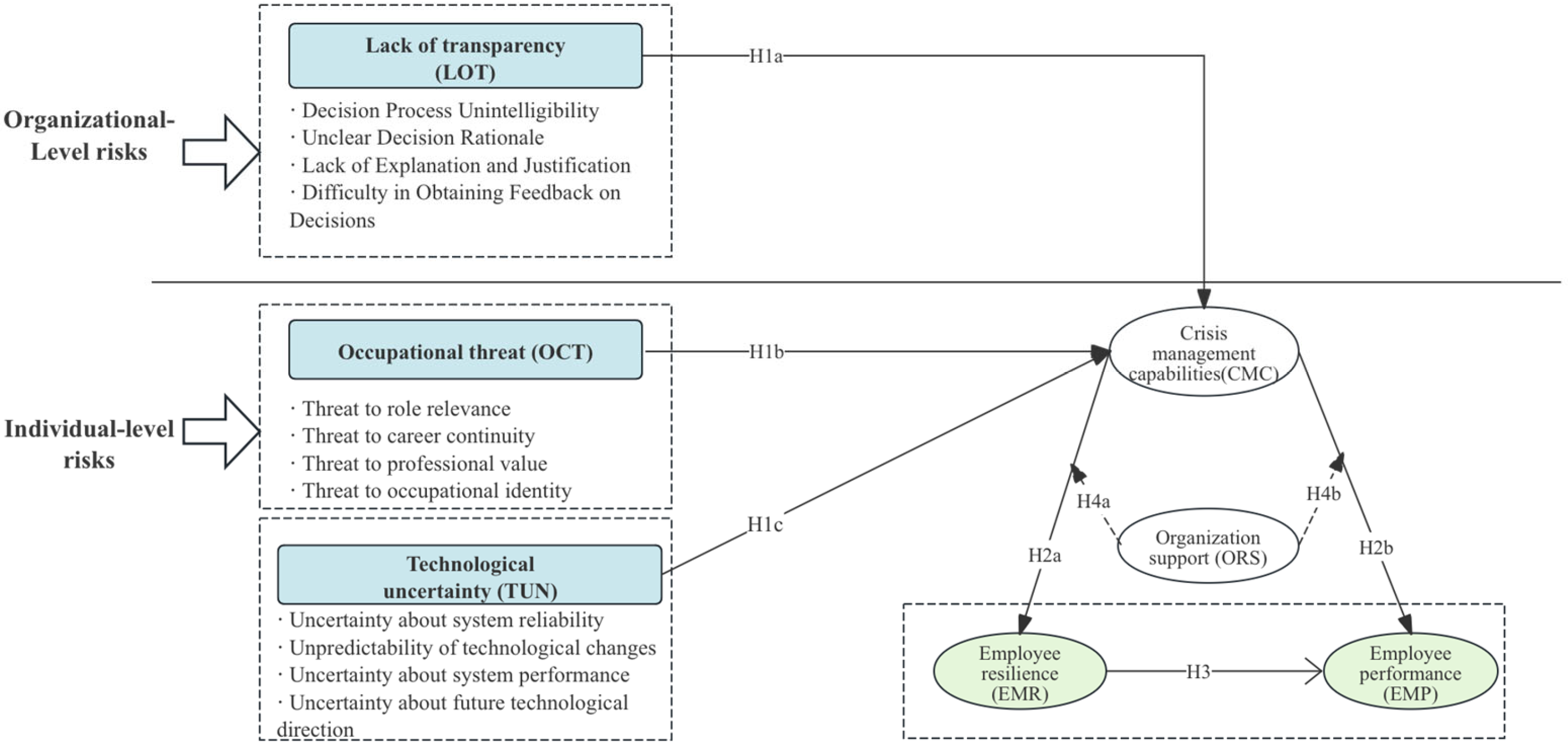
Drawing on the preceding theoretical analysis, the relationships among the key constructs are established. Thus, the conceptual framework of this study is presented in Figure 1.
Figure 1.
Conceptual Framework.
3. Research Design and Data Collection
3.1. Research Subjects
This study adopts a cross-sectional survey design using self-reported data, which is appropriate for examining perceptual and psychological constructs such as risk perception, resilience, and perceived organizational support. Given that AI-related risks are experienced subjectively by employees, self-report measures provide direct access to these internal cognitive and emotional states. Although cross-sectional data limit strong causal inference, the study relies on established theoretical frameworks and directional hypotheses to guide model specification. Moreover, statistical procedures, including mediation and moderation analysis within PLS-SEM, allow examination of structural relationships consistent with theory. Nevertheless, causal interpretations should be made cautiously, and future research using longitudinal or experimental designs is encouraged to further validate the temporal dynamics identified in this study.
3.2. Data Collection
The empirical scope of this research is situated within the agricultural SME sector of Northwest China, specifically targeting its workforce, including regions such as Inner Mongolia, Gansu, Ningxia, and Qinghai. These areas are characterized by limited water resources, high agricultural production risks. Executing a structured survey methodology, we gathered primary data from the agri-enterprise workforce across China between October and November 2025. In the process of promoting AI-enabled agricultural systems [61], such as intelligent irrigation, digital ranching, drone-based field monitoring, and smart feeding systems, employees in these enterprises face typical challenges related to organizational transformation and technology adaptation [61,62]. Therefore, they represent suitable and representative subjects for examining AI-related organizational and psychological responses. Ethical adherence was ensured by securing prior written consent from all adult respondents, with the study strictly excluding any minor participants.
Primary data were sourced through a systematic survey instrument, allowing for a structured quantification of respondent insights. Prior to the formal survey, interviews with industry managers and technical personnel were conducted, and established measurement scales were adapted to develop the final questionnaire. Both online and offline distribution methods were employed. From an initial pool of 519 collected responses, a rigorous data-cleaning protocol was applied to exclude entries characterized by systematic biases, logical contradictions, or significant data gaps. This process yielded a final sample of 418 usable cases, representing an efficiency rate of 80.54%—a volume well-suited for the dual requirements of SEM and NCA.
3.3. Sample Statistics
With a representative and balanced demographic structure. Specifically, we explain that the sample was drawn from agricultural SMEs in Northwest China, a region that faces unique AI-related challenges in agriculture due to its geographic, economic, and technological context.
A stratified sampling technique was employed to ensure broad representation, encompassing small and medium-scale firms across various organizational scales, spatial distributions, and stages of digital maturity within the area. This approach was aimed at capturing a broad spectrum of perspectives on AI-related risks and their impact on employee performance and resilience. The sample includes a gender-balanced distribution (45.22% male, 54.78% female), with 46.17% of respondents aged 31–40, reflecting the core labor force in agricultural SMEs undergoing digital transformation. The workforce surveyed is highly credentialed, with 78% having attained degree-level education or above. This suggests the sample is well-positioned to navigate the complexities of AI-driven changes. Frontline employees form the largest group (51.91%), reflecting the organizational structure of agricultural enterprises (Table 2).
Table 2.
Sample Characteristics.
Additionally, the sample covers key functional departments such as production, finance, sales, HR, and R&D. Respondents’ work experience in agriculture spans various tenure levels, and the businesses represented include crop farming, animal husbandry, agricultural technology services, product processing, and integrated operations. This diverse sample ensures robust empirical analysis.
4. Results Analysis
4.1. Regression Analysis of Control Variables
To account for the potential role of demographic variables in shaping employee performance (EMP) and to ensure the integrity of the subsequent structural model, we controlled for these factors to mitigate any biased estimations. Initially, we regressed employee performance (EMP) on a suite of control variables, including demographic profiles (gender, age, education) and professional backgrounds (job role, department, industry tenure, and firm type). The outcomes of this preliminary analysis are tabulated in Table 3.
Table 3.
Results of Linear Regression Analysis (n = 418).
The initial regression analysis reached statistical significance (F (7,410) = 4.031, p < 0.001), confirming that the set of control variables possesses collective predictive utility in relation to employee performance. The coefficient of determination (R2) was 0.064, and the adjusted R2 was 0.048, Specifically, 4.8% of the variance in EMP is attributable to the control variables, a figure that conforms to the established premise in the field. It is well-documented that such baseline factors generally exert a marginal influence compared to core psychological or organizational constructs [27].
In terms of specific predictors, academic credentials were found to be positively and significantly associated with employee performance (β = 0.12, p = 0.016 < 0.05), Providing evidence that greater scholastic attainment is positively linked to optimized workplace results. Specifically, internal department assignment served as a significant negative predictor, indicating that the nature of the division one belongs to can detract from overall efficacy (β = −0.17, p = 0.001 < 0.01), While these findings highlight inter-departmental performance gaps, the impacts of gender, age, job role, and business category were negligible, as they did not meet the threshold for statistical significance (p > 0.05). The multicollinearity diagnostics indicated that all VIF values were below 2 [63]. The assessment of Variance Inflation Factors (VIF) and tolerance levels (all > 0.65) confirmed that the independent variables are suitably independent [26]. Consequently, the model is devoid of multicollinearity concerns, rendering the subsequent path estimates both stable and credible.
4.2. PLS-SEM Result
4.2.1. Measurement Model
Prior to estimating the structural paths, it is imperative to establish the psychometric soundness of the measurement model. Specifically, this phase involved verifying that the research instruments possess sufficient internal consistency and construct validity [64]. Following the PLS-SEM framework, the measurement model was scrutinized based on its reliability, convergent validity, and discriminant properties [65,66].
Analysis of the measurement model (Table 4) confirms that the scales possess adequate reliability and validity. Specifically, internal consistency was supported by reliability coefficients ranging from 0.826 to 0.933. Convergent validity was evidenced by the fact that all AVE values (0.593–0.739) and factor loadings (>0.68) met the ideal performance parameters. To ensure the distinctiveness of the constructs, the Fornell-Larcker criterion was applied, successfully demonstrating that the square root of each AVE surpassed inter-construct correlations. Additionally, the structural integrity of the model was reinforced by VIF values below 5, precluding any concerns regarding multicollinearity.
Table 4.
Reliability and convergent validity.
4.2.2. Discriminant Validity Test (HTMT)
To supplement the initial analysis, the HTMT technique was utilized to verify the distinctiveness of the constructs, as shown in Table 5. Following established psychometric guidelines, an HTMT value failing to exceed the conservative 0.85 limit or the liberal 0.90 cutoff provides robust evidence that the variables are statistically independent [67,68]. With the highest HTMT ratio reaching only 0.783—well within the prescribed 0.85,the model demonstrates superior discriminant validity. This statistical independence ensures that the subsequent SEM estimations are based on clearly differentiated theoretical dimensions [69,70,71,72].
Table 5.
Heterotrait–Monotrait Ratio (HTMT).
4.2.3. Discriminant Validity Test (Fornell–Larcker)
Table 6 validates discriminant validity via the Fornell-Larcker criterion, showing diagonal AVE square roots (0.770–0.860) consistently exceed inter-construct correlations. Notably, EMR (0.781) and ORS (0.858) surpass their peak correlations with EMP and CMC, respectively. This confirms that each latent variable shares greater variance with its own indicators than with other constructs, establishing the psychometric robustness required for structural modeling.
Table 6.
Fornell-Lacker criterion.
4.3. Correlation Analysis
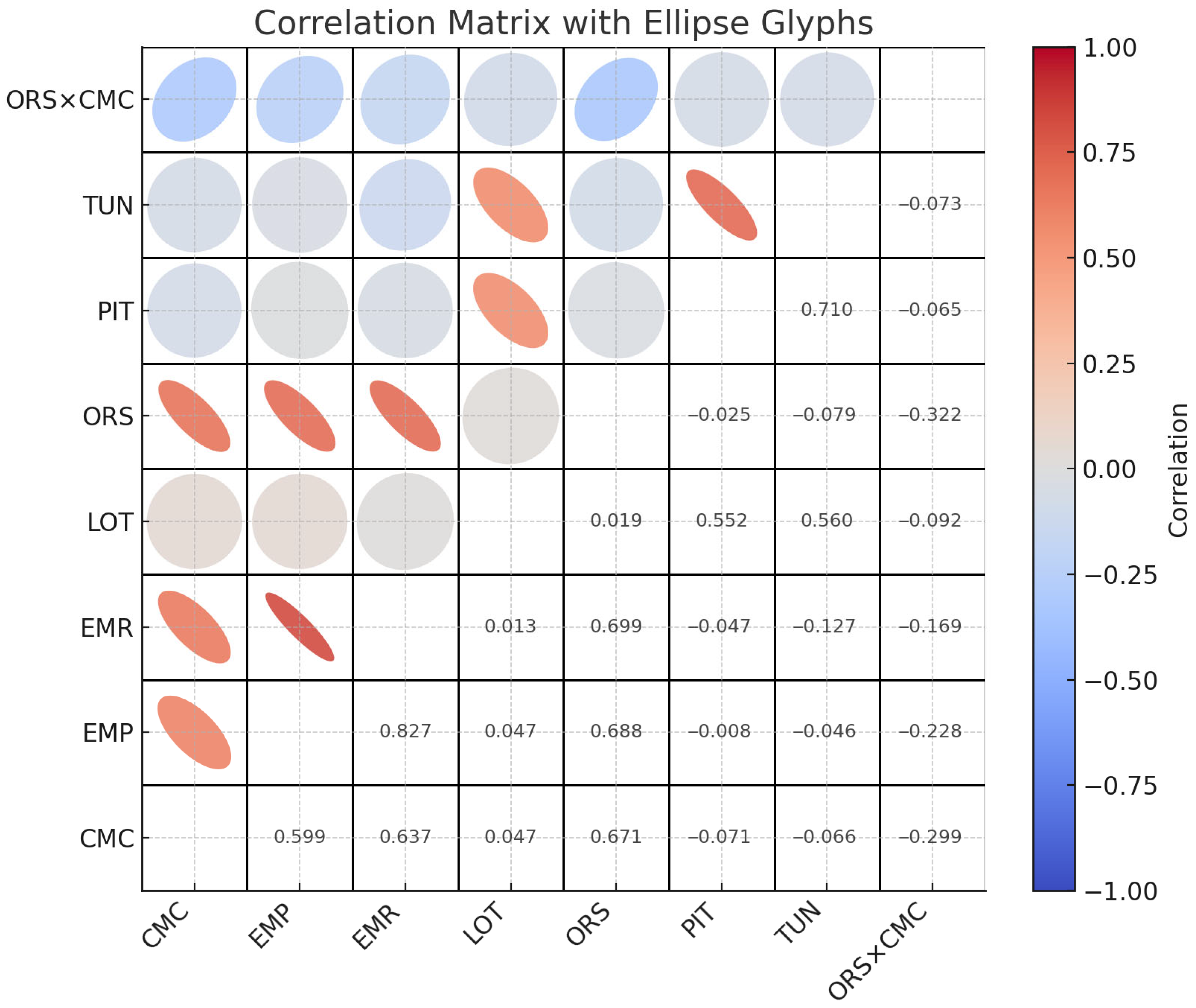
To preliminarily examine the direction and strength of the associations among the variables in the model, a correlation heatmap was generated, as shown in (Figure 2). Overall, the core variables CMC, EMP, EMR, and ORS exhibit moderate to strong positive correlations (indicated by medium to deep blue shading), suggesting that these constructs are conceptually and statistically closely related.
Figure 2.
Correlation between variables.
The correlation between EMR and EMP is the strongest, which aligns closely with theoretical expectations. Meanwhile, LOT, OCT, and TUN also exhibit relatively strong positive intercorrelations. A particularly noteworthy finding is that the core variable set represented by CMC, EMP, EMR, and ORS shows only very weak or near-zero correlations with the variable set represented by LOT, OCT, and TUN (indicated by white or very light blue shading). This distinct “block-pattern” correlation structure [73] provides preliminary evidence that the core explanatory model is well differentiated from the antecedent and control variables included in the analysis.
4.4. Structural Analysis
Inner Model
Statistical validation of the conceptual model was performed via PLS-SEM, with comprehensive metrics provided in Table 7. The data demonstrate strong predictive support for most proposed hypotheses, substantiated by the observed path coefficients and their corresponding t-values.
Table 7.
Assessment of Structural Model.
The empirical results provide a nuanced understanding of the structural links. Specifically, Crisis Management Capability (CMC) failed to exert a direct statistical influence on Employee Performance (EMP) (β = 0.038, p = 0.512), implying that its effect may be indirect rather than immediate in the AI-risk landscape. Conversely, CMC demonstrated a robust positive association with Employee Resilience (EMR) (β = 0.319, p < 0.001), reinforcing the premise that organizational readiness is a critical antecedent to psychological resilience. Crucially, EMR was found to be a powerful predictor of performance (β = 0.668, p < 0.001), confirming that individual adaptive capacity is paramount for maintaining high output during disruptions.
Results indicate Lack of Transparency (LOT) lacks a significant link to CMC (β = 0.145, p > 0.01), suggesting other drivers in agri-SMEs. Conversely, Organizational Support (ORS) robustly enhances both EMP and EMR (β = 0.182/0.514, p < 0.01). While ORS significantly moderates the CMC-EMR path (β = 0.064, p = 0.039), it fails to moderate the CMC-EMP relationship. Finally, PIT and TUN exert no discernible influence on CMC, confirming these external stressors do not directly impede crisis capability in this framework.
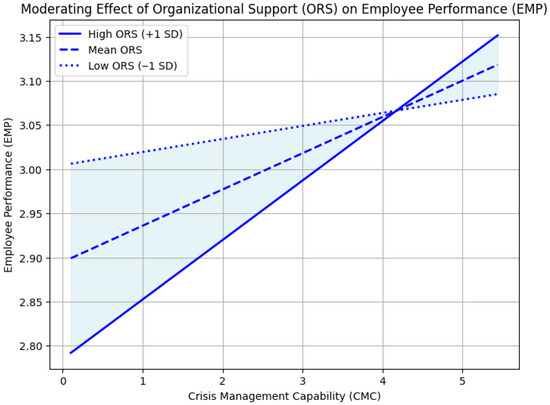
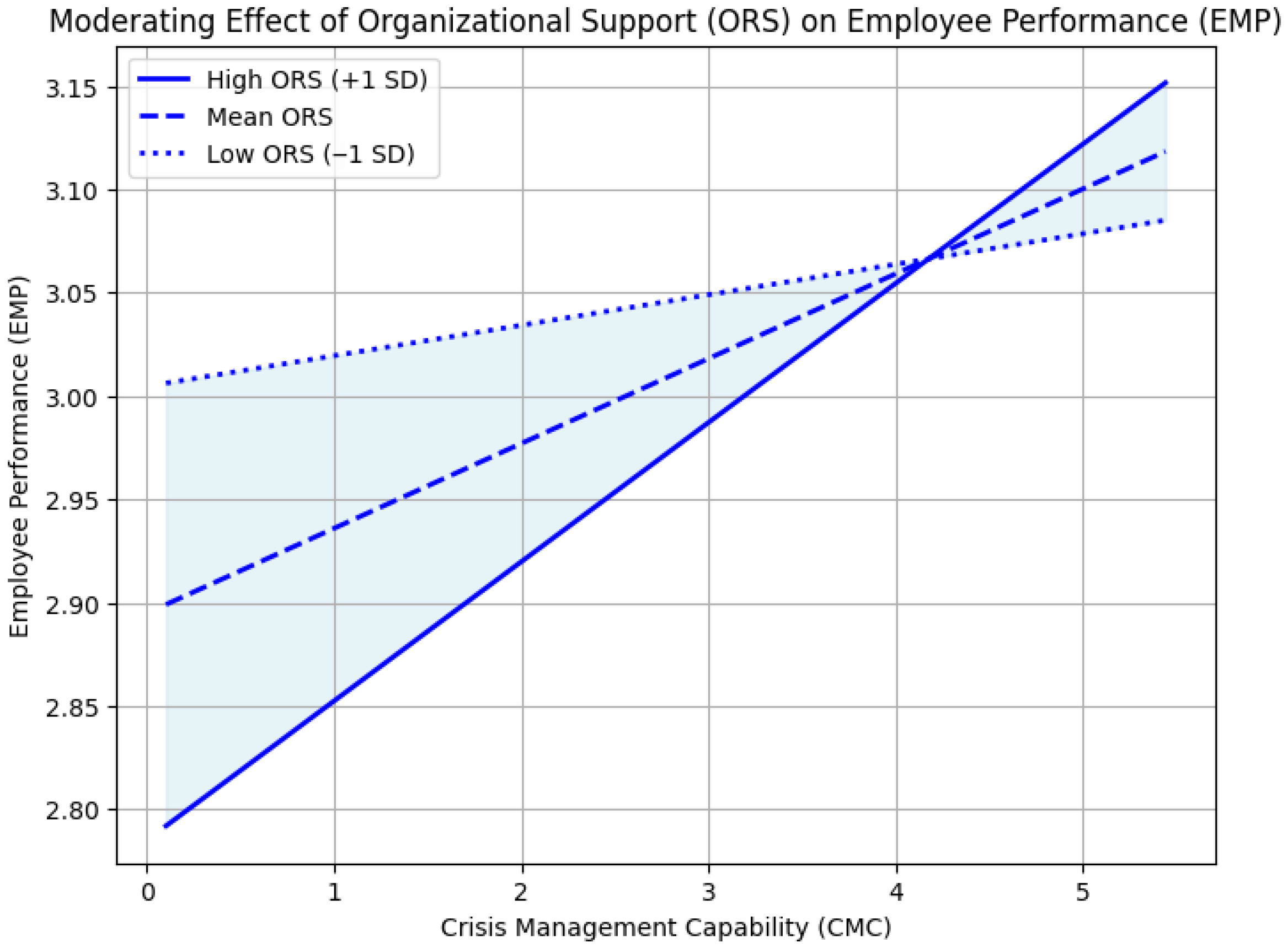
The interaction effect between organizational support (ORS) and crisis management capability (CMC) in shaping employee resilience (EMR). High ORS attenuates the positive association between CMC and EMR, indicating a buffering effect (Figure 3).
Figure 3.
Simple Slope Plot.
4.5. Necessary Condition Analysis
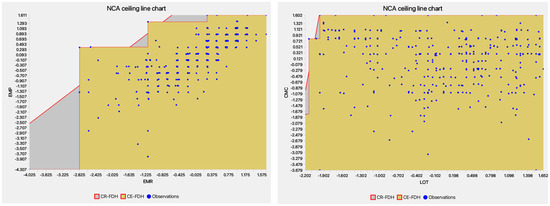
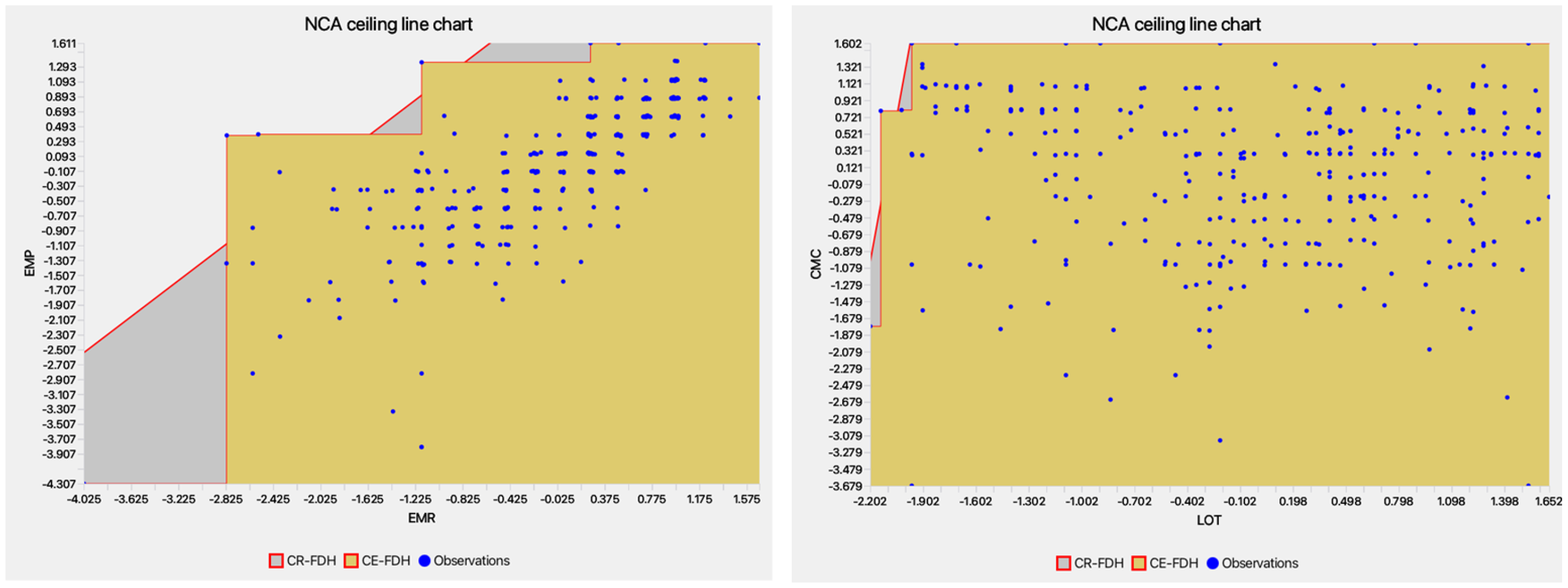
Departing from traditional symmetry-based analysis, this study incorporates applying Necessary Condition Analysis (NCA) to determine which factors act as non-negotiable requirements for the target constructs, rather than mere probabilistic predictors. The core value of NCA lies in its ability to transcend conventional sufficiency logic by precisely quantifying the “necessary but not sufficient” relationships between independent variables (IV) and dependent variables (DV) [74,75]. By demarcating the minimum thresholds essential for achieving specific outcome levels, this methodology provides a quantitative foundation for understanding causal constraints [76]. In practice, NCA begins by establishing a ceiling line on a scatter plot (Figure 4), which connects the uppermost observations to visually delineate the boundary of necessary conditions.
Figure 4.
Scatter plots of necessary condition analysis.
The blue “×” markers represent the observed data points of EMR and EMP. The black stepwise line (CE-FDH) indicates the ceiling envelope (Figure 4), which depicts the maximum possible level of EMP at different levels of EMR. The red line (CR-FDH) represents the ceiling regression line, reflecting a linear approximation of the necessity effect. The analysis shows that Employee Resilience (EMR) is a necessary but not sufficient condition for Employee Performance (EMP). The CMC remains relatively stable, with little fluctuation. However, as LOT increases, the CMC begins to show a noticeable upward shift, indicating that higher LOT levels push CMC toward higher values. This suggests that when transparency in crisis communication is low (high LOT), organizations are able to develop a higher crisis management capability, possibly due to a more urgent need for crisis response and control. In other words, the Lack of Transparency Risk (LOT) appears to act as a driving factor, encouraging organizations to develop more robust crisis management processes.
NCA results support this claim by demonstrating that CMC contributes to the achievement of high employee performance and resilience, but it is not the only factor that determines performance outcomes. This finding aligns with the theoretical distinction between sufficiency and necessity: in a complex organizational context, factors such as psychological resilience, organizational culture, and leadership can compensate for the lack of CMC and still produce positive performance outcomes. Thus, while CMC is sufficient to drive high performance, it is not strictly necessary if other organizational resources or conditions are in place.
4.6. SVM Decision Boundary Analysis
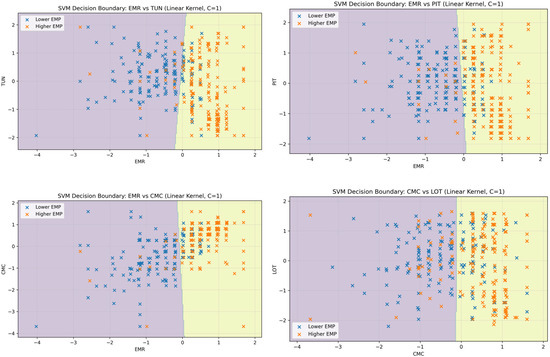
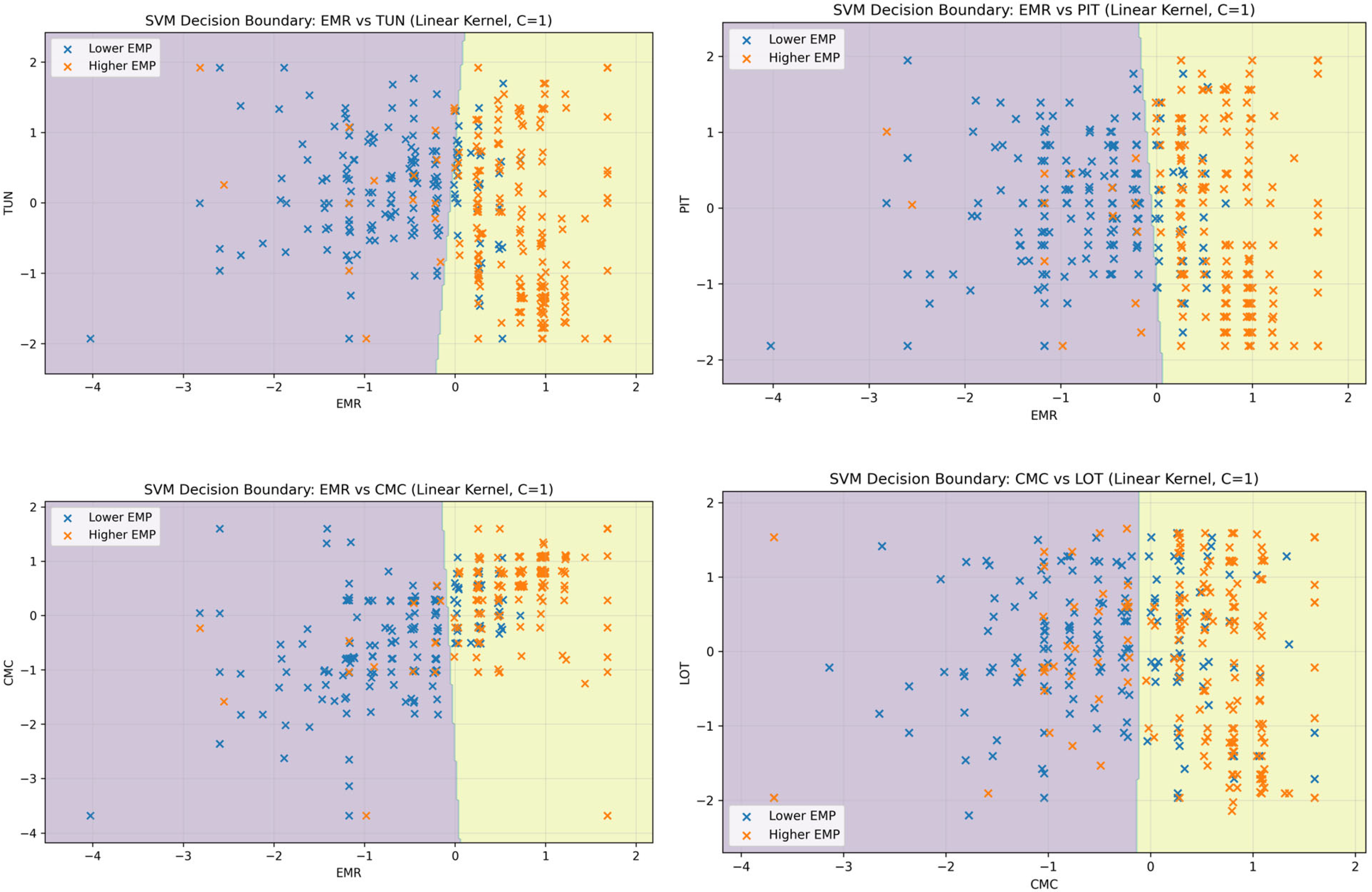
To further visualize the non-linear and configurational effects among AI-related risks, crisis management capability, and employee outcomes, we employed Support Vector Machine (SVM) classification with a linear kernel. The SVM decision boundary plots illustrate how combinations of organizational and individual-level AI risks (LOT, TUN, and OCT) and crisis management capability distinguish high versus low levels of employee resilience and performance, thereby complementing the findings from SEM and NCA.
The decision boundary analysis indicates (Figure 5) that under conditions of low crisis management capability (CMC), samples are predominantly classified into the low employee resilience region regardless of the level of lack of transparency (LOT). However, once CMC exceeds a certain threshold, employees are more likely to be classified as exhibiting high resilience, even when transparency-related risks remain high. Similarly, when technological uncertainty (TUN) is high and CMC is low, employee resilience is largely concentrated in the low-resilience region. As CMC increases, the decision boundary shifts noticeably toward the high-resilience region, suggesting a buffering effect of organizational crisis management capability.
Figure 5.
SVM Decision Boundary Analysis with EMR, EMP.
Under conditions of high occupational identity threat (OCT/PIT), employees are able to maintain higher levels of resilience only when CMC is sufficiently strong. AI-induced occupational identity threat represents a deep-seated psychological risk; if organizations fail to address this threat through institutional responses, effective communication, and supportive practices, employee resilience is likely to deteriorate substantially. These findings underscore the critical mediating and moderating role of crisis management capability in transforming psychological risks into psychological resources.
5. Conclusions and Discussion
5.1. Discussion
Our findings illuminate the complex interplay between AI-associated threats and their subsequent effects on the adaptive capacity and output of workers within the agricultural SME sector. The structural model reveals that EMR serves as the most potent precursor to employee performance, yielding the highest path coefficient among all tested indicators (EMP) (β = 0.668, p < 0.001), underscoring the vital role of psychological resilience in maintaining performance under AI-induced challenges. In environments where AI technologies are being integrated, employees’ ability to adapt to technological disruptions and sustain work engagement is paramount [77]. Employee resilience not only reflects individual self-efficacy but also signifies a dynamic adaptive capacity that helps employees remain productive during transitions, making it a key organizational asset in the digital transformation process.
Despite Crisis Management Capability (CMC) showing a significant positive relationship with employee resilience, it did not directly influence employee performance (EMP) (β = 0.038, p = 0.512). This indicate that while CMC plays a significant role in building resilience, it is the resilience itself that has a more direct impact on performance. This finding shifts the focus from crisis management strategies alone to a broader resilience-building approach that supports employees in managing AI-related risks. Organizations should prioritize building resilience through training programs that emphasize stress tolerance, self-efficacy, and adaptive problem-solving, which are crucial for ensuring sustained performance during times of digital transformation.
The findings also indicate that organizational support (ORS) is critical in influencing both employee performance and resilience (β = 0.182, p = 0.007 for EMP and β = 0.514, p < 0.001 for EMR). These results highlight that employees are more likely to thrive in environments where they feel supported not only through technical resources but also psychosocial support, such as emotional backing, career development opportunities, and a fair work environment [76,78]. However, while ORS moderates the relationship between CMC and resilience, its moderation effect on performance was found to be non-significant (β = −0.032, p = 0.401), indicating that while support is vital for resilience, it does not necessarily translate to improved performance unless combined with other organizational capabilities. The claim about CMC being a sufficient but not necessary condition is an interpretation of the NCA results and should be discussed in the theoretical implications subsection. This is where you elaborate on how Crisis Management Capability contributes to employee performance and resilience, and why it is considered sufficient but not necessary in the study’s context.
Regarding the SVM results, we understand that the visual illustration provided by the SVM method was descriptive, and the implications were not sufficiently discussed. We have revised the manuscript to include a more detailed interpretation of the SVM findings. We acknowledge that SVM is primarily a classification method, which was used here to illustrate the decision boundaries in the relationship between Crisis Management Capability (CMC), Employee Resilience (EMR), and Employee Performance (EMP) under different levels of organizational support (ORS). However, we agree that the discussion of these results lacked adequate depth in terms of their theoretical and practical implications.
In the revised manuscript, we have added a more thorough discussion of how the SVM-based decision boundary analysis provides insight into the dynamic interactions between the key variables. This method visually represents how different levels of CMC and ORS influence Employee Performance (EMP) and Resilience (EMR). The SVM results indicate that Employee Resilience plays a central role in determining Employee Performance, with organizational support strengthening this relationship, especially when Crisis Management Capability is high. We have further discussed the limitations of SVM, including its descriptive nature and the need for additional statistical tests to fully validate the findings. We argue that SVM complements PLS-SEM by providing visual insights into the moderating effects of organizational support.
Finally, Lack of Transparency (LOT), Professional Identity Threat (PIT), and Technological Uncertainty (TUN) were found to have no direct impact on Crisis Management Capability (CMC). This suggests that while these AI-related risks are critical in broader organizational contexts, they do not directly affect CMC in the agricultural SME sector [79,80]. It is possible that these risks are mediated by other organizational factors such as leadership, culture, and management practices that ensure employees are supported during AI-driven transformations.
5.2. Conclusions
Our findings offer pivotal insights into the ramifications of AI risks for employee-level attributes. Despite the lack of evidentiary support for the impact of LOT, PIT, and TUN on CMC, these results are significant as they delineate the limits of current AI risk theories within the context of small-scale agricultural enterprises, pointing toward a more complex organizational reality [46,81]. Specifically, the lack of significance for LOT, PIT, and TUN in shaping CMC suggests that while these factors are important, they do not have a direct impact on Crisis Management Capability in the context of agricultural SMEs undergoing AI-driven transformations. This finding challenges the assumption that AI-related risks such as technological uncertainty or professional identity threats directly affect Crisis Management Capability, highlighting the complexity of crisis management processes in organizations. These risks may not directly influence CMC, but they might affect employees in indirect ways, such as through organizational culture, leadership, or employee engagement, which are not captured by traditional measures of crisis management. Furthermore, while Crisis Management Capability (CMC) was found to positively influence employee resilience (EMR), its non-significant impact on employee performance (EMP) emphasizes that resilience rather than crisis management alone drives performance improvements in AI-driven environments. This suggests that organizations need to prioritize resilience-building programs alongside technical training to help employees adapt to AI-induced disruptions.
Interestingly, while Organizational Support (ORS) was found to significantly impact both EMP and EMR, its moderating effect on the CMC-EMP relationship was non-significant, indicating that organizational support alone cannot enhance performance unless it is coupled with strong employee resilience and organizational capabilities. This highlights the indirect role that organizational support plays in fostering resilience and suggests that support systems should be integrated into a broader, more comprehensive organizational approach to AI-driven transformation [82,83]. Despite the non-significant results, these findings remain important because they help clarify which factors are necessary conditions for successful adaptation to AI transformations, thus contributing to the theoretical understanding of organizational behavior in the digital age [84,85]. The absence of direct significance in certain paths underscores the underlying complexity of the model, necessitating a deeper look into leadership and organizational climate. Integrating these elements into future frameworks could reveal sophisticated mediation paths that explain how AI risks are processed within firms [86]. Thus, rather than indicating model failure, these findings unveil new avenues for assessing the contextual determinants and indirect pathways that bolster organizational hardiness amidst technological disruptions [87].
6. Implications
6.1. Theoretical Implications
The findings of this study address several critical gaps within the existing body of knowledge. First, by examining professional identity threat, technological uncertainty, and transparency-related risks in the context of AI-driven agricultural work environments [18,20,61,88], this study extends the research on risk perception beyond traditional economic or operational risk frameworks. The findings demonstrate that the psychological consequences of AI adoption particularly identity insecurity and uncertainty [21,62] regarding controllability are central mechanisms shaping workers’ adaptive responses. This enriches the theoretical understanding of how perceived technological threats translate into behavioral and performance outcomes.
Second, this study highlights the pivotal role of employee resilience as a psychological bridge linking risk perception and performance [4,18]. While prior studies have emphasized skill upgrading and capability development as the foundation of performance improvement [1,15], the current findings show that resilience functions as an internal psychological resource that enables workers to sustain motivation and task engagement under conditions of uncertainty.
Third, by integrating PLS-SEM (sufficiency logic) with NCA (necessity logic), this study advances methodological approaches in organizational research. While SEM revealed that crisis management capability (CMC) can enhance resilience and performance, NCA showed that CMC is not a necessary condition for achieving performance. Conversely, organizational transparency (LOT) and resilience (EMR) emerge as necessary bottleneck conditions: when transparency is low or resilience is weak, high levels of performance cannot be achieved regardless of other supportive variables [19,89]. The findings highlight a non-linear interplay between latent resources and outcomes, facilitated by a dual-perspective methodology. Specifically, the data prove that organizational and psychological assets exhibit functional asymmetry: some facilitate incremental gains, while others impose structural ceilings on an employee’s performance capacity.
Lastly, this evidence enriches the field of agri-business organizational behavior by illustrating [79,80,90] that successful organizational adaptation to AI is not determined solely by technological capability. Instead, identity security and institutional clarity serve as foundational prerequisites for employees to internalize [45] and benefit from technological change. This suggests a reorientation in theoretical thinking from “technology acceptance” to “technology adaptation,” emphasizing the role of interpersonal and systemic psychological security in shaping productive AI integration.
6.2. Practical Implications
Initially, the findings highlight that institutional transparency serves as a pivotal driver of worker output. A deficit in information clarity acts as a structural impediment to both resilience and productivity, potentially undermining the durability of digitalization initiatives. Consequently, enterprises should embed open communication architectures and transparent governance into their AI adoption strategies. Far from being a luxury, transparency constitutes a core institutional prerequisite that bolsters trust and psychological contract fulfillment. From a sustainability perspective, such openness cultivates an equitable atmosphere, ensuring that AI-driven progress harmonizes with the dual objectives of corporate efficiency and personnel welfare.
In addition, the robust mediating effect of resilience indicates that fostering mental agility is as essential as technical training. Organizations are encouraged to bolster the rebounding capacity of their staff to ensure consistent performance during digital disruptions. This includes providing emotional support systems, reflective learning opportunities, structured problem-solving routines, and positive feedback mechanisms. By strengthening self-efficacy, stress tolerance, and adaptive coping strategies, organizations can sustain employee motivation and performance in rapidly evolving technological environments. This approach contributes directly to sustainable workforce development, ensuring that employees are not only equipped with technical skills but also with the psychological resilience needed to navigate the challenges of digital transformation.
While CMC helps strengthen resilience and boost performance, the NCA test rules out its possibility as a necessary prerequisite for performance improvement. This finding clarifies the logical boundaries between CMC and performance growth. This implies that organizations can achieve performance gains through multiple resource pathways, such as supportive leadership, collaborative team climates, and shared learning practices. For sustainable management, it is crucial that managers avoid overemphasizing individual crisis-handling ability and instead cultivate collective resilience and distributed problem-solving systems. By focusing on organizational capacity rather than individual performance, companies can ensure a more sustainable and adaptive approach to risk management and crisis response.
Fourth, the significant role of organizational support in strengthening the relationship between resilience and performance emphasizes the importance of relational and socioemotional resources. Supportive managerial communication, recognition of effort, fair workload distribution, and career progression pathways can foster a sense of belonging and motivation. However, the non-significant moderation of CMC–resilience suggests that while organizational support is essential, it cannot replace structural transparency or identity security. In the context of sustainable management, support practices should be embedded within stable, coherent, and fair organizational systems, rather than relying solely on short-term motivational gestures. This approach ensures that employee well-being and organizational performance remain aligned with long-term sustainability goals.
Finally, the findings have significant implications for workforce development in rural and agricultural contexts, where digital transitions may be perceived as disruptive. Policies and organizational programs should frame AI integration not as a replacement for human labor but as an enhancement of human capability. Acknowledging the irreplaceable value of workers’ experiential knowledge and contextual judgment is essential for fostering a sustainable and inclusive path to technological modernization. By reinforcing identity security and dignity, organizations can reduce resistance to change and build a more sustainable, psychologically inclusive approach to AI adoption. This will not only benefit the individual employees but also contribute to the long-term sustainability of agricultural enterprises as they navigate the complexities of digital transformation.
6.3. Theoretical Contribution
Beyond employing Necessary Condition Analysis (NCA) within the agricultural AI domain, this research advances theoretical discourse by clarifying the intricate relationship between AI-associated risks and their subsequent impact on employee resilience and workplace performance. This study expands on existing research by proposing that employee resilience is not only a personal trait but also a dynamic capacity shaped by both crisis management capabilities and organizational support. This theoretical framework clarifies the link between resilience and performance, highlighting the vital impact of transparency and psychosocial support in navigating AI-induced challenges. Additionally, utilizing NCA allows for a departure from traditional sufficiency analyses, identifying the non-negotiable conditions required for personnel to thrive amid AI adoption. This theoretical refinement deepens our understanding of the complex relationships between organizational capabilities and individual psychological resources in high-tech environments.
By introducing NCA into the AI risk context and focusing on resilience as a necessary condition, the study offers a theoretical shift from prior models that often emphasize sufficient conditions or mediating effects. Our findings suggest that AI-related risks require organizations to not only invest in technical expertise but also prioritize the psychological resilience of employees, particularly in industries undergoing digital transformation. These findings establish a fresh conceptual foundation for exploring the triadic relationship between artificial intelligence, human behavior in the workplace, and strategic decision-making.
7. Limitations and Future Research
While this research offers valuable insights, certain constraints must be noted, which in turn pave the way for subsequent investigations. Specifically, the empirical evidence was derived exclusively from small and medium-sized agricultural enterprises situated in Northwest China, a region characterized by relatively fragile ecological conditions, limited digital infrastructure, and higher operational uncertainty. This regional focus, while providing a robust foundation for theorizing AI risks, introduces certain geographical boundaries. The conclusions drawn here may not be directly applicable to the eastern digital farming clusters or the ecological agriculture systems prevalent in southern provinces, which operate under different structural dynamics. Future research is encouraged to conduct cross-regional comparative studies or expand to different types of agricultural organizations to validate the robustness and contextual boundary of the proposed model.
In addition, the study relied primarily on self-reported questionnaire data to measure employees’ risk perceptions, crisis management capability, resilience, and performance. Such data may be affected by social desirability bias or common method variance. Although procedural controls (e.g., anonymity, reverse items) and statistical tests were applied, future research may incorporate multi-source or multi-method data, such as supervisor evaluations, production performance records, digital behavioral logs, or physiological/emotional monitoring indicators, to enhance measurement validity.
Finally, this study adopted a cross-sectional research design, which limits the ability to infer dynamic causal mechanisms and temporal developmental patterns. However, risk perception, resilience development, and crisis response processes are inherently dynamic and iterative. Future studies should consider longitudinal tracking, process modeling, or experience sampling methods (ESM) to examine how employee psychological and behavioral adjustments evolve across different stages of AI adoption.
Author Contributions
D.L.: Conceptualization, methodology, data collection, formal analysis, manuscript writing; W.L.: Research design, data validation, supervision, manuscript review and editing. All authors have read and agreed to the published version of the manuscript.
Funding
This research was supported by National Natural Science Foundation of China Funding No. 72471223 and 72231010.
Institutional Review Board Statement
The study was conducted in accordance with the Declaration of Helsinki, and the protocol was approved by the Ethics Committee of University of Chinese Academy of Sciences (UCASSTEC25-047) on 15 October 2025.
Informed Consent Statement
Informed consent was obtained from all subjects involved in the study.
Data Availability Statement
Data available in a publicly accessible repository. The original data presented in the study are openly available in Zenodo at https://doi.org/10.5281/zenodo.18028970.
Acknowledgments
The authors would like to thank institutions, experts, or individuals for their valuable support during data collection and project coordination. We also acknowledge the participating agricultural enterprises for their cooperation.
Conflicts of Interest
The authors declare that they have no competing interests.
References
- Aijaz, N.; Lan, H.; Raza, T.; Yaqub, M.; Iqbal, R.; Pathan, M.S. Artificial intelligence in agriculture: Advancing crop productivity and sustainability. J. Agric. Food Res. 2025, 20, 101762. [Google Scholar] [CrossRef] [Scilit]
- Omotayo, A.O.; Adediran, S.A.; Omotoso, A.B.; Olagunju, K.O.; Omotayo, O.P. Artificial intelligence in agriculture: Ethics, impact possibilities, and pathways for policy. Comput. Electron. Agric. 2025, 239, 110927. [Google Scholar] [CrossRef] [Scilit]
- Chen, X. The role of modern agricultural technologies in improving agricultural productivity and land use efficiency. Front. Plant Sci. 2025, 16, 1675657. [Google Scholar] [CrossRef] [Scilit] [PubMed]
- Li, M.; Feng, F.; Nisar, D.U.; Khalid, Z.; Ahmad, M. Advancing Sustainable Agricultural Productivity through Structural Adjustment and Digitalization in China. Front. Sustain. Food Syst. 2025, 9, 1639062. [Google Scholar] [CrossRef] [Scilit]
- Tace, Y.; Elfilali, S.; Tabaa, M.; Leghris, C. Implementation of smart irrigation using IoT and artificial intelligence. Math. Model. Comput. 2023, 10, 575–582. [Google Scholar] [CrossRef] [Scilit]
- Kong, J.W.; Kwon, H.-J.; Oh, H. Voices of migrant care workers caring for older adults in South Korea: A qualitative descriptive analysis. J. Asian Public Policy 2025, 1–12. [Google Scholar] [CrossRef] [Scilit]
- Li, X.; Ma, Y.; Zhang, W. Enhancing urban public service efficiency through the national civilized city policy: An empirical analysis of 282 cities in China from 2005 to 2019. J. Asian Public Policy 2025, 18, 767–796. [Google Scholar] [CrossRef] [Scilit]
- Ivchyk, V. Overcoming barriers to artificial intelligence adoption. Three Seas Econ. J. 2024, 5, 14–20. [Google Scholar] [CrossRef] [Scilit]
- Xia, J.; Ning, L.; Wang, Q.; Chen, J.; Wan, L.; Hong, S. Vulnerability of and risk to water resources in arid and semi-arid regions of West China under a scenario of climate change. Clim. Change 2017, 144, 549–563. [Google Scholar] [CrossRef] [Scilit]
- Han, X.; Zhao, Y.; Gao, X.; Jiang, S.; Lin, L.; An, T. Virtual water output intensifies the water scarcity in Northwest China: Current situation, problem analysis and countermeasures. Sci. Total Environ. 2021, 765, 144276. [Google Scholar] [CrossRef] [Scilit]
- Wu, F.; Sun, Y.; Sun, Z.; Wu, S.; Zhang, Q. Assessing agricultural system vulnerability to floods: A hybrid approach using emergy and a landscape fragmentation index. Ecol. Indic. 2019, 105, 337–346. [Google Scholar] [CrossRef] [Scilit]
- Nguyen, T.T.; Grote, U.; Neubacher, F.; Do, M.H.; Paudel, G.P. Security risks from climate change and environmental degradation: Implications for sustainable land use transformation in the Global South. Curr. Opin. Environ. Sustain. 2023, 63, 101322. [Google Scholar] [CrossRef] [Scilit]
- Celestin, M.; Sujatha, S. AI’s impact on corporate strategies and efficiency: Risks, opportunities, and ethical considerations. Indo Am. J. Multidiscip. Res. Rev. 2024, 8, 111–119. [Google Scholar]
- Rezaei, M.; Pironti, M.; Quaglia, R. AI in knowledge sharing, which ethical challenges are raised in decision-making processes for organisations? Manag. Decis. 2025, 63, 3369–3388. [Google Scholar] [CrossRef] [Scilit]
- Donfouet, O.; Ngouhouo, I. Impact of artificial intelligence on the total productivity of agricultural factors in Africa. Environ. Dev. Sustain. 2024, 1–29. [Google Scholar] [CrossRef] [Scilit]
- Abdul-Rahman, M.; Anwer, S.; Antwi-Afari, M.F.; Uddin, M.N.; Li, H. Climatic Heat Stress Management Systems in Hong Kong’s Construction Industry: A Scoping Review. Buildings 2025, 15, 3456. [Google Scholar] [CrossRef] [Scilit]
- Liu, L.; Liu, Y. AI-assisted decision-making and dynamic trust in lean construction: Synergy mechanisms and insights. Eng. Constr. Archit. Manag. 2026, 33, 1012–1034. [Google Scholar] [CrossRef] [Scilit]
- Suchiradipta, B.; Raj, S. Agricultural Innovation Systems (AIS): A Study of Stakeholders and their Relations in System of Rice Intensification (SRI). J. Agric. Educ. Ext. 2015, 21, 343–368. [Google Scholar] [CrossRef] [Scilit]
- Ryan, M.; Isakhanyan, G.; Tekinerdogan, B. An interdisciplinary approach to artificial intelligence in agriculture. NJAS Impact Agric. Life Sci. 2023, 95, 2168568. [Google Scholar] [CrossRef] [Scilit]
- Yang, L.; Yang, J.; Min, Q.; Liu, M. Impacts of non-agricultural livelihood transformation of smallholder farmers on agricultural system in the Qinghai-Tibet Plateau. Int. J. Agric. Sustain. 2022, 20, 302–311. [Google Scholar] [CrossRef] [Scilit]
- Zhang, Z.; Chen, Y.-H.; Yan, Q. Effects of agricultural informatization on agricultural carbon emissions: A quasi natural experiment study in China. Appl. Econ. 2025, 57, 4227–4241. [Google Scholar] [CrossRef] [Scilit]
- Dalaixi, M.; Huang, B.; Li, T.; Jiang, Z. The political selection logic of department heads at the provincial level: An organizational size perspective. J. Asian Public Policy 2025, 1–18. [Google Scholar] [CrossRef] [Scilit]
- Wang, D.; Cao, X. Artificial intelligence adversity event, inter-organisational trust, and firm resilience: The moderating effect of responsible innovation. Technol. Anal. Strateg. Manag. 2025, 37, 3051–3064. [Google Scholar] [CrossRef] [Scilit]
- Kim, B.-J.; Lee, D.-G. Self-efficacy in using artificial intelligence as a shield: Mitigating the detrimental effects of organizationally prescribed perfectionism on employee stress and anxiety. Curr. Psychol. 2025, 44, 1805–1831. [Google Scholar] [CrossRef] [Scilit]
- Chang, P.-C.; Zhang, W.; Cai, Q.; Guo, H. Does AI-driven technostress promote or hinder employees’ artificial intelligence adoption intention? A moderated mediation model of affective reactions and technical self-efficacy. Psychol. Res. Behav. Manag. 2024, 17, 413–427. [Google Scholar] [CrossRef] [Scilit]
- Zhao, H.; Furuoka, F. Linking social capital to green purchasing intentions in livestreaming sessions: The moderating role of perceived visible heterogeneity. Humanit. Soc. Sci. Commun. 2025, 12, 1–17. [Google Scholar] [CrossRef] [Scilit]
- Zhao, H.; Furuoka, F.; Rasiah, R.A.L.; Shen, E. Consumers’ purchase intention toward electric vehicles from the perspective of perceived green value: An empirical survey from china. World Electr. Veh. J. 2024, 15, 267. [Google Scholar] [CrossRef] [Scilit]
- Wang, Y.; Tang, N.; Cai, C. Cross-level dynamic construction: The evolution of collective policy entrepreneurs—A case study of the rural homestead system reform in X County, China. J. Asian Public Policy 2025, 1–24. [Google Scholar] [CrossRef] [Scilit]
- Weng, Y.; Rasiah, R.; Furuoka, F. The role of policy style in public participation: A case study of counterpart assistance policy in China. J. Asian Public Policy 2025, 1–13. [Google Scholar] [CrossRef] [Scilit]
- Wang, R.; Ren, L. Cross-border ESG regulations and corporate compliance: The role of policy compliance willingness in shaping ESG performance. J. Asian Public Policy 2025, 1–18. [Google Scholar] [CrossRef] [Scilit]
- Zhang, P.; Liang, H.; Yue, C. Technological anxiety: How robots impact college graduates’ informal employment? J. Asian Public Policy 2025, 18, 26–42. [Google Scholar] [CrossRef] [Scilit]
- Suda, Y. Challenges in budgetary control: The evolution of service organizations in Japan’s long-term care insurance system. J. Asian Public Policy 2025, 1–14. [Google Scholar] [CrossRef] [Scilit]
- Wang, Y. Is the public willing to provide personal information for processing by government AI? An experimental study based on regulatory commitment and algorithmic transparency. J. Asian Public Policy 2025, 1–22. [Google Scholar] [CrossRef] [Scilit]
- Basnayake, D.; Naranpanawa, A.; Selvanathan, S.; Bandara, J.S. Financial inclusion through digitalization and economic growth in Asia-Pacific countries. Int. Rev. Financ. Anal. 2024, 96, 103596. [Google Scholar] [CrossRef] [Scilit]
- Leavitt, K.; Barnes, C.M.; Shapiro, D.L. The role of human managers within algorithmic performance management systems: A process model of employee trust in managers through reflexivity. Acad. Manag. Rev. 2025, 50, 745–767. [Google Scholar] [CrossRef] [Scilit]
- Minniti, M.; Rodriguez, Z.; Williams, T.A. Resilience within constraints: An event oriented approach to crisis response. J. Manag. 2025, 51, 1133–1169. [Google Scholar] [CrossRef] [Scilit]
- Iqbal, F.; Pfarrer, M.D.; Bundy, J. How crisis management strategies address stakeholders’ sociocognitive concerns and organizations’ social evaluations. Acad. Manag. Rev. 2024, 49, 299–321. [Google Scholar] [CrossRef] [Scilit]
- Ghobadi, S.; D’Ambra, J. Knowledge sharing in cross-functional teams: A coopetitive model. J. Knowl. Manag. 2012, 16, 285–301. [Google Scholar] [CrossRef] [Scilit]
- De Clercq, D.; Thongpapanl, N.; Dimov, D. A closer look at cross-functional collaboration and product innovativeness: Contingency effects of structural and relational context. J. Prod. Innov. Manag. 2011, 28, 680–697. [Google Scholar] [CrossRef] [Scilit]
- Fouad, N.S. Failing better in the infosphere: Ontological uncertainties and the essence of security in cyberspace. Inf. Commun. Soc. 2025, 1–18. [Google Scholar] [CrossRef] [Scilit]
- Christie, A. The Role of Blockchain Technology in Promoting Stakeholder Trust for Australian Charities. Ph.D. Thesis, RMIT University, Melbourne, Australia, 2024. [Google Scholar]
- Yu, S. Unraveling the Black Box-Building Understandable AI Through Strategic Explanation and User-Based Design. Master’s Thesis, Göteborgs Universitet, Gothenburg, Sweden, 2024. [Google Scholar]
- Hamzah, M.I.; Othman, A.K.; Fikry, A.; Abdullah, M.Z. The interaction effects of adhocracy culture, work experience on information acquisition and job performance of bank salespeople. J. Financ. Serv. Mark. 2023, 28, 544–557. [Google Scholar] [CrossRef] [Scilit]
- Norton-Gardner, I.; Tramel, W. Building Mental Resilience. In Strength and Conditioning for the Human Weapon System; Springer: Berlin/Heidelberg, Germany, 2025; pp. 179–189. [Google Scholar]
- Shandilya, P.; Bansal, D. Emotional Resilience in Times of Crisis: Leveraging Emotional Intelligence for Effective Response. In Emotional Intelligence in the Digital Era; Auerbach Publications: Boca Raton, FL, USA, 2025; pp. 159–178. [Google Scholar]
- Long, W.; Liu, D.; Zhang, W. Resilient Leadership and SME Performance in Times of Crisis: The Mediating Roles of Temporal Psychological Capital and Innovative Behavior. Sustainability 2025, 17, 7920. [Google Scholar] [CrossRef] [Scilit]
- Liu, Z.; Shu, Q.; Li, Z.; Liu, Y.; Rui, S.; Wu, B.; Ye, Z.; Li, J. Unveiling the journey of industrial selective catalytic reduction (SCR) catalysts: Understanding deactivation mechanisms and innovating regeneration techniques. J. Clean. Prod. 2025, 506, 145475. [Google Scholar] [CrossRef] [Scilit]
- Yang, R.; Zhang, M.; Zhang, Y. A system dynamics model based on ISM for risk perception in emergency by employees in chemical industrial parks. Sci. Rep. 2024, 14, 25767. [Google Scholar] [CrossRef] [Scilit]
- Hussain, R.F.; Salehi, M.A. Resource allocation of industry 4.0 micro-service applications across serverless fog federation. Future Gener. Comput. Syst. 2024, 154, 479–490. [Google Scholar] [CrossRef] [Scilit]
- Yu, H.; Zahidi, I.; Fai, C.M.; Liang, D.; Madsen, D.Ø. Tailings dam failures: A critical evaluation of current policies and practices. Results Eng. 2025, 25, 103973. [Google Scholar] [CrossRef] [Scilit]
- Esposito, D. A Ladder of Urban Resilience: An Evolutionary Framework for Transformative Governance of Communities Facing Chronic Crises. Sustainability 2025, 17, 6010. [Google Scholar] [CrossRef] [Scilit]
- D’Antone, S.; Crespin-Mazet, F.; Goglio, K.; Fuschillo, G. Social collective organizing: A dynamic capability for the social resilience of a territory. Manag. Decis. 2025; ahead of printing. [CrossRef] [Scilit]
- Boghrati, R.; Sharif, M.A.; Yousefi, S.; Heydarian, A. Emotion tracking (vs. reporting) increases the persistence of positive (vs. negative) emotions. J. Exp. Soc. Psychol. 2024, 110, 104556. [Google Scholar] [CrossRef] [Scilit]
- Healey, M.P.; Hodgkinson, G.P. Overcoming strategic persistence: Effects of multiple scenario analysis on strategic reorientation. Strateg. Manag. J. 2024, 45, 1423–1445. [Google Scholar] [CrossRef] [Scilit]
- Jeon, J.; Park, D. Your feelings are reasonable: Emotional validation promotes persistence among preschoolers. Dev. Sci. 2024, 27, e13523. [Google Scholar] [CrossRef] [Scilit]
- Szasz, P.L.; Szentagotai, A.; Hofmann, S.G. Effects of emotion regulation strategies on smoking craving, attentional bias, and task persistence. Behav. Res. Ther. 2012, 50, 333–340. [Google Scholar] [CrossRef] [Scilit]
- Van Damme, S.; Kindermans, H. A self-regulation perspective on avoidance and persistence behavior in chronic pain: New theories, new challenges? Clin. J. Pain 2015, 31, 115–122. [Google Scholar] [CrossRef] [Scilit] [PubMed]
- Bernardo, A.; Esteban, M.; Cervero, A.; Cerezo, R.; Herrero, F.J. The influence of self-regulation behaviors on university students’ intentions of persistance. Front. Psychol. 2019, 10, 2284. [Google Scholar] [CrossRef] [Scilit] [PubMed]
- Agarwal, P.; Kaur, P.; Budhwar, P. Silencing Quiet Quitting: Crafting a Symphony of High-Performance Work Systems and Psychological Conditions. Hum. Resour. Manag. 2025, 64, 621–635. [Google Scholar] [CrossRef] [Scilit]
- Wang, H.; Jiao, S.; Ma, C. The impact of ESG responsibility performance on corporate resilience. Int. Rev. Econ. Financ. 2024, 93, 1115–1129. [Google Scholar] [CrossRef] [Scilit]
- Prasad, L.; Mishra, P.; Hadalgekar, S.; Patil, K. AI-Enabled Smart Agriculture: A Sustainable Approach to Rural Development Using Structural Equation Modelling. Int. J. Sustain. Dev. Plan. 2025, 20, 1155–1166. [Google Scholar] [CrossRef] [Scilit]
- Nimmala, S.; Ramchander, M.; Mahendar, M.; Manasa, P.; Kiran, M.A.; Rambabu, B. A Recent Survey on AI Enabled Practices for Smart Agriculture. In Proceedings of the 2024 International Conference on Intelligent Systems for Cybersecurity (ISCS), Coimbatore, India, 14–16 March 2024; pp. 1–5. [Google Scholar]
- Zhao, H.; Furuoka, F.; Rasiah, R. The Influence of Psychological Factors on Consumer Purchase Intention for Electric Vehicles: Case Study from China: Integrating the Necessary Condition Analysis Methodology from the Perspective of Self-Determination Theory. World Electr. Veh. J. 2024, 15, 331. [Google Scholar] [CrossRef] [Scilit]
- Zhou, S.; Yi, N.; Rasiah, R.; Zhao, H.; Mo, Z. An empirical study on the dark side of service employees’ AI awareness: Behavioral responses, emotional mechanisms, and mitigating factors. J. Retail. Consum. Serv. 2024, 79, 103869. [Google Scholar] [CrossRef] [Scilit]
- Zhang, J.; Xia, T.; Cheng, Y.; Zhou, S.; Cai, Z.; Zhao, B.; Dadvand, P. Unraveling the heterogeneity of pathways linking residential green space quantity and quality to the well-being of older adults in different housing price communities. Cities 2025, 156, 105561. [Google Scholar] [CrossRef] [Scilit]
- Teng, R.; Zhou, S.; Zheng, W.; Ma, C. Artificial intelligence (AI) awareness and work withdrawal: Evaluating chained mediation through negative work-related rumination and emotional exhaustion. Int. J. Contemp. Hosp. Manag. 2023, 36, 2311–2326. [Google Scholar] [CrossRef] [Scilit]
- Henseler, J.; Dijkstra, T.K.; Sarstedt, M.; Ringle, C.M.; Diamantopoulos, A.; Straub, D.W.; Ketchen, D.J., Jr.; Hair, J.F.; Hult, G.T.M.; Calantone, R.J. Common beliefs and reality about PLS: Comments on Rönkkö and Evermann (2013). Organ. Res. Methods 2014, 17, 182–209. [Google Scholar] [CrossRef] [Scilit]
- Dijkstra, T.K.; Henseler, J. Consistent partial least squares path modeling. MIS Q. 2015, 39, 297–316. [Google Scholar] [CrossRef] [Scilit]
- Steen, R.; Haug, O.J.; Patriarca, R. Business continuity and resilience management: A conceptual framework. J. Conting. Crisis Manag. 2024, 32, e12501. [Google Scholar] [CrossRef] [Scilit]
- Xiang, Y.; He, J.; Li, Q. The causal mechanism between envy and subjective well-being: Based on a longitudinal study and a diary method. Acta Psychol. Sin. 2022, 54, 40–53. [Google Scholar] [CrossRef] [Scilit]
- Romero, D.; Molina, A. Collaborative networked organisations and customer communities: Value co-creation and co-innovation in the networking era. Prod. Plan. Control. 2011, 22, 447–472. [Google Scholar] [CrossRef] [Scilit]
- Adnan, N.; Nordin, S.M.; Rahman, I.; Vasant, P.M.; Noor, A. A comprehensive review on theoretical framework-based electric vehicle consumer adoption research. Int. J. Energy Res. 2017, 41, 317–335. [Google Scholar] [CrossRef] [Scilit]
- Gill, S.; Al Houf, H.; Hayes, S.; Conlon, J. Evolving pattern practice, from traditional patterns to bespoke parametric blocks. Int. J. Fash. Des. Technol. Educ. 2024, 17, 144–161. [Google Scholar] [CrossRef] [Scilit]
- Dul, J. Necessary condition analysis (NCA) logic and methodology of “necessary but not sufficient” causality. Organ. Res. Methods 2016, 19, 10–52. [Google Scholar] [CrossRef] [Scilit]
- Anderljung, M.; Barnhart, J.; Korinek, A.; Leung, J.; O’Keefe, C.; Whittlestone, J.; Avin, S.; Brundage, M.; Bullock, J.; Cass-Beggs, D. Frontier AI regulation: Managing emerging risks to public safety. arXiv 2023, arXiv:2307.03718. [Google Scholar] [CrossRef] [Scilit]
- Sukhov, A.; Friman, M.; Olsson, L.E. Unlocking potential: An integrated approach using PLS-SEM, NCA, and fsQCA for informed decision making. J. Retail. Consum. Serv. 2023, 74, 103424. [Google Scholar] [CrossRef] [Scilit]
- Richter, N.F.; Schubring, S.; Hauff, S.; Ringle, C.M.; Sarstedt, M. When predictors of outcomes are necessary: Guidelines for the combined use of PLS-SEM and NCA. Ind. Manag. Data Syst. 2020, 120, 2243–2267. [Google Scholar] [CrossRef] [Scilit]
- Kahneman, D.; Tversky, A. Prospect Theory: An Analysis of Decision under Risk. Econometrica 1979, 47, 263–291. [Google Scholar] [CrossRef] [Scilit]
- Roberts, H.; Cowls, J.; Hine, E.; Mazzi, F.; Tsamados, A.; Taddeo, M.; Floridi, L. Achieving a ‘Good AI Society’: Comparing the Aims and Progress of the EU and the US. Sci. Eng. Ethics 2021, 27, 1–25. [Google Scholar] [CrossRef] [Scilit] [PubMed]
- Wu, X.; Li, L. An application of generative AI for knitted textile design in fashion. Des. J. 2024, 27, 270–290. [Google Scholar] [CrossRef] [Scilit]
- Eggers, F. Masters of disasters? Challenges and opportunities for SMEs in times of crisis. J. Bus. Res. 2020, 116, 199–208. [Google Scholar] [CrossRef] [Scilit]
- Olan, F.; Ogiemwonyi Arakpogun, E.; Suklan, J.; Nakpodia, F.; Damij, N.; Jayawickrama, U. Artificial intelligence and knowledge sharing: Contributing factors to organizational performance. J. Bus. Res. 2022, 145, 605–615. [Google Scholar] [CrossRef] [Scilit]
- Prentice, C.; Wong, I.A.; Lin, Z. Artificial intelligence as a boundary-crossing object for employee engagement and performance. J. Retail. Consum. Serv. 2023, 73, 103376. [Google Scholar] [CrossRef] [Scilit]
- Chowdhury, S.; Budhwar, P.; Dey, P.K.; Joel-Edgar, S.; Abadie, A. AI-employee collaboration and business performance: Integrating knowledge-based view, socio-technical systems and organisational socialisation framework. J. Bus. Res. 2022, 144, 31–49. [Google Scholar] [CrossRef] [Scilit]
- Li, J.; Bonn, M.A.; Ye, B.H. Hotel employee’s artificial intelligence and robotics awareness and its impact on turnover intention: The moderating roles of perceived organizational support and competitive psychological climate. Tour. Manag. 2019, 73, 172–181. [Google Scholar] [CrossRef] [Scilit]
- Shaikh, F.; Afshan, G.; Anwar, R.S.; Abbas, Z.; Chana, K.A. Analyzing the impact of artificial intelligence on employee productivity: The mediating effect of knowledge sharing and well-being. Asia Pac. J. Hum. Resour. 2023, 61, 794–820. [Google Scholar] [CrossRef] [Scilit]
- Kong, H.; Yin, Z.; Baruch, Y.; Yuan, Y. The impact of trust in AI on career sustainability: The role of employee–AI collaboration and protean career orientation. J. Vocat. Behav. 2023, 146, 103928. [Google Scholar] [CrossRef] [Scilit]
- Braganza, A.; Chen, W.; Canhoto, A.; Sap, S. Productive employment and decent work: The impact of AI adoption on psychological contracts, job engagement and employee trust. J. Bus. Res. 2021, 131, 485–494. [Google Scholar] [CrossRef] [Scilit]
- Jie, W.; Poulova, P.; Haider, S.A.; Sham, R.B. Impact of internet usage on consumer impulsive buying behavior of agriculture products: Moderating role of personality traits and emotional intelligence. Front. Psychol. 2022, 13, 951103. [Google Scholar] [CrossRef] [Scilit]
- Diwanji, V.S.; Geana, M.; Pei, J.; Nguyen, N.; Izhar, N.; Chaif, R.H. Consumers’ Emotional Responses to AI-Generated Versus Human-Generated Content: The Role of Perceived Agency, Affect and Gaze in Health Marketing. Int. J. Hum. Comput. Interact. 2025, 41, 12270–12290. [Google Scholar] [CrossRef] [Scilit]

Disclaimer/Publisher’s Note: The statements, opinions and data contained in all publications are solely those of the individual author(s) and contributor(s) and not of MDPI and/or the editor(s). MDPI and/or the editor(s) disclaim responsibility for any injury to people or property resulting from any ideas, methods, instructions or products referred to in the content. |
© 2026 by the authors. Licensee MDPI, Basel, Switzerland. This article is an open access article distributed under the terms and conditions of the Creative Commons Attribution (CC BY) license.