Article

Mineralogical Effects on Cement-Stabilized Rammed Earth Strength: A Multivariate and Non-Parametric Analysis


1
Faculty of Civil Engineering, Warsaw University of Technology, Al. Armii Ludowej 16, 00-637 Warsaw, Poland
2
Faculty of Geology, University of Warsaw, Żwirki i Wigury 93, 02-089 Warsaw, Poland
*
Author to whom correspondence should be addressed.
Sustainability 2026, 18(5), 2491; https://doi.org/10.3390/su18052491
Submission received: 28 January 2026 / Revised: 24 February 2026 / Accepted: 28 February 2026 / Published: 4 March 2026

Abstract

This study demonstrates that compressive strength in cement-stabilized rammed earth is governed by conditional, threshold-controlled interactions rather than by intrinsic mineralogical effects. A B + K (beidellite + kaolinite) content exceeding 15% defines a low-strength regime (median ≈ 44.6 kN), whereas B + K ≤ 5% allows medians above 90 kN under 7% forming moisture. Quartz-rich fractions show a global correlation of r = 0.71. The Kruskal–Wallis test confirms strong clay grouping influence (H = 72.78, p < 0.001). Analysis of the experimental dataset shows that most strength distributions deviate from normality, invalidating pooled parametric inference and justifying the use of distribution-free methods. At the global level, bulk density and quartz-rich fractions are the dominant positive contributors to strength. Meanwhile, forming moisture and high combined beidellite–kaolinite content (>15%) exerts a negative influence under elevated forming moisture (8%), whereas the effect of 1:1 and 2:1 clay minerals differs depending on their hydro-affinity and moisture regime. However, subgroup analyses reveal frequent reversals in both magnitude and sign of correlations, proving that mineral effects depend critically on cement dosage and moisture regime, revealing discrete strength regimes defined by hierarchical interactions between moisture, cement content, and mineralogical thresholds. The combined beidellite–kaolinite content was classified into ≤5%, 5–15%, and >15% groups. Specimens with B + K > 15% consistently formed a low-strength regime, with a median destructive load of approximately 44.6 kN (≈1.1–1.3 MPa depending on cross-sectional area). In contrast, mixtures with B + K ≤ 5% achieved median loads above 90 kN (≈2.5–3.0 MPa). Quartz-rich fractions showed a strong global positive correlation with strength (r = 0.71), while the grouped clay fraction exhibited a highly significant effect (Kruskal–Wallis H = 72.78, p < 0.001). A regime shift was observed between 7% and 8% forming moisture, where quartz correlation changed from strongly positive (r ≈ 0.70) to negative (r ≈ −0.69). Increasing cement content from 6% to 9% significantly improved strength (H = 12.30, p = 0.0005), although this effect diminished when B + K exceeded 15% or forming moisture reached 8%. Association rules further confirm that high or low strength emerges only from specific multivariate combinations. The results show that mineralogy influences CSRE strength primarily through interaction with technological parameters, providing a robust basis for regime-based interpretation and rational mixture design.

1. Introduction

Cement-stabilized rammed earth (CSRE) is increasingly recognized as a sustainable construction material due to its low embodied energy, reduced reliance on industrial binders, and compatibility with locally available soils. Despite these advantages, the widespread structural application of CSRE remains constrained by the pronounced variability of its mechanical properties, particularly compressive strength.
This variability is most commonly attributed in the literature to the combined influence of technological parameters, such as forming moisture, binder content, and compaction method, and intrinsic material characteristics, including soil grading and composition [1]. However, it is increasingly recognized that an equally important, yet less frequently considered, factor is the influence of soil mineralogical composition on compressive strength [2].
Clay minerals, carbonates, quartz-rich fractions, and iron-bearing phases influence CSRE strength through distinct physicochemical mechanisms affecting plasticity, water retention, particle packing, and cement hydration [3]. Clay minerals play a particularly complex role. Minerals with a 2:1 layer structure and high cation exchange capacity, such as beidellite or illite, exhibit strong water affinity and swelling behavior, which can interfere with cement hydration and promote microcracking during drying [4]. In contrast, 1:1 minerals such as kaolinite show limited expansivity and may, under favorable conditions, participate in pozzolanic reactions in alkaline environments, potentially contributing to strength development. As a result, the influence of clay minerals on CSRE strength is inherently non-linear and strongly dependent on moisture and binder regime.
Carbonates and iron-bearing phases introduce additional complexity. Calcite and siderite may act as micro-fillers or rigid inclusions, improving particle packing and local stiffness, whereas iron oxides and hydroxides such as goethite may contribute to interparticle bonding or cementation effects [5]. In addition to microfiller and packing effects, car-bonate-bearing phases may also participate in cement–aluminate reactions. In systems containing reactive aluminate species, originating from cement and/or aluminosilicate fines, CaCO3 may promote the formation of carbonate-bearing AFm phases (notably, hemi- and monocarboaluminate). This process modifies the aluminate–sulfate balance and may contribute to pore-structure refinement through the precipitation of additional solid phases within the pore network. Importantly, the magnitude and even the direction of this contribution are expected to be regime-dependent, being constrained by cement dosage, water availability for hydration, and the accessibility of reactive aluminates. Such interactions provide a mechanistic explanation for the moisture- and binder-dependent variability observed in carbonate–strength relationships. Comparable regime-dependent behavior has also been reported for calcium-based modifications in stabilized rammed earth systems. Increasing CaO content beyond an optimal threshold was shown to alter both thermal and mechanical responses in a non-linear manner, indicating that calcium-driven changes do not produce uniform improvements but instead depend on mixture composition and microstructural evolution [6].
However, these phases may also exhibit moisture-sensitive or time-dependent behavior, particularly in the case of siderite, which may undergo oxidation under humid conditions, potentially affecting long-term durability [2]. Consequently, the net contribution of carbonates and iron-bearing minerals to CSRE strength cannot be assumed a priori and must be evaluated within the context of the full mixture system.
Studies on aluminosilicate-rich materials in cementitious systems indicate that mineralogical variability and phase reactivity, particularly for kaolinite-bearing sources, can fundamentally influence mechanical response. Material behavior is therefore strongly source-dependent and governed by interactions with binder chemistry and processing conditions rather than representing intrinsic, universal trends [7].
Previous investigations into mineralogical effects on CSRE strength have largely relied on simple linear correlations or qualitative comparisons [2]. Linear models provide valuable first-order approximations of strength development and remain widely used in material science. However, when mechanically distinct regimes coexist—such as moisture-controlled or clay-controlled transitions—purely linear representations may oversimplify discontinuous behavior and obscure threshold effects. This study therefore complements conventional linear analysis with non-parametric and regime-based approaches to capture potential structural transitions, rather than to replace linear modeling as a valid methodological framework. These assumptions are rarely satisfied in CSRE datasets, which are typically characterized by non-normal distributions, strong interactions between variables, and threshold-driven behavior associated with moisture and clay content. As a result, aggregated analyses across heterogeneous datasets may obscure or even misrepresent mixture-specific mechanisms governing strength development. Similar phenomena have been reported in probabilistic analyses, where the correlation structure of variability can maximize adverse outcomes, reinforcing the need for regime-aware rather than globally pooled inference [8].
Recent advances in data-driven and exploratory statistical methods offer new opportunities to address these limitations. Non-parametric tests and association rule mining allow for the identification of non-linear relationships, conditional interactions, and discrete strength regimes without requiring assumptions of normality or linearity [9]. In particular, these methods are well suited to materials such as CSRE, where abrupt regime changes may occur once critical thresholds in moisture or clay content are exceeded. These methods can explicitly reveal hierarchical control structures [10]. Threshold-driven behavior in CSRE does not imply purely statistical segmentation but reflects physically identifiable structural transitions within the soil–cement matrix. At low clay contents, the granular skeleton remains load-bearing, and clay particles act primarily as void-filling fines that enhance packing continuity. Beyond a critical mineralogical fraction, clay begins separating coarse grains, disrupting intergranular contact, and reducing effective stress transfer. Similarly, forming moisture introduces a mechanical tipping point: below an optimal level, water facilitates compaction and hydration, whereas excess moisture increases plasticity and reduces frictional resistance within the soil framework. Cement dosage further modulates these regimes by establishing a competing cementitious matrix; however, once clay content or moisture exceed critical boundaries, additional binder cannot fully restore skeletal load transfer. The identified thresholds therefore correspond to sharp structural transitions between skeleton-supported and matrix-disrupted states rather than gradual proportional changes in material composition.
Despite the demonstrated potential of such methods, their application to the interpretation of mineralogical effects in CSRE remains limited. Existing studies often focus on predictive accuracy rather than mechanistic interpretation, or they do not explicitly link statistical findings to physicochemical processes occurring within the material [9]. Moreover, the majority of published analyses continue to report pooled correlations across datasets with varying moisture and cement content, implicitly treating mineralogical effects as intrinsic properties rather than conditional responses emerging from multivariate interactions.
This study addresses this gap by adopting a multivariate and threshold-driven analytical framework to investigate the influence of mineralogical composition on CSRE compressive strength. Building on an extended experimental dataset comprising controlled combinations of cement content and forming moisture, the study integrates classical correlation analysis with distribution-free methods and association rule mining. In support of employing advanced predictive models for threshold-sensitive and non-linear relationships between composition and mechanical response, recent work has demonstrated the effectiveness of machine learning and metaheuristic algorithms in optimizing mixture design and revealing complex dependencies in cementitious systems [11]. Particular emphasis is placed on evaluating the statistical validity of pooled analyses, identifying regime-dependent reversals in mineralogical effects, and distinguishing intrinsic trends from conditional interactions. By explicitly accounting for non-normal data distributions and threshold-controlled behavior, the study aims to provide a more robust and physically meaningful interpretation of how mineralogical composition governs CSRE strength.
The overarching objective is to demonstrate that mineralogical effects on CSRE compressive strength are not fixed material constants but emerge from the interaction of mineralogy with technological parameters, especially moisture and binder content. Through this approach, the study seeks to contribute both methodological guidance for statistical analysis of earthen materials and practical insights for the rational design of CSRE mixtures in sustainable construction.

2. Materials and Methods

2.1. Characteristics of CSRE Samples and Reference Experimental Results

This study utilizes destructive load data obtained from CSRE specimens characterized by varying mineralogical composition, forming moisture, and cement content. The experimental results were previously reported in [2], where a consolidated overview of the testing program was presented and aggregated, predominantly mean mechanical responses of specimens produced under controlled forming conditions were reported. In this article, this dataset is reanalyzed to address the identified research gap by applying a multivariate, threshold-driven analytical framework, enabling the identification of non-linear relationships, conditional interactions, and regime-dependent strength behavior that were not captured in the original mean-based analysis.
For clarity, selected elements documenting the experimental program and sample characteristics previously reported in [2] are presented below. The complete, non-aggregated dataset—including detailed mineralogical composition, forming moisture, bulk density at failure, moisture content at failure, and failure load—is provided in Appendix A.
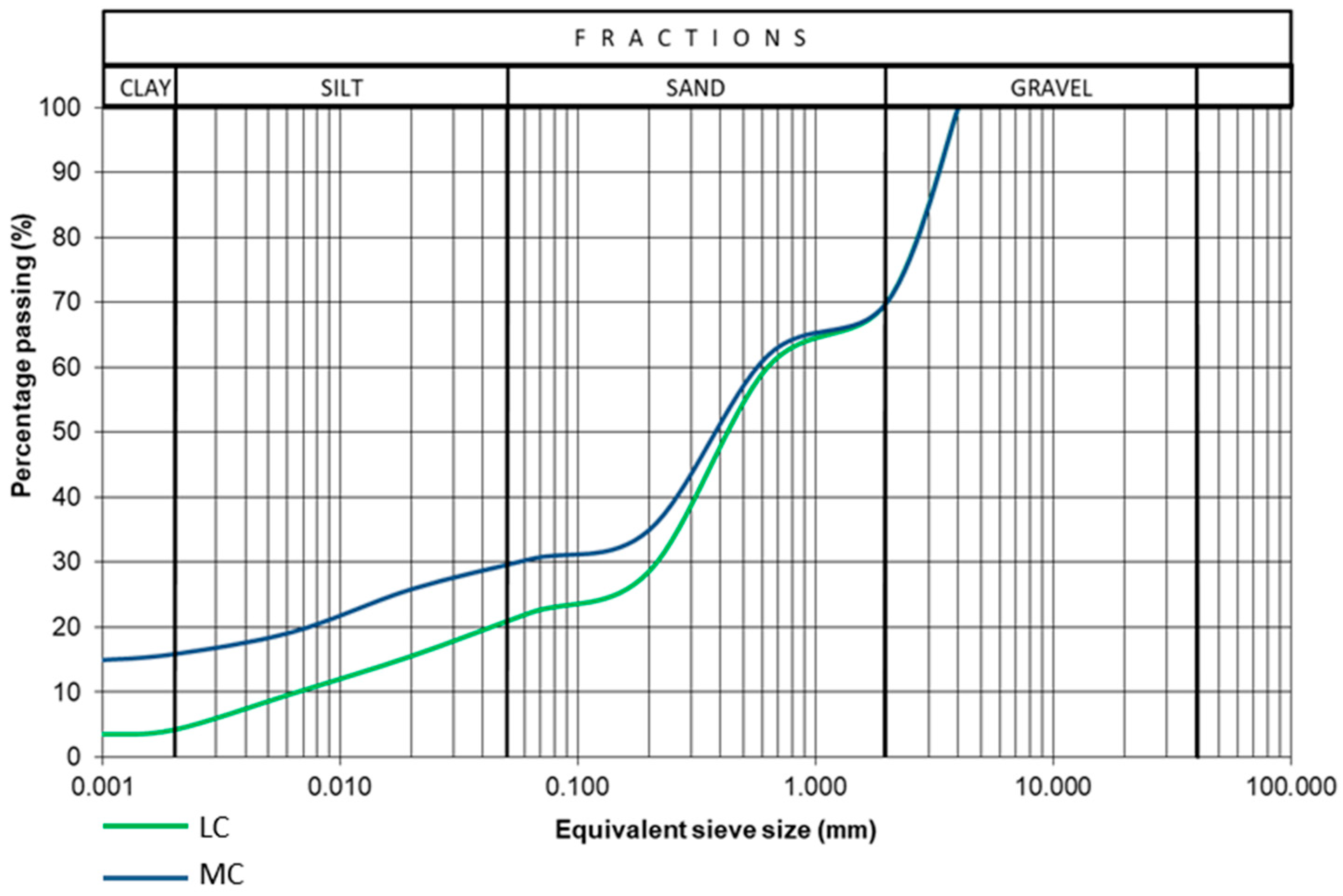
Seven loam-based soil mixtures incorporating clay materials with contrasting mineralogical compositions were prepared and investigated. A series of soil mixtures was produced by progressively adding controlled amounts of dry constituents—including silt, sand, and gravel fractions—to a loam soil, resulting in the particle size distribution curves shown in Figure 1. These mixtures represent two model soils that may be considered as potential primary constituents of cement-stabilized rammed earth (CSRE) and differ primarily in their clay fraction content. The MC mixture contains 16% clay fraction, 15% silt fraction, 39% sand fraction, and 30% gravel fraction, whereas the LC mixture consists of 4% clay fraction, 18% silt fraction, 48% sand fraction, and 30% gravel fraction.
The mineral component (Table 1) of the mixtures consisted of a controlled sand–gravel skeleton supplemented with clay materials of contrasting mineralogical composition. Seven clay materials were used, differing primarily in the relative proportions of kaolinite, beidellite, and illite. These clay minerals were selected to represent both low-activity and high-activity clay regimes, which differ significantly in water affinity, cation exchange capacity, and interaction with cement hydration products [3].
Mineralogical characterization was performed on the raw clay materials prior to specimen forming in order to identify their intrinsic properties independently of cement hydration and compaction effects. XRD analysis was used to identify and semi-quantitatively estimate the relative proportions of mineral phases within the raw soil material. After stabilization, the mineralogical composition of each mixture was calculated proportionally based on the mass balance, considering the known mass fractions of soil, added coarse aggregates, and cement. The XRD results therefore represent a semi-quantitative characterization of the original soil mineralogy and were used for relative comparative statistical analysis rather than absolute phase determination. The identified mineral phases included clay minerals, quartz, carbonates (mainly calcite and siderite), and iron-bearing phases (predominantly goethite). This approach ensures that the identified mineralogical influences on compressive strength originate from the soil constituents themselves rather than from secondary reactions occurring during curing and follows standard practice in soil mineralogy and engineering geology [3].
Portland cement of compressive class CEM I 42.5R (Holcim S.A., Małogoszcz, Poland) was used as the stabilizing binder. Two cement contents were adopted, 6% and 9% by dry mass of the soil mixture, corresponding to commonly applied lower and upper stabilization levels in CSRE practice [12]. Forming moisture was controlled at two levels, 7% and 8%, selected to represent distinct technological regimes close to the optimum moisture content determined by compaction testing. These combinations resulted in four principal technological regimes, enabling the assessment of mineralogical effects under comparable forming conditions.
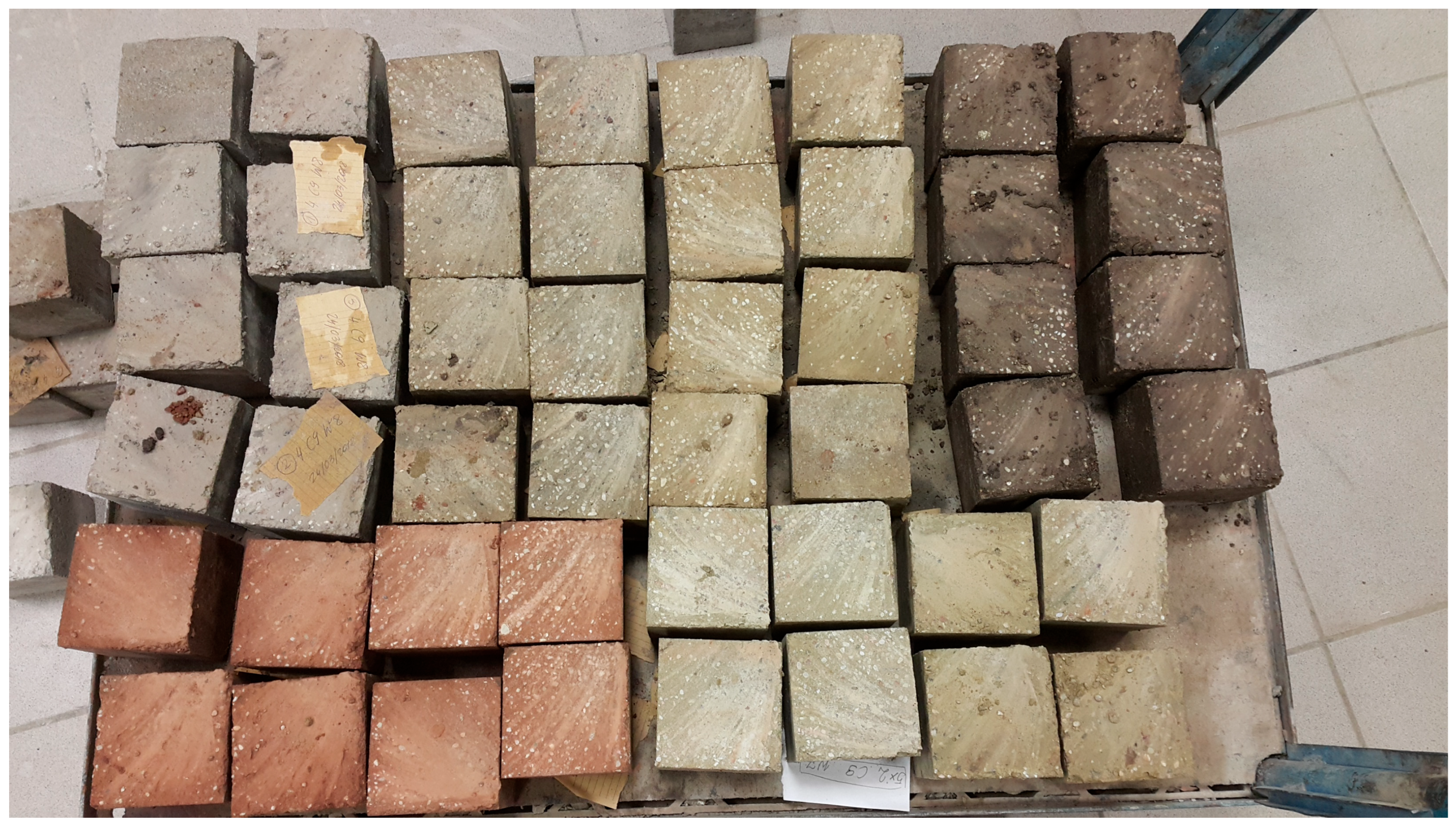
Specimens were formed as cubes with dimensions of 100 × 100 × 100 mm (Figure 2) using steel molds equipped with a guiding collar. The moist soil–cement mixture was compacted in three equal layers using a manual rammer with a mass of 6.5 kg and a compaction face of 96 × 96 mm. Each layer was compacted by 20 free-fall blows from a height of 0.30 m, corresponding to a compaction energy of approximately 38 J per blow. The rammer was guided vertically to ensure consistent energy input and uniform specimen density, directly replicating the procedure described in [9] and reflecting the stratified compaction typical of monolithic CSRE walls.
After compaction, specimens were demolded after 24 h and cured for 28 days at 20 ± 1 °C under high relative humidity. Compressive strength testing was conducted with the load applied parallel to the compaction direction to account for the inherent anisotropy of rammed earth materials. This unified forming and testing procedure ensured that observed differences in compressive strength could be attributed to mineralogical composition and its interaction with moisture and cement content rather than to variations in specimen preparation.
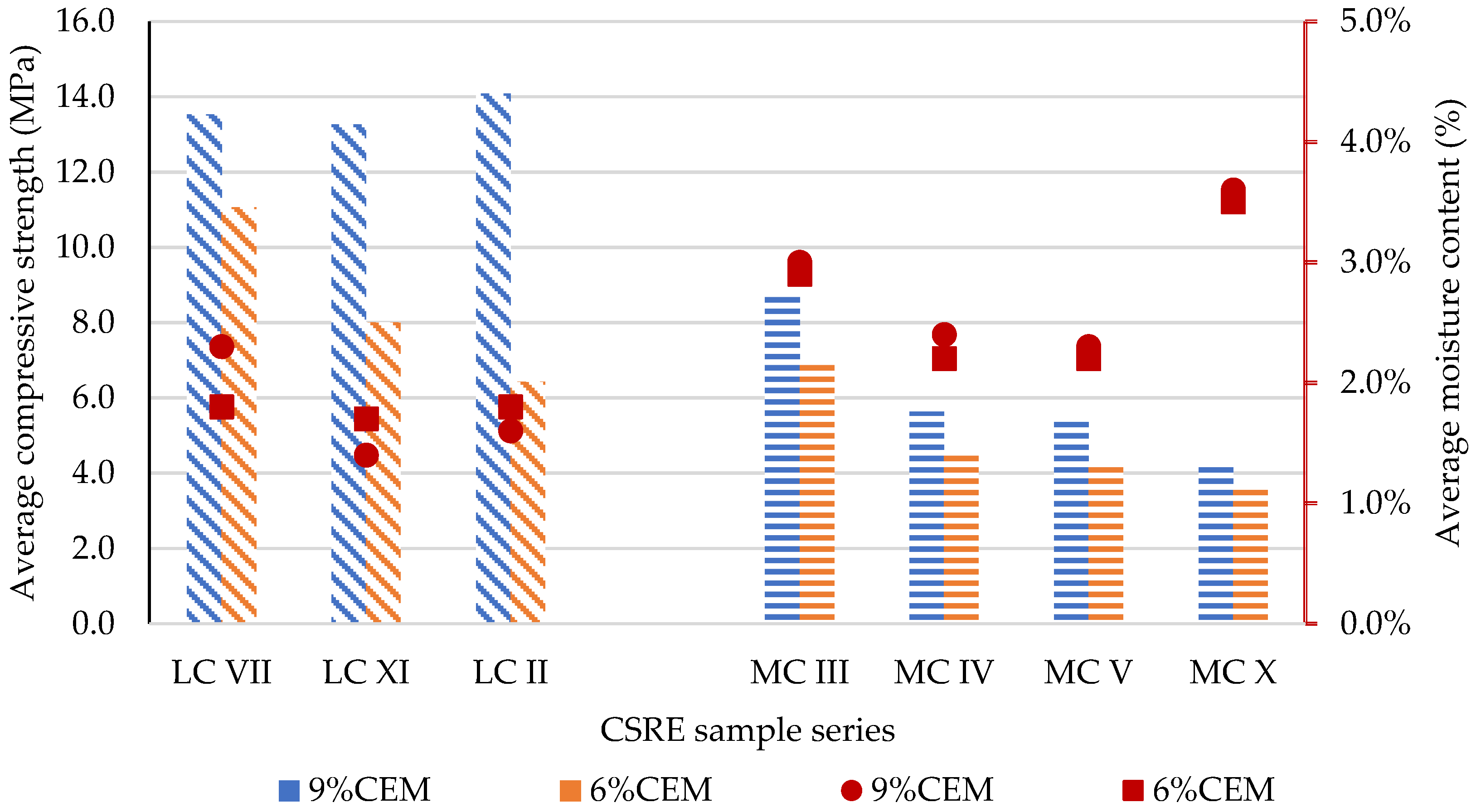
Compressive strength tests on CSRE cube specimens were conducted using a testing machine (Controls Automax, Milan, Italy) with a load capacity of 0–3000 kN, following the general principles of EN 12390-3:2019 [13], adapted for earthen materials. Due to the three-layered structure of CSRE, all specimens were loaded in the direction of compaction. The average compressive strength values obtained for the investigated series are presented in Figure 3. The results reveal a pronounced scatter of compressive strength, observed even for specimens characterized by the same particle size distribution, forming moisture, and cement content. This variability indicates that factors beyond technological parameters play a significant role and suggests the importance of mineralogical composition in governing CSRE strength behavior.
After failure, the specimens were subjected to drying in order to determine the moisture content at the moment of failure. The average moisture content at failure for the corresponding sample series is also presented in Figure 3, providing additional insight into the interaction between moisture state and compressive strength development.
For statistical analysis, individual mineral phases were grouped into functionally meaningful categories reflecting their physicochemical role in cement-stabilized systems. Clay minerals were divided into a combined kaolinite–beidellite group and an illite group, distinguishing between relatively low-activity and more active structures with higher surface area and cation exchange capacity. Quartz was treated as a separate skeletal fraction due to its dominant role in load transfer and packing efficiency, while carbonates and iron-bearing phases were grouped separately as secondary modifiers potentially contributing to microfiller effects or secondary bonding under alkaline conditions. The resulting mineralogical dataset represents the inherent composition of the clay materials prior to any technological modification and was assigned to all specimens produced from the corresponding clay series. This assumption is justified because specimen forming, compaction, and curing do not alter primary mineralogical phase proportions but only affect particle arrangement and cement–mineral interactions.
Prior to statistical evaluation, the dataset was screened for completeness and consistency. Only specimens with fully defined mineralogical composition, cement content, moisture content, and compressive strength were retained. Continuous mineralogical variables were preserved in their original quantitative form (%) for correlation and multivariate analyses.

2.2. Statistical Tests and Sequence of Analytical Procedures

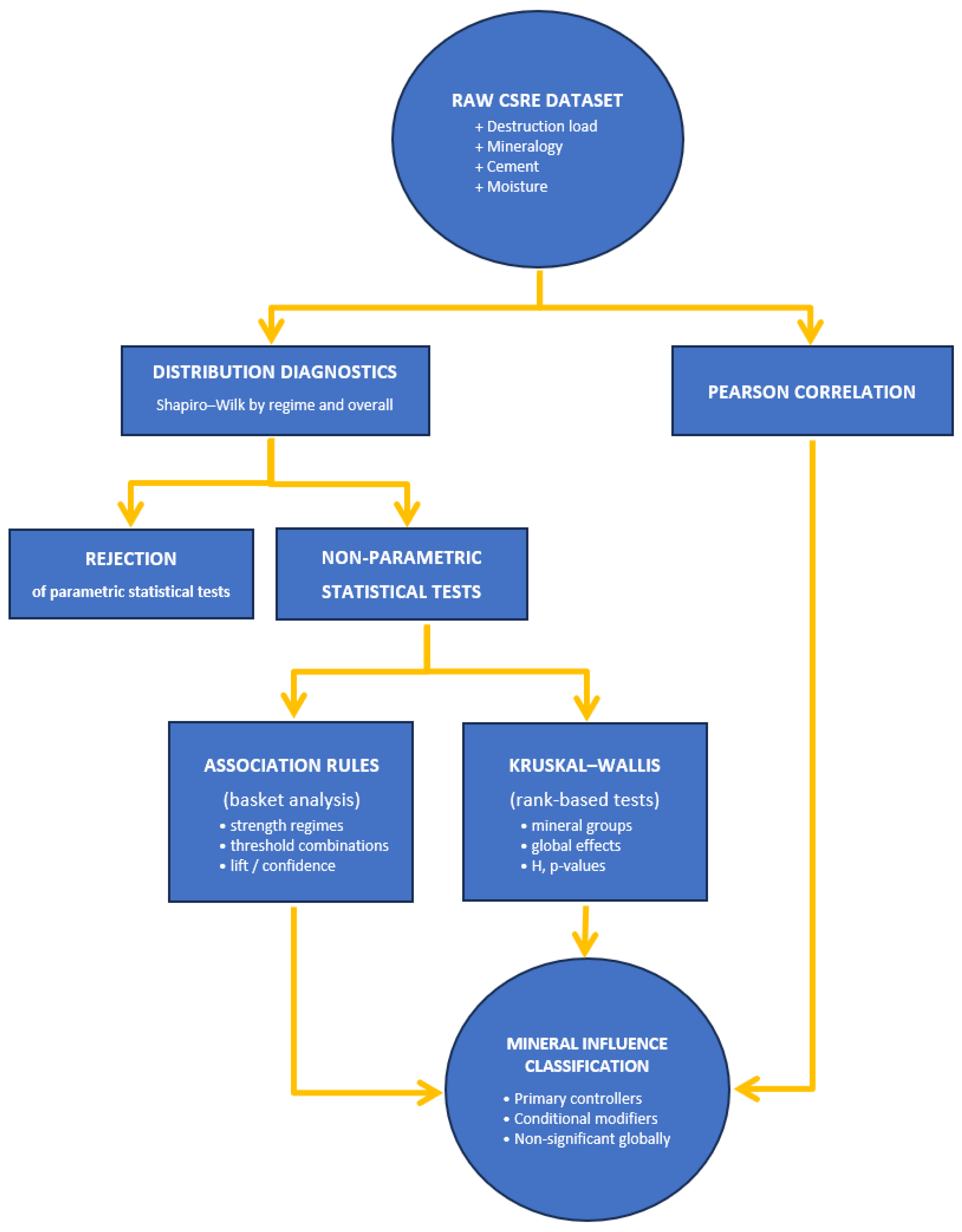
The statistical analysis was designed to identify both global trends and regime-dependent relationships between mineralogical composition, technological parameters, and the compressive strength of CSRE. The analytical workflow (Figure 4) was structured as a sequential, multi-stage procedure, in which each step informed the selection and interpretation of subsequent analyses. This approach minimizes the risk of misinterpretation caused by non-normal data distributions, collinearity between variables, and non-linear interactions typical of earthen materials. Recent machine learning-based predictive studies have shown that advanced data-driven models can effectively capture non-linear relationships between mixture parameters and compressive strength, supporting the use of multivariate analytical frameworks in cementitious material research [14]. Comprehensive reviews further emphasize that integrating statistical analysis with machine learning improves robustness against collinearity, non-normal distributions, and complex threshold-controlled interactions when predicting mechanical properties of concrete and related cement-based composites [15].
In the first stage, exploratory data analysis was performed to assess the basic structure of the dataset. Descriptive statistics were calculated for all continuous variables, including destructive load, mineral contents, cement dosage, moisture content, and bulk density. The normality of compressive strength distributions was evaluated using the Shapiro–Wilk test, both for the full dataset and for subsets defined by cement content and forming moisture. The results indicated frequent deviations from Gaussian distribution, particularly when data from different technological regimes were pooled. Consequently, classical parametric assumptions were treated as conditional rather than universal, and distribution-free methods were emphasized in the subsequent stages. Comparable analytical workflows in soil–cement research have adopted Shapiro–Wilk and Levene’s tests to assess normality and variance homogeneity, subsequently emphasizing non-parametric procedures such as the Kruskal–Wallis test where parametric assumptions fail, thus ensuring robust comparative analysis across heterogeneous datasets [16].
In the second stage, Pearson correlation coefficients were calculated to identify global linear associations between destructive load and individual mineralogical and technological variables. This analysis provided an initial ranking of dominant trends but was interpreted cautiously, as global correlations may reflect indirect effects mediated by moisture or cement content rather than intrinsic mineralogical influence. To address this limitation, partial correlation analysis was subsequently applied, controlling for cement content and forming moisture. This step allowed for the isolation of mineralogical effects that persist after removing the influence of the two primary technological parameters and served as a critical filter distinguishing direct from confounded relationships.
For the purposes of statistical grouping and association rule mining, continuous variables were discretized using predefined numerical thresholds derived from the empirical distribution of the dataset. The combined beidellite–kaolinite (B + K) content was classified into three categories: Low (≤5%), Medium (5–15%), and High (>15%). Forming moisture was treated as a binary technological variable at two fixed levels: 7% and 8%. Cement content was likewise treated as a binary variable at 6% and 9% by dry mass of soil. For association rule mining, destructive load values were discretized into strength classes based on empirical distribution boundaries: Very Low (<46 kN), Low (46–60 kN), Medium (60–110 kN), High (>110 kN), and Very High (>130 kN). Quartz content was analyzed as a continuous variable in correlation analyses and classified into relative High/Low groups for non-parametric testing using median-based separation. Carbonates and iron-bearing phases (goethite + siderite) were treated as binary presence/absence variables for Kruskal–Wallis testing. Illite was classified as present/absent due to its discontinuous distribution across soil types. These threshold values were consistently applied across correlation, non-parametric, and association rule analyses to ensure methodological coherence.
In the third stage, association rule mining was applied to the discretized dataset to extract interpretable rule-based relationships between combinations of mineralogical and technological variables and compressive strength classes. Thresholds were derived from quartile-based empirical distribution and validated by Kruskal–Wallis separation to avoid arbitrary binning. Combined beidellite–kaolinite (B + K) classes were defined numerically as: Low (≤5%), Medium (5–15%), and High (>15%). Rules were filtered using minimum support, confidence, and lift criteria to retain only statistically and practically meaningful associations. This analysis highlights recurrent variable combinations rather than hierarchical splits.
Finally, the results of all analytical stages were cross-compared to assess consistency and robustness. Only relationships confirmed by more than one method were interpreted as physically meaningful. This multi-method, sequential framework ensures that conclusions regarding mineralogical effects on CSRE strength are not artifacts of a single statistical technique but reflect stable patterns emerging across complementary analytical perspectives.

3. Results

3.1. Results of Normality Testing of Destructive Load Data

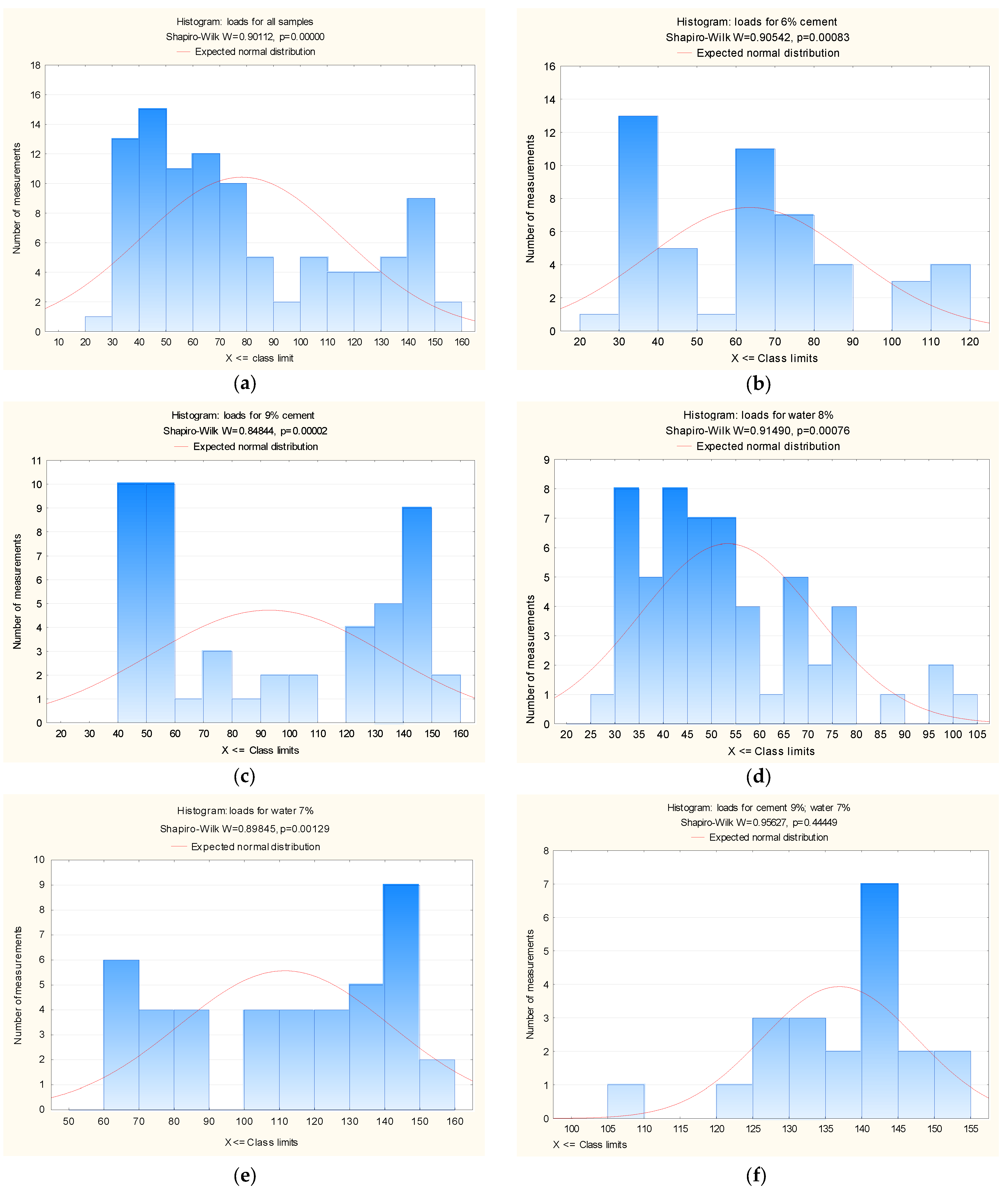
The assessment of normality revealed a clear and consistent pattern indicating that the distributions of unconfined compressive strength (UCS) values are predominantly non-Gaussian. As shown in the normality plots and histograms presented side by side in Figure 5a–f, substantial deviations from symmetry and kurtosis characteristic of a normal distribution are observed when destructive loads data are analyzed at the global level and within broadly defined groups. In these cases, the distributions are typically skewed and multimodal, reflecting the coexistence of different technological and material regimes within a single dataset.
When the dataset was progressively stratified according to technological parameters, a systematic improvement in normality was observed. Subsets defined simultaneously by cement content and forming moisture exhibited markedly more regular distributions, as illustrated in Figure 5d–f. In one narrowly defined group (9% cement and 7% forming moisture), the Shapiro–Wilk test did not reject normality (p > 0.05), indicating that within a fixed technological regime, UCS variability approaches a stochastic, approximately Gaussian character. This behavior contrasts sharply with the strongly non-normal distributions observed in mixed regimes.
The deviation from Gaussian distribution observed in several strength subsets does not indicate uncontrolled experimental variability. All specimens were produced under constant compaction energy, standardized curing conditions, and predefined moisture–cement combinations. The non-normality arises primarily from the coexistence of mechanically distinct regimes (e.g., 7% versus 8% forming moisture), which generate multimodal strength responses within the pooled dataset. This regime-driven heterogeneity reflects inherent non-linear material behavior rather than procedural inconsistency.
These results demonstrate that non-normality in UCS data is not an inherent property of the material cement content and moisture but a consequence of aggregating results of different combinations of moisture, binder content, and mineralogical composition. The presence of multiple overlapping regimes produces artificial skewness and multimodality, which invalidates the use of classical parametric methods on pooled datasets. Consequently, further analyses in this study explicitly account for regime separation and prioritize statistical tools capable of handling non-normal, threshold-driven behavior. It is important to distinguish between inherent non-normality and sampling-induced non-normality. Sampling non-normality may arise from limited sample size, measurement noise, or uncontrolled experimental variability. In contrast, inherent non-normality reflects the coexistence of physically distinct material regimes within the dataset. In this study, all specimens were prepared under standardized compaction energy, predefined cement dosages (6% and 9%), and controlled forming moisture levels (7% and 8%). The deviation from Gaussian distribution is therefore interpreted as regime-driven multimodality resulting from structurally different moisture–cement states, rather than from uncontrolled variability or statistical artifact. The non-normal distributions thus represent physically meaningful heterogeneity in strength response.

3.2. Global and Regime-Specific Correlation Analysis

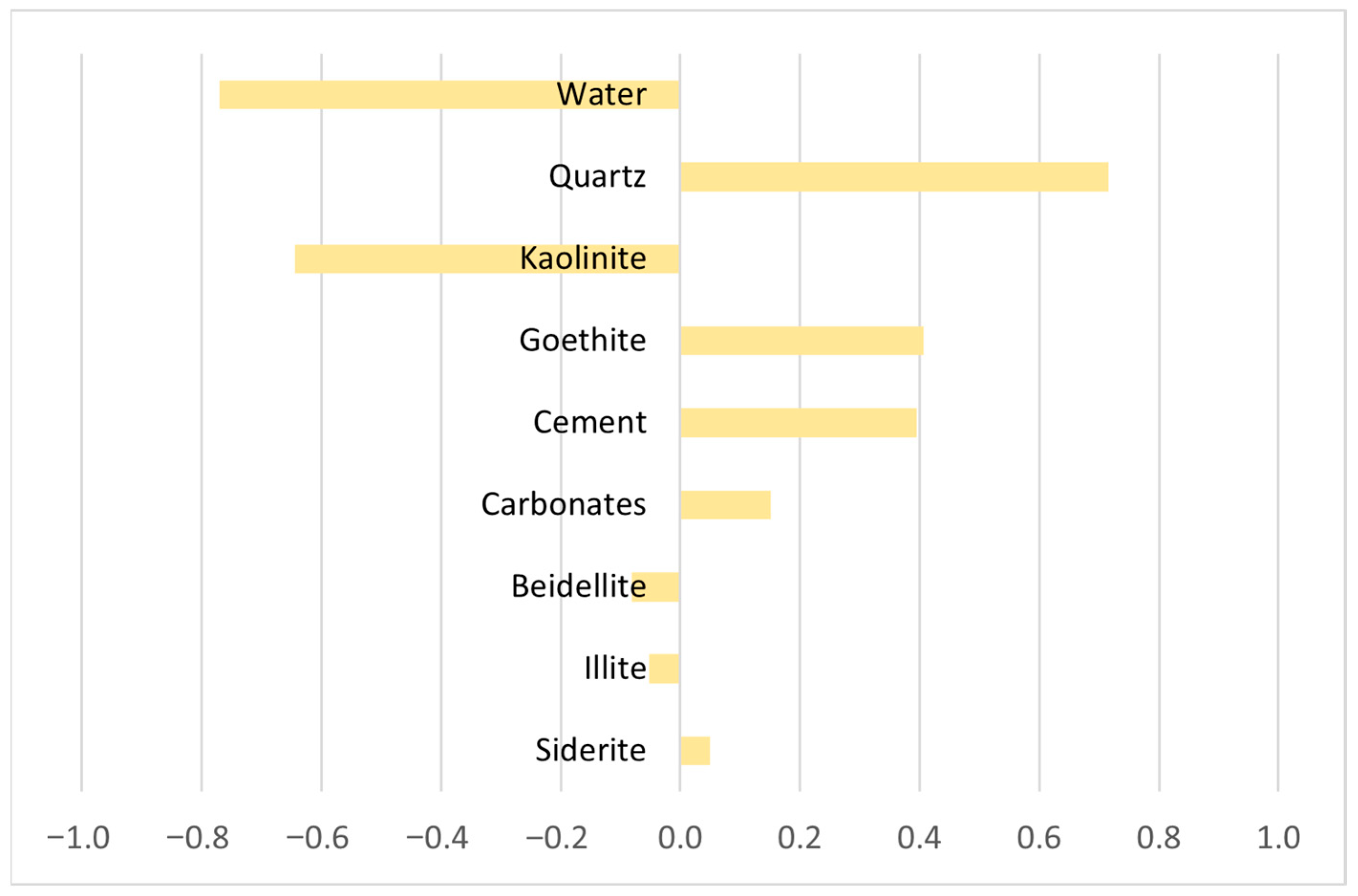
The overall correlation structure of the dataset is illustrated in Figure 6, which presents a single scatter plot matrix for the full set of specimens. Several mineral correlations reverse sign once stratified by regime, indicating threshold transitions. This figure visualizes the global relationships between destructive load and the principal explanatory variables, including quartz content, forming moisture, cement content, and partitioned clay mineral fractions. The fitted linear trends highlight dominant tendencies across the entire dataset, while the pronounced dispersion around these trends reflects the coexistence of multiple technological regimes. In particular, the global plot clearly demonstrates the strong positive association between UCS and quartz-rich fractions, as well as the strong negative association with forming moisture. At the same time, the broad scatter visible in all panels indicates that these relationships are not uniform across all mixtures and cannot be interpreted as intrinsic linear laws.
Recent research on stabilized soils integrating predictive modeling highlights that correlations between physical parameters and compressive strength can differ markedly across technological regimes, emphasizing that moisture, cement content, and other variables interact non-linearly and conditionally with mechanical response [16]. To examine the sensitivity of these relationships to technological conditions, Pearson correlations were additionally calculated for subsets defined by cement content and forming moisture. The results of these subgroup analyses are presented in Table 2, where correlation coefficients are reported separately for each technological regime. This table reveals pronounced variability in both the magnitude and the sign of correlations. Similar patterns of regime-dependent correlation variability have been observed in statistical studies of cement-treated soils, where the influence of moisture content and binder dosage on strength metrics must be evaluated within stratified subsets to avoid misleading pooled estimates [17]. In several cases, correlations that appear strong at the global level weaken substantially or even reverse within narrowly defined regimes. This behavior is particularly evident for clay minerals, whose negative correlation with UCS is amplified at higher moisture levels but becomes negligible under low-moisture conditions.

3.3. Association Rule Mining (Basket Analysis)

Basket analysis, implemented in the form of association rule mining, was applied to identify recurrent combinations of mineralogical and technological conditions associated with discrete destructive load classes. Association rule mining procedures have been widely characterized as robust methods for uncovering frequent patterns and conditional relationships in complex datasets, which supports their application for identifying recurrent mineralogical and technological regimes linked with specific compressive strength classes [18]. Unlike correlation, this approach focuses on co-occurrence patterns and conditional probabilities, enabling the extraction of interpretable, rule-based relationships that describe typical strength regimes rather than hierarchical decision paths.
The most significant rules are summarized in Table 3, which reports support, confidence, and lift values together with the corresponding variable combinations. High-strength rules are consistently characterized by low forming moisture, sufficient cement content, and a low combined content of beidellite and kaolinite. For example, rules combining low clay mineral content with low moisture show high confidence and lift values, indicating a substantially increased probability of achieving high UCS compared to random expectation. These rules confirm that favorable mineralogical conditions only translate into high strength when moisture is constrained below critical thresholds.
While several extracted rules (R3, R4, R7) confirm expected relationships—such as high cement content combined with high bulk density leading to high destructive load—these patterns primarily validate known binder-driven strengthening mechanisms. More informative are the mineralogical override rules, where expected cement-induced strength gain is suppressed. In particular, combinations including B + K > 15% or forming moisture of 8% frequently lead to medium or low strength classes even at 9% cement content. These rules indicate that mineralogical thresholds can override binder dosage effects, defining regime boundaries that cannot be captured by monotonic cement–strength relationships.

3.4. Non-Parametric Significance Testing Using the Kruskal–Wallis Procedure

The mineralogical variables were grouped to reflect shared physicochemical functions and comparable mechanisms by which individual phases influence the mechanical behavior of CSRE, rather than treating each mineral as an isolated component. Beidellite and kaolinite were combined because both belong to the clay fraction and jointly control clay activity, specific surface area, water retention, and interaction with cement hydration products; their combined content therefore provides a more mechanistically meaningful indicator of clay-controlled strength response than either mineral considered separately. Similarly, goethite and siderite were grouped as iron-bearing phases, which may act as micro-fillers or secondary cementing agents, but whose influence on strength is highly conditional and dependent on moisture and curing environment.
Illite was treated as a binary variable (present/absent) because of its generally low and discontinuous content in the tested soils; under such conditions, quantitative stratification would be statistically unstable and potentially misleading, whereas presence alone captures its potential to interfere with water availability and cement hydration. Carbonates were also classified dichotomously, as their mechanical contribution is primarily associated with their occurrence rather than gradual concentration changes, reflecting their role as rigid inclusions or micro-filling phases. Organic matter was grouped into low–high classes to distinguish between negligible and potentially active contents, acknowledging its dual role as a dispersive agent and a modifier of cement hydration.
Quartz and others were grouped together to represent the load-bearing granular skeleton of CSRE, which governs compaction efficiency, stress transfer, and stiffness. Classifying this fraction into high–low levels reflects a fundamental structural distinction between mixtures dominated by a rigid granular framework and those in which the skeleton is weakened by increased fines. Overall, the adopted grouping strategy reduces dimensionality while preserving physical interpretability, enabling statistically robust analysis of mineralogical effects that are inherently multivariate and interaction-driven rather than strictly mineral-specific.
Given the systematic violation of the normality assumption demonstrated by the Shapiro–Wilk test (Section 3.1), the application of pooled parametric tests to the destructive load data is statistically unjustified. As shown previously, normality is satisfied only within a narrowly defined technological subgroup (9% cement and 7% forming moisture), whereas the overall dataset and most composition-based subgroups exhibit skewed and regime-mixed distributions. Under these conditions, rank-based, distribution-free methods are required to reliably assess the statistical significance of individual independent variables.
Accordingly, the Kruskal–Wallis H test was applied to evaluate the effect of selected mineralogical and technological factors on destructive load. This test is the non-parametric analog of one-way ANOVA and assesses whether samples originating from different categorical levels of a given factor are drawn from the same population. It is particularly suitable for this dataset, as it does not assume normality and is robust to heteroscedasticity, while still allowing formal hypothesis testing across multiple factor levels.
The results of the Kruskal–Wallis tests are summarized in Table 4, which reports the H statistic and corresponding p-values for each independent variable. As shown in the table, forming moisture exhibits the strongest and most statistically significant effect on destructive load (p < 0.05), confirming its dominant role in defining strength regimes. Cement content also shows a statistically significant effect, although its influence is weaker than that of moisture and strongly dependent on the accompanying mineralogical conditions.
Among the mineralogical variables, the combined beidellite–kaolinite fraction demonstrates a highly significant effect on destructive load (p < 0.01), consistent with its prominent role identified in the basket analyses. Quartz and other non-clay minerals also show statistically significant differences between ranked groups, indicating their importance as a skeletal load-bearing fraction. In contrast, illite and organic matter exhibit weak or statistically insignificant effects when considered independently, suggesting that their influence is largely indirect or conditional on moisture and binder content.
Notably, variables such as carbonates and iron-bearing phases yield intermediate H statistics, indicating a measurable but secondary contribution to strength variability. These results align with the regime-based interpretation developed in Section 3.2 and Section 3.3, where these phases act as modifiers rather than primary controllers of compressive strength.
Following the highly significant Kruskal–Wallis result for the combined beidellite–kaolinite (B + K) classes (χ2 = 73.92, df = 2, p < 0.001; see Table 4), post-hoc pairwise comparisons were conducted using Dunn’s test with Bonferroni correction to identify which class pairs differ significantly. This analysis was necessary to determine whether the observed global effect reflects a gradual monotonic trend or the presence of discrete strength regimes.
The post-hoc results demonstrate that the High B + K class differs significantly from both the Low and Medium classes (p ≤ 0.000001 in both comparisons), whereas no statistically significant difference is observed between the Low and Medium classes (p = 0.44). This pattern indicates a sharp transition rather than a continuous decrease in strength with increasing clay mineral content. The ordering of mean ranks further corroborates this interpretation, with values of M = 86.33, L = 68.50, and H = 21.62, clearly separating the High B + K class from the remaining groups.
Descriptive statistics based on medians and quartiles provide additional insight into the mechanical behavior of each regime and are summarized in Table 5. Specimens belonging to the High B + K class exhibit the lowest median destructive load (44.55) and a relatively narrow interquartile range (IQR = 15.10), indicating consistently poor mechanical performance. In contrast, the Low B + K class shows a substantially higher median load (91.25) accompanied by a much broader interquartile range (IQR = 51.70), reflecting greater variability and sensitivity to accompanying technological parameters such as moisture and cement content. Despite its limited sample size (N = 6), the Medium B + K class is characterized by the highest median destructive load (136.53) and a very narrow interquartile range (IQR = 7.40), forming a distinct high-strength regime.
For comparison, the aggregated dataset exhibits a wide interquartile range (61.60), which masks these regime-specific behaviors and illustrates the statistical distortion introduced by pooling heterogeneous mixtures. Together, the post-hoc comparisons and quartile-based statistics provide robust, distribution-free evidence that the influence of the combined beidellite–kaolinite fraction on CSRE strength is non-linear and threshold-controlled, rather than gradual. These findings directly support the regime-based interpretation derived from the association rule analyses and explain why global correlation-based approaches fail to capture the true mineralogical effect.

4. Discussion

4.1. Integrated Interpretation of Mineralogical Composition on CSRE Strength

Normality testing using the Shapiro–Wilk procedure demonstrated that compressive strength distributions of CSRE specimens do not conform to a Gaussian model for the vast majority of cases, despite stratification by cement content and forming moisture. Such distributional patterns suggest the coexistence of multiple strength-forming mechanisms operating within nominally identical technological regimes. This behavior implies that mineralogical heterogeneity govern strength beyond cement dosage and moisture alone. Consequently, the observed multimodality supports the hypothesis that additional compositional factors could play a decisive role in shaping CSRE strength variability, thereby justifying the use of subgroup-specific and distribution-free statistical approaches in subsequent analyses.
The correlation results demonstrate that relationships between mineralogical components and CSRE compressive strength are highly non-uniform and strongly dependent on the technological regime defined by cement content and forming moisture. Global correlations calculated for the pooled dataset suggest a dominant positive role of quartz-rich fractions (r = 0.71) and goethite (r = 0.41), alongside a pronounced negative influence of kaolinite (r = −0.64). However, these aggregated trends mask substantial internal heterogeneity: several components that appear negligible or weakly correlated at the global level (e.g., siderite, carbonates, organic matter) exhibit strong and even opposing correlations once the data are disaggregated into technologically homogeneous groups. The observed reversals in correlation sign do not represent statistical anomalies but correspond to mechanical tipping points associated with structural regime transitions. At lower moisture and moderate clay content, load transfer is primarily governed by a granular skeleton, where quartz-rich fractions enhance interparticle friction and stress continuity. Once forming moisture increases to 8% or the combined clay fraction exceeds approximately 15%, the structural mechanism shifts toward a clay-influenced matrix state. In this regime, increased plasticity and reduced intergranular contact diminish frictional resistance, and clay-mediated deformation becomes dominant. This transition alters the governing load-bearing mechanism, causing minerals that were previously positively associated with strength to exhibit neutral or negative correlations. In mixtures compacted at lower moisture (C6-W7 and C9-W7), quartz and other non-clay minerals show consistently positive correlations with strength (r ≈ 0.70), confirming the dominant role of a dense granular skeleton under drier conditions. In contrast, at higher forming moisture (C6-W8 and C9-W8), the correlation for quartz-rich fractions becomes strongly negative (r ≈ −0.69 to −0.72), indicating that excess water fundamentally alters the load-transfer mechanism and negates the beneficial effect of the granular framework. Similar moisture-dependent reversals are evident for carbonates and siderite, which shift from strongly negative or negligible effects at low moisture to very strong positive correlations at 8% moisture, highlighting their conditional contribution to strength development.
The observed reversal in correlation sign under higher forming moisture can be physically explained by moisture-induced plasticization of kaolinite. At elevated moisture levels (8%), kaolinite absorbs additional pore water and transitions toward a more plastic state, reducing interparticle friction within the granular skeleton. This reduction in effective grain-to-grain friction weakens stress transfer through the sand–quartz framework and shifts the dominant load-bearing mechanism toward moisture-sensitive clay behavior. Consequently, a mineral that contributes positively under lower moisture (7%) may exhibit a neutral or negative statistical association once plastic deformation and reduced friction become governing factors.
Clay minerals and organic matter exhibit the most pronounced regime sensitivity. Kaolinite displays a strongly positive correlation in the C6-W7 group (r = 0.94), but negative or negligible correlations in all other regimes, while illite consistently shows negative correlations across all subgroups, intensifying at higher moisture and cement content. Organic matter follows a comparable pattern, acting beneficially only under low-moisture, low-cement conditions and becoming distinctly detrimental at higher moisture. The apparent inconsistency between grouped clay effects and individual mineral behavior is resolved by considering differences in hydro-affinity. Kaolinite (1:1 structure) is less hydrophilic and exhibits lower cation exchange capacity compared to 2:1 clays such as beidellite or illite. Consequently, its negative mechanical influence becomes pronounced only under elevated forming moisture (8%), where additional pore water increases its plasticity and reduces intergranular friction. Under lower moisture (7%), kaolinite does not sufficiently hydrate to disrupt granular packing, and its statistical association with strength may therefore appear neutral or even weakly positive. In contrast, high-CEC 2:1 clays can affect effective water availability even at lower moisture levels, producing earlier regime transitions.
The extracted association rules reveal that CSRE strength development is governed by discrete, internally consistent behavioral domains rather than by gradual or additive effects of individual variables. Rules R1–R3 define a high-strength domain characterized by low forming moisture and/or high cement content, with mineralogical composition acting as a secondary but stabilizing modifier. In particular, the combination of low clay activity and low moisture (R1) yields a fully deterministic high-strength outcome (confidence = 1.00), confirming that suppression of expansive clay behavior is a prerequisite for robust load transfer. The exceptionally high lift of R3 (4.67) demonstrates a strong synergistic interaction between cement dosage and moisture control, indicating that optimal moisture enables the binder to fully activate its reinforcing potential, thereby defining the upper strength domain of CSRE.
In contrast, rules R4 and R9–R11 delineate persistent low-strength response domains dominated by moisture–clay interactions. Elevated forming moisture systematically overrides both favorable mineralogy (B + K ≤ 5% and forming moisture = 7%) and binder presence, as evidenced by R4, where low cement combined with high moisture invariably leads to reduced strength. The strongest degradation is observed when high combined beidellite–kaolinite content coincides with high moisture (R9–R11), culminating in the extreme low-strength class (Load < 46) when cement content is simultaneously low (R11, lift = 3.21). These rules confirm that expansive clay minerals amplify the detrimental effect of excess water by disrupting compaction efficiency and microstructural continuity, thereby overwhelming the stabilizing action of cement. The recurrence of high lift values for clay-related rules demonstrates that these low-strength domains are structurally embedded in the material behavior.
Intermediate rules (R5–R8) highlight conditional and compensatory mechanisms that are invisible in classical correlation analysis. Organic matter emerges as a context-dependent modifier: at high cement content and high moisture, its presence partially offsets strength loss (R5), whereas its absence does not preclude moderate strength recovery if cement dosage is sufficient (R6). Conversely, favorable mineralogy (B + K ≤ 5% and forming moisture = 7%) or iron-bearing phases alone cannot compensate for insufficient binder content (R7, R8), underscoring that mineralogical advantages are subordinate to technological constraints. Collectively, the association analysis corroborates the correlation-based findings by explicitly demonstrating that CSRE strength is controlled by threshold-driven interactions among moisture, binder content, and clay activity. The results confirm that meaningful interpretation and mix design optimization must adopt a domain-based, multivariate perspective rather than rely on single-variable trends or global averages.
The results of the Kruskal–Wallis tests confirm that only a subset of the analyzed independent variables exerts a statistically robust and globally detectable influence on CSRE compressive strength, while others act in a conditional or secondary manner. The strongest effects are associated with the combined beidellite–kaolinite content and the proportion of quartz and other non-clay minerals, both yielding very high H statistics (72.78 and 56.17, respectively; p < 0.001). The post-hoc Dunn test demonstrates that the High B + K class is statistically distinct from both the Low and Medium classes (p ≤ 0.000001), while no significant difference is observed between the Low and Medium classes (p = 0.44). This result indicates the presence of a clear threshold effect rather than a gradual, monotonic reduction in strength with increasing beidellite–kaolinite content. Consequently, high combined B + K content defines a discrete low-strength domain, whereas Low and Medium B + K levels form a statistically homogeneous response range with respect to compressive strength. Mean-rank analysis indicates that high clay activity decisively shifts the strength response toward lower load levels, whereas high quartz content produces the opposite effect, defining a globally favorable mechanical response. These findings demonstrate that the balance between the load-bearing granular skeleton and the fine clay fraction constitutes the primary control on CSRE strength variability at the dataset level.
In contrast, several mineralogical variables do not exhibit statistically significant global effects despite their relevance in subgroup or rule-based analyses. The absence of significant differences for goethite + siderite (p = 0.573) and illite presence (p = 0.449) indicates that their influence cannot be interpreted as universal across all mixtures. Instead, their mechanical contribution is likely activated only under specific combinations of moisture, cement content, and overall fabric, as previously evidenced by correlation reversals and association rules. This result underscores an important methodological implication: the lack of global significance in rank-based testing does not imply irrelevance, but rather points to interaction-controlled behavior that is obscured when data are pooled across heterogeneous technological conditions.
Technological parameters retain a statistically meaningful role alongside mineralogy. Cement content shows a clear and significant positive effect on strength (H = 12.30, p = 0.0005), confirming that higher binder dosage systematically increases load capacity, although its influence remains subordinate to that of quartz-rich fractions and clay activity. Carbonates also display a significant global effect (p = 0.002), with higher mean ranks associated with their presence, suggesting a net beneficial contribution, likely through micro-filling or densification mechanisms. Organic matter exhibits only a weak but statistically detectable effect (p = 0.035), indicating that its influence is marginal at the global scale and should be interpreted cautiously.
Table 6 demonstrates that CSRE compressive strength is governed by interaction-driven, non-linear relationships rather than by single variables acting independently. Persistent non-Gaussian distributions indicate structural heterogeneity arising from coupled technological and mineralogical effects. Correlation analysis shows that mineralogical influences are regime-dependent and frequently change sign with forming moisture, which acts as the primary control parameter. Association rules further identify threshold-controlled strength domains, in which low clay activity and limited moisture enable high strength, whereas their combination defines stable low-strength behavior. Overall, CSRE strength development follows a hierarchical control structure dominated by moisture and clay activity, with mineralogical components acting as conditional modifiers within these constraints. This hierarchical, regime-based interpretation is consistent with previously reported aging behavior of cement-stabilized rammed earth under different exposure conditions, where long-term strength evolution was shown to be governed by moisture availability and mineral–binder interactions rather than by intrinsic material properties alone [19].
This study does not include microstructural validation (SEM, MIP or TG-DTA). Consequently, mechanistic interpretations are inferred from established soil–cement hydration theory rather than directly observed pore-structure analysis.

4.2. Synthesis of Previous Studies and Present Results on Mineralogical Effects

A combined interpretation of the available literature and the results obtained in this study leads to a coherent, regime-based understanding of how mineralogical composition affects compressive strength. Earlier studies have consistently emphasized that mineralogy influences CSRE strength indirectly, through its interaction with moisture, cement content, and granulometric composition, rather than acting as an independent control parameter [3,20,21]. However, most previous investigations relied on global correlations or qualitative comparisons, which limited their ability to resolve non-linear and threshold-controlled effects [20,21]. Apparent contradictions in previous literature arise primarily from pooled linear analyses conducted across heterogeneous moisture–cement regimes. When stratified by technological regime, mineral effects do not contradict earlier findings but reveal conditional dependencies.
This study confirms the main trends reported in the literature while substantially refining their interpretation. Quartz is universally identified as the most beneficial mineral component, providing a rigid skeletal framework that enhances packing efficiency and load transfer. This conclusion is consistent across Pearson correlation analysis, association rules, and non-parametric testing, and fully agrees with earlier experimental and theoretical studies [4]. Clay minerals are consistently identified in the literature as the most critical limiting factor for CSRE strength, but their reported influence varies widely. Previous works indicate that moderate clay contents may improve cohesion, while excessive clay reduces strength due to increased water demand and swelling [12]. This resolves this ambiguity by demonstrating, through non-parametric and multivariate analyses, that the effect of clay minerals is threshold-controlled. Only high contents of the combined beidellite–kaolinite fraction define a statistically distinct low-strength regime, whereas low and medium contents are not significantly different. This finding reconciles contradictory conclusions reported in earlier studies.
The role of individual clay minerals aligns well with their known physicochemical properties. Kaolinite is reported in the literature to have a potentially positive influence under controlled moisture and binder conditions due to its low expansivity and possible participation in pozzolanic reactions [2,3,22]. Although kaolinite may theoretically undergo pozzolanic reactions under sufficiently alkaline and elevated-temperature conditions, its activation under the ambient curing regime applied in this study cannot be assumed as a primary mechanism. Any reference to pozzolanic interaction is therefore considered theoretical rather than experimentally verified in the present dataset. Cement hydration is exothermic; however, local temperature rise was not monitored and is not assumed to have significantly altered kaolinite reactivity. This dual behavior is confirmed by the results of this study, which show both positive and negative effects depending on regime. Illite is consistently described as detrimental due to its competition for pore water and interference with cement hydration [3,22], a conclusion strongly supported by these analyses, particularly in clay-rich mixtures. Beidellite and other smectitic minerals are described as highly sensitive to moisture [3,23]; this study confirms their weak but regime-dependent influence, becoming relevant only when critical moisture or clay thresholds are exceeded. The detrimental influence of beidellite is interpreted primarily as a hydration-related chemical/kinetic effect rather than exclusively as mechanical swelling. Notably, early-age hydration effects discussed in the literature should not automatically be interpreted as intrinsic hydration retardation. In cementitious systems containing highly hydrophilic nano-/micro-phases, an apparent delay may arise simply from transient water sequestration (i.e., reduced free water available for reaction), even when cement reactivity is not fundamentally suppressed. This distinction between water adsorption and true kinetic retardation has been explicitly discussed for graphene oxide (GO), where early-age hydration reduction was attributed to GO absorbing part of the mixing water, thereby lowering the water available for clinker hydration, while later-age hydration may recover due to gradual water release and nucleation effects [24,25].
As a 2:1 clay mineral with high cation exchange capacity and large specific surface area, beidellite adsorbs pore water that would otherwise be available for cement hydration. This reduces the effective water-to-cement ratio and may limit early C–S–H formation. Although GO and clay minerals differ in scale and chemistry, both represent highly hydrophilic, high-surface-area phases that can transiently bind mixing or pore water, thereby modifying the effective water availability for hydration [24,25]. However, such water sequestration can also act as a delayed internal-curing mechanism, because the previously adsorbed water may be gradually released as hydration progresses and free water becomes scarce, sustaining longer-term hydration and enabling additional C–S–H precipitation. This internal curing via temporary water storage and gradual release interpretation has been reported for GO-containing cement systems and is consistent with later-age recovery/increase of hydration degree and C–S–H development attributed to nucleation on GO surfaces [24,25]. While volumetric swelling and associated microcracking cannot be excluded, particularly at higher moisture levels, the statistical pattern observed in this dataset suggests that competitive water adsorption and reduced effective water availability constitute the primary mechanism under the applied curing regime.
Carbonates and iron-bearing phases are treated in earlier studies as secondary contributors with context-dependent effects [3]. The results of this study confirm this interpretation. Calcite, siderite, and goethite act as modifiers that can enhance strength through filler effects or particle aggregation, particularly in mixtures with higher clay content [23]. Siderite shows strong short-term positive associations with strength in selected regimes, but both the literature and theoretical considerations indicate potential long-term instability due to oxidation and dissolution processes [4]. This study therefore supports a cautious interpretation of siderite as a transient strengthening phase.
Overall, the combined evidence from previous studies and this experimental dataset, shown in Table 7, demonstrates that CSRE strength is governed by discrete regimes defined by mineralogical thresholds and technological constraints. The integration of distribution-free statistics and association rules provides a quantitative framework that explains the wide scatter of strength values reported in the literature and unifies previously fragmented interpretations [10,20,21].

5. Conclusions

This study demonstrates that the compressive strength of cement-stabilized rammed earth (CSRE) is governed by conditional interactions between mineralogical composition and technological parameters, rather than by isolated material properties. Strength development cannot be interpreted as a simple additive effect of individual components; instead, it emerges from the coupled influence of soil mineralogy, forming moisture, and cement content, which together control compaction efficiency, microstructural continuity, and the effectiveness of cement bonding.
From a mixture design perspective, the results suggest that combined beidellite–kaolinite content should remain below approximately 15% to avoid entering a persistent low-strength regime. This threshold therefore represent practical design limits derived from effect magnitude rather than solely from statistical significance.
Quartz-rich fractions constitute the principal positive mineralogical contributor to CSRE strength by forming a rigid load-bearing skeleton that enhances stress transfer and densification. This contribution, however, is effective only when forming moisture is adequately controlled, as excessive water disrupts granular contact and diminishes the structural role of the skeleton. Under unfavorable moisture conditions (over 7%), the beneficial effect of quartz is significantly reduced or reversed.
Clay minerals represent the primary constraint on CSRE strength. Their influence is non-linear: moderate clay contents do not necessarily impair mechanical performance and may support microstructural cohesion, whereas excessive amounts increase water retention, reduce effective stress during compaction, and interfere with cement hydration. Kaolinite may exert a favorable influence under moderate moisture and binder content due to its low expansivity and compatibility with cementitious reactions, but becomes detrimental at elevated moisture or fine-fraction levels. Illite exhibits a consistently negative effect, particularly in clay-rich mixtures, owing to competition for pore water and delayed cement hydration. Beidellite shows a weak and highly conditional influence, becoming relevant mainly when critical moisture or clay content thresholds are exceeded. The negative influence of 2:1 clay minerals is attributed to competitive water adsorption that reduces effective hydration efficiency, establishing a mineralogical threshold beyond which additional binder cannot fully compensate for hydration inhibition.
Carbonates and iron-bearing phases act as secondary modifiers of strength rather than primary controlling factors. Calcite, siderite, and goethite can locally enhance mechanical performance through filler effects or particle aggregation, especially in mixtures with higher clay content, but they do not compensate for unfavorable moisture conditions (over 7%) or excessive clay activity. The contribution of siderite may be transient and should be interpreted cautiously in view of its potential chemical instability over time.
An increase in cement content generally enhances compressive strength, but only within favorable mineralogical and moisture conditions. Higher binder dosage cannot fully offset the adverse effects of excessive clay content or elevated forming moisture.
Overall, the results confirm that mineralogical influences on CSRE compressive strength are conditional and interaction-controlled rather than intrinsic material constants.

Author Contributions

Conceptualization, P.N. and Ł.R.; methodology, Ł.R. and H.A.; validation, P.N. and Ł.R.; formal analysis, Ł.R. and H.A.; resources, P.N.; data curation, P.N.; writing—original draft preparation, P.N. and Ł.R.; writing—review and editing, P.N., Ł.R. and I.G.; visualization, P.N. and Ł.R.; project administration, P.N.; supervision P.N. All authors have read and agreed to the published version of the manuscript.

Funding

This research received no external funding.

Institutional Review Board Statement

Not applicable.

Informed Consent Statement

Not applicable.

Data Availability Statement

The original contributions presented in the study are included in the article. Further inquiries can be directed to the corresponding authors.

Conflicts of Interest

The authors declare no conflicts of interest.

Appendix A

Table A1. Detailed dataset of mineralogical composition, forming moisture, density at failure, moisture at failure, and failure load of CSRE samples.
SeriesSampleBeidelliteKaoliniteIlliteGoethiteSideriteCarbonatesOrganic MatterQuartzCement Addition
(CEM I 42.5 R)
Forming Moisture
Content
Bulk Density
at Failure
Moisture Content
at Failure
Failure Load
(%)(%)(%)(%)(%)(%)(%)(%)(%)(%)(kg/m3)(%)(kN)
LC II2-c9-w7-12.58%0.39%0.84%0.30%0.00%6.81%0.18%88.90%9%7%23461.6%129.5
2-c9-w7-22.58%0.39%0.84%0.30%0.00%6.81%0.18%88.90%9%7%23381.6%153.7
2-c9-w7-32.58%0.39%0.84%0.30%0.00%6.81%0.18%88.90%9%7%23201.6%148.2
2-c9-w7-42.58%0.39%0.84%0.30%0.00%6.81%0.18%88.90%9%7%23401.6%140.9
2-c9-w7-52.58%0.39%0.84%0.30%0.00%6.81%0.18%88.90%9%7%23631.6%126.1
2-c9-w7-62.58%0.39%0.84%0.30%0.00%6.81%0.18%88.90%9%7%23361.6%143.1
2-c9-w7-72.58%0.39%0.84%0.30%0.00%6.81%0.18%88.90%9%7%23401.6%142.2
2-c6-w7-12.58%0.39%0.84%0.30%0.00%6.81%0.18%88.90%6%7%23051.8%60.8
2-c6-w7-22.58%0.39%0.84%0.30%0.00%6.81%0.18%88.90%6%7%23261.8%77.5
2-c6-w7-42.58%0.39%0.84%0.30%0.00%6.81%0.18%88.90%6%7%23081.8%64.1
2-c6-w7-52.58%0.39%0.84%0.30%0.00%6.81%0.18%88.90%6%7%23201.8%64.3
2-c6-w7-62.58%0.39%0.84%0.30%0.00%6.81%0.18%88.90%6%7%23131.8%64.20
2-c6-w7-72.58%0.39%0.84%0.30%0.00%6.81%0.18%88.90%6%7%23181.8%68.63
2-c6-w7-82.58%0.39%0.84%0.30%0.00%6.81%0.18%88.90%6%7%23131.8%66.68
LC VII7-c9-w7-12.26%1.23%0.00%0.79%0.74%0.00%0.34%94.65%9%7%22622.3%133
7-c9-w7-22.26%1.23%0.00%0.79%0.74%0.00%0.34%94.65%9%7%22652.3%137.7
7-c9-w7-32.26%1.23%0.00%0.79%0.74%0.00%0.34%94.65%9%7%22742.3%150.5
7-c9-w7-42.26%1.23%0.00%0.79%0.74%0.00%0.34%94.65%9%7%22282.3%130.4
7-c9-w7-52.26%1.23%0.00%0.79%0.74%0.00%0.34%94.65%9%7%22642.3%135.4
7-c9-w7-62.26%1.23%0.00%0.79%0.74%0.00%0.34%94.65%9%7%22512.3%140.5
7-c9-w7-72.26%1.23%0.00%0.79%0.74%0.00%0.34%94.65%9%7%22672.3%140.4
7-c6-w7-12.26%1.23%0.00%0.79%0.74%0.00%0.34%94.65%6%7%22571.6%108
7-c6-w7-22.26%1.23%0.00%0.79%0.74%0.00%0.34%94.65%6%7%22661.6%109.6
7-c6-w7-32.26%1.23%0.00%0.79%0.74%0.00%0.34%94.65%6%7%22601.6%115.4
7-c6-w7-42.26%1.23%0.00%0.79%0.74%0.00%0.34%94.65%6%7%22521.6%111.7
7-c6-w7-52.26%1.23%0.00%0.79%0.74%0.00%0.34%94.65%6%7%22621.6%108.8
7-c6-w7-62.26%1.23%0.00%0.79%0.74%0.00%0.34%94.65%6%7%22631.6%112.5
7-c6-w7-72.26%1.23%0.00%0.79%0.74%0.00%0.34%94.65%6%7%22561.6%113.6
LC XI11-c9-w7-11.79%0.40%2.67%0.00%0.50%0.00%0.00%94.64%9%7%22771.7%109.2
11-c9-w7-21.79%0.40%2.67%0.00%0.50%0.00%0.00%94.64%9%7%23011.7%144.5
11-c9-w7-31.79%0.40%2.67%0.00%0.50%0.00%0.00%94.64%9%7%23211.7%145.1
11-c9-w7-41.79%0.40%2.67%0.00%0.50%0.00%0.00%94.64%9%7%23061.7%120.7
11-c9-w7-51.79%0.40%2.67%0.00%0.50%0.00%0.00%94.64%9%7%22891.7%126.9
11-c9-w7-61.79%0.40%2.67%0.00%0.50%0.00%0.00%94.64%9%7%23111.7%144.8
11-c9-w7-71.79%0.40%2.67%0.00%0.50%0.00%0.00%94.64%9%7%23141.7%132.9
11-c6-w7-11.79%0.40%2.67%0.00%0.50%0.00%0.00%94.64%6%7%22651.4%74.4
11-c6-w7-21.79%0.40%2.67%0.00%0.50%0.00%0.00%94.64%6%7%23011.4%82.7
11-c6-w7-31.79%0.40%2.67%0.00%0.50%0.00%0.00%94.64%6%7%22641.4%83.9
LC XI11-c6-w7-41.79%0.40%2.67%0.00%0.50%0.00%0.00%94.64%6%7%22551.4%77.4
11-c6-w7-51.79%0.40%2.67%0.00%0.50%0.00%0.00%94.64%6%7%22831.4%78.6
11-c6-w7-61.79%0.40%2.67%0.00%0.50%0.00%0.00%94.64%6%7%22831.4%83.3
11-c6-w7-71.79%0.40%2.67%0.00%0.50%0.00%0.00%94.64%6%7%22601.4%80.7
MC III3-c9-w8-16.64%1.87%0.00%0.92%0.00%13.15%0.09%77.34%9%8%22203.0%79.5
3-c9-w8-26.64%1.87%0.00%0.92%0.00%13.15%0.09%77.34%9%8%22423.0%78.2
3-c9-w8-36.64%1.87%0.00%0.92%0.00%13.15%0.09%77.34%9%8%22283.0%95.6
3-c9-w8-46.64%1.87%0.00%0.92%0.00%13.15%0.09%77.34%9%8%22463.0%101.8
3-c9-w8-56.64%1.87%0.00%0.92%0.00%13.15%0.09%77.34%9%8%22313.0%78.9
3-c9-w8-66.64%1.87%0.00%0.92%0.00%13.15%0.09%77.34%9%8%22353.0%86.9
3-c9-w8-76.64%1.87%0.00%0.92%0.00%13.15%0.09%77.34%9%8%22373.0%98.7
3-c6-w8-16.64%1.87%0.00%0.92%0.00%13.15%0.09%77.34%6%8%22272.9%78.9
3-c6-w8-26.64%1.87%0.00%0.92%0.00%13.15%0.09%77.34%6%8%22582.9%72.2
3-c6-w8-36.64%1.87%0.00%0.92%0.00%13.15%0.09%77.34%6%8%22232.9%66.9
3-c6-w8-46.64%1.87%0.00%0.92%0.00%13.15%0.09%77.34%6%8%22272.9%66.5
3-c6-w8-56.64%1.87%0.00%0.92%0.00%13.15%0.09%77.34%6%8%22362.9%72.7
3-c6-w8-66.64%1.87%0.00%0.92%0.00%13.15%0.09%77.34%6%8%22362.9%68.5
3-c6-w8-76.64%1.87%0.00%0.92%0.00%13.15%0.09%77.34%6%8%22292.9%68.7
MC IV4-c9-w8-10.00%21.81%0.00%0.30%0.00%0.00%0.12%77.77%9%8%22052.4%57.9
4-c9-w8-20.00%21.81%0.00%0.30%0.00%0.00%0.12%77.77%9%8%21882.4%56.3
4-c9-w8-30.00%21.81%0.00%0.30%0.00%0.00%0.12%77.77%9%8%22272.4%65.2
4-c9-w8-40.00%21.81%0.00%0.30%0.00%0.00%0.12%77.77%9%8%21612.4%54.8
4-c9-w8-50.00%21.81%0.00%0.30%0.00%0.00%0.12%77.77%9%8%21802.4%54.1
4-c9-w8-60.00%21.81%0.00%0.30%0.00%0.00%0.12%77.77%9%8%21952.4%58.6
4-c9-w8-70.00%21.81%0.00%0.30%0.00%0.00%0.12%77.77%9%8%21892.4%57.6
4-c6-w8-10.00%21.81%0.00%0.30%0.00%0.00%0.12%77.77%6%8%22052.2%62.2
4-c6-w8-20.00%21.81%0.00%0.30%0.00%0.00%0.12%77.77%6%8%21602.2%42.3
4-c6-w8-30.00%21.81%0.00%0.30%0.00%0.00%0.12%77.77%6%8%21352.2%40.3
4-c6-w8-40.00%21.81%0.00%0.30%0.00%0.00%0.12%77.77%6%8%21522.2%50.9
4-c6-w8-50.00%21.81%0.00%0.30%0.00%0.00%0.12%77.77%6%8%21792.2%45.1
4-c6-w8-60.00%21.81%0.00%0.30%0.00%0.00%0.12%77.77%6%8%21632.2%48.9
4-c6-w8-70.00%21.81%0.00%0.30%0.00%0.00%0.12%77.77%6%8%21572.2%44.7
MC V5-c9-w8-10.00%21.15%0.00%0.00%0.00%0.00%0.13%78.72%9%8%21941.9%51.5
5-c9-w8-20.00%21.15%0.00%0.00%0.00%0.00%0.13%78.72%9%8%21861.9%48
5-c9-w8-30.00%21.15%0.00%0.00%0.00%0.00%0.13%78.72%9%8%21961.9%53.6
5-c9-w8-40.00%21.15%0.00%0.00%0.00%0.00%0.13%78.72%9%8%21861.9%48.1
5-c9-w8-50.00%21.15%0.00%0.00%0.00%0.00%0.13%78.72%9%8%21911.9%50.3
MC V5-c9-w8-60.00%21.15%0.00%0.00%0.00%0.00%0.13%78.72%9%8%21901.9%50.0
5-c9-w8-70.00%21.15%0.00%0.00%0.00%0.00%0.13%78.72%9%8%21911.9%50.5
5-c6-w8-10.00%21.15%0.00%0.00%0.00%0.00%0.13%78.72%6%8%21532.1%33
5-c6-w8-20.00%21.15%0.00%0.00%0.00%0.00%0.13%78.72%6%8%21762.1%35
5-c6-w8-30.00%21.15%0.00%0.00%0.00%0.00%0.13%78.72%6%8%21452.1%34
5-c6-w8-40.00%21.15%0.00%0.00%0.00%0.00%0.13%78.72%6%8%21572.1%35
5-c6-w8-50.00%21.15%0.00%0.00%0.00%0.00%0.13%78.72%6%8%21652.1%34
5-c6-w8-60.00%21.15%0.00%0.00%0.00%0.00%0.13%78.72%6%8%21612.1%34
5-c6-w8-70.00%21.15%0.00%0.00%0.00%0.00%0.13%78.72%6%8%21512.1%34.5
MC X10-c9-w8-17.09%6.86%2.85%0.00%1.09%0.00%0.35%81.73%9%8%21723.6%43
10-c9-w8-27.09%6.86%2.85%0.00%1.09%0.00%0.35%81.73%9%8%21503.6%40.1
10-c9-w8-37.09%6.86%2.85%0.00%1.09%0.00%0.35%81.73%9%8%21703.6%48.8
10-c9-w8-47.09%6.86%2.85%0.00%1.09%0.00%0.35%81.73%9%8%21623.6%42.4
10-c9-w8-57.09%6.86%2.85%0.00%1.09%0.00%0.35%81.73%9%8%21613.6%41.6
10-c9-w8-67.09%6.86%2.85%0.00%1.09%0.00%0.35%81.73%9%8%21603.6%44.5
10-c9-w8-77.09%6.86%2.85%0.00%1.09%0.00%0.35%81.73%9%8%21663.6%45.6
10-c6-w8-17.09%6.86%2.85%0.00%1.09%0.00%0.35%81.73%6%8%21303.5%36.1
10-c6-w8-27.09%6.86%2.85%0.00%1.09%0.00%0.35%81.73%6%8%21023.5%28.7
10-c6-w8-37.09%6.86%2.85%0.00%1.09%0.00%0.35%81.73%6%8%21203.5%37.1
10-c6-w8-47.09%6.86%2.85%0.00%1.09%0.00%0.35%81.73%6%8%21263.5%35.8
10-c6-w8-57.09%6.86%2.85%0.00%1.09%0.00%0.35%81.73%6%8%21163.5%32.4
10-c6-w8-67.09%6.86%2.85%0.00%1.09%0.00%0.35%81.73%6%8%21113.5%32.9
10-c6-w8-77.09%6.86%2.85%0.00%1.09%0.00%0.35%81.73%6%8%21233.5%36.45

References

  1. Jayasinghe, C.; Kamaladasa, N. Compressive Strength Characteristics of Cement Stabilized Rammed Earth Walls. Constr. Build. Mater. 2007, 21, 1971–1976. [Google Scholar] [CrossRef]
  2. Narloch, P.; Woyciechowski, P.; Kotowski, J.; Gawriuczenkow, I.; Wójcik, E. The Effect of Soil Mineral Composition on the Compressive Strength of Cement Stabilized Rammed Earth. Materials 2020, 13, 324. [Google Scholar] [CrossRef] [PubMed]
  3. Mitchell, J.K.; Soga, K. Fundamentals of Soil Behavior, 3rd ed.; John Wiley & Sons: Hoboken, NJ, USA, 2005; ISBN 978-0471463023. [Google Scholar]
  4. Sherwood, P.T. Soil Stabilization with Cement and Lime; H.M. Stationery Office: London, UK, 1993; ISBN 9780115511714. [Google Scholar]
  5. Nahon, D.B. Introduction to the Petrology of Soils and Chemical Weathering; John Wiley & Sons: New York, NY, USA, 1991. [Google Scholar]
  6. Fouad, W.; Youssf, O.; Allam, R.Y.M.; Tahwia, A.M. Thermal Insulation and Mechanical Performance of Sustainable Rammed Earth Walls Incorporating Construction and Demolition Waste and Calcium Oxide. Sci. Rep. 2025, 15, 43822. [Google Scholar] [CrossRef]
  7. Wang, Y.; Zhu, L.; Xue, Y. A Comprehensive Review on Dual-Pathway Utilization of Coal Gangue Concrete: Aggregate Substitution, Cementitious Activity Activation, and Performance Optimization. Buildings 2026, 16, 302. [Google Scholar] [CrossRef]
  8. Zhu, D.; Griffiths, D.V.; Fenton, G.A.; Huang, J. Computers and Geotechnics Probabilistic Stability Analyses of Two-Layer Undrained Slopes. Comput. Geotech. 2025, 182, 107178. [Google Scholar] [CrossRef]
  9. Anysz, H.; Narloch, P. Designing the Composition of Cement Stabilized Rammed Earth Using Artificial Neural Networks. Materials 2019, 12, 1396. [Google Scholar] [CrossRef]
  10. Anysz, H.; Brzozowski, Ł.; Kretowicz, W.; Narloch, P. Feature Importance of Stabilised Rammed Earth Components Affecting the Compressive Strength Calculated with Explainable Artificial Intelligence Tools. Materials 2020, 13, 2317. [Google Scholar] [CrossRef] [PubMed]
  11. Song, Y.; Wang, X.; Li, H.; He, Y.; Zhang, Z.; Huang, J. Mixture Optimization of Cementitious Materials Using Machine Learning and Metaheuristic Algorithms: State of the Art and Future Prospects. Materials 2022, 15, 7830. [Google Scholar] [CrossRef]
  12. Walker, P.; Stace, T. Properties of Some Cement Stabilised Compressed Earth Blocks and Mortars. Mater. Struct. 1997, 30, 545–551. [Google Scholar] [CrossRef]
  13. EN 12390-3:2019; Testing Hardened Concrete—Part 3: Compressive Strength of Test Specimens. European Committee for Standardization (CEN): Brussels, Belgium, 2019.
  14. Vargas, J.F.; Oviedo, A.I.; Ortega, N.A.; Orozco, E.; Gómez, A.; Londoño, J.M. Machine-Learning-Based Predictive Models for Compressive Strength, Flexural Strength, and Slump of Concrete. Appl. Sci. 2024, 14, 4426. [Google Scholar] [CrossRef]
  15. Adsul, N.; Choi, Y.; Kang, S.-T. A Comprehensive Review of Numerical and Machine Learning Approaches for Predicting Concrete Properties: From Fresh to Long-Term. Materials 2025, 18, 3718. [Google Scholar] [CrossRef] [PubMed]
  16. Oliveira, R.M.; Campos, D.; Bicalho, K.V.; Macêdo, B.d.S.; Bodini, M.; Saporetti, C.M.; Goliatt, L. AutoML-Based Prediction of Unconfined Compressive Strength of Stabilized Soils: A Multi-Dataset Evaluation on Worldwide Experimental Data. Forecasting 2025, 7, 80. [Google Scholar] [CrossRef]
  17. Abdallah, A.; Russo, G.; Cuisinier, O. Statistical and Predictive Analyses of the Strength Development of a Cement-Treated Clayey Soil. Geotechnics 2023, 3, 465–479. [Google Scholar] [CrossRef]
  18. Machfudiyanto, R.A.; Chen, J.-H.; Latief, Y.; Rachmawati, T.S.; Arifai, A.M.; Firmansyah, N. Applying Association Rule Mining to Explore Unsafe Behaviors in the Indonesian Construction Industry. Sustainability 2023, 15, 5261. [Google Scholar] [CrossRef]
  19. Rosicki, Ł.; Narloch, P. Studies on the Ageing of Cement Stabilized Rammed Earth Material in Different Exposure Conditions. Materials 2022, 15, 1090. [Google Scholar] [CrossRef]
  20. Ávila, F.; Puertas, E.; Gallego, R. Characterization of the Mechanical and Physical Properties of Stabilized Rammed Earth: A Review. Constr. Build. Mater. 2022, 325, 126693. [Google Scholar] [CrossRef]
  21. Maniatidis, V.; Walker, P. A Review of Rammed Earth Construction. DTI Project Report. 2003. Available online: https://people.bath.ac.uk/abspw/rammedearth/review.pdf (accessed on 8 January 2026).
  22. Zhang, S.; Wu, Z.; Chen, J.; Xu, R.; Wang, M.; Ni, W. Study on the Hydration Reaction of Typical Clay Minerals under Alkali and Sulfate Compound Activation. Gels 2022, 8, 564. [Google Scholar] [CrossRef] [PubMed]
  23. Bhattacharja, S.; Bhatty, J.I.; Todres, H.A. Stabilization of Clay Soils by Portland Cement or Lime; Portland Cement Association: Skokie, IL, USA, 2003. [Google Scholar]
  24. Djenaoucine, L.; Picazo, A.; Angel, M.; Rubia, D.; Carlos, J. Effect of Graphene Oxide on the Hydration Process and Macro-Mechanical Properties of Cement. Boletín Soc. Española Cerámica Vidr. 2024, 63, 294–303. [Google Scholar] [CrossRef]
  25. Djenaoucine, L.; Picazo, Á.; de la Rubia, M.Á.; Moragues, A.; Gálvez, J.C. Influence of Graphene Oxide on Mechanical Properties and Durability of Cement Mortar. Materials 2024, 17, 1445. [Google Scholar] [CrossRef] [PubMed]
Figure 1. Particle size distribution curves of the soil mixtures used in the CSRE compressive strength tests.
Sustainability 18 02491 g001
Figure 2. Representative CSRE specimens used for compressive strength testing.
Sustainability 18 02491 g002
Figure 3. Average compressive strength (UCS) and moisture content at failure of the CSRE sample series.
Sustainability 18 02491 g003
Figure 4. Sequential multi-stage analytical workflow used to investigate mineralogical and technological controls on CSRE compressive strength.
Sustainability 18 02491 g004
Figure 5. Histograms of destructive load distributions for the complete dataset and selected subgroups: (a) all samples, (b) cement 6%, (c) cement 9%, (d) water 8%, (e) water 7%, and (f) cement 9% and water 7%.
Sustainability 18 02491 g005
Figure 6. Partial correlations of rammed earth parameters with the destructive load for all specimens.
Sustainability 18 02491 g006
Table 1. Mineralogical composition of the soil mixtures expressed as percentages, together with the applied forming moisture and cement content. Reproduced from [2], MDPI, CC BY.
Mixture SymbolMontmorillonite (%)Beidellite (%)Kaolinite (%)Illite (%)Goethite (%)Siderite (%)Calcite (%)Organic
Substance (%)
Quartz (%)Cement Addition (%)Water Content (%)
LC II 6% 2.60.40.80.3 6.80.288.967
LC II 9%9
LC VII 6% 2.31.2 0.80.7 0.394.667
LC VII 9%9
LC XI 6% 1.80.427 0.5 94.667
LC XI 9%9
MC III 6% 6.61.9 0.9 13.10.177.368
MC III 9%9
MC IV 6% 21.8 0.3 0.177.868
MC IV 9%9
MC V 6% 21.1 0.178.768
MC V 9%9
MC X 6%3.04.16.92.9 1.1 0.481.768
MC X 9%9
Legend (%)0.1–11–55–1010–25>25
Table 2. Pearson correlation coefficients between component content and destructive force.
ComponentAll Samplesc6-w7c6-w8c9-w7c9-w8
Beidellite−0.07−0.190.330.340.29
Kaolinite−0.640.94−0.520.09−0.50
Illite−0.05−0.50−0.47−0.29−0.53
Goethite0.410.760.960.210.95
Siderite0.050.89−0.47−0.16−0.53
Carbonates0.15−0.720.890.240.92
Organic matter−0.040.64−0.580.25−0.63
Quartz 0.710.70−0.69−0.25−0.72
Legend (expanded abbreviations for CSRE mixtures): c6-w7—cement content 6% by dry mass, forming moisture content 7%. c6-w8—cement content 6% by dry mass, forming moisture content 8%. c9-w7—cement content 9% by dry mass, forming moisture content 7%. c9-w8—cement content 9% by dry mass, forming moisture content 8%.
Table 3. Association rules linking mineralogical and technological conditions with strength regimes in cement-stabilized rammed earth.
Rule IDAntecedent (Conditions)Consequent (Strength
Regime)
SupportConfidenceLiftPhysical Interpretation
R1(Beidellite + Kaolinite) = Low ∧
Forming moisture = Low (7%)
High
strength
regime
0.2861.0001.69Low clay activity combined with low forming moisture defines a robust high-strength regime, largely independent of binder dosage
R2(Goethite + Siderite) = Low ∧
Illite = Low/Absent ∧
Kaolinite = Low
High
strength
regime
0.1431.0002.88Absence of clay minerals and iron-bearing phases promotes strength governed by the granular skeleton
R3Cement content = High (9%) ∧
Forming moisture = Low (7%)
Very high
strength
regime
0.2141.0004.67Strong synergistic effect of high binder content and optimal moisture defining the upper strength regime
R4Cement content = Low (6%) ∧
Forming moisture = High (8%)
Low
strength
regime
0.2861.0001.61Excess moisture dominates over binder content, leading to systematic strength reduction
R5Cement content = High (9%) ∧
Forming moisture = High (8%) ∧
Organic matter = Medium/High
Medium–high
strength
regime
0.2141.0001.56Organic matter partially mitigates adverse moisture effects at high cement content
R6Cement content = High (9%) ∧
Forming moisture = High (8%) ∧
Organic matter = Low
Medium
strength
regime
0.0711.0002.39Even in the absence of organic matter, high cement dosage enables partial recovery of strength under wet conditions
R7Cement content = Low (6%) ∧
Forming moisture = Low (7%) ∧ (Beidellite + Kaolinite) = Low
Medium
strength
regime
0.1531.0001.14Favorable mineralogy (B + K ≤ 5% and forming moisture = 7%) cannot fully compensate for insufficient binder content
R8Cement content = Low (6%) ∧
Forming moisture = Low (7%) ∧ (Goethite + Siderite) = Medium
Medium
strength
regime
0.1531.0001.14Iron-bearing phases do not significantly enhance strength at low cement dosage
R9(Beidellite + Kaolinite) = High ∧ Forming moisture = High (8%)Low
strength
regime
0.2861.0002.13Strong clay–moisture interaction defines a persistent low-strength regime
R10(Beidellite + Kaolinite) = High ∧ Quartz-rich fraction = LowLow
strength
regime
0.2861.0002.13Lack of skeletal support combined with high clay content leads to structural weakness
R11(Beidellite + Kaolinite) = High ∧ Forming moisture = High (8%) ∧
Cement content = Low (6%)
Very low
strength
regime
0.1120.7863.21Extreme unfavorable regime where moisture and clay activity overwhelm binder action
Note: Strength regimes were defined based on failure load thresholds derived empirically from the data distribution. Continuous mineralogical variables were discretized into low, medium, and high classes for the purpose of association rule mining.
Table 4. Results of the Kruskal–Wallis tests for the effect of independent variables on destructive load (non-normal data).
Independent Variable (Grouping)H Statisticp-ValueStatistical SignificanceDirection/Interpretation Based on Mean Ranks
Beidellite + kaolinite (L–M–H)72.78<0.001Yes (very strong)High combined content → markedly lower load; medium level shows highest ranks
Goethite + siderite (L–H)0.320.573NoNo global effect; behavior likely conditional
Illite (present/absent)0.570.449NoNo detectable global influence
Carbonates
(present/absent)
9.500.002YesPresence associated with higher load
(global effect)
Organic matter (L–H)4.420.035Yes (weak)Higher content associated with higher
ranks globally
Quartz (H–L)56.17<0.001Yes (very strong)High content → substantially higher load
Cement content (9–6%)12.300.0005YesHigher cement content → higher load
Table 5. Descriptive statistics of destructive load for combined beidellite + kaolinite (B + K) classes.
B + K ClassNMedianLower Quartile (Q1)Upper Quartile (Q3)Interquartile Range (IQR)
All samples9867.7248.00109.6061.60
High (H)4244.5535.8050.9015.10
Low (L)5091.2574.40126.1051.70
Medium (M)6136.53133.00140.407.40
Table 6. Interpretation of technological and mineralogical variables controlling CSRE compressive strength across statistical analyses.
VariablesDistributional Behavior (Normality)Correlation BehaviorDomain-Based Interpretation
Forming moisture, cement contentPersistent non-normality; multimodal UCS distributionsMoisture: strong negative, sign-reversing; cement: positive, secondaryPrimary controllers of strength domains; moisture governs regime separation, cement modulates
QuartzContributes to multimodality via fabric-dependent packingStrong positive at low moisture; strong negative at high moistureHigh quartz enables high strength only under low-moisture regimes
Beidellite + kaolinite, illitePrincipal source of non-Gaussian and multimodal behaviorStrong negative globally; sharp regime-dependent reversalsHigh clay activity defines persistent low-strength domains
Goethite + sideriteNo global effect on distribution shapeWeak or inconsistent globally; strong subgroup effectsSecondary modifiers, never primary strength drivers
Calcite + siderite
(presence)
Neutral at global distribution levelWeak positive globally; moisture-dependent reversalsBeneficial only within specific moisture–cement combinations
Organic matter
(low–high)
Increases dispersion without shifting central tendencyWeak global effects; negative at high moistureContext-dependent modifier (compensatory or degrading)
Table 7. Summary of mineralogical effects on CSRE compressive strength based on literature and present study.
Mineral/GroupEffect Reported in Literature [2]Effect Observed in This StudyKey Point of Convergence/Divergence
QuartzStrong positive—dominant load-bearing skeleton, consistently associated with higher UCSStrong positive, but moisture-dependentAgreement on dominant role; this study shows loss or reversal of benefit at high forming moisture
KaoliniteSlight positive or neutral—non-expansive clay, may support strength at low contentsPositive or negative, strongly conditionalLiterature treats kaolinite as benign; this study shows threshold- and moisture-controlled behavior
IlliteNeutral to weak negative—secondary role, often masked by other variablesConsistently negativeStronger and more systematic negative effect identified in this study
Beidellite (smectite)Weak negative—expansive
behavior detrimental
to strength
Weak, regime-dependent negativeConvergent; this study
refines effect as conditional rather than uniformly
adverse
Clay minerals (grouped)Strong negative at high content—increased water demand
and reduced compaction
Strong negative at high content, threshold-controlledFull agreement; this study demonstrates non-linear, non-gradual response
Calcite (carbonates)Ambiguous to moderately
positive—filler effect possible at low clay content
Moderate positive, moisture-dependentLiterature notes inconsistency; this study clarifies conditional benefit
Siderite (FeCO3)Neutral to weak negative
– no clear strengthening role
Strong short-term positive, conditionalDivergence; this study identifies context-specific strengthening not
emphasized in literature
Goethite (FeOOH)Weak to moderate positive—aggregation and cementation effectsModerate positive, secondary modifierGeneral agreement;
both indicate non-dominant but beneficial role
Disclaimer/Publisher’s Note: The statements, opinions and data contained in all publications are solely those of the individual author(s) and contributor(s) and not of MDPI and/or the editor(s). MDPI and/or the editor(s) disclaim responsibility for any injury to people or property resulting from any ideas, methods, instructions or products referred to in the content.