Review

Solar Driven Refrigeration Systems in Food Supply Cold Chain: The State-of-the-Art, Challenges, and Environmental Impact


by
Ahmed Hamza H. Ali
1,* and
Jillan Ahmed Hamza H. Ali
2,3
1
Department of Mechanical Engineering, Faculty of Engineering, Assiut University, Assiut 71516, Egypt
2
Architecture Department, School of Engineering, Canadian International College, New Cairo 11835, Egypt
3
Environmental Design and Energy Efficiency in Buildings, Architecture Department, Faculty of Engineering, Cairo University, Giza 12613, Egypt
*
Author to whom correspondence should be addressed.
Sustainability 2026, 18(5), 2442; https://doi.org/10.3390/su18052442
Submission received: 29 January 2026 / Revised: 26 February 2026 / Accepted: 28 February 2026 / Published: 3 March 2026
(This article belongs to the Special Issue Application of Sustainable Practices in Food Engineering)

Abstract

A considerable proportion of perishable goods, including fruits and vegetables, deteriorate prior to reaching customers. Inadequate refrigeration infrastructure, particularly in developing nations with arid climates and markets distant from agricultural sources, accounts for most of these losses. A food cold chain has three primary phases: pre-cooling, cold storage, and refrigerated transportation. All phases of the cold chain rely fundamentally on refrigeration to preserve perishable products at designated temperatures, relative humidity, and CO2 concentrations, thus prolonging their shelf life. Solar-driven or aided refrigeration systems use solar energy to power cooling systems and preserve the food in the cold chain. These systems are especially beneficial in off-grid or developing areas for preserving perishable goods such as fruits, vegetables, and other food items, mitigating postharvest losses that can exceed 30–50% in areas with inconsistent energy supplies. Despite progress in efficiency and scalability, numerous research gaps remain across technological, economic, social, policy, and regional dimensions, including technical aspects, optimization, and integration. There is a need to enhance energy-efficient designs, particularly by managing solar intermittency to address non-uniform cooling, which leads to inconsistent ripening and spoilage, and by integrating sustainable refrigerants to mitigate environmental impact. Further development is necessary for micro-scale, transportable, or decentralized systems designed for small farms, while economic and financing obstacles include high upfront costs and limited financial accessibility. Substantial deficiencies exist in creating affordable models and funding channels for small-scale agriculturalists. Addressing these deficiencies could expedite adoption, thereby reducing global food loss and waste (accounting for 8–10% of GHG emissions) while improving food security. Future research must emphasize multidisciplinary methodologies that amalgamate engineering, economics, and social sciences to provide comprehensive solutions.

1. Introduction

The world population is increasing continuously; consequently, demand for food, both in quantity and quality, has increased noticeably. A significant amount of food produced today deteriorates before it reaches consumers, posing a worry for both consumers and producers. Coulomb [1] indicated that postharvest losses account for 30% of worldwide food production, primarily due to inadequate preservation conditions, with fewer than 10% of perishable food items already refrigerated. Kader [2] indicated that these losses are particularly significant in underdeveloped nations, accounting for 20% to 50%, whereas in developed nations they constitute 5% to 25%. The International Institute of Refrigeration [3] stated that increasing refrigerated availability, especially in poor nations, can prevent up to 23% of food spoilage in those regions. Lipinski et al. [4] indicated that food waste and losses have specific detrimental effects, diminishing farmers’ revenues and elevating consumers’ costs. Moreover, food loss adversely affects the environment by escalating unnecessary greenhouse gas (GHG) emissions from wasted fossil fuel energy and inefficient use of water and land, thereby impacting natural ecosystems and their functions. Consequently, minimizing waste and food loss will bolster global efforts to realize sustainable food policies. Lim [5] and Mahajan et al. [6] asserted that to avert significant quantitative and qualitative losses of perishable foods, all facets of food production, from cultivation to postharvest processing, must be controlled efficiently. Postharvest processing includes various procedures such as preservative treatments (heat, irradiation, and edible coatings), chemical treatments (antimicrobials, antioxidants, and anti-browning agents), gaseous treatments, and processes like drying, cooling, dehulling, splitting, milling, storage, handling, packaging, and transportation. However, refrigeration is one of multiple postharvest strategies.
Mahajan et al. [6] reported that a combination of postharvest treatments, including optimal temperatures, relative humidity, and gas composition, has been employed to prolong the shelf life of perishable food items while preserving their safety and quality. Joshi et al. [7], Lange et al. [8], and Raut et al. [9] indicated that preserving the quality of perishable food items necessitates careful temperature management from harvesting to storage, packaging, transportation, retail display, and ultimately to the consumer. This sequence of events is referred to as the “food cold chain,” emphasizing the importance of preserving the links from crop to consumer. Evans et al. [10], James and Evans [11], Giannakourou and Taoukis [12], and Gogou et al. [13] indicated that temperature is the primary post-processing factor influencing shelf life in the cold chain for chilled and frozen food products. It is crucial to maintain perishable goods at their critical temperature, below the threshold that initiates unwanted, irreversible processes, throughout the cold food chain, to mitigate degradation and prolong shelf life.
A variety of cooling technologies are now employed in the food cold chain to maintain the quality of perishable goods for extended periods. They vary in essential performance attributes, encompassing output temperature ranges, energy consumption, refrigerant type, capital and operational expenses, and environmental repercussions. The attributes of a cooling system depend on the cooling method employed, including vapor compression, absorption/adsorption, evaporative cooling, and ice-based cooling, as noted by Deoraj et al. [14] and Lange et al. [8]. Table 1 shows that vapor-compression devices are applicable throughout the cold chain for all food products across the entire temperature spectrum. Nevertheless, employing this cooling technology within the cold chain increases power consumption, greenhouse gas emissions, and CFC and HCFC emissions, thereby exacerbating ozone layer depletion. Simultaneously, most alternative chilling technologies exhibit limited applicability, whether for food products, across comprehensive temperature ranges, or at different phases of the food cold chain. Gwanpua et al. [15] observed that while refrigeration is crucial for preserving the safety and quality of perishable goods, its operation is significantly energy-intensive and has environmental repercussions.
This paper presents a comprehensive review of solar-driven refrigeration systems in the food supply cold chain, covering their technical challenges, economic feasibility, and environmental impact. Moreover, this paper will present the research on solar-driven refrigeration systems in the food supply cold chain from the literature to identify research gaps and future directions, without limitations on geographical focus or period covered.

2. Food Cold Chain

A cold chain for food is a crucial preventive strategy to guarantee food safety. The “food cold chain” is well recognized by specialists; nevertheless, most consumers lack an adequate understanding of the importance of the term “food cold chain,” potentially exposing them to significant health risks from inadequately managed food. Food products are produced in rural regions, while urban areas facilitate their distribution through centers, stores, and markets that require continuous temperature control to preserve perishables. This attention to temperature is crucial not only to postharvest and during storage but also throughout packing, transportation, and retail presentation. This sequence of events is referred to as the “cold chain.” Lange et al. [8] indicated that maintaining low temperatures throughout the cold chain is essential to mitigate the risk of pathogenic diseases and increase shelf life. Montanari [16], Ovca and Jevšnik [17], Kuo and Chen [18], and Joshi [7] asserted that maintaining the required storage temperature for perishable food items is essential to mitigating risks to food safety and quality.
Kitinoja [19] characterizes the perishable foods cold chain as “the continuous management of the product within a low-temperature environment throughout the postharvest value chain, encompassing harvesting, collection, processing, packaging, storage, transportation, and marketing until it reaches the final consumer.” The term ‘cold chain’ refers to the uninterrupted process of manufacturing, packing, and delivering temperature-sensitive products. The objective is to preserve products in consumable condition. Conversely, while advanced cold chains are commonplace in developed nations, most poor countries are significantly underdeveloped or lack such systems. Nonetheless, most poor and growing nations still lack the requisite infrastructure and administrative expertise to facilitate integrated cold chains for the transportation of perishable food items. Nonetheless, global cold chain capacity has expanded significantly over the past few decades. Yahia [20] indicated that in developing nations, it more than doubled in India, rose by 66% in Brazil, and climbed by 20% in China. Nonetheless, it remains significantly restricted or nonexistent in most areas of the developing world, and there is a lack of available statistics for specific regions, including the MENA (Middle East and North Africa) region. Table 2 presents a comparison based on available data on cold chain market growth and future trends (2024–2029) from [21,22].
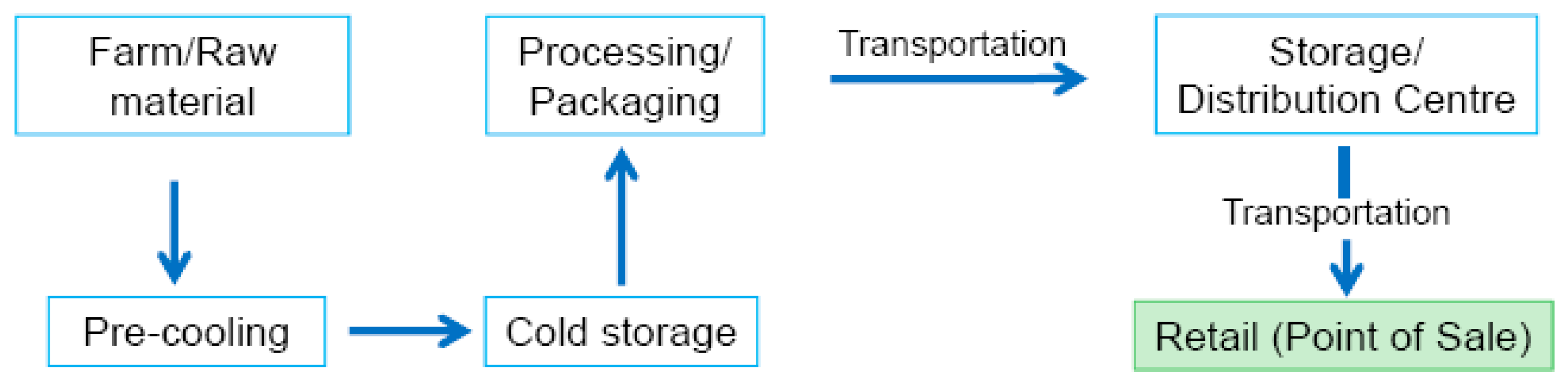
The cold chain for food is essential in mitigating food waste. The cold chain may lead to food waste due to inadequate food management, including local oversupply or extended storage times, as well as unsuitable storage conditions that shorten food shelf life. Mercier et al. [23] reported that in Canada, a developed nation, over 40% of food is wasted, resulting in substantial economic losses of $25 billion or more. Moreover, the cold chain has a significant environmental impact due to its high energy consumption, methane emissions from food degradation, and additional greenhouse gas emissions from refrigerant leakage into the atmosphere. Mercier et al. [24] and Badia-Melis et al. [25] identified heterogeneous pre-cooling, ground operations during transportation, retail display, domestic refrigerator storage, temperature variability within shipments, and industry handling practices as critical deficiencies in the contemporary food cold chain. These vulnerabilities may lead to premature product deterioration, increased waste, and financial losses, which make it difficult for farmers, vendors, and retailers. The length of cold chains varies significantly and depends on several factors. A comprehensive cold chain (shown in Figure 1) encompasses all elements, from post-production storage (whether small- or large-scale) to intermittent transportation to retail, culminating in refrigeration for the end user. According to Yahia [20], Lange [8], Fox [26], and Kitinoja and Kader [27], the significance of a complete cold chain escalates with distance and the duration between production and consumption. The significant distance between production and consumption necessitates continuous temperature control to prevent excessive food waste. The food cold chain can be categorized into three primary stages: pre-cooling, cold storage, and refrigerated transport, which will be elaborated upon in the subsequent subsections.
The growth of the cold chain—encompassing temperature-controlled storage, transportation, and logistics for perishable goods like food and pharmaceuticals—varies significantly between developed and developing countries. Countries like the US and Germany, which are already developed, usually have mature, well-established infrastructures with high current capacity but slower growth rates. This is because they have to follow rules, use automation, and have a steady demand. In contrast, developing countries like China, India, Brazil, and South Africa exhibit faster expansion due to rapid urbanization, rising middle-class consumption, e-commerce in perishables, export-oriented agriculture, and government investments in infrastructure to address food security and reduce losses. Global projections show the overall market growing robustly, but emerging regions often outpace mature ones in CAGR.
Overall, trends indicate that developing countries’ CAGRs (8–15%) often exceed those in developed countries (6–13%), reflecting catch-up growth from low bases (e.g., developing nations have only ~19 m3 of refrigerated capacity per 1000 inhabitants vs. 200 in developed countries). Food losses are higher in developing countries (up to 40% for perishables at harvest/storage) than in developed countries (15%, mostly at consumption), underscoring the need to expand the cold chain. Global market estimates range from USD 228–385 billion (2024–2025) to USD 372–2063 billion (2029–2034), with CAGRs of 10–20%, largely propelled by emerging markets.

2.1. Pre-Cooling

Pre-cooling technologies are crucial in postharvest management, especially for fruits and vegetables, to swiftly eliminate field heat, decrease respiration rates, minimize moisture loss, and prolong shelf life. These methods differ in velocity, energy consumption, cost, and suitability for different types of food (e.g., leafy greens for vacuum chilling, dense fruits for hydrocooling). This document presents a comparative analysis of standard attributes, encompassing cooling duration, moisture evaporation, water exposure, decay susceptibility, capital expenditure, energy efficiency, and constraints. The data is aggregated from conventional industry benchmarks, emphasizing prevalent methodologies. Gustavsson et al. [28] reported that postharvest losses from harvest to consumer may range from 13% to 38%. To mitigate the frequency and severity of postharvest losses, it is essential to swiftly remove field heat from the product after harvest and maintain ideal temperatures throughout the food cold chain. Temperature is the primary factor influencing the quality, shelf life, and deterioration rates of fresh produce [29].
Pre-cooling represents the initial and most vital phase in the refrigerated food cold chain. The pre-cooling procedure aims to remove heat from the field from fresh horticultural products and is conducted postharvest, prior to storage in cold storage or transfer to refrigerated vehicles. In hot, arid regions, delays in the pre-cooling process led to quality degradation and value loss in output. The Technical Standards-2010 [30] indicated that a 1 h delay at 35 °C field temperature between the pre-cooling and harvest diminishes the quality of most fresh horticultural commodities by 20 h during storage under optimal conditions. Pre-cooling can enhance the shelf life of perishable foods, thereby prolonging the market window for such items, as noted by Kongwong et al. [31]. Implementing pre-cooling on a product prior to cold storage can provide more rapid temperature decreases than direct integration with bulk cold storage [8]. Pre-cooling techniques encompass room cooling, hydrocooling, forced-air cooling, ice application, and, in certain instances, vacuum chilling, which is applicable for specific green crops but impractical for small-scale enterprises due to its substantial financial investment. These systems utilize mechanical refrigeration; however, economical alternatives such as night air ventilation, radiant cooling, and evaporative cooling are available when low air temperatures are not required, as noted by Kitinoja and Thompson [32], Brecht et al. [33], Duan et al. [34], Brosnan et al. [35], Thompson et al. [36], El-Ramady et al. [37], Kitinoja and Kader [27], and Kongwong et al. Table 3 presents a comparison of the typical characteristics and relative costs of different pre-cooling technologies. In pre-cooling systems, the predominant portion of the total heat load should derive from the product load, as the principal purpose of a pre-cooling system is to eliminate it.
The total product heat load depends on the type of food product, its initial temperature at harvest, the required final storage temperature, and the product mass [38].

2.2. Cold Storage

After harvesting, many perishable goods are transported to centralized cold storage facilities before being distributed to retailers or end users. Cold storage facilities can be either chilled or frozen, operating at various temperatures based on product specifications or customer requirements. When utilized appropriately, these facilities are solely necessary to sustain the product temperature. After harvesting, the quality of a crop is nearly impossible to enhance without appropriate storage conditions. Shende [39] highlighted the crucial role of ideal storage humidity and temperature in extending storage life and maintaining crop quality after chilling. Fresh fruits and vegetables require low temperatures (0 to 13 °C) and elevated relative humidity (80 to 95%) to diminish respiration and decelerate metabolic and transpiration rates. It is known that lower temperatures slow down respiration rates and senescence and ripening processes, making fruits and vegetables last longer. Under elevated relative humidity, the food preserves its marketable weight, aesthetic appeal, nutritional integrity, and flavor, but wilting, juiciness, and softening diminish; conversely, at lower relative humidity, transpiration rates escalate.
A cold store is an expansive refrigerated chamber or structure designed for the storage of perishable goods, including fruits and vegetables, under regulated conditions of relative humidity, temperature, CO2 levels, ethylene concentration, air circulation, and illumination [40]. Cold storage systems are essential infrastructure for prolonging the shelf life of perishable goods. Cold storage facilities for perishable goods can be categorized into three primary types as outlined below: (i) Cold storage facilities for fresh horticultural items that do not necessitate pre-cooling; (ii) Multi-commodity cold storage facilities for both short-term and long-term preservation of fresh horticultural items that necessitate pre-cooling and diverse storage conditions, as well as Controlled Atmosphere (CA) storage [40]. Despite the scarcity of published data on energy consumption in cold storage facilities, Duiven and Binard reported in 2002 that the electrical energy consumption of operational cold stores ranged from 30 to 50 kWh/m3/year. The outcome is contingent on multiple factors, including the building’s quality, operational activities (e.g., chilled or frozen storage), room dimensions, inventory turnover, the temperature of incoming products, and external environmental conditions. Furthermore, they indicated that power expenses account for roughly 10–15% of a store’s overall operating costs [10,41].
Cold storage facilities, commonly referred to as refrigerated warehouses or cold rooms, are significantly energy-intensive due to the constant refrigeration required to sustain low temperatures (usually chilled: 0–10 °C or frozen: <−18 °C). Refrigeration systems account for 60–80% of overall energy use, while the remainder is attributed to lighting, fans, defrost cycles, office HVAC, and other loads. Energy consumption fluctuates according to factors such as temperature level (frozen requires more energy than chilled). Facility dimensions (bigger facilities tend to exhibit more efficiency per unit volume)—quality of insulation. The efficient use of doors and the penetration of air are also important factors. Operational efficiency and equipment maintenance are also crucial factors. Geographical setting/meteorological conditions. Operational methodologies (e.g., product rotation, loading configurations). Table 4 presents the specifications for energy use in cold storage. Table 4 shows that small cold storage facilities use significantly more electrical energy per unit volume annually than large ones. Small cold stores are generally built without a pre-cooling system. Consequently, the cooling system for the small cold store must eliminate the field heat load and the load required to maintain the specified environmental conditions for perishable goods throughout the storage duration. Despite the high initial expenditure associated with building a large cold storage facility, owing to its dimensions and the incorporation of a pre-cooling system, its annual operating expenses are lower than those of a smaller cold storage unit. Consequently, vapor compression is the most efficient cooling technique used in the cold storage phase, as it applies to all food products across a wide range of temperatures. However, numerous small farmers and vendors in many developing nations are unable to adopt this method for preserving perishable fruits and vegetables due to its prohibitive costs for installation, energy use, and maintenance, as well as its detrimental environmental impact.

2.3. Refrigerated Transport

McGregor and Brian [42] and Gross et al. [43] identified three methods for delivering perishable food items: highway trailers or trucks, which serve as the principal mode of transport for domestic markets or merchants, and air- or sea-freight containers used for international markets. Fresh produce is a significant technological difficulty among the diverse array of perishable products carried. Flores et al. [44] indicated that fresh whole, sliced, and slightly processed fruits and vegetables undergo continuous respiration, generating heat, humidity, and gases that influence the temperature and environment of the transport system. Various elements must be regulated to minimize waste in transporting perishable goods from farmers to markets or consumers. Factors such as temperature, relative humidity, water loss, and atmospheric composition (CO2 concentration) must be regulated throughout transport to ensure ideal conditions and minimize losses, Chen and Shaw [45]. Vigneault et al. [46] indicated that the product is rarely maintained under ideal environmental conditions; roughly 40% of the vegetables fail to reach shop shelves due to transit damage. Consequently, well-insulated refrigerated transport trucks provide strict compliance with appropriate storage conditions during transit and mitigate food losses [46] and Yildiz [47]. Moreover, air distribution within the refrigerated transport container influences the quality of perishable fruits and vegetables. Defraeye et al. [48] conducted experimental investigations into the impacts of two innovative airflow strategies for refrigerated containers used in the overseas export of fruit: the channeling configuration, which reduces airflow bypass between pallets, and the horizontal configuration, which directs airflow horizontally through the pallets. The fruit exhibited reduced moisture retention compared to the channeling design, possessed an extended shelf life, and demonstrated superior quality. The horizontal arrangement performed poorly in all respects. Due to their elevated latent heat of fusion, Phase Change Materials (PCMs) have lately been utilized in transportation systems as a layer on the exterior of a container envelope, in conjunction with thermal insulation. This can improve the energy efficiency of transportation systems. Simultaneously, phase change materials (PCMs) can absorb and mitigate heat loads from the environment, maintaining the internal temperature of refrigerated vehicles within an acceptable range, as noted by Mosaffa et al. [49], Sari [50], Fioretti et al. [51], and Li et al. [52].
Refrigerated transport operations have been overlooked, despite their essential role in the cold chain. A recent study investigating the economic and environmental implications across the primary phases of the food cold chain found that refrigerated transportation incurs the highest costs and CO2 emissions. Refrigerated transportation accounts for, on average, 65.81% of cold chain expenditures and approximately 50.37% of CO2 emissions [53]. Food transportation requires considerable energy; it is estimated that the equivalent fuel can convey 5 kg of food 3800 miles by ship, 2400 km by rail, 740 km by truck, and merely 43 km by air [54]. In the USA, food travels an average of 2100 km before reaching the consumer’s plate [55]. Approximately 20% of transit time is allocated to loading and stationary periods, as indicated by a survey of 1300 refrigerated trailers conducted over 48 h [56]. It was projected that around 1300 specialized refrigerated cargo ships, 80,000 refrigerated railcars, and 650,000 refrigerated containers exist [57].
Furthermore, of the roughly 4 million refrigerated road vehicles globally, around 30% are trailers, 30% are heavy trucks, and 40% are small trucks and vans. The percentage is projected to rise by 2.5% by 2030 [58]. The use of diesel-powered refrigeration systems in food transportation significantly increases traditional fuel consumption and emissions per ton of distributed product. Consequently, it is highly pertinent to explore various cooling technologies to diminish the energy consumption of refrigerated vehicles and enhance their environmental footprint, given that 40% of greenhouse gas emissions stem from the vehicle’s engine and refrigerant leakage, as indicated by Tassou et al. [59] and Adekomaya et al. [60].
Despite the region’s weather conditions and the significant distances that spoilable commodities must travel between farms and markets, the available literature lacks precise data on the size, energy consumption, costs, and environmental impacts of refrigerated transportation in the MENA region. Further research is needed to enhance the energy efficiency of refrigerated transport by employing new cooling technologies, particularly those powered by renewable energy sources, to maintain controlled environmental conditions for perishable food during long-distance transport in extreme heat.

3. Cooling Systems Used in the Food Cold Chain

Refrigeration contributes to global warming and ozone layer depletion through the refrigerants used and the energy required to power refrigeration systems. The majority of current refrigeration systems operate by compressing and expanding a refrigerant. Numerous refrigerants have been utilized globally; owing to their efficiency and user-friendliness, chlorofluorocarbons (CFCs) were the predominant refrigerants until the 1980s. Due to their detrimental effects on the ozone layer, CFCs were progressively supplanted by hydrochlorofluorocarbons (HCFCs), which by 2010 exerted a reduced influence on ozone depletion and global warming. HCFCs are slated for elimination by 2030 in industrialized nations and by 2040 in poor nations, as stipulated under the Montreal Protocol framework (P0 to P6). While HFCs do not deplete the ozone layer, they are significant greenhouse gases recognized in the Kyoto Protocol [61]. Enhancing the efficiency of the food cold chain can reduce the likelihood of foodborne illness and spoilage while alleviating environmental impacts, given that the food cold chain currently accounts for around 1% of global carbon dioxide emissions, a figure expected to rise as global temperatures rise [38]. Implementing energy-efficient cooling technology in the food cold chain can substantially enhance its efficacy while reducing environmental impact.
A diverse array of cooling methods is currently available and also employed in the cold chain. They vary in essential performance attributes, including output temperature ranges, energy and refrigerant consumption, and capital and operational expenses. The attributes of a cooling system depend on the cooling technology used, including vapor compression, sorption (adsorption/absorption), evaporative cooling, or ice-based cooling. Vapor compression devices are applicable throughout the whole cold chain for all food products and across the complete temperature spectrum. Simultaneously, most alternative chilling technologies exhibit limited applicability, whether for food products, across comprehensive temperature ranges, or along the cold chain, Aste et al. [62].
Nevertheless, employing this cooling technology within the cold chain increases energy consumption, leading to greater reliance on fossil fuels, which, in turn, amplifies greenhouse gas (GHG), CFC, and HCFC emissions, thereby exacerbating ozone layer depletion. Recently, numerous innovative technologies and methodologies have been developed for application in cooling systems. Many of these nascent technologies depend on renewable energy sources or waste heat recovery as environmentally friendly substitutes for cooling systems, therefore diminishing traditional energy usage and, in turn, deleterious gas emissions, Reda et al. [63].

4. Solar Energy Applications in the Food Cold Chain

Recently, there has been heightened focus on solar energy due to the rising demand for its applications, including water heating, building climate control, cooking, electricity generation, and refrigeration. Numerous nations are currently increasing the use of solar energy owing to its environmental benefits, low operational costs, and abundant availability [64]. Presently, solar energy is becoming more prevalent in rural regions with constrained electrical and fuel resources, as is applicable in postharvest operations, including drying and chilling.

4.1. Solar Cooling

Recently, solar energy has emerged as an alternative to traditional energy sources for powering cooling systems, as the alignment of solar irradiation with peak cooling demand during daylight hours provides solar-driven systems a competitive edge over those reliant on conventional sources. Solar-powered cooling systems could be vital in developing villages devoid of electricity [65]. Furthermore, using solar energy for cooling is an essential solution to energy and environmental issues. Solar cooling systems provide significant electricity savings compared to traditional systems, thereby reducing fossil fuel use and the detrimental emissions that exacerbate global warming and ozone depletion. Moreover, these systems are quiet and resilient, as they have fewer or no moving mechanical components than traditional systems (Cascetta et al.) [66].

4.2. Solar Thermal-Driven Refrigeration Systems in the Food Cold Chain

Thermal cooling systems have been introduced to the market for air conditioning and refrigeration applications, utilizing diverse thermodynamic cycles and technologies. Thermally powered cooling systems are favored when substantial waste heat is available to operate the chiller, and increasingly so when integrated with renewable energy sources such as solar thermal energy. There are two primary thermal sorption cooling systems: absorption and adsorption systems. A considerable amount of research has been undertaken on solar cooling systems for the preservation of perishable goods, including fruits and vegetables. Sid-Ahmed and Ibrahim [67] investigated the use of a pond lined with floating water hyacinth as an economical heat sink to reduce the operational expenses of a cold storage facility powered by a solar absorption system in a rural setting. The cold storage facility was engineered to accommodate approximately 10 tons of agricultural products at 5 °C. The technology was developed and evaluated at the Energy Research Center in Khartoum, Sudan. The system comprises an 80 m2 evacuated-tube solar collector array that powers a 13 kW single-stage ammonia–water absorption refrigerator, together with a pond featuring a 1 m2 surface area and a depth of 0.2 m to provide cooling water for the system. The pond was obscured with water hyacinth to shield the water from solar radiation. This plant cover may provide a large surface area for evaporation and facilitate radiative cooling with the atmosphere. Their findings indicated that the pond’s cooling water was maintained at roughly 15 °C below ambient temperature at noon, and the cost of this passive heat sink was about 20% that of a comparable cooling tower. To reduce conventional energy usage for cold storage in rural regions facing electricity shortages, Islam et al. [68] engineered, built, and assessed cold storage systems for fruits and vegetables with moderate respiration rates for operation without electricity. The technology was implemented and evaluated at the Faculty of Agriculture, Ehime University, Matsuyama, Japan, to lower the internal temperature of the cold storage facility.
Water was introduced to a filler composed of sand and zeolite between the external and internal brick walls, and shade curtains were placed. The water in the filler evaporates into the ambient air via a cooling process that utilizes the latent heat of evaporation necessary for the transition from liquid to vapor. Throughout this process, the thermal energy necessary for water evaporation is extracted from the water, the filler, and the brick walls, therefore reducing the temperature of the inner walls. They aimed to reduce the cold store’s internal temperature by optimizing watering using neural networks and evolutionary algorithms. The control method for dynamic optimization over 24 h was divided into 8 phases, and optimal ON–OFF irrigation intervals for each phase were determined. The mean interior temperature with optimal control was 4 °C lower than that under continuous watering for 24 h and 7.5 °C lower than that under no watering. This technology enabled the cold store to prolong tomato shelf life from 7 to 16 days by utilizing an effective watering strategy. The authors subsequently altered the device to incorporate two cooling mechanisms: a solar-driven adsorption refrigerator and an evaporative cooling system. They also investigated a solar-powered adsorption refrigerator comprising a solar collector array, activated carbon as the adsorbent, a condenser, and an evaporator that cools water by evaporating methanol and adsorbing it onto the activated carbon, thereby producing ice. Methanol, utilized as a refrigerant, is adsorbed onto activated carbon and subsequently desorbed by solar thermal energy. The generated ice is employed to refrigerate the storage area. This was conducted for an extended duration without electricity. The evaporative cooling system lowers the temperature of the storage area by evaporating water from the moist walls that hold the wet filler. The simultaneous use of two cooling systems decreased the average interior temperature of the cold storage by 12.07 °C, relative to an average external temperature of 31.5 °C, thereby prolonging tomato shelf life from 7 to 23 days.
Inexpensive silica gel-water adsorption cooling systems have attracted interest for use in small-scale agricultural operations for cold storage. The silica gel-water adsorption cycles can be powered by low-grade solar energy or waste heat below 80 °C, as the silica gel-water adsorbent pair can be regenerated at comparatively low temperatures.
El-Bahloul et al. [69] conducted experimental investigations into the efficacy of a solar-driven vapor-compression refrigerator with a direct current (DC) motor, including indoor and outdoor tests with and without thermal storage and under loading conditions. The experimental apparatus was established in New Borg Al-Arab, Egypt. The experimental configuration comprised a multi-crystalline photovoltaic (PV) module, a battery functioning as a buffer for a stable 12 V DC supply, and a 50 L portable refrigerator equipped with or without phase change material (PCM) thermal energy storage. A theoretical model was developed to assess refrigerator performance under varying climatic conditions relative to the design point. The findings suggested that this technique is applicable for refrigeration in distant, hot, arid regions during postharvest crop transportation. Outdoor results at PCM demonstrated a complete load condition with a coefficient of performance (COP) of 1.22, and storage temperatures of 5 °C on the third day and 0 °C on the sixth day were documented. Basu and Ganguly [70] proposed a conceptual design for a grid-interactive solar photovoltaic/thermal-powered cold storage system for potato preservation. The proposed design comprises four primary components: cold storage, a LiBr-water absorption system, solar thermal flat-plate collectors (FPCs), and solar photovoltaic (PV) modules. The device was engineered to function under the existing meteorological conditions in Kolkata, India. The microclimate within the cold storage is controlled by the lithium bromide-water absorption system. The suggested system utilizes both solar thermal and photovoltaic energy. It was determined that 165 PM-150 modules in parallel, in conjunction with 50 FPCs, can adequately supply power to the cold storage for the year. The integrated solar and thermal power system can yield an annual net energy surplus of approximately 36 MWh. An economic analysis was conducted independently for the SPV array and FPCs. Both components provide a payback period of less than years, thereby affirming the economic and technical feasibility of the proposed design.

4.3. Solar-Driven Thermoelectric Cooling Systems in the Food Cold Chain

Thermoelectric cooling technology is based on the Peltier effect. The thermoelectric modules comprise P-type and N-type semiconductor blocks in standard designs. When direct current flows through one or more pairs of P-N semiconductors, the thermoelectric cooling effect occurs, in which heat is transferred in a designated direction when DC is applied to two heat sinks affixed to its hot and cold sides. Solar energy can serve as an adequate substitute for traditional electricity to power thermoelectric cooling modules. Solar thermoelectric cooling systems offer numerous benefits: the absence of moving mechanical components, elimination of working fluids, zero reliance on conventional energy, no detrimental emissions, excellent reliability, reduced weight, and greater packaging and integration flexibility. Owing to these benefits, solar-powered thermoelectric cooling systems have been widely used in the military, aerospace, instrumentation, and industrial sectors. Research has investigated the application of thermoelectric cooling technologies within the food cold chain. Wang et al. [71] determined that the semiconductor refrigeration plate possesses significant potential for application in cold-chain transportation. The researchers conducted an experimental analysis of a storage box utilizing semiconductor types TEC1-12706 and TEC1-12712. The experimental apparatus mainly comprises an insulated storage box with a volume of 0.1 m3, a semiconductor refrigeration unit powered by a DC power source, a submersible pump, and a heat-retaining water tank. The experimental findings demonstrated enhanced airflow dispersion. For cold storage, the semiconductor model TEC1-12706 with air cooling on the hot side is optimal. Consequently, this configuration maintained the box temperature at 6 °C for 10 h.
Furthermore, for freezing applications, the semiconductor model TEC1-12712 is recommended, with water cooling on the hot side and a fan positioned beneath the cold-side fins. This application method can maintain the central temperature below 0 °C for 3 h. The temperature distribution within the storage box was simulated numerically based on the experimental results. The cooling rate within the box increases with higher food-distribution porosity and higher cold-side velocity. Rahman et al. [72] examined a portable solar-assisted thermoelectric refrigerator. The system basically comprises a photovoltaic module that provides electricity to the thermoelectric module and a well-insulated rectangular aluminum container functioning as the cooling chamber. To fully use the capabilities of the thermoelectric module (TEM), the heat expelled from the hot side was utilized for low-temperature heating. A system was engineered to achieve 10 °C in the cold chamber; thus, it operates as a refrigerator. Experimental results indicated that the system reached the target temperature of roughly 10 °C in the cold chamber, while the hot side reached approximately 40 °C. The maximum coefficient of performance (COP) achieved was 0.61 for both cooling and heating applications.

4.4. Overview of Solar Thermal and Thermoelectric Cooling Technologies

Solar thermal and thermoelectric cooling are two separate methods for achieving sustainable refrigeration across the food cold chain, which includes postharvest storage, shipping, and the preservation of perishable items such as fruits and vegetables. Both utilize solar energy, although they differ in processes, scale, and performance. The comparison between the two technologies is given in the Table 5.
Solar Thermal Cooling: This cooling technique uses solar collectors (e.g., flat-plate or evacuated-tube) to convert solar energy into heat, which powers thermally activated chillers, such as absorption chillers (e.g., ammonia–water or lithium bromide–water) or adsorption chillers. It is commonly coupled with thermal storage systems, such as hot water tanks, for intermittent functionality.
Thermoelectric Cooling (TEC): This cooling technique, based on a solid-state method, employs the Peltier effect, in which an electric current traversing a semiconductor junction generates a temperature differential. It can be energized by solar photovoltaic (PV) panels that transform a fraction of solar radiation into electricity.
The following comparison emphasizes efficiency, pricing, advantages/disadvantages, and applications across the food cold chain, using quantitative data from research studies.
Efficiency Comparison: Efficiency is quantified by the Coefficient of Performance (COP), which is the ratio of cooling output to energy input. In solar-driven systems, overall efficiency is determined by the sum of the solar conversion efficiency (thermal or photovoltaic) and the chiller coefficient of performance (COP). Solar thermal systems typically surpass thermoelectric converters (TEC) owing to superior solar-to-thermal conversion efficiencies (40–70% compared to 10–20% for photovoltaic systems). TEC provides more simplicity.
Solar thermal is 2–4 times more efficient overall for large-scale cooling, but thermoelectric cooling (TEC) performs optimally at low temperature differences (DTs), such as 20 °C, resulting in a coefficient of performance (COP) of approximately 0.5.
Cost Comparison: Costs vary by size and location, with solar thermal generally having higher startup costs but lower lifecycle costs due to higher efficiency. Projections indicate that solar PV-TEC expenses may decline in the near future as PV prices fall.
Advantages and Disadvantages of Both Technologies in the Food Cold Chain
  • Both systems mitigate postharvest losses (20–40% in impoverished nations) by maintaining temperatures between 0 and 10 °C; they differ in their appropriateness for different circumstances.
  • Solar Thermal: Solar thermal storage is ideal for decentralized stationary storage in rural regions, such as 2–10-ton units for fruits and vegetables, as it reduces losses by 30–40% and extends the shelf life by 7–13 days for mangoes and papayas. India and Pakistan utilize solar thermal storage for on-farm preservation and have hybridized it with a grid for enhanced reliability.
  • Thermoelectricity: Optimal for mobile and micro-storage (e.g., integrated with electric vehicles for short-distance transport; 4–30 L units for vendors; decreases postharvest loss by 11–19% for bitter gourd and mango; prolongs shelf life by 7–10 days). Designed for distant locations, it keeps okra and papaya at an interior temperature of 16–22 °C.
In conclusion, solar thermal is favored for efficient, large-scale stationary applications in the food cold chain, while thermoelectric cooling excels in portable, low-maintenance contexts despite its lower efficiency. Hybrid methodologies, such as PCM integration, can reconcile disparities for both parties.

5. Research Gaps

The subject of solar-driven or aided refrigeration systems in the food cold chain emphasizes the use of solar energy, predominantly through photovoltaic (PV) or solar–thermal systems, to facilitate refrigeration and preserve perishable goods, including fruits, vegetables, dairy, and other commodities in the supply chain. This is especially pertinent to both on-grid and off-grid rural regions in poor nations, where grid energy is either inconsistent or nonexistent, resulting in significant postharvest losses, frequently ranging from 30% to 50% for perishable goods due to inadequate refrigeration. Research indicates advancements in decentralized solar-powered cold storage solutions (such as walk-in rooms, portable units, and thermoelectric/hybrid systems) that aim to minimize food waste, enhance farmer earnings, and reduce emissions. Examples encompass solar photovoltaic systems with batteries, solar thermal absorption/adsorption cycles, phase change materials (PCMs) for thermal storage, and integration with electric vehicles or evaporative cooling systems. Nonetheless, numerous research gaps remain, as follows:
(1)
Intermittency and reliability under variable conditions, such as solar energy variability on overcast days and seasonal fluctuations, lead to discrepancies with the continuous requirements of refrigeration. There are deficiencies in the durable, long-term efficacy of hybrid systems (solar + batteries/PCMs/backup) across many climates, particularly in areas with low irradiance or intermittent solar availability. Limited research examines year-round off-grid functionality without reliance on a diesel backup system.
(2)
Scalability and Integration Throughout the Entire Cold Chain: The majority of research focuses on on-farm or small-scale storage, such as decentralized units for fruits and vegetables. Substantial inefficiencies persist in solar-powered transportation refrigeration systems (e.g., refrigerated trucks/tricycles), last-mile delivery, pre-cooling/packhouses, and large-scale aggregation. Mobile or vehicle-integrated systems, such as solar-thermoelectric systems for electric vehicles, are emerging, though they remain inadequately examined with respect to their extensive supply chain connections.
(3)
Economic and Adoption Obstacles in Developing Nations: Significant initial expenses, limited financial capacity among farmers, restricted access to financing, and insufficient awareness impede implementation, particularly for smallholders. Identified gaps include thorough techno-economic assessments tailored to specific regions, feasible business models (e.g., cooling-as-a-service), policy incentives (e.g., subsidies, duty reductions), and sociocultural factors such as consumer preferences for non-refrigerated produce or gender dynamics in adoption.
(4)
Performance Optimization and Alternative Cycles Vapor compression predominates in photovoltaic-driven systems; however, adsorption/absorption cycles, which are better suited to solar-thermal applications, offer potential in arid regions due to reduced heat-source requirements and enhanced environmental sustainability. Identified gaps include comparative analyses of cycles, advanced materials (such as phase change materials that operate at subzero temperatures and methods for corrosion and leakage mitigation), surface upgrades in heat exchangers, and integration with contemporary compressors or natural/low-global-warming-potential refrigerants to achieve higher coefficients of performance and efficiency.
(5)
Environmental and Lifecycle Impacts: Although solar energy reduces emissions relative to diesel and grid systems, it still has environmental impacts. However, comprehensive lifecycle assessments that account for refrigerant global warming potential, battery disposal, and water consumption in hybrids are scarce. There are deficiencies in measuring the net benefits of food loss reduction in terms of climate impacts, as well as in data on long-term durability and maintenance under severe rural conditions.
(6)
Data and Monitoring Deficiencies: insufficient empirical, longitudinal field data on system dependability, energy efficiency, and postharvest loss mitigation. Increased demand for digital twins, IoT monitoring, and forecasting is essential to enhance renewable integration and address underexplored domains such as microbial management and specific crop needs.
(7)
Although prototypes and pilots exhibit promise, achieving widespread adoption necessitates interdisciplinary collaboration that integrates technology, economics, policy, and the social sciences. Future research must emphasize multi-climatic validations, cost-reduction technologies, and inclusive models for smallholders to address these gaps and improve food security in at-risk locations.

6. Conclusions

A substantial portion of perishable goods, including fruits and vegetables, deteriorates prior to reaching customers. Most of these losses can be attributed to the lack of refrigeration facilities, especially in developing nations with arid climates and marketplaces distant from agricultural sources. A food cold chain is an uninterrupted sequence of activities that ensures perishable products reach the consumer in a viable postharvest condition. The cold chain has three primary phases: pre-cooling, cold storage, and refrigerated transportation. Every phase of the cold chain relies fundamentally on refrigeration to preserve perishable goods at designated temperatures, relative humidity, and CO2 concentrations, thus prolonging their shelf life.
Solar-driven or aided refrigeration systems utilize solar energy either directly through thermal processes (e.g., absorption or adsorption cycles) or indirectly via photovoltaics (PV) to operate vapor-compression or thermoelectric cooling systems and preserve the food cold chain. These systems are especially beneficial in off-grid or developing nations for preserving perishable goods such as fruits, vegetables, and other food products, mitigating postharvest losses that can exceed 30–50% in areas with inconsistent energy supply. Solar-assisted variations frequently integrate with grid power, batteries, or phase change materials (PCMs) to enhance reliability. Despite progress in efficiency and scalability, numerous research gaps remain, as shown by recent reviews and studies. These gaps encompass technological, economic, social, policy, and regional elements as outlined below.
(1)
Technical Optimization and Integration Difficulties
  • Energy Efficiency and Intermittency Management: Improved optimization of energy-efficient designs is necessary, particularly in managing solar intermittency without excessive dependence on expensive batteries, which constitute 30–40% of system costs and necessitate replacement every 3–5 years. Alternative methods, such as cold thermal energy storage using phase change materials (PCMs) for subzero preservation of fruits and vegetables, merit greater focus, especially for long-term stability, enhanced thermal conductivity, and compatibility with solar refrigeration systems (SRS). Gaps also include addressing non-uniform cooling, which leads to inconsistent ripening and spoilage, and integrating sustainable refrigerants to mitigate environmental impact.
  • Adoption of Smart Technologies: Insufficient research on the integration of IoT, AI-driven predictive maintenance, digital twins, and intelligent monitoring systems to improve performance and decrease energy intensity in solar-powered cold storage. Subzero phase change materials face unresolved challenges, including supercooling, corrosion, and container leakage, necessitating targeted research, particularly in food applications where material deterioration may compromise safety.
  • System Scalability for Decentralized Applications: Additional efforts are necessary for micro-scale, mobile, or decentralized systems (e.g., 2–10 tonne capacities) designed for small farms, encompassing hybrid solar-thermoelectric configurations and phase change material backups to ensure reliable operation in fluctuating climates.
(2)
Economic and Financial Obstacles
  • Elevated Initial Expenses and Affordability: Substantial deficiencies persist in creating affordable models and financing strategies for small-scale farmers, who encounter preliminary investments beyond USD20,000 for medium-sized facilities. Investigations into “chilling as a service” (pay-per-use) models, blended finance, and cost reduction via local manufacture are insufficiently advanced, especially in areas with inconsistent farmer incomes.
  • Market and Economic Evaluations: Inadequate research on overall market dynamics, return on investment, and scalability impedes wider adoption. For example, payback periods of less than 2 years are achievable with incentives; however, economic evaluations tailored to food cold chains across various contexts are insufficient.
(3)
Social, Cultural, and Awareness Concerns
  • Consumer and Farmer Education: Deficiencies in research about public awareness initiatives and evolving sociocultural preferences, including hesitance to purchase refrigerated food in markets that emphasize fresh (non-chilled) goods. This influences demand for and the implementation of solar cold storage.
  • Skill Development and Workforce: Insufficient research on training initiatives for maintenance and operations in rural regions, resulting in a deficit of qualified workers and distrust among users.
(4)
Deficiencies in Policy and Regulation
  • Incentives and Legislation: There is a necessity for further investigation into policy interventions, including subsidies, reductions in import duties, and rules that encourage renewable cooling within food supply chains. Existing deficiencies in governmental assistance and private investment hinder progress in off-grid regions.
  • Environmental and Site-Specific Data: Insufficient data for feasibility evaluations across many climates, encompassing greenhouse gas reduction potential and alignment with sustainable development objectives (SDGs).
(5)
Regional and Application-Specific Research
  • Emphasis on Developing Regions: There is a paucity of research on solar-powered cold storage technologies (SPCSTs) in Sub-Saharan Africa and analogous regions, notwithstanding significant postharvest losses.

Author Contributions

Conceptualization, A.H.H.A. and J.A.H.H.A.; methodology, A.H.H.A.; formal analysis, A.H.H.A.; investigation, A.H.H.A. and J.A.H.H.A.; resources, J.A.H.H.A.; writing—original draft preparation, J.A.H.H.A.; writing—review and editing, A.H.H.A.; supervision, A.H.H.A.; project administration, J.A.H.H.A. All authors have read and agreed to the published version of the manuscript.

Funding

This research received no external funding.

Institutional Review Board Statement

Not applicable.

Informed Consent Statement

Not applicable.

Data Availability Statement

No new data were created or analyzed in this study.

Acknowledgments

The authors, Jillian Ahmed and Hamza H. Ali, express gratitude to the Science, Technology & Innovation Funding Authority (STDF) for the funding awarded at Cairo University, Egypt, under grant number 48913.

Conflicts of Interest

The authors declare no conflicts of interest.

References

  1. Coulomb, D. Refrigeration and the cold chain serving the global food industry and creating a better future: Two key IIR challenges for improving health and environment. Trends Food Sci. Technol. 2008, 19, 413–417. [Google Scholar] [CrossRef]
  2. Kader, A.A. Fruit maturity, ripening, and quality relationships. In Proceedings of International Symposium on Effect of Pre-and Postharvest Factors on Storage of Fruits; ACTA Horticulture 485; Michalczuk, L., Ed.; ISHS: Leuven, Belgium, 1999; pp. 203–208. [Google Scholar]
  3. International Institute of Refrigeration (IIR). The Role of Refrigeration in Worldwide Nutrition—5th Informatory Note on Refrigeration and Food; International Institute of Refrigeration (IIR): Paris, France, 2015; Available online: http://www.iifiir.org/userfiles/file/publications/notes/Note-Food_05_EN.pdf (accessed on 2 March 2025).
  4. Lipinski, G.; Hanson, C.; Lomax, J.; Kitinoja, L.; Waite, R.; Searchinger, T. Reducing Food Loss and Waste; World Resources Institute: Washington, DC, USA, 2013. [Google Scholar]
  5. Lim, L.C. A Review of: “Handbook of Postharvest Technology Cereals, Fruits, Vegetables, Tea and Spices”. Dry. Technol. 2005, 23, 1593–1595. [Google Scholar] [CrossRef]
  6. Mahajan, P.V.; Caleb, O.J.; Singh, Z.; Watkins, C.B.; Geyer, M. Postharvest treatments of fresh produce. Philos. Trans. A Math. Phys. Eng. Sci. 2014, 372, 20130309. [Google Scholar] [CrossRef]
  7. Joshi, R.; Banwet, D.K.; Shankar, R. Consumer link in cold chain: Indian scenario. Food Control 2010, 21, 1137–1142. [Google Scholar] [CrossRef]
  8. Lange, B.; Priesemann, C.; Geiss, M.; Lambrecht, A. Promoting Food Security and Safety via Cold Chains; Deutsche Gesellschaft für Internationale Zusammenarbeit (GIZ) GmbH: Bonn, Germany, 2016. [Google Scholar]
  9. Raut, R.D.; Gardas, B.B.; Narwan, V.S.; Narkhede, B.E. Improvement in the food losses in fruits and vegetable supply chain—A perspective of cold third-party logistics approach. Oper. Res. Perspect. 2019, 6, 100117. [Google Scholar] [CrossRef]
  10. Evans, J.A.; Huet, J.-M.; Reinholdt, L.; Fikiin, K.; Zilio, C.; Houska, M.; Bond, C.; Scheurs, M.; Van Sambeek, T.W.M. Cold Store Energy Usage and Optimisation. In Proceedings of the 23rd IIR International Congress of Refrigeration, IICR 2011, Prague, Czech Republic, 21–26 August 2011. [Google Scholar]
  11. James, S.J.; Evans, J. Consumer handling of chilled foods: Temperature performance. Int. J. Refrig. 1992, 15, 299–306. [Google Scholar] [CrossRef]
  12. Giannakourou, M.C.; Taoukis, P.S. Application of a TTI-based Distribution Management System for Quality Optimization of Frozen Vegetables at the Consumer End. J. Food Sci. 2003, 68, 201–209. [Google Scholar] [CrossRef]
  13. Gogou, E.; Katsaros, G.; Derens, E.; Alvarez, G.; Taoukis, P.S. Cold chain database development and application as a tool for the cold chain management and food quality evaluation. Int. J. Refrig. 2015, 52, 109–121. [Google Scholar] [CrossRef]
  14. Deoraj, S.; Edwin, I.; Ekwue, E.I.; Birch, R. An Evaporative Cooler for the Storage of Fresh Fruits and Vegetables. West Indian J. Eng. 2015, 38, 86–95. [Google Scholar]
  15. Gwanpua, S.G.; Verboven, P.; Leducq, D.; Brown, T.; Verlinden, B.E.; Bekele, E.; Aregawi, W.; Evans, J.; Foster, A.; Duret, S.; et al. The FRISBEE tool is software for optimising the trade-off between food quality, energy use, and the global warming impact of cold chains. J. Food Eng. 2015, 148, 2–12. [Google Scholar] [CrossRef]
  16. Montanari, R. Cold chain tracking: A managerial perspective. Trends Food Sci. Technol. 2008, 19, 425–431. [Google Scholar] [CrossRef]
  17. Andrej, O.; Jevšnik, M. Maintaining a cold chain from purchase to the home and at home: Consumer opinions. Food Control 2009, 20, 167–172. [Google Scholar] [CrossRef]
  18. Kuo, J.C.; Chen, M.C. Developing an advanced Multi-Temperature Joint Distribution System for the food cold chain. Food Control 2010, 21, 559–566. [Google Scholar] [CrossRef]
  19. Kitinoja, L. Use of Cold Chains for Reducing Food Losses in Developing Countries; PEF White Paper No. 13-03; The Postharvest Education Foundation (PEF): La Pine, OR, USA, 2013. [Google Scholar]
  20. Yahia, E.M. Cold Chain Development and Challenges in the Developing World. In Proceedings of the 6th International Postharvest Symposium; Acta Horticulture 877; Erkan, M., Aksoy, U., Eds.; ISHS: Leuven, Belgium, 2010. [Google Scholar]
  21. FB 2871. Cold Chain Market Growth & Future Trends (2024–2029). Available online: https://www.marketsandmarkets.com/Market-Reports/cold-chain-market-811.html (accessed on 22 February 2026).
  22. FBI104317, Cold Chain Market Size, Share & Industry Analysis, By Technology (Programmable Logic Controller, Vapor Compression, Blast Freezing, Others), By Type (Transport, Refrigerated Storage), By Application (Bakery & Confectionary, Processed Food, Dairy & Frozen Food, Fruits & Vegetables, Meat & Seafood) and Regional Forecast, 2026–2034. 2 February 2026. Available online: https://www.fortunebusinessinsights.com/cold-chain-market-104317 (accessed on 22 February 2026).
  23. Mercier, S.; Mondor, M.; Villeneuve, S.; Marcos, B. The Canadian food cold chain: A legislative, scientific, and prospective overview. Int. J. Refrig. 2018, 88, 637–645. [Google Scholar] [CrossRef]
  24. Mercier, S.; Villeneuve, S.; Mondor, M.; Uysal, I. Time–Temperature Management Along the Food Cold Chain: A Review of Recent Developments. Compr. Rev. Food Sci. Food Saf. 2017, 16, 647–667. [Google Scholar] [CrossRef] [PubMed]
  25. Badia-Melis, R.; Carthy, U.M.; Ruiz-Garcia, L.; Garcia-Hierro, J.; Robla Villalba, J.I. New trends in cold chain monitoring applications—A review. Food Control 2018, 86, 170–182. [Google Scholar] [CrossRef]
  26. Fox, T. A tank of cold. In Cleantech Leapfrog to a More Food-Secure World; Institution of Mechanical Engineers: London, UK, 2014. [Google Scholar]
  27. Kitinoja, L.; Kader, A.A. Small-Scale Postharvest Handling Practices: A Manual for Horticultural Crops, 5th ed; University of California, Davis—Postharvest Technology Research and Information Center: Davis, CA, USA, 2015. [Google Scholar]
  28. Gustavsson, J.; Cederberg, C.; Sonesson, U.; van Otterdijk, R.; Meybeck, A. Global Food Losses and Food Wastes—Extent, Causes and Prevention; Food and Agriculture Organization of the United Nations: Rome, Italy, 2011; Available online: www.fao.org (accessed on 5 March 2025).
  29. Wu, W.; Cronjé, P.; Nicolai, B.; Verboven, P.; Opara, U.L.; Defraeye, T. Virtual cold chain method to model the postharvest temperature history and quality evolution of fresh fruit—A case study for citrus fruit packed in a single carton. Comput. Electron. Agric. 2018, 144, 199–208. [Google Scholar] [CrossRef]
  30. NHB-CS-Type 01-2010Cold Storages for Storage of Fresh Horticulture Products Which Do Not Require Pre-Cooling; National Horticulture Board: Haryana, India, 2010. Available online: https://nhb.gov.in/documents/cs1.pdf (accessed on 22 February 2026).
  31. Kongwong, P.; Boonyakiat, D.; Poonlarp, P. Extending the shelf life and qualities of baby cos lettuce using commercial pre-cooling systems. Postharvest Biol. Technol. 2019, 150, 60–70. [Google Scholar] [CrossRef]
  32. Kitinoja, L.; Thompson, J.F. Pre-cooling systems for small-scale producers. Stewart Postharvest Rev. 2010, 6, 1–14. [Google Scholar] [CrossRef]
  33. Brecht, J.K.; Sargent, S.A.; Brecht, P.E.; Saenz, J.; Rodowick, L. Protecting Spoilable Foods During Transport by Truck and Rail; University of Florida: Gainesville, FL, USA, 2019. [Google Scholar] [CrossRef]
  34. Duan, Y.; Wang, G.B.; Fawole, O.A.; Verboven, P.; Zhang, X.R.; Wu, D.; Opara, U.L.; Nicolai, B.; Chen, K. Postharvest pre-cooling of fruit and vegetables: A review. Trends Food Sci. Technol. 2020, 100, 278–291. [Google Scholar] [CrossRef]
  35. Brosnan, T.; Sun, D.-W. Pre-cooling techniques and applications for horticultural products—A review. Int. J. Refrig. 2001, 24, 154–170. [Google Scholar] [CrossRef]
  36. Thompson, J.F.; Mitchell, F.G.; Kasmire, R.F. Cooling horticultural commodities. In Postharvest Technology of Horticultural Crops, 3rd ed.; Kader, A.A., Ed.; University of California, Division of Agriculture and Natural Resources: Oakland, CA, USA, 2002; pp. 97–112. [Google Scholar]
  37. El-Ramady, H.R.; Domokos-Szabolcsy, É.; Abdalla, N.A.; Taha, H.S.; Fári, M. Postharvest Management of Fruits and Vegetables Storage; Sustainable Agriculture Reviews; Lichtfouse, E., Ed.; Springer: Cham, Switzerland, 2015; Volume 15. [Google Scholar] [CrossRef]
  38. James, S.J.; James, C. The food cold-chain and climate change. Food Res. Int. 2010, 43, 1944–1956. [Google Scholar] [CrossRef]
  39. Shende, S.M. Design of cold storage. Int. Res. J. Eng. Technol. (IRJET) 2018, 5, 262–265. [Google Scholar]
  40. NHB-CS-Type 02-2010; Cold Storage for Fresh Horticulture Produces Pre-Cooling Before Storage. Cold Chain Development Centre-National Horticulture Board: Haryana, India, 2010.
  41. Duiven, J.E.; Binard, P. Refrigerated storage: New developments. Bull. IIR 2002, 82, 2–16. Available online: https://iifiir.org/en/fridoc/refrigerated-storage-new-developments-119219 (accessed on 5 March 2025).
  42. McGregor Brian, M. Tropical Products Transport Handbook; Handbook No. 668; United States Department of Agriculture Office of Transportation Agriculture: Washington, DC, USA, 1989. [Google Scholar]
  43. Gross Kenneth, C.; Wang, C.Y.; Saltveit, M. (Eds.) The Commercial Storage of Fruits, Vegetables, and Florist and Nursery Stocks; Agriculture Handbook 66; US Department of Agriculture, Agricultural Research Service: Washington, DC, USA, 2016. [Google Scholar]
  44. Flores, S.E.; David Tanner, D.; Amos, N. Cold Chain Management During Transport of Spoilable Products. Food Aust. 2002, 54, 268–270. [Google Scholar]
  45. Chen, K.Y.; Shaw, Y.C. Applying back propagation network to cold chain temperature monitoring. Adv. Eng. Inform. 2011, 25, 11–22. [Google Scholar] [CrossRef]
  46. Vigneault, C.; Thompson, J.; Wu, S.; Hui, K.P.; LeBlanc, D.I. Transportation of fresh horticultural produce. Postharvest Technol. Hortic. Crops 2009, 2, 1–24. [Google Scholar]
  47. Yildiz, T. CFD characteristics of refrigerated trailers and improvement of airflow for preserving spoilable foods. Logistics 2019, 3, 11. [Google Scholar] [CrossRef]
  48. Defraeye, T.; Nicolai, B.; Kirkman, W.; Moore, S.; Niekerk, S.V.; Verboven, P.; Cronjé, P. Integral performance evaluation of the fresh-produce cold chain: A case study for ambient loading of citrus in refrigerated containers. Postharvest Biol. Technol. 2016, 112, 1–13. [Google Scholar] [CrossRef]
  49. Mosaffa, A.H.; Infante Ferreira, C.A.; Talati, F.; Rosen, M.A. Thermal performance of multiple PCM thermal storage units for free cooling. Energy Convers. Manag. 2013, 67, 1–7. [Google Scholar] [CrossRef]
  50. Sari, A. Thermal energy storage characteristics of bentonite-based composite PCMs with enhanced thermal conductivity as novel thermal storage building materials. Energy Convers. Manag. 2016, 117, 132–141. [Google Scholar] [CrossRef]
  51. Fioretti, R.; Principi, P.; Copertaro, B. A refrigerated container envelope with a PCM (Phase Change Material) layer: Experimental and theoretical investigation in a representative town in Central Italy. Energy Convers. Manag. 2016, 122, 131–141. [Google Scholar] [CrossRef]
  52. Li, S.; Liu, Z.; Wang, X. A comprehensive review on positive cold energy storage technologies and applications in air conditioning with phase change materials. Appl. Energy 2019, 255, 113667. [Google Scholar] [CrossRef]
  53. Bottani, E.; Casella, G.; Nobili, M.; Tebaldi, L. Assessment of the economic and environmental sustainability of a food cold supply chain. IFAC-PapersOnline 2019, 52, 367–372. [Google Scholar] [CrossRef]
  54. Brodt, S.; Chernoh, E.; Feenstra, G. Assessment of Energy Use and Greenhouse Gas Emissions in the Food System: A Literature Review. 2007. Available online: https://asi.ucdavis.edu/sites/g/files/dgvnsk5751/files/inline-files/litreview-assessmentofenergyuse.pdf (accessed on 5 October 2016).
  55. Miller, G.T. Environmental Science, 8th ed.; Brook/Cole: Escondido, CA, USA, 2001. [Google Scholar]
  56. McKinnon, A.; Campbell, J. Quick Response in the Frozen Food Supply Chain: The Manufacturers’ Perspective; Christian Salvesen logistics research paper no. 2; Heriot-Watt University: Edinburgh, UK, 1998. [Google Scholar]
  57. Heap, R.D. Cold chain performance issues now and in the future. In Innovative Equipment and Systems for Comfort and Food Preservation, Proceedings of the Meeting of IIR Commissions B2, E1 with C2, D1, D2, Auckland, New Zealand, 16–18 February 2006; International Institute of Refrigeration: Paris, France, 2006. [Google Scholar]
  58. Glouannec, P.; Michel, B.; Delamarre, G.; Grohens, Y. Experimental and numerical study of heat transfer across insulation wall of a refrigerated integral panel van. Appl. Therm. Eng. 2014, 73, 196–204. [Google Scholar] [CrossRef]
  59. Tassou, S.A.; De-Lille, G.; Ge, Y.T. Food transport refrigeration—Approaches to reduce energy consumption and environmental impacts of road transport. Appl. Therm. Eng. 2009, 29, 1467–1477. [Google Scholar] [CrossRef]
  60. Adekomaya, O.; Jamiru, T.; Sadiku, R.; Huan, Z. Sustaining the shelf life of fresh food in cold chain—A burden on the environment. Alex. Eng. J. 2016, 55, 1359–1365. [Google Scholar] [CrossRef]
  61. Kyoto Protocol. United Nations Framework Convention on Climate Change; Kyoto Protocol: Kyoto, Japan, 1997; Volume 19. [Google Scholar]
  62. Aste, N.; Pero, C.D.; Leonforte, F. Active refrigeration technologies for food preservation in a humanitarian context—A review. Sustain. Energy Technol. Assess. 2017, 22, 150–160. [Google Scholar] [CrossRef]
  63. Reda, A.M.; Ali, A.H.H.; Morsy, M.G.; Taha, I.S. Design optimization of a residential scale solar driven adsorption cooling system in upper Egypt based. Energy Build 2016, 130, 843–856. [Google Scholar] [CrossRef]
  64. Sarbu, I.; Sebarchievici, C. Review of solar refrigeration and cooling systems. Energy Build 2013, 67, 286–297. [Google Scholar] [CrossRef]
  65. Rivera, C.O.; Rivera, W. Modeling of an intermittent solar absorption refrigeration system operating with ammonia–lithium nitrate mixture. Sol. Energy Mater. Sol. Cells 2003, 76, 417–427. [Google Scholar] [CrossRef]
  66. Cascetta, F.; Lorenzo, R.D.; Nardini, S.; Cirillo, L. A TRNSYS Simulation of a Solar-Driven Air Refrigerating System for a Low-Temperature Room of an Argo-Industry site in the Southern part of Italy. Energy Procedia 2017, 126, 329–336. [Google Scholar] [CrossRef]
  67. Sid-Ahmed, M.O.; Ibrahim, N. Passive cooling of the heat sink of an absorption solar cold store. Renew. Energy 1995, 6, 35–38. [Google Scholar] [CrossRef]
  68. Islam, M.P.; Morimoto, T.; Hatou, K. Dynamic optimization of inside temperature of zero energy cool chamber for storing fruits and vegetables using neural networks and genetic algorithms. Comput. Electron. Agric. 2013, 95, 98–107. [Google Scholar] [CrossRef]
  69. El-Bahloul, A.A.M.; Ali, A.H.H.; Ookawara, S. Performance, and sizing of solar driven dc motor vapor compression refrigerator with thermal storage in hot arid, remote areas. Energy Procedia 2015, 70, 634–643. [Google Scholar] [CrossRef]
  70. Basu, D.N.; Ganguly, A. Solar thermal–photovoltaic powered potato cold storage—Conceptual design and performance analyses. Appl. Energy 2016, 165, 308–317. [Google Scholar] [CrossRef]
  71. Wang, Y.; Qiu, L.; Liu, J.; Xu, X.; Bao, J.; Zhu, J. Performance of a fresh-food storage box based on semiconductor Refrigeration. Sustain. Cities Soc. 2019, 49, 101599. [Google Scholar] [CrossRef]
  72. Rahman, S.M.A.; Hachicha, A.A.; Ghenai, C.; Saidur, R.; Said, Z. Performance and life cycle analysis of a novel portable solar thermoelectric refrigerator. Case Stud. Therm. Eng. 2020, 19, 100599. [Google Scholar] [CrossRef]
Figure 1. Cold chain in the food sector.
Sustainability 18 02442 g001
Table 1. The table outlines the key characteristics of various cooling and refrigeration technologies.
Cooling Techniques Applicability Source of Driving EnergyRefrigerant Type
Food TypeTemperature RangesCold Chain StagesNotes
Direct expansion systemsAll food typesFull rangeFull cold chain ElectricHalogenated or natural refrigerants
Absorption and AdsorptionAll food typesFull rangeFull cold chain and not applicable during transportation Thermalnatural refrigerants
Evaporative coolingFreezing sensitive
Fruits and vegetables
Higher than 10 °CBulk storage, display, and household refrigeratorsClimatic limitations (low humidity) Thermal (passive)Water
IceNon-freezing sensitive produce, such as fish and meatEqual to 0 °CFull cold chain Electric or thermalHalogenated or natural refrigerants
Table 2. A comparison based on available data on cold chain market growth and future trends (2024–2029).
Country/RegionCategoryRecent Market SizeProjected Market SizeCompound Annual Growth Rate (CAGR)Key Growth Drivers/Challenges
United StatesDevelopedUSD 105.2 billion (cold chain logistics, 2025)Not specified (part of North America, projected to grow steadily)~8% (cold storage segment, 2026–2036); regional North America at 6.12% overallThe industry is characterized by advanced infrastructure, with over 3.7 billion cubic feet of refrigerated capacity, automation/IoT adoption, pharmaceutical demand, and food safety regulations such as FSMA. Challenges: Driver shortages, port congestion.
GermanyDeveloped~7% of Europe’s market share (cold chain, 2025; Europe total ~USD 90.8 billion in cold chain logistics)Not specified13.6% (cold chain logistics, 2026–2035); part of Europe at 12.9%Stringent EU food safety regulations, export-oriented supply chains, energy-efficient technology, and pharmaceutical manufacturing characterize the market. The market is mature and prioritizes sustainability.
ChinaDeveloping~40% of Asia-Pacific’s cold storage capacity (>180 million cubic meters, recent estimate); part of Asia-Pacific at ~30% global shareProjected to nearly double by 2026 (from the earlier base); part of global growth to USD 862.33 billion by 203214.6% (cold chain logistics, 2026–2035); regional Asia-Pacific at 8.05–11.5%Urbanization, e-commerce (e.g., online grocery sales up 30% 2020–2021), meat/pharma imports, and government infrastructure initiatives. Challenges: Uneven regional development, energy costs.
IndiaDeveloping>40 million metric tons cold storage capacity (recent est.); part of Asia-Pacific growthNot specified10% (cold storage, 2026–2036); regional Asia-Pacific at 8.05–11.5%Shift to fruit/vegetable cultivation, export growth, government warehousing investments, and rising frozen food demand. Challenges: Fragmented infrastructure, high postharvest losses (up to 40%).
BrazilDevelopingPart of Latin America’s emerging growth (developing economies with <15% global capacity but 38% perishable production)Not specified8.3% (cold storage, 2026–2036)The challenges include rising disposable income, food and pharmaceutical exports, and the modernization of cold storage—challenges: infrastructure costs and rural-urban gaps.
South AfricaDeveloping13 m3 cold storage per 1000 residents (highest in Africa); part of Africa’s USD 10.88 billion (2024)Part of Africa’s projection to USD 14.85 billion by 2029~8.28% (Africa regional, 2024–2029)The challenges include urbanization (45–60% by 2050), supermarket expansion, pharma/vaccine needs, and the boost to trade from the AfCFTA. Challenges: Electricity access, skills shortages, and climate impacts.
Table 3. Comparison of the typical characteristics and relative costs of different pre-cooling technologies.
MethodCooling Time (Hours)Moisture Loss (%)Water ContactDecay Contamination RiskCapital CostEnergy EfficiencyKey Limitations/Suitability
Passive Evaporative Cooling (e.g., water-soaked media like zero-energy chambers)40–100No dataNoLowLowHighThe product is limited by climate; it is best for low-cost, non-refrigerated setups in humid areas.
Refrigerated Room Cooling (cold air circulated around containers)20–1000.1–2.0NoLowLow to MediumLowSlowly avoid harvesting hot produce to prevent infections, as it is well-suited to bulk storage.
Forced-Air Cooling (cold air forced through containers)1–100.1–2.0NoLowLowLowThe system depends on the airflow setup, which may increase cost, but it is versatile for many fruits and vegetables and reduces ethylene production and decay.
Hydrocooling (water cooling; immersion or spraying with cold water)0.1–1.00–0.5YesHigh (if water is not sanitized)LowHighRequires clean, recirculated water to avoid microbial buildup; enhances firmness and shelf life (e.g., up to 32 days for mangoes); best for water-tolerant produce such as corn or grapes.
Vacuum Cooling (evaporative cooling in a sealed chamber)0.25–1.0 (typically fastest)1–3 (higher due to evaporation)No (but moisture evaporates).LowHighMedium to HighUniform cooling preserves nutrition and color; it has a higher investment than forced air; it is ideal for leafy greens but may cause wilting in sensitive produce.
Ice Cooling (crushed or slurry ice in packages)0.1–0.3No dataYesLowHighLowIce melting poses hazards and requires moisture-proof packaging; it is effective for rapid cooling in transport but is energy-intensive.
Table 4. The energy requirements for different volumes of cold stores depend on the chilling temperature.
Temperature TypeTypical/Average (Older or Standard Facilities)Best Practice/Modern Efficient FacilitiesNotes/Sources
Chilled (0–10 °C)20–100 kWh/m3/year (e.g., European avg. ~44 kWh/m3/year)10–30 kWh/m3/year (larger stores lower)Wide variation: smaller stores have higher SEC. Thailand chilled: 37–212+ kWh/m3/year, often inversely correlated with volume.
Frozen (≤−18 °C)30–425 kWh/m3/year (European avg. ~62 kWh/m3/year; older IIR est. 30–50 kWh/m3/year)5–20 kWh/m3/year (e.g., India frozen avg. ~69 kWh/m3/year, but best much lower)Frozen uses more due to lower temps; large facilities achieve the lowest.
Mixed (Chilled + Frozen)50–100+ kWh/m3/year10–30 kWh/m3/yearIt depends on proportions.
Table 5. Comparison between Solar Thermal and Thermoelectric Cooling Technologies.
FeatureSolar Thermal CoolingThermoelectric Cooling (Solar PV-Driven)
Chiller COP0.25–1.2 (e.g., 0.25 for diffusion-absorption refrigeration (DAR); 0.6–0.85 for adsorption; 0.7–1.2 for single-effect absorption)0.3–0.85 (e.g., 0.3 without controls; 0.42 average; 0.6–0.69 with PCM; up to 0.85 for liquid-cooled variants)
Overall Solar Efficiency0.3–0.8 (solar thermal conversion >40%; e.g., >40% vs. PV’s 10–20%, leading to higher energy efficiency)0.045–0.12 (PV efficiency 10–20%; TEC COP 0.3–0.6; e.g., yearly cooling COP up to 1.87 for storage tanks, but typically lower)
Temperature RangeSuitable for 0–10 °C (e.g., <10 °C for absorption)5–20 °C below ambient (e.g., 5–10 °C for food storage; up to 17–22 °C internal with 30 °C ambient)
Energy ConsumptionLower long-term due to high thermal efficiency, e.g., 30–50% less than PV for equivalent cooling in off-grid setupsHigher due to low COP; e.g., 37–138 W for small systems, but optimized modes reduce to 107 W average
EnhancementsPCM integration reduces startup time (e.g., 2 h for bubble pump activation); COP improves with higher heat input.Solar tracking boosts COP by 44–75% (e.g., max 2.07 vs. 1.19 without); PCM shortens solidification by ~1 h.
Disclaimer/Publisher’s Note: The statements, opinions and data contained in all publications are solely those of the individual author(s) and contributor(s) and not of MDPI and/or the editor(s). MDPI and/or the editor(s) disclaim responsibility for any injury to people or property resulting from any ideas, methods, instructions or products referred to in the content.