


Abstract
Against the backdrop of rapid digitalization and greening, examining the impact of green, digital, cross-boundary innovation on carbon emissions is of critical importance for achieving carbon reduction more efficiently. This study uses data on Chinese listed companies from 2011 to 2022 as the sample and employs machine learning methods on patent texts to measure green, digital, cross-boundary innovation. A two-way fixed-effects model is applied to empirically examine its impact on carbon emissions. The results show that green, digital, cross-boundary innovation significantly reduces carbon emissions, with a carbon-reduction effect about 96% higher than that of traditional green technology innovation and showing some advantage over traditional digital technology innovation. Its mechanisms include enhancing green knowledge recombination, deeply embedding digital technologies, and improving resource allocation efficiency. The carbon-reduction effect is more pronounced in high-tech industries, highly competitive markets, and regions with stronger intellectual property protection and stricter environmental regulations. When differentiating among types of cross-boundary green innovation, green, digital, cross-boundary innovation reduces carbon emissions more effectively than non-digital, green, cross-boundary innovation and pure green technology innovation. Moreover, its carbon-reduction effect exhibits industry spillover and peer group effects. These findings provide valuable references for promoting the synergistic development of digitalization and greening and for leveraging innovation to achieve carbon reduction.
1. Introduction
In the context of accelerating global warming, reducing carbon emissions has become an urgent global challenge [1]. According to the World Energy Outlook report released by the International Energy Agency, China—the world’s largest emitter of carbon dioxide—maintained relatively stable CO2 emissions in 2022, totaling 10.2 billion tons, representing a slight decline of 0.2% compared to the previous year. The sustained high level of emissions is mainly driven by structural factors, including an economic structure dominated by energy-intensive industries, an energy mix heavily reliant on coal, and the accelerated pace of industrialization. In response, China has actively implemented a series of measures to curb carbon emissions. In September 2025, the Chinese government explicitly announced its third carbon target—achieving carbon emission reductions by 2035—at the United Nations Climate Change Summit. To advance the realization of the “three carbon goals,” China has further promoted the accelerated integration of digitalization and green transformation. As this coordination deepens, digitalization and greening have evolved from two parallel development trajectories into an increasingly integrated process characterized by strong interconnections and mutual reinforcement. The growing interaction of cross-boundary knowledge and technologies has driven the gradual convergence of digital and green innovation domains [2], giving rise to a new innovation paradigm—green, digital, cross-boundary innovation. As the primary agents of innovation, enterprises are actively responding to this emerging paradigm. According to this study’s estimates, the number of green, digital, cross-boundary patents held by listed firms increased steadily from 1909 in 2014 to 4072 in 2020. This trend indicates that green, digital, cross-boundary innovation has become an important pathway through which firms respond to carbon reduction targets and advance the coordinated development of digitalization and greening, supported by a solid foundation of practical application.
Unlike traditional digital technology innovation and conventional green technology innovation, green, digital, cross-boundary innovation is characterized by both high returns and high risks. Cross-boundary innovation highlights the integration of heterogeneous knowledge, technologies, and experience from diverse fields, enabling enterprises to generate new technological outcomes through collision, intersection, and recombination [3]. Correspondingly, green, digital, cross-boundary innovation refers to applying digital technologies within green technology innovation, achieving deep integration between digital technologies such as big data, artificial intelligence, and the Internet of Things with the essential elements of green technology innovation. On one hand, enterprises engaging in green, digital, cross-boundary R&D are more likely to generate frontier and disruptive innovations [4]. Traditional green technology innovation is often constrained by the positive externalities dilemma, where environmental benefits exhibit pronounced externalities that enterprises struggle to fully internalize, resulting in insufficient innovation incentives [5,6]. Digital technologies, with their robust capabilities in data processing, intelligent decision-making, and resource optimization, can enhance the precision and systematic nature of green technology R&D, accelerate knowledge flow and solution iteration, and foster the emergence of novel low-carbon solutions [7]. On the other hand, the simple combination of the two does not necessarily guarantee success. Digital technology innovation exhibits complex characteristics such as openness and dynamic interactivity, with blurred boundaries among innovation actors, designs, and processes, and highly uncertain innovation outcomes [8]. Meanwhile, cross-boundary research and development involves multiple departments and professional backgrounds, resulting in high communication costs and complex collaboration, which can easily lead to information delays or resource misallocation, potentially reducing the actual innovation output. Whether the integration of green technological innovation with digitalization can truly break through these bottlenecks and achieve a synergistic carbon-reduction effect of “1 + 1 > 2” remains to be verified. Studying the impact of green, digital, cross-boundary innovation on carbon emissions, in this context, not only enriches the theoretical framework for digital green synergy but also provides crucial practical insights for China in exploring efficient low-carbon development pathways.
Addressing gaps in existing literature, this study examines 3724 Chinese A-share listed companies from 2011 to 2022. Using 62,357 green patents in China from 1991 to 2022, it combines text analysis with Word2Vec algorithms to measure green, digital, cross-boundary innovation. Employing a two-way fixed-effects model, it examines the impact of such innovation on carbon emissions, compares its carbon-reduction effects with those of traditional digital technology innovation and traditional green technology innovation, and further analyzes the carbon-reduction mechanisms, heterogeneous effects, industry spillover effects, and peer group effects of green, digital, cross-boundary innovation.
The article includes the following sections: Section 2 presents the theoretical background and develops the hypotheses; Section 3 describes the data sources and empirical methodology; Section 4 reports the empirical results; Section 5 and Section 6 summarize the findings and discuss their implications; and Section 7 outlines directions for future research.
2. Research Hypotheses
2.1. Green, Digital, Cross-Boundary Innovation and Enterprise Carbon Emissions
Digital technologies and green technologies exhibit significant differences in their emission reduction mechanisms. Digital technologies can reduce energy consumption and consequently lower carbon emissions through intelligent and information-based management [9]. Green technologies primarily reduce carbon emissions by replacing traditional fossil fuels, promoting renewable energy, and enhancing energy efficiency [10] Complementarity theory posits that when two or more elements coexist, the performance generated by their synergistic interaction often exceeds the sum of their individual effects. In innovation research, empirical studies have shown that combining different types of innovation can yield more significant performance improvements than implementing them separately, reflecting the multiplicative effect and the complementary nature of innovation activities [11,12]. Moreover, the complementarity of technologies or resources has also been validated in corporate practice—for example, the synergy between internal and external innovation activities, as well as the complementarity between information technology infrastructure and firm capabilities—providing a solid theoretical foundation for the synergistic benefits of green, digital, cross-boundary innovation.
Green, digital, cross-boundary innovation can fully leverage the environmental externalities of green technological innovation while amplifying the synergistic emission-reduction effects of digital technologies. Through dual empowerment of information intelligence and environmental friendliness, it generates a combined and amplified carbon-reduction effect.
From the perspective of intrinsic technological characteristics, digital technology possesses two unique features: data homogenization and programmability [13]. Data homogenization refers to the process in which digital technology standardizes information with binary properties during computation [14], enabling green data or information to be converted into binary green knowledge. This provides a more efficient means for data processing and sharing, facilitating precise measurement and optimization in corporate carbon emission management. Programmability indicates that digital technology allows for easy program editing or reprogramming [15], which reduces barriers to the dissemination of green knowledge and minimizes resource waste in the process of green technology innovation.
From a technology-enabled perspective, different categories of digital technologies can provide multifaceted technical support for green technology innovation. Specifically, technologies such as big data analytics and cloud computing help reduce information uncertainty, enabling enterprises to more accurately identify market demands and formulate effective green technology innovation strategies. Blockchain technology, characterized by transparency, traceability, decentralization, and tamper-proofing, can mitigate uncertainties and risks associated with green technology innovation by establishing a shared information infrastructure for all participants. This infrastructure tracks material and resource flows across supply chains and consumption stages. Artificial intelligence promotes corporate green innovation by enhancing foundational knowledge coupling and expanding and supplementing knowledge coupling.
From the perspective of technological convergence, convergence occurs when digital technologies are embedded within the technologies of other sectors [16]. Green, digital, cross-boundary innovation allows for the unified digital encoding of technical knowledge and information, enhancing information sharing and knowledge integration in corporate green innovation. This, in turn, improves technological efficiency [17], enabling enterprises to manage and optimize resource utilization more effectively and further advance the goal of reducing carbon emissions. Based on this, Hypothesis 1 is proposed.
Hypothesis 1.
Green, digital, cross-boundary innovation can reduce carbon emissions and more effectively reduce carbon emissions than traditional digital technology innovation and traditional green technology innovation.
2.2. Green, Digital, Cross-Boundary Innovation, Green Knowledge Recombination and Enterprise Carbon Emissions
Green knowledge recombination capabilities encompass green knowledge recombination creation and green knowledge recombination reuse. Green knowledge recombination creation refers to new combinations that drive innovation breakthroughs and knowledge restructuring, while green knowledge recombination reuse involves reestablishing new connections between previously associated elements [18].
The optimal environmental practices and technological paradigms within the green technology domain remain largely undefined, compelling enterprises to invest considerable resources in developing a solid green knowledge base [19]. Green, digital, cross-boundary innovation leverages the advantages of digital technology in efficiently acquiring information and storing data, enabling enterprises to achieve efficient sharing and reuse of green knowledge across different departments, projects, or business units. This facilitates the redeployment of existing familiar knowledge components, thereby driving the expanded application of green knowledge. The restructuring and reuse of green knowledge allows enterprises to redeploy existing relevant knowledge and technological components into new green technologies or application scenarios. This enhances the applicability and influence of green knowledge, thereby promoting the diffusion of green technologies [20]. Furthermore, the process of restructuring and repurposing existing green knowledge can facilitate the transition from unsustainable technologies to sustainable ones, thereby effectively reducing carbon emissions.
Green, digital, cross-boundary innovation involves the intersection of two types of knowledge and requires the integration of heterogeneous knowledge across boundaries. It broadens and deepens the breadth and depth of external knowledge acquisition, compelling the innovation process to challenge the foundations of existing product and service portfolios and to break through existing technological barriers and domain constraints [21]. Knowledge recombination theory posits that innovation arises from the novel recombination of existing knowledge. By integrating heterogeneous knowledge from different domains, firms can generate new technologies, products, or processes that transcend the limitations of single-domain knowledge [22]. In the context of green, digital, cross-boundary innovation, digital technologies and green technologies represent two distinct knowledge bases. Through knowledge recombination, firms can embed digital capabilities such as data analytics, intelligent monitoring, and process automation into green technologies, including energy-efficient processes and renewable energy systems. This integration not only enables synergistic reductions in carbon emissions and improves resource utilization but also fosters breakthrough innovations that would not be attainable if the technologies were applied independently. Furthermore, effective knowledge recombination reflects a firm’s dynamic capabilities, allowing it to continuously adapt to changing regulatory, market, and technological environments, thereby sustaining long-term carbon reduction and competitive advantage [23].
Meanwhile, digital technologies exert positive effects on the products and process flows of green innovation. Digital green innovation possesses differentiated advantages, helping enterprises increase spending from environmentally conscious consumers and further enabling them to obtain greater profits. The restructuring and creation of knowledge require substantial financial investment, while green, digital, cross-boundary innovation can, to some extent, alleviate enterprises’ financial constraints, thereby facilitating green knowledge recombination and creation [24]. Such restructuring and creation are more likely to generate breakthrough green technological innovations that disrupt current technological and scientific paradigms. These innovations are more likely to be widely adopted and exert far-reaching impacts, fundamentally driving the low-carbon transformation of corporate production methods and thus achieving carbon emission reductions. Based on this, this paper proposes Hypothesis 2.
Hypothesis 2.
Green, digital, cross-boundary innovation can reduce corporate carbon emissions by enhancing green knowledge recombination capabilities.
2.3. Green, Digital, Cross-Boundary Innovation, Digital Technology Application Depth and Enterprise Carbon Emissions
Green, digital, cross-boundary innovation is not only a process that integrates green technology with digital technology but also an important force driving enterprises to embed digital technologies more deeply. To advance this type of innovation, enterprises must incorporate a variety of digital technologies, including artificial intelligence, big data, cloud computing, the Internet of Things and blockchain, into green technology research and development, production management, energy utilization and supply chain coordination. This facilitates a transition from technology introduction to technology integration and continuously strengthens the internal application of digital technologies [25,26]. Moreover, while basic digital upgrades may only yield efficiency improvements, the stringent requirements of green technological innovation, especially in carbon reduction and resource recycling, compel enterprises to transform technologies such as big data and the Internet of Things from supporting tools into core systems that guide production and operational decision-making.
The deep embedding of digital technologies promotes carbon emission reduction across multiple dimensions. First, the deep embedding of digital technologies enhances the refined management capability of energy and resources. Through big data analytics and Internet of Things sensing systems, enterprises can monitor energy consumption and emission data in production processes in real time, identify energy efficiency bottlenecks, and implement precise adjustments, thereby significantly reducing energy waste and ineffective emissions. Second, the deep embedding of digital technologies promotes the development of green supply chains and collaborative ecosystems. Green, digital, cross-boundary innovation encourages firms to extend digital technologies to both upstream and downstream segments of the supply chain, enabling information sharing and process coordination, thereby improving resource allocation efficiency and logistics transparency [21]. Through technologies such as blockchain, firms can achieve reliable recording and tracking of carbon emission data, which facilitates the establishment of green procurement and low-carbon production systems, and further reduces overall carbon emissions at the system level. Based on this, Hypothesis 3 is proposed.
Hypothesis 3.
Green, digital, cross-boundary innovation can reduce corporate carbon emissions by promoting the deep integration of digital technologies.
2.4. Green, Digital, Cross-Boundary Innovation, Resource Allocation Efficiency and Enterprise Carbon Emissions
Green, digital, cross-boundary innovation significantly enhances the precision and efficiency of resource allocation by integrating the intelligent and interconnected characteristics of digital technology with the environmentally friendly objectives of green technology. Digital technology can markedly improve corporate information transparency, enabling enterprises to acquire and utilize vast data resources at low cost and high efficiency [27]. Through the application of big data, artificial intelligence, the Internet of Things, and other technologies, enterprises can acquire and utilize vast amounts of data at virtually zero cost, facilitating rapid circulation and efficient sharing of information and resource [28]. This enables businesses to precisely monitor energy consumption, environmental pollution, and market dynamics during production and operations. Based on real-time data, they can optimize energy allocation within production processes, thereby improving energy efficiency and reducing waste.
Resource misallocation is a key factor behind persistently high carbon emissions, and improving resource allocation efficiency plays a crucial role in reducing corporate carbon emissions. When resource allocation efficiency is low, capital, labor, and technological factors fail to flow sufficiently toward high-productivity sectors, leading to structural distortions in energy consumption and pollution emissions. Efficient resource allocation enables enterprises to achieve the same or even higher output with less energy consumption in their production activities, thereby reducing unnecessary carbon emissions. Based on the above analysis, this paper proposes Hypothesis 4.
Hypothesis 4.
Green, digital, cross-boundary innovation can reduce carbon emissions by enhancing resource allocation efficiency.
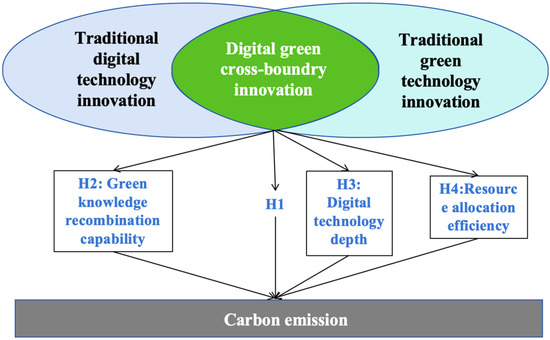
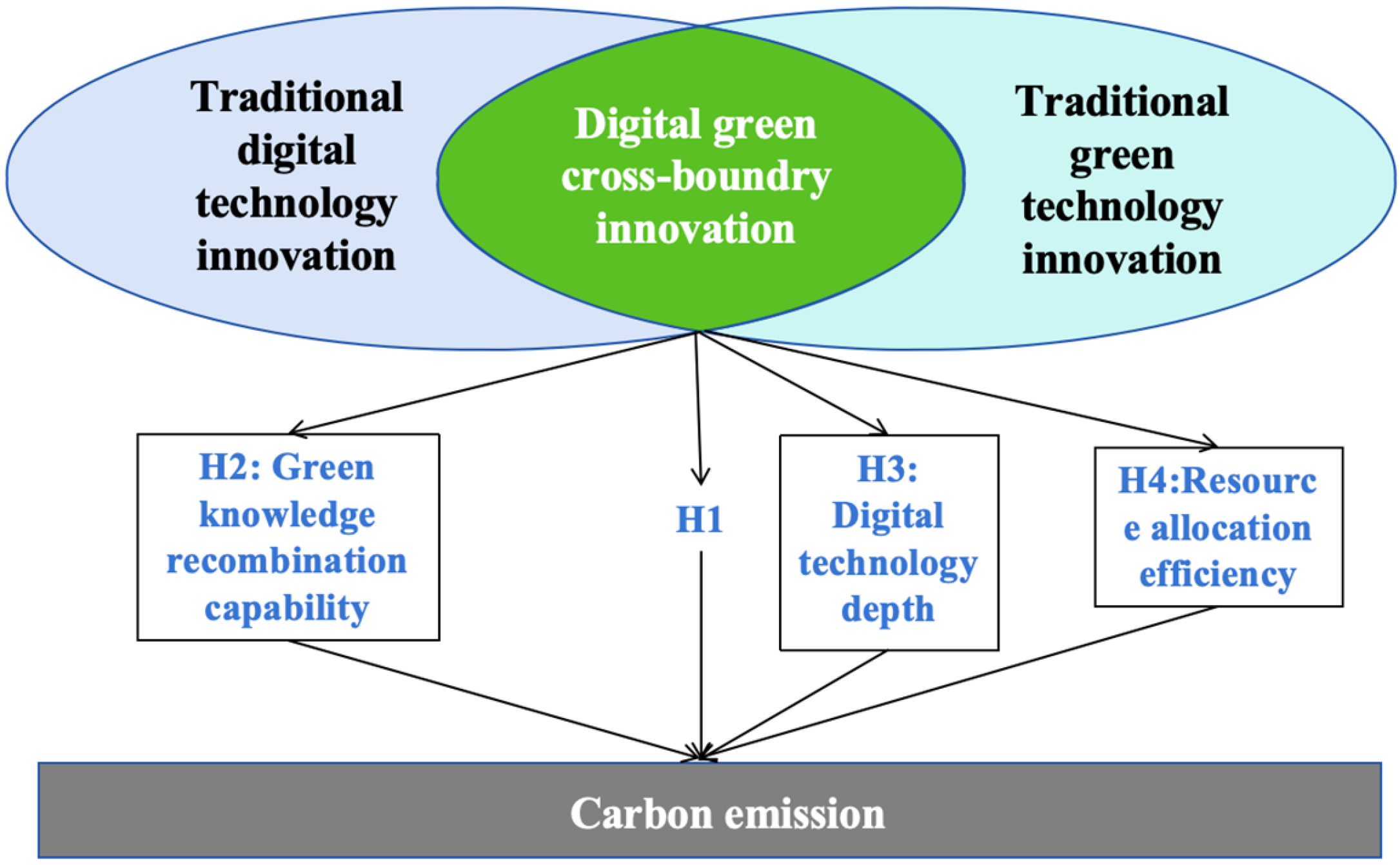
This study aims to examine whether green, digital, cross-boundary innovation can effectively reduce corporate carbon emissions through channels such as green knowledge recombination, deep application of digital technologies, and improved resource allocation efficiency, and to compare its synergistic emission-reduction effects with those of traditional digital and green technological innovations. In doing so, the study addresses several gaps in the existing literature: it provides a more precise and systematic measure of green, digital, cross-boundary innovation, empirically tests the synergistic ‘one plus one is greater than two’ emission-reduction effect that has rarely been explored, and investigates the underlying mechanisms and potential heterogeneous effects across firms and industries, thereby extending both theoretical understanding and practical implications of digital-enabled green innovation. The hypothetical framework of this paper is shown in Figure 1.
Figure 1.
Carbon-reduction mechanism of green, digital, cross-boundary innovation.
The relevant research primarily encompasses the following four categories of studies. First, the impact of green technological innovation on carbon emissions. Some scholars argue that green technological innovation can reduce carbon emissions [29,30], while others hold differing views. Mongo et al. (2021) [31] contend that green technological innovation exhibits a rebound effect, meaning it reduces carbon emissions in the long term but produces the opposite effect in the short term. Chen et al. (2023) [32] discover an inverted U-shaped relationship between the two. The existing literature generally agrees that digital technologies can reduce carbon emissions through mechanisms such as enhancing production efficiency, promoting renewable energy development, optimizing the allocation of production factors, and strengthening market competitiveness [33] Third is the measurement of green, digital, cross-boundary innovation. A limited number of studies measure the integration of digital and green technologies using coupling indices based on proxy variables [34,35] or IPC identification methods [36], and find that such integration can reduce carbon emissions by improving green innovation quality, with regional heterogeneity [37].
Although prior research has made meaningful progress in linking digital technologies, green technological innovation, and carbon emissions, several methodological and conceptual limitations remain. First, the literature has yet to establish a unified and rigorous measurement framework for green, digital, cross-boundary innovation. Existing approaches based on coupling indices may suffer from limited representativeness, as a high degree of quantitative coupling between digital and green proxy indicators does not necessarily imply genuine technological integration at the innovation level. Similarly, IPC-based identification methods may lead to incomplete or inaccurate classification, as patent classification systems do not always fully capture the cross-boundary nature of digital and green technology convergence.
Second, most existing studies primarily examine the independent effects of digital technologies and green technological innovation on carbon emissions, while relatively few explicitly investigate the emission-reduction effects arising from their integration. Consequently, it remains unclear whether green, digital, cross-boundary innovation can generate a synergistic emission-reduction effect that exceeds the sum of its individual components—that is, whether it is more effective in reducing carbon emissions than traditional digital innovation or conventional green technological innovation alone.
Finally, the literature provides limited insight into the underlying mechanisms through which green, digital, cross-boundary innovation affects carbon emissions. In particular, existing studies rarely explore how factors such as resource integration, knowledge recombination, or coordination efficiency mediate this relationship, nor do they systematically examine potential heterogeneous effects across firms or regions. These unresolved issues highlight the need for a more refined measurement strategy and a clearer theoretical framework to better understand the carbon reduction potential of green, digital, cross-boundary innovation.
This study contributes to the literature in the following three aspects. First, this study enriches the measurement approaches for cross-boundary innovation and addresses the methodological limitations in the existing literature. Based on 62,357 green patent texts, it employs the Word2Vec algorithm to construct a digital technology lexicon tailored to green patents, thereby systematically measuring green, digital, cross-boundary innovation. This approach effectively overcomes the problems of data incompleteness, strong subjectivity, and limited representativeness associated with prior methods that rely solely on coupling indices or IPC classifications and provides a replicable and extensible measurement tool for future research.
Second, this study goes beyond the predominant focus in prior research on the independent effects of traditional digital technological innovation or traditional green technology innovation and instead concentrates on green, digital, cross-boundary innovation arising from the integration of the two. By comparing its carbon-reduction effects with those of traditional digital technology innovation and traditional green technology innovation, the study empirically verifies the “one plus one greater than two” emission-reduction effect of green, digital, cross-boundary innovation, revealing its distinctive value relative to conventional forms of innovation. This not only provides empirical evidence for identifying the marginal environmental contributions of digital empowerment but also enriches the research perspective on the impact of cross-boundary innovation on carbon emissions.
Finally, this study extends the research on the mechanisms through which cross-boundary innovation empowers carbon emission reduction. From the three dimensions of green knowledge recombination capability, the depth of digital technology application, and improvements in resource allocation efficiency, it provides a systematic and in-depth analysis of the internal mechanisms of green, digital, cross-boundary innovation. This deepens the theoretical understanding of the enabling role of cross-boundary innovation in carbon emission reduction and offers valuable insights for policy formulation and corporate practice.
3. Material and Method
This study selected Chinese A-share listed companies on the Shanghai and Shenzhen stock exchanges from 2011 to 2022 as the initial sample. In 2010, the World Intellectual Property Organization introduced the International Patent Green Classification List, incorporating “green” as a substantive examination criterion for patent reviews, thereby effectively promoting environmentally friendly technological innovation. To minimize the impact of this change and considering data availability, this study selected the period from 2011 to 2022 as the sample period.
During the sample selection process, the following fundamental adjustments were made: (1) samples classified as ST, ST*, or PT during the sampling period were excluded; (2) observations with missing key variables were removed. Additionally, to mitigate the impact of outliers, all continuous variables underwent trimming at the 1% level on both ends. The final sample comprised 3724 firms, totaling 24,302 observations.
Carbon emission data are sourced from the Statistical Yearbook of China’s Industrial Economy and the Statistical Yearbook of China’s Energy. Patent data are obtained from the China National Intellectual Property Administration, while financial data are derived from the CSMAR database.
Independent variables were constructed using Python 3.10 (Python Software Foundation, Wilmington, DE, USA) in PyCharm 2025.1.3.1, primarily relying on the pandas and numpy libraries for data processing. The two-way fixed-effects model was estimated in Stata 18.0 (StataCorp LLC, College Station, TX, USA).
3.1. Variable Definitions
Table 1 presents the definitions and descriptions of the relevant variables used in this study.
Table 1.
Variable definitions.
3.1.1. Dependent Variable
Dependent variable: carbon emission intensity (CEI). Carbon emission intensity partly removes the effect of firm size and is more consistent with the objective of minimizing environmental harm while maintaining economic growth. Since many firms do not disclose their carbon emissions, directly using publicly reported carbon emission data may introduce sample selection bias. Therefore, this paper follows the methodology of [38], estimating corporate carbon emissions based on energy consumption within their respective industries. According to Equation (1):
where CE—carbon emission; IEC—industry energy consumption, the value 2.493 represents the amount of carbon dioxide emissions per ton of standard coal (according to the Xiamen Energy Conservation Centre); EOC—enterprise operating costs; IOC—industry operating costs.
Carbon emission intensity is calculated as the ratio of estimated corporate emissions to operating revenue. According to Equation (2):
where CEI—carbon emission intensity; CE—carbon emission; COI—corporate operating income.
Among them, the value 2.493 represents the amount of carbon dioxide emissions per ton of standard coal, and this figure is sourced from the Xiamen Energy Conservation Center.
3.1.2. Independent Variables
Independent variable: green, digital, cross-boundary Innovation (DGI). This paper employs patent co-classification analysis, text analysis, and Word2Vec algorithm measurement. First, based on patent co-classification analysis, a green patent is classified as a green, digital, cross-boundary patent if it contains at least one IPC code belonging to the digital technology field. Green patents are identified by their IPC numbers in the International Patent Classification List published by WIPO. The IPC codes in the “Correspondence Table between the International Patent Classification and the National Economic Industry Classification (2018)” and the “Statistical Classification of the Digital Economy and Its Core Industries (2021)” are used to determine classifications in the digital technology sector. Second, to avoid potential identification omissions resulting from relying solely on IPC codes to identify digital technologies, as well as biases arising from the subjective selection of keywords, this study draws on the methods of [39] and uses the Word2Vec word–vector method in machine learning to construct a digital technology keyword database applicable to green patents. By matching the titles and abstracts of green patents with the keywords in the database, a green patent is classified as a green, digital, cross-boundary patent if it contains digital technology keywords. Finally, the green, digital, cross-boundary patents identified using the two methods are merged and deduplicated.
Traditional green technology innovation (GI). Subtract the number of green, digital, cross-boundary patents from the total number of green patents to obtain the number of green patents that have not integrated digital technology.
Traditional digital technology innovation (DI). Subtract the number of patents within digital patents that contain green patent IPC classifications from the total number of digital patents, the number of green patents not integrated with digital technologies is obtained.
Given the inherent time lag in innovation, the number of green, digital, cross-boundary patents, traditional green patents, and traditional digital patents applied for by enterprises in the previous year are adopted as proxy variables for green, digital, cross-boundary innovation, traditional green technology innovation, and traditional digital technology innovation, respectively. To reduce potential bias from heteroscedasticity, the variables were log-transformed after adding 1.
3.1.3. Mediating Variables
Green knowledge recombination capability (GKC). Following [18], measurement is conducted from two dimensions: green knowledge recombination reuse and green knowledge recombination creation. (1) Green knowledge recombination reuse (GR): This variable reflects the extent to which enterprises innovate by reusing their previously adopted green technology portfolios. It is calculated as the ratio of the number of times an enterprise has reused its previously employed green technology portfolios within the past five years to the total number of portfolios in that year. A reused green technology portfolio refers to a pair of IPC subclass numbers, where at least one IPC number is a green IPC number, and that IPC number has been reused in the enterprise’s patents over the past five years. (2) Green technology recombination creation (GC): This variable reflects the extent to which enterprises innovate by creating new green technology combinations. It is calculated as the ratio of the number of green technology combinations not used in the preceding five years to the total number of combinations in the current year. New green technology combinations are measured by a pair of IPC subclass codes, where at least one IPC code is a green IPC code and the enterprise has not used it in the preceding five years.
Depth of digital technology application (DC): This study adopts a text analysis approach to construct word frequency measures that capture the depth of digital technology application from two dimensions, digital management and digital production, including terms such as “data acquisition” and “deep manufacturing.” Keyword matching is then conducted on the full texts of listed firms’ annual reports, and the extent is measured using keyword frequencies.
Resource allocation efficiency (CMs): Following the methodology of [40], from the perspective of capital misallocation, it is measured by the relationship between the risk-adjusted return per unit and the invested capital. The higher the value, the greater the capital misallocation and the lower the efficiency of resource allocation.
3.1.4. Control Variables
Referencing the research in [35], this paper incorporates the following variables as control variables: return on assets (ROA), cashflow (Cashflow), firm size (Size), debt-to-asset ratio (Lev), revenue growth rate (Growth), proportion of independent directors (Indep), and firm age (FirmAge). These control variables are included to account for firm-specific financial, governance, and operational characteristics that may confound the relationship between green, digital, cross-boundary innovation and carbon emission intensity.
Table 2 presents the definition for the relevant variables. The mean of carbon emission intensity (CEI) is 45.467, with a standard deviation of 55.998, and a minimum and maximum of 4.138 and 247.103, respectively. This large variation indicates substantial differences in carbon emission intensity across firms, reflecting heterogeneity in their environmental performance. The mean of green, digital, cross-boundary innovation (DGI) is 0.136, with a standard deviation of 0.461, and a minimum and maximum of 0 and 2.708, respectively. These statistics suggest that engagement in green, digital, cross-boundary innovation is unevenly distributed, with some firms actively pursuing such innovation while others exhibit limited or no participation. Similarly, traditional green innovation exhibits an uneven distribution across firms. Traditional digital innovation has a mean of 0.857 and a variance of 1.284, indicating substantial variation in firms’ engagement in conventional digital technological innovation.
Table 2.
Descriptive statistics for primary variables.
3.2. Two-Way Fixed-Effects Model
This study aims to examine the impact of green, digital, cross-boundary innovation on carbon emissions. The following two-way fixed-effects model is constructed to validate Hypothesis 1, as shown in Equation (3).
In Equation (3), represents the carbon emission intensity of firm i in year t, denotes the green, digital, cross-boundary innovation of firm i in year t − 1, represents all control variables, and denote the time fixed effect and individual fixed effect, respectively, while is the random disturbance term.
To further validate Hypothesis 1, this paper constructs Equation (4).
In Equation (4), denotes firm i’s traditional green technology innovation in year t − 1, denotes firm i’s traditional digital technology innovation in year t − 1, and the remaining variables are consistent with the preceding text.
To further validate Hypotheses 2–4, this paper constructs Equation (5).
In Equation (5), denotes the proxy variable for the mechanism variable, representing three categories of variables: green knowledge re-organization capability, depth of digital technology application, and resource allocation efficiency. The interpretation of the remaining variables remains consistent with the preceding text.
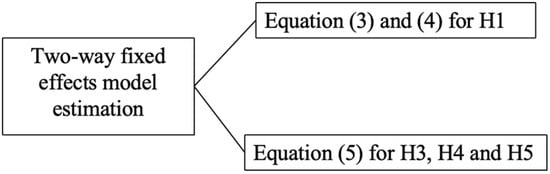
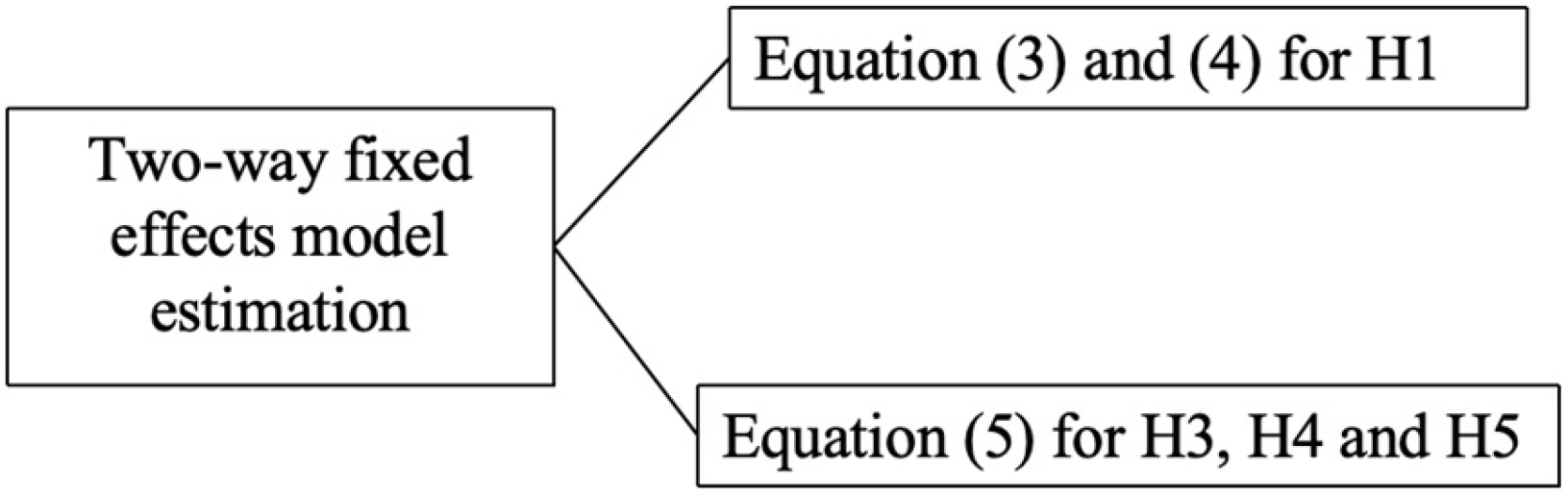
Specifically, the analysis follows a stepwise procedure. First, Equation (3) is estimated using a two-way fixed-effects model to test the baseline effect of green, digital, cross-boundary innovation on carbon emissions. Second, Equation (4) compares the effects of green, digital, cross-boundary innovation with traditional green and digital innovations. Third, Equation (5) is estimated to explore the underlying mechanisms through green knowledge reorganization, depth of digital technology application, and resource allocation efficiency. Figure 2 illustrates the methodological framework of this study.
Figure 2.
Methodological framework.
Yin et al. (2022) [2] conducted a quantitative analysis of green, digital, cross-boundary innovation using survey data, a method that inevitably suffers from a certain degree of subjective bias. Chen et al. (2024) [41] identified green, digital, cross-boundary patents solely based on IPC codes, which may lead to incomplete identification. Building on these approaches, this study combines IPC codes with a Word2Vec-based method to address the limitations of existing measurement techniques, thereby contributing to a more precise identification of the carbon-reduction effects of green, digital, cross-boundary innovation. Furthermore, to overcome the gap in the literature regarding comparative analyses [5,37], this study incorporates green, digital, cross-boundary innovation, traditional green innovation, and traditional digital innovation into a unified regression model to examine and compare their respective carbon-reduction effects.
4. Results and Discussions
4.1. Baseline Regression
Table 3 presents the benchmark regression results. Column (1) shows the regression results without additional control variables. It can be observed that the regression coefficient for green, digital, cross-boundary innovation is −1.234, significant at the 1% level. Column (2) further controls for firm-level characteristics and corporate governance variables, where the coefficient for green, digital, cross-boundary innovation remains significantly negative. This confirms that green, digital, cross-boundary innovation leverages the enabling effects of digital technologies to enhance innovation efficiency. This conclusion is consistent with the findings of [42], who show that synergy between digitalization and greening at the macro level enhances carbon emission performance. Our study further substantiates this relationship from a micro-level perspective. Columns (3) and (4) respectively illustrate the differential impacts of green, digital, cross-boundary innovation, traditional digital technology innovation, and traditional green technology innovation on carbon emissions, with and without control variables, validating Hypothesis 1. Calculated based on the coefficients in Column (4), the carbon-reduction effect of green, digital, cross-boundary innovation is 96% higher than that of traditional green innovation. The results indicate that although the coefficient of traditional green innovation is negative, it is not statistically significant, suggesting that it does not have a substantial mitigating effect on carbon emission intensity. This finding is consistent with [43], who reported that traditional green innovation has no significant impact on carbon emissions, possibly due to the rebound effect of carbon [44]. In contrast, the coefficients for traditional digital innovation are −0.887 and −1.093, both significant at the 1% level. This indicates that traditional digital innovation has a significant inhibitory effect on carbon emission intensity, further complementing [45] from a micro-level perspective. This study further conducts coefficient difference tests for the three types of innovation in Column (4). The results show that the coefficient of green, digital, cross-boundary innovation differs from that of traditional digital technology innovation at the 10% significance level and from that of traditional green technology innovation at the 5% significance level. The results demonstrate that green, digital, cross-boundary innovation yields significantly stronger carbon-reduction effects than traditional digital technology and green technology innovations. Specifically, the effect of green, digital, cross-boundary innovation on carbon reduction is approximately 96% higher than that of traditional green innovation, nearly double its impact, and about 5% higher than that of traditional digital innovation. This suggests that while pure digital innovation alone can significantly reduce carbon emissions, its combination with green technologies further amplifies the effect. At the micro level, these results highlight the critical role of digital technologies in green innovation: by optimizing processes, improving energy efficiency, facilitating the recombination of green knowledge, and promoting cross-departmental collaboration, digital technologies enable the full realization of the environmental benefits of green technologies. Through technological empowerment and green guidance, it generates a synergistic amplification of carbon reduction outcomes, thereby validating Hypothesis 2. This finding is consistent with the study by [46], who show that not all green innovations significantly improve environmental performance; only source-oriented emission reduction technologies effectively enhance environmental outcomes, whereas end-of-pipe green technologies have an insignificant impact. Compared with end-of-pipe technologies, source-oriented emission reduction technologies rely on fundamental changes to production processes. Digital technologies facilitate such process optimization [47]. Moreover, from an economic perspective, digital technologies reduce the implementation costs and uncertainties of green innovation, alleviating firms’ risks and resource constraints in investing in source-oriented emission reduction technologies, thereby significantly enhancing the marginal effect of green innovation.
Table 3.
Baseline regression results: effects on CEI.
4.2. Robustness Tests
This study employs the following four approaches for robustness tests: (1) Considering that the appearance of digital technology related terms in patent titles or abstracts may be incidental, this study defines green, digital, cross-boundary innovation solely as patents whose IPC codes simultaneously fall under both the green patent categories specified in the WIPO International Patent Classification List and the IPC categories listed in the Reference relationship table between core industry classification of digital economy and international patent classification (2023) issued by the China National Intellectual Property Administration, and then re-estimates the regressions. (2) Switching clustering levels: To ensure the model’s error term structure is appropriate and reduce estimation biases caused by heterogeneity and autocorrelation, this paper employs two-way clustering at both the firm and year levels, simultaneously controlling for cross-firm and cross-time error term correlations in the data. (3) Incorporating industry fixed effects: Considering the presence of unobservable factors at the industry level that vary over time and may introduce bias into the model’s estimation results, this study further replaces the year fixed effect with a year-by-industry interaction fixed effect in the regression analysis to enhance the model’s accuracy and the reliability of its results. (4) Excluding municipalities directly under the central government: Significant economic and social disparities exist across regions in China. Compared with other areas, municipalities directly under the central government have distinct advantages in economic development, the intensity of policy implementation, and talent accumulation. Moreover, green technological innovation by enterprises in these regions may bias its estimated impact on carbon intensity. Therefore, this study excludes enterprises located in the four municipalities directly under the central government, namely Beijing, Tianjin, Shanghai, and Chongqing, and recalculates the regression. Table 4 presents the regression results of the aforementioned robustness tests. Following these tests, the conclusions of this paper remain robust.
Table 4.
Results of robustness tests: effects on CEI.
4.3. Endogenous Analysis
4.3.1. The Instrumental Variable Method
This study may face endogeneity concerns arising from reverse causality and omitted variables, namely that firms with higher carbon emission intensity are more likely to engage in green, digital, cross-boundary innovation, and that unobservable factors correlated with the variables of interest may lead to biased estimation results. To address this, the instrumental variables method is employed to mitigate potential endogeneity issues. Following the methodology of [48], this study employs the mean value of green, digital, cross-boundary innovation among other firms in the same industry and year as the instrumental variable (IV) for green, digital, cross-boundary innovation. Table 5 presents the two-stage least squares (2SLS) regression results for the instrumental variable. Columns (1) and (2) display the first-stage regression results, revealing that the estimated coefficient of the instrumental variable is significantly positive, consistent with theoretical expectations. The K-P F statistic of 30.674 exceeds the 10% critical value of 7.03 for the StockYogo weak instrumental variable test, indicating the instrument variable satisfies the correlation requirement. Column (3) presents the second-stage regression results. The sign and significance of the core explanatory variable’s estimated coefficient align with the benchmark regression, confirming that the study’s conclusions remain consistent after addressing endogeneity issues.
Table 5.
Results of the endogenous analysis.
4.3.2. The Heckman Method
To address potential sample self-selection in the model, this study further employs the Heckman two-step procedure. First, a Logit model is estimated using whether a firm applies for green, digital, cross-boundary innovation as the treatment variable, from which the inverse Mills ratio is obtained. This ratio is then incorporated into the baseline regression. The corresponding results are reported in Column (3) of Table 4, showing that after accounting for sample selection, the coefficient of the core explanatory variable remains significantly negative.
4.4. Mechanism Analysis
The aforementioned research provides substantial empirical evidence supporting the assertion that green, digital, cross-boundary innovation can suppress corporate carbon emissions, yet it has not yet explored the underlying mechanisms. In this section, Model 4 is employed to validate the mechanism through which green, digital, cross-boundary innovation impacts carbon emissions. The results for Hypothesis 2 are presented in columns (1) and (2) of Table 6. It can be observed that the coefficients for green, digital, cross-boundary innovation are all positive and statistically significant at the 1% level. Green, digital, cross-boundary innovation can promote the green knowledge reorganization reuse and green knowledge reorganization creation within enterprises, as well as the creation of new green knowledge. This enables the efficient integration and dissemination of existing green technologies and knowledge, thereby optimizing production processes, reducing energy consumption, and achieving carbon emission reductions. The test results for Hypothesis 3 are shown in Column (3). The coefficient for green, digital, cross-boundary innovation is 0.030, which is significant at the 10% significance level. Green, digital, cross-boundary innovation promotes the deep application of digital technologies, enabling refined management of production processes and energy consumption monitoring, thereby further reducing corporate carbon emissions. Column (4) presents the regression results for Hypothesis 4, indicating that green, digital, cross-boundary innovation reduces capital misallocation, enhances resource allocation efficiency, secures more robust support for green investment and innovation projects, and minimizes resource waste and carbon emissions.
Table 6.
Results of mechanism analysis.
4.5. Heterogeneity Tests
4.5.1. Heterogeneity in the High-Tech Industry
For different industries, the carbon-reduction effects of green, digital, cross-boundary innovation may exhibit heterogeneity. This paper categorizes the sample into two groups based on whether the enterprise belongs to a high-tech industry: high-tech industries and non-high-tech industries. Columns (1) and (2) of Table 7 report the results of the grouped regressions. The regression results indicate that in high-tech industries, the coefficient for green, digital, cross-boundary innovation is significantly negative. In non-high-tech industries, the coefficient for green, digital, cross-boundary innovation is not significant. This indicates that green, digital, cross-boundary innovation can only suppress carbon emissions within high-tech industries. Green, digital, cross-boundary innovation requires robust foundational support for innovation. High-tech enterprises possess greater innovation resource bases, enabling them to provide stronger resource support mechanisms for businesses. This facilitates the deepening of sustained research and practical application in the cross-boundary integration of digital and green technologies.
Table 7.
Results of heterogeneity analysis.
4.5.2. Heterogeneity in Market Competition Intensity
The level of green, digital, cross-boundary innovation in enterprises may be related to the degree of market competition within their respective industries. This paper employs industry competition as a measure of the market competition faced by traditional enterprises. The Herfindahl–Hirschman Index (HHI) is calculated at the industry level using enterprise main business revenue data to assess industry competitiveness. The sample is then grouped into high- and low-market-competition categories based on the median value, enabling regression analysis for each group. The regression results are shown in columns (3) and (4) of Table 7. For enterprises operating in highly competitive markets, the coefficient for green, digital, cross-boundary innovation on carbon emissions is −1.198, and it is statistically significant at the 1% level. In contrast, for enterprises in low-competition markets, green, digital, cross-boundary innovation has no significant effect on carbon emissions. In intense market competition, enterprises face greater survival pressures and must enhance their market position through differentiation strategies. Green, digital, cross-boundary innovation not only optimizes production processes and enhances resource utilization efficiency but also elevates green credentials and social reputation, thereby strengthening competitive advantages. Consequently, a highly competitive market environment intensifies the impetus for corporate green innovation, yielding more significant carbon reduction outcomes.
4.5.3. Heterogeneity in Intellectual Property Protection Levels
Innovative behavior is susceptible to the influence of intellectual property systems. Regions with differing levels of intellectual property protection may exhibit heterogeneous impacts of green, digital, cross-boundary innovation on carbon emissions. Based on the National Intellectual Property Development Report released by the China National Intellectual Property Administration, this study divides the sample into regions with high and low levels of intellectual property protection according to the median value of the intellectual property protection index and conducts subgroup regressions. The regression results are shown in columns (5) and (6) of Table 7. The findings indicate that green, digital, cross-boundary innovation only exerts a suppressing effect on carbon emissions in regions with high intellectual property protection. This demonstrates that robust intellectual property protection provides legal safeguards for enterprises’ innovative achievements, reduces risks and uncertainties in green, digital, cross-boundary innovation, and incentivizes companies to increase innovation investments, thereby more effectively achieving carbon emission reduction targets. Conversely, in regions with weaker intellectual property protection, enterprises face higher risks of their innovations being imitated or infringed upon, thereby limiting the effectiveness of green, digital, cross-boundary innovation in controlling carbon emissions.
4.5.4. Heterogeneity in Regional Environmental Regulation Intensity
Environmental regulations initiated by the government through incentive-based or mandatory measures serve as a crucial approach to curb ecological degradation and compel enterprises to achieve green transformation and development. It can be reasonably inferred that the inhibitory effect of green, digital, cross-boundary innovation on carbon emission intensity varies with heterogeneity in regional environmental regulation intensity. Following [49], this study measures environmental regulation intensity by the proportion of the total number of words in a city’s government work report that appear in sentences containing environment related keywords. The sample of enterprises was divided into high environmental regulation and low environmental regulation groups based on the median, and grouped regression tests were conducted. The results are shown in columns (7) and (8) of Table 7. The results indicate that the coefficient for green, digital, cross-boundary innovation is significantly negative. Relatively speaking, the standardized coefficient in column (7) is higher than that in column (8), suggesting that the carbon-reduction effect of green, digital, cross-boundary innovation is more pronounced in regions with high environmental regulation. This finding aligns with the research by Liu et al. (2025) [42]. In regions with stringent environmental regulations, enterprises face greater policy pressure and social oversight. To meet regulatory requirements and safeguard corporate reputation, they proactively advance green, digital, cross-boundary innovation to enhance resource efficiency, reduce energy consumption, and lower carbon emissions.
4.6. Further Analysis
4.6.1. Heterogeneity in Carbon Emissions Reduction Across Different Categories of Cross-Boundary Green Innovation
Previous sections have demonstrated that green, digital, cross-boundary innovation can significantly suppress carbon emissions and achieve greater carbon-reduction effects than traditional digital technology innovation or traditional green technology innovation. Does green, digital, cross-boundary innovation prove more effective than general green cross-boundary innovation in reducing carbon emissions? To further address this question, this paper subdivides traditional green technology innovation into non-digital cross-boundary green innovation and pure green innovation. Non-digital cross-boundary green innovation is defined as green innovation combined with cross-boundary innovation in other non-digital fields, meaning the patent IPC codes include both green patent IPC codes and IPC codes from other non-digital patent fields. Pure green innovation is defined as green technological innovation without cross-boundary integration with other fields, meaning the patent IPC codes contain only green patent IPC codes. Green, digital, cross-boundary innovation, non-digital cross-boundary green innovation, and non-cross-boundary green innovation are incorporated into Model 6 for regression analysis.
In the equation, denotes non-digital cross-boundary green innovation by firm i in year t − 1, while represents pure green innovation by firm i in year t − 1. The remaining variables are consistent with those defined earlier.
The regression results are presented in Table 8, Column (1). The coefficient for green, digital, cross-boundary innovation is significantly negative, while the coefficients for non-digital cross-boundary green innovation and non-cross-boundary green innovation are not significant. This indicates that only green, digital, cross-boundary innovation exerts a significant suppressing effect on carbon emissions. Digital technologies possess unique advantages such as strong versatility and low cost, enabling rapid connection and utilization of diverse resources. They provide efficient and scalable support for innovation, thereby achieving superior emission reduction outcomes.
Table 8.
Results of further analysis.
4.6.2. Industry Spillover Effects
Enterprises that pioneer digital green cross-sector innovation demonstrate exemplary effects. The technological upgrades and efficiency gains resulting from such innovation prompt other firms to follow suit, thereby promoting carbon emission reductions among other enterprises.
To further examine whether green, digital, cross-boundary innovation generates industry spillover effects on carbon emissions, this study conducts Equation (7) using the average carbon emission intensity of other firms in the same industry, excluding the focal firm itself, as the dependent variable.
In the equation, denotes the carbon emission intensity of firm i in year t, while the remaining variables are consistent with those defined earlier.
The regression results are shown in Table 8, Column (2). The regression coefficient for green, digital, cross-boundary innovation is −0.786, significant at the 1% significance level. This indicates that green, digital, cross-boundary innovation possesses industry spillover effects, reducing carbon emissions among other enterprises within the same industry.
4.6.3. The Peer Group Effects of Green, Digital, Cross-Boundary Innovation
Innovation behaviors among enterprises often exhibit interdependence, particularly when new innovation models emerge. Companies may rush to imitate or follow suit to align their actions with the “majority within the group.”
To examine whether enterprises’ digital green cross-industry innovation is influenced by other companies in the sector, that is, whether digital green cross-industry innovation exhibits a peer group effect. In this paper, the lagged one-period mean value of digital green cross-industry innovation of peer enterprises in the same industry and the same year (excluding the enterprise itself) is selected as the explanatory variable, and the current-period green, digital, cross-boundary innovation of the enterprise is taken as the explained variable, with Equation (8) adopted for regression analysis.
In the equation, represents the green, digital, cross-boundary innovation of firm i in year t, while denotes the average green, digital, cross-boundary innovation of firms in the same industry as firm i in year t, excluding the firm itself. All other variables are consistent with the full text.
The regression results are shown in Table 8, column (3). The regression coefficient for DGI_peer is 0.076, significant at the 1% level. This indicates that the more green, digital, cross-boundary innovation other firms within the industry engage in, the more likely the firm is to pursue green, digital, cross-boundary innovation.
Our study finds that green, digital, cross-boundary innovation significantly reduces carbon emissions, consistent with previous research. Building on existing findings, we further demonstrate that green, digital, cross-boundary innovation achieves markedly stronger carbon-reduction effects than traditional green innovation and exhibits marginally significant superiority over traditional digital innovation, thereby addressing gaps in the current literature [35]. In addition, we examine the underlying mechanisms of green, digital, cross-boundary innovation from three perspectives: green knowledge recombination capability, digital technology application, and resource allocation efficiency. Prior studies have primarily explained its mechanisms from an energy-saving and consumption-reduction standpoint [29,37]. Our research thus further extends the understanding of how green, digital, cross-boundary innovation operates.
5. Conclusions
This study employs a two-way fixed-effects model to verify that green, digital, cross-boundary innovation can significantly reduce carbon emissions. Its mitigation effect is significantly stronger than that of traditional digital technology innovation and, to some extent, stronger than that of green technology innovation. The underlying mechanisms primarily involve enhancing firms’ capacity to leverage green knowledge, deepening the application of digital technologies, and improving resource allocation efficiency.
6. Research Implications
6.1. Theoretical Implications
This study makes the following theoretical contributions to the fields of digital green innovation and environmental management. First, it advances the theoretical understanding of cross-boundary innovation by emphasizing that the integration of digital and green technologies can generate synergistic carbon-reduction effects, empirically validating the “1 + 1 > 2” environmental benefit. This finding not only enriches the literature on the environmental performance of cross-boundary innovation but also provides new evidence on how digital enablement contributes marginally to green innovation.
Second, the study uncovers the herd effects and industry spillover effects of green, digital, cross-boundary innovation at the micro level. The results indicate that the innovative activities of a single firm not only enhance its own environmental performance but also positively influence peer firms and the wider industry network through the diffusion of knowledge, technology, and resources. Notable innovative initiatives can even shape stakeholder behavior [50]. This provides a novel perspective for theoretically understanding the diffusion mechanisms of cross-boundary innovation, collaborative innovation networks, and the systemic impact of green technologies, linking the externalities of environmental innovation with inter-firm interactions.
Third, this study lays the groundwork for further examination of the economic effects of green, digital, cross-boundary innovation. Its conclusions are connected to existing research. For example, Bolton et al. (2021) [51] show that investors demand higher returns from carbon-intensive firms, suggesting that efforts to reduce carbon emissions can effectively lower firms’ risk exposure.
6.2. Practical Implications
Based on the findings, this paper proposes policy implications for key stakeholders.
Policymakers should prioritize green, digital, cross-boundary innovation within green technology and digital economy strategies, with preferential funding and collaborative platforms involving governments, firms, universities, and research institutions. Policies should account for regional and industrial differences.
High-tech and competitive industries should offer targeted incentives, such as tax breaks, R&D subsidies, and green credit, to encourage investment in cross-boundary innovation. Leading firms should drive collaboration across the supply chain to enhance coordinated emission reduction and industry-wide low-carbon transition.
Regions and firms with varying IP and environmental regulation levels should strengthen IP and environmental policies in a differentiated way. Enhanced IP protection and stricter environmental rules, including carbon trading and green taxation, can guide innovation-driven emission reductions.
Enterprises of different scales should deepen the application of cross-boundary innovation. Firms should align with policy resources, integrate knowledge, and expand collaborations with research institutions and industry partners. SMEs may need additional support to fully realize innovation potential.
7. Limitations of the Study and Future Research
This study has several limitations. First, since many firms do not disclose their carbon emissions data, and considering data availability and completeness, this study measures firm-level carbon emissions based on industry energy consumption data. This approach may introduce some measurement bias. Future research could adopt more rigorous measurement methods to improve accuracy. Second, this study empirically tests only the environmental effects of green, digital, cross-boundary innovation, and whether its carbon reduction impacts can be effectively translated into economic benefits remains unclear. Future research could further investigate its economic implications.
Author Contributions
Conceptualization, T.Z.; Methodology, T.Z.; Software, J.Y.; Validation, R.Q.; Formal analysis, R.Q.; Data curation, J.Y.; Writing—original draft, T.Z.; Writing—review and editing, J.Y. All authors have read and agreed to the published version of the manuscript.
Funding
This research received no external funding.
Institutional Review Board Statement
Not applicable.
Informed Consent Statement
Not applicable.
Data Availability Statement
The original contributions presented in this study are included in the article. Further inquiries can be directed to the corresponding author.
Conflicts of Interest
The authors declare no conflict of interest.
References
- Shi, C.; Cui, X.; Li, X.; Xu, N.; Niu, Z. Corporate resilience, economic policy uncertainty, and corporate carbon emissions. Financ. Res. Lett. 2025, 86, 108636. [Google Scholar] [CrossRef] [Scilit]
- Yin, S.; Yu, Y. An adoption-implementation framework of digital green knowledge to improve the performance of digital green innovation practices for industry 5.0. J. Clean. Prod. 2022, 363, 132608. [Google Scholar] [CrossRef] [Scilit]
- Feng, X.; Zhao, D.; Ma, X.; Lei, J. How does digital transformation affect cross-boundary innovation? Evidence from China. Appl. Econ. 2025, 1–13. [Google Scholar] [CrossRef] [Scilit]
- Zhang, X.; Gao, C.; Zhang, S. The niche evolution of cross-boundary innovation for Chinese SMEs in the context of digital transformation—Case study based on dynamic capability. Technol. Soc. 2022, 68, 101870. [Google Scholar] [CrossRef] [Scilit]
- Liu, Y.; Huang, H.; Mbanyele, W.; Wei, Z.; Li, X. How does green industrial policy affect corporate green innovation? Evidence from the green factory identification in China. Energy Econ. 2025, 141, 108047. [Google Scholar] [CrossRef] [Scilit]
- Xu, B. Artificial intelligence and green technology innovation: Evidence from 265 cities in China. J. Environ. Manag. 2026, 398, 128494. [Google Scholar] [CrossRef] [Scilit]
- Wang, J.; Ma, X.; Zhang, J.; Zhao, X. Impacts of digital technology on energy sustainability: China case study. Appl. Energy 2022, 323, 119329. [Google Scholar] [CrossRef] [Scilit]
- Jiao, H.; Wang, T.; Libaers, D.; Yang, J.; Hu, L. The relationship between digital technologies and innovation: A review, critique, and research agenda. J. Innov. Knowl. 2025, 10, 100638. [Google Scholar] [CrossRef] [Scilit]
- Liu, Y.; Liu, N.; Huo, Y. Impact of digital technology innovation on carbon emission reduction and energy rebound: Evidence from the Chinese firm level. Energy 2025, 320, 135187. [Google Scholar] [CrossRef] [Scilit]
- Xu, L.; Fan, M.; Yang, L.; Shao, S. Heterogeneous green innovations and carbon emission performance: Evidence at China’s city level. Energy Econ. 2021, 99, 105269. [Google Scholar] [CrossRef] [Scilit]
- Zhang, H. Does combining different types of innovation always improve SME performance? An analysis of innovation complementarity. J. Innov. Knowl. 2022, 7, 100192. [Google Scholar] [CrossRef] [Scilit]
- Schmiedeberg, C. Complementarities of innovation activities: An empirical analysis of the German manufacturing sector. Res. Policy 2008, 37, 1492–1503. [Google Scholar] [CrossRef] [Scilit]
- Yuan, S.; Pan, X. Inherent mechanism of digital technology application empowered corporate green innovation: Based on resource allocation perspective. J. Environ. Manag. 2023, 345, 118841. [Google Scholar] [CrossRef] [Scilit]
- Ancillai, C.; Sabatini, A.; Gatti, M.; Perna, A. Digital technology and business model innovation: A systematic literature review and future research agenda. Technol. Forecast. Soc. Change 2023, 188, 122307. [Google Scholar] [CrossRef] [Scilit]
- Yoo, Y.; Boland, R.J., Jr.; Lyytinen, K.; Majchrzak, A. Organizing for innovation in the digitized world. Organ. Sci. 2012, 23, 1398–1408. [Google Scholar] [CrossRef] [Scilit]
- Park, C.; Heo, W. Review of the changing electricity industry value chain in the ICT convergence era. J. Clean. Prod. 2020, 258, 120743. [Google Scholar] [CrossRef] [Scilit]
- Goldfarb, A.; Tucker, C. Digital economics. J. Econ. Lit. 2019, 57, 3–43. [Google Scholar] [CrossRef] [Scilit]
- Guo, R.; Zhang, Y.; Chen, K.; Wang, Y.; Ning, L. Heterogeneous impact of green finance instruments on firms’ green innovation novelty: Policy mix or mess? Energy Econ. 2025, 144, 108315. [Google Scholar] [CrossRef] [Scilit]
- Ning, L.; Guo, R. Technological diversification to green domains: Technological relatedness, invention impact and knowledge integration capabilities. Res. Policy 2022, 51, 104406. [Google Scholar] [CrossRef] [Scilit]
- Papazoglou, M.E.; Spanos, Y.E. Bridging distant technological domains: A longitudinal study of the determinants of breadth of innovation diffusion. Res. Policy 2018, 47, 1713–1728. [Google Scholar] [CrossRef] [Scilit]
- Haefner, N.; Wincent, J.; Parida, V.; Gassmann, O. Artificial intelligence and innovation management: A review, framework, and research agenda✰. Technol. Forecast. Soc. Change 2021, 162, 120392. [Google Scholar] [CrossRef] [Scilit]
- Fleming, L. Recombinant uncertainty in technological search. Manag. Sci. 2001, 47, 117–132. [Google Scholar] [CrossRef] [Scilit]
- Laursen, K.; Salter, A. Open for innovation: The role of openness in explaining innovation performance among UK manufacturing firms. Strateg. Manag. J. 2006, 27, 131–150. [Google Scholar] [CrossRef] [Scilit]
- Bhutta, U.S.; Tariq, A.; Farrukh, M.; Raza, A.; Iqbal, M.K. Green bonds for sustainable development: Review of literature on development and impact of green bonds. Technol. Forecast. Soc. Change 2022, 175, 121378. [Google Scholar] [CrossRef] [Scilit]
- Fan, Y. The innovation effect of digital business model transformation orientation: Evidence from corporate cross-boundary innovation. Int. Rev. Econ. Financ. 2025, 103, 104578. [Google Scholar] [CrossRef] [Scilit]
- Liu, Z.; Du, S.; Zhang, L.; Xie, J.; Wang, X. Does the coupling of digital and green technology innovation matter for carbon emissions? J. Environ. Manag. 2025, 373, 123824. [Google Scholar] [CrossRef] [Scilit]
- Xia, W.; Ruan, Z.; Ma, S.; Zhao, J.; Yan, J. Can the digital economy enhance carbon emission efficiency? Evidence from 269 cities in China. Int. Rev. Econ. Financ. 2025, 97, 103815. [Google Scholar] [CrossRef] [Scilit]
- Zhuo, C.; Chen, J. Can digital transformation overcome the enterprise innovation dilemma: Effect, mechanism and effective boundary. Technol. Forecast. Soc. Change 2023, 190, 122378. [Google Scholar] [CrossRef] [Scilit]
- Habiba, U.; Xinbang, C.; Anwar, A. Do green technology innovations, financial development, and renewable energy use help to curb carbon emissions? Renew. Energy 2022, 193, 1082–1093. [Google Scholar] [CrossRef] [Scilit]
- Obobisa, E.S.; Chen, H.; Mensah, I.A. The impact of green technological innovation and institutional quality on CO2 emissions in African countries. Technol. Forecast. Soc. Change 2022, 180, 121670. [Google Scholar] [CrossRef] [Scilit]
- Mongo, M.; Belaïd, F.; Ramdani, B. The effects of environmental innovations on CO2 emissions: Empirical evidence from Europe. Environ. Sci. Policy 2021, 118, 1–9. [Google Scholar] [CrossRef] [Scilit]
- Chen, H.; Yi, J.; Chen, A.; Peng, D.; Yang, J. Green technology innovation and CO2 emission in China: Evidence from a spatial-temporal analysis and a nonlinear spatial durbin model. Energy Policy 2023, 172, 113338. [Google Scholar] [CrossRef] [Scilit]
- Liu, Y.; Zhang, X.; Shen, Y. Technology-driven carbon reduction: Analyzing the impact of digital technology on China’s carbon emission and its mechanism. Technol. Forecast. Soc. Change 2024, 200, 123124. [Google Scholar] [CrossRef] [Scilit]
- Tian, Q.; Shen, W.; Wang, Y.; Liu, L. Mechanism and evolution trend of digital green fusion in China’s regional advanced manufacturing industry. J. Clean. Prod. 2023, 427, 139264. [Google Scholar] [CrossRef] [Scilit]
- Zhang, K.; Zheng, T.; Gao, P.; Ren, Y. Digital-green synergy in transition: Exploring the dual synergy transformation impact on corporate ESG performance. Int. Rev. Financ. Anal. 2025, 105, 104459. [Google Scholar] [CrossRef] [Scilit]
- Zhang, Z.; Zhang, Q. Bridging the digital and green divide: Technology convergence and productivity in innovative manufacturing. J. Innov. Knowl. 2025, 10, 100848. [Google Scholar] [CrossRef] [Scilit]
- Hu, J.; Sun, Q.; Wang, W. The role of green and digital technology convergence on carbon emission reduction: Evidence from China. Front. Environ. Sci. 2024, 12, 1490657. [Google Scholar] [CrossRef] [Scilit]
- Zheng, D.; Song, H.; Zhao, C.; Liu, Y.; Zhao, W. Is it possible for semiconductor companies to reduce carbon emissions through digital transformation? Evidence from China. Int. J. Prod. Econ. 2024, 272, 109246. [Google Scholar] [CrossRef] [Scilit]
- Verendel, V. Tracking artificial intelligence in climate inventions with patent data. Nat. Clim. Change 2023, 13, 40–47. [Google Scholar] [CrossRef] [Scilit]
- Zhu, W. Digital finance, capital misallocation and corporate innovation. Int. Rev. Econ. Financ. 2024, 96, 103696. [Google Scholar] [CrossRef] [Scilit]
- Chen, J.; Chen, Z. How does environmental regulations affect digital green innovation of high-pollution enterprises? Empirical evidence from China. Heliyon 2024, 10, e33725. [Google Scholar] [CrossRef] [Scilit]
- Liu, X.; Zuo, Z.; Han, J.; Zhang, W. Is digital-green synergy the future of carbon emission performance? J. Environ. Manag. 2025, 375, 124156. [Google Scholar] [CrossRef] [Scilit] [PubMed]
- Weina, D.; Gilli, M.; Mazzanti, M.; Nicolli, F. Green inventions and greenhouse gas emission dynamics: A close examination of provincial Italian data. Environ. Econ. Policy Stud. 2016, 18, 247–263. [Google Scholar] [CrossRef] [Scilit]
- Zhu, Y.; Lan, M. Digital economy and carbon rebound effect: Evidence from Chinese cities. Energy Econ. 2023, 126, 106957. [Google Scholar] [CrossRef] [Scilit]
- Li, Z.; Wang, J. The dynamic impact of digital economy on carbon emission reduction: Evidence city-level empirical data in China. J. Clean. Prod. 2022, 351, 131570. [Google Scholar] [CrossRef] [Scilit]
- Cheng, Q.; Lin, A.-P.; Yang, M. Green innovation and firms’ financial and environmental performance: The roles of pollution prevention versus control. J. Account. Econ. 2025, 79, 101706. [Google Scholar] [CrossRef] [Scilit]
- Tomaschko, F.; Reichelt, L.; Krommes, S. Digitalisation of Manufacturing Systems: A Literature Review of Approaches to Assess the Sustainability of Digitalisation Technologies in Production Systems. Sustainability 2024, 16, 6275. [Google Scholar] [CrossRef] [Scilit]
- Shao, Y.; Xu, K.; Shan, Y.G. Leveraging corporate digitalization for green technology innovation: The mediating role of resource endowments. Technovation 2024, 133, 102999. [Google Scholar] [CrossRef] [Scilit]
- Chen, Z.; Kahn, M.E.; Liu, Y.; Wang, Z. The consequences of spatially differentiated water pollution regulation in China. J. Environ. Econ. Manag. 2018, 88, 468–485. [Google Scholar] [CrossRef] [Scilit]
- Mugerman, Y.; Steinberg, N.; Wiener, Z. The exclamation mark of Cain: Risk salience and mutual fund flows. J. Bank. Financ. 2022, 134, 106332. [Google Scholar] [CrossRef] [Scilit]
- Bolton, P.; Kacperczyk, M. Do investors care about carbon risk? J. Financ. Econ. 2021, 142, 517–549. [Google Scholar] [CrossRef] [Scilit]

Disclaimer/Publisher’s Note: The statements, opinions and data contained in all publications are solely those of the individual author(s) and contributor(s) and not of MDPI and/or the editor(s). MDPI and/or the editor(s) disclaim responsibility for any injury to people or property resulting from any ideas, methods, instructions or products referred to in the content. |
© 2026 by the authors. Licensee MDPI, Basel, Switzerland. This article is an open access article distributed under the terms and conditions of the Creative Commons Attribution (CC BY) license.