


Abstract
Intelligent transportation systems increasingly rely on artificial intelligence and predictive analytics to achieve sustainability. This study presents Adaptive Weighting, Chaos Theory, and Gaussian Mutation-based RIME algorithm-tuned Extreme Gradient Boosting (ACGRIME-XGBoost), an advanced Artificial Intelligence (AI)-driven framework specifically designed for carbon emission prediction in air transport to contribute to the development of sustainable smart infrastructure. The proposed hybrid model integrates XGBoost with ACGRIME, a novel metaheuristic optimization algorithm enhanced with chaos theory, adaptive weighting, and Gaussian mutation mechanisms to overcome limitations in traditional hyperparameter tuning approaches. The framework demonstrates exceptional performance on Congress on Evolutionary Computation (CEC) 2020 benchmark functions, outperforming conventional optimization algorithms in accuracy and robustness. When applied to real-world flight data within a smart transportation monitoring, ACGRIME-XGBoost achieves a 94% R2 score for CO2 emission prediction, significantly surpassing other optimized machine learning models. This research bridges the gap between advanced AI optimization techniques and sustainable transportation infrastructure, offering a scalable decision-support system that can be integrated with IoT sensor networks and mobility platforms in the future. The results demonstrate how metaheuristic-assisted machine learning can enhance environmental monitoring capabilities in smart transportation ecosystems, supporting data-driven policy-making for climate-resilient infrastructure and sustainable aviation management within the broader context. Also, the research contributes to sustainable aviation by enabling high-fidelity CO2 prediction models that can inform policy-making and be integrated into digital monitoring tools for future smart transport infrastructures.
1. Introduction
The Industrial Revolution is termed a revolution due to its profound societal transformations and its pivotal role in accelerating economic growth. This era marked a shift to a manufacturing-based economy, leading to significant advancements in production efficiency, improvements in living conditions, and transportation systems. However, these advancements had substantial environmental repercussions [1]. The Industrial Revolution initiated our extensive dependance on fossil fuels, which are the primary drivers of climate change. This period saw a notable increase in carbon dioxide emissions (CO2), establishing a foundation for the high greenhouse gas concentrations that continue to drive global warming today [2]. To control carbon emissions and mitigate climate change, reducing CO2 emissions has become a global developmental imperative. The international community has taken significant steps toward this goal, beginning with the Kyoto Protocol in 1997, which made carbon emission reduction a legal obligation for developed nations [3]. In December 2015, the adoption of the Paris Agreement encouraged most countries to define concrete targets to curb global temperature rise. Among modern industries, the aviation sector is recognized as one of the most pollution-heavy and challenging sectors to decarbonize. It accounts for around 2% of worldwide CO2 emissions.
These emissions interfere with the global carbon cycle and result in various planetary warming effects, including possible ecological, physical, and health issues. This incurs significant external expenditures for the aviation sector. In 2016, the external climate change costs associated with CO2 emissions from passenger flights at 33 selected European airports amounted to €19.1 billion [4]. Recognizing the urgency, the aviation industry has proposed several global frameworks. At the 2010 International Civil Aviation Organization (ICAO) assembly, the aviation sector introduced a Global framework to address CO2 emissions from civil aviation. The collective objectives encompassed an average annual fuel efficiency enhancement of 1.5% from 2010 to 2020; carbon-neutral growth commencing in 2020; and a 50% net decrease in CO2 emissions by 2050 relative to 2005 levels. In 2021, during its 77th Annual General Meeting, the International Air Transport Association (IATA) amended the 2050 long-term objective, endorsing a resolution for the global air transport sector to attain net-zero carbon emissions by 2050. This pledge is anticipated to conform to the Paris Agreement objective of limiting global warming to no more than 1.5 °C [5]. Setting such goals is a vital component of climate action in the aviation sector, and an important first step in this process is the accurate modeling of aviation-related carbon emissions. Accurate forecasting is essential for guiding policymakers and industry stakeholders in mitigating the greenhouse effect and achieving emission reduction targets. As noted by the Head of Product at the Forecasting CO2 Emissions company, “Without accurate forecasting, it simply isn’t possible for stakeholders to make better decisions” [6].
Forecasting not only empowers organizations to make informed decisions but also supports the identification of targeted interventions to curb emissions. However, several challenges complicate the forecasting process. These include the need to generate forecasts for a vast number of flights, the demand for real-time updates across multiple routes and schedules, and the necessity for scalability and speed in any predictive solution. In today’s data-driven world, artificial intelligence has emerged as key instrument for this purpose. AI-based approaches, particularly machine learning (ML) approaches, have shown considerable success in prediction across various sectors [7]. Machine learning methodologies have been utilized in stock market trend analysis [8], financial risk assessment [9], urban planning and infrastructure [10], traffic flow prediction [11], predictive maintenance [12], disease outbreak prediction [13], crop yield estimation [14], flood forecasting [15], customer churn prediction [16], and crime pattern detection and prediction [17]. Additionally, ML models are employed in environmental sustainability research, including temperature forecasting [18,19]; air quality prediction [20], electricity consumption forecasting [21], forest fire susceptibility [22], and CO2 emission prediction, with the research on this latter subject becoming an increasingly prominent area of research [23]. This trend is exemplified by the work of Nassef et al. who utilized three advanced artificial intelligence models: a Feed-Forward Neural Network (FFNN), an Adaptive Network-Based Fuzzy Inference System (ANFIS), and Long Short-Term Memory (LSTM) to predict annual CO2 emissions through 2030 [24]. Model performance was assessed utilizing RMSE and R2 metrics, with LSTM achieving the highest accuracy. Singh et al. performed a comparison of four forecasting models: Random Forest Regressor (RFR), Support Vector Regression (SVR), SARIMAX and Holt-Winters (H-W) to forecast CO2 emissions from paddy cultivation in India [25]. Utilizing data from 1961 to 2018 for training and testing, the models forecasted emissions up to 2025. Based on the evaluation, H-W and SVR outperformed the others, with H-W achieving the lowest error values, followed closely by SVR. Zhang et al. used the XGBoost to forecast CO2 emissions in four major cities in China, showing high predictive accuracy [26]. They identified population, land area, and GDP as key drivers, with population and density gaining importance in single-factor analysis. Vo Thanh et al. developed and evaluated three supervised machine learning models (XGBoost, Random Forest (RF), and Support Vector Regression (SVR)) to predict CO2-trapping efficiency in saline formations using a dataset of 1509 field-scale simulations [27].
Comparative analysis showed that XGBoost demonstrated the best performance, obtaining the highest accuracy, followed by RF and SVR with lower predictive performance. According to previous literature, although stand-alone ML algorithms show great success in predictive modelling, their performance can be improved even more when combined with metaheuristic optimization techniques. This improvement is due to the ability of metaheuristics to optimize weights and biases in ML models, which are traditionally challenging to adjust manually. These hybrid models demonstrate enhanced accuracy, faster convergence, and better generalizing performance. Consequently, in prediction tasks, including carbon emission forecasting, the combination of ML with metaheuristic strategies has become a popular method [28]. Khajavi and Rastgoo developed a hybrid modeling framework that integrates Response Surface Methodology, SVR and RF to forecast CO2 emissions across 30 major cities in China [29]. Two optimization algorithms were used by SVR to fine-tune hyperparameters, and seven optimization algorithms were applied to Random Forest to improve model performance. According to the results, RF using the Slime Mould Algorithm (SMA) achieved the highest accuracy during testing, while the SVR optimized with Harris Hawk Optimization (HHO) achieved the highest accuracy during training. Shen et al. investigated the use of machine learning algorithms to forecast carbon monoxide (CO) and carbon dioxide (CO2) emissions in gasification processes [30]. The study incorporated two advanced optimization algorithms, Jellyfish Search Optimizer (JSO) and Sooty Tern Optimization Algorithm (STOA), to fine-tune the RF model. Among the configurations, the RF-JSO model achieved the best performance, with the lowest RMSE of 0.593 and a validation R2 of 0.983. Chai et al. integrated a deep neural network (DNN) with an improved particle swarm optimization (PSO) algorithm [31]. The study benchmarked the proposed method against other common models, including decision tree (DT), RF, SVR, and a standalone DNN. The results indicate that the hybrid DNN-PSO model achieved superior predictive accuracy and a low error. Hu et al. developed a hybrid forecasting model, CRLPSO-LSTM, which combines an improved particle swarm optimization algorithm (CRLPSO) with a long short-term memory (LSTM) network for predicting daily residential CO2 emissions [32]. After validation on 23 benchmark test functions, the algorithm was applied to fine-tune the LSTM’s parameters. The resulting model was tested on different datasets, representing varying levels of emissions and volatility. The experimental outcomes showed that the CRLPSO-LSTM outperformed other hybrid models. Liebert and Ruple proposed a hybrid model combining Dual-Path Recurrent Neural Networks (DPRNNs) with a Nature-inspired Optimization Algorithm (NiOA) for precise CO2 emission prediction [33]. Their approach delivered superior accuracy and outperformed other methods, with statistical tests confirming its reliability. Moayedi et al. proposed a multilayer perceptron (MLP) optimized with Black Hole Algorithm (BHA), Future Search Algorithm (FSA), Backtracking Search Algorithm (BSA), Biogeography-Based Optimization (BBO), and Shuffled Complex Evolution (SCE) [34]. Among these, MLP-SCE and MLP-BBO achieved the highest accuracy, demonstrating their effectiveness in enhancing CO2 emission predictions.
A comprehensive review of recent hybrid metaheuristic–machine learning frameworks reveals important patterns and gaps. Studies have explored PSO-optimized models, reporting improved prediction accuracy but lacking generalizability. Other works introduced advanced swarm-based algorithms but suffered from premature convergence. Additionally, most studies relied on limited datasets that did not reflect real-world operational complexities, reducing model robustness. While machine learning models have shown high predictive strength, their performance is sensitive to manual tuning and feature noise. Recent efforts combining these models with nature-inspired optimizers offer promising directions but often neglect scalability, interpretability, and computational cost. In response to these challenges, the proposed ACGRIME-XGBoost model introduces a novel optimizer that addresses convergence stability, dynamic balance of exploration-exploitation, and predictive generalization on aviation CO2 datasets.
Although various forecasting models have demonstrated considerable potential, studies specifically addressing the prediction of CO2 emissions within the aviation industry remain scarce. Moreover, standalone machine learning models exhibit limited capacity in capturing the complex dynamics of this sector. The aviation industry presents unique challenges, including high flight frequencies, rapidly changing operational conditions, and significant global variability in emission patterns. As a result, models validated on general CO2 emission datasets exhibit limited generalizability when applied to aviation-specific data. eXtreme Gradient Boosting (XGBoost) offers a compelling alternative. It combines high training speed with strong predictive accuracy and can handle both linear and nonlinear relationships in the data. As a scalable tree-boosting algorithm, XGBoost has been engineered for efficiency and performance, performing especially well in structured and sparse datasets, common scenarios in real-world aviation data [35]. Yet, despite its strengths, XGBoost has been underused for CO2 emissions prediction in aviation. Most existing studies focus on general environmental forecasting or urban data, without tailoring the models to aviation’s distinct characteristics. This study introduces a novel hybrid model, ACGRIME-XGBoost, that improves the predictive performance of XGBoost through metaheuristic-based hyperparameter tuning. Unlike conventional approaches, ACGRIME enhances the RIME optimizer by incorporating three strategic mechanisms: (i) chaos-driven initialization to increase search diversity and avoid premature convergence, (ii) adaptive weighting to dynamically shift the exploration–exploitation balance, and (iii) Gaussian mutation for localized solution refinement [36]. These innovations collectively address the major limitations in existing hybrid metaheuristic–ML models discussed earlier, which often suffer from premature convergence or limited generalization. By integrating these techniques, the model aims to improve CO2 emissions forecasting accuracy in the aviation sector, especially in handling complex and nonlinear data patterns. The key contributions of this manuscript are:
- The development of ACGRIME, which integrates chaotic initialization, adaptive weights, chaos theory, and Gaussian mutation to improve convergence speed and robustness in hyperparameter optimization;
- The fusion of ACGRIME with XGBoost to enhance predictive accuracy for CO2 emissions using flight operational data;
- Empirical benchmarking of ACGRIME against other optimizers on the CEC 2020 suite.
The rest of the article is organized in the following manner: Section 2 offers a summary of the conventional RIME algorithm and presents the ACGRIME methodology. It also introduces the ACGRIME-based XGBoost model. Section 3 presents the experimental assessments and analyses. Finally, Section 4 describes the analysis and emphasizes prospective avenues for further research.
2. Methodology
This section outlines the methodological framework employed in this study. We begin by revisiting the foundational RIME method to provide context for the enhancements introduced in our proposed approach. The improved metaheuristic, ACGRIME, integrates chaotic mapping, adaptive weight control, and Gaussian perturbation to enhance convergence and robustness in optimization. This is followed by the development of the ACGRIME-XGBoost hybrid model, which is used for carbon emission prediction.
2.1. RIME Optimization Algorithm
The RIME algorithm draws inspiration from the physical process underlying rime ice formation [37]. Rime ice is produced when supercooled atmospheric water droplets strike a solid surface and instantly freeze. This phenomenon, which occurs under specific meteorological conditions, results in a distinctive accumulation of ice crystals on surfaces such as foliage and branches. The algorithm capitalizes on the structural and stochastic growth behavior observed in this natural event to devise a robust optimization framework for solving high-dimensional and nonlinear problems. RIME operates through three synergistic mechanisms: the soft-rime exploratory mechanism, the hard-rime intensification operator, and a deterministic greedy selection process. The soft-rime mechanism is engineered to model the early, more delicate phase of rime formation. In meteorological terms, this occurs under low-wind conditions, where soft ice crystals loosely accumulate. Translating this to an optimization approach, the mechanism facilitates wide exploration within the solution space, allowing agents to stochastically find potential regions of interest. The position update of the agents in this exploratory phase is governed by Equation (1).
where stands for the j-th dimension of the current best solution. and are stochastic variables that introduce randomness and promote a global search. and denote the upper and lower bounds of the -th dimension. and introduce a directional bias that refines the trajectory towards promising regions. is an exploration-exploitation control coefficient that gradually shifts the strategy from exploration to exploitation over time, where is the current iteration and is the maximum number of iterations. This mechanism facilitates a balance between diversification (searching new regions) and intensification (focusing on promising areas), akin to the gradual and spatially distributed accumulation of soft rime in nature. The hard-rime mechanism serves as an exploitation strategy, emulating the abrupt and dense deposition of ice that characterizes hard rime, which typically forms under high-velocity wind and rapid freezing conditions. This component directs the algorithm toward intensifying the search in the proximity of the best-known solutions by aggressively realigning agent positions. The rule for this intensification step is given in Equation (2).
where is the updated position of the -th agent in the -th dimension. is a random value, and is a normalized fitness-based threshold applied to the i-th agent. This update rule causes the agent to leap directly to the best solution found so far, provided that a probabilistic condition is satisfied. Such a movement simulates the puncturing effect of hard rime, which solidifies rapidly and often overwhelms less stable formations, thereby reinforcing convergence towards the global optimum. The positive greedy selection mechanism embodies a deterministic selection protocol where only beneficial positional updates are retained. By evaluating and comparing the fitness of both current and newly proposed solutions, this strategy ensures that only improvements are accepted. This mechanism mimics a survival-of-the-fittest approach, progressively directing the search population toward higher-quality solutions. Unlike stochastic selection schemes, this greedy technique prioritizes consistent progress by accepting only those candidates that demonstrably enhance the solution quality, thus ensuring convergence reliability.
2.2. The Proposed ACGRIME Algorithm: Framework and Enhancements
This section outlines the design of the novel ACGRIME algorithm. The development of this enhanced optimizer stems from observed limitations in the original RIME algorithm, such as limited solution diversity and a propensity to stagnate in local optima. To address these challenges, ACGRIME integrates chaotic mapping, adaptive weight control, and Gaussian perturbations to improve search behavior, convergence efficiency, and robustness, especially in high-dimensional feature selection tasks [36]. Chaotic Dynamics, via logistic maps, introduce controlled randomness to enhance global exploration and deter premature convergence. Adaptive weighting, which adjusts the influence of exploration versus exploitation over time, promotes a balanced and flexible search process. Gaussian Mutation, exploiting the statistical properties of the Gaussian distribution, enables localized and precise solution refinements, preserving population diversity. This design facilitates the effective identification of informative features while sustaining or enhancing predictive performance.
2.2.1. Integration of Chaos Theory
Chaos theory is employed within ACGRIME to elevate the algorithm’s ability to traverse the solution space and avoid local optimal traps. The inherently unpredictable and non-linear behavior of chaotic systems makes them well-suited for dynamic adjustment mechanisms in metaheuristic algorithms. In ACGRIME, the Logistic Map is used to model chaos, as described in Equation (3).
where represents the chaotic variable at iteration and is a control parameter set to 4 to ensure fully chaotic behavior. This chaotic sequence-initiated from a random seed-is integrated throughout ACGRIME to modulate control parameters dynamically, enhancing both the exploratory and exploitative capabilities of the algorithm.
2.2.2. Adaptive Weighting Mechanism
The adaptive weighting mechanism allows ACGRIME to modify the emphasis placed on different phases of the search process. Initially, greater weight is given to exploration, which then gradually shifts towards exploitation as the algorithm advances. This approach is critical for promoting early diversity and late-stage precision. The adaptive weight is computed using the following nonlinear function given in Equation (4).
t denotes the number of current function evaluations, T is the total number of allowed evaluations, is a value derived from the chaotic sequence, and rand is a uniformly distributed random number in . This formulation combines a linear decay component with a chaotic and stochastic adjustment term. The nonlinear exponent derived from the tangent function introduces fluctuating, chaos-modulated dynamics, allowing the algorithm to adaptively respond to the optimization process. Equation (4) defines a nonlinear adaptive weighting function that governs the transition from exploration to exploitation during the optimization process. The first term () decays linearly with iterations, encouraging a global search in early stages. The second term introduces chaos-based stochastic variability through a tangent transformation and a randomly sampled chaotic coefficient κ, allowing the algorithm to adjust search pressure dynamically in response to the optimization landscape. This design helps ACGRIME avoid early stagnation while ensuring steady convergence in later stages.
2.2.3. Gaussian Mutation Strategy
Gaussian mutation introduces fine-grained diversity into the population by performing local perturbations around existing solutions. This operator generates offspring close to parent solutions using a normally distributed mutation function, which is particularly effective in refining solutions near optima. In ACGRIME, Gaussian mutation is applied as shown in Equation (5).
where is the current candidate solution, is a chaos-influenced scaling factor, and rand(1) is a standard normal random value with a mean of 0 and a variance of 1. This formulation ensures that mutation magnitude changes dynamically over the course of optimization, governed by both chaotic and probabilistic components. The result is a more refined search, enabling gradual refinements and preventing the population from becoming homogenous. Equation (5), in turn, introduces Gaussian mutation by perturbing candidate solutions with a normally distributed random factor scaled by a chaos-driven multiplier. This mechanism enables fine-grained adjustments in high-potential regions, improving the optimizer’s ability to refine promising solutions without disrupting the broader search dynamics. Together, these two mechanisms balance global exploration and local exploitation, enhancing convergence efficiency and robustness across diverse problem spaces.
2.3. Proposed ACGRIME-XGBOOST Model
2.3.1. XGBOOST
The eXtreme Gradient Boosting (XGBoost) algorithm, an advanced implementation of the Gradient Tree Boosting (GTB) technique, was proposed by Chen and Guestrin [38]. XGBoost has become widely adopted because of its robust performance and computational efficiency in addressing high-dimensional and complex engineering problems [39]. Its superior capabilities stem from its use of second-order Taylor approximation and regularization mechanisms that effectively control model complexity and mitigate overfitting. In XGBoost, the predictive process involves learning an ensemble of classification and regression trees, where each successive learner is trained to correct the residuals of the preceding ensemble. Mathematically, the predicted output for an input sample is given by the summation of individual tree contributions, as shown in Equation (6).
Here, denotes the total number of regression trees, represents the space of all regression tree functions, and denotes the tree function generated in the iteration. The core of XGBoost lies in minimizing an objective function that balances the loss function and a regularization term. At the boosting round, the objective function is defined as shown in Equation (7).
In this expression, is a differentiable loss function quantifying the prediction error between the true value and the predicted value , denotes the prediction from the previous iteration, and is the regularization term used to penalize model complexity and prevent overfitting. The regularization term is formally represented in Equation (8):
where is the number of leaves in the decision tree, is the weight associated with the leaf node, and and are regularization parameters that govern model sparsity and weight magnitude, respectively. To efficiently minimize the objective, XGBoost employs a second-order Taylor expansion of the loss function around the previous prediction, as shown in Equation (9):
and are given in Equations (10) and (11):
These gradient statistics enable the model to approximate the loss and guide the tree construction without an exhaustive search. Instead of building the tree greedily across the full structure, XGBoost utilizes a strategy of adding optimal branches by maximizing the Gain, which measures the reduction in the objective function, as shown in Equation (12):
where and are the sets of data points assigned to the left and right child nodes, respectively, and is the full set of samples in the current split. This formulation ensures that only splits leading to sufficient gain are considered, enhancing model performance while controlling complexity.
2.3.2. ACGRIME-XGBOOST Model
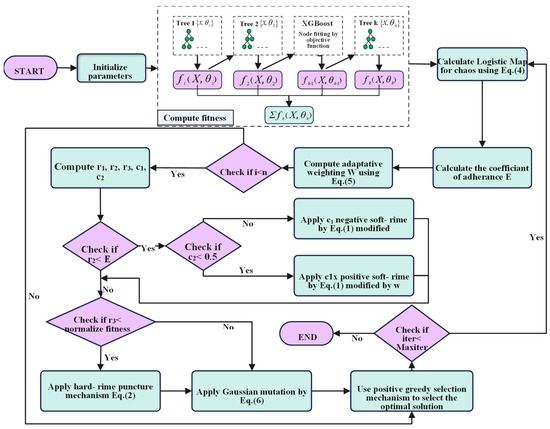
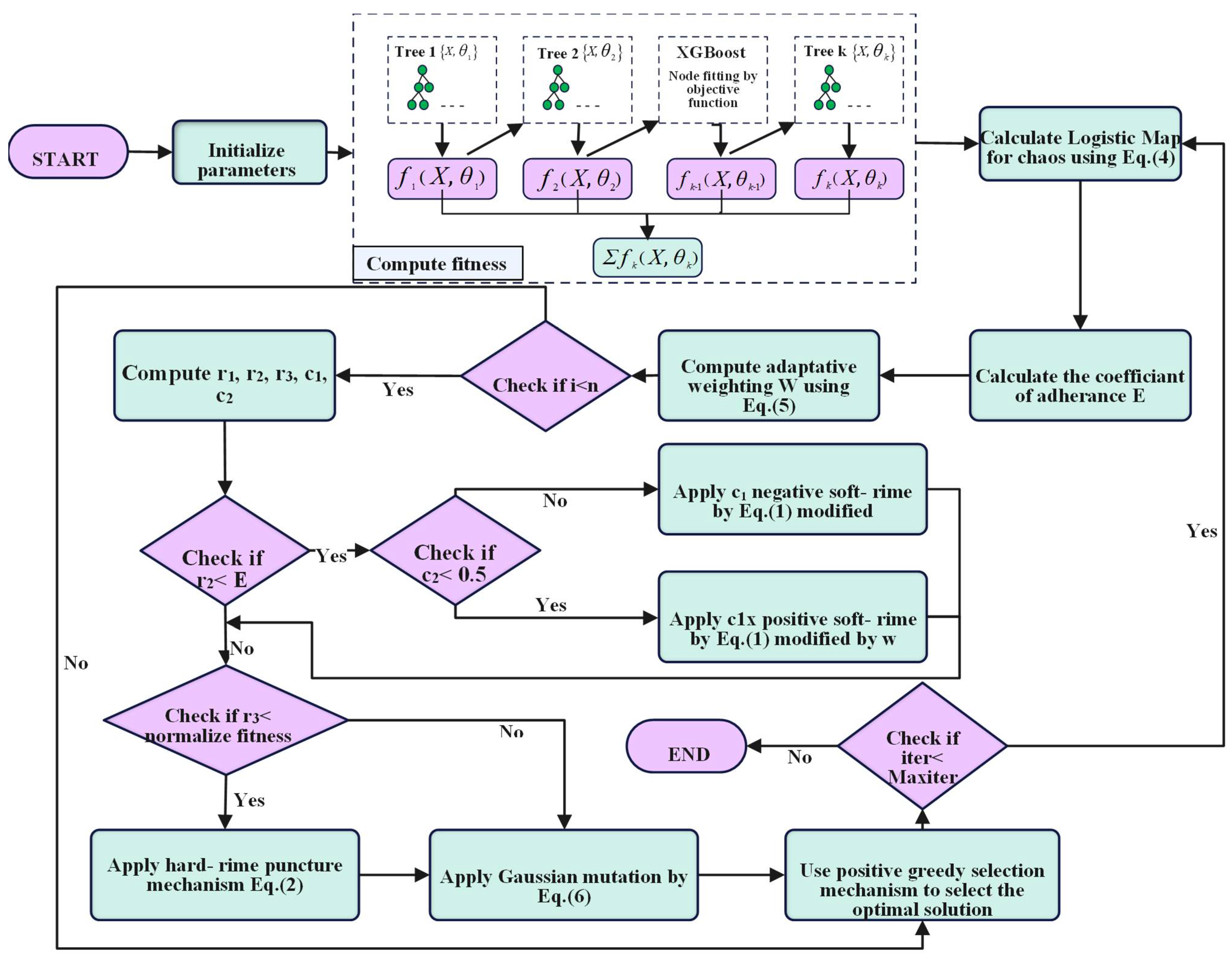
To improve the predictive performance of the XGBoost algorithm, this study proposes the integration of an improved metaheuristic optimization approach, termed ACGRIME, for hyperparameter tuning. The schematic illustration of the ACGRIME-XGBoost framework is illustrated in Figure 1. The optimization process explores a defined hyperparameter space, wherein the learning rate is bounded between 0.01 and 0.3, the number of boosting trees varies from 50 to 200, and the tree depth is within the range of 3 to 10. XGBoost, despite its robustness and scalability, often suffers from suboptimal generalization when manually configured or subjected to conventional tuning methods. Its performance is highly sensitive to hyperparameter settings, and improper tuning leads to overfitting, especially in high-dimensional or noisy datasets. Furthermore, XGBoost’s reliance on greedy algorithms for tree construction can lead to local optima convergence, limiting its capability to capture complex nonlinear patterns over diverse search spaces.
Figure 1.
ACGRIME-XGBOOST Framework.
To address these limitations, the proposed ACGRIME algorithm integrates three principal strategies: chaotic initialization, adaptive weighting, and Gaussian mutation. ACGRIME extends the capabilities of the original RIME algorithm by introducing chaos theory to enhance global search capacity and avoid premature convergence. The chaotic mechanism enriches the search diversity in the early stages, thereby improving the exploration of the solution space as expressed in Equation (3). The adaptive weighting strategy enables dynamic control over the exploration–exploitation balance, adjusting the algorithm’s search behavior in response to the optimization progress, as shown in Equation (4). This facilitates a smooth shift from exploration to exploitation, optimizing convergence without sacrificing solution quality. Furthermore, the Gaussian mutation operator introduces stochastic variations governed by chaotic dynamics, which maintains population diversity and reduces the risk of being trapped in local optima, as shown in Equation (5). The ACGRIME-XGBoost model, therefore, serves as a robust and adaptive optimization framework for fine-tuning XGBoost hyperparameters. This hybrid framework was specifically applied to the task of CO2 emission forecasting in the aviation sector, demonstrating superior generalization and predictive accuracy over baseline methods. The integration of chaotic mapping, adaptive weight control, and Gaussian mutation in ACGRIME is grounded in well-established optimization theory. Chaotic maps, particularly the logistic map used in this study, are known to introduce ergodic and non-repetitive sequences that enhance population diversity and prevent premature convergence, outperforming purely random initialization in many global optimization scenarios. Adaptive weighting dynamically modulates the influence of exploration and exploitation based on iteration progress, enabling more flexible convergence control than static coefficients. This mechanism helps the search process avoid stagnation and accelerates fine-tuning near optima. Gaussian mutation introduces local perturbations with probabilistic control, favoring refined exploitation in high-fitness regions without disrupting global search momentum. Together, these enhancements enable ACGRIME to maintain a well-balanced and resilient search trajectory, which is particularly effective in complex, high-dimensional optimization landscapes.
The integration of ACGRIME with XGBoost is motivated by the sensitivity of gradient-boosted tree models to hyperparameter configurations and the limitations of conventional tuning methods such as grid or random search in high-dimensional spaces. XGBoost provides strong nonlinear regression capability and robustness to feature interactions, but its predictive performance depends heavily on parameters such as learning rate, tree depth, and number of estimators. ACGRIME is employed as a global optimizer to systematically explore this hyperparameter space by balancing exploration and exploitation through chaos-driven initialization, adaptive weighting, and Gaussian mutation. In this hybrid framework, each candidate solution generated by ACGRIME represents a specific XGBoost hyperparameter configuration, which is evaluated using a fitness function defined by the prediction error on the training set. The optimal XGboost model, as illustrated in Figure 1, is obtained through an iterative optimization process. At each iteration, ACGRIME updates the population of candidate hyperparameter sets based on fitness feedback from the XGBoost model. Inferior solutions are discarded through greedy selection, while promising configurations are refined via adaptive exploitation mechanisms. This process continues until the termination criterion is met, defined by a maximum number of iterations or convergence of the fitness value. The final output corresponds to the optimal XGBoost configuration that minimizes prediction error, which is then used for CO2 emission prediction using unseen flight data.
3. Experiments and Discussion
This section describes two sets of experiments that were carried out to validate the effectiveness of the ACGRIME algorithm and its integration with the XGBoost model. First, the standalone performance of ACGRIME is rigorously assessed using ten widely adopted comprehensive functions from the Congress on Evolutionary Computation (CEC) 2020 competition. These benchmark problems are selected to evaluate the algorithm’s optimization capability across a diverse set of problem landscapes, including unimodal, multimodal, separable, and non-separable functions. Second, the ACGRIME-XGBoost hybrid model is employed to address the CO2 emission prediction problem in the aviation industry. The model’s predictive performance is thoroughly assessed using several standard statistical metrics, thereby demonstrating the practical relevance and superiority of the novel approach in real-world tasks. All experiments were conducted on a workstation equipped with an Intel Core i7. The system operated on Windows 11 Pro. The implementation was carried out using Python 3.10, with key libraries including Scikit-learn 1.2.2, XGBoost 1.7.6, NumPy 1.24.2, Pandas 1.5.3, and Matplotlib 3.7.1.
3.1. Evaluation of the Novel ACGRIME on CEC2020 Functions
The experimental evaluation utilizes a set of ten complex benchmark functions drawn from the CEC2020 test suite, which encompasses various unimodal, multimodal, hybrid, and composite functions. These functions are specifically designed to simulate the challenges encountered in real-world optimization tasks, providing a robust platform for evaluating the performance of metaheuristic algorithms. Comprehensive descriptions of the benchmark functions can be found in [40]. To rigorously assess the search capability of the proposed ACGRIME algorithm, comparative analyses are conducted against several established optimization algorithms, including the original RIME [37], Exponential Differential Optimizer (EDO) [41], Harris Hawk Optimization (HHO) [42], Polar Light Optimization (PLO) [43], Sine Cosine Algorithm (SCA) [44], Sand Cat Swarm Optimization (SCSO) [45], and Transient Search Optimization (TSO) [46]. All algorithms are subjected to identical experimental settings for fairness and reproducibility: the maximum number of iterations is set to 5000, each algorithm is independently executed 30 times, and both the population size and problem dimensionality are fixed at 30. The parameter configurations for each algorithm are summarized in Table 1. The main objective of this experiment is to evaluate the optimization effectiveness and global search capabilities of the ACGRIME algorithm when confronted with complex functions exhibiting diverse characteristics, including separability, modality, and ruggedness.
Table 1.
Parameter Settings.
3.1.1. Statistical and Non-Parametric Analyses
Based on the statistical results presented in Table 2, the proposed ACGRIME algorithm consistently outperforms competing methods across a range of benchmark functions. The reported average and standard deviation values indicate that ACGRIME not only achieves higher-quality solutions on average, but also exhibits lower variability over multiple independent runs, underscoring its stability and reliability.
Table 2.
Performance of ACGRIME and Compared Algorithms on CEC2020 Functions.
In the unimodal function (F1), ACGRIME attains a solution closest to the global optimum, highlighting its strong convergence capability. This is largely due to its adaptive weighting strategy, which adjusts the exploration–exploitation balance during the search process. For the multimodal functions (F2–F4), ACGRIME significantly outperforms all comparative algorithms, including EDO, PLO, HHO, SCA, SCSO, TSO, and the original RIME by effectively navigating complex landscapes filled with numerous local optima. The enhanced exploration ability, facilitated by the integration of chaos mechanism and the use of Gaussian mutation for infusing stochastic diversity, enables the algorithm to escape local optima and converge toward global solutions. Moreover, in the more challenging hybrid and composite benchmark functions (F5–F10), ACGRIME achieves the best average performance in functions F5, F6, and F8, reflecting its robustness in high-complexity problem spaces that demand a well-balanced exploration–exploitation mechanism. This improvement in performance can be directly linked to the combined effect of the three core strategies employed in ACGRIME: chaos-driven exploration, adaptive weighting, and Gaussian mutation. Although PLO achieved superior mean results in functions F7, F9, and F10, ACGRIME remained highly competitive across all problem instances. This observation aligns with the No Free Lunch (NFL) theorem [47], which states that no single optimization algorithm can outperform all others across all possible problem domains.
To further validate the performance of the novel ACGRIME algorithm, nonparametric statistical tests were employed to evaluate the differences in performance between the algorithms. While Table 2 provides summary statistics including the mean and standard deviation of each optimizer’s results, these metrics alone are insufficient for establishing statistical significance. Therefore, the Wilcoxon Rank-Sum Test (WRT), a robust nonparametric test suitable for data with non-normal or complex distributions, was utilized. A significance level (p-value) of 0.05 was adopted, where a p-value less than 0.05 indicates a statistically significant difference between the two compared algorithms. The WRT results in Table 1 demonstrate that ACGRIME outperforms the majority of the compared algorithms, with statistically significant improvements in most benchmark functions. However, in a few cases, particularly with the HHO algorithm, the p-values exceeded 0.05, indicating non-statistically significant differences. This suggests that HHO exhibits comparable convergence behavior to ACGRIME on certain problems. Such findings are consistent with the NFL theorem, which asserts that no single algorithm universally outperforms all others on all optimization problems. In addition to the WRT, the Friedman Test (FT), a common nonparametric test for comparing multiple algorithms across multiple datasets, was also used. This test ranks the algorithms based on their performance, assigning lower mean values to better-performing methods. As shown in Table 2, ACGRIME consistently achieved the top rank in all test scenarios, as evidenced by its lowest average rank value in the Friedman Test (FT). These results further reinforce the effectiveness and generalizability of ACGRIME in solving a wide range of complex optimization problems.
3.1.2. Convergence Analysis
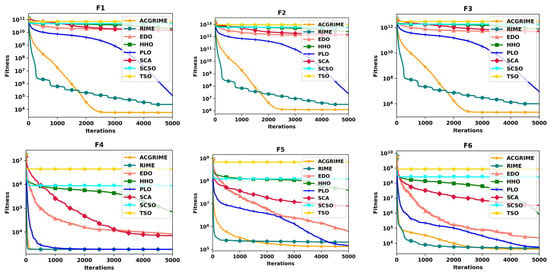
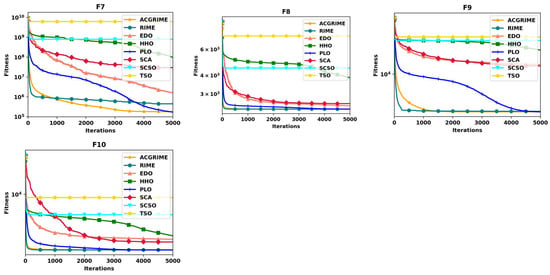
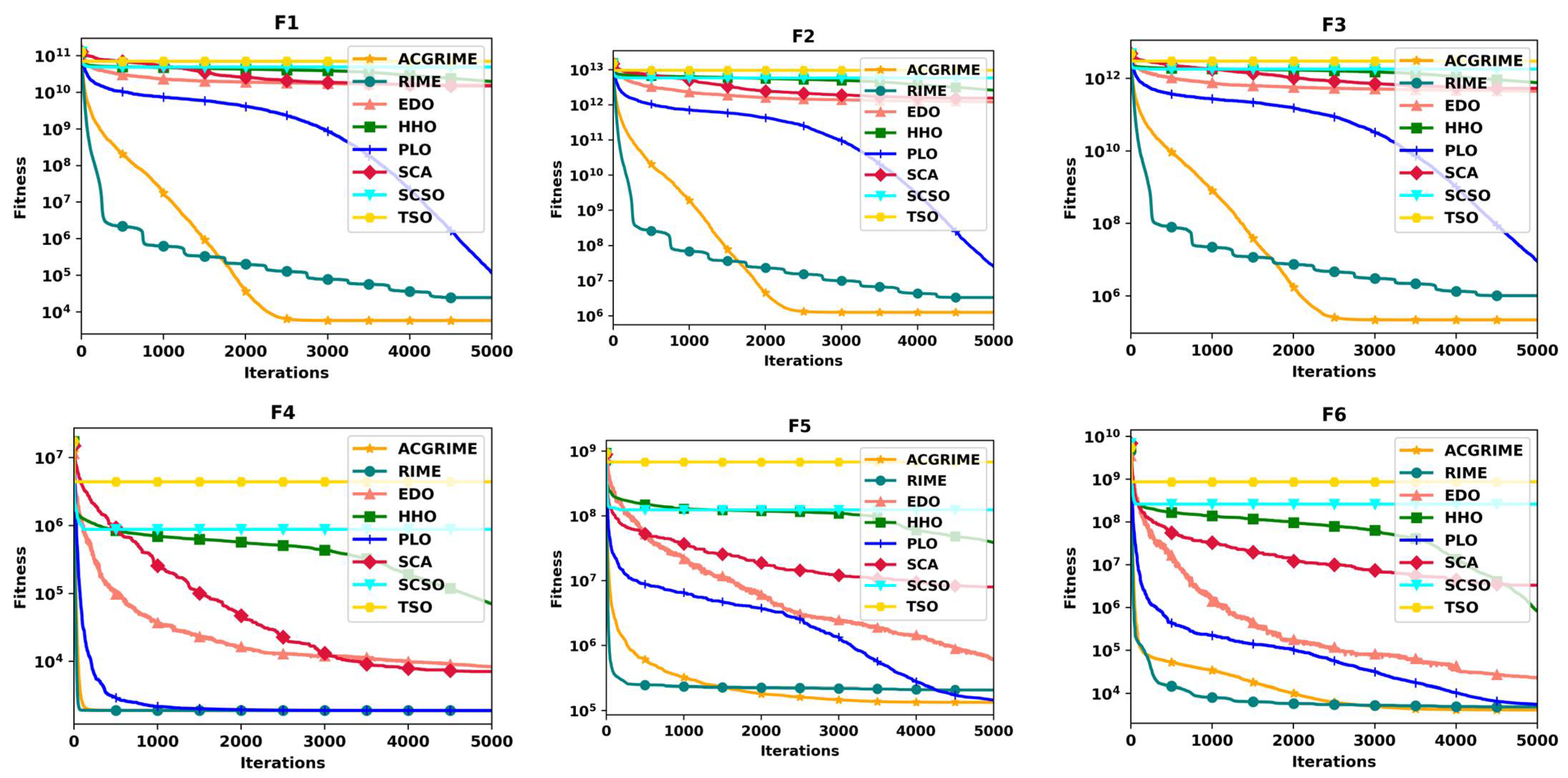
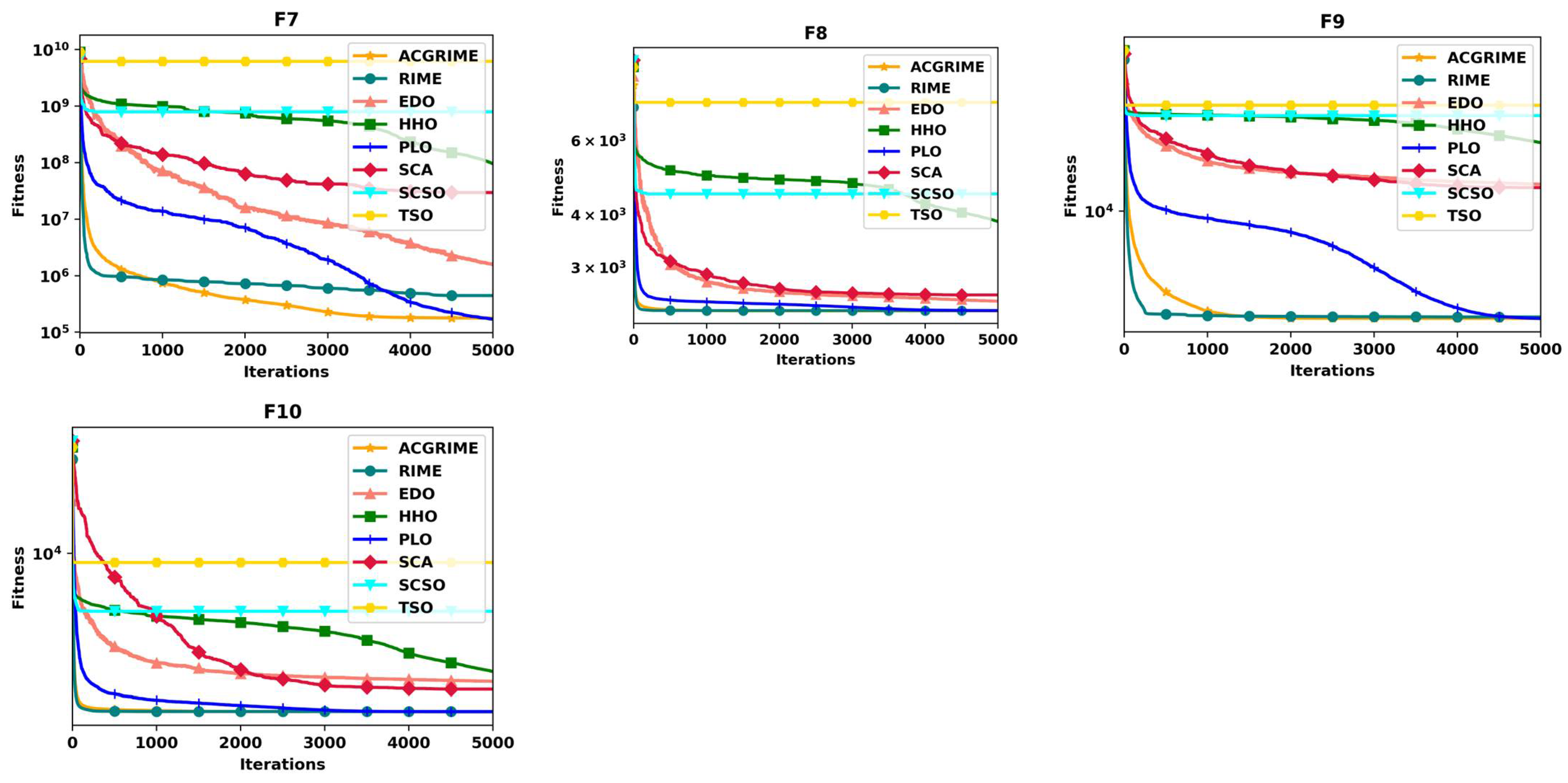
Figure 2 illustrates the average convergence behavior of the evaluated optimization algorithms over 30 independent runs. The convergence plot of an algorithm reflects its efficiency in navigating the search space and approaching the optimal solution, thus providing insights into the accuracy and speed of its optimization process. The proposed ACGRIME algorithm demonstrates markedly improved convergence performance relative to the original RIME algorithm, exhibiting a more stable and accelerated convergence trajectory across most benchmark functions. For the unimodal function F1, the ACGRIME algorithm converges significantly faster and achieves higher accuracy than the compared algorithms, highlighting its strong exploitation capability in simpler landscapes. In the early stages of optimization, ACGRIME rapidly narrows in on the global optimum, primarily due to the influence of the adaptive weighting strategy, which effectively guides the algorithm from exploration to exploitation. When applied to multimodal functions (F2–F4), ACGRIME consistently exhibits superior convergence speed and precision. Its capacity to escape local optima and approach the global solution with high accuracy is facilitated by the integration of chaos theory, which enhances population diversity, and Gaussian mutation, which infuses controlled stochastic variation. These mechanisms jointly contribute to the algorithm’s robust performance in complex, multimodal environments. In the case of hybrid and composite functions (F5, F6, and F8), ACGRIME maintains its dominance by achieving the best convergence accuracy among all the tested algorithms. The algorithm’s capacity to adaptively balance exploration and exploitation allows it to efficiently handle the intricate landscapes posed by these high-complexity functions. The convergence analysis confirms the efficacy of ACGRIME in delivering fast and accurate optimization, demonstrating its versatility and robustness across a wide spectrum of problem types.
Figure 2.
Convergence Graphs of ACGRIME and Compared Algorithms on CEC2020.
3.1.3. Box Plot Analysis
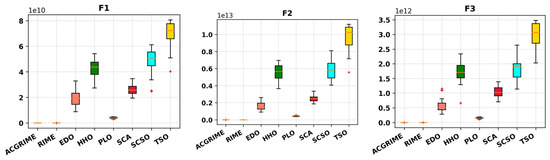
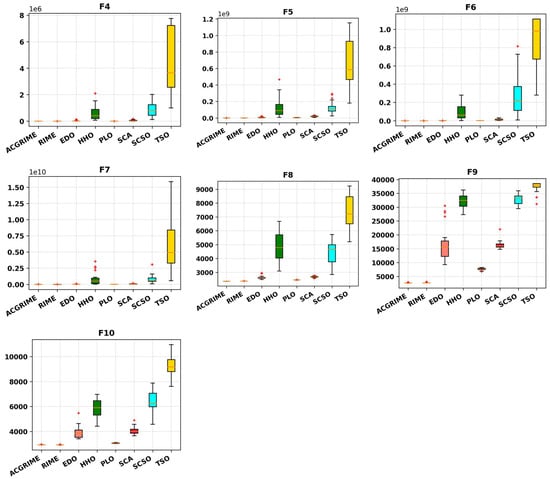
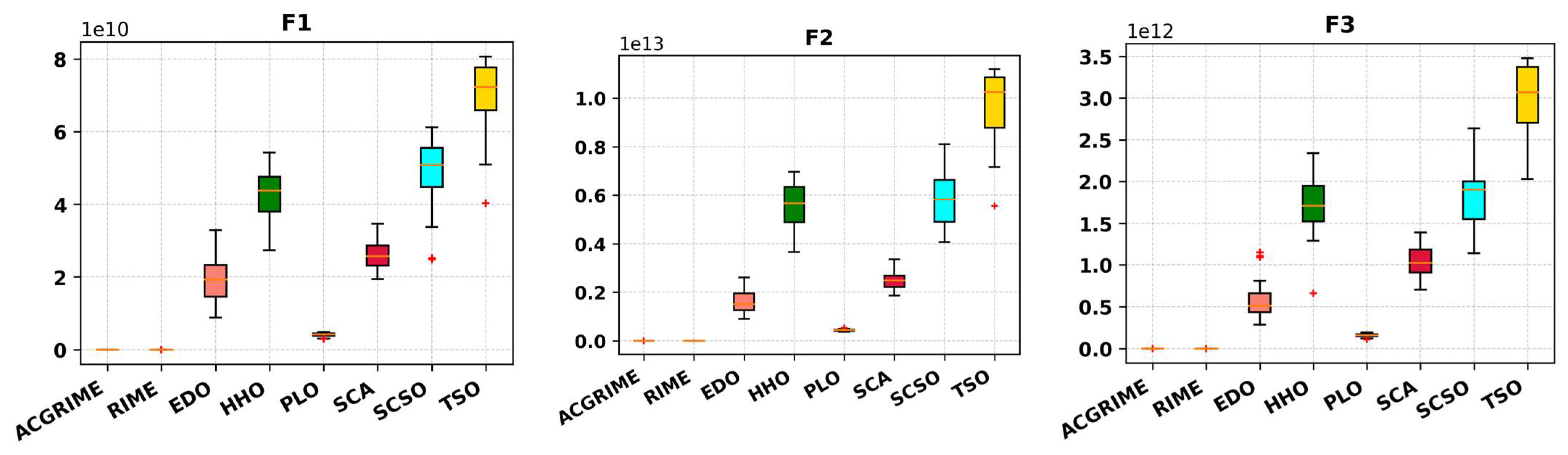
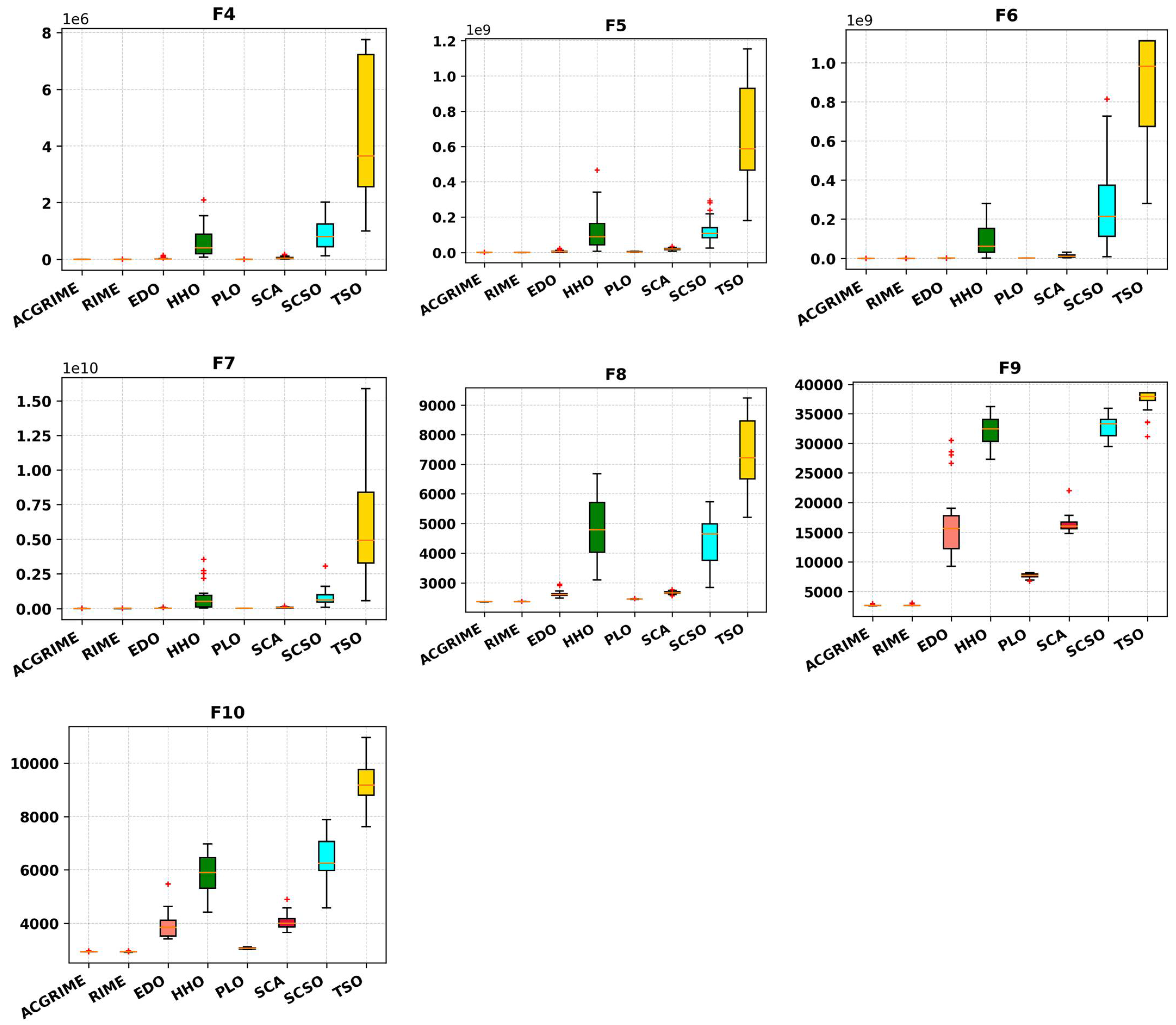
Boxplot analysis was used to illustrate the distribution and variability of outputs generated by each algorithm. Each benchmark function was independently executed 30 times using the dimensional settings outlined in Table 1. In the boxplot, the minimum and maximum values are represented by the whiskers, while the edges of the box mark the lower and upper quartiles. The results, shown in Figure 3, reveal that ACGRIME consistently produced tighter distributions for most benchmark functions (F1–F10), indicating greater stability and reliability. The narrow spread and shorter whiskers in ACGRIME’s boxplots suggest that it can locate the global optimum more consistently than the alternative algorithms. Additionally, the shorter boxes and central medians reflect its robustness and performance consistency. This performance advantage is largely attributed to the integration of chaos theory, adaptive weighting, and Gaussian mutation within ACGRIME, which enhances the balance between exploration and exploitation, ultimately boosting the algorithm’s overall efficiency.
Figure 3.
Box Plot Analysis of ACGRIME and Compared Algorithms.
3.1.4. Exploration vs. Exploitation Analysis
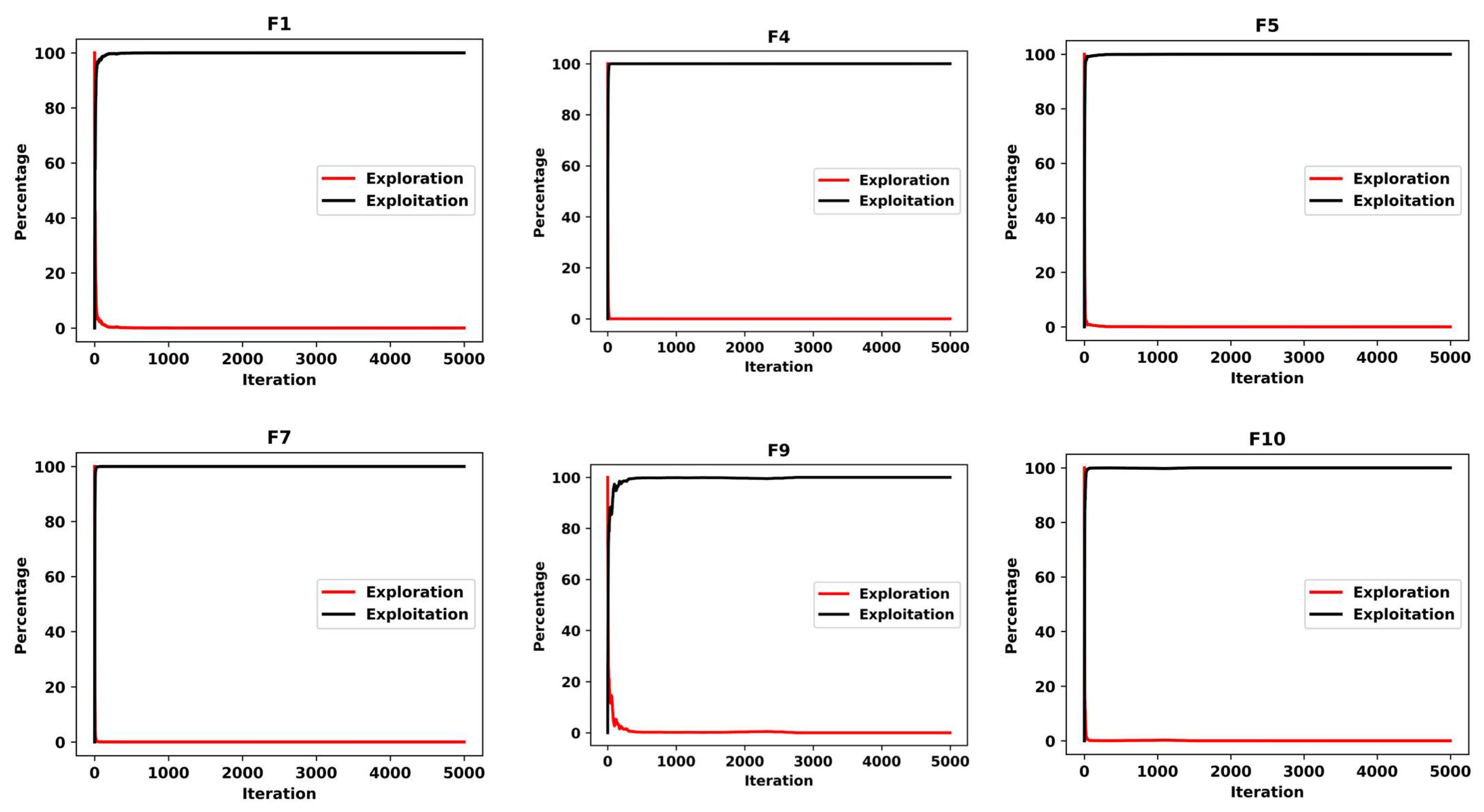
Optimization algorithms, and nature-inspired ones in particular, rely heavily on effective exploration and exploitation. Exploration entails a comprehensive search throughout the solution space to reveal several candidate solutions to mitigate the risk of the algorithm being ensnared in sub-optimal regions. This is particularly advantageous in intricate, multimodal environments. On the other hand, exploitation emphasizes the thorough investigation of areas that have previously shown favorable outcomes, allowing the algorithm to effectively settle on an optimal or near-optimal solution. Achieving an appropriate equilibrium between exploration and exploitation is crucial for efficient optimization. Extreme exploration may impede convergence, whereas an excessive emphasis on exploitation poses the risk of early convergence to inferior solutions. As shown in Figure 4, the algorithm initially prioritizes exploration to thoroughly scan the search space, then gradually shifts toward exploitation to refine the most optimal regions. This adaptive balance is achieved through the novel integration of chaos theory, adaptive weighting, and Gaussian mutation. Together, these mechanisms enable the algorithm to perform effectively across diverse and complex problem landscapes.
Figure 4.
Exploration vs. Exploitation Plots for ACGRIME.
3.2. Performance Evaluation of ACGRIME-XGBOOST Model
3.2.1. Data
The dataset used in this study for forecasting CO2 emissions in the aviation sector was obtained from Kaggle [48] and comprises flight data from China to various international destinations. To ensure data integrity and support reliable analysis, several preprocessing steps were applied. Categorical variables were converted into numerical format using appropriate encoding techniques, while standardization was used to normalize the numerical variables. Additionally, all rows containing missing values were removed to maintain consistency in the dataset. The refined dataset comprises the following variables: from_country, indicating the origin of the flight; dest_country, representing the destination; aircraft_type, denoting the model or type of the aircraft, which significantly affects fuel consumption and emissions; airline_number, a unique identifier identifying the number of airlines used in the route; duration, referring to the total flight time; stops, indicating the number of stopovers; price, and CO2 emission, the target variable representing the estimated CO2 output per flight. These variables collectively form a comprehensive feature set that supports accurate modeling of CO2 emissions in aviation through machine learning techniques.
3.2.2. Evaluation Metrics
In this study, the predictive accuracy of the proposed model was measured using five widely adopted performance evaluation metrics: the Mean Squared Error (MSE), Root Mean Squared Error (RMSE), Normalized Root Mean Squared Error (NRMSE), Mean Absolute Error (MAE), and Coefficient of Determination (). These metrics are mathematically expressed in Equation (13) through (17). Specifically, (Equation (13)) quantifies how well the model explains the variability of the target variable, comparing the residual sum of squares to the total sum of squares. RMSE (Equation (14)) and MSE (Equation (15)) both assess the average magnitude of prediction errors, with RMSE providing a more interpretable measure by expressing error in the same units as the output. MAE (Equation (16)) calculates the average absolute difference between actual and predicted values, offering a straightforward error metric that is less sensitive to outliers. Lastly, NRMSE (Equation (17)) normalizes the RMSE by the mean of the actual values, allowing for scale-independent comparisons; it is expressed as a percentage. In all equations, denotes the actual observed value, represents the predicted value, is the mean of the observed values, and refers to the total number of observations. Together, these metrics provide a comprehensive view of the model’s predictive power, error distribution, and overall performance consistency.
3.2.3. Prediction Results
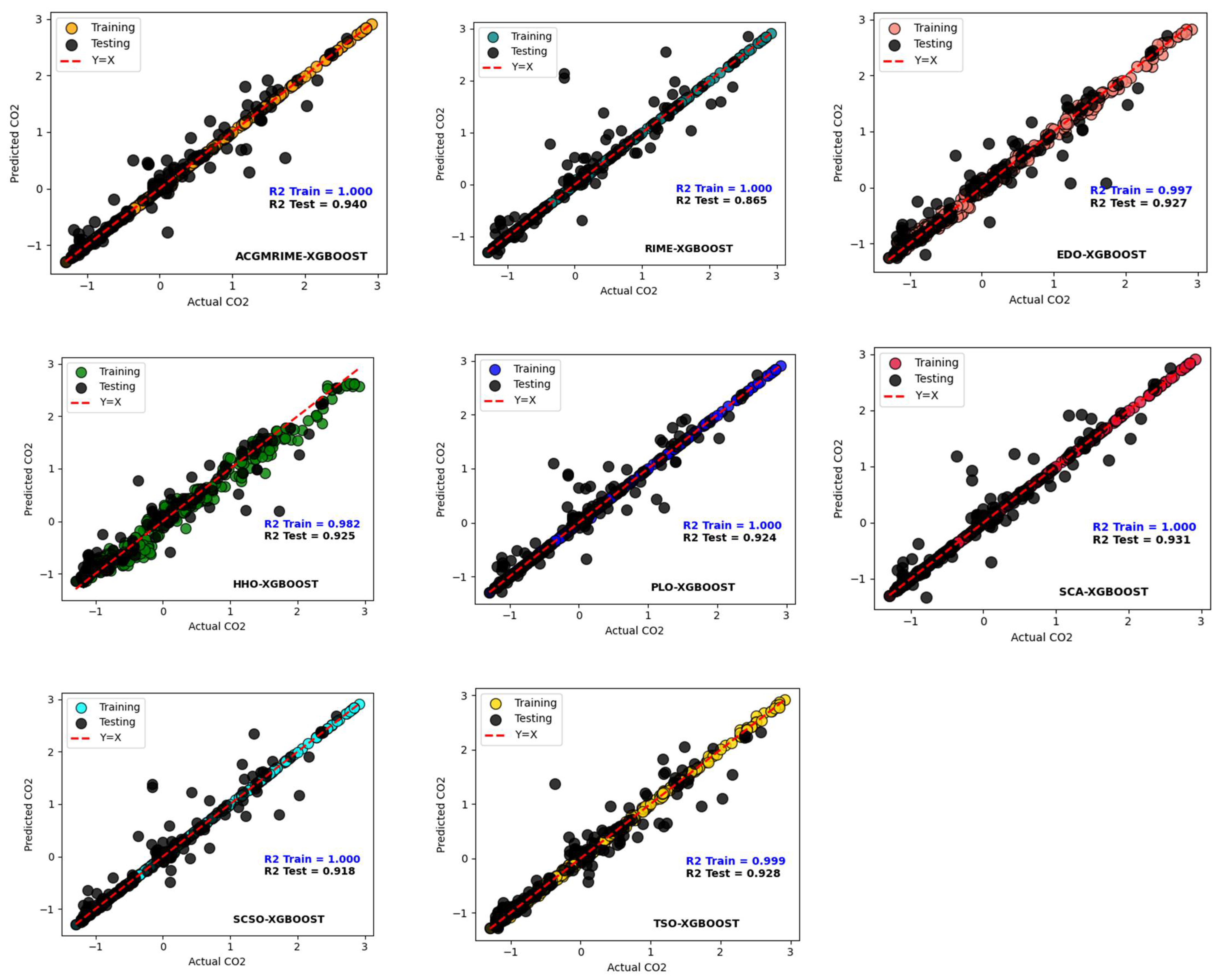
The efficacy of the novel ACGRIME-XGBOOST method was rigorously assessed and benchmarked against various algorithmically enhanced XGBOOST models, including traditional XGBOOST, using multiple statistical metrics during the training and testing stages. Consistent parameter settings, specified in Table 1, were maintained throughout all experiments, including a fixed iteration count of 50 and a population size of 30 search agents for each algorithm. MSE, defined in Equation (15), served as the principal function guiding the optimization of the XGBOOST’s parameters. The dataset was partitioned into training and testing subsets in an 80:20 ratio to guarantee a thorough assessment of the model’s generalization performance. This subsection provides a thorough performance assessment of various XGBOOST-based prediction models optimized by different nature-inspired algorithms, with a focus on both training and testing phases. As shown in Table 3, the ACGMRIME-XGBOOST model demonstrated the most favorable outcomes during training, achieving the lowest MSE of 6.3189 × 10⁻⁵, RMSE of 7.9491 × 10⁻³, and MAE of 1.5235 × 10⁻³. These metrics underscore the model’s precision in minimizing prediction errors. Moreover, the NRMSE of 7.9496 × 10⁻³ and a superior coefficient of determination (R2) of 0.999937 affirm its superior predictive accuracy and ability to capture the underlying data distribution with minimal deviation. The performance of other models, such as RIME-XGBOOST, PLO-XGBOOST, and SCA-XGBOOST, also remained competitive with their R2 and RMSE values in the range of 7.9709 × 10⁻³ to 8.2917 × 10⁻³, suggesting that these models are competitive while ACGRIME-XGBOOST remains superior in its performance. However, models like EDO-XGBOOST and HHO-XGBOOST showed higher MSE values of 3.2053 × 10⁻³ and 1.7799 × 10⁻² and R2 scores of 0.996795 and 0.982201, indicating relatively less accurate parameter optimization and potential underfitting compared to the top-performing models.
Table 3.
Training Result for Optimized XGBOOST Optimized Models.
In the testing phase, detailed in Table 4, ACGMRIME-XGBOOST continued to exhibit robust generalization capabilities, achieving the lowest test MSE of 5.3055 × 10⁻² and the lowest RMSE of 2.3034 × 10⁻¹. Despite an increase in absolute error compared to training, the model retained a strong predictive performance with an R2 of 0.939673 and NRMSE of 2.4759 × 10⁻¹, indicating its resilience in maintaining low error margins on previously unseen. Conversely, models such as RIME-XGBOOST and EDO-XGBOOST showed significantly lower R2 values of 0.864560 and 0.926741, alongside higher RMSE values of 3.4513 × 10⁻¹ and 2.5383 × 10⁻¹, respectively, signifying weaker generalization and increased susceptibility to overfitting or noise in the testing data. Furthermore, SCA-XGBOOST and TSO-XGBOOST demonstrated moderate performance, with R2 values of 0.930543 and 0.927990, and MAE values of 1.2288 × 10⁻¹ and 1.4636 × 10⁻¹, respectively. Meanwhile, the relatively high error rates of models such as HHO-XGBOOST and SCSO-XGBOOST, each with RMSEs exceeding 2.57 × 10⁻¹, suggest suboptimal prediction accuracy during testing. The ACGMRIME-XGBOOST model consistently outperformed its counterparts across both phases due to its enhanced optimization framework that effectively balances exploration and exploitation. Its dominance in terms of lower error metrics and higher R2 values establishes it as a reliable and robust model for predictive tasks such as CO2 emission forecasting, where precision and generalization are critical.
Table 4.
Test Result for Optimized XGBOOST Optimized Models.
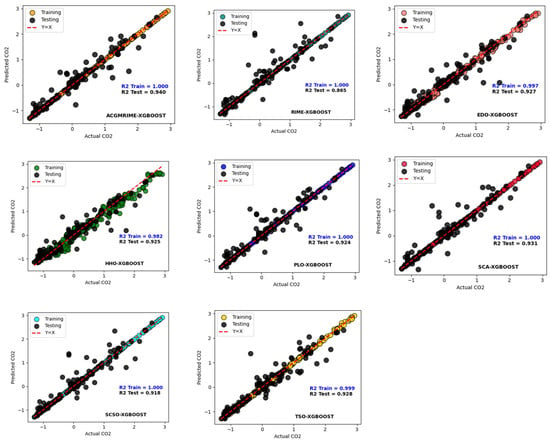
The scatter plot in Figure 5 shows the effectiveness of the ACGMRIME-XGBOOST model for CO2 prediction, plotting predicted values against actual measurements for both training and testing datasets (black circles) and the ideal alignment indicated by the y = x line (red dashed line). ACGMRIME-XGBOOST exhibits superior R2 values on the training dataset, signifying high correlation and minimal error as the data points are tightly clustered along the y = x line. For the testing dataset, the R2 value of 0.940 reflects a strong generalization capability, despite slight dispersion around the y = x line, indicating reliable predictive accuracy on unseen data. While the training data points demonstrate improved training, the testing data points, though slightly more scattered, still maintain a robust linear relationship with actual values, affirming the model’s ability to capture underlying patterns more effectively than the compared models. Collectively, these high R2 values and the close proximity to the y = x line highlight the model’s precision, reliability, and capacity for generalization. Although minor deviations in testing suggest potential areas for refinement, the ACGMRIME-XGBOOST model demonstrates exceptional predictive capabilities, making it a promising approach for accurate and robust CO2 prediction.
Figure 5.
Predicted CO2 Emission Values Compared with Observed Values.
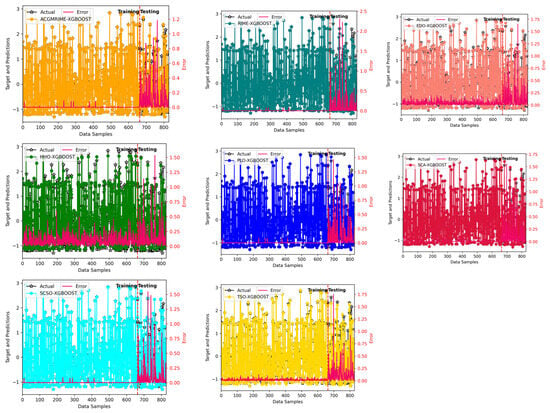
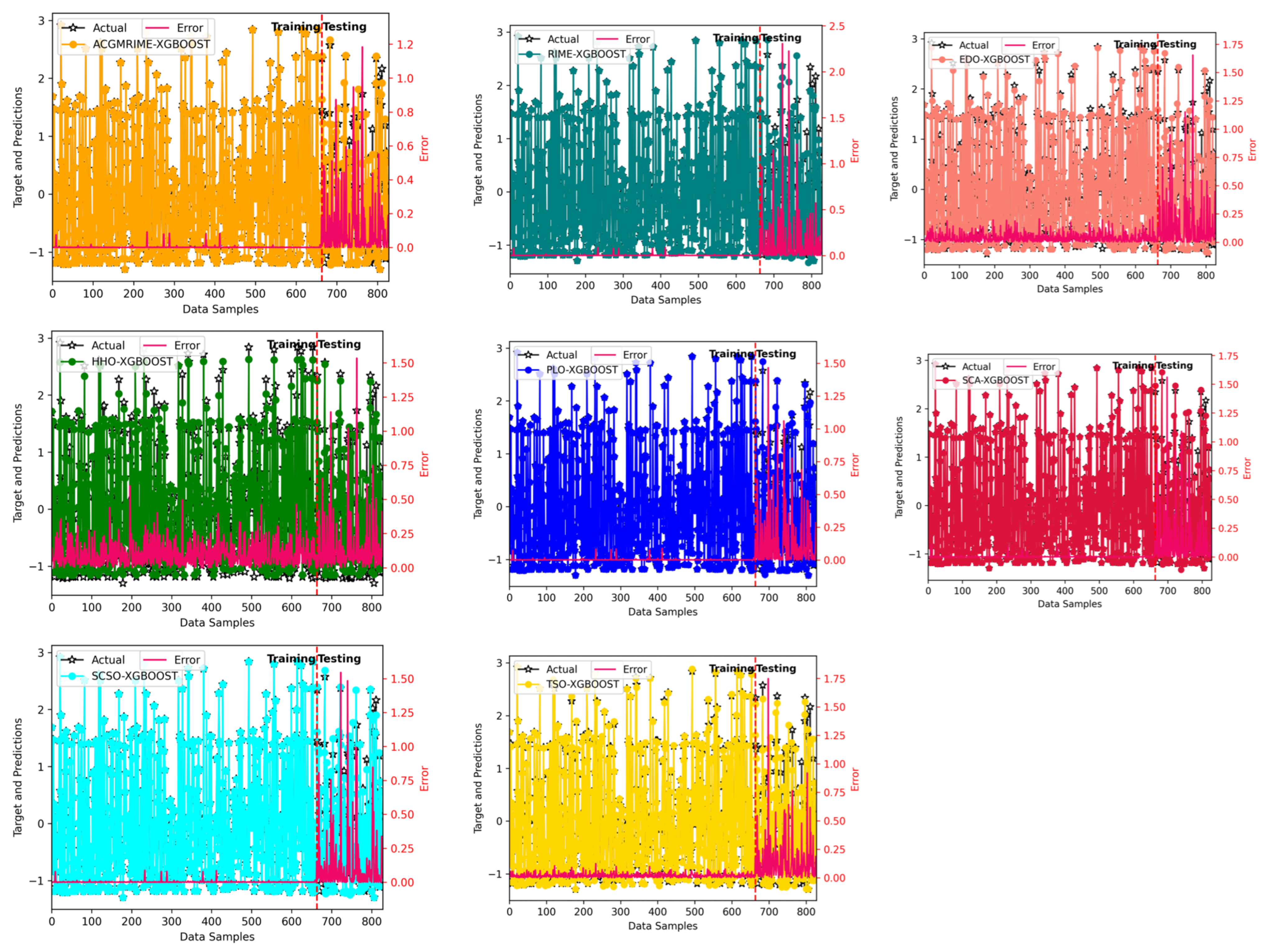
Figure 6 displays a side-by-side assessment of the ACGRIME-XGBoost model’s prediction accuracy compared to several baseline models on training and testing datasets. The plot comprises three principal components: the actual CO2 values (depicted as a black line with star markers), the predicted outputs from the various models, and the absolute prediction error (illustrated by a pink line). The sequential data samples are presented on the x-axis, while the left y-axis corresponds to the actual and forecasted values. Additionally, the graph is segmented into two regions: the training phase and a testing phase. The ACGMRIME-XGBOOST model’s predictive trajectory closely aligns with the actual observations across both data segments, demonstrating its strong capacity to model and generalize the underlying data dynamics. Minor discrepancies are observed between the anticipated and observed values, as seen by the absolute error curve on the right y-axis. Although these discrepancies are present, they remain relatively constrained in magnitude compared to those observed in the other models. The minimal spread of the error values further signifies the model’s stability and robustness, particularly in handling complex and potentially noisy data within the test set. Such a performance indicates that the integration of chaos theory, adaptive weighting, and Gaussian mutation strategies into the original RIME framework effectively enhances the global search behavior and fine-tuning ability of the optimization process. This improved optimization mechanism directly contributes to the superior learning and generalization capabilities of the ACGMRIME-XGBOOST model. The evidence depicted in the figure confirms that ACGMRIME-XGBOOST achieves high predictive fidelity and consistency, making it a reliable and efficient approach for CO2 prediction challenge. The enhanced alignment between predicted and actual trends, along with the consistently low error margins, substantiates the advantages of the proposed modifications and underscores the model’s effectiveness in practical applications.
Figure 6.
Comparing Error Values of Models.
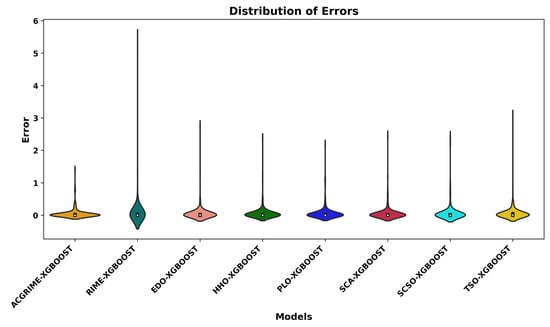
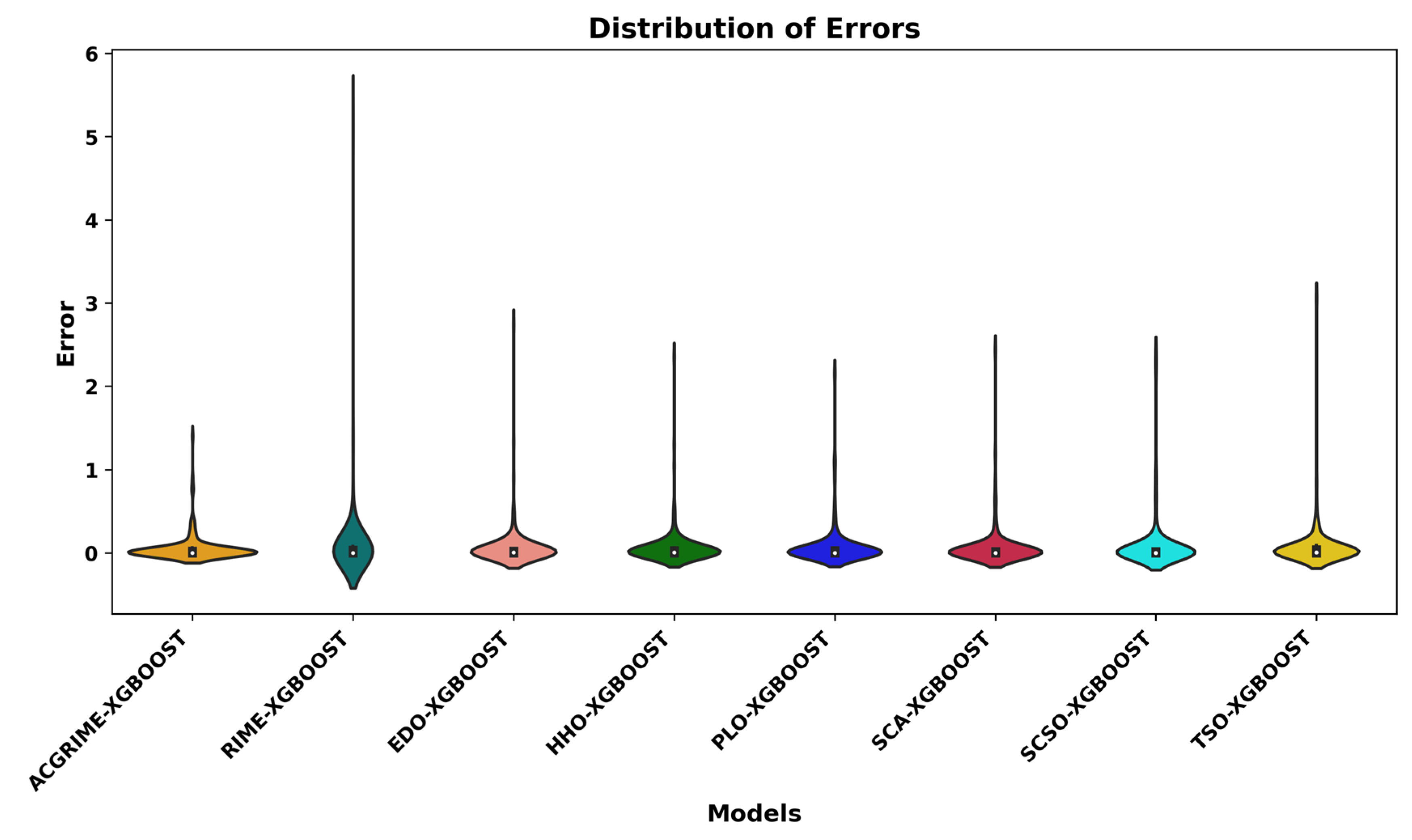
Figure 7 displays the distribution of prediction errors for various XGBOOST-based hybrid models during the testing phase using violin plots, offering a detailed comparison of their error dispersion and central tendencies. Each model’s performance is visualized through the shape and spread of its corresponding violin, where the width of each plot at a given error value indicates the density of observations. Notably, the distribution for the RIME-XGBOOST model exhibits the widest spread and the longest tail, indicating a higher frequency of large errors and suggesting potential instability or overfitting in specific cases. The ACGRIME-XGBOOST shows narrower and more compact distributions, with most error values tightly concentrated around lower magnitudes. This reflects a more consistent predictive performance and reduced occurrence of extreme deviations. The median and interquartile ranges, marked by embedded boxplots within the violins, further reinforce the comparative precision of these models. In summary, the plot highlights the robustness and reliability of certain ACGRIME-XGBOOST models. This plot underscores the importance of error distribution analysis in assessing the generalization capabilities of hybrid machine learning models.
Figure 7.
Comparing Error Distribution of Models.
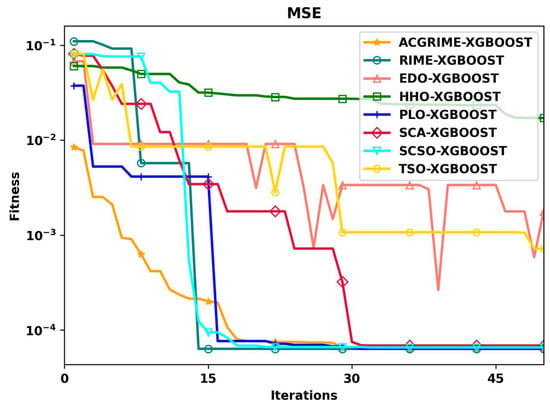
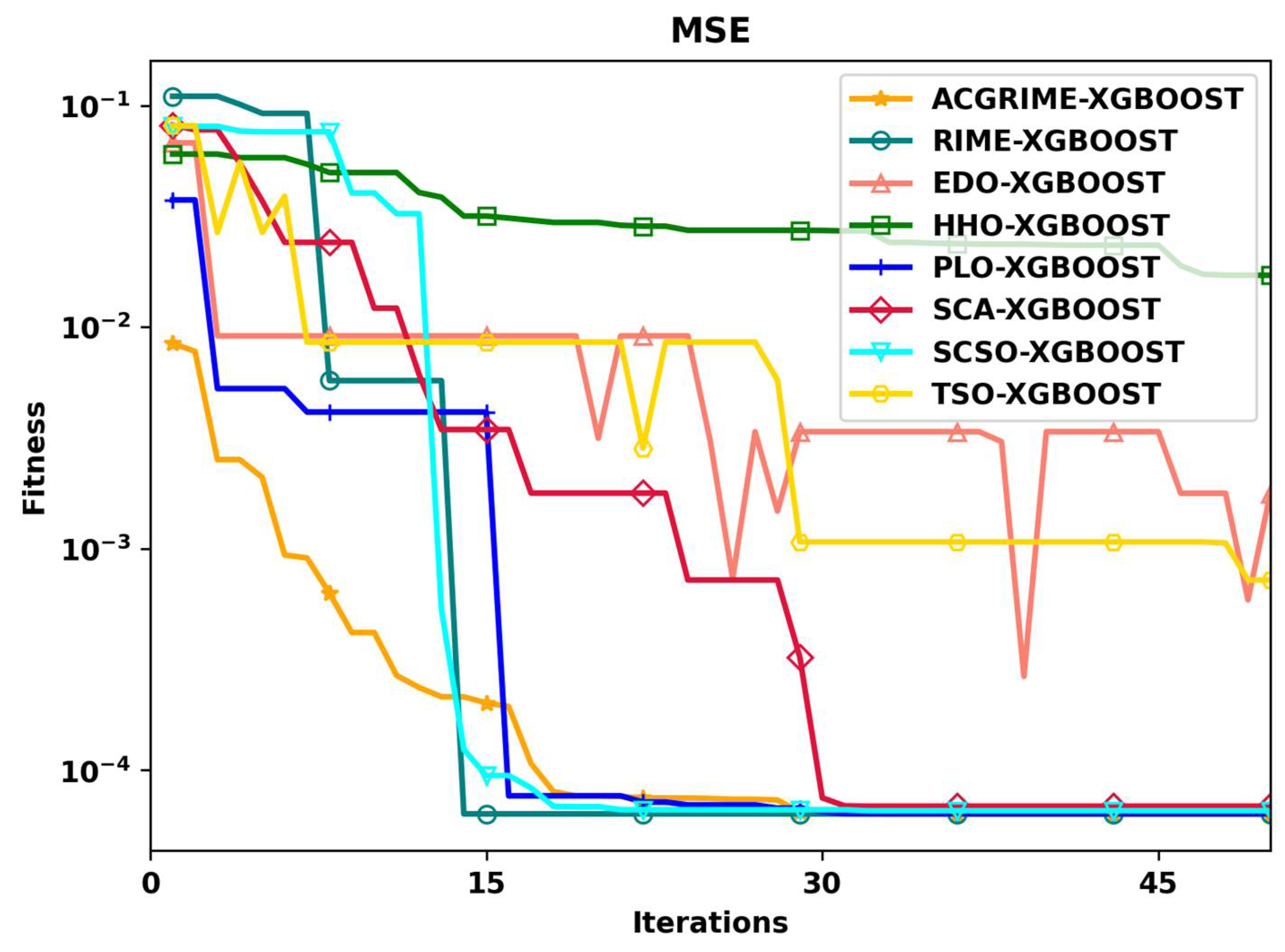
Figure 8 illustrates the convergence behavior of various XGBOOST-based hybrid models in terms of MSE across optimization iterations. The plot clearly differentiates the optimization efficiency of each model. Models such as ACGRIME-XGBOOST, RIME-XGBOOST, SCSO-XGBOOST, and PLO-XGBOOST rapidly descend towards minimal error values within the first 15 iterations, indicating swift convergence and superior fine-tuning capabilities. In contrast, HHO-XGBOOST exhibits suboptimal convergence, stabilizing at a relatively high error threshold, suggesting inferior optimization performance. The fluctuations observed in models like EDO-XGBOOST and TSO-XGBOOST imply instability in the optimization process, possibly due to local optima or parameter sensitivity. Thus, this comparative analysis highlights the convergence speed and stability of ACGRIME-XGBOOST models, providing key insights into their effectiveness in minimizing predictive error through iterative learning.
Figure 8.
Convergence of Algorithms.
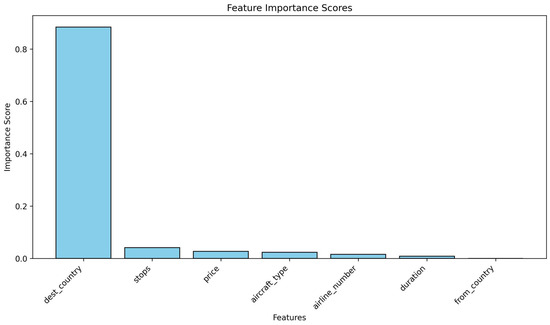
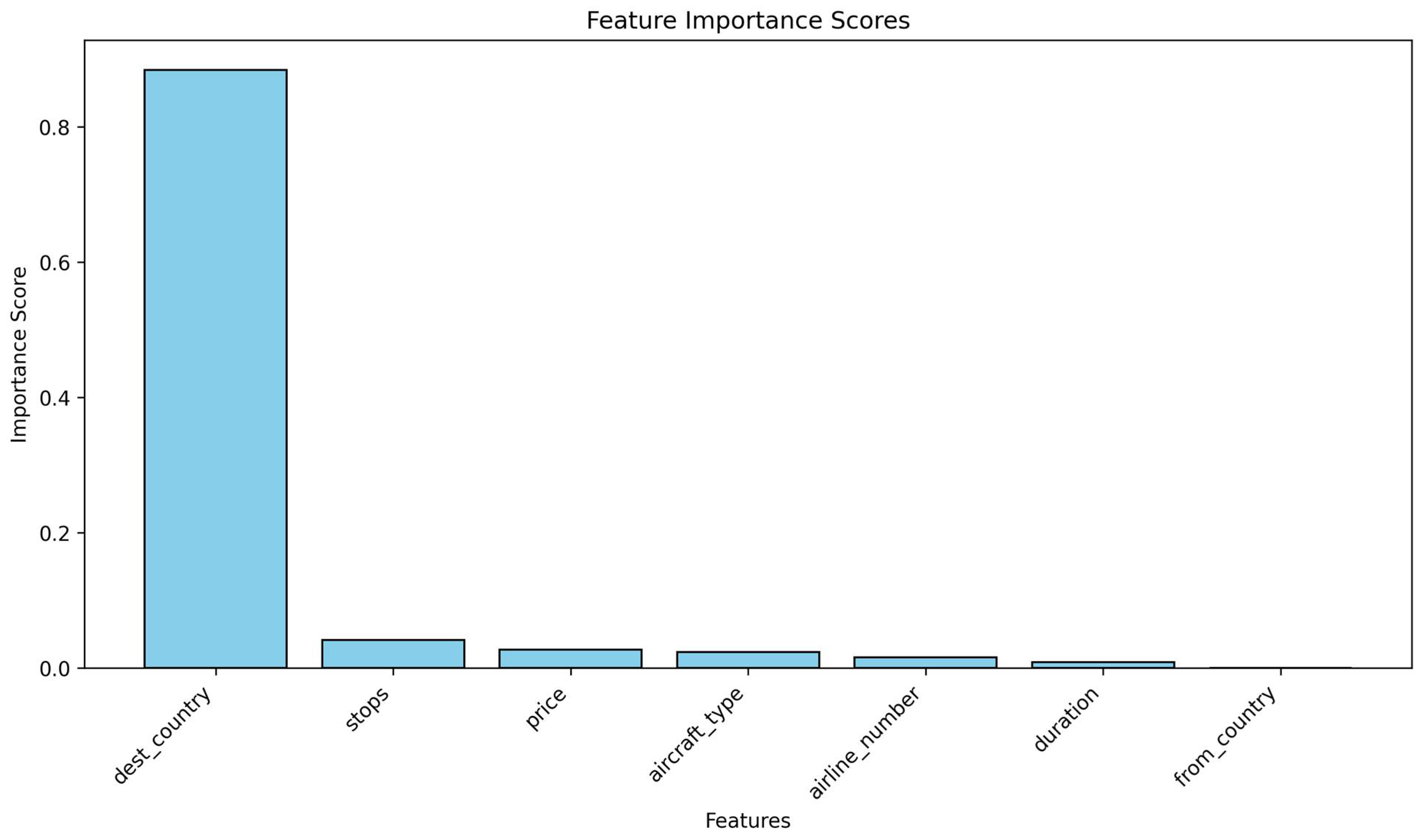
Figure 9 depicts the feature importance scores derived from the ACGRIME-XGBOOST model for predicting CO2 emissions within the aviation sector. The x-axis lists the input features, while the y-axis represents their respective importance scores. The analysis reveals that dest_country is by far the most influential variable, overwhelmingly contributing to the model’s predictive performance. All other features including stops, price, aircraft_type, and duration exhibit marginal contributions, highlighting their relatively minor impact on model accuracy. This shows that destination country strongly influences aviation-related CO2 emissions prediction, potentially due to variations in flight distances, airspace regulations, or regional environmental factors.
Figure 9.
Feature Importance Score of ACGRIME-XGBOOST.
4. Conclusions
This study proposed a novel hybrid model, ACGRIME-XGBoost, to improve the prediction accuracy of CO2 emissions in the aviation sector. By integrating the enhanced metaheuristic optimizer ACGRIME with the XGBoost algorithm, the model effectively addressed the challenge of hyperparameter tuning, which often limits the performance of traditional machine learning methods. ACGRIME, built upon the original RIME algorithm, leverages chaos theory to boost exploration capability, adaptive weighting to dynamically balance exploration and exploitation, and Gaussian mutation to maintain population diversity. The algorithm was rigorously evaluated using the CEC 2020 benchmark suite, where it demonstrated superior convergence performance and solution quality when compared with several state-of-the-art optimizers. Subsequently, its application to real-world aviation data showed significant improvements in prediction accuracy, confirming the robustness and generalizability of the proposed hybrid model. Although the proposed model was benchmarked against several competitive methods, this study did not include more baseline models. Therefore, future studies will also consider more baseline models.
Despite its strong performance, the present work has certain shortcomings. First, while ACGRIME was shown to outperform several well-known optimizers, the model was only validated using a specific CO2 emissions dataset from flights originating in China, which may limit the generalizability to global aviation data. Additionally, the computational cost associated with metaheuristic optimization can be relatively high, particularly for large-scale or real-time prediction tasks. Furthermore, while the model demonstrated high accuracy, interpretability remains limited due to the complex interactions within the hybrid framework. Most notably, the input feature set is constrained by the scope of the available dataset. Operationally significant variables such as aircraft payload, cabin layout, load factor, cruising altitude, engine type, and airline-specific practices were not present in the source data and therefore could not be incorporated into the modeling. As such, while the proposed model effectively captures statistical relationships within the provided features, its predictions may not reflect the full spectrum of factors influencing CO2 emissions. Future studies should seek access to richer, aviation-industry-grade datasets to further improve model fidelity and applicability to real-time sustainability assessments. This study did not include an ablation analysis to isolate the individual contributions of the chaotic initialization, adaptive weight control, and Gaussian mutation components within ACGRIME. We acknowledge the importance of such a study and will include comprehensive ablation experiments in future work to validate the effectiveness of each enhancement in the optimizer. Future work will explore the integration of explainable AI techniques to enhance the transparency of the ACGRIME-XGBoost model. In addition, adapting the framework to support real-time predictive applications and testing its effectiveness across diverse datasets, regions, and environmental variables would strengthen its applicability. Moreover, further research into parallelization strategies or lightweight versions of the optimizer could improve computational efficiency and scalability for practical deployment.
Author Contributions
A.M.S.E. Conceptualization, Methodology, Validation; W.M.S.K. writing—original draft preparation, supervision. All authors have read and agreed to the published version of the manuscript.
Funding
This research received no external funding.
Institutional Review Board Statement
Not applicable.
Informed Consent Statement
Not applicable.
Data Availability Statement
Data will be made available upon reasonable request to the corresponding author.
Conflicts of Interest
The authors declare no conflicts of interest.
References
- Zhang, L.; Xu, M.; Chen, H.; Li, Y.; Chen, S. Globalization, Green Economy and Environmental Challenges: State of the Art Review for Practical Implications. Front. Environ. Sci. 2022, 10, 870271. [Google Scholar] [CrossRef] [Scilit]
- Çınarer, G.; Yeşilyurt, M.K.; Ağbulut, Ü.; Yılbaşı, Z.; Kılıç, K. Application of various machine learning algorithms in view of predicting the CO2 emissions in the transportation sector. Sci. Technol. Energy Transit. 2024, 79, 15. [Google Scholar] [CrossRef] [Scilit]
- Ding, M.; Shen, Z.-Y.; Baležentis, T.; Chen, X. Climate change and marginal abatement cost: Policy insights on international treaty. Energy 2025, 321, 135515. [Google Scholar] [CrossRef] [Scilit]
- Yang, H.; O’Connell, J.F. Short-term carbon emissions forecast for aviation industry in Shanghai. J. Clean. Prod. 2020, 275, 122734. [Google Scholar] [CrossRef] [Scilit]
- Jensen, L.L.; Bonnefoy, P.A.; Hileman, J.I.; Fitzgerald, J.T. The carbon dioxide challenge facing U.S. aviation and paths to achieve net zero emissions by 2050. Prog. Aerosp. Sci. 2023, 141, 100921. [Google Scholar] [CrossRef] [Scilit]
- Filelis-Papadopoulos, C.K.; Kirshner, S.N.; O’Reilly, P. Sustainability with Limited Data: A Novel Predictive Analytics Approach for Forecasting CO2 Emissions. Inf. Syst. Front. 2024, 27, 1227–1251. [Google Scholar] [CrossRef] [Scilit]
- Kumar, S. A novel hybrid machine learning model for prediction of CO2 using socio-economic and energy attributes for climate change monitoring and mitigation policies. Ecol. Inform. 2023, 77, 102253. [Google Scholar] [CrossRef] [Scilit]
- Rouf, N.; Malik, M.B.; Arif, T.; Sharma, S.; Singh, S.; Aich, S.; Kim, H.-C. Stock Market Prediction Using Machine Learning Techniques: A Decade Survey on Methodologies, Recent Developments, and Future Directions. Electronics 2021, 10, 2717. [Google Scholar] [CrossRef] [Scilit]
- Mhlanga, D. Financial Inclusion in Emerging Economies: The Application of Machine Learning and Artificial Intelligence in Credit Risk Assessment. Int. J. Financ. Stud. 2021, 9, 39. [Google Scholar] [CrossRef] [Scilit]
- Chen, H.; Dong, Y.; Li, H.; Tian, S.; Wu, L.; Li, J.; Lin, C. Optimized green infrastructure planning at the city scale based on an interpretable machine learning model and multi-objective optimization algorithm: A case study of central Beijing, China. Landsc. Urban Plan. 2024, 252, 105191. [Google Scholar] [CrossRef] [Scilit]
- Omar, M.; Yakub, F.; Abdullah, S.S.; Rahim, M.S.A.; Zuhairi, A.H.; Govindan, N. One-step vs horizon-step training strategies for multi-step traffic flow forecasting with direct particle swarm optimization grid search support vector regression and long short-term memory. Expert Syst. Appl. 2024, 252, 124154. [Google Scholar] [CrossRef] [Scilit]
- Elkateb, S.; Métwalli, A.; Shendy, A.; Abu-Elanien, A.E.B. Machine learning and IoT—Based predictive maintenance approach for industrial applications. Alex. Eng. J. 2024, 88, 298–309. [Google Scholar] [CrossRef] [Scilit]
- Rodríguez, A.; Kamarthi, H.; Agarwal, P.; Ho, J.; Patel, M.; Sapre, S.; Prakash, B.A. Machine learning for data-centric epidemic forecasting. Nat. Mach. Intell. 2024, 6, 1122–1131. [Google Scholar] [CrossRef] [Scilit]
- Meghraoui, K.; Sebari, I.; Pilz, J.; Ait El Kadi, K.; Bensiali, S. Applied Deep Learning-Based Crop Yield Prediction: A Systematic Analysis of Current Developments and Potential Challenges. Technologies 2024, 12, 43. [Google Scholar] [CrossRef] [Scilit]
- Dtissibe, F.Y.; Ari, A.A.A.; Abboubakar, H.; Njoya, A.N.; Mohamadou, A.; Thiare, O. A comparative study of Machine Learning and Deep Learning methods for flood forecasting in the Far-North region, Cameroon. Sci. Afr. 2024, 23, e02053. [Google Scholar] [CrossRef] [Scilit]
- Saha, S.; Saha, C.; Haque, M.; Alam, G.R.; Talukder, A. ChurnNet: Deep Learning Enhanced Customer Churn Prediction in Telecommunication Industry. IEEE Access 2024, 12, 4471–4484. [Google Scholar] [CrossRef] [Scilit]
- Aziz, R.M.; Sharma, P.; Hussain, A. Machine Learning Algorithms for Crime Prediction under Indian Penal Code. Ann. Data Sci. 2024, 11, 379–410. [Google Scholar] [CrossRef] [Scilit]
- Gong, B.; Langguth, M.; Ji, Y.; Mozaffari, A.; Stadtler, S.; Mache, K.; Schultz, M.G. Temperature forecasting by deep learning methods. Geosci. Model Dev. 2022, 15, 8931–8956. [Google Scholar] [CrossRef] [Scilit]
- Fister, D.; Pérez-Aracil, J.; Peláez-Rodríguez, C.; Del Ser, J.; Salcedo-Sanz, S. Accurate long-term air temperature prediction with Machine Learning models and data reduction techniques. Appl. Soft Comput. 2023, 136, 110118. [Google Scholar] [CrossRef] [Scilit]
- Kumar, K.; Pande, B.P. Air pollution prediction with machine learning: A case study of Indian cities. Int. J. Environ. Sci. Technol. 2023, 20, 5333–5348. [Google Scholar] [CrossRef] [Scilit]
- Lee, M.H.L.; Ser, Y.C.; Selvachandran, G.; Thong, P.H.; Cuong, L.; Son, L.H.; Tuan, N.T.; Gerogiannis, V.C. A Comparative Study of Forecasting Electricity Consumption Using Machine Learning Models. Mathematics 2022, 10, 1329. [Google Scholar] [CrossRef] [Scilit]
- Mishra, M.; Guria, R.; Baraj, B.; Nanda, A.P.; Santos, C.A.G.; da Silva, R.M.; Laksono, F.A.T. Spatial analysis and machine learning prediction of forest fire susceptibility: A comprehensive approach for effective management and mitigation. Sci. Total Environ. 2024, 926, 171713. [Google Scholar] [CrossRef] [Scilit]
- Li, S.; Tong, Z.; Haroon, M. Estimation of transport CO2 emissions using machine learning algorithm. Transp. Res. Part D Transp. Environ. 2024, 133, 104276. [Google Scholar] [CrossRef] [Scilit]
- Nassef, A.M.; Olabi, A.G.; Rezk, H.; Abdelkareem, M.A. Application of Artificial Intelligence to Predict CO2 Emissions: Critical Step towards Sustainable Environment. Sustainability 2023, 15, 7648. [Google Scholar] [CrossRef] [Scilit]
- Singh, P.K.; Pandey, A.K.; Ahuja, S.; Kiran, R. Multiple forecasting approach: A prediction of CO2 emission from the paddy crop in India. Environ. Sci. Pollut. Res. 2022, 29, 25461–25472. [Google Scholar] [CrossRef] [Scilit]
- Zhang, J.; Zhang, H.; Wang, R.; Zhang, M.; Huang, Y.; Hu, J.; Peng, J. Measuring the Critical Influence Factors for Predicting Carbon Dioxide Emissions of Expanding Megacities by XGBoost. Atmosphere 2022, 13, 599. [Google Scholar] [CrossRef] [Scilit]
- Vo Thanh, H.; Yasin, Q.; Al-Mudhafar, W.J.; Lee, K.-K. Knowledge-based machine learning techniques for accurate prediction of CO2 storage performance in underground saline aquifers. Appl. Energy 2022, 314, 118985. [Google Scholar] [CrossRef] [Scilit]
- Yaseen, Z.M.; Melini Wan Mohtar, W.H.; Homod, R.Z.; Alawi, O.A.; Abba, S.I.; Oudah, A.Y.; Togun, H.; Goliatt, L.; Ul Hassan Kazmi, S.S.; Tao, H. Heavy metals prediction in coastal marine sediments using hybridized machine learning models with metaheuristic optimization algorithm. Chemosphere 2024, 352, 141329. [Google Scholar] [CrossRef] [Scilit] [PubMed]
- Khajavi, H.; Rastgoo, A. Predicting the carbon dioxide emission caused by road transport using a Random Forest (RF) model combined by Meta-Heuristic Algorithms. Sustain. Cities Soc. 2023, 93, 104503. [Google Scholar] [CrossRef] [Scilit]
- Shen, B.; Lu, X.; Jiang, J.; Li, D. Modeling the emitted carbon dioxide and monoxide gases in the gasification process using optimized hybrid machine learning models. Chem. Prod. Process Model. 2024, 19, 1029–1051. [Google Scholar] [CrossRef] [Scilit]
- Chai, H.-D.; Lin, B.-J.; Wang, Y.; Li, Y.-H.; Xu, J.-Y.; Lin, Y.-L.; Li, S.-H.; Lee, Z.-J.; Chen, Y.-Z. Building Carbon Emissions Prediction Based on Deep Learning Network with Improved Particle Swarm Optimization. Artif. Intell. Evol. 2023, 4, 216–225. [Google Scholar] [CrossRef] [Scilit]
- Hu, Y.; Wang, B.; Yang, Y.; Yang, L. An Enhanced Particle Swarm Optimization Long Short-Term Memory Network Hybrid Model for Predicting Residential Daily CO2 Emissions. Sustainability 2024, 16, 8790. [Google Scholar] [CrossRef] [Scilit]
- Ghorbal, A.B.; Grine, A.; Elbatal, I.; Almetwally, E.M.; Eid, M.M.; El-Kenawy, E.-S.M. Predicting carbon dioxide emissions using deep learning and Ninja metaheuristic optimization algorithm. Sci. Rep. 2025, 15, 4021. [Google Scholar] [CrossRef] [Scilit]
- Moayedi, H.; Mukhtar, A.; Alshammari, S.; Boujelbene, M.; Elbadawi, I.; Thi, Q.T.; Mirzaei, M. Prediction of CO2 emission for the central European countries through five metaheuristic optimization techniques helping multilayer perceptron. Eng. Appl. Comput. Fluid Mech. 2024, 18, 2327437. [Google Scholar] [CrossRef] [Scilit]
- Hakkal, S.; Lahcen, A.A. XGBoost To Enhance Learner Performance Prediction. Comput. Educ. Artif. Intell. 2024, 7, 100254. [Google Scholar] [CrossRef] [Scilit]
- Batis, M.; Chen, Y.; Wang, M.; Liu, L.; Heidari, A.A.; Chen, H. ACGRIME: Adaptive chaotic Gaussian RIME optimizer for global optimization and feature selection. Clust. Comput. 2024, 28, 61. [Google Scholar] [CrossRef] [Scilit]
- Su, H.; Zhao, D.; Heidari, A.A.; Liu, L.; Zhang, X.; Mafarja, M.; Chen, H. RIME: A physics-based optimization. Neurocomputing 2023, 532, 183–214. [Google Scholar] [CrossRef] [Scilit]
- Chen, T.; Guestrin, C. XGBoost: A Scalable Tree Boosting System. In Proceedings of the 22nd ACM SIGKDD International Conference on Knowledge Discovery and Data Mining; Association for Computing Machinery: New York, NY, USA, 2016; pp. 785–794. [Google Scholar]
- Khajavi, H.; Rastgoo, A.; Masoumi, F. Enhanced Streamflow Forecasting for Crisis Management Based on Hybrid Extreme Gradient Boosting Model. Iran. J. Sci. Technol. Trans. Civ. Eng. 2025, 49, 5233–5254. [Google Scholar] [CrossRef] [Scilit]
- Yue, C.T.; Price, K.V.; Suganthan, P.N.; Liang, J.J.; Ali, M.Z.; Qu, B.Y.; Awad, N.H.; Biswas, P.P. Problem Definitions and Evaluation Criteria for the CEC 2020 Special Session and Competition on Single Objective Bound Constrained Numerical Optimization; Zhengzhou University: Zhengzhou, China; Nanyang Technological University: Singapore, 2019. [Google Scholar]
- Abdel-Basset, M.; El-Shahat, D.; Jameel, M.; Abouhawwash, M. Exponential distribution optimizer (EDO): A novel math-inspired algorithm for global optimization and engineering problems. Artif. Intell. Rev. 2023, 56, 9329–9400. [Google Scholar] [CrossRef] [Scilit]
- Heidari, A.A.; Mirjalili, S.; Faris, H.; Aljarah, I.; Mafarja, M.; Chen, H. Harris hawks optimization: Algorithm and applications. Future Gener. Comput. Syst. 2019, 97, 849–872. [Google Scholar] [CrossRef] [Scilit]
- Yuan, C.; Zhao, D.; Heidari, A.A.; Liu, L.; Chen, Y.; Chen, H. Polar lights optimizer: Algorithm and applications in image segmentation and feature selection. Neurocomputing 2024, 607, 128427. [Google Scholar] [CrossRef] [Scilit]
- Mirjalili, S. SCA: A Sine Cosine Algorithm for solving optimization problems. Knowl.-Based Syst. 2016, 96, 120–133. [Google Scholar] [CrossRef] [Scilit]
- Seyyedabbasi, A.; Kiani, F. Sand Cat swarm optimization: A nature-inspired algorithm to solve global optimization problems. Eng. Comput. 2023, 39, 2627–2651. [Google Scholar] [CrossRef] [Scilit]
- Qais, M.H.; Hasanien, H.M.; Alghuwainem, S. Transient search optimization: A new meta-heuristic optimization algorithm. Appl. Intell. 2020, 50, 3926–3941. [Google Scholar] [CrossRef] [Scilit]
- Wang, S.; Rao, H.; Wen, C.; Jia, H.; Wu, D.; Liu, Q.; Abualigah, L. Improved Remora Optimization Algorithm with Mutualistic Strategy for Solving Constrained Engineering Optimization Problems. Processes 2022, 10, 2606. [Google Scholar] [CrossRef] [Scilit]
- Flight Data with 1 Million or More Records. Available online: https://www.kaggle.com/datasets/polartech/flight-data-with-1-million-or-more-records/data (accessed on 25 April 2025).

Disclaimer/Publisher’s Note: The statements, opinions and data contained in all publications are solely those of the individual author(s) and contributor(s) and not of MDPI and/or the editor(s). MDPI and/or the editor(s) disclaim responsibility for any injury to people or property resulting from any ideas, methods, instructions or products referred to in the content. |
© 2026 by the authors. Licensee MDPI, Basel, Switzerland. This article is an open access article distributed under the terms and conditions of the Creative Commons Attribution (CC BY) license.