


Abstract
This study examines the relationship between government spending on sports and recreation and economic growth based on two distinct views: Wagner’s Law and Keynesian theory. While previous research has largely focused on total government spending, this study emphasizes the importance of analyzing specific spending categories. Panel data from 30 European countries from 2001 to 2023 were analyzed using several econometric techniques, including cross-sectional dependency tests, CIPS unit root tests, Westerlund cointegration, the Dumitrescu–Hurlin panel causality test, and the Augmented Mean Group (AMG) estimator. The findings suggest a relationship between economic growth and sports and recreation spending from the Wagnerian perspective, while the Keynesian perspective is not supported. The Dumitrescu–Hurlin panel causality analysis confirms a unidirectional relationship from economic growth to sports and recreation spending. These results suggest that economic growth drives public investment in these sectors rather than vice versa. This study contributes to the literature by offering a disaggregated analysis of public spending and its macroeconomic implications. The findings also provide useful insights for policymakers, particularly when designing growth-responsive strategies for public investment in sports and recreation.
1. Introduction
Economic growth is a key area of research in both theoretical and applied economic literature. It is widely recognized as a fundamental factor that directly affects the level of welfare in societies [1,2,3]. It is suggested by the literature on economics that economic freedom is one of the fundamental determinants of economic growth [4]. In this context, economic growth has become an indicator not only of macroeconomic performance but also of social development. A considerable corpus of research has been conducted over the years on the subject of the effects of different types of public expenditure on economic growth. The role of public expenditure in economic growth is twofold: it can act as both a catalyst and a constraint [5]. The relationship between public expenditure and revenue has been debated in economic literature for many years and is considered one of the fundamental dynamics affecting the direction and sustainability of economic growth. This relationship is an important area of debate for economic policymakers as it has internal and external economic consequences. The Great Depression in 1929, in particular, led to the questioning of classical economic understanding. The deep economic stagnation, job losses, and serious decline in production that emerged during this period made state intervention inevitable. The Keynesian economic approach, which argued that aggregate demand could be supported by increasing public spending, emerged during this process. John Maynard Keynes’s theories suggested that government spending could be used as an effective tool to promote employment and economic growth [6].
According to Keynes, public spending is an important policy tool that affects economic growth and is considered an external factor. In contrast, Wagner argues that public spending is not the cause of economic growth, but rather an internal result of increasing national income [7]. The relationship between public spending and national income has long been a subject of study for economists, who have developed different theoretical approaches regarding the direction and the cause-and-effect structure of this relationship [2,8]. Public expenditure, which exerts a plethora of direct and indirect influences on economic growth, occupies a pivotal role in the formulation of public policies and the assurance of macroeconomic stability. There is a dynamic structure between public spending and economic growth, and the dynamic structure of these two interdependent variables is an important research topic requiring careful examination [2,9,10].
Wagner’s Law is the first theoretical framework developed to explain the relationship between public spending and economic growth. It proposes that public spending increases in proportion to national income. According to this law, public spending is a consequence of economic growth, and it tests the positive relationship between the size of the public sector and economic growth using a classical approach [11]. Consequently, Wagner’s Law is regarded as one of the earliest public spending models to examine this relationship [12]. By contrast, the Keynesian hypothesis takes a different approach to public spending, considering these expenditures to be an active policy tool used to stimulate economic growth. According to Keynes, increasing public spending, particularly during periods of economic stagnation, boosts total demand, thereby raising production and employment, and supporting economic growth [13]. Unlike Wagner’s Law, this approach argues that public spending can be a determining cause of growth, not just a result of it. The fact that the economy affects many sectors, which are in turn intertwined with economic activities, makes the development of sectoral policies inevitable.
The sports sector stands out in particular as a noteworthy area in terms of its relationship with economic growth. Sports have a significant effect on economic growth, and the sports sector clearly reflects the effects of economic development [14]. The majority of economic research on sport economies focuses on the development of indicators related to gross value added, employment, and consumer spending [15].
However, changes to economic growth policies and practices yield significant results, not only in terms of the number of public resources spent but also in terms of how these resources are used effectively and efficiently. Higher output or better-quality services can be achieved with the same level of public spending, which highlights the need to increase the efficiency of public spending. In this context, there is an increasing demand for empirical research to inform policy recommendations that aim to improve the efficiency of public spending [16,17]. Empirical evidence suggests that sports industry output in China exerts a substantial influence on economic growth, with a 1% increase in output resulting in an estimated rise of approximately 0.78% in GDP [18].
Various studies based on different periods and countries have comprehensively examined the relationship between public spending and economic growth in the literature [19]. In particular, the empirical analysis conducted by Biswal et al. (1999) reveals that, in the context of Wagner’s Law and the Keynes hypothesis, there is no significant long-term relationship between national income and disaggregated public expenditure variables, while showing short-term reciprocal causality [16]. This finding provides important clues. It suggests that national income may affect total government current expenditure in the short term. It also suggests that these expenditure items may affect the government’s income. Similarly, positive correlations have been found between national income and public expenditure [20,21,22], as well as between public consumption expenditure and national income [9,23,24]. These findings reveal the existence of a complex, multidimensional relationship between economic growth and public spending in the short and long term.
The accelerated growth of the global sports economy in recent years has facilitated the augmentation of the scope of sport-related economic activities [25].
Although the relationship between sports and recreational spending and economic growth, as outlined by Wagner’s Law and the Keynes hypothesis, has not yet been comprehensively addressed in the literature, studies have examined public spending on sports and recreation. These studies provide valuable insights into how public spending can be evaluated on a sector-by-sector basis by investigating the relationship between sports and recreational spending and economic dynamics. Sports and recreational activities are considered important for enhancing social life and promoting sporting success. Consequently, governments allocate substantial budgets to these areas [26]. According to a study by based on data from 2017, the average person spent 255.95 euros on sports and recreational activities. Furthermore, the study emphasizes that the availability of parks and recreation facilities has a significant impact on physical activity [27]. This suggests that augmenting public expenditure in this domain should be regarded as an efficacious policy instrument to promote engagement in physical activity [28,29]. Such investments contribute to individual health and quality of life, and enable regional development to be promoted [30,31]. The numerous responsibilities and increasing demands encountered in sports and recreation today require more and more resources to ensure the sustainability of these activities [32]. Increases in government expenditure on sport have been shown to provide substantial support for regional sustainable development, with the effects being particularly pronounced in the dimensions of green and balanced (coordinated) growth [33]. The extant literature, both conceptual and empirical, indicates that investments in sport generate multidimensional returns through health, human capital, and productivity channels, thereby fostering economic and social development [33,34]. In this context, public resources play a critical role in ensuring the continuity of sports and recreational activities, and such expenditure is vital for the development and effective functioning of the relevant sectors.
Despite the economic significance of sports and recreational activities, the relationship between public spending on sports and economic growth remains under-explored, both empirically and theoretically. While studies in the literature focus on education, health, employment, regional development, and social issues, the question of whether economic growth leads governments to allocate more resources to sports and recreation, or whether these expenditures stimulate economic growth, has not been clearly answered. Moreover, the relationship between sports spending and economic growth has been regarded as a secondary factor. While the existing literature on sports economics has largely adopted a descriptive approach, examining factors such as gross domestic product and employment, there is a scarcity of studies that directly assess the direction of causality between sports-related public expenditure and economic growth. Moreover, empirical studies have not incorporated multi-country analyses. The objective of this study is to eliminate the existing uncertainty surrounding the relationship between economic growth and sports and recreation spending in European countries. To this end, the study employs a systematic examination of the relationship, utilizing Wagner’s Law and the Keynesian hypothesis as analytical frameworks.
This article aims to examine in depth the relationship between government spending on sports and recreation and economic growth. In this context, the study has two main objectives. First, it seeks to investigate the theoretical and conceptual foundations of the direct effects of public spending on economic growth, based on Wagner’s and Keynes’s views. The fundamental claims put forward by these approaches are then evaluated within the framework of various conceptual issues that address the relationship between economic growth and public spending. Models commonly used in the literature are also expanded and developed. The second objective of the article is to emphasize the need for different strategies and policy recommendations that aim to increase the economic impact of the relationship between economic growth and sports and recreational spending. It is emphasized that adopting variable strategies to increase the effectiveness of public spending can maximize the positive effects on economic growth.
The Section 1 of this paper is introductory in nature, delineating the rationale behind the study, its theoretical framework, and the objectives that guide its undertaking. The Section 2 of the document presents the materials and methods, including the data description and the econometric techniques employed to analyze the relationship between GDP and sport and recreational government expenditure. The Section 3 presents and examines the econometric conclusions. Section 4, the paper’s conclusion, offers a summary of the main findings and their significance.
2. Materials and Methods
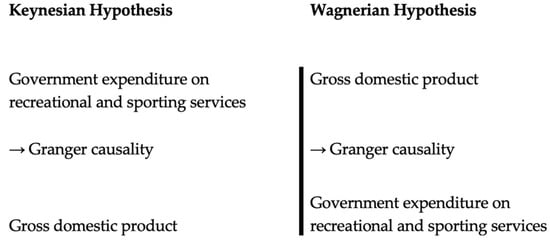
This study seeks to examine the relationship between economic growth and government expenditure on sport and recreational services, drawing upon two prominent theoretical frameworks: the Wagnerian hypothesis and the Keynesian hypothesis. These two perspectives offer contrasting views on the direction of causality between public spending and economic performance, thereby allowing for a comprehensive exploration of their interdependence. The structure of the empirical inquiry is summarized in Figure 1, which illustrates the bidirectional Granger causality tests conducted between the two variables of interest: gross domestic product (GDP) and government expenditure on recreational and sporting services.
Figure 1.
Keynesian and Wagnerian hypotheses.
According to the Wagnerian hypothesis, public expenditure tends to increase as a country’s income level rises. This theory suggests that as economies grow and societies become more complex, there is a corresponding increase in demand for public goods and services, including non-essential services such as sports and recreation. In other words, economic growth is viewed as the driving force behind public sector expansion. This relationship is often expressed in functional form as follows:
where GE denotes government expenditure, and GDP represents economic output. In contrast, the Keynesian hypothesis argues that government expenditure is an active instrument of economic policy that can influence aggregate demand and stimulate economic growth. From this perspective, increased public spending—particularly during economic downturns—can lead to higher levels of output and employment. This relationship is represented as follows:
These functional forms reflect the theoretical underpinnings of each hypothesis. While the Wagnerian approach treats government spending as a dependent variable influenced by GDP, the Keynesian model sees public expenditure as an independent variable that can affect economic performance. Within the context of this study, both models are tested empirically to determine whether government spending on recreational and sporting services acts as a driver of economic growth or whether it is instead a consequence of it. By employing a dual perspective, the research aims to uncover potential feedback loops and the nature of causality between these two variables. The selection of the Peacock–Wiseman model within the Wagnerian tradition is particularly noteworthy. This model is one of the earliest and most widely cited in the literature and provides a foundational understanding of how economic development leads to increased public spending. It emphasizes the structural changes that occur in public finance as a result of economic shocks or growth, suggesting that once government spending increases, it tends to remain at a higher level even after the initial cause has subsided [35]. Several subsequent extensions and variations in Wagner’s Law have been proposed by scholars such as Gupta (1967), Goffman (1968), Pryor (1968), Musgrave (1969), and Mann (1980), but this study focuses on the original Peacock–Wiseman formulation due to its historical significance and conceptual clarity [36,37,38,39,40]. Based on the theoretical evolution, this study aims to examine this relation with the hypothesis as follows:
H1:
Unidirectional Granger causality running from GDP to sports and recreation government expenditures.
H2:
Unidirectional Granger causality running from sports and recreation government expenditure to GDP.
To empirically test these hypotheses, the study adopts a panel data approach that enables the analysis of both cross-country heterogeneity and dynamic interactions over time.
The empirical analysis is based on panel data from 30 European countries over the period from 2001 to 2023. The countries included in the dataset are as follows: Austria, Belgium, Bulgaria, Croatia, Cyprus, Czechia, Denmark, Estonia, Finland, France, Germany, Greece, Hungary, Iceland, Ireland, Italy, Latvia, Lithuania, Luxembourg, Malta, Netherlands, Norway, Poland, Portugal, Romania, Slovakia, Slovenia, Spain, Sweden, and Switzerland. The choice of countries ensures a broad and diverse sample across different levels of economic development and public expenditure structures within Europe. Data for the analysis were obtained from Eurostat, the official statistical office of the European Union. Two key variables are used: (1) general government expenditure on recreational and sporting services (SPORT), and (2) gross domestic product (GDP) at current prices. Both variables are measured in million euros to ensure consistency and comparability across countries. Government expenditure data include all public spending directed toward facilities, services, and programs related to sports and recreation, as defined by the Classification of the Functions of Government (COFOG). GDP figures represent the total market value of all final goods and services produced within a country in a given year. Both variables were transformed using the natural logarithm. To provide a foundational understanding of the dataset, descriptive statistics are computed and summarized in Table 1.
Table 1.
Descriptive statistics.
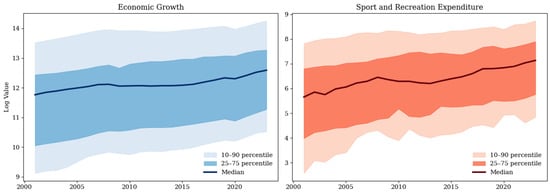
Additionally, the evolution of both economic growth and government expenditure on sport and recreational services is illustrated in Figure 2. The figure depicts the time evolution of the cross-sectional distribution of the variables using yearly quantiles. Shaded areas indicate interquantile ranges, while the solid line represents the median across countries. Although both series exhibit short-term fluctuations, the overall trend over the study period is upward, indicating a general increase in both economic activity and public investment in recreational and sporting services across the sampled countries.
Figure 2.
Distributional dynamics of the series across countries.
The econometric estimation strategy employed in this study involves a series of sequential steps to ensure the robustness and validity of the results. The first step focuses on testing cross-sectional dependence among the panel units, as ignoring such dependence may lead to biased and inconsistent estimators. To this end, several complementary tests are applied, including the Breusch–Pagan LM test, Pesaran’s scaled LM test, bias-corrected scaled LM test, and Pesaran’s CD (cross-sectional dependence) test. These tests collectively assess whether residuals across countries are correlated, which is a common feature in macroeconomic panel data involving interconnected economies such as European countries. Following the assessment of cross-sectional dependence, the second step involves determining the stationarity properties of the variables. For this purpose, the cross-sectionally augmented Im, Pesaran and Shin (CIPS) test, proposed by Pesaran (2007), is employed [41]. The CIPS test is particularly suitable in this context, as it accounts for the presence of cross-sectional dependence and provides more reliable results compared to traditional unit root tests. Establishing the order of integration is a critical prerequisite before proceeding to cointegration analysis. Once the integration order of the variables is identified, the next step is to examine whether a long-run equilibrium relationship exists between them. To test for panel cointegration, the cointegration test is utilized. This test is advantageous due to its ability to handle cross-sectional dependence and heterogeneity among panel units. Furthermore, in order to enhance the robustness of the findings, the Westerlund test is implemented with 1000 bootstrap replications, which helps mitigate size distortions and improves inference in the presence of complex error structures [42].
The final step of the empirical analysis involves identifying the direction of causality between government spending on sport and recreational services and economic growth. To this end, the panel Granger causality test is employed. This test allows for heterogeneity in the causal relationships across cross-sectional units and is well-suited for panels with a relatively large time dimension. Similarly to the cointegration analysis, the causality test is conducted with 1000 bootstrap replications to improve the reliability and robustness of the results. The use of bootstrapping in both the cointegration and causality testing stages ensures that the statistical inference remains valid even under non-standard data conditions often present in macroeconomic panel settings [43]. Furthermore, the impact of economic growth on sport and recreational government expenditure is examined using the Augmented Mean Group (AMG) estimator in order to quantify the magnitude of the long-run relationship while accounting for cross-sectional dependence. The AMG estimator developed by Eberhardt and Bond (2009) is employed in this study, as evidenced by the results of the Monte Carlo simulations conducted by Bond and Eberhardt (2013) that demonstrate its capacity to provide unbiased and efficient estimates across an extensive range of combinations of cross-sectional units and time periods [44,45].
3. Econometric Findings
The estimation results are presented in this section, beginning with the assessment of cross-sectional dependence among the variables, as outlined in the methodology. This step is crucial for selecting econometric techniques that yield consistent and reliable estimates in the presence of interdependencies across countries. The results from all four tests consistently indicate the presence of significant cross-sectional dependence for both variables—gross domestic product (GDP) and government expenditure on sport and recreational services. Recognizing cross-sectional dependence at this stage is essential, as it informs the selection of econometric methods capable of accounting for such interdependencies.
The next stage of the empirical analysis involves testing the stationarity properties of the variables using the cross-sectionally augmented Im, Pesaran, and Shin (CIPS) test, as illustrated in Table 2. This test is particularly appropriate in the context of this study, as it accounts for the presence of cross-sectional dependence, which was previously confirmed [41]. The CIPS test is conducted under two specifications—with a constant and trend—both at levels and at first differences, to ensure robustness, as shown in Table 3. The results indicate that government expenditure on sport and recreational services is non-stationary at levels, but becomes stationary after first differencing, significant at the 1% level, under both specifications. In the case of GDP (economic growth), the variable is non-stationary at the level when tested with a constant only. However, when the constant and trend specification is applied, GDP becomes stationary at the five percent significance level. After first differencing, GDP is found to be stationary across all model specifications.
Table 2.
Cross-section dependency tests.
Table 3.
Unit root test.
To determine whether a long-run equilibrium relationship exists between the variables, the panel cointegration test is applied. This test is chosen because it is robust to both cross-sectional dependence and heterogeneity in the stationarity properties of the series [42]. Additionally, to improve the reliability of the inference, the test is implemented with 1000 bootstrap replications. The cointegration analysis is conducted under both theoretical frameworks—Wagnerian (GDP → government expenditure) and Keynesian (government expenditure → GDP). The results are reported in Table 4. For the Wagnerian case, the robust p-values of the four test statistics—Gt, Ga, Pt, and Pa—are all statistically significant at the five percent level, suggesting the existence of a long-run cointegration relationship where GDP drives government spending on sport and recreational services. In contrast, the test results for the Keynesian specification do not indicate statistical significance for any of the four test statistics, implying that there is no evidence of a long-run relationship running from government expenditure to GDP within this context.
Table 4.
Westerlund co-integration test.
The final step in the empirical analysis involves examining the direction of causality between economic growth and government expenditure on sport and recreational services. For this purpose, the panel Granger causality test is employed. This method is particularly suitable for heterogeneous panel data, as it allows for individual-specific causal relationships across cross-sectional units [43]. In order to ensure robustness and improve the reliability of statistical inference, the test is conducted with 1000 bootstrap replications. The results of the Dumitrescu–Hurlin test reveal a unidirectional Granger causality running from economic growth (GDP) to government expenditure on sport and recreational services, as illustrated in Table 5. This finding suggests that changes in economic output significantly influence public spending patterns in the sport and recreation sector across the sampled European countries.
Table 5.
Dumitrescu–Hurlin panel causality test.
Taken together with the earlier cointegration test results, which also confirmed a long-run relationship consistent with the Wagnerian hypothesis, the findings provide coherent and robust empirical support. Specifically, the analysis shows that for the 30 European countries over the period 2001–2023, economic growth drives government expenditure in sport and recreational services, whereas the reverse relationship—public spending influencing GDP—does not hold. These results underscore the idea that as national economies grow, governments tend to allocate more resources to non-essential public goods such as sports and recreation, potentially in response to rising citizen demand for quality-of-life improvements. Conversely, there is no evidence to suggest that increasing government expenditure in this area has a significant causal effect on economic performance in the short or long run.
The AMG results indicate a positive and statistically significant long-run association between GDP and sports imports, as illustrated in Table 6. Specifically, a 1% increase in GDP is associated with an approximately 0.95% increase in sports imports. The model accounts for cross-sectional dependence through a common dynamic process, ensuring that the estimated coefficient reflects the long-run relationship conditional on unobserved common shocks.
Table 6.
The Augmented Mean Group results.
4. Conclusions
The relationship between economic growth and government spending is one of the central themes in the literature. However, analyses focusing on specific subcomponents of public spending, such as sports and recreation, have received relatively little attention. However, these categories of spending have important implications for economic outcomes, social welfare, public health, and community development. This study examined the relationship between government spending on sports and recreation and economic growth within the theoretical frameworks of Wagner and Keynes. According to Wagner’s hypothesis, economic growth leads to an expansion of public-sector activities, particularly in areas related to welfare and public services. In contrast, the Keynesian perspective posits that government spending, particularly during economic downturns, can stimulate growth. To empirically test these propositions, the study employed econometric methodologies with panel data from 30 European countries from 2001 to 2023. The analysis included tests for cross-sectional dependency, panel unit root tests (CIPS), panel cointegration analysis using the Westerlund test with bootstrap replications, and the Dumitrescu–Hurlin panel causality test. These methods were chosen to account for the common features of macro-panel datasets: heterogeneity, non-stationarity, and cross-country dependencies. Unit root test results showed that the time series exhibited mixed stationary characteristics at levels but became stationary after taking first differences. Specifically, gross domestic product (GDP) was found to be stationary at the level, whereas government spending on sports and recreation contained a unit root and only achieved stationarity after differencing. Based on bootstrap replications, the Westerlund cointegration test results indicated the existence of a statistically significant cointegration relationship among the relevant variables under the Wagnerian framework. Group-level and panel-level statistics both supported the presence of a long-run association between economic growth and government spending on sports and recreation. However, the Keynesian hypothesis was not supported by the data; all associated test statistics failed to confirm a long-run cointegrating relationship from public spending to GDP. Further analysis using the Dumitrescu–Hurlin panel causality test corroborated these findings. Unidirectional causality was observed running from economic growth to sports and recreation spending. The reverse relationship, from sports and recreation spending to economic growth, was statistically insignificant. These findings reinforce the validity of Wagner’s Law in the context of the selected European countries, suggesting that rising national income levels drive increases in public investment in areas such as sports and recreation. The results imply that, in the context of European countries, increases in GDP lead to greater government allocation of resources toward sports and recreational activities. To further illustrate the magnitude and economic relevance of this relationship, the Augmented Mean Group estimator was employed to provide insightful long-run effect estimates while accounting for cross-sectional dependence. The AMG results revealed a positive and statistically significant long-run association between GDP and government expenditure on sport and recreation. Specifically, a 1% increase in gross domestic product is associated with an approximately 0.95% increase in sport and recreation expenditure. Therefore, policymakers aiming to expand these services may benefit more from promoting economic growth than from providing direct fiscal stimulus to these sectors. However, the study has limitations that open avenues for future research. First, the sample is confined to European countries, which limits the generalizability of the findings to regions with different socioeconomic structures and fiscal institutions. Second, while the period from 2001 to 2023 provides a relatively robust timeline, future studies could expand the analysis to earlier periods or incorporate data from after 2023 as it becomes available. Additionally, the analysis could be enriched by incorporating control variables such as unemployment, inflation, and public debt levels, which may moderate or mediate the relationship between public spending and growth. In conclusion, this study provides empirical support for the Wagnerian view of public spending in the context of sports and recreation, showing that economic growth significantly drives government investment in these areas. In contrast, the Keynesian proposition finds little support within the parameters of the dataset and methods employed. These findings contribute to a more nuanced understanding of the growth–expenditure relationship and emphasize the importance of context-specific analyses in developing effective fiscal policies.
Author Contributions
M.A.: conceptualization, resources, investigation, data curation, writing—review and editing; Y.S.: conceptualization, resources, validation, data curation, methodology, formal analysis; A.E.: conceptualization, data curation, writing—review and editing; B.K.: conceptualization, data curation, writing—review and editing. All authors have read and agreed to the published version of the manuscript.
Funding
This research received no external funding.
Institutional Review Board Statement
Not applicable.
Informed Consent Statement
Not applicable.
Data Availability Statement
The data that support the findings of this study are available from Y.S. upon request.
Conflicts of Interest
The authors declare no conflicts of interest.
References
- Acemoglu, D. Introduction to economic growth. J. Econ. Theory 2012, 147, 545–550. [Google Scholar] [CrossRef] [Scilit]
- Sagdic, E.N.; Sasmaz, M.U.; Tuncer, G. Wagner versus Keynes: Empirical evidence from Turkey’s provinces. Panoeconomicus 2020, 67, 657–674. [Google Scholar] [CrossRef] [Scilit]
- Ranis, G.; Stewart, F.; Ramirez, A. Economic growth and human development. World Dev. 2000, 28, 197–219. [Google Scholar] [CrossRef] [Scilit]
- Arce, V.; Naula, F. Does economic freedom influence economic growth? Evidence from Latin America. J. Risk Financ. Manag. 2025, 18, 309. [Google Scholar] [CrossRef] [Scilit]
- Sosvilla-Rivero, S.; Ramos-Herrera, M.C.; Rubio-Guerrero, J.J. Public expenditure and economic growth: Further evidence for the European Union. Economies 2025, 13, 60. [Google Scholar] [CrossRef] [Scilit]
- Kamasa, K.; Ofori-Abebrese, G. Wagner or Keynes for Ghana government expenditure and economic growth dynamics. A ‘var’ approach. J. Rev. Glob. Econ. 2015, 4, 177–183. [Google Scholar] [CrossRef] [Scilit]
- Ansari, M.I.; Gordon, D.V.; Akuamoah, C. Keynes versus Wagner: Public expenditure and national income for three African countries. Appl. Econ. 1997, 29, 543–550. [Google Scholar] [CrossRef] [Scilit]
- Peacock, A.T.; Wiseman, J. Approaches to the analysis of government expenditure growth. Public Financ. Q. 1979, 7, 3–23. [Google Scholar] [CrossRef] [Scilit]
- Iniguez-Montiel, A.J. Government expenditure and national income in Mexico: Keynes versus Wagner. Appl. Econ. Lett. 2010, 17, 887–893. [Google Scholar] [CrossRef] [Scilit]
- Poku, K.; Opoku, E.; Ennin, P.A. The Influence of government expenditure on economic growth in Ghana: An ardl Approach. Cogent Econ. Financ. 2022, 10, 2160036. [Google Scholar] [CrossRef] [Scilit]
- Wagner, A. Three extracts on public finance. In Classics in the Theory of Public Finance; Palgrave Macmillan: London, UK, 1958; pp. 1–15. [Google Scholar]
- Magazzino, C. Wagner versus Keynes: Public spending and national income in Italy. J. Policy Model. 2012, 34, 890–905. [Google Scholar] [CrossRef] [Scilit]
- Keynes, J.M. The General Theory of Money, Interest and Employment; Palgrave Macmillan: London, UK, 1936. [Google Scholar]
- Aygün, M.; Savaş, Y.; Alma Savaş, D. The relation between football clubs and economic growth: The case of developed countries. Humanit. Soc. Sci. Commun. 2023, 10, 566. [Google Scholar] [CrossRef] [Scilit]
- Kokolakakis, T.; Čingienė, V. An estimation of consumer spending on sport in Lithuania, its division between active and passive participation and the effects of COVID-19. Sustainability 2022, 14, 12261. [Google Scholar] [CrossRef] [Scilit]
- Biswal, B.; Dhawan, U.; Lee, H.Y. Testing Wagner versus Keynes using disaggregated public expenditure data for Canada. Appl. Econ. 1999, 31, 1283–1291. [Google Scholar] [CrossRef] [Scilit]
- Nessel, K.; Kościółek, S. The total sporting arms race: Benchmarking the efficiency of public expenditure on sports in EU countries. Eur. Sport Manag. Q. 2022, 22, 833–855. [Google Scholar] [CrossRef] [Scilit]
- Wu, C. The impact of sports industry output on economic growth: Evidence from China. J. Knowl. Econ. 2025, 16, 8420–8440. [Google Scholar] [CrossRef] [Scilit]
- Sek, S.K.; Sim, K.Y.; Chea, W.K.; Hoe, Z.H. The causal nexus between government expenditure and economic growth: Wagner versus keynes hypothesis. Matematika 2022, 38, 91–102. [Google Scholar] [CrossRef] [Scilit]
- Chandran Govindaraju, V.G.R.; Rao, R.; Anwar, S. Economic growth and government spending in Malaysia: A re-examination of Wagner and Keynesian views. Econ. Change Restruct. 2011, 44, 203–219. [Google Scholar] [CrossRef] [Scilit]
- Wang, L.; Peculea, A.D.; Xu, H. The relationship between public expenditure and economic growth in Romania: Does it obey Wagner’s or Keynes’s law. Theor. Appl. Econ. 2016, 23, 41–52. [Google Scholar]
- Bazán, C.; Álvarez-Quiroz, V.J.; Morales Olivares, Y. Wagner’s law vs. Keynesian hypothesis: Dynamic impacts. Sustainability 2022, 14, 10431. [Google Scholar] [CrossRef] [Scilit]
- Pehlivan, C.; Han, A.; Konat, G. Empirical analysis of public expenditure-growth relationship in OECD countries: Testing the Wagner law. Int. J. Political Stud. 2021, 7, 87–109. [Google Scholar] [CrossRef]
- Nadabo, Y.S.; Salisu, S.M. Asymmetric relationships between government spending and economic growth in Nigeria: Wagner’s law and Keynes’ hypothesis. Int. J. Mod. Sci. Res. Technol. 2023, 1, 50–65. [Google Scholar]
- Gövdeli, T. Investigating the importance of sports economics and economic growth on tourism: An empirical study of EU countries. Dicle Univ. J. Econ. Adm. Sci. 2025, 15, 172–190. [Google Scholar] [CrossRef] [Scilit]
- Mueller, J.T.; Park, S.Y.; Mowen, A.J. The relationship between parks and recreation per capita spending and mortality from 1980 to 2010: A fixed effects model. Prev. Med. Rep. 2019, 14, 100827. [Google Scholar] [CrossRef] [Scilit]
- Topolewski, L.; Topolewska, K. Impact of government sport–related spending on staying healthy and being physically active. J. Phys. Educ. Sport 2020, 20, 2932–2938. [Google Scholar] [CrossRef]
- Humphreys, B.R.; Ruseski, J.E. Participation in physical activity and government spending on parks and recreation. Contemp. Econ. Policy 2007, 25, 538–552. [Google Scholar] [CrossRef] [Scilit]
- Dallmeyer, S.; Wicker, P.; Breuer, C. The relationship between sport-related government spending and sport and exercise participation: The role of funding size, period, and consistency. Int. J. Health Promot. Educ. 2018, 56, 237–247. [Google Scholar] [CrossRef] [Scilit]
- Bergstrom, J.C.; Cordell, H.K.; Ashley, G.A.; Watson, A.E. Economic impacts of recreational spending on rural areas: A case study. Econ. Dev. Q. 1990, 4, 29–39. [Google Scholar] [CrossRef] [Scilit]
- Inna, I.; Yevheniia, B.; Iryna, K.; Serhii, R.; Ihor, S.; Tubaltseva, N.; Natalia, H.; Olena, I. Development of socialization of the economy on the conditions of financing sports and health activities. Int. J. Health Sci. 2022, 6, 2819–2826. [Google Scholar] [CrossRef] [Scilit]
- Popescu, C.C.; Diaconu, L. Government spending and economic growth: A cointegration analysis on Romania. Sustainability 2021, 13, 6575. [Google Scholar] [CrossRef] [Scilit]
- Wang, D.; Zhang, E.; Qiu, P.; Hong, X. Does Increasing public expenditure on sports promote regional sustainable development: Evidence from China. Front. Public Health 2022, 10, 976188. [Google Scholar] [CrossRef] [Scilit] [PubMed]
- Tóth, N.; Mátrai, G. The system of Hungarian sport financing, with special regard to public finance aspects. Public Financ. Q. 2023, 69, 84–102. [Google Scholar] [CrossRef] [Scilit]
- Peacock, A.T.; Wiseman, J. The Growth of Public Expenditure in the United Kingdom; NBER General Series No. 72; National Bureau of Economic Research; Princeton University Press: Princeton, NJ, USA, 1961. [Google Scholar]
- Gupta, S.P. Public expenditure and economic growth: A time series analysis. Public Financ. 1967, 22, 423–461. [Google Scholar]
- Goffman, I.J. On the empirical testing of Wagner’s law: A technical note. Public Financ. 1968, 23, 359–364. [Google Scholar]
- Pryor, F.L. Public Expenditures in Communist and Capitalist Nations; George Allen and Unwin: Crows Nest, Australia, 1968. [Google Scholar]
- Musgrave, R.A. Fiscal Systems; Yale University Press: New Haven, CT, USA, 1969. [Google Scholar]
- Mann, A.J. Wagner’s law: An econometric test for Mexico, 1925–1976. Natl. Tax J. 1980, 33, 189–201. [Google Scholar] [CrossRef] [Scilit]
- Pesaran, M.H. A simple panel unit root test in the presence of cross-section dependence. J. Appl. Econom. 2007, 22, 265–312. [Google Scholar] [CrossRef] [Scilit]
- Westerlund, J. Testing for error correction in panel data. Oxf. Bull. Econ. Stat. 2007, 69, 709–748. [Google Scholar] [CrossRef] [Scilit]
- Dumitrescu, E.I.; Hurlin, C. Testing for Granger non-causality in heterogeneous panels. Econ. Model. 2012, 29, 1450–1460. [Google Scholar] [CrossRef] [Scilit]
- Eberhardt, M.; Bond, S. Cross-Section Dependence in Nonstationary Panel Models: A Novel Estimator. MPRA Paper 2009, No. 17870. Munich Personal RePEc Archive. Available online: https://mpra.ub.uni-muenchen.de/17870/ (accessed on 10 December 2025).
- Bond, S.; Eberhardt, M. Accounting for unobserved heterogeneity in panel time series models. Univ. Oxf. 2013, 1, 1–12. [Google Scholar]

Disclaimer/Publisher’s Note: The statements, opinions and data contained in all publications are solely those of the individual author(s) and contributor(s) and not of MDPI and/or the editor(s). MDPI and/or the editor(s) disclaim responsibility for any injury to people or property resulting from any ideas, methods, instructions or products referred to in the content. |
© 2026 by the authors. Licensee MDPI, Basel, Switzerland. This article is an open access article distributed under the terms and conditions of the Creative Commons Attribution (CC BY) license.