


Abstract
Social sustainability remains the least operationalised dimension of sustainability research in tourism, particularly with regard to employment quality. Tourism growth is often assumed to generate positive social outcomes through job creation, yet limited empirical attention has been paid to whether tourism employment meets basic standards of decent work. The main objective of this study is to assess whether sustained employment growth in the Portuguese tourism sector has been accompanied by measurable improvements in employment quality, and to examine the implications of this relationship for the social sustainability of tourism development. Drawing on the International Labour Organization’s Decent Work Agenda, the study operationalises decent work as a core, though partial, dimension of social sustainability and develops a Social Sustainability Index in Tourism (SSIT). The index is constructed using longitudinal administrative labour data from the Portuguese tourism sector covering the period of 2010–2022 and integrates indicators related to employment stability, remuneration, working conditions, gender equality, and social protection through a transparent, theory-informed weighting scheme complemented by sensitivity analysis. The empirical results show that, despite substantial expansion in tourism employment, gains in job quantity were not matched by commensurate improvements in decent work outcomes. Persistent employment insecurity, low wage adequacy, and enduring gender inequalities continue to characterise the sector, indicating a structurally constrained pattern of social sustainability. The main contribution of the study lies in providing a replicable, employment-based composite indicator that enables systematic monitoring of social sustainability in tourism and empirically challenges growth-centred narratives that implicitly equate employment expansion with socially sustainable development. The SSIT is intended as a diagnostic and monitoring tool rather than a comprehensive evaluation of social sustainability, as it captures only formal employment and those dimensions of decent work observable in administrative data.
1. Introduction
Tourism is frequently promoted as a driver of inclusive and socially sustainable development due to its capacity to generate employment, absorb relatively low-skilled labour, and support regional economies [1,2,3,4]. At both national and international levels, tourism expansion is often implicitly equated with positive social outcomes, particularly in countries where the sector represents a substantial share of employment and gross domestic product [5,6]. However, this assumption rests largely on the quantity of jobs created, while comparatively little systematic attention has been paid to the quality of those jobs and to the conditions under which tourism work is performed [7,8,9,10].
The main objective of this study is to assess whether employment growth in the Portuguese tourism sector has been accompanied by measurable improvements in employment quality, as conceptualised through the notion of decent work, and to examine the implications of this relationship for the social sustainability of tourism development. In line with this objective, the article addresses the following research question: To what extent has employment growth in the Portuguese tourism sector between 2010 and 2022 been accompanied by improvements in decent work conditions, and what does this imply for the social sustainability of tourism development?
This imbalance reflects a broader limitation within sustainability research. While environmental and economic dimensions of sustainability have been extensively conceptualised and operationalised, social sustainability remains comparatively diffuse and empirically underdeveloped [8,11]. In tourism studies, social sustainability has been predominantly approached through community well-being, resident perceptions, and destination-level social impacts [12,13]. Although these perspectives have generated important insights, they tend to overlook labour conditions within tourism firms. As a result, workers—the primary agents through which tourism generates social outcomes—are often treated as a peripheral concern rather than as a central analytical dimension [9,14].
From a labour-market perspective, tourism is characterised by a distinctive employment structure. In Portugal, the sector is marked by high seasonality, a predominance of small and micro firms, strong reliance on fixed-term contracts, comparatively low wage levels, and a workforce with above-average female participation [2,5,7]. These structural features shape both employment opportunities and employment risks, influencing income stability, career progression, and exposure to precarious working conditions. Understanding tourism’s contribution to social sustainability therefore requires moving beyond aggregate employment figures and engaging explicitly with the qualitative attributes of tourism jobs.
This article argues that employment quality, conceptualised through the notion of decent work, constitutes a missing and indispensable dimension of social sustainability in tourism. Drawing on the International Labour Organization’s Decent Work Agenda, social sustainability is understood here in a deliberately focused sense: as the extent to which tourism employment provides fair income, employment stability, safe working conditions, gender equality, and access to basic labour protection [9,10,15]. This interpretation does not seek to capture the full breadth of social sustainability, nor to replace community-based or societal approaches. Rather, it addresses a dimension that has been systematically under-measured and under-theorised in tourism sustainability frameworks [8,11].
The Social Sustainability Index in Tourism [SSIT] developed in this study is explicitly designed as a policy-relevant diagnostic tool. Its primary users include policy-makers responsible for labour-market regulation and tourism strategy, regulatory bodies concerned with employment standards, and researchers seeking empirically grounded measures of social sustainability. By translating the normative principles of decent work into observable employment indicators, the SSIT provides a structured basis for monitoring employment quality trends and informing evidence-based policy debate.
Despite increasing recognition of labour-related challenges in tourism—such as precarious contracts, low wages, gender inequality, and unsafe working conditions—empirical assessments of decent work remain fragmented [7,9,14]. Existing studies often rely on qualitative case-based evidence, firm-level surveys, or isolated indicators, which limits comparability across contexts and constrains the analysis of structural trends over time [10,16]. Moreover, composite sustainability indices have rarely incorporated labour indicators in a coherent or theoretically grounded manner, further marginalising employment quality within sustainability assessment [11,17].
In response to these limitations, the present study advances a more operational and empirically grounded approach to social sustainability in tourism by developing a Social Sustainability Index in Tourism [SSIT]. The SSIT integrates employment-based indicators aligned with key components of the ILO Decent Work Agenda [18,19] and applies them to longitudinal administrative labour data from the Portuguese tourism sector covering the period of 2010–2022 [20,21,22,23]. By focusing on realised employment outcomes rather than on employment volume or voluntary corporate practices, the article positions the SSIT as a methodological contribution to the measurement of social sustainability in tourism.
Portugal provides a particularly relevant empirical context for this analysis. Tourism has expanded rapidly over the past decade and plays a central role in national employment, yet the sector is also characterised by strong seasonality, high labour turnover, and persistent concerns regarding wage adequacy and employment stability [2,5,8]. The analysis is further situated within the institutional context of the Portuguese Decent Work Agenda, introduced in 2023 as a national policy framework aimed at promoting job quality, reducing precariousness, and strengthening labour protection. This policy backdrop reinforces the relevance of developing tools capable of empirically monitoring decent work outcomes in key sectors such as tourism.
To address the research question, the SSIT is conceived as a diagnostic and monitoring tool rather than as a comprehensive or final evaluation of social sustainability. It captures only the formal segment of tourism employment and those dimensions of decent work that are observable in administrative data. By making these conceptual and empirical boundaries explicit, the study aims to contribute to more transparent, theoretically grounded, and policy-relevant assessments of social sustainability in tourism.
The remainder of the article is structured as follows. Section 2 reviews the literature on social sustainability in tourism and the marginalisation of employment quality. Section 3 outlines the methodological framework and the construction of the SSIT. Section 4 describes the data sources and indicator selection. Section 5 presents the research design and analytical strategy. Section 6 reports the empirical results. Section 7 discusses the findings in relation to existing literature and policy debates. Section 8 concludes by summarising the main contributions, acknowledging limitations, and identifying directions for future research.
2. Literature Review: Social Sustainability, Tourism, and the Marginalisation of Work
2.1. Social Sustainability in Tourism: Conceptual Ambiguity and Analytical Gaps
Social sustainability is widely recognised as a core pillar of sustainable development, yet it remains the least clearly defined and operationalised dimension within sustainability research [15]. In tourism studies, this ambiguity is particularly pronounced. While environmental impacts and economic performance have been extensively measured through standardised indicators, social sustainability has often been treated as a broad and heterogeneous construct encompassing community well-being, social cohesion, cultural preservation, and quality of life [15,16].
This conceptual openness has encouraged a strong focus on community-centred approaches, with empirical work largely examining residents’ perceptions of tourism impacts, social carrying capacity, and host–guest relations [12,13,16]. Although this literature has generated valuable insights into destination-level social outcomes, it has tended to overlook the internal social relations of tourism production, particularly those associated with employment structures and labour conditions [17]. Workers—despite being central to tourism value creation—are frequently treated as secondary or implicit actors within social sustainability frameworks [9,14].
From a theoretical perspective, this omission reflects a broader tendency to conflate social sustainability with social acceptance, rather than with social reproduction and labour relations. As several authors have argued, sustainability assessments that exclude employment conditions risk overstating tourism’s social contribution by assuming that job creation is inherently beneficial [24]. This assumption has become increasingly problematic in light of evidence documenting the prevalence of precarious, low-paid, and gender-segregated employment in tourism and hospitality [9,14].
2.2. Employment Quantity Versus Employment Quality in Tourism Development
A critical distinction emerging from labour economics and political economy is that between employment quantity and employment quality. In tourism research, employment growth is frequently interpreted as a proxy for social sustainability, reinforcing a “more jobs equals better outcomes” narrative [5,6]. However, this approach obscures the fact that jobs differ substantially in terms of income adequacy, stability, working conditions, and social protection.
This distinction aligns closely with the International Labour Organization’s differentiation between job creation and productive employment. While job creation refers to increases in the number of jobs, productive employment emphasises employment that generates sufficient income, security, and social protection to support a decent standard of living [18,19]. Creating jobs without ensuring their quality may therefore expand employment while simultaneously reproducing in-work poverty, insecurity, and social vulnerability.
Tourism provides a paradigmatic example of this tension. Empirical studies consistently show that tourism employment growth is often concentrated in low-wage, seasonal, and fixed-term jobs, with limited career progression and weak collective representation [15,25,26]. As a result, tourism-led employment expansion may coexist with stagnant or deteriorating employment quality, challenging the assumption that employment growth necessarily contributes to social sustainability [17].
2.3. The ILO Decent Work Agenda as a Framework for Social Sustainability
The International Labour Organization’s Decent Work Agenda offers a coherent normative and analytical framework for assessing employment quality. Introduced in 1999, the agenda is structured around four interrelated pillars:
- (i)
- Productive employment;
- (ii)
- Rights at work;
- (iii)
- Social protection;
- (iv)
- Social dialogue.
Rather than focusing solely on employment volume, the decent work framework emphasises the qualitative dimensions of work and their role in supporting social inclusion, economic security, and human dignity. This makes it particularly relevant for social sustainability analysis, where the objective is not merely economic participation, but socially sustainable livelihoods [15,17].
In tourism and hospitality research, engagement with the decent work agenda has increased, particularly in relation to Sustainable Development Goal 8 [25,27]. However, empirical applications remain uneven. Many studies focus on individual pillars—such as gender equality, job insecurity, or occupational health—without integrating them into a coherent analytical framework [28,29]. Moreover, the operationalisation of decent work often relies on qualitative evidence or self-reported survey data, limiting longitudinal comparability and sector-level assessment [30].
2.4. Why Employment Quality Remains Marginal in Tourism Sustainability Frameworks
The persistent marginalisation of employment quality within tourism sustainability frameworks can be attributed to several interrelated factors.
First, data constraints have historically limited the inclusion of labour indicators in sustainability assessment tools. Comparable, longitudinal, and sector-specific data on wages, contract stability, and working conditions are often scarce, particularly for service sectors characterised by high turnover and seasonality [31].
Second, tourism’s structural characteristics—such as seasonality, firm fragmentation, and reliance on flexible labour—have contributed to the normalisation of precarious employment arrangements [15,16]. These conditions are frequently presented as intrinsic to tourism, rather than as outcomes shaped by regulatory choices, labour institutions, and business models [32].
Third, sustainability frameworks have tended to prioritise environmental externalities and destination-level impacts, relegating labour relations to a secondary role [15,33]. Within this hierarchy, employment quantity is often treated as evidence of social contribution, while employment quality is framed as a firm-level or human resource issue rather than a core sustainability concern [17]. This conceptual separation obscures the structural nature of labour-market vulnerabilities in tourism and limits the explanatory power of social sustainability assessments.
2.5. Composite Indices, Social Indicators, and the Limits of Existing Approaches
Several composite sustainability indices at national and sectoral levels have attempted to incorporate social indicators alongside economic and environmental metrics. While these efforts represent a methodological advance, social indicators are often weakly theorised, inconsistently selected, or insufficiently integrated into the overall analytical framework [15,33].
In tourism-specific indices, labour-related indicators are frequently absent or treated in a residual manner. Where included, they are rarely aligned explicitly with the ILO Decent Work Agenda, and aggregation procedures are often poorly justified [11,17]. Moreover, many frameworks conflate worker-focused outcomes with community-level social impacts, leading to conceptual overlap and analytical imprecision [16].
These limitations have prompted calls for more focused and theoretically grounded approaches that treat employment quality as a distinct and measurable dimension of social sustainability [15,16,17]. From this perspective, decent work provides an analytically tractable entry point for integrating labour considerations into sustainability assessment without diluting them within overly broad social categories.
2.6. Recentring Decent Work as a Core Dimension of Social Sustainability in Tourism
Recent contributions argue that sustainable tourism cannot be meaningfully assessed without placing work and employment relations at its core [15,17]. From a political economy perspective, tourism’s social sustainability depends not only on the distribution of benefits across destinations and communities, but also on the conditions under which tourism labour is organised and remunerated [34,35].
By focusing on observable employment outcomes—rather than on employment volume or voluntary corporate practices—the decent work framework enables a more critical evaluation of tourism’s social performance [36]. This approach aligns with broader debates on sustainable development that emphasise social reproduction, labour standards, and institutional regulation as foundational components of sustainability [15,17].
The present study builds on this literature by operationalising decent work as a core, though partial, dimension of social sustainability in tourism. By integrating employment-based indicators aligned with the ILO framework into a composite index, it seeks to overcome the fragmentation of existing empirical studies and to provide a transparent, replicable tool for monitoring employment quality over time.
2.7. Literature Gaps and Contribution of the Present Study
Despite growing recognition of labour-related challenges in tourism, three gaps remain salient in the literature. First, there is a lack of longitudinal, sector-level assessments of employment quality grounded in administrative data. Second, existing studies rarely integrate multiple dimensions of decent work into a coherent analytical framework. Third, the relationship between employment growth and employment quality remains insufficiently examined in empirical terms.
The Social Sustainability Index in Tourism [SSIT] responds directly to these gaps. By operationalising a minimum measurable core of decent work and applying it to longitudinal administrative data, the SSIT enables systematic assessment of whether tourism employment growth translates into socially sustainable outcomes. In doing so, it positions employment quality not as a peripheral concern, but as a central criterion for evaluating social sustainability in tourism development.
3. Methodology
This study operationalises decent work as a core, though partial, dimension of social sustainability in tourism. While the International Labour Organization [ILO] Decent Work Agenda is structured around four interrelated pillars—productive employment, rights at work, social protection, and social dialogue—the present analysis does not claim to capture the full breadth of this framework. Instead, it focuses on those dimensions of decent work that can be consistently observed and measured using longitudinal administrative labour data, namely employment stability, remuneration, working time, occupational safety, and gender equality [9,10,15].
This partial operationalisation reflects a deliberate methodological choice rather than a conceptual limitation. Administrative labour datasets are well suited to capturing realised employment outcomes—such as contract type, wages, and accident rates—but provide limited insight into institutionalised worker voice, collective bargaining processes, or psychosocial dimensions of work. Rather than approximating these dimensions through weak proxies, the analysis prioritises conceptual coherence and empirical reliability by restricting the SSIT to indicators that can be robustly measured over time.
3.1. Mapping the ILO Decent Work Agenda to the SSIT
Table 1 highlights an asymmetric incorporation of the ILO Decent Work Agenda into the SSIT, reflecting both conceptual priorities and empirical constraints.
Table 1.
Mapping of ILO decent work pillars and SSIT dimensions.
The strongest alignment is observed in the pillar of productive employment, which constitutes the backbone of the index and anchors the SSIT in observable labour-market outcomes related to job quantity, stability, and income adequacy. Rights at work and social protection are incorporated in a more limited and indirect manner, capturing selected outcome-based aspects—such as contract security, gender equality, and occupational safety—rather than the full institutional architecture underpinning these pillars. By contrast, social dialogue remains outside the empirical scope of the index, underscoring the limits of administrative data for capturing collective representation and worker voice. The mapping reveals that the SSIT prioritises measurable employment outcomes over institutional processes, positioning the index as a conservative and outcome-oriented representation of decent work rather than a comprehensive implementation of the ILO framework.
3.2. Data Source and Scope of Analysis
The empirical analysis draws on Quadros do Pessoal [20,21,22,23], a matched employer–employee administrative dataset collected annually by the Portuguese Ministry of Labour. The dataset provides detailed information on firms and workers, including contract type, wages, working hours, occupation, gender, and occupational accidents. Due to its compulsory nature for firms with paid employees, Quadros do Pessoal offers extensive coverage of formal employment and enables consistent longitudinal analysis of labour-market dynamics.
The use of administrative data has important implications for interpretation. First, informal and undeclared employment—estimated to account for a non-negligible share of tourism work—is not captured. Second, because the dataset is based on an annual reference date, highly seasonal and short-term employment relationships may be underrepresented. Third, the analysis is conducted at the sectoral level and does not disaggregate results by tourism sub-sector or region. These features imply that the SSIT should be interpreted as a conservative estimate of employment quality within the formal segment of tourism employment [7,9,10].
3.3. Structure of the Social Sustainability Index in Tourism [SSIT]
The SSIT is constructed from a set of employment-based indicators derived from administrative data and organised into three analytical dimensions:
- Employment quantity and stability;
- Income and working conditions;
- Equality and safety.
Each dimension captures a distinct but interrelated aspect of decent work that is observable in administrative data. This parsimonious structure avoids excessive fragmentation and enhances interpretability for both academic and policy audiences.
The choice to use a composite index reflects the analytical objective of the study. Social sustainability is inherently multidimensional, and reliance on isolated indicators risks producing fragmented or internally inconsistent interpretations. By aggregating indicators into a composite measure, the SSIT enables the systematic assessment of overall employment quality trends while preserving transparency through dimension-level reporting.
3.4. Indicator Normalisation, Weighting, and Aggregation
Given the heterogeneous units and scales of the selected indicators, all variables are normalised prior to aggregation. Min–max normalisation is applied to transform each indicator onto a common scale, ensuring comparability across dimensions [36,37]. For indicators where higher values correspond to poorer employment outcomes—such as accident rates or excessive working hours—the scale is inverted prior to normalisation.
Normalised indicators are first aggregated into dimension-level indices using weighted averages and subsequently combined into the composite SSIT. The baseline index applies a transparent and theory-informed weighting scheme, reflecting the centrality of employment stability and income adequacy in the decent work framework [9,10]. To address concerns regarding arbitrariness, the robustness of results is assessed through sensitivity analysis using alternative weighting schemes, including equal weights across dimensions (see Appendix A). The consistency of trends across specifications supports the interpretation of the SSIT as a diagnostic and monitoring tool rather than a ranking instrument [11,17].
3.5. Analytical Strategy and Methodological Positioning
The empirical analysis examines trends in the SSIT and its component dimensions over the period of 2010–2022. The approach is explicitly descriptive and diagnostic. It does not seek to establish causal relationships or estimate econometric models linking tourism growth to employment outcomes. This choice is intentional and aligned with the study’s research objective.
Econometric analysis would require strong assumptions regarding functional form, exogeneity, and counterfactual scenarios that are difficult to justify given the structural complexity of tourism labour markets and the aggregate nature of the data. Instead, the SSIT is designed to answer a prior and more fundamental question: whether observed employment growth has been accompanied by improvements in measurable dimensions of decent work.
By situating the analysis at this diagnostic level, the study provides a necessary empirical foundation for subsequent causal or comparative research, rather than pre-empting such analysis with potentially fragile econometric specifications.
3.6. Methodological Limitations
Several methodological limitations must be explicitly acknowledged. First, the reliance on administrative data restricts the analysis to formal employment relationships, excluding informal, undeclared, and platform-based tourism work. Second, annual data may mask intra-year variability associated with seasonality. Third, dimensions such as workers’ voice, collective bargaining, and psychosocial well-being—recognised by the ILO as central components of decent work—remain weakly observable or entirely absent [18,19].
These limitations do not invalidate the SSIT but delimit its scope. The index should therefore be interpreted as a conservative estimate of employment-based social sustainability, capturing structural trends rather than the full lived experience of tourism work. As such, it is best understood as a complement to qualitative, institutional, and participatory research approaches rather than as a standalone assessment.
4. Data and Indicators
The empirical analysis is based on longitudinal administrative labour data from Quadros do Pessoal, covering the period of 2010–2022 [20,21,22,23]. As noted in the previous section, this dataset is collected annually by the Portuguese Ministry of Labour and provides comprehensive information on formal employment relationships. Due to its mandatory nature for firms with paid employees, it offers extensive coverage of the formal labour market and enables consistent longitudinal analysis of employment dynamics in the tourism sector [8].
4.1. Sectoral Definition and Coverage
The tourism sector is defined in accordance with the Statistical Classification of Economic Activities in the European Community [NACE Rev. 2], including accommodation, food and beverage services, and other tourism-related activities consistent with national and international statistical standards [36]. This sectoral delimitation ensures comparability with official tourism employment statistics and with existing empirical research on tourism labour markets [5,7].
Despite its broad coverage, Quadros do Pessoal captures only formal employment relationships. Informal work, undeclared employment, and certain non-standard contractual arrangements—known to be prevalent in tourism—are therefore excluded from the analysis [9,14]. Consequently, all indicators reported in this section reflect conditions within the formal and more regulated segment of tourism employment and are likely to understate the overall extent of employment precariousness in the sector.
4.2. Indicator Selection Criteria
Indicator selection follows a theoretically informed and empirically constrained approach. Three criteria guided the selection process.
First, theoretical relevance: Each indicator corresponds to a recognised dimension of decent work as articulated in the ILO Decent Work Agenda [18,19]. Second, empirical consistency: Indicators are available with stable definitions and measurement procedures across the entire 2010–2022 period. Third, outcome orientation: Indicators capture realised employment outcomes rather than organisational intentions, voluntary commitments, or self-reported perceptions [11,17].
This approach addresses a recurrent limitation in tourism sustainability research, where social indicators are often selected primarily on the basis of data availability rather than conceptual alignment [15]. By anchoring indicator selection explicitly in the decent work framework, the SSIT enhances conceptual coherence and transparency.
4.3. Structure and Number of Indicators
Based on these criteria, the Social Sustainability Index in Tourism [SSIT] integrates a total of Y indicators, organised into three analytical dimensions:
- Employment quantity and stability;
- Income and working conditions;
- Equality and safety.
The first dimension captures both the scale of employment and the degree of contractual security within the tourism sector. Indicators include measures of total employment, the prevalence of permanent versus fixed-term contracts, and workforce continuity over time [7,9].
The second dimension focuses on income adequacy and temporal aspects of work. Indicators include average real wages, wage dispersion, and working-time patterns, reflecting the extent to which tourism employment provides a stable and sufficient income relative to broader labour-market standards [10,14].
The third dimension captures structural inequalities and occupational risks within tourism employment. Indicators address gender wage gaps, gender composition, and occupational accident rates, reflecting persistent concerns regarding unequal treatment and unsafe working environments in tourism and hospitality occupations [9].
This parsimonious structure avoids excessive fragmentation and facilitates interpretation at both the dimension and composite levels.
4.4. Data Construction and Harmonisation
All indicators are constructed using harmonised definitions and consistent variable coding across the 2010–2022 period. Monetary variables are adjusted for inflation using official deflators to ensure that observed wage trends reflect real changes in purchasing power rather than price effects [5].
Sectoral reclassifications and administrative changes affecting Quadros do Pessoal over time are carefully accounted for to avoid artificial breaks in the data series. Where minor discontinuities occur, indicators are adjusted to preserve temporal consistency. These procedures are essential for ensuring that observed changes reflect substantive labour-market dynamics rather than artefacts of data construction.
4.5. Data Limitations
Several limitations of the indicator set must be explicitly acknowledged.
First, indicators related to workers’ voice, collective bargaining coverage, and social dialogue—central components of the ILO Decent Work Agenda—are not observable in the dataset and are therefore excluded [15,18]. Second, psychosocial dimensions of work quality, such as work intensity, stress, and work–life balance, are only partially captured through working-time indicators. Third, the sector-level aggregation masks heterogeneity across tourism sub-sectors, firm sizes, and regions.
These limitations imply that the SSIT should be interpreted as a conservative and partial measure of employment-based social sustainability, rather than as an exhaustive representation of working conditions in tourism [11,17]. The indicators capture structural trends within the formal labour market, but not the full diversity of employment experiences in the tourism sector.
4.6. Role of Indicators Within the Analytical Framework
The indicators presented in this section form the empirical foundation of the SSIT and are subsequently normalised, weighted, and aggregated as described in Section 3. By separating indicator construction from index aggregation and empirical analysis, the study enhances transparency and reduces the risk of conflating data description with interpretation.
This structured presentation responds directly to calls for greater methodological clarity in tourism sustainability assessment and facilitates replication and adaptation of the SSIT in other national or sectoral contexts.
5. Research Design and Analytical Strategy
This study adopts a longitudinal, sector-level research design to assess whether employment growth in tourism has been accompanied by improvements in observable dimensions of employment quality. Rather than treating social sustainability as a static outcome, the analysis focuses explicitly on temporal dynamics, allowing for a systematic evaluation of how changes in employment quantity align—or fail to align—with trends in decent work within the formal tourism labour market.
Tourism labour markets are characterised by structural volatility, institutional mediation, and pronounced seasonality, which challenge standard assumptions of stability and linearity commonly underpinning econometric modelling [7,9]. A longitudinal descriptive approach is therefore particularly appropriate for capturing structural employment patterns over time, especially across periods of expansion, contraction, and exogenous shock.
5.1. Analytical Positioning
Unlike econometric or causal approaches frequently used to analyse tourism–employment relationships, this study deliberately refrains from modelling determinants, estimating marginal effects, or inferring causal mechanisms. Such approaches presuppose stable functional relationships, identifiable counterfactuals, and strong exogeneity assumptions that are difficult to sustain in the context of aggregate administrative data and institutionally mediated tourism labour markets [9,11].
The analytical objective is instead diagnostic. The study asks whether observed employment growth trajectories are accompanied by commensurate improvements in measurable dimensions of decent work, rather than why such changes occur. This positioning reflects the conceptual distinction between employment growth and socially sustainable employment, a distinction that remains insufficiently examined in tourism research [15,17].
Accordingly, the Social Sustainability Index in Tourism [SSIT] is conceptualised as a monitoring and diagnostic instrument, not as an explanatory or predictive model. Its function is to identify structural patterns, directional trends, and potential mismatches between employment quantity and employment quality, thereby providing a robust empirical basis for subsequent causal, comparative, or qualitative research.
5.2. Sequential Structure of the Analysis
The empirical analysis follows a clearly defined three-step structure.
First, trends in tourism employment quantity are examined to establish the macro-level context of labour demand over the study period. This step provides the baseline against which changes in employment quality are assessed.
Second, trends in the SSIT and its component dimensions are analysed to evaluate changes in employment quality over time. Examining the composite index alongside its underlying dimensions allows for the identification of periods of convergence or divergence between employment growth and decent work outcomes.
Third, selected individual indicators are examined in parallel with the composite index. This disaggregated reading prevents over-reliance on aggregated results and ensures that movements in the SSIT are interpreted in light of underlying employment conditions rather than treated as abstract numerical changes [11,17].
5.3. Treatment of Structural Breaks and Institutional Context
Given the length of the study period, the analysis explicitly accounts for major structural disruptions affecting tourism employment. Most notably, the COVID-19 pandemic constitutes an exogenous shock with profound effects on both employment levels and working conditions in tourism [14]. Rather than excluding pandemic years or treating them as statistical outliers, the analysis incorporates them as an integral part of the employment trajectory.
Institutional and regulatory changes affecting labour markets over the study period are also considered when interpreting results, although they are not modelled explicitly. This contextualisation supports an institutionally informed interpretation of trends and avoids attributing observed changes exclusively to tourism dynamics.
5.4. Interpretation Strategy and Analytical Limits
To avoid normative overreach, the SSIT is interpreted strictly as a relative and directional measure of employment-based social sustainability. No threshold values are defined to distinguish “sustainable” from “unsustainable” employment, nor are rankings or league tables produced.
The analysis focuses instead on changes over time and on the alignment—or misalignment—between employment growth and improvements in employment quality. This interpretation strategy is consistent with the partial operationalisation of decent work adopted in this study and with recognised limitations of administrative labour data [9,11].
5.5. Contribution of the Research Design
By combining longitudinal administrative data with a theoretically grounded composite index, this research design makes two interrelated contributions to tourism sustainability research. First, it enables a systematic and replicable assessment of employment quality trends over time, addressing a persistent empirical gap in the literature. Second, it provides a structured empirical basis for critically evaluating growth-centred tourism development narratives that implicitly equate job creation with social sustainability [15,17].
The analytical strategy does not seek to replace qualitative, institutional, or participatory approaches to assessing social sustainability. Rather, it complements them by offering an empirically grounded diagnosis of structural employment conditions within the tourism sector.
6. Results
This section presents the empirical results of the Social Sustainability Index in Tourism [SSIT] and its component dimensions for the Portuguese tourism sector over the period of 2010–2022. In line with the methodological positioning outlined in Section 5, the analysis is descriptive and diagnostic in nature. The SSIT is used to examine whether changes in employment quantity were accompanied by observable improvements in measurable dimensions of decent work within the formal segment of tourism employment. The results are interpreted as indicative of structural patterns and constraints, rather than as evidence of causal relationships.
The section combines a synthetic overview of the composite index with a dimension-by-dimension analysis of employment growth and stability, remuneration, gender equality, and working conditions. This structure ensures consistency with the conceptual framework developed in the previous sections and avoids over-reliance on the composite indicator alone.
6.1. Evolution of the Social Sustainability Index in Tourism [SSIT]
Table 2 reports the annual values of the SSIT between 2010 and 2022. Across the entire period, the index remains concentrated in the mid-range of the scale, indicating a pattern of moderate but persistently constrained social sustainability performance in tourism employment.
Table 2.
Social Sustainability Index in Tourism [SSIT], Portugal [2010–2022].
Despite substantial variation in employment levels, macroeconomic conditions, and institutional context, long-term improvements in the SSIT are limited. This relative stability is analytically significant, as it suggests that gains in certain employment dimensions were systematically offset by stagnation or deterioration in others. In particular, increases in employment quantity were not consistently accompanied by improvements in employment quality, as conceptualised through the decent work framework [18,19].
Three broad phases can be identified. Between 2010 and 2014, the SSIT remains largely flat, reflecting weak wage dynamics, a high prevalence of fixed-term contracts, and persistent gender inequalities. During the period of sustained tourism expansion between 2015 and 2019, the index shows a modest upward movement, driven primarily by employment growth and incremental wage increases. However, these gains remain limited and do not indicate a structural shift in employment quality. In 2020, the COVID-19 shock produces a marked decline in the SSIT, followed by a partial recovery in 2021–2022. Importantly, post-pandemic values do not exceed pre-crisis levels, indicating a return to pre-existing structural conditions rather than a transformation of the tourism employment model. Similar patterns have been documented in other tourism labour markets, where crises expose vulnerabilities but do not fundamentally alter employment structures [38].
The SSIT results point to a persistent decoupling between employment growth and social sustainability outcomes, challenging growth-centred narratives that implicitly equate job creation with socially sustainable development [5,6].
6.2. Employment Growth and Employment Stability
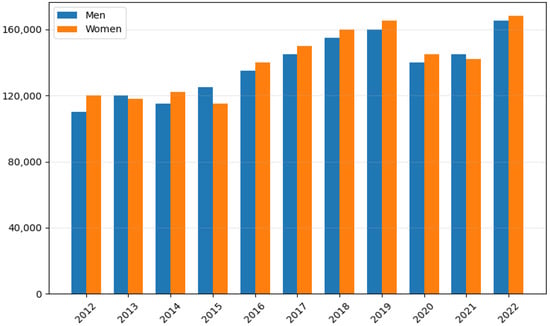
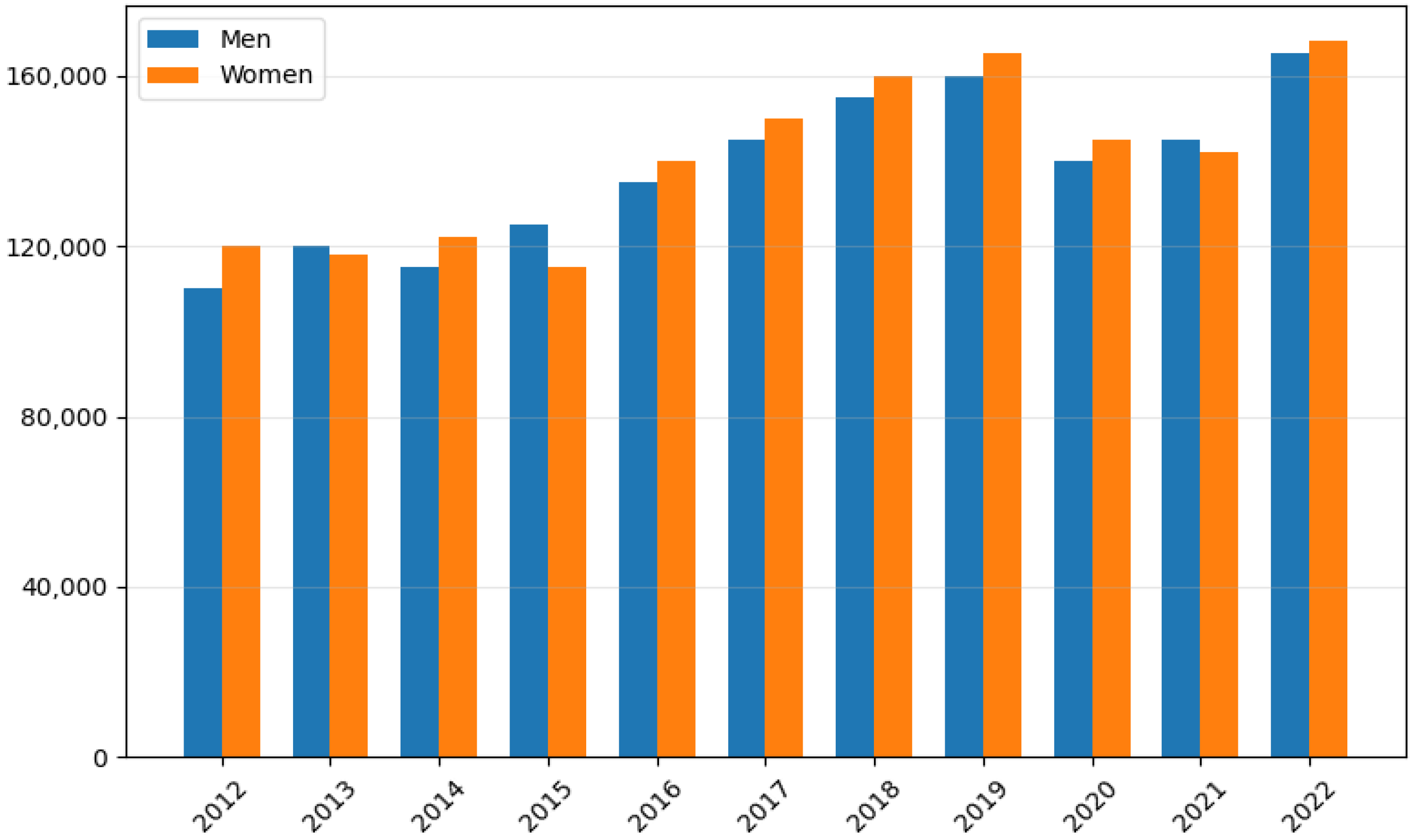
Figure 1 shows the evolution of tourism employment by gender between 2012 and 2022. Total employment increased substantially over the period, rising from approximately 230 thousand workers in 2012 to around 330 thousand in 2022. Women consistently represented a slight majority of the tourism workforce, accounting for around 52–53% of total employment.
Figure 1.
Tourism Employment by Gender [2012–2022, in thousands].
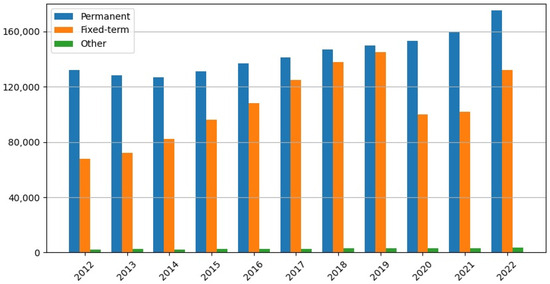
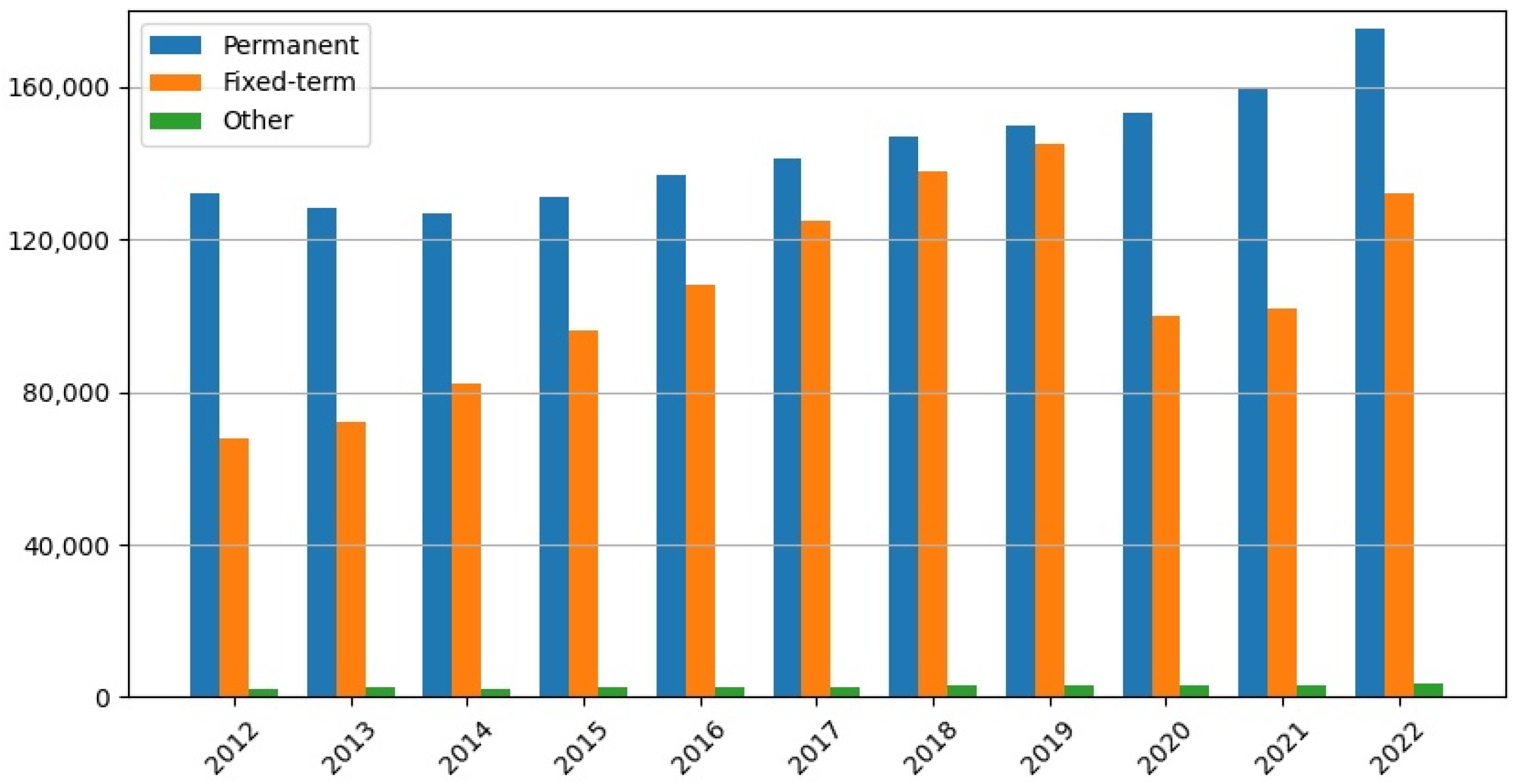
However, this strong employment growth was not accompanied by a corresponding improvement in employment stability. As illustrated in Figure 2, permanent contracts accounted for only slightly more than half of total employment, fluctuating between approximately 52% and 57% prior to the pandemic. Employment expansion was therefore largely absorbed through fixed-term and temporary contracts.
Figure 2.
Permanent vs. Fixed-Term Contracts in Tourism [2012–2022, in thousands].
From a social sustainability perspective, this divergence is critical. Persistent contractual instability limits income predictability, employment continuity, and access to social protection, constraining the contribution of employment growth to overall SSIT performance. Rather than representing a transitional phenomenon, employment insecurity appears structurally embedded in the organisation of tourism labour markets, consistent with existing empirical evidence [15]. The SSIT captures this structural constraint by preventing employment growth from being interpreted as an unambiguous improvement in social sustainability.
6.3. Remuneration and Income Adequacy
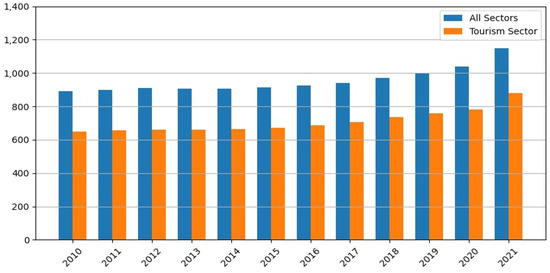
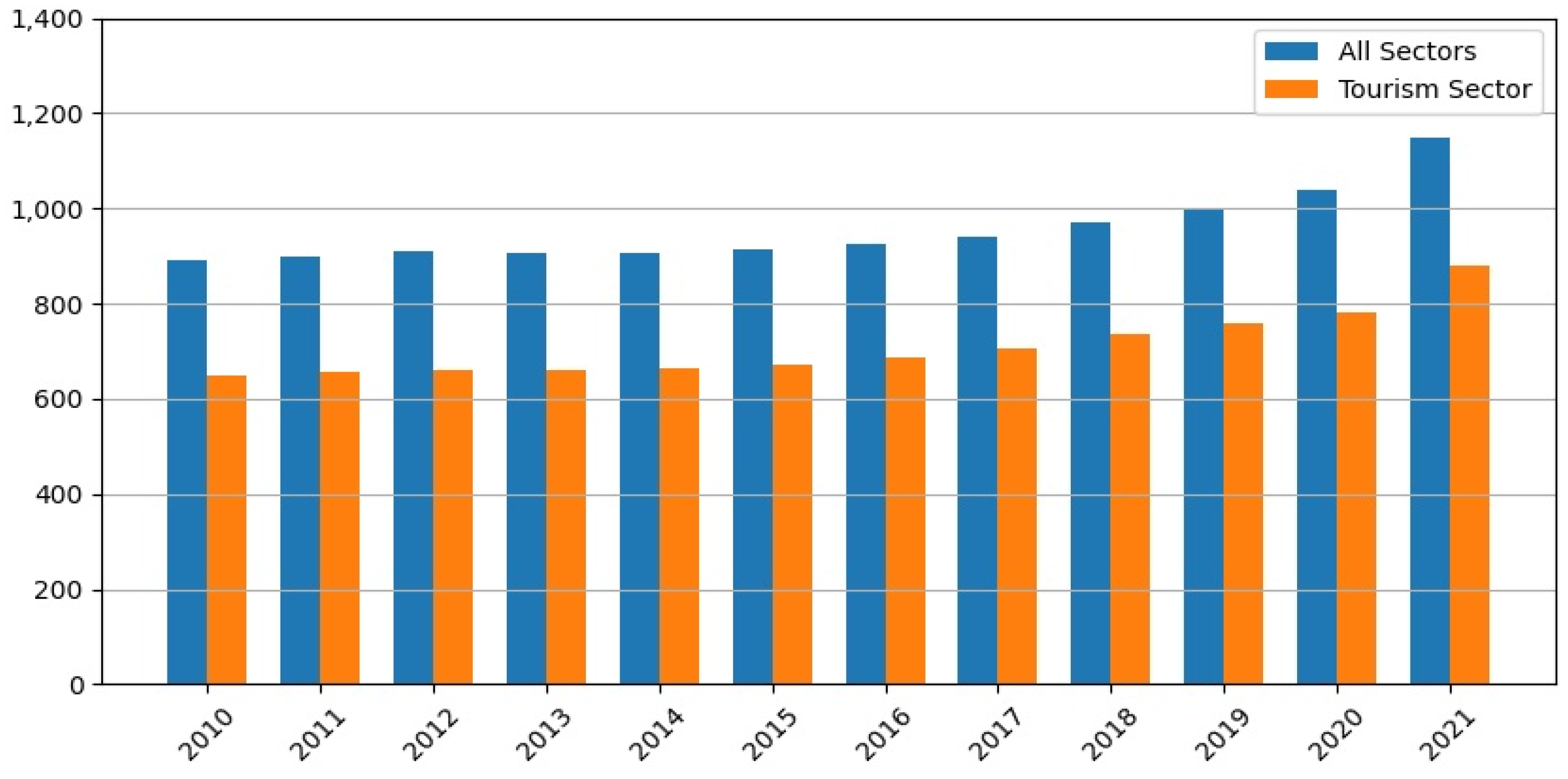
Figure 3 compares average monthly base wages in the tourism sector with the national average across all sectors.
Figure 3.
Average Monthly Base Salary in Tourism vs. All Sectors [€] [2010–2021].
Throughout the period analysed, tourism wages remained consistently below the national benchmark, with a structural gap of approximately 25–30%.
Although nominal wages increased over time, no meaningful convergence with economy-wide wage levels is observed. As a result, remuneration and income adequacy constitute one of the weakest dimensions of the SSIT. Persistently low wages reduce workers’ economic security and their capacity to absorb external shocks, even within formal employment relationships. This pattern is consistent with broader evidence indicating that labour-intensive service sectors face structural constraints on wage upgrading, even during periods of sustained growth [9,14,39].
Within the composite index, low remuneration exerts a systematic downward pressure on overall SSIT performance. This finding reinforces the argument that employment quantity alone provides an incomplete and potentially misleading picture of tourism’s social contribution, particularly when employment expansion is achieved through low-paid jobs [17,40].
6.4. Gender Equality in Tourism Employment
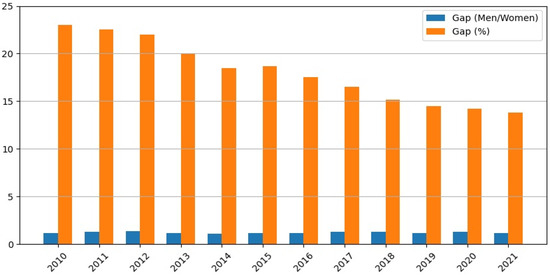
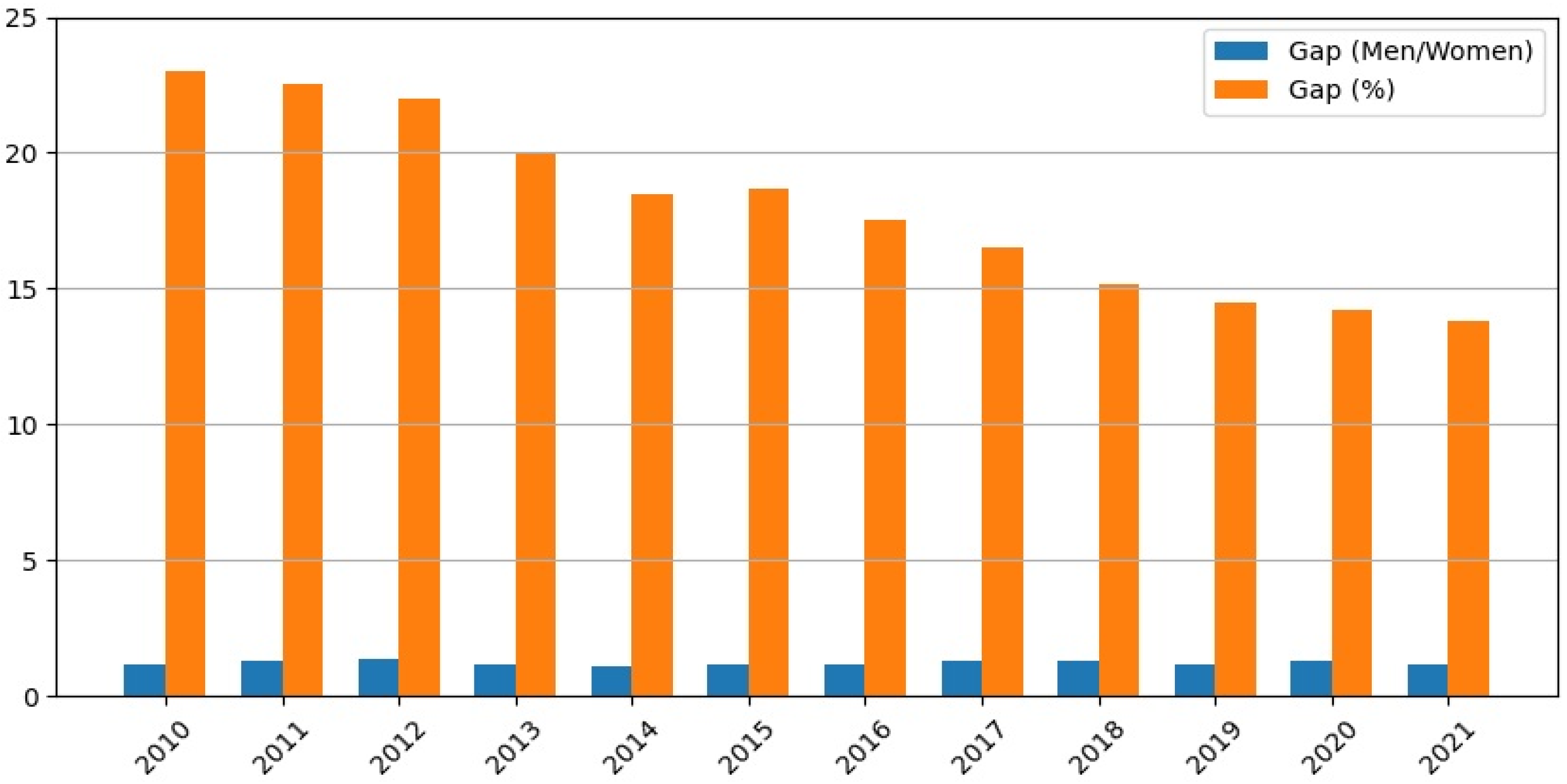
Figure 4 presents the evolution of the gender pay gap in the tourism sector between 2010 and 2021.
Figure 4.
Gender Pay Gap in Tourism Sector [Average Base Salary, 2010–2021].
The results indicate a gradual narrowing of the gender pay gap, declining from above 20% at the beginning of the period to just under 14% by 2021. This trend contributes positively to the gender equality dimension of the SSIT and reflects incremental progress toward wage parity. Nevertheless, substantive gender inequality persists. Despite women’s majority participation in tourism employment, wage differentials and unequal access to stable contracts remain embedded in the sector. This disjunction between participation and substantive equality corroborates extensive literature documenting the feminisation of tourism labour alongside enduring structural inequalities [27,30,41].
By relying on outcome-based indicators rather than participation rates alone, the SSIT captures both improvement and persistence, avoiding an overly optimistic interpretation of gender equality progress within tourism employment.
6.5. Working Conditions, Social Protection, and Labour Institutions
Indicators related to working conditions and occupational health and safety display moderate but uneven performance. While formal employment provides a baseline level of protection, tourism work continues to be characterised by irregular working hours, physical demands, and uneven exposure to occupational risk [42]. These conditions constrain the contribution of this dimension to overall social sustainability performance.
The weakest performance is observed in the dimension related to social protection and labour institutions. High labour turnover, firm fragmentation, and the predominance of small and micro enterprises limit collective bargaining coverage and institutionalised worker representation. Weak labour institutions reduce workers’ bargaining power and restrict the scope for collective upgrading of wages, stability, and working conditions, reinforcing low-quality employment equilibria within the sector [17,24].
This finding supports arguments that social sustainability deficits in tourism are rooted not only in firm-level practices, but also in broader labour governance arrangements and institutional contexts [43,44].
6.6. COVID-19 as a Stress Test of Tourism Social Sustainability
The COVID-19 pandemic constitutes a critical stress test for the SSIT framework. In 2020, tourism employment declined sharply, particularly among workers in fixed-term and unstable contracts. The SSIT registers a corresponding decline, reflecting heightened employment insecurity and income vulnerability.
Although employment levels recovered relatively quickly in 2021–2022, SSIT values recovered only partially and did not exceed pre-pandemic levels. This asymmetric recovery indicates that the pandemic did not fundamentally alter the structure of tourism employment, but rather exposed and amplified pre-existing vulnerabilities related to contractual insecurity, low wages, and weak institutional protection. Similar dynamics have been observed across international tourism labour markets [45,46].
Taken together, the results reveal a pattern of social sustainability characterised by structural inertia rather than sustained upgrading. By explicitly linking the composite SSIT to its underlying dimensions, the analysis demonstrates that tourism employment growth alone is insufficient to deliver socially sustainable outcomes. Decent work must therefore be treated as an explicit and measurable criterion in tourism sustainability assessment, rather than as an assumed by-product of sectoral expansion.
7. Discussion
This section discusses the results in light of ongoing theoretical and empirical debates on social sustainability and decent work in tourism. By operationalising social sustainability through employment outcomes, the analysis responds to long-standing critiques regarding the conceptual vagueness and empirical underdevelopment of the social pillar in tourism sustainability frameworks [26,29]. Rather than treating labour as a secondary or derivative outcome of tourism growth, the findings position employment quality as a core and analytically indispensable dimension of social sustainability.
The discussion is organised around four interrelated themes: (i) the role of decent work as an empirical lens for reassessing tourism’s social sustainability, (ii) the structural decoupling between employment growth and employment upgrading, (iii) the reproduction of inequality and vulnerability within tourism labour markets, and (iv) the implications of these patterns for theory and policy.
7.1. Decent Work as an Empirical Lens for Tourism Social Sustainability
The results reinforce earlier critiques arguing that tourism social sustainability has been dominated by community-level indicators and aggregate economic proxies, often neglecting labour conditions within the production process itself [30,31]. By operationalising social sustainability through decent work outcomes, this study responds directly to calls to recentre labour within sustainability assessment frameworks [26,29].
The SSIT demonstrates empirically that employment quality constitutes a distinct dimension of social sustainability, rather than a residual outcome of tourism growth. Although tourism employment expanded significantly in Portugal over the study period, the persistence of employment insecurity, low wages, and weak institutional protection reveals a structural disjunction between growth and social sustainability. This finding supports earlier arguments that tourism’s social impacts must be assessed within labour relations and employment structures, rather than inferred from aggregate output, income, or community indicators [32,33].
7.2. Employment Growth Without Employment Upgrading
A central contribution of this study lies in demonstrating that sustained employment growth in tourism has not translated into corresponding improvements in employment quality. This finding aligns with comparative and sectoral studies showing that tourism development is frequently associated with low-quality employment equilibria characterised by flexibility, seasonality, and cost containment [34,35].
The persistence of temporary contracts and limited employment continuity observed in the Portuguese case mirrors evidence from other European and international contexts, where tourism growth has relied heavily on precarious labour arrangements [36,37]. Rather than representing a transitional phase, employment insecurity appears embedded in the tourism production model, reinforcing claims that precariousness constitutes a structural feature of tourism labour markets [38].
These results challenge optimistic interpretations of tourism’s contribution to SDG 8 that focus primarily on employment volume [39]. They demonstrate that job creation alone cannot be equated with progress towards decent work and that employment growth may coexist with stagnant or deteriorating employment quality.
7.3. Persistent Low Wages and In-Work Vulnerability
Remuneration and income adequacy emerge as one of the weakest dimensions of social sustainability. Despite nominal wage growth, tourism wages remain consistently below national averages, confirming long-standing concerns regarding low pay and in-work poverty in tourism and hospitality [40,41].
This pattern is consistent with evidence from multiple tourism contexts indicating that wage compression and limited career progression are structural constraints within labour-intensive service sectors [24,42]. The findings reinforce arguments that tourism competitiveness is frequently built on labour cost minimisation, limiting the scope for wage upgrading even during periods of sectoral expansion [44].
From a social sustainability perspective, persistent low wages undermine workers’ economic security and reduce resilience to external shocks, as clearly exposed during the COVID-19 crisis. This supports earlier work linking wage adequacy directly to vulnerability and social risk in tourism employment [45].
7.4. Gender Equality: Participation Without Substantive Transformation
The SSIT results reveal a clear disjunction between female participation and substantive gender equality. While women represent a substantial share of tourism employment, gender wage gaps and unequal access to stable contracts persist throughout the period analysed. This finding corroborates extensive literature documenting the feminisation of tourism labour alongside enduring structural inequalities [46].
Prior research shows that women in tourism are disproportionately concentrated in low-paid, part-time, and unstable positions, with limited opportunities for advancement [28,41]. The present study extends this literature by demonstrating that these patterns persist even within formal employment and over extended time horizons. These results highlight the limitations of participation-based indicators and underscore the importance of outcome-oriented measures when assessing equality and social sustainability in tourism labour markets [9,16].
7.5. Working Conditions, Occupational Risk, and Partial Decent Work Gains
Indicators related to working conditions and occupational health and safety show modest improvements but remain constrained. This mixed performance reflects findings documenting incremental regulatory compliance alongside persistent exposure to physical strain, irregular working hours, and high work intensity in tourism and hospitality [24,25,28]. While some progress is observable, particularly within formal employment, the uneven nature of improvements suggests that decent work gains remain partial and fragile rather than systemic. This reinforces arguments that improvements in tourism working conditions tend to be unevenly distributed and insufficient to alter underlying employment structures [38,39,40].
7.6. Weak Labour Institutions and Structural Reproduction of Low-Quality Employment
One of the most significant findings concerns the consistently weak performance of the social protection and labour institutions dimension. Limited collective bargaining coverage and weak worker representation mirror patterns identified in previous studies linking fragmented firm structures and high labour turnover to institutional fragility in tourism [44,45]. The absence of strong labour institutions constrains workers’ capacity to negotiate improvements in wages, stability, and working conditions, reinforcing a self-reinforcing cycle of low-quality employment. This finding aligns with broader critiques of sustainability governance that argue labour conditions are marginalised not only analytically, but institutionally [18,19].
7.7. COVID-19 as a Stress Test of Tourism’s Employment Model
The COVID-19 shock did not fundamentally alter the structure of tourism employment, but rather exposed and intensified existing vulnerabilities. Workers in temporary, low-paid, and weakly protected positions experienced the most severe impacts, confirming earlier assessments of the pandemic as a stress test for tourism labour markets [1,2]. The asymmetric recovery observed—rapid employment rebound without corresponding improvement in employment quality—reinforces the interpretation of employment insecurity and weak social protection as structural weaknesses rather than cyclical anomalies. This supports calls for sustainability frameworks that explicitly incorporate vulnerability and resilience, rather than relying on growth-oriented indicators alone [15,16].
7.8. Implications for Social Sustainability Theory and Tourism Policy
Taken together, the findings provide strong empirical support for recent theoretical arguments that decent work should be treated as a foundational condition for social sustainability in tourism [26,29]. By demonstrating that employment growth and employment quality can diverge systematically, the study challenges dominant tourism development narratives and underscores the need for labour-centred sustainability governance.
From a policy perspective, the results suggest that improving tourism’s social sustainability requires deliberate institutional intervention aimed at wage upgrading, employment stability, and strengthened labour representation. Without such measures, tourism expansion risks reproducing structurally unsustainable employment outcomes, regardless of its contribution to aggregate employment figures.
8. Conclusions
This study set out to assess whether sustained employment growth in the Portuguese tourism sector has been accompanied by measurable improvements in employment quality, as conceptualised through the notion of decent work, and to examine what this relationship implies for the social sustainability of tourism development. By operationalising decent work as a core, though partial, dimension of social sustainability, the analysis responds to long-standing concerns regarding the conceptual ambiguity and empirical underdevelopment of the social pillar in tourism sustainability research.
Drawing on longitudinal administrative labour data covering the period of 2010–2022, the results demonstrate a persistent decoupling between employment growth and employment quality in the tourism sector. While tourism employment expanded substantially over the study period, this growth was not matched by commensurate improvements in key dimensions of decent work. Employment insecurity, low wage adequacy, and enduring gender inequalities remained structural features of tourism employment, even during periods of sustained sectoral expansion. These findings challenge growth-centred narratives that implicitly equate job creation with socially sustainable development and suggest that employment quantity alone provides an insufficient basis for assessing tourism’s social contribution.
The empirical evidence further indicates that observed improvements in certain indicators—such as incremental wage growth or a narrowing gender pay gap—were partial and uneven, and insufficient to generate a sustained upgrading of overall employment quality. The COVID-19 pandemic functioned as a stress test rather than a turning point, exposing pre-existing vulnerabilities without fundamentally altering the underlying employment model. The post-pandemic recovery of employment levels was not accompanied by a corresponding improvement in decent work outcomes, reinforcing the interpretation of precariousness and weak labour protection as structural rather than cyclical characteristics of tourism labour markets.
The main contribution of this study lies in the development of the Social Sustainability Index in Tourism (SSIT) as a replicable, employment-based composite indicator that enables systematic monitoring of social sustainability in tourism. By translating the normative principles of the ILO Decent Work Agenda into observable employment outcomes, the SSIT recentres labour conditions within sustainability assessment and provides an empirically grounded tool for examining whether tourism development delivers socially sustainable employment. Methodologically, the index addresses a key gap in the literature by integrating multiple dimensions of decent work into a coherent and transparent analytical framework based on longitudinal administrative data.
At the same time, the study acknowledges important limitations. The SSIT captures only formal employment and those dimensions of decent work observable in administrative datasets, excluding informal work, workers’ voice, collective bargaining, and psychosocial aspects of employment quality. As such, it should be interpreted as a conservative and partial measure of employment-based social sustainability. The index is intended as a diagnostic and monitoring tool rather than as a comprehensive evaluation or ranking instrument, and it is best understood as complementary to qualitative, institutional, and participatory research approaches.
From a policy perspective, the findings suggest that improving the social sustainability of tourism requires deliberate institutional intervention aimed at strengthening employment stability, wage adequacy, and labour representation. Without such measures, continued tourism expansion risks reproducing structurally constrained employment outcomes, regardless of its contribution to aggregate employment figures. For future research, the SSIT provides a foundation for comparative cross-country analysis, sectoral disaggregation, and the integration of additional dimensions of decent work as data availability improves. More broadly, the study underscores the need to treat decent work not as an assumed by-product of tourism growth, but as a central and measurable criterion of socially sustainable tourism development.
Funding
This research was funded by National Funds of the FCT—Portuguese Foundation for Science and Technology within the project “UID/04928/2025”.
Institutional Review Board Statement
Not applicable.
Informed Consent Statement
Not applicable.
Data Availability Statement
The data presented in this study (Quadros do Pessoal) are openly available in Ministério do Trabalho, Solidariedade e Segurança Social. https://www.gep.mtsss.gov.pt/documents/10182/10928/serieqp_2013_2023.pdf/6c7ffa73-37de-4723-baf7-281650c28c57; https://www.gep.mtsss.gov.pt/documents/10182/10928/qp2012pub.pdf/c0783f76-e38e-4c5e-8030-a931e2e4c7b8; https://www.gep.mtsss.gov.pt/documents/10182/10928/qp2011pub.pdf/90b72fee-9009-4b3d-aeed-55b28ffc929a; https://www.gep.mtsss.gov.pt/documents/10182/10928/qp2010pub.pdf/c675a6ec-7db6-47b5-9414-811171ec71d6, accessed on 20 December 2025.
Conflicts of Interest
The author declares no conflicts of interest.
Appendix A
This appendix summarises the operational steps used to construct the Social Sustainability Index in Tourism (SSIT) from administrative employment data. The procedure follows a standard composite-indicator approach based on indicator selection, normalisation, aggregation at the dimension level, and construction of a final composite index.
The SSIT is built from a set of observable employment indicators derived from the Portuguese administrative employer–employee dataset Quadros do Pessoal, compiled by the Ministério do Trabalho, Solidariedade e Segurança Social.
Indicators are grouped into three analytical dimensions:
- Employment quantity and stability
- Income and working conditions
- Equality and safety
Each indicator is measured annually at the sector level for the period 2010–2022.
Because indicators are expressed in different units, all variables are rescaled to a common range using min–max normalisation.
For a given indicator xit (value of indicator i in year t):
where min(xi) and max(xi) are the minimum and maximum observed values of indicator i across the entire period.
For indicators where higher raw values represent worse outcomes (e.g., gender pay gap, accident rates), the scale is inverted:
This ensures that higher normalised values always indicate better social sustainability performance.
Normalised indicators are aggregated into dimension-level indices using the simple arithmetic mean:
where is the value of dimension d in year t, and is the number of indicators in dimension d. All indicators receive equal weights within each dimension.
The annual SSIT is obtained by a weighted arithmetic mean of the dimension-level indices:
where are predefined dimension weights assigned to each dimension, and the weights are normalised so that their sum equals one. The resulting index ranges from 0 to 1, with higher values indicating better employment-based social sustainability outcomes. The SSIT is designed as a descriptive and monitoring indicator. Changes over time reflect relative improvements or deteriorations in observed employment conditions within the formal tourism labour market.
References
- Abbas, J.; Mamirkulova, G.; Al-Sulaiti, I.; Al-Sulaiti, K.I.; Dar, I.B. Mega-infrastructure development, tourism sustainability and quality of life assessment at world heritage sites: Catering to COVID-19 challenges. Kybernetes 2025, 54, 1993–2018. [Google Scholar] [CrossRef] [Scilit]
- Ansari, M.A. Tourism and economic growth: Evidence from cross-country data with policy insights. J. Knowl. Econ. 2025, 16, 968–1013. [Google Scholar] [CrossRef] [Scilit]
- Arici, H.E.; Köseoglu, M.A. What are the most influential drivers of tourism destination competitiveness? J. Destin. Mark. Manag. 2025, 36, 100990. [Google Scholar] [CrossRef] [Scilit]
- Bhatt, K.; Seabra, C.; Kumar, J.; Ashutosh, K.; Kumar Kabia, S. Tourism-led inclusive growth in emerging and developing economies: A systematic literature review. SAGE Open 2024, 14, 21582440241252516. [Google Scholar] [CrossRef] [Scilit]
- Guo, Y.; Tian, R.G.; Vasiljeva, M. Impact of pro-poor ethnic tourism on achieving sustainable development goals. J. Hosp. Tour. Manag. 2024, 61, 270–280. [Google Scholar] [CrossRef] [Scilit]
- Mehdi, H.; Ali, A.; Audi, M. Tourism, sustainability and growth: An empirical investigation of long-run economic impacts in Pakistan. Contemp. J. Soc. Sci. Rev. 2025, 3, 1479–1493. [Google Scholar]
- Nguyen, P.C.; Schinckus, C.; Chong, F.H.L.; Nguyen, B.Q.; Tran, D.L.T. Tourism and contribution to employment: Global evidence. J. Econ. Dev. 2025, 27, 22–37. [Google Scholar] [CrossRef] [Scilit]
- Santos, E. Promoting firms’ sustainability in tourism planning through employment. In Advances in Tourism, Technology and Smart Systems; Springer: Berlin/Heidelberg, Germany, 2019; pp. 345–355. [Google Scholar]
- Santos, E. From neglect to progress: Assessing social sustainability and decent work in the tourism sector. Sustainability 2022, 15, 10329. [Google Scholar] [CrossRef] [Scilit]
- Santos, E. Sustainable tourism dynamics: Understanding the impact of tourist stays on regional revenue and development. Sustainability 2024, 16, 8403. [Google Scholar] [CrossRef] [Scilit]
- Santos, E.; Lisboa, I.; Crespo, C.; Moreira, J.; Eugénio, T. Evaluating economic sustainability of nautical tourism through brand equity and corporate performance. In Transcending Borders in Tourism Through Innovation and Cultural Heritage; Springer: Berlin/Heidelberg, Germany, 2022; pp. 105–118. [Google Scholar]
- Subramony, M.; Rosenbaum, M.S. SDG commentary: Economic services for work and growth for all humans. J. Serv. Mark. 2024, 38, 190–216. [Google Scholar] [CrossRef] [Scilit]
- Vazquez Vicente, G.; Martín Barroso, V.; Blanco Jimenez, F.J. Sustainable tourism, economic growth and employment: The case of the wine routes of Spain. Sustainability 2021, 13, 7164. [Google Scholar] [CrossRef] [Scilit]
- Zavaleta Chavez Arroyo, F.O.; Sánchez Pantaleón, A.J.; Aldea Roman, C.E.; Esparza-Huamanchumo, R.M.; Álvarez-García, J. A structural analysis of the economic impact of tourism and the perspective of tourism providers in Kuélap, Peru. Land 2024, 13, 120. [Google Scholar] [CrossRef] [Scilit]
- Rasoolimanesh, S.M.; Ramakrishna, S.; Hall, C.M.; Esfandiar, K.; Seyfi, S. A systematic scoping review of sustainable tourism indicators in relation to the sustainable development goals. J. Sustain. Tour. 2022, 31, 1497–1517. [Google Scholar] [CrossRef] [Scilit]
- Mooney, S.; Robinson, R.; Solnet, D.; Baum, T. Rethinking tourism’s definition, scope and future of sustainable work and employment: Locating workforce at the heart of sustainable tourism discourse. J. Sustain. Tour. 2022, 30, 2707–2725. [Google Scholar] [CrossRef] [Scilit]
- Ioannides, D.; Gyimóthy, S.; James, L. From liminal labor to decent work: A human-centered perspective on sustainable tourism employment. Sustainability 2021, 13, 851. [Google Scholar] [CrossRef] [Scilit]
- International Labour Organization. Decent Work; International Labour Organization: Geneva, Switzerland, 1999; Available online: https://webapps.ilo.org/public/english/standards/relm/ilc/ilc87/rep-i.htm?referrer=grok.com (accessed on 15 December 2025).
- International Labour Organization. Decent Work Indicators: Guidelines for Producers and Users of Statistical and Legal Framework Indicators; International Labour Organization: Geneva, Switzerland, 2013; Available online: https://www.ilo.org/sites/default/files/wcmsp5/groups/public/---dgreports/---integration/documents/publication/wcms_229374.pdf (accessed on 15 December 2025).
- Ministério do Trabalho; Solidariedade e Segurança Social. Series Cronológicas. Quadros do Pessoal 2013 – 2023; Ministério do Trabalho, Solidariedade e Segurança Social: Lisbon, Portugal, 2022. Available online: https://www.gep.mtsss.gov.pt/documents/10182/10928/serieqp_2013_2023.pdf/6c7ffa73-37de-4723-baf7-281650c28c57 (accessed on 15 December 2025).
- Ministério do Trabalho; Solidariedade e Segurança Social. Series Cronológicas. Quadros do Pessoal 2012; Ministério do Trabalho, Solidariedade e Segurança Social: Lisbon, Portugal, 2022. Available online: https://www.gep.mtsss.gov.pt/documents/10182/10928/qp2012pub.pdf/c0783f76-e38e-4c5e-8030-a931e2e4c7b8 (accessed on 15 December 2025).
- Ministério do Trabalho; Solidariedade e Segurança Social. Series Cronológicas. Quadros do Pessoal 2011; Ministério do Trabalho, Solidariedade e Segurança Social: Lisbon, Portugal, 2022. Available online: https://www.gep.mtsss.gov.pt/documents/10182/10928/qp2011pub.pdf/90b72fee-9009-4b3d-aeed-55b28ffc929a (accessed on 15 December 2025).
- Ministério do Trabalho; Solidariedade e Segurança Social. Series Cronológicas. Quadros do Pessoal 2010; Ministério do Trabalho, Solidariedade e Segurança Social: Lisbon, Portugal, 2022. Available online: https://www.gep.mtsss.gov.pt/documents/10182/10928/qp2010pub.pdf/c675a6ec-7db6-47b5-9414-811171ec71d6 (accessed on 15 December 2025).
- Wang, D.; Cheung, C. Decent work in tourism and hospitality: A systematic literature review, classification, and research recommendations. Int. J. Contemp. Hosp. Manag. 2024, 36, 2194–2213. [Google Scholar] [CrossRef] [Scilit]
- Giousmpasoglou, C. Working conditions in the hospitality industry: The case for a fair and decent work agenda. Sustainability 2024, 16, 8428. [Google Scholar] [CrossRef] [Scilit]
- McGinley, S.; Dogru, T.; Sharma, A. The effect of job abundance on tourism employee turnover. Int. J. Hosp. Manag. 2024, 119, 103718. [Google Scholar] [CrossRef] [Scilit]
- Elbelehy, C.; Crispim, J. Social sustainability in the hospitality and tourism supply chains: What can we learn from existing research and what remains unexplored? J. Hosp. Tour. Insights 2025, 8, 1688–1716. [Google Scholar] [CrossRef] [Scilit]
- Faria, L.; Gouveia, C.; Florêncio, L. Decent work research in tourism industry: A bibliometric mapping. Asia-Pac. J. Innov. Hosp. Tour. 2024, 13, 67–89. [Google Scholar]
- Efthymiadou, F.; Farmaki, A. Women empowerment in tourism: Progressing the research agenda. Tour. Rev. 2022, 79, 953–968. [Google Scholar] [CrossRef] [Scilit]
- Bansal, A.; Mukherjee, S.; Prayag, G. From crisis to care: Redesigning work and jobs for employee well-being in hospitality and tourism. Tour. Hosp. Res. 2025. Epub ahead of printing. [Google Scholar] [CrossRef] [Scilit]
- Melián-González, S.; Bulchand Gidumal, J. Is tourism development associated with employment of low quality? Tour. Rev. 2025, 80, 1321–1334. [Google Scholar]
- Zientara, P.; Adamska, J.; Bąk, M. Social Sustainability and the Employee: Labor, Employment Relations, and the Hospitality Industry; Taylor & Francis: New York, NY, USA, 2025. [Google Scholar]
- Streimikiene, D.; Svagzdiene, B.; Jasinskas, E.; Simanavicius, A. Sustainable tourism development and competitiveness: A systematic literature review. Sustain. Dev. 2021, 29, 259–271. [Google Scholar] [CrossRef] [Scilit]
- Kronenberg, K.; Fuchs, M. The socio-economic impact of regional tourism: An occupation-based modelling perspective from Sweden. J. Sustain. Tour. 2022, 30, 2785–2805. [Google Scholar] [CrossRef] [Scilit]
- Okrožnik, D.; Kopić, P.; Vodeb, K. Social sustainability discourse in cohesion policy: A critical review of Interreg Europe 2021–2027. Dev. Policy Rev. 2024, 42, e12801. [Google Scholar] [CrossRef] [Scilit]
- Eurostat. NACE Rev. 2.1—Statistical Classification of Economic Activities in the European Community: Manual and Guidelines; European Commission: Ispra, Italy, 2025; Available online: https://ec.europa.eu/eurostat/web/products-manuals-and-guidelines/w/ks-gq-24-007 (accessed on 15 December 2025).
- European Agency for Safety and Health at Work (EU-OSHA). OSH Pulse 2025: Occupational Safety and Health in the Era of Climate and Digital Change; Publications Office of the European Union: Luxembourg, 2025; Available online: https://osha.europa.eu/en/publications/osh-pulse-2025-occupational-safety-and-health-era-climate-and-digital-change (accessed on 15 December 2025).
- Baum, T.; Lockstone-Binney, L.; Nimri, R. Decent or dirty work? Revealing the complexities of employment in wellness tourism. Tour. Recreat. Res. 2025, 1–13. [Google Scholar] [CrossRef] [Scilit]
- Baker, M.A. Sustainable tourism employment: A comprehensive overview of tourism employees’ experience. J. Hosp. Tour. Manag. 2024, 60, 228–238. [Google Scholar] [CrossRef] [Scilit]
- Rydzik, A.; Kissoon, C.S. Decent work and tourism workers in the age of intelligent automation. In A Sustainable Tourism Workforce; Routledge: London, UK, 2024; pp. 244–261. [Google Scholar]
- Salman, D.; Bakas, F.E. Gender, tourism, and the gig economy. In The Elgar Companion to Tourism and the Sustainable Development Goals; Edward Elgar: Cheltenham, UK, 2024; pp. 123–140. [Google Scholar]
- Mihalic, T. Trends in sustainable tourism paradigm: Resilience and adaptation. Sustainability 2024, 16, 7838. [Google Scholar] [CrossRef] [Scilit]
- Winchenbach, A.; Hanna, P.; Miller, G. Rethinking decent work: The value of dignity in tourism employment. J. Sustain. Tour. 2019, 27, 1026–1043. [Google Scholar] [CrossRef] [Scilit]
- Bianchi, R.V.; de Man, F. Tourism, inclusive growth and decent work: A political economy critique. J. Sustain. Tour. 2021, 29, 353–371. [Google Scholar] [CrossRef] [Scilit]
- Sun, Y.Y.; Li, M.; Lenzen, M.; Malik, A.; Pomponi, F. Tourism, job vulnerability and income inequality during the COVID-19 pandemic: A global perspective. Ann. Tour. Res. Empir. Insights 2022, 3, 100046. [Google Scholar] [CrossRef] [Scilit]
- International Labour Organization. Decent Work in Portugal 2008–18: From Crisis to Recovery; International Labour Organization: Geneva, Switzerland, 2018; Available online: https://www.ilo.org/publications/decent-work-portugal-2008-18-crisis-recovery (accessed on 15 December 2025).

Disclaimer/Publisher’s Note: The statements, opinions and data contained in all publications are solely those of the individual author(s) and contributor(s) and not of MDPI and/or the editor(s). MDPI and/or the editor(s) disclaim responsibility for any injury to people or property resulting from any ideas, methods, instructions or products referred to in the content. |
© 2026 by the author. Licensee MDPI, Basel, Switzerland. This article is an open access article distributed under the terms and conditions of the Creative Commons Attribution (CC BY) license.