


Abstract
Between 2014 and 2023, Italian Manila clam (Ruditapes philippinarum) production declined by 36% due to climate change and predation by the invasive blue crab (Callinectes sapidus), which preys particularly on small clams. Traditionally, Manila clam farming starts with seed collection from natural recruitment or hatcheries, followed by pre-fattening in raceways and/or FLUPSY (Floating Upweller Systems) to size T3 (>3 mm). The fattening phase in lagoons up to the commercial size (>25 mm) follows. Rearing juveniles in controlled conditions may ensure stable supplies of high-quality seed, reduced mortality, and increase overall yields. Furthermore, a larger pre-seeding size (e.g., T10, >10 mm) is supposed to improve resistance to predators and environmental stress. This study uses an ex-ante Life Cycle Assessment (LCA) to evaluate the potential environmental impacts of a novel and unique “sand-nursery” method under development at an Italian company. The nutrient removal potential of juvenile clams was also assessed as an ecosystem service. At full capacity, the optimised system could produce 120 t of liveweight juveniles and remove 338 kg of nitrogen and 32 kg of phosphorus. Although it has inherent limitations, the ex-ante LCA results show that electricity consumption is the main contributor to environmental impacts, with a global warming potential of 1.11 kg CO2 eq/kg T10 clam. Further research is needed to assess impacts across the full production cycle.
1. Introduction
Manila clam (Ruditapes philippinarum, Adam and Reeve 1850) is a bivalve species of considerable commercial interest. In 2022, the global aquaculture production of clams was about 4 million t (24% of global molluscs production) [1]. China leads Manila clam production, with more than 2 million t per year [2], followed by Italy, the top producer of Manila clam in the European Union (EU). In 2023, Italian Manila clam production was about 21,500 t, worth about €198 million [3]. The main Italian area for mollusc aquaculture is the North Adriatic Sea, near the Po River Delta. However, Italian Manila clam production has decreased by 36% over the past decade [3], and the most recent data indicate that production in 2024 has fallen to just over 6000 t [4]. The overexploitation due to the initial mismanagement of natural resources on the one hand [5] and increased sea temperatures [6] and the deterioration of the natural environment due to anthropogenic factors on the other [7] have been implicated in the decrease in Manila clam natural recruitment, mortality of adult specimens and overall production decline. More recently, another factor has begun to impact Italian clam production: the intense predation by the blue crab Callinectes sapidus (Rathbun 1896). Since 2023, records of this highly invasive species have been increasing all along the Italian coast, especially in the areas dedicated to Manila clam aquaculture (North Adriatic Sea) [8]. In the same year, about 1000 t of blue crab were harvested and sold or disposed of in the Veneto region, and this blue crab invasion has been reported by farmers as the main reason for losses of juvenile and adult Manila clam lately [8].
Manila clam farming, conducted using extensive low-impact techniques, can contribute to the sustainable management of resources and the preservation of local ecosystems. As all bivalves, they can prevent seabed erosion, increase biodiversity and improve water clarity by filtering and removing nutrient excess, stimulating nutrient cycling and denitrification [9]. As previously described [10], traditional Manila clam aquaculture involves (1) seed sourcing, (2) a pre-fattening phase, and (3) a fattening phase in a lagoon. Seed can be collected from the wild in natural nursery areas or bought from specialised hatcheries. Over the past few decades, as natural recruitment has decreased due to the multiple interrelated reasons outlined above, farmers have increasingly relied on seed from hatcheries. Despite being the main producer of Manila clams in the EU (about 94% of EU production [3]), Italy has only one Manila clam hatchery. As previously mentioned [11], establishing a network of clam hatcheries across the Italian territory would substantially benefit the sector, ensuring a stable supply of high-quality seed at a time of declining natural availability while helping to revitalise the sector by reducing its dependence on foreign seed supply. At present, the most common strategy for farmers is to purchase pre-fattened seed (T3 size, >3 mm) from foreign hatcheries and then stock it in the lagoon. The pre-fattening phase involves growth from size T0.5 (<1 mm) to T3 in raceways and suspended systems called FLUPSY (Floating Upweller System). Finally, the fattening phase allows for T3 specimens to reach commercial size (>25 mm) in the on-bottom sediment in the lagoon. However, seeding clams at a small size could not be productive, since they can be more vulnerable than larger individuals to predation and environmental stress (salinity and temperature fluctuations, temporary anoxic conditions) [8,12,13,14]. To address this issue, a company involved in Manila clam farming in the Veneto region (North-Eastern Italy) is developing a system that enables clams to undergo an additional pre-fattening phase, which would allow them to reach the T10 size (>10 mm) under protected, semi-natural conditions. Besides the possibility of increasing survival to predation and environmental stress, this strategy would allow for the provision of stable, large quantities of high-quality juvenile clams ready to be seeded for the fattening phase. These so-called “sand-nursery” systems consist of excavated ponds with sandy bottoms located adjacent to the lagoon. Water from the lagoon enters the sand-nurseries via a system of pumps and propellers, creating a continuous flow. The sand-nursery system is similar to Chinese “eco-hatcheries,” which supply about 80% of the seed used by Chinese Manila clam farmers [2]. However, in contrast to those systems, sand-nurseries are not fertilised. The water is naturally rich in phytoplankton and can sustain clam growth in the pond before returning to the lagoon. Once juveniles reach T10, they are sold to farmers, who then seed them in the lagoon open environment.
Hatchery-produced Manila clam seed has been shown to generate increased environmental impacts compared to wild-collected seed [10,11]. At the same time, mollusc farming has been claimed to provide several ecosystem services, such as water filtration, nutrient removal and cycling [9,15,16,17,18,19,20,21]. Given the growing emphasis on environmental sustainability, concerns about impacts from aquaculture, and European Union initiatives to reduce greenhouse gases and other anthropogenic emissions in the agrifood sector (e.g., European Green Deal [22], Farm to Fork strategy [23]), it is crucial to quantify the potential environmental impacts of alternative farming strategies. The scarcity of natural seed has made hatchery production essential, underscoring the need for a national network of hatcheries and pre-fattening facilities to reduce imports and support the clam farming sector, which is currently facing an unprecedented crisis driven by the impacts of climate change (e.g., increasing water temperature, spread of allochthonous species). Evaluating options that could boost production volume is pivotal for supporting this remunerative and socially significant sector while aligning with environmental policy goals.
The present study aims to perform an ex-ante Life Cycle Assessment (LCA) of the sand-nursery clam farming system to (1) estimate its environmental impacts using preliminary data from the company’s first pilot trial; (2) identify the main “hotspots” in production where environmental burden is highest; and (3) evaluate the ecosystem service potential associated with the system, particularly the removal of nitrogen and phosphorus from the waterbody. This work pursues an assessment of the burdens and benefits of this semi-natural farming strategy, which could support future decision-making for more environmentally and economically sustainable production.
2. Materials and Methods
2.1. Ex-Ante Life Cycle Assessment (LCA)
In this study, an ex-ante LCA approach was used to assess the environmental performance of a not-fully upscaled system for Manila clam pre-fattening up to size T10. Ex-ante LCA provides an early assessment of emerging technologies for which there is only experimental proof or validation in a pilot plant [24]. The LCA was conducted according to [25], following the four main LCA steps: Goal and Scope definition, Life Cycle Inventory (LCI), Life Cycle Impact Assessment (LCIA), and Interpretation.
2.1.1. Studied System and Estimated Sand-Nursery Production
The production chain for Manila clam juveniles managed by the company consists of three distinct phases:
- 1.
- Seed production (hereafter, this stage is referred to as T0.5), carried out in the branch facility in The Netherlands. Each production cycle lasts 2 weeks.
- 2.
- Nursery and pre-fattening phase: T0.5 seed (8.5 million animals/kg) produced in The Netherlands is brought to the Italian pre-fattening facility, where juvenile clams are reared to various sizes, depending on the market demand, in raceway and FLUPSY systems. The main product of the company is Manila clam seed size T3–3.5 (22 000 animals/kg on average), which represents >40% of biomass production. However, it also produces clams ranging from T2.5 to, occasionally, T10. The duration of the pre-fattening depends on the seasonality and, indeed, on the final size of the output. On average, it ranges from 2 months to obtain T2.5 individuals to 5–6 months to obtain T10 juveniles. For the T3–3.5 juveniles, the pre-fattening lasts about 2.5–3 months (hereafter, this stage is referred to as T3). At present, larger sizes of Manila clam seed (e.g., T10) are produced using FLUPSY systems (. However, the number of clams that can be reared to this size under appropriate stocking densities and optimal rearing conditions is inherently limited.
- 3.
- The alternative pre-fattening phase (sand-nursery), not fully commercially upscaled (Technical Readiness Level—TRL: 7, System prototype demonstrated in an operational environment), is conducted in a facility located about 40 km from the pre-fattening facility in Italy. Here, T3 individuals are seeded in the sand-nursery units and let grow up to T10 size (1500 animals/kg) (hereafter, this stage is referred to as T10). Each unit is an earthen basin measuring 700 m2 with a depth of 0.5 m. The pilot trial for the production of T10 Manila clam juveniles was conducted in three sand-nursery units (in spring-summer 2025). In each sand-nursery, 7 million T3 clams (approximately 280 kg) were seeded. Over a period of 7–8 months, each sand-nursery produced 5 million T10 individuals, corresponding to roughly 5000 kg. Based on these results, the estimated survival was approximately 70%. The company plans to operate a total of 24 sand-nursery units in the near future. Considering the outcomes of the initial seeding and growth trial, together with the expected optimisation of the production system, the facility is projected to produce approximately 120 t of T10 clams ready for seeding in lagoon environments. This phase represents the core of the ex-ante LCA.
2.1.2. Goal and Scope Definition
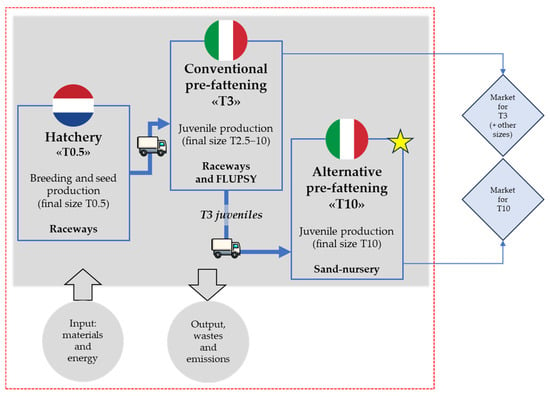
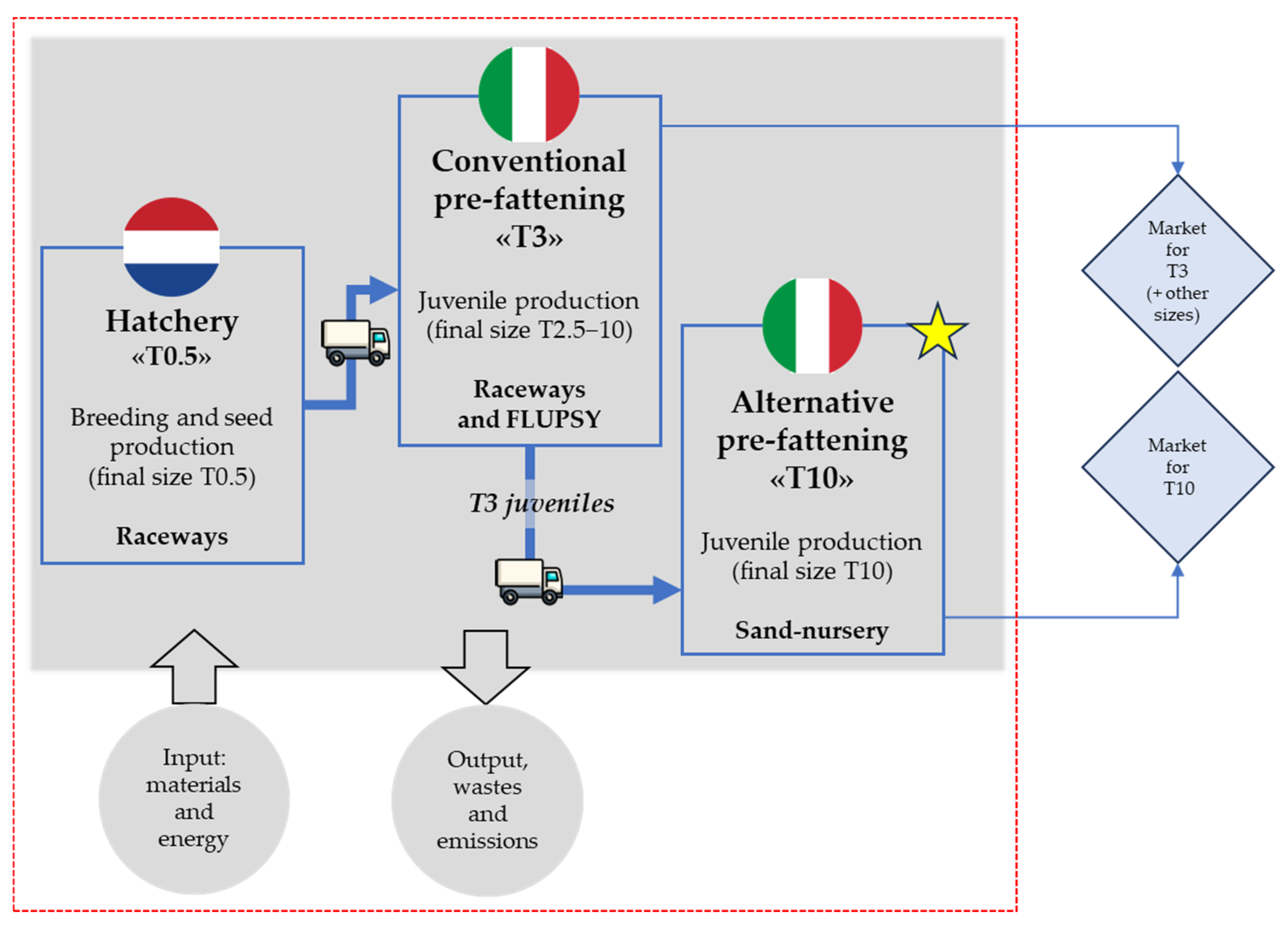
The goal of this study is to document the environmental performance of both the conventional Manila clam juvenile production chain (T3) and alternative strategies aimed at providing the sector with larger juvenile individuals (T10 in sand-nurseries) and to identify potential areas for improvement. The scope of the analysis encompasses the flows of materials and energy throughout the system, covering the hatchery seed production phase (T0.5 phase), the pre-growing phases in raceways and FLUPSY units (T3 phase), and the sand-nursery phase (from size classes T3–T10; T10 phase). A cradle-to-gate approach was adopted, in which system boundaries include all stages from seed production to the completion of the pre-growing phase, i.e., up to the point at which the product is ready for sale to aquaculture operators. The system boundaries considered in this study are illustrated in Figure 1.
Figure 1.
System boundaries (cradle-to-gate) adopted in the study, delineated by the red dashed box. The grey area encompasses the three production phases. The alternative pre-fattening phase in sand-nurseries is highlighted by the yellow star and represents the core of the ex-ante LCA. Circles represent the inputs and outputs of materials, energy, waste, and emissions. The transport of seed and juveniles within the production chain is represented by the truck icon. Distribution and marketing phases, which were excluded from the analysis, are shown as diamonds positioned outside the system boundaries. Source: drafted by authors.
The functional unit (FU) selected for this study, i.e., the reference unit to which all LCA results are normalised, is 1 kg of live juvenile Manila clams ready for sale. To allow for further comparisons, results are also reported using the following FUs: 1000 animals T10 and 1000 animals T3 (Supplementary Materials). Since the production segment corresponding to the first conventional fattening phase yields multiple final products (juveniles ranging from size classes T2.5 to T10), it was necessary to adopt an allocation criterion. Allocation is used to distribute environmental impacts among co-products that share common production processes. In this case, the mass allocation principle was chosen. It distributes environmental burdens proportionally to the mass of each co-product. Table 1 reports the allocation factors applied.
Table 1.
Mass allocation factors applied to products of the first pre-fattening phase.
2.1.3. Life Cycle Inventory (LCI)
The LCI has been compiled based on data collected through semi-structured interviews and visits to the farming facilities (foreground data). For the hatchery (T0.5) and first pre-fattening phases (T3), foreground data were collected for a reference representative year (2024). For the sand-nursery pre-fattening phase (T10), foreground data refer to the operational period in which the first trial was carried out (2025). The LCI was further validated with the technical personnel of the company. Background data were retrieved from the Ecoinvent 3.11 database (https://www.ecoinvent.org), the literature, and expert judgement. The End-of-Life of all material and equipment was considered. General information and assumptions related to the collected data are as follows: (1) all inputs related to the production of the capital goods (e.g., steel machinery, pumps, and other equipment used) were included in the study; and (2) data on the construction of buildings were excluded from the analysis because of the lack of information. The LCI is provided in the Supplementary Material, Table S1.
2.1.4. Life Cycle Impact Assessment (LCIA)
The LCIA has been performed using the software Simapro 10.2.0.2 (Pré Consultants, Amersfoort, The Netherlands), adopting the following LCIA methods: ReCiPe 2016 Midpoint (H) v 1.11/World (2010) H, Cumulative Energy Demand v. 1.12 and CML-IA baseline v 3.11. The impact categories considered were: Global Warming (GW), Terrestrial Acidification (TA), Freshwater Eutrophication (FE), Marine Eutrophication (ME), Water Consumption (WC), Land Use (LU), Cumulative Energy Demand (CED), and Abiotic Depletion (AD).
2.1.5. Uncertainty Analysis
To assess the robustness of the LCIA results with respect to data- and assumption-related uncertainties, both a Monte Carlo analysis and a sensitivity analysis were performed. Regarding the Monte Carlo analysis, the inventory data were derived from a single reference year and a single company, and part of the system operated at pilot scale. Therefore, data variability could not be quantified, and standard deviations for most foreground data could not be calculated directly. To address this limitation, the Pedigree Matrix approach [26] was applied to qualitatively assess data quality and to derive proxy uncertainty ranges. Data quality was evaluated according to five criteria: reliability, completeness, temporal correlation, geographical correlation, and technological correlation. Based on the assigned pedigree scores, standard deviations were calculated in Simapro 10.2.0.2 (Pré Consultants). This approach was applied to all processes created by the authors, as well as to electricity consumption associated with sand-nursery operations. Subsequently, a Monte Carlo simulation with 1000 iterations was performed to propagate inventory uncertainties and to estimate the resulting coefficients of variation (CV%) for the impact categories. In addition to data-related uncertainty, a major source of model uncertainty was identified in the production efficiency of the sand-nursery system, which is strongly influenced by clam survival rates. Based on expert judgement, the authors assumed that adverse environmental conditions, such as heat waves, could substantially reduce survival and lead to a production decrease of up to 40%. Conversely, improved nursery conditions (e.g., a more suitable substrate and favourable environmental conditions) could increase production by up to 20%. Indeed, these values are assumptions, as only one trial in the sand-nursery system was conducted at the time of data collection. To evaluate the influence of these assumptions on the LCIA results, a sensitivity analysis was performed by varying the total production volume relative to the baseline scenario (120 t), considering both a −40% and a +20% change in output. Finally, as part of the sensitivity analysis, the ex-ante LCA model sensitivity to variability in electricity consumption within the sand-nursery system (±30% and ±15%) was tested, as this input was identified as one of the environmental hotspots of the production chain.
2.2. Estimation of Carbon and Nutrient Removal Potential
Quantifying carbon (C), nitrogen (N) and phosphorus (P) content in the soft tissues of Manila clam individuals allows for an estimation of their removal potential and highlights the potential contribution of mollusc aquaculture to regulating ecosystem services associated with aquatic environments, such as the reduction in the effects of eutrophication. Individuals of Manila clams at size T10 (n = 125) were collected from the facility and transported to the laboratories of the CREA Research Centre for Animal Production and Aquaculture. Individuals were weighed, dissected into two fractions (soft tissues and shell) and subsequently freeze-dried. Freeze-dried soft tissues were homogenised using a two-step process. First, samples were manually grounded with mortar and pestle to reduce particle size. Samples were then processed through multiple cycles in a tissue homogenizer (MiniLys, Bertin Technologies, Montigny-le-Bretonneux, France) until a fine, homogeneous powder suitable for elemental analyses was obtained. Total carbon (C) and nitrogen (N) and total phosphorus (P) were quantified in soft tissues using a FLASH 1112 EA/Soil Thermo Fisher elemental analyser (C,N) and an ICAP 7400 Thermo Fisher ICP-OES Dual Vision spectrophotometer (P) (Thermo Fisher Scientific, Waltham, MA, USA), according to [27,28], respectively. The C, N and P content analyses were carried out at the Microanalysis Laboratory, Department of Agricultural, Food, Environmental and Forestry Sciences and Technologies, University of Florence (Florence, Italy). Results are expressed as a percentage of dry weight (% DW) and subsequently converted into absolute quantities relative to the estimated total production at the sand-nursery facility.
3. Results and Discussions
3.1. Environmental Performance of an Optimised Sand-Nursery Production of T10 Manila Clams
The results of the environmental performance assessment for the production of 1 kg of T10 juvenile Manila clam produced in a sand-nursery system from hatchery-produced seed are reported in Table 2. In Table S2, the environmental impacts associated with the production of 1000 animals T10 and T3 are also provided.
Table 2.
LCIA results (characterisation) and contribution analysis for the production chain, including hatchery seed production (T0.5), conventional pre-fattening phase (T3), and the alternative additional pre-fattening phase (T10). The “Total” column refers to the LCIA result of the entire production chain. Columns “T10”, “T3” and “T0.5” provide both the LCIA result (value) and its percentage contribution (%) for the specific production phase. Results refer to 1 kg of T10 juvenile Manila clams. GW: Global Warming; TA: Terrestrial Acidification; FE: Freshwater Eutrophication; ME: Marine Eutrophication; LU: Land Use; WC: Water Consumption; AD: Abiotic Depletion; CED: Cumulative Energy Demand.
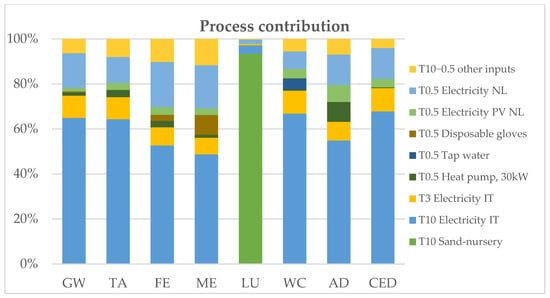
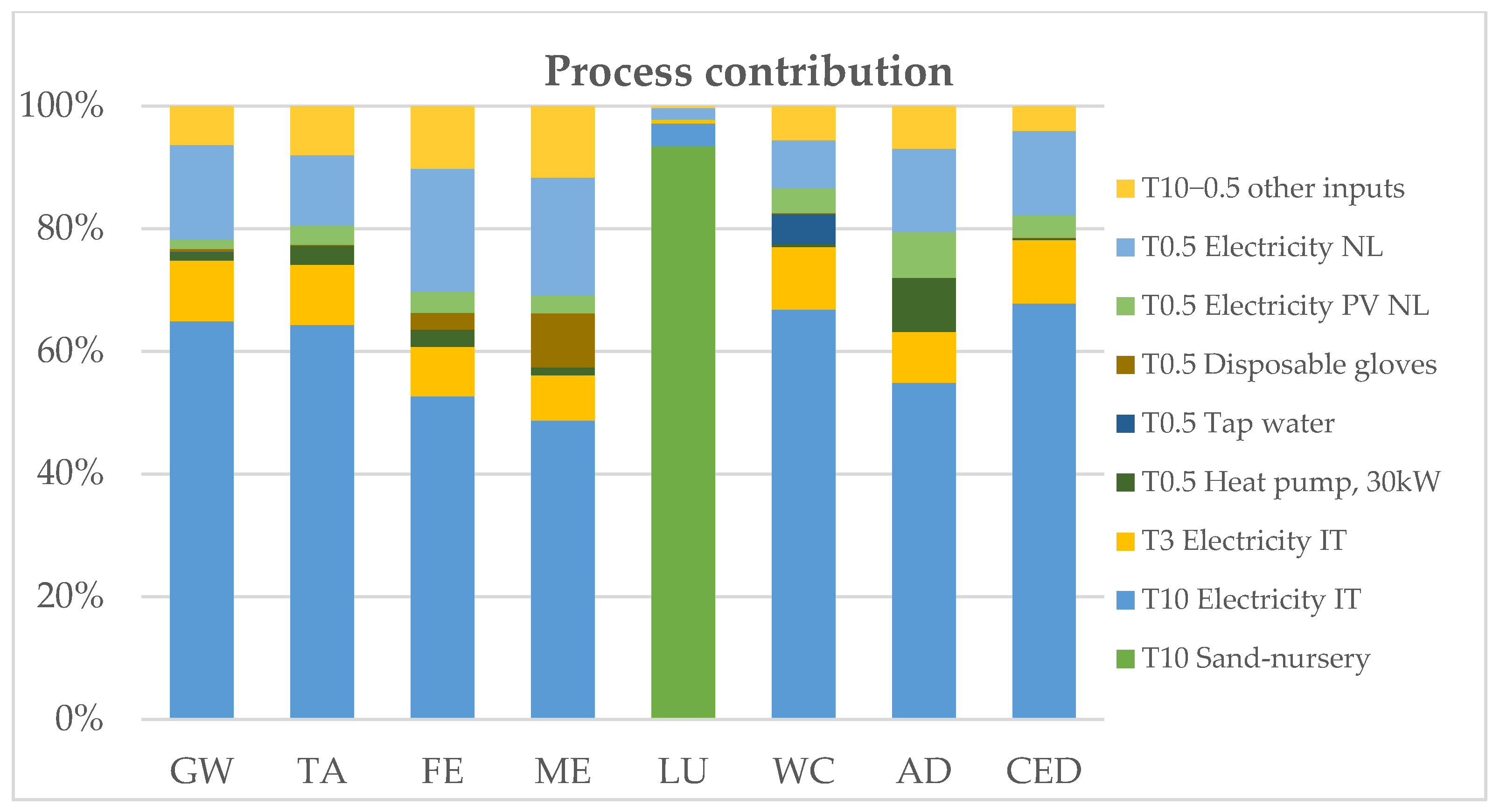
For all impact categories considered, the production phase that contributes most to the impacts is the additional pre-fattening phase in the sand-nursery system (T10). Its contribution ranges between 57% for Abiotic Depletion and 97% for Land Use. The high contribution to land use impacts is primarily associated with the land required for the construction of the sand-nurseries (700 m2 each, for a total of 24 units), which corresponds to approximately 0.6 m2 of land per kilogram of juvenile clams produced. For all remaining impact categories, the use of electricity from the national grid (Italy) for T10 production represents the dominant contributor (from 4% to 68% according to the impact category considered), as depicted in Figure 2. Consumption of electricity for T0.5 production (NL electric grid) and T3 pre-fattening (IT electric grid) follows, with contributions spanning from 8–20% to 7–10%, respectively. The hatchery in The Netherlands also consumes electricity from a photovoltaic (PV) installation. The use of PV electricity contributes little to some impact categories, for example, 3% for TA and FE, 4% for WC and CED, and 8% for AD. The latter value is linked to the extraction, processing, and consumption of the non-renewable metals and other abiotic resources used for the construction of PV panels (e.g., silver, copper and silicon). Finally, three additional processes contribute at least 3% to specific impact categories: the heat pump (3% of TA and 9% of AD), consumption of water (5% of WC), and the use of disposable gloves (9% of ME).
Figure 2.
Contribution of the production chain processes to the impact categories. A 3% cut-off has been applied to select the processes displayed. Processes contributing less than 3% to every impact category have been grouped under “T10–0.5 Other Inputs.” GW: Global Warming; TA: Terrestrial Acidification; FE: Freshwater Eutrophication; ME: Marine Eutrophication; LU: Land Use; WC: Water Consumption; AD: Abiotic Depletion; CED: Cumulative Energy Demand.
Considering the pilot nature of the sand-nursery farming trial (T10 phase), a Monte Carlo analysis was performed to assess the extent to which data uncertainty could influence the results. As reported in Table S3, the coefficients of variation in the impact results across all impact categories range between 0.4% and 7.3%, indicating that the model is sensitive to the variability of the input data, especially for the impact categories Global Warming, Terrestrial Acidification, and Land Use (CV > 7%).
In addition, a sensitivity analysis was performed on the “T10 production volume” and “electricity consumption at the T10 phase” parameters. According to the farmers’ experience, T10 production volumes may vary within the −40% and +20% range due to environmental conditions such as water temperature. As reported in Table 3, a 40% reduction in T10 production leads to an overall increase in impacts of 67%, whereas a 20% increase results in a 17% decrease in impacts. This highlights that variability in production volumes can have an even more pronounced effect on the results than data uncertainty alone.
Table 3.
Sensitivity analysis. LCIA results of the baseline scenario and the percentage variation (%) obtained by varying the “T10 production volume” and “energy use” parameters. GW: Global Warming; TA: Terrestrial Acidification; FE: Freshwater Eutrophication; ME: Marine Eutrophication; LU: Land Use; WC: Water Consumption; AD: Abiotic Depletion; CED: Cumulative Energy Demand.
Further, by hypothetically varying the electricity consumption of the sand-nursery system (Table 3), e.g., by ±30%, an increase or decrease in impacts of up to 20% in the most sensitive categories (Cumulative Energy Demand and Water Consumption) can be observed, confirming the sensitivity of the system to the factor identified as the main environmental hotspot.
Comparing the present results with the existing literature on the environmental performance of clam production is challenging due to differences in system boundaries, functional units, and production contexts. It is also important to highlight that the “sand-nursery T10 individuals” do not typically correspond to a standard market category for Manila clams. Under conventional farming practice, producers usually purchase T3 seed and rely on lagoon-based fattening until clams reach sizes above 25 mm for market sale. The T10 size can therefore be considered an intermediate stage reached during the fattening stage in the lagoon, rather than a commercially traded product. In the context of the present case study, sand-nursery-reared T10 seed represents an output, and the company under investigation is, to our knowledge, the only producer in Italy that could supply, in the future, Manila clam juveniles at this intermediate size. However, the sand-nursery system is currently operated on a pilot scale, and its capacity to reliably produce large quantities of T10 seed will be verified and optimised in the near future. Should the technique prove scalable and enable consistent production at this size class, a dedicated market could potentially develop, supported by an effective demand for juveniles of this size. Thus, the Technology Readiness Level (TRL) should be taken into account when interpreting and comparing environmental performance results. Nevertheless, an effort to establish a comparison has been undertaken.
One study specifically assessed the environmental burdens associated with hatchery production of Manila clam seed in Italy [11]. Overall, the study reported substantially higher impacts than those observed here. For instance, as shown in Table S4, the GW associated with producing 1 kg of T3–3.5 from T0.5 seed produced in The Netherlands (the system examined in the present work) is approximately 6.6 kg CO2 eq. In contrast, the assessment of the hatchery carried out by [11] reported a GW of 26 kg CO2 eq. Similarly, ME and FE results appeared to be higher in [11] (ME: 8.4 × 10⁻⁴ kg N eq and FE: 9.04 × 10⁻³ kg P eq) than in the present study. Although production volumes were broadly comparable (approximately 7 t of T3–3.5 seed in the current study vs. 5 t reported by [11]), the clam seed production completely performed in Italy exhibited markedly higher grid electricity consumption (around 55 kWh kg−1 of product) compared to 15 kWh kg−1 (from both grid and photovoltaic systems) in the present case study. These differences suggest that the Italian hatchery was likely operating under suboptimal efficiency conditions at the time of data collection (reference year: 2020), with energy and material inputs not yet fully optimised. Consequently, variability in technological maturity and operational practices must be considered when comparing environmental performances across hatchery systems. Beyond the comparison of overall impact scores, it is noteworthy that the contribution analyses of the available studies show substantial agreement. Even in the assessment of clam seed produced entirely in Italy, electricity consumption emerged as the dominant contributor, accounting for more than 70% of the impacts across all evaluated categories. This finding is consistent with broader evidence from land-based aquaculture facilities (e.g., hatcheries, depuration centres, aquafeed plant), where energy use frequently represents the principal environmental hotspot identified in sustainability assessments [10,11,29,30,31,32,33].
Moreover, despite differences in methodological approaches among studies, we attempted to estimate the potential environmental impacts (GW) resulting from the integration of the system under study into a conventional supply chain. In particular, [10] analysed a conventional supply chain based on hatchery-produced seed seeded in the lagoon at size T3 and grown to commercial size. It was assumed that pre-fattening to size T10 in a sand-nursery system would reduce the lagoon grow-out period from approximately 24 to 10 months (Paola Landri, personal communication; see also [34] for grow-out times required for individuals of approximately 10 mm to reach commercial size in lagoon). According to [10], the growth-out phase in lagoon represents about 66.34% of the GW impacts (0.70 kg CO2 eq/kg clams). Thus, an indicative estimate for a production chain including hatchery, sand-nursery pre-fattening, and lagoon grow-out to commercial size suggests an increase in GW impacts from about 1.05 to 1.39 kg CO2 eq per kg of clams (≈+32%).
A second reference study by [34], which does not include the hatchery phase and considers wild-collected juveniles of approximately 10 mm, reports substantially lower global warming impacts (0.08 kg CO2 eq/kg clam), with about 62% attributable to the lagoon grow-out phase (0.05 kg CO2 eq/kg clams). Under similar assumptions, the inclusion of a hypothetical T0.5–T10 phase would result in an increased GW potential of 1.15 kg CO2 eq/kg commercial size clam. It should be noted, however, that the results reported in the two studies for GW impacts differ by approximately one order of magnitude, highlighting the strong influence of system boundaries, modelling assumptions, and data sources on the resulting impact estimates.
3.2. Carbon and Nutrient Removal Potential
In addition to being considered a low-impact form of animal production [9,35,36,37,38,39,40], bivalves are well documented to provide a range of ecosystem services [9,20]. Among these, their capacity to remove carbon and nutrients from the surrounding water column is particularly noteworthy in actively growing animals [41], and this characteristic is recognised as a mechanism that can contribute to mitigating eutrophication [9,16,42,43,44,45]. For this reason, the present study reports the carbon and nutrient (nitrogen and phosphorus) content of T10 clam soft tissues and provides an estimate of the associated potential removal of these elements from the aquatic environment. The results of the analysis of the content of C, N and P in the soft tissues of T10 Manila clams and the estimation of the potential removal of nutrients (N, P) from the water body, referred to the total production of the optimised sand-nursery system (120 t, liveweight), are reported in Table 4.
Table 4.
Number of T10 individuals used, average carbon (C), nitrogen (N), and phosphorus (P) concentration (%) in soft tissues (DW), and estimation of the potential removal of C, N, and P according to an optimised production of T10 Manila clam in a sand-nursery system (approx. 120,000 kg/year).
The results of the present study are broadly consistent with previously reported elemental compositions for bivalves. Several studies have documented ranges of 36.6–44.4% for carbon, 6–11% for nitrogen, and 0.85–0.98% for phosphorus [46,47,48,49], which align with the values obtained here. Some differences emerge when comparing the results reported in Table 3 with those of Manila clams reported in [50]. In that case, clams’ carbon contents were higher (8.5% on live weight; considering the moisture in soft tissue being 84%, it approximately equals 53% C in DW) and nitrogen contents were lower (0.32% on live weight = 2% DW). Similar discrepancies were observed relative to the values for phosphorous content reported for Irish Pacific oysters by [51], which were lower than those measured for Manila clams in the present study (0.58–0.74%). Nevertheless, despite these variations, the nutrient contents found in this study remain within the same general order of magnitude across studies, suggesting that species-, site-, and condition-specific factors and analytical methods likely account for the observed differences.
This study also explored the potential for nutrient removal associated with the estimated annual production of the sand-nursery system. Assuming an output of 120 t (liveweight) per year of Manila clams grown up to the T10 size, the harvested biomass could theoretically remove approximately 1440 kg of carbon, 340 kg of nitrogen, and 32 kg of phosphorus from the system. Although simplistically, applying the nutrient-credit values used by [51], i.e., 19 EUR kg−1 N and 34 EUR kg−1 P, would translate into potential credits of 6460 EUR for nitrogen removal and 1088 EUR for phosphorus removal. In addition, carbon currently lacks an established economic valuation within nutrient-crediting schemes, and its relevance to economic assessments remains uncertain. When considering the potential nutrient removal capacity of 1 kg of T10 Manila clams (estimated at 2.82 × 10⁻³ kg N and 2.70 × 10⁻⁴ kg P) and comparing these values with the corresponding LCIA results, it appears that nutrient extraction could partially offset eutrophication-related impacts. Phosphorus removal might compensate for a portion of the freshwater eutrophication impacts associated with production (about 60%), while nitrogen removal could exceed emissions by one to two orders of magnitude.
However, it is important to note that LCA impact categories are expressed at a global scale (i.e., LCA takes into account potential impacts across the entire production chain, including emissions arising from material extraction to processing inputs to produce clam juveniles, which occur in different locations). On the other hand, nutrient removal provided by juvenile clams occurs at the local scale and affects the immediate receiving water bodies. Consequently, the apparent offsets in eutrophication impact categories should be interpreted with caution, as local-scale ecosystem benefits cannot be directly equated to reductions in global LCA impacts.
Overall, these results indicate that juvenile Manila clam production may influence local nutrient dynamics, but the extent to which this translates into meaningful contributions to global environmental objectives remains highly uncertain. This highlights the challenges of integrating ecosystem service indicators, which operate at a local scale, with conventional LCA metrics, which are calculated at a global scale. Any conclusions regarding environmental benefits should therefore be considered indicative rather than definitive, and further research is needed to better link local ecosystem processes with global impact assessments.
3.3. Transferability, Generalizability, and Study Limitations
The main limitation of this study is that it is based on a single case study and, more importantly, that it represents an ex-ante assessment of a production system that is not yet fully operational. Nevertheless, the production system analysed can be considered a generalisable model with potential future applicability in other contexts. Italy is the leading producer of commercial-size Manila clams, but most of the seed used for lagoon seeding (T3) is currently sourced from foreign hatcheries, predominantly within Europe (e.g., Spain, France, and The Netherlands). In this perspective, the adoption and spread of the proposed technology could occur both in Italy, thereby shortening and localising the production chain, and in other countries, where suitable environments for pre-fattening are available. This is particularly relevant if Italian demand for T10-size seed increases in the future as a result of an improved production efficiency, such as higher survival rates of T10 juveniles compared with T3 and reduced grow-out time in lagoons. Hatcheries are generally located in coastal areas due to the need for seawater accessibility. Therefore, provided the availability of space and authorisation, the use of land adjacent to indoor hatcheries to operate sand-nursery systems could be considered both feasible and scalable.
As discussed in the previous sections, the introduction of a sand-nursery phase would increase the environmental impacts of the production chain. However, it may also represent one of the few viable solutions to counteract the ongoing decline in Manila clam production, a species of significant economic and social relevance in countries such as Italy.
The environmental impacts of potential sand-nursery systems would remain strongly dependent on the specific geographical context (e.g., national energy mix, facility efficiency, and origin of juveniles). Nonetheless, the relative contribution of individual inputs to overall impacts is expected to be consistent with the patterns identified in this study. Consequently, although country-specific assessments would be required to accurately quantify the environmental impacts of sand-nursery systems in locations other than that considered here, the identification of environmental hotspots provided by this study can still support informed decision-making. In particular, it may help to anticipate critical weaknesses and guide the design of future facilities by integrating mitigation strategies at an early stage, such as the development of energy-self-sufficient systems aimed at reducing emissions and overall environmental burdens.
4. Conclusions
This study provides an ex-ante LCA of the sand-nursery system for Manila clam production, using an Italian company which implemented it as a case study. The results suggest that, in its current form, i.e., without any PV integration, the sand-nursery system may increases the overall environmental impacts of the production chain, as it involves the implementation of an additional energy-intensive farming phase. However, it could offer important practical advantages: first, it could ensure a consistent and standardised supply of high-quality juveniles, which is critical for stable and efficient clam aquaculture, and, second, the increased availability and use of T10 juveniles grown in a controlled environment could reduce the mortality (e.g., due to predation or environmental conditions) during the grow-out phase. Indeed, it is key to point out that such benefits of extending the pre-fattening phase before seeding juvenile Manila clam in lagoon environments must be tested in the field, i.e., by scientifically demonstrating (i) improved survival rates of Manila clams in open-water conditions and (ii) acceptable environmental and production costs for farming companies. In this way, this model could potentially be adopted in other countries where clam hatcheries have been established or are currently being developed. However, without such a complete assessment and data availability, it remains difficult to draw firm conclusions regarding the potential trade-offs. Overall, this work aims to provide a first step toward the environmental assessment of an innovative solution for the clam pre-fattening sector. The concept of nutrient credits, based on the removal of nitrogen and phosphorus by harvested clams, is also promising and warrants further investigation. Integrating such ecosystem services could add economic and environmental value to Manila clam production. Overall, these exploratory findings highlight that a comprehensive LCA of the full production chain (from seed production to the harvest of commercial-size clams), incorporating the sand-nursery system once it is fully optimised, is needed to accurately assess its net environmental impact. Such future studies would help balance the trade-offs between improved juvenile management, production gains, and environmental performance, while exploring potential benefits from nutrient removal.
Supplementary Materials
The following supporting information can be downloaded at https://www.mdpi.com/article/10.3390/su18052229/s1. Table S1: Life Cycle Inventory (LCI) of the production 1 kg of T10 Manila clam in the sand-nursery system; Table S2: LCIA results for 1000 animals at T10 size and 1000 animals at T3 size; Table S3: Results of the Monte Carlo analysis based on data input variability determined by the Pedigree Matrix for all created processes and electricity used in the sand-nursery system; Table S4: Life Cycle Impact Assessment (LCIA) referred to the production of 1 kg of T3 juvenile clams in a raceways/FLUPSY system.
Author Contributions
Conceptualization, A.M., D.P. and P.L.; methodology, A.M. and R.N.; software, A.M.; validation, A.M., D.P., F.O., L.F. and P.L.; formal analysis, A.M.; investigation, A.M., D.P., F.O., L.F., R.N. and P.L.; resources, D.P.; data curation, A.M. and D.P.; writing—original draft preparation, A.M.; writing—review and editing, A.M., D.P., F.O., L.F., T.D.I., M.M., R.N. and P.L.; visualisation, A.M., M.M. and T.D.I.; supervision, D.P.; project administration, D.P. and P.L.; funding acquisition, D.P. and P.L. All authors have read and agreed to the published version of the manuscript.
Funding
This research was funded by iNEST Spoke 7-Next Generation EU, grant number B39J24001810004 PNRR_M4C2 (“Progetto SoCAM—Sostenibilità Circolare Allevamento Molluschicoltura”).
Institutional Review Board Statement
Ethical approval was not required for this study, as it was based exclusively on voluntarily provided, non-personal, company-level data. No human participants or personal data were involved, and the study therefore falls outside the scope of Regulation (EU) 2016/679 (GDPR; Article 4 and Recital 26) and Italian Legislative Decree No. 196/2003, as amended by Legislative Decree No. 101/2018. Informed consent for data collection, use and publication was obtained from the participating organisation, as reported in the Informed Consent Statement.
Informed Consent Statement
Informed consent for participation was obtained from all subjects involved in the data collection of the study.
Data Availability Statement
Data are included in the article/Supplementary Material. Further data can be asked upon reasonable request.
Acknowledgments
The graphical abstract and Figure 1 have been designed by the authors using resources from https://Flaticon.com (designed by https://www.freepik.com), (accessed on 18 December 2025).
Conflicts of Interest
Authors L.F., P.L., and F.O. are employed by the company Ecotapes Società Agricola Srl. The remaining authors declare that their involvement did not influence the study design, data collection, data analysis, or the interpretation of the results. All analyses were conducted independently to ensure objectivity and scientific rigour. The research was conducted in the absence of any commercial or financial relationships that could be construed as a potential conflict of interest.
List of Abbreviations
| AD | Abiotic Depletion |
| CED | Cumulative Energy Demand |
| CV | Coefficient of Variation |
| DW | Dry Weight |
| EU | European Union |
| FE | Freshwater Eutrophication |
| FLUPSY | Floating Upweller System |
| FU | Functional Unit |
| GW | Global Warming |
| LCA | Life Cycle Assessment |
| LCI | Life Cycle Inventory |
| LCIA | Life Cycle Impact Assessment |
| LU | Land Use |
| ME | Marine Eutrophication |
| NL | Dutch |
| PV | Photovoltaic |
| TA | Terrestrial Acidification |
| TRL | Technical Readiness Level |
| WC | Water Consumption |
| WW | Wet Weight |
References
- FAO. The State of World Fisheries and Aquaculture 2024. Blue Transformation in Action; FAO: Rome, Italy, 2024; ISBN 978-92-5-138763-4. [Google Scholar]
- Fang, J.; Lin, Z. Development of Manila Clam Industry in China. Bull. Jpn. Fish. Res. Educ. Agency 2016, 42, 29–34. [Google Scholar]
- EUROSTAT FISH_AQ2A. Available online: https://ec.europa.eu/eurostat/databrowser/view/fish_aq2a/default/table?lang=en&category=fish.fish_aq (accessed on 31 October 2025).
- European Council and European Parliament. Regulation (EC) No 762/2008 of the European Parliament and of the Council of 9 July 2008 on the Submission by Member States of Statistics on Aquaculture and Repealing Council Regulation (EC) No 788/96; 2008; European Council and European Parliament: Brussels, Belgium, 2008. [Google Scholar]
- Pellizzato, M.; da Ros, L. Clam Farming Quality as a Management Tool: A Proposal Based on Recent Studies in Northern Adriatic Lagoons. Aquac. Int. Int. 2005, 13, 57–66. [Google Scholar] [CrossRef] [Scilit]
- Ponti, M.; Castellini, A.; Ragazzoni, A.; Gamba, E.; Ceccherelli, V.U.; Abbiati, M. Decline of the Manila Clams Stock in the Northern Adriatic Lagoons: A Survey on Ecological and Socio-Economic Aspects. Acta Adriat. 2017, 58, 89–104. [Google Scholar] [CrossRef] [Scilit]
- Zentilin, A.; Pellizzato, M.; Rossetti, E.; Turolla, E. La Venericoltura in Italia a 25 Anni Dal Suo Esordio. Il Pesce 2008, 3, 31–40. [Google Scholar]
- Chiesa, S.; Petochi, T.; Brusà, R.B.; Raicevich, S.; Cacciatore, F.; Franceschini, G.; Antonini, C.; Vallini, C.; Bernarello, V.; Oselladore, F.; et al. Impacts of the Blue Crab Invasion on Manila Clam Aquaculture in Po Delta Coastal Lagoons (Northern Adriatic Sea, Italy). Estuar. Coast. Shelf Sci. 2025, 312, 109037. [Google Scholar] [CrossRef] [Scilit]
- van der Schatte Olivier, A.; Jones, L.; Le Vay, L.; Christie, M.; Wilson, J.; Malham, S.K. A Global Review of the Ecosystem Services Provided by Bivalve Aquaculture. Rev. Aquac. 2020, 12, 3–25. [Google Scholar] [CrossRef] [Scilit]
- Martini, A.; Napolitano, R.; Capoccioni, F.; Martinoli, M.; Tonachella, N.; Aguiari, L.; Piva, P.; Rossetti, E.; Pulcini, D. Prefacing the Challenge—Assessment of the Environmental Efficiency of Manila Clam (Ruditapes Philippinarum) Production Based on Hatchery-Produced and Wild Seed. Aquaculture 2025, 595, 741474. [Google Scholar] [CrossRef] [Scilit]
- Martini, A.; Aguiari, L.; Capoccioni, F.; Martinoli, M.; Napolitano, R.; Pirlo, G.; Tonachella, N.; Pulcini, D. Is Manila Clam Farming Environmentally Sustainable? A Life Cycle Assessment (LCA) Approach Applied to an Italian Ruditapes Philippinarum Hatchery. Sustainability 2023, 15, 3237. [Google Scholar] [CrossRef] [Scilit]
- Zanella, L.; Pastres, R.; Freguglia, M.; Stoppa, S.; Palazzi, R. Effects of Water Flow Rate and Stocking Density on the Early Pre-Fattening of Manila Clams (Ruditapes Philippinarum) Farmed in a North Adriatic “Valle Da Pesca” (Italy). Aquac. Int. 2025, 33, 161. [Google Scholar] [CrossRef] [Scilit]
- Boschiero, M.; Facca, C.; Cavraro, F.; Tonolli, M.; Malavasi, S.; Franzoi, P. Feeding Strategies of the Invasive Blue Crab (Callinectes Sapidus) on Manila Clam (Ruditapes Philippinarum): Implications for Aquaculture. Estuar. Coast. Shelf Sci. 2025, 325, 109486. [Google Scholar] [CrossRef] [Scilit]
- Cigarría, J.; Fernández, J.M. Management of Manila Clam Beds. Aquaculture 2000, 182, 173–182. [Google Scholar] [CrossRef] [Scilit]
- Catherine, P.S.; Nandan, S.B.; Hershey, N.R. Diversity of Bivalve Mollusks, Their Ecosystem Services, and Potential Impacts of Climate Change. In Ecosystem Services Valuation for Sustainable Development; Joseph, S., Pradeepkumar, A.P., Eds.; Springer: Singapore, 2024; pp. 161–184. [Google Scholar] [CrossRef] [Scilit]
- Petersen, J.K.; Holmer, M.; Termansen, M.; Hasler, B. Nutrient Extraction through Bivalves. In Goods and Services of Marine Bivalves; Smaal, A.C., Ferreira, J.G., Grant, J., Petersen, J.K., Strand, Ø., Eds.; Springer Cham Switzerland, 2018; pp. 179–208. [Google Scholar] [CrossRef] [Scilit]
- Alleway, H.K.; Gillies, C.L.; Bishop, M.J.; Gentry, R.R.; Theuerkauf, S.J.; Jones, R. The Ecosystem Services of Marine Aquaculture: Valuing Benefits to People and Nature. Bioscience 2019, 69, 59–68. [Google Scholar] [CrossRef] [Scilit]
- Bridger, D.; Attrill, M.J.; Davies, B.F.R.; Holmes, L.A.; Cartwright, A.; Rees, S.E.; Cabre, L.M.; Sheehan, E.V. The Restoration Potential of Offshore Mussel Farming on Degraded Seabed Habitat. Aquac. Fish Fish. 2022, 2, 437–449. [Google Scholar] [CrossRef] [Scilit]
- Ferreira, J.G.; Bricker, S.B. Goods and Services of Extensive Aquaculture: Shellfish Culture and Nutrient Trading. Aquac. Int. 2016, 24, 803–825. [Google Scholar] [CrossRef] [Scilit]
- Suplicy, F.M. A Review of the Multiple Benefits of Mussel Farming. Rev. Aquac. 2020, 12, 204–223. [Google Scholar] [CrossRef] [Scilit]
- Theuerkauf, S.J.; Barrett, L.T.; Alleway, H.K.; Costa-Pierce, B.A.; St. Gelais, A.; Jones, R.C. Habitat Value of Bivalve Shellfish and Seaweed Aquaculture for Fish and Invertebrates: Pathways, Synthesis and next Steps. Rev. Aquac. 2022, 14, 54–72. [Google Scholar] [CrossRef] [Scilit]
- European Commission. The European Green Deal (COM/2019/640 Final); European Commission: Brussel, Belgium, 2019. [Google Scholar]
- European Commission. A Farm to Fork Strategy for a Fair, Healthy and Environmentally-Friendly Food System (COM/2020/381 Final); European Commission: Brussel, Belgium, 2020. [Google Scholar]
- Cucurachi, S.; Van Der Giesen, C.; Guinée, J. Ex-Ante LCA of Emerging Technologies. Procedia CIRP 2018, 69, 463–468. [Google Scholar] [CrossRef] [Scilit]
- Joint Research Centre. International Reference Life Cycle Data System (ILCD) Handbook—General Guide on LCA—Detailed Guidance, 1st ed.; Publications Office of the European Union: Luxembourg, 2010. [Google Scholar]
- Weidema, B.P.; Wesnæs, M.S. Data Quality Management for Life Cycle Inventories—An Example of Using Data Quality Indicators. J. Clean. Prod. 1996, 4, 167–174. [Google Scholar] [CrossRef] [Scilit]
- Il Ministro per le Politiche Agricole e Forestali. Decreto Ministeriale 13, Approvazione Dei “Metodi Ufficiali Di Analisi Chimica Del Suolo”; Gazzetta Ufficiale della Repubblica Italiana: Rome, Italy, 1999; Volume 248. [Google Scholar]
- APAT; CNR-IRSA. Metodi Analitici per Le Acque; Sezione 3000; Agenzia per la Protezione dell’Ambiente e per i Servizi Tecnici (APAT): Rome, Italy; Consiglio Nazionale delle Ricerca, Istituto di Ricerca sulle Acque (CNR-IRSA): Montelibretti, Italy, 2003; Volume 1. [Google Scholar]
- Dias, A.C.; Almeida, C.; da Costa, T.P.; Nunes, M.L.; Marques, A.; Quinteiro, P. Environmental Assessment of Oyster Farming from a Life Cycle Perspective. Sustain. Prod. Consum. 2025, 54, 102–114. [Google Scholar] [CrossRef] [Scilit]
- Hou, H.; Han, F.; Song, J.; Jia, F.; Bai, Y.; Ma, Z.; Huo, Z.; Liu, Y. Quantifying the Environmental Performance of the Oyster (Crassostrea gigas) Supply Chain: A Life Cycle Assessment in Dalian, China. Sustainability 2025, 17, 7392. [Google Scholar] [CrossRef] [Scilit]
- De Vet, J.M.; Gardner, H.; Sala Pérez, M.; Matheus, D.; Mirambell Huguet, M.; Bessin, A.; Reyes, M.; Pastres, R.; Herpers, F.; Nelissen, D.; et al. Techno-Economic Analysis for the Energy Transition of the EU Fisheries and Aquaculture Sector; Publications Office of the European Union: Luxembourg, 2024. [Google Scholar]
- Liu, H.Y.; Bhat, A.A.; Chen, Y.W.; Chen, S.Y.; Shih, M.K.; Ting, K.H.; Lin, C.H.; Hou, C.Y. Carbon Footprint Assessment of Taiwan’s Aquaculture Industry Integrated with Solar Photovoltaics: A Comprehensive Review. Aquaculture 2025, 614, 743495. [Google Scholar] [CrossRef] [Scilit]
- Pucylowski, T. Life Cycle Assessment (LCA) of Oyster Farming in Washington State. Master’s Thesis, University of Washington, Seattle, WA, USA, 2017. [Google Scholar]
- Turolla, E.; Castaldelli, G.; Fano, E.; Tamburini, E. Life Cycle Assessment (LCA) Proves That Manila Clam Farming (Ruditapes Philippinarum) Is a Fully Sustainable Aquaculture Practice and a Carbon Sink. Sustainability 2020, 12, 5252. [Google Scholar] [CrossRef] [Scilit]
- Vélez-Henao, J.A.; Weinland, F.; Reintjes, N. Life Cycle Assessment of Aquaculture Bivalve Shellfish Production—a Critical Review of Methodological Trends. Int. J. Life Cycle Assess. 2021, 26, 1943–1958. [Google Scholar] [CrossRef] [Scilit]
- Gephart, J.A.; Henriksson, P.J.G.; Parker, R.W.R.; Shepon, A.; Gorospe, K.D.; Bergman, K.; Eshel, G.; Golden, C.D.; Halpern, B.S.; Hornborg, S.; et al. Environmental Performance of Blue Foods. Nature 2021, 597, 360–365. [Google Scholar] [CrossRef] [Scilit]
- Krause, G.; Le Vay, L.; Buck, B.H.; Costa-Pierce, B.A.; Dewhurst, T.; Heasman, K.G.; Nevejan, N.; Nielsen, P.; Nielsen, K.N.; Park, K.; et al. Prospects of Low Trophic Marine Aquaculture Contributing to Food Security in a Net Zero-Carbon World. Front. Sustain. Food Syst. 2022, 6, 875509. [Google Scholar] [CrossRef] [Scilit]
- MacLeod, M.J.; Hasan, M.R.; Robb, D.H.F.; Mamun-Ur-Rashid, M. Quantifying Greenhouse Gas Emissions from Global Aquaculture. Sci. Rep. 2020, 10, 11679. [Google Scholar] [CrossRef] [Scilit]
- Martini, A.; Calì, M.; Capoccioni, F.; Martinoli, M.; Pulcini, D.; Buttazzoni, L.; Moranduzzo, T.; Pirlo, G. Environmental Performance and Shell Formation-Related Carbon Flows for Mussel Farming Systems. Sci. Total Environ. 2022, 831, 154891. [Google Scholar] [CrossRef] [Scilit]
- Martini, A.; Calì, M.; Capoccioni, F.; Martinoli, M.; Pulcini, D.; Buttazzoni, L.; Moranduzzo, T.; Pirlo, G. Environmental Performance and Shell Formation-Related Carbon Flows for Mussel Farming Systems. Sci. Total Environ. 2022, 831, 154891, Corrigendum in Sci. Total Environ. 2024, 914, 169928. https://doi.org/10.1016/j.scitotenv.2024.169928. [Google Scholar] [CrossRef] [Scilit]
- Rice, M. Environmental Impacts of Shellfish Aquaculture: Filter Feeding to Control Eutrophication. In Marine Aquaculture and the Environment: A Meeting for Stakeholders in the Northeast; Cape Cod Press: Falmouth, MA, USA, 2001; pp. 77–86. [Google Scholar]
- Gren, I.M. The Economic Value of Mussel Farming for Uncertain Nutrient Removal in the Baltic Sea. PLoS ONE 2019, 14, e0218023. [Google Scholar] [CrossRef] [Scilit]
- Dvarskas, A.; Bricker, S.B.; Wikfors, G.H.; Bohorquez, J.J.; Dixon, M.S.; Rose, J.M. Quantification and Valuation of Nitrogen Removal Services Provided by Commercial Shellfish Aquaculture at the Subwatershed Scale. Environ. Sci. Technol. 2020, 54, 16156–16165. [Google Scholar] [CrossRef] [Scilit]
- Lindahl, O.; Hart, R.; Hernroth, B.; Kollberg, S.; Loo, L.-O.; Olrog, L.; Rehnstam-Holm, A.-S.; Svensson, J.; Svensson, S.; Syversen, U. Improving Marine Water Quality by Mussel Farming: A Profitable Solution for Swedish Society. BioOne 2005, 34, 131–138. [Google Scholar] [CrossRef]
- Schernewski, G.; Stybel, N.; Neumann, T. Zebra Mussel Farming in the Szczecin (Oder) Lagoon: Water-Quality Objectives and Cost-Effectiveness. Ecol. Soc. 2012, 17, 4. [Google Scholar] [CrossRef] [Scilit]
- Lu, G.; Wang, W.X. Tissue-Based Trace Element Pollution of Clam Ruditapes Philippinarum in China: Hotspot Identification and Multiple Nonlinear Analysis. Sci. Total Environ. 2023, 868, 161598. [Google Scholar] [CrossRef] [Scilit]
- Nizzoli, D.; Welsh, D.T.; Viaroli, P. Seasonal Nitrogen and Phosphorus Dynamics during Benthic Clam and Suspended Mussel Cultivation. Mar. Pollut. Bull. 2011, 62, 1276–1287. [Google Scholar] [CrossRef] [Scilit]
- Buer, A.L.; Taylor, D.; Bergström, P.; Ritzenhofen, L.; Klemmstein, A. Nitrogen and Phosphorous Content in Blue Mussels (Mytilus spp.) Across the Baltic Sea. Front. Mar. Sci. 2020, 7, 705. [Google Scholar] [CrossRef] [Scilit]
- Zhou, Y.; Yang, H.; Liu, S.; He, Y.; Zhang, F. Chemical Composition and Net Organic Production of Cultivated and Foulingorganisms in Sishili Bay and Their Ecological Effects. J. Fish. China 2002, 26, 21–27. [Google Scholar]
- Ferreira, J.G.; Cubillo, A.M.; Lopes, A.S.; Marteleira, R.; Service, M.; Moore, H.; Hunter, B.; Cromie, H.; Bricker, S.B. Deliverable Report for GAIN Green Aquaculture Intensification in Europe Grant Agreement Number 773330 Deliverable 2.9 Report & White Paper on Framework for a Nutrient Credit Trading Policy for Europe, Integrating Shellfish Producers; European Commission: Brussel, Belgium, 2021. [Google Scholar]
- Domech, P.C.; Cooney, R.; Tahar, A.; Kennedy, A.; Wan, A.H.L.; Clifford, E. Oysters, a Sustainable Bluefood? npj Sustain. Agric. 2025, 3, 24. [Google Scholar] [CrossRef] [Scilit]

Disclaimer/Publisher’s Note: The statements, opinions and data contained in all publications are solely those of the individual author(s) and contributor(s) and not of MDPI and/or the editor(s). MDPI and/or the editor(s) disclaim responsibility for any injury to people or property resulting from any ideas, methods, instructions or products referred to in the content. |
© 2026 by the authors. Licensee MDPI, Basel, Switzerland. This article is an open access article distributed under the terms and conditions of the Creative Commons Attribution (CC BY) license.