1. Introduction
The negative impact of climate change is driving the decarbonization of economies, which is associated with a shift away from fossil fuels. The Polish economy is also moving in this direction [
1,
2]. The Polish energy sector has for years been based on coal-fired energy generation, and its generation and transmission infrastructure is adapted to this model. To ensure a smooth transition while allowing time for necessary investments and safe supply continuity, a transition period is necessary [
3,
4]. It is planned that during this transition period, the domestic hard coal mining industry, supported by potential imports, will provide the necessary fuel for the energy sector. Increasing contamination of the mined material with rock masses both degrades fuel quality and negatively impacts the environment [
5,
6].
Mineral extraction will remain a key part of the global economy for a long time to come. Industrial activity and the supporting extraction of useful minerals from the rock mass are the largest contributors to environmental impacts and climate change. Due to technological constraints, it is impossible to extract pure raw materials, which is why underground mining of useful minerals produces waste [
7,
8]. The negative impact of hard coal mining on the environment results from, among other things, waste rock and dust emissions. In Poland, thermal coal mining is expected to continue until at least 2049, and during this period, the environment will be exposed to a continuous influx of mining waste [
9,
10].
The aim of this paper is to present the scope of rock and dust emissions resulting from hard coal mining in Poland and to provide a “picture” of the state of management of waste rock masses obtained during hard coal mining within the context of the long-term phasing out of mining capacity. With the ongoing energy transformation of the economy, identifying the scale of emissions and the factors modifying these emissions may be helpful in ongoing adjustments to adapt the hard coal mining sector to the dynamically changing political and economic situation [
11,
12] and especially to environmental challenges [
13,
14]. The research objectives were achieved by answering the following questions:
Question 1: What is the extent of mineral emissions into the environment from hard coal mining in recent years?
Question 2: What factors have negatively impacted the amount of mineral emissions from mining in recent years?
Question 3: What can be done to reduce the extent of mineral emissions into the environment from hard coal mining?
Adapting the sector to decarbonization policies and applicable legal regulations may prove to be a significant challenge. This paper presents a critical analysis of rock and dust emissions into the environment associated with hard coal mining. It is particularly significant that the analysis is based on the most recent statistical data set. The analysis was conducted for the period from 2017 to 2025, with the values for 2025 estimated based on data for the January–September 2025 period (Q1–Q3 2025). A statistical analysis of rock mass emissions into the environment was conducted, which is a useful tool for developing adjustments to current mining operations and forecasting potential directions of environmental changes accompanying the transformation of the energy sector. This paper identifies the most important factors influencing the scope of rock mass and dust emissions in Poland. Information and conclusions resulting from the analysis can help in designing potential and current adjustments to the already adopted directions of economic transition away from the use of hard coal in Poland and in other countries phasing out fossil fuel extraction [
5,
15].
The beginning of the twenty-first century has been marked by rapid global economic development. This economic progress has been accompanied by an acceleration of the adverse impacts of climate change [
15,
16,
17]. In an effort to slow these negative climatic and environmental trends, the European Union has introduced the European Green Deal [
18,
19,
20]. Its overarching objective is to ensure economic growth while minimizing the use of natural resources and to achieve net-zero greenhouse gas emissions by 2050 [
10,
16]. Both businesses and the European society as a whole are required to implement the measures arising from the Green Deal and other EU environmental regulations [
21].
According to EU policy, mining operations may continue only if they are conducted efficiently and with minimal environmental impact. Reducing this impact may involve, among other measures, limiting the emission of waste into the environment. It must be acknowledged, however, that any form of mineral extraction inevitably alters the natural environment [
22,
23].
Cessation of thermal coal mining will reduce or even stop waste rock and dust emissions into the environment, but existing mineral waste dumps will remain landscape features in areas where mineral deposits have been or are being mined. Unfortunately, even after cessation of mining, until the mining waste dumps are fully closed, the environment will still be exposed to secondary dust and gas emissions [
10,
24]. Managing at least some of the mining waste could be a solution to most environmental problems in areas affected by past or ongoing mining operations [
25,
26].
The aging generation capacity of the Polish coal-based energy sector and increasing delays in implementing nuclear power require action to ensure energy security [
13,
21]. Current climate and energy policies and the decarbonization of the energy sector force the economy to reduce its demand for fossil fuels. However, the Polish energy sector, with its generation and transmission infrastructure adapted to generating energy from coal, is not prepared for an immediate transformation. Adapting the existing energy model to new challenges requires appropriate investment and time for investment. An immediate transition to previously unstable renewable sources, without maintaining a stabilizing reserve, could lead to a disruption in energy security [
17,
27]. Blackouts, which have recently hit European countries several times, are an example of disruptions in energy security. According to fuel and energy demand forecasts, in 2030, the share of coal will decrease to approximately 39% in the primary energy production balance and to 57% in electricity generation.
To ensure a secure transformation of Poland’s energy sector, a transitional period is required, during which coal-based energy will continue to stabilize the national energy system. Throughout this transition, the Polish mining industry is expected to supply the necessary fuels; however, the associated environmental emissions must also be taken into account [
2].
After many years of dominating energy markets, hard coal is slowly losing its importance [
6,
7]. Decarbonization of economies and the resulting technological changes in industry are reducing the demand for energy from fossil fuels, including thermal hard coal. The ongoing restructuring of the economy means that the hard coal mining industry must adapt to the current market situation and to tightening environmental restrictions [
15,
28]. Over the last nine years, a steady decline in production volumes has been observed by all domestic producers [
10,
29]. The mining of fossil fuels, including hard coal, has been affected by changes in the structure of fossil fuel supply chains. Factors disrupting established hard coal supply models included the “lockdown of economies” caused by the COVID-19 pandemic and the war in Ukraine [
30,
31,
32]. International conditions were compounded by the conclusion of the so-called social agreement in 2021. The document was signed by representatives of the Polish government and representatives of Polish mining trade unions [
33]. The agreement, among other things, agreed on a schedule for reducing hard coal mining capacity in Poland until 2049 [
27,
34]. The agreement [
33] stipulated that thermal coal mining companies are to conduct safe mining until the agreed decommissioning of the mining units and that mining efficiency is to be supported by public funds.
Polish underground mining is characterized by complex geological and mining conditions and the presence of a number of hazards. As mining progresses to greater depths, the level of mining hazards rises, mining difficulties increase, and deposits offer an increasingly poorer quality of the extracted raw material [
35,
36].
The impact of typical mineral extraction methods involves the extraction of minerals to the surface along with gangue [
8,
35]. Some of the extracted waste rock masses are utilized, but some are disposed of in surface storage facilities [
37,
38]. Underground hard coal mining is an example of a form of mineral extraction with high environmental emissions. Hard coal mining will remain present in the Polish economy for a long time [
39]. Due to the scale of mining operations, the coal sector is one of the largest emitters of rock masses to the surface. In hard coal mining, for technological reasons, the extraction of gangue, often in significant quantities, cannot be avoided [
40]. The so-called coal spoil extracted through shafts to the surface is a mixture of commercial coal and gangue. Regardless of the raw material extracted, the term “gangue” refers to all rocks extracted along with useful minerals but not other raw materials. In enrichment plants, after separation from useful minerals, gangue becomes mining waste. Waste management regulations specify how to further handle the obtained waste rock masses [
22,
34]. Gangue, as waste, is usually classified as neutral waste. Due to the rock mass structure in hard coal mining areas and depending on the seam being mined, waste rock consists mainly of sandstones, mudstones, and shales [
41]. Limiting or discontinuing mining operations would reduce or ultimately eliminate mining waste emissions into the environment; however, such a measure could pose risks to both economic stability and energy security. During the necessary transition period, it will not be possible to completely stop waste rock emissions [
14,
41].
Another type of emission, this time from finely divided waste rock, is dust emissions. Dust is generated during the mechanical extraction of all mineral deposits, including hard coal. In hard coal mining, mechanized mining and the extraction of increasingly thinner seams increase dust levels in the mine [
33,
36]. The generated dust is carried by the ventilation air. Ventilation air carries away both mining dust and other dust. Limestone dust, used to prevent coal dust explosions, accounts for the largest share of other dust carried to the surface by ventilation air. Regardless of its origin, the vast majority of the raised dust settles and remains in the mine, but some dust carried to the surface by ventilation air is released through exhaust shafts [
11,
42]. Limiting mining will reduce dust emissions into the atmosphere, but until mining is completely discontinued, dust emissions from mine shafts are expected.
In accordance with the principles of the circular economy, current environmental policy, and applicable legal requirements, mining companies are obliged to manage the waste they generate in an environmentally responsible manner. Given the substantial volume of mining waste, its management must be carried out in consultation with, and with the approval of, local communities. The obligation to manage waste at its source is further reinforced by rising environmental fees, which may translate into financial savings for mining enterprises [
43,
44].
Recently, there has been a shift away from the disposal of mining waste toward its economic utilization. Mining waste generated during coal enrichment has the potential to be used in many applications [
22,
25]. Many examples of successful mining waste utilization can be cited. The greatest needs, and at the same time the greatest opportunities, are created by waste rock, which consists primarily of Carboniferous claystones, mudstones, and sandstones, usually contaminated with coal. After leaving the mine processing plants, waste rock becomes waste. Mining waste with appropriate codes is used, for example, in construction and environmental protection, as exemplified by the use of waste rock for earthworks to enhance landscaped areas or for reclamation facilities. In these cases, the waste requires further processing to change its status from waste to material. Examples include crushing to obtain a uniform fraction or combining it with another material or waste to achieve the desired chemical or mechanical parameters [
9,
45,
46]. Produced aggregates or mixtures are used in engineering works or in repairing mining damage, e.g., by filling various types of depressions in the ground. Appropriate granulation of waste rocks, already as aggregate, allows for their successful use in road and hydraulic engineering, for example, for repairing railway structures, roads, or river embankments. There are also many other possibilities for using mining waste, for example, in the production of ceramics and construction materials or, after re-enrichment, as a low-energy raw material (coal slurry). Processed waste from hard coal processing, combined with waste from other industries, can be used, for example, in agriculture or in the reclamation of municipal waste landfills [
12,
47].
3. Results and Discussion
In the mining of mineral resources from the rock mass (rock massif), including hard coal, a distinction must be made between the extraction of raw material, commercial product, and waste gangue. For technological reasons, underground mining brings the raw material to the surface. In the case of hard coal, it is called “coal spoil”, which is a mixture of the final commercial product and waste gangue (waste rock and mining waste). In surface beneficiation plants, commercial coal and waste gangue are separated from coal spoil. The commercial product is sold on the market, while the waste gangue is managed or stored.
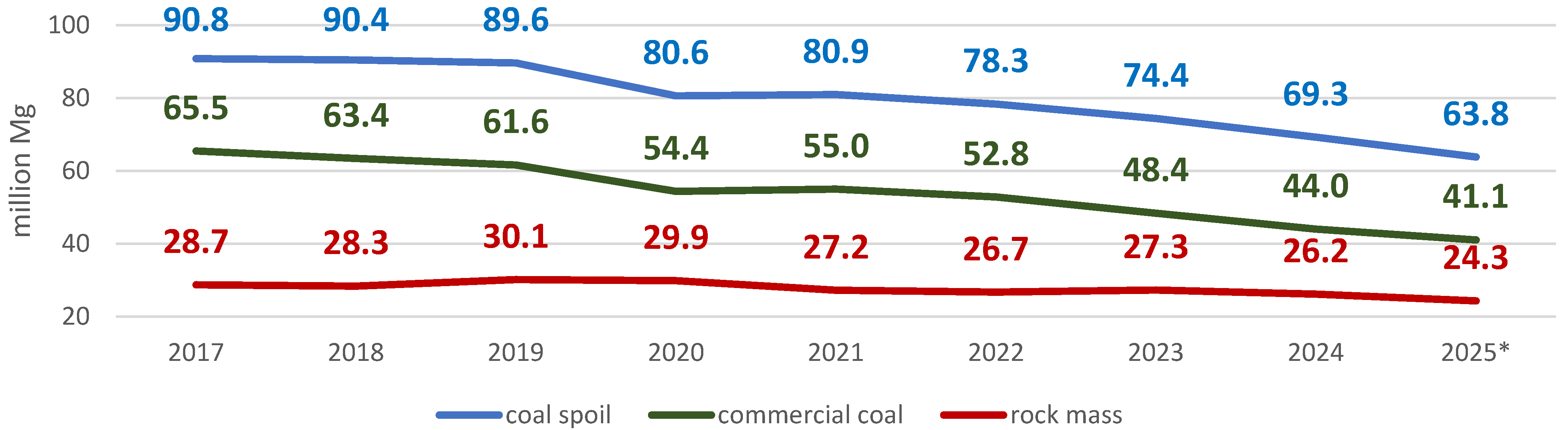
From January to September 2025 (Q1–Q3 2025), the Polish hard coal mining industry produced approximately 30.8 million Mg of hard coal (commercial coal), which suggests that by the end of 2025, the Polish hard coal mining industry will have produced 41.1 million Mg. This will be approximately 2.92 million Mg less than in 2024 (a 6.7% year-on-year decrease). A steady decline is observed in the sector’s production volume [
29]. If the 2025 production forecast proves accurate, production will be 24.4 million Mg of commercial coal, lower than in 2017. During this period, the hard coal mining sector has been reducing its production by an average of approximately 3 million Mg of commercial coal per year. This corresponds to an annual decline of 4.6%. The only exception is 2021, when, due to increased global and domestic energy demand, a slight increase in production of 0.6 million Mg (1% increase year-on-year) was observed. During Q1–Q3 2025, domestic hard coal mining satisfied approximately 89% of Polish consumers’ demand, with the remaining needs covered by imports [
22,
29]. Most of the hard coal produced in Poland is thermal coal. In the long term, a drastic reduction or even abandonment of thermal hard coal mining is expected; however, coking coal mining for industry and the metallurgical sector should continue well beyond 2049 [
43].
By the end of September 2025, approximately 47.9 million Mg of coal spoil output had been extracted to the surface, and enrichment plants extracted 30.8 million Mg of commercial coal from this volume. These volumes are forecast to reach approximately 63.8 million Mg of coal spoil output by the end of 2025 (
Figure 1,
Table A1) and approximately 41.1 million Mg of commercial coal. Since the beginning of the restructuring, coal spoil output has been steadily declining, and over the last nine years, from 2017 to the end of 2025 (based on the forecast for the first 9 months of 2025), a reduction of approximately 27 million Mg (a decrease of approximately 30%) has been recorded (
Figure 1,
Table A1). On average, the Polish hard coal mining industry has reduced production by approximately 4.9% year-on-year (from −10.6% to +0.4%). The largest year-on-year reduction in extraction was observed in 2017 compared to 2016. Coal spoil extraction decreased by as much as 10.6%. Only in 2021, compared to 2020, was a slight increase in coal spoil extraction recorded, by approximately 0.3 million Mg, i.e., only 0.4% year-on-year. This temporary increase in extraction was caused by the increased supply of fossil fuels on global markets after the lockdown period [
48].
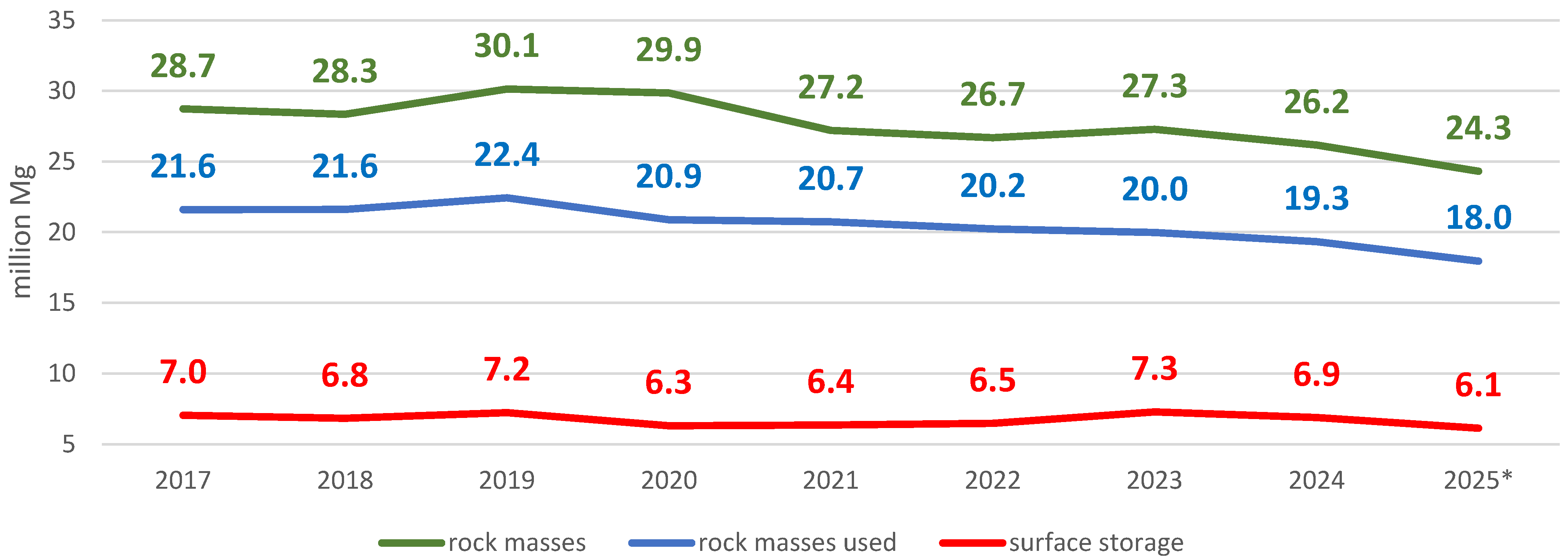
According to data reported by coal companies, over the last nine years, waste rock extraction has shown some variability, with a certain downward trend [
30]. From 2017 to the end of 2025 (forecast based on the first 9 months of 2025), a reduction in emissions by approximately 4.4 million Mg is predicted, a decrease of approximately 15% (
Figure 1,
Table A1). In 2019 and 2023, an increase in waste rock extraction to the surface was observed by 1.8 million Mg year-on-year (6.3% year-on-year) and by 0.6 million Mg year-on-year (2.3% year-on-year), respectively. Another disturbing phenomenon is the almost unchanged surface rock mass emissions in 2020 compared to the previous year. Due to the so-called “COVID restrictions” [
48] in 2020, coal spoil mining output decreased by about 10%, but only 0.97% less waste rock was extracted than in 2019 (
Figure 1,
Table A1). Paradoxically, this phenomenon of greater-than-usual waste rock contamination may be at least partially caused by the COVID-19 pandemic. Another explanation for this phenomenon may be that mining crews were seeking faster ways to complete shift mining tasks. This phenomenon was noted by the authors during conversations (previously unpublished anonymous direct interviews from 2022) with mining department employees and mining supervisors in selected mines. According to the respondents, under less intensive supervision, employees probably mined the roof or floor rocks to speed up daily mining tasks, as expressed by the volume of coal spoil output.
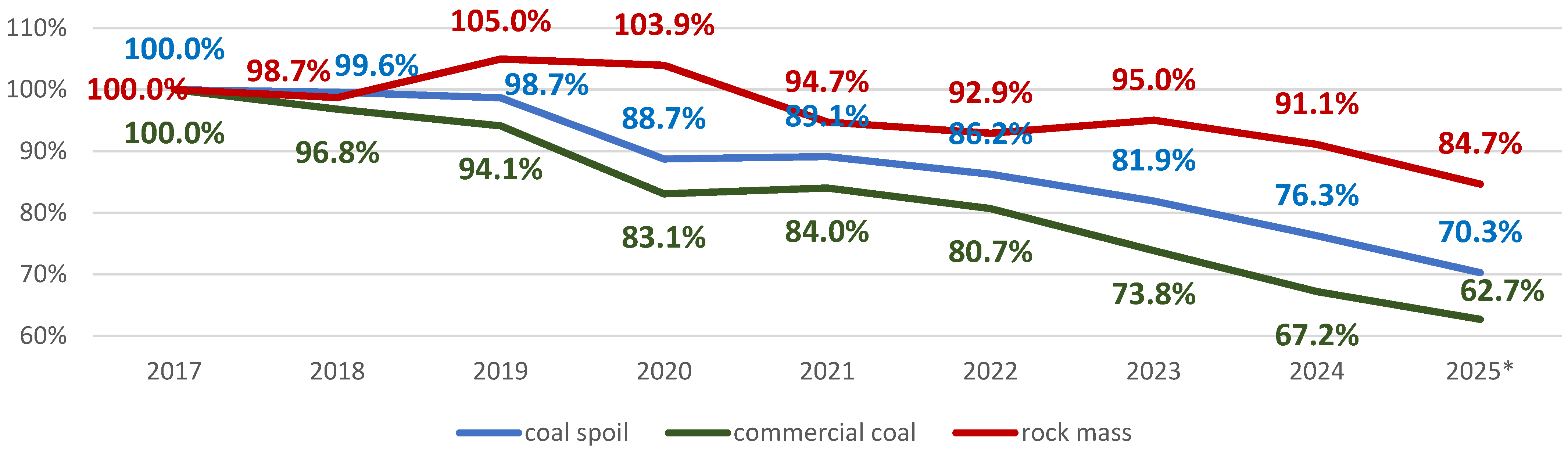
Figure 2 shows an unfavorable trend in the differing rates of decline in commercial coal extraction and waste rock emissions. The proposed data normalization helps to demonstrate the trend. However, it should be remembered that it masks, to some extent, the actual scale of the decrease in absolute emissions. Such a unified approach may weaken intuitive assessment of the scope of emission reductions. To facilitate comparison, the values of coal spoil, commercial coal, and rock mass emissions in 2017 were assumed to be 100%. The remaining values are percentages of the 2017 values. Since 2017, commercial coal extraction has decreased by 37.3% (forecast based on the first 9 months of 2025). The decline in rock mass emissions to the surface is no longer as dynamic. Since 2017, waste rock emissions have decreased by only 15.3% (forecast based on the first 9 months of 2025). The higher rock mass emissions in 2019 and 2020 than in the reference year 2017, coupled with decreasing coal spoil extraction, are also very concerning. The reduced rate of the decline in waste rock emissions may indirectly indicate the increasing content of waste rock in the coal spoil output.
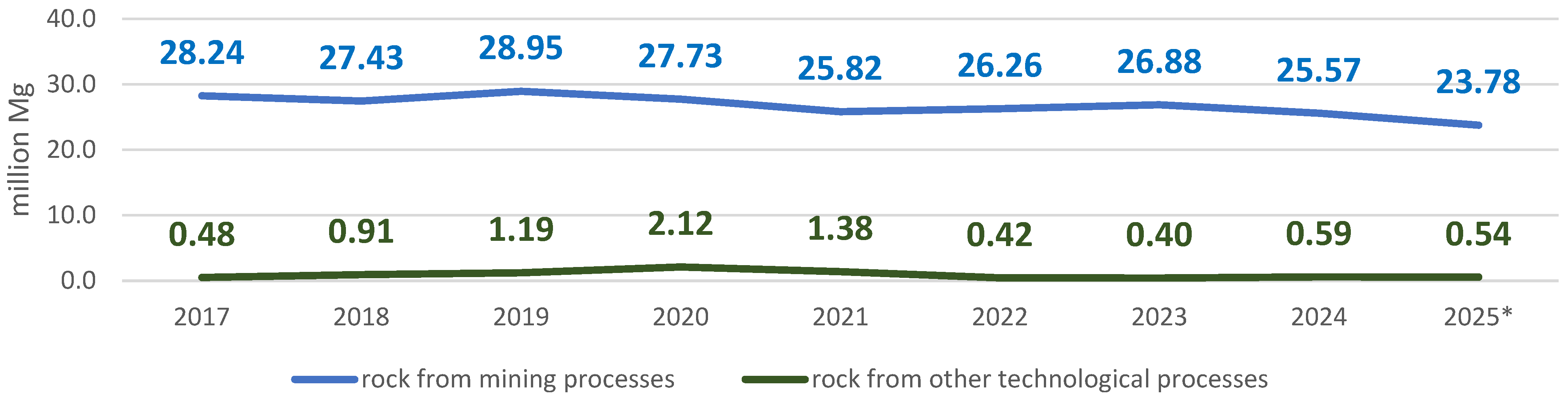
Total rock emissions consist of waste rock extracted along with coal spoil and rocks obtained in processes indirectly related to mining (
Figure 3,
Table A1). From January to September 2025 (Q1–Q3 2025), mines, along with coal spoil, extracted 17.8 million Mg of rock through shafts, which the mine’s enrichment plants separated from commercial coal, and 0.4 million Mg of rock from other mining processes. It is estimated that, if the quality of coal spoil remains constant, by the end of 2025, emissions from rocks extracted during processing processes will reach approximately 25.3 million Mg, plus approximately 0.54 million Mg of waste rock additionally extracted through mine shafts (
Figure 3,
Table A1). According to data reported by coal companies [
29], rock emissions directly related to mining are declining (
Figure 3,
Table A1). It is predicted that from 2017 to the end of 2025, annual emissions of rock mass and mining waste will decrease by 4.4 million Mg (15.8%). In contrast, emissions of rock mass from other mining processes have remained practically constant at approximately 0.5 million Mg since 2017. This is another disturbing phenomenon regarding rock mass emissions into the environment, considering the systematic reduction in the number of mining excavations in the rock surrounding the deposit (
Figure 3,
Table A1).
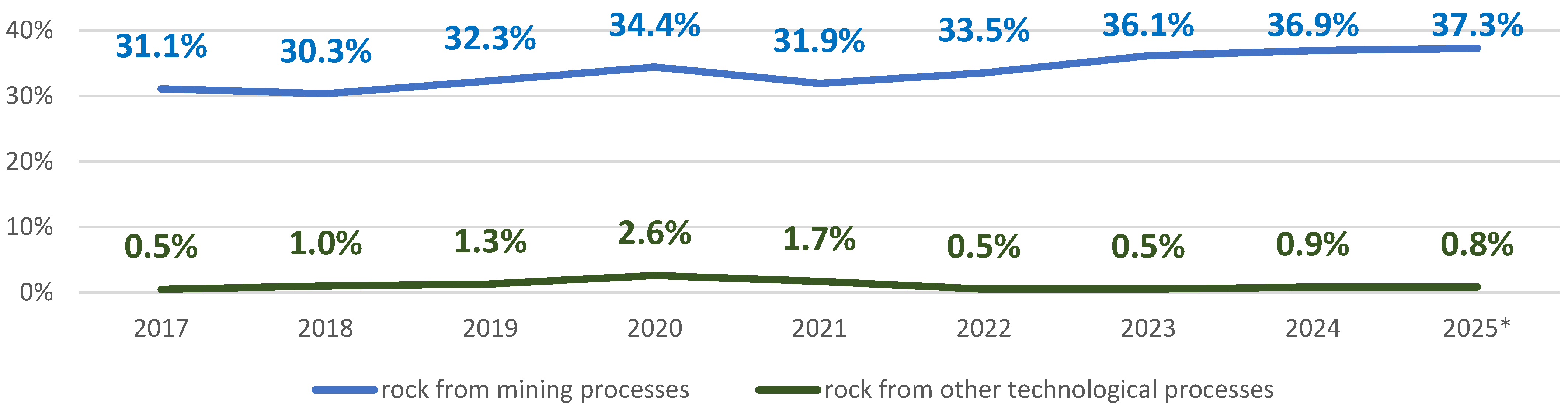
A much better way to describe the environmental problems of rock emissions from hard coal mining is to indicate the share of rock emissions in coal spoil output (
Figure 4,
Table A1). The analyzed data were obtained by dividing the rock emissions reported by coal companies (
Figure 3,
Table A1) by the volume of coal spoil output also reported by coal companies (
Figure 1,
Table A1). According to the analysis in
Figure 4, during Q1–Q3 2025, coal spoil output contained approximately 38% gangue, and an additional 0.84% gangue came from processes not directly related to mining, e.g., from development operations. Over the last nine years, the gangue content in coal spoil output has been systematically increasing. According to the forecast, after the period from January to September 2025 (Q1–Q3 2025), rock contamination of coal spoil output increased by 6.2 percentage points. This phenomenon may be partly due to mining in increasingly difficult mining and geological conditions, but it is also partly caused by the need to hold mining crews accountable for coal production [
26,
27]. This phenomenon intensified in 2020 during the COVID-19 pandemic, was limited the following year by mining supervision, but has been growing again since 2022 (
Figure 4,
Table A1).
The emission of rock masses from other mining processes as a percentage of coal spoil output has remained at a similar level of approximately 0.9% since 2017 (
Figure 4,
Table A1). It can be assumed that a more or less constant share of waste rock in the output is an acceptable phenomenon, resulting from properly conducted underground construction in mining plants. The increase in this indicator in 2020 and 2021 can be linked to the greater scope of excavations in the rocks surrounding the deposit, the so-called “stone excavations,” reported by mining companies [
29].
Mining companies report that some of the waste rock brought to the surface is utilized, while the rest is deposited on the surface (
Figure 5,
Table A1). As of January–September 2025 (Q1–Q3 2025), mines have managed approximately 13 million Mg of emitted rock, and approximately 4.6 million Mg of rock and mining waste have been stored on the surface. This allows us to estimate that by the end of 2025, approximately 18 million Mg of rock will be managed, and approximately 6.1 million Mg of waste rock will be disposed of in dumps. The amount of managed rock is decreasing year by year. The exception is 2019, when the volume of managed waste rock (
Figure 5,
Table A1) increased by approximately 0.8 million Mg of waste rock year-on-year (3.6% year-on-year). Throughout the analyzed period, the utilization of emitted rock masses decreased by approximately 3.4 million Mg (16.2%). A decrease in the utilization of emitted rock masses, expressed in absolute units while simultaneously reducing emissions, is no longer necessarily a negative phenomenon; at this stage, it is difficult to determine the nature of this phenomenon. The situation is different for rocks placed in waste heaps. For the last nine years, a similar volume of waste rock has been placed in heaps. This value fluctuates around 6.5 million Mg per year. Even at the stage of analyzing the information expressed in absolute values, it should be noted that with decreasing rock mass emissions, placing similar volumes in heaps is already unfavorable.
Figure 5 shows that both the volume of waste rock brought to the surface and the utilization of emitted waste rock are decreasing. When analyzing absolute values, the phenomenon of decreasing amounts of waste rock being utilized may be a concern.
Figure 6 presents the share of rock mass management in rock mass emissions. The analysis shows that the Polish hard coal mining industry manages approximately 75% of the emitted rock masses. In 2020 alone, “COVID restrictions” reduced the level of waste rock management by approximately 5 percentage points [
49]. To reduce rock mass emissions into the environment, it is necessary to further increase the management of at least some of the approximately 25% of rock masses located in dumps. Coal company management boards should seek additional opportunities to manage not only their current emissions but also the rock masses accumulated in dumps for many years [
1].
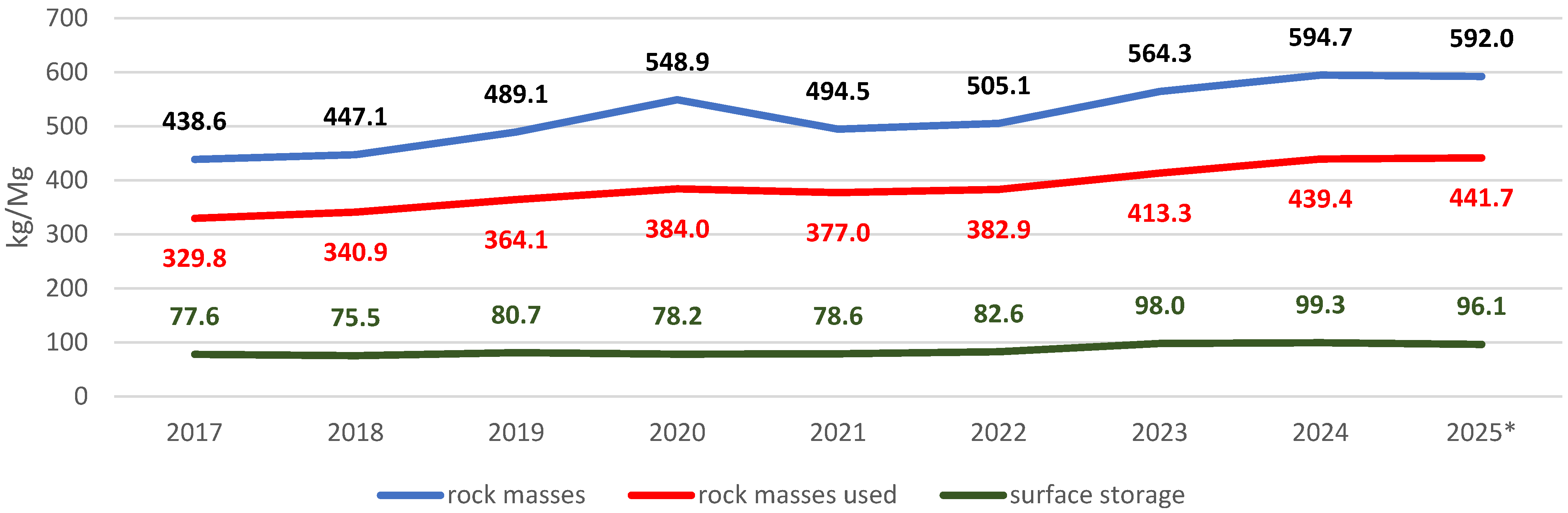
Given the faster decline in coal spoil output than in rock mass emissions, it can be assumed that the share of waste rock in the output is increasing. A more precise picture of this phenomenon is provided by analyzing the unit rock mass emissions per volume of coal output (
Figure 7,
Table A1). The analyzed value was obtained by dividing the annual volume of waste rock (
Figure 5,
Table A1) by the annual volume of coal spoil output (
Figure 1,
Table A1).
Figure 7 shows two unfavorable phenomena and one positive one. The unfavorable phenomenon is the increasing contamination of the output, as just highlighted. Considering the period from January to September 2025 (Q1–Q3 2025), it is estimated that by the end of the year, the share of waste rock in the coal spoil output will reach 592 kg/Mg. While this is 2.7 kg/Mg of coal spoil (CS) less than in 2024 (a 0.5% decrease year-on-year), it is 153.4 kg/Mg more than nine years ago (a 35% increase). Another unfavorable phenomenon is the individual disposal of waste rock in heaps, forecast for the end of 2025. As in the previous case, the share of rock disposed in heaps is forecasted to be approximately 3.2 kg/Mg lower than in 2024 (a 3.2% decrease year-on-year), but, as before, this small decrease does not change the overall upward trend over the last nine years by approximately 18.5 kg/Mg (a 24% increase). However, the estimated individual volume of rock mass management at the end of 2025 provides a good forecast. The unit value of developed rocks is not expected to decrease compared to 2024 but rather to increase by 2.3 kg/Mg (a 0.5% increase year-on-year). The projected increase in the share of developed rocks by the end of 2025 compared to 2017 will be approximately 111.9 kg/Mg (a 34% increase).
The observed increase in coal spoil contamination is partly due to mining in increasingly difficult mining and geological conditions while simultaneously exploiting increasingly less attractive seams [
3,
49]. The rapid increase in coal spoil contamination observed since 2023 can be explained by a factor that initially appears to be unrelated to the quality of the spoil. In 2022, a support system was launched, and subsidies for capacity reduction were introduced for some Polish hard coal producers.
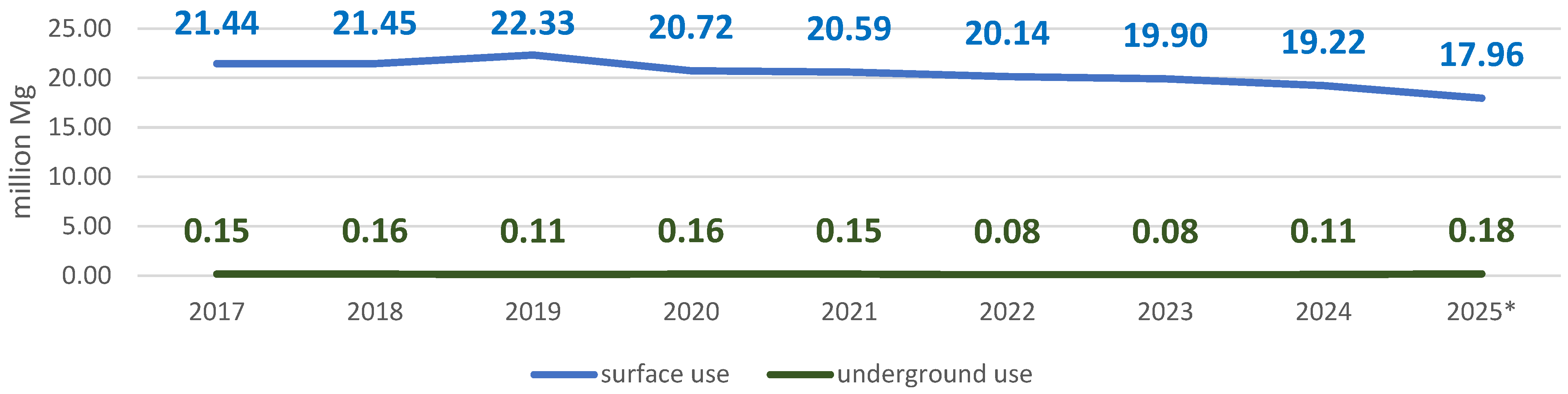
As previously described, mining waste management is primarily conducted on the surface but can also occur underground (
Figure 8,
Table A1). The management of rock emissions from the Polish hard coal mining industry must comply with EU legislation. Directive 2008/98/EC, applicable in European Union (EU) countries, requires mining companies to apply the waste management hierarchy in national regulations, including the Polish Waste Act. Derogations are permitted for certain waste streams if justified by the product’s life cycle. The hierarchy aims to minimize the impact of waste on the environment and improve resource management. The waste management hierarchy consists of five priority actions: prevention, preparation for reuse, recycling, other recovery methods (e.g., energy), and disposal (landfilling). In this context, the increased use of waste rock underground aligns with both Priority 1, “Prevention,” and Priority 5, “Disposal.”
An example of underground storage of rock masses is the mining technology of filling selected spaces with waste rock or sand mixed with waste rock. These technologies have been technically tested and proven effective in reducing surface emissions and limiting surface deformation caused by mining operations. However, for economic reasons, the use of externally supplied materials in the Polish mining industry has been discontinued since 2019. Over time, since 2017, surface rock mass management has declined, with a projected decline of 3.48 million Mg by the end of 2025. Underground management, meanwhile, has remained relatively constant at approximately 0.13 million Mg per year. The latter approach is preferable; however, only 0.6% (average from 2017 to 2024) of rock is managed underground. In 2025, it is projected that approximately 0.18 million Mg of waste rock will be managed underground, representing an increase of approximately 1% of the total managed rock mass. During the mining of hard coal, which is a sedimentary rock, the mined material becomes contaminated with rocks located directly in the roof or floor. Contaminating waste rock also includes sedimentary rocks, most commonly mudstones or claystones. These rocks fail to meet the increasingly stringent requirements for aggregates suitable for use in construction and engineering (primarily due to excessive waterlogging). This is one of the reasons for the declining avenues for the economic utilization of waste rocks.
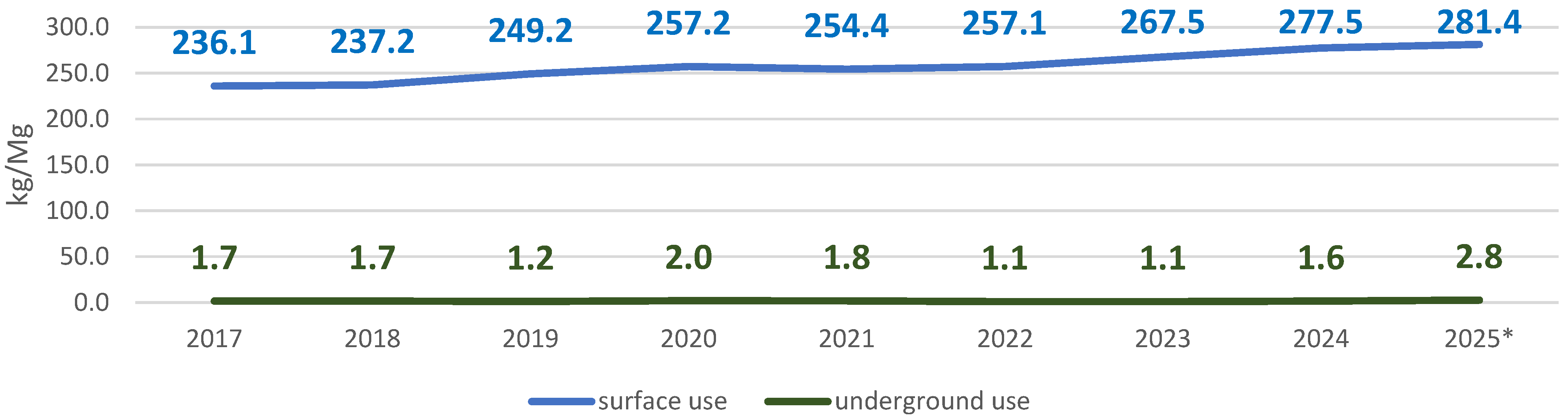
When analyzing the management of rock masses, the most important information is provided by comparing the management of rock masses relative to the volume of coal spoil production (
Figure 9,
Table A1). The desirable phenomenon is the increase in the individual use of rock masses on the surface. In the analyzed period, from 2017 to 2025, this indicator is expected to increase by approximately 45.3 kg/Mg. This corresponds to an increase of approximately 19%.
For underground rocks, the specific utilization rate during the analyzed period was approximately 1.6 kg/Mg. An interesting phenomenon is the increase in the specific utilization rate of underground rocks in 2020 and 2021. It is possible that due to the reduction in the number of employees at a single location due to COVID-19 restrictions, it was possible to allocate some of the crew to work that is usually less intensive. By the end of 2025, the specific utilization rate of underground rocks is projected to increase to approximately 2.8 kg/Mg, which is the highest value in recent years. It should also be noted that such a phenomenon is extremely desirable for reducing rock mass emissions to the surface [
49].
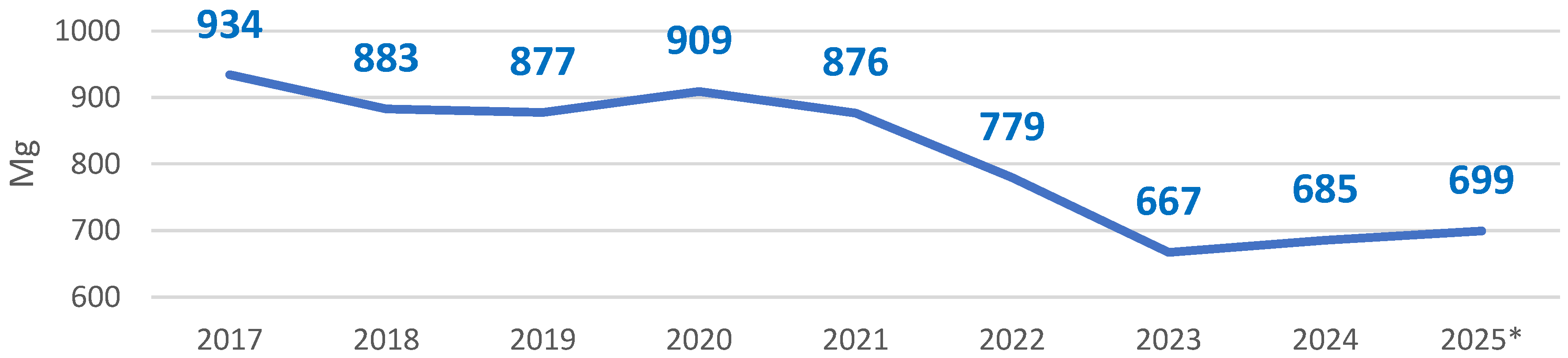
Another form of rock mass emissions to the surface is the discharge of dust generated during mining and dust used in mines as coal dust explosion prevention with ventilation air. By 2023, dust emissions from hard coal mines had decreased to 667 Mg (
Figure 10,
Table A1). Since that year, dust emissions have been increasing, and considering the first 9 months of 2025, it is forecasted that, by the end of December, they will reach approximately 700 Mg, a decrease of 235 Mg or approximately 25% [
29]. As previously noted, the increase in dust emissions from mine shafts may be caused by more frequent mining in thin seams, where, for technological reasons, it is necessary to partially mine rocks located in the roof or floor of mining excavations (so-called walls). This phenomenon may also result from the deliberate excavation of rocks surrounding the deposit to speed up shift mining operations, which is expressed in the amount of coal spoil extracted, regardless of its quality. This again suggests that coal company managements exercise greater diligence in enforcing the quality of work performed by mining crews.
As before, a clearer picture will emerge when analyzing the unit value of dust emissions per coal spoil output (
Figure 11,
Table A1). During the analyzed period, unit dust emissions from mine shafts oscillated around 10.2 g/Mg. The highest unit dust emission value of 11.3 g/Mg was recorded in 2020, when crews, under COVID restrictions, were widely mining the surrounding rocks. In the following years, a return to normality reduced dust emissions to 9 g/Mg in 2023. A similar phenomenon to that observed with rock mass emissions likely resulted in the forecast unit dust emissions to the atmosphere of approximately 11 g/Mg at the end of 2025 [
29].
Dust emissions into the environment occur when ventilation air is discharged through mine exhaust shafts [
17,
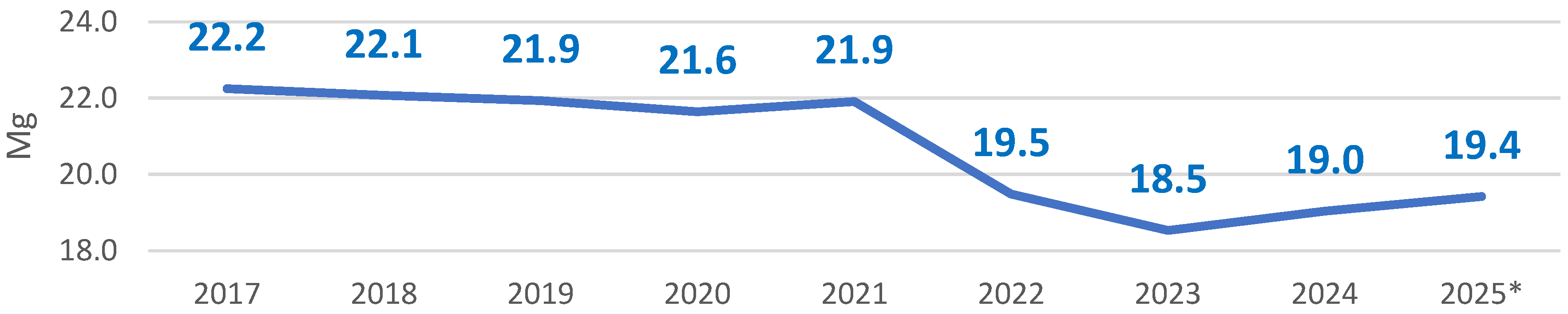
28]. These shafts are point emitters of dust into the atmosphere. Information on the level of emissions from shafts is crucial for residents. Fortunately for residents, exhaust shafts are usually located away from population centers due to the nuisance. However, some of the shafts are located near or even in residential areas. The average annual dust emission to the atmosphere per shaft resulting from mining operations remained at approximately 22 Mg until 2021 (
Figure 12,
Table A1). After a two-year period of dust emission reduction, the emission level has been increasing again since 2024, and by the end of 2025, the average exhaust shaft is projected to emit approximately 19.4 Mg of dust per year.
Mining is one of the most important sectors of the economy, as the mineral resources it extracts are used in all sectors of industry after processing. Mining activities are inextricably linked to environmental impacts, including landscape transformations and air quality. In recent years, the continued tightening of environmental protection requirements resulting from the European Green Deal and the pressure on businesses to reduce emissions have led to a number of measures in the Polish hard coal mining industry to minimize the impact of the extraction, processing, and use of mineral resources. The emission of rock masses into the environment by the hard coal mining industry, as analyzed in the study, indicates that it is only partially due to the volume of extraction conducted by the sector [
29]. Urgent reduction, and where possible, prevention of the escalation of the presented phenomena and problems by the management boards of mining companies, may increase the efficiency of extraction and have a positive impact on the environment affected by ongoing and completed mining operations [
40,
41]. The depletion and non-renewability of mineral resources necessitate their rational use and recycling, which will consequently reduce the pressure of mining on the environment. As a non-financial effect, an appropriate response of the mining community to the presented factors may improve the living conditions of local communities and counteract stereotypes related to the operation of the hard coal mining sector [
49].