


Abstract
Ecuador’s energy system, heavily reliant on hydropower, is increasingly exposed to climate-related disruptions. The 2023–2024 crisis triggered by a historic drought revealed critical structural weaknesses. During this period, the government implemented scheduled electricity rationing of up to 14 h per day in major cities and industrial zones. The blackouts led to cascading economic and social impacts, with an estimated economic toll of USD 2 billion from the energy crisis, equivalent to 2% of Ecuadorian GDP. Hence, this study aims to apply the LEAP model to quantitatively simulate demand, supply, and policy outcomes under two long-term scenarios through 2050. The findings underscore the urgent need for energy diversification, efficiency improvements, and decarbonization of the transport sector to enhance system resilience. The results offer actionable insights for building a more resilient and low-carbon energy future in Ecuador and in similar hydropower-dependent economies. Additionally, the analysis highlights that institutional reforms, technological modernization, and energy integration are essential to mitigating long-term climate risks. By incorporating scenario-based projections, this study provides evidence to guide public policy and investment decisions. These findings contribute to the broader discourse on sustainable energy transitions in vulnerable economies under climate stress.
1. Introduction
Ecuador, a country strategically located on the equator in South America, has made substantial strides in adopting renewable energy sources, particularly hydropower, which has represented approximately 70% of the national installed electricity capacity over the past decade (2015–2024) [1]. This transition was enabled by ambitious public investment, including USD 11.3 billion allocated to the development of 14 major hydroelectric projects between 2007 and 2017 [2,3].
Despite these advancements, Ecuador’s energy system is critically vulnerable due to its structural overreliance on hydropower, particularly in the broader context of intensifying climatic uncertainty [4]. Hydropower infrastructure is inherently dependent on stable hydrological cycles; climate change is increasingly disrupting these patterns through altered precipitation regimes, rising temperatures, and more frequent and prolonged droughts [5]. While structurally beneficial under normal climatic conditions, this dependence presents systemic risks in the face of erratic water availability [6].
These risks were exposed between 2023 and 2024, when Ecuador endured its most severe energy crisis in over six decades, caused by a drought that significantly reduced inflows to hydroelectric reservoirs and limited the operational capacity of the country’s major plants [7]. In response, the government implemented scheduled electricity rationing of up to 14 h per day, particularly from September to December in major cities and industrial zones [8]. The blackouts led to cascading economic and social impacts, including disruptions in industrial production, losses in commercial activity, and reductions in household productivity and quality of life. According to Ecuadorian reports, the economic toll of the energy crisis in 2024 alone amounted to USD 2 billion, equivalent to 2% of GDP [9,10].
The recent crisis in Ecuador exposed critical weaknesses in institutional design and energy governance frameworks. Although government-led emergency measures, such as increased electricity imports from Colombia and the optimization of thermal generation, helped stabilize the energy system by December 2024, they failed to address the root problem: the absence of a resilient and diversified energy grid [11].
This situation sparked a national debate over the need to reform Ecuador’s energy planning and climate adaptation strategies [10]. The 2023–2024 energy crisis in Ecuador, marked by severe blackouts, exposed vulnerabilities in the national energy system. The disruptions significantly affected economic activities, household well-being, and public services, highlighting the systemic risks of hydro-dependence under changing climatic conditions [12,13].
Against this background, several studies have applied the Long-range Energy Alternatives Planning (LEAP) model to analyze long-term energy transitions in developing countries with energy systems comparable to that of Ecuador. For example, LEAP-based assessments in Latin American countries with hydro-dependent power systems have been used to evaluate alternative policy scenarios focused on renewable energy diversification, emissions reductions, and energy security under different demand and climate assumptions [14]. These studies demonstrate the suitability of LEAP for integrating sectoral demand projections, supply options, and policy interventions in context characterized by climatic vulnerability similar to that faced by Ecuador [15].
Notwithstanding increasing global attention to the impacts of climate disruptions on energy systems, a critical knowledge gap persists regarding the specific vulnerabilities of hydropower-dependent countries such as Ecuador. Most regional energy studies tend to emphasize macroeconomic balances or technical infrastructure assessments, yet they often fail to incorporate climate scenarios, long-term policy planning, or resilience modeling in a comprehensive manner. This lack of integrative, forward-looking research constrains the ability of policymakers and institutions to anticipate systemic risks and design adaptive, robust frameworks for energy planning under conditions of uncertainty [16,17].
Ecuador presents a particularly relevant case of investigation due to its ambitious energy transition over the past decade and its continued reliance on hydropower nearly three-quarters of its electricity generation [18]. Although this transition was initially aligned with sustainability goals and international climate commitments, the recent energy crisis exposed the fragile foundation of this model. The crisis underscored the need for reflection on the country’s energy governance, infrastructure planning, and preparedness for climate variability.
In this context, this study aims to assess the structural vulnerabilities of Ecuador’s electricity system under increasing climate-related pressures through a scenario-based application of the Long-range Energy Alternatives Planning (LEAP) model up to 2050. The study makes two main contributions. First, it provides an empirical assessment of how recent climate-induced disruptions, exemplified by the 2023–2024 energy crisis, translate into long-term capacity requirements and system resilience challenges in a hydropower-dependent economy. Second, it develops and compares two policy-consistent scenarios that explicitly integrate generation mix targets, exogenous capacity expansion pathways, technology retirements, and energy efficiency improvements, thereby offering a reproducible framework for energy planning.
Finally, guided by these contributions, the analysis addresses the following research questions:
RQ1: How does Ecuador’s strong dependence on hydropower affect the long-term reliability and resilience of its electricity system under different development pathways?
RQ2: What are the implications of alternative energy scenarios for energy security and generation mix diversification toward 2050?
2. Materials and Methods
This study adopts an exploratory approach utilizing quantitative techniques to evaluate the interactions among energy diversification, population dynamics, institutional policies, and climate variability in Ecuador. A modeling strategy is implemented using the Long-range Energy Alternatives Planning (LEAP) platform, developed by the Stockholm Environment Institute, which facilitates the simulation of energy systems through dynamic scenario analysis [19].
The Long-range Energy Alternatives Planning system is a widely used bottom–up, scenario-based energy modeling framework designed to support integrated energy and climate policy analysis. LEAP operates through a modular structure that includes demand, transformation, and resource modules, allowing for the systematic representation of energy flows across the entire system [20]. One of its key features is the ability to evaluate alternative scenarios by modifying technological pathways, policy constraints, and efficiency assumptions, while consistently calculating energy balances and associated greenhouse gas emissions. This structure ensures transparency, internal consistency, and reproducibility in long-term energy system assessments [21].
In practical terms, LEAP represents the energy system through a hierarchical tree structure in which final energy demand is disaggregated by sector, subsector, and end-use, while the supply side is modeled through transformation modules that convert primary energy resources into usable electricity [22]. Demand is calculated using activity levels such as population growth, economic activity, or vehicle stock, combined with sector-specific energy intensity indicators, allowing consumption to evolve dynamically over time [23]. On the supply side, electricity generation is constrained by installed capacity, technology-specific efficiencies, capacity factors, and availability assumptions.
The simulation incorporates several data relationships. First, Equation (1) represents the conceptual relationship between how energy consumption, projected demand, installed capacity, and emissions interact over time or across specific scenarios, thereby supporting strategic energy planning by providing a comprehensive view of system dynamics.
To strengthen the methodological robustness of this study, the calculation model is explicitly supported by clearly defined underlying assumptions. These include demand growth rates, technology efficiency improvements, emission factors, and system constraints, which are consistently applied across all modeled scenarios. In addition, key scenario parameters such as the temporal horizon, policy constraints, and technological pathways are systematically incorporated within the LEAP modeling framework [24]. This structured approach enhances transparency, ensures internal consistency, and improves the scientific rigor and reproducibility of the modeling results.
Equation (1) is deliberately formulated as a conceptual expression rather than as an explicit analytical equation. It is intended to formalize the functional relationships among final energy demand, installed generation capacity, and associated emissions as represented within the LEAP modeling environment [25].
In this context, Equation (1) mirrors the internal structure of model, where energy balances and emission outcomes are computed through embedded demand forecasting routines, technology-specific efficiency parameters, capacity constraints, and emissions factors. These interactions are endogenously resolved by LEAP’s scenario-based simulation engine through iterative demand–supply reconciliation and accounting algorithms, rather than through a closed-form mathematical solution.
Within the LEAP framework, the interaction between energy demand, generation capacity, and emissions is resolved through an accounting-based simulation approach rather than through cost-optimization. For each modeled year, the platform first computes final electricity demand across all sectors and subsequently allocates generation across available technologies according to predefined dispatch rules and exogenous capacity constraints. Emissions are then calculated by linking fuel consumption to technology-specific emission factors [26]. This sequential resolution allows the model to capture structural system changes, including fuel switching, efficiency improvements, and technology phase-out, while maintaining transparency over the assumptions that drive scenario outcomes.
On the other hand, using quantitative methods and historical energy supply–demand data (2015–2024), the model relationships among consumption trends, installed capacity, greenhouse gas emissions by source, and regulatory impacts through the following equation.
In the second formula, Energy Pollution represents total greenhouse gas emissions. EC is the energy consumption of Ecuador; s denotes the consumption sector. Furthermore, EF is the emission factor of the greenhouse gases, f is the type of source related to the emissions, and in both cases, t is the time in years. Total emissions are obtained by summing across all sectors and fuels over time.
For clarity regarding units, Energy consumption is expressed in terajoules (TJ), Emission factors (EF) in kilograms of CO2-equivalent per terajoule (kg CO2e/TJ) by source used in Ecuador, and the resulting emissions in tons of CO2-equivalent (t CO2e). Emission factors are allowed to vary over time to capture changes in fuel quality, technological efficiency, and datasets that are integrated within the LEAP platform. The analysis considers CO2-equivalent emissions, including CO2, CH4, and N2O, aggregated using 100-year Global Warming Potentials in accordance with the Intergovernmental Panel on Climate Change guidelines [27].
Although not an explicit formula within LEAP, Equation (2) is derived from its emission estimation methodology, and constitutes an adapted expression based on the model’s emission method [26].
Specifically, it reflects the standard approach for estimating emissions based on energy consumption and emission factors across different sectors and fuel types over time. This representation serves to illustrate the structural interaction modeled within LEAP between consumption trends and their aggregated environmental impact [28].
Scenario construction in this study follows LEAP’s comparative scenario methodology, in which all scenarios share a common base year (2024) and an identical historical calibration, diverging only through changes in policy, technology, and behavioral assumptions over time. Each scenario modifies a consistent set of parameters, including electricity generation mix targets, capacity expansion schedules, technology retirement rules, energy efficiency improvements, and electric vehicle penetration trajectories.
Likewise, based on the integration of demand, capacity, and consumption equations within the platform, two principal energy development scenarios were defined, reflecting contrasting strategic approaches to Ecuador’s energy future [29]. These scenarios were developed at the discretion of the researchers, in alignment with national data trends, climate projections, and institutional planning assumptions, as summarized below.
- Energy Optimization and Renewable Support (EO&R): This scenario assumes the implementation of progressive energy policies aimed at maintaining a renewable share of 70% by 2050 in a diversified manner. It emphasizes investment in clean energy technologies, energy efficiency programs across key sectors, and infrastructure upgrades to support integration of intermittent renewable sources. It includes diversification of sources such as wind, solar, and biomass, as well as the integration of electric mobility and decentralized energy systems. The EO&R scenario is aligned with Ecuador’s international climate commitments and envisions an institutional shift toward sustainable, long-term planning.
- Business-as-Usual (B&U): In contrast, this scenario reflects a continuation of current energy system dynamics, characterized by limited regulatory reform, insufficient diversification of energy sources, and inertia in investment decision-making. The B&U model projects a fossil fuel-dominated grid with thermal generation reaching 50% of the energy grid by 2050, driven by sustained demand growth and minimal structural change. It assumes that the current inefficiencies and carbon-intensive technologies persist, exacerbating environmental impacts and increasing exposure to supply disruptions, market volatility, and possible emissions penalties. Under this trajectory, system resilience remains weak, leaving the national grid more vulnerable to climate-induced hydrological variability and long-term instability.
From both scenarios, the quoted percentages refer to the share of annual electricity generation (GWh) to 2050, rather than to installed capacity (MW). This choice is consistent with standard practice in long-term power system scenarios, where technology shares are reported in terms of electricity generated rather than installed capacity, because capacity shares do not reflect differences in power factors across technologies. Moreover, the scenarios are do not constitute least-cost optimizations but rather comparative assessment of policy-consistent pathways.
Capacity expansion pathways are specified exogenously for each generation technology and implemented in LEAP through linear interpolation between milestone years (2025–2050), as detailed in Appendix A. New capacity additions are defined in annualized MW/year terms for hydropower, solar photovoltaic, wind, biomass, and thermal sources.
Thermal power plant retirements are explicitly modeled based on an assumed technical lifetime of 30 years. Plants exceeding this age are progressively retired, with differentiated retirement rates under the EO&R and B&U scenarios. Retired capacity is replaced by new generation according to each scenario’s expansion strategy. Moreover, demand-side assumptions include improvements in energy efficiency, modeled as gradual reductions in final electricity demand relative to baseline growth.
Transport sector decarbonization is modeled through explicit electric vehicle (EV) penetration trajectories for the light-duty vehicle fleet, consistent with LEAP’s fuel-switching framework (Appendix A).
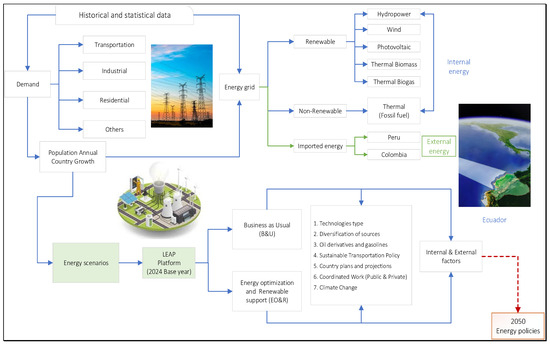
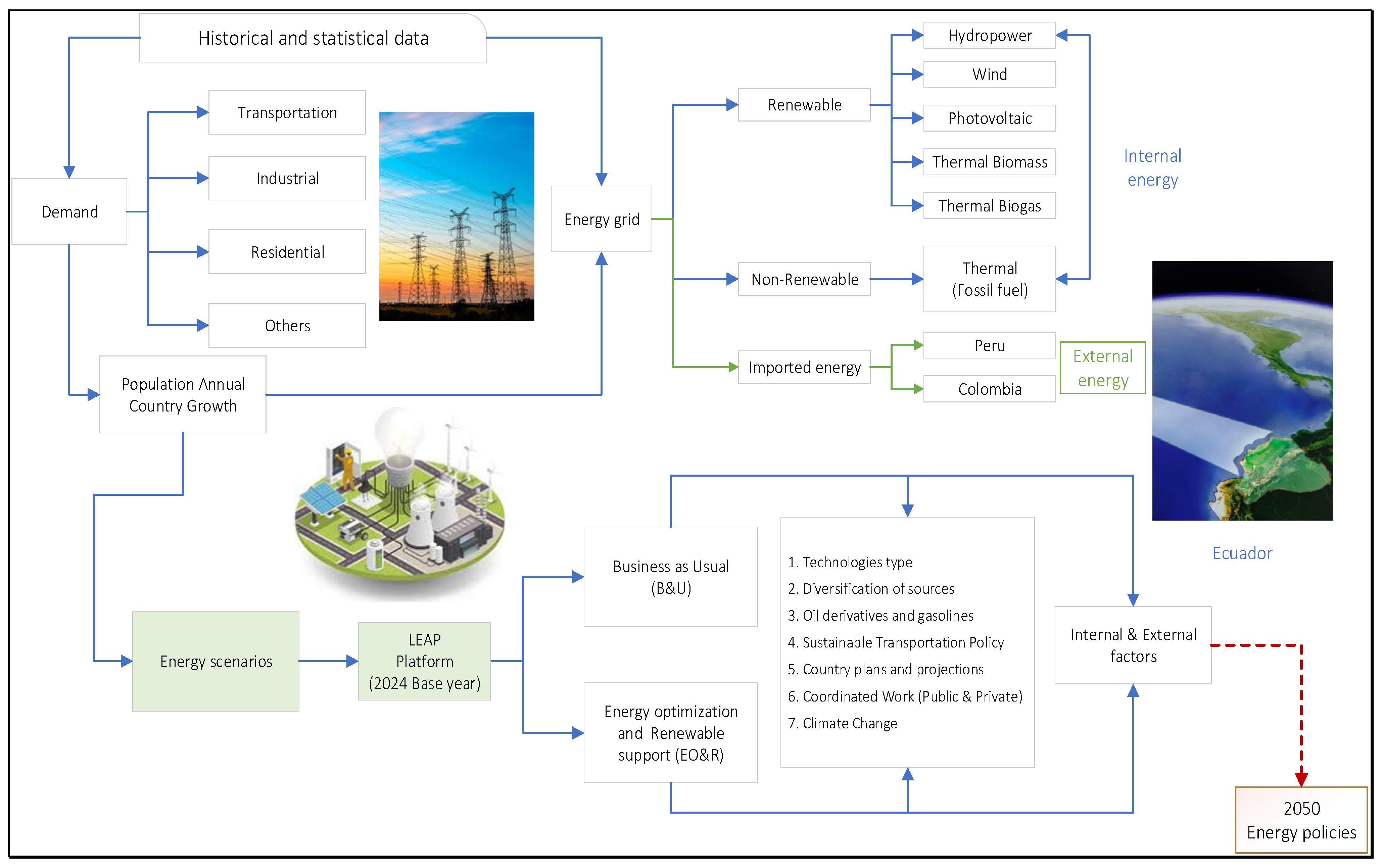
Both scenarios were designed using 2024 as the base year, projecting system behavior through 2050. The model incorporated official statistics from Ecuadorian national sources (Ministry of Energy and Electricity Agency), and sectoral growth projections to evaluate energy resilience under climate change conditions. Moreover, this methodology employs the LEAP platform version 2025.0.7 as the main integrated tool for energy planning and scenario projection [30], as illustrated in Figure 1.
Figure 1.
Methodological Framework for Ecuadorian Energy Planning under Climate Pressure.
The methodological framework illustrated in Figure 1 demonstrates the integration of key variables driving Ecuador’s energy planning scenarios. Historical and statistical data categorized by sectoral demand in transportation, industrial, residential, and other uses are combined with projections of annual population growth to inform a dynamic representation of the national energy grid [31]. This grid distinguishes between renewable, non-renewable, and imported sources (from Peru and Colombia), and the model incorporates additional systemic variables such as technology types, diversification of energy sources, transportation policies, country-level planning, and climate disruptions [32].
Moreover, the Long-range Energy Alternatives Planning platform is widely adopted by national governments and academic institutions for integrated energy–environment analysis. Its flexible, scenario-based structure allows researchers and policymakers to simulate energy demand, supply, and policy interventions under varying assumptions. Currently, LEAP is utilized by over 90 countries across national governments, academic institutions, and agencies, underscoring its credibility and global relevance [19,33].
In the context of this study, LEAP serves as an analytical framework to assess Ecuador’s energy system vulnerabilities [34]. In addition, the methodological framework adopted in this study is designed to be replicable across countries with similar energy system characteristics. By relying on a standardized LEAP structure, transparent assumptions, and scenario-based analysis, the approach can be readily adapted to other hydro-dependent and climate-vulnerable countries by adjusting national input data while preserving the overall modeling logic. This enhances the external validity of the results and supports their applicability beyond the Ecuadorian case.
To ensure reliable projections, the LEAP model was calibrated and validated using historical national energy data. Calibration consisted of aligning simulated outputs namely total electricity demand, and electricity generation by source with observed values for the period up to the base year (2024). Model performance was assessed for selected years between 2015 and 2024 to ensure consistency between observed trends.
Appendix B (Table A2, Table A3 and Table A4) presents a quantitative comparison by major sources and the model accuracy was evaluated using the Mean Absolute Percentage Error (MAPE), which remained below 4% across all indicators, indicating high model fidelity and robust replication of historical trends [35]. This calibration and validation process strengthens the internal consistency of the model, ensures that it adequately reflects the structural characteristics of the national power system, and enhances the credibility of subsequent scenario-based policy analyses [28].
3. Results
For the analysis, the evolution of energy demand in Ecuador across key economic sectors namely industrial, residential, transportation, and others was systematically examined over the period 2015 to 2024 (Table 1). This sectoral disaggregation allows for a granular understanding of how energy consumption patterns have shifted in response to demographic, technological, and policy developments. The transportation sector experienced the sharpest growth, indicating rising fuel dependency. In contrast, the industrial and residential sectors showed more moderate or even declining shares, suggesting potential saturation or efficiency gains in these areas [36,37].
Understanding sectoral energy consumption trends is essential for long-term energy planning, as each sector exhibits distinct consumption behaviors, sensitivities to price, and supply fluctuations. Moreover, these sectoral dynamics must be interpreted in conjunction with national population growth, urbanization, and economic activity, which collectively influence aggregate demand [38]. In this context, the historical data not only reveal consumption trends but also expose structural imbalances that could exacerbate energy security risks if left unaddressed, as shown in Table 1.
Table 1.
Energy Demand in Ecuador.
Table 1 illustrates a marked intensification in energy demand across Ecuador between 2015 and 2024, with the transportation sector showing the most significant growth when measured in barrels of oil equivalent (BOE). The energy consumption values expressed in BOE were converted to electricity demand (GWh) using standard conversion factors and national energy balances [40]. Moreover, sectoral shares correspond to the percentage contribution of each sector to total final electricity demand in each reference year. Population figures are reported to contextualize per capita demand trends. Finally, “Percentage of variation” is computed as the relative change between initial and final values for each period, as shown in Equation (3):
Over the data analyzed, the percentage of variation is the percentage of increase in any data; for example, the total national energy demand grew by approximately 33% from the last 10 years (2015–2024). Notably, a 26% increase occurred between 2020 and 2024, calculated using the same relative variation formula, indicating an accelerated trend observed in the last five-year period of the data. This accelerated growth rate suggests an unsustainable trajectory that, if maintained, could place substantial stress on existing energy infrastructure, elevate import dependency, and hinder progress toward climate mitigation targets [39,41].
In parallel with demand growth, it is essential to evaluate whether supply infrastructure has kept pace. The subsequent section (Table 2) examines trends in Ecuador’s effective installed generation capacity, disaggregated by energy source. This assessment provides insight into the country’s ability to respond to rising demand and highlights the critical need for strategic investments in diversification, modernization, and renewable energy integration to ensure long-term system resilience.
Table 2.
Effective installed capacity (MW) and Energy generated (GWh) of Ecuador.
Table 2 shows sustained growth in hydropower installations over the years. However, when comparing the capacity between 2020 and 2024, renewable energy only increased by 6% and thermal energy by 4%, reflecting an average total growth of 5% over the five years presented. In contrast, between 2015 and 2019, the growth in total energy installed was significantly higher, reaching 45% [39].
Using the available official information, a set of prospective scenarios was developed with a projection horizon extending to the year 2050. The base year selected for model calibration was 2024, corresponding to the most recent year with consolidated national energy data. The energy system was modeled using the LEAP platform, which enables a comprehensive representation of energy supply, transformation, and demand dynamics under different future conditions.
According to Ecuador’s National Energy Balance, in 2024, total gross energy production, including imports, reached 34,370 GWh, while net energy production amounted to 31,007 GWh. Of this total, 22,983 GWh (74.43%) originated from renewable energy sources, 6754 GWh (21.52%) from non-renewable sources, and 1270 GWh (4.05%) corresponded to energy imports from Colombia and Peru [37]. These values confirm the strong dependence of the Ecuadorian energy grid on renewable generation, particularly hydropower, while also evidencing the strategic role of regional interconnections in ensuring energy security.
In addition, according to the Central Bank of Ecuador, the population in 2024 was 18.25 million inhabitants, and Ecuador’s GDP reached USD 124 billion, growing by 2% compared to the previous year [42,43]. Additionally, according to Ecuador’s Second Nationally Determined Contribution of 2025, variations in precipitation and temperature were recorded. On the coast, precipitation increased by 33% and temperature by 0.6 °C; in the Sierra, precipitation increased by 13% and temperature by 1.1 °C, while in the Amazon, precipitation decreased by 1% and temperature rose by 0.9 °C [44].
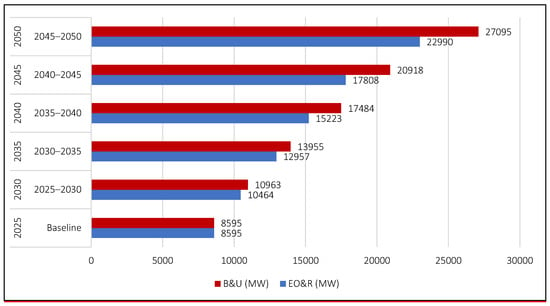
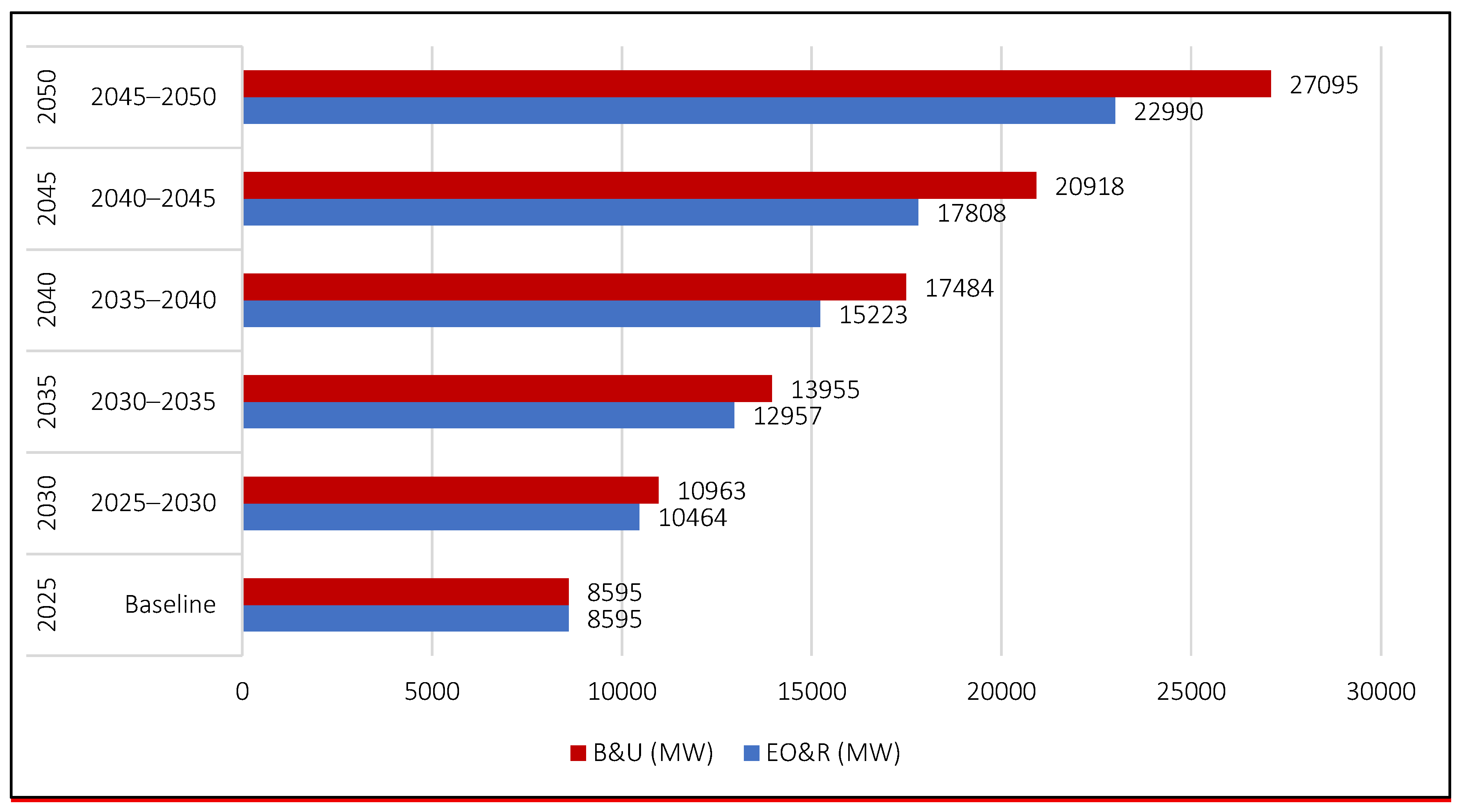
With these data defined, the trends were input to the platform, which processed two consumption scenarios in capacity (MW) required for the year 2050 related to the specified criteria (Figure 2) taking into account the following: Energy Optimization and Renewable Support (EO&R): a renewable grid of 70% of its total energy production, and the application of efficiency plans; Business as Usual (B&U): similar trends, with energy consumption that has a thermal source grid of 50% and the same consumption tendency of the actors, without improvements and remaining disorganized. The principal results indicate the minimum capacity of the Ecuadorian energy grid modeled in the LEAP platform.
Figure 2.
Energy capacity projection for Ecuador to 2050.
As shown in Figure 2, the LEAP modeling chart illustrates the projected minimum installed capacity requirements for Ecuador’s energy grid under two scenarios: Business-as-Usual and Energy Optimization & Renewables Support from 2025 to 2050. The graph shows a consistent upward trend in both scenarios, reflecting increasing energy demand over time. By 2050, the B&U scenario projects a requirement of 27,095 MW, whereas the EO&R scenario, which incorporates improved planning and resilience strategies, requires 22,990 MW, a finding which indicates potential efficiency gains of over 4000 MW from the most effective scenario compared with the less efficient scenario.
The divergence between the two scenarios widens significantly after 2035, highlighting the long-term benefits of adopting optimized and resilient energy strategies in terms of reduced infrastructure needs and potentially lower environmental impact.
However, a third, intermediate scenario linked to climate change could be developed to capture the heightened risk of supply disruptions and the potential need for emergency measures, such as temporary capacity additions or demand-side restrictions, in the absence of timely diversification. It could be called “Climate Stress & Energy Security Scenario”, although the uncertainty makes very difficult to evaluate the resilience of the Ecuadorian power system under adverse climate conditions and highlight the trade-offs between short-term supply security and long-term sustainability.
On the other hand, based on the recent energy problems (2024), a deficit of 1200 MW was identified due to the country’s dependence on hydroelectric energy, projections for Ecuador’s energy grid in 2050 were input into the model (Figure 2), and the following long-term recommendations were derived from the research:
- Technologies: In the medium term, Ecuador must deploy highly efficient fossil fuel or renewable energy systems to deliver at least 4350 MW of additional capacity to new projects by 2035 relative to the base year. To ensure supply reliability and reduce vulnerability to hydrological variability, installed capacity should grow at a conservative annual rate of 3% to 5%, reaching a minimum nominal capacity between 22,990 MW and 27,095 MW by 2050 under both modeled scenarios. Furthermore, a general recommendation is to increase the use of combined-cycle systems fueled by natural gas in thermal power plants to improve overall resource efficiency [45]. In the case of Ecuador, this strategy is particularly relevant given that the country operates fewer than 20 thermal plants nationwide, most of which are aging, diesel-based and concentrated mainly in the coastal region, providing limited backup capacity during hydrological shortages [46].
- Diversification: Ecuador possesses certified natural gas reserves in the Guayaquil Gulf, but exploitation has declined due to a lack of investment. Investment in well drilling is needed to increase natural gas production, and meet with the transportation sector. In 2024, production was 21 million cubic feet per day, but can increase to 60 million cubic feet per day, taking advantage of the proven reserves of 146 billion cubic feet in this field [47]. By comparison, increasing the availability of natural gas for power generation or transportation sector helps avoid the use of imported diesel, which costs between $15 and $20 per MMBtu, whereas domestically produced gas ranges from $3 to $5 per MMBtu. This recommendation could produce annual savings of $200 to $250 million in electricity generation [15].
- Derivatives and gasoline: Given that Ecuador is a crude oil exporter, in 2024, Ecuador’s average crude oil production was approximately 470,272 barrels per day; thus, it is urgent that it builds a new petrochemical fuel refining plant to meet the growing future demand for gasoline in the automotive sector [48]. At least 200 kBOE/day should be processed. However, at the same time, it is essential to develop new infrastructure to increase the use of alternative fuels such as Liquefied Petroleum Gas, Compressed Natural Gas, Liquefied Natural Gas, and biofuels in the automotive sector [49]. Around 60% of fuels (gasoline, diesel, and bunker) have been imported into Ecuador over the past five years. This dependency could be reduced at a lower cost by developing a domestic petrochemical industry.
- Sustainable Transportation Policy: Given that the transportation sector is the main energy consumer in Ecuador, it is necessary to promote a transition toward a transportation system with a lower impact on local pollution and emissions. This would translate into the implementation of automated public mass transit systems, such as subways in the main cities, and the creation of public transportation options with greater hourly capacity, and reducing individual mobility. Ecuadorian legislation also establishes the obligation to integrate electric vehicles into public transport systems. As an example, in the capital of Ecuador, there is a high-speed underground transport system with a high volume of people, whereas other cities continue to rely on outdated fossil-fueled bus systems.
- Country plans and projections: It is essential that society, as well as the transportation and industrial sectors, directly understand which technologies are most efficient, how to conserve energy resources, and how to implement energy-efficient strategies. This must be done while the country develops the necessary infrastructure to cover the energy deficit that caused the blackouts. Furthermore, it is crucial to understand how changes in population and energy policies influence consumption trends, economic growth, globalization, and other factors that affect demand. Additionally, international studies in comparable contexts highlight that the most electricity-intensive industrial sectors include cement production, steel manufacturing, plastics transformation, ceramics, and chemical industries. These sectors typically rely on high-temperature operations and energy-intensive equipment [50]. Therefore, these sectors should be given incentives to directly install their energy plants, thus relieving pressure on the Ecuadorian state.
- Multi-stakeholder coordination: For Ecuador, it is crucial that the government and the private sector work together to implement policies that promote investment in diversified energy sources. Regulatory reforms are currently underway; 2025 marked the start of private investment in energy systems, as previously only a public development model existed, which blocked investments of more than 10 MW. However, in any investment scenario, the government must implement streamlined regulatory procedures to attract timely and effective private investment. In addition, direct incentives should be proposed to the private energy sector that introduce diversified renewable energy, i.e., different from the direct renewable energy in Ecuador.
- Climate change: In all projected scenarios, hydropower is affected by seasonal changes, droughts, and temperature increases, which project efficiency reductions of 11% to 18% by 2050. As part of the solution to climate variations, Ecuador must adopt battery energy storage systems to store excess electricity and release it during peak demand, thereby improving grid stability, supporting the integration of renewable energy, reducing reliance on fossil fuels, and lowering both operational costs and emissions. In contrast, and given Ecuador’s abundant renewable natural resources, it is essential to diversify the 70% share of renewable energy by incorporating wind, solar photovoltaic, and geothermal power sources. This diversification would enhance energy system resilience.
For the last recommendation, the climate change impact on hydropower availability was represented through exogenous adjustments to hydropower capacity factors based on projected precipitation and temperature trends. Climate projections were derived from Ecuador’s Nationally Determined Contribution (NDC), which is based on an ensemble of regional climate model outputs under Representative Concentration Pathway (RCP) scenarios [51].
Nevertheless, all the long-term recommendations detailed are consistent with recent research highlighting the role of emerging renewable energy technologies and flexible system solutions in strengthening energy system resilience under climate and demand uncertainties [52].
Studies have shown that the integration of advanced solar and wind technologies, energy storage systems, and smart grid solutions can significantly enhance system reliability and reduce vulnerability to hydrological variability [53]. In the context of Ecuador, the incorporation of such technologies could complement hydropower-dominated systems, reduce exposure to climate-related risks, and support long-term energy security, as suggested by recent regional and international assessments [54].
Projected changes in precipitation and temperature were translated into hydropower energy availability using annual hydropower availability multipliers applied to baseline capacity factors. Specifically, gradual reductions in effective hydropower capacity factors were imposed to reflect reduced inflows and increased evaporation losses. By 2050, hydropower availability was reduced by 11% in the moderate climate impact case and by up to 18% in the severe climate impact case [51]. These reductions represent exogenous scenario assumptions informed by national climate projections rather than endogenous hydrological modeling.
4. Discussion
The results of this study highlight a critical divergence between two projected energy pathways for Ecuador: one rooted in a proactive shift toward energy optimization and renewable support (EO&R scenario), and another following a business-as-usual (B&U) trajectory. Maintaining a 70% share of renewables by 2050 would lead to only a 15% increase in emissions, largely attributable to population growth. In stark contrast, reverting to a fossil fuel-dependent grid (50% thermal) under the B&U scenario could increase emissions by up to 55%, further intensifying Ecuador’s vulnerability to climate and environmental stressors [28]. These findings align with a growing body of global research that emphasizes the importance of diversifying energy portfolios and implementing climate-resilient technologies to meet sustainability commitments [55].
Comparing these results with other simulation studies, Atiaja et al. developed a dynamic simulation of energy scenarios for Ecuador’s transportation sector in 2035 using VENSIM 6.0b to estimate total energy demand and pollutant emissions. Their findings indicate that aligning national transport policies with global mobility trends, particularly through the promotion of electric vehicle adoption, combined with strengthening the energy system via a more diversified energy grid, could significantly reduce both system vulnerabilities and emissions by 2035. This consistency across modeling approaches reinforces the robustness of policy-driven decarbonization pathways identified in the present study [56].
Beyond transport-related impacts, resilience at the system level emerges as a critical dimension of Ecuador’s energy transition. Pila et al. further analyzed the dynamics of Ecuador’s power system to assess its capacity to recover from variable and disruptive events. A representative electrical network composed of generators, transformers, and transmission lines was modeled using official data from Ecuador’s electricity sector, focusing on three substations in the southern segment of the national power system [57]. The results identified structural vulnerabilities and critical nodes, particularly under transient conditions driven by climate variability and external disturbances, showing strong consistency with the vulnerabilities highlighted by the LEAP-based projections in this investigation.
In a regional context, Ecuador’s energy challenges are emblematic of broader trends among hydropower-dependent economies in Latin America. Similar to experiences in Colombia and Brazil, where climate variability has disrupted hydroelectric output, Ecuador faces the compounded risk of seasonal droughts, aging infrastructure, and limited investment in alternative energy systems [58]. This reinforces the need to accelerate the integration of solar and wind power, both of which are abundant in Ecuador’s geography [59]. For instance, in Ecuador, the Galápagos and coastal zones offer high solar radiation, while the Andean and Amazonian regions present viable conditions for wind energy expansion.
Comparatively, countries such as Uruguay and Chile have already leveraged these resources to rapidly scale up renewable energy deployment, offering relevant benchmarks for Ecuador. In particular, their use of competitive renewable energy auctions, long-term power purchase agreements, and regulatory frameworks that facilitate private investment and grid integration provides policy and institutional lessons that could be adapted to the Ecuadorian context to support diversification and system resilience [60].
Sectoral energy consumption trends further underscore the need for targeted interventions. The transportation sector, which accounted for over 51% of total energy demand by 2024, is the primary driver of growth in fossil fuel consumption. This trajectory undermines climate mitigation goals and exposes the country to geopolitical and price volatility associated with imported fuels [61].
Studies such as Rivera-González (2020) have also flagged this sector as critical, recommending accelerated deployment of electric vehicles, modernization of public transit infrastructure, and development of alternative fuels such as compressed natural gas and biofuels [33]. In contrast, Laverde-Alvarracin in alignment with Ecuador’s imperative to develop sustainable and locally sourced transport fuels, assessed the energy performance of a bioethanol-based fuel derived from the mucilage of the CCN-51 cocoa variety, tested under controlled conditions in a combustion engine. The bioethanol produced from this feedstock was blended with Ecuador’s commercial Extra gasoline, resulting in a formulation that exhibited enhanced oxidation behavior. These results validate its technical feasibility as a viable domestic ethanol source for the national fuel landscape [62].
In addition, the findings of this study align closely with De la Cruz (2024), who employed the LEAP model to simulate the energy system of Peru which emphasizes environmental and economic trade-offs under renewable and non-renewable pathways; their results show that energy efficiency reduces demand and emissions in the short term. For Peru, despite limited development, geothermal energy emerges as a viable strategy for diversification [63]. The research highlights the need to combine efficiency measures with renewable energy expansion, similar results of our finding with the LEAP model that define a minimum of 70% diversified renewable energies.
In Colombia, projections of the energy system indicate the need to diversify the renewables, take advantage of renewable natural resources, but keep in mind that climate change affects energy systems, so it is recommended to have sufficient supplies to avoid supply problems. The results of this study are similar to those obtained using the LEAP model, which recommends strengthening the entire energy policy, outlining several steps for both decision-makers and policymakers [64,65].
Additionally, the relative stagnation in industrial and residential energy demand may mask underlying inefficiencies or data limitations. While modest growth in these sectors could reflect energy conservation or improved efficiency, it could also suggest constraints in access, affordability, or technological modernization factors that require further investigation [66]. Smart grid technologies, distributed generation, and digital monitoring tools offer promising solutions to improve demand management and resilience, particularly in residential zones and small-scale industry.
However, the robustness of LEAP-based modeling remains dependent on data quality and the assumptions embedded in scenario design. Nevertheless, the model’s accuracy remains contingent on data availability, the quality of assumptions, and periodic calibration [67]. Comparing these findings with prior studies with forecasting’s Carvajal and Li, strengthens the validity of the projected outcomes and confirms the structural risks associated with hydropower overdependence and the need of diversification [68].
Ultimately, this discussion points to the need for a paradigm shift in Ecuador’s energy planning one that emphasizes decentralization, and systemic integration. Coordinated action among public agencies, private investors, civil society, and international partners is vital to bridge existing infrastructure gaps and mobilize the capital needed for sustainable transformation. In tandem, policy efforts should focus on strengthening institutional capacity, improving technical education, and fostering a culture of energy responsibility among citizens. Only through such a multifaceted and inclusive approach can Ecuador transition toward a more secure, equitable, and climate-resilient energy future.
Beyond the technical feasibility demonstrated by LEAP modeling, the successful implementation of the proposed policy pathways depends critically on institutional, financial, and social feasibility. From an institutional perspective, Ecuador requires strengthened governance structures, clearer regulatory frameworks, and enhanced coordination between public authorities, and private investors. Financially, while the transition toward a diversified renewable energy grid entails substantial upfront investment, international climate finance mechanisms, public–private partnerships, and multilateral development funding offer viable pathways to mitigate fiscal constraints and distribute risk [69,70]. Social feasibility is equally decisive, as public acceptance, behavioral change, and stakeholder engagement particularly in the transportation, industrial, and residential sectors will influence the pace and durability of the transition. Integrating these institutional, financial, and social dimensions reinforces the sustainability tendencies.
Finally, as with any projection, LEAP modeling presents limitations. Despite providing a comprehensive national-level perspective, this study does not capture subnational disparities across Coastal, Sierra, and Amazon regions, which may reveal unique energy vulnerabilities. Furthermore, financial, institutional, and geopolitical constraints that could limit the feasibility of implementing the proposed solutions were not deeply analyzed.
5. Conclusions
This study provides a comprehensive assessment of Ecuador’s energy system vulnerabilities under increasing climate pressure, using the LEAP modeling framework to explore long-term development pathways through 2050. Beyond documenting the impacts of the 2023–2024 energy crisis, the research makes three main contributions: a conceptual contribution to energy planning under climate stress, an empirical contribution through scenario-based modeling, and a policy-oriented contribution relevant for hydropower-dependent economies.
To build a resilient energy system, Ecuador should install at least 4.3 GW of new capacity by 2035 and project a total installed capacity of between 23 and 27 GW by 2050. Maintaining a 70% renewable energy diversified share is essential to fulfill climate commitments while safeguarding energy security. In this context, Ecuador has a strategic opportunity to reposition its energy governance within a broader framework of regional integration and knowledge exchange. Establishing cooperative mechanisms, investments in renewable technologies, and harmonized policy strategies could significantly enhance the reliability and adaptability of the national energy grid, which can strengthen wind, solar and geothermal sources.
In terms of policy innovation, this study offers a set of integrated recommendations that move beyond technology-specific solutions. The results underscore the importance of aligning energy diversification, transport decarbonization, fuel infrastructure planning, and institutional reform within a single strategic framework. In particular, the analysis highlights the need for regulatory mechanisms that enable private investment, incentives for non-hydro renewables, and planning instruments that explicitly account for climate uncertainty. This integrated perspective contributes to policy debates by demonstrating how energy security, climate adaptation, and economic resilience can be jointly addressed rather than treated as separate policy domains.
Future research should focus on integrating real-time climate data into dynamic planning models such as LEAP, enabling more responsive and resilient decision-making in the face of increasing climatic uncertainty. This approach would ensure that Ecuador’s energy transition remains not only technically feasible and economically viable but also climate-informed and adaptable. Moreover, incorporating stakeholder (academic areas and private companies) engagement into these models could foster broader consensus and facilitate the implementation of sustainable energy policies.
Author Contributions
S.N.-S. conceptualized the study, designed the research framework, assembled and curated the data, conducted the formal analysis, and prepared the initial draft of the manuscript. D.J.P.-G. and E.A.J.-D. critically reviewed the conceptual and methodological aspects of the study, contributed to the interpretation of results, and participated in subsequent revisions and refinement of the manuscript. K.E.-S. and C.L.-A. developed and implemented the methodological approach, performed data simulation and scenario modeling, and contributed to the preparation of the final version of the manuscript. All authors have read and agreed to the published version of the manuscript.
Funding
This research received no external funding.
Institutional Review Board Statement
This study did not require ethical approval from any academic, private, or public institution, as it was conducted by an independent group of researchers focused on energy projection, and ethical review was not applicable because the study did not involve human participants or animals.
Data Availability Statement
The data supporting the findings of this study consist in Ecuadorian public energy data.
Acknowledgments
The authors express their gratitude to all the scholars referenced in this work for the time and effort devoted to their respective articles, theses, and papers.
Conflicts of Interest
All the authors declare no conflicts of interest.
Appendix A
Table A1.
Quantitative scenario assumptions used in LEAP to 2050.
Appendix B
Comparison between observed and modeled values (calibration and validation)
Appendix B.1
Table A2.
Calibration and validation of total electricity demand (selected years).
Appendix B.2
Table A3.
Calibration and validation of hydropower generation (selected years).
Appendix B.3
Table A4.
Calibration and validation of thermal generation (selected years).
References
- Araujo-Vizuete, G.; Robalino-López, A. A Systematic Roadmap for Energy Transition: Bridging Governance and Community Engagement in Ecuador. Smart Cities 2025, 8, 80. [Google Scholar] [CrossRef] [Scilit]
- Naranjo-Silva, S.; Romero-Bermeo, J. Coca Codo Sinclair Hydropower Plant: A time bomb in the energy sector for Ecuador or a successful project? Enfoque UTE 2025, 16, 26–37. [Google Scholar] [CrossRef] [Scilit]
- Viera-Romero, A.M. Beyond Blackouts: Analyzing Ecuador’s Energy Transition through the Multi-Level-Perspective. Energy Res. Soc. Sci. 2025, 129, 104400. [Google Scholar] [CrossRef] [Scilit]
- Godoy, J.C.; Cajo, R.; Estrada, L.M.; Hamacher, T. Multi-criteria analysis for energy planning in Ecuador: Enhancing decision-making through comprehensive evaluation. Renew. Energy 2025, 241, 122278. [Google Scholar] [CrossRef] [Scilit]
- Portalanza, D.; Ortega, C.; Garzon, L.; Bello, M.; Zuluaga, C.F.; Bresciani, C.; Durigon, A.; Ferraz, S. Projected Heat Waves in Ecuador under Climate Change: Insights from HadGEM-RegCM4 Coupled Model. Earth 2024, 5, 90–109. [Google Scholar] [CrossRef] [Scilit]
- Adu-Poku, A.; Siabi, E.K.; Otchere, N.O.; Effah, F.B.; Awafo, E.A.; Kemausuor, F.; Yazdanie, M. Impact of drought on hydropower generation in the Volta River basin and future projections under different climate and development pathways. Energy Clim. Change 2024, 5, 100169. [Google Scholar] [CrossRef] [Scilit]
- Valdivieso-García, K.; Vázquez-Patiño, A.; Saritama, H.; Contreras, J.; Avilés, A.; García, F. Influence of climate change on precipitation extremes in Ecuador. Clim. Change 2024, 177, 165. [Google Scholar] [CrossRef] [Scilit]
- Araujo-Vizuete, G.; Robalino-López, A.; Mena-Nieto, Á. Looking beyond subsidies: Understanding the complexity of household energy consumption dynamics of Ecuador’s main cities. Cities 2025, 163, 106008. [Google Scholar] [CrossRef] [Scilit]
- Portalanza, D.; Torres, M.; Rosso, F.; Zuluaga, C.F.; Durigon, A.; Horgan, F.G.; Alava, E.; Ferraz, S. Climate variability and change in Ecuador: Dynamic downscaling of regional projections with RegCM4 and HadGEM2-ES for informed adaptation strategies. Front. Clim. 2024, 6, 1344868. [Google Scholar] [CrossRef] [Scilit]
- Primicias. El Año en Que se Fue y Regresó la luz en Ecuador. 2024. Available online: https://www.primicias.ec/economia/crisis-electricidad-cortes-luz-resumen2024-86508/ (accessed on 5 August 2025).
- Icaza-Alvarez, D.; Jurado, F.; Østergaard, P.A.; Tostado-Véliz, M.; Flores, C. Cornerstones for greater participation of smart renewable energy on clustered islands: The case of Guayas in Ecuador towards 2050. Energy Rep. 2025, 13, 1350–1368. [Google Scholar] [CrossRef] [Scilit]
- Ghafoor, J.; Forio, M.A.E.; Nolivos, I.; Arias-Hidalgo, M.; Goethals, P.L.M. Model-based analysis of the impact of climate change on hydrology in the Guayas River basin (Ecuador). J. Water Clim. Change 2024, 15, 5021–5040. [Google Scholar] [CrossRef] [Scilit]
- Voz de América. Reducen Cortes de Energía en Ecuador, Pero Crisis Energética Parece Lejos de Llegar a su Fin. Available online: https://www.vozdeamerica.com/a/reducen-cortes-de-energia-en-ecuador-pero-crisis-energetica-parece-lejos-de-llegar-a-su-fin/7587628.html (accessed on 8 June 2024).
- Meng, L.; Li, M.; Asuka, J. A scenario analysis of the energy transition in Japan’s road transportation sector based on the LEAP model. Environ. Res. Lett. 2024, 19, 044059. [Google Scholar] [CrossRef] [Scilit]
- Rivera-González, L.M. Technical and Economic Study of the Gasification of Ecuador. Doctoral Thesis, Universidad Politécnica de Madrid, Madrid, Spain, 2020. [Google Scholar] [CrossRef] [Scilit]
- Vaca-Jiménez, S.; Gerbens-Leenes, P.W.; Nonhebel, S. The monthly dynamics of blue water footprints and electricity generation of four types of hydropower plants in Ecuador. Sci. Total. Environ. 2020, 713, 136579. [Google Scholar] [CrossRef] [Scilit] [PubMed]
- Hartmann, J. Climate Change and Hydropower Training Manual. AICCA Project, Ministry of the Environment and Water of Ecuador—CONDESAN. 2020. Available online: https://condesan.org/recursos/manual-entrenamiento-cambio-climatico-e-hidroenergia/ (accessed on 6 January 2026).
- Arcos–Aviles, D.; Salazar, A.; Rodriguez, M.; Martinez, W.; Guinjoan, F. Model predictive control-based energy management system for an isolated electro-thermal microgrid in the Amazon region of Ecuador. Energy Convers. Manag. 2024, 310, 118479. [Google Scholar] [CrossRef] [Scilit]
- Connolly, D.; Lund, H.; Mathiesen, B.V.; Leahy, M. A review of computer tools for analysing the integration of renewable energy into various energy systems. Appl. Energy 2010, 87, 1059–1082. [Google Scholar] [CrossRef] [Scilit]
- Abbas, Z.; Waqas, M.; Lun, Z.; Khan, S.S.; Amjad, M.; Larkin, S. Predicting energy consumption through the LEAP model based on LMDI technique along with economic analysis: A case study. Energy Explor. Exploit. 2023, 41, 1919–1941. [Google Scholar] [CrossRef] [Scilit]
- Zhang, C.; Luo, H. Research on carbon emission peak prediction and path of China’s public buildings: Scenario analysis based on LEAP model. Energy Build. 2023, 289, 113053. [Google Scholar] [CrossRef] [Scilit]
- Stevanato, N.; Rocco, M.V.; Giuliani, M.; Castelletti, A.; Colombo, E. Advancing the representation of reservoir hydropower in energy systems modelling: The case of Zambesi River Basin. PLoS ONE 2021, 16, e0259876. [Google Scholar] [CrossRef] [Scilit]
- Golfam, P.; Ashofteh, P.-S. Environmental-economic analysis of regional energy system under different supply and demand side scenarios with LEAP model. Environ. Dev. Sustain. 2024, 17, 1–22. [Google Scholar] [CrossRef] [Scilit]
- Cai, L.; Luo, J.; Wang, M.; Guo, J.; Duan, J.; Li, J.; Li, S.; Liu, L.; Ren, D. Pathways for municipalities to achieve carbon emission peak and carbon neutrality: A study based on the LEAP model. Energy 2023, 262, 125435. [Google Scholar] [CrossRef] [Scilit]
- Feng, D.; Xu, W.; Gao, X.; Yang, Y.; Feng, S.; Yang, X.; Li, H. Carbon Emission Prediction and the Reduction Pathway in Industrial Parks: A Scenario Analysis Based on the Integration of the LEAP Model with LMDI Decomposition. Energies 2023, 16, 7356. [Google Scholar] [CrossRef] [Scilit]
- Villaprado, Y.T.; Cadena-Barrera, J.; Castro-Verdezoto, P.; Ortega-Pacheco, D. Energy forecast of Ecuador’s Tertiary Sector to 2040 Using the LEAP Model. EASI Ing. Cienc. Apl. Ind. 2025, 4, 1–8. [Google Scholar] [CrossRef] [Scilit]
- Dall-Orsoletta, A.; Uriona-Maldonado, M.; Dranka, G.; Ferreira, P. A review of social aspects integration in system dynamics energy systems models. Int. J. Sustain. Energy Plan. Manag. 2022, 36, 33–52. [Google Scholar] [CrossRef] [Scilit]
- Feng, H.; Wang, R.; Zhang, H. Research on Carbon Emission Characteristics of Rural Buildings Based on LMDI-LEAP Model. Energies 2022, 15, 9269. [Google Scholar] [CrossRef] [Scilit]
- Espinoza-Andaluz, M.; Melo Vargas, E.; Santana-Villamar, J.; Encalada Dávila, Á.; Ordóñez-Saca, B.M. Congress on Research, Development, and Innovation in Renewable Energies. In Green Energy and Technology; Springer Nature: Cham, Switzerland, 2024. [Google Scholar] [CrossRef] [Scilit]
- Stockholm Environment Institute. Long-Range Energy Alternatives Planning Platform; Stockholm Environment Institute: Stockholm, Sweden, 2026. [Google Scholar]
- Arévalo, P.; Cano, A.; Jurado, F. Large-scale integration of renewable energies by 2050 through demand prediction with ANFIS, Ecuador case study. Energy 2024, 286, 129446. [Google Scholar] [CrossRef] [Scilit]
- Cevallos, B.; Urquizo, J. Spatial national multi-period long-term energy and carbon planning scenarios in Ecuador’s electric system. J. Environ. Manag. 2024, 370, 122010. [Google Scholar] [CrossRef] [Scilit]
- Rivera-González, L.; Bolonio, D.; Mazadiego, L.F.; Naranjo-Silva, S.; Escobar-Segovia, K. Long-term forecast of energy and fuels demand towards a sustainable road transport sector in Ecuador (2016–2035): A LEAP model application. Sustainability 2020, 12, 472. [Google Scholar] [CrossRef] [Scilit]
- Aguirre, W.E.; Alvarez-Mieles, G.; Anaguano-Yancha, F.; Morán, R.B.; Cucalón, R.V.; Escobar-Camacho, D.; Jácome-Negrete, I.; Prado, P.J.; Laaz, E.; Miranda-Troya, K.; et al. Conservation threats and future prospects for the freshwater fishes of Ecuador: A hotspot of Neotropical fish diversity. J. Fish Biol. 2021, 99, 1158–1189. [Google Scholar] [CrossRef] [Scilit]
- Guayanlema, V.; Martínez-Gómez, J.; Fontalvo, J.; Espinoza, V.S. Modeling the Benefits of Electric Cooking in Ecuador: A Long-Term Perspective. Processes 2024, 12, 2400. [Google Scholar] [CrossRef] [Scilit]
- Briones-Hidrovo, A.; Uche, J.; Martínez-Gracia, A. Estimating the hidden ecological costs of hydropower through an ecosystem services balance: A case study from Ecuador. J. Clean. Prod. 2019, 233, 33–42. [Google Scholar] [CrossRef] [Scilit]
- Ministry of Energy and Non-Renewable Resources of Ecuador. National Energy Balance of Ecuador. Quito. 2024. Available online: www.recursosyenergia.gob.ec (accessed on 1 February 2026).
- Llamosas Del Puerto, M.C. Exploring the Energy Security and Justice Implications of Large Transboundary Hydropower Dams. Ph.D. Thesis, University of Sussex, Brighton, UK, 2023. Available online: https://sussex.figshare.com/articles/thesis/Exploring_the_energy_security_and_justice_implications_of_large_transboundary_hydropower_dams/25040186?file=44178602 (accessed on 8 October 2025).
- Electricity Regulation and Control Agency of Ecuador. Statistical Information System for the Electricity Sector of Ecuador 2024, Quito. 2024. Available online: https://arconel.gob.ec/publicaciones-estadistica-del-sector-electrico-2/ (accessed on 10 April 2025).
- Electricity Regulation and Control Agency of Ecuador. Statistical Information System for the Electricity Sector of Ecuador 2023, Statistics of the Ecuadorian Electricity Sector. Available online: https://arconel.gob.ec/publicaciones-estadistica-del-sector-electrico-2/ (accessed on 31 May 2025).
- Naranjo-Silva, S. A hydropower development perspective in Ecuador: Past, present, and future. Granja 2024, 39, 63–77. [Google Scholar] [CrossRef] [Scilit]
- Senent-Aparicio, J.; Peñafiel, L.; Alcalá, F.J.; Jimeno-Sáez, P.; Pérez-Sánchez, J. Climate change impacts on renewable groundwater resources in the andosol-dominated Andean highlands, Ecuador. Catena 2024, 236, 107766. [Google Scholar] [CrossRef] [Scilit]
- The World Bank. GDP per Capita (Current US$). Available online: https://data.worldbank.org/indicator/NY.GDP.PCAP.CD?end=2020&locations=BR-EC-CO&start=2000&view=chart (accessed on 15 January 2026).
- Ministry of Environment of Ecuador. Second Nationally Determined Contribution of Ecuador, Quito. 2025. Available online: https://www.planificacion.gob.ec/ecuador-ratifico-su-compromiso-con-la-mitigacion-y-adaptacion-al-cambio-climatico-a-traves-de-su-segunda-ndc/ (accessed on 5 August 2025).
- Khatri, D.; Pandey, V.P.; Lamsal, G.R.; Baniya, R. Climate change impact on hydropower generation and adaptation through reservoir operation in a Himalayan river, Tamor. J. Water Clim. Change 2024, 15, 4631–4646. [Google Scholar] [CrossRef] [Scilit]
- Jaramillo, L.M.; Díaz-Sinche, D. Advancing Electric Mobility in Andean Countries: A Systematic Review and Case Study of Ecuador. Sustainability 2025, 17, 8075. [Google Scholar] [CrossRef] [Scilit]
- Ortiz, D.; Calderón, D.; Viloria, A.; Ricaurte, M. A Techno-Economic Analysis of Natural Gas Valuation in the Amazon Region to Increase the Liquefied Petroleum Gas (LPG) Production in Ecuador. Resources 2023, 12, 91. [Google Scholar] [CrossRef] [Scilit]
- Villamarín-Jácome, A.; Saltos-Rodríguez, M.; Espín-Sarzosa, D.; Haro, R.; Villamarín, G.; Okoye, M.O. Deploying renewable energy sources and energy storage systems for achieving low-carbon emissions targets in hydro-dominated power systems: A case study of Ecuador. Renew. Energy 2025, 241, 122198. [Google Scholar] [CrossRef] [Scilit]
- Lala, J.O.; Mora, H.C.; Garzón, N.O.; Vega, J.; Ohishi, T. Examining the Evolution of Energy Storing in the Ecuadorian Electricity System: A Case Study (2006–2023). Energies 2024, 17, 3500. [Google Scholar] [CrossRef] [Scilit]
- Galindo, S.P.; Borge-Diez, D.; Icaza, D. Energy sector in Ecuador for public lighting: Current status. Energy Policy 2022, 160, 112684. [Google Scholar] [CrossRef] [Scilit]
- Naranjo-Silva, S.; Punina-Guerrero, D.; Rivera-Gonzalez, L.; Escobar-Segovia, K.; Barros-Enriquez, J.D.; Almeida-Dominguez, J.A.; del Castillo, J.A. Hydropower Scenarios in the Face of Climate Change in Ecuador. Sustainability 2023, 15, 10160. [Google Scholar] [CrossRef] [Scilit]
- Castro-Diaz, L.; Lopez, M.C.; Moore, S.; Radonic, L.; Hodbod, J.; Moran, E. Multidimensional and multitemporal energy injustices: Exploring the downstream impacts of the Belo Monte hydropower dam in the Amazon. Energy Res. Soc. Sci. 2024, 113, 103568. [Google Scholar] [CrossRef] [Scilit]
- Salazar, A. Characterization of the RSU thermal potential, for the generation of Electric Energy, using Hydrothermal carbonization. Ingenius 2023, 2023, 58–65. [Google Scholar] [CrossRef] [Scilit]
- Hunt, J.D.; Nascimento, A.; Zakeri, B.; Ilyas, A.; Ramos, D.S.; Kuriqi, A.; Tolmasquim, M.T.; de Freitas, M.A.V.; Brandão, R.; Wada, Y. Optimizing hydropower generation with reservoir level management in humid regions. Energy Rep. 2025, 13, 856–864. [Google Scholar] [CrossRef] [Scilit]
- Chengot, R.; Zylberman, R.; Momblanch, A.; Salazar, O.V.; Hess, T.; Knox, J.W.; Rey, D. Evaluating the impacts of agricultural development and climate change on the water-energy nexus in Santa Elena (Ecuador). Environ. Sci. Policy 2024, 152, 103656. [Google Scholar] [CrossRef] [Scilit]
- Atiaja, J.; Arroyo, F.; Hidalgo, V.; Erazo, J.; Remache, A.; Bravo, D. Dynamic Simulation of Energy Scenarios in the Transition to Sustainable Mobility in the Ecuadorian Transport Sector. Sustainability 2024, 16, 6640. [Google Scholar] [CrossRef] [Scilit]
- Pila, D.; Quinatoa, C.; Camacho, L.; Vaca, J. Transient Stability Analysis of the Ecuadorian Electrical System: Case of the Southern Segment. WSEAS Trans. Power Syst. 2024, 19, 360–373. [Google Scholar] [CrossRef] [Scilit]
- Peña-Murillo, R.; Lavado-Casimiro, W.; Bourrel, L. Impacts of LULC and climate change on runoff and sediment production for the Puyango-Tumbes basin (Ecuador-Peru). Front. Remote. Sens. 2024, 5, 1471144. [Google Scholar] [CrossRef] [Scilit]
- Hidrovo, A.B.; Uche, J.; Martínez-Gracia, A. Accounting for GHG net reservoir emissions of hydropower in Ecuador. Renew. Energy 2017, 112, 209–221. [Google Scholar] [CrossRef] [Scilit]
- Icaza, D.; Borge-Diez, D.; Galindo, S.P. Analysis and proposal of energy planning and renewable energy plans in South America: Case study of Ecuador. Renew. Energy 2022, 182, 314–342. [Google Scholar] [CrossRef] [Scilit]
- Zalakeviciute, R.; Diaz, V.; Rybarczyk, Y. Impact of City-Wide Diesel Generator Use on Air Quality in Quito, Ecuador, during a Nationwide Electricity Crisis. Atmosphere 2024, 15, 1192. [Google Scholar] [CrossRef] [Scilit]
- Laverde-Albarracín, C.; González, J.F.G.; Cano, B.L.; Suero, S.R.; Villarroel-Bastidas, J.; Peña-Banegas, D.; Puente-Bosquez, S.; Naranjo-Silva, S. Comparing Ecuadorian Cocoa Mucilage-Based Bio-Ethanol and Commercial Fuels Toward Their Performance and Environmental Impacts in Internal Combustion Engines. Energies 2025, 18, 6378. [Google Scholar] [CrossRef] [Scilit]
- De la Cruz Torres, D.G.; Mazadiego, L.F.; Bolonio, D.; Pons-Esparver, R.R. Long-Term Forecast of Energy Demand towards a Sustainable Future in Renewable Energies Focused on Geothermal Energy in Peru (2020–2050): A LEAP Model Application. Sustainability 2024, 16, 4964. [Google Scholar] [CrossRef] [Scilit]
- Arango-Aramburo, S.; Turner, S.W.; Daenzer, K.; Ríos-Ocampo, J.P.; Hejazi, M.I.; Kober, T.; Álvarez-Espinosa, A.C.; Romero-Otalora, G.D.; van der Zwaan, B. Climate impacts on hydropower in Colombia: A multi-model assessment of power sector adaptation pathways. Energy Policy 2019, 128, 179–188. [Google Scholar] [CrossRef] [Scilit]
- Telli, A.; Kırısık, A.; Quaranta, E.; Kuriqi, A.; Kasiulis, E.; Muntean, S. Hydropower’s Role in Enhancing Energy Justice: Preliminary Insights from the EU and Turkey. IOP Conf. Ser. Earth Environ. Sci. 2025, 1442, 012009. [Google Scholar] [CrossRef] [Scilit]
- Naranjo-Silva, S.; Punina-Guerrero, D.; Barros-Enriquez, J.; Almeida-Dominguez, J.; del Castillo, J.A. Hydropower Development in Three South American Countries: Brazil, Colombia, and Ecuador. Iran. J. Energy Environ. 2023, 14, 102–110. [Google Scholar] [CrossRef] [Scilit]
- Naranjo-Silva, S.; Punina-Guerrero, D.J.; Jacome-Dominguez, E.A. Perceptions of Four Rural Communities Regarding the Largest Hydropower Project in Ecuador: The Case of Coca Codo Sinclair. Limnol. Rev. 2025, 25, 52. [Google Scholar] [CrossRef] [Scilit]
- Carvajal, P.E.; Li, F.G.N.; Soria, R.; Cronin, J.; Anandarajah, G.; Mulugetta, Y. Large hydropower, decarbonisation and climate change uncertainty: Modelling power sector pathways for Ecuador. Energy Strat. Rev. 2019, 23, 86–99. [Google Scholar] [CrossRef] [Scilit]
- Mekonnen, T.W.; Teferi, S.T.; Kebede, F.S.; Anandarajah, G. Assessment of Impacts of Climate Change on Hydropower-Dominated Power System—The Case of Ethiopia. Appl. Sci. 2022, 12, 1954. [Google Scholar] [CrossRef] [Scilit]
- Roni, M.; Mosier, T.; Li, B.; Alam, S.S.; Durvasulu, V.; Lawson, B.; Steindorf, D.; Pracheil, B.; Chalishazar, V. Hydropower flexibility valuation tool for flow requirement evaluation. Energy Rep. 2023, 9, 217–228. [Google Scholar] [CrossRef] [Scilit]

Disclaimer/Publisher’s Note: The statements, opinions and data contained in all publications are solely those of the individual author(s) and contributor(s) and not of MDPI and/or the editor(s). MDPI and/or the editor(s) disclaim responsibility for any injury to people or property resulting from any ideas, methods, instructions or products referred to in the content. |
© 2026 by the authors. Licensee MDPI, Basel, Switzerland. This article is an open access article distributed under the terms and conditions of the Creative Commons Attribution (CC BY) license.