


Abstract
As a key production factor in the era of the intelligent economy, Artificial Intelligence is profoundly reshaping the production methods and energy usage structures of the manufacturing industry. Based on the data of 55 economies from 2002 to 2020, this paper systematically examines the impact and mechanism of AI on carbon emissions embodied in manufacturing production from the perspective of the intelligent economy. The results show that AI presents an “inverted U-shaped” characteristic in relation to carbon emissions embodied in manufacturing production, that is, it has a “carbon-increasing” effect in the early stage and a “carbon-reducing” effect in the later stage. This conclusion remains valid after a series of robustness tests. Mechanism analysis indicates that AI jointly affects carbon emissions embodied in manufacturing production by improving the technical level of manufacturing production and energy utilization efficiency, but there is certain national heterogeneity in the relevant transmission paths, with green inflection points appearing earlier in developed countries. Heterogeneity analysis shows that AI first reduces and then expands the carbon emission gap between different manufacturing industries, and at the same time, the carbon reduction effect on industries varies significantly due to differences in technical gaps, production energy consumption, and the status of intelligent applications. Therefore, China should accelerate the promotion and application of AI in the manufacturing industry, enhance the transmission effect of the manufacturing industry’s production technology level and energy utilization efficiency on carbon emission reduction in the manufacturing industry, and at the same time, rationally plan the industrial layout of AI investment to fully release the carbon emission reduction capacity of AI.
1. Introduction and Literature Review
In recent years, extreme climate events have occurred frequently worldwide. Natural disasters such as floods, droughts, and typhoons have severely impacted human society and the ecological environment. These environmental issues not only threaten the development of local regions but also pose challenges to the survival and security of all humanity. To address this increasingly severe climate crisis, governments worldwide have put forward carbon neutrality goals, aiming to lower global greenhouse gas emissions and mitigate the worsening impacts of climate change. Although the manufacturing sector serves as a fundamental pillar of the global economy by supporting economic growth and employment, its long-standing dependence on extensive inputs and energy-intensive production has resulted in comparatively low efficiency, positioning it as one of the principal sources of carbon emissions (CE). Existing evidence indicates that carbon emissions from the manufacturing industry account for nearly a quarter of global total emissions. Accordingly, the control of manufacturing-related carbon emissions is essential for realizing global carbon neutrality.
Currently, a new generation of digital technologies represented by Artificial Intelligence (AI) is deeply integrated into manufacturing production systems, driving the transformation of traditional industrial systems towards the Intelligent Economy. The Intelligent Economy not only represents a fundamental restructuring of production methods, organizational forms, and factor structures but has also become a key force driving global economic growth and improving total factor productivity. The accelerated formation of the Intelligent Economy provides new opportunities for the green transformation of global manufacturing. Enterprises can better manage production processes, enhance energy efficiency, and minimize resource wastage while ensuring production capacity and efficiency, thereby promoting intelligent manufacturing and green, low-carbon development. Existing studies have provided empirical support for this view. According to Bag et al. (2022), the extensive deployment of AI and Industry 4.0 technologies exerts a positive influence on the advancement of eco-manufacturing practices and the circular economy [1]. Li et al. (2022) pointed out that AI can empower the green transformation of industry, enabling the achievement of economic benefits while ensuring environmental benefits, thus realizing a synergistic outcome for both the environment and the economy [2]. Balsalobre-Lorente et al. (2018) argued that the in-depth integration of AI with manufacturing production can reduce environmental degradation, optimize energy efficiency [3], and enhance carbon dioxide emission performance [4]. Using data from 16 industrial sub-sectors, Liu et al. (2021) demonstrate that AI can effectively reduce energy intensity through increases in output value and declines in energy consumption [5]. Lv et al. (2022) show that the adoption of AI contributes to emissions mitigation in manufacturing by curbing fossil fuel use in production processes and improving energy utilization efficiency [6]. Ojadi et al. (2023) similarly argue that integrating the predictive analytics of artificial intelligence into industrial manufacturing can enhance sustainability and support carbon emission initiatives [7].
However, some studies have pointed out that implementing AI in manufacturing is not entirely beneficial, and its development may bring new pressure on carbon emissions. According to Grant et al. (2016), the extensive diffusion of AI in the manufacturing sector leads to higher energy demand, which may aggravate energy constraints in the process of economic development [8]. Vinuesa et al. (2020) also found that AI systems usually require a large amount of computing power support, and high computing power means a significant increase in energy consumption, which may, to some extent, offset their role in fostering green development and enhancing energy conservation and emissions mitigation [9]. Luan et al. (2022) document that, despite the substantial productivity gains associated with the large-scale adoption of industrial robots, it has also promoted the rapid growth of production and consumption, thereby leading to greater dependence on high-carbon fossil energy and exacerbating air pollution and carbon emissions [10]. Especially in countries such as China, where the energy mix remains heavily coal-dependent, the high energy consumption brought about by the transformation of industrial intelligence has exacerbated the problems of waste emissions and environmental pollution [11].
Furthermore, some studies indicate that the relationship between AI and sustainable development exhibits non-linear characteristics. From the perspective of ecological sustainable development, Zhao et al. (2022) demonstrate that the relationship between AI and green total factor productivity (GTFP) is non-linear [12]. Specifically, AI initially exerts an inhibitory effect on GTFP, but once a critical development threshold is surpassed, it promotes GTFP through faster green technology adoption and improved environmental efficiency. The findings of Liu et al. (2024) indicate a non-linear, inverted U-shaped association between industrial robots and carbon emissions [13]. Specifically, at early stages of adoption, industrial robots may raise energy demand, but once a certain threshold is surpassed, efficiency gains gradually offset this effect.
Overall, prior studies have investigated the relationship between AI and manufacturing-related carbon emissions from diverse angles, which can be broadly categorized into three main strands: First, the majority of the literature concentrates on individual countries or regions, or uses macro-level aggregate data, lacking a comprehensive examination of manufacturing carbon emissions at the level of multiple countries and industries globally. The manufacturing sector constitutes a major source of carbon emissions, and its production methods, energy usage, and technological absorption capacity differ significantly from the overall economy. Consequently, conclusions regarding inverted U-shaped relationships drawn from single-country or regional analyses may not adequately reflect the true emission dynamics of the manufacturing industry. Second, existing studies mostly use energy consumption or direct carbon emissions as the core indicators to measure the level of greening, while relatively insufficient attention has been paid to carbon emissions embodied in manufacturing production (CEEMP). Compared with direct emission indicators, carbon emissions embodied in manufacturing production can more comprehensively depict the in-depth emission reduction effects of intelligent technologies through improving production efficiency, promoting factor substitution, and driving process upgrading. Neglecting the dimension of embodied carbon emissions may lead to an underestimation of the emission reduction effect of AI. Third, the mechanism explanation for the inverted U-shaped relationship is still insufficient. Although existing studies have identified a non-linear association between AI and carbon emissions, there is a lack of systematic and clear explanations for why the inverted U-shape occurs. To address the shortcomings of the existing literature, this paper, grounded in the dual context of the intelligent economy and green development, studies the effect of AI on carbon emissions embodied in manufacturing production from the perspective of the intelligent economy and constructs an analytical framework for AI empowering emission reduction in the manufacturing industry from a global perspective. It focuses on solving the following issues: (1) Can the penetration of AI significantly reduce carbon emissions embodied in manufacturing production? (2) Does the green effect of AI have non-linear characteristics, that is, is there a “green inflection point”? (3) What are the reasons for the emergence of this “green inflection point”? (4) Do the green impacts of AI exhibit significant heterogeneity across countries, industries, and different stages of technological development? A thorough answer to these questions will help to more accurately understand the role of AI in the green transformation of the global manufacturing industry and also have important practical significance for promoting high-quality development of the manufacturing industry.
2. Research Hypothesis
2.1. Direct Impact
Against the backdrop of the accelerated formation of the intelligent economy, AI technology, as a new production factor, is deeply embedded in the manufacturing production system. It can reshape the resource input structure and energy consumption mechanism in the manufacturing production process through multiple paths, achieving the coordinated development of manufacturing digitalization and low-carbonization. In terms of production process optimization, relying on real-time data collection, machine learning prediction, and process control algorithms, AI realizes intelligent monitoring of equipment status, production line load, and process parameters. This can significantly improve equipment operation efficiency, reduce non-effective production time such as downtime, standby, and line change, and lower energy consumption and fuel consumption per unit of output [14]. In terms of intelligent detection and management, AI can collect, organize, and analyze massive amounts of environmental information, and jointly drive the whole-link prevention and control of pollution reduction and carbon reduction from multiple aspects such as top-level design, detection and perception, early warning and forecasting, and emergency response [15]. In terms of networked collaborative production, AI can enable core enterprises in the supply chain to take the lead in achieving green and efficient production relying on intelligent technologies. It can also transmit green innovation momentum to upstream and downstream through methods such as optimization of process design and digital transformation of logistics and transportation links. This thereby drives collaborative emission reduction and green upgrading of the entire supply chain, and improves the overall green production efficiency of the supply chain [16].
However, the energy consumption of AI systems themselves and the carbon emissions generated by hardware manufacturing cannot be ignored [17]. For example, the energy demands from the operation of data centers, the growth of power loads, and algorithm training may exert a certain reverse pull on carbon emissions from manufacturing production, leading to the phenomenon of the “green paradox” [18]. Brossog (2015) pointed out that the electricity consumption generated by the application of AI accounts for approximately 8% of the total energy consumption of manufacturing enterprises [19].
Furthermore, the productivity improvement brought about by AI may induce a “rebound effect”. Compared with traditional production methods, the productivity improvement brought by AI may reduce production costs, improve supply capacity, lead to a decrease in product prices, thereby stimulating market demand and promoting output expansion, which in turn may offset the emission reduction benefits from reduced energy consumption [20]. At the same time, the “Jevons Paradox” suggests that while AI technology improves energy efficiency, it may increase total energy consumption [21]. It can be understood that artificial intelligence technology improves energy efficiency through intelligent applications, leading to a decrease in the price of energy services [22], thereby reducing the energy cost per unit of output. This cost advantage may induce manufacturing enterprises to increase energy consumption, so that the energy saved by improved energy efficiency is offset by the increased energy consumption.
Overall, the impact of AI on carbon emissions embodied in manufacturing production is stage-dependent. In the initial phase of development, AI adoption is associated with rising carbon emissions embodied in manufacturing production; however, as AI advances and increasingly contributes to technological upgrading and energy efficiency improvements in manufacturing, its effect shifts toward reducing carbon emissions embodied in manufacturing production. Accordingly, we propose the following hypothesis:
Hypothesis 1.
The impact of AI on carbon emissions embodied in manufacturing production exhibits an “inverted U-shaped” characteristic.
2.2. Indirect Impact
2.2.1. The Transmission Path of Technological Level Improvement
As a technology-oriented technology [23], AI is deeply embedded in the production process of the manufacturing industry and can promote the level of production technology from the traditional stage of mechanization and automation to the stage of intelligence. Specifically, through algorithms, AI can conduct real-time collection and analysis of high-frequency and high-dimensional data in the production process. This enables enterprises to identify process bottlenecks and energy consumption redundancies at a more refined scale [24], thereby achieving dynamic optimization of process parameters and precise control of equipment operating status. At the production organization level, AI-driven intelligent control systems, industrial robots, and flexible manufacturing units help attain a high degree of automation and operational flexibility in production lines, reduce human operation errors and process fluctuations, and promote the evolution of the production process towards the direction of “high precision, high stability, and low loss” [2]. Furthermore, through collaboration with technologies such as the Internet of Things, big data, and cloud computing, AI has accelerated the diffusion of advanced processes and green technologies within enterprises and across industrial chains, resulting in the characteristics of accelerated improvement and widespread spillover effects in the overall production technology level. However, during the early phase of AI adoption, there may be a temporary “efficiency leakage” in the production technology level of the manufacturing industry. On the one hand, based on the “adjustment cost theory”, enterprises’ introduction of AI requires large-scale capital renewal and organizational structure reshaping, which will generate high implicit costs, including shutdown and debugging of production lines, restructuring of labor skills, etc. On the other hand, the in-depth integration of the underlying algorithms of AI with the manufacturing industry requires the accumulation of massive amounts of data and parameter optimization. In the early stage of deployment, the contribution of AI will have difficulty offsetting its disturbance to traditional, mature production processes.
The improvement of production technology level is a key channel to reduce carbon emissions [25,26]. At the product structure level, the improvement of the technical level is often accompanied by the optimization of the combination of production factors and the upgrading and replacement of process links. With the improvement of the technical level, enterprises are more capable of developing green products with high added value, low energy consumption, and long service life. Through lightweight, modular design and recyclable design of products, material consumption and energy consumption are reduced [27]. At the level of production network and value chain, the improvement of technical level can promote enterprises to reduce unnecessary intermediate input links, reduce redundant inventory and ineffective logistics, optimize the layout of production division of labor across regions and links, make the energy consumption and carbon emission paths through which unit output passes more concise and efficient, and substantially shorten the “carbon footprint chain” [28]. The improvement of technical level capability promotes the progressive movement of production factors away from high-energy-consuming and high-emission industries to high-tech-intensive industries [29], and low-end manufacturing industries with high emissions, high pollution, and low efficiency will be gradually eliminated and replaced, giving birth to new industries that are more in line with the requirements of green development.
Hypothesis 2.
AI can reduce carbon emissions embodied in manufacturing production by improving the level of manufacturing production technology.
2.2.2. The Transmission Path of Energy Efficiency Improvement
The impact of AI on energy utilization efficiency in the manufacturing industry exhibits a significant characteristic of first decreasing and then increasing [30]. Specifically, in the initial stage of introducing AI into the manufacturing industry, energy utilization efficiency often experiences a phased decline; on the one hand, enterprises’ deployment of AI is usually accompanied by investments such as the expansion of computing infrastructure, data collection and transmission, edge computing, and the construction of industrial internet platforms, which creates new digital energy consumption and increases fixed energy costs; on the other hand, the production process of the manufacturing industry has the characteristics of high coupling and strong on-site nature. Issues such as inconsistent data standards, difficulty in structuring process knowledge, insufficient model generalization ability, and the learning cost of organizational process reengineering make enterprises tend to adopt more conservative process windows and redundant operation strategies during the running-in period. This process generates additional inefficient energy use due to equipment downtime, repeated adjustment trials, and production instability, which increases energy intensity and weakens overall energy efficiency.
With the transition of AI from an externally embedded to an endogenously driven, energy utilization efficiency is progressively enhanced. Based on existing literature, AI can enhance energy utilization efficiency in three aspects. First, AI can drive the intelligent optimization of links such as the production, transmission, storage, and processing of energy factors in the manufacturing production process [31] and realize efficient reorganization and refined management of energy supply and demand through rational allocation and dynamic scheduling. Second, the application of AI stimulates enterprises’ R&D activities in production and pollution abatement, promotes energy-related technological progress, and facilitates the dissemination and diffusion of energy technologies through imitation and learning effects, thereby improving energy utilization efficiency [32]. Finally, as a new type of production factor, the in-depth integration of AI with manufacturing production processes can form a network collaborative production model, break through the time and space constraints of traditional manufacturing, realize the interconnection, interaction, and complementarity of energy information among various manufacturing departments, and thus reduce the interaction deviation of energy information.
Improvements in energy utilization efficiency can reduce carbon emissions [33]. Based on existing literature, energy utilization efficiency can reduce carbon emissions from two aspects. In terms of production modes, improvements in energy utilization efficiency can give rise to more sustainable production modes that can meet the needs of green and low-carbon transformation, prompting enterprises to shift to the use of renewable energy and reducing the demand for high-carbon energy in the manufacturing production process. In terms of green innovation, the improvement of energy utilization efficiency can stimulate the enthusiasm of manufacturing enterprises for green innovation. Supporting innovative research and development related to energy utilization efficiency can promote further improvement and expansion of the scale of emission reduction technologies, forming a sound innovation cycle. Accordingly, the following hypothesis is put forward:
Hypothesis 3.
AI can reduce carbon emissions embodied in manufacturing production by improving energy utilization efficiency.
3. Research Design
3.1. Model Setup
Based on the aforementioned hypothesis, we first examine the impact of AI on CEEMP. Therefore, to test Hypothesis 1, we constructed a non-linear fixed-effects model as shown in Equation (1).
where i represents country, k represents industry, and t represents year. denotes the carbon emissions embedded in production of industry k in country (region) i in year t; denotes the degree of AI application in industry k of country i in year t; is a series of control variables that may affect the ; represents country and industry fixed effects; represents industry and year fixed effects; is the random error term.
3.2. Variable Description
3.2.1. Explained Variable
Carbon emissions embodied in manufacturing production (CEEMP). Referring to the method of Wang et al. (2021) [34], we calculate the embodied carbon emissions in manufacturing production based on the input–output tables provided by the OECD database. It should be noted that due to the common time lag in the compilation and publication of input–output tables, we set the sample period as 2002–2020 and selected data from 15 manufacturing industries in 55 countries for empirical research. We assume that the world consists of I economies, and each economy includes N industrial sectors. For an economy, the basic model of MRIO can be represented as X = AX + Y, thus we can write as Y = (I − A)X, as shown in Formula (2):
Here, (i = 1, 2, …, I) denotes the N × 1 order total output vector of country i; (i = 1, 2, …, I) represents the N × 1 order final output vector of country i; represents the N × N dimensional unit output intermediate input coefficient matrix. Thus, we can get X = Y = BY, that is,
where represents the N × N order leontief inverse block capturing the total production in country i induced by one unit of final demand in country j.
On this basis, is defined as the carbon emission intensity row vector of country i, and is converted into a diagonal matrix (), so that the carbon emission intensity diagonal matrix can be obtained. Similarly, is the final output of the diagonal matrix. Therefore, the level of carbon emissions caused by production activities in each economy is expressed as follows:
Each sub-matrix of the matrix B is decomposed to obtain the carbon emissions embodied in manufacturing production of each manufacturing sector.
3.2.2. Explanatory Variable
The core explanatory variable is AI, which is represented by the installed quantity of industrial robots and denoted as subscript base subscript base . Data are collected from the International Federation of Robotics (IFR). The IFR database contains industrial robot data at three levels: country, industry, and time. Therefore, we match the OECD database with the IFR database and compile the data on the installed quantity of robots in the manufacturing industries of various economies. It should be noted that we use the installed quantity of industrial robots as a proxy variable for the application of AI in the manufacturing production process, mainly based on the following considerations. On the one hand, industrial robots are the most representative and earliest carriers to realize large-scale application of AI in the field of manufacturing production. They integrate intelligent functions such as perception, control, decision-making, and execution and can well reflect the application of AI in the manufacturing production process. On the other hand, the existing cross-country and cross-industry AI data still have limitations in terms of availability and comparability, while the industrial robot data have good continuity and consistency in terms of time span and industry coverage, and have been widely used in relevant literature to describe the level of AI application. However, it should be acknowledged that AI is a collection of various technologies, and industrial robots mainly embody “embodied artificial intelligence” with production automation and intelligent equipment as the core, which may not fully represent a wider range of artificial intelligence application scenarios.
3.2.3. Control Variables
To ensure accurate model estimation, the following control variables are selected in line with the existing literature: (1) Manufacturing output scale (Out): measured by the manufacturing output scale of each economy. (2) Population size (POP): measured by the population quantity of each country. (3) Proportion of high-energy-consuming manufacturing (Pollution): measured by the proportion of the output scale of high-energy-consuming manufacturing in each economy to the total output. Among them, based on the Benchmark Levels and Baseline Levels of Energy Efficiency in Key Areas of High-Energy-Consuming Industries (2021 Edition), we select coke and refined petroleum manufacturing, chemical and chemical product manufacturing, other non-metallic mineral manufacturing, and metal manufacturing as high-energy-consuming industries in the manufacturing sector. (4) Level of economic development (PGDP): Measured by per capita GDP. (5) Urbanization level (Urban): Measured by the proportion of urban population to the total population. The above variables are sourced from the OECD database and the WDI database. On this basis, we conduct logarithmic processing on non-proportional variables, and the descriptive statistics of the variables are shown in Table 1:
Table 1.
Variables Descriptive Statistics.
4. Research Result
4.1. Baseline Results
Benchmark estimates of AI and CEEMP are presented in Table 2. It can be observed from columns (1) to (6) that the estimated coefficients of AI and are significantly positive and negative, which indicates that there is an “inverted U-shaped” relationship between AI and CEEMP, that is, it first increases and then decreases. In the early stage, the application of AI plays an “accelerator” role in CEEMP. The reasons are as follows: first, the rapid development of AI will consume a lot of electricity, thus increasing CEEMP; second, although AI can promote carbon emission reduction by improving the technical level, it also promotes the growth of manufacturing output, generating new energy consumption demand, that is, there is a “rebound effect”, making energy demand much greater than energy savings, which exacerbates energy consumption [35]. When AI develops to a certain level, its energy-saving and carbon-reducing effects gradually become apparent. That is, in the “intelligent maturity stage” of the intelligent economy, the synergistic effects of intelligent algorithms, process optimization, and supply chains are gradually strengthened, and embodied carbon emissions begin to decrease. Overall, in the later stage of AI application, it plays a “speed bump” role in curbing CEEMP.
Table 2.
Results Regression.
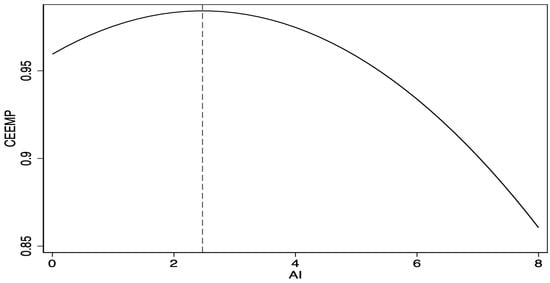
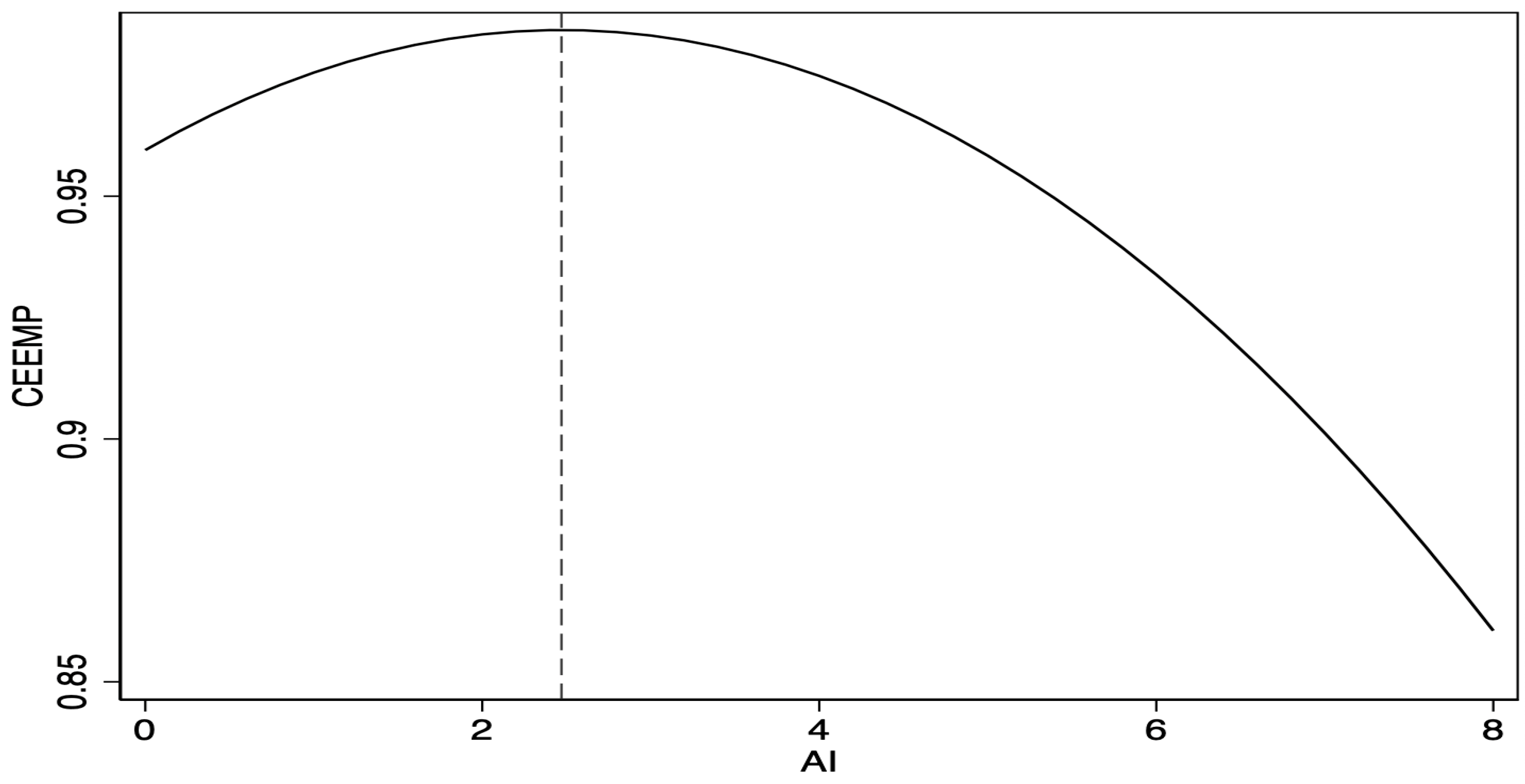
It should be noted that inferring the existence of an inverted U-shaped relationship solely from the significance and signs of the linear and quadratic terms may be misleading, as non-linear functions can exhibit monotonic convexity over the relevant sample range. Therefore, we further use the U-Test for re-examination and find that the test statistics of the U-Test are all significantly positive. The inflection point values corresponding to the regressions in each column range from 2.55 to 3.43, all of which are within the sample interval, further verifying the robustness and statistical validity of the inverted U-shaped relationship. Thus, Hypothesis H1 is effectively verified, indicating that when the level of AI application exceeds the threshold, AI will shift from promoting embodied carbon emissions to reducing them, officially entering the “green inflection point interval”. From Figure 1, the “inverted U-shaped” inflection point value between AI and CEEMP is 2.47. By sorting out the samples during the investigation period, it is found that there are 4171 samples where the application of AI exceeds 2.47, accounting for 26.6%. In 2020, more than half of the manufacturing industries in various economies were able to reduce CEEMP through the application of AI.
Figure 1.
The “inverted U-shaped” relationship between AI and CEEMP. Note: AI stands for Artificial Intelligence (Unit: set), and CEEMP stands for Carbon Emissions Embodied in Manufacturing Production (Unit: Million Tons).
Although we controlled for country–industry fixed effects and industry–year fixed effects in the benchmark model, which can effectively absorb the long-term structural differences in the manufacturing industries of various countries and the global technological trends at the industry level, there may still be situations where macro shocks at the country–year level are not fully absorbed. Adjustments in macroeconomic policies, the process of energy structure transformation, and macroeconomic fluctuations implemented by various countries in specific years may have an impact on the CEEMP. Therefore, in the subsequent robustness tests, we further introduce country–year fixed effects to more strictly control for country-level time-varying factors on the basis of the original fixed effect structure, but the core conclusions of this paper have not undergone substantial changes.
In addition, the estimated coefficients of the control variables are broadly consistent with theoretical expectations. First, the coefficient on manufacturing output scale is significantly positive, indicating that industries with larger output scales tend to exhibit higher CEEMP; specifically, a 1% increase in manufacturing output is associated with a 0.152% rise in CEEMP. Second, the share of energy-intensive manufacturing industries exerts a significantly positive effect on CEEMP at the 1% level, suggesting that a higher concentration of energy-intensive sectors aggravates embodied carbon emissions. Third, the coefficients on population size, urbanization level, and economic development level are all positive, implying that these factors contribute to higher CEEMP.
4.2. Robustness Test
To assess the reliability and robustness of the benchmark results, we conduct a series of robustness checks on the inverted U-shaped relationship between AI and CEEMP from multiple dimensions. The results are reported in Table 3.
Table 3.
Robustness Test.
First, replace the core explanatory variable. The stock of industrial robots can also reflect the development level of a country’s AI. Therefore, we use the installed stock of industrial robots instead of the installed quantity of industrial robots to estimate the panel data. Column (1) indicates that the coefficient of AI is positive, while the coefficient on its quadratic term is significantly negative, both passing the significance test. Meanwhile, the inflection point value is 3.44, which falls within a reasonable range, and the U-Test is 3.62, further supporting the existence of the green inflection point effect.
Second, considering that the 2008 global economic crisis impacted the robot market, and this impact continued until 2012. Therefore, to reduce the interference of external shocks on the research results of this paper, the data from 2008 to 2012 are excluded from the overall sample interval. Compared with the benchmark regression results, the significance and direction of the coefficients shown in column (2) are completely consistent, indicating that the inverted U-shaped structure is not driven by outliers.
Third, to solve the problem of zero values in the explained variable, we use the Poisson Pseudo-Maximum Likelihood (PPML) estimation under the premise of high-dimensional fixed effects for regression. Column (3) shows that the PPML results are highly consistent with the OLS regression results, indicating that the discreteness and non-normality of implicit carbon emission data will not affect the core conclusions.
Fourth, to avoid the impact of extreme outliers on the research conclusions, we conduct regression analysis using winsorization at the 1% level. As shown in column (4), outliers will not change the core conclusions of this paper.
Fifth, considering that the application and development of AI is a long-term process, it is difficult for various economic variables to be fully adjusted in a short period of time. Therefore, combining with sample information, we divide the overall sample into six intervals using a three-year division method, and the results are shown in column (5).
Sixth, the automobile manufacturing industry, as a sector with high energy consumption, high technological integration, and a relatively high penetration rate of intelligence, has obvious industry-specific characteristics in both its technological structure and energy structure, which may lead to structural biases in the estimation of the overall sample. According to statistics from the IFR database, in 2020, the proportion of the number of newly installed industrial robots and the stock of installed industrial robots in the automotive industry in the total manufacturing sector reached 35.3% and 44.4%, respectively, significantly higher than those in other industries. Based on this, to ensure the universality of the research results and avoid the influence of special samples on the research conclusions, this paper excludes the automobile manufacturing industry from the regression analysis. According to the results shown in column (6), the coefficients of the first-order and second-order terms of AI are highly significant, the inflection point value is 2.50, and the U-Test is 3.20, indicating that the inverted U-shaped effect does not stem from industry-specific influences.
Seventh, change the clustering level. Considering the selection bias in the choice of clustering levels, we adjust the clustering level to the national–year level to further test the robustness of the paper’s conclusions, and the results are shown in column (7). The results indicate that changing the clustering level does not affect the conclusions of this paper.
Eighth, controlling macro-level shocks. To control for macro-level shocks such as policies and energy structures, we add country–year fixed effects to Equation (1) and adjust the clustering level to the country–year level to ensure the accuracy of model estimation. The results are shown in column (8). The results show that shocks at the macro level do not affect the conclusions of this paper.
The above estimation results show that the “inverted U-shaped” relationship between AI and CEEMP is robust.
4.3. Endogeneity Analysis
Although we control for many variables and introduces fixed effects in the regression, the regression results may still be affected by endogeneity issues caused by reverse causality. The reason is that with the continuous improvement of environmental awareness and environmental regulation levels in various countries, countries or regions with higher CEEMP face stronger pressure to reduce carbon emissions, prompting governments to actively encourage manufacturing enterprises to introduce AI technology to achieve energy conservation and emission reduction in the production process. Therefore, CEEMP, in turn, will affect the application and development of AI, resulting in a possible reverse causal relationship between AI and CEEMP. To better avoid the endogeneity problem in measurement identification, this paper, following the approach of Acemoglu et al. (2020) [36], selects the average usage of industrial robots in other countries within the same industry and the same year () as the instrumental variable. The underlying logic is that driven by the fierce international competition in the global manufacturing industry, the application trends of industrial robots across countries show convergence. That is, countries that have not yet widely adopted industrial robots tend to introduce robotic technology to gain greater international competitive advantages. This provides logical support for our selection of the average usage of industrial robots in other countries, thereby satisfying the relevance requirement of the instrumental variable. In terms of exogeneity, the application of industrial robots in other countries can only affect the embodied carbon emissions of their own manufacturing production and has no direct correlation with the manufacturing carbon emissions of other countries. Although the application of industrial robots in other countries may be affected by macro factors such as global shocks, it mainly affects their own production organization methods and energy use structures, and there is no direct transmission mechanism for its potential impact on the manufacturing carbon emissions of other economies. The embodied carbon emissions of a country’s manufacturing production are mainly constrained by its own production technology choices, energy structure, and environmental policies, while the level of industrial robot application in other countries does not directly change the energy input or emission decisions of its own manufacturing industry. Therefore, this instrumental variable theoretically satisfies the exclusivity requirement, with results shown in columns (1)–(3) of Table 4. Second, following Bartik (2009) [37], we construct a “Bartik instrument”, which takes the product of the first-order lag of Artificial Intelligence, , and the first-order time difference of core Artificial Intelligence, , as the instrumental variable, with results shown in columns (4)–(6) of Table 4.
Table 4.
Endogeneity Test.
The estimation results are consistent with the benchmark results, that is, the coefficient of AI is significantly positive, while the coefficient on the quadratic term is significantly negative. This proves that after eliminating potential endogeneity issues, AI continues to exert a significant inverted U-shaped effect on CEEMP, meaning that endogeneity issues do not significantly affect the estimation conclusions of this paper. Moreover, the Kleibergen–Paap rk LM and Kleibergen–Paap rk Wald F test results further corroborate the relevance and validity of the instrumental variables employed.
4.4. Mechanism Analysis
Based on the estimation results in the previous text, this paper finds that the impact of AI on CEEMP exhibits an “inverted U-shaped” characteristic, first promoting and then inhibiting. To further investigate the mechanism through which artificial intelligence affects embodied carbon emissions from manufacturing production, this paper draws on the stepwise regression analysis method by Long et al. (2024) [38] to construct regression models as shown in Equations (5) and (6). These models are used to test whether Hypotheses (2) and (3) hold, that is, to determine whether AI affects CEEMP by influencing the technological level of manufacturing production and energy utilization efficiency. The specific model construction is as follows:
Among them, the manufacturing production technology level (TEC) and energy utilization efficiency (EI) are the mediating variables. Specifically, the manufacturing production technology level is expressed as the product of the domestic value-added rate of exports and total factor productivity in various manufacturing industries, while energy utilization efficiency is characterized by the reciprocal of total energy consumption to real GDP. Mechanism test results are shown in Table 5.
Table 5.
Mechanism Test.
Column (1) presents the results of the mechanism test on the technological level of manufacturing production. It can be observed that the coefficient of the first-order term of AI is significantly negative, while the coefficient of the second-order term is significantly positive. This indicates that with the development of AI, its impact on the technological level of manufacturing production exhibits a non-linear characteristic of “first inhibiting, then promoting”. In the early stage of AI development, enterprises mainly apply AI to partial process replacement, automation transformation, and cost reduction. In the short term, this may crowd out R&D investment or intensify the lock-in of technical paths, thereby exerting a certain inhibitory effect on the overall production technology level. However, when the application of AI crosses a certain threshold, its synergistic effects in data integration, process optimization, and intelligent decision-making gradually emerge, which in turn significantly promotes the leapfrog improvement of the production technology level.
As shown in column (2), the mechanism test for energy utilization efficiency reveals a U-shaped relationship with AI, whereby AI initially exerts an inhibitory effect before generating efficiency-enhancing outcomes. This means that in the early stage of AI application, due to increased computing power input, high system integration costs, and rising energy consumption of intelligent devices, energy consumption per unit of output may instead increase, leading to a phased decline in energy utilization efficiency. However, as AI deeply integrates with production systems, its advantages in energy consumption monitoring, load forecasting, and dynamic optimization of process parameters are unleashed, thereby significantly improving energy utilization efficiency.
The above conclusions indicate that the U-shaped impact of AI on production technology levels and energy utilization efficiency further explains the internal mechanism behind its “inverted U-shaped” characteristic in relation to CEEMP. In the early stages of AI development, as technological progress and energy efficiency improvements have not yet become apparent, the effects of scale expansion and growth in energy demand dominate, leading to a rise in carbon emissions. With the continuous development of AI technology, it can significantly improve production technology levels and energy utilization efficiency, and the effect of energy conservation and emission reduction gradually takes the lead, thereby promoting a shift in manufacturing carbon emissions from “increasing emissions” to “reducing emissions”. That is, Hypotheses H2 and H3 hold true.
4.5. Further Exploration of the Transmission Path
Owing to marked disparities in technological R&D capacity, industrial coordination, and energy consumption structures across economies at different development stages, the sample is divided into developed and developing countries following the OECD classification to assess the non-linear impact of AI on CEEMP.
Based on the estimation results in Table 6, it is found that the impact of AI on CEEMP shows significant differences among countries at different stages of economic development. For developing countries, as can be seen from column (1), the impact of AI on CEEMP presents a typical inverted U-shaped structure, with the corresponding inflection point value being approximately 3.62 and the U-Test statistic being 1.70, indicating strong significance. This means that in developing countries, AI mainly exhibits a technological pressure effect on energy consumption and emissions in the initial stage. That is, due to the increased energy demand brought about by the renewal of intelligent equipment, infrastructure construction, and computing power input, the level of CEEMP is pushed up in the short term. However, when the application level of AI crosses the threshold, the energy-saving and emission-reduction effects of intelligent production, process optimization, and the penetration of green technologies gradually emerge, and the CEEMP begins to decline, thus forming a green inflection point. From the perspective of the impact mechanism, it can be found that in developing countries, AI has a significant U-shaped impact on both the production technology level (TEC) and energy utilization efficiency (EI). That is, it inhibits the technology level and energy efficiency performance in the early stage of application but significantly promotes both in the deepening stage of application. This indicates that in developing countries, AI is more used for scale expansion and cost control in the early stage, and its role in promoting production technology upgrading and energy conservation has not been fully released. However, with the accumulation of AI technology and the improvement of the institutional environment, its positive effects on process optimization, refined production management, and more efficient energy allocation gradually materialize.
Table 6.
National Heterogeneity Test.
In contrast, in the sample of developed countries, the “inverted U-shaped” effect of AI on embodied carbon emissions is also significant, but the intensity of the effect and the position of the inflection point are different. As shown in column (4), in developed countries, the coefficient of AI is 0.011, and the inflection point value is approximately 1.86, which is slightly lower than that of developing countries. This indicates that in developed countries, the promoting effect of AI on CEEMP in the early stage is relatively weak, but the technical level required to cross the green inflection point is also lower, and the green transition comes earlier. This difference is highly related to the existing advantages of developed countries in terms of infrastructure, energy structure, and industrial upgrading: first, developed countries have a better foundation for manufacturing intelligence, and the obstacles to technology application are relatively small; second, the proportion of renewable energy is higher and the energy governance mechanism is more complete, enabling the “emission reduction effect” of AI in the energy system to be realized more quickly; third, the green regulatory system and environmental constraints are stricter, so that intelligent technologies are embedded in production links oriented towards energy conservation and emission reduction earlier. From a mechanism perspective, the effect of AI on production technology in developed economies follows a U-shaped pattern, whereas no significant effect is observed on energy utilization efficiency. This indicates that, compared with developing countries, developed countries are more likely to achieve significant improvements in technological progress through AI, while the marginal effect of energy efficiency improvement is relatively small. This is consistent with the reality that developed countries are at the forefront of technology; that is, developed countries have a high technical benchmark level and can quickly promote technological innovation through AI, but in terms of refined energy management, AI still has significant room for improvement.
4.6. Industry Heterogeneity Analysis
We, from the perspective of industry carbon emission dispersion, study the impact of AI on the actual gap in carbon emissions embedded in production among different manufacturing industries. We use the relative distance between the logarithmic production-embedded carbon emission level of different industries in a country and the overall minimum logarithmic production-embedded carbon emission level to represent the dispersion of industry carbon emissions embedded in production. As reported in column (1) of Table 7, the coefficient of AI is significantly negative, while that of the quadratic term is significantly positive. This indicates that AI first reduces the gap in carbon emissions embedded in production among different manufacturing industries within an economy and then widens this gap, suggesting that the impact of AI on carbon emissions embedded in the production of different manufacturing industries is unbalanced. This is because, in the early stage of AI application, it mainly narrows the carbon emission gap among different industries through channels such as technology diffusion and energy efficiency improvement. However, with the continuous deepening of AI applications, the differences in its task orientation and industry adaptability gradually emerge. Factors such as capital and technology are accelerating their concentration in industries that are more easily empowered by AI, promoting some industries to take the lead in moving towards the low-carbon frontier. In contrast, other industries have limited room for improvement due to constraints on technology and processes, which in turn leads to the expansion of the carbon emission gap among industries.
Table 7.
Industry Heterogeneity Test.
We further conduct a heterogeneity analysis from three aspects: industry technological gap, production energy consumption, and intelligent application status. First, considering that the OECD classifies manufacturing industries into four categories based on their technological level, namely high-tech industries, medium-high-tech industries, medium-low-tech industries, and low-tech industries, we further divide 15 manufacturing sectors into three types: high-tech manufacturing, medium-tech manufacturing, and low-tech manufacturing. The regression results are shown in columns (2) to (4) of Table 7. It can be seen that among the three technology-based industries, the primary term coefficient and quadratic term coefficient of AI in the medium-end technology industry and low-end technology industry are significantly positive and negative, respectively, indicating that the impact of AI on carbon emissions in the medium-end and low-end technology industries presents an obvious “inverted U-shaped” relationship. However, this relationship is not significant in the high-end technology industry. The reason is that the complexity of equipment and the high algorithm training load in high-end industries limit the green emission reduction potential of the intelligent economy. In contrast, the medium-end technology industry is more sensitive to intelligent factors. In the early stage, AI may push up energy consumption, but with the acceleration of process optimization and intelligent substitution, the emission reduction effect gradually strengthens. The low-end technology industry shows unique industry characteristics. Its quadratic term coefficient has the largest absolute value, and the inflection point value is 1.974, indicating that the green inflection point of AI in the low-end industry appears the earliest. This shows that due to the simple production process, low basic efficiency, and large optimization space in low-end industries, AI can quickly reduce ineffective energy consumption. Therefore, the “green catch-up effect” of the intelligent economy is most obvious in such industries.
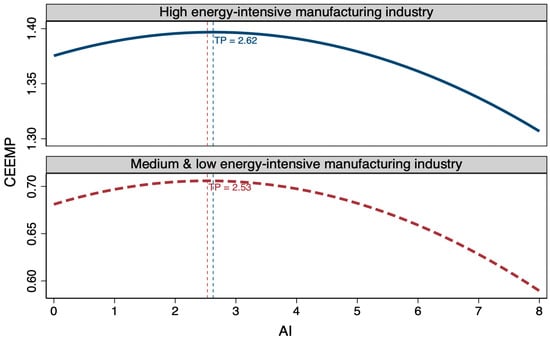
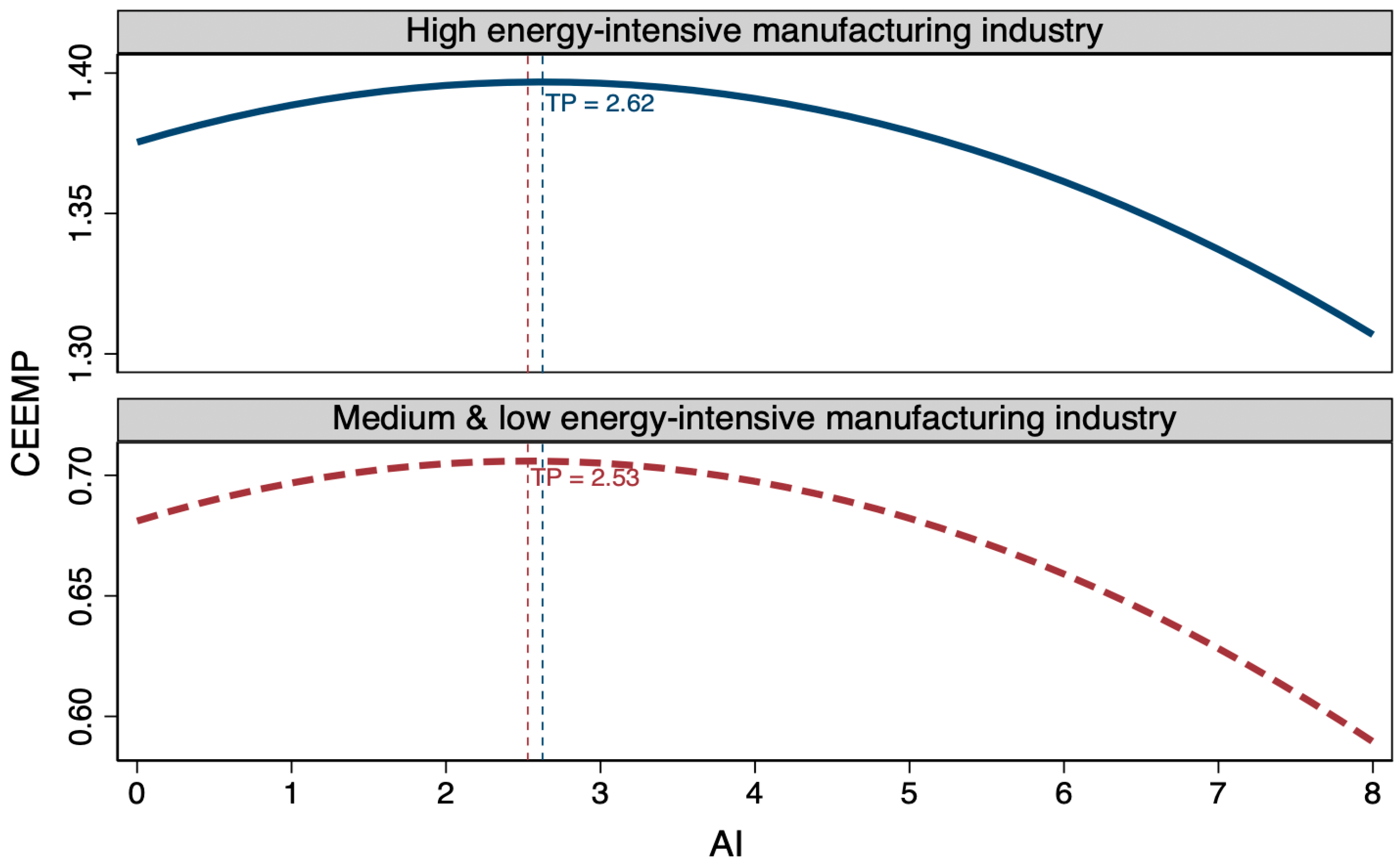
Second, we refer to the Benchmark Levels and Baseline Levels of Energy Efficiency in Key Areas of High-Energy-Consuming Industries (2021 Edition) and classify manufacturing industries into high-energy-consuming manufacturing and medium-to-low-energy-consuming manufacturing to examine whether there are differences in the effect of AI on reducing carbon emissions embodied in manufacturing industries with different production energy consumption. Results are shown in Table 7, columns (5)–(6). It can be seen that the “inverted U-shaped” structure is most significant in high-energy-consuming manufacturing. The primary term coefficient of AI is the highest at 0.0204, and the quadratic term also remains significant, which means that the energy consumption rebound in high-energy-consuming industries is the most obvious in the early stage. However, once the inflection point is exceeded, the energy-saving capabilities of AI in energy scheduling, intelligent management, and process optimization will be quickly released, making this industry the sector with the greatest energy-saving potential in the context of the intelligent economy. Although medium-to-low-energy-consuming industries also present an “inverted U-shaped” structure, the curve is relatively flat, and the inflection point value is slightly lower, indicating that the demand for intelligent technology in such industries is relatively weak, and the reshaping speed of the intelligent economy on their production efficiency and energy structure is faster, as shown in Figure 2.
Figure 2.
The impact of AI on CEEMP with different energy consumption levels. Note: This figure plots the predicted values of CEEMP based on industry heterogeneity regression. The vertical dashed line indicates the estimated turning point. AI stands for Artificial Intelligence (Set); CEEMP stands for Carbon Emissions Embodied in Manufacturing Production (Million Tons). The solid navy line (upper panel) and the dashed maroon line (lower panel) plot the predicted CEEMP against AI for high energy-intensive and medium & low energy-intensive industries, respectively.
Third, considering that the distribution of industrial robots across manufacturing industries is significantly imbalanced at the current stage, we classify the level of AI application based on the stock of industrial robots, dividing all manufacturing industries into high AI application industries and low AI application industries. The metal products industry, computer, electronic, optical, and electrical equipment manufacturing, machinery and equipment manufacturing, and transportation equipment manufacturing are categorized as high AI application industries, with all other sectors classified as low AI application industries. Regression results are presented in columns (7) to (8) of Table 7. It can be seen that the inflection point value for low AI application industries is 1.969, which is significantly earlier than the 2.771 for high AI application industries. This indicates that due to weak intelligentization foundations and more redundant processes, traditional manufacturing sectors can quickly reduce energy waste and improve production process efficiency after the application of intelligent technologies, thus entering the carbon emission reduction stage earlier. In contrast, high AI application industries already have a high degree of intelligentization. The large hardware investment, algorithm training, and computing power consumption required in their intelligent application stage delay the green inflection point. However, once they enter the downward stage, the effect of energy conservation and carbon reduction is more significant.
5. Conclusions and Policy Recommendations
5.1. Conclusions
Drawing on balanced panel data for 55 economies and 15 manufacturing sectors from 2002 to 2020, this paper examines the impact of AI on carbon emissions embodied in manufacturing production, with the main conclusions presented below.
First, AI exhibits a significant “inverted U-shaped” characteristic of “first rising and then falling” with respect to carbon emissions embodied in manufacturing production. That is, it has a “carbon-increasing” effect in the early stage and a “carbon-reducing” effect in the later stage. This conclusion remains valid after endogeneity tests and other robustness tests.
Second, AI mainly reduces carbon emissions embodied in manufacturing production through two mechanisms: the level of manufacturing production technology and energy utilization efficiency, thereby exerting a non-linear impact on carbon emissions embodied in manufacturing production. However, there is certain national heterogeneity in the relevant transmission paths, with the green inflection point appearing earlier in developed countries.
Third, AI first reduces and then expands the carbon emission gap between different manufacturing industries. At the same time, its carbon reduction effect on industries varies significantly due to differences in technological gaps, production energy consumption, and the status of intelligent applications. The emission reduction effect is significant in low-end technology industries, high-energy-consuming manufacturing industries, and industries with low AI applications.
5.2. Policy Proposal
Based on the above research conclusions, in order to give full play to the role of AI in reducing carbon emissions embodied in manufacturing production, three policy recommendations are put forward.
First, accelerate the promotion of AI application development to boost carbon emission reduction in manufacturing production. The empirical results of this paper show that AI can only play a role in reducing carbon emissions embodied in manufacturing production when it develops to a certain level. Therefore, it is crucial to accelerate the application of AI in the field of manufacturing production. For countries that have passed the inflection point, they should further promote the in-depth integration of AI with manufacturing production chains, comprehensively implement intelligent transformation, and drive the low-carbon transformation of intelligent manufacturing. For countries that have not yet reached the inflection point, especially developing countries, they should formulate a sound AI development plan, and at the same time, encourage manufacturing enterprises to introduce AI through fiscal and taxation means, accelerate the application of AI to cross the inflection point, and realize the carbon emission reduction effect of AI.
Second, enhance the conductive effect of the manufacturing industry’s production technology level and energy utilization efficiency on carbon emission reduction in the manufacturing sector. This study shows that AI technology can reduce carbon emissions embodied in manufacturing production by improving the manufacturing industry’s production technology level and energy utilization efficiency. Therefore, manufacturing enterprises should increase investment in scientific and technological research and development as well as technological innovation. With reference to existing production processes and technological characteristics, they should vigorously develop AI that is suitable for the intelligent transformation of the manufacturing industry, promote AI to be oriented towards improving the manufacturing industry’s technological level and energy utilization efficiency, and enhance the in-depth integration of AI with energy-saving and emission-reduction technologies. At the same time, empirical results indicate that the improvement effect of AI on the manufacturing industry’s production technology level and energy utilization efficiency varies across countries with different levels of economic development. Therefore, all countries should abandon technical barriers, promote collaborative innovation, pool global innovation forces through facilitating technology and experience sharing, and accelerate the intelligent and low-carbon transformation of the manufacturing industry.
Third, rationally plan the industrial layout of AI investment and fully unleash the carbon emission reduction capacity of AI. The research shows that AI has obvious industrial heterogeneity in terms of carbon emissions embodied in manufacturing production, and its emission reduction effect is more significant in high-energy-consuming industries and low-end technology industries. Therefore, differentiated AI application strategies should be formulated based on the industrial carbon emission structure, technical foundation, and the level of intelligent penetration. On the one hand, for high-energy-consuming industries such as steel, chemicals, non-ferrous metals, and building materials, AI should be regarded as a key technical path to improve energy utilization efficiency and optimize energy structure. By extensively introducing intelligent scheduling systems, intelligent energy management platforms, and predictive maintenance technologies, the consumption of non-renewable energy and the energy consumption intensity per unit of product can be reduced. On the other hand, for low-end technology industries, support policies for intelligent process transformation and process optimization should be strengthened. Through fiscal subsidies, special funds for digital transformation, and industrial internet empowerment projects, low-end industries can be guided to achieve intelligent transformation at a lower cost, thereby amplifying their “green catch-up effect”.
Author Contributions
Conceptualization, Z.L.; methodology, Z.L.; software, Z.L.; validation, Z.L. and X.M.; formal analysis, Z.L.; investigation, X.M.; resources, X.M.; data curation, X.M. and Z.L.; writing—original draft preparation, Z.L.; writing—review and editing, Z.L. and X.M.; visualization, J.G.; supervision, J.G.; project administration, J.G.; funding acquisition, J.G. All authors have read and agreed to the published version of the manuscript.
Funding
This research was funded by the Special Fund for the Taishan Scholars Program, project “A Study on the Impact and Mechanism of Domestic Market Integration on the High-Quality Development of the Manufacturing Industry” (Grant No. tsqn202306167).
Institutional Review Board Statement
Not applicable.
Informed Consent Statement
Not applicable.
Data Availability Statement
The data used to support the findings of this study are available from the corresponding author upon request.
Conflicts of Interest
The authors declare no conflicts of interest.
References
- Bag, S.; Pretorius, J.H.C. Relationships Between Industry 4.0, Sustainable Manufacturing and Circular Economy: Proposal of a Research Framework. Int. J. Organ. Anal. 2022, 30, 864–898. [Google Scholar] [CrossRef] [Scilit]
- Li, Y.; Zhang, Y.; Pan, A.; Han, M.; Veglianti, E. Carbon Emission Reduction Effects of Industrial Robot Applications: Heterogeneity Characteristics and Influencing Mechanisms. Technol. Soc. 2022, 70, 102034. [Google Scholar] [CrossRef] [Scilit]
- Balsalobre-Lorente, D.; Shahbaz, M.; Roubaud, D.; Farhani, S. How economic growth, renewable electricity and natural resources contribute to CO2 emissions? Energy Policy 2018, 113, 356–367. [Google Scholar] [CrossRef] [Scilit]
- Lantz, V.; Feng, Q. Assessing Income, Population, and Technology Impacts on CO2 Emissions in Canada: Where’s the EKC? Ecol. Econ. 2006, 57, 229–238. [Google Scholar] [CrossRef] [Scilit]
- Liu, L.; Yang, K.; Fujii, H.; Liu, J. Artificial intelligence and energy intensity in China’s industrial sector: Effect and transmission channel. Econ. Anal. Policy 2021, 70, 276–293. [Google Scholar] [CrossRef] [Scilit]
- Lv, H.; Shi, B.; Li, N.; Kang, R. Intelligent Manufacturing and Carbon Emissions Reduction: Evidence from the Use of Industrial Robots in China. Int. J. Environ. Res. Public Health 2022, 19, 15538. [Google Scholar] [CrossRef] [Scilit] [PubMed]
- Ojadi, J.O.; Onukwulu, E.; Odionu, C.; Owulade, O. AI-driven predictive analytics for carbon emission reduction in industrial manufacturing: A machine learning approach to sustainable production. Int. J. Multidiscip. Res. Growth Eval. 2023, 4, 948–960. [Google Scholar] [CrossRef] [Scilit]
- Grant, D.; Jorgenson, A.K.; Longhofer, W. How Organizational and Global Factors Condition the Effects of Energy Efficiency on CO2 Emission Rebounds among the World’s Power Plants. Energy Policy 2016, 94, 89–93. [Google Scholar] [CrossRef] [Scilit]
- Vinuesa, R.; Azizpour, H.; Leite, I.; Balaam, M.; Dignum, V.; Domisch, S.; Felländer, A.; Langhans, S.D.; Tegmark, M.; Fuso Nerini, F. The role of artificial intelligence in achieving the sustainable development goals. Nat. Commun. 2020, 11, 233. [Google Scholar] [CrossRef] [Scilit]
- Luan, F.; Yang, X.; Chen, Y.; Regis, P.J. Industrial robots and air environment: A moderated mediation model of population density and energy consumption. Sustain. Prod. Consum. 2022, 30, 870–888. [Google Scholar] [CrossRef] [Scilit]
- Brevini, B. Black boxes, not green: Mythologizing artificial intelligence and omitting the environment. Big Data Soc. 2020, 7, 1–5. [Google Scholar] [CrossRef] [Scilit]
- Zhao, P.; Gao, Y.; Sun, X. How does artificial intelligence affect green economic growth? Evidence from China. Sci. Total Environ. 2022, 834, 155306. [Google Scholar] [CrossRef] [Scilit]
- Liu, B.; Yang, X.; Zhang, J. Nonlinear effect of industrial robot applications on carbon emissions: Evidence from China. Environ. Impact Assess. Rev. 2024, 104, 107297. [Google Scholar] [CrossRef] [Scilit]
- Forslid, R.; Okubo, T.; Ulltveit-Moe, K.H. Why are Firms that Export Cleaner? International Trade, Abatement and Environmental Emissions. J. Environ. Econ. Manag. 2018, 91, 166–183. [Google Scholar] [CrossRef] [Scilit]
- Vivanco, D.F.; Kemp, R.; van der Voet, E. How to deal with the rebound effect? A Policy-oriented Approach. Energy Policy 2016, 94, 114–125. [Google Scholar] [CrossRef] [Scilit]
- Wu, T.; Zuo, M. Green supply chain transformation and emission reduction based on machine learning. Sci. Prog. 2023, 106, 00368504231165679. [Google Scholar] [CrossRef] [Scilit]
- Ligozat, A.-L.; Lefevre, J.; Bugeau, A.; Combaz, J. Unraveling the Hidden Environmental Impacts of AI Solutions for Environment Life Cycle Assessment of AI Solutions. Sustainability 2022, 14, 5172. [Google Scholar] [CrossRef] [Scilit]
- Freitag, C.; Berners-Lee, M.; Widdicks, K.; Knowles, B.; Blair, G.S.; Friday, A. The real climate and transformative impact of ICT: A critique of estimates, trends, and regulations. Patterns 2022, 3, 100576. [Google Scholar] [CrossRef] [Scilit] [PubMed]
- Paryanto; Brossog, M.; Bornschlegl, M.; Franke, J. Reducing the energy consumption of industrial robots in manufacturing systems. Int. J. Adv. Manuf. Technol. 2015, 78, 1315–1328. [Google Scholar] [CrossRef] [Scilit]
- Berkhout, P.H.; Muskens, J.C.; Velthuijsen, J.W. Defining the rebound effect. Energy Policy 2000, 28, 425–432. [Google Scholar] [CrossRef] [Scilit]
- Jevons, W. The Coal Question; An Inquiry Concerning the Progress of the Nation, and the Probable Exhaustion of our Coal-Mines. In British Politics and the Environment in the Long Nineteenth Century; Routledge: London, UK, 2023; pp. 103–111. [Google Scholar]
- Khazzoom, J.D. Economic implications of mandated efficiency in standards for household appliances. Int. Assoc. Energy Econ. 1980, 1, 21–40. [Google Scholar] [CrossRef] [Scilit]
- Acemoglu, D.; Restrepo, P. The race between man and machine: Implications of technology for growth, factor shares, and employment. Am. Econ. Rev. 2018, 108, 1488–1542. [Google Scholar] [CrossRef] [Scilit]
- Arinez, J.F.; Chang, Q.; Gao, R.X.; Xu, C.; Zhang, J. Artificial intelligence in advanced manufacturing: Current status and future outlook. J. Manuf. Sci. Eng. 2020, 142, 110804. [Google Scholar] [CrossRef] [Scilit]
- Mizobuchi, K. An empirical study on the rebound effect considering capital costs. Energy Econ. 2008, 30, 2486–2516. [Google Scholar] [CrossRef] [Scilit]
- Dehdar, F.; Silva, N.; Fuinhas, J.A.; Koengkan, M.; Nazeer, N. The impact of technology and government policies on OECD carbon dioxide emissions. Energies 2022, 15, 8486. [Google Scholar] [CrossRef] [Scilit]
- Mariani, M.M.; Machado, I.; Nambisan, S. Types of innovation and artificial intelligence: A systematic quantitative literature review and research agenda. J. Bus. Res. 2023, 155, 113364. [Google Scholar] [CrossRef] [Scilit]
- Ciriello, R.F.; Richter, A.; Schwabe, G. Digital innovation. Bus. Inf. Syst. Eng. 2018, 60, 563–569. [Google Scholar] [CrossRef] [Scilit]
- Wu, H.; Hao, Y.; Ren, S.; Yang, X.; Xie, G. Does internet development improve green total factor energy efficiency? Evidence from China. Energy Policy 2021, 153, 112247. [Google Scholar] [CrossRef] [Scilit]
- Vijay Kumar, V.; Shahin, K. Artificial intelligence and machine learning for sustainable manufacturing: Current trends and future prospects. Intell. Sustain. Manuf. 2025, 2, 10002. [Google Scholar] [CrossRef] [Scilit]
- Zhou, W.; Zhuang, Y.; Chen, Y. How does artificial intelligence affect pollutant emissions by improving energy efficiency and developing green technology. Energy Econ. 2024, 131, 107355. [Google Scholar] [CrossRef] [Scilit]
- Lau, C.K.; Gozgor, G.; Mahalik, M.K.; Patel, G.; Li, J. Introducing a new measure of energy transition: Green quality of energy mix and its impact on CO2 emissions. Energy Econ. 2023, 122, 106702. [Google Scholar] [CrossRef] [Scilit]
- Yang, S.; Zhong, Y.; Feng, D.; Li, R.Y.M.; Shao, X.F.; Liu, W. Robot application and occupational injuries: Are robots necessarily safer? Saf. Sci. 2022, 147, 105623. [Google Scholar] [CrossRef] [Scilit]
- Wang, Q.; Han, X. Is decoupling embodied carbon emissions from economic output in Sino-US trade possible? Technol. Forecast. Soc. Change 2021, 169, 120805. [Google Scholar] [CrossRef] [Scilit]
- Dauvergne, P. Is artificial intelligence greening global supply chains? Exposing the political economy of environmental costs. Rev. Int. Political Econ. 2022, 29, 696–718. [Google Scholar] [CrossRef] [Scilit]
- Acemoglu, D.; Restrepo, P. Robots and jobs: Evidence from US labor markets. J. Political Econ. 2020, 128, 2188–2244. [Google Scholar] [CrossRef] [Scilit]
- Bartik, T.J. How Do the Effects of Local Growth on Employment Rates Vary with Initial Labor Market Conditions? Upjohn Institute Working Paper: Kalamazoo, MI, USA, 2009; pp. 9–148. [Google Scholar]
- Long, G.; Duan, D.; Wang, H.; Chen, S. The impact of industrial robots on low-carbon green performance: Evidence from the belt and road initiative countries. Technol. Soc. 2024, 79, 102712. [Google Scholar] [CrossRef] [Scilit]

Disclaimer/Publisher’s Note: The statements, opinions and data contained in all publications are solely those of the individual author(s) and contributor(s) and not of MDPI and/or the editor(s). MDPI and/or the editor(s) disclaim responsibility for any injury to people or property resulting from any ideas, methods, instructions or products referred to in the content. |
© 2026 by the authors. Licensee MDPI, Basel, Switzerland. This article is an open access article distributed under the terms and conditions of the Creative Commons Attribution (CC BY) license.