


Abstract
This study investigates how online discussion forums in an undergraduate Social Responsibility course support students’ SDG-oriented idea generation and collaborative knowledge construction. It also examines how participation roles, behavioral intensity, interaction-network influence, and goal-aligned discourse shape idea visibility and discussion. Using a mixed-methods learning analytics design, we analyzed forum logs and message texts across five SDG-linked themes (SDGs 6, 7, 12, 14, 15) by classifying contributor types, computing a Behavioral Participation Index (BPI), constructing a directed reply network and estimating PageRank centrality, extracting solution proposals, scoring semantic goal alignment, modelling weekly temporal dynamics, and fitting multivariate regressions predicting visibility (reads) and engagement (replies) while controlling for theme, message level, time, PageRank, and BPI. Results show role-differentiated participation (N = 514), meaningful cross-theme solution proposals that varied across academic groups, and peak-driven weekly activity. PageRank centrality emerged as the strongest and most consistent predictor of both visibility and engagement, whereas goal alignment showed weaker direct effects after controls, suggesting that SDG-aligned ideas do not necessarily diffuse without structural embeddedness. Among highly goal-aligned posts, specific communicative features differentiated which proposals attracted attention and interaction. These findings suggest that SDG forum design benefits from structured interaction pathways and scaffolded discourse strategies to support equitable diffusion and productive sustainability dialogue. The study does not evaluate the normative quality of sustainability positions but examines how interaction structures and discourse features shape the visibility and diffusion of student-generated ideas.
1. Introduction
Societies face wicked problems, including climate change, resource scarcity, biodiversity loss, and social inequality [1]. These challenges require technological innovation and a shift in how people perceive systems, evaluate values, and act under uncertainty [2,3]. Higher education institutions need learning designs that build sustainability competencies beyond disciplinary content, including systems thinking, critical reflection, and future-oriented (anticipatory) reasoning [3,4].
Sustainability education emphasizes transformative learning that reshapes assumptions, values, and action orientations [5]. Sterling argues for education that deepens engagement with interdependence, complexity, and responsibility. Within this framing, sustainability-oriented learning environments should enable students to question existing systems, articulate values, and build actionable strategies for change. Social Responsibility courses link theory to sustainability challenges and require students to propose solutions. Online discussion forums support collaborative inquiry across time and location. Researchers describe forums as social constructivist spaces where learners co-construct understanding and negotiate meaning through interaction [6,7]. Students can contribute original ideas, critique and refine peers’ proposals, and develop interpersonal competence through constructive dialogue [8].
A systems perspective treats the forum as a learning system where students, messages, and interaction patterns shape outcomes. Actors (students), messages (content), and interaction patterns (network structure) mutually shape one another through interaction [6,9]. In such systems, a student’s network position (centrality) and the communicative quality of their contribution may influence the collective capacity to generate sustainability-relevant knowledge.
Future-oriented sustainability learning requires analysis of present conditions, scenario reasoning, and strategy design. Critical thinking supports this process by enabling learners to question norms, synthesize information across sources, and engage in reflective evaluation of assumptions [4,10]. Many forum studies measure participation through post and reply counts (e.g., number of posts), with fewer studies integrating interaction capacity within the social network and the semantic alignment of contributions with sustainability goals. Yet these dimensions are crucial for SDG-oriented curricula: visibility and engagement may be shaped by network attention mechanisms, while goal alignment reflects the extent to which student discourse substantively addresses assigned sustainability targets.
Few sustainability education studies combine network influence measures with goal alignment measures in a single analytical framework [6,9]. This study combines text analysis, goal alignment scoring, and social network analysis to examine how student attributes, participation roles, network structure, and discourse strategies jointly shape solution development and interaction in a Social Responsibility course forum.
Recent studies have increasingly examined the relationship between digital technologies, artificial intelligence, and the SDGs in higher education. Empirical and conceptual studies highlight that AI-supported educational practices can advance SDG 4 by improving access, participation, and instructional efficiency, while also introducing risks related to equity, transparency, and governance [11,12]. At the same time, recent sustainability-oriented learning analytics research emphasizes that technological affordances alone do not guarantee inclusive or reflective learning outcomes; rather, the design of interaction structures and pedagogical scaffolds plays a decisive role in shaping whose ideas gain visibility and influence within digital learning environments [13]. These insights point to the need for empirically grounded analyses that examine how interactional dynamics, not the normative quality of ideas, shape participation and influence in sustainability-oriented online learning.
This study does not privilege or promote specific sustainability positions. Instead, it adopts a descriptive and analytical perspective to examine how interaction structures and communicative practices influence the visibility and diffusion of student-generated ideas within an online learning environment. Consistent with recent work on responsible AI use and SDG-aligned pedagogy in higher education [12], the focus is on understanding structural conditions that shape participation and engagement, while preserving students’ reflective autonomy and critical reasoning.
This study proposes a systems-informed model where visibility, engagement, and SDG-aligned knowledge construction result from the interaction of (1) actor characteristics (student attributes and participation roles), (2) network structure (relational embeddedness and influence), and (3) message properties (goal alignment and discourse design). The study addresses the following research questions:
- RQ1. Contributor roles: What contributor role patterns emerge in the forum, and how are these roles distributed across participants?
- RQ2. Behavioral participation: How does behavioral participation (BPI) differ by contributor type and student characteristics such as faculty, department, and class level?
- RQ3. Network centrality: How does network centrality (PageRank) differ by contributor type and student characteristics?
- RQ4. Theme and solution alignment: To what extent do solution proposals align with their assigned sustainability theme? What level of cross-theme proposals occurs?
- RQ5. Cross-theme variation by student characteristics: How do theme-solution alignment and cross-theme rates differ by faculty, department, and class level?
- RQ6. Goal alignment across message types: How does goal alignment differ between thread starters and replies? To what extent do messages address SDG-oriented targets?
- RQ7. Temporal dynamics: How does weekly interaction change over time? How does the proportion of highly goal-aligned posts change across weeks, including peak weeks?
- RQ8. Visibility and engagement mechanisms: How do goal alignment, network centrality, and behavioral participation relate to visibility and engagement? Do discourse features within highly aligned posts amplify these outcomes after controlling for theme, message level, and time?
This study examines how online discussion forums in a higher education Social Responsibility course shape students’ idea-generation practices toward sustainability-related goals. The forum was structured around sustainability themes aligned with the Sustainable Development Goals (SDGs): Clean Water and Sanitation (SDG 6), Affordable and Clean Energy (SDG 7), Responsible Consumption and Production (SDG 12), Life Below Water (SDG 14), and Life on Land (SDG 15). Based on a systems perspective, we conceptualize the forum as a socio-technical learning system in which actors (students), message content, and interaction structure co-evolve and jointly influence discourse quality and diffusion.
Wicked problems are characterized by complexity, uncertainty, and value conflict, making them resistant to definitive solutions [1]. In sustainability contexts, these characteristics are intensified because socio-ecological systems involve interdependent environmental, social, and economic subsystems. Competency-based sustainability education responds to this challenge by specifying capacities needed for problem framing, systems analysis, and collective action [3,4]. A widely used reference framework identifies key sustainability competencies like systems thinking, anticipatory competence, normative competence, strategic competence, and interpersonal competence that together support effective sustainability problem-solving [3]. These competencies operate as an interconnected framework rather than a checklist of independent skills [2,14].
Sustainability learning increasingly emphasizes transformative learning approaches that enable students to reflect critically on assumptions, values, and systemic structures shaping sustainability outcomes [5]. Systems thinking supports this transformation by helping learners understand feedback, interdependencies, and leverage points in socio-ecological systems [3]. In higher education contexts, competence development for sustainable development has been linked to reflective learning and ethical inquiry, emphasizing that students must integrate knowledge with value reasoning and agency [8,15].
Online discussion forums provide environments for collaborative knowledge construction where students can articulate ideas, question assumptions, and refine proposals through feedback. The Community of Inquiry framework posits that learning quality emerges from cognitive, social, and teaching presence, with cognitive presence capturing practical inquiry from exploration to resolution [5]. Task-based collaborative discussions can strengthen reflective and critical thinking by requiring learners to transform concepts into actionable strategies and engage constructively with peers [8].
Social learning analytics increasingly employs social network analysis (SNA) to understand how interaction structures shape learning processes, visibility, and influence. Centrality measures such as PageRank capture how often participants sit at the intersection of reply pathways, affecting information flow and attention [6,9]. Prior research suggests that network position can shape exposure and engagement, yet centrality does not necessarily coincide with goal-aligned or high-quality discourse, highlighting the need to model structure and content jointly.
In sustainability education, learning analytics (LA) offers a methodological bridge between competency frameworks, i.e., “what learners should develop”, and digital traces of learning, i.e., “what learners actually do in online environments”. LA is commonly defined as the measurement, collection, analysis, and reporting of learner data for the purpose of understanding and optimizing learning and learning environments [16]. When applied to sustainability-oriented learning contexts, LA is increasingly positioned as a promising approach for capturing complex competencies that are otherwise difficult to observe at scale, particularly those involving collaborative inquiry, reflective engagement, and systems reasoning. Recent studies show that learning analytics can support future-oriented competences by enabling the analysis and visualization of social interactions, facilitating purposeful group formation, and helping learners reflect on their patterns of participation and collaboration, but concrete operational pathways for competency support remain underdeveloped [17,18].
Anticipatory competence and futures thinking involve exploring plausible futures, evaluating risks and opportunities, and linking present action with long-term consequences [3,4]. In SDG-oriented education, this competence supports students in constructing proactive and actionable solution strategies. Future literacy initiatives similarly emphasize that learners can be trained to diversify future imaginaries and strengthen agency under uncertainty [10].
A particularly relevant subfield is Social Learning Analytics (SLA), which focuses on sociocultural dimensions of learning by analyzing interaction patterns, discourse, and collaborative knowledge practices. SLA emphasizes closing the feedback loop by turning social interaction data into actionable insights for learners and instructors, and it frequently uses network metrics and discourse analytics to make collaborative processes visible [19,20]. This is especially aligned with sustainability competencies, because sustainability problem-solving is inherently relational: it requires learners to negotiate meanings, contest assumptions, integrate perspectives, and co-produce actionable strategies. Systematic reviews show that SLA research has expanded steadily, yet teacher-facing and design-oriented applications remain comparatively limited, reinforcing the need for empirical studies that connect network influence and discourse quality to competency-relevant outcomes [20]. In this regard, combining SLA-style network measures with content-level indicators represents a high-potential pathway for assessing whether SDG-relevant ideas are not only produced but also socially amplified within online learning communities, which is a key concern for sustainability-oriented curricular innovation [19]. Recent studies operationalize sustainability competencies using digital trace data [21].
2. Materials and Methods
Methodologically, the study relies on interpreting associations among mixed data types, including ordinal goal-alignment scores, categorical discourse features, continuous network metrics, and count-based engagement outcomes. Recent statistical work provides principled frameworks for examining partial associations in such mixed-type settings [22] and for balancing interpretability and flexibility in complex, multi-predictor modelling pipelines [23]. We combine text analysis and social network analysis to examine how students generate and refine sustainability solution ideas in an online forum structured around SDG-linked themes. We use a systems perspective and treat the forum as a socio-technical learning system. Students and their attributes, reply structures, and message content shape participation, influence, visibility, and engagement.
The study links sustainability competency frameworks and online collaborative learning research. We use learning analytics to operationalize how students enact competencies in authentic discourse, using digital trace data from the forum. We also draw on learning analytics research that frames trace data as evidence for understanding and improving learning environments. We use social network methods because interaction structure shapes information flow and attention in online learning spaces.
The research questions are addressed through seven steps: (1) classification of students into contributor types (RQ1), (2) construction of a behavioral participation index (RQ2), (3) building a directed reply network and estimating PageRank centrality (RQ3), (4) extracting solution proposals and modelling theme–solution relationships (RQ4–RQ5), (5) measuring semantic alignment with course-defined sustainability goals (RQ6), (6) modelling temporal dynamics in weekly aggregates (RQ7), and (7) estimating multivariate models to test whether goal alignment predicts visibility and engagement while controlling for network position, participation, theme, message level, and time (RQ8).
2.1. Course Context and Participant Selection
The study was conducted within the framework of a mandatory Undergraduate Social Responsibility course at a single large-scale higher education institution. This course is designed to foster civic engagement and sustainability literacy among students from diverse academic backgrounds, ranging from engineering and natural sciences to the humanities and social sciences. Participants were included on an enrolment basis, comprising all students registered for the course during the academic semester. The course utilizes a task-based collaborative learning model where students are required to interact within an online forum environment. One of their primary tasks is to participate in an online forum organized around five sustainability themes aligned with the following SDGs: Clean Water and Sanitation (SDG 6), Affordable and Clean Energy (SDG 7), Responsible Consumption and Production (SDG 12), Life Below Water (SDG 14), and Life on Land (SDG 15). For each theme, students posted new solution ideas and replied to peers with critiques, suggestions, and extensions.
2.2. Data Collection
The dataset consists of forum message logs exported from the learning platform and a course topic file defining themes and goals. All personally identifiable information, including student names and identification numbers were replaced with unique alphanumeric codes prior to the Social Network Analysis (SNA) and Natural Language Processing (NLP) phases. The message level dataset includes message ID, anonymous identifiers for students, timestamp, theme label, message level (thread starter vs. reply), thread structure, visibility indicators (e.g., number of readers), and the full text fields (title/body). Student attributes include faculty, department/program, and class level.
2.3. Analytical Design
The analytical framework for this study employs two distinct units of analysis. At the user level, individual students are treated as primary actors to facilitate comparative analyses of contributor types, Behavior Performance Indices (BPI), and PageRank metrics. At the message level, each post serves as the discrete unit for evaluating goal alignment scoring, modelling visibility and engagement and conducting discourse coding within high-alignment content. In addition to structural and behavioral indicators, the analysis incorporated a rubric-guided coding of discourse features commonly associated with sustainability-oriented reasoning. These features were treated as analytic indicators of how students articulated and positioned ideas within the forum, rather than as direct measures of internal competencies. As shown in Table 1, the coding scheme was informed by established sustainability competency frameworks and was designed to remain transparent, interpretable, and reproducible across messages.
Table 1.
Rubric-aligned discourse indicators and associated sustainability competencies.
Messages marked as deleted were excluded. Timestamp fields were parsed into comparable date-time formats. Text fields were cleaned by removing excessive whitespace, retaining original semantics to preserve discourse meaning. For modelling, visibility and engagement outcomes were log-transformed to reduce skew (log(1 + x)).
Students were classified into contributor types based on their forum behavior: the balance between initiating solution proposals (thread starters) and responding to peers, plus posting frequency. This typology is consistent with online participation research in which roles emerge from interaction patterns rather than from formal assignments. The classification scheme includes Initiators (primarily thread starters), Responders (primarily replies), Hybrids (active in both), and Low-frequency participants (limited contributions). Behavioral participation was captured using a Behavioral Participation Index (BPI). BPI combines activity indicators such as total posts, thread starters, and replies. Composite engagement indices support interpretation beyond single metrics [16]. BPI was computed at the user level and compared scores across contributor types and student attributes. The interaction structure was modelled as a directed reply network. Nodes represent students, and a directed edge from student A to student B indicates that A replied to B, based on thread and reply to metadata. This approach aligns with social learning analytics work on discussion forums [6,9]. PageRank centrality was computed for each student. PageRank captures influence in directed networks by weighting ties to influential nodes [24]. PageRank scores were then compared across contributor types and student attributes. Solution proposals were defined as thread starters. The solution topic field was used to identify distinct proposals within each theme. We tested two properties: (a) whether solutions matched their assigned theme and (b) whether solutions exhibited cross-theme conceptual overlap. Cross-theme proposals indicate potential integrative reasoning across SDGs, which aligns with systems thinking competence [3]. Semantic similarity measures were utilized for comparing individual messages against the extended goal descriptions of each theme to evaluate goal alignment. By operationalizing alignment as the semantic proximity to predefined Sustainable Development Goal (SDG)-oriented objectives, this methodology facilitates a scalable assessment of content relevance [16]. Each message was systematically categorized using a three-level ordinal scale: low alignment (0), moderate alignment (1), and high alignment (2). Furthermore, the underlying continuous similarity values were retained for subsequent statistical modelling, ensuring that the granular variance in semantic depth was preserved alongside the categorical classifications. Messages were aggregated into weekly intervals. Weekly total activity and the weekly proportion of Score-2 messages were analyzed. The analysis utilized two primary outcome measures to evaluate user activity (visibility and engagement). Visibility was operationalized through ‘read counts’, while engagement was quantified by the total number of replies received within a specific thread. To address potential skewness in the data and account for zero-value observations, both variables underwent a logarithmic transformation.
2.4. Statistical Procedures
The analytical procedure commenced with the generation of descriptive statistics to characterize contributor typologies, longitudinal activity patterns, goal alignment, and the distribution of thematic content. To evaluate variations in the BPI (Behavioral Participation Index) and PageRank across different contributor types and student attribute groups, comparative analyses were employed. Non-parametric tests were selected due to skewed distributions and unequal group sizes, consistent with recommendations for learning analytics research based on digital trace data. In instances where data distributions violated the assumption of normality, non-parametric alternatives were utilized, specifically the Kruskal–Wallis test supplemented by post hoc pairwise comparisons. Subsequently, multivariate models were estimated to determine whether goal alignment serves as a significant predictor of visibility and engagement when controlling for network position and participation intensity. In the primary analyses, goal alignment was operationalized using discretized categories (low, moderate, high) to support interpretability and alignment with the study’s conceptual framing. As a robustness check, supplementary analyses were conducted treating goal alignment as a continuous similarity score rather than categorical levels. The substantive patterns of association, including the relative strength and direction of relationships with engagement and visibility outcomes, remained consistent across specifications. This suggests that the main findings are not driven by the discretization procedure but reflect stable associations between goal alignment, interaction structure, and engagement within the forum. To mitigate issues related to heteroskedasticity, these models utilized Ordinary Least Squares (OLS) regression with HC3 robust standard errors. The primary specifications incorporated goal similarity, alignment categories, theme-level fixed effects, message level, and temporal indices, alongside network metrics. The internal consistency of these findings was further evaluated through robustness checks, including models restricted to “starter” posts and sensitivity analyses excluding peak activity periods. To address the qualitative dimensions of high-alignment interactions (RQ8), a discourse coding protocol was applied to messages designated as Score 2. An automated pre-labelling process categorized content according to theory-based indicators, such as actionability, evidence-based reasoning, quantified targets, stakeholder orientation, and engagement prompts. Statistical differences in outcomes across these codes were assessed using Mann–Whitney and Kruskal–Wallis tests, followed by multivariate models that controlled for word count to isolate the effect of communicative quality. Furthermore, the analysis explored theory-driven interactions among codes, interpreted via simple slopes and predicted marginal means plots. This methodological integration aligns with established sustainability competency research, which posits that learning outcomes are intrinsically linked to communicative performance, specifically through technical specificity and dialogic moves [3,14].
The analysis relies on course-generated interaction logs. Student identifiers were treated as confidential, and analyses were reported at aggregate or anonymized levels. The study focuses on pedagogical improvement and research insight consistent with institutional norms for educational research ethics.
3. Results
This section reports findings aligned with Research Questions RQ1–RQ8, integrating (a) participation role typologies, (b) behavioral engagement (BPI), (c) interaction network structure (PageRank centrality), (d) theme–solution relationships (match vs. cross-theme), (e) goal alignment scoring, (f) weekly temporal trends, and (g) multivariate models predicting visibility and engagement while controlling for confounds (theme, message level, time, PageRank, and BPI). Consistent with social learning analytics approaches, results are interpreted from a systems perspective in which actor characteristics, network structure, and discourse properties jointly shape learning-relevant outcomes.
3.1. RQ1. What Contributor Role Patterns Emerge in the Forum, and How Are These Roles Distributed Across Participants?
Initially, an examination is conducted into the emergence of specialized behavioral patterns among students; specifically, it is investigated whether student contributions are characterized by the initiation of solution proposals or the sustenance of discourse through replies. RQ1 is exploratory and descriptive, serving to characterize the interaction ecology prior to inferential analyses. As an exploratory and descriptive inquiry, RQ1 serves to characterize the underlying interaction ecology of the forum, providing a necessary baseline for the subsequent inferential analyses.
Participants (N = 514) were classified into contributor types based on role patterns (thread starters vs. responders) and posting frequency. As shown in Table 2, Hybrids (n = 416, 80.9%) dominated the forum; Responder only (n = 52, 10.1%); Low frequency (n = 43, 8.4%); Initiator only (n = 3, 0.6%). This pattern indicates functional differentiation in the forum, with distinct roles in idea initiation and dialogic maintenance.
Table 2.
Contributor types and frequencies.
Distinct contributor roles emerged in the forum, indicating that participation was not uniform but organized around differentiated forms of engagement. The distribution suggests a division of labour consistent with online collaborative learning settings: some students contributed primarily by initiating solution proposals (thread starters), others sustained discourse by responding and elaborating, and a third group remained hybrid, participating actively in both initiating and replying. These patterns align with social learning analytics findings that online learning systems develop implicit participation roles that shape discourse dynamics and learning opportunities [6].
3.2. RQ2. How Does Behavioral Participation (BPI) Vary by Contributor Type and Student Attributes?
Behavioral participation (BPI) differed significantly across contributor types (Kruskal–Wallis H = 216.65, p < 0.001) as shown in Table 3.
Table 3.
BPI by contributor type.
Hybrid and initiator profiles generally exhibited higher central tendencies in BPI than low-frequency participants. Differences by faculty and class level are summarized in Table 4 and Table 5.
Table 4.
BPI by faculty.
Table 5.
BPI by class level.
BPI also differed across student characteristics, including faculty and class level. While these differences were not uniform across all groups, the pattern indicates that engagement cultures and disciplinary contexts can shape how students participate in sustainability-oriented learning tasks.
3.3. RQ3. How Does PageRank (Centrality) Vary by Contributor Type and Student Attributes?
A directed reply network was constructed, and PageRank centrality was computed to quantify network influence. PageRank centrality also differed significantly across contributor types (Kruskal–Wallis H = 74.32, p < 0.001) as shown in Table 6.
Table 6.
PageRank centrality by contributor type.
Contributors who engaged in sustained interaction, especially those who frequently replied and received replies, tended to occupy more central network positions. Centrality also varied across faculty, department/program, and class level, although group level differences showed greater dispersion than BPI results, indicating that network influence is not reducible to posting frequency alone.
3.4. RQ4. What Is the Relationship Between Solution Proposals and Themes?
Solution proposals (thread starters) were summarized by theme. Table 7 reports the number of solutions per theme and the rates of theme matching vs. cross-theme classification within each theme.
Table 7.
Theme level solution proposal summary (match vs. cross-theme).
A nontrivial portion of proposals exhibited cross-theme overlap, reflecting integrative reasoning and the interdependence of sustainability challenges.
3.5. RQ5. How Do Match vs. Cross-Theme Rates Differ by Student Attributes?
Using the revised cross-theme threshold (0.10), cross-theme rates varied across student attributes. Some faculties displayed higher cross-theme activity, suggesting stronger integrative or interdisciplinary framing of sustainability problems.
Table 8 and Table 9 report cross-theme and match rates by faculty and class level, indicating potential differences in interdisciplinary framing across academic units. Differences in cross-theme engagement align with the notion that disciplinary epistemologies shape how students frame sustainability problems—some emphasizing domain-specific solutions and others favouring multi-system linkages [2,14].
Table 8.
Cross-theme rates by faculty.
Table 9.
Cross-theme rates by class level.
3.6. RQ6. To What Extent Do Messages Align with Stated Goals?
Goal alignment scoring revealed meaningful variation in how strongly posts matched the theme-specific objectives. The distribution of goal alignment scores is presented in Table 10. Across all posts, the distribution was: Score 0: n = 1164 (75.0%), M = 0.017 (SD = 0.009); Score 1: n = 232 (14.9%), M = 0.047 (SD = 0.008); Score 2: n = 156 (10.1%), M = 0.099 (SD = 0.041). These results indicate that highly aligned posts (Score-2) represent a smaller subset of forum contributions, with higher average similarity to stated goals.
Table 10.
Goal alignment score distribution.
The distribution of alignment scores (0/1/2) indicates that while many posts were moderately aligned, a distinct subset achieved high alignment (Score-2), reflecting discourse closely tied to course-defined sustainability goals. Goal alignment differed by message level: thread starters were more likely to contain actionable and goal-relevant framing than replies, while replies varied widely depending on whether they offered elaboration, critique, or off-topic commentary.
3.7. RQ7. How Does Interaction Change over Time (Weekly)?
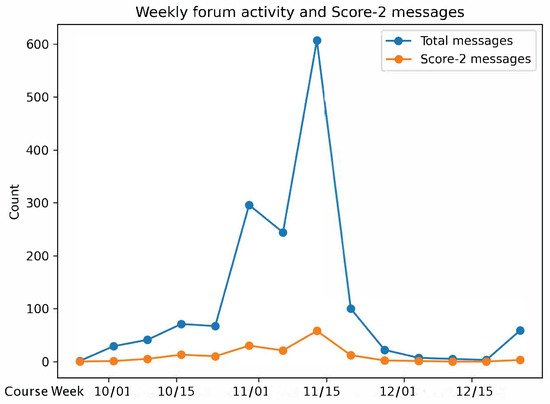
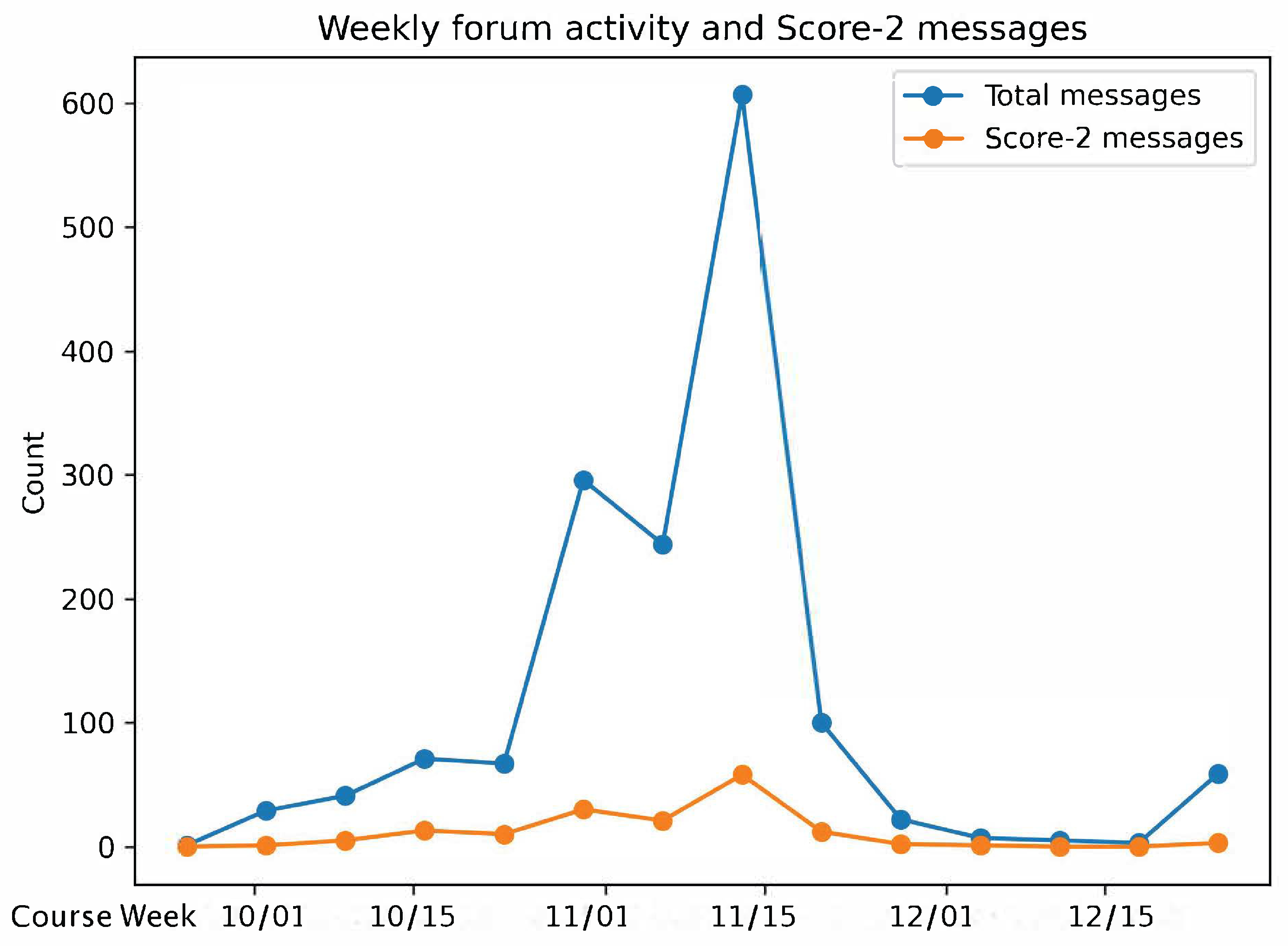
Weekly aggregation of forum activity indicated a peak-driven temporal pattern. After excluding the peak week, the association between weekly total message volume and the weekly proportion of highly aligned posts (Score-2) was not significant in a linear sense (Pearson r = 0.28, p = 0.350) but showed a strong monotonic association (Spearman ρ = 0.56, p = 0.048). This suggests that high-volume weeks tend to also rank-order with higher Score-2 proportions, although the relationship is not strictly linear.
Figure 1 shows weekly forum activity across the course timeline. Weekly aggregation showed that overall forum activity was peak-driven, with a small number of weeks accounting for a disproportionately large share of posting volume.
Figure 1.
Weekly time-series of total messages and Score-2 messages.
The proportion of high-alignment (Score-2) messages did not scale linearly with total volume, suggesting that peak periods reflect both intensified participation and variable quality composition. Peak-week analyses indicated that alignment distributions during the highest-activity week differed from baseline weeks, supporting the notion that deadline-driven bursts may alter discourse composition. Correlation analysis between weekly message volume and the Score-2 proportion showed that the relationship was weak-to-moderate and sensitive to peak-week inclusion; excluding the peak week changed the magnitude and/or significance of the association. This indicates that temporal rhythms can influence apparent “quality trends,” and peak weeks may function as outliers driven by instructional pacing rather than sustained learning processes.
3.8. RQ8. Do Goal-Aligned Messages Receive Higher Visibility and Engagement, Controlling for Network Position and Participation?
In bivariate comparisons, Score-2 posts tended to show higher visibility and/or engagement compared with low-alignment posts, but the size of these differences varied by theme and message level, as shown in Table 11 and Table 12.
Table 11.
Top multivariate predictors of visibility and engagement among Score-2 posts (standardized beta).
Table 12.
Top multivariate predictors of engagement among Score-2 posts (standardized beta).
Network centrality and behavioral participation were positively associated with both outcomes, suggesting that structurally embedded students and active contributors tend to generate posts that receive greater attention and interaction. Robust OLS models predicted (a) visibility (DV = log(1 + NUM_READERS)) and (b) engagement (DV = log(1 + thread replies)) from goal alignment while controlling for theme, message level, time (week), PageRank, and BPI.
Multivariate regression models tested whether goal alignment predicts (a) visibility and (b) engagement, net of confounds. Across models, PageRank centrality emerged as the strongest and most consistent predictor of both outcomes, indicating that relational position in the reply network drives exposure and conversational momentum. BPI also contributed to the models, but its effects were less stable once PageRank and other controls were included, supporting the distinction between behavioral activity and relational influence.
For visibility (all messages; Model 1), goal similarity did not reach conventional significance (B = 0.968, SE = 0.551, t = 1.76, p = 0.079, 95% CI [−0.113, 2.048]), and Score 2 (vs. Score 0) was not significant (B = −0.049, SE = 0.056, t = −0.87, p = 0.387, 95% CI [−0.159, 0.062]). PageRank was a strong positive predictor (B = 1.925, SE = 2.262, t = 4.83, p < 0.001, 95% CI [6.492, 15.358]), whereas BPI was not significant (B = 0.001, SE = 0.004, t = 0.36, p = 0.716, 95% CI [−0.006, 0.009]).
For engagement (all messages; Model 2), neither goal similarity (B = −0.087, SE = 0.730, t = −0.12, p = 0.906, 95% CI [−1.517, 1.344]) nor Score 2 (vs. Score 0) (B = 0.019, SE = 0.089, t = 0.21, p = 0.831, 95% CI [−0.156, 0.194]) predicted replies once controls were included. PageRank positively predicted engagement (B = 6.615, SE = 3.163, t = 2.09, p = 0.036, 95% CI [0.415, 12.815]). BPI showed a negative association with engagement (B = −0.041, SE = 0.007, t = −5.93, p < 0.001, 95% CI [−0.055, −0.028]), indicating that higher behavioral participation did not correspond to higher reply volume when network position and other controls were held constant.
In the starters only specification predicting visibility (Model 3), goal similarity (B = 0.506, SE = 0.671, t = 0.75, p = 0.451, 95% CI [−0.810, 1.821]) and Score 2 (vs. Score 0) (B = −0.093, SE = 0.085, t = −1.10, p = 0.270, 95% CI [−0.260, 0.073]) remained nonsignificant. PageRank retained a strong positive association with visibility (B = 25.838, SE = 9.880, t = 2.62, p = 0.009, 95% CI [6.474, 45.202]). BPI also showed a positive association in this specification (B = 0.162, SE = 0.063, t = 2.57, p = 0.010, 95% CI [0.038, 0.285]), suggesting that for solution proposal posts, activity intensity relates to visibility after accounting for network position and controls.
Overall, PageRank was the strongest and most consistent predictor of visibility and engagement across specifications, while the incremental contribution of goal alignment depended on model and outcome. The starter-only specification indicates that proposal visibility is jointly associated with centrality (PageRank) and participation intensity (BPI).
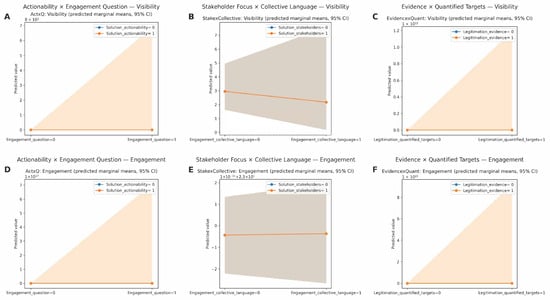
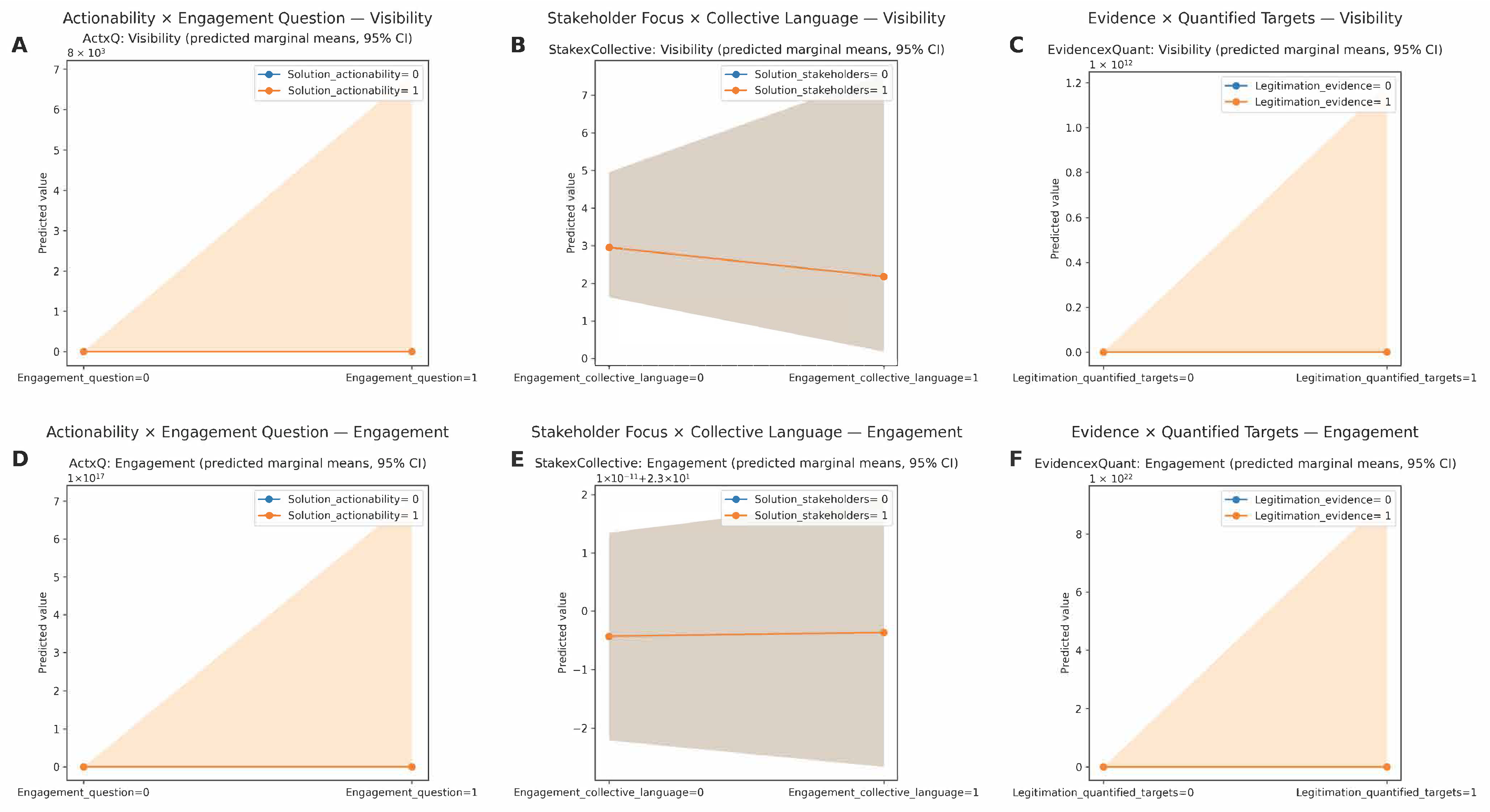
To deepen interpretation, Score-2 posts were analyzed using a discourse coding scheme, with interaction patterns presented in Figure 2. Code-based tests showed that certain communicative features significantly differentiated visibility and engagement. Multivariate models controlling for word count identified the strongest independent code predictors. Within the Score-2 subset, discourse-code analyses (controlling for word count) identified message design features that differentiate which highly aligned messages become most visible vs. most discussed. Interaction models (e.g., Actionability × Question prompts; Evidence × Quantified targets) showed conditional patterns in predicted marginal means, consistent with the idea that discursive strategies can amplify attention and engagement when combined.
Figure 2.
Interaction effects of discourse codes on visibility and engagement among Score-2 posts. (A–C) show predicted marginal means (with 95% CI) for visibility (readers), and (D–F) for engagement (replies), based on robust OLS models controlling for word count and sample group. Predicted values are back-transformed from log(1 + outcome). (A,D): Actionability × engagement question; (B,E): stakeholder focus × collective language; (C,F): evidence legitimation × quantified targets.
Interaction models did not provide evidence that combinations of discourse strategies predicted visibility or engagement once controls were included. For visibility, Act × Q was not significant (B = 0.021, SE = 4.894, t = 0.00, p = 0.997) and Evidence × Quant was not significant (B = 0.472, SE = 15.253, t = 0.03, p = 0.975). For engagement, Act × Q and Evidence × Quant were also not significant (both ps = 1.000). The Stake × Collective interaction could not be estimated because the interaction term had zero variance. Adding interaction terms explained negligible additional variance for visibility (ΔR2 = 0.005) and none for engagement (ΔR2 = 0.000).
4. Discussion
This study examined how SDG-aligned idea generation unfolds in an online forum embedded within a Social Responsibility course, integrating sustainability competencies with learning analytics, social network analysis, and goal-alignment scoring. The findings should not be interpreted as evidence that certain sustainability ideas are inherently superior or more desirable than others. Rather, they demonstrate how interaction structures and communicative features shape the visibility and diffusion of student contributions in online discussions. This interpretation aligns with recent higher-education research emphasizing that responsible, SDG-aligned pedagogy should foreground equity of participation and dialogic openness rather than content prescription [12]. Overall, findings support a systems-informed view of online sustainability learning: participation roles, network influence, and discourse design jointly shape which sustainability ideas become visible and debated.
The BPI captures participation intensity and activity volume, such as posting frequency, whereas network centrality reflects relational embeddedness within the interaction network. The observed weak or negative association between BPI and engagement outcomes suggests that frequent posting alone does not guarantee visibility or interaction. Contributor types differed clearly across participants, which indicates role specialization rather than uniform participation. Behavioral participation (BPI) also differed across contributor roles and across faculty, department or program, and class level. This finding indicates that contributions may remain peripheral unless they are strategically positioned within the network structure, reinforcing the distinction between behavioral intensity and relational influence. These patterns suggest that disciplinary and program contexts shaped how students engaged in SDG-oriented discussion tasks.
Network centrality differed across contributor roles and student attributes. PageRank predicted visibility and engagement more consistently than posting frequency, which shows that structural embeddedness in the reply network is distinct from behavioral activity. Most solution proposals aligned with assigned themes, while cross-theme proposals occurred at meaningful rates. Cross-theme rates also varied across academic groups, which suggests differences in integrative reasoning across disciplines.
While cross-theme similarity may indicate integrative or systems-oriented reasoning, semantic similarity alone cannot confirm such cognitive processes. Cross-theme overlap also reflects broad or ambiguous framing. Accordingly, cross-theme alignment is interpreted here as an indicator of potential integrative engagement rather than definitive evidence of systems thinking, consistent with recent cautions in sustainability education research [11]. Goal alignment varied across message types and student characteristics. Forum interaction was concentrated in a small number of weeks, and alignment rates shifted during peak periods. After controls for theme, message level, time, PageRank, and BPI, goal alignment showed weaker direct effects on visibility and engagement. This pattern indicates that SDG-aligned discourse does not diffuse automatically without structural exposure.
Taken together, the results show that SDG-oriented learning in online forums depends on both content and structure. Goal-aligned ideas gained traction when they moved through interaction pathways that shaped attention and reply behavior. From a pedagogical perspective, the results suggest that instructors can enhance the visibility of high-quality but peripheral contributions through intentional interaction design rather than evaluative filtering. Strategies such as structured reply requirements, rotating facilitation roles, and staged discussion prompts may reduce cumulative advantage effects associated with early participation and central network positions. Similar design-oriented approaches have been shown to support inclusivity and sustained engagement in SDG-aligned higher education contexts [13], as well as to mitigate inequities arising from differential confidence or linguistic capital [12]. In addition, the identified communicative features associated with higher visibility, such as the use of evidence, quantified references, and dialogic prompts, can be translated into instructional guidance through rubric criteria, exemplar posts, and scaffolded discussion prompts. Rather than prescribing viewpoints, such scaffolds make epistemic expectations explicit, supporting reflective participation while maintaining openness to diverse sustainability perspectives [11].
The emergence of contributor types aligns with research showing that online forums naturally generate participation roles and status structures, often resulting in unequal distributions of influence and attention [6,9]. In sustainability education, such role differentiation has dual implications. On one hand, role diversity can support collective problem solving by enabling some students to act as initiators of strategic ideas while others provide critique, elaboration, and coordination processes consistent with interpersonal and strategic competencies in sustainability frameworks [3,14]. On the other hand, role differentiation may also reproduce participation inequality, whereby some students become structurally central and therefore shape which SDG topics gain traction and which voices remain peripheral.
From a transformative learning perspective, sustainability education should cultivate agency, reflexivity, and pluralistic dialogue rather than merely producing “high-volume” participation [5]. The BPI differences across student characteristics suggest that engagement is shaped by disciplinary context and potentially by differences in perceived relevance, prior knowledge, and communicative confidence. This supports prior sustainability education research emphasizing that competence development is unevenly distributed and requires intentional pedagogy and scaffolding [4,14]. Practically, these findings reinforce the need for instructors to design forum tasks and facilitation practices that prevent role lock-in and ensure equitable participation opportunities, particularly in SDG contexts where diverse perspectives are vital.
The main contribution of this study is the robust finding that PageRank centrality most consistently predicted visibility and engagement, even when controlling for behavioral participation (BPI), time, theme, and message level. This result is consistent with social learning analytics work showing that structural position influences attention and learning-related outcomes [9]. In online environments, central actors often occupy brokerage positions that allow them to distribute ideas through multiple relational pathways and to receive responses from diverse participants. This suggests that SDG-oriented discourse diffusion is not solely merit-based (content quality) but also structure-based (relational visibility).
Our findings suggest that goal alignment alone may not be sufficient for idea uptake if authors are peripheral in the interaction network. The robustness further supports interpreting goal alignment as a meaningful but non-deterministic contributor to idea diffusion, whose effects are conditioned by interaction structure rather than measurement granularity. Thus, sustainability educators may need to incorporate structural design strategies like rotating facilitation roles, ensuring cross-group replies, or using structured peer-comment protocols to disrupt attention inequality and allow goal-aligned ideas to circulate more widely. In this sense, learning analytics can support sustainability education not merely by evaluating learning but by informing design to ensure that forum structures promote inclusive SDG discourse [16].
Although many solution proposals aligned well with the assigned themes and SDG-relevant goals, the multivariate models showed that goal alignment had weaker direct effects on visibility and engagement once network position and controls were included. This nuance refines common assumptions in competency-based sustainability education. Competency frameworks emphasize alignment with strategic and normative goals [3,14], but our findings indicate that aligned discourse must also be socially amplified to become influential in the learning system. This “content–structure gap” aligns with the broader literature on online collaborative learning, where discourse quality may not translate into interaction outcomes unless it is embedded in social presence dynamics and active conversational pathways [5,6]. In practical terms, instructors seeking to strengthen SDG-related learning should not only ask students to write aligned proposals but also facilitate interaction patterns that allow these proposals to be read, debated, and refined. This also suggests that learning designs emphasizing SDG alignment should be combined with social facilitation strategies to avoid a hidden curriculum where only structurally central students shape collective knowledge.
The presence of cross-theme solution proposals and variation in cross-theme rates across student characteristics is theoretically consistent with systems thinking and integrative sustainability reasoning [3]. Cross-theme thinking signals recognition that SDGs are interconnected rather than separable, a core premise of sustainability transitions. Differences in cross-theme patterns across faculties and departments may reflect different disciplinary epistemologies: some fields may naturally approach sustainability through interconnected systems, while others may frame problems more locally. This underscores a key sustainability education challenge: while interdisciplinary diversity can enrich SDG discourse, instructors may need to make interconnections explicit and scaffold integrative reasoning to help all students practice cross-SDG synthesis. Cross-theme overlap should be interpreted cautiously. Although references to multiple SDG themes may be consistent with systems-oriented reasoning, semantic similarity alone cannot establish integrative or relational thinking. Cross-theme similarity may also reflect broad or ambiguous framing of sustainability concepts rather than deliberate coordination across domains. For this reason, cross-theme overlap is treated in this study as an indicator of potential systems-oriented engagement rather than as proof of integrative reasoning.
Importantly, the cross-theme findings also reinforce the suitability of online forums for sustainability learning: the forum enabled not only theme-specific solution generation but also integrative framing across SDGs. This supports emphasis on curricular innovation that enables sustainability learning across subject areas, particularly when SDGs are used as a unifying structure.
A distinctive strength of this study is that it complements analytics with a communication-oriented lens: among the subset of highly goal-aligned messages (Score-2), discursive features and their combinations meaningfully differentiated outcomes. Posts that combined actionability with engagement prompts generated stronger engagement, while combinations such as evidence-based legitimation with quantified targets were associated with higher visibility. These patterns align with communication theories emphasizing that message uptake depends on both informational content and interactional affordances, including whether the message invites dialogue, provides credible justification, and specifies implementable steps.
From the standpoint of sustainability competencies, these discourse strategies can be mapped to competence enactment: actionability reflects strategic competence, evidence reflects epistemic rigor and critical thinking, quantified targets reflect operationalization of sustainability objectives, and engagement prompts reflect interpersonal competence and collaborative orientation [3,14]. Thus, the discourse code findings provide concrete evidence that sustainability competencies are not only cognitive capacities but are manifested in communicative choices that shape social uptake.
Time-series analysis showed that interaction was peak-driven and that the proportion of high-alignment posts did not scale linearly with total posting volume. This has practical relevance because online sustainability learning is often embedded within assessment structures. Peak weeks may reflect deadline-driven behavior rather than sustained reflective inquiry, raising concerns that the forum may become an instrument for compliance rather than transformative learning. From a pedagogical standpoint, sustainability forums benefit from distributed deadlines, staged tasks like propose, critique and revise, and instructor facilitation that promotes iterative improvement. Such designs could better reflect transformative learning goals by sustaining depth of engagement over time [5].
5. Limitations
This study has several limitations that shape how the findings should be interpreted and point to clear next steps. Goal alignment relied on semantic similarity to theme objectives, which captures topical proximity but does not fully represent ethical depth, feasibility, or transformative intent. The data came from a single course at one institution, so cultural and curricular factors may limit generalizability. PageRank captured network influence but did not measure learning outcomes or conceptual change, and centrality may reflect social dynamics unrelated to sustainability reasoning. Discourse coding focused on Score-2 posts and used automated pre-labelling, which supports scalable analysis but limits interpretive depth. The rubric dimensions capture observable discourse properties that support reliable message-level coding. While they are theoretically linked to sustainability competencies, the analysis does not assume a one-to-one correspondence between textual indicators and underlying cognitive processes. Future research should connect network and discourse indicators to validated sustainability competency measures, test causal effects through experimental forum designs, replicate across institutions and SDG configurations, integrate deeper qualitative discourse analysis to examine values conflicts and justice-related trade-offs, and assess equity by testing how factors such as gender, language proficiency, and prior sustainability literacy relate to network position, voice, and recognition in SDG-oriented forums.
6. Conclusions
This study examined how interaction structures and communicative practices shape the visibility and diffusion of student-generated sustainability-related ideas in an online higher-education context. The findings indicate that network position, timing of participation, and specific discourse features are associated with differential visibility, independent of the substantive stance of the ideas expressed. These results contribute to growing evidence that equitable participation in SDG-oriented education depends not only on learner motivation, but also on the design of digital learning environments [11].
For higher education practice, the findings suggest that instructors can support inclusive and reflective sustainability learning by focusing on interaction design rather than content control. Distributed deadlines, phased discussion tasks, and explicit discourse scaffolds may help counteract cumulative visibility advantages while preserving pluralism and critical inquiry. This design-based orientation aligns with recent calls to move beyond surveillance or prescriptive approaches toward pedagogies that foreground equity, agency, and transparency in SDG-aligned education [12,13].
The results carry implications for sustainability implementation in higher education. Course designers should support equitable diffusion of ideas by structuring participation and response pathways so that goal-aligned proposals from less central students gain exposure. Instructors should use learning analytics to monitor network inequality and goal alignment and to guide timely facilitation when attention concentrates among a small group [16]. Prompts and assessment criteria should require cross-theme connections to support integrative systems thinking across SDGs. Instruction should also target communicative sustainability competence by teaching students to justify proposals with evidence, specify measurable targets, identify relevant stakeholders, and use clear prompts that invite peer response. Finally, course pacing should reduce burst-driven participation by distributing deadlines and implementing iterative cycles of proposal, critique, and revision to sustain engagement over time. The study links sustainability competency theory with social learning analytics through measurable indicators, by demonstrating that SDG discourse diffusion depends on both content quality and structural exposure, and by framing sustainability competence as a socially enacted capability expressed through interaction and discourse.
Author Contributions
Y.Ö. and Ö.O. were responsible for the conceptualization of the research. Ö.O. developed the methodology. Y.Ö. handled the software and formal analysis. The validation of the work was a collaborative effort by Y.Ö. and Ö.O. Y.Ö. and Ö.O. conducted the investigation and provided resources. Data curation was managed by Ö.O. and Y.Ö. The original draft of the manuscript was prepared by Y.Ö. and Ö.O., while Ö.O. was responsible for reviewing and editing it. Ö.O. was in charge of visualization. Y.Ö. provided supervision for the project, and Ö.O. was responsible for project administration. All authors have approved the submitted version and agree to be personally accountable for their contributions, ensuring the accuracy and integrity of the work. All authors have read and agreed to the published version of the manuscript.
Funding
This research received no external funding.
Institutional Review Board Statement
Not applicable.
Informed Consent Statement
Not applicable.
Data Availability Statement
The data supporting the findings of this study are not publicly available due to privacy and ethical restrictions related to student educational records. Aggregated or de-identified data may be made available from the corresponding author upon reasonable request and subject to institutional approval.
Acknowledgments
All statistical analyses were performed using the Python (v3.9) ecosystem and Jamovi (v2.4), a free and open-source statistical analysis software. The authors confirm that GenAI (ChatGPT v5.2 and Gemini v3) tools were only utilized for superficial text editing, including grammar, spelling, punctuation, and formatting, and not for generating text, data, graphics, or assisting in study design, data collection, analysis, or interpretation. All authors reviewed and edited the output and take full responsibility for the content of this publication.
Conflicts of Interest
The authors declare no conflicts of interest.
Abbreviations
The following abbreviations are used in this manuscript:
| SDGs | Sustainable Development Goals |
| SDG 6 | Clean Water and Sanitation |
| SDG 7 | Affordable and Clean Energy |
| SDG 12 | Responsible Consumption and Production |
| SDG 14 | Life Below Water |
| SDG 15 | Life on Land |
| SNA | Social network analysis |
| LA | Learning analytics |
| SLA | Social Learning Analytics |
| BPI | Behavioral Participation Index |
| OLS | Ordinary Least Squares |
References
- Rittel, H.W.J.; Webber, M.M. Dilemmas in a general theory of planning. Policy Sci. 1973, 4, 155–169. [Google Scholar] [CrossRef] [Scilit]
- Redman, A.; Wiek, A. Competencies for advancing transformations towards sustainability. Front. Educ. 2021, 6, 785163. [Google Scholar] [CrossRef] [Scilit]
- Wiek, A.; Withycombe, L.; Redman, C.L. Key competencies in sustainability: A reference framework for academic program development. Sustain. Sci. 2011, 6, 203–218. [Google Scholar] [CrossRef] [Scilit]
- Rieckmann, M. Future-oriented higher education: Which key competencies should be fostered through university teaching and learning? Futures 2012, 44, 127–135. [Google Scholar] [CrossRef] [Scilit]
- Sterling, S. Learning and Sustainability in Dangerous Times; Agenda Publishing: Newcastle upon Tyne, UK, 2024. [Google Scholar] [CrossRef] [Scilit]
- Garrison, D.R.; Anderson, T.; Archer, W. Critical thinking, cognitive presence, and computer conferencing in distance education. Am. J. Distance Educ. 2001, 15, 7–23. [Google Scholar] [CrossRef] [Scilit]
- Lim, J. Exploring the relationships between interaction measures and learning outcomes through social network analysis: The mediating role of social presence. Int. J. Educ. Technol. High. Educ. 2023, 20, 384. [Google Scholar] [CrossRef] [Scilit]
- Barth, M.; Godemann, J.; Rieckmann, M.; Stoltenberg, U. Developing key competencies for sustainable development in higher education. Int. J. Sustain. High. Educ. 2007, 8, 416–430. [Google Scholar] [CrossRef] [Scilit]
- Doleck, T.; Lemay, D.J.; Brinton, C.G. Evaluating the efficiency of social learning networks: Perspectives for harnessing learning analytics to improve discussions. Comput. Educ. 2021, 164, 104124. [Google Scholar] [CrossRef] [Scilit]
- UNESCO. Issues and Trends in Education for Sustainable Development; UNESCO: Paris, France, 2018. [Google Scholar] [CrossRef] [Scilit]
- Ferk Savec, V.; Jedrinović, M. Education for sustainable development in digital learning environments: Linking sustainability competencies, learning design, and assessment. Sustainability 2025, 17, 183. [Google Scholar] [CrossRef] [Scilit]
- Joseph, M.M.; Areepattamannil, S. From policing to design: A qualitative multisite study of generative artificial intelligence and SDG 4 in higher education. Sustainability 2025, 17, 10381. [Google Scholar] [CrossRef] [Scilit]
- Apata, O.E.; Ajose, S.T.; Apata, B.O.; Olaitan, G.I.; Oyewole, P.O.; Ogunwale, O.M.; Oladipo, E.T.; Oyeniran, D.O.; Awoyemi, I.D.; Ajobiewe, J.O.; et al. Artificial intelligence in higher education: A systematic review of contributions to SDG 4 (quality education) and SDG 10 (reduced inequality). Int. J. Educ. Manag. 2025. ahead-of-print. [Google Scholar] [CrossRef] [Scilit]
- Brundiers, K.; Barth, M.; Cebrián, G.; Cohen, M.; Diaz, L.; Doucette-Remington, S.; Dripps, W.; Habron, G.; Harré, N.; Jarchow, M.; et al. Key competencies in sustainability in higher education—Toward an agreed-upon reference framework. Sustain. Sci. 2021, 16, 13–29. [Google Scholar] [CrossRef] [Scilit]
- Rieckmann, M.; Barth, M. Educators’ Competence Frameworks in Education for Sustainable Development. In Competences in Education for Sustainable Development; Vare, P., Lausselet, N., Rieckmann, M., Eds.; Springer: Cham, Switzerland, 2022. [Google Scholar] [CrossRef] [Scilit]
- Siemens, G. Learning analytics. Am. Behav. Sci. 2013, 57, 1380–1400. [Google Scholar] [CrossRef] [Scilit]
- Banihashem, S.K.; Noroozi, O.; van Ginkel, S.; Macfadyen, L.P.; Biemans, H.J.A. A systematic review of the role of learning analytics in enhancing feedback practices in higher education. Educ. Res. Rev. 2022, 37, 100489. [Google Scholar] [CrossRef] [Scilit]
- Kleimola, R.; Leppisaari, I. Learning analytics to develop future competences in higher education: A case study. Int. J. Educ. Technol. High. Educ. 2022, 19, 318. [Google Scholar] [CrossRef] [Scilit]
- Chen, B.; Chang, Y.; Ouyang, F.; Zhou, W. Fostering student engagement in online discussion through social learning analytics. Internet High. Educ. 2018, 37, 21–30. [Google Scholar] [CrossRef] [Scilit]
- Kaliisa, R.; Rienties, B.; Mørch, A.I.; Kluge, A. Social learning analytics in computer-supported collaborative learning environments: A systematic review of empirical studies. Comput. Educ. Open 2022, 3, 100073. [Google Scholar] [CrossRef] [Scilit]
- Valdes-Ramirez, D.; De Armas Jacomino, L.; Monroy, R.; Zavala, G. Assessing sustainability competencies in contemporary STEM higher education: A data-driven analysis at Tecnologico de Monterrey. Front. Educ. 2024, 9, 1415755. [Google Scholar] [CrossRef] [Scilit]
- Li, S.; Fan, Z.; Liu, I.; Morrison, P.S.; Liu, D. Surrogate method for partial association between mixed data with application to well-being survey analysis. Ann. Appl. Stat. 2024, 18, 2254–2276. [Google Scholar] [CrossRef] [Scilit]
- Fan, Z.; Reimherr, M. High-dimensional adaptive function-on-scalar regression. Econom. Stat. 2017, 1, 167–183. [Google Scholar] [CrossRef] [Scilit]
- Page, L.; Brin, S.; Motwani, R.; Winograd, T. The PageRank Citation Ranking: Bringing Order to the Web; Stanford InfoLab: Stanford, CA, USA, 1998; Available online: http://ilpubs.stanford.edu:8090/422/1/1999-66.pdf (accessed on 10 January 2026).

Disclaimer/Publisher’s Note: The statements, opinions and data contained in all publications are solely those of the individual author(s) and contributor(s) and not of MDPI and/or the editor(s). MDPI and/or the editor(s) disclaim responsibility for any injury to people or property resulting from any ideas, methods, instructions or products referred to in the content. |
© 2026 by the authors. Licensee MDPI, Basel, Switzerland. This article is an open access article distributed under the terms and conditions of the Creative Commons Attribution (CC BY) license.