


Abstract
Against the backdrop of China’s dual carbon goals, investigating the impact of environmental taxes on carbon productivity is crucial for formulating effective regional environmental policies and achieving carbon peaking and carbon neutrality targets. This study employs panel data from 31 Chinese provinces spanning the period 2013–2023 and applies a spatial mediation model to empirically examine whether environmental taxes influence regional and neighboring carbon productivity through technological innovation. Furthermore, the study explores the underlying transmission mechanisms and regional heterogeneity of this effect. The analysis reveals that environmental taxation significantly enhances carbon productivity, accompanied by notable spatial spillover effects. Technological innovation serves as a partial mediator, indicating that such taxes indirectly foster productivity gains by stimulating the development of green technologies. From a regional perspective, the positive influence of environmental taxation is strongest in eastern China, produces moderate spillover effects in the central provinces, and demonstrates comparatively limited policy efficacy in the western regions.
1. Introduction
As global climate change intensifies, addressing its consequences has become a critical challenge shared by all of humanity. According to the annual report released by the World Meteorological Organization on 19 March 2025, the global average temperature in 2024 rose by approximately 1.15 °C above pre-industrial levels (1850–1900). Among the various contributing factors, excessive carbon emissions are widely recognized as the primary driver of global warming. Consequently, reducing carbon emissions and promoting green, sustainable development have emerged as urgent priorities for governments worldwide.
As a core metric of low-carbon economic performance, carbon productivity captures the efficiency with which economic output is generated relative to carbon emissions. By incorporating ecological constraints, it provides a more comprehensive evaluation of the quality of regional economic growth [1]. Identifying the core factors that influence carbon productivity and exploring effective pathways for its enhancement are of great practical significance for facilitating the transition from traditional economic growth to a green and low-carbon development model.
Among various policy instruments, tax policy has attracted increasing attention in the fields of carbon emission reduction and environmental governance due to its unique advantages in reallocating resources and guiding corporate behavior [2]. The Environmental Protection Tax Law of the People’s Republic of China, which came into effect on 1 January 2018, established a positive incentive mechanism of “more emissions, higher tax; fewer emissions, lower tax; no emissions, no tax.” This law incorporates air pollutants, water pollutants, and solid waste into the tax scope. It aims to encourage firms to reduce emissions and increase environmental protection investment through market-based mechanisms, thereby promoting the green transformation of industrial sectors [3].
Nevertheless, prior research indicates that the relationship between environmental taxation and carbon productivity may exhibit nonlinearity. Instead, there may exist complex mediating mechanisms underlying this relationship. In particular, technological innovation, as a critical link between environmental regulation and low-carbon performance, plays a key role in the transmission of environmental tax policies. Moreover, carbon emissions exhibit significant spatial spillover effects. The carbon productivity of a given region is not only influenced by its own environmental tax intensity and technological capacity but may also be affected by spillover effects from neighboring regions’ emission policies and economic activities [4]. Therefore, investigating whether environmental taxes can enhance interregional carbon productivity through technological innovation holds substantial theoretical value and important policy implications.
Despite existing studies on the pairwise relationships between environmental taxes, technological innovation, and carbon productivity, three critical gaps remain unaddressed: (1) Direct effect verification: Do provincial environmental taxes in China significantly promote carbon productivity, and how to quantify this effect while addressing endogeneity? (2) Spatial spillover mechanism: Does environmental tax policy generate cross-regional spillover effects on carbon productivity, and what are the transmission channels? (3) Mediation role identification: Does technological innovation mediate the relationship between environmental taxes and carbon productivity, and what are the characteristics of this mediation effect? (4) Regional heterogeneity explanation: Why do the effects of environmental taxes differ across eastern, central, and western China, and what structural/institutional factors drive these differences? To fill these gaps, this study uses panel data of 31 Chinese provinces from 2013 to 2023 to systematically examine the direct effects, spatial spillover effects, and technological innovation mediation mechanisms of environmental taxes on carbon productivity, providing empirical support for differentiated environmental policy design.
This study makes three marginal contributions to the existing literature. First, it integrates environmental taxation, technological innovation, and carbon productivity into a unified analytical framework, capturing direct effects, spatial spillover effects, and mediating mechanisms. Second, this study combines the spatial Durbin model with a mediation effect framework to construct a spatial mediation model, enabling the identification of indirect transmission channels while accounting for spatial dependence. Third, by revealing significant regional heterogeneity, this study provides policy-relevant evidence for designing differentiated environmental tax and innovation policies in the context of carbon neutrality.
The remainder of this paper is structured as follows. Section 2 synthesizes relevant studies from both domestic and international contexts. Section 3 introduces the theoretical framework and formulates the research hypotheses. Section 4 describes the research design, including model specification, variable definitions, and data sources. Section 5 presents the baseline regression results, while Section 6 extends the analysis to explore spatial effects and mediation pathways. Finally, Section 7 summarizes the main findings and proposes targeted policy implications.
2. Literature Review
2.1. Direct Impact of Environmental Taxes on Carbon Productivity
As a key indicator of low-carbon economic development and economic output efficiency, carbon productivity measures the economic benefits generated per unit of carbon emissions. In recent years, both domestic and international scholars have increasingly examined the direct effects of environmental regulatory policies on carbon productivity. Some studies argue that when firms anticipate stringent environmental regulation and perceive strong policy rigidity, poorly designed environmental taxes—particularly those imposing excessive external costs—may induce firms to accelerate short-term fossil fuel consumption, leading to a temporary increase in carbon emissions [5]. Nevertheless, the majority of studies support the Porter Hypothesis, which suggests that appropriately designed environmental taxes can incentivize firms’ green transformation through cost pressures, thereby optimizing resource allocation, improving energy efficiency, and enhancing carbon productivity [6].
Empirical evidence further supports this view. Using provincial panel data, Jin [7] finds that environmental regulation significantly improves carbon productivity, with green technological innovation playing a key mediating role. Wang et al. [8] identify a nonlinear, U-shaped relationship between environmental regulation and carbon productivity, indicating that moderate regulation enhances efficiency, whereas excessive regulation may suppress innovation. Uche E et al. [9] report that energy taxes and environmental management exert moderately positive effects on carbon productivity, particularly in the long run. From the perspective of tax policy design, Zhou et al. [10] demonstrate that green taxation exhibits a significant threshold effect on carbon emission reduction, with marginal effects depending on tax intensity. From an institutional standpoint, Sun et al. [11] emphasize the need to improve the green tax system—including carbon and resource taxes—to strengthen its long-term effectiveness in promoting green transformation and carbon productivity.
2.2. Spatial Effects and Regional Heterogeneity in the Impact of Environmental Taxes on Carbon Productivity
Carbon productivity exhibits pronounced spatial interdependence, as economic activities and emission behaviors across regions are interconnected through various externalities. Accordingly, existing studies increasingly focus on the spatial spillover effects of environmental policies and their implications for carbon productivity. Using a Spatial Durbin Model, Li et al. [12] find that heterogeneous environmental regulations generate significant positive spatial spillover effects, indicating that policy adjustments in one region can influence carbon productivity in neighboring areas through economic linkages. Similarly, Wang et al. [13] show that two-way FDI not only enhances local carbon productivity but also strengthens the spatial transmission of carbon efficiency. Zhang et al. [14], examining coordinated emission reduction in the Yangtze River Economic Belt, further reveal that improvements in carbon productivity exhibit spatial agglomeration patterns closely associated with regional industrial upgrading.
Beyond positive spillovers, some studies emphasize strategic interactions among local governments that may distort spatial transmission mechanisms. Lin et al. [15] demonstrate that under environmental tax pressure, local governments tend to exhibit “structural convergence” in policy responses, potentially weakening the overall efficiency of green transformation. From a dynamic perspective, Xu et al. [16] highlight substantial heterogeneity in carbon productivity trajectories across cities at different stages of their development life cycles, underscoring the importance of accounting for regional characteristics in policy design. Taken together, these findings suggest that the impact of environmental taxes on carbon productivity is characterized by both spatial externalities and regional heterogeneity, thereby necessitating the use of spatial econometric models to empirically capture policy spillovers, strategic interactions, and heterogeneous effects.
2.3. Mechanisms Through Which Environmental Taxes Affect Carbon Productivity
Beyond direct effects and spatial spillovers, a growing strand of literature examines the mechanisms through which environmental taxes indirectly influence carbon productivity, with particular emphasis on the mediating role of green innovation. Rubashkina et al. [17], Yuan et al. [18], and Calel et al. [19] argue that environmental regulation stimulates low-carbon technological innovation by creating cost-saving incentives for firms. Empirical evidence further shows that technological innovation reduces carbon emission intensity and improves environmental quality, thereby supporting sustainable economic development [20]. Studies on climate mitigation technologies also confirm that green technological progress plays a critical role in achieving carbon emission reductions and improving carbon performance [21,22].
Further research disaggregates green innovation into process innovation, end-of-pipe technologies, and source innovation, suggesting that environmental taxes mainly promote emission reduction and efficiency gains through the first two channels, while their incentives for source innovation remain relatively weak [23]. Moreover, the mediating effect of green innovation may exhibit nonlinear or threshold characteristics [24]. In regions with limited innovation capacity, environmental taxes may initially constrain carbon efficiency, with positive effects emerging only after technological accumulation exceeds a critical threshold. Recent studies also highlight synergistic mechanisms between environmental taxes and green finance instruments—such as green credit, fiscal subsidies, and carbon trading—which enhance technology diffusion and emission reduction effectiveness [25]. Overall, these findings underscore green innovation as a key transmission channel linking environmental taxes to carbon productivity, while also providing a clear empirical rationale for examining mediation effects and regional heterogeneity within a unified analytical framework.
In summary, existing studies have systematically examined the multidimensional impact pathways of environmental taxes on carbon productivity from three perspectives: direct effects, spatial spillovers, and mediating mechanisms. The literature generally supports the view that, under appropriate institutional arrangements and incentive structures, environmental taxes can sustainably enhance carbon productivity through green technological innovation and regional collaborative governance. However, several gaps remain in the existing research. On the one hand, studies on the spatial econometric and mediation mechanisms linking environmental taxes and carbon productivity are still fragmented, lacking an integrated analytical framework that combines both perspectives. On the other hand, issues such as the rebound effect of technological innovation and regional asymmetries have not been sufficiently addressed or identified. On the basis of a comprehensive review of the existing literature, this study employs provincial-level panel data from China and constructs a spatial mediation model that integrates spatial spillover effects with mediation mechanisms. From an interregional perspective, we investigate the transmission pathways through which environmental taxes affect carbon productivity, thereby providing new empirical evidence on the externality effects of environmental taxation. In addition, this study further compares the heterogeneous policy effects across eastern, central, and western regions, thereby providing both theoretical insights and empirical support for optimizing environmental tax systems and advancing China’s “dual carbon” goals.
3. Theoretical Framework and Research Hypotheses
3.1. The Direct Effect of Environmental Taxes on Carbon Productivity
As a typical market-based environmental regulatory instrument, environmental taxes function by internalizing the external costs of carbon emissions, thereby guiding firms to adjust their production behaviors and enhance carbon productivity. On the one hand, a heavier environmental tax burden prompts firms to adjust their production strategies. They may phase out high-carbon capacity, increase investment in energy-saving and emission-reduction technologies, and pursue green innovation. These measures help to cut compliance costs and enhance the economic output generated per unit of carbon emissions. In regions heavily reliant on fossil fuel consumption, environmental taxes impose strong constraints, encouraging firms to adopt clean energy and energy-efficient technologies, thus reducing carbon emissions at the source [26]. On the other hand, environmental taxes stimulate a “survival of the fittest” mechanism, facilitating industrial restructuring and factor reallocation. This process accelerates the phasing out of high-pollution, high-energy-consuming sectors and promotes the flow of resources toward industries with higher carbon efficiency. Such a reallocation releases “structural dividends”, improving overall resource utilization efficiency and enhancing the carbon productivity of the industrial sector.
Overall, environmental taxes improve energy use efficiency and technological allocation efficiency through two primary channels: reducing the cost of carbon productivity and promoting structural transformation of carbon-intensive production. These mechanisms contribute to achieving the dual objectives of carbon emission reduction and economic growth.
It should be noted that although the existing literature has documented potential nonlinear or threshold effects of environmental regulation, the present study focuses on the average effect of environmental taxes under relatively moderate regulatory intensity. During the sample period, environmental tax levels in China mainly operated within a range where incentive effects—such as cost internalization, efficiency improvement, and innovation stimulation—were expected to dominate. Therefore, a linear and unidirectional hypothesis is theoretically appropriate for capturing the prevailing impact of environmental taxes on carbon productivity. This study proposes the following hypothesis:
H1:
Environmental taxes have a significant positive effect on local carbon productivity.
3.2. Spatial Spillover Effects of Environmental Taxes on Carbon Productivity
Carbon emissions have significant spatial externalities; when carbon governance is effective in one region, the environmental quality of neighbouring regions improves as well, reducing their governance costs and thus increasing their carbon productivity. Although environmental tax policies are formulated independently by regions, their impacts on corporate behaviour, pollution transfer and resource allocation often transcend administrative boundaries, creating spatial spillover effects. Green technology investment, energy efficiency improvement and clean energy use through environmental tax incentives not only improve local carbon productivity but also form positive radiation to neighbouring regions through technology diffusion, green industry agglomeration and knowledge spillovers, thus spatially driving a wider range of carbon productivity improvement [27]. Meanwhile, according to the theory of “competitive regulation”, when a region achieves a win-win situation in economic and ecological governance by raising environmental standards and promoting green transformation, neighbouring regions tend to follow its policy path in order to maintain regional competitiveness, forming a mechanism of “regulatory imitation”. In addition, based on the theory of policy diffusion, successful environmental tax practices will enhance the recognition and adoption of green transition policies by neighbouring policymakers through the “learning effect” [28]. Accordingly, the following research hypotheses are proposed:
H2:
Environmental taxes promote carbon productivity in neighbouring regions through spatial spillover effects.
3.3. Mechanisms of Environmental Taxes’ Impact on Carbon Productivity
The neoclassical school advocates the “cost-following effect”, suggesting that environmental regulations—such as environmental taxes—raise production costs and suppress firms’ vitality. In contrast, the Porter Hypothesis introduces the concept of “innovation compensation effect”, arguing that well-designed environmental regulations can stimulate firms to increase investment in green technologies to offset compliance costs, thereby enhancing both productivity and carbon efficiency. Recent empirical studies generally support the view that the positive innovation-compensating effects of environmental taxes outweigh their negative cost effects. Faced with fiscal pressure, firms are more inclined to invest in low-carbon technological innovation, which in turn accelerates the phasing out of energy-intensive and inefficient industries [29], while promoting the development of emerging low-carbon sectors. This process facilitates broader economic restructuring and industrial upgrading.
Technological innovation has been demonstrated to exert a direct effect on the reduction of carbon emission intensity, whilst concurrently functioning as a structural moderating factor. On the one hand, it enhances production efficiency, optimizes industrial processes and energy structures, and reduces dependence on traditional carbon-intensive sectors, thereby lowering total carbon emissions. On the other hand, green technological progress alters labor demand structures and modes of production organization, promoting a shift from labor-intensive to technology-intensive industries.
This profound structural transformation improves resource allocation efficiency and provides robust support for enhancing carbon productivity. Taken together, environmental taxes incentivize green innovation, which in turn contributes to higher carbon productivity by improving efficiency and driving industrial upgrading. Therefore, this study proposes the following hypothesis:
H3:
Technological innovation serves as a mediating mechanism in the relationship between environmental taxes and carbon productivity.
4. Research Design
4.1. Modeling
4.1.1. Benchmark Regression Model
To examine the effect of environmental tax intensity on carbon productivity across various provinces in China, carbon productivity is used as the explained variable, and environmental tax intensity is included as the main explanatory variable. The benchmark regression model is shown as Equation (1):
where denotes the carbon productivity of province in year ; denotes province and denotes year, and denotes the core explanatory variable-environmental tax intensity. The remaining variables are control variables. is a constant term. are the coefficients of the explanatory variables; is the individual effect; is the time effect. is the randomized perturbation term.
4.1.2. Spatial Econometric Models
To verify the spatial spillover effect of environmental tax intensity and carbon productivity, spatial econometric models are employed to explore their intrinsic relationship. Three types of spatial econometric models are generally used: the Spatial Autoregressive Model (SAR), the Spatial Error Model (SEM), and the Spatial Durbin Model (SDM). Based on the results of the LM, LR, and Wald tests, this study adopts the Spatial Durbin Model (SDM) for the empirical analysis. The model is shown as Equation (2):
where denotes the spatial weight matrix; denotes spatial effect coefficients, reflecting the degree of spatial dependence of carbon productivity; the rest of the variables have the same meaning as in the benchmark regression model.
4.1.3. Spatial Mediating Effects Models
To examine the role of technological innovation and carbon productivity, technological innovation is used as a mediating variable. According to the stepwise regression analysis proposed by Jiang [30], a mediation effect model is constructed based on the spatial Dubin model. The model is shown as Equation (3):
Here, Technological innovation is introduced as the explained variable. The definitions of the remaining variables are consistent with those in the previous section. A spatial econometric regression is then performed using these variables. The mechanism for testing the spatial mediation effect is composed of Equations (2) and (3). To determine the presence of spatially mediated effects, it is first necessary to test whether the environmental tax intensity coefficient in Equation (2) is significant. If it is significant, then we proceed to test the significance of the coefficient in Equation (3). If it is significant, then a spatial mediation effect exists.
4.2. Variable Settings
4.2.1. Explained Variable
Carbon productivity is a key indicator of the economic output generated per unit of carbon emissions and is an important measure for evaluating low-carbon development levels. Following Wang et al.’s [31] approach, the calculation is based on the ratio of gross domestic product (GDP) to total carbon emissions, providing a more intuitive reflection of economic output per unit of carbon emissions. Carbon dioxide (CO2) emissions are calculated following the IPCC Guidelines for National Greenhouse Gas Inventories.
4.2.2. Core Explanatory Variable
At present, there is no clear consensus on the definition of environmental taxes. Within China’s existing tax system, most scholars classify taxes that are directly related to environmental protection—such as the resource tax, certain items of the consumption tax, and the urban maintenance and construction tax—as environmental taxes. Based on the existing literature and the analytical framework of this study, environmental taxes are categorized into three types. The first is broadly defined environmental taxes, which encompass any tax instruments that are directly or indirectly related to environmental protection, including the value-added tax. The second is quasi-environmental taxes, which refer only to taxes that are directly linked to environmental protection. The third is narrowly defined environmental taxes, namely the Environmental Protection Tax that was formally implemented on 1 January 2018. Following Fu’s [32] approach, this study broadly analyzes environmental taxation. Since environmental taxes are levied through charges like sewage fees, the paper uses sewage charges as a proxy for environmental taxes before their official implementation. Sewage charges fall under the category of administrative and institutional charges, whereas environmental tax constitutes a statutory tax category. While subtle discrepancies between the two may induce certain deviations, sewage charges and environmental tax maintain a high degree of functional continuity in China. In practice, sewage charges before 2018 were levied based on pollution intensity and served as a core fiscal instrument for internalizing environmental externalities, similar to the post-2018 environmental tax. The Environmental Protection Tax Law inherited the tax base, levy objects, and rate structure of the sewage charge system, reflecting a policy transition rather than a fundamental institutional rupture. Data on tax incentives for environmental protection in value-added tax (VAT) and enterprise income tax (EIT) are unavailable, and taxes like vehicle purchase tax and consumption tax, which are centralized, are difficult to access. Following Xu [33], environmental tax revenue is broadly defined as the sum of sewage charges and six other taxes. These include the environmental protection tax, resource tax, arable land occupation tax, urban maintenance and construction tax, vehicle and vessel tax, and urban land use tax. The ratio of regional broadly defined environmental tax revenue to regional GDP is used to construct environmental tax intensity, which serves as the core explanatory variable.
In this study, environmental tax intensity is measured using realized fiscal data, reflecting the actual tax or charge revenues collected relative to economic activity. As such, the variable primarily captures fiscal outcomes rather than formal legal provisions alone. Importantly, these fiscal outcomes are jointly determined by statutory tax rates, enforcement rigor, local administrative capacity, and firm compliance behavior.
4.2.3. Mediating Variable
Building on Wang’s [34] study, this paper measures the level of technological innovation by the ratio of green patent grants to regional GDP. Green patents are widely recognized as a marker of innovation in environmentally friendly technologies. The ratio of green patent grants to regional GDP allows for comparisons across different regions.
4.2.4. Control Variables and Instrumental Variables
Carbon productivity can be influenced not only by the intensity of environmental taxes but also by other factors. In this paper, we review relevant literature and include additional factors that may impact carbon productivity as control variables: Environmental Protection Fiscal Expenditure (EPFE) refers to the share of local government expenditures on energy saving and environmental protection within the total public budget. The Energy Structure (ES) is defined as the ratio of coal consumption to total energy consumption. Urbanization rate (UR) is defined as the proportion of permanent urban residents to the total population. The Regional Economic Development Level (PGDP) is measured by the logarithm of each province’s per capita GDP in China.
The main challenge in determining the causal link between environmental tax intensity and carbon productivity is addressing the endogeneity of environmental tax intensity. The existing literature finds a significant negative relationship between precipitation and air pollution, while air pollution levels are an important determinant of local environmental policy. Regions with more severe air pollution are likely to adopt stricter environmental tax policies, implying a positive association between air pollution and environmental taxes. Consequently, precipitation is correlated with environmental taxes. Moreover, precipitation is a natural phenomenon and thus satisfies the exogeneity requirement. Following Zhou’s [35] method, precipitation (RF) is selected as an instrumental variable for environmental tax intensity. The first-stage results of the instrumental variable two-stage least squares (2SLS) regression show that precipitation is significantly related to the environmental tax indicator. The first-stage F-statistic is 17.3681. This result rules out concerns regarding weak instruments.
This study conducts multicollinearity diagnostics, and the results show all variance inflation factor (VIF) values are well below the conventional threshold, indicating multicollinearity is not a concern. Detailed definitions of each variable are provided in Table 1.
Table 1.
Variables definition.
4.3. Data Sources and Descriptive Statistics
This study employs STATA 18 for data analysis. The sample consists of panel data from 31 provinces, autonomous regions, and municipalities directly under the central government in China, excluding Hong Kong, Macao, and Taiwan, for the period 2013–2023. Data are obtained from the China Taxation Yearbook, China Statistical Yearbook, China Environmental Statistical Yearbook, and China Energy Statistical Yearbook. Additional sources include the China Research Data Service Platform and the China Stock Market & Accounting Research Database. Descriptive statistics are reported in Table 2.
Table 2.
Descriptive statistics.
5. Benchmark Regression Analyses
5.1. Benchmark Regression Results
To test the direct impact of environmental tax intensity on carbon productivity, this study first constructs a fixed-effects panel regression model and introduces control variables in a step-by-step manner for testing. The results of the benchmark regression of environmental tax intensity on carbon productivity are reported in Table 3. Across all columns, environmental tax intensity shows a positive association with carbon productivity at the 1% significance level. This confirms a strong and consistent effect of environmental tax intensity in promoting carbon productivity. The results test the Porter hypothesis of the incentive effect of moderate regulation. H1 is proved.
Table 3.
Benchmark regression results.
From an economic perspective, the positive effect of environmental tax intensity on carbon productivity suggests that environmental taxation operates as a cost-internalization mechanism, encouraging firms to reallocate resources away from carbon-intensive activities toward more efficient production processes. Rather than merely reducing emissions, environmental taxes appear to improve the efficiency with which economic output is generated per unit of carbon emissions, indicating a shift in production structure and factor allocation. Institutionally, this result aligns with the ‘incentive-constraint’ design of China’s Environmental Protection Tax Law: the mechanism of ‘more emissions-higher tax; fewer emissions-lower tax’ encourages enterprises to reduce compliance costs through green innovation and energy structure optimization, verifying the Porter Hypothesis at the provincial level.
As shown in Table 3, environmental protection fiscal expenditure (EPFE) is statistically insignificant, suggesting no direct or immediate association with provincial carbon productivity. This may be because such expenditures are primarily allocated to pollution control, ecological restoration, or public environmental services, which improve environmental quality but do not directly enhance carbon productivity in the short run. In addition, their effects are likely to involve time lags, and potential inefficiencies or misallocation of funds may further weaken their impact. Moreover, provincial-level aggregation may mask heterogeneous effects across sectors and projects. Consequently, the insignificance of EPFE does not imply that environmental fiscal spending is ineffective, but rather that its influence on carbon productivity may be indirect or delayed.
5.2. Endogeneity Test
To mitigate the endogeneity problem, precipitation is selected as an instrumental variable and estimated using the two-stage least squares (2SLS) method. Precipitation affects the intensity of local environmental taxes through environmental pressure transmission, and because it is continuous, precipitation satisfies natural exogeneity. Table 4 reports the endogeneity test results. The first stage regression results show that precipitation is significant at 1% level for environmental tax intensity, indicating a high correlation relationship. The unidentifiable test and the weak instrumental variable test are passed. The second stage regression results demonstrate that the impact of environmental tax intensity on carbon productivity remains positive and significant, consistent with the benchmark regression results.
Table 4.
Endogeneity test results.
6. Further Analysis
6.1. Spatial Autocorrelation Analysis
This study applies an inverse distance weight matrix to capture the degree of association between regions. Prior to spatial regression, a global spatial autocorrelation test is performed using Moran’s I. This test examines the spatial clustering of the explanatory variables and verifies the presence of spatial dependence.
where , denotes the district, denotes the spatial weight matrix; denotes the number of districts.
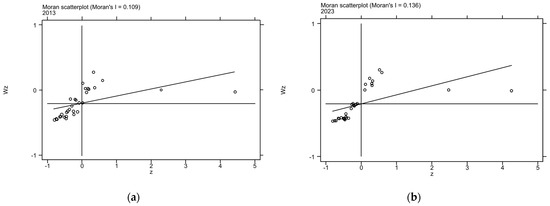
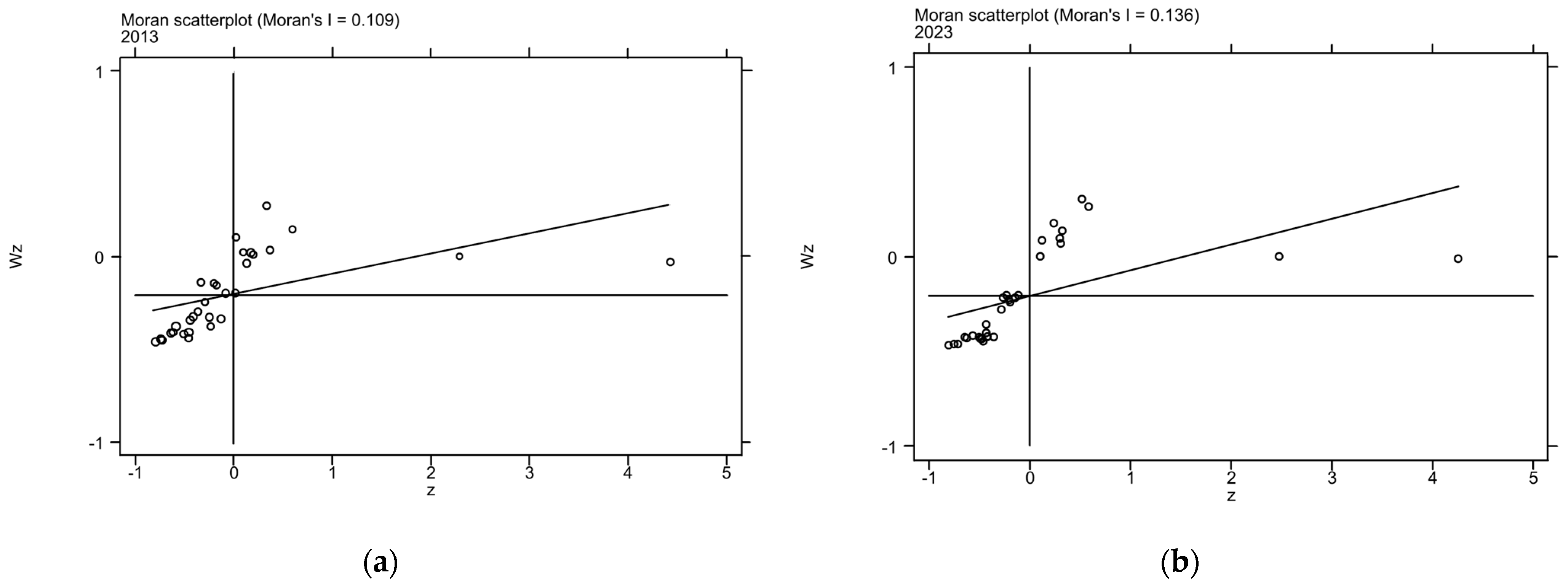
To examine the spatial distribution of carbon productivity across Chinese provinces, a Moran’s I test is conducted for the period 2013–2023, with results reported in Table 5. The Moran’s I statistics are consistently positive and statistically significant at the 5% level across all years, ranging from 0.109 to 0.136, indicating the presence of significant positive spatial autocorrelation. This finding suggests a clear spatial clustering pattern, whereby provinces with high (low) carbon productivity tend to be geographically proximate to other high (low) productivity provinces. The relatively stable evolution of Moran’s I over time, with a moderate increase toward 2023, reflects the combined effects of enhanced interregional cooperation in low-carbon development and persistent regional heterogeneity in industrial structure and policy implementation. Overall, the results confirm that spatial dependence in carbon productivity is systematic rather than transitory, thereby providing a strong empirical justification for employing spatial econometric models in the subsequent analysis.
Table 5.
Carbon productivity Moran’s I index.
To more clearly illustrate the spatial autocorrelation between environmental tax intensity and carbon productivity, this study uses data from 2013 and 2023 to construct Moran scatter plots shown in Figure 1. The spatial weight matrix applied in the SDM is also used for constructing the Moran scatter plots. Most provinces fall within the first and third quadrants, indicating pronounced spatial agglomeration effects. The distribution exhibits both “high–high” and “low–low” clustering patterns. Moreover, the spatial distribution is markedly heterogeneous, reflecting substantial regional disparities.
Figure 1.
(a) Scatterplot of Moran’s I of carbon productivity in 2013; (b) Scatterplot of Moran’s I of carbon productivity in 2023.
6.2. Model Checking
Before estimating the spatial econometric model, a series of systematic empirical tests are conducted to assess the appropriateness of the model specification and to ensure its scientific validity and robustness. (1) The LM test is first applied to examine whether spatial correlation exists in both the error term and the lag term. The results show that all four LM statistics-LM-error, Robust LM-error, LM-lag, and Robust LM-lag-are statistically significant. Consequently, the null hypothesis of “no spatial error term and no spatial lag term” is rejected, suggesting that both the SAR and SEM models are applicable. According to Elhorst [36], when both SAR and SEM are supported, the more general Spatial Durbin Model should be adopted as the starting point. (2) The LR and Wald tests are then used to determine whether the SDM can be simplified to either a SAR or SEM specification. The results indicate that LR-lag, LR-error, Wald-lag, and Wald-error all reject the null hypothesis at the 1% significance level. This confirms that the SDM is a more suitable model framework. (3) The Hausman test is performed to decide between fixed effects and random effects. As reported in Table 6, the null hypothesis in favor of random effects is rejected at the 1% level, leading to the adoption of a fixed effects specification. (4) Finally, the LR test is applied to select among individual fixed effects, time fixed effects, and individual–time two-way fixed effects. The significance of both LR-time and LR-ind supports the use of the two-way fixed effects model. Integrating the above results, a two-way fixed effects Spatial Durbin Model is employed for the subsequent empirical analysis in this study.
Table 6.
Spatial measurement model test results.
6.3. Spatial Durbin Model
Based on the prior model selection analysis, this study adopts the SDM with spatio-temporal two-way fixed effects to conduct the empirical regression. The estimation results are presented in Table 7. The spatial autoregressive coefficient (rho) is 0.213 and is significantly positive at the 5% level. This finding confirms the existence of positive spatial autocorrelation in the data. The coefficient for environmental tax intensity is estimated at 0.015, showing a significant positive relationship at the 1% level. This suggests that higher environmental tax intensity promotes improvements in carbon productivity. The estimated coefficient of the spatial spillover term is 0.016, also significantly positive at the 5% level. This result indicates that environmental tax intensity in a given province exerts a positive influence on the carbon productivity of adjacent provinces. This effect is conjectured to reflect multiple potential channels, including technology diffusion, industrial relocation and upgrading, policy imitation, and intensified market competition.
Table 7.
SDM regression results and effects decomposition.
The partial differential approach is employed to quantify the direct, indirect, and total effects of each explanatory variable. The corresponding estimates are reported in Table 7. The direct effect of environmental tax intensity is 0.016, while the indirect effect reaches 0.025. The total effect is calculated as 0.041. All coefficients are statistically significant at the 1% level. These results demonstrate that environmental tax intensity exerts a dual impact on carbon productivity. On the one hand, it enhances carbon productivity within the local jurisdiction (“local enhancement”). On the other hand, it generates a positive spillover influence on surrounding regions (“neighborhood spillover”).
Specifically, the direct effect indicates that increasing environmental tax intensity can enhance provincial carbon productivity by improving resource allocation, optimizing energy structures, and stimulating investment in green technologies. Meanwhile, the indirect effect captures the spatial spillover of environmental tax intensity, whereby tax adjustments in one province significantly influence carbon productivity in other regions through policy imitation, institutional linkages, competitive pressures, supply-chain connections, and the diffusion of green technologies and production practices. These spatial spillovers underscore the presence of policy externalities that transcend administrative boundaries and highlight the importance of interregional policy coordination and governance integration. Overall, the empirical results provide robust evidence supporting Hypothesis H2.
6.4. Robustness Test
To verify the robustness of the estimated direct, indirect, and total effects, this study employs the substitution matrix and shrinking tail approaches. The results are presented in Table 8. (1) Spatial weight matrix substitution. The inverse distance weight matrix is replaced with an economic–geographic nested matrix to further evaluate the influence of environmental tax intensity on carbon productivity. The estimates indicate that the coefficients of environmental tax intensity for direct, indirect, and total effects remain significantly positive at the 1% level. This outcome aligns with the baseline results. (2) Shrinking tail adjustment. This treatment mitigates the potential bias arising from extreme values in model estimation. After applying the shrinking tail method, all coefficients pass at least the 5% significance threshold, and the direction of influence is consistent with the benchmark regression. These findings collectively confirm the robustness of the empirical conclusions.
Table 8.
Robustness test results.
6.5. Spatial Mediation Mechanisms Test
To investigate the transmission mechanism through which environmental tax intensity promotes carbon productivity, technological innovation is incorporated into the Spatial Durbin Model as a mediating variable. The estimation is conducted under the specification of the inverse distance spatial weight matrix. The corresponding empirical results are reported in Table 9.
Table 9.
Spatial mediation mechanisms test results.
(1) In the Spatial Durbin Model regression without incorporating the mediating variable, the coefficient of environmental tax intensity on carbon productivity is significantly positive at the 1% level. This result confirms that environmental tax intensity independently promotes improvements in carbon productivity. (2) When technological innovation is introduced as the mediating variable, the coefficient of environmental tax intensity on technological innovation remains significantly positive at the 1% level. This finding indicates that environmental tax intensity exerts a strong and favorable influence on technological innovation. (3) Consistent with the insights from prior literature, environmental tax intensity stimulates regional investment in technological innovation. Enhanced technological innovation subsequently contributes to carbon productivity by improving resource efficiency and facilitating industrial upgrading. Therefore, the results demonstrate that technological innovation serves as a significant spatial mediator in the relationship between environmental tax intensity and carbon productivity within the Spatial Durbin Model framework.
6.6. Heterogeneity Test
China’s vast territory is characterized by pronounced disparities in economic development and resource endowment across regions. Following the regional classification established by the National Development and Reform Commission, the sample comprising 31 provinces and municipalities is geographically divided into eastern, central, and western regions. This classification forms the basis for conducting the heterogeneity analysis. The corresponding results are presented in Table 10.
Table 10.
Heterogeneity test results.
(1) Environmental tax intensity exhibits the strongest local and spatial spillover effects on carbon productivity in eastern China, reflecting the region’s solid technological foundation and effective policy implementation. These pronounced effects are closely linked to an advanced industrial structure, higher levels of marketization, and a relatively mature innovation system. The concentration of technology-intensive and service-oriented industries enables firms to respond more effectively to environmental tax pressures through technological upgrading and efficiency improvements. Moreover, stronger fiscal capacity and stricter regulatory enforcement enhance policy credibility and effectiveness, facilitating the internalization of environmental costs and amplifying both direct and spillover impacts on carbon productivity. (2) In the central region, environmental tax intensity exhibits noticeable spatial diffusion effects on carbon productivity, while its local impact remains relatively weak. This pattern reflects the central provinces’ intermediate position within China’s regional economic system, where they often act as recipients of industrial relocation from eastern regions. As a result, improvements in carbon productivity are more likely to arise from external technology diffusion and policy learning than from strong endogenous innovation. Moreover, relatively constrained fiscal resources and regulatory capacity may limit the effectiveness of environmental tax implementation at the local level, thereby dampening direct effects while still permitting spillover influences from neighboring regions. (3) In the western region, the absence of statistically significant effects of environmental tax intensity on carbon productivity can be attributed to a combination of structural and institutional constraints. These regions are typically characterized by a high dependence on resource-intensive industries, lower levels of technological accumulation, and weaker innovation ecosystems, which limit firms’ capacity to respond to environmental tax incentives. In addition, constrained fiscal space, relatively weak regulatory enforcement, and development-oriented policy priorities may further reduce policy effectiveness. Consequently, environmental taxes alone are often insufficient to generate measurable improvements in carbon productivity in the western region without complementary support policies aimed at enhancing technological capacity and institutional quality. It suggests that policies should be formulated to take into account regional differences and to promote a green policy layout that is “Eastern-led—Central-Western synergized”.
7. Discussion
7.1. Empirically Supported Findings
In the context of escalating global climate challenges, this study examines the relationship between environmental taxes, technological innovation, and carbon productivity using panel data from 31 Chinese provinces over the period 2013–2023. By employing a Spatial Durbin Model and a spatial mediation effect model, the analysis provides several empirically grounded findings.
First, environmental tax intensity exerts a significantly positive effect on carbon productivity, and this result remains robust after controlling for potential endogeneity and alternative specifications. Second, carbon productivity exhibits pronounced spatial autocorrelation, and the spatially lagged environmental tax term is significantly positive, indicating that environmental tax policies generate clear spatial spillover effects across regions. Third, the mediation analysis confirms that technological innovation serves as a partial transmission channel through which environmental taxes enhance carbon productivity, providing direct empirical support for the innovation-compensation mechanism. Fourth, the results of robustness tests further validate the stability and reliability of the empirical conclusions. Finally, regional heterogeneity analysis reveals that the positive effects of environmental taxes are strongest in eastern China, relatively weak but characterized by spatial spillovers in central regions, and statistically insignificant in western provinces. Collectively, these findings empirically substantiate the theoretical linkage among environmental taxation, technological innovation, and carbon productivity, while highlighting the importance of spatial interactions and regional structural differences.
7.2. General Policy Implications
First, the environmental tax system should be continuously refined to enhance its dual role as both an incentive and a regulatory constraint. Gradual expansion of the taxable scope and improved coordination between environmental taxes, carbon trading mechanisms, and related market-based instruments may help strengthen overall regulatory effectiveness. At the same time, clearer earmarking of environmental tax revenues toward green infrastructure, energy-efficient technologies, and ecological compensation can promote a virtuous cycle of green development.
Second, sustained support for green technological innovation remains essential. While the empirical results confirm the mediating role of innovation, broader policy frameworks—such as fiscal incentives, green finance, and industry–academia–research collaboration—are needed to facilitate technology diffusion, particularly in regions with weaker innovation capacity.
Third, cross-regional coordination in carbon governance should be encouraged to better harness spatial spillover effects. Establishing cooperative mechanisms across regions, especially in major urban agglomerations and river basins, may help reduce policy fragmentation and improve governance efficiency.
Finally, differentiated environmental tax policies should be designed in line with regional heterogeneity. Given disparities in economic structure, fiscal capacity, and governance effectiveness, a uniform policy approach may lead to uneven outcomes. Complementary fiscal support and capacity-building measures are particularly important for central and western regions to avoid symbolic implementation. More broadly, incorporating carbon productivity into green performance evaluation systems could guide local governments toward a development trajectory that emphasizes efficiency-oriented emission reduction rather than purely quantitative targets.
8. Conclusions
Overall, this study demonstrates that environmental taxes, as market-based regulatory instruments, can effectively enhance carbon productivity, with their impacts amplified through technological innovation and spatial spillover mechanisms. Under the “dual carbon” goals, an integrated approach—combining institutional design, innovation incentives, regional coordination, and performance evaluation—will be crucial for building a more efficient, equitable, and sustainable green fiscal system and for advancing China’s transition toward high-quality, low-carbon development.
Author Contributions
Conceptualization, R.B. and S.W.; methodology, R.B.; software, R.B.; investigation, R.B.; writing—original draft preparation, R.B.; writing—review and editing, R.B. and S.W.; visualization, R.B. All authors have read and agreed to the published version of the manuscript.
Funding
This research received no external funding.
Institutional Review Board Statement
Not applicable.
Informed Consent Statement
Not applicable.
Data Availability Statement
The data provided in this study can be obtained online, such as the China Taxation Yearbook, China Statistical Yearbook, China Environmental Statistical Yearbook, China Energy Statistical Yearbook, etc.
Conflicts of Interest
No conflicts of interest to declare.
References
- Wang, H.H.; He, Y.Y.; Shi, W.Y.; Zeng, W.H.; He, Y.F. Spatiotemporal Spillover Effect and Efficiency of Carbon Emissions from Land Use in China. Environ. Dev. Sustain. 2024, 26, 8915–8953. [Google Scholar] [CrossRef] [Scilit]
- Porter, M.E.; van der Linde, C. Toward a New Conception of the Environment-Competitiveness Relationship. J. Econ. Perspect. 1995, 9, 97–118. [Google Scholar] [CrossRef] [Scilit]
- He, Y.; Zhu, X.B.; Zheng, H. The Influence of Environmental Protection Tax Law on Total Factor Productivity: Evidence from Listed Firms in China. Energy Econ. 2022, 113, 106248. [Google Scholar] [CrossRef] [Scilit]
- Feng, Y.C.; Wang, X.H.; Liang, Z.; Hu, S.L.; Xie, Y.; Wu, G.Y. Effects of Emission Trading System on Green Total Factor Productivity in China: Empirical Evidence from a Quasi-Natural Experiment. J. Clean. Prod. 2021, 294, 126262. [Google Scholar] [CrossRef] [Scilit]
- Van der Ploeg, F.; Withagen, C.A. Is There Really a Green Paradox? J. Environ. Econ. Manag. 2012, 64, 342–363. [Google Scholar] [CrossRef] [Scilit]
- Boyd, G.A.; Tolley, G.; Pang, J. Plant Level Productivity, Efficiency, and Environmental Performance of the Container Glass Industry. Environ. Resour. Econ. 2002, 23, 29–43. [Google Scholar] [CrossRef] [Scilit]
- Jin, X. Environmental Regulation, Green Technological Innovation and Carbon Productivity. J. Northwest Minzu Univ. (Philos. Soc. Sci.) 2024, 172–188. [Google Scholar] [CrossRef]
- Wang, L.; Zhang, Y.; Gao, G.L. Environmental Regulation, Technological Innovation and Carbon Productivity. J. Arid Land Resour. Environ. 2020, 34, 1–6. [Google Scholar] [CrossRef]
- Uche, E.; Ngepah, N.; Shaddady, A.; Haron, N.F. Enhancing Carbon Productivity in Germany Through Climate Technology, Carbon Capture, Environmental Management and Renewable Energy Technology. Energy Sources Part B Econ. Plan. Policy 2026, 21, 2602777. [Google Scholar] [CrossRef] [Scilit]
- Zhou, D.; Luo, D.Q. Green Taxation, Industrial Structure Transformation, and Carbon Emissions Reduction. Resour. Sci. 2021, 43, 693–709. [Google Scholar]
- Sun, Y.P.; Huang, Z.J. Reflections on Better Playing the Role of Carbon Emission Reduction Related Tax Policies in Support of Green and Low-Carbon Development. Taxation Res. 2025, 26–30. [Google Scholar] [CrossRef]
- Li, X.P.; Yu, D.S.; Yu, J.J. Spatial Spillover Effect of Heterogeneous Environmental Regulations on Carbon Productivity—Spatial Durbin Model. China Soft Sci. 2020, 82–96. [Google Scholar]
- Wang, X.; Hou, Z.; Fang, Y. Two-Way FDI, Environmental Regulation, and Carbon Productivity. Res. Econ. Manag. 2022, 43, 50–64. [Google Scholar] [CrossRef]
- Zhang, C.L.; Zhang, F. Impact of Ecological Protection and Industrial Structure Upgrading on Carbon Emissions—Empirical Evidence Based on Data from the Yangtze River Economic Belt. Stat. Decis. 2022, 38, 77–80. [Google Scholar] [CrossRef]
- Lin, X.M.; Guan, S. Does Environmental Regulation Promote the Transformation and Upgrading of Industrial Structure: Based on Strategic Interaction of Local Government Environmental Regulation. South China J. Econ. 2020, 99–115. [Google Scholar] [CrossRef]
- Xu, Y.Q.; Cheng, Y.; Wang, J.J. The Impact of Green Technological Innovation on the Spatiotemporal Evolution of Carbon Emission Efficiency of Resource-Based Cities in China. Geogr. Res. 2023, 42, 878–894. [Google Scholar]
- Rubashkina, Y.; Galeotti, M.; Verdolini, E. Environmental Regulation and Competitiveness: Empirical Evidence on the Porter Hypothesis from European Manufacturing Sectors. Energy Policy 2015, 83, 288–300. [Google Scholar] [CrossRef] [Scilit]
- Yuan, Y.J.; Xie, R.H. Environmental Regulation and the ‘Green’ Productivity Growth of China’s Industry. China Soft Sci. 2016, 144–154. [Google Scholar]
- Calel, R.; Dechezleprêtre, A. Environmental Policy and Directed Technological Change: Evidence from the European Carbon Market. Rev. Econ. Stat. 2016, 98, 173–191. [Google Scholar] [CrossRef] [Scilit]
- Liu, M.; Sheng, B.S.; Alharthi, M.; Hassan, M.S.; Hanif, I. The Role of Natural Resources, Clean Energy and Technology in Mitigating Carbon Emissions in Top Populated Countries. Resour. Policy 2023, 83, 103705. [Google Scholar] [CrossRef] [Scilit]
- Xin, D.; Ahmad, M.; Khattak, S.I. Impact of Innovation in Climate Change Mitigation Technologies Related to Chemical Industry on Carbon Dioxide Emissions in the United States. J. Clean. Prod. 2022, 379, 134746. [Google Scholar] [CrossRef] [Scilit]
- Shao, S.; Fan, M.T.; Yang, L.L. Economic Restructuring, Green Technical Progress, and Low-Carbon Transition Development in China: An Empirical Investigation Based on the Overall Technology Frontier and Spatial Spillover Effect. J. Manag. World 2022, 38, 46–69+4–10. [Google Scholar] [CrossRef]
- Xia, X.C.; Sun, H.; Yang, Z.D.; Zhu, S.S. Research on the Impact of Environmental Tax on Collaborative Governance of Carbon Reduction and Pollution Abatement: A Study from the Perspective of Whole-Process Technological Innovation. Sci. Res. Manag. 2025, 46, 166–176. [Google Scholar] [CrossRef]
- Jiang, P.; Li, M.Y.; Zhao, Y.T.; Gong, X.J.; Jin, R.F.; Zhang, Y.H.; Li, X.; Liu, L. Does Environmental Regulation Improve Carbon Emission Efficiency? Inspection of Panel Data from Inter-Provincial Provinces in China. Sustainability 2022, 14, 10448. [Google Scholar] [CrossRef] [Scilit]
- Li, H.; Tong, M.H.; Zhang, G.J. Carbon Emission Reduction Effect of Green Finance Reform and Innovation Pilot Zone: From the Perspective of Spatial Spillover Effect and Urban Heterogeneity. Stat. Res. 2024, 41, 44–58. [Google Scholar] [CrossRef]
- Wu, H.T.; Xu, L.N.; Ren, S.Y.; Hao, Y.; Yan, G.Y. How Do Energy Consumption and Environmental Regulation Affect Carbon Emissions in China? New Evidence from a Dynamic Threshold Panel Model. Resour. Policy 2020, 67, 101678. [Google Scholar] [CrossRef] [Scilit]
- Ren, Y.J.; Wang, C.X.; Li, B.T. The Influence of Industrial Agglomeration on China’s Green Total Factor Productivity. Syst. Eng. 2019, 37, 31–40. [Google Scholar]
- Li, J.J. The Influence of Network Public Opinion on Carbon Emissions under the “Double Carbon” Target: Analysis of Influence Paths Based on Chained Multiple Intermediary Model. Urban Probl. 2023, 38–47. [Google Scholar] [CrossRef]
- Xu, W.L.; Sun, L. Market-Incentive Environmental Regulation and Energy Consumption Structure Transformation. J. Quant. Tech. Econ. 2023, 40, 133–155. [Google Scholar] [CrossRef]
- Jiang, T. Mediating Effects and Moderating Effects in Causal Inference. China Ind. Econ. 2022, 5, 100–120. [Google Scholar] [CrossRef]
- Wang, X.L.; Wang, S.L.; Teng, Z.W. Research on Spatial Convergence of Carbon Productivity in China’s Service Industry. China Popul. Resour. Environ. 2020, 30, 70–79. [Google Scholar]
- Fu, S.; Wang, J. Has Green Tax Policy Reduced Carbon Emissions in China?—An Empirical Study Based on Extended STIRPAT Modeling. Mod. Econ. Res. 2018, 72–78. [Google Scholar] [CrossRef]
- Xu, Y.; Chen, X.L.; Qin, X.N. Whether Green Tax System Can Promote Industrial Structure Upgrading—Evidence from Porter’s Hypothesis in China. J. Guizhou Univ. Financ. Econ. 2022, 89–99. [Google Scholar]
- Wang, X.; Xu, L. The Impact of Technological Innovation on Economic Growth: Evidence from China. In Proceedings of the 3rd International Conference on Economic Management and Cultural Industry (ICEMCI 2021), Guangzhou, China, 22–24 October 2021; Atlantis Press: Paris, France, 2021; pp. 1911–1916. [Google Scholar] [CrossRef] [Scilit]
- Zhou, J.K. A Study on Haze Pollution in China by Analysis of Relationship Between City Development Level and Average Annual Rainfall: Based on the Cross-Sectional Data of 73 Major Cities in 2013. J. Arid Land Resour. Environ. 2017, 31, 94–100. [Google Scholar] [CrossRef]
- Elhorst, J.P. Spatial Panel Data Analysis. In Encyclopedia of GIS; Springer: Cham, Switzerland, 2017; pp. 2050–2058. [Google Scholar] [CrossRef] [Scilit]

Disclaimer/Publisher’s Note: The statements, opinions and data contained in all publications are solely those of the individual author(s) and contributor(s) and not of MDPI and/or the editor(s). MDPI and/or the editor(s) disclaim responsibility for any injury to people or property resulting from any ideas, methods, instructions or products referred to in the content. |
© 2026 by the authors. Licensee MDPI, Basel, Switzerland. This article is an open access article distributed under the terms and conditions of the Creative Commons Attribution (CC BY) license.