Article

A Sustainability-Oriented NLP Framework for Early Detection of Economic, Operational, and Environmental Risks in Global Shipping

1
Division of Shipping Management, Korea Maritime and Ocean University, Busan 49112, Republic of Korea
2
Department of English Language and Literature, Korea Maritime and Ocean University, Busan 49112, Republic of Korea
*
Author to whom correspondence should be addressed.
Sustainability 2026, 18(4), 1814; https://doi.org/10.3390/su18041814
Submission received: 10 January 2026 / Revised: 5 February 2026 / Accepted: 7 February 2026 / Published: 10 February 2026

Abstract

The global shipping industry faces escalating sustainability risks arising from geopolitical disruptions, operational instability, and tightening environmental regulations. These risks often first emerge in qualitative market narratives, limiting the effectiveness of conventional backward-looking indicators. This study proposes a sustainability-oriented natural language processing (NLP) framework for the early detection of sustainability-critical stress in global shipping. Using 155 weekly expert-curated shipping market reports published between 2022 and 2025, the framework integrates topic modeling and domain-tuned sentiment analysis to extract sustainability-relevant signals from unstructured text. Critical-to-Quality (CTQ) factors are reconceptualized as sustainability-critical performance dimensions encompassing economic sustainability (freight rate stability), operational sustainability (schedule reliability, lead time, vessel utilization, and equipment availability), and environmental sustainability (eco-efficiency). Topic–sentiment interactions are quantified using network analysis and ElasticNet-based estimation to construct composite CTQScores, which capture the intensity and persistence of sustainability stress. Empirical validation using observed market performance indicators demonstrates that the CTQScores exhibit strong directional accuracy and systematically precede market adjustments, supporting their role as early warning indicators rather than predictive forecasts. The framework is operationalized as a Sustainability Risk Radar, enabling proactive monitoring of economic, operational, and environmental risks. The findings demonstrate how NLP-based analytics can support ESG-aligned sustainability risk monitoring and resilience-oriented decision-making in global shipping systems.

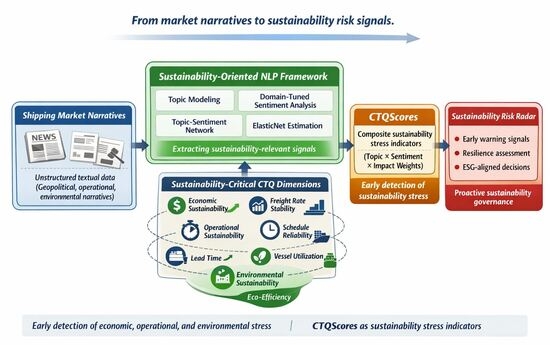
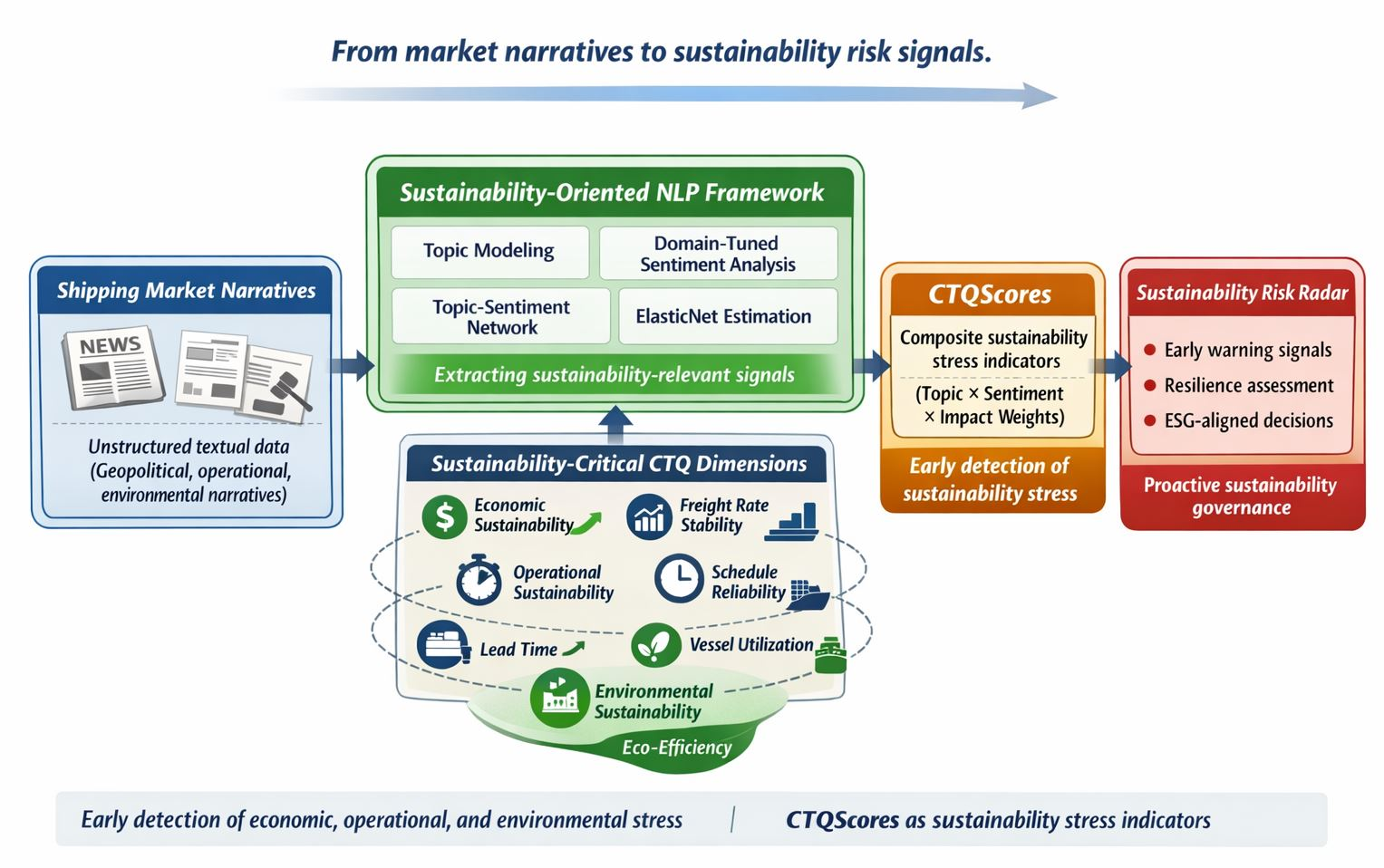
Graphical Abstract

1. Introduction

1.1. Research Background and Purpose

In recent years, the global shipping industry has entered a period of heightened structural instability, driven by the simultaneous interaction of geopolitical conflicts, climate-related disruptions, regulatory transitions, and persistent supply–demand imbalances [1,2,3]. Unlike previous cyclical fluctuations, recent market shocks increasingly threaten the long-term sustainability of shipping operations by undermining economic stability, operational reliability, and environmental compliance [4,5]. In this study, sustainability is conceptualized not as a static performance outcome, but as a dynamic condition shaped by the accumulation, propagation, and persistence of systemic stress across interconnected economic, operational, and environmental dimensions.
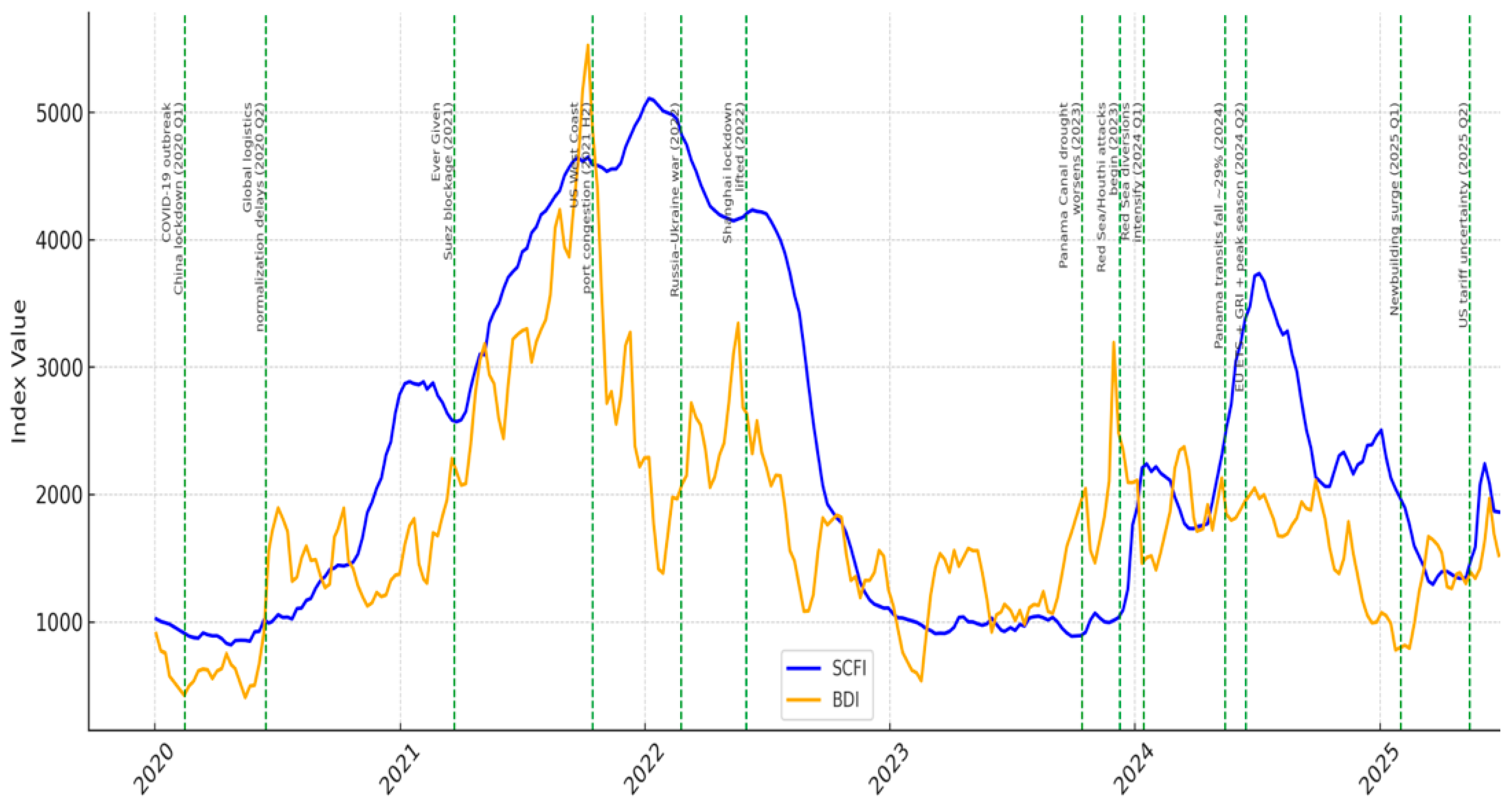
From an economic sustainability perspective, freight markets have exhibited extreme levels of volatility. The Shanghai Containerized Freight Index (SCFI), which remained near 1000 points prior to the COVID-19 pandemic, surged by more than 520% to exceed 5000 points in late 2021, before declining by over 70% during the market normalization phase in 2023 [6,7,8]. Similarly, the dry bulk market experienced dramatic swings, with the Baltic Dry Index (BDI) peaking above 5500 points in 2021 and falling below 1000 points in 2023 [9,10,11]. These fluctuations reflect not only cyclical demand shifts, but also deeper structural tensions related to fleet deployment, capacity management, and contract stability [7,11]. Importantly, this study does not equate short-term price volatility per se with unsustainability; rather, it emphasizes persistent and system-wide instability as a potential signal of sustainability stress when such volatility is repeatedly reinforced through operational disruption, regulatory pressure, and capacity misalignment.
Operational sustainability has been further challenged by overlapping geopolitical and climate-related shocks. In early 2024, disruptions to the Red Sea–Suez route following attacks by Houthi forces triggered widespread vessel rerouting around the Cape of Good Hope, substantially increasing transit distances, insurance premiums, and operational costs [1,2,12]. Concurrently, drought-induced restrictions at the Panama Canal constrained transit capacity, amplifying congestion and lead-time uncertainty [13,14]. Between May and July 2024, the combined effects of these disruptions, together with the pass-through of EU Emissions Trading System (ETS) costs and peak-season demand, pushed the SCFI above 3700 points—an atypical surge reflecting systemic operational stress rather than organic demand growth [6,15].
In contrast, 2025 marked the reemergence of sustainability risks associated with structural oversupply. Large-scale newbuilding deliveries, historically high orderbook levels, rising trade-policy uncertainty, and weakening demand from China converged to depress freight markets, with the SCFI retreating toward the 1100-point range [7,15]. These developments underscore that contemporary volatility in shipping markets is no longer episodic but increasingly structural, shaped by the interaction of geopolitical risk, climate variability, regulatory pressure, and long-term capacity decisions [4,16]. Rather than reflecting isolated cyclical corrections, these dynamics indicate the accumulation of systemic sustainability stress, reinforcing the need for analytical frameworks capable of capturing early and latent risk signals before they manifest in conventional performance indicators.
Figure 1 illustrates the long-term volatility of the Shanghai Containerized Freight Index (SCFI) and the Baltic Dry Index (BDI) from 2020 to 2025 in relation to major global shipping events [12,13,14,15]. The figure highlights how successive shocks—including the COVID-19 pandemic, Suez Canal blockage, Red Sea geopolitical disruptions, Panama Canal drought, regulatory cost pass-through, and structural oversupply—have generated persistent instability in shipping markets. Rather than reflecting short-term cyclical fluctuations, the observed dynamics indicate the accumulation of system-wide sustainability stress arising from the interaction of geopolitical risk, climate-related constraints, and regulatory transitions, underscoring the need for early warning sustainability risk monitoring frameworks.
Importantly, sustainability risks in shipping extend well beyond freight rate dynamics. Market instability has propagated across multiple Critical-to-Quality (CTQ) dimensions that collectively define sustainable shipping performance [16]. During the pandemic, schedule reliability deteriorated to average levels below 35%, while vessel utilization exceeded 90%, intensifying congestion and service disruption [17]. Lead times became increasingly unstable due to port bottlenecks and rerouting, equipment availability remained constrained by persistent container imbalances, and environmental performance faced mounting pressure from increasingly stringent decarbonization regulations [18,19]. These CTQ dimensions are not assumed to be orthogonal or exhaustive representations of sustainability. Instead, they are conceptualized as sustainability-critical operational lenses through which systemic stress becomes observable and measurable in complex shipping systems. Their interdependence reflects the inherently non-linear and tightly coupled nature of sustainability challenges in global maritime transport.
Despite this reality, much of the existing literature continues to rely on static quantitative indicators—such as freight rates, trade volumes, or macroeconomic variables—to assess shipping market conditions [8,20]. While valuable, such indicators are inherently backward-looking and insufficient for capturing emerging sustainability risks that first materialize through market narratives, perceptions, and qualitative signals [5,21]. Moreover, prior studies have largely treated market sentiment as a unidimensional construct, focusing primarily on freight rate expectations while neglecting broader operational and environmental sustainability dimensions [9,22,23,24,25,26].
In the context of compound sustainability risks—where resilience, adaptability, and transition dynamics are increasingly central—there is a growing need for analytical frameworks that translate qualitative market narratives into early warning sustainability stress indicators rather than narrow predictive signals. Market narratives embedded in shipping news and industry reports often reveal early signals of deteriorating service reliability, supply chain fragility, capacity imbalance, and environmental stress well before such risks are fully reflected in conventional performance metrics [21,27,28,29,30].
Accordingly, this study aimed to develop a sustainability-oriented early detection framework for the global shipping industry by integrating natural language processing (NLP), sentiment analysis, and topic modeling with (CTQ) indicators. Using weekly shipping market reports published by the Korea Maritime Institute [31], the study constructed domain-tuned sentiment and topic measures that capture six sustainability-critical dimensions: freight rate stability, schedule reliability, lead time, vessel utilization, equipment availability, and eco-efficiency.
Eco-efficiency is explicitly conceptualized as a structural and transition-oriented dimension shaped by regulatory pressure and technological change, rather than as a short-term environmental performance outcome. By linking qualitative narrative signals to quantitative performance indicators through ElasticNet regression and vector autoregression (VAR) analysis, the proposed framework seeks to identify early signals of sustainability stress while avoiding deterministic or purely causal interpretations.
Through this approach, the study contributes to the literature by theoretically grounding CTQs as sustainability-critical performance dimensions within a dynamic stress–resilience–transition perspective, and by demonstrating how unstructured textual data can be systematically transformed into actionable indicators for sustainable shipping management. The findings aim to support shipping firms, policymakers, and port authorities in enhancing operational resilience [16], improving ESG-aligned decision-making [28,30], and proactively managing sustainability risks in an increasingly uncertain global maritime environment.

1.2. Research Scope and Methods

This study investigated sustainability-critical risks in the global shipping industry by developing and empirically validating a sustainability-oriented NLP framework. The scope of the analysis encompassed economic, operational, and environmental dimensions of shipping sustainability, with particular emphasis on how emerging risks are first reflected in qualitative market narratives before becoming evident in conventional performance indicators. Consistent with contemporary sustainability literature, sustainability is operationalized as a dynamic condition characterized by stress accumulation, resilience capacity, and transition pressure, rather than as a static or purely outcome-based metric.
Empirically, the study focused on weekly shipping market reports published by the Korea Maritime Institute (KMI) between 2022 and 2025. These reports provide expert-curated assessments of global shipping conditions, covering freight markets, operational disruptions, regulatory developments, and environmental policy trends. By analyzing this corpus, the study captures sustainability stress signals that evolve gradually and are not immediately observable in high-frequency quantitative data. While reliance on a single institutional corpus introduces potential limitations regarding external validity, the KMI reports were selected due to their consistent temporal coverage, expert-based synthesis, and comprehensive treatment of global shipping dynamics. These characteristics make the dataset particularly suitable for the methodological validation of a sustainability risk detection framework, rather than for definitive global generalization claims.
Methodologically, the research integrates natural language processing techniques—specifically topic modeling, domain-tuned sentiment analysis, and topic–sentiment network analysis—with econometric validation methods. Product of Experts Latent Dirichlet Allocation (ProdLDA) was employed to extract sustainability-relevant issue structures from textual data, with an explicit focus on identifying persistent and structurally embedded themes rather than short-lived semantic clusters. The choice of ProdLDA reflects its suitability for modeling correlated and overlapping topic structures, which is consistent with the non-orthogonal and interdependent nature of sustainability stress in complex shipping systems.
A shipping-specific sentiment lexicon aligned with CTQ dimensions was constructed to measure perceived sustainability stress. CTQs are not treated as an exhaustive or orthogonal representation of sustainability; instead, they are conceptualized as sustainability-critical operational lenses through which systemic stress becomes observable. The six CTQ dimensions—freight rate stability, schedule reliability, lead time, vessel utilization, equipment availability, and eco-efficiency—were selected to capture complementary aspects of economic viability, operational resilience, and environmental transition pressure. Eco-efficiency is explicitly framed as a structural and transition-oriented dimension shaped by regulatory and technological change, rather than as a short-term environmental performance indicator.
To quantify how sustainability-related narratives influence shipping performance, the study applied ElasticNet regression, Bayesian estimation, and vector autoregression (VAR) analysis. These methods were used to estimate topic-to-CTQ impact weights and to construct composite CTQScores, which function as early warning sustainability stress indicators. ElasticNet was employed to address high dimensionality and multicollinearity, while the resulting CTQScores were interpreted as probabilistic stress signals rather than deterministic predictors. Accordingly, causal language was deliberately avoided in this study, and temporal precedence was assessed in terms of systematic association and directional consistency rather than strict causality.
The explanatory and early warning relevance of CTQScores was validated through linkage with observed key performance indicators (KPIs), including the Shanghai Containerized Freight Index (SCFI). Validation focused on directional accuracy, temporal alignment, and robustness across CTQ dimensions, rather than on maximizing point-forecast precision. This approach is consistent with the study’s emphasis on sustainability risk monitoring and resilience assessment rather than short-term market prediction.
The remainder of this paper is organized as follows. Section 2 reviews prior studies on NLP-based shipping market analysis and critically examines their limitations from a sustainability- and ESG-oriented perspective. Section 3 introduces the proposed sustainability-oriented NLP framework and details the empirical methodology, including data construction, topic modeling, domain-tuned sentiment analysis, topic–sentiment network construction, and CTQScore estimation and validation. Section 4 integrates the empirical findings with managerial, policy, and theoretical discussions, interpreting CTQScores as components of an operational Sustainability Risk Radar for global shipping systems. This section also highlights the framework’s implications for proactive sustainability governance and resilience-oriented decision-making.

2. Review of Prior Research on Shipping NLP

2.1. Literature Review on Shipping Sentiment Analysis and Sustainability-Related Risks

Amid rising uncertainty in the global shipping market, text-based analytical approaches for interpreting qualitative market dynamics have become increasingly prevalent. In particular, NLP-based studies utilizing news articles and industry reports have gained attention, employing techniques such as sentiment analysis, topic modeling, and document classification. This study examines previous research related to shipping market prediction models and the use of sentiment variables derived from textual data. Recent advancements in text analysis techniques have spurred extensive research into how sentiment variables influence freight rate forecasts.
Major contributions in the literature are summarized in Table 1.
A synthesis of the studies summarized in Table 1 indicates that market sentiment extracted from shipping-related news has consistently demonstrated explanatory and predictive relevance for freight market dynamics. Prior research has shown that sentiment-based indicators can improve short-term forecasts of indices such as the BDI and container freight rates, and that their effects may vary across market regimes or volatility conditions [9,10,11]. In addition, several studies highlight the value of constructing shipping-specific sentiment indices to capture perceived risk and investor psychology not fully reflected in conventional quantitative indicators.
However, Table 1 also reveals a common limitation across these studies: despite methodological sophistication, textual sentiment is predominantly interpreted through a price-centric or forecasting-oriented lens. Sustainability implications—such as operational resilience, systemic risk accumulation, or environmental transition pressure—are rarely explicitly conceptualized. As a result, qualitative narratives are often reduced to inputs for improving predictive accuracy, rather than being analyzed as early signals of sustainability-related stress embedded in shipping systems.
Overall, the evolution of NLP-based shipping market research from 2018 to 2025 reflects systematic progress across four interrelated dimensions: data sources, text pre-processing techniques, modeling architectures, and evaluation strategies [16,17,18,19]. While this progression has substantially enhanced the technical sophistication and predictive accuracy of text-based analyses, it has also reinforced a predominantly forecasting-oriented research paradigm. Table 2 synthesizes this evolution by comparing representative studies in terms of their corpora, analytical pipelines, and evaluation metrics, thereby highlighting both methodological advancements and the persistent emphasis on price-centric market prediction rather than sustainability-oriented risk interpretation.
Table 2 illustrates that NLP-based shipping research has undergone substantial methodological evolution, encompassing richer data sources, more sophisticated text representations, advanced modeling architectures, and increasingly rigorous evaluation strategies. These developments have significantly enhanced the technical capability of text-based market analysis. However, the comparative overview also revealed a persistent orientation toward short-term freight rate prediction as the primary analytical objective.
Although recent studies have expanded their topical scope to include operational disruptions, ESG-related issues, and multilingual corpora, such elements are typically incorporated as supplementary features rather than as central components of a sustainability-oriented analytical framework. As a result, methodological innovation has outpaced conceptual integration, leaving sustainability-related stress—such as resilience erosion, systemic operational fragility, and environmental transition pressure—largely undertheorized in existing NLP-based shipping studies.
Despite these methodological advancements, the dominant orientation of prior NLP-based shipping studies remains price-centric and prediction-driven. Textual signals are primarily interpreted as inputs for improving short-term freight rate forecasts, with limited consideration of their broader implications for long-term sustainability, system resilience, or structural transition. As a result, qualitative narratives are often reduced to proxies for market optimism or pessimism, rather than being analyzed as manifestations of deeper sustainability-related stress.
From a sustainability theoretical perspective, this constitutes a critical limitation. Foundational frameworks such as Elkington’s Triple Bottom Line emphasize that sustainable systems must balance economic viability, operational and social robustness, and environmental integrity, often involving trade-offs rather than simple optimization [32]. Similarly, Sachs’ sustainability transition framework highlights the importance of governance, institutional adaptation, and long-term structural change in achieving sustainable development [33], while the planetary boundaries framework proposed by Rockström et al. underscores that environmental sustainability is constrained by biophysical limits rather than short-term performance indicators [34]. In contrast, most existing shipping NLP studies implicitly assume that economic volatility or negative sentiment directly implies unsustainability, without critically examining whether such signals reflect transient market adjustment, an innovation-driven transformation, or genuinely destabilizing stress.
Moreover, the operationalization of sustainability in prior shipping NLP research is often implicit and undertheorized. While recent studies increasingly reference ESG-related topics, they rarely articulate how extracted textual signals map onto sustainability concepts such as resilience, adaptability, or transition risk. This has resulted in a conceptual gap in which advanced analytical techniques are applied to increasingly complex data, yet sustainability remains treated as an auxiliary or rhetorical construct rather than a theoretically grounded analytical objective.
In particular, relatively little attention has been paid to how qualitative market narratives reflect sustainability-related stress arising from operational instability, capacity imbalance, and environmental regulation. These dimensions are critical for understanding the resilience and long-term viability of global shipping systems, yet they remain underexplored in the existing NLP-based shipping literature. The lack of integration between foundational sustainability theory and this lack of integration between foundational sustainability theory and NLP-based market analysis limits the interpretability and policy relevance of prior findings.
This gap motivates the present study. Rather than using textual sentiment primarily to enhance freight rate prediction, this research reframes qualitative market narratives as early indicators of sustainability stress. By reconceptualizing CTQ dimensions as sustainability-critical performance lenses, the study systematically links economic stability, operational reliability, and environmental transition pressure to narrative signals embedded in shipping discourse. In doing so, it moves beyond price-centric interpretation and contributes a theoretically informed framework for translating unstructured textual information into indicators of sustainability-critical risk across interconnected dimensions of global shipping systems.

2.2. Limitations of Prior Research from a Sustainability Perspective

Despite the rapid expansion of NLP-based studies in shipping and logistics, several structural limitations remain that constrain their relevance for sustainability-oriented shipping management.
First, most prior studies lack explicit conceptual alignment with sustainability and ESG frameworks. While recent research increasingly incorporates topics such as congestion, reliability, and environmental regulation, these elements are often analyzed in isolation or treated as auxiliary explanatory variables rather than as integral components of sustainable shipping performance. As a result, sustainability is frequently operationalized implicitly through conventional economic or operational indicators, without critical engagement with foundational sustainability concepts such as trade-offs among economic efficiency, system resilience, and environmental limits. Consequently, existing studies rarely conceptualize shipping market risks in terms of long-term economic viability, operational resilience, and environmental responsibility as interdependent dimensions of sustainability.
Second, sentiment indicators in prior research tend to be overly narrow and price-centric. Market sentiment is commonly modeled as a unidimensional construct primarily linked to freight rate expectations or short-term price movements. Such an approach assumes that negative sentiment necessarily reflects adverse market conditions, overlooking the possibility that volatility or negative narratives may also accompany structural adjustment, innovation, or transition dynamics. More importantly, sustainability risks often manifest first through operational deterioration—such as declining schedule reliability, unstable lead times, or equipment shortages—rather than through immediate price changes. As a result, conventional sentiment indices fail to capture early-stage sustainability stress embedded in market narratives.
Third, limited domain adaptation reduces the interpretability of sustainability-related signals. Many studies rely on general financial or economic sentiment dictionaries, which inadequately reflect shipping-specific terminology related to operational continuity and environmental compliance (e.g., blank sailings, port congestion, decarbonization regulations, capacity deployment). This lack of contextual sensitivity can distort sentiment polarity and obscure whether textual signals reflect transient market reactions or structurally embedded sustainability pressures.
Fourth, the integration between qualitative text signals and quantitative sustainability outcomes remains weak. Although prior research has successfully extracted sentiment and topics from shipping news, few studies have systematically linked these textual features to performance indicators that reflect sustainable operations over time. Validation efforts are often limited to short-term forecasting accuracy, with insufficient attention to temporal robustness, directional consistency, or the persistence of risk signals. As a result, the potential of NLP-based methods to function as early warning tools for sustainability risks—such as supply chain fragility, operational bottlenecks, or ESG-related regulatory pressure—remains underexplored.
Finally, existing analytical frameworks are often fragmented. Sentiment analysis, topic modeling, and time-series forecasting are typically conducted as separate exercises, limiting their ability to diagnose system-wide sustainability risks that arise from the interaction of economic, operational, and environmental factors. This fragmentation constrains interpretability and hinders the development of integrated decision-support tools capable of supporting sustainability-oriented governance and resilience planning in shipping systems.

2.3. Contributions and Research Direction of the Present Study

Addressing the limitations identified above, this study advances the literature on shipping market analysis by explicitly repositioning NLP-based sentiment and topic modeling within a sustainability management framework.
First, the study conceptualizes CTQ factors as sustainability-critical performance dimensions. Rather than treating CTQs merely as operational quality indicators, this research reframes them as analytical lenses through which sustainability-related stress becomes observable in complex shipping systems. The selected CTQ dimensions are not assumed to be exhaustive or orthogonal representations of sustainability; instead, they are intentionally chosen to capture complementary aspects of economic sustainability (freight rate stability), operational sustainability (schedule reliability, lead time, vessel utilization, and equipment availability), and environmental sustainability (eco-efficiency). This framing aligns shipping market analysis with ESG-oriented management objectives while acknowledging the inherent complexity and interdependence of sustainability challenges.
Second, the study develops a domain-tuned sentiment and topic extraction framework specifically designed to capture sustainability-relevant signals in shipping narratives. By extending the Loughran–McDonald financial sentiment dictionary with shipping-specific and environmentally relevant terminology, the proposed approach enhances the interpretability of sentiment signals related to operational resilience and regulatory transition. Rather than assuming a direct a one-to-one mapping between sentiment polarity and sustainability outcomes, the framework treats sentiment as a probabilistic indicator of perceived stress embedded in market discourse.
Third, the study integrates qualitative text signals with quantitative performance indicators through a unified analytical pipeline. Using ElasticNet regression, Bayesian estimation, and vector autoregression (VAR), sentiment- and topic-based indicators are systematically linked to observed market outcomes. This integration allows for the construction of composite CTQScores that capture the intensity and direction of sustainability stress while avoiding deterministic causal claims. The framework emphasizes temporal alignment, directional accuracy, and robustness across CTQ dimensions rather than narrow point-forecast precision.
Fourth, the proposed framework contributes methodologically by demonstrating how unstructured textual data can be operationalized as an early detection mechanism for sustainability risks. Unlike conventional backward-looking indicators, the CTQScore framework captures emerging stress signals embedded in market narratives, enabling the earlier identification of potential deterioration in economic stability, operational continuity, and environmental compliance. In this sense, the framework prioritizes resilience monitoring and transition risk detection over short-term prediction.
Finally, this study offers practical relevance for sustainability-oriented decision-making in the shipping industry. By providing a scalable and data-driven tool for monitoring sustainability-critical risks, the framework supports proactive management strategies for shipping firms, ports, and policymakers seeking to enhance resilience, align with ESG objectives, and navigate increasing uncertainty in global maritime systems. The proposed Sustainability Risk Radar thus serves as a governance-oriented diagnostic tool rather than a prescriptive forecasting system.
In summary, this study bridges the gap between shipping market analytics and sustainability management by transforming NLP-based sentiment and topic analysis into theoretically grounded and empirically validated indicators of sustainability-critical stress. It establishes a structured foundation for future research on AI-driven sustainability monitoring, cross-regional validation, and risk governance in global logistics and maritime industries.

3. Research Design and Empirical Analysis

3.1. Overview of the Sustainability-Oriented NLP Framework

This study proposes a sustainability-oriented natural language processing (NLP) framework designed to monitor, quantify, and identify sustainability-critical risks in the global shipping industry. Unlike conventional shipping market studies that focus primarily on short-term price prediction or demand forecasting, the proposed framework aims to detect early signals of sustainability stress, understood as persistent pressures that threaten the long-term economic viability, operational resilience, and environmental integrity of shipping systems.
In this study, sustainability was not treated as a static ESG classification, but as a dynamic system property reflecting the capacity of shipping systems to absorb shocks, adapt to structural change, and remain within economic, operational, and environmental constraints over time. This perspective draws on the foundational sustainability and resilience literature, including the Triple Bottom Line framework, resilience and adaptability concepts, and transition-oriented views of environmental governance.
The proposed framework functions as an integrated Sustainability Risk Monitoring System, transforming unstructured textual information embedded in shipping market narratives into structured indicators aligned with sustainability-critical quality dimensions. Rather than assuming that negative sentiment or volatility directly implies unsustainability, the framework explicitly distinguishes between transient market adjustment and persistent sustainability stress by focusing on the accumulation, persistence, and cross-dimensional propagation of narrative signals. By combining domain-tuned sentiment analysis, topic modeling, network analysis, and econometric validation, the framework captures how emerging risks are perceived, amplified, and transmitted across economic, operational, and environmental domains.
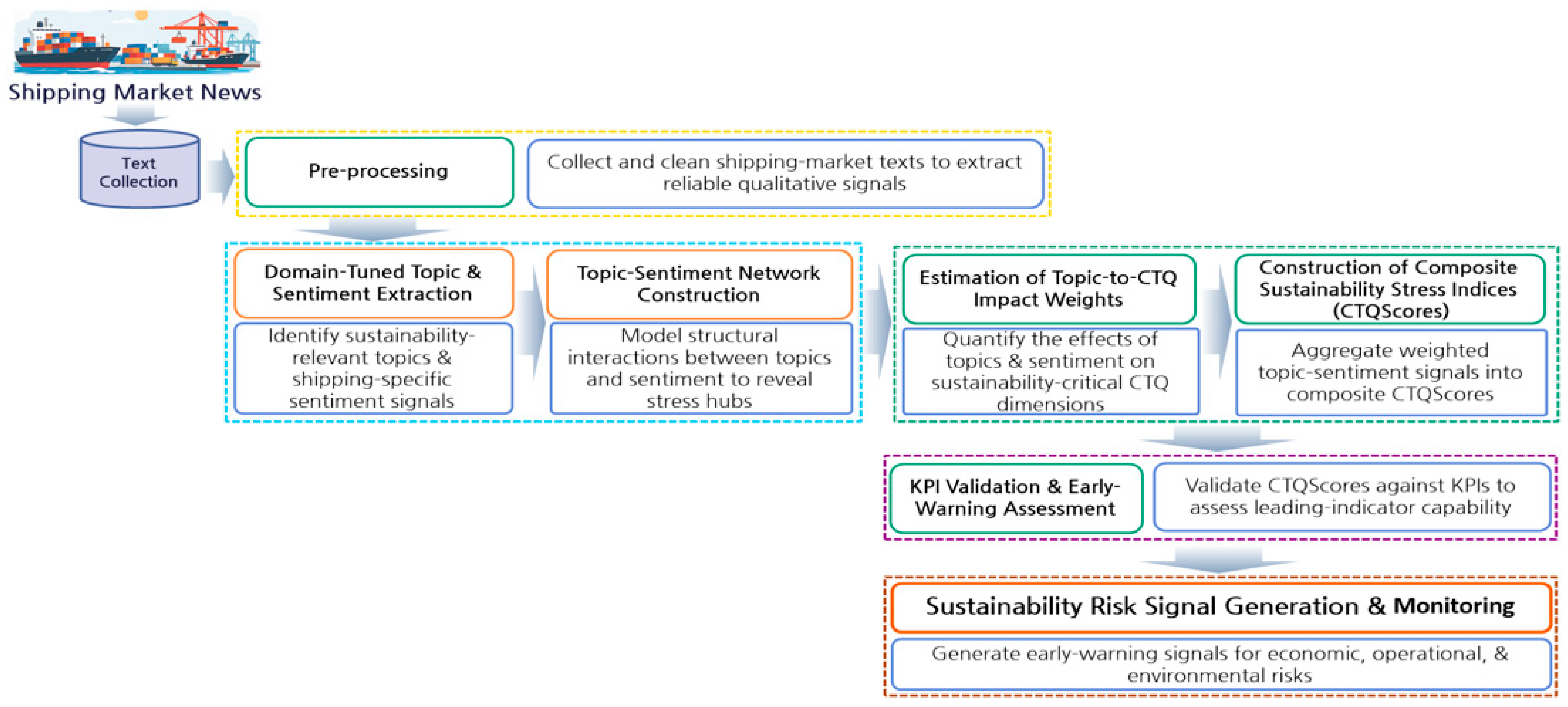
Figure 2 illustrates the overall research flow. The analytical pipeline consists of seven sequential stages, each contributing to the construction and validation of early warning sustainability stress indicators:
  • Shipping Market Text Collection and Pre-Processing: Shipping- and logistics-related news articles and weekly market reports are systematically collected and pre-processed to ensure textual consistency, temporal alignment, and analytical reliability. The focus on expert-curated weekly reports allows the framework to capture slow-moving, structural sustainability signals rather than high-frequency market noise. This stage establishes the foundation for capturing qualitative signals related to market instability, operational disruptions, regulatory transitions, and environmental pressures;
  • Domain-Tuned Topic and Sentiment Extraction: Sustainability-relevant issue themes are identified using topic modeling, while sentiment polarity is measured using a shipping-specific sentiment lexicon aligned with CTQ dimensions. The sentiment lexicon is explicitly designed to capture sustainability-relevant stress expressions (e.g., congestion persistence, regulatory burden, capacity imbalance) rather than generic market optimism or pessimism. This step enables the detection of narratives associated with sustainability stress—such as congestion, rerouting risk, regulatory compliance, and decarbonization—that are embedded in shipping market discourse;
  • Topic–Sentiment Network Construction: A topic–sentiment network is constructed to capture the structural relationships between extracted topics and sentiment signals. Network centrality, edge weight, and co-occurrence persistence are interpreted as indicators of systemic relevance rather than causal dominance. This step allows for the identification of which sustainability-related issues function as stress hubs and how narrative emphasis propagates across interconnected topics, providing structural context beyond isolated sentiment scores;
  • Estimation of Topic-to-CTQ Impact Weights: The influence of sustainability-related topics and sentiment signals on sustainability-critical CTQ dimensions is quantified using ElasticNet regression, vector autoregression (VAR), and Bayesian estimation techniques. ElasticNet is employed to ensure model interpretability and robustness under multicollinearity, while VAR-based diagnostics are used to assess temporal precedence rather than causal determinism. This stage produces a weight matrix formalizing how qualitative narratives are statistically associated with changes in economic stability, operational reliability, and environmental performance;
  • Construction of Composite Sustainability Stress Indices (CTQScores): Topic and sentiment information, weighted by their estimated impacts, are aggregated into composite CTQScores for each sustainability-critical dimension—freight rate stability, schedule reliability, lead time, vessel utilization, equipment availability, and eco-efficiency. CTQScores are explicitly interpreted as indicators of sustainability stress intensity and persistence, not as direct performance forecasts. Positive CTQScore values indicate stabilizing narrative conditions, whereas negative values reflect elevated sustainability stress;
  • Validation through KPI Linkage and Early warning Assessment: The constructed CTQScores are empirically validated by linking them to observed key performance indicators (KPIs), such as the Shanghai Containerized Freight Index (SCFI) and operational performance metrics. Validation focuses on directional accuracy, temporal lead–lag relationships, and stress-detection capability rather than point-forecast precision. VAR-based diagnostics and robustness checks are used to evaluate whether sustainability stress signals extracted from textual data systematically precede or coincide with observable market and operational deterioration;
  • Sustainability Risk Signal Generation and Monitoring: Based on validated CTQScore trajectories, sustainability risk signals are generated when stress levels exceed predefined thresholds or exhibit abnormal persistence. These thresholds are calibrated to balance sensitivity and false-alarm risk and are interpreted as early warning alerts rather than deterministic predictions. The resulting signals support proactive managerial and policy responses aimed at mitigating long-term sustainability risks.
Through this integrated process, the proposed framework systematically transforms qualitative market narratives into structured sustainability stress indicators that capture emerging risks before they fully materialize in conventional quantitative metrics. By explicitly positioning NLP-based analytics as tools for sustainability risk monitoring—rather than purely predictive modeling—the framework addresses conceptual ambiguity in prior work and enhances interpretability, transparency, and policy relevance.
Overall, the framework provides a scalable analytical foundation for enhancing sustainable shipping management, resilience planning, and ESG-aligned decision-making in an increasingly uncertain global maritime environment.

3.2. Empirical Analysis by Research Stage

3.2.1. Data Collection and Pre-Processing

To systematically capture sustainability-related risks embedded in global shipping market discourse, this study constructed a domain-specific textual corpus based on the KMI Weekly Shipping Market Focus reports published by the Korea Maritime Institute (KMI). These reports provide comprehensive, expert-curated syntheses of developments in global shipping and logistics markets, covering economic conditions, operational disruptions, regulatory changes, and environmental policy trends. Rather than representing a narrow institutional viewpoint, the KMI reports function as a secondary, integrative knowledge layer that consolidates and critically filters primary information from a wide range of authoritative international sources.
Specifically, the KMI Weekly Shipping Market Focus systematically aggregates, cross-checks, and reinterprets first-order news and analytical content from leading global maritime and logistics information providers, including More Than Shipping, Seatrade Maritime, Maritime Strategies International (MSI), Lloyd’s List, TradeWinds, Reuters, S&P Global, Hellenic Shipping News, and policy communications from U.S. and other international regulatory authorities. KMI subsequently synthesizes these heterogeneous inputs into a unified weekly narrative through expert judgment and domain knowledge, reducing noise, mitigating source-specific bias, and emphasizing structurally relevant market signals.
To capture these synthesized market signals empirically, we tracked and crawled the external URLs linked within these reports, directly extracting the primary English-language content. This approach allowed us to utilize the original global data in its raw form, ensuring that our analysis remained independent of the accompanying Korean-language summaries. The Korean weekly reports were subsequently utilized as supplementary reference material to contextualize and cross-validate the findings derived from the primary English corpus.
This two-stage information construction process—primary global data collection followed by expert-driven secondary synthesis—addresses concerns regarding data representativeness and external validity by embedding diverse regional and institutional perspectives within a single, analytically coherent corpus.
The analysis period spanned from January 2022 to June 2025, encompassing 155 weekly reports (Issues Nos. 548–699). This period included multiple structural stress episodes—such as pandemic aftershocks, geopolitical conflicts, climate-induced disruptions, and intensified environmental regulation—making it particularly suitable for examining sustainability risks rather than isolated cyclical fluctuations. Each weekly report is treated as one analytical document, reflecting contemporaneous market perceptions and expert assessments of global shipping conditions.
From a sustainability management perspective, the selected corpus captures a broad range of narratives related to economic sustainability (freight rate volatility, demand imbalance, capacity deployment), operational resilience (schedule reliability, congestion persistence, rerouting risk, equipment shortages), and environmental sustainability (decarbonization policies, IMO regulations, fuel transitions, carbon pricing mechanisms). This multidimensional narrative coverage enables the identification of early-stage sustainability stress signals that may not yet be observable in conventional quantitative indicators, particularly those related to resilience erosion and transition pressure rather than immediate performance deterioration.
For pre-processing, all reports were converted to UTF-8 encoded plain-text format after removing non-informative elements such as tables, footnotes, bullet symbols, annotations, and formatting artifacts. The main text of each report was segmented into sentences, which serve as the minimum unit of analysis for sentiment and topic extraction. Sentence segmentation was performed using punctuation marks (., !, ?) and structured delimiters (e.g., bullet points and numeric markers), ensuring consistent granularity across documents.
Each weekly corpus yielded approximately 2000–3000 sentences, resulting in a large-scale sentence-level dataset suitable for fine-grained sustainability analysis. During text cleaning, numerical values, units (e.g., USD, TEU), HTML tags, and special symbols were removed using regular expressions to minimize noise and enhance semantic consistency.
The resulting dataset comprised 26,768 sentence-level text chunks, which were divided into training (18,737), validation (4015), and testing (4016) subsets. Weakly supervised sentiment and topic labels were generated using rule-based and lexicon-assisted procedures to support model training while avoiding excessive manual subjectivity. In addition, domain-adaptive pre-training (DAPT) based on masked language modeling (MLM) was conducted to further align language representations with shipping- and sustainability-specific vocabulary and contextual usage.
Through this data construction and pre-processing strategy, the study established a robust textual foundation for extracting sustainability-relevant sentiment and topic signals. By relying on expert-curated, globally synthesized weekly narratives rather than fragmented or high-frequency raw news streams, the corpus is particularly well-suited for identifying systemic sustainability risks that evolve gradually, persist across time, and manifest through qualitative discourse before being reflected in observable market or operational outcomes.

3.2.2. Identification of Sustainability-Critical Issue Domains Through Topic Modeling

To identify the structural drivers of sustainability stress embedded in shipping market narratives, this study employed Product of Experts Latent Dirichlet Allocation (ProdLDA) for topic modeling. Unlike conventional Latent Dirichlet Allocation (LDA), which relies on probabilistic mixture assumptions constrained to a simplex, ProdLDA adopts a neural variational inference framework that relaxes these constraints and enables more expressive topic representations. This property is particularly relevant for sustainability analysis in the shipping sector, where multiple interdependent risk factors—economic volatility, operational disruption, and environmental regulation—frequently co-occur within the same textual context rather than appearing as clearly separable themes.
From a sustainability management perspective, topic modeling in this study was not treated as a purely descriptive clustering tool but as an analytical mechanism for uncovering latent issue domains that generate persistent, system-wide sustainability stress. Sustainability risks in shipping rarely arise from isolated events; instead, they emerge through the accumulation and interaction of pressures such as congestion persistence, regulatory tightening, capacity imbalance, and environmental transition. Accordingly, the selected topic model must be capable of capturing stable, interpretable, and structurally meaningful and interpretable themes rather than short-lived, event-driven clusters.
To substantiate the methodological choice of ProdLDA, a comparative evaluation of alternative topic modeling approaches—including classical LDA and BERTopic, alongside ProdLDA—was conducted prior to model selection. The comparison focused on criteria relevant to sustainability-oriented analysis: topic coherence, stability across runs, interpretability of extracted themes, and robustness to noisy industry text. Table 3 summarizes the results of this evaluation, including quantitative coherence metrics and qualitative interpretability assessments.
The comparison indicates that while BERTopic is effective in detecting short-lived or event-specific clusters (e.g., discrete incidents such as route blockages or labor strikes), it exhibits higher sensitivity to hyperparameter settings and tends to produce fragmented topic structures that are difficult to interpret from a long-term sustainability perspective. Classical LDA, although computationally efficient, showed lower semantic coherence and limited ability to capture overlapping issue domains. In contrast, ProdLDA consistently produced higher topic coherence scores and more stable topic distributions across repeated runs, which supports its suitability for identifying sustainability-critical issue domains that persist across market cycles and regulatory regimes. A detailed quantitative and qualitative comparison of topic coherence, stability, and interpretability across alternative models (LDA, BERTopic, and ProdLDA) is reported in Appendix A (Table A1) to enhance the transparency and reproducibility of the model selection process.
Based on the selected ProdLDA specification, six dominant topics were extracted from the corpus. These topics were interpreted and labeled through expert domain review with an explicit focus on their implications for sustainability-critical performance dimensions rather than on short-term market movements. Table 4 presents representative keywords associated with each topic, their sustainability interpretations, and the corresponding CTQ dimensions.
The extracted topics represent core structural sources of sustainability stress in the shipping industry. For example, the topic characterized by keywords such as lead time, congestion, port bottleneck, and rerouting reflects systemic constraints on operational continuity and supply chain resilience. Similarly, the topic dominated by delay, blank sailing, and schedule reliability captures persistent challenges to service reliability that undermine operational sustainability. Topics related to regulation, decarbonization, and IMO frameworks reflect the growing influence of environmental governance and compliance pressure as long-term structural drivers rather than short-term cost shocks.
Capacity-related topics—associated with fleet deployment, utilization, and oversupply—highlight tensions between economic sustainability and operational efficiency, particularly during periods of demand volatility. Equipment-related topics capture vulnerabilities in logistics infrastructure that directly affect continuity and resilience. Finally, freight rate volatility-related topics encapsulate the economic dimension of sustainability by linking financial stability with broader strategic and operational decision-making.
Importantly, these topics are not treated as independent or orthogonal categories. Instead, they are conceptualized as interconnected sustainability stressors whose joint evolution shapes the overall shipping system performance. By mapping each latent topic to a corresponding sustainability-critical CTQ dimension, the study established a theoretically grounded linkage between unstructured textual themes and measurable sustainability outcomes, addressing prior critiques that such topic–CTQ mappings are merely taxonomic.
Through this approach, topic modeling functions as a foundational step in translating unstructured shipping market discourse into analytically tractable sustainability constructs. The resulting topic structures provide the empirical basis for subsequent sentiment integration, topic–sentiment network analysis, and CTQScore construction, enabling systematic monitoring sustainability stress that evolves gradually across economic, operational, and environmental domains rather than manifesting solely through short-term price fluctuations.

3.2.3. Domain-Tuned Shipping-Specific Sentiment Lexicon: MTL-Based Sustainability Perception Modeling

To quantitatively capture sustainability-related perceptions embedded in shipping market narratives, this study developed a domain-tuned, sustainability-aware sentiment lexicon specifically tailored to the shipping industry. Unlike conventional sentiment analysis approaches that primarily focus on emotional polarity or short-term market expectations, the proposed lexicon is explicitly designed to capture perceived sustainability stress, i.e., how market participants implicitly assess risks to economic stability, operational resilience, and environmental transition pressure through textual discourse.
Shipping market narratives simultaneously convey multiple dimensions of sustainability. Discussions of freight rates reflect perceptions of economic viability, narratives related to congestion, delay, and blank sailing reveal operational fragility and resilience constraints, while discourse on decarbonization and regulation signals long-term environmental transition pressure. General-purpose financial sentiment dictionaries are ill-suited to capture these nuanced interpretations as they lack contextual sensitivity to shipping-specific terminology and sustainability implications. To address this limitation, this study constructed a sustainability-oriented shipping sentiment lexicon by extending the Loughran–McDonald financial sentiment dictionary and sentiment resources through systematic domain adaptation and expert-informed validation.
Importantly, sentiment polarity in shipping discourse is inherently perspective-dependent and sustainability-contingent. From a sustainability management standpoint, freight rate increases may signal improved economic resilience for carriers, whereas capacity oversupply, idle vessels, or prolonged congestion indicate deteriorating operational sustainability. Similarly, environmental sentiment exhibits a dual structure: regulatory tightening may impose short-term compliance costs while simultaneously indicating progress toward long-term environmental sustainability. Accordingly, sentiment polarity in this study is defined from the perspective of sustainable shipping system performance, rather than from generic macroeconomic or consumer-oriented viewpoints.
Construction of the Sustainability-Oriented Shipping Sentiment Lexicon
The construction of the domain-tuned sentiment lexicon follows a five-stage reproducible process:
  • Base dictionary extraction: Positive and negative terms (approximately 6000 entries) were initially extracted from the Loughran–McDonald financial sentiment dictionary, providing a standardized and widely validated foundation for polarity classification;
  • Domain corpus integration: Approximately 2.5 million tokens were collected from the shipping market corpus spanning 155 weekly KMI reports (2022–2025). Using TF–IDF analysis, the most salient shipping- and sustainability-relevant terms were identified as candidate vocabulary for lexicon expansion;
  • Sustainability-critical CTQ labeling: Candidate terms were manually reviewed and labeled according to six sustainability-critical CTQ dimensions—freight rate stability, schedule reliability, vessel utilization, lead time, equipment availability, and eco-efficiency. Sentiment polarity was assigned according to each term’s implications for sustainable shipping performance rather than short-term profitability. For example, expressions indicating stabilized freight rates or improved utilization were classified as positive, whereas terms related to congestion, oversupply, or service disruption were classified as negative. Environmental terms were evaluated based on their contribution to long-term sustainability trajectories rather than immediate cost implications;
  • PMI-based lexicon expansion: Pointwise Mutual Information (PMI) was calculated to identify statistically significant co-occurrence relationships between sentiment terms and CTQ-related keywords. Terms exceeding a predefined PMI threshold were incorporated into the lexicon to enhance contextual relevance;
  • Coherence validation: The coherence of the expanded lexicon was evaluated using Word2Vec-based similarity measures and topic–sentiment association strengths. The resulting coherence score (c_v = 0.58) indicates that the lexicon reliably captures sustainability-relevant semantic structures in shipping discourse.
To mitigate potential subjectivity and overfitting in lexicon expansion, sentiment polarity was assigned through an expert-informed consensus procedure. Specifically, candidate terms were independently evaluated by three domain researchers specializing in shipping economics and maritime operations. The initial labeling stage yielded a high level of inter-rater reliability across CTQ dimensions.
Any remaining discrepancies were resolved through structured consensus discussions guided by predefined sustainability-oriented CTQ criteria, rather than ad hoc judgments. This procedure was designed to preserve domain sensitivity while minimizing idiosyncratic interpretations. For transparency and reproducibility, the complete shipping-specific lexicon and CTQ-linked term lists are provided in Appendix B.
MTL-Based Sustainability Perception Modeling
To operationalize the domain-tuned shipping-specific sentiment lexicon, this study employed a multi-task learning (MTL) architecture that jointly aligns sentiment polarity classification with CTQ dimension identification. This design reflects the conceptual assumption that sustainability-related perceptions in shipping market texts are inherently multidimensional: market narratives simultaneously convey early evaluative signals of stress and their structural operational or environmental context. By jointly learning sentiment polarity and CTQ association, the MTL architecture constrains sentiment interpretation within sustainability-relevant operational contexts, reducing the risk of corpus-specific or purely emotive polarity-based overfitting. Treating sentiment and CTQ identification as independent tasks would overlook their synergistic role in shaping sustainability interpretations.
The proposed MTL framework shares a common language representation layer while employing task-specific output heads for sentiment and CTQ classification. Given an input sentence x, the shared encoder generates a latent representation h, which is then mapped to sentiment and CTQ predictions through separate classification heads. The model structure is formally defined as follows:
h = E n c o d e r x ; θ E y s ^ = S o f t m a x W s h + b s ( S e n t i m e   h e a d ) y c ^ = S o f t m a x W c h + b c ( C T Q   h e a d )
Here, θ E denotes the parameters of the shared encoder, while W s , b s and W c , b c represent the weights and biases of the sentiment and CTQ classification heads, respectively. Through this shared representation, the model learns a unified linguistic embedding that aligns evaluative sentiment with sustainability-critical operational and environmental context, rather than optimizing purely predictive accuracy.
To jointly optimize the two tasks, a weighted multi-task loss function is adopted. The overall objective function is defined as a convex combination of the sentiment classification loss and the CTQ classification loss, as shown in Equation (2):
L M T L = α L s e n t i m e n t + 1 α L C T Q
In this formulation, L s e n t m e n t denotes the cross-entropy loss for sentiment classification, L C T Q represents the loss for CTQ category prediction, and α is the weighting parameter that balances the relative contribution of the two tasks. The parameter α was set to 0.6, reflecting the conceptual distinction between sentiment as an early perception of sustainability stress and CTQ classification as a representation of more structural and persistent risk dimensions.
ElasticNet-based cross-validation indicates that model performance stabilized around α 0.6 , consistent with prior findings in shipping market text analytics. Importantly, this weighting is not intended to maximize forecasting accuracy, but to enhance sensitivity to emerging sustainability stress signals while preserving interpretability across CTQ dimensions.
Through this MTL structure, the model simultaneously learns the sentiment polarity of each sentence and its association with specific CTQ dimensions. This joint alignment enables the construction of CTQScores that embed both perceived sustainability stress and its operational or environmental context, forming a critical input to subsequent topic–sentiment network analysis and sustainability risk quantification.
Lexicon Characteristics and CTQ Linkage
A quantitative summary of the resulting domain-tuned shipping-specific sentiment dictionary (Shipping-LM Extended Dictionary) is presented in Table 5.
A total of 166 shipping-specific sentiment terms were added to the extended lexicon, consisting of 64 positive terms, 48 negative terms, and 54 domain-expanded shipping expressions. In proportional terms, positive and negative terms accounted for 38.5% and 28.9% of the sentiment-bearing vocabulary, respectively. Based on these extracted terms, a domain-tuned shipping-specific sentiment lexicon linked to CTQ dimensions was constructed. Table 6 summarizes the resulting CTQ-linked shipping-specific sentiment dictionary.
By explicitly aligning CTQ dimensions with ESG pillars, the proposed sentiment lexicon moves beyond market-specific sentiment interpretation toward sustainability-oriented risk monitoring. In this framework, eco-efficiency is conceptualized as an environmental sustainability pillar of shipping performance, while economic and operational CTQs reflect financial sustainability and system resilience, respectively. This explicit ESG alignment provides the conceptual basis for interpreting CTQScores as integrated indicators of sustainability stress rather than short-term market sentiment.
The sentiment lexicon was constructed by extracting domain-specific sentiment terms explicitly tailored to the sustainability characteristics of the shipping industry. Positive sentiment terms—such as recovery, stability, improvement, operational normalization, capacity securing, decarbonization, efficiency enhancement, and lead-time reduction—are associated with improvements in economic viability, operational continuity, or environmental performance. In contrast, negative sentiment terms—such as decline, congestion, cancellation, lay-up, oversupply, operational disruption, delay, and declining utilization—reflect elevated sustainability stress across shipping operations.
In addition, neutral and structural keywords—such as IMO regulations, greenhouse gas standards, fuel transition, LNG-powered vessels, carbon emissions, and environmental policies—are treated as long-term sustainability drivers rather than sentiment-bearing expressions. These terms capture regulatory governance and technological transition dynamics that shape environmental sustainability over extended horizons and are therefore not assigned direct polarity.
Empirically, positive sentiment terms predominantly appeared in narratives related to market recovery, capacity adjustment, and operational efficiency improvements, whereas negative sentiment terms were frequently observed in articles reflecting sustainability risks such as congestion, supply disruptions, and reduced vessel utilization. Structural terms were primarily associated with regulatory and technology-oriented discourse and function as contextual anchors for interpreting long-term environmental transition rather than short-term sustainability stress.
On this basis, the sentiment lexicon was systematically integrated with sustainability-critical CTQ dimensions, and the resulting CTQ-linked sentiment structure is summarized in Table 7. This mapping clarifies both the representative keywords associated with each CTQ factor and the direction in which sentiment is interpreted from a sustainability perspective.
Distinguishing Features from a Sustainability Perspective
The shipping-specific sentiment lexicon developed in this study exhibited several distinguishing features:
First, the lexicon specializes sentiment vocabulary around sustainability-critical shipping dimensions, ensuring strong domain relevance for sustainability-oriented maritime operations.
Second, sentiment polarity is interpreted through a multidimensional sustainability lens, accounting for heterogeneous stakeholder perspectives rather than a single profit-oriented viewpoint.
Third, sentiment intensity is contextualized using PMI-based co-occurrence strengths and CTQ linkage, enabling systematic identification of dominant sustainability stress signals in shipping market discourse.
Finally, the lexicon is designed to be dynamically extensible, allowing for periodic updates using newly released weekly market reports. This adaptive structure ensures responsiveness to evolving sustainability challenges, regulatory developments, and structural transitions in global shipping systems.

3.2.4. Topic–Sentiment Network Analysis: Systemic Sustainability Stress Propagation

To examine how sustainability-related risks propagate across different dimensions of shipping performance, this study conducted a topic–sentiment network analysis that integrates NLP-based sentiment extraction with network theoretic measures. Rather than treating sentiment signals as isolated predictors, the proposed approach conceptualizes the interaction between topics and sentiment as a systemic structure through which sustainability stress accumulates, concentrates, and diffuses across the shipping systems.
From a sustainability management perspective, risks rarely manifest in isolation. Economic volatility, operational disruption, and environmental transition pressures are inherently interdependent and often reinforce one another through shared narratives and perceptions. Topic–sentiment network analysis provides a means of making these interdependencies analytically visible by identifying which CTQ dimensions occupy structurally central positions in market discourse and how evaluative sentiment amplifies or attenuates perceived sustainability stress.
Network Construction and Weighting Scheme
The construction of the topic–sentiment network proceeds as follows. For each sentence in the corpus, an edge was established between CTQ-related topic keywords and sentiment-bearing terms when they co-occurred within the same textual unit. This co-occurrence was interpreted as a discursive coupling between a sustainability-critical issue (e.g., congestion, capacity imbalance, regulatory pressure) and its perceived impact on system performance.
To quantify the strength of these associations, PMI is calculated, capturing the degree to which topic–sentiment co-occurrences exceed a random expectation, as shown in Equation (3):
P M I ( C T Q i , S j ) = log 2 P ( C T Q i , S j ) P ( C T Q i ) × P ( S j )
PMI is employed not as a causal estimator, but as a measure of semantic concentration, indicating which sustainability-related issues are consistently framed in evaluative contexts within shipping market narratives.
In addition to local association strength, frequency-based network centrality measures were computed to assess the systemic importance of each CTQ dimension within the overall discourse structure. Centrality reflects how often a given CTQ dimension functions as a narrative hub through which sustainability-related concerns are articulated and connected to other issues. The final edge weight is defined as a composite function of PMI and centrality, allowing for simultaneous consideration of local semantic coupling and global structural relevance:
L i n k S c o r e i j = P M I i j × C e n t r a l i t y i j
Network Construction and Weighting Scheme
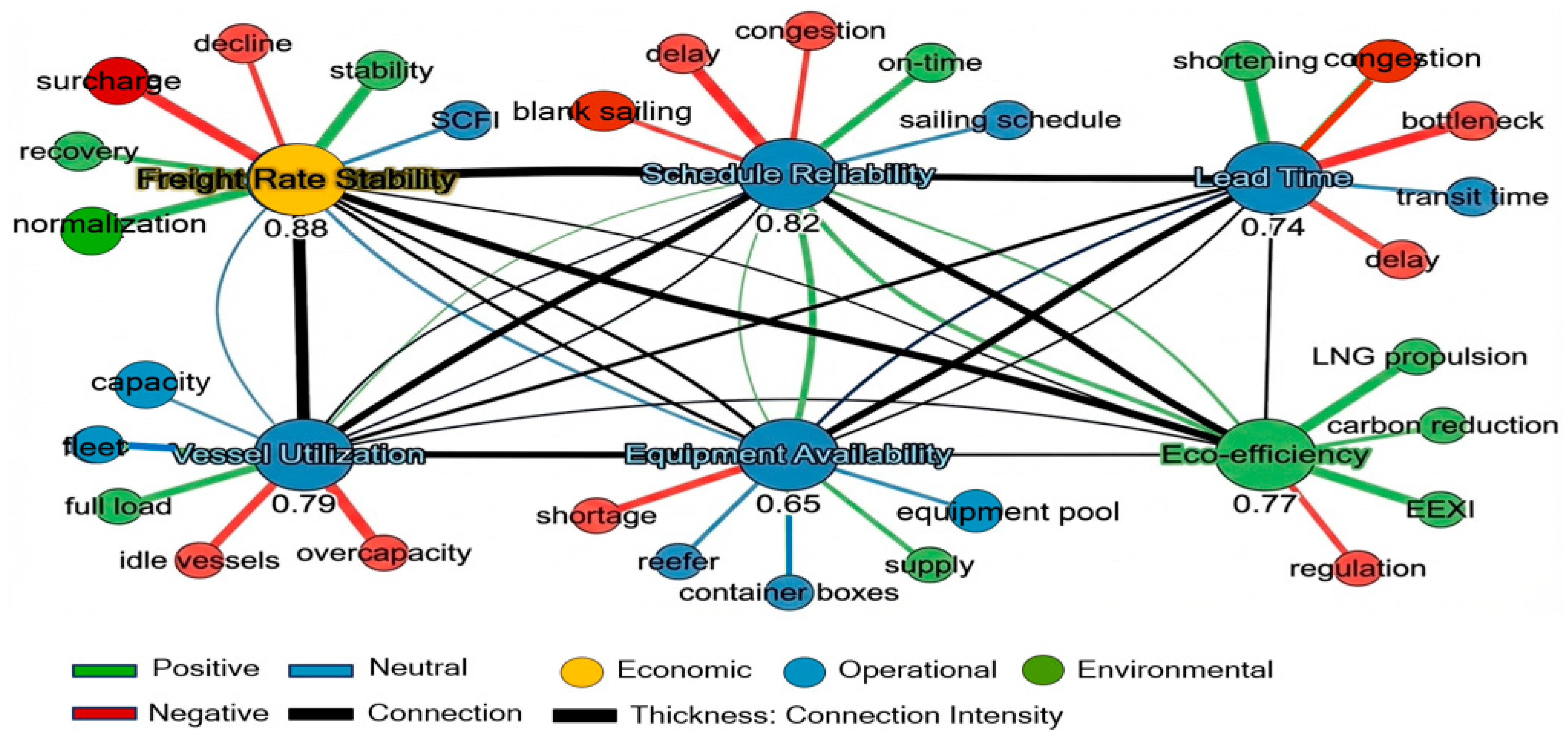
The resulting network structure revealed how sustainability stress is distributed and concentrated across CTQ dimensions. Table 8 summarizes the centrality and PMI values for each sustainability-critical dimension, while Figure 3 visualizes the topic–sentiment network topology.
High centrality values indicate CTQ dimensions that function as structural stress hubs rather than short-term shock absorbers. Freight rate stability and schedule reliability exhibited the highest centrality, reflecting the dominance of economic and operational sustainability risks in shipping market discourse. Importantly, this does not imply that price volatility alone constitutes a state of unsustainability, but rather that freight rate narratives act as a convergence point through which broader operational and strategic concerns are articulated.
Notably, the eco-efficiency dimension also demonstrates substantial centrality and association strength, indicating that environmental sustainability concerns—such as decarbonization requirements, emission regulations, and fuel transition mandates—are increasingly embedded in shipping market narratives. This finding suggests that environmental sustainability is no longer peripheral or exogenous to market dynamics but structurally integrated into the system-wide perception of sustainability stress.
For schedule reliability, sustainability stress is strongly associated with negative sentiment related to delays and congestion, indicating that persistent port congestion functions as a structural driver of operational unsustainability rather than a temporary disruption. The coexistence of positive signals associated with punctuality suggests adaptive responses, but the network structure indicates that resilience remains constrained by systemic bottlenecks.
Freight rate stability occupied the most central position in the network (centrality = 0.88), indicating that economic sustainability stress acts as the primary narrative hub. The simultaneous presence of positive (recovery, stabilization) and negative (surcharge, instability) sentiment reflects structural volatility rather than cyclical noise. This reinforces the interpretation of freight rates as a critical proxy for broader systematic tension, extending beyond simple market sentiment.
For lead time, sustainability stress was driven predominantly by negative sentiment related to bottlenecks and rerouting, highlighting the dependence of end-to-end transport stability on infrastructure resilience and network coordination. Vessel utilization exhibited a transitional pattern, with declining negative sentiment related to overcapacity and emerging positive signals associated with demand recovery, indicating partial structural rebalancing.
Equipment availability remained a persistent stress point, although emerging positive sentiment related to normalization suggests gradual recovery. These dynamics illustrate how sustainability stress evolves heterogeneously across CTQs rather than dissipating uniformly.
Finally, eco-efficiency demonstrated both high centrality and strong association strength (PMI = 0.53), underscoring its role as a long-term sustainability transition driver. Unlike economic and operational CTQs, eco-efficiency-related narratives reflect regulatory and technological transition dynamics rather than short-term performance fluctuations, aligning with sustainability transition theory rather than market-cycle interpretation.
Overall, the topic–sentiment network reveals that sustainability stress in global shipping is systemic, multidimensional, and path-dependent, spanning economic volatility, operational resilience, and environmental transition. By emphasizing structural connectivity rather than predictive accuracy, the network analysis supports the interpretation of CTQScores as sustainability stress indicators rather than forecasting tools, providing a conceptual bridge between qualitative discourse and sustainability-oriented risk governance.

3.2.5. Estimation of Topic-to-CTQ Weights and Construction of Sustainability Stress Indices

Based on the topic–sentiment network structure, this section estimates the impact weights that quantify how sustainability-related topics and sentiment signals influence sustainability-critical CTQ dimensions and constructs composite sustainability stress indices (CTQScores). Rather than focusing on short-term prediction performance, the proposed framework integrates topic intensities, CTQ-linked sentiment signals, and observed performance indicators to capture how sustainability stress accumulates and propagates across the economic, operational, and environmental dimensions of global shipping systems.
Model Specification and Estimation of Topic-to-CTQ Weights
Weekly observations are indexed by t = 1, …, T. Let z t denote the normalized topic vector derived from ProdLDA, representing the intensity of sustainability-related narratives at time t. The CTQ-linked sentiment vector s t is constructed using CTQ-specific positive and negative LinkScores, as well as their net sentiment values derived from PMI-weighted topic–sentiment associations. Observed performance indicators are denoted by y t , capturing realized outcomes associated with sustainability-critical CTQ dimensions. The CTQ set is defined as C = {Freight Rate Stability, Schedule Reliability, Lead Time, Vessel Utilization, Equipment Availability, Eco-efficiency}.
Let W denote the topic-to-CTQ weight matrix, capturing how sustainability-related topics map onto each CTQ dimension, and let γ denote the sentiment-to-CTQ weight vector. For each CTQ c C , topic and sentiment variables are combined into a feature vector X c , t , and the observed CTQ outcome is modeled as:
β c ^ , γ c ^ = a r g m i n β c , γ c 1 T t = 1 T y c , t β c z t γ c s c , t 2 + λ α θ c 1 + 1 α 2 θ c 2 2
Estimation is conducted using an ElasticNet regression framework, which combines L1 (LASSO) and L2 (Ridge) penalties to simultaneously address multicollinearity, perform variable selection, and enhance interpretability in a high-dimensional sustainability context. The penalty-mixing parameter α [ 0 , 1 ] controls the balance between sparsity and coefficient shrinkage, while the regularization strength λ > 0 is selected via cross-validation. Estimated coefficients associated with topic variables form the c -th row of the topic-to-CTQ weight matrix W , whereas coefficients on sentiment variables correspond to the sentiment-to-CTQ weights γ .
To complement point estimates and explicitly address uncertainty in sustainability stress transmission, Bayesian linear regression was applied in parallel, yielding posterior credible intervals for the estimated weights.
Construction and Interpretation of CTQScores
Using the estimated weights, a CTQ-specific sustainability stress index (CTQScore) was constructed as a weighted aggregation of topic intensities and sentiment signals defined in Equation (6):
C T Q S c o r e c , t = k = 1 K β c , k ^ z k , t + m = 1 M γ c , m ^ s c , m , t
Here, index i denotes individual topics or topic–sentiment interaction terms. Weekly CTQ-specific net sentiment scores—such as those for freight rate stability or eco-efficiency—were calculated using PMI weighted by network centrality, reflecting both the statistical strength and the structural importance of sustainability stress signals in market discourse.
When all weights were assumed to be equal, the CTQScore was reduced to a simple average sentiment index. However, the proposed weighted formulation enables differential attribution of sustainability stress based on empirically estimated influence pathways. As such, CTQScores integrate both which issues dominate shipping market narratives (topic intensity) and how these issues are evaluated from a sustainability perspective (sentiment polarity and intensity).
A positive CTQScore indicates that prevailing narratives are associated with improving economic stability, operational resilience, or environmental performance. Conversely, a negative CTQScore signals elevated sustainability stress, suggesting an increased likelihood of deterioration in CTQ outcomes due to persistent market volatility, operational disruptions, or environmental compliance pressure. Importantly, CTQScores are not interpreted as point forecasts but as early warning indicators of sustainability stress trajectories.
Illustrative Temporal Dynamics of Sustainability Stress
To illustrate the dynamic properties of the proposed index, Table 9 presents the temporal evolution of CTQScores for the freight rate stability dimension from late April to late June 2025. The results demonstrate that CTQScores capture persistent sustainability stress trajectories rather than isolated weekly fluctuations. Notably, during late April and early May 2025, the index exhibited sustained negative values, indicating heightened stress associated with freight rate volatility and demand uncertainty. These negative trajectories coincide with intensified negative sentiment, suggesting that economic sustainability stress was accumulating well before observable adjustments appeared in the realized market indicators.
Subsequent weeks displayed a gradual moderation of negative CTQScores and intermittent positive movements, reflecting emerging narratives of market stabilization and recovery. This transition highlights the ability of CTQScores to detect early signals of sustainability stress alleviation before such improvements are fully reflected in realized freight rate performance.
Overall, the temporal patterns observed in Table 9 confirm that CTQScores function as dynamic sustainability stress indicators, capable of tracing the buildup, persistence, and dissipation of economic sustainability stress in shipping markets. This trajectory-based perspective underscores the value of CTQScores for proactive monitoring and the early warning of sustainability-related risks.
Robustness Checks, Sensitivity Analysis, and Model Scope
To ensure that the observed CTQScore trajectories are not artifacts of specific model settings or short-term noise, several robustness and sensitivity analyses were conducted.
First, ElasticNet regularization paths were examined across a wide range of λ values. The estimated topic-to-CTQ weights maintained consistent signs and relative magnitudes across specifications, indicating that CTQScore construction is not driven by overfitting to a particular penalty level.
Second, sensitivity analysis with respect to the ElasticNet mixing parameter α was performed by re-estimating the model under alternative specifications ( α { 0.3 , 0.5 , 0.7 } ). The resulting CTQScore trajectories and sustainability stress rankings remained highly correlated, confirming robustness to alternative regularization structures.
Third, rolling-window estimations using a 52-week moving window were applied to assess temporal stability. The persistence of key topic-to-CTQ influence pathways across subsamples supports the interpretation of CTQScores as structurally meaningful sustainability stress indicators rather than sample-specific artifacts.
Although the final aggregation stage of CTQScore estimation adopts a linear ElasticNet framework, this linearity should be interpreted as an explanatory approximation layer rather than a strict structural assumption. Nonlinear dynamics are already embedded upstream through neural topic modeling (ProdLDA), PMI-weighted topic–sentiment network construction, and multi-task representation learning. The use of a linear aggregation layer at this stage enhances interpretability, transparency, and governance relevance, which are essential for sustainability-oriented monitoring and decision support.

3.2.6. KPI Validation and Operationalization of the Sustainability Risk Radar

In the final stage of the proposed framework, the constructed CTQScores are empirically validated against observed market performance indicators and operationalized as an integrated Sustainability Risk Radar for the global shipping industry. Rather than serving as pure forecasting inputs, CTQScores were explicitly interpreted as early warning indicators of sustainability stress, designed to capture emerging deterioration in economic stability, operational continuity, and environmental performance before such risks are fully reflected in conventional quantitative metrics. To improve actionability, the study translates each CTQScore into decision-relevant levers and trigger rules. Specifically, when a CTQScore falls below a distribution-based threshold (e.g., the historical 10th percentile) or exhibits abnormal persistence for k consecutive weeks, the Sustainability Risk Radar issues an alert and recommends CTQ-specific interventions.
Validation Through KPI Linkage
To assess the empirical relevance of the proposed sustainability stress indicators, CTQScores were linked to key performance indicators (KPIs) associated with sustainability-critical CTQ dimensions. Particular emphasis was placed on the Shanghai Containerized Freight Index (SCFI) as a representative indicator of economic sustainability in container shipping.
An ElasticNet regression framework was employed to estimate a one-week-ahead validation model that examined whether CTQScores contain incremental explanatory information beyond conventional time-series dynamics:
K P I t + 1 = β 0 + β 1 K P I t + β 2 C T Q S c o r e t + ϵ t
This formulation evaluates whether sustainability-related topic and sentiment signals embedded in CTQScores are systematically associated with subsequent market outcomes, after controlling for autoregressive persistence.
Table 10 compares the responsiveness of alternative modeling specifications to emerging sustainability stress. Rather than emphasizing predictive superiority, the comparison highlights the ability of CTQScore-based models to detect sustainability-relevant stress signals embedded in shipping market narratives. The results indicate that the integrated ElasticNet model incorporating CTQScores exhibited the highest sensitivity to emerging stress conditions, supporting its role as an effective early warning mechanism rather than a short-term forecasting tool.
Temporal Precedence and Dynamic Interaction Diagnostics
To further examine the temporal precedence of sustainability stress indicators, Granger causality tests were conducted between the CTQScores and key performance indicators. Results indicate that several CTQScores—particularly those related to freight rate stability, schedule reliability, and vessel utilization—Granger caused subsequent movements in the SCFI at short horizons (1–3 weeks), while reverse causality was weaker or statistically insignificant.
Complementary VAR models were estimated to analyze dynamic interactions between CTQScores and market outcomes. Impulse response functions (IRFs) showed that shocks to CTQScores generated statistically significant responses in SCFI trajectories, typically peaking within 2–3 weeks before gradually dissipating. These patterns suggest that CTQScores capture early sustainability stress signals that precede observable market adjustments rather than contemporaneous noise.
Importantly, these diagnostics are not interpreted as proof of structural causality but as evidence of temporal lead and informational relevance, consistent with the role of CTQScores as early warning sustainability indicators rather than forecasting instruments.
CTQ-Specific Heterogeneity of Sustainability Stress Relevance
Validation results revealed substantial heterogeneity across CTQ dimensions. Economic and operational CTQs—such as freight rate stability, vessel utilization, and lead time—demonstrated strong short-term relevance to SCFI dynamics, indicating that sustainability stress in these dimensions is rapidly transmitted to market performance.
In contrast, eco-efficiency exhibited weaker short-term alignment with SCFI movements. This result reflects the structural nature of environmental sustainability, which is primarily shaped by regulatory regimes, technological transitions, and decarbonization pathways, rather than short-term price fluctuations.
Table 11 illustrates how sustainability stress captured by CTQScores manifests differently across CTQ dimensions, reinforcing the interpretation of eco-efficiency as a long-term structural sustainability driver rather than a cyclical market signal.
Directional Accuracy and Sustainability Relevance
Beyond magnitude-based validation, the framework evaluates directional accuracy (hit ratios) to assess whether CTQScores reliably capture the direction of sustainability-related change. From a sustainability management perspective, correctly anticipating whether conditions are deteriorating or stabilizing is often more critical than minimizing numerical forecast error.
High hit ratios across key CTQ dimensions indicate that CTQScores effectively capture directional sustainability stress signals, reinforcing their practical relevance for decision-making under uncertainty (selected weekly examples of sustainability stress realization and directional signals are reported in Appendix C).
Sustainability Risk Signal Generation and Interpretation as a Sustainability Risk Radar
Building on the validated linkage between CTQScores and KPIs, sustainability risk signals are generated using two complementary threshold mechanisms.
First, a performance-based threshold triggers a sustainability alert when expected KPI trajectories (e.g., SCFI) are expected to deteriorate beyond a predefined magnitude, capturing imminent economic sustainability risk.
Second, a distribution-based threshold issues an alert when a CTQScore falls below a critical percentile of its historical distribution, indicating abnormally elevated sustainability stress relative to past conditions. This mechanism is particularly effective in detecting systemic operational or environmental stress that may not yet be reflected in market prices.
Thresholds are calibrated using historical data and domain expert judgment to balance sensitivity and false-alarm risk.
Taken together, the KPI validation and risk signal generation mechanisms transform CTQScores into an integrated Sustainability Risk Radar. This radar enables the continuous monitoring of sustainability-critical dimensions and provides early warnings of emerging risks across economic, operational, and environmental domains.
Unlike conventional early warning systems based on single indicators, the proposed radar captures multidimensional sustainability stress, allowing decision-makers to diagnose not only whether risk is increasing, but also where it originates within the shipping system. For example, concurrent declines in schedule reliability and equipment availability in CTQScores signal operational fragility, whereas persistent deterioration in eco-efficiency CTQScores highlights long-term environmental and regulatory transition risks.
Through this final stage, the framework completes an end-to-end transformation of unstructured market narratives into structured, governance-relevant sustainability risk signals. The Sustainability Risk Radar thus serves as a practical decision-support tool for shipping firms, port authorities, and policymakers seeking to enhance resilience, align with ESG objectives, and proactively manage sustainability risks in an increasingly complex global maritime environment.

4. Conclusions and Implications

This study develops and empirically validates a sustainability-oriented NLP framework that transforms unstructured shipping market narratives into early warning indicators of sustainability stress. By integrating topic modeling, domain-tuned sentiment analysis, network-based stress propagation, and econometric validation, the proposed framework moves beyond conventional price-centric market analysis and offers a structured approach to monitoring economic, operational, and environmental sustainability risks in global shipping systems.

4.1. Managerial Implications

The findings of this study provide actionable managerial insights for shipping companies, logistics providers, and port operators operating under increasingly volatile and sustainability-constrained conditions. By transforming unstructured market narratives into CTQ-specific sustainability stress indicators, the proposed CTQScore framework enables managers to move from reactive decision-making to proactive risk monitoring and targeted intervention.
First, the Sustainability Risk Radar enhances early visibility into the accumulation and persistence of sustainability stress across economic and operational dimensions. For instance, sustained deterioration in the Freight Rate Stability CTQScore—particularly when values fall below the historically calibrated stress thresholds or remain negative for multiple consecutive weeks—can signal impending instability in revenue conditions. Such signals allow carriers to adjust capacity deployment, renegotiate contract coverage, or reconsider pricing and surcharge strategies before adverse conditions are fully reflected in realized market outcomes.
Second, the multidimensional structure of CTQScores enables diagnostic decision-making rather than aggregate reaction. Because each CTQScore corresponds to a specific sustainability-critical performance dimension, managers can identify where stress originates within the shipping system. For example, concurrent declines in Schedule Reliability and Lead Time CTQScores indicate operational fragility driven by congestion or rerouting, motivating tactical responses such as buffer-time adjustment, port-pair prioritization, or contingency routing. In contrast, persistent stress in Vessel Utilization may justify capacity cascading, slow steaming, or temporary idling strategies aimed at restoring balance between supply and demand.
Third, the framework supports resilience-oriented and adaptive management by emphasizing stress trajectories rather than isolated weekly fluctuations. Monitoring the persistence and intensity of CTQScore movements allows managers to evaluate whether corrective actions are effectively alleviating sustainability stress or whether risks are becoming systemic. This temporal perspective is particularly valuable in shipping markets characterized by rigid capacity structures and delayed adjustment mechanisms, where early intervention can substantially reduce downstream disruption.
Importantly, CTQScores are not intended as deterministic forecasts but as decision-support indicators for early warning and triage. Their primary managerial value lies in identifying emerging sustainability risks, prioritizing response areas, and aligning short-term operational decisions with longer-term resilience objectives.

4.2. Policy and Regulatory Implications

From a policy and regulatory perspective, the Sustainability Risk Radar offers a complementary monitoring tool for public authorities seeking to enhance the resilience and sustainability of maritime transport systems. Unlike traditional oversight mechanisms that rely on lagged performance indicators, the proposed framework provides early warning insights derived from market narratives and stakeholder perceptions, allowing the earlier identification of systemic stress.
In particular, the eco-efficiency CTQScore functions as an indicator of environmental sustainability pressure associated with regulatory transitions, such as decarbonization mandates, fuel shifts, and emission standards. Elevated or persistent stress in this dimension signals periods in which compliance costs and operational adjustment burdens may intensify. Policymakers can use these signals to inform the timing, sequencing, and communication of environmental regulations, thereby supporting smoother transition pathways while maintaining long-term decarbonization objectives.
Beyond environmental policy, the framework also enables authorities to monitor system-wide operational risks that threaten supply chain stability. For example, simultaneous stress signals in Schedule Reliability and Equipment Availability CTQs indicate congestion-driven bottlenecks and equipment imbalances that may require coordinated responses across ports, carriers, and inland transport networks. The early identification of such patterns supports targeted interventions, information-sharing initiatives, and temporary capacity management measures aimed at preventing cascading disruptions.
By integrating economic, operational, and environmental dimensions within a single analytical structure, the Sustainability Risk Radar aligns closely with ESG-oriented governance objectives. It provides regulators with an interpretable and scalable decision-support tool that complements quantitative statistics, enabling evidence-based monitoring of sustainability stress without asserting structural causality. In this role, the framework supports adaptive governance by highlighting where and when intervention may be warranted in increasingly complex global shipping systems.

4.3. Theoretical Implications

The study contributes to the sustainability and maritime economics literature in three main ways. First, it advances the concept of sustainability stress as a measurable, dynamic, and multidimensional construct that emerges from the interaction of narratives, operations, and regulatory environments.
Second, it bridges the gap between qualitative market perceptions and quantitative performance outcomes by embedding NLP-based sentiment analysis within a CTQ-anchored sustainability framework.
Third, it demonstrates how topic–sentiment network structures can be operationalized as early warning mechanisms, offering a methodological contribution applicable to other sustainability-critical industries characterized by complex system dynamics.
Importantly, the study does not claim that CTQ dimensions exhaustively represent sustainability in a normative sense. Rather, they are positioned as operationally observable lenses through which sustainability stress manifests in shipping markets, consistent with resilience- and transition-oriented sustainability theory.

4.4. Limitations and Directions for Future Research

Several limitations suggest avenues for future research.
First, although the analysis was based on the KMI Weekly Shipping Market Focus, the underlying corpus primarily consisted of English-language shipping news and analytical content from diverse international sources, with the KMI reports functioning as an expert-curated synthesis layer rather than the primary data. Nevertheless, reliance on a single institutional synthesis process may still introduce framing effects. Extending the framework to independent multilingual and multi-institutional corpora would further enhance external validity. Future research could apply multilingual language models (e.g., mBERT or XLM-R) directly to international shipping intelligence sources—such as Lloyd’s List, TradeWinds, and Alphaliner—and compare CTQScore dynamics across alternative institutional pipelines to assess cross-regional robustness.
Second, while the shipping-specific sentiment lexicon was designed for extensibility and is provided in the appendix for transparency, the study acknowledges the inherent challenges of manual polarity assignment. Future research could enhance this framework by incorporating formal inter-rater reliability metrics (e.g., Cohen’s Kappa or Krippendorff’s Alpha) during the expansion phase or employing automated multi-lingual validation to further minimize linguistic subjectivity. Such efforts would strengthen the cross-border applicability of the lexicon in the highly globalized maritime sector.
Third, while this study focused on market-level narratives, the environmental sustainability dimension could be further solidified by integrating multi-source granular data. Future studies could pair our text-mined insights with firm-level ESG disclosures, real-time AIS-based emissions data, or port-level operational metrics. This multimodal approach would enable a finer-grained evaluation of how high-level policy shifts—such as the IMO decarbonization mandates—translate into measurable operational changes at the vessel and terminal levels.
Future research may also explore real-time implementation of the Sustainability Risk Radar and its integration with decision-support systems, enabling adaptive and automated sustainability risk management across global maritime and logistics networks.

Author Contributions

Conceptualization, D.K. and Y.K.; methodology, D.K. and Y.K.; software, D.K.; validation, D.K. and Y.K.; formal analysis, D.K. and Y.K.; investigation, D.K. and Y.K.; resources, D.K. and Y.K.; data curation, D.K.; writing—original draft preparation, D.K. and Y.K.; writing—review and editing, D.K.; visualization, D.K.; supervision, D.K.; project administration, D.K.; funding acquisition, D.K. and Y.K. All authors have read and agreed to the published version of the manuscript.

Funding

This research received no external funding.

Institutional Review Board Statement

Not applicable.

Informed Consent Statement

Not applicable.

Data Availability Statement

The data presented in this study are available on request from the corresponding author.

Acknowledgments

During the preparation of this manuscript, the authors used ChatGPT (OpenAI, version 5.2) for the purposes of improving the language and readability. The authors have reviewed and edited the output and take full responsibility for the content of this publication.

Conflicts of Interest

The authors declare no conflicts of interest.

Abbreviations

The following abbreviations are used in this manuscript:
BDIBaltic Dry Index
BERTBidirectional Encoder Representations from Transformers
CCFIChina Containerized Freight Index
CTQCritical-to-Quality
CVCross-Validation
DAPTDomain-Adaptive Pre-training
FinBERTFinancial BERT
IMOInternational Maritime Organization
KMIKorea Maritime Institute
KOBCKorea Ocean Business Corporation
KPIKey Performance Indicator
LDALinear Discriminant Analysis
LMLanguage Model
LSTMLong Short-Term Memory
MAPEMean Absolute Percentage Error
MLMMasked Language Modeling
MTLMulti-Task Learning
NACNamed Account Contract
NLPNatural Language Processing
PCAPrincipal Component Analysis
PMIPointwise Mutual Information
ProdLDAProduct of Experts Latent Dirichlet Allocation
SCFIShanghai Containerized Freight Index
S/NSales and Negotiation
SSIShipping Sentiment Index
VARVector Autoregression
WWeights
WSWorld Scale

Appendix A. Comparative Evaluation of Topic Modeling Methods

To enhance the transparency and reproducibility of the topic modeling procedure, this appendix reports a comparative evaluation of alternative topic modeling approaches considered prior to selecting ProdLDA as the primary method. The comparison includes classical Latent Dirichlet Allocation (LDA), BERTopic, and ProdLDA, which represent the probabilistic, embedding-based, and neural variational topic modeling paradigms, respectively.

Appendix A.1. Evaluation Criteria

The evaluation was conducted using criteria relevant to sustainability-oriented shipping market analysis:
  • Topic coherence: Quantitative coherence scores were computed to assess semantic consistency within topics. Both c_v and u_mass coherence metrics were calculated using the Gensim framework;
  • Stability across runs: Each model was estimated over multiple random initializations, and topic overlap consistency was examined;
  • Interpretability: Topics were qualitatively assessed by domain experts in maritime economics based on semantic clarity and alignment with sustainability-critical issues;
  • Suitability for sustainability analysis: Models were evaluated on their ability to capture persistent, structural issue domains rather than short-lived event-driven clusters.

Appendix A.2. Comparative Results

Table A1 summarizes the quantitative coherence scores and qualitative assessments across the three models.
Table A1. Comparative topic coherence and interpretability across alternative topic modeling methods.
ModelAvg. c_vAvg. u_MassStability Across RunsInterpretabilitySustainability Suitability
LDA0.41−8.72ModerateLow–ModerateLimited
BERTopic0.53−6.18LowModerateEvent-oriented
ProdLDA0.61−5.02HighHighStructural/Long-term
Classical LDA demonstrated relatively low semantic coherence and limited ability to capture overlapping sustainability-relevant themes, reflecting its bag-of-words assumptions and sensitivity to sparse industry text. BERTopic achieved higher coherence scores than LDA and was effective in detecting short-lived, event-specific narratives (e.g., port strikes or route blockages). However, it exhibited higher sensitivity to hyperparameter settings and produced fragmented topic structures that were less stable across runs.
In contrast, ProdLDA consistently achieved the highest coherence scores and demonstrated strong stability across repeated estimations. More importantly, the extracted topics exhibited clear semantic alignment with sustainability-critical domains such as freight rate stability, schedule reliability, capacity utilization, and environmental regulation. These characteristics support the suitability of ProdLDA for identifying persistent structural stress factors relevant to long-term sustainability analysis rather than transient market shocks.

Appendix A.3. Implications for Model Selection

Based on the combined quantitative and qualitative evidence, ProdLDA was selected as the most appropriate topic modeling approach for this study. Its ability to balance semantic coherence, topic stability, and interpretability makes it particularly suitable for sustainability-oriented analysis, where the objective is to identify enduring issue domains that shape systemic sustainability stress in global shipping markets.

Appendix B. CTQ-Linked Sentiment Lexicon

Table A2. CTQ-linked Sentiment Lexicon.
Freight Rate Stability
TermPolarityTermPolarityTermPolarity
CBAMNegativefreight rateNeutralimprovementPositive
declineNegativelong-term contractNeutralincrementPositive
downward trendNegativeratesNeutralnormalizationPositive
hikeNegativeSCFINeutralPoseidon PrinciplesPositive
instabilityNegativespot marketNeutralPSSPositive
overcapacityNegativeWSNeutralrecoveryPositive
plungeNegativeBAFPositiveresiliencePositive
sharp declineNegativebalancePositiveresilientPositive
sharp increaseNegativebunker hedgingPositiveslow steamingPositive
surchargeNegativecanal surchargePositivestabilityPositive
volatileNegativecapacity crunchPositivestabilizePositive
volatilityNegativecharter rate spikePositivestabilizedPositive
BDINeutralgreen financingPositivestablePositive
capacity adjustmentNeutralgreen premiumPositivetonnage taxPositive
CCFINeutralGRIPositive
Schedule Reliability
TermPolarityTermPolarityTermPolarity
bottleneckNegativetransshipment delayNegativeon-timePositive
cancellationNegativeblank sailingNegativepro-forma schedulePositive
congestionNegativesailing scheduleNeutralreliabilityPositive
delayNegativescheduleNeutralschedule adherencePositive
detourNegativeshipmentNeutralsmooth flowPositive
disruptionNegativeterminal congestionNeutralstable operationPositive
port labor strikeNegativetrade laneNeutral
reroutingNegative
Vessel Utilization
TermPolarityTermPolarityTermPolarity
idle vesselNegativecarrierNeutralautonomous navigationPositive
port congestionNegativecarriersNeutralbackhaulPositive
orderbook-to-fleet ratioNegativecharterNeutraldemolition valuePositive
underusedNegativefleetNeutraldigital twinPositive
overcapacityNegativeportNeutralEEXI compliancePositive
bulkNeutralsupply adjustmentNeutralmethanol-readyPositive
bunkeringNeutraltankerNeutralscrappingPositive
capacityNeutraltonnageNeutralslow steamingPositive
ton-mileNeutral
Lead Time
TermPolarityTermPolarityTermPolarity
diversionNegativelead timeNeutraltransit timeNeutral
droughtNegativelogisticsNeutraltransshipment timeNeutral
port congestionNegativelogistics flowNeutralefficiencyPositive
restrictionNegativerouteNeutralslow steamingPositive
waitingNegativeroute re-routingNeutralsmart port automationPositive
customs delayNeutralshipmentNeutralspeedPositive
distanceNeutraltransitNeutral
Equipment Availability
TermPolarityTermPolarityTermPolarity
chassis shortageNegativeavailabilityNeutraltruckingNeutral
deficiencyNegativechassisNeutralnormal supplyPositive
demurrageNegativecontainerNeutralsecuredPositive
detentionNegativecontainer boxNeutralsmooth availabilityPositive
dwell timeNegativecontainersNeutral
empty repoNegativeequipmentNeutral
imbalanceNegativereeferNeutral
shortageNegativetruckNeutral
Eco-efficiency
TermPolarityTermPolarityTermPolarity
EU ETSNegativeRetrofittingNeutralgreen financingPositive
fuel EU maritimeNegativescrubberNeutralgreen premiumPositive
penaltyNegativeSEEMPNeutralgreen recyclingPositive
pollutionNegativebio-fuel bunkeringPositiveLNG propulsionPositive
regulationNegativebio-methanol bunkeringPositivereductionPositive
spillNegativecarbon reductionPositiveslow steamingPositive
violationNegativeCII ratingPositivesustainabilityPositive
carbon emissionsNegativedecarbonizationPositivesustainablePositive
CIINeutraldecarbonizePositivetransitionPositive
EEXINeutraldual-fuel enginePositiveWAPSPositive
emissionsNeutraleco-friendlyPositive
fuelNeutralESGPositive
IMONeutralgreen corridorPositive

Appendix C

This appendix provides selected weekly examples illustrating how sustainability stress signals, as captured by the CTQScores, are reflected in subsequent movements of the Shanghai Containerized Freight Index (SCFI). The purpose of Table A3 is to demonstrate the directional alignment between the identified stress signals and realized market outcomes, thereby offering transparent, case-based evidence of the framework’s interpretability.
Table A3. Illustrative examples of sustainability stress realization and directional signals.
WeekSCFIActual
SCFI_t + 1
Predicted SCFI_t + 1Actual Direction
SCFI_t + 1 vs. SCFI_t
Predicted Direction
SCFI_t + 1 vs. SCFI_t
Match
4-3137113481399.23Down (1348 < 1371)Up (1399 > 1371)No
4-4134813451430.43Down (1345 < 1348)Up (1430 > 1348)No
5-1134514791735.15Up (1479 > 1345)Up (1735 > 1345)Yes
5-2147915861652.51Up (1586 > 1479)Up (1652 > 1479)Yes
5-3158620732093.51Up (2073 > 1586)Up (2093 > 1586)Yes
5-4207322402087.82Up (2240 > 2073)Up (2087 > 2073)Yes
6-1224020881987.46Down (2088 < 2240)Down (1987 < 2240)Yes
6-2208818701738.97Down (1870 < 2088)Down (1738 < 2088)Yes
6-3187018621871.88Down (1862 < 1870)Up (1871 > 1870)No
6-41862-----
Table A3 compares the observed change in SCFI between week t and t + 1 with the corresponding model-implied directional signal. For each observation, the direction of movement is classified as Up or Down based on the sign of the difference between SCFI_t + 1 and SCFI_t. A directional match is recorded when the predicted and realized movements coincide. The table is intended to provide an intuitive illustration of the model’s directional interpretability rather than a formal evaluation of predictive accuracy. Instances of both correct and incorrect directional predictions are deliberately included to reflect realistic forecasting performance. Formal statistical assessments of predictive performance are reported separately in the main empirical analysis.
Several weeks exhibited consistent alignment between the predicted and realized directions, particularly during the sustained upward phase observed from Week 5-1 to Week 5-4. During this period, elevated CTQScores coincided with a persistent recovery in spot freight rates, suggesting that the framework successfully captured the buildup and continuation of market stress dynamics. Conversely, mismatches observed in Weeks 4-3, 4-4, and 6-3 corresponded to periods characterized by short-term volatility and rapid adjustments in market expectations, during which spot rates reversed direction within a single week.
Importantly, these examples are not intended to demonstrate numerical forecast accuracy. Instead, they highlight the framework’s ability to identify emerging stress or recovery regimes ahead of, or contemporaneously with, directional market shifts. The inclusion of both correct and incorrect signals reflects realistic market conditions in which exogenous shocks, abrupt sentiment changes, or liquidity-driven adjustments may temporarily weaken directional alignment.
Overall, the illustrative cases in Table A1 complement the aggregate validation results reported in Section 3.2.6. They support the interpretation of CTQScores as early warning indicators of sustainability-related market stress, rather than as point-forecasting instruments for freight rate levels.

References

  1. Baertlein, L. Red Sea Diversions, Tariff Risks Send Ocean Shipping Soaring. Reuters. 2024. Available online: https://www.reuters.com/markets/commodities/red-sea-diversions-tariff-risks-send-ocean-shipping-soaring-2024-05-31/ (accessed on 10 October 2025).
  2. United Nations Conference on Trade and Development (UNCTAD). Suez and Panama Canal Disruptions Threaten Global Trade and Development; UNCTAD: Geneva, Switzerland, 2024; Available online: https://unctad.org (accessed on 10 October 2025).
  3. Wolff, J. Red Sea Crisis Underlines the Need for Greater Data Transparency. Seatrade Maritime. 2024. Available online: https://www.seatrade-maritime.com/maritime-technology/red-sea-crisis-underlines-the-need-for-greater-data-transparency (accessed on 10 October 2025).
  4. Hoffart, F.M.; D’Orazio, P.; Holz, F.; Kemfert, C. Exploring the interdependence of climate, finance, energy, and geopolitics: A conceptual framework for systemic risks amidst multiple crises. Appl. Energy 2024, 361, 122885. [Google Scholar] [CrossRef]
  5. Aven, T.; Renn, O. Risk Management and Governance: Concepts, Guidelines and Applications; Springer: Berlin, Germany, 2010. [Google Scholar]
  6. Jeon, J. SCFI Surge Causes and Improvement in Liner Bargaining Power. Cello-Square. 2024. Available online: https://www.cello-square.com/en/blog/view-1405.do (accessed on 10 October 2025).
  7. Labrut, M. Container Shipping Set for Short, Sharp, Hard Landing. Seatrade Maritime. 2022. Available online: https://www.seatrade-maritime.com/containers/container-shipping-set-for-short-sharp-hard-landing- (accessed on 10 October 2025).
  8. Chen, L.; Liu, J.; Pei, R.; Su, Z.; Liu, Z. Shanghai Containerised Freight Index Forecasting Based on Deep Learning Methods: Evidence from Chinese Futures Markets. East Asian Econ. Rev. 2024, 28, 359–388. [Google Scholar] [CrossRef]
  9. Bai, X.; Lam, J.; Jakher, A. Shipping sentiment and the dry bulk shipping freight market: New evidence from newspaper coverage. Transp. Res. Part E 2021, 55, 102490. [Google Scholar] [CrossRef]
  10. Gavriilidis, T.; Merika, A.; Merikas, A.; Sigalas, C. Development of a sentiment measure for dry bulk shipping. Marit. Policy Manag. 2023, 50, 58–80. [Google Scholar] [CrossRef]
  11. Michail, N.A.; Melas, K.D. Sentiment-augmented supply and demand equations for the dry bulk shipping market. Economies 2021, 9, 171. [Google Scholar] [CrossRef]
  12. Labrut, M. Boxship Blocks Suez Canal. Seatrade Maritime. 2021. Available online: https://www.seatrade-maritime.com/containers/boxship-blocks-suez-canal (accessed on 10 October 2025).
  13. How the Panama Canal Drought and Trade Shifts Are Redefining Supply Chain Resilience for 2025. Langley. 2025. Available online: https://www.langleysearch.com/blog/2025/01/how-the-panama-canal-drought-and-trade-shifts-are-redefining-supply-chain-resilience-for-2025?source=google.com (accessed on 15 October 2025).
  14. Labrut, M. Panama Canal Transits Drop 29% in FY2024. Seatrade Maritime. 2024. Available online: https://www.seatrade-maritime.com/containers/panama-canal-transits-drop-29-in-fy2024 (accessed on 10 October 2025).
  15. Savvides, N. US Trade Surge Could Trigger Pandemic Levels of Port Congestion. Seatrade Maritime. 2025. Available online: https://www.seatrade-maritime.com/ports-logistics/us-trade-surge-could-trigger-pandemic-levels-of-port-congestion.com (accessed on 10 October 2025).
  16. Pettit, T.J.; Fiksel, J.; Croxton, K.L. Ensuring supply chain resilience: Development of a conceptual framework. J. Bus. Logist. 2010, 31, 1–21. [Google Scholar] [CrossRef]
  17. OECD. Risks and Resilience in Global Trade: Key Trends in 2023–2024; OECD Publishing: Paris, France, 2024. [Google Scholar] [CrossRef]
  18. Bouman, E.A.; Lindstad, E.; Rialland, A.; Strømman, A.H. State-of-the-art technologies, measures, and potential for reducing GHG emissions from shipping—A review. Transp. Res. Part D 2017, 52, 408–421. [Google Scholar] [CrossRef]
  19. World Bank. The Container Port Performance Index 2022: A Comparable Assessment of Performance Based on Vessel Time in Port; World Bank Group: Washington, DC, USA, 2023; Available online: http://hdl.handle.net/10986/39824 (accessed on 10 October 2025).
  20. Hirata, E.; Takahashi, T. Forecasting Shanghai Containerized Freight Index: A deep-learning-based model experiment. J. Mar. Sci. Eng. 2022, 10, 593. [Google Scholar] [CrossRef]
  21. Kaprinis, K. The Institutional Structure of Macroprudential Policy in the UK; Springer: Cham, Switzerland, 2023. [Google Scholar]
  22. Ivanov, D.; Dolgui, A.; Sokolov, B. The impact of digital technology and Industry 4.0 on the ripple effect and supply chain risk analytics. Int. J. Prod. Res. 2019, 57, 829–846. [Google Scholar] [CrossRef]
  23. Sui, C.; Wang, S.; Zheng, W. Sentiment as a shipping market predictor: Testing market-specific language models. Transp. Res. Part E 2024, 189, 103651. [Google Scholar] [CrossRef]
  24. Gong, Y. Shipping news sentiment as a predictor of iron ore freight rates. Resour. Policy 2025, 89, 105682. [Google Scholar]
  25. Jeon, J.; Çağatay, I.; Hong, S.; Andrew, L. Box rates unveiled: Predictive analytics for ocean freight rates with news-based market sentiment. Int. J. Prod. Econ. 2025, 286, 109669. [Google Scholar] [CrossRef]
  26. Ehlert, S.; Wilson, C.; Yawson, A. Industry investor sentiment in the global shipping industry. Marit. Policy Manag. 2024, 51, 74–79. [Google Scholar] [CrossRef]
  27. Kim, J.; Lee, K.; Kwon, J.; Yeo, J. Maritime supply chain risk sentiment and Korea’s trade volume: A news big-data analysis perspective. Asian J. Shipp. Logist. 2024, 40, 42–51. [Google Scholar]
  28. Friede, G.; Busch, T.; Bassen, A. ESG and financial performance: Aggregated evidence from more than 2000 empirical studies. J. Sustain. Financ. Invest. 2015, 5, 210–233. [Google Scholar] [CrossRef]
  29. George, G.; Merrill, R.K.; Schillebeeckx, S.J.D. Digital sustainability and entrepreneurship. J. Bus. Ventur. 2021, 36, 106153. [Google Scholar]
  30. Kölbel, J.F.; Heeb, F.; Paetzold, F.; Busch, T. Can sustainable investing save the world? Organ. Environ. 2020, 33, 554–574. [Google Scholar]
  31. Korea Maritime Institute (KMI). KMI Weekly Shipping Market Focus; Nos. 548–699; KMI: Busan, Republic of Korea, 2022–2025. [Google Scholar]
  32. Elkington, J. Towards the Sustainable Corporation: Win–Win–Win Business Strategies for Sustainable Development. Calif. Manag. Rev. 1994, 36, 90–100. [Google Scholar] [CrossRef]
  33. Sachs, J.D. From Millennium Development Goals to Sustainable Development Goals. Lancet 2012, 379, 2206–2211. [Google Scholar] [CrossRef] [PubMed]
  34. Rockström, J.; Steffen, W.; Noone, K.; Persson, Å.; Chapin, F.S.; Lambin, E.; Lenton, T.; Scheffer, M.; Folke, C.; Schellnhuber, H.J.; et al. A Safe Operating Space for Humanity. Nature 2009, 461, 472–475. [Google Scholar] [CrossRef] [PubMed]
Figure 1. Long-term volatility of shipping freight indices and sustainability stress drivers (2020–2025).
Sustainability 18 01814 g001
Figure 2. Sustainability-oriented NLP framework for early detection of shipping market stress.
Sustainability 18 01814 g002
Figure 3. Topic–sentiment network illustrating the propagation of sustainability stress across CTQ dimensions.
Sustainability 18 01814 g003
Table 1. Summary of Prior NLP-based Studies on Shipping Markets & Sustainability Relevance.
Authors (Year)Data SourceNLP/Modeling ApproachResearch FocusMain FindingsSustainability Relevance
/Limitation
Bai, Lam & Jakher (2021) [9]Shipping news articlesLexicon-based sentiment indexBDI predictionShipping sentiment shows short-term predictive power for BDIPrimarily focuses on freight rate dynamics; sustainability implications are indirect and limited to economic volatility.
Gavriilidis et al. (2023) [10]News articlesShipping-specific sentiment indexMarket risk explanationCaptures investor psychology and perceived riskImproves domain relevance, but sustainability is treated implicitly without linkage to resilience or environmental transition.
Sui, Wang & Zheng (2024) [23]Multilingual shipping newsDomain-tuned language model (BERT-based)Freight rate predictionOutperforms general-purpose language modelsMethodologically advanced, but primarily prediction-oriented with limited sustainability interpretation.
Gong. Y (2025) [24]Shipping newsSentiment index + threshold autoregressionRegime-dependent freight rate predictionSentiment effects vary across market regimesInterprets sentiment mainly as a price signal; sustainability stress is not explicitly conceptualized.
Jeon et al. (2025) [25]Shipping newsTransformer-based deep learningContainer freight rate forecastingSignificantly reduces forecasting errorsHigh predictive accuracy, but limited transparency for sustainability governance or risk diagnosis.
This studyWeekly expert market reports (KMI)Topic modeling + domain-tuned sentiment + ElasticNetSustainability risk detectionCTQScores capture early warning sustainability stressExplicitly sustainability-oriented; interprets textual narratives as early indicators of economic, operational, and environmental stress rather than price prediction.
Table 2. Evolution of NLP-based shipping studies (2018–2025).
PeriodTypical CorporaPre-Processing MethodsModeling
Approaches
Evaluation
Metrics
Sustainability
Orientation
2018–2020Lloyd’s List, TradeWindsTF-IDF, n-gramsLDA, linear regressionAccuracy, coherencePredominantly price-centric; sustainability largely absent.
2021–2022Shipping newsWord2Vec, FastTextLDA, VARRMSE, R2Emerging focus on operational disruption, but sustainability framed narrowly as efficiency loss.
2023–2024Multilingual newsSentence-BERT, morphological analysisProdLDA, BERTopicF1-score, RMSEESG-related topics appear, but links to performance remain weak.
2025Integrated news & reportsContextual embeddingsMTL, hybrid modelsForecast accuracy, robustnessInitial sustainability references, still largely forecasting-driven.
This studyExpert weekly reports (KMI)Domain-tuned lexicon + topic–sentiment networkProdLDA + ElasticNet + VARDirectional accuracy, stress persistenceExplicit sustainability-risk orientation: resilience, transition, and governance focus.
Table 3. Comparative evaluation of alternative topic modeling methods for sustainability-oriented shipping market analysis.
CategoryLDAProdLDABERTopic
Model typeProbabilistic generative modelNeural variational generative modelEmbedding-based clustering model
Input representationBag-of-Words (BoW)Bag-of-Words (BoW)Contextual sentence embeddings (BERT)
Topic coherence (Cv)0.42–0.480.53–0.610.47–0.55
Topic redundancyModerateLowModerate to high
Topic stability across runsLowHighModerate
Suitability for CTQ linkageModerateHighLow
InterpretabilityHighLowModerate
Computational complexityLowModerateHigh
Role in this studyBaseline comparisonPrimary analytical modelComplementary robustness check
Table 4. Sustainability-critical issue domains and corresponding CTQ dimensions.
Topic IDRepresentative
Keywords
InterpretationRelated CTQ Factor
T1lead time, waiting, congestion, port bottleneck, reroutingPort congestionLead Time
T2delay, blank sailing, schedule, reliability, disruptionService irregularitySchedule Reliability
T3regulation, decarbonization, CII, ESG, IMOEnvironmental regulationEco-efficiency
T4container box, reefer, chassis, truckingEquipment supplyEquipment Availability
T5capacity, utilization, fleet, supply adjustmentCapacity imbalanceVessel Utilization
T6freight rate, SCFI, surcharge, volatilityRate fluctuationFreight Rate Stability
Table 5. Statistics of the shipping-specific sentiment lexicon across ESG-aligned sustainability-critical CTQ dimensions.
ESG PillarSustainability-Critical CTQ DimensionPositive TermsNegative TermsDomain-Expanded TermsTotal Terms
Economic (E)Freight Rate Stability2312944
Operational (S *)Schedule Reliability610521
Vessel Utilization851225
Lead Time451120
Equipment Availability38920
Environmental (E)Eco-efficiency208836
Total644854166
* Operational dimension corresponds to the social and operational resilience pillar of ESG in shipping and logistics contexts. Note: The eco-efficiency CTQ dimension represents the environmental sustainability (E pillar of ESG) of shipping performance, capturing compliance with decarbonization regulations, emission reduction efforts, and long-term energy-efficiency improvements. Economic and operational CTQ dimensions reflect the financial sustainability and resilience of shipping systems.
Table 6. ESG-linked shipping-specific sentiment dictionary for sustainability risk interpretation.
ESG PillarCTQ
Dimension
Positive TermsNegative TermsNeutral/Structural TermsDomain-Expanded TermsSustainability
Interpretation
Economic (E)Freight Rate
Stability
stability, recovery, balance, improvementsurge, plunge, volatility, declinecontract rate, spot rate, index, market conditionSCFI, BDI, CCFI capacity adjustmentIndicates economic sustainability through reduced volatility and stable freight markets
Operational (S *)Schedule
Reliability
on-time, stable operation, schedule maintaineddelay, cancellation, congestion, reroutingvoyage plan, port call, berthing timeroute, blank sailing, terminal congestionReflects reliability and resilience of shipping services
Vessel
Utilization
higher utilization, full load, demand growthovercapacity, idle vessels, service suspensionavailable capacity, load factor, deploymentfleet capacity, idle shipsIndicates efficiency and sustainability of capacity deployment
Lead Timeshortened, efficient, improvementdelay, bottleneck, congestiontransit time, customs clearance, logistics flowtransshipment time, transport durationMeasures stability of end-to-end transport duration
Equipment Availabilitysecured supply, smooth circulationshortage, imbalance, bottleneckcontainer inventory, equipment turnovercontainer boxes, reefers, chassisEvaluates robustness of equipment supply chains
Environmental (E)Eco-efficiencyreduction, transition, decarbonizationviolation, pollution, penaltyIMO regulations, emission standardsLNG propulsion, EEXI, CIIAssesses environmental sustainability by capturing compliance with emission regulations, progress toward decarbonization, and long-term energy-efficiency improvements
* Operational dimension corresponds to the social and operational resilience pillar of ESG in maritime transport.
Table 7. Sustainability-oriented CTQ–sentiment mapping structure in the shipping domain.
CTQ
Factor
Representative
Keywords
Key Sentiment TermsInterpretation
Freight Rate
Stability
freight rates, SCFI, rate indexIncrease (+),
Decrease (–)
Changes in freight rates are interpreted from an economic sustainability and market stability perspective, where reduced volatility and gradual adjustments indicate improved sustainability rather than short-term profitability.
Schedule
Reliability
cancellation, delay, sailingNormalization (+), Congestion (–)Sentiment reflects the operational sustainability of shipping services, with reductions in delays and cancellations indicating enhanced service resilience and reliability.
Vessel
Utilization
transit days, shipping durationSecured (+),
Shortage (–)
Sentiment captures the sustainability of capacity deployment, where balanced utilization signals efficient resource use and structural alignment between supply and demand.
Lead Timetransit days, shipping durationShortening (+),
Delay (–)
Sentiment represents the stability of end-to-end transport duration, with persistent delays indicating heightened sustainability stress in supply chain operations.
Equipment Availabilitycontainers, equipment, turnoverSmooth supply (+), Shortage (–)Sentiment measures the smoothness and resilience of equipment circulation, where improved availability supports sustainable logistics flows.
Eco-efficiencydecarbonization, LNG, IMO rulesStrengthening (+),
Insufficiency (–)
Sentiment reflects environmental sustainability performance, capturing perceptions of compliance with emission regulations, progress toward decarbonization, and long-term energy-efficiency improvements.
Table 8. Concentration of sustainability stress across CTQ dimensions based on topic–sentiment network analysis.
Sustainability-Critical CTQ DimensionCentrality
(Stress Concentration)
PMI
(Stress Association)
Representative Sustainability-Related Keywords
Freight Rate
Stability
0.880.62surcharge, decline, recovery, stability, normalization, SCFI
Schedule
Reliability
0.820.56delay, congestion, on-time, sailing schedule, blank sailing
Lead Time0.740.49shortening, bottleneck, transit time, delay, congestion
Vessel
Utilization
0.790.51full load, idle vessels, overcapacity, fleet, capacity
Equipment
Availability
0.650.44shortage, reefer, supply, container boxes, equipment pool
Eco-efficiency0.770.53LNG propulsion, carbon reduction, EEXI, regulation
Table 9. Temporal evolution of sustainability stress (CTQScore) for freight rate stability (April–June 2025).
WeekPositive Sentiment
Contribution
Negative Sentiment
Contribution
Net Sustainability Stress Index (CTQScore)
4-30.291902010.41402586−1.7363935
4-40.228402340.218786200.1611671
5-10.314216750.217473991.4161243
5-20.292088790.37271511−1.1386700
5-30.322196360.277121980.6719016
5-40.265906350.243552970.3446320
6-10.297007360.297007360.0226577
6-20.355582840.346573580.1524255
6-30.496015970.408065621.2894797
6-40.149777330.23350383−1.1833245
Note: The net CTQScore represents a composite sustainability stress index, where positive values indicate alleviated sustainability stress and negative values indicate elevated sustainability stress for the corresponding CTQ dimension.
Table 10. Comparative responsiveness of sustainability stress indicators to market performance.
ModelDescriptionMape (%)R2Sustainability-Oriented
Interpretation
Naïve TrendExtension of previous week’s change14.20.41Limited sensitivity to emerging sustainability stress; reacts only after market movements
ARIMATraditional time-series forecasting model11.80.52Captures medium-term market dynamics but lacks sensitivity to narrative-driven sustainability stress
PCA-Based CTQ Score ModelPrediction using first principal component of CTQScore9.40.61Moderately captures aggregated sustainability stress across CTQ dimensions
ElasticNet (CTQ Score + KPI)Integrated sentiment–topic–CTQ–KPI model6.70.68Highest responsiveness to emerging sustainability stress; effective early warning capability
Table 11. CTQ-specific relevance of sustainability stress signals to market outcomes (SCFI t + 1).
Sustainability-Critical
CTQ Dimension
R2Hit RatioSustainability-Oriented Interpretation
Freight Rate Stability0.680.74Strong alignment with economic sustainability stress; functions as a primary stress hub
Schedule Reliability0.540.66Operational sustainability stress exhibits medium-term influence on market stability
Lead Time0.610.70Supply chain efficiency provides leading signals of systemic sustainability stress
Vessel Utilization0.720.78Capacity deployment strongly reflects sustainability stress embedded in freight markets
Equipment Availability0.490.63Operational stress exhibits delayed but persistent sustainability relevance
Eco-efficiency0.450.58Reflects long-term environmental sustainability stress driven by regulatory and transition dynamics
Disclaimer/Publisher’s Note: The statements, opinions and data contained in all publications are solely those of the individual author(s) and contributor(s) and not of MDPI and/or the editor(s). MDPI and/or the editor(s) disclaim responsibility for any injury to people or property resulting from any ideas, methods, instructions or products referred to in the content.