


Abstract
The main objective of this work is to outline a theoretical framework for effectively managing income risk in agriculture. This is based on establishing clear boundaries among several private tools and promoting the concept of a public strategy a public intervention strategy that considers the necessary synergy between individual instruments (e.g., insurance, funds, credit). Farmers are currently facing notable structural challenges as they adapt to evolving global scenarios. These challenges are compounded by uncertainties about the future role of public policy, which could significantly influence the economic sustainability of agricultural revenue sustainability. Both market volatility and extreme weather events have severely affected farmers’ incomes in recent years, raising concerns about their long-term resilience. In this article, we propose a theoretical framework to analyze how public support has been utilized in risk management within the primary sector over recent decades. A secondary objective of this work is to emphasize the critical distinction between risk and uncertainty. Recognizing this difference is essential for devising new tools and policies aimed at enhancing farmers survive. This distinction is particularly important for institutional interventions, which play a pivotal role in managing risk within the agricultural sector.
Keywords:
farmers’ sustainability; risk management in agriculture; utility function; green financial portfolio JEL Classification:
Q14; G18; G22; G32
1. Introduction
The management of risks in the primary sector, along with the role of insurance and financial instruments in this realm, has been a longstanding focus for researchers and policymakers worldwide. One widely acknowledged assertion in this context is that private insurance markets for crop yields are unlikely to function effectively without some degree of public intervention (Cafiero et al., 2007 [1], Capitanio et al., 2011 [2]). However, the academic discourse remains divided on the primary causes of such market failure, with varying perspectives and interpretations shaping the debate.
Traditionally, two key factors—information asymmetry and market incompleteness—are cited, both of which give rise to issues like adverse selection and moral hazard. More recently, systemic risks have been added to this list (Akerlof, 1970 [3], Arrow, 1964 [4], Glauber, 2004 [5]). The absence of detailed statistical data on the risk profiles of potentially insurable farmers, coupled with the challenge for insurance companies to assess farmers’ adherence to effective farm management practices, has historically hindered the development of a private agricultural insurance market. Nonetheless, many governments in developed nations have taken active roles in agricultural insurance markets. Beyond offering direct premium subsidies, as seen in the United States, Portugal, Italy, France, Austria, and Spain, some administrations have opted to reinsure contracts issued by private insurers (Wang et al., 2022 [6]). Public subsidies for insurance premiums are designed to reduce costs for farmers, thereby boosting demand. Additionally, public reinsurance covers insurance company losses, shielding them from the risk of portfolio defaults during exceptionally catastrophic years. This governmental support appears to reflect an acceptance of arguments emphasizing the private sector’s limitations in addressing correlated risks effectively.
An alternative view attributes the low uptake of agricultural insurance less to issues like informational asymmetry and moral hazard (and the associated high costs for private insurers) and more to market dynamics where high concentration and limited competition among insurers allow for price discrimination. In such markets, insurance providers often target customers willing to pay higher premiums while neglecting broader demand.
Agriculture remains a unique sector in which production outcomes are heavily reliant on factors beyond human control. This inherent unpredictability has historically justified public intervention as a means of mitigating income variability (Hardacker, 2000 [7], Moschini and Hennessy, 2001 [8]; Goodwin, 1993 [9], Wright and Hewitt, 1994 [10]). Over recent decades, both the nature of risks faced by farms—encompassing production, market fluctuations, financial instability, and institutional pressures—and their potential impacts have evolved considerably. Consequently, farmers now require significantly revamped risk management tools such as innovative crop insurance schemes, financing solutions, and loan structures. Alongside the increased frequency and intensity of climate events, farmers now face additional challenges such as market crises driven by price volatility, which pose significant risks to production costs, particularly in livestock farming. Health crises further exacerbate these issues, leaving farmers exposed to far greater pressures than in the past. These needs underscore the importance of enhanced public intervention strategies both as preventative measures (ex-ante) and as responses to crises (ex-post).
Compounding these challenges are shifting climatic patterns that exacerbate the unpredictability of farmers’ economic performance (Chavas, 2004 [11], Chavas et al., 2019 [12], Di Falco and Chavas, 2009 [13]). These climatic variables, alongside the structural and market-related issues mentioned earlier, have driven legislators globally to craft agricultural policies aimed at safeguarding producers from the inherent risks associated with food production. Such measures are increasingly vital in ensuring the stability and sustainability of agricultural operations in today’s volatile environment.
The purpose of this work is to develop a theoretical framework for understanding income risk management in agriculture, utilizing the “green portfolio” concept. This approach integrates private risk management tools with public interventions. Additionally, we aim to clarify the critical distinction between the concepts of risk and uncertainty. Are these two terms interchangeable? One way to differentiate them is to associate risk with events that can be linked to known probabilities, whereas uncertainty pertains to events for which probability assessments are not feasible. This distinction implies that risks are relatively easier to evaluate, while uncertainties are more challenging to assess. For example, the difference between risk and uncertainty can be better understood through the variability observed in weather patterns over recent decades. We also sought to emphasize this conceptual differentiation to shape a public support framework that acknowledges such realities within the evolving global context.
The structure of the work is as follows: Section 2 provides an analysis of risk management policies and public interventions, highlighting how the lingering influence of past practices continues to shape public approaches to agricultural risk management in developed countries. Subsequently, we examine the theoretical framework surrounding risk and uncertainty, highlighting their influence on empirical analyses in existing literature, particularly regarding assumptions about utility functions and risk aversion. Finally, we propose a new theoretical paradigm that considers the conceptual limitations evident in recent efforts to design public support mechanisms worldwide.
2. Analysis of Risk Management Policies
The assessment of agricultural risk requires methodological precision due to the heterogeneous nature of farm activities and the multiplicity of exogenous variables involved. Traditional models have often relied on variance-based indicators such as standard deviation and coefficient of variation to proxy income volatility; however, these tools assume normality and symmetry, conditions rarely satisfied in agricultural datasets. Contemporary approaches increasingly adopt Expected Utility Theory (EUT) and Stochastic Dominance (SD), which allow for asymmetric risk preferences and non-linear pay-off structures. These models enable differentiation between downside risk (e.g., yield collapse due to drought) and opportunity cost (e.g., missed market gains), offering a more refined basis for designing intervention mechanisms. Some real-world utilities evidently cannot be adequately captured by linear expected utility functions (Xiao, 2014 [14]). Peng (2015 [15]) introduced a nonlinear variation in the von Neumann–Morgenstern representation theorem, specifically addressing utilities that reflect an individual agent’s preferences. In contrast, stochastic dominance (SD) provides a framework for representing the preferences of a group of agents. Additionally, its mathematical structure facilitates the incorporation of probabilistic shocks, multi-period decision frameworks, and correlations with systemic variables such as inflation, input price trends, or regulatory changes (Lobell et al., 2014 [16]). Empirical applications of risk measurement in agriculture frequently rely on Monte Carlo simulations, Bayesian inference models, and copula-based dependency structures to estimate the joint distribution of income, yield, and price risks. These approaches allow analysts to simulate thousands of potential farm-level outcomes under different weather, policy, and market conditions, generating probabilistic estimates of downside exposure, Value-at-Risk (VaR), and Conditional Value-at-Risk (CVaR). Unlike deterministic budgeting models, these stochastic frameworks accommodate fat-tailed distributions, autocorrelation in yield data, and time-varying volatility. They are particularly effective when applied to longitudinal farm panels, where dynamic programming models can account for intertemporal decision-making, investment lag, and liquidity constraints. The shift towards these computational techniques has made risk measurement more robust, but also more technically demanding, requiring high-quality data inputs and statistically valid model calibration.
Despite their rigor, most quantitative models remain bounded by assumptions that often fail to capture the behavioral dimension of farmer decision-making under uncertainty. Empirical studies reveal that farmers frequently exhibit risk perceptions that deviate from objective probabilities due to heuristics, framing effects, or bounded rationality. It has led to the incorporation of Prospect Theory and Cumulative Prospect Theory (CPT) into agricultural risk analysis, allowing for loss aversion, probability weighting, and reference dependence. Such models better reflect observed behavior, such as underinvestment in insurance or overreliance on informal coping strategies. However, they introduce additional complexity in calibration, as utility functions must be individually estimated and often depend on survey data with inherent subjectivity. These behavioral extensions illustrate a key limitation of conventional models: the assumption that risk preferences are stable, observable, and consistent across contexts rarely holds in agricultural settings subject to socio-economic, cultural, and environmental heterogeneity.
Due to the implicit assumption, a hasty use this theoretical framework could inspire misleading conclusions (Chang and Zilberman et al., 2014 [17]).
Bridging this gap requires integrating advanced models, such as Bayesian updating, climate scenario analysis, and agent-based simulation, into the policy design process, while maintaining operational feasibility and transparency. The challenge lies not in model development, but in transforming probabilistic complexity into regulatory simplicity, ensuring that support schemes are both technically sound and administratively viable (Table 1).
Table 1.
Methods at a glance.
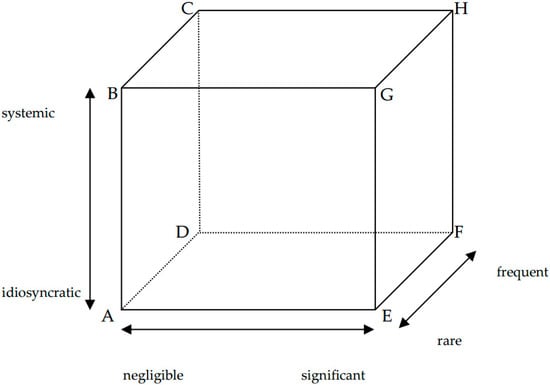
From this perspective, it could be fitting to present a three-dimensional framework, often referred to as a “risk box” (Capitanio, 2022 [18]) which classifies events that generate risk based on varying levels of frequency, damage intensity, and correlation (Cafiero et al., 2007 [1]). By examining the interaction among these dimensions, a harmful event can be illustrated within a three-dimensional space (Figure 1), where its vertices depict the most extreme possible scenarios. While it is unlikely that any real-life event perfectly aligns with these extremes, this classification highlights the combination of key characteristics necessary to determine the most effective management approach. Except for events located at vertices G and H of the structure—those involving potential and highly severe consequences, where the only viable strategy would be avoidance (e.g., refraining from activities in highly exposed areas)—most recurring risks described within the “risk box” framework can be effectively managed. A potential categorization of management strategies includes maintaining the risk (allowing potential consequences to remain a future possibility), avoiding it, reducing it, or transferring it.
Figure 1.
The three dimensions of risk—“risk box” and “green portfolio”.
When potential harm is moderate (A, B, C, and D vertices), farmers can manage the risk through a posteriori actions, a strategy known as risk coping. The most common approach involves utilizing savings to maintain consumption levels, creating a form of self-insurance. This method enables the impacts of adverse events to be distributed over an extended period, with the expectation that conditions will eventually improve, allowing replenishment of savings for future emergencies. However, this strategy is only viable if sufficient financial resources are available from the outset or if farmers have convenient access to credit. The associated cost includes either the opportunity cost of using financial reserves or the interest incurred on borrowed funds. Conversely, when the potential harm reaches critical levels, the preferred course of action may be to avoid the risk entirely. This, however, entails significant decisions, such as relocating farming activities to areas less prone to risk, investing in physical infrastructure (such as irrigation systems to mitigate drought or protective nets against hail), or engaging in so-called income-skewing practices (Dercon, 2004 [19]). These practices involve adopting less risky but also less profitable activities. Income skewing is notably common in rural areas of developing countries where limited financial resources and inadequate market access render alternative risk management or risk-transfer solutions unfeasible.
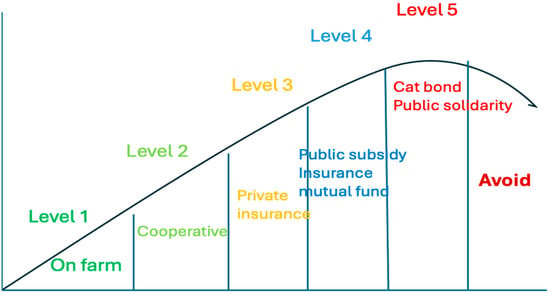
Reducing the costs associated with crises can be achieved by investing in measures that enhance the predictability of such events or minimize their potential impact. This approach aims to transform crises into manageable risks. Every event sheds light on the likelihood of similar occurrences in the future, offering a chance to reassess opportunities for investment in preventive strategies. These investments could also aid in establishing financial mechanisms designed to distribute the associated costs effectively. The primary focus of this work is to propose a new theoretical framework for addressing income risk in agriculture. It introduces the concept of a “green portfolio,” which integrates private initiatives and tools alongside public policies to create a more comprehensive and sustainable approach. From the perspective of farms, society, and the public budget, a sector’s capacity for innovation and competitiveness—that is, its capacity for resilience—is crucial (Figure 2).
Figure 2.
Level and scope of risk and “green portfolio”.
The theoretical model plays a crucial role in outlining the range of interventions available through various public and private tools that can be effectively utilized to manage farm income risk. The synergy between different instruments highlights the complexity of an issue that does not lend itself to simplistic solutions. This demarcation, breaking with the prevailing view that in recent decades has confined and identified risk management in the primary sector with insurance policies, is essential for the effective economic and financial management of farms in the third millennium.
In this sense, the concept of a “green portfolio” would imply the need to synergistically use different tools and strategies to ensure the stability of agricultural businesses’ income across all possible risk scenarios.
3. Theory of Behavior Under Uncertainty: Notes
Two fundamental concepts appear in the economic model regarding risk and uncertainty: equilibrium (the balancing of individual demands in the market) and optimization (rational behavior by economic agents). The assumption most widely used is that an economic agent maximizes expected utility when faced with uncertainty (Tversky and Kahneman, 1992 [20], von Neumann and Morgenstern, 1953 [21]).
The classic postulates apply, completeness, continuity and transitivity of preferences (ordinal utility). One way of formalizing the expected-utility model is to denote by A the set of all possible actions available to the decision-maker and by S all the possible states of the world. The occurrence of an outcome can thus be identified with the simultaneous occurrence of a subset of A and a subset of S; in other words, outcomes (consequences of an action at a particular time) may be represented as a random variable characterized by the function c: S × A → C, where C represents the set of all possible consequences.
If C is finite (there are N possible consequences), then by assigning an “objective” probability to each state of the world and choosing a particular action from the set A, we obtain a probability distribution over all possible outcomes.
Formally, one may define a lottery as a list of probabilities:
so that is the probability that the outcome occurs (obviously and ). Simplistically, therefore, one may regard A as a set of possible decisions whilst C represents all the results of a decision taken from A; Represents the probability that those outcomes occur. In a simple lottery, the outcomes that may occur are certain; a more general variant (and more useful for economic applications) is that of a compound lottery. Consider simple lotteries. with probabilities (with ). The compound lottery represents the risky alternative to the individual simple lotteries with probability for . For every compound lottery It is possible to compute the corresponding simple lottery that generates the same distribution of outcomes. In this way the probability of outcome n in the reduced lottery is
Let be the set of simple lotteries over the set of possible outcomes C, and suppose that the preference relation on is rational (complete and transitive); if the assumption of specific continuity holds, it is therefore possible to compare any pair of simple lotteries. The underlying assumption is that the consumer regards compound and reduced lotteries as equivalent; in other words, a game that generates lottery L with probability and lottery with probability is equivalent to a lottery whose probability is . The parallel with the standard theory of the consumer is evident; the similarity is further strengthened by taking V(L) to be an ordinal function. Closely tied to the continuity of preferences is the independence axiom (the core of choice theory under uncertainty). Formally, the utility function has the form of expected utility if there is an assignment of numbers. to the N outcomes such that for each lottery we have
The function is the von Neumann–Morgenstern (VNM) expected-utility function; the utility function has the form of expected utility if and only if it is linear and if and only if the relation:
is respected for every set of lotteries and probabilities with and . It is the utility function that underpins the remainder of this work.
3.1. Risk Aversion and the Risk Premium
Different investors have different attitudes to risk; some are indifferent or averse to risk (risk-neutral or risk-averse), whereas others are risk-loving. In general, one may say that there is a trade-off between the level of return and the level of risk. An investor may accept low returns if the risks inherent in the investment are low or demand high returns if investment risks are high; such behavior reflects risk aversion. When there is risk aversion (as with farmers, for whom such a condition is plausible), certainty of outcome is preferred to the gamble of participating in a lottery with a random payoff and expected value:
where and represent the pay-offs of the game (the possible outcomes), and and are the probabilities that the respective outcomes occur. Assuming that individuals’ preferences can be expressed by the VNM utility function introduced earlier, we have a utility function with the following properties:
- It is increasing in W, implying a marginal utility satisfying .
- It has diminishing marginal utility, .
Formally, the risk aversion of individuals is defined by the condition
Consider an investor who can choose between holding a risk-free prospect, whose return is f, and investing instead in a risky prospect whose return r is a random variable with mean µ and variance σ2. For simplicity, assume that the uncertain prospect has two outcomes r1 and r2 with probabilities π1 and π2; the expected return is
And the variance of return is
For a fair game, the mean return equals the risk-free rate, µ = f; that is, to participate in an investment characterized by uncertainty, the risk-averse investor will demand an expected return at least equal to that obtainable from a risk-free investment (with expected random gain zero). A fair game may also be expressed in terms of the excess return over the risk-free rate as
Consider the decision of an economic agent about whether to take part in a fair gamble, i.e., whether to accept a risky prospect in place of a risk-free prospect when the expected outcomes are the same: . Suppose the initial wealth of the consumer is .
- If the consumer keeps the risk-free prospect and invests all his wealth, after one period, his wealth will be
So the expected wealth from the risk-free prospect is and its variance is zero: .
- 2.
- If the consumer chooses the risky prospect, then
And the mean and variance will be
If the aim is to maximize the expected utility of wealth . The expected utility from buying a risk-free or risky asset is
If investment is in the risk-free prospect, and
Suppose the investment is in a risky prospect. When expected returns on the two investments are equal, a risk-averse agent would prefer not to invest.
An interesting question is: what compensation in money will the investor require to participate in the game? This additional compensation may be a fixed payment known in advance before the game or may take the form of a game offering a higher expected return.
The additional payoff required to compensate the risk-averse investor for entering a fair investment is called the risk premium. In an actuarially fair game such as that introduced earlier, the expected payoff is zero:
If represents the initial wealth and the final wealth, we have
In this theoretical context, the utility of the expected payoff is greater than the expected utility of the uncertain payoff
If an amount ρ (the risk premium) is granted to the investor to take part in the game, what must the value of ρ be to induce the investor to participate? The expected payoff then becomes
To be indifferent between taking part in the game (receiving the risk premium) and not taking part (and not receiving it), the investor will require ρ to satisfy:
The size of the risk premium ρ will therefore depend on
- The degree of curvature of the utility function: theoretically, a linear function would require a value of ρ = 0; the greater the curvature, the higher the risk premium demanded by the investor.
- The variance of the random payoff; a greater dispersion between and increases . And thus enlarges ρ.
The same results can be derived more formally using a second-order Taylor series expansion and approximating the value of around the value of . This approach yields
Taking expectations, we obtain
Using the condition
One sees that
The risk premium ρ must satisfy:
i.e., the expected utility of wealth plus the risk premium equals the utility of expected wealth in the absence of a risk premium. If ρ is small, then ρ2 may be ignored, and one obtains
yielding the expression for the risk premium
Thus, as noted earlier, the value of the risk premium is greater the larger it is
- The curvature of the utility function.
- The variance (or volatility) of the payoff .
This mean that risk has some relevance to an individual’s evaluation of a lottery; in particular, a risk-averse individual will demand compensation for the risk they incur by accepting the lottery, x’ beyond the expected value of x’. This compensation is, in fact, the risk premium where more risk-averse individual has a more curved utility function.
Worked Example
A mixed cereal farm with a 3-year average income of €160,000 faces input-price pressure and a drier climate outlook. Income is modeled with a skew-t marginal; wheat price follows AR(1)-GARCH; dependence captured with a t-copula (ν = 6, τ = 0.28). Ten thousand scenarios yield a one-year 10% VaR of €32,000 and CVaR of €46,000. An IST-style rule triggers when income falls below 70% of the rolling average. The model implies a 0.21 trigger probability and an expected payout of €18,700 at a 50% compensation rate. Adding a weather index collar (satellite soil-moisture percentile, farm-calibrated) reduces CVaR to €36,000 but introduces 0.12 probability of false negatives due to basis risk. A behavioral overlay with moderate loss aversion (generally in the literature a risk aversion coefficient λ ≈ 1.8 indicates a moderate-to-high level of risk aversion) predicts only 55% take-up unless premium salience is reduced through ex-ante subsidy or premium smoothing across quarters.
4. Risk and Uncertainty: New Methods for New Scenarios
Predictably, agricultural operators base their production decisions on individual expectations about future events and, individually, react differently to policy and price changes depending on their risk aversion and level of wealth; at least this is what has always been emphasized in the literature.
A widely accepted conclusion in the literature is that farmers are risk averse, and that this aversion decreases as wealth increases.
This attitude toward production choices is called “decreasing absolute risk aversion” (DARA) and is accepted as “rational behavior” for risk-averse agents.
The gist of the problem is that more risk-averse farmers will be willing to make less risky production choices; given the same income, they will favor those choices that suggest “greater certainty” about future outcomes.
It all seems clear and, above all, embarrassingly simple.
What lies behind this seemingly simple formalization? Is there a theory that can truly represent a farmer’s optimal choice in his production decisions? Is there a single optimal choice that is the same for everyone?
Risk preference, in agricultural economics, denotes the behavioral disposition of decision-makers when confronted with uncertain outcomes, particularly regarding income, yield, or asset value. This disposition is formally expressed through utility functions, where the curvature of the function represents the degree of risk aversion, risk neutrality, or risk seeking. In operational terms, a risk-averse farmer prefers a certain income over a risky alternative with the same expected value, a tendency captured by concave utility functions. Conversely, convex utility curves denote risk-seeking behavior, while linearity implies neutrality. These profiles guide decisions about input use, crop diversification, insurance adoption, and investment planning. Yet, empirical identification of such preferences remains problematic due to dynamic contexts, unobservable utility constructs, and confounding socio-cultural factors. As a result, economic analysis often relies on non-parametric dominance rules, especially stochastic dominance criteria, to compare risky alternatives without specifying an exact utility function (Antle, 1983 [22]; Di Falco and Chavas, 2009 [13]; Chavas et al., 2019 [12]).
First-Order Stochastic Dominance (FSD) occurs when one cumulative distribution function (CDF) lies entirely to the right of another, indicating that for any non-decreasing utility function, the dominating prospect yields a higher or equal utility. In agricultural settings, FSD allows the immediate rejection of dominated choices, such as crop insurance products or investment options that always deliver lower or equal returns across the probability space. However, FSD provides limited discriminatory power when distributions cross, prompting the use of Second-Order Stochastic Dominance (SSD). SSD applies to concave utility functions, thus accommodating risk-averse behavior, and relies on the comparison of the areas under CDFs. It makes it especially useful for policy evaluation, such as comparing different subsidy schemes or risk mitigation programs, where preferences are assumed to exhibit diminishing marginal utility. These dominance criteria offer a utility-consistent method to rank distributions without imposing strong assumptions on the functional form, making them analytically robust and statistically testable through bootstrap or simulation techniques.
While First- and Second-Order Stochastic Dominance provide robust tools for ranking uncertain outcomes under general preference structures, they encounter limitations in practical applications. Many real-world distributions, particularly those describing farm income or yield, exhibit crossovers that prevent clear ranking under FSD or SSD (Moschini and Hennessy, 2001 [8]; Just and Pope, 2002 [23]; Chavas, 2004 [12]). In such cases, reliance on higher moments of the distribution, such as skewness and kurtosis, becomes necessary, motivating the use of Third-Order Stochastic Dominance (TSD). TSD accommodates prudence, a higher-order risk attitude where individuals exhibit a preference for positive skewness and aversion to downside uncertainty. Although theoretically appealing, TSD and beyond require increasingly restrictive assumptions on the utility function’s curvature (e.g., positive third derivatives) and are often sensitive to sampling variation, especially in small datasets. Moreover, the increased mathematical complexity and reduced intuitive interpretability limit their adoption in policy environments. Consequently, analysts must balance precision with tractability, often reverting to SSD unless behavioral evidence or distributional features explicitly justify the need for third-order assessments (Ray et al., 2012 [24]; Lobell et al., 2014 [16]; Nelson et al., 2014 [25]; Gammans et al., 2017 [26]; Arora et al., 2020 [27]).
The empirical application of stochastic dominance in agricultural decision analysis relies on non-parametric methods to test whether one distribution statistically dominates another over the sample space. These tests, often implemented through bootstrapped Kolmogorov–Smirnov-type statistics, allow the comparison of simulated or observed income distributions resulting from alternative cropping patterns, insurance options, or market strategies. At the farm level, dominance analysis supports the ex-ante evaluation of risk management tools by identifying options that perform better for all farmers with a given risk preference profile, without requiring explicit utility elicitation (Jones et al., 2013 [28]; Amundson et al., 2015 [29]; Stevens, 2018 [30]). However, accurate implementation requires high-frequency or multi-year data to capture the variability of income, price, and yield. Issues such as serial correlation, censoring, and the presence of structural breaks, e.g., policy regime shifts or extreme weather events, complicate the inference process. As such, stochastic dominance serves not only as a decision rule but also as a diagnostic framework, guiding data requirements and model selection in risk preference research.
The theoretical foundation linking stochastic dominance to expected utility maximization is rooted in the axiomatic structure of decision theory. For any utility function that satisfies monotonicity and risk aversion, the set of alternatives preferred under expected utility coincides with the set of distributions preferred under stochastic dominance of the corresponding order. Specifically, if a distribution A second-order stochastically dominates distribution B, then every risk-averse decision-maker, characterized by a concave utility function, will weakly prefer A to B. It makes SSD a necessary condition for optimality under EUM, although not a sufficient one when preferences are heterogeneous. The advantage lies in its model-independence: it allows normative prescriptions even when the explicit form of the utility function is unknown. However, stochastic dominance does not provide cardinal rankings; it only permits the exclusion of dominated strategies. Therefore, its role is more eliminative than prescriptive, useful in narrowing down the feasible set of policies or choices, rather than identifying a unique optimum.
5. Final Considerations
This work has examined the complex nature of risk in contemporary agriculture, integrating theoretical foundations with practical tools tailored to an increasingly complex global environment. Agricultural producers operate at the nexus of climatic volatility, market fluctuations, and institutional uncertainties, necessitating robust frameworks for measuring, managing, and transferring risk. The evolution from traditional indemnity-based schemes toward innovative tools, such as index-based insurance, mutual funds, income stabilization mechanisms, and derivative financial instruments, reflects both advances in data analytics and the growing imperative to embed resilience within production and financial systems.
Critical to effective risk management is the recognition of heterogeneous risk profiles and information asymmetries that challenge conventional contract design and market functioning. We emphasized that asymmetric information contributes to inefficiency in both resource allocation and public intervention framework in two ways: (1) it implies less refined decision rules by the poorly informed individuals, and (2) it has adverse effects on exchange, meaning that it contributes to both incomplete markets and incomplete contracts and reduce the gain from trade. The paper highlighted the persistent tension between actuarial principles and behavioral realities, underscoring the need for incentive-compatible, context-sensitive contracts that harmonize farmer behavior with financial sustainability. Public–private partnerships emerged as pivotal enablers of scalable risk-sharing, leveraging state resources and market discipline while navigating governance complexities and political economy pressures.
The layered architecture of risk management presented, demonstrates the necessity of integrating multiple tools across temporal and institutional scales. Contingency-based policies and pre-arranged financial instruments represent promising pathways toward predictable, transparent, and timely responses to agricultural crises, reducing reliance on ex post, politically influenced relief.
The lessons to be learnt from what has been discussed can be summarized as follows:
- (1)
- When the predictability of events becomes so limited that no preventative actions can feasibly be taken, or when the scale of potential harm exceeds what a farmer can reasonably handle alone, state subsidies and the transfer of risk to third parties emerge as the only viable solutions.
- (2)
- To ensure public funds are spent efficiently, it is essential to differentiate between the routine risks associated with farming and catastrophic events. Farmers should take primary responsibility for managing regular business risks, without relying on state support.
- (3)
- Subsidies may include direct payments or financial assistance to cover the interest on loans needed to rebuild farms damaged by unforeseen events.
- (4)
- Over the medium to long term, subsidies should focus on helping farmers adopt preventive measures that mitigate damage from natural disasters. This could include incentivizing relocation from high-risk areas or investing in protective infrastructure. Moreover, public funds should be directed toward initiatives that benefit from economies of scale or qualify as public goods, like large-scale protective infrastructure.
- (5)
- For the everyday risks inherent in farming, state involvement should primarily center on creating conditions that empower farmers to build and strengthen their risk management capabilities. This includes promoting the use of private instruments such as insurance, credit, and financial markets while fostering their development and accessibility.
A series of targeted actions can support progress toward these goals:
- (6)
- Establishing institutions and providing information to encourage the demand for private-sector risk management tools, while simultaneously enhancing competition among suppliers (Public intervention is needed to provide certified data on weather, market, and production cost trends. This certified information is essential for the development and operation of advanced insurance and financial instruments (e.g., index policies)).
- (7)
- Strengthening farmers’ resilience to moderate risks at the farm level by encouraging precautionary savings through both direct and indirect incentives, such as tax benefits.
- (8)
- Facilitating stronger demand consolidation for risk management tools to improve farmers’ access to insurance, credit, and financial markets. This could include promoting mutual funds, which can effectively enhance the development of risk markets in Italy. Additionally, pooling demand reduces monitoring costs, making mutual funds more viable for managing risks that are challenging to transfer due to issues like information asymmetry.
- (9)
- Exploring securitization strategies for climate-related risks should also be prioritized to maximize public investment leverage in agriculture. Instruments such as catastrophe bonds (Cat bonds) can offer a sustainable mechanism for ex-post disaster compensation. As extreme weather events become more frequent and severe, relying solely on traditional compensation methods will grow increasingly unsustainable without such financial innovations.
Ultimately, advancing agricultural risk management demands a holistic, interdisciplinary approach that aligns financial engineering with agronomic realities, socio-cultural dynamics, and environmental sustainability (Anderson et al., 2023 [31]). Only through such comprehensive integration can policies and contracts evolve beyond reactive compensation toward proactive resilience-building, securing food systems and rural livelihoods amid an increasingly uncertain global scenario.
The research area that appears to be a priority for the future of agricultural risk management is, on the one hand, the systematic collection of certified, as detailed as possible, information on weather patterns affecting agricultural activity. On the other hand, a crucial issue is the provision of sufficient financial resources for the insurance and reinsurance market. In this context, it is important to consolidate the path undertaken by the World Bank with the securitization of catastrophe risks to be shared with financial markets. Catastrophe bonds appear to be an important avenue for pursuing the financial leverage necessary to raise increasingly significant financial resources to address the effects of climate change.
Funding
This research received no external funding.
Institutional Review Board Statement
Not applicable.
Informed Consent Statement
Not applicable.
Data Availability Statement
No new data were created or analyzed in this study.
Conflicts of Interest
The authors declare no conflicts of interest.
References
- Cafiero, C.; Capitanio, F.; Cioffi, A.; Coppola, A. Risk and Crises Management in the reformed European Agricultural Crises Policy. Can. J. Agric. Econ. 2007, 55, 419–441. [Google Scholar] [CrossRef] [Scilit]
- Capitanio, F.; Bielza, M.D.C.; Cafiero, C.; Adinolfi, F. Crop insurance and public intervention in the risk management in agriculture: Does farmers really benefit? Appl. Econ. 2011, 43, 4149–4159. [Google Scholar] [CrossRef] [Scilit]
- Akerlof, G. The market for lemons: Quality uncertainty and the market mechanism. Q. J. Econ. 1970, 84, 488–500. Available online: https://www.jstor.org/stable/1879431 (accessed on 14 December 2025). [CrossRef] [Scilit]
- Arrow, K.J. The Role of Securities in the Optimal Allocation of Risk-bearing. Rev. Econ. Stud. 1964, 31, 91–96. [Google Scholar] [CrossRef] [Scilit]
- Glauber, J. Crop Insurance Reconsidered. Am. J. Agric. Econ. 2004, 86, 1179–1195. [Google Scholar] [CrossRef] [Scilit]
- Wang, Q.; Soksophors, Y.; Barlis, A.; Mushtaq, S.; Phanna, K.; Swaans, C.; Rodulfo, D. Willingness to Pay for Weather-Indexed Insurance: Evidence from Cambodian Rice Farmers. Sustainability 2022, 14, 14558. [Google Scholar] [CrossRef] [Scilit]
- Hardaker, J.B. Some issues in dealing with risk in agriculture. In Working Paper Series in Agricultural and Resource Economics; University of New England, Graduate School of Agricultural and Resource Economics: Maine, UK, 2000. [Google Scholar]
- Hennessy, G.D. Uncertainty, Risk Aversion, and Risk Management for Agricultural Producer. In Handbook of Agricultural Economics; Gardner, B., Rausser, G., Eds.; Elsevier Science Publishing: Amsterdam, The Netherlands, 2001; Volume 1A. [Google Scholar]
- Goodwin, B.K.; Vandeveer, M.L.; Deal, J.L. An Empirical Analysis of Acreage Effects of Participation in the Federal Crop Insurance Program. Am. J. Agric. Econ. 2004, 86, 1058–1077. [Google Scholar] [CrossRef] [Scilit]
- Wright, B.D.; Hewitt, J.A. All-Risk Crop Insurance: Lessons from Theory and Experience. In Economics of Agricultural Crop Insurance: Theory and Evidence; Hueth, D.L., Furtan, W.H., Eds.; Natural Resource Management and Policy Series; Kluwer Academic Publishers: Boston, MA, USA, 1994; Volume 4, pp. 73–112. [Google Scholar]
- Chavas, J.P. Risk Analysis in Theory and Practice; Elsevier Academic Press: Amsterdam, The Netherlands, 2004. [Google Scholar]
- Chavas, J.P.; Di Falco, S.; Adinolfi, F.; Capitanio, F. Weather Effects and their Long-Term Impact on the Distribution of Agricultural Yields: Evidence from Italy. Eur. Rev. Agric. Econ. 2019, 46, 29–51. [Google Scholar] [CrossRef] [Scilit]
- Di Falco, S.; Chavas, J.P. On Crop Biodiversity, Risk Exposure, and Food Security in the Highlands of Ethiopia. Am. J. Agric. Econ. 2009, 91, 599–611. [Google Scholar] [CrossRef] [Scilit]
- Xiao, X. Stochastic Dominance under the Nonlinear Expected Utilities. Math. Probl. Eng. 2014. [Google Scholar] [CrossRef] [Scilit]
- Peng, S. Nonlinear expectations nonlinear Markov chains. Chin. Ann. Math. B 2005, 26, 159–184. [Google Scholar] [CrossRef] [Scilit]
- Lobell, D.; Roberts, M.J.; Schlenker, W.; Braun, N.; Little, B.B.; Rejesus, R.M.; Hammer, G.L. Greater sensitivity to drought accompanies maize yield increase in the US Midwest. Science 2014, 344, 516–519. [Google Scholar] [CrossRef] [Scilit]
- Chang, H.H.; Zilberman, D. On the political economy of allocation of agricultural disaster relief payments: Application to Taiwan. Eur. Rev. Agric. Econ. 2014, 41, 657–680. [Google Scholar] [CrossRef] [Scilit]
- Capitanio, F. Risk, uncertainty, crises management and public intervention in agriculture. Ital. Rev. Agric. Econ. 2022, 77, 3–14. [Google Scholar] [CrossRef] [Scilit]
- Dercon, S. Insurance Against Poverty; Oxford University Press: Oxford, UK, 2004. [Google Scholar]
- Tversky, A.; Kahneman, D. Advances in Prospect Theory: Cumulative Representation of Uncertainty. J. Risk Uncertain. 1992, 5, 297–323. [Google Scholar] [CrossRef] [Scilit]
- von Neumann, J.; Morgenstern, O. Theory of Games and Economic Behavior, 3rd ed.; Princeton University Press: Princeton, NJ, USA, 1953. [Google Scholar]
- Antle, J.M. Incorporating Risk in Production Analysis. Am. J. Agric. Econ. 2013, 65, 1099–1106. [Google Scholar] [CrossRef] [Scilit]
- Just, R.G.; Pope, R.D. A Comprehensive Assessment of the Role of Risk in U.S. Agriculture; Springer: Berlin/Heidelberg, Germany, 2002. [Google Scholar] [CrossRef] [Scilit]
- Ray, D.K.; Ramankutty, N.; Mueller, N.D.; West, P.C.; Foley, J.A. Recent patterns of crop yield growth and stagnation. Nat. Commun. 2012, 3, 1293. [Google Scholar] [CrossRef] [Scilit]
- Nelson, G.C.; Valin, H.; Sands, R.D.; Havlík, P.; Ahammad, H.; Deryng, D.; Willenbockel, D. Climate change effects on agriculture: Economic responses to biophysical shocks. Proc. Natl. Acad. Sci. USA 2014, 111, 3274–3279. [Google Scholar] [CrossRef] [Scilit]
- Gammans, M.; Mérel, P.; Ortiz-Bobea, A. Negative impacts of climate change on cereal yields: Statistical evidence from France. Environ. Res. Lett. 2017, 12, 054007. [Google Scholar] [CrossRef] [Scilit]
- Arora, G.; Feng, H.; Anderson, C.J.; Hennessy, D.A. Evidence of climate change impacts on crop comparative advantage and land use. Agric. Econ. 2019, 51, 221–236. [Google Scholar] [CrossRef] [Scilit]
- Jones, D.L.; Cross, P.; Withers, P.J.; DeLuca, T.H.; Robinson, D.A.; Quilliam, R.S.; Harris, I.M.; Chadwick, D.R.; Edwards-Jones, G. Nutrient Stripping: The Global Disparity between Food Security and Soil Nutrient Stocks. J. Appl. Ecol. 2013, 50, 851–862. [Google Scholar] [CrossRef] [Scilit]
- Amundson, R.; Berhe, A.A.; Hopmans, J.W.; Olson, C.; Sztein, A.E.; Sparks, D.L. Soil and Human Security in the 21st Century. Science 2015, 348, 1261071. [Google Scholar] [CrossRef] [Scilit] [PubMed]
- Stevens, A.W. Review: The Economics of Soil Health. Food Policy 2018, 80, 1–9. [Google Scholar] [CrossRef] [Scilit]
- Anderson, W.; Baethgen, W.; Capitanio, F.; Ciais, P.; Cook, B.; Rocca da Cunha, G.; Goddard, L.; Schauberger, B.; Sonder, K.; Podestá, G.; et al. Climate variability and simultaneous breadbasket yield shocks. Agric. For. Meteorol. 2023, 331, 109321. [Google Scholar] [CrossRef] [Scilit]

Disclaimer/Publisher’s Note: The statements, opinions and data contained in all publications are solely those of the individual author(s) and contributor(s) and not of MDPI and/or the editor(s). MDPI and/or the editor(s) disclaim responsibility for any injury to people or property resulting from any ideas, methods, instructions or products referred to in the content. |
© 2026 by the author. Licensee MDPI, Basel, Switzerland. This article is an open access article distributed under the terms and conditions of the Creative Commons Attribution (CC BY) license.