


Abstract
The biophilic city concept has been proposed as an approach to mitigate the negative impacts of urban growth under global warming, which increasingly affects people’s mental health. As architecture occupies a substantial proportion of urban areas, biophilic architecture plays a crucial role in supporting urban well-being, contributing to sustainable development in line with Sustainable Development Goal 3 (SDG 3) (Good Health and Well-being). Previous studies have identified a research gap regarding the integration of exterior biophilic architectural attributes within urban contexts. Therefore, this study aims to identify exterior biophilic architectural attributes that can enhance urban mental well-being, using buildings in Singapore as case studies. A questionnaire survey was conducted to evaluate architectural attributes and people’s emotional responses, with the aim of analyzing their relationships. The results indicate that exterior biophilic architectural attributes contribute unequally to urban mental well-being. Natural features emerged as the most influential attribute, exerting comprehensive positive effects on attentiveness, inspiration, and self-assurance. Natural forms and natural colors also demonstrated significant contributions by promoting relaxation, cognitive engagement, and inspiration. In addition, natural spaces supported attentiveness and confidence, while natural materials, despite being less prevalent, exhibited strong qualitative effects on inspiration and psychological security. Accordingly, this study provides biophilic architectural design guidelines that support the mental sustainability of urban populations affected by global warming.
1. Introduction
Global warming has become an urgent challenge, reflected in the steady rise in Earth’s average temperatures [1,2]. This phenomenon not only threatens planetary health but also significantly undermines human mental health [3,4,5,6,7]. Research shows that both direct exposure to natural disasters and indirect environmental impacts or news can trigger eco-grief [8,9]. These circumstances underscore the urgent need to develop effective mitigation strategies.
Numerous studies have demonstrated that rapid urban development poses significant challenges to both the environment and human health and well-being [10,11]. Therefore, urban development is essential to integrate city growth with ecological conservation to enhance urban residents’ quality of life [10,12,13]. The concept of biophilic urban design has been evidenced to connect cities with nature and promote the mental health and well-being of urban residents [14,15,16].
The concept of a biophilic city pertains to urban design that seeks to reconnect people with nature by incorporating natural experiences and elements into contemporary urban environments [17]. Its objective is to fulfill human-nature experiences and respond to humanity’s innate tendency toward biophilia [18,19,20]. Biophilia emphasizes fostering human connections with nature on emotional, sensory, and interactive levels [21].
Developing a biophilic city involves multiple indicators, including infrastructure, the integration of space and place, and community engagement with people’s activities [15]. Over 70% of urban areas are occupied by buildings [19]. Moreover, previous studies highlight the built environment and architectural design as key determinants of healthy cities [17] and human well-being [18]. It can be concluded that architecture plays a crucial role in developing a biophilic city.
Biophilic architecture is closely aligned with the development of a biophilic city [17]. Biophilic architecture is rooted in the biophilia theory, which asserts that humans are connected with nature [22]. Therefore, biophilic architectural design that is exposed to natural elements significantly enhances people’s mental well-being [23,24,25,26]. This relationship is relevant to the United Nations Sustainable Development Goals (SDGs), especially SDG 3 (Good Health and Well-being) [27].
1.1. Research Gap
As global warming continues to intensify, its impacts increasingly threaten people’s mental health. Moreover, rapid urban growth has further amplified these challenges. In response, the concept of the biophilic city has been developed and is now recognized as a practical approach to addressing such issues. However, because most urban areas are dominated by buildings, architectural design plays a crucial role in advancing this solution. Although biophilic architecture has been shown to support human well-being, previous studies have primarily focused on interior environments [21], with limited attention to its integration within the urban fabric [28]. In contrast, building exterior attributes constitute a continuous layer of the urban fabric, shaping daily visual, sensory, and psychological exposure at the pedestrian level [29,30].
Therefore, this study aims to address this research gap by identifying exterior biophilic architectural attributes that can enhance urban mental well-being and support sustainable development in line with SDG 3 (Good Health and Well-being) [27]. Accordingly, this study is guided by the following research question: which exterior biophilic architectural attributes most effectively enhance urban mental well-being, and how can these attributes be prioritized to improve it?
1.2. Research Area
Several previous studies have highlighted Singapore as a leading example of a biophilic city [31], with its foundations rooted in traditional approaches. Singapore initiated the Garden City concept in the 1960s, which has since evolved into the current City in Nature vision led by NParks [32,33]. This vision emphasizes the expansion of nature ways, the establishment of 30 therapeutic gardens, and the significant increase of skyrise greenery by 2023 [34,35].
Significantly, Singapore has become home to a wide range of biophilic architecture, driven by policies that encourage integrating green spaces into buildings. The Urban Redevelopment Authority (URA) introduced the LUSH program, which promotes the integration of skyrise greenery such as rooftop and vertical planting, communal roof gardens, sky terraces, and planter boxes [36]. This initiative applies to new buildings and retrofitting projects to fulfill Landscape Replacement Areas requirements.
Previous studies indicate that research on biophilic design has been concentrated in Western countries, leaving a knowledge gap across the Global South [37]. Singapore is widely recognized as a biophilic city and is enriched with numerous examples of biophilic architectural design. Thus, it provides an excellent case study for the present research, which seeks to identify the exterior architectural features of biophilic design that support urban mental well-being.
1.3. Research Structure
This research paper is structured into six main sections. Section 1, the Introduction, outlines the background and significance of the study, identifies existing research gaps, and defines the research area as previously described. Section 2 presents a literature review to identify exterior biophilic architectural attributes and clarify the concept of urban mental well-being, forming the study’s conceptual framework. Section 3 details the case study, data extraction procedures, and methods used to analyze the findings. Section 4 presents the research findings, including identified exterior biophilic architectural attributes and assessments of urban mental well-being, highlighting the design features most supportive of mental health. Section 5 discusses the key findings. Section 6 outlines the study’s limitations. Section 7 presents directions for future research. Finally, Section 8 concludes the study by summarizing the overall research process.
2. Literature Review
This section reviews relevant literature to identify key exterior biophilic architectural attributes and to clarify the concept of urban mental well-being. This review further informs the development of the study’s conceptual framework by linking exterior architectural elements with mental well-being in urban contexts.
2.1. The Exterior of Biophilic Design
Previous studies have consolidated the architectural characteristics of biophilic design from eight well-recognized sources, namely Kellert (2008, 2018) [38,39], Abdelaal (2019) [40], Xue et al. (2019) [19], Browning and Ryan (2020) [41], Wijesooriya et al. (2021) [42], and Indre Grazuleviciute-Vileniske et al. (2022) [43]. These works demonstrate that biophilic design encompasses a wide range of attributes [44]. This distinction is critical, as many biophilic attributes identified in previous studies are primarily applied to interior environments or localized settings [21], while their manifestation at the building exterior and contribution to everyday urban experience remain underexplored [28].
However, when considering architectural features that effectively support urban mental well-being, particular emphasis should be placed on externally visible architectural elements, including form, spatial articulation, color, materiality, and other façade-related features that can be perceived from public space and contribute to everyday environmental exposure [45,46,47].
Biophilic architecture is commonly characterized by the incorporation of nature-derived forms [39,41,43,48,49,50]. These forms are typically expressed through natural shapes [21,39,43,48,49] and natural patterns [50], applied to building exteriors, drawing direct inspiration from nature [41,43]. In this study, concepts such as exposure to and connection with nature are operationalized through externally observable design attributes, rather than experiential outcomes [21]. Accordingly, nature-integrated architecture is reflected in the use of natural color palettes, which are often earthy, warm, and muted [19,21,39,40,43,48]. Nature-integrated architecture frequently uses textured materials [21,39,40,43] that incorporate natural patterns [19,21,40,41,43,48], including wood or clay [51]. Nature-integrated objects often include environmental features [19,21,40,43,48], plants, water, and landscapes [21]. The definitions of the exterior biophilic design attributes examined in this study are summarized in Table 1.
Table 1.
Definition of the Exterior of Biophilic Design.
2.2. Urban Mental Well-Being
This section explores the types of mental well-being that can be influenced by biophilic design. Previous studies have synthesized theoretical perspectives on mental well-being that are likely to be stimulated through biophilic architectural design. Although no prior research has focused explicitly on urban contexts [52], existing literature indicates that biophilic design has the potential to promote stress reduction, attention restoration, feelings of refuge and prospect, and inspiration [53].
These mental well-being dimensions can be assessed using the Positive and Negative Affect Scale (PANAS) by examining individuals’ self-reported feelings of being relaxed, attentive, self-assured, and inspired, respectively [54]. This approach is supported by prior architectural and environmental psychology studies, which have widely applied PANAS to capture affective responses elicited by spatial and architectural characteristics, particularly in assessing users’ emotional and experiential states within built environments [55,56,57].
Together, these dimensions represent a balanced set of criteria for assessing urban mental well-being, as they capture emotional regulation (relaxation), cognitive functioning (attentiveness), psychological security (self-assurance), and motivational vitality (inspiration), which are widely recognized as core components of quality of life in urban environments. The definitions of urban mental well-being dimensions examined in this study are summarized in Table 2.
Table 2.
Definitions of Urban Mental Well-Being.
2.3. Conceptual Framework
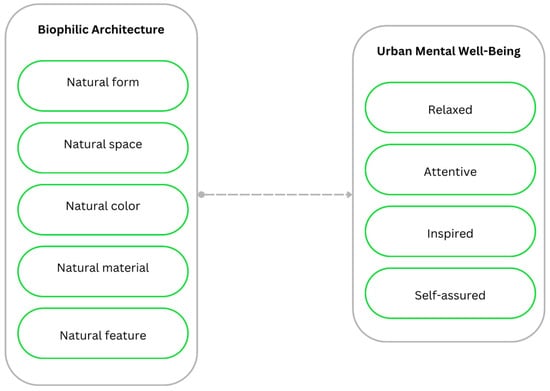
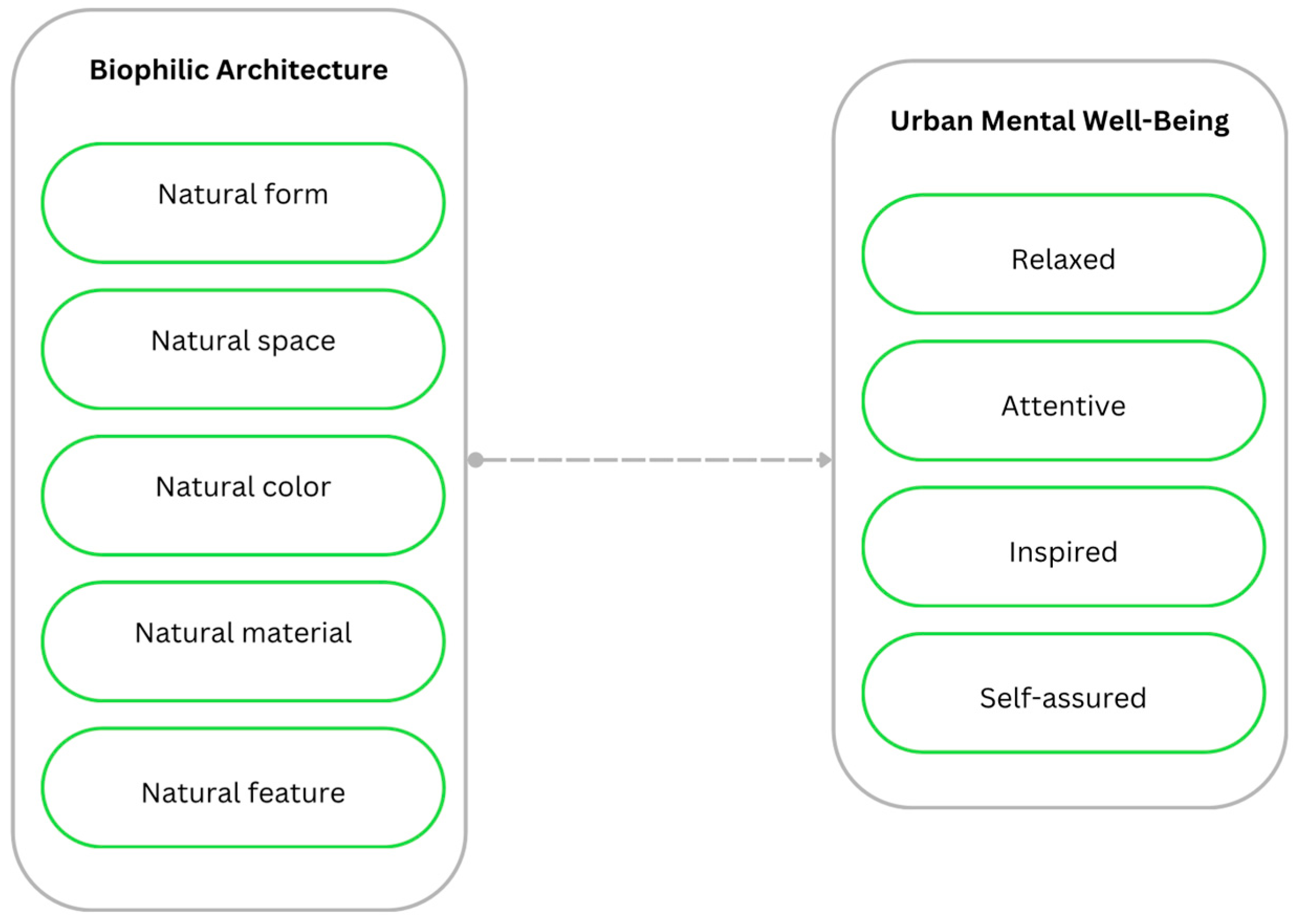
Drawing on a comprehensive review of the literature, the conceptual framework (Figure 1) depicts the hypothesized relationships between five exterior biophilic architectural attributes, including natural form, natural space, natural color, natural material, and natural feature, and their combined effects on four dimensions of urban mental well-being, which are relaxed, attentive, inspired, and self-assured. Together, these dimensions represent a balanced set of emotional, cognitive, and psychological criteria for assessing quality of life in dense urban environments.
Figure 1.
A Conceptual Framework of Exterior Biophilic Design Supporting Urban Mental Well-Being.
3. Methodology
To provide empirical evidence on how exterior biophilic design attributes enhance mental well-being in urban environments, the research methodology begins with selecting an appropriate case study. Data were then gathered to decode exterior biophilic design attributes and assess urban mental well-being based on public perceptions. Finally, the collected data were interpreted through analytical procedures to synthesize the key findings.
3.1. Case Study
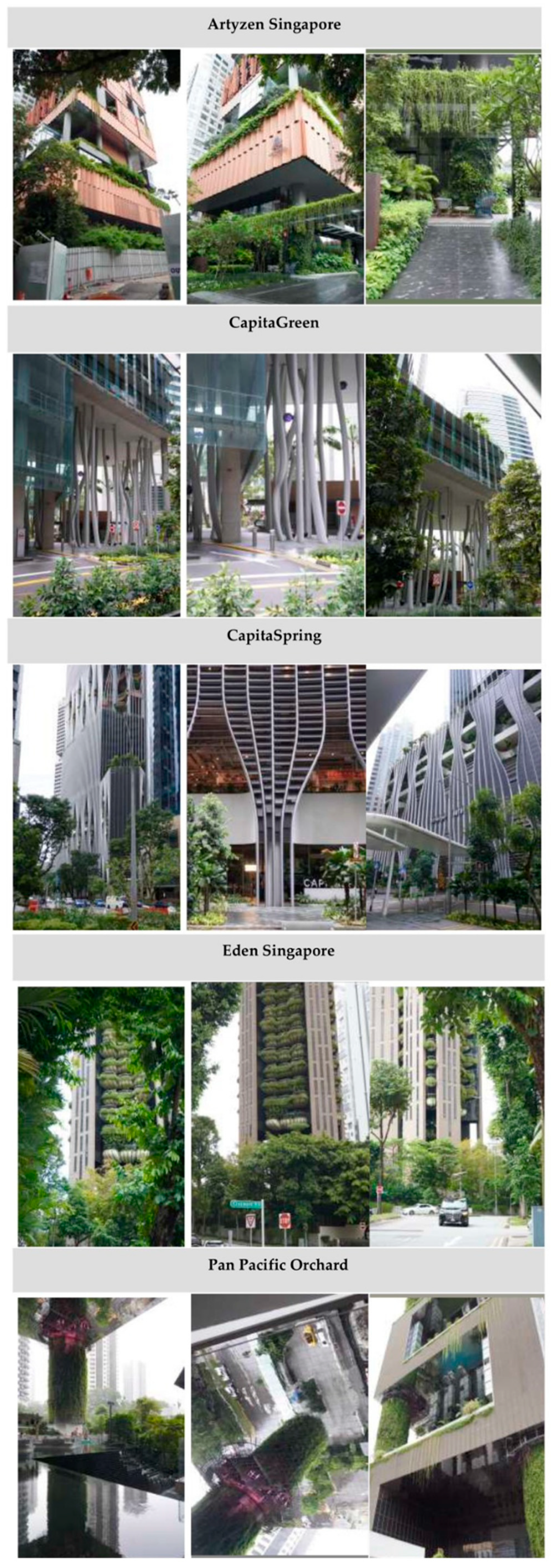
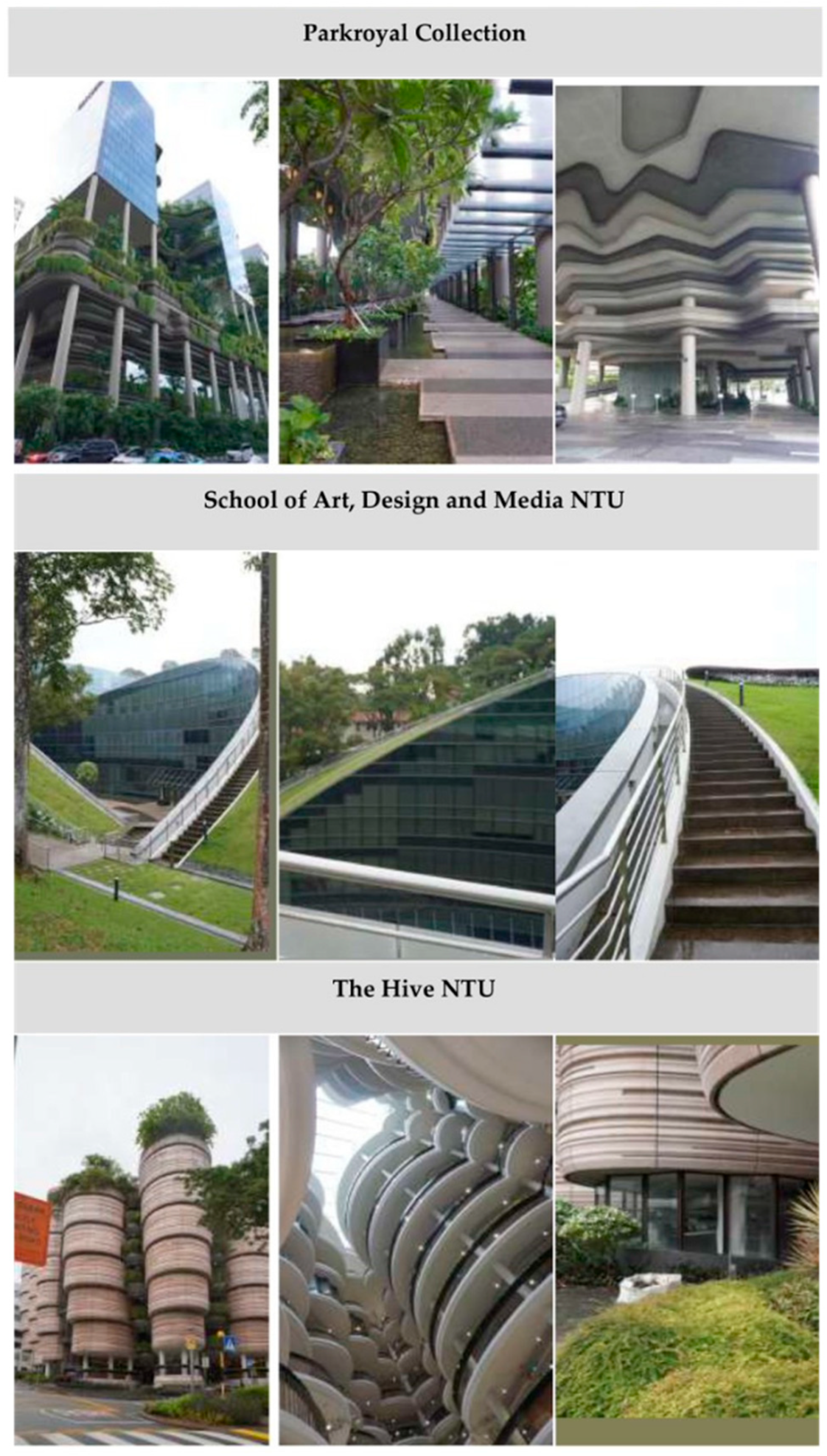
To identify suitable architectural examples for biophilic design case studies in Singapore, we reviewed the existing literature on biophilic design, biophilic cities, green buildings, and sustainable architecture. In addition, we conducted a search for suitable buildings using Google Street View to ensure that biophilic architectural examples not documented in the existing literature were not overlooked. This involved randomly navigating main streets on Google Maps and examining green spaces visible from above. Although many buildings in Singapore exemplify biophilic design, this study focused on on-site investigations. To make fieldwork more feasible, only accessible buildings were selected, including Artyzen Singapore, CapitaGreen, CapitaSpring, Eden Singapore, Pan Pacific Orchard, Parkroyal Collection, School of Art, Design and Media NTU, and The Hive NTU.
The case study’s validation was conducted by consulting three faculty members using a multiple-researcher triangulation approach [58]: Dr. Phattranis Suphavarophas, Bhumin Bhutdhakomut, and Pachara Yenjai. The validation expert panel comprised only three reviewers. This number aligns with methodological precedent in exploratory case study research, where independent expert judgment is commonly used to screen cases and enhance content validity through triangulation rather than for statistical inference [59,60]. Each expert independently reviewed the selected buildings by conducting a general visual search on Google.
The expert evaluation focused on the overall exterior biophilic design attributes observable from the public space. These attributes were derived from the synthesized biophilic design framework, as mentioned in Table 1. Each participant independently completed a 5-point Likert-scale questionnaire, where 1 = very weak expression of exterior biophilic attributes, 2 = weak, 3 = moderate, 4 = strong, and 5 = very strong and clearly articulated biophilic expression. This procedure uses pairwise absolute differences to determine the weighted agreement among evaluators. The calculations indicated that the respondents generally agreed moderately to almost perfectly [61], as shown in Table 3. The expert evaluation focused on the overall exterior biophilic design attributes observable from the public space. These attributes were derived from the synthesized biophilic design framework, as mentioned in Table 1. Each participant independently completed a 5-point Likert-scale questionnaire, where 1 = very weak expression of exterior biophilic attributes, 2 = weak, 3 = moderate, 4 = strong, and 5 = very strong and clearly articulated biophilic expression. This procedure uses pairwise absolute differences to determine the weighted agreement among evaluators. The calculations indicated that the respondents generally agreed moderately to almost perfectly [61], as shown in Table 3.
Table 3.
Agreement of Singapore’s Biophilic Architecture Selection.
3.2. Data Gathering
To address the research gap by identifying exterior biophilic architectural attributes that can enhance urban mental well-being, this study employed a questionnaire-based data collection approach grounded in a case study framework. The selected case studies represent prominent examples of biophilic architecture in Singapore, including Artyzen Singapore, CapitaGreen, CapitaSpring, Eden Singapore, Pan Pacific Orchard, Parkroyal Collection, School of Art, Design and Media at Nanyang Technological University (NTU), and The Hive (NTU). For each case, street-level view images were captured and subsequently evaluated by multiple members of the research team to ensure that the selected images closely represented on-site visual conditions; the final images used for analysis are presented in Appendix A.
Data were collected through an online survey administered via Google Forms, with a total of 34 respondents participating in the study. Respondents were asked to evaluate the extent to which biophilic architecture in cities could support their psychological well-being. To assess whether this sample size was sufficient for the statistical analyses, a post hoc power analysis was conducted using G*Power 3.1 for multiple linear regression. Based on a fixed-effects model with four predictors, an alpha level of 0.05, and an observed medium-to-large effect size (f2 = 0.49), the achieved statistical power was 0.87, exceeding the commonly recommended threshold of 0.80 [62]. These results indicate that the sample size was adequate for detecting meaningful relationships among the studied variables.
The architectural attributes examined in this study comprised five exterior biophilic design factors: natural form, natural space, natural color, natural material, and natural feature. Each attribute was measured using a five-point Likert scale, where 1 represented “very low” and 5 represented “very high,” accompanied by descriptive examples to ensure conceptual clarity. Specifically, natural form was assessed through indicators such as natural shapes, natural patterns, and nature-inspired forms; natural space through exposure to nature, connection to nature, and a strong relationship with the natural environment; natural color through earthy, warm, and muted color tones; natural material through texture, pattern, and the use of materials such as wood or clay; and natural feature through the presence of plants, water elements, and landscape components. Urban mental well-being was evaluated using four psychological dimensions: irritable/relaxed, fatigued/attentive, frightened/self-assured, and downhearted/inspired [54]. These items were measured using a reverse-scored five-point Likert scale, in which higher scores reflected more positive psychological states.
Prior to data collection, the questionnaire was reviewed by three experts in architecture and environmental psychology to assess content clarity, relevance, and conceptual consistency with the study objectives, thereby enhancing content validity of the questionnaire. Minor wording adjustments were made to improve item clarity and ensure that the questions accurately reflected the intended biophilic design attributes and mental well-being dimensions.
Internal consistency reliability was assessed using Cronbach’s alpha. The exterior biophilic design indicator demonstrated acceptable reliability (α = 0.758). Item-deleted analysis showed that the removal of any individual indicator did not substantially improve reliability, suggesting balanced contribution across items. The mental well-being instrument showed good internal consistency (α = 0.810), with all items contributing equally according to the item-deleted analysis, indicating satisfactory measurement reliability.
3.3. Data Interpreting
All questionnaire responses were coded and transformed into numerical values to enable systematic statistical analysis. To ensure a clear and systematic interpretation of the collected data, the data interpretation process was organized into two main stages.
To explain the characteristics of both exterior biophilic design attributes and urban mental well-being, descriptive statistical analyses were first conducted. These analyses reported frequency (N), mean, median, standard deviation (S.D.), minimum (Min), and maximum (Max) values, providing an overview of respondents’ perceptions and the overall distribution of each variable.
To address the research objective of identifying exterior biophilic architectural attributes that can enhance urban mental well-being, the analytical process was conducted in two sequential stages. In the first stage, correlation analysis was employed to examine the relationships between exterior biophilic design attributes and dimensions of urban mental well-being in order to determine whether statistically meaningful associations existed among the variables. In the second stage, where significant correlations were identified, regression analysis was subsequently performed to assess the predictive relationships and to identify which exterior biophilic architectural attributes exerted the strongest influence on urban mental well-being outcomes.
4. Results
To address this research gap by identifying exterior biophilic architectural attributes that can enhance urban mental well-being, the results are organized into three main sections. Section 4.1 presents the results of the exterior biophilic design attributes. Section 4.2 reports results on urban mental well-being. Section 4.3 examines the biophilic design attributes of the exterior that support urban mental well-being.
4.1. The Results of the Exterior of Biophilic Design
Based on the descriptive statistical analysis of exterior biophilic design attributes, the findings indicate that, within Singapore’s architectural environment, the most dominant attribute is Natural Feature. This factor recorded the highest mean score (M = 4.22) and demonstrated high response consistency (S.D. = 0.91), suggesting strong agreement among respondents regarding its prevalence. The second most frequently observed attribute was Natural Space, reflecting the allocation of spaces connected to nature (M = 4.06), followed closely by Natural Form, which represents nature-inspired morphologies (M = 4.02). In contrast, Natural Color was perceived as less prevalent (M = 3.94), while Natural Material was the least observed attribute, with the lowest mean score (M = 3.78). An overview of the findings on exterior biophilic design attributes is presented in Table 4.
Table 4.
The Results of the Exterior of Biophilic Design.
4.2. The Results of Urban Mental Well-Being
Based on the descriptive statistical analysis of urban mental well-being, in which higher scores indicate more positive psychological states, the findings can be summarized as follows. The most prominent emotional state reported was Inspired, which recorded the highest mean score (M = 4.00) and a median of 4.00. Other positive emotional states with comparable levels included Relaxed (M = 3.88) and Attentive (M = 3.87). In contrast, Self-assured exhibited the lowest mean score among the measured indicators (M = 3.65); however, this value still falls within a relatively positive range, indicating an overall favorable level of urban mental well-being among respondents (Table 5).
Table 5.
The Results of Urban Mental Well-Being.
4.3. The Exterior Biophilic Design Attributes Supporting Urban Mental Well-Being
To address the research question of how the characteristics of exterior biophilic architecture promote mental well-being in urban contexts, the correlation analysis examining the relationship between exterior biophilic architectural characteristics and urban mental well-being is summarized in Table 6.
Table 6.
The Correlation of Exterior Biophilic Design Attributes and Urban Mental Well-Being.
Table 7 shows that all variables representing external biophilic architectural characteristics exhibit positive correlations with urban mental well-being. Consequently, a multiple regression analysis was conducted to examine the effects of the five external biophilic architectural factors on urban mental well-being. The results can be summarized as follows.
Table 7.
Multiple regression analysis of the natural form of biophilic architecture influencing urban mental health.
The multiple regression analysis of biophilic architectural characteristics focusing on the natural form factor and its effects on urban mental well-being revealed a multiple correlation coefficient (R) of 0.492. The model demonstrated a predictive power of 24.2% (R2 = 0.242), with a standard error of estimate of 0.874. At the 0.05 level of statistical significance, three predictors were identified as significant contributors to the natural form factor. Specifically, Relaxed and Inspired exhibited positive effects, whereas Self-assured showed an adverse effect (Table 7).
The multiple regression analysis of biophilic architectural characteristics, focusing on the natural space factor and its effects on urban mental well-being, yielded a multiple correlation coefficient (R) of 0.595. The model demonstrated a predictive power of 35.4% (R2 = 0.354), with a standard error of estimate of 0.801. At the 0.05 level of statistical significance, two predictors were identified as significant contributors to the natural space factor: Attentive and Self-assured, both of which showed positive effects (Table 8).
Table 8.
Multiple regression analysis of the natural space of biophilic architecture influencing urban mental health.
The multiple regression analysis of biophilic architectural characteristics focusing on the natural color factor and its effects on urban mental well-being revealed a multiple correlation coefficient (R) of 0.582. The model demonstrated a predictive power of 33.9% (R2 = 0.339), with a standard error of estimate of 0.909. At the 0.05 level of statistical significance, three predictors were identified as significant contributors to the natural color factor: Relaxed, Inspired, and Self-assured, all of which exhibited positive effects (Table 9).
Table 9.
Multiple regression analysis of the natural color of biophilic architecture influencing urban mental health.
The multiple regression analysis of biophilic architectural characteristics focusing on the natural material factor and its effects on urban mental well-being revealed a multiple correlation coefficient (R) of 0.656. The model demonstrated a predictive power of 43.0% (R2 = 0.430), with a standard error of estimate of 0.797. At the 0.05 level of statistical significance, two predictors were identified as significant contributors to the natural material factor: Inspired and Self-assured, both of which exhibited positive effects (Table 10).
Table 10.
Multiple regression analysis of the natural material of biophilic architecture influencing urban mental health.
The multiple regression analysis of biophilic architectural characteristics, focusing on the natural-feature factor and its effects on urban mental well-being, yielded a multiple correlation coefficient (R) of 0.515. The model demonstrated a predictive power of 26.5% (R2 = 0.265), with a standard error of estimate of 0.778. At the 0.05 level of statistical significance, three predictors were identified as significant contributors to the natural feature factor: Attentive, Inspired, and Self-assured, all of which exhibited positive effects (Table 11).
Table 11.
Multiple regression analysis of the natural features of biophilic architecture influencing urban mental health.
5. Discussion
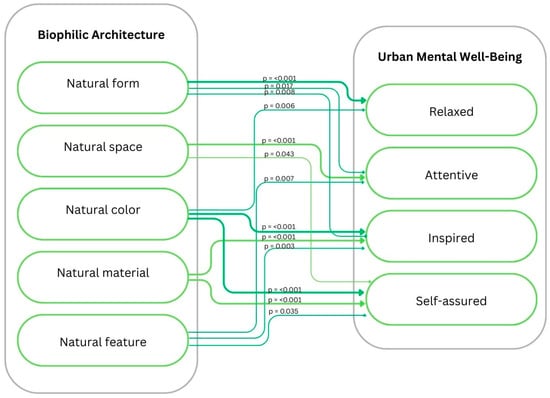
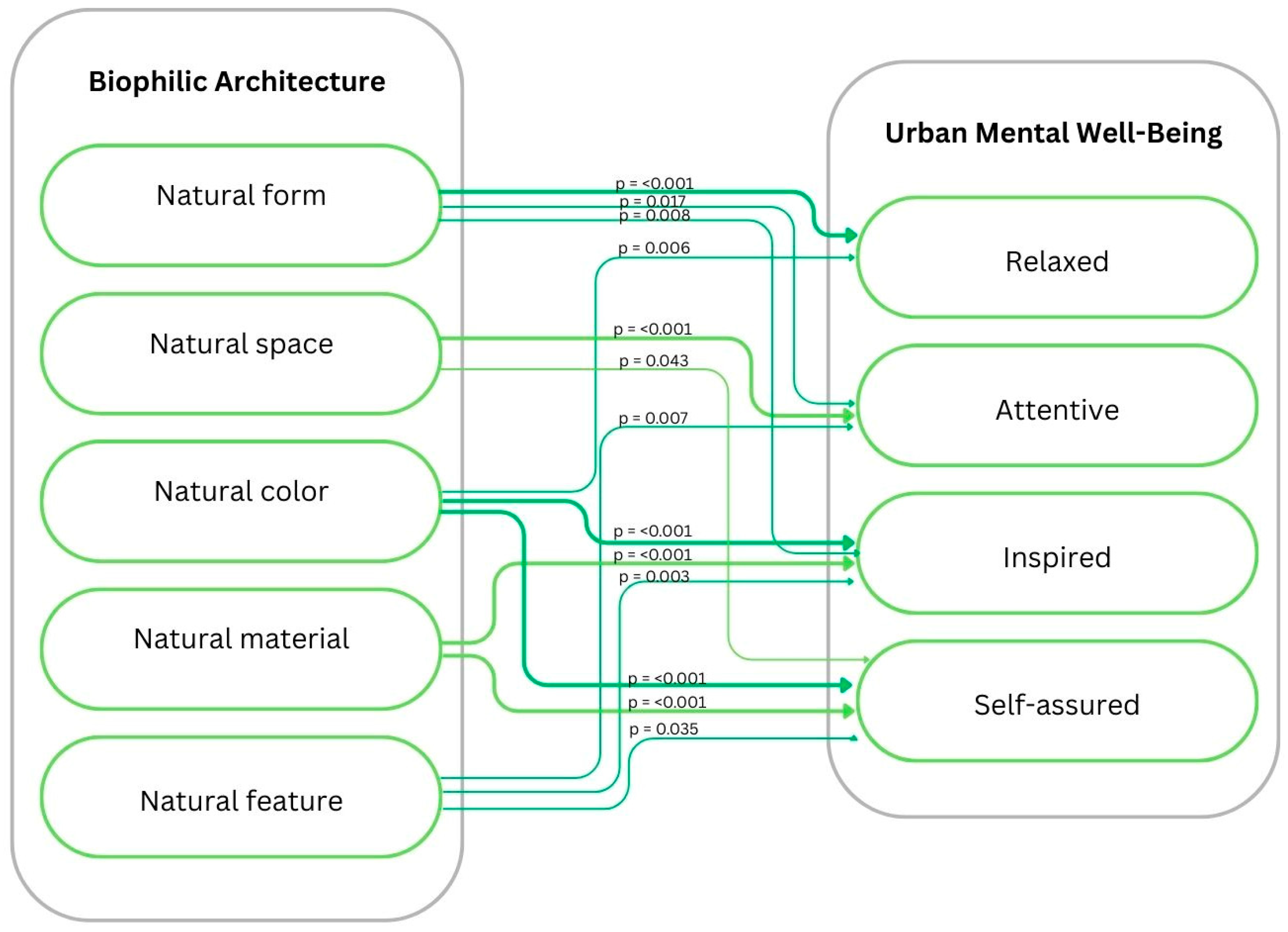
This study aims to examine the relative contribution of exterior biophilic architectural attributes to different dimensions of urban mental well-being, with particular attention to identifying which attributes exert the strongest influence on specific psychological outcomes. The investigation of exterior biophilic architecture that supports urban mental well-being, based on the case study of Singapore’s architecture, yields several key findings. The results of the exterior biophilic design attributes supporting urban mental well-being are illustrated in Figure 2.
Figure 2.
Exterior Biophilic Design Attributes Supporting Urban Mental Well-Being.
Natural features emerged as the most influential attribute, possessing a broad and significant positive impact on urban mental well-being. According to the regression analysis, this factor is a primary driver of higher levels of attentiveness (β = 0.191, p = 0.007), profound inspiration (β = 0.199, p = 0.003), and a solid sense of self-assurance (β = 0.141, p = 0.035). Given its high visibility and comprehensive psychological benefits, incorporating natural features is the most effective strategy for architectural interventions aimed at supporting mental health. This finding is consistent with prior studies identifying environmental features as core biophilic attributes [19,21,40,43,48], while extending their applicability to urban building exteriors and everyday public exposure [45,46,47,53].
The strategic use of natural color palettes serves as a vital catalyst for mental health, significantly enhancing feelings of relaxation, inspiration, and overall self-assurance among urban residents. Statistical evidence from the path analysis indicates that natural color exerts a significant positive influence on several mental well-being dimensions, most notably on relaxation (β = 0.176, p = 0.006) and inspiration (β = 0.264, p < 0.001). Additionally, it plays a key role in reinforcing self-assurance (β = 0.229, p < 0.001). This result aligns with existing literature on the psychological benefits of nature-derived color palettes [19,21,39,40,43,48], supporting their effectiveness as perceptible biophilic elements at the architectural exterior [21,28].
Natural forms exert a statistically significant positive influence on three specific dimensions of mental well-being: relaxation (β = 0.455, p < 0.001), attentiveness (β = 0.172, p = 0.017), and inspiration (β = 0.181, p = 0.008). This attribute demonstrates a high level of perception among participants, with a mean score of 4.02, confirming its role as a versatile and recognizable tool for enhancing the user experience in urban architecture. These findings support prior research emphasizing nature-inspired forms as fundamental biophilic attributes [39,41,43,48,49,50], confirming their positive influence on mental well-being in urban exterior contexts [21,28,53].
The integration of natural materials into architectural design plays a pivotal role in uplifting the urban psyche, specifically by instilling a deeper sense of inspiration (β = 0.373, p < 0.001) and reinforcing a stable feeling of self-assurance (β = 0.317, p < 0.001). Although it was perceived as the least frequent attribute in the studied environment with a mean score of 3.78, its strong statistical link to feelings of safety and inspiration suggests that increasing the use of natural textures and materials could significantly improve psychological outcomes. This outcome is consistent with earlier studies on the psychological benefits of natural materials [21,39,40,43,48,51], extending their relevance from interior settings to urban architectural exteriors [21,45,46,47].
The provision of natural space significantly enhances urban mental health by fostering a greater sense of attentiveness (β = 0.395, p < 0.001) and boosting personal self-assurance (β = 0.127, p = 0.043). It is a prominent feature in the studied architectural context, achieving a high perception mean score of 4.06. This finding aligns with literature linking natural spaces to attention restoration and psychological security [53], highlighting their importance within dense urban environments [21,28,52].
6. Limitations
This study has several limitations. First, the sample size was relatively small and limited to selected case-study buildings in Singapore, potentially limiting the generalizability of the findings. As an exploratory case study, the research aimed to identify key exterior biophilic design attributes rather than to achieve statistical representativeness. In addition, the cross-sectional design does not allow for causal inference regarding the relationship between exterior biophilic attributes and mental well-being. The reliance on self-reported affective measures (PANAS), although widely validated in architectural research, may introduce subjective response bias. Moreover, the consistently strong correlations observed among exterior biophilic design attributes may partially reflect homogeneous response patterns, as participants generally perceived these attributes positively. This tendency is not unexpected, since biophilic architectural elements are often experienced holistically rather than as isolated features, with attributes such as natural form, space, color, material, and features typically co-occurring within integrated design strategies. As all variables were collected using self-reported questionnaires at a single time point, common method bias may have contributed to the magnitude of the observed correlations.
7. Future Research
Future research should address these limitations by employing larger and more diverse samples, as well as longitudinal or experimental designs to strengthen causal inference. Comparative analyses across different biophilic cities and cultural contexts would further enhance the external validity of the findings. In addition, future studies could incorporate objective environmental and physiological measures alongside self-reported data, control for contextual factors such as weather and time of day, and differentiate participants’ background characteristics (e.g., age, profession, and architectural knowledge). Such approaches would provide a more comprehensive understanding of how exterior biophilic design attributes interact with cognitive, psychological, and environmental factors to support urban mental well-being.
8. Conclusions
When this study sought to identify exterior biophilic architectural attributes that can enhance urban mental well-being, the findings clearly demonstrated that not all attributes contribute equally to psychological outcomes in dense urban environments, underscoring the role of biophilic design in advancing sustainable development in line with SDG 3 (Good Health and Well-being). Among the identified factors, natural features emerged as the most influential attribute, providing the most comprehensive support for positive mental states by simultaneously enhancing attentiveness, inspiration, and self-assurance.
Following this, natural forms play a critical role in promoting both emotional relaxation and cognitive engagement. The strategic use of natural color further contributes to mental well-being by fostering relaxation, stimulating inspiration, and strengthening self-assurance. Natural spaces also support urban mental well-being by encouraging attentiveness and reinforcing feelings of confidence. Finally, although natural materials were perceived as the least prevalent attribute, their substantial qualitative impact on inspiration and psychological security underscores their latent potential and suggests that increased integration of natural textures and materials could substantially enhance urban mental well-being. These findings suggest that architectural practice and urban policy should prioritize integrating natural features, forms, colors, spaces, and materials, particularly at the building exterior, to strategically enhance urban mental well-being in dense cities.
Rather than viewing the regression results as isolated statistical outputs, the findings offer practical insights into how exterior biophilic design can be strategically employed in dense urban environments. The analysis demonstrates that not all biophilic attributes contribute equally to mental well-being; instead, different attributes support distinct psychological dimensions. This suggests that architectural interventions can be intentionally tailored, for example, by emphasizing natural features to enhance attentiveness and inspiration, or by employing natural colors and materials to foster relaxation and psychological security. Accordingly, this study proposes evidence-based biophilic architectural design guidelines that promote the mental sustainability of urban populations facing increasing climate-related stress under global warming.
Author Contributions
Conceptualization, S.B. and C.T.; Methodology, S.B., C.T. and T.W.; Formal analysis, T.W. and N.R.; Data curation, T.P. and P.S.; Writing—original draft preparation, C.T., T.P., and N.R.; Writing—review and editing, T.W., P.S. and S.S.; Supervision, S.B. All authors have read and agreed to the published version of the manuscript.
Funding
This work was financially supported by King Mongkut’s Institute of Technology Ladkrabang [Grant Number: KREF046813].
Institutional Review Board Statement
This study was approved by the Research Ethics Committee of King Mongkut’s Institute of Technology Ladkrabang (Study Code: EC-KMITL_68_035 as of 5 May 2025).
Informed Consent Statement
Informed consent was obtained from all subjects involved in the study.
Data Availability Statement
The original contributions presented in this study are included in the article. Further inquiries can be directed to the corresponding author.
Acknowledgments
We would like to acknowledge Pakin Anuntavachakorn for serving as the documenter; Phattranis Suphavarophas, Bhumin Bhutdhakomut, and Pachara Yenjai for evaluating the suitability of the case studies; Prima Phaibulputhipong and Limpasilp Sirisakdi for conducting the field surveys.
Conflicts of Interest
The authors declare no conflicts of interest. The funders had no role in the design of the study; in the collection, analyses, or interpretation of data; in the writing of the manuscript; or in the decision to publish the results.
Appendix A
Figure A1.
The selected image of biophilic architecture in Singapore.
References
- Bukaita, W. Global Warming’s Influence on Temperature Increase. In Proceedings of the Future Technologies Conference, 2024; Springer: Berlin/Heidelberg, Germany, 2024; pp. 291–306. [Google Scholar]
- Cattiaux, J.; Ribes, A.; Cariou, E. How Extreme Were Daily Global Temperatures in 2023 and Early 2024? Geophys. Res. Lett. 2024, 51, e2024GL110531. [Google Scholar] [CrossRef] [Scilit]
- Chen, J.; Shi, X.; Gu, L.; Wu, G.; Su, T.; Wang, H.-M.; Kim, J.-S.; Zhang, L.; Xiong, L. Impacts of Climate Warming on Global Floods and Their Implication to Current Flood Defense Standards. J. Hydrol. 2023, 618, 129236. [Google Scholar] [CrossRef] [Scilit]
- Cuijpers, P.; Kumar, M.; Karyotaki, E. Climate Change and Mental Health—Time to Act Now. JAMA Psychiatry 2023, 80, 1183–1184. [Google Scholar] [CrossRef] [Scilit] [PubMed]
- Vercammen, A.; Yatirajula, S.; Daniel, M.; Maharaj, S.; Campbell, M.; Greaves, N.; Guinto, R.; Aruta, J.; Peñamante, C.; Wray, B. Investigating the Mental Health Impacts of Climate Change in Youth: Design and Implementation of the International Changing Worlds Study. Challenges 2023, 14, 34. [Google Scholar] [CrossRef] [Scilit]
- Woodland, L.; Ratwatte, P.; Phalkey, R.; Gillingham, E.L. Investigating the Health Impacts of Climate Change among People with Pre-Existing Mental Health Problems: A Scoping Review. Int. J. Environ. Res. Public Health 2023, 20, 5563. [Google Scholar] [CrossRef] [Scilit] [PubMed]
- Tovar-Ortiz, S.A.; Rodriguez-Gonzalez, P.T.; Tovar-Gómez, R. Modeling the Impact of Global Warming on Ecosystem Dynamics: A Compartmental Approach to Sustainability. World 2024, 5, 1077–1100. [Google Scholar] [CrossRef] [Scilit]
- Cunsolo, A.; Ellis, N.R. Ecological Grief as a Mental Health Response to Climate Change-Related Loss. Nat. Clim. Change 2018, 8, 275–281. [Google Scholar] [CrossRef] [Scilit]
- Vergunst, F.; Berry, H.L. Climate Change and Children’s Mental Health: A Developmental Perspective. Clin. Psychol. Sci. 2022, 10, 767–785. [Google Scholar] [CrossRef] [Scilit]
- Russo, A.; Cirella, G.T. Modern Compact Cities: How Much Greenery Do We Need? Int. J. Environ. Res. Public Health 2018, 15, 2180. [Google Scholar] [CrossRef] [Scilit]
- Panlasigui, S.; Spotswood, E.; Beller, E.; Grossinger, R. Biophilia Beyond the Building: Applying the Tools of Urban Biodiversity Planning to Create Biophilic Cities. Sustainability 2021, 13, 2450. [Google Scholar] [CrossRef] [Scilit]
- MacGregor, C. Urban Regeneration as a Public Health Intervention. J. Soc. Interv. Theory Pract. 2010, 19, 38–51. [Google Scholar] [CrossRef] [Scilit]
- Sharifi, A.; Yamagata, Y. Smart Cities and Climate-Resilient Urban Planning; SAGE Publications: London, UK, 2022; Volume 49, pp. 1347–1353. [Google Scholar]
- Russo, A.; Cirella, G.T. Biophilic Cities: Planning for Sustainable and Smart Urban Environments. In Smart Cities Movement in BRICS; Wiley Blackwell: Hoboken, NJ, USA, 2017. [Google Scholar]
- Heymans, A.; Breadsell, J.; Morrison, G.M.; Byrne, J.J.; Eon, C. Ecological Urban Planning and Design: A Systematic Literature Review. Sustainability 2019, 11, 3723. [Google Scholar] [CrossRef] [Scilit]
- Xue, F.; Gou, Z.; Lau, S.S.-Y.; Lau, S.-K.; Chung, K.-H.; Zhang, J. From Biophilic Design to Biophilic Urbanism: Stakeholders’ Perspectives. J. Clean. Prod. 2019, 211, 1444–1452. [Google Scholar] [CrossRef] [Scilit]
- Tarek, S.; Ouf, A.S.E.-D. Biophilic Smart Cities: The Role of Nature and Technology in Enhancing Urban Resilience. J. Eng. Appl. Sci. 2021, 68, 40. [Google Scholar] [CrossRef] [Scilit]
- Beatley, T. Biophilic Urbanism: Inviting Nature Back to Our Communities and into Our Lives. William Mary Environ. Law Policy Rev. 2009, 34, 209. [Google Scholar]
- Xue, F.; Lau, S.S.; Gou, Z.; Song, Y.; Jiang, B. Incorporating Biophilia into Green Building Rating Tools for Promoting Health and Wellbeing. Environ. Impact Assess. Rev. 2019, 76, 98–112. [Google Scholar] [CrossRef] [Scilit]
- Taylor, R.P. The Potential of Biophilic Fractal Designs to Promote Health and Performance: A Review of Experiments and Applications. Sustainability 2021, 13, 823. [Google Scholar] [CrossRef] [Scilit]
- Zhong, W.; Schröder, T.; Bekkering, J. Biophilic Design in Architecture and Its Contributions to Health, Well-Being, and Sustainability: A Critical Review. Front. Archit. Res. 2022, 11, 114–141. [Google Scholar] [CrossRef] [Scilit]
- Kellert, S. Biophilia and Biomimicry: Evolutionary Adaptation of Human Versus Nonhuman Nature. Intell. Build. Int. 2016, 8, 51–56. [Google Scholar] [CrossRef] [Scilit]
- Sadat, M.; Farjami, G. The Effect of Biophilic in the Office Space to Improve Mental Health. J. Urban Stud. Space Place 2021, 5, 59–70. [Google Scholar]
- Jha, H.; Behera, S. Exploring Biophilic Design and Its Implications for Mental Health. In Understanding Psychology in the Context of Relationship, Community, Workplace and Culture; Springer: Cham, Switzerland, 2022; pp. 297–314. [Google Scholar]
- Alam, M. Biophilic Architecture and Designs for Mental Well-Being. In IOP Conference Series: Earth and Environmental Science; IOP Publishing: Bristol, UK, 2023; Volume 1218, p. 012020. [Google Scholar]
- Li, K.; Perrault, A.; DeYoung, W.A.; Cameron, E.; Miller, C.T.; O’Connor, A.S.; Gu, M.; Braun, B. Impact of Biophilic Design on College Student Perception of Mental Health and Environmental Benefits: A Dose-Response Study. Build. Environ. 2025, 267, 112318. [Google Scholar] [CrossRef] [Scilit]
- Votruba, N.; Thornicroft, G.; Group, F.S. Sustainable Development Goals and Mental Health: Learnings from the Contribution of the Fundamentalsdg Global Initiative. Glob. Ment. Health 2016, 3, e26. [Google Scholar] [CrossRef] [Scilit]
- Lefosse, D.; van Timmeren, A.; Ratti, C. Biophilia Upscaling: A Systematic Literature Review Based on a Three-Metric Approach. Sustainability 2023, 15, 15702. [Google Scholar] [CrossRef] [Scilit]
- Liang, X.; Chang, J.H.; Gao, S.; Zhao, T.; Biljecki, F. Evaluating Human Perception of Building Exteriors Using Street View Imagery. Build. Environ. 2024, 263, 111875. [Google Scholar] [CrossRef] [Scilit]
- Zumelzu, A.; Heskia, C.; Herrmann-Lunecke, M.G.; Vergara, G.; Estrada, M.; Jara, C. Street Design Elements That Influence Mental Well-Being: Evidence from Southern Chile. Land 2024, 13, 1398. [Google Scholar] [CrossRef] [Scilit]
- Newman, P. Biophilic Urbanism: A Case Study on Singapore. Aust. Plan. 2014, 51, 47–65. [Google Scholar] [CrossRef] [Scilit]
- Yuen, B. Creating the Garden City: The Singapore Experience. Urban Stud. 1996, 33, 955–970. [Google Scholar] [CrossRef] [Scilit]
- Er, K. Transforming Singapore into a City in Nature. Urban Solut. 2021, 19, 68–77. [Google Scholar]
- Li, Y.; Du, H.; Sezer, C. Sky Gardens, Public Spaces and Urban Sustainability in Dense Cities: Shenzhen, Hong Kong and Singapore. Sustainability 2022, 14, 9824. [Google Scholar] [CrossRef] [Scilit]
- Franzén, E. Green Cities: A Comparative Case Study of Urban Greening in Sydney and Singapore. Master’s Thesis, Linkopings Universitet, Linkoping, Sweden, 2024. [Google Scholar]
- Urban Redevelopment Authority. Updates to the Landscaping for Urban Spaces and High-Rises (Lush) Programme: Lush 3.0. 2017. Available online: https://www.ura.gov.sg/Corporate/Guidelines/Circulars/dc17-06?utm_source=chatgpt.com (accessed on 25 December 2025).
- Tekin, B.H.; Izmir Tunahan, G.; Disci, Z.N.; Ozer, H.S. Biophilic Design in the Built Environment: Trends, Gaps and Future Directions. Buildings 2025, 15, 2516. [Google Scholar] [CrossRef] [Scilit]
- Kellert, S.R. Dimensions, Elements, and Attributes of Biophilic Design. In Biophilic Design: The Theory, Science, and Practice of Bringing Buildings to Life; John Wiley & Sons: Hoboken, NJ, USA, 2008; pp. 3–19. [Google Scholar]
- Kellert, S.R. Nature by Design: The Practice of Biophilic Design; Yale University Press: New Haven, CN, USA, 2018. [Google Scholar]
- Abdelaal, M.S. Biophilic Campus: An Emerging Planning Approach for a Sustainable Innovation-Conducive University. J. Clean. Prod. 2019, 215, 1445–1456. [Google Scholar] [CrossRef] [Scilit]
- Browning, W.D.; Ryan, C.O. What Is Biophilia and What Does It Mean for Buildings and Spaces. In Nature Inside: A Biophilic Design Guide; RIBA Publishing: London, UK, 2020; pp. 1–5. [Google Scholar] [CrossRef] [Scilit]
- Wijesooriya, N.; Brambilla, A.; Markauskaite, L. Biophilic Water Criteria: Exploring a Technique to Develop an Environmentally Sustainable Biophilic Design Framework. In Advanced Studies in Efficient Environmental Design and City Planning; Springer: Cham, Switzerland, 2021; pp. 437–447. [Google Scholar]
- Grazuleviciute-Vileniske, I.; Daugelaite, A.; Viliunas, G. Classification of Biophilic Buildings as Sustainable Environments. Buildings 2022, 12, 1542. [Google Scholar] [CrossRef] [Scilit]
- Thampanichwat, C.; Wongvorachan, T.; Sirisakdi, L.; Somngam, P.; Petlai, T.; Singkham, S.; Bhutdhakomut, B.; Jinjantarawong, N. The Architectural Language of Biophilic Design after Architects Use Text-to-Image Ai. Buildings 2025, 15, 662. [Google Scholar] [CrossRef] [Scilit]
- Wright, N.; Peterman, K. Green Walls: A Review of Their Thermal Mechanisms, Efficacy, and Performance. Efficacy, and Performance. Available online: https://papers.ssrn.com/sol3/papers.cfm?abstract_id=4719839 (accessed on 25 December 2025).
- Virtudes, A.; Manso, M. Applications of Green Walls in Urban Design. In IOP Conference Series: Earth and Environmental Science, 2016; IOP Publishing: Bristol, UK, 2016; Volume 44, p. 032016. [Google Scholar]
- Goel, M.; Jha, B.; Khan, S. Living Walls Enhancing the Urban Realm: A Review. Environ. Sci. Pollut. Res. 2022, 29, 38715–38734. [Google Scholar] [CrossRef] [Scilit]
- Kellert, S.; Heerwagen, J.; Mador, M. Biophilic Design: The Theory, Science, and Practice of Bringing Buildings to Life by Stephen R. Kellert, and Judith H. Heerwagen, and Martin L. Mador. Child. Youth Environ. 2008, 18, 285–286. [Google Scholar]
- Abdelaal, M.S.; Soebarto, V. History Matters: The Origins of Biophilic Design of Innovative Learning Spaces in Traditional Architecture. Archnet-IJAR: Int. J. Archit. Res. 2018, 12, 108. [Google Scholar] [CrossRef] [Scilit]
- Zhong, W.; Schroeder, T.; Bekkering, J. Designing with Nature: Advancing Three-Dimensional Green Spaces in Architecture through Frameworks for Biophilic Design and Sustainability. Front. Archit. Res. 2023, 12, 732–753. [Google Scholar] [CrossRef] [Scilit]
- Sadeghi, F. Architecture of Mindfulness: How Architecture Engages the Five Senses. Master’s Thesis, University of Memphis, Memphis, TN, USA, 2021. [Google Scholar]
- Gillis, K.; Gatersleben, B. A Review of Psychological Literature on the Health and Wellbeing Benefits of Biophilic Design. Buildings 2015, 5, 948–963. [Google Scholar] [CrossRef] [Scilit]
- Xing, Y.; Stevenson, N.; Thomas, C.; Hardy, A.; Knight, A.; Heym, N.; Sumich, A. Exploring Biophilic Building Designs to Promote Wellbeing and Stimulate Inspiration. PLoS ONE 2025, 20, e0317372. [Google Scholar] [CrossRef] [Scilit]
- Watson, D.; Clark, L.A. The Panas-X: Manual for the Positive and Negative Affect Schedule-Expanded Form; University of Iowa: Iowa city, IA, USA, 1994. [Google Scholar]
- Strachan-Regan, K.; Baumann, O. The Impact of Room Shape on Affective States, Heartrate, and Creative Output. Heliyon 2024, 10, e28340. [Google Scholar] [CrossRef] [Scilit]
- Zhang, Z.; Lu, J.; Zhang, X. Emotionally-Oriented Design in Museums: A Case Study of the Jewish Museum Berlin. Front. Psychol. 2024, 15, 1423466. [Google Scholar] [CrossRef] [Scilit] [PubMed]
- Albeyboni, B.; Raswol, L. The Impact of Historic Built Environment on Residents’ Emotional Experiences: Duhok as a Case Study. J. Umm Al-Qura Univ. Eng. Archit. 2025, 16, 162–171. [Google Scholar] [CrossRef] [Scilit]
- Cole, R. Inter-Rater Reliability Methods in Qualitative Case Study Research. Sociol. Methods Res. 2024, 53, 1944–1975. [Google Scholar] [CrossRef] [Scilit]
- Käss, S.; Brosig, C.; Westner, M.; Strahringer, S. Short and Sweet: Multiple Mini Case Studies as a Form of Rigorous Case Study Research. Inf. Syst. e-Bus. Manag. 2024, 22, 351–384. [Google Scholar] [CrossRef] [Scilit]
- Kellerhuis, B.E.; Jenniskens, K.; Kusters, M.P.; Schuit, E.; Hooft, L.; Moons, K.G.; Reitsma, J.B. Expert Panel as Reference Standard Procedure in Diagnostic Accuracy Studies: A Systematic Scoping Review and Methodological Guidance. Diagn. Progn. Res. 2025, 9, 12. [Google Scholar] [CrossRef] [Scilit] [PubMed]
- Bartok, L.; Burzler, M.A. How to Assess Rater Rankings? A Theoretical and a Simulation Approach Using the Sum of the Pairwise Absolute Row Differences (Pards). J. Stat. Theory Pract. 2020, 14, 37. [Google Scholar] [CrossRef] [Scilit]
- Cohen, J. Statistical Power Analysis for the Behavioral Sciences; Routledge: New York, NY, USA, 2013. [Google Scholar]

Disclaimer/Publisher’s Note: The statements, opinions and data contained in all publications are solely those of the individual author(s) and contributor(s) and not of MDPI and/or the editor(s). MDPI and/or the editor(s) disclaim responsibility for any injury to people or property resulting from any ideas, methods, instructions or products referred to in the content. |
© 2026 by the authors. Licensee MDPI, Basel, Switzerland. This article is an open access article distributed under the terms and conditions of the Creative Commons Attribution (CC BY) license.