Article

Incorporating Microalgae and Cyanobacterial Pigments into Biopolymers to Develop Attractive Bio-Based Materials for the Built Environment


1
Institute for Molecular Bioscience, The University of Queensland, St Lucia, QLD 4072, Australia
2
ARCITTC Biopolymers and Biocomposites, School of Chemical Engineering, The University of Queensland, St Lucia, QLD 4072, Australia
3
School of Architecture, Design and Planning, The University of Queensland, St Lucia, QLD 4072, Australia
*
Author to whom correspondence should be addressed.
Sustainability 2026, 18(3), 1468; https://doi.org/10.3390/su18031468
Submission received: 17 October 2025 / Revised: 19 December 2025 / Accepted: 14 January 2026 / Published: 2 February 2026

Abstract

Delivering net-zero CO2 emissions by 2050 requires rapid, large-scale carbon sequestration. Global photosynthesis, driven by cyanobacteria, microalgae, and higher plants, captures CO2 and constitutes the dominant natural carbon sink (biomass). The built environment represents a second major sink. Large-scale microalgal cultivation and the integration of its bioproducts into building materials offers a pathway to capture and store CO2 in built infrastructure. Colourful sustainably produced biopolymers offer one such route for carbon sequestration. Although pigments have a minor direct contribution, their coloration potential can accelerate the adoption of C-containing materials to increase architectural carbon sequestration. Here, we blended (individually and in combination) a range of structurally different pigments; the carotenoids—lutein (yellow) and astaxanthin (red), a water-soluble chlorophyll derivative—sodium copper chlorophyllin (green), and a water-soluble protein (phycocyanin, blue) into two biopolymers, polyhydroxybutyrate-hydroxyhexanoate and polycaprolactone with melting points of 135 °C and 60 °C, respectively. Six blending processes were evaluated for homogeneous coloured biopolymer production. UV resistance of coloured biopolymers was evaluated and enhanced by the application of a UV-protective coating. The best of the coloured biopolymer samples were integrated into a small-scale curved architectural structure to gain insight into the use and performance of the translucent materials produced for exhibition.

1. Introduction

The EU’s Copernicus Climate Service (C3S) reported that 2024 was the ‘warmest year on record globally, and the first calendar year that the average global temperature exceeded 1.5 °C above its pre-industrial level’ [1]. Global CO2-eq emissions remain high (41.6 billion tonnes; 37.7 GT CO2-eq yr−1 in 2024). Of this, 37.4 billion tonnes (33.9 GT CO2-e yr−1) were contributed by CO2 alone during 2023 [2]. To level off and ultimately drive down global atmospheric and oceanic CO2 concentrations toward safer levels, both rapid CO2 emissions reductions and increased CO2 sequestration rates are urgently required. Photosynthetic organisms are positioned at the nexus of this challenge [3,4].
Photosynthetic CO2 capture: Over 3 billion years, photosynthetic organisms, including cyanobacteria, microalgae, and higher plants, have evolved intricate pigment-binding photosystems to tap into our huge solar energy resource (3020 ZJ.yr−1; >4600× our total annual global energy demand of ~0.65 ZJ.yr−1) [3]. The solar energy that the photosystems absorb is used to capture and store CO2 in a wide array of biomolecules (e.g., proteins, carbohydrates, oils, biopolymers, and pigments) that collectively form biomass. Indeed, global photosynthesis is Earth’s largest natural planetary carbon sink and is estimated to capture 110 GT-C yr−1 (403 GT-CO2 yr−1) [3]. This photosynthetic capacity can be expanded further through the mass cultivation of microalgae [5] and macroalgae in the oceans (blue biomass) and non-arable land. This offers significantly more potential for CO2 capture and storage than is currently utilized, especially if linked with the long-term storage of carbon in the built environment [6,7].
CO2 sequestration in the built environment: The rapidly expanding built environment is now emerging as a second massive potential C-sink, with reports that in 2020, the mass of human-made materials, including concrete, steel, and other structures used in the built environment, reached 1100 GT, exceeding the total mass of all living biomass on Earth [8]. The production of current building materials is a major contributor to CO2 emissions [6], but the rapid development of new bio-based carbon-containing products is supporting a transition, first towards CO2 neutrality and ultimately, to the development of a major carbon sink for long-term storage [9,10]. As part of this process, whole biomass can be used for construction, either as a raw material (e.g., wood, cellulosic materials) or in its living form, such as in living walls [11]. Biomass can also be processed to charcoal forms to produce carbon that can be stored for the longer term, on integration into concrete and clays [12,13]. Finally, in biorefinery processes, photosynthetic organisms can be disassembled into a range of useful biomolecules, including feedstocks for the production of biopolymers (e.g., polyhydroxyalkanoates; PHA) [14], binders and adhesives (e.g., alginate [15]), and pigments that provide a spectrum of attractive natural colours [16].
Connecting CO2 capture and storage (CO2-sequestration): While biological carbon fixation provides the initial step in capturing atmospheric CO2, long-term carbon retention requires part of this fixed carbon to be transferred into durable forms supporting long-term carbon storage. In this broader and widely used sense, carbon sequestration encompasses both natural CO2 capture processes and the subsequent storage of biogenic carbon in materials that delay its return to the atmosphere. The aim of the work presented here is to show how fractions of algal biomass, in this case pigments and biopolymers, can be stabilized within engineered products. This approach connects natural CO2 fixation to material carbon storage and highlights one of many pathways by which photosynthetically derived molecules can be embedded in long-lived products. Pigments and biopolymers are particularly suited for this purpose, as they represent concentrated, extractable fractions of algal and cyanobacterial biomass that can theoretically be blended to generate useful coloured composites.
Microalgal and cyanobacterial pigments: The photosystems and their light-capturing antenna systems have evolved a range of structures, with those of cyanobacteria consisting predominantly of water-soluble pigment-binding proteins (phycobiliproteins) [17] and those of eukaryotic microalgae and higher plants consisting of pigment-rich membrane proteins (light-harvesting proteins) [18]. Collectively, these pigments provide a comprehensive natural colour palette from blue to red that can be blended into sustainable, renewable materials, such as biopolymers to produce a diverse array of effects.
Phycobiliproteins and pigments: The phycobiliproteins consist of a set of proteins that have both strong colour (predominantly blue and red) and fluorescent properties (mainly yellow to red), both of which are of interest in the built environment. These coloured proteins include r, b, and c-phycoerythrins (red-orange/pink) [19], c-phycocyanin (blue) [20], and allophycocyanin (blue-green) [21,22]. Their colours are derived from the respective chromophores that they coordinate. These chromophores include phycoerythrobilins (red) [23] and phycourobilin (orange) [24] found in phycoerythrin, as well as phycocyanobilin (blue) [25] found in phycocyanin and allophycocyanin. It has been reported [26] that chromophore fluorescence can be more intense when a given chromophore is bound to its respective phycobiliprotein.
Chlorophylls: The membrane-embedded light-harvesting antenna proteins of eukaryotic microalgae and higher plants predominantly coordinate chlorophylls (green), together with a range of carotenoids (mainly yellow, orange, and red). Chlorophyll a is a bluish-green [27], chlorophyll b is a yellow-green [28], chlorophyll c is a blue-green [29], and chlorophyll d is a green colour [30]. All these chlorophylls fluoresce in the red region of the spectrum. Chlorophylls are porphyrin derivatives, but unlike haems, which coordinate Fe2+ ions (e.g., hemoglobin), the chlorophylls coordinate Mg2+ ions. These central Mg2+ ions can be readily substituted with copper ions that bind much more tightly and form a very stable construct, which is why, in this work, sodium copper chlorophyllin was used [31].
Carotenoids: Carotenoids (tetraterpenoids; C40 isoprenoids) exhibit a range of structural variation. The carotenoids, such as the α- and β-carotenes, are hydrocarbons (i.e., containing only C and H). Carotenoids additionally containing oxygen include xanthophylls (antheraxanthin, astaxanthin, canthaxanthin, cryptoxanthin, flavaxthin, fucoxanthin, lutein, neoxanthin, rhodoxanthin, rubixanthin, violaxanthin, and zeaxanthin) [32]. The length of their conjugated bond systems determines the colour, from yellow to red [33].
Pigmented bioplastics: Collectively, the intensely colourful diversity of photosynthetic organisms provides an excellent source of renewable pigments differing in structure, from the protein-based phycobiliproteins (blue and red) and light-harvesting proteins (predominantly green), as well as their carotenoids (xanthophylls: lutein, yellow, and astaxanthin, red) and porphyrin-based (chlorophylls, green) chromophores. These colours can be incorporated into building materials, but due to their chemical diversity (e.g., hydrophilic vs. hydrophobic, small molecule vs. protein-based), this requires a range of pigment-blending and stabilization methods.
Natural pigments have been incorporated into biopolymers, but published studies focused largely on plant-derived and synthetic colourants and not on microalgae- and cyanobacteria-specific pigments, despite their broader structural and colour range and sustainability advantages. One of the more comprehensive reviews on colouring PHA (polyhydroxyalkanoates) films concludes that new classes of natural dyes and innovative colouring approaches are needed and that current methodologies remain limited in colour intensity, dispersion quality, and stability [34]. Recent studies on natural pigment-based colour masterbatches in polymers such as PLA (Poly-Lactic Acid) and PBS (Polybutylene Succinate) demonstrate the feasibility of incorporating pigments, including chlorophyllin, spirulina, beetroot, and curcumin into thermoplastics [35]. However, these systems generally yield muted or pastel colour tones rather than highly saturated colours, and the behaviour of protein-based pigments such as phycocyanin under thermoplastic processing conditions remains insufficiently resolved. Studies on Spirulina-coloured alginates support the feasibility of producing coloured biopolymer films but do not address cyanobacterial pigment behaviour under thermoplastic processing conditions (e.g., temperatures from 50 to 135 °C) [36]. Research on β-carotene in PLA, PCL, and PHBV (Poly(3-hydroxybutyrate-co-3-hydroxyvalerate)) demonstrates UV and thermal sensitivity but examines only one carotenoid and excludes protein-based and metal-complex pigments [37]. Importantly, none of the approaches discussed involved methods applicable to melt-processed thermoplastic polymers, in which thermal degradation during blending, pigment dispersion challenges, and environment-driven colour changes (e.g., UV-induced photodegradation of pigments and biopolymers) are critical challenges. As a result, the current state of natural pigment-based thermoplastics does not yet achieve the colour intensity, durability, and stability required to be competitive with synthetic dyes in demanding applications.
To address these gaps, this paper explores the integration of a diverse array of structurally different pigments (that can be produced at scale using microalgae and cyanobacteria) into different thermoplastics to identify suitable candidates for future development. These pigments include a typical carotenoid lutein, a xanthophyll (astaxanthin), a water-soluble chlorophyll derivative (sodium copper chlorophyllin), and a soluble protein (phycocyanin). These were incorporated into the biopolymers PCL (polycaprolactone) and PHBH (polyhydroxybutyrate-hydroxyhexanoate). Both are biodegradable biopolymers, where PCL is produced from fossil resources and PHBH from bacterial fermentation of renewable feedstocks. A comprehensive review on biopolymer feedstocks that can be produced by photosynthetic microalgae and cyanobacteria can be found in [38]. The aim of the present work was to evaluate which of these diverse classes of pigments can be used to generate vividly coloured materials, ideally for relatively high-value interior applications.
Another objective was to identify key manufacturing challenges and potential solutions. Six methods involving water, detergent, and solvent blending were developed and tested to integrate, disperse, and stabilize hydrophilic phycocyanin (cyan, blue) as well as hydrophobic chlorophyllin (green) and carotenoids (yellow, orange, and red), individually and in combination, into the biopolymers. PHBH [39] and PCL [40] are hydrophobic polymers that create potential blending challenges when water is the preferred pigment solvent. Therefore, detergent-assisted blending was investigated as a possible approach to enhance pigment–polymer compatibility. Additionally, the performance of UV-protective coatings was tested, and prototype architectural materials were produced and presented as showcase demonstrations. These protocols were deliberately designed to be broad, to map the best overall strategies for pigment:polymer integration for further development. As this limited the extent of procedural replication, the results presented should be considered a semi-quantitative guide for further development.
As in most new markets, emerging companies initially focus on the development of high-value/low-volume products [41] that can command an acceptable price. As production and the market expand, and the cost of production is reduced, new, higher-volume/lower-cost opportunities emerge, such as the range of sustainable building materials. Pigmented plastics that could contribute to improved CO2 neutrality include aesthetically appealing, coloured plastics for kitchen and bathroom surfaces, decorative dividers, and new glass replacement materials (e.g., stained glass alternatives).

2. Materials and Methods

2.1. Materials

2.1.1. Pigments

Details of the pigments used (astaxanthin, sodium copper chlorophyllin, lutein, and phycocyanin) are provided in Table 1, and include the suppliers, their molecular weights (MW), the solvents used to dissolve them, reported molar extinction coefficients, and peak absorption wavelengths, as well as the reported temperature and exposure times at which these pigments were reported to be stable.

2.1.2. Biopolymers

Poly(ε-caprolactone) (PCL, Capa® 6500D, Ingevity, Zhuhai, China) and polyhydroxyalkolate (PHBH; polyhydroxybutyrate-hydroxyhexanoate), consisting of 30% mol hydroxyhexanoate (HH) co-monomer, trade name BP350-PD, were supplied by Bluepha (Yancheng, China) in granular and powder form, respectively.
The PCL granules were cryogenically ground to a fine powder to support homogeneous mixing with natural pigments. Cryomilling was performed using a Freezer/Mill 6870 (SPEX SamplePrep, Metuchen, NJ, USA). Approximately 30 g of PCL granules were loaded into a large grinding vial, pre-cooled for 4 min in liquid nitrogen. The granules were then subjected to six 2 min grinding–2 min cooling cycles. The mill rotation speed was 15 beats s−1.

2.2. Methods

2.2.1. Pigment Preparation and Quantification

The stock solution concentrations of highly purified phycocyanin and sodium copper chlorophyllin were set based on weight (XPR Essential, Mettler Toledo, Columbus, OH, USA). Astaxanthin and lutein standard prices were prohibitively expensive for larger-scale pigment/polymer blending. Consequently, these were extracted from capsule-based formulations, making the use of weight less accurate. The contents of the capsules were ground into a fine powder using a mortar and pestle, and the resulting powder was incubated in 100% (v/v) acetone at 30 °C for 1 h to extract the pigments. Following incubation, the mixture was centrifuged at 5000× g for 5 min. The supernatants, containing the dissolved astaxanthin and lutein pigments, were collected and used as the working pigment solutions. Astaxanthin and lutein concentrations were determined spectrophotometrically (Nanodrop 2000 C, Thermofisher Scientific, Waltham, MA, USA) using the molar extinction coefficient provided for the pigment in acetone (Table 1). After setting the absorbance baseline between 350 and 750 nm to zero using the solvent control, absorbance spectra were recorded to confirm that their spectra matched the standard spectral profiles. Pigment concentrations were then calculated using the respective wavelength-specific molar absorption coefficients of each pigment based on the Lambert–Beer law. For all four pigments, the respective pigment concentrations were used to calculate the required pigment mass, which was subsequently incorporated into the biopolymer matrix.

2.2.2. Polymer–Pigment Pre-Mixing and Blending Methods

The blue phycocyanin, green chlorophyllin, yellow lutein, and red astaxanthin have very different properties. It was, therefore, expected that they were likely to require different pigment–polymer mixing, as well as plastic sheet production methods. Phycocyanin is a water-soluble protein–chromophore complex, and chlorophyllin is a reasonably polar small molecule, while lutein and astaxanthin are more hydrophobic small molecules. Furthermore, as most proteins denature at elevated temperatures, phycocyanin was expected to be sensitive to exposure to high plastic melting temperatures. The following six polymer–pigment pre-mixing methods were therefore evaluated to identify solvent, temperature, mixing, and moulding strategies that support uniform pigment blending into PCL and PHBH, which have melting temperatures of 135 °C and 60 °C, respectively.
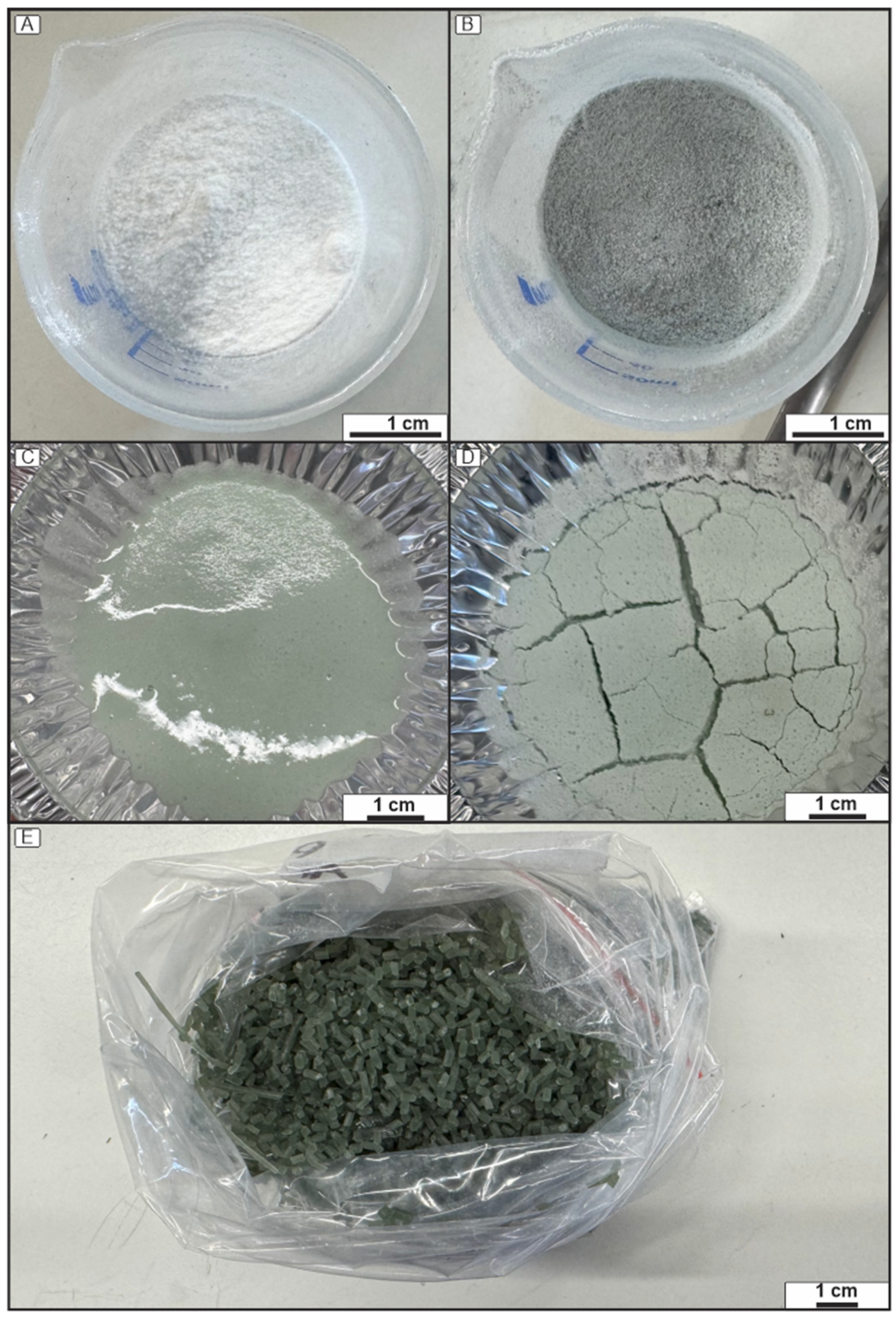
Method 1—Dry powder mixing: The required pigment powder quantity was added to the above PCL and PHBH powders (Figure 1A), before manually or mechanically mixing the two solid components (pigment powder and bioplastic powder) to produce the pigment plastic blends (Figure 1B).
Method 2—Wet paste mixing: The PCL and PHBH powders were weighed and mixed with deionized water in a 1:4 biopolymer:water ratio to form a fluid paste, into which pigments could be more readily mixed (Figure 1C). Aqueous solutions of phycocyanin and sodium copper chlorophyllin, lutein, and astaxanthin (from a stock solution in acetone) at the desired concentrations were then blended into the aqueous polymer pastes (Figure 1C). Similarly, astaxanthin and lutein dissolved in 100% DMSO could be blended into the water–polymer pastes. Thorough mixing was designed to yield a homogeneous distribution of the pigment throughout the polymer paste and was confirmed by visual inspection (Figure 1C). The resulting pigmented pastes were then dried overnight in an oven at 60 °C (or 40 °C for phycocyanin) for 15 h (Figure 1D). After drying, the solidified material was again manually ground using a mortar and pestle to increase pigment uniformity within the PCL and PHBH polymer powders.
Method 3—Extrusion mixing: PHBH–pigment mixtures were processed using a co-rotating twin-screw extruder (Eurolab 16, Thermo Scientific, Karlsruhe, Germany) with a screw length (L) of 67 cm and a diameter (D) of 1.5 cm. The barrel temperature was maintained at 135 °C, and the residence time during extrusion was approximately 3 min. The extrudate was pelletised for subsequent injection moulding or hot-press shaping (Figure 1E).
Method 4—Detergent mixing: Phycocyanin is a water-soluble pigment, while PHA is a hydrophobic biopolymer. To improve hydrophilic pigment dispersion in the hydrophobic plastic powder and to prevent aggregation, the use of the detergent sodium deoxycholate was tested. Specifically, 5 mg of sodium deoxycholate powder was dissolved in 20 g of distilled water, yielding a final concentration of 0.25 mg/mL (0.025% w/v; 0.603 mM). Given that the critical micelle concentration (CMC) [60] of sodium deoxycholate is approximately 2–6 mM, the applied concentration was below the CMC threshold.
Method 5—Rotational mixing: Dry phycocyanin and PCL powder were rotationally mixed overnight in a Lab Co Rotating Mixer (Brisbane, Australia) at room temperature (22 °C) and a rotation speed of 70 min−1.
Method 6—Torque-controlled heated mixing of polycaprolactone and phycocyanin. PCL granules (90 wt%) were added to a preheated (65 °C) Rheomix 600 chamber (Thermo Scientific Haake, Karlsruhe, Germany). A 10 wt% masterbatch of phycocyanin and PCL powder—pre-homogenized via manual and mechanical shaking—was introduced and mixed under controlled shear for ~3 min, until torque stabilization indicated uniform dispersion. The warm blend was then transferred to a hot press for further processing.
Remelting process—Different combinations of pigmented PCL samples were placed between two glass slides. The samples were then briefly heated until the plastic melted. The coloured plastics were then blended by rotating the top slide by 360° so that the differently coloured plastics were blended.

2.2.3. Processing of Pigment–Polymer Composites

Injection moulding: A Thermo Fisher MiniJet HAAKE (Karlsruhe, Germany) injection moulding machine was used to produce coloured squares (30 mm × 30 mm × 1 mm) from the prepared biopolymer–pigment mixture. Optimized processing parameters are summarized in Table 2.
Hot press: A Collin LabLine P300S Hot Press (Maitenbeth, Germany) was used to shape coloured sheets (110 mm × 110 mm × 0.8 mm) from PHBH-astaxanthin, PHBH-lutein, PHBH-sodium copper chlorophyllin, and PHBH-phycocyanin, as well as a PCL-phycocyanin mixture. Detailed hot pressing procedure parameters are provided in Table 3.

2.2.4. Photometric Analysis of Coloured Biopolymer Samples

Colour measurement: Colour measurements of the biopolymer samples were performed using a chromameter (CR-400, Konica Minolta Inc., Tokyo, Japan). According to the manufacturer’s specifications, the instrument exhibits a repeatability (standard deviation) of ≤0.07 ΔEab and an inter-instrument agreement of ≤0.6 ΔEab under standard calibration conditions. These values were used to contextualize measurement variability and ensure that observed colour differences exceed the instrument’s inherent uncertainty. It operates within the CIELAB colour space [61]. This system defines colour using three coordinates: L* (lightness), ranging from 0 (black) to 100 (white); a*, representing the red–green axis (+100 = red, −100 = green); and b*, indicating the yellow–blue axis (+100 = yellow, −100 = blue). Each biopolymer sample was measured at three different surface positions, and the mean L*, a*, and b* values were used for analysis. The following formula represents the difference between two colours in the three-dimensional colour space:
E =   ( L 2 L 1 ) 2 + ( a 2 a 1 ) 2 + ( b 2 b 1 ) 2
The colour difference ∆E (i.e., the change between treatments) was assessed using previously reported experimentally verified data [62]: ∆E values of less than 1 were defined as indicating no colour change, while a ∆E of 1–2 was defined as only being detected by an experienced observer. In contrast, ∆E values of 2–3.5 were considered detectable by an inexperienced observer, and ∆E values between 3.5 and 5 were clearly noticeable. ∆E values above 5 indicated pigment degradation.
UV-Coating
Coloured bioplastic samples were coated with a varnish that provides UV protection (Montana Cans, Clear Varnish spray, UFI code 6MTKJ-PV9E-630W-NA70, Heidelberg, Germany). The bioplastic samples were sprayed four times from a 200 mm distance.
UV-Resistance Assay—Photostability
To assess the photostability of the samples, UV-A irradiation was used. This is because approximately 95% of natural solar UV light reaching the Earth’s surface is UV-A, making it the dominant source of environmentally relevant UV light exposure [63]. To test pigment stability under UV-A exposure, samples were irradiated at 340 nm using a Quantitative Ultraviolet (QUV) accelerated weathering tester equipped with UVA-340 lamps (Q-LAB). The irradiance was set to 0.60 W·m−2·nm−1 for 24 h, which is slightly below the ISO 4892-3 Cycle 1 value (0.76 W·m−2·nm−1) [64] and approaches the maximum solar irradiance at 340 nm reported in Commission Internationale d’Éclairage, which is French for International Commission on Illumination, technical report no.85 ((CIE 85) [65]; ~0.68 W·m−2·nm−1, as cited by the QUV tester manufacturer) [66] in order to maintain the chamber temperature close to 45 °C—well below the thermal degradation thresholds of phycocyanin (~60 °C) and other pigments (see Table 1). This temperature limit was intentionally maintained because the protein pigment phycocyanin begins to denature above ~45 °C. Operating slightly below the ISO irradiance, therefore, ensured realistic high-UV exposure without inducing heat-driven denaturation. Colour changes (ΔE) were measured before and after exposure, as described in the section entitled Photometric analysis of Coloured Biopolymer Samples. The chosen conditions simulate intensified but realistic sunlight, allowing light-induced degradation to be reliably assessed within 24 h using the Q-LAB’s continuous and controlled irradiation.

3. Results

3.1. The Natural Colour Palette of Microalgae

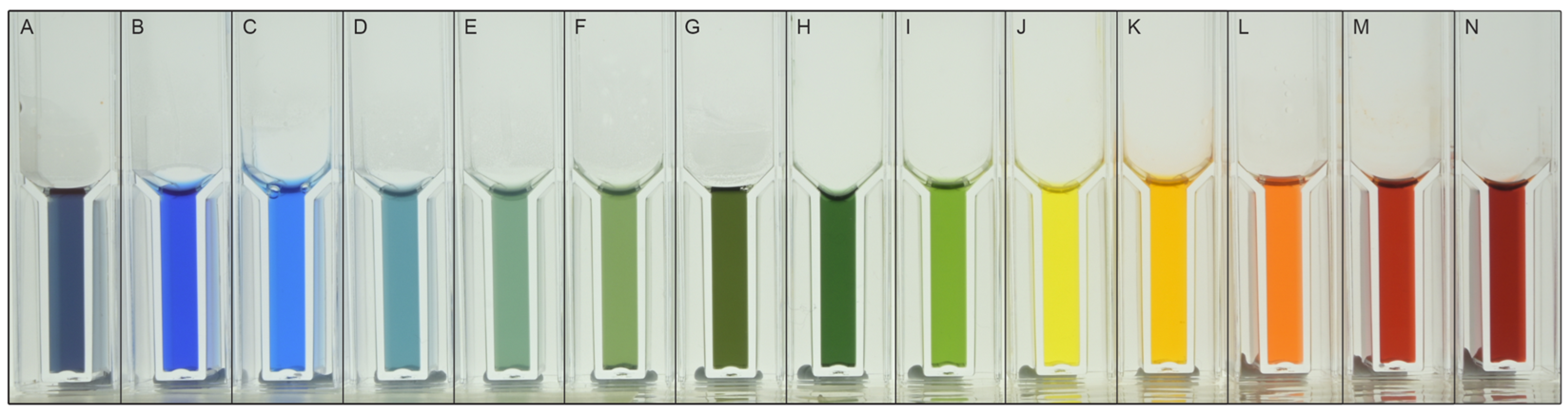
Cyanobacteria and microalgae produce a broad range of pigments, including phycocyanin (blue), chlorophylls (green), and carotenoids (yellow, orange, and red), and from these, combinatorial blends can also be produced. Figure 2 illustrates the natural colour range that can be generated in solution across the visible spectrum.
Figure 2 demonstrates the extensive colour palette achievable through pigment combinations in solution. In the following experiments, however, only individual pigments were incorporated into the biopolymers, which allowed their colour expression and stability to be assessed independently and compared on a consistent basis.

3.2. Normalizing Natural Pigments

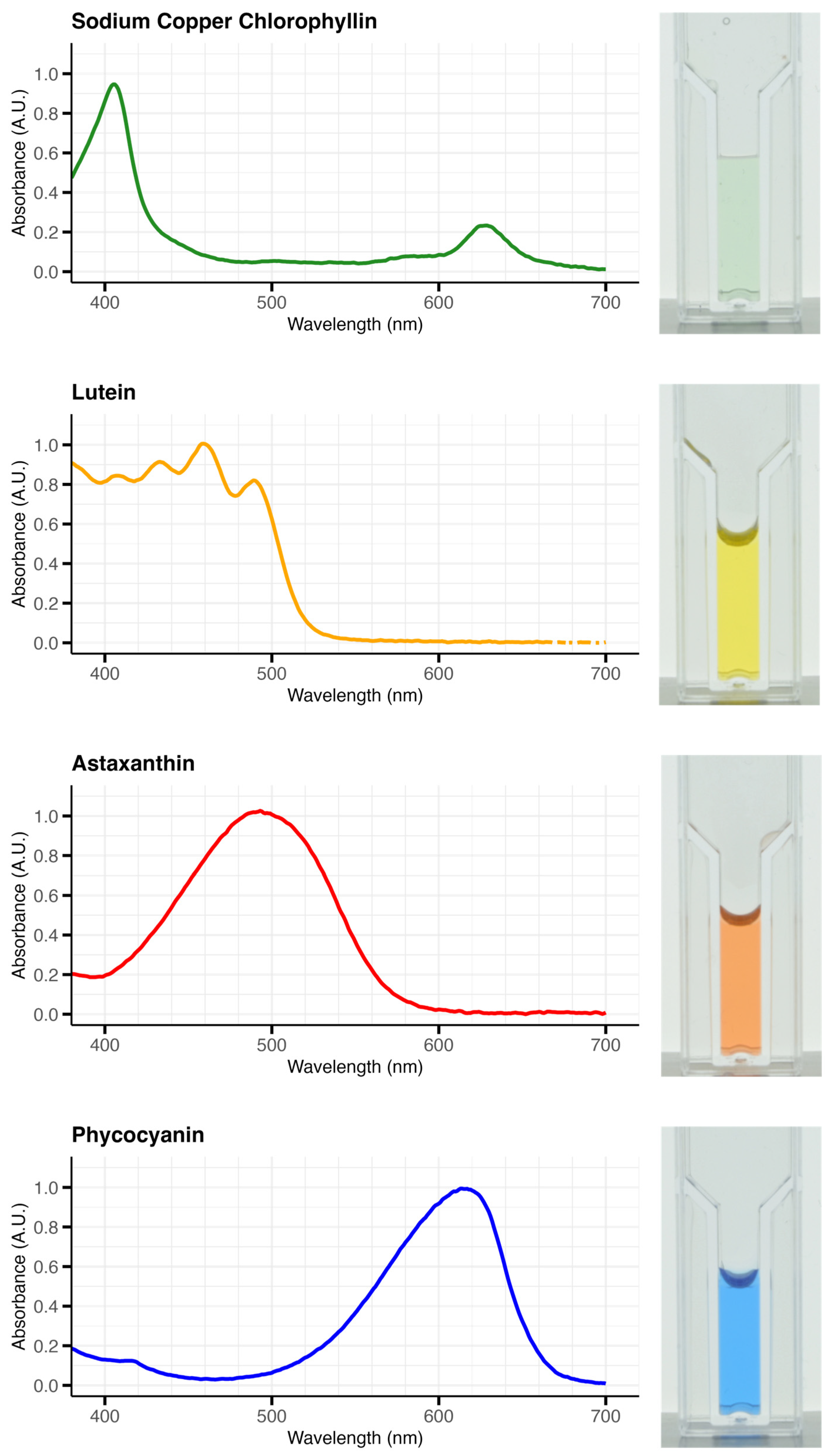
Next, to produce defined colours and enable meaningful comparison between the colours after incorporation into the biopolymers, pigment solutions were normalized. Since pigments of different hues naturally exhibit different intrinsic absorption intensities, identical mass concentrations would not produce comparable colour intensities. To address this, pigment solutions were adjusted so that their maximum absorbance values were normalized to an absorbance of 1 prior to incorporation. This approach is consistent with the Lambert–Beer law [67], which relates absorbance linearly to concentration and path length, and it typically relies on the pigment-specific extinction coefficients in the solvent of choice (Table 1). Figure 3 shows spectra of sodium copper chlorophyllin, lutein, astaxanthin, and phycocyanin normalized to an absorbance of 1 at the maximum wavelength height, and their corresponding colours at a 10 mm path length. These normalized concentrations then formed the basis for all subsequent experiments, allowing the resulting colours in the biopolymers to be interpreted relative to each other rather than being biased by their inherently different absorption intensities.
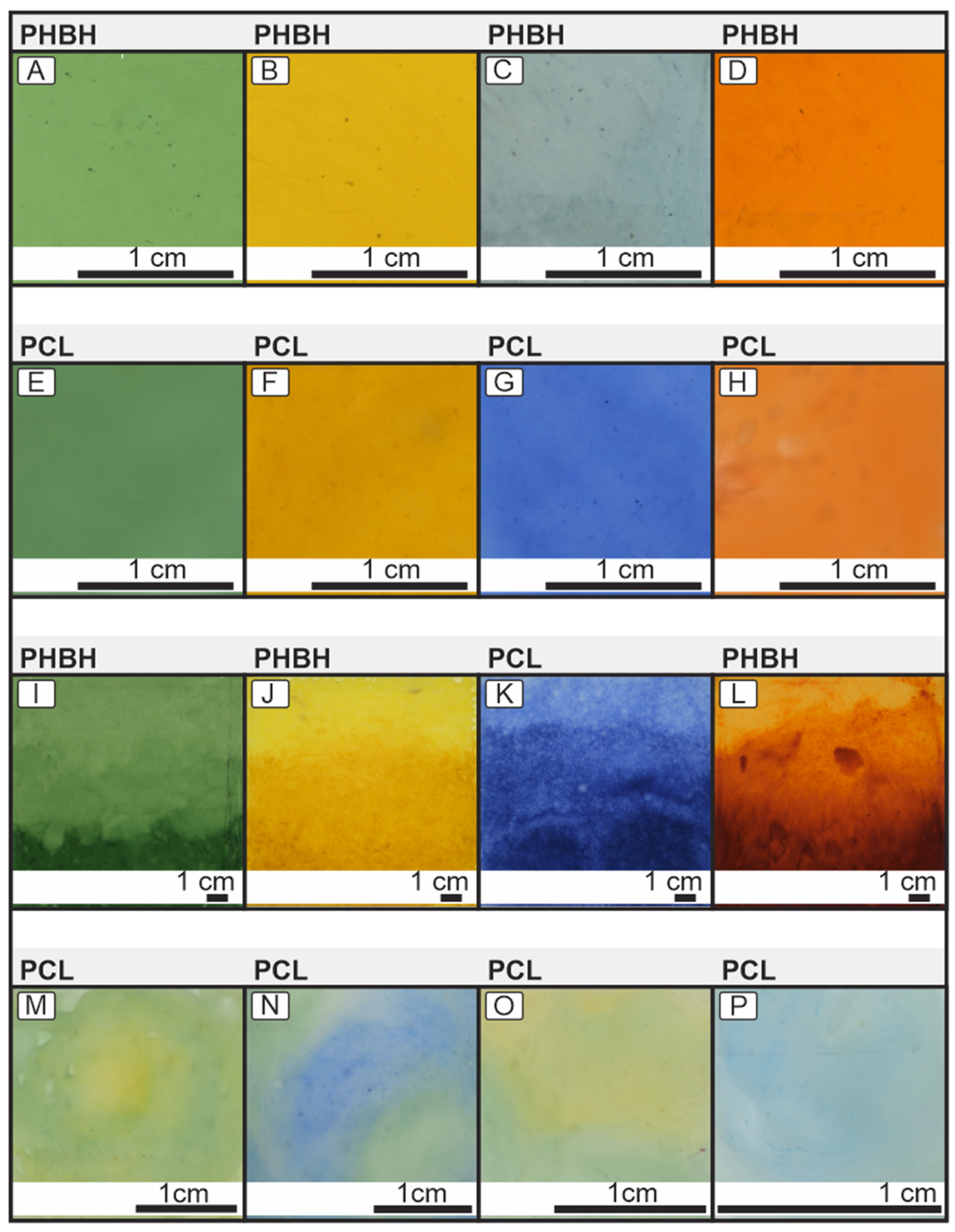
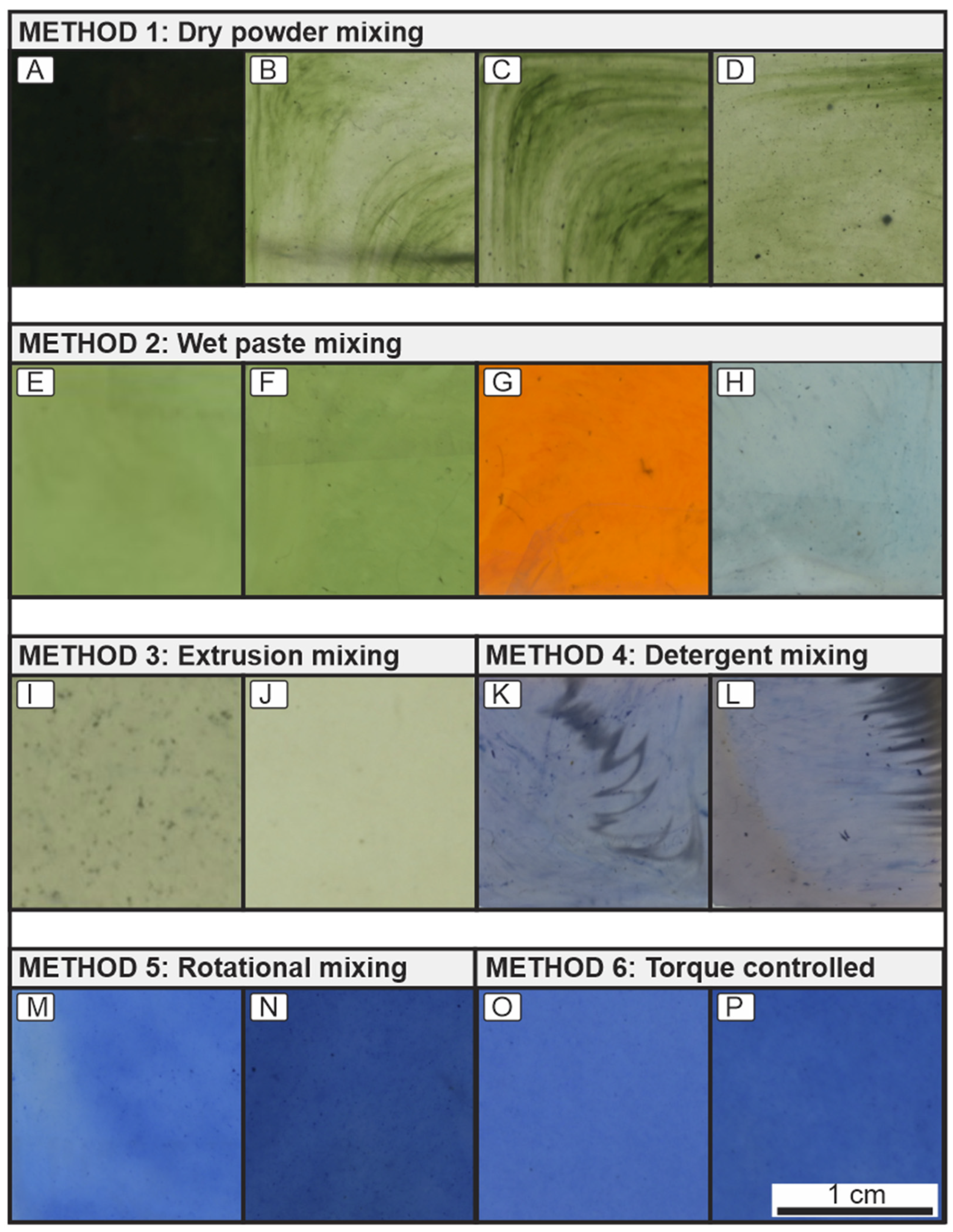
Following pigment normalization, two concentration levels were selected for each pigment. As shown in Figure 4A–D and detailed in Table 4, pigment loadings around 0.1 wt% resulted in clearly visible and well-defined colours, whereas higher concentrations (e.g., 1 wt%) produced overly dark materials with reduced visual differentiation.
Based on this qualitative assessment, intermediate pigment concentrations were selected to avoid both insufficient and excessive colour intensity. The specific concentrations chosen for each pigment are shown in Figure 5. Within the samples, doubling the pigment loading resulted in consistent colour differences across all four pigments and their two normalized concentrations, with ΔE values of approximately 10 for all different pigments (Supplementary File S1). This indicates that the chosen low and high concentrations represent comparable step sizes in perceived colour intensity, enabling direct comparison between chemically distinct pigments.

3.3. Comparison of Blending Methods for Pigmented Biopolymer Production

Using these four pigments, both in solid form and in solution (sodium copper chlorophyllin), (lutein), (astaxanthin), and (phycocyanin), a wide range of pigment–biopolymer pre-mixing and extrusion methods were evaluated using both PCL and PHBH (Table 4). PCL and PHBH have melting points of 60 °C and 135 °C, respectively. Since the pigments differ strongly in chemical structure, polarity, and thermal stability, multiple processing strategies were required to achieve effective dispersion and colour development. In addition to laboratory-scale approaches, methods reflecting industrially relevant and potentially automatable processing routes were also assessed. The key findings of these experiments are summarized in Figure 4.
Method 1—Dry powder mixing: Pigment–polymer mixing trials were initiated using Method 1. Figure 4A–D show 2× magnified images of 30 mm × 30 mm × 1 mm-thick sheets based on PHBH and sodium copper chlorophyllin (SCC) mixtures produced by injection moulding at 135 °C/200–800 bar. As Figure 4A shows, the use of 1% sodium copper chlorophyllin resulted in a very dark green sample. Dropping the sodium copper chlorophyllin concentration to 0.1% (w/w) but maintaining the temperature at 135 °C and pressure at 800 bar gave a significantly lighter green colour but a pigmented PHBH sheet with clear flow lines (Figure 4B). Such flow lines typically arise from irregularities in melt flow or cooling during injection moulding and are often associated with excessively high injection pressures. In Figure 4C,D, the injection pressure was reduced to 400 bar and 200 bar, respectively, to reduce these flow lines. Lowering the pressure reduced the formation of flow lines, but it did not substantially improve the uniform dispersion of sodium copper chlorophyllin within the PHBH matrix.
Dry powder mixing (Method 1) resulted in non-uniform pigmentation, with visible flow lines and heterogeneous colour distribution, indicating insufficient pigment dispersion within the PHBH matrix. To improve homogeneity, wet paste mixing (Method 2) was subsequently explored, based on the premise that dispersing the pigment in a liquid phase prior to polymer incorporation would enhance distribution and reduce flow-induced inhomogeneities. Sodium copper chlorophyllin is relatively polar and inherently water-soluble, as well as 80% acetone, which is more compatible with PHBH, as it is a hydrophobic molecule [68]. Consequently, both water- and acetone-based wet paste mixing approaches were evaluated.
Method 2—Wet paste mixing: After wet paste mixing with different solvents, the following results were observed in terms of dispersion and colour quality. Both the 80% acetone- (Figure 4E) and the water-based (Figure 4F) samples produced using Method 2 were much more uniform than the samples produced using Method 1 at a 0.1% w/w sodium copper chlorophyllin blend (Figure 4B–D). This suggested that dissolving the sodium copper chlorophyllin (which is soluble in both 80% acetone and water) was important to achieve uniform PHBH pigmentation. An advantage of using acetone is its rapid solvent evaporation compared to water, which minimizes residual moisture and thereby reduces the risk of PHBH hydrolysis during the injection-moulding process. Method 2, using 80% acetone, also yielded reasonably uniform and vibrant PHBH blends of astaxanthin (Figure 4G) and lutein (Figure 5B). However, phycocyanin, a protein-based pigment, only yielded a faded blue grey colour (Figure 4H), likely due to its denaturation during the 135 °C injection-moulding step. Consequently, further method development was required.
Method 3—Extrusion mixing: Pigment–biopolymer mixed by extrusion is a process usually used in industry to prevent pigment aggregation (Figure 1E). Conducting these tests with sodium copper chlorophyllin (which has been proven to be reasonably heat-stable in earlier tests), injection moulding of the extruded pellets still showed pigment speckles, indicating that the dispersion was not complete (Figure 4I). In contrast, the hot-pressed sheets did not show speckling, which might be due to the longer residence time at elevated temperature (~15 min) that allowed further homogenization (Figure 4J). It could also be due to PHBH degradation with longer processing time, which causes an increase in biopolymer fluidity and, therefore, also potentially increased pigment dispersion. In addition, the colour of the extruded and then injection-moulded samples appeared noticeably more matte than that of the Method 2 samples (Figure 4E) prepared using acetone, which exhibited a more vibrant and uniform surface. As a result, Method 2 (using 80% acetone) was identified as the best production method for sodium copper chlorophyllin- (Figure 4E), astaxanthin- (Figure 4G), and lutein-pigmented PHBH (Figure 5A,B,D).
Method 4—Detergent mixing: As phycocyanin is a predominantly hydrophilic protein and PHBH is a hydrophobic polymer, a low concentration of the relatively mild detergent sodium deoxycholate (0.025% w/v; commonly used for protein purification) was added to test if this supports pigment–polymer mixing due to its amphipathic properties (i.e., it has both hydrophilic and hydrophobic groups). After injection moulding, the resultant pigmented biopolymer sample had a darker and more vibrant blue colour (Figure 4K) than was obtained with Method 2 (Figure 4H), but the samples were still not uniform and very similar in quality to those obtained without detergent (Figure 4L). Higher detergent concentrations could have been assessed, but Methods 5 and 6 gave superior results to Method 4, and so we proceeded using these methods.
Method 5—Rotational mixing: PCL was chosen instead of PHBH as it has a lower melting temperature (60 °C instead of 135 °C). This is important as protein-based pigments can denature at high temperatures [50]. Figure 4M,N shows the vibrant blue colours obtained using 1 and 2% w/w phycocyanin mixtures, respectively, highlighting the importance of using low-melting-point plastics to incorporate this protein-based pigment.
Method 6—Torque-controlled heated mixing: To further improve the blending of polymer and pigment, torque-controlled mixing was used. Figure 4O,P shows the resultant PCL biopolymer sheets with 1 and 2 wt% PC. The samples were quite well-mixed and had a uniform, vibrant blue colour.
Overall, the results showed that wet paste mixing (Method 2) provided the most effective and consistent pigment dispersion for PHBH and also performed well for PCL. However, for the protein-based pigment phycocyanin, torque-controlled heated mixing using PCL (Method 6) resulted in colour stability, reflecting the importance of reduced processing temperature. These trends are further illustrated in Figure 5, which highlights both the improved uniformity achieved with the selected methods and additional effects such as colour gradients that could be generated through controlled processing.

3.4. Optimized Biopolymer Sheet Production and Colour Variation

Figure 5 shows the biopolymer sheet production conditions that yielded the most uniform green (chlorophyllin, Figure 5A,E), yellow (lutein, Figure 5B,F), blue (phycocyanin, Figure 5C,G), and orange/red colours (astaxanthin, Figure 5D,H) in PHBH and PCL, respectively. While the colours are not completely uniform, improved process control and system scale-up is expected to enhance and likely achieve acceptable colour uniformity.
Figure 5I–L illustrates the effects that can be achieved by hot pressing different concentrations of single pigments, while Figure 5M–P shows different examples of two-colour blending.
Here, representative examples of vividly coloured biopolymer sheets produced under the optimized processing conditions are shown. Although the pigment concentrations were identical, visible differences in colour intensity and hue were observed depending on the polymer matrix used, with PHBH appearing more translucent and PCL exhibiting a whiter background. These intrinsic differences in polymer appearance influence the perceived colour of the pigmented sheets.
To systematically assess the stability of these colours, the next step was to evaluate UV resistance under controlled conditions using two defined pigment concentrations for each pigment–polymer combination.

3.5. UV Resistance Analysis

Many natural pigments, including chlorophylls [69], carotenoids [70] and protein-based pigments such as phycocyanin [71] and phycoerythrin [72], are sensitive to UV-mediated oxidation. In the case of the above pigments, bleaching is thought to be due to the oxidation of the extensive conjugated chromophore bond systems. In powder and solution forms, UV exposure was expected to result in oxygen free radical-mediated bleaching [73]. What was less clear was whether, once embedded in the PCL and PHBH biopolymers, the pigments would be just as susceptible to UV-mediated oxidation and bleaching, or more protected.
Biopolymer–pigment composites exhibited negligible colour variation under ambient indoor lighting over several months, indicating a degree of photostability that may be further improved with UV-protective coating and antioxidant incorporation. While UV-B radiation is effectively blocked indoors by glass windows, UV-A radiation can penetrate window glass, with the extent of transmission depending on the glass composition and the distance of the exposed object from the window. However, more rigorous and controlled UV testing was required to evaluate UV stability under outdoor conditions, which have much higher UV levels.
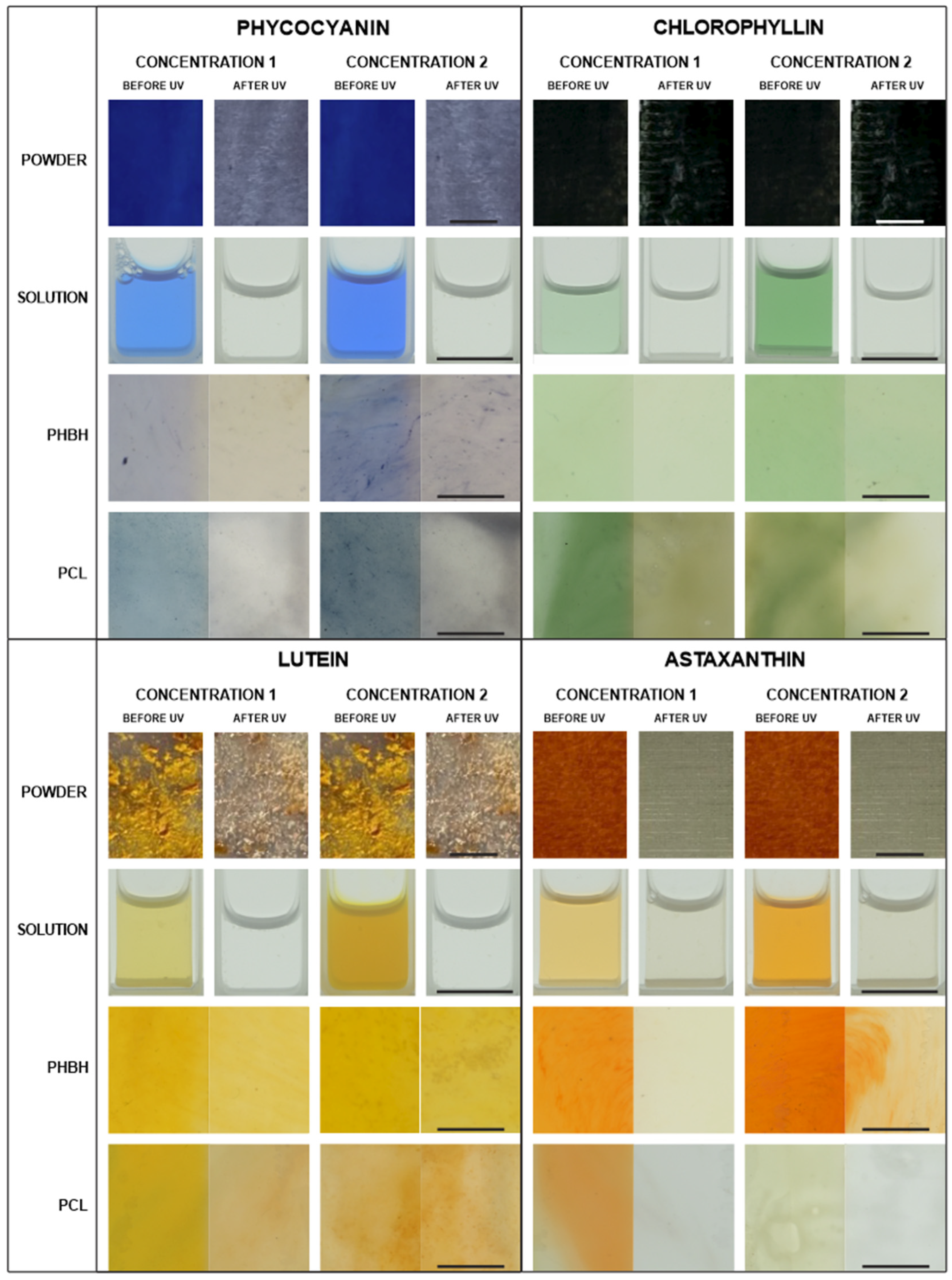
Figure 6 shows the effect of 24 h of 0.61 W m−2 UV-A (340 nm) irradiation on phycocyanin, sodium copper chlorophyllin, lutein, and astaxanthin in powder-, solution-, PHBH-, and PCL-embedded plastic forms (30 × 30 × 1 mm). The pigment concentrations were normalized to the absorbance of 1, as displayed in Figure 3. Following this pigment normalization, the concentrations corresponding to an absorbance of 1 were used to define comparable pigment loadings in the biopolymers, from which one lower (concentration 1) and one higher concentration (conc. 2, which was conc. 1 × 2) were selected for each pigment. Hence, each pigment was evaluated at both at and twice the control concentration. As expected, extensive pigment bleaching was observed in the powder and solution forms exposed to oxidizing oxygen free radicals.
In the pigment–biopolymer sheets (PHBH and PCL), phycocyanin, sodium copper chlorophyllin, and astaxanthin were also bleached, but in many cases to a lesser extent than in the powder and solution forms, with some colour remaining after 24 h of UV exposure. Astaxanthin was the most sensitive to bleaching in PHBH, followed by phycocyanin, chlorophyllin, and lutein. Lutein appeared to be reasonably stable at this level of exposure, with little bleaching observed. In contrast, bleaching in PCL was severe and often extended from the illuminated part of the plastic sheet into regions of the UV-protected part of the sheet. This suggests that either some UV scatter or oxygen free radical diffusion occurred into the non-exposed section of the sample. The bleaching pattern was more patchy for sodium copper chlorophyllin and astaxanthin samples in particular. This suggests that biopolymer selection may be important to enhance colour protection, especially because it is known that biopolymer photodegradation by chain scission can result in colour changes [74].
After 24 h of UV exposure, the pigments displayed clear differences in colour stability, as reflected by their ΔE values. Sodium Copper Chlorophyllin showed the lowest colour difference (ΔE ≈ 5.6, Table 5), indicating the highest UV stability among the tested pigments. Lutein (ΔE ≈ 8.6. Table 5) also exhibited relatively moderate stability, with only a minor perceptible colour shift. In contrast, phycocyanin (ΔE ≈ 17.8, Table 5) underwent a substantial change in colour, while astaxanthin showed the largest instability, with ΔE values exceeding 42, representing a pronounced loss of colour integrity. Overall, the ranking of UV stability was sodium copper chlorophyllin > lutein > phycocyanin > astaxanthin.
In the PCL formulations, the ΔE value for lutein was approximately 18.1 at concentration 1, while for sodium copper chlorophyllin, it was around 15.0 at concentration 1 (Figure 6 and Supplementary Files). Both values are higher than those of PHBH-based samples, which were around 7.5 for lutein and around 5 for sodium copper chlorophyllin (Table 5). For phycocyanin and astaxanthin, it was not measured because the biopolymer samples were bleached completely (white). The results clearly indicate that PCL does not provide UV protection, whereas PHBH seems to provide some UV protection. This outcome was expected, since no data exist in the literature supporting UV-stabilizing effects of PCL, while PHBH has been reported to be more UV stable [75]. Astaxanthin and phycocyanin in PCL were not measured further, as the samples lost all colouration under UV exposure, even to some extent in the shielded parts, confirming complete degradation. Due to the intense bleaching in PCL samples, ΔE values were not included in Table 5.

3.6. UV Resistance Test with UV-Protective Coating

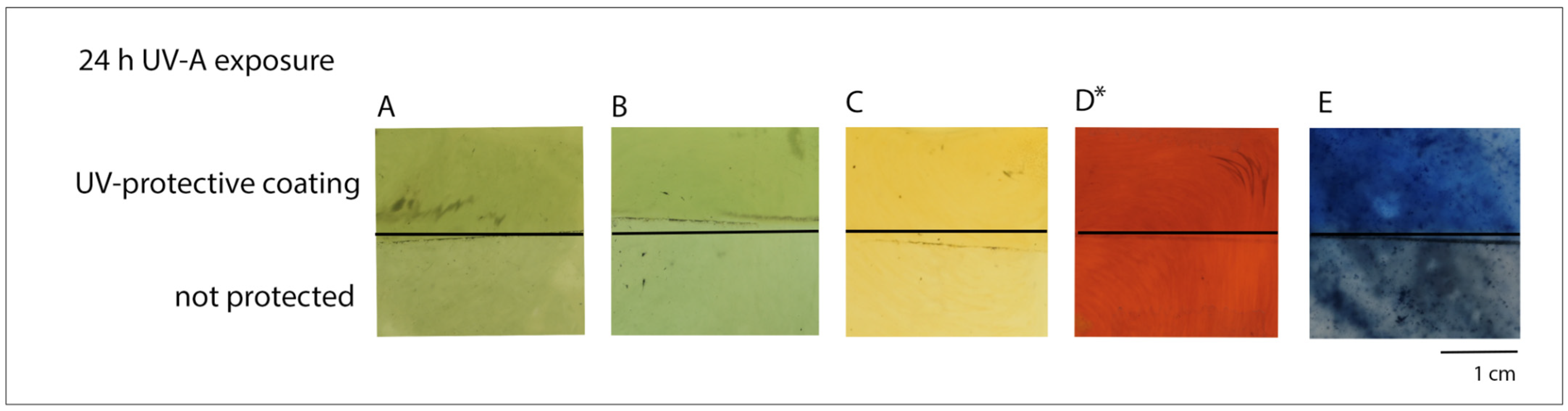
To further mitigate colour fading, pigment-incorporated PHBH sheets—with and without a UV-protective coating—were exposed to 144 h of UV irradiation under standard conditions (Figure 7, Table 6). The UV coating conferred notable protection, effectively reducing pigment degradation and helping to preserve colour integrity. All samples were sprayed with an external UV-protective coating prior to irradiation, except for Sample D*: due to its higher astaxanthin concentration (1.325 wt%), it inherently exhibited strong UV resistance and therefore did not require an additional UV-protective layer under the conditions tested. This highlights the intrinsic stabilizing effect of increased astaxanthin content.
The results clearly demonstrate that the UV coating provided increased protection for the samples. The strongest effect was observed in the blue biopolymer sample coloured with phycocyanin, where the largest colour difference was measured, ΔE = 33.61 (between the upper (UV-protective coating) and the lower part (no UV-protective coating added; Figure 7E). Without the UV-protective coating, the pigment showed significant degradation, while with this coating, the characteristic blue colour was preserved. A protective effect was also evident for lutein, with a colour difference of ΔE = 7.93. Since values above five are considered perceptible even to an untrained observer, this indicates a marked visual change when UV protection was omitted. For the two green pigments, the acetone-based samples (Figure 7B) showed slightly higher protection (ΔE = 2.39) than the sample where the pigment was dissolved in water (Figure 7A, ΔE = 0.77), suggesting that sodium copper chlorophyllin in water remains more stable, even without a UV-resistant coating, since an ΔE < 1 is considered the same colour. Astaxanthin remained very colour-stable with a high concentration of 1.235 wt%, with a very small perceptible colour difference after UV exposure. This is in contrast to the complete colour loss that was observed when astaxanthin was only 0.011 or 0.022 wt%, suggesting that a higher concentration of astaxanthin increases its colour fastness (not included in ΔE comparison, only for illustrative purposes).

3.7. Thermal Colour Blending and Reprocessing of PCL

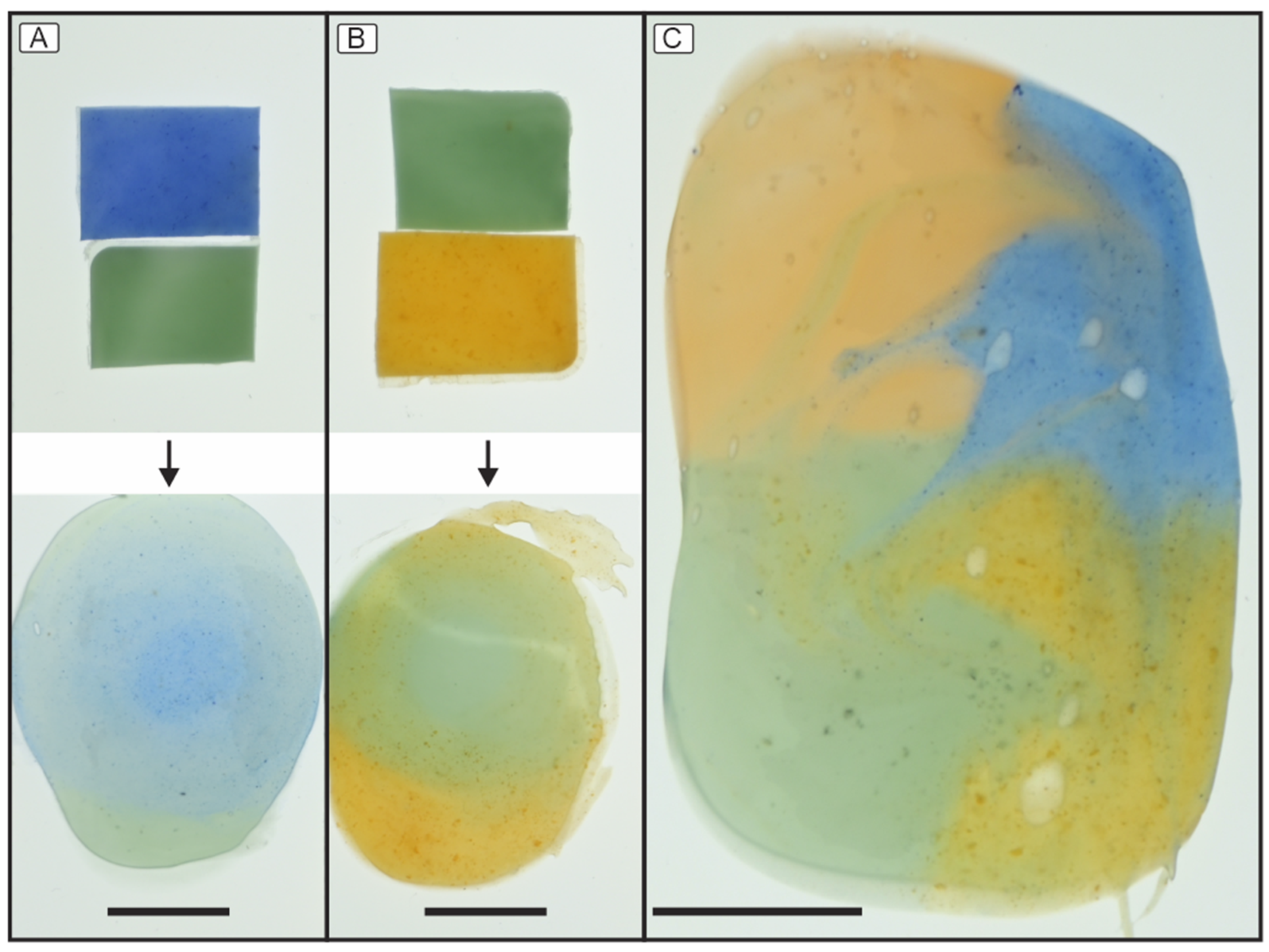
Next, two individually pigmented PCL pieces were positioned next to each other on a glass slide (Figure 8A,B top), and the slide was placed on a hot plate set to 100 °C. A second glass slide was then placed on top of these plastic pieces. Once the plastic pieces had melted, the glass slides were pressed together, bringing the two-coloured plastic pieces into contact, and the top slide rotated. This resulted in a circular mixing pattern and a blue–green blend (Figure 8A bottom) and a green–yellow blend (Figure 8B bottom). Figure 8C shows a piece generated from the four different coloured plastics (orange, blue, yellow, and green). In this example, the colours were streaked into each other to illustrate the effect of mixing adjacent colours.
Importantly, PCL can be readily remelted and reprocessed, allowing the colour-blending process to be repeated and adjusted, which highlights the potential for iterative shaping and colour tuning using simple thermal processing steps.

3.8. Small-Scale Architectural Prototype

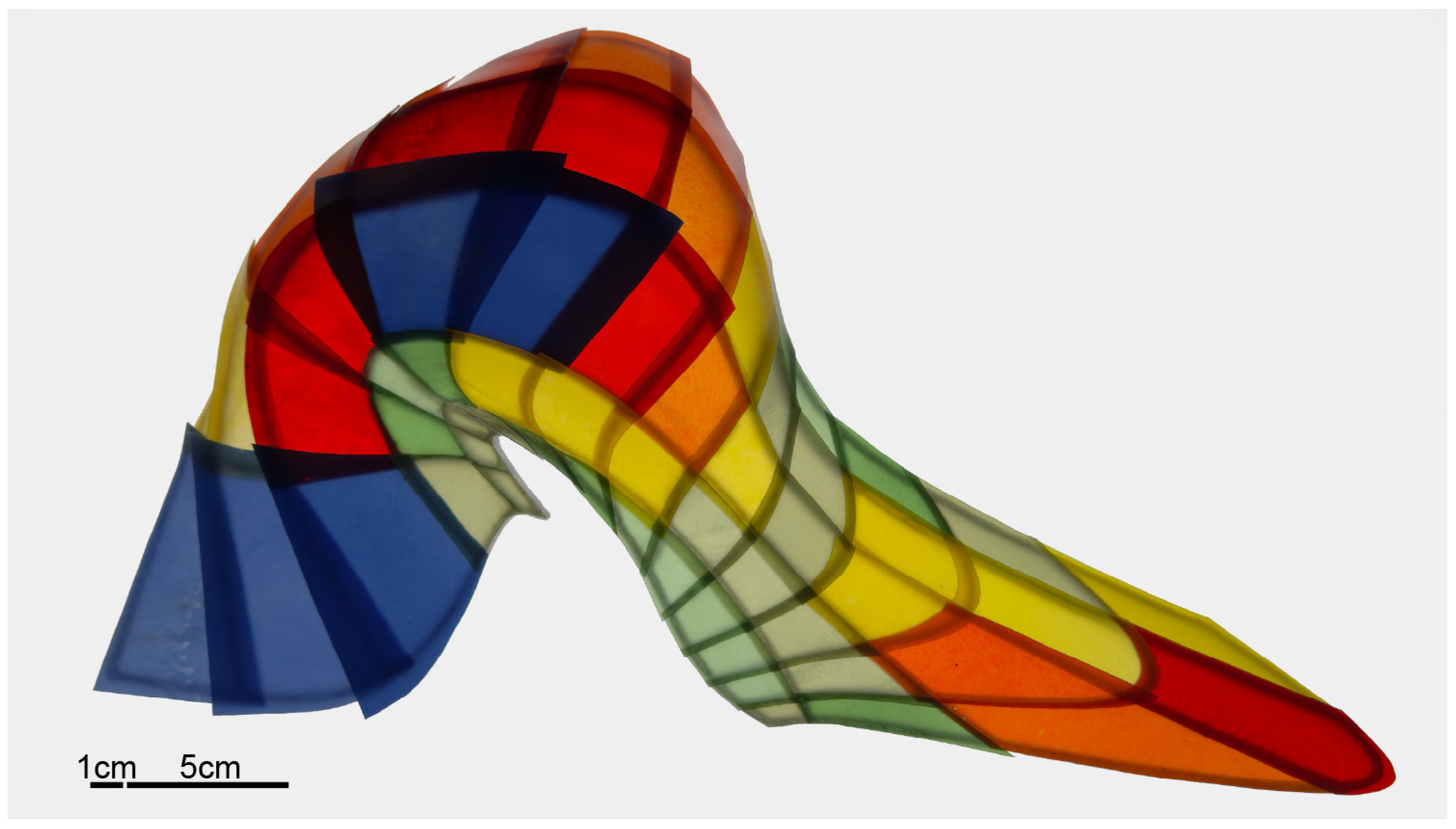
Following the colour-mixing studies, we fabricated a small-scale architectural prototype to demonstrate the feasibility of translating pigment–biopolymer sheets into curved, assembled forms suitable for interior applications (Figure 9). Panels were produced using the same blending protocols and concentrations evaluated in this study for PHBH and PCL (Methods 2 and 6), then thermo-formed and mechanically fixed to a lightweight subframe. We chose coloured plastic samples that showed higher colour fastness under UV-A exposure. The prototype therefore uses chlorophyllin- and lutein-tinted panels in higher-exposure zones, reserving phycocyanin and astaxanthin for shaded or indirect-light locations. This design-to-data linkage illustrates how measured photostability can guide pigment assignment, the addition of UV stabilization coatings, and panel placement for built elements.

4. Discussion

Despite being produced at laboratory scale with limited blend uniformity compared to industrial processing, the pigmented biopolymer samples successfully demonstrated the effective incorporation and stabilization of diverse pigments, including a small-molecule tetrapyrrole (sodium copper chlorophyllin), a carotenoid (lutein), a xanthophyll (astaxanthin), and a protein-based pigment (phycocyanin) within two biopolymer matrices (PHBH and PCL).
We used pure analytical reagent (AR) grade standards of lutein and astaxanthin to confirm the identity of the extracted pigments by comparison to their UV–Vis absorption spectra. Due to their high cost, using these AR standards for bulk material preparation was not feasible, but readily available nutraceutical capsules including these compounds at a modest cost were employed (Table 1). In these products, the desired pigment was the single major contributor (>80%) to the colour, and any related coloured substances were from the same family (e.g., for astaxanthin, a mix of other carotenoids at less than 20% in total). We used UV spectroscopy to verify the similarity of the UV-visible spectra to the AR. The pigments were incorporated into the polymer matrices, and pigment concentration was normalized via their extinction coefficients. This approach ensured consistent pigment loading and reproducible spectral properties.
While the hydrophobic pigments lutein and astaxanthin could be readily blended with hydrophobic polymers using organic solvents, phycocyanin, a hydrophilic protein-based pigment, posed a greater challenge when incorporated into hydrophobic polymer matrices. To address this incompatibility, the amphipathic detergent sodium deoxycholate was explored to improve pigment dispersion and interfacial compatibility. Overall, among the approaches evaluated, wet paste mixing (Method 2) proved to be the most broadly effective strategy for incorporating and dispersing the different pigments across both polymer matrices. For the protein-based pigment phycocyanin, in particular, the torque-controlled heated mixing approach using PCL (Method 6) yielded the most uniform incorporation and colour stability. These findings highlight the importance of matching pigment chemistry with both the processing route and polymer properties, particularly with respect to solvent compatibility, processing temperature, and applied shear.
The small-molecule pigments withstood temperatures of 135 °C. The challenge of the protein-based phycocyanin is that it poorly withstands this temperature. Consequently, PCL, with a melting temperature of 60 °C, was used to incorporate it. Many proteins are inherently sensitive to temperature-induced denaturation but can be stabilized through a variety of methods that reduce the unfolding of the protein (e.g., embedding in sugars or crosslinking the protein). The possibility of stabilizing the protein structure using encapsulation, crosslinking, or other strategies should, therefore, be explored. However, given the limitation of using protein-based pigments, the use of the isolated chromophores from these proteins, which can have a higher thermal stability, should be considered in future work [76].
Importantly, the low water activity in the interior of plastics may help with stabilization strategies that are not possible in aqueous environments. In addition, a range of sustainable technologies exists, such as molecular encapsulation with cyclodextrins (natural, biodegradable reagents), which can greatly improve the stability of natural pigments to oxidation and UV exposure in foods [77,78,79]. The logical extension of our work would therefore be to explore the use of these approaches for stabilizing algae-derived pigments in natural biopolymers, using sustainable protectants. Further work will include the identification of the most stable natural pigments, if protective derivatization is appropriate, and whether the extrusion/mixing process can be optimized. Parameters such as temperature profiles, screw configuration, and specific mechanical energy input were not systematically adjusted, as would be possible in a more extensive process development study on a single pigment. Optimization of these parameters could significantly improve pigment dispersion and matrix–filler interaction, potentially enhancing overall material performance. Furthermore, incorporating UV-protective additives during extrusion presents a logical next step to improve the UV stability of the composites. Future work should therefore focus on both extrusion process optimization and the integration of suitable stabilizers to achieve improved long-term durability under UV exposure.
To assess surface homogeneity and measurement reliability, the means and standard deviations of the L*, a*, and b* values were analyzed. Across all detergent-free samples, the intra-sample variation was small relative to the measured colour changes. For 1.16% PC (ΔE = 17.77, while for 2.32% PC (ΔE = 13.27), the standard deviations of L*, a*, and b* remained within 0.2–2.3% of their respective means. SCC, which showed the lowest colour change at concentrations of 0.034% (ΔE = 5.57) and 0.068% (ΔE = 5.03), also exhibited very low variability, generally <0.1–1.3% of the mean. The low concentration of lutein (0.02%) gave a ΔE of 8.58 and showed SD values of 0.1–1.1% of the mean. The higher loading (0.04%) gave a ΔE of 6.21 and displayed an increased variation of 3–7%, which is consistent with the slight surface heterogeneity observed after UV exposure. Astaxanthin showed the largest colour changes. At a loading of 0.011%, ΔE was 42.89, and at 0.022%, ΔE was 33.62, with SD values between 1 and 10%, reflecting strong photobleaching and increased surface non-uniformity. Overall, the magnitude of the standard deviations is small compared with the corresponding ΔE values, supporting the conclusion that the reported differences in colour stability reflect true pigment behaviour rather than local surface fluctuations. The low intra-sample variation also confirms that the differences observed between SCC, PC, lutein, and astaxanthin are meaningful and not artefacts of spatial measurement variation.
The enhanced colour stability of pigments in PHBH compared to PCL is most likely related to differences in the UV resistance of the two polymer matrices. Previous studies have shown that polyhydroxyalkanoates inside bacterial cells protect them from UV radiation-related harmful effects [80] or generally demonstrated much better resistance to UV degradation compared to polypropylene [81]. Only limited work has examined the photodegradation of PCL, but reported findings indicate bulk erosion, loss of mechanical properties, and increased crystallinity under UV exposure [82]. Photodegradation can be delayed in blends, yet the presence of carbonyl groups still promotes UV-initiated chain scission. These trends support the view that PCL is relatively susceptible to photo-oxidative degradation, which is consistent with the bleaching observed in our samples. Such degradation of the polymer matrix can increase oxygen diffusion, micro-cracking, and pigment bleaching, which is consistent with the pronounced whitening observed in the PCL samples, including propagation into shaded areas. In contrast, the PHBH samples retained colour for longer, suggesting that the polymer matrix itself provided partial protection against photodegradation.
In addition to high temperature, light intensity, and wavelength, pigment degradation is affected by oxygen species [77]. Consequently, both the matrix and pigment encapsulation could help prevent oxygen permeation and protect against UV-induced damage, thereby enhancing stability. Although the detailed mechanisms of pigment bleaching remain to be confirmed, the observed trends indicate that matrix stability plays an important role. Future work should therefore include accelerated ageing tests on the neat polymers and thermo-gravimetric analysis (TGA) of pigment–polymer blends to separate the effects of polymer degradation and pigment degradation under processing and UV exposure.

5. Conclusions

In conclusion, this paper has trialled the blending (individually and in combination) of a diverse array of structurally different pigments, including a carotenoid, xanthophyll, water-soluble chlorophyll derivative (chlorophyllin), and protein-based pigment (phycocyanin, blue) into two biopolymers (polycaprolactone and polyhydroxybutyrate-hydroxyhexanoate) with melting points of 60 °C and 135 °C, respectively, to evaluate whether they could generate robust, vibrant coloured materials, ultimately for relatively high-value interior architectural applications.
The carotenoids and sodium copper chlorophyllin-based pigments integrated well into both PHBH and PCL, while the more temperature-sensitive phycocyanin (blue) could only be blended effectively into PCL at 60 °C. Because the chromophore of phycocyanin, phycocyanobilin, is more temperature-stable, future experiments should examine its incorporation into PHBH instead of phycocyanin. All of the coloured plastics maintained a stable colour under indoor illumination over a period of approximately three months, suggesting that with further improvement, they could potentially be suitable for internal architectural elements (e.g., sustainable alternatives to conventional glass and synthetic plastics for kitchen and bathroom surfaces, decorative dividers, and internal windows, such as stained glass). As expected, the pigments tested were UV sensitive, even after embedding them in PCL and PHBH. The UV-protective coating demonstrated promising stability during a six-day UV exposure period (Figure 7). Nevertheless, the ongoing challenge is, therefore, to find ways to stabilize these compounds inside the plastic matrix to minimize photobleaching. UV protection could be increased by application of UV-resistant thin films, and by encapsulation of pigments in natural or synthetic polymers or inorganic shells (e.g., silica, chitosan-TPP) [77,83]. Similarly, cyclodextrins, which are enzymatically synthesized from starch and are readily biodegradable [84], have been shown to stabilize natural pigments against UV and oxidative degradation [83]. We anticipate that such methods may extend the lifetime of natural pigment complexes to meet industrial requirements.
Integrating natural pigments into the built environment offers two main advantages over synthetic dyes: they are environmentally friendly and are helpful regarding carbon emissions. Synthetic dyes are primarily derived from petrochemicals, and their production generates toxic wastewater containing non-biodegradable pollutants that accumulate in soil and water. From a carbon emissions perspective, the manufacturing of synthetic dyes has been reported to emit approximately 7.5–8.3 tonnes of CO2 per tonne of dye produced [85]. In contrast, natural pigment production via large-scale microalgae cultivation reduces manufacturing emissions and sequesters carbon [86].
While the CO2 sequestered by natural pigments incorporated into coloured architectural materials is itself small, colour enhancement of sustainable carbon-sequestering building materials (e.g., photosynthetically produced biopolymers) is expected to increase their rate of incorporation into the built environment and thereby increase their contribution to architectural CO2 sequestration. More work, however, has to be conducted to enhance pigment stability and assess the produced biopolymers’ mechanical properties.
Karan et al. [14] detailed a wide range of biopolymer feedstocks that can be produced photosynthetically. Once a full-scale industrial process has been developed, technoeconomic and life cycle analysis [5] will enable a quantitative sustainability comparison with synthetic dye generation and also enable estimates of the potential contribution of such coloured materials to carbon storage in the built environment.
As the built environment is now recognized as a major carbon sink (~1100 Gt)—exceeding the total living biomass of the Earth—its role in the global carbon cycle is gaining increasing importance. The development of novel CO2-sequestering materials could, therefore, support the necessary conversion of the built environment from a major CO2 emissions source to a carbon sink to support international efforts to revert atmospheric CO2 concentrations back towards internationally recognized safe levels as rapidly as possible.

Supplementary Materials

The following supporting information can be downloaded at: https://www.mdpi.com/article/10.3390/su18031468/s1. Supplementary File S1. Normalized absorption spectra of sodium copper chlorophyllin, lutein, astaxanthin, and phycocyanin in their respective solvents. Spectra were normalized to an absorbance of 1 at the maximum peak wavelength to enable direct comparison of intrinsic absorption intensities and to define equivalent pigment concentrations for subsequent polymer incorporation experiments. Supplementary File S2. CIELAB colour coordinates (L*, a*, b*) of pigment–biopolymer composites before and after UV-A exposure, together with calculated colour differences (ΔE). Data were used to quantify pigment photostability and compare UV-induced colour changes across pigments and polymer matrices. Supplementary File S3. Normalized pigment concentrations corresponding to an absorbance of 1 and the derived low and high loading levels used for polymer blending, together with the CIELAB colour coordinates (L*, a*, b*) and calculated colour differences (ΔE) between single and double pigment concentrations. These data confirm successful normalization of pigment loadings across all pigment.

Author Contributions

Conceptualization, B.H.; methodology, V.M., E.G., B.H., F.F.L.A.T. and R.C.; validation, B.H. and R.C.; formal analysis, R.C.; investigation, R.C., resources, P.H., B.H. and F.F.L.A.T. writing—original draft preparation, B.H.; writing—review and editing, I.L.R., F.F.L.A.T., E.G. and V.M.; visualization, B.H., R.C., Q.X. and F.F.L.A.T.; supervision, E.G., V.M., I.L.R., B.H. and F.F.L.A.T.; project administration, B.H. and R.C.; funding acquisition, B.H. All authors have read and agreed to the published version of the manuscript.

Funding

B.H. gratefully acknowledges the financial support of the Australian Coal Industry’s Research Program (ACARP-C34027).

Institutional Review Board Statement

Not applicable.

Informed Consent Statement

Not applicable.

Data Availability Statement

Supplementary material on the tabulated LAB colour values will be provided in the Supplementary Materials. Research data is stored on UQ repositories and can be requested as required.

Acknowledgments

We are sincerely grateful to Céline Chaleat (School of Chemical Engineering, University of Queensland) for her kind support and collaboration in helping us to use the Rheomix machine with PCL. We would also like to warmly thank Nasim Amiralian (AIBN, University of Queensland) for generously providing access to the colorimeter, which enabled the determination of the Lab* values of the plastic samples.

Conflicts of Interest

The authors declare no conflicts of interest. The funders had no role in the design of the study; in the collection, analyses, or interpretation of data; in the writing of the manuscript; or in the decision to publish the results.

Abbreviations

The following abbreviations are used in this manuscript:
ARAnalytical Reagent
ASTAstaxanthin
CMCCritical micelle concentration
CO2Carbon dioxide
CO2-eqCarbon dioxide equivalents
DMSODimethyl sulfoxide
GTGigatonnes
HHHydroxyhexanoate
LUTLutein
MWMolecular weight
PBSPolybutylene Succinate
PCPhycocyanin
PCLPolycaprolactone
PHAPolyhydroxyalkanoates
PHBHPolyhydroxybutyrate-hydroxyhexanoate
PHBVPoly(3-hydroxybutyrate-co-3-hydroxyvalerate)
PLAPoly-Lactic Acid
SCCSodium copper chlorophyllin
TGAThermo-Gravimetric Analysis
UVUltraviolet light
UV-AUltraviolet light (315–400 nm)
UV-BUltraviolet light (280–315 nm)
UV-VisUltraviolet-Visible

References

  1. Copernicus: 2024 Is the First Year to Exceed 1.5 °C Above Pre-Industrial Level|Copernicus. Available online: https://climate.copernicus.eu/copernicus-2024-first-year-exceed-15degc-above-pre-industrial-level# (accessed on 10 September 2025).
  2. IEA. CO2 Emissions in 2023; IEA: Paris, France, 2024; Available online: https://www.iea.org/reports/co2-emissions-in-2023 (accessed on 10 September 2025).
  3. Ringsmuth, A.K.; Landsberg, M.J.; Hankamer, B. Can Photosynthesis Enable a Global Transition from Fossil Fuels to Solar Fuels, to Mitigate Climate Change and Fuel-Supply Limitations? Renew. Sustain. Energy Rev. 2016, 62, 134–163. [Google Scholar] [CrossRef]
  4. Wang, F.; Harindintwali, J.D.; Yuan, Z.; Wang, M.; Wang, F.; Li, S.; Yin, Z.; Huang, L.; Fu, Y.; Li, L.; et al. Technologies and Perspectives for Achieving Carbon Neutrality. Innovation 2021, 2, 100180. [Google Scholar] [CrossRef]
  5. Roles, J.; Yarnold, J.; Hussey, K.; Hankamer, B. Techno-Economic Evaluation of Microalgae High-Density Liquid Fuel Production at 12 International Locations. Biotechnol. Biofuels 2021, 14, 133. [Google Scholar] [CrossRef] [PubMed]
  6. Kuittinen, M.; Zernicke, C.; Slabik, S.; Hafner, A. How Can Carbon Be Stored in the Built Environment? A Review of Potential Options. Archit. Sci. Rev. 2023, 66, 91–107. [Google Scholar] [CrossRef]
  7. Van Roijen, E.; Miller, S.A.; Davis, S.J. Building Materials Could Store More than 16 Billion Tonnes of CO2 Annually. Science 2025, 387, 176–182. [Google Scholar] [CrossRef]
  8. Elhacham, E.; Ben-Uri, L.; Grozovski, J.; Bar-On, Y.M.; Milo, R. Global Human-Made Mass Exceeds All Living Biomass. Nature 2020, 588, 442–444. [Google Scholar] [CrossRef]
  9. Pittau, F.; Krause, F.; Lumia, G.; Habert, G. Fast-Growing Bio-Based Materials as an Opportunity for Storing Carbon in Exterior Walls. Build. Environ. 2018, 129, 117–129. [Google Scholar] [CrossRef]
  10. Pozzobon, V. Microalgae Bio-Reactive Façade: Location and Weather-Based Systematic Optimization. Build. Environ. 2024, 253, 111352. [Google Scholar] [CrossRef]
  11. Charoenkit, S.; Yiemwattana, S. Living Walls and Their Contribution to Improved Thermal Comfort and Carbon Emission Reduction: A Review. Build. Environ. 2016, 105, 82–94. [Google Scholar] [CrossRef]
  12. Khaldi, V.A.; Mourad, A.-H.I. Black Magic for Concrete: Using Biomass and Industrial by-Products to Create Innovative Sustainable Construction Materials. Case Stud. Constr. Mater. 2025, 22, e04674. [Google Scholar] [CrossRef]
  13. Barbhuiya, S.; Bhusan Das, B.; Kanavaris, F. Biochar-Concrete: A Comprehensive Review of Properties, Production and Sustainability. Case Stud. Constr. Mater. 2024, 20, e02859. [Google Scholar] [CrossRef]
  14. Karan, H.; Funk, C.; Grabert, M.; Oey, M.; Hankamer, B. Green Bioplastics as Part of a Circular Bioeconomy. Trends Plant Sci. 2019, 24, 237–249. [Google Scholar] [CrossRef] [PubMed]
  15. Lacoste, C.; El Hage, R.; Bergeret, A.; Corn, S.; Lacroix, P. Sodium Alginate Adhesives as Binders in Wood Fibers/Textile Waste Fibers Biocomposites for Building Insulation. Carbohydr. Polym. 2018, 184, 1–8. [Google Scholar] [CrossRef]
  16. Reimão, M.; Almeida, L.; Ramos, C.; Eusébio, N.; Martins, R.; Vieira da Silva, M.; Vasconcelos, V.; Freitas, M. Colouring Applications of Microalgae and Cyanobacteria Photosynthetic Pigments: Challenges for Industrial and Market Acceptance. J. Clean. Prod. 2025, 520, 146071. [Google Scholar] [CrossRef]
  17. Zhang, X.; Xiao, Y.; You, X.; Sun, S.; Sui, S.-F. In Situ Structural Determination of Cyanobacterial Phycobilisome–PSII Supercomplex by STAgSPA Strategy. Nat. Commun. 2024, 15, 7201. [Google Scholar] [CrossRef] [PubMed]
  18. Shen, L.; Huang, Z.; Chang, S.; Wang, W.; Wang, J.; Kuang, T.; Han, G.; Shen, J.-R.; Zhang, X. Structure of a C2S2M2N2-Type PSII–LHCII Supercomplex from the Green Alga Chlamydomonas reinhardtii. Proc. Natl. Acad. Sci. USA 2019, 116, 21246–21255. [Google Scholar] [CrossRef]
  19. Tan, H.T.; Yusoff, F.M.; Khaw, Y.S.; Noor Mazli, N.A.I.; Nazarudin, M.F.; Shaharuddin, N.A.; Katayama, T.; Ahmad, S.A. A Review on a Hidden Gem: Phycoerythrin from Blue-Green Algae. Mar. Drugs 2022, 21, 28. [Google Scholar] [CrossRef]
  20. Yu, Z.; Zhao, W.; Sun, H.; Mou, H.; Liu, J.; Yu, H.; Dai, L.; Kong, Q.; Yang, S. Phycocyanin from Microalgae: A Comprehensive Review Covering Microalgal Culture, Phycocyanin Sources and Stability. Food Res. Int. 2024, 186, 114362. [Google Scholar] [CrossRef]
  21. Dagnino-Leone, J.; Figueroa, C.P.; Castañeda, M.L.; Youlton, A.D.; Vallejos-Almirall, A.; Agurto-Muñoz, A.; Pavón Pérez, J.; Agurto-Muñoz, C. Phycobiliproteins: Structural Aspects, Functional Characteristics, and Biotechnological Perspectives. Comput. Struct. Biotechnol. J. 2022, 20, 1506–1527. [Google Scholar] [CrossRef]
  22. Domínguez-Martín, M.A.; Sauer, P.V.; Kirst, H.; Sutter, M.; Bína, D.; Greber, B.J.; Nogales, E.; Polívka, T.; Kerfeld, C.A. Structures of a Phycobilisome in Light-Harvesting and Photoprotected States. Nature 2022, 609, 835–845. [Google Scholar] [CrossRef]
  23. National Center for Biotechnology Information. PubChem Compound Summary for CID 20057005, (3E)-Phycoerythrobilin. 2025. Available online: https://pubchem.ncbi.nlm.nih.gov/compound/3e_-phycoerythrobilin (accessed on 10 September 2025).
  24. National Center for Biotechnology Information. PubChem Compound Summary for CID 163203599, Phycourobilin. 2025. Available online: https://pubchem.ncbi.nlm.nih.gov/compound/phycourobilin (accessed on 10 September 2025).
  25. National Center for Biotechnology Information. PubChem Substance Record for SID 177900033, PHYCOCYANOBILIN, Source: NCBI Structure. 2025. Available online: https://pubchem.ncbi.nlm.nih.gov/substance/177900033 (accessed on 10 September 2025).
  26. Isailovic, D.; Sultana, I.; Phillips, G.J.; Yeung, E.S. Formation of Fluorescent Proteins by the Attachment of Phycoerythrobilin to R-Phycoerythrin Alpha and Beta Apo-Subunits. Anal. Biochem. 2006, 358, 38–50. [Google Scholar] [CrossRef][Green Version]
  27. National Center for Biotechnology Information. PubChem Compound Summary for CID 12085802, Chlorophyll A. 2025. Available online: https://pubchem.ncbi.nlm.nih.gov/compound/12085802 (accessed on 10 September 2025).
  28. National Center for Biotechnology Information. PubChem Compound Summary for CID 11593175, Chlorophyll B. 2025. Available online: https://pubchem.ncbi.nlm.nih.gov/compound/chlorophyll-b (accessed on 10 September 2025).
  29. National Center for Biotechnology Information. PubChem Compound Summary for CID 135926595, Chlorophyll C. 2025. Available online: https://pubchem.ncbi.nlm.nih.gov/compound/chlorophyll-c (accessed on 10 September 2025).
  30. National Center for Biotechnology Information. PubChem Compound Summary for CID 16070025, Chlorophyll d. 2025. Available online: https://pubchem.ncbi.nlm.nih.gov/compound/chlorophyll-d (accessed on 10 September 2025).
  31. Singh, V.L.; Chakravarty, S.; Chandra, N.; Mallick, N. Production of Sodium Copper Chlorophyllin from a Green Microalga Chlorella minutissima: A Value-Added Co-Product for Sustainable Microalgal Refinery. Food Bioprod. Process. 2020, 123, 322–334. [Google Scholar] [CrossRef]
  32. Miller, N.J.; Sampson, J.; Candeias, L.P.; Bramley, P.M.; Rice-Evans, C.A. Antioxidant Activities of Carotenes and Xanthophylls. FEBS Lett. 1996, 384, 240–242. [Google Scholar] [CrossRef]
  33. Orange Bacillus Spore-Formers—ScienceDirect. Available online: https://www.sciencedirect.com/science/article/abs/pii/S138819811000257X (accessed on 15 December 2025).
  34. Zanini, M.; Rios, C.; Chagas, K.; Diaz, P. Coloured Polyhydroxyalkanoates: A Review. Color. Technol. 2025, 141, 603–620. [Google Scholar] [CrossRef]
  35. Ibáñez-García, A.; Berbegal-Pina, R.; Vidal, R.; Martínez-García, A. Sustainability in the Development of Natural Pigment-Based Colour Masterbatches and Their Application in Biopolymers. Polymers 2024, 16, 2116. [Google Scholar] [CrossRef] [PubMed]
  36. Delgado, C.; Forman, G.; Apolinário, A. Blue-Green Horizons: Redefining Alginate Bioplastics with Spirulina Dyes. Mater. Circ. Econ. 2024, 6, 7. [Google Scholar] [CrossRef]
  37. López-Rubio, A.; Lagaron, J.M. Improvement of UV Stability and Mechanical Properties of Biopolyesters through the Addition of β-Carotene. Polym. Degrad. Stab. 2010, 95, 2162–2168. [Google Scholar] [CrossRef]
  38. Mastropetros, S.G.; Pispas, K.; Zagklis, D.; Ali, S.S.; Kornaros, M. Biopolymers Production from Microalgae and Cyanobacteria Cultivated in Wastewater: Recent Advances. Biotechnol. Adv. 2022, 60, 107999. [Google Scholar] [CrossRef]
  39. Eraslan, K.; Aversa, C.; Nofar, M.; Barletta, M.; Gisario, A.; Salehiyan, R.; Goksu, Y.A. Poly(3-Hydroxybutyrate-Co-3-Hydroxyhexanoate) (PHBH): Synthesis, Properties, and Applications—A Review. Eur. Polym. J. 2022, 167, 111044. [Google Scholar] [CrossRef]
  40. Rezaei, A.; Khanzadeh, A.; Behniafar, H. PCL-Based Hydrophobic Chains Grafted with Two PEG-Based Hydrophilic Branches: Fluorescence and Dynamic Light Scattering Studies. J. Polym. Res. 2023, 30, 91. [Google Scholar] [CrossRef]
  41. Hankamer, B.; Pregelj, L.; O’Kane, S.; Hussey, K.; Hine, D. Delivering Impactful Solutions for the Bioeconomy. Trends Plant Sci. 2023, 28, 583–596. [Google Scholar] [CrossRef] [PubMed]
  42. Lichtenthaler, H.K. Chlorophylls and Carotenoids: Pigments of Photosynthetic Biomembranes. In Methods in Enzymology; Plant Cell Membranes; Academic Press: Cambridge, MA, USA, 1987; Volume 148, pp. 350–382. [Google Scholar]
  43. Sodium Copper Chlorophyllin. Available online: https://www.chemspider.com/Chemical-Structure.32035047.html (accessed on 9 December 2025).
  44. Wang, F.; Terazono, Y.; Liu, J.; Fefer, M.; Pelton, R.H. Adsorption of Aqueous Copper Chlorophyllin Mixtures on Model Surfaces. Colloids Surf. A Physicochem. Eng. Asp. 2020, 592, 124578. [Google Scholar] [CrossRef]
  45. Li, J.; Peng, Y.; Han, X.; Guo, S.; Liang, K.; Zhang, M. Nonlinear Optical Properties of Sodium Copper Chlorophyllin in Aqueous Solution. J. Appl. Biomater. Funct. Mater. 2017, 15, 19–24. [Google Scholar] [CrossRef]
  46. Ferruzzi, M.G.; Schwartz, S.J. Thermal Degradation of Commercial Grade Sodium Copper Chlorophyllin. J. Agric. Food Chem. 2005, 53, 7098–7102. [Google Scholar] [CrossRef]
  47. Berns, D.S.; Scott, E.; O’reilly, K.T. C-phycocyanin: Minimum molecular weight. Science 1964, 145, 1054–1056. [Google Scholar] [CrossRef]
  48. Glazer, A.N.; Fang, S.; Brown, D.M. Spectroscopic Properties of C-Phycocyanin and of Its α and β Subunits. J. Biol. Chem. 1973, 248, 5679–5685. [Google Scholar] [CrossRef]
  49. Yacobi, Y.Z.; Köhler, J.; Leunert, F.; Gitelson, A. Phycocyanin-Specific Absorption Coefficient: Eliminating the Effect of Chlorophylls Absorption. Limnol. Oceanogr. Methods 2015, 13, e10015. [Google Scholar] [CrossRef]
  50. Adjali, A.; Clarot, I.; Chen, Z.; Marchioni, E.; Boudier, A. Physicochemical Degradation of Phycocyanin and Means to Improve Its Stability: A Short Review. J. Pharm. Anal. 2022, 12, 406–414. [Google Scholar] [CrossRef]
  51. PubChem Lutein A. Available online: https://pubchem.ncbi.nlm.nih.gov/compound/5281243 (accessed on 9 December 2025).
  52. Bhat, I.; Jose, N.M.; Mamatha, B.S. Oxidative Stability of Lutein on Exposure to Varied Extrinsic Factors. J. Food Sci. Technol. 2023, 60, 987–995. [Google Scholar] [CrossRef] [PubMed]
  53. PubChem Astaxanthin. Available online: https://pubchem.ncbi.nlm.nih.gov/compound/5281224 (accessed on 9 December 2025).
  54. Li, Y.; Miao, F.; Geng, Y.; Lu, D.; Zhang, C.; Zeng, M. Accurate Quantification of Astaxanthin from Haematococcus Crude Extract Spectrophotometrically. Chin. J. Ocean. Limnol. 2012, 30, 627–637. [Google Scholar] [CrossRef]
  55. Liu, X.; Li, W.; Yue, Z.; Qian, J.; Zhu, W.; Dai, H.; Wang, J.; Pi, F. Evaluation of Astaxanthin Stability under Varying Temperatures and Ultraviolet Irradiation Durations Based on Raman Spectroscopy. Food Chem. X 2024, 24, 101947. [Google Scholar] [CrossRef]
  56. Ashenafi, E.L.; Nyman, M.C.; Shelley, J.T.; Mattson, N.S. Spectral Properties and Stability of Selected Carotenoid and Chlorophyll Compounds in Different Solvent Systems. Food Chem. Adv. 2023, 2, 100178. [Google Scholar] [CrossRef]
  57. Todorović, B.; Grujić, V.J.; Krajnc, A.U.; Kranvogl, R.; Ambrožič-Dolinšek, J. Identification and Content of Astaxanthin and Its Esters from Microalgae Haematococcus pluvialis by HPLC-DAD and LC-QTOF-MS after Extraction with Various Solvents. Plants 2021, 10, 2413. [Google Scholar] [CrossRef]
  58. Jeffrey, S.W. Astaxanthin: Phytoplankton Pigments in Oceanography: Guidelines to Modern Methods. Available online: http://hdl.handle.net/10013/epic.32182.d001 (accessed on 13 January 2026).
  59. Harker, M.; Tsavalos, A.J.; Young, A.J. Autotrophic Growth and Carotenoid Production of Haematococcus pluvialis in a 30 Liter Air-Lift Photobioreactor. J. Ferment. Bioeng. 1996, 82, 113–118. [Google Scholar] [CrossRef]
  60. Matsuoka, K.; Moroi, Y. Micelle Formation of Sodium Deoxycholate and Sodium Ursodeoxycholate (Part 1). Biochim. Biophys. Acta 2002, 1580, 189–199. [Google Scholar] [CrossRef]
  61. Suzuki, T.; Ito, C.; Kitano, K.; Yamaguchi, T. CIELAB Color Space as a Field for Tracking Color-Changing Chemical Reactions of Polymeric pH Indicators. ACS Omega 2024, 9, 36682–36689. [Google Scholar] [CrossRef]
  62. Color Difference Delta E—A Survey. Available online: https://www.researchgate.net/publication/236023905_Color_difference_Delta_E_-_A_survey (accessed on 7 June 2025).
  63. Humans, I.W.G. On the E. of CR to solar and ultraviolet radiation. In Radiation; International Agency for Research on Cancer: Lyon, France, 2012. [Google Scholar]
  64. ISO 4892-3; Plastics—Methods of Exposure to Laboratory Light Sources—Part 3: Fluorescent UV Lamps. ISO: Geneva, Switzerland, 2023. Available online: https://www.q-lab.com/weathering/weathering-test-standards/iso-4892-3 (accessed on 9 December 2025).
  65. Solar Spectral Irradiance|CIE. Available online: https://cie.co.at/publications/solar-spectral-irradiance (accessed on 15 December 2025).
  66. Manual Quv—Free Download PDF. Available online: https://kupdf.net/download/manual-quv_5f9a84abe2b6f518763afaa7_pdf (accessed on 9 December 2025).
  67. Swinehart, D.F. The Beer-Lambert Law. J. Chem. Educ. 1962, 39, 333. [Google Scholar] [CrossRef]
  68. Sharma, V.; Sehgal, R.; Gupta, R. Polyhydroxyalkanoate (PHA): Properties and Modifications. Polymer 2021, 212, 123161. [Google Scholar] [CrossRef]
  69. Petrović, S.; Zvezdanović, J.; Marković, D. Chlorophyll Degradation in Aqueous Mediums Induced by Light and UV-B Irradiation: An UHPLC-ESI-MS Study. Radiat. Phys. Chem. 2017, 141, 8–16. [Google Scholar] [CrossRef]
  70. Semitsoglou-Tsiapou, S.; Meador, T.B.; Peng, B.; Aluwihare, L. Photochemical (UV–Vis/H2O2) Degradation of Carotenoids: Kinetics and Molecular End Products. Chemosphere 2022, 286, 131697. [Google Scholar] [CrossRef] [PubMed]
  71. Athiyappan, K.D.; Routray, W.; Paramasivan, B. Phycocyanin from Spirulina: A Comprehensive Review on Cultivation, Extraction, Purification, and Its Application in Food and Allied Industries. Food Humanit. 2024, 2, 100235. [Google Scholar] [CrossRef]
  72. Rastogi, R.P.; Sonani, R.R.; Madamwar, D. Effects of PAR and UV Radiation on the Structural and Functional Integrity of Phycocyanin, Phycoerythrin and Allophycocyanin Isolated from the Marine Cyanobacterium Lyngbya Sp. A09DM. Photochem. Photobiol. 2015, 91, 837–844. [Google Scholar] [CrossRef] [PubMed]
  73. Ghelardi, E.; Degano, I.; Colombini, M.P.; Mazurek, J.; Schilling, M.; Khanjian, H.; Learner, T. A Multi-Analytical Study on the Photochemical Degradation of Synthetic Organic Pigments. Dye. Pigment. 2015, 123, 396–403. [Google Scholar] [CrossRef]
  74. Rånby, B.; Rabek, J.F. 12—Photodegradation of Polymer Materials. In Comprehensive Polymer Science and Supplements; Allen, G., Bevington, J.C., Eds.; Pergamon: Amsterdam, The Netherlands, 1989; pp. 253–283. [Google Scholar]
  75. Read, T.; Chaléat, C.; Laycock, B.; Pratt, S.; Lant, P.; Chan, C.M. Lifetimes and Mechanisms of Biodegradation of Polyhydroxyalkanoate (PHA) in Estuarine and Marine Field Environments. Mar. Pollut. Bull. 2024, 209, 117114. [Google Scholar] [CrossRef]
  76. Shkolnikov Lozober, H.; Okun, Z.; Parvari, G.; Shpigelman, A. The Effect of Storage and Pasteurization (Thermal and High-Pressure) Conditions on the Stability of Phycocyanobilin and Phycobiliproteins. Antioxidants 2023, 12, 568. [Google Scholar] [CrossRef]
  77. Ali, H.M.; Eid, S.A.; Eldeen, H.A.S.; Ebrahim, M.E.H. Oxidative Degradation Pathways of Carrot Carotenes and Their Protection via Chitosan-TPP Encapsulation. Chem. Biol. Technol. Agric. 2025, 12, 130. [Google Scholar] [CrossRef]
  78. Fuenmayor, C.A.; Baron-Cangrejo, O.G.; Salgado-Rivera, P.A. Encapsulation of Carotenoids as Food Colorants via Formation of Cyclodextrin Inclusion Complexes: A Review. Polysaccharides 2021, 2, 454–476. [Google Scholar] [CrossRef]
  79. Yuan, B.; Li, Z.; Shan, H.; Dashnyam, B.; Xu, X.; McClements, D.J.; Zhang, B.; Tan, M.; Wang, Z.; Cao, C. A Review of Recent Strategies to Improve the Physical Stability of Phycocyanin. Curr. Res. Food Sci. 2022, 5, 2329–2337. [Google Scholar] [CrossRef]
  80. Slaninova, E.; Sedlacek, P.; Mravec, F.; Mullerova, L.; Samek, O.; Koller, M.; Hesko, O.; Kucera, D.; Marova, I.; Obruca, S. Light Scattering on PHA Granules Protects Bacterial Cells against the Harmful Effects of UV Radiation. Appl. Microbiol. Biotechnol. 2018, 102, 1923–1931. [Google Scholar] [CrossRef] [PubMed]
  81. Laycock, B.; Halley, P.; Pratt, S.; Werker, A.; Lant, P. The Chemomechanical Properties of Microbial Polyhydroxyalkanoates. Prog. Polym. Sci. 2014, 39, 397–442. [Google Scholar] [CrossRef] [PubMed]
  82. França, D.C.; Morais, D.D.; Bezerra, E.B.; Araújo, E.M.; Wellen, R.M.R. Photodegradation Mechanisms on Poly(ε-Caprolactone) (PCL). Mat. Res. 2018, 21, e20170837. [Google Scholar] [CrossRef]
  83. Sultana, A.; Yoshii, H. Encapsulation of Colors and Pigments. In Functionality of Cyclodextrins in Encapsulation for Food Applications; Ho, T.M., Yoshii, H., Terao, K., Bhandari, B.R., Eds.; Springer International Publishing: Cham, Switzerland, 2021; pp. 75–90. [Google Scholar]
  84. Nicolaescu, O.E.; Ionescu, C.; Samide, A.; Tigae, C.; Spînu, C.I.; Oprea, B. Advancements in Cyclodextrin Complexes with Bioactive Secondary Metabolites and Their Pharmaceutical Applications. Pharmaceutics 2025, 17, 506. [Google Scholar] [CrossRef]
  85. Li, X.; Zhu, L.; Ding, X.; Wu, X.; Wang, L. Climate Change and the Textile Industry: The Carbon Footprint of Dyes. AATCC J. Res. 2023, 11, 109–123. [Google Scholar] [CrossRef]
  86. Adetunji, A.I.; Gumbi, S.T.; Erasmus, M. Harnessing the Potential of Microalgae in Sequestration of CO2 Emissions: Removal Mechanisms, Optimization Strategies, and Bioenergy Production. J. Hazard. Mater. Adv. 2025, 18, 100722. [Google Scholar] [CrossRef]
Figure 1. Pigment–plastic mixing. (A) Pure PHBH powder. (B) PHBH powder with sodium copper chlorophyllin, right, dry mixing (Method 1). (C) Liquid PHBH:water paste (4:1) with sodium copper chlorophyllin blend (Method 2). (D) And after drying for 15 h at 60 °C (Method 2). (E) PHA and pigment melted and mixed together by extrusion, then solidified and cut into granules (Method 3).
Sustainability 18 01468 g001
Figure 2. Microalgae-derived pigments in solution provide a wide colour spectrum. Phycocyanin (blue), chlorophyllin (green), lutein (yellow/orange), and astaxanthin (red), in varying concentrations and blends. (A) 0.05 wt% phycocyanin and 0.0002 wt% astaxanthin in DMSO:H2O (1:600, v/v). (B) 0.52 wt% phycocyanin in water. (C) 50 wt% phycocyanin in water. (D) 1.46 wt% phycocyanin and 0.045 wt% sodium copper chlorophyllin in H2O:acetone (75:25, v/v). (E) 1.22 wt% phycocyanin and 0.067 wt% sodium copper chlorophyllin in H2O:acetone (50:50, v/v). (F) 0.97 wt% phycocyanin and 0.09 wt% sodium copper chlorophyllin in H2O:acetone (25:75, v/v). (G) 0.23 wt% sodium copper chlorophyllin in water. (H) 0.18 wt% sodium copper chlorophyllin in acetone. (I) 0.9 wt% sodium copper chlorophyllin and 0.015 wt% lutein in acetone. (J) 0.00775 wt% lutein in acetone. (K) 0.015 wt% lutein and 0.007 wt% astaxanthin in acetone. (L) 0.00138 wt% astaxanthin in DMSO. (M) 0.023 wt% astaxanthin in DMSO. (N) 0.046 wt% astaxanthin in DMSO.
Sustainability 18 01468 g002
Figure 3. Normalized pigment solutions: Chlorophyllin (in water), lutein (in 80% acetone), astaxanthin (in 80% acetone), and phycocyanin (in water) spectra in their respective solvents (Table 1) and normalized to 1.0 at their maximum peak height (left). Cuvettes showing the resultant colours are provided for each pigment solution (right).
Sustainability 18 01468 g003
Figure 4. Pigmented plastics obtained using polymer–pigment Methods 1–6. Sections of 30 mm × 30 mm × 1 mm sheets are shown at a 2× magnification. The scale bar applies to all panels. Below, 80% acetone refers to 80% acetone: 20% water. Method 1: Dry powder mixing: (A) PHBH containing 1 wt % sodium copper chlorophyllin, extruded at 800 bar. (B) PHBH containing 0.1 wt% sodium copper chlorophyllin, extruded at 800 bar. (C) PHBH containing 0.1 wt% sodium copper chlorophyllin, extruded at 600 bar. (D) PHBH containing 0.1 wt% sodium copper chlorophyllin, extruded at 400 bar. Method 2: Wet paste mixing: (E) PHBH containing 0.1 wt% sodium copper chlorophyllin in 80% acetone, moulded at 200 bar. (F) PHBH containing 0.1 wt% sodium copper chlorophyllin in water, extruded at 200 bar. (G) PHBH containing 0.04 wt% astaxanthin in 80% acetone, extruded at 200 bar. (H) PHBH containing 1.0 wt% phycocyanin in water, extruded at 200 bar. Method 3: Extrusion mixing: (I) PHBH containing 0.1 wt% sodium copper chlorophyllin in water, injection-moulded at 135 °C. (J) PHBH containing 0.1 wt% sodium copper chlorophyllin in water, hot-pressed at 135 °C. Method 4: Detergent mixing: (K) PHBH containing 2.32 wt% phycocyanin in 0.025 wt% Na deoxycholate, injection-moulded at 135 °C. (L) PHBH containing 2.32 wt% phycocyanin in water, injection-moulded at 135 °C. Method 5 Rotational Mixing: (M) PCL containing 1.0 wt% phycocyanin, injection-moulded at 60 °C. (N) PCL containing 2.0 wt% phycocyanin, injection-moulded at 60 °C. Method 6 Torque-controlled mixing: (O) PCL containing 1.0 wt% phycocyanin, thermo-pressed at 60 °C. (P) PCL containing 2.0 wt% phycocyanin, thermo-pressed at 60 °C.
Sustainability 18 01468 g004
Figure 5. Selected pigment–plastic composites incorporating phycocyanin (blue), sodium copper chlorophyllin (green), lutein (yellow), and astaxanthin (orange/red), prepared via injection moulding, hot pressing, and remelting (see methods). Below, 80% acetone refers to 80% acetone: 20% water. Method 2: PHBH composites (moulded at 200 bar, 135 °C): (A) 0.068 wt% sodium copper chlorophyllin in 80% acetone. (B) 0.04 wt% lutein in 80% acetone. (C) 1.0 wt% phycocyanin in water. (D) 0.04 wt% astaxanthin in 80% acetone. Method 2: PCL composites (moulded at 300 bar, 60 °C): (E) 0.068 wt% sodium copper chlorophyllin in 80% acetone. (F) 0.04 wt% lutein in 80% acetone. (G) 1.0 wt% phycocyanin in water. (H) 0.04 wt% astaxanthin in 80% acetone. Hot-pressed composites (135 °C): (I) PHBH with 0.034–0.15 wt% sodium copper chlorophyllin (Method 2, 80% acetone). (J) PHBH with 0.01–0.04 wt% lutein (Method 2, 80% acetone). (K) PCL with 1.0–2.5 wt% phycocyanin (Method 5). (L) PHBH with 0.02–1.375 wt% astaxanthin (Method 2, 80% acetone). Blended PCL composites (Remelting method): (M) 0.034 wt% sodium copper chlorophyllin + 0.02 wt% lutein. (N) 0.034 wt% sodium copper chlorophyllin + 1.16 wt% phycocyanin. (O) Repeat of (M). (P) Repeat of (N).
Sustainability 18 01468 g005
Figure 6. UV exposure testing of phycocyanin, sodium copper chlorophyllin, lutein, and astaxanthin in powder and solution, as well as PHBH- and PCL-embedded plastic forms. Each plastic piece had dimensions of 30 × 30 × 1 mm. During UV illumination (0.61 W m−2 UV-A—340 nm—irradiation for 24 h), half of each piece was covered with a UV-protective metal shield, and the other half was exposed to UV. Each pigment was tested at low (left) and high (right) pigment concentrations. Concentration 1: phycocyanin: 1.16 wt%, sodium copper chlorophyllin: 0.034 wt%, lutein: 0.02 wt%, and astaxanthin: 0.011 wt%. Concentration 2: phycocyanin: 2.32 wt%, sodium copper chlorophyllin: 0.068 wt%, lutein: 0.04 wt%, and astaxanthin: 0.022 wt%. Scale bars: 1 cm for all panels. One scale bar is provided for each powder, solution, PHBH, and PCL row. The effect of colour fastness after UV-A exposure was also quantified by a colorimeter, and the data is shown in Table 5. Detergent was not included in these samples.
Sustainability 18 01468 g006
Figure 7. Coloured PHBH biopolymers after 144 h 0.61 W m−2 UV-A (340 nm) exposure with (top) and without a UV-protective coating (bottom), except for astaxanthin, D, which has no UV coating. (A) 0.068 wt% sodium copper chlorophyllin dissolved in water and incorporated into PHBH, with the top part coated with UV protection spray. (B) 0.068 wt% sodium copper chlorophyllin dissolved in acetone incorporated into PHBH, with the top part coated with UV protection spray. (C) 0.04 wt% lutein dissolved in acetone and incorporated into PHBH, with the top part coated with UV protection spray. (D*) 1.325 wt% astaxanthin dissolved in acetone and incorporated into PHBH; the * denotes that this sample contained a higher concentration of astaxanthin (1.325 wt%) instead of a UV coating. Here the top half of the sample was covered with a metal plate to prevent UV exposure while the bottom half was exposed under the same conditions as the other samples. (E) 3.41 wt% phycocyanin dissolved in water and incorporated into PHBH, with the top part coated with UV protection spray.
Sustainability 18 01468 g007
Figure 8. Colour mixing: (A) Top: PCL pieces containing 2.32 wt% phycocyanin (blue) and 0.068 wt% sodium copper chlorophyllin, prepared using Method 2, were placed on a glass slide and covered with a second glass slide. These plastic pieces were gently heated on a hot plate set to 100 °C until they melted. The glass slides were then gently pressed together to bring the two plastic samples into contact, and the top slide rotated by 360 degrees to produce the circular mixing pattern (bottom). (B) As in A, except that PCL pieces containing 0.068 wt% sodium copper chlorophyllin (green) and 0.04 wt% lutein (yellow), prepared using Method 2, were blended. (C) Four coloured plastic pieces (0.022 wt% astaxanthin in PCL, 0.068 wt% sodium copper chlorophyllin in PCL, 0.04 wt% lutein in PCL, and 2.32 wt% phycocyanin in PCL), prepared using Method 2, were heated on a hot plate set to 100 °C until they melted. The colours were then streaked into each other using a spatula. Scale bars: 1 cm.
Sustainability 18 01468 g008
Figure 9. Small-scale architectural model demonstrating some of the visual effects possible with different microalgal pigments in biopolymers. Blue (phycocyanin), green (copper chlorophyllin), yellow (lutein) and red (astaxanthin) containing sheets were used.
Sustainability 18 01468 g009
Table 1. Natural pigment and phycobiliprotein properties.
Pigments/PhycobiliproteinsSupplierMW
g·mol−1
SolventMolar
Extinction
Coefficient
L·mol·cm−1
Peak Absorbance Wavelength (nm)Thermo-
Stability
(°C)/min
Sodium Copper Chlorophyllin (SCC)Sigma-Aldrich, St. Louis, MO, USA722.14 [42]Water or
Acetone 80%
3.12 × 10³
[43]
405, 630
[44,45]
<100/(n.a.)
[46]
Phycocyanin 65% (sodium citrate 17.3%, trehalose 17.7%)The Source Bulk Foods, Sydney, Australia30 kDa [47]Water2.3 × 105
[48]
620
[49]
<64/28
[50]
Lutein StandardExtra Synthese, Genay, France568.87 [51]DMSO 100%145,000
[51]
417, 446, 475
[51]
<100/60
[52]
Astaxanthin StandardSigma-Aldrich, St. Louis, MO, USA596.84 [53]DMSO 100%125,000
[54]
480
[54]
<80/(240)
[55]
Lutein (commercial) *Blackmores, Sydney, Australia568.871 [51]Acetone 100%144,500
[56]
426, 449, 477.5
[57]
>80/<60
[52]
Astaxanthin ester (commercial) 12 mg/capsuleGreen Nutritionals, Melbourne, Australian.a. * [58]Acetone 100%140,000
[32]
478–480
[58]
<80/(240)
[55]
* Each capsule contained lutein (10 mg) and zeaxanthin (2 mg); other acetone-soluble excipients are uncoloured. Ingredients can be confirmed on the Australian Register of Therapeutic Goods (public database; AUST L 326390). Each capsule contains Haematococcus pluvialis extract equivalent to 12 mg astaxanthin ester; other excipients are coconut oil and silica. Astaxanthin comprises 82% to 96% of the total carotenoids in red stage Haematococcus extract, and the remainder is mainly lutein, violaxanthin, and β-carotene [59]. n.a.—not available.
Table 2. Injection moulding manufacturing details of pigment–biopolymer composites (PHBH and PCL).
PropertyPCLPHBH
Injection temperature (°C)70135
Injection pressure (bar)300200
Injection time (s)55
Mould temperature (°C)2040
Mould pressure (bar)100200
Mould time (s)510
Table 3. Hot press manufacturing details of pigment–biopolymer composites (PHBH and PCL).
PHBH 11 × 11 cmStep 1Step 2Step 3Step 4
time (s)60120120180
temperature upper (°C)14014014030
temperature lower (°C)14014014030
K/min015015
Pressure (bar)0208080
Press N cm−30101245245
PCL 11 × 11 cm12 *34
time (s)3008060120
temperature upper (°C)75756520
temperature lower (°C)75756520
K/min02000
pressure (bar)015400
press N cm−30461230
* with degassing for 2 s.
Table 4. Summary of pigment–polymer pre-mixing methods used in this study, including pigment type, polymer carrier, solvent conditions, processing temperature, and qualitative outcome. Results relate to the representative samples shown in Figure 4.
Mixing MethodPigment(s)PolymerSolvent T (°C)Outcome Summary
1 Dry powder
(Figure 4A–D)
Sodium Copper ChlorophyllinPHBHNone135 °CNon-uniform, flow lines, and poor dispersion
2 Wet paste
(Figure 4E–H)
SCC, lutein, astaxanthin, phycocyaninPHBH, PCLWater or 80% Acetone60–135 °CBest uniformity for SCC and carotenoids, moderate for PC
3 Extrusion
(Figure 4I,J)
Sodium Copper ChlorophyllinPHBHnone135 °CPoor dispersion, matt colour, but better UV stability
4 Detergent
(Figure 4K,L)
SCC, lutein, astaxanthin, phycocyaninPHBHWater + detergent135 °CSlight improvement, but still non-uniform
5 Rotational
(Figure 4M,N)
PhycocyaninPCLNone60 °CVibrant blue,
poor dispersion
6 Torque-controlled heated
(Figure 4O,P)
PhycocyaninPCLNone60 °CMost uniform
blue colour
Table 5. LAB values and standard deviations of pigment–PHBH composites before and after 24 h 0.61 W m−2 UV-A exposure. L (Lightness), a (green–red axis), b (blue–yellow axis). DE is the difference in the sample colours before and after UV treatment. In the CIELAB colour space, the coordinates L*, a*, and b* are computed from measured tristimulus values (X, Y, Z) through a nonlinear transformation defined by the CIE. The asterisk denotes that these coordinates represent perceptually uniform colour attributes, distinguishing them from linear, physically based tristimulus values [61].
Before UV-A Exposure After UV-A Exposure
SampleL*a*b*L*a*b*ΔE
PC 1.16%39.58 ± 0.084.12 ± 0.27−5.87 ± 0.1549.17 ± 0.215.69 ± 0.029.01 ± 0.4417.77
PC 2.32%29.31 ± 0.904.44 ± 0.18−7.52 ± 0.0537.30 ± 0.258.17 ± 0.062.39 ± 0.2113.27
SCC 0.03459.02 ± 0.70−12.11 ± 0.2313.64 ± 0.0361.60 ± 0.28−7.38 ± 0.5812.24 ± 0.475.57
SCC 0.068%48.69 ± 0.02−13.96 ± 0.0312.56 ± 0.0450.45 ± 0.07−9.34 ± 0.2111.68 ± 0.115.03
LT 0.02%53.56 ± 0.5111.47 ± 0.0631.28 ± 0.3660.42 ± 0.116.36 ± 0.1231.97 ± 0.168.58
LT 0.04%49.68 ± 0.0420.06 ± 0.2629.21 ± 0.0355.05 ± 1.8316.99 ± 1.7028.64 ± 1.36.21
AST 0.011%47.01 ± 1.2231.27 ± 1.5527.44 ± 0.7072.44 ± 0.13−1.50 ± 0.1016.52 ± 0.2042.89
AST 0.022%39.42 ± 1.8435.27 ± 2.3721.76 ± 1.5863.05 ± 3.7212.08 ± 3.8227.65 ± 1.1433.62
Note: Pigmented PCL samples were severely bleached, and so the related ΔE values were not included in the Table (See Figure 6).
Table 6. LAB values of PHBH samples in Figure 7, after UV-exposure either with or without a UV-protective coating.
Figure 7PigmentUV CoatedWithout CoatingΔE
ASodium Copper Chlorophyllin 0.068 wt% water31.74−2.619.4132.4−2.69.80.77
BSodium Copper Chlorophyllin 0.068 wt% acetone35.2−5.8411.7237.1−6.510.422.39
CLutein 0.04 wt%63.517.2542.5466.246.1449.97.93
EPhycocyanin 3.41 wt%36.847.525.3160.30.68−2.2333.61
Disclaimer/Publisher’s Note: The statements, opinions and data contained in all publications are solely those of the individual author(s) and contributor(s) and not of MDPI and/or the editor(s). MDPI and/or the editor(s) disclaim responsibility for any injury to people or property resulting from any ideas, methods, instructions or products referred to in the content.