


How Does Digital Experience of Cultural Heritage Transform into Sustained Behavioral Intention? Assessing Perceived Value and Place Attachment Mechanisms Based on Value Adoption Model

Abstract
1. Introduction
2. Theoretical Background and Hypotheses
2.1. VAM
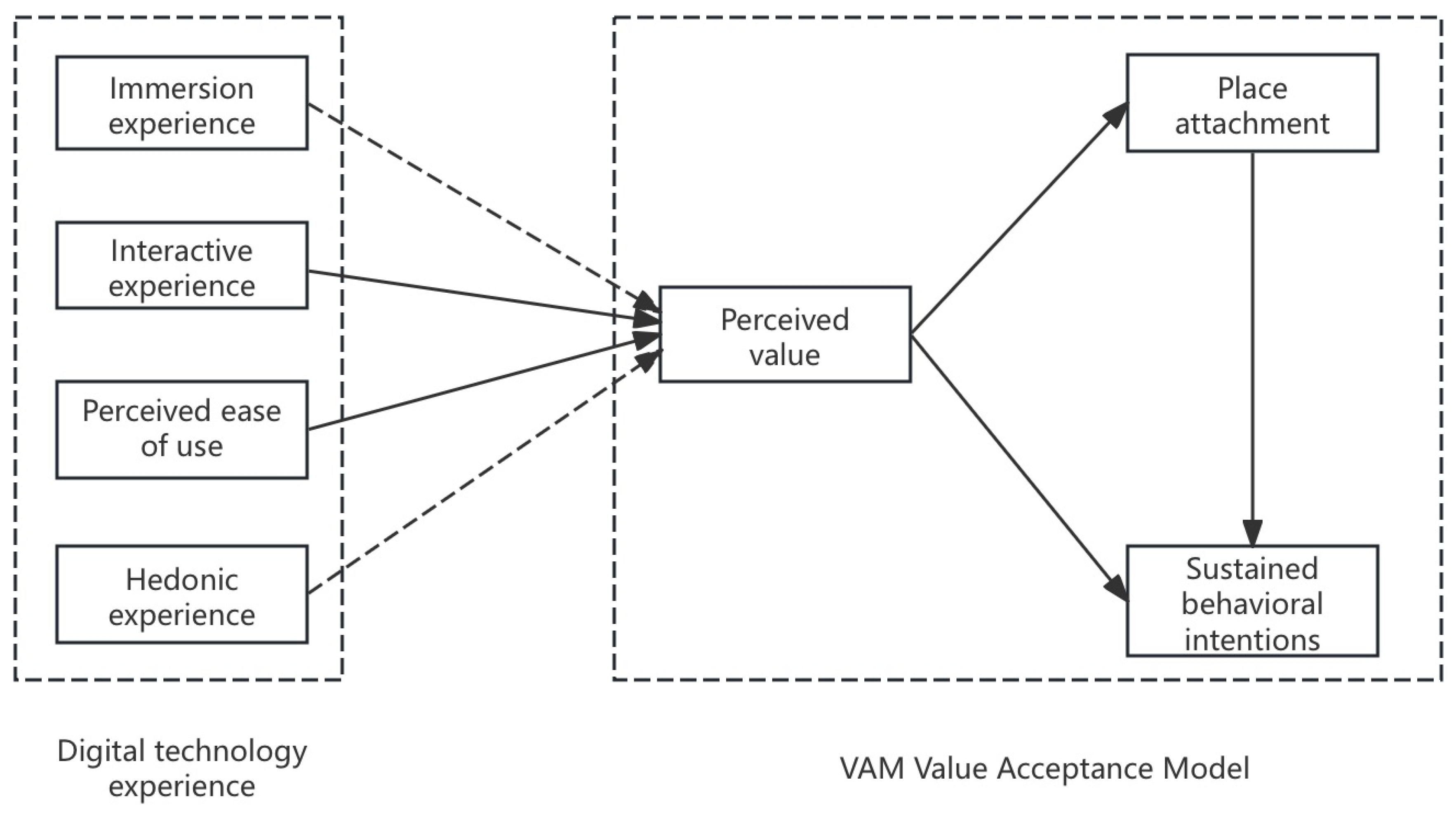
2.2. Tourism Digital Technology Experience
2.3. Impact of Cultural Heritage Digital Technology Experience on Perceived Value
2.3.1. Immersive Experience
2.3.2. Interactive Experience
2.3.3. Perceived Ease of Use (PEOU)
2.3.4. Hedonic Experience
2.4. Impact of Perceived Value on Place Attachment
2.5. Impact of Perceived Value on Cultural Heritage Sustained Behavioral Intention
2.6. Impact of Place Attachment on Cultural Heritage Sustained Behavioral Intentions
2.7. Sequential Mediation Mechanism of Perceived Value and Place Attachment
3. Research Design
3.1. Case Site Selection
3.2. Questionnaire Design
3.3. Data Collection and Sample Characteristics
3.4. Reliability and Validity
3.5. Data Analysis
3.5.1. CFA
3.5.2. SEM Analysis
4. Results and Analysis
4.1. Descriptive Statistics
4.2. Reliability and Validity Analysis
Multicollinearity and Common Method Bias Assessment
4.3. CFA
4.3.1. Composite Reliability and Convergent Validity Analysis
4.3.2. Discriminant Validity Analysis
4.3.3. Model Fit Analysis
4.4. SEM Testing and Analysis
4.4.1. SEM Fit Analysis
4.4.2. Path Analysis
4.5. Mediation Effects Testing (H8)
5. Discussion
6. Conclusions and Contributions
6.1. Conclusions
6.2. Theoretical Contributions
6.3. Practical Contributions
7. Limitations and Recommendations for Future Research
Author Contributions
Funding
Institutional Review Board Statement
Informed Consent Statement
Data Availability Statement
Conflicts of Interest
References
- Bec, A.; Moyle, B.; Schaffer, V.; Timms, K. Virtual reality and mixed reality for second chance tourism. Tour. Manag. 2021, 83, 104256. [Google Scholar] [CrossRef]
- Calisto, M.D.L.; Sarkar, S. A systematic review of virtual reality in tourism and hospitality: The known and the paths to follow. Int. J. Hosp. Manag. 2024, 116, 103623. [Google Scholar] [CrossRef]
- Choi, K.; Nam, Y. Do Presence and Authenticity in VR Experience Enhance Visitor Satisfaction and Museum Re-Visitation Intentions? Int. J. Tour. Res. 2024, 26, e2737. [Google Scholar] [CrossRef]
- Bruce, C.; Pittock, J. Museums in the Metaverse—Audiences and Impact Report; Museums Association: London, UK, 2024; p. 15. Available online: https://eprints.gla.ac.uk/367278/2/367278.pdf (accessed on 1 January 2025).
- Al-Gaoudi, H.A.; Marouf, M.A.; Badry, N.; Rehan, M. Design innovative strategies for coating archaeological linen textiles surface to achieve protective multifunctional properties. J. Cult. Herit. 2023, 59, 274–286. [Google Scholar] [CrossRef]
- Liu, Q.; Sutunyarak, C. The Impact of Immersive Technology in Museums on Visitors’ Behavioral Intention. Sustainability 2024, 16, 9714. [Google Scholar] [CrossRef]
- Tschirschwitz, F.; Richerzhagen, C.; Przybilla, H.-J.; Kersten, T.P. Duisburg 1566: Transferring a Historic 3D City Model from Google Earth into a Virtual Reality Application. PFG–J. Photogramm. Remote Sens. Geoinf. Sci. 2019, 87, 47–56. [Google Scholar] [CrossRef]
- Jiang, S.; Moyle, B.; Yung, R.; Tao, L.; Scott, N. Augmented reality and the enhancement of memorable tourism experiences at heritage sites. Curr. Issues Tour. 2023, 26, 242–257. [Google Scholar] [CrossRef]
- Xu, W.; Ismail, M.; Shahruddin, S.; Quan, W.; Li, Y. Exploring Tourists’ Intentions to Adopt Augmented Reality in Cultural Heritage Museums: Insights From a Modified Technology Acceptance Model. SAGE Open 2025, 15, 21582440251339936. [Google Scholar] [CrossRef]
- Wu, H.-C.; Li, T. A Study of Experiential Quality, Perceived Value, Heritage Image, Experiential Satisfaction, and Behavioral Intentions for Heritage Tourists. J. Hosp. Tour. Res. 2017, 41, 904–944. [Google Scholar] [CrossRef]
- Kumar, V.; Reinartz, W. Creating Enduring Customer Value. J. Mark. 2016, 80, 36–68. [Google Scholar] [CrossRef]
- Hoang, S.D.; Dey, S.K.; Ratilla, M.; Tučková, Z. Investigating the Antecedents of Ecotourism and Destination Loyalty Among Vietnamese Tourists: An Expectation–Confirmation Perspective. Glob. Bus. Rev. 2023, 12, 09721509231174740. [Google Scholar] [CrossRef]
- Wang, S.; Lai, I.K.W.; Wong, J.W.C. The impact of pluralistic values on postmodern tourists’ behavioural intention towards renovated heritage sites. Tour. Manag. Perspect. 2023, 49, 101175. [Google Scholar] [CrossRef]
- tom Dieck, M.C.; Jung, T.H. Value of augmented reality at cultural heritage sites: A stakeholder approach. J. Destin. Mark. Manag. 2017, 6, 110–117. [Google Scholar] [CrossRef]
- Bekele, M.K.; Pierdicca, R.; Frontoni, E.; Malinverni, E.S.; Gain, J. A Survey of Augmented, Virtual, and Mixed Reality for Cultural Heritage. J. Comput. Cult. Herit. 2018, 11, 1–36. [Google Scholar] [CrossRef]
- Zhang, B.; Jia, T.; Zhang, W. Determinants of users’ continuance intention of digital museums: A self-regulation perspective. Front. Public Health 2024, 12, 1338387. [Google Scholar] [CrossRef] [PubMed]
- Şeker, F.; Unur, K. The experience economy analysis of distinct destinations. J. Multidiscip. Acad. Tour. 2022, 7, 31–43. [Google Scholar] [CrossRef]
- Li, J.; Tu, X.-F.; Nie, J.-W.; Ye, J.; Lv, C. Visitors’ Acceptance of Wearable AR Technology in Museums. SAGE Open 2024, 14, 21582440241303507. [Google Scholar] [CrossRef]
- Tan, G.-S.; Ahmad, Z.; Ab. Aziz, K. Travelers’ Continuance Intention to Use Mobile Augmented Reality App in UNESCO World Heritage Sites: An Integrated Model of ECM and UTAUT. Tour. Hosp. 2025, 6, 192. [Google Scholar] [CrossRef]
- Wu, R.; Gao, L.; Li, J.; Xie, A.; Zhang, X. Exploring Key Factors Influencing the Processual Experience of Visitors in Metaverse Museum Exhibitions: An Approach Based on the Experience Economy and the SOR Model. Electronics 2025, 14, 3045. [Google Scholar] [CrossRef]
- Nguyen-Viet, B.; Van Nguyen, S. Authentic Experience, Place Attachment, and Behavioral Intention: Vietnamese Religious Tourism. SAGE Open 2023, 13, 21582440231216193. [Google Scholar] [CrossRef]
- Ramkissoon, H.; Graham Smith, L.D.; Weiler, B. Testing the dimensionality of place attachment and its relationships with place satisfaction and pro-environmental behaviours: A structural equation modelling approach. Tour. Manag. 2013, 36, 552–566. [Google Scholar] [CrossRef]
- Cheng, A.; Ma, D.; Pan, Y.; Qian, H. Enhancing Museum Visiting Experience: Investigating the Relationships Between Augmented Reality Quality, Immersion, and TAM Using PLS-SEM. Int. J. Hum.–Comput. Interact. 2024, 40, 4521–4532. [Google Scholar] [CrossRef]
- Choudhary, V.; Bag, T.; Mukherjee, S. Promotion of rural tourism through virtual reality: The impact of content richness on consumer’s perceived value and behavioral intention. J. Travel Tour. Mark. 2025, 42, 665–692. [Google Scholar] [CrossRef]
- tom Dieck, M.C.; Jung, T.H.; Rauschnabel, P.A. Determining visitor engagement through augmented reality at science festivals: An experience economy perspective. Comput. Hum. Behav. 2018, 82, 44–53. [Google Scholar] [CrossRef]
- Wang, Z.; Meng, J. Dialogues with cultural heritage via museum digitalisation: Developing a model of visitors’ cognitive identity, technological agent, cultural symbolism, and public engagement. Mus. Manag. Curatorship 2024, 39, 810–833. [Google Scholar] [CrossRef]
- Marto, A.; Gonçalves, A.; Melo, M.; Bessa, M. A survey of multisensory VR and AR applications for cultural heritage. Comput. Graph. 2022, 102, 426–440. [Google Scholar] [CrossRef]
- Xu, D.; Zhang, W.; Zhang, C.; Mao, R.; Wang, C. Digitally enriched exhibitions: Perspectives from Museum professionals. Tour. Manag. 2024, 105, 104970. [Google Scholar] [CrossRef]
- Zhang, A.; Gong, Y.; Chen, Q.; Jin, X.; Mu, Y.; Lu, Y. Driving Innovation and Sustainable Development in Cultural Heritage Education Through Digital Transformation: The Role of Interactive Technologies. Sustainability 2025, 17, 314. [Google Scholar] [CrossRef]
- Zhang, W.; Xue, Y.; Tang, S. The impact of cultural tourism digital humans in China on tourists’ travel intentions. Curr. Issues Tour. 2025, 4, 1–21. [Google Scholar] [CrossRef]
- Chen, Y.; Wang, X.; Le, B.; Wang, L. Why people use augmented reality in heritage museums: A socio-technical perspective. Herit. Sci. 2024, 12, 108. [Google Scholar] [CrossRef]
- Ding, Y.; Sun, J.; Leung, X.Y.; Liu, S. Museum experience and revisit intention: The impact of multitasking. Tour. Rev. 2025, 31, 1–27. [Google Scholar] [CrossRef]
- Melo, M.; Gonçalves, G.; Jorge, F.; Losada, N.; Barbosa, L.; Teixeira, M.S.; Bessa, M. The impact of virtual reality and biological sex on the promotion of tourist destinations: Effects on destination image, place attachment, and behavioural intention. J. Hosp. Tour. Technol. 2024, 15, 18–36. [Google Scholar] [CrossRef]
- Wang, F.; Huang, S.; Morrison, A.M.; Wu, B. The effects of virtual reality tourism involvement on place attachment and behavioral intentions: Virtual reality tourism of the Yellow Crane Tower in Wuhan. Asia Pac. J. Tour. Res. 2022, 27, 274–289. [Google Scholar] [CrossRef]
- Cranmer, E.E.; tom Dieck, M.C.; Fountoulaki, P. Exploring the value of augmented reality for tourism. Tour. Manag. Perspect. 2020, 35, 100672. [Google Scholar] [CrossRef]
- Zhou, Q.; Pu, Y. Impact of cultural heritage rejuvenation experience quality on perceived value, destination affective attachment, and revisiting intention: Evidence from China. Asia Pac. J. Tour. Res. 2022, 27, 192–205. [Google Scholar] [CrossRef]
- Vishwakarma, P.; Mukherjee, S.; Datta, B. Travelers’ intention to adopt virtual reality: A consumer value perspective. J. Destin. Mark. Manag. 2020, 17, 100456. [Google Scholar] [CrossRef]
- Wang, C.; Teo, T.S.H.; Liu, L. Perceived value and continuance intention in mobile government service in China. Telemat. Inform. 2020, 48, 101348. [Google Scholar] [CrossRef]
- Vieira, V.A.; Rafael, D.N.; Agnihotri, R. Augmented reality generalizations: A meta-analytical review on consumer-related outcomes and the mediating role of hedonic and utilitarian values. J. Bus. Res. 2022, 151, 170–184. [Google Scholar] [CrossRef]
- Kim, H.-W.; Chan, H.C.; Gupta, S. Value-based Adoption of Mobile Internet: An empirical investigation. Decis. Support Syst. 2007, 43, 111–126. [Google Scholar] [CrossRef]
- Blut, M.; Chaney, D.; Lunardo, R.; Mencarelli, R.; Grewal, D. Customer Perceived Value: A Comprehensive Meta-analysis. J. Serv. Res. 2024, 27, 501–524. [Google Scholar] [CrossRef]
- Hsu, C.-L.; Lin, J.C.-C. Effect of perceived value and social influences on mobile app stickiness and in-app purchase intention. Technol. Forecast. Soc. Change 2016, 108, 42–53. [Google Scholar] [CrossRef]
- Yu, H.; Seo, I.; Choi, J. A study of critical factors affecting adoption of self-customisation service-focused on value-based adoption model. Total Qual. Manag. Bus. Excell. 2019, 30, S98–S113. [Google Scholar] [CrossRef]
- Mathavan, B.; Vafaei-Zadeh, A.; Hanifah, H.; Ramayah, T.; Kurnia, S. Understanding the purchase intention of fitness wearables: Using value-based adoption model. Asia-Pac. J. Bus. Adm. 2022, 16, 101–126. [Google Scholar] [CrossRef]
- Du, K.; Ryu, M.H. Use of Robotaxi Services for Sustainable Transportation: Focusing on Their Perceived Benefits and Sacrifices as Well as Consumers’ Technology Readiness. Sustainability 2025, 17, 8020. [Google Scholar] [CrossRef]
- Qiu, N.; Li, H.; Pan, C.; Wu, J.; Guo, J. The study on the relationship between perceived value, satisfaction, and tourist loyalty at industrial heritage sites. Heliyon 2024, 10, e37184. [Google Scholar] [CrossRef]
- Qian, J.; Li, X. Perceived Value, Place Identity, and Behavioral Intention: An Investigation on the Influence Mechanism of Sustainable Development in Rural Tourism. Sustainability 2024, 16, 1583. [Google Scholar] [CrossRef]
- Cheng, Z.; Chen, X. The Effect of Tourism Experience on Tourists’ Environmentally Responsible Behavior at Cultural Heritage Sites: The Mediating Role of Cultural Attachment. Sustainability 2022, 14, 565. [Google Scholar] [CrossRef]
- Larsen, S. Aspects of a Psychology of the Tourist Experience. Scand. J. Hosp. Tour. 2007, 7, 7–18. [Google Scholar] [CrossRef]
- Otto, J.E.; Brent Ritchie, J.R. Exploring the quality of the service experience: A theoretical and empirical analysis. Adv. Serv. Mark. Manag. 1995, 4, xvii–xix. [Google Scholar] [CrossRef]
- Otto, J.E.; Ritchie, J.R.B. The service experience in tourism. Tour. Manag. 1996, 17, 165–174. [Google Scholar] [CrossRef]
- Kim, J.H.; Ritchie, J.R.B.; McCormick, B. Development of a scale to measure memorable tourism experiences. J. Travel Res. 2012, 51, 12–25. [Google Scholar] [CrossRef]
- Mortara, M.; Catalano, C.E.; Bellotti, F.; Fiucci, G.; Houry-Panchetti, M.; Petridis, P. Learning cultural heritage by serious games. J. Cult. Herit. 2014, 15, 318–325. [Google Scholar] [CrossRef]
- Assiouras, I.; Giannopoulos, A.; Mavragani, E.; Buhalis, D. Virtual reality facilitated travel inspiration: The role of pleasure and arousal. Curr. Issues Tour. 2024, 28, 1–14. [Google Scholar] [CrossRef]
- Loureiro, S.M.C.; Guerreiro, J.; Ali, F. 20 years of research on virtual reality and augmented reality in tourism context: A text-mining approach. Tour. Manag. 2020, 77, 104028. [Google Scholar] [CrossRef]
- Tussyadiah, I.P.; Wang, D.; Jung, T.H.; tom Dieck, M.C. Virtual reality, presence, and attitude change: Empirical evidence from tourism. Tour. Manag. 2018, 66, 140–154. [Google Scholar] [CrossRef]
- Slater, M.; Sanchez-Vives, M.V. Enhancing Our Lives with Immersive Virtual Reality. Front. Robot. AI 2016, 3, 74. [Google Scholar] [CrossRef]
- Lee, H.; Jung, T.H.; tom Dieck, M.C.; Chung, N. Experiencing immersive virtual reality in museums. Inf. Manag. 2020, 57, 103229. [Google Scholar] [CrossRef]
- Li, J.; Zhou, L.; Wei, W. Analyzing Factors Influencing Learning Motivation in Online Virtual Museums Using the S-O-R Model: A Case Study of the National Museum of Natural History. Information 2025, 16, 573. [Google Scholar] [CrossRef]
- Li, T.; Chen, Y. Will virtual reality be a double-edged sword? Exploring the moderation effects of the expected enjoyment of a destination on travel intention. J. Destin. Mark. Manag. 2019, 12, 15–26. [Google Scholar] [CrossRef]
- Zhu, C.; Io, M.-U.; Hall, C.M.; Ngan, H.F.B.; Peralta, R.L. Exploring the influence of augmented reality on tourist word-of-mouth through the lens of museum tourism. J. Herit. Tour. 2025, 20, 78–91. [Google Scholar] [CrossRef]
- Csikszentmihalyi, M. Flow: The Psychology of Optimal Experience; Harper & Row: New York, NY, USA, 1990. [Google Scholar]
- Kaplan, S. The restorative benefits of nature: Toward an integrative framework. J. Environ. Psychol. 1995, 15, 169–182. [Google Scholar] [CrossRef]
- Irimiás, A.; Mitev, A.Z.; Michalkó, G. Narrative transportation and travel: The mediating role of escapism and immersion. Tour. Manag. Perspect. 2021, 38, 100793. [Google Scholar] [CrossRef]
- Fan, X.; Jiang, X.; Deng, N. Immersive technology: A meta-analysis of augmented/virtual reality applications and their impact on tourism experience. Tour. Manag. 2022, 91, 104534. [Google Scholar] [CrossRef]
- Zeithaml, V.A. Consumer Perceptions of Price, Quality, and Value: A Means-End Model and Synthesis of Evidence. J. Mark. 1988, 52, 2–22. [Google Scholar] [CrossRef]
- Valverde-Roda, J.; Moral-Cuadra, S.; Aguilar-Rivero, M.; Solano-Sánchez, M.Á. Perceived value, satisfaction and loyalty in a World Heritage Site Alhambra and Generalife (Granada, Spain). Int. J. Tour. Cities 2022, 8, 949–964. [Google Scholar] [CrossRef]
- Zheng, F.; Wu, S.; Liu, R.; Bai, Y. What influences user continuous intention of digital museum: Integrating task-technology fit (TTF) and unified theory of acceptance and usage of technology (UTAUT) models. Herit. Sci. 2024, 12, 253. [Google Scholar] [CrossRef]
- Li, Y.; Song, H.; Guo, R. A Study on the Causal Process of Virtual Reality Tourism and Its Attributes in Terms of Their Effects on Subjective Well-Being during COVID-19. Int. J. Environ. Res. Public Health 2021, 18, 1019. [Google Scholar] [CrossRef]
- Zhu, L.; Wang, Y. Technological Innovation in Promoting the Sustainable Development of Tourist Factories: Factors Influencing Tourists’ Perceived Value and Loyalty in Immersive VR Experiences. Sustainability 2025, 17, 2871. [Google Scholar] [CrossRef]
- Steuer, J. Defining Virtual Reality: Dimensions Determining Telepresence. J. Commun. 1993, 42, 73–93. [Google Scholar] [CrossRef]
- Billinghurst, M.; Clark, A.; Lee, G. A Survey of Augmented Reality. Found. Trends Hum.–Comput. Interact. 2015, 8, 73–272. [Google Scholar] [CrossRef]
- Flavián, C.; Ibáñez-Sánchez, S.; Orús, C. The impact of virtual, augmented and mixed reality technologies on the customer experience. J. Bus. Res. 2019, 100, 547–560. [Google Scholar] [CrossRef]
- Uhm, J.-P.; Kim, S.; Do, C.; Lee, H.-W. How augmented reality (AR) experience affects purchase intention in sport E-commerce: Roles of perceived diagnosticity, psychological distance, and perceived risks. J. Retail. Consum. Serv. 2022, 67, 103027. [Google Scholar] [CrossRef]
- Davis, F.D. Perceived Usefulness, Perceived Ease of Use, and User Acceptance of Information Technology. MIS Q. 1989, 13, 319–340. [Google Scholar] [CrossRef]
- De Paolis, L.T.; Gatto, C.; Corchia, L.; De Luca, V. Usability, user experience and mental workload in a mobile Augmented Reality application for digital storytelling in cultural heritage. Virtual Real. 2023, 27, 1117–1143. [Google Scholar] [CrossRef]
- Li, J.; Lv, C. Exploring user acceptance of online virtual reality exhibition technologies: A case study of Liangzhu Museum. PLoS ONE 2024, 19, e0308267. [Google Scholar] [CrossRef]
- Holbrook, M.B.; Hirschman, E.C. The Experiential Aspects of Consumption: Consumer Fantasies, Feelings, and Fun. J. Consum. Res. 1982, 9, 132–140. [Google Scholar] [CrossRef]
- Shi, M.; Deng, L.; Zhang, M.; Long, Y. How telepresence and perceived enjoyment mediate the relationship between interaction quality and continuance intention: Evidence from China Zisha-ware Digital Museum. PLoS ONE 2025, 20, e0317784. [Google Scholar] [CrossRef]
- Makransky, G.; Lilleholt, L. A structural equation modeling investigation of the emotional value of immersive virtual reality in education. Educ. Technol. Res. Dev. 2018, 66, 1141–1164. [Google Scholar] [CrossRef]
- Oghuma, A.P.; Libaque-Saenz, C.F.; Wong, S.F.; Chang, Y. An expectation-confirmation model of continuance intention to use mobile instant messaging. Telemat. Inform. 2016, 33, 34–47. [Google Scholar] [CrossRef]
- Gallarza, M.G.; Arteaga, F.; Gil-Saura, I. Customer value in tourism and hospitality: Broadening dimensions and stretching the value-satisfaction-loyalty chain. Tour. Manag. Perspect. 2019, 31, 254–268. [Google Scholar] [CrossRef]
- Lewicka, M. Place attachment: How far have we come in the last 40 years? J. Environ. Psychol. 2011, 31, 207–230. [Google Scholar] [CrossRef]
- Halpenny, E.A. Pro-environmental behaviours and park visitors: The effect of place attachment. J. Environ. Psychol. 2010, 30, 409–421. [Google Scholar] [CrossRef]
- Rezapouraghdam, H.; Akhshik, A.; Strzelecka, M.; Roudi, S.; Ramkissoon, H. Fascination, Place Attachment, and Environmental Stewardship in Cultural Tourism Destinations. Tour. Recreat. Res. 2025, 50, 1577–1593. [Google Scholar] [CrossRef]
- Chan, S.H.G.; Lee, W.H.H.; Tang, B.M.; Chen, Z. Legacy of culture heritage building revitalization: Place attachment and culture identity. Front. Psychol. 2024, 14, 1314223. [Google Scholar] [CrossRef]
- Li, H.; Bibi, S.; Kanwel, S.; Khan, A.; Hussain, B. Understanding of cultural heritage tourists’ emotional experiences: How place attachment and satisfaction determine behavioral intentions. Acta Psychol. 2025, 259, 105429. [Google Scholar] [CrossRef]
- Zhang, J.; Zou, Y.; Li, Y.; Peng, C.; Jin, D. Embodied power: How do museum tourists’ sensory experiences affect place identity? J. Hosp. Tour. Manag. 2024, 60, 334–346. [Google Scholar] [CrossRef]
- Yang, L.; Liu, J. The moderating effect of visual landscape and soundscape on place attachment in world cultural heritage: A case study in Kulangsu, China. NPJ Herit. Sci. 2025, 13, 94. [Google Scholar] [CrossRef]
- Fu, Y.; Dong, W. How perceived value, environmental awareness, and social identity shape public support for industrial heritage: The mediating role of place attachment. Front. Psychol. 2025, 16, 1645646. [Google Scholar] [CrossRef]
- Zeithaml, V.A.; Berry, L.L.; Parasuraman, A. The Behavioral Consequences of Service Quality. J. Mark. 1996, 60, 31–46. [Google Scholar] [CrossRef]
- Chen, C.-F.; Chen, F.-S. Experience quality, perceived value, satisfaction and behavioral intentions for heritage tourists. Tour. Manag. 2010, 31, 29–35. [Google Scholar] [CrossRef]
- Ambalov, I.A. A meta-analysis of IT continuance: An evaluation of the expectation-confirmation model. Telemat. Inform. 2018, 35, 1561–1571. [Google Scholar] [CrossRef]
- Gu, M.; Zhao, T. Research on the purchase intention of museum digital cultural and creative products based on value adoption model. Sci. Rep. 2025, 15, 18184. [Google Scholar] [CrossRef] [PubMed]
- Hao, X.; Xu, J.; Wang, Y. How generative AI shapes user perceived value and adoption intention in digital museum experiences. NPJ Herit. Sci. 2025, 13, 608. [Google Scholar] [CrossRef]
- Hosany, S.; Prayag, G.; Van Der Veen, R.; Huang, S.; Deesilatham, S. Mediating Effects of Place Attachment and Satisfaction on the Relationship between Tourists’ Emotions and Intention to Recommend. J. Travel Res. 2017, 56, 1079–1093. [Google Scholar] [CrossRef]
- Jiang, S.; Zhang, Z.; Xu, H.; Pan, Y. What Influences Users’ Continuous Behavioral Intention in Cultural Heritage Virtual Tourism: Integrating Experience Economy Theory and Stimulus–Organism–Response (SOR) Model. Sustainability 2024, 16, 10231. [Google Scholar] [CrossRef]
- Lin, Z.; Rasoolimanesh, S.M. Sharing tourism experiences in social media: A systematic review. Anatolia 2024, 35, 67–81. [Google Scholar] [CrossRef]
- Hansen, T.; Olk, S.; Thomsen, T.U. A meta-analysis of sustainable tourist behavioral intention and the moderating effects of national culture. J. Sustain. Tour. 2024, 32, 883–903. [Google Scholar] [CrossRef]
- Pandža Bajs, I. Tourist Perceived Value, Relationship to Satisfaction, and Behavioral Intentions: The Example of the Croatian Tourist Destination Dubrovnik. J. Travel Res. 2015, 54, 122–134. [Google Scholar] [CrossRef]
- Zhou, X. Exploring the Influence of Mixed Reality Museum Design Features on Users’ Continued Usage Intention: Evidence from Pls-Sem; SSRN Scholarly Paper No. 5008168; Social Science Research Network: Rochester, NY, USA, 2024. [Google Scholar] [CrossRef]
- Buonincontri, P.; Marasco, A.; Ramkissoon, H. Visitors’ Experience, Place Attachment and Sustainable Behaviour at Cultural Heritage Sites: A Conceptual Framework. Sustainability 2017, 9, 1112. [Google Scholar] [CrossRef]
- Meng, W.; Dolah, J. From virtual museum experience quality to offline visit intention: A cultural identity mediation model for sustainable heritage engagement. Sustainability 2025, 17, 10664. [Google Scholar] [CrossRef]
- Zhang, Y.; Sotiriadis, M.; Shen, S. Investigating the impact of smart tourism technologies on tourists’ experiences. Sustainability 2022, 14, 3048. [Google Scholar] [CrossRef]
- Scannell, L.; Gifford, R. Defining place attachment: A tripartite organizing framework. J. Environ. Psychol. 2010, 30, 1–10. [Google Scholar] [CrossRef]
- Alatrash, S.; Arnab, S.; Antlej, K. Communicating engineering heritage through immersive technology: A VR framework for enhancing users’ interpretation process in virtual immersive environments. Comput. Educ. X Real. 2023, 3, 100040. [Google Scholar] [CrossRef]
- Jiang, C.; Wang, Y.; Liu, Y.; Zhang, H. Cultural odyssey in the metaverse: Investigating the impact of virtual technologies on tourist reuse behavior and social sustainability. Humanit. Soc. Sci. Commun. 2025, 12, 132. [Google Scholar] [CrossRef]
- Pan, Z.; Chen, Y.; Huang, Y.; Zheng, L. The vernacular cultural landscape in traditional villages: Global hotspots, emerging trends, and a case study of China’s Qilu cultural district. Front. Earth Sci. 2024, 12, 1511292. [Google Scholar] [CrossRef]
- Rong, W.; Bahauddin, A. The Heritage and Narrative of Confucian Courtyard and Architecture in Sustainable Development in Shandong, China. Plan. Malays. 2023, 21, 180–193. [Google Scholar] [CrossRef]
- Deng, Y.; Zhang, X.; Zhang, B.; Zhang, B.; Qin, J. From digital museuming to on-site visiting: The mediation of cultural identity and perceived value. Front. Psychol. 2023, 14, 1111917. [Google Scholar] [CrossRef]
- Jin, N.P.; Lee, S.; Lee, H. The Effect of Experience Quality on Perceived Value, Satisfaction, Image and Behavioral Intention of Water Park Patrons: New versus Repeat Visitors. Int. J. Tour. Res. 2015, 17, 82–95. [Google Scholar] [CrossRef]
- Shipps, B.; Phillips, B. Social Networks, Interactivity and Satisfaction: Assessing Socio-Technical Behavioral Factors as an Extension to Technology Acceptance. J. Theor. Appl. Electron. Commer. Res. 2013, 8, 7–8. [Google Scholar] [CrossRef]
- Yersüren, S.; Özel, Ç.H. The effect of virtual reality experience quality on destination visit intention and virtual reality travel intention. J. Hosp. Tour. Technol. 2024, 15, 70–103. [Google Scholar] [CrossRef]
- Kim, M.J.; Hall, C.M. A hedonic motivation model in virtual reality tourism: Comparing visitors and non-visitors. Int. J. Inf. Manag. 2019, 46, 236–249. [Google Scholar] [CrossRef]
- Xie, Y. Enhancing the Effectiveness of Digital Museum Services: Through a Study of Perceived Value Theory. J. Knowl. Econ. 2023, 15, 13701–13726. [Google Scholar] [CrossRef]
- Hoang, T.D.T.; Brown, G.; Kim, A.K.J. Measuring resident place attachment in a World Cultural Heritage tourism context: The case of Hoi An (Vietnam). Curr. Issues Tour. 2020, 23, 2059–2075. [Google Scholar] [CrossRef]
- Luo, J.; Xia, M. Embracing Virtual Reality in Destination Marketing: A Serial Mediation Model to Investigate the Role of Virtual Tourism Experiences in the Formation of Place Attachment. Sustainability 2024, 16, 10551. [Google Scholar] [CrossRef]
- Yuksel, A.; Yuksel, F.; Bilim, Y. Destination attachment: Effects on customer satisfaction and cognitive, affective and conative loyalty. Tour. Manag. 2010, 31, 274–284. [Google Scholar] [CrossRef]
- Fan, X.; Yao, L.; Shi, B.; Wang, J.; Wu, G.; Shen, W. The effect of mixed emotions on the behavioral intentions of tourists at overseas Chinese cultural heritage sites: With place attachment and memorable tourism experience as mediators. J. Tour. Cult. Change 2025, 23, 106–125. [Google Scholar] [CrossRef]
- Lin, C.-H.; Kuo, B.Z.-L. The Behavioral Consequences of Tourist Experience. Tour. Manag. Perspect. 2016, 18, 84–91. [Google Scholar] [CrossRef]
- Comrey, A.L.; Lee, H.B. A First Course in Factor Analysis, 2nd ed.; Lawrence Erlbaum Associates: Hillsdale, NJ, USA, 1992. [Google Scholar]
- Anderson, J.C.; Gerbing, D.W. Structural equation modeling in practice: A review and recommended two-step approach. Psychol. Bull. 1988, 103, 411–423. [Google Scholar] [CrossRef]
- Fornell, C.; Larcker, D.F. Evaluating Structural Equation Models with Unobservable Variables and Measurement Error. J. Mark. Res. 1981, 18, 39–50. [Google Scholar] [CrossRef]
- Eisinga, R.; te Grotenhuis, M.; Pelzer, B. The reliability of a two-item scale: Pearson, Cronbach, or Spearman-Brown? Int. J. Public Health 2013, 58, 637–642. [Google Scholar] [CrossRef]
- Hair, J.F.; Black, W.C.; Babin, B.J.; Anderson, R.E. Multivariate Data Analysis, 7th ed.; Pearson Prentice Hall: Upper Saddle River, NJ, USA, 2010. [Google Scholar]
- Podsakoff, P.M.; MacKenzie, S.B.; Lee, J.Y.; Podsakoff, N.P. Common method biases in behavioral research: A critical review of the literature and recommended remedies. J. Appl. Psychol. 2003, 88, 879–903. [Google Scholar] [CrossRef]
- Kline, R.B. Principles and Practice of Structural Equation Modeling, 1st ed.; The Guilford Press: New York, NY, USA, 1998. [Google Scholar]
- Hooper, D.; Coughlan, J.; Mullen, M.R. Structural Equation Modelling: Guidelines for Determining Model Fit. Electron. J. Bus. Res. Methods 2008, 6, 53–60. [Google Scholar]
- Marsh, H.W.; Hocevar, D. Application of confirmatory factor analysis to the study of self-concept: First- and higher order factor models and their invariance across groups. Psychol. Bull. 1985, 97, 562–582. [Google Scholar] [CrossRef]
- Sweller, J. Cognitive load during problem solving: Effects on learning. Cogn. Sci. 1988, 12, 257–285. [Google Scholar] [CrossRef]
- Ryan, R.M.; Deci, E.L. Self-determination theory and the facilitation of intrinsic motivation, social development, and well-being. Am. Psychol. 2000, 55, 68–78. [Google Scholar] [CrossRef] [PubMed]
- Packer, J.; Ballantyne, R. Conceptualizing the Visitor Experience: A Review of Literature and Development of a Multifaceted Model. Visitor Stud. 2016, 19, 128–143. [Google Scholar] [CrossRef]
- Ma, D.; Cheng, A.; Qian, H. Exploring the structural relationships between augmented reality quality, perceived value, and psychological well-being in museum applications: A PLS-SEM analysis. Libr. Hi Tech 2024, 43, 1137–1156. [Google Scholar] [CrossRef]
- Chen, D. How Visitors Perceive Heritage Value—A Quantitative Study on Visitors’ Perceived Value and Satisfaction of Architectural Heritage through SEM. Sustainability 2023, 15, 9002. [Google Scholar] [CrossRef]
- Zhou, G.; Chen, W.; Wu, Y. Research on the Effect of Authenticity on Revisit Intention in Heritage Tourism. Front. Psychol. 2022, 13, 883380. [Google Scholar] [CrossRef]
- Mazzanti, P.; Ferracani, A.; Bertini, M.; Principi, F. Reshaping Museum Experiences with AI: The ReInHerit Toolkit. Heritage 2025, 8, 277. [Google Scholar] [CrossRef]
- Jones, S.; Jeffrey, S.; Maxwell, M.; Hale, A.; Jones, C. 3D heritage visualisation and the negotiation of authenticity: The ACCORD project. Int. J. Herit. Stud. 2018, 24, 333–353. [Google Scholar] [CrossRef]
- Maulina, A.; Sukoco, I.; Hermanto, B.; Kostini, N. Tourists’ Revisit Intention and Electronic Word-of-Mouth at Adaptive Reuse Building in Batavia Jakarta Heritage. Sustainability 2023, 15, 14227. [Google Scholar] [CrossRef]
- Campos, A.C.; Mendes, J.; Valle, P.O.; Scott, N. Co-creation of tourist experiences: A literature review. Curr. Issues Tour. 2018, 21, 369–400. [Google Scholar] [CrossRef]

| Variable | Category | Number | Percentage |
|---|---|---|---|
| Gender | Female | 307 | 49.7 |
| Male | 311 | 50.3 | |
| Education Level | Junior high school and below | 65 | 10.5 |
| High school (including technical secondary school) | 80 | 12.9 | |
| Junior college | 161 | 26.1 | |
| Bachelor’s degree | 215 | 34.8 | |
| Master’s degree and above | 97 | 15.7 | |
| Age | Under 18 years old | 1 | 0.2 |
| 18–30 years old | 372 | 60.2 | |
| 31–44 years old | 192 | 31.1 | |
| 45–60 years old | 37 | 6 | |
| 60 years old and above | 16 | 2.6 | |
| Occupation | Government and public institution staff | 94 | 15.2 |
| Enterprise staff | 211 | 34.1 | |
| Industrial and agricultural workers | 37 | 6 | |
| Self-employed | 18 | 2.9 | |
| Retirees | 17 | 2.8 | |
| Students | 241 | 39 | |
| Monthly Income Level | Below 3000 yuan | 41 | 6.6 |
| 3000–5000 yuan | 64 | 10.4 | |
| 5001–7000 yuan | 317 | 51.3 | |
| 7001–10,000 yuan | 113 | 18.3 | |
| Above 10,000 yuan | 83 | 13.4 | |
| Daily Internet Time | Less than 3 h | 81 | 13.1 |
| 3–5 h | 256 | 41.4 | |
| 5–7 h | 137 | 22.2 | |
| 7–9 h | 38 | 6.1 | |
| More than 9 h | 106 | 17.2 |
| Variable | Item | Item Description | Factor Loading |
|---|---|---|---|
| Immersive Experience (IE, α = 0.831) | IE1 | I feel like I have entered a whole new world | 0.816 |
| IE2 | I feel as if I have traveled through time and space, living in another era or place | 0.753 | |
| IE3 | I can immerse myself in the historical context and imagine myself becoming another person | 0.773 | |
| IE4 | I temporarily escape from the real world | 0.800 | |
| Interactive Experience (IX, α = 0.830) | IX1 | I can freely choose the content I want to see | 0.766 |
| IX2 | Each of my operations receives a good response | 0.765 | |
| IX3 | I can interact in real-time and get timely feedback | 0.790 | |
| IX4 | I can feel a connection with people and do not feel lonely | 0.791 | |
| Perceived Ease of Use (PEOU, α = 0.845) | PEOU1 | Learning how to use these digital technologies is easy | 0.811 |
| PEOU2 | The operation instructions are clear and easy to understand | 0.803 | |
| PEOU3 | I can quickly master the use of these digital technologies | 0.811 | |
| PEOU4 | These digital technologies are easy to use | 0.805 | |
| Hedonic Experience (HE, α = 0.866) | HE1 | The digital technology experience is exciting | 0.793 |
| HE2 | The digital technology experience is pleasant | 0.800 | |
| HE3 | The digital technology experience is full of fun | 0.800 | |
| HE4 | The digital technology experience is satisfying | 0.780 | |
| Perceived Value (PV, α = 0.976) | PV1 | The visiting experience is vivid and interesting | 0.876 |
| PV2 | The visiting process is easy and convenient | 0.882 | |
| PV3 | The museum deeply explores the value of collections in history, art, and technology | 0.878 | |
| PV4 | Through digital technology, I can more easily acquire knowledge and broaden my horizons | 0.870 | |
| PV5 | My mood is relaxed and pleasant during the visit | 0.887 | |
| PV6 | This experience touched my inner emotions | 0.891 | |
| PV7 | I can immerse myself in the atmosphere and resonate with the exhibition content | 0.895 | |
| PV8 | I am willing to visit again | 0.870 | |
| PV9 | I can’t wait to share this visiting experience with family and friends | 0.891 | |
| PV10 | My cultural appreciation ability has been enhanced | 0.865 | |
| PV11 | My influence on relatives and friends in terms of ideology and values has improved | 0.884 | |
| Place Attachment (PA, α = 0.947) | PA1 | This museum is a very special place to me | 0.638 |
| PA2 | This museum has great significance for me | 0.619 | |
| PA3 | I fully recognize the cultural and historical value conveyed by this museum | 0.696 | |
| PA4 | The heritage presented makes me feel proud | 0.664 | |
| PA5 | I feel a strong emotional attachment to this museum | 0.660 | |
| PA6 | I felt a strong sense of belonging to this museum | 0.651 | |
| Sustained Behavioral Intentions (SBI, α = 0.931) | SBI1 | I will recommend others to visit this museum | 0.542 |
| SBI2 | I will visit this museum again in the future | 0.568 | |
| SBI3 | I will share my experience at this museum with others | 0.555 |
| Variable | Measurement Item | Factor Loading | Average Variance Extracted (AVE) | Composite Reliability |
|---|---|---|---|---|
| Immersive Experience (IE) | IE1 | 0.779 | 0.555 | 0.833 |
| IE2 | 0.705 | |||
| IE3 | 0.724 | |||
| IE4 | 0.768 | |||
| Interactive Experience (IX) | IX1 | 0.715 | 0.551 | 0.831 |
| IX2 | 0.732 | |||
| IX3 | 0.758 | |||
| IX4 | 0.764 | |||
| Perceived Ease of Use (PEOU) | PEOU1 | 0.726 | 0.582 | 0.847 |
| PEOU2 | 0.787 | |||
| PEOU3 | 0.754 | |||
| PEOU4 | 0.782 | |||
| Hedonic Experience (HE) | HE1 | 0.783 | 0.619 | 0.867 |
| HE2 | 0.810 | |||
| HE3 | 0.793 | |||
| HE4 | 0.761 | |||
| Perceived Value (PV) | PV1 | 0.893 | 0.788 | 0.976 |
| PV2 | 0.895 | |||
| PV3 | 0.885 | |||
| PV4 | 0.871 | |||
| PV5 | 0.891 | |||
| PV6 | 0.892 | |||
| PV7 | 0.897 | |||
| PV8 | 0.871 | |||
| PV9 | 0.898 | |||
| PV10 | 0.875 | |||
| PV11 | 0.894 | |||
| Place Attachment (PA) | PA1 | 0.874 | 0.748 | 0.947 |
| PA2 | 0.874 | |||
| PA3 | 0.892 | |||
| PA4 | 0.847 | |||
| PA5 | 0.858 | |||
| PA6 | 0.843 | |||
| Sustained Behavioral Intentions (SBI) | SBI1 | 0.907 | 0.819 | 0.931 |
| SBI2 | 0.890 | |||
| SBI3 | 0.917 |
| AVE | IE | IX | PEOU | HE | PV | PA | SBI | |
|---|---|---|---|---|---|---|---|---|
| IE | 0.555 | 0.745 | ||||||
| IX | 0.551 | 0.107 | 0.742 | |||||
| PEOU | 0.582 | 0.101 | 0.118 | 0.763 | ||||
| HE | 0.619 | 0.078 | 0.091 | 0.043 | 0.787 | |||
| PV | 0.788 | 0.133 | 0.327 | 0.334 | 0.101 | 0.888 | ||
| PA | 0.748 | 0.422 | 0.476 | 0.159 | 0.606 | 0.409 | 0.865 | |
| SBI | 0.819 | 0.386 | 0.397 | 0.293 | 0.247 | 0.694 | 0.586 | 0.905 |
| Hypothesis | Path and Hypothesis | Standardized Path Coefficient | Standard Error | Composite Reliability | p |
|---|---|---|---|---|---|
| H1 | IE ⟶ PV | 0.077 | 0.052 | 1.862 | 0.063 |
| H2 | IX ⟶ PV | 0.285 | 0.052 | 6.632 | *** |
| H3 | PEOU ⟶ PV | 0.292 | 0.050 | 6.894 | *** |
| H4 | HE ⟶ PV | 0.063 | 0.053 | 1.558 | 0.119 |
| H5 | PV ⟶ PA | 0.414 | 0.037 | 10.351 | *** |
| H6 | PV ⟶ SBI | 0.547 | 0.034 | 15.779 | *** |
| H7 | PA ⟶ SBI | 0.362 | 0.035 | 10.821 | *** |
| Paths | β [95% CI] |
|---|---|
| Total effects (c) | |
| IE ⟶ SBI | 0.22 *** [0.12, 0.33] |
| IX ⟶ SBI | 0.39 *** [0.27, 0.51] |
| HE ⟶ SBI | 0.18 ** [0.18, 0.45] |
| PEOU ⟶ SBI | 0.15 ** [0.15, 0.45] |
| Mediation effects | |
| IE ⟶ PV ⟶ PA ⟶ SBI | 0.16 *** [0.06, 0.64] |
| IX ⟶ PV ⟶ PA ⟶ SBI | 0.12 * [0.01, 0.76] |
| HE ⟶ PV ⟶ PA ⟶ SBI | 0.60 [−0.29, 0.80] |
| PEOU ⟶ PV ⟶ PA ⟶ SBI | 0.10 [−0.06, 0.064] |
| Mediation Path | β | 95% CI | Result |
|---|---|---|---|
| IE ⟶ PV ⟶ PA ⟶ SBI | 0.16 *** | [0.06, 0.64] | Supported |
| IX ⟶ PV ⟶ PA ⟶ SBI | 0.12 * | [0.01, 0.76] | Supported |
| HE ⟶ PV ⟶ PA ⟶ SBI | 0.60 | [−0.29, 0.80] | Not supported |
| PEOU ⟶ PV ⟶ PA ⟶ SBI | 0.10 | [−0.06, 0.64] | Not supported |
Disclaimer/Publisher’s Note: The statements, opinions and data contained in all publications are solely those of the individual author(s) and contributor(s) and not of MDPI and/or the editor(s). MDPI and/or the editor(s) disclaim responsibility for any injury to people or property resulting from any ideas, methods, instructions or products referred to in the content. |
© 2026 by the authors. Licensee MDPI, Basel, Switzerland. This article is an open access article distributed under the terms and conditions of the Creative Commons Attribution (CC BY) license.
Share and Cite
Meng, L.; Zhu, Z.-Y. How Does Digital Experience of Cultural Heritage Transform into Sustained Behavioral Intention? Assessing Perceived Value and Place Attachment Mechanisms Based on Value Adoption Model. Sustainability 2026, 18, 1470. https://doi.org/10.3390/su18031470
Meng L, Zhu Z-Y. How Does Digital Experience of Cultural Heritage Transform into Sustained Behavioral Intention? Assessing Perceived Value and Place Attachment Mechanisms Based on Value Adoption Model. Sustainability. 2026; 18(3):1470. https://doi.org/10.3390/su18031470
Chicago/Turabian StyleMeng, Lingsen, and Zong-Yi Zhu. 2026. "How Does Digital Experience of Cultural Heritage Transform into Sustained Behavioral Intention? Assessing Perceived Value and Place Attachment Mechanisms Based on Value Adoption Model" Sustainability 18, no. 3: 1470. https://doi.org/10.3390/su18031470
APA StyleMeng, L., & Zhu, Z.-Y. (2026). How Does Digital Experience of Cultural Heritage Transform into Sustained Behavioral Intention? Assessing Perceived Value and Place Attachment Mechanisms Based on Value Adoption Model. Sustainability, 18(3), 1470. https://doi.org/10.3390/su18031470

