


Abstract
As transparency and sustainability gain strategic importance, the mass balance approach under chain of custody (MB-CoC) has become a central mechanism for assessing product carbon footprints (PCFs) in complex chemical value chains. The MB-CoC enables the attribution of renewable and recycled feedstock characteristics via certified bookkeeping when physical segregation or molecular tracing is infeasible—thus complementing PCF methodologies based on ISO 14067 and the LCA standards ISO 14040/44. However, the methodological integration of the MB-CoC into ISO-conformant PCFs remains insufficiently defined and empirically underexplored. This paper systematically reviews the interaction between the MB-CoC and PCF/LCA frameworks. It (i) synthesizes the allocation rules of ISO 14040/44/67 and the attribution principles of the MB-CoC according to ISO 22095 and key industry initiatives; (ii) analyzes academic publications, guidelines, and corporate applications; and (iii) identifies methodological tensions concerning system boundaries, allocation logic, residual mixes, treatment of biogenic and recycled carbon, and risks of double counting. Our review reveals five recurring insights across the literature: the need for certification and standardization; the importance of primary data and residual mixes; the requirement for ISO conformity; the necessity of transparent reporting of conventional versus alternative inputs; and the lack of independent empirical case studies. Addressing these gaps through harmonized rules, residual mix development, and comparative applications will be essential for establishing the MB-CoC as a robust instrument for circularity, decarbonization, and regulatory compliance, developed by interdisciplinary research and industry approaches.
1. Introduction
Given the accelerating pace of climate change, the Paris Agreement (United Nations) requires substantial reductions in greenhouse gas (GHG) emissions along global value chains [1]. According to the Sixth Assessment Report of the Intergovernmental Panel on Climate Change (IPCC), industrial processes accounted for approximately one-quarter of global energy-related emissions in 2019 and, without additional mitigation measures, these emissions are projected to increase significantly by 2050 [2].
To quantify emissions at the product level, the product carbon footprint (PCF) methodology according to ISO 14067, based on life cycle assessment (LCA) ISO 14040 and ISO 14044 standards, has been established [3,4,5]. These ISO standards provide robust frameworks that ensure the transparency, comparability, and verifiability of results. However, the PCF methodology faces limitations when material flows in complex chemical reactions can no longer be traced according to physical relationships. This leads to uncertainties in allocation and risks of double counting [6,7].
The mass balance approach under chain of custody (MB-CoC) can offer a solution in such cases [8] since it does not rely on tracking physical material flows but instead distributes certified amounts of sustainable inputs via bookkeeping. This allows sustainable content to be declared in chemical products, even though the molecules can no longer be physically separated after the chemical reaction.
Nevertheless, to date, the methodological integration of the MB-CoC into PCF calculations remains insufficiently clarified. So far, only a few industry initiatives have addressed this issue, and independent empirical studies applying both approaches in combination remain rare.
Against this background, the present study pursues three objectives. First, it analyzes the allocation rules of ISO 14040/44/67 and the attribution rules of the MB-CoC according to ISO 22095 [8] and selected industry initiatives in order to compare both approaches and identify potential synergies and discrepancies. Second, it investigates the current state of research and practice on combining the MB-CoC and PCF. Third, it systematizes the findings through a literature review and identifies commonalities, challenges, and research needs.
2. Theoretical Background
In the field of sustainable chemistry and product carbon footprinting, two methodological domains are particularly relevant: LCA and the MB-CoC, applied within chemical value chains. While experts in environmental assessment are typically well versed in LCA principles, and professionals in the chemical industry possess a deep understanding of MB systems and CoC models, it is less common for individuals to have detailed expertise in both areas. This knowledge gap might hinder the integration of environmental evaluation methods with practical accounting systems for material and carbon flows. Therefore, the following sections provide a concise theoretical background on both approaches, establishing a common foundation for the subsequent discussion and ensuring that all readers share a coherent understanding of the underlying concepts.
2.1. Life Cycle Assessment (LCA)
LCA, according to ISO 14040/44, is a standardized method for evaluating the potential environmental impacts of a product throughout its entire life cycle. It quantifies the inputs, outputs, and potential environmental impacts of a product system across all life cycle stages. LCA supports both the development of products and processes, as well as the communication of environmental performance, by enabling a comprehensive evaluation of impacts [3,4].
An LCA consists of four phases: (i) goal and scope definition, (ii) life cycle inventory (LCI), (iii) life cycle impact assessment (LCIA), and (iv) interpretation. In the first phase, the goal and scope are defined, including the specification of the functional unit (FU), which serves as the reference basis for subsequent phases. In the second phase (LCI), data are collected and assessed and then related to subprocesses and normalized to the FU. In the third phase (LCIA), all LCI emissions are assigned to impact categories (e.g., global warming potential, acidification potential, and eutrophication potential). Within each category, elementary flows are multiplied by characterization factors and aggregated into impact indicator values (e.g., kg CO2e). For instance, methane has a characterization factor of 25 kg CO2e/kg CH4, which is why 0.5 g of methane released into the atmosphere has a global warming potential of 12.5 g CO2e (0.5 g CH4 × 25 kg CO2e/kg CH4 = 12.5 g CO2e). In the fourth phase (interpretation), significant parameters are identified; completeness, sensitivity, and consistency checks are performed; and conclusions, limitations, and recommendations are drawn [3,4].
The PCF defined in ISO 14067 is a specific form of LCA that restricts LCIA to the impact category global warming potential (GWP) while following the requirements of ISO 14040/44 [5].
2.2. Allocation in Life Cycle Assessment
In processes that yield more than one product (multi-output processes) or require multiple inputs (multi-input processes), allocation procedures must be applied to distribute inputs and outputs among the products [3,4]. ISO 14040/44 prescribes the following hierarchy:
First, avoid allocation where possible, either by (a) subdividing the process into subprocesses that produce each product, provided input and output data are available at that level, or by (b) expanding the system boundaries to include additional functions so that multiple products are covered by the FU [3,4].
If allocation cannot be avoided, inputs and outputs should be distributed among the products based on underlying physical relationships, such as mass or energy. If no physical relationship exists, other relationships that reflect the causal connections among the products, such as economic value, may be used.
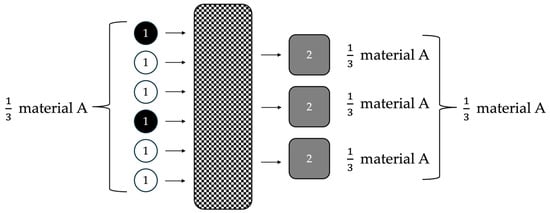
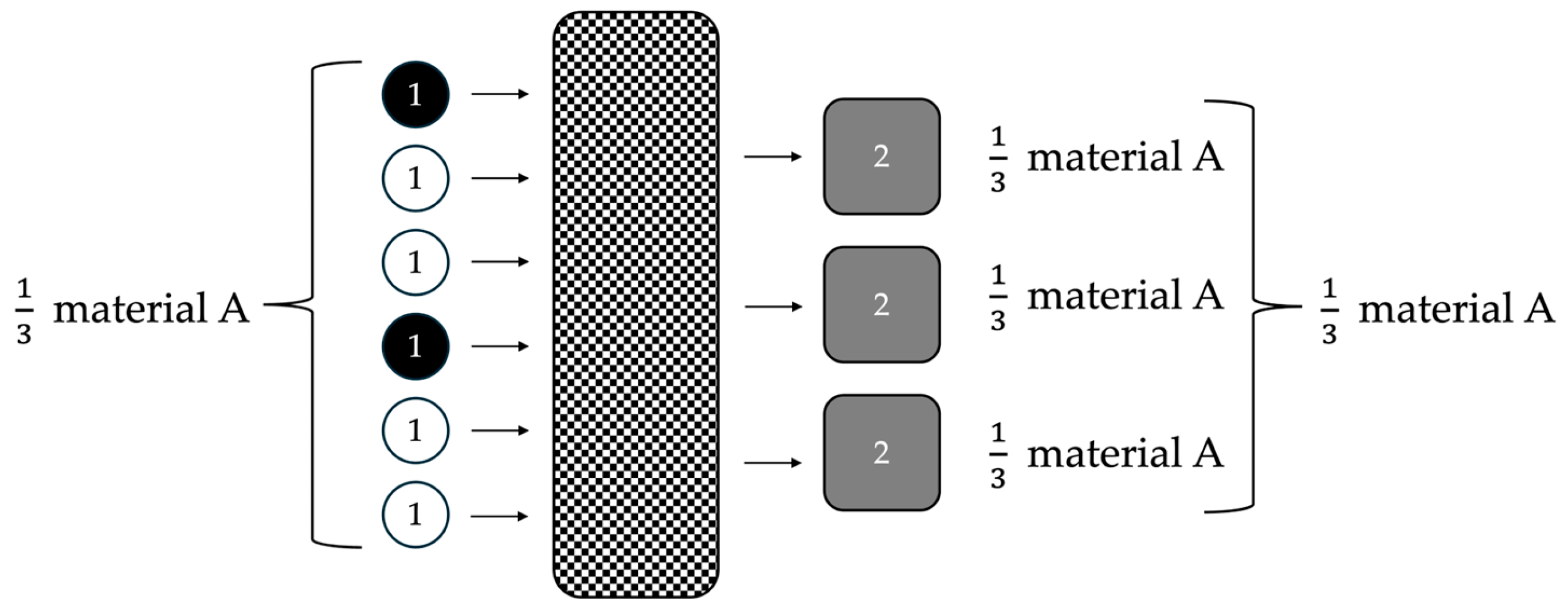
Figure 1 illustrates the application of allocation to a multi-input process in accordance with ISO 14040/44. Materials A (black spheres) and B (white spheres) are processed simultaneously in a single process (into squares), so subdivision is not possible, as no physically distinguishable sub-processes can be defined. System expansion cannot be applied because the three co-products are functionally identical. Allocation cannot be avoided, and the total input flows are consequently partitioned among the products using physical relationships (e.g., mass or energy). Since the outputs are physically equivalent, each product is assigned to one-third of material A, yielding product-specific LCIs.
Figure 1.
Illustration of unavoidable allocation in a multi-input LCI.
If a process generates not only products but also waste, allocation must first distinguish between waste and products since inputs and outputs can only be assigned to products. Special rules apply for reuse, recycling, and energy recovery, where material property changes require additional considerations [3,4].
Given the multiple possible allocation choices in LCA, ISO strongly recommends conducting sensitivity analyses [4,5]. Studies have shown that LCA results can be highly sensitive to the chosen allocation approach, which makes model selection a critical methodological challenge [9,10]. Carbon offsetting, i.e., compensating a PCF through emission reductions outside the studied product system, is not permitted under ISO 14067 [5]. Multifunctionality in LCA, therefore, remains one of the most controversial methodological issues.
2.3. Chain of Custody
Chain of custody (CoC) is defined as “a process by which inputs, outputs, and associated information are transferred, monitored, and controlled at each step along the relevant supply chain” [8].
The first sustainability-focused CoC system was established in 1994 in the forestry sector, with the Forest Stewardship Council (FSC) certifying wood products [11]. Since then, numerous CoC systems have been developed in response to rising demand for sustainable supply chains, including for palm oil (RSPO 2004) [12], soy (RTRS 2006) [13], energy and textiles, and various agricultural commodities [11,14]. Today, certification schemes exist for food (e.g., fish, coffee, and vegetables), energy, biofuels, and raw materials such as timber and cotton [14]. CoC systems are also applied in contexts such as food safety and social standards [8].
All CoC systems share the common feature of ensuring consistent bookkeeping and establishing a clear link between input streams with defined characteristics (e.g., sustainable, recycled, or organic) and the resulting products [6]. To harmonize the growing number of systems, ISO 22095 [8] was published in 2020, providing generic, cross-sectoral rules for CoC models and systems. Five CoC models are distinguished, including the mass balance approach (MB-CoC) [8].
2.4. Mass Balance
In thermodynamics, mass balance is based on the principle of mass conservation, which states that mass cannot be created or destroyed within a closed system [15]. Analogously, MB-CoC ensures that the share of certified input materials is balanced with the share of certified outputs across defined system boundaries. Certified and non-certified materials may be co-processed, as long as the mass balance of certified material remains consistent within the supply chain [8].
MB-CoC enables the co-processing of certified and conventional inputs within the same infrastructure, assigning certified attributes to outputs proportionally to the certified input share. Organizations can apply MB-CoC at one site, across multiple sites, or across several inputs at multiple sites, as long as the defined temporal and geographic boundaries are respected [8].
ISO 22095 [8] recognizes two implementation methods:
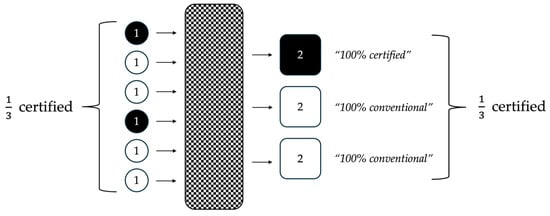
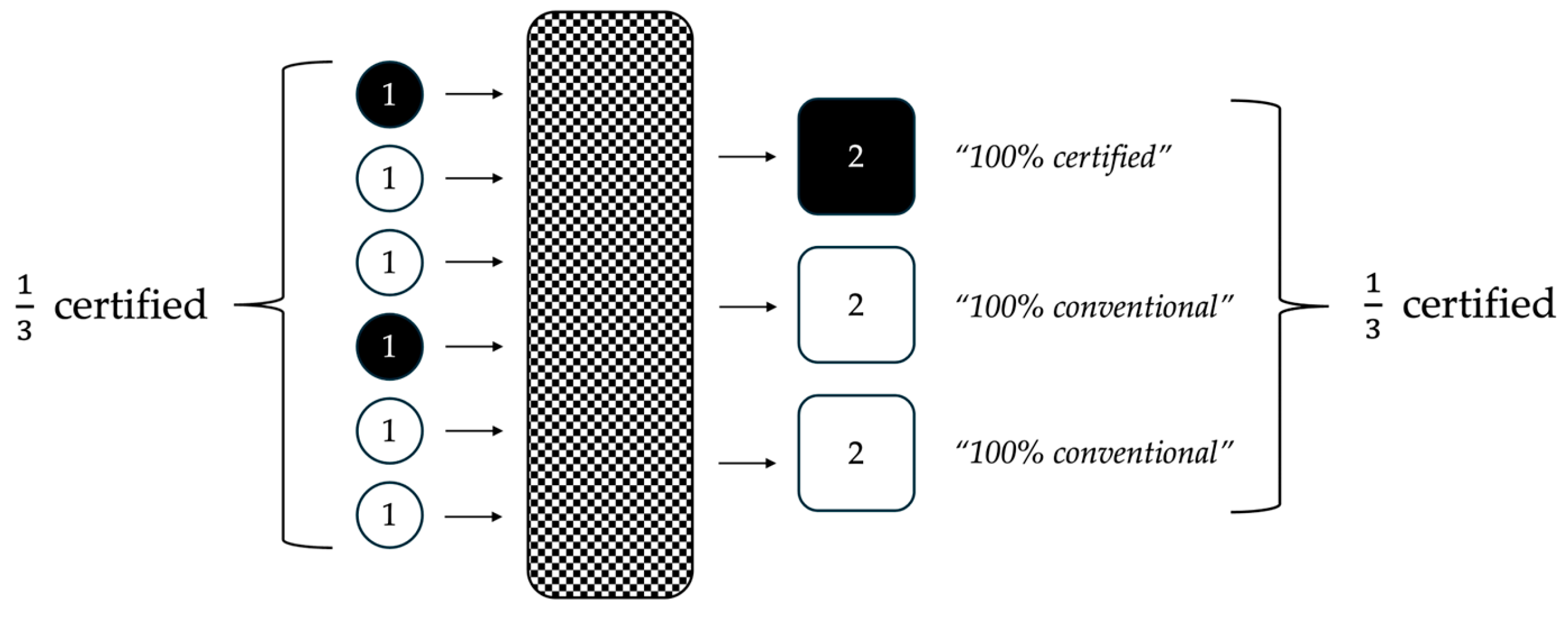
First, the rolling average percentage method calculates an average output share of sustainable material over a defined time period, based on varying alternative input shares. Second, the credit method uses virtual credit accounts for each input-output stream, with site- and material-specific conversion factors determining the allocation of credits [8]. Figure 2 illustrates the simplified application of the MB-CoC credit method. Black spheres represent certified material, and white spheres represent conventional material. Certified and conventional inputs are processed simultaneously in a single process, yielding physically indistinguishable outputs. In the example shown, one-third of the total input is certified; accordingly, one-third of the total output is eligible to carry certified credits. Credits generated from the certified input share are transferred through the process and may be fully assigned to a single selected output (100% certified claim), while the remaining outputs receive no certified credits (100% conventional), although their physical composition remains unchanged. The figure represents a simplified example; in practice, additional certification requirements determine whether and how such claims may be made.
Figure 2.
Schematic illustration of the MB-CoC credit approach.
Sector-specific schemes, such as, for example, ISCC PLUS (International Sustainability & Carbon Certification) [16], add further rules. For example, MB-CoC must be site-specific, primary data must be used to calculate conversion factors, and different allocation bases may be applied (mass, energy, or “trace the atom” [16]). Fuel-use-exempt approaches ensure that energy outputs from sustainable inputs cannot be counted as material outputs [17,18].
2.5. Application of MB and LCA—The Chemical Sector
Chemicals are present in more than 90% of manufactured products, making the chemical sector a key contributor to global supply chains [19]. In 2019, the sector was responsible for about 7% of anthropogenic GHG emissions, ranking as the third-largest source of industrial emissions [20]. Its main environmental burdens include high energy demand, reliance on fossil feedstocks, large waste streams, and use of hazardous reagents [21].
Potential mitigation measures include chemical recycling, use of biogenic feedstock materials, and carbon capture and utilization (CCU) [2], all of which require LCA-based evaluation. Since a large share of the sector’s emissions arises upstream in the value chain (so-called Scope 3 emissions), product-level transparency is crucial [22]. Regulatory frameworks such as the EU’s Carbon Border Adjustment Mechanism (CBAM) [23], the Corporate Sustainability Reporting Directive (CSRD) [24], and Ecodesign directives [25] also increasingly mandate product-level GHG accounting.
The MB-CoC is particularly attractive in the chemical sector, as it enables flexible integration of alternative feedstocks into existing assets where physical segregation is infeasible [16,26]. For example, MB-CoC allows for the attribution of recycled or renewable inputs to outputs when cracking or polymerization processes render physical tracing impossible [7]. Chemical companies have applied the MB-CoC since 2015 to integrate sustainable biomass feedstocks in chemical production, verified by certification bodies like TÜV SÜD [27]. ISCC PLUS, as an example, requires site-specific MB-CoC calculations [16], while other chemical companies have developed a “chemical connectivity” approach that restricts allocation to feedstocks used in the production process and allows for conditional credit transfers across sites [28].
3. State of the Art
The objective of this structured literature review was to determine whether, and how, MB-CoCs have already been integrated into PCF and/or LCA calculations. Data collection was based on the academic databases Scopus and Web of Science, as well as targeted Google searches. The web search aimed to capture company reports, white papers, and guidelines not listed in academic databases. Publications between 1 January 2010 and the end of June 2025 were considered, with only English-language sources included.
To ensure comprehensive coverage, search terms from both domains—the MB-CoC and LCA/PCF—were combined. For the MB-CoC, the terms mass balance, chain of custody, CoC, and ISO 22095 were applied. For LCA/PCF, the terms PCF, CO2 footprint, carbon footprint, LCA, life cycle assessment, allocation, attribution, ISO 14044, ISO 14040, ISO 14067, GHG, greenhouse gas, GWP, and global warming potential were used.
After making use of the named search terms, identified studies, reports, and guidelines were screened and categorized based on predefined inclusion and exclusion criteria. Papers were included only if they applied in accordance with ISO 22095 or ISO 14040/44/67. Publications that merely referred to the MB-CoC or LCA/PCF without implementing these approaches in line with relevant ISO standards were excluded (e.g., [29,30]). Studies that use LCA/PCF approaches primarily for political targets or corporate GHG reporting were also excluded (e.g., [31,32]). One study was excluded because it relied on CO2 offsetting, which is not permitted under ISO 14040/44/67 [33]. Importantly, many practice-oriented insights stem from non-peer-reviewed sources such as white papers, company reports, industry standards, draft norms, and guidance documents. Only sources authored by relevant industry actors, consultancies, or associations were considered. Press releases without methodological transparency were excluded.
The review identified four scientific contributions explicitly addressing the methodological integration of MB-CoC with PCF or LCA:
Holzapfel et al. (2025) [34] published a paper on the applicability of CoC models in PCF calculations. The study compared the five CoC models defined in ISO 22095 with ISO 14040/44/67 requirements. A key prerequisite for combining approaches is that the CoC model must enable environmentally preferable products (e.g., more circular, bio-based, or lower PCF). Furthermore, the technical feasibility of producing mass-balanced products must be ensured, with periodic reviews of process constraints and potential environmental benefits. For MB-CoC credit integration, Holzapfel et al. proposed two approaches:
First, the virtual subprocess approach, whereby the production process is divided into two virtual subprocesses, one for alternative feedstocks and one for conventional feedstocks. Emissions are then allocated within each subprocess using LCA allocation rules. Second, the combined allocation approach. Here, alternative and conventional inputs are first aggregated, and emissions are allocated via LCA and then reallocated across multiple products using the MB-CoC credit approach [34].
Besides the two named approaches, the study by Holzapfel et al. identified methodological challenges. Defining product systems in accordance with ISO 14040 poses particular challenges when the mass balance approach with CoC is applied, as this system allows flexible allocation of sustainable inputs to identical outputs rather than adhering strictly to physical correspondence. Whereas conventional LCA methodologies allocate inputs proportionally to physical relationships within the system, the MB-CoC credit approach enables allocations based on bookkeeping rules, introducing a conceptual divergence between physical and accounting perspectives. Consequently, data requirements must rely entirely on primary data, or—if secondary databases are employed—these must explicitly represent residual or conventional mixes to ensure consistency. Particular caution is required to avoid double counting, which may arise when combining primary supply chain data with generic or averaged datasets within the same LCI. To preserve transparency and methodological integrity, PCF results should, therefore, be reported separately for conventional and alternative material flows [34].
Holzapfel et al. also suggested that book-and-claim models from the electricity sector could inspire analogous MB-CoC credit approaches in chemicals, provided that residual-mix databases are introduced [35].
Finkbeiner et al. (2025) published the discussion paper “From Analysis to Message LCA” [36]. The authors emphasize that LCA has traditionally been established as a fact-based, systematic assessment tool, particularly in line with the ISO 14040 series of standards. At the same time, they observe that, in the wake of decarbonization and climate neutrality initiatives, increasingly innovative approaches have emerged, such as the concepts of avoided emissions or CoC models, including the mass-balance-credit and book-and-claim systems. The central argument is that these newer approaches deviate, in part substantially, from the original purpose of LCA: the neutral and physically grounded analysis of product systems. The authors articulate several key criticisms of CoC models, particularly regarding their use in LCA practice. First, they note the virtualization of attribution: CoC models such as the mass-balance-credit and book-and-claim systems decouple the physically delivered product from its assigned environmental benefit or property. This departs from the LCA principle of representing real material and energy flows as directly as possible. Second, the issue of double counting arises when environmental attributes (e.g., sustainability characteristics) are allocated purely on a bookkeeping basis; there is a risk that these may be counted multiple times, by both the producer and the downstream user, or through the concurrent use of primary and average datasets. Third, allocation poses a methodological challenge. In the mass-balance-credit system, physically identical products can be split into two virtual categories (e.g., with a specified “sustainable” share versus a conventional share). This raises substantial methodological questions about consistency with ISO 14044, which establishes a hierarchy of allocation rules and demands transparency in their application. Fourth, the authors highlight inconsistent modeling and lack of transparency: when different actors apply varying CoC models, or when such models are combined with traditional LCAs, comparability and interpretability of results become increasingly problematic—further exacerbating the already limited comparability of LCA outcomes. Finally, and arguably most critically, the authors stress the need for temporal limitation and demonstrable additionality. They argue that CoC models should be applied only when they deliver genuine value—such as enabling transformation toward renewable feedstocks or circular economy models—and ideally only for a defined transitional period. While CoC systems are often justified as tools to facilitate transformation, their indefinite use risks reducing environmental benefits to mere accounting constructs without corresponding physical change. Such practice undermines the fundamental premise of LCA, the representation of physical reality, and may compromise the credibility of environmental performance claims. The authors, therefore, call for evidence of additional environmental benefit, technical feasibility, and robust traceability mechanisms before applying CoC models, emphasizing that their use is defensible only when a verifiable physical transformation is taking place. For the LCA community, particularly within the chemical sector, Finkbeiner et al. identify the need to more clearly distinguish between the traditional, analytical form of LCA (“analysis-LCA”) and the communication- or message-oriented variants (“message-LCA”) that are gaining traction. Existing standards (e.g., ISO 14040/44 [3,4]) and related standardization bodies are thus challenged to develop explicit guidelines for the application of CoC models—particularly concerning temporal boundaries, traceability, allocation procedures, and prevention of double counting. In practical terms, practitioners employing CoC-based approaches must critically assess whether the chosen modeling method aligns with physical realities, how allocation is performed, whether data are primary and specific, and whether a defined transition strategy is in place. Otherwise, as the authors caution, the credibility of LCA results—and, by extension, their value for environmental communication—may be fundamentally undermined if CoC models are used without constraint or critical scrutiny [36].
Jeswani et al. (2019) [37] developed a methodological framework for incorporating the MB-CoC credit approach into LCAs of biomass-balanced (BMB) products. The study addresses the challenge of integrating the BMB approach—a variant of the MB-CoC approach for allocating biogenic feedstocks in chemical value chains—into a conformant LCA in accordance with ISO 14040/44 standards [3,4]. The focus is on products that were originally derived from fossil feedstocks but are now partially replaced with biomass-based inputs and reported as BMB products [37].
The authors define a series of methodological prerequisites for incorporating the BMB approach into LCA modeling, primarily concerning accounting design, data quality, and system boundaries. According to Jeswani et al., identical production processes are required: it is assumed that there are no differences in production between the fossil-based material and the bio-based material. This allows for the substitution of biogenic feedstocks (e.g., bio-naphtha and biogas) in existing facilities to be modeled without establishing new production lines [37].
Furthermore, transparent accounting of biogenic carbon is essential: for accurate treatment of emissions within the PCF, uptake, temporary storage, and release of biogenic carbon must be documented transparently, particularly when end-of-life scenarios are included. To model the input–output flow of bio- versus fossil-based feedstocks, a material flow analysis for replacement demand is required. This involves quantifying the amount of biogenic feedstock needed to replace fossil inputs, typically based on chemical equivalence or energy content [37].
In addition, waste and residues must be excluded from emission allocation: emissions should be assigned to the products rather than to waste streams, ensuring that residuals do not carry the same emission burden as the main products. The study also identifies key challenges related to the availability of primary data on biogenic inputs in industrial settings and uncertainties arising from chemical differences between fossil and biogenic feedstocks, such as variations in composition, energy content, and process losses [37].
A case study presented in this paper involves a polymer product that can be manufactured either from fossil feedstocks or using biogenic feedstocks (bio-naphtha and biogas). The LCA comparison demonstrates that while the BMB approach is practically feasible, its outcomes are highly sensitive to the assumptions made, leading to uncertainties and limited transparency and comparability. Environmental benefits vary significantly depending on the source and processing pathway of the biomass feedstock, the underlying data, and the biogenic carbon modeling approach [37].
The assumption of identical production processes between fossil- and bio-based variants, although methodologically necessary, is not always realistic in practice, as differences in feedstock quality, process optimization, by-products, or chemistry may exist. Chemical differences between fossil and biogenic feedstocks (e.g., composition, process losses, and energy- or material-based equivalence) present significant risks. The authors note that equivalence factors (e.g., energy content or material value) are useful but inherently uncertain.
Finally, emission allocation, particularly for biogenic carbon, requires careful modeling, considering end-of-life release, temporal delays, and system boundaries; otherwise, there is a risk of misallocation or incorrect conclusions. Despite methodological feasibility, and especially when developed in collaboration with the chemical industry, Jeswani et al. emphasize that the BMB approach is a pragmatic tool but does not automatically confer environmental benefits; these depend on the context, data, and model assumptions [37].
In addition to purely scientific publications, the chemical industry itself is also active in this field. Together for Sustainability (TfS) released Version 3.0 of its Product Carbon Footprint Data Model for the chemical industry in December 2024 [22], introducing a structured framework for integrating mass-balanced products into carbon accounting. A central feature of the update is the explicit incorporation of CoC principles in combination with the MB approach, ensuring traceability of bio-based and alternative feedstocks throughout the supply chain. The guideline introduces a dedicated section on PCF calculation for mass-balanced products and defines three core requirements:
- (1)
- MB-CoC must adhere to a recognized certification scheme.
- (2)
- The underlying process LCA must be conducted in accordance with ISO 14044.
- (3)
- Any changes in energy use, direct emissions, or process efficiency resulting from the use of alternative feedstocks must be explicitly accounted for.
To quantify PCFs, the guideline further outlines two methodological approaches: First, the inventory method. Within the inventory method, conventional and alternative feedstocks are allocated proportionally to product outputs, energy use, and process emissions. The resulting emissions may then be freely assigned to specific outputs, aggregated, and divided by product mass to determine the PCF. While straightforward, this approach carries the risk that low-PCF inputs may be preferentially allocated to products, while high-PCF inputs remain unaccounted for, potentially skewing results. Second, the reference method. In this approach, the PCF decreases linearly with the substitution rate of fossil feedstocks, as determined through material flow analysis.
A key methodological limitation arises with the MB-CoC credit approach: low-PCF alternative feedstocks may be preferentially allocated to selected outputs, while the higher PCF contributions associated with conventional feedstocks may remain unaccounted for. This introduces a systematic risk of bias toward artificially lower PCF values. The guideline emphasizes that while the MB-CoC is a practical tool for promoting the use of bio-based and recycled feedstocks, its credibility depends on robust certification, transparent data collection, and careful modeling of process changes. Uncertainties remain, particularly regarding the chemical equivalence of fossil and biogenic feedstocks, the handling of multi-output processes, and potential allocation errors.
To maintain methodological rigor, TfS requires that any MB-CoC implementation be certified under a recognized scheme, thereby mitigating risks of double counting or misallocation of environmental benefits. The guideline further mandates that all LCAs of production processes comply with ISO 14044, ensuring consistency with international standards for system boundaries, allocation, and emission accounting, which, in turn, can pose a challenge when one considers Finkbeiner’s publication [36]. Additionally, any changes in energy use, direct emissions, or process efficiency resulting from the substitution of fossil feedstocks with biogenic or recycled alternatives must be explicitly accounted for, guaranteeing that the PCF reflects actual physical impacts rather than purely bookkeeping allocations [22].
In addition to scientific publications and industry consortia, several individual stakeholders have commented on the combination of MB-CoC and LCA. Dow (2024) [38] published a system document introducing a PCF register for MB-CoC products. The register tracks partial PCFs of purchased materials, emission factors for energy and fuels, and intermediate PCFs for in-house products. Mass–energy balances define input requirements per unit of output. Emission profiles are assigned at each process node, with flexible spatial and temporal boundaries. The PCF register stores and tracks results, ensuring traceability [38]. Several position statements highlight the relevance of MB-CoC approaches within LCA/PCF calculations. For example, Deutsche Bauchemie emphasizes the need to integrate the MB-CoC into Environmental Product Declarations (EPDs) in the construction sector to promote circular economy practices [39], while One Click LCA stresses the necessity of standardization in this context [40]. In parallel, an ISO working group is currently developing ISO/WD 14077-2, which aims to provide methodologies for incorporating CoC models into LCA [41]. Together, these initiatives underline the ongoing need for standardized and transparent methodologies.
4. Discussion
The literature review shows that the methodological integration of the MB-CoC into LCA and PCF calculations is still in its infancy, and a diversity of publications—peer-reviewed or from the industry perspective—have been published. Only a handful of studies and guidelines explicitly address the subject in detail. Nevertheless, initial approaches are emerging, especially in the chemical industry, where the method holds particular relevance.
4.1. Commonalities in Existing Approaches
Despite the relatively small number of contributions, several common themes emerge, identified as five main topics:
- (1)
- Necessity of certification:
MB-CoC systems must be embedded within a recognized certification scheme to ensure full traceability and to prevent double counting. Existing standards such as ISCC PLUS and REDcert provide well-established frameworks for this purpose, even though they do not yet fully focus on the combination of LCA and MB-CoC, which still leaves room for further development and the definition of a sector-independent approach by third parties.
- (2)
- Requirement for ISO conformity:
PCF calculations incorporating the MB-CoC must comply with ISO 14040/44/67. This entails a clearly articulated goal and scope; a transparent definition of FUs; and consistent, methodologically justified allocation procedures. Although the authors consider this requirement to be essential, it is clear that not all previously published approaches fully comply with the standards and that there is either a need for education regarding the interpretation of the ISO standards, a refinement of these standards, or a revision of the MB approaches in a supposed combination of LCA and MB.
- (3)
- Importance of primary data:
Conversion factors and material balances should be derived from primary data wherever feasible. When secondary data are required, the introduction of residual mixes is essential to maintaining correct system-wide mass and emissions accounting. Unfortunately, this is a well-known problem in LCA and is unlikely to be solved by combining LCA and MB alone. Nevertheless, in this case, it is an even more important issue than in LCA alone.
- (4)
- Transparency in reporting:
PCF results should clearly differentiate between conventional and alternative input flows, as methodological transparency is a prerequisite for credibility and comparability. This also remains a general LCA challenge and is closely related to the aforementioned aspect, as well as the public availability of datasets and modeling approaches.
- (5)
- Risk of double counting:
Across the reviewed studies, the potential for double counting is consistently identified as a central methodological risk—particularly when MB-CoC credit approaches are applied without clearly defined system boundaries or in the absence of residual mixes. It should be mentioned again at this point that transparent communication—as always in LCA—is the key to traceability and comparability.
4.2. Methodological Tensions
The reviewed contributions also highlight a set of methodological tensions arising from the interaction between established LCA principles and the operational logic of MB-CoC systems. These tensions manifest across several core dimensions:
- (1)
- Physical versus bookkeeping-based allocation:
Conventional LCA requires allocation procedures to be grounded in physical, chemical, or otherwise causal relationships that reflect the underlying transformation processes. In contrast, the MB-CoC credit approach permits the attribution of sustainable/certified content to product outputs that are somewhat independent of the actual physical flow of alternative feedstocks. This bookkeeping-based attribution mechanism stands in conceptual opposition to ISO’s causality principle, thereby complicating the methodological integration of the MB-CoC within attributional LCA frameworks (at minimum, the LCI does not necessarily correspond to the ISO 14040/44/67 approach; see also the critique by Finkbeiner et al. (2025)) [36].
- (2)
- System boundaries:
LCA typically employs clearly defined, physically based system boundaries that reflect (besides other requirements) the geographic and temporal characteristics of the processes under study. MB-CoC systems, however, intentionally allow temporal, spatial, and organizational flexibility in order to facilitate chain-of-custody accounting across complex supply chains, which makes sense and is understandable from the perspective of chemical companies and can also be reflected by ISCC PLUS, for example. Nevertheless, the resulting misalignment of boundary definitions can limit methodological coherence and poses substantive challenges for the harmonized application of MB-CoC within standardized LCA system models.
- (3)
- Handling of multifunctionality:
ISO-compliant LCA provides an established hierarchy for addressing multifunctionality, prioritizing subdivision and system expansion before turning to allocation rules. The MB-CoC, by design, relies on allocation through mass balance as a primary mechanism to distribute inputs across outputs. When MB-CoC-based allocation is combined with LCA models that aim to avoid allocation where possible (according to the ISO norms [3,4]), internal inconsistencies could quickly arise between attributional conventions and the operational requirements of the chain-of-custody system—not necessarily simplifying the systems.
- (4)
- Treatment of end-of-life:
For bio-based feedstocks, accurate representation of biogenic carbon uptake during biomass growth and its subsequent release at end-of-life is essential for maintaining carbon balance integrity (which opens up another methodological component and has not been discussed in detail within the scope of this paper). Within MB-CoC applications, there is a risk that these biogenic flows are either omitted or reported inconsistently, particularly when the bookkeeping logic does not explicitly track carbon flows across life cycle stages. Such omissions can lead to biased PCF results and reduced comparability across studies.
4.3. Opportunities and Benefits
Despite these named methodological challenges, the integration of the MB-CoC into PCF and broader LCA frameworks offers several noteworthy opportunities that can enhance both the practical implementation of sustainability strategies and the robustness of product-level carbon accounting—even though, according to the authors, it needs further detailed methodological elaboration. The first benefit, which can be named and is especially relevant to the industry, is as follows:
Enabling the use of sustainable feedstocks in complex industrial processes:
Many chemical conversion processes–such as naphtha cracking, polymerization, and large-scale continuous production systems—do not allow for the physical tracking of individual molecules or feedstock origins. The MB-CoC provides a structurally viable mechanism to attribute renewable, bio-based, or recycled carbon inputs to specific products even when direct physical segregation is technically infeasible. This attribution capability enables sectors with highly integrated production systems (especially the chemical sector) to incorporate low-carbon feedstock without redesigning core process technologies and restructuring entire highly integrated plants. The second positive aspect to be named is as follows:
Scalability and operational flexibility:
MB-CoC systems support the rapid and cost-effective scaling of sustainable inputs by avoiding the need for parallel, dedicated production streams. This could also provide a business incentive for more sustainable production, provided that the currently opaque assessment scheme is optimized in the foreseeable future. This flexibility is particularly valuable in capital-intensive chemical industries, where infrastructure modification is time-consuming and expensive. By allowing the incremental substitution of fossil with renewable or recycled feedstocks within existing assets, the MB-CoC can accelerate decarbonization trajectories and support continuous improvement while maintaining operational efficiency. The third beneficial aspect, according to the authors, is as follows:
Alignment with emerging regulatory requirements:
Policymakers increasingly emphasize traceable and verifiable product-level environmental information, as reflected in regulatory initiatives such as the EU Corporate Sustainability Reporting Directive (CSRD), the Ecodesign for Sustainable Products Regulation (ESPR), and the Carbon Border Adjustment Mechanism (CBAM), as well as sector-specific requirements such as the Digital Product Passport within the EU Battery Regulation. The MB-CoC, when combined with robust certification schemes, offers a pragmatic interface between sustainability certification, supply chain due diligence, and PCF calculation. It thus provides a mechanism for integrating certified material sustainability attributes into regulatory-compliant carbon-accounting frameworks. Nevertheless, the authors would like to mention at this point that a more transparent and ISO-compliant assessment is necessary. A fourth positive aspect of the combination of LCA and MB-CoC is as follows:
Business and market relevance:
For companies, the MB-CoC enables the differentiation of products based on certified sustainability characteristics—such as recycled content, renewable carbon share, or reduced PCFs—without compromising the efficiency of integrated production. This enhances the ability to meet growing customer expectations, respond to procurement-based sustainability criteria, and demonstrate conformity with voluntary and mandatory disclosure requirements. As markets increasingly reward transparency and low-carbon performance, the MB-CoC can become a strategically important tool for competitive positioning and value chain engagement, but first and foremost, it is certainly an incentive for more sustainable businesses.
4.4. Research Gap
In addition to comparing the positive and negative effects of the current combination of mass balance and life cycle assessments, a rather limited body of research and growing demand in industry also reveal a number of future research gaps that should preferably be addressed in research and industry collaborations. Our analysis highlights several areas in which further methodological development and empirical investigation are necessary to ensure the robust integration of the MB-CoC into PCF and LCA practices:
1. Need for methodological standardization:
The authors assume that this point has already been sufficiently defined but nevertheless conclude, once again, that it is an extremely relevant research topic. Although current guidelines (e.g., ISO 14040/44/67, TfS PCF Guideline, and ISO 22095) provide relevant principles, harmonized and universally accepted rules for embedding the MB-CoC within ISO-compliant LCA frameworks are still lacking. A central challenge concerns reconciling the MB-CoC’s bookkeeping logic with ISO’s causality-based allocation requirements. The authors identify substantial potential in the standardization and certification of PCF incorporating MB-CoC. Accordingly, future research should develop standardized procedures that ensure transparency, avoid inconsistencies with attributional LCA principles, and enable consistent application across value chains. Such standardization is also essential to ensure comparability of PCF results across studies, companies, and certification schemes. It is important to note at this point that this is by no means purely a research or industry task; rather, researchers in the LCA community must be united and strive for very close industry cooperation. Similarly, from the authors’ point of view, purely industrial consortia may not be sufficient either. As is so often the case in the field of sustainability assessment, an interdisciplinary consortium is, therefore, required.
2. Development of residual mix databases for material flows:
Residual mix accounting, as established in the electricity sector to address double counting in renewable energy markets, provides a useful methodological analogue for the integration of the MB-CoC into LCA. However, comparable residual mix structures are largely absent for material-based MB-CoC systems—until now. Without residual mixes to represent the “unattributed” share of conventional feedstocks and emissions, system-wide consistency cannot be guaranteed. Methodological development is, therefore, required to establish rules, database structures, and governance arrangements for residual mixes tailored to chemical and polymer supply chains. This includes, in particular, the definition of temporal resolution, geographic representativeness, and systematic alignment with certification system data.
3. Comparative and independent case studies:
Despite growing industry interest, independent empirical applications of MB-CoC in PCF and LCA studies remain scarce. Existing examples are often produced by companies or certification bodies, limiting methodological transparency. More systematically designed case studies—ideally covering diverse products, technologies, and substitution rates—are needed to evaluate the practical implications of different allocation approaches, test the feasibility of residual mix integration, and quantify uncertainties introduced by the MB-CoC system. Such case studies should ideally be peer-reviewed and publicly accessible, which is closely related to the first aspect mentioned, methodological standardization.
4. Clarification of end-of-life modeling for biogenic and recycled carbon:
The MB-CoC currently provides limited methodological guidance on how to account for biogenic carbon uptake, delayed emissions, and end-of-life release when bio-based feedstocks are used. Similarly, the treatment of recycled carbon in mass balance systems raises questions about closed-loop, open-loop, and avoided-burden approaches. Research is needed to develop coherent EoL modeling rules that maintain carbon mass balance, avoid inconsistencies between attributed and physical flows, and align with ISO-based practices and emerging regulatory requirements, further keeping in mind current approaches for biogenic carbon accounting and EoL modeling rules.
5. Conclusions
This paper examined the methodological integration of the mass balance approach under chain of custody (MB-CoC) with product carbon footprint (PCF) calculation frameworks. Drawing on the ISO standards for life cycle assessment (ISO 14040/44) and product carbon footprints (ISO 14067), as well as the general chain of custody standard (ISO 22095), this review synthesized insights from the academic literature, industry guidelines, and corporate disclosures.
The analysis presented in this paper demonstrates that while PCF methodologies provide a mature and internationally harmonized framework for quantifying greenhouse gas emissions at the product level, they encounter inherent limitations in highly integrated chemical production systems. In such systems, physical segregation or causal allocation of feedstocks to specific outputs is often technically impossible due to molecular mixing, complex reaction networks, and continuous-flow operations. Against this background, the MB-CoC provides a pragmatic complement for PCF calculations by enabling the attribution of renewable or recycled content through a transparent bookkeeping mechanism, thereby allowing low-carbon feedstocks to be credibly incorporated into existing value chains without requiring physical separation—especially required from and used by the chemical industry.
At the same time, integrating MB-CoC into PCF calculations introduces methodological tensions that cannot be overlooked. Specifically, these concerns are the alignment of system boundaries, the reconciliation of bookkeeping-based and causality-based allocation principles, and the mitigation of double counting risks when sustainable attributes are attributed to products. Contributions from Jeswani et al. (2019) [37], Holzapfel et al. (2025) [34], Finkbeiner (2025) [36], and the TfS Guideline (2024) [22] collectively underline these challenges while also highlighting the significant potential of the MB-CoC to support industry decarbonization. Across the reviewed literature, five overarching insights emerge: (1) Certification and standardization are indispensable for ensuring credibility, comparability, and traceability in MB-CoC-based PCFs. (2) Primary data and the development of residual mixes are necessary to prevent double counting and maintain system-wide mass and emissions integrity. (3) Strict adherence to ISO principles is essential to avoid methodological inconsistencies and safeguard analytical rigor. (4) Transparency in reporting, particularly through explicit differentiation of conventional and alternative input flows, is critical for interpretability and stakeholder trust. (5) Empirical case studies are needed to validate proposed methods, quantify uncertainties, and test their applicability in real industrial settings.
Taken together, these findings provide a consolidated methodological agenda for the integration of the MB-CoC in PCF calculations and a structured foundation for the development of harmonized frameworks that can reconcile the operational logic of the MB-CoC with the foundational principles of LCA and PCF. Future research should prioritize the development of standardized integration rules, the construction of residual mix databases for material flows, and the implementation of comparative case studies across diverse chemical value chains—always being developed within an interdisciplinary industry–research consortium.
If these gaps can be systematically addressed, the MB-CoC has the potential to become a key enabler of circularity and decarbonization, supporting robust product-level emissions accounting, facilitating compliance with emerging regulatory requirements, and accelerating the transition toward more sustainable industrial systems.
Author Contributions
Conceptualization, J.G.B. and L.S.; methodology, L.S.; validation, J.G.B., M.N., and P.O.; formal analysis, L.S.; investigation, L.S. and J.G.B.; data curation, L.S.; writing—original draft preparation, L.S. and J.G.B.; writing—review and editing, J.G.B., M.N., and P.O.; supervision, J.G.B. All authors have read and agreed to the published version of the manuscript.
Funding
This research received no external funding.
Institutional Review Board Statement
Not applicable.
Informed Consent Statement
Not applicable.
Data Availability Statement
The original contributions presented in this study are included in the article. Further inquiries can be directed to the corresponding author.
Acknowledgments
During the preparation of this manuscript, the authors used ChatGPT-5 for the purposes of linguistic corrections and adjustments, such as shortening very long and convoluted sentences. The authors have reviewed and edited the output and take full responsibility for the content of this publication.
Conflicts of Interest
Authors Laura Schmidt and Malina Nikolic were employed by the company Meo Carbon Solutions GmbH. Author Patrick Ober was employed by the company ISCC System GmbH. The remaining authors declare that this research was conducted in the absence of any commercial or financial relationships that could be construed as potential conflicts of interest.
Abbreviations
The following abbreviations are used in this manuscript:
| BMB | Biomass Balanced |
| CBAM | Carbon Border Adjustment Mechanism |
| CCU | Carbon Capture and Utilization |
| CoC | Chain of Custody |
| CSRD | Corporate Sustainability Reporting Directive |
| FSC | Forest Stewardship Council |
| FU | Functional Unit |
| GHG | Greenhouse Gas(es) |
| GWP | Global Warming Potential |
| IPCC | Intergovernmental Panel on Climate Change |
| ISO | International Organization for Standardization |
| LCA | Life Cycle Assessment |
| LCI | Life Cycle Inventory |
| LCIA | Life Cycle Impact Assessment |
| MB | Mass Balance |
| MB-CoC | Mass Balance approach under Chain of Custody |
| PCF | Product Carbon Footprint |
| TfS | Together for Sustainability |
References
- United Nations. The Paris Agreement. Available online: https://unfccc.int/process-and-meetings/the-paris-agreement (accessed on 12 December 2025).
- Intergovernmental Panel on Climate Change. Climate Change 2023: Synthesis Report. In Contribution of Working Groups I, II and III to the Sixth Assessment Report of the Intergovernmental Panel on Climate Change; AR6; IPCC: Geneva, Switzerland, 2023; pp. 35–115. [Google Scholar] [CrossRef] [Scilit]
- DIN EN ISO 14040:2006; Environmental Management—Life Cycle Assessment—Principles and Framework. ISO: Geneva, Switzerland, 2006.
- DIN EN ISO 14044:2006-10; Environmental Management—Life Cycle Assessment—Requirements and Guidelines. ISO: Geneva, Switzerland, 2006.
- ISO 14067:2018; Greenhouse Gases—Carbon Footprint of Products—Requirements and Guidelines for Quantification. International Organization for Standardization: Geneva, Switzerland, 2018.
- Beers, K.; Schuhmacher, K.; Migler, K.; Morris, K.; Kneifel, J. An Assessment of Mass Balance Accounting Methods for Polymers Workshop Report. NIST Spec. Puplication 2022, 1500, 206. [Google Scholar] [CrossRef] [Scilit]
- Schumacher, K.A.; Beers, K. Mass balance accounting: Considerations for circular polymers. WIREs Energy and Environ. 2023, 13, e505. [Google Scholar] [CrossRef] [Scilit]
- ISO 22095:2020; Chain of Custody—General Terminology and Models. ISO: Geneva, Switzerland, 2020.
- Weidema, B. Avoiding Co-Product Allocation in Life-Cycle Assessment. J. Ind. Ecol. 2000, 4, 11–33. [Google Scholar] [CrossRef] [Scilit]
- Schrijvers, D.; Loubet, P.; Sonnemann, G. Developing a systematic framework for consistent allocation in LCA. Int. J. Life Cycle Assess. 2016, 21, 976–993. [Google Scholar] [CrossRef] [Scilit]
- de Man, R.; German, L. Certifying the sustainability of biofuels: Promise and reality. Energy Policy 2017, 109, 871–883. [Google Scholar] [CrossRef] [Scilit]
- Roundtable for Responsible Palm Oil. RSPO Supply Chain Certification Standard. Available online: https://rspo.org/resources/?id=5523 (accessed on 12 December 2025).
- Round Table on Responsible Soy. RTRS Chain of Custody Standard V3.0. Available online: https://responsiblesoy.org/documentos/rtrs-chain-of-custody-standard-v3-0?lang=en (accessed on 12 December 2025).
- Mol, A.; Oosterveer, P. Certification of Markets, Markets of Certificates: Tracing Sustainability in Global Agro-Food Value Chains. Sustainability 2015, 7, 12258–12278. [Google Scholar] [CrossRef] [Scilit]
- Stephan, P.; Schaber, K.; Stephan, K.; Mayinger, F. Thermodynamik: Grundlagen und technische Anwendungen, 19th ed.; Springer Viewing: Berlin/Heidelberg, Germany, 2007; ISBN 978-3540708131. [Google Scholar] [CrossRef] [Scilit]
- International Sustainability & Carbon Certification. ISCC PLUS V3.4.2. Available online: https://www.iscc-system.org/wp-content/uploads/2024/03/ISCC-PLUS_v3.4.2.pdf (accessed on 12 December 2025).
- European Commission—Directorate-General for Environment. Plastic Waste: Commission Consults on New Rules for Chemically-Recycled Content in Plastic Bottles. Available online: https://environment.ec.europa.eu/news/commission-consults-new-rules-chemically-recycled-content-plastic-bottles-2025-07-08_en (accessed on 12 December 2025).
- Plastics Europe. Chemical Recycling and the Role of Mass Balance—Explained. Available online: https://plasticseurope.org/sustainability/circularity/recycling/chemical-recycling/ (accessed on 12 December 2025).
- Oxford Economics. The Global Chemical Industry: Catalyzing Growth and Addressing Our World’s Sustainability Challenges. Available online: https://icca-chem.org/wp-content/uploads/2020/10/Catalyzing-Growth-and-Addressing-Our-Worlds-Sustainability-Challenges-Report.pdf (accessed on 12 December 2025).
- International Energy Agency. Chemicals. Available online: https://www.iea.org/energy-system/industry/chemicals (accessed on 12 December 2025).
- Cespi, D. Procedural life cycle inventory of chemical products at laboratory and pilot scale: A compendium. Green Chem. 2024, 26, 9554–9568. [Google Scholar] [CrossRef] [Scilit]
- Together for Sustainability. The Product Carbon Footprint Guideline for the Chemical Industry—Specification for Product Carbon Footprint and Corporate Scope 3.1 Emission Accounting and Reporting V3.0. Available online: https://www.tfs-initiative.com/app/uploads/2024/12/TfS-PCF-Guidelines-2024.pdf (accessed on 12 December 2025).
- European Commission. Guidance Document on CBAM Implementation for Importers of Goods into the EU. Available online: https://taxation-customs.ec.europa.eu/system/files/2023-11/CBAM%20Guidance_EU%20231121%20for%20web_0.pdf (accessed on 12 December 2025).
- European Commission. Corporate Sustainability Reporting. Available online: https://finance.ec.europa.eu/capital-markets-union-and-financial-markets/company-reporting-and-auditing/company-reporting/corporate-sustainability-reporting_en (accessed on 12 December 2025).
- European Union. Ecodesign Requirements for Sustainable Products. 2024, Regulation 2024/1781. Available online: https://eur-lex.europa.eu/legal-content/EN/TXT/PDF/?uri=OJ:L_202401781 (accessed on 2 December 2025).
- Ellen MacArthur Foundation; CE100. Enabling a Circular Economy for Chemicals with the Mass Balance Approach. Available online: https://www.basf.com/dam/jcr%3Ac044c761-9e62-3318-b50f-3a4827e6fda0/basf/www/global/documents/de/sustainability/we-source-responsibly/EllenMacArthur_White%20Paper_2019_englisch.pdf (accessed on 12 December 2025).
- Badische Anilin-und Sodafabrik. The Mass Balance Approach in Feedstock Substitution. Available online: https://www.basf.com/global/en/who-we-are/sustainability/our-contributions-to-enabling-the-green-transformation/circular-economy/circular-feedstocks/mass-balance (accessed on 12 December 2025).
- Covestro. Our Mass Balance Approach—Transparent and Credible. Available online: https://www.covestro.com/en/sustainability/what-drives-us/circular-economy/alternative-resources/mass-balancing#approach (accessed on 12 December 2025).
- Vogtländer, J.G.; van der Velden, N.M.; van der Lugt, P. Carbon sequestration in LCA, a proposal for a new approach based on the global carbon cycle; cases on wood and on bamboo. Int. J. Life Cycle Assess. 2013, 19, 13–23. [Google Scholar] [CrossRef] [Scilit]
- Zerbino, P.; Mabroum, S.; Montalbano, G.; Lima, A.T.; Aloini, D. Mapping supply systems in circular settings: A proposal for a new methodology. Comput. Ind. Eng. 2025, 201, 110891. [Google Scholar] [CrossRef] [Scilit]
- Ter-Mikaelian, M.T.; Chen, J.; Desjardins, S.M.; Colombo, S.J. Can Wood Pellets from Canada’s Boreal Forest Reduce Net Greenhouse Gas Emissions from Energy Generation in the UK? Forests 2023, 14, 1090. [Google Scholar] [CrossRef] [Scilit]
- Gonçalves Dias Ponzi, G.; Jacks Mendes dos Santos, V.H.; de Medeiros Engelmann, P.; Dalla Vecchia, F. The hydrogen life cycle assessment methodology: An overlooked puzzle piece in harmonizing hydrogen certification and trade. Clean Technol. Environ. Policy 2024, 26, 2573–2596. [Google Scholar] [CrossRef] [Scilit]
- Rodriguez-Garcia, G.; Brandão, M.; Anex, R. Carbon Removal Accounting for a Sustainable Future: Distributing CO2 Flows in Multiservice Systems. Sustainability 2024, 16, 10909. [Google Scholar] [CrossRef] [Scilit]
- Holzapfel, P.; Blizniukova, D.; Bach, V.; Finkbeiner, M. Chain of custody modelling in carbon footprinting and life cycle assessment. Int. J. Life Cycle Assess. 2025, 30, 980–993. [Google Scholar] [CrossRef] [Scilit]
- Holzapfel, P.; Bach, V.; Finkbeiner, M. Electricity accounting in life cycle assessment: The challenge of double counting. Int. J. Life Cycle Assess. 2023, 28, 771–787. [Google Scholar] [CrossRef] [Scilit]
- Finkbeiner, M.; Roche, L.; Holzapfel, P. From analysis-LCA to message-LCA: A lost cause? Int. J. Life Cycle Assess. 2025, 30, 803–810. [Google Scholar] [CrossRef] [Scilit]
- Jeswani, H.K.; Kruger, C.; Kicherer, A.; Antony, F.; Azapagic, A. A methodology for integrating the biomass balance approach into life cycle assessment with an application in the chemicals sector. Sci. Total Environ. 2019, 687, 380–391. [Google Scholar] [CrossRef] [Scilit] [PubMed]
- Dow Chemical Company. Product Carbon Footprint Calculation Methodology. Available online: https://engage.dow.com/LP=13652 (accessed on 30 June 2025).
- Deutsche Bauchemie. Position on Mass Balance Chain-of-Custody and Environmental Product Declaration (EPD). Available online: https://deutsche-bauchemie.de/positionspapiere/august-2022-position-on-mass-balance-chain-of-custody-and-environmental-product-declaration-epd (accessed on 14 January 2026).
- One Click LCA. Mass Balance Approach in the Chemical Industry. Available online: https://oneclicklca.com/en/resources/articles/mass-balance-approach-chemical-industry/ (accessed on 14 January 2026).
- ISO/WD 14077.2; Under Development: Environmental Management—Life Cycle Assessment—Requirements and Guidelines for Application of Chain of Custody (CoC) Approaches in Life Cycle Assessment (LCA). ISO: Geneva, Switzerland, 2025. Available online: https://www.iso.org/standard/61120.html (accessed on 14 January 2026).
Disclaimer/Publisher’s Note: The statements, opinions and data contained in all publications are solely those of the individual author(s) and contributor(s) and not of MDPI and/or the editor(s). MDPI and/or the editor(s) disclaim responsibility for any injury to people or property resulting from any ideas, methods, instructions or products referred to in the content. |
© 2026 by the authors. Licensee MDPI, Basel, Switzerland. This article is an open access article distributed under the terms and conditions of the Creative Commons Attribution (CC BY) license.