Article

Sustainable Trade Credit Access: The Role of Digital Transformation Under the Resource Dependence Theory


1
School of Finance, Anhui University of Finance and Economics, Bengbu 233030, China
2
School of Public Policy and Administration, Nanchang University, Nanchang 330031, China
*
Authors to whom correspondence should be addressed.
Sustainability 2026, 18(3), 1174; https://doi.org/10.3390/su18031174
Submission received: 3 December 2025 / Revised: 12 January 2026 / Accepted: 15 January 2026 / Published: 23 January 2026

Abstract

This paper constructs a two-way fixed effects model using data from 4623 Chinese A-share listed enterprises from 2011 to 2022, confirming that firm digital transformation can enhance access to sustainable trade credit. Specifically, for every 1% increase in the standard deviation of digital transformation, the trade credit obtained by enterprises increases by 2.14% in relation to their average value. We employed instrumental variable (IV) and propensity score matching (PSM) methods, utilizing the Broadband China pilot policy as a quasi-natural experiment to conduct a multi-period propensity score matching-difference in differences (PSM-DID) analysis to address potential issues of reverse causality and sample selection bias. Mechanism analysis indicates that the diversification of supplier structures, R&D innovation, and market share facilitated by digitalization are three main channels. This effect is particularly significant in state-owned enterprises, mature enterprises, and those with higher social trust. Finally, the study also found that the spillover effects of digital transformation encourage client enterprises to allocate credit resources to downstream firms, thereby promoting the sustainable development of supply chain finance. Furthermore, the digital transformation primarily alleviates short-term credit challenges for enterprises and reduces their reliance on bank credit.

1. Introduction

Against the backdrop of rapid development in the global digital economy, digital transformation plays a critical role in maintaining market competitiveness and promoting sustainable development within enterprises [1,2]. Previous studies have extensively focused on the economic consequences of digital transformation, including aspects such as corporate governance [3], corporate risk-taking [4], and corporate innovation [5]. Some research indicates that enterprises’ digital transformation provides robust support for supply chain finance [6,7]. As key external stakeholders, suppliers widely employ trade credit in B2B transactions, influencing the stability and efficiency of the supply chain [8,9], making them an important topic within supply chain finance [10].
Furthermore, we note that the literature on how digital transformation affects the interaction between enterprises and external stakeholders has not been sufficiently explored. Resource Dependence Theory (RDT) posits that organizations need to rely on external resources for survival and development [11]. Furthermore, strategic management literature indicates that dependencies may enable dependent firms to acquire knowledge and learning opportunities [12], which could provide sustainable advantages for dependent firms. Wilner [13] proposed in the field of supply chain finance that dependency affects trade credit terms, and relying on customers or suppliers may extend credit to maintain relationships. In the context of digital transformation, RDT reveals how digital technology breaks traditional resource boundaries and facilitates resource utilization. Digitalization not only promotes internal transformation but also breaks down the external boundaries of enterprises. The application of digital technology strengthens the connections between suppliers and customers, and data empowerment enhances the bargaining power of enterprises within the supply chain network, leading to a reallocation of resources among supply chain participants. In light of this, this paper distinguishes itself from previous research perspectives by focusing on the angle of resource dependence theory, exploring whether corporate digital transformation can reconstruct inter-firm dependency relationships and thereby increase suppliers’ trade credit to the enterprise. If this hypothesis holds, what are the potential motivations and reasons? The answers to these important questions will contribute to a deeper understanding of how external stakeholders respond to client firms’ digital transformation from the perspective of resource dependence, and aim to provide reference and insights for enterprises in pursuing digital advantages and sustainable supply chain financing.
Given that China is the world’s second-largest economy and has achieved significant progress in information technology infrastructure development [14,15], the technology-enabled credit allocation improvement mechanism revealed in this context provides a representative sample for understanding the interaction between technological change and corporate financing. Therefore, choosing China as the context for this study is of significant practical importance and broad representativeness. Specifically, this study analyzes 34,304 firm-year observations from 4622 Chinese listed companies between 2011 and 2022 to explore the impact of digital transformation on firms’ ability to obtain trade credit. The regression results show that for every one standard deviation increase in digital transformation, firms’ access to credit increases by 2.3 percentage points relative to their average. Moreover, from a spillover perspective, we find that the increase in trade credit driven by digital transformation also enhances firms’ willingness and capacity to provide trade credit externally. We conduct a series of robustness checks to demonstrate that the impact of digital transformation on trade credit is generalizable. In addition, we employ the instrumental variable approach and propensity score matching method to address potential endogeneity issues arising from reverse causality and sample selection bias. Furthermore, this study uses the “Broadband China” policy as a quasi-natural experiment, applying the multi-period propensity score matching–difference-in-differences (PSM-DID) method to further enhance the accuracy of causal inference. Following this series of endogeneity tests, our research findings remain robust.
We attempt to answer from the perspective of resource dependence theory why the digital transformation of enterprises enhances their opportunities to obtain trade credit from suppliers. Coşkun and Öztürk [16] view dependence as a strategic choice, suggesting that dependent firms gain a sustainable competitive advantage relative to their competitors due to these dependency relationships. Consequently, because of their need for strategic resources from partners, more dependent firms may strengthen their collaboration motives and even develop sustainable strategies. For example, elevating the provision of trade credit to an active strategic choice. Therefore, this paper focuses on three corporate characteristics that may increase suppliers’ dependence on client enterprises: supplier concentration, research and development (R&D) innovation, and market share. Firstly, based on resource dependence theory, a high concentration of suppliers can intensify downstream firms’ dependence on resources and weaken their bargaining power [17]. Digital transformation, however, can reconstruct buyer-supplier relationships through technological empowerment, reducing the costs for firms to switch suppliers and expanding procurement channels [18]. Ultimately, to avoid customers turning to alternative supply sources, suppliers may offer more trade credit. Secondly, digital transformation sharpens firms’ data processing and technological coordination, raising innovation quality and spurring breakthroughs [19,20]. These knowledge spillovers encourage suppliers to grant trade credit and lock in digitally advanced customers. Finally, digital transformation enhances a firm’s market insight and responsiveness to demand by integrating data with production factors, thereby helping the firm optimize products and services, and expand its market share and influence [21,22]. The increase in the client firm’s market share will bring stable revenue and economies of scale to suppliers, strengthening their reliance on key buyers and consequently motivating suppliers to proactively offer more trade credit to maintain the business relationship. Our research findings provide evidence for the aforementioned discussion, confirming that digital transformation leads to a decrease in supplier concentration, an increase in R&D innovation, and a rise in market share. This change motivates suppliers based on resource dependence, thereby enhancing the opportunities for enterprises to obtain trade credit from suppliers.
We explore the differentiated impact of digital transformation on trade credit under varying conditions. The research concluded that in state-owned enterprises, mature enterprises, and those with a higher level of social trust, the effect of digital transformation on firms’ access to trade credit is more pronounced. Furthermore, we extend this study by analyzing the impact of digital transformation on both short-term and long-term trade credit. Our findings indicate that digital transformation primarily enhances the accessibility of short-term trade credit, with a relatively minor effect on long-term trade credit. Additionally, we examined whether digital transformation has similar or different effects on bank credit. The findings reveal that the coefficients for digital transformation on bank credit are not significant, and in some cases, appear negative. This suggests that the advantages afforded by digitalization, which leads to lower-cost and more flexible trade credit, have reduced firms’ reliance on bank credit.
This paper makes the following contributions to the existing literature. First, this study expands the research perspective on corporate digital transformation and supply chain finance. Current scholars focus on buyer market theory [23], information asymmetry theory and signaling theory [24,25], and creditor risk aversion [26]. Different from the existing literature, we focus on the resource dependence perspective, revealing that suppliers, driven by resource dependence motivations, are more inclined to provide trade credit to enterprises with higher levels of digitalization, highlighting that digital transformation is one of the key factors driving the sustainable acquisition of trade credit. Secondly, we reveal the black-box relationship between digital transformation and trade credit, and delve into the applicability and effectiveness of trade credit driven by digital transformation across different types of enterprises and external environments. Consequently, from the perspective of resource dependence, we further refine the theoretical framework regarding the acquisition of sustainable commercial credit driven by digital transformation. Finally, this study confirms that trade credit access driven by digital transformation has a value effect, facilitating the rational flow of trade credit resources between upstream and downstream supply chain entities, forming a sustainable pattern of credit allocation, and providing new theoretical insights and empirical evidence for the construction and development of a sustainable financing ecosystem at the supply chain level.
The arrangement of the following sections is as follows: Section 2 is a literature review; Section 3 presents theoretical analysis and hypotheses; Section 4 explains the sources of the data and constructs the variables and empirical models, along with descriptive statistical analysis; Section 5 provides the baseline regression results and robustness checks; Section 6 employs instrumental variable methods, Propensity Score Matching (PSM), and PSM-DID for endogeneity tests; Section 7 analyzes the mechanisms from the perspective of resource dependence theory; Section 8 discusses heterogeneity analysis; Section 9 is dedicated to further analysis; and Section 10 summarizes the entire text.

2. Literature Review

2.1. Research on Digital Transformation and Its Economic Consequences

Digital transformation is a transition prompted by the changes in information technology, which can cause planned digital impacts on a normally functioning system. Early research primarily focused on information technology, employing research methods largely consisting of case studies or theoretical explorations [27], as well as model development [28,29,30]. With the continuous advancement of information technology, related studies have expanded from the initial singular phase of informatization to a more comprehensive phase of digitization. This shift involves empirical research on systems and encompasses multiple dimensions such as corporate governance, risk-taking, and business innovation. Firstly, digital transformation, as an organizational management tool [31], aids enterprises in enhancing their internal control capabilities [32] and improving the efficiency of internal supervision [33]. Secondly, digital transformation can enhance an enterprise’s risk-bearing capacity through improved management capabilities, strategic deviations, and asset utilization rates [4], leading to financial stability, increased innovation output capabilities [34], and high-quality development [35]. Furthermore, Andersson et al. [36] approach from a B2B perspective, suggesting that digitalization provides enterprises with a cost-effective and value-creating means of interacting with customers in a B2B environment. Mostaghel et al. [37] reveal the role of digitalization in driving business model innovation in the retail industry from three dimensions: value creation, value delivery, and value capture. Dou and Gao [38] further clarify the non-linear relationship between digital transformation and innovation performance.
However, as relevant research continues to deepen, an increasing number of scholars are recognizing that digital transformation not only brings unprecedented opportunities for enterprises but also triggers numerous challenges and risks in various areas, including internal management, data security and privacy, and financial risks. Excessive digital transformation may lead to an crowding-out effecton other factors. Firstly, overly pursuing digitalization without fully considering one’s own capabilities and resources may result in management confusion and inefficiency [3]. From the perspective of data security and privacy, digital transformation also introduces new challenges related to cybersecurity risks, such as data breaches and cyberattacks [39]. Secondly, financially, the significant investment required for digital transformation in information technology to reduce delays in competitive responses can negatively impact a firm’s asset return rate and equity return rate in the short term [40]. Finally, some scholars have also explored the impacts and roles of digital transformation on corporate performance [41], ESG performance [42], carbon emissions [43], and Environmental Sustainability [44], providing a more comprehensive and profound explanation for the economic consequences resulting from digital transformation.

2.2. Factors Affecting Trade Credit

Since Meltzer’s [45] pioneering discovery of inter-firm trade credit as an alternative source of credit, academics have begun to pay attention to and explore the factors that affect trade credit, and the study of the relevant factors can be summarized into two categories: external environmental factors and internal firm factors.
The influence of external environmental factors on trade credit cannot be ignored. Firstly, fluctuations in the macroeconomic environment directly affect enterprises’ demand for trade credit. Nilsen [46] found that during economic recessions, enterprises increase the financing scale of trade credit. Love et al. [47], based on the theory of trade credit redistribution, argued that after a financial crisis, the scale of enterprises’ trade credit first rises and then drops sharply. Secondly, Fisman and Love [48] believed that in regions with a lower level of financial development, enterprises are more dependent on trade credit due to the difficulty in obtaining loans from banks, meaning that the level of regional financial development negatively affects enterprises’ trade credit. Moreover, a tight monetary policy leads enterprises to rely more on trade credit financing [49], while policy uncertainty may result in a reduction in accounts payable, accounts receivable, and net credit scale [50,51]. Furthermore, studies have shown that informal institutions such as Confucian culture [52], merchant guild culture [53], and regional social trust [54] also affect enterprises’ trade credit.
Internal factors of enterprises also play a significant role in obtaining trade credit. Relevant research covers multiple dimensions such as enterprise characteristics, operational governance conditions, and financial status. Regarding the relationship between enterprise scale and trade credit, existing viewpoints are divided. Maksimovic [55] holds that enterprise scale is negatively correlated with the trade credit it obtains. In contrast, Giannetti et al. [56] hold the opposite view, arguing that large enterprises, especially those with multiple suppliers, can obtain more trade credit and that the terms of such credit are longer. Additionally, factors such as enterprise age [57] and property rights nature [58] are also considered important influences on trade credit. Secondly, scholars have focused on key elements such as internal management, financial health, and development potential of enterprises and found that strong management capabilities [59] and high-quality internal control [60] are both conducive to enterprises obtaining trade credit. Regarding financial status, Boisjoly et al. [61] discovered that an enterprise’s financial status affects its working capital management practices, thereby influencing its ability to obtain trade credit. When an enterprise’s financial status is more important to its suppliers, socially responsible enterprises obtain more trade credit from their suppliers [62]. Further, the social responsibility behavior of enterprises can significantly enhance their trade credit financing capabilities by optimizing internal control, reducing operational risks, and stabilizing supplier relationships [63]. There are also views suggesting that there is a U-shaped nonlinear relationship between enterprise social responsibility performance and trade credit [64]. Moreover, it is believed that green innovation behavior of enterprises can significantly improve their trade credit accessibility [65].

3. Theoretical Analysis and Hypotheses

3.1. Digital Transformation and Trade Credit

Resource Dependency Theory (RDT) posits that organizations need to rely on external resources for survival and development, leading to power dynamics among organizations [11]. Extending this reasoning into the realm of supply chain finance, the power dynamics in buyer-supplier relationships are a key factor in understanding the dynamic changes in trade credit oriented towards supply chain finance [18]. Cox [66] argues that power is related to the accessibility of resources in buyer-supplier relationships. Furthermore, Wilner [13] asserts that the dependence of the transaction parties affects trade credit conditions; thus, suppliers that rely on customers are more likely to extend trade credit to maintain such relationships. The emergence of digitalization provides greater opportunities to realize this potential. Digitalization, as a new form of resource, creates a logical chain of resource structure, resource bundling, and resource allocation patterns [67], which can enhance a firm’s advantages by optimizing asset allocation and promoting cost-efficient production methods [68], as well as improving internal control [69], strategic management [70], and innovation capabilities [71] among other resources. From the perspective of the supply chain, customer digital transformation enables the digital and resource empowerment of suppliers by customers. The application of digital technologies strengthens the connection between suppliers and customers, including knowledge spillovers [72], resource exchange [73], and technological innovation [74]. Consequently, digital transformation equips downstream enterprises with core resources sufficient to attract suppliers, potentially leading suppliers to provide more trade credit to their customers based on the strategic resource needs. This paper proposes the following hypothesis.
Hypothesis 1.
Digital transformation can enhance the trade credit that customers obtain from suppliers.

3.2. The Supplier Diversification Mechanism Channel

According to resource dependence theory, downstream enterprises with a highly concentrated supplier base exhibit a higher degree of dependence on major suppliers, which results in lower bargaining power and poses greater vulnerability and risk of exploitation [75,76,77]. This scenario reduces the commercial credit available to downstream enterprises and exacerbates financing constraints [78]. According to the dynamic capabilities theory, digital transformation provides technological empowerment for the restructuring of buyer-supplier relationships. As emphasized by Cavalcante et al. [79], the advent of digitalization promotes more flexible supplier selection. Specifically, digital transformation facilitates efficient and seamless global and cross-regional procurement, leading to faster communication and shorter negotiation times [80], thereby significantly reducing the costs associated with switching suppliers [18]. In this context, enterprises are able to more broadly search and evaluate potential suppliers, overcoming geographical limitations [18], diversifying resource procurement routes and reducing supplier concentration. Therefore, in order to prevent customers from opting for alternative sources of supply, suppliers may offer more trade credit to maintain smooth sales and stable sales volumes [81]. We believe that digital transformation can facilitate the formation of supplier diversification, allowing suppliers to be motivated by maintaining stable cooperative relationships, thereby enhancing the opportunities for firms to obtain trade credit from suppliers. Hence, this paper proposes the following hypothesis.
Hypothesis 2.
Digital transformation enhances trade credit accessibility by improving supplier diversification.

3.3. The R&D Innovation Mechanism Channel

Previous scholars have discussed the positive role of digitalization in promoting enterprise R&D innovation from various perspectives [37,82]. This viewpoint has been widely validated; the application of digitalization can enhance a firm’s ability to absorb, coordinate, and process data [19], and it influences the innovative potential of product and service innovation [83,84]. Research shows that the higher the degree of digital transformation in an enterprise, the more managers focus on updating and iterating digital technologies [85], increasing the likelihood of synergizing foundational digital technologies with enterprise-specific technologies, thereby generating significant technological spillover effects that stimulate breakthrough technological innovations [20]. Zhuo and Chen [5], from the perspective of the innovation dilemma faced by enterprises, argue that digital transformation can overcome innovation dilemmas by enhancing the quality of innovation and strengthening absorption and conversion capabilities. According to the knowledge spillover theory, buyers with high levels of innovation capability in the supply chain often generate knowledge spillover effects on their suppliers through their technology, skills, knowledge, and expertise [86]. The digital transformation of customers provides technological support for suppliers’ innovation through resource integration and information sharing [87], enabling suppliers to produce new innovative products and achieve higher business performance [88]. In this context, suppliers tend to rely on buyers’ strong innovation capabilities, dedicating more effort to the sustainable development of their cooperative relationships [89], which leads suppliers to willingly lock incustomers through trade credit. Therefore, we propose the following hypothesis.
Hypothesis 3.
Digital transformation enhances trade credit acquisition by improving corporate R&D innovation.

3.4. The Market Share Mechanism Channel

According to the dynamic capabilities theory, a higher level of digital transformation in enterprises can enable decision-makers to combine data resources with other production factors, making data resources an effective tool for enterprises to gain market insights and generate ideas [90]. For instance, the deep integration of digitalization with organizational management helps firms promptly identify consumer needs and enhance market awareness. This capability allows firms to predict the functionality and delivery channels of new products/services during innovation processes [21], thereby improving product/service quality to better align with market preferences [91] and ultimately increasing market share and influence [22]. Resource dependence theory posits that the degree of a firm’s dependence is determined by the importance, scarcity, and irreplaceability of the resources provided by its partners. An increase in market share implies a larger procurement scale from suppliers [92]. Customers with high market share and sustained purchasing capacity are relatively scarce in the market, and their procurement volume and partnership stability are difficult for other small and medium-sized customers to substitute. Such client firms not only provide suppliers with stable sales revenue but also help them achieve economies of scale and reduce costs [92]. Given these advantages, suppliers’ dependence on core buyers strengthens [93]. This aligns with the view of Fabbri and Klapper [94] that a supplier’s sales share to specific buyers reflects their dependence on transactions with their trading partners, making them more inclined to provide more trade credit to buyers. Furthermore, the study by Bloom and Perry [95] demonstrates that Walmart, leveraging its substantial market share and market power, forces suppliers to depend on its orders and even offer financial concessions to maintain cooperative relationships. Therefore, this paper proposes the following hypothesis.
Hypothesis 4.
Digital transformation increases trade credit access by enhancing market share.

4. Research Design

4.1. Data and Sample

This paper selects Chinese A-share listed firms from 2011 to 2022 as the research samples. In selecting the initial sample, we followed the following criteria: First, A-share firms in the financial sector (SFC 2012 Industry Classification) were exclude to reduce the interference of the results due to factors such as accounting standards, regulatory specificities, data outliers and differences in business models. In addition, we also remove firms that have been marked as ST* listed firms by the stock exchange due to financial status or other anomalies, as well as firms with incomplete data, to ensure the accuracy and reliability of the data. Secondly, in order to avoid the interference of outliers, we perform a 1% tailing treatment for continuous variables. After screening, the final sample included 34,304 firm-year observations from 4622 listed firms. All data are derived from the CSMAR database (China Economic and Financial Research Database).

4.2. Measures

Explanatory variables for digital transformation of DCG. We use text analysis to measure the variable of digital transformation. First, based on the CSMAR database, we crawl the annual reports of all A-share listed firms on the Shanghai and Shenzhen Stock Exchanges from 2011 to 2022 except for financial listed firms and A-share listed firms marked as *ST and converted them into text format, using Python 3.12 combined with text analysis methods, and extracting all text content using Java PDFbox library version 2.x. Secondly, with reference to official documents and authoritative literature, the characteristic words of firm digital strategy are determined, that is, 99 digital-related characteristic thesaurus in four dimensions: digital technology application, Internet business model, intelligent manufacturing, and modern information system. Then, based on the self-built feature thesaurus, the Jieba function was used to count and summarize the word frequency in the text thesaurus, and the index system of firm digital transformation was constructed. Finally, the frequency of keyword occurrence is standardized to measure the degree of “digital transformation” of firms, so as to establish an index to measure the degree of digitalization of firms (DCG). For the detailed construction of the digital transformation indicator and the keyword selection, see Table A4 in Appendix B. Although this indicator primarily reflects a firm’s tendency to disclose digital information, only companies with corresponding digital practices and resources can generate and disclose comprehensive, standardized, and verifiable digital annual report information. Therefore, it can indirectly reflect a firm’s digital capability. This indicator has been widely used in research on digital transformation [96,97]. A higher value of this indicator indicates a higher degree of digital implementation by the firm. Furthermore, in the robustness tests discussed later, we also excluded strategic disclosure behaviors by firms, allowing our text-based indicators to more closely reflect the firms’ actual digital capabilities. Furthermore, in order to address the controversies surrounding the interpretation of word frequency in text analysis, we conducted a series of robustness checks, including the use of non-textual digital measurement methods.
Explanatory variable trade credit AP. Sustainable trade credit access refers to the short-term financing support that enterprises obtain from their partners within the supply chain, characterized by both continuity and stability. Since the trade credit received by enterprises mainly comes from suppliers, following the approach of a substantial body of existing literature [98,99], we measure trade credit as accounts payable divided by total assets. This metric reflects the proportion of trade credit obtained from suppliers through deferred payments in relation to total assets. Furthermore, in the robustness tests, we replaced trade credit with (accounts payable + notes payable)/total assets to prevent the results from being biased due to a particular measurement method being influenced by specific factors.
In selecting the control variables for this paper, we have included the following fundamental indicators as control variables: firm size (size), years since listing (age), ownership type (soe), leverage ratio (lev), return on assets (roa), number of independent directors (dep), and size of the board chair (board). To eliminate the interference of inherent firm characteristics and changes in the external environment, thereby more accurately assessing the independent effect of digital transformation, the model also controls for individual and year effects. Detailed definitions of the relevant variables can be found in Table 1.

4.3. Empirical Model

In order to study the impact of digital transformation on firms’ access to trade credit, we have constructed the following Equation (1) to estimate the effect of digital transformation on the acquisition of trade credit.
A P i , t = α 0 + α 1 D C G i , t + α 2 C o n t r o l s i , t + F E Y e a r + F E F i r m + ε i , t
among them, APi,t represents the trade credit acquisition of firm i in year t, the core explanatory variable DCGi,t indicates the degree of digital transformation of firm i in year t, and Controlsi,t refers to the set of control variables. The model also controls for year fixed effects FEYear and firm fixed effects FEFirm, with ε representing the random error term. Furthermore, taking into account the correlation of error terms across different observations, this paper applies firm-level clustering adjustments to the standard errors in the regression analysis, thereby providing more accurate estimates of standard errors. Finally, we assess the relationship between the two by observing the significance of the coefficient α1; if it is significantly positive, it indicates a positive correlation between the degree of digital transformation of firms and the acquisition of trade credit, which will support our H1.

4.4. Descriptive Statistics

Table 2 presents the descriptive statistical results of the main variables in this study. The mean and median of the core explanatory variable, Digital Transformation (DCG), are 2.979 and 2.944, respectively, indicating that the data distribution is relatively concentrated, and the sample data is close to a normal distribution, effectively reducing the potential issues caused by data skewness in regression analysis. The maximum value of DCG is 6.122, the minimum value is 0.000, and the standard deviation is 1.246, indicating significant differences among Chinese firms in terms of digital transformation. This variability provides rich variation for our study on the impact of digital transformation on firms’ ability to obtain trade credit, thereby enhancing the practical significance of the research. From the perspective of the explained variable, the mean and median of firm trade credit are relatively low, at 0.091 and 0.076, respectively, indicating that most firms have a low level of trade credit. The maximum and minimum values differ significantly, at 0.367 and 0.002, with a standard deviation of 0.065, further indicating significant differences in the ability of different firms to obtain trade credit. This variability highlights the importance and practical relevance of this study in exploring the factors affecting firms’ ability to obtain trade credit. The signs of other control variables are consistent with existing research and are all within a reasonable range.

5. Empirical Results

5.1. Baseline Results

Table 3 presents the results of the baseline regression analysis. In Column (1), where only firm and year fixed effects are controlled for, the coefficient of digital transformation is 0.001, significant at the 1% level, providing strong support for our preliminary hypothesis. In Column (2), after including firm-level control variables, the coefficient of digital transformation increases to 0.002 and remains significant at the more stringent 1% level, indicating that the selected control variables fit the model well. It is worth noting that for every 1% increase in the standard deviation of a firm’s digital transformation, the amount of trade credit the firm obtains increases by 2.14% relative to its mean (calculation formula: regression coefficient multiplied by the standard deviation of the independent variable divided by the mean of the dependent variable). This finding indicates that digital transformation has both statistical and economic significance in enhancing a firm’s ability to acquire trade credit. In addition, in column (3), we regress trade credit on the one-period lag of digital transformation, and the results show that L.DCG is significantly positive at the 5% level. This indicates that the impact of digital transformation on firms’ access to trade credit is not limited to the current period, but also exhibits a significant lagged effect, providing support for firms’ sustainable short-term trade credit acquisition. Therefore, H1 is confirmed.

5.2. Robustness Test

5.2.1. Replace the Dependent Variable

In the main regression analysis, we replace the measures of digital transformation and trade credit, defining them, respectively, as ln(Firm Digital Patents + 1) (DCG1) and (Accounts Payable + Notes Payable)/Total Assets (AP1). These were then reintroduced into Equation (1) for regression, with the results presented in Columns (1) and (2) of Table 4. The results of the regression analysis indicate that, regardless of the measurement method employed, the coefficient of digital transformation remains significantly positive, suggesting that the positive effect of digital transformation on firms’ access to trade credit remains robust across different measurement approaches.

5.2.2. Eliminate Early Biases and Macro Events

Although firms have gradually invested in digital transformation since 2011, considering that before 2015, the application of digital transformation in firms is still in its infancy, and most firms have not yet carried out large-scale digital transformation practices, and the digital transformation cycle is long. During this period, there may be firms that rely more on traditional credit evaluation systems and market experience than on the application of digital technology in their trade credit decisions. Situations that lead to digital transformation having little or no significant impact on the trade credit behavior of firms. To do this, we excluded data from the robustness test prior to 2015 and reperformed the regression analysis. At the same time, considering the many uncertainties brought about by the post-2020 pandemic, such as supply chain disruptions and sudden changes in market demand, the issuance and collection of trade credit by firms will fluctuate abnormally, which may mask the long-term stable impact of digital transformation on firms’ trade credit strategies. We also exclude the data for 2020–2022. Columns (1) and (2) in Table 5 show the regression results after excluding these special period data, and the coefficient of DCG is significantly positive at the level of 5%, indicating that digital transformation still promotes the acquisition of trade credit by firms after excluding abnormal years.

5.2.3. Exclusion of Strategic Behavior

In order to more accurately and comprehensively reflect the digitalization process, and to avoid the right—skewed data problem that may arise due to text word frequency analysis, which could lead to an overestimation of the digital transformation degree constructed in this paper compared to the actual situation of enterprises (as enterprises may intentionally exaggerate the disclosure of their digital transformation—related information to cater to policy orientation or for concept hype), this paper draws on the information disclosure scoring results of the Shenzhen Stock Exchange. The scoring results are based on a series of criteria, including the authenticity, accuracy, completeness, timeliness, and fairness of corporate information disclosure, as well as the firm’s governance, investor relations management, and social responsibility performance. The evaluation of the information disclosure work of listed enterprises is conducted, and the assessment results are divided into four levels: A (excellent), B (good), C (qualified), and D (unqualified). We chose to retain only a sample of listed firms with excellent or good evaluation results in the robustness regression, and we believe that these firms have more standardized and transparent performance in information disclosure, and are less likely to make strategic information disclosures. Table 6 report the corresponding test results. The results show that the coefficients of DCG are all significantly positive at the level of 1%, which indicates that even after excluding possible strategic behaviors, digital transformation still significantly improves the ability of firms to obtain trade credit, indicating that our basic conclusion is robust and not affected by corporate strategic information disclosure behaviors.

5.2.4. Exclude Economic and Industrial Particularities

Considering the particularity of China’s municipalities in terms of economic scale and level of digital economy development, as well as the possible leading advantages of firms in these regions in terms of digital transformation, we remove the firm data of Beijing, Shanghai, Tianjin, and Chongqing from the sample to reduce the potential impact of regional economic differences on the research results. In addition, given the close connection between high-tech firms and the Internet and digital business models, the starting point and depth of their digital transformation may be much higher than that of traditional firms. In addition, the policy advantages enjoyed by these firms as the key targets of China’s innovation and R&D may mask the true impact of digital transformation on trade credit, making the research results overestimate the role of digital transformation. Therefore, we further exclude the sample of Chinese high-tech firms and re-performed the regression analysis. Columns (1) and (2) in Table 7 show the regression results after excluding these special samples, where digital transformation is significant at the confidence levels of 5% and 1%, respectively, and the core conclusion that “digital transformation promotes firms’ access to trade credit” has not changed.

6. Endogeneity

6.1. IV Method

The conclusions of previous studies may be affected by reverse causality, as firms with greater access to trade credit may be more inclined towards digital transformation due to abundant funds and lower financing constraints. To mitigate the impact of reverse causality, this paper employs instrumental variable testing. Drawing on the methods for constructing heteroskedasticity-based instrumental variables from Lewbel [100] and Liu and He [101], we respectively construct digital transformation indicators at the enterprise, industry, and provincial levels, and further calculate the cube of the difference between an enterprise’s digital transformation and the industry and provincial averages, which is used as the instrumental variable for enterprise digital transformation (denoted as IV_DCG). From the perspective of correlation, regions and industries with a higher degree of digitalization typically possess abundant factor resources and well-developed infrastructure, providing strong support for promoting enterprises’ digital transformation. Therefore, this key variable significantly affects enterprises’ digital transformation, satisfying the requirements of relevance. The instrumental variable IV_DCG exhibits strong exogeneity. Its construction is based on the mean level of digital transformation at the industry-province level, which reflects the common development level of digital transformation among enterprises in a specific industry within a specific region. As a macro-level structural variable, it does not directly impact the performance of individual enterprises in obtaining trade credit. Therefore, IV_DCG is uncorrelated with the model’s error term, further supporting the condition of exogeneity.
Table 8 presents the results of the two-stage least squares (2SLS) estimation. The Kleibergen–Paap rk LM statistic is 531.618, indicating that the test for under-identification is passed. The Kleibergen–Paap rk Wald F statistic is 316.051, far exceeding the critical value of 16.380 at the 10% significance level, suggesting that there is no weak instrument problem. This demonstrates the reasonableness of our instrument variable selection. From the empirical results, column (1) in Table 8 shows that in the first-stage estimation, the estimated coefficient of the instrument variable is significantly positive at the 1% level, indicating a strong correlation with corporate digital transformation. In column (2) of Table 8, the second-stage estimation shows that the estimated coefficient of DCG is 0.002, significantly positive at the 5% level. This indicates that after removing endogeneity interference, corporate digital transformation still maintains a positive correlation with trade credit.

6.2. Propensity Score Matching (PSM)

To address the endogeneity issue caused by sample self-selection, we employe the propensity score matching (PSM) method to re-evaluate the samples after matching. Firms were divided into two groups based on whether they had implemented digital transformation: the treatment group (firms that had implemented digital transformation) and the control group (firms that had not implemented digital transformation). The control variables in Equation (1) were used as covariates for the equilibrium test. Subsequently, the Logit regression model was used to estimate the propensity score of each firm to carry out digital transformation, that is, the probability of the firm implementing digital transformation. Based on the 1:1 and 1:3 nearest neighbor matching principles, control group firms with similar characteristics were found for each firm in the treatment group.
The balance test results in Table A1 and Table A2 of Appendix A indicate that, after matching, the absolute values of standardized differences between the treatment group and the control group are all below 5%, and the t-test results show that most of the covariates after matching do not exhibit significant differences, suggesting that the matching was effective. In addition, the average treatment effect on the treated (ATT) for digitally transformed enterprises is significantly positive at the 1% level, indicating that, after propensity score matching, the characteristic differences between digitally transformed enterprises and non-digitally transformed enterprises are substantially reduced. As shown in Table 9, the test results of the matched samples are consistent with the regression results of the hypothesis testing part, which further proves that the conclusions of this study are still robust after controlling for sample self-selection bias.

6.3. Multi-Period PSM-DID

To more effectively control unobservable heterogeneity factors and accurately address the endogeneity problem caused by sample self-selection, this study introduce the “Broadband China Policy” as a quasi-natural experiment and used the multi-period propensity score matching and difference-in-difference (PSM-DID) method to further confirm the relationship between digital transformation and firms’ trade credit. In August 2013, China’s State Council issued the “Broadband China” Strategy and Implementation Plan. Subsequently, the Ministry of Industry and Information Technology, in conjunction with the National Development and Reform Commission, selected 120 cities (or city clusters) in three batches as demonstration sites between 2014 and 2016. The specific batches of policy implementation and the corresponding city-level timelines are detailed in Table A5 of Appendix B. This policy aims to promote the development of information technology, expand broadband user bases, increase network speeds, and extend coverage, clearly illustrating that its policy objectives are closely linked to digital transformation. By using the “Broadband China” pilot cities as a quasi-natural experiment, we are able to compare the changes between the pilot cities and non-pilot cities before and after the implementation of the policy, so as to more accurately assess the impact of the policy on digital transformation. Therefore, a multi-period DID model of Equation (2) is set up in this paper.
A P i , t = α + β 1 ( T r e a t i × P o s t t ) + β 2 C o n t r o l s + μ i + λ t + ε i , t
when implementing the PSM-DID method, we use whether the city where the firm is registered is selected as a “Broadband China” demonstration city as the criterion for dividing the experimental group (Treat = 1) and the control group (Treat = 0). For firms selected as “Broadband China” demonstration cities and subsequent years, the value of the Post variable is 1, otherwise it is 0. The interactive item (Treati × Postt) indicates whether the city where firm i is registered in year t has been selected as a demonstration city of “Broadband China”. The control variable Controls is consistent with Equation (1), λi is the year fixed effect, μi is the individual fixed effect, εit is the random error term, and performed standard error clustering at the corporate level.
Before the PSM-DID analysis, we first performed Logit regression on the control variables in Equation (2) based on the dummy variable Treat to calculate the propensity score value, and then used the 1:1 nearest neighbor matching method with return to match on this basis. The balance test results in Table A3 of Appendix A show that the standardized differences of the covariates after matching are all less than 5%, and the t-test results failed to reject the null hypothesis that there was no significant difference between the experimental group and the control group, indicating that the matching effect is good. The samples before and after the matching were used for regression, and the regression results are shown in Table 10. Before and after the use of PSM, the regression coefficients of Treat × Post were 0.003 and 0.004, respectively, which are significantly positive at the levels of 5% and 1%, respectively, indicating that the research conclusion that digital transformation increases firms’ access to trade credit remains robust.
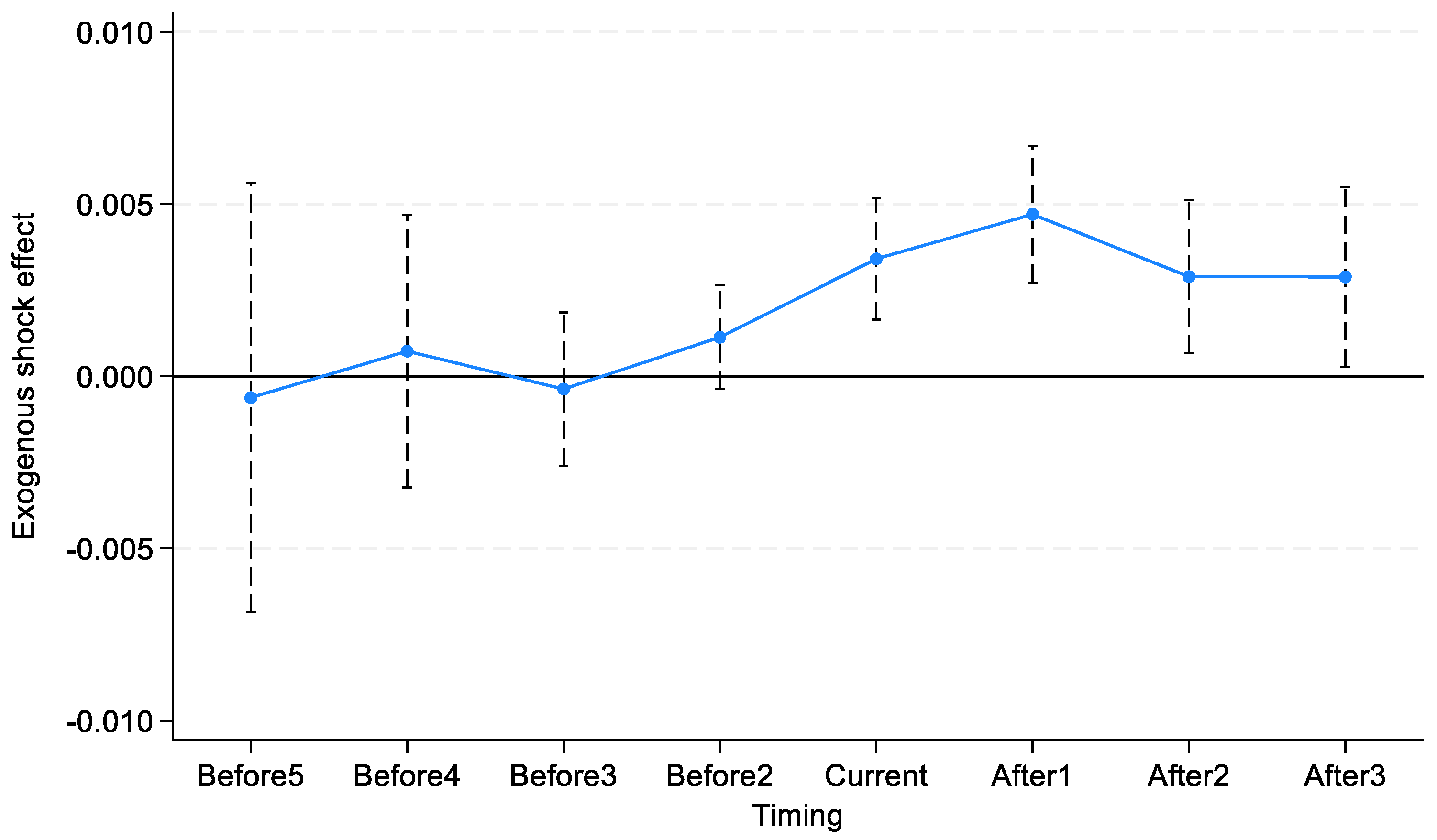
To ensure the validity of the estimation results, we further employ the following Equation (3) to test whether the Difference-in-Differences (DID) setup satisfies the parallel trends assumption. To avoid multicollinearity among the dummy variables, we exclude the period immediately before the policy (t = −1) and use it as the baseline period. We define the following dummy variables to represent the policy shock of the Broadband China pilot: five years before, four years before, three years before, two years before, one year before, the current year, one year after, two years after, and three years after (Before5, Before4, Before3, Before2, Before1, Current, After1, After2, After3).
T C i t = α 0 + α 1 B e f o r e 5 i t + α 2 B e f o r e 4 i t + α 3 B e f o r e 3 i t + α 4 B e f o r e 2 i t + α 5 C u r r e n t i t + α 6 A f t e r 1 i t + α 7 A f t e r 2 i t + α 8 A f t e r 3 i t + α 9 C o n t r o l s i t + Y e a r F E + F i r m F E + ε i t
As shown in column (3) of Table 10 and Figure 1, before the implementation of the Broadband China pilot policy, there was no statistically significant difference in trade credit between enterprises in pilot cities and those in non-pilot cities, and the trend of trade credit remained parallel. Therefore, our setting satisfies the parallel trends assumption. Moreover, the coefficients for Current, After1, After2, and After3 are all significantly positive, indicating that the increase in trade credit occurred only after the implementation of the Broadband China pilot policy in the cities where the enterprises are located. Hence, the above results support the causal effect of digital transformation on trade credit.

7. Mechanism Analysis

While the baseline regressions, robustness checks, and endogeneity tests have robustly demonstrated the positive effect of digital transformation on firms’ access to trade credit, they have not yet examined the underlying channels through which this relationship operates. This section’s mechanism analysis primarily aims to clarify the intrinsic relationship between digital transformation and enterprises’ access to trade credit, and to explore through which channels digital transformation actually enhances enterprises’ acquisition of trade credit. Drawing on Resource Dependence Theory (RDT), we focus specifically on firm characteristics that may enhance suppliers’ dependence on their corporate clients. We empirically test three potential mechanisms: supplier concentration, R&D innovation, and market share. The above three major channels all revolve around the core logic of strengthening supplier dependence under the resource dependence theory, by enhancing the firm’s own core value, deepening the suppliers’ attachment to the customer, and promoting suppliers to provide more trade credit. To formally verify these channels, we augment our baseline Equation (1) by constructing the following mediation Equations (4) and (5):
M e d i a t o r i , t = α 0 + β 1 D C G i , t + β 2 C o n t r o l s i , t + Y e a r + F i r m + ε i , t
A P i , t = γ 0 + γ 1 D C G i , t + γ 2 M e d i a t o r i , t + γ 3 C o n t r o l s i , t + Y e a r + F i r m + ε i , t
the Mediator in Equations (4) and (5) represent the mechanism variables, and the symbols of the other variables are consistent with those represented by Equation (1). β1 is the effect of digital transformation (DCG) on the mediator variable. γ1 is the impact of digital transformation (DCG) on trade credit (AP); γ2 is the effect of the Mediator on trade credit (AP).

7.1. Supplier Diversification

Digital transformation enables firms to expand their search for and evaluation of potential suppliers, transcending geographical constraints to identify more diverse supply sources [18]. Lower supplier concentration incentivizes suppliers to offer more trade credit to maintain existing collaborative relationships [81]. To test this channel, we introduce supplier concentration (Supplier) into our analysis. We measure supplier concentration (Supplier) following Zhang et al. [17] as the ratio of purchases from the top five suppliers to total annual purchases, where a lower Supplier value indicates greater supply source diversification.
The regression results are presented in columns (1) and (2) of Table 11. Column (1) shows the regression results of digital transformation on supplier concentration (Supplier). The coefficient for digital transformation is −0.811, significant at the 1% level, indicating that higher degrees of digital transformation lead to lower supplier concentration. Column (2) presents the results after including the mediator variable (Supplier). The coefficient for supplier concentration (Supplier) is negative and significant at the 1% level, while the coefficient and significance level of the digital transformation variable decrease. Further, we conduct a mediation effect test based on the multi-step mediator bootstrap method proposed by Taylor et al. [102]. As can be seen from the bootstrap test results in Table 11, the bootstrap value is significantly positive at the 1% level, and the confidence interval does not include zero. Therefore, supplier diversification plays a mediating role between digital transformation and corporate trade credit, with the mediating effect accounting for approximately 0.073. These results demonstrate that digital transformation helps increase suppliers’ cooperative dependence on client firms by enhancing supplier diversification, thereby enhancing the likelihood of firms obtaining trade credit. Therefore, the results support H2.

7.2. R&D Innovation

Digitalization plays a positive role in promoting corporate R&D innovation [37]. Knowledge spillovers from highly innovative buyers [86] can help suppliers improve their performance [88]. In this context, suppliers tend to rely on buyers’ strong innovation capabilities [89], making them willing to “lock in” customers through trade credit.
Prior research has established patent data as an indicator of innovation activity [103,104]. Following established approaches [105], we construct the variable RD to measure corporate R&D innovation, calculated as the natural logarithm of the total patent applications (invention patents, utility models, and design patents) plus 1, with weights assigned as 3:2:1, respectively, to these three patent types. Higher values of this indicator reflect greater R&D innovation capability. The empirical results are presented in columns (1) and (2) of Table 12. Column (1) shows the regression of digital transformation on R&D innovation (RD), revealing a significantly positive coefficient for digital transformation at the 1% level, indicating that digital transformation enhances corporate R&D innovation. Column (2) demonstrates that the coefficient for R&D innovation (RD) is significantly positive at the 5% level, while the coefficient for digital transformation shows a decrease. In addition, according to the Bootstrap test results in Table 12, the Bootstrap value is significantly positive at the 1% level, and the confidence interval does not include 0. This indicates that R&D innovation plays a mediating role between digital transformation and the acquisition of trade credit by enterprises, with the mediating effect accounting for approximately 0.049. These results support the conclusion that digital transformation increases trade credit obtained from suppliers by enhancing corporate R&D innovation.

7.3. Market Share

Digital transformation can increase a firm’s market share and influence [22], leading to an increase in the scale of procurement from suppliers [92], and assisting suppliers in achieving economies of scale and reducing costs. Given these advantages, suppliers become increasingly dependent on core buyers [93]. As a result, they tend to offer more trade credit to buyers [94].
We measure market share (Market) using the ratio of a firm’s annual main operating revenue to the total main operating revenue of peer enterprises in the same industry for that year. A larger value indicates a greater market share held by the firm. The regression results are shown in columns (1) and (2) of Table 13. Column (1) presents the regression results of digital transformation and market share (Market), where the coefficient of DCG is significantly positive at the 1% level, indicating that digital transformation effectively increases a firm’s market share. In column (2), the coefficients of digital transformation and market share (Market) are both positive; however, the coefficient and significance of digital transformation have decreased compared to the benchmark regression. Moreover, as can be seen from the Bootstrap test results in Table 13, the Bootstrap value is significantly positive at the 1% level, and the confidence interval does not include 0. This indicates that market share plays a mediating role between digital transformation and firms’ access to trade credit, with the mediating effect accounting for approximately 0.052. These results suggest that increasing market share is one of the channels through which digital transformation enhances trade credit. Therefore, the above findings support H4.

8. Heterogeneity Analysis

8.1. Enterprise Property Rights

Given the differences in the nature of enterprise ownership in China, there are significant disparities between state-owned and non-state-owned enterprises in terms of resource endowment, governance structure, and information disclosure in the capital market. These differences may affect the implementation effectiveness of digitalization in enterprises. Therefore, we divide the sample into two groups based on the nature of enterprise ownership: state-owned enterprises and non-state-owned enterprises, and conducts regression analysis for each group.
The results are shown in column (1) and column (2) of Table 14. The estimated coefficient for the digital transformation of state-owned enterprises (DCG) is 0.003, which is significant at the 5% level, indicating that digital transformation has a positive impact on the acquisition of trade credit by state-owned enterprises. In contrast, the estimated coefficient for non-state-owned enterprises is 0.001 and is not statistically significant, suggesting that the impact of digital transformation on the access to trade credit by non-state-owned enterprises is not apparent. The close relationship between state-owned enterprises and the government makes it easier for them to obtain government subsidies and policy support [106], and also allows them to more effectively attract key innovation resources such as talent, technology, and capital, thereby achieving a deep integration of digital technology with the real economy. This further reinforces the dependence of suppliers on client enterprises in the context of digital transformation, enabling state-owned enterprises to more effectively acquire trade credit during their digital transformation.

8.2. Corporate Life Cycle

According to the corporate life cycle theory [107], there are significant differences in financial stability, organizational structure, governance efficiency, and external environment among enterprises in different stages of their life cycle [108], which in turn affects the degree to which the digitization process influences enterprises’ access to trade credit. Therefore, this study uses the dividend payout ratio, main business revenue growth rate, capital expenditure rate, and the age of the firm as core indicators to measure the corporate life cycle, as proposed by Anthony and Ramesh [109]. Specifically, we first calculate the aforementioned four key variables for each sample firm, and then categorize the sample enterprises into high, medium, and low tiers based on the quartile scores of these indicators. Each tier is assigned a different level mark (growth phase = 0, maturity phase = 1, decline phase = 2). Finally, we sum the level mark values for each firm across the four variables, determining the corporate life cycle stage based on the total score: 0–3 points for the growth phase (lifec1), 4–6 points for the maturity phase (lifec2), and 7–10 points for the decline phase (lifec3). Columns (1), (2), and (3) of Table 15 show the regression results for enterprises at different life cycle stages, where the coefficient for digital transformation (DCG) is significantly positive in the maturity phase sample and significant at the 1% level, indicating that during the maturity phase, digital transformation has a more pronounced facilitating effect on enterprises’ access to trade credit.
We believe that growing enterprises typically face financing constraints, high capital expenditures, and insufficient R&D experience [110]. Due to the uncertainty and volatility of their operations, their attractiveness to suppliers is relatively limited. In contrast, enterprises in the declining phase often encounter issues such as institutional rigidities, personnel redundancies, and a lack of innovation awareness [111], resulting in decreased trust from suppliers and a weakened willingness to provide trade credit. Conversely, mature enterprises usually possess well-developed digital strategic planning and management systems [32]. Enterprises at this stage have a clear vision and values that take stakeholder needs into full consideration [112], making suppliers more willing to enhance their reliance on these enterprises, thus demonstrating a more significant advantage in obtaining trade credit.

8.3. Social Trust

Given that social trust can create a resource siphoning effect, it can help enterprises attract more critical resources such as talent and capital [113], and can strengthen suppliers’ trust in the enterprise. Therefore, we expect that enterprises located in regions with high social trust will be better positioned to reinforce their dependence on suppliers, thereby significantly increasing their opportunities to obtain trade credit. Existing literature [114,115,116] indicates that regional social trust is relatively sticky and remains highly stable over the long term. Therefore, we use the enterprise credibility survey data from the 2000 “China Enterprise Survey System” to construct a social trust index (TrustA), and this measurement method has been widely applied in the field of social trust research [117,118,119,120]. Specifically, we measure the social trust level of a region by the proportion of the total sample that considers enterprises in that region to be the most trustworthy (the higher the proportion, the higher the trust level). Additionally, we further use the corporate social responsibility ratings published by https://www.hexun.com/ as a proxy variable for social trust (TrustB). This rating system evaluates five indicators: responsibility to shareholders, employees, suppliers, customers and consumers, environmental responsibility, and social responsibility. Higher scores indicate better fulfillment of corporate social responsibility and, consequently, increased corporate social trust. Based on the medians of these two indicators, the sample is divided into low social trust (TrustA_1 and TrustB_1) and high social trust (TrustA_2 and TrustB_2) groups for regression analysis.
The results in Table 16 indicate that, consistent with our expectations, in groups with high social trust (TrustA_2 and TrustB_2), the regression coefficient of digital transformation (DCG) is significantly positive at the 5% level, suggesting that digital transformation has a positive impact on firms’ access to trade credit. In contrast, in regions with low social trust (TrustA_1 and TrustB_1), the coefficient of DCG is not significant. Enterprises located in regions with a higher level of social trust not only possess more critical resources that promote digital transformation but are also crucial for the development and maintenance of relational trust [121]. The high level of social trust in these regions reinforces moral constraints, motivating collective and non-self-serving considerations [122], and is committed to more fair and transparent business practices [123]. In this context, suppliers are more willing to offer trade credit to sustain resource-dependent collaborative relationships.

9. Extended Analysis

In this section, we will further explore three important issues: (1) whether the increase in trade credit due to digital transformation is accompanied by spillover effects; (2) whether there are differences in the impact of digital transformation on long-term and short-term trade credit; (3) whether digital transformation has altered the financing structure of firms.

9.1. Digital Transformation Spillover Effects

Considering that trade credit is a financing behavior formed by both parties based on their respective conditions and business environments, we further explore whether digital transformation would produce spillover effects. Specifically, we examine whether firms, after obtaining more trade credit, would redistribute it to other firms in the form of trade credit, thereby jointly creating value for both parties in the supply chain.
Therefore, referencing existing literature [124], we measure the trade credit provided externally by firms using the net accounts receivable divided by total assets (AR), taking the trade credit access mentioned earlier (AP) as the mechanism channel to explore the relationship between digital transformation and trade credit supply. The regression results are shown in Table 17, where column (1) displays the regression results of digital transformation and firm trade credit supply, with a coefficient of 0.005, which is significantly positively correlated with trade credit supply at the 1% level. Column (2) presents the benchmark regression results, indicating that digital transformation has increased the acquisition of trade credit by firms. According to column (3), the coefficient for trade credit access is 0.441, and the coefficient for digital transformation is 0.004, both of which have decreased compared to the coefficients and significance in column (1), with the mediating effect accounting for 14.11%. This further verifies that digital transformation not only affects the ability of firms to acquire trade credit but also encourages them to provide more trade credit to their business partners, thereby playing a “spillover” role in the supply chain and jointly creating value.

9.2. Digital Transformation and Trade Credit Periods

In the previous text, we have confirmed that digital transformation has a positive impact on the access to trade credit. However, the access to trade credit is a multidimensional process that can be categorized into long-term and short-term types based on the term structure. The differences in terms may significantly affect a firm’s liquidity management, capital investment decisions, and overall financial robustness. Therefore, exploring how digital transformation influences a firm’s ability to obtain trade credit of varying durations is crucial for a comprehensive understanding of its impact on corporate financial health and strategic development. Consequently, we categorize accounts payable by aging into accounts payable within one year (denoted as AP ≤ 1 year) and accounts payable outstanding for more than one year (denoted as AP > 1 year), and we standardize these indicators by total assets.
The regression results are shown in Table 18, where the column (1) with AP ≤ 1 year as the dependent variable shows a significant positive correlation, and the coefficient of DCG is significantly positive at the 1% level, indicating that digital transformation significantly increases the acquisition of short-term trade credit for firms. In contrast, in column (2) with AP > 1 year as the dependent variable, the coefficient of DCG is negative but not statistically significant, suggesting that the impact of digital transformation on long-term trade credit financing for firms is limited. We believe that this result may stem from the greater difficulty in obtaining long-term trade credit, as most trade credit tends to favor short-term settlement methods. Long-term trade credit often faces higher default risks, and the prevalence of long-term trade credit defaults can affect suppliers’ liquidity and create supply chain financial risks, leading suppliers to be more cautious when providing long-term credit, thus limiting its availability. Furthermore, we also believe that China’s digital transformation has yet to effectively address the issues of information asymmetry and credit default risk in long-term trade credit.

9.3. Digital Transformation and Financing Structure

We are equally concerned about whether digital transformation affects another major financing method in the corporate financing structure—bank credit—in order to comprehensively understand the profound impact of digital transformation on the overall financing structure of firms. Following the approach of Cosci et al. [125], this study constructs a bank credit variable, which consists of “short-term loans + long-term loans,” and standardizes it based on total liabilities.
As shown in the regression results in Table 19, the coefficient of digital transformation (DCG) is not significant and even shows a negative value. This finding indicates that although digitalization brings numerous benefits to firms, attracting lenders to provide more financial support, bank loans are often expensive. According to the alternative financing hypothesis and the theory of comparative financing advantages, firms may find that trade credit has more apparent cost and flexibility advantages compared to bank credit, thus being more inclined to obtain more favorable trade credit from partners, resulting in a lower motivation to seek additional loans from banks, and even leading to a substitution effect of trade credit on bank credit.

10. Conclusions and Implications

This article uses A-share listed enterprises in China from 2011 to 2022 as a research sample and adopts resource dependence theory from the supplier’s perspective for the first time. It examines the impact of digital transformation of client enterprises on obtaining trade credit provided by suppliers, exploring how suppliers respond to the digital transformation of client enterprises. Our empirical results indicate a significant and robust positive correlation between the degree of digital transformation of client enterprises and the trade credit obtained from suppliers. By focusing on customer characteristics that make firms attractive to suppliers, the mechanism analysis shows that the increases in supplier diversification, R&D innovation, and market share brought about by digital transformation all raise suppliers’ dependence, thereby helping firms obtain trade credit from suppliers. Furthermore, heterogeneity analysis reveals that the positive impact of digital transformation on trade credit is more pronounced in state-owned enterprises, mature enterprises, and those with a higher level of social trust. Additionally, we demonstrate that digital transformation has a positive spillover effect, prompting enterprises to effectively allocate the acquired credit resources to downstream partners in the supply chain, thus promoting the collaborative development of supply chain credit ecosystems. Finally, we also find that digital transformation primarily alleviated the short-term credit difficulties faced by enterprises, while reducing their dependence on bank credit. Therefore, based on the above research findings, we offer the following recommendations for businesses and policymakers.
For enterprises, it is essential to fully recognize the core value of digital transformation in alleviating credit constraints and optimizing supply chain relationships, treating digital transformation as an important strategic direction to enhance financing capabilities. On one hand, enterprises should increase investment in digitalization, use digital methods to promote diversified supplier arrangements, strengthen research and development innovation, and expand market share, thereby increasing their attractiveness to suppliers and obtaining greater trade credit support. On the other hand, they should make reasonable use of the credit resource advantages brought by digital transformation, proactively provide credit support to downstream partners, and build a healthy credit ecosystem within supply chain collaboration. Meanwhile, enterprises can leverage trade credit to relieve short-term financial pressure, reduce excessive reliance on bank loans, and optimize financing structure. This is especially important for non-state-owned enterprises, growth-stage enterprises, and those operating in environments with low social trust, which should accelerate digital transformation to compensate for inherent shortcomings and enhance their financing negotiation capabilities.
For suppliers, it is important to rationally assess the collaborative value brought by clients’ digital transformation and proactively adjust cooperation strategies to achieve mutual benefits. Suppliers need to accurately identify high-quality clients with development potential. For clients with significant digital transformation achievements, trade credit conditions can be moderately relaxed, using credit support to deepen collaboration and share the gains from clients’ growth. At the same time, suppliers should pay attention to the positive changes brought by clients’ digital transformation, such as supplier diversification, R&D innovation, and increased market share, dynamically evaluating their own dependence on clients and reasonably balancing credit risk with cooperative benefits. Additionally, suppliers can leverage the digital enablement of client enterprises to integrate into the collaborative credit ecosystem of the supply chain, enhancing the efficiency of credit transmission within the supply chain.
For policymakers, it is essential to focus on the goal of collaborative development within supply chains and to introduce targeted policies that promote the deep integration of digital transformation and supply chain credit ecosystems. Firstly, there is a need to strengthen policy support for enterprise digital transformation by reducing the cost of digital investment through financial subsidies, tax incentives, and special credit programs, particularly assisting non-state-owned enterprises, growth-stage firms, and other entities that are weaker in transformation to accelerate their digitalization process. Secondly, efforts should be made to improve the construction of the social credit system and enhance overall social trust, creating a favorable environment for credit to empower digital transformation. Thirdly, financial resources should be guided toward the field of supply chain digitalization, encouraging financial institutions to develop supply chain financial products based on enterprise digital maturity, thereby supporting the reasonable circulation of supply chain credit resources. Finally, relevant policies can be established to regulate the order of supply chain trade credit, clearly defining the rights and obligations of all parties in the context of digital transformation, promoting a development pattern in the supply chain driven by digitalization, credit collaboration, and ecological win-win outcomes, which in turn supports the high-quality development of the real economy.

Author Contributions

Conceptualization, Y.X.; Methodology, Y.X. and Y.C.; Software, Y.Z.; Validation, S.Z. and X.T.; Formal analysis, Y.C. and Y.Z.; Investigation, S.Z.; Writing—original draft, Y.C.; Writing—review & editing, Y.X.; Supervision, X.T. All authors have read and agreed to the published version of the manuscript.

Funding

The authors are supported by the Anhui Social Science Innovation Development Research Project (Grant No. 2023CX035) and the National Natural Science Foundation of China (Grant Nos. 72201001 and 72501129).

Institutional Review Board Statement

Not applicable.

Informed Consent Statement

Not applicable.

Data Availability Statement

The data presented in this study are openly available in CSMAR Database at https://data.csmar.com/.

Conflicts of Interest

The authors declare no conflict of interest.

Appendix A

Table A1. 1:1 Matching Balance Test Results.
Variable MeanStandardReduction ofT-Valuep-Value
ExperimentalControlDeviationStandard
GroupGroup(%)Deviation (%)
sizeBefore22.257 22.030 17.800 99.000 15.440 1.08 *
After22.253 22.251 0.200 0.180 0.92 *
ageBefore2.014 2.011 0.300 54.000 0.230 0.990
After2.013 2.014 −0.100 −0.130 1.020
soeBefore0.303 0.390 −18.300 89.100 −16.090 .
After0.304 0.313 −2.000 −2.200 .
levBefore0.402 0.411 −4.400 53.600 −3.900 0.85 *
After0.402 0.398 2.000 2.200 0.86 *
dep Before0.379 0.372 11.600 98.700 10.020 1.09 *
After0.378 0.379 −0.200 −0.160 0.96 *
cflow Before0.048 0.046 3.400 87.600 3.020 0.90 *
After0.048 0.049 −0.400 −0.460 0.94 *
roa Before0.039 0.039 0.400 −256.500 0.330 1.26 *
After0.039 0.040 −1.400 −1.430 1.13 *
borad Before2.110 2.136 −13.300 82.200 −11.540 1.04 *
After2.110 2.106 2.400 2.450 0.93 *
Note: * p < 0.10.
Table A2. 1:3 Matching Balance Test Results.
Variable MeanStandardReduction ofT-Valuep-Value
ExperimentalControlDeviationStandard
GroupGroup(%)Deviation (%)
sizeBefore22.257 22.030 17.800 94.700 15.440 1.08 *
After22.253 22.241 0.900 0.970 0.92 *
ageBefore2.014 2.011 0.300 −401.200 0.230 0.990
After2.013 2.001 1.300 1.400 1.010
soeBefore0.303 0.390 −18.396.800 −16.090 .
After0.304 0.307 −0.6−0.650 .
levBefore0.402 0.411 4.400 42.600 −3.900 0.85 *
After0.402 0.397 2.500 2.720 0.86 *
dep Before0.379 0.372 11.600 97.600 10.020 1.09 *
After0.378 0.379 −0.3−0.290 0.96 *
cflow Before0.048 0.046 3.400 72.900 3.020 0.90 *
After0.048 0.049 −0.9−1.000 0.93 *
roa Before0.039 0.039 0.400 −509.900 0.330 1.26 *
After0.039 0.040 −2.3−2.450 1.13 *
borad Before2.110 2.136 −13.385.400 −11.540 1.04 *
After2.110 2.106 1.900 2.030 0.95 *
Note: * p < 0.10.
Table A3. Balance Test Results of PSM-DID.
Variable MeanStandardReduction ofT-Valuep-Value
ExperimentalControlDeviationStandard
GroupGroup(%)Deviation (%)
sizeBefore22.209 22.177 2.500 91.800 1.910 1.17 *
After22.208 22.205 0.200 0.220 1.11 *
ageBefore2.011 2.072 −6.400 82.900 −4.840 1.08 *
After2.011 2.021 −1.100 −1.150 1.010
soeBefore0.348 0.350 −0.300 324.200 −0.220 .
After0.348 0.354 −1.200 −1.310 .
levBefore0.405 0.410 −2.600 82.800 −2.001.010
After0.404 0.404 0.500 0.490 1.020
dep Before0.379 0.370 16.000 91.300 11.960 1.23 *
After0.379 0.379 −1.400 −1.430 0.980
cflow Before0.045 0.052 −9.200 88.300 −6.980 1.03 *
After0.045 0.046 −1.100 −1.140 1.00
roa Before0.038 0.040 −2.600 1.700 −2.040 0.97 *
After0.038 0.040 −2.600 −2.840 1.030
borad Before2.111 2.142 −16.100 96.100 −12.220 1.08 *
After2.111 2.110 0.600 0.670 0.980
Note: * p < 0.10.

Appendix B

Metrics for Measuring Digital Transformation
This study uses a text analysis method to construct a digital transformation index for manufacturing enterprises. First, the DCG variable is constructed using text analysis. The first step involves collecting annual reports of listed manufacturing companies from 2010 to 2023 and converting them into text format, then extracting the textual content of the business performance analysis section using Python. The second step is to manually identify a certain number of enterprise samples that have been relatively successful in digital transformation. The third step involves performing word segmentation and word frequency statistics on the selected samples, filtering out high-frequency words related to digital transformation, and creating a word cloud. The keywords in the word cloud can be categorized into four dimensions: digital technology application, internet business model, smart manufacturing, and modern information systems, which suggests that the digital transformation index of enterprises can be constructed from these four dimensions (see Table A4). Step four involves extracting the surrounding text of the terms identified in step three from the overall sample of listed companies and identifying frequently occurring text combinations. Step five supplements the keywords based on existing literature to form the final segmentation dictionary. Step six uses the self-constructed segmentation dictionary and the Jieba tool to perform word segmentation on all samples, counting the frequency of keyword disclosures across four aspects: digital technology application, internet business models, intelligent manufacturing, and modern information systems, to reflect the extent of enterprise transformation in each area. On this basis, the word frequency data are standardized, the entropy method is used to determine the weight of each indicator, and ultimately the DCG Index is obtained.
Table A4. Construction of the Enterprise Digital Transformation Index and Selection of Keywords.
DimensionCategorized TermsText combinations with Higher FrequencyWord Segmentation Dictionary
Application of Digital TechnologyData, numbers, digitizationData management, data mining, data networking, data platforms, data centers, data science, digital control, digital technology, digital communication, digital networks, digital intelligence, digital terminals, digital marketing, digitalizationData management, data mining, data networks, data platforms, data centers, data science, digital control, digital technology, digital communication, digital networks, digital intelligence, digital terminals, digital marketing, digitalization, big data, cloud computing, cloud IT, cloud ecosystem, cloud services, cloud platforms, blockchain, Internet of Things, machine learning
Internet Business ModelInternet and E-commerceMobile Internet, Industrial Internet, Industrial Internet of Things, Internet solutions, Internet technology, Internet thinking, Internet actions, Internet business, Internet mobility, Internet applications, Internet marketing, Internet strategy, Internet platforms, Internet models, Internet business models, Internet ecosystem, e-commerce, electronic commerceMobile Internet, Industrial Internet, Industry Internet, Internet Solutions, Internet Technology, Internet Thinking, Internet Actions, Internet Business, Mobile Internet, Internet Applications, Internet Marketing, Internet Strategy, Internet Platforms, Internet Models, Internet Business Models, Internet Ecosystem, E-commerce, Electronic Commerce, Internet, ‘Internet’, Online and Offline, Online to Offline, Online and Offline, O2O, B2B, C2C, B2C, C2B
Intelligent ManufacturingIntelligent, intelligentized, automatic, CNC, integrated, combinedArtificial intelligence, advanced intelligence, industrial intelligence, mobile intelligence, intelligent control, intelligent terminals, intelligent mobility, intelligent management, smart factories, intelligent logistics, intelligent manufacturing, intelligent warehousing, intelligent technology, intelligent equipment, intelligent production, intelligent connectivity, intelligent systems, intelligentization, automatic control, automatic monitoring, automatic surveillance, automatic inspection, automated production, numerical control, integration, integrated, integrated solutions, integrated control, integrated systemsArtificial intelligence, advanced intelligence, industrial intelligence, mobile intelligence, intelligent control, intelligent terminals, intelligent mobility, intelligent management, smart factories, intelligent logistics, intelligent manufacturing, intelligent warehousing, intelligent technology, intelligent equipment, intelligent production, intelligent networking, intelligent systems, intelligence, automatic control, automatic monitoring, automatic surveillance, automatic detection, automatic production, numerical control, integration, integrated solutions, integrated control, integrated systems, industrial cloud, future factories, intelligent fault diagnosis, lifecycle management, manufacturing execution systems, virtualization, virtual manufacturing
Modern Information SystemsInformation, Informatization, NetworkingInformation sharing, information management, information integration, information software, information systems, information networks, information terminals, information centers, informatization, networkingInformation sharing, information management, information integration, information software, information systems, information networks, information terminals, information centers, informatization, networking, industrial information, industrial communication
Table A5. List of Cities for the Broadband China Pilot Policy.
BatchtPilot YearPilot Cities
Batch 12014Beijing, Tianjin, Shanghai, Chang-Zhu-Tan City Cluster, Shijiazhuang, Dalian, Benxi, Yanbian Korean Autonomous Prefecture, Harbin, Daqing, Nanjing, Suzhou, Zhenjiang, Kunshan, Jinhua, Wuhu, Anqing, Fuzhou (including Pingtan), Xiamen, Quanzhou, Nanchang, Shangrao, Qingdao, Zibo, Weihai, Linyi, Zhengzhou, Luoyang, Wuhan, Guangzhou, Shenzhen, Zhongshan, Chengdu, Panzhihua, Aba Tibetan and Qiang Autonomous Prefecture, Guiyang, Yinchuan, Wuzhong, Aral
Batch 22015Taiyuan, Hohhot, Ordos, Anshan, Panjin, Baishan, Yangzhou, Jiaxing, Hefei, Tongling, Putian, Xinyu, Ganzhou, Dongying, Jining, Dezhou, Xinxiang, Yongcheng, Huangshi, Xiangyang, Yichang, Shiyan, Suizhou, Yueyang, Shantou, Meizhou, Dongguan, Jiangjin District of Chongqing, Rongchang District of Chongqing, Mianyang, Neijiang, Yibin, Dazhou, Yuxi, Lanzhou, Zhangye, Guyuan, Zhongwei, Karamay
Batch 32016Yangquan, Jinzhong, Wuhai, Baotou, Tongliao, Shenyang, Mudanjiang, Wuxi, Taizhou, Nantong, Hangzhou, Suzhou (Anhui), Huangshan, Ma’anshan, Ji’an, Yantai, Zaozhuang, Shangqiu, Jiaozuo, Nanyang, Ezhou, Hengyang, Yiyang, Yulin, Haikou, Jiulongpo District, Beibei District, Ya’an, Luzhou, Nanchong, Zunyi, Wenshan Zhuang and Miao Autonomous Prefecture, Lhasa, Nyingchi, Weinan, Wuwei, Jiuquan, Tianshui, Xining

References

  1. Alojail, M.; Khan, S.B. Impact of Digital Transformation toward Sustainable Development. Sustainability 2023, 15, 14697. [Google Scholar] [CrossRef]
  2. Martínez-Peláez, R.; Ochoa-Brust, A.; Rivera, S.; Félix, V.G.; Ostos, R.; Brito, H.; Félix, R.A.; Mena, L.J. Role of Digital Transformation for Achieving Sustainability: Mediated Role of Stakeholders, Key Capabilities, and Technology. Sustainability 2023, 15, 11221. [Google Scholar] [CrossRef]
  3. Xing, X.; Chen, T.; Yang, X.; Liu, T. Digital Transformation and Innovation Performance of China’s Manufacturers? A Configurational Approach. Technol. Soc. 2023, 75, 102356. [Google Scholar] [CrossRef]
  4. Luo, W.; Yu, Y.; Deng, M. The Impact of Enterprise Digital Transformation on Risk-Taking: Evidence from China. Res. Int. Bus. Financ. 2024, 69, 102285. [Google Scholar] [CrossRef]
  5. Zhuo, C.; Chen, J. Can Digital Transformation Overcome the Enterprise Innovation Dilemma: Effect, Mechanism and Effective Boundary. Technol. Forecast. Soc. Change 2023, 190, 122378. [Google Scholar] [CrossRef]
  6. Chen, L.; Moretto, A.; Jia, F.; Caniato, F.; Xiong, Y. The Role of Digital Transformation to Empower Supply Chain Finance: Current Research Status and Future Research Directions (Guest Editorial). Int. J. Oper. Prod. Manag. 2021, 41, 277–288. [Google Scholar] [CrossRef]
  7. Liao, H.; Wen, Z.; Liu, L. Integrating Bwm and Aras under Hesitant Linguistic Environment for Digital Supply Chain Finance Supplier Section. Technol. Econ. Dev. Econ. 2019, 25, 1188–1212. [Google Scholar] [CrossRef]
  8. Lee, C.H.; Rhee, B.-D. Trade Credit for Supply Chain Coordination. Eur. J. Oper. Res. 2011, 214, 136–146. [Google Scholar] [CrossRef]
  9. Zhou, Z.; Li, Z. Corporate Digital Transformation and Trade Credit Financing. J. Bus. Res. 2023, 160, 113793. [Google Scholar] [CrossRef]
  10. Xu, X.; Chen, X.; Jia, F.; Brown, S.; Gong, Y.; Xu, Y. Supply Chain Finance: A Systematic Literature Review and Bibliometric Analysis. Int. J. Prod. Econ. 2018, 204, 160–173. [Google Scholar] [CrossRef]
  11. Miner, J.B. Organizational Behavior 2: Essential Theories of Process and Structure; Routledge: London, UK; Taylor and Francis Group: New York, NY, USA, 2015; Volume XVII, 444p, ISBN 978-1-315-70200-1. [Google Scholar]
  12. Permatasari, A.; Dhewanto, W.; Dellyana, D. The Role of Traditional Knowledge-Based Dynamic Capabilities to Improve the Sustainable Performance of Weaving Craft in Indonesia. J. Enterp. Communities People Places Glob. Econ. 2023, 17, 664–683. [Google Scholar] [CrossRef]
  13. Wilner, B.S. The Exploitation of Relationships in Financial Distress: The Case of Trade Credit. J. Financ. 2000, 55, 153–178. [Google Scholar] [CrossRef]
  14. Jiang, Z.; Xu, C. Disrupting the Technology Innovation Efficiency of Manufacturing Enterprises through Digital Technology Promotion: An Evidence of 5G Technology Construction in China. IEEE Trans. Eng. Manag. 2024, 71, 6918–6928. [Google Scholar] [CrossRef]
  15. Guo, J.; Wang, L.; Zhou, W.; Wei, C. Powering Green Digitalization: Evidence from 5G Network Infrastructure in China. Resour. Conserv. Recycl. 2022, 182, 106286. [Google Scholar] [CrossRef]
  16. Coşkun, R.; Öztürk, O. Dependence as Strategy: Extending Resource Dependence Theory and Clarifying Its Understanding of the Strategic Options of Dependent Firms. Int. J. Organ. Anal. 2024, 32, 1982–2009. [Google Scholar] [CrossRef]
  17. Zhang, X.; Zou, M.; Liu, W.; Zhang, Y. Does a Firm’s Supplier Concentration Affect Its Cash Holding? Econ. Model. 2020, 90, 527–535. [Google Scholar] [CrossRef]
  18. Parviziomran, E.; Elliot, V. The Effects of Bargaining Power on Trade Credit in a Supply Network. J. Purch. Supply Manag. 2023, 29, 100818. [Google Scholar] [CrossRef]
  19. Gupta, M.; George, J.F. Toward the Development of a Big Data Analytics Capability. Inf. Manag. 2016, 53, 1049–1064. [Google Scholar] [CrossRef]
  20. Mikalef, P.; Pappas, I.O.; Krogstie, J.; Giannakos, M. Big Data Analytics Capabilities: A Systematic Literature Review and Research Agenda. Inf. Syst. E Bus. Manag. 2018, 16, 547–578. [Google Scholar] [CrossRef]
  21. Lerch, C.; Gotsch, M. Digitalized Product-Service Systems in Manufacturing Firms: A Case Study Analysis. Res.-Technol. Manag. 2015, 58, 45–52. [Google Scholar] [CrossRef]
  22. Legner, C.; Eymann, T.; Hess, T.; Matt, C.; Böhmann, T.; Drews, P.; Mädche, A.; Urbach, N.; Ahlemann, F. Digitalization: Opportunity and Challenge for the Business and Information Systems Engineering Community. Bus. Inf. Syst. Eng. 2017, 59, 301–308. [Google Scholar] [CrossRef]
  23. Zhang, Y.; Liu, H.; Li, S.; Xing, C. The Digital Transformation Effect in Trade Credit Uptake: The Buyer Perspective. Emerg. Mark. Financ. Trade 2023, 59, 2056–2078. [Google Scholar] [CrossRef]
  24. Duan, S.; Lu, Y.; He, W.; Buitrago, G.A. The Effects of the Digital Transformation on Firm’s Trade Credit: Evidence from China. Emerg. Mark. Financ. Trade 2024, 60, 2748–2767. [Google Scholar] [CrossRef]
  25. Hu, M.; Yang, X.; Zhu, Y.; Uddin, G.S. Spillover Effect of Corporate Digitalization in the Supply Chain: Perspective of Trade Credit Financing. Glob. Financ. J. 2024, 62, 101009. [Google Scholar] [CrossRef]
  26. Xiao, Z.; Li, Y.; Xiang, C. Do Suppliers Value Customer Firms’ Digital Transformation? Evidence from Trade Credit Provision. Int. Rev. Financ. Anal. 2025, 99, 103976. [Google Scholar] [CrossRef]
  27. Robey, D. Computer Information Systems and Organization Structure. Commun. ACM 1981, 24, 679–687. [Google Scholar] [CrossRef]
  28. Meagher, K.J. Generalizing Incentives and Loss of Control in an Optimal Hierarchy: The Role of Information Technology. Econ. Lett. 2003, 78, 273–280. [Google Scholar] [CrossRef]
  29. Melville, N.; Kraemer, K.; Gurbaxani, V. Review: Information Technology and Organizational Performance: An Integrative Model of IT Business Value. MIS Q. 2004, 28, 283. [Google Scholar] [CrossRef]
  30. Swanson, E.B.; Ramiller, N.C. Innovating Mindfully with Information Technology. MIS Q. 2004, 28, 553. [Google Scholar] [CrossRef]
  31. Goldfarb, A.; Tucker, C. Digital Economics. J. Econ. Lit. 2019, 57, 3–43. [Google Scholar] [CrossRef]
  32. Zhao, T.; Yan, N.; Ji, L. Digital Transformation, Life Cycle and Internal Control Effectiveness: Evidence from China. Financ. Res. Lett. 2023, 58, 104223. [Google Scholar] [CrossRef]
  33. Zhang, Y.; Guo, X. Digital transformation of enterprises and the governance of executive corruption: Empirical evidence based on text analysis. J. Glob. Inf. Manag. 2022, 30, 1–18. [Google Scholar] [CrossRef]
  34. Matthyssens, P. Reconceptualizing Value Innovation for Industry 4.0 and the Industrial Internet of Things. J. Bus. Ind. Mark. 2019, 34, 1203–1209. [Google Scholar] [CrossRef]
  35. Wu, Y.; Li, H.; Luo, R.; Yu, Y. How Digital Transformation Helps Enterprises Achieve High-Quality Development? Empirical Evidence from Chinese Listed Companies. Eur. J. Innov. Manag. 2024, 27, 2753–2779. [Google Scholar] [CrossRef]
  36. Andersson, S.; Aagerup, U.; Svensson, L.; Eriksson, S. Challenges and Opportunities in the Digitalization of the B2B Customer Journey. J. Bus. Ind. Mark. 2024, 39, 160–174. [Google Scholar] [CrossRef]
  37. Mostaghel, R.; Oghazi, P.; Parida, V.; Sohrabpour, V. Digitalization Driven Retail Business Model Innovation: Evaluation of Past and Avenues for Future Research Trends. J. Bus. Res. 2022, 146, 134–145. [Google Scholar] [CrossRef]
  38. Dou, Q.; Gao, X. How Does the Digital Transformation of Corporates Affect Green Technology Innovation? An Empirical Study from the Perspective of Asymmetric Effects and Structural Breakpoints. J. Clean. Prod. 2023, 428, 139245. [Google Scholar] [CrossRef]
  39. Stewart, H. Digital Transformation Security Challenges. J. Comput. Inf. Syst. 2023, 63, 919–936. [Google Scholar] [CrossRef]
  40. Jardak, M.K.; Ben Hamad, S. The Effect of Digital Transformation on Firm Performance: Evidence from Swedish Listed Companies. J. Risk Financ. 2022, 23, 329–348. [Google Scholar] [CrossRef]
  41. Zhai, H.; Yang, M.; Chan, K.C. Does Digital Transformation Enhance a Firm’s Performance? Evidence from China. Technol. Soc. 2022, 68, 101841. [Google Scholar] [CrossRef]
  42. Wang, S.; Esperança, J.P. Can Digital Transformation Improve Market and ESG Performance? Evidence from Chinese SMEs. J. Clean. Prod. 2023, 419, 137980. [Google Scholar] [CrossRef]
  43. Chen, J.; Guo, Z.; Lei, Z. Research on the Mechanisms of the Digital Transformation of Manufacturing Enterprises for Carbon Emissions Reduction. J. Clean. Prod. 2024, 449, 141817. [Google Scholar] [CrossRef]
  44. Goel, A.; Masurkar, S.; Pathade, G.R. An Overview of Digital Transformation and Environmental Sustainability: Threats, Opportunities, and Solutions. Sustainability 2024, 16, 11079. [Google Scholar] [CrossRef]
  45. Meltzer, A.H. Mercantile Credit, Monetary Policy, and Size of Firms. Rev. Econ. Stat. 1960, 42, 429. [Google Scholar] [CrossRef]
  46. Nilsen, J.H. Trade Credit and the Bank Lending Channel. J. Money Credit Bank. 2002, 34, 226–253. [Google Scholar] [CrossRef]
  47. Love, I.; Preve, L.A.; Sarria-Allende, V. Trade Credit and Bank Credit: Evidence from Recent Financial Crises. J. Financ. Econ. 2007, 83, 453–469. [Google Scholar] [CrossRef]
  48. Fisman, R.; Love, I. Trade Credit, Financial Intermediary Development, and Industry Growth. J. Financ. 2003, 58, 353–374. [Google Scholar] [CrossRef]
  49. Altunok, F.; Mitchell, K.; Pearce, D.K. The Trade Credit Channel and Monetary Policy Transmission: Empirical Evidence from U.S. Panel Data. Q. Rev. Econ. Financ. 2020, 78, 226–250. [Google Scholar] [CrossRef]
  50. Jory, S.R.; Khieu, H.D.; Ngo, T.N.; Phan, H.V. The Influence of Economic Policy Uncertainty on Corporate Trade Credit and Firm Value. J. Corp. Financ. 2020, 64, 101671. [Google Scholar] [CrossRef]
  51. Lai, S.; Chen, L.; Wang, Q.S.; Anderson, H. Natural Disasters, Trade Credit, and Firm Performance. Econ. Model. 2022, 116, 106029. [Google Scholar] [CrossRef]
  52. Li, W.; Xu, X.; Long, Z. Confucian Culture and Trade Credit: Evidence from Chinese Listed Companies. Res. Int. Bus. Financ. 2020, 53, 101232. [Google Scholar] [CrossRef]
  53. Xiu, Z.; Liu, R.; Feng, P.; Yin, J. Does Social Culture Matter for Firms’ Access to Trade Credit? Evidence from China. Econ. Model. 2023, 119, 106163. [Google Scholar] [CrossRef]
  54. Wu, W.; Firth, M.; Rui, O.M. Trust and the Provision of Trade Credit. J. Bank. Financ. 2014, 39, 146–159. [Google Scholar] [CrossRef]
  55. Maksimovic, V. Firms as Financial Intermediaries: Evidence from Trade Credit Data; Policy Research Working Papers; The World Bank: Washington, DC, USA, 2001. [Google Scholar]
  56. Giannetti, M.; Burkart, M.; Ellingsen, T. What You Sell Is What You Lend? Explaining Trade Credit Contracts. Rev. Financ. Stud. 2011, 24, 1261–1298. [Google Scholar] [CrossRef]
  57. Ferrando, A.; Mulier, K. Do Firms Use the Trade Credit Channel to Manage Growth? J. Bank. Financ. 2013, 37, 3035–3046. [Google Scholar] [CrossRef]
  58. Ge, Y.; Qiu, J. Financial Development, Bank Discrimination and Trade Credit. J. Bank. Financ. 2007, 31, 513–530. [Google Scholar] [CrossRef]
  59. James, H.L.; Ngo, T.; Wang, H. The Impact of More Able Managers on Corporate Trade Credit. J. Behav. Exp. Financ. 2023, 40, 100857. [Google Scholar] [CrossRef]
  60. D’Mello, R.; Gao, X.; Jia, Y. Internal Control and Internal Capital Allocation: Evidence from Internal Capital Markets of Multi-Segment Firms. Rev. Acc. Stud. 2017, 22, 251–287. [Google Scholar] [CrossRef]
  61. Boisjoly, R.P.; Conine, T.E.; McDonald, M.B. Working Capital Management: Financial and Valuation Impacts. J. Bus. Res. 2020, 108, 1–8. [Google Scholar] [CrossRef]
  62. Zhang, Y.; García Lara, J.M.; Tribó, J.A. Unpacking the Black Box of Trade Credit to Socially Responsible Customers. J. Bank. Financ. 2020, 119, 105908. [Google Scholar] [CrossRef]
  63. Cai, H.; Huang, Y. Corporate Social Responsibility on Trade Credit Financing Capacity: Facilitation or Inhibition? Financ. Res. Lett. 2024, 69, 106073. [Google Scholar] [CrossRef]
  64. Shou, Y.; Shao, J.; Wang, W.; Lai, K. The Impact of Corporate Social Responsibility on Trade Credit: Evidence from Chinese Small and Medium-Sized Manufacturing Enterprises. Int. J. Prod. Econ. 2020, 230, 107809. [Google Scholar] [CrossRef]
  65. Li, C.; Sensoy, A.; Song, C.; Zhang, M. Does Corporate Green Innovation Behaviour Impact Trade Credit? Evidence from China. Res. Int. Bus. Financ. 2023, 66, 102056. [Google Scholar] [CrossRef]
  66. Cox, A. Understanding Buyer and Supplier Power: A Framework for Procurement and Supply Competence. J. Supply Chain Manag. 2001, 37, 8–15. [Google Scholar] [CrossRef]
  67. Osarenkhoe, A.; Fjellström, D. The Oxymoron of Digitalization: A Resource-Based Perspective. J. Inf. Technol. Res. 2021, 14, 122–138. [Google Scholar] [CrossRef]
  68. Oberländer, A.M.; Röglinger, M.; Rosemann, M. Digital Opportunities for Incumbents—A Resource-Centric Perspective. J. Strateg. Inf. Syst. 2021, 30, 101670. [Google Scholar] [CrossRef]
  69. Cheng, W.; Li, C.; Zhao, T. The Stages of Enterprise Digital Transformation and Its Impact on Internal Control: Evidence from China. Int. Rev. Financ. Anal. 2024, 92, 103079. [Google Scholar] [CrossRef]
  70. Xu, N.; Lv, W.; Wang, J. The Impact of Digital Transformation on Firm Performance: A Perspective from Enterprise Risk Management. Eurasian Bus. Rev. 2024, 14, 369–400. [Google Scholar] [CrossRef]
  71. Abbate, T.; Coppolino, R.; Schiavone, F. Linking Entities in Knowledge Transfer: The Innovation Intermediaries. J. Knowl. Econ. 2013, 4, 233–243. [Google Scholar] [CrossRef]
  72. Isaksson, O.H.D.; Simeth, M.; Seifert, R.W. Knowledge Spillovers in the Supply Chain: Evidence from the High Tech Sectors. Res. Policy 2016, 45, 699–706. [Google Scholar] [CrossRef]
  73. Zhou, Q.; Wang, S.; Ma, X.; Xu, W. Digital Technologies and Corporate Green Innovation: Opening the “Black Box” of Resource Orchestration Mechanisms. Sustain. Account. Manag. Policy J. 2024, 15, 884–912. [Google Scholar] [CrossRef]
  74. Lai, K.; Feng, Y.; Zhu, Q. Digital Transformation for Green Supply Chain Innovation in Manufacturing Operations. Transp. Res. Part E Logist. Transp. Rev. 2023, 175, 103145. [Google Scholar] [CrossRef]
  75. Kim, Y.H.; Henderson, D. Financial Benefits and Risks of Dependency in Triadic Supply Chain Relationships. J. Oper. Manag. 2015, 36, 115–129. [Google Scholar] [CrossRef]
  76. Ryals, L.J.; Rogers, B. Holding up the Mirror: The Impact of Strategic Procurement Practices on Account Management. Bus. Horiz. 2006, 49, 41–50. [Google Scholar] [CrossRef]
  77. Wagner, S.M.; Bode, C. An Empirical Investigation into Supply Chain Vulnerability. J. Purch. Supply Manag. 2006, 12, 301–312. [Google Scholar] [CrossRef]
  78. Duchin, R. Cash Holdings and Corporate Diversification. J. Financ. 2010, 65, 955–992. [Google Scholar] [CrossRef]
  79. Cavalcante, I.M.; Frazzon, E.M.; Forcellini, F.A.; Ivanov, D. A Supervised Machine Learning Approach to Data-Driven Simulation of Resilient Supplier Selection in Digital Manufacturing. Int. J. Inf. Manag. 2019, 49, 86–97. [Google Scholar] [CrossRef]
  80. Obal, M.; Lancioni, R.A. Maximizing Buyer–Supplier Relationships in the Digital Era: Concept and Research Agenda. Ind. Mark. Manag. 2013, 42, 851–854. [Google Scholar] [CrossRef]
  81. Huang, H.; Li, R.; Bai, Y. Investor Sentiment, Market Competition and Trade Credit Supply. China Financ. Rev. Int. 2019, 9, 284–306. [Google Scholar] [CrossRef]
  82. Li, R.; Rao, J.; Wan, L. The Digital Economy, Enterprise Digital Transformation, and Enterprise Innovation. Manag. Decis. Econ. 2022, 43, 2875–2886. [Google Scholar] [CrossRef]
  83. Blichfeldt, H.; Faullant, R. Performance Effects of Digital Technology Adoption and Product & Service Innovation—A Process-Industry Perspective. Technovation 2021, 105, 102275. [Google Scholar] [CrossRef]
  84. Burmeister, C.; Lüttgens, D.; Piller, F.T. Business Model Innovation for Industrie 4.0: Why the “Industrial Internet” Mandates a New Perspective on Innovation. Unternehmung 2016, 70, 124–152. [Google Scholar] [CrossRef]
  85. Chen, D.Q.; Preston, D.S.; Swink, M. How the Use of Big Data Analytics Affects Value Creation in Supply Chain Management. J. Manag. Inf. Syst. 2015, 32, 4–39. [Google Scholar] [CrossRef]
  86. Zhao, X.; Huo, B.; Flynn, B.B.; Yeung, J.H.Y. The Impact of Power and Relationship Commitment on the Integration between Manufacturers and Customers in a Supply Chain. J. Oper. Manag. 2008, 26, 368–388. [Google Scholar] [CrossRef]
  87. Feliciano-Cestero, M.M.; Ameen, N.; Kotabe, M.; Paul, J.; Signoret, M. Is Digital Transformation Threatened? A Systematic Literature Review of the Factors Influencing Firms’ Digital Transformation and Internationalization. J. Bus. Res. 2023, 157, 113546. [Google Scholar] [CrossRef]
  88. Rollins, M.; Pekkarinen, S.; Mehtälä, M. Inter-firm Customer Knowledge Sharing in Logistics Services: An Empirical Study. Int. J. Phys. Distrib. Logist. Manag. 2011, 41, 956–971. [Google Scholar] [CrossRef]
  89. Han, Z.; Hu, M.; Zuo, Y.; Jiang, S. Supplier-Base Concentration and Efficiency: The Moderating Roles of R&D Expenditure and Market Share. Int. J. Phys. Distrib. Logist. Manag. 2022, 52, 748–770. [Google Scholar] [CrossRef]
  90. De Haes, S.; Van Grembergen, W. An Exploratory Study into IT Governance Implementations and Its Impact on Business/IT Alignment. Inf. Syst. Manag. 2009, 26, 123–137. [Google Scholar] [CrossRef]
  91. Tambe, P.; Hitt, L.M. The Productivity of Information Technology Investments: New Evidence from IT Labor Data. Inf. Syst. Res. 2012, 23, 599–617. [Google Scholar] [CrossRef]
  92. Mantena, R.; Saha, R.L. Market Share Contracts in B2B Procurement Settings with Heterogeneous User Preferences. Prod. Oper. Manag. 2022, 31, 1290–1308. [Google Scholar] [CrossRef]
  93. Bhattacharya, A.; Morgan, N.A.; Rego, L.L. Examining Why and When Market Share Drives Firm Profit. J. Mark. 2022, 86, 73–94. [Google Scholar] [CrossRef]
  94. Fabbri, D.; Klapper, L.F. Bargaining Power and Trade Credit. J. Corp. Financ. 2016, 41, 66–80. [Google Scholar] [CrossRef]
  95. Bloom, P.N.; Perry, V.G. Retailer Power and Supplier Welfare. J. Retail. 2001, 77, 379–396. [Google Scholar] [CrossRef]
  96. Qiao, Y.; Li, X.; Hu, J. From Digital to Innovative: How Does Digital Transformation Affect Corporate Innovation? Econ. Lett. 2025, 247, 112210. [Google Scholar] [CrossRef]
  97. Wang, B.; He, X. Fintech and Corporate Advertising Expenditures: The Role of Financial Constraints. Asia-Pac. J. Account. Econ. 2025, 32, 1–18. [Google Scholar] [CrossRef]
  98. Ding, F.; Liu, Q.; Shi, H.; Wang, W.; Wu, S. Firms’ Access to Informal Financing: The Role of Shared Managers in Trade Credit Access. J. Corp. Financ. 2023, 79, 102388. [Google Scholar] [CrossRef]
  99. Lin, T.-T.; Chou, J.-H. Trade Credit and Bank Loan: Evidence from Chinese Firms. Int. Rev. Econ. Financ. 2015, 36, 17–29. [Google Scholar] [CrossRef]
  100. Lewbel, A. Constructing Instruments for Regressions with Measurement Error When No Additional Data Are Available, with an Application to Patents and R&D. Econometrica 1997, 65, 1201. [Google Scholar] [CrossRef]
  101. Liu, Y.; He, Q. Digital Transformation, External Financing, and Enterprise Resource Allocation Efficiency. Manag. Decis. Econ. 2024, 45, 2321–2335. [Google Scholar] [CrossRef]
  102. Taylor, A.B.; MacKinnon, D.P.; Tein, J.-Y. Tests of the Three-Path Mediated Effect. Organ. Res. Methods 2008, 11, 241–269. [Google Scholar] [CrossRef]
  103. Jaffe, A.B.; Trajtenberg, M.; Henderson, R. Geographic Localization of Knowledge Spillovers as Evidenced by Patent Citations. Q. J. Econ. 1993, 108, 577–598. [Google Scholar] [CrossRef]
  104. Jaffe, A.B.; Trajtenberg, M. International Knowledge Flows: Evidence from Patent Citations. Econ. Innov. New Technol. 1999, 8, 105–136. [Google Scholar] [CrossRef]
  105. Bereskin, F.L.; Campbell, T.L.; Hsu, P. Corporate Philanthropy, Research Networks, and Collaborative Innovation. Financ. Manag. 2016, 45, 175–206. [Google Scholar] [CrossRef]
  106. Chen, X.; Chen, X.; Xu, L.; Wen, F. Attention to Climate Change and Downside Risk: Evidence from China. Risk Anal. 2023, 43, 1011–1031. [Google Scholar] [CrossRef]
  107. Miller, D.; Friesen, P.H. A Longitudinal Study of the Corporate Life Cycle. Manag. Sci. 1984, 30, 1161–1183. [Google Scholar] [CrossRef]
  108. Lu, M.; Han, Q.; Hao, Q. Can Digital Transformation Help Alleviate Corporate Financial Redundancy? Int. Rev. Econ. Financ. 2025, 97, 103772. [Google Scholar] [CrossRef]
  109. Anthony, J.H.; Ramesh, K. Association between Accounting Performance Measures and Stock Prices. J. Account. Econ. 1992, 15, 203–227. [Google Scholar] [CrossRef]
  110. De Blick, T.; Paeleman, I.; Laveren, E. Financing Constraints and SME Growth: The Suppression Effect of Cost-Saving Management Innovations. Small Bus. Econ. 2024, 62, 961–986. [Google Scholar] [CrossRef]
  111. Hitt, M.A.; Ireland, R.D.; Hoskisson, R.E. Strategic Management: Competitiveness and Globalization; Concepts and Cases; Volberda, H.W., Ed.; South-Western Cengage Learning: Andover, UK, 2011; ISBN 978-1-4080-1918-4. [Google Scholar]
  112. Yang, L.; Qin, H.; Xia, W.; Gan, Q.; Li, L.; Su, J.; Yu, X. Resource Slack, Environmental Management Maturity and Enterprise Environmental Protection Investment: An Enterprise Life Cycle Adjustment Perspective. J. Clean. Prod. 2021, 309, 127339. [Google Scholar] [CrossRef]
  113. Chen, G.; Liu, P.; Jiang, A. Does Digital Transformation in Enterprises Reduce Debt Default Risk? Int. Rev. Econ. Financ. 2024, 96, 103529. [Google Scholar] [CrossRef]
  114. Bjørnskov, C. Determinants of Generalized Trust: A Cross-Country Comparison. Public Choice 2007, 130, 1–21. [Google Scholar] [CrossRef]
  115. Saaranen, A. Social Trust during the Pandemic: Longitudinal Evidence from Three Waves of the Swiss Household Panel Study. J. Trust Res. 2024, 14, 188–212. [Google Scholar] [CrossRef]
  116. Algan, Y.; Cahuc, P. Inherited Trust and Growth. Am. Econ. Rev. 2010, 100, 2060–2092. [Google Scholar] [CrossRef]
  117. Li, X.; Wang, S.S.; Wang, X. Trust and IPO Underpricing. J. Corp. Financ. 2019, 56, 224–248. [Google Scholar] [CrossRef]
  118. Zhu, B.; Wang, Y. Does Social Trust Affect Firms’ ESG Performance? Int. Rev. Financ. Anal. 2024, 93, 103153. [Google Scholar] [CrossRef]
  119. Qiu, B.; Ren, H.; Zuo, J.; Cheng, B. Social Trust and Female Board Representation: Evidence from China. J. Bus. Ethics 2023, 188, 187–204. [Google Scholar] [CrossRef]
  120. Gu, L.; Liu, Z.; Ma, S.; Wang, H. Social Trust and Corporate Financial Asset Holdings: Evidence from China. Int. Rev. Financ. Anal. 2022, 82, 102170. [Google Scholar] [CrossRef]
  121. Robbins, B.G. From the General to the Specific: How Social Trust Motivates Relational Trust. Soc. Sci. Res. 2016, 55, 16–30. [Google Scholar] [CrossRef]
  122. Zan, H.; Jiang, K.; Ma, J. Social Trust, Green Finance, and Enterprise Innovation. Financ. Res. Lett. 2024, 63, 105386. [Google Scholar] [CrossRef]
  123. Liu, B.; Huang, W.; Chan, K.C.; Chen, T. Social Trust and Internal Control Extensiveness: Evidence from China. J. Account. Public Policy 2022, 41, 106940. [Google Scholar] [CrossRef]
  124. Cuñat, V. Trade Credit: Suppliers as Debt Collectors and Insurance Providers. Rev. Financ. Stud. 2007, 20, 491–527. [Google Scholar] [CrossRef]
  125. Cosci, S.; Meliciani, V.; Sabato, V. Relationship Lending and Innovation: Empirical Evidence on a Sample of European Firms. Econ. Innov. New Technol. 2016, 25, 335–357. [Google Scholar] [CrossRef]
Figure 1. Dynamic analysis.
Sustainability 18 01174 g001
Table 1. Variables description.
Dependent Variables
APAccounts Payable divided by Total Assets.
AP1(Accounts Payable + Notes Payable)/Total Assets
Independent Variables
DCGln(Frequency of Digital Transformation Terms + 1)
DCG1ln(Digital Patent of Enterprise 1)
Control Variables
sizeNatural logarithm of total annual assets.
ageThe natural logarithm of (current year—listing year + 1)
soeState-owned enterprises are assigned a value of 0, private enterprises are assigned a value of 1.
levTotal liabilities at year end divided by total assets at year end
roaNet Profit/Total Assets
depThe number of independent directors divided by the total number of directors
boradln(Number of Board Members)
Mediating Variables
SupplierTotal Purchases from Top Five Suppliers/Annual Total Purchases
RDln (3 × number of invention patent applications + 2 × number of utility model patent applications + number of design patent applications + 1)
MarketEnterprise’s annual main business revenue/Total main business revenue of peer enterprises in the same period
Note: Table 1 provides variable definitions.
Table 2. Descriptive statistics.
VariableNMeanSDMinMedianMax
DCG34,3042.9791.2460.0002.9446.122
AP34,3040.0910.0650.0020.0760.349
size34,30422.1821.28819.50621.97726.456
age34,3042.0130.9580.0002.1973.401
soe34,3040.3320.4710.0000.0001.000
lev34,3040.4050.2020.0320.3950.895
dep34,3040.3770.0530.3000.3640.600
cflow34,3040.0470.068−0.1960.0470.269
roa34,3040.0390.064−0.5060.0390.236
borad34,3042.1180.1951.6092.1972.708
Table 3. Baseline results for digital transformation and trade credit access.
Variables(1)(2)(3)
APAPAP
DCG0.001 ***0.002 ***
(3.762)(2.603)
L.DCG 0.001 **
(2.390)
size −0.006 ***−0.006 ***
(−4.249)(−4.115)
age −0.003 **−0.004 **
(−2.515)(−2.071)
soe 0.006 **0.006 **
(2.548)(2.515)
lev 0.116 ***0.114 ***
(25.308)(23.642)
dep 0.0070.008
(0.711)(0.830)
cflow 0.012 ***0.017 ***
(2.660)(3.498)
roa 0.0090.003
(1.550)(0.583)
borad 0.0060.005
(1.589)(1.467)
Constant0.087 ***0.150 ***0.164 ***
(92.056)(5.084)(5.070)
Year FEYesYesYes
Firm FEYesYesYes
N33,94533,94528,598
R20.8000.8250.835
Note: t statistics in parentheses; ** p < 0.05, *** p < 0.01.
Table 4. The robustness tests for alternative variables.
Variables(1)(2)
AP1AP
DCG0.002 **
(2.189)
DCG1 0.001 *
(1.869)
Constant0.175 ***0.204 ***
(3.550)(5.702)
ControlsYesYes
Year FEYesYes
Firm FEYesYes
N26,75822,641
R20.8340.858
Note: t statistics in parentheses; * p < 0.1, ** p < 0.05, *** p < 0.01.
Table 5. Exclude special policy changes and macro events.
VariablesYear > 2015Year < 2020
(1)(2)
APAP
DCG0.002 **0.001 **
(2.394)(2.046)
Constant0.270 ***0.116 ***
(5.946)(3.390)
ControlsYesYes
Year FEYesYes
Firm FEYesYes
N23,19022,274
R20.8810.846
Note: t statistics in parentheses; ** p < 0.05, *** p < 0.01.
Table 6. Exclude strategic behaviors.
VariablesAP
DCG0.002 ***
(2.714)
Constant0.132 ***
(4.380)
ControlsYes
Year FEYes
Firm FEYes
N31,017
R20.128
Note: t statistics in parentheses; *** p < 0.01.
Table 7. Exclusion of economic and industry specificities.
VariablesDelete the Four Municipalities
of the Four Municipalities
Eliminate High-Tech Firms
(1)(2)
APAP
DCG0.001 **0.002 ***
(1.966)(2.989)
Constant0.142 ***0.142 ***
(4.443)(4.659)
ControlsYesYes
Year FEYesYes
Firm FEYesYes
N27,38931,977
R20.1270.133
Note: t statistics in parentheses; ** p < 0.05, *** p < 0.01.
Table 8. Regression results of the instrumental variables method.
Variable(1) (2)
DCG AP
IV_DCG0.106 ***
(17.778)
DCG 0.002 **
(2.502)
constant−1.239 *** −0.0953 ***
(−3.311) (−2.990)
ControlsYes Yes
Year FEYes Yes
Firm FEYes Yes
N33,945 33,945
R20.890 0.125
Kleibergen–Paap rk LM 531.618 ***
Kleibergen–Paap rk Wald F statistic 316.051 ***
Note: t statistics in parentheses; ** p < 0.05, *** p < 0.01.
Table 9. PSM Match Sample Regression Results.
Variables1:1 Matching1:3 Matching
(1)(2)
APAP
DCG0.002 ***0.003 ***
(3.099)(4.351)
Constant0.134 ***0.115 ***
(4.348)(4.188)
ControlsYesYes
Year FEYesYes
Firm FEYesYes
N16,20327,273
R20.1240.128
Note: t statistics in parentheses; *** p < 0.01.
Table 10. Regression Results of Multi-period PSM-DID.
VariablesBefore PSMAfter PSMDynamic Effect Test
(1)(2)(3)
APAPAP
Treat × Post0.004 ***0.004 ***
(3.082)(3.073)
Before5 −0.001
(−0.163)
Before4 0.001
(0.304)
Before3 −0.000
(−0.274)
Before2 0.001
(1.238)
current 0.003 ***
(3.178)
After1 0.005 ***
(3.906)
After2 0.003 **
(2.145)
After3 0.003 *
(1.814)
Constant0.142 ***0.142 ***0.143 ***
(4.750)(4.767)(4.780)
ControlsYesYesYes
Year FEYesYesYes
Firm FEYesYesYes
N30,93830,90533,945
R20.1410.1420.825
Note: t statistics in parentheses; * p < 0.1, ** p < 0.05, *** p < 0.01.
Table 11. Diversified Supplier Channel.
VariablesSupplier AP
(1) (2)
DCG−0.811 *** 0.002 **
(−3.881) (2.343)
Supplier −0.000 ***
(−4.108)
Constant108.779 *** 0.198 ***
(10.795) (6.391)
ControlsYes Yes
Year FEYes Yes
Firm FEYes Yes
N29,881 29,881
R20.032 0.151
Bootstrap 0.000119 ***
(3.80)
95% confidence interval (0.000058, 0.00018)
Proportion of mediating effect 0.073
Note: t statistics in parentheses; ** p < 0.05, *** p < 0.01.
Table 12. Research and Innovation Channel.
Variable(1) (2)
Patent AP
DCG0.073 *** 0.001 **
(4.790) (2.470)
Patent 0.001 ***
(3.754)
constant−9.853 *** 0.148 ***
(−13.383) (5.033)
ControlsYes Yes
Year FEYes Yes
Firm FEYes Yes
N33,705 33,705
R20.219 0.139
Bootstrap 0.0001 ***
(4.01)
95% confidence interval (0.000039, 0.000114)
Proportion of mediating effect 0.049
Note: t statistics in parentheses; ** p < 0.05, *** p < 0.01.
Table 13. Market Share Channel.
Variable(1) (2)
Market AP
DCG0.000 *** 0.001 **
(3.022) (2.467)
Market 0.195 ***
(3.855)
constant−0.070 *** 0.156 ***
(−7.489) (5.483)
ControlsYes Yes
Year FEYes Yes
Firm FEYes Yes
N34,249 34,249
R20.053 0.139
Bootstrap 0.0001 ***
(3.43)
95% confidence interval (0.000034, 0.000124)
Proportion of mediating effect 0.052
Note: t statistics in parentheses; ** p < 0.05, *** p < 0.01.
Table 14. The nature of firm property rights.
VariablesSOEsNon-SOEs
(1)(2)
APAP
DCG0.003 **0.001
(2.430)(1.353)
Constant0.0790.186 ***
(1.370)(5.833)
ControlsYesYes
Year FEYesYes
Firm FEYesYes
N11,39022,914
R20.0950.152
Note: t statistics in parentheses; ** p < 0.05, *** p < 0.01.
Table 15. Firm Life cycle.
Variableslifec1lifec2lifec3
(1)(2)(3)
APAPAP
DCG0.0010.002 ***0.002
(0.908)(2.768)(1.013)
Constant0.174 ***0.115 ***0.208
(4.820)(2.868)(1.282)
ControlsYesYesYes
Year FEYesYesYes
Firm FEYesYesYes
N13,35516,7831894
R20.1480.1320.061
Note: t statistics in parentheses; *** p < 0.01.
Table 16. Social Trust.
VariablesTrustA_1TrustA_2TrustB_1TrustB_2
(1)(2)(3)(4)
APAPAPAP
DCG0.0010.002 **0.0010.002 *
(1.603)(2.244)(0.908)(1.823)
Constant0.138 ***0.189 ***0.174 ***0.109 **
(3.784)(4.037)(4.820)(2.086)
ControlsYesYesYesYes
Year FEYesYesYesYes
Firm FEYesYesYesYes
N20,77813,52613,35513,841
R20.1180.1640.1480.105
Note: t statistics in parentheses; * p < 0.1, ** p < 0.05, *** p < 0.01.
Table 17. Spillover Effect.
Variables(1)(2)(3)
ARAPAR
DCG0.005 ***0.002 ***0.004 ***
(4.684)(2.604)(4.425)
AP 0.441 ***
(16.670)
Constant0.280 ***0.142 ***0.217 ***
(6.050)(4.905)(4.982)
ControlsYesYesYes
Year FEYesYesYes
Firm FEYesYesYes
N34,21834,30434,218
R20.0430.1370.120
Note: t statistics in parentheses; *** p < 0.01.
Table 18. Trade Credit Periods.
Variables(1)(2)
AP≤ 1 YearAP > 1 Year
DCG0.002 ***−0.000
(2.709)(−0.522)
Constant0.121 ***0.019 **
(3.715)(1.975)
ControlsYesYes
Year FEYesYes
Firm FEYesYes
N34,30234,303
R20.1050.020
Note: t statistics in parentheses; ** p < 0.05, *** p < 0.01.
Table 19. Bank Credit.
Variables(1)
Bankd
DCG−0.002
(−0.957)
Constant0.047
(0.385)
ControlsYes
Year FEYes
Firm FEYes
N22,774
R20.129
Note: t statistics in parentheses.
Disclaimer/Publisher’s Note: The statements, opinions and data contained in all publications are solely those of the individual author(s) and contributor(s) and not of MDPI and/or the editor(s). MDPI and/or the editor(s) disclaim responsibility for any injury to people or property resulting from any ideas, methods, instructions or products referred to in the content.