Article

Impact of Climate Change Awareness and Perception on Pro-Environmental Behaviour in Türkiye: A Structural Equation Modelling Approach

by
Cengiz Gazeloğlu
Department of Statistics, Engineering and Natural Sciences, Süleyman Demirel University, Isparta 32000, Türkiye
Sustainability 2026, 18(3), 1175; https://doi.org/10.3390/su18031175
Submission received: 11 December 2025 / Revised: 14 January 2026 / Accepted: 21 January 2026 / Published: 23 January 2026
(This article belongs to the Section Air, Climate Change and Sustainability)

Abstract

This study investigated the influence of awareness, knowledge, and risk perceptions on environmental attitudes and behaviours in Türkiye, specifically in the context of climate change, using structural equation modelling (SEM). Data were collected from all 81 provinces covering the seven geographical regions of the country. The results revealed that awareness and risk perception have the strongest direct impact on pro-environmental behaviour. Environmental attitudes also demonstrated a significant positive effect, though the findings suggest that high awareness and risk perception can directly drive action even independently of attitude. Uniquely, this study fills a critical gap in the developing country literature by demonstrating that in Türkiye, perceiving the risk translates directly into action, contrasting with the ‘value-action gap’ often observed in Western contexts. Practically, the findings suggest that policymakers should prioritize risk-communication strategies and disaster-preparedness drills over passive information campaigns to effectively stimulate pro-environmental behaviours.

1. Introduction

Climate change is widely recognized as one of the greatest global threats, and understanding the knowledge, awareness, and behaviours needed to address it is critical to a sustainable future [1]. The effects of global warming and climate change are pervasive, from natural ecosystems to economic systems. Hence, it is necessary to examine the environmental awareness and behaviour of individuals and societies in depth [2,3].
While efforts to combat climate change are increasing worldwide, the importance of individual and social awareness, knowledge, and perceptions in shaping environmentally friendly behaviours have not been sufficiently investigated, especially in certain cultural and geographical locations. Turkey is a country located at the intersection of Europe and Asia and facing significant environmental problems such as deforestation, water scarcity, and urbanization pressures. These problems are exacerbated by climate change, making it essential to understand how Turkish citizens perceive and respond to environmental issues.
Studies on climate change awareness, knowledge, and perception in Turkey have generally focused on specific subgroups. For example, ref. [2] examined how university students’ climate change knowledge levels affect their environmental attitudes and found that environmental sensitivity increases as knowledge levels increase. Similarly, ref. [4] investigated how pre-service teachers’ climate change risk perception shapes their environmental behaviours and revealed that risk perception positively affects behaviours. Ref. [5] compared the climate change perceptions of individuals living in urban and rural areas and found that those living in urban areas are more conscious of climate change. These studies provide important information on how climate change awareness and perception vary among different demographic groups in Turkey. This study aims to fill a distinct gap in the literature by examining the structural determinants of pro-environmental behaviours in a developing economy, Türkiye [6,7,8]. While existing literature heavily features Western/industrialized samples where a ‘value-action gap’ is prevalent, there is limited empirical evidence on how risk perception and knowledge interact to shape behaviour in transitional economies facing immediate climate risks. Unlike previous local studies that focused on specific subgroups (e.g., students, farmers), this research utilizes a large-scale dataset (n = 3125) covering all seven geographical regions. By doing so, it provides a threshold contribution: validating whether the theoretical models of environmental psychology established in the West are applicable to the Turkish context, particularly regarding the translation of attitude into action.
The importance of the study lies in its potential to reveal the factors affecting environmentally friendly behaviours in Turkey. For example, while studies conducted in other contexts have emphasized the importance of knowledge and risk perception in shaping environmentally friendly behaviours [2,3,4,5,6,9,10,11], it is not yet clear how these factors operate in Turkey. Such studies are of great importance, especially in a country like Turkey, where environmental awareness campaigns and educational initiatives are still developing. Furthermore, by using structural equation modelling (SEM), this research not only identifies the main determinants of environmentally friendly behaviours but also provides a solid methodological framework to analyze the complex relationships between awareness, perception, and actions.
The findings of this study offer practical implications for policy makers, educators, and environmental advocates in Turkey. By identifying factors that encourage or hinder environmentally friendly behaviours, this study can contribute to the design of more effective awareness campaigns, educational curricula, and policy measures appropriate for the Turkish context. The use of a large and diverse sample across all regions provides valuable insights and enhances the study’s applicability to contexts with similar socio-economic characteristics, though caution is needed in generalizing to the entire Turkish population without survey weights.
The existing literature heavily features Western/industrialized samples, leaving a gap in understanding how structural determinants operate in developing economies like Türkiye. To address this, the current study offers three key contributions to the literature:
Scale and Representativeness: Unlike previous local studies focused on specific subgroups (students, farmers), this research utilizes a large-scale dataset (n = 3125) covering all seven geographical regions of Türkiye.
Contextual Validation: It tests whether Western-origin environmental psychology models are applicable to a transitional economy, revealing a distinct ‘direct action’ pathway driven by risk perception.
Methodological Robustness: It employs structural equation modelling (SEM) to provide a rigorous statistical validation of the complex interplay between awareness, knowledge, risk perception, and behaviour.

2. Theoretical Framework

2.1. Research Model

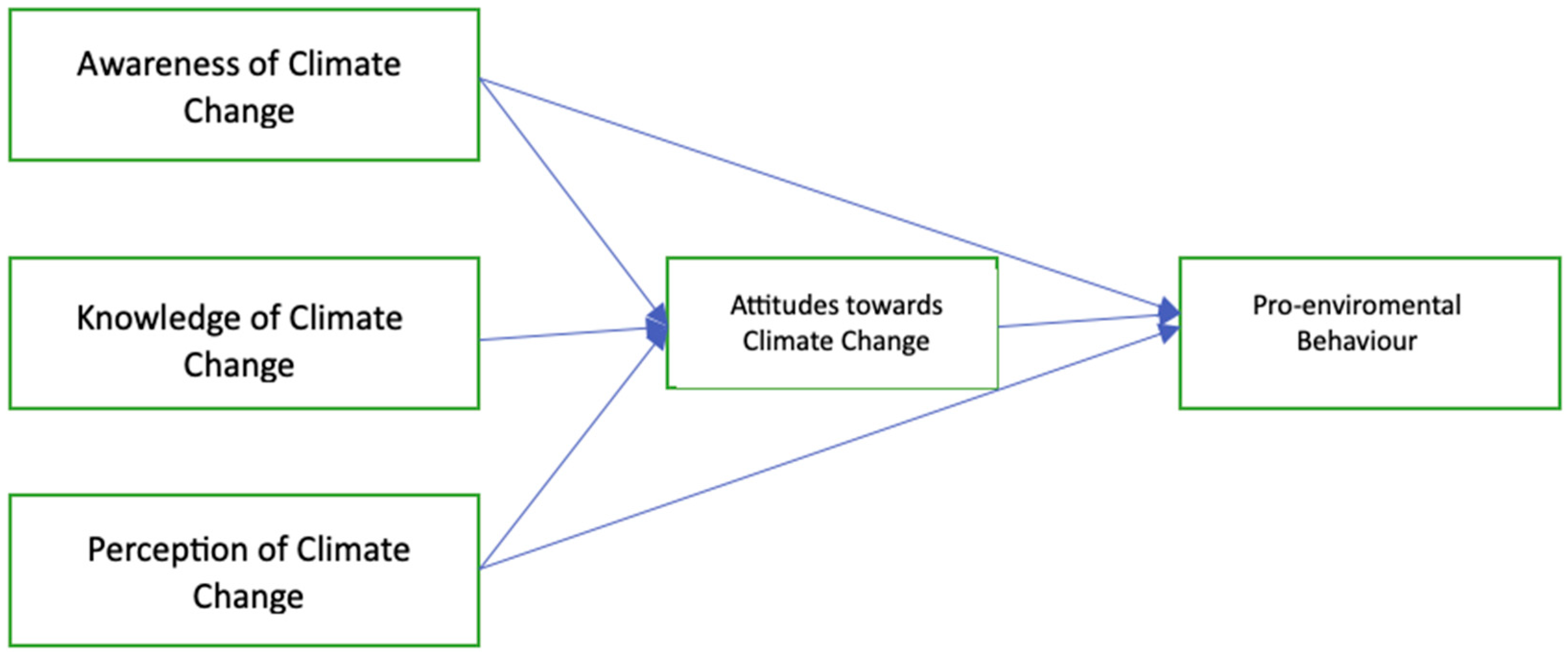
This study investigates the climate change attitudes of individuals living in Turkey through climate change awareness, knowledge, and risk perception towards climate change and the impact of these attitudes on pro-environmental behaviour. While establishing the research model, it is aimed to present the results of individuals’ awareness, knowledge, and risk perceptions to comprehend and improve their attitudes and behaviours towards climate change. To determine the main architecture of the study, the model given in Figure 1 is proposed to determine the relationships between awareness, risk perception, and environmental behaviours towards climate change. The model designed for the study is in the literature. Ref. [3] focused on environmental awareness and public perception in their study. Ref. [7] used the theory of planned behaviour to predict individuals’ environmental behaviours in their study. Ref. [12] modelled how farmers’ knowledge levels, attitudes and behaviours towards the protection of agricultural lands are shaped in their study. Finally, ref. [13] developed a model by examining the relationship between awareness and perception of risk in the context of environmental responsibility. In the light of all these studies, the basic structure of the current research was created and a framework based on the literature was presented.
Awareness is an important phenomenon that enables individuals to be aware of the problems in their environment and to have ideas for solving these problems [14]. Previous studies have shown that individuals’ awareness of climate change is positively associated with pro-environmental attitudes and behaviours. When studies on this attitude were examined, ref. [14] stated that climate change awareness positively affects individuals’ environmental attitudes and behaviours. Likewise, ref. [15] stated that increased awareness through environmental education leads to an increase in environmental behaviour and positive development.
The other important point emphasized in this study is individuals’ knowledge about climate change. Knowledge covers the extent to which individuals are informed about climate change and the way they evaluate this information [14]. In this context, the ‘knowledge’ scale employed in this study specifically measures ‘subjective knowledge’ (awareness of observed changes) rather than solely ‘factual scientific knowledge’, consistent with the framework established by [14]. Examining the studies using the variable of knowledge about climate change in the literature, it is stated that increasing the level of knowledge affects individuals’ perceptions and attitudes towards climate change. Reference [14] concluded in their study that individuals with a higher knowledge of climate change perceive environmental risks more accurately and exhibit more positive attitudes in this direction. In a similar vein, ref. [16] stated that knowledge plays an important role in explaining behavioural intentions related to climate change. Ref. [17], in 2013, stated that educating young people about climate change improved their risk perception and helped them develop positive behaviours regarding climate change.
Risk perception of climate change is the sensitivity and evaluation of individuals regarding the issue of climate change, which is rapidly spreading around the world. Risk perception reflects individuals’ interpretations of climate change and their level of concern about it [18]. Studies have been confirmed in the literature that risk perception enables individuals to directly examine their attitudes and increases their attitudes towards pro-environmental behaviours. Ref. [18] argued that the perception of climate change causes individuals to feel responsible for climate change and engage in pro-environmental behaviours. Ref. [18] stated that having increased knowledge about climate change may increase concern about the potential risks and that this situation requires more personal competence and responsibility.
Attitude, which combines the variables of awareness, knowledge, and risk perception about climate change, covers the emotional tendencies of individuals towards climate change. Attitudes encompass individuals’ thoughts about climate change, their emotional behaviours, and their behavioural intentions as a result [8]. It has been emphasized in different studies in the literature that attitudes are important and strong determinants of pro-environmental behaviours. Ref. [8] has demonstrated that climate change attitudes have a significant and positive effect on individuals’ behaviour towards the environment in their study; similarly to this study, the attitudes towards climate change were evaluated together with knowledge level, awareness, and perception variables, evaluating whether they engage in pro-environmental behaviours or not. As a result, it was concluded that the attitudes of individuals with a high level of awareness are active and sensitive in protecting the environment. Individuals with positive attitudes are more willing to protect the environment and adopt sustainable practices. Attitudes toward the environment influence a variety of activities such as recycling, using pro-environmental products, and using sustainable energy sources [19]. This observation was supported by [15]. The study revealed that pro-environmental behaviours are affected by various psychological, social, and demographic characteristics and that positive attitudes increase pro-environmental behaviours. Relatedly, ref. [20] stated that knowledge about climate change, risk perception, and personal norms affect and increase attitudes towards the environment.
In the literature, pro-environmental behaviour is defined as individuals’ actual implementation of environmentally sensitive actions; pro-environmental behaviour intention refers to individuals’ intentions and tendencies to implement environmentally friendly behaviours [15,21]. Although some items seem to include intentions for future behaviours, when the general structure of the scale is examined, it is seen that it is aimed at evaluating the participants’ environmentally sensitive behaviours based on their past and current efforts. For example, the statement ‘I have made major efforts to adopt climate change last year’ is aimed at measuring an actual behaviour in the past, and this situation is evaluated within the scope of environmental actions taken, rather than behavioural intention. In addition, studies in the field of environmental psychology emphasize that the different dimensions of pro-environmental behaviour (attitude, intention, and actual behaviour) are interrelated and that the scales provide a holistic assessment in this context [22,23]. The scale used in the study covers not only the participants’ intentions but also their attitudes and behavioural tendencies in coping with environmental problems.
In the research model determined in the study, it is predicted that individuals’ awareness, knowledge, and risk perceptions about climate change may affect their attitudes towards this issue; thus, their attitudes towards pro-environmental behaviours are examined. It is predicted that increases in awareness, knowledge, and risk perception levels can increase individuals’ positive attitudes towards the environment, and they will be more effective in exhibiting pro-environmental behaviours. It is assumed that increases in knowledge, awareness, and risk perception levels increase individuals’ positive attitudes towards climate change and contribute to their pro-environmental behaviours in this direction. In line with this understanding, it was thought and analyzed that the study aims to increase the participation of individuals living in the country and play an important role in developing effective strategies to deal with climate change. This study specifically integrates elements of the Protection Motivation Theory (PMT), as high-risk perception often triggers direct protective actions independently of general environmental attitudes. This theoretical framework justifies why awareness and risk perception act as direct drivers in our model, rather than being fully mediated by attitude.

2.2. Design of the Hypotheses

2.2.1. Awareness and Environmental Attitudes

Climate change is a global and prevalent problem; however, it is of great importance all over the world. Greenhouse gas emissions resulting from human activities and population growth cause serious changes in ecosystems, and these changes cause devastating effects on the world [24]. However, phenomena such as increasing temperatures, increasing frequency of extreme weather events, and decreasing biodiversity have a devastating effect on the world and are among the direct consequences of climate change [25]. The awareness, knowledge, perceptions, and attitudes of individuals about climate change need to be increased to combat climate change and ensure a sustainable future. In the literature, the impact of these factors on pro-environmental behaviour has been widely studied, and the results show that these variables play a critical role in combating climate change [1,16]. The hypothesis H1 related to climate change awareness is, therefore, proposed in this study.
H1: 
Climate change awareness impacts positively and significantly on attitudes towards climate change.

2.2.2. Knowledge and Environmental Attitudes

Being informed about climate change is a basic requirement for individuals to develop awareness and make more informed decisions while living their lives. Knowledge enables individuals to develop a deeper understanding of the causes and consequences of climate change. Ref. [26] conducted a study on the subject with high school students and emphasized that students with higher knowledge levels were more active in participating in environmental activities. This shows that increasing the level of knowledge will enable individuals to take active steps regarding climate change. Additionally, ref. [27] emphasized the positive relationship between climate change knowledge and individuals’ environmental attitudes. Ref. [28] examined the knowledge and attitudes of university students about climate change in their study, and the results show that the knowledge level of university students in the USA about climate change positively affects their environmentally friendly attitudes and behaviours. Similarly, ref. [29] analyzed the attitudes of the public in different countries about climate change; as a result, they revealed that awareness about climate change increases individuals’ attitudes and concerns towards the environment.
H2: 
Knowledge positively and significantly affects attitudes towards climate change.

2.2.3. Risk Perception and Environmental Attitudes

From another perspective, climate change perception refers to individuals’ perception of and feeling towards climate change This perception directly affects individuals’ attitudes and, ultimately, their behaviours related to climate change. Ref. [18] argued that climate change perception increases individuals’ concern and sense of responsibility, leading them to develop more pro-environmental attitudes. In societies with a high perception of climate change, individuals’ attitudes towards combating climate change and their behaviours in this regard are also positively affected [30]. In their study, ref. [31] found that public attitudes towards climate change play a major role in the process of transforming into environmental behaviours.
H3: 
Perceptions positively and significantly influence attitudes towards climate change.

2.2.4. Antecedents of Pro-Environmental Behaviour

Pro-environmental behaviours refer to the positive activities that individuals undertake to address climate change in personal daily lives. Pro-environmental behaviours include various actions such as energy saving, recycling, sustainable products, and the use of energy resources. Ref. [22] revealed in their studies that environmental attitudes and perceptions increase individuals’ pro-environmental behaviours. In this context, increasing awareness, knowledge, and perception levels about climate change plays a critical role in individuals’ development and sustainability of pro-environmental behaviours. Hypotheses were put forward by assuming that there may be a relationship between pro-environmental behaviours and climate change awareness, perception, and attitudes. Perception of climate change also affects individuals’ pro-environmental behaviour. It has been proven in many studies in the literature that the perception of climate change has an important role in encouraging and improving individuals’ environmental behaviour [22,30]. However, it was revealed by [32] in 2008 that awareness has the potential to change and improve individuals’ environmental behaviour. On the last hand, positive attitudes towards climate change can directly affect individuals’ pro-environmental behaviours. Ref. [23] demonstrate that environmental attitudes are an important determinant for individuals to exhibit pro-environmental behaviours. Ref. [33] showed in their study that risk perceptions play an important role in individuals’ awareness of climate change and development of environmental attitudes. In addition, ref. [20] found that risk perceptions directly affect attitudes and actions.
H4: 
Climate change perception significantly and positively influences pro-environmental behaviour.
H5: 
Awareness of climate change has a significant and positive impact on environmental behaviour.
H6: 
Attitudes towards climate change significantly and positively influence environmental behaviour.
This model aims to examine the relationship between individuals’ awareness, knowledge, and risk perceptions of climate change and pro-environmental behaviours through their attitudes. These hypotheses tested using SEM are supported by related studies in the literature. Moreover, it has contributed to the understanding and development of individual behaviours on climate change [7,34,35,36].

3. Materials and Methods

3.1. Site Selection

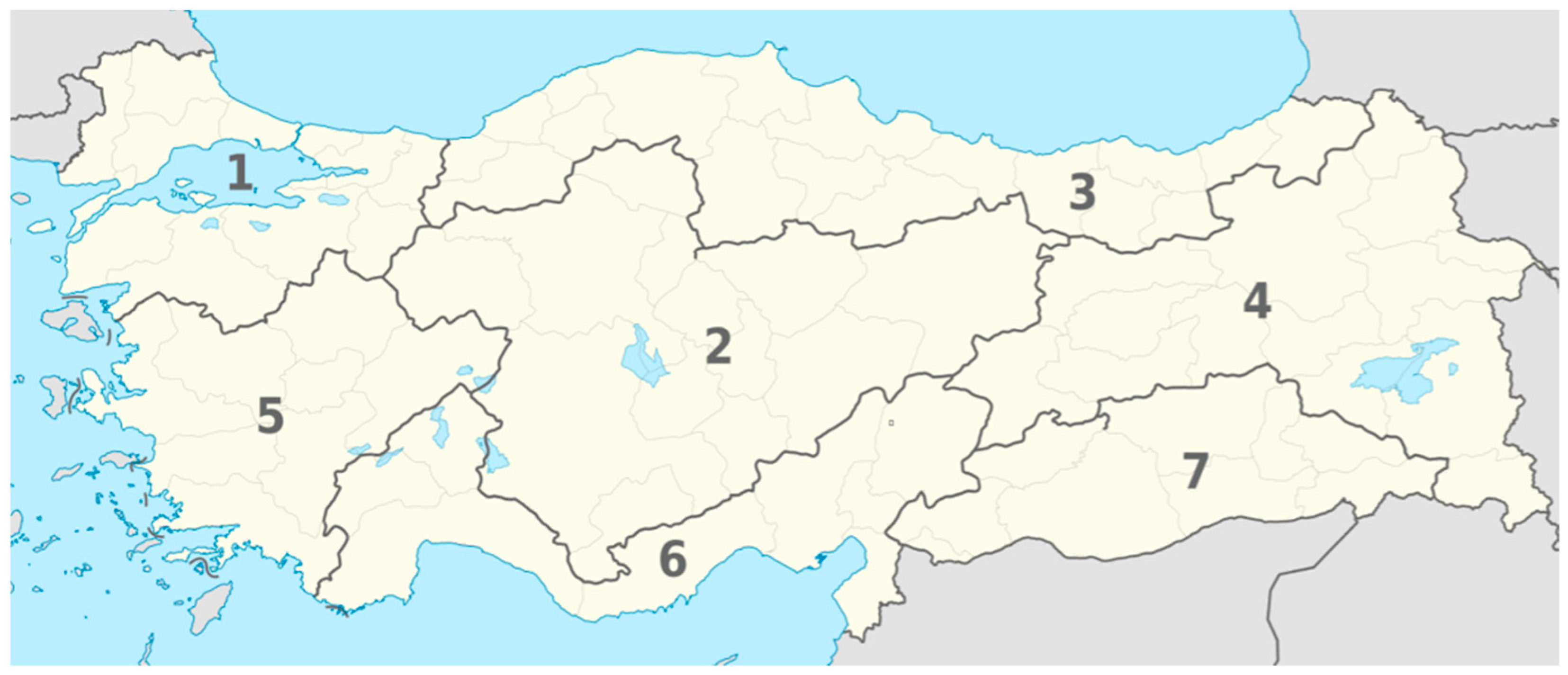
Turkey is known as a crossroads between Asia and Europe, which makes it an extremely important region for cultural interaction. Located at the crossroads of land and sea routes, Turkey also occupies a strategic geopolitical position. For both of these reasons, the main focus of the research is to understand the public’s views on climate change in this region with a rich cultural diversity. The survey was conducted in 2025 and focused on a total of 81 provinces in Turkey. These provinces are divided into seven regions: Mediterranean, Eastern Anatolia, Aegean, Southeastern Anatolia, Central Anatolia, Black Sea, and Marmara (Figure 2). The methodological structure of the study is illustrated in Figure S1 (Supplementary Materials).

3.2. Sampling Frame

In the study, a stratified random sampling method was used to create a sample that would represent the adult population living in Turkey. This method was preferred in order to reflect the geographical, demographic, and socio-economic diversity of the country. The strata were determined according to geographical regions, urban/rural areas, and age groups using TURKSTAT data. While this approach enhances diversity, the absence of survey weights limits claims about national representativeness. This approach enhances the geographical and demographic diversity of the sample, enabling a more comprehensive analysis of factors affecting environmentally friendly behaviour intentions. However, the absence of survey weights should be considered when interpreting results.
The sample frame of the study consists of individuals aged 18 and over, and with any monthly income, residing in Turkey in 2025. In addition, the frame in question was designed to represent the geographical and demographic diversity of Turkey. The sample was created using the address-based sampling method. In this method, randomly selected households from all regions, including urban and rural areas, were reached using the national address database provided by the Turkish Statistical Institute (TURKSTAT). All these comprehensive planning and implementation processes aimed to maximize the scientific validity and representativeness of the study. While the stratified sampling method ensures diversity across regions and age groups, survey weights were not applied to the dataset. Therefore, the results reflect the sample characteristics and should be interpreted with caution regarding national representativeness.

3.3. Measurements and Instrument Development

The questionnaire used in this study consisted of two main sections. The first section included questions regarding the demographic characteristics of the participants (age, gender, education, income). The second section comprised scales designed to measure awareness, knowledge, risk perception, attitudes, and pro-environmental Behaviour. All items in the scales were measured using a 5-point Likert type scale ranging from “1 = Strongly Disagree” to “5 = Strongly Agree”.
The specific constructs were adapted from validated scales in the existing literature to ensure content validity:
  • Awareness: Measured using 4 items adapted from [3,14] focusing on individuals’ realization of climate change problems.
  • Knowledge: Consisted of 5 items assessing subjective knowledge about climate indicators (e.g., temperature increase, rainfall patterns). These items were consistent with the framework established by [14,18].
  • Risk Perception: Measured with 4 items adapted from [18,37], assessing the level of concern regarding the impacts of climate change on health, agriculture, and living standards.
  • Attitudes: Comprised 4 items evaluating emotional tendencies and willingness to pay/act, adapted from [8,19].
  • Pro-environmental Behaviour: Measured using 5 items focusing on actual past behaviours and future intentions, based on the frameworks of [15,21].
Prior to the main data collection, the survey items were reviewed by three academic experts in the field of statistics and environmental science to ensure clarity and relevance (content validity). A pilot test was conducted with a small sub-sample (n = 100) to verify the comprehensibility of the questions. Following the pilot study, minor wording adjustments were made to fit the Turkish cultural context. The reliability of these scales was further confirmed via Cronbach’s Alpha and Composite Reliability (CR) values in the main study.

3.4. Data Collection Method

In this study, the necessary approval was obtained from the Süleyman Demirel University Science and Engineering Sciences Ethics Committee in Türkiye before starting the data collection process. Before the data collection process, the participants were provided with detailed information about the purpose and scope of the research. It was also stated that the survey was completely based on volunteering. Data was collected only from individuals who agreed to participate in the survey.
The data was collected between 15 January and 15 August 2025 and covers a total period of approximately seven months. In addition, great importance was given to collecting the data on different days of the week and at different times of the day. The fact that the data collection process was spread over a period of seven months is to increase the power of the sample that represents the population. The data was collected face-to-face by interviewers with the help of tablets they had with them, by going to pre-determined places based on addresses. Through the use of these mobile devices, the data collection process could be monitored instantly through a central system.
This research was conducted in Türkiye and Türkiye is divided into seven different regions geographically. These regions are Marmara, Aegean, Black Sea, Central Anatolia, Eastern Anatolia, Southeastern Anatolia, and Mediterranean. The population of each region and the ratio of these regions to the total population are given in Table 1. For sampling, the number of samples to be taken from these regions was determined by taking the specified percentages into consideration. It was emphasized that the demographic characteristics of the individuals in the included sample group, such as age and gender, showed a homogeneous distribution in subgroups. In addition, the sample size of the study was determined to meet the sample size of the SEM analyses. Although >400 participants are generally recommended for SEM analyses in the literature [38], larger samples were created considering the complex model structure and multiple variables of the studies. A total of 3125 participants were reached, and this number provided the necessary compliance in the validity indices of the model. The data collection process was terminated when the convergence criteria of the complex SEM model were met during the data collection processes. This process ensured that the study produced statistically strong and valid results.
Figure 2. Map of study area in Turkey [38]. (1) Marmara Region, (2) Central Anatolia Region, (3) Black Sea Region, (4) Eastern Anatolia Region, (5) Aegean Region, (6) Mediterranean Region, (7) Southeastern Anatolia Region.
Sustainability 18 01175 g002

3.5. Data Analysis

The data obtained were analyzed using IBM SPSS Statistics for Windows, version 26.0 (IBM Corp., Armonk, NY, USA) for descriptive statistics and exploratory factor analysis. The structural equation modelling (SEM) and confirmatory factor analysis (CFA) were conducted using LISREL (version 8.72 Scientific Software International, Inc., Skokie, IL, USA).

4. Results

4.1. The Socio-Economic Characteristics of the Respondents

Table 2 presents the socio-economic characteristics of the participants in Turkey. The age distribution shows that the largest group is 25–34 years old, representing 23.4% of the total respondents. This group is followed by participants between the ages of 45–54 with 21.1% and individuals between the ages of 35–44 with 17.3%. In terms of gender distribution, it is seen that male participants are in the majority with 59.3%, while female participants are represented by 40.7%. In terms of education level, it was observed that high school graduates constitute the largest group with 42.1%, followed by master’s degree graduates with 26.2%. While undergraduate graduates are represented by 15.4%, the rate of doctoral graduates is 12.7%. It is noteworthy that the rate of primary school graduates is only 3.6%. When the income distribution is examined, it is seen that 37.8% of the participants earn an income between 16,501 and 2200–2200 TRY. This is followed by those earning an income between 27,501 and 33,000 TRY with 25.7% and participants with income between 22,001 and 27,500 TRY with 19.4%. Participants in the lowest income group (less than 16,500 TRY) are represented by 5.1%, while participants in the highest income group (33,001 TRY and above) are represented by 12.0%.
These data show that participants covered a wide range of ages, genders, education, and incomes. Especially, the diversity in education level and differences in income distribution reveal that the study has a rich data set for socio-economic analyses. This diversity provides information about important points in understanding perceptions and attitudes about climate change.

4.2. Confirmatory Factor Analysis (CFA)

The explanatory factor analysis results indicated that the KMO sample adequacy measure was 0.982, and Bartlett’s sphericity test was significant (χ* = 594.07; p < 0.01), confirming the suitability of the data for factor analysis. The items were grouped under five factors explaining approximately 76% of the total variance. As detailed in Table 3, all factor loadings were high, and Cronbach’s Alpha values exceeded the 0.70 threshold, indicating high reliability.

4.3. Results of Structural Equation Modelling (SEM) Analysis

In the study, the relationships between awareness, knowledge, risk perception, attitudes, and pro-environmental behaviours regarding climate change were examined using SEM. Statistical criteria such as RMSEA, NFI, NNFI, CFI, GFI, AGF and path coefficients were used in the evaluation of the model.
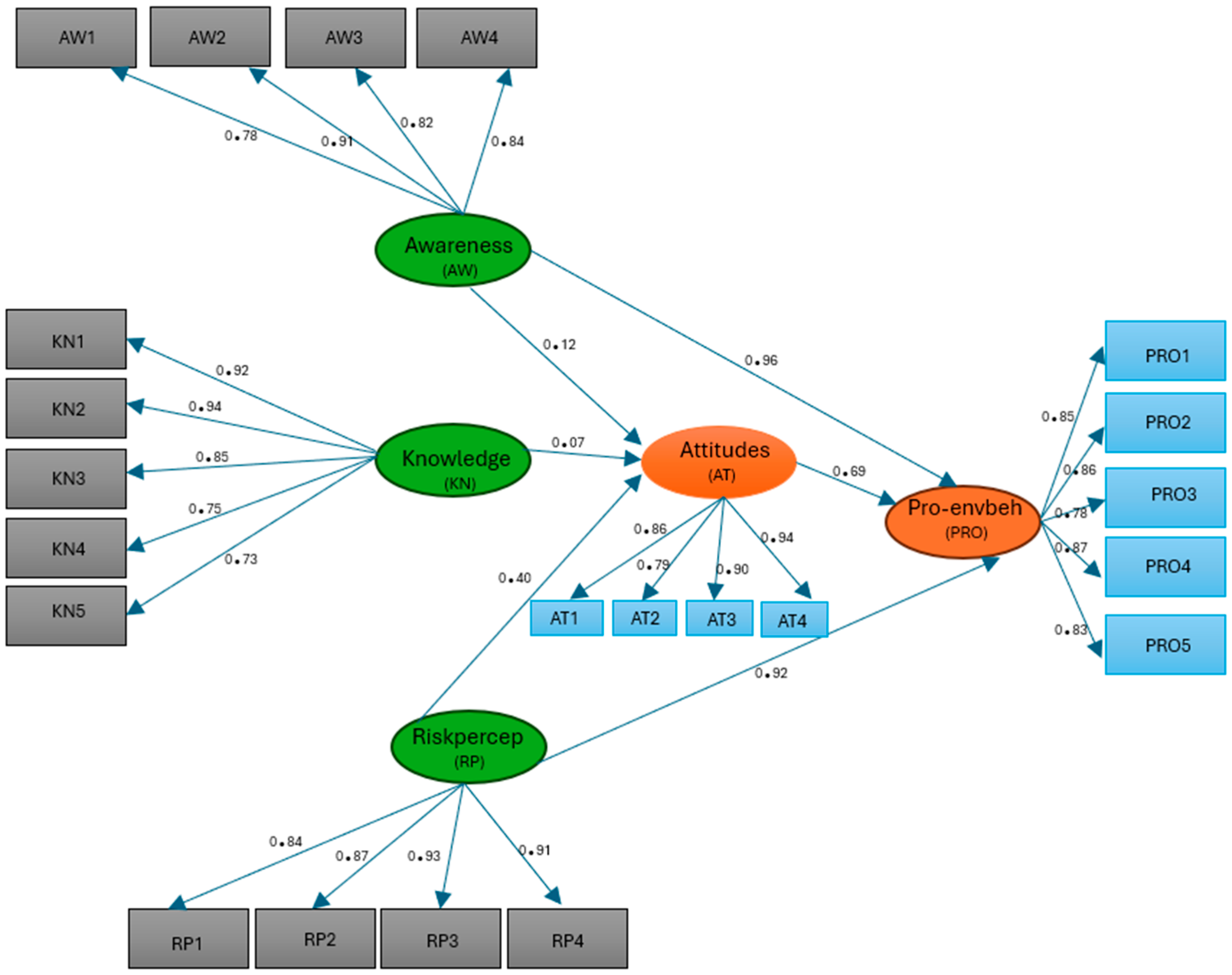
The results of the SEM reveal the effects of climate change awareness, knowledge, and risk perception on individuals’ attitudes and pro-environmental behaviours. Figure 3 demonstrates that the awareness variable has a moderate effect on individuals’ attitudes (0.12) but a very strong direct effect on pro-environmental behaviours (0.96). While the effect of knowledge level on individuals’ attitudes is low (0.07), the direct effect of knowledge on pro-environmental behaviours is also low (0.07). Risk perception has a significant effect on individuals’ attitudes (0.40) and an exceptionally strong direct effect on pro-environmental behaviours (0.92). Finally, the effect of attitudes on pro-environmental behaviour is found to be significant and strong (0.69), though lower than the direct impacts of awareness and risk perception. This indicates that individuals’ attitudes are the most important and critical factor in determining their pro-environmental behaviours.
Root Mean Square Error of Approximation (RMSEA) value being less than 0.05 indicates that the variables in the model have a very good fit with the model. However, in other indices (NFI, NNFI, CGI, GFI, and AGFI) ranging from 0 to 1, a value above 0.90 indicates a good fit between the model and the data [39]. The fact that the specified index values are 0.95 and above also indicates that the model has an adequate fit [40,41,42]. Apart from these indices, the chi-square test is a major and important statistic used in evaluating the results of SEM analyses. A low chi-square value indicates that the model fits the data more accurately. However, the chi-square value is sensitive to model complexity and sample size. It is recommended that other indices be used as a basis [43]. Excellent and acceptable fit measures for the listed fit indices are shown in Table 4.
Performance comparison shows that the model fits the data quite well. RMSEA (0.048), NFI (0.980), NNFI (0.980), CFI (0.980), GFI (0.960), and AGFI (0.960) values are all within acceptable limits, and most of them are within perfect fit range. Considering the chi-square value, these findings support the accuracy of the mathematical structure of the model, and it fits the data.

4.4. Validity and Reliability of the Model

Composite Reliability (CR) and Average Variance Extracted (AVE) values were calculated to assess the internal consistency and convergent validity of the measurement model. As presented in Table 5, all CR values exceeded the recommended threshold of 0.70 [44], ranging from 0.904 to 0.937. Similarly, all AVE values were above the 0.50 threshold, ranging from 0.703 to 0.789. These results confirm the strong construct validity and reliability of the scale.

4.5. Hypotheses Testing

In the analysis conducted with structural equation modelling (SEM), the values obtained because of testing the hypotheses are presented in the table below. For each hypothesis, the relevant path coefficients, parameter estimates, t-values, and p-values are presented. These results support the accuracy of the model and the relationships between theoretical constructions.
The findings in Table 2, Table 3 and Table 6 show that the main hypotheses proposed in the model (see Section 2.2) and the hypotheses related to indirect relationships are supported and provide results consistent with previous studies in the literature. The research model revealed that awareness positively influences attitudes (t = 6.51, p < 0.01), similarly knowledge positively influences attitudes (t = 3.80, p < 0.01). Furthermore, the strong effect of risk perception on attitudes showed that environmental risk perception constructs individuals’ attitudes towards the environment (t = 19.76, p < 0.01), while attitudes have a strong effect on pro-environmental behaviours (t = 4.36, p < 0.01). Awareness has a positive effect on pro-environmental behaviours (t = 9.99, p < 0.01). The significant effect of risk perception on pro-environmental behaviours showed that environmental risk perception is a factor that motivates individuals’ environmental actions. Awareness, knowledge, and risk perception indirectly contribute to pro-environmental behaviours by determining individuals’ attitudes (t = 4.48, 2.87, 12.49, p < 0.01) (Table 7). This reveals that environmental attitudes have a critical role in determining the environmental actions of individuals.

5. Discussion

In this study, climate change attitudes and behaviours of individuals living in Turkey towards climate change through awareness, knowledge, and perception and the effect of these attitudes on pro-environmental behaviour were investigated using SEM. The purpose of using SEM is that it is a tool used to identify, explain, and predict outcomes by determining, explaining, and estimating correlations between variables. As a result of the analysis, it was concluded that awareness has a remarkably high direct effect on pro-environmental behaviours (β = 0.96). This suggests that simply being aware of the problem is a primary driver of action in Türkiye. Similarly, risk perception has a very strong direct effect on pro-environmental behaviours (β = 0.92), indicating that anxiety about climate risks directly motivates behaviour. The effect of attitudes on pro-environmental behaviours is also strong (β = 0.69), but our findings show that direct awareness and risk perception are stronger drivers than attitude alone in this specific context. This reveals that while positive attitudes are important, the urgency created by high awareness and risk perception is the dominant factor triggering environmental actions in Türkiye.
The exceptionally strong path coefficients observed in our results ( β = 0.92 to 0.96) warrant careful interpretation. Such high values, while statistically significant in our large sample (n = 3125), may be attributed to cognitive consistency or cultural response patterns in the Turkish context, where individuals who identify as ‘aware’ of climate change risks tend to report a high commitment to action to avoid cognitive dissonance. Furthermore, the strong direct path from awareness to behaviour suggests that in Türkiye climate-related threats are perceived with high urgency, leading to immediate behavioural intentions that bypass long-term attitudinal shifts.
As a result, risk perception and attitude were found to be the variables with the highest impact on pro-environmental behaviours. The effect of awareness and knowledge on attitudes and behaviours is lower, but it is found to be significant when the values are examined. Considering the different studies in the literature [7,12,13], it was determined that awareness, knowledge, and risk perception play a critical role in shaping individuals’ attitudes and behaviours towards the environment. The results of the CR and AVE criteria in the study show that the model has high reliability and validity. These results are also in line with the CR and AVE values proposed by [44] and show that the variables obtained in this study support the theoretical structures of the model in terms of internal consistency and validity and are compatible with the data. In addition, the six hypotheses identified in the study were supported when considering the findings. Hypothesis H1, which examines the effect of awareness on attitudes, was supported in the literature by [15,21]. Hypothesis H2, on the other hand, shows that knowledge has a positive effect on attitudes [22], while the strong effect of risk perception on attitudes (H3) is supported by this study and different studies in the literature [37].
Moreover, the positive and significant effect of attitudes and awareness on pro-environmental behaviours is theoretically confirmed and confirmed by previous studies (H4 and H5) [15,21,45]. The significant effect of risk perception on pro-environmental behaviours reveals that this perception is a variable that increases individuals’ environmental actions [37]. However, there are also studies in the literature suggesting that attitude is not the most critical determinant of environmentally friendly behaviours. For example, ref. [1] stated that environmental behaviours are affected not only by individual attitudes but also by personal norms, social pressures, and habits. Similarly, ref. [22] showed in their meta-analysis that factors such as moral norms, perceived behavioural control, and habits may have a stronger effect than attitudes among the determinants of environmentally friendly behaviours. In addition, the integrated model developed by [46] reveals that environmental behaviours are more closely related to past behaviours and habits than attitudes. On the other hand, ref. [47] argued in the context of social identity theory that individuals’ environmental attitudes and behaviours are shaped by a sense of belonging to social groups, and therefore social norms may be more determinant than individual attitudes. In addition, ref. [23] emphasized that environmental behaviours are largely affected by emotional and social factors beyond the cognitive evaluations of individuals. When the findings of this study are compared with international literature, detailed consistencies and divergences emerge regarding the structural drivers of pro-environmental behaviour. Aligning with our results in Türkiye, where risk perception significantly impacts attitudes (path coefficient: 0.40), studies in other developing economies have similarly highlighted risk perception as a primary motivator. For instance, ref. [6] identified that in Vietnam, risk perception was the strongest predictor of farmers’ intention to adapt to climate change, while ref. [8] reported that in Egypt high perception of resource scarcity directly influenced environmental attitudes. In contrast, the role of objective knowledge presents a divergence; while our study found a relatively low impact of knowledge on attitude (0.07), research in developed contexts like the USA by [28,36] suggest that information efficacy often plays a more central role in shaping concern, though it is heavily mediated by political ideology. Perhaps the most distinctive finding of our study is the remarkably high path coefficient (0.90) between attitude and pro-environmental behaviour. This contrasts with the ‘value-action gap’ frequently discussed in Western literature, where ref. [15] note that environmental awareness often fails to translate into direct action. Our results suggest that in the Turkish context, once a positive attitude is formed, it translates almost directly into behavioural implementation, differentiating it from trends observed in some industrialized nations. This shows that environmental education and awareness campaigns can be more effective in developing countries. These findings align with recent cross-cultural research on climate-risk perception, suggesting that social identity and local context often shape behavioural responses more strongly than individual cognitive factors alone. In this context, when comparing the findings of our study with other studies in the literature, it is important to emphasize the effect of attitude, but also to consider the existence of alternative theoretical approaches. Our finding that attitude is a strong determinant should be evaluated in the context of the sample and in line with the variables used. Finally, while the indirect relationships suggested in the model are supported, it is understood that awareness, knowledge, and risk perception indirectly contribute to environmentally friendly behaviours by shaping individuals’ attitudes. This reveals that environmental attitudes play a critical role in mediating individuals’ environmental actions.

6. Conclusions

6.1. Theoretical Implications

This study demonstrates the significant effects of individuals’ awareness, knowledge, and risk perceptions of climate change on environmental attitudes and behaviours in Turkey. Analyses using SEM show that all three factors positively affect environmental attitudes and behaviours. The results indicated that individuals with increased levels of awareness and knowledge are more sensitive to environmental problems and more willing to solve such problems. This draws attention to the importance of environmental education programmes and awareness-raising campaigns. Individuals with more awareness and knowledge about climate change perceive environmental risks more accurately and exhibit more positive attitudes towards these risks. This indicates that providing necessary training can positively change individuals’ behaviours towards the environment. Risk perception is an important variable that reflects individuals’ concerns about environmental problems. Individuals with high-risk perception exhibit responsible behaviours in combating climate change. In this respect, the findings indicate that effective strategies should be developed in combating climate change, and the level of awareness and knowledge of the public should be increased.

6.2. Policy and Practical Implications

The findings offer actionable strategies for policymakers. First, since risk perception is a stronger driver than knowledge, environmental campaigns in Türkiye should move beyond simply ‘informing’ the public. Instead, they should utilize visual and emotional communication strategies that highlight the tangible risks of climate change (e.g., drought simulations, flood impact maps) to trigger immediate behavioural change. Second, the strong link between awareness and action suggests that mandatory climate literacy curricula should be integrated not just in schools but also in municipal vocational training centres. Finally, local governments should leverage social media platforms to disseminate real-time risk assessments, as the public in this context responds rapidly to perceived immediate threats.

7. Limitations and Future Research

Several limitations should be noted. First, the study relies exclusively on self-reported data, which may be subject to social desirability bias; participants might overreport their pro-environmental behaviours to appear favourable. Future studies could incorporate observational data to validate these findings. Second, although the stratified sampling ensured proportional geographical coverage, the absence of survey weights limits the ability to generalize findings perfectly to the entire Turkish population. The sample may overrepresent certain education or income groups compared to the national census.

Supplementary Materials

The following supporting information can be downloaded at: https://www.mdpi.com/article/10.3390/su18031175/s1, Figure S1: Mind map of the study structure.

Funding

This research received no external funding.

Institutional Review Board Statement

The study was conducted in accordance with the Declaration of Helsinki and approved by the Institutional Review Board of Süleyman Demirel University (protocol code E.903271 and date of approval 11 December 2024).

Informed Consent Statement

Informed consent was obtained from all subjects involved in the study.

Data Availability Statement

The original data used to support the findings of this study have been deposited in the FIGSHARE repository (https://doi.org/10.6084/m9.figshare.26714509).

Acknowledgments

Language editing was assisted using an AI-based tool; the author assumes responsibility for the content. Certain images in this publication have been obtained by the author from the Wikipedia/Wikimedia website, where they were made available under a Creative Commons licence or stated to be in the public domain.

Conflicts of Interest

The author declares no conflicts of interest.

Abbreviations

The following abbreviations are used in this manuscript:
SEMStructural equation modelling
TURKSTATTurkish Statistical Institute
CFAConfirmatory factor analysis
KNKnowledge
RPRisk perception
ATAttitudes towards
PROPro-environmental behaviour
AWAwareness
RMSEARoot mean square error
NFINormed Fit Index
NNFINon-Normed Fit Index
CFIComparative Fit Index
GFIGoodness-of-Fit
AGFIAdjusted Goodness-of-Fit
CRComposite reliability
AVEAverage variance extracted
KMOKaiser-meyer-olkin

References

  1. Stern, N. The Economics of Climate Change. Am. Econ. Rev. 2008, 98, 1–37. [Google Scholar] [CrossRef]
  2. Yilmaz, V.; Can, Y. Impact of Knowledge, Concern and Awareness about Global Warming and Global Climatic Change on Environmental Behavior. Environ. Dev. Sustain. 2020, 22, 6245–6260. [Google Scholar] [CrossRef]
  3. Masud, M.; Akhtar, R.; Afroz, R.; Al-Amin, A.; Kari, F. Pro-Environmental Behavior and Public Understanding of Climate Change. Mitig. Adapt. Strateg. Glob. Change 2015, 20, 591–600. [Google Scholar] [CrossRef]
  4. Demirbağ, M.; Yılmaz, Ş. Preservice Teachers’ Knowledge Levels, Risk Perceptions and Intentions to Use Renewable Energy: A Structural Equation Model. J. Educ. Sci. Environ. Health 2020, 6, 193–206. [Google Scholar] [CrossRef]
  5. Gülsoy, E.; Korkmaz, M. Üniversite Öğrencilerinin Sosyo-Ekonomik Özelliklerinin Küresel Isınma ve İklim Değişikliği Algıları Üzerine Etkileri. Turk. J. For. 2020, 21, 428–437. [Google Scholar] [CrossRef]
  6. Dang, H.L.; Li, E.; Nuberg, I.; Bruwer, J. Understanding Farmers’ Adaptation Intention to Climate Change: A Structural Equation Modelling Study in the Mekong Delta, Vietnam. Environ. Sci. Policy 2014, 41, 11–22. [Google Scholar] [CrossRef]
  7. Masud, M.; Al-Amin, A.; Junsheng, H.; Ahmed, F.; Yahaya, S.; Akhtar, R.; Banna, H. Climate Change Issue and Theory of Planned Behaviour: Relationship by Empirical Evidence. J. Clean. Prod. 2015, 113, 613–623. [Google Scholar] [CrossRef]
  8. Salem, M.R.; Hegazy, N.; Thabet Mohammed, A.A.; Mahrous Hassan, E.; Saad Abdou, M.M.; Zein, M.M. Climate Change-Related Knowledge and Attitudes among a Sample of the General Population in Egypt. Front. Public Health 2022, 10, 1047301. [Google Scholar] [CrossRef] [PubMed]
  9. Agibayeva, A.; Tleuken, A.; Karaca, F.; Avcu, E.; Guney, M. Understanding Public Perception of Air Quality in the Urban Environment of Central Asia: An Empirical Assessment Using Structural Equation Modelling. Environ. Urban. ASIA 2024, 15, 39–58. [Google Scholar] [CrossRef]
  10. Chen, J.; Huang, J.; Huang, X.; Sun, S.; Hao, Y.; Wu, H. How Does New Environmental Law Affect Public Environmental Protection Activities in China? Evidence from Structural Equation Model Analysis on Legal Cognition. Sci. Total Environ. 2020, 714, 136558. [Google Scholar] [CrossRef]
  11. Rampedi, I.T.; Ifegbesan, A.P. Understanding the Determinants of Pro-Environmental Behavior among South Africans: Evidence from a Structural Equation Model. Sustainability 2022, 14, 3218. [Google Scholar] [CrossRef]
  12. Aregay, F.A.; Minjuan, Z.; Tao, X. Knowledge, Attitude and Behavior of Farmers in Farmland Conservation in China: An Application of the Structural Equation Model. J. Environ. Plan. Manag. 2018, 61, 249–271. [Google Scholar] [CrossRef]
  13. Yılmaz, V.; Guleç, P.; Ari, E. Impact of Climate Change Information of University Students in Turkey on Responsibility and Environmental Behavior through Awareness and Perceived Risk. Environ. Dev. Sustain. 2023, 25, 7281–7297. [Google Scholar] [CrossRef]
  14. Lee, T.M.; Markowitz, E.M.; Howe, P.D.; Ko, C.-Y.; Leiserowitz, A.A. Predictors of Public Climate Change Awareness and Risk Perception around the World. Nat. Clim. Change 2015, 5, 1014–1020. [Google Scholar] [CrossRef]
  15. Kollmuss, A.; Agyeman, J. Mind the Gap: Why Do People Act Environmentally and What Are the Barriers to pro-Environmental Behavior? Environ. Educ. Res. 2002, 8, 239–260. [Google Scholar] [CrossRef]
  16. O’Connor, R.E.; Bord, R.J.; Fisher, A. Risk Perceptions, General Environmental Beliefs, and Willingness to Address Climate Change. Risk Anal. 1999, 19, 461–471. [Google Scholar] [CrossRef]
  17. Stevenson, K.T.; Peterson, M.N.; Bondell, H.D.; Mertig, A.G.; Moore, S.E. Environmental, Institutional, and Demographic Predictors of Environmental Literacy among Middle School Children. PLoS ONE 2013, 8, e59519. [Google Scholar] [CrossRef]
  18. Milfont, T.L. The Interplay between Knowledge, Perceived Efficacy, and Concern about Global Warming and Climate Change: A One-Year Longitudinal Study. Risk Anal. 2012, 32, 1003–1020. [Google Scholar] [CrossRef]
  19. Shafiei, A.; Maleksaeidi, H. Pro-Environmental Behavior of University Students: Application of Protection Motivation Theory. Glob. Ecol. Conserv. 2020, 22, e00908. [Google Scholar] [CrossRef]
  20. Gifford, R.; Nilsson, A. Personal and Social Factors That Influence Pro-Environmental Concern and Behaviour: A Review. Int. J. Psychol. 2014, 49, 141–157. [Google Scholar] [CrossRef]
  21. Ajzen, I. The Theory of Planned Behavior. Organ. Behav. Hum. Decis. Process. 1991, 50, 179–211. [Google Scholar] [CrossRef]
  22. Bamberg, S.; Möser, G. Twenty Years after Hines, Hungerford, and Tomera: A New Meta-Analysis of Psycho-Social Determinants of pro-Environmental Behaviour. J. Environ. Psychol. 2007, 27, 14–25. [Google Scholar] [CrossRef]
  23. Steg, L.; Vlek, C. Encouraging Pro-Environmental Behaviour: An Integrative Review and Research Agenda. J. Environ. Psychol. 2009, 29, 309–317. [Google Scholar] [CrossRef]
  24. IPCC. Climate Change Widespread, Rapid, and Intensifying—IPCC. Available online: https://www.ipcc.ch/2021/08/09/ar6-wg1-20210809-pr/ (accessed on 30 October 2025).
  25. Pachauri, R.K.; Allen, M.R.; Barros, V.R.; Broome, J.; Cramer, W.; Christ, R.; Church, J.A.; Clarke, L.; Dahe, Q.D.; Dasqupta, P.; et al. Climate Change 2014 Synthesis Report. Contribution of Working Groups I, II, and III to the Fifth Assessment Report of the Intergovernmental Panel on Climate Change; IPCC: Geneva, Switzerland, 2014. [Google Scholar]
  26. Mcneill, K.; Vaughn, M. Urban High School Students’ Critical Science Agency: Conceptual Understandings and Environmental Actions Around Climate Change. Res. Sci. Educ. 2010, 42, 373–399. [Google Scholar] [CrossRef]
  27. Climate Change Education in the Context of Education for Sustainable Development: Rationale and Principles—Yoko Mochizuki, Audrey Bryan, 2015. Available online: https://journals.sagepub.com/doi/10.1177/0973408215569109 (accessed on 30 October 2025).
  28. Wachholz, S.; Artz, N.; Chene, D. Warming to the Idea: University Students’ Knowledge and Attitudes about Climate Change. Int. J. Sustain. High. Educ. 2014, 15, 128–141. [Google Scholar] [CrossRef]
  29. Calculli, C.; D’Uggento, A.M.; Labarile, A.; Ribecco, N. Evaluating People’s Awareness about Climate Changes and Environmental Issues: A Case Study. J. Clean. Prod. 2021, 324, 129244. [Google Scholar] [CrossRef]
  30. Whitmarsh, L. Behavioural Responses to Climate Change: Asymmetry of Intentions and Impacts. J. Environ. Psychol. 2009, 29, 13–23. [Google Scholar] [CrossRef]
  31. Ağıralan, E.; Sadioğlu, U. İklim Değişikliği Farkındalığı ve Toplum Bilinci: İstanbul Örneği. Anadolu Üniversitesi Sos. Bilim. Derg. 2021, 21, 627–654. [Google Scholar] [CrossRef]
  32. Nisbet, E.K.L.; Gick, M.L. Can Health Psychology Help the Planet? Applying Theory and Models of Health Behaviour to Environmental Actions. Can. Psychol./Psychol. Can. 2008, 49, 296–303. [Google Scholar] [CrossRef]
  33. Oldekop, J.A.; Sims, K.R.E.; Whittingham, M.J.; Agrawal, A. An Upside to Globalization: International Outmigration Drives Reforestation in Nepal. Glob. Environ. Change 2018, 52, 66–74. [Google Scholar] [CrossRef]
  34. Choon, S.-W.; Ong, H.-B.; Tan, S.-H. Does Risk Perception Limit the Climate Change Mitigation Behaviors? Environ. Dev. Sustain. 2019, 21, 1891–1917. [Google Scholar] [CrossRef]
  35. Hu, S.; Jia, X.; Zhang, X.; Zheng, X.; Zhu, J. How Political Ideology Affects Climate Perception: Moderation Effects of Time Orientation and Knowledge. Resour. Conserv. Recycl. 2017, 127, 124–131. [Google Scholar] [CrossRef]
  36. Kellstedt, P.M.; Zahran, S.; Vedlitz, A. Personal Efficacy, the Information Environment, and Attitudes toward Global Warming and Climate Change in the United States. Risk Anal. 2008, 28, 113–126. [Google Scholar] [CrossRef]
  37. Slovic, P. Perception of Risk. Science 1987, 236, 280–285. [Google Scholar] [CrossRef]
  38. Geographical Regions of Turkey. Wikipedia. Available online: https://en.wikipedia.org/wiki/Geographical_regions_of_Turkey (accessed on 30 October 2025).
  39. Browne, M.W.; Cudeck, R. Alternative Ways of Assessing Model Fit. Sociol. Methods Res. 1992, 21, 230–285. [Google Scholar] [CrossRef]
  40. Bentler, P.M.; Bonett, D.G. Significance Tests and Goodness of Fit in the Analysis of Covariance Structures. Psychol. Bull. 1980, 88, 588–606. [Google Scholar] [CrossRef]
  41. Hu, L.; Bentler, P.M. Cutoff Criteria for Fit Indexes in Covariance Structure Analysis: Conventional Criteria versus New Alternatives. Struct. Equ. Model. Multidiscip. J. 1999, 6, 1–55. [Google Scholar] [CrossRef]
  42. Lomax, R. A Guide to LISREL-Type Structural Equation Modeling. Behav. Res. Methods Instrum. 1982, 14, 1–8. [Google Scholar] [CrossRef]
  43. Byrne, M. Barbara Structural Equation Modeling with EQS: Basic Concepts, Applications, and Programming, 2nd ed.; Routledge: New York, NY, USA, 2013. [Google Scholar]
  44. Fornell, C.; Larcker, D.F. Evaluating Structural Equation Models with Unobservable Variables and Measurement Error. J. Mark. Res. 1981, 18, 39–50. [Google Scholar] [CrossRef]
  45. Hines, J.M.; Hungerford, H.R.; Tomera, A.N. Analysis and Synthesis of Research on Responsible Environmental Behavior: A Meta-Analysis. J. Environ. Educ. 1987, 18, 1–8. [Google Scholar] [CrossRef]
  46. Klöckner, C.A. A Comprehensive Model of the Psychology of Environmental Behaviour—A Meta-Analysis. Glob. Environ. Change 2013, 23, 1028–1038. [Google Scholar] [CrossRef]
  47. Fielding, K.S.; Hornsey, M.J. A Social Identity Analysis of Climate Change and Environmental Attitudes and Behaviors: Insights and Opportunities. Front. Psychol. 2016, 7, 121. [Google Scholar] [CrossRef] [PubMed]
Figure 1. Proposed research model for understanding awareness, knowledge, and perception of climate change in Türkiye.
Sustainability 18 01175 g001
Figure 3. Structural equation modelling of climate change in Türkiye.
Sustainability 18 01175 g003
Table 1. The seven regions in Turkey and their total populations.
RegionPopulationProportion in Total Population (%)Sample Size
Mediterranean11,020,55012.92404
Eastern Anatolia5,998,7787.03220
Aegean10,886,80312.80399
Southeastern Anatolia9,305,91010.91341
Central Anatolia13,566,79215.90497
Black Sea7,970,4069.34292
Marmara26,530,31431.10972
Total85,279,5531003125
Table 2. Socio-economic characteristics of the Turkey respondents.
VariableGroupn%
Age18–2446614.9
25–3473223.4
35–4454017.3
45–5465921.1
55–642638.4
65 and above46514.9
GenderMale185359.3
Female127240.7
EducationPrimary Education1113.6
High School131742.1
Bachelor’s Degree48115.4
Graduate Degree81926.2
PhD39712.7
IncomeLess than 16,500 TRY (Less than USD 445)1605.1
16,501–22,000 TRY (USD 446–593)118137.8
22,001–27,500 TRY (USD 594–740)60619.4
27,501–33,000 TRY (USD 741–889)80225.7
33,001 TRY and above (USD 890 and above)37612.0
Table 3. Results of the explanatory factor analysis.
Factors Factor
Loadings
Eigen Value% Variance
Explained
Cronbach Alfa (α)
KNKnowledge 7.12532.3870.923
KN1I know climate change is happening in the country ( R 2 = 0.85 )0.906
KN2I feel temperature is increasing ( R 2 = 0.87 )0.914
KN3Rainfall pattern is unpredictable ( R 2 = 0.74 )0.884
KN4Rapid increases in greenhouse gases are causing climate change in Türkiye ( R 2 = 0.58 )0.827
KN5Carbon dioxide emission is one of the major causes of climate change in Türkiye ( R 2 = 0.53 )0.764
RPRISK PERCEPTION 3.34115.1880.947
RP1Climate change is a danger to public health ( R 2 = 0.85 ) 0.887
RP2Climate change impacts on agricultural production ( R 2 = 0.89 )0.905
RP3Due to climate change freshwater shortages will occur ( R 2 = 0.77 ) 0.875
RP4My standard of living will decrease ( R 2 = 0.75 ) 0.864
ATAttitudes Towards 2.29810.4440.903
AT1 *The environment in Türkiye is in danger because of global climate change ( R 2 = 0.83 ) 0.873
AT2Current global warming is a natural not manmade phenomenon ( R 2 = 0.72 ) 0.861
AT3Climate change damages the natural environment and wildlife in Türkiye ( R 2 = 0.73 )0.846
AT4I am willing to pay a certain amount to reduce the impact of climate change ( R 2 = 0.53 ) 0.827
PROPro-Environmental Behaviour 2.1289.6740.800
PRO1 *I am not willing to change my lifestyle to counteract global warming and CC ( R 2 = 0.70 )0.829
PRO2I am willing to implement pro-environmental methods for my peers ( R 2 = 0.71 ) 0.824
PRO3It is my responsibility to encourage my neighbours to adopt climate change ( R 2 = 0.66 )0.834
PRO4I have made major efforts to adopt climate change last year ( R 2 = 0.79 ) 0.871
PRO5I will do everything that can reduce the impact of climate change ( R 2 = 0.58 )0.866
AWAwareness 1.7327.8740.900
AW1I am aware of climate change ( R 2 = 0.58 ) 0.771
AW2I am aware that climate change is a serious problem ( R 2 = 0.78 ) 0.881
AW3I am aware that climate change affects human life ( R 2 = 0.75 )0.886
AW4I am aware that climate change might affect the natural environment in Türkiye ( R 2 = 0.54 ) 0.776
* It is reverse coded.
Table 4. Compliance indices.
Measurement IndexGoodness-of-Fit StatisticAcceptableModel
RMSEA0 < RMSEA < 0.050.05 ≤ RMSEA ≤ 0.100.048
NFI0.95 ≤ NFI ≤ 10.90 ≤ NFI ≤ 0.950.980
NNFI0.97 ≤ NNFI ≤ 10.95 ≤ NNFI ≤ 0.970.980
CFI0.97 ≤ CFI ≤ 10.95 ≤ CFI ≤ 0.970.980
GFI0.95 ≤ GFI ≤ 10.90 ≤ GFI ≤ 0.950.960
AGFI0.90 ≤ AGFI ≤ 10.85 ≤ AGFI ≤ 0.900.940
Chi-Square = 594.07, df = 194.
Table 5. Composite reliability (CR) and average variance extracted (AVE).
Composite Reliability (CR)Average Variance Extracted (AVE)Kaiser-Meyer-Olkin (KMO)
Knowledge0.9230.7100.880
Risk Perception0.9370.7890.807
Attitudes Towards0.9280.7640.823
Pro-Environmental Behaviour0.9220.7030.874
Awareness0.9040.7040.809
Table 6. Hypothesis test result.
HPathsParameter Estimationt-Valuep-ValueDecision
H1Awareness Attitudes Towards0.126.51<0.01 ***Supported
H2Knowledge Attitudes Towards0.073.80<0.01 ***Supported
H3Risk Perception Attitudes Towards0.4019.76<0.01 ***Supported
H4Attitudes Towards Pro-environmental behaviour0.694.36<0.01 ***Supported
H5Awareness Pro-environmental behaviour0.969.99<0.01 ***Supported
H6Risk Perception Pro-environmental behaviour0.9215.54<0.01 ***Supported
*** p < 0.001.
Table 7. Indirect relationship.
Indirect RelationshipParameter Estimationt-Valuep-ValueDecision
Awareness Attitudes Towards Pro-environmental0.104.48<0.01 ***Supported
Knowledge Attitudes Towards Pro-environmental0.152.87<0.01 ***Supported
Risk Perception Attitudes Towards Pro-environmental0.4512.49<0.01 ***Supported
*** p < 0.001.
Disclaimer/Publisher’s Note: The statements, opinions and data contained in all publications are solely those of the individual author(s) and contributor(s) and not of MDPI and/or the editor(s). MDPI and/or the editor(s) disclaim responsibility for any injury to people or property resulting from any ideas, methods, instructions or products referred to in the content.