


Abstract
Highway runoff represents an important pathway for the transport of traffic-associated contaminants to roadside environments, while microplastic contamination in road drainage systems remains poorly documented in North Macedonia. The present study provides a field-based assessment of suspected microplastic occurrence and selected trace elements in highway drainage water and adjacent roadside soils in North Macedonia. Drainage-water samples were collected from five oil-separator locations along the Shtip–Krupishte and Shtip–Radovish expressway subsections, while roadside soils were also investigated along these subsections and along the higher-traffic Skopje–Miladinovci motorway. Suspected microplastic particles were isolated and examined by stereomicroscopy, with selected particles further characterized using scanning electron microscopy coupled with energy-dispersive X-ray spectroscopy (SEM–EDS), while trace elements were determined by inductively coupled plasma mass spectrometry (ICP-MS). Particle identification was based on visual and morphological characteristics without polymer-specific chemical confirmation. Particles suspected to be microplastics were observed in all investigated drainage-water and soil samples, with concentrations of 28–68 particles L−1 in drainage water and 1100–2700 particles kg−1 in Shtip–Krupishte and Shtip–Radovish expressway soils. Mean abundance of suspected microplastic particles in soil along the Skopje–Miladinovci motorway was approximately threefold higher than in the Shtip expressway area. SEM revealed heterogeneous particle morphologies and dimensions, including particles as small as 66 × 36 µm. Trace-element concentrations showed spatial and temporal variability, including localized Pb enrichment. These findings provide baseline data on visually identified particles suspected to be microplastics in highway drainage water and roadside soils in North Macedonia. Their morphological characteristics provide only circumstantial evidence of potential traffic-related sources and do not allow definitive source attribution. The results highlight the need for systematic wet-weather monitoring and polymer-specific characterization to confirm particle identity and further investigate their sources, transport dynamics, environmental implications and the sustainability of highway drainage and treatment systems.
1. Introduction
Highway runoff is an important diffuse pathway for the mobilization and transport of traffic-derived contaminants from road surfaces into roadside soils, drainage infrastructure, and receiving waters [1]. Traffic activity, pavement deterioration [2], atmospheric deposition, and vehicle component wear contribute a complex mixture of suspended solids, petroleum hydrocarbons [3], nutrients, trace elements [4] and particulate contaminants to road surfaces. The occurrence and mobilization of these contaminants are driven by traffic intensity, pollutant accumulation during antecedent dry periods, rainfall characteristics, and hydrological processes, including the frequently reported first-flush effect [3,5,6,7,8].
Trace elements represent an important component of traffic-related pollution in roadside environments. Roadside soils can accumulate metals released through vehicle-component wear, particularly brake and tyre (tire) wear; road-surface abrasion; resuspension of deposited road dust; and historical traffic-related deposition. Their concentrations may vary considerably over relatively short distances as a result of differences in traffic conditions, road characteristics, distance from the carriageway, and local soil properties. Previous roadside-soil studies have emphasized the importance of both traffic-related inputs and site-specific factors when interpreting the spatial distribution of elements such as Cu, Zn, Pb, Ni and Cr [9,10,11].
In addition to conventional highway runoff pollutants, microplastics (MPs) [12] are increasingly recognized as an emerging component of traffic-related pollution. Microplastics are defined as synthetic polymer particles ranging from 1 µm to 5 mm [13,14]. The European Union (EU) proposed a more refined definition of MPs: solid polymer-containing particles that may include additives and other substances, with all particle dimensions ≤5 mm and all fibre-like particles ≤15 mm with a length-to-diameter ratio of ≥3 [15]. MPs become pervasive global contaminants due to their environmental persistence and continuous input from multiple anthropogenic sources [13], and roadsides have been recognized as a reservoir for microplastic accumulation [16]. Road environments may receive substantial quantities of plastic-containing particles generated through tyre and road wear, abrasion of vehicle components, degradation of road infrastructure and road markings, atmospheric deposition, and fragmentation of plastic litter [17]. According to Premarathna, K.S.D. et al. [16], some of the main sources of microplastics on roadsides are tyre and road wear particles. Vercauteren, M. et al. [18], in their research, stated that the road runoff samples contained between 0.02 and 9.2 mg tyre wear particles per litre per day, which they calculated to correspond to an emission of 10.8 mg tyre wear particles per driven vehicle km. These particles can be transported by surface runoff [12] and accumulate in adjacent soils, sediments, ponds and drainage systems. Despite growing international concern, MPs are still rarely incorporated into routine highway runoff monitoring or conventional drainage-treatment assessments. This represents an important knowledge gap, because their transport and retention depend on particle-specific properties such as size, density, morphology, and association with suspended material.
Oil separators are widely used in road drainage systems to intercept mineral oils, grease, hydrocarbons, and settleable particulate matter prior to discharge [19,20]. Their principal function is, therefore, associated with the retention and separation of hydrophobic substances and settleable solids rather than the targeted removal of microplastics. Nevertheless, MPs entering drainage systems may interact with suspended solids and sediment accumulated within separator chambers. Consequently, understanding MP occurrence in water collected from highway drainage systems, together with the characteristics of adjacent roadside soils, provides useful information on their potential transport and accumulation within the road environment.
Although research on road-derived MPs and highway runoff has expanded internationally, field evidence from North Macedonia and the wider Western Balkan region remains particularly limited. The investigated road sections provide contrasting traffic and infrastructure conditions. The Shtip–Radovish and Shtip–Krupishte expressway subsections (also referred below as Shtip expressway bypass area) represent relatively recent road infrastructure equipped with dedicated drainage and oil-separator systems, whereas the Skopje–Miladinovci motorway section represents a substantially higher-traffic transport corridor without an oil-separator system. These contrasting road environments provide an opportunity to examine spatial differences in roadside MP abundance while recognizing that the limited number of sampling locations does not permit traffic intensity to be isolated from other site-specific factors.
The case study investigates the occurrence and characteristics of suspected microplastic particles in highway drainage water and roadside soils from selected road sections in North Macedonia. The study aims to (i) quantify MP abundance in water collected from five oil-separator locations along the Shtip–Krupishte and Shtip–Radovish expressway subsections; (ii) characterize MP abundance in adjacent roadside soils; (iii) compare roadside-soil MP abundance between the Shtip expressway bypass area and the higher-traffic Skopje–Miladinovci motorway; (iv) characterize the size and morphological features of the detected particles; and (v) assess spatial differences in selected trace-element concentrations between the Shtip expressway bypass area and Skopje–Miladinovci motorway-side soils and evaluate temporal differences between the November 2025 and July 2026 sampling campaigns at the Shtip expressway bypass area.
Although standardized methods and analytical techniques for microplastic identification and quantification are still lacking, potentially affecting the comparability of reported results [14,21], this study provides baseline field data on the occurrence and spatial distribution of suspected microplastic particles in areas associated with state road infrastructure in North Macedonia. By considering drainage water, roadside soils, contrasting traffic environments, microplastic particle characteristics, and trace-element concentrations, the study contributes to the limited evidence available for the Western Balkan region and provides a basis for more comprehensive monitoring of traffic-associated particulate pollution.
The study provides baseline evidence on the occurrence and distribution of suspected microplastic particles and trace elements in highway drainage water and roadside soils, highlighting the importance of incorporating emerging pollutants into environmental monitoring and sustainable road infrastructure management.
2. Materials and Methods
2.1. Study Area and Site Characteristics
The study was conducted on selected state-road sections in the Republic of North Macedonia, focusing on the Shtip expressway bypass area (comprising the Shtip–Krupishte and Shtip–Radovish expressway subsections) and the Skopje–Miladinovci motorway section. The investigated state-road sections were selected to represent different traffic and drainage conditions and to enable assessment of microplastic occurrence in highway drainage water and adjacent roadside soils.
State road A4 provides an important connection between Skopje, Sveti Nikole, Shtip, Radovish, Strumica and the Novo Selo border crossing with Bulgaria. The Shtip–Radovish section was upgraded to an expressway and consists of a single carriageway with two traffic lanes and two emergency stopping lanes. The construction of its five subsections was completed between 2018 and 2021 [22]. The investigated expressway sections incorporate dedicated drainage infrastructure and oil separators for the collection and treatment of road runoff.
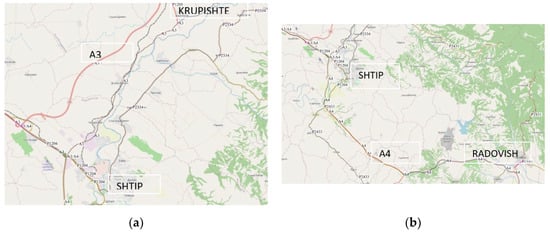
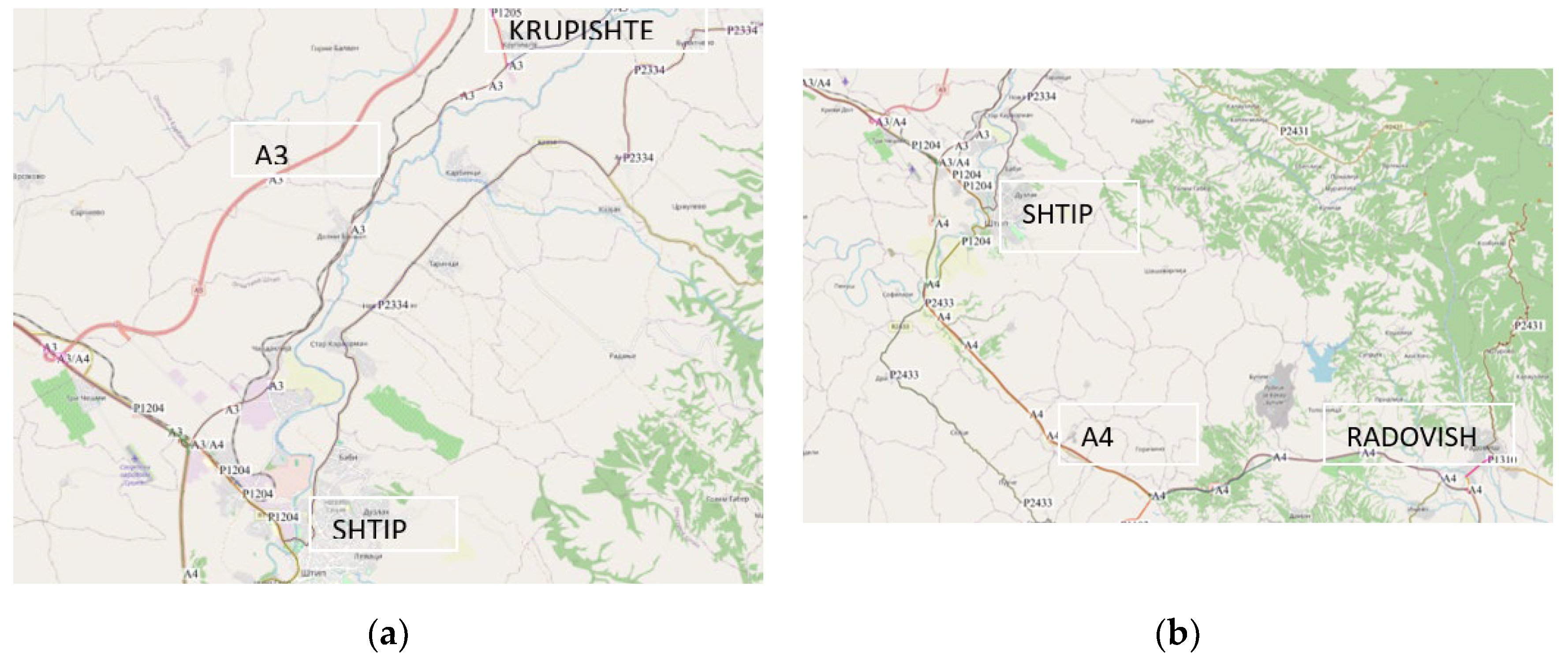
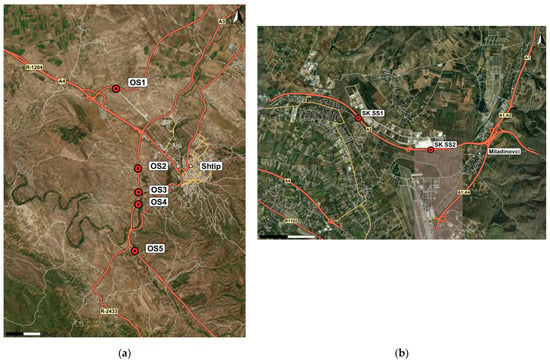
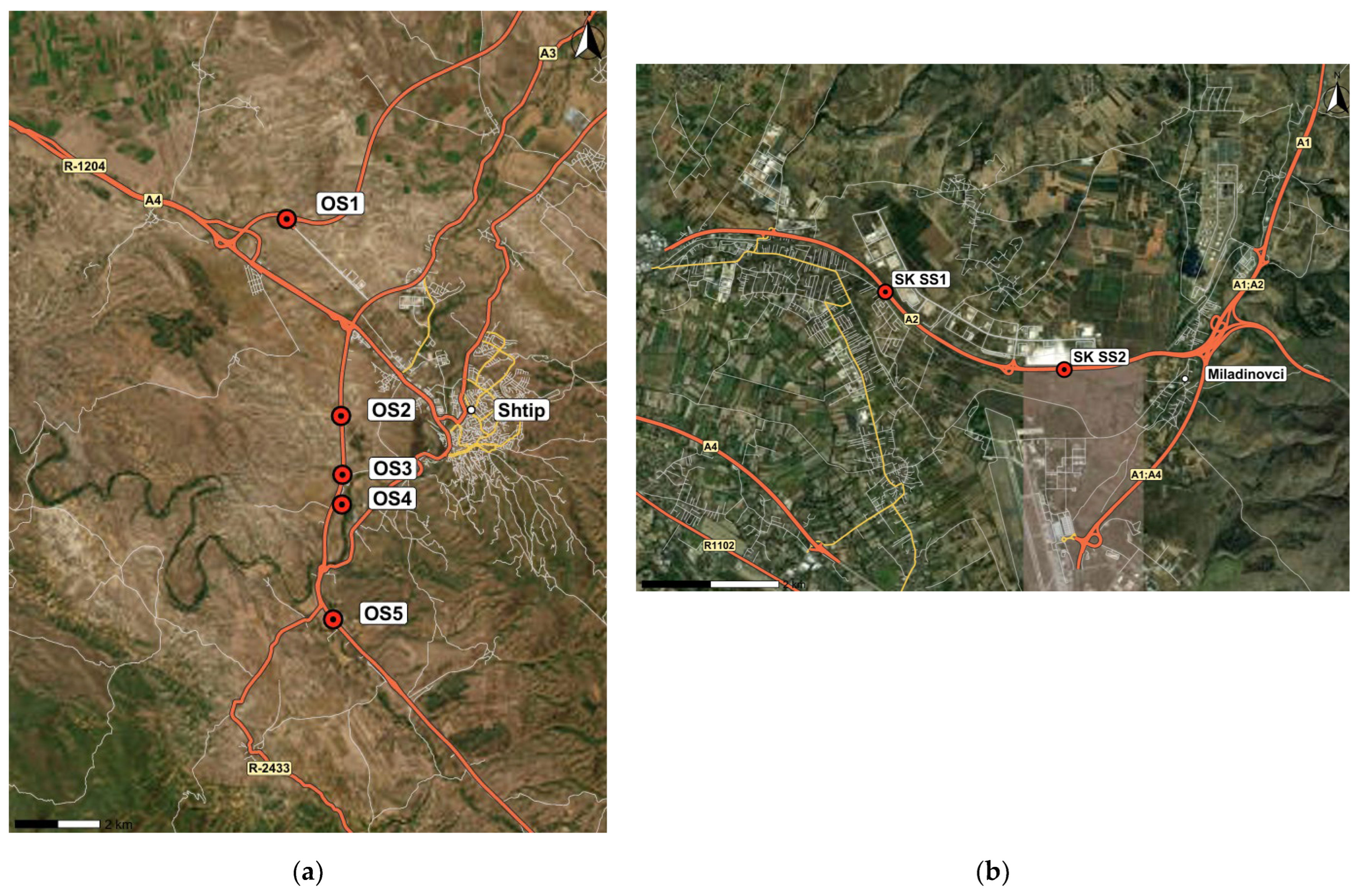
Five oil separators (OS1–OS5) located along the Shtip–Krupishte and Shtip–Radovish expressway subsections were included in the study. OS1 is located on the Shtip–Krupishte expressway subsection, which forms part of the broader Shtip–Kochani expressway (Figure 1a and Figure 2a), whereas OS2–OS5 are located along the Shtip–Radovish expressway subsections 1 and 2 (Figure 1b and Figure 2a). Water samples for microplastic analysis were collected from these five oil separators (inlet chambers), while roadside soil samples were collected from the corresponding road environments next to the oil separators.
Figure 1.
Shtip (a) Tri Cheshmi—Krupishte A3 expressway section and (b) Shtip–Radovish A4 expressway section (source: PE for state roads Webgis portal [22] and Google map image [23]).
Figure 2.
(a) Locations of oil separators OS1 to OS5 at Shtip expressway bypass area and (b) Skopje—Miladinovci A2 motorway section measuring points (MP—SKMP1 and SKMP2) (source: Authors in Rstudio, R version 4.6.1 (2026-06-24 ucrt)). Coordinates of the oil separators: (a) OS1 7595463.62, 4627578.44; OS2 7596813.41, 4622941.38; OS3 7596865.04, 4621550.47; OS4 7596862.05, 4620847.18 and OS5 7596691.06, 4618125.32; (b) SK SS1 7548264.90, 4650116.47 and SK SS2 7550894.54, 4649000.66.
For comparison with a higher-traffic road environment, an additional section of the A2 Skopje–Miladinovci motorway was investigated (Figure 2b). This section does not have oil separators at the investigated locations. Two roadside-soil sampling points were selected, one near the Bunardzik industrial zone and the second near the Miladinovci toll station.
2.2. Site Conditions and Pollution Factors
Site-specific conditions represent an important consideration when interpreting pollutant occurrence in highway runoff and roadside environments. Pollutant concentrations and particulate transport can be influenced by several interacting factors, including traffic volume, precipitation characteristics, antecedent dry periods, pavement properties, drainage conditions, and the physicochemical characteristics of the pollutants [24]. The relative importance of these factors varies according to contaminant type and environmental matrix.
Traffic volume is commonly expressed as annual average daily traffic (AADT) and represents one of the principal indicators of road use. Previous studies have reported associations between traffic intensity and selected highway-runoff pollutants, although the relationship is not necessarily consistent across locations [25]. Barrett M.E. [26] reported higher pollutant concentrations on heavily travelled roads, whereas Drapper D. et al. [27] observed relatively weak relationships between traffic volume and several chemical constituents of road runoff. Consequently, traffic intensity should be considered together with other site-specific and hydrological factors rather than as an isolated predictor of pollutant occurrence.
Site-specific AADT data for 2025 were obtained from the Public Enterprise for State Roads (PESR). The AADT for the broader A3 Shtip–Kochani road section, which includes the Shtip–Krupishte subsection containing OS1, was 6021 vehicles per day (all categories), whereas the A4 Shtip–Radovish section containing OS2–OS5 had an AADT of 4816 vehicles per day. The A2 Skopje–Miladinovci motorway section had a substantially higher AADT of 18,177 vehicles daily. These traffic data were used to characterize the investigated road environments and to provide context for the observed spatial differences in roadside MP abundance rather than to establish a direct quantitative relationship between traffic volume and MP occurrence.
Precipitation and antecedent weather conditions can also influence the mobilization and redistribution of road-derived particulate contaminants. During rainfall events, accumulated material can be washed from the road surface into drainage systems and adjacent environmental compartments. The magnitude and temporal distribution of this transport depend on rainfall intensity and volume as well as the duration of the antecedent dry period. The first-flush phenomenon may result in elevated contaminant concentrations during the initial portion of a runoff event, particularly following prolonged dry periods.
Pavement characteristics may additionally influence runoff generation and particulate transport. The Shtip–Radovish expressway section has conventional asphalt pavement. The pavement structure consists of BNS 32sA and AB 16sPmB layers with measured porosities within the ranges specified by the applicable standards. Some previous research papers such as Ref. [28] have demonstrated that pavement characteristics can affect both runoff hydrology and particulate retention, and therefore, represent an additional site-specific factor when interpreting road-derived contaminant transport.
2.3. Sampling Design and Analytical Methods
Microplastic sampling included both water and roadside-soil matrices. Water samples were collected from five oil separators (OS1–OS5) along the Shtip–Krupishte and Shtip–Radovish expressway sections (Shtip expressway bypass area).
Five roadside-soil samples (S1–S5) were collected next to the five investigated oil-separator locations. Soil samples were collected approximately 1 m from the road shoulder between the roadway and the corresponding drainage/oil-separator system.
Two additional roadside-soil samples were collected approximately 1 m from the road shoulder along the Skopje–Miladinovci motorway. Soil sample “SK SS1” was collected near the Bunardzik industrial zone, whereas “SK SS2” was collected near the Miladinovci toll station. These samples were used to provide a preliminary comparison of roadside-soil MP abundance between road environments characterized by different traffic intensities. The comparison was interpreted as an observational contrast between road sections rather than as a controlled assessment of the effect of traffic volume alone. No drainage-water samples were obtained at the Skopje–Miladinovci section during the sampling campaign because the drainage structures were dry.
Soil samples (SSs) were initially dried and subsequently sieved through a 2 mm mesh sieve to remove large particles and macroscopic organic debris. For each sample, 10 g of dried soil was weighed and transferred into 1000 mL laboratory beakers. For the removal of organic matter, 20 mL of 30% H2O2 was initially added, after which the samples were placed in a water bath at 60 °C. Additional 30% H2O2 was subsequently added in 10 mL portions until complete removal of the organic matter was achieved. The total volume of H2O2 used ranged from 60 to 70 mL, depending on the organic matter content of the sample.
After cooling to room temperature, 50 mL of distilled water was added to each sample for dilution, followed by 100 mL of saturated NaCl solution for density separation of microplastics from the soil matrix. The mixture was homogenized for 5–10 min and allowed to stand for 30–60 min to facilitate density-based separation. The surface fraction was collected, and the procedure was repeated 2–3 times to increase the recovery efficiency of the microplastics.
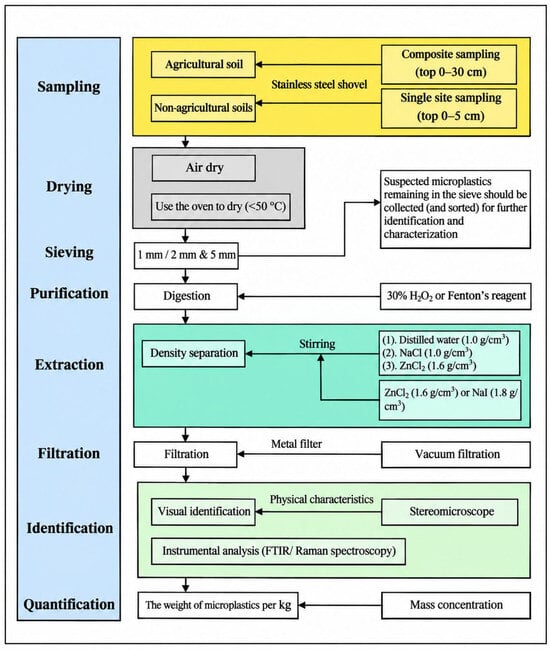
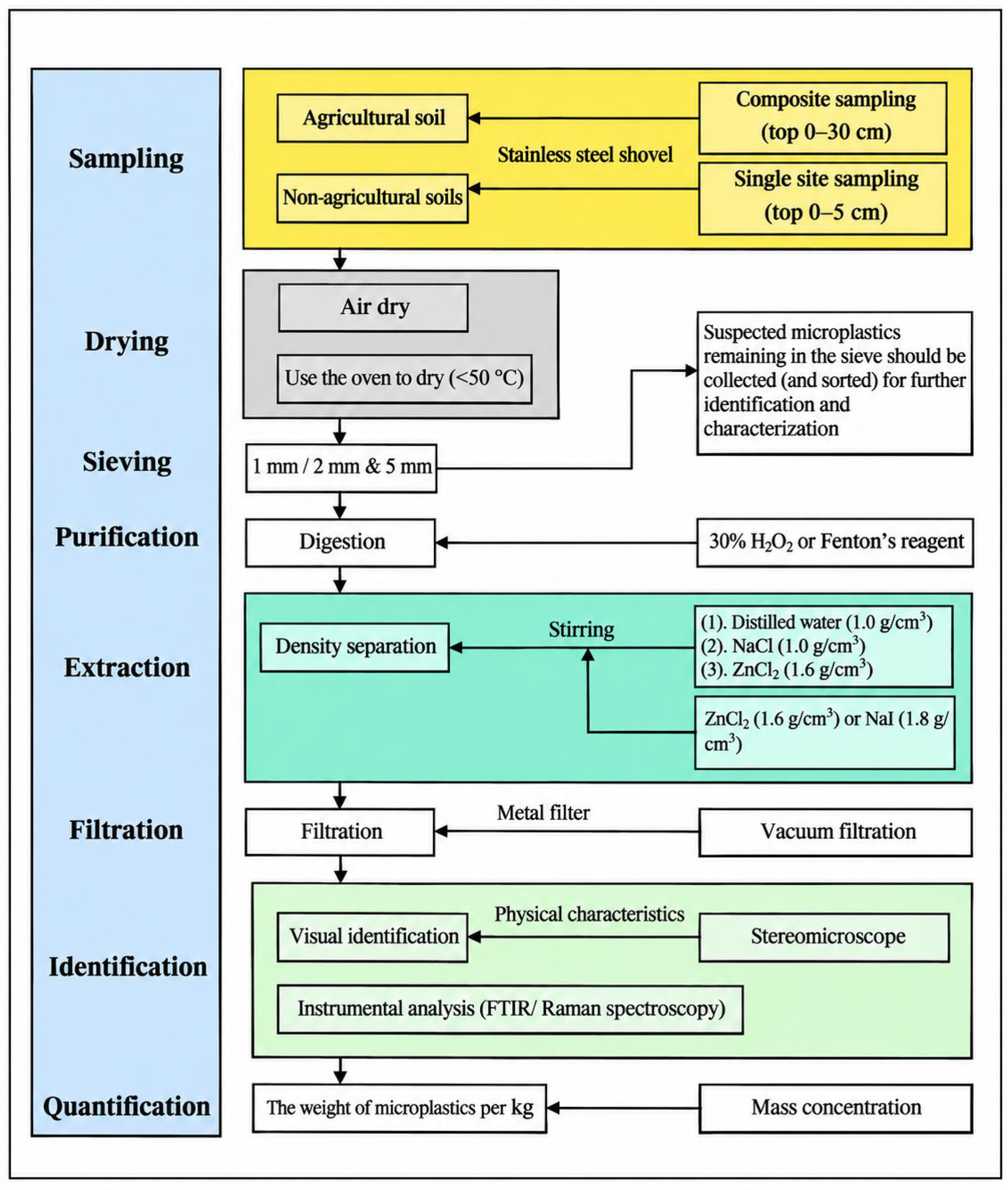
Following digestion, the samples were vacuum filtered onto filter paper. The filters were dried at room temperature and placed in Petri dishes for examination under a stereomicroscope, following the procedures adapted from Jafarova et al. [29], Roblin and Aherne [30] and Yang L., et al. [31] (Figure 3).
Figure 3.
Applied sampling and analysis procedures for microplastics in soil (adapted from Yang L., et al., 2021 [31]).
The sample preparation and processing procedures, up to and including the filtration step, were carried out at Alma Mater Europaea Campus College “Rezonanca” Pristina, while filter papers for identification of suspected microplastics were examined using a OLYMPUS SZX16 stereomicroscope (manufacturer: Olympus, Tokyo, Japan) at the Department of Biology, University of Pristina. Suspected microplastic particles were visually identified and characterized according to their observable morphological characteristics, including particle number, size, shape and colour.
Particle dimensions were determined individually from stereomicroscopic observations. Because polymer-specific identification by Fourier-transform infrared spectroscopy (FTIR) [12], Raman spectroscopy [15,32] or another spectroscopic technique was not performed, the visually identified particles are referred to as suspected microplastic particles [33]. Morphological characteristics were therefore used for descriptive characterization and not for definitive polymer identification or source attribution.
Water samples (WSs): For each water sample, 500 mL of water was collected and transferred into 1000 mL laboratory beakers, leaving sufficient space for the reaction and foaming during treatment due to the exothermic nature of the Fenton reaction. The Fenton reaction was used for the digestion of organic matter in the water samples. A 0.05 mol/dm3 Fe(II) solution was prepared by dissolving 6.95 g of FeSO4·7H2O in 500 mL of distilled water. Subsequently, 3 mL of H2SO4 was added to stabilize the solution.
Initially, 20 mL of 0.05 M Fe(II) solution was added to each 500 mL water sample, followed by the addition of 20 mL of 30% H2O2. The mixture was placed in a water bath at 60–70 °C for 30 min, after which 30% H2O2 was added in 10 mL portions, while heating was continued for an additional 30 min. The addition of H2O2 in portions was repeated until complete digestion of the organic matter was achieved. The total volume of H2O2 used for each sample was ~50 mL. After completion of the digestion, the samples were allowed to cool to room temperature and were subsequently filtered using vacuum filtration. The filters were dried at room temperature and placed in Petri dishes for examination under a stereomicroscope.
The blank control was performed using deionized water, which underwent the same procedure as the actual samples. During this process, Fenton reagents were used (FeSO4 and H2O2). The purpose was to identify potential contamination originating from laboratory air, equipment and other materials used throughout the experimental procedure.
As for the soil samples, the filter papers for water samples were examined using a OLYMPUS SZX16 stereomicroscope at the Department of Biology, University of Pristina.
In order to investigate even smaller microplastics, the selected suspected microplastic particles previously isolated from the investigated samples and identified by stereomicroscopic examination were further analysed by scanning electron microscopy (SEM) at the AMBICON Laboratory at Faculty of Natural and Technical Sciences, Goce Delcev University, Stip.
Scanning electron microscopy (SEM) is one of the most widely used techniques for the morphological characterization of microplastics [34,35]. It produces high-resolution images that reveal the shape, size and surface structure of particles down to the nanometre scale. When combined with energy-dispersive X-ray spectroscopy (EDS), the method also provides information on the elemental composition of the particles. This makes it possible to distinguish organic (carbon-based) particles from inorganic ones such as minerals, salts and metal oxides, and to detect additives and fillers such as Ti, Zn, Ca or Si.
Particles were analysed directly on the cellulose filter, which was sputter-coated with a thin layer (20 nm) of gold prior to analysis to ensure surface conductivity for both SEM imaging and EDS analysis. SEM observations were performed using a TESCAN VEGA3 LMU (version Vega3 Software 4.1.12.0) scanning electron microscope (TESCAN ORSAY HOLDING a.s., with headquarters in Brno, Czechia) with a secondary electron (SE) detector, operated at an accelerating voltage of 20 kV and a working distance of approximately 15 mm. Elemental composition was determined by EDS point analyses. Particles were examined at various magnifications to document their surface morphology, texture, irregularities, cracks and other structural features; scale bars are provided in each micrograph. C, S, Cl and K were quantified using the software’s built-in standards.
The main limitation of SEM-EDS is that it cannot identify the polymer type. Although C and O are detected, most plastics and natural organic materials share the same elemental composition (C, H and O), and hydrogen is not detectable by EDS. In addition, the cellulose filter may have contributed to the measured C and O signals, particularly for thin particles. Therefore, in the absence of FTIR or Raman spectroscopic confirmation, the examined particles are referred to as suspected microplastics.
In addition to the analysis of suspected microplastic particles, trace element concentrations were determined by inductively coupled plasma mass spectrometry (ICP-MS) using an Agilent 7500cx (Agilent Technologies, Santa Clara, CA, USA). ICP-MS was chosen for its ability to determine multiple elements simultaneously, rapidly and precisely at trace and ultra-trace levels. The sample solution is converted into an aerosol by a nebuliser and introduced into an argon plasma, where temperatures of approximately 6000–10,000 K atomise and ionise the elements. The resulting ions are then separated according to their mass-to-charge ratio (m/z) in a quadrupole mass analyser and quantified by a detector.
Trace elements in soil samples were analysed by ICP-MS according to ISO 17294-2:2023 [36] following sample preparation in accordance with ISO 14869-1:2001 [37], also using a flexible analytical range.
3. Results and Discussion
3.1. Occurrence and Abundance of Suspected Microplastics
The occurrence and abundance of suspected microplastics were assessed in drainage-water and adjacent roadside-soil samples collected at five oil separators along the Shtip expressway bypass area, while two additional roadside-soil samples from the Skopje–Miladinovci motorway were analysed for preliminary comparison.
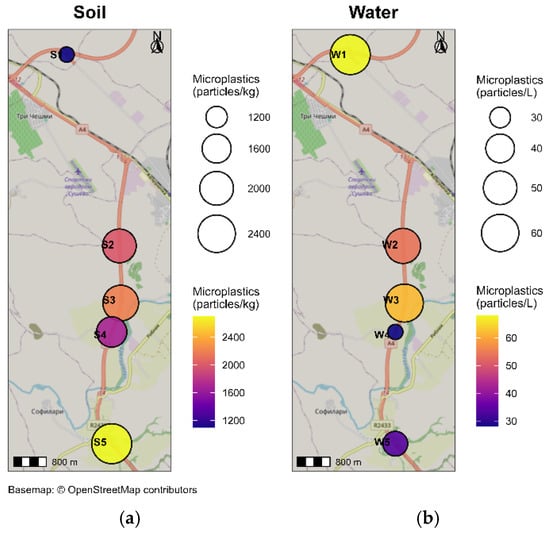
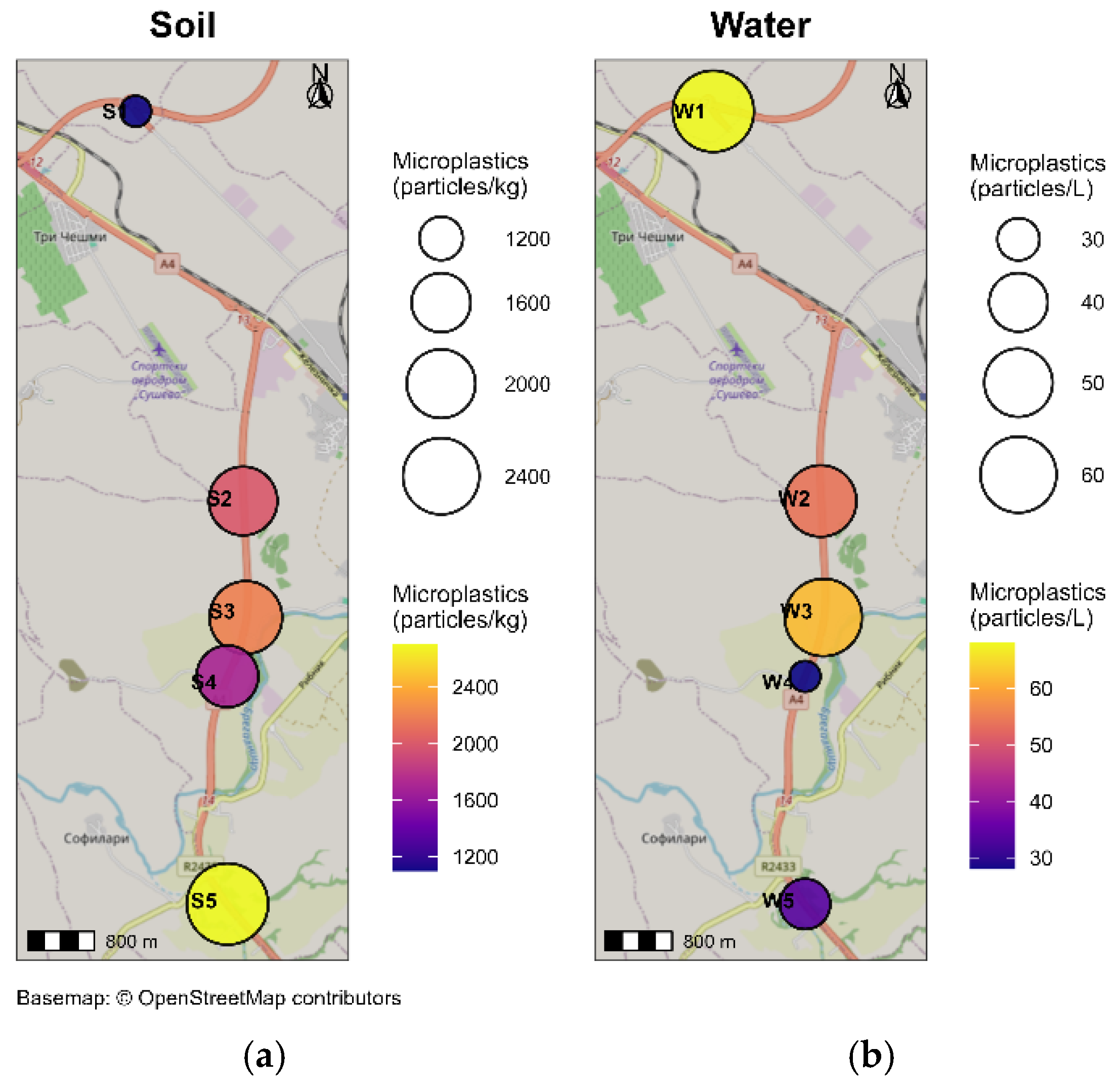
In drainage-water samples collected at the five oil separators, MP abundance ranged from 28 to 68 particles L−1 (Figure 4b). The highest abundance was recorded at WS1 (OS1), with 34 particles in 500 mL, equivalent to 68 particles L−1. WS3 (OS3) and WS2 (OS2) contained 31 and 27 particles per 500 mL, corresponding to 62 and 54 particles L−1, respectively. Lower abundances were observed at WS5 (OS5; 17 particles per 500 mL, 34 particles L−1) and WS4 (OS4; 14 particles per 500 mL, 28 particles L−1).
Figure 4.
Spatial distribution of suspected microplastic abundance in (a) roadside-soil samples and (b) drainage-water samples collected at highway oil-separator locations OS1–OS5 along the Shtip expressway bypass area during the July 2026 sampling campaign.
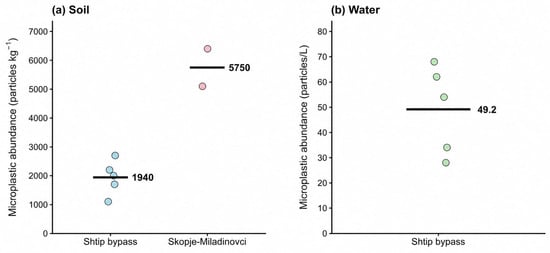
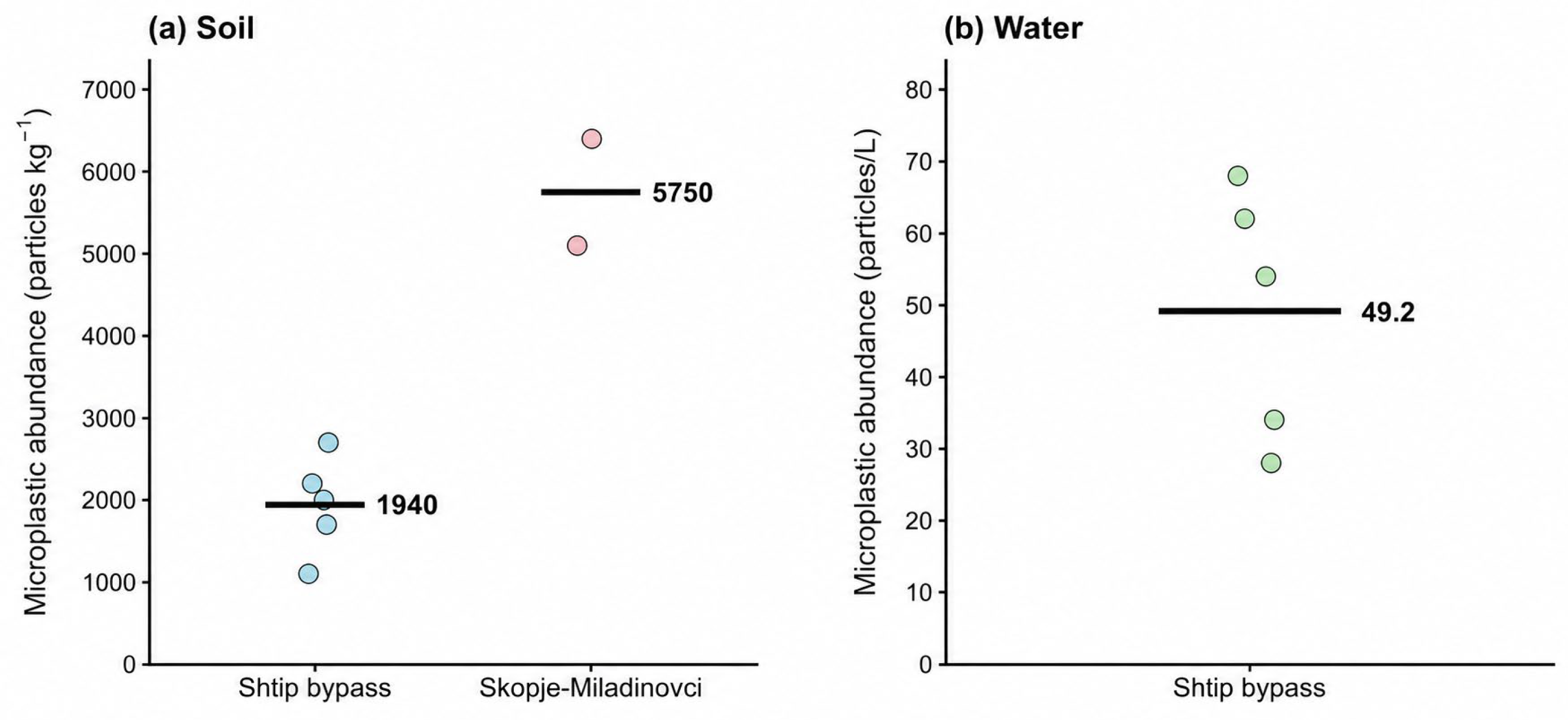
Across the five drainage-water samples, mean MP abundance was 24.6 ± 8.7 particles per 500 mL, equivalent to 49.2 ± 17.5 particles L−1. The median was 27 particles per 500 mL, and the coefficient of variation (CV) was 35.5%, indicating moderate spatial variability among the investigated locations (Figure 5b).
Figure 5.
Comparison of suspected microplastic abundance in (a) roadside-soil samples from the Shtip expressway bypass area and Skopje–Miladinovci motorway environments and (b) drainage-water samples from Shtip expressway bypass area during the July 2026 sampling campaign. Points represent individual samples, and horizontal lines indicate mean abundance. No drainage-water samples were available from Skopje–Miladinovci because the drainage structures were dry at the time of sampling.
Suspected MP particles were also detected in all five roadside-soil samples collected along the Shtip expressway bypass area. Abundance ranged from 11 to 27 particles per 10 g of soil, equivalent to 1100–2700 particles kg−1 (Figure 4a). The lowest abundance was recorded at SS1 (OS1; 11 particles per 10 g or 1100 particles kg−1), whereas the highest was observed at SS5 (OS5; 27 particles per 10 g or 2700 particles kg−1). SS2, SS3, and SS4 contained 20, 22, and 17 particles per 10 g, corresponding to 2000, 2200, and 1700 particles kg−1, respectively.
Mean MP abundance in the Shtip expressway bypass area roadside soils was 19.4 ± 5.9 particles per 10 g, equivalent to 1940 ± 594 particles kg−1. The median was 20 particles per 10 g, and the CV was 30.6%, likewise indicating moderate spatial variability among sampling locations (Figure 5a).
The spatial patterns differed between the two environmental matrices. OS1 exhibited the highest suspected MP abundance in drainage water (68 particles L−1) but the lowest abundance in adjacent roadside soil (1100 particles kg−1), whereas OS5 showed relatively low abundance in water (34 particles L−1) but the highest soil abundance (2700 particles kg−1). This contrasting pattern indicates that suspected MP occurrence in drainage water and adjacent roadside soil does not follow a simple site-by-site correspondence and is likely influenced by matrix-specific transport, deposition, and retention processes. Because the measurements represent a single sampling campaign, these differences are interpreted as spatial observations rather than persistent site characteristics.
The detection of suspected microplastics in both roadside soil and drainage water is consistent with the role of road environments as important sources and transport pathways for microplastic particles. Road traffic generates microplastic-containing particles through tyre and road-surface wear, while deposited particles can subsequently be redistributed by wind and stormwater runoff into adjacent soils and drainage systems [16,38]. Tyre and road wear particles are particularly relevant in road runoff, where both traffic activity and pavement characteristics can influence microplastic generation and transport [39].
The contrasting abundances observed between drainage water and adjacent roadside soil at individual Shtip expressway bypass locations suggest that these matrices represent different stages of particle transport, deposition and retention. At OS1, the highest abundance in drainage water (68 particles L−1) coincided with the lowest concentration in adjacent soil (1100 particles kg−1), potentially reflecting enhanced aqueous transport or limited local soil accumulation. Conversely, OS5 exhibited relatively low water abundance (34 particles L−1) but the highest soil abundance (2700 particles kg−1), suggesting greater particle deposition or accumulation in the surrounding soil environment. Local hydrological conditions, antecedent particle accumulation, drainage efficiency and site-specific retention processes may contribute to these differences, consistent with previous findings on the transport of road-associated microplastics by runoff, wind and local surface processes [16]. However, the observed distribution cannot establish particle retention or remobilization mechanisms within the oil separators, since simultaneous inlet–outlet measurements and analyses of accumulated separator sediments were not available.
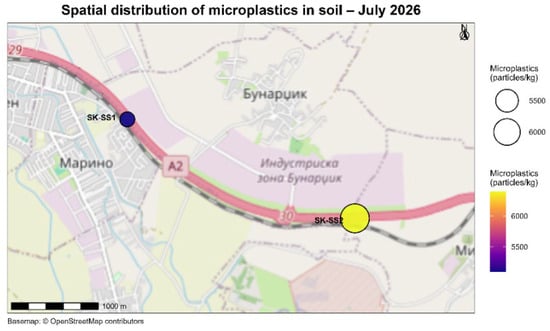
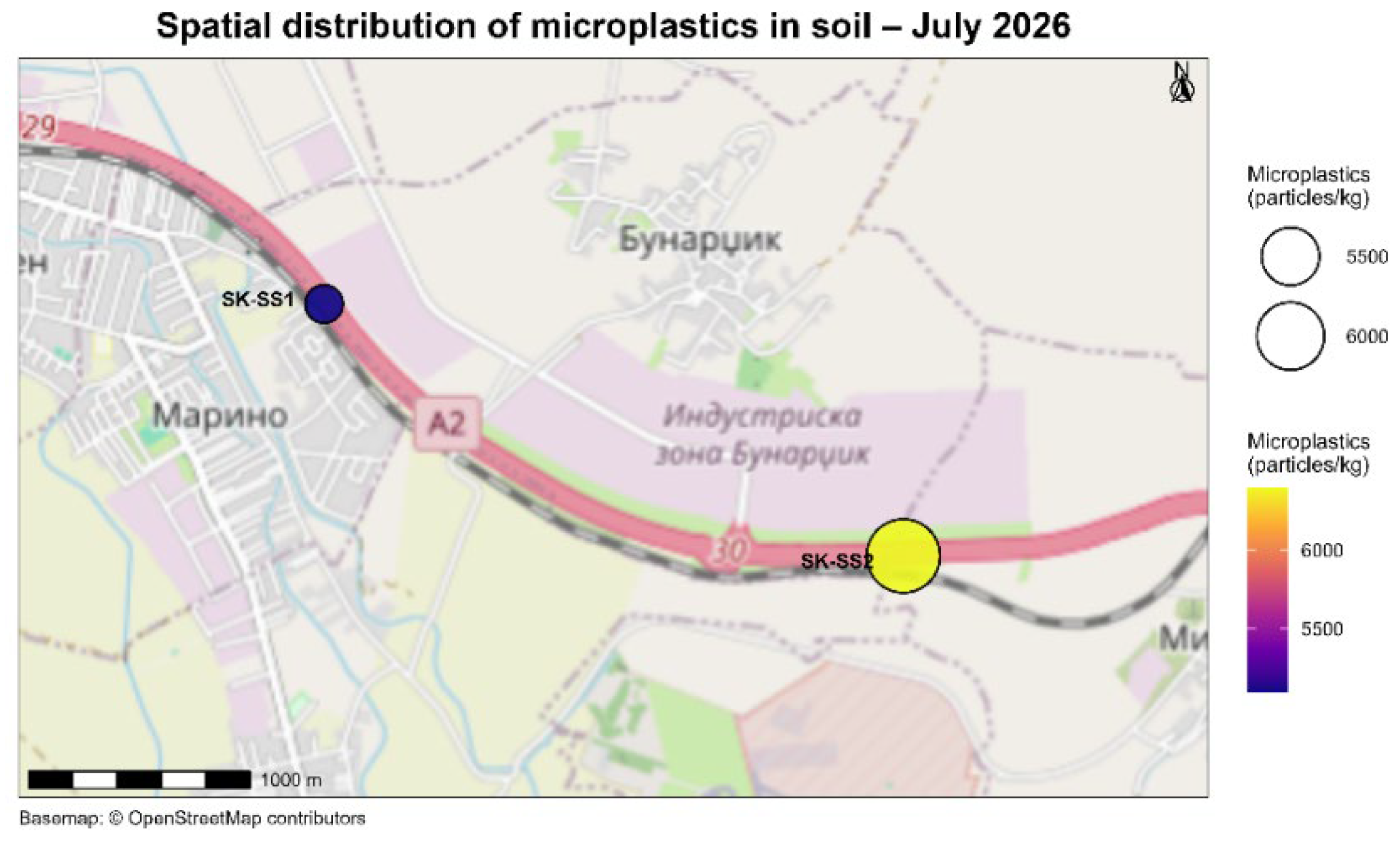
To provide a preliminary comparison with a higher-traffic road environment, two additional roadside-soil samples were collected along the Skopje–Miladinovci motorway section, approximately 1 m from the road shoulder. Soil sample SK SS1, collected near the Bunardzik industrial zone, contained 51 suspected MP particles per 10 g of soil (5100 particles kg−1), whereas SK SS2, collected near the Miladinovci toll station, contained 64 particles per 10 g (6400 particles kg−1) (Figure 6). No drainage-water samples were obtained from the Skopje–Miladinovci sites during the July 2026 campaign because the drainage structures were dry at the time of sampling and oil separators are not placed. Consequently, the between-area comparison is restricted to roadside soil.
Figure 6.
Spatial distribution of suspected microplastic abundance in roadside-soil samples collected along the Skopje–Miladinovci motorway section during the July 2026 sampling campaign.
Mean MP abundance in the two Skopje–Miladinovci roadside-soil samples was 57.5 particles per 10 g (5750 particles kg−1). In comparison, the five Shtip expressway bypass area roadside-soil samples had a mean abundance of 19.4 particles per 10 g (1940 particles kg−1). The mean observed in the Skopje–Miladinovci samples was, therefore, approximately 2.96 times the mean observed in the Shtip expressway bypass area samples (Figure 5a). This comparison is descriptive and should be interpreted cautiously because it is based on only two Skopje–Miladinovci samples and five Shtip expressway bypass area samples.
The higher roadside-soil suspected MP abundance observed at the two Skopje–Miladinovci sites is consistent with a possible influence of traffic-related factors, including AADT, tyre wear and local driving conditions such as braking and acceleration [38]. However, the difference cannot be attributed to traffic intensity alone, as site-specific factors may also contribute (including drainage infrastructure, surrounding land use, soil properties, etc.). Given the small and unequal sample sizes and the absence of drainage-water samples from Skopje–Miladinovci, the comparison should be regarded as preliminary and descriptive, and no quantitative relationship between AADT and suspected MP abundance can be established from the present dataset.
The abundance of suspected microplastics observed in the present study (28–68 particles L−1 in drainage water and 1100–6400 particles kg−1 in roadside soils) can be considered in relation to findings from other Southern European and neighbouring regions. Rosso et al. (2022) [40] reported substantially higher concentrations of small microplastics (11,932–18,966 particles L−1) in highway stormwater runoff in Italy using micro-FTIR identification of particles in the 5–100 µm size range. In a subsequent investigation, Rosso et al. (2024) [41] reported maximum concentrations of 39,813 and 15,173 particles L−1 in inlet and outlet highway runoff samples, respectively, from a treatment facility equipped with filtration. In terrestrial environments, a recent study from Karaman, Türkiye [42], reported 276 microplastic particles kg−1 in roadside soils, whereas the concentrations observed in the present study were higher, particularly along the Skopje–Miladinovci motorway. However, direct quantitative comparison among these studies remains limited by differences in sampling procedures, particle-size detection limits, environmental matrices and analytical identification methods. In particular, the absence of polymer-specific spectroscopic confirmation in the present study requires the reported abundances to be interpreted as suspected microplastics rather than confirmed polymer particles.
Meteorological conditions represent another important factor potentially influencing MP abundance and distribution. During the July 2026 sampling campaign at both study areas (the Shtip expressway bypass and the Skopje–Miladinovci motorway), weather conditions were dry, with air temperatures ranging from 18 to 20 °C. However, in the absence of comprehensive meteorological datasets covering the sampling periods, it is difficult to distinguish the potential effects of rainfall-driven particle wash-off and transport from those of other site-specific factors, including drainage infrastructure, hydromorphological characteristics, and soil properties. Therefore, the observed differences in suspected MP abundance should be interpreted cautiously and considered as inter-site observational differences under the specific conditions of the sampling campaign rather than as evidence of regular seasonal or temporal trends.
3.2. Morphology and Size Characteristics of Suspected Microplastics
The stereomicroscopic examination detected suspected microplastic particles exhibiting considerable variability in particle size and morphological appearance. Particle-size characteristics were evaluated for selected particles from Shtip expressway bypass area soil samples and runoff water and from Skopje-Miladinovci roadside-soil samples (Table 1).
Table 1.
Descriptive statistics and size distribution of suspected microplastic particles measured by stereomicroscopy in Shtip expressways runoff water, Shtip expressways roadside soils, and Skopje–Miladinovci motorway roadside soils.
In the Shtip expressways area runoff-water samples, particle sizes ranged from 121.7 to 493.7 µm, with a mean size of 292.5 ± 134.9 µm and a median of 308.0 µm. The coefficient of variation was 46.1%, indicating relatively high variability in the dimensions of the measured particles. Particles smaller than 200 µm accounted for 36.4% of the measured particles, while 9.1% were within the 200–299 µm size class, 36.4% within the 300–399 µm class, and 18.2% were ≥400 µm.
In the Shtip expressway roadside-soil samples, particle sizes ranged from 154.4 to 477.4 µm, with a mean size of 298.7 ± 152.0 µm and a median of 281.6 µm. The relatively high CV of 50.9% indicates substantial variability in particle size. Half of the detected particles (50%) were smaller than 200 µm, while 25% were in the 300–399 µm range and another 25% were ≥400 µm. No particles were recorded in the 200–299 µm class. Thus, the distribution shows a relatively broad size range rather than concentration within a single size class.
The suspected microplastic particles examined in the Skopje–Miladinovci motorway roadside-soil samples ranged from 223.8 to 604.1 µm, with a mean size of 411.7 ± 117.8 µm and a median of 422.8 µm. The coefficient of variation was 28.6%. No particles smaller than 200 µm were recorded among the measured particles, while 20% were within the 200–299 µm size class, 20% within the 300–399 µm class, and 60% were ≥400 µm.
Although the measured particles from the Skopje–Miladinovci motorway roadside-soil samples exhibited a higher mean and median size than those examined in Shtip expressways bypass area runoff water, the two datasets represent different environmental matrices and should not be interpreted as directly comparable populations. Differences in particle retention, transport and sampling between water and soil may influence the observed size distributions. Consequently, the present results are considered descriptive and do not demonstrate a road section- or traffic-related difference in suspected MP particle size.
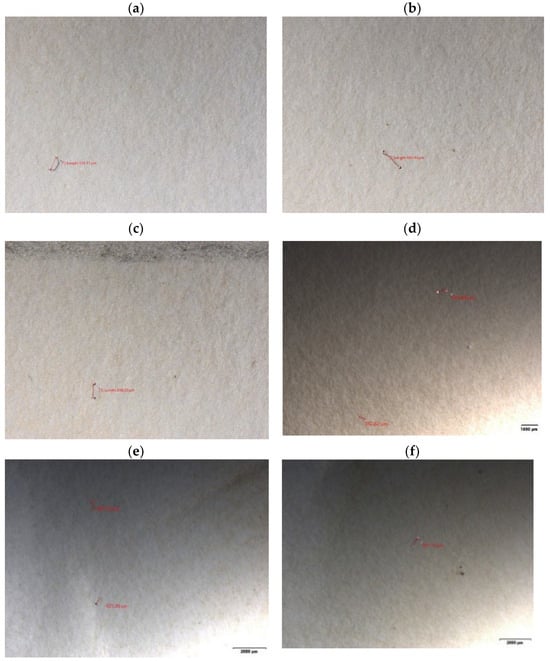
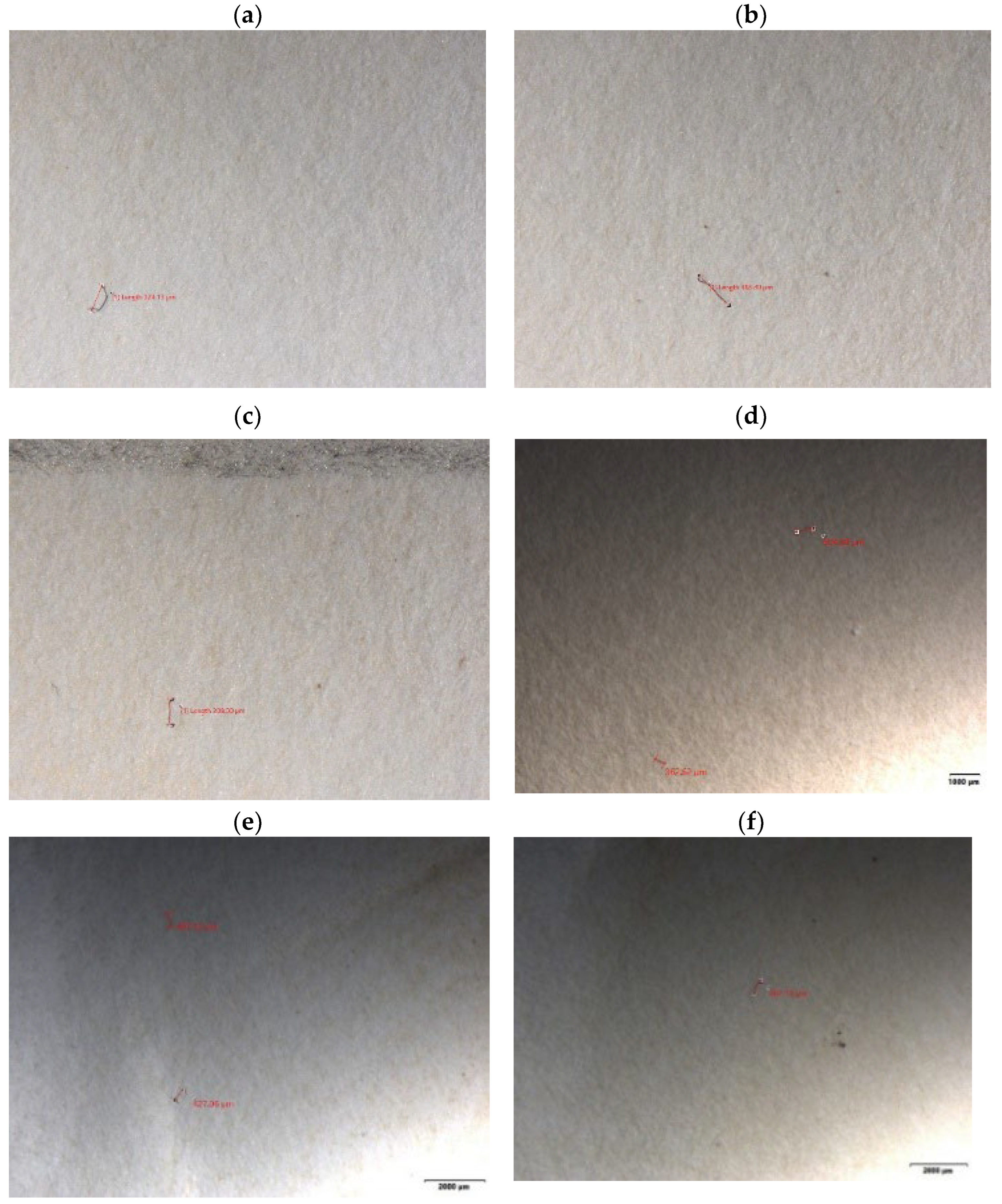
Stereomicroscopic examination showed that the suspected microplastic particles detected were predominantly black and exhibited elongated, irregular or linear morphologies (Figure 7). The observed variability in particle shape and size indicates morphological heterogeneity among the detected particles.
Figure 7.
Representative stereomicroscope images of suspected microplastic particles isolated from samples collected along the investigated road sections. (a–c) Shtip expressway bypass area and (d–f) Skopje–Miladinovci motorway. Scale bars indicate particle dimensions ((a–c,e,f)—2000 µm; (d)—1000 µm); the size characteristics of suspected microplastics is discussed in the text in Section 3.2.
The predominance of black, irregular and elongated particles is noteworthy in the context of highway runoff because traffic-related wear processes, including tyre and road wear, are recognized as potential sources of dark-coloured particulate material in road environments [43]. However, particle colour and morphology alone cannot establish polymer identity or confirm a tyre-derived origin. Because the particles were identified by stereomicroscopic examination without subsequent FTIR or Raman spectroscopic confirmation, the detected particles are reported as suspected microplastics. Spectroscopic or chemical characterization would be required for definitive polymer identification and source attribution.
To enable a more detailed comparison and in-depth characterization of the particles identified by stereomicroscopy, selected particles suspected to be microplastics and particles exhibiting features potentially associated with traffic-related sources were additionally examined using scanning electron microscopy (SEM), which provided higher-resolution imaging and more precise assessment of particle size, morphology, surface characteristics, and structural features.
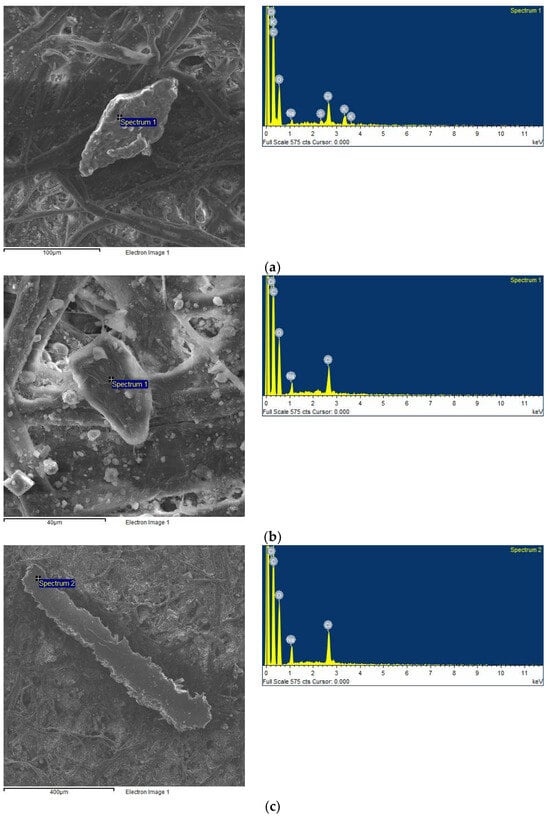
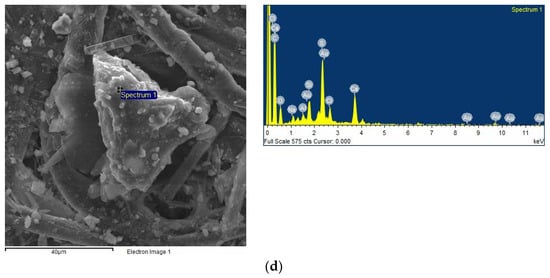
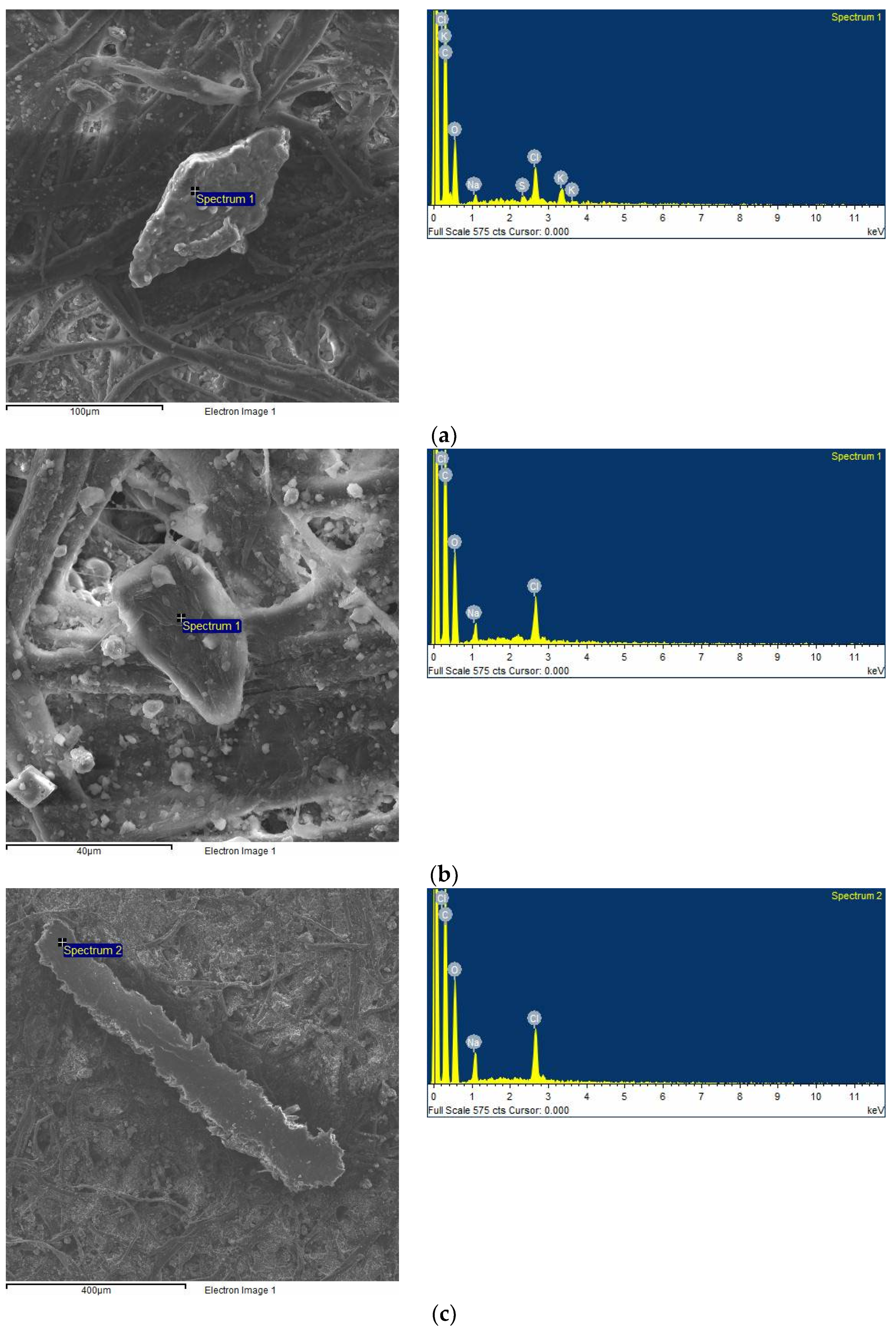
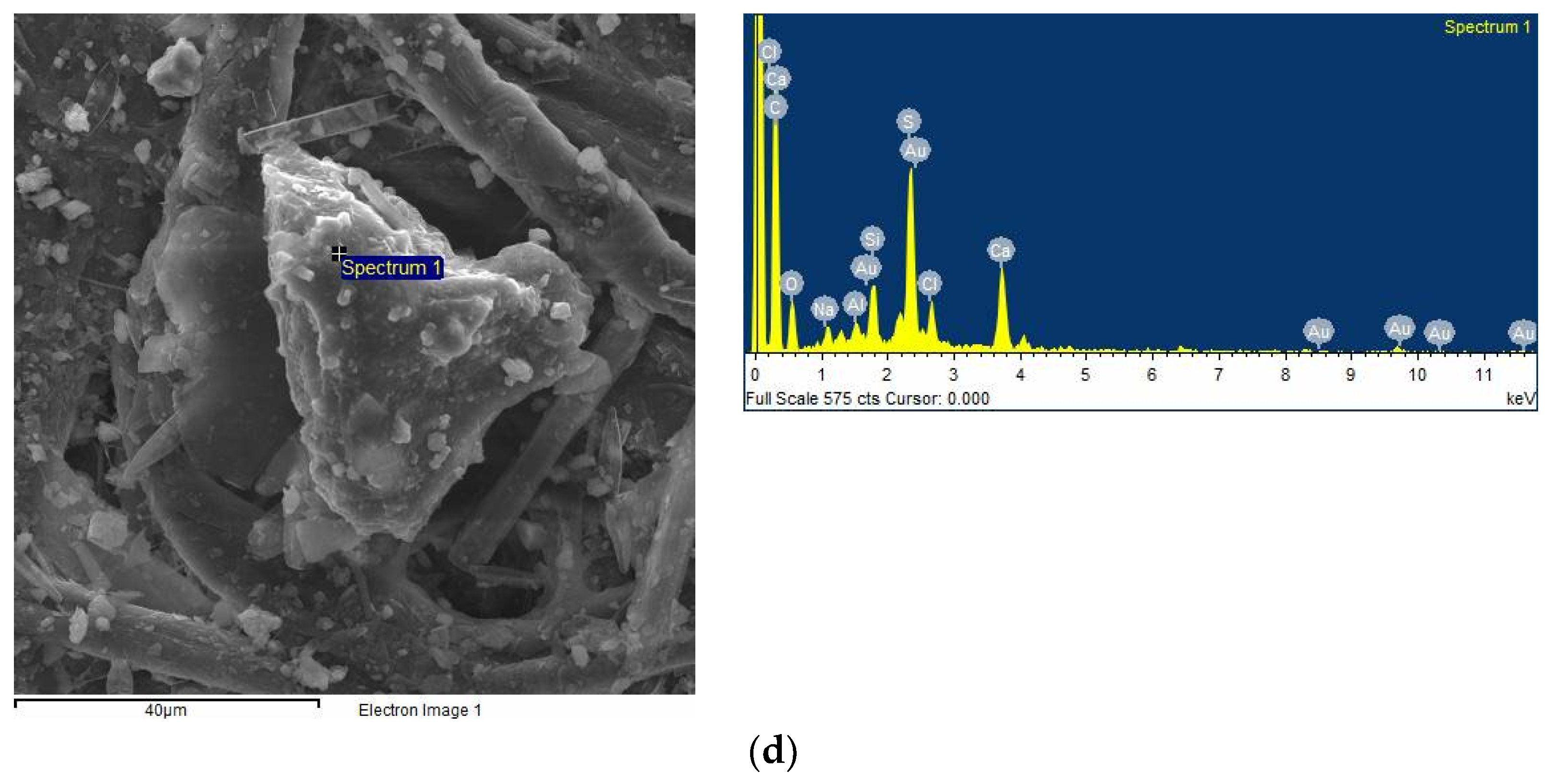
The SEM micrographs (Figure 8) revealed distinct particle features such as irregular and three-dimensional fragments, flattened particles with rounded edges and surface striations, and elongated film-like particles with torn margins. The higher-resolution SEM observations therefore complemented the stereomicroscopic assessment by enabling the visualization and more accurate dimensional characterization of smaller particles suspected to be microplastics and providing additional information on their morphological characteristics. However, these features alone do not allow definitive discrimination between plastic and non-plastic particles or attribution to specific traffic-related sources. The observed variability in particle shape and size indicates morphological heterogeneity among the investigated particles.
Figure 8.
Representative SEM images of suspected microplastic and traffic-derived particles isolated from samples collected along the investigated road sections and observed on the cellulose filter: (a,b) Shtip expressway bypass area and (c,d) Skopje–Miladinovci motorway. Scale bars are shown in each micrograph. (a) Irregular, thick, three-dimensional fragment (208 × 83 µm) with a lumpy, rounded surface. The morphology is consistent with a weathered plastic fragment. (b) Flattened oval particle (66 × 36 µm) with a smooth surface, rounded edges and fine surface striations. The smooth surface and rounded edges are consistent with a weathered plastic fragment. (c) Elongated film-like particle (1285 × 140 µm) with a smooth surface and jagged, torn edges, characteristic of fragmented plastic film. (d) Irregular, layered, carbon- and sulphur-rich particle (53 × 44 µm) with attached mineral grains. The composition and morphology are consistent with a traffic-derived particle, such as asphalt/bitumen or tyre and road wear particles (TRWPs).
The SEM observations indicate a wide dimensional range of the examined particles, with particle length ranging from 66 to 1285 µm and width from 36 to 140 µm. The relatively high standard deviation for particle length (655.6 µm) reflects the pronounced difference between the smaller fragmented particles and the substantially larger elongated film-like particle (1285 µm). In contrast, particle widths showed a narrower range (36–140 µm), although variability remained evident. Particle (b), measuring only 66 × 36 µm, demonstrates that SEM enabled the visualization and characterization of relatively small particles suspected to be microplastics that may be difficult to resolve or measure accurately using stereomicroscopy. SEM analysis also provided complementary information on particle morphology and surface characteristics at higher resolution. The occurrence of irregular fragments, flattened particles with surface striations and elongated film-like structures further demonstrates the morphological heterogeneity of the investigated particles. At the same time, the observation of a carbon- and sulphur-rich particle associated with mineral material highlights the importance of considering non-plastic particles and other potential sources when interpreting visually identified particles. These observations support the combined use of stereomicroscopy and SEM–EDS for preliminary screening and characterization of particles in road-associated environmental samples, while polymer-specific spectroscopic confirmation remains necessary for definitive microplastic identification.
The EDS results (Table 2) showed that carbon (C) and oxygen (O) were the dominant elements in all four analysed particles, accounting for 59.12–73.07 wt.% and 17.05–37.32 wt.%, respectively, although the cellulose filter may have contributed to the measured signals. The presence of minor amounts of sodium (Na) and chlorine (Cl) in all particles may be attributed to residual NaCl from the saturated salt solution used during density separation rather than to the intrinsic elemental composition of the particles. Particle (d) exhibited a distinct elemental profile, characterized by elevated sulphur content (4.20 wt.%) and the presence of calcium (2.57 wt.%), silicon (1.05 wt.%) and aluminium (0.30 wt.%), suggesting a possible association with inorganic material. Although a contribution from traffic-related sources cannot be excluded, the elemental composition does not permit definitive source attribution. Overall, the carbon-rich elemental composition combined with the observed particle morphologies is compatible with the possible presence of plastic-containing particles, but it is not diagnostic of polymer identity. Therefore, the observed particles remain classified as suspected microplastics, and polymer-specific spectroscopic analysis is required to confirm their chemical composition.
Table 2.
Chemical composition of the samples using EDS.
3.3. Trace-Element Occurrence and Distribution in Roadside Soils
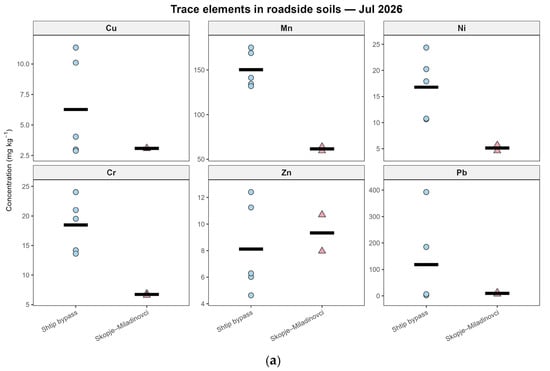
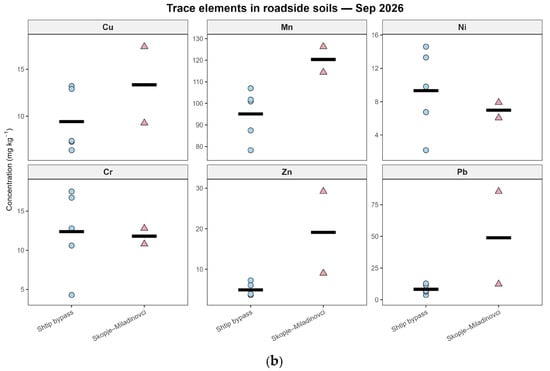
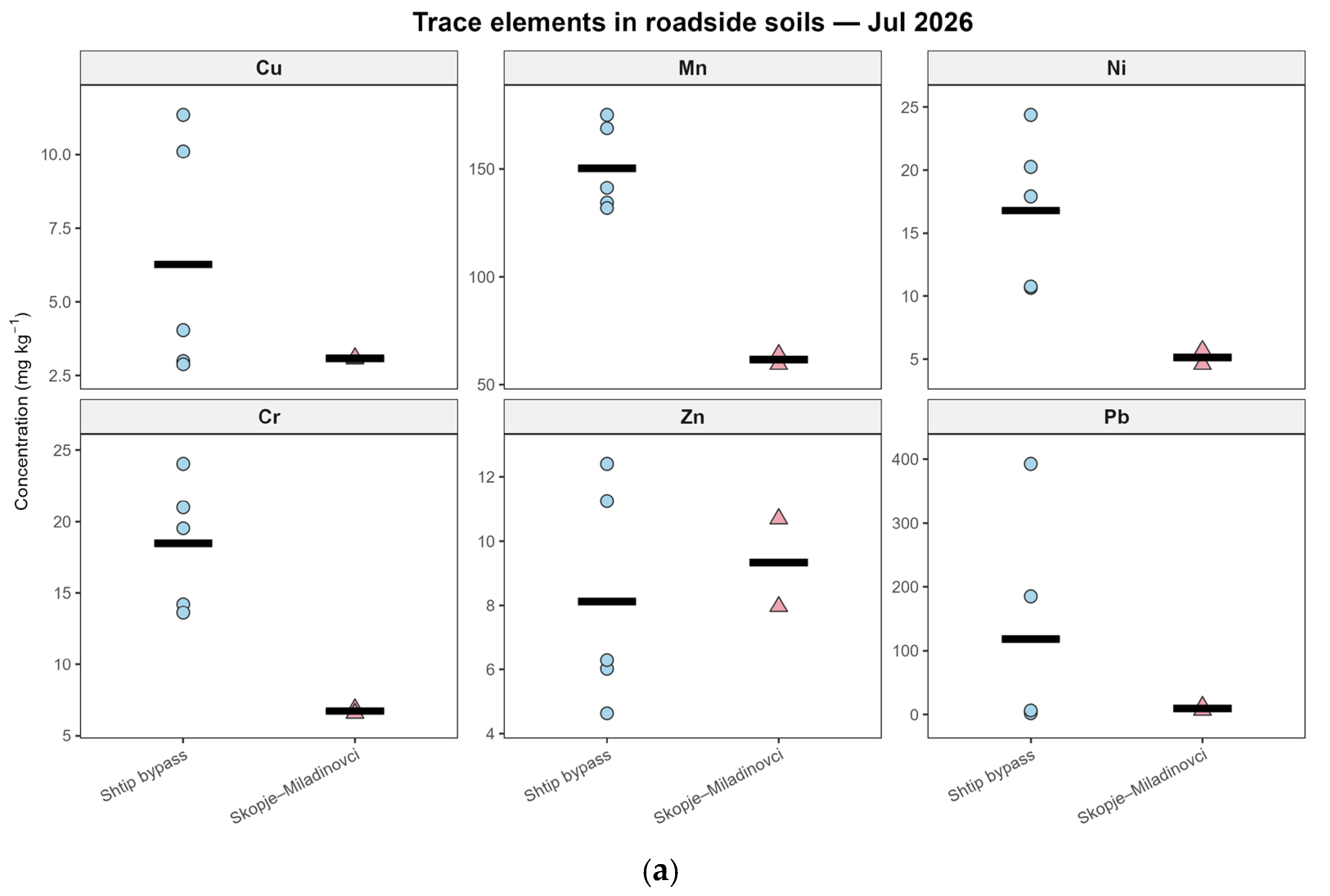
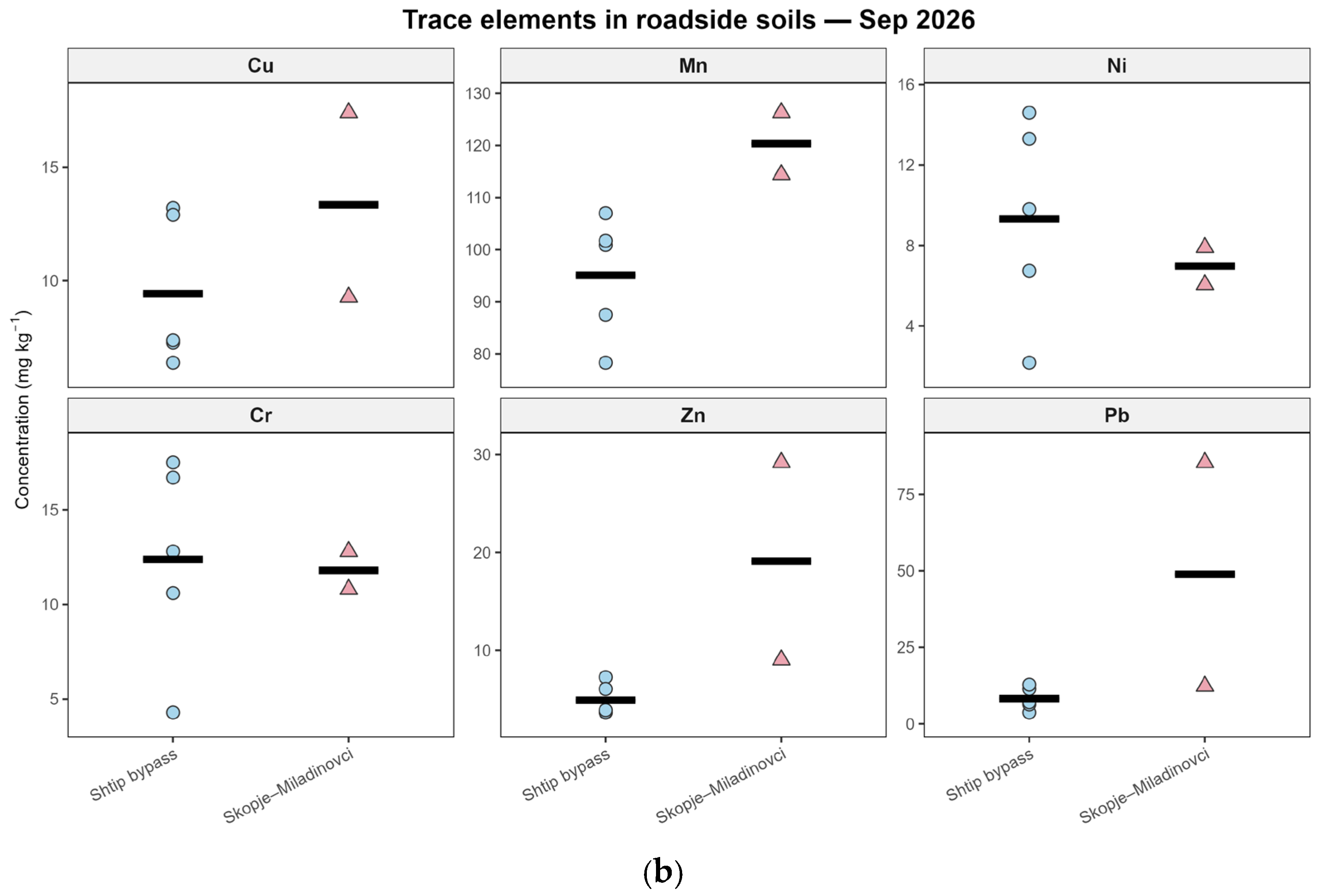
Trace-element concentrations in roadside soils were assessed by ICP-MS for Cu, Mn, Ni, Pb, Cr and Zn. The evaluation was structured in two stages. First, spatial differences were examined for the July and September 2026 sampling campaigns by comparing five roadside-soil samples collected along the Shtip expressway bypass area (S1–S5) with two samples collected along the Skopje–Miladinovci motorway section (SK-SS1 and SK-SS2). Second, temporal variability at the Shtip expressway bypass area was evaluated using three sampling campaigns (November 2025, July 2026 and September 2026) at the same five locations. The Skopje–Miladinovci motorway samples were compared between July and September 2026. These comparisons are descriptive because the sampling design provides limited spatial replication and does not establish seasonal trends. The July 2026 results revealed clear differences in the distribution of trace elements between the two investigated road environments. Concentrations of Cu, Mn, Ni and Cr were generally higher in roadside soils from the Shtip expressway bypass area than in the Skopje–Miladinovci motorway samples, whereas Zn concentrations were broadly comparable between the two locations. The strongest contrast was observed for Pb, which showed pronounced spatial variability at the Shtip expressway bypass area. In September 2026, by contrast, mean Cu, Mn, Zn and Pb concentrations were higher at the two Skopje–Miladinovci sampling locations than at the five Shtip bypass locations, whereas mean Ni and Cr concentrations were higher at the Shtip expressway bypass areas. These patterns should not be interpreted as evidence of road-type or traffic-intensity effects, because the number of locations was small and site-specific conditions were not controlled.
As shown in Figure 9, the July 2026 Shtip expressway bypass area samples exhibited a wider concentration range for most investigated elements, particularly Pb, whereas the two Skopje–Miladinovci motorway samples showed relatively similar concentrations. The pronounced July 2026 Pb variability at the Shtip expressway bypass area was primarily associated with the elevated concentrations recorded at S3 and S4. In September, however, Pb at S3 and S4 decreased to 6.31 and 12.80 mg kg−1, respectively, while SK-SS1 reached 85.40 mg kg−1 and SK-SS2 measured 12.30 mg kg−1. Thus, the locations with the largest Pb concentrations differed between the two campaigns; the observations represent sampling-period contrasts rather than confirmed persistent hotspots.
Figure 9.
Concentrations of selected trace elements in roadside-soil samples collected along the Shtip expressway bypass area sections (S1–S5) and the Skopje–Miladinovci motorway (SK SS1–SK SS2) in July 2026 (a) and September 2026 (b). Individual points represent measured concentrations at each sampling location, and horizontal lines indicate the mean concentration for each road section. Concentrations are expressed as mg kg−1 dry soil.
Spatial heterogeneity of trace-element concentrations is a common feature of roadside soils. A review of European roadside environments showed that Cr, Cu, Ni, Pb and Zn generally reach their highest concentrations in surface soils close to the road, while the influence of traffic tends to decrease with increasing distance and soil depth. However, considerable differences among individual sites have also been reported, reflecting the combined effects of traffic intensity, road characteristics, soil properties and local transport and retention processes [9].
Road traffic can contribute metals to roadside environments through several pathways. In addition to exhaust-related inputs, non-exhaust emissions arise from brake wear, tyre wear, road-surface abrasion and the resuspension of previously deposited road dust [11]. Studies of roadside soils have consequently reported enrichment of traffic-associated elements such as Cu, Pb and Zn, particularly at sites exposed to intensive vehicle activity [44,45]. Cu is frequently associated with brake-wear emissions, whereas Zn is commonly linked to tyre wear; nevertheless, elemental tracers should be interpreted cautiously because their relationships with traffic-derived particles can vary substantially among sites. The occurrence of Mn, Zn, Pb, Cr, Cu and Ni in roadside soils may reflect a combination of natural soil composition and anthropogenic inputs associated with vehicle wear, road-surface abrasion, infrastructure corrosion and historical traffic-related deposition. Consequently, the measured concentrations should not be attributed solely to traffic sources without additional source-apportionment information, because local geological background and site-specific soil characteristics may also influence their distribution.
To provide a reference framework for the assessment of trace-element concentrations in roadside soils, and in the absence of uniform, generally applicable national regulatory limits for metal concentrations in soils in the Republic of North Macedonia, the Dutch background values (AW) and intervention values (I), established under the Regeling bodemkwaliteit 2022 [46] and the Besluit activiteiten leefomgeving [47], were used as reference criteria for the comparative assessment of the measured concentrations (Table 3). For manganese (Mn), no specific background or intervention values are established within the referenced Dutch regulatory framework. Therefore, the measured Mn concentrations are reported and discussed without comparison against regulatory threshold values.
Table 3.
Dutch reference and intervention values for selected metals in soil (Regeling bodemkwaliteit 2022, Annex B; Besluit activiteiten leefomgeving, Annex IIA).
Comparison of the measured trace-element concentrations with the Dutch reference values revealed distinct spatial and temporal differences between the investigated sampling locations. In November 2025, Ni and Cr concentrations exceeded the Dutch background values (AW) at four and five sampling locations, respectively, with Ni additionally exceeding the intervention value (I) at S2 (101 mg kg−1) and S3 (116 mg kg−1). Elevated Cu (108 mg kg−1) and Zn (246 mg kg−1) concentrations exceeding their respective background values were recorded at S5, whereas Pb concentrations remained below the background value at all five locations.
In July 2026, Cu, Ni, Cr and Zn remained below the Dutch background values at the five Shtip expressway bypass locations and both Skopje–Miladinovci locations. Pb exhibited localized elevations at S3 (185.20 mg kg−1) and S4 (392.60 mg kg−1), equivalent to approximately 3.7 and 7.9 times the Dutch Pb background value of 50 mg kg−1, respectively, but below the intervention value of 530 mg kg−1. In September 2026, all measured Cu, Ni, Cr, Zn and Pb concentrations at the five Shtip expressway bypass locations remained below their corresponding Dutch background values. At Skopje–Miladinovci, Pb at SK-SS1 (85.40 mg kg−1) exceeded the Dutch Pb background value, whereas Pb at SK-SS2 (12.30 mg kg−1) remained below it; the other reported metals were below their corresponding background values. Mn was not assessed against Dutch thresholds because no corresponding values are provided in the selected reference framework. These comparisons are indicative only: Dutch reference values are not site-specific geochemical background concentrations, and exceedances alone cannot demonstrate anthropogenic enrichment or traffic-related origin.
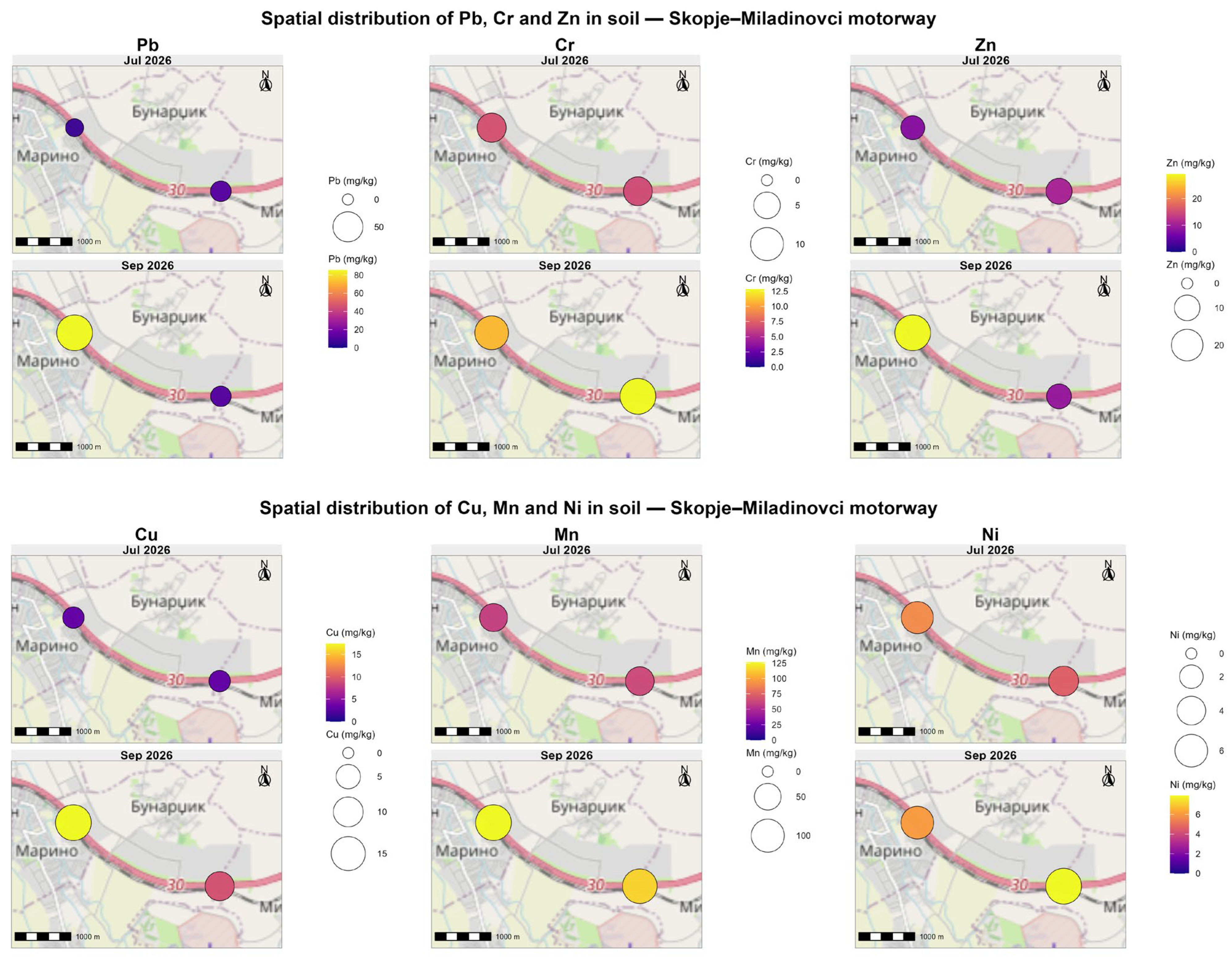
The localized July Pb elevations at S3 and S4 deserve particular attention. Although concentrations exceeded the Dutch background value, they remained below its intervention value and did not indicate a uniform increase along the Shtip expressway bypass area. Their substantially lower September values (6.31 and 12.80 mg kg−1) show that the July elevations were not reproduced in the subsequent sampling campaign. Conversely, SK-SS1 at the Skopje–Miladinovci motorway increased from 6.73 mg kg−1 in July to 85.40 mg kg−1 in September, while SK-SS2 remained similar (12.80 and 12.30 mg kg−1). Such contrasts may reflect localized deposition, runoff redistribution, soil heterogeneity, sampling variability, previous contaminant accumulation or legacy Pb. Historical leaded-gasoline emissions are a possible legacy source [48], but the current dataset does not establish their contribution at any sampling location. Neither the July Pb elevations at S3 and S4 nor the September elevation at SK-SS1 can be conclusively attributed to traffic. Targeted repeat sampling, characterization of local geochemical background and source-specific analyses are needed to investigate these findings. The comparatively narrow concentration range observed in the Skopje–Miladinovci motorway sites in July 2026 should also be interpreted with caution because only two locations were sampled. September 2026 revealed larger differences between the two sites for some elements, notably Pb (85.40 versus 12.30 mg kg−1), Zn (29.20 versus 9.01 mg kg−1) and Cu (17.40 versus 9.28 mg kg−1). The small sample size does not support generalization to the motorway section as a whole. Although traffic conditions differ between the two road environments, neither campaign demonstrates a consistently higher trace-element burden at the more heavily trafficked road section; local geological, drainage and soil characteristics may influence the observed patterns [9,10].
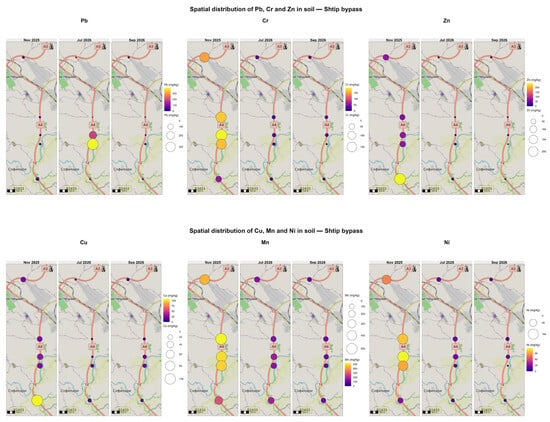
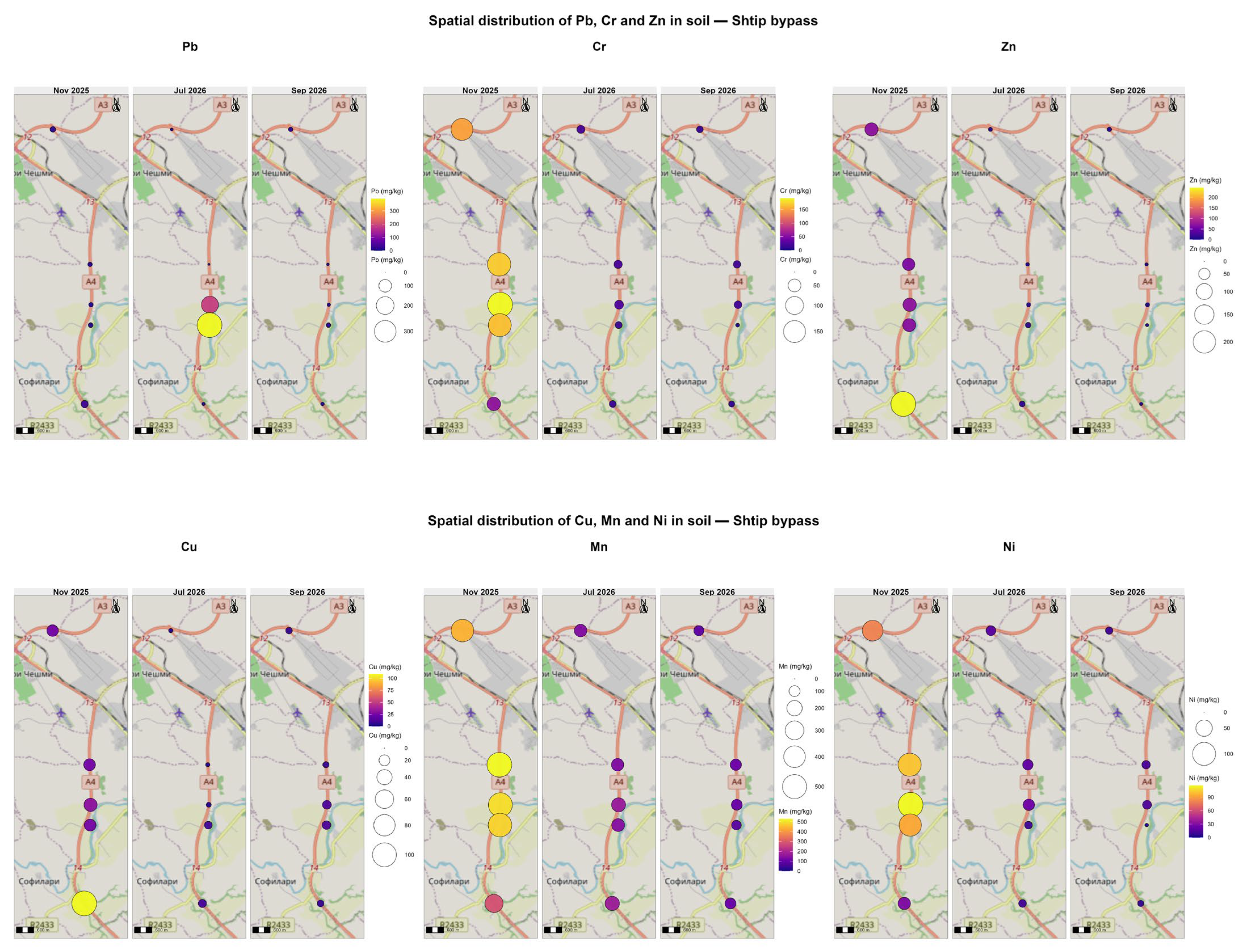
The spatial maps for the Skopje–Miladinovci motorway section (Figure 10) illustrate differences between SK SS1 and SK SS2 in July and September 2026, particularly the September Pb elevation at SK-SS1. Within the Shtip expressway bypass area, the spatial maps (Figure 11) show element-specific variation across three campaigns, including the marked July Pb elevations at S3 and S4 that were not repeated in September. The spatial patterns are descriptive and do not permit source attribution.
Figure 10.
Spatial distribution of Cu, Mn, Ni, Pb, Cr and Zn in roadside soils along the Skopje–Miladinovci motorway in July and September 2026. Symbol size and colour represent measured concentrations (mg kg−1 dry soil); scales are consistent between the two campaigns for each element.
Figure 11.
Spatial distribution of Cu, Mn, Ni, Pb, Cr and Zn in roadside soils along the Shtip expressway bypass area at S1–S5 in November 2025, July 2026 and September 2026. Symbol size and colour represent measured concentrations (mg kg−1 dry soil); scales are consistent across campaigns for each element.
Overall, the July and September 2026 spatial comparisons indicate substantial location- and sampling-period-specific heterogeneity in roadside-soil trace-element concentrations. The pronounced July Pb elevations at S3 and S4 were not reproduced in September, while elevated September Pb was observed at SK-SS1. These contrasts underscore the need for site-specific interpretation and do not justify attributing the observed concentrations solely to traffic intensity or to a particular emission source.
Marked differences in trace-element concentrations were observed among the November 2025, July 2026 and September 2026 sampling campaigns at the Shtip expressway bypass area. Cu, Mn, Ni, Cr and Zn generally had higher concentrations in November 2025 than in either 2026 campaign. September 2026 concentrations remained relatively low: Cu ranged from 6.39 to 13.20, Mn from 78.30 to 107.00, Ni from 2.17 to 14.60, Cr from 4.29 to 17.50 and Zn from 3.63 to 7.24 mg kg−1. These values indicate a contrast between sampling periods rather than a demonstrated seasonal pattern.
Cu and Zn displayed particularly distinct spatial patterns in November 2025, with the highest concentrations occurring at S5 (108 and 246 mg kg−1, respectively). Mn, Ni and Cr showed elevated concentrations primarily at the central sampling locations, while comparatively lower concentrations were observed at S5 for Ni and Cr. In July 2026, the concentrations of these elements were substantially lower and showed a narrower spatial range. In September, the spatial maxima varied by element: Cu and Cr peaked at S3, Mn at S2, Ni at S3 and Zn at S1. The changing locations of the maxima reinforce the heterogeneous nature of the measurements and do not demonstrate a single common contamination source.
Temporal variability in roadside-soil metal concentrations has also been reported in previous studies. Batool et al. [49], for example, observed significant spatial and temporal heterogeneity of Zn, Cu, Pb and Cd in roadside soils sampled during different seasons, demonstrating that metal accumulation is not necessarily constant throughout the year. The direction and magnitude of such temporal changes are, however, strongly site dependent and should not be expected to follow the same pattern in different road environments.
Variations between sampling periods may reflect changes in both pollutant input and post-depositional processes. Roadside metal accumulation is influenced by dry and wet deposition, road runoff, resuspension of previously deposited particles and local environmental conditions. In particular, precipitation amount and intensity, preceding dry periods, wind conditions and vegetation cover can influence the transfer and redistribution of traffic-derived contaminants between the road surface and adjacent soils [9]. Non-exhaust traffic emissions from brake wear, tyre wear, pavement abrasion and resuspended road dust also provide continuing inputs of metal-containing particles to the roadside environment [11].
Changes in soil-water conditions can additionally affect the mobility and retention of individual metals. Previous roadside studies have demonstrated that seasonal changes in soil solution chemistry can modify the mobilization of Cu, Pb and Zn, although the magnitude and mechanisms of these effects differ among elements and sites [4]. The lower concentrations of Cu, Mn, Ni, Cr and Zn recorded in both July and September 2026 relative to November 2025 may reflect differences in deposition, redistribution, retention and sampling conditions. Without matched meteorological, hydrological and soil-property measurements, the relative contribution of these mechanisms cannot be determined.
Pb exhibited a different pattern from the other trace elements. In November 2025, Pb ranged from 11.7 to 32.3 mg kg−1 across S1–S5. In July 2026, markedly elevated concentrations at S3 (185.20 mg kg−1) and S4 (392.60 mg kg−1) raised the mean across the five locations to 118.14 mg kg−1; this did not represent a uniform increase across all sites. September 2026 Pb values ranged from 3.69 to 12.80 mg kg−1, and the five-site mean declined to 8.25 mg kg−1. The absence of repeated elevated values at S3 and S4 does not establish whether the July concentrations resulted from transient deposition, microscale heterogeneity or other causes. Further targeted investigation is necessary.
The contrasting temporal behaviour of Pb relative to the other investigated elements further supports the interpretation that roadside-soil contamination is controlled by element-specific and site-specific processes. Different trace elements may vary in their sources, particle associations, mobility and affinity for soil constituents, resulting in contrasting patterns of accumulation and redistribution. Reviews of roadside environments similarly show that metal concentrations in the soil matrix and soil solution do not necessarily respond in the same way to environmental conditions, emphasizing the importance of local soil properties and hydrological processes in controlling metal retention and mobilization [9].
Overall, comparison across three sampling campaigns at the Shtip expressway bypass area and two at Skopje–Miladinovci motorway reveal substantial spatial and temporal variability in roadside-soil trace elements, particularly Pb. The July 2026 Shtip Pb elevations at S3 and S4 were not repeated in September, whereas the September 2026 Skopje–Miladinovci campaign showed elevated Pb at SK-SS1. The limited number of sampling locations and campaigns, the lack of locally measured geochemical background concentrations, and the absence of source-specific tracers preclude reliable enrichment-factor-based source assessment or definitive attribution to traffic. Dutch soil reference values support indicative comparison with regulatory benchmarks but are not a substitute for local background data. Further repeated, spatially targeted sampling and complementary meteorological, hydrological, soil-characterization and source-apportionment analyses are required to explain the observed contrasts.
4. Conclusions
This study provides an integrated field assessment of highway runoff, roadside-soil particles suspected to be microplastics (MPs), and trace elements at selected road environments in North Macedonia, providing an initial dataset for road-associated particulate contamination in the country. Particles suspected to be MPs were observed in all investigated drainage-water and roadside-soil samples, indicating their occurrence in both transport and accumulation compartments. The abundance of suspected microplastic particles in drainage water in the Shtip expressway bypass area ranged from 28 to 68 particles L−1, while respective roadside soils contained 1100–2700 particles kg−1. The two Skopje–Miladinovci motorway sites exhibited approximately threefold higher mean soil abundance of suspected microplastic particles than the Shtip expressway bypass sites; however, given the limited sampling design, these spatial differences cannot be attributed to traffic intensity alone and may also reflect site-specific environmental and drainage conditions.
The observed particles showed considerable morphological and size variability. SEM analysis complemented stereomicroscopic observations and revealed heterogeneous particle morphologies, including fragments and film-like structures. These morphological features provide only circumstantial evidence of potential traffic-related sources rather than definitive identification of particle origin. In the absence of FTIR or Raman spectroscopic confirmation, the particles are conservatively classified as suspected microplastics; visual morphology and SEM–EDS elemental information cannot confirm polymer type or establish specific sources. This methodological limitation is important when interpreting particle abundance and comparing the present findings with studies based on spectroscopically confirmed polymers.
Trace-element concentrations showed marked spatial and temporal variability. In July 2026, elevated Pb concentrations occurred at S3 (185.20 mg kg−1) and S4 (392.60 mg kg−1) along the Shtip expressway bypass area but were not reproduced in September 2026, when concentrations at those sites were 6.31 and 12.80 mg kg−1, respectively. Conversely, Pb at the Skopje–Miladinovci motorway site SK-SS1 increased from 6.73 mg kg−1 in July to 85.40 mg kg−1 in September, exceeding the Dutch background reference value of 50 mg kg−1 while remaining below the intervention value. The Dutch values offer an indicative regulatory comparison, not local geochemical background measurements. Neither the July Pb elevations nor the September elevation can be conclusively attributed to traffic or any other specific source. Site conditions, historical accumulation and localized redistribution may contribute, but these explanations require targeted investigation. Overall, the findings establish preliminary baseline observations for suspected microplastic particles and measured trace elements in selected highway environments in North Macedonia. The additional September 2026 campaign strengthens the evidence for sampling-period variability, but the limited number of sites and sampling campaigns precludes inference of persistent hotspots, seasonal trends, national-scale patterns or definitive source attribution. Further work requires repeated and spatially targeted soil sampling, locally characterized geochemical background, appropriate reference-element data for enrichment-factor assessment, and source-specific analytical approaches. Replicated wet-weather and first-flush sampling, polymer-specific FTIR or Raman analysis, and integration of meteorological, hydrological, traffic and drainage-system data are also needed. The role of oil separators in retaining different particulate fractions remains to be evaluated directly rather than assumed from the present screening data.
The study observations are particularly relevant to countries in the Western Balkan region, where strengthening environmental monitoring capacity and integrating emerging pollutants into infrastructure planning and management can contribute to the protection of soil and water resources and the achievement of broader sustainable development.
Author Contributions
Conceptualization, S.L., J.J. and A.Z.; methodology, S.L., J.J., A.Z., T.S.I. and M.R.; validation, S.L., J.J., A.Z., T.S.I., G.D., K.D., M.R. and J.K.; sample collection, S.L., J.J., and G.D.; sample preparation and interpretation, S.L., J.J., A.Z., T.S.I., G.D. and M.R.; writing—original draft preparation, S.L., J.J., A.Z., T.S.I., G.D., K.D., M.R. and J.K.; visualization, J.J., A.Z., T.S.I. and M.R.; supervision, T.S.I., G.D., K.D. and J.K.; communicating with the journal, A.Z.; funding acquisition, S.L. All the co-authors participated in discussions and reviewed the manuscript. All authors have read and agreed to the published version of the manuscript.
Funding
This research was funded by the Ministry of Education and Science of the Republic of North Macedonia within the granted project “Optimization of advanced methods for monitoring and remediation of pollution from highway runoff through digitization, new technologies, and algorithms”.
Institutional Review Board Statement
Not applicable.
Informed Consent Statement
Not applicable.
Data Availability Statement
The original contributions presented in this study are included in the article. Further inquiries can be directed to the corresponding author.
Acknowledgments
The authors are thankful to the PE for state roads for providing data on AADT and providing access to road sites as well as to STRABAG SE construction company for providing access to oil separators and design documentation for relevant subsections. We are thankful to AMBICON laboratory for all the support in the ongoing project.
Conflicts of Interest
The authors declare no conflicts of interest.
References
- Mangani, G.; Berloni, A.; Bellucci, F.; Tatàno, F.; Maione, M. Evaluation of the pollutant content in road runoff first flush waters. Water Air Soil Pollut. 2005, 160, 213–228. [Google Scholar] [CrossRef] [Scilit]
- Lindgren, Å. Asphalt wear and pollution transport. Sci. Total Environ. 1996, 189, 281–286. [Google Scholar] [CrossRef] [Scilit]
- Legret, M.; Pagotto, C. Evaluation of pollutant loadings in the runoff waters from a major rural highway. Sci. Total Environ. 1999, 235, 143–150. [Google Scholar] [CrossRef] [Scilit] [PubMed]
- Bäckström, M.; Karlsson, S.; Bäckman, L.; Folkeson, L.; Lind, B. Mobilisation of heavy metals by deicing salts in a roadside environment. Water Res. 2004, 38, 720–732. [Google Scholar] [CrossRef] [Scilit] [PubMed]
- Bertrand-Krajewski, J.L.; Chebbo, G.; Saget, A. Distribution of pollutant mass vs volume in stormwater discharges and the first flush phenomenon. Water Res. 1998, 32, 2341–2356. [Google Scholar] [CrossRef] [Scilit]
- Koeleman, M.; van der Laak, W.J.; Ietswaart, H. Dispersion of PAH and heavy metals along motorways in the Netherlands—An overview. Sci. Total Environ. 1999, 235, 347–349. [Google Scholar] [CrossRef] [Scilit] [PubMed]
- Krein, A.; Schorer, M. Road runoff pollution by polycyclic aromatic hydrocarbons and its contribution to river sediments. Water Res. 2000, 34, 4110–4115. [Google Scholar] [CrossRef] [Scilit]
- Brezonik, P.L.; Stadelmann, T.H. Analysis and predictive models of stormwater runoff volumes, loads, and pollutant concentrations from watersheds in the Twin Cities metropolitan area, Minnesota, USA. Water Res. 2002, 36, 1743–1757. [Google Scholar] [CrossRef] [Scilit] [PubMed]
- Werkenthin, M.; Kluge, B.; Wessolek, G. Metals in European roadside soils and soil solution—A review. Environ. Pollut. 2014, 189, 98–110. [Google Scholar] [CrossRef] [Scilit] [PubMed]
- De Silva, S.; Ball, A.S.; Huynh, T.; Reichman, S.M. Metal accumulation in roadside soil in Melbourne, Australia: Effect of road age, traffic density and vehicular speed. Environ. Pollut. 2016, 208, 102–109. [Google Scholar] [CrossRef] [Scilit] [PubMed]
- Piscitello, A.; Bianco, C.; Casasso, A.; Sethi, R. Non-exhaust traffic emissions: Sources, characterization, and mitigation measures. Sci. Total Environ. 2021, 766, 144440. [Google Scholar] [CrossRef] [Scilit] [PubMed]
- Kabir, S.A.; Bhuiyan, M.A.; Zhang, G.; Pramanik, B.K. Microplastic distribution and ecological risks: Investigating road dust and stormwater runoff across land uses. Environ. Sci. Adv. 2024, 3, 62–75. [Google Scholar] [CrossRef] [Scilit]
- Badawi, A.K.; Hasan, R.; Ismail, B. Sustainable coagulative removal of microplastic from aquatic systems: Recent progress and outlook. RSC Adv. 2025, 15, 25256–25273. [Google Scholar] [CrossRef] [Scilit] [PubMed]
- Shruti, V.C.; Pérez-Guevara, F.; Elizalde-Martínez, I.; Kutralam-Muniasamy, G. Current trends and analytical methods for evaluation of microplastics in stormwater. Trends Environ. Anal. Chem. 2021, 30, e00123. [Google Scholar] [CrossRef] [Scilit]
- Lin, Y.; Wang, Y.; Ho, Y.W.; Fang, J.K.H.; Li, Y. Characterization and ecological risks of microplastics in urban road runoff. Sci. Total Environ. 2024, 954, 176590. [Google Scholar] [CrossRef] [Scilit] [PubMed]
- Premarathna, K.S.D.; Rajapaksha, A.U.; Vithanage, M. Microplastics in road dust and surrounding environment: Sources, fate and analytical approaches. Trends Environ. Anal. Chem. 2025, 45, e00256. [Google Scholar] [CrossRef] [Scilit]
- Siegfried, M.; Koelmans, A.A.; Besseling, E.; Kroeze, C. Export of microplastics from land to sea: A modelling approach. Water Res. 2017, 127, 249–257. [Google Scholar] [CrossRef] [Scilit] [PubMed]
- Vercauteren, M.; Semmouri, I.; Van Acker, E.; Pequeur, E.; Van Esch, L.; Uljee, I.; Asselman, J.; Janssen, C.R. Assessment of road run-off and domestic wastewater contribution to microplastic pollution in a densely populated area (Flanders, Belgium). Environ. Pollut. 2023, 333, 122090. [Google Scholar] [CrossRef] [Scilit] [PubMed]
- Odiete, W.E.; Agunwamba, J.C. Novel design methods for conventional oil-water separators. Heliyon 2019, 5, e02099. [Google Scholar] [CrossRef] [Scilit] [PubMed]
- Barbosa, A.E.; Escarameia, M. Sustainable containment of hazardous road spillages: Design and experimental assessment of a low-maintenance system. Process Saf. Environ. Prot. 2026, 216, 109249. [Google Scholar] [CrossRef] [Scilit]
- Stock, F.; Kochleus, C.; Bänsch-Baltruschat, B.; Brennholt, N.; Reifferscheid, G. Sampling techniques and preparation methods for microplastic analyses in the aquatic environment—A review. TrAC Trends Anal. Chem. 2019, 113, 84–92. [Google Scholar] [CrossRef] [Scilit]
- PE for State Roads Website: www.roads.org.mk. Available online: https://webgis.roads.org.mk/webgis/?_gl=1*d6m8p6*_ga*MjA3NDE4NTM5OC4xNzkxMDYwMTc4*_ga_R9DN6P6241*czE3OTEwNjAxNzckbzEkZzEkdDE3OTEwNjAxODIkajU1JGwwJGgw#/map (accessed on 30 September 2026).
- Google Maps Website: www.roads.org.mk. Available online: https://www.google.com/maps (accessed on 30 September 2026).
- Opher, T.; Friedler, E. Factors affecting highway runoff quality. Urban Water J. 2010, 7, 155–172. [Google Scholar] [CrossRef] [Scilit]
- Jovanovski, J.; Donevska, K.; Lepitkova, S.; Dimov, G. Effects of highway runoff pollutants on water quality: A review. In Proceedings of the Third Macedonian Road Congress, Ohrid, North Macedonia, 6–7 November 2025; pp. 596–606. [Google Scholar]
- Barrett, M.E. A Review and Evaluation of Literature Pertaining to the Quantity and Control of Pollution from Highway Runoff and Construction; Technical Report; Center for Research and Water Resources: Austin Texas, TX, USA, 1995. [Google Scholar]
- Drapper, D.; Tomlinson, R.; Williams, P. Pollutant concentrations in road runoff: Southeast Queensland case study. J. Environ. Eng. 2000, 126, 313–320. [Google Scholar] [CrossRef] [Scilit]
- Pagotto, C.; Legret, M.; Le Cloirec, P. Comparison of the hydraulic behaviour and the quality of highway runoff water according to the type of pavement. Water Res. 2000, 34, 4446–4454. [Google Scholar] [CrossRef] [Scilit]
- Jafarova, M.; Grifoni, L.; Aherne, J.; Loppi, S. Comparison of lichens and mosses as biomonitors of airborne microplastics. Atmosphere 2023, 14, 1007. [Google Scholar] [CrossRef] [Scilit]
- Roblin, B.; Aherne, J. Moss as a biomonitor for the atmospheric deposition of anthropogenic microfibres. Sci. Total Environ. 2020, 715, 136973. [Google Scholar] [CrossRef] [Scilit] [PubMed]
- Yang, L.; Zhang, Y.; Kang, S.; Wang, Z.; Wu, C. Microplastics in soil: A review on methods, occurrence, sources, and potential risk. Sci. Total Environ. 2021, 780, 146546, Correction in Sci. Total Environ. 2021, 801, 149616.. [Google Scholar] [CrossRef] [Scilit] [PubMed]
- Gillibert, R.; Magazzù, A.; Callegari, A.; Bronte-Ciriza, D.; Foti, A.; Donato, M.G.; Maragò, O.M.; Volpe, G.; Lamy de La Chapelle, M.; Lagarde, F.; et al. Raman tweezers for tire and road wear micro- and nanoparticles analysis. Environ. Sci. Nano 2022, 9, 145–161, Correction in Environ. Sci. Nano 2024, 11, 3657. [Google Scholar] [CrossRef] [Scilit]
- Ziajahromi, S.; Drapper, D.; Hornbuckle, A.; Rintoul, L.; Leusch, F.D. Microplastic pollution in a stormwater floating treatment wetland: Detection of tyre particles in sediment. Sci. Total Environ. 2020, 713, 136356. [Google Scholar] [CrossRef] [Scilit] [PubMed]
- Wang, Z.-M.; Wagner, J.; Ghosal, S.; Bedi, G.; Wall, S. SEM/EDS and optical microscopy analyses of microplastics in ocean trawl and fish guts. Sci. Total Environ. 2017, 603–604, 616–626. [Google Scholar] [CrossRef] [Scilit] [PubMed]
- Webb, M.; Buckman, J.; Ratouit, B.; Scott, J.; Bischoff, J.; Le, T.T.; Gutierrez, T.; Wagner, T.; Ngo, H.T.T.; Kaiser, M.; et al. Novel characterisation of microplastics and other contaminant particles using new scanning electron microscopy technologies. Sci. Rep. 2025, 15, 44361. [Google Scholar] [CrossRef] [Scilit] [PubMed]
- ISO 17294-2:2023; Water Quality—Application of Inductively Coupled Plasma Mass Spectrometry (ICP-MS)—Part 2: Determination of Selected Elements Including Uranium Isotopes. International Organization for Standardization (ISO): Geneva, Switzerland, 2023.
- ISO 14869-1:2001; Soil Quality—Dissolution for the Determination of Total Element Content—Part 1: Dissolution with Hydrofluoric and Perchloric Acids. International Organization for Standardization (ISO): Geneva, Switzerland, 2001.
- Knight, L.J.; Parker-Jurd, F.N.F.; Al-Sid-Cheikh, M.; Thompson, R.C. Tyre wear particles: An abundant yet widely unreported microplastic? Environ. Sci. Pollut. Res. 2020, 27, 18345–18354. [Google Scholar] [CrossRef] [Scilit] [PubMed]
- Smyth, K.; Tan, S.; Van Seters, T.; Henderson, V.; Passeport, E.; Drake, J. Pavement wear generates microplastics in stormwater runoff. J. Hazard. Mater. 2025, 481, 136495. [Google Scholar] [CrossRef] [Scilit] [PubMed]
- Rosso, B.; Corami, F.; Vezzaro, L.; Biondi, S.; Bravo, B.; Barbante, C.; Gambaro, A. Quantification and characterization of additives, plasticizers, and small microplastics (5–100 μm) in highway stormwater runoff. J. Environ. Manag. 2022, 324, 116348. [Google Scholar] [CrossRef] [Scilit] [PubMed]
- Rosso, B.; Vezzaro, L.; Bravo, B.; Sambo, F.; Biondi, S.; Barbante, C.; Gambaro, A.; Corami, F. From the highway to receiving water bodies: Identification and simultaneous quantification of small microplastics (less than 100 µm) in highway stormwater runoff. Environ. Sci. Pollut. Res. 2024, 31, 61845–61859. [Google Scholar] [CrossRef] [Scilit] [PubMed]
- Temiz, M.A.; Yıldızbaş, F. Spatial Distribution and Characterization of Soil Microplastics Across Different Terrestrial Land-Use Types in Karaman, Türkiye. Water Air Soil Pollut. 2026, 237, 818. [Google Scholar] [CrossRef] [Scilit]
- Parker-Jurd, F.; Abbott, G.; Guthery, B.; Parker-Jurd, G.; Thompson, R. Features of the highway road network that generate or retain tyre wear particles. Environ. Sci. Pollut. Res. 2024, 31, 26675–26685. [Google Scholar] [CrossRef] [Scilit] [PubMed]
- Yan, G.; Mao, L.; Liu, S.; Mao, Y.; Ye, H.; Huang, T.; Li, F.; Chen, L. Enrichment and sources of trace metals in roadside soils in Shanghai, China: A case study of two urban/rural roads. Sci. Total Environ. 2018, 631–632, 942–950. [Google Scholar] [CrossRef] [Scilit] [PubMed]
- Hiller, E.; Pilková, Z.; Filová, L.; Jurkovič, Ľ.; Mihaljevič, M.; Lacina, P. Concentrations of selected trace elements in surface soils near crossroads in the city of Bratislava (the Slovak Republic). Environ. Sci. Pollut. Res. 2021, 28, 5455–5471. [Google Scholar] [CrossRef] [Scilit] [PubMed]
- Ministry of Infrastructure and Water Management. Regeling Bodemkwaliteit 2022 [Soil Quality Regulation 2022] (Annex B, as Amended). Government of the Netherlands. 2022. Available online: https://wetten.overheid.nl/BWBR0047808/ (accessed on 9 October 2026).
- Government of the Netherlands. Besluit Activiteiten Leefomgeving [Environmental Activities Decree] (Annex IIA, as Amended). 2021. Available online: https://wetten.overheid.nl/BWBR0041330/ (accessed on 9 October 2026).
- Kayhanian, M. Trend and concentrations of legacy lead (Pb) in highway runoff. Environ. Pollut. 2012, 160, 169–177. [Google Scholar] [CrossRef] [Scilit] [PubMed]
- Batool, H.; Hussain, M.; Hameed, M.; Ahmad, R. Spatial and temporal heterogeneity of metal contaminants in soils along two major roads. Bull. Environ. Contam. Toxicol. 2020, 105, 111–118. [Google Scholar] [CrossRef] [Scilit] [PubMed]

Disclaimer/Publisher’s Note: The statements, opinions and data contained in all publications are solely those of the individual author(s) and contributor(s) and not of MDPI and/or the editor(s). MDPI and/or the editor(s) disclaim responsibility for any injury to people or property resulting from any ideas, methods, instructions or products referred to in the content. |
© 2026 by the authors. Licensee MDPI, Basel, Switzerland. This article is an open access article distributed under the terms and conditions of the Creative Commons Attribution (CC BY) license.