


Abstract
The transition towards a circular economy in the construction sector necessitates the systematic implementation of life-cycle assessment (LCA) and circular design principles. In Poland, regulatory frameworks and market incentives supporting material circularity and whole-building life-cycle assessment have only recently begun to emerge. These issues are primarily promoted through multi-criteria certifications. This study describes and compares the uptake of selected material-related credits of multi-criteria building certification schemes, specifically BREEAM and LEED over the years 2011–2023. From a theoretical frame of 300 certified buildings meeting the selection criteria, 19 cases were purposively selected for comparative analysis based on access to comprehensive, confidential certification data provided by a single architectural practice, APA Wojciechowski sp. z o.o. The assessment examined certification credits related to material category, such as material efficiency, LCA, material circularity, component reuse, recyclability, and responsible sourcing. The findings indicate that, while both systems are designed to address building sustainability, the analyzed cases demonstrated a low uptake of direct circular design strategies. Despite available credits for component and material reuse, none of the analyzed LEED-certified buildings obtained them. Similarly, BREEAM-certified buildings attained only 1–3 points out of a possible 13 in BREEAM Europe Commercial 2009 and 3 points out of possible 11 in BREEAM International 2013 and 2016 in the materials category. No credits were awarded for structural reuse, façade reuse, or responsible material sourcing. While the newer BREEAM 2013 and BREEAM 2016 cases achieved two out of six and two out of five possible points in the Mat 01 category through elemental or partial material assessments, the sample demonstrated a complete absence of full whole-building life-cycle assessment. Ultimately, the analysis reveals that historically, in the past decade, the uptake of advanced life-cycle and material circularity credits within this sample remained limited.
1. Introduction
1.1. Scope and Area of Research
The following study aims to analyze the scores obtained in multi-criteria certifications such as LEED or BREEAM in the context of building materials. This category is reflected in the “Materials and Resources” section of the LEED certification [1,2] and in the “Materials” section of the BREEAM certification [3,4,5]. In the year 2024, when the certification analysis was conducted, there were a total of 2315 certified buildings registered in the PLGBC database [6], and from this total, 300 buildings with common characteristics were preliminarily filtered out. Finally, the analysis of credit uptake was conducted on 19 buildings, for which confidential data regarding detailed scoring in certifications were made available by the APA Wojciechowski sp. z o.o. The chosen criteria are described in detail in the Section 2.
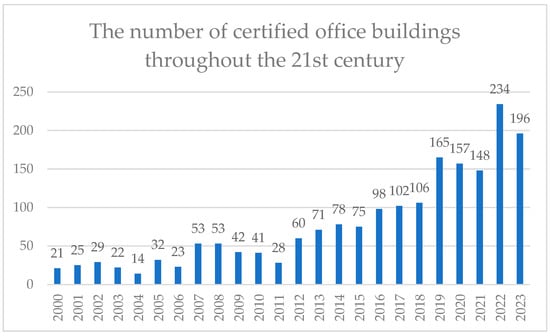
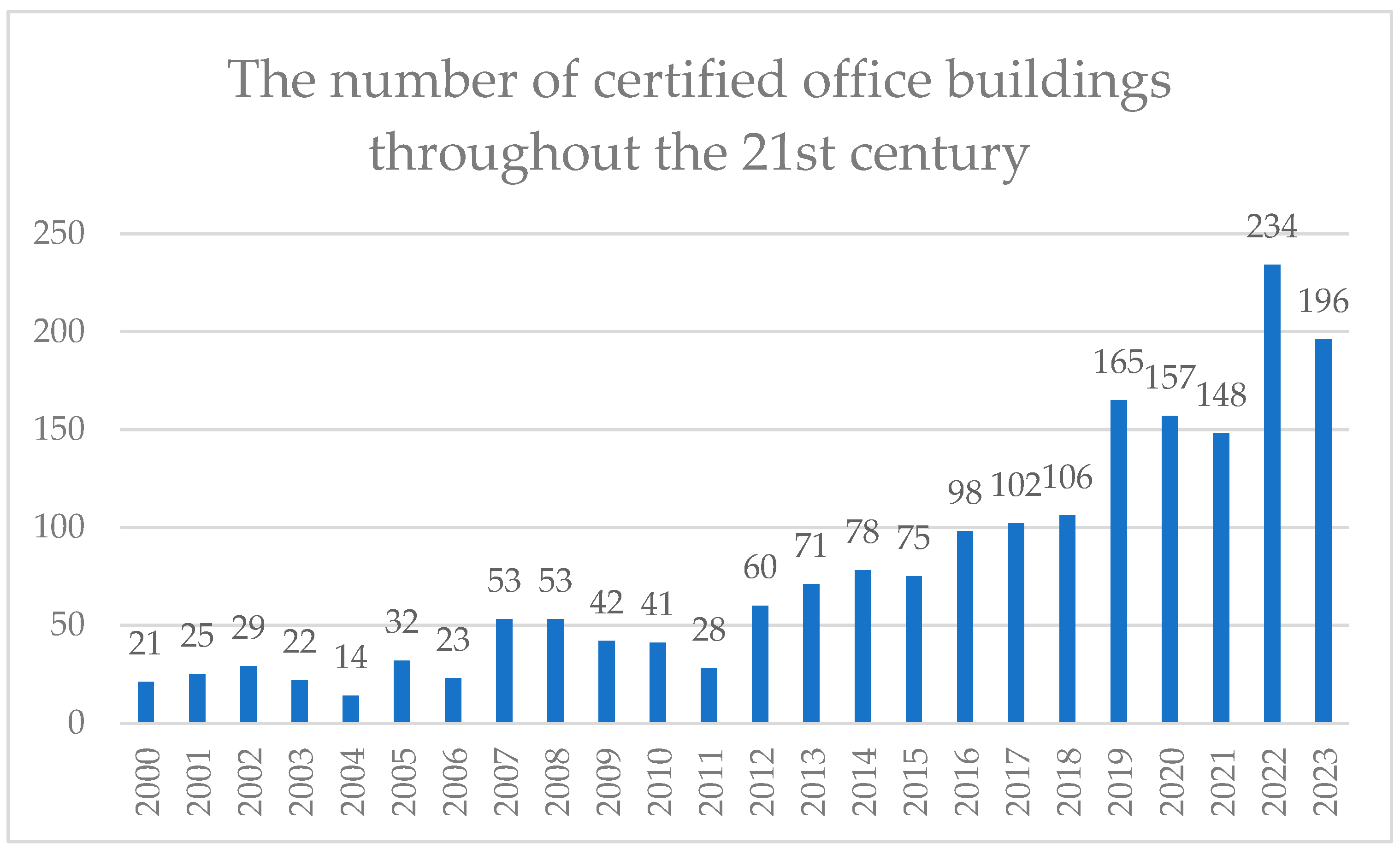
Among the selection criteria, an important aspect was the office function, as the most popular function in the group of certified facilities in the analyzed time period [7]. A minimum area was defined as 5000 m2, and the timeframe of the buildings’ realization corresponded to the last decade and the beginning of the current one (years 2011–2023), when the number of certified office buildings in Poland increased sharply, as shown in Figure 1.
Figure 1.
The number of certified office buildings throughout the 21st century. Own analysis, based on data from the PLGBC certified buildings database.
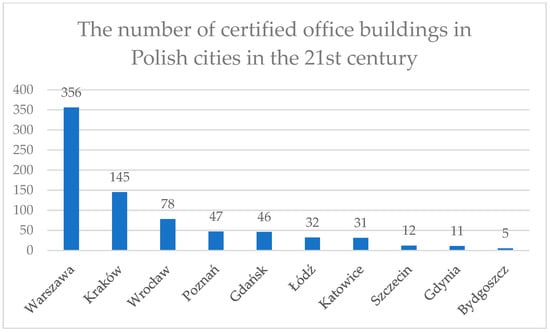
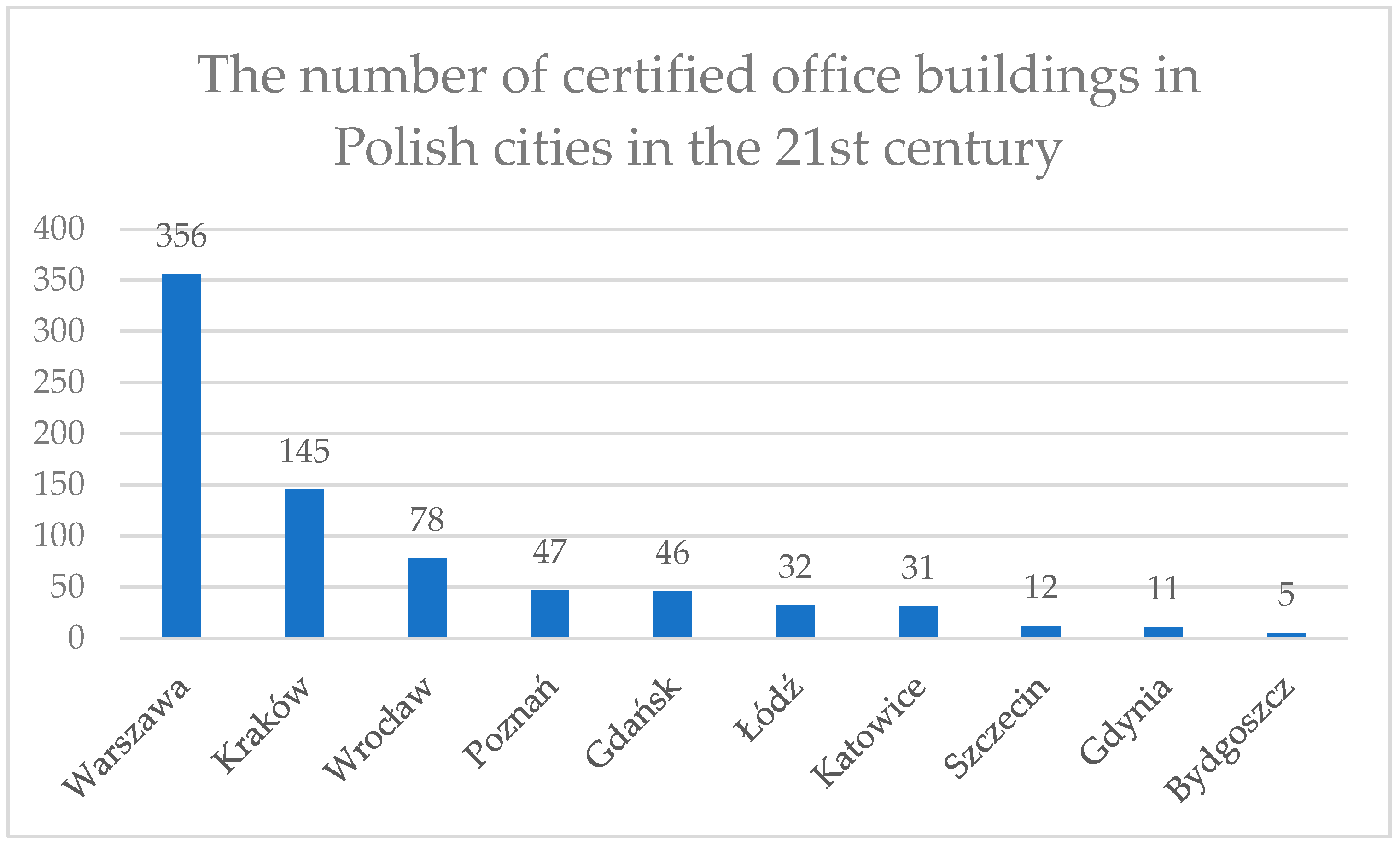
The examined buildings are located in Poland, in cities such as Warsaw, Wrocław, and Gdańsk, which before 2024 were among the 10 cities with the highest number of certified office buildings, which is presented in Figure 2.
Figure 2.
The number of certified office buildings in Polish cities in the 21st century. Own analysis, based on data from the PLGBC certified buildings database.
To ensure analytical clarity, this study explicitly differentiates core sustainability concepts. Life-cycle assessment (LCA) is the standardized methodology used to quantify impacts [8], while global warming potential (GWP) is the specific metric (kg CO2e) measuring climate change effects [9]. Embodied carbon represents emissions from material life cycles, distinct from operational and whole-life carbon [10]. Circularity denotes physical resource loop-closing (e.g., reuse, recycling) [11]. While circular strategies often reduce carbon, the two are analytically distinct. Accordingly, this study maps certification credits to these separate constructs: assessment methods (e.g., BREEAM 2013 and BREEAM 2016 Mat 01), carbon-related indicators (e.g., GWP reductions), direct material-circularity strategies (e.g., structural reuse, façade reuse) and indirect resource-efficiency proxies (e.g., responsible sourcing of materials, designing for durability and resilience). Such mapping helped in understanding the distribution of points obtained in the materials category and led to specific conclusions.
1.2. Research Problem
Interest in LCA topics, project optimization, and material specification is extremely high. A study conducted in 2024 indicated that between 2010 and 2023, over 10,000 scientific publications were produced concerning the embodied carbon of buildings, building emissions, and the carbon footprint of construction [12]. Despite such great interest in the topic, there are certain limitations that result in the implementation of material circularity principles in practice to an insufficient degree [13,14]. In a survey conducted by OneClick LCA during the period of August–September 2023, it was observed that the most significantly limiting factor for LCA and embodied carbon progress was the lack of national regulations or policies (50% of all replies). Additionally, over 80% of all respondents reported that lack of understanding from developers and investors, as well as lack of best practices, was limiting progress [15].
The emission of greenhouse gases (GHGs) from the operational phase of buildings is subject to regulation at both the EU and national levels, with energy efficiency requirements serving as the primary regulatory instrument [16]. Consequently, research and policy have focused on energy-efficient construction technologies, including innovative building materials, renewable energy systems, energy management systems, and adaptive building envelopes [17,18,19]. The operational energy performance of a building was also reflected in multi-criteria certification schemes, where the energy category was assigned the highest weighting [1,2,3,4,5]. However, the issue of embodied carbon remains less widely addressed despite its growing importance in achieving climate neutrality. In contrast to operational emissions, embodied emissions occur primarily prior to and during the construction phase, thereby acquiring increasing significance in the context of meeting the EU’s 2050 decarbonization targets [20,21]. Recent comparative analyses of green building certification systems confirm that while operational energy credits remain heavily prioritized, structural frameworks for embodied carbon and material circularity continue to experience uneven adoption globally, highlighting the ongoing need for rigorous whole-life assessment integration [22].
Life-cycle assessment (LCA) is increasingly applied in the construction sector through sustainable building certification schemes such as the Deutsche Gesellschaft für Nachhaltiges Bauen (DGNB), Leadership in Energy and Environmental Design (LEED) [23], and the Building Research Establishment Environmental Assessment Method (BREEAM) [24]. Furthermore, the incorporation of circular economy indicators has become an integral component of building certification systems and planning regulations. The newest certification schemes, including LEED v4 and BREEAM v7, have incorporated credits pertaining to embodied carbon and whole-life carbon (WLC). However, these account for a negligible proportion of the overall certification score [24,25,26]. In the LEED v4 framework (BD+C: Core and Shell), the overall ‘Building Life-Cycle Impact Reduction’ credit offers a maximum of six possible points through various compliance paths, such as historic building reuse. However, projects opting specifically for Option 4 (whole-building life-cycle assessment) can earn three points by demonstrating a minimum 10% reduction in global warming potential and other impact categories against a baseline building [2,23]. BREEAM v7 strengthens this approach by introducing minimum LCA requirements for higher certification ratings and aligning certification with ESG objectives and the EU Taxonomy [25,27]. While current industry discourse increasingly focuses on newer frameworks—such as LEED v4/v4.1/v5 and the upcoming BREEAM v7—the existing certified built environment is predominantly shaped by earlier standards [6,28]. Consequently, this study conducts a retrospective analysis of historical certification systems, specifically evaluating LEED Core and Shell v2009 and BREEAM Commercial 2009, BREEAM New Construction 2013, and BREEAM New Construction 2016. Analyzing these legacy versions provides critical empirical evidence on how early LCA and circularity credits were practically adopted (or ignored) in Polish office buildings. These historical performance baselines serve as vital policy context, highlighting the specific industry inertia that newer, more stringent certification versions must overcome.
During the analyzed period, in Poland there were no other tools than multi-criteria certifications, which could motivate the implementation of material circularity and LCA analyses in construction practice [7]. The mandatory regulation of whole-life carbon is currently in effect in only few European countries, including Denmark, Finland, France, the Netherlands and Sweden, where reporting requirements are combined with maximum emission thresholds [7]. In other countries, such as Germany, Switzerland, Norway and the United Kingdom, LCA requirements are applied to selected building types or publicly funded projects [7]. The prospective implementation of the recast Energy Performance of Buildings Directive (Directive (EU) 2024/1275, Article 7 and Annex III) in Poland will introduce phased requirements for the calculation and disclosure of life-cycle global warming potential (GWP). Subject to national enactment, this pathway will first mandate whole-life carbon reporting for new buildings with a useful floor area exceeding 1000 m2 starting in 2028, before extending the requirement to all new buildings from 2030 [29].
1.3. Legislative Implementation of Circular Economy and WLCA in Selected Cities
Despite the absence of a national methodology for calculating the whole-life carbon (WLC) or global warming potential (GWP) of buildings in Poland, several European countries—including Denmark, Finland, France, the Netherlands, and Sweden—have already incorporated WLC requirements into their regulatory frameworks, serving as great examples to follow [30]. Denmark has mandated Life-Cycle Carbon (LCC) calculations for all new buildings, with emission limits for buildings larger than 1000 m2 supported by the LCAbyg assessment tool [30]. Finland has announced its intention to implement mandatory climate declarations from 2026 onwards. These declarations will include a novel carbon handprint indicator, which recognizes environmental benefits such as carbon storage in bio-based materials [31]. In France, the HQE (Haute Qualité Environnementale) certification system incorporates material flow analysis. In contrast, the RE2020 regulation and the Anti-Waste and Circular Economy Act require life-cycle assessment and introduce extended producer responsibility for construction products [32]. Similarly, the updated London Plan requires major developments to submit circular economy statements demonstrating material reuse, design for disassembly, on-site waste management, and waste reduction strategies [33]. Sweden has required climate declarations for all new buildings since 2022 as part of its transition towards a circular economy [34]. The Netherlands, where the construction sector consumes approximately 50% of raw materials but already achieves a recycled material share of nearly 38%, aims to reduce virgin material consumption by 50% by 2030 and achieve a fully circular economy by 2050 [35]. Despite these common objectives, national approaches differ considerably with respect to the scope of assessed building elements, LCA boundaries, reference units, and emission calculation methods. These differences largely reflect national regulatory frameworks, established sustainability practices, and existing approaches to evaluating the environmental performance of buildings [30].
1.4. Evolution of Material Circularity in Polish Building Certifications
The number of certified buildings in Poland has increased rapidly in recent years, reflecting the growing importance of sustainable construction. By March 2025, the total certified floor area exceeded 50 million m2, representing an annual increase of more than 11.6 million m2 [36]. Poland currently has 2456 certified buildings, of which 82.5% are BREEAM-certified and 10.8% LEED-certified, making these the dominant certification schemes. Other systems, including Zielony Dom (3.9%) and WELL (1.5%), account for a much smaller share [36]. Certified buildings are concentrated mainly in the warehouse and industrial sector (54.2%), followed by office buildings (25.5%) [36].
Before the year 2024, office buildings led the way among the most frequently certified facilities. They accounted for over 42% of all certified buildings [28]. During that time, the most popular types of certification were:
- BREEAM New Construction, with 661 out of 1468 of all certified in the BREEAM system.
- LEED Core and Shell, with 122 out of 246 of all certified in the LEED system [28].
Moreover, before 2024, the highest numbers of certified buildings was recorded in the following voivodeships: Mazowieckie, Lower Silesian, Silesian, Lesser Poland, Łódź, Pomeranian, and Greater Poland. In these voivodeships, their numbers exceeded 100 buildings [28].
Both BREEAM and LEED schemes assess aspects such as site accessibility, energy efficiency, indoor environmental quality, pollution reduction, and the selection of environmentally responsible materials and technologies improving operational performance [37]. Circular economy principles are also incorporated through dedicated categories covering materials, resource efficiency, and life-cycle considerations [1,2,3,4,5,23].
Table 1, Table 2, Table 3, Table 4 and Table 5 present the possible scores in the Materials and Resources section of LEED and BREEAM certification, in their versions, which were the most frequently used during the examined period, for office buildings in Poland [6,28].
Table 1.
LEED v2009 for Core&Shell Development possible points in the Materials and Resources (MR) category.
Table 2.
LEED v4 for Core&Shell Development: possible points in the Materials and Resources (MR) category.
Table 3.
BREEAM Europe Commercial 2009—Offices: Possible credits in the materials (Mat) category.
Table 4.
BREEAM International 2013 New Construction—Offices: Possible credits in the materials (Mat) category.
Table 5.
BREEAM International 2016 New Construction—Offices: Possible credits in the materials (Mat) category.
In BREEAM, credits are weighted according to the importance of each assessment category, with the weighting varying by category and project type. Similar to LEED, BREEAM includes a dedicated materials category, although credits are awarded using different criteria. In BREEAM 2009, seven core credits address material-related issues, but none explicitly requires a life-cycle assessment (LCA) [3].
BREEAM 2013 introduced a significant change compared with the previous version, with a credit relating to the performance of an LCA as Mat 1 [4]. This should be carried out in accordance with the standards PN-EN ISO 14040:2006 and PN-EN 15978:2012 [8,38]. Furthermore, the Mat 3 and Mat 4 credits, relating to the reuse of the building’s façades and structure, were discontinued. The remaining credits remained unchanged [4]. BREEAM 2013 identifies five credits relating to the management of building materials and products [36].
The new Mat 06 credit in BREEAM International 2016 New Construction requires identification of measures optimizing material use throughout the building life cycle, in collaboration with the project team and key stakeholders [5].
1.5. Research Gap
While circular economy principles are incorporated into both LEED and BREEAM systems through dedicated material and life-cycle categories, a significant research gap remains: it is currently unknown whether the high market penetration of these certificates translates into the actual adoption of advanced circular design strategies, or if projects merely rely on conventional resource efficiency to achieve their ratings.
To address this gap, this study asks the primary research question: What is the observed project-level uptake and distribution of life-cycle assessment (LCA) and comprehensive circular design credits within selected LEED- and BREEAM-certified office buildings in Poland? This is supported by a secondary descriptive question: Which specific material and resource credits are most frequently targeted by design teams, and which circularity metrics are systematically bypassed?
The prespecified outcome of this study is the project-level credit uptake rate for certification criteria related to LCA, material circularity, component reuse, recyclability, and responsible sourcing. While measuring project-level credit uptake has limitations—primarily that it serves as a documentation-based proxy rather than a direct quantification of physical environmental performance—it remains a highly informative metric. Analyzing these credit distributions reveals the strategic compliance priorities of developers within the studied sample, demonstrating which specific circularity options are practically utilized under historical voluntary frameworks.
1.6. Article Structure
In the following section, the article is divided into four main parts:
- Materials and Methods. In this section, the criteria for selecting the objects are presented and thoroughly justified. Additionally, the section provides a summary of the buildings chosen for analysis, along with their detailed data verified against the publicly available database of certified PLGBC buildings.
- Results: In the ‘Results’ chapter, an original analysis is presented mapping the credits related to materials for both LEED and BREEAM certification systems, in which they are defined as four different construct categories: directly related to material circularity, indirect proxies, and assessment methods and credits related to the carbon footprint. Additionally, this section presents a summary of the raw scores obtained, taken directly from the final score sheets, as well as sensitivity analyses regarding the distribution of credits among individual buildings and grouped campuses.
- Discussion: This section reviews the presented and developed results, describes hypothetical causes that may underlie such outcomes, and discusses and presents the legislative context in Poland as well as in other European countries.
- Conclusions: This section summarizes the obtained and analyzed results, simultaneously indicating the limitations of the study and showing how it could be expanded and refined in the future.
2. Materials and Methods
The study was conducted on a sample of 19 buildings, whose data regarding scores in a selected certification categories were provided by the company APA Wojciechowski sp. z o.o. (Warsaw, Poland). The scores were taken from the final certification sheets and then subjected to analysis and calculation using the appropriate formulas in Excel. The results were cross-verified by both authors of the study. The sample of buildings was extracted from a broader compilation of certified buildings, the list of which was obtained from the PLGBC database in 2024. The building list, which originally consisted of 2327 entities, was converted to Excel format, and then, using appropriate filters in the program, the original research sample of 300 buildings was extracted from it. The applied filters were related to the selection criteria described below.
Building Selection Criteria and Sampling Frame
To ensure technical comparability, cases from the sampling frame were required to meet the following predefined inclusion criteria:
Location: Situated in the top 5 Polish office markets (Warszawa, Kraków, Wrocław, Poznań, Gdańsk) to reduce geographic heterogeneity. As mentioned in the Introduction, before 2024, the highest number of certified buildings was recorded in the above-mentioned cities. This criterion ensured comparable investment conditions, similar market maturity, and broad implementation of sustainability certification, thereby reducing potential selection bias and increasing the internal consistency of the comparative analysis [36].
Construction Period: This timeframe captures the modern era of voluntary certification in Poland, beginning with the post-2010 surge of foreign institutional capital into the Polish real estate sector [39] and ending with the year in which the study was conducted. Starting from the beginning of the last decade, there has been a rapid increase in the number of certified buildings in Poland [28].
Building Function and Size: We looked at primary commercial office buildings with a Gross Floor Area (GFA) exceeding 5000 m2. Because premium office developments are heavily driven by the ESG reporting requirements of multinational tenants and institutional funds, this typology faces the highest market pressure to achieve advanced sustainability metrics. According to PLGBC reports, office buildings, both in the previous decade and at present, are among the most frequently certified buildings in Poland [28,36]. Mixed-use assets were included only if officially assessed under primary commercial/office pathways. For the purposes of this study, building typologies were classified strictly according to the primary use-type officially registered on their respective LEED or BREEAM certification scorecards. Mixed-use assets were included in the ‘office’ sample only if the USGBC or BRE officially assessed and certified the project under their primary commercial or office evaluation pathways. A minimum Gross Floor Area of 5000 m2 was established to isolate institutional-grade, Class-A assets [40]. Projects below this threshold often lack the economies of scale, capital backing, and specialized consulting teams required to pursue complex, cost-intensive credits such as whole-building LCA or structural reuse.
Certification Type and Rating: LEED v2009 for Core&Shell, LEED v4 for Core&Shell, BREEAM Europe Commercial 2009, BREEAM International 2013 New Construction—Offices, and BREEAM International 2016 New Construction—Offices were the most popular types in the analyzed period of time for new office buildings [28]. Minimum ratings of Gold for LEED or Very Good for BREEAM are required to evaluate projects claiming high sustainability performance. Moreover, at this level, the highest number of certified buildings was demonstrated during the given period of time (LEED Gold 56% and BREEAM Very Good 49%) [28]. The study describes selected highly rated buildings without establishing differences from lower-rated projects.
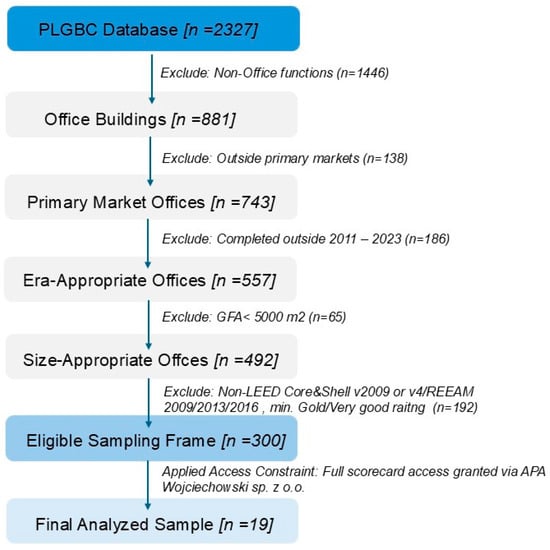
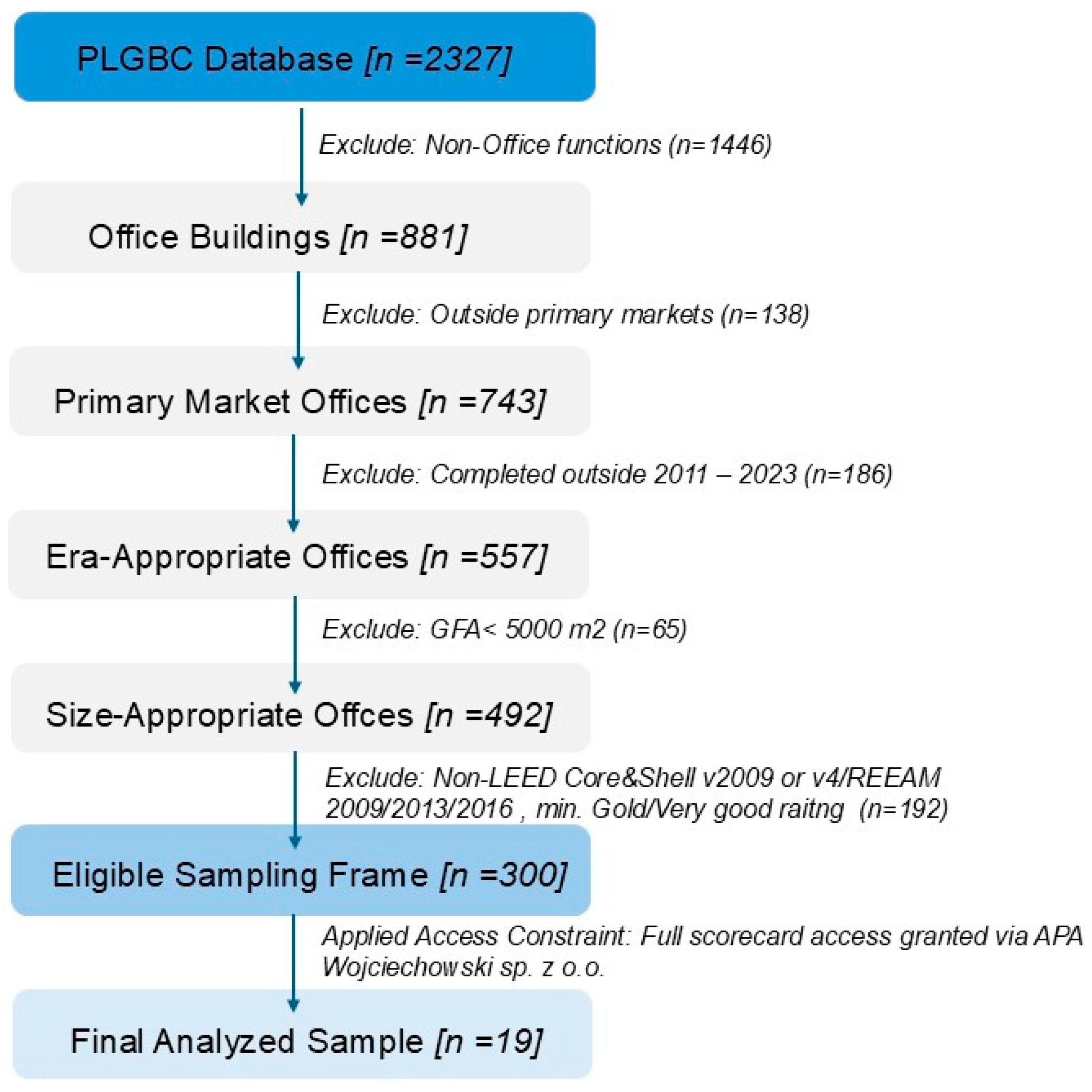
The case selection process was initiated using a snapshot of the PLGBC certified buildings database captured on March 15, 2024. At that time, the database contained 2327 registered buildings. Subsequently, buildings that did not meet the selection criteria were filtered out according to the following scheme.
Step 1: Excluded 1446 buildings that were not categorized as office functions.
Step 2: Excluded 138 office buildings located outside the primary markets.
Step 3: Excluded 186 buildings completed outside the 2011–2023 timeframe.
Step 4: Excluded 65 buildings with a Gross Floor Area (GFA) below 5000 m2.
Step 5: Excluded 192 buildings that did not meet the certification rating type (at minimum for BREEAM Very Good, for LEED Gold).
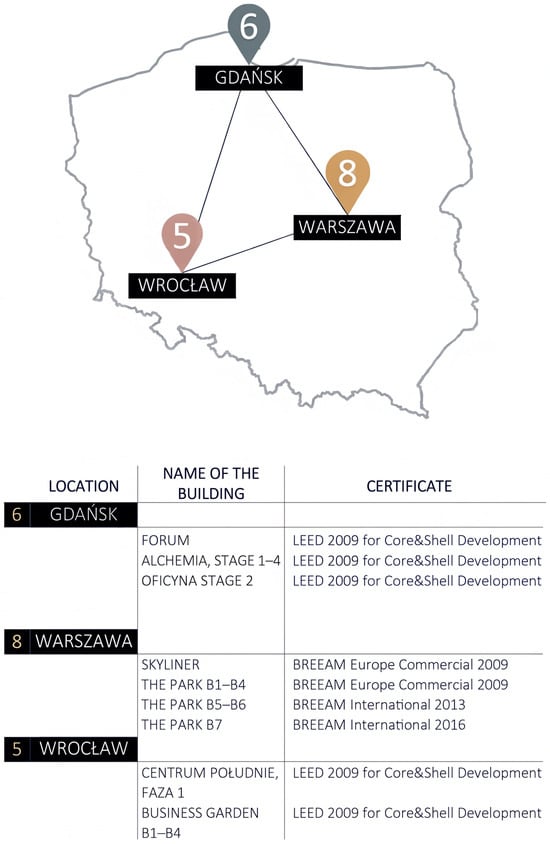
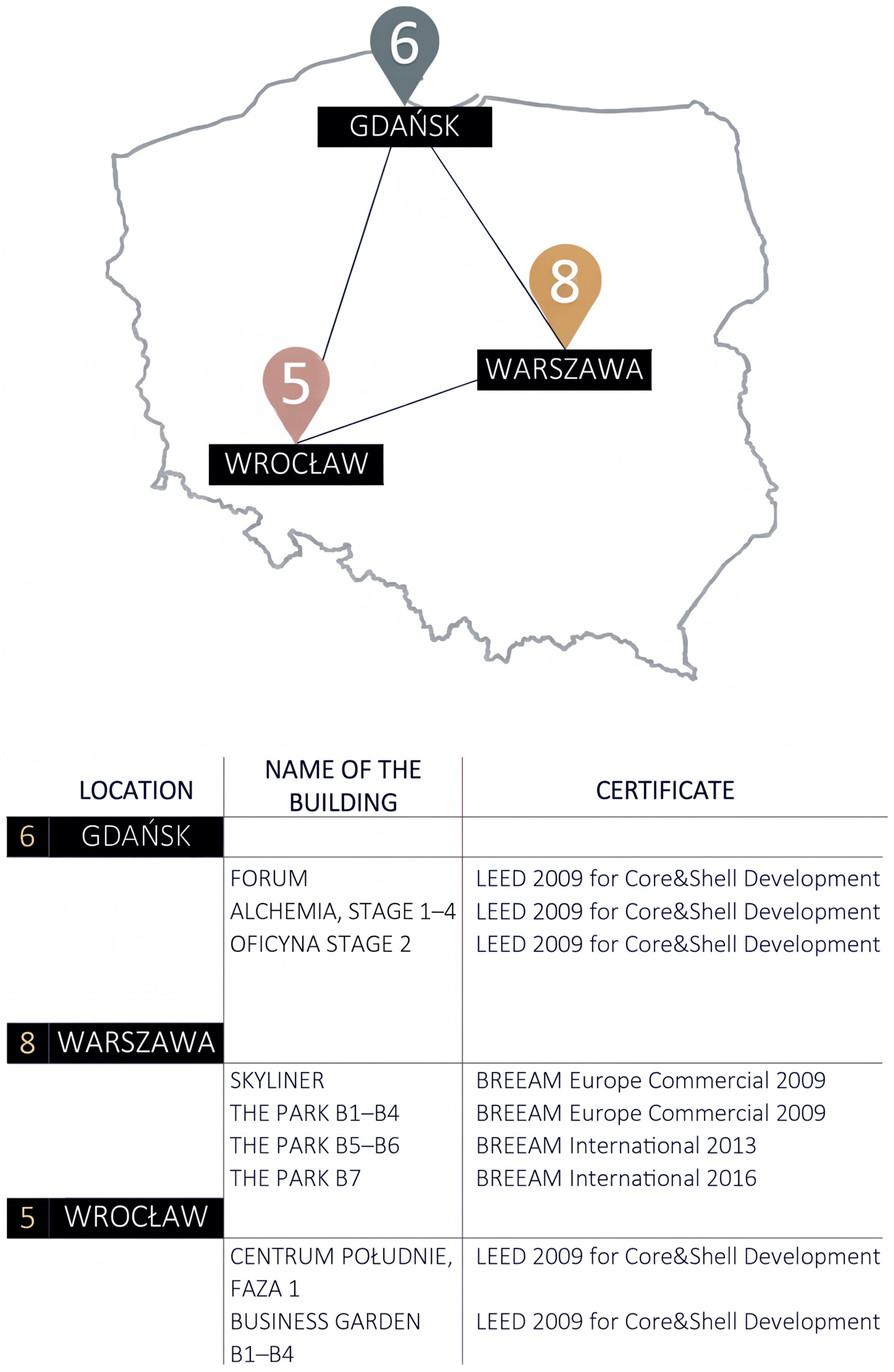
Following these exclusions, represented as a flow chart (Figure 3), a frame of 300 eligible office buildings remained. Due to the confidential nature of detailed certification reports, public access to the required sub-category scoring was unavailable. Consequently, our final analyzed sample consists of 19 buildings from this eligible frame for which full internal certification documentation was granted access by the architectural practice APA Wojciechowski sp. z o.o. Figure 4 and Table 6 present the list of 19 buildings selected for analysis. The list of all 2327 buildings considered is attached to the manuscript as a Supplementary Material (Table S1).
Figure 3.
Flow chart representing the exclusion math of the analyzed buildings.
Figure 4.
A list of buildings subjected to analysis.
Table 6.
List of building selected for analysis, source: PLGBC certified buildings database.
A standardized extraction protocol was utilized. For each eligible building, data was extracted directly from the final certification scorecards. The primary outcome was defined as “point yield”, which was the proportion of total points achieved to total eligible points available. The “credit uptake rate” was defined as the number of buildings achieving >0 points/total eligible buildings. Credits were coded into three distinct states: achieved, eligible-but-not-achieved, and not applicable (N/A). N/A was applied when a credit was structurally unavailable for the project type.
Because the metrics (points) differ fundamentally between LEED v2009, BREEAM 2009, BREEAM 2013, and BREEAM 2016, performance was analyzed strictly within respective scheme versions rather than aggregated into a cross-version index.
It also restricts its analysis strictly to the credits native to each scheme’s official ‘Materials’ category (LEED MR and BREEAM Mat). While BREEAM addresses circularity concepts such as construction waste management and adaptability within a separate ‘Waste’ (Wst) category, these were excluded to preserve the original taxonomic boundaries of the rating systems.
Table 6 presents the buildings for which the company APA Wojciechowski sp. z o.o. enabled access to the final certification scorecards. The table provides basic information about the buildings, verified with the PLGBC database, as well as an additional column, indicating the original site condition. This information was crucial in order to assess whether all available credits could be obtained. If the buildings had been constructed on so-called greenfield sites, some of the credits would have inherently been unavailable.
3. Results
3.1. Operational Mapping of Certification Credits to Circularity Constructs
To eliminate subjective classification, a standardized mapping framework was developed for this study. Credits from the LEED “Materials and Resources” (MR) and BREEAM “Materials” (Mat) categories were operationally mapped to specific sustainability constructs. A critical distinction was made between direct circularity outcomes and indirect proxies (resource efficiency). Direct circularity outcomes refer to credits requiring fundamental changes to the linear construction model, such as closing material loops (structural reuse). In contrast, indirect proxies represent incremental environmental improvements within a linear model, such as waste diversion or the selection of regionally sourced materials. Table 7 outlines the mapping framework utilized to categorize the scheme-specific credits across the analyzed versions. To ensure methodological transparency, a complete, version-specific codebook detailing the applicability rules, point numerators and denominators, required evidence, and theoretical rationale for each evaluated credit is provided in Appendix A. To establish a strictly standardized analytical baseline across the differing frameworks, the principal denominators (13 base points for LEED v2009 and BREEAM 2009; 11 base points for BREEAM 2013 and 2016) represent only the core materials-category credits. Mandatory prerequisites are marked in Table 8 as “yes” and all the innovation points and exemplary-performance bonus credits were explicitly excluded from both the numerators and denominators.
Table 7.
Operational mapping of certification credits to circularity constructs.
Table 8.
Summary of all results, compiled by the authors.
3.2. Credit Uptake and Sensitivity Analysis
When evaluating certification scores, a distinction must be made between mechanical credit eligibility and absolute circularity performance. Certification manuals often treat structural and façade reuse credits (such as LEED 2009 MR 1 or MR 3 or BREEAM 2009 Mat 03 and Mat 04) as “not applicable” if a project is a greenfield new-build. However, while precise quantitative site histories fall outside the scope of the certification data, historical development records confirm the sample consists entirely of post-industrial brownfield and urban infill redevelopments (e.g., the demolition of the former ‘Chemia’ plant for the Alchemia complex, or the clearance of post-industrial plots for the Skyliner and The Park Warszawa). Therefore, the ‘absolute maximum’ baseline—which scores zero points for structural reuse—is utilized not as a normative assumption regarding greenfields, but as a reflection of the developers’ verified pursuit of linear demolition-and-rebuild pathways on previously developed land.
To ensure rigorous data reporting, this study distinguishes between distinct non-achievement states across its primary and sensitivity analyses. Because the dataset derives exclusively from final, post-construction verified scorecards, there are no ‘missing’ or ‘unavailable’ data observations. The states are defined as follows:
Eligible-but-not-achieved (0): Opportunities where the project was eligible under scheme rules but did not achieve the points.
Non-applicable (N/A): Credits structurally ruled out by scheme applicability criteria.
Table 8 sets out the results of the certification process for the buildings under review in the category relating to building materials.
Table 9 transparently evaluates projects against the absolute theoretical maximum denominator.
Table 9.
Sensitivity analysis of credit uptake rate for the analyzed 19 buildings.
Because raw points and assessment mechanics are incommensurate across schemes and updates, performance must be evaluated strictly within the context of each specific standard version. For the LEED v2009 projects (n = 11), achieved scores ranged from 6 to 7 points against the 13-point base denominator. Within the BREEAM sample, performance varied by version: the BREEAM 2009 projects (n = 5) achieved 1 to 3 points out of a possible 13; the BREEAM 2013 projects (n = 2) achieved 3 points out of 11; and the single BREEAM 2016 project (n = 1) achieved 3 points out of 11. Rather than attempting to causally compare these raw totals across different systems, the critical observation is the internal distribution of these scores: across every specific version and assessment route analyzed, total scores were accumulated entirely through indirect resource-efficiency proxies or assessment method, while the uptake for direct material-circularity strategies remained 0%.
A more detailed description of the results is presented below.
Buildings certified under the LEED 2009 system, in the section on materials and resources, most frequently received points in categories such as:
- Construction waste management;
- Use of recycled materials (20% of the total volume of materials);
- Use of regionally sourced materials (20% of the total volume of materials);
- Use of certified timber.
Analysis of buildings certified in the LEED v2009 system shows that points were always earned in credits related to indirect proxies. On the other hand, credits related to direct material circularity (MR 1 and MR 3) were skipped in every case—the credit uptake rate was 0% for all the 11 buildings studied under this scheme.
Buildings certified under the BREEAM 2009 system also received 100% credit uptake for credits related to indirect proxies, such as Mat 06 or Mat 07. It is worth noting that both in the LEED v2009 and BREEAM 2009 systems, whole-life-cycle assessment was not yet available as an option, so its absence results from limitations over which developers had no control.
Buildings certified under the BREEAM 2013 and BREEAM 2016 systems, however, did not receive any points related to direct material circularity, as these systems no longer include such credits.
A detailed examination of the BREEAM 2013 and BREAAM 2016 Mat 01 (‘Life-Cycle Impacts’) scores reveals simplified compliance routes over holistic environmental modeling. While several BREEAM projects achieved partial scores in this category (e.g., two out of five, or two out of six available points), an audit of the sub-credit evidence confirms that these points were attained exclusively via the elemental assessment route. Design teams relied on specifying major building elements with favorable Green Guide to Specification ratings or basic Environmental Product Declarations (EPDs) to secure baseline points. Crucially, no project in the sample achieved the specific sub-credits allocated for conducting a comprehensive, whole-building life-cycle assessment (LCA). Therefore, while basic material specification criteria were partially met, robust whole-building LCA practices were entirely absent from the analyzed dataset. A complete case-level breakdown identifying the exact elemental assessment compliance routes and documented evidence for each BREEAM 2013 and 2016 project receiving a partial Mat 01 score is provided in Appendix B.
In order to verify how the distribution of points falls across multi-building campuses, the 19 individual buildings were collapsed into nine independent organizational entities (representing either a unified multi-phase campus or an independent standalone building) additionally divided by the type of certification used. As demonstrated in Table 10, when analyzed at this cluster level (n = 9), the core performance outcomes is as follows: the credit uptake for comprehensive assessment methods (whole-building LCA) is 22,2%, direct material-circularity strategies (structural/material reuse) remains exactly 0%, and compliance with indirect resource-efficiency proxies (e.g., waste diversion, regional sourcing) remains at 100% across all eligible entities.
Table 10.
Cluster-level sensitivity analysis for evaluated constructs.
4. Discussion
By maintaining the absolute denominator, the data present that despite achieving premium certification ratings, the analyzed projects bypassed the most impactful circular strategies beginning at the fundamental level of utilization of existing material resources found on the plots. From a circular economy perspective, site selection and the decision to demolish rather than adapt are not neutral constraints—they are active, linear design choices.
To evaluate whether the credit uptake patterns observed in Poland reflect unique regional anomalies or systemic characteristics of multi-criteria certification schemes, these results must be contextualized against empirical studies conducted across different international jurisdictions and rating frameworks (including LEED, BREEAM, DGNB, and Level(s)). The absence of direct circularity outcomes in this Polish sample aligns with empirical research on green building credit distribution globally. In an analysis of over 1000 LEED BD+C projects in the United States, the researchers observed that structural reuse credits were among the least frequently pursued across all building typologies, achieving an uptake rate of under 3% [41]. A different paper reviewed the use of LEED v2.2 and investigated the allocation pattern of LEED points. The results confirmed that while innovation-related points were the easiest to obtain, the energy-related and material-related points were the most difficult to obtain [42]. Another study, which examined the integration of circular economy principles in LEED v4 BD+C, focusing on the 971 certified projects in the U.S., revealed that credits related to building life-cycle impact reduction and sourcing of raw materials were both fully achieved in only 63 out of the 971 studied projects [43]. The findings aligned LEED-certified projects with the lower tier of CE R-frameworks, emphasizing the need for collaboration across project stakeholders, as well as the need for enhanced material data availability to improve CE practices in LEED projects [43]. A Czech study developed circularity indicators specifically for office buildings and compared multiple certification systems. The study emphasized the need for standardization and unification in measuring circularity to enable effective comparison of building performance across different regions and rating systems [44]. A Malaysian study added a useful perspective on how certification levels relate to embodied and operational carbon. According to that study, LEED Platinum comprises 25.1% embodied carbon and 74,9% operational carbon emissions, whereas GreenRE Platinum is 13,4% and 86,6%, respectively [45]. A Turkish study confirms that while certification schemes such as BREEAM, LEED, DGNB, and the Turkiye-specific YES-TR have contributed significantly to sustainability assessment practices, their weighting structures remain predominantly operational-energy-oriented and rarely integrate embodied carbon performance [46]. Similar conclusions were also presented in a New Zealand paper [22]. Another study reveals that Green Building Rating Systems (GBRS) tend to allocate an average of 2.7 times more credits to operational carbon than embodied carbon. Among the systems reviewed in the paper, DGNB is the only GBRS allocating more than 50% of its carbon-related credits to embodied emissions, reflecting a more explicit life-cycle-oriented approach [47]. In a critical review of material criteria across global sustainability assessment tools, the researchers demonstrated that historical versions of BREEAM and LEED predominantly weighted their material categories toward procedural supply-chain metrics (such as responsible sourcing and recycled content thresholds) rather than physical loop-closing [48]. The findings of 100% uptake for indirect proxies in the Polish market directly empirically validate this theoretical critique, confirming that these schemes successfully standardized administrative resource efficiency while structurally failing to mandate direct circularity.
While global certification overviews indicate a growing trend toward carbon literacy, the systemic indexing of carbon footprint reduction approaches requires robust metrics rather than fragmented procedural proxies. When comparing the voluntary, market-driven compliance documented in Poland (where developers default to low-risk administrative credits) with the mandatory carbon caps established in Western and Northern European jurisdictions, a stark regulatory divergence emerges. This contrast strongly suggests that voluntary multi-criteria certificates alone may be insufficient to trigger systemic circularity without the coercive push of statutory limits. The findings indicate that both LEED and the analyzed BREEAM schemes place significantly greater emphasis on conventional resource efficiency measures than on principles of the circular economy. While all LEED-certified office buildings attained a score within the range of 6 to 7 out of 13 points in the Materials and Resources category, the preponderance of these credits was allocated for initiatives pertaining to construction waste management, utilization of recycled materials, incorporation of regionally sourced materials, and the use of certified timber.
While the high uptake of credits for construction waste management, recycled content, and regional sourcing demonstrates strong procedural compliance, it is critical to interpret these strategies independently. Attaining these specific credits does not automatically guarantee equivalent absolute reductions in greenhouse gas (GHG) emissions or represent true material circularity. The physical environmental benefits of these indirect proxies are highly conditional. For example, the net environmental benefit of regional sourcing can occasionally be offset by transport-mode inefficiencies or highly carbon-intensive local manufacturing [49]. Furthermore, strategies like crushing concrete for aggregate road base are frequently characterized as downcycling, which rarely displaces the need for virgin cement production [14,50]. Consequently, while these distinct strategies successfully promote resource efficiency within a linear supply chain, they cannot be conflated with the verified, systemic carbon reductions achieved through direct structural reuse or whole-building life-cycle assessments.
A particularly noteworthy finding is that none of the analyzed LEED-certified office buildings received credits for building component reuse or design for material recovery. Collectively, these credits accounted for almost half of the available points within the materials category, indicating that the greatest potential for improving certification performance remained entirely unexplored. This finding suggests that, at the time of certification, design teams and investors placed a higher value on relatively straightforward documentation-based credits than on strategies that necessitated fundamental changes to the design process, procurement practices, and supply chains. The absence of reused structural elements and design-for-disassembly solutions is reflected in the limited market availability of reclaimed construction materials and the lack of regulatory incentives supporting material reuse in Poland during the study period [14]. When interpreting the universally zero uptake for direct circularity outcomes (such as structural or façade reuse), it is critical to acknowledge that low credit attainment does not necessarily equate to poorly designed certification incentives. Instead, this observed low uptake likely reflects a confluence of external market barriers present during the 2011–2023 study period. We hypothesize that several alternative factors drove this outcome, primarily the high capital costs associated with non-standard construction methods and a lack of mature, local supply chains for reclaimed materials [14]. Furthermore, the administrative burden of sourcing compliant documentation for secondary materials, coupled with the rigid timelines of commercial development, likely steered design teams toward highly predictable, well-documented resource-efficiency proxies (such as certified timber or standard waste sorting) rather than riskier circularity credits [14].
When evaluating the absence of whole-building life-cycle assessment (LCA) analyses, it is critical to contextualize the findings within the specific certification versions utilized. All 11 LEED projects in this sample were certified under the LEED v2009 standard. Because v2009 predates the introduction of a dedicated whole-building LCA credit (which was later introduced in LEED v4), the absence of LCA in these specific projects reflects a structural limitation of the historical standard rather than active market avoidance of an available credit. Consequently, this study makes no inferences regarding the uptake of LCA credits in contemporary LEED v4 or v4.1 projects. The subsequent evolution of the LEED standard addresses this historical gap, though evaluating its modern market adoption remains outside the scope of this v2009-based sample.
These findings also illustrate the evolution of sustainable building assessment over the past decade. Earlier certification systems primarily rewarded recycled content, local sourcing, and construction waste diversion. By contrast, more recent European policies have increasingly emphasized whole-life carbon assessment, design for adaptability, material passports, and the reuse of existing building stock. The prevailing regulatory frameworks, incorporating the revised Energy Performance of Buildings Directive (EPBD), the Level(s) framework, and national whole-life carbon regulations implemented in countries such as Denmark, France, Finland, Sweden, and the Netherlands, signify a discernible transition from the assessment of individual material attributes to the evaluation of the entire building life cycle [30]. The paradigm shift that has taken place in these countries is certainly worth noting. The reduction in the embedded carbon footprint and circularity have, to a large extent, been removed from voluntary commercial certification schemes and incorporated into binding legal regulations and state subsidy schemes. France was one of the first countries to introduce rigorous emission thresholds for materials themselves, based on a mandatory 50-year life-cycle assessment (LCA). Instead of rewarding “efforts”, the RE2020 law defines hard limits on embodied carbon, which have been lowered every three years since 2022 [51]. In the Netherlands, the BREEAM NL certificate is just an add-on. The core tool is the national MPG (Milieuprestatie Gebouwen) system, which verifies the material profile of a building as early as the building permit application stage. MPG takes 11 (eventually 19) environmental impact indicators from the national EPD database (NMD) and converts them into the so-called shadow cost—a hypothetical amount in euros needed to repair environmental damage per m2 of surface area per year [52]. The German market has closely linked the national DGNB certification system with the QNG (Qualitätssiegel Nachhaltiges Gebäude) state seal, which serves as a prerequisite for federal financial incentives. To obtain the QNG certificate, non-residential buildings—such as offices—must meet rigorous, project-specific greenhouse gas emission benchmarks based on their distinct functional profiles, contrasting with the fixed 24 and 20 kg CO2e/m2 per year thresholds that are applied to residential buildings [53]. In the United Kingdom, voluntary certification has been increasingly complemented by stringent planning-level policies. According to Policy SI 2 of the London Plan, development applications that are referable to the Mayor are strictly required to calculate and submit a Whole-Life-Cycle Carbon (WLC) assessment using the standard Greater London Authority (GLA) reporting template, while assessments for other non-referable major applications are actively encouraged [54]. To prevent inconsistent emission accounting, the GLA guidance mandates a standardized calculation methodology aligned with the RICS (Royal Institution of Chartered Surveyors) Professional Standard for Whole Life Carbon Assessment for the Built Environment. With the ongoing transition to the second edition of the RICS standard (effective mid-2024), the planning framework requires comprehensive calculation of all emissions, strictly including end-of-life dismantling and disposal [55].
The office buildings that were analyzed therefore represent a transitional stage in which resource efficiency was recognized, but comprehensive circularity principles had not yet been integrated into certification practice. A significant consequence of this phenomenon pertains to the interplay between certification schemes and market transformation. While it is evident that both LEED and BREEAM have contributed to the acceleration of environmentally preferable construction practices, the outcomes indicate that certification in itself is inadequate to associate with the extensive implementation of circular design strategies [43,48]. In order to achieve higher levels of circularity, a range of policy instruments are required. These include mandatory whole-life carbon assessment, digital material passports, procurement requirements favoring reused materials, and economic incentives supporting secondary material markets. In the absence of such systemic changes, developers are likely to continue prioritizing certification credits that are relatively straightforward to achieve while overlooking measures with greater long-term environmental benefits [15].
Overall, the study demonstrates that the analyzed certification schemes showed high rates of documented credit attainment for improvements in waste management and responsible material selection. However, the influence of the schemes on reducing embodied carbon through material reuse and circular design is only limited. In the context of the construction sector undergoing a transition towards whole-life carbon assessment and resource efficiency targets, future certification systems must place greater emphasis on adaptive reuse, design for disassembly, material recovery, and life-cycle assessment [44]. Strengthening the present requirements would enhance the alignment between green building certification and the broader objectives of the circular economy and climate neutrality, ensuring that certification reflects genuine reductions in environmental impact rather than compliance with relatively accessible procedural requirements.
Limitations and Market Context
While this study provides critical insights into the real-world application of green building certifications, the findings must be interpreted within the context of specific methodological boundaries.
First, acquiring detailed, post-construction certification scorecards inherently requires access-based sampling due to corporate confidentiality. While a sample size of 19 buildings introduces selection bias, it constitutes a verified dataset of premium commercial space that reflects the practices of market-leading developers. Second, the presence of multi-building campuses (e.g., Business Garden, Alchemia) introduces statistical non-independence. However, this clustering is not a sampling error; rather, it authentically represents the operational reality of the commercial real estate sector, where major developers apply centralized ESG strategies across phased developments. Similarly, the geographic concentration of specific certification schemes reflects corporate-level portfolio decisions rather than regional confounding.
Third, analyzing historical standard versions (e.g., LEED v2009) restricts direct inferences regarding contemporary updates (such as LEED v4); nevertheless, it rigorously captures the prevailing market behavior during the 2011–2023 construction boom. Fourth, while greenfield developments render structural reuse credits mechanically inapplicable, the overwhelming market preference for greenfield sites over adaptive reuse is itself a valid indicator of circularity avoidance.
Furthermore, the sample is geographically confounded (all LEED cases are located in Wrocław and Gdańsk, while all BREEAM cases are in Warsaw), preventing isolation of scheme effects from regional market effects. Furthermore, the lack of WLCA attainment among eligible projects is drawn from a highly clustered subset of only three buildings on a single developer campus, severely restricting generalizability.
Finally, this study utilizes certification credits as document-based proxies rather than physically measured carbon reductions. While a limitation in physical environmental science, this approach captures the administrative and procedural compliance framework that currently dictates sustainability in real estate investment.
5. Conclusions
This study delivers a critical empirical contribution to the sustainable built-environment literature by providing verified, scorecard-level evidence of how material circularity and life-cycle assessment (LCA) credits were implemented during the post-2010 commercial building boom in a maturing European real estate market (Poland, 2011–2023).
The findings reveal a stark divergence in credit uptake in material-related credits of LEED and BREEAM certification systems. While the analyzed 19 buildings consistently achieved maximum uptake (100%) for conventional indirect resource-efficiency proxies such as construction waste management, recycled content, and regional sourcing, the attainment rate for direct circularity outcomes, including structural reuse and component reuse, remained at zero. These results indicate that premium certification ratings during the study period were achieved entirely through incremental improvements within a linear construction model, rather than through systemic material circularity.
The findings align with global empirical benchmarks, confirming that this credit divergence is a systemic characteristic of historical voluntary rating schemes rather than a regional market anomaly. Similar studies from North American, Asian and European markets demonstrate an identical avoidance of direct material reuse [41,43,45,46]. Furthermore, as highlighted by broader certification reviews, historical versions of LEED and BREEAM structurally rewarded documentation-based supply-chain compliance—mirroring the 100% proxy uptake observed here—rather than enforcing physical loop-closing [48]. Numerous studies have also indicated a significant disparity in certification systems between credits related to operational and embodied energy [22,45,46,47].
These findings must be interpreted within the context of key methodological limitations, including an access-based purposive sample size (n = 19), sample clustering across multi-phase developer campuses, historical certification version constraints (such as LEED v2009 and BREEAM 2009 lacking dedicated LCA credits), and the reliance on credit uptake as an administrative proxy rather than verified physical carbon reductions.
Ultimately, the restrained implication of this research is that voluntary building certification schemes, in their historical configurations, saw minimal credit uptake for material circularity. However, these findings must be bounded strictly to the selected historical case series: the observed low uptake applies specifically to the analyzed sample and cannot be used to estimate broader national prevalence, direct scheme causality, or absolute physical carbon reductions.
The analyzed examples indicate that multi-criteria certification—in the versions used between 2011 and 2023—serves as a tool to support both the enhancement of material circularity and the execution of life-cycle assessments (LCAs), yet it is neither effective nor sufficient. Numerous studies indicate that material strategies based on a circular economy are associated with inevitable trade-offs, and the optimization of raw material sourcing, material intensity, and local supply—reflected in the impact on carbon dioxide emissions—remains a key challenge in the design of circular buildings [24]. In Poland, scientific communities, government and local authorities, as well as non-governmental organizations and businesses, are considering the possibilities of standardizing the methodology for calculating the carbon footprint throughout the entire life cycle, which would also take into account the embedded carbon footprint. The examples mentioned above from EU countries as well as the UK show how varied the approach can be depending on the existing national conditions. The National Energy Conservation Agency is a Polish company working towards the standardization of regulations and legislative changes that would contribute to reporting the embedded carbon footprint of buildings in Poland as well. In 2024, NAPE published the national proposal for a methodology for determining the carbon footprint of a building throughout its entire life cycle. To this day, no other proposals have been made publicly available [56]. However, with the revision of the EPBD (Energy Performance of Buildings Directive), this situation is expected to change soon. The European Parliament’s position on the EPBD, which was put to a vote, calls for the establishment of EU-wide frameworks for calculating the global warming potential (GWP) over the entire life cycle and for the publication by Member States of action plans that introduce threshold values and targets regarding GWP throughout the life cycle, including the embodied carbon footprint [29].
Legislative changes cause multi-criteria certifications to also undergo updates, attempting to meet EU requirements. Newer versions of certificates, such as LEED v4, BREEAM 2018 and BREEAM v7, place greater emphasis on life-cycle analyses and material circularity [23,25,37]. Therefore, an interesting extension of the study would be to compare the research sample from 2011–2023 with a sample based on the most recent versions of the multi-criteria certifications.
Supplementary Materials
The following supporting information can be downloaded at https://www.mdpi.com/article/10.3390/su182111440/s1: Table S1: building list from PLGBC Database.
Author Contributions
Conceptualization, A.P. and E.D.R.; methodology, A.P. and E.D.R.; software, A.P.; validation, A.P. and E.D.R.; formal analysis, A.P. and E.D.R.; investigation, A.P.; resources, A.P.; data curation, A.P.; writing—original draft preparation, A.P.; writing—review and editing, A.P. and E.D.R.; supervision, E.D.R.; project administration, A.P.; funding acquisition, E.D.R. All authors have read and agreed to the published version of the manuscript.
Funding
This research received no external funding.
Institutional Review Board Statement
Not applicable.
Informed Consent Statement
Not applicable.
Data Availability Statement
The datasets generated and analyzed during the current study are not publicly available in their raw, unredacted form due to strict commercial confidentiality agreements with the participating developers.
Conflicts of Interest
The authors declare that Aleksandra Pacholska was employed by APA Wojciechowski sp. z o.o. during the time when the research was made. The author also participated in the certification process of some of the analyzed buildings on behalf of APA Wojciechowski sp. z o.o. However, the analysis was conducted independently based on verified, third-party certification scorecards to mitigate bias.
Abbreviations
The following abbreviations are used in this manuscript:
| LCA | Life-Cycle Assessment |
| EPD | Environmental Product Declaration |
| WLCA | Whole-Life-Cycle Assessment |
| GWP | Global Warming Potential |
Appendix A. Supplementary Certification Codebooks
Table A1.
Codebook for LEED v2009 Core and Shell.
Table A2.
Codebook for BREEAM Europe Commercial 2009.
Table A3.
Codebook for BREEAM International 2013 and 2016 Offices.
Appendix B. Case-Level Breakdown of BREEAM Mat 01 Compliance Routes
Table A4.
Case-level Breakdown of BREEAM Mat 01 compliance routes.
References
- U.S. Green Building Council. Leed 2009 for Core and Shell Development Rating System, 2008th ed.; U.S. Green Building Council: Washington, DC, USA, 2008. [Google Scholar]
- U.S. Green Building Council. LEED v4_Reference Guide for Building Design and Construction 2013; U.S. Green Building Council: Washington, DC, USA, 2013. [Google Scholar]
- BRE Global Ltd.; BREEAM Europe Commercial. Assessor Manual SD 5066A: Issue 1.1 2009; BRE Global Ltd., BREEAM Europe Commercial: Hertfordshire, UK, 2009. [Google Scholar]
- BRE Global Ltd.; BREEAM International. New Construction, Technical Manual, SD5075-0.0:2013-2013; BRE Global Ltd., BREEAM International: Hertfordshire, UK, 2013. [Google Scholar]
- BRE Global Ltd.; BREEAM International. New Construction 2016, Technical Manual SD233-1.0-2016; BRE Global Ltd., BREEAM International: Hertfordshire, UK, 2016. [Google Scholar]
- PLGBC Budynki. Baza Budynków Certyfikowanych; PLGBC: Gliwice, Poland, 2023. [Google Scholar]
- KAPE—Krajowa Agencja Poszanowania Energii S.A. Ślad Węglowy w Całym Cyklu Życia Budynków—Wnioski z Raportu Dot. Polityki Wdrażania Przepisów w krajach UE. Available online: https://kape.gov.pl/blog/aktualnosci-projektowe-11/slad-weglowy-w-caym-cyklu-zycia-budynkow-wnioski-z-raportu-dot-polityki-wdrazania-przepisow-w-krajach-ue-672 (accessed on 29 September 2026).
- ISO 14040:2006; Environmental Management—Life Cycle Assessment—Principles and Framework 2006. International Organization for Standardization: Geneva, Switzerland, 2006.
- Cambridge University Press. Annex VII: Glossary. In Climate Change 2021—The Physical Science Basis; Cambridge University Press: Cambridge, UK, 2023; pp. 2215–2256. [Google Scholar]
- Grainger, A.; Smith, G. The Role of Low Carbon and High Carbon Materials in Carbon Neutrality Science and Carbon Economics. Curr. Opin. Environ. Sustain. 2021, 49, 164–189. [Google Scholar] [CrossRef] [Scilit]
- Steingrimsson, G.; Davidsdottir, B.; Petursson, J.G.; Reck, B. The Sense and Sensibility of the Circular Material Use Rate: A Case Study of EU’s Key Circularity Indicator. Resour. Conserv. Recycl. 2027, 238, 109217. [Google Scholar] [CrossRef] [Scilit]
- Sattar, S.; Cook, D.; Johnson, K.; Fung, J. Systematic Review of Embodied Carbon Assessment and Reduction in Building Life Cycles; National Institute of Standards and Technology (U.S.): Gaithersburg, MD, USA, 2024; p. NIST SP 1324.
- Moustafa, Z.; Asif, M.; Wuni, I.Y. Circular Economy in the Building Sector: A Systematic Review of Environmental, Economic, and Social Dimensions. Sustain. Futur. 2025, 9, 100690. [Google Scholar] [CrossRef] [Scilit]
- Bukowski, H.; Fabrycka, W. Budownictwo w Obiegu Zamkniętym w Praktyce; INNOWO: Warsaw, Poland, 2019. [Google Scholar]
- One Click LCA®. Construction LCA and Embodied Carbon Experts Outlook 2024; One Click LCA: Helsinki, Finland, 2024. [Google Scholar]
- Sejm RP Ustawa z Dnia 29 Sierpnia 2014 r. o Charakterystyce Energetycznej Budynków (Dz.U. 2014 Poz. 1200) 2014. Available online: https://sip.lex.pl/akty-prawne/dzu-dziennik-ustaw/charakterystyka-energetyczna-budynkow-18122118 (accessed on 10 October 2026).
- Zielonko-Jung, K. Projektowanie Elewacji Aktywnej Energetycznie; Politechnika Wrocławska, Oficyna Wydawnicza: Wrocław, Poland, 2020. [Google Scholar]
- Ryńska, E. Developing and Designing Circular Cities: Emerging Research and Opportunities; Practice, Progress, and Proficiency in Sustainability; IGI Global: Hershey, PA, USA, 2020. [Google Scholar]
- Zielonko-Jung, K. Technologie prośrodowiskowe dla budynków miejskich. Kwart. Nauk. Uczel. Vistula 2017, 4, 142–152. [Google Scholar]
- Kuczera, A.; Płoszaj-Mazurek, M. Zerowy Ślad Węglowy Budynków, Mapa Drogowa Dekarbonizacji Budownictwa Do Roku 2050; Polskie Stowarzyszenie Budownictwa Ekologicznego PLGBC: Gliwice, Poland, 2021. [Google Scholar]
- Płoszaj-Mazurek, M. Cyfrowe Metody Wspomagania Projektowania Architektonicz Nego a Analiza Śladu Węglowego Budynków. Doctoral Dissertation, Warsaw University of Technology, Warsaw, Poland, 2022. [Google Scholar] [CrossRef]
- Olanrewaju, O.I.; Enegbuma, W.I.; Donn, M. Operational, Embodied and Whole Life Cycle Assessment Credits in Green Building Certification Systems: Desktop Analysis and Natural Language Processing Approach. Build. Environ. 2024, 258, 111569. [Google Scholar] [CrossRef] [Scilit]
- Singh, R.K. Whole Building Life Cycle Assessment Through LEED V4; GBCI: Washington, DC, USA, 2017. [Google Scholar]
- Altamura, P.; Rossini, G.; Garofali, G.; Baiani, S.; Tucci, F. Measuring Building Circularity Through Materials, Processes and Impacts: An Evaluation Framework for Architecture Integrating Reused, Bio-Based and Recycled Components. Appl. Sci. 2026, 16, 5617. [Google Scholar] [CrossRef] [Scilit]
- Yılmaz, E.; Akkam, M.S. Certification Criteria and Bio-Inspired Functional Themes: LEED v5 and BREEAM V7 Profiles with a Bounded YeS-TR Audit. Biomimetics 2026, 11, 737. [Google Scholar] [CrossRef] [Scilit] [PubMed]
- Yang, Y.; Yue, X.; Luo, Y.; Jin, L.; Jia, B. Building Information Modeling–Life Cycle Assessment: A Novel Technology for Rapid Calculation and Analysis System for Life Cycle Carbon Emissions of Bridges. Sustainability 2024, 16, 10574. [Google Scholar] [CrossRef] [Scilit]
- BREEAM. New Construction Version 7; BREEAM: Watford, UK, 2025. [Google Scholar]
- Kuczera, A.; Franke, D. Zrównoważone Certyfikowane Budynki—Raport 2023; PLGBC: Gliwice, Poland, 2023; p. 19. [Google Scholar]
- European Parliament Directive (EU) 2024/1275 of the European Parliament and of the Council of 24 April 2024 on the Energy Performance of Buildings (Recast). Available online: https://eur-lex.europa.eu/eli/dir/2024/1275/oj/eng (accessed on 14 March 2024).
- Steinemann, J.; Rock, M.; Lutzkendorf, T.; Allacker, K.; Le Den, X. Whole Life Carbon Models for the EU27 to Bring Down Embodied Carbon Emissions from New Buildings. Review of Existing National Legislative Measures; RAMBOLL: Brussels, Belgium, 2022; p. 43. [Google Scholar]
- Ympäristöministeriö (Ministry of the Environment). Rakentamislaki 751/2023 [Construction Act 751/2023]; Ministry of the Environment: Helsinki, Finland, 2023.
- Alliance HQE-GBC. Accueil de l’Alliance-HQE-GBC. Available online: https://www.hqegbc.org/ (accessed on 15 March 2023).
- London City Hall. Circular Economy Statement Guidance. Available online: https://www.london.gov.uk/programmes-strategies/planning/implementing-london-plan/london-plan-guidance/circular-economy-statement-guidance (accessed on 15 March 2023).
- IVL. Svenska Miljöinstitutet Klimatdeklaration av Byggnader. Available online: https://www.ivl.se/vart-erbjudande/vara-tjanster/klimatdeklaration-av-byggnader-bm.html (accessed on 27 March 2023).
- Circle Economy and the City of Amsterdam. Amsterdam Circular 2020–2025 Strategy; Circle Economy and the City of Amsterdam: Amsterdam, The Netherlands, 2020. [Google Scholar]
- Heller, A.; Kuczera, A. Zrównoważone Certyfikowane Budynki, RAPORT 2025; Polskie Stowarzyszenie Budownictwa Ekologicznego PLGBC: Gliwice, Poland, 2025. [Google Scholar]
- Pushkar, S. Life-Cycle Assessment in the LEED-CI v4 Categories of Location and Transportation (LT) and Energy and Atmosphere (EA) in California: A Case Study of Two Strategies for LEED Projects. Sustainability 2022, 14, 10893. [Google Scholar] [CrossRef] [Scilit]
- PN-EN 15978:2012; Zrównoważone Obiekty Budowlane—Ocena Środowiskowych Właściwości Użytkowych Budynków—Metoda Obliczania. The Polish Committee for Standardization: Warsaw, Poland, 2012.
- Foryś, I.; Tarczyńska-Łuniewska, M. POLISH REAL ESTATE FUNDS AND INTERNATIONAL EXPERIENCE. Acta Sci. Pol. Oecon. 2017, 16, 45–53. [Google Scholar] [CrossRef] [Scilit]
- Geltner, D.; Miller, N.G.; Clayton, J.; Eichholtz, P. Commercial Real Estate: Analysis and Investments, 3rd ed.; OnCourse Learning: Mason, OH, USA, 2014. [Google Scholar]
- Pushkar, S.; Verbitsky, O. Leed-Nc 2009 Silver to Gold Certified Projects in the Us in 2012–2017: An Appropriate Statistical Analysis. J. Green Build. 2019, 14, 83–107. [Google Scholar] [CrossRef] [Scilit]
- Wu, P.; Mao, C.; Wang, J.; Song, Y.; Wang, X. A Decade Review of the Credits Obtained by LEED v2.2 Certified Green Building Projects. Build. Environ. 2016, 102, 167–178. [Google Scholar] [CrossRef] [Scilit]
- Eissa, R.; El-adaway, I.H. Circular Economy and LEED v4: Benchmarking Materials and Resources Credit Achievement. CIB Conf. 2025, 1, 256. [Google Scholar] [CrossRef] [Scilit]
- Trubina, N.; Pešta, J.; Lupíšek, A. Developing of Comprehensive Circular Rating System for Office Buildings: A Review of Existing Tools and Case Study. In Creating a Roadmap Towards Circularity in the Built Environment; Bragança, L., Cvetkovska, M., Askar, R., Ungureanu, V., Eds.; Springer Tracts in Civil Engineering; Springer Nature: Cham, Switzerland, 2024; pp. 359–370. [Google Scholar]
- Mulya, K.S.; Ng, W.L.; Biró, K.; Ho, W.S.; Wong, K.Y.; Woon, K.S. Decarbonizing the High-Rise Office Building: A Life Cycle Carbon Assessment to Green Building Rating Systems in a Tropical Country. Build. Environ. 2024, 255, 111437. [Google Scholar] [CrossRef] [Scilit]
- Arslan, V.; Ulubeyli, S. Aligning Green Building Rating Systems with Whole Life Carbon: A Comparative Assessment for New Buildings. Energy Build. 2026, 352, 116842. [Google Scholar] [CrossRef] [Scilit]
- Ng, W.L.; Mulya, K.S.; Wong, K.Y.; Tan, H.; Bao, Z.; Chen, L.; Yap, P.-S.; Jiang, P.; Woon, K.S. Decarbonization in Green Building Rating Systems: A Systematic Review on Embodied and Operational Carbon Credits. J. Environ. Manag. 2026, 401, 128757. [Google Scholar] [CrossRef] [Scilit] [PubMed]
- Park, J.; Yoon, J.; Kim, K.-H. Critical Review of the Material Criteria of Building Sustainability Assessment Tools. Sustainability 2017, 9, 186. [Google Scholar] [CrossRef] [Scilit]
- Martínez Leal, J.; Pompidou, S.; Charbuillet, C.; Perry, N. Design for and from Recycling: A Circular Ecodesign Approach to Improve the Circular Economy. Sustainability 2020, 12, 9861. [Google Scholar] [CrossRef] [Scilit]
- Allwood, J.; Cullen, J.M. Sustainable Materials Without the Hot Air: Making Buildings, Vehicles and Products Efficiently and with Less New Material; UIT Cambridge Ltd.: Cambridge, UK, 2015. [Google Scholar]
- Marion, C.; Gaelle, C.; Quentin, D.; Jordan, G. Réglementation Environnementale des Bâtiments Neufs (RE2020); French Ministry of Ecological Transition: Paris, France, 2020. [Google Scholar]
- Rijksdienst Voor Ondernemend Nederland (RVO); Stichting Nationale Milieudatabase (NMD). Bepalingsmethode Milieuprestatie Bouwwerken En GWW-Werken [Metodyka Oznaczania Efektywności Środowiskowej Budynków—Wskaźnik MPG]; Stichting Nationale Milieudatabase (NMD): AK Den Haag, The Netherlands, 2019. [Google Scholar]
- Deutsche Gesellschaft für Nachhaltiges Bauen (DGNB). DGNB System, New Construction, Buildings Criteria Set Version 2026 International. 2026. Available online: https://www.dgnb.de/en/certification/important-facts-about-dgnb-certification/certify-projects-internationally/dgnb-system-new-construction-version-2026-international (accessed on 10 October 2026).
- Mayor of London. Whole Life-Cycle Carbon Assessments Guidance 2022; Mayor of London: London, UK, 2022. [Google Scholar]
- Royal Institution of Chartered Surveyors (RICS). Whole Life Carbon Assessment for the Built Environment, 2nd ed.; RICS: London, UK, 2023. [Google Scholar]
- Narodowa Agencja Poszanowania ENERGII S.A. Propozycja Krajowej Metodyki Wyznaczania Śladu Węglowego Budynków; Narodowa Agencja Poszanowania ENERGII S.A.: Warsaw, Poland, 2024. [Google Scholar]
- ISO 14001:2015; Environmental Management Systems- Requirements with Guidance for Use. International Organization for Standardization: Warsaw, Poland, 2016.
- BES 6001; Framework Standard for Responsible Sourcing. BRE Global: San Francisco, CA, USA, 2008.

Disclaimer/Publisher’s Note: The statements, opinions and data contained in all publications are solely those of the individual author(s) and contributor(s) and not of MDPI and/or the editor(s). MDPI and/or the editor(s) disclaim responsibility for any injury to people or property resulting from any ideas, methods, instructions or products referred to in the content. |
© 2026 by the authors. Licensee MDPI, Basel, Switzerland. This article is an open access article distributed under the terms and conditions of the Creative Commons Attribution (CC BY) license.