


Abstract
This paper examines how architecture students identify, spatially interpret, and prioritise the Sustainable Development Goals (SDGs) within a course on urban waterfronts. Its pedagogical design was informed conceptually by UNESCO’s cognitive, socio-emotional, and action-oriented dimensions of ESD and its recommendation to use mapping-based activities. The study involved third-year architecture students and drew on student-produced analyses of SDG-based spatial mapping of selected international waterfront projects. The mixed-method research design combined: (i) systematic coding and descriptive frequency and intensity analysis of student products addressing all 17 SDGs; (ii) exploratory multimodal network mapping of project-mediated associations among SDGs, urban problems, and spatial strategies; and (iii) an Analytic Hierarchy Process (AHP) survey completed by students to compare SDGs in relation to a prospective intervention in Istanbul waterfront. The findings show that the student products frequently combined multiple SDGs with spatial problems and strategies rather than presenting them solely as isolated categories. SDG 11 was the most consistently represented goal across the international cases. SDGs 2 and 5 emerged as the clearest potential blind spots, while SDGs 1, 7, and 16 also showed comparatively limited engagement. By contrast, the AHP results ranked SDG 13 first, followed by SDGs 11 and 3. This difference reflects the distinct contexts and analytical purposes of the two components: the product analysis examined SDG representation in international waterfront projects, whereas the AHP elicited prospective priorities for an Istanbul waterfront intervention. The study proposes an exploratory course-level framework for examining SDG literacy through spatial representation, and context-specific prioritisation, illustrating how ESD principles may be operationalised within an architecture course.
1. Introduction
Higher education has an important role in translating the Sustainable Development Goals (SDGs) into knowledge, competencies, and practices through Education for Sustainable Development (ESD) [1,2,3,4]. Architecture, as a discipline that directly creates the built environment and shapes the relationships between people, space, and ecological systems, and architectural education, as the pedagogical practice of this discipline, hold a critical position in advancing ESD and the SDGs.
Architectural programs combine creative, technical, and cultural aspects through theoretical, practical, and studio courses, and there has been a growing emphasis on the environmental, social, and economic aspects of sustainability in recent years [5,6,7,8]. In this respect, the SDGs have become increasingly relevant to architectural education as frameworks for connecting design and spatial analysis with broader sustainability concerns. However, a growing body of work on SDG integration in higher education shows that such use is often limited, with environmental dimensions receiving more attention than social or governance-related ones [9,10,11], and that there is a persistent misalignment between policy-level commitments and course-level implementation and assessment frameworks [11,12,13,14].
UNESCO’s “Education for Sustainable Development Goals: Learning Objectives and the ESD for 2030 Roadmap” provide detailed guidelines on how ESD can be integrated into curricula, specifying cognitive, socio-emotional, and behavioral learning objectives and suggesting context-based, participatory, and interdisciplinary pedagogical approaches [1,2,15,16,17]. Nevertheless, studies on architectural education show that students’ awareness of sustainability issues does not necessarily translate into design choices regarding the use of materials, energy efficiency, or social sustainability in architectural design [13,18,19]. Recent studies have increasingly examined how sustainability and the SDGs are embedded within architectural curricula and assessed from students’ perspectives [18,20]. However, less attention has been given to how students operationalize SDGs within specific spatial contexts.
From an ESD perspective, this gap is relevant since sustainability-oriented education is conceived not only as the transfer of knowledge, but also as the development of critical, systemic, and action-oriented competencies. The recommended topics and learning-teaching methods for the SDGs can be considered a reference for designing educational activities, with particular emphasis given to SDG 4. Project- and problem-based learning and context-specific analysis can enable students to work with the SDGs as analytical frameworks, while mapping and diagramming provide spatial tools for examining how different sustainability concerns intersect or even conflict within the same urban context [21,22]. Recent work on “green education” and SDG-oriented course design in the natural and environmental sciences similarly highlights the potential of such approaches to scaffold students’ sustainability learning performance [19,21,23].
Urban waterfronts are important interfaces between vulnerable ecological systems and dense urban environments, in which sustainability issues can be observed at different scales. They simultaneously involve climate vulnerability, ecological systems, public-space accessibility, infrastructure, economic redevelopment, heritage, and social inclusion, making them particularly suitable contexts for examining the interdependence of sustainability goals [24,25,26,27,28]. In architectural pedagogy, such a complex environment can be considered an opportunity to learn, explore, and discuss, in which students can relate the complexity of urban space to the multi-layered nature of the SDGs. Waterfronts therefore provide not only the empirical context of this study but also a spatial-pedagogical lens through which students can examine the interaction between environmental, social, and economic dimensions of sustainability.
This study examines how an international group of third-year architecture students, of an Istanbul-based faculty, engaged with the SDGs in the framework of an elective course on urban waterfronts. The course structure was particularly tailored to UNESCO’s proposed “mapping projects” for the implementation of SDGs [1] and provided a context for examining how students operationalized SDGs through spatial analysis rather than simply recognizing them as sustainability principles. The course combined the examination of 15 international waterfront projects through the prism of the SDGs with SDG-based mapping exercises for selected sections of the local Istanbul waterfront context. Student works and a survey formed the empirical basis of the study.
The multidimensional and interdependent structure of the 17 SDGs makes their educational interpretation difficult to capture through a single analytical lens [21]. In architectural education, addressing this complexity requires methods that can examine not only which goals are represented, but also how they are related. This is particularly relevant because SDGs may otherwise remain isolated labels without explicit consideration of their synergies, trade-offs, or relative importance [10]. Multi-criteria decision-making (MCDM) provides a structured means of addressing this problem by decomposing a complex sustainability judgement into comparable criteria and explicit priorities [29,30].
Accordingly, this study aims to examine how architecture students spatially represent the SDGs in their analyses of existing waterfront projects, how their work brings sustainability goals together with identified urban problems and spatial strategies, and how they prioritise SDGs when considering a prospective intervention in a locally familiar context.
To address this aim, the mixed-method research design comprises two principal analytical components. The first is a systematic analysis of student-produced materials relating to international waterfront cases, combining structured coding, descriptive frequency and intensity analysis of all 17 SDGs, and exploratory multimodal network mapping of project-mediated associations among SDGs, urban problems, and spatial strategies. The second is an MCDM analysis operationalised through an Analytic Hierarchy Process (AHP) survey, completed by students, which examines their relative priorities among SDGs for a prospective intervention in Istanbul waterfront spaces. Within this framework, the following research questions are addressed:
RQ1. Which SDGs are most and least represented in students’ works about urban waterfront projects?
RQ2. How are the SDGs related to the problems and strategies represented across projects?
RQ3. How do students prioritise SDGs when considering a prospective intervention in a local waterfront context?
SDGs in Architectural Education
ESD is increasingly framed as a transformative approach that “integrates knowledge with critical thinking, collaborative decision-making, and action-oriented competencies” [1,2,15,16]. In the broader “green education” literature, this translates into forms of learning that emphasize the translation of abstract sustainability goals into context-specific interpretations and decisions [19,31]. Recent contributions also stress that pedagogy and assessment must be designed together: course-level guidelines such as “ten simple rules” for integrating SDGs highlight the importance of making sustainability outcomes explicit, embedding SDG-related criteria into rubrics, and using formative tasks rather than knowledge tests alone [23].
Architecture curricula have many opportunities to support this agenda because of the emphasis on context and multiple actors in studio and project-based design pedagogies, as well as the importance of visual and spatial reasoning [32]. Hendawy et al. [5] found that SDGs were used in studios to define problems in urban design but did not necessarily influence design outcomes. Similarly, Boarin and Martínez-Molina [10] found that SDGs were used in design studios but as little more than icons and labels without explicit consideration of synergies and trade-offs between goals. More recent curriculum-level work has also examined how SDGs are embedded across architectural programmes, reinforcing the need to move from formal curriculum alignment towards more explicit pedagogical and assessment practices [20].
ESD-oriented tools such as systems thinking, future scenarios, co-design, and stakeholder engagement in local contexts are suggested as ways to overcome this limitation. Mapping, diagramming, and thematic analysis can further support students in translating the SDGs into spatial relationships and context-specific interpretations. From an assessment perspective, such multimodal and decision-oriented activities provide opportunities to examine sustainability learning beyond knowledge recall, while remaining aligned with the cognitive, socio-emotional, and behavioral objectives of ESD [15].
The literature also points to some challenges in the integration of the SDGs into the education of architects. First, the number and complexity of the SDGs may encourage selective engagement with a smaller set of highly visible goals, particularly SDG 11 and environmentally oriented goals, while social dimensions such as gender equality (SDG 5) and reduced inequalities (SDG 10) may receive less attention [5,7]. Second, the SDGs are often added to projects as a label, rather than as a criterion for the decision-making process, which has given rise to the dichotomy between the SDGs as a pedagogical “showcase” instead of a transformative learning axis [10].
Third, the global character of the SDGs is in contrast with the local character of design, particularly in the Global South, where sustainability challenges may be shaped by overlapping social, infrastructural, and environmental pressures [33]. Fourth, there is a call for the integration of the SDGs into the entire programme, and for the integration of technology, materials, urbanism, and theory into the SDG-learning cycle [12,13,20].
Traditionally, architectural education has been based on experiential and reflective learning strategies in which students are considered active agents in the creation of knowledge through project-based learning, visualization, and iterative design [34,35,36]. Teachers might facilitate critical and reflective learning rather than offering solutions to problems, and current architectural curricula place significant emphasis on collaborative and multi-stakeholder approaches to design learning that mimic real-world practice [37,38]. In this context, the integration of SDGs in architectural education has been recognized as essential to linking different aspects of sustainable development to design learning [5,7,37]. In-depth learning of the SDGs requires assessment practices that capture how students interpret and relate SDGs within specific contexts, rather than only checking whether SDG-related terminology appears in their projects [15,23].
2. Materials and Methods
2.1. Course Context and Pedagogical Design
The empirical focus of this study is a third-year elective course at host university. The course explores the impact of transformation in waterfront cities on social, physical, and economic sustainability. Despite being a non-studio course, it was designed to sit at the interface between theoretical and studio-based learning, using short inputs by the instructor, group mapping exercises, production of posters, and presentations to support experiential, reflective, and context-based learning, consistent with Kolb’s [39] experiential learning theory. From a pedagogical perspective, the course was designed to encourage reflection, independent thinking, and consideration of environmental, social, and economic dimensions of sustainability through analysis and synthesis. Small-group works provided opportunities for discussion, knowledge sharing, and collaborative interpretation of sustainability issues.
The course was involving an international cohort of 15 third-year architecture students. The course was organised into pedagogical stages informed by ESD-oriented approaches, including case-based learning, collaborative discussion, and spatial mapping [1,2]. These stages were intended to engage cognitive, socio-emotional, and action-oriented dimensions of ESD.
The instructor introduced global waterfront development processes through theoretical lectures. Students examined projects selected from a pool of 15 international waterfront cases representing different geographical contexts, waterfront typologies, scales, and redevelopment trajectories, including historic harbour regeneration, former dockland transformation, riverfront parks, reclaimed cultural districts, and mixed-use waterfront redevelopment (see Table 1). For each case, students identified relevant SDGs, examined their relationships with spatial and functional characteristics, assessed the perceived strength of these relationships, and produced an SDG-based analytical map. The resulting student works were used as course artefacts through which students’ developing interpretations could be presented and discussed [23].
Table 1.
Characteristics of the international waterfront case studies.
Students worked also in groups to apply the SDG-based approach to selected local waterfront areas in Istanbul. Each group produced a collaborative map connecting locally observed spatial conditions with relevant SDGs and indicating the perceived strength of these relationships. The activity was intended to support collaborative knowledge construction, discussion among students, and the spatial contextualisation of the SDGs in a locally familiar setting. It also reflected UNESCO’s recommendation to use mapping-based activities in education for sustainable urban development [1,2].
2.2. Research Design, Data Sources, and Analytical Framework
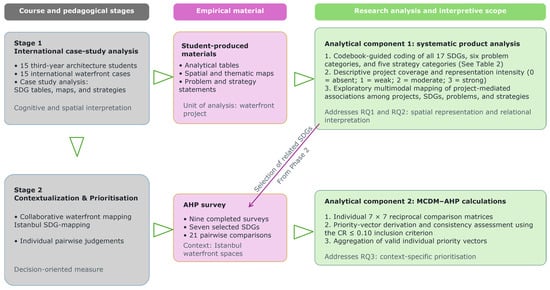
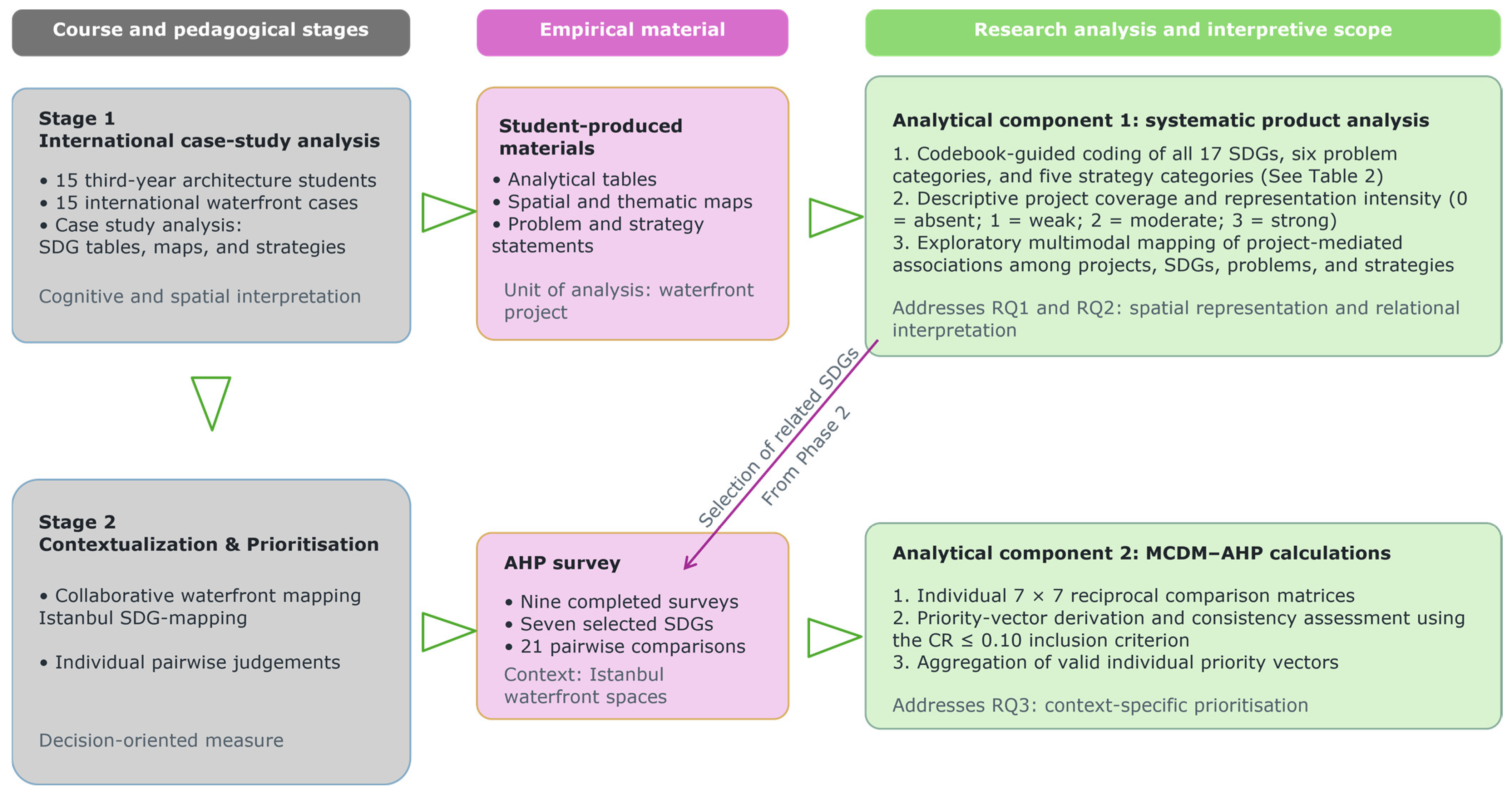
The study comprised two principal analytical components: a systematic analysis of student-produced materials and an Istanbul-based application of the Analytic Hierarchy Process (AHP), a multi-criteria decision-making (MCDM) method. Before completing the AHP survey, students participated in a collaborative mapping exercise focusing on selected Istanbul waterfront areas, which served as a pedagogical contextualisation and preparatory stage. Accordingly, the product-based analysis focused exclusively on the 15 international waterfront cases, while the AHP survey examined the relative priorities assigned to selected SDGs in relation to a prospective intervention in Istanbul waterfront public spaces. Figure 1 summarises the relationship between the course stages, data sources, and analytical procedures.
Figure 1.
Relationship among the course stages, empirical materials, and analytical procedures.
The systematic analysis of student-produced materials relating to the 15 international waterfront cases combined structured coding, descriptive frequency and intensity analysis, and exploratory multimodal network mapping of project-mediated associations among SDGs, problems, and strategies. Secondly, MCDM analysis, operationalised through AHP, to examine students’ relative priorities among seven SDGs, filtered according to the intensity in the student products, within the context of a prospective intervention in Istanbul waterfront spaces. Together, these components addressed three interrelated dimensions of SDG literacy examined in the study: spatial representation, relational interpretation, and context-specific prioritisation.
2.3. Student-Product Coding and Frequency Analysis
The waterfront case was treated as the primary unit of analysis. The materials were coded by the author using a structured codebook based on established principles of systematic content analysis [40,41]. The same codebook and decision rules were applied to all 15 cases to support procedural consistency. As summarised in Table 2, the codebook specified the unit of analysis, coding categories, operational definitions, inclusion and exclusion rules, and decision rules for ambiguous cases. The retained variables comprised: (i) the presence and intensity of representation of each of the 17 SDGs; (ii) waterfront type and transformation context; (iii) six problem categories; and (iv) five strategy categories.
Table 2.
Operational codebook for student-produced waterfront case materials [1,40,41,42].
Evidence could be textual, visual, diagrammatic, or spatial, but had to be identifiable in the submitted material and specific to the case. A goal icon appearing only in a general legend, without a case-specific link, was not treated as evidence of representation. For each SDG, presence and representational intensity were recorded on a predefined four-point ordinal scale: 0 = not represented; 1 = nominal or weak representation; 2 = explicit representation; and 3 = strong, multi-layered representation. A score of 1 required at least a case-specific label, icon, or general reference, but no clearly explained spatial relationship. A score of 2 required an explicit relationship between the SDG and at least one identifiable spatial element, problem, or strategy. A score of 3 required coherent evidence connecting the SDG to multiple spatial elements, problems, and/or strategies.
Problem and strategy categories were coded as present or absent using the operational definitions provided. Closely related categories were distinguished through boundary rules. For example, accessibility barriers were coded as P3, whereas distributive inequality, displacement, or exclusion of particular social groups was coded as P4. Ecological repair was coded as S1, whereas measures responding specifically to flooding, erosion, heat, or other climate hazards were coded as S5. Frequencies, cumulative and mean intensity values, and cross-tabulations were subsequently calculated from the completed coding matrix.
2.4. Multimodal Network Mapping
A project-centred heterogenous network was constructed using four node types: projects, SDGs, urban problems, and spatial strategies for the descriptive analysis of the student-produced materials. The 15 waterfront projects formed the central affiliation nodes and were connected to the SDGs, problems, and strategies identified through the coding procedure described in Section 2.3. No direct edges were constructed between SDGs, problems, or strategies. Instead, their recurring associations were made visible through the projects in which they were jointly coded, following the principles of heterogeneous information networks, in which different types of entities can be connected indirectly through shared intermediary nodes [43].
The edge values reflected the corresponding coding structure. Project–SDG edges retained the ordinal representation-intensity scores of 1–3, where 1 indicated weak, 2 moderate, and 3 strong representation. Project–Problem and Project–Strategy edges indicated binary presence only, because these categories were coded according to whether they occurred within each project. Consequently, the network visualised project-mediated associations rather than direct causal or semantic relationships among individual SDGs, problems, and strategies.
The node and edge data were imported into the web-based Gephi Lite v1.0.0 environment for exploratory visualisation [44,45]. Node colours differentiated projects, SDGs, problems, and strategies, while the visual appearance of Project–SDG edges reflected the three representation-intensity levels. Problem and strategy edges were displayed with equal weight because they represented binary occurrence. Software was used only to display the coded project–category structure. Node positions were therefore interpreted as a visual support for identifying recurring project-level configurations rather than as analytical evidence in themselves.
2.5. AHP-Based SDG Prioritisation
The Analytic Hierarchy Process (AHP) is a multi-criteria decision-making approach that uses pairwise comparisons on a numerical scale to derive relative weights for decision criteria [29,30]. AHP has been applied in architectural and urban studies to structure decisions involving multiple spatial, environmental, social, and technical criteria. Its applications include architectural design assessment, sustainable building and material selection, urban risk evaluation, landscape sustainability assessment, and the prioritisation of context-specific design factors [46,47,48,49,50]. AHP has also been used as a pedagogical and analytical instrument in architectural education. Harputlugil [51], for example, employed AHP as a complementary assessment approach in the architectural design studio. More recently, Seçmen et al. [52] used AHP to examine how third-year architecture students prioritised eight site-specific urban design criteria and subsequently compared these priorities with their spatial design responses. Building on these applications, the present study uses AHP to reveal the relative priorities expressed by students within a defined waterfront decision context.
All 15 students enrolled in the course were invited to participate in the AHP exercise, and nine students completed the pairwise-comparison survey, corresponding to a response rate of 60%. AHP does not prescribe a universal minimum number of participants when it is used to elicit judgements from a specifically defined decision group. Saaty and Özdemir [53] argue that the quality and consistency of judgements may be more important than the numerical size of the group and that, in expert-based applications, even a single suitably knowledgeable decision-maker may provide meaningful judgements. A review of 77 AHP applications in construction similarly found no strict minimum sample-size requirement and identified studies using groups of four to nine decision-makers [48]. Small purposively constituted groups have also been employed in sustainability, higher-education, architectural, and urban studies, including applications involving three to five participants [49,51,54,55,56,57].
The AHP exercise used a focused set of seven goals: SDGs 3, 8, 10, 11, 13, 14, and 15. These goals were selected by the author following the international case-study stage because they formed part of the strongly represented group of SDGs in the student products (see frequency and intensity analysis). The selection therefore combined evidence from students’ analyses and the practical need to keep the number of pairwise comparisons manageable.
The AHP converts qualitative comparative judgements into ratio-scale priorities through reciprocal pairwise-comparison matrices [29]. In the standard Saaty fundamental scale, a value of 1 indicates equal importance between two criteria, while values of 3, 5, 7, and 9 indicate moderate, strong, very strong, and extreme importance, respectively. The even-numbered values 2, 4, 6, and 8 may be used as intermediate judgements between the adjacent verbal categories. To reduce response complexity for student participants, the present study used a simplified subset of the standard Saaty scale comprising the principal intensity values 1, 3, 5, and 7. In this scale, 1 represented equal importance, 3 moderate importance, 5 strong importance, and 7 very strong importance. This simplification retained the ordinal and reciprocal structure of the Saaty scale while limiting the number of response categories presented to students.
When criterion i is judged to be more important than criterion j, the corresponding comparison is entered as aij, whereas the reverse comparison is represented by its reciprocal:
In this study, the AHP hierarchy consisted of one overall goal—determining the relative priority of selected SDGs for sustainable spaces along the Istanbul waterfront—and seven SDGs as decision criteria. For n criteria, the number of independent pairwise comparisons is calculated as:
Thus, each participant completed 21 independent comparisons for the seven selected SDGs, producing a 7 × 7 reciprocal comparison matrix.
2.6. Weight Derivation and Consistency Assessment
For each participant, the relative weights of the seven SDGs were derived separately from their pairwise-comparison matrix. First, each matrix value was divided by the sum of its corresponding column:
where represents the column-normalised value of criterion i relative to criterion j. The priority weight of each criterion was subsequently calculated as the arithmetic mean of its normalised row values:
The resulting priority vector was expressed as:
This normalised-column and row-average procedure provides an approximation of the principal right eigenvector of the pairwise-comparison matrix and expresses the relative weight assigned to each SDG [29,57]. Higher weights indicate greater relative priority within the defined decision context. Because human pairwise judgements are not expected to be perfectly transitive, the logical consistency of each participant’s matrix was assessed before the individual priority vectors were combined. The maximum eigenvalue was estimated as:
For a perfectly consistent matrix, λmax = n. Increasing divergence between λmax and n indicates greater inconsistency among the pairwise judgements. The Consistency Index (CI) was calculated as:
The Consistency Ratio (CR) was then obtained by comparing the calculated CI with the Random Index (RI) corresponding to the matrix size:
For a seven-criterion matrix, the Saaty Random Index is RI = 1.32. Following Saaty’s recommended criterion, matrices with CR ≤ 0.10 were considered to display an acceptable level of consistency. A CR exceeding 0.10 indicates that the participant’s judgements contain a comparatively high level of inconsistency and should therefore be reconsidered or excluded from the aggregated analysis [29,58]. Consistency was evaluated separately for each respondent rather than only for an aggregated group matrix. Only the priority vectors obtained from matrices meeting the CR ≤ 0.10 criterion were retained. Because the participating students provided individual rather than consensus-based judgements, their valid priority vectors were combined using an aggregation of individual priorities approach [58]. For m valid responses, the group-level weight of criterion i was calculated as:
where wir denotes the priority assigned to criterion i by respondent r. The resulting group-level vector was subsequently normalised so that its weights summed to 1. This vector represents the mean relative priority assigned to the seven selected SDGs by students whose comparison matrices met the specified consistency criterion.
3. Results
3.1. Representation of the SDGs: Frequency and Intensity Analysis
According to the calculations based on the coded Project × SDG matrix, as shown in Table 3, SDGs 3, 8, 9, 10, 11, 13, and 15 were represented in all 15 cases. SDGs 5 and 16 had the lowest project coverage, appearing in 11 cases each. SDGs 1, 2, 7, and 17 were represented in 12 cases, SDGs 6 and 14 in 13 cases, and SDGs 4 and 12 in 14 cases.
Table 3.
Descriptive frequency and intensity of SDG representation across the 15 waterfront cases.
SDG 11 recorded the highest cumulative intensity score (45), followed by SDGs 8 (42), 3 (38), and 9 (37). These goals therefore combined complete project coverage with comparatively high representation intensity. SDGs 13 (33), 15 (31), and 4 (30) also received relatively high cumulative scores. At the lower end of the distribution, SDGs 2 recorded the lowest cumulative intensity scores (9), followed by SDG 5 (12), SDGs 1 and 7 (15) and SDG 16 (16).
SDG 2 appeared in 9 cases, whereas SDG 5 appeared in 11. Given that SDG 2 received a cumulative score of 10 across 9 cases, it was consistently represented at only weak intensity when present. SDG 5 combined similarly weak representation with the lowest project coverage. These findings identify SDGs 2 and 5 as the clearest areas of limited engagement in the student analyses.
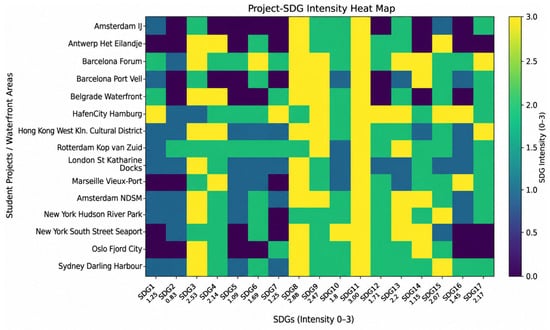
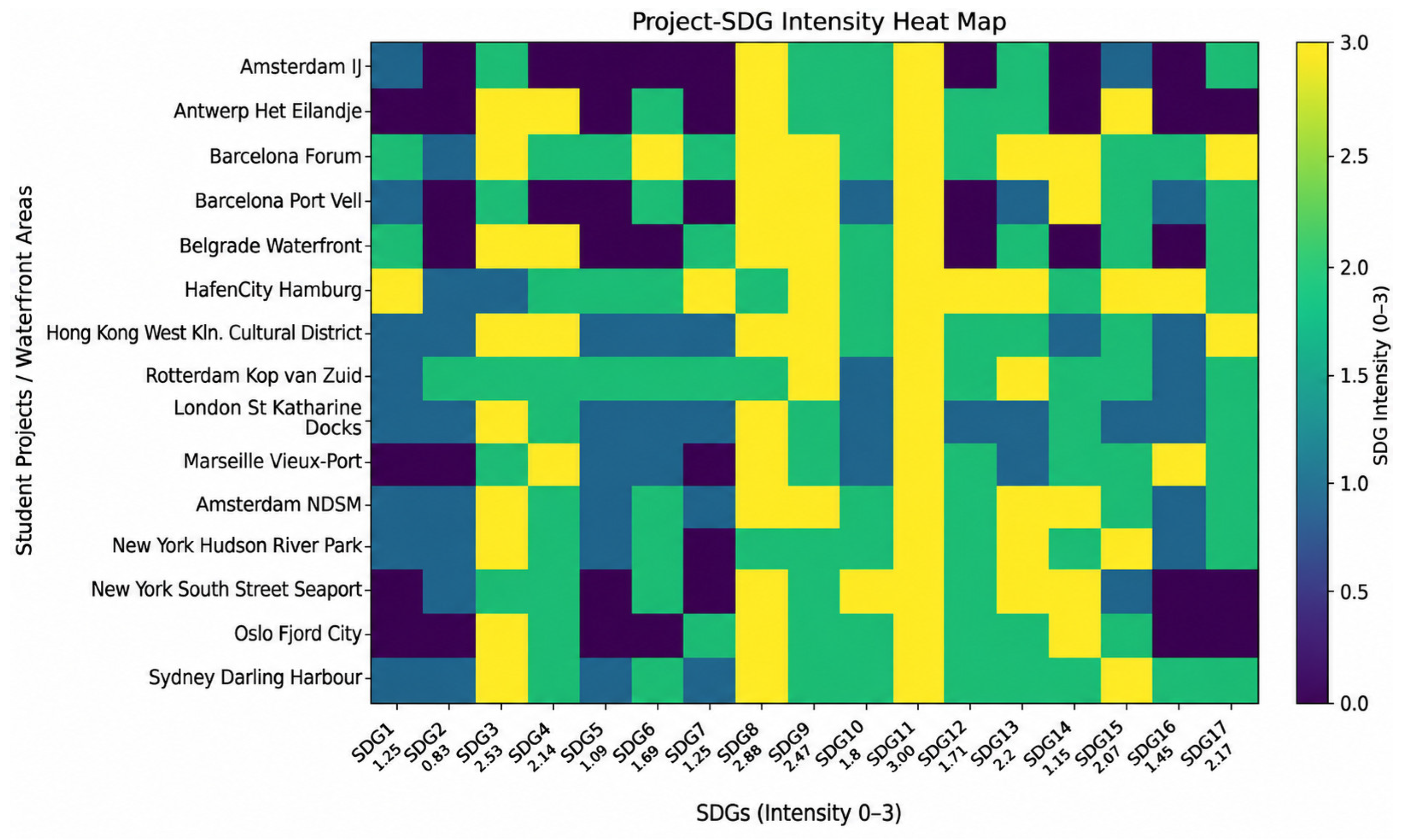
Figure 2 complements the SDG-level summary by showing how representation scores were distributed across individual waterfront cases. The heatmap indicates differences in the breadth of the SDG profiles developed by students. Barcelona Forum, Hamburg HafenCity, Rotterdam Kop van Zuid, Amsterdam NDSM Werf, Sydney Darling Harbour, and New York Hudson River Park displayed relatively broad profiles, with multiple SDGs represented at moderate or strong intensity. By contrast, Amsterdam IJ, London St Katharine’s Docks, Marseille Vieux-Port, and New York South Street Seaport showed more selective profiles concentrated on a narrower set of goals. The remaining cases occupied intermediate positions. The heatmap therefore identifies distinct patterns of breadth and emphasis across the student case analyses.
Figure 2.
Project–SDG intensity heatmap.
In the student-produced materials, broader profiles were observed mainly in analyses of cases involving multiple forms of waterfront transformation. HafenCity and Barcelona Forum, for example, received comparatively high representation scores across goals concerning urban development, infrastructure, climate, public space, and ecosystems. Hudson River Park similarly received higher scores for SDGs 3, 11, 13 and 15, corresponding to the combination of public access, recreation, and ecological restoration identified in the student analyses. Cases interpreted primarily through heritage, tourism, or harbour-related functions displayed more selective profiles.
3.2. Multimodal Network Mapping: International Projects and SDGs–Problems–Strategies
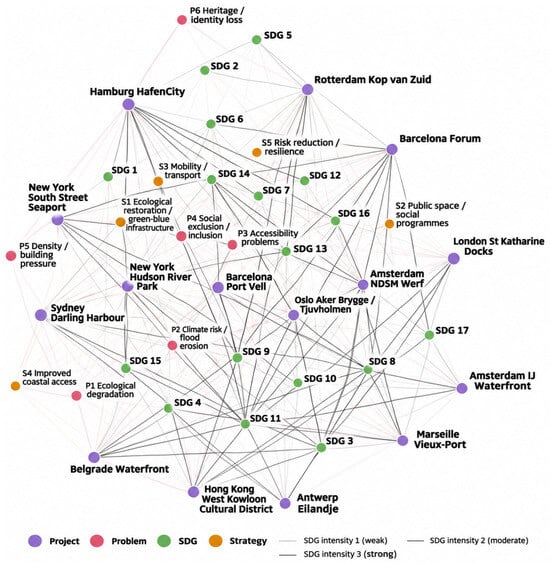
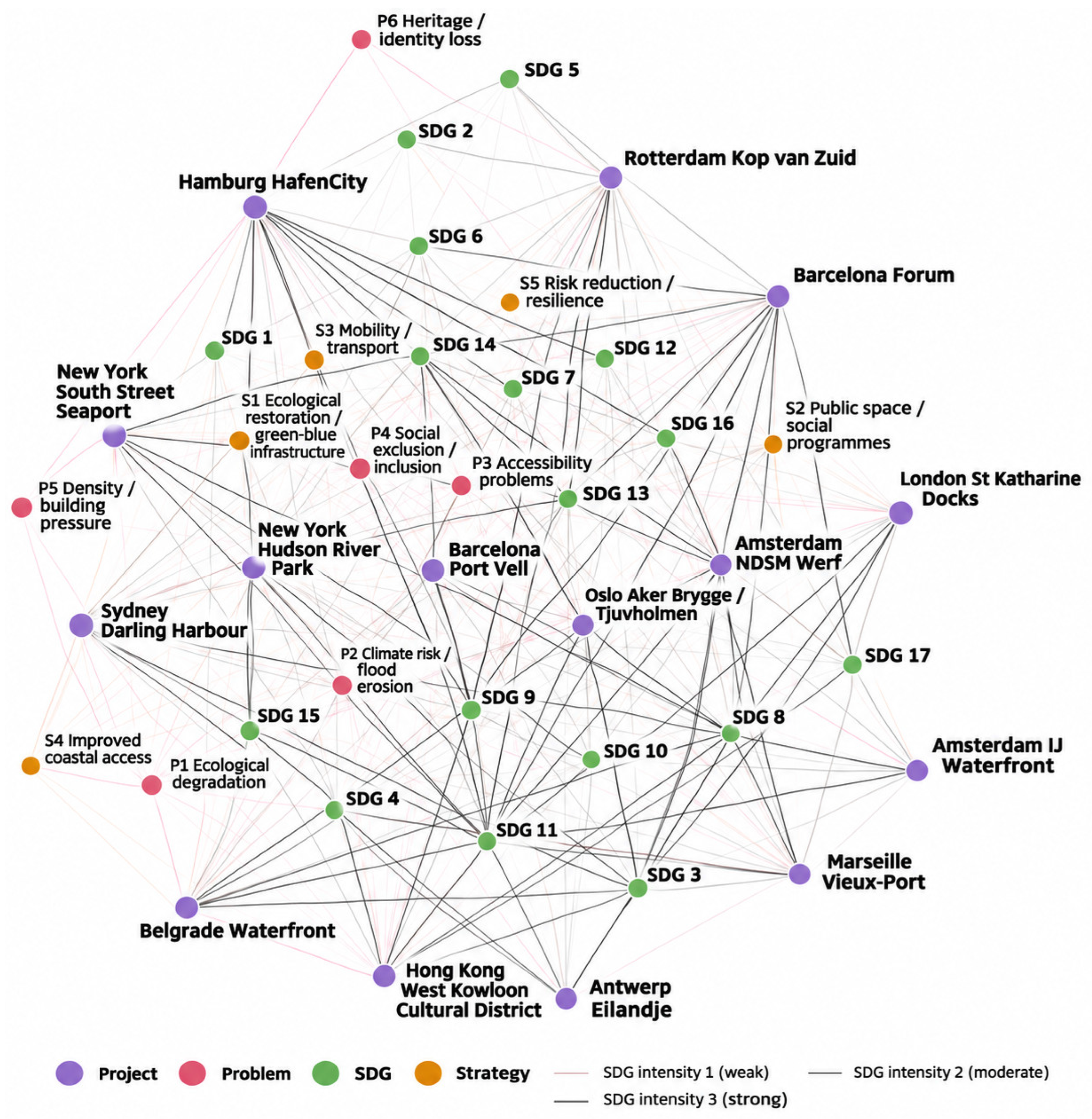
Figure 3 visualises how the 15 waterfront projects brought together the 17 SDGs, six urban problem categories (P1–P6), and five spatial strategy categories (S1–S5). The network contains 43 nodes and 339 project-mediated links: 214 Project–SDG, 65 Project–Problem, and 60 Project–Strategy links. Table 4 complements the visualisation by presenting the SDGs, problems, and strategies identified in each project. While the figure reveals recurring combinations across the student analyses, the relationships should be understood as associations formed through shared projects rather than as direct causal relationships between individual SDGs, problems, and strategies.
Figure 3.
Multimodal mapping of project-mediated associations among waterfront projects (generated using Gephi Lite).
Table 4.
Data structure and the project-level multimodal network composition.
The network reflects the strong urban focus of the student analyses. SDG 11 (Sustainable Cities and Communities) was strongly represented in all 15 projects and forms the most visually prominent element of the network. SDGs 3, 8, 9, 10, 13, and 15 were also represented across all cases, although their intensity varied between projects. In contrast, SDGs 2, 5, and 16 appeared in fewer projects and were generally represented at lower intensity. The visual prominence of SDG 11 therefore derives from both its universal project coverage and its consistently strong representation, rather than from a formal centrality measure.
Environmental and climate-related problems formed one of the most visible recurring patterns. P1 (Ecological Degradation) and P2 (Climate Risk, Flooding, and Erosion) were each identified in 14 of the 15 projects. Within these projects, they frequently occurred alongside SDG 13 (Climate Action), SDG 14 (Life Below Water), and SDG 15 (Life on Land). The corresponding spatial responses included S1 (Ecological Restoration and Green–Blue Infrastructure) and S5 (Risk Reduction and Resilience), each of which was coded in 12 projects. This pattern was particularly visible in projects such as Barcelona Forum, Hamburg HafenCity, Hong Kong West Kowloon Cultural District, Rotterdam Kop van Zuid, and Sydney Darling Harbour, where climate, ecological, infrastructural, and resilience considerations were represented together.
A second recurring pattern concerned accessibility, inclusion, health, and public-space provision. P3 (Accessibility Problems) was identified in 13 projects and P4 (Social Exclusion/Inclusion) in 14. These concerns frequently occurred in projects that also strongly represented SDG 3 (Good Health and Well-Being), SDG 10 (Reduced Inequalities), and SDG 11. S2 (Public Space and Social Programmes), the most widely represented strategy category, appeared in 13 projects, while S4 (Improved Coastal Access) occurred in 11. The overlapping presence of these categories indicates that students often interpreted waterfront sustainability through public access, social inclusion, health, recreation, and the improvement of shared urban spaces.
Mobility and economic–infrastructural transformation constituted another visible theme. S3 (Mobility and Transport) was coded in 12 projects and commonly appeared in projects where SDG 8 (Decent Work and Economic Growth), SDG 9 (Industry, Innovation and Infrastructure), and SDG 11 were represented at moderate or strong intensity. This combination was particularly apparent in large-scale mixed-use or former dockland redevelopment cases such as Hamburg HafenCity, Rotterdam Kop van Zuid, Belgrade Waterfront, and Barcelona Port Vell. These cases encouraged students to connect waterfront regeneration with transport, infrastructure, employment, mixed-use development, and public-space provision.
P5 (Density and Building Pressure) and P6 (Heritage and Identity Loss) were more selective concerns. P5 was identified in six projects, including Barcelona Forum, Barcelona Port Vell, Belgrade Waterfront, Hamburg HafenCity, Hong Kong West Kowloon Cultural District, and New York South Street Seaport. P6 occurred in only four projects: Hamburg HafenCity, Rotterdam Kop van Zuid, Amsterdam NDSM Werf, and New York South Street Seaport. Their lower occurrence suggests that development pressure, heritage transformation, and identity loss were recognised in particular redevelopment contexts.
Project-level differences further clarify the network structure. Hamburg HafenCity displayed the broadest profile, with 28 coded links. Barcelona Forum, Hong Kong West Kowloon Cultural District, and Rotterdam Kop van Zuid followed with 27 links each, while Sydney Darling Harbour and London St Katharine Docks/Tower Surroundings each had 26. These relatively dense project nodes brought together multiple SDGs with several problem and strategy categories. Barcelona Forum, Hamburg HafenCity, and Sydney Darling Harbour are particularly illustrative because their profiles combined ecological and climate concerns with public-space, mobility, accessibility, and resilience strategies.
By contrast, Amsterdam IJ Waterfront had the most focused profile, with 11 links, followed by Antwerp Eilandje with 13 and Oslo Aker Brygge/Tjuvholmen with 18. Amsterdam IJ was primarily associated with SDGs 8 and 11 at strong intensity, a smaller set of moderately represented goals, P4 (Social Exclusion/Inclusion), and S2 (Public Space and Social Programmes). Antwerp Eilandje similarly concentrated on a limited combination of urban, health, education, employment, environmental, and accessibility concerns.
The most recurrent combinations concerned ecological degradation, climate risk, accessibility, social inclusion, public-space programming, mobility, coastal access, and resilience. Because many of these categories were represented across a large proportion of the cases, however, the network is interpreted as an exploratory representation of recurring project-mediated patterns.
3.3. AHP Results: Prioritisation of SDGs for the Istanbul Local Context
Nine students completed the AHP exercise for the seven selected criteria filtered from the frequency and intensity analysis: SDGs 3, 8, 10, 11, 13, 14, and 15. The consistency of each participant’s 7 × 7 pairwise-comparison matrix was assessed separately using Saaty’s CR ≤ 0.10 criterion. Six matrices met the required consistency threshold and were retained for group aggregation, corresponding to 66.7% of the completed surveys. Three matrices, with CR values ranging from 0.1050 to 0.1253, were excluded. Across the nine completed surveys, the individual CR values ranged from 0.0680 to 0.1253, with a mean of 0.0906 and a median of 0.0904. Among the six retained matrices, CR values ranged from 0.0680 to 0.0998, with a mean of 0.0800. The valid individual priority vectors were aggregated using the arithmetic mean to derive the group-level weights reported in Table 5.
Table 5.
Group-level AHP weights derived from the six valid individual priority vectors.
As shown in Table 5, SDG 13 (Climate Action) received the highest group-level mean priority weight (21.9%) for a prospective intervention in Istanbul waterfront public spaces. It was followed by SDG 11 (Sustainable Cities and Communities; 19.6%) and SDG 3 (Good Health and Well-Being; 17.1%). Together, these three goals accounted for 58.6% of the total priority weight. SDG 8 (Decent Work and Economic Growth; 11.6%) occupied the fourth position, followed by SDG 14 (Life Below Water; 10.7%) and SDG 10 (Reduced Inequalities; 10.3%). SDG 15 (Life on Land) received the lowest group-level mean weight at 8.8%. Although SDG 13 was the highest-ranked criterion, the difference between SDGs 13 and 11 was limited to 2.3 percentage points. The resulting distribution therefore indicates a differentiated hierarchy rather than the dominance of a single sustainability goal.
4. Discussion
Previous studies have raised concerns that SDGs may be incorporated into architectural education primarily as icons, reporting categories, or thematic checklists, without demonstrating how individual goals relate to spatial conditions, design problems, or possible interventions [5,10,59]. In such applications, assigning an SDG “label” to a project does not necessarily show how students understand the goal or translate it into spatial reasoning.
In this study students were required to identify spatial evidence for each selected SDG rather than merely attach an SDG icon to a project. The analysis therefore examined not only which SDGs were mentioned but also how they were spatially represented and contextualised through specific spaces, buildings and structures.
The network visualisation showed recurring project-mediated configurations. Ecological degradation and climate risk frequently occurred in projects that also represented SDGs 13–15 and incorporated ecological restoration or resilience strategies. Accessibility and social inclusion concerns commonly overlapped with SDGs 3, 10, and 11 and with public-space and coastal-access strategies. Similarly, mobility and transport strategies appeared in projects where urban development, employment, and infrastructure-related goals were prominent. They demonstrate that students’ work could be examined in terms of relationships among spatial conditions, sustainability goals, and possible responses rather than through SDG labels alone.
The project profiles also reveal that this operationalisation was not uniform. Hamburg HafenCity, Barcelona Forum, Hong Kong West Kowloon Cultural District, Rotterdam Kop van Zuid, and Sydney Darling Harbour brought together relatively broad combinations of SDGs, problems, and strategies. Amsterdam IJ Waterfront, Antwerp Eilandje, and Oslo Aker Brygge/Tjuvholmen displayed more focused profiles. Thus, the framework does not assume that every student product achieved the same level of relational interpretation. Instead, it makes variation between selective and multidimensional uses of the SDGs observable. Compared with curriculum-mapping studies that align course content or learning outcomes with particular SDGs, and survey-based studies that identify which SDGs educators report incorporating into architectural courses [5,10], the present study examines the student products themselves to examine a more differentiated basis for discussing course-level SDG literacy.
Projects combining mixed-use redevelopment, public-space provision, mobility infrastructure, ecological intervention, and climate adaptation tended to generate broader SDG representations, whereas cases dominated by more specific heritage, harbour, or tourism functions produced comparatively selective profiles. This supports the argument that SDG literacy in architectural education should be understood as context-dependent: abstract sustainability goals acquire different meanings according to the spatial and functional conditions through which students encounter them [1,2,19].
The findings identify SDGs 2 and 5 as the clearest potential blind spots, particularly in relation to food systems and gender equality, while poverty, energy, and institutional governance represent additional areas of comparatively limited engagement. Rather than indicating an absence of social concerns overall, this pattern suggests a selective social literacy: accessibility, health, and inequality were more readily translated into spatial terms than food security, gender equality, poverty, or institutional governance.
4.1. SDGs in a Local Decision Context: Istanbul Waterfronts
The AHP exercise shifted the focus from recognising SDGs in existing international projects to prioritising selected goals for a prospective intervention in Istanbul waterfront spaces. Istanbul provides a particularly complex decision context because its waterfronts combine intensive public use, unequal access to open space, environmental and climate-related vulnerability, seismic risk, rapid urban transformation, and pressure on historically layered coastal areas. Research on the Bosphorus waterfront has demonstrated that publicness and accessibility vary according to land use, ownership, and historical development patterns [60]. Other studies have shown that large-scale waterfront redevelopment can produce tensions among economic development, public interest, access to the coast, and the continuity of port and cultural heritage [61,62].
These spatial tensions intersect with broader urban inequalities. Istanbul’s earthquake risk has been used to justify extensive urban-regeneration programmes, but research has shown that physical risk reduction may also be accompanied by displacement, gentrification, and unequal exposure to environmental hazards [63]. Migration has further transformed the city’s peripheral neighbourhoods and intensified questions concerning social inclusion, citizenship, access, and the right to the city [64]. These conditions do not directly explain individual AHP responses, but they provide an important local context for interpreting how students evaluated climate, urban quality, health, inequality, and ecosystem-related goals.
Within this context, SDG 13 received the highest group-level priority, followed by SDG 11 and SDG 3. The prominence of SDG 13 can plausibly be interpreted in relation to the environmental vulnerability of a coastal metropolis and the increasing policy emphasis on climate adaptation, flooding, heat, and urban resilience. Istanbul’s Climate Change Action Plan similarly identifies coastal and urban systems as areas requiring adaptation and resilience measures [65]. However, earthquake risk should not be treated as evidence explaining the priority of SDG 13 alone, because seismic risk is not a climate-change issue. Instead, it contributes to a wider resilience context involving SDG 11, infrastructure, health, inequality, and institutional capacity.
The high position of SDG 11 is consistent with the city’s continuing challenges concerning public waterfront access, urban transformation, spatial inequality, and the balance between redevelopment and public interest. SDG 3 may likewise reflect the importance of environmental quality, recreation, safety, and access to public open space in a densely populated metropolitan setting. SDG 10 received a lower group-level weight than SDGs 13, 11, and 3, despite Istanbul’s substantial social and spatial inequalities. This may indicate that climate, urban form, and health were more immediately legible to architecture students as spatial design concerns, while migration, displacement, and structural inequality were less readily translated into the prioritisation exercise.
Heritage-related conflicts provide an additional contextual consideration. Istanbul’s waterfronts contain archaeological, industrial, maritime, and urban heritage layers, while recent redevelopment projects have generated debate concerning commercialisation, public access, and the spatial continuity of cultural heritage [61,62]. Nevertheless, heritage conservation was not included as a separate AHP criterion. Its possible influence can therefore be discussed only as part of the broader meaning of SDG 11, rather than as an independently measured student priority.
The difference between the product analysis and the AHP results is particularly informative. SDG 11 was the most strongly represented goal in the analyses of existing international projects, whereas SDG 13 received the highest priority for a prospective intervention in Istanbul. The two results are not different because the tasks measured different forms of judgement. The product analysis was retrospective and interpretive: SDG 11 provided a broad disciplinary framework for identifying visible characteristics. The AHP exercise was prospective and decision-oriented: it required students to make explicit trade-offs among seven selected goals in a locally familiar waterfront context. Under this framing, climate action may have acquired greater urgency for Istanbul.
4.2. Pedagogical Implications
Case analysis and mapping help translate the abstract language of the SDGs into the context-specific reasoning used in architecture and urban studies. AHP adds a further dimension by requiring students to compare goals and express relative priorities rather than treating every goal as equally applicable. The study also demonstrates the potential contribution of non-studio courses to sustainability education. While much of the architectural education literature discusses SDG integration through design studios [5,10], this course was with an analytical and theory-oriented content.
The correspondence between the course activities and UNESCO’s ESD dimensions should be interpreted at the level of pedagogical intention rather than measured learning change. The international case analysis was designed to support systems-oriented interpretation, collaborative mapping created opportunities for dialogue and contextualisation, and the AHP exercise introduced structured decision-oriented judgement. However, the study did not directly measure changes in students’ cognitive, socio-emotional, or behavioural competencies.
4.3. Limitations and Future Research
The study concerns a single elective course at one institution and involved 15 students; nine completed the AHP survey. Its findings should therefore be interpreted as evidence from a micro-case rather than generalised to architectural education more broadly. The product coding was conducted by a single researcher according to the codebook including operational definitions, coding examples, and project–category matrix strengthen procedural transparency. Future studies should test the framework across different courses, institutions, and student cohorts. Independent double coding, interviews, focus groups, and pre-/post-course measures could provide insight into how students develop SDG-related knowledge and judgement. Furthermore, future research should combine follow-up interviews asking participants to explain the reasons underlying their judgements.
5. Conclusions
This article examined how the Sustainable Development Goals (SDGs) can be operationalized within architectural higher education through a non-studio, ESD-oriented elective course on international urban waterfront projects. By combining SDG-based mapping and a multi-criteria decision-making approach, the study examined how students spatially represent, relationally interpret, and prioritize sustainability goals within situated educational contexts.
The findings suggest that students tended to apply the SDGs not simply as a checklist but as interconnected goals associated with spatial problems and strategies. From a pedagogical perspective, the study illustrates how a non-studio course can provide a structured setting for examining SDG literacy through international context and apply decision-oriented prioritization to a local context. Case-based analysis and mapping enabled abstract sustainability goals to be connected with concrete spatial conditions, and MCDM/AHP exercise provided explicit priorities. The course explored how UNESCO’s ESD principles can be translated into course-level activities in architectural education.
Future research could examine its application across different institutions, courses and spatial contexts to investigate the patterns.
Funding
This research received no external funding.
Institutional Review Board Statement
Institutional ethical approval was not obtained for this study. The research was conducted in the context of a higher education course, ARC3919, a third-year elective course offered in the Department of Architecture at Bahçeşehir University in every semester. The course activities formed part of the regular teaching and learning process. The research involved the retrospective analysis of anonymised student-produced educational materials and a voluntary, non-interventional AHP prioritisation exercise conducted within the context of a university course. The research data were analysed and reported anonymously, and no personally identifiable or sensitive information was collected or disclosed.
Informed Consent Statement
Informed consent was obtained from all subjects involved in the study.
Data Availability Statement
The data supporting the findings of this study are available from the corresponding author upon reasonable request. The data are not publicly available because they include student-produced educational materials and course-related records subject to privacy and institutional restrictions.
Acknowledgments
The author gratefully acknowledges the students who participated in the elective course and contributed their analytical works and perspectives to the study.
Conflicts of Interest
The author declares no conflicts of interest.
References
- UNESCO. Education for Sustainable Development Goals: Learning Objectives; UNESCO: Paris, France, 2017; Available online: https://www.unesco.org/en/articles/education-sustainable-development-goals-learning-objectives (accessed on 10 January 2026).
- UNESCO. Education for Sustainable Development: A Roadmap; UNESCO: Paris, France, 2020; Available online: https://unesdoc.unesco.org/ark:/48223/pf0000374802 (accessed on 10 January 2026).
- Findler, F.; Schönherr, N.; Lozano, R.; Reider, D.; Martinuzzi, A. The impacts of higher education institutions on sustainable development: A review and conceptualization. Int. J. Sustain. High. Educ. 2019, 20, 23–38. [Google Scholar] [CrossRef] [Scilit]
- Amorós Molina, Á.; Helldén, D.; Alfvén, T.; Niemi, M.; Leander, K.; Nordenstedt, H.; Rehn, C.; Ndejjo, R.; Wanyenze, R.; Biermann, O. Integrating the United Nations Sustainable Development Goals into higher education globally: A scoping review. Glob. Health Action 2023, 16, 2190649. [Google Scholar] [CrossRef] [Scilit] [PubMed]
- Hendawy, M.; Junaid, M.; Amin, A. Integrating sustainable development goals into the architecture curriculum: Experiences and perspectives. City Environ. Interact. 2024, 21, 100138. [Google Scholar] [CrossRef] [Scilit]
- Mohamed, K.E. An instructive model of integrating sustainability into the undergraduate design studio. J. Clean. Prod. 2022, 338, 130591. [Google Scholar] [CrossRef] [Scilit]
- Ibiyeye, A.I.; Shamang, K.J.; Malachy, G. Awareness of building sustainability: A case of architectural students of Kaduna State University. Soc. Sci. Humanit. Open 2024, 10, 100927. [Google Scholar] [CrossRef] [Scilit]
- Ahmad, T.; Stephan, A.; Purwaningrum, R.D.A.; Gulzar, S.; De Vecchi, R.; Ahmed, M.; Candido, C.; Sadek, A.H.; Qrayeiah, W. Practices contributing to building sustainability: Investigating opinions of architecture students using partial least squares structural equation modeling. J. Build. Eng. 2024, 96, 110391. [Google Scholar] [CrossRef] [Scilit]
- Lozano, R.; Merrill, M.Y.; Sammalisto, K.; Ceulemans, K.; Lozano, F.J. Connecting competences and pedagogical approaches for sustainable development in higher education: A literature review and framework proposal. Sustainability 2017, 9, 1889. [Google Scholar] [CrossRef] [Scilit]
- Boarin, P.; Martínez-Molina, A. Integration of environmental sustainability considerations within architectural programmes in higher education: A review of teaching and implementation approaches. J. Clean. Prod. 2022, 342, 130989. [Google Scholar] [CrossRef] [Scilit]
- Dejo-Vásquez, M.; Bravo Schroth, A.Y.; Hammatt, Z.; Guilhem, D.B.; Lescano, R.; Kombe, F.K. Analysis of sustainable development goals in university foundational documents. Int. J. Sustain. High. Educ. 2026, 27, 132–150. [Google Scholar] [CrossRef] [Scilit]
- McCowan, T. Higher Education for and Beyond the Sustainable Development Goals; Palgrave Macmillan: Cham, Switzerland, 2019. [Google Scholar] [CrossRef] [Scilit]
- Obrecht, M.; Feodorova, Z.; Rosi, M. Assessment of environmental sustainability integration into higher education for future experts and leaders. J. Environ. Manag. 2022, 316, 115223. [Google Scholar] [CrossRef] [Scilit] [PubMed]
- Avelar, A.B.A.; da Silva Oliveira, K.D.; Farina, M.C. The integration of the Sustainable Development Goals into curricula, research and partnerships in higher education. Int. Rev. Educ. 2023, 69, 299–325. [Google Scholar] [CrossRef] [Scilit]
- Ofei-Manu, P.; Didham, R.J. Identifying the factors for sustainability learning performance. J. Clean. Prod. 2018, 198, 1173–1184. [Google Scholar] [CrossRef] [Scilit]
- Burbules, N.C.; Fan, G.; Repp, P. Five trends of education and technology in a sustainable future. Geogr. Sustain. 2020, 1, 93–97. [Google Scholar] [CrossRef] [Scilit]
- Mokski, E.; Leal Filho, W.; Sehnem, S.; Andrade Guerra, J.B.S.O. Education for sustainable development in higher education institutions: An approach for effective interdisciplinarity. Int. J. Sustain. High. Educ. 2023, 24, 96–117. [Google Scholar] [CrossRef] [Scilit]
- Martínez-Ventura, J.; de-Miguel-Arbonés, E.; Sentieri-Omarrementería, C.; Galan, J.; Calero-Llinares, M. A Tool to Assess Architectural Education from the Sustainable Development Perspective and the Students’ Viewpoint. Sustainability 2021, 13, 9596. [Google Scholar] [CrossRef] [Scilit]
- Akinsemolu, A.A.; Onyeaka, H. The role of green education in achieving the sustainable development goals: A review. Renew. Sustain. Energy Rev. 2025, 210, 115239. [Google Scholar] [CrossRef] [Scilit]
- Matin, S.; Yasar, D.; Kucukali, U.F. Embedding the SDGs in Architectural Education: Curriculum Mapping of Sustainability and Transformation in an Undergraduate Program at a Foundation University in Istanbul. Sustainability 2026, 18, 4699. [Google Scholar] [CrossRef] [Scilit]
- Greenland, S.J.; Saleem, M.; Misra, R.; Nguyen, N.; Mason, J. Reducing SDG complexity and informing environmental management education via an empirical six-dimensional model of sustainable development. J. Environ. Manag. 2023, 344, 118328. [Google Scholar] [CrossRef] [Scilit] [PubMed]
- Mayr, H.; Vollmer, C. Fostering interest in sustainable development with the Global Goals Design Jam—Testing its effectiveness with a mixed methods design. Think. Ski. Creat. 2024, 51. [Google Scholar] [CrossRef] [Scilit]
- Ghazian, N.; Lortie, C.J. Ten Simple Rules for Incorporating the UN Sustainable Development Goals (SDGs) into Environmental and Natural Science Courses. Sustainability 2024, 16, 9594. [Google Scholar] [CrossRef] [Scilit]
- Hoyle, B.S. The port–city interface: Trends, problems and examples. Geoforum 1989, 20, 429–435. [Google Scholar] [CrossRef] [Scilit]
- Bruttomesso, R. (Ed.) Waterfronts: A New Frontier for Cities on Water; International Centre Cities on Water: Venice, Italy, 1993. [Google Scholar]
- Marshall, R. (Ed.) Waterfronts in Post-Industrial Cities; Spon Press/Taylor & Francis: London, UK, 2001. [Google Scholar]
- Sairinen, R.; Kumpulainen, S. Assessing social impacts in urban waterfront regeneration. Environ. Impact Assess. Rev. 2006, 26, 120–135. [Google Scholar] [CrossRef] [Scilit]
- Aerts, J.C.J.H.; Botzen, W.J.W.; Emanuel, K.; Lin, N.; de Moel, H.; Michel-Kerjan, E.O. Evaluating flood resilience strategies for coastal megacities. Science 2014, 344, 473–475. [Google Scholar] [CrossRef] [Scilit] [PubMed]
- Saaty, T.L. Decision making with the analytic hierarchy process. Int. J. Serv. Sci. 2008, 1, 83–98. [Google Scholar] [CrossRef] [Scilit]
- Mu, E.; Pereyra-Rojas, M. Practical Decision Making: An Introduction to the Analytic Hierarchy Process (AHP) Using Super Decisions V2; Springer: Cham, Switzerland, 2017. [Google Scholar] [CrossRef] [Scilit]
- Janakiraman, S. Digital games for environmental sustainability education: A systematic literature review. Environ. Educ. Res. 2021, 27, 1770–1799. [Google Scholar] [CrossRef] [Scilit]
- Cross, N. Designerly ways of knowing. Des. Stud. 1982, 3, 221–227. [Google Scholar] [CrossRef] [Scilit]
- Azubuike, H.; Jiburum, U.; Nwachukwu, M.U.; Mba, H.C.; Okosun, A.E.; Nwanmuoh, E.E. Inclusive factor inputs for determination of human development index for informal settlements: A case study of Enugu city, Nigeria. SAGE Open 2024, 14, 21582440241294144. [Google Scholar] [CrossRef] [Scilit]
- Demirbaş, Ö.O.; Demirkan, H. Focus on architectural design process through learning styles. Des. Stud. 2003, 24, 437–456. [Google Scholar] [CrossRef] [Scilit]
- Djabarouti, K.; O’Flaherty, J. Experiential learning with building craft in the architectural design studio: A pilot study exploring its implications for built heritage in the UK. Int. J. Art Des. Educ. 2019, 38, 1028–1040. [Google Scholar]
- Top, L.M.; Schoonraad, S.A.; Otero, V.K. Development of pedagogical knowledge among learning assistants. Int. J. STEM Educ. 2018, 5, 1. [Google Scholar] [CrossRef] [Scilit] [PubMed]
- Grover, R.; Emmitt, S.; Copping, A. Critical learning for sustainable architecture: Opportunities for design studio pedagogy. Sustain. Cities Soc. 2020, 53, 101876. [Google Scholar] [CrossRef] [Scilit]
- Luck, R. Participatory design in architectural practice: Changing practices in future making in uncertain times. Des. Stud. 2018, 59, 139–157. [Google Scholar] [CrossRef] [Scilit]
- Kolb, D.A. Experiential Learning: Experience as the Source of Learning and Development; Prentice Hall: Englewood Cliffs, NJ, USA, 1984. [Google Scholar]
- Krippendorff, K. Content Analysis: An Introduction to Its Methodology, 4th ed.; Sage: Thousand Oaks, CA, USA, 2019. [Google Scholar]
- Neuendorf, K.A. The Content Analysis Guidebook, 2nd ed.; Sage: Thousand Oaks, CA, USA, 2017. [Google Scholar]
- United Nations General Assembly. Transforming Our World: The 2030 Agenda for Sustainable Development; Resolution A/RES/70/1; United Nations: New York, NY, USA, 2015; Available online: https://sdgs.un.org/2030agenda (accessed on 6 September 2025).
- Sun, Y.; Han, J. Mining heterogeneous information networks: A structural analysis approach. ACM SIGKDD Explor. Newsl. 2013, 14, 20–28. [Google Scholar] [CrossRef] [Scilit]
- Bastian, M.; Heymann, S.; Jacomy, M. Gephi: An open source software for exploring and manipulating networks. In Third International AAAI Conference on Weblogs and Social Media; AAAI Press: Menlo Park, CA, USA, 2009; pp. 361–362. [Google Scholar]
- Gephi Consortium. Gephi Lite: A Web-Based Application for Visual Network Analysis v1.0.0. Available online: https://gephi.org/lite/ (accessed on 20 September 2026).
- Kazancı, G.; Gülümser, A.A.; Costa, J.P. Enhancing Public Perception of Climate-Adaptation Spatial Strategies in Coastal Communities: A Case Study from Kadıköy, Istanbul. Sustainability 2026, 18, 1418. [Google Scholar] [CrossRef] [Scilit]
- Başdoğan Deniz, G. GIS-based spatial multi-hazard vulnerability assessment of cultural heritage sites: The case of Antakya. Front. Earth Sci. 2026, 14, 1837277. [Google Scholar] [CrossRef] [Scilit]
- Darko, A.; Chan, A.P.C.; Ameyaw, E.E.; Owusu, E.K.; Pärn, E.; Edwards, D.J. Review of application of analytic hierarchy process (AHP) in construction. Int. J. Constr. Manag. 2019, 19, 436–452. [Google Scholar] [CrossRef] [Scilit]
- Hapsari, M.A.; Subiyanto, S. Fuzzy AHP based optimal design building-attached photovoltaic system for academic campus. Int. J. Photoenergy 2020, 2020, 6508329. [Google Scholar] [CrossRef] [Scilit]
- Seçmen, S.; Türkoğlu, H. An Approach for the Evaluation of the Spatial Quality of Urban Waterfronts: The Case of Istanbul. Int. J. Des. Soc. 2022, 16, 91–111. [Google Scholar] [CrossRef] [Scilit]
- Harputlugil, T. Analytic Hierarchy Process (AHP) as an assessment approach for architectural design: Case study of architectural design studio. ICONARP Int. J. Archit. Plan. 2018, 6, 217–245. [Google Scholar] [CrossRef] [Scilit]
- Seçmen, S.; Ceylan, S.; Atam, B.; Vatan, M.; Maro, İ.; Topçu, Ü. Students’ Approach to Architectural Design in Developing Urban Areas: A Studio Experience. J. Archit./Plan. Res. Stud. 2026, 23, 276186. [Google Scholar] [CrossRef] [Scilit]
- Saaty, T.L.; Özdemir, M.S. How many judges should there be in a group? Ann. Data Sci. 2014, 1, 359–368. [Google Scholar] [CrossRef] [Scilit]
- Mian, S.H.; Salah, B.; Ameen, W.; Moiduddin, K.; Alkhalefah, H. Adapting universities for sustainability education in Industry 4.0: Channel of challenges and opportunities. Sustainability 2020, 12, 6100. [Google Scholar] [CrossRef] [Scilit]
- Seçmen, S.; Ibrahim, F.A. Rethinking sustainable development goals (SDG) for floating slums in African coastal settings: Makoko community in Nigeria. Cities 2025, 159, 105751. [Google Scholar] [CrossRef] [Scilit]
- Saaty, T.L. A scaling method for priorities in hierarchical structures. J. Math. Psychol. 1977, 15, 234–281. [Google Scholar] [CrossRef] [Scilit]
- Saaty, T.L. The Analytic Hierarchy Process: Planning, Priority Setting, Resource Allocation; McGraw-Hill: New York, NY, USA, 1980. [Google Scholar]
- Forman, E.; Peniwati, K. Aggregating individual judgments and priorities with the analytic hierarchy process. Eur. J. Oper. Res. 1998, 108, 165–169. [Google Scholar] [CrossRef] [Scilit]
- Bertone, E.; Bischeri, C.; Boddy, J. Integration of the Sustainable Development Goals (SDGs) in architecture curriculum—Quantifying the extent of SDG contributions. Environ. Educ. Res. 2024, 31, 566–586. [Google Scholar] [CrossRef] [Scilit]
- Erdem, S.; Terzi, F. Assessing Public Space Complexity: A Comparative Study of Waterfront Areas in Istanbul’s Bosphorus District. Livenarch+ J. 2024, 1, 14–33. [Google Scholar]
- Erbaş, A.E.; Emre, B. Port heritage, planning challenges and the role of GIS tools in multi-layered cities: Yenikapı Metro Station, Istanbul. Spool 2021, 8, 23–48. [Google Scholar] [CrossRef] [Scilit]
- Erbil, A.Ö.; Erbil, T. Unveiling the role of the state in Istanbul’s urban transformation: Insights from Galataport redevelopment. J. Infrastruct. Policy Dev. 2024, 8, 7631. [Google Scholar] [CrossRef] [Scilit]
- Güzey, Ö. The last round in restructuring the city: Urban regeneration becomes a state policy of disaster prevention in Turkey. Cities 2016, 50, 40–53. [Google Scholar] [CrossRef] [Scilit]
- Kılıçaslan, G. Forced migration, citizenship, and space: The case of Syrian Kurdish refugees in İstanbul. New Perspect. Turk. 2016, 54, 77–95. [Google Scholar] [CrossRef] [Scilit]
- Istanbul Metropolitan Municipality. Istanbul Climate Change Action Plan; Istanbul Metropolitan Municipality: Istanbul, Turkey, 2022.

Disclaimer/Publisher’s Note: The statements, opinions and data contained in all publications are solely those of the individual author(s) and contributor(s) and not of MDPI and/or the editor(s). MDPI and/or the editor(s) disclaim responsibility for any injury to people or property resulting from any ideas, methods, instructions or products referred to in the content. |
© 2026 by the author. Licensee MDPI, Basel, Switzerland. This article is an open access article distributed under the terms and conditions of the Creative Commons Attribution (CC BY) license.