


Abstract
Organic by-products are widely used as sustainable amendments to enhance vegetable productivity while reducing the environmental impact of farming practices. Owing to its high nutritional value, cauliflower (Brassica oleracea L. var. botrytis, cv. El-Soultani) was selected for this study to examine the effects of oyster mushroom compost tea (OMCT), as an organic by-product, on its growth and development. Cauliflower plantlets were cultivated under open-field conditions and sprayed with different dilutions of OMCT three times at 15-day intervals after transplanting. The dilutions included 1 L of OMCT-B mixed with varying amounts of water (50, 100, 150, and 200 L) and the plants sprayed with tap water only served as the control treatment. The results demonstrated that foliar application of OMCT significantly enhanced all evaluated parameters, exhibiting a progressive yet nonlinear concentration response pattern (p < 0.01), with the strongest responses consistently observed at the A3 dilution. Under open-field conditions, treatment 1: 100 dilution (A3) produced the highest average curd weight in both growing seasons. Consequently, total yield increased by 137.03% in the 2023 growing season and by 117.41% in the 2024 growing season compared with the untreated control. These findings indicate that the A3 was the most promising OMCT-B treatment for enhancing cauliflower curd yield and overall productivity under the conditions of the present study. The beneficial effect of OMCT on nutrient availability and nitrogen metabolism may be partly attributed to the organic substances present in OMCT. These substances interact with plant nutrients in complex ways, serving multiple functions.
1. Introduction
Cauliflower (Brassica oleracea L. var. botrytis) is one of the principal cole crops of the Brassicaceae family and is widely cultivated for its white, edible curd, which consists of a compact mass of immature floral meristems. As a nutrient-dense vegetable rich in vitamins, minerals, and bioactive compounds, cauliflower holds considerable economic importance, warranting continued efforts to improve its productivity [1].
Mushroom cultivation substrates are commonly prepared from organic agricultural wastes supplemented with beneficial ingredients such as lime, wheat bran, and nutrients. Furthermore, some studies during the cultivation process of oyster mushroom reported that the media can be supplemented with different portions of organic acid and decomposed compost, which enriches it with diverse microbial communities and soluble nutrients [2,3]. Organic waste substrates naturally carry microorganisms on their surfaces, most of which originate from the soil. These microorganisms remain largely inactive on dry materials; once the substrate is moistened during mushroom cultivation, however, they are reactivated and convert the substrate nutrients into various bioactive compounds. During cultivation, a considerable portion of the substrate is consumed by the mushroom, while the remainder is left over as a by-product known as spent mushroom substrate (SMS) [4]. Because of this microbial transformation, SMS is enriched with bioactive compounds and nutrients that can function as plant biostimulants [5].
Accordingly, SMS represents a promising organic by-product that can be recycled as a soil amendment rather than discarded. One approach for sustainable production is recycling organic waste as fertilizer [6,7]. In addition to reducing the amount of leftover biomass, the biomass waste composting process ensures the provision of soil moisture, organic matter, minerals, and other valuable substances [4]. Composting is a natural process where recyclable organic compounds are transformed into compost [8]. In agriculture, the use of products obtained from compost, such as compost tea (CT), is mainly increasing due to their positive roles on the different crops [9,10]. Compost teas are liquefied biological formulas attained using the water extraction of solid composted materials for a specific incubation time [10]. The CTs contain a large number of plant phytohormones, macronutrients, micronutrients, and many other beneficial components. The microorganisms that exist on CTs can modify plant growth and help in the bio-control of pathogens, and have constructive beneficial effects on soil quality and structure and plant health [11]. The CTs’ quality and effectiveness are correlated with numerous aspects, such as the compost-to-water ratio, and the type of compost, which determine the development of specific groups of beneficial microorganisms [12,13]. Bacterial strains isolated from CTs can be defined as plant growth-promoting rhizobacteria (PGPR) [14]. These bacteria strains could promote plant growth and productivity through different mechanisms under abiotic and biotic stresses [15]. Compost mushroom substrate (CMS) refers to any mushroom cultivation media that has surpassed its usability and is no longer viable. Waste accumulation around disposal sites poses air and soil pollution risks, yet it also represents a valuable resource that can be transformed into beneficial products such as compost tea. In this context, the present study prepared oyster mushroom compost tea (OMCT) and examined its influence on the growth, nutrient status, and average curd weight of cauliflower under open-field conditions.
2. Materials and Methods
2.1. Preparation of Oyster Mushroom Compost Tea (OMCT) Solutions
The spent mushroom substrate (SMS) used to prepare oyster mushroom compost tea (OMCT) was obtained from a previous study [5]. The OMCT was prepared at the Central Laboratory of Organic Agriculture (CLOA), Agricultural Research Center (ARC), Giza, Egypt. Four OMCT formulations (OMCT-A, OMCT-B, OMCT-C, and OMCT-D) were prepared by soaking SMS in tap water at concentrations of 50, 100, 150, and 200 g L−1 of water, respectively. These formulations were incubated in closed plastic containers at 25 °C and stirred every 3 days for 45 days, after which, the liquid extracts were obtained by filtration through a single layer of cheesecloth. Based on the preliminary chemical, biochemical, and microbiological characterizations presented in Table 1 and Table 2, OMCT-B (100 g SMS L−1) was selected for the subsequent cauliflower field experiment. This selection was based on its superior concentrations of macronutrients (N, P, K, and S), micronutrients (Fe, Zn, Mn, and Mo), total organic carbon (TOC), total amino acids (TAAs), phytohormones (gibberellins, auxins, and cytokinins), and Bacillus subtilis count, alongside a near-neutral pH (6.81) and the lowest electrical conductivity (1.78 dS m−1). The field experiment subsequently evaluated four foliar application dilutions of OMCT-B, alongside untreated control, to investigate its effects on cauliflower growth, nutritional status, yield, and nitrogen-assimilating enzyme activities.
Table 1.
Basic chemical properties of different oyster mushroom compost teas.
Table 2.
Basic physico-chemical properties of different oyster mushroom compost teas.
Experimental conditions—the field experiment was conducted using a Randomized Complete Block Design (RCBD), at the Agricultural Research Center, Egypt, with three replications during two successive seasons. The physical and chemical properties of the experimental soil prior to transplanting are presented in Table 3. The experiment comprised five treatments, resulting in a total of 15 experimental units to test the effect of oyster mushroom compost tea (OMCT) on cauliflower growth. Each plot consisted of 25 cauliflower plants arranged in five rows with five plants per row. The planting distance was 70 cm between rows and 50 cm between plants within the row. The net plot size was (8.75 m2), while the gross plot size, including borders, was (15.75 m2). The three blocks were arranged such that each block contained all five treatments in a random order, with randomization performed independently for each block. To prevent border effects and inter-plot interference, a 1.0 m alley was maintained between plots within the same block, a 1.5 to 2.0 m alley was left between blocks, and a 1.0 m border was established around the entire experimental area. The total area required for the experiment was approximately 287 m2. “El-Soultani cv” seeds were germinated at 25 ± 2 °C in darkness and then seeded in trays during September 2023 and 2024. After 21 days, seedlings with 2 fully expanded true leaves were transplanted into the location. Throughout both growth seasons, all standard cultural practices were carried out as needed to maintain optimal growing conditions according to [16].
Table 3.
Some physical and chemical properties of the experimental soil sample before transplanting.
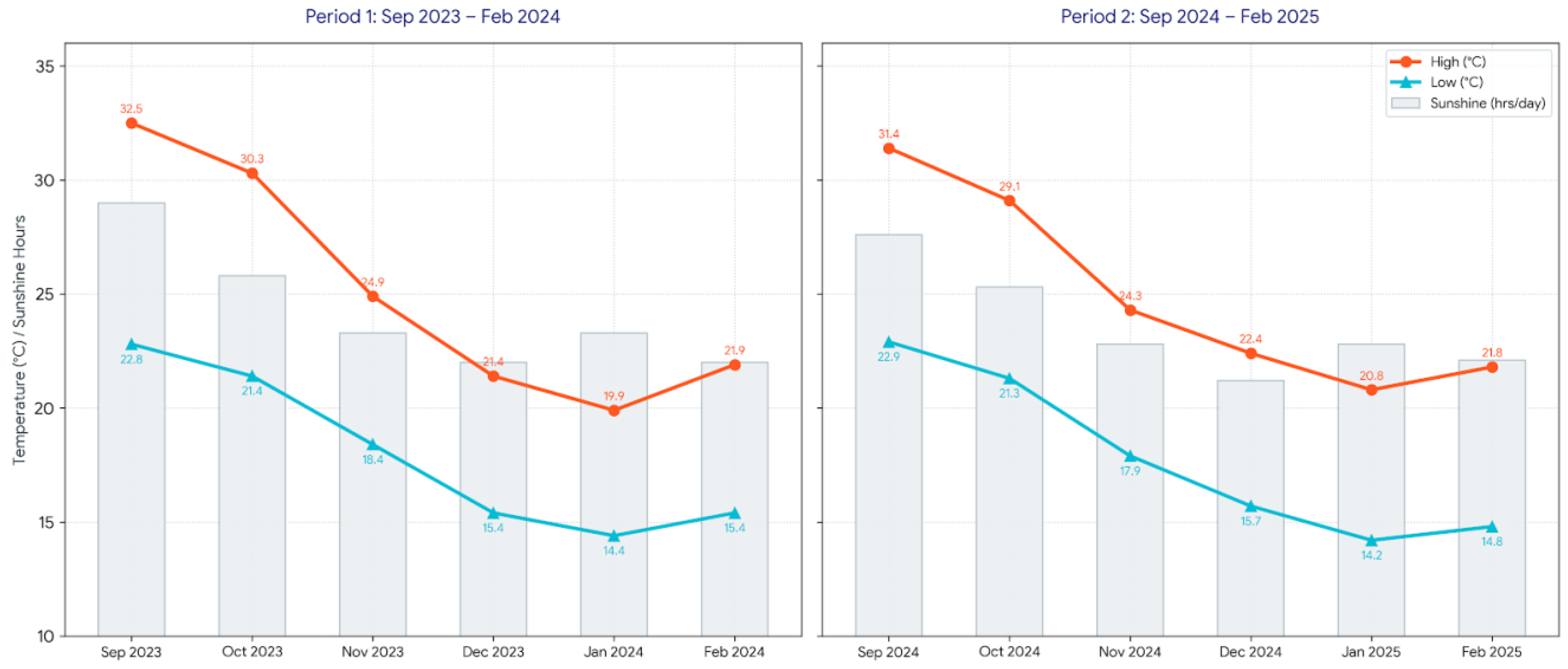
The monthly maximum/minimum temperature (°C) and light density (average sunshine hours/day) during the growth seasons of 2023 and 2024 are displayed in Figure 1. The relative air humidity was approximately 60–75%, and the plants were sprayed 3 times with each OMCT-B dose as follows: A1 = untreated plants (control); A2 = 1 L (OMCT-B)/50 L water; A3 = 1 L (OMCT-B)/100 L water; A4 = 1 L (OMCT-B)/150 L water; and A5 = 1 L (OMCT-B)/200 L water.
Figure 1.
Monthly maximum/minimum temperature (°C) from September 2023 to February 2024 on the main axis and light density (average sunshine hours/day) on the secondary axis.
2.2. Data Recorded
Morphological traits: nine random plants were selected from each replicate to record the following parameters: number of leaves, curd diameter (cm), fresh shoot weights (g), fresh root weights (g), dry shoot weights (g), dry root weights (g), average days of visible curd, average curd weights and total yield (g). Dry weights were determined after oven-drying the samples at 70 °C until a constant weight was reached.
Number of leaves: the number of fully developed leaves per plant was determined by counting the leaves on each sampled plant at harvest.
Curd diameter (cm): curd diameter was measured in centimeters across the widest portion of each curd using a caliper.
Fresh shoot weight (g): fresh shoot weight was determined by weighing the aboveground parts of each sampled plant immediately after harvest using a digital balance (BP 221S; Sartorius AG, Göttingen, Germany).
Fresh root weight (g): fresh root weight was determined after carefully uprooting the plants, washing the roots to remove adhering soil, and gently removing excess surface water before weighing.
Dry shoot weight (g): shoot samples were oven-dried at 70 °C until a constant weight was reached, and the dry weight was recorded using a digital balance.
Dry root weight (g): root samples were oven-dried at 70 °C until a constant weight was reached, and the dry weight was recorded using a digital balance.
Average days to visible curd formation: the number of days from transplanting until the first visible appearance of the curd was recorded for each plant, and the average was calculated for each experimental plot.
Average curd weight (g): average curd weight was calculated by dividing the total fresh weight of harvested curds by the number of harvested curds.
Total yield (ton feddan−1): total yield was estimated by recording the fresh weight of the curds harvested from each experimental plot. The yield was then calculated based on the plot area and converted to ton per feddan (1 feddan = 4200 m2).
Chemical contents: at the end of the seasons, the leaves from 9 random plants in each replicate were picked up for determination of N/P/K/Ca. The mineral contents were determined as percent (% DW) in dry leaves according to [17]. Total nitrogen concentration was determined using the Kjeldahl method, and the results were expressed as a percentage of leaf dry weight (%). Phosphorus concentration in the dried leaf samples was determined colorimetrically using the molybdenum blue method after appropriate digestion of the plant material. The absorbance of the developed color was measured using a spectrophotometer (Jenway 6305; Jenway Ltd., Stone, UK), and phosphorus concentration was expressed as a percentage of leaf dry weight (%). Potassium concentration was determined in the digested leaf samples using a flame photometer (Jenway PFP7; Jenway Ltd., Stone, UK). The concentration was calculated using an appropriate calibration curve and expressed as a percentage of leaf dry weight (%). Calcium concentration was determined in the digested leaf samples using an atomic absorption spectrophotometer. The measured concentration was calculated using an appropriate calibration curve and expressed as a percentage of leaf dry weight (%).
Nitrogen enzyme assay: nitrate reductase (NR; EC 1.7.1.1) and nitrite reductase (NiR; EC 1.7.7.1) were determined spectrophotometrically following the respective assay procedures [18].
Nitrate reductase (NR) activity: frozen leaves (0.2 g) were homogenized in chilled 25 mM phosphate buffer (pH 8.7) containing 10 mM cysteine and 1 mM EDTA. The homogenate was centrifuged at 12,000× g for 15 min at 4 °C, and the supernatant was used for the assay. The reaction mixture containing 100 mM KNO3, 2% (w/v) NADH, and enzyme extract was incubated at 25 °C for 30 min. A control without NADH was run simultaneously. The reaction was stopped by adding 1% (w/v) sulfanilamide in 3 M HCl and 0.02% (w/v) N-(1-naphthyl) ethylenediamine dihydrochloride. After 15 min for color development, the mixture was centrifuged at 12,000× g for 5 min, and absorbance was measured at 540 nm.
Nitrite reductase (NiR) activity: frozen leaf tissue (0.2 g) was homogenized in a chilled mortar with 50 mM Tris–HCl buffer (pH 7.8) containing 1 mM EDTA, 15% (v/v) glycerol, 14 mM 2-mercaptoethanol, and 0.1% (v/v) Triton X-100. The homogenate was centrifuged twice at 10,000× g for 10 min at 4 °C. The resulting supernatant was collected and stored at 4 °C until analysis. NiR activity was determined by measuring the consumption of nitrite (NO2−) at 520 nm using a modified Griess reagent method [18] in a reaction mixture containing 100 mM phosphate-buffered saline (pH 6.5), NaCl, NaNO2, methyl viologen, sodium dithionite (Na2S2O4), and the enzyme extract.
2.3. Statistical Analysis
Data from each of the two growing seasons were analyzed separately by one-way analysis of variance (ANOVA) based on a Randomized Complete Block Design (RCBD), accounting for treatment and block effects. Prior to ANOVA, model assumptions were verified by testing residual normality and homogeneity of variances. The overall treatment effect was evaluated using the ANOVA F-test (p < 0.01), and treatment means were compared using Duncan’s Multiple Range Test (DMRT) at a significance level of p ≤ 0.05 [19]. All results in the tables are presented as means ± standard error (SE) of three replicates, along with relative percentage changes (%) compared with the untreated control. All statistical analyses were performed using CoStat software (Version 6.400; CoHort Software, Monterey, CA, USA).
3. Results
Morphological traits: across the 2023 and 2024 growing seasons, foliar application of oyster mushroom compost tea (OMCT-B) significantly improved all assessed cauliflower vegetative growth and yield parameters compared with the untreated control (p < 0.01). These parameters included leaf number, curd diameter, fresh and dry shoot and root weights, days to visible curd formation, average curd weight, and total yield (Table 4, Table 5, Table 6 and Table 7). The findings revealed a clear nonlinear concentration response pattern, with the intermediate A3 dilution (1:100) consistently producing the most pronounced improvements across all evaluated traits.
Table 4.
Effects of OMCT on the number of leaves and curd diameter (cm) of cauliflower plants during the 2023 and 2024 growing seasons.
Table 5.
Effects of OMCT on the fresh cauliflower shoot and root weights (g) of cauliflower plants during 2023 and 2024 growing seasons.
Table 6.
Effects of OMCT on the dry cauliflower shoot and root weights (g) of cauliflower plants during 2023 and 2024 growing seasons.
Table 7.
Effects of OMCT on the average days of visible curd and average curd weight (kg) of cauliflower plants during 2023 and 2024.
Specifically, the highest number of leaves per plant was obtained under the A3 treatment, reaching 14.64 in the first season (73.05% increase over the control) and 14.89 in the second season (66.18% increase) (Table 4). Similarly, the maximum curd diameters were recorded under A3 at 26.44 cm and 28.23 cm, representing increases of 42.15% and 69.55% compared with the untreated control (18.60 cm and 16.65 cm) in the first and second seasons, respectively (Table 4). Following A3 application, fresh shoot weight increased significantly to 576.66 g and 579.17 g, corresponding to increases of 149.39% and 116.54% over the control (231.23 g and 267.46 g) in the first and second seasons, respectively (Table 5). A similar positive impact was observed on fresh root weight, where A3-treated plants recorded the highest values of 223.40 g (+85.90%) and 234.14 g (+49.21%) compared with the control (120.17 g and 156.92 g) in seasons 1 and 2, respectively (Table 5). Furthermore, the data in Table 6 show that A3 significantly maximized dry shoot weight (+82.89% and +74.89%) and dry root weight (+83.31% and +93.60%) in the first and second seasons, respectively, compared with the untreated control.
As shown in Table 7, the A3 treatment significantly accelerated curd initiation, reducing the average number of days to visible curd formation by 20.54% (75.29 vs. 94.75 days) in the first season and by 20.77% (72.55 vs. 91.57 days) in the second season compared with the control. Consequently, A3 produced the highest average curd weight (6.94 kg and 7.38 kg) and elevated total curd yield to 83.39 and 88.66 ton feddan−1, representing substantial yield increases of 137.04% and 117.41% over the untreated control (35.18 and 40.78 ton feddan−1) in the first and second seasons, respectively (Table 7).
Chemical content: comparing the leaf mineral composition of untreated plants with those sprayed with various OMCT-B dilutions revealed significant improvements across both seasons, with the A3 treatment consistently achieving the highest nutrient accumulation (Table 8).
Table 8.
Effects of OMCT on nutrient content of cauliflower leaves during 2023 and 2024.
Nitrogen (N): foliar application of OMCT-B significantly increased leaf N content, peaking under the A3 treatment at 4.37% and 4.63% DW, which corresponded to increases of 127.60% and 120.48% over the untreated control (1.92% and 2.10% DW) in the first and second seasons, respectively.
Phosphorus (P): leaf P content reached its maximum under A3 at 0.53% and 0.58% DW, representing increases of 278.57% and 241.18% relative to the control (0.14% and 0.17% DW) in the first and second seasons, respectively.
Potassium (K): plants treated with A3 exhibited the highest leaf K concentrations of 2.23% and 2.34% DW, corresponding to increases of 85.83% and 95.00% over the control (1.20% DW in both seasons) in the 2023 and 2024 seasons, respectively.
Calcium (Ca): leaf Ca content responded strongly to OMCT-B application, increasing from 0.05% DW in the untreated control to 0.40% DW (an 8-fold increase) in the first season and 0.60% DW (a 12-fold increase) in the second season under the A3 treatment (Table 8).
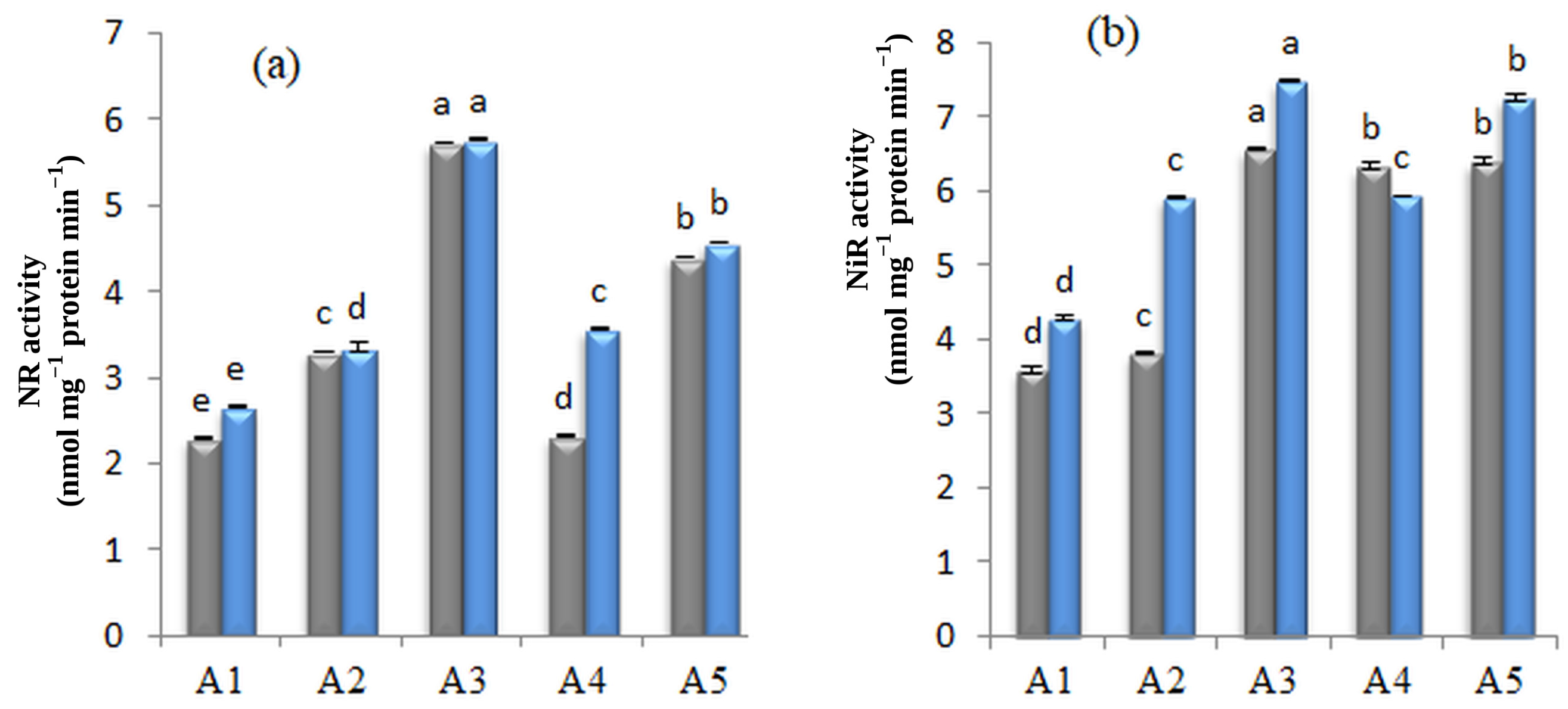
Nitrogen enzymes: due to the enhancement of nutrient content induced by the aforementioned treatments, the present study demonstrated pronounced effects on nitrogen metabolism in cauliflower leaves compared with the control. In both growing seasons, the A3 treatment significantly increased NR activity in cauliflower leaves compared with the untreated control, reaching its maximum value of 5.73 nmol mg−1 protein min−1 in the first season, and 5.76 nmol mg−1 protein min−1 in the second season (Figure 2).
Figure 2.
The changes in nitrate reductase (NR) a and nitrite reductase (NiR) b activity under open-field conditions by using OMCT on cauliflower leaves during 2023 (a) and 2024 (b). The horizontal axis expresses the treatments; bars with the same letters are not significantly different at p ≤ 0.05. Gray axis indicates season 1 while the blue axis indicates season 2.
A similar trend was observed for NiR activity, where the A3 treatment produced a significant increase relative to the control in both seasons, with peak values of 6.57 and 7.48 nmol mg−1 protein min−1 recorded under A3 in the first and second season, respectively (Figure 2).
Correlation Analysis Between Nitrogen Enzymes and the Cauliflower Average Curd Weights
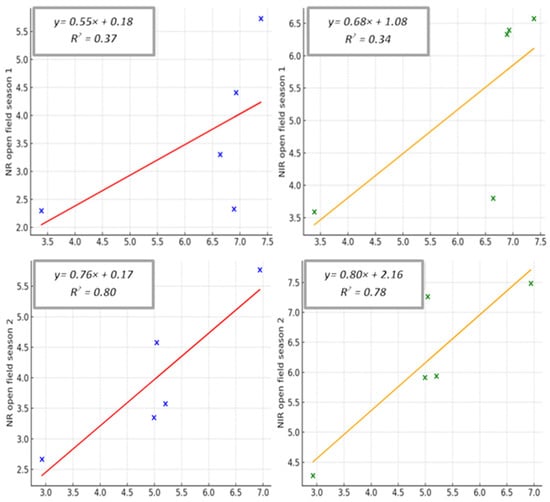
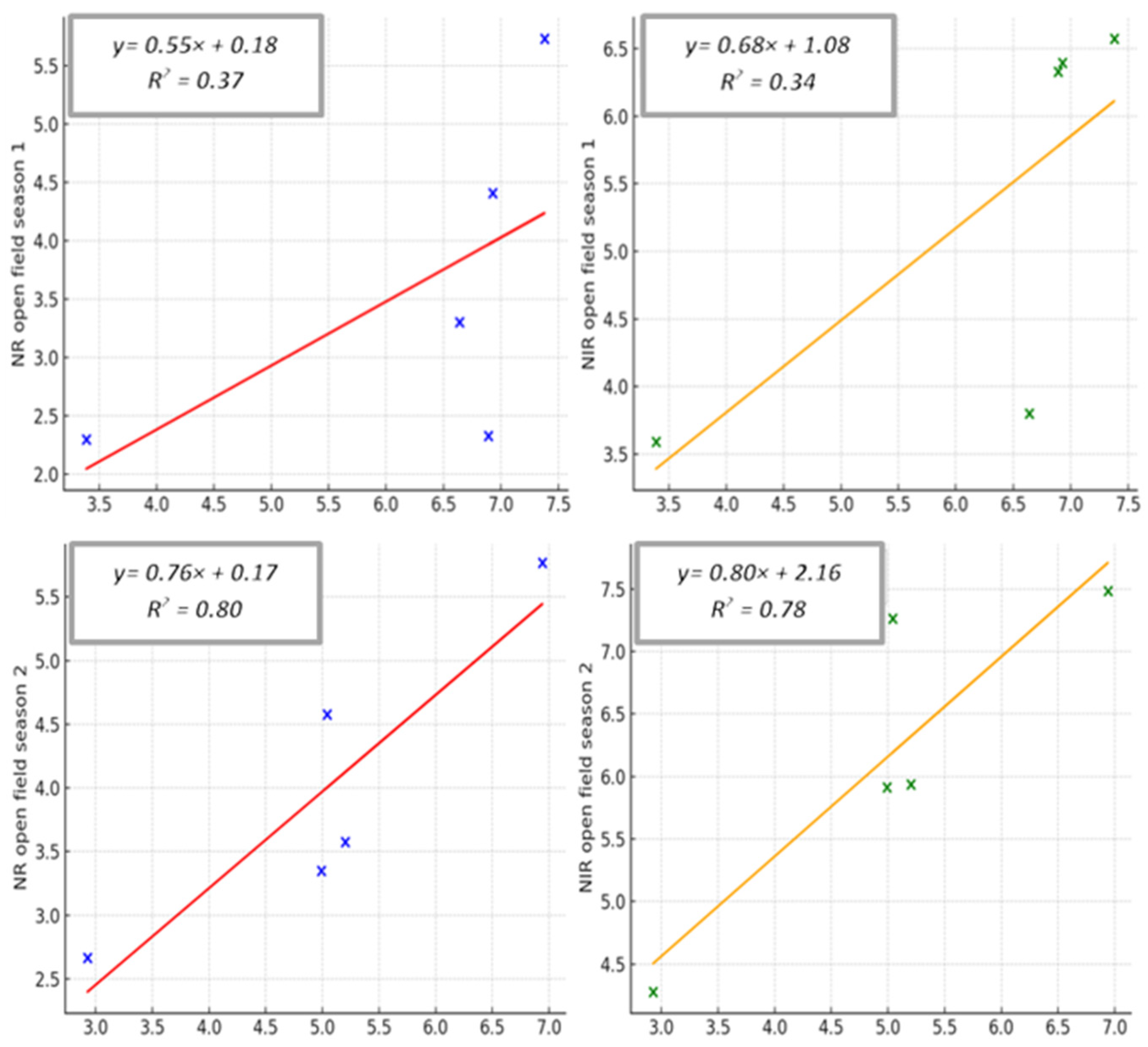
To further elucidate the physiological relationship between nitrogen metabolism and curd development, Pearson correlation analyses were performed between the leaf activities of nitrate reductase (NR) and nitrite reductase (NiR) and the average curd weight of cauliflower under open-field conditions (Figure 3).
Figure 3.
Scatter plots illustrate the relationships between average curd weights (kg) and enzyme activities of cauliflower leaves. With linear regression lines and a matching R2 value, each panel plots a distinct attribute against average curd weights (kg). The x-axis represents the average curd weight (kg), while the y-axis shows the corresponding enzyme activity (NR or NiR) in all panels. Blue (NR) and green (NiR) crosses represent the treatment means (A1–A5), and the red (NR) and orange (NiR) lines represent the fitted linear regression lines. In the first season, NR activity exhibited only a weak positive correlation with average curd weight (R2 = 0.37), suggesting that nitrate reduction was not a principal determinant of curd biomass accumulation under the prevailing conditions of that season. In contrast, a markedly stronger positive relationship between NR activity and average curd weight was recorded in the second season (R2 = 0.80), indicating that the contribution of efficient nitrate assimilation to curd development became considerably more pronounced with time. With respect to NiR, the enzyme activity showed a moderate positive correlation with average curd weight in the first season (R2 = 0.34), which strengthened to a strong positive correlation in the second season (R2 = 0.78).
4. Discussion
Based on the results obtained from this experiment, the treatment with A3 magnificently enhanced all morphological parameters compared to the control and other treatments. Moreover, under open-field conditions, OMCT-B application enhanced curd weight, thereby contributing to a corresponding increase in total yield compared with the untreated control. These results may be associated with the positive relationship between roots and shoot growth, as improved root development can promote aboveground growth by enhancing water and nutrient uptake. In agreement with this interpretation, Pane et al. (2014) [20] reported that enhanced root growth positively affects crop growth and development. The results of this study are consistent with previous research demonstrating the potential of compost teas to improve vegetable productivity. For example, Pane et al. (2014) [20] reported increases in lettuce and kohlrabi commercial yield following compost tea application, while a more recent field study reported yield increases in onion following application of a characterized compost tea formulation [21].
The nonlinear concentration response pattern further indicates that increasing the concentration of OMCT-B did not necessarily produce a greater average curd weight response. The more concentrated A2 treatment (1 L OMCT-B per 50 L water) produced a lower numerical mean curd weight than A3 in both seasons. Similarly, the more diluted A4 and A5 treatments did not exceed the mean observed under A3. This pattern may be attributed to the possibility that the intermediate dilution provided a more favorable balance of nutrients and potentially bioactive organic compounds, thereby influencing plant responses under the conditions of the present experiment. The response may also be attributed to differences in cultivar type and crop species.
The results of the present study showed that, compared with the untreated control, cauliflower plants treated with different OMCT-B dilutions exhibited higher nutrient concentrations, with the A3 dilution producing the most favorable response in both growing seasons. Our results suggest that foliar application of OMCT enhanced root growth, as evidenced by increased root fresh weight, which may have contributed to improved water and nutrient uptake from the root zone. This improvement in root development may, in turn, have facilitated greater nutrient acquisition and contributed to the higher nutrient concentrations observed in the leaves compared with the untreated control. The improvement in mineral content, especially nitrogen, may be attributed to optimal light assimilation that accelerates root growth, which in turn affects nutrient absorption and water uptake; consequently, this may be attributed to the optimal chlorophyll content, which leads to increased plant development parameters and cauliflower average curd weight and yield [22]. It is well established that nitrogen is a crucial nutrient for the plant life cycle, which is involved in physiological functions and enzyme metabolism activities. Nitrogen is being used by farmers to stimulate curd initiation and size of cauliflower as well as the total yield [23].
Our results showed that A3 significantly increased phosphorus concentration in cauliflower leaves compared with the untreated plants. The improved P status under A3 application may be partly attributed to changes in plasma membrane lipid composition and the regulation of genes involved in phosphorus uptake and metabolism. This hypothesis is consistent with previous findings showing that alterations in membrane lipid composition and the expression of P-responsive genes can enhance phosphorus acquisition and utilization in plants [24,25]. Furthermore, P availability is essential for plant improvement because the forms of inorganic P absorbed by plant roots are minimally soluble in soil solution due to retention by oxides and clay minerals and the immobilization of P into organic forms. Potassium (K+) is an essential cationic macronutrient that plays a fundamental role in plant growth and development, particularly in terrestrial plants. In the present study, foliar application of oyster mushroom compost tea (OMCT) at different dilutions enhanced potassium (K) accumulation in cauliflower leaves, with the A3 dilution exhibiting the most pronounced response. This enhancement indicates that OMCT, particularly at the A3 dilution, may contribute to improving plant nutritional status and could potentially support nutrient availability and soil fertility under the conditions evaluated. Potassium also serves to maintain structural rigidity by contributing to the vacuole’s osmotic pressure and activating important enzyme activities [26].
The observed differences in Ca content between the OMCT treatments represented about an 8- to 12-fold increase by A3 compared to untreated control in S1 and S2. And the untreated control may suggest a potential role of OMCT, particularly the A3 dilution, in enhancing calcium nutrition in cauliflower. Given that calcium is an essential plant macronutrient with important structural and signaling functions, the enhanced Ca status observed under A3 may potentially contribute to improved plant growth and development. Moreover, the organic substances present in OMCT could rapidly activate plasma membrane H+-ATPase, resulting in proton efflux and subsequent changes in the electrochemical gradient across the plasma membrane. These changes facilitate Ca2+ influx into root cells, producing a transient increase in cytosolic Ca2+ concentration (Ca2+ spike). This transient Ca2+ signal subsequently acts as an important regulator of downstream cellular processes involved in nutrient uptake, ion homeostasis, and root development. As Ca2+ levels increase, feedback regulation may reduce H+-ATPase activity, thereby contributing to the maintenance of an appropriate root surface pH and regulating ion uptake, and root expansion [27,28] revealed that the root tip or areas of lateral root initiation absorb calcium, which then moves through the interconnected cytoplasm or extracellular gaps in order to reach the xylem.
In the present study, application of OMCT-B at a 1:100 dilution (A3) positively influenced nitrogen metabolism in cauliflower leaves during both growing seasons. The observed response by spraying A3 may be related to the ability of plant roots to absorb both nitrate and ammonium through specific transport systems, with subsequent translocation of absorbed nitrogen to the shoot. The enhanced activities of nitrate reductase (NR) and nitrite reductase (NiR) under A3 suggest an improvement in the nitrate assimilation process, which may have contributed to the superior plant growth, average curd weight, and quality attributes observed in this treatment. Nitrogen metabolism is closely associated with the efficiency of nitrate uptake, translocation, reduction, and subsequent incorporation into organic nitrogen compounds, such as amino acids and proteins, required for plant growth and development. Previous research has demonstrated that enhancement of NR and NiR activities in plant leaves may be associated with their roles in nitrate uptake, translocation, and remobilization from roots to shoots, thereby affecting vegetative growth and productivity [29]. The enhanced NR and NiR activities observed following A3 application may be attributed to improved nitrogen availability in the rhizosphere and/or the stimulatory effects of organic compounds and beneficial microorganisms associated with OMCT-B. The organic fraction of compost tea may improve nutrient availability and root functioning, while associated beneficial microorganisms may contribute indirectly to nutrient mobilization and plant nutrient acquisition. These effects could enhance the supply of nitrogen to the plant and consequently support the enzymatic processes involved in nitrate assimilation. Nevertheless, these proposed mechanisms remain hypothetical and should be verified through further investigations involving nitrogen uptake, translocation, and assimilation pathways [30].
Our study could suggest that the positive correlation between nitrogen enzymes and total curd yield can be attributed to increased morphological parameters and enhanced nutrient assimilation by using OMCT, which may contain hormones and other beneficial substances, as well as beneficial bacteria. Additionally, a previous study revealed that enhancing nutrient uptake in plants can lead to the production of hormones in the plant organs [31]. This increase in levels and their movement from the roots to the shoots enhances shoots development, thereby promoting overall plant growth and increasing average curd weight and yield. At all events, the outcome of the current research indicates that applying OMCT as a spray could quickly enhance the total yield of cauliflower plants. Future investigations should directly compare foliar and soil-drench applications of OMCT and evaluate nutrient uptake kinetics, root architecture, rhizosphere microbial dynamics, and soil enzymatic activities to verify the exact pathways underlying the observed growth and yield responses. An additional limitation of the present study is that the open-field evaluation focused exclusively on dilutions of a single formulation (OMCT-B), even though four formulations (OMCT-A to OMCT-D) were prepared during the initial laboratory screening. Consequently, future field trials should compare multiple OMCT formulations alongside commercial biostimulants to confirm whether the formulation selected via chemical and microbiological screening consistently delivers the highest agronomic and economic returns under field conditions.
5. Conclusions
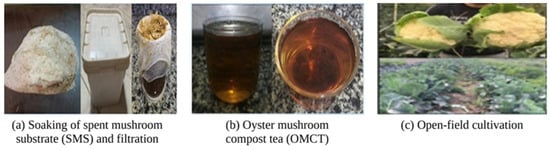
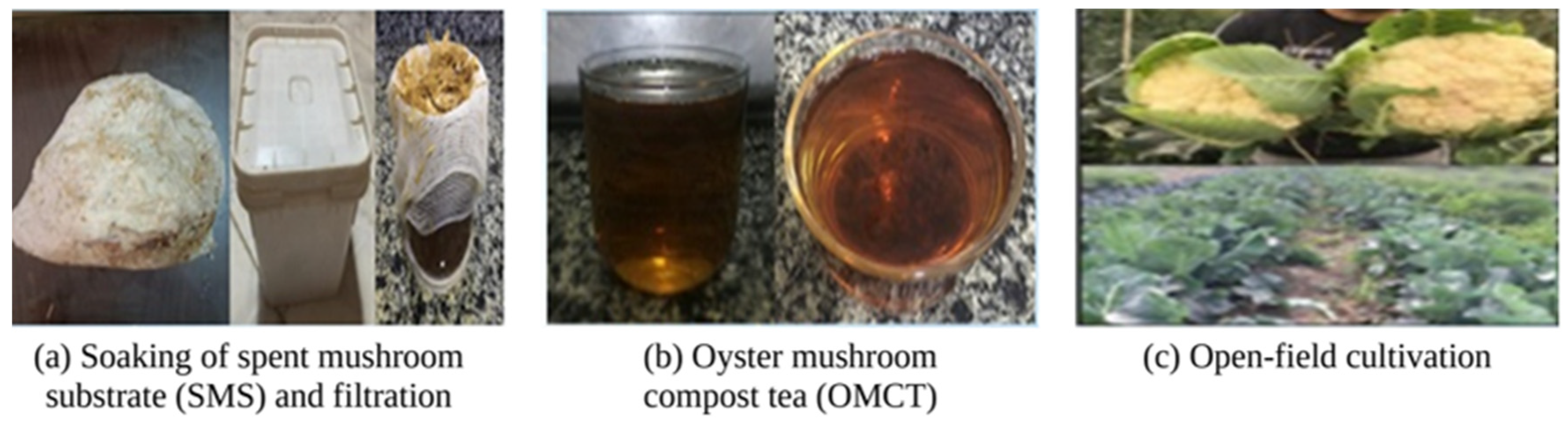
In conclusion, foliar application of OMCT-B at a 1:100 dilution (A3; 1 L OMCT-B per 100 L water), applied three times at 15-day intervals after transplanting, showed promising potential to improve cauliflower curd development, nutrient accumulation, and nitrate reductase (NR) and nitrite reductase (NiR) activities under the conditions evaluated in the present study. The workflow for preparing OMCT and applying it to cauliflower under open-field conditions is summarized in Figure 4. Nevertheless, the scope of these findings is constrained by the evaluation of a single location, one cauliflower cultivar (El-Soultani), and two consecutive growing seasons. Further multi-location and multi-environment studies involving diverse cultivars are therefore warranted to validate the consistency and broader applicability of the observed responses and to optimize OMCT-B application timing and frequency. Future research should also elucidate the biochemical and microbial mechanisms underlying the observed effects and evaluate the long-term implications of OMCT-B application for crop performance. Overall, the results indicate that oyster mushroom compost tea may represent a promising organic input for supporting sustainable cauliflower production. However, additional studies are needed to determine the underlying mechanisms, economic feasibility, and performance across different soils, cultivars, and environments.
Figure 4.
Preparing oyster mushroom compost tea stages and its usage in cauliflower under open-field conditions.
Author Contributions
Conceptualization, E.M. and S.H.A.; methodology, E.M. and S.H.A.; software, I.A.; validation, I.A. and E.A.; formal analysis, I.A. and S.H.A.; investigation, E.M. and S.H.A.; resources, S.H.A. and E.A.; data curation, E.M. and I.A.; writing—original draft preparation, E.M. and S.H.A.; writing—review and editing, I.A. and E.A.; visualization, I.A.; supervision, S.H.A. and E.A.; project administration, S.H.A.; funding acquisition, E.A. All authors have read and agreed to the published version of the manuscript.
Funding
This research received no external funding.
Institutional Review Board Statement
This article does not contain any studies with human or animal subjects. The current experimental research and field study, including the collection of plant material, comply with relevant institutional, national, and international guidelines and legislation and are used for research and development.
Informed Consent Statement
Not applicable.
Data Availability Statement
The original contributions presented in this study are included in the article. Further inquiries can be directed to the corresponding authors.
Acknowledgments
The researchers would like to thank the Deanship of Graduate Studies and Scientific Research at Qassim University (https://www.qu.edu.sa) for financial support (QU-APC-2026). During the preparation of this study, the authors used Gemini 4 Argon for the purposes of language editing and text refinement. The authors have reviewed and edited the output and take full responsibility for the content of this publication.
Conflicts of Interest
The authors declare no conflicts of interest.
References
- Kushwaha, A.; Baily, S.B.; Maxton, A.; Ram, G.D. Isolation and characterization of PGPR associated with cauliflower roots and its effect on plant growth. Bioscan 2013, 8, 95–99. [Google Scholar]
- Abdelgalil, S.H.; Mohamed, E.; Teiba, I.I.; Lamlom, S.F.; Abdelghany, A.M.; Shalaby, M.E. Enhancing Pearl oyster mushroom (Pleurotus ostreatus (Jacq.) P. Kumm) performance by evaluating the influence of potassium humate and wheat straw on yield and biochemical attributes. BMC Plant Biol. 2025, 25, 930. [Google Scholar] [CrossRef] [Scilit]
- Zahid, A.; Fozia; Ramzan, M.; Bashir, M.A.; Khatana, M.A.; Akram, M.T.; Nadeem, S.; Qureshi, M.S.; Iqbal, W.; Umar, M.; et al. Effect of humic acid enriched cotton waste on growth, nutritional and chemical composition of oyster mushrooms (Pluerotus ostreatus and Lentinus sajorcaju). J. King Saud Univ. 2020, 32, 3249–3257. [Google Scholar] [CrossRef] [Scilit]
- Miśkiewicz, K.; Gendaszewska, D.; Sieczyńska, K.; Gutarowska, B. Agri-food wastes as substrates for oyster mushroom (Pleurotus ostreatus) cultivation and their agricultural potential. Sci. Rep. 2025, 15, 42617. [Google Scholar] [CrossRef] [Scilit]
- Mohamed, M.F.; Refaei, E.F.S.; Abdalla, M.M.A.; Abdelgalil, S.H. Fruiting bodies yield of oyster mushroom (Pleurotus columbinus) as affected by different portions of compost in the substrate. Int. J. Recycl. Org. Waste Agric. 2016, 5, 281–288. [Google Scholar] [CrossRef] [Scilit]
- Ayilara, M.S.; Olanrewaju, O.S.; Babalola, O.O.; Odeyemi, O. Waste management through composting: Challenges and potentials. Sustainability 2020, 12, 4456. [Google Scholar] [CrossRef] [Scilit]
- González-Hernández, A.I.; Suárez-Fernández, M.B.; Pérez-Sánchez, R.; Gómez-Sánchez, M.Á.; Morales-Corts, M.R. Compost tea induces growth and resistance against Rhizoctonia solani and Phytophthora capsici in pepper. Agronomy 2021, 11, 781. [Google Scholar] [CrossRef] [Scilit]
- Pilla, N.; Tranchida-Lombardo, V.; Gabrielli, P.; Aguzzi, A.; Caputo, M.; Lucarini, M.; Durazzo, A.; Zaccardelli, M. Effect of compost tea in horticulture. Horticulturae 2023, 9, 984. [Google Scholar] [CrossRef] [Scilit]
- Zaccardelli, M.; Pane, C.; Scotti, R.; Palese, A.M.; Celano, G. Impiego di compost-tea come bioagrofarmaci e biostimolanti in ortofrutticoltura. Italus Hortus 2012, 19, 17–28. [Google Scholar]
- Eudoxie, G.; Martin, M. Compost tea quality and fertility. In Organic Fertilizers-History, Production and Applications; IntechOpen: London, UK, 2019. [Google Scholar]
- Milinković, M.; Lalević, B.; Jovičić-Petrović, J.; Golubović-Ćurguz, V.; Kljujev, I.; Raičević, V. Biopotential of compost and compost products derived from horticultural waste—Effect on plant growth and plant pathogens’ suppression. Process Saf. Environ. Prot. 2019, 121, 299–306. [Google Scholar] [CrossRef] [Scilit]
- De Corato, U. Agricultural waste recycling in horticultural intensive farming systems by on-farm composting and compost-based tea application improves soil quality and plant health: A review under the perspective of a circular economy. Sci. Total Environ. 2020, 738, 139840. [Google Scholar] [CrossRef] [Scilit]
- Mengesha, W.K.; Gill, W.M.; Powell, S.M.; Evans, K.J.; Barry, K.M. A study of selected factors affecting efficacy of compost tea against several fungal pathogens of potato. J. Appl. Microbiol. 2017, 123, 732–747. [Google Scholar] [CrossRef] [Scilit]
- Samet, M.; Ghazala, I.; Karray, F.; Abid, C.; Chiab, N.; Nouri-Ellouz, O.; Sayadi, S.; Gargouri-Bouzid, R. Isolation of bacterial strains from compost teas and screening of their PGPR properties on potato plants. Environ. Sci. Pollut. Res. 2022, 29, 75365–75379. [Google Scholar] [CrossRef] [Scilit]
- Badawi, G.H.; Yamauchi, Y.; Shimada, E.; Sasaki, R.; Kawano, N.; Tanaka, K.; Tanaka, K. Enhanced tolerance to salt stress and water deficit by overexpressing superoxide dismutase in tobacco (Nicotiana tabacum) chloroplasts. Plant Sci. 2004, 166, 919–928. [Google Scholar] [CrossRef] [Scilit]
- Hassan, A.A. Production of Vegetable Crops; Al-Dar Al-Arabiah Lil Nashr Wa Al-Tawsia: Nasr City, Egypt, 1991. [Google Scholar]
- Agroindustriais, P. AOAC. Official methods of analysis of the Association of Official Analytical Chemists. Caracter. Propagação Melhor. Genético Pitaya Comer. Nativ. Cerrado 2013, 26, 62. [Google Scholar]
- Chen, G.; Fan, P.S.; Feng, W.M.; Guan, A.Q.; Lu, Y.Y.; Wan, Y.L. Effects of 5-aminolevulinic acid on nitrogen metabolism and ion distribution of watermelon seedlings under salt stress. Russ. J. Plant Physiol. 2017, 64, 116–123. [Google Scholar] [CrossRef] [Scilit]
- Duncan, D.B. Multiple range and multiple F tests. Biometrics 1955, 11, 1–42. [Google Scholar] [CrossRef] [Scilit]
- Pane, C.; Palese, A.M.; Celano, G.; Zaccardelli, M. Effects of compost tea treatments on productivity of lettuce and kohlrabi systems under organic cropping management. Ital. J. Agron. 2014, 9, 596. [Google Scholar] [CrossRef] [Scilit]
- Moussa, M.; Carine, N.N.; Jordan, N.N.; Ngakou, A. Influence of compost and compost tea quality (components and microbiome) in boosting onion yield in the field. Int. J. Agric. Ext. 2025, 13, 129–138. [Google Scholar] [CrossRef] [Scilit]
- Fahruddin, F. Pengaruh Konsentrasi Dan Frekuensi Pemberian Bap (Benzyl Amino Purine) Terhadap Pertumbuhan Bibit Kakao (Theobroma cacao L.). Bachelor’s Thesis, Universitas Sebelas Maret, Surakarta, Indonesia, 2011. [Google Scholar]
- Kc, N.K.; Giri, H.N.; Sharma, M.D.; Tripathi, K.M. Effects of nitrogen on growth, yield and postharvest quality of selected cauliflower (Brassica oleracea) varieties. SAARC J. Agric. 2021, 19, 195–205. [Google Scholar] [CrossRef] [Scilit]
- Arnaud, C.; Clément, M.; Thibaud, M.-C.; Javot, H.; Chiarenza, S.; Delannoy, E.; Revol, J.; Soreau, P.; Balzergue, S.; Block, M.A.; et al. Identification of phosphatin, a drug alleviating phosphate starvation responses in Arabidopsis. Plant Physiol. 2014, 166, 1479–1491. [Google Scholar] [CrossRef] [Scilit]
- Wissuwa, M.; Gamat, G.; Ismail, A.M. Is root growth under phosphorus deficiency affected by source or sink limitations? J. Exp. Bot. 2005, 56, 1943–1950. [Google Scholar] [CrossRef] [Scilit]
- Tuncturk, R.; Kulaz, H.; Tuncturk, M. Effect of Humic Acid Applications on Some Nutrient Contents of Soybean (Glycine max L.) Cultivars. Oxid. Commun. 2016, 39, 503. [Google Scholar]
- Santos, M.P.; Zupunski, M.; Monda, H.; Gralian, J.; James, A.; Grossmann, G.; Lamar, R.T.; Zandonadi, D.B. Humic acids modify root architecture in Arabidopsis through H+-ATPase-dependent target of rapamycin activation in concert with Ca2+ and ROS signaling. Chem. Biol. Technol. Agric. 2025, 12, 47. [Google Scholar] [CrossRef] [Scilit]
- White, P.J. The pathways of calcium movement to the xylem. J. Exp. Bot. 2001, 52, 891–899. [Google Scholar] [CrossRef] [Scilit]
- Zhang, Y.; Hu, X.-H.; Shi, Y.; Zou, Z.-R.; Yan, F.; Zhao, Y.-Y.; Zhang, H.; Zhao, J.-Z. Beneficial role of exogenous spermidine on nitrogen metabolism in tomato seedlings exposed to saline-alkaline stress. J. Am. Soc. Hortic. Sci. 2013, 138, 38–49. [Google Scholar] [CrossRef] [Scilit]
- Liu, C.; Wang, Y.; Pan, K.; Zhu, T.; Li, W.; Zhang, L. Carbon and nitrogen metabolism in leaves and roots of dwarf bamboo (Fargesia denudata Yi) subjected to drought for two consecutive years during sprouting period. J. Plant Growth Regul. 2014, 33, 243–255. [Google Scholar] [CrossRef] [Scilit]
- Simão, B.R.; Santos, T.d.O.; do Amaral Junior, A.T.; Pinto, V.B. Integrative Strategies to Enhance Phosphorus Use Efficiency in Maize: Plant Breeding, Soil Dynamics and Plant–Microbe Interactions Under Phosphorus Stress. Stresses 2026, 6, 10. [Google Scholar] [CrossRef] [Scilit]

Disclaimer/Publisher’s Note: The statements, opinions and data contained in all publications are solely those of the individual author(s) and contributor(s) and not of MDPI and/or the editor(s). MDPI and/or the editor(s) disclaim responsibility for any injury to people or property resulting from any ideas, methods, instructions or products referred to in the content. |
© 2026 by the authors. Licensee MDPI, Basel, Switzerland. This article is an open access article distributed under the terms and conditions of the Creative Commons Attribution (CC BY) license.