


Abstract
Wildfires are a key ecological factor shaping many of the world’s ecosystems, including Mediterranean ones. However, recent shifts in fire regimes driven by a combination of climate change, demographic and socioeconomic factors are increasing the risk of high-severity wildfires, posing severe threats to protected areas, including Natura 2000 sites. In Italy, one of the world’s biodiversity hotspots, these challenges are particularly relevant. We used spatial data to analyze wildfire trends in Italy between 2008 and 2023, with a focus on Natura 2000 sites. We also assessed the economic impacts associated with them through a benefit transfer exercise. Natura 2000 sites account for approximately 30% of the total burned area recorded in Italy over the study period, corresponding to estimated economic losses of ecosystem services foregone ranging from €135.14 million to €186.45 million (i.e., €8.4–11.6 million year−1). At the sub-national scale, these losses may amount to nearly 40% of annual operating expenditures for Natura 2000 management in fire-prone regions like Sicily, highlighting the substantial financial implications of wildfire occurrence in protected areas. Findings can inform future management and policymaking choices in the context of ongoing conservation challenges and the nature restoration targets set by both European and national policies.
1. Introduction
Wildfires are a key ecological factor shaping many of the world’s ecosystems [1]. In the Mediterranean region, fire is one of the main drivers of ecosystem dynamics, interacting with land-use and climate change to influence habitat composition, structure, and functioning [2,3,4,5]. Although the ecological role of fire in maintaining key ecosystem processes and shaping biodiversity patterns has long been recognized, in human-dominated Mediterranean landscapes wildfires are largely perceived as major socioeconomic disturbances due to their potential adverse effects on infrastructure, livelihoods, and human safety [6]. These concerns have intensified as fire regimes have changed in response to environmental and socioeconomic transformations. Historically, fire regimes in European Mediterranean ecosystems were characterized by recurrent low-intensity fires, interspersed with occasional high-severity events [7]. These fire regimes facilitated species persistence and shaped evolutionary trajectories over centuries [8]. However, demographic and socioeconomic transformations, land abandonment, declining active management, long-term fire suppression policies and climate change [9,10] are modifying Mediterranean fire regimes. This ultimately results in an increase in the frequency and intensity of high-severity wildfires, although their effects vary across locations and depend on interactions among climatic conditions, vegetation, and land-use patterns [4]. The magnitude, pace and intensity of these changes pose significant challenges even for species adapted to historical fire patterns [11,12]. Consequently, the growing prevalence of large, high-intensity wildfires can pose an increasing threat to protected ecosystems within the Mediterranean biodiversity hotspot, potentially undermining socioecological system resilience and biodiversity conservation [13,14].
Within this context, the protection of habitats encompassed by the Natura 2000 network, Europe’s cornerstone of biodiversity conservation, assumes particular importance. Established in the early 1990s through the Habitats Directive (Directive 92/43/EEC) and further reinforced through the Birds Directive (Directive 2009/147/EC), Natura 2000 is a Europe-wide network of protected areas designed to conserve biodiversity by safeguarding natural habitats and wild species of European importance. Many Natura 2000 sites across Mediterranean countries have been repeatedly affected by large wildfires, resulting in habitat conversion, species composition shifts, and altered ecological trajectories that threaten the achievement of the network’s conservation objectives [15,16]. In 2023, approximately 41% of the total area burned in Europe occurred within Natura 2000 sites, despite these areas covering only about 18% of the European territory [17]. Forest habitats are among the most affected ones, as they tend to be intrinsically exposed to fire risks, and 50% of the overall protected area under Natura 2000 is forest [18]. Beyond the direct environmental damages of burning on vegetation and habitats, wildfires can have devastating effects on biodiversity in terms of impacts on trophic chains due to the loss of vegetation [19], degradation of refuge habitats and food sources (increasing the vulnerability of surviving animals to predation [20,21,22,23]), and changes to landscapes [24]. Furthermore, fire can facilitate the establishment and spread of some alien plant species in Mediterranean-type ecosystems, potentially increasing the risk of biological invasions [25].
In Italy—one of the biodiversity hotspots globally, recognized as a priority ecoregion [26]—these patterns are particularly evident. Recurrent wildfire seasons, coupled with socioeconomic drivers such as rural depopulation, declining grazing activities, and reduced fuel management, have heightened the exposure of Natura 2000 habitats to high-severity wildfires [27,28]. Over the past two decades, approximately 40–50% of wildfire-affected areas in Italy have consisted of forests, while a large proportion of ignitions have occurred in the wildland–urban interface, with fires often spreading into adjacent forests and semi-natural habitats [29]. The substantial contribution of forests to the area burned should also be considered in the context of the expansion of forest cover across the country in the last seventy years [30].
Climate change may further exacerbate these risks. Italy encompasses both Mediterranean areas already exposed to substantial fire risk and Alpine environments where changing climatic conditions may alter the seasonality and geographical distribution of fire risk. Rising temperatures, more frequent heat extremes and drought-related reductions in vegetation moisture are expected to intensify fire-weather conditions in Mediterranean regions. In mountain areas, warmer and drier conditions may also extend the period of elevated fire danger into spring and autumn and increase wildfire risk in mountain areas where fires have historically been less frequent [31]. Moreover, Italy is the European Union (EU) Member State with the largest proportion of national forest area designated under Ministerial Conference on the Protection of Forests in Europe (MCPFE) Class 1 indicators, corresponding to forests protected for biodiversity conservation (including Natura 2000 sites) [32]. This extensive overlap between forest conservation and fire-prone environments is reflected in the high proportion of Natura 2000 sites affected by wildfires in Italy relative to other fire-prone Southern European countries in recent years [16,17]. These interacting climatic, environmental, and socioeconomic factors make Italy a particularly relevant case study for assessing wildfire impacts on protected habitats.
Natura 2000 sites—i.e., Special Protection Areas (SPAs) for birds and Sites of Community Importance (SCIs), which are designated as Special Areas of Conservation (SACs) to protect habitats and species—represent legally designated conservation priorities under the European Union (EU) Habitats and Birds Directives. Therefore, quantifying the extent and severity of wildfire impacts within this network is essential for assessing conservation status, reporting under Article 17 of the Habitats Directive, and prioritizing restoration and risk mitigation efforts. Natura 2000 sites are also expected to constitute priority targets for restoration interventions promoted within the framework of the EU Nature Restoration Regulation [33]. Restoring these areas without considering their vulnerability to wildfires and implementing appropriate fuel management strategies, such as prescribed burning, would undermine the effectiveness and efficiency of restoration efforts and associated investments. The above-reported considerations seem even more relevant in light of targets set by the EU Biodiversity Strategy for 2030 that, besides restoring degraded ecosystems, aims to protect 30% of EU land and sea, with 10% strictly protected [34].
Despite the growing recognition of wildfire impacts on biodiversity, there remains limited understanding of their economic consequences, particularly regarding the loss of nature’s contributions to people [35,36] and ecosystem services [37] such as carbon sequestration, soil protection, recreation, and cultural values. From an economic perspective, a wildfire can be seen as “an event that interrupts or impedes the flow of goods and services provided by forest ecosystems that are desired by people” [38]. The valuation of these losses in monetary terms is crucial to inform cost–benefit analyses, support evidence-based policy design, and justify investments in prevention, restoration, and adaptive management. In particular, estimating these losses can help policymakers make the economic implications of wildfire damage more explicit and support the allocation of limited resources towards prevention and mitigation measures. This is especially relevant in Mediterranean EU countries, where wildfire management risks are becoming trapped in a cycle of reactive firefighting rather than addressing the underlying drivers of fire risk. This so-called “firefighting trap” reflects a management paradigm that prioritizes fire suppression while insufficiently addressing fuel accumulation, landscape change, and other factors contributing to increasingly severe fires [39]. Recent evidence from the European Court of Auditors reinforces the importance of this issue: although some EU Member States have increased their use of EU funding for forest-fire prevention, the long-term sustainability of the results has not always been ensured [40]. These challenges highlight the importance of evaluating wildfire impacts in terms of avoided socioeconomic and ecological damages, thereby supporting a shift towards more preventive, integrated, and long-term approaches to wildfire risk management.
Building upon these considerations, the present study aims to (i) identify and spatially analyze Natura 2000 sites affected by wildfires in Italy; (ii) perform an economic assessment of the damages associated with biodiversity decline and ecosystem service degradation. By integrating spatial, ecological, and economic analyses, this research contributes to improving the understanding of wildfire impacts on nature protection areas and provides an evidence base to inform national and sub-national conservation planning, restoration priorities, and wildfire risk management strategies.
2. Materials and Methods
This section outlines the methodological approaches adopted for the study. It first introduces the case study area (Section 2.1), followed by a description of the procedures for general data collection (Section 2.2) and data analysis (Section 2.3).
2.1. Case Study Area
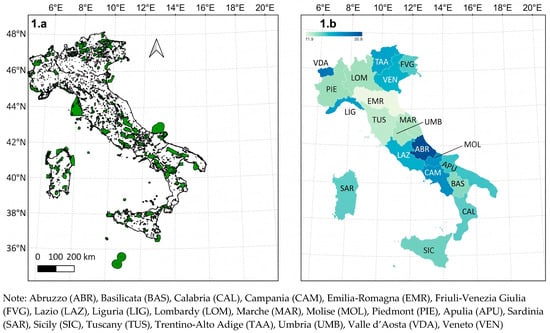
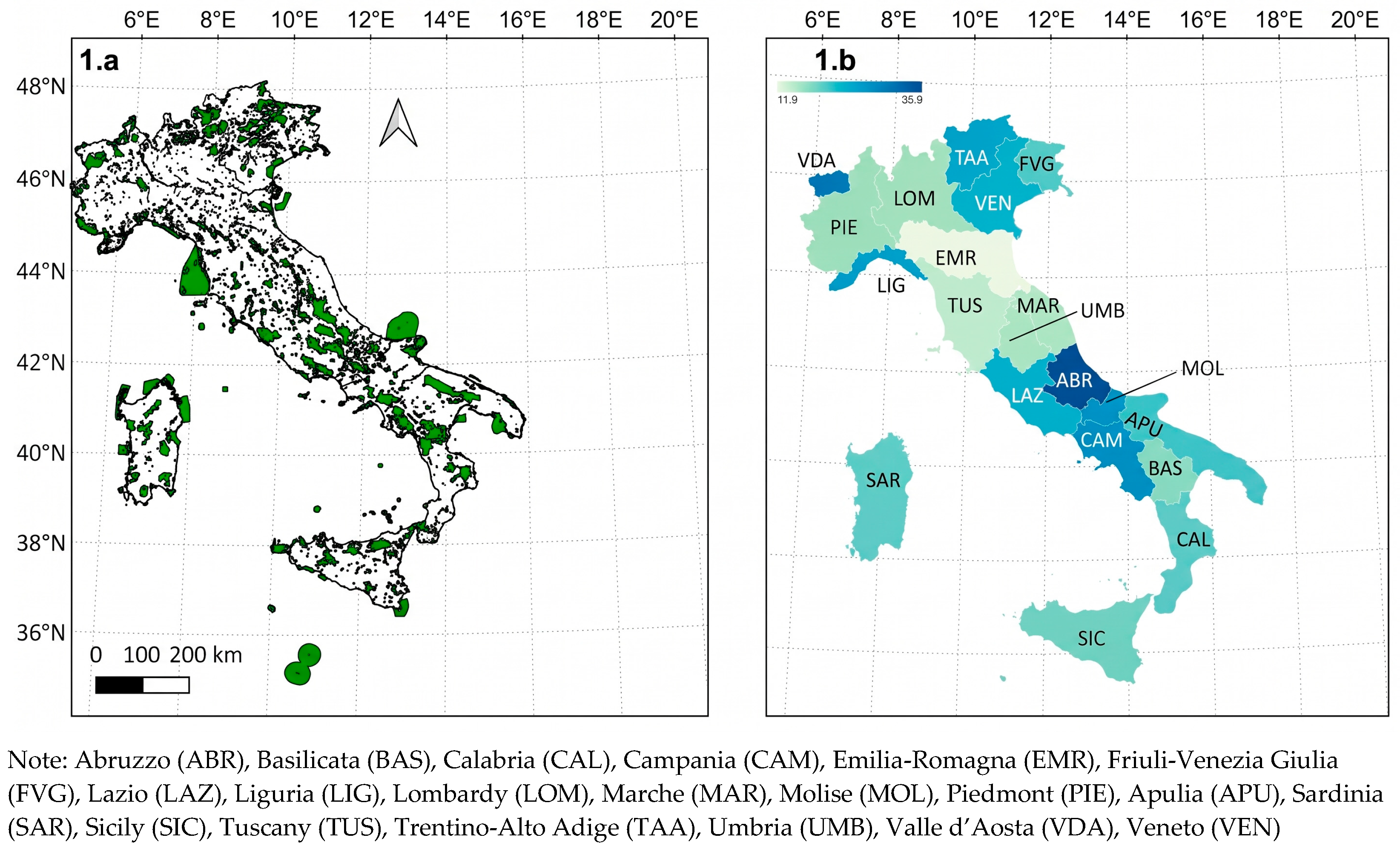
The Natura 2000 network in Italy covers approximately 19.4% of Italy’s land territory and 6.5% of its territorial waters [41] (Figure 1a). The extent of this coverage varies significantly across Italian regions (corresponding to NUTS-2 level according to the Nomenclature of Territorial Units for Statistics (NUTS) classification adopted by Eurostat) (Figure 1b).
Figure 1.
(a) Total designated sites in the Natura 2000 network (green shade) and (b) share of terrestrial Natura 2000 sites over total area per NUTS-2 regions. Values expressed as a percentage (source: authors’ elaborations based on BISE [42]).
Abruzzo and Valle d’Aosta, for example, are the only two NUTS-2 regions with Natura 2000 sites covering at least 30% of their territories (36% and 30% respectively), thus meeting the EU Biodiversity Strategy for 2030 target, which calls for expanding protected areas in the EU to reach at least 30% of terrestrial and 30% of marine areas. Other regions approaching this target include the Autonomous Province of Trento (28%), Molise (27%), Campania (27%), and Liguria (26%). All other regions are still below the target, with Tuscany, Marche, Piemonte and Umbria setting around 15% [41].
Forest habitats (European Nature Information System (EUNIS) macrocategory 9) are the most common ones within the national Natura 2000 network, especially in the Alpine and Continental regions, followed by grassland habitats (EUNIS macrocategory 6), while macrocategories with the lowest percentage of coverage are those related to coastal environments, such as Coastal, sand dunes and inland dunes and Coastal and halophytic habitats [43]. The most common forest habitat types include prevalently Mediterranean habitats like Eastern white oak woods (EUNIS code 91AA) and Salix alba and Populus alba galleries (92A0), and, to a lower extent, continental and alpine habitats like Alluvial forests with Alnus glutinosa and Fraxinus excelsior (Alno-Padion, Alnion incanae, Salicion albae) (91E0), Castanea sativa woods (9260), Acidophilous Picea forests of the montane to alpine levels (Vaccinio-Piceetea) (9410), and Alpine Larix decidua and/or Pinus cembra forests (9420).
2.2. Data Collection
We used open data on forest wildfires from the European Forest Fire Information System (EFFIS) of the European Commission’s Joint Research Centre [44]. The dataset covers the period 2008–2023 (16 years), with harmonized, georeferenced territorial data across Europe. We decided to cover such a period for several reasons. This time frame includes years of exceptional wildfire activity in Italy (2012, 2017, 2021) and coincides with the 2017 reorganization of the former Forest Corps (in Italian: Corpo Forestale dello Stato), which transferred active firefighting responsibilities at the forest–urban interface to the Fire Brigades (though autonomous regions, like Sicily, and provinces, like South Tyrol, maintain local Forest Corps). Such a transfer had significant governance and practical implications in wildfire fighting activities in Italy.
Due to the technical–scientific criteria used by the international expert group responsible for processing satellite imagery into harmonized geospatial information for Europe, EFFIS records prior to 2018 include only fires affecting areas larger than 30 ha, whereas since 2018, fires smaller than this threshold have also been mapped and recorded. Consequently, the full dataset for the 2008–2023 period is likely to underestimate the total fire numbers and burned area, particularly in the years preceding 2018, when smaller fires were not systematically included. Although only a fraction of the total number of fires is covered, the area burned by fires mapped in EFFIS represents about 95% of the total area burned in the EU [45].
We used spatially defined data on the Natura 2000 network in Italy as reported by the Biodiversity Information System for Europe (BISE) of the European Environment Agency (EEA) and made available through the website of the Ministry of Environment and Energy Security (in Italian: Ministero dell’Ambiente e della Sicurezza Energetica, MASE [46]).
We integrated them with the Natura 2000 database for Italy made available by the EEA and updated to 2024 [47]. The database allows collecting information about the identification and formal designation of Natura 2000 sites, as well as on relevant habitats and species, and their conservation status. The latter is assessed and reported using a four-tiered system: Favorable, Unfavorable–Inadequate, Unfavorable–Bad, and Unknown. Assessments are based on the evaluation of various factors like habitat area, structure and functions, and species populations.
2.3. Data Elaboration and Analysis
By integrating EFFIS forest wildfire data with BISE, MASE and EEA data on Natura 2000 sites across the targeted timeframe, we overlaid spatial datasets (vector format) to identify forest wildfires occurring within Natura 2000 boundaries. Spatial analysis was conducted using QGIS LTR 3.28.15. Data were compiled into a database in MS Excel 16.84 and organized annually according to the NUTS classification adopted by Eurostat. Specifically, data were aggregated at the NUTS-2 level, corresponding to the 20 Italian administrative regions. For each NUTS-2 territorial unit, burned areas within the Natura 2000 network were further classified into three sub-categories:
- (a)
- Special Protection Areas (SPAs),
- (b)
- Special Areas of Conservation (SACs), and
- (c)
- overlapping sites comprising SACs and SPAs, as well as newly designated Sites of Community Importance (SCIs).
Wildfire severity was accounted for by distinguishing between fully burned and partially burned areas, as the EFFIS mapping process captures unburned patches within fire perimeters.
Annual data were then summed and aggregated over the entire 2008–2023 period for further processing and statistical analysis.
For the economic assessment, we applied an adjusted benefit transfer approach [48]. Benefit transfer is defined as the application of research results from pre-existing primary studies conducted at one or more locations or policy contexts (“study sites”) to predict values for other, typically unstudied locations or policy contexts (“policy sites”). In other words, this approach extrapolates study results from one situation to another similar situation. This enables the provision of empirical estimates when time, budget, or other constraints preclude conducting primary valuation studies [48].
For study site values, we referred to economic estimates for Natura 2000 habitats from the European Commission: Directorate-General for Environment and the University of the West of England [49]. Policy sites corresponded to areas affected by forest fires and located within the Natura 2000 network in Italy, as identified through the EFFIS–BISE spatial data overlap. To calibrate the transferred estimates to policy-site conditions, we applied a two-level post hoc adjustment procedure to account for ecological and socioeconomic differences between the study and policy sites [50].
Habitat-specific conservation status information was obtained from EEA [47]. To account for ecological differences, we assigned discrete numerical coefficients to conservation status categories of each Natura 2000 site: Favorable (1.0), Unfavorable–Inadequate (0.5), Unfavorable–Bad (0.3), and Unknown (0.4). These coefficients were defined and calibrated in consultation with a panel of experts in forest ecology and Natura 2000 site management. The underlying assumption was that more favorable conservation conditions are generally associated with higher habitat quality and biodiversity, which may, in turn, enhance the potential to provide ecosystem services [51].
To account for socioeconomic discrepancies between the study sites and the policy sites, we introduced a second adjustment coefficient, calculated as the ratio between the European Union (EU)’s average per capita Gross Domestic Product (GDP) and the regional (NUTS-2) per capita GDP of each of the 20 Italian NUTS-2 administrative regions. GDP nominal values were adjusted to 2023 real values using GDP deflators [52]. The use of GDP per capita as a proxy for socioeconomic differences between study and policy sites is a common approach in value transfer, as it provides an indicator of differences in economic conditions that may influence the monetary valuation of ecosystem services [48,53,54].
Unit values (€·ha−1) from the European Commission: Directorate-General for Environment and University of the West of England (UWE) [49] were then applied to fire-affected Natura 2000 habitats in Italy and adjusted using the above-reported coefficients, according to Equation (1):
where
AUVi = UVs · Csi · (GDPEU/GDPj)
AUVi = adjusted unit value for the i-th Natura 2000 site (policy site), €;
UVs = original unit value estimated for the study site, €;
Csi = conservation value coefficient for the i-th Natura 2000 site;
GDPEU = average EU GDP per capita, €;
GDPj = average GDP per capita for the j-th NUTS-2 Italian region hosting the i-th Natura 2000 site, €.
Unit values were retrieved as a minimum–maximum range. Consequently, all estimations presented in this study reflect this range, rather than a single point estimate. While this approach does not capture all potential sources of uncertainty within the estimation process, we consider it appropriate for the exploratory, country-wide assessment undertaken in this study. All in all, this procedure allowed the estimation of the adjusted economic loss associated with the burning of protected habitats.
3. Results
This section reports results, differentiating between general data and trends about forest fires in Italy (Section 3.1) and within national Natura 2000 sites (Section 3.2), and the economic assessment of impacts associated with fires (Section 3.3).
3.1. Forest Fires in Italy
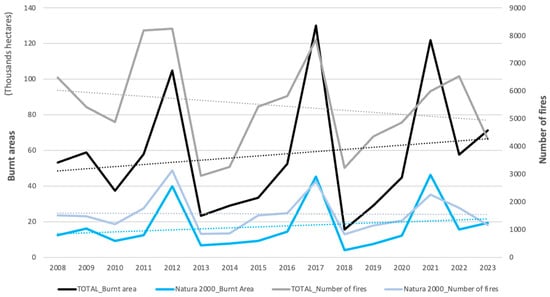
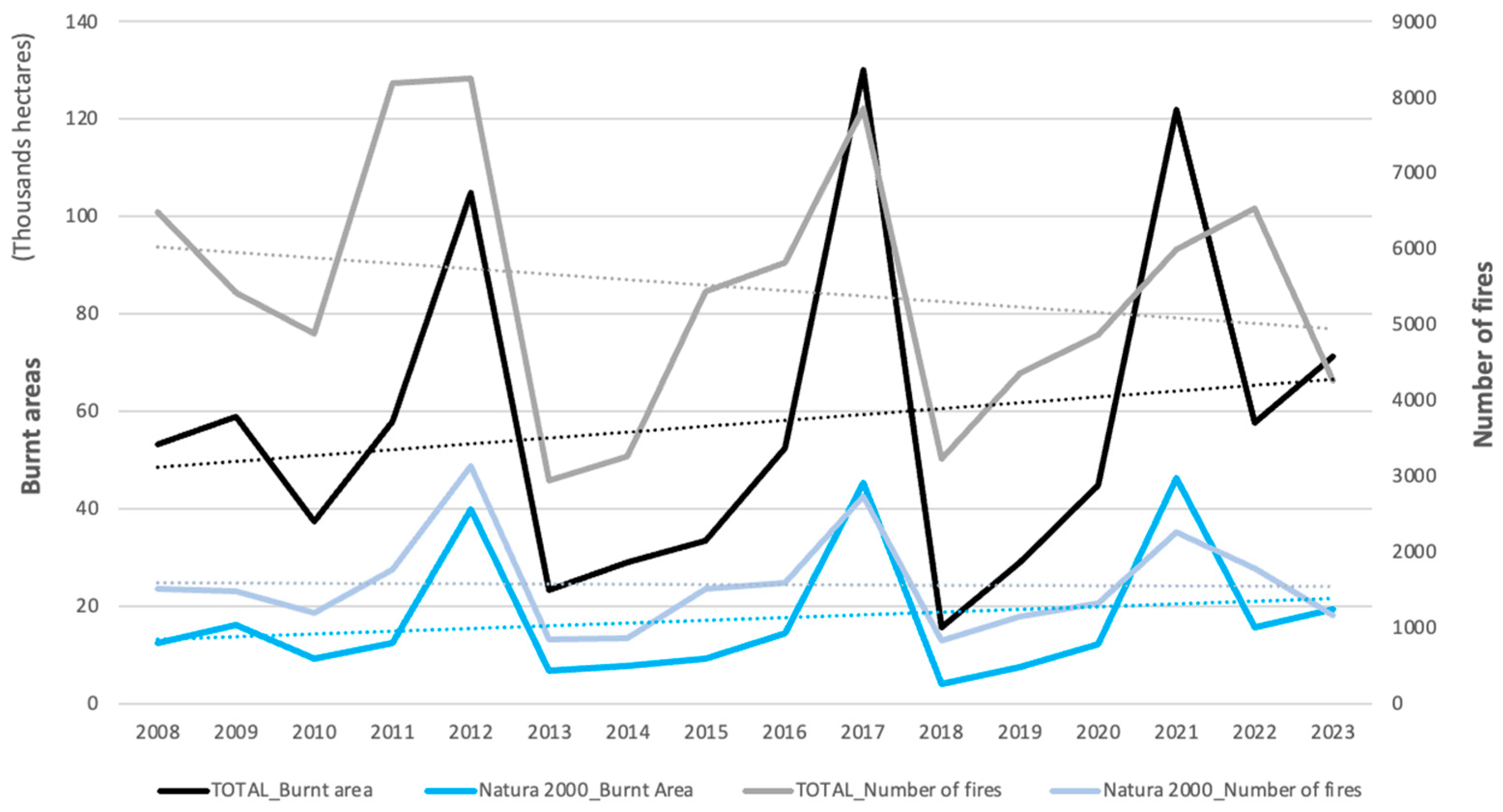
According to the EFFIS data, the total burned area recorded between 2008 and 2023 in Italy amounts to approximately 1.15 million hectares (Mha), of which 0.92 Mha (i.e., about 80%) correspond to forest areas. Over the same period, a total of 87,752 wildfire events were reported, with an average burned surface of approximately 10.5 ha per event. An analysis of annually burned areas indicates an overall increasing trajectory, punctuated by three peaks in 2012, 2017, and 2021. Conversely, the annual number of fire events shows a general decreasing trend over the study period, although with temporary surges coinciding with the same three peak years identified for burned area (Figure 2).
Figure 2.
Total burnt area and number of fires in Italy and within the Italian Natura 2000 network, 2008–2023 (source: authors’ elaborations from EFFIS [44]).
Wildfire events were recorded in 1307 municipalities, representing about 16.5% of total Italian municipalities, and spanning 19 regions out of a total of 20 NUTS-2 territorial units. The spatial distribution of burned areas, however, is highly uneven. Sicily alone accounts for over 45% of the total fire-prone area, while Calabria and Sardinia together contribute an additional 35%. When Campania, Lazio, and Apulia are also included, these six regions collectively account for over 90% of the total burned land during the study period.
3.2. Fires in Natura 2000 Sites in Italy
Burned areas within Natura 2000 sites amount to 0.28 million hectares (272,212 ha), i.e., about 28% of the total burned area recorded at the national scale over the study period. The temporal trends for both the total burned area and the number of wildfire events within Natura 2000 sites closely reflect the national-scale patterns for all fires, with similar peaks and fluctuations over time (Figure 2).
Geographical distribution is again highly uneven: Sicily alone accounts for about 52% of all burned areas within Natura 2000 sites, followed by Sardinia (12%) and Campania (10.7%), which together represent an additional 23%. When also including Calabria, Lazio, and Apulia, this results in approximately 93% of the total burned Natura 2000 sites in Italy.
A more detailed analysis of Natura 2000 data reveals distinct patterns between fully and partially burned areas. Fully burned surfaces are relatively evenly distributed between type (a) sites (i.e., SPAs), which account for approximately 56% of the total burned area, and type (b) sites (i.e., SACs), which account for the remaining 44%. In contrast, partially burned areas show a marked predominance of type (b) sites, which represent roughly 80% of the total partially affected surface. This disparity may reflect the generally larger spatial extent and habitat diversity of SACs, as well as their greater overlap with fire-prone landscapes.
3.3. Economic Assessment
According to the European Commission: Directorate-General for Environment and University of the West of England [49], the estimated total economic value of the EU Natura 2000 network ranges from €223 to €314 billion (Bln €). This corresponds to average unit values between 486.45 €·ha−1 and 684.96 €·ha−1, with a mean value of 585.70 €·ha−1.
Using these figures as a reference (i.e., study site values) for the adjusted benefit transfer methodology (Equation (1)), we calculated the economic costs of ecosystem services foregone associated with the loss of Natura 2000 sites due to forest fires.
Over the study period, these costs range from a minimum of €135.14 million (Mln €) to a maximum of 186.45 Mln €, with an average of 159.43 Mln €. On an annual basis, this corresponds to values between 8.4 Mln € and 11.6 Mln €, averaging approximately 9.9 Mln € year−1.
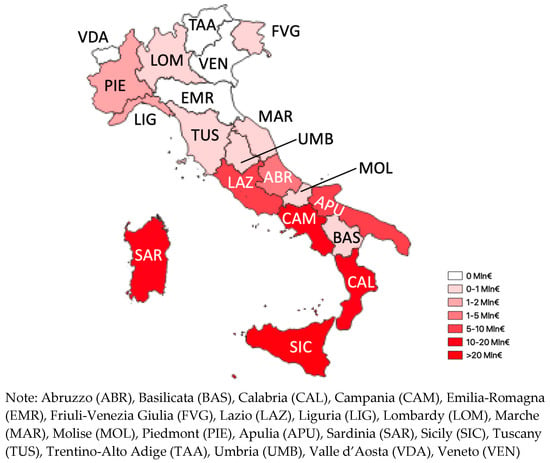
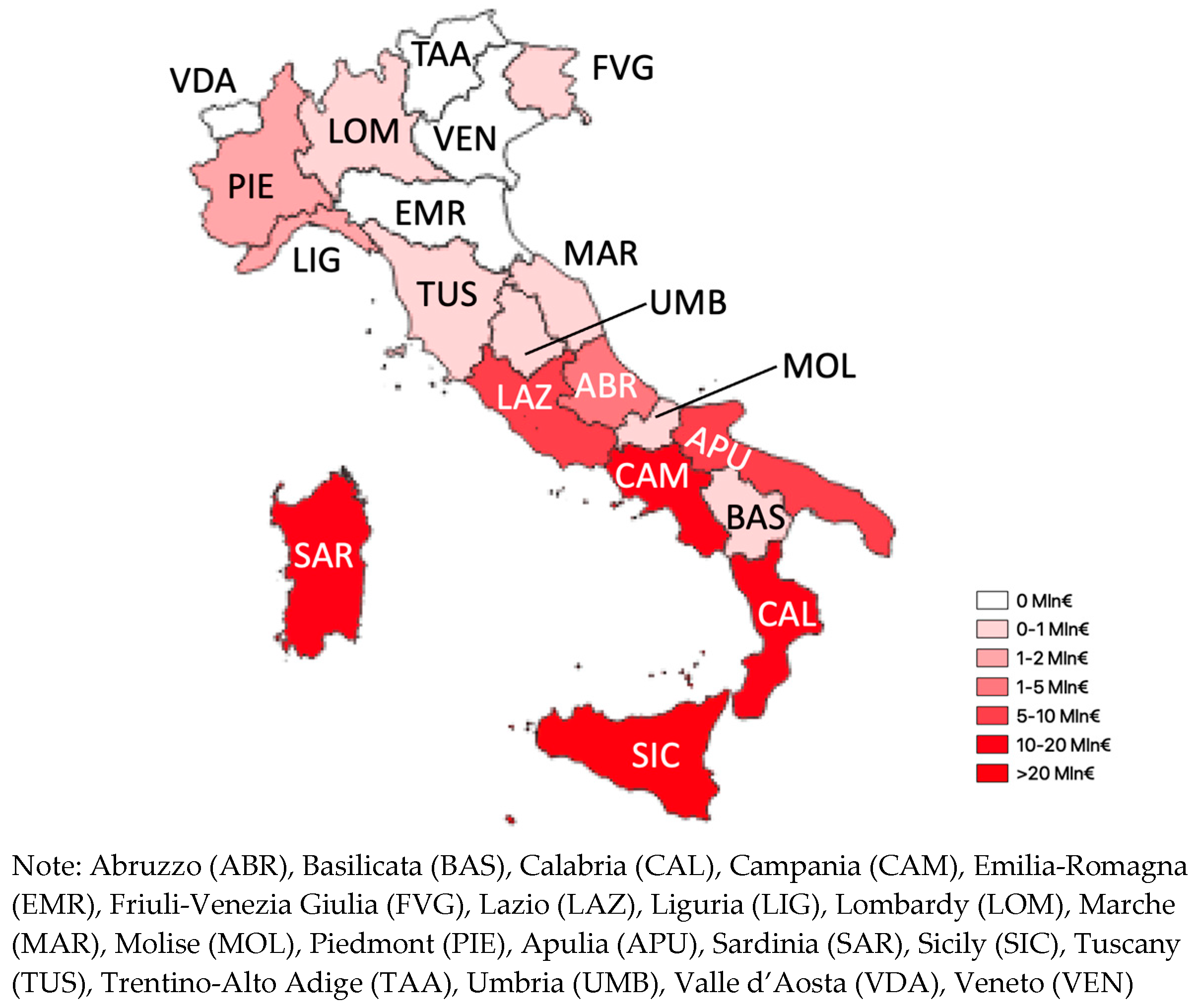
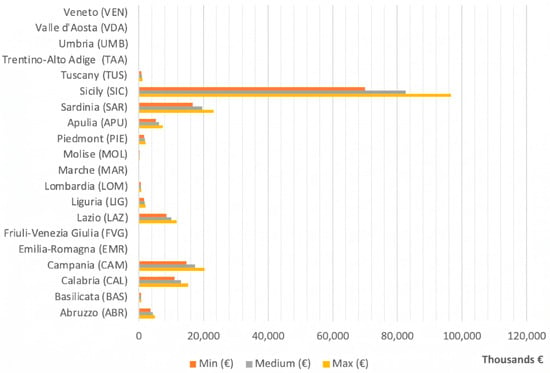
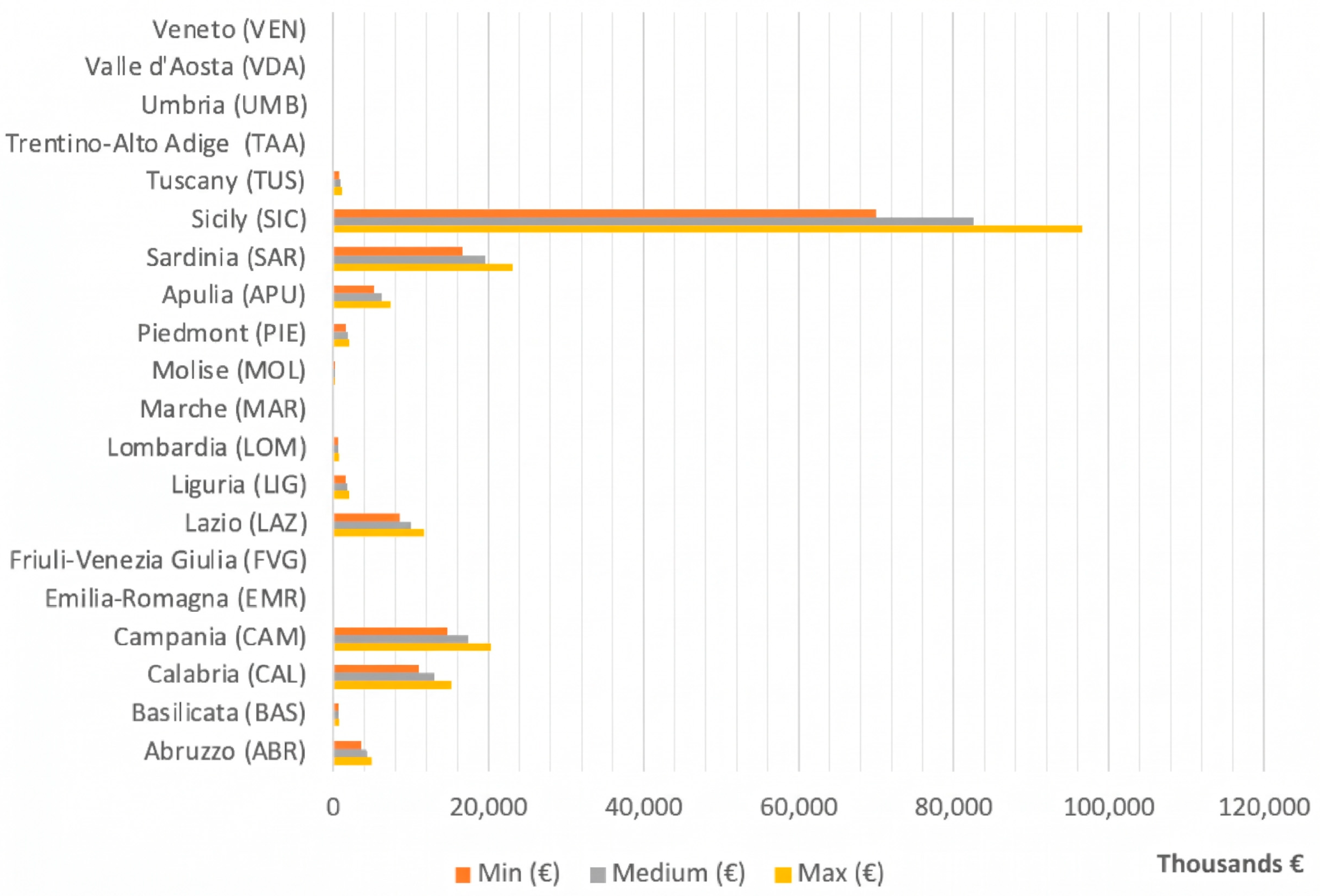
More than 50% of the total costs concentrate in Sicily, followed by Sardinia (12%) and Campania (11%). When considering also Calabria (8.2%), Lazio (6.3%), and Apulia (3.9%), this corresponds to about 93.4% of the total value (Figure 3 and Figure 4, and Table 1).
Figure 3.
Economic value of fire damages in Natura 2000 sites per NUTS-2 Italian regions, 2008–2023. Spatial distribution of medium values.
Figure 4.
Economic value of fire damages in Natura 2000 sites per NUTS-2 Italian regions, 2008–2023. Minimum, medium and maximum values are shown (source: authors’ elaborations from EFFIS and BISE [42,44]).
Table 1.
Economic value of fire damage in Natura 2000 sites per NUTS-2 Italian regions, 2008–2023. Bold values indicate the national totals (sum of all Italian regions) (source: authors’ elaborations from EFFIS and BISE [42,44]).
Fully burned areas account for approximately 80% of the total estimated economic loss, corresponding to 105.9–149.2 Mln €. On an annual basis, this translates into values ranging between 6.6 and 9.3 Mln € year−1. Partially burned and damaged areas represent the remaining 20% of the total loss, amounting to 13.8 and 19.5 Mln €, equivalent to annual values in the range of 0.99–1.39 Mln € year−1.
4. Discussion
Research findings are first analyzed in relation to existing studies and available data (Section 4.1). The discussion then examines the connections between nature protection and wildfires, including potential trade-offs (Section 4.2), and compares the cost of damages associated with wildfires with the management budget for Natura 2000 sites in Italy (Section 4.3). The discussion then explores possible fuel management strategies in Natura 2000 sites (Section 4.4), before addressing research limitations and possible future developments (Section 4.5).
4.1. Our Findings in the Context of Existing Studies and Available Data
Our findings indicate that approximately 30% of the total forest area burned in Italy during the analyzed period occurred within Natura 2000 sites. Although slightly lower, this proportion is broadly consistent with values reported at the EU level, where protected areas represent a comparable share of fire-affected landscapes. In terms of total burned area within Natura 2000 sites and other protected areas, Italy ranks fourth among EU Member States and third among EU Mediterranean countries [44,55]. Regarding the economic valuation of wildfire impacts, existing studies addressing comparable contexts have generally focused on individual sites (e.g., [56,57]). Studies adopting a broader geographical perspective have generally not focused specifically on Natura 2000 sites and have examined economic dimensions of wildfire impacts other than just ecosystem service losses (e.g., [58,59]). Other research has investigated the economic implications of alternative land-use and fire-prevention strategies in Mediterranean landscapes, including the effects of fire-smart forest management on wildfire suppression costs and ecosystem service damages (e.g., [60]). The economic estimates reported in these studies are of a comparable order of magnitude to those obtained in the present study, although direct comparisons should be interpreted with caution given differences in geographical scope and valuation approaches. Against this background, the present study extends the existing literature by combining a spatial analysis of wildfire occurrence within Natura 2000 sites across Italy over the 2008–2023 period with an economic assessment of the associated ecosystem service losses using a benefit transfer approach. This provides a complementary perspective to previous site-specific assessments by quantifying the spatial distribution and aggregate magnitude of estimated losses across a national network of protected areas, thereby providing evidence to support conservation planning and the prioritization of wildfire prevention and mitigation measures.
4.2. Wildfires and Protected Areas
Protected areas have been documented to support greater aboveground biomass relative to surrounding landscapes and comparable areas (e.g., [61]) as management and human-related disturbances (e.g., logging and firewood collection) often stop, or at least decrease, after protection. While these conditions might support biodiversity conservation, carbon storage, and ecosystem integrity, they can also facilitate the accumulation and continuity of live and dead fuels. This accumulation of biomass may augment both the quantity and spatial continuity of available fuels, thereby intensifying potential fuel hazards, especially under drought conditions [14].
Empirical evidence further links elevated probabilities of large and severe fires to passive or exclusionary approaches to reserve management strategies [62]. Although “hands-off” approaches may benefit certain ecological processes (e.g., [63,64,65]), they can inadvertently increase vulnerability to high-intensity wildfire, especially in fire-prone Mediterranean ecosystems where traditional management regimes historically maintained lower fuel loads. Balancing ecological objectives with fire-risk reduction therefore represents a major challenge for protected-area management and governance. Protected areas are considered a cornerstone for biodiversity conservation [66] and for ensuring co-benefits, in particular in terms of carbon sequestration [67] and water resource management [68]. Ensuring their effective protection under conditions of rising wildfire incidence is thus central to EU environmental policy. This challenge is becoming even more urgent in the context of expanding nature restoration commitments. The EU Nature Restoration Regulation—a key pillar of the EU Biodiversity Strategy for 2030—requires Member States to implement measures restoring at least 30% of degraded habitats by 2030 and 90% by 2050, with priority given to areas located within Natura 2000 sites until 2030 [49]. These targets are aligned with the Kunming–Montreal Global Biodiversity Framework, adopted during the fifteenth meeting of the Conference of the Parties (COP 15) [69], situating EU restoration obligations within broader international conservation commitments.
At the same time, the growing emphasis on rewilding [70,71]—a relatively new but contested discourse and practice in Europe—and the reinstatement of natural processes introduce further complexity. Rewilding initiatives often aim to reduce human intervention, promote natural vegetation dynamics, and enhance trophic interactions [72]. While these approaches can strengthen ecological resilience and support long-term carbon storage, they may also alter vegetation structure and fuel patterns in ways that influence wildfire regimes [73,74]. Understanding how rewilding trajectories interact with fire behavior represents an emerging research frontier, particularly for Mediterranean landscapes where fire is a dominant ecological and socioeconomic driver.
4.3. Comparing Fire Damage Costs and Natura 2000 Management Expenditures
According to data provided by the Ministry of Environment and Energy Security [46], the annualized expenditures for the management of the Natura 2000 network across Italian regions—including both ongoing operational costs and amortized one-time investments—amount to approximately 491.77 Mln € year−1. When restricting the analysis to NUTS-2 regions for which EFFIS data report wildfire events over the study period, annual expenditures for Natura 2000 management amount to 430.23 Mln € year−1. Against this baseline, the estimated direct annual economic losses due to wildfires in Natura 2000 sites correspond to approximately 2–2.7% of the yearly management expenditures incurred by the affected NUTS-2 regions. Sicily (up to 16.8%), Calabria (7.2%) and Lazio (6%) are the NUTS-2 regions showing the highest incidence of direct fire damage costs over management expenditures.
When restricting the analysis to annual operating expenditures for NUTS-2 regions affected by fires (205.83 Mln € year−1), the incidence of direct fire damage costs rises to 4.1–5.7%. At the regional level, Sicily, Calabria, and Lazio remain the areas with the highest incidence rates. In particular, Sicily shows an exceptionally high impact, with direct fire damage costs corresponding to 38.2% of the annual operating expenses allocated to the Natura 2000 network. Calabria follows with 19.2%, and Campania records 11.2%.
When considering fire damage costs vis-à-vis amortized one-off investments for NUTS-2 regions affected by fires (255.33 Mln € year−1), the former correspond to 3.8–5.2% of the latter. Sicily shows the highest incidence (30.1%), followed by Lazio (12.8%), Calabria (11.9%) and Sardinia (11.7%). These values underscore the vulnerability of operating budgets in fire-prone regions, where wildfire-related damages represent a substantial share of the available resources for Natura 2000 management and could therefore pose trade-offs with other investment opportunities.
Finally, when reporting direct fire damage costs to the population resident in the targeted NUTS-2 regions (about 48.4 Mln units) [75], the resulting per capita annual cost is estimated to range between 0.17 and 0.24 € year−1. The highest per capita annual costs are estimated for Sicily (1.26 € year−1), Sardinia (0.92 € year−1) and Calabria (0.52 € year−1). Overall, between 2.7 and 4.4% of per capita annual costs for the management of Natura 2000 sites within targeted NUTS-2 regions are offset by losses due to fires, with peaks of about 17% for Sicily, 7% for Calabria and 6% for Lazio.
4.4. A Shift in Fire Management Policies and Strategies
Wildfire governance in Italy is characterized by a highly fragmented institutional structure, with responsibilities distributed across multiple organizations and administrative levels [76]. This fragmentation reflects broader structural weaknesses in the decentralization of Italian forest governance, whereby responsibilities have been transferred to regional authorities without a commensurate strengthening of political prioritization, long-term planning capacity, or coordination with national strategies [77]. At the same time, environmental protection involves both national and subnational (i.e., regional) authorities, with responsibilities divided according to their respective institutional mandates. The coexistence of these multilevel governance arrangements may create coordination challenges between forest management, wildfire prevention and suppression, and biodiversity conservation. Moreover, as in many other Mediterranean countries, wildfire management in Italy has traditionally prioritized fire suppression over prevention, with emergency response remaining the dominant approach [76,78].
The National Forestry Strategy (2022) has sought to strengthen the integration of forest, agro-pastoral, and wildfire-risk governance, supporting a more coordinated approach to prevention and suppression [79]. Nevertheless, improving coordination between regional and national actors, strengthening prevention planning, and moving beyond an emergency-oriented approach remain key priorities for wildfire governance in Italy [80].
The high costs of wildfire damage in Natura 2000 sites documented in this study raise the question of whether more active management strategies could provide cost-effective alternatives or complements to predominantly suppression-oriented approaches to wildfire risk management. These may include direct fire-prevention measures, such as fuel management (e.g., via thinning and creation of firebreaks) and prescribed burning, as well as landscape-scale interventions aimed at reducing fire risk and increasing forest resilience [81]. Rather than generating trade-offs between wildfire risk reduction and conservation and restoration objectives, an integrated approach could promote fire-smart strategies that simultaneously reduce wildfire risk and support biodiversity conservation through context-specific management [82]. At the landscape level, maintaining a diverse spatial structure via a mosaic approach may contribute to reducing fuel continuity and limiting the spread and severity of wildfires, while monitoring can support the identification of areas where fire risk may conflict with conservation objectives [83,84,85]. At the stand level, wildfire risk management should be aligned with site-specific conservation and restoration practices, considering the fire sensitivity and conservation requirements of individual habitats and species [86]. For example, selective thinning and understory vegetation management can reduce fuel continuity in fire-prone forests while retaining habitat structures important for biodiversity. Strategically located fuel breaks can also be incorporated into site management plans where compatible with conservation objectives. Maintaining diverse tree species compositions and heterogeneous stand structures may enhance forest resilience to fire and other disturbances, depending on local ecological conditions. In open habitats, extensive grazing or targeted mowing can reduce fine-fuel accumulation, provided that grazing intensity and timing are adapted to the ecological requirements of protected species and habitats. All such interventions should be carefully planned, with particular attention to their location, timing, and design, and assessed against the relevant conservation objectives. Where applicable, they must also comply with the requirements of Article 6 of the Habitats Directive. Overall, this approach is consistent with the European Commission’s 2026 Guidance on Natura 2000 and climate change, which advocates integrating landscape- and ecosystem-based wildfire prevention with site-specific conservation objectives rather than treating fire prevention and biodiversity conservation as inherently competing goals [87].
4.5. Research Limitations and Future Developments
Despite our efforts to ensure methodological rigor, our research is subject to some limitations that may influence the scope and interpretation of the results. First, our analysis relies on EFFIS data, which, prior to 2018, recorded only wildfires affecting areas larger than 30 ha. Consequently, smaller fires are not captured consistently across the study period. Although a 30 ha threshold is common in large-scale fire analyses, omitting smaller events may lead to an underestimation of fire occurrence and burned area, particularly in relation to localized but frequent disturbances. Moreover, EFFIS includes prescribed and controlled burns, which are intentionally mapped because they contribute to greenhouse gas emissions and, in some cases, can become uncontrolled.
Second, although the use of adjusted benefit transfer provides a robust and efficient approach for large-scale assessments, it does not substitute for a detailed, site-specific damage evaluation. As such, some nuances of fire impacts on different forest types and management contexts may not be fully captured.
Finally, consistent with commonly employed fire damage assessment methodologies, our analysis focuses solely on direct damage costs and does not account for indirect impacts, which are more challenging to quantify yet highly relevant. Indirect effects include, for example, consequences for human health, such as exposure to fine particulate matter (PM2.5), which has been linked to respiratory diseases and increased mortality. For instance, the European Environment Agency [88] reports 702 casualties related to wildfire events across 32 European countries between 1980 and 2022, while BISE [89] estimates that PM2.5 exposure from wildfires caused 1000–1400 premature deaths in the EU27 during 2005–2007.
Despite these limitations, we believe that our findings remain robust and offer valuable insights into wildfire dynamics within Natura 2000 forests. Future research would benefit from incorporating smaller fire events, undertaking detailed local damage assessments, and integrating indirect and long-term societal impacts to provide a more comprehensive evaluation of wildfire consequences.
5. Conclusions
This study provides a country-wide economic assessment of wildfire damages to Natura 2000 forest areas in Italy. Our analysis shows that Natura 2000 sites account for approximately 30% of the total burned area recorded between 2008 and 2023, corresponding to estimated economic losses ranging from €135.14 million to €186.45 million over the study period (i.e., €8.4–11.6 million year−1). At the regional (NUTS-2) scale, these values may represent up to nearly 40% of annual operating expenditures for Natura 2000 management in fire-prone regions like Sicily, underscoring the substantial economic implications of wildfire occurrence within protected forest landscapes. These values should not be interpreted as damage estimates suitable for determining compensation amounts. Rather, they provide indicative estimates of the economic losses associated with ecosystem services foregone because of wildfires affecting Natura 2000 sites. As such, they can inform decisions on resource allocation for wildfire prevention and mitigation, helping to reduce both the direct and indirect impacts of fires in protected areas.
Taken together, our results highlight the need for integrated fire–biodiversity–climate governance within Natura 2000 sites. Priority actions include the development of evidence-based fuel management strategies compatible with conservation objectives, the enhancement of monitoring systems, and the systematic incorporation of wildfire risk into restoration planning and budgeting. Redirecting management priorities and resources towards fire prevention and risk mitigation could help reduce both direct expenditures, including firefighting and post-fire restoration, and indirect economic and social costs arising from ecosystem service losses and associated adverse spillover effects. This is even more urgent in the framework of existing EU policies on nature restoration and conservation that put Natura 2000 sites center stage. As climate change continues to intensify fire danger and extend the fire season across southern Europe, aligning conservation policy with adaptive, fire-resilient management approaches will be essential to safeguard both biodiversity and the ecosystem services provided by the Natura 2000 network.
Author Contributions
Conceptualization, M.M.; methodology, M.M. and M.T.; software, M.M.; validation, M.M. and M.T.; formal analysis, M.M. and M.T.; investigation, M.M. and M.T.; resources, M.M. and M.T.; data curation, M.M. and M.T.; writing—original draft preparation, M.M.; writing—review and editing, M.M. and M.T.; visualization, M.M. and M.T.; supervision, M.M.; project administration, M.M.; funding acquisition, M.M. All authors have read and agreed to the published version of the manuscript.
Funding
This study was carried out within the Agritech National Research Center and received funding from the European Union Next-GenerationEU (PIANO NAZIONALE DI RIPRESA E RESILIENZA (PNRR)—MISSIONE 4 COMPONENTE 2, INVESTIMENTO 1.4—D.D. 1032 17/06/2022, CN00000022). This manuscript reflects only the authors’ views and opinions; neither the European Union nor the European Commission can be considered responsible for them.
Institutional Review Board Statement
Not applicable.
Informed Consent Statement
Not applicable.
Data Availability Statement
The original contributions presented in this study are included in the article. Further inquiries can be directed to the corresponding author.
Conflicts of Interest
The authors declare no conflicts of interest.
Abbreviations
The following abbreviations are used in this manuscript:
| BISE | Biodiversity Information System for Europe |
| Bln | Bilion |
| EEA | European Environment Agency |
| EFFIS | European Forest Fire Information System |
| GDP | Gross Domestic Product |
| ha | Hectare |
| MASE | Ministero dell’Ambiente e della Sicurezza Energetica (Ministry of Environment and Energy Security) |
| Mln | Million |
| NUTS | Nomenclature of Territorial Units for Statistics |
| SAC | Special Areas of Conservation |
| SCI | Sites of Community Importance |
| SPA | Special Protection Areas |
References
- Pastro, L.A.; Dickman, C.R.; Letnic, M. Burning for Biodiversity or Burning Biodiversity? Prescribed Burn vs. Wildfire Impacts on Plants, Lizards, and Mammals. Ecol. Appl. 2011, 21, 3238–3253. [Google Scholar] [CrossRef] [Scilit]
- Blondel, J.; Blondel, J. The ‘Design’ of Mediterranean Landscapes: A Millennial Story of Humans and Ecological Systems during the Historic Period. Hum. Ecol. 2006, 34, 713–729. [Google Scholar] [CrossRef] [Scilit]
- Morales-Molino, C.; Steffen, M.; Samartin, S.; van Leeuwen, J.F.N.; Hürlimann, D.; Vescovi, E.; Tinner, W. Long-Term Responses of Mediterranean Mountain Forests to Climate Change, Fire and Human Activities in the Northern Apennines (Italy). Ecosystems 2021, 24, 1361–1377. [Google Scholar] [CrossRef] [Scilit] [PubMed]
- Ortega, M.; Lora, Á.; Yocom, L.; Zumaquero, R.; Molina, J.R. Effects of Fire Recurrence and Severity on Mediterranean Vegetation Dynamics: Implications for Structure and Composition in Southern Spain. Sci. Total Environ. 2025, 961, 178392. [Google Scholar] [CrossRef] [Scilit] [PubMed]
- Pausas, J.G. Pyrogeography across the Western Palaearctic: A Diversity of Fire Regimes. Glob. Ecol. Biogeogr. 2022, 31, 1923–1932. [Google Scholar] [CrossRef] [Scilit]
- Lasanta, T.; Cortijos-López, M.; Errea, M.P.; Khorchani, M.; Nadal-Romero, E. An Environmental Management Experience to Control Wildfires in the Mid-Mountain Mediterranean Area: Shrub Clearing to Generate Mosaic Landscapes. Land Use Policy 2022, 118, 106147. [Google Scholar] [CrossRef] [Scilit]
- San-Miguel-Ayanz, J.; Moreno, J.M.; Camia, A. Analysis of Large Fires in European Mediterranean Landscapes: Lessons Learned and Perspectives. For. Ecol. Manag. 2013, 294, 11–22. [Google Scholar] [CrossRef] [Scilit]
- Moghli, A.; Baeza, M.J.; Soliveres, S.; Santana, V.M. Restoring Resilient Mediterranean Landscapes: Long-Term Benefits of Integrated Post-Fire Management for Ecosystem Multifunctionality. J. Environ. Manag. 2025, 394, 127316. [Google Scholar] [CrossRef] [Scilit] [PubMed]
- Aquilué, N.; Fortin, M.J.; Messier, C.; Brotons, L. The Potential of Agricultural Conversion to Shape Forest Fire Regimes in Mediterranean Landscapes. Ecosystems 2020, 23, 34–51. [Google Scholar] [CrossRef] [Scilit]
- Moreira, F.; Leal, M.; Bergonse, R.; Canadas, M.J.; Novais, A.; Oliveira, S.; Ribeiro, P.F.; Zêzere, J.L.; Santos, J.L. Recent Trends in Fire Regimes and Associated Territorial Features in a Fire-Prone Mediterranean Region. Fire 2023, 6, 60. [Google Scholar] [CrossRef] [Scilit]
- Pausas, J.G. Response of Plant Functional Types to Changes in the Fire Regime in Mediterranean Ecosystems: A Simulation Approach. J. Veg. Sci. 1999, 10, 717–722. [Google Scholar] [CrossRef] [Scilit]
- Molina, J.R.; Moreno, N.; Moreno, R. Influence of Fire Regime on Forest Structure and Restoration of a Native Forest Type in the Southern Andean Range. Ecol. Eng. 2017, 102, 390–396. [Google Scholar] [CrossRef] [Scilit]
- Arellano-del-Verbo, G.; Urbieta, I.R.; Moreno, J.M. Large-Fire Ignitions Are Higher in Protected Areas than Outside Them in West-Central Spain. Fire 2023, 6, 28. [Google Scholar] [CrossRef] [Scilit]
- Resco de Dios, V.; Schütze, S.J.; Cunill Camprubí, À.; Balaguer-Romano, R.; Boer, M.M.; Fernandes, P.M. Protected Areas as Hotspots of Wildfire Activity in Fire-Prone Temperate and Mediterranean Biomes. J. Environ. Manag. 2025, 385, 125669. [Google Scholar] [CrossRef] [Scilit] [PubMed]
- San-Miguel-Ayanz, J.; Durrant, T.; Boca, R.; Camia, A. Forest Fire Damage in Natura 2000 Sites 2000–2012; Publications Office of the European Union: Luxembourg, 2012. [Google Scholar]
- San-Miguel-Ayanz, J.; Durrant, T.; Boca, R.; Maianti, P.; Liberta, G.; Artes Vivancos, T.; Jacome Felix, D.; Oom, B.A.; De Rigo, D.; Ferrari, D.; et al. Forest Fires in Europe Middle East and North Africa 2020; Publications Office of the European Union: Luxembourg, 2021. [Google Scholar]
- San-Miguel-Ayanz, J.; Durrant, T.; Boca, R.; Maianti, P.; Liberta, G.; Jacome Felix Oom, D.; Branco, A.; De Rigo, D.; Suarez-Moreno, M.; Ferrari, D.; et al. Forest Fires in Europe, Middle East and North Africa 2023; Publications Office of the European Union: Luxembourg, 2024. [Google Scholar]
- Winkel, G.; Blondet, M.; Borrass, L.; Frei, T.; Geitzenauer, M.; Gruppe, A.; Jump, A.; de Koning, J.; Sotirov, M.; Weiss, G.; et al. The Implementation of Natura 2000 in Forests: A Trans- and Interdisciplinary Assessment of Challenges and Choices. Environ. Sci. Policy 2015, 52, 23–32. [Google Scholar] [CrossRef] [Scilit]
- Carvalho, F.; Pradhan, A.; Abrantes, N.; Campos, I.; Keizer, J.J.; Cássio, F.; Pascoal, C. Wildfire Impacts on Freshwater Detrital Food Webs Depend on Runoff Load, Exposure Time and Burnt Forest Type. Sci. Total Environ. 2019, 692, 691–700. [Google Scholar] [CrossRef] [Scilit]
- Letnic, M.; Tamayo, B.; Dickman, C.R. The Responses of Mammals to La Niña (El Niño Southern Oscillation)–Associated Rainfall, Predation, and Wildfire in Central Australia. J. Mammal. 2005, 86, 689–703. [Google Scholar] [CrossRef] [Scilit]
- Green, K.; Sanecki, G. Immediate and Short-Term Responses of Bird and Mammal Assemblages to a Subalpine Wildfire in the Snowy Mountains, Australia. Austral Ecol. 2006, 31, 673–681. [Google Scholar] [CrossRef] [Scilit]
- Kodandapani, N.; Cochrane, M.A.; Sukumar, R. A Comparative Analysis of Spatial, Temporal, and Ecological Characteristics of Forest Fires in Seasonally Dry Tropical Ecosystems in the Western Ghats, India. For. Ecol. Manag. 2008, 256, 607–617. [Google Scholar] [CrossRef] [Scilit]
- Pelegrin, N.; Bucher, E.H. Long-Term Effects of a Wildfire on a Lizard Assemblage in the Arid Chaco Forest. J. Arid Environ. 2010, 74, 368–372. [Google Scholar] [CrossRef] [Scilit]
- Nemens, D.G.; Kidd, K.R.; Varner, J.M.; Wing, B. Recurring Wildfires Provoke Type Conversion in Dry Western Forests. Ecosphere 2022, 13, e4184. [Google Scholar] [CrossRef] [Scilit]
- Keeley, J.E.; Bond, W.J.; Bradstock, R.A.; Pausas, J.G.; Rundel, P.W. Alien Species and Fire. In Fire in Mediterranean Ecosystems: Ecology, Evolution and Management; Cambridge University Press: Cambridge, UK, 2011; pp. 330–348. ISBN 9780521824910. [Google Scholar]
- Conservation International Biodiversity Hotspots. Available online: https://www.conservation.org/learning/biodiversity-hotspots (accessed on 20 October 2026).
- Michetti, M.; Pinar, M. Forest Fires in Italy: An Econometric Analysis of Major Driving Factors. CMCC Res. Pap. 2013, 152, 39. [Google Scholar]
- Spadoni, G.L.; Moris, J.V.; Vacchiano, G.; Elia, M.; Garbarino, M.; Sibona, E.; Tomao, A.; Barbati, A.; Sallustio, L.; Salvati, L.; et al. Active Governance of Agro-Pastoral, Forest and Protected Areas Mitigates Wildfire Impacts in Italy. Sci. Total Environ. 2023, 890, 164281. [Google Scholar] [CrossRef] [Scilit] [PubMed]
- ISPRA Ecosistemi Ed Incendi Boschivi in Italia. Available online: https://www.isprambiente.gov.it/it/attivita/Crisi-Emergenze-ambientali-e-Danno/centro-operativo-per-la-sorveglianza-ambientale/ecosistemi-ed-incendi-boschivi-in-italia (accessed on 20 October 2026).
- Gasparini, P.; Di Cosmo, L.; Floris, A.; De Laurentis, D. (Eds.) Italian National Forest Inventory—Methods and Results of the Third Survey. In Inventario Nazionale Delle Foreste e Dei Serbatoi Forestali Di Carbonio—Metodi e Risultati Della Terza Indagine; Springer Tracts in Civil Engineering: Cham, Switzerland, 2022; ISBN 978-3-030-98678-0. [Google Scholar]
- Bednar-Friedl, B.; Biesbroek, R.; Schmidt, D.N.; Alexander, P.; Børsheim, K.Y.; Carnicer, J.; Georgopoulou, E.; Haasnoot, M.; Le Cozannet, G.; Lionello, P.; et al. Europe. In Climate Change 2022—Impacts, Adaptation and Vulnerability. Contribution of Working Group II to the Sixth Assessment Report of the Intergovernmental Panel on Climate Change; Pörtner, H.-O., Roberts, D.C., Tignor, M., Poloczanska, E.S., Mintenbeck, K., Alegría, A., Craig, M., Langsdorf, S., Löschke, S., Möller, V., et al., Eds.; Cambridge University Press: Cambridge, UK; New York, NY, USA, 2022; pp. 1817–1928. [Google Scholar]
- Liaison Unit Bratislava. Forest Europe State of Europe’s Forests 2020; Liaison Unit Bratislava: Bratislava, Slovakia, 2020. [Google Scholar]
- EC Regulation (EU) 2024/1991 of the European Parliament and of the Council of 24 June 2024 on Nature Restoration and Amending Regulation (EU) 2022/869. Available online: https://eur-lex.europa.eu/eli/reg/2024/1991/oj (accessed on 20 October 2026).
- European Commission. Communication from the Commission to the European Parliament, the Council, the European Economic and Social Committee and the Committee of the Regions. Available online: https://eur-lex.europa.eu/legal-content/EN/TXT/?uri=celex:52020DC0380 (accessed on 20 October 2026).
- IPBES. Methodological Assessment of the Diverse Values and Valuation of Nature of the Intergovernmental Science-Policy Platform on Biodiversity and Ecosystem Services; IPBES: Bonn, Germany, 2022. [Google Scholar]
- Himes, A.; Muraca, B.; Anderson, C.B.; Athayde, S.; Beery, T.; Cantú-Fernández, M.; González-Jiménez, D.; Gould, R.K.; Hejnowicz, A.P.; Kenter, J.; et al. Why Nature Matters: A Systematic Review of Intrinsic, Instrumental, and Relational Values. Bioscience 2024, 74, 25–43. [Google Scholar] [CrossRef] [Scilit]
- Millennium Ecosystem Assessment. Ecosystems and Human Well-Being: Synthesis; Island Press: Washington, DC, USA, 2005; ISBN 1597260401. [Google Scholar]
- Holmes, T.P.; Prestemon, J.P.; Abt, K.L. An Introduction to the Economics of Forest Disturbance. In The Economics of Forest Disturbances: Wildfires, Storms, and Invasive Species; Springer: Dordrecht, The Netherlands, 2008; Volume 79, pp. 3–14. [Google Scholar] [CrossRef] [Scilit]
- Moreira, F.; Ascoli, D.; Safford, H.; Adams, M.A.; Moreno, J.M.; Pereira, J.M.C.; Catry, F.X.; Armesto, J.; Bond, W.; González, M.E.; et al. Wildfire Management in Mediterranean-Type Regions: Paradigm Change Needed. Environ. Res. Lett. 2020, 15, 011001. [Google Scholar] [CrossRef] [Scilit]
- European Court of Auditors. Special Report 16/2025: “EU Funding to Tackle Forest Fires—More Preventive Measures, but Insufficient Evidence of Results and Their Long-Term Sustainability”; Publications Office of the European Union: Luxembourg, 2025. [Google Scholar]
- Ispra Natura 2000 Network. Environmental Indicators. Available online: https://indicatoriambientali.isprambiente.it/en/protected-areas/natura-2000-network (accessed on 20 October 2026).
- BISE Biodiversity Information System for Europe. Italy. Available online: https://biodiversity.europa.eu/countries/italy (accessed on 20 October 2026).
- Zivkovic, L.; Biondi, E.; Pesaresi, S.; Lasen, C.; Spampinato, G.; Angelini, P. The Third Report on the Conservation Status of Habitats (Directive 92/43/EEC) in Italy: Processes, Methodologies, Results and Comments. Plant Sociol. 2017, 54, 51–64. [Google Scholar] [CrossRef] [Scilit] [PubMed]
- EFFIS European Forest Fire Information System. Available online: https://forest-fire.emergency.copernicus.eu/ (accessed on 20 October 2026).
- EFFIS Rapid Damage Assessment. Available online: https://forest-fire.emergency.copernicus.eu/about-effis/technical-background/rapid-damage-assessment (accessed on 20 October 2026).
- MASE Schede e Cartografie. Available online: https://www.mase.gov.it/portale/schede-e-cartografie (accessed on 20 October 2026).
- EEA BD Natura 2000 Update 2024. Available online: https://cdr.eionet.europa.eu/it/eu/n2000/envz1qklw/ (accessed on 20 October 2026).
- Johnston, R.J.; Rolfe, J.; Rosenberger, R.; Brouwer, R. Benefit Transfer of Environmental and Resource Values—A Guide for Researchers and Practitioners; Johnston, R.J., Rolfe, J., Rosenberger, R.S., Brouwer, R., Eds.; The Economics of Non-Market Goods and Resources; Springer: Dordrecht, The Netherlands, 2015; Volume 14, ISBN 9789401799294. [Google Scholar]
- European Commission: Directorate-General for Environment and University of the West of England (UWE). Science Communication Uni The Value of Natura 2000; Publications Office: Luxembourg, 2015. [Google Scholar]
- Johnston, R.J.; Boyle, K.J.; Loureiro, M.L.; Navrud, S.; Rolfe, J. Guidance to Enhance the Validity and Credibility of Environmental Benefit Transfers. Environ. Resour. Econ. 2021, 79, 575–624. [Google Scholar] [CrossRef] [Scilit]
- Maes, J.; Paracchini, M.L.; Zulian, G.; Dunbar, M.B.; Alkemade, R. Synergies and Trade-Offs between Ecosystem Service Supply, Biodiversity, and Habitat Conservation Status in Europe. Biol. Conserv. 2012, 155, 1–12. [Google Scholar] [CrossRef] [Scilit]
- Eurostat GDP Deflators. Available online: https://ec.europa.eu/eurostat/databrowser/view/teina110/default/table (accessed on 20 October 2026).
- Bateman, I.J.; Brouwer, R.; Ferrini, S.; Schaafsma, M.; Barton, D.N.; Dubgaard, A.; Hasler, B.; Hime, S.; Liekens, I.; Navrud, S.; et al. Making Benefit Transfers Work: Deriving and Testing Principles for Value Transfers for Similar and Dissimilar Sites Using a Case Study of the Non-Market Benefits of Water Quality Improvements Across Europe. Environ. Resour. Econ. 2011, 50, 365–387. [Google Scholar] [CrossRef] [Scilit]
- Loomis, J.; Richardson, L.; Kroeger, T.; Casey, F. Valuing Ecosystem Services Using Benefit Transfer: Separating Credible and Incredible Approaches. In Valuing Ecosystem Services; Edward Elgar Publishing: Cheltenham, UK, 2014. [Google Scholar]
- San-Miguel-Ayanz, J.; Durrant, T.; Boca, R.; Maianti, P.; Libertà, G.; Oom, D.; Branco, A.; de Daniele, R.; Suarez, M.M.; Ferrari, D.; et al. Advance Report on Forest Fires in Europe, Middle East and North Africa 2024; Publications Office of the European Union: Luxembourg, 2025; ISBN 9789268254837. [Google Scholar]
- Silvestro, R.; Saulino, L.; Cavallo, C.; Allevato, E.; Pindozzi, S.; Cervelli, E.; Conti, P.; Mazzoleni, S.; Saracino, A. The Footprint of Wildfires on Mediterranean Forest Ecosystem Services in Vesuvius National Park. Fire 2021, 4, 95. [Google Scholar] [CrossRef] [Scilit]
- Spada, E.; Falcone, G.; Praticò, S.; Benedetto, M.C.; Gulisano, G.; Iofrida, N.; De Luca, A.I. Wildfires’ Cost for Societal Welfare: Economic Evaluation of Forestry Ecosystem Services Losses in Southern Italy. Land Degrad. Dev. 2026, 37, 3999–4015. [Google Scholar] [CrossRef] [Scilit]
- Meier, S.; Strobl, E.; Elliott, R.J.R.; Kettridge, N. Cross-country Risk Quantification of Extreme Wildfires in Mediterranean Europe. Risk Anal. 2022, 43, 1745–1762. [Google Scholar] [CrossRef] [Scilit] [PubMed]
- Meier, S.; Elliott, R.J.R.; Strobl, E. The Regional Economic Impact of Wildfires: Evidence from Southern Europe. J. Environ. Econ. Manag. 2023, 118, 102787. [Google Scholar] [CrossRef] [Scilit]
- Lecina-Diaz, J.; Chas-Amil, M.-L.; Aquilué, N.; Sil, Â.; Brotons, L.; Regos, A.; Touza, J. Incorporating Fire-Smartness into Agricultural Policies Reduces Suppression Costs and Ecosystem Services Damages from Wildfires. J. Environ. Manag. 2023, 337, 117707. [Google Scholar] [CrossRef] [Scilit] [PubMed]
- Duncanson, L.; Liang, M.; Leitold, V.; Armston, J.; Krishna Moorthy, S.M.; Dubayah, R.; Costedoat, S.; Enquist, B.J.; Fatoyinbo, L.; Goetz, S.J.; et al. The Effectiveness of Global Protected Areas for Climate Change Mitigation. Nat. Commun. 2023, 14, 2908. [Google Scholar] [CrossRef] [Scilit] [PubMed]
- Agee, J.K. The Fallacy of Passive Management Managing for Firesafe Forest Reserves. Conserv. Pract. 2002, 3, 18–26. [Google Scholar] [CrossRef] [Scilit]
- Schnitzler, A. Towards a New European Wilderness: Embracing Unmanaged Forest Growth and the Decolonisation of Nature. Landsc. Urban Plan. 2014, 126, 74–80. [Google Scholar] [CrossRef] [Scilit]
- Regos, A.; Domínguez, J.; Gil-Tena, A.; Brotons, L.; Ninyerola, M.; Pons, X. Rural Abandoned Landscapes and Bird Assemblages: Winners and Losers in the Rewilding of a Marginal Mountain Area (NW Spain). Reg. Environ. Change 2016, 16, 199–211. [Google Scholar] [CrossRef] [Scilit]
- van der Zanden, E.H.; Verburg, P.H.; Schulp, C.J.E.; Verkerk, P.J. Trade-Offs of European Agricultural Abandonment. Land Use Policy 2017, 62, 290–301. [Google Scholar] [CrossRef] [Scilit]
- Langhammer, P.F.; Bull, J.W.; Bicknell, J.E.; Oakley, J.L.; Brown, M.H.; Bruford, M.W.; Butchart, S.H.M.; Carr, J.A.; Church, D.; Cooney, R.; et al. The Positive Impact of Conservation Action. Science 2024, 384, 453–458. [Google Scholar] [CrossRef] [Scilit] [PubMed]
- Soto-Navarro, C.; Ravilious, C.; Arnell, A.; de Lamo, X.; Harfoot, M.; Hill, S.L.L.; Wearn, O.R.; Santoro, M.; Bouvet, A.; Mermoz, S.; et al. Mapping Co-Benefits for Carbon Storage and Biodiversity to Inform Conservation Policy and Action. Philos. Trans. R. Soc. B Biol. Sci. 2020, 375, 20190128. [Google Scholar] [CrossRef] [Scilit] [PubMed]
- Jung, M.; Arnell, A.; de Lamo, X.; García-Rangel, S.; Lewis, M.; Mark, J.; Merow, C.; Miles, L.; Ondo, I.; Pironon, S.; et al. Areas of Global Importance for Conserving Terrestrial Biodiversity, Carbon and Water. Nat. Ecol. Evol. 2021, 5, 1499–1509. [Google Scholar] [CrossRef] [Scilit] [PubMed]
- Secretariat of the Convention on Biological Diversity. Kunming-Montreal Global Biodiversity Framework; Cbd decision adopted by the conference of the parties to the convention on biological diversity 15/4; Secretariat of the Convention on Biological Diversity: Montreal, QC, Canada, 2022. [Google Scholar]
- Corlett, R.T. Restoration, Reintroduction, and Rewilding in a Changing World. Trends Ecol. Evol. 2016, 31, 453–462. [Google Scholar] [CrossRef] [Scilit] [PubMed]
- Perino, A.; Pereira, H.M.; Navarro, L.M.; Fernández, N.; Bullock, J.M.; Ceaușu, S.; Cortés-Avizanda, A.; van Klink, R.; Kuemmerle, T.; Lomba, A.; et al. Rewilding Complex Ecosystems. Science 2019, 364, eaav5570. [Google Scholar] [CrossRef] [Scilit] [PubMed]
- Wang, L.; Wei, F.; Tagesson, T.; Fang, Z.; Svenning, J.-C. Transforming Forest Management through Rewilding: Enhancing Biodiversity, Resilience, and Biosphere Sustainability under Global Change. One Earth 2025, 8, 101195. [Google Scholar] [CrossRef] [Scilit]
- Liang, S.; Hurteau, M.D. Novel Climate–Fire–Vegetation Interactions and Their Influence on Forest Ecosystems in the Western USA. Funct. Ecol. 2023, 37, 2126–2142. [Google Scholar] [CrossRef] [Scilit]
- Plumanns-Pouton, E.; Bakx, T.R.M.; Buitenwerf, R.; Espelta, J.M.; Moreira, F.; Regos, A.; Selwyn, M.; Brotons, L. Restoring Fire Regimes through Rewilding. Curr. Biol. 2025, 35, R670–R686. [Google Scholar] [CrossRef] [Scilit] [PubMed]
- Istat Popolazione Residente per Sesso, Età e Stato Civile al 1° Gennaio, 2025. Available online: https://demo.istat.it/app/?l=it&a=2025&i=POS (accessed on 20 October 2026).
- Kirschner, J.A.; Ascoli, D.; Moore, P.; Clark, J.; Calvani, S.; Boustras, G. Governance Drivers Hinder and Support a Paradigm Shift in Wildfire Risk Management in Italy. Reg. Environ. Change 2024, 24, 3. [Google Scholar] [CrossRef] [Scilit]
- Secco, L.; Favero, M.; Masiero, M.; Pettenella, D.M. Failures of Political Decentralization in Promoting Network Governance in the Forest Sector: Observations from Italy. Land Use Policy 2017, 62, 79–100. [Google Scholar] [CrossRef] [Scilit]
- Delugo, G.M. I Modelli Organizzativi Della Gestione Degli Incendi Nell’Europa Mediterranea. Poliarchie/Polyarchies 2024, 7, 269–297. [Google Scholar] [CrossRef] [PubMed]
- MASAF Strategia Forestale Nazionale per Il Settore Forestale e Le Sue Filiere. Available online: https://www.masaf.gov.it/flex/cm/pages/ServeBLOB.php/L/IT/IDPagina/17813 (accessed on 20 October 2026).
- La Mela Veca, D.; Piroli, E.; Bacciu, V.; Barbera, G.; Brunori, A.; Calvani, G.; Delogu, G.; Elia, M.; La Mantia, T.; Laschi, A.; et al. Managing Wildfires in Italy: Overcoming the Emergency, Planning the Prevention. J. Silvic. For. Ecol. 2024, 21, 37–47. [Google Scholar] [CrossRef] [Scilit]
- Ascoli, D.; Plana, E.; Oggioni, S.D.; Tomao, A.; Colonico, M.; Corona, P.; Giannino, F.; Moreno, M.; Xanthopoulos, G.; Kaoukis, K.; et al. Fire-Smart Solutions for Sustainable Wildfire Risk Prevention: Bottom-up Initiatives Meet Top-down Policies under EU Green Deal. Int. J. Disaster Risk Reduct. 2023, 92, 103715. [Google Scholar] [CrossRef] [Scilit]
- Ascoli, D.; Nolè, A.; Gamba, R.; Passamani, C.; Berretti, R.; Marchi, E. Nature Restoration Law e Mitigazione Del Rischio Incendi in Aree Natura 2000: Sinergie e Compromessi a Scala Territoriale e Di Popolamento. L’Italia For. E Mont. 2026, 81, 67–78. [Google Scholar] [CrossRef] [Scilit]
- Rainsford, F.W.; Campedelli, T.; Londi, G.; Miozzo, M.; Cutini, S.; Florenzano, G.T.; Milanese, C.; Betti, N.; Tonarelli, L.; Berretti, R.; et al. Restoring Mediterranean Heathlands for Declining Birds: Initial Responses to Mosaic Cutting and Prescribed Burning in the Natura 2000 LIFE Program. J. Appl. Ecol. 2026, 63, e70283. [Google Scholar] [CrossRef] [Scilit]
- Moreira, F.; Viedma, O.; Arianoutsou, M.; Curt, T.; Koutsias, N.; Rigolot, E.; Barbati, A.; Corona, P.; Vaz, P.; Xanthopoulos, G.; et al. Landscape—Wildfire Interactions in Southern Europe: Implications for Landscape Management. J. Environ. Manag. 2011, 92, 2389–2402. [Google Scholar] [CrossRef] [Scilit] [PubMed]
- Blanco-Rodríguez, M.Á.; Ameztegui, A.; Alday, J.G.; Lecina-Diaz, J.; Pineda-Zapata, S.; Coll, L. Fire Severity Shapes Landscape Heterogeneity in Mediterranean Forest Ecosystems. Landsc. Ecol. 2025, 40, 210. [Google Scholar] [CrossRef] [Scilit]
- Foresta, M.; Carranza, M.L.; Garfì, V.; Di Febbraro, M.; Marchetti, M.; Loy, A. A Systematic Conservation Planning Approach to Fire Risk Management in Natura 2000 Sites. J. Environ. Manag. 2016, 181, 574–581. [Google Scholar] [CrossRef] [Scilit] [PubMed]
- European Commission. Commission Notice Guidance on Natura 2000 and Climate Change (C/2026/3567); European Commission: Luxembourg, 2026. [Google Scholar]
- EEA Fatalities Associated with Wildfires (1980–2022). Available online: https://climate-adapt.eea.europa.eu/en/observatory/evidence/health-effects/wildfires/wildfires (accessed on 20 October 2026).
- Kollanus, V.; Prank, M.; Gens, A.; Soares, J.; Vira, J.; Kukkonen, J.; Sofiev, M.; Salonen, R.O.; Lanki, T. Mortality Due to Vegetation Fire–Originated PM2.5 Exposure in Europe—Assessment for the Years 2005 and 2008. Environ. Health Perspect. 2017, 125, 30–37. [Google Scholar] [CrossRef] [Scilit] [PubMed]

Disclaimer/Publisher’s Note: The statements, opinions and data contained in all publications are solely those of the individual author(s) and contributor(s) and not of MDPI and/or the editor(s). MDPI and/or the editor(s) disclaim responsibility for any injury to people or property resulting from any ideas, methods, instructions or products referred to in the content. |
© 2026 by the authors. Licensee MDPI, Basel, Switzerland. This article is an open access article distributed under the terms and conditions of the Creative Commons Attribution (CC BY) license.