


Abstract
The objective of this paper is to locate CBT within the wider tourism system, highlight its key principles, illustrate the structural and institutional conditions necessary to strengthen it at both the local and global levels and illuminate its potential contribution to tourism development for a just tourism sector. This paper is based on a traditional literature review, which enabled the identification of key themes constitutive of the proposed conceptual model. Contemporary tourism has evolved into a complex ‘ensemble’ of various components that incorporate technology to extend its world reach. CBT is ubiquitous worldwide. Its typical characteristics include local ownership by disadvantaged community members and its redistributive foci. As its contribution, the paper posits that CBT’s architecture depends on the local and global milieu, anchored on its unique principles and characteristics. The proposed model incorporates supply chains and distribution channels as key processes operating across these levels. The paper argues that communities provide the knowledge, resources, skills, culture and heritage that tourists seek. These resources are then transformed into products and services in a context where supply chains link service providers to suppliers while distribution ensures that the products reach visitors. Supportive legislation and policy frameworks are essential to formally recognize CBT in a context where power is omnipresent at all levels to identify decisionmakers at the local and global levels.
1. Introduction
Tourism is a major global economic activity comprising several interrelated economic sectors, making it a highly dynamic system where globalisation, customer behaviour, and information technologies decisively influence the industry [1]. In the tourism ecosystem, destinations are formed through an arrangement of products, activities, and space [2]. Tourism can generate both positive and negative impacts, with adverse consequences for localities [3]. Hence, it is crucial to develop a deeper understanding of how the tourism sector, which involves numerous stakeholders, operates and affects destinations. It is argued that tourism and hospitality extend beyond marketing and management matters to include NGOs, tourists, communities, governments, and workers [4].
Debate on community-based tourism (CBT) is well established. There are three schools of thought related to sustainable CBT, namely, Eco- and Community-based Tourism, Tourism and Sustainable Communities, and Rural Tourism and Development [5]. As such, CBT has been posited as a key contributor to development and community empowerment, alongside the potential to reduce inequality and promote employment [6]. While external assistance can be acquiesced in CBT initiatives, a key characteristic is the control that local community members command over tourism businesses, which are usually small in scale, with collective and community dimensions [7].
It is “[t]he ownership structure and how tourism is organized and managed rather than the type of tourism (ecotourism, SSS tourism, adventure tourism, and so on) that define whether or not a specific tourism context is CBT,” making it possible for ‘any’ type of tourism to be CBT insofar as it adheres to its principles and characteristics [8] (p. 277). Importantly, CBT “differs significantly from conventional tourism precisely because of its local nature” [7] (p. 1). However, this ‘localness’ does not signal separation from the global context. Community-based tourism, like all other forms of tourism, remains embedded in the global milieu [9]. This global embeddedness is reflected in the geographical spread of CBT. CBT is usually associated with rural tourism; however, it can be found in urban contexts [10].
Community-based tourism is interconnected with policy frameworks, market demand, local contexts, and the wider global and local milieu. The objective of this paper is to locate CBT within the wider tourism system, highlight its key principles and illustrate the structural and institutional conditions necessary to strengthen it at both the local and global levels. Placing CBT in the broader tourism context allows for the recognition of pathways through which its principles and potential can be successfully realized and transform the tourism sector to become more locally grounded and inclusive. CBT is a pathway to sustainability because it is predicated on the premise of community ownership, control and management of CBT ventures, community stewardship of resources and community decision-making. In such circumstances, communities exercise their agency in the implementation of community-based projects. These elements of agency, equity, control and stewardship are the bedrock of sustainability. In CBT, community members participate in decision-making, they own the ventures and are involved in benefit-sharing. These characteristics are at the heart of sustainable tourism development. The paper’s main contribution is the conceptual positioning of CBT within global, local, and tourism contexts.
2. Literature Review
2.1. Community-Based Tourism
Since the 1980s, CBT has become a common approach within alternative tourism to counteract mass tourism in the developing world while promoting community development and empowerment [11]. Community-oriented forms of tourism are increasingly becoming relevant due to growing interest in responsible tourism, and “investing in CBT models will be essential for creating inclusive and sustainable tourism economies” [12] (p. 4). CBT “has increasingly become a focus across various geographical regions as a strategy for achieving socially sustainable outcomes” [13] (p. 1).
Although CBT has been interpreted in various ways, common objectives such as community development and poverty alleviation are evident [11]. CBT has been linked to poverty reduction, community development, and conservation, and is typically associated with rural contexts, although urban CBT has gained traction [14]. The aspiration and practicality of expanding CBT have been discussed [9], and CBT is strongly associated with locally driven rural development [7]. Even where external assistance is invoked, a defining characteristic of CBT is community control over tourism businesses and the complementary role of CBT in economic diversification [7], making local control and poverty alleviation fundamental elements of CBT [15,16].
Local management is a critical factor in CBT, as “participants’ actual abilities in managing tourism businesses are sometimes made up. So that community-based tourism must be controlled and implemented by the community” [17] (p. 72). CBT can generate positive environmental, social, cultural, and economic impacts, such as job creation and environmental protection [16]. Case studies demonstrate that CBT can facilitate the redistribution of resources among community members, highlighting its alignment with “wider community development and participatory planning philosophies, which likewise promote increased community autonomy in local processes” [18] (p. 848).
In CBT, mutual learning occurs between hosts and guests [19], where visitors “are not afforded priority but rather are part of the system” [20] (p. 1549) and seek authentic local experiences. CBT relies on local resources [21,22] and is closely linked to authenticity [23]. A positive relationship has been identified between CBT development and quality of life, as CBT “improves the lives of locals and shows appreciation for their heritage through fostering the growth of infrastructure including roads, parks, and cultural and recreational centers” [15] (p. 150).
Any form of tourism “can be CBT” provided that it adheres to CBT values and characteristics, of local community control and redistributive intentions [8] (p. 277). However, being locally based does not equate to being CBT, as CBT encompasses a broader set of principles beyond geographical location. While CBT initiatives are almost exclusively locally based, locally based tourism does not necessarily follow a CBT approach. Although a fully realized CBT enterprise may be considered ‘utopian’, a locally owned five-star accommodation establishment, would not typically qualify (but in specific cases could be) as CBT due to the absence of other core CBT principles.
New technologies and management approaches are increasingly relevant to CBT. Sharing-economic platforms can support sustainable development, as a case study notes that the “Thai context of strategic and long-term support for CBT and active government involvement in the sharing economy illustrates that governments can be proactive in creating and supporting platforms and that there is indeed room for the development of local platforms beyond the currently dominant Airbnb” [24] (p. 235). Therefore, digital presence is important for CBT development, with evidence from Brazil showing that digital interaction can support “creating strong networks, raising awareness of indigenous issues, and establishing promising cultural and heritage tourism approaches in the context of CBT” [25] (p. 769).
In CBT, the community supplies the tourism product [26], becoming a ‘gazed’ entity with associated risks such as commodification and exploitation. CBT ventures may offer accommodation, hospitality services, guiding, souvenirs and handicrafts, food and beverage services, village tours, cultural performances, cooking classes, workshops, and various types of attractions and accommodation [7,15,27]. This diversity of services links CBT to livelihood diversification and diversification of the tourism sector itself [27].
While some CBT perspectives may overlook external constraints on local control [18], it is essential to consider the global context, as in CBT “some problems are intrinsic to CBT itself, while others are products of their inclusion in the neoliberal structure of tourism and, in some case, international cooperation” [9] (p. 150). Debate surrounding CBT’s potential and external influences is well captured in the observation that:
While some view CBT as endorsing empowerment and facilitating community participation, allowing the community to assert decision-making authority in the tourism value chain […], others argue that the tourism market’s articulation depends heavily on intermediary agents, leading to conditions being imposed within the community and processes of subordination […]. Thirdly, the economic risk of relying on tourism, which may be vulnerable to crises owing to exogenous factors such as political instability, competition from other destinations and epidemics, presents a significant concern [6].(p. 28)
CBT must also be distinguished from other forms of tourism such as pro-poor tourism, responsible tourism, and ecotourism [28], in order to clarify its specific position within the wider tourism sector and global context.
External assistance can play a strategic role in CBT development. A “successful implementation of CBT requires support from various parties and the right strategy” [29] (p. 93). Research highlights the importance of “partnerships between communities, governments, NGOs, and private sector entities in overcoming barriers such as lack of infrastructure, limited resources, and socio-cultural conflicts” [18] (p. 850). In this regard, CBT can be analysed through a resource dependency theory perspective, which emphasizes “the interdependent relationships maintained among organizations to achieve a common purpose” and recognizes that organizations must interact with others to meet their needs [16] (p. 797). Consequently, CBT networks are being recognized and have emerged in various countries [30]. While communities should remain the main beneficiaries, CBT is inherently a multi-stakeholder endeavour.
The success of CBT depends on the integration of efforts across stakeholder groups. Policymakers must establish enabling environments through supportive policies and infrastructure investments; communities must be empowered to participate in decision-making and benefit-sharing; tourists must adopt ethical travel practices; and academics should provide actionable insights and foster innovation. Addressing governance, capacity-building, ethical tourism, and academic engagement allows CBT to fulfil its transformative potential and contribute to SDG 1 and SDG 8, serving as a global model for inclusive and equitable development [12].
CBT faces several challenges. Many initiatives “struggle with poor road networks, lack of digital marketing, and weak promotional strategies, reducing their visibility in global and regional tourism markets” [12] (p. 12). Limited community capacity is a recurring issue [21], making collaboration with intermediaries a crucial “enabler of community-based tourism” [31] (p. 1535), [16] (p. 796). While participation is fundamental in CBT [17], it is insufficient on its own, as “participation is important in CBT, but that specific methods for resident participation need to be considered” [16] (p. 796).
Partnerships with the private sector may take various forms, such as profit-sharing joint ventures between investors and communities [32]. Mtapuri and Giampiccoli [33] emphasize the importance of balancing benefits and power among actors, noting that partnerships may be internal or external, formal or informal, each with its own advantages and disadvantages. Power relations and hegemonic structures cannot be ignored, as “the dominance of Eurocentric values, social exclusion, lack of participation, structural constraints to local control of the tourism industry and challenges attending the exercise of individual and community agency have led to unsustainable results in many such initiatives” [34] (p. 2). Effective CBT models require that communities act as owners and key protagonists rather than passive participants. However, “power imbalances within communities frequently obstruct equitable decision-making,” often enabling local elites to control tourism revenues, thereby necessitating institutional and policy frameworks that promote inclusive and democratic decision-making [13] (p. 13).
CBT development is inherently multi-dimensional, encompassing planning, marketing, management, and resource development [21]. Village-based tourism supply chains may include accommodation, transport, catering, cultural events, environmental and heritage resources, with first-tier suppliers such as transport and accommodation providers and second-tier suppliers such as craft producers and food manufacturers. These suppliers collaborate in tourism supply chains to produce tourism packages [35]. Distribution channels, segmented by market typology, connect consumers with products and are essential for CBT sustainability, including travel agencies, offshore wholesalers, and transport providers [36].
2.2. Tourism Systems
Systems thinking is not a new approach and assists in developing situational awareness and addressing complex problems, as it focuses “on the connectedness of actors/actions rather than the characteristics of actors/actions” [37] (p. 9). A tourism system perspective is valuable for planning tourism sites, as it considers the collection of infrastructures, resources, services, and experiences necessary for successful tourism development [38]. Leiper’s tourism system has been described as “known as one of the simplest [tourism] systems” [39] (p. 86). This system comprises tourists, the tourism industry (e.g., accommodation and transportation), and three geographical elements: the generating region (the area of origin of travellers), transit routes (the routes between origin and destination), and the destination region, all circumscribed by broader physical, cultural, social, economic, political, and technological environments [39,40].
Systems thinking begins by “defining a distinctive whole and then examining the interconnected parts or components […] A system in this context includes both social and ecological components as both are important components of much of tourism” [37] (p. 9). The current century is characterized by processes and forces operating simultaneously at local and global levels, interacting in multiple ways [37]. Large-scale forces affecting destinations include climate change, population dynamics, technology, governance, public values, decision-making, economic restructuring, and wealth [37]. Moscardo [4] (p. 155) synthesizes the key features of systems thinking as follows:
- A focus on understanding the whole first, as key properties that emerge from the functioning of the system cannot be predicted through analysis of its individual parts;
- A focus on the connectedness of actors and their actions;
- An assumption of non-linear causality, contributing to continuous change through feedback loops;
- A desire to change the system and its emergent properties in some way;
- The simplification of complex systems through relatively simple models bounded by specific problems or desired outcomes.
In addition, system models normally incorporate external forces that exert pressure on the system, as well as causal relationships illustrated through interconnectedness among elements [4].
Within systems theory, “a tourist site is a dynamically complex system consisting of various non-linearly interconnected elements,” including multiple stakeholders with diverse interests and interactions between destinations and the wider environment, including cultural values [41] (p. 153). Tourism systems encompass various components such as attractions, accommodation, transportation, tour operators, travel agencies, and services including guiding and information provision, as well as key stakeholders such as government agencies, local businesses, and local communities [42]. Destinations consist of interconnected actors, sectors, products, and institutions [43]. Tourism-related planning also requires consideration of attractions, transportation facilities, tourist services and facilities, and the natural and socio-economic environment, among other elements [44].
Several tourism systems models have been proposed based on different case studies. Jakulin [45] proposes a tourism system comprising tourism market areas, tourism supply, tourism demand, tourist flows, intermediaries, supporting institutions, and influences from the external environment. Moscardo’s [4] model of tourism impacts on destinations includes tourists, tourism infrastructure and experience opportunities, tourism service providers, destination management organizations (DMOs), and local residents. The tourism system, encompassing journeys to and from destinations, can be divided into subsystems that “are interrelated and affect one another” [46] (p. 326). According to Wiweka and Arcana [46], the tourism system includes an internal subsystem—tourist demand (tourist motivation and determining factors), intermediaries, and tourism supply—and an external subsystem comprising climatic, socio-cultural, technological, economic, political, demographic, safety, security, and international trade factors. Anuar et al. [2] propose a tourism system approach related to tourist-friendly destinations, incorporating elements of space (e.g., infrastructure, location, accessibility), activities (e.g., culture, history, entertainment), and products (e.g., services and hospitality), which together contribute to a tourist-friendly destination. Applying systems thinking to CBT invokes the interdependencies of subsystems. For example, its socio-economic, environmental and governance dimensions depend on each other. For instance, revenue generated in CBT relies on the quality and sustainability of the environment. Environmental degradation threatens the economic benefits that accrue to communities. External factors such as climate change, poor infrastructure and demand patterns (for example, reduced demand experienced during COVID-19) can affect the viability of CBT ventures. In terms of attribution, these are factors beyond the capabilities of communities such that any success or failure cannot solely be attributed to communities. This paper scaffolds on Jakulin [45] tourism system that comprises tourism markets, tourism supply and demand, supporting institutions, and influence from the environment.
From a structural perspective, a destination can be considered a system comprising numerous interconnected components that evolve through internal and external inputs, making it an adaptive system [1]. Components may include private and public entities, supporting structures, and tourism operators [1]. Tourism systems, thus, encompass a wide array of elements that interact directly or indirectly at local and global levels, including social, economic, environmental, and cultural dimensions. Importantly, tourism remains embedded within the global context and is closely linked to contemporary neoliberalism, as tourism constitutes a fundamental “component of a worldwide process of neoliberalization” [47] (p. 1). CBT has socio-economic, cultural and environmental dimensions that are interconnected—CBT jobs bring better standards of living, cultural stewardship provides the tourist with a unique experience, and the preservation and conservation of the environment are good for sustainability. Therefore, systems thinking is a lens through which these dimensions are better understood, especially their interconnectedness or interdependencies.
3. Materials and Methods
This paper draws on the existing literature rather than primary empirical data. Some CBT studies have adopted an integrative literature review methodology, understood as a form of research that generates original knowledge on the investigated topic [48]. Integrative reviews should be recognised as a stand-alone research approach [49] that synthesises and critiques a topic in an integrated manner to generate new perspectives and frameworks [50] (see also [48,51]). Such reviews go beyond description to produce new insights “through integration and/or critique” [49] (p. 2). As there is no rigid methodological standard for this approach [51], integrative literature reviews are understood as “a creative activity that produces a new model, conceptual framework, or other unique conception informed by the author’s intimate knowledge of the topic” [50] (p. 362; see also [48,49]). There are several examples of tourism research employing an integrative literature review methodology [52,53,54]. But this study is not a scoping review or a systematic literature review. It is a narrative/traditional literature review. It did not follow any systematic or screening protocol associated with a scoping review. As such, this paper is based on a literature review whose purpose is to reveal what is known, highlight the existing debates around the issue and identify any missing scholarship. It involved searching, selecting, and comparing information from scholarly journal articles and books. Its analysis rested on the examination and interpretation of previously published academic sources on community-based tourism (CBT), sustainability, and tourism systems. By adopting this method, the study brought together themes constitutive of the conceptual elements that reveal CBT and its positioning within broader tourism and global contexts.
4. Conceptual Findings/Synthesis
Based on the preceding discussion, three overarching relationships can be identified regarding the position of CBT within the wider tourism sector undergirded by systems thinking:
- CBT in relation to the general local and global milieu. CBT does not exist in isolation but operates within broader social, economic, political, cultural, and environmental contexts at both local and global levels.
- CBT in relation to the wider tourism sector. As a form of tourism, CBT must be understood within the broader tourism framework, including its relationship with conventional, mass, and alternative tourism.
- CBT in relation to its own specific characteristics. CBT has distinct principles, such as community empowerment and redistribution, which define its internal system of relationships. Authors [13] identify these characteristics including community participation and sustainability as important aspects in a number of studies they reviewed as they note a surge in CBT research from 2015.
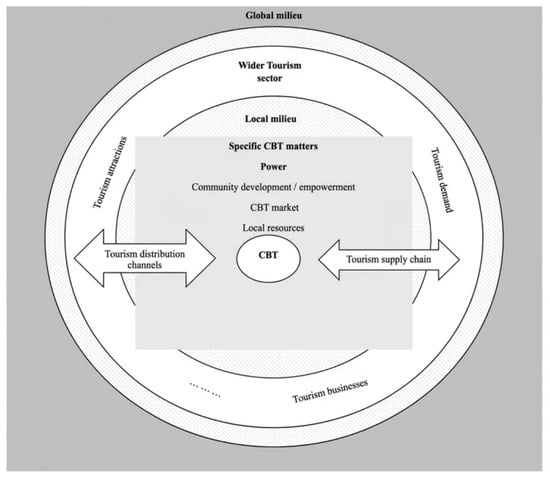
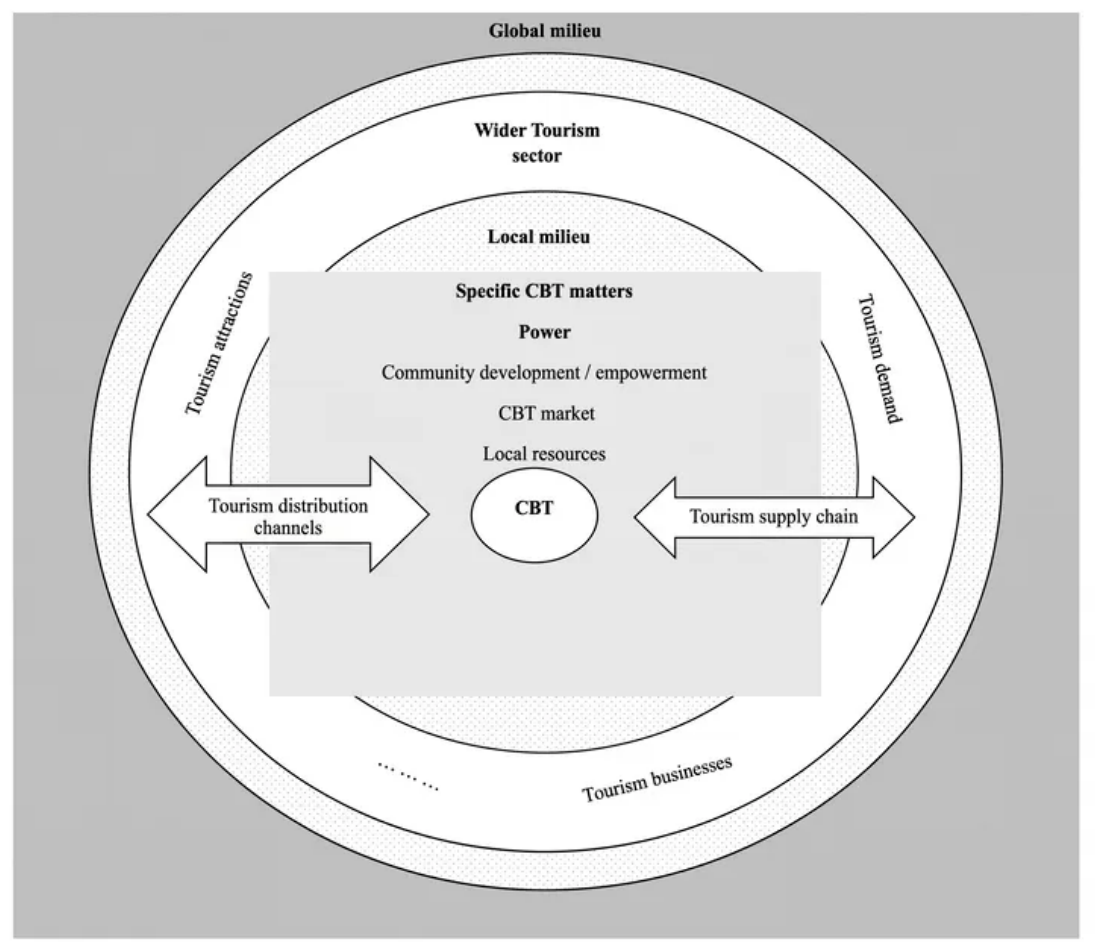
Using a system thinking approach, these three levels and Jakulin’s (45) tourism systems approach inform the proposed structure (Figure 1), which illustrates the positioning of CBT within global, local, and tourism contexts. The figure represents a simplified CBT system and does not include all possible factors to avoid excessive complexity.
Figure 1.
The positioning of CBT within global, local, and tourism contexts. Author elaboration.
In the wider tourism sector, supply and demand forces operate simultaneously. These same forces are amplified at the global level, impacting attractions and businesses in the sector. In the local milieu, there are issues of power, empowerment, tourism markets, etc., to consider. All these aspects have backward and forward linkages consistent with systems thinking approaches. None operate in a silo.
Figure 1 illustrates how CBT, as a locally based activity, remains embedded within the local context and is defined by a core set of principles and characteristics, many of which are themselves locally circumscribed. These CBT-specific elements intersect with issues related to the wider tourism sector, emphasizing that CBT does not operate independently of mainstream tourism. This resonates with system thinking. Similarly, the local milieu is not isolated from the tourism sector or the global context, with local influences extending outward and attenuating as they interact with global forces emphasizing the interconnectedness of the system and its sub-systems and this is illustrated thus:
Communities provide the knowledge, resources, skills, culture and heritage that tourists seek. They transform these resources through their entrepreneurship into products and services. External/internal actors provide backstopping support and funding, while the government provides the policy and regulatory environment. Markets come into play to attract visitors. The supply chain links service providers to suppliers while distribution ensures how the products reach visitors; power permeates all levels to determine who makes decisions and who matters. Outcomes are not solely a result of the efforts of communities. How these chores are enacted will determine the sustainability of the community. Ultimately, CBT is connected to the tourism system through the supply chain and distribution systems.
Although not explicitly illustrated in Figure 1, power relations operate within the CBT system, with power generally exercised at the global to the local level, with differentiated impetus. The global neoliberal milieu can reshape CBT, as it does other alternative forms of tourism [55,56,57], potentially undermining its transformative objectives. CBT should therefore operate parallel to or with the hegemonic frame by striving towards the facilitation of alternative pathways of development that fit the local context and are flexible, while it works towards the legalisation of specific rights of ownership and control of tourism [9] (p. 178). CBT has been connected to rural development, biodiversity and sustainability [58]. Nevertheless, CBT remains influenced by global dynamics.
As earlier stated, CBT development is multi-dimensional as it encompasses power, planning, management, marketing, and resource development [21]. In all this, power is important because it is at the heart of who makes the decisions, who benefits and who does not, who controls resources and who does not, and it has a bearing on how sustainability can be achieved. Therefore, power can amplify the inequalities in communities –the one who makes decisions has the power to sway decisions in his favour or in any other way. Gender, age and kinship can also affect community members either positively or negatively depending on their stations in these hierarchies of power.
External facilitators often operate within the global context and bring associated discourses. Their role should therefore adopt a facilitative, bottom-up approach rather than a top-down interventionist model. CBT entities also face structural disadvantages relative to conventional tourism actors, including tour operators, travel agencies, and global distribution channels. Establishing locally based supply chains and strengthening connections with local realities prior to engaging global actors may enhance local development and resource utilization. Strengthening local supply chains would respond to the burgeoning local and global demand.
Figure 1 positions CBT entities at the center of a system surrounded by more powerful actors and processes. To address this structural weakness, CBT must reconfigure its relationships through horizontal collaboration, networking, and collective organization at local, regional, and global levels. In addition, CBT entities need to reconfigure their relationship vertically with the conventional tourism championed by the private sector because finding an avenue that fosters mutual support is of fundamental importance. It was noted earlier that tourism remains embedded in the global context and is closely linked to contemporary neoliberalism, as tourism constitutes a fundamental “component of a worldwide process of neoliberalization” [47] (p. 1). Therefore, supportive legislation and policy frameworks are essential to formally recognize CBT, similar to the institutional recognition afforded to ecotourism.
5. Discussion
The findings of this paper highlight that CBT cannot be adequately understood as an isolated or purely local phenomenon. Instead, the proposed conceptual model demonstrates that CBT is embedded within a multilayered system composed of global, local, and tourism-specific dynamics. This reinforces the central argument emerging from this paper that CBT is simultaneously shaped by its internal principles, its position within the tourism sector, and broader socio-economic and political contexts. The interaction among these levels provides a useful lens for interpreting both the opportunities and constraints associated with CBT development.
5.1. Global Forces
At the core of the discussion is the tension between the locally grounded nature of CBT and the influence of global forces. The results suggest that while CBT is rooted in local contexts (defined by community values, resources, and governance) it remains significantly exposed to external forces. These pressures stem particularly from the global neoliberal milieu, which can reshape CBT initiatives in ways that may dilute their transformative and redistributive objectives. This implies that the sustainability of CBT is not solely dependent on internal community organization, but also on how effectively communities navigate and negotiate external influences.
5.2. Power Asymmetries
A key implication of this is the recognition of structural power asymmetries within the tourism system. CBT entities are positioned within a broader network dominated by more powerful actors such as tour operators, travel agencies, and global distribution systems. This structural imbalance places CBT at a disadvantage, limiting its control over market access, pricing, and representation. Consequently, achieving sustainability in CBT requires not only local empowerment but also strategic engagement with these external actors. Without addressing these asymmetries, CBT risks being incorporated into mainstream tourism systems in ways that undermine its foundational principles. Capacity building becomes a necessity to elevate the capacities of communities to higher levels to be able to engage with sophisticated local and international actors.
5.3. Supply Chains
The proposed model also highlights the importance of relationships and linkages, particularly through supply chains and distribution channels. These mechanisms connect CBT initiatives to markets but also act as channels through which external influences are transmitted. The results indicate that strengthening local supply chains before engaging with global networks may enhance local resource utilization and economic retention. This highlights a critical pathway for CBT sustainability: prioritizing endogenous development while selectively integrating into broader systems. In this sense, sustainability is framed not as isolation from global markets, but as a calibrated form of engagement that preserves local benefits.
5.4. Facilitators
Another important aspect is the role of facilitators. External facilitators, often operating within global contexts, can provide essential support, especially during the early stages of CBT development. However, their involvement introduces potential risks if it adopts a top-down, interventionist approach. The need is, therefore, to emphasize the need for facilitation models that are participatory and bottom-up, aligning with the core principles of CBT such as community empowerment and local control. This reinforces the idea that processes are as important as outcomes in determining the sustainability of CBT initiatives.
5.5. Collaborations
The model further suggests that collaboration and collective organization are crucial strategies for overcoming the structural weaknesses faced by CBT entities. Horizontal networking at local, regional, and even global levels can enhance bargaining power, knowledge sharing, and resilience. This collective dimension represents a shift from viewing CBT as isolated community projects to understanding it as part of a broader movement that can reconfigure relationships within the tourism sector. In this regard, sustainability is linked not only to local practices but also to the capacity for collective action.
5.6. Institutional Frameworks
In addition, the findings highlight the importance of institutional frameworks, particularly supportive legislation and policy recognition. Formal recognition of CBT can legitimize its role within the tourism sector and provide a foundation for securing rights related to ownership, control, and resource use. This institutional dimension is essential for translating the conceptual positioning of CBT into practical outcomes that support long-term sustainability and community empowerment.
5.7. Sustainability of CBT
Overall, the sustainability of CBT is inherently relational and systemic. It depends on how CBT entities position themselves within a complex network of interactions spanning local to global scales. The proposed model contributes to this understanding by offering a simplified yet integrative framework that captures these dynamics. However, as acknowledged in the paper, the model is preliminary and does not encompass all possible factors, indicating the need for further research to refine and empirically validate its components. The paper makes the following propositions: CBT is rooted in local contexts shaped and defined by community values, resources, and governance, but with likely exposure to the influence of external forces. Facilitators introduce potential risks in a top-down, interventionist approach. Therefore, processes are as important as outcomes in determining the sustainability of CBT initiatives. Overall, CBT entities are positioned within a broader network dominated by powerful actors, resulting in a structural imbalance that limits their control over market access, pricing, and representation. Horizontal networks at local, regional, and global levels can enhance bargaining power, knowledge sharing, and resilience, with the potential to understand it as part of a broader movement that can equally reconfigure vertical relationships with the private sector within the tourism sector. In this regard, sustainability is linked not only to local practices but also to the capacity for collective action.
5.8. Future Research
Future research could build on this conceptual foundation by exploring how different configurations of relationships affect CBT outcomes in diverse contexts. In particular, empirical studies could examine the effectiveness of local supply chain development, the impact of facilitation approaches, and the role of policy frameworks in supporting CBT. Such research would enhance the practical applicability of the model and contribute to a more nuanced understanding of CBT as a pathway for sustainable and inclusive tourism development. The future direction could examine redistributive justice and power in community-based tourism as a topical issue in the recent literature that claims communities are not benefiting enough from CBT. This argument is supported by Muruganantham & Patro [59] (p.1), who argue that “despite advancements [in our understanding of CBT], challenges such as unequal distribution of benefits and limited local authority remain”.
6. Conclusions
Based on a literature review, his paper proposed a conceptual model representing the position of CBT within the wider tourism sector and the general local and global context. Community-based tourism, like all forms of tourism and socio-economic activity, is shaped by both local and global forces that may either facilitate or constrain its development. Three interconnected levels were identified: CBT’s relationship with the general local and global milieu, its relationship with the wider tourism sector, and its relationship with its own specific principles and characteristics.
The proposed model incorporates supply chains and distribution channels as key processes operating across these levels, as well as the role of facilitators at both local and global scales. External facilitation is particularly relevant in the early stages of CBT development, although each type of facilitator presents distinct advantages and disadvantages.
This paper advances a preliminary model for positioning CBT within the broader tourism system and global context, aiming to stimulate debate and further research. A clearer understanding of CBT’s interconnectedness with tourism systems and global dynamics is essential for developing strategies that enhance its role in sustainable and inclusive development towards a more just tourism.
Limitations of the research
Since the study is based on secondary data, issues of their quality and reliability cannot be ascertained, except that most articles were peer-reviewed. The study lacks the lived experiences of owners of the CBT operations. This article, therefore, lacks the contextual specificities on which CBT ventures are anchored.
Practical implications
The practical implications are that there is a need to ensure that communities fully participate in tourism governance; and there is a need to scale up the building of local capacity, enhancing entrepreneurial prospects and combining socio-cultural sustainability with the environmental dimension.
Funding
This research received no external funding.
Institutional Review Board Statement
Not applicable.
Informed Consent Statement
Not applicable.
Data Availability Statement
No new data were created or analyzed in this study. Data sharing is not applicable to this article.
Conflicts of Interest
The author declares no conflicts of interest.
References
- Baggio, R. Symptoms of Complexity in a Tourism System. Tour. Anal. 2008, 13, 1–20. [Google Scholar] [CrossRef] [Scilit]
- Anuar, A.N.A.; Ahmad, H.; Jusoh, H.; Hussain, M.Y. The Essential Elements Underlying Formation of Tourist Friendly Destination Concept: Analysis in Micro Level. Asian Soc. Sci. 2012, 8, 59–70. [Google Scholar] [CrossRef] [Scilit]
- Abreu, L.A.D.; Walkowski, M.D.C.; Perinotto, A.R.C.; Fonseca, J.F.D. Community-Based Tourism and Best Practices with the Sustainable Development Goals. Adm. Sci. 2024, 14, 36. [Google Scholar] [CrossRef] [Scilit]
- Moscardo, G. Using Systems Thinking to Improve Tourism and Hospitality Research Quality and Relevance: A Critical Review and Conceptual Analysis. Tour. Hosp. 2021, 2, 153–172. [Google Scholar] [CrossRef] [Scilit]
- Krittayaruangroj, K.; Suriyankietkaew, S.; Hallinger, P. Research on Sustainability in Community-Based Tourism: A Bibliometric Review and Future Directions. Asia Pac. J. Tour. Res. 2023, 28, 1031–1051. [Google Scholar] [CrossRef] [Scilit]
- Gascón, J.; Milano, C. Community Based Tourism: A Global South Perspective. Tour. Manag. Stud. 2024, 20, 27–37. [Google Scholar] [CrossRef] [Scilit]
- Ruiz-Ballesteros, E.; González-Portillo, A. Limiting Rural Tourism: Local Agency and Community-Based Tourism in Andalusia (Spain). Tour. Manag. 2024, 104, 104938. [Google Scholar] [CrossRef] [Scilit]
- Dłużewska, A.; Giampiccoli, A. Enhancing Island Tourism’s Local Benefits: A Proposed Community-Based Tourism-Oriented General Model. Sustain. Dev. 2021, 29, 272–283. [Google Scholar] [CrossRef] [Scilit]
- Saayman, M.; Giampiccoli, A. Community-Based and Pro-Poor Tourism: Initial Assessment of Their Relation to Community Development. Eur. J. Tour. Res. 2016, 12, 145–190. [Google Scholar] [CrossRef] [Scilit]
- Vongvisitsin, T.B.; Wong, A.K.F. New Perspectives of Community-Based Tourism: A Universal Approach to Tourism Development. In A Research Agenda for the Social Impacts of Tourism; Edward Elgar Publishing: Cheltenham, UK, 2024; pp. 125–144. [Google Scholar]
- Dangi, T.B.; Jamal, T. An Integrated Approach to ‘Sustainable Community-Based Tourism’. Sustainability 2016, 8, 475. [Google Scholar] [CrossRef] [Scilit]
- Jackson, L.A. Community-Based Tourism: A Catalyst for Achieving the United Nations Sustainable Development Goals One and Eight. Tour. Hosp. 2025, 6, 29. [Google Scholar] [CrossRef] [Scilit]
- Tuyen, Q.D.; Phan, C.N.; Hieu, N.D.; Le Anh, T. How Has Community-Based Tourism Evolved Over Three Decades (1995–2025): A Bibliometric and Systematic Literature Review on Evolution and Future Research Directions. Sustain. Dev. 2025, 33, 8870–8893. [Google Scholar] [CrossRef] [Scilit]
- Vongvisitsin, T.B.; Huang, W.J.; King, B. Urban Community-Based Tourism Development: A Networked Social Capital Model. Ann. Tour. Res. 2024, 106, 103759. [Google Scholar] [CrossRef] [Scilit]
- Wani, M.D.; Batool, N.; Dada, Z.A.; Shah, S.A. Investigating the Impact of Community-Based Tourism on the Residents’ Quality of Life and Their Support for Tourism. Community Dev. 2024, 55, 138–159. [Google Scholar] [CrossRef] [Scilit]
- Lee, S.; Lee, N.; Lee, T.J.; Hyun, S.S. The Influence of Social Support from Intermediary Organizations on Innovativeness and Subjective Happiness in Community-Based Tourism. J. Sustain. Tour. 2024, 32, 795–817. [Google Scholar] [CrossRef] [Scilit]
- Bagus, S.I.; Imade, S.U.; Nyoman, S.I.A.; Putu, W.S.N. Community Based Tourism as Sustainable Tourism Support. Russ. J. Agric. Socio-Econ. Sci. 2019, 94, 70–78. [Google Scholar] [CrossRef] [Scilit]
- Mia, M.N.; Mani, L.; Rahman, M.M.; Milon, M.N.U.; Hossain, R. Gravitating towards Community Based Tourism (CBT): Community Empowerment and Reducing Poverty in Tourism Sector Development in Bangladesh. Int. J. Relig. 2024, 5, 848–864. [Google Scholar] [CrossRef] [Scilit]
- Krongyut, K.; Boonpat, O.; Boonpat, S.N. The Development of Community-Based Tourism Based on Socio-Cultural Capital in Chiang Rai Province, Thailand. J. Manag. Inf. Decis. Sci. 2021, 24, 1–13. [Google Scholar]
- Dodds, R.; Ali, A.; Galaski, K. Mobilizing Knowledge: Determining Key Elements for Success and Pitfalls in Developing Community-Based Tourism. Curr. Issues Tour. 2018, 21, 1547–1568. [Google Scholar] [CrossRef] [Scilit]
- Jugmohan, S.; Spencer, J.P.; Steyn, J.N. Local Natural and Cultural Heritage Assets and Community Based Tourism: Challenges and Opportunities. Afr. J. Phys. Act. Health Sci. 2016, 22, 306–317. [Google Scholar]
- Siakwah, P.; Musavengane, R. Re-Imagining Community-Based Tourism in Rural Africa through Networks and Management Innovation. In New Frontiers in Hospitality and Tourism Management in Africa; Springer International Publishing: Cham, Switzerland, 2021; pp. 227–244. [Google Scholar]
- Hariyadi, B.R.; Rokhman, A.; Rosyadi, S.; Yamin, M.; Runtiko, A.G. The Role of Community-Based Tourism in Sustainable Tourism Village in Indonesia. Rev. Gest. Soc. Ambient. 2024, 18, e05466. [Google Scholar] [CrossRef] [Scilit]
- Ditta-Apichai, M.; Kattiyapornpong, U.; Gretzel, U. Platform-Mediated Tourism Micro-Entrepreneurship: Implications for Community-Based Tourism in Thailand. J. Hosp. Tour. Technol. 2020, 11, 223–240. [Google Scholar] [CrossRef] [Scilit]
- Freitag, A.M.; Camargo-Borges, C. The Digital Bow: Exploring the Potential of Digital Presence for Indigenous Community-Based Tourism in Brazil. Tour. Plan. Dev. 2024, 21, 755–772. [Google Scholar] [CrossRef] [Scilit]
- Vo, N.T.Q. Community-Based Tourism and Destination Attractiveness: From Theory to Practice. J. Tour. Hosp. Sports 2020, 49, 24–36. [Google Scholar] [CrossRef] [Scilit]
- Mtapuri, O.; Giampiccoli, A.; Jugmohan, S. Impact of COVID-19 on Small Community-Based Tourism Businesses: Diversification of Opportunities and Threats in Modern Africa. Econ. Ann.-XXI 2021, 192, 177–187. [Google Scholar] [CrossRef] [Scilit]
- Giampiccoli, A.; Saayman, M. A Conceptualisation of Alternative Forms of Tourism in Relation to Community Development. Mediterr. J. Soc. Sci. 2014, 5, 1667–1677. [Google Scholar] [CrossRef] [Scilit]
- Nainggolan, H.C.; Prihadi, D.J.; Mulyana, H. Community-Based Tourism as a Solution to Reduce the Negative Impact of Mass Tourism. Major. Sci. J. 2024, 2, 88–93. [Google Scholar] [CrossRef] [Scilit]
- Jugmohan, S.; Giampiccoli, A.; Vallabh, D.; Mtapuri, O. A Model of CBT Networks and Organizations: An African Perspective and Beyond. Forum Geogr. 2020, 19, 105–115. [Google Scholar] [CrossRef] [Scilit]
- Lee, S.; Joo, D. Intermediary Organizations as Supporters of Residents’ Innovativeness and Empowerment in Community-Based Tourism. J. Sustain. Tour. 2024, 32, 1534–1556. [Google Scholar] [CrossRef] [Scilit]
- Ashley, C.; Garland, E. Promoting Community-Based Tourism Development: Why, What and How? Research Discussion Paper No. 4; Directorate of Environmental Affairs, Ministry of Environment and Tourism: Windhoek, Namibia, 1994. [Google Scholar]
- Mtapuri, O.; Giampiccoli, A. Towards a Comprehensive Model of Community-Based Tourism Development. S. Afr. Geogr. J. 2016, 98, 154–168. [Google Scholar] [CrossRef] [Scilit]
- Moayerian, N.; McGehee, N.G.; Stephenson, M.O., Jr. Community Cultural Development: Exploring the Connections between Collective Art Making, Capacity Building and Sustainable Community-Based Tourism. Ann. Tour. Res. 2022, 93, 103355. [Google Scholar] [CrossRef] [Scilit]
- Dewi, N.I.K.; Siwantara, W.; Astawa, I.P.; Mataram, I.G.A.B. Tourism Supply Chain Framework: A Case on Tourism Village. In Proceedings of the International Conference on Social Science 2019 (ICSS 2019), Bali, Indonesia, 17–18 October 2019; pp. 1124–1130. [Google Scholar]
- Schott, C.; Nhem, S. Paths to the Market: Analysing Tourism Distribution Channels for Community-Based Tourism. Tour. Recreat. Res. 2018, 43, 356–371. [Google Scholar] [CrossRef] [Scilit]
- McCool, S.F. Information Needs for Building a Foundation for Enhancing Sustainable Tourism as a Development Goal: An Introduction. In A Research Agenda for Sustainable Tourism; Edward Elgar Publishing: Cheltenham, UK, 2019; pp. 1–13. [Google Scholar]
- Teruki, N. Empowering Rural Economies: A Community-Centric Sustainable Ecotourism Model. Int. J. Adv. Res. Econ. Finance 2024, 6, 149–156. [Google Scholar] [CrossRef] [Scilit]
- Leiper, N. The Framework of Tourism: Towards a Definition of Tourism, Tourist, and the Tourist Industry. Ann. Tour. Res. 1979, 6, 390–407. [Google Scholar]
- Tandilino, S.B. Model of Sustainable Tourism System Application between Borders of Indonesia and Timor Leste. In International Conference on Applied Science and Technology on Social Science 2021 (iCAST-SS 2021); Atlantis Press: Dordrecht, The Netherlands, 2022; pp. 83–89. [Google Scholar]
- Amiruddin, S.; Normelani, E.; Budhi, S. The Central Government’s Role in Cultural Sustainability and Developing Tourism to Support Rural Economies. J. Ethn. Cult. Stud. 2022, 9, 151–170. [Google Scholar] [CrossRef] [Scilit] [PubMed]
- Khan, D.; Banerjee, S. Value Chain Mapping of Tourism in Birbhum. Int. J. Tour. Hosp. Manag. Digit. Age 2020, 4, 23–33. [Google Scholar] [CrossRef] [Scilit]
- Hartman, S. Destination Governance in Times of Change: A Complex Adaptive Systems Perspective to Improve Tourism Destination Development. J. Tour. Futures 2023, 9, 267–278. [Google Scholar] [CrossRef] [Scilit]
- Soeswoyo, D.M. Exploring the Readiness of Betawi Cultural Village as a Sustainable Cultural Tourism Destination in Jakarta. In Asia Tourism Forum 2016—The 12th Biennial Conference of Hospitality and Tourism Industry in Asia; Atlantis Press: Dordrecht, The Netherlands, 2016; pp. 93–98. [Google Scholar]
- Jakulin, T.J. Systems Approach to Tourism: A Methodology for Defining Complex Tourism System. Organizacija 2017, 50, 208–215. [Google Scholar] [CrossRef] [Scilit]
- Wiweka, K.; Arcana, K.T.P. Rethinking the Theory of Tourism: What Is Tourism System in Theoretical and Empirical Perspective? J. Bus. Hosp. Tour. 2019, 5, 318–336. [Google Scholar] [CrossRef] [Scilit][Green Version]
- Fletcher, R. Tourism and Neoliberalism. Tourism. Geographies. 2023, 1–10. [Google Scholar] [CrossRef] [Scilit]
- Torraco, R.J. Writing Integrative Literature Reviews: Using the Past and Present to Explore the Future. Hum. Resour. Dev. Rev. 2016, 15, 404–428. [Google Scholar]
- Elsbach, K.D.; van Knippenberg, D. Creating High-Impact Literature Reviews: An Argument for ‘Integrative Reviews’. J. Manag. Stud. 2020, 57, 1277–1289. [Google Scholar] [CrossRef] [Scilit]
- Torraco, R.J. Writing Integrative Literature Reviews: Guidelines and Examples. Hum. Resour. Dev. Rev. 2005, 4, 356–367. [Google Scholar] [CrossRef] [Scilit]
- Snyder, H. Literature Review as a Research Methodology: An Overview and Guidelines. J. Bus. Res. 2019, 104, 333–339. [Google Scholar] [CrossRef] [Scilit]
- Cabral, C.; Dhar, R.L. Ecotourism Research in India: From an Integrative Literature Review to a Future Research Framework. J. Ecotourism 2020, 19, 23–49. [Google Scholar] [CrossRef] [Scilit]
- Otowicz, M.H.; Macedo, M.; Biz, A.A. Dimensions of Smart Tourism and Its Levels: An Integrative Literature Review. J. Smart Tour. 2022, 2, 5–19. [Google Scholar] [CrossRef] [Scilit]
- Zagarkhorloo, U.; Heijman, W.; Dries, L.; Batjargal, B. Managing Herder-Community-Based Tourism: An Institutional Framework for an Integrated Social–Ecological System. Sustainability 2021, 13, 4001. [Google Scholar] [CrossRef] [Scilit]
- Higgins-Desbiolles, F. The Potential for Justice through Tourism. Via Tour. Rev. 2018, 13, 1–11. [Google Scholar] [CrossRef] [Scilit]
- Giampiccoli, A.; Dłużewska, A.; Mnguni, E.M. Host Population Well-Being through Community-Based Tourism and Local Control: Issues and Ways Forward. Sustainability 2022, 14, 4372. [Google Scholar] [CrossRef] [Scilit]
- Manyara, G.; Jones, E. Community-Based Tourism Enterprises Development in Kenya: An Exploration of Their Potential as Avenues of Poverty Reduction. J. Sustain. Tour. 2007, 15, 628–644. [Google Scholar] [CrossRef] [Scilit]
- Ramaano, A.I. Community-Based Tourism (CBT) Advancement and Sustainable Tourism Enterprise Establishments in Marginalized Rural Municipalities: Context for Ecotourism Development in Parks-Adjacent Communities. For. Econ. Rev. 2025, 7, 77–109. [Google Scholar] [CrossRef] [Scilit]
- Muruganantham, G.; Patro, U.S. Community-based sustainable tourism: A systematic review and future research agenda. Asia Pac. J. Tour. Res. 2026, 1–24. [Google Scholar] [CrossRef] [Scilit]
Disclaimer/Publisher’s Note: The statements, opinions and data contained in all publications are solely those of the individual author(s) and contributor(s) and not of MDPI and/or the editor(s). MDPI and/or the editor(s) disclaim responsibility for any injury to people or property resulting from any ideas, methods, instructions or products referred to in the content. |
© 2026 by the author. Licensee MDPI, Basel, Switzerland. This article is an open access article distributed under the terms and conditions of the Creative Commons Attribution (CC BY) license.