


Abstract
Religious tourism can generate economic, environmental, social, and experiential benefits while impairing the functions that sustain a destination as a living religious place. This conceptual paper examines the limits of cross-domain compensation through theory synthesis, drawing primarily on spiritual-sustainability research and strong sustainability, and distinguishing value formation from value compensation. It develops sacred-function criticality as the degree to which impairment threatens religious functional continuity for a specified community and time horizon. Assessment considers constitutiveness, reversibility, and functional replaceability, with religious–institutional embeddedness providing context. Two conditional propositions associate documented dependencies with higher estimated criticality and credible recovery options with lower criticality under comparable conditions. The sacredness constraint states that, when maintaining religious continuity is an explicit objective, benefits alone do not demonstrate compensation; maintenance, restoration, or religiously equivalent replacement must be examined separately. A hypothetical comparison distinguishes benefits accompanying persistent loss from revenues enabling later recovery, without erasing missed ritual occurrences. The framework separates project approval and acceptance of trade-offs from evidence of religious continuity. It offers a function-specific basis for comparing tourism interventions alongside economic and ecological appraisal, while its empirical usefulness remains to be established.
1. Introduction
Living religious destinations bring several purposes into the same place. They sustain worship, pilgrimage, and community life while also providing heritage experiences and supporting local tourism economies. Improvements in access, conservation, or visitor services can help maintain religious use, but they can also alter the spaces and conditions on which that use depends. Sustainability assessment must therefore consider what happens to religious functioning alongside the benefits that tourism generates.
Economic appraisal and ecological-footprint assessment address real achievements and pressures in tourism development. Ecological-footprint research extends environmental accounting beyond the immediate destination [1,2], while later reviews examine water, carbon, and ecological footprints in tourism [3]. Favorable economic and ecological outcomes nevertheless do not establish, on their own, that a destination remains a living religious place. The issue addressed here complements those assessments: whether the practices and relationships constitutive of that religious role can continue. Religious functions are not natural-capital stocks, and ecological thresholds cannot supply thresholds for religious continuity.
Religious-tourism research already recognizes this concern. Aulet and Duda [4] connect spiritual sustainability with the preservation of spiritual values and religious uses, including the consequences of making sacred sites accessible to visitors. Shinde and Olsen place tangible and intangible sacredness at the center of pilgrimage sustainability and emphasize the practices and institutions through which religious places are sustained [5]. These contributions establish why the continued religious life of a destination matters. They also provide the starting point for a more specific evaluative question: what would justify a claim that benefits from tourism compensate for impairment of that religious life?
Consider, hypothetically, an intervention that improves public transport and generates conservation funding while restricting access needed for a communal ritual. The transport and conservation gains may be substantial. Yet their presence does not establish whether the ritual can continue, resume after disruption, or be performed through a religiously equivalent arrangement. Revenue used to restore access has a different relationship to the impairment from revenue that accompanies its persistent loss. The issue concerns what the benefits enable, as well as their magnitude and distribution.
Sustainability research has long questioned unrestricted compensation, including in tourism development assessed through a strong-sustainability perspective [6]. Strong sustainability directs attention to functions whose deterioration may not be adequately replaced by gains elsewhere [7]. Tourism research has also developed non-compensatory approaches to combining sustainability indicators [8]. The present paper builds on this reasoning without treating sacredness as natural capital or proposing another composite index. It addresses the prior question of what has been impaired and whether the affected religious function can be maintained or recovered.
The problem requires a distinction between value formation and value compensation. The former concerns how interactions generate beneficial and detrimental outcomes; the latter concerns whether gains can adequately offset a specified loss for the purpose of an evaluation. Service-Dominant Logic and value co-destruction offer supporting accounts of tourism-related interactions and their uneven outcomes [9,10]. Those accounts do not, by themselves, establish equivalence between an economic benefit and the loss of an opportunity for religious practice. Nor can that equivalence be inferred solely from stakeholders’ acceptance or refusal of a proposed exchange.
The conceptual task is to connect continued religious use with the problem of compensation in tourism sustainability. A general judgment of spiritual loss leaves open which function is affected, whose participation is at issue, and whether adaptation can sustain it. An overall favorable balance can leave the same questions unresolved. The research objective is to develop a conceptual framework that specifies how the role, impairment, and recovery possibilities of a religious function inform claims that tourism benefits compensate for its loss. This paper asks the following: how do the role of an affected religious function, the disruption it faces, and its recovery possibilities clarify whether economic, ecological, social, and experiential gains compensate for its impairment when maintaining the destination as a living religious place is an explicit objective? Maintaining a living religious place is the conditional objective of the assessment examined here; developing the framework is the objective of the conceptual investigation.
The framework develops one focal construct and one conditional evaluative principle. Sacred-function criticality is the degree to which impairment of a religious function threatens the site’s religious functional continuity for a specified community and time horizon. Constitutiveness, reversibility, and functional replaceability organize the assessment; religious–institutional embeddedness provides context for dependencies and possible responses. The sacredness constraint states that benefits elsewhere are insufficient, by themselves, to demonstrate compensation for an impairment that compromises the site’s religious functional continuity for that community and time horizon. Maintenance, restoration, or religiously equivalent replacement of the affected function must be examined separately. This principle makes the evaluative objective explicit while leaving room for an intervention to be justified on other grounds, with its religious loss acknowledged.
The contribution is a function-specific comparison of the compensatory relevance of tourism benefits. It specifies the function, reference community, and time horizon; separates constitutive role from the profile of disruption; and compares opportunities for maintenance and recovery. It then traces what the benefits enable. A hypothetical comparison makes this operation concrete: comparable gross benefits can accompany persistent ritual loss or, through allocated revenues, enable recovery for later cycles under stated conditions. This difference matters to the sustainability of the religious destination itself: economic viability and ecological improvement can coexist with either persistent loss or restored religious capacity. Two conditional propositions organize comparisons of dependencies and recovery, while the evaluative principle distinguishes project approval from achievement of the religious-continuity objective. The framework develops existing arguments about spiritual sustainability and limited substitutability; its added usefulness remains to be examined empirically.
2. Conceptual Development Approach
This paper develops a conceptual framework through theory synthesis. It brings together arguments about continued religious use, functional substitution, and tourism-related value outcomes to examine a specific evaluative problem: whether benefits generated by an intervention establish that an impaired religious function has been compensated for. Theory synthesis provides an appropriate approach to relating concepts from different research streams around a defined problem [11]. The purpose is conceptual development through integration [12], rather than an exhaustive account of the literature or an estimate of the prevalence of particular effects; this distinction matters when selecting a literature-based research design [13].
The argument draws primarily on religious-tourism and spiritual-sustainability research to establish a concern with living religious places, and draws on strong sustainability to examine the limits of functional substitution. These perspectives perform different tasks. The former identifies the practices, relationships, and conditions that sustainability assessment should attend to; the latter provides a rationale for asking whether gains elsewhere can replace a function that has been impaired. The transfer from strong sustainability is limited to this reasoning about functions and substitution. It does not treat sacredness as a stock of natural capital or assume that religious continuity has ecological equivalents.
Service-Dominant Logic (SDL) and value co-destruction provide supporting contexts for how tourism interactions produce divergent outcomes. They are used to explain changes in the conditions of religious practice, not to determine the religious status of a place. Research on protected values serves a different, delimiting purpose: it helps distinguish resistance to exchange from evidence about functional loss. The studies are therefore not treated as four equally extensive components of a causal model.
The synthesis connects the research problem to the framework through four analytical moves. Section 4 separates the formation of tourism-related gains and losses from the justification of compensation. Section 5 then specifies the religious function, reference community, and time horizon, and derives three assessment questions: what role does the function perform and what depends on it; can its impaired conditions be restored in time; and can a religiously equivalent alternative sustain it? These questions yield constitutiveness, reversibility, and functional replaceability as considerations for assessing sacred-function criticality. Section 6 formulates conditional propositions from comparisons of dependencies and recovery possibilities under comparable conditions. It also states the sacredness constraint by relating the distinction between benefit generation and functional recovery to the explicit objective of maintaining religious continuity. This is a problem-led conceptual derivation, not a report of systematic searching, empirical coding, or validated dimension selection. Protected-values research helps interpret judgments about exchange but does not supply the premise from which the evaluative principle is deduced.
The outputs of this synthesis are conceptual: a focal construct, sacred-function criticality; two conditional analytical propositions; and a conditional evaluative principle, the sacredness constraint. The three considerations organize criticality assessment, while religious–institutional embeddedness provides context for dependencies and responses. Table 1 distinguishes analytical levels and Table 2 specifies orienting evidence for future assessments. The illustrations make the reasoning explicit under stated assumptions. The microexample in Section 6.1 compares dependence on a communal gathering while keeping its defining role, interruption, and recovery conditions comparable. Table 3 holds the ritual function, reference community, time horizon, and assumed gross benefits constant while varying restoration and equivalent alternatives. Timely restoration and equivalent provision illustrate maintained capacity; persistent loss and delayed recovery more specifically illustrate the recovery comparison in the second proposition and the compensatory relevance of benefit-funded restoration. These analytical demonstrations neither establish causal effects nor validate the framework. Its empirical usefulness remains to be examined, and the justification of the principle also requires normative scrutiny.
3. Spiritual Sustainability and Religious Functioning
Living religious destinations sustain activities and relationships whose purposes extend beyond tourism. Worship, pilgrimage, communal religious life, and the transmission of practices may continue whether or not a site attracts visitors. Tourism development enters this setting through changes in access, resources, spatial use, and governance. Its sustainability therefore concerns both the benefits it generates and the conditions under which religious life remains possible.
This concern is already established in spiritual-sustainability research. Aulet and Duda connect accessibility with the preservation of spiritual values and religious uses, showing why access to a sacred site cannot be considered solely as a visitor-management issue [4]. Shinde and Olsen place tangible and intangible sacredness within the sustainability of pilgrimage and religious tourism, including religious practices and the institutions that sustain them [5]. Recent work also relates spiritual integrity to relationships among visitors, communities, and place-based practices [14]. The present framework builds on these concerns. Its proposed contribution is a more explicit account of how the role of an affected function and the possibilities of recovery bear on claims of compensation.
Sacred function refers here to a site’s capacity to support a specified religious practice or community relationship under the conditions required for its religious role. The term directs attention to what the place enables. It does not attempt to define sacredness as a whole. Research on symbolism and perceptions of sacredness addresses one aspect of this broader concept [15], which may also encompass theological status and collective attribution. Nor does sacred function imply that the capacity in question is identical to a building, route, or administrative arrangement. Such arrangements may be indispensable, adaptable, or replaceable, depending on the practice and its requirements.
The distinction matters because a favorable visitor experience does not establish that religious functioning has been maintained. Visitor-experience research assesses desired and perceived experiences at religious heritage sites [16]; the evaluative object differs from the continuity assessed here. A visitor may find a site spiritually meaningful while members of its religious community encounter increasing difficulty in using spaces or observing ritual schedules. Conversely, new infrastructure may change the visitor experience without impairing religious practice. These are analytical possibilities, not findings about particular destinations. They show why individual experience and the continuity of religious functions require different evidence.
Table 1 locates these terms at their respective analytical levels. The definitions of sacred function and religious functional continuity specify the object of this paper; only sacred-function criticality is advanced as a focal construct. The sacredness constraint states how evidence is interpreted under a declared objective. The comparison terms identify overlapping concerns rather than mutually exclusive categories.
Table 1.
Terms and analytical levels used in the assessment.
Authenticity and heritage integrity can overlap with religious continuity without being interchangeable with it. Pilgrimage authenticity can concern the relationship between place, belief, and embodied experience [17], while religious heritage is subject to contested interpretation and planning [18]. Neither authenticity nor integrity is reduced here to an individual impression or the preservation of physical fabric. An assessment using either concept may examine religious use closely; the question is whether its evidence establishes the continued possibility of the specified function.
Continuity does not mean preservation of every existing arrangement. An adapted space or schedule may sustain a practice if the relevant requirements are met and participation remains possible. In other settings, attachment to a prescribed place, season, sequence, or form of authorization may limit adaptation. Religious requirements thus form part of the function being assessed. A technically feasible alternative cannot be assumed to be religiously equivalent, but neither should every alteration be classified in advance as a loss.
Institutional context helps explain these differences. Norms and authority structures may bind a practice to particular arrangements; they may also support adaptation, coordinate resources, and make restoration possible. Research at Catholic pilgrimage sites in Labuan Bajo documents community volunteering and clergy-led coordination [19]. The relevant community may itself contain divergent judgments about what continuity requires. An assessment must therefore identify whose practices and relationships are at issue and document disagreements, rather than treating institutional authorization, community acceptance, and actual performance as the same judgment. Section 5 develops this concern into an explicit definition of religious functional continuity and criteria for assessing threats to it.
4. Value Formation and the Problem of Compensation
Religious institutions, pilgrims, residents, tourism businesses, and public authorities participate in shaping the conditions of a destination. Their interactions bring together resources such as infrastructure, labor, ritual knowledge, access rights, and funding. SDL offers a way to understand this process through resource integration within institutional arrangements [9,20]. Tourism and hospitality reviews connect interaction and engagement with value co-creation [21], while work on sustainable tourism examines the value emerging through collaboration among destination actors [22]. Here, this perspective supplies a processual account of tourism-related change rather than a theory of sacredness.
Collaboration does not ensure that every participant benefits. Value co-destruction concerns interaction through which value or well-being is diminished for at least one participating service system [23]. Subsequent conceptual work examines its relationship with value co-creation and the conditions under which detrimental outcomes emerge [10]. A tourism and hospitality review similarly maps value co-destruction research [24], while a mobility-service study examines co-creation and co-destruction across linked actor relationships [25]. These contributions support attention to uneven outcomes without assuming that every impairment of religious functioning is necessarily an instance of co-destruction. The process of producing the impairment must also be identified.
For example, an access intervention could improve mobility and support local businesses while redirecting visitors through a space required for worship. A different arrangement could provide similar transport benefits while protecting that space. These hypothetical possibilities illustrate why the magnitude of tourism activity alone does not determine its religious consequences. The location, timing, and organization of interactions matter, as does the distribution of benefits and burdens. An arrangement welcomed by visitors may create difficulties for a resident religious community, and initial improvements may coexist with losses that become apparent only later.
Explaining the formation and distribution of such outcomes does not settle whether they compensate for one another. Revenue, accessibility, or satisfaction can improve while the affected practice remains impossible. Alternatively, revenue may finance the restoration that allows it to resume. The compensatory relevance of the benefit depends on its relationship to the impaired function and on the evaluative objective, rather than simply on its positive value.
Strong sustainability makes this distinction consequential by questioning unrestricted substitution among resources and functions [7]. In the present application, the question is whether the religious role of what has been impaired can be maintained, restored, or performed through an equivalent alternative. This is narrower than claiming that religious values are inherently beyond comparison. It also differs from choosing an aggregation method: a non-compensatory tourism indicator regulates how criteria enter an overall evaluation but does not itself establish whether a particular religious function has survived [8].
Protected-values research adds a caution about interpreting acceptance and refusal. Resistance to trading a valued commitment can reflect moral obligations that are not captured by ordinary benefit calculations [26]. Sacred-values research also cautions that professed resistance to trade-offs is conditioned by stakes and resource constraints [27]. Such resistance is relevant to understanding stakeholders’ responses, but it neither proves functional irreplaceability nor establishes that an intervention ought to be prohibited. Equally, willingness to accept benefits does not demonstrate that religious continuity has been maintained. The following sections therefore assess the threat to the function separately from perceived acceptability and state explicitly the objective under which the sacredness constraint applies.
5. Sacred-Function Criticality and Religious Functional Continuity
Section 4 establishes why benefit generation and functional recovery require different evidence. This section specifies the religious continuity at issue and derives the considerations needed to assess threats to it. The transfer from strong sustainability concerns functional dependence, limited substitution, and restoration possibilities [7,28]. Religious meanings, requirements, and authority must be established in their own setting.
5.1. Defining the Function and the Continuity at Issue
Religious functional continuity refers here to a site’s capacity, over a specified period, to sustain the practices and community relationships constitutive of its religious role under conditions compatible with the relevant religious requirements. This includes adaptations justified within the setting concerned. Continuity therefore does not require every spatial arrangement or customary practice to remain unchanged. It requires an account of which religious activities and relationships must remain possible, for whom, and under what conditions.
An assessment begins by identifying the religious function, the site, the reference community, the proposed intervention, and the time horizon. The function should be distinguished from the material arrangement through which it is performed. For example, the function may be the community’s ability to complete a pilgrimage ritual; a particular route is one possible condition of its performance. Whether that route is indispensable depends on the requirements of the practice, rather than on an assumption that all existing arrangements are irreplaceable.
Evidence of continuity concerns actual opportunities for practice, effective community access and participation, and compatibility with the relevant religious requirements. Ritual calendars, records of interruptions and resumptions, and observation of access and performance can inform that judgment. These are outcome checks, distinct from the three considerations used below to estimate criticality prospectively. A compatible arrangement that participants cannot effectively use does not establish continuity; conversely, non-performance for unrelated reasons does not by itself demonstrate loss of capacity attributable to the intervention.
The requirements must be documented through relevant norms, observed practices, and accounts from religious and community actors. Institutional authorization is pertinent but does not establish that all participants agree or that access is effective. Where communities or authorities differ, the assessment should identify the competing requirements and their implications instead of presuming a single religious judgment. Religious functional continuity is thus a specified concern within spiritual sustainability, rather than an exhaustive measure of sacredness or spiritual experience.
5.2. Assessing Sacred-Function Criticality
Sacred-function criticality is the degree to which impairment of a religious function threatens the site’s religious functional continuity for the specified community and time horizon. It concerns the consequences of an impairment in context, rather than an intrinsic ranking of sacred practices. The initial severity, extent, duration, and timing of disruption must be described separately from the function’s constitutive role. A brief interruption during an indispensable ritual period may have different consequences from a longer interruption outside that period.
The selection of three considerations follows from the evaluative problem. Before deciding whether an impairment threatens continuity, one must establish what religious role the function performs and what depends on it. This yields constitutiveness. Because the same initial disruption can have different consequences when it can be remedied, one must next ask whether restoration is feasible in the relevant period. This yields reversibility. Restoration of the original arrangement is not the only possible response: another arrangement may sustain the same religious function, which yields functional replaceability. Omitting any question would conflate, respectively, the role of the function, recovery of its impaired conditions, or continuation through an equivalent alternative. The selection is therefore analytically motivated, not empirically validated or asserted to be universally exhaustive.
Constitutiveness concerns the function’s role in sustaining the site as a living religious place for the reference community. It operates at the relationship between function, place, and community. A function can be constitutive because it defines a central religious role of the site, because other practices or relationships depend on it, or both. A sanctuary’s provision for its defining annual observance could be constitutive even if no further ritual depends on that observance. This hypothetical boundary case prevents the number of dependent activities from becoming a proxy for religious significance. Visitor visibility and expressed attachment alone do not establish either constitutive role or dependence.
Reversibility concerns the impairment and the feasibility of remedying it within the stated period. Restoration requires resources, access rights, responsible actors, relevant authorization, and a timetable compatible with religious practice. Physical repair alone may leave participation or ritual provision unavailable. The question is consequently whether the impaired conditions for the function can be restored, not simply whether construction can be undone. Recovery of future capacity does not retrospectively recover a missed ritual occurrence.
Functional replaceability concerns the available alternatives and the requirements of religious equivalence. A substitute must sustain the specified function for the reference community under the relevant conditions of place, time, sequence, and participation. Those conditions determine what counts as equivalent performance; technical availability alone cannot settle the matter. If a specific location is constitutive of the practice, a nearby accessible space may fail the requirement. If location permits authorized adaptation, the same relocation need not imply functional loss. Competing interpretations should be documented rather than resolved through an assumed community consensus.
Religious–institutional embeddedness forms part of the context in which these judgments are made. Norms, authority, obligations, and community relationships may create dependencies that make disruption consequential. They may also provide the resources, coordination, and legitimate adaptations through which continuity is maintained. The institutional role emphasized in religious-tourism research [5], therefore, does not warrant a uniformly positive relationship between embeddedness and criticality. Dependencies and response capacities should both be examined, without treating them as additional constructs.
The considerations are used to compare documented configurations, without weights or addition. For comparable constitutive roles and initial impairments, a credible opportunity to restore or replace the affected conditions before the next required practice supports a lower estimate of threat than persistent loss without an equivalent alternative. For comparable impairment and recovery conditions, documented dependence of other functions can support a judgment of wider consequences. The comparison must state what is held comparable and what differs. It need not rank every function: a defining practice with uncertain recovery and a supporting practice with known prolonged disruption may remain only partially comparable. Missing information warrants an unresolved or conditional judgment, not an automatic assignment of high or low criticality.
Table 2 is a conceptual documentation aid, not a validated scale. Its orienting evidence supports an assessment before the continuity outcome is known. Later records of practice, access, participation, and compatibility provide a separate basis for revising that assessment. This separation prevents criticality from being inferred solely from either subsequent loss or stakeholders’ refusal of compensation.
Table 2.
Orienting evidence for prospective criticality assessment.
6. The Sacredness Constraint as a Conditional Evaluative Principle
Sacred-function criticality and the sacredness constraint perform complementary tasks in evaluating religious tourism development. Criticality organizes the comparison of threats to continuity by relating the function’s constitutive role to the disruption and the possibilities of recovery. The sacredness constraint specifies what the relationship between benefits and the affected function supports as a conclusion about compensation when maintaining a living religious destination is an explicit objective. Benefits alone cannot demonstrate recovery at any degree of criticality. Criticality adds to the comparison needed to distinguish what is threatened, which practices depend on it, and whether the loss persists or can be remedied within the relevant period. The principle keeps a favorable economic, ecological, or social balance from being treated as achievement of that continuity objective. Their joint use connects the significance and persistence of religious loss to what tourism benefits actually enable, without making the principle stronger as criticality increases.
6.1. Conditional Propositions and the Evaluative Principle
Two analytical propositions organize these comparisons and identify conditional expectations about subsequent continuity. Assigning criticality according to their comparison rules is an analytical judgment; empirical examination begins with whether the anticipated consequences occur. Neither proposition states an established causal effect or a fully operationalized empirical hypothesis.
Proposition 1.
For comparable initial impairments, similar recovery conditions, and comparable defining roles, estimated sacred-function criticality is higher where documented dependencies mean that impairment of the affected function also threatens other religious functions at the site.
P1 isolates one relationship within constitutiveness; it does not exhaust the concept. Consider two hypothetical religious houses in which a common prayer gathering has a comparable defining role. Assume the same interruption of that gathering and the same lack of recovery during the period. In the first house, the gathering also provides the indispensable coordination and authorization for subsequent communal practices; in the second, those practices are organized and authorized independently. Under these assumptions, disruption has a wider expected consequence in the first house. Both affected functions remain religiously significant. The comparison concerns dependence, not a contrast between a religious practice and a tourist amenity.
Before implementation, schedules, authorization procedures, and accounts of how subsequent practices are enabled support the dependency assessment in P1. After implementation, effective access, opportunities for participation, and records of interruptions and resumptions show whether the anticipated wider disruption occurred. If the supposedly dependent practices continue independently, this would challenge the invoked dependency after examining substitute coordination, other adaptations, and alternative explanations. Merely assigning higher criticality where dependence was assumed cannot confirm P1. Nor does the number of interrupted activities establish the relationship: their connection to the affected function and the comparability of impairment and recovery conditions still require examination. A defining but relatively self-contained function remains assessable through its constitutive role, even where P1 offers little additional discrimination.
Proposition 2.
For functions with comparable constitutive roles and similar initial impairments, estimated sacred-function criticality is lower when credible restoration or religiously equivalent replacement is available within the relevant time horizon.
A recovery option is credible prospectively when the arrangement meets the relevant religious requirements, secures access and funding, assigns responsibilities, and has a feasible timetable. P2 uses those conditions to compare expected threats over the full horizon, including missed practices. Subsequent checks must establish effective access, opportunities for participation, and which practices became possible, were interrupted, or resumed. Failure to deliver the promised arrangement differs from delivery without restoration of the anticipated religious capacity. The latter can challenge the sufficiency of the assumed recovery conditions and should not automatically be classified as an implementation error. Non-participation for reasons independent of the intervention does not itself establish lost capacity. Thus, the lower criticality assigned to a credible plan is a prospective judgment; the empirical question is whether the expected capacity becomes available and persists. Later recovery still leaves earlier missed occurrences unrecovered.
The criticality comparison identifies the threat and the available responses. The sacredness constraint relates those findings to the benefits offered as compensation:
Sacredness constraint. When the objective of evaluation is to maintain a site as a living religious place, benefits in other domains are not sufficient, by themselves, to demonstrate compensation for an impairment that compromises the site’s religious functional continuity for the specified community and time horizon. Maintenance, restoration, or religiously equivalent replacement of the affected function must be examined separately.
A project can be justified on public, environmental, or social grounds while leaving a religious loss. Accepting that trade-off is a decision about the project; recovery concerns what the community can again do. Under the stated continuity objective, the evaluation must therefore identify whether the function is maintained, restored, or remains impaired alongside the benefits. The principle permits these judgments to inform the wider decision without granting religious claims unconditional priority or prescribing a veto.
Benefits can nevertheless contribute directly to continuity. Tourism revenues may finance restoration, while environmental improvements may help maintain the conditions of religious practice. Their relevance then depends on what they enable and when they do so. Benefits that restore the affected function differ from benefits that accompany its continuing loss. The issue is therefore the relationship between the gains and the function, not the domain in which the gains are initially recorded.
6.2. Comparative Illustration
Consider a hypothetical mobility project at a living pilgrimage site, assessed before construction. The reference community comprises the participants who sustain an annual communal ritual at that site. The function is their effective opportunity to complete this ritual over the next three annual cycles. It can be assumed that this observance is constitutive of the site’s religious role and requires access in a prescribed season, the full ritual sequence, and authorized participation. For this illustration, location can vary if a route meets these requirements and remains effectively accessible to the community. This is an explicit scenario assumption, not a finding about a real tradition or an assumed consensus among participants.
The original route becomes unavailable during construction in all four variants. This common material disturbance has different consequences for the ritual: timely restoration or an equivalent alternative can preserve capacity before an occurrence is lost. Expected gross transport and visitor benefits are assumed comparable, including improved mobility and potential reductions in traffic-related environmental pressure. These are scenario assumptions, not calculated economic gains or ecological footprints. Recovery costs, funding, timing, and reliability differ, so equal net benefits and overall project superiority cannot be inferred. The comparison also requires attention to who receives the mobility and tourism gains and who bears the disruption and recovery costs. Table 3 holds the constitutive role fixed while distinguishing maintained capacity, persistent loss, and delayed recovery.
Table 3.
Hypothetical recovery configurations over three ritual cycles.
C–D provides the more direct illustration of P2: both variants lose the first ritual opportunity for the same community and function, but their prospects for the remaining cycles differ. In C, the benefits leave the required access unavailable throughout the horizon, so none of the three ritual occurrences is possible. In D, allocated project revenues finance restoration before cycle 2. If the funding and implementation conditions are fulfilled, the ritual becomes possible in cycles 2 and 3, reducing the persistent threat compared with C. D therefore illustrates benefit-funded recovery, not compensation for a continuing religious loss by a gain in another domain. The first missed occurrence remains a loss. The distinction concerns what the revenues make possible, even when the projects generate comparable gross benefits.
Benefits accepted in exchange for C’s unrecovered loss would constitute a third relationship: an accepted trade-off, with the religious capacity still absent. A and B instead preserve capacity from cycle 1 through timely restoration or an equivalent, usable route. They illustrate prevention of functional loss and are not comparisons of recovery after the same initial ritual impairment as C and D. All four prospective judgments depend on the stipulated conditions. Disputed equivalence or late revenues must remain explicit uncertainties; subsequent access and ritual opportunities determine whether the anticipated capacity materializes. A longer horizon can reveal further recovery or deterioration, but cannot remove the missed first occurrence in C and D.
6.3. Scope and Assessment Boundaries
Three judgments should be reported separately while retaining their relationship. Religious functional continuity concerns whether the community can sustain the specified practice over the period. Religious compatibility concerns conformity with the relevant religious requirements and therefore informs continuity; it does not establish effective access or participation. Perceived acceptability concerns stakeholders’ evaluation of the intervention or exchange. Perceived compensation adequacy belongs to this third judgment when it expresses a willingness to accept benefits, whereas adequacy relative to continuity requires evidence about maintenance or recovery. A participant can accept a project while acknowledging an unrecovered loss or reject a compatible and usable alternative for reasons concerning distribution or the wider project.
These distinctions preserve the contribution of neighboring approaches without treating them as inadequate by definition. A non-compensatory indicator can prevent substitution among selected criteria [8,29,30]. The assessment proposed here specifies the function and recovery evidence to which such an evaluation might refer. Protected-values research helps interpret resistance to trade [26]; criticality assessment additionally asks whether the affected religious role can continue. Its scope is consequently narrower than a general account of sacredness, tourism pressure, or acceptable development.
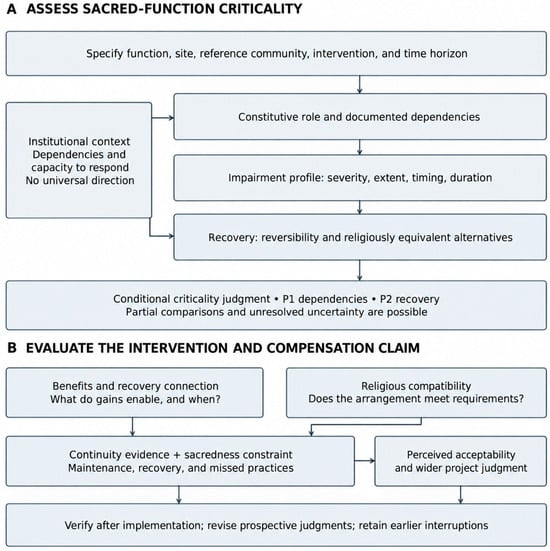
Figure 1 links the two levels of assessment. Panel A organizes the function, impairment, and recovery evidence into a conditional criticality judgment. Panel B examines the relationship between benefits and maintenance or recovery under the stated evaluative objective. Religious compatibility informs continuity, while acceptability contributes to the wider project judgment. Subsequent evidence can revise prospective estimates without erasing earlier interruptions.
Figure 1.
Criticality assessment and evaluation of compensation claims. Arrows show assessment relationships, not validated causal effects. Religious compatibility informs continuity; acceptability concerns the wider judgment. Source: Authors’ conceptualization.
7. Theoretical and Managerial Implications
7.1. Theoretical Implications
The framework adds an explicit comparison of how tourism benefits relate to a specified religious loss. First, separating value formation from compensation directs attention from the coexistence of gains and losses to what the gains enable. SDL and value co-destruction explain how tourism interactions generate divergent outcomes; the comparison examines their compensatory relevance. In C, revenues coexist with a ritual that remains impossible. In D, their allocation to restoration permits later ritual opportunities under the stated conditions. The same benefit category thus has different implications for the sustainability of the living religious destination because its use and timing change the persistence of functional loss.
Second, sacred-function criticality organizes that comparison within the concern for religious use established by spiritual-sustainability research [4,5]. It specifies the function, reference community, and period, distinguishes constitutive role from the severity and timing of disruption, and compares feasible recovery options. P1 concerns the wider consequences of documented dependencies under comparable conditions. P2 concerns differences in recovery prospects for comparable functions and initial impairments. These comparisons make the reasons for different continuity judgments explicit and open to subsequent examination. Where conditions are insufficiently comparable or recovery remains uncertain, the assessment can remain partial.
Third, the sacredness constraint connects those differences to conclusions about compensation under the religious-continuity objective. Criticality identifies the significance and persistence of the threat; the principle requires the claimed contribution of benefits to be established through their connection to maintenance or recovery. Project approval can acknowledge an accepted religious loss while recovery requires restored capacity. This distinction matters because a destination can remain viable as a tourism economy while losing a constitutive religious role. The combined framework clarifies which aspect of destination sustainability the gains support and whether religious continuity is maintained, restored after interruption, or traded off. It leaves the overall project decision open to other legitimate objectives.
The transfer from strong sustainability is confined to critical functions and limited substitution [7]. It does not transfer ecological thresholds, quantify religious value as capital, or replace religiously grounded requirements with environmental criteria. Likewise, normative objections to exchange and functional loss are related without being identical: a refusal can reflect obligations beyond the particular continuity objective, and consent can coexist with an acknowledged loss. Institutional embeddedness contextualizes both dependence and recovery, avoiding the assumption that stronger institutions invariably increase criticality.
Spiritual-sustainability research addresses the preservation of sacred places’ religious meanings and functions [4], while work on pilgrimage sustainability also examines ritual participation, institutional disruption, and resilience [5]. Strong sustainability provides a rationale for examining limits to substitution, particularly where critical natural-capital functions are concerned [28]. At the level of measurement, composite-indicator approaches specify whether and to what extent stronger performance on some indicators can compensate for weaker performance on others [8,29,30]. Research on protected and sacred values examines resistance to trade-offs [26] and the conditions under which such commitments accommodate competing demands [27].
Building on these contributions, the present framework specifies the affected function, reference community, and time horizon, and then relates the impairment and recovery evidence to the particular compensation claim. This makes it possible to distinguish benefits accompanying an accepted but persistent religious loss from benefits that enable the affected function to resume, while retaining interruptions within the assessment. These situations need not differ in gross benefits or stakeholder acceptance, yet they differ in what can be claimed about religious continuity. Sacred-function criticality organizes the comparison of threats and recovery prospects; the sacredness constraint identifies why favorable outcomes elsewhere do not, by themselves, establish achievement of the continuity objective. The contribution is therefore an integrated basis for evaluating compensation claims, rather than a newly demonstrated causal mechanism. Whether it yields additional insight beyond careful applications of existing approaches remains an empirical question.
7.2. Managerial Implications
For destination managers, the assessment can proceed through six linked steps. First, define the objective and unit of analysis: identify the living religious role to be sustained, the function, reference community, intervention, and time horizon. This specifies what a claim of success must demonstrate and identifies the actors whose knowledge is needed.
Second, document the function and its requirements. Religious authorities can clarify matters within their competence, while participants can describe lived practice, dependencies, and barriers to access. Existing schedules, norms, and records should be considered together. The resulting account supplies the criteria against which impairment and religious equivalence can be judged; institutional approval alone does not establish community-wide agreement.
Third, assess the impairment and recovery options using Table 2. Record the severity, extent, timing, and duration of disruption separately from constitutive role. Identify feasible restoration or equivalent arrangements, their resources, responsibilities, permissions, and deadlines. The output is a conditional criticality judgment with explicit uncertainties, which identifies what alternatives require closer comparison.
Fourth, compare designs and the benefits they generate. Table 3 illustrates how to distinguish maintenance, equivalent replacement, persistent loss, and delayed recovery. Record gross benefits separately from recovery costs and show whether a benefit actually finances or otherwise enables continuity. Prevention measures such as protected ritual periods, phased construction, or altered visitor routes should be considered where they address the documented requirements. A favorable net economic balance remains relevant to approval but cannot substitute for recovery evidence.
Fifth, report continuity, religious compatibility, and perceived acceptability, including unresolved disagreements. Visitor research distinguishes attitudes towards different forms of commercialization at religious sites [31]; such attitudes inform acceptability rather than directly establishing continuity. Disagreement about criticality may concern the facts of dependence, restoration feasibility, or the religious requirements defining equivalence. Additional records, access checks, and credible delivery plans can clarify factual disputes. Where interpretations of requirements differ, evaluate the resulting scenarios separately and identify the communities and authorities to which each applies. A normative disagreement about whether other benefits justify accepting an unrecovered loss concerns the project decision; record its reasons without claiming that further measurement must produce consensus.
Sixth, monitor implementation against the conditions and deadlines established earlier. Verify effective access and opportunities for performance at the relevant ritual times, investigate interruptions, and update the assessment. A missed restoration deadline should trigger reconsideration of the alternative design or the continuity claim, rather than the automatic acceptance of a later promise. Report recovery and missed occurrences together.
The sequence distributes rather than concentrates judgment. Religious actors, planners, engineers, residents, and tourism organizations contribute different forms of knowledge and responsibility. Research on Mazu tourism documents collaboration between state and non-state religious and community actors [32]. Formal religious institutions do not automatically speak for every participant, and majority acceptance does not settle religious equivalence. When a project proceeds despite a persistent religious loss, its justification should identify the trade-off openly. This provides a usable account alongside economic and ecological appraisal while leaving the broader decision to the legitimate processes applicable to the site.
8. Future Research and Conclusions
8.1. Research Priorities and Limitations
The framework was developed conceptually and has not been empirically validated. The priorities are to identify the construct independently of outcomes, examine the conditional implications of P1–P2, trace recovery over time, and establish scope and comparative usefulness. The three considerations are provisional; their analytical derivation does not demonstrate completeness across traditions. The illustrations provide no evidence of actual community judgments, restoration performance, or causal effects.
Construct identification and evidence come first. Comparative case studies could identify specified functions and document their requirements, dependencies, impairment profiles, and recovery options before subsequent continuity is assessed. Interviews with participants and institutional actors, observation of access and performance, ritual calendars, and planning records can be compared rather than treated as interchangeable. Conflicting judgments should retain their stated criteria. If criticality can only be assigned after loss is known, or if assessors cannot distinguish constitutive role from impairment, its usefulness as a prospective construct would be limited. Agreement among assessors would support reproducibility without by itself establishing substantive adequacy.
P1 requires particular care because constitutiveness can easily become a restatement of importance. Research should document dependencies before using them to assess criticality. Comparisons could then examine whether disruption of a function on which other practices depend is followed by wider interruptions, under reasonably comparable impairment and recovery conditions. Evidence that the other practices continue independently would challenge the particular dependency claim. If constitutiveness can be identified only after continuity has failed, the proposition would retain little independent explanatory content.
P2 directs attention to prospective recovery assessments and their later outcomes. Longitudinal studies could record which arrangements appeared credible before implementation and follow access, participation, and performance over the stated period, accounting for differences in initial impairment, timing, and constitutive role. Failures despite delivery of the promised arrangement would challenge the sufficiency of the assumed recovery conditions, rather than automatically count as implementation errors. Repeated inability to distinguish outcomes using prospectively documented recovery options would weaken the proposed comparison. Analysis should also examine cases of successful continuity despite an initial judgment that no adequate option existed, which might reveal omitted adaptive capacities or excessively narrow equivalence criteria.
Recovery dynamics require attention beyond a single before-and-after comparison. Researchers should track missed practices, subsequent resumptions, changing access, and the availability of resources over successive cycles. Institutional context belongs within these histories: norms and authority may restrict relocation, authorize adaptation, or mobilize recovery. Comparison across traditions must establish local requirements rather than assume equivalent functions from shared labels. These studies could reveal additional considerations or scope conditions that require revision of the framework, including situations in which continuity depends more on community participation than on the restoration of facilities.
Studies of perceived compensation would address a separate empirical question. Interviews or carefully designed choice tasks could examine how participants evaluate benefits alongside different impairments and recovery arrangements. These studies would measure judgments of acceptability or perceived adequacy, not directly establish functional continuity. Willingness to accept an intervention must therefore remain distinct from evidence that a practice can continue. The same distinction applies when assessing whether perceived sacredness, authenticity, or visitor experience provides information that overlaps with, or differs from, criticality assessment. Existing spiritual-experience scales concern tourist experience [33,34]; their availability does not establish a measure of religious functional continuity.
The sacredness constraint requires normative examination of its justification, objective, and scope. It is not an empirical mediator whose intensity should be estimated. Its practical usefulness can nevertheless be studied by comparing assessments conducted with and without the framework. The demanding comparator is a careful assessment of religious functions and their disruption using existing concepts, not merely a simplistic aggregate score. Outcomes could include recognition of benefit-funded recovery, disclosure of missed practices, and avoidance of unsupported compensation claims. No improvement, or greater confusion and burden without additional information, would count against the framework’s added value. Better reports would support practical usefulness without establishing the principle’s normative authority or proving better continuity.
The present scope is limited to sites evaluated as living religious places. The framework does not measure sacredness in its entirety, adjudicate theological disagreements, or establish universally acceptable levels of disruption. Nor does the theory synthesis warrant an exhaustive claim about the literature. Any extension to other settings organized around living practices would require separate justification. Within religious tourism, the central empirical challenge is whether a prospective, function-specific assessment adds useful information beyond existing approaches without merely redescribing the eventual loss.
8.2. Conclusions
Religious tourism can generate substantial benefits while impairing the practices and relationships through which a site functions as a living religious place. This study used theory synthesis to develop a conceptual framework for assessing what those benefits establish about compensation for an affected religious function. It brings the concern for continued religious use into dialogue with limits to functional substitution and distinguishes value formation from value compensation. A positive aggregate judgment and evidence of religious functional continuity answer different questions.
Sacred-function criticality expresses the degree to which impairment threatens religious functional continuity for a specified community and time horizon. Its assessment considers constitutiveness, reversibility, and functional replaceability within institutional dependencies and response capacities. Under comparable impairment, recovery conditions, and defining roles, documented dependencies on an affected function support a higher estimate of threat because other religious functions may also be compromised. Constitutiveness nevertheless cannot be reduced to the number of dependent practices. For comparable constitutive roles and initial impairments, credible restoration or religiously equivalent replacement within the relevant period supports a lower estimate of threat. These are conditional analytical comparisons; they may remain partial or uncertain and require no universal score or threshold.
The sacredness constraint specifies what benefits can establish when maintaining a destination as a living religious place is an explicit evaluative objective. Benefits alone do not demonstrate compensation for an impairment compromising religious functional continuity; maintenance, restoration, or religiously equivalent replacement must be examined separately. The hypothetical illustration distinguishes comparable gross benefits accompanying persistent functional loss from revenues that enable recovery of future religious capacity. Recovery remains conditional on the required arrangements being delivered and usable, and it cannot retrospectively recover missed ritual occurrences. Approving a project despite an acknowledged religious loss is a broader judgment than establishing that the affected function has been maintained or restored.
The framework offers an integrated basis for evaluating compensation claims alongside economic and ecological achievements, community benefits, and visitor experience. Their relationship to religious continuity must be established if the destination is to be sustained as a living religious place. The construct and propositions have not been empirically validated; the three considerations are not claimed to be universally exhaustive, and the hypothetical illustrations provide no evidence of actual outcomes. The framework’s scope and usefulness beyond careful applications of existing approaches require empirical examination; the evaluative principle also requires normative scrutiny.
Author Contributions
Conceptualization, S.A.C., H.V.B. and G.Ț.; methodology, H.V.B., G.Ț. and C.F.; writing—original draft preparation, S.A.C. and H.V.B.; writing—review and editing, S.A.C., H.V.B., C.F. and G.Ț.; visualization, H.V.B.; supervision, S.A.C. All authors have read and agreed to the published version of the manuscript.
Funding
This research received no external funding.
Institutional Review Board Statement
Not applicable.
Informed Consent Statement
Not applicable.
Data Availability Statement
The original contributions presented in this study are included in the article. Further inquiries can be directed to the corresponding author.
Acknowledgments
The authors gratefully acknowledge Stavrophore Abbess Maria Asaftei for her valuable reflections on the lived religious and monastic dimensions of sacred places, which helped inform the broader conceptual context of this study. We also thank the anonymous reviewers for their constructive comments, which helped clarify the conceptual framework and improve the manuscript.
Conflicts of Interest
S.A.C. and G.T. serve as Guest Editors of the Special Issue to which this manuscript is submitted. They had no role in the editorial handling or decision-making process concerning this manuscript. The remaining authors declare no conflicts of interest.
References
- Hunter, C. Sustainable Tourism and the Touristic Ecological Footprint. Environ. Dev. Sustain. 2002, 4, 7–20. [Google Scholar] [CrossRef] [Scilit]
- Hunter, C.; Shaw, J. The Ecological Footprint as a Key Indicator of Sustainable Tourism. Tour. Manag. 2007, 28, 46–57. [Google Scholar] [CrossRef] [Scilit]
- Casals Miralles, C.; Barioni, D.; Mancini, M.S.; Colón Jordà, J.; Boy Roura, M.; Ponsá Salas, S.; Llenas Argelaguet, L.; Galli, A. The Footprint of Tourism: A Review of Water, Carbon, and Ecological Footprint Applications to the Tourism Sector. J. Clean. Prod. 2023, 422, 138568. [Google Scholar] [CrossRef] [Scilit]
- Aulet, S.; Duda, T. Tourism Accessibility and Its Impact on the Spiritual Sustainability of Sacred Sites. Sustainability 2020, 12, 9695. [Google Scholar] [CrossRef] [Scilit]
- Shinde, K.A.; Olsen, D.H. Reframing the Intersections of Pilgrimage, Religious Tourism, and Sustainability. Sustainability 2023, 15, 461. [Google Scholar] [CrossRef] [Scilit]
- Dwyer, L. Tourism Development to Enhance Resident Well-Being: A Strong Sustainability Perspective. Sustainability 2023, 15, 3321. [Google Scholar] [CrossRef] [Scilit]
- Ekins, P.; Simon, S.; Deutsch, L.; Folke, C.; De Groot, R. A Framework for the Practical Application of the Concepts of Critical Natural Capital and Strong Sustainability. Ecol. Econ. 2003, 44, 165–185. [Google Scholar] [CrossRef] [Scilit]
- Lozano-Oyola, M.; Contreras, I.; Blancas, F.J. An Operational Non-Compensatory Composite Indicator: Measuring Sustainable Tourism in Andalusian Urban Destinations. Ecol. Econ. 2019, 159, 1–10. [Google Scholar] [CrossRef] [Scilit]
- Vargo, S.L.; Lusch, R.F. Institutions and Axioms: An Extension and Update of Service-Dominant Logic. J. Acad. Mark. Sci. 2016, 44, 5–23. [Google Scholar] [CrossRef] [Scilit]
- Lumivalo, J.; Tuunanen, T.; Salo, M. Value Co-Destruction: A Conceptual Review and Future Research Agenda. J. Serv. Res. 2024, 27, 159–176. [Google Scholar] [CrossRef] [Scilit]
- Jaakkola, E. Designing Conceptual Articles: Four Approaches. AMS Rev. 2020, 10, 18–26. [Google Scholar] [CrossRef] [Scilit]
- Torraco, R.J. Writing Integrative Literature Reviews: Guidelines and Examples. Hum. Resour. Dev. Rev. 2005, 4, 356–367. [Google Scholar] [CrossRef] [Scilit]
- Snyder, H. Literature Review as a Research Methodology: An Overview and Guidelines. J. Bus. Res. 2019, 104, 333–339. [Google Scholar] [CrossRef] [Scilit]
- Duda, T.; Gardzińska, A.; Aulet, S. Religious Sensitivity and Regenerative Tourism: Protecting the Spiritual Integrity of Sacred Spaces. Religions 2026, 17, 564. [Google Scholar] [CrossRef] [Scilit]
- Li, C.; Sayyed, Y.; Wei, C. Journeys of Sacredness: The Role of Symbolism in Nature-Based Religious Destinations. J. Sustain. Tour. 2026, 34, 1224–1248. [Google Scholar] [CrossRef] [Scilit]
- Pande, K.; Shi, F. Managing Visitor Experience at Religious Heritage Sites. J. Destin. Mark. Manag. 2023, 29, 100800. [Google Scholar] [CrossRef] [Scilit]
- Belhassen, Y.; Caton, K.; Stewart, W.P. The Search for Authenticity in the Pilgrim Experience. Ann. Tour. Res. 2008, 35, 668–689. [Google Scholar] [CrossRef] [Scilit]
- Thouki, A. Heritagization of Religious Sites: In Search of Visitor Agency and the Dialectics Underlying Heritage Planning Assemblages. Int. J. Herit. Stud. 2022, 28, 1036–1065. [Google Scholar] [CrossRef] [Scilit]
- Pramezwary, A.; Juliana, J.; Yuliantoro, N.; Hulu, M.; Teguh, F.X. Sacred Service, Cultural Transformation, and Sustainable Religious Tourism in Labuan Bajo. Societies 2026, 16, 97. [Google Scholar] [CrossRef] [Scilit]
- Vargo, S.L.; Akaka, M.A. Value Cocreation and Service Systems (Re)Formation: A Service Ecosystems View. Serv. Sci. 2012, 4, 207–217. [Google Scholar] [CrossRef] [Scilit]
- Ribeiro, T.D.L.S.; Costa, B.K.; Ferreira, M.P.; Freire, O.B.D.L. Value Co-Creation in Tourism and Hospitality: A Systematic Literature Review. Eur. Manag. J. 2023, 41, 985–999. [Google Scholar] [CrossRef] [Scilit]
- Font, X.; English, R.; Gkritzali, A.; Tian, W. Value Co-Creation in Sustainable Tourism: A Service-Dominant Logic Approach. Tour. Manag. 2021, 82, 104200. [Google Scholar] [CrossRef] [Scilit]
- Plé, L.; Chumpitaz Cáceres, R. Not Always Co-creation: Introducing Interactional Co-destruction of Value in Service-dominant Logic. J. Serv. Mark. 2010, 24, 430–437. [Google Scholar] [CrossRef] [Scilit]
- Sthapit, E.; Garrod, B.; Stone, M.J.; Björk, P.; Song, H. Value Co-Destruction in Tourism and Hospitality: A Systematic Literature Review and Future Research Agenda. J. Travel Tour. Mark. 2023, 40, 363–382. [Google Scholar] [CrossRef] [Scilit]
- Schulz, T.; Zimmermann, S.; Böhm, M.; Gewald, H.; Krcmar, H. Value Co-Creation and Co-Destruction in Service Ecosystems: The Case of the Reach Now App. Technol. Forecast. Soc. Change 2021, 170, 120926. [Google Scholar] [CrossRef] [Scilit]
- Baron, J.; Spranca, M. Protected Values. Organ. Behav. Hum. Decis. Process. 1997, 70, 1–16. [Google Scholar] [CrossRef] [Scilit] [PubMed]
- Tetlock, P.E.; Mellers, B.A.; Scoblic, J.P. Sacred versus Pseudo-Sacred Values: How People Cope with Taboo Trade-Offs. Am. Econ. Rev. 2017, 107, 96–99. [Google Scholar] [CrossRef] [Scilit]
- Dietz, S.; Neumayer, E. Weak and Strong Sustainability in the SEEA: Concepts and Measurement. Ecol. Econ. 2007, 61, 617–626. [Google Scholar] [CrossRef] [Scilit]
- Blancas, F.J.; Lozano-Oyola, M. Sustainable Tourism Evaluation Using a Composite Indicator with Different Compensatory Levels. Environ. Impact Assess. Rev. 2022, 93, 106733. [Google Scholar] [CrossRef] [Scilit]
- Pérez León, V.E.; Contreras, I.; Ramírez-Hurtado, J.M. Sustainability Measurement with a Non-Compensatory Approach in Cuban Nature-Based Tourism. Int. J. Sustain. Dev. World Ecol. 2022, 29, 784–796. [Google Scholar] [CrossRef] [Scilit]
- Shi, F.; Pande, K. Commercialization at Religious Sites: Who Cares and Why? Curr. Issues Tour. 2023, 26, 2284–2300. [Google Scholar] [CrossRef] [Scilit]
- Chan, K.-S. Cultural Governance of Mazu Religious Tourism. Tour. Geogr. 2026, 1–24. [Google Scholar] [CrossRef] [Scilit]
- Şahin, İ.; Güzel, F.Ö. Dimensions of Spirituality in Tourism: Developing the Spiritual Tourism Experience Scale (STES). J. Destin. Mark. Manag. 2024, 34, 100955. [Google Scholar] [CrossRef] [Scilit]
- Tsaur, S.-H.; Lin, Y.-S. Tourist Spiritual Experience: A Scale Development and Empirical Study. Tour. Manag. Perspect. 2025, 58, 101394. [Google Scholar] [CrossRef] [Scilit]
Disclaimer/Publisher’s Note: The statements, opinions and data contained in all publications are solely those of the individual author(s) and contributor(s) and not of MDPI and/or the editor(s). MDPI and/or the editor(s) disclaim responsibility for any injury to people or property resulting from any ideas, methods, instructions or products referred to in the content. |
© 2026 by the authors. Licensee MDPI, Basel, Switzerland. This article is an open access article distributed under the terms and conditions of the Creative Commons Attribution (CC BY) license.