


Abstract
Promoting sustainable active mobility requires a better understanding of the psychological factors associated with environmentally responsible physical activity (PA) behaviors among young people. This study examined the associations among love and care for nature, the satisfaction of basic psychological needs in energy-saving contexts, and sustainable energy-related PA behaviors, as well as differences by gender and school grade. A cross-sectional observational study was conducted among 1230 students aged 9–16. Participants completed validated questionnaires during physical education classes. Correlation analyses revealed low-to-moderate positive associations among love and care for nature, basic psychological needs related to energy saving, and sustainable energy-related PA behaviors. Hierarchical regression analyses with bootstrapping identified school grade, love and care for nature, and perceived competence in energy saving as variables independently associated with these behaviors. Multilevel linear mixed-effects analyses further indicated that love and care for nature and perceived competence remained significantly associated with sustainable energy-related PA behaviors after adjustment for gender and age. Gender differences were observed in love and care for nature and autonomy related to energy saving, while school-grade differences emerged across all environmental variables examined. These findings highlight the relevance of young people’s connection with nature and perceived competence in energy saving for understanding sustainable energy-related PA behaviors. Although the cross-sectional design precludes causal conclusions, the findings may inform future research and the development and evaluation of physical education and school-based sustainability initiatives. Such initiatives could explore ways to promote environmentally responsible physical activity and contribute to sustainable mobility and healthier, more sustainable communities.
1. Introduction
Sustainable cities depend not only on technological innovation and environmentally responsible infrastructure but also on citizens’ willingness to adopt behaviors that reduce environmental impacts in everyday life. Among these behaviors, sustainable energy-related physical activity (PA) behaviors, such as walking, cycling, using public transportation, and choosing active modes of transportation whenever possible, represent an important intersection between environmental sustainability and public health. These behaviors contribute simultaneously to reducing energy consumption and greenhouse gas emissions while promoting PA and improving individual and community well-being. Consequently, achieving sustainable mobility requires not only investments in transportation systems and urban planning but also a better understanding of the psychological factors that motivate individuals to adopt environmentally responsible behaviors. This is particularly important during childhood and adolescence, when environmental values, behavioral habits, and motivational orientations are established and may influence lifestyles throughout adulthood.
Growing public awareness of climate change and environmental degradation has increased recognition that individuals, communities, institutions, and governments share responsibility for promoting environmental sustainability. Recent evidence indicates that citizens increasingly support policies related to climate action, energy efficiency, and environmental protection, while also recognizing the close relationship between environmental quality, human health, and quality of life [1,2]. However, translating environmental concern into consistent everyday behavior remains a major challenge. Understanding the psychological mechanisms that encourage young people to adopt sustainable behaviors is therefore essential for developing effective educational and behavioral interventions.
Addressing the global environmental challenges facing our planet requires substantial changes in human behavior. Personal experiences with nature and individuals’ psychological connection to the natural environment have been identified as important factors associated with pro-environmental behavior (PEB). Systematic reviews and meta-analyses indicate that direct experiences of nature and nature connectedness are positively associated with a broad range of environmentally responsible actions, including recycling, energy conservation, green purchasing, and participation in conservation activities [3,4,5]. These associations have been observed across different conceptualizations of nature connectedness, various measures of PEB—including behavioral intentions, self-reported behaviors, and observed actions—and diverse demographic groups. Collectively, these findings suggest that strengthening individuals’ connection to nature may encourage greater engagement in environmental protection and conservation.
An important psychological foundation of environmentally responsible behavior is the affective relationship individuals develop with the natural world. Nature connectedness refers to the extent to which individuals experience a sense of belonging, emotional attachment, and psychological closeness to nature. Contemporary theoretical perspectives conceptualize this connection as an orientation that extends individuals’ sense of belonging and concern beyond the human world to encompass animals, plants, ecosystems, and the broader natural environment [6]. This relationship may shape environmental identity, personal values, empathy toward nature, and a sense of responsibility for environmental protection. Moreover, nature plays an important role in psychological development and well-being. Beyond serving as a physical setting for human activities, natural environments can contribute to identity formation, the development of personal meaning, psychological restoration, and the cultivation of ecological values. When individuals incorporate nature into their sense of identity, they may develop greater environmental concern and a stronger motivation to engage in sustainable behaviors, including active transportation and environmentally responsible mobility choices [7].
Within this broader framework, love and care for nature represents a specific affective and value-based orientation characterized by emotional attachment to the natural world, appreciation of its intrinsic value, psychological closeness, and concern for the protection of natural ecosystems [8]. This orientation may provide a motivational basis for translating positive feelings toward nature into environmentally responsible actions. Individuals who express greater love and care for nature may be more inclined to engage in conservation activities, save energy, adopt sustainable consumption practices, and make environmentally responsible mobility choices [5,9,10]. These relationships are particularly relevant to children and adolescents, whose environmental values, identities, and behavioral patterns are still developing. Accordingly, love and care for nature may constitute an important psychological factor in understanding how young people develop and maintain environmentally responsible lifestyles.
PA provides a particularly relevant context for strengthening the relationship between individuals and the natural environment. Participation in outdoor PA can increase opportunities for direct experiences with nature, enhance appreciation of natural environments, and promote environmental awareness [11,12,13]. These experiences may strengthen emotional bonds with nature and increase willingness to adopt sustainable behaviors. Among young people, stronger love and care for nature has been associated with more positive environmental attitudes and greater engagement in environmentally friendly behaviors [14]. Therefore, PA may function as both a health-promoting behavior and a pathway through which environmental values are developed and expressed.
Although emotional connection with nature provides an important explanation for why individuals value environmental protection, it does not fully explain how these values are translated into consistent behavior. A complementary perspective is provided by Self-Determination Theory (SDT), which emphasizes the motivational processes underlying sustained behavioral engagement. According to SDT, satisfaction of the basic psychological needs for autonomy, competence, and relatedness promotes autonomous motivation and facilitates the internalization of personally meaningful values and behaviors. When individuals feel capable of performing environmentally responsible actions, experience choice and personal agency, and receive social support, they are more likely to maintain sustainable behaviors over time [15].
Within the environmental domain, satisfaction of basic psychological needs has been associated with stronger motivation for energy-saving behaviors and greater commitment to sustainability [16]. In particular, competence may be especially important because it reflects individuals’ beliefs that they possess the skills and ability to perform environmentally responsible actions effectively. Need-supportive environments, including schools and physical education settings, may therefore represent important contexts for developing both environmental values and the motivational resources required to translate these values into sustainable behaviors.
Integrating perspectives from nature connectedness and SDT may provide a more comprehensive understanding of sustainable mobility behaviors among youth. While love and care for nature explain the affective and value-based foundation of environmental responsibility, satisfaction of basic psychological needs explains the motivational processes through which these values become internalized and expressed through daily actions. However, previous research has largely examined these psychological processes independently. Limited attention has been given to whether emotional connection with nature and motivational need satisfaction jointly contribute to sustainable energy-related PA behaviors among children and adolescents.
In addition to psychological factors, environmental attitudes and behaviors are influenced by demographic and developmental characteristics. Environmental knowledge, psychological well-being, supportive family environments, and educational experiences have been positively associated with environmentally responsible behaviors [17]. Similarly, gender, age, and socioeconomic conditions contribute to differences in environmental engagement, although these associations may vary across developmental stages [18]. Gender differences have been frequently reported, with women generally demonstrating stronger environmental concern and greater engagement in energy-saving and pro-environmental behaviors than men. However, findings among children and adolescents remain less consistent, suggesting that developmental, educational, and sociocultural factors may influence these relationships [19,20,21,22].
Developmental differences are particularly relevant because environmental attitudes and behaviors do not necessarily increase linearly with age. Although schools provide important opportunities for environmental learning and many young people develop positive environmental attitudes through formal education [23], evidence suggests that pro-environmental attitudes may increase during childhood, stabilize during early adolescence, and decline during later adolescence, whereas actual opportunities to engage in independent sustainable behaviors may increase as autonomy develops [24]. Examining differences across educational levels may therefore provide important insights into how psychological factors contribute to sustainable behaviors during critical developmental periods.
Within the context of sustainable mobility, PA-related energy-saving behaviors—including walking, cycling, using public transportation, and engaging in active recreation—represent behaviors that simultaneously improve health, reduce energy consumption, decrease greenhouse gas emissions, and support more sustainable urban environments [9,25,26,27]. These behaviors illustrate the intersection between environmental sustainability, active mobility, and healthy lifestyles, making them particularly relevant for the development of sustainable cities. Understanding the psychological determinants of these behaviors is therefore essential for designing educational interventions that complement investments in sustainable transport infrastructure and urban planning.
Despite growing recognition of the importance of environmental values and psychological motivation in promoting sustainability, several gaps remain in the literature. First, limited research has examined the associations of love and care for nature and the satisfaction of basic psychological needs with sustainable energy-related physical activity (PA) behaviors among young people. Second, these relationships remain insufficiently explored in the context of sustainable mobility, which is relevant to both environmental sustainability and public health. Third, further evidence is needed regarding gender and school-grade differences in these environmental and motivational factors. To address these gaps, the present study examined the associations among love and care for nature, satisfaction of basic psychological needs in energy-saving contexts (autonomy, competence, and relatedness), and sustainable energy-related PA behaviors among school-aged youth. Specifically, it was hypothesized that (a) greater love and care for nature would be positively associated with sustainable energy-related PA behaviors; (b) greater satisfaction of basic psychological needs would be positively associated with these behaviors; and (c) differences in love and care for nature, basic psychological needs, and sustainable energy-related PA behaviors would emerge according to gender and school grade. The main novelty of this study lies in its integrated examination of affective connection with nature and need-based motivational factors in relation to sustainable energy-related PA behaviors among a large sample of young people, while also considering gender and school-grade differences. By bringing together perspectives from environmental psychology and Self-Determination Theory, this study extends understanding of the psychological factors associated with these behaviors and may inform the development of school-based physical education and sustainability initiatives. The hypotheses were examined using a cross-sectional observational design; therefore, the findings are interpreted in terms of associations rather than causal relationships. This approach provides a basis for further research on how educational initiatives may support environmentally responsible physical activity and contribute to sustainable mobility and healthier, more sustainable communities.
2. Materials and Methods
2.1. Study Design
This study employed an observational, analytical, cross-sectional design to examine the associations between love and care for nature, satisfaction of basic psychological needs related to energy saving, and sustainable energy-related physical activity behaviors among school-aged youth. Using G*Power (v3.1.9), an a priori power analysis for a multiple regression model revealed that a sample of at least 787 participants is required to achieve a statistical power of 0.80, assuming a significance level (alpha) of 0.05 and a small effect size (f2 = 0.01).
2.2. Participants
A total of 1230 students (550 boys, 665 girls, and 15 who did not report their gender) aged 9–16 years (M = 12.31, SD = 1.39) voluntarily participated in this study. Participants were recruited from 31 schools (21 elementary and 10 high schools) located in five cities in central Greece. Regarding educational level, 676 participants attended elementary school and 554 attended high school. In terms of ethnicity, 1109 participants identified as Greek, 49 as Albanian, 23 reported another ethnic background, and 49 did not report their ethnicity.
2.3. Instruments
Love and Care for Nature. Love and care for nature was assessed using the Love and Care for Nature Scale [8,14]. The instrument consists of 15 items assessing individuals’ emotional attachment to nature, appreciation of its intrinsic value, and personal sense of responsibility for its protection. Sample items include “I feel a deep love for nature” and “I enjoy learning about nature.” Responses were recorded on a 7-point Likert scale ranging from 1 (strongly disagree) to 7 (strongly agree), with higher scores indicating greater love and care for nature.
Satisfaction of the Basic Psychological Needs for Energy Saving. Satisfaction of the basic psychological needs for energy-saving behaviors was measured using the scale developed by Sweeney et al. [16,28]. The instrument assesses the three psychological needs proposed by Self-Determination Theory: autonomy (three items; e.g., “I am free to choose what I do to save energy”), competence (three items; e.g., “I feel confident in my ability to save energy”), and relatedness (three items; e.g., “I feel connected with other people who are saving energy”). Responses were provided on a 7-point Likert scale ranging from 1 (strongly disagree) to 7 (strongly agree), with higher scores reflecting greater satisfaction of each psychological need.
Sustainable Energy-Related Physical Activity Behaviors. Sustainable energy-related physical activity behaviors were assessed using a six-item scale [14]. The scale measures the frequency with which participants engage in environmentally sustainable PA and active mobility behaviors that reduce energy consumption. Sample items include “I go to school by bike or on foot,” “At home, I prefer to use the stairs instead of the elevator,” and “For short distances, I prefer to walk, regardless of the season.” Responses were recorded on a 7-point Likert scale ranging from 1 (never) to 7 (very often), with higher scores indicating more frequent engagement in sustainable energy-related PA behaviors.
2.4. Procedure
Participants were recruited through school administrators during the first three months of 2024. The study was conducted in accordance with international ethical standards, including the principles of the American Psychological Association and the Declaration of Helsinki, and received approval from the University Ethics Committee. Quota sampling was used to ensure approximately equal representation by gender and educational level (elementary and secondary school). Eligibility criteria included sufficient proficiency in Greek to understand and complete the self-report questionnaires. No schools or classes declined to participate, as prior approval for the study had been obtained from the Regional Directorate of Education overseeing the participating schools.
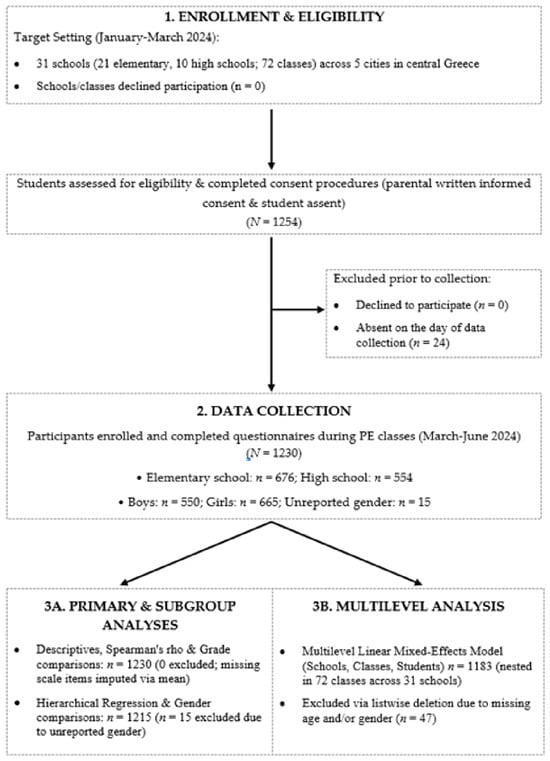
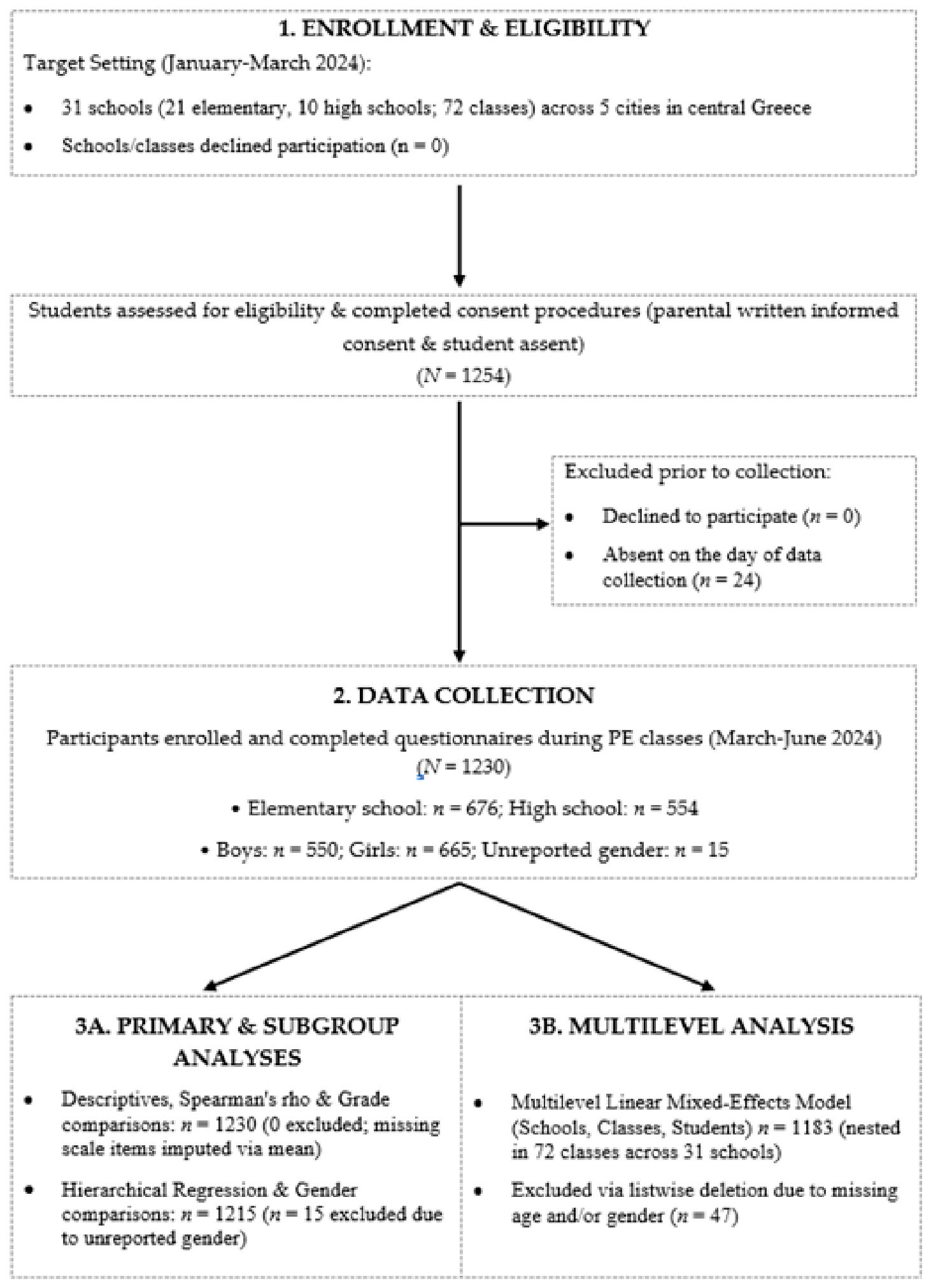
Data were collected between March and June 2024 using paper-based questionnaires administered during regular physical education (PE) classes. Before data collection, written informed consent was obtained from parents or caregivers, and students provided their consent to participate. Of the 1254 students initially eligible who completed the consent procedures, 24 were absent from school on the day of data collection. No students declined participation or were excluded from the study (Figure 1).
Figure 1.
Flow diagram of participant recruitment, eligibility, data collection, and statistical analysis. Note: PE = Physical Education.
Participation was voluntary, and students were informed about the study’s purpose, the anonymity and confidentiality of their responses, and their right to withdraw at any time without penalty. A trained researcher was present throughout questionnaire administration to provide procedural guidance and clarify questions when necessary. To minimize potential social desirability bias, students were assured that there were no right or wrong answers and were encouraged to respond honestly. Validated and widely used measurement scales were employed to support measurement reliability and validity and to minimize measurement error. Questionnaire completion took approximately 10 min.
2.5. Data Analysis
Data were analyzed using IBM SPSS Statistics version 31.0 (IBM Corp., Armonk, NY, USA). Statistical significance was set at p < 0.05. Descriptive statistics, including means, standard deviations, and medians, were computed for all study variables. The normality of the distributions was assessed using the Kolmogorov–Smirnov test, which indicated that none of the variables were normally distributed (p < 0.05). Consequently, non-parametric statistical procedures were employed where appropriate. Spearman’s rank-order correlation coefficient (Spearman’s rho) was calculated to examine the relationships among love and care for nature, satisfaction of the basic psychological needs for energy saving (autonomy, competence, and relatedness), and sustainable energy-related PA behaviors.
To identify the predictors of sustainable energy-related PA behaviors, hierarchical multiple regression analysis with bootstrap resampling was performed. Gender and school grade were entered first, followed by love and care for nature and the three basic psychological needs (autonomy, competence, and relatedness). Regression estimates were based on 1000 bootstrap samples to obtain robust parameter estimates and confidence intervals, an approach recommended when the assumptions of normality may be violated. The inclusion of independent variables at the various levels of the hierarchical regression was based on previous studies with a similar scientific design [29,30,31].
Separate Mann–Whitney U tests were also conducted to examine differences in the study variables according to gender (boys vs. girls) and educational level (elementary vs. high school).
Finally, a three-level linear mixed-effects model (schools, classes-within-schools, and students-within-classes) was calculated to examine whether love and care for nature, autonomy to save energy, competence to save energy, and relatedness to save energy were associated with PA-related energy saving behaviors, adjusting for gender and age. The multilevel random-intercept linear mixed model was estimated using Restricted Maximum Likelihood (REML). Fixed effects were love and care for nature, autonomy to save energy, competence to save energy, relatedness to save energy, gender, and age; schools and classes-within-school were modeled as random intercepts. Predictors were uncentered and entered in their original scale units. Fixed-effect inference below uses Wald z tests and 95% Wald confidence intervals.
It is important to mention here that missing values for the variables under consideration were replaced with the mean values of the respective variable for the remaining participants (replacement with mean values).
3. Results
3.1. Descriptive Statistics, Reliability Analysis, Normal Distribution, and Correlations
Descriptive statistics, reliability coefficients, normality indices, and correlations among the study variables are presented in Table 1. Internal consistency reliability was acceptable to excellent, with Cronbach’s alpha coefficients ranging from 0.66 to 0.92. Spearman’s rank-order correlation analyses revealed low-to-moderate positive associations among love and care for nature, satisfaction of the basic psychological needs for energy saving, and sustainable energy-related PA behaviors. Overall, students who reported stronger emotional connections with nature and greater satisfaction of their psychological needs also reported more frequent engagement in sustainable energy-related PA behaviors.
Table 1.
Descriptive statistics, reliability analysis, normal distribution indices, and Spearman’s correlations.
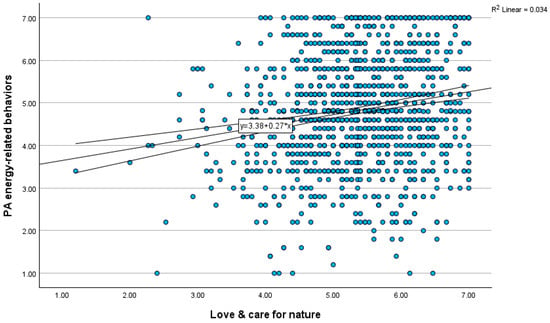
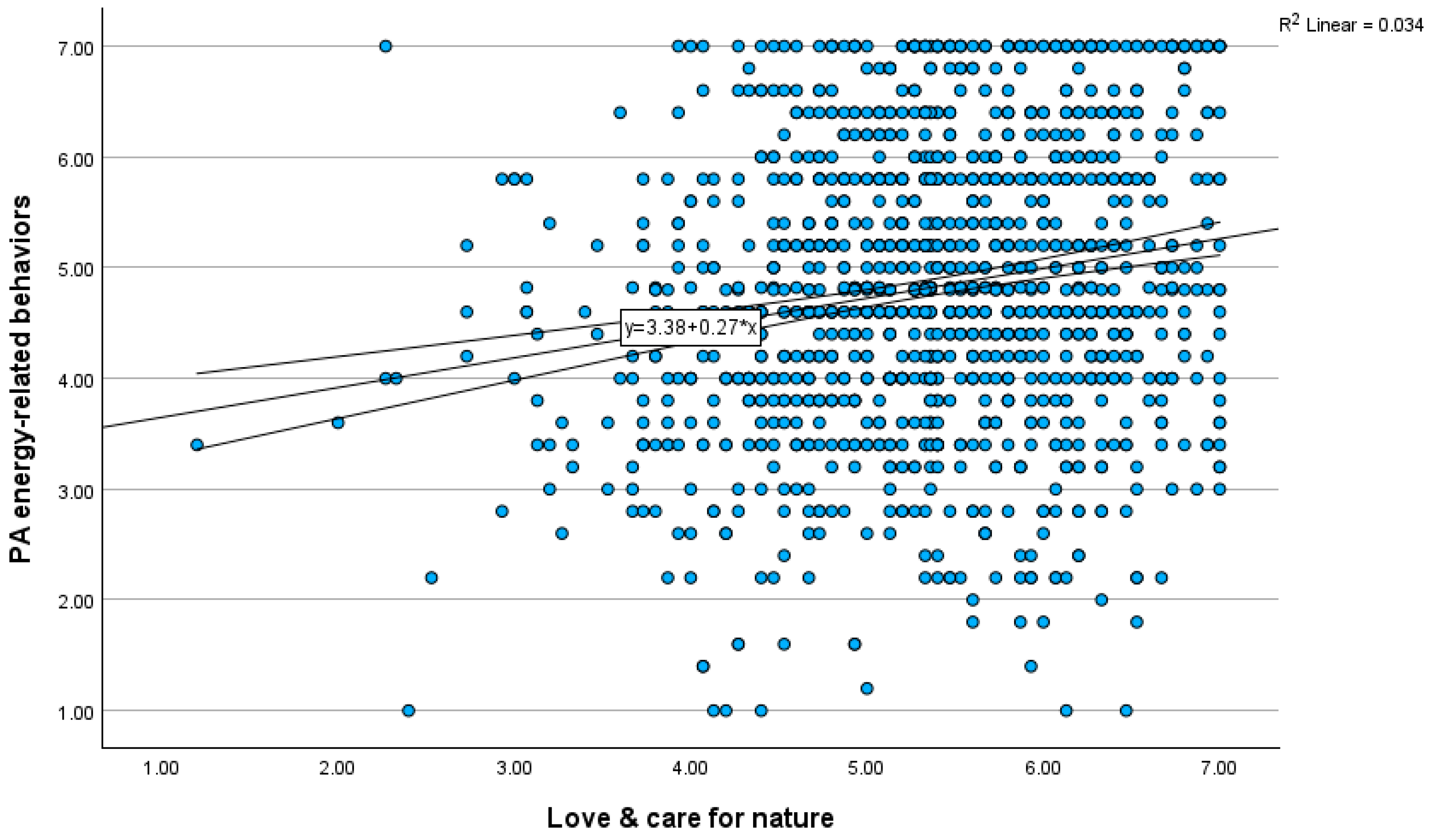
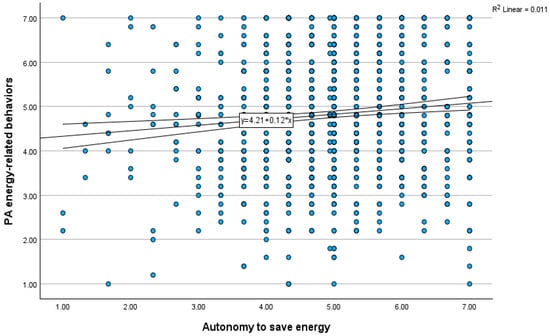
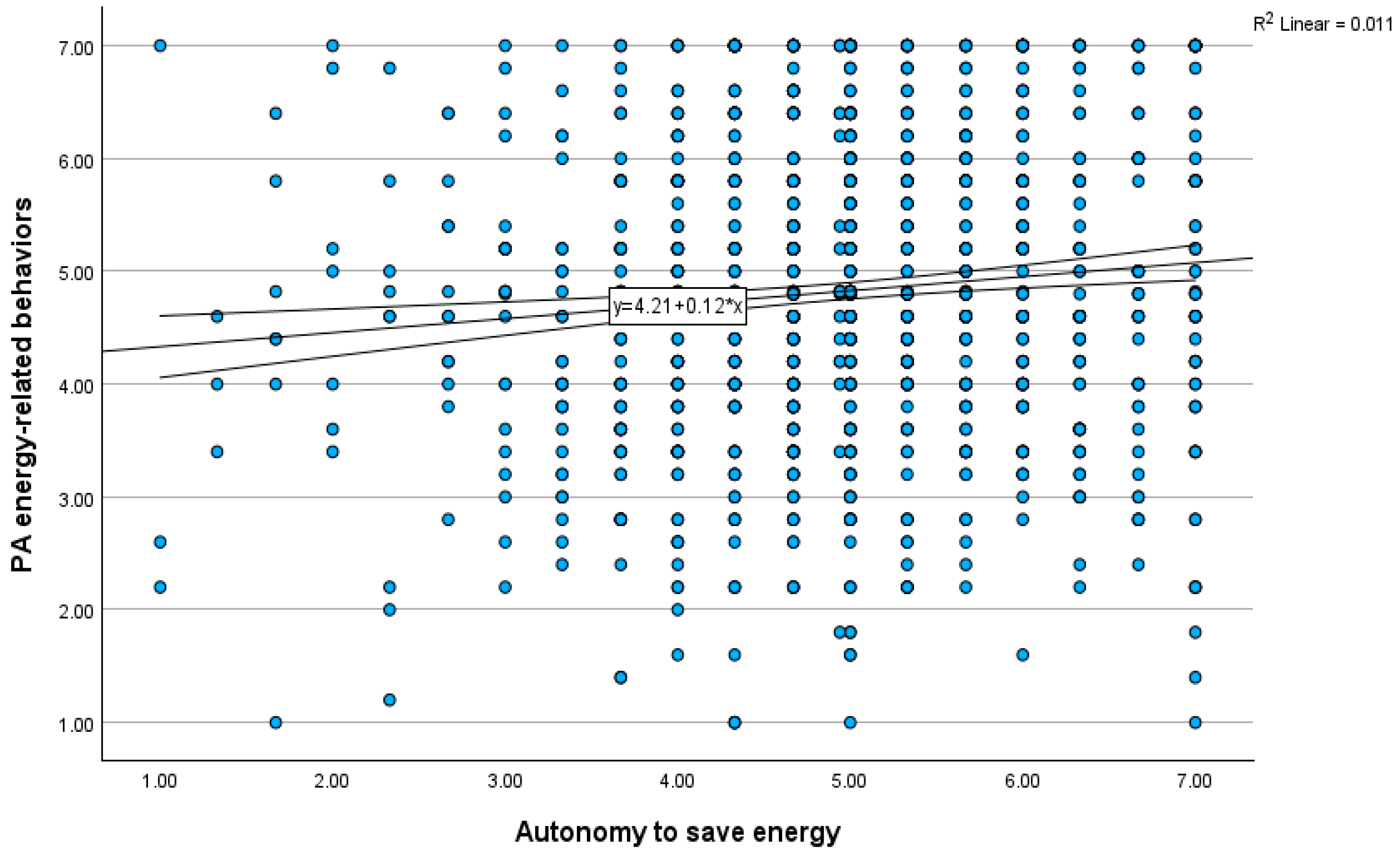
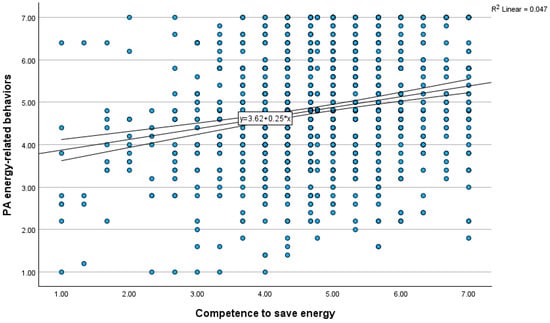
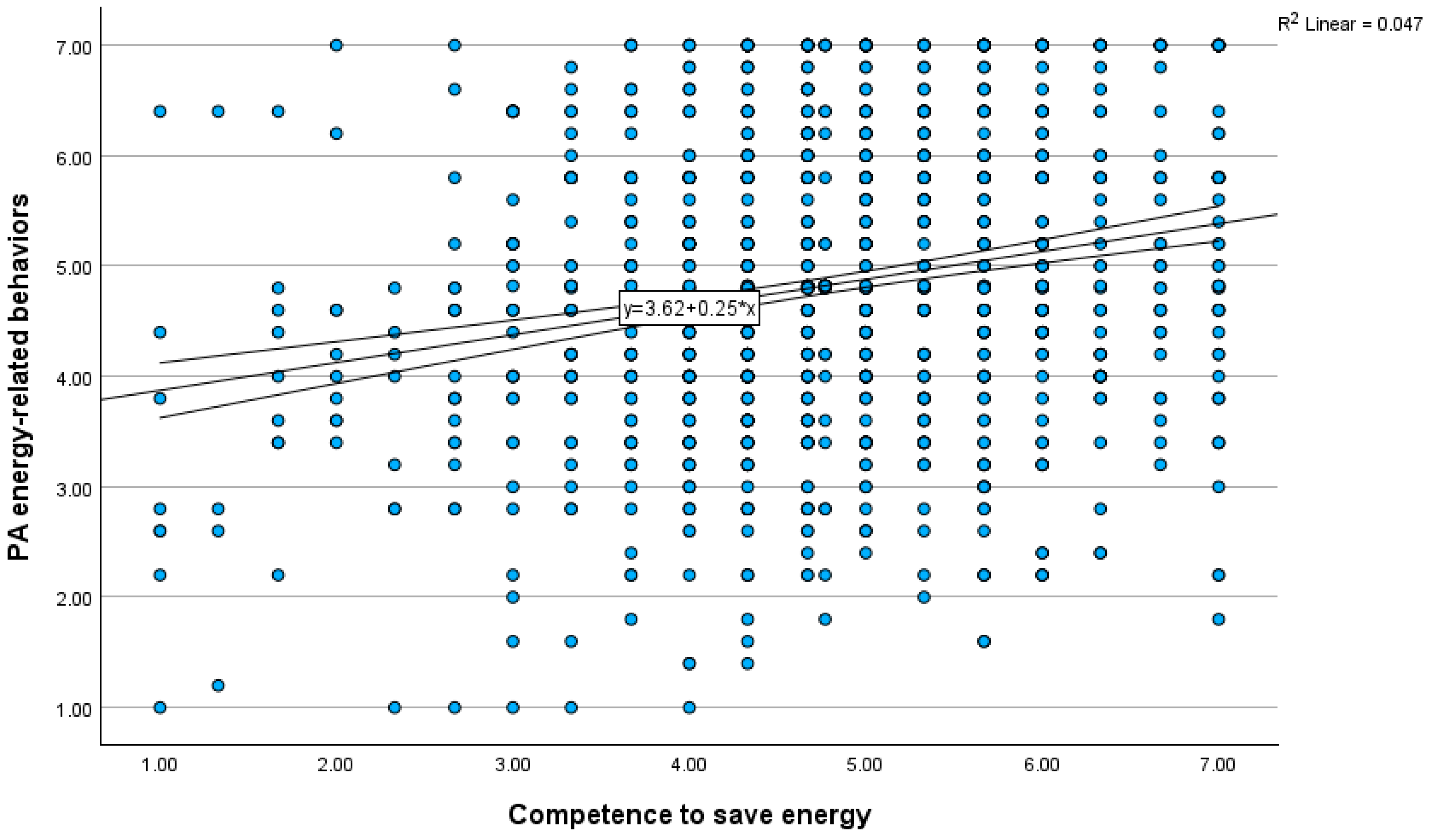
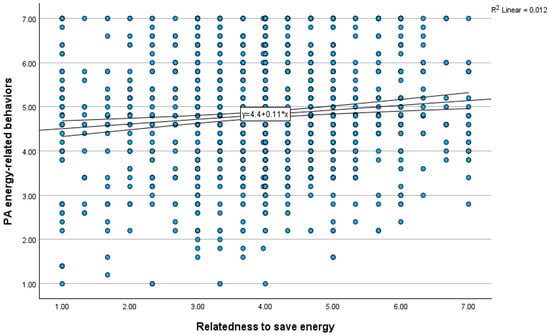
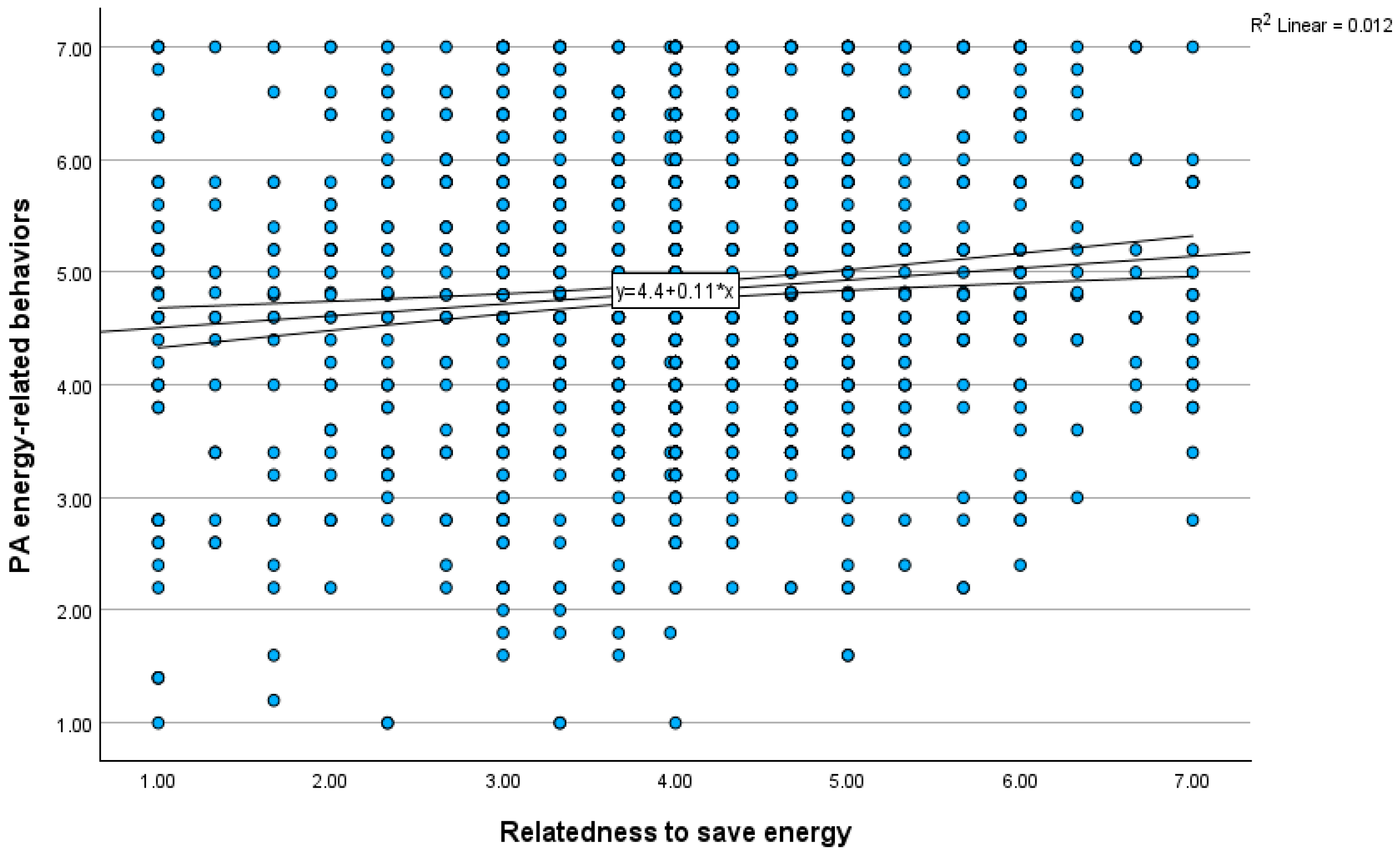
The scatter plots below illustrate the relationships between the main dependent variable of PA energy-related behaviors and the independent variables of love for and care for nature (Figure 2), autonomy to save energy (Figure 3), competence to save energy (Figure 4), and relatedness to save energy (Figure 5).
Figure 2.
Relationship between PA energy-related behaviors and love for and care for nature. Notes. PA = Physical Activity. Dots represent individual observations/mean values; solid lines indicate linear regression trends. Symbol * simply represents the multiplication sign (×) between the slope (0.27) and the variable (x).
Figure 3.
Relationship between PA energy-related behaviors and autonomy to save energy. Notes. PA = Physical Activity. Dots represent individual observations/mean values; solid lines indicate linear regression trends. Symbol * simply represents the multiplication sign (×) between the slope (0.12) and the variable (x).
Figure 4.
Relationship between PA energy-related behaviors and competence to save energy. Notes. PA = Physical Activity. Dots represent individual observations/mean values; solid lines indicate linear regression trends. Symbol * simply represents the multiplication sign (×) between the slope (0.25) and the variable (x).
Figure 5.
Relationship between PA energy-related behaviors and relatedness to save energy. Notes. PA = Physical Activity. Dots represent individual observations/mean values; solid lines indicate linear regression trends. Symbol * simply represents the multiplication sign (×) between the slope (0.11) and the variable (x).
3.2. Preliminary Analyses and Statistical Assumptions
Prior to conducting the hierarchical multiple regression analysis, preliminary diagnostic tests were performed to evaluate statistical assumptions. Although the Kolmogorov–Smirnov test yielded statistically significant results (p < 0.001) for all study variables, this test is known to be overly sensitive in large samples (N = 1230). Inspection of skewness (ranging from −0.50 to −0.17, SE = 0.070) and kurtosis (ranging from −0.374 to 0.65, SE = 0.139) confirmed that the vast majority of the values did not follow a normal distribution [30]. Nonetheless, to safeguard against any potential violations of residual normality and homoscedasticity, parameter estimates were derived using non-parametric bootstrapping (1000 resamples, 95% percentile confidence intervals). Linearity was supported by consistent non-parametric (Spearman’s rho) correlations between energy-related PA behaviors and all predictors (Love and care for nature: rho = 0.17, p < 0.001; Autonomy to save energy: rho = 0.10, p < 0.001; Competence to save energy: rho = 0.20, p < 0.001; Relatedness to save energy: rho = 0.08, p < 0.01), alongside a progressive reduction in the Standard Error of the Estimate across Steps 1 to 3 (1.299, 1.274, and 1.260, respectively). Finally, bivariate correlations among predictors did not exceed rho = 0.43 (well below 0.80), and in the final regression model (Model 3), Tolerance values ranged from 0.66 to 0.98 (>0.10), while Variance Inflation Factors (VIF) ranged from 1.02 to 1.52 (<5.00), confirming that multicollinearity was not a concern.
3.3. Hierarchical Regression Analysis Using the Bootstrapping Method
Hierarchical regression analysis using the bootstrapping method (results were based on 1000 bootstrap samples) showed that grade (B = 0.17; BC 95% CI = 0.01–0.31), but not gender (B = −0.05; BC 95% CI = −0.19–0.10), was significantly associated with energy-related PA behaviors in the first step. However, the first step was not statistically significant, F(2, 1212) = 2.593, p = 0.075. After love and care for nature was added in the second step, the results showed that grade (B = 0.23; BC 95% CI = 0.09–0.37) and love and care for nature (B = 0.29; BC 95% CI = 0.21–0.38) were significant predictors of energy-related PA behaviors, Fchange(1, 1211) = 49.025, p < 0.001. In the final step, after basic psychological needs for energy saving were added, results revealed that grade (B = 0.25; BC 95% CI = 0.10–0.39), love and care for nature (B = 0.19; BC 95% CI = 0.10–0.29), and competence to save energy (B = 0.20; BC 95% CI = 0.11–0.28) significantly associated with energy-related PA behaviors, Fchange(3, 1208) = 9.932, p < 0.001 (Table 2).
Table 2.
Results of bootstrapped hierarchical linear regression analysis with PA-related energy-saving behaviors as the dependent variable (DV).
3.4. Multilevel Analysis of PA-Related Energy Saving Behaviors
A multilevel linear mixed-effects model (school, class-within-schools, and students-within-classes) examined whether love and care for nature, autonomy to save energy, competence to save energy, and relatedness to save energy were associated with PA-related energy saving behaviors, adjusting for gender and age. The analysis included 1183 students nested in 72 classes and 31 schools. Listwise deletion excluded 47 of the 1230 records because of missing age and/or gender.
In Step 1, the Wald z for the school variance was significant (Wald z = 3.110, p < 0.01). In this step (school only), love and care for nature, b = 0.171, SE = 0.046, t = 3.732, p < 0.001, 95% CI [0.081, 0.260], and competence to save energy significantly predicted PA-related energy saving behaviors, b = 0.182, SE = 0.039, t = 4.703, p < 0.001, 95% CI [0.106, 0.258]. The intraclass correlation coefficient (ICC) at the school level was 0.128.
In Step 2 (school and class), the Wald z for the school variance was still significant (Wald z = 2.783, p < 0.01), while the class variance was non-significant (Wald z = 1.515, p = 0.130). As the Wald z test is unreliable for variances, testing the likelihood-ratio test of Step 1 against Step 2 significantly improved the model’s fit to the data, χ2(1) = 3.94, p < 0.05. In this step, love and care for nature was positively associated with PA-related energy-saving behaviors, b = 0.161, SE = 0.046, t = 3.502, p < 0.001, 95% CI [0.071, 0.251]. Competence to save energy was also positively associated with the outcome, b = 0.180, SE = 0.039, t = 4.661, p < 0.001, 95% CI [0.104, 0.256]. Autonomy to save energy, b = −0.003, SE = 0.037, t = −0.073, p = 0.941, 95% CI [−0.075, 0.069], and relatedness to save energy, b = 0.005, SE = 0.030, t = 0.163, p = 0.870, 95% CI [−0.054, 0.063], were not statistically significant. Gender (female vs. male), b = −0.098, SE = 0.072, t = −1.363, p = 0.173, 95% CI [−0.238, 0.043], and age, b = −0.026, SE = 0.043, t = −0.610, p = 0.543, 95% CI [−0.112, 0.059], were also not statistically significant (Table 3).
Table 3.
Results from multilevel analysis predicting PA-related energy-saving behaviors (N = 1183; 31 schools; 72 classes).
In Step 2, the estimated school-level intercept variance was 0.191, the class-level intercept variance was 0.045, and the residual variance was 1.398. In the adjusted model, the school-level ICC was 0.117, and the class-level ICC was 0.027; together, the school and class levels accounted for approximately 0.144 of the outcome variance, which means that 14.4% of the differences in student outcomes can be explained by which school they attend and which classroom they are in.
The substantive conclusion is the same in both steps. Competence and love and care predict PA-related energy-saving behaviors, while autonomy, relatedness, gender and age do not.
3.5. Differences in the Environmentally-Related Variables Between Boys and Girls
Separate Mann–Whitney U tests revealed significant differences in love and care for nature (U = 158,975.50, Z = −3.927, p < 0.001, r = 0.11) and autonomy to save energy (U = 163,360.50, Z = −3.222, p < 0.001, r = 0.09) between boys and girls (Table 4). Girls reported higher scores in love and care for nature and autonomy to save energy compared to boys. In contrast, there were no significant differences in competence to save energy (U = 174,598.00, Z = −1.366, p = 0.172), relatedness to save energy (U = 182,797.50, Z = −0.013, p = 0.990), and PA-related energy saving behaviors (U = 180,945.50, Z = −0.317; p = 0.751) between boys and girls (Table 4).
Table 4.
Mean ranks and significant differences in the examined variables between boys and girls.
3.6. Differences in the Environmentally-Related Variables Between Elementary and High Schools
Separate Man Whitney U tests revealed significant differences in love and care for nature (U = 158,909.00, Z = −4.574, p < 0.001, r = 0.13) and autonomy to save energy (U = 172,344.50, Z = −2.418, p < 0.05, r = 0.07), competence to save energy (U = 167,393.50, Z = −3.219, p < 0.001, r = 0.09), relatedness to save energy (U = 168,859.50, Z = −2.981, p < 0.01, r = 0.08), and PA-related energy saving behaviors (U = 170,261.50, Z = −0.2.746; p < 0.01, r = 0.08) between elementary and high school students (Table 5). More specifically, elementary school students reported higher scores in love and care for nature, autonomy, competence, and relatedness to save energy compared to high school students. In contrast, elementary school students reported lower scores in PA-related energy-saving behaviors compared to high school students (Table 5).
Table 5.
Mean ranks and significant differences in the examined variables between elementary and high school students.
4. Discussion
The present study examined the relationships among love and care for nature, satisfaction of the basic psychological needs for energy saving, and sustainable energy-related PA behaviors among school-aged youth. Drawing on perspectives from environmental psychology and Self-Determination Theory (SDT), the findings indicate that emotional attachment to nature and motivational factors are associated with environmentally responsible PA behaviors. Specifically, students who reported stronger love and care for nature and greater satisfaction of their psychological needs—particularly perceived competence—also reported higher levels of sustainable energy-related PA behaviors. Furthermore, love and care for nature, perceived competence in energy saving, and school grade emerged as significant variables independently associated with these behaviors. Collectively, these findings suggest that sustainable mobility behaviors are associated not only with environmental values but also with motivational factors that may be relevant to everyday behavioral choices.
A multilevel linear mixed-effects model further revealed that love and care for nature and perceived competence in energy saving remained significantly associated with PA-related energy-saving behaviors after adjustment for gender and age. The school- and class-level effects accounted for approximately 14.4% of the variance in the outcome, indicating that differences between schools and classrooms may also be relevant to understanding students’ sustainable energy-related PA behaviors. This finding highlights the importance of considering the educational context when examining the psychological factors associated with these behaviors.
The positive association between love and care for nature and sustainable energy-related PA behaviors reinforces growing evidence that emotional connectedness with the natural environment is associated with pro-environmental behavior [10,32,33]. Rather than representing only an affective disposition, love and care for nature may reflect an environmental value orientation associated with greater consideration of the ecological consequences of their daily decisions. Adolescents who feel emotionally connected with nature may therefore be more inclined to choose behaviors that are consistent with their environmental values, such as walking, cycling, or selecting other low-energy modes of transportation. These findings support recent intervention research demonstrating that strengthening individuals’ emotional relationship with nature may be associated with more positive pro-environmental intentions and behaviors [34]. Consequently, educational initiatives that provide meaningful experiences in natural environments and cultivate appreciation for nature may be worth exploring as strategies to encourage sustainable mobility among young people.
While love and care for nature help explain why adolescents value environmental protection, SDT provides a complementary perspective for understanding the motivational factors associated with environmentally responsible behavior. Emotional attachment to nature alone may not be sufficient if young people do not feel capable of acting in environmentally responsible ways. In the present study, perceived competence emerged as the strongest motivational variable associated with sustainable energy-related PA behaviors, suggesting that adolescents who feel more capable of adopting energy-saving behaviors are also more likely to report engaging in active and environmentally responsible forms of transportation. These findings are consistent with previous research suggesting that need-supportive environments may facilitate the internalization of environmental values and be associated with the adoption of sustainable behaviors [15,16,28,35]. From this perspective, competence may be relevant to adolescents’ confidence in their ability to make choices that support environmental protection. Educational interventions could therefore move beyond increasing environmental awareness alone and provide students with practical opportunities to develop the confidence, skills, and autonomy that may support sustainable daily behaviors.
A theoretical contribution of the present study is the integration of environmental psychology and SDT within the context of sustainable mobility. Previous research has generally examined connectedness with nature or motivational processes separately [5,28]. By considering these constructs within the same analytical framework, the present findings indicate that both love and care for nature and perceived competence are independently associated with sustainable energy-related PA behaviors. These findings are consistent with the possibility that affective connections with nature and motivational factors represent complementary perspectives for understanding such behaviors. Love and care for nature reflect an affective orientation toward the natural environment, whereas satisfaction of basic psychological needs provides a motivational perspective on individuals’ perceived capacity and willingness to engage in environmentally responsible actions. Although the present study did not test causal mechanisms or mediation pathways, considering these perspectives together may provide a more comprehensive framework for investigating sustainable energy-related PA behaviors than examining either perspective in isolation.
The present findings also highlight the relevance of psychological perspectives to discussions of sustainable mobility and urban sustainability. Sustainable energy-related PA behaviors—including walking, cycling, using public transportation, and choosing active transportation whenever possible—not only improve physical health benefits but may also help reduce energy consumption and greenhouse gas emissions, and contribute to healthier and more sustainable cities. Although investments in cycling infrastructure, pedestrian networks, and public transportation remain essential components of sustainable urban development, infrastructure alone does not fully explain individual mobility choices. The adoption of sustainable mobility options may also be associated with individuals’ attitudes, perceived competence, and opportunities to act. The present findings therefore suggest that interventions designed to strengthen emotional connections with nature while supporting adolescents’ competence, autonomy, and relatedness could complement structural investments in sustainable mobility. However, the effectiveness of such combined approaches requires further investigation.
The observed gender and school-grade differences further indicate that environmental attitudes, psychological needs, and sustainable mobility-related behaviors vary across groups of young people. Girls reported higher levels of love and care for nature and greater autonomy for energy saving than boys, supporting previous research suggesting that girls tend to express stronger pro-environmental attitudes and may respond differently to school-based environmental influences [15,36]. These differences have been discussed in relation to empathic concern, care-oriented values, and gender-specific socialization processes that may encourage environmental responsibility. However, the present study did not directly assess these potential explanations; therefore, they should be regarded as possible interpretations rather than mechanisms established by the findings.
Differences between elementary and secondary school students were also observed across the environmental variables examined. Interestingly, elementary school students reported stronger love and care for nature and higher levels of autonomy and competence for energy saving, yet they reported lower levels of sustainable energy-related PA behaviors than secondary school students. This apparent discrepancy suggests that positive environmental attitudes and perceived psychological need satisfaction do not necessarily correspond directly to higher levels of reported behavior. One possible explanation is that younger children have fewer opportunities to make independent transportation decisions because their travel patterns may depend more heavily on parents, school arrangements, and neighborhood conditions. In contrast, older adolescents may have greater opportunities to travel independently and choose walking, cycling, or other active modes of transportation, even when their reported environmental attitudes are comparatively lower. This interpretation remains a hypothesis, as independent mobility, neighborhood safety, distance to school, and transportation availability were not directly assessed in the present study. The observed differences may therefore reflect a combination of psychological, developmental, family, and environmental influences that warrant further investigation. Previous developmental research has reported age-related variation in environmental attitudes and opportunities for pro-environmental action [23,24]; however, the cross-sectional nature of the present study does not allow conclusions to be drawn about how these factors change within individuals over time.
Collectively, these findings indicate that environmental values, psychological needs, and sustainable mobility behaviors should not be assumed to develop in parallel as children mature. Instead, their associations may vary according to developmental stage and the opportunities available to young people in their everyday environments. Physical education represents a promising context for exploring these relationships because it integrates movement experiences, outdoor activities, and opportunities to discuss active transportation and environmental responsibility. Need-supportive teaching strategies that foster competence, autonomy, and relatedness while encouraging students’ emotional connection with nature may be valuable components of school-based sustainability initiatives. Future longitudinal and intervention studies are needed to determine whether such approaches lead to changes in environmental attitudes, psychological need satisfaction, and sustainable mobility behaviors over time. Such research could also examine how school context, independent mobility, and access to safe and accessible transportation options relate to these behaviors across developmental stages.
The present findings also have important implications for sustainability policy and educational practice. International organizations, including the United Nations and the World Health Organization [37,38,39], emphasize that healthy lifestyles, sustainable mobility, and climate action are essential components of achieving the Sustainable Development Goals, particularly SDG 3 (Good Health and Well-Being), SDG 11 (Sustainable Cities and Communities), and SDG 13 (Climate Action). The present results suggest that school-based interventions integrating environmental education, physical education, and need-supportive teaching practices may simultaneously promote active lifestyles, environmentally responsible behavior, and sustainable mobility. Such interventions can complement investments in the built environment by increasing young people’s motivation and capability to choose active and low-energy forms of transportation, thereby supporting healthier, more inclusive, and environmentally sustainable communities.
Several limitations should be acknowledged. First, the cross-sectional design precludes causal inferences regarding the observed relationships and does not allow conclusions to be drawn about the temporal order of the variables. Second, all variables were assessed using self-report measures, which may be influenced by recall bias or social desirability. The use of self-reported measures for both psychological constructs and behavioral outcomes may also introduce common method bias, potentially affecting the observed associations. Third, although multilevel analyses accounted for the clustering of students within schools and classes, contextual differences between educational settings may still have influenced the findings. Fourth, sustainable mobility behaviors were assessed through self-reported behavioral practices rather than objective indicators of transportation patterns. Future studies should combine psychological assessments with objective measures, such as travel diaries, accelerometry, GPS tracking, and geographic information systems, to obtain more comprehensive assessments of sustainable mobility.
Furthermore, relevant contextual factors associated with active mobility, including home-to-school distance, the built environment, transportation availability, perceived safety, and socioeconomic status, were not directly assessed. These factors may be associated with young people’s opportunities to engage in sustainable energy-related PA behaviors and may help explain differences between age groups and educational settings. The generally weak correlations and the limited explanatory capacity of the regression model suggest that the findings should be interpreted with caution. The potential educational applications of the findings remain tentative, as the effectiveness of the suggested interventions was not directly tested in this study. Potential selection bias should also be considered, as participation depended on the schools and students who agreed to take part in the study. Finally, because the sample was drawn from schools in central Greece, caution is warranted when generalizing the findings to other cultural, geographical, and educational contexts. Longitudinal and intervention studies involving more diverse populations and combining self-reported and objective assessments are needed to examine how psychological, developmental, and contextual factors are associated with sustainable mobility over time. Such studies could also investigate whether educational initiatives that encourage love and care for nature and support adolescents’ psychological needs are associated with sustained changes in environmentally responsible PA and mobility behaviors.
5. Conclusions
The present study found that young people’s emotional connection with nature and satisfaction of their basic psychological needs—particularly perceived competence—are associated with higher levels of sustainable energy-related PA behaviors. School grade was also associated with these behaviors, highlighting the importance of considering developmental and educational differences when examining sustainable mobility among young people. These findings suggest that understanding sustainable mobility requires consideration not only of environmental values but also of psychological and contextual factors associated with everyday behavioral choices.
By integrating perspectives from environmental psychology and Self-Determination Theory, the study provides evidence of the relevance of emotional connectedness with nature and perceived competence for understanding sustainable energy-related PA behaviors among school-aged youth. Physical education and school-based sustainability initiatives may offer valuable opportunities to explore ways of encouraging active mobility, strengthening students’ connection with nature, and supporting their perceived competence, autonomy, and relatedness. However, these educational implications should be considered potential directions for practice rather than established intervention effects. Longitudinal and intervention studies are needed to determine whether such approaches can produce sustained changes in environmentally responsible PA and mobility behaviors. Further research should also consider contextual factors, including access to safe active transportation routes and opportunities for independent mobility, to better understand how psychological and environmental conditions are associated with sustainable mobility across developmental stages. Such efforts may ultimately inform the development of healthier, more sustainable, and more inclusive communities.
Author Contributions
Y.T.: Conceptualization, data curation, formal analysis, funding acquisition, investigation, methodology, project administration, supervision, writing—original draft, writing—review and editing. C.K.: Conceptualization, formal analysis, investigation, writing—original draft. A.K.: Formal analysis, methodology, writing—original draft. A.V., M.A. and E.G.: Data curation, investigation, writing—original draft. M.H.: Conceptualization, methodology, writing—review and editing. N.C.: Conceptualization, funding acquisition, methodology, project administration, writing—review and editing. All authors have read and agreed to the published version of the manuscript.
Funding
The data reported in the present study form part of the broader research project ENvironmentally LITErate Youth through an Interdisciplinary Intervention (ENLITE) (www.enliteproject.eu, accessed on 22 October 2026). This project is carried out within the framework of the National Recovery and Resilience Plan Greece 2.0, funded by the European Union—NextGenerationEU (Implementation body: HFRI) (H.F.R.I. Project Number: 16567). https://greece20.gov.gr, accessed on 22 October 2026.
Institutional Review Board Statement
The research approval was obtained by the Bioethics Committee of the authors’ University (Ref: 09/Date: 6 February 2024). The study was conducted in accordance with the Declaration of Helsinki. Participants were informed that participation in the study was voluntary, and they had the right to withdraw at any time during the data collection process. Written informed consent was obtained from the parents of all participants.
Informed Consent Statement
Informed consent was obtained from all subjects involved in the study.
Data Availability Statement
The datasets generated and/or analyzed during the current study are available from the corresponding author upon reasonable request.
Acknowledgments
The research was conducted in the operating framework of the Innovation, Technology Transfer Unit and Entrepreneurship Center “One Planet Thessaly”, under the “University of Thessaly Grants for Scientific Publication Support” actions and is funded by the Special Account of Research Grants of the University of Thessaly. We would like to thank students and teachers for their help and cooperation.
Conflicts of Interest
The authors declare no conflicts of interest. The funder was not involved in the design and conduct of the study; in the collection, analysis and interpretation of data; in the preparation, review, or approval of the manuscript; or in the decision to submit the manuscript for publication.
Abbreviations
The following abbreviations are used in this manuscript:
| PA | Physical Activity |
| SDT | Self-Determination Theory |
References
- European Commission. Attitudes of Europeans Towards the Environment (Eurobarometer Survey). 2024. Available online: https://europa.eu/eurobarometer/surveys/detail/3173 (accessed on 5 August 2026).
- European Commission. Climate Change—Eurobarometer Survey. Special Eurobarometer 538 Climate Change—Report. 2023. Available online: https://europa.eu/eurobarometer/surveys/detail/2954 (accessed on 5 August 2026).
- Soga, M.; Gaston, K. Do people who experience more nature act more to protect it? A meta-analysis. Biol. Conserv. 2024, 289, 110417. [Google Scholar] [CrossRef] [Scilit]
- Mackay, C.M.L.; Schmitt, M.T. Do people who feel connected to nature do more to protect it? A meta-analysis. J. Environ. Psychol. 2019, 65, 101323. [Google Scholar] [CrossRef] [Scilit]
- Whitburn, J.; Linklater, W.; Abrahamse, W. Meta-analysis of human connection to nature and proenvironmental behavior. Conserv. Biol. 2020, 34, 180–193. [Google Scholar] [CrossRef] [Scilit] [PubMed]
- Janhonen, J.; Kähönen, J.; Salmi, I. Nature Relatedness as an Orientation in Moral Psychology. Integr. Psychol. Behav. Sci. 2026, 60, 39. [Google Scholar] [CrossRef] [Scilit] [PubMed]
- Vanderheiden, E. Love for Nature: Insights from Biophilia, Topophilia, and Environmental Identity. In International Handbook of Love; Mayer, C.H., Vanderheiden, E., Eds.; Springer: Cham, Switzerland, 2025. [Google Scholar] [CrossRef] [Scilit]
- Perkins, H.E. Measuring love and care for nature. J. Environ. Psychol. 2010, 30, 455–463. [Google Scholar] [CrossRef] [Scilit]
- Teixeira, A.; Gabriel, R.; Martinho, J.; Santos, M.; Faria, A.; Oliveira, I.; Moreira, H. Pro-Environmental Behaviors: Relationship with Nature Visits, Connectedness to Nature and Physical Activity. Am. J. Health Promot. 2022, 37, 12–29. [Google Scholar] [CrossRef] [Scilit] [PubMed]
- Guazzini, A.; Valdrighi, G.; Fiorenza, M.; Duradoni, M. The Relationship Between Connectedness to Nature and Pro-Environmental Behaviors: A Systematic Review. Sustainability 2025, 17, 3686. [Google Scholar] [CrossRef] [Scilit]
- Niu, H.J.; Huang, K.S.; Huang, P.Y.; Ju, H.F. Leisure-Time Physical Activity as a Pathway to Sustainable Living: Insights on Health, Environment, and Green Consumerism. Int. J. Environ. Res. Public Health 2024, 21, 618. [Google Scholar] [CrossRef] [Scilit] [PubMed]
- Puhakka, S.; Pyky, R.; Lankila, T.; Kangas, M.; Rusanen, J.; Ikäheimo, T.M.; Koivumaa-Honkanen, H.; Korpelainen, R. Physical Activity, Residential Environment, and Nature Relatedness in Young Men—A Population-Based MOPO Study. Int. J. Environ. Res. Public Health 2018, 15, 2322. [Google Scholar] [CrossRef] [Scilit] [PubMed]
- Turecek, S.; Brymer, E.; Rahimi-Golkhandan, S. The relationship between physical activity environment, mental wellbeing, flourishing and thriving: A mixed method study. Psychol. Sport Exerc. 2025, 76, 102769. [Google Scholar] [CrossRef] [Scilit] [PubMed]
- Theodorakis, Y.; Karamitrou, A.; Krommidas, C.; Violatzi, A.; Angeli, M.; Hassandra, M.; Comoutos, N. Exploring the pathways between physical activity, love for nature and eco-friendly behavior in children. Front. Psychol. 2026, 16, 1710555. [Google Scholar] [CrossRef] [Scilit] [PubMed]
- Darner, R. Self-Determination Theory as a guide to fostering environmental motivation. J. Environ. Educ. 2009, 40, 39–49. [Google Scholar] [CrossRef] [Scilit]
- Sweeney, J.C.; Webb, D.; Mazzarol, T.; Soutar, G.N. Self-Determination Theory and word of mouth about energy-saving behaviors: An online experiment. Psychol. Mark. 2014, 31, 698–716. [Google Scholar] [CrossRef] [Scilit]
- Piao, X.; Managi, S. Determinants of pro-environmental behaviour: Effects of socioeconomic, subjective, and psychological well-being factors from 37 countries. Humanit. Soc. Sci. Commun. 2024, 11, 1293. [Google Scholar] [CrossRef] [Scilit]
- Cantillo, J.; Astorino, L.; Tsana, A. Determinants of pro-environmental attitude and behaviour among European Union (EU) residents: Differences between older and younger generations. Qual. Quant. 2025, 59, 2623–2659. [Google Scholar] [CrossRef] [Scilit]
- Zinober, I. The Green Gender Gap: Environmental attitudes and pro-environmental vote choice across Europe. Elect. Stud. 2026, 101, 103062. [Google Scholar] [CrossRef] [Scilit]
- Ramstetter, L.; Habersack, F. Do women make a difference? Analysing environmental attitudes and actions of Members of the European Parliament. Environ. Polit. 2020, 29, 1063–1084. [Google Scholar] [CrossRef] [Scilit]
- Orkut, H.; Perrin, C. Two Shades of Green? Gender Differences in Environmental Concern and Activism. Int. J. Finance Econ. 2026, 31, 4914–4938. [Google Scholar] [CrossRef] [Scilit]
- Baltikian, M.; Kärkkäinen, S.; Kukkonen, J. Adolescents’ attitudes toward climate change urgency: The role of scientific literacy and socio-scientific engagement. Int. J. Sci. Educ. 2025, 1–24. [Google Scholar] [CrossRef] [Scilit]
- Kirbiš, A. Environmental Attitudes among Youth: How Much Do the Educational Characteristics of Parents and Young People Matter? Sustainability 2023, 15, 11921. [Google Scholar] [CrossRef] [Scilit]
- Otto, S.; Evans, G.; Moon, M.; Kaiser, F. The development of children’s environmental attitude and behavior. Glob. Environ. Change 2019, 58, 101947. [Google Scholar] [CrossRef] [Scilit]
- Comoutos, N.; Karamitrou, A.; Krommidas, C.; Morres, I.D.; Violatzi, A.; Dimitriou, E.; Hassandra, M.; Papaioannou, A.; Theodorakis, Y. Exploring the relationship between physical activity, flood experience, eco-anxiety, and youth well-being in a changing climate. Sci. Rep. 2025, 15, 38713. [Google Scholar] [CrossRef] [Scilit] [PubMed]
- Miller, L.B.; Rice, R.E.; Gustafson, A.; Goldberg, M.H. Relationships among environmental attitudes, environmental efficacy, and pro-environmental behaviors across and within 11 countries. Environ. Behav. 2022, 54, 1063–1096. [Google Scholar] [CrossRef] [Scilit]
- Yao, W.; Chen, F.; Wang, S.; Zhang, X. Impact of exposure to natural and built environments on positive and negative affect: A systematic review and meta-analysis. Front. Public Health 2021, 9, 758457. [Google Scholar] [CrossRef] [Scilit] [PubMed]
- Theodorakis, Y.; Krommidas, C.; Karamitrou, A.; Violatzi, A.; Angeli, M.; Galanis, E.; Hassandra, M.; Comoutos, N. Determinants of environmentally related physical activity in adolescents: Integration of self-determination and planned behavior theories. BMC Psychol. 2026, 14, 1278. [Google Scholar] [CrossRef] [Scilit] [PubMed]
- Barber, J.A.; Thompson, S.G. Analysis of cost data in randomized trials: An application of the non-parametric bootstrap. Stat. Med. 2000, 19, 3219–3236. [Google Scholar] [CrossRef] [Scilit] [PubMed]
- Cheung, S.F.; Pesigan, I.J.A.; Vong, W.N. DIY bootstrapping: Getting the nonparametric bootstrap confidence interval in SPSS for any statistics or function of statistics (when this bootstrapping is appropriate). Behav. Res. Methods 2023, 55, 474–490. [Google Scholar] [CrossRef] [Scilit] [PubMed]
- Kim, H.Y. Statistical notes for clinical researchers: Assessing normal distribution (2) using skewness and kurtosis. Restor. Dent. Endod. 2013, 38, 52–54. [Google Scholar] [CrossRef] [Scilit] [PubMed]
- Marchetti, V.; Scopelliti, M.; Angelini, G.; Boezeman, E.J.; van Doesum, N.J.; Staats, H.; Fiorilli, C. Understanding Proenvironmental Behavior: A Model Based on Moral Identity and Connection to Nature. J. Appl. Soc. Psychol. 2025, 55, 644–656. [Google Scholar] [CrossRef] [Scilit]
- Qie, X.; Tian, Y.; Ma, Y.; Ding, W. Nature connection and adolescents’ pro-environmental behavior: An analysis based on chain mediation. BMC Psychol. 2026, 14, 935. [Google Scholar] [CrossRef] [Scilit] [PubMed]
- Rahmani, L.; Haasova, S.; Czellar, S.; Clergue, V.; Martin, C. Nature & Me: Promoting pro-environmental behaviors through relationship-with-nature interventions. J. Environ. Psychol. 2026, 110, 102755. [Google Scholar] [CrossRef] [Scilit]
- Maco, M.; Kwon, J. Fostering pro-environmental behavior at work: A self-determination theory perspective. Bus. Ethics Environ. Responsib. 2025, 34, 473–488. [Google Scholar] [CrossRef] [Scilit]
- Duarte, R.; Escario, J.J.; Sanagustín, M.V. The influence of the family, the school, and the group on the environmental attitudes of European students. Environ. Educ. Res. 2017, 23, 23–42. [Google Scholar] [CrossRef] [Scilit]
- United Nations General Assembly. Transforming Our World: The 2030 Agenda for Sustainable Development (A/RES/70/1). 2015. Available online: https://undocs.org/A/RES/70/1 (accessed on 7 May 2026).
- United Nations. Taking Action for the Health of People and the Planet. 2025. Available online: https://www.un.org/en/climatechange/science/climate-issues/health (accessed on 13 July 2026).
- World Health Organization. Climate Change. 2023. Available online: https://www.who.int/news-room/fact-sheets/detail/climate-change-and-health/ (accessed on 1 August 2026).

Disclaimer/Publisher’s Note: The statements, opinions and data contained in all publications are solely those of the individual author(s) and contributor(s) and not of MDPI and/or the editor(s). MDPI and/or the editor(s) disclaim responsibility for any injury to people or property resulting from any ideas, methods, instructions or products referred to in the content. |
© 2026 by the authors. Licensee MDPI, Basel, Switzerland. This article is an open access article distributed under the terms and conditions of the Creative Commons Attribution (CC BY) license.