


Abstract
Based on the conservation of resources (COR) theory, the study explores the relationships between employee well-being and task and contextual performance and aims to analyze the statistical mediation of perceived psychological safety. The data were collected using a purposive, cross-sectional, self-report questionnaire and analyzed by Partial Least Squares Structural Equation Modeling (PLS-SEM) with a sample size of 390 knowledge workers from five knowledge-intensive industries in Pakistan. The measurement model showed acceptable reliability, convergent and discriminant validity. Task performance, contextual performance and perceived psychological safety were positively related to employee well-being, and perceived psychological safety was positively related to both performance dimensions. However, in the bootstrapping model, there were also important indirect effects of employee well-being on task performance via perceived psychological safety (β = 0.094, 95% BCa CI [0.061, 0.135]) and of employee well-being on contextual performance via perceived psychological safety (β = 0.126, 95% BCa CI [0.082, 0.174]). The pattern was consistent with complementary mediation in statistics, as the direct associations remained significant. These results are interpreted as associations only because of the cross-sectional design. The study builds on COR-based research by investigating the relationship of employee well-being and perceived interpersonal safety with different types of self-reported performance in a knowledge-work context that has been under-researched. The results could also be used for wider debates on the level of social sustainability of employees, but not as an actual measure: the SDG achievement and practices of HRM were not measured.
1. Introduction
Within this framework of the global economy, companies are under pressure to make financial gains and implement good social sustainability practices [1]. Corporate Social Responsibility (CSR) has been transformed from philanthropy to human resource preservation for the United Nations Sustainable Development Goals (SDGs) [2]. In particular, SDG 3 (Good Health and Well-Being) and SDG 8 (Decent Work and Economic Growth) call for creating micro-environments, where mental health, perceived psychological safety and sustainable workloads are actively fostered [3]. The conventional occupational health and safety literature has been mainly concerned with physical risks, while contemporary corporate sustainability frameworks address psychological risk management as a key factor in human capital regeneration [4]. Industry 5.0 is a paradigm shift with greater emphasis on direct human resilience and sustainable employee life cycles directly linked to corporate value creation [5].
Psychological resource preservation is essential in knowledge-intensive organizations (KIOs), like software development organizations, information technology centers and corporate consultancy organizations. In KIOs, intelligence is used as the main source of innovation and competitive advantage for an organization [6]. In contrast to labor-focused sectors, knowledge workers are subject to frequent cognitive overloads, rapid technostress due to technologization, and what is known as the “paradox of autonomy” in which flexible and remote work arrangements can paradoxically increase the boundaries between personal and professional life. These structural pressures deplete employee well-being, which encompasses both hedonic (emotional) and eudaimonic (meaning-driven) dimensions of well-being, and this results in immediate decreases in the human capital output of the organization [7].
The strategic human resource management (SHRM) field has focused on two key aspects of employee behavior when determining output: task and contextual performance. Task performance is the job-related performance that is explicitly specified in the job description, while contextual performance is a set of discretionary behaviors that contribute to the social and psychological climate of the business, such as peer mentoring, working collaboratively, and showing voluntary civic spirit [8]. The link between well-being and basic task output has been well established but little empirical research has focused on how well-being facilitates or hinders discretionary, contextual performance in highly collaborative settings.
The concept of perceived psychological safety, shared beliefs in a workplace that are safe for individual risk-taking, disclosure of mistakes, and the sharing of creative ideas without penalty, is a research gap that is clear when considered. The conservation of resources (COR) theory states that people have to have an excess of psychological energy available to put into their work context [9]. An environment of trust is created when a company has policies in place that promote employee well-being. This relationship helps buffer against occupational strain and burnout. Therefore, perceived psychological safety could be considered as the missing black box, the cognitive process under which a person’s feeling of safety is converted into their contribution to the work in a proactive manner and their support to peers.
Previous research has found valid connections between employee well-being, employee-perceived psychological safety and employee performance outcomes; however, less research has been conducted focusing on the relationships among them and how they are related to various types of employee performance. Specifically, task performance and contextual performance are two different types of behaviors; task performance is the performance of formally defined job tasks while contextual performance is the performance of behaviors that are not specifically required by the job. Hence, it is important to know if perceived psychological safety is an additional pathway between employee well-being and the two performance dimensions to gain a more complete view of the relationship between personal and interpersonal resources and employee behavior.
In addition, the literature on sustainable HRM and employee performance is predominantly western, with a significant lack of geographic coverage, particularly of contexts such as developing, collectivist and high-power-distance countries like Pakistan. The IT and software export industry, which is growing rapidly in cities such as Lahore, Karachi and Islamabad in Pakistan, is subject to a combination of pressures which are peculiar to it. Knowledge workers in Pakistan face significant macro-economic pressures, financial concerns due to inflation, infrastructure issues, and are expected to deliver projects and products on tight schedules as set by their global clients [10]. Sustainability models can be evaluated in a unique way for their applicability to all workplaces through analyzing how internal corporate well-being programs support the creation of a psychologically safe workplace while maintaining outputs while the workplace is facing external instability.
This study introduces a comprehensive mediation model to fill all these empirical gaps in the literature, and to respond to two central questions: What are the implications of employee well-being for task and contextual performance in the knowledge sector in Pakistan? Are perceived psychological safety relationships active mediators of these relationships? This paper contributes to the literature on social sustainability in three ways through the answers to these questions. This study advances COR research by examining the relationship between employee well-being (as an individual psychological resource) and perceived experienced psychological safety, and two theoretically different measures of self-reported performance. The study differentiates between task performance and contextual performance, offering insights into the potentially differing relationship between personal and interpersonal resources and required and discretionary employee behaviors. Secondly, it is a synthesis of the COR theory with the literature on perceived psychological safety, where it explains the impact of individual emotional stability as it unfolds through collective performance outcomes. Lastly, it offers prescriptive advice for managers in developing economies, showing how important it is to establish a safe, supportive work environment even in the face of macro-economic uncertainty.
While there are numerous studies that have investigated employee well-being, perceived sense of psychological safety and outcomes of employee performance separately, few studies have explored the interplay among these three constructs as interconnected employee resources. Specifically, there has been little research on whether employees’ perceived psychological safety is a further mechanism by which employee well-being is related to unique forms of individual performance. This is significant because the measures of task performance capture the fulfillment of formally defined job requirements, whereas the measures of contextual performance capture a set of discretionary behaviors including cooperation, helping, and organizational citizenship behaviors. In this regard, analyzing the relations in combination offers a more complex picture on the relation between personal and interpersonal resources and various performance outcomes.
2. Literature Review and Hypothesis Development
2.1. Theoretical Framework: Conservation of Resources (COR) Theory
This study’s theoretical framework is grounded in Hobfoll’s Conservation of Resources (COR) theory. According to COR theory, individuals are motivated to acquire, protect, and conserve valuable psychological, social, and energetic resources [11]. Resources in knowledge-intensive contexts that are essentially unstructured and cognitive are mental energy, emotional resilience, time autonomy, and workplace trust. Stress and resulting performance degradation happens when employees perceive a threat to losing resources, lose resources, or do not get resources that they put a lot of energy into acquiring. Formal organizational well-being practices are an external structural “resource caravan” when applied to the framework of sustainable HRM and the UN SDGs (SDGs 3 and SDG 8, specifically) [4]. These caravans offer workers a framework for structural safety nets, protecting them from the shortfall of resources, which is the result of the intensity of their cognitive workloads and macro-economic fears. Because of high levels of internal resources, including hedonic and eudaimonic well-being knowledge, workers are not forced to work in a defensive and resource-conservation manner. Rather, they reap a “resource gain spiral” in which their psychological “profit” is channeled into higher quality technical performance, and pro-organizational “extra-role” behaviors, which benefit the broader organizational ecosystem.
2.2. Employee Well-Being and Multidimensional Performance
Employee well-being is now considered a multidimensional, holistic concept that includes hedonic dimensions (pleasure, life satisfaction, positive affect) and eudaimonic dimensions (purpose, meaning, self-actualization) [12]. This state of well-being is of critical importance to an individual’s cognitive bandwidth in knowledge-intensive environments.
2.2.1. Employee Well-Being and Task Performance
Task performance involves the most fundamental technical demands and duties explicitly specified in a worker’s job specification. Task performance for knowledge workers like software engineers, financial analysts, and corporate consultants requires in-depth focus, analytical accuracy, and creative problem-solving within strict deadlines. The broaden and build theory suggests that positive well-being expands the person’s immediate range of thought-action possibilities which, in turn, allows for increased cognitive flexibility and complexity processing [13]. If the well-being of the knowledge worker is high, then his/her susceptibility to technostress and cognitive exhaustion is less [14]. They have a lot of psychological energy that helps them have high attentional control, lower errors, and do complex technical tasks efficiently. On the other hand, with stress disrupting well-being, the narrowing of cognition significantly reduces the analytical skills necessary for doing advanced tasks [15]. Therefore, we hypothesize:
H1.
The well-being of employees is a significant positive contributor to the task performance of employees in KIOs.
2.2.2. Mechanisms Leading to Contextual Performance
Contextual performance is often manifested as organizational citizenship behaviors (OCBs), which are behaviors that employees engage in that are not part of their formal job duties but are nonetheless helpful in maintaining the social, relational, and psychological structure of the workplace [16]. These range from acts of benevolence such as helping a fellow developer with a technical problem, coaching the newer members of the development team, and serving on committees to improve the organization. Contextual performance is purely voluntary; thus, it depends on ample psychological resources of discretion [17]. According to the COR theory, an employee in a negative balance of well-being will consciously withhold discretionary effort and save the energy he or she has left over only to survive the tasks. Only when an employee’s well-being is structurally protected, do they have the emotional surplus to leave their limited job context boundaries and enter into prosocial and collaborative contextual behaviors. Thus, we hypothesize:
H2.
The relationship between employee well-being and employee contextual performance is positive and significant to the employees of Pakistani KIOs.
2.3. The Resource-Generating Role of Well-Being on Perceived Psychological Safety
Perceived psychological safety is an environment in which team members feel safe to make interpersonal risks, ask questions, point out system weaknesses, and report mistakes without fear of negative consequences to their own self-esteem, their career, or the group [18]. Creating a psychologically safe environment needs a significant shift in organizational norms moving from authoritarian to supportive and human-centric sustainable human resource management. When an organization is explicit about their internal operations and SDG 3 and SDG 8 are a reality, by actively investing in infrastructure that supports the well-being of their employees, they are telling their employees that human capital is more important to the organization than short-term exploitation. This institutional commitment is a strong relational resource that diminishes defensiveness and vulnerability among employees. A workforce with high levels of psychological and emotional health sees their workplace as a place of trust, not suspicion [19]. This good effect enables them to see the manager’s intention in a positive light and creates a sense of security between the teams. Perceived psychological safety is linked to employee well-being because employees likely have more psychological resources and therefore may perceive interpersonal situations with higher positivity and feel more able to communicate openly and take interpersonal risks. A conservation of resources (COR) perspective would indicate that the more psychological resources an individual has, the more likely they are to have greater confidence and capacity to deal with the demands of the workplace, which can impact the meaning ascribed and response to interpersonal interactions. Thus, there might be a relation between employee well-being and higher levels of perceived psychological safety, but this is a theory-driven statistical association, not a causal–temporal one. Perceived psychological safety involves employees’ beliefs that it is safe to express ideas, ask questions, and engage in interpersonal risk-taking without negative consequences. While previous studies have mainly focused on perceived psychological safety as an antecedent of employee outcomes, the current study is based on an individual-level perception of interpersonal resources, namely perceived psychological safety, that could be linked to employees’ personal psychological resources. Based on this, the present study suggests that an increase in well-being among employees would be associated with increased perceptions of perceived psychological safety.
Based on this, we assume that:
H3.
The employee well-being is very positively associated with perceived psychological safety in Pakistani KIOs.
2.4. Perceived Psychological Safety as a Driver of Workforce Performance
Once perceived psychological safety is firmly set in a knowledge ecosystem, it can immediately shape how employees use their cognitive resources and significantly influence both their primary and secondary role performance measures.
2.4.1. Perceived Psychological Safety and Task Performance
The actions needed to accomplish a task are often unpredictable and complex, and regularly include unexpected issues with code, uncharted system issues, and major client pivots. Without perceived psychological safety, employees will be inclined to conceal failures, skimp on missing skills, and not seek advice to preserve their professional reputation, all which can combine to create more real technical fails and postponed product releases [20]. On the other hand, when perceived psychological safety is present, peers give direct feedback to others, employees admit to their lack of knowledge in a hurry, and they try out new and high-risk technical approaches. This clear communication cycle significantly accelerates problem-solving, streamlines business operations and has a direct impact on enhancing technical task performance. Thus, we hypothesize:
H4.
Perceived psychological safety has a significant positive impact on task performance.
2.4.2. Path to Contextual Performance
Contextual performance is necessarily relational, and is always interpersonally risky; giving peer assistance can be interpreted as being intrusive, and suggesting a change in the office process structure can upset the office hierarchy [21]. When the trust level is low and the climate is punitive, these risks are systematically reduced by knowledge workers and they choose to speak less and live in isolation. However, the social costs of interpersonal initiative are almost eliminated in an organization with perceived psychological safety. Staff are eager to demonstrate behaviors of innovation, to encourage their less successful peers and to provide above and beyond effort to create a harmonious and collaborative work environment.
Thus, we hypothesize:
H5.
Perceived psychological safety is associated with higher contextual performance.
2.5. The Mediating Role of Perceived Psychological Safety
Combining the roads outlined above, this study places perceived psychological safety as the key cognitive link in what can be called the operational “black box” between macro-level well-being inputs and multidimensional well-being outputs from the workforce [22]. Corporate well-being programs provide the employees the energy needed to get the job done (the ability to do the job), but that energy must be energized via a supportive contextual engine to translate into visible workplace behaviors (the willingness to do the job safely). The COR theory assumes that the resource pool of well-being enables the build-up of the resource pool of perceived psychological safety (secondary relational resources) as a result of a primary pool (relational resources). This perceived psychological safety then becomes a safe processing channel. It assures the workers that with their discretionary energy they will contribute to innovative activities and support their colleagues and that such efforts will be respected and not exploited or penalized. Without a sense of safety, the good vibes created by a well-being program can get stuck; workers may be personally happy, but they can still be inhibited from performing because of an uncertain, high-fear environment at their place of work [23]. Leadership that fosters perceived psychological safety is the best way to overcome this impediment and convert internal health into externally observable accuracy in performance and proactive contextual citizenship behaviors. This is a very important mediation mechanism in the context of Pakistan’s developing macro-economic environment. External resource depletion is a grave issue for Pakistani knowledge workers, which is exacerbated by high inflation, labor market uncertainty, and poor infrastructure. High internal well-being of local KIOs creates a strong foundation of perceived psychological safety, which protects local KIOs from external stressors. Within this safe internal climate, knowledge workers can keep their cognitive focus (task performance) and be actively contributing to their teams (contextual performance) in spite of any socio-economic turbulence in the outside world.
Thus, the following mediation hypotheses are presented:
H6.
Perceived psychological safety mediates the relationship between employee well-being and task performance in knowledge-intensive organizations.
H7.
Perceived psychological safety mediates the relationship between employee well-being and contextual performance in knowledge-intensive organizations.
3. Methodology
3.1. Research Design and Context
The research design for this study was a quantitative, deductive, and cross-sectional survey. For this reason, a quantitative approach was chosen because the study investigates the theoretically derived relationships to test the hypothesis via PLS-SEM. The study is a multiple-latent-reflective-construct study, as well as a direct and indirect relationship study between these constructs that are interconnected with each other in a theoretically developed model, so the use of PLS-SEM was implemented. The approach is applicable to exploratory theory extension, especially if the goal is to estimate relationships among constructs in the prediction and determine the explanatory power of the hypothesized pathways. Furthermore, PLS-SEM can also evaluate the measurement quality and structure simultaneously when testing the proposed model. The data were obtained from a structured questionnaire and the proposed research model was tested by carrying out measurement-model and structural-model analysis.
3.2. Sample Determination and Sectoral Distribution
The geographical scope of data collection was limited to the entire geographical region of Pakistan, so as to get a holistic and representative picture of the knowledge economy of Pakistan. This sampling method allowed for knowledge workers to be accessed across different sectors that are relevant to the study’s context. The results, however, are not statistically representative of the whole Pakistani knowledge economy and should only be considered to represent the experiences of the sampled respondents because this is a non-probability sampling method [24]. A sample size of N = 390 was finally validated, which is sufficient for reliable statistical power for parameter estimation with Partial Least Squares Structural Equation Modeling (PLS-SEM). The total number of usable responses obtained after screening and data quality check was 390. The sample size was determined based on the demands of PLS-SEM and the number of structural paths linking the p to the endogenous constructs, as well as the statistical power needed to test the hypotheses. The number of observations collected was more than the minimum needed for estimating the proposed structural model. The sample contains a representation of the diversity of the Pakistani knowledge economy, which is divided into five major sectors. The sector-wise distribution of the 390 respondents is presented in Table 1.
Table 1.
Sector-wise respondents.
3.3. Data Collection Procedure and Ethical Considerations
The questionnaire was broken up into individual sections for each of the constructs to minimize possible response-pattern effects. As all variables of the focus were measured from the same respondents in the same cross-sectional survey, it is not entirely possible to exclude common-source variance. Out of the total responses, 262 questionnaires were retrieved using online digital survey method with a percentage of 67.18% of the sample. The surveys were sent via email lists of companies, professional networks and institutional communication groups. The rest of the 128 responses (32.82%) came from face-to-face surveys conducted in person. These surveys were done on campus and at company sites at a pre-planned time. This gave them access to the more senior people, who are less likely to respond to online surveys. Data was gathered using both online and offline questionnaire administration, so that respondents of various organizations can access the data. The administration mode by respondent was not, however, retained for respondent-level analyses, so statistical comparisons of responses from the two modes of administration were not possible in the final analytical dataset.
There was no coercive pressure to join the study and participants were assured their anonymity and confidentiality. The study used self-report measures so the questionnaire was divided into distinct sections to break the psychological response pattern and reduce the possibility of common method bias (CMB).
3.4. Measurement Instruments
The scales used to measure all latent variables in the study were used scales that are well established and have been psychometrically validated. All measurement items were assessed using a five-point Likert-type response scale ranging from 1 (“strongly disagree”) to 5 (“strongly agree”). Employee well-being (EWB) was conceptualized as a broad employee-level psychological resource. Based on Zheng et al. [25], employee well-being is a multidimensional concept consisting of life well-being, psychological well-being, and workplace well-being. In the current study, six indicators were adapted to measure the perceived well-being experiences in the workplace. Thus, the construct is understood in the sense of the employee’s well-being in the organizational context instead of as general life well-being or psychological well-being. The seven-item scale to measure perceived psychological safety (PS) measured how employees felt about the level of risk-taking and feeling vulnerable among the people in the team [26].
The five self-report indicators adapted for this study measured the perceived effectiveness of task performance by capturing the perceived effectiveness of an employee in completing the formally required task in their job [27]. Contextual performance was evaluated by six self-report indicators adapted from Klehe & Anderson [27] that capture discretionary behaviors that facilitate the interpersonal and organizational context within which core task activities are performed.
3.5. Analytical Strategy
The analysis of the structural model and test of the mediation hypotheses were done using the Partial Least Squares Structural Equation Modeling (PLS-SEM) technique carried out with the software Smart PLS 4.0. The statistical evaluation was carried out in two steps: outer measurement model reliability and validity was checked and the inner structural model was checked for direct and indirect (mediating) path coefficients using a non-parametric bootstrapping procedure.
4. Results and Data Analysis
The Partial Least Squares Structural Equation Modeling (PLS-SEM) technique was used to analyze the data with the software Smart PLS. The variance-based approach was selected because it is very appropriate for testing complex models that have both direct and indirect pathways alongside each other and is not dependent on data normality assumptions [28]. Assessment of the measurement model and the evaluation of the structural model are the two basic phases of the evaluation.
4.1. Measurement-Model Assessment
The measurement model was then assessed for the reliability and internal consistency of the constructs as well as the validity of the constructs employee well-being (EWB), perceived psychological safety (PS), task performance (TP), and contextual performance (CP).
4.1.1. Descriptive Statistics and Zero-Order Correlations
Descriptive statistics and zero-order correlations between the constructs are shown in Table 2. The average scores for the items rated in the Section 4.1.1, Section 4.1.2 and Section 4.1.3, regarding employee well-being, employee-perceived psychological safety, task performance, and contextual performance, were around the mid-point of the five-point response format. There were no negative zero-order correlations and they were all statistically significant. The correlations do not represent internal consistency reliability coefficients; they simply serve as a preliminary description of the bivariate relationships between the constructs and are different from the internal consistency reliability coefficients reported in the measurement-model assessment that follows.
Table 2.
Summary of Descriptive statistics and zero-order correlations.
4.1.2. Indicator Reliability and Internal Consistency
The reflective measurement model was assessed using indicator loadings, Cronbach’s alpha, composite reliability (rho_A and rho_C), and average variance extracted (AVE). The loading values of all the indicators were above the recommended value of 0.708 and ranged from 0.879 to 0.927. The Cronbach’s alpha coefficient was between 0.946 and 0.962, and the composite reliability (rho_C) was between 0.957 and 0.969. Moreover, all AVE scores were above 0.50 (ranging from 0.787 to 0.840). The results suggest satisfactory reliability of indicators, internal consistency reliability, and convergent validity for all four constructs. The results of the construct reliability and validity assessment are presented in Table 3.
Table 3.
Construct reliability and validity.
4.1.3. Convergent and Discriminant Validity
The convergent validity was supported as the AVE of all the constructs were above 0.50. The heterotrait–monotrait (HTMT) ratio was used to test the discriminant validity (Table 4). All the HTMT ratios were below the conservative level of 0.85. In particular, the HTMT ratio of task performance and contextual performance was 0.443, which showed reasonable empirical separation between task and contextual performance. The cross-loadings were then examined, and all the indicators had the highest loading on the construct to which they were theoretically assigned. The results of these analyses are supportive of discriminant validity.
Table 4.
Discriminant validity (HTMT ratio).
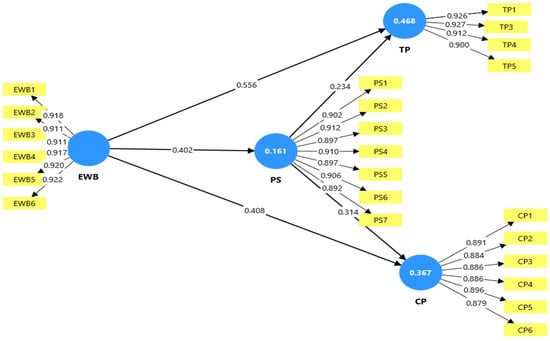
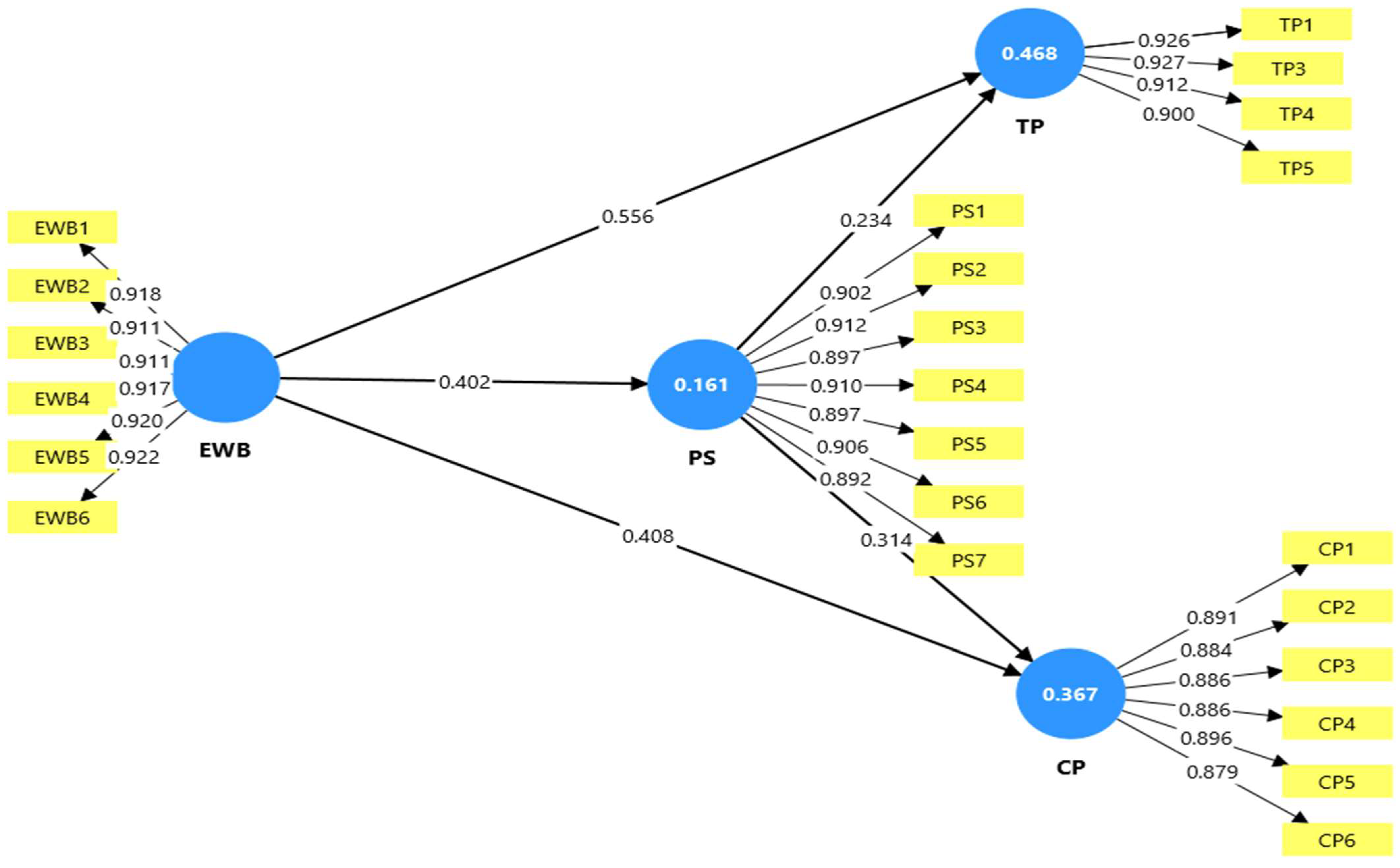
The measurement model, including the indicator loadings and structural path coefficients, is presented in Figure 1.
Figure 1.
The measurement model (PLS algorithm output) displaying outer loadings, path coefficients, and R2 values. Note: Different colors are used solely to visually distinguish the constructs in the PLS-SEM model and do not represent any statistical significance or additional analytical classification.
4.2. Structural Model Assessment
Following the reliability, convergent validity and discriminant validity of the measurement model, the structural model was tested to explore the hypothesized relationships between employee well-being (EWB), perceived psychological safety (PS), task performance (TP), and contextual performance (CP). Collinearity diagnostics, explained variance (R2), path coefficients, effect sizes (f2) and bootstrapping with 5000 resampling results were included in the assessment. Collinearity among predictor constructs was examined using variance inflation factor (VIF) values, prior to examining the hypothesized relationships. In the structural model, all VIF values were lower than the recommended value, and thus there was no problem of multicollinearity. Thus, the estimated path coefficients can be confidently interpreted.
The endogenous constructs showed their explanatory power by the coefficient of determination (R2). The model accounted for 46.8% of the variation in task performance, 36.7% of the variations in contextual performance, and 16.1% of the variations in perceived psychological safety. The values showed that employee well-being and employee-perceived psychological safety have meaningful explanatory power for employee performance outcomes. The values of R2, however, are not used as indicators of out-of-sample predictive validity, but as measures of the amount of in-sample explained variance.
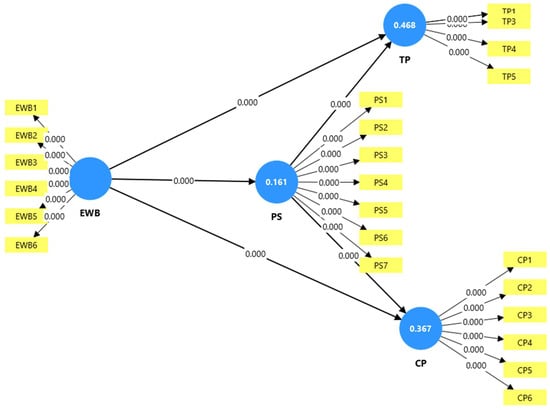
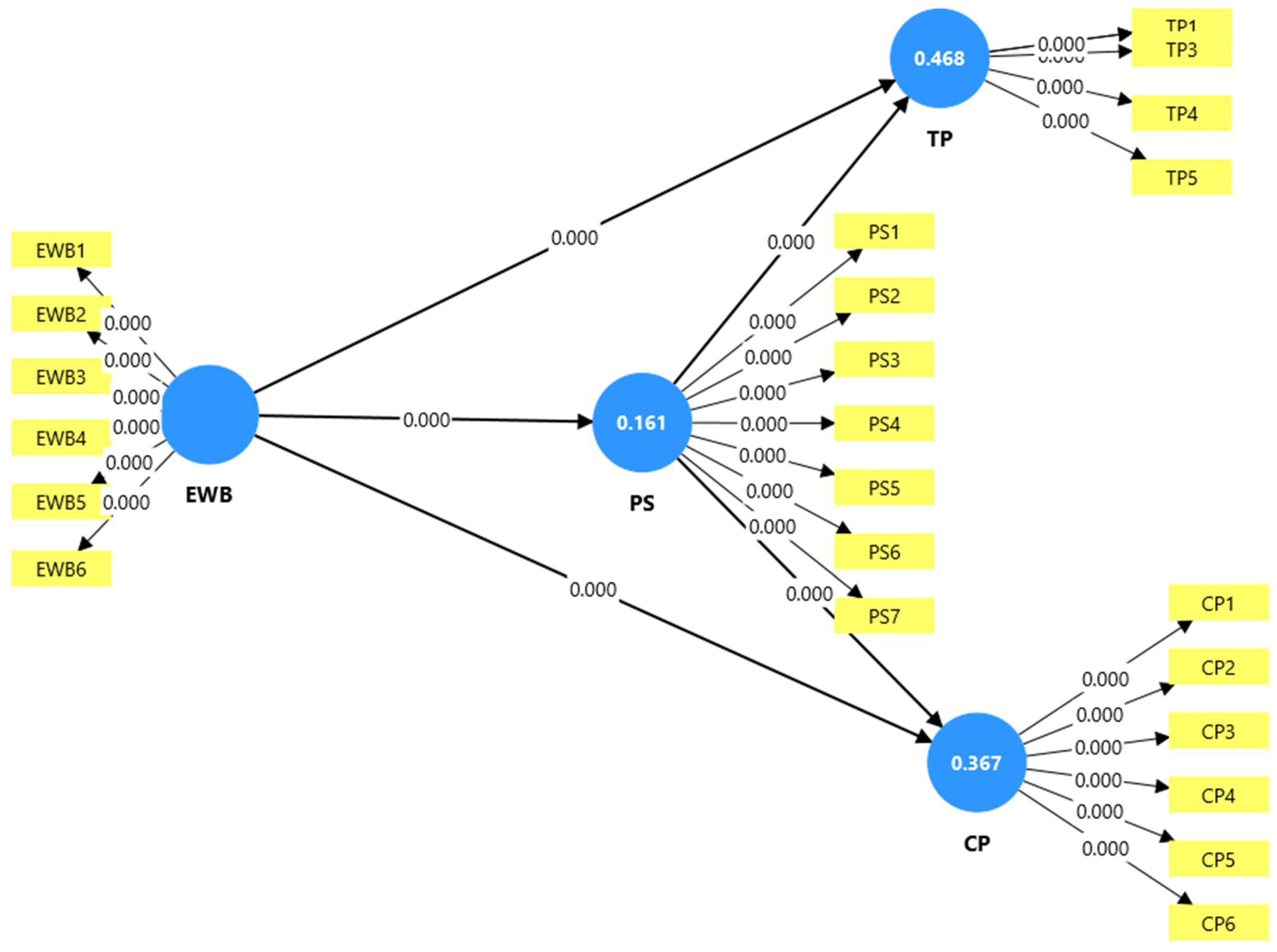
We also calculated the effect sizes (f2) to estimate the substantive effect of each predictor. Task performance (f2 = 0.487), contextual performance (f2 = 0.220), and perceived psychological safety (f2 = 0.193) were found to have large, medium, and medium effects, respectively, on employee well-being. The correlation between perceived psychological safety and task performance was small to medium (f2 = 0.086) and the correlation between perceived psychological safety and contextual performance was small to medium (f2 = 0.130). The findings suggest that employee well-being is a more robust explanatory variable and that perceived psychological safety contributes to explaining performance outcomes. The structural model, including the bootstrapped path coefficients and their statistical significance, is presented in Figure 2.
Figure 2.
The structural model (bootstrapping output).
Bootstrapping procedures were used to determine the significance and magnitude of the hypothesized relationships. The results of the structural model are presented in Table 5.
Table 5.
Structural model assessment (direct effects).
The findings suggest that higher levels of employee well-being are related to positive relationships with both facets of employee performance. In particular, well-being was more strongly related to task performance (β = 0.556) than contextual performance (β = 0.408). Moreover, the link of employee well-being to psychological safety was positive (β = 0.402): the hypothesis that individual psychological resources are linked to employee perceptions of workplace safety was supported.
Task performance and contextual performance also showed significant positive associations with perceived psychological safety, with values of β = 0.234 and β = 0.314, respectively. Interestingly, the stronger connection between perceived PS and contextual performance implies that psychologically safe environments could be especially pertinent to less routine and more discretionary, collaborative, and extra-role performance behaviors.
The overall results of the structural model confirm all the direct hypotheses (H1–H5). However, the cross-sectional study design should not be interpreted as evidence for temporal or causal effects; rather, these are significant associations.
4.2.1. Cross-Loading Assessment
The test of discriminant validity was conducted by looking at the cross-loadings of the indicators. All indicators were predicted to load higher on the theorized construct than the other constructs. All indicators met this criterion as indicated in Table 6. The six employee well-being indicators that have the highest loadings on EWB range from a minimum of 0.911 to a maximum of 0.922. The seven perceived psychological safety indicators (PS1–PS7) had the highest loadings on PS, from 0.892 to 0.912. Likewise, the items that measured task performance loaded between 0.900 and 0.927 on TP, and the items that measured contextual performance loaded between 0.879 and 0.896 on CP. Cross-loadings were lower for all other alternative constructs. The findings give more evidence of the four reflective constructs’ distinctiveness in the empirical field.
Table 6.
Cross-loading matrix.
As shown in Table 6, all the indicators had the highest loading on the corresponding constructs. For instance, loadings of the CP indicators were highest at the contextual performance (CP) construct (0.879 to 0.896), and their cross-loadings on other constructs were significantly lower. Likewise, the TP indicators loaded higher than the employee well-being and psychological safety indicators, ranging from 0.900 to 0.927.
Similarly, the employee well-being indicators had high loadings on their intended construct (0.911–0.922) and the indicators of perceived psychological safety had high construct-specific loadings (0.892–0.912). The findings are in line with the idea that the four constructs are empirically different.
4.2.2. Assessment of Explained Variance and Effect Sizes
Explained variance and its effect size are explained in Table 7.
Table 7.
Explained variance and effect sizes.
The model explained 46.8% of the variance in task performance, 36.7% in contextual performance, and 16.1% in perceived psychological safety. These R2 values are interpreted as in-sample explained variance and are not treated as evidence of out-of-sample predictive validity. The effect sizes associated with the hypothesized structural relationships are presented in Table 8.
Table 8.
f2 effect sizes.
The results from the effect size analysis suggest that employee well-being has a large effect on task performance (f2 = 0.487), and a medium effect on contextual performance (f2 = 0.220) and perceived psychological safety (f2 = 0.193). Perceived psychological safety has moderate, yet significant (f2 = 0.130), impacts on contextual performance and significant (f2 = 0.086) impacts on task performance. This is because, as shown in these findings, employee well-being is the more explanatory resource, and perceived psychological safety adds to the employee performance outcomes.
4.3. Assessment of Mediating Role of Perceived Psychological Safety
The central question of this study, whether employee well-being has an indirect effect on the performance outcome through the action of perceived psychological safety, as a mediator, was also analyzed using the bootstrapping output (Table 9). Employee well-being indirectly affected task performance through perceived psychological safety, and the effect was statistically significant (β = 0.094, t = 4.944, p < 0.001, 95% BCa CI [0.061, 0.135]). Employee Wellbeing is essential for achieving the employee performance [28]. The direct link between employee well-being and task performance also stayed strong and significant (β = 0.556, t = 16.234, p < 0.001, 95% BCa CI [0.484, 0.621]). These findings line up with complementary statistical mediation and support H6. The pattern showed up again with contextual performance. Employee well-being had a significant indirect effect on contextual performance through perceived psychological safety (β = 0.126, t = 5.328, p < 0.001, 95% BCa CI [0.082, 0.174]). The direct connection between employee well-being and contextual performance was also positive and significant (β = 0.408, t = 9.475, p < 0.001, 95% BCa CI [0.323, 0.492]). So, these results support complementary statistical mediation and H7 as well. Because the study used a cross-sectional design, these mediation effects show statistical indirect relationships, not direct evidence of temporal or causal mediation.
Table 9.
Mediation analysis.
The bootstrapping results shows statistically significant indirect associations of employee well-being with task and contextual performance through perceived psychological safety, corresponding to the paths EWB → PS → TP and EWB → PS → CP. The indirect association between EWB and TP through PS was β = 0.094, t = 4.944, p < 0.001, with a bias-corrected 95% confidence interval of [0.061, 0.135]. The corresponding indirect association between EWB and CP was β = 0.126, t = 5.328, p < 0.001, with a bias-corrected 95% confidence interval of [0.082, 0.174]. The results are consistent with complementary statistical mediation, as the direct associations were still positive and statistically significant. The indirect component accounted for around 14.5% of the overall EWB–TP association, and, around 23.6% of the overall EWB–CP association. These findings should be viewed as a cross-sectional statistical mediation effect, not as evidence of a temporal or causal effect.
In summary, employee well-being has a direct link to key job performance and to prosocial work-related behaviors, and fostering perceived psychological safety offers a promising second pathway to boost these positive workplace responses.
5. Discussion
The results support the hypothesized associations between employee well-being and perceived psychological safety and effort and between perceived psychological safety and performance. The contribution of the study is not only to discover significant relationships but also the relationship of the various employee resources with the various kinds of employee performance behaviors. Again, in accordance with the prior research, employee well-being had a positive relationship with performance outcomes, and thus, employees who had more psychological resources may be able to exhibit higher levels of necessary and discretionary work behaviors. The results add to the existing evidence by exploring task performance and contextual performance separately instead of using overall employee performance as an indicator.
5.1. Interpretation of Direct Effects
The positive relationship between employee well-being and task performance is consistent with earlier findings that workers possessing greater psychological resources can, for instance, demonstrate greater concentration, motivation and persistence with task completion. Likewise, the connection between employee well-being and contextual performance can be used to support the idea that personal resources can be used to facilitate discretionary behaviors like cooperation, helping, and organizational citizenship behaviors. The strength of these relationships should be understood as associations; however, due to the cross-sectional design, a temporal causality cannot be determined.
These results are in line with the previous study that examined the mediating role of employee well-being on the performance of employees [29].
This fits in nicely with the conservation of resources (COR) theory. Well-being is an essential in-house resource in a cognitively demanding and high-stress environment in knowledge-intensive organizations (KIOs) in Pakistan. If this resource is plentiful, then staff do not have to work in a defensive and survival mode. Rather, they fall into a resource gain spiral and invest their psychological surplus into what they are expected to do in their primary work demands. The theoretically meaningful positive association between perceived psychological safety and contextual performance is also very interesting in that many of the behaviors of contextual performance involve interpersonal behavior, collaboration, and voluntary contributions that require a high level of social exposure. Employees may feel more confident to engage in cooperative activities because their perception of psychological safety may decrease their perception of the interpersonal risks that such actions may incur. This interpretation mirrors past perceived psychological safety research that has been correlated with voice behavior, learning behavior, and citizenship-related outcomes.
In addition, the study finds that employee well-being is highly positively related to perceived psychological safety (H3), and that perceived psychological safety is highly positively related to both performance measures (H4 and H5). This positive relationship between employee well-being and perceived psychological safety implies that employees who report higher levels of personal psychological resources may also report higher levels of perceived interpersonal psychological safety. It is important to note that it is not found as a result of this study that organizational well-being programs make a person feel psychologically safe; organizational well-being practices were not measured in this study. When a company actively invests in and invests heavily in well-being infrastructure, it is telling its employees that it trusts its employees [30]. This institutional commitment helps to lower interpersonal defensiveness and foster a common culture of safety for employees to take interpersonal risks, share novel ideas and express technical issues without worry of being discredited or reprimanded.
5.2. The Mediating Mechanism of Perceived Psychological Safety
The most significant result of this study is the validation of perceived psychological safety as a partial (complementary) mediator between employee well-being and the results of work (H6 and H7). This is an effective way to “open the black box” of how internal wellness translates to the workforce outputs measured [31]. Corporate well-being programs provide the employees with the energy they need to perform but this energy must be used within a contextual engine that supports their use. This critical engine is demonstrated in the mediation analysis. It assures knowledge workers that any discretionary energy they expend, whether in experimenting with a new and interesting technical solution or in mentoring a fellow worker, will be met with respect. The mediation results indicate that perceived psychological safety is another pathway through which employee well-being can be related to task and contextual performance. The substantial indirect association is consistent with complementary statistical mediation, along with the other direct associations. These results should not be interpreted as a causal mediation process, however, as the data used in the study is cross-sectional and self-reported. Perceived psychological safety is another statistical pathway that is linked to the relationship between employee well-being and performance outcomes. The results indicate that personal psychological resources and perceptions of interpersonal safety might both have a role in the employees’ perceived performance behaviors, although it is important to note that longitudinal studies are required to determine temporal relationships. Given the unpredictable nature of the macro-economic environment in Pakistan, with external challenges regularly taxing employees’ capabilities, an inclusive and conducive work culture with a robust internal micro-environment of perceived psychological safety is essential to maintain their high productivity.
6. Conclusions
In the current fast pace of technological development and high level of socio-economic uncertainty, optimizing the production of the corporation and human sustainability is no option. This study empirically demonstrates that employee well-being is one of the critical factors to attain task and contextual performance in knowledge-intensive sectors in Pakistan. Most importantly, the study shows that the best effect is seen when well-being interventions are delivered via a psychologically safe workplace culture. The findings of this paper indicate that the development of sustainable organizational growth is a need of organizational leaders who can look at the psychological safeguard of their human resources as a strategic process rather than a side effect of their activities for CSR.
6.1. Theoretical Contributions
There are a number of important theoretical contributions to the literature on social sustainability and organizational behavior that this research brings. The results indicate, from a COR perspective, that employee well-being (as individual psychological resource) is positively related to perceived psychological safety. This is similar to the potential for personal and interpersonal resources to occur together and complement each other in employees’ work experiences. The cross-sectional nature of the data, however, does not warrant the present study to conclude that one resource is a temporal cause of the other.
First, it takes sustainable human resource management one step further and makes employee well-being and perceived psychological safety structural antecedents of employee performance. It is a shift from the more traditional “depletion-based” HR culture, which is more focused on “productivity” and less on “people”, to a more sustainable “people-based” approach. The results could be relevant to other discussions on sustainable working places in which the focus is on employee well-being and good working experiences. Nevertheless, the present study does not directly assess SDG implementation, decent work indicators, sustainability outcomes, or organizational practices of well-being. These linkages are therefore considered as context-specific relevance, and not as evidence of SDG achievement.
Second, the study is based on the conservation of resources theory and adds this theory to the literature on team climate. Results show that personal energetic resources, in particular employee wellness, can help develop shared and relational resources like perceived psychological safety. This linkage suggests that employee well-being can be positively linked with employees’ sense of supportive, trustworthy, and safe interpersonal risk-taking at work. The study, therefore, extends the scope of the explanatory power of the COR theory by illustrating that personal resources can create valuable social and organizational resources.
Thirdly, the study makes a contribution in terms of its geographical and context-related approach. The study also fills the lacunae of the available literature because the majority of the studies have been carried out in developed economies while in the present study the proposed model has been tested in the context of the knowledge-intensive sector in Pakistan. The results suggest that the human-centered sustainability models also have significant operational relevance in high-stress organizational settings in developing economies. This contextualization helps in the generalizability of the theoretical relations between employee well-being, employee-perceived psychological safety, and employee performance.
6.2. The Implications for Practice and Management
This study has several practical implications for managers and human resource practitioners, particularly those in knowledge-intensive organizations, and particularly in the technology and professional services sector. Well-being must be a big part of leadership performance, not an afterthought to an organization. Operational investments should be considered, such as providing mental health support, flexibility in workload, stress-management programs and a reasonable workload [32,33]. When employees’ physical, emotional and psychological health and well-being are supported, organizations will be able to better provide for the essential job functions.
Managers should also create a culture that is conducive to staff well-being as one that is not punitive, so as to maximize the performance upside of staff well-being. It has to be a culture of perceived psychological safety at work where individuals do not have to worry about saying something to their managers about concerns, mistakes, questions, or new ideas. Such an environment can be fostered by the normalization of constructive failure, an open culture of error reporting and the education of managers to be inclusive, empathetic and supportive.
Furthermore, more research is needed to adjust the procedures for evaluating performance to include context as well as task-specific factors. Employee behavior, such as peer mentoring, cooperation, knowledge sharing, teamwork, and help given voluntarily, is an important aspect of organizational effectiveness and is not part of a regular performance management system. These behaviors in the appraisal and reward process can get employees to do more, improve the team spirit in the company.
6.3. Limitations and Future Research Directions
This study, while sound in methodology, has certain limitations that can be investigated in a future study. Replication in other contexts of emerging economies would enable us to evaluate the generalizability, robustness and contextual boundary conditions of the observed relationships. Causal inferences with regard to the relation between well-being, safety and performance over time cannot be made with the help of this type of research design (cross-section). More research is encouraged that would employ longitudinal or diary-study designs that would capture the dynamic, day-to-day changes in these variables. Moreover, common method bias was minimized in the dual-mode data collection; however, the use of self-reported performance measures has some limitations. There may be future research that could include the use of multi-source data, such as supervisor ratings or objective measure of the project completion rate, which would be used as triangulation of the data. Last but not least, scaling up the structural model to other emerging economies would further corroborate the universal validity of this sustainable HRM model. The findings are not evidence of shared team climate or organizational-level psychological safety; rather, they are individual-level perceptions of psychological safety. Future studies using multi-level and team identifiers could explore the dynamics of individual perceptions becoming a team psychological safety climate.
In overall terms, the results suggest that this positive relationship between employee well-being and task and contextual performance was mediated by perceived psychological safety. These findings extend the study of the COR by emphasizing the simultaneous importance of personal psychological resources and perceived interpersonal safety. The cross-sectional design, however, should be interpreted with caution and future longitudinal and cross-context studies are required to look at the temporal ordering, replicability, and boundary conditions of the contexts.
Author Contributions
Conceptualization, M.A. and A.I.; methodology, M.A. and A.R.; software, A.I. and M.N.F.; validation, M.A., S.N. and A.R.; formal analysis, A.I. and M.N.F.; investigation, M.A. and A.I.; resources, M.A. and S.N.; data curation, A.I. and M.N.F.; writing—original draft preparation, M.A., A.I. and M.N.F.; writing—review and editing, S.N. and A.R.; visualization, A.I. and M.N.F.; supervision, S.N. and A.R.; project administration, M.A.; funding acquisition, M.A. All authors have read and agreed to the published version of the manuscript.
Funding
This research received no external funding.
Institutional Review Board Statement
This study was approved by the Office of Research, Innovation and Commercialization (ORIC), University of Kamalia (UKM-ORIC-REC-2026-26, 22 January 2026).
Informed Consent Statement
Informed consent was obtained from all subjects involved in the study.
Data Availability Statement
The original contributions presented in this study are included in the article. Further inquiries can be directed to the corresponding author.
Conflicts of Interest
The authors declare no conflict of interest.
References
- Khamis, S.; Ibrahim, Y.; Moubarak, H. Sustainability practices and financial performance: A meta-analysis approach. J. Financ. Report. Account. 2026, 24, 1347–1371. [Google Scholar] [CrossRef] [Scilit]
- Kholaif, M.M.N.H.K. AI-Driven Green-Supply-Chains and Corporate Social Responsibility for Decent Work Environments: Pathways Toward Achieving SDG 8 and ISO 26000 Labor Standards. Corp. Soc. Responsib. Environ. Manag. 2026, 33, 3424–3446. [Google Scholar] [CrossRef] [Scilit]
- Abdullah Saeed Khan, M.; Arafat, S.M.Y. Sustainable Development Goals and Mental Health in Bangladesh; Springer: Singapore, 2026; pp. 173–187. [Google Scholar] [CrossRef] [Scilit]
- Martins, H.; Moreira, S.B. Human Capital at the Crossroads of Sustainability: Integrating Key Trends in HRM with the Sustainable Development Goals. In Integrated Science; Springer Nature: Cham, Switzerland, 2025; Volume 37, pp. 99–120. [Google Scholar] [CrossRef] [Scilit]
- Ghobakhloo, M.; Mahdiraji, H.A.; Iranmanesh, M.; Jafari-Sadeghi, V. From Industry 4.0 Digital Manufacturing to Industry 5.0 Digital Society: A Roadmap Toward Human-Centric, Sustainable, and Resilient Production. Inf. Syst. Front. 2024, 2024, 1–33. [Google Scholar] [CrossRef] [Scilit]
- Malik, S. Emotional intelligence and innovative work behaviour in knowledge-intensive organizations: How tacit knowledge sharing acts as a mediator? VINE J. Inf. Knowl. Manag. Syst. 2022, 52, 650–669. [Google Scholar] [CrossRef] [Scilit]
- Straus, E.; Uhlig, L.; Kühnel, J.; Korunka, C. Remote workers’ well-being, perceived productivity, and engagement: Which resources should HRM improve during COVID-19? A longitudinal diary study. Int. J. Hum. Resour. Manag. 2023, 34, 2960–2990. [Google Scholar] [CrossRef] [Scilit]
- Hameed, A.; Khwaja, M.G.; Zaman, U. Configuring optimal contextual performance and task performance in offshore business processing organizations. Bus. Process Manag. J. 2023, 29, 285–307. [Google Scholar] [CrossRef] [Scilit]
- Demerouti, E. Job demands-resources and conservation of resources theories: How do they help to explain employee well-being and future job design? J. Bus. Res. 2025, 192, 115296. [Google Scholar] [CrossRef] [Scilit]
- Ullah, H.; Qureshi, A.W.; Ali, R. Grade inflation in Pakistan higher education: Teachers’ perspective. J. Furth. High. Educ. 2024, 48, 700–713. [Google Scholar] [CrossRef] [Scilit]
- Peeters, M.; De Jonge, J.; Taris, T. An Introduction to Contemporary Work Psychology; Wiley: Hoboken, NJ, USA, 2024; p. 603. Available online: https://books.google.com/books/about/An_Introduction_to_Contemporary_Work_Psy.html?id=a37lEAAAQBAJ (accessed on 9 August 2026).
- Ijaz, D.A.; Chawla, R.N.; Saeed, A.; Naz, M.; Abubakar, M. Fostering Sustainable Workplace Wellbeing through Responsible Leadership via lens of Signalling Theory: Mediating Effect of Employee Oriented HRM in Banking Sector of Pakistan. J. Manag. Sci. Res. Rev. 2026, 5, 274–296. [Google Scholar]
- Hoang, N.H. Investigating EFL students’ emotional responses in AI-assisted language learning: A Broaden-and-Build Theory approach. Interact. Learn. Environ. 2026, 34, 1046–1061. [Google Scholar] [CrossRef] [Scilit]
- Byrom, N.C.; Dinu, L.; Kirkman, A.; Hughes, G. Predicting stress and mental wellbeing among doctoral researchers. J. Ment. Health 2022, 31, 783–791. [Google Scholar] [CrossRef] [Scilit] [PubMed]
- James, K.A.; Stromin, J.I.; Steenkamp, N.; Combrinck, M.I. Understanding the relationships between physiological and psychosocial stress, cortisol and cognition. Front. Endocrinol. 2023, 14, 1085950. [Google Scholar] [CrossRef] [Scilit] [PubMed]
- Elsner Twesme, E.; Werner, J.M.; Simha, A. Can We Talk? Improving Employee Contextual Performance Using Motivating Language and Feedback Orientation. Int. J. Bus. Commun. 2025, 62, 326–346. [Google Scholar] [CrossRef] [Scilit]
- Awwad, M.S. The mediating role of internal marketing and job satisfaction in enhancing task and contextual performance: Evidence from the Jordanian public sector. Int. Rev. Public Nonprofit Mark. 2025, 23, 47–68. [Google Scholar] [CrossRef] [Scilit]
- Edmondson, A.C.; Kerrissey, M.J. What People Get Wrong About Psychological Safety. Harv. Bus. Rev. 2025, 103, 52–59. [Google Scholar]
- Chen, B.; Wang, L.; Li, B.; Liu, W. Work stress, mental health, and employee performance. Front. Psychol. 2022, 13, 1006580. [Google Scholar] [CrossRef] [Scilit] [PubMed]
- Li, X.; Peng, P. How authentic leadership prevents knowledge hiding: The mediating roles of perceived psychological safety and relational identification. J. Innov. Knowl. 2026, 11, 100881. [Google Scholar] [CrossRef] [Scilit]
- Xiao, H.; Xie, W.; Liu, B. An empirical study on the influence of new generation employees’ job satisfaction on contextual performance in the energy industry. Heliyon 2024, 10, e30073. [Google Scholar] [CrossRef] [Scilit] [PubMed]
- Mahmoud, M.A.; Ahmad, S.; Poespowidjojo, D.A.L. Perceived psychological safety and individual performance: The mediating effect of intrapreneurial behavior. Int. J. Product. Perform. Manag. 2022, 71, 2913–2931. [Google Scholar] [CrossRef] [Scilit]
- Clarke, E.; Näswall, K.; Masselot, A.; Malinen, S. Feeling safe to speak up: Leaders improving employee wellbeing through perceived psychological safety. Econ. Ind. Democr. 2025, 46, 152–176. [Google Scholar] [CrossRef] [Scilit]
- Ahmad, S.K. How to choose a sampling technique and determine sample size for research: A simplified guide for researchers. Oral Oncol. Rep. 2024, 12, 100662. [Google Scholar] [CrossRef] [Scilit]
- Zheng, X.; Zhu, W.; Zhao, H.; Zhang, C. Employee well-being in organizations: Theoretical model, scale development, and cross-cultural validation. J. Organ. Behav. 2015, 36, 621–644. [Google Scholar] [CrossRef] [Scilit]
- Oh, S.H.; Dong, L.; Nahm, A.Y.; Yu, G.C. Fostering innovation and involvement among Korean workers in problem solving through trust and perceived psychological safety: The role of paradoxical leader behaviours. Asia Pac. Bus. Rev. 2023, 29, 701–718. [Google Scholar] [CrossRef] [Scilit]
- Klehe, U.C.; Anderson, N. Working Hard and Working Smart: Motivation and Ability During Typical and Maximum Performance. J. Appl. Psychol. 2007, 92, 978–992. [Google Scholar] [CrossRef] [Scilit] [PubMed]
- Legate, A.E.; Hair, J.F., Jr.; Chretien, J.L.; Risher, J.J. PLS-SEM: Prediction-oriented solutions for HRD researchers. Hum. Resour. Dev. Q. 2023, 34, 91–109. [Google Scholar] [CrossRef] [Scilit]
- Al Nahyan, M.T.; Al Ahbabi, J.M.; Alabdulrahman, M.A.; Alhosani, I.; Jabeen, F.; Farouk, S. Employee job security and job performance: The mediating role of well-being and the moderating role of perceived organizational support and psychological capital. Eur. J. Manag. Bus. Econ. 2026, 35, 244–265. [Google Scholar] [CrossRef] [Scilit]
- Islam, M.S.; Amin, M. A systematic review of human capital and employee well-being: Putting human capital back on the track. Eur. J. Train. Dev. 2022, 46, 504–534. [Google Scholar] [CrossRef] [Scilit]
- Mutio, E.N.; Onyango, J.O. C-suite mental wellness and organisational performance: Evidence from companies listed on the Nairobi Securities Exchange. Ment. Health Soc. Incl. 2026, 1–15. [Google Scholar] [CrossRef] [Scilit]
- Aibinu, A.A.; Al-Lawati, A.M. Using PLS-SEM technique to model construction organizations’ willingness to participate in e-bidding. Autom. Constr. 2010, 19, 714–724. [Google Scholar] [CrossRef] [Scilit]
- Jia, Z.; Zheng, F.; Wang, F.; Yang, G. Psychometric properties of the wellbeing literacy 6-item scale in Chinese military academy cadets. Front. Psychol. 2024, 15, 1293845. [Google Scholar] [CrossRef] [Scilit] [PubMed]

Disclaimer/Publisher’s Note: The statements, opinions and data contained in all publications are solely those of the individual author(s) and contributor(s) and not of MDPI and/or the editor(s). MDPI and/or the editor(s) disclaim responsibility for any injury to people or property resulting from any ideas, methods, instructions or products referred to in the content. |
© 2026 by the authors. Licensee MDPI, Basel, Switzerland. This article is an open access article distributed under the terms and conditions of the Creative Commons Attribution (CC BY) license.