


Abstract
As a key strategic sector underpinning China’s future development, the artificial intelligence (AI) industry is essential to enhancing national competitiveness and advancing sustainable economic and social development. Based on Chinese provincial panel data from 2012 to 2022, we explore how industrial structure upgrading (ISU) affects the resilience of China’s AI industry chain (RAIIC) and empirically test the underlying transmission mechanism using a mediation effect model. The results indicate that (1) ISU significantly enhances the RAIIC, thereby providing a solid structural foundation for its long-term stability and sustainable evolution; (2) the impact of ISU on the RAIIC can be realized by enhancing regional financial agglomeration and human capital levels; (3) the positive impact of ISU on the RAIIC is significantly stronger in regions with larger population sizes, higher levels of economic development, higher technological sophistication, and more advanced digital inclusive finance. These findings imply that policy design should emphasize regional coordination and dynamic adaptability so as to support the balanced and sustainable nationwide development of the AI industry. According to these findings, we propose corresponding policy recommendations aimed at providing theoretical support and practical guidance for the sustainable and high-quality development of China’s AI industry.
1. Introduction
AI, as the next generation of “foundational technology” following the internet, possesses broad empowering potential. It can deeply integrate into traditional industries, giving rise to emerging sectors such as smart transportation, fintech, digital healthcare, intelligent manufacturing, smart agriculture, and wellness services. It has emerged as a key driver of the new wave of technological and industrial transformation, with far-reaching and enduring implications for the global economic structure, social development, and the evolution of human civilization [1]. According to a report by the McKinsey Global Institute, the societal transformation led by AI is 300 times the scale of the industrial revolution, 3000 times as impactful, and its pace is ten times faster than the previous revolution [2]. As a result, AI has become a pivotal determinant in the contest for future comprehensive national power among leading global economies. Numerous countries worldwide are proactively laying out strategic plans from a national perspective, intensively launching related national strategies and policy frameworks to seize the initiative in the new round of international technological competition. As early as May 2017, Singapore launched the national-level project AI Singapore, elevating its development goal to building a “Smart Nation.” In November 2019, the country further released the National AI Strategy, and subsequently, in December 2023, it introduced National AI Strategy 2.0, putting forward the vision of “AI for the benefit of the public” [3]. On February 11, 2025, Ursula von der Leyen, President of the European Commission, unveiled the “Investing in AI” initiative during the AI Action Summit in Paris, aiming to mobilize €200 billion in funds to accelerate the development and application of AI. In January 2025, shortly after taking office, President Trump announced the launch of a major project named “Stargate,” which was jointly funded by Japan’s SoftBank Group, OpenAI, and Oracle Corporation with an investment of $500 billion to establish a new company focused on building infrastructure in the U.S. to support the development of artificial intelligence [4]. Furthermore, Trump rescinded the AI executive order issued by the Biden administration and replaced it with a new executive order titled “Removing Barriers to American Leadership in Artificial Intelligence” [5].
China has positioned AI development as a national strategic priority, actively fostering its integration with multiple economic and social sectors. The New Generation Artificial Intelligence Development Plan, released in July 2017, further defines AI as a core driver of the nation’s overall development. The report of the 20th National Congress of the Communist Party of China pointed out the need to “build new growth engines, such as new-generation information technology and artificial intelligence.” In August 2025, the State Council issued the Opinions on Deepening the Implementation of the “AI+” Action, comprehensively deploying the “AI+” action plan, which proposed six major focus areas, aiming to deeply integrate AI into various economic and social fields. The plan sets development goals for 2027, 2030, and 2035. Driven by strong government and industry investment and ongoing technological innovations, China’s AI industry is entering a golden period of rapid growth and resource consolidation. Data from the China Academy of Information and Communications Technology indicate that China’s AI industry surpassed 900 billion yuan in 2024, with a year-on-year growth rate of 24% [6]. As of 9 April 2025, China had filed a total of 1.576 million AI patents, accounting for 38.58% of the global total and maintaining the world’s leading position [7]. By September 2025, the number of AI-related companies in China exceeded 5300, representing 15% of the global total [6], and a relatively complete industrial system has been gradually built. According to the IDC Worldwide AI and Generative AI Spending Guide V2 edition, released in 2025, it is forecasted that by 2029, China’s total investment in AI will reach $111.4 billion, with a projected compound annual growth rate of 25.7% over the next five years.
However, as external disruptive factors such as trade frictions and economic sanctions continue to intensify, issues related to the underlying foundation and stability of the AI industry chain have become increasingly prominent. From the 2018 ZTE ban to the listing of companies and universities such as Huawei, Hikvision, and iFlytek on the Entity List between 2019 and 2022, a series of disputes has raised widespread concerns about the security risks within the AI industry chain [8]. Meanwhile, China still faces structural weaknesses in this field, such as a weak foundation and technological layout, insufficient talent reserves, and dependence on foreign countries for key technologies [9], as well as issues like an imperfect innovation support system and a lack of patent research and standard-setting influence [10], further exposing the vulnerability of the industry chain. In response, the 3rd Plenary Session of the 20th Central Committee called for the enhancement of the institutional framework to strengthen the resilience and security of industrial and supply chains. Enhancing the RAIIC is the fundamental guarantee for achieving its long-term sustainable development. Faced with a more complex external environment and growing technological bottleneck risks, strengthening the autonomy, controllability, and resilience of the industry chain is essential to securing the continuous supply of core technologies, sustaining a robust innovation ecosystem, and preventing disruptions from external supply shocks. More importantly, resilience building drives the industry chain to extend toward foundational and high-end segments, fostering a technologically endogenous and structurally balanced industrial system that supports continuous technological iteration, deeper application integration, and sustained value creation. At the same time, a resilient industry chain is better positioned to meet sustainability requirements such as green development, ethical compliance, and responsible governance, ensuring that AI empowerment in economic and social transformation remains both safe and inclusive. Therefore, consolidating the RAIIC is a core prerequisite for the steady, high-quality, and sustainable development of the AI sector.
2. Literature Review
Studies relevant to this paper have predominantly examined ISU, focusing on the factors that drive it and the economic benefits it generates. In terms of influencing factors, prior studies suggest that the development of digital trade [11], digital finance [12,13], high-speed rail [14], information infrastructure [15], new infrastructure [16], digital economy [17,18], digital government [19], industrial intelligence [20], as well as the growth of total economic output [21], all exert a positive influence on the advancement of ISU. Lin et al. [22] found that vertical fiscal imbalances caused by fiscal decentralization may suppress industrial structure upgrading to some extent. Wu et al. [23] demonstrated that higher education exerts a significant positive spatial spillover effect on ISU, with its indirect effect exceeding the direct effect. Zheng et al. [24], employing low-carbon city pilots as a quasi-natural experiment, found that while the policy facilitated ISU, its effect on the rationalization of the industrial structure was limited. Tang [25] found that digital government promotes the ISU, while inhibiting the rationalization of the industrial structure. Long et al. [26] showed that new infrastructure investment fosters the advancement of the industrial structure within provinces but constrains its coordinated (rationalized) transformation. Additionally, Du et al. [27] found that environmental regulations have a threshold effect on ISU: when economic development reaches a higher level, environmental regulations will significantly promote industrial structure upgrading. Li et al. [28] further revealed that green credit mainly promotes industrial structure upgrading through two channels: optimizing financial resource allocation and incentivizing enterprise entrepreneurship.
Industrial structure upgrading affects economic, environmental, and social development in complex ways through multiple pathways. In the context of innovation and carbon emissions, Qiu et al. [29], using a spatial Durbin model, found that ISU has a significant positive direct effect on local green innovation, while its indirect and total effects are significantly negative. Fan et al. [30] noted that ISU not only directly reduces carbon emissions but also indirectly contributes to carbon mitigation by promoting energy structure optimization and technological innovation. Regarding environmental sustainability, studies have identified a “U-shaped” relationship between ISU and the efficient utilization of solid waste: initially, upgrading slows the process, but over the long term, it accelerates it, thereby enhancing waste utilization [31]. Moreover, ISU has been shown to substantially improve urban ecological efficiency [32] and green total factor productivity [33], significantly reduce CO2 emissions [34], and exert an overall positive effect on environmental quality [35]. From a socio-economic perspective, ISU plays a significant role in narrowing the urban–rural income gap [36,37] and exhibits a nonlinear relationship with urban economic resilience, characterized by a dual-threshold effect [38]. Furthermore, its implementation has positively influenced the expenditure of the basic medical insurance fund for urban employees in China’s central, western, and northeastern regions [39].
Research on the RAIIC is relatively scarce and currently focuses mainly on the definition and measurement aspects. Wu et al. [8] believe that the RAIIC is reflected in the ability of the AI industry to resist, adapt, and recover from disruptive risks in the dynamic and uncertain global political and economic environment. This definition encompasses three capabilities: resistance, adaptability, and recovery. Different segments of the industry chain exhibit different levels of resilience, and the overall resilience of the industry chain can be considered an organic combination of the resilience levels of different industry segments. Lai [9] examined RAIIC from the perspectives of resistance, recovery, and innovation capabilities, and constructed an evaluation index system to measure the resilience development level of the industry chain across 30 Chinese provinces from 2012 to 2022. Guo [10] measured RAIIC from four dimensions: the foundation of the AI industry chain, its capacity for resistance and absorption, its adaptability and adjustment capacity, and its capacity for innovation and leadership. He found that RAIIC has shown a steady upward trend and exhibits spatial spillover effects, promoting the resilience of AI industry chains in neighboring regions.
In summary, there is limited literature on the relationship between ISU and the RAIIC, especially regarding how ISU empowers and enhances the RAIIC, which remains unclear. This paper theoretically investigates the relationship between ISU and RAIIC, and empirically assesses its effects using data from 30 Chinese provinces spanning 2012 to 2022.
This paper’s potential contributions can be summarized in three main aspects: First, it deepens the theoretical mechanism by which ISU drives the enhancement of RAIIC and provides empirical evidence through analysis based on existing literature. Second, this study explores the mediating role of financial agglomeration and human capital levels in the impact of ISU on the RAIIC, clarifying the pathways through which ISU affects RAIIC, and further expanding the existing literature. Third, it discusses the effects of ISU under different conditions and provides policy recommendations to promote ISU and enhance RAIIC, offering decision-making references for the high-quality development of the AI industry.
3. Theoretical Analysis and Research Hypotheses
3.1. Industrial Structure Upgrading and AI Industry Chain Resilience
ISU is the main way for a country’s economy to reach a mid-to-high-end level. It greatly strengthens the RAIIC by making resource allocation more efficient, improving technological innovation capabilities, and building a more complex and sophisticated division of labor network. Firstly, industrial structure upgrading means the gradual shift towards producing more technology-intensive and complex goods, driving the reallocation and accumulation of advanced production factors [40]. This process facilitates the transfer of production factors from low-efficiency sectors to high-efficiency ones, thereby optimizing the quality and allocation efficiency of resources supplied to the AI industry. Traditional labor-intensive or resource-intensive industrial structures tend to focus on primary labor and raw materials, making it difficult to meet the AI industry’s intensive demand for high-end chips, advanced algorithms, large-scale high-quality data, and highly skilled talent. Industrial structure upgrading causes capital, talent, and technology to move to high-tech industries and knowledge-intensive services. This gives the upstream and midstream parts of the AI industry chain better and more stable high-end factor inputs. This approach not only directly enhances the technological level and output efficiency of key links in the industry chain but also, by constructing a high-quality factor supply system, reduces the risk of industry chain breakdowns caused by the shortage of specific factors, thereby strengthening the chain’s resistance to external shocks.
Secondly, industrial structure upgrading can promote technological innovation [41], which injects a continuously evolving dynamic adaptability into the artificial intelligence industry chain. An industrial structure focused on imitation or primary processing has weak technological innovation capabilities, making key links in the industry chain highly vulnerable to technological route changes or external technological blockades. Industrial structure upgrading emphasizes independent innovation and breakthroughs in core technologies, guiding social resources towards R&D activities. This process fully stimulates the innovative vitality of various entities within the AI industry chain. This not only helps achieve technological independence in core fields like AI chip architecture, machine learning frameworks, and large models, reducing dependence on external technologies, but also enhances the chain’s ability to rapidly iterate and undergo transformational upgrades. When facing disruptive technological changes or drastic market fluctuations, an industry chain with strong internal innovation capacity can quickly adjust its technological paths and product structures, demonstrating exceptional adaptability and resilience—i.e., higher resilience.
Finally, industrial structure upgrading deepens the linkages and integration between industries, building an ecological support system with strong diversity, collaboration, and backup capacity for the AI industry chain, enhancing the survival rate of both existing enterprises and startups. Weak industry connections and short division chains often accompany a low-level industrial structure. Industrial structure upgrading, especially the evolution towards service-oriented, digital, and intelligent sectors, has driven the widespread penetration and deep integration of “AI+,” such as in smart manufacturing and intelligent services. This integration not only provides AI technology with broad application scenarios and market space, facilitating the formation of a commercialized closed loop, but more importantly, it creates a networked connection between the AI industry chain and other sectors of the national economy, supporting each other. On the one hand, diversified application scenarios reduce dependence on a single market and mitigate market fluctuation risks. On the other hand, close industry connections promote knowledge spillovers, technological collaboration, and capacity cooperation. When one link in the industry chain is impacted, other related industries can provide necessary technological alternatives, capacity supplementation, or market support, forming a strong system backup and collaborative recovery capability, significantly enhancing the overall stability of the industry chain. Based on this, Hypothesis 1 is proposed:
H1.
ISU enhances the RAIIC.
3.2. Transmission Mechanism
3.2.1. Industrial Structure Upgrading, Financial Agglomeration, and AI Industry Chain Resilience
The shift in industrial structure toward high-tech and high value-added sectors is, in essence, a process of economic activity becoming more complex and advanced, capable of attracting the agglomeration of more high-quality enterprise resources [42]. This process profoundly affects financial services from the demand side, thereby stimulating and reinforcing the spatial agglomeration of financial resources. In turn, financial agglomeration provides crucial support for the resilience of the AI industry chain. First, industrial structure upgrading creates the demand base and development momentum for financial agglomeration. With the regional economic focus transitioning from traditional labor- and resource-intensive industries to advanced manufacturing, modern services, and especially knowledge-intensive sectors, emerging industries tend to exhibit high R&D investment, long payback periods, light-asset operations, and dependence on sustained innovation. This generates a huge demand for diversified, specialized, and higher-risk-tolerance financial services. Traditional credit-based indirect financing mechanisms cannot fully meet these demands, thereby incentivizing the emergence and development of new financial forms such as venture capital, private equity, tech loans, leasing, and intellectual property securitization. To be close to clients, share information, and reduce transaction costs, these financial institutions and services tend to cluster in regions where industrial structure upgrading is active, forming geographic financial agglomeration. Thus, industrial structure upgrading reshapes the financing demand structure of the real economy and directly drives innovation and agglomeration on the financial supply side.
The enhanced level of financial agglomeration empowers the resilience of the AI industry chain through multiple mechanisms. Financial agglomeration implies a denser network of capital supply and more sophisticated risk management tools. For the AI industry, foundational R&D requires huge investments and is highly uncertain. Concentrated financial resources can provide firms in these critical segments with long-term and stable “patient capital,” and offer refinancing support when they encounter short-term market fluctuations or technological setbacks. In this sense, financial agglomeration can alleviate financing constraints [43], preventing R&D interruptions or the failure of key nodes in the supply chain caused by funding disruptions. Meanwhile, the rich array of insurance, guarantees, and derivative tools within agglomeration areas helps firms effectively hedge technological, market, and credit risks, creating a systemic risk buffer and enhancing the stability and resistance of the entire industry chain against shocks. When the industry chain encounters external shocks, recovery speed is crucial. Financial agglomeration areas, leveraging their role as information hubs and efficient capital networks, can quickly identify survivors or emerging alternatives within affected segments. Venture capital and M&A funds can rapidly inject resources into distressed but promising enterprises, helping them adjust direction or consolidate resources; creditors can provide breathing space through flexible debt restructuring. This market-signal-driven, rapid capital reallocation capability allows the AI industry chain to quickly repair broken links, activate backup capacities or technological paths, thereby significantly shortening recovery time and improving dynamic restoration efficiency. Based on this, Hypothesis 2 is proposed:
H2.
ISU enhances the RAIIC by increasing the level of financial agglomeration.
3.2.2. Industrial Structure Upgrading, Human Capital Levels, and AI Industry Chain Resilience
As the economic structure shifts from a traditional model reliant on cheap labor and natural resources to one driven by innovation, high-end design, and the service sector, the demand structure of the labor market undergoes a fundamental transformation. Frontier industries no longer require workers for simple, repetitive tasks but urgently need highly skilled talent capable of complex problem-solving, interdisciplinary integration, continuous learning, and creative thinking. This shift directly drives the demand for improved quality in higher education, vocational training, and lifelong learning systems. To cope with intense talent competition, enterprises actively increase investments in employee training, skill upgrading, and R&D team development. Individuals and households, expecting higher returns, are also more willing to invest in education. Simultaneously, at the government level, policies such as talent recruitment programs, research funding, and innovation platform development systematically optimize the institutional environment for human capital accumulation. Together, these factors significantly enhance the quality of regional human capital.
Higher levels of human capital bolster the RAIIC through the establishment of knowledge barriers, the enhancement of technological adaptability, and the promotion of sustained innovation. First, high-quality human capital possesses strong learning capabilities, enabling the acquisition of cutting-edge technologies and knowledge. This facilitates the utilization of internal knowledge within upstream and downstream segments of the industrial chain, as well as the transfer of external knowledge into the industrial chain [44]. It also helps firms develop specialized expertise and core technologies. Such specialized knowledge and core technologies constitute a difficult-to-imitate knowledge moat, which not only reduces technological risks arising from talent loss or external imitation but also enhances the team’s adaptability and coordination when facing external shocks, allowing firms to rapidly buffer the impacts of shocks through process optimization and technological adjustments. Second, a deep reserve of human capital allows the industry chain to quickly organize problem-solving efforts and develop alternative solutions when facing technology blockages or standard changes, thereby shortening the disruption period. Multi-skilled talent teams also facilitate rapid capacity reconstruction, mastery of new processes, and transition to new domains, improving recovery efficiency. Finally, as the direct carrier of innovation, human capital exerts a positive effect on firms’ innovation activities [45], giving rise to a continuous stream of technological and business model innovations and further promoting the construction of innovation ecosystem networks. Such a high-skill-driven innovation ecosystem enhances the system’s diversity, redundancy, and self-evolution capacity, enabling the industry chain to proactively anticipate technological trends and identify potential risks, ultimately evolving toward a higher-level, more sustainable form. Based on the above, Hypothesis 3 is proposed:
H3.
ISU enhances the RAIIC by improving human capital levels.
4. Study Design
4.1. Econometric Model Specification
To examine Hypothesis 1, i.e., that ISU have a positive impact on the RAIIC, this paper constructs the following econometric model:
In the model, is the dependent variable, representing the RAIIC. is the key independent variable, representing ISU. represents control variables that may affect the RAIIC. is the individual fixed effect, is the time fixed effect, and is the random disturbance term.
4.2. Variable Definition
4.2.1. Dependent Variable
Following Lai [9], we construct an evaluation index system for RAIIC based on three dimensions: resistance capacity, recovery capacity, and innovation capacity. The measurement is conducted using the entropy weight method. For detailed indicators, see the Table 1.
Table 1.
Index System for Assessing the RAIIC.
4.2.2. Independent Variable
We reference in this paper by Du et al. [27] uses the ratio of the output value of the tertiary industry to the output value of the secondary industry as a measure.
4.2.3. Mediating Variables
Financial Agglomeration Level (FAG): Following the approach of Ren et al. [46], the calculation is conducted as follows:
In this, represents financial agglomeration in region i at time t, where F stands for the value added by the financial industry.
Human Capital Levels (HC): Measured as the proportion of the population aged six and above who hold a university degree or higher.
4.2.4. Control Variables
In this paper, the control variables include: per capita GDP (Pgdp), calculated as regional GDP divided by total population; tax burden level (Tax), measured by the ratio of tax revenue to regional GDP; marketization degree (Mar), indicated by the marketization index; degree of openness (Oup), measured by the ratio of total imports and exports of goods (converted to local currency using the USD–RMB exchange rate) to regional GDP; population density (Pd), calculated as total population divided by the area of the administrative region; social consumption level (Scl), defined as the ratio of total retail sales of consumer goods to regional GDP; Internet penetration rate (Ipr), defined as the proportion of Internet users in the total resident population; and regional innovation capacity (Inno), measured as the natural logarithm of the number of patent grants.
4.2.5. Data Sources and Descriptive Statistics
This paper uses data from 30 provinces (Due to difficulties in obtaining data from other regions) in China between 2012 and 2022 as the research sample. The data is sourced from the China High-Tech Industry Statistical Yearbook, China Science and Technology Statistical Yearbook, China Electronics and Information Industry Statistical Yearbook, China Statistical Yearbook, and the National Bureau of Statistics. Table 2 provides a summary of the descriptive statistics for the variables used in this study.
Table 2.
Descriptive Statistics of Variables.
4.2.6. Temporal Characteristics of ISU and the RAIIC
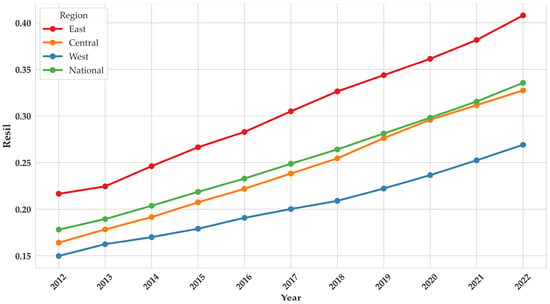
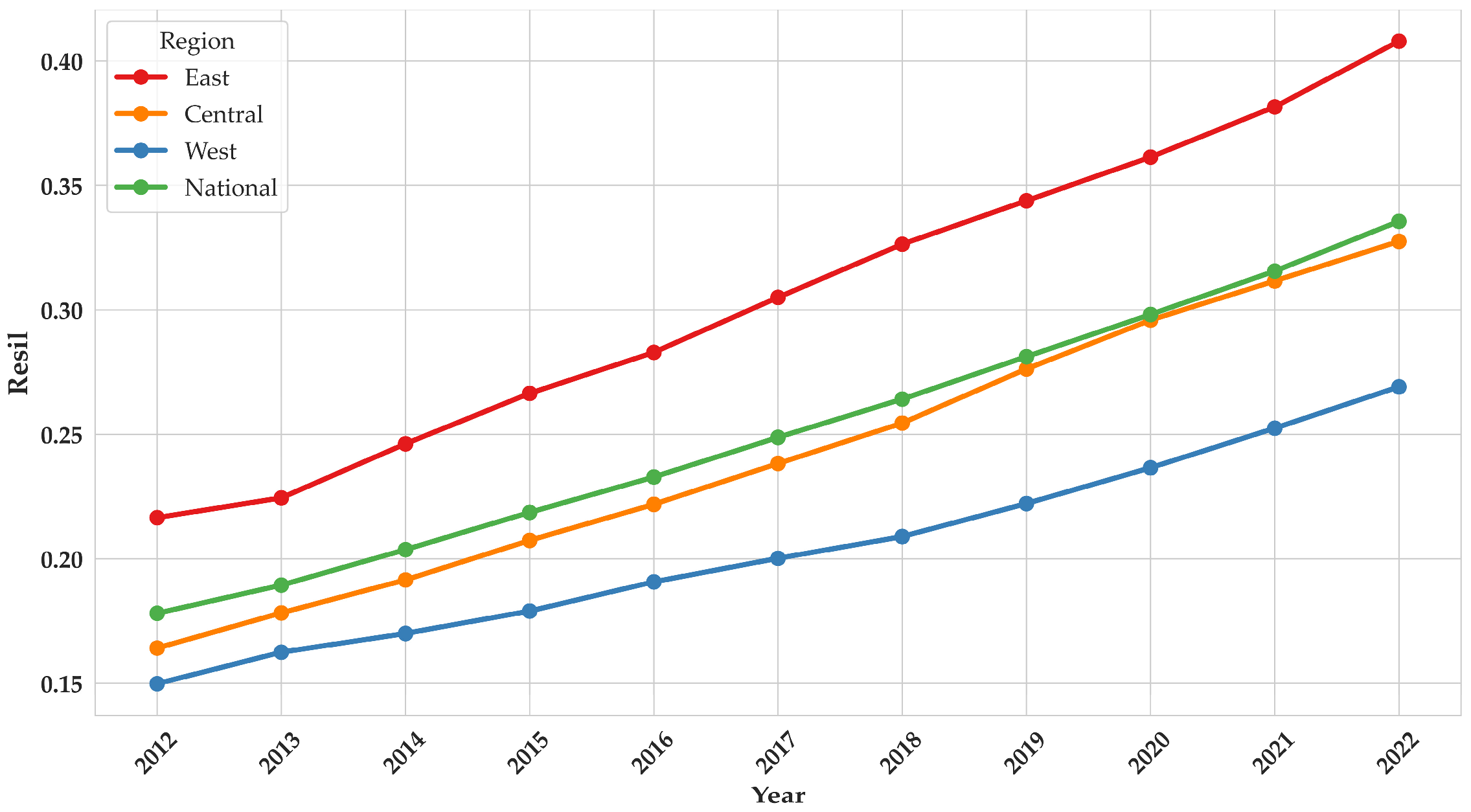
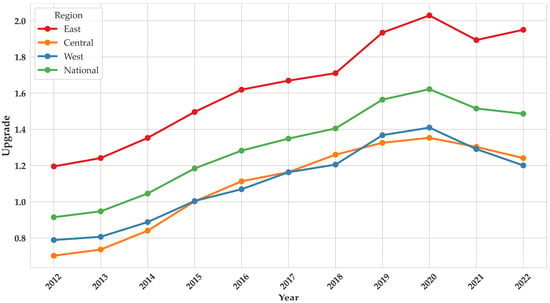
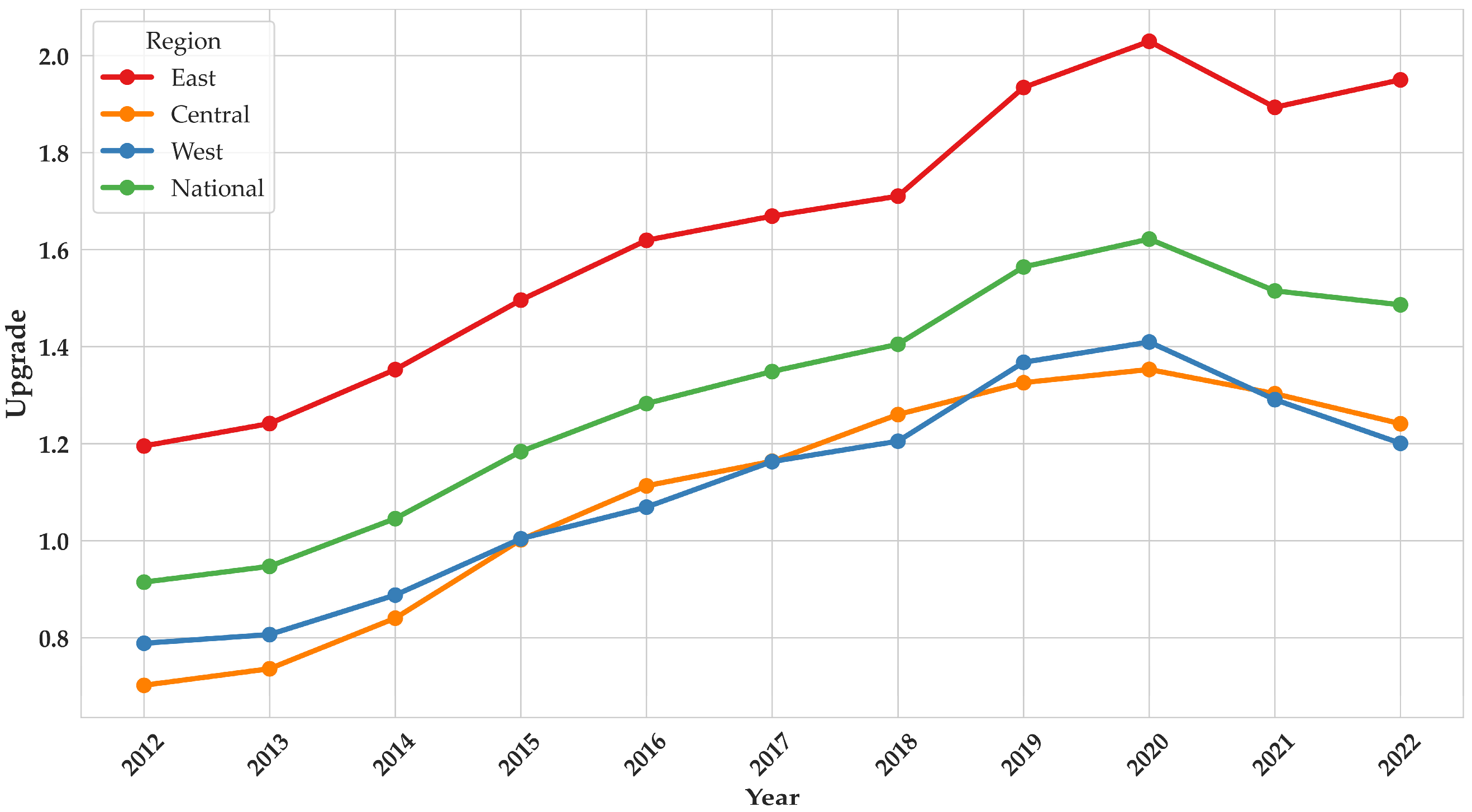
Figure 1 and Figure 2, respectively, depict the temporal changes in RAIIC and ISU levels at the national level and across the eastern, central, and western regions of China. First, the resilience of China’s AI industry chain shows pronounced regional heterogeneity, while overall exhibiting a steady upward trend. The eastern region consistently demonstrates the highest resilience, increasing from 0.22 in 2012 to nearly 0.41 in 2022. Not only does it start at a leading position, but it also has the steepest growth rate, making it the core driver of national industry chain resilience improvement. The central region ranks second, with resilience increasing steadily from about 0.17 in 2012 to 0.33 in 2022, showing a stable linear growth pattern, although the gap with the eastern region gradually widens over time. The western region starts with the lowest resilience and a relatively moderate growth rate, reaching approximately 0.27 in 2022. While it maintains a continuous upward trajectory, its improvement is notably weaker than that of the eastern and central regions. At the national level, resilience lies between that of the eastern and central regions. Its temporal trend aligns with regional patterns, reflecting both the leading role of the east and the supporting contributions of the central and western regions, while also highlighting the overall upward trend of national RAIIC amid regional development disparities.
Figure 1.
Time Trend of RAIIC.
Figure 2.
Time Trend of Industrial Structure Upgrading.
Next, the level of regional ISU in China exhibits significant differentiation and phased evolution. The eastern region has consistently led in ISU, starting at 1.20 in 2012 and rising steadily to a peak of 2.02 in 2020, before slightly declining to 1.95 in 2022. Both the magnitude and speed of growth are the highest among all regions, making the east the core driving region for ISU. At the national level, the level of ISU has been closely linked with developments in the eastern region: it was approximately 0.93 in 2012, rose to 1.61 in 2020, and slightly declined to 1.50 in 2022. This trend, strongly correlated with the eastern region, reflects the leading and driving role of the east. The central region started at the lowest level, gradually increasing from 2012 to 1.35 in 2020, before slightly decreasing to 1.22 in 2022. In the western region, the starting point in 2012 was slightly higher than that of the central region. It rose to 1.4 in 2020 before declining to 1.2, indicating that the stability of ISU in both regions is weaker than that of the eastern region.
5. Results and Analysis
5.1. Analysis of Baseline Regression
In order to examine the impact of ISU on RAIIC, we implement a two-way fixed effects regression. The results are summarized in Table 3.
Table 3.
Estimation Results of the Baseline Model.
Column (1) of Table 3 shows that the coefficient of ISU is significantly positive at the 5% level, before incorporating control variables. By gradually adding the control variables—marketization level, regional innovation level, social consumption level, tax burden level, per capita GDP, population density, Internet penetration rate, and degree of openness—across columns (2) to (9), the coefficient of ISU remains significantly positive at least at the 5% level. This finding demonstrates that ISU positively and significantly influences RAIIC, providing empirical support for Hypothesis 1.
5.2. Robustness Analysis
5.2.1. Eliminating the Impact of Outliers
Extreme values may potentially affect the accuracy of regression estimates. To enhance the robustness of the results, all continuous variables in this study were winsorized at the 1% and 5% levels to mitigate the influence of outliers. Column (1) of Table 4 presents the results after this treatment. The findings indicate that, even after controlling for extreme values, the estimated coefficient of ISU remains significantly positive, providing further support for the robustness of the baseline regression results.
Table 4.
Robustness Test Results.
5.2.2. Replacement of the Independent Variable
Following Shen et al. [13], we recalculate the core independent variable, ISU, using the ratio of the value added of the tertiary and secondary industries to GDP, together with Formula (3), as alternative measures of Upgrade, and conduct regression analysis. As shown in Column (2) of Table 4, the coefficients of both alternative variables are statistically significant at least at the 5% level, further confirming the robustness of the regression results reported in this study.
5.2.3. Adjusting the Research Sample
Given that municipalities directly under the central government may possess distinct policies and resources, they could uniquely influence the effect of ISU on RAIIC, potentially acting as confounding factors. To mitigate this effect, this study excludes the four municipalities—Beijing, Shanghai, Tianjin, and Chongqing—from the regression analysis. Column (3) in Table 4 presents the regression results based on the adjusted sample. The estimated coefficient remains positive and significant at the 1% level, indicating that even after excluding the municipalities, ISU continues to effectively enhance the RAIIC.
5.3. Endogeneity Test
There may exist potential reverse causality between industrial structure upgrading and the resilience of the AI industry chain. To address possible endogeneity, this study employs the one-period lag of industrial structure upgrading (IV) as an instrumental variable and estimates the model using the two-stage least squares (2SLS) method. The results are presented in Table 5. Column (1) reports the first-stage regression, where the coefficient of the IV is positive and statistically significant at the 1% level, satisfying the relevance condition. Column (2) shows the second-stage results using the instrumental variable. The Kleibergen–Paap rk LM and Wald F statistics indicate that the instrument passes both the under-identification and weak instrument tests. Even after accounting for endogeneity, industrial structure upgrading continues to significantly enhance the resilience of the AI industry chain, further supporting the robustness and validity of the study’s findings.
Table 5.
Instrumental Variable Results.
6. Heterogeneity Analysis
6.1. Heterogeneity in Population Size
Population size is an important contextual factor affecting the relationship between ISU and the RAIIC. In this study, the sample is divided into regions with large and small populations according to the median year-end resident population. The results, reported in Columns (1) and (2) of Table 6, indicate that the positive effect of ISU on RAIIC is stronger in regions with larger populations. This indicates that population size provides an important foundation of market scale and factor agglomeration for ISU to empower RAIIC. Regions with larger populations typically imply greater local market capacity and richer application scenarios. As a technology-intensive industry highly dependent on data-driven insights and market feedback, AI benefits from a large population base, which provides sustained demand, opportunities for iteration, product optimization, and experimentation with new business models. Emerging industries during the industrial structure upgrading process—such as intelligent services, smart cities, and digital consumption—are more likely to achieve scalable applications and commercialized feedback loops in densely populated regions, thereby enhancing the market adaptability and recovery capacity of the industry chain. Moreover, population agglomeration is often accompanied by the concentration of high-end factors such as talent, capital, and technology. ISU relies on intensive input of highly skilled labor and innovation resources. Large provinces or municipalities typically have more developed higher education systems, more active mobility of technological talent, and more sophisticated financial services, providing stable talent reserves and financial support for the AI industry. When the industrial structure shifts toward high-tech and high-value-added sectors, these regions can more quickly convert human resources into industrial innovation capability, transforming the “demographic dividend” into a “talent dividend” and “innovation dividend,” thereby significantly enhancing the resistance and renewal capacity of the industry chain.
Table 6.
Results of Heterogeneity by Population Size and Economic Development Level.
6.2. Heterogeneity in Economic Development Levels
Economic development level is a fundamental condition influencing the effectiveness of ISU. In this study, the sample is divided into regions with high and low economic development levels based on the median per capita GDP. The results in columns (3) and (4) of Table 6 show that the positive effect of ISU on RAIIC is more pronounced in regions with higher economic development levels. This may be because higher economic development provides the necessary material foundation, market environment, and institutional support for ISU to enhance industry chain resilience. Economically developed regions typically possess stronger fiscal capacity, more complete infrastructure, and more mature industrial supporting systems. These conditions offer solid material support for R&D investment, technology transfer, and large-scale application in the AI industry. The exploration of cutting-edge technologies, introduction of high-end equipment, and construction of major innovation platforms required for industrial structure upgrading often rely on sustained and large-scale capital investment, which developed regions are better able to provide, thereby ensuring the stability and security of key links in the AI industry chain. Furthermore, high levels of economic development are often accompanied by deeper marketization and a more active innovation ecosystem. Enterprises in developed regions tend to have stronger innovation awareness and risk-bearing capacity, allowing them to more sensitively capture technological opportunities and market space arising from ISU, and to actively carry out adaptive adjustments and strategic investments. This market-driven, enterprise-led innovation system enables the AI industry chain to maintain stability and achieve upgrading in the face of external shocks through rapid technology substitution, business transformation, and resource reallocation, demonstrating stronger dynamic adaptability and resilience.
6.3. Heterogeneity in Technological Levels
High-tech industries not only drive diversification of supply chains and industrial chains but also have a strong penetration ability into other industries, providing a favorable environment for enhancing the RAIIC. Following [47], the sample is classified into high-tech and low-tech regions based on the median ratio of high-tech industry output to regional GDP, and separate regressions are conducted for each group. The results, presented in Columns (3) and (4) of Table 7, indicate that in high-tech regions, the coefficient of ISU is 0.016 and statistically significant at the 10% level, whereas in low-tech regions, the coefficient is 0.013 and not significant. This evidence indicates that the effect of ISU is more pronounced in high-tech regions. The reason is that a high-tech environment provides a unique enabling effect for industrial upgrades. The innovation ecosystem formed by the concentration of high-tech industries, through mechanisms such as knowledge spillover, technology diffusion, and talent mobility, lowers the research and development costs and innovation barriers for AI technologies. As industrial structures evolve toward high-end sectors, the well-developed industrial support capabilities in these regions enable the rapid conversion of technological breakthroughs into actual production capacity, forming a complete loop from research and development to the market. Additionally, the vibrant development of high-tech industries nurtures a mature factor market, including venture capital, specialized technical services, and high-end talent supply, all of which are highly complementary to the AI industry. In the face of external shocks, such regions, with their deep technical reserves and diversified industrial foundation, can maintain the stability of their industrial chains through rapid technological substitution and business transformation. Moreover, the innovative culture and agile organizational models of high-tech enterprises also enhance the adaptability and learning capabilities of the entire industrial chain. In contrast, low-tech regions, due to the lack of necessary technological infrastructure and innovation support systems, often see ISU remain superficial and fail to form synergistic effects with the AI industry. Their industrial systems exhibit clear rigidity when facing complex technological changes, unable to effectively transform structural adjustments into substantial improvements in resilience.
Table 7.
Heterogeneity Results of Technological Level and Digital Inclusive Finance.
6.4. Heterogeneity in Digital Inclusive Finance
The level of digital inclusive finance determines whether the ‘financial fuel’ supporting industrial upgrading is sufficient in a region, potentially leading to variations in the effect of ISU on RAIIC. In this study, the sample is divided into regions with high and low levels of digital inclusive finance based on the median, and separate regressions are conducted for each group. The results indicate that the impact of ISU is more pronounced in regions with higher levels of digital inclusive finance. In these regions, the inclusive characteristics of digital finance can effectively cover areas of the industry chain that traditional financial services often fail to reach, especially by providing crucial initial funding and continuous development support for many small and medium-sized AI enterprises, start-up teams, and innovative projects. These small and medium-sized innovative entities, scattered across various nodes of the industry chain, form the micro-foundation of industrial chain resilience. Their existence increases the redundancy of the industry’s nodes and ecological diversity, preventing the entire industry network from falling into systemic risks due to fluctuations in a few core enterprises. Meanwhile, the efficiency of digital finance significantly reduces transaction costs for factor flows, accelerating the optimization and rapid reorganization of innovative resources, such as technology, talent, and data, within the industry chain. When external shocks occur, the industrial ecosystem, built on a broad financial inclusion foundation, shows significant advantages: on one hand, sufficient financial tools and convenient financing channels provide a buffer for businesses to cope with crises, preventing chain reactions caused by short-term cash flow disruptions; on the other hand, the vibrant innovative atmosphere and abundant financial support enable enterprises to quickly adjust their technology paths and explore emerging markets, allowing for adaptive transformation and creative rebirth of the industry chain. In contrast, regions with underdeveloped digital inclusive finance often rely more on government-led initiatives and large project investments for industrial structure upgrading. They lack the bottom-up, widespread vitality that nurtures the entire industry chain, making their built industrial systems more vulnerable when facing shocks.
7. Mechanism Testing
The preceding analysis examined the impact of ISU on the RAIIC, and the theoretical framework proposed that financial agglomeration and human capital levels are important mechanisms through which ISU enhances RAIIC. Therefore, based on the original model (Equation (1)), we further construct the following mechanism testing model to verify whether the proposed mechanisms hold.
Column (1) of Table 8 presents the effect of ISU on regional financial agglomeration. The results show a significant positive relationship, indicating that ISU substantially promotes regional financial agglomeration, which in turn enhances the RAIIC, thus supporting Hypothesis 2. Column (2) shows the impact of ISU on human capital levels. The results also reveal a significant positive relationship, suggesting that ISU effectively improves human capital levels, which subsequently strengthens the RAIIC, thereby confirming Hypothesis 3.
Table 8.
Mediation Analysis Results.
8. Research Limitations and Future Research Directions
8.1. Research Limitations
Limitations of data sources and measurement methods: The study uses provincial-level panel data, which, while reflecting macro-level trends, cannot fully capture firm-level micro-mechanisms or heterogeneous behaviors. The measurement of RAIIC is based on a composite index constructed using the entropy weighting method. Although informed by existing research, the selection of indicators and assignment of weights may involve subjectivity. Moreover, due to data availability constraints, important resilience dimensions—such as supply chain coordination efficiency or technological autonomy—are not fully incorporated. The proxy variable for ISU, measured by the ratio of tertiary to secondary industry output, is widely used but cannot fully capture the technological complexity or the upgrading of value chain positions within industries.
Depth of research perspective and mechanism analysis: The study focuses on two major mediating channels—financial agglomeration and human capital—which are theoretically important and empirically supported. However, ISU may also influence industry chain resilience through other pathways, such as technological diffusion, linkage with producer services, or optimization of institutional environments. These unexamined mechanisms warrant further investigation. Additionally, while the heterogeneity analysis reveals differences in effects under varying conditions, the deeper underlying reasons—such as local governance models or the degree of market integration—are not fully explored or empirically tested, leaving room for more nuanced theoretical and empirical examination.
8.2. Future Research Directions
Promote integration of micro-level data and multi-dimensional indicators: Future research is encouraged to utilize firm-level data, supply chain data, and even patent collaboration network data to examine the specific pathways through which industrial structure upgrading affects industry chain resilience from the perspective of micro-level behavior and network relationships. Additionally, leveraging big data, text analysis, and other advanced methods can help construct more comprehensive and dynamic indicators for monitoring AI industry chain resilience, incorporating qualitative information such as technology dependency reports and risk early-warning signals.
Deepen causal identification and complex effect modeling: Future studies could exploit more exogenous policy shocks—such as the establishment of national-level industrial innovation pilot zones or implementation of major scientific and technological projects—as quasi-natural experiments, employing methods like difference-in-differences or regression discontinuity to strengthen causal inference. Moreover, constructing more sophisticated models that include moderating effects, threshold effects, and spatial econometric approaches can help examine the non-linear characteristics, condition-dependent effects, and spatial spillovers of industrial structure upgrading, better reflecting the complexity of real economic systems.
Expand mechanism analysis and contextual research: Beyond financial agglomeration and human capital, future research can systematically examine multiple mediating and moderating mechanisms, including the technological innovation ecosystem, coordination of producer services, data factor allocation, and pressures from green transformation. In addition, case studies or cross-country comparative analyses can provide deeper insights into how macro-contextual factors—such as institutional environments, global value chain positions, and geopolitical risks—shape the relationship between industrial structure upgrading and industry chain resilience, offering more targeted theoretical guidance for navigating an increasingly uncertain international environment.
9. Conclusions and Recommendations
9.1. Conclusions
This study examines the impact of ISU on the RAIIC and its underlying mechanisms. The results indicate that ISU significantly enhances RAIIC, and this finding remains robust across a series of sensitivity analyses. Furthermore, the heterogeneity analysis reveals that the positive effect of ISU on RAIIC is more pronounced in regions with larger populations, higher economic development levels, higher technological sophistication, and greater digital inclusive finance. The mechanism testing results indicate that ISU enhances RAIIC by increasing regional financial agglomeration and human capital levels.
9.2. Recommendations
Deeply integrate industrial structure upgrading into regional sustainable development strategies and implement differentiated, coordinated resilience enhancement paths. The positive effect of ISU on RAIIC exhibits significant regional heterogeneity. Therefore, policymakers should move away from a “one-size-fits-all” approach and adopt more precise and adaptive regional coordination strategies. In leading regions such as the eastern provinces, efforts should continue to strengthen their leadership in high-tech industries, advanced services, and innovation ecosystems, promoting deep integration of industrial structures with green, digital, and intelligent development, and building globally competitive AI industry clusters and resilience benchmarks. For catching-up regions in the central and western areas, strategies should align with local resource endowments and development stages, emphasizing digital infrastructure, green technology adoption, and localized innovation scenarios. By hosting industrial transfers and cultivating region-specific AI applications, these areas can link industrial structure upgrading with local sustainable development goals, gradually establishing resilient AI industry systems with regional characteristics. At the national level, cross-regional innovation cooperation, data sharing, and industrial linkage mechanisms should be strengthened to guide the orderly flow of innovation factors and green capital, reduce regional development gaps, and promote a more balanced and inclusive sustainable development of the AI industry chain nationwide.
Strengthen financial system support for green and innovative AI industries, directing “patient capital” to critical and weak links of industry chain resilience. Financial agglomeration is a key channel through which industrial structure upgrading enhances AI industry chain resilience. To achieve sustainable resilience improvement, the development of green finance, transition finance, and technology innovation finance should be vigorously promoted. Financial institutions should be encouraged to increase long-term and strategic support for AI foundational R&D, key technological breakthroughs, green algorithm development, and low-carbon computing infrastructure. Dedicated industrial funds focusing on the intersection of AI and sustainable development should be established, and multi-tiered capital markets should provide financing services for AI startups, especially those addressing environmental and social governance challenges. In addition, financial innovation should be promoted, including the development of financial products linked to AI project emission reduction performance and social impact, ensuring that capital not only strengthens economic resilience but also directly contributes to environmental and social sustainability.
Build a talent pipeline for a sustainable ai future, linking human capital accumulation with green industrial transformation and social responsibility. Human capital is another critical mechanism through which industrial structure upgrading enhances AI industry chain resilience. Future talent policies should go beyond mere quantitative growth, focusing instead on quality, structure, and social responsibility. Higher education and vocational training systems should accelerate interdisciplinary integration to cultivate versatile talent with AI technical skills, sustainability awareness, and cross-domain knowledge. Collaboration between universities, research institutes, and enterprises should be encouraged to establish research and training programs focused on areas such as “AI + Carbon Neutrality,” “AI + Circular Economy,” and “AI + Inclusive Development.” A lifelong learning and skill updating mechanism should also be established to help the existing workforce adapt to the occupational changes brought by green industrial upgrading, ensuring that human capital development itself is inclusive and equitable, thereby providing talent support with both innovation capability and social responsibility for the long-term resilience of the AI industry chain.
Enhance industry chain inclusiveness and environmental adaptability through digital inclusive finance and green technology dissemination. Digital inclusive finance and high technological levels significantly strengthen the resilience-enhancing effect of industrial structure upgrading. Efforts should continue to extend digital inclusive finance to central and western regions, small and medium-sized cities, and rural areas, lowering the barriers for SMEs and innovation actors in the AI industry chain to access financial services, thereby improving micro-level resilience and innovation vitality. Simultaneously, policies should encourage and promote green AI technologies, integrating environmental performance into AI technical standards and industrial support policies. By guiding industrial structure upgrading toward resource-efficient and environmentally friendly directions, technology inclusiveness and green orientation ensure that the AI industry chain not only enhances economic resilience but also actively addresses long-term systemic challenges such as climate change and resource constraints, achieving the integration of development and sustainability.
Author Contributions
Conceptualization, L.W.; methodology, L.W.; software, L.W.; resources, R.L.; data curation, R.L.; writing—original draft preparation, R.L.; writing—review and editing, R.L.; supervision, R.L.; project administration, R.L. All authors have read and agreed to the published version of the manuscript.
Funding
This research received no external funding.
Institutional Review Board Statement
Not applicable.
Informed Consent Statement
Not applicable.
Data Availability Statement
Readers may contact the corresponding author to obtain the data used here.
Acknowledgments
We would like to express our gratitude to all the individuals and organizations who have supported this study, and we are very grateful for the valuable advice and assistance received during this study.
Conflicts of Interest
The authors declare no conflicts of interest.
References
- Yang, C. Patient Capital Empowering the AI Industry: Theoretical Rationale, Practical Challenges and Policy Pathways. Nanjing Soc. Sci. 2025, 8, 57–66. [Google Scholar] [CrossRef]
- Zhou, J. “The Fourth Industrial Revolution”: A Marxist Analysis. Tianjin Soc. Sci. 2017, 1, 4–11. [Google Scholar] [CrossRef]
- Gong, C.; Su, F. The Evolution and Insights of Singapore’s National Artificial Intelligence Strategy: A Comparative Analysis of NAIS 1.0 and NAIS 2.0. Chin. J. ICT Educ. 2025, 31, 73–85. [Google Scholar]
- Jacobs, J. Trump Announces up to $500 Billion in Private Sector AI Infrastructure Investment. CBS News. Available online: https://www.cbsnews.com/news/trump-announces-private-sector-ai-infrastructure-investment/ (accessed on 22 January 2025).
- Economic Policy Institute. EO Removing Barriers to American Leadership in Artificial Intelligence. Available online: https://www.epi.org/policywatch/eo-removing-barriers-to-american-leadership-in-artificial-intelligence/ (accessed on 28 January 2025).
- CCTV. China Academy of Information and Communications Technology: China’s AI Industry Scale Exceeded 900 Billion Yuan in 2024. Available online: https://v.cctv.com/2025/09/24/ARTI9eL6feOA0N659kykXlnL250924.shtml (accessed on 24 September 2025).
- Henan Provincial Bureau of Statistics. China Has Formed a Complete AI Industry System. Available online: https://tjj.henan.gov.cn/2025/04-28/3152805.html (accessed on 28 April 2025).
- Wu, B.; Bai, S.; Zhang, X. Discussion on the Application of Industrial Chain Resilience in the Evaluation of Artificial Intelligence Industrial Chain. Sci. Technol. Manag. Res. 2023, 43, 199–204. [Google Scholar]
- Lai, S. Resilience Measurement and Spatial Convergence Analysis of Artificial Intelligence Industry Chain. Stud. Sci. Technol. Manag. 2025, 2, 31–37. [Google Scholar]
- Guo, X. Resilience of China’s AI Industrial Chain: Statistical Measurement and Spatiotemporal Evolution Characteristics. Stat. Decis. 2025, 41, 84–89. [Google Scholar]
- Lin, C. Research on the Impact of Digital Trade Development on Industrial Structure Upgrading—Heterogeneity analysis based on different economies. Commer. Econ. Res. 2024, 6, 173–176. [Google Scholar]
- Ren, X.; Zeng, G.; Gozgor, G. How does digital finance affect industrial structure upgrading? Evidence from Chinese prefecture-level cities. J. Environ. Manag. 2023, 330, 117125. [Google Scholar] [CrossRef] [Scilit]
- Shen, H.; Qin, M.; Li, T.; Zhang, X.; Zhao, Y. Digital finance and industrial structure upgrading: Evidence from Chinese counties. Int. Rev. Financ. Anal. 2024, 95, 103442. [Google Scholar] [CrossRef] [Scilit]
- Zha, Q.; Liu, Z.; Wang, J.; Siddiqui, F. Study on the impact of the high-speed rail network on industrial structure upgrading. Res. Transp. Bus. Manag. 2023, 51, 101044. [Google Scholar] [CrossRef] [Scilit]
- Zhang, P.; Wang, J.; Li, M.; Xiao, F. Research on the mechanism of information infrastructure affecting industrial structure upgrading. Sci. Rep. 2022, 12, 19962. [Google Scholar] [CrossRef] [Scilit] [PubMed]
- Gong, M.; Zeng, Y.; Zhang, F. New infrastructure, optimization of resource allocation and upgrading of industrial structure. Financ. Res. Lett. 2023, 54, 103754. [Google Scholar] [CrossRef] [Scilit]
- Wu, T.; Shao, W. How does digital economy drive industrial structure upgrading: An empirical study based on 249 prefecture-level cities in China. PLoS ONE 2022, 17, e0277787. [Google Scholar] [CrossRef] [Scilit]
- Lian, J.; Dong, Q. Research on the Relationship between the Digital Economy, Human Capital, and Industrial Structure Upgrading: Empirical Evidence from Provincial-Level Panel Data in China. Price Theory Pract. 2024, 1, 135–139+215. [Google Scholar]
- Deng, S.; Chen, X.; Zhang, Q. Digital Government Construction and Industrial Structure Upgrading: Empirical Evidence from Urban Data in China. China Dev. 2022, 22, 34–42. [Google Scholar]
- Chai, Z.; Zhang, P.; Han, X. Can Industrial Intelligence Become a New Momentum for Industrial Structure Upgrading? Sci. Technol. Prog. Policy 2024, 41, 56–66. [Google Scholar]
- Fu, L. An Empirical Study on Industrial Structure and Economic Growth. Stat. Res. 2010, 27, 79–81. [Google Scholar] [CrossRef]
- Lin, B.; Zhou, Y. How does vertical fiscal imbalance affect the upgrading of industrial structure? Empirical evidence from China. Technol. Forecast. Soc. Change 2021, 170, 120886. [Google Scholar] [CrossRef] [Scilit]
- Wu, N.; Liu, Z.K. Higher education development, technological innovation and industrial structure upgrade. Technol. Forecast. Soc. Change 2021, 162, 120400. [Google Scholar] [CrossRef] [Scilit]
- Zheng, J.; Shao, X.; Liu, W.; Kong, J.; Zuo, G. The impact of the pilot program on industrial structure upgrading in low-carbon cities. J. Clean. Prod. 2021, 290, 125868. [Google Scholar] [CrossRef] [Scilit]
- Tang, J. Digital Government, Regional Innovation Capability and Upgrading of Industrial Structure. Master’s Thesis, Guizhou University, Guiyang, China, 2022. [Google Scholar]
- Long, H.; Liu, Z.; Cheng, M. New infrastructure investment affects the spatial effect of industrial structure upgrading. Syst. Eng.—Theory Pract. 2024, 44, 3115–3129. [Google Scholar] [CrossRef]
- Du, K.; Cheng, Y.; Yao, X. Environmental regulation, green technology innovation, and industrial structure upgrading: The road to the green transformation of Chinese cities. Energy Econ. 2021, 98, 105247. [Google Scholar] [CrossRef] [Scilit]
- Li, R.; Luo, Y. Green credit and regional industrial structure upgrading: Evidence from China. Financ. Res. Lett. 2024, 65, 105472. [Google Scholar] [CrossRef] [Scilit]
- Qiu, Y.; Wang, H.; Wu, J. Impact of industrial structure upgrading on green innovation: Evidence from Chinese cities. Environ. Sci. Pollut. Res. 2023, 30, 3887–3900. [Google Scholar] [CrossRef] [Scilit]
- Fan, G.; Zhu, A.; Xu, H. Analysis of the impact of industrial structure upgrading and energy structure optimization on carbon emission reduction. Sustainability 2023, 15, 3489. [Google Scholar] [CrossRef] [Scilit]
- Zhang, W.; Wang, Y.; Song, M.; Shen, Z.Y. Industrial structure upgrading, technological innovation and comprehensive utilisation of solid waste. Technol. Anal. Strateg. Manag. 2024, 36, 3637–3652. [Google Scholar] [CrossRef] [Scilit]
- Niu, S.; Zhang, K.; Zhang, J.; Feng, Y. How does industrial upgrading affect urban ecological efficiency? New evidence from China. Emerg. Mark. Financ. Trade 2024, 60, 899–920. [Google Scholar] [CrossRef] [Scilit]
- Chen, B.; Wang, W. Internet, Industrial Structure Upgrading and Green Total Factor Productivity. Ecol. Econ. 2021, 37, 43–53. [Google Scholar]
- Dong, J.; Dou, Y.; Jiang, Q.; Zhao, J. How does industrial structure upgrading affect the global greenhouse effect? Evidence from RCEP and non-RCEP countries. Front. Energy Res. 2021, 9, 683166. [Google Scholar] [CrossRef] [Scilit]
- Zhi-qiang, J.; Ximei, K.; Javaid, M.Q.; Sibt-e-Ali, M.; Chishti, M.Z.; Ali, A. Revealing the effects of industrial structure upgrading and environmental technologies on environmental quality: Evidence from Asia. Environ. Dev. Sustain. 2024, 1–35. [Google Scholar] [CrossRef] [Scilit]
- Hong, M.; Zhang, W. Industrial structure upgrading, urbanization and urban-rural income disparity: Evidence from China. Appl. Econ. Lett. 2021, 28, 1321–1326. [Google Scholar] [CrossRef] [Scilit]
- Zhou, Q.; Li, Z. The impact of industrial structure upgrades on the urban–rural income gap: An empirical study based on China’s provincial panel data. Growth Change 2021, 52, 1761–1782. [Google Scholar] [CrossRef] [Scilit]
- Zhang, L.; Lin, G.; Lyu, X.; Su, W. Suppression or promotion: Research on the impact of industrial structure upgrading on urban economic resilience. Humanit. Soc. Sci. Commun. 2024, 11, 843. [Google Scholar] [CrossRef] [Scilit]
- Zheng, M.; Zhu, J. The impact of the upgrading of the industrial structure on the urban employee basic medical insurance fund: An empirical study in China. Risk Manag. Healthc. Policy 2021, 14, 2133–2144. [Google Scholar] [CrossRef] [Scilit] [PubMed]
- Zhou, H. Research on the Impact of Industrial Structure Upgrading on New Quality Productivity. Master’s Thesis, Jiangxi University of Finance and Economics, Nanchang, China, 2025. [Google Scholar]
- Zhu, X. Have carbon emissions been reduced due to the upgrading of industrial structure? Analysis of the mediating effect based on technological innovation. Environ. Sci. Pollut. Res. 2022, 29, 54890–54901. [Google Scholar] [CrossRef] [Scilit] [PubMed]
- Zhang, L.; Lin, G.; Lv, X. Spatial differentiation and driving factors of urban economic resilience from the perspective of industrial structure upgrading. Sci. Geogr. Sin. 2024, 44, 1577–1586. [Google Scholar]
- Chen, X.; Zhang, F.; Zou, D. The Impact of Financial Agglomeration on Corporate Innovation Quality—A Perspective from Strategic Emerging Industries. Bus. Res. 2025, 4, 52–62. [Google Scholar]
- Gu, C.; Zhang, S. Digital Economy Development and the Improvement of Industry Chain Resilience. Bus. Res. 2023, 5, 1–11. [Google Scholar] [CrossRef]
- Li, T.; Lu, M. Urban Human Capital and Enterprise Innovation. J. Northeast Norm. Univ. (Philos. Soc. Sci. Ed.) 2022, 3, 115–123. [Google Scholar]
- Ren, Y.; Wu, Y.; Wu, Z. Financial Agglomeration, Industry–University–Research Cooperation, and New Quality Productive Forces. Financ. Econ. Theory Pract. 2024, 45, 27–34. [Google Scholar]
- Chen, Z.; Zhu, J. R&D Intensity Targets, Digital Economy Development and Industrial Chain Modernization. Stat. Decis. 2025, 41, 168–173. [Google Scholar] [CrossRef]

Disclaimer/Publisher’s Note: The statements, opinions and data contained in all publications are solely those of the individual author(s) and contributor(s) and not of MDPI and/or the editor(s). MDPI and/or the editor(s) disclaim responsibility for any injury to people or property resulting from any ideas, methods, instructions or products referred to in the content. |
© 2026 by the authors. Licensee MDPI, Basel, Switzerland. This article is an open access article distributed under the terms and conditions of the Creative Commons Attribution (CC BY) license.