


Abstract
Eco-friendly driving, defined as an individual’s daily driving practices that reduce fuel and energy consumption, remains significantly underutilized despite growing attention to climate change and sustainability. Given that changes in consumer behaviour are central to sustainability transitions and strongly influenced by how individuals perceive sustainability-related information, this study investigates the psychological and structural barriers that shape consumers’ perceptions of eco-friendly driving. A scoping review of empirical research on these barriers (Study 1), informed by Gifford’s “dragons of inaction,” combined with 50 semi-structured interviews (Study 2) conducted in a highly car-dependent regional context, provides convergent evidence on the complex factors shaping consumer behaviour in sustainable mobility. Across both studies, consistent psychological barriers emerged, including limited awareness of eco-driving techniques, doubts about effectiveness, emotional responses such as stress or range anxiety, and habitual reliance on conventional driving. Structural barriers such as inadequate infrastructure, limited charging accessibility, economic constraints, and weak policy support further constrained perceived feasibility. Evidence from both studies showed that these barriers reinforce one another, intensifying scepticism and reducing engagement with sustainability initiatives and messages. The findings contribute to research on sustainable consumer behaviour and sustainability communication by showing how internal and external constraints jointly shape eco-friendly driving decisions. Practically, the results highlight opportunities for coordinated infrastructure, policy, and communication strategies to support broader adoption of eco-friendly driving behaviours.
1. Introduction
Global warming, driven by a 51% increase in the warming effect of greenhouse gases (GHGs) since 1990, continues to pose severe threats to ecosystems and human societies [1]. The transportation sector is a major contributor to this challenge, accounting for roughly 20% of global GHG emissions [2,3]. Personal road vehicles constitute a disproportionate share of this footprint, representing 83% of transportation-related emissions in the United States alone [4]. Because personal vehicles provide individuals with substantial autonomy over driving practices, eco-friendly driving, namely, an individual’s everyday driving behaviours that reduce fuel or energy consumption, offers an accessible and meaningful opportunity for emissions reductions [5]. As a form of sustainable consumption, eco-friendly driving is shaped by how consumers perceive sustainability cues, evaluate behavioural trade-offs, and interact with mobility-related “green” interventions, making it directly relevant to consumer perceptions in sustainability-oriented decision making.
Despite its potential, eco-friendly driving has not achieved widespread adoption. Research shows that individuals are less likely to engage in pro-environmental behaviour when they perceive substantial barriers to action [6], and such perceptions shape eco-friendly driving. Prior studies identify a range of psychological and structural obstacles (e.g., entrenched habits, perceived inconvenience, limited trust in eco-driving technologies, inadequate infrastructure, and economic constraints) that impede adoption [7,8]. However, existing research remains methodologically and conceptually fragmented. Many studies focus on isolated barriers or rely on experimental simulations [9] or AI-based predictive models [10], which specify behavioural mechanisms but often miss the lived experiences of drivers operating within real-world constraints. This fragmentation underscores the need for an integrative approach that links consumer perceptions with the combined psychological and structural barriers shaping eco-friendly driving behaviour.
Gifford’s [11] ‘dragons of inaction’ framework provides a valuable lens for this integration. On the one hand, psychological barriers, such as limited cognition, uncertainty, conflicting goals, habitual inertia, and the well-documented value–action gap, can significantly weaken pro-environmental intentions. On the other hand, structural barriers, such as infrastructural limitations, economic burdens, inadequate policy support, and unfavourable built environments, further restrict behavioural options [12,13,14]. Importantly, when consumers perceive both types of barriers together, their combined effects may be stronger than each barrier alone, thus amplifying resistance to behavioural change/adaptation. Accordingly, we aim to address an overarching research question: How do psychological and structural barriers hinder eco-friendly driving, and how do they jointly shape (un)sustainable driving behaviours?
2. Theoretical Background and Research Question
This study is grounded in Gifford’s [11] framework of barriers to sustainable behaviour, which provides a comprehensive lens for understanding why individuals fail to adopt environmentally friendly practices despite being aware of their importance. Gifford identifies five key barriers, including limited cognition (e.g., lack of knowledge, ignorance of consequences), ideological beliefs (e.g., scepticism about environmental benefits), social comparisons (e.g., the influence of peer norms), perceived risk (e.g., emotional concerns like range anxiety), and the “value-action gap,” where environmental concerns do not translate into consistent behaviour due to habitual tendencies or perceived inefficacy. This framework is particularly relevant to eco-friendly driving, as it explains how internal constraints, such as drivers’ lack of awareness about eco-friendly driving techniques or habitual reliance on conventional driving patterns, hinder sustainability.
Gifford’s [11] framework also offers a foundation for understanding the interplay between psychological and structural barriers. For instance, limited cognition (e.g., unawareness of subsidies) may prevent individuals from effectively leveraging structural solutions, such as financial incentives. At the same time, perceived risks (e.g., concerns about EV reliability) can be exacerbated by structural deficiencies such as inadequate charging infrastructure. Similarly, social comparisons may amplify the impact of community norms, which can either support or undermine eco-friendly driving depending on local perceptions. By framing structural barriers as external constraints that interact with psychological barriers, Gifford’s [11] framework illuminates how a lack of supportive systems (e.g., policy gaps, resource scarcity) can reinforce internal resistance, creating a self-reinforcing cycle that perpetuates unsustainable personal driving behaviours.
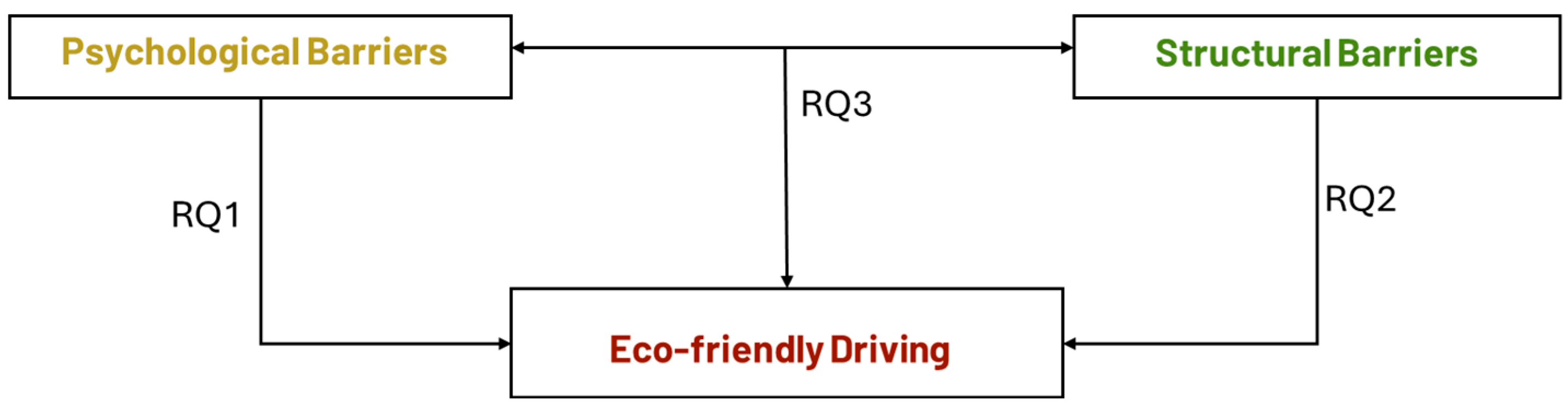
Building on this theoretical foundation, we aim to advance an integrative, consumer-focused understanding of the barriers surrounding eco-friendly driving, focusing on how internal perceptions and external conditions jointly limit sustainable mobility practices. Figure 1 illustrates the proposed research framework. Accordingly, we explore the following research questions (RQs):
- RQ1: What psychological barriers constrain consumers’ adoption of eco-friendly driving behaviours?
- RQ2: What structural barriers constrain consumers’ adoption of eco-friendly driving behaviours?
- RQ3: How do psychological and structural barriers reinforce one another in shaping unsustainable driving behaviours?
Figure 1.
Proposed research framework of barriers to eco-friendly driving.
3. Study Overview
To address the research questions, we adopted a mixed-methods design consisting of two complementary studies that together enable both systematic evaluation and qualitative prioritization of influencing factors. Study 1 comprises a scoping review of empirical research published since Gifford’s [11] “dragons of inaction,” focusing on eco-friendly driving, sustainable mobility behaviours, and pro-environmental transportation practices. Following established scoping review procedures, this study systematically maps a fragmented interdisciplinary literature, including transportation engineering, environmental psychology, behavioural science, and sustainability research, by identifying, categorizing, and synthesizing recurring psychological and structural barriers. In addition to mapping the field, the review provides an initial assessment of the relative prominence of these factors based on their frequency and emphasis across studies, while also highlighting gaps in the integration of psychological and structural perspectives.
Study 2 builds on the findings of the scoping review through an exploratory qualitative interview study conducted with residents of Prince Edward Island (PEI), Canada. The interview protocol was explicitly informed by the factor categories identified in Study 1, enabling a focused yet open-ended examination of how these factors are experienced in practice. PEI offers a theoretically meaningful context for eco-friendly driving due to its high level of car dependence, rural geography, limited transportation alternatives, and strong climate policy commitments. These structural conditions create a rich setting for examining how external constraints interact with individual attitudes, perceptions, and habits. Through thematic analysis, Study 2 evaluates the contextual salience and perceived impact of each influencing factor, allowing for a qualitative prioritization based on the consistency and intensity of participant accounts. Together, the two studies provide a triangulated and actionable understanding of the key psychological and structural barriers to eco-friendly driving.
4. Study 1: Barriers to Eco-Friendly Driving: A Scoping Literature Review
We conducted a scoping review of the literature on barriers to eco-friendly driving, following Arksey and O’malley’s [15] scoping review guidelines. We searched four major databases for peer-reviewed, empirical studies on barriers to eco-friendly driving. PsycINFO was prioritized given the psychological focus of our topic (e.g., attitudes, barriers, motivation, etc.). Web of Science is followed for its multidisciplinary coverage and citation mapping across environmental, transportation, and social sciences. Scopus was then used to capture additional international journals and conference proceedings. Finally, Google Scholar provided a broad sweep to identify studies or grey literature not indexed elsewhere. Search terms included combinations of keywords such as “barriers in driving behaviour”, “personal travel”, “eco-driving,” “fuel-efficient driving”, “psychological barriers”, “structural barriers”, “sustainable transportation”, and “driver behaviour” (e.g., “eco-driving AND barriers”, “fuel-efficient driving AND psychology”). Exclusion criteria eliminated studies that focused solely on technological interventions without behavioural analysis, were non-empirical (e.g., opinion pieces, [16]; reviews, [17]), or addressed unrelated topics (e.g., autonomous vehicles without a human driver focus, [18]).
The final set comprised 11 empirical studies, employing a range of methodologies, including qualitative (e.g., interviews, [19]), quantitative (e.g., surveys, [20]; field trials, [21]), and mixed-methods approaches. Eco-friendly driving is generally characterized by smooth acceleration, steady speeds, and anticipation of traffic and offers a practical, low-cost strategy to reduce fuel or energy consumption, enabling individuals to contribute to sustainable practices [17]. Across the reviewed articles, three overarching themes emerged, including (1) psychological barriers, (2) structural barriers, and (3) the interaction between psychological and structural barriers. Each theme is discussed in detail in the following sections. Table 1 summarizes the reviewed studies within these thematic categories.
4.1. Psychological Barriers
Psychological barriers refer to internal cognitive and emotional constraints that hinder individuals from adopting sustainable behaviour even when they acknowledge their importance [11]. Recent research highlights the critical role of attitudes, social norms, and perceived personal efficacy in shaping eco-friendly driving behaviour. For example, Lauper et al. [22], through a longitudinal study, identified attitudes, social norms, and risk perceptions as key predictors of sustained engagement in fuel-efficient driving. These findings indicate the enduring influence of psychological determinants, though the reliance on self-reported data may limit generalizability. Similarly, Kramer [23] found that perceived behavioural costs, such as effort or inconvenience, can moderate the impact of environmental motivations, weakening the relationship between pro-environmental attitudes and consistent eco-friendly driving practices.
Emotional and cognitive responses also act as significant psychological barriers. Allison et al. [24] demonstrated that eco-friendly driving can trigger varied emotional reactions, including stress or dissatisfaction, which may deter long-term adoption. This aligns with Franke et al. [20], who identified ‘range anxiety’ among electric vehicle (EV) users as a significant emotional barrier. Their findings suggest that perceived limitations in battery range significantly impact drivers’ willingness to adopt EVs, although experience and familiarity can mitigate this anxiety.
Table 1.
Studies on Eco-friendly driving Barriers: A summary.
The role of psychological barriers is also evident in studies examining real-time feedback. For instance, Harvey et al. [25], in a mixed-methods design, found that while positive reinforcement can encourage eco-friendly driving, negative perceptions, such as viewing eco-friendly driving as stressful, can undermine motivation to adopt eco-friendly driving. These insights reinforce Gifford’s [11] concept of the ‘value-action gap’, where individuals express concern for environmental issues but fail to translate it into behaviour due to cognitive constraints, feelings of inefficacy, or competing psychological pressures.
4.2. Structural Barriers
Research on structural barriers to eco-friendly driving remains relatively limited. Overall, structural barriers refer to external, systemic constraints that limit individuals’ ability to engage in eco-friendly driving, regardless of personal intent. These include inadequate infrastructure, vehicle technology limitations, and policy gaps. For instance, Jonas et al. [21] examined how different road types influence the energy consumption of EVs, identifying challenges such as poor road conditions, urban congestion, and hilly terrain that reduce drivers’ ability to maintain energy-efficient driving practices. Drawing on field data and energy modelling, their study provided strong evidence of these infrastructural constraints, though it did not account for driver behaviour, which could have enhanced its relevance for eco-friendly driving interventions. Similarly, Vaezipour et al. [9] explored the role of in-vehicle human–machine interfaces (HMIs) and incentive systems through a simulator study. Their findings indicated that the design and integration of technological feedback systems within driving environments can either support or hinder eco-friendly driving, depending on their effectiveness.
Despite these contributions, a gap remains regarding structural barriers. Several critical issues, such as the high cost of fuel-efficient vehicles, limited training support opportunities to support eco-friendly driving, and the absence of policy incentives, are underexplored [13,14].
4.3. Interaction Between Psychological and Structural Barriers
While previous studies have identified the psychological and structural barriers, research continues to show that even individuals with strong motivation to adopt eco-friendly driving often struggle to act on their intentions when supportive infrastructure or incentives are lacking [12]. Conversely, enabling structures, such as subsidies for EVs or public transit options, may remain underutilized if individuals are unaware of, or sceptical about, their benefits [7].
We therefore propose that an interaction between psychological and structural barriers creates a compounding effect that restrains individuals from adopting eco-friendly driving. Supporting this, Harvey et al. [25] emphasized the role of driver perceptions and attitudes in conjunction with the design of feedback systems, suggesting that fostering eco-friendly driving requires an integrated approach. Building on this, Günther et al. [26] demonstrated that driving experience and access to consumption-related feedback are critical in influencing driver behaviour, as experienced drivers are better equipped to interpret and act on such information.
Integration of structural and psychological perspectives is also evident in studies targeting professional driver populations and workplace interventions. For example, Jazairy et al. [19] found that internal variables, such as environmental concern and external workplace factors (e.g., tight delivery schedules or limited company support), shaped truck drivers’ motivations to adopt eco-friendly driving. Similarly, Arroyo-López et al. [27] showed that past behaviour and sustained organizational interventions reinforce eco-friendly driving habits, although their single-company case study limits broader applicability.
Technological interventions provide another link between psychological and structural domains. Potvin-Bernal and Shu [28], for example, tested associative graphical displays (e.g., a coffee cup icon) to promote energy-efficient driving. These simple, relatable cues effectively influenced psychological responses by reducing the perceived effort required for eco-friendly driving. However, as both studies were conducted in simulated environments, their real-world generalizability may be limited.
Taken together, these studies reveal how psychological and structural elements interact to shape eco-friendly driving behaviours. While psychological factors are essential, they are often constrained or facilitated by structural conditions. This highlights the need for a deeper understanding of the interaction between these barriers to advance eco-friendly driving.
5. Study 2: Exploratory Qualitative Study
To examine and better understand the barriers that individuals perceive in adopting eco-friendly driving, this study employed a qualitative approach, building on the scoping literature review presented above. Qualitative design is suitable for this research because it allows for an in-depth exploration of individual perceptions, attitudes, and lived experiences that may not be easily captured through quantitative surveys or experiments. However, quantitative studies would be helpful to generalize the findings from this qualitative study to other contexts, which future studies can attempt.
The research was conducted in PEI, Canada, for several reasons. First, PEI’s relatively small geographic scale facilitates an in-depth exploration of community-level behaviours and environmental attitudes. The island’s small communities and accessible population provide an excellent context for understanding how localized factors influence eco-friendly driving behaviours. Second, PEI is characterized by a unique socio-cultural context and a diverse demographic profile, thanks to its immigration popularity. This diversity enriches the investigation, offering varied perspectives on eco-friendly driving behaviours. Third, ongoing efforts in PEI to implement sustainable transportation policies and develop eco-friendly infrastructure create a timely opportunity to assess the impact of psychological and structural barriers on behaviour change. Finally, the region’s distinctive economic and infrastructural characteristics, where rural and urban influences integrate, offer valuable insights into how economic constraints and limited awareness affect the adoption of eco-friendly driving practices.
Building on these methodological foundations, the present study examines the barriers that hinder eco-friendly driving behaviours in PEI through qualitative interviews. Participants were recruited via advertisements and met specific criteria, including (1) 18 years of age or older, (2) fluent in English, and (3) able to discuss their personal driving habits. The convenient sample was diverse, incorporating perspectives from various stakeholder groups, including a mix of long-time residents, academics, newcomers, car dealerships, students, and professionals, as they represented the majority of people who drive a personal car in PEI. Semi-structured interview questions focused on eco-friendly driving awareness, challenges, and specific personal driving behaviours (e.g., rapid acceleration versus energy-efficient driving habits) were developed from key insights generated in the scoping review. Specifically, the interview questions on barriers were developed based on Gifford’s [11] typology and the findings from Study 1 (scoping review). All interviews were audio-recorded, anonymized using pseudonyms, and then transcribed by two Research Assistants.
5.1. Results
A total of 50 semi-structured interviews were completed to gain deep insights into participants’ attitudes and experiences towards eco-friendly driving behaviour. As shown in Table 2, participants ranged in age from 18 to over 55, with 68% between the ages of 18 and 40. 62% of the participants are predominantly male. Participants also represented a variety of educational and professional backgrounds from different industries. The sample was ethnically diverse, including White (34%), Black (24%), Asian (28%), and others who identified with other ethnicities. This represents well of the PEI demographic of White dominating with some visible minority [29,30]. Geographically, the interviewees spanned diverse community sizes, including urban (54%) and rural or small areas (46%). This diversity is intentional to understand the barriers to eco-friendly driving across different social contexts in PEI.
Table 2.
Sociodemographic Profile of Participants.
5.2. Participants’ Perceptions of Eco-Friendly Driving
A key insight that emerged from the interviews is that participants’ perceptions of eco-friendly driving vary from each other, and some perceive driving an EV as practicing eco-friendly driving. Additionally, participants’ perceptions of eco-friendly driving were shaped by a diverse mix of motivations, habits, and contextual factors, rather than a single, unified view. Notably, eco-friendly driving was not always a deliberate environmental choice. For many, it was embedded in routine practices, family dynamics, vehicle characteristics, and even economic incentives.
For example, one participant answered that they bought an EV when being asked the question about ‘What do you know about eco-friendly driving’.
“I’ve been quite passionate about environmental issues and ways that I can impact them and reduce my personal footprint. So anyways, five years ago we bought an electric vehicle. And that experience sort of launched me into learning more about cars and the different options out there… I’ve become somewhat of an advocate for Electric transportation.”[Participant ID: 0913D01]
Others viewed eco-driving through the lens of habitual maintenance, such as regularly checking tire pressure to improve efficiency. More specifically, 10 out of 50 participants mentioned they performed pre-trip inspections or routine vehicle checks instinctively as their form of eco-friendly driving. For example:
“I make a habit of checking the pressure every day I drive.”[Participant ID: 0925D01]
“I think I checked my tire pressure often, at least once in a month before long trips and after tire repair and replacement… regular checking of your tire pressure is a key to eco-friendly driving and sustainable driving in society.”[Participant ID: 0912Z05]
Family values and life transitions also played a key role in their driving behaviours. Several participants described how becoming parents led to calmer, more mindful driving styles, while others made lifestyle changes, such as relocating to walkable neighbourhoods, to reduce car dependence. For example:
“My driving style now as a parent, is much calmer and smoother. I don’t feel the need to start fast as soon as the light turns green. I take my time, believing that if you need to be somewhere, you should plan enough time to get there, and if you’re late, you’re late. No need to rush.”[Participant ID: 0925D01]
“Always making the choice not to use the car at all when that’s possible. My husband and I moved into almost the center of Charlottetown about 20 years ago for this reason, and we were able to walk to work… Everything is about a 10 to 15-min walk.”[Participant ID: 0919D02]
However, not all perceptions were aligned with eco-driving goals. A subset of participants openly described their aggressive or performance-oriented driving behaviours, highlighting a disconnect between environmental ideals and actual road behaviour. For instance, some participants described their style as aggressive:
“My driving style is aggressive, I would say… I like to drive fast and often hit the gas or brake suddenly when opportunities arise.”[Participant ID: 0831Z01]
“My typical style is a bit aggressive and competitive… I like to be the first one off the line at green lights and generally drive near the speed limit.”[Participant ID: 1002Z21]
“I’d say I drive confidently. Also, I like to drive fast, and it probably depends on the car I’m in as well. Also, I like smaller cars. I find [it] more fun to drive… especially when I’m in that electric car, I like accelerating fast and, on bigger highways, I’d usually wouldn’t speed a lot, but I would speed, so maybe 10 or 20 over [the speed limit].”[Participant ID: 1008Z23]
Economic motivations and institutional or policy supports, such as fuel efficiency programmes or EV rebates, were also instrumental in shaping driving behaviour. Many participants emphasized the need for broader public education, infrastructure investment, and driver training to promote eco-friendly driving. For example, some participants noted that greater infrastructure support and stronger government regulations could facilitate the adoption of eco-friendly driving practices:
“We really need more infrastructure for electric vehicles. Like, charging stations are still too sparse in some areas, and that’s a barrier for people who might want to switch.”[Participant ID: 0913D01]
“I think for driving, it’s good to maintain a minimum amount of speed, obeying some of these traffic signs and regulations… trying to avoid speeding.”[Participant ID: 0912Z05]
“I think speed limit enforcement should be stricter to help people drive more sustainably.”[Participant ID: 0912Z05]
Other participants emphasized the importance of public education to increase awareness and understanding of eco-friendly driving practices:
“You’re always trying to be in that regenerative state where the battery is recharging based on the braking action as opposed to a draining state… I think more drivers could be taught how to use regenerative braking effectively, maybe through driver’s ed programs.”[Participant ID: 1002D01]
“I think people need to be educated on how electric cars work… Workshops or community programs could teach people how to drive EVs efficiently, like using regenerative braking properly.”[Participant ID: 0913D01]
Lastly, 5 out of 50 participants indicated that economic factors influenced their eco-friendly driving practices. For example:
“The incentives for electric vehicles, like rebates, definitely made it easier for us to get the Nissan Leaf. Without those, it would’ve been a tougher decision.”[Participant ID: 1002D01]
“Programs… like rebates for efficient vehicles, really make a difference for people choosing greener options.”[Participant ID: 0925D01]
In sum, participants’ perceptions of eco-friendly driving spanned a continuum from intentional environmental action to habitual, economic, or practical decisions, with no consistent understanding evident among the public. Moreover, eco-friendly driving behaviours were shaped not only by values and awareness but also by vehicle type, social context, and policy environments.
5.3. Barriers to Eco-Friendly Driving
The second main finding was that participants perceive various barriers to adopting eco-friendly driving practices. To better understand these barriers, the qualitative data were analyzed via a double-blinded categorizing procedure conducted independently by two research assistants. Research assistants reviewed the scripts sentence by sentence, following the 5 baseline categories we developed based on Gifford’s [11] typology of barriers, and 1 category of “unknown”. For instance, if a participant discussed “aware of, being conscious of, knowing about”, it can be put into the category of “knowledge and awareness gaps”, or other categories. Agreed-upon categorizations were placed into their respective category, while discrepancies and unknowns were resolved by the two lead researchers. Each sentence was counted as one mention. The results revealed two overarching types of barriers: psychological barriers, which stem from individual mindsets and behaviours, and structural barriers, which arise from external systemic factors.
Five types of psychological barriers were revealed and summarized in Figure 2. The most frequently mentioned psychological barrier was ‘knowledge and awareness gaps’ (total mentions = 216). Many individuals expressed an interest in eco-friendly driving but lacked awareness. For example, Participant 0904D01 mentioned:
“So, the challenges are just being conscious of it [driving impacts], especially when other people who come to visit are not [conscious]. That might be the biggest challenge.”[Participant ID: 0904D01]
Figure 2.
Total number of mentions for each psychological barrier.
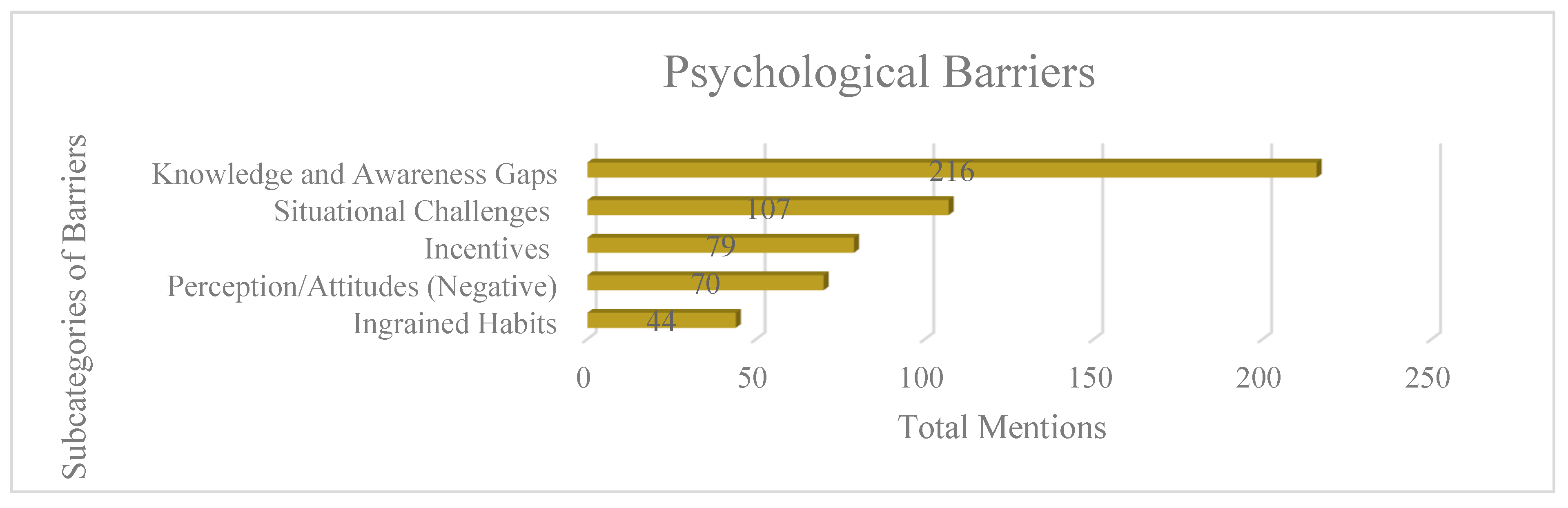
Incentives were not consistently framed as barriers but rather as enablers; however, some participants stated that without incentives, they would not adopt eco-friendly driving (total mentions = 79). This aligns with Gifford’s [11] ‘value-action gap’ barriers, where environmental concerns do not translate into behaviour due to a lack of incentives. For instance, participants mentioned:
“The incentives for electric vehicles, like rebates, definitely made it easier for us to get the Nissan Leaf. Without those, it would’ve been a tougher decision.”[Participant ID: 1002D01]
Additional psychological barriers included situational challenges such as stresses arising from traffic congestion and time constraints (total mentions = 107), negative perceptions toward eco-friendly driving (total mentions = 70), and ingrained habits (total mentions = 44).
“… in stressful situations, I think it can be very difficult to always maintain eco driving practice when you are in a hurry or dealing with some unpredictable traffic.”[Participant ID: 0902Z02]
“it’s a little difficult [to change habits], but the first thing is to realize the habits. I think the first thing is to learn and to know what it is, and learn to control it, the knowledge [is important].”[Participant ID: 0902Z03]
Collectively, these findings suggest that psychological barriers are driven by limited awareness, ingrained behaviours, incentives, and environmental conditions.
The analysis further revealed four types of structural barriers (Figure 3). The most frequently mentioned structural barrier was ‘community and social norms’ (total mentions = 108). However, participants’ responses varied: some noted that community attitudes strongly influenced their driving behaviour, while others acknowledged that social media reinforced positive habits yet dismissed the influence of peers. This variation suggests that social norms may either support or hinder eco-friendly driving, depending on the cultural context and the visibility of eco-friendly driving practices.
“I think the only challenges you face [while driving] are dealing with other people on the road, like it’s kind of difficult when you’re trying to be eco-friendly when it comes to driving.”[Participant ID: 1002D04]
Figure 3.
Total number of mentions for each structural barrier.
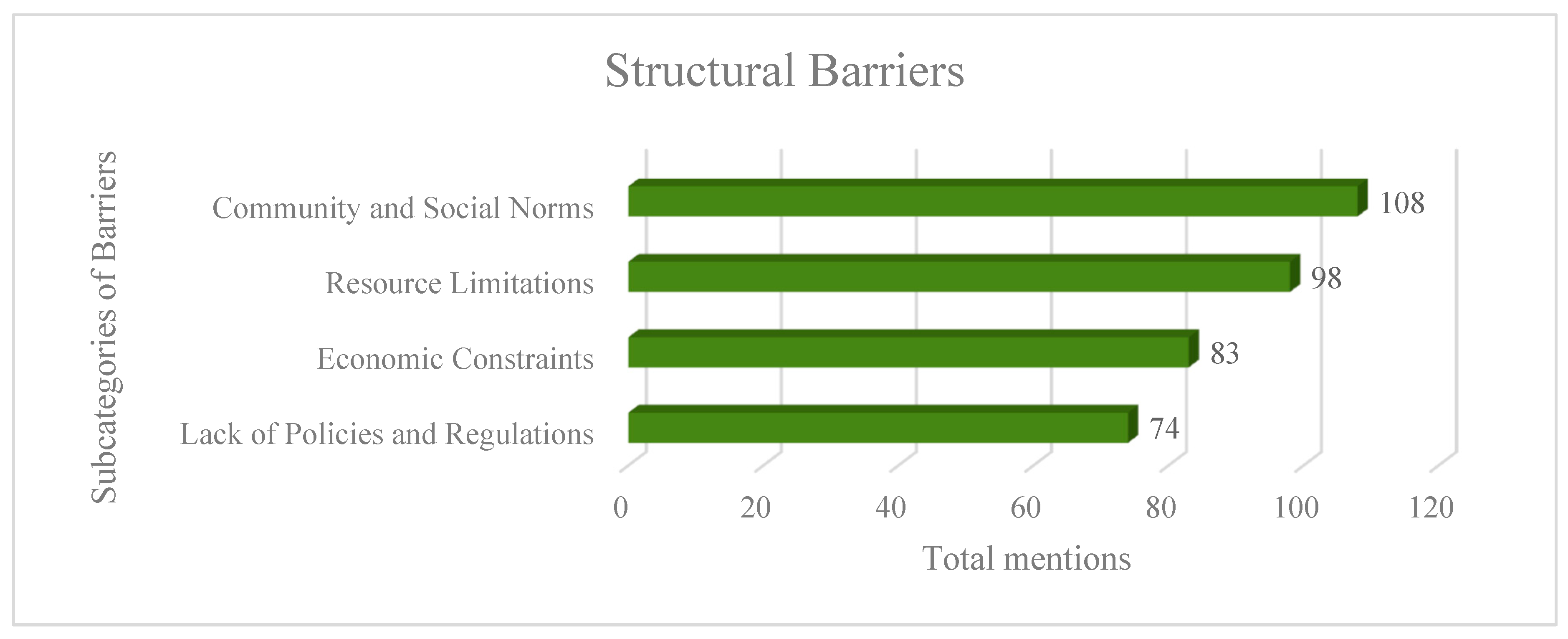
Another key structural barrier shown in Figure 3 was ‘Resource limitation’ (total mentions = 98), with participants pointing to the lack of charging stations and limited public transportation as deterrents. For instance, participants specifically mentioned:
“We really need more infrastructure for electric vehicles. Like, charging stations are still too sparse in some areas, and that’s a barrier for people who might want to switch.”[Participant ID: 0913D01]
“Infrastructure is a big one. … If we don’t have the infrastructure for public transportation or accessibility to more fuel-efficient vehicles, then it will become increasingly difficult to reduce your impact.”[Participant ID: 0930Z11]
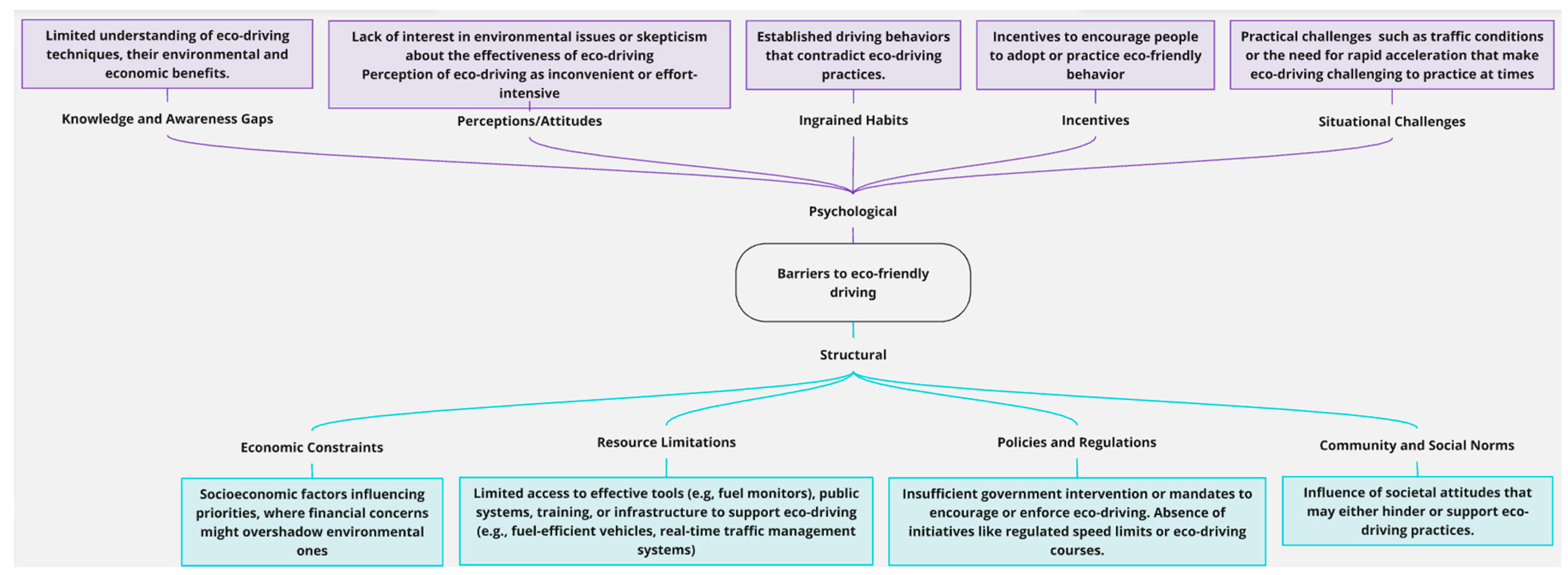
Economic constraints (total mentions = 83) and insufficient policies and regulations (total mentions = 74) also emerged as significant structural barriers, reflecting concerns about the high upfront costs of EVs, perceived financial burdens, and inadequate government intervention and regulations. Figure 4 offers an integrated overview of both psychological and structural barriers. Each box demonstrates one short explanation of each barrier correspondingly, along with some specific quotes below:
“I don’t have the budget to like the switch my car to hybrid or electric. Because these cars that are expensive and there are no good options available.”[Participant ID: 0914D01]
“Maybe one thing I will say is that I’ve always wanted to buy an electric vehicle, but they are not at all affordable.”[Participant ID: 0925D02]
“Part of the challenges is, you know, financial constraint.”[Participant ID: 0926D01]
“Trying to practice eco-friendly practice and then observing your environment might be overwhelming to you, … trying to follow the rules and regulations sometimes may be the most difficult challenge I face.”[Participant ID: 1001Z14]
Figure 4.
Psychological and structural barriers identified through thematic analysis.
During the analysis, an interesting interplay emerged between psychological and structural barriers. Participants noted that structural barriers, such as inadequate infrastructure and limited access to EV charging stations, further strengthen psychological barriers by enlarging knowledge gaps and scepticism. Many reported feeling discouraged from adopting eco-friendly driving practices due to a combination of psychological and structural barriers, which in turn reinforced their habitual reliance on conventional driving. For instance.
“One of the challenges I’m facing is that I don’t have a charging port at home, so my only option is to depend on public charging stations, which is a big challenge for me. That’s one of my main concerns. Initially, I had planned to buy a used electric vehicle, maybe something like a Nissan Leaf, but the options I found were old models, and I’m really worried about the range they’d have after all these years. Ultimately, I felt forced to buy a gasoline vehicle instead.”[Participant ID: 0925D02]
On the other hand, psychological barriers such as situational challenges (e.g., stress, perceived time constraints) add to structural barriers, leading participants to undervalue impacts and perceptions from the social community and government programmes. For instance,
“When you are in hurry, you are missing your deadline, the time of the appointment, you will be forgetting about your eco driving. You must be in hurry and aggressive. So, the planning of your journey is very important to achieve the eco driving. If you don’t have a planning earlier, you always can’t achieve the eco driving.”[Participant ID: 1002D03]
“So, if you’re [obeying] the speed limit, you find a lot of people are overtaking you and even honking at you, even though you’re following the speed limit and stuff like that. So, I feel like it’s difficult. Even though people should be obeying the rules, they’re almost pressuring you not to.”[Participant ID: 1002D04]
This interplay highlights the complexity of behaviour change, where insufficient structural support amplifies psychological resistance, while psychological barriers reduce the effectiveness of systemic solutions. These findings emphasize the need to address both types of barriers simultaneously rather than in isolation.
6. Discussion
This study examined the psychological and structural barriers to eco-friendly driving practices on PEI and how these barriers influence the adoption of sustainable driving behaviours. The findings empirically address all three research questions, highlighting distinct yet interconnected challenges hindering eco-friendly driving adoption. Theoretically, this study reinforces Gifford’s [11] framework of psychological barriers to sustainable behaviour, extending it to include structural interactions that perpetuate resistance to change, particularly in geographically and culturally unique settings like PEI.
The first research question examined the most prevalent psychological barriers to eco-friendly driving and was built upon prior research. The thematic analysis confirmed that knowledge and awareness gaps were the most frequently cited barriers and a foundational issue in PEI’s context, followed by situational challenges (e.g., traffic congestion, time constraints), negative perceptions toward sustainable practices, and ingrained habits. These findings are consistent with Gifford’s [11] “value-action gap,” where environmental concerns do not translate into sustainable behaviours due to cognitive limitations or perceived ineffectiveness. The dominance of knowledge gaps reinforces Harvey et al.’s [25] argument that a lack of actionable information undermines motivation for eco-friendly driving. Similarly, the influence of ingrained habits and situational challenges aligns with Kramer’s [23] work on how perceived behavioural costs moderate environmentally conscious intentions. Although incentives were not identified as a primary barrier, the findings suggest they may function as psychological enablers, supporting Lauper et al.’s [22] emphasis on the role of positive reinforcement in maintaining eco-friendly driving behaviours.
The second research question examined the structural barriers to the adoption of eco-friendly driving. Results indicated that community and social norms were the most frequently cited structural barriers, though their influence varied across contexts. Other key barriers included resource limitations, economic constraints, and a lack of supportive policies. The variation in social norms supports Restya’s [13] conclusion that cultural and community contexts significantly shape the adoption of sustainable behaviours, implying that local attitudes across PEI communities may either encourage or deter eco-friendly driving. Economic barriers, such as the high cost of EVs and limited charging infrastructure, align with Jonas et al.’s [21] findings on systemic impediments to energy-efficient transportation. Additionally, the emphasis on policy gaps echoes Tu et al.’s [14] calls for structural interventions, particularly in rural or resource-limited regions where the absence of institutional support disproportionately hinders sustainable practices.
The third research question examined the interplay between psychological and structural barriers, bridging Harvey et al.’s [25] integrated framework, which emphasizes aligning driver attitudes with feedback systems, with Jazairy et al.’s [19] examination of workplace influences. This suggests that eco-driving adoption requires a holistic approach that addresses internal and external constraints. These findings further underscore a self-reinforcing cycle, in which structural limitations such as insufficient public transit and EV infrastructure intensify psychological barriers like habitual behaviours and scepticism. At the same time, knowledge deficits prevent individuals from taking advantage of available systemic solutions, such as subsidies or incentive programs. This interplay supports Ercan et al.’s [12] argument that even highly motivated individuals may struggle to adopt sustainable behaviours without enabling structural conditions. The feedback loop identified in this study, where structural barriers reinforce negative perceptions and psychological resistance undermine advocacy for improved infrastructure, offers a novel contribution to the literature by demonstrating how these barriers can compound over time, perpetuating unsustainable driving practices.
7. Implications
Practically, the findings suggest that shifting consumer misperceptions of eco-friendly driving is essential. First, psychological barriers cannot be addressed solely by raising awareness. Drivers respond more positively to personalized, actionable guidance that considers their everyday driving experiences, such as how smoother acceleration or anticipating traffic can save fuel. The government can consider hosting education campaigns that offer practical, easy-to-follow advice tailored to real-life personal driving situations. Real-time feedback tools, as noted by Harvey et al. [25], can reinforce these behaviours by making the benefits of eco-friendly practices more visible and tangible. At the same time, consumer perceptions of the structural barriers, such as limited charging infrastructure or unreliable public transit, inform policymakers to prioritize equitable and accessible infrastructure development, such as expanding EV charging stations and improving public transit, especially in rural parts of PEI, to reduce reliance on traditional gas-powered vehicles. Additionally, policymakers could influence these perceptions by introducing economic incentives like subsidies or tax credits to help cover the upfront costs and ease concerns to minimize psychological and structural barriers and foster sustainable driving practices [31,32].
Theoretically, this study significantly contributes to Gifford’s [11] framework by demonstrating how psychological barriers, such as limited cognition and the “value-action gap”, interact with structural barriers to create a self-reinforcing cycle that perpetuates unsustainable personal driving behaviours, thus extending the framework’s applicability to eco-friendly driving contexts. Additionally, by highlighting the interplay between knowledge gaps, infrastructure deficits, and social norms, this research enriches the sustainability and eco-friendly driving literature, offering a nuanced understanding of how individual and systemic variables interrelate to hinder behaviour change, serving as a starting point for more integrated theoretical models in sustainable transportation research.
8. Limitations and Future Research Directions
While this study offers valuable insights, there are a few limitations that cannot be avoided. The qualitative approach provided in-depth perspectives but was based on a relatively small sample (n = 50), which may not fully capture the diversity of PEI’s population. Future studies could consider expanding the sample size and diversifying demographic characteristics. Different geographical locations might also present very different views on eco-friendly driving. For instance, residents who live in areas that rely more on public transportation might care less about eco-friendly driving, which a future study could consider comparing consumers’ perception among different geographic locations.
Additionally, despite a mixed-method approach being employed by conducting a thorough literature review prior to the semi-structured interviews, quantitative measurements (e.g., various dimensions of eco-friendly driving, habit frequency, knowledge scores, moderating effects or infrastructure density) may be helpful in demonstrating the intensity of each barrier. Future research could consider collecting quantitative data via surveys or experiments.
Lastly, although the study included a range of socio-cultural backgrounds, it did not examine how specific factors such as income or ethnicity shape or moderate these barriers. Future studies could consider conducting longitudinal studies (e.g., [22]), as they can track how eco-friendly driving behaviours evolve, especially after specific interventions, shedding light on whether behaviour change is sustained. A deeper exploration of socioeconomic and cultural factors through cross-regional comparative studies could help clarify how equity, driving experience, life stage, or policy changes influence or moderate the prevalence of barriers and the success of interventions. It would also be important to consider how emerging technologies, such as advanced human–machine interfaces [9], perform in real-world settings, helping to bridge the gap between simulation-based research and practical use. Lastly, testing interventions that simultaneously address psychological and structural barriers could lead to more effective, actionable strategies for disrupting the feedback loops that hinder change.
9. Conclusions
The growing global issue of rising CO2 emissions and fuel consumption has made eco-friendly driving more important to reduce transportation’s environmental impact. While technology continues to advance, changing how people drive remains a largely untapped research opportunity, one that is complicated by a mix of psychological and structural barriers. This study explored those barriers and how they interact, focusing on PEI.
The results show that psychological barriers, such as a lack of knowledge, ingrained habits, complex driving situations, and negative perceptions, are significant challenges to adopting eco-friendly driving practices. On the structural side, social norms, limited resources, economic constraints, and weak policy support create systemic barriers that restrict people’s ability to drive more sustainably. Most importantly, the study found a reinforcing loop where structural barriers (such as poor EV infrastructure) worsen psychological resistance. At the same time, knowledge gaps and negative attitudes prevent people from using existing solutions or pushing for better systems. This cycle confirms all three research questions and explains how these combined barriers keep even environmentally conscious individuals from changing their personal driving behaviours.
This research has two key takeaways. On a practical level, it points to the need for comprehensive solutions that blend education, financial incentives, and infrastructure improvements to break this cycle and promote eco-friendly driving, especially in places like PEI with their own social and geographic challenges. Theoretically, it builds on existing models like Gifford’s [11] “value-action gap”. By highlighting the complex web of barriers that hinder sustainable choices, this study adds to the broader conversation on climate action, making it clear that tackling psychological and structural barriers is essential for meaningful environmental progress.
Author Contributions
Conceptualization, L.J.L. and X.C.; methodology, L.J.L. and X.C.; software, validation & formal analysis, L.J.L. and X.C. with assistance of L.J.L.; investigation, L.J.L. and X.C. resources, L.J.L. and X.C.; data curation, L.J.L. and X.C. with assistance of L.J.L.; writing—original draft preparation, L.J.L., with assistance of L.J.L.; writing—review and editing, L.J.L. and X.C.; visualization, L.J.L. with assistance of L.J.L.; supervision, L.J.L. and X.C.; project administration, L.J.L. and X.C.; funding acquisition, L.J.L. and X.C. All authors have read and agreed to the published version of the manuscript.
Funding
This research was funded by Mitacs through the Mitacs Accelerate program IT37668, in partnership with Net Zero Atlantic.
Institutional Review Board Statement
The study was conducted in accordance with the Tri-Council Policy Statement: Ethical Conduct for Research Involving Humans (TCPS 2), and the protocol was approved by the UPEI Research Ethics Board of 6012603 on 2024-08-15.
Informed Consent Statement
Informed consent for participation was obtained from all subjects involved in the study.
Data Availability Statement
The data presented in this study are not publicly available due to ethical restrictions, but are available on request from the corresponding author.
Acknowledgments
The authors would like to thank Zhen Li and Daud Saifullah for their assistance with data collection, and Jude Imuede for support with preliminary data analyses and draft preparation. The authors also gratefully acknowledge the financial support provided by Mitacs through the Accelerate Program.
Conflicts of Interest
The authors declare no conflict of interest.
References
- Cao, M.; Wang, F.; Ma, S.; Geng, H.; Sun, K. Recent advances on greenhouse gas emissions from wetlands: Mechanism, global warming potential, and environmental drivers. Environ. Pollut. 2024, 355, 124204. [Google Scholar] [CrossRef] [Scilit]
- Azhar, U.; Yaseen, S.; Arif, M.; Babar, M.; Sagir, M. Emission of greenhouse gases from transportation. In Advances and Technology Development in Greenhouse Gases: Emission, Capture and Conversion; Elsevier: Amsterdam, The Netherlands, 2024; pp. 147–163. [Google Scholar] [CrossRef] [Scilit]
- Schießl, C.; Fricke, N.; Staubach, M. Identification and analysis of motives for eco-friendly driving within the eco-move project. IET Intell. Transp. Syst. 2013, 7, 46–54. [Google Scholar] [CrossRef] [Scilit]
- Congressional Budget Office. Emissions of Carbon Dioxide in the Transportation Sector. 2022. Available online: https://www.cbo.gov/system/files/2022-12/58566-co2-emissions-transportation.pdf (accessed on 12 June 2025).
- Sussman, R.; Tan, L.Q.; Kormos, C.E. Behavioral interventions for sustainable transportation: An overview of programs and guide for practitioners. In Transport and Energy Research; Elsevier: Amsterdam, The Netherlands, 2020; pp. 315–371. [Google Scholar] [CrossRef] [Scilit]
- Beulah, P.; Chitrakala, I. Consumer perceptions and attitudes towards sustainability: The role of influencers in shaping eco-conscious behavior. Int. J. Multidiscip. Res. 2024, 1–9. [Google Scholar] [CrossRef]
- Vieira, J.; Castro, S.L.; Souza, A.S. Psychological barriers moderate the attitude-behavior gap for climate change. PLoS ONE 2023, 18, e0287404. [Google Scholar] [CrossRef] [Scilit]
- Strömberg, H. “But I already know how to drive”-exploring intervention strategies and systemic barriers to eco-driving in public transport. In Proceedings of the Crafting the Future-10th European Academy of Design Conference, Göteborg, Sweden, 17–19 April 2013; Available online: https://research.chalmers.se/en/publication/175978 (accessed on 2 October 2025).
- Vaezipour, A.; Rakotonirainy, A.; Haworth, N.; Delhomme, P. A simulator study of the effect of incentive on adoption and effectiveness of an in-vehicle human machine interface. Transp. Res. Part F Traffic Psychol. Behav. 2019, 60, 383–398. [Google Scholar] [CrossRef] [Scilit]
- Ziemba, P.; Majewski, F. Using the large language model chatgpt to support decisions in sustainable transport. Sustainability 2025, 17, 7520. [Google Scholar] [CrossRef] [Scilit]
- Gifford, R. The dragons of inaction: Psychological barriers that limit climate change mitigation and adaptation. Am. Psychol. 2011, 66, 290–302. [Google Scholar] [CrossRef] [Scilit] [PubMed]
- Ercan, T.; Onat, N.C.; Keya, N.; Tatari, O.; Eluru, N.; Kucukvar, M. Autonomous electric vehicles can reduce carbon emissions and air pollution in cities. Transp. Res. Part D Transp. Environ. 2022, 112, 103472. [Google Scholar] [CrossRef] [Scilit]
- Restya, W.P.D. Understanding the barriers against eco-friendly behavior. J. Ecopsy 2022, 9, 142. [Google Scholar] [CrossRef] [Scilit]
- Tu, R.; Xu, J.; Li, T.; Chen, H. Effective and acceptable eco-driving guidance for human-driving vehicles: A review. Int. J. Environ. Res. Public Health 2022, 19, 7310. [Google Scholar] [CrossRef] [Scilit] [PubMed]
- Arksey, H.; O’malley, L. Scoping studies: Towards a methodological framework. Int. J. Soc. Res. Methodol. 2005, 8, 19–32. [Google Scholar] [CrossRef] [Scilit]
- Gifford, R.; Kormos, C.; McIntyre, A. Behavioral dimensions of climate change: Drivers, responses, barriers, and interventions. Wiley Interdiscip. Rev. Clim. Change 2011, 2, 801–827. [Google Scholar] [CrossRef] [Scilit]
- McIlroy, R.C.; Stanton, N.A.; Harvey, C. Getting drivers to do the right thing: A review of the potential for safely reducing energy consumption through design. IET Intell. Transp. Syst. 2014, 8, 388–397. [Google Scholar] [CrossRef] [Scilit]
- Brell, T.; Philipsen, R.; Ziefle, M. sCARy! Risk perceptions in autonomous driving: The influence of experience on perceived benefits and barriers. Risk Anal. 2019, 39, 342–357. [Google Scholar] [CrossRef] [Scilit] [PubMed]
- Jazairy, A.; Pohjosenperä, T.; Sassali, J.; Juga, J.; von Haartman, R. Driving the talk: Examining professional truck drivers’ motivations to engage in eco-driving. Int. J. Phys. Distrib. Logist. Manag. 2023, 53, 98–124. [Google Scholar] [CrossRef] [Scilit]
- Franke, T.; Neumann, I.; Bühler, F.; Cocron, P.; Krems, J.F. experiencing range in an electric vehicle: Understanding psychological barriers. Appl. Psychol. 2012, 61, 368–391. [Google Scholar] [CrossRef] [Scilit]
- Jonas, T.; Wilde, T.; Hunter, C.D.; Macht, G.A. The Impact of Road Types on the Energy Consumption of Electric Vehicles. J. Adv. Transp. 2022, 2022, 1436385. [Google Scholar] [CrossRef] [Scilit]
- Lauper, E.; Moser, S.; Fischer, M.; Matthies, E.; Kaufmann-Hayoz, R. Psychological predictors of eco-driving: A longitudinal study. Transp. Res. Part F Traffic Psychol. Behav. 2015, 33, 27–37. [Google Scholar] [CrossRef] [Scilit]
- Kramer, J. Promoting Green Driver Behavior: Determinants of and Motivational Interventions for (Future) Pro-Environmental Driver Behaviors. Dissertation, Dresden University of Technology, Dresden, Germany, 2023. Available online: https://tud.qucosa.de/en/api/qucosa%3A90927/attachment/ATT-0 (accessed on 31 December 2025).
- Allison, C.K.; Stanton, N.A.; Fleming, J.M.; Yan, X.; Lot, R. How does eco-driving make us feel? Considering the psychological effects of eco-driving. Appl. Ergon. 2022, 101, 103680. [Google Scholar] [CrossRef] [Scilit]
- Harvey, J.; Thorpe, N.; Fairchild, R. Attitudes towards and perceptions of eco-driving and the role of feedback systems. Ergonomics 2013, 56, 507–521. [Google Scholar] [CrossRef] [Scilit]
- Günther, M.; Rauh, N.; Krems, J.F. How driving experience and consumption related information influences eco-driving with battery electric vehicles–Results from a field study. Transp. Res. Part F Traffic Psychol. Behav. 2019, 62, 435–450. [Google Scholar] [CrossRef] [Scilit]
- Arroyo-López, P.; Velázquez-Martínez, J.C.; Gámez-Pérez, K.M. Past behavior as a predictor of eco-driving practices: The case of a sustained intervention in a Mexican transportation company. Int. J. Sustain. Transp. 2022, 16, 989–1002. [Google Scholar] [CrossRef] [Scilit]
- Potvin-Bernal, J.; Shu, L.H. Promoting energy-efficient driving using associative graphical displays: Can a cup of coffee encourage you to drive more smoothly? In Proceedings of the International Conference on Design Theory and Methodology, Anaheim, CA, USA, 18–21 August 2019. [Google Scholar] [CrossRef] [Scilit]
- PEI Statistics Bureau. PEI Population Report–Annual. 2025. Available online: https://www.princeedwardisland.ca/en/publication/pei-population-report-annual (accessed on 3 October 2025).
- Statistics Canada. Population and Demography: Statistics. 2025. Available online: https://www.statcan.gc.ca/en/subjects-start/population_and_demography (accessed on 3 October 2025).
- Jansson, J.; Nordlund, A.; Westin, K. Examining drivers of sustainable consumption: The influence of norms and opinion leadership on electric vehicle adoption in Sweden. J. Clean. Prod. 2017, 154, 176–187. [Google Scholar] [CrossRef] [Scilit]
- Mersky, A.C.; Sprei, F.; Samaras, C.; Qian, Z.S. Effectiveness of incentives on electric vehicle adoption in Norway. Transp. Res. Part D Transp. Environ. 2016, 46, 56–68. [Google Scholar] [CrossRef] [Scilit]

Disclaimer/Publisher’s Note: The statements, opinions and data contained in all publications are solely those of the individual author(s) and contributor(s) and not of MDPI and/or the editor(s). MDPI and/or the editor(s) disclaim responsibility for any injury to people or property resulting from any ideas, methods, instructions or products referred to in the content. |
© 2026 by the authors. Licensee MDPI, Basel, Switzerland. This article is an open access article distributed under the terms and conditions of the Creative Commons Attribution (CC BY) license.