


Abstract
Forests play a strategic role in global sustainability, and restoration is essential to meet ESG targets. Seedling quality strongly influences reforestation success, but standardized evaluation protocols are often lacking. This study aimed to identify and prioritize critical technical parameters of forest seedlings and determine the highest-priority factor affecting field performance. A total of 100 seedlings of Handroanthus impetiginosus and Sparattosperma leucanthum were evaluated using Quality Function Deployment (QFD), considering reforestation as the client to translate field performance requirements into nursery-level technical parameters. Seedling characteristics were compared to standards based on the literature and nursery best practices. QFD analysis revealed that stem thickness and integrity, absence of borers, well-developed and firm roots, and complete and healthy leaves were the most critical attributes. Hardiness, combining structural robustness, disease resistance, and vigor, emerged as the central factor. Observed non-conformities included disease (15%), stem bifurcations (10%), and substrate deficiencies (12%). These results demonstrate that QFD is an effective tool for systematically identifying and prioritizing seedling attributes. The study provides a structured approach for nursery evaluation and quality control, supporting informed decision-making to enhance the success of forest restoration projects.
1. Introduction
Increasing pressure for sustainable solutions has placed the environmental agenda at the center of global discussions, with the concept of Environmental, Social, and Governance (ESG) becoming a strategic benchmark that integrates environmental, social, and governance dimension [1,2]. Among the pillars of the transition to a low-carbon economy, forest conservation plays a central role due to its capacity to store carbon, conserve biodiversity, and maintain essential ecosystem services [3,4]. Reforestation emerges as a priority strategy, but its success is often limited by the insufficient quality of seedlings, which remains an unresolved problem in the literature. Current studies report variable mortality rates and point to challenges related to the standardization of quality assessment, as well as the use of isolated parameters that may not fully capture the complexity of factors influencing seedling performance in the field.
Despite the recognized importance of seedling quality, there is a lack of comprehensive, standardized, and integrative evaluation methods in the literature. Existing approaches often focus on individual morphological traits, such as stem diameter or shoot height, without considering physiological, phytosanitary, and operational aspects simultaneously. This fragmented assessment fails to capture the full complexity of factors influencing post-planting survival and growth, resulting in high variability in outcomes across species and restoration contexts. Moreover, there is limited guidance on prioritizing the most critical attributes for field performance, leaving nursery managers without clear decision-support tools to optimize seedling production. Thus, the central challenge lies in the absence of methodologies that hierarchize and organize existing parameters into an integrated decision-making framework. Addressing these gaps is essential to improve both ecological success and cost-effectiveness in reforestation projects.
The quality of seedlings, characterized by adequate morphological, physiological, and phytosanitary attributes, is essential to ensure initial survival and adaptation to local environmental conditions [5]. The absence of these attributes increases mortality rates, reduces yields, and expands financial losses [5,6]. Even in well-structured projects, up to 30% of seedlings may not survive the first year of planting, significantly increasing costs due to replanting [7]. A major challenge lies in the fact that seedling quality is often assessed using isolated parameters or indices, which may not fully capture the complexity of factors influencing post-planting performance. In addition, the lack of standardized and integrated evaluation criteria contributes to technical inconsistencies that compromise uniformity, survival, and ecological functionality in restored areas [8,9]. These challenges highlight the need for systematic and standardized methods to integrate different technical parameters and support more effective decisions in seedling production, particularly when different species and nursery conditions are considered.
Parameters such as root system quality, shoot height, and stem diameter have been widely used in seedling evaluation [8,10,11]. Among these, composite indices such as the Dickson Quality Index (DQI) are frequently applied because they combine several morphological attributes into a single numerical value, providing an overall indication of seedling robustness. Techniques for surveying and detecting non-conformities, common in process management, have been applied in forest nurseries to identify seedlings with attributes suitable for post-planting survival and development [12]. Although attributes such as stem diameter and height are routinely measured, studies indicate the need for complementary parameters and analytical frameworks that better represent seedling quality in a comprehensive and operational manner [13]. In this context, identifying non-conformities offers a non-destructive way to assess critical quality aspects that may not be fully captured by growth-based indices alone, contributing to process standardization, efficiency, and reliability in a manner that is not restricted to a single species or index.
In this scenario, Quality Function Deployment (QFD) emerges as a structured tool capable of translating customer needs into technical specifications and design requirements, considering interactions between parameters and comparing products with existing alternatives [14,15,16,17,18]. Unlike single indices, QFD does not replace conventional quality indicators but integrates them with additional morphological, physiological, and phytosanitary requirements, as well as operational aspects of nursery production. Applied to the production of forest seedlings, QFD allows for aligning morphological, physiological, and phytosanitary attributes with project demands and environmental conditions, enhancing the survival rate, growth, ecological functionality, and long-term sustainability. Additionally, its application contributes to reducing financial losses, increasing the efficiency of reforestation projects, and generating value for companies through sustainable practices, while allowing adaptations according to species-specific and site-specific requirements.
In this study, we applied Quality Function Deployment (QFD) to identify and prioritize critical technical parameters of forest seedlings, explicitly linking commonly used seedling quality indicators (e.g., biomass allocation, stem diameter, and root development) with operational and phytosanitary requirements identified in nursery production. The analysis is presented as a case study based on two native forest species widely used in Brazilian reforestation programs, aiming to demonstrate the applicability of the QFD framework in a real nursery context. By integrating conventional quality metrics within the QFD framework, the study seeks to overcome the limitations of isolated assessments and provide a more comprehensive basis for improving seedling quality, survival, and field performance, with a methodological approach that can be extended to other forest species produced under similar nursery conditions.
2. Materials and Methods
2.1. Study Area and Data Collection
The QFD (Quality Function Deployment) project began building a multidisciplinary team composed of professors specializing in nurseries and reforestation, technicians, interns, and service providers from forest nurseries in Brazil. The experiment was conducted in a major nursery that supplies seedlings for reforestation in the southern part of the Espírito Santo state, Brazil. This nursery serves both the private sectors and the Programa Reflorestar governmental initiative for payment for environmental services aimed to restore the hydrological cycle through the conservation and recovery of forest cover [19]. The nursery is located on an approximate area of 10,000 m2 at coordinates 20°47′44.2″ S 41°24′21.6″ W, with a production capacity of approximately 80,000 forest seedlings for reforestation. The production system uses suspended beds and tubes with commercial organic substrate, a base fertilizer, and fertigation twice a week with nitrogen and potassium, following the dosage recommendations of Gonçalves & Benedetti [20]. The region’s climate is classified by Köppen as Cwa (dry winter and rainy summer), with an average annual temperature of 24.1 °C and average annual rainfall of 1104 mm [21].
To identify and analyze non-conformities in forest seedling production, the study began with a technical visit to the nursery to characterize the production environment and operational aspects of the process. This step was followed by brainstorming sessions with professionals responsible for seedling production and other staff involved in daily nursery activities. Two native forest species were selected for the study, Handroanthus impetiginosus and Sparattosperma leucanthum, both approximately 18 months old. The selection of these species reflects the case-study nature of the research, based on their availability at the nursery during the study period and their frequent use in reforestation programs. Seedlings of these native species require extended nursery periods to develop adequate morphological, physiological, and root system attributes essential for survival and establishment under field conditions. The 18-month age was chosen to ensure that seedlings had reached sufficient structural robustness, enabled the observation of representative nonconformities and provided reliable data for QFD-based prioritization of critical technical parameters. Although certain evaluated attributes may be influenced by species-specific morphological characteristics, the parameters analyzed are primarily related to operational, structural, and management conditions of seedling production. Thus, while the quantitative results are specific to the studied species, the QFD-based methodological approach and identification of critical technical requirements are potentially applicable to other forest species produced under similar nursery conditions. Data was collected by individually evaluating one hundred seedlings of each species, following a sampling method that determines the minimum sampling size for finite populations [22], using Equation (1).
where: = Number of individuals in the sample; N = total number of the population; = Population proportion of individuals belonging to the category we are interested in studying; = population proportion of individuals that do not belong to the category we are interested in studying (q = 1 − p); = If the values of and If they are unknown, substitute them. is replaced by 0.5; = Critical value that corresponds to the desired degree of confidence; = margin of error or maximum estimation error. It identifies the maximum difference between the sample and true population proportions (p).
The seedbeds were divided into four quadrants, where each seedling received a sequential number. Then, 25 seedlings were randomly chosen from each quadrant. The analysis was conducted on the material in the nursery’s shipping area, that is, on the seedlings considered ready to be taken to the field, as indicated by the interviewed technical team.
2.2. Quality Function Deployment (QFD)
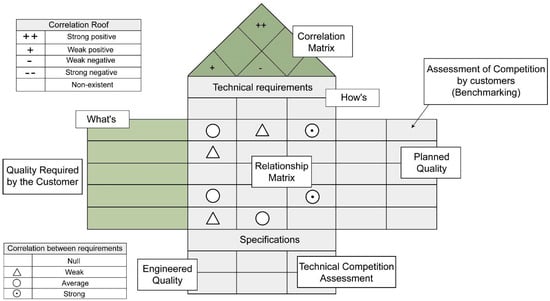
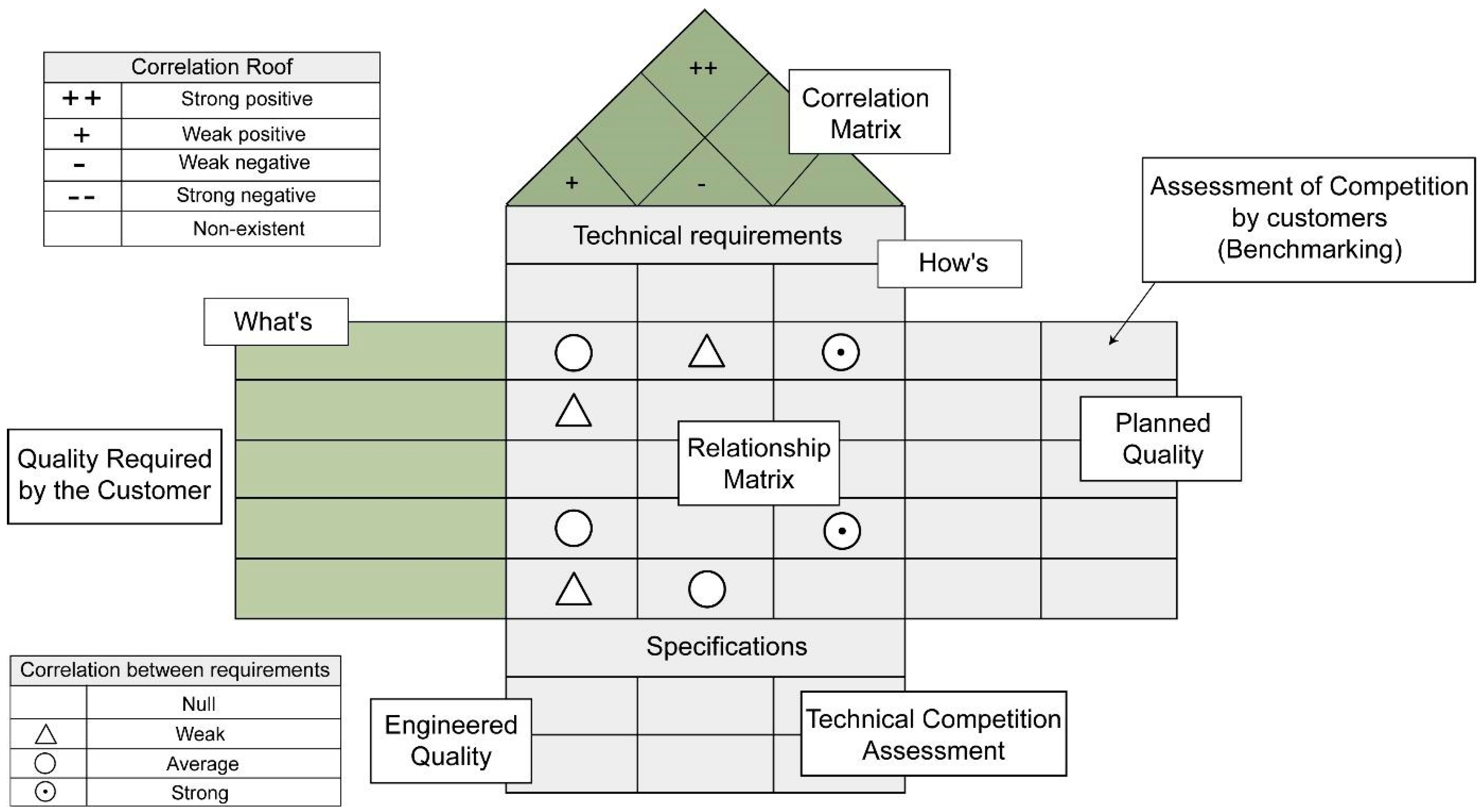
The QFD analysis was conducted following the methodologies proposed by Cheng & Melo Filho, Lucas Filho et al., Dias Júnior et al., Castro and Nagumo [15,23,24,25,26], which were applied to the forestry sector and aligned with the objectives of this study. The quality requirements were identified, the product’s technical characteristics were broken down, and the “roof” (correlation matrix) was built to create the quality matrix, as illustrated in Figure 1.
Figure 1.
Framework of the Quality Function Deployment (QFD) tool.
The steps for constructing the QFD were:
- (I)
- Determining the quality required (“WHAT”) by the client.
- (II)
- Verifying the degree of importance of each “WHAT”.
- (III)
- Evaluating the quality required by the client (planned quality).
- (IV)
- Breaking down the required qualities (“WHAT”) into technical requirements (“HOW”).
- (V)
- Determining the relationship between “WHAT” and “HOW”; and,
- (VI)
- Assembling the correlation or the “roof of the house.”
To evaluate the required items, a degree of importance (GI) was established for each quality item. Each item was assigned a GI of (1) no importance, (3) important, or (5) very important. Competitive analysis was performed by evaluating “our products” (A) and (B) against the competitor (C). Values (1, 3, and 5) were assigned to each item based on the same criteria used for the required quality. The improvement plan was developed based on the judgment of the technical team for each required quality, analyzing the degree of importance and the comparative evaluation between the competing products. Thus, the improvement index (IM) was determined by dividing the technical team’s improvement plan evaluation by the lowest score assigned to any of our products in the competitive evaluation.
The absolute weight (PA) of the required quality was obtained as a function of the GI, the IM, and the selling point, which was converted into a success argument (AS) for each item of the required quality (Equation (2)). The AS was determined based on the technical team’s opinion, representing a differential that each quality attribute can assume in the success of the implementation. For this step, 1, 1.2, and 1.5 weights were used for neutral, medium, and strong, respectively. The relative weight (PR) was calculated based on the absolute weight of the required quality and the sum of the absolute weights (Equation (3)). The calculation of these elements is used later to analyze which technical requirements are most important, considering the quality required for implementation success, bringing effectiveness in the case of intervention.
where: PAi = Absolute weight of the required quality for the i-th attribute; GIi = Degree of importance of the i-th attribute; IMi = Improvement index of the i-th attribute; ASi = Success argument for the i-th attribute; PRi = Relative weight of the required quality for the i-th attribute (%).
To break down the required quality into technical requirements, we identified the measurable characteristics of the products to evaluate the fulfillment of the client’s demands, in this case, reforestation. For this stage, a brainstorming session was held with the technical team. Based on the main objective, the most relevant means to achieve it were determined. These means primarily consist of measurable or controllable metrics. The definition of the general means was done by answering questions like “WHAT TO DO?” (the answer was the objective) and “HOW TO DO IT?” (the answer indicated the means to achieve the objective). These questions were asked until all possible options were exhausted. After defining the primary means, the evaluation phase was conducted to determine the suitability and feasibility of each means in relation to the objective. They were classified as “viable” or “unviable.” The unsuitable means were eliminated, keeping only the viable ones.
Based on the results obtained at this stage, aiming at the comparison and analysis between the products developed in this study and a competing product, morphological, physiological, and qualitative attributes of forest seedlings were evaluated. The parameters analyzed included: shoot height (cm), root collar diameter (cm), shoot dry mass (SDM), root dry mass (RDM), Dickson Quality Index (DQI), tortuous root growth, number of leaves, and number of nonconformities.
Shoot height was measured using a graduated ruler, expressed in centimeters, from the substrate surface to the apical bud responsible for the emission of the last leaf, according to the methodology described by Gomes et al. [27]. Root collar diameter was determined at the substrate level using a digital caliper, also following Gomes et al. [27]. For root system evaluation, seedlings were removed from the containers, and the tortuous root growth was visually assessed and classified in a binary manner as “non-coiled” (0) or “coiled” (1). Nonconformities, including visual symptoms of nutrient deficiency, pest attack, or disease occurrence, were identified by visual inspection and classified in a binary form as absence (0) or presence (1).
The determination of shoot dry mass and root dry mass was performed by sectioning the stem near the substrate level, separating the shoot from the root system. Roots were washed under running water over a sieve to remove adhering substrate. Subsequently, shoot and root samples were separately placed in Kraft paper bags and dried in a forced-air circulation oven at 70 °C until constant mass was reached. After drying, the samples were weighed using a precision electronic balance.
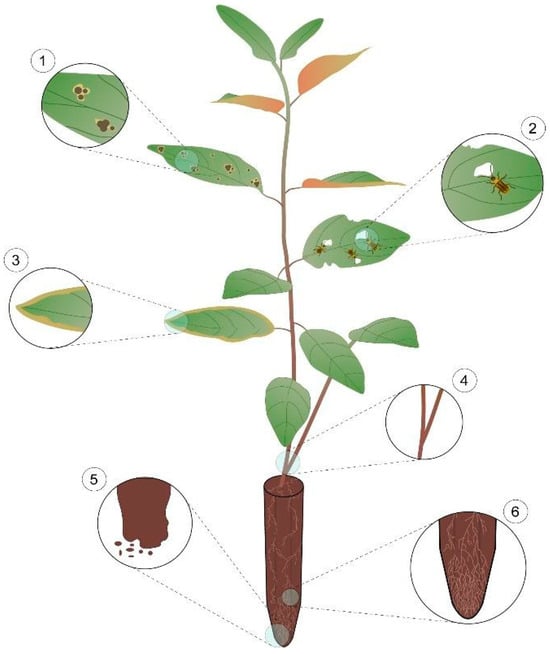
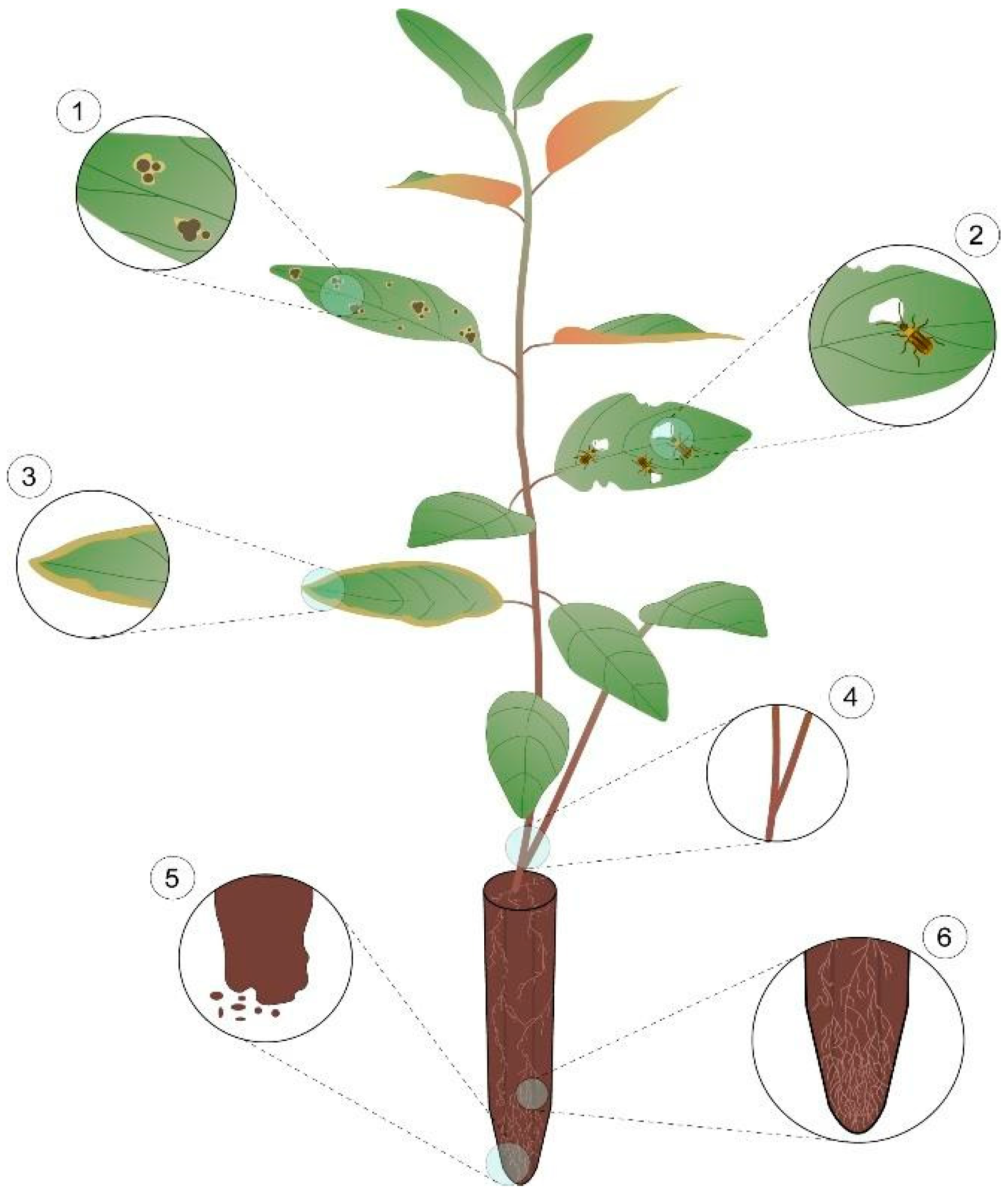
The Dickson Quality Index (DQI) was calculated based on shoot height, root collar diameter, shoot dry mass, and root dry mass, according to the methodology established in the literature [28]. The nonconformities identified throughout the evaluations are presented in Figure 2.
Figure 2.
Non-conformities detected in the production of Tabebuia impetiginosa and Handroanthus pentaphyllus seedlings. (1) Disease attack; (2) pest attack; (3) nutritional deficiency; (4) bifurcation; (5) crumbling substrate (unformed root ball); (6) tortuous root growth.
To identify the level of interrelation between the quality characteristics and the quality requirements, the team assigned weights of 9, 3, 1, and 0 for strong, moderate, weak, and no correlation, respectively. The final score was determined after the team reached a consensus. The designed quality, which includes the products’ technical requirements, incorporated the Absolute Weight (PA) and Relative Weight (PR), the classification of technical requirements, and the evaluation of technical specifications and objectives related to the quality of seedlings for reforestation. The technical specifications were established in collaboration with the team and compared with those of the competition. The specifications were then grouped by affinity and validated, considering performance and specific issues, resulting in the following aspects: (↑) = the higher, the better; (↓) = the lower, the better; (↑↓) = specific range; and (○) = value variation does not matter. The correlation matrix, also known as the “roof” of the House of Quality, was created based on the correlations established between the technical requirements, aiming to determine the future priorities of each item. These correlations were given weights of (++), (+), (-), and (--) to indicate strong positive, weak positive, weak negative, and strong negative correlations, respectively.
2.3. Data Analysis
The data collected for the QFD was analyzed using descriptive statistics, emphasizing the percentages of the main quality factors. An interpretation of the constructed quality matrix and the relationships identified through it was also performed.
3. Results
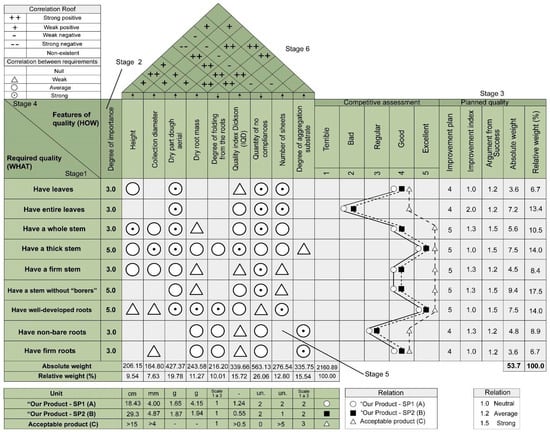
Figure 3 presents the application of the QFD methodology to structure and prioritize forest seedling quality attributes for reforestation. The matrix integrates required quality characteristics (WHATs) with technical and operational nursery parameters (HOWs), allowing the relative importance and interactions among variables to be systematically evaluated.
Figure 3.
Seedling quality defined and prioritized using the Quality Function Deployment (QFD) methodology. The left matrix (WHATs) represents the required seedling quality characteristics, including morphological, physiological, and phytosanitary attributes. The upper matrix (HOWs) comprises the technical and operational parameters of nursery production, with the roof indicating positive and negative correlations among these parameters. The central relationship matrix expresses the strength of the interactions between WHATs and HOWs (weak, moderate, and strong). The right section presents the competitive assessment of seedling quality by comparing the evaluated products and identifying performance gaps. The planned quality matrix summarizes improvement priorities, as well as absolute and relative weights, supporting decision-making and quality optimization in forest nursery production.
Among the required quality attributes, stem integrity (thick, firm, and pest-free stems) and root system quality (well-developed, firm, and non-bare roots) showed the highest importance weights, indicating their central role in defining seedling quality for reforestation purposes. These attributes exhibited strong correlations with key technical parameters, particularly the Dickson Quality Index (DQI), root and shoot dry mass, degree of substrate aggregation, and the number of non-conformities. The correlation roof highlights predominantly positive interactions among technical parameters, suggesting synergistic effects between growth-related indicators and operational quality controls.
The planned quality matrix further indicates that parameters related to non-conformities, DQI, and biomass allocation concentrate the highest absolute and relative weights, defining priority areas for quality improvement in nursery management. The competitive assessment demonstrates performance differences between the evaluated seedling lots, with clear gaps in attributes associated with stem and root quality, reinforcing the relevance of the QFD framework for identifying critical quality constraints and guiding targeted improvements in forest seedling production.
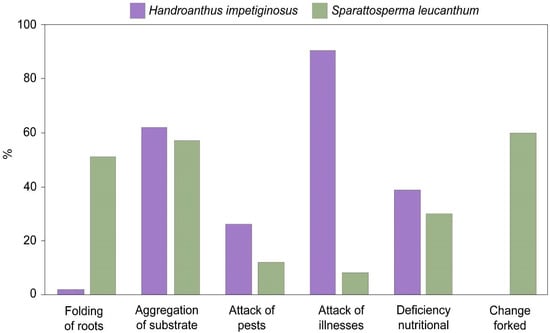
The evaluation of the produced seedlings revealed a high incidence of atypical morphologies and nonconformities in Handroanthus impetiginosus and Sparattosperma leucanthum, which resulted in a higher relative weight of these attributes in the QFD matrix (26.06%) (Figure 4), as such deviations directly affected the quality parameters considered a priority. In Handroanthus impetiginosus, phytosanitary problems were predominant, with disease symptoms affecting 90% of the evaluated seedlings, followed by substrate aggregation issues (62%) and pest (borer) attacks (41%). In contrast, Sparattosperma leucanthum showed a higher occurrence of stem malformation, with forked stems observed in 60% of the seedlings, in addition to substrate aggregation problems (57%) and nutritional deficiency symptoms (33%). These results indicate species-specific patterns of non-conformities, which reinforce the relevance of using an integrative framework such as QFD to identify critical quality bottlenecks under nursery production conditions.
Figure 4.
Percentage distribution of non-conformities observed in seedlings of Handroanthus impetiginosus and Sparattosperma leucanthum produced in the evaluated forest nursery. The figure compares the frequency of the main morphological and phytosanitary non-conformities identified for each species, including root folding, substrate aggregation, pest (borer) attack, nutritional deficiency symptoms, and stem malformation (forked stem), highlighting differences in the occurrence of production-related quality issues between species.
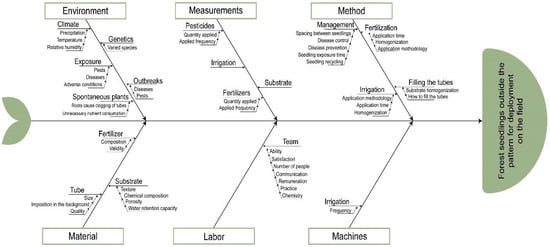
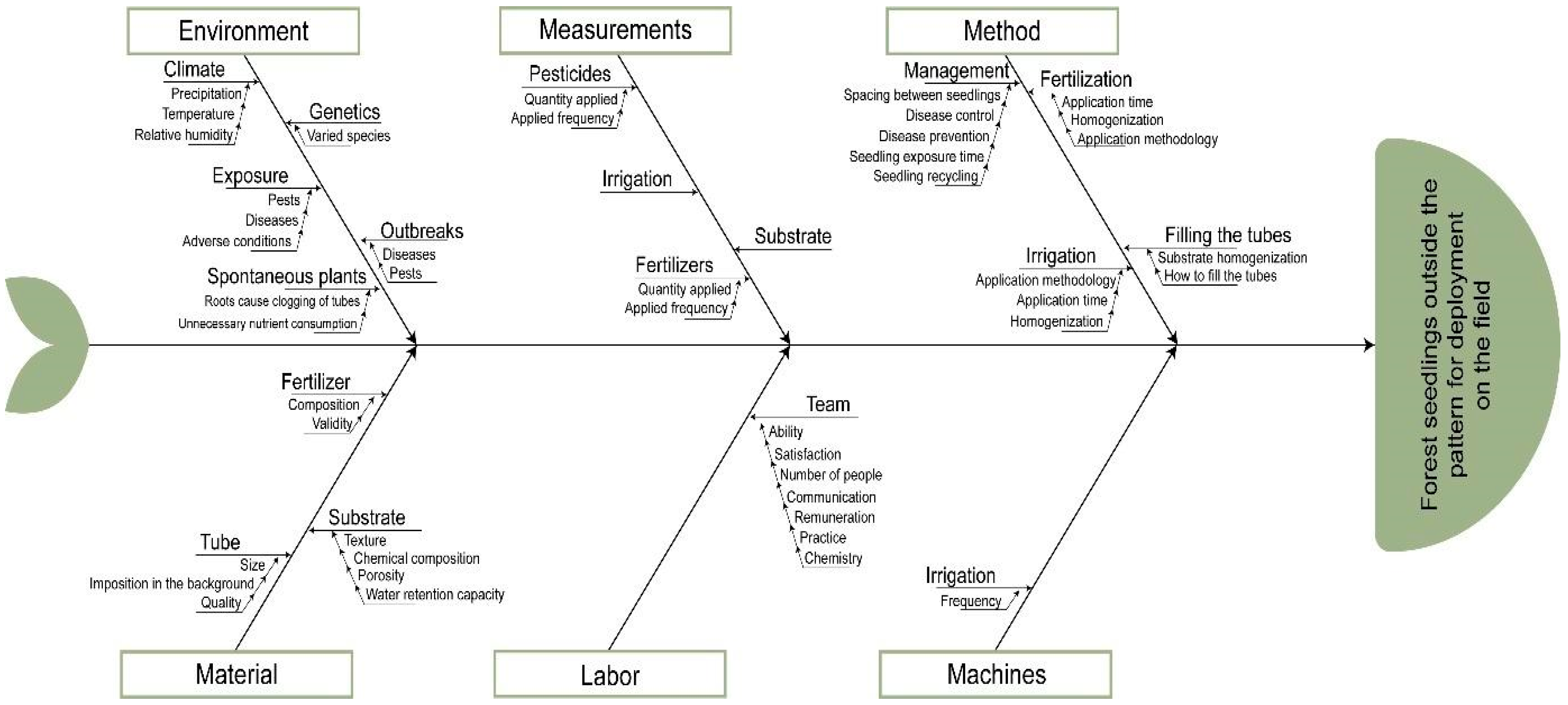
Figure 5 synthesizes the main sources of variability and non-conformities affecting forest seedling production, organized according to environmental, material, labor, machine, measurement, and management factors. The diagram shows that non-conformities arise from the interaction between substrate characteristics, irrigation and fertilization practices, phytosanitary management, container design, and workforce performance. Among these factors, inadequate substrate aggregation, improper irrigation and fertilization, pest and disease outbreaks, and operational failures during tube filling and handling emerge as critical drivers of root deformation, nutritional deficiencies, stem malformation, and reduced seedling vigor. Overall, the results highlight that seedling quality is not determined by isolated factors, but by systemic interactions throughout the production process, reinforcing the need for integrated management guided by the parameters prioritized in the QFD framework.
Figure 5.
Contributing factors to variability and non-conformities in seedling production.
4. Discussion
4.1. Deployment of Forest Seedling Quality for Reforestation
The relationships observed in the QFD matrix (Figure 3) indicate that forest seedling quality for reforestation should be interpreted as an integrated outcome of multiple interacting attributes, rather than the result of isolated morphological indicators. The identification of nine essential technical requirements reflects the multifactorial nature of seedling robustness, where structural, physiological, and phytosanitary traits jointly determine field performance. The correlations highlighted in Figure 3 reinforce this integrative perspective, particularly the association between aerial dry mass, leaf number, and the reduced occurrence of non-conformities, as well as the relationship between collar diameter and stem robustness. Similarly, the link between non-bare roots and substrate aggregation emphasizes the central role of root–substrate interaction in seedling establishment. These interactions support the argument that robustness emerges from coordinated development, not from single metrics evaluated in isolation.
Within this context, the Dickson Quality Index (DQI) is widely applied as an indicator of seedling robustness and biomass balance, integrating aerial and root dry mass, height, collar diameter, and total dry mass, with higher values generally reflecting better seedling quality [10,29]. DQI values above 0.3–0.4 are considered acceptable, values between 0.5 and 0.6 indicate good quality, and values above 1 suggest excellent morphophysiological balance [12]. In this study, we provide quantitative values for DQI and its components, including means, standard deviations, and ranges, allowing a more precise comparison of seedling quality and facilitating direct comparisons with literature reports. The inclusion of DQI within the QFD framework reflects the relevance of adopting a standardized and consolidated index in seedling evaluation, while simultaneously allowing its relative importance to be assessed alongside other quality attributes.
Although DQI captures important aspects of seedling morphology and biomass distribution, its isolated use does not encompass several attributes that are critical for nursery management and field performance, such as phytosanitary conditions, stem integrity, root exposure, and the occurrence of production-related non-conformities. The QFD analysis revealed that parameters such as well-developed roots, pest-free stems, and stem robustness received high relative importance, indicating that reliance solely on DQI may overlook operational and qualitative aspects that directly affect seedling survival and establishment. The correlation matrix (Step 6, Figure 3) further demonstrated that DQI was associated with leaf number, while aerial dry mass correlated with height, and the number of non-conformities correlated with root entanglement. The correlation matrix further highlights interactions and compensations between technical attributes, including negative correlations that indicate trade-offs in nursery management. Practical implications include prioritizing monitoring of attributes with strong negative correlations to prevent cascading non-conformities in other traits.
Competitive evaluation using QFD highlighted parameters such as pest-free stems (17.5%), intact leaves (13.4%), sound stems (10.5%), non-bare roots (8.9%), and firm stems (8.4%) as priority attributes. These values are discussed in comparison with previous studies, emphasizing similarities and differences in non-conformity incidence and DQI components, thus situating our findings within the broader literature on nursery performance. Rather than indicating final performance outcomes, these results support the identification of management-sensitive parameters that require monitoring and control during nursery production, contributing to gradual improvement of seedling quality and consistency in reforestation programs. From a practical perspective, nursery managers can use these priorities to optimize pruning, substrate selection, and pest control protocols, ensuring seedlings meet field performance expectations.
4.2. Assessment of Non-Conformities in the Production Process of Forest Nursery Seedlings
Figure 4 shows that in Handroanthus impetiginosus, disease attacks affected 90% of the seedlings, compromising leaf vigor and stem robustness [30,31]. These attributes have high priority in the QFD matrix, and deficiencies in this dimension increase initial mortality and reduce post-planting growth, directly impacting reforestation effectiveness. In Sparattosperma leucanthum, undesirable bifurcations in 60% of the seedlings compromise collar diameter and structural integrity, restricting vertical growth and increasing susceptibility to breakage [32,33]. Substrate aggregation problems, observed in 62% of Purple Trumpet Tree seedlings and 57% of Five-Leaf Trumpet Tree seedlings, affect root development and water and nutrient uptake, increasing the risk of root entanglement (Figure 4) and directly influencing the DQI and the number of non-conformities in the QFD matrix (Figure 3) [13,32,34]. We provide mean values and variation ranges for these attributes to support a more quantitative interpretation of seedling quality. Practical recommendations include adjusting substrate composition and irrigation regimes to reduce aggregation and prevent root entanglement.
Nursery phytosanitary conditions are another critical factor. High humidity, abundant irrigation, close spacing, and continuous cultivation favor fungi and insects (leaf-cutting ants, defoliating caterpillars, aphids), which damage leaves and roots and induce bifurcations [30,31]. These factors affect essential QFD attributes, such as leaf vigor, collar diameter, and leaf number, compromising seedling survival and growth in the field. Limitations of the study include the single nursery context, the small sample size, and potential operator bias in non-conformity evaluation, which should be considered when generalizing the results. Nursery managers should consider these practical constraints when implementing recommendations derived from this study.
Each non-conformity, whether disease, pest attack, nutritional deficiency, bifurcation, disaggregated substrate, or root entanglement, directly interferes with the parameters prioritized in the QFD [34,35,36]. Preventive interventions, high-quality substrate, strict phytosanitary control, proper nutritional management, pruning techniques, and containers that favor rooting improve uniformity, hardiness, and seedling performance in the field, reflecting on critical QFD parameters [37]. Systematic monitoring of non-conformities allows for the identification of failures, implementation of continuous improvements, and increased survival, vigor, and establishment in the field, enhancing the success of reforestation and degraded area restoration projects [37,38]. Integrating non-conformity analysis with the parameters prioritized in the QFD provides a robust guide for optimizing production and standardizing seedling quality.
4.3. Causes and Impacts of Non-Conformities in Forest Seedlings
The production of forest seedlings involves a complex interaction between materials, management practices, and environmental conditions, where failures generate non-conformities that directly affect seedling quality and performance (Figure 5). Using tubes with vertical gloves and bottom holes directs root growth and allows natural pruning, guiding the root system [39]. However, root entanglement occurs when holes are blocked or seedlings remain in the nursery for too long, limiting water and nutrient uptake and reducing robustness. Substrate quality is crucial for balanced development, and nutritional deficiencies or pest attacks further impair survival and growth. By analyzing these interactions within the QFD framework, including negative correlations and compensations between parameters, practical recommendations for priority management actions can be derived, such as adjusting container design, substrate type, and spacing.
Substrate quality is crucial for balanced development. Aggregated, nutrient-rich, and pathogen-free substrates promote stable clod formation and proper root development. Friable or poorly aggregated substrates increase root dedication, favor entanglement, and compromise initial survival. Fungal and bacterial diseases pose additional threats, with pathogens introduced via seeds, cuttings, substrates, or inadequate management. Figure 5 shows a high incidence of diseases in Purple Trumpet Tree, affecting leaf vigor and stem robustness. Diseased seedlings act as weak links in the reforestation chain, increasing mortality, reducing growth, and causing failures in vegetation cover.
Nutritional deficiencies result from improper irrigation or fertilization management, limiting photosynthesis, growth, and resistance to abiotic and biotic stresses, thereby impacting the forest’s competitiveness, mortality, and structural development [40]. Foliar damage caused by pests or nutritional deficiencies reinforces these effects, impairing seedling vigor and planting uniformity. Stem bifurcation, often associated with tip death due to water deficit or pest attack, compromises structural integrity and final seedling height, affecting competitiveness and commercial value of the stem, particularly in Sparattosperma leucanthum.
Human factors play a critical role throughout the seedling production process. Differences in team experience, especially in nurseries employing temporary staff, can create procedural inconsistencies that result in non-conformities. Ensuring uniformity, reducing mortality, and producing seedlings adapted to field conditions require ongoing training, careful supervision, and constructive feedback. Figure 5 illustrates the interaction of materials, environment, and labor, highlighting their influence on each stage of nursery operations.
Non-conformities, such as root entanglement, poor substrate quality, disease, nutrient deficiencies, or stem bifurcation, directly compromise seedling survival, growth, and competitiveness after planting. Combining high-quality substrate, effective phytosanitary management, proper nutrition, controlled irrigation, tip care, and skilled personnel, in alignment with the critical QFD parameters, supports the production of uniform, robust seedlings, enhancing the success of reforestation and degraded land restoration initiatives.
4.4. Practical Applications and Policy Implications
Using forest seedlings is a key factor for the success of reforestation projects. Recent studies by Guerra et al. e Martins et al. [31,41] and highlight a preference for nursery-grown seedlings and direct seeding as the predominant methods in this process. Planting nursery-grown seedlings, although associated with higher costs [7,42], has been widely adopted due to relatively high survival rates. de Souza & Engel (2023) [7] report that these rates can reach approximately 70% in the first year, justifying the initial investment, especially in areas with adverse environmental conditions. While less common, direct seeding represents a viable alternative in tropical regions but faces significant challenges, including substantially lower establishment rates, often below 14% [7], due to predation, competition with invasive species, and climatic variability.
The benefits of planting nursery-grown seedlings must be balanced by considering available resources and reforestation efficiency. Seedling quality assessments, as conducted in this study, allow the identification of critical attributes for survival and growth, including leaf vigor, stem robustness, root system integrity, and phytosanitary status. Tools such as the QFD methodology facilitate the prioritization of these attributes and can guide practical decisions regarding substrate management, irrigation, fertilization, and phytosanitary control [10,29]. Furthermore, QFD can be applied in other forest restoration contexts, such as species evaluation for degraded area recovery, monitoring survival in experimental plantings, and optimizing planting strategies across different ecosystems.
In the realm of public policy, the results underscore the importance of investments in well-structured nurseries and technical training programs to ensure that seedling production meets the quality standards necessary for effective reforestation. Strategies to incentivize restoration, regulate nurseries, and certify seedlings can be strengthened through assessments based on technical parameters and performance indicators, ensuring greater ecological and social returns. Aligning seedling quality with public policies promotes not only plant survival and growth but also climate change mitigation and the achievement of global goals, such as Sustainable Development Goals SDG 13 (Climate Action) and SDG 15 (Life on Land) [43].
The findings of this study also have implications for environmental and social governance (ESG). Producing high-quality seedlings contributes to environmental restoration and the mitigation of greenhouse gas emissions, strengthening corporate responsibility in the face of climate change. Monitoring non-conformities and prioritizing critical nursery attributes, based on analyses such as QFD, provides strategic indicators that can support public policies promoting forest restoration and corporate sustainability decisions. Thus, using high-quality seedlings, combined with management practices and systematic monitoring, integrates science, practice, and public policy, enhancing the effectiveness of reforestation projects and the restoration of degraded ecosystems.
5. Conclusions
This study demonstrates that Quality Function Deployment (QFD) represents a relevant and methodologically consistent approach for identifying and prioritizing seedling quality attributes within forest nurseries, meeting the proposed objective of evaluating its applicability in this context. The results indicate that QFD provides a structured means to organize technical, morphological, phytosanitary, and operational requirements, allowing the identification of attributes that are particularly influential at the nursery stage.
The contribution of this research does not lie in proposing a complete or definitive solution, nor in predicting field performance, but in offering a systematic, transparent, and replicable framework that supports decision-making and diagnostic analyses within seedling production systems. In this sense, the application of QFD adds methodological value by clarifying priority quality requirements and supporting internal evaluation and planning processes in forest nurseries.
While the findings highlight the practical relevance and applicability of QFD at the nursery level, further investigations are required to broaden and strengthen its use. Future studies may expand this approach by applying QFD to different forest species, multiple nurseries, and additional stages of the production chain, as well as by integrating quantitative field performance data. Thus, the present study serves as a robust starting point, contributing to methodological advances and encouraging continued research on the use of QFD in forest restoration and seedling production systems.
Author Contributions
Conceptualization, Á.M.d.S. and A.F.D.J.; methodology, Á.M.d.S. and A.F.D.J.; formal analysis, Á.M.d.S.; investigation, Á.M.d.S. and T.A.F.; data curation, Á.M.d.S. and F.M.D.; writing—original draft preparation, Á.M.d.S.; writing—review and editing, F.M.D., K.C.A.d.S., G.A.A., I.N.C., G.F.M.C., G.C.M., D.S., J.O.B. and A.F.D.J.; visualization, K.C.A.d.S., supervision, A.F.D.J. and G.C.M. All authors have read and agreed to the published version of the manuscript.
Funding
This study was supported by the Coordenação de Aperfeiçoamento de Pessoal de Nível Superior (CAPES–Finance Code 001), the Conselho Nacional de Desenvolvimento Científico e Tecnológico (CNPq–Chamada Universal 18/2021; Bolsas no Exterior 26/2021; Bolsa de Produtividade em Desenvolvimento Tecnológico e Extensão Inovadora 08/2022; Apoio a Projetos Internacionais de Pesquisa Científica, Tecnológica e de Inovação 14/2023 and 16/2024; Conhecimento Brasil–Rede de Colaboração 22/2024), and the Fundação de Amparo à Pesquisa e Inovação do Espírito Santo (FAPES–Chamada Universal 28/2022; Extensão Tecnológica 09/2024). Additional support was provided by Sociedade de Amparo ao Desenvolvimento Tecnológico e Cultural (Sadtec, Brasil).
Institutional Review Board Statement
Not applicable.
Informed Consent Statement
Not applicable.
Data Availability Statement
Data are contained within the article.
Conflicts of Interest
The authors declare no conflicts of interest.
References
- Mohammad, W.M.W.; Wasiuzzaman, S. Environmental, Social and Governance (ESG) Disclosure, Competitive Advantage and Performance of Firms in Malaysia. Clean. Environ. Syst. 2021, 2, 100015. [Google Scholar] [CrossRef] [Scilit]
- Lee, M.T.; Suh, I. Understanding the Effects of Environment, Social, and Governance Conduct on Financial Performance: Arguments for a Process and Integrated Modelling Approach. Sustain. Technol. Entrep. 2022, 1, 100004. [Google Scholar] [CrossRef] [Scilit]
- Singhania, M.; Saini, N. Systems Approach to Environment, Social and Governance (ESG): Case of Reliance Industries. Sustain. Oper. Comput. 2022, 3, 103–117. [Google Scholar] [CrossRef] [Scilit]
- Aguiar, A.C.F.; Scarano, F.R.; Bozelli, R.L.; Branco, P.D.; Ceotto, P.; Farjalla, V.F.; Loyola, R.; da Silva, J.M.C. Business, Biodiversity, and Innovation in Brazil. Perspect. Ecol. Conserv. 2023, 21, 6–16. [Google Scholar] [CrossRef] [Scilit]
- Di Sacco, A.; Hardwick, K.A.; Blakesley, D.; Brancalion, P.H.S.; Breman, E.; Cecilio Rebola, L.; Chomba, S.; Dixon, K.; Elliott, S.; Ruyonga, G.; et al. Ten Golden Rules for Reforestation to Optimize Carbon Sequestration, Biodiversity Recovery and Livelihood Benefits. Glob. Change Biol. 2021, 27, 1328–1348. [Google Scholar] [CrossRef] [Scilit]
- Höhl, M.; Ahimbisibwe, V.; Stanturf, J.A.; Elsasser, P.; Kleine, M.; Bolte, A. Forest Landscape Restoration—What Generates Failure and Success? Forests 2020, 11, 938. [Google Scholar] [CrossRef] [Scilit]
- de Souza, D.C.; Engel, V.L. Advances, Challenges, and Directions for Ecological Restoration by Direct Seeding of Trees: Lessons from Brazil. Biol. Conserv. 2023, 284, 110172. [Google Scholar] [CrossRef] [Scilit]
- Gallegos-Cedillo, V.M.; Diánez, F.; Nájera, C.; Santos, M. Plant Agronomic Features Can Predict Quality and Field Performance: A Bibliometric Analysis. Agronomy 2021, 11, 2305. [Google Scholar] [CrossRef] [Scilit]
- Villar-Salvador, P.; Andivia, E.; Mariotti, B.; Oliet, J.A.; Puértolas, J.; Cocozza, C.; Ivetić, V.; Tsakaldimi, M.; Montagnoli, A.; Cvjetković, B.; et al. Quality Matters. A Quantitative Review on the Effect of Seedling Morphology and Nursery Practices on the Outplanting Performance of Forest Plantings. In Guidelines for Climate Adaptive Forest Restoration and Reforestation Projects; Elsevier: Amsterdam, The Netherlands, 2026; pp. 131–191. [Google Scholar]
- Reyes Moreno, G.; Elena Fernández, M.; Darghan Contreras, E. Balanced Mixture of Biochar and Synthetic Fertilizer Increases Seedling Quality of Acacia Mangium. J. Saudi Soc. Agric. Sci. 2021, 20, 371–378. [Google Scholar] [CrossRef] [Scilit]
- de Oliveira Silva, L.; Mendonça, H.V.; Conforto, B.A.A.F.; Pinto, M.F.; de Carvalho, D.F. Production of Forest Seedlings Using Sewage Sludge and Automated Irrigation with Ozonated Cattle Wastewater. PLoS ONE 2022, 17, e0276633. [Google Scholar] [CrossRef] [Scilit]
- Avelino, N.R.; Schilling, A.C.; Dalmolin, Â.C.; Santos, M.S.d.; Mielke, M.S. Alocação de Biomassa e Indicadores de Crescimento Para a Avaliação Da Qualidade de Mudas de Espécies Florestais Nativas. Ciênc. Florest. 2021, 31, 1733–1750. [Google Scholar] [CrossRef] [Scilit]
- Faustino, I.S.; Jacovine, L.A.G.; Morais Júnior, V.T.M.; Alves, E.B.B.M.; Rocha, S.J.S.S.; França, L.C.J.; Oliveira, K.; Oliveira, T.A.; Romero, F.M.B.; Paiva, H.N. Avaliação da qualidade de mudas de espécies florestais nativas. In Recursos Hídricos: Gestão, Planejamento e Técnicas em Pesquisa—Volume 2; Editora Científica Digital: Sao Paulo, Brazil, 2022; pp. 26–39. [Google Scholar]
- Fang, H.; Li, J.; Song, W. A New Method for Quality Function Deployment Based on Rough Cloud Model Theory. IEEE Trans. Eng. Manag. 2022, 69, 2842–2856. [Google Scholar] [CrossRef] [Scilit]
- Dias Júnior, A.F.; Andrade, C.R.; Milan, M.; Brito, J.O.; Andrade, A.M.d.; de Souza, N.D. Quality Function Deployment (QFD) Reveals Appropriate Quality of Charcoal Used in Barbecues. Sci. Agric. 2020, 77, e20190021. [Google Scholar] [CrossRef] [Scilit]
- Deveci, M.; Öner, S.C.; Canıtez, F.; Öner, M. Evaluation of Service Quality in Public Bus Transportation Using Interval-Valued Intuitionistic Fuzzy QFD Methodology. Res. Transp. Bus. Manag. 2019, 33, 100387. [Google Scholar] [CrossRef] [Scilit]
- Kulcsár, E.; Gyurika, I.G.; Csiszér, T. Network-Based—Quality Function Deployment (NB-QFD): The Combination of Traditional QFD with Network Science Approach and Techniques. Comput. Ind. 2022, 136, 103592. [Google Scholar] [CrossRef] [Scilit]
- Torkayesh, A.E.; Yazdani, M.; Ribeiro-Soriano, D. Analysis of Industry 4.0 Implementation in Mobility Sector: An Integrated Approach Based on QFD, BWM, and Stratified Combined Compromise Solution under Fuzzy Environment. J. Ind. Inf. Integr. 2022, 30, 100406. [Google Scholar] [CrossRef] [Scilit]
- Governo ES (Governo do Estado Espírito Santo). Programa Reflorestar. Available online: https://www.es.gov.br/programa-reflorestar (accessed on 27 May 2025).
- Gonçalves, J.L.d.M.; Benedetti, V. Nutrição e Fertilização Florestal; IPEF—Instituto de Pesquisas e Estudos Florestais: Piracicaba, Brazil, 2000. [Google Scholar]
- Alvares, C.A.; Stape, J.L.; Sentelhas, P.C.; de Moraes Gonçalves, J.L.; Sparovek, G. Köppen’s Climate Classification Map for Brazil. Meteorol. Z. 2013, 22, 711–728. [Google Scholar] [CrossRef] [Scilit]
- Levine, D.M.; Stephan, D.F.; Szabat, K.A. Estatistica: Teoria e Aplicações Usando Microsoft Excel Em Português; Livros Técnicos e Científicos: Rio de Janeiro, Brazil, 2000. [Google Scholar]
- Cheng, L.C.; Melo Filho, L.D.R.d. QFD: Desdobramento da Função Qualidade na Gestão de Desenvolvimento de Produtos, 2nd ed.; Blucher: São Paulo, Brazil, 2010. [Google Scholar]
- Lucas Filho, F.C.; Pio, N.d.S.; Ferreira, D.R. Método QFD Como Ferramenta Para Desenvolvimento Conceitual de Produtos de Madeiras Da Amazônia. Acta Amazon. 2010, 40, 675–686. [Google Scholar] [CrossRef] [Scilit]
- Castro, D.C.V. Planejamento da Qualidade dos Processos Silviculturais na Cultura do Eucalipto no Brasil; Universidade de São Paulo: Piracicaba, Brazil, 2017. [Google Scholar]
- Nagumo, G.K. Desdobramento da Função de Qualidade (QFD) Aplicado à Produção de Mudas de Café (Coffea arabica L.). Master’s Thesis, Escola Superior de Agricultura “Luiz de Queiroz”, Universidade de São Paulo, Piracicaba, Brazil, 2005. [Google Scholar]
- Gomes, J.M.; Couto, L.; Leite, H.G.; Xavier, A.; Garcia, S.L.R. Parâmetros Morfológicos da Avaliação da Qualidade de Mudas de Eucalyptus Grandis. Rev. Árvore 2002, 26, 655–664. [Google Scholar] [CrossRef] [Scilit]
- Dickson, A.; Leaf, A.L.; Hosner, J.F. Quality Appraisal of White Spruce and White Pine Seedling Stock in Nurseries. For. Chron. 1960, 36, 10–13. [Google Scholar] [CrossRef] [Scilit]
- Da Ros, C.O.; Torchelsen, M.D.M.; Somavilla, L.; Da Silva, R.F.; Rodrigues, A.C. Composto de águas residuárias de suinocultura na produção de mudas de espécies florestais. Floresta 2018, 48, 103. [Google Scholar] [CrossRef] [Scilit]
- Ahumada, R.; Rotella, A. Disease Management in the Forest Plantations in Chile. In Forest Pest and Disease Management in Latin America; Springer International Publishing: Cham, Switzerland, 2020; pp. 171–184. [Google Scholar]
- Martins, S.M.C.; Boscardin, J. Levantamento Do Manejo de Pragas Aplicado em Viveiros Florestais no Brasil. Entomol. Begin. 2022, 3, e047. [Google Scholar] [CrossRef] [Scilit]
- Grossnickle, S.C.; MacDonald, J.E. Seedling Quality: History, Application, and Plant Attributes. Forests 2018, 9, 283. [Google Scholar] [CrossRef] [Scilit]
- Grossnickle, S.C.; MacDonald, J.E. Why Seedlings Grow: Influence of Plant Attributes. New For. 2018, 49, 1–34. [Google Scholar] [CrossRef] [Scilit]
- Kaudo, B.O.; Mwenja, P.; Epasit, D.; Ekai, D.; Isacko, D.; Owino, J. Effect of Potting Tube Size on Growth and Development of Zizyphus Mauritiana Seedlings. East Afr. J. For. Agrofor. 2022, 5, 118–129. [Google Scholar] [CrossRef] [Scilit]
- Poorter, H.; Bühler, J.; van Dusschoten, D.; Climent, J.; Postma, J.A. Pot Size Matters: A Meta-Analysis of the Effects of Rooting Volume on Plant Growth. Funct. Plant Biol. 2012, 39, 839. [Google Scholar] [CrossRef] [Scilit] [PubMed]
- Klimenko, O.E.; Plugatar, Y.V.; Klimenko, N.I. The Effect of Microbial Preparations on the Mineral Nutrition of Seedlings and the Productivity of a Fruit Nursery in the Steppe Crimea. Russ. J. Plant Physiol. 2023, 70, 195. [Google Scholar] [CrossRef] [Scilit]
- Marshall, L.A.E.; Fornwalt, P.J.; Stevens-Rumann, C.S.; Rodman, K.C.; Chapman, T.B.; Schloegel, C.A.; Stevens, J.T. What Influences Planted Tree Seedling Survival in Burned Colorado Montane Forests? For. Ecol. Manag. 2024, 572, 122321. [Google Scholar] [CrossRef] [Scilit]
- Hagazi, N.; Brhan, A.; Birhane, E.; Gebrekirstos, A.; Bräuning, A. Survival and Plasticity in Acacia Saligna Growth across Contrasting Management Practices and Growing Niches. J. Environ. Manag. 2024, 367, 121941. [Google Scholar] [CrossRef] [Scilit]
- Jia, X.; Zhu, J.; Guo, G.; Huang, Y.; Gao, X.; Zhang, C. Design and Test of a Novel Converging Groove-Guided Seed Tube for Precision Seeding of Maize. Biosyst. Eng. 2024, 245, 36–55. [Google Scholar] [CrossRef] [Scilit]
- Ahluwalia, O.; Singh, P.C.; Bhatia, R. A Review on Drought Stress in Plants: Implications, Mitigation and the Role of Plant Growth Promoting Rhizobacteria. Resour. Environ. Sustain. 2021, 5, 100032. [Google Scholar] [CrossRef] [Scilit]
- Guerra, A.; Reis, L.K.; Borges, F.L.G.; Ojeda, P.T.A.; Pineda, D.A.M.; Miranda, C.O.; Maidana, D.P.F.d.L.; Santos, T.M.R.d.; Shibuya, P.S.; Marques, M.C.M.; et al. Ecological Restoration in Brazilian Biomes: Identifying Advances and Gaps. For. Ecol. Manag. 2020, 458, 117802. [Google Scholar] [CrossRef] [Scilit]
- Meli, P.; Isernhagen, I.; Brancalion, P.H.S.; Isernhagen, E.C.C.; Behling, M.; Rodrigues, R.R. Optimizing Seeding Density of Fast-growing Native Trees for Restoring the Brazilian Atlantic Forest. Restor. Ecol. 2018, 26, 212–219. [Google Scholar] [CrossRef] [Scilit]
- Ichii, K.; Muraoka, T.; Shinohara, N.; Managi, M.; Takeda, T. Methodology for Calculating CO2 Absorption by Tree Planting for Greening Projects. arXiv 2024, arXiv:2407.05596. [Google Scholar] [CrossRef] [Scilit]
Disclaimer/Publisher’s Note: The statements, opinions and data contained in all publications are solely those of the individual author(s) and contributor(s) and not of MDPI and/or the editor(s). MDPI and/or the editor(s) disclaim responsibility for any injury to people or property resulting from any ideas, methods, instructions or products referred to in the content. |
© 2026 by the authors. Licensee MDPI, Basel, Switzerland. This article is an open access article distributed under the terms and conditions of the Creative Commons Attribution (CC BY) license.