
Effect of Coffee Grounds as a Bio-Input in Lettuce Cultivation

 , , , , , , and
Abstract
1. Introduction
2. Material and Methods
2.1. Experimental Design
- ETc = crop evapotranspiration.
- Kc = crop coefficient.
- ETo = reference evapotranspiration.
2.2. Agronomic Variables and Nutrition
2.3. Mycorrhizal Colonization (MC)
- CM: mycorrhizal colonization (%).
- sn: number of non-colonized segments.
- sc: number of colonized segments.
Mycorrhizal Spore Density (MSD)
2.4. Statistical Procedures
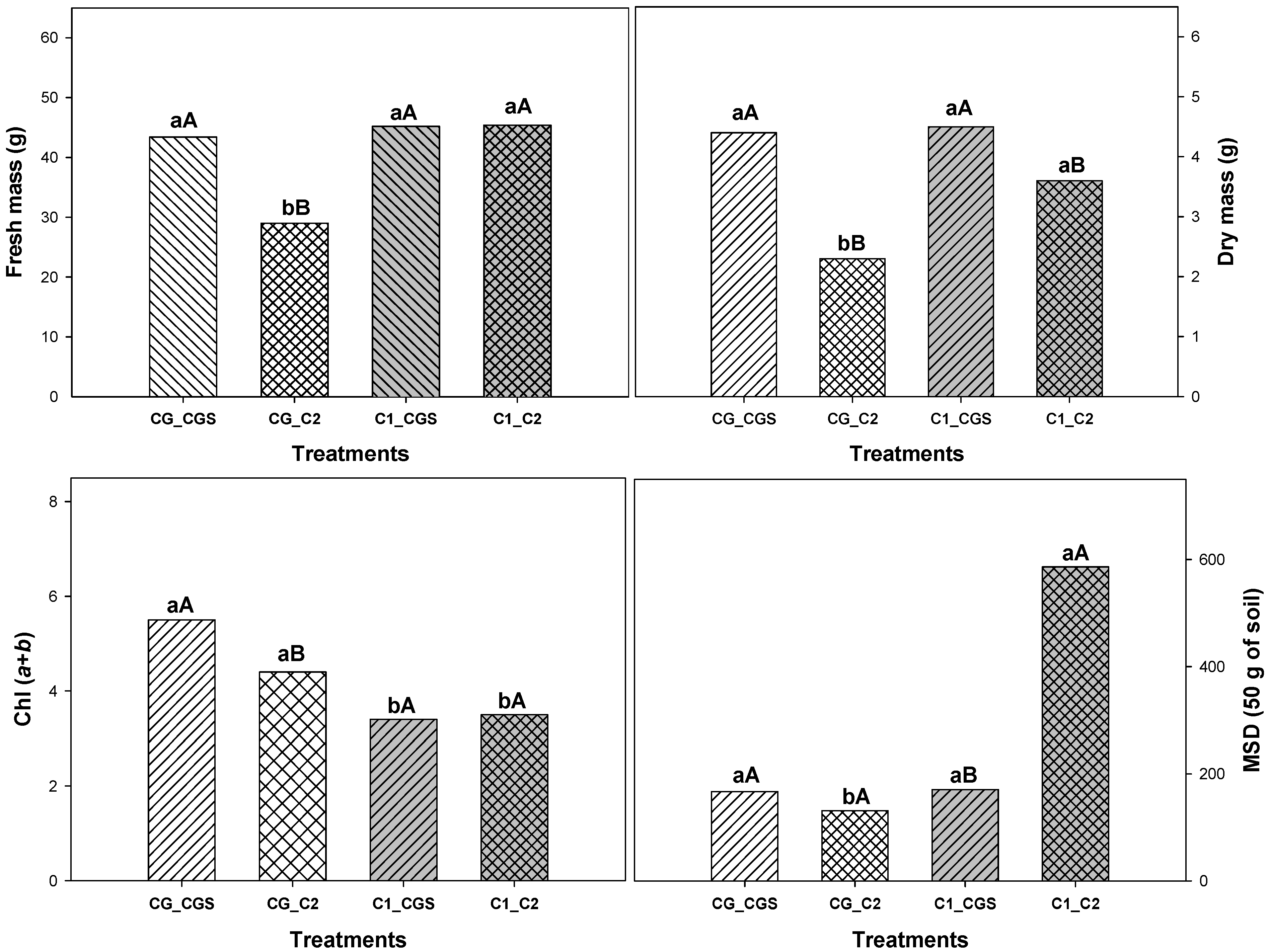
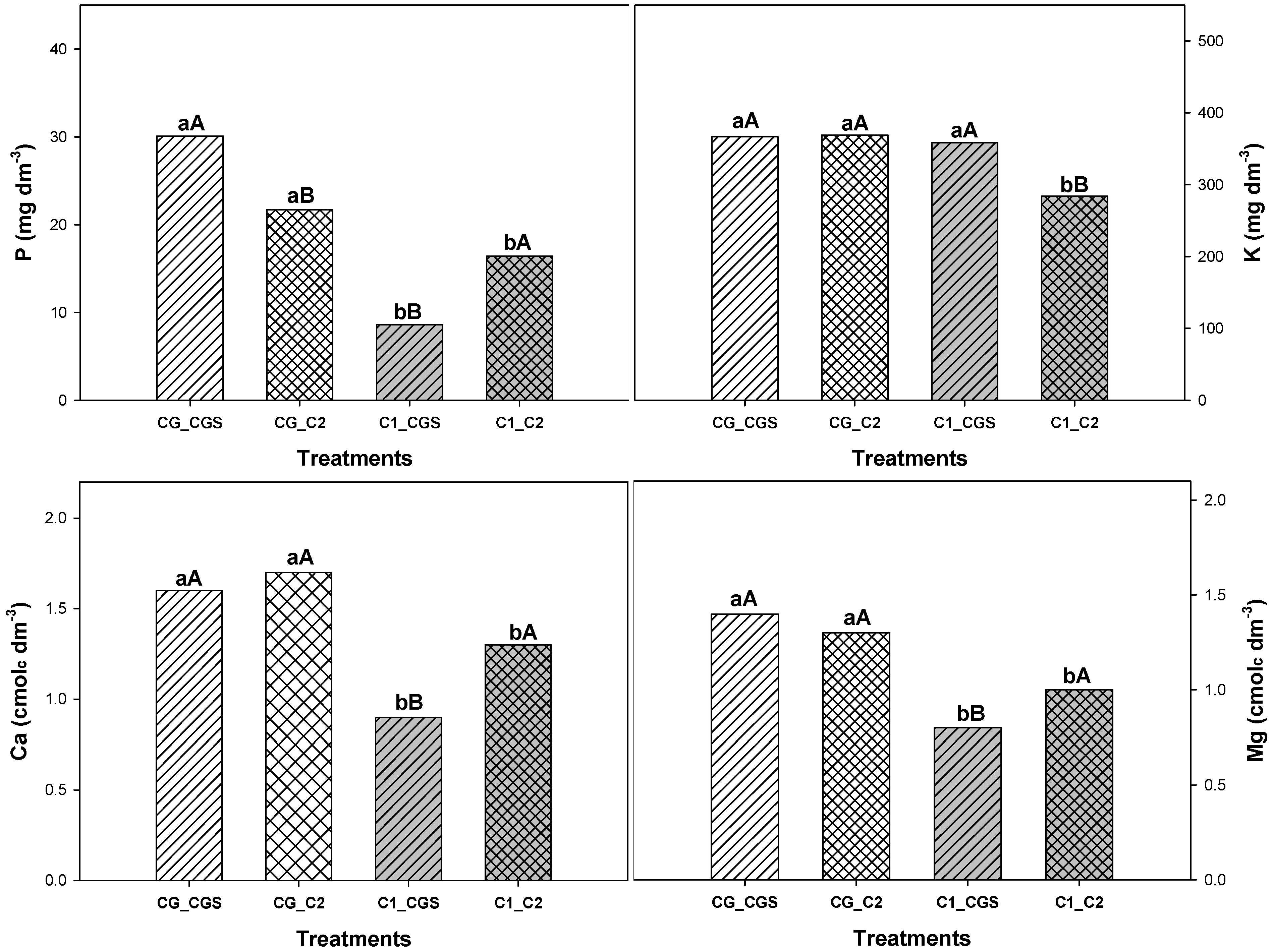
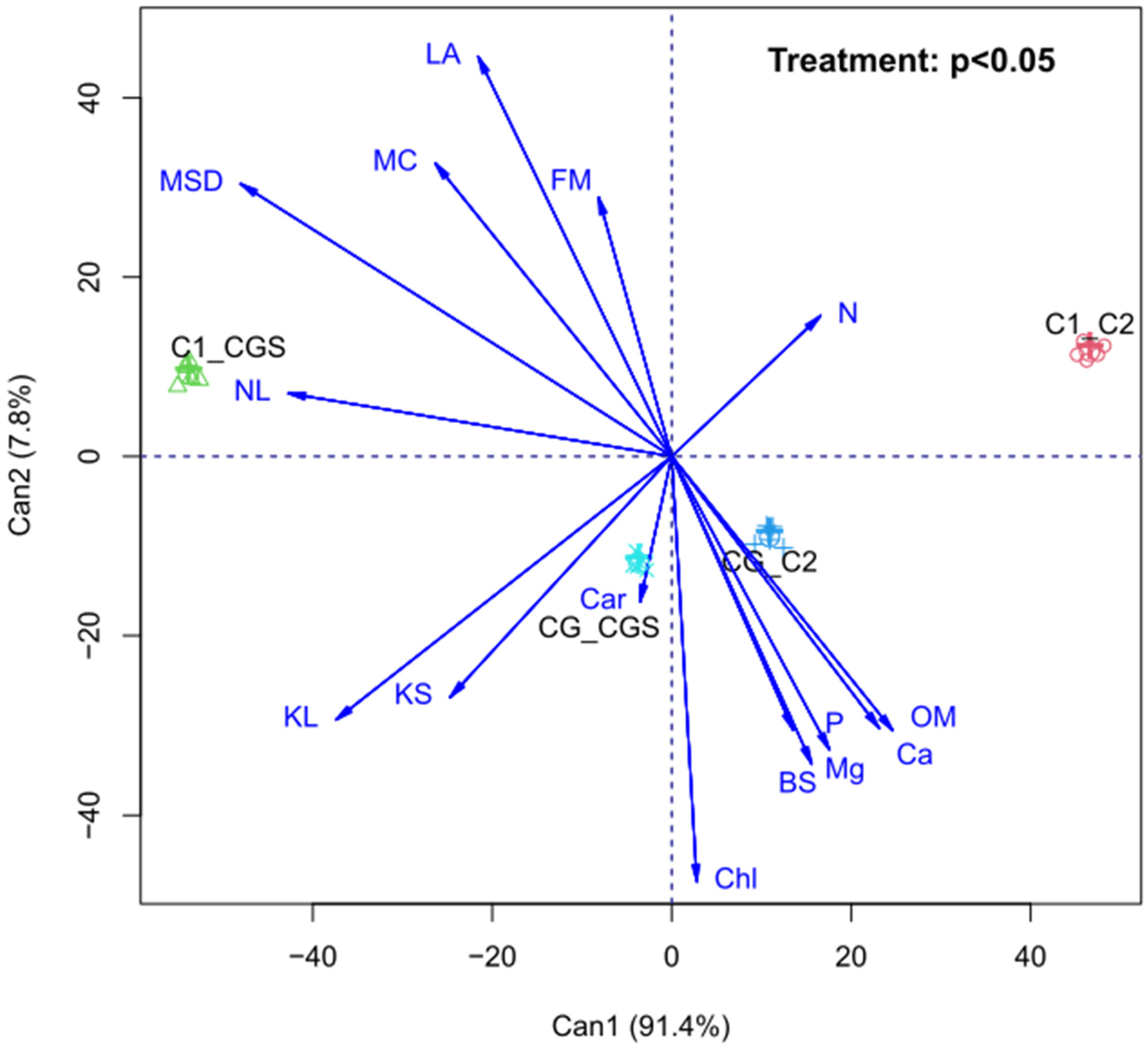
3. Results and Discussion
4. Conclusions
Author Contributions
Funding
Institutional Review Board Statement
Informed Consent Statement
Data Availability Statement
Conflicts of Interest
References
- Thode Filho, S.; da Paixão, C.P.S.; Maranhão, F.d.S.; Franco, H.A. Avaliação do Impacto do Extrato Solubilizado da Borra de Café sobre de Germinação de Sementes de Alface. Front. J. Soc. Technol. Environ. Sci. 2020, 9, 414–423. [Google Scholar] [CrossRef] [Scilit]
- CONAB—Companhia Nacional de Abastecimento. Produção de Café de 2024 é Estimada em 54,79 Milhões de Sacas, Influenciada por Clima; Companhia Nacional de Abastecimento: Brasília, Brazil, 2024. Available online: https://www.gov.br/conab/pt-br (accessed on 22 October 2024).
- OIC—Organização Internacional do Café. Relatório Sobre o Mercado do Café Em Junho de 2023; Organização Internacional do Café: London, UK, 2023; pp. 1–14. Available online: https://www.icocoffee.org/documents/cy2022-23/cmr-0623-p.pdf (accessed on 22 August 2023).
- ABIC—Associação Brasileira da Indústria do Café. Indicadores da Indústria do Café em 2023; Associação Brasileira da Indústria de Café: São Paulo, Brazil, 2023; Available online: https://www.abic.com.br/estatisticas/indicadores-da-industria/ (accessed on 22 October 2024).
- Almeida, R.S.; Nieri, E.M.; Monteiro, E.C.S.; Silva, O.M.d.C.; de Melo, L.A. Reaproveitamento de resíduos de café em substratos para produção de mudas de Joannesia princeps. Pesqui. Florest. Bras. 2021, 41, 1–7. [Google Scholar] [CrossRef] [Scilit]
- Adans, M.R.; Dougan, W. Chapter 9—Waste Products. In Coffee Technology; Elsevier Applied Science: London, UK, 1987. [Google Scholar] [CrossRef] [Scilit]
- Horgan, F.G.; Floyd, D.; Mundaca, E.A.; Crisol-Martínez, E. Spent Coffee Grounds Applied as a Top-Dressing or Incorporated into the Soil Can Improve Plant Growth While Reducing Slug Herbivory. Agriculture 2023, 13, 257. [Google Scholar] [CrossRef] [Scilit]
- Thode Filho, S.; de Souza, L.C.; Jorge, E.N.d.L.F.; Silva, M.D.L.M.d.; Guedes, A.S.d.O.; Franco, H.A. Assessment of Associated Impacts the Inappropriate Disposal of Coffee Waste on the Behavior Escape of the Earthworms. Rev. Eletrônica Gestão Educ. Tecnol. Ambient. 2017, 21, 16–23. [Google Scholar] [CrossRef] [Scilit]
- Vidal, H.M. Composição Lipídica e a Qualidade de Bebida Do Café (Coffea arabica L.) Durante o Armazenamento. Master’s Thesis, Universidade Federal de Viçosa, Viçosa, Brazil, 2001. Available online: https://locus.ufv.br/server/api/core/bitstreams/f21a06e4-772f-4462-8d8a-44e562ebbafb/content (accessed on 12 January 2024).
- Chrysargyris, A.; Antoniou, O.; Xylia, P.; Petropoulos, S.; Tzortzakis, N. The use of spent coffee grounds in growing media for the production of Brassica seedlings in nurseries. Environ. Sci. Pollut. Res. 2021, 28, 24279–24290. [Google Scholar] [CrossRef] [Scilit]
- Hardgrove, S.J.; Livesley, S.J. Applying spent coffee grounds directly to urban agriculture soils greatly reduces plant growth. Urban Urban Green 2016, 18, 1–8. [Google Scholar] [CrossRef] [Scilit]
- Lara, R.L.; Cervera-Mata, A.; Fernández-Bayo, J.; Delgado, G.; Fernández-Arteaga, A. New Insights into the Use of Spent Coffee Grounds By-products as Zn Bio-chelates for Lettuce Biofortification. J. Soil Sci. Plant Nutr. 2024, 24, 679–683. [Google Scholar] [CrossRef] [Scilit]
- Truong, T.H.A.; Marschner, P. Respiração, N disponível e N da biomassa microbiana em solo corrigido com misturas de materiais orgânicos diferindo na relação C/N e estágio de decomposição. Geoderma 2018, 319, 167–174. [Google Scholar] [CrossRef] [Scilit]
- Araujo, M.N.; dos Santos, K.C.; Diniz, N.D.C.; de Carvalho, J.C.; Corazza, M.L. A biorefinery approach for spent coffee grounds valorization using pressurized fluid extraction to produce oil and bioproducts: A systematic review. Bioresour. Technol. Rep. 2022, 18, 101–113. [Google Scholar] [CrossRef] [Scilit]
- Basílio, A.A.G.; Gratão, M.S.; Macedo, G.C.; Xavier, S.J.L.; Soares, L.A.F.; Macedo, P.H.L.; Matos, F.S. Efeito da borra de café como bioinsumo no cultivo da alface. Preprints 2025. [Google Scholar] [CrossRef] [Scilit]
- Hechmi, S.; Guizani, M.; Kallel, A.; Zoghlami, R.I.; Ben Zrig, E.; Louati, Z.; Jedidi, N.; Trabelsi, I. Impact of raw and pre-treated spent coffee grounds on soil properties and plant growth: A mini-review. Clean Technol. Environ. Policy 2023, 25, 2831–2843. [Google Scholar] [CrossRef] [Scilit]
- Leite, S.T.; Teixeira, L.; Sartori, M.; Garcia, G.; Lima Filho, T. Compostagem como alternativa para aproveitamento da borra de café. Enciclopédia Biosf. 2011, 7, 1068–1075. [Google Scholar]
- Supang, W.; Ngamprasertsith, S.; Sakdasri, W.; Sawangkeaw, R. Ethyl acetate as extracting solvent and reactant for producing biodiesel from spent coffee grounds: A catalyst- and glycerol-free process. J. Supercrit. Fluids 2022, 186, 105586. [Google Scholar] [CrossRef] [Scilit]
- EMBRAPA—Empresa Brasileira de Pesquisa Agropecuária. Resultados e Impactos Positivos da Pesquisa Agropecuária na Economia, no Meio Ambiente e na Mesa do Brasileiro. 2024. Available online: https://www.embrapa.br/ (accessed on 22 October 2024).
- Brzezinski, C.R.; Abati, J.; Geller, A.; Werner, F.; Zucareli, C. Produção de cultivares de alface americana sob dois sistemas de cultivo. Rev. Ceres 2017, 64, 83–89. [Google Scholar] [CrossRef] [Scilit]
- Demartelaere, A.C.F.; Silva, T.B.M.; Preston, H.A.F.; Ferreira, A.d.S.; Rodrigues, A.L.d.S.; Feitosa, S.d.S.; Preston, W.; de Medeiros, D.C.; Rosado, A.K.H.B.; da Silva, R.M.; et al. O cultivo hidropônico de alface com água de reuso. Braz. J. Dev. 2020, 6, 90206–90224. [Google Scholar] [CrossRef] [Scilit]
- Dos Santos, F.; Lucas, A.A.T.; Moreira, M.A.; Nascimento, L.F.D.A.; De Sá, J.C.F. Cobertura do solo e adubação orgânica na produção de alface. Rev. Ciências Agrárias Amaz. J. Agric. Environ. Sci. 2017, 60, 173–176. [Google Scholar] [CrossRef] [Scilit]
- Da Silva, M.H.; de Lima, M.S.; Ferreira, A.B.; Souza, R.B.; do Nascimento, M.M. Cultivo de alface utilizando substratos alternativos. Sci. Nat. 2020, 2, 819–827. [Google Scholar]
- Alvares, C.A.; Stape, J.L.; Sentelhas, P.C.; Moraes, G.J.L.; Sparovek, G. Köppen’s climate classification map for Brazil. Meteorol. Z. 2013, 22, 711–728. [Google Scholar] [CrossRef] [Scilit]
- ABNT NBR 10004; Procedimento Para Obtenção de Extrato Solubilizado de Resíduos Sólidos. Brazilian Association of Technical Standards: Rio de Janeiro, Brazil, 2004. Available online: https://analiticaqmcresiduos.paginas.ufsc.br/files/2014/07/Nbr-10004-2004-Classificacao-De-Residuos-Solidos.pdf (accessed on 20 May 2025).
- Allen, R.G.; Pereira, L.S.; Raes, D.; Smith, M. Crop evapotranspiration: Guidelines for computing crop water requirements. FAO Irrig. Drain. 1998, 56, 147–151. Available online: https://www.fao.org/4/x0490e/x0490e00.htm (accessed on 20 May 2025).
- Santos, M.R.; da Silveira, B.C.; Neto, C.d.S.S.; Pereira, L.B.; Ferreira, N.C.S. QIrriga: A mobile application for climate-based irrigation management. Semin. Ciências Agrárias 2023, 44, 1789–1804. [Google Scholar] [CrossRef] [Scilit]
- Smith, M. Report on Expert Consultation on Procedures Fro Revision of FAO Methodologies for Crop Water Requirements; FAO: Rome, Italy, 1991; pp. 1–68. [Google Scholar]
- Phillips, J.M.; Hayman, D.S. Improved procedures for clearing roots and staining parasitic and vesicular-arbuscular mycorrhizal fungi for rapid assessment of infection. Trans. Br. Mycol. Soc. 1970, 55, 157–160. [Google Scholar] [CrossRef] [Scilit]
- Giovannetti, J.W.; Mosse, B. An evaluation of techniques for measuring vesicular arbuscular mycorrhizal infection in roots. New Phytol. 1980, 84, 489–500. Available online: https://www.jstor.org/stable/2432123 (accessed on 20 October 2024). [CrossRef] [Scilit]
- Gerdemann, J.B.; Nicolson, T.H. Spores of mycorrhizal Endogone species extracted from soil by wet sieving and decanting. Trans. Br. Mycol. Soc. 1963, 46, 235–244. [Google Scholar] [CrossRef] [Scilit]
- Jenkins, W.R. A Rapid Centrifugal-Flotation Technique for Separating Nematodes from Soil. Plant Dis. Rep. 1964, 48, 692. [Google Scholar]
- Bhering, L.L. RBio: A Tool for Biometric and Statistical Analysis Using the R Plataform. Crop Breed. Appl. Biotechnol. 2017, 17, 187–190. [Google Scholar] [CrossRef] [Scilit]
- Mesmar, A.K.; Albedwawi, S.T.; Alsalami, A.K.; Alshemeili, A.R.; Abu-Elsaoud, A.M.; El-Tarabily, K.A.; Al Raish, S.M. The Effect of Recycled Spent Coffee Grounds Fertilizer, Vermicompost, and Chemical Fertilizers on the Growth and Soil Quality of Red Radish (Raphanus sativus) in the United Arab Emirates: A Sustainability Perspective. Foods 2024, 13, 1997. [Google Scholar] [CrossRef] [Scilit]
- Cervera, A.; Navarro-Alarcón, M.; Delgado, G.; Pastoriza, S.; Montilla-Gómez, J.; Llopis, J.; Sánchez-González, C.; Rufián-Henares, J.Á. Spent coffee grounds improve the nutritional value in elements of lettuce (Lactuca sativa L.) and are an ecological alternative to inorganic fertilizers. Food Chem. 2019, 282, 1–8. [Google Scholar] [CrossRef] [Scilit] [PubMed]
- Comino, F.; Cervera-Mata, A.; Aranda, V.; Martín-García, J.M.; Delgado, G. Short-term impact of spent coffee grounds over soil organic matter composition and stability in two contrasted Mediterranean agricultural soils. J. Soils Sediments 2020, 20, 1182–1198. [Google Scholar] [CrossRef] [Scilit]
- Ciesielczuk, T.; Rosik-Dulewska, C.; Poluszyńska, J.; Miłek, D.; Szewczyk, A.; Sławińska, I. Acute toxicity of experimental fertilizers made of spent coffee grounds. Waste Biomass Valorization 2018, 9, 2157–2164. [Google Scholar] [CrossRef] [Scilit]
- Yazici, M.A.; Asif, M.; Tutus, Y.; Ortas, I.; Ozturk, L.; Lambers, H.; Cakmak, I. A redução da colonização micorrízica da raiz, afetada pela fertilização com fósforo, é responsável pelo alto acúmulo de cádmio no trigo. Plant Soil 2021, 468, 19–35. [Google Scholar] [CrossRef] [Scilit]
- Cervera, A.; Pastoriza, S.; Rufián-Henares, J.Á.; Párraga, J.; Martín-García, J.M.; Delgado, G. Impact of spent coffee grounds as organic amendment on soil fertility and lettuce growth in two Mediterranean agricultural soils. Arch. Agron. Soil Sci. 2018, 64, 790–804. [Google Scholar] [CrossRef] [Scilit]
- Matos, F.S.; Borges, L.P. Folha Seca: Introdução à Fisiologia Vegetal; Editora Appris: Curitiba, Brazil, 2024; Volume 2, pp. 1–200. [Google Scholar]
- Eckardt, J.; Tondi, G.; Fanchin, G.; Lach, A.; Junker, R.R. Effect of Tannin Furanic Polymer in Comparison to Its Mimosa Tannin Extract on the Growth of Bacteria and White-Rot Fungi. Polymers 2022, 15, 175. [Google Scholar] [CrossRef] [Scilit] [PubMed]
- González-Vázquez, B.M.; Rosas-Morales, M.; Hernández, D.C.; Ríos-Cortés, A.M. Aprovechamiento del bagazo del café, uma alternativa para enriquecer alimentos a partir de resíduos. RD-ICUAP 2023, 26, 136–146. [Google Scholar] [CrossRef] [Scilit]
- Sanchez-Hernandez, J.C.; Domínguez, J. Vermicompost derived from spent coffee grounds: Assessing the potential for enzymatic bioremediation. In Handbook of Coffee Processing By-Products; Academic Press: Cambridge, MA, USA, 2017; pp. 369–398. [Google Scholar] [CrossRef] [Scilit]
- Cervera, A.; Molinero, A.; Delgado, G.; Rufián-Henares, J.Á.; Pastoriza, S.; Navarro, M. Sequential effects of spent coffee grounds on the growth and mineral content of Lactuca sativa and chemical fertility of a Mediterranean agricultural soil. In VIII Congresso Ibérico de las Ciencias del Suelo/VIII Congresso Ibérico de Ciências do Solo; Sociedad Española de Ciencia de Suelo (SECS): Donostia-San Sebastián, Spain, 2021; pp. 110–113. [Google Scholar]
- Jeon, Y.J.; Kang, Y.-G.; Eun, J.-A.; Oh, T.-K. Yield, functional properties and nutritional compositions of leafy vegetables with dehydrated food waste and spent coffee grounds. Appl. Biol. Chem. 2024, 67, 22. [Google Scholar] [CrossRef] [Scilit]



| Sources of Variation | Mean Square | ||||||||
|---|---|---|---|---|---|---|---|---|---|
| DF | NL | FM | LA | K | DM | Cl (a+b) | MC | MSD | |
| Soil (S) | 1 | 5.0 ns | 413.0 * | 35.0 * | 41,314 * | 3.0 * | 11.0 | 268.3 * | 262,663 ** |
| Error 1 | 8 | 1.0 | 25.0 | 0.4 | 4205 | 0.1 | 0.3 | 10.7 | 2241 |
| Irrigation (I) | 1 | 64.0 * | 255.0 * | 8.0 * | 142,974 * | 12.0 * | 1.0 | 53.3 ns | 254,025 ** |
| SxI | 1 | 1.0 ns | 265.0 * | 0.0 ns | 4234 ns | 2.0 * | 2.0 | 69.1 ns | 180,500 ** |
| Error 2 | 8 | 2.0 | 265.0 | 0.6 | 2741 | 1.1 | 0.1 | 33.13 | 957.27 |
| Total | 19 | ||||||||
| CV1 | 6.8 | 12.5 | 7.3 | 17.5 | 8.1 | 13.5 | 11.51 | 17.94 | |
| CV2 | 8.5 | 10.9 | 9.2 | 14.2 | 8.8 | 8.5 | 20.21 | 11.72 | |
| Sources of Variation | Mean Square | |||||||
|---|---|---|---|---|---|---|---|---|
| DF | pH | P | K | Ca | Mg | BS | OM | |
| Soil (S) | 1 | 0.0 ns | 897 * | 10,951 * | 1.0 * | 1.0 * | 6.0 * | 2.0 * |
| Error 1 | 8 | 0.0 | 6.0 | 389 | 0.3 | 0.0 | 0.2 | 0.1 |
| Irrigation (I) | 1 | 0.1 * | 0.5 ns | 6552 * | 0.3 * | 0.1 ns | 0.3 ns | 0.2 ns |
| SxI | 1 | 0.1 ns | 331 * | 7296 * | 0.2 * | 0.1 * | 0.3 ns | 0.2 ns |
| Error 2 | 8 | 0.0 | 60 | 532 | 0.0 | 0.0 | 0.2 | 0.1 |
| Total | 19 | |||||||
| CV1% | 3.1 | 13.6 | 5.7 | 14.1 | 16.4 | 13.9 | 14.3 | |
| CV2% | 2.4 | 11.5 | 6.7 | 10.7 | 9.0 | 8.8 | 16.4 | |
| Treatment | NL | LA (cm2) | K (ppm) | pH | BS (cmolc dm−3) | O.M (%) | MC (%) |
|---|---|---|---|---|---|---|---|
| Substrate with and without coffee grounds | |||||||
| CG | 15.2a | 7.7b | 415.0a | 6.3a | 3.9a | 2.2a | 24.82b |
| C1 | 16.2a | 10.4a | 324.1b | 6.3a | 2.8b | 1.6b | 32.15a |
| Type of irrigation | |||||||
| CGS | 17.5a | 9.6a | 454.1a | 6.4a | 3.2a | 1.7a | 30.11a |
| C2 | 13.9b | 8.4b | 285.0b | 6.2b | 3.5a | 2.0a | 26.85a |
Disclaimer/Publisher’s Note: The statements, opinions and data contained in all publications are solely those of the individual author(s) and contributor(s) and not of MDPI and/or the editor(s). MDPI and/or the editor(s) disclaim responsibility for any injury to people or property resulting from any ideas, methods, instructions or products referred to in the content. |
© 2026 by the authors. Licensee MDPI, Basel, Switzerland. This article is an open access article distributed under the terms and conditions of the Creative Commons Attribution (CC BY) license.
Share and Cite
Basílio, A.A.G.; Gratão, M.S.; Macedo, G.C.; Xavier, S.J.L.; Silva, M.E.B.R.; Soares, L.A.F.; Macedo, P.H.L.; dos Santos, T.E.B.; Matos, F.S. Effect of Coffee Grounds as a Bio-Input in Lettuce Cultivation. Sustainability 2026, 18, 649. https://doi.org/10.3390/su18020649
Basílio AAG, Gratão MS, Macedo GC, Xavier SJL, Silva MEBR, Soares LAF, Macedo PHL, dos Santos TEB, Matos FS. Effect of Coffee Grounds as a Bio-Input in Lettuce Cultivation. Sustainability. 2026; 18(2):649. https://doi.org/10.3390/su18020649
Chicago/Turabian StyleBasílio, Amanda Ayda Garcia, Mariana Souza Gratão, Geovana Cristina Macedo, Sarah Jamilly Leones Xavier, Maria Eduarda Borges Rodrigues Silva, Luiz Antônio Freitas Soares, Pedro Henrique Lopes Macedo, Talles Eduardo Borges dos Santos, and Fábio Santos Matos. 2026. "Effect of Coffee Grounds as a Bio-Input in Lettuce Cultivation" Sustainability 18, no. 2: 649. https://doi.org/10.3390/su18020649
APA StyleBasílio, A. A. G., Gratão, M. S., Macedo, G. C., Xavier, S. J. L., Silva, M. E. B. R., Soares, L. A. F., Macedo, P. H. L., dos Santos, T. E. B., & Matos, F. S. (2026). Effect of Coffee Grounds as a Bio-Input in Lettuce Cultivation. Sustainability, 18(2), 649. https://doi.org/10.3390/su18020649