Article

Regional Energy Transition: Decoupling CO2 Emissions and Policy Perspectives

by
Raluca Mihaela Drăcea
1,
Mirela Cristea
2,*,
Cătălina Sitnikov
3,
Ina Nimerenco
1 and
Alexandra Nedelcu
4
1
Department of Agri-Food and Environmental Economics, Faculty of Agri-Food and Environmental Economics, Bucharest University of Economic Studies, 010961 Bucharest, Romania
2
Department of Finance, Banking and Economic Analysis, Faculty of Economics and Business Administration, University of Craiova, 200585 Craiova, Romania
3
Department of Management, Marketing and Business Administration, Faculty of Economics and Business Administration, University of Craiova, 200585 Craiova, Romania
4
Doctoral School of Economics II, Bucharest University of Economic Studies, 010371 Bucharest, Romania
*
Author to whom correspondence should be addressed.
Sustainability 2026, 18(2), 652; https://doi.org/10.3390/su18020652
Submission received: 15 December 2025 / Revised: 4 January 2026 / Accepted: 6 January 2026 / Published: 8 January 2026
(This article belongs to the Section Economic and Business Aspects of Sustainability)

Abstract

This study examines the relationship between energy consumption and energy-related CO2 emissions for a sample of 79 reporting entities, grouped into seven regions, over the period 2013–2023. The methodology uses three empirical tools: (i) Tapio elasticity to classify types of decoupling; (ii) Kaya–LMDI decomposition to identify factors that determine emissions; and (iii) a log-difference panel model to separate year- and country-specific effects. The results indicate a reduction in carbon intensity in all regions, more pronounced in Europe and North America. According to the Tapio classification, Europe is in recessive decoupling, the Middle East is on the verge of expansive decoupling, North and South America are in strong expansive decoupling, and Asia Pacific, Africa, and CIS show only weak signals of expansive decoupling. The LMDI results show that, in regions with strong decoupling, the decrease in carbon intensity contributes to reducing emissions. In those with weak decoupling, the effects are partially canceled out by population growth and energy demand. Finally, the fixed-effects panel model does not identify any structural decoupling at the regional level. Overall, this study contributes to the literature by separating long-term structural effects from annual fluctuations. On this basis, we provide clear guidelines for designing regional energy policies.

1. Introduction

Over time, a series of important natural resources, such as fossil fuels, have supported the economic development of states. At the same time, they have generated significant negative effects on the environment and contributed to the intensification of climate change [1,2], being the main source of greenhouse gas (GHG) [3,4,5].
Beyond fossil fuel consumption, the literature [6,7], but also economic practice, shows that economic growth is a determining factor for the increase in carbon emissions, as it mainly depends on energy consumption. In addition, the structure of the energy mix significantly influences the level of carbon emissions [8,9]. In this sense, identifying sustainable economic growth models that reduce pressure on the environment has become an imperative of our day.
In this context, the concept of decoupling has gained a major role in climate strategies [10]. It implies an improvement in environmental indicators while economies are continuously developing, thus contributing to the reduction in the effect that economic development has on the environment [11]. Although relative decoupling is increasingly present among developed countries [10,12,13,14,15,16,17], it is still not sufficient to limit the global human impact on the environment.
Over time, studies on decoupling have targeted several levels, namely the regional level [12,18,19], the economy/country level [20] or even the global level [10,21,22]. The results suggest different effects depending on the analyzed indicators, the analyzed period, the considered particularities of the countries or regions, or various econometric aspects established at the methodological level [23].
Beyond documenting episodes of relative and absolute decoupling, the literature also captures the limits of these processes, especially when they are analyzed over short time horizons or without taking into account the externalization of carbon emissions and the structure of production [24]. Thus, Kaya-type models—Logarithmic Mean Divisia Index (LMDI) methods, the decoupling classifications proposed by Tapio [18], and econometric tests on time series or panels—have been used in the literature to separate the role of energy and carbon intensity, economic growth, population, and fuel mix [25,26]. At the same time, recent reports by international institutions [27,28] emphasize that although some economies have managed to reduce emissions in absolute terms, at the global level, the growth trend is still present, and decoupling is uneven between the geographical regions of the world [29].
In this context, the contribution of this paper consists of the combined approach of several empirical tools to assess the decoupling between energy and carbon emissions at the regional level, during the period 2013–2023, on a balanced panel of 79 countries and regional entities, grouped into seven regions. The chosen time period is relevant because it captures both the impact of the COVID-19 pandemic, which affected all economic sectors and reorganized their operating models, and the beginning of the energy crisis generated by the conflict in Ukraine. This paper thus covers a gap in the literature by explicitly treating the decoupling by regions at the global level in a time horizon that includes numerous shocks. The novelty of the study lies in the clear separation between long-term patterns of regional decoupling and short-term structural relationships that emerge from one year to the next. This approach helps to distinguish more clearly between persistent structural decoupling and temporary effects generated by shocks in the global context.
In this paper, we have resorted to several research methods, namely the following: a comparative descriptive analysis (before–after) at the regional level; a comparative descriptive analysis with verification of distributions by countries (blocks of countries) to assess robustness; and a descriptive analysis, econometric modeling with fixed effects and log-differences, and a decoupling (decomposition) analysis, each justifying its role in assessing decoupling. First, we classify decoupling with Tapio elasticity and apply an LMDI decomposition to separate the contributions of carbon intensity, energy per capita, and population. For robustness, we validate in the 2013–2015 and 2021–2023 periods. The choice of these two intervals is justified by the need to compare energy trends in stable periods vs. periods marked by global shocks. Then, we use a panel model with log-differences with country and year fixed effects to estimate the statistical relationship between the variation in CO2 emissions and the variation in total energy consumption, with robust Driscoll–Kraay-type standard errors. The results obtained can be used as support for calibrating regional energy policies.
This paper is structured in five sections. Starting from the analysis of the theoretical framework through the lens of the specialized literature, the research methodology was developed, exemplifying the applied method, the justification, and evolution of the selected indicators, as well as their descriptive analysis at the regional level, resulting in three research hypotheses. The results are presented and discussed following the validity of the hypotheses established by the methodology. The conclusion part concerns the main findings of the study together with the proposal of policy recommendations to support the energy transition, taking into account its limits.

2. Literature Review

Given the worldwide concerns about climate change, the specialized literature devotes a vast space to analyzing this issue. It is well known that carbon emissions are a real problem worldwide, contributing approximately 60% to the total greenhouse effect, and for this reason, regional [30] and global [31] climate policies aim to reduce them.
The literature on decoupling theory mainly focuses on relative and absolute decoupling [10,12], as they show the extent to which a state can develop economically without putting major pressure on the environment, but they are not the only ones. Haberl et al. [10] analyze the process of decoupling, as an objective of climate policies, and investigate the cases when countries can reduce their greenhouse gas emissions and natural resource use, without affecting the process of economic growth. Within this direction of the literature, Tapio [18] proposes a theoretical model for classifying decoupling according to both the direction and intensity of the relationship between the environmental pressure indicator (e.g., CO2) and the economic one (e.g., Gross Domestic Product—GDP). The classification is based on the value of the elasticity coefficient ε, interpreted jointly with the sign of the change of the two variables. On this basis, Tapio [18] distinguishes eight empirically observable forms of decoupling: (1) In periods of economic expansion, a strong decoupling is observed when GDP increases while environmental pressure decreases (ε < 0). (2) Weak decoupling occurs when both GDP and environmental pressure increase, but the latter increases at a slower rate (0 ≤ ε < 0.8). (3) When the two variables increase at a similar rate, with elasticity values between 0.8 and 1.2, an expansive coupling is manifested. (4) Finally, when environmental pressure increases faster than economic output, and the level of elasticity ε is above 1.2, an expansive negative decoupling occurs. (5) In periods of economic contraction, a strong negative decoupling occurs when GDP decreases while environmental pressure increases (ε < 0). (6) If both GDP and environmental pressure decrease, but environmental pressure decreases faster (ε > 1.2), we identify a recessive decoupling. (7) If both variables decrease, but the environmental pressure decreases slower (0 ≤ ε < 0.8), then a weak recessive decoupling occurs. (8) Finally, if both variables decrease at comparable rates, with elasticities between 0.8 and 1.2, then the situation is classified as recessive coupling.
Tapio [18] describes the process of decoupling and analyzes how environmental pressures (measured by CO2 emissions) change with the development of an economy (measured by GDP). Further studies in the literature [12,32] argue that while for developing countries the objective is relative decoupling, for the Organisation for Economic Co-operation and Development (OECD) countries the objective is absolute decoupling. However, Haberl et al. [10] document that there is no solid evidence for absolute global decoupling, as many studies supporting decoupling ignore externalized effects. Schandl et al. [12] reinforce that absolute decoupling is only possible through ambitious policies and technological transition; business-as-usual scenarios, present in many developed countries, assume a relative decoupling that is not sufficient to reduce the global ecological impact.
A second major direction of the literature focuses on decomposition methods used to explain variations in carbon emissions. According to Ang [26], decomposition can be seen as a diagnostic tool, which is able to mark the sectors and factors on which it is worth intervening. Moreover, Ang [33] proposes the LMDI method, which allows the separation of the influence of each factor on emissions, acting as a guide to carry out decomposition analysis. In this context, the Kaya identity [25], frequently used in Intergovernmental Panel on Climate Change (IPCC) scenarios, is an application of decomposition analysis, taking into account four determinants: population, GDP, energy intensity, and carbon intensity. In the literature, the Kaya identity is used to decompose CO2 emissions according to economic, demographic, energy, and technological factors [19,20,25,34,35].
Within the decomposition literature, one of the central indicators in the Kaya identity is the carbon intensity of energy, or CO2 emitted per unit of energy consumed or produced. This indicator shows us how clean or polluting the energy used in an economy is. In 2023, global CO2 emissions from the energy sector increased by 1.1%. Emissions from coal combustion accounted for over 65% of the total [28]. At the same time, the use of clean energy technologies limited the increase in emissions to about one-third of the level that would have been recorded in their absence [36]. According to Raupach et al. [19], the carbon intensity of energy has remained largely constant after 2000, without significant reductions at the regional level. Regional values range between 15 and 20 gC/MJ, but in countries with high dependence on coal, such as China and India, carbon intensity is above the global average.
Steinberger and Roberts [22] show that moderate levels of energy and emissions are sufficient for a high level of human development. The analysis carried out (1975–2005) also highlights a decoupling of energy and carbon needed per capita for human needs, and projections up to 2030 suggest a continuation of the trend, even with population growth. In addition, Scarlat et al. [36] reveal that the carbon intensity of electricity decreased in most European countries between 1990 and 2019 (from 641 g CO2eq/kWh to 334 g CO2eq/kWh). Brock and Taylor [37] propose the “Green Solow Model”, an extension of the classic economic growth model where technological progress was introduced as a factor in reducing pollution. Empirical results, based on data for 173 countries (1960–1998), show that the evolution of carbon emissions follows a trajectory similar to the Environmental Kuznets Curve (EKC). Thus, emissions increase in the early stage of economic development and then decrease with the improvement of technology and, implicitly, energy efficiency. The authors show that EKC is not only observed empirically but can be explained by the level of economic development and technological innovation. These findings highlight the importance of technological progress combined with decarbonization policies to reduce carbon intensity.
A third line of research examines the role of policy instruments adopted to reduce carbon emissions. Carbon taxes, emissions trading systems (ETS), and subsidies are also the most researched decarbonization policies in the literature [38,39,40,41]. The way in which the distribution of per capita emissions evolves shows considerable divergence or gaps at the global level but, at the same time, shows convergence between the major polluters [42]. Complementary to the policy-oriented literature, Chancel [43] shows that in 2019, the richest 10% of the global population generated approximately 48% of greenhouse gas (GHG) emissions, and the top 1% generated 17% of GHGs, while the poorest half emitted only 12%. If in the 1990s emissions inequality came from differences between countries, in 2019, they come in a proportion of 63% from internal gaps.
Carbon taxation is an instrument that has been adopted by several countries around the world since the 1990s, but its effectiveness in achieving decarbonization targets is quite questionable. For example, Murray & Rivers [44] analyzed the carbon tax in the province of British Columbia, introduced in 2008, and the results show a decrease in emissions in the first years between 5% and 15%, without significantly affecting economic growth. Globally, carbon pricing instruments (which include the EU ETS, along with the carbon tax) covered only 20% of GHG emissions in 2020 [45], and over 2/3 of these emissions had prices below 20 USD/tCO2. More recent data [46] indicates that, by 2024, carbon pricing instruments covered about 24% of GHG emissions, but only a fraction of countries globally set a carbon price compatible with the climate objectives of the Paris Agreement.
Complementary to carbon taxes, the EU ETS is the largest emissions trading system, and many countries/regions use such an instrument [47]. Li & Zhao [48] find that China’s ETS have significantly reduced carbon emissions without affecting economic activities, arguing that carbon mitigation can be achieved simultaneously with economic growth. According to Ahmad et al. [39], the effectiveness of carbon taxes, ETS, and emission reductions remains a topic of debate, as the empirical evidence is mixed. Studies by other authors [49] document that the implementation of the EU ETS policy accentuates disparities between European economies while generating unequal competition. Therefore, the results of the studies converge towards the idea that carbon pricing instruments have an active role in decarbonization, but their effectiveness depends on the regional context and the calibration of energy policies. Overall, they can support the decoupling of emissions from economic growth, but only if they are correlated with country-specific economic structures and complemented by support measures.
Another market-based instrument aimed at decarbonization is clean energy subsidies. According to Zhang and Zahoor [50], these subsidies contribute positively to achieving the net-zero emissions target. In contrast, Murray et al. [51] mention the low impact of subsidies on GHG emissions reduction, while Gugler et al. [41] show that setting a carbon price contributes more to reducing emissions than granting energy subsidies.
Thus, overall, three research directions have emerged in the literature on the relationship between economic growth, environmental impact, and energy consumption, namely the following [52]: (i) the relationship between economic development and carbon emissions using the Environmental Kuznets Curve (EKC); (ii) the relationship between economic development and energy consumption; and (iii) the relationship between economic development, environment, and energy, from the perspective of decoupling.
Although the phenomenon of decoupling is widely discussed in the literature, some gaps remain evident. Most academic works focus either on the classification of forms of decoupling or on decomposition methods, with analyses being carried out exclusively at the national level. In contrast, those targeting the regional level are still limited, and the link between empirical results and energy policy design is rarely systematically analyzed. Moreover, in the current conditions, marked by multiple external shocks, the clear separation between long-term structural dynamics and short-term fluctuations is insufficiently addressed.

3. Data and Methodology

We analyze the relationship between carbon emissions and energy consumption for the period 2013–2023 on a balanced panel of 79 countries and regional entities (as defined in the Energy Institute dataset [53]), grouped into seven regions: Europe, Asia Pacific, Commonwealth of Independent States (CIS), Middle East, North America, South America, and Africa (see Table A1 from Appendix A). The analyzed period was selected considering both data availability and the capture of energy shocks post-2020. Table 1 presents the distribution of these countries by region, showing that Europe is predominant, with approximately 41.8% of the sample, followed by the Asia–Pacific region with 20%.
Even though the regions comprise a different number of countries, the analysis is built at the regional level and is based on aggregate indicators (total CO2 emissions and total primary energy consumption). In addition, the application of fixed-effects panel models mitigates the potential impact of this asymmetry on the empirical results.
The data used in the research are summarized in Table 2. In order to carry out the analysis, we selected and extracted three quantitative indicators at the country level from the Energy Institute, Statistical Review of World Energy 2024 [53], namely the following:
  • Carbon dioxide emissions from energy;
  • Primary energy consumption;
  • Population.
To these three indicators, we added two other derived indicators so that comparisons between countries and regions are consistent:
  • CO2 intensity of energy;
  • CO2 emissions per capita.
By including these two secondary indicators, the units of measurement become comparable both over time and space.
Descriptive statistics of the dataset (Table 3) show that there are large differences in carbon emissions, population, and primary energy consumption at the regional level. The standard deviations are quite high, indicating significant variations at the regional and country level. These differences are quite intuitive, given the diversity of energy and development profiles of global regions, and will be considered in choosing the research methodology.
The carbon intensity averages 54 MtCO2/EJ, with a minimum of around 9 MtCO2/EJ and a maximum of around 90 MtCO2/EJ. These variations show large differences in the energy efficiency of the regions and the share of fossil fuels in the energy mix. Moreover, because the population sizes differ greatly between countries, direct comparisons of absolute levels would be insufficient and would distort the results obtained, so we consider regional aggregation to be more relevant than an unweighted global average. Therefore, the heterogeneity of the dataset justifies the use of decoupling and decomposition analysis methods.
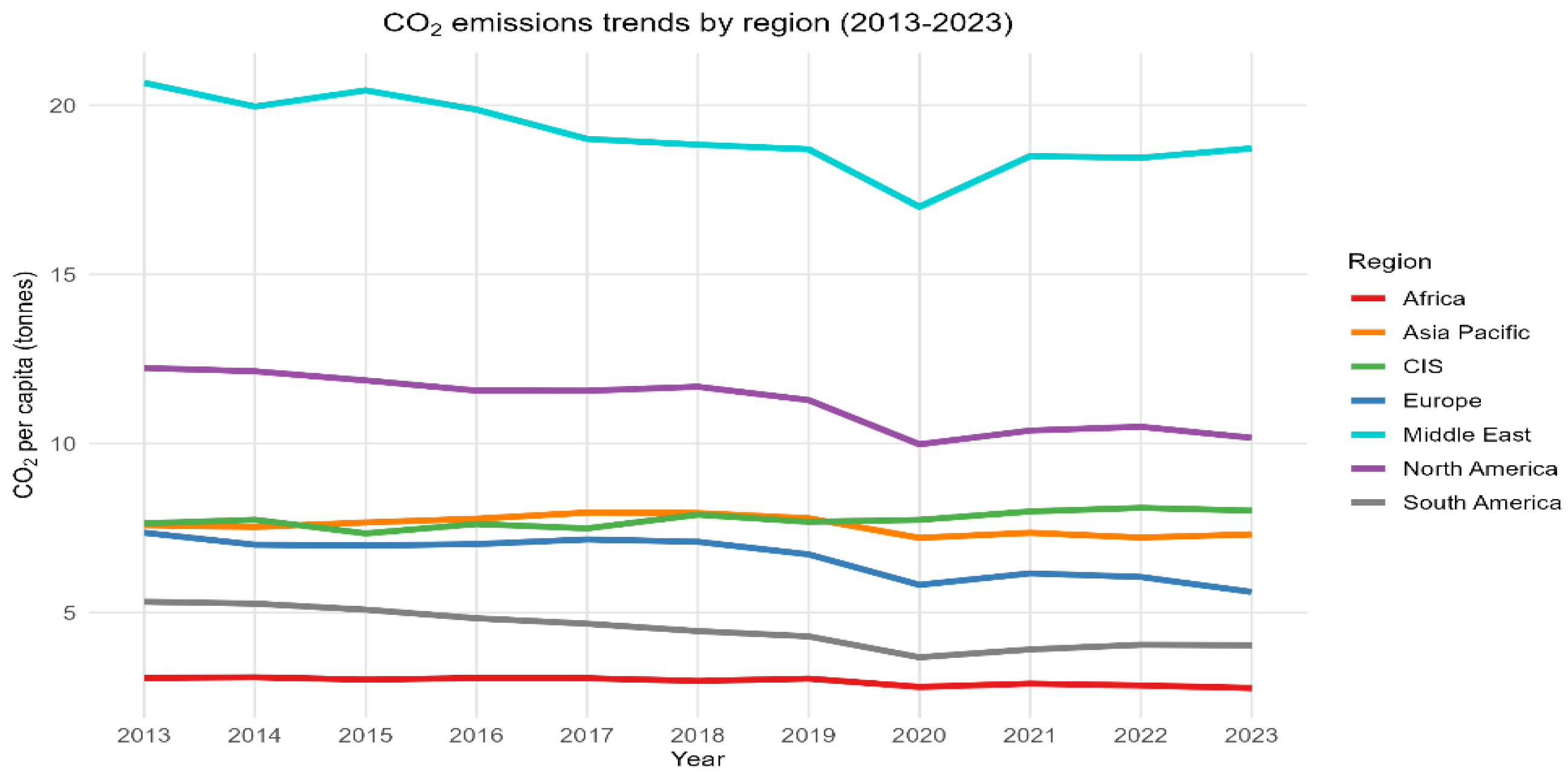
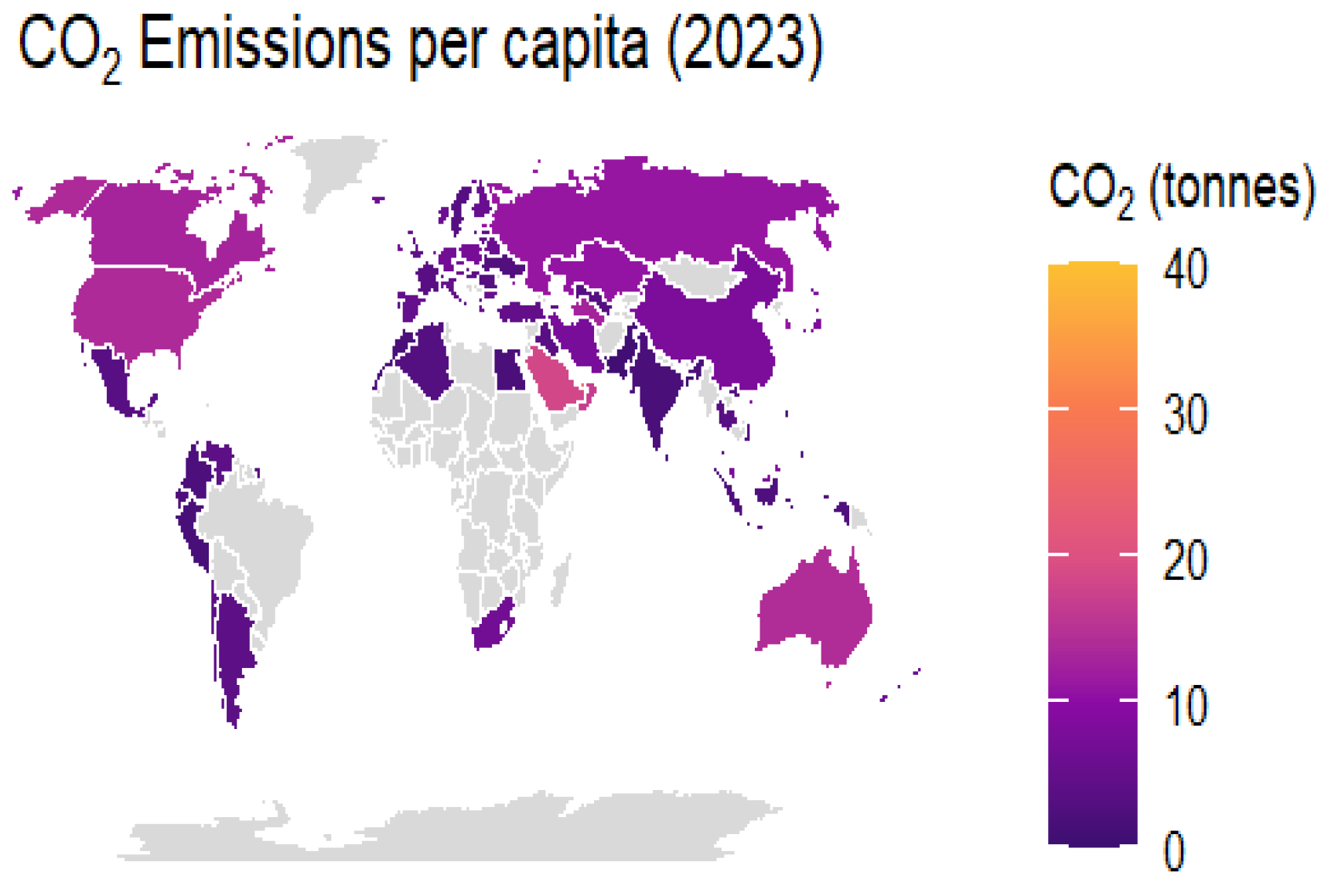
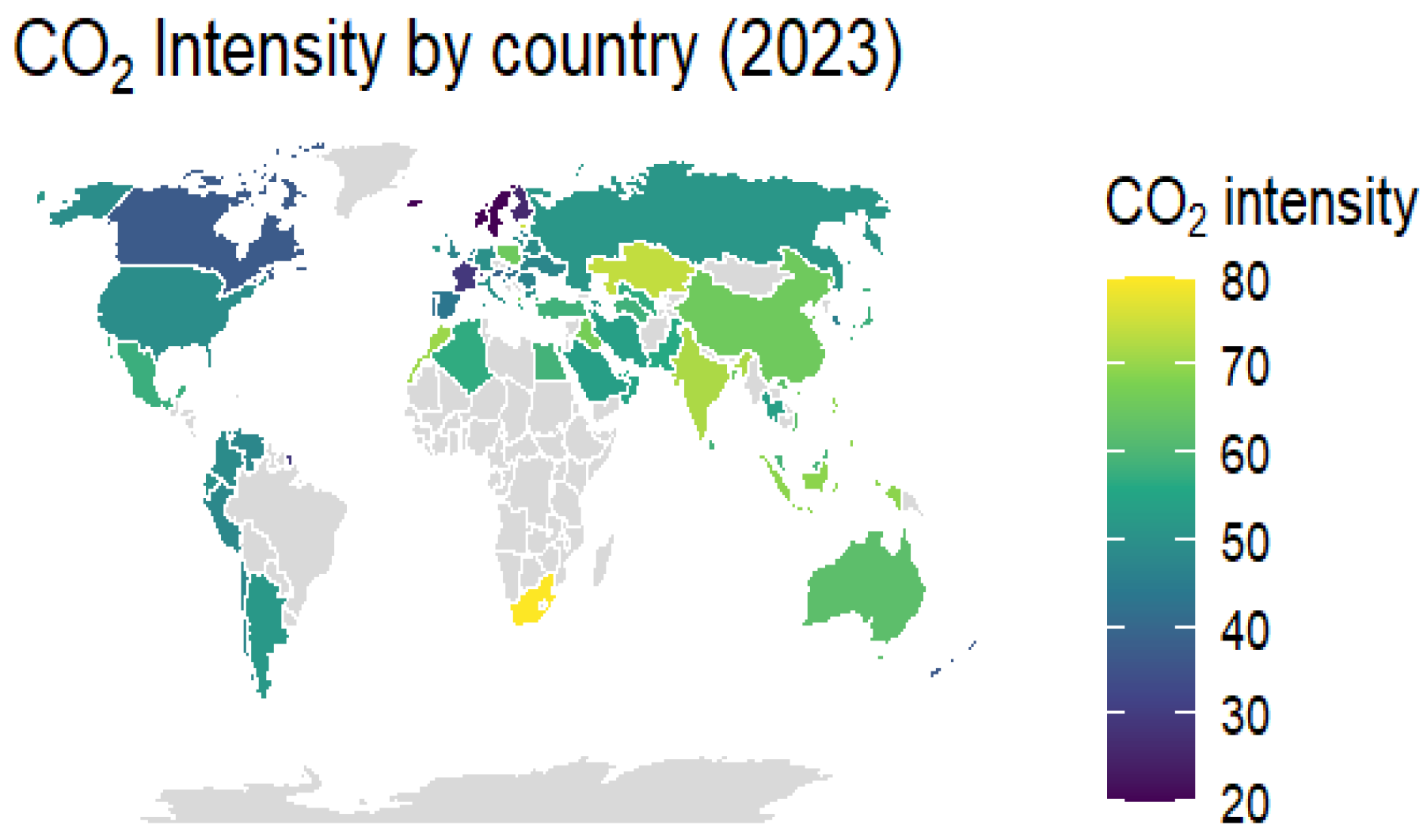
To characterize the dataset, we analyze the trends in regional carbon emissions (Figure 1), the geographic distribution of per capita carbon emissions (Figure 2), and carbon emissions intensity (Figure 3) for the last year of the period.
Figure 1 shows fluctuations in carbon emissions and their significant differences in distribution for the analyzed regions between 2013 and 2023. The Middle East consistently records the highest values, of approximately 18 t/capita, as well as the largest fluctuations, reflecting the massive dependence on fossil fuels and the economic structure based on the extraction and export of oil and gas.
North America ranks second, with around 10 t/capita at the end of the period, confirming the energy intensity of the economy, even although emissions are decreasing similar to Europe and South America. The CIS countries show relatively stable values, around 8 t/capita, with a slight increase after 2020, being the only region with an upward trend throughout the period. Europe is seen to have the most significant decrease, from around 7.5 to below 6 t/capita. This reduction is correlated with accelerated decarbonization amid energy transition policies. Asia Pacific has an upward trend until 2019, followed by a stabilization around 7–8 t/capita, influenced by the rapid industrialization of China and India. In contrast, South America and Africa remain at significantly lower levels, of 3–4 t/capita and below 2 t/capita, which reflects both the lower level of economic development and lower per capita energy consumption.
Descriptive statistical analysis of carbon emissions per capita, by region (Table 4), shows a fairly high volatility between the analyzed regions. Thus, the highest and most variable levels of CO2 per capita are in the Middle East, with an average of approx. 19 t/person and maximum values reaching up to approx. 53 t/person. North America is also above the global average, with over 11 t/person. The lowest levels of CO2 per capita are in Africa (2.97 t/person), which reflects low energy consumption due to limited access to clean energy resources and insufficient development. Europe has moderate values (6.64 t/person) and moderate dispersion of carbon emissions per capita, due to European decarbonization policies and similar energy profile of the countries.
Finally, Asia Pacific is a heterogeneous region, with an average of 7.58 t/person, which includes both low-emitting countries (e.g., India) and high-emitting countries (e.g., Australia).
Thus, viewed at the regional level, the differences are clear and comparable, with the global average not being representative as it masks variations and differences between regions.
Figure 2 provides a graphical representation of the global distribution of carbon emissions per capita in 2023. It is observed that developing countries (India, Bangladesh, Philippines) record the lowest carbon emissions, of approximately 1–3 t/capita, while developed countries (Canada, Australia) or countries dependent on oil and gas exports (Qatar, Saudi Arabia) record the highest carbon emissions.
From a regional perspective, Europe is relatively homogeneous, with most countries having carbon emissions below 10 t/capita, which can be associated with the efficiency of energy policies and the progress of the transition to renewable sources.
Regarding the global distribution of carbon intensity, Figure 3 shows that it is very varied and that there are major disparities across the seven regions.
Countries with very high intensity are coal-dependent countries (South Africa, Kazakhstan, China), while countries with a significant share of nuclear or renewable energy (France, Norway, Sweden, Iceland) record low levels of carbon intensity. Australia records medium values of carbon intensity, while the Middle Eastern countries have a relatively moderate carbon intensity, due to the efficiency of oil extraction. Finally, Europe is distinguished by low to medium values, confirming the transition to low-carbon sources.
Thus, given the theoretical framework in the literature, the collected data, and the results of the descriptive statistics, we formulate the following research hypotheses:
H1. 
During 2013–2023, CO2 intensity decreased in most regions;
H2. 
Per capita emissions decreased in advanced economies and remained high in emerging Asia (developing region);
H3. 
There is a decoupling between the growth of total energy consumption and the growth of total CO2 emissions at the regional level.
The research methodology involves several research methods, specific to each hypothesis formulated, namely the following: a comparative descriptive analysis (before–after) at the regional level; a comparative descriptive analysis with verification of distributions by countries (blocks of countries) for assessing robustness; and a descriptive analysis, a decoupling analysis (decomposition), and econometric modeling with fixed effects and logarithmic differences, each justifying its role in assessing decoupling.
Given the results of summary statistics (Table 3) with very high per capita emissions (with a large standard deviation of the data), their impact on the results is limited through several methodological choices. First, fixed-effects panel models estimate the energy–emissions relationship based on within-country variations over time, eliminating the influence of permanent structural differences across economies. Second, the use of logarithmic differences mitigates the impact of extreme values on the estimated coefficients. In addition, Driscoll–Kraay standard errors are robust to heteroskedasticity and cross-sectional dependence.
Overall, the research methods used are observational and quantitative, with longitudinal analysis on the balanced panel 2013–2023 and stratification by regions. We compare levels and changes of indicators defined at the country level and aggregated by regions, and the robustness of the results is verified using averages in the 2013–2015 and 2021–2023 periods and visual validation through maps and graphs.
Specifically, to test H1, the research method consists of a comparative descriptive analysis (before–after) at the regional level, based on the means and medians of the CO2 intensity indicator for the years 2013 and 2023. Thus, we verify whether the carbon intensity of energy decreased at the regional level in the interval 2013–2023. We calculate, for each region, the unweighted average by country of the CO2 intensity indicator in the starting year and in the ending year and then evaluate the absolute difference and the percentage variation between 2013 and 2023. In parallel, we confirm the direction of the result with medians by region and with simple checks of missing values, without imputation and without additional models.
To test H2, we apply descriptive–comparative analysis of per capita emissions between a priori defined geographical blocks, measuring the change in the unweighted average across countries between 2013 and 2023 and visualizing the distribution of changes at the country level, to assess the robustness of the result. Specifically, we compare the dynamics of per capita emissions between two geographical blocks explicitly defined in the sample. We form the group of advanced economies in Europe, North America, and the Asia–Pacific region, according to the International Monetary Fund classification [54]. We treat the rest of the Asia–Pacific countries as emerging Asia. For each block, we measure the change in per capita emissions between 2013 and 2023, as an unweighted average across countries, and then visualize the distribution of changes at the country level to show whether the block result is supported by most observations or depends on a few extreme cases. For transparency and robustness, we also reproduce the indicator in a population-weighted version, maintaining the same scale and units, so that the comparison between blocks remains easy to follow.
For H3, we perform the following, in this order: (i) a descriptive analysis of the energy–CO2 decoupling, for the part that uses aggregated data by region, Tapio classification and visualizations with bars and scatter plots; (ii) a panel model with fixed effects and logarithmic differences, for the econometric part that verifies the statistical relationship between the variation in emissions and the variation in energy consumption, using robust standard errors; and (iii) a Kaya–LMDI decomposition, for the part that separates the contributions of structural factors—carbon intensity, energy per capita, and population.
Therefore, we assess the decoupling between energy consumption and CO2 emissions at the regional level over the same period through descriptive analysis of decoupling, according to Tapio’s [18] classification, complemented with regional visualizations and robustness tests using three-year averages. Specifically, for each region, we aggregate the total emissions and total energy consumption in 2013 and 2023, calculate the percentage growth rates, and identify the decoupling according to Tapio’s [18] classification, based on the elasticity:
ε   =   % CO 2 % PE
where
  • % CO 2 = percentage change in total CO2;
  • % PE = percentage change in total primary energy consumption;
  • ε = energy–emissions elasticity (Tapio).
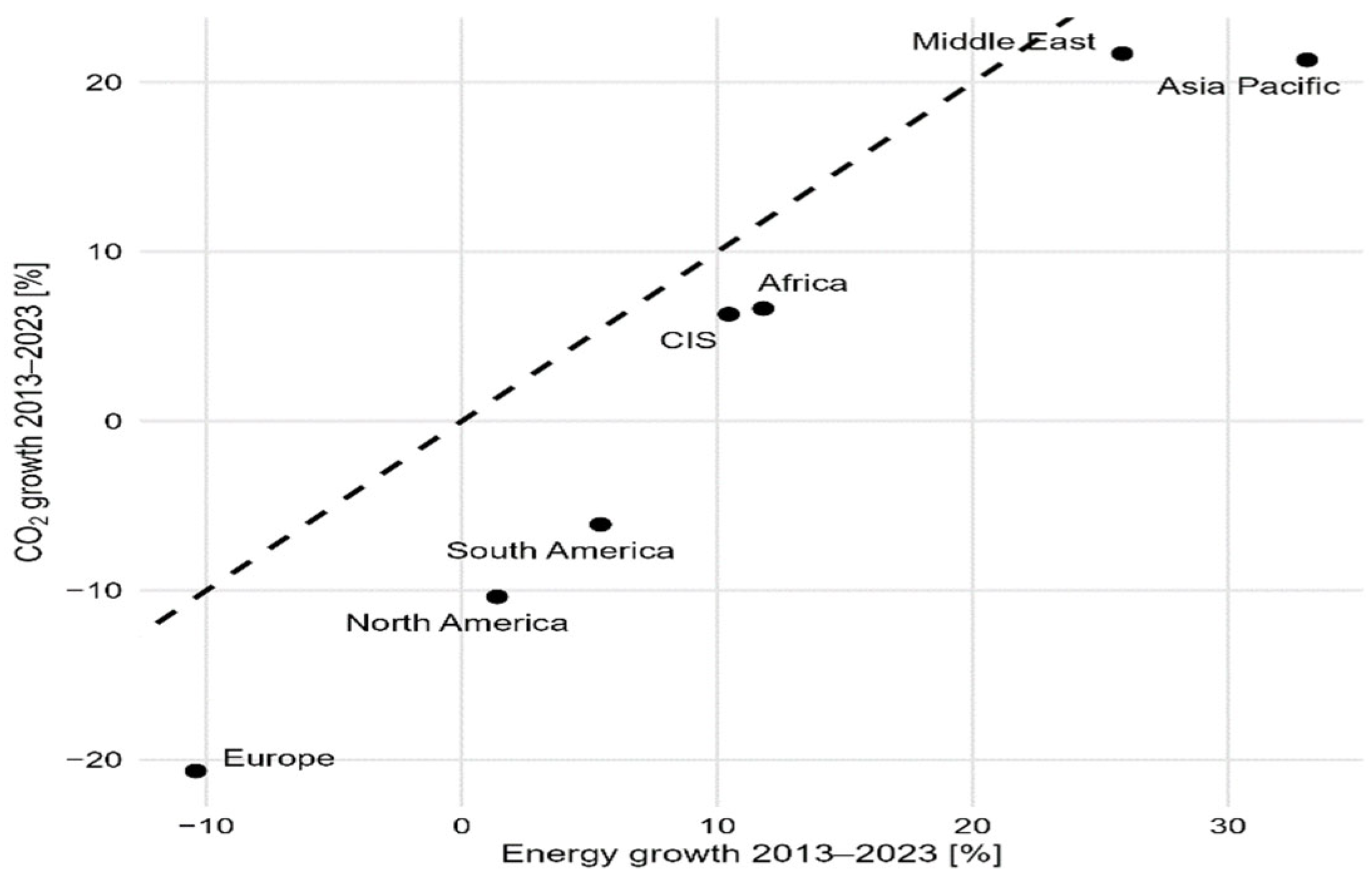
The results are complemented by supporting visualizations, with side-by-side bars for each region and a scatter plot against the 45-degree line, where positioning below the line indicates decoupling. To avoid a single atypical year influencing the conclusions, we re-run the calculations using the average of the values from the 2013–2015 interval and the average of the values from the 2021–2023 interval to see if the sign of the differences is maintained.
To identify the mechanism of decoupling, we apply a Kaya–LMDI decomposition at the regional level, separating the variation in 2013–2023 emissions into contributions from energy carbon intensity, energy per capita, and population in the same series without imputations.
Finally, we complete the analysis by applying a panel model with log-differences and country and year fixed effects, with robust Driscoll–Kraay standard errors. Thus, we estimate the statistical relationship between the variation in CO2 emissions and the variation in total energy consumption, with robust Driscoll–Kraay type standard errors, in the following form:
ln ( CO 2   i , t )   =   α i   +   γ t   +   β ln PE i , t   +   ε i , t
where
  • CO 2   i , t = total CO2 emissions in year t for each country in the sample i;
  • PE = total primary energy consumption;
  • γ t = control variable for shocks common to all states;
  • β = energy elasticity of CO2 emissions;
  • ε i , t = error term.
We estimate the model both for the entire sample of countries globally and separately for each region. This approach allows us to test whether the results obtained by the Tapio method are also confirmed over the annual horizon.

4. Results and Discussion

4.1. Results of the Comparative Descriptive Analysis (Before–After) at the Regional Level, Including Carbon Intensity and per Capita Emissions

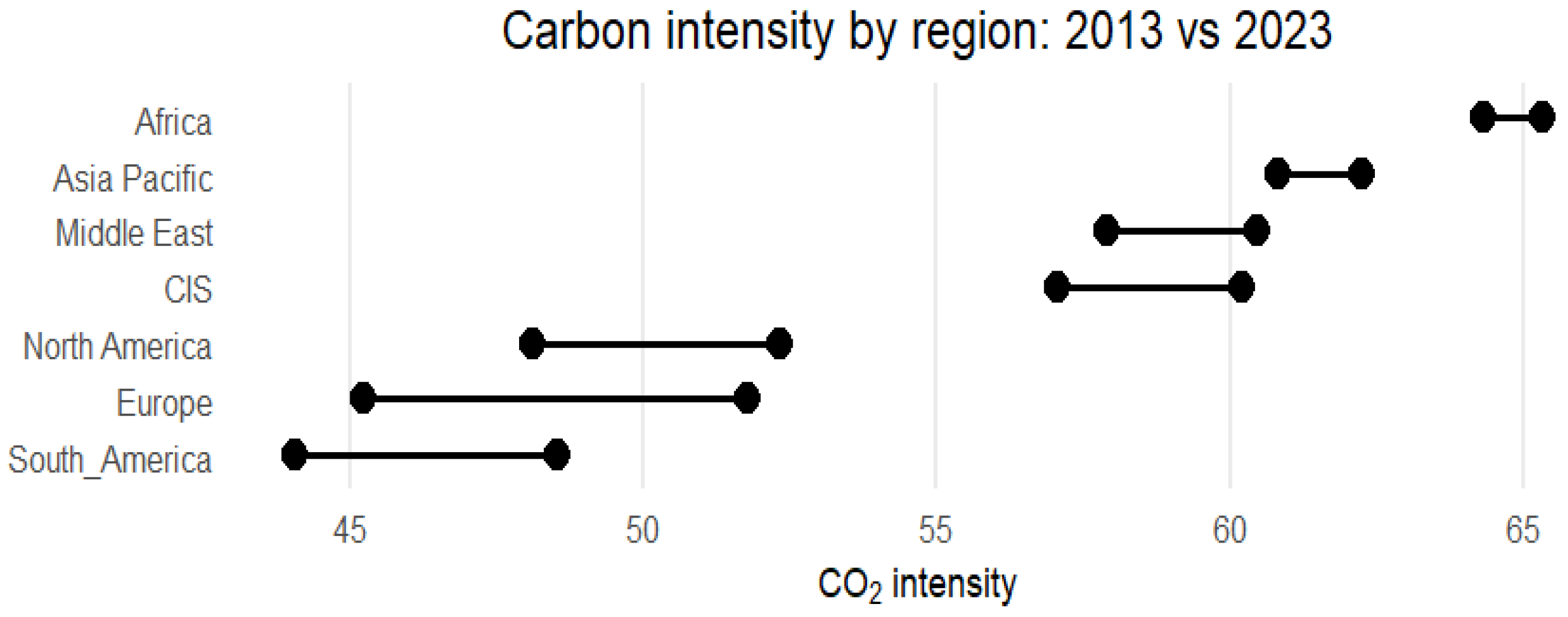
Comparing regional levels of energy carbon intensity (CI) in 2013 and 2023, the results in Table 5 confirm H1. All seven regions experience decreases in CI (MtCO2/EJ), with different magnitudes. Europe experiences the largest reduction (−6.53 MtCO2/EJ, equivalent to −12.6% compared to 2013), followed by South America (−9.18%) and North America (−8.03%). The CIS and the Middle East experience moderate decreases, between −5.19% and −4.22%. Finally, in the Asia–Pacific region, energy carbon intensity decreases in 2023 compared to 2013 by −2.29%, and Africa has the smallest adjustment, at −1.53% (Table 5).
Figure 4 visually summarizes these transitions, showing the partial convergence of regions towards lower levels but also the persistence of gaps. In Africa and the Asia–Pacific region, emissions remain above 60 MtCO2/EJ in 2023, while Europe and South America approach 45 MtCO2/EJ.
Evidence from the IEA and IPCC assessments (AR6), together with previous studies, indicates faster declines in carbon intensity in advanced economies, while in regions with a heavy dependence on coal progress has been much slower [27,29,55,56].
Therefore, the evidence on decoupling confirms that developed countries more frequently reach absolute decoupling and reduce intensity faster, while emerging economies are predominantly in relative decoupling, reflecting the differences in Table 5 [34,35,57,58].
Thus, we observe that the reduction in carbon intensity, although generally occurring, is still uneven across regions.
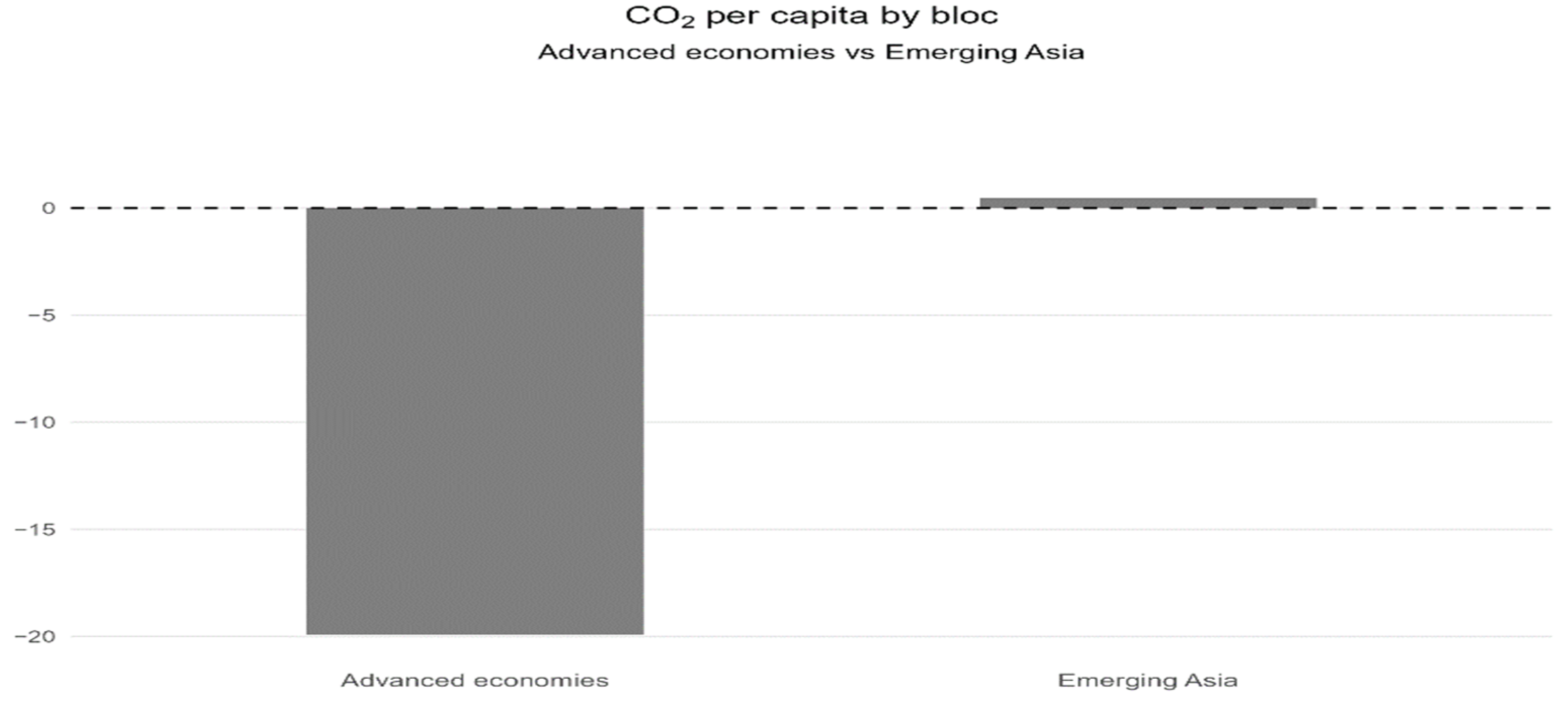
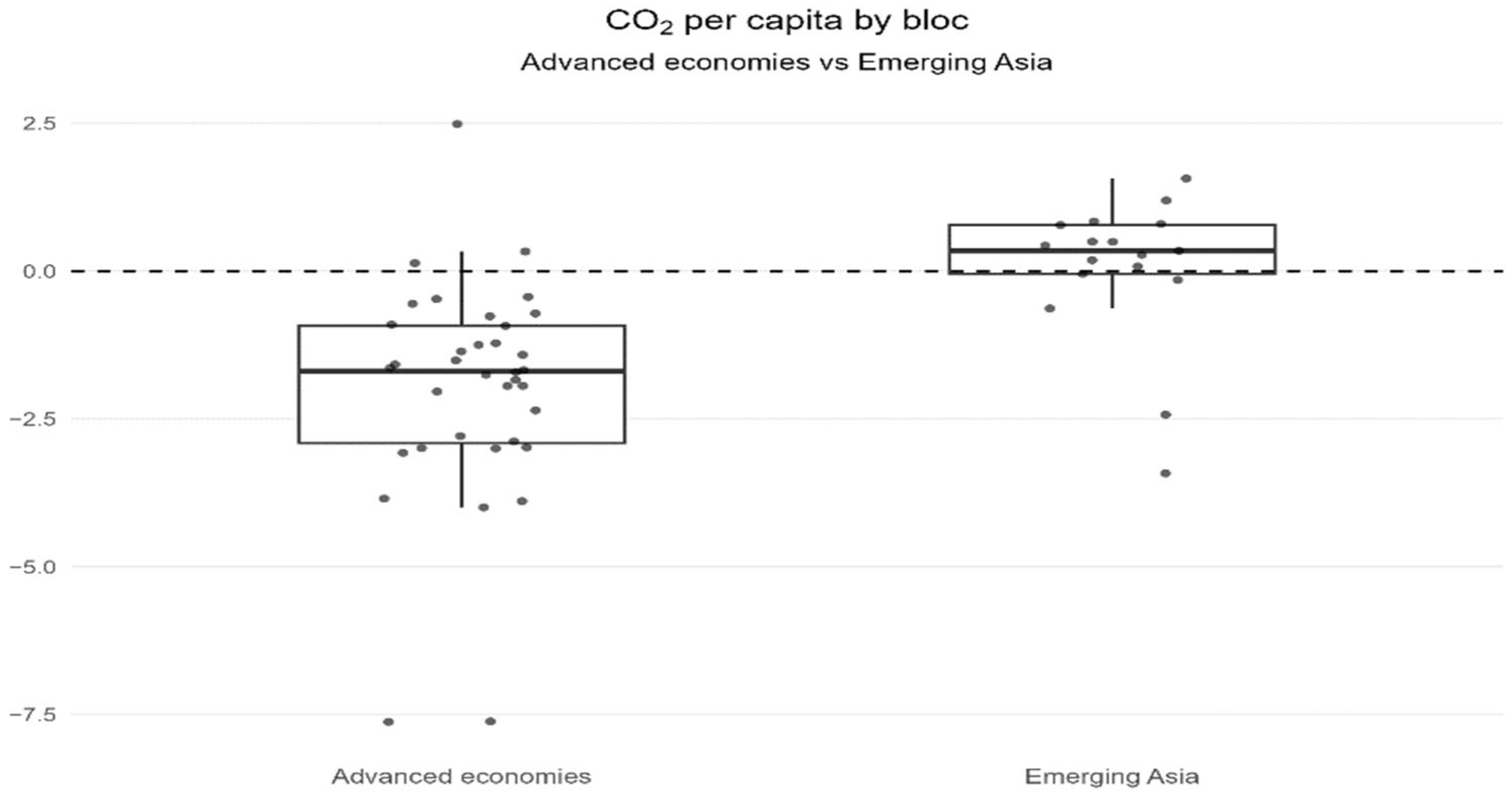
Comparing CO2 emissions per capita (CPC) between advanced economies and emerging Asia, according to the IMF classification [54], confirms hypothesis H2. Based on the data in Table 6, emissions reductions by approximately 19% are observed in advanced economies (from 8.85 t/person in 2013 to 7.16 t/person in 2023). In contrast, in emerging Asia (Bangladesh, China, India, Indonesia, Malaysia, Pakistan, Philippines, Sri Lanka, Thailand, and Vietnam), the reductions are insignificant, of approximately −1.18% (from 3.87 to 3.82 t/person).
Figure 5 captures the differences at the block level. Thus, advanced economies have a substantial average reduction, while emerging Asia remains at stable levels. Figure 6 details the distribution by country and shows that the decline in the advanced block is supported by most observations, with individual variations, but the overall trend is clearly downward.
The results are supported by international evidence. According to assessments by the IEA [28] and estimates from the Global Carbon Budget [55], per capita CO2 emissions have been falling in advanced economies. This trend is largely associated with increased electrification, efficiency improvements, and a progressively cleaner energy mix. A different picture appears in emerging Asia, where increasing energy demand linked to industrialization and urban growth continues to limit emission reductions [27,56]. In line with the literature on decoupling, absolute decoupling is therefore more often observed in advanced economies, while in emerging Asia the relationship remains predominantly one of relative decoupling or, in some cases, no clear decoupling at all [29,57].

4.2. Results of the Panel Econometric Model with Fixed Effects and Log-Differences

4.2.1. Aggregate Elasticity of the Decoupling-Emissions Relationship, at the Regional Level, over the Entire Analyzed Horizon (2013–2023)

The comparison between the dynamics of total CO2 emissions and total energy consumption (PE) also confirms hypothesis H3, which evaluates the relationship according to Tapio [18], at the aggregate level, over the entire analyzed period of 10 years. Table 7 presents the dynamics of energy and carbon emissions at the level of the seven global regions, considering the ends of the analyzed interval, 2013 to 2023, according to the Tapio [18] method.
Based on the values obtained in Table 7, where we calculated the elasticity ( ε ), for the period 2013–2023, a classification of regions according to the Tapio typology [18] is presented in Table 8.
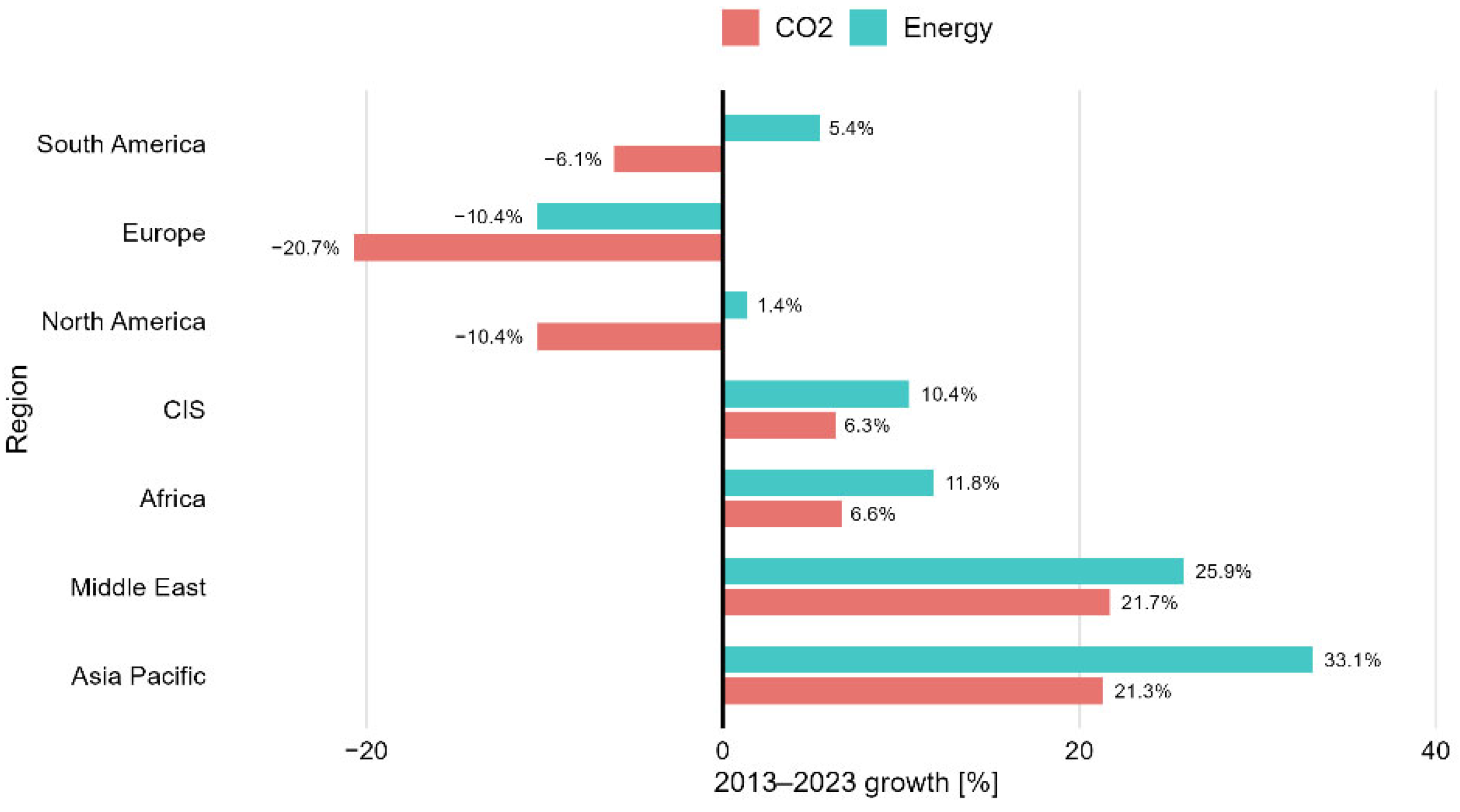
According to the results from Table 8, Europe is in recessive decoupling, with total primary energy consumption decreasing by 10.4%, while CO2 emissions decrease faster (by 20.7%), resulting in an elasticity ε of approximately 1.98. North America and South America present characteristics of expansive strong decoupling, with total primary energy consumption increasing slightly (by 1.4%) or moderately (by 5.4%), and emissions decreasing by 10.4% and 6.1%, respectively, showing the result of ε being negative, with a strong decoupling. Finally, Africa, CIS, and Asia Pacific present expansive weak decoupling, as both variables increase, while CO2 remains below the energy dynamics, with ε between 0.56 and 0.84. The difference is more visible in the Asia–Pacific region (energy increases by 33.1%, and emissions by 21.3%).
Figure 7 illustrates these variations at the regional level, while Figure 8 presents regions position according to the 45-degree line, so the results are also supported visually.

4.2.2. Annual Elasticity of the Decoupling–Emissions Relationship, Overall and by Region

To verify whether the decoupling–emissions relationship identified by the Tapio method holds, we also verify it in an econometric framework by estimating the panel model in differences with Driscoll–Kraay errors. The difference from the previous approach is that, through Tapio, we test trends over the 10-year horizon (by using initial and final values), while through the econometric model, we estimate the annual elasticity between the dynamics of energy consumption and emissions. In other words, through Tapio we obtain the aggregate result of the period 2013–2023, while the panel model identifies how the variables evolve in the usual years of the interval without being influenced by atypical years. The results obtained are summarized in Table 9.
The results reveal that at the global level (for the entire sample), the energy–emissions elasticity is very close to 1 (β = 0.98), and the tests do not reject the hypothesis β = 1, which suggests the absence of decoupling at the global level in the analyzed period.
At the regional level, the results are quite interesting and present some nuances that need to be analyzed. Thus, from the econometric model, Africa, Asia Pacific, CIS, and the Middle East have elasticities very close to 1, and the tests do not reject the hypothesis β = 1, which suggests that the dynamics of CO2 and energy consumption are quite close. In contrast, the Tapio elasticities (located between 0.56 and 0.84, as observed in Table 8) indicate, for these regions, forms of expansive strong decoupling or expansive weak decoupling over the period 2013–2023. The results are not contradictory but only show the differences between capturing the trends over a 10-year horizon compared to the dynamics of emissions and consumption at the annual level, which are quite sensitive to market volatility and short-term shocks [55]. The results are similar to those obtained by other authors [59,60,61], who, although they find episodes of decoupling in these regions, consider them limited and dependent on the dynamics of the business cycle.
In contrast, in Europe, the elasticity is sub-unitary (β = 0.84). In other words, the results of econometric modeling show that, at the annual horizon, the growth of emissions is slower than the growth of energy consumption, suggesting the existence of relative decoupling. This result is similar to the Tapio classification, according to which Europe is in recessive decoupling. Evidence in this sense is frequently provided in the literature [19,62], but some authors argue that some components of the European decoupling are cyclical or dependent on temporary structural changes [63,64].
Finally, North America and South America present above unity elasticities (β = 1.25 and β = 1.18, respectively), which indicates that, over the annual horizon, for the same percentage change in energy consumption, the change in CO2 emissions is larger than that of energy. The result, although it seems different from the Tapio analysis, which shows for both regions expansive strong decoupling over the entire interval 2013–2023, is in fact in agreement with it. Specifically, the econometric result suggests that the emission declines in 2020–2021, which determine the Tapio decoupling, are isolated episodes and do not translate into the annual relationship captured by the econometric model. Similar results are obtained by other authors [28,55,58], who show that the emission reductions in North and South America reflect exogenous shocks and non-persistent trends.
Overall, the Tapio elasticity shows long-term decoupling over the entire analyzed period (2013–2023), while the panel estimates describe average elasticities over the annual horizon. Since these annual measures are more sensitive to short-term fluctuations and external shocks, it is expected that there will be divergences between the results obtained. Therefore, these differences stem from the time horizon considered in the analysis, not from inconsistencies in the applied methodologies.

4.3. Results of the Kaya–LMDI Decomposition Analysis

To identify the mechanism by which different factors contribute to the dynamics of carbon emissions within the sample by regions, we also apply a Kaya/LMDI decomposition on three factors, namely energy carbon intensity, energy per capita, and population.
The results in Table 10 show that fewer emissions in Europe come from the reduction in carbon intensity and the decrease in total energy consumption per capita, while population partially mitigates the total effect. This result is in agreement with the recessive decoupling shown in Table 8 and the dynamics in Figure 8.
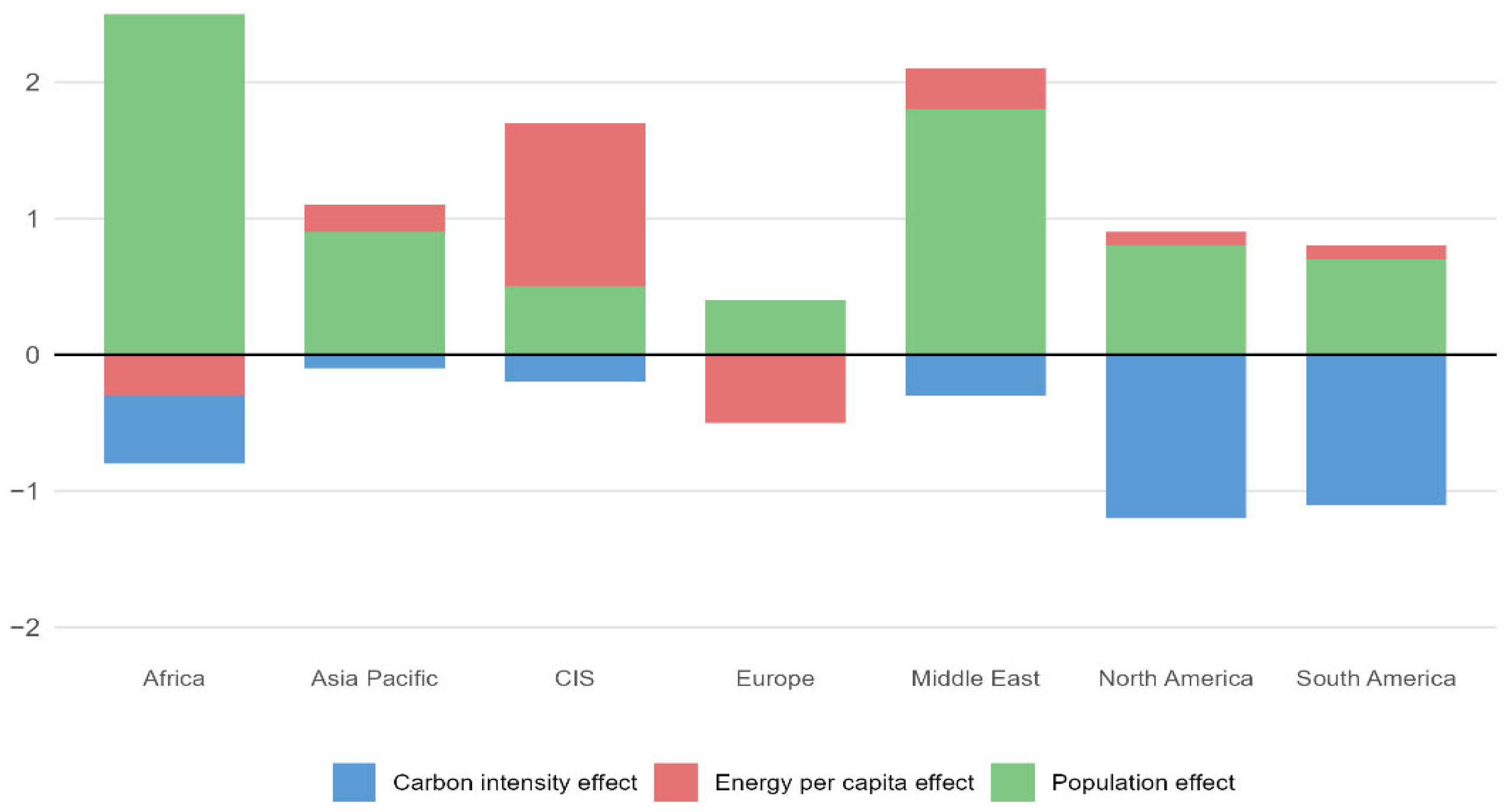
In North America, intensity and total energy consumption per capita contribute negatively, while population has a positive contribution, resulting in a strong expansive decoupling pattern (Table 8). South America shows the same pattern of contributions, with a negative effect of intensity and energy per capita and a positive effect of population, the net result remaining negative. Similarly, in the Asia–Pacific region and the Middle East, carbon intensity contributes negatively, but energy per capita and population growth outweigh this reduction. This explains why emissions grow more slowly than energy, consistent with the weak expansive decoupling identified (Table 8). Finally, Africa and CIS have an intermediate profile, with decreases in carbon intensity but consistent increases in energy and population per capita.
Overall, Table 10 makes it clear how reducing carbon intensity supports decoupling, and the combination of energy per capita and population size explains the differences between strong and relative decoupling.
The distribution of contributions is shown in Figure 9. Thus, we observe that, in regions with strong decoupling, the reduction in carbon intensity and the decrease in energy consumption per capita made a major contribution to the reduction of emissions. Conversely, in regions with relative decoupling, the positive effects of the reduction in carbon intensity were diminished by the increase in population and energy consumption per capita.
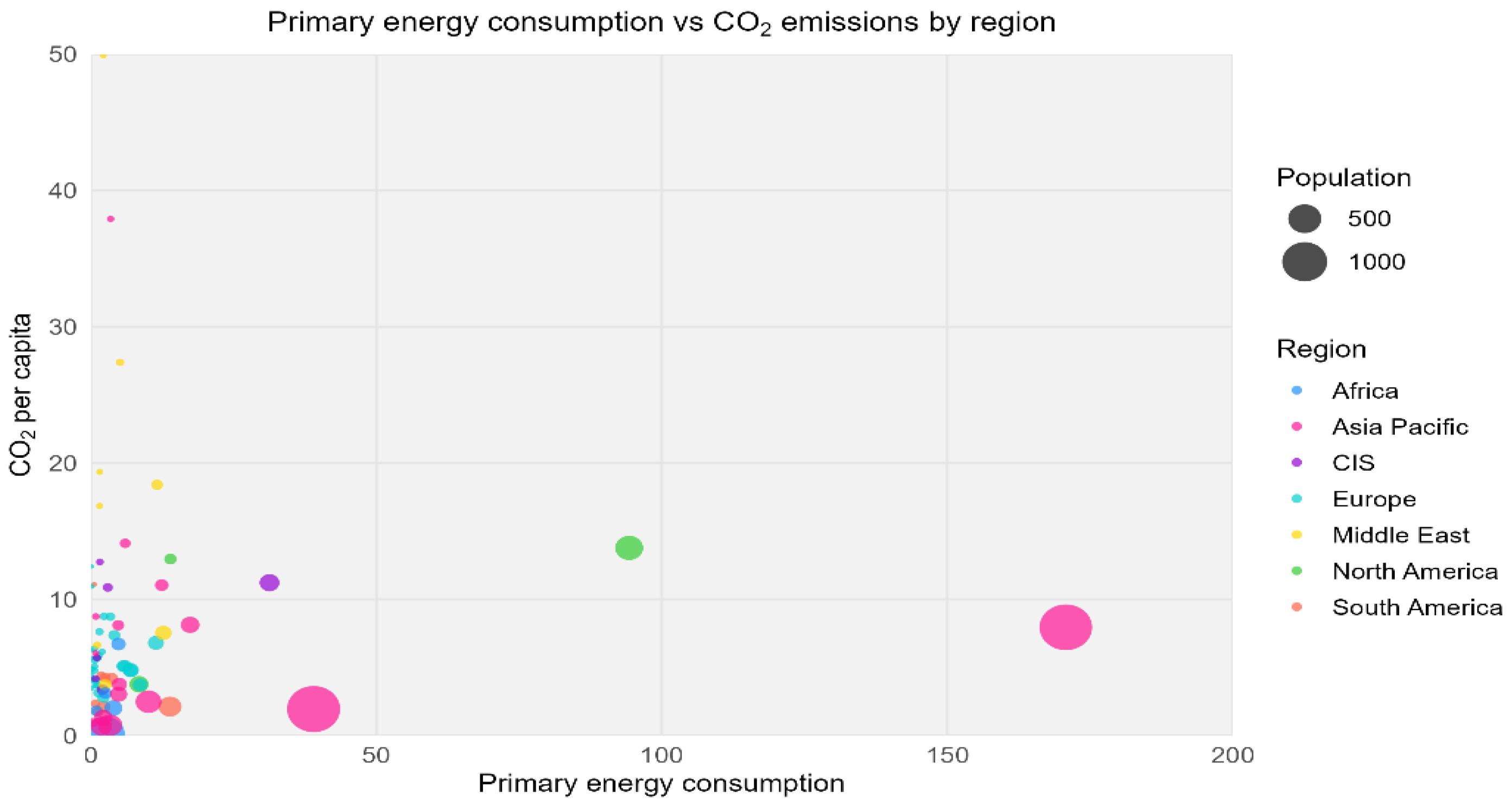
Figure 10 presents the relationship between total primary energy consumption and CO2 emissions per capita in 2023. Therefore, the distribution shows that regions that are high consumers (e.g., Asia Pacific and North America) have high levels of total energy and moderate to high emissions per capita. On the other hand, regions with large populations (Africa, South Asia) have low values on both axes. This confirms that regional differences in demographic and energy profiles directly influence the type of decoupling identified in Table 7, Table 8 and Table 9.
The results are similar to those obtained by the authors [19,58,62,63,64,65] who document the determinants and structural decompositions of emissions, where they explain the transition to decoupling through decreasing energy and carbon intensity and through changes in the structure of production and consumption.
In addition to the issues analyzed, the literature also brings into discussion other important concepts for long-term sustainability, such as system resilience, structural transformation, or adaptive capacity. Although we recognize the importance of these concepts in the analysis of energy transition and long-term sustainability, they are beyond the scope of our study and will be explored in future research.

5. Conclusions

The objective of the paper is to analyze the relationship between energy consumption and CO2 emissions at the regional level. The focus is on 79 countries and regional entities, grouped into seven regions, for the period 2013–2023. To achieve the objective of the paper, we use several research tools that include Tapio elasticity, Kaya/LMDI decomposition, and a panel econometric model with fixed effects per year and Driscoll–Kraay errors [18,25,66]. The choice of this research model was motivated by the need to ensure comparability between global and regional dynamics and, on the other hand, by the need to distinguish between structural and cyclical trends (on an annual horizon) of the emissions–consumption relationship.
The results obtained confirmed the three research hypotheses formulated. However, beyond confirming the hypotheses, we have shown that decoupling is uneven across the regions analyzed and strongly dependent on conjunctural situations. These findings are also highlighted in the literature, which draws attention to the fact that decoupling episodes are limited and cyclical [10,12,63,64].
The results obtained by testing the Hypothesis H1 showed that, although carbon intensity decreased in all regions during the period 2013–2023, the reduction is asymmetric. Europe had the most significant reduction in 2023, followed by South America and North America. In contrast, the CIS and the Middle East had moderate reductions, while Asia Pacific and Africa had extremely modest reductions. This creates a different profile of the regions depending on the level of economic development and the consistency of the energy transition. At the same time, the results show a number of gaps in the reduction in carbon intensity due to the different composition of the energy mix and the different stages of the energy transition in which the countries are at the regional level. For example, in Europe and North and South America, decarbonization of the mix and climate policies have reduced the carbon intensity of electricity [19,30,38], while Africa and the Asia–Pacific region have made extremely slow progress due to dependence on coal and limited access to technology [10,27].
The per capita analysis of CO2 emissions confirmed Hypothesis H2 and showed that they have decreased considerably in advanced economies, while remaining almost constant in emerging Asia. Country-level distributions showed that the reductions in the advanced group of countries are not influenced by the dominant countries but are supported by the majority of the analyzed economies. In contrast, in emerging Asia, although the dispersion is high, the population-weighted averages still show a stagnant profile. The results are in agreement with the literature, confirming that in developed countries the reduction in CO2 emissions per capita is the result of increased efficiency and the use of clean energy, while rapidly industrializing countries face a stagnation of emissions per capita [22,28,55,58].
Regarding Hypothesis H3, the obtained results showed that there is decoupling between the growth of total energy consumption and the growth of CO2 emissions at the regional level, but the intensity and forms of manifestation are different. Therefore, the Tapio classification results in Europe being in recessive decoupling (energy consumption decreases, while emissions decrease, with an elasticity ε = 1.98), while North and South America are in expansive strong decoupling (moderate increases in energy consumption, concomitant with reductions in CO2 emissions). In contrast, Africa, Asia Pacific, CIS, and the Middle East are in an expansive weak decoupling process characterized by energy growth rates ranging between 10.4% and 33.1% and emissions increases between 6.3% and 21.7%. The elasticity for these countries is between 0.56 and 0.84, which shows a slower increase in emissions than the increase in energy consumption [18,32]. This result confirms Hypothesis H3 but also shows that the strong decoupling is specific only to certain regions, while in others it remains in a predominantly relative form.
The panel model with log-differences and fixed effects nuanced these results. Moreover, the results of the econometric model showed that, at the global level, the energy–emissions elasticity is very close to 1, and the tests do not reject the hypothesis β = 1. This result suggests the absence of a robust decoupling at the level of the entire sample of countries. In contrast, at the regional level, the results, although they seem different from those obtained by Tapio, actually indicate that the decoupling is strongly dependent on the conjunctural situations. Thus, Africa, Asia Pacific, CIS, and the Middle East have almost unitary elasticities, which suggests that the dynamics of CO2 and energy consumption are quite close. In contrast, Europe has a sub-unitary elasticity, which shows a persistent decoupling, while North and South America have elasticities above unity, suggesting that in these regions, the decoupling identified by Tapio reflects cyclical shocks (e.g., the COVID-19 pandemic) and not necessarily a structural relationship [58,59,60,61].
The econometric results for the global panel show that the elasticity is close to unity. Overall, the results show that emissions reductions evolve, on average, in close relation to global economic activity. In these circumstances, global decoupling appears to be limited, and regional progress is mainly associated with cyclical factors, rather than deep structural transformations. Thus, regional decoupling is fragile and uneven, and public policies should focus on strengthening structural mechanisms to reduce carbon intensity rather than on short-term outcomes.
This perspective was reinforced by the Kaya/LMDI analysis, which showed that in regions with strong decoupling (Europe, North America, South America) emissions reductions are supported by decreases in carbon intensity and, in some cases, in per capita energy. On the other hand, in regions with weak or partial decoupling (such as, for example, Asia Pacific, Africa, CIS, and the Middle East) reducing carbon intensity brings a positive boost, but the rate at which energy consumption per capita increases, combined with a rapid population growth, is higher than any technological gain. In other words, in these regions, even if efforts are made to shift the energy mix towards clean energy, population growth negatively affects emissions, canceling out the benefits of reducing intensity. As a result, Hypothesis H3 was also confirmed, but with some nuances. Energy–emissions decoupling remains deeply uneven across regions and dependent on the combination of technological progress, the structure of energy demand, and the cyclicality of economic shocks [19,27,55,58].
Essentially, the results obtained allow the separation of structural trends from annual variations and integrate carbon intensity, energy per capita, and population in the same framework to explain why some regions manage to achieve strong decoupling while others only experience relative or partial decoupling. These results are useful for calibrating regional energy policies and for understanding that decoupling episodes are often conjunctural and directly affected by economic shocks. Compared to the existing literature, the triangulation of research tools makes an additional contribution by allowing a direct comparison of the typology of decoupling between Tapio elasticity, the Kaya/LMDI decomposition, and the panel econometric model.
In terms of policy recommendations to support the energy transition, this study clearly shows the effectiveness of policies where they have been implemented and are being maintained over time.
Given the uneven patterns of decoupling identified at regional level, the policy implications can be summarized as follows:
  • In regions with persistent or structural decoupling (e.g., Europe), the results show that the policies already implemented have worked on and produced consistent effects over time. In this context, the priority is not to reinvent a policy framework but to strengthen and maintain it in the long term. Carbon pricing mechanisms, strict energy standards, and climate targets should be adjusted gradually. By doing so, the progress achieved is maintained even in the face of economic shocks or tensions in energy markets.
  • In regions where decoupling is uneven or predominantly cyclical (e.g., North and South America), emission reductions appear to be mainly linked to short-term factors, such as economic shocks or periods of temporary decline in activity. In these circumstances, policies should aim to transform these short-term episodes into more sustainable structural processes. An important step is to shift investments towards clean technologies and low-emission energy infrastructure, capable of supporting decoupling beyond the cyclical phases of the economy.
  • In regions characterized by weak or relative decoupling (e.g., Africa, Asia Pacific, CIS, and the Middle East), the results point to the need for policies that are much more carefully tailored to the regional and sectoral context. The focus needs to be on reducing carbon intensity, while managing rapidly growing energy demand and demographic pressures. As there are a number of differences from one region to another in terms of institutional capacity, the composition of the energy mix, and industrial structures, it is quite clear that uniform solutions cannot work in practice. What seems to be important instead are approaches that can be adapted to local circumstances and the stage of the energy transition. This usually means focusing first on energy efficiency, gradually expanding the energy mix and directing investments towards low-emission technologies. In parallel, increased attention needs to be paid to energy security, especially in regions where energy demand is growing rapidly.
This study includes several limitations that we have taken into account. First, the analysis period of 2013–2023, although it captures some large shocks (such as the COVID-19 pandemic), is still short enough to capture long-term structural trends. Second, given the sample structure, heterogeneities may arise between countries in the same region, both in terms of policies and economic structure. Third, the focus on energy and CO2 emissions does not capture other GHGs—such as methane and nitrous oxide—whose dynamics are driven by different sectoral mechanisms and may alter the emissions profile of the analyzed regions. Of course, these limitations do not invalidate the research results but only set the framework for the analysis.
Future research could extend the current analysis by incorporating concepts such as system resilience, structural transformation, and adaptive capacity, which are important for understanding energy transition and long-term sustainability; by including additional sustainability dimensions, such as social development, industrial transformation, and energy security; and by examining how regional innovation policies—such as Research and Development investment and clean energy patents—affect carbon intensity reductions.


Author Contributions

Conceptualization, R.M.D., M.C. and C.S.; methodology, R.M.D. and M.C.; software, R.M.D. and M.C.; validation, R.M.D., M.C. and C.S.; formal analysis, I.N. and A.N.; investigation, R.M.D., M.C. and C.S.; resources, R.M.D. and I.N.; data curation, I.N. and A.N.; writing—original draft preparation, R.M.D., M.C., C.S., I.N. and A.N.; writing—review and editing, R.M.D., M.C. and C.S.; visualization, R.M.D. and M.C.; supervision, R.M.D. All authors have read and agreed to the published version of the manuscript.

Funding

This research received no external funding.

Institutional Review Board Statement

Not applicable.

Informed Consent Statement

Not applicable.

Data Availability Statement

The data used in this study are publicly available. Carbon dioxide emissions from energy (CO2) and primary energy consumption (PE) were obtained from the Energy Institute, Statistical Review of World Energy 2024, available at: https://www.energyinst.org/statistical-review (accessed on 3 June 2025). Population data (POP) were retrieved from the World Bank, World Development Indicators, indicator SP.POP.TOTL, available at: https://data.worldbank.org/indicator/SP.POP.TOTL (accessed on 6 July 2025). CO2 intensity of energy (CI) and CO2 emissions per capita (CPC) were computed by the authors using these publicly available primary datasets. No proprietary or restricted-access data were used in this study.

Conflicts of Interest

The authors declare no conflicts of interest.

Abbreviations

The following abbreviations are used in this manuscript:
AR6IPCC Sixth Assessment Report
CPCCO2 Emissions Per Capita
CICO2 Intensity of Energy
CISCommonwealth of Independent States
CO2Carbon Dioxide Emissions from Energy
EJExajoules
EKCEnvironmental Kuznets Curve
ETSEmissions Trading System
EUEuropean Union
FEFixed Effects
GDPGross Domestic Product
GHGGreenhouse Gas(es)
IMFInternational Monetary Fund
IPCCIntergovernmental Panel on Climate Change
LMDILogarithmic Mean Divisia Index
MtCO2Megatons of CO2
OECDOrganisation for Economic Co-operation and Development
PEPrimary energy consumption
POPPopulation
tCO2Tons of CO2 per person
UNFCCCUnited Nations Framework Convention on Climate Change

Appendix A

Table A1. Distribution of reporting entities by region within the analysis sample.
No.RegionCountry/Entities
1North AmericaCanada, Mexico, US
2South AmericaArgentina, Brazil, Chile, Colombia, Ecuador, Peru, Trinidad and Tobago, Venezuela
3EuropeAustria, Belgium, Bulgaria, Croatia, Cyprus, Czech Republic, Denmark, Estonia, Finland, France, Germany, Greece, Hungary, Iceland, Ireland, Italy, Latvia, Lithuania, Luxembourg, Netherlands, North Macedonia, Norway, Poland, Portugal, Romania, Slovakia, Slovenia, Spain, Sweden, Switzerland, Turkey, Ukraine, UK
4CISAzerbaijan, Belarus, Kazakhstan, Russian Federation, Turkmenistan, Uzbekistan
5Middle EastIran, Iraq, Israel, Kuwait, Oman, Qatar, Saudi Arabia, UAE
6AfricaAlgeria, Egypt, Morocco, South Africa, Eastern Africa (regional aggregate)
7Asia PacificAustralia, Bangladesh, China, Hong Kong SAR (China), India, Indonesia, Japan, Malaysia, New Zealand, Pakistan, Philippines, Singapore, South Korea, Sri Lanka, Thailand, Vietnam
Source: Authors’ contribution.

References

  1. Gbadeyan, O.J.; Muthivhi, J.; Linganiso, L.Z.; Deenadayalu, N. Decoupling economic growth from carbon emissions. Clean Technol. 2024, 6, 1076–1113. [Google Scholar] [CrossRef]
  2. Hurduzeu, G.; Noja, G.G.; Cristea, M.; Drăcea, R.M.; Filip, R.I. Revisiting the Impact of ESG Practices on Firm Financial Performance in the Energy Sector: New Empirical Evidence. Econ. Comput. Econ. Cybern. Stud. Res. 2022, 56, 37–53. [Google Scholar] [CrossRef]
  3. Majeed, M.T.; Mumtaz, S. Happiness and environmental degradation. Pak. J. Commer. Soc. Sci. 2017, 11, 753–772. [Google Scholar]
  4. Leal, P.A.; Marques, A.C.; Fuinhas, J.A. Australia sectoral decomposition. Econ. Anal. Policy 2018, 62, 12–26. [Google Scholar] [CrossRef]
  5. Drăcea, R.M.; Cristea, S.M.; Nimerenco, I.; Teodor, C. Interactions and shocks in energy markets—Empirical evidence from VAR modeling. Proc. Int. Conf. Bus. Excell. 2025, 19, 5149–5171. [Google Scholar] [CrossRef]
  6. Pao, H.-T.; Chen, C.-C. G20 decoupling. J. Clean. Prod. 2019, 206, 907–919. [Google Scholar] [CrossRef]
  7. Ahmed, A.D.; Huo, R. Volatility transmissions across international oil market, commodity futures and stock markets: Empirical evidence from China. Energy Econ. 2020, 93, 104741. [Google Scholar] [CrossRef]
  8. Shen, T.; Hu, R.; Hu, P.; Tao, Z. Decoupling between Economic growth and carbon emissions: Based on four major regions in China. Int. J. Environ. Res. Public Health 2023, 20, 1496. [Google Scholar] [CrossRef]
  9. Noja, G.G.; Cristea, M.; Pirtea, M.G.; Panait, M.; Drăcea, R.M.; Abrudan, D. Drivers of firms’ financial performance in the energy sector: A comparative approach between the conventional and renewable energy fields. Eng. Econ. 2023, 34, 205–222. [Google Scholar] [CrossRef]
  10. Haberl, H.; Wiedenhofer, D.; Virág, D.; Kalt, G.; Plank, B.; Brockway, P.; Fishman, T.; Hausknost, D.; Krausmann, F.; Leon-Gruchalski, B.; et al. A systematic review of the evidence on decoupling of GDP, resource use and GHG emissions: Part II: Synthesizing the insights. Environ. Res. Lett. 2020, 15, 065003. [Google Scholar] [CrossRef]
  11. OECD. Sustainable Development: Indicators to Measure Decoupling of Environmental Pressure from Economic Growth; OECD: Paris, France, 2002; Available online: https://www.oecd.org/env/indicators-modelling-outlooks/1933638.pdf (accessed on 2 December 2025).
  12. Schandl, H.; Hatfield-Dodds, S.; Wiedmann, T.; Geschke, A.; Cai, Y.; West, J.; Newth, D.; Baynes, T.; Lenzen, M.; Owen, A. Decoupling global environmental pressure and economic growth: Scenarios for energy use, materials use and carbon emissions. J. Clean. Prod. 2016, 132, 45–56. [Google Scholar] [CrossRef]
  13. Saidi, K.; Hammami, S. The impact of CO2 emissions and economic growth on energy consumption in 58 countries. Energy Rep. 2015, 1, 62–70. [Google Scholar] [CrossRef]
  14. Wu, Y.; Zhu, Q.; Zhu, B. Decoupling analysis of world economic growth and CO2 emissions: A study comparing developed and developing countries. J. Clean. Prod. 2018, 190, 94–103. [Google Scholar] [CrossRef]
  15. Chen, J.; Wang, P.; Cui, L.; Huang, S.; Song, M. Decomposition and decoupling analysis of CO2 emissions in OECD. Appl. Energy 2018, 231, 937–950. [Google Scholar] [CrossRef]
  16. Shuai, C.; Chen, X.; Wu, Y.; Zhang, Y.; Tan, Y. A three-step strategy for decoupling economic growth from carbon emission: Empirical evidences from 133 countries. Sci. Total Environ. 2019, 646, 524–543. [Google Scholar] [CrossRef]
  17. Vadén, T.; Lähde, V.; Majava, A.; Järvensivu, P.; Toivanen, T.; Hakala, E.; Eronen, J.T. Decoupling for ecological sustainability: A categorisation and review of research literature. Environ. Sci. Policy 2020, 112, 236–244. [Google Scholar] [CrossRef]
  18. Tapio, P. Towards a theory of decoupling: Degrees of decoupling in the EU and the case of road traffic in Finland between 1970 and 2001. Transp. Policy 2005, 12, 137–151. [Google Scholar] [CrossRef]
  19. Raupach, M.R.; Marland, G.; Ciais, P.; Le Quéré, C.; Canadell, J.G.; Klepper, G.; Field, C.B. Global and regional drivers of accelerating CO2 emissions. Proc. Natl. Acad. Sci. USA 2007, 104, 10288–10293. [Google Scholar] [CrossRef]
  20. Zhang, Y.J.; Da, Y.B. The decomposition of energy-related carbon emission and its decoupling with economic growth in China. Renew. Sustain. Energy Rev. 2015, 41, 1255–1266. [Google Scholar] [CrossRef]
  21. Wiedenhofer, D.; Virág, D.; Kalt, G.; Plank, B.; Streeck, J.; Pichler, M.; Mayer, A.; Krausmann, F.; Brockway, P.; Schaffartzik, A. A systematic review of the evidence on decoupling of GDP, resource use and GHG emissions, part I: Bibliometric and conceptual mapping. Environ. Res. Lett. 2020, 15, 063002. [Google Scholar] [CrossRef]
  22. Steinberger, J.K.; Roberts, J.T. From constraint to sufficiency: The decoupling of energy and carbon from human needs, 1975–2005. Ecol. Econ. 2010, 70, 425–433. [Google Scholar] [CrossRef]
  23. Lucindo, J.; Feijóo, M.; González-Álvarez, M.A. Is Europe prepared to live without emissions? A dynamic analysis of the energy transition in economic sectors. Ann. Reg. Sci. 2024, 73, 671–730. [Google Scholar] [CrossRef]
  24. Peters, G.P.; Hertwich, E.G. CO2 embodied in international trade with implications for global climate policy. Environ. Sci. Technol. 2008, 42, 1401–1407. [Google Scholar] [CrossRef]
  25. Kaya, Y. Impact of carbon dioxide emission control on GNP growth: Interpretation of proposed scenarios. In IPCC Working Group III Response Strategies; Intergovernmental Panel on Climate Change: Geneva, Switzerland, 1989. [Google Scholar]
  26. Ang, B.W. Decomposition analysis for policymaking in energy: Which is the preferred method? Energy Policy 2004, 32, 1131–1139. [Google Scholar] [CrossRef]
  27. IPCC. AR6 Synthesis Report: Summary for Policymakers; Intergovernmental Panel on Climate Change: Geneva, Switzerland, 2023; Available online: https://www.ipcc.ch/report/ar6/syr/ (accessed on 15 November 2025).
  28. IEA. CO2 Emissions in 2023; International Energy Agency: Paris, France, 2024; Available online: https://www.iea.org/reports/CO2-emissions-in-2023 (accessed on 15 November 2025).
  29. Xie, Q.; Guo, S.; Cao, F. Exploring the decoupling of carbon emissions and economic growth and its influencing factors: A comparative study of the EU and BRICS countries. Sustainability 2025, 17, 10637. [Google Scholar] [CrossRef]
  30. European Commission. The European Green Deal (COM(2019) 640 Final); European Commission: Brussels, Belgium, 2019; Available online: https://eur-lex.europa.eu/legal-content/EN/TXT/?uri=CELEX:52019DC0640 (accessed on 15 November 2025).
  31. UNFCCC. Paris Agreement; United Nations Framework Convention on Climate Change: Paris, France, 2015; Available online: https://unfccc.int/sites/default/files/english_paris_agreement.pdf (accessed on 10 November 2025).
  32. Martínez-Alier, J.; Pascual, U.; Vivien, F.-D.; Zaccai, E. Sustainable de-growth: Mapping the context, criticisms and future prospects of an emergent paradigm. Ecol. Econ. 2010, 69, 1741–1747. [Google Scholar] [CrossRef]
  33. Ang, B.W. The LMDI approach to decomposition analysis: A practical guide. Energy Policy 2005, 33, 867–871. [Google Scholar] [CrossRef]
  34. Jing, L.; Zhou, B.; Liao, Z. Decoupling analysis of economic growth and carbon emissions in Xinjiang based on Tapio and logarithmic mean Divisia index models. Sustainability 2024, 16, 8010. [Google Scholar] [CrossRef]
  35. Ma, P.; Liu, H.; Zhang, X. A study on the decoupling effect and driving factors of industrial carbon emissions in the Beibu Gulf City Cluster of China. Sustainability 2025, 17, 3993. [Google Scholar] [CrossRef]
  36. Scarlat, N.; Prussi, M.; Padella, M. Quantification of the carbon intensity of electricity produced and used in Europe. Appl. Energy 2022, 305, 117901. [Google Scholar] [CrossRef]
  37. Brock, W.A.; Taylor, M.S. The green Solow model. J. Econ. Growth 2010, 15, 127–153. [Google Scholar] [CrossRef]
  38. Pan, J.; Cross, J.L.; Zou, X.; Zhang, B. To tax or to trade? A global review of carbon emissions reduction strategies. Energy Strategy Rev. 2024, 55, 101508. [Google Scholar] [CrossRef]
  39. Ahmad, M.; Li, X.F.; Wu, Q. Carbon taxes and emission trading systems: Which one is more effective in reducing carbon emissions?—A meta-analysis. J. Clean. Prod. 2024, 476, 143761. [Google Scholar] [CrossRef]
  40. European Court of Auditors. Review 01/2022: Energy Taxation, Carbon Pricing, and Energy Subsidies; European Court of Auditors: Luxembourg, 2022; Available online: https://www.eca.europa.eu/Lists/ECADocuments/RW22_01/RW_Energy_taxation_EN.pdf (accessed on 15 November 2025).
  41. Gugler, K.; Haxhimusa, A.; Liebensteiner, M. Effectiveness of climate policies: Carbon pricing vs. subsidizing renewables. J. Environ. Econ. Manag. 2021, 106, 102405. [Google Scholar] [CrossRef]
  42. Criado, C.O.; Grether, J.M. Convergence in per capita CO2 emissions: A robust distributional approach. Resour. Energy Econ. 2011, 33, 637–665. [Google Scholar] [CrossRef]
  43. Chancel, L. Global carbon inequality over 1990–2019. Nat. Sustain. 2022, 5, 931–938. [Google Scholar] [CrossRef]
  44. Murray, B.; Rivers, N. British Columbia’s revenue-neutral carbon tax: A review of the latest “grand experiment” in environmental policy. Energy Policy 2015, 86, 674–683. [Google Scholar] [CrossRef]
  45. Rosenbloom, D.; Markard, J.; Geels, F.W.; Fuenfschilling, L. Why carbon pricing is not sufficient to mitigate climate change—And how “sustainability transition policy” can help. Proc. Natl. Acad. Sci. USA 2020, 117, 8664–8668. [Google Scholar] [CrossRef]
  46. World Bank. State and Trends of Carbon Pricing 2024; World Bank Group: Washington, DC, USA, 2024; Available online: https://openknowledge.worldbank.org/server/api/core/bitstreams/253e6cdd-9631-4db2-8cc5-1d013956de15/content (accessed on 15 November 2025).
  47. Laing, T.; Sato, M.; Grubb, M.; Comberti, C. Assessing the Effectiveness of the EU Emissions Trading Scheme; Centre for Climate Change Economics and Policy, Working Paper No. 126/106; Grantham Research Institute on Climate Change and the Environment: London, UK, 2013; Available online: https://www.lse.ac.uk/granthaminstitute/wp-content/uploads/2014/02/WP106-effectiveness-eu-emissions-trading-system.pdf (accessed on 2 December 2025).
  48. Li, Y.; Zhao, J. The effectiveness of carbon emission trading system: Evidence from China’s regional markets. J. Dev. Econ. 2025, 179, 103631. [Google Scholar] [CrossRef]
  49. Błażejowska, M.; Czarny, A.; Kowalska, I.; Michalczewski, A.; Stępień, P. The Effectiveness of the EU ETS Policy in Changing the Energy Mix in Selected European Countries. Energies 2024, 17, 4243. [Google Scholar] [CrossRef]
  50. Zhang, Y.; Zahoor, Z. The role of energy subsidies, savings, and transitions in driving energy transformations toward net-zero emissions. Energy 2025, 320, 135209. [Google Scholar] [CrossRef]
  51. Murray, B.C.; Cropper, M.L.; de la Chesnaye, F.C.; Reilly, J.M. How effective are US renewable energy subsidies in cutting greenhouse gases? Am. Econ. Rev. 2014, 104, 569–574. [Google Scholar] [CrossRef]
  52. Tiba, S.; Omri, A. Literature survey on the relationships between energy, environment and economic growth. Renew. Sustain. Energy Rev. 2017, 69, 1129–1146. [Google Scholar] [CrossRef]
  53. Energy Institute. Statistical Review of World Energy; Energy Institute: London, UK, 2024; Available online: https://www.energyinst.org/statistical-review (accessed on 10 June 2025).
  54. IMF. World Economic Outlook, Country Classification; International Monetary Fund: Washington, DC, USA, 2025; Available online: https://www.imf.org/-/media/files/publications/weo/2025/april/english/statsappendix.pdf (accessed on 15 October 2025).
  55. Friedlingstein, P.; O’Sullivan, M.; Jones, M.W.; Andrew, R.M.; Hauck, J.; Landschützer, P.; Le Quéré, C.; Li, H.; Luijkx, I.T.; Olsen, A.; et al. Global Carbon Budget 2023. Earth Syst. Sci. Data 2023, 15, 5301–5369. [Google Scholar] [CrossRef]
  56. IPCC. AR6 Working Group III: Mitigation of Climate Change; Intergovernmental Panel on Climate Change: Geneva, Switzerland, 2022; Available online: https://www.ipcc.ch/report/ar6/wg3/downloads/report/IPCC_AR6_WGIII_FullReport.pdf (accessed on 15 November 2025).
  57. Hubacek, K.; Chen, X.; Feng, K.; Wiedmann, T.; Shan, Y. Evidence of decoupling consumption-based CO2 emissions from economic growth. Adv. Appl. Energy 2021, 4, 100074. [Google Scholar] [CrossRef]
  58. Le Quéré, C.; Korsbakken, J.I.; Wilson, C.; Tosun, J.; Andrew, R.; Andres, R.J.; Canadell, J.G.; Jordan, A.; Peters, G.P.; Van Vuuren, D.P. Drivers of declining CO2 emissions in 18 developed economies. Nat. Clim. Change 2019, 9, 213–217. [Google Scholar] [CrossRef]
  59. Feng, K.; Davis, S.J.; Sun, L.; Hubacek, K. Drivers of the US CO2 emissions 1997–2013. Nat. Commun. 2015, 6, 7714. [Google Scholar] [CrossRef] [PubMed]
  60. Wang, Z.; Jiang, Q.; Dong, K.; Mubarik, M.S.; Dong, X. Decomposition of the US CO2 emissions and its mitigation potential: An aggregate and sectoral analysis. Energy Policy 2020, 147, 111925. [Google Scholar] [CrossRef]
  61. Mikayilov, J.I.; Hasanov, F.J.; Galeotti, M. Decoupling of CO2 emissions and GDP: A time-varying cointegration approach. Ecol. Indic. 2018, 95, 615–628. [Google Scholar] [CrossRef]
  62. Cohen, G.; Jalles, J.T.; Loungani, P.; Marto, R. The long-run decoupling of emissions and output: Evidence from the largest emitters. Energy Policy 2018, 118, 58–68. [Google Scholar] [CrossRef]
  63. Moreau, V.; Neves, C.A.D.O.; Vuille, F. Is decoupling a red herring? The role of structural effects and energy policies in Europe. Energy Policy 2019, 128, 243–252. [Google Scholar] [CrossRef]
  64. Jakob, M.; Lamb, W.F.; Steckel, J.C.; Flachsland, C.; Edenhofer, O. Understanding different perspectives on economic growth and climate policy. WIREs Clim. Change 2020, 11, e677. [Google Scholar] [CrossRef]
  65. Chen, C.; Lu, Y.; He, G. Driving mechanisms for decoupling CO2 emissions from economic development in the ten largest emission countries. Ecosyst. Health Sustain. 2022, 8, 2059016. [Google Scholar] [CrossRef]
  66. Driscoll, J.C.; Kraay, A.C. Consistent covariance matrix estimation with spatially dependent panel data. Rev. Econ. Stat. 1998, 80, 549–560. [Google Scholar] [CrossRef]
Figure 1. CO2 Emissions trends by region (2013–2023). Source: Own representation in R 4.5.2.
Sustainability 18 00652 g001
Figure 2. CO2 Emissions per capita, 2023. Source: own representation in R 4.5.2.
Sustainability 18 00652 g002
Figure 3. CO2 intensity by country, 2023. Source: own representation in R 4.5.2.
Sustainability 18 00652 g003
Figure 4. CO2 intensity [Mt/EJ] by region (2013 vs. 2023). Source: own representation in R 4.5.2.
Sustainability 18 00652 g004
Figure 5. Change in CO2 emissions per capita between 2013 and 2023, advanced economies and emerging Asia. Source: own representation in R 4.5.2.
Sustainability 18 00652 g005
Figure 6. Distribution of changes in CO2 emissions per capita by country, 2013–2023, advanced economies and emerging Asia. Source: own representation in R 4.5.2.
Sustainability 18 00652 g006
Figure 7. Energy and CO2 emissions growth by region, 2013–2023. Comparison of rates (%). Note: The bars show the growth rates of energy and emissions. Source: Own representation in R 4.5.2.
Sustainability 18 00652 g007
Figure 8. Energy vs. CO2 by region in 2013–2023, relative to the 45-degree line (%). Note: Dots below the line indicate decoupling. Source: Own representation in R 4.5.2.
Sustainability 18 00652 g008
Figure 9. Contributions of factors to the change in CO2 emissions by region, 2013–2023. Source: Own calculations in Stata 14.
Sustainability 18 00652 g009
Figure 10. Relationship between primary energy consumption and CO2 emissions per capita by region, 2023. Source: Own representation in R 4.5.2.
Sustainability 18 00652 g010
Table 1. Reporting entities by region (countries and one regional aggregate), 2013–2023.
RegionCountries/Entities (N)Share (%)
Europe3341.8
Asia Pacific1620.3
CIS67.6
Middle East810.1
South America810.1
Africa *56.3
North America33.8
Total79100.0
* Africa includes four countries (Algeria, Egypt, Morocco, South Africa) and one regional aggregate (Eastern Africa). Source: Own calculations.
Table 2. Indicators used in the empirical regional analysis (panel), 2013–2023.
No.IndicatorsU.M.AcronymData Source
1Carbon dioxide emissions from energyMegatons of CO2 (MtCO2)CO2Energy Institute, Statistical Review of World Energy, 2024
2Primary energy consumptionExajoules (1018 Joule) (EJ)PEEnergy Institute, Statistical Review of World Energy, 2024
3PopulationMillion personsPOPWorld Bank, World Development Indicators (SP.POP.TOTL)
4CO2 intensity of energyMtCO2 per EJCIOwn computation from CO2 and PE
5CO2 emissions per capitatons of CO2 (tCO2) per personCPCOwn computation from CO2 and POP
Source: Own contributions based on Energy Institute, Statistical Review of World Energy (extraction: 2013–2023) [53].
Table 3. Descriptive statistics, 2013–2023 (all entities, all years).
VariableNMeanStandard
Deviation
MinimumMaximum
Primary energy [EJ]8696.9819.170.1170.74
CO2 emissions [Mt]869408.531241.801.811,218.4
Population [million]86986.44228.930.321438.07
CO2 intensity [Mt/EJ]86954.1613.718.6789.93
CO2 per capita [t/person]8697.97.770.1652.85
Source: Own calculations in Stata 14.
Table 4. CO2 per capita by region, 2013–2023.
RegionNMeanStandard DeviationMinimumMaximum
Africa552.972.610.168.47
Asia Pacific1767.589.060.4140.53
CIS667.753.623.2313.52
Europe3636.643.132.6620.03
Middle East8819.1113.752.9552.85
North America3311.225.383.2616.57
South America884.514.131.3818.7
Source: Own calculations in Stata 14.
Table 5. Carbon intensity of energy (CI) by region, 2013–2023 (levels, absolute and relative changes).
RegionCI in 2013CI in 2023Absolute ChangesRelative Changes
Africa65.31964.323−0.996−1.526
Asia_Pacific62.25360.829−1.424−2.287
Middle_East60.45857.906−2.552−4.221
CIS60.19357.069−3.124−5.190
North_America52.33648.135−4.201−8.027
South_America48.53344.076−4.457−9.184
Europe51.77945.252−6.527−12.606
Source: Own calculations in Stata 14.
Table 6. Per capita CO2 emissions (CPC) in advanced economies and emerging Asia, 2013–2023 (absolute and percentage levels and changes).
RegionCPC in 2013CPC in 2023Absolute ChangesRelative Changes
Advanced economies8.857.16−1.69−19.1
Emerging Asia3.873.82−0.0454−1.18
Source: Own calculations in Stata 14.
Table 7. Total CO2 emissions and total energy consumption (PE) by region, 2013–2023 (levels and growth rates).
RegionCO2 in 2013 (MtCO2)CO2 in 2023 (MtCO2)PE in 2013 (EJ)PE in 2023 (EJ)CO2 Growth (%)PE Growth (%)
Africa926.2987.713.214.86.611.8
Asia Pacific15,130.818,357.5213.0283.421.333.1
CIS2017.62144.836.139.96.310.4
Europe4321.53428.684.775.9−20.7−10.4
Middle East1755.52136.430.538.421.725.9
North America6302.95649.1115.1116.7−10.41.4
South America1146.31076.325.426.8−6.15.4
Note: Energy (PE) represents total primary energy consumption in EJ; CO2 represents total emissions from energy, in MtCO2; Growth (%) = 100 × (X2023 − X2013)/X2013. Source: Own calculations in Stata 14 based on Energy Institute, Statistical Review of World Energy [53].
Table 8. Tapio classification for energy–emissions decoupling by region, 2013–2023.
RegionPE Growth (%)CO2 Growth (%)Elasticity (Epsilon)Tapio Class
Africa11.806.640.56Expansive Weak Decoupling
Asia Pacific33.0821.330.64Expansive Weak Decoupling
CIS10.456.300.60Expansive Weak Decoupling
Europe−10.41−20.661.98Recessive Decoupling
Middle East25.8521.700.84Expansive Coupling
North America1.38−10.37−7.51Expansive Strong Decoupling
South America5.43−6.11−1.13Expansive Strong Decoupling
Source: Own calculations.
Table 9. Energy–emissions elasticity overall and at regional level.
RegionCoefficient (β)Standard ErrorProbability (p_Value) (H0: β = 1)
Total sample0.98170.05300.7380
Africa1.03040.05980.6231
Asia Pacific1.00850.08190.9201
CIS0.98920.02000.6030
Europe0.84210.10430.1641
Middle East0.99440.01710.7491
North America1.25710.08700.0161
South America1.18940.13380.1905
Source: Own calculations in Stata 14.
Table 10. LMDI decomposition of the change in CO2 emission by region, 2013–2023.
RegionΔCarbon Intensity (CI)ΔEnergy per Capita (PE)ΔPopulation (POP)Total
Europe−0.139−0.1130.020−0.231
North America−0.084−0.1070.075−0.116
South America−0.094−0.1960.072−0.219
Asia Pacific−0.0220.0210.0760.075
Middle East−0.043−0.0750.1840.066
CIS−0.0530.1100.0480.106
Africa−0.017−0.0580.2380.163
Note: Values represent additive LMDI contributions to the logarithmic change in total CO2 emissions (ΔlnCO2). Source: Own calculations in Stata 14.
Disclaimer/Publisher’s Note: The statements, opinions and data contained in all publications are solely those of the individual author(s) and contributor(s) and not of MDPI and/or the editor(s). MDPI and/or the editor(s) disclaim responsibility for any injury to people or property resulting from any ideas, methods, instructions or products referred to in the content.