


Abstract
In achieving sustainable development goals, soils play a key role in environmental protection, natural resources, and food security. Peatlands are particularly important here, as they function at the interface between terrestrial and aquatic ecosystems and store large amounts of organic matter. However, organic soils are highly susceptible to transformation and degradation; therefore, their degradation caused by, among others, drainage properties is a high risk to both the environment and agriculture—it disrupts the ecosystems, causes greenhouse gas emissions, and eutrophicates the hydrosphere. Soil degradation in drained peatlands is associated with the transformation of soil organic matter (SOM), which in organic soils is the dominant component of the solid phase of the soil. The aim of our study was to assess the properties and degree of organic matter transformation in drained temperate peatland soils, with particular emphasis on sequential fractionation of SOM and humic acid properties. Due to the fact that in Poland, as many as 90% of non-forest peat bogs have been drained, we compare the mursh horizons that formed after peat bog drainage with the peat horizons that constitute the parent rock (where anaerobiosis occurs and morphological changes in the soil material are absent due to peat bog drainage). Studies were conducted on 11 soil profiles located in central-eastern Poland. Basic physicochemical soil properties were determined: pH, bulk density, contents of ash, SOM, total carbon (TC), and total nitrogen (TN). Sequential carbon fractionation was used to qualitatively analyze organic matter, which allowed for the identification of labile fractions, lipid fractions, humic substances (fulvic and humic acids), and residual fractions. Humic acids (HAs) were extracted using the Schnitzer method and analyzed for their elemental composition and spectrometric parameters in the VIS range. It was demonstrated that SOM transformation in drained temperate peatland soils was correlated with comprehensive changes in the soil’s physical and chemical properties. Compared to peat horizons, topsoil horizons were characterized by higher ash content and density, lower SOM content, and a lower TC/TN ratio. Qualitative SOM transformation during aerobic SOM transformation after draining the studied peatlands consisted of an increase in the amount of labile fractions and humic substances and a decrease in the lipid and residual fractions. The research results have shown that the HAs properties depended on the depth. HAs from topsoil horizons, compared to peat horizons, were characterized by a lower “degree of maturity,” as reflected by the values of atomic ratios (H/C, O/C) and absorbance coefficients (A4/6 and ΔlogK). It was found that the share of the distinguished SOM fractions and HAs properties were closely correlated with the physical and chemical properties of the soils. The study demonstrated the usefulness of the sequential carbon fractionation method for assessing the effects of dewatered peat transformation. The obtained results could contribute to the development of good practices ensuring high quality of organic matter and stability of ecosystems, as well as to the development of methods for limiting the mineralization of organic matter (SOM), greenhouse gas emissions, and the loss of organic soils in agricultural areas.
1. Introduction
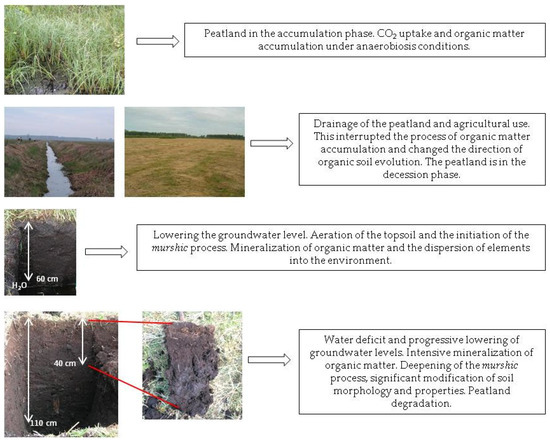
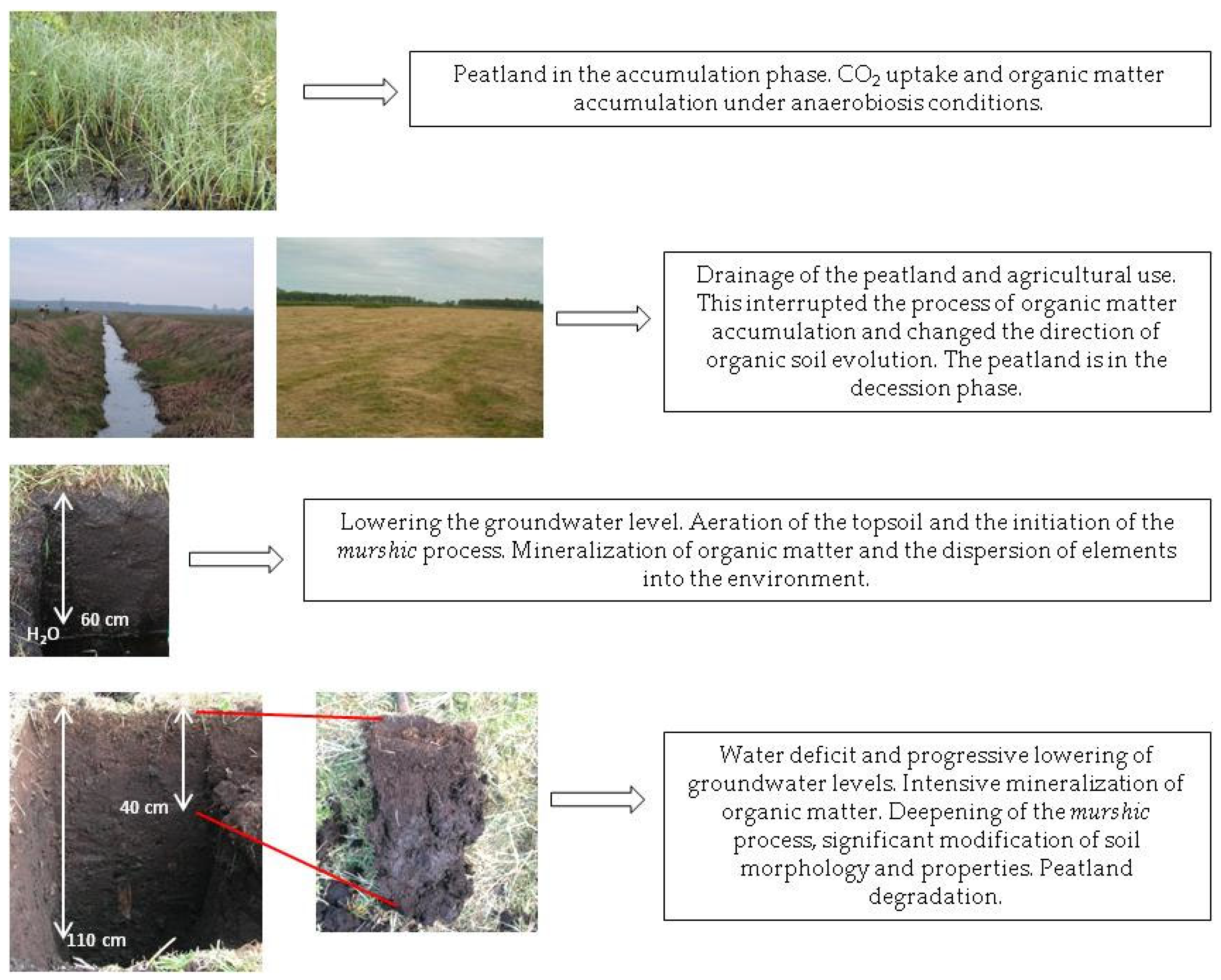
The process of peatland degradation intensified during the industrial era, accompanied by industrial and hydrotechnical investments, peat exploitation, and the development of intensive agriculture. The main cause of the degradation of European fens was their drainage to increase the area of organic soils used for agriculture [1,2]. Nowadays, the process of peatland drainage is intensifying due to climate warming and a water balance unfavorable for peatland development [3,4]. Unfortunately, in this context, climate change forecasts for Central Europe are disturbing, indicating an increase in air temperature and a decrease in the total annual precipitation [5]. It should be emphasized that organic soils are highly susceptible to transformation and degradation [6,7,8,9,10,11,12,13,14]. Peat degradation caused by drainage poses a high risk to both the environment and agriculture. As a result of drying these soils, water retention and filtration, as well as carbon sequestration, are impaired [6,11,14,15,16,17,18]. A conceptual figure of the process of drainage and degradation of agriculturally used peatlands is shown in Figure 1.
Figure 1.
Illustration of the process of drainage and degradation of agriculturally used peatlands.
Peatland drainage and agricultural use of soils stimulate increased trophicity and aerobic decomposition of soil organic matter (SOM). This occurs in the top layers of drained organic soils and, in concert with other factors, causes peat degradation. Soil scientists have defined this process as murshing, which involves the formation of mursh horizons (M), composed of the soil diagnostic material murshic [6,19,20,21]. The top mursh horizons, relative to the deeper peat horizons (O), are characterized by a well-developed granular structure and a reconstruction of the physical, chemical, and biological properties of the soil [6,22,23,24].
The importance of scientific research on the transformation of SOM in peatland soils stems primarily from the role of peatlands in the natural carbon cycle. It is particularly emphasized that peatlands, despite their relatively small area, accounting for approximately 3% of the land surface, accumulate as much as one-third of the Earth’s surface organic carbon resources [20,25,26]. Furthermore, the effects of SOM transformation occurring after peatland drainage (here referred to as secondary transformation) include mineralization and a negative organic matter balance, with the simultaneous production of labile forms of organic matter and persistent humic substances [19,26,27,28,29,30,31]. It has been proven that the release and dispersion of elements in the process of mineralization of peatland organic matter significantly affects the chemistry of the hydrosphere (eutrophication) and atmosphere (CO2 emissions) [32,33,34,35,36,37,38]. Therefore, peatland degradation is currently one of the greatest problems that disrupt the functioning of wetland areas and sustainable development [2,20,39]. It should be emphasized, however, that in recent years, due to the idea of sustainable development and rewetting of peatlands, more and more attention has been paid to the so-called zero SOM balance, referred to as the equilibrium phase [40,41].
As previously mentioned, qualitative changes in organic matter in drained peatlands consist of an increase in the content of humic substances as a result of intensified humification under the conditions of good oxygenation of the topsoil layers. Humic substances are a mixture of amorphous, dark-colored polydisperse compounds of various origins, relatively resistant to degradation processes [42,43,44,45]. The share of humic substances in the peat mass indicates the degree of its decomposition [19,20,46]. Humic acids (HAs) are one of the most stable forms of humic substances. By studying the properties of HAs, the advancement of SOM transformation and decomposition processes can be determined. HAs can be characterized by, among other things, elemental composition [47,48] and the absorbance values of their solutions in the UV-VIS range: A280, A400 A465, A600 and A665 and absorbance coefficients: A2/4, A2/6, A4/6 and ΔlogK [19,48,49,50,51,52,53,54]. It is known that the oxidation and decomposition of soil organic matter (SOM) is related to the quality of soil organic matter (SOM) and its fractions [55]. Recently, many articles have appeared presenting data on the quality of soil organic matter (SOM) in peatlands, mainly in bogs [56,57,58,59,60]. There are also studies on the quality of soil organic matter (SOM) in drained peatland soils [61]. However, there are few studies on both fractional sequencing of SOM and humic acid properties. It should also be emphasized that in Poland, as many as 90% of non-forest peat bogs have been drained [62].
Therefore, one of the aims of this study was to compare the properties of organic matter fractions and humic acids between peat and mursh horizons. We compare the mursh horizons that formed after peat bog drainage with the peat horizons that constitute the parent rock (where anaerobiosis occurs and morphological changes in the soil material are absent due to peat bog drainage). We hypothesize that the process of secondary organic matter transformation, intensified by the drainage of organic soils, significantly affected the quantity and quality of organic matter, including the properties of humic acids. It was assumed that the obtained results could contribute to the development of good practices ensuring high quality of organic matter and stability of ecosystems, as well as to the development of methods for limiting (reducing and mitigating) the mineralization of organic matter (SOM), greenhouse gas emissions, and the loss of organic soils in agricultural areas.
2. Materials and Methods
2.1. Location and Research Material
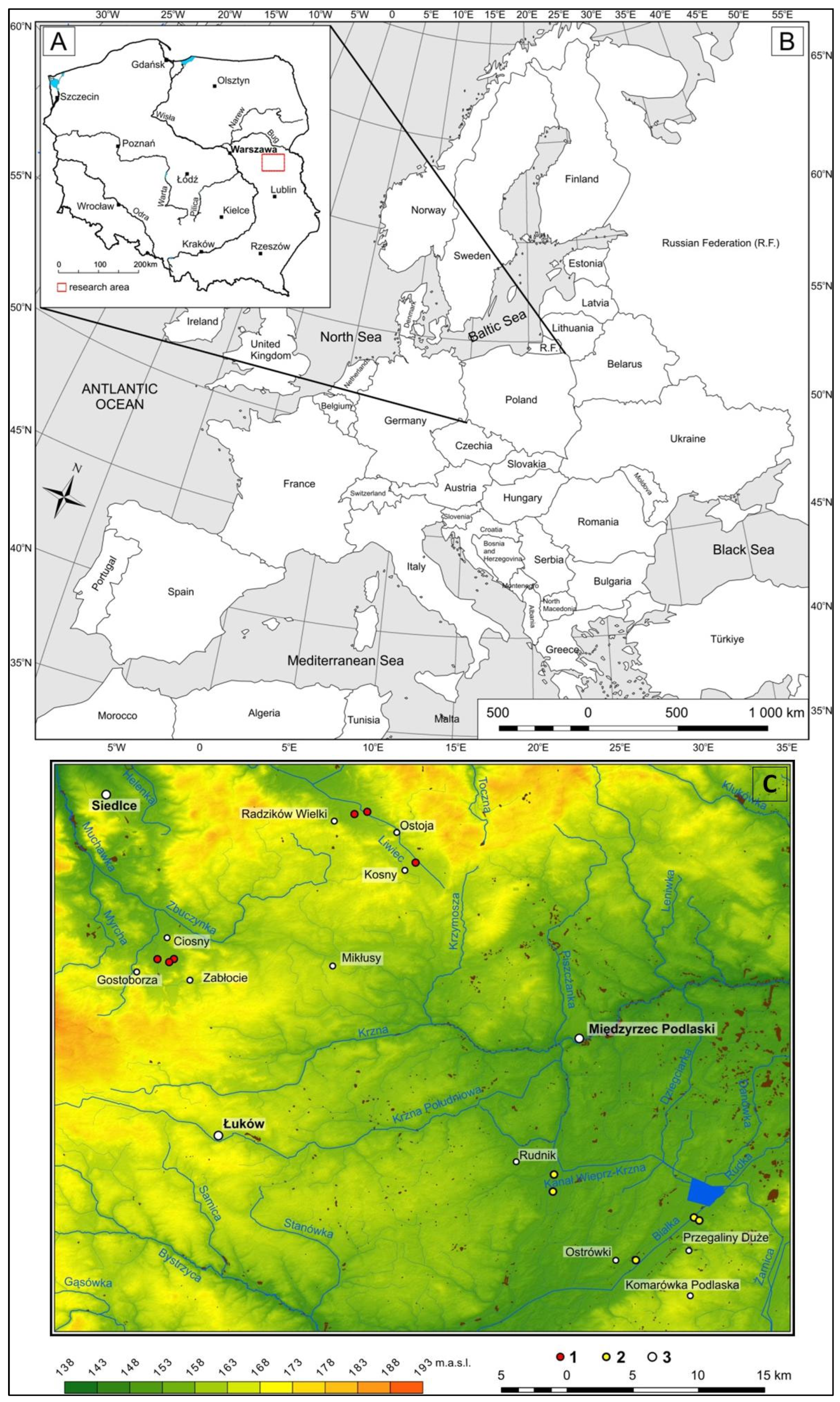
Intensively agriculturally used valley peatlands in central-eastern Poland were selected for soil science research, from two geographic regions (Figure 2):
Figure 2.
Location of field studies: 1—research points on the Siedlce Upland; 2—measurement points on the Lomazy Depression; 3—localities. Source (A–C): Prepared based on The Topographic Objects Database (BDOT), Head Office of Geodesy and Cartography (GUGiK).
- -
- The Lomazy Depression (region number: 845.11), in Western Polesie [63]. Drainage of these peatlands occurred in the 1950s during the construction of the Wieprz-Krzna Canal. Soil science research was conducted in the lower reaches of the Wieprz-Krzna Canal, which forms part of the grassland drainage system here. Five soil profiles were dug in this area at the following locations: 51.857558, 22.904463; 51.855351, 22.910128; 51.830564, 22.837839; 51.891955, 22.752488; 51.880417, 22.750303.
- -
- The Siedlce Upland, in the Central Polish Lowlands (physical-geographical region number: 318.94). Research was conducted on the largest peatlands in this region, in the Liwiec and Muchawka river valleys. For agricultural purposes, these peatlands were drained in the 1960s. Six soil profiles were dug in this area at the following locations: 52.0521499, 22.343763; 52.050170, 22.338312; 52.052493, 22.325352; 52.110126, 22.616801; 52.145199, 22.55160; 52.146343, 22.566053.
According to the Köppen–Geiger climate classification [64], the area of soil research is located in the fully humid warm temperate climate zone with warm summers.
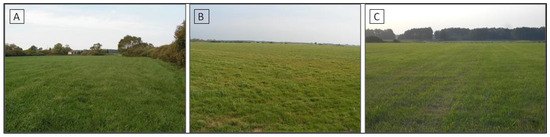
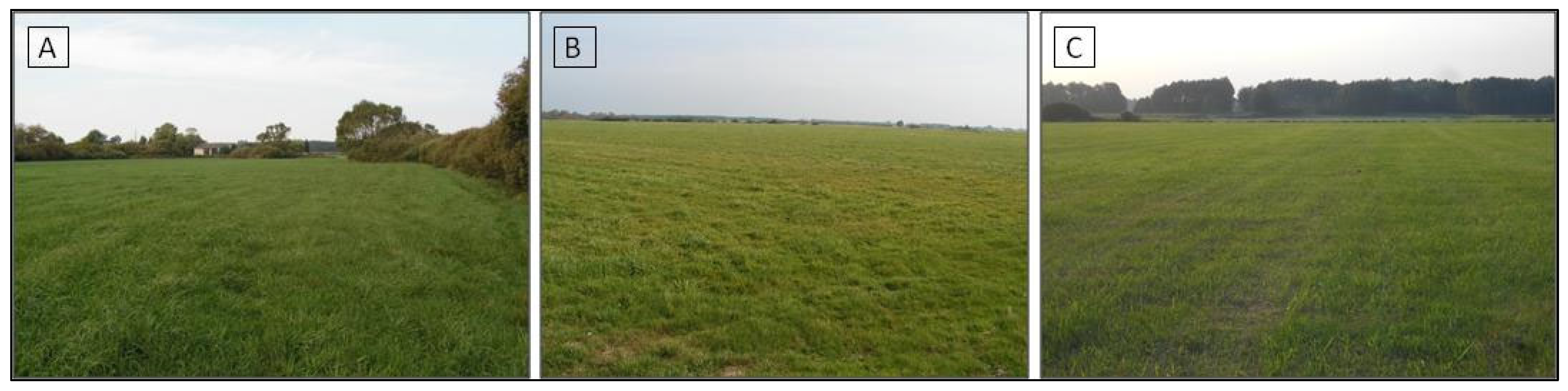
Since the drainage project was completed, the selected soils have been used for agricultural purposes exclusively as permanent grassland (mowed three times during the growing season) (Figure 3). Soil profiles were performed after harvesting biomass from the last cut of the growing season. During soil tests, the groundwater table in all excavations was found at a similar depth of 90–110 cm below ground level. According to the FAO WRB soil classification [65], the studied soils are classified as Murshic Hemic Histosols (soils formed from organic material with a medium degree of decomposition, where there is a murshic horizon with a granular structure and a bulk density.
Figure 3.
The examined drained peatlands used for agricultural purposes: (A)—the area of the Wieprz-Krzna Canal; (B,C)—the area of the Liwiec and Muchawka River Valleys.
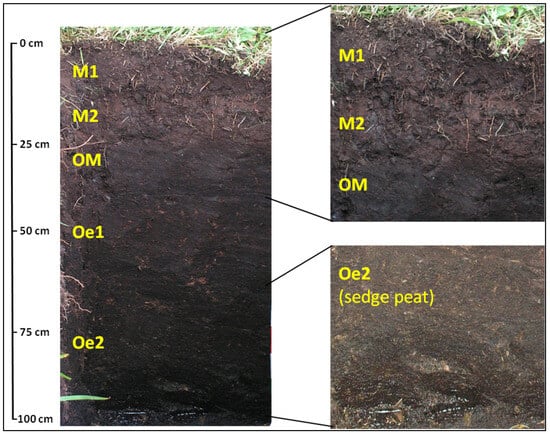
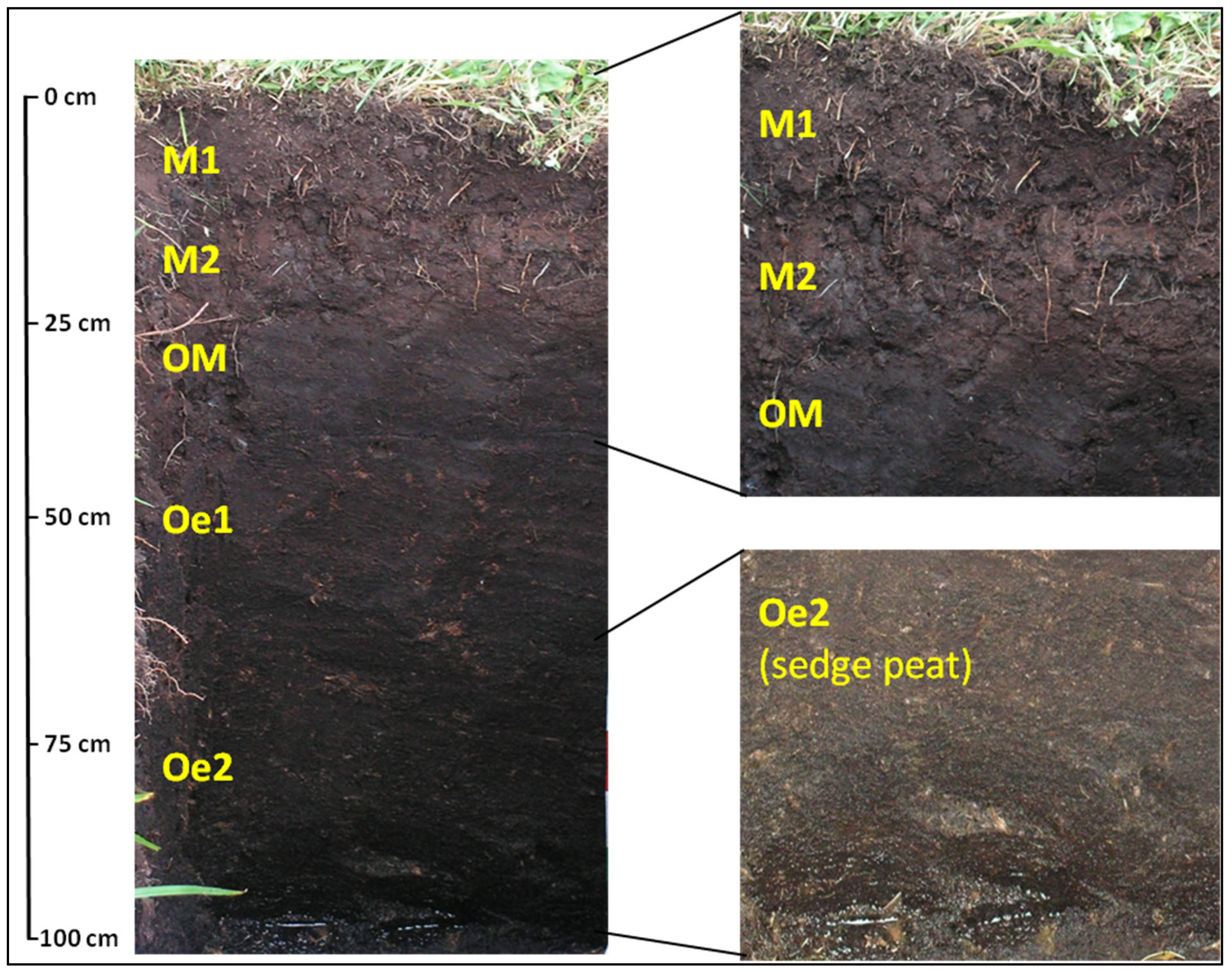
During field studies, based on the developed structure and macroscopic features of peat, the following soil horizons were diagnosed: mursh (M1 and M2), transitional (OM), and peat (Oe) [22]. Soil samples representing the distinguished soil horizons were collected to a uniform maximum depth of 90 cm (Table 1).
Table 1.
Soil horizons covered by the study and the most important morphological features of the soil material.
Representative soil profile of the examined drained peatlands is presented in Figure 4.
Figure 4.
Representative soil profile of the examined drained peatlands.
To measure bulk density, soil samples were collected in their intact state using metal cylinders (v = 100 cm3). Fresh soil material was collected in polypropylene bags from several locations within the identified soil horizons. The fresh soil material (approximately 1.0 kg) was dried at room temperature. During drying, the soil material was systematically crushed, and visible plant roots were removed from the mursh horizons.
2.2. Laboratory Analyses
For laboratory analyses, a representative portion of the room-temperature-dried sample (approximately 50 g) was ground in a porcelain mortar (particle diameter < 0.25 mm). Laboratory analyses were performed in triplicate.
2.2.1. Basic Properties of Soils
The following parameters were determined in soil samples:
- -
- Bulk dry soil density using the oven-drying method. Soil samples were collected in metal cylinders and dried at 105 °C [66].
- -
- pH using the potentiometric method. The measurement was performed on a soil suspension 24 h after the soil was flooded with the 1 M KCl solution (v/v = 1/5) [67].
- -
- Ash content (Ash) was determined by weight after calcining the soil material in a muffle furnace (temp. 450 °C, 6 h) [66].
- -
- Soil organic matter content (SOM, %). Calculated based on ash content:
SOM = 100 − CI·Ash
CI—correction index = 1, 2 [68].
Ash—ash content (%).
- -
- Total carbon (TC) and total nitrogen (TN) content were determined on a Series II 2400 analyzer (Perkin Elmer). Acetanilide was used as a reference material to calibrate the instrument. Prior to analysis, soil samples were tested for carbonate content using a reaction with 10 M HCl solution (m/v = 1/1). No CO2 release was observed in all soil samples [69].
2.2.2. Sequential Fractionation of Organic Matter
Operationally defined SOM fractions were obtained by sequential separation of organic carbon fractions [69]. The soil material weighed 2 g. The analytical process and obtaining individual fractions were carried out in the following stages:
Stage 1. Carbon of labile fraction (Lab-C).
Soil sample dealkalization step. Extraction was performed in centrifuge tubes on a rotary mixer for 24 h. A 0.05 M H2SO4 solution (m/v = 1/50) was used. Centrifuged (RCF = 3309) and filtered through a hard cellulose filter. The carbon content in the filtrate was determined using the oxidation–titration method [70]. For carbon content analysis, the solution was filtered through a membrane filter (ø = 0.45 μm).
The entire soil samples were transferred to a cellulose filter and rinsed three times with deionized H2O. For the next extraction step, the soil material was dried in a desiccator (T = 40 °C) under vacuum.
Stage 2. Carbon of lipid fraction (Lip-C).
The soil material (dried and wrapped in a cellulose filter) was placed in an extraction thimble. Extraction was performed with a mixture of ethanol and n-hexane (v/v = 1/1) in a Soxterm extractor (Gerhard). The extract was transferred to a weighing vessel, and the residual extraction reagents were evaporated (in a desiccator under vacuum). The amount of lipid fraction was determined by weight. The carbon content of the lipid fraction was determined using an elemental analyzer. The residual organic solvents were evaporated from the soil material in a desiccator and transferred to the third extraction stage.
Stage 3. Humic substances carbon (HS-C).
A soil sample was placed in a centrifuge tube. Extraction was performed with a 0.1 M NaOH solution for 24 h (m/v = 1/50). After extraction, it was centrifuged (RCF = 3309) and filtered through a cellulose filter. The soil material was poured three times with deionized H2O (25 cm3), and after 5 min of stirring, it was centrifuged and filtered. The resulting filtrate was added to the humic substances solution (v = 200 cm3). The extracted soil was discarded.
Carbon content in the humic substances solution was determined using the oxidation–titration method. For carbon content analysis, the solution was filtered through a membrane filter (ø = 0.45 μm).
Stage 4. Carbon of fulvic acid fraction (FAs-C).
A total of 25 cm3 of the humic substance solution obtained in step 3 of the sequential extraction was acidified (to pH = 1.80) in centrifuge tubes. A 1.0 M H2SO4 solution was slowly added while stirring vigorously. After sedimentation of the humic acid gel (24 h), the fulvic acid solution was decanted into a volumetric flask (v = 50 cm3). Then, 20 cm3 of 0.05 M H2SO4 solution was added to the humic acid gel, centrifuged, and after decantation, the stock fulvic acid solution was added. The carbon content in the fulvic acid solution was determined using the oxidation–titration method. For carbon content analysis, the solution was filtered through a membrane filter (ø = 0.45 μm).
Stage 5. Carbon of humic acid fraction (HAs-C).
The carbon content in this fraction was calculated:
HAs-C = HS-C − FAs-C
Stage 6. Carbon of residual fraction (Res-C).
The carbon content in this fraction was calculated:
Res-C = TC − (Lab-C + Lip-C + HS-C)
2.2.3. Qualitative Analysis of Humic Acids
Humic acids were obtained from a solution of humic substances obtained in the third stage of sequential extraction. HAs were extracted from the samples following the standard procedure described by Banach-Szott et al. [71] and dried in a freeze-dryer. Ash content was determined in the HAs preparations (after calcination in a muffle furnace at 550 °C). The average ash content in the tested HAs was 0.89% (SD = 0.11). Elemental analysis and VIS spectrophotometry were used in qualitative studies of HAs.
The carbon (C), hydrogen (H), and nitrogen (N) contents were determined using a CHN autoanalyzer (acetanilide as the reference material). The oxygen (O) content was calculated (in wt.%):
O = 100 − (C + H + N)
The elemental composition was expressed in atomic percent (ash-free mass). Based on the elemental composition, the atomic ratios of H/C, N/C, O/C, and O/H were calculated, as well as the internal oxidation state of humic acid molecules [72]:
ω = [(2O + 3N) − H]/C
The spectrophotometric properties of HAs were tested using a Lambda 25 spectrophotometer (Perkin Elmer, Ueberlingen, Germany). Absorbance (A) was measured for HAs solutions (0.02%, in 0.05 M NaHCO3) at wavelengths (in nm): 400, 465, 600, and 665. The following spectrophotometric coefficients were calculated [48,73]:
A4/6 = A (465 nm)/A (665 nm)
ΔlogK = logA (400 nm) − logA (600 nm)
2.3. Statistical Analyses
Statistical calculations were performed using the STATISTICA 13 PL (TIBCO Software Inc., Palo Alto, CA, USA). The mean value (Mean) and standard deviation (SD) were calculated. Statistical calculations for pH were performed for hydrogen ion concentration. Mean values of the studied parameters for individual soil horizons were compared using one-way analysis of variance and Tukey’s post hoc test. Statistical differences were considered significant at a significance level of p < 0.05. Relationships between the studied parameters were expressed as the simple correlation coefficient (r).
3. Results and Discussion
3.1. Soil Properties
The results presented in Table 2 clearly demonstrate the profile variability of the properties of the studied soils. Statistical analysis showed that horizons M1 and M2 constituted homogeneous groups, significantly more compacted (higher bulk density values) than the underlying horizons, characterized by higher ash and lower SOM content. Such differences in properties between the mursh and peat horizons are a typical effect of secondary transformation of organic matter following peatland drainage [19,20,46]. The process of organic matter mineralization contributed to a significant decrease in SOM content in the mursh horizons of the studied soils and, consequently, to increased ash content and compaction of the soil material.
Table 2.
Profile variability of selected properties of the studied soil horizons.
The change in SOM content has obvious consequences for TC content—it is commonly assumed that SOM contains approximately 58% organic carbon. Due to the lack of carbonates, the total carbon content (TC) roughly corresponds to the carbon content in organic compounds (TOC) in the studied soil horizons [69]. In the studied soil profiles, a trend of increasing TC content with depth in the profile was observed. Analysis of variance allowed the studied soil horizons to be classified into three homogeneous groups, which can be arranged in the following order of increasing carbon content: mursh horizons (M1 and M2) > transition horizons (OM) > peat horizons (Oe1 + Oe2).
A significantly lower TC/TN value was recorded in the mursh horizons compared to the peat horizons. This is the result of the process of organic matter mineralization and CO2 emissions from the peatland following its drainage, widely described in the literature [6,19,20,46,74,75,76], and partly also the process of secondary nitrogen accumulation in the mursh horizons [77,78]. The lowest TC/TN values were recorded for the top M1 horizons (average 11.6). It should be emphasized that the values of this parameter in these horizons are similar to those found in the humus layers of arable soils (TC/TN is approximately 10), which, as a result of soil aeration practices, are characterized by intensive organic matter decomposition, a predominance of humic substances, and a mull humus type [79].
The low TC/TN values observed for the M1 and M2 horizons and the relatively low acidification (pH in the range of 5.42–6.90) suggest that the topsoil of the studied soils provides favorable conditions for the decomposition of organic matter. Furthermore, these horizons are potentially well aerated, which may be due to several factors: low groundwater levels following peat bog drainage; granular soil structure favoring soil aeration; and lower water capacity and increased hydrophobicity of soil colloids [18,20,74,76,80].
3.2. SOM Fractions
In the studied soils, a high profile variability was observed, both for the carbon content in the distinguished SOM fractions and for the share of carbon in each fraction in TC (Table 3). For both methods of expressing the fractional composition of SOM, statistical analysis revealed very similar homogeneous groups for the studied soil horizons.
Table 3.
Profile variability of the content and share of the distinguished SOM fractions.
For all soil horizons, the distinguished SOM fractions can be arranged in the following order of increasing quantitative significance in terms of carbon content: Lab-C < Lip-C < FAs-C < HAs-C < Hs-C < Res-C. The obtained laboratory test results and statistical analysis revealed significant differences in the SOM fractional composition, primarily in the mursh and peat horizons. Therefore, in the studied soils, dewatering led to a qualitative transformation of organic matter and the formation of a characteristic vertical variability in the distribution of distinguished SOM fractions. It was shown that in this context, the studied soils exhibit the following characteristics:
- (i)
- With depth in the profile, the content of labile fractions and humic substances decreases, while the content of lipid and residual fractions increases.
- (ii)
- The M1 horizons are characterized by the highest Lab-C content. For the remaining SOM fractions, the mursh horizons (M1 and M2) constitute statistically homogeneous groups.
- (iii)
- Peat horizons (Oe1 and Oe2) constitute statistically homogeneous groups for all SOM fractions.
- (iv)
- Transition horizons (OM) exhibit intermediate characteristics between mursh and peat horizons. For most fractions, they constitute a statistically homogeneous group.
- (v)
- In all soil horizons, humic acids clearly predominate in the humic substances fraction.
- (vi)
- The humic acid to fulvic acid ratio exhibits relatively minimal profile variability. Clear differences are observed between M1 and peat horizons. There are clear differences between the M1, M2, and peat horizons. The mursh horizons are characterized by higher contents and shares of the Lab-C, HS-C, HAs-C, and FAs-C fractions, and lower contents and shares of the Lip-C and Res-C fractions.
The differences demonstrated in the content and proportion of SOM fractions between mursh and peat horizons result from factors influencing SOM transformation. Mursh horizons constitute the rhizosphere zone of the soil, are the most oxygenated, and exhibit the greatest biological activity [6,18,80,81]. Transformation affects not only organic compounds accumulated in the past during the peat accumulation stage, but also organic compounds produced by vegetation and microorganisms of the current ecosystem [82]. For these reasons, the highest Lab-C content is observed in mursh horizons (especially in M1, which constitutes the main rhizosphere zone). This fraction consists primarily of organic compounds constituting the so-called soil dissolved organic matter (DOM), low molecular weight, and a relatively easily accessible carbon source for microorganisms [18,45,79,83]. The amount and composition of DOM is stimulated by respiration processes occurring in the soil, which also influences the amount of CO2 emitted from the peatland [32,33].
Similarly, the lower amount of Lip-C fraction in the mursh horizons (especially M1) likely results from the relatively good conditions for organic matter decomposition in the upper parts of the studied soil profiles. This is suggested by scientific studies demonstrating that soil aeration, biological activity, and intensive mineralization of organic matter result in the degradation of lipid substances (often referred to as bitumins in soil sciences) [84]. Furthermore, the amount of substances in soils that can be extracted with organic solvents may be influenced by the saponification reaction of fatty acids with alkaline cations [85]. In the mursh horizons, as a result of organic matter mineralization and fertilization, a higher amount of alkaline cations may occur [20,80].
Organic compounds extracted from soil material with alkaline solutions are conventionally classified as humic substances, including fulvic and humic acids [19,42,79]. The carbon content of humic substances (HS-C) showed significant profile variability and can be considered related to the progress of the humification process in the organic matter of the studied soils. Approximately twice as much HS-C was found in the mursh horizons compared to the peat horizons. Therefore, in the topsoil of the studied soils, we note an intensification of the humification process of organic matter, which is also related to oxygenation and probably a greater biological activity in this part of the soil [6,19,78]. For the studied soils, it was shown that humic substances are represented primarily by humic acids (HAs-C), which are considered stable in the soil environment [42,79]. The carbon content of fulvic acids (FAs-C) was several times lower than that of HAs-C. It is worth noting that the highest FAs-C content was found in the M1 horizons, which may indicate the presence of higher amounts of SOM in the initial stages of humification [83,85]. This is reflected in the HAs-C/FAs-C value, which was significantly the lowest in the M1 horizons (Table 3).
In the studied soils, the highest residual carbon fraction (Res-C) was found in peat horizons, suggesting the lowest degree of SOM transformation in the deeper and most hydrated soil layers. Considering the specificity of the studied organic soils, the carbon in this fraction likely comprises a significant portion of unhumified organic matter, and to a lesser extent, the humic fraction (the most resistant to decomposition of humic substances) [43,46]. It should be emphasized that peat (non-silted) soils lack clay minerals, which precludes the formation of very durable bonds between humic substances and the mineral part of the soil solid phase, which are potentially not extractable by 0.1 M NaOH [45,77]. Generally, the direction of organic matter transformation observed in the studied soils is characteristic of soils developed from peat, which are subject to strong evolution under drainage pressure [19,20,78,83,86].
3.3. Properties of Humic Acids
Similarly to the carbon fraction, significant differences in HAs properties were found between the mursh and peat horizons (Table 4).
Table 4.
Profile variability of humic acid properties isolated from the tested soils.
Generally, the profile variability of HAs parameters in the studied soils can be described as follows:
- (i)
- With depth in the profile, the proportion of C atoms in HAs molecules increases, while that of H and N decreases.
- (ii)
- The proportion of O atoms does not differ significantly between soil horizons.
- (iii)
- The H/C and N/C atomic ratios decrease significantly with depth in the profile.
- (iv)
- The internal oxidation state of HAs molecules does not differ significantly between soil horizons.
- (v)
- The values of the A4/6 and ΔlogK parameters decrease with depth in the profile.
- (vi)
- HAs from mursh horizons (M1 and M2) constitute statistically homogeneous groups for all parameters studied.
- (vii)
- HAs from the top mursh horizons (M1) are distinguished by the significantly lowest share of C atoms and the highest H/C, N/C, and A4/6 values.
The vertical variability of SOM properties in the studied soils was therefore confirmed by qualitative studies of HAs. Generally, it can be concluded that HAs properties depend on their depth in the soil profile.
Scientific studies indicate that the chemical nature of molecules can be inferred from elemental composition, atomic ratios, and spectrophotometric coefficients [48,50,52,87,88]. The data obtained in our study suggest that HAs from mursh horizons, compared to peat horizons, are likely characterized by a lower degree of aromatic element condensation in the structure, a higher proportion of aliphatic structures, and a lower molecular weight. The greatest differences are found in the properties of HAs from the top mursh horizons (M1) and peat horizons (Oe1 + Oe2), in which no signs of secondary transformation of organic matter following dewatering were observed. The obtained parameters for HAs from peat horizons indicate that their structure is dominated by aromatic elements (H/C value < 1, low spectrophotometric coefficients) [48,89,90,91]. This proves that HAs molecules are “mature” and have a high degree of humification. HAs from the M1 horizons are characterized by a predominance of aliphatic groups, chemical “youthfulness,” and a lower degree of humification [54,71,88,89,92]. In this context, it should be emphasized that this horizon is systematically supplied with fresh organic matter, which is subject to ongoing decomposition—as a result, HAs with a lower degree of humification and that are less stable may be formed in the M1 horizon [19,26,89,92,93].
3.4. Correlation Between Basic Soil Properties and SOM Properties
Many scientific studies have shown that during transformation induced by peatland drainage, the physical and chemical properties of soils change in the following directions: increased ash content, decreased SOM content, increased bulk density, and decreased TC/TN ratio [6,19,20,21,22,94]. In our study, these soil properties significantly correlated with the identified SOM fractions (Table 5).
Table 5.
Correlation between soil properties and SOM properties.
Among the identified SOM fractions, particularly high correlation coefficients were found for the labile fraction (Lab-C), humic substances (HS-C), and residual fraction (Res-C). The studies thus confirmed that the secondary transformation process is primarily associated with the production of labile forms of organic matter and humic substances. An important effect of organic matter decomposition in the studied soils was a significant reduction in the TC/TN value in the soil, as indicated by the negative correlation of this indicator with Lab-C and HS-C and a positive correlation with Res-C. In general, the correlation coefficient values indicate that favorable conditions for organic matter transformation occurred in the studied soils, resulting from drainage and oxygenation of the topsoil layers. Transformation of SOM in peat soils under such conditions results in an increase in the amount of labile forms of organic matter and humus substances [21,94]. The significant positive correlation between Lab-C and pH, and the negative correlation between Lip-C and pH, suggests that reducing the acidification of the studied soils may stimulate the production of labile forms of organic matter and the degradation of fatty acids.
Significant correlations were found between soil properties and most of the studied HAs parameters (Table 5). The highest coefficient values were found for the share of C and N atoms, the atomic ratios of H/C, N/C, and O/C, and the spectrophotometric coefficients (especially A4/6). Furthermore, the studied HAs parameters significantly correlated with the share of carbon in the distinguished fractions (Table 6).
Table 6.
Correlation between the share of SOM fraction and HAs properties of the tested soils.
Particularly high values of the correlation coefficient were obtained for the properties of humic acids with the share of carbon in humic substances and the residual fraction. The values of these coefficients and their signs (+/−) confirm that the process of organic matter transformation occurring after drainage of the studied peatlands results in the secondary synthesis of HAs molecules which, at the current stage of soil development, are characterized by a low degree of humification, a predominance of aliphatic structures, and a low degree of aromatic ring condensation. In general, the obtained research results are characteristic of drained temperate peat bogs used for agricultural purposes. It seems that expanding the research on SOM and humic acid fractions may allow the development of chemical indicators assessing the extent of transformation of organic soils after drainage, produced from various organic sediments.
4. Conclusions
The study demonstrated that SOM transformation in drained temperate peatlands was correlated with a comprehensive change in soil physical and chemical properties. Compared to peat horizons, topsoil horizons were characterized by higher ash content and density, lower SOM content, and lower carbon-to-nitrogen ratios. Qualitative SOM transformation during aerobic SOM transformation after draining the studied peatlands consisted of an increase in the amount of labile fractions and humic substances, and a decrease in the lipid and residual fractions. The properties of humic acids in the studied soils varied significantly, depending on the depth of the soil horizon from which they were extracted. Humic acids in topsoil horizons, compared to peat horizons, were characterized by a lower degree of humification, as reflected by the values of atomic ratios (H/C, O/C) and absorbance coefficients (A4/6 and ΔlogK). The proportion of the identified SOM fractions and the properties of humic acids were found to be closely correlated with the physical and chemical properties of the soils. In our opinion, the presented method of chemical fractionation of carbon compounds can be used to assess the advancement of organic matter decomposition processes in drained peat bog soils and to assess current and potential threats to the mineralization of organic carbon compounds, including migration in the environment. Knowledge about the transformation of SOM is of great importance for developing better soil management strategies for drained peatlands used for agricultural purposes, in terms of renaturalization and achieving sustainable development goals. To slow down the degradation of SOM, groundwater levels should be maintained at a significantly higher level than in our study area. In addition, it is advisable to use meadows that allow for high yields, which will also result in intensive photosynthesis and a larger amount of post-harvest residues. This can contribute to a positive organic matter balance.
At the same time, we recognize the need for further, even more extensive research, including biochemical studies. Comparing the properties of organic matter fractions and humic acids in undrained and drained peat bogs would also be extremely valuable.
Author Contributions
Conceptualization, M.B. and M.B.-S.; Methodology, M.B., M.B.-S. and D.J.; Validation, M.B., M.B.-S. and D.J.; Formal Analysis, M.B. and M.B.-S.; Investigation, M.B., M.B.-S., D.J. and N.B.; Resources, M.B., M.B.-S., A.G., D.J. and N.B.; Data Curation, M.B., M.B.-S. and D.J.; Writing—Original Draft Preparation, M.B., M.B.-S., D.J. and N.B.; Writing—Review and Editing, M.B., M.B.-S., A.G., D.J. and N.B.; Visualization, M.B., M.B.-S., A.G., D.J. and N.B.; Supervision, M.B., M.B.-S. and A.G.; Project Administration, M.B., M.B.-S., A.G. and D.J.; Funding Acquisition, M.B., A.G. and D.J. All authors have read and agreed to the published version of the manuscript.
Funding
This research was supported under the research theme no. 35/20/B by the Ministry of Science and Higher Education.
Institutional Review Board Statement
Not applicable.
Informed Consent Statement
Not Applicable.
Data Availability Statement
The raw data supporting the conclusions of this article will be made available by the authors on request.
Conflicts of Interest
The authors declare no conflicts of interest.
References
- Joosten, H.; Tanneberger, F.; Moen, A. Mires and Peatlands of Europe Status, Distribution and Conservation; Schweizerbart Science Publishers: Stuttgart, Germany, 2017. [Google Scholar] [CrossRef] [Scilit]
- Patel, N.; Ieviņa, B.; Kažmēre, D.; Feofilovs, M.; Kamenders, A.; Romagnoli, F. Towards Resilient Peatlands: Integrating Ecosystem-Based Strategies, Policy Frameworks, and Management Approaches for Sustainable Transformation. Sustainability 2025, 17, 3419. [Google Scholar] [CrossRef] [Scilit]
- Song, L.; Guanter, L.; Guan, K.; You, L.; Huete, A.; Ju, W.; Zhang, Y. Satellite suninduced chlorophyll fluorescence detects early response of winter wheat to heat stress in the Indian Indo-Gangetic Plains. Glob. Change Biol. 2018, 24, 4023–4037. [Google Scholar] [CrossRef] [Scilit] [PubMed]
- Buras, A.R.; Zang, C.S. Quantifying impacts of the 2018 drought on European ecosystems in comparison to 2003. Biogeosciences 2020, 17, 1655–1672. [Google Scholar] [CrossRef] [Scilit]
- Orth, R.; Zscheischler, J.; Seneviratne, S.I. Record dry summer in 2015 challenges precipitation projections in Central Europe. Sci. Rep. 2016, 6, 28334. [Google Scholar] [CrossRef] [Scilit]
- Okruszko, H. Transformation of fen-peat soils under the impact of draining. Adv. Agri. Sci. Probl. 1993, 406, 3–73. [Google Scholar]
- Glina, B.; Piernik, A.; Hulisz, P.; Mendyk, Ł.; Tomaszewska, K.; Podlaska, M.; Bogacz, A.; Spychalski, W. Water or soil—What is the dominant driver controlling the vegetation pattern of degraded shallow mountain peatlands? Land Degrad. Dev. 2019, 30, 1437–1448. [Google Scholar] [CrossRef] [Scilit]
- Nicia, P.; Bejger, R.; Zadrożny, P.; Sterzyńska, M. The impact of restoration processes on the selected soil properties and organic matter transformation of mountain fens under Caltho-Alnetum community in the Babiogórski National Park in Outer Flysch Carpathians, Poland. J. Soil Sediments 2018, 18, 2770–2776. [Google Scholar] [CrossRef] [Scilit]
- Okruszko, H. Phenomenon of peat soil degradation in the light of experiments. Acta Agroph. 2000, 26, 7–15. [Google Scholar]
- Ilnicki, P.; Zeitz, J. Irreversible loss of organic soil functions after reclamation. In Organic Soils and Peat Materials for Sustainable Agriculture; Parent, L.-E., Ilnicki, P., Eds.; CRC Press: Boca Raton, FL, USA, 2003; pp. 15–32. [Google Scholar] [CrossRef] [Scilit]
- Dawson, Q.; Kechavarzi, C.; Leeds-Harrison, P.B.; Burton, R.G.O. Subsidence and degradation of agricultural peatlands in the Fenlands of Norfolk, UK. Geoderma 2010, 154, 181–187. [Google Scholar] [CrossRef] [Scilit]
- Krüger, J.P.; Leifeld, J.; Glatzel, S.; Szidat, S.; Alewell, C. Biogeochemical indicators of peatland degradation—A case study of temperate bog in northern Germany. Biogeosciences 2015, 12, 2861–2871. [Google Scholar] [CrossRef] [Scilit]
- Zając, E.; Zarzycki, J.; Ryczek, M. Degradation of peat surface on an abandoned post-extracted bog and implications for re-vegetation. Appl. Ecol. Environ. Res. 2018, 16, 3363–3380. [Google Scholar] [CrossRef] [Scilit]
- Oleszczuk, R.; Łachacz, A.; Kalisz, B. Measurements versus estimates of soil subsidence and mineralization rates at peatland over 50 years (1966–2016). Sustainability 2022, 14, 16459. [Google Scholar] [CrossRef] [Scilit]
- Xu, J.; Morris, P.J.; Liu, J.; Holden, J. PEATMAP: Refining estimates of global peatland distribution based on a meta-analysis. Catena 2018, 160, 134–140. [Google Scholar] [CrossRef] [Scilit]
- Liu, H.; Price, J.; Rezanezhad, F.; Lennartz, B. Centennial-scale shifts in hydrophysical properties of peat induced by drainage. Water Resour. Res. 2020, 56, e2020WR027538. [Google Scholar] [CrossRef] [Scilit]
- Tiemeyer, B.; Kahle, P. Nitrogen and dissolved organic carbon (DOC) losses from an artificially drained grassland on organic soils. Biogeosciences 2014, 11, 4123–4137. [Google Scholar] [CrossRef] [Scilit]
- Glina, B.; Piernik, A.; Mocek-Płóciniak, A.; Maier, A.; Glatzel, S. Drivers controlling spatial and temporal variation of microbial properties and dissolved organic forms (DOC and DON) in fen soils with persistently low water tables. Glob. Ecol. Conserv. 2021, 27, e01605. [Google Scholar] [CrossRef] [Scilit]
- Becher, M.; Tołoczko, W.; Godlewska, A.; Pakuła, K.; Żukowski, E. Fractional Composition of Organic Matter and Properties of Humic Acids in the Soils of Drained Bogs of the Siedlce Heights in Eastern Poland. J. Ecol. Eng. 2022, 23, 208–222. [Google Scholar] [CrossRef] [Scilit]
- Łachacz, A.; Kalisz, B.; Sowiński, P.; Smreczak, B.; Niedźwiecki, J. Transformation of Organic Soils Due to Artificial Drainage and Agricultural Use in Poland. Agriculture 2023, 13, 634. [Google Scholar] [CrossRef] [Scilit]
- Glina, B.; Bogacz, A.; Mendyk, Ł.; Boiko, O.; Nowak, M. Effectiveness of restoration of a degraded shallow mountain fen after five years. Mires Peat 2018, 21, 11. [Google Scholar] [CrossRef] [Scilit]
- Becher, M.; Pakuła, K.; Jaremko, D. Phosphorus Accumulation in the Dehydrated Peat Soils of the Liwiec River Valley. J. Ecol. Eng. 2020, 21, 213–220. [Google Scholar] [CrossRef] [Scilit]
- Kabała, C.; Charzyński, P.; Chodorowski, J.; Drewnik, M.; Glina, B.; Greinert, A.; Hulisz, P.; Jankowski, M.; Jonczak, J.; Łabaz, B.; et al. Polish Soil Classification, 6th edition—Principles, classification scheme and correlations. Soil Sci. Annu. 2019, 70, 71–97. [Google Scholar] [CrossRef] [Scilit]
- Łachacz, A.; Bogacz, A.; Glina, B.; Kalisz, B.; Mendyk, Ł.; Orzechowski, M.; Smólczyński, S.; Sowiński, P. Origin, transformation and classification of organic soils in Poland. Soil Sci. Annu. 2024, 75, 195241. [Google Scholar] [CrossRef] [Scilit]
- Chimner, R.A.; Pypker, T.G.; Hribljan, J.A.; Moore, P.A.; Waddington, J.M. Multi-decadal changes in water table levels alter peatland carbon cycling. Ecosys 2017, 20, 1042–1057. [Google Scholar] [CrossRef] [Scilit]
- Zaccone, C.; Plaza, C.; Ciavatta, C.; Miano, T.M.; Shotyk, W. Advances in the determination of humification degree in peat since Achard (1786): Applications in geochemical and paleoenvironmental studies. Earth Sci. Rev. 2018, 185, 163–178. [Google Scholar] [CrossRef] [Scilit]
- Sokołowska, Z.; Szajdak, L.; Matyka-Sarzyńska, D. Impact of the degree of secondary transformation on acid-base properties of organic compounds in mucks. Geoderma 2005, 127, 80–90. [Google Scholar] [CrossRef] [Scilit]
- Beer, J.; Lee, K.; Whiticar, M.; Blodau, C. Geochemical controls on anaerobic organic matter decomposition in a northern peatland. Limnol. Oceanogr. 2008, 53, 1393–1407. [Google Scholar] [CrossRef] [Scilit]
- Dhandapani, S.; Evers, S.; Ritz, K.; Sjögersten, S. Nutrient and trace element concentrations influence greenhouse gas emissions from Malaysian tropical peatlands. Soil Use Manag. 2021, 37, 138–150. [Google Scholar] [CrossRef] [Scilit]
- Obeng, A.S.; Dunne, J.; Giltrap, M.; Tian, F. Soil organic matter carbon chemistry signatures, hydrophobicity and humification index following land use change in temperate peat soils. Heliyon 2023, 9, e19347. [Google Scholar] [CrossRef] [Scilit]
- Tfaily, M.M.; Cooper, W.T.; Kostka, J.E.; Chanton, P.R.; Schadt, C.W.; Hanson, P.J.; Iversen, C.M.; Chanton, J.P. Organic matter transformation in the peat column at Marcell experimental Forest: Humification and vertical stratification. J. Geophys. Res. Biogeosci. 2014, 119, 661–675. [Google Scholar] [CrossRef] [Scilit]
- Kalbitz, K.; Geyer, S. Different effects of peat degradation on dissolved organic carbon and nitrogen. Org. Geochem. 2002, 33, 319–326. [Google Scholar] [CrossRef] [Scilit]
- Glatzel, S.; Kalbitz, K.; Dalva, M.; Moore, T. Dissolved organic matter properties and their relationship to carbon dioxide efflux from restored peat bogs. Geoderma 2003, 113, 397–411. [Google Scholar] [CrossRef] [Scilit]
- Berglund, O.; Berglund, K. Influence of water table level and soil properties on emissions of greenhouse gases from cultivated peat soil. Soil Biol. Biochem. 2011, 43, 923–931. [Google Scholar] [CrossRef] [Scilit]
- Vassiljev, A.; Blinova, I. The influence of drained peat soils on diffuse nitrogen pollution of surface water. Hydrol. Res. 2012, 43, 352–358. [Google Scholar] [CrossRef] [Scilit]
- Tuukkanen, T.; Marttila, H.; Klove, B. Effect of soil properties on peat erosion and suspended sediment delivery in drained peatlands. Water Resour. Res. 2014, 50, 3523–3535. [Google Scholar] [CrossRef] [Scilit]
- Dinsmore, K.J.; Billett, M.F.; Skiba, U.M.; Rees, R.M.; Drewer, J.; Helfter, C. Role of the aquatic pathway in the carbon and greenhouse gas budgets of a peatland catchment. Glob. Change Biol. 2010, 16, 2750–2762. [Google Scholar] [CrossRef] [Scilit]
- Müller, D.; Warneke, T.; Rixen, T.; Müller, M.; Mujahids, A.; Banges, H.W. Fate of peat-derived carbon and associated CO2 and CO emissions from two Southeast Asian estuaries. Biogeosci. Discuss. 2015, 12, 8299–8340. [Google Scholar] [CrossRef] [Scilit]
- Freeman, C.; Fenner, N.; Ostle, N.J.; Kang, H.; Dowrick, D.J.; Reynolds, B.; Lock, M.A.; Hudson, J. Export of dissolved organic carbon from peatlands under elevated carbon dioxide levels. Nature 2004, 430, 195–198. [Google Scholar] [CrossRef] [Scilit]
- Renger, M.; Wessolek, G.; Schwaerzel, K.; Sauerbrey, R.; Siewert, C. Aspects of peat conservation and water management. J. Plant Nutr. Soil Sci. 2002, 165, 487–493. [Google Scholar] [CrossRef] [Scilit]
- Jurczuk, S. Reclamation determinants of organic matter preservation in post-bog soils under meadows. Woda-Sr.-Obsz. Wiej. Rozpr. Nauk. Monogr. 2011, 30, 1–81, (In Polish with English Summary). [Google Scholar]
- Weber, J.; Chen, Y.; Jamroz, E.; Miano, T. Preface: Humic substances in the environment. J. Soils Sediments 2018, 18, 2665–2667. [Google Scholar] [CrossRef] [Scilit]
- De Nobili, M.; Bravo, C.; Chen, Y. The spontaneous secondary synthesis of soil organic matter components: A critical examination of the soil continuum model theory. Appl. Soil Ecol. 2020, 154, 103655. [Google Scholar] [CrossRef] [Scilit]
- Orsi, M. Molecular dynamics simulation of humic substances. Chem. Biol. Technol. Agric. 2014, 1, 10. [Google Scholar] [CrossRef] [Scilit]
- Almendros, G.; González-Pérez, J.A. Soil Organic Carbon Sequestration Mechanisms and the Chemical Nature of Soil Organic Matter—A Review. Sustainability 2025, 17, 6689. [Google Scholar] [CrossRef] [Scilit]
- Ilnicki, P. Peat Bogs and Peat; Wyd. AR: Poznań, Poland, 2002. (In Polish) [Google Scholar]
- Canellas, L.P.; Piccolo, A.; Dobbss, L.B.; Spaccini, R.; Olivares, F.L.; Zandonadi, D.B.; Façanha, A.R. Chemical composition and bioactivity properties of size-fractions separated from a vermicompost humic acid. Chemosphere 2010, 78, 457–466. [Google Scholar] [CrossRef] [Scilit]
- Kumada, K. Chemistry of Soil Organic Matter; Elsevier: Amsterdam, The Netherlands, 1987. [Google Scholar]
- Vieyra, F.E.M.; Palazzi, V.I.; de Pinto, M.I.S.; Borsarelli, C.D. Combined UV–Vis absorbance and fluorescence properties of extracted humic substances-like for characterization of composting evolution of domestic solid wastes. Geoderma 2009, 151, 61–67. [Google Scholar] [CrossRef] [Scilit]
- Polak, J.; Bartoszek, M.; Żądło, M.; Kos, A.; Sułkowski, W.W. The spectroscopic studies of humic acid extracted from sediment collected at different seasons. Chemosphere 2011, 84, 1548–1555. [Google Scholar] [CrossRef] [Scilit] [PubMed]
- Klavins, M.; Purmalis, O. Characterization of humic acids from raised bog peat. Latv. J. Chem. 2014, 1, 83–97. [Google Scholar] [CrossRef] [Scilit]
- Rodríguez, F.J.; Schlenger, P.; García-Valverde, M. Monitoring changes in the structure and properties of humic substances following ozonation using UV-Vis, FTIR and H NMR techniques. Sci. Total Environ. 2016, 541, 626–637. [Google Scholar] [CrossRef] [Scilit] [PubMed]
- Derrien, M.; Lee, Y.K.; Park, J.E.; Li, P.; Chen, M.; Lee, S.H.; Lee, S.H.; Lee, J.B.; Hur, J. Spectroscopic and molecular characterization of humic substances (HS) from soils and sediments in a watershed: Comparative study of HS chemical fractions and the origins. Environ. Sci. Pollut. Res. Int. 2017, 24, 16933–16945. [Google Scholar] [CrossRef] [Scilit]
- Bejger, R.; Mielnik, L.; Włodarczyk, M.; Nicia, P. Studying of the interaction between peat humic acids and metazachlor using spectroscopy methods. J. Soils Sediments 2018, 18, 2675–2681. [Google Scholar] [CrossRef] [Scilit]
- de Souza, G.P.; de Figueiredo, C.C.; de Sousa, D.M.G. Relationships between labile soil organic carbon fractions under different soil management systems. Sci. Agric. 2016, 73, 535–542. [Google Scholar] [CrossRef] [Scilit]
- Fenner, N.; Freeman, C. Drought-induced carbon loss in peatlands. Nat. Geosci. 2011, 4, 895–900. [Google Scholar] [CrossRef] [Scilit]
- Lohila, A.; Minkkinen, K.; Aurela, M.; Tuovinen, J.P.; Penttila, T.; Ojanen, P.; Laurila, T. Greenhouse gas flux measurements in a forestry-drained peatland indicate a large carbon sink. Biogeosciences 2011, 8, 3203–3218. [Google Scholar] [CrossRef] [Scilit]
- Turetsky, M.R.; Donahue, W.F.; Benscoter, B.W. Experimental drying intensifies burning and carbon losses in a northern peatland. Nat. Commun. 2011, 2, 514. [Google Scholar] [CrossRef] [Scilit]
- Keller, J.K.; Takagi, K.K. Solid-phase organic matter reduction regulates anaerobic decomposition in bog soil. Ecosphere 2013, 4, 54. [Google Scholar] [CrossRef] [Scilit]
- Leifeld, J.; Menichetti, L. The underappreciated potential of peatlands in global climate change mitigation strategies. Nat. Commun. 2018, 9, 1071. [Google Scholar] [CrossRef] [Scilit] [PubMed]
- Heller, C.; Zeitz, J. Stability of soil organic matter in two northeastern German fen soils: The influence of site and soil development. J. Soils Sediments 2012, 12, 1231–1240. [Google Scholar] [CrossRef] [Scilit]
- Ilnicki, P.; Szajdak, L.W. The Disappearance of Peat Bogs; Publishing House of the Poznań Society of Friends of Science: Poznań, Poland, 2016; p. 312. (In Polish) [Google Scholar]
- Solon, J.; Borzyszkowski, J.; Bidłasik, M.; Richling, A.; Badora, K.; Balon, J.; Brzezińska-Wójcik, T.; Chabudziński, Ł.; Dobrowolski, R.; Grzegorczyk, I.; et al. Physico-geographical mesoregions of Poland: Verification and adjustment of boundaries on the basis of contemporary spatial data. Geogr. Pol. 2018, 91, 143–170. [Google Scholar] [CrossRef] [Scilit]
- Kottek, M.; Grieser, J.; Beck, C.; Rudolf, B.; Rubel, F. World Map of the Köppen-Geiger climate classification updated. Meteorol. Z. 2006, 15, 259–263. [Google Scholar] [CrossRef] [Scilit]
- IUSS Working Group WRB. World Reference Base for Soil Resources. International Soil Classification System for Naming Soils and Creating Legends for Soil Maps, 4th ed.; International Union of Soil Sciences (IUSS): Vienna, Austria, 2022; 236p. [Google Scholar]
- Myślińska, E. Physical properties of peats and evaluation of methods of their determination. Prz. Geol. 1999, 47, 676–682. [Google Scholar]
- van Reeuwijk, L.P. Procedures for Soil Analysis; International Soil Reference and Information Centre: Wageningen, The Netherlands, 2002. [Google Scholar]
- Hobbs, N.B. Mire morphology and the properties and behaviour of some foreign peats. Quarter. J. Engineer. Geol. 1986, 19, 7–80. [Google Scholar] [CrossRef] [Scilit]
- Becher, M.; Banach-Szott, M.; Godlewska, A. Organic matter properties of spent button mushroom substrate in the context of soil organic matter reproduction. Agronomy 2021, 11, 204. [Google Scholar] [CrossRef] [Scilit]
- Kalembasa, S. Quick method of determination of organic carbon in soil. Pol. J. Soil Sci. 1991, 24, 17–22. [Google Scholar]
- Banach-Szott, M.; Dziamski, A.; Markiewicz, M. Properties of humic acids in meadow soils irrigated with the slope-and-flooding system. Agronomy 2021, 11, 2553. [Google Scholar] [CrossRef] [Scilit]
- Simpson, A.J.; McNally, D.J.; Simpson, M.J. NMR spectroscopy in environmental research: From molecular interactions to global processes. Prog. Nucl. Magn. Reason. Spectrosc. 2011, 58, 97–175. [Google Scholar] [CrossRef] [Scilit]
- Chen, Y.; Senesi, N.; Schnitzer, M. Information provided on humic substances by E4/6 ratios. Soil Sci. Soc. Am. J. 1977, 41, 352–358. [Google Scholar] [CrossRef] [Scilit]
- Straková, P.; Penttilä, T.; Laine, J.; Laiho, R. Disentangling direct and indirect effects of water level drawdown on above- and belowground plant litter decomposition: Consequences for accumulation of organic matter in boreal peatlands. Glob. Change Biol. 2012, 18, 322–335. [Google Scholar] [CrossRef] [Scilit]
- Tahvanainen, T. Abrupt ombrotrophication of a boreal aapa mire triggered by hydrological disturbance in the catchment. J. Ecol. 2011, 99, 404–415. [Google Scholar] [CrossRef] [Scilit]
- Ilnicki, P.; Szajdak, L.W. Peatland and Peat; The Poznan Society of Friends of Sciences: Poznan, Poland, 2016. [Google Scholar]
- Leifeld, J.; Klein, K.; Wüst-Galley, C. Soil organic matter stoichiometry as indicator for peatland degradation. Sci. Rep. 2020, 10, 7634. [Google Scholar] [CrossRef] [Scilit]
- Becher, M.; Kalembasa, D.; Kalembasa, S.; Symanowicz, B.; Jaremko, D.; Matyszczak, A. A New Method for Sequential Fractionation of Nitrogen in Drained Organic (Peat) Soils. Int. J. Environ. Res. Public Health 2023, 20, 2367. [Google Scholar] [CrossRef] [Scilit] [PubMed]
- Stevenson, F.J. Styructural Basis of Humic Substances. In Humus Chemistry: Genesis, Composition, Reaction; John Wiley and Sons: New York, NY, USA, 1994. [Google Scholar]
- Lucas, R.E. Organic soils (Histosols). Formation, distribution, physical and chemical properties and management for crop production. Farm Sci. 1982, 435, 3–77. [Google Scholar]
- Knox, N.M.; Grunwald, S.; McDowell, M.L.; Bruland, G.L.; Myers, D.B.; Harris, W.G. Modelling soil carbon fractions with visible near-infrared (VNIR) and mid-infrared (MIR) spectroscopy. Geoderma 2015, 239, 229–239. [Google Scholar] [CrossRef] [Scilit]
- Flanagan, L.B.; Syed, K.H. Stimulation of both photosynthesis and respiration in response to warmer and drier conditions in a boreal peatland ecosystem. Glob. Change Biol. 2011, 17, 2271–2287. [Google Scholar] [CrossRef] [Scilit]
- Becher, M. Organic Matter Transformation Degree in the Soils of the Upper Liwiec River. Ph.D. Thesis, University of Natural Science and Humanities in Siedlce, Siedlce, Poland, 2013. [Google Scholar]
- Wiesenberg, G.L.B.; Schwark, L.; Schmidt, W.I. Improved automated extraction and separation procedure for soil lipid analyses. Eur. J. Soil Sci. 2004, 55, 349–356. [Google Scholar] [CrossRef] [Scilit]
- Dębska, B.; Szombathová, N.; Banach-Szott, M. Properties of humic acids of soil under different management regimes. Pol. J. Soil Sci. 2009, 42, 131–138. [Google Scholar]
- Kalisz, B.; Lachacz, A.; Glazewski, R. Transformation of some organic matter components in organic soils exposed to drainage. Turk. J. Agric. For. 2010, 34, 245–256. [Google Scholar] [CrossRef] [Scilit]
- Zhang, J.; An, T.; Chi, F.; Wei, D.; Zhou, B.; Hao, X.; Jin, L.; Wang, J. Evolution over years of structural characteristics of humic acids in Black Soil as a function of various fertilization treatments. J. Soils Sediments 2019, 19, 1959–1969. [Google Scholar] [CrossRef] [Scilit]
- Jamroz, E.; Jerzykiewicz, M. Humic fractions as indicators of soil organic matter responses to clear-cutting in mountain and lowland conditions of southwestern Poland. Land Degrad. Dev. 2021, 33, 368–378. [Google Scholar] [CrossRef] [Scilit]
- Fernandes, A.N.; Giovanela, M.; Esteves, V.I.; de Souza Sierra, M.M. Elemental and spectral properties of peat and soil samples and their respective humic substances. J. Mol. Struct. 2010, 971, 33–38. [Google Scholar] [CrossRef] [Scilit]
- Boguta, P.; D’Orazio, V.; Sokołowska, Z.; Senesi, N. Effects of selected chemical and physicochemical properties of humic acids from peat soils on their interaction mechanisms with copper ions at various pHs. J. Geochem. Explor. 2016, 168, 119–126. [Google Scholar] [CrossRef] [Scilit]
- Dębska, B.; Banach-Szott, M. Humic Acids Properties of Luvisol of 40-Year Fertilizer Experiment. Agronomy 2025, 15, 1405. [Google Scholar] [CrossRef] [Scilit]
- Klavins, M.; Purmalis, O.; Rodinov, V. Peat humic acid properties and factors influencing their variability in a temperate bog ecosystem. Estonian J. Ecol. 2013, 62, 35–52. [Google Scholar] [CrossRef] [Scilit]
- Wilkomirski, B.; Malawska, M. Characteristics of humic substances in peat of selected peatlands from north-eastern Poland. Soil Sci. Plant Nutr. 2004, 50, 931–934. [Google Scholar] [CrossRef] [Scilit]
- Becher, M.; Kobierski, M.; Pakuła, K.; Jaremko, D. Distribution of Mercury in Drained Peatlands as the Effect of Secondary Transformation of Soil Organic Matter. Agriculture 2023, 13, 995. [Google Scholar] [CrossRef] [Scilit]

Disclaimer/Publisher’s Note: The statements, opinions and data contained in all publications are solely those of the individual author(s) and contributor(s) and not of MDPI and/or the editor(s). MDPI and/or the editor(s) disclaim responsibility for any injury to people or property resulting from any ideas, methods, instructions or products referred to in the content. |
© 2026 by the authors. Licensee MDPI, Basel, Switzerland. This article is an open access article distributed under the terms and conditions of the Creative Commons Attribution (CC BY) license.