Article

A Socio-Environmental Index for Assessing Air Quality Based on PM Concentrations in a Latin American Megacity

by
Angie Daniela Barrera-Heredia
1,
Carlos Alfonso Zafra-Mejía
2,* and
Nelson Javier Cely-Calixto
3
1
Grupo de Investigación para el Desarrollo Sostenible-INDESOS, Facultad del Medio Ambiente y Recursos Naturales, Universidad Distrital Francisco José de Caldas, Bogotá 110321, Colombia
2
Grupo de Investigación en Ingeniería Ambiental-GIIAUD, Facultad del Medio Ambiente y Recursos Naturales, Universidad Distrital Francisco José de Caldas, Bogotá 110321, Colombia
3
Grupo de Investigación en Procesos Ambientales, Universidad Francisco de Paula Santander, Av. Gran Colombia, No. 12E-96, Cúcuta 540001, Colombia
*
Author to whom correspondence should be addressed.
Sustainability 2026, 18(2), 1097; https://doi.org/10.3390/su18021097
Submission received: 18 December 2025 / Revised: 14 January 2026 / Accepted: 19 January 2026 / Published: 21 January 2026
(This article belongs to the Special Issue Air Pollution and Sustainability)

Abstract

Air pollution represents one of the foremost environmental and public health challenges of the twenty-first century, with differentiated impacts according to the socio-economic and urban conditions of affected populations. It therefore remains necessary to integrate social and spatial factors into air quality assessment, going beyond purely physicochemical approaches. This study aims to develop a socio-environmental index to assess air quality (SAQI) based on particulate matter (PM) concentrations in two urban areas of Bogota (Colombia). The methodology is structured in three phases: (i) a global review of reported socio-environmental indices over the past decade, (ii) construction of the index via integration of environmental and socio-economic variables collected in the locality of Kennedy, and (iii) comparative validation of the index in the locality of Barrios Unidos to assess robustness and transferability. The structure of the proposed SAQI assigns 45% weight to the socio-economic dimension and 55% to environmental exposure (PM2.5 and PM10 concentrations). During the development phase in Kennedy, annual PM2.5 concentrations were systematically found to exceed World Health Organization guidelines by factors ranging between 4.0 and 5.7 (24.5 ± 2.89 µg/m3). The comparative application in Barrios Unidos (SAQI = 12, “good”) and Kennedy (SAQI = 21.8, “acceptable”) revealed an 81.5% socio-environmental gap driven by PM concentrations up to 49.8% higher and greater social vulnerability in Kennedy. The methodological divergence compared to the local technical index—IBOCA (45.2 in Kennedy)—underscores the added value of the SAQI developed to capture effective socio-environmental risk. The SAQI developed in this work is a potential decision-making tool that guides public policies toward fairer and more equitable air quality management in urban areas of developing countries.

1. Introduction

Air pollution has emerged as one of the most urgent environmental and public health challenges of the 21st century, affecting billions of people worldwide. According to the World Health Organization (WHO), in 2019, ambient (outdoor) air pollution was responsible for approximately 4.2 million premature deaths, most of them attributable to exposure to fine particulate matter (PM2.5 and PM10) and other “criteria” air pollutants [1]. These pollutants (PM2.5 and PM10) are capable of penetrating deeply into the respiratory system, contributing to cardiovascular and respiratory diseases. Moreover, particulate matter (PM) also influences urban climate dynamics and the sustainability of cities [2,3]. Global assessments—such as those produced by WHO/United Nations Human Settlements Programme (UN-Habitat) and the European Environment Agency [4]—have underscored the need to integrate social factors such as vulnerability, spatial inequality, and institutional capacity alongside environmental variables in air-quality management. Indeed, this opens the path toward more comprehensive socio-environmental indices for assessing air quality. In this global context, there is a clear trend toward developing tools that not only measure physico-chemical concentrations but also capture the social and spatial dimensions of exposure and urban air management.
In urban areas, exposure to atmospheric pollutants displays marked spatial heterogeneity that reflects persistent socio-environmental inequalities. A number of studies have demonstrated that factors such as population density, socioeconomic status, infrastructure conditions, and mobility patterns determine the distribution of air pollution [5,6]. Consequently, they also determine the environmental risk faced by different social groups. In densely populated cities such as Delhi, Beijing or Mexico City, lower-income populations are often located in zones with higher PM exposure and poorer access to urban services. This trend amplifies their vulnerability to the health and well-being impacts of air pollution [7]. In light of this reality, there arises the need to integrate social and environmental dimensions through socio-environmental indices that enable the evaluation of equity and urban vulnerability to air-pollution. Experiences developed in Santiago (Chile), São Paulo (Brazil), and Madrid (Spain) have shown that such indicators can be useful tools for guiding public policy and more inclusive environmental management strategies [8,9].
Over the last decade, various air quality indicators have been proposed that incorporate, to varying degrees, socioeconomic dimensions alongside physical and chemical variables. These include the Air Quality Indices extended with population exposure components, the Environmental Performance Indices, the Urban Vulnerability Indices, and the Social Vulnerability Index–Air Pollution frameworks applied in North America, Europe, and Asia [10,11]. Their main strength lies in integrating pollutant concentrations with factors such as population density, socioeconomic status, age, prior health, and access to services, allowing for the identification of inequalities in exposure and the prioritization of interventions. However, these indicators have significant weaknesses: dependence on aggregate socioeconomic databases, limited spatial resolution, poor adaptability to urban contexts in developing countries, and weightings defined outside the local context. In Latin American cities, these limitations reduce their ability to capture real socio-environmental vulnerability, highlighting the need for contextualized, flexible indices geared toward urban equity [12,13]. Thus, there is a gap in the development of contextualized socio-environmental indices that integrate environmental and social information to support equitable air-quality management in intermediate cities and megacities of the Global South.
Bogota, the capital of Colombia, is an Andean megacity facing rapid urban growth, disorderly expansion, and high levels of motorization. These factors have intensified its mobility and atmospheric emission problems [14,15]. The city presents persistent concentrations of PM that exceed the annual standards recommended by the WHO (PM10: 15 μg/m3; PM2.5: 5 μg/m3), especially in areas of high density and vehicular traffic, according to the records of the Bogota Air Quality Monitoring Network [16,17]. In this context, for example, the locality of Kennedy is characterized by high population density, intensive transport activities, and greater social vulnerability, whereas the locality of Barrios Unidos represents a medium-density sector with intermediate socioeconomic conditions. These socio-environmental differences make both localities ideal scenarios for the construction and validation of a socio-environmental air quality index (SAQI), allowing the capture of intra-urban contrasts in exposure and vulnerability to PM pollution in Bogota.
Despite global advances in the development of AQIs, in developing countries, there are few specific socio-environmental indices that simultaneously integrate atmospheric, urban, and social variables to assess differential exposure to pollutants such as PM. In the Latin American context, reported experiences are scarce and are mostly limited to partial approaches centered on air quality or social vulnerability without establishing integrative links between both dimensions (environmental and socioeconomic). This lack of holistic tools limits the formulation of local mitigation and adaptation policies for urban air pollution. Therefore, this study proposes an innovative contribution through the development and validation of a SAQI that is potentially adaptable to the contexts of developing countries, which can support integrated air quality management and guide territorial decision-making. This approach is likely to contribute both to methodological advances in the field of urban AQIs and to the strengthening of environmental management in cities with high socio-spatial inequality.
In this context, the main objective of this study is to develop a SAQI to assess air quality based on PM2.5 and PM10 concentrations in the megacity of Bogota (Colombia). This approach allows for physical, social, and spatial information to be integrated into a single tool, potentially adaptable to developing countries, which may contribute to strengthening urban air quality monitoring, planning, and management strategies. The results of this work aim to support evidence-based decision-making and promote public policies geared toward healthier, more equitable, and sustainable cities.

2. Materials and Methods

2.1. Study Sites

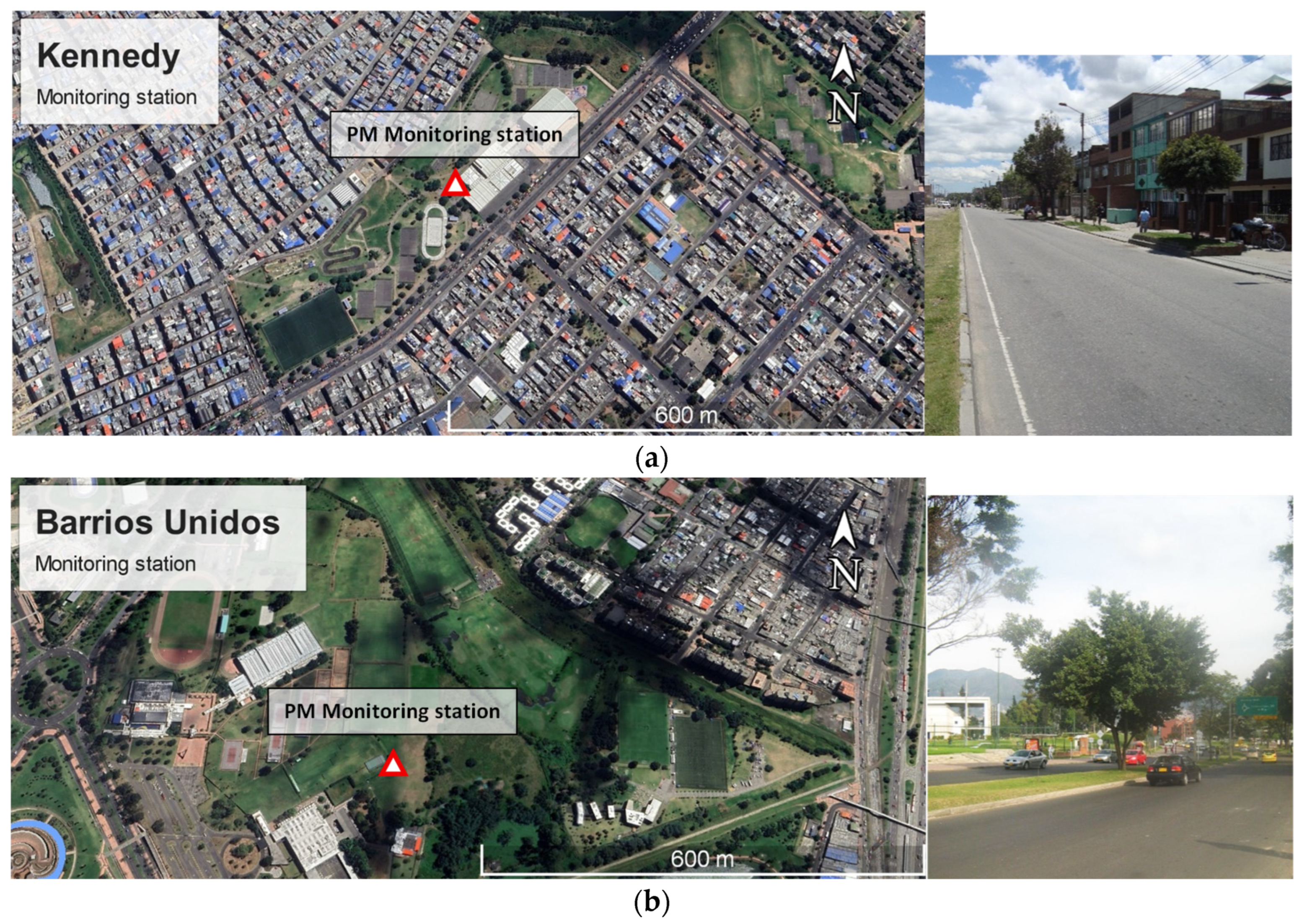
The city of Bogota, the capital of Colombia, covers an approximate area of 1775 km2 and hosts a population exceeding 8.5 million inhabitants. This figure rises to over 10 million when considering its metropolitan area. The megacity is administratively divided into 20 localities that exhibit marked socioeconomic and environmental disparities [18]. This study focuses on the localities of Kennedy and Barrios Unidos, selected due to their contrasting population densities, land-use patterns, and air pollution levels, as well as their inclusion within the Bogota Air Quality Monitoring Network–RMCAB (http://rmcab.ambientebogota.gov.co/home/map accessed on 8 October 2024). Kennedy, located in the southwestern sector of the city, encompasses an area of 3859 hectares and a population of approximately 1.23 million residents, positioning it among the most densely populated zones of Bogota (Figure 1a). This locality combines intense vehicular traffic, the presence of industrial corridors, and limited green area coverage—conditions that have historically contributed to elevated PM2.5 and PM10 concentrations [18,19]. In contrast, Barrios Unidos, situated in the northwestern part of Bogota, covers 1189 hectares and exhibits lower population density and a middle socioeconomic profile (Figure 1b). This area is primarily characterized by commercial and service-related activities and displays comparatively lower PM2.5 levels than Kennedy, according to RMCAB records over the past decade [18,20]. Its selection as the validation area for the proposed SAQI responds to the need to assess the index’s performance in an urban context with less critical air pollution conditions and distinct social vulnerability characteristics. The comparison between these two localities enables the identification of interactions among environmental, socioeconomic, and spatial factors, thereby providing a robust foundation for developing a SAQI tailored to the urban context of Bogota.

2.2. PM Monitoring System

The PM10 and PM2.5 monitoring system deployed in Bogota operated under the automated methods approved by the U.S. EPA, as specified in CFR 40 Parts 50 and 53 [21], and implemented by the RMCAB at the Kennedy and Barrios Unidos stations. For PM10, the Met One BAM-1020 beta-attenuation monitor was used, with a detection limit of approximately 1.0 µg/m3, instrument precision of 6.25% for concentrations ≤ 80 µg/m3 and 7.0% for concentrations > 80 µg/m3, and continuous hourly operation within an analytical range of 0–1000 µg/m3, 0–40 °C temperature tolerance, and <90% relative humidity. For PM2.5, the Thermo Scientific FH62C14-DHS beta-attenuation analyzer was employed, offering a detection limit of roughly 0.5 µg/m3, an operational range of 0–1000 µg/m3, thermal stability between 0 and 45 °C, and automated humidity control (<85%). Both instruments comply with widely recognized international standards (U.S. EPA) [21] and ensure robust hourly measurements supporting the development and validation of the proposed SAQI for Bogota. The PM sensors were located 3 m above ground level (outdoor). This applies to both monitoring stations considered in this study.

2.3. Research Methodology

This study adopted a sequential methodological design consisting of three complementary phases aligned with the proposed objectives. Phase I involved conducting a concise global review of scientific literature published over the past ten years using major scientific databases. The purpose was to identify the principal environmental and socioeconomic variables considered worldwide in existing air quality indices. Phase II comprised the collection of hourly PM10 and PM2.5 concentration data from the Bogota Air Quality Monitoring Network–RMCAB (http://rmcab.ambientebogota.gov.co/Report/stationreport accessed on 8 October 2024) over a seven-year period (2017–2023). This network operates 19 automated stations strategically distributed across the megacity. The dataset was complemented with socioeconomic variables obtained through an on-site citizen perception survey conducted in the study localities (See survey in Supplementary Material, Table S1). The combined atmospheric pollutant and perception data served as the basis for developing the proposed SAQI designed to evaluate air quality. The index was developed and tested in the Kennedy locality. Phase III consisted of validating the developed SAQI through its application in the Barrios Unidos locality. The same data collection and analytical protocols employed during model development were replicated, followed by comparative analyses between the two localities to assess the robustness, sensitivity, and transferability of the proposed SAQI.

2.3.1. Phase I: Global Mini-Review of Air Quality Indices

The first phase involved a global review of scientific literature aimed at identifying the main indices used to assess air quality over the past ten years, within both environmental and socioeconomic dimensions. The following high-visibility scientific databases were consulted: Scopus, ScienceDirect, SpringerLink, and Taylor & Francis. The Scopus database was selected over other available databases due to its broad coverage of journals and its advanced bibliometric and analytical tools. This allowed for the efficient identification, comparison, and synthesis of documents on AQIs. This concise literature review followed the methodological framework of the PRISMA protocol (Preferred Reporting Items for Systematic Reviews and Meta-Analyses) [22] and the recommendations outlined by Zafra et al. [23]. The mini-review was structured in four stages. The initial search stage (Stage 1) identified a total of 24,099 documents across all consulted databases using the following combination of keywords: “air quality,” “index,” and “socioenvironmental.” Subsequently, three additional stages were developed: Stage 2–identification of the most extensively studied air pollutants under the socio-environmental context; Stage 3–detection of the main variables considered by existing indices; and Stage 4–identification of the most frequently applied air quality indices. For all stages of the literature review, specific combinations of keywords were employed.
A citation index (Q) was used to weight the scientific relevance of the identified variables, defined as follows: Q1 (0.00–0.24), Q2 (0.25–0.49), Q3 (0.50–0.74), and Q4 (0.75–1.00), according to the methodological adaptation proposed by Zafra et al. [23]. This procedure enabled the identification of recurrent key variables across each stage of the mini-review. The results of this analysis guided the selection of environmental and socioeconomic variables subsequently used to construct the proposed SAQI. Furthermore, to validate the findings of the mini-review, a representative sample of documents was selected from the considered databases. The inclusion criteria comprised selecting the first 60 documents reported by each database (n = 240) that were directly related to the construction, validation, or application of air quality indices under environmental and social contexts in urban settings. Based on these inclusion criteria, 45 documents were ultimately selected, forming the reference basis for validating the results of the global mini-review.

2.3.2. Phase II. SAQI Development

This phase was structured in two stages. In Stage I, hourly records of PM10 and PM2.5 concentrations from the RMCAB network (http://rmcab.ambientebogota.gov.co/Report/stationreport accessed on 8 October 2024) and complementary meteorological variables were collected over a seven-year period (2017–2023). The original database contained hourly measurements of six criteria pollutants (PM10, PM2.5, O3, SO2, NO2, and CO) and six meteorological variables (temperature, precipitation, solar radiation, relative humidity, and wind direction and speed). Since the time series of the selected variables exhibited missing values due to equipment maintenance, calibration, and technical failures, normality was assessed using the Kolmogorov–Smirnov test, assuming a normal distribution when p-value > 0.05 [24]. For time series with a normal distribution, Pearson’s correlation coefficient was applied, while for non-parametric series, the Spearman coefficient was used [25]. This procedure allowed the identification of geographically close support monitoring stations (distance < 5 km) with significant correlations (r > 0.70, p-value < 0.01) to fill missing data in the PM2.5 and PM10 concentration time series. Missing data (<12% of the total per variable) were imputed using the normal ratio method [26]. This method has demonstrated robustness in previous urban air quality studies under similar conditions [27]. Twenty-four-hour moving averages were calculated to analyze daily variations, and hourly averages (n = 24 per station) were computed to examine temporal patterns. The processed data were organized into monthly and annual matrices for the subsequent construction of the proposed SAQI.
Stage II corresponded to the measurement of citizen perception. A total of 300 structured surveys (conducted anonymously in public areas) were administered in the localities of Kennedy and Barrios Unidos (150 in each) using non-probabilistic sampling within a 300 m radius of the selected RMCAB stations. The surveys included 30 questions on air pollution perception, perceived health effects, and demographic variables (age, gender, education level, and occupation; see Supplementary Material, Table S1). The instrument focused on collecting information related to the following social components: citizen perception of air quality, socioeconomic level, land coverage, knowledge of current environmental regulations, and length of residence in the locality. Survey data were quantitatively processed using SPSS V.21 for windows (IBM Corporation, Armonk, NY, USA), applying descriptive analysis, the Shapiro–Wilk normality test [28], and Pearson and Spearman correlations (95% confidence level).
The perception survey was developed based on a literature review (Phase I) on air quality perception, generating an initial pool of 30 items evaluated by a panel of six experts (researchers in air quality, environmental health, and social sciences) [29]. The content validity index (CVI ≥ 0.80 per item) was calculated for methodological refinement [30]. A pilot test (n = 50: 25 in Kennedy, 25 in Barrios Unidos) enabled wording and format adjustments through cognitive interviews assessing item comprehension and contextual relevance [31]. Psychometric validation with the main sample (n = 150 per locality) assessed reliability using Cronbach’s alpha coefficient [32] by variable (perception of air quality: α = 0.82; familiarity with current regulations: α = 0.81; years of living in the locality: α = 0.84). Values above the recommended threshold of 0.80 for applied research were achieved, confirming the satisfactory internal consistency of the instrument developed.
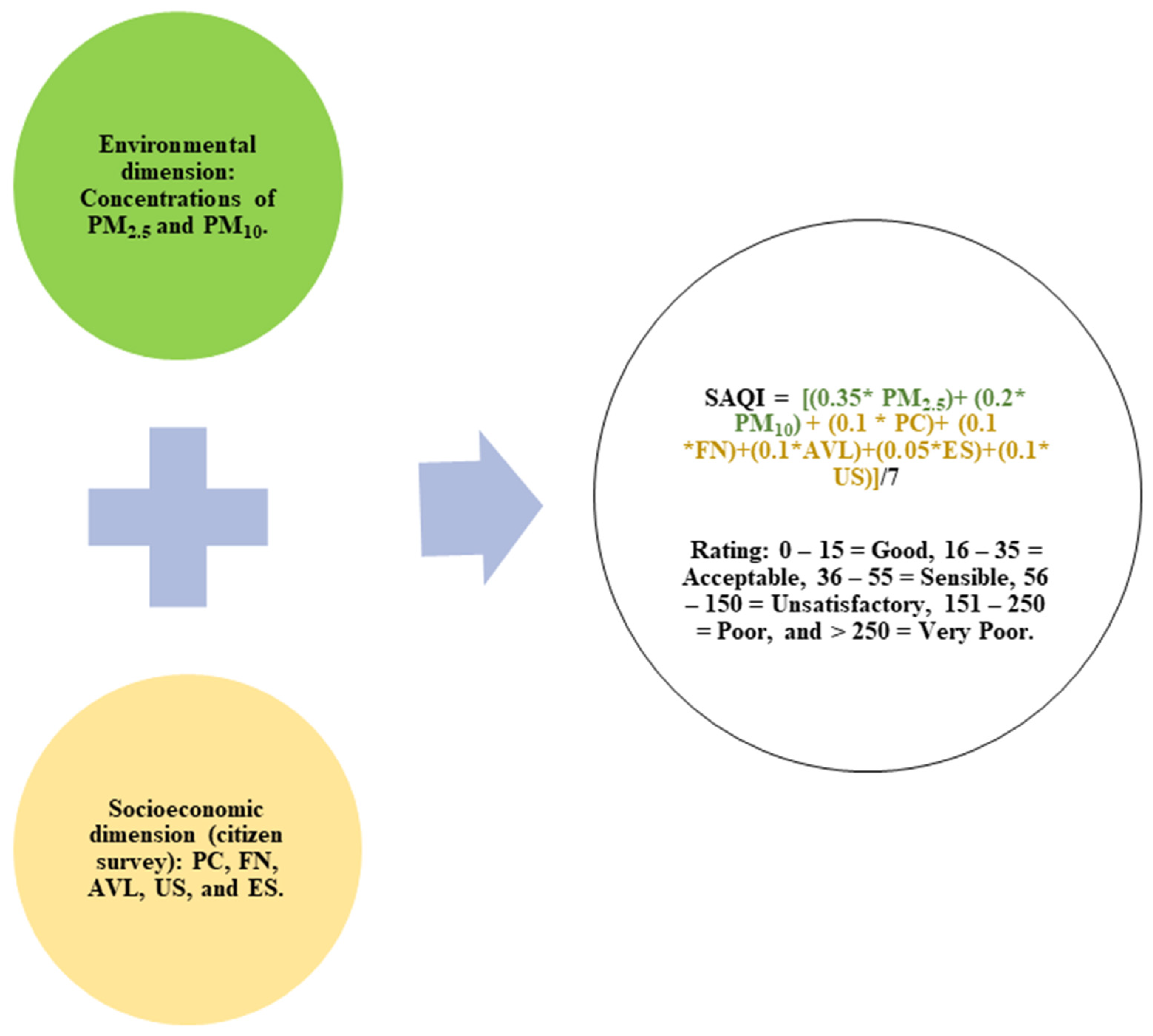
The SAQI integrated seven variables grouped into two complementary dimensions (environmental and socioeconomic). The environmental dimension included the annual mean concentrations of PM2.5 and PM10. The socioeconomic dimension comprised the following variables: citizen perception of air quality, familiarity with current environmental regulations, length of residence in the locality (years), assuming that long-term residents possess greater empirical knowledge of temporal variations in air quality; socioeconomic stratum, and predominant land coverage, classified into four categories (Table 1). The weighting of each variable was based on a mini literature review of 45 documents (Phase I) that developed air quality indices and consultations with an expert panel (n = 6). The assigned weights were as follows: PM2.5 (w = 0.35), given its higher respiratory penetration and strong epidemiological association with cardiorespiratory morbidity and mortality [33]. PM10 (w = 0.20), acknowledging its relevance to respiratory health but lower toxicity than PM2.5 [34]. Air quality perception (w = 0.10), as public perception significantly influences community mobilization and protective behaviors [35]. Familiarity with regulations (w = 0.10), reflecting informed responsiveness to pollution episodes [36]. Years of living in the locality (w = 0.10), capturing accumulated experiential knowledge [37]. Socioeconomic stratum (w = 0.05), highlighting disparities in vulnerability and adaptive capacity to air pollution [38]. Land coverage (w = 0.10), representing differences in local emission source intensity [39]. The sum of all weights equaled 1.00, ensuring interpretability of the resulting SAQI.
The SAQI was calculated through weighted linear aggregation (Equation (1)):
SAQI = [(0.35 × PM2.5) + (0.20 × PM10) + (0.10 × PC) + (0.10 × FN) + (0.10 × AVL) + (0.05 × ES) + (0.10 × US)]/7
where PM2.5 and PM10 represent annual mean concentrations, PC is air quality perception, FN is familiarity with regulations, AVL is the number of years living in the locality, ES is socioeconomic stratum, and US is land coverage.
All variables were normalized to the [0–500] range to standardize scales. This was performed using a linear transformation: V_normalized = [(V_observed − V_min)/(V_max − V_min)] × 500. The resulting index produced continuous values on a scale of 0 to 500, with higher values indicating very poor socio-environmental conditions in terms of air quality. Six interpretative categories were established with standardized color coding following international air quality communication protocols [41]: good (0–15, green), acceptable (16–35, yellow), sensible (36–55, orange), unsatisfactory (56–150, red), poor (151–250, purple), and very poor (>250, brown). Each category included specific recommendations for vulnerable groups (individuals with cardiovascular/respiratory diseases, adults > 60 years old, and children < 5 years old) and the general population, ranging from “no action required” (Good) to “avoid outdoor activities” (Very Poor) [42]. The categorization thresholds were defined through percentile analysis of the SAQI distribution for the Kennedy locality (Table 2). This mathematical and categorical structure was designed to provide an effective communicative tool that condensed complex technical information into an accessible format for decision-makers and the general public. This facilitated the possible implementation of differentiated preventive measures according to the level of socio-environmental risk identified.

2.3.3. Phase III. Validation and Comparative Analysis of the SAQI

The validation of the developed index was carried out through its application in the locality of Barrios Unidos, using the same methodological protocol implemented in Kennedy to ensure comparability (Figure 2). Barrios Unidos was selected as the contrasting area due to its distinct environmental and socioeconomic characteristics. Initially, social variables were obtained through an identical perception survey (n = 150) to that conducted in Kennedy. These variables were also normalized using the global minimum and maximum values (considering both localities) to preserve the comparative scale and were weighted with the same coefficients (wi) derived from the Kennedy dataset. Subsequently, environmental data (PM2.5 and PM10 concentrations) were collected from the Barrios Unidos monitoring station for the same seven-year period corresponding to the Kennedy station. Identical procedures for quality control, missing data imputation, and statistical analysis were applied. The SAQI values were then calculated to assess air quality, followed by a comparative analysis between the study localities. Statistical validation included: (1) internal consistency analysis using Cronbach’s alpha coefficient (α > 0.70 considered acceptable). (2) Sensitivity analysis evaluating the impact of variations in PM concentrations between 5 and 30% on the final index values. (3) Comparative analysis between localities to assess differences in SAQI distributions. All statistical analyses were performed in SPSS V.21 for windows (IBM Corporation, Armonk, NY, USA) with a 95% confidence level. This process allowed verification of the index’s validity as a comprehensive tool for the socio-environmental assessment of urban air quality, aiming to strengthen its applicability in public health decision-making and local environmental management. Lastly, a comparative analysis was conducted between the Bogota Air Quality Index–IBOCA (http://iboca.ambientebogota.gov.co/mapa/ accessed on 8 October 2024) and the proposed SAQI. This comparison was carried out for both study localities.

3. Results and Discussion

3.1. Mini-Review of Air Quality Indices

The global literature review identified 24,099 documents across four scientific databases, with Science Direct accounting for 64.4% of the total records (n = 15,527), followed by Taylor & Francis (22.4%, n = 5402), Springer Link (6.7%, n = 1620), and Google Scholar (6.4%, n = 1550), within a socio-environmental context (Stage 1). The results revealed patterns in global research on socio-environmental air quality indices (Table 3). In Stage 2 of the review, PM emerged as the most frequently integrated pollutant in air quality indices (n = 4249 documents, citation index-Q average = 0.18), followed by NO2 (n = 2908, index = 0.12) and O3 (n = 2677, index = 0.11). CO, SO2, and NO exhibited lower representation (Q indices ranging from 0.04 to 0.11). This predominance of PM suggested the increasing scientific recognition of PM2.5 and PM10 as major contributors to the global disease burden attributable to air pollution, with widely documented cardiovascular and respiratory effects [2].
The Stage 3 of review identified “public health” as the most prevalent variable (n = 15,034, index = 0.62, Q3–Q4), demonstrating that epidemiological orientation remains dominant in air quality index development, followed by “public transportation” (n = 10,811, index = 0.45, Q2) and “climatic variables” (n = 7445, index = 0.31, Q2). Notably, “socioeconomic vulnerability” and “environmental exposure” showed lower representation (indices of 0.18 and 0.04, respectively; Table 3), revealing a critical gap in integrating equity and environmental justice dimensions into existing assessment tools. This is despite growing evidence of the unequal distribution of air pollution exposure among different socioeconomic groups in urban areas [6]. Stage 4 of the review indicated the predominance of the Common Air Quality Index (n = 24,098, index = 1.00, Q4) and the Air Quality Health Index (n = 17,973, index = 0.75, Q4), whereas specialized indices such as the Air Pollution Tolerance Index and the EPA Air Quality Index exhibited lower citation frequencies (indices 0.10, Q1). These results corroborate previous observations regarding the persistence of techno-chemical approaches in air quality assessment, with limited multidimensional integration of social, economic, and spatial factors. Indeed, this trend underscores the need to develop contextualized tools that transcend conventional paradigms by incorporating perspectives of differential vulnerability and environmental equity within Latin American urban contexts.
The detailed analysis of the 45 documents selected according to predefined inclusion criteria revealed consistent patterns (validation) with the global mini-review on socio-environmental air quality indices (Table 4). The findings showed that PM was the most frequently incorporated pollutant (84%, n = 38 documents, Q1, index = 0.18), suggesting scientific consensus regarding its role as the main contributor to adverse cardiovascular and respiratory health effects. This is due to its high capacity for deep penetration into the respiratory system and its strong association with morbidity and mortality [43]. PM was followed by NO2 (74%, index = 0.12) and O3 (72%, index = 0.11). These secondary pollutants produce significant irritative effects on the respiratory tract and impair lung function, particularly among vulnerable populations such as individuals with asthma and the elderly [44]. Other pollutants, including SO2 (62%), CO (30%), and NO (14%), exhibited lower representation.
Among contextual variables, “air pollution” (58%, Q1, index = 0.20) and “public transportation” (52%, Q2, index = 0.31) predominated, while “public health” achieved a high citation frequency (44%, Q3, index = 0.62). Particularly, “socioeconomic vulnerability” and “climatic variables” showed low integration (24% and 26%, respectively). This trend suggests once again the persistence of a traditional techno-chemical approach with limited incorporation of the dimensions of equity and environmental justice (Table 4). Regarding the classification of indices, the Common Air Quality Index (48%, Q4, index = 1.00) and the Air Quality Health Index (46%, Q4, index = 0.75) were likely dominant, whereas specialized instruments such as the Air Pollution Tolerance Index appear to remain underutilized (4%, Q1, index = 0.10).
Based on the selected documents, the results identified seven recurrent variables integrated into four typologies of air quality indices: Common Air Quality Index, Air Quality Index (AQI), Air Quality Health Index, and Air Pollution Tolerance Index (Table 4). The distribution of variables indicated a predominance of “air pollution” (58%), followed by “public transportation” and “public health” (both 44%), whereas “climatic variables” (26%) and “socioeconomic vulnerability” (24%) showed lower citation frequencies. At the continental scale, the findings revealed that Asia accounted for the largest share of scientific production (56%), followed by North America (36%), Europe (16%), and Africa (2%). This trend suggested disparities in regional research capacity, with Latin America remaining particularly underrepresented despite facing critical urban air quality challenges in megacities.
Methodologically, the environmental variables considered by the indices were calculated using standardized equations. For instance, PM10 concentrations were estimated as AQI = [(0.4 × (PM10/PM10_Standard) + 0.6 × (PM10/PM10_Limit)) × 100, and PM2.5 concentrations as AQI = (0.3 × (PM2.5/PM2.5_Standard) + 0.7 × (PM2.5/PM2.5_Limit)) × 100] [11]. Thus, weighting deviations are relative to regulatory limits rather than WHO-recommended standards. Conversely, socioeconomic variables were derived from composite indices—for example, community perception through weighted survey averages (Q1), socioeconomic vulnerability through normalization of multiple factors (Q2), and health impact through quantification of attributable mortality per 100,000 inhabitants (Q2) [45,46,47]. Overall, the findings also suggested that this methodological heterogeneity constrained inter-study comparability and contextual transferability, underscoring the need to develop standardized frameworks that systematically integrate environmental and socioeconomic dimensions for Latin American contexts.

3.2. SAQI Development

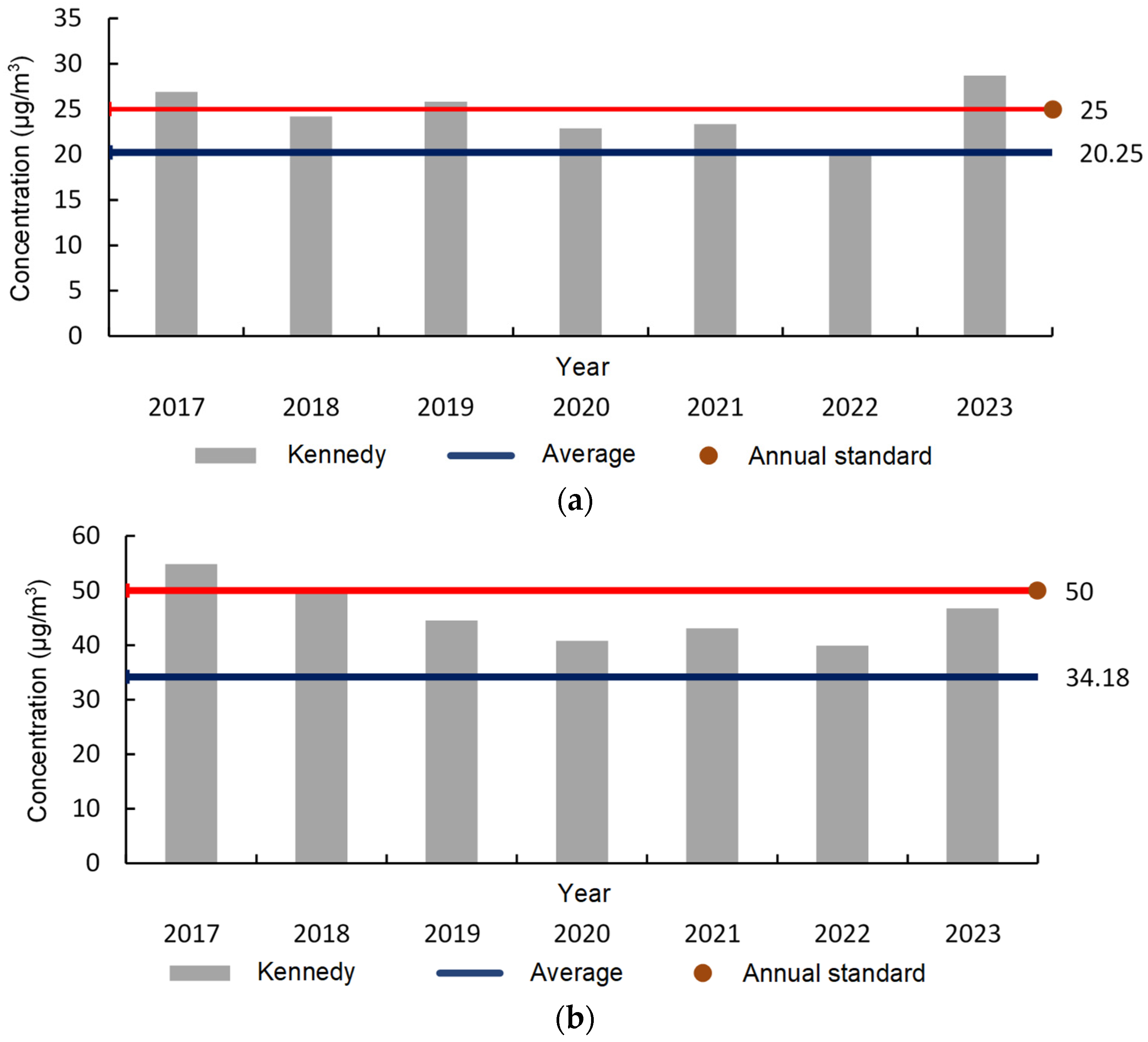
Regarding environmental data used for index development, results indicated that average concentrations during the study period were 45.6 ± 9.59 μg/m3 for PM10 and 24.1 ± 5.39 μg/m3 for PM2.5, with skewness coefficients of −0.34 and +0.37, respectively. This pattern suggested asymmetric distributions toward lower values for PM10 and higher values for PM2.5. Annual averages exhibited a decreasing trend from 2017 (PM10: 54.9 μg/m3; PM2.5: 26.9 μg/m3) to 2022 (PM10: 39.9 μg/m3; PM2.5: 20.1 μg/m3), representing reductions of 27.2% and 25.2%, respectively (Figure 3). This behavior aligned with vehicle emission control measures and mobility restrictions implemented during the COVID-19 period, as reported in other Latin American cities [48]. However, 2023 recorded an increase in PM concentrations (PM10: 46.7 μg/m3; PM2.5: 28.7 μg/m3).
In terms of regulatory compliance, PM10 exceeded the Colombian annual standard (Resolution 2254/2017: 50 μg/m3) between 2017 and 2018, while PM2.5 exceeded it in 2017, 2019, and 2023 (25 μg/m3). Critically, both pollutants systematically surpassed the WHO guidelines (PM10: 15 μg/m3; PM2.5: 5 μg/m3) [49], with episodes of levels between 2.7 and 3.7 times higher for PM10 and 4.0–5.7 times higher for PM2.5. This trend suggested that less stringent national standards allowed exposure levels associated with well-documented adverse cardiovascular and respiratory effects. Monthly variations revealed maximum concentrations during March–April (dry season: PM2.5 up to 30.6 μg/m3; PM10 up to 56.8 μg/m3) and minima between August–October (wet season). This seasonal behavior was likely linked to precipitation-driven wet deposition processes and fluctuations in the planetary boundary layer height.
Additionally, the results demonstrated improved air quality in Kennedy between 2017 and 2023, particularly for PM10, which achieved sustained compliance with national regulations since 2020 (Figure 3). Nevertheless, persistent exceedances of WHO guidelines indicated possible continued exposure of the local population (>1.2 million inhabitants) to concentrations associated with increased premature mortality, respiratory and cardiovascular hospitalizations, and reduced life expectancy. These effects were likely disproportionate among vulnerable groups (children <5 years: 13.4% of the population; adults >60 years: 10.8%). The observed seasonal variability also highlighted the need for temporally differentiated management measures, such as intensifying vehicle-restriction policies during the dry season (March–April), when unfavorable meteorological conditions (low precipitation and nocturnal thermal inversions) promote pollutant accumulation.
The relatively lower standard deviation for PM2.5 (5.39 μg/m3) compared with PM10 (9.59 μg/m3) suggested more spatially homogeneous emission sources for fine particles. This finding was consistent with the dominant contribution of vehicular combustion (40–50%) versus mechanical sources such as road dust resuspension, which predominantly affect PM10 [50]. The resurgence of particulate concentrations observed in 2023 underscores the need for continuous monitoring and reinforces the importance of integrated instruments such as the developed SAQI. This index is likely to transcend mere technical oversight by incorporating differentiated social vulnerability, which makes it possible to identify priority areas where high environmental exposure converges with low adaptive capacity. This probably prevents cumulative health risks and guides policies toward environmental equity.
Regarding the socioeconomic information used for index development, the survey applied to a non-probabilistic sample (n = 150) in the locality of Kennedy revealed a predominance of adults aged 46–60 years (46.8%), males (71.0%), and residents belonging to socioeconomic stratum III–middle (64.5%), according to the six socioeconomic categories considered in this study. Results showed that 91.9% of respondents used their dwellings for residential purposes, spending approximately 12 h per day at home (74.2%), with 16.1% having resided in the locality for more than 20 years. Concerning the immediate surroundings, 59.7% lived in impervious areas, 33.9% in vegetated zones, and 6.5% on unpaved surfaces (Supplementary Material, Figure S1). The perception of deteriorating air quality was widespread (75%), consistent with previous studies documenting increases in PM2.5 concentrations in Bogota between 2017 and 2020, despite recent improvements [51]. Critically, 78% of respondents considered government measures inadequate, revealing a disconnect between public policy and citizen perception. This phenomenon has also been documented in other Latin American cities, where risk communication gaps have limited the effectiveness of air quality interventions [52]. Moreover, respondents reported respiratory irritation symptoms (53%), recent respiratory infections (58.1%), and visible PM perception (71%), mainly attributed to mobile sources (53.2%). This causal attribution was consistent with emission inventories identifying vehicular transport as the primary contributor to PM2.5 in Bogota (40–50% of the total) [53].
Additionally, a total of 89% of respondents identified heavy vehicular traffic as the main source of pollution, with 64.5% spending more than two hours per day commuting. This trend suggested urban mobility patterns that amplified personal exposure to air pollutants, particularly among public transport users exposed to microenvironments with elevated concentrations [53]. These results supported the inclusion of perception, residence time, and built environment characteristics as key variables within the developed SAQI.
The developed SAQI integrated seven variables grouped into two complementary dimensions through weighted aggregation. The environmental dimension (aggregate weight = 0.55) incorporated PM2.5 concentrations and PM10 concentrations, weighted differentially considering the greater documented toxicity of fine particles (PM2.5) [54]. The socioeconomic dimension (aggregate weight = 0.45) included public perception of air quality, considering evidence on the role of perception in promoting protective behaviors and community mobilization in response to environmental risks [35]; familiarity with current air quality regulations, reflecting informed response capacity [55]; and residence time, capturing accumulated experiential knowledge [56]. Moreover, this dimension incorporated socioeconomic stratum and land coverage, acknowledging evidence of socioeconomic gradients in exposure to air pollutants. Reports indicate that lower-income populations experience 15–25% higher pollutant concentrations and have lower adaptive capacity to adverse effects [6,45].
Therefore, the proposed multiscalar index structure transcended the limitations of conventional, purely techno-chemical indices by integrating dimensions of differential vulnerability and environmental equity. This approach probably aligns with conceptual frameworks of environmental justice recognizing the unequal distribution of environmental burdens and adaptive capacities among social groups. The weighting assignment was based on the systematic literature review (Table 3), ensuring the theoretical and contextual validity of the developed index. Although the structure of the proposed SAQI may be transferable, the specificity of the weights adopted requires contextual recalibration. These values reflect social sensitivity and risk in the megacity of Bogota. Thus, an iterative local process (review and expert judgment) is required in other Latin American megacities to ensure its validity and relevance.
The application of the SAQI enabled quantitative and qualitative assessment of the urban system’s response in Kennedy under different simulated scenarios of increasing PM pollution. Results showed that the baseline SAQI value (21.8) classified air quality as “Acceptable,” reflecting moderate exposure conditions consistent with previous studies in densely populated Latin American urban areas [9]. Furthermore, the sensitivity analysis—considering six scenarios of increasing PM concentrations (10%, 15%, 20%, 25%, 50%, and 80%) while keeping socioeconomic variables constant (perception = 2.21, regulatory familiarity = 1.69, residence time = 3.02 years, socioeconomic stratum = 3, land use = 2.25)—demonstrated the robustness of the developed index. Increases of up to 50% produced a SAQI value of 32.1, remaining within the “Acceptable” category (16–35), while an 80% increase (PM10 = 82.3 μg/m3, PM2.5 = 44.2 μg/m3) yielded a SAQI of 38.3, transitioning to the “Moderate” category (36–55). This nonlinear relationship between pollutant concentrations and the resulting index probably reflected a methodological design that integrated multiple dimensions, reducing excessive sensitivity to variations in individual variables. It also provided a more stable assessment than indices based solely on pollutant concentrations, where 80% increases typically result in more abrupt categorical changes. The communicative structure of the SAQI also likely enhanced public interpretation through the use of recognized color codes and actionable recommendations scaled to the identified risk levels (Table 2).

3.3. SAQI Validation

The validation of the SAQI confirmed its internal coherence, methodological reliability, and practical applicability across the heterogeneous urban contexts under study. The process integrated verification of data source quality, consistency of statistical normalization, and review of the weighting assigned to environmental and socioeconomic variables. The results showed a strong correspondence between SAQI values and citizens’ perception of air quality, supporting its validity as an integrative indicator. However, uncertainty sources were identified, possibly associated with the spatial variability of PM10 and PM2.5 concentrations and the subjectivity of social responses (perception survey). Such uncertainty has been reported in similar studies conducted in urban areas, where environmental risk perception tended to moderate the interpretation of technical indicators [57]. Thus, the results suggested that the developed SAQI probably constitutes a robust and flexible tool for assessing air quality and supporting local decision-making, consistent with methodological standards applied in composite environmental sustainability indices.
The SAQI validation was conducted through its application in the Barrios Unidos locality, which exhibits contrasting socio-environmental characteristics compared to Kennedy. PM10 and PM2.5 concentration data during the seven-year study period presented 8.4% missing values, which were completed using the ratio method with two supporting stations. These stations were selected due to their geographic proximity (<3 km) and significant correlations (Las Ferias: PM10 rs-Spearman = 0.763; PM2.5, rs = 0.804, p-value < 0.01; MinAmbiente: PM2.5, rs = 0.674, p-value < 0.05). Previous studies have reported that missing data imputation using validated statistical techniques is a standard practice in air quality research [27], allowing for continuous time series necessary for temporal trend analysis and forecasting.
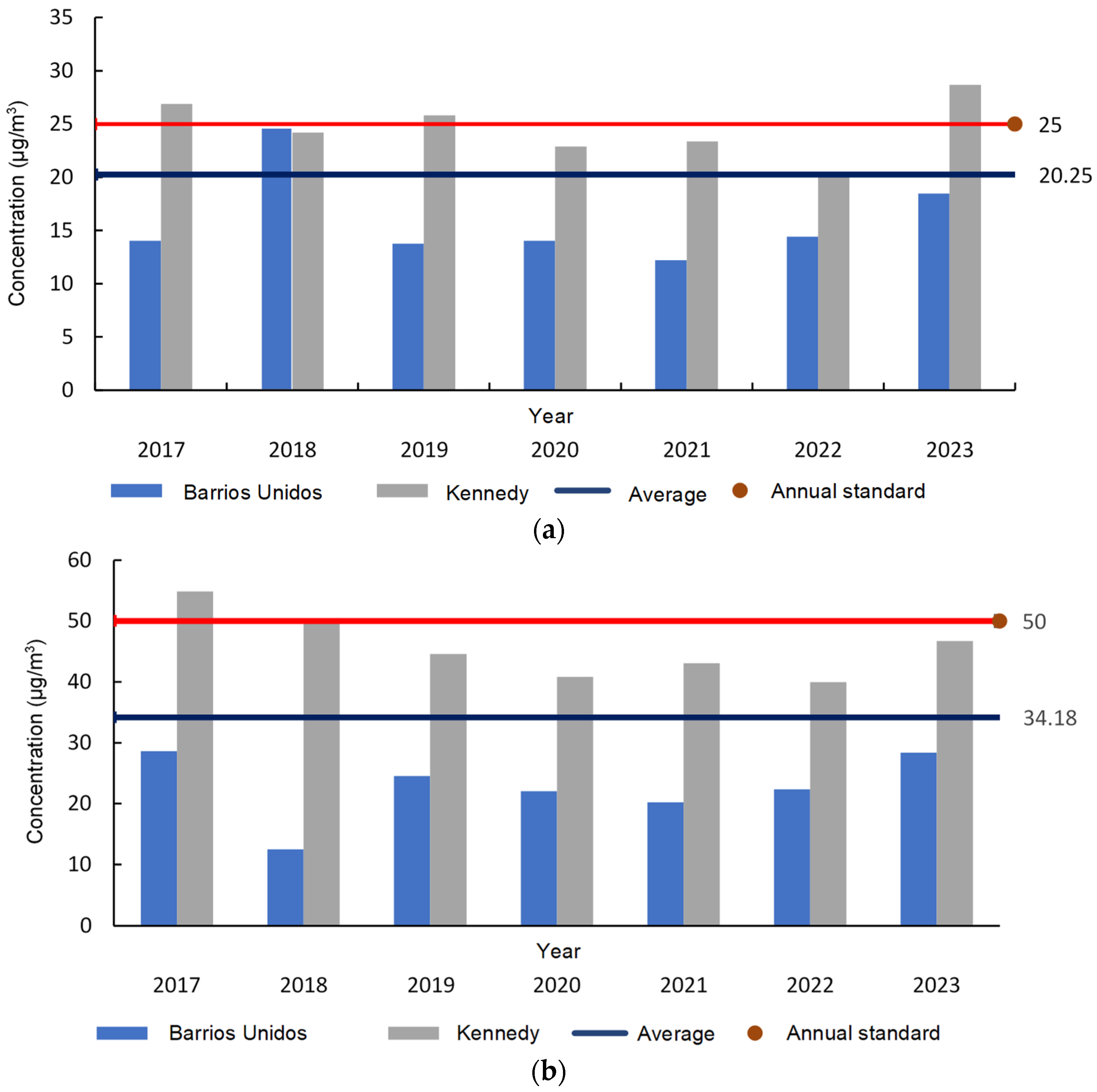
Additionally, the results showed that the multiyear mean PM concentrations in Barrios Unidos (PM10: 22.9 ± 4.19 μg/m3; PM2.5: 15.9 ± 4.17 μg/m3) were lower than those in Kennedy (PM10: 45.7 ± 5.69 μg/m3; PM2.5: 24.5 ± 2.89 μg/m3), representing reductions of 49.8% and 34.9%, respectively (Figure 4). Barrios Unidos consistently complied with Colombian air quality regulations throughout the seven-year period, whereas Kennedy exceeded the limits in specific years (PM10: 2017–2018; PM2.5: 2017, 2019, 2023). These intra-urban differences likely suggest spatial exposure gradients, a phenomenon documented in several Latin American megacities. For instance, it has been reported that peripheral areas with higher industrial and vehicular activity exhibited concentrations 30–60% higher than central residential zones with better urban infrastructure [58].
The findings showed that the application of the SAQI in Barrios Unidos yielded a value of 12, classified as “Good” (0–15, green code), indicating no need for precautionary measures for either the general population or vulnerable groups. The weighted contributions were as follows: PM10 (22.7 μg/m3, w: 0.35) = 7.93; PM2.5 (15.9 μg/m3, w: 0.20) = 3.19; citizens’ perception (1.95, w: 0.10) = 0.20; regulatory familiarity (2.05, w: 0.10) = 0.21; years of residence (3.02 years, w: 0.10) = 0.30; socioeconomic stratum (3, w: 0.05) = 0.15; and land use (2.18, w: 0.10) = 0.22. The SAQI value for Barrios Unidos (12) was 44.9% lower than that of Kennedy (21.8), reflecting the convergence of favorable conditions. In other words, substantially lower PM concentrations were observed (PM2.5: 34.9% lower; PM10: 50.4% lower), coupled with better citizens’ perception (1.95 vs. 2.21) and greater regulatory knowledge (2.05 vs. 1.69). This trend aligns with the literature on intra-urban gradients, where higher socioeconomic areas exhibit cumulative advantages in environmental quality and community response capacity [59]. The differentiated categorization (“Good” vs. “Acceptable”) probably validated the sensitivity of the SAQI to discriminate contrasting socio-environmental conditions and supported the robustness of the developed methodological framework, which systematically integrated environmental and socioeconomic dimensions. This feature was likely absent in conventional indices based exclusively on pollutant concentrations, which often produced similar classifications, as both localities met Colombian air quality standards. This finding also suggests an added value of the socio-environmental approach in identifying subtle inequities not captured by traditional technical monitoring.
Additionally, the descriptive statistical analysis revealed differences in the distributions of PM concentrations between the study areas. Kennedy exhibited higher variability (PM10: σ = 13.0 μg/m3, range = 42.4; PM2.5: σ = 5.68 μg/m3, range = 16.5) and negative skewness (PM10: −0.02; PM2.5: −0.11), indicating a higher frequency of low concentrations interspersed with episodic peaks. The negative kurtosis observed in both localities (Kennedy PM10: −1.29; PM2.5: −1.62) suggested platykurtic distributions with less clustering around the mean than a normal distribution. Thus, the successful application of the SAQI in differentiated socio-environmental contexts (Barrios Unidos: middle-to-upper socioeconomic level, lower population density, greater green area availability; Kennedy: lower-to-middle socioeconomic level, high density, deficient infrastructure) probably demonstrated the methodological robustness and transferability of the developed tool. This possibly represents a critical feature of effective composite indices, which must retain structural validity across diverse contexts without requiring a complete recalibration of weights.
The findings also revealed an improvement in air quality in Kennedy between 2017 and 2022 (PM10 reduction: 27.2%; PM2.5 reduction: 25.2%), attributable to the implementation of vehicle restrictions, the renewal of public transport fleets, and temporary effects of the COVID-19 pandemic. Similar trends have been documented in multiple Latin American cities [60]. However, a deterioration in air quality was observed in 2023 (PM2.5: 28.7 μg/m3), suggesting the need for continued monitoring (Figure 4). Thus, the comparative validation between the study localities highlighted the SAQI’s capacity to discriminate contrasting socio-environmental conditions, likely providing an adaptable tool for identifying inequities in exposure to air pollutants and prioritizing interventions aimed at promoting environmental equity in Latin American urban contexts.
The comparative analysis between the study localities revealed differences across all SAQI-assessed dimensions. PM concentrations were systematically higher in Kennedy (PM10: 45.7 μg/m3; PM2.5: 24.6 μg/m3) compared to Barrios Unidos (PM10: 22.7 μg/m3; PM2.5: 15.9 μg/m3), representing increases of 101.7% and 54.1%, respectively. These disparities reflected typical intra-urban gradients in megacities. For instance, peripheral areas with higher industrial activity, greater vehicular density, and infrastructural deficiencies often experience disproportionate exposure to air pollutants, perpetuating environmental inequities that amplify the vulnerability of low-income populations [61]. Conversely, social variables exhibited differentiated patterns. The perception of air quality was worse in Kennedy (2.21 vs. 1.95), consistent with objectively higher exposure. However, regulatory familiarity was greater in Barrios Unidos (2.05 vs. 1.69), suggesting higher social capital and access to information that may facilitate adaptive responses. This trend has also been documented in other studies, where educational and socioeconomic levels were positively correlated with environmental knowledge and the adoption of protective behaviors [62]. Results further indicated that years of residence and socioeconomic stratum were identical (AVL = 3.02 years; ES = 3), while land use showed minimal differences (2.25 vs. 2.18) between the two study areas. The resulting SAQI values (Kennedy: 21.8, “Acceptable”; Barrios Unidos: 12.0, “Good”) quantified a socio-environmental gap of 81.5% in Kennedy. In other words, multiple disadvantages (high environmental exposure to PM, limited regulatory knowledge, and poorer public perception of air quality) converged in Kennedy compared to Barrios Unidos, characterizing the conditions of environmental injustice observed. Previous studies have reported that vulnerable communities face cumulative burdens without proportional resources for mitigation [38].
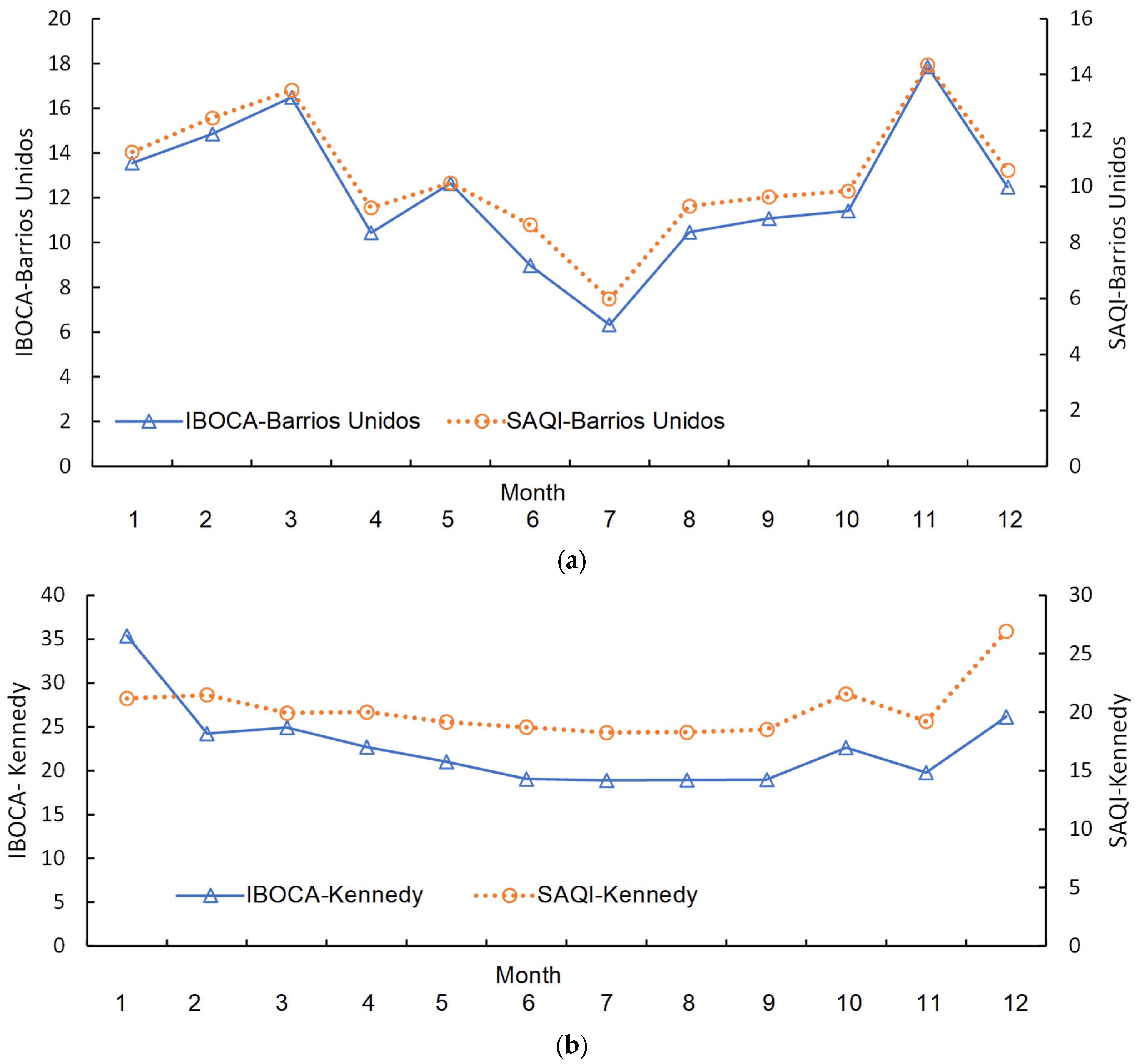
The monthly comparison during 2021 between the Bogota Air Quality Index (IBOCA)—based exclusively on PM10, PM2.5, O3, NO2, SO2, and CO concentrations—and the developed SAQI revealed divergences in both localities (Figure 5). IBOCA consistently yielded higher values than SAQI (Kennedy: average IBOCA = 45.2 vs. ISCA = 21.8; Barrios Unidos: average IBOCA = 28.4 vs. ISCA = 12.0), indicating that purely techno-chemical indices tended to produce more restrictive classifications by not incorporating contextual factors that modulate effective vulnerability and perceived risk. This divergence likely does not imply that SAQI underestimated risks but rather that it integrated complementary dimensions absent in conventional indices. While IBOCA quantified objective exposure to pollutants (biophysical dimension), the developed SAQI additionally incorporated differential social vulnerability, regulatory awareness, and citizens’ perception. The inclusion of these social variables likely provided a multidimensional assessment more aligned with the concept of effective risk, which arises from the interaction between environmental hazard (exposure) and community susceptibility/resilience factors.
Finally, the assumption of temporal constancy for social variables during 2021 represented a methodological limitation of this study. Longitudinal research has recommended annual or biennial updates of perception surveys to capture temporal changes in public knowledge and attitudes—particularly in response to significant events (e.g., episodes of high pollution or the implementation of new policies) that may alter citizens’ perceptions and behaviors [63,64]. Nevertheless, the comparative analysis demonstrated the added value of the SAQI in identifying socio-environmental inequities not captured by conventional technical monitoring. Indeed, this provides differentiated information for the design of context-sensitive interventions that move beyond emission control alone toward comprehensive approaches to environmental equity.

4. Conclusions

This study develops and validates an index designed to evaluate air quality by integrating PM concentrations with socioeconomic variables in urban contexts in developing countries. The SAQI structure integrates seven key variables, assigning a robust weight of 45% to the socioeconomic dimension (subjective variables = 15%) to complement the critical environmental exposure component (55%). The latter reflects PM2.5 concentrations that consistently exceed WHO guidelines by factors ranging from 4.0 to 5.7. The sensitivity analysis confirms the stability of the SAQI: a baseline value of 21.8 (“Acceptable”) shifts to 38.3 (“Moderate”) only under an extreme 80% increase in PM concentrations. Thus, the SAQI establishes itself as a multiscale and adaptable tool essential for guiding public policies toward environmental equity and strengthening risk management and planning strategies in urban contexts in developing countries.
The results suggest that the proposed SAQI is a validated and robust instrument crucial for identifying inequities in PM exposure across urban environments. The comparative application in Barrios Unidos and Kennedy demonstrates the index’s sensitivity, revealing a socio-environmental gap of 81.5%, with Barrios Unidos registering a SAQI of 12 (“Good”) compared to Kennedy’s 21.8 (“Acceptable”). These differences not only reflect objectively higher PM concentrations—up to 49.8% greater in Kennedy—but also the convergence of social vulnerability and lower regulatory awareness regarding air quality. Moreover, the methodological divergence between the SAQI and the local, purely technical index (IBOCA, averaging 45.2 in Kennedy) underscores the added value of the socio-environmental approach adopted in this study to capture effective risk. Consequently, the SAQI likely provides a critical decision-support tool for designing contextualized interventions aimed at promoting more equitable and just air quality management in megacities in developing countries.
Despite its robustness, this study presents limitations related to the use of secondary information, spatial restriction to two localities, and the assumed temporal constancy of social variables, which may constrain the extrapolation of the index to other urban settings. Future research should expand SAQI’s application across multiple territorial scales, periodically update citizen perception surveys, and integrate cost–benefit analyses and predictive modeling to strengthen the socio-environmental management of air quality in cities in developing countries.

Supplementary Materials

The following supporting information can be downloaded at https://www.mdpi.com/article/10.3390/su18021097/s1. Figure S1: Results of the perception survey conducted; Table S1: Applied perception survey.

Author Contributions

Conceptualization, A.D.B.-H. and C.A.Z.-M.; Methodology, A.D.B.-H. and C.A.Z.-M.; Software, A.D.B.-H. and C.A.Z.-M.; Validation, A.D.B.-H., C.A.Z.-M. and N.J.C.-C.; Formal analysis, A.D.B.-H. and C.A.Z.-M.; Investigation, A.D.B.-H. and C.A.Z.-M.; Resources, C.A.Z.-M. and N.J.C.-C.; Data curation, A.D.B.-H., C.A.Z.-M. and N.J.C.-C.; Writing—original draft, C.A.Z.-M. and N.J.C.-C.; Writing—review and editing, A.D.B.-H., C.A.Z.-M. and N.J.C.-C.; Visualization, A.D.B.-H., C.A.Z.-M. and N.J.C.-C.; Supervision, C.A.Z.-M.; Project administration, C.A.Z.-M.; Funding acquisition, C.A.Z.-M. and N.J.C.-C. All authors have read and agreed to the published version of the manuscript.

Funding

This research received no external funding.

Institutional Review Board Statement

This study was exempted from ethical review and approval because it is a low-risk, completely anonymous investigation that uses verbal surveys in public spaces about a non-sensitive urban service, and strictly adhered to the principles of verbal informed consent, anonymity, and voluntariness (Minimal Risk Waiver Clause). The study was conducted in accordance with the ethical principles of the Declaration of Helsinki (1975, revised in 2013) and with Colombian national regulations, including Resolution 8430 of 1993 of the Ministry of Health (which establishes scientific, technical, and administrative norms for research involving human subjects) and Decree 1377 of 2013 on personal data protection.

Informed Consent Statement

All participants were informed about the purpose of the study, and their participation was entirely voluntary. Informed consent was obtained from all subjects involved in the study.

Data Availability Statement

The original contributions presented in this study are included in the article. Further inquiries can be directed to the corresponding author.

Acknowledgments

The authors would like to thank the Environmental Engineering Research Group (GIIAUD) and the Sustainable Development Research Group (INDESOS) at the Universidad Distrital Francisco José de Caldas (Colombia).

Conflicts of Interest

The authors declare no conflicts of interest.

Abbreviations

SAQISocio-environmental air quality index
PMParticulate matter
IBOCABogotá Air Quality Index
WHOWorld Health Organization
AQIAir Quality Index
RMCABBogota Air Quality Monitoring Network
PCAir quality perception
FNFamiliarity with regulations
AVLNumber of years living in the locality
ESSocioeconomic stratum
USLand coverage
V_normalizedNormalized value
V_observedObserved value
V_minMinimum value
V_maxMaximum value
DDDocuments detected
QCitation frequency index

References

  1. World Health Organization. WHO Global Air Quality Guidelines: Particulate Matter (PM2.5 and PM10), Ozone, Nitrogen Dioxide, Sulfur Dioxide and Carbon Monoxide; World Health Organization: Geneva, Switzerland, 2021; ISBN 978-92-4-003422-8. [Google Scholar]
  2. Zhao, Y.; Cheng, Z.; Lu, Y.; Chang, X.; Chan, C.; Bai, Y.; Zhang, Y.; Cheng, N. PM10 and PM2.5 Particles as Main Air Pollutants Contributing to Rising Risks of Coronary Heart Disease: A Systematic Review. Environ. Technol. Rev. 2017, 6, 174–185. [Google Scholar] [CrossRef]
  3. Al-Thani, H.; Koç, M.; Isaifan, R.J. A Review on the Direct Effect of Particulate Atmospheric Pollution on Materials and Its Mitigation for Sustainable Cities and Societies. Environ. Sci. Pollut. Res. 2018, 25, 27839–27857. [Google Scholar] [CrossRef]
  4. Citaristi, I. United Nations Human Settlements Programme—UN-Habitat. In The Europa Directory of International Organizations 2022; Routledge: Abingdon-on-Thames, UK, 2022. [Google Scholar]
  5. García-Burgos, J.; Miquelajauregui, Y.; Vega, E.; Namdeo, A.; Ruíz-Olivares, A.; Mejía-Arangure, J.M.; Resendiz-Martinez, C.G.; Hayes, L.; Bramwell, L.; Jaimes-Palomera, M.; et al. Exploring the Spatial Distribution of Air Pollution and Its Association with Socioeconomic Status Indicators in Mexico City. Sustainability 2022, 14, 15320. [Google Scholar] [CrossRef]
  6. Pratt, G.C.; Vadali, M.L.; Kvale, D.L.; Ellickson, K.M. Traffic, Air Pollution, Minority and Socio-Economic Status: Addressing Inequities in Exposure and Risk. Int. J. Environ. Res. Public Health 2015, 12, 5355–5372. [Google Scholar] [CrossRef]
  7. Sen Roy, S. (Ed.) Resilient and Sustainable Cities. In Linking Gender to Climate Change Impacts in the Global South; Springer International Publishing: Cham, Swizterland, 2018; pp. 117–137. ISBN 978-3-319-75777-3. [Google Scholar]
  8. Vedrenne, M.; Borge, R.; Lumbreras, J.; Conlan, B.; Rodríguez, M.E.; de Andrés, J.M.; de la Paz, D.; Pérez, J.; Narros, A. An Integrated Assessment of Two Decades of Air Pollution Policy Making in Spain: Impacts, Costs and Improvements. Sci. Total Environ. 2015, 527–528, 351–361. [Google Scholar] [CrossRef] [PubMed]
  9. Bell, M.L.; Cifuentes, L.A.; Davis, D.L.; Cushing, E.; Gusman Telles, A.; Gouveia, N. Environmental Health Indicators and a Case Study of Air Pollution in Latin American Cities. Environ. Res. 2011, 111, 57–66. [Google Scholar] [CrossRef]
  10. Mandal, T.; Gorai, A. Air Quality Indices: A Literature Review. J. Environ. Sci. Eng. 2014, 56, 357–362. [Google Scholar]
  11. Horn, S.A.; Dasgupta, P.K. The Air Quality Index (AQI) in Historical and Analytical Perspective a Tutorial Review. Talanta 2024, 267, 125260. [Google Scholar] [CrossRef]
  12. Pierri-Daunt, A.B.; Siedentop, S. Unravelling Urban Typologies in Latin American Cities: Integrating Socioeconomic Factors and Urban Configurations across Scales. Appl. Geogr. 2025, 174, 103460. [Google Scholar] [CrossRef]
  13. Barros, J.; Feitosa, F.d.F.; Araujo, A.S. de Revisiting Urban Inequalities and Segregation in Latin America: Progress within and beyond Research Traditions–Special Section Editorial. Urbe Rev. Bras. Gest. Urbana 2024, 16, e20240000. [Google Scholar] [CrossRef]
  14. Gomis, M.; Cepeda-Másmela, C. Territorial Stigma: The (Un)Likable Governance by Strata in Bogota. Dilemas Rev. Estud. Conflito Controle Soc. 2025, 18, e65144. [Google Scholar] [CrossRef]
  15. La Colla, N.S.; Botté, S.E.; Marcovecchio, J.E. Atmospheric Particulate Pollution in South American Megacities. Environ. Rev. 2021, 29, 415–429. [Google Scholar] [CrossRef]
  16. Mura, I.; Franco, J.F.; Bernal, L.; Melo, N.; Díaz, J.J.; Akhavan-Tabatabaei, R. A Decade of Air Quality in Bogotá: A Descriptive Analysis. Front. Environ. Sci. 2020, 8, 65. [Google Scholar] [CrossRef]
  17. Franceschi, F.; Cobo, M.; Figueredo, M. Discovering Relationships and Forecasting PM10 and PM2.5 Concentrations in Bogotá, Colombia, Using Artificial Neural Networks, Principal Component Analysis, and k-Means Clustering. Atmos. Pollut. Res. 2018, 9, 912–922. [Google Scholar] [CrossRef]
  18. Economic Observatory. Bogotá en Cifras 2023–Observatorio de Desarrollo Económico. Available online: https://observatorio.desarrolloeconomico.gov.co/estudios/libros/bogota-en-cifras-2023-2/ (accessed on 11 November 2025).
  19. Zafra-Mejía, C.; Santamaría-Galindo, D.M.; Torres-Galindo, C.D. Climatic analysis of heavy metal concentration associated with urban road-deposited sediment. Rev. Salud Publica 2015, 17, 351–364. [Google Scholar] [CrossRef]
  20. Del Pilar Romero-Barreiro, M.; Pinilla-Castañeda, R.D.; Zafra-Mejía, C.A. Temporal assessment of the heavy metals (Pb and Cu) concentration associated with the road sediment: Fontibón-barrios unidos (Bogotá D.C., Colombia). Ing. Univers. 2015, 19, 315–333. [Google Scholar] [CrossRef]
  21. United States Environmental Protection Agency. Current Knowledge of Particulate Matter (PM) Continuous Emission Monitoring. Available online: https://nepis.epa.gov/Exe/ZyNET.exe/2000F6VS.txt?ZyActionD=ZyDocument&Client=EPA&Index=2000%20Thru%202005&Docs=&Query=&Time=&EndTime=&SearchMethod=1&TocRestrict=n&Toc=&TocEntry=&QField=&QFieldYear=&QFieldMonth=&QFieldDay=&UseQField=&IntQFieldOp=0&ExtQFieldOp=0&XmlQuery=&File=D%3A%5CZYFILES%5CINDEX%20DATA%5C00THRU05%5CTXT%5C00000009%5C2000F6VS.txt&User=ANONYMOUS&Password=anonymous&SortMethod=h%7C-&MaximumDocuments=1&FuzzyDegree=0&ImageQuality=r75g8/r75g8/x150y150g16/i425&Display=hpfr&DefSeekPage=&SearchBack=ZyActionL&Back=ZyActionS&BackDesc=Results%20page&MaximumPages=1&ZyEntry=1 (accessed on 2 December 2025).
  22. Moher, D.; Liberati, A.; Tetzlaff, J.; Altman, D.G. Preferred Reporting Items for Systematic Reviews and Meta-Analyses: The PRISMA Statement. Int. J. Surg. 2010, 8, 336–341. [Google Scholar] [CrossRef]
  23. Zafra, C.; Temprano, J.; Tejero, I. The Physical Factors Affecting Heavy Metals Accumulated in the Sediment Deposited on Road Surfaces in Dry Weather: A Review. Urban Water J. 2017, 14, 639–649. [Google Scholar] [CrossRef]
  24. Berger, V.W.; Zhou, Y. Kolmogorov–Smirnov Test: Overview. In Wiley StatsRef: Statistics Reference Online; John Wiley & Sons, Ltd.: Hoboken, NJ, USA, 2014; ISBN 978-1-118-44511-2. [Google Scholar]
  25. El-Hashash, E.F.; Shiekh, R.H.A. A Comparison of the Pearson, Spearman Rank and Kendall Tau Correlation Coefficients Using Quantitative Variables. Asian J. Probab. Stat. 2022, 20, 36–48. [Google Scholar] [CrossRef]
  26. Burhanuddin, S.N.Z.A.; Deni, S.M.; Ramli, N.M. Imputation of Missing Rainfall Data Using Revised Normal Ratio Method. Adv. Sci. Lett. 2017, 23, 10981–10985. [Google Scholar] [CrossRef]
  27. Junninen, H.; Niska, H.; Tuppurainen, K.; Ruuskanen, J.; Kolehmainen, M. Methods for Imputation of Missing Values in Air Quality Data Sets. Atmos. Environ. 2004, 38, 2895–2907. [Google Scholar] [CrossRef]
  28. Yazici, B.; Yolacan, S. A Comparison of Various Tests of Normality. J. Stat. Comput. Simul. 2007, 77, 175–183. [Google Scholar] [CrossRef]
  29. Maione, M.; Mocca, E.; Eisfeld, K.; Kazepov, Y.; Fuzzi, S. Public Perception of Air Pollution Sources across Europe. Ambio 2021, 50, 1150–1158. [Google Scholar] [CrossRef] [PubMed]
  30. Almanasreh, E.; Moles, R.; Chen, T.F. Evaluation of Methods Used for Estimating Content Validity. Res. Soc. Adm. Pharm. 2019, 15, 214–221. [Google Scholar] [CrossRef] [PubMed]
  31. García, A.A. Cognitive Interviews to Test and Refine Questionnaires. Public Health Nurs. 2011, 28, 444–450. [Google Scholar] [CrossRef]
  32. Mirzaei-Alavijeh, M.; Jalilian, F.; Dragoi, E.-N.; Pirouzeh, R.; Solaimanizadeh, L.; Khashij, S. Self-Care Behaviors Related to Air Pollution Protection Questionnaire: A Psychometric Analysis. Arch. Public Health 2020, 78, 19. [Google Scholar] [CrossRef]
  33. Lippmann, M. Toxicological and Epidemiological Studies of Cardiovascular Effects of Ambient Air Fine Particulate Matter (PM2.5) and Its Chemical Components: Coherence and Public Health Implications. Crit. Rev. Toxicol. 2014, 44, 299–347. [Google Scholar] [CrossRef]
  34. Moreno, T.; Trechera, P.; Querol, X.; Lah, R.; Johnson, D.; Wrana, A.; Williamson, B. Trace Element Fractionation between PM10 and PM2.5 in Coal Mine Dust: Implications for Occupational Respiratory Health. Int. J. Coal Geol. 2019, 203, 52–59. [Google Scholar] [CrossRef]
  35. Ngo, N.S.; Kokoyo, S.; Klopp, J. Why Participation Matters for Air Quality Studies: Risk Perceptions, Understandings of Air Pollution and Mobilization in a Poor Neighborhood in Nairobi, Kenya. Public Health 2017, 142, 177–185. [Google Scholar] [CrossRef]
  36. Yang, G.; Ju, Y.; Ni, W. Does the Air Pollution Level Information Matter in Public Perception? Insights from China. J. Environ. Manag. 2024, 349, 119582. [Google Scholar] [CrossRef]
  37. Zhou, Q.; Chen, N.; Pan, X.; Xu, X.; Liu, B.; Liu, M.; Bi, J.; Kinney, P.L. Characterizing Air Pollution Risk Perceptions among High-Educated Young Generation in China: How Does Risk Experience Influence Risk Perception. Environ. Sci. Policy 2021, 123, 99–105. [Google Scholar] [CrossRef]
  38. Park, S.; Kim, S.J.; Yu, H.; Lim, C.-H.; Park, E.; Kim, J.; Lee, W.-K. Developing an Adaptive Pathway to Mitigate Air Pollution Risk for Vulnerable Groups in South Korea. Sustainability 2020, 12, 1790. [Google Scholar] [CrossRef]
  39. Shekarrizfard, M.; Faghih-Imani, A.; Crouse, D.L.; Goldberg, M.; Ross, N.; Eluru, N.; Hatzopoulou, M. Individual Exposure to Traffic Related Air Pollution across Land-Use Clusters. Transp. Res. Part D Transp. Environ. 2016, 46, 339–350. [Google Scholar] [CrossRef]
  40. Departamento Administrativo Nacional de Estadística DANE. Available online: https://www.dane.gov.co/ (accessed on 5 January 2024).
  41. Ravindra, K.; Singh, V.; Mor, S. Why We Should Have a Universal Air Quality Index? Environ. Int. 2024, 187, 108698. [Google Scholar] [CrossRef]
  42. Woodward, N.; Levine, M. Minimizing Air Pollution Exposure: A Practical Policy to Protect Vulnerable Older Adults from Death and Disability. Environ. Sci. Policy 2016, 56, 49–55. [Google Scholar] [CrossRef] [PubMed]
  43. Thangavel, P.; Park, D.; Lee, Y.-C. Recent Insights into Particulate Matter (PM2.5)-Mediated Toxicity in Humans: An Overview. Int. J. Environ. Res. Public Health 2022, 19, 7511. [Google Scholar] [CrossRef]
  44. Ritz, B.; Hoffmann, B.; Peters, A. The Effects of Fine Dust, Ozone, and Nitrogen Dioxide on Health. Dtsch. Arztebl. Int. 2019, 116, 881–886. [Google Scholar] [CrossRef] [PubMed]
  45. Loizeau, M.; Buteau, S.; Chaix, B.; McElroy, S.; Counil, E.; Benmarhnia, T. Does the Air Pollution Model Influence the Evidence of Socio-Economic Disparities in Exposure and Susceptibility? Environ. Res. 2018, 167, 650–661. [Google Scholar] [CrossRef]
  46. Geldsetzer, P.; Fridljand, D.; Kiang, M.V.; Bendavid, E.; Heft-Neal, S.; Burke, M.; Thieme, A.H.; Benmarhnia, T. Disparities in Air Pollution Attributable Mortality in the US Population by Race/Ethnicity and Sociodemographic Factors. Nat. Med. 2024, 30, 2821–2829. [Google Scholar] [CrossRef]
  47. Kim, M.; Yi, O.; Kim, H. The Role of Differences in Individual and Community Attributes in Perceived Air Quality. Sci. Total Environ. 2012, 425, 20–26. [Google Scholar] [CrossRef]
  48. Latif, M.T.; Purhanudin, N.; Afandi, N.Z.M.; Cambaliza, M.O.L.; Halim, N.D.A.; Hawari, N.S.S.L.; Hien, T.T.; Hlaing, O.M.T.; Jansz, W.R.L.H.; Khokhar, M.F.; et al. In-Depth Analysis of Ambient Air Pollution Changes Due to the COVID-19 Pandemic in the Asian Monsoon Region. Sci. Total Environ. 2024, 941, 173145. [Google Scholar] [CrossRef]
  49. Ministerio de Ambiente y Desarrollo Sostenible. Resolución 2254 de 2017. Ministerio de Ambiente y Desarrollo Sostenible de Colombia. Available online: https://www.alcaldiabogota.gov.co/sisjur/normas/Norma1.jsp?i=82634&dt=S (accessed on 11 November 2025).
  50. Alshetty, D.; SM, S.N. Urban Characteristics and Its Influence on Resuspension of Road Dust, Air Quality and Exposure. Air Qual. Atmos. Health 2022, 15, 273–287. [Google Scholar] [CrossRef]
  51. Rodriguez-Villamizar, L.A.; Belalcazar-Ceron, L.C.; Castillo, M.P.; Sanchez, E.R.; Herrera, V.; Agudelo-Castañeda, D.M. Avoidable Mortality Due to Long-Term Exposure to PM2.5 in Colombia 2014–2019. Environ. Health 2022, 21, 137. [Google Scholar] [CrossRef]
  52. Riojas-Rodríguez, H.; da Silva, A.S.; Texcalac-Sangrador, J.L.; Moreno-Banda, G.L. Air Pollution Management and Control in Latin America and the Caribbean: Implications for Climate Change. Rev. Panam. Salud Publica 2016, 40, 150–159. [Google Scholar]
  53. Cuéllar-Álvarez, Y.; Guevara-Luna, M.A.; Belalcázar-Cerón, L.C.; Clappier, A. Well-to-Wheels Emission Inventory for the Passenger Vehicles of Bogotá, Colombia. Int. J. Environ. Sci. Technol. 2023, 20, 12141–12154. [Google Scholar] [CrossRef]
  54. Dieme, D.; Cabral-Ndior, M.; Garçon, G.; Verdin, A.; Billet, S.; Cazier, F.; Courcot, D.; Diouf, A.; Shirali, P. Relationship between Physicochemical Characterization and Toxicity of Fine Particulate Matter (PM2.5) Collected in Dakar City (Senegal). Environ. Res. 2012, 113, 1–13. [Google Scholar] [CrossRef]
  55. Bickerstaff, K.; Walker, G. Clearing the Smog? Public Responses to Air-quality Information. Local Environ. 1999, 4, 279–294. [Google Scholar] [CrossRef]
  56. Zajchowski, C.A.B.; Rose, J. Sensitive Leisure: Writing the Lived Experience of Air Pollution. Leis. Sci. 2022, 42, 1–14. [Google Scholar] [CrossRef]
  57. Wu, Y.; Zhang, L.; Wang, J.; Mou, Y. Communicating Air Quality Index Information: Effects of Different Styles on Individuals’ Risk Perception and Precaution Intention. Int. J. Environ. Res. Public Health 2021, 18, 10542. [Google Scholar] [CrossRef] [PubMed]
  58. Safarov, R.; Shomanova, Z.; Nossenko, Y.; Kopishev, E.; Bexeitova, Z.; Kamatov, R. Spatial Analysis of Air Pollutants in an Industrial City Using GIS-Based Techniques: A Case Study of Pavlodar, Kazakhstan. Sustainability 2024, 16, 7834. [Google Scholar] [CrossRef]
  59. Ho, H.C.; Wong, M.S.; Yang, L.; Chan, T.-C.; Bilal, M. Influences of Socioeconomic Vulnerability and Intra-Urban Air Pollution Exposure on Short-Term Mortality during Extreme Dust Events. Environ. Pollut. 2018, 235, 155–162. [Google Scholar] [CrossRef] [PubMed]
  60. Cavallaro, F.; Nocera, S. COVID-19 Effects on Transport-Related Air Pollutants: Insights, Evaluations, and Policy Perspectives. Transp. Rev. 2024, 44, 484–517. [Google Scholar] [CrossRef]
  61. Izah, S.C.; Onwudiegwu, C.A.; Sylva, L.; Etim, N.G. Health and Environmental Justice Strategies for Mitigating Air Pollution. In Sustainable Strategies for Air Pollution Mitigation: Development, Economics, and Technologies; Ogwu, M.C., Izah, S.C., Eds.; Springer Nature: Cham, Switzerland, 2024; pp. 311–342. ISBN 978-3-031-74157-9. [Google Scholar]
  62. Huang, Y.-J.; Lee, P.-H.; Hsieh, S.-H.; Chiu, Y.-C.; Chan, T.-C. Understanding Factors Influencing Adoption of Air Pollution Protective Measures Using the Knowledge-Attitude-Behavior Model. Sci. Rep. 2024, 14, 28414. [Google Scholar] [CrossRef] [PubMed]
  63. Semenza, J.C.; Wilson, D.J.; Parra, J.; Bontempo, B.D.; Hart, M.; Sailor, D.J.; George, L.A. Public Perception and Behavior Change in Relationship to Hot Weather and Air Pollution. Environ. Res. 2008, 107, 401–411. [Google Scholar] [CrossRef]
  64. Del Ponte, A.; Ang, L.; Li, L.; Lim, N.; Tam, W.W.S.; Seow, W.J. Change of Air Quality Knowledge, Perceptions, Attitudes, and Practices during and Post-Wildfires in the United States. Sci. Total Environ. 2022, 836, 155432. [Google Scholar] [CrossRef]
Figure 1. Location map of the study sites in the megacity of Bogota (Colombia): (a) Kennedy locality and (b) Barrios Unidos locality.
Sustainability 18 01097 g001
Figure 2. Structure of the proposed SAQI for assessing urban air quality. Environmental dimension (green color). PM2.5: Average concentration of PM2.5 in µg/m3; PM10: Average concentration of PM10 in µg/m3. Socioeconomic dimension (yellow color). PC: Residents’ perception of local air quality; FN: Familiarity with environmental regulations; AVL: Years of residence in the locality; US: Land coverage; ES: Socioeconomic stratum.
Sustainability 18 01097 g002
Figure 3. Average annual concentrations for PM2.5 (a) and PM10 (b) in Kennedy.
Sustainability 18 01097 g003
Figure 4. Average annual concentrations for PM2.5 (a) and PM10 (b) in Barrios Unidos.
Sustainability 18 01097 g004
Figure 5. Comparison of the Bogota Air Quality Index (IBOCA) and SAQI during 2021. Localities of (a) Barrios Unidos and (b) Kennedy.
Sustainability 18 01097 g005
Table 1. Definition of the variables considered for the development of the SAQI.
VariableDescriptionWeighting (%)Units
PM10Average annual concentration of PM1035µg/m3
PM2.5Average annual concentration of PM2.520µg/m3
Perception of air quality *Public perception of risks associated with air quality10Scale from 1 to 5: 1 = good, 2 = acceptable, 3 = poor, 4 = very poor, 5 = extremely poor
Socioeconomic stratumSocioeconomic stratification of the population (for each family)10Scale from 1 to 4: 1 = Medium to high (625–840 USD/month), 2 = Medium (410–625 USD/month), 3 = Low to medium (195–410 USD/month), 4 = Very low to low (<195 USD/month) [40]
Land coverageClassification of land according to its coverage10Scale from 1 to 3: 1 = Water bodies, Vegetated, green areas, 2 = Waterproofed or paved, 3 = Uncovered or unpaved
Familiarity with current regulations *Knowledge of local environmental regulations (restriction of vehicular traffic/car-free days, increase in vegetation coverage, restriction of industrial activity, and promotion of clean energy)5Scale from 1 to 3: 1 = Full knowledge, 2 = Moderately knowledgeable, 3 = Not knowledgeable
Years of living in the localityHow many years have you lived in the area?10Scale from 1 to 5: 1 = >20 years, 2 = 10–20 years, 3 = 6–10 years, 4 = 2–5 years, 5 = <1 years
Note. * Subjective variables (public perception) = 15%.
Table 2. Quantitative and qualitative assessment, color scale, and actionable recommendations for the developed SAQI. The categorization thresholds (numerical range) were defined through percentile analysis of the SAQI distribution for the Kennedy locality. The recommendations were adapted from the mini literature review conducted (n = 45).
SAQI
Numerical RangeColorAir QualityRecommendation
0–15GreenGoodNo action required
16–35YellowAcceptablePeople with asthma, cardiovascular or lung disease should avoid intense or prolonged physical activity outdoors
36–55OrangeSensiblePeople with heart or respiratory disease, adults over 60, and children are advised to avoid intense or prolonged physical activity outdoors
56–150RedUnsatisfactoryPeople with heart or respiratory diseases, those over 60, and children should avoid intense or prolonged physical activity
151–250PurplePoorPeople with heart or respiratory diseases, those over 60, and children should refrain from any outdoor physical activity. On the other hand, other people are advised to avoid intense or prolonged physical activity
>250BrownVery poorIt is recommended that everyone avoid outdoor activities
Table 3. Global review of indices, pollutants, and variables used to assess air quality under socio-environmental contexts (n = 24,099).
StageKeywordsScience DirectSpringer LinkGoogle ScholarTaylor & FrancisTotal DocumentsAverage Q IndexQ Variation
DDQ IndexDDQ IndexDDQ IndexDDQ Index
Stage 1: General searchAir Quality, Index, socio-environmental15,5271.0016201.0015501.0054021.0024,0991.00Q4Q4–Q4
Stage 2: Air pollutants in the socio-environmental contextAir Quality, Index, socio-environmental, nitrogen dioxide19740.134160.262970.192210.0429080.12Q1Q1–Q2
Air Quality, Index, socio-environmental, Ozone18160.123780.232380.152450.0526770.11Q1Q1–Q1
Air Quality, Index, socio-environmental, Nitric oxide4470.031210.073490.231210.0210380.04Q1Q1–Q1
Air Quality, Index, socio-environmental, Particulate Matter29200.193950.245860.383480.0642490.18Q1Q1–Q2
Air Quality Index, socio-environmental, Sulfur Dioxide14920.103160.202020.131790.0321890.09Q1Q1–Q1
Air Quality, Index, socio-environmental, Carbon Monoxide10120.071970.1212500.811350.0225940.11Q1Q1–Q4
Stage 3: Main variablesAir Quality, Index, socio-environmental, public health91530.5914140.8714100.9130570.5715,0340.62Q3Q3–Q4
Air Quality, Index, socio-environmental, atmospheric pollution29470.196870.425380.357510.1449230.20Q1Q1–Q2
Air Quality Index, socio-environmental, socioeconomic vulnerability21520.148280.517150.465320.1042270.18Q1Q1–Q3
Air Quality, Index, socio-environmental, public transport60800.3911660.7211000.7124650.4610,8110.45Q2Q2–Q3
Air Quality, Index, socio-environmental, climatic variables33060.217600.478100.5225690.4874450.31Q2Q1–Q3
Air Quality, Index, socio-environmental, environmental exposure90.00280.028890.57120.009380.04Q1Q1–Q3
Stage 4. Air quality indicesAir Quality, Index, socio-environmental, common air quality10.3850.0014510.9013600.8839060.7267270.28Q2Q1–Q4
Air Quality, Index, socio-environmental, air quality index15,5261.0016201.0015501.0054021.0024,0981.00Q4Q4–Q4
Air Quality, Index, socio-environmental, air quality health index11,4080.7315020.9314200.9236430.6717,9730.75Q4Q3–Q4
Air Quality, Index, socio-environmental, air pollution tolerance index9760.065810.364240.273460.0623270.10Q1Q1–Q2
Air Quality, Index, socio-environmental, EPA Air Quality Index14160.093840.242880.192430.0423310.10Q1Q1–Q1
Note. DD = Documents detected. Q index = Citation frequency index according to the scientific database considered. Q index = (number of documents detected)/(number of documents detected in Stage 1). Q1 = 0.00–0.24, Q2 = 0.25–0.49, Q3 = 0.50–0.74, and Q4 = 0.75–1.00.
Table 4. Validation of pollutants, main variables, and air quality indices in a socio-environmental context (n = 45).
CategoriesDocuments (%)SubcategoriesQ-Global Review Index
Air pollutants74Air quality index, socio-environmental, nitrogen dioxideQ1 (0.12)
72Air quality index, socio-environmental, ozoneQ1 (0.11)
14Air quality index, socio-environmental, nitric oxideQ1 (0.04)
84Air quality index, socio-environmental, particulate matterQ1 (0.18)
62Air quality index, socio-environmental, sulfur dioxideQ1 (0.09)
30Air quality index, socio-environmental, carbon monoxideQ1 (0.11)
Main variables44Air quality index, socio-environmental, public healthQ3 (0.62)
58Air quality index, socio-environmental, atmospheric pollutionQ1 (0.20)
24Air quality index, socio-environmental, socioeconomic vulnerabilityQ1 (0.18)
52Air quality index, socio-environmental, public transportQ2 (0.31)
26Air quality index, socio-environmental, climatic variablesQ2 (0.31)
Air quality indices10Air quality index, socio-environmental, common air qualityQ2 (0.28)
48Air quality index, socio-environmental, air quality indexQ4 (1.00)
46Air quality index, socio-environmental, air quality health indexQ4 (0.75)
4Air quality index, socio-environmental, air pollution tolerance indexQ1 (0.10)
Disclaimer/Publisher’s Note: The statements, opinions and data contained in all publications are solely those of the individual author(s) and contributor(s) and not of MDPI and/or the editor(s). MDPI and/or the editor(s) disclaim responsibility for any injury to people or property resulting from any ideas, methods, instructions or products referred to in the content.