


Abstract
This study explores the factors that influence Gen Z consumers’ green purchasing behavior, addressing a gap in current research by combining the Theory of Planned Behavior, the Theory of Consumption Values, and Generational Theory, and applying them to the touristic accommodation context. Based on a quantitative survey of Gen Z tourists from Spain, Norway, and Lithuania, the study examined traditional constructs of the Theory of Planned Behavior alongside subjective knowledge, environmental consciousness, perceived value, and green trust. Using Partial Least Squares Structural Equation Modeling (PLS-SEM), the results indicate a significant role for price-based functional value and emotional value in shaping Gen Z’s attitudes toward sustainable accommodation. Furthermore, subjective knowledge and environmental consciousness strengthen green trust, which in turn contributes to a more positive attitude toward sustainable touristic options. Attitude, subjective norms, and perceived behavioral control significantly predict behavioral intention, while both perceived behavioral control and behavioral intention directly influence actual purchasing behavior. The findings suggest that tourism marketers should focus on enhancing price-related and emotionally meaningful value propositions, while also fostering trust through clear communication of environmental performance. Overall, the study offers a comprehensive understanding of the drivers behind Gen Z’s sustainable accommodation choices and provides practical implications for promoting environmentally responsible tourism.
1. Introduction
Sustainability has become a constant driving force in various industries, and tourism is no exception, being one of the world’s fastest-growing sectors [1]. Recent data indicate that the tourism industry accounts for approximately 8% of global carbon emissions [2]. To mitigate environmental impacts, the tourism sector must increasingly integrate sustainability principles [3]. The industry is therefore compelled to reassess consumption patterns in light of ethical and climate concerns [4]. According to the World Travel & Tourism Council (WTTC), in 2025, the tourism industry’s carbon footprint fell below the 2019 level, and the positive social impact is continuing to grow [1].
Aiming to respect future generations, natural resources, and local communities, there is a need to foster sustainability across various tourism segments, such as lodging. The extensive range of operations and facilities in tourist accommodations classifies them as energy-intensive settings that require continuous energy use to ensure ventilation, heating, and air conditioning [2,5]. By contrast, green accommodation providers prioritize sustainability in their operational practices.
Building on this context, it becomes increasingly important to understand how different generations, particularly Generation Z (Gen Z), interact with sustainable touristic options. Every generation is distinct from the one that came before it and shares unique characteristics. Gen Z, also referred to as iGen or Centennials, includes individuals born between 1997 and 2012 [1]. According to Generational Theory, the shopping behaviors of Gen Z are shaped by values and preferences specific to this cohort [6,7]. Gen Z represents 22.9% of the global population as of December 2024, and over the next several decades, they are expected to become a dominant consumer group [8]. Their expectations and needs increasingly influence tourism businesses to innovate for sustainability [4]. Gen Z consumers expect retailers and brands to become more sustainable [6,9].
Although Gen Z is gaining recognition as a powerful consumer segment, they remain insufficiently understood as tourists. Identifying the factors that determine their selection of sustainable accommodation is pivotal for shaping the future development of the sustainable lodging industry. Modern marketing must adapt to the dynamic needs of Gen Z consumers, focusing on what, when, and why they make their choices. Therefore, it is essential to determine which values Gen Z prioritizes when booking sustainable accommodation. Their value perceptions differ from those of other generations [10]. Gen Z is often described as environmentally conscious, strongly willing to engage in pro-environmental activities, yet financially pragmatic [4,10]. These characteristics make them a critical cohort for understanding the future of sustainable consumption.
Previous research has extensively explored tourists’ behavior in sustainable tourism using the Theory of Planned Behavior [4,11,12] as a conceptual framework. However, most studies have focused on general adult consumers rather than Gen Z. In parallel, a growing body of literature is devoted to the sustainable behavior of Gen Z consumers [11,13,14,15,16]; however, there remains a potential for a more explicit link between generational characteristics and value-based mechanisms underlying sustainable consumption. Additionally, although some studies have examined perceived value in relation to sustainable tourism [4,12], the multidimensional nature of this construct has rarely been fully explored, and existing research has been either limited to e-commerce contexts or focused on sustainable tourism more broadly rather than on sustainable touristic accommodation specifically. From a marketing perspective, more studies are needed to understand Gen Z’s value perceptions. Insights into how consumer value perceptions drive green purchase intentions for sustainable tourist accommodations will extend theory and contribute empirical knowledge on consumer behavior.
This study contributes to the green marketing literature by examining how determinants—subjective knowledge, environmental consciousness, green trust, perceived value, subjective norms, attitude, perceived behavioral control, and behavioral intention—influence the purchasing behavior of Gen Z. By doing so, the study aims to expand existing literature with an innovative perspective integrating the Theory of Planned Behavior, the Theory of Consumption Values, and Generational Theory. Gaining more profound insights into purchasing behavior through these theoretical lenses will assist the touristic accommodation industry in meeting the evolving demands of Gen Z.
2. Literature Review
2.1. Theoretical Background
This study is based on the Theory of Planned Behavior, which has demonstrated strong explanatory power across a wide range of consumer behavior contexts [11,12,17,18,19]. The theory combines the elements of attitude, subjective norms, perceived behavioral control, and behavioral intention to explain consumer behavior [20]. In this framework, behavioral intention is defined as a consumer’s motivation to act in a specific way, while behavior is viewed as the outcome of that intention. Behavioral intention, in turn, is shaped by attitude toward performing the behavior, subjective norms, defined as peer or social pressure to behave in a certain way, and perceived behavioral control, understood as the perception of ease or difficulty associated with performing the behavior [18].
The Theory of Planned Behavior has received some criticism for its insufficient explanatory capability in value-driven contexts, as it does not explicitly account for values rooted in personal or moral beliefs [18]. Therefore, we combine the Theory of Planned Behavior with the theory of consumption values proposed by Sheth et al. [21]. This theory explains consumers’ choices through multiple dimensions of perceived value [9,21]. Integrating these two theoretical perspectives provides a more nuanced foundation for understanding intentions and behaviors related to sustainable touristic accommodation consumption.
The study also incorporates Generational Theory, systematically articulated by Inglehart [22]. This theory classifies individuals into generational cohorts based on their birth years. Individuals within the same cohort are expected to share similar preferences, values, attitudes, and behaviors [12]. Rather than defining generations solely by chronological age, generation theory emphasizes the role of common sociopolitical, cultural and economic events [23]. Those events experienced during the formative years shape consumers’ values, attitudes, myths, and behaviors [24].
By integrating the three theories, we develop a research model that includes all the relevant components of the Theory of Planned Behavior, and conceptualizes value perception as a multidimensional construct, consistent with the Theory of Consumption Values. Considering Generational Theory, Gen Z exhibits specific preferences, values, attitudes, and behaviors. Therefore, we presume that the Theory of Planned Behavior constructs combined with perceived value may not be sufficient to fully explain the purchasing behavior of Gen Z. Following prior research [12,25,26,27], we therefore integrate three additional constructs—subjective knowledge, environmental consciousness, and green trust—as antecedents of Gen Z’s attitude.
2.2. Hypotheses Development
Recent research [28,29,30,31,32] highlights the importance of green trust in explaining sustainable consumption. Green trust refers to the extent to which a consumer feels confident in a product’s or brand’s environmental performance [33]. According to Chamoli et al. [28], green trust plays a critical role in shaping environmentally responsible consumer actions. Ideally, green trust is knowledge-based, as knowledge can influence the entire decision-making process [27]. Kim et al. [34] note that greater knowledge is generally associated with higher levels of pro-environmental engagement; however, this influence may differ across consumers depending on educational factors, social context, exposure, and available market information.
Roh et al. [25] suggest that knowledge significantly affects trust in the context of organic food consumption in China. Asif et al. [26], who explored factors shaping consumers’ intentions to purchase eco-friendly home appliances, also confirmed a significant effect of knowledge on green trust. This impact was similarly validated by Wang et al. [27], Kim et al. [34]. This empirical evidence indicates that knowledge reduces uncertainty. Hence, we predict that:
H1.
Subjective knowledge has a positive effect on green trust among Gen Z.
Environmental consciousness is defined as an integrative concept encompassing perceptions, cognitions, concerns, and sensitivities regarding environmental issues, as well as attitudes, thoughts, and expectations about how to ensure balance between human needs and environmental well-being [35]. Hoang et al. [36] suggest that environmental consciousness does not directly affect green trust; instead, it influences perceived green marketing strategies, which subsequently impact trust.
Gen Z is widely recognized for its strong environmental consciousness [4]. According to Badar et al. [37], consumers who are more environmentally conscious tend to have greater confidence in green product attributes. However, Vatamanescu et al. [38] did not confirm a positive influence of environmental consciousness on green trust. Despite these contradictory findings, we predict that:
H2.
Environmental consciousness has a positive effect on green trust among Gen Z.
Attitude reflects beliefs shaped by exposure to a specific behavior [20]. Previous research has established that environmental consciousness can enhance consumer attitudes [39,40,41,42]. Eti [40], who examined the purchase intention of organic food on e-commerce platforms in Turkey, identified a significant direct relationship between environmental consciousness and attitude. Similar findings were reported by Arslan [41]. Ma et al. [12] further confirmed the positive influence of environmental consciousness on the attitudes of Gen Z in China. Therefore, we expect that:
H3.
Environmental consciousness has a positive effect on attitude of Gen Z.
Trust influences consumers’ attitudes, and when consumers trust a product or service, they are more likely to form positive evaluations. Chang et al. [43], who investigated factors determining service adoption, confirmed the positive effect of green trust on attitude in the context of mobility services. Sobgo et al. [44], examining determinants of consumers’ intention to purchase eco-friendly personal care products, similarly demonstrated a significant effect of green trust on green attitude. Accordingly, trust in sustainable touristic accommodation services is also expected to foster a positive attitude. Thus, we propose:
H4.
Green trust has a positive effect on attitude of Gen Z.
This study conceptualizes the consumption value of sustainable touristic accommodation using a multidimensional approach. While the Theory of Consumption Values includes five dimensions—functional, social, emotional, epistemic, and conditional—the present study focuses on functional, social, and emotional value, as epistemic and conditional values are context-dependent and less influential in accommodation settings where consumer attitudes are primarily shaped by perceived quality, emotional experience, and social meaning. This operationalization has been validated in prior research [45].
Functional value reflects practical benefits or utility and consists of two aspects: quality and price [17,46]. The quality-related aspect is derived from perceived performance, while the price-related aspect reflects perceived economic benefits in both the short and long term. Consumers may differ greatly in how they evaluate these aspects [45].
Social value originates from social gains such as identity reinforcement or status enhancement [46]. It is conceptualized as the perception of receiving favorable evaluation from others and achieving social recognition through product choices [8]. Miller et al. [47] found that social value did not significantly influence purchase intention in fashion apparel, yet it may still shape consumers’ attitudes in ways that affect later behavioral intention.
Emotional value reflects the emotional responses elicited through consumption—specifically, how well a product meets the consumer’s affective and psychosomatic needs [9,17,46]. It stems from the feelings and affective states generated by a product [45].
We employ functional, social, and emotional value dimensions, which have been shown to influence consumer attitudes significantly. Kim et al. [8], studying 850 Korean millennial and Gen Z participants, found that emotional and social value significantly influenced attitude toward fashion products. Arora and Manchanda [17] similarly confirmed the relationship between perceived value and attitude toward sustainable apparel among Gen Z in India. In organic food consumption research in China, value perception had a strong effect on attitude [25]. Ma et al. [12], Lavuri [48] further confirmed the positive influence of perceived value on Gen Z tourists’ attitudes.
Building on the multidimensional perspective of consumption values and on the empirical evidence presented in scholarship, this study suggests that functional value (quality and price dimensions), as well as quality-based social and emotional values, have an impact on Gen Z attitudes:
H5a.
Functional value (quality) positively influences the attitude of Gen Z.
H5b.
Functional value (price) positively influences the attitude of Gen Z.
H5c.
Social value positively influences the attitude of Gen Z.
H5d.
Emotional value positively influences the attitude of Gen Z.
Subjective norms represent the perceived pressure from peers or socials to enact a specific behavior [18]. Prior studies have consistently shown a significant impact of subjective norms on behavioral intention. Roh et al. [25] confirmed the positive influence of subjective norms on intention to purchase organic food. A study of Gen Z’s engagement with e-commerce and value perceptions in Bangladesh found that subjective norms significantly shaped sustainable tourism intentions [4]. Ma et al. [12] also demonstrated that subjective norms directly affect Gen Z behavioral intentions toward low-carbon hotels. Based on these findings, we hypothesize:
H6.
Subjective norms have a positive effect on the behavioral intention of Gen Z.
According to the Theory of Planned Behavior, attitude—comprising behavioral beliefs—has a positive effect on behavioral intention [12,17]. However, empirical findings are mixed. Arora and Machanda [17], Roh et al. [25], Rashid and Lone [49] confirmed the positive effect of attitude on intention, whereas Asif et al. [26] did not. Shuvo and Ahmed [4] reported that attitude does not influence Gen Z sustainable tourism intentions, and similar findings were observed regarding Gen Z’s intention to stay in low-carbon hotels [12]. Despite these inconsistencies, we anticipate that the Theory of Planned Behavior-based relationship holds in the context of sustainable touristic accommodation. Therefore, we hypothesize:
H7.
Attitude has a positive effect on the behavioral intention of Gen Z.
Perceived behavioral control describes an individual’s perceived ease or difficulty in performing a behavior [18]. A recent study on Gen Z’s e-commerce engagement for sustainable tourism in Bangladesh confirmed a significant effect of perceived behavioral control on behavioral intention [4]. This relationship was also demonstrated in the context of eco-friendly home appliance purchases [26] and Gen Z’s intention to stay in low-carbon hotels in China [12]. Hence, we propose:
H8.
Perceived behavioral control has a positive effect on the behavioral intention of Gen Z.
Perceived behavioral control not only affects behavioral intention but can also directly influence actual purchasing behavior. Research by Wang [50] in the fast-moving consumer goods market demonstrated a significant positive effect of perceived behavioral control on actual purchases of milk and air conditioners. Similar findings were reported by Zheng et al. [51], Aydin [52] regarding green purchasing behavior. Therefore, prior evidence suggests a strong association between perceived behavioral control and actual purchasing. Therefore, we expect that:
H9.
Perceived behavioral control has a positive effect on purchasing behavior of Gen Z.
Behavioral intention is widely recognized as a critical antecedent of actual behavior within the Theory of Planned Behavior framework. According to the theory, intention predicts behavior [20]. In the context of organic food purchases in India, behavioral intention has been found to influence actual purchasing behavior significantly [49]. However, some studies caution that sustainable intentions do not always translate into real behavior [10]. Despite these mixed findings, we expect that, consistent with the Theory of Planned Behavior, behavioral intention will translate into actual purchases in the sustainable accommodation context:
H10.
Behavioral intention has a positive effect on purchasing behavior.
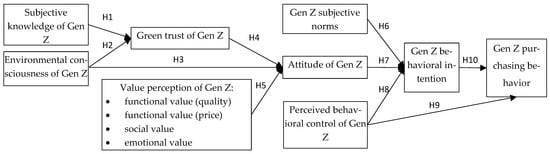
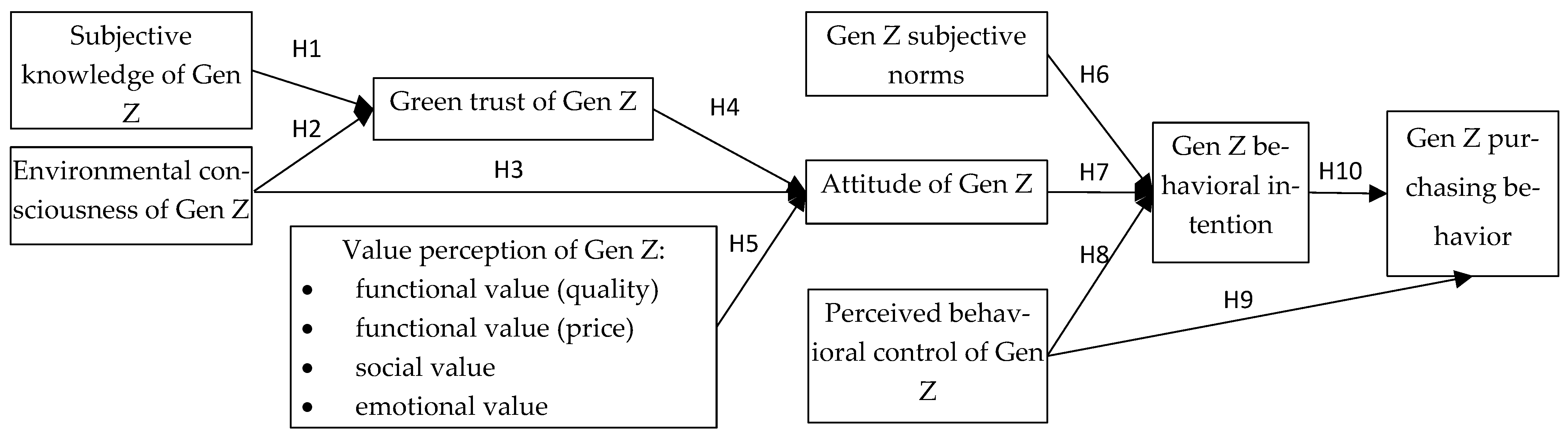
The hypotheses discussed above are summarized in Figure 1.
Figure 1.
Research model.
3. Materials and Methods
3.1. Sample
Data were collected through an online questionnaire between 2023 and 2024 by the international research company ‘Intraresearch’. The company distributed the questionnaire and facilitated access to the respondents through its online panel, while the author was responsible for the questionnaire design, construct selection, screening criteria, and data analysis. Participation in the study was entirely voluntary, and respondents’ anonymity was ensured.
A non-probability sampling approach was applied. A purposive sampling technique was employed to target participants residing in three specific countries: Lithuania, Norway, and Spain. This multicultural group of respondents was intentionally selected to obtain insights from tourists with diverse socio-economic backgrounds. Participants were recruited from the research company’s panel database that includes individuals who agreed to take part in academic and market research surveys. As the respondents’ recruitment process was panel-based, we were unable to determine the exact response and non-response rates.
A screening question ensured that all respondents had recent travel experience; only individuals who had traveled within the past 12 months were included in the dataset.
The final sample consisted of 344 Gen Z participants, the target population of this study. All respondents met the requirement of having undertaken a touristic trip in the preceding year. Table 1 presents the sociodemographic characteristics of the sample. Of all participants, 69.5% were female, and 30.2% were male, with an average age at the time of data collection of 23.36 years. Most respondents (63.7%) had a tertiary education. In terms of occupation, 48.3% were employed full-time and 27.9% were university students. Regarding annual income, 42.4% earned up to €24,999.
Table 1.
Socio-demographic characteristics of the sample.
3.2. Measures
The survey instrument was developed based on validated scales from previous studies and adapted to the context of sustainable touristic accommodation. The questionnaire included 14 questions: a screening question, sociodemographic questions, and construct-specific measurement items.
The questionnaire included measures of subjective knowledge, environmental consciousness, green trust, perceived value, subjective norms, attitude, perceived behavioral control, behavioral intention, and purchasing behavior. Subjective knowledge was measured using five items adapted from Jaiswal and Kant [53], capturing respondents’ self-assessed knowledge about environmental issues. Environmental consciousness was measured using six items from Bashir et al. [54]. Green trust was assessed using five items from Chen [55]. Perceived value items were adapted from Gugkang et al. [56] and Khan, Moshin [57]. Attitude, perceived behavioral control, and subjective norms were measured using items from Han et al. [58]. Behavioral intention and purchasing behavior were measured using scales from Ajzen [20], and Bashir et al. [54]. All items used a 5-point Likert scale (1 = Strongly disagree to 5 = Strongly agree). The average time to complete the questionnaire was 12 min and 58 s.
A questionnaire was pretested with 30 respondents before the main data collection, aiming to ensure its clarity and contextual appropriateness. Based on the feedback, minor wording adjustments were made. The original survey was initially developed in English and subsequently translated into Lithuanian, Spanish, and Norwegian. A back-translation procedure was implemented to ensure linguistic accuracy and conceptual equivalence across languages.
In order to improve transparency, the research followed a pre-defined sequence. Initially, the questionnaire was developed and pretested. Secondly, data were collected through an online panel. Finally, the collected data were screened for suitability and completeness before statistical analysis.
3.3. Data Analysis Methods
PLS-SEM was employed to test both the measurement model and the structural model. PLS-SEM is defined as a method that examines how observed variables form latent constructs and how these constructs relate to one another [59].
Data analysis was performed using SmartPLS 4 software. Results are presented in three stages: assessment of common method bias, evaluation of the measurement model, and examination of the structural model.
4. Results
4.1. Common Method Bias
To assess the potential presence of bias arising from self-reported measures, Harman’s single-factor test was conducted [60]. The test indicated that the first factor accounted for 43.44% of the total variance, which is below the recommended threshold of 50%, suggesting that common method variance is unlikely to pose a concern. Additionally, full collinearity variance inflation factors (VIFs) were examined. All VIF values ranged between 1.464 and 2.869, below the recommended threshold of 3.3 [61]. Thus, it can be concluded that common method bias is not present, supporting the validity of the model and strengthening confidence in the estimated path coefficients.
4.2. Measurement Model
The measurement model specifies how each item represents its corresponding latent variable. All standardized factor loadings were examined and met the recommended threshold of 0.7 [62]. Due to a low factor loading, one item from the perceived behavioral control scale (PBC1) was removed, resulting in 59 retained measurement items. The complete list of items is provided in the Appendix A.
The internal consistency of the constructs was assessed using Cronbach’s alpha, with values ranging from 0.808 to 0.905 (Table 2), indicating satisfactory reliability for all constructs [63].
Table 2.
Measurement model results and reliability statistics.
To further evaluate scale reliability, composite reliability (CR) values were assessed and ranged from 0.874 to 0.925, demonstrating strong reliability [63]. Average Variance Extracted (AVE) was calculated to assess convergent validity, with values ranging from 0.583 to 0.732, exceeding the recommended minimum of 0.50 and indicating good convergent validity [64]. Overall, these results confirm the robustness and reliability of the measurement model.
Following the recommendations of Henseler et al. [65], discriminant validity was evaluated using the Fornell–Larcker criterion and the Heterotrait–Monotrait Ratio (HTMT) (Table 3 and Table 4). The square root of each construct’s AVE exceeded its correlations with other constructs, and all HTMT values were below 0.85, confirming discriminant validity.
Table 3.
Discriminant validity through Fornell-Larcker criterion.
Table 4.
Discriminant validity through HTMT.
In addition to the Fornell-Larcker criterion, discriminant validity was further tested using HTMT. This criterion is considered to be more stringent for the evaluation of discriminant validity in PLS-SEM models.
4.3. Structural Model
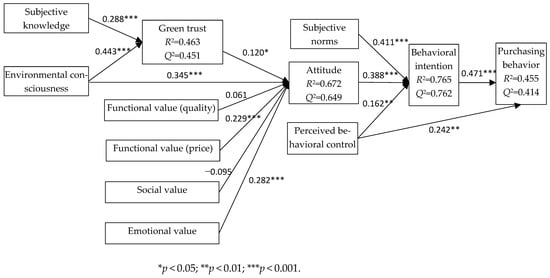
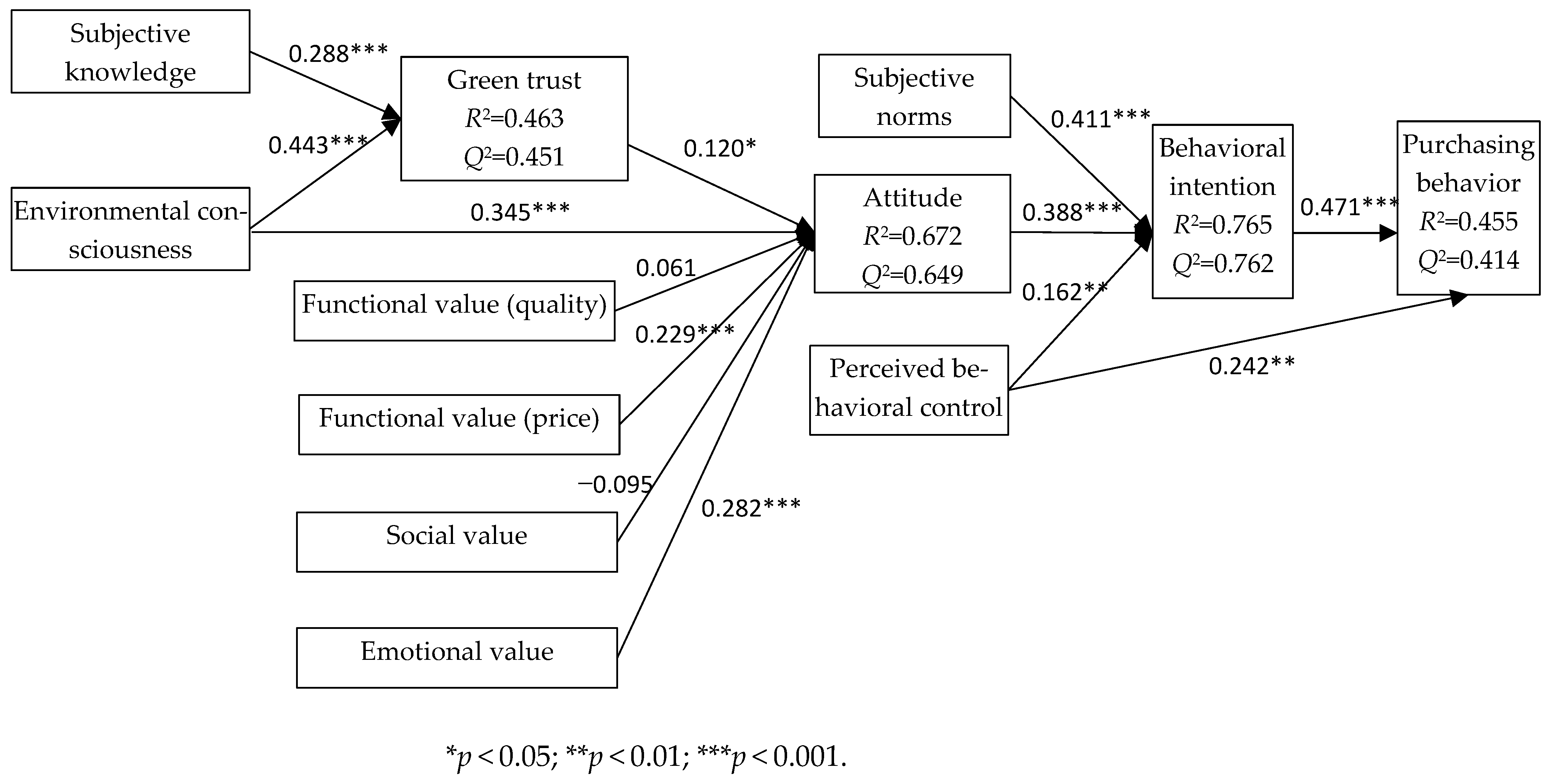
To evaluate the explanatory power of the structural model, R2 values for the endogenous variables (green trust, attitude, behavioral intention, and purchasing behavior) and predictive relevance (Stone-Geisser Q2) were examined (Figure 2). All Q2 values were greater than zero, confirming the predictive relevance of the model. The R2 value for purchasing behavior indicated that the included variables explained 45.5% of the variance, demonstrating relatively strong predictive power and highlighting the importance of the selected factors in shaping Gen Z’s purchasing behavior toward sustainable touristic accommodation.
Figure 2.
A structural model with coefficients, R2 and Q2 values.
A bootstrapping procedure with 5000 resamples, as recommended by Henseler et al. [65] was used to determine the significance of the path coefficients. Table 5 presents the hypothesis testing results.
Table 5.
Results of hypothesis testing.
Subjective knowledge (β = 0.288, p = 0.000) and environmental consciousness (β = 0.443, p = 0.000) were found to significantly and positively influence Gen Z’s green trust, confirming H1 and H2. Environmental consciousness also positively influenced attitude (β = 0.345, p = 0.000), supporting H3. Likewise, green trust had a positive effect on attitude (β = 0.120, p = 0.039), confirming H4. Price-based functional value (β = 0.229, p = 0.000) and emotional value (β = 0.282, p = 0.000) had significant positive effects on attitude, supporting H5b and H5d. However, quality-based functional value (β = 0.061, p = 0.273) and social value (β = –0.095, p = 0.100) were not significant, and therefore H5a and H5c were rejected. Subjective norms significantly influenced behavioral intention (β = 0.411, p = 0.000), supporting H6. Behavioral intention was also positively affected by attitude (β = 0.388, p = 0.000) and perceived behavioral control (β = 0.162, p = 0.004), confirming H7 and H8. Additionally, perceived behavioral control had a significant positive effect on purchasing behavior (β = 0.242, p = 0.002), supporting H9. Finally, behavioral intention positively influenced purchasing behavior (β = 0.471, p = 0.000), confirming H10.
5. Discussion
While existing studies have extensively analyzed green purchasing behavior in tourism [66,67,68,69,70], there remains a limited understanding of what drives green choices among different generational cohorts. In this regard, the present study offers valuable insights into how Gen Z tourists engage in environmentally conscious purchasing behavior. Using an integrated model that combines the theoretical lenses of the Theory of Planned Behavior and the Theory of Consumption Values, this study explored the interrelationships among key antecedents of sustainable purchasing behavior. The novelty and contribution of the study lie not only in the integration of these theories and the focus on a specific generational cohort but also in the inclusion of three additional factors—subjective knowledge, environmental consciousness, and green trust—which further explain Gen Z’s choice of sustainable accommodation.
Firstly, the study fully confirmed all relationships within the Theory of Planned Behavior framework, as the corresponding path coefficients were positive and significant. Subjective norms, attitude, and perceived behavioral control were found to positively influence behavioral intention, which in turn significantly affected actual purchasing behavior. These findings confirm the applicability of the Theory of Planned Behavior for explaining Gen Z tourists’ sustainable purchasing decisions.
One of the study’s most notable contributions concerns the role of perceived value. The SEM results showed that price-related functional value and emotional value positively shape Gen Z tourists’ attitudes, whereas quality-based functional value and social value were not significant predictors. This suggests that only specific dimensions of perceived value in sustainable touristic accommodation meaningfully affect Gen Z’s attitudes. Notably, emotional value exerted a more substantial effect on attitude than price-based functional value, underscoring the primacy of emotional responses in Gen Z’s evaluative processes. This finding aligns with previous studies highlighting the influence of emotional value on product attitudes among millennial and Gen Z consumers in Korea [8].
Beyond perceived value, the study examined green trust and environmental consciousness as additional antecedents of attitude. Both subjective knowledge and environmental consciousness were found to have a positive influence on green trust, highlighting the crucial role of cognitive and environmental awareness in strengthening trust among Gen Z.
From a theoretical perspective, this study extends the application of the Theory of Planned Behavior to the consumption behavior of Gen Z. By integrating perceived value, subjective knowledge, environmental consciousness, and green trust into a single framework, the study offers a more comprehensive and evidence-based understanding of Gen Z’s decision-making processes. While prior research has explored these constructs separately [12,25,26,27], this study brings them together, demonstrating how they jointly explain sustainable purchasing behavior among young tourists.
From a practical standpoint, the findings of the study offer important implications for tourism organizations seeking to attract and retain Gen Z consumers in the sustainable tourism accommodation market. The results of the research indicate that both functional (price-related) and emotional value significantly influence Gen Z’s attitudes toward sustainable accommodation, while the role of perceived functional quality and social value is less prominent. This suggests that traditional service performance indicators or social signaling are not as important as emotional experience and perceived economic fairness in the evaluation of sustainable accommodation options. Accordingly, providers of sustainable tourist accommodation services should focus on transparent pricing strategies. At the same time, marketing communication should integrate emotional and experiential benefits, such as alignment with individual values, authenticity, connection to local communities, and personal meaning.
This study has several limitations that provide directions for future research. First, the findings are based on self-reported data, which may be subject to recall inaccuracies and social desirability bias. Future studies could employ scenario-based experiments, behavioral data, or mixed methods to obtain more objective insights. Second, the study focused exclusively on Gen Z tourists and does not include a comparison with other generational cohorts. As a result, while the findings led to identifying the determinants of sustainable consumption within Gen Z, they do not provide any conclusions about whether the relationships are different across generations. Future research could address this limitation by including multi-group analyses to compare Gen Z with other cohorts. The third limitation is related to the sampling. Even though purposive sampling is appropriate for the study that aims to explain the behavior of a specific consumer cohort instead of producing population-level estimates, it may limit the generalizability of the findings beyond the studied context. Another limitation concerns the nature of the data, which may not fully capture complex behavioral nuances. Finally, considering the rapid growth of virtual tourism [3,19,71], future studies could explore Gen Z’s sustainable consumption patterns in virtual or digitally mediated tourism environments.
6. Conclusions
This study examined the determinants of Gen Z tourists’ behavior toward sustainable accommodation using an expanded Theory of Planned Behavior framework. While previous studies have applied the Theory of Planned Behavior to explain green purchasing behavior, this study provides new insights by incorporating perceived value along with three additional antecedents—subjective knowledge, environmental consciousness, and green trust.
The results demonstrate a significant positive influence of price-based functional value and emotional value on consumer attitudes, which in turn shape behavioral intention and subsequently actual purchasing behavior. These findings suggest that Gen Z tourists are more likely to choose sustainable accommodation when they perceive strong functional (price-related) and emotional benefits.
Funding
This research received no external funding.
Institutional Review Board Statement
Ethical review and approval were waived for this study by Institution Committee due to Legal Regulations of Lithuania.
Informed Consent Statement
Informed consent was obtained from all subjects involved in the study.
Data Availability Statement
The data presented in this study are available on request from the corresponding author.
Conflicts of Interest
The author declares no conflicts of interest.
Abbreviations
The following abbreviations are used in this manuscript:
| AVE | Average Variance Extracted |
| CR | Composite reliability |
| Gen Z | Generation Z |
| HTMT | Heterotrait–Monotrait Ratio |
| PLS-SEM | Partial Least Squares Structural Equation Modeling |
| VIF | Variance inflation factor |
| WTTC | World Travel & Tourism Council |
Appendix A
Table A1.
Measurement Scales.
References
- World Travel & Tourism Council WTTC Launches Latest Environmental & Social Research in Partnership with Omran. 2025. Available online: https://wttc.org/news/global-travel-tourism-sector-cuts-emissions-intensity-economic-prosperity-grows (accessed on 16 October 2025).
- Sustainable Travel International. Carbon Footprint of Tourism; Sustainable Travel International: Lewes, DE, USA, 2024. [Google Scholar]
- Adnan, N.; Rashed, M.F.; Ali, W. Embracing the Metaverse: Cultivating Sustainable Tourism Growth on a Global Scale. Curr. Issues Tour. 2025, 28, 3264–3283. [Google Scholar] [CrossRef] [Scilit]
- Shuvo, M.I.M.; Ahmed, T. Sustainable Clicks: Exploring Gen Z’s e-Commerce Engagement and Value Perceptions for Sustainable Tourism. Sustain. Futures 2025, 10, 101147. [Google Scholar] [CrossRef] [Scilit]
- Sezenler, C.; Aga, M. Managerial Perspectives on the Use of Environmentally Friendly Energy in Accommodation Facilities in Northern Cyprus. Sustainability 2025, 17, 6111. [Google Scholar] [CrossRef] [Scilit]
- Gomes, S.; Lopes, J.M.; Nogueira, S. Willingness to Pay More for Green Products: A Critical Challenge for Gen Z. J. Clean. Prod. 2023, 390, 136092. [Google Scholar] [CrossRef] [Scilit]
- Chang, J.Y.; Lim, X.; Luo, X.; Cheah, J.; Morrison, A.M.; Hall, C.M. Modelling Generation Z Tourists’ Social Responsibility Toward Environmentally Responsible Behaviour: The Role of Eco-travel Cravings. J. Tour. Res. 2024, 26, e2695. [Google Scholar] [CrossRef] [Scilit]
- Kim, I.; Jung, H.J.; Lee, Y. Consumers’ Value and Risk Perceptions of Circular Fashion: Comparison between Secondhand, Upcycled, and Recycled Clothing. Sustainability 2021, 13, 1208. [Google Scholar] [CrossRef] [Scilit]
- Hudayah, S.; Aulia Ramadhani, M.; Arum Sary, K.; Raharjo, S.; Yudaruddin, R. Green Perceived Value and Green Product Purchase Intention of Gen Z Consumers: Moderating Role of Environmental Concern. Environ. Econ. 2023, 14, 87–102. [Google Scholar] [CrossRef] [Scilit]
- Manley, A.; Seock, Y.; Shin, J. Exploring the Perceptions and Motivations of Gen Z and Millennials Toward Sustainable Clothing. Fam. Consum. Sci. Res. J. 2023, 51, 313–327. [Google Scholar] [CrossRef] [Scilit]
- Raman, R.; Das, P.; Mandal, S.; Vijayan, V.; Ar, A.; Nedungadi, P. The Impact of Gen Z’s pro-Environmental Behavior on Sustainable Development Goals Through Tree Planting. Sustain. Futures 2024, 8, 100251. [Google Scholar] [CrossRef] [Scilit]
- Ma, Y.; Li, Y.; Han, F. Interconnected Eco-Consciousness: Gen Z Travelers’ Intentions Toward Low-Carbon Transportation and Hotels. Sustainability 2024, 16, 6559. [Google Scholar] [CrossRef] [Scilit]
- Minazzi, R.; Grechi, D. Exploring Gen Z Sustainable Behavior in the Hospitality Industry. Adm. Sci. 2025, 15, 266. [Google Scholar] [CrossRef] [Scilit]
- Lemanowicz, M.; Wanat, T.; Jasiulewicz, A.; Waśkowski, Z.; Jarka, S.; Biernat-Jarka, A. Environmental Concerns, Financial Sacrifice, and Motivation as Predictors of Gen Z Sustainable Behaviour. Econ. Environ. 2025, 94, 988. [Google Scholar] [CrossRef] [Scilit]
- Bajar, R.G.C.A.; Ong, A.K.S.; German, J.D. Determining Sustainable Purchase Behavior for Green Products from Name-Brand Shops: A Gen Z Perspective in a Developing Country. Sustainability 2024, 16, 3747. [Google Scholar] [CrossRef] [Scilit]
- Agustina, T.; Susanti, E.; Ali Saeed Rana, J. Sustainable Consumption in Indonesia: Health Awareness, Lifestyle, and Trust Among Gen Z and Millennials. Environ. Econ. 2024, 15, 82–96. [Google Scholar] [CrossRef] [Scilit]
- Arora, N.; Manchanda, P. Green Perceived Value and Intention to Purchase Sustainable Apparel Among Gen Z: The Moderated Mediation of Attitudes. J. Glob. Fash. Mark. 2022, 13, 168–185. [Google Scholar] [CrossRef] [Scilit]
- Hassan, L.M.; Shiu, E.; Parry, S. Addressing the Cross-country Applicability of the Theory of Planned Behaviour (TPB): A Structured Review of Multi-country TPB Studies. J. Consum. Behav. 2016, 15, 72–86. [Google Scholar] [CrossRef] [Scilit]
- Zhang, J.; Quoquab, F.; Mohammad, J. Metaverse Tourism and Gen-Z and Gen-Y’s Motivation: “Will You, or Won’t You Travel Virtually?”. Tour. Rev. 2024, 79, 304–320. [Google Scholar] [CrossRef] [Scilit]
- Ajzen, I. The Theory of Planned Behavior. Organ. Behav. Hum. Decis. Process. 1991, 50, 179–211. [Google Scholar] [CrossRef] [Scilit]
- Sheth, J.N.; Newman, B.I.; Gross, B.L. Why We Buy What We Buy: A Theory of Consumption Values. J. Bus. Res. 1991, 22, 159–170. [Google Scholar] [CrossRef] [Scilit]
- Inglehart, R. The Silent Revolution: Changing Values and Political Styles Among Western Publics; Princeton University Press: Princeton, NJ, USA, 1977. [Google Scholar]
- Pompurova, K.; Filieri, R.; Medekova, K. Why, Where, and How Generations from Baby Boomers to GenZ Share eWOM: Fresh Insights from Generational Cohort Theory. Tour. Recreat. Res. 2025, 1–26, Early access. [Google Scholar] [CrossRef]
- D’Acunto, D.; Filieri, R.; Okumus, F. The Gen Z Attitude-Behavior Gap in Sustainability-Framed eWOM: A Generational Cohort Theory Perspective. Int. J. Hosp. Manag. 2025, 129, 104194. [Google Scholar] [CrossRef] [Scilit]
- Roh, T.; Seok, J.; Kim, Y. Unveiling Ways to Reach Organic Purchase: Green Perceived Value, Perceived Knowledge, Attitude, Subjective Norm, and Trust. J. Retail. Consum. Serv. 2022, 67, 102988. [Google Scholar] [CrossRef] [Scilit]
- Asif, M.H.; Zhongfu, T.; Irfan, M.; Işık, C. Do Environmental Knowledge and Green Trust Matter for Purchase Intention of Eco-Friendly Home Appliances? An Application of Extended Theory of Planned Behavior. Environ. Sci. Pollut. Res. 2022, 30, 37762–37774. [Google Scholar] [CrossRef] [Scilit] [PubMed]
- Wang, H.; Ma, B.; Bai, R. How Does Green Product Knowledge Effectively Promote Green Purchase Intention? Sustainability 2019, 11, 1193. [Google Scholar] [CrossRef] [Scilit]
- Chamoli, A.; Tariyal, A.; Rana, V. From Green Trust to Green Plates: How External Stimuli Shape Gen Z’s Local Food Purchases in Organic Tourism Destinations. Int. J. Gastron. Food Sci. 2025, 42, 101288. [Google Scholar] [CrossRef] [Scilit]
- Gorton, M.; Tocco, B.; Yeh, C.-H.; Hartmann, M. What Determines Consumers’ Use of Eco-Labels? Taking a Close Look at Label Trust. Ecol. Econ. 2021, 189, 107173. [Google Scholar] [CrossRef] [Scilit]
- Yang, Y.; Xue, F.; Qiao, G. The Impact of Information Acquisition Ability on Consumers’ Trust in Eco-Labels in China: Insight of Food Sustainability. Front. Sustain. Food Syst. 2024, 8, 1449848. [Google Scholar] [CrossRef] [Scilit]
- Borah, P.S.; Dogbe, C.S.K.; Marwa, N. Generation Z’s Green Purchase Behavior: Do Green Consumer Knowledge, Consumer Social Responsibility, Green Advertising, and Green Consumer Trust Matter for Sustainable Development? Bus. Strat. Environ. 2024, 33, 4530–4546. [Google Scholar] [CrossRef] [Scilit]
- Hoque, M.Z.; Alam, M.N. What Determines the Purchase Intention of Liquid Milk during a Food Security Crisis? The Role of Perceived Trust, Knowledge, and Risk. Sustainability 2018, 10, 3722. [Google Scholar] [CrossRef] [Scilit]
- Guerreiro, J.; Pacheco, M. How Green Trust, Consumer Brand Engagement and Green Word-of-Mouth Mediate Purchasing Intentions. Sustainability 2021, 13, 7877. [Google Scholar] [CrossRef] [Scilit]
- Kim, R.B.; Matsui, T.; Uehara, W. From Confusion to Trust: How Cognitive Factors Shape Green Consumption in Different Market Contexts. J. Int. Consum. Mark. 2025, 37, 479–496. [Google Scholar] [CrossRef] [Scilit]
- Chen, S.-C.; Hung, C.-W. Elucidating the Factors Influencing the Acceptance of Green Products: An Extension of Theory of Planned Behavior. Technol. Forecast. Soc. Change 2016, 112, 155–163. [Google Scholar] [CrossRef] [Scilit]
- Van Hoang, D.; Ngoc Ngan Anh, N.; Thi Xuan, N.; Ngoc Han, P.; Phuong Ngan, D.; Le Khanh Linh, N.; Nguyen Khoi, L.; Thiet Tung, V.; Duong, T.T.-T. Pathways to Green Purchase Intention in FMCG Industry: A Combined Approach of PLS-SEM and fsQCA. Sage Open 2025, 15, 21582440251378964. [Google Scholar] [CrossRef] [Scilit]
- Badar, K.; Khattak, A.; Danish, M.; Tariq, A.; Nisar, Q.A. Cosmopolitan Orientation, Consumer Consciousness and Green Purchase Intentions: Mediating Role of Green Trust. Eur. J. Int. Manag. 2025, 25, 79–97. [Google Scholar] [CrossRef] [Scilit]
- Vătămănescu, E.-M.; Dincă, V.-M.; Cegarra-Navarro, J.-G.; Gazzola, P.; Amelio, S. Individuals’ Behavioral Intention to Use Car Sharing (CS): From Environmental Consciousness to Socio-Psychological Drivers. EuroMed J. Bus. 2025, 20, 234–257. [Google Scholar] [CrossRef] [Scilit]
- Xing, Y.; Liao, Y. Health or Environment? How Do Motivations Affect Consumers’ Organic Food Purchasing Behaviour in China? Br. Food J. 2024, 126, 3779–3802. [Google Scholar] [CrossRef] [Scilit]
- Eti, H.S. An Investigation on Organic Food Purchase Intention on E-Commerce Platforms. Tekirdağ Ziraat Fakültesi Derg. 2025, 22, 544–556. [Google Scholar] [CrossRef] [Scilit]
- Arslan, Y. Unpacking Organic Food Purchase Intentions in an S-O-R Framework: The Multidimensional Moderating Roles of Consumer Knowledge and Trust. Food Sci. Nutr. 2025, 13, e70447. [Google Scholar] [CrossRef] [Scilit] [PubMed]
- Prado, N.B.D.; Moraes, G.H.S.M.D.; Synodinos, C. Environmental Concern and Attitude: The Mediatinge of Environmental Knowledge. Rev. Adm. Empres. 2025, 65, e2024-0341. [Google Scholar] [CrossRef] [Scilit]
- Chang, R.; Vafaei-Zadeh, A.; Hanifah, H.; Nikbin, D.; Ramayah, T. Modelling Mobility as a Service (MaaS) Adoption Using Perceived Value, Trust and Attitude: The Contingent Role of Environmental Consciousness. Energy Strategy Rev. 2025, 62, 101934. [Google Scholar] [CrossRef] [Scilit]
- Sobgo, A.D.Z.; Sun, L.; Atingabili, S.; Ngansom Kewou, N.Y.; Temagna Tcheudjeu, A. Psychological and Situational Determinants Shaping Consumers’ Intention to Purchase Eco-Friendly Personal Care Products: PLS-SEM and fsQCA Insights. J. Clean. Prod. 2025, 522, 146281. [Google Scholar] [CrossRef] [Scilit]
- Sweeney, J.C.; Soutar, G.N. Consumer Perceived Value: The Development of a Multiple Item Scale. J. Retail. 2001, 77, 203–220. [Google Scholar] [CrossRef] [Scilit]
- Kantarcıoğlu, B.; Kubat Dokumacı, U. Understanding Gen Z’s Fast Fashion Consumption: The Role of Gender Identity and Consumer Values. J. Fash. Mark. Manag. Int. J. 2025, 29, 1221–1242. [Google Scholar] [CrossRef] [Scilit]
- Miller, N.J.; Yan, R.-N.T.; Jankovska, D.; Hensely, C. Exploring US Millennial Consumers’ Consumption Values in Relation to Traditional and Social Cause Apparel Product Attributes and Purchase Intentions. J. Glob. Fash. Mark. 2017, 8, 54–68. [Google Scholar] [CrossRef] [Scilit]
- Lavuri, R. Organic Green Purchasing: Moderation of Environmental Protection Emotion and Price Sensitivity. J. Clean. Prod. 2022, 368, 133113. [Google Scholar] [CrossRef] [Scilit]
- Rashid, I.; Lone, A.H. Organic Food Purchases: Does Green Trust Play a Part? Asia-Pac. J. Bus. Adm. 2024, 16, 914–939. [Google Scholar] [CrossRef] [Scilit]
- Wang, X.; Peng, M.; Li, Y.; Ren, M.; Ma, T.; Zhao, W.; Xu, J. How E-Commerce Product Environmental Information Influences Green Consumption: Intention–Behavior Gap Perspective. Sustainability 2025, 17, 2337. [Google Scholar] [CrossRef] [Scilit]
- Zheng, Z.; Srinuan, C.; Rojniruttikul, N. Exploring the Impact of Digital Platform on Energy-Efficient Consumption Behavior: A Multi-Group Analysis of Air Conditioning Purchase in China Using the Extended TPB Model. Sustainability 2025, 17, 5192. [Google Scholar] [CrossRef] [Scilit]
- Aydin, G. Thresholds of Sustainability: Necessary and Sufficient Conditions for Green Buying Behavior. Sustainability 2025, 17, 4965. [Google Scholar] [CrossRef] [Scilit]
- Jaiswal, D.; Kant, R. Green Purchasing Behaviour: A Conceptual Framework and Empirical Investigation of Indian Consumers. J. Retail. Consum. Serv. 2018, 41, 60–69. [Google Scholar] [CrossRef] [Scilit]
- Bashir, S.; Khwaja, M.G.; Turi, J.A.; Toheed, H. Extension of Planned Behavioral Theory to Consumer Behaviors in Green Hotel. Heliyon 2019, 5, e02974. [Google Scholar] [CrossRef] [Scilit]
- Chen, Y.-S. The Drivers of Green Brand Equity: Green Brand Image, Green Satisfaction, and Green Trust. J. Bus. Ethics 2010, 93, 307–319. [Google Scholar] [CrossRef] [Scilit]
- Gugkang, A.S.; Sondoh, S.L.; Tanakinjal, G.H. Consumption Values, Environmental Concern, Attitude and Purchase Intention in the Context of Green Products. Int. J. Glob. Manag. Stud. Prof. 2013, 5, 73–92. [Google Scholar]
- Khan, S.N.; Mohsin, M. The Power of Emotional Value: Exploring the Effects of Values on Green Product Consumer Choice Behavior. J. Clean. Prod. 2017, 150, 65–74. [Google Scholar] [CrossRef] [Scilit]
- Han, H.; Hsu, L.-T.; Sheu, C. Application of the Theory of Planned Behavior to Green Hotel Choice: Testing the Effect of Environmental Friendly Activities. Tour. Manag. 2010, 31, 325–334. [Google Scholar] [CrossRef] [Scilit]
- Hair, J.F.; Hult, G.T.M.; Ringle, C.; Sarstedt, M. A Primer on Partial Least Squares Structural Equation Modeling (PLS-SEM); Sage: Thousand Oaks, CA, USA, 2016. [Google Scholar]
- Podsakoff, P.M.; MacKenzie, S.B.; Lee, J.-Y.; Podsakoff, N.P. Common Method Biases in Behavioral Research: A Critical Review of the Literature and Recommended Remedies. J. Appl. Psychol. 2003, 88, 879–903. [Google Scholar] [CrossRef] [Scilit]
- Kock, F.; Berbekova, A.; Assaf, A.G. Understanding and Managing the Threat of Common Method Bias: Detection, Prevention and Control. Tour. Manag. 2021, 86, 104330. [Google Scholar] [CrossRef] [Scilit]
- Hair, J.F.; Black, W.C.; Babin, B.J.; Anderson, R.E.; Tatham, R.L. Multivariate Data Analysis; Pearson: Harlow, UK, 2009. [Google Scholar]
- Hair, J.F.; Balin, B.B.; Anderson, R.E. Multivariate Data Analysis, 7th ed.; Maxwell Macmillan International Editions: London, UK, 2010. [Google Scholar]
- Fornell, C.; Larcker, D.F. Evaluating Structural Equation Models with Unobservable Variables and Measurement Error. J. Mark. Res. 1981, 18, 39. [Google Scholar] [CrossRef] [Scilit]
- Henseler, J.; Ringle, C.M.; Sarstedt, M. A New Criterion for Assessing Discriminant Validity in Variance-Based Structural Equation Modeling. J. Acad. Mark. Sci. 2015, 43, 115–135. [Google Scholar] [CrossRef] [Scilit]
- Saltık, Z.; Akova, O. Who Goes Green? Demographic Drivers of Sustainable Tourist Behavior. Anatolia 2025, 1–16. [CrossRef] [Scilit]
- Li, Y.; Peng, L.; Zeng, X. Preference Reversal of Green Tourism Products. Int. J. Hosp. Manag. 2026, 133, 104430. [Google Scholar] [CrossRef] [Scilit]
- Ezeh, P.C.; Dube, K. Bibliometric Analysis of Trends and Development in Religion and Green Tourism Behavior. Cogent Soc. Sci. 2025, 11, 2445771. [Google Scholar] [CrossRef] [Scilit]
- Liu, D.; Fang, H.; Huang, M.; Jiang, C.; Ma, J. I Buy Green Because I Feel Green Pressure: The Effect of Destination Social Responsibility on Tourists’ Green Product Purchase Behavior. Asia Pac. J. Mark. Logist. 2025, 37, 2422–2440. [Google Scholar] [CrossRef] [Scilit]
- Sun, B.L. Who Goes to the Green Hotel? The Role of Face Consciousness and Ethical Mindedness. J. Hosp. Tour. Insights 2025, 8, 3261–3279. [Google Scholar] [CrossRef] [Scilit]
- Das, P.; Chintaluri, M.G.; Mandal, S.; Babu, S.; Kotni, V.V.P.; Raman, R. Exploring the Enablers of Virtual Tourism Experiences for Gen Z. J. Adv. Manag. Res. 2025, 22, 395–416. [Google Scholar] [CrossRef] [Scilit]

Disclaimer/Publisher’s Note: The statements, opinions and data contained in all publications are solely those of the individual author(s) and contributor(s) and not of MDPI and/or the editor(s). MDPI and/or the editor(s) disclaim responsibility for any injury to people or property resulting from any ideas, methods, instructions or products referred to in the content. |
© 2026 by the author. Licensee MDPI, Basel, Switzerland. This article is an open access article distributed under the terms and conditions of the Creative Commons Attribution (CC BY) license.