


Abstract
Academic engagement and perceived employability are increasingly relevant to how higher education prepares students for changing labor markets, yet their empirical relationship remains theoretically and methodologically fragmented. This systematic review synthesized primary studies that substantively examined both constructs among higher education students. Reporting followed PRISMA 2020. The original Scopus and Web of Science searches were expanded during peer review to ERIC, APA PsycINFO, Education Source, and ProQuest, and one-generation backward and forward citation searching was completed. Across all sources, 627 raw records were consolidated, 119 duplicates were removed, 508 unique records were screened, 17 full texts were assessed, and 14 studies met the eligibility criteria. Evidence was synthesized narratively because study designs, measures, modeled directions, and statistical metrics were not sufficiently comparable for meta-analysis. Twelve studies were cross-sectional and two were longitudinal or time-lagged. The evidence was predominantly consistent with a positive association between engagement and perceived employability, but effect magnitude, dimensional patterns, modeled direction, and explanatory mechanisms varied. Engagement frequently operated as a mediator linking educational, relational, or psychological resources with employability perceptions, whereas several studies modeled perceived employability as an antecedent of engagement. JBI appraisal indicated generally adequate measurement and statistical analysis but recurrent limitations in explicit confounding control and temporal inference. The findings support a cautious, mechanism-oriented interpretation: academic engagement and perceived employability are related, but causal ordering remains unresolved. Future research should prioritize longitudinal, reciprocal, dimension-sensitive, multi-source, and cross-context designs and directly measure sustainable career outcomes rather than treating perceived employability as a proxy for career sustainability.
1. Introduction
Higher education is increasingly expected to support both academic development and students’ transitions into changing labor markets. Perceived employability captures students’ subjective assessments of their capacity to obtain and sustain suitable employment in light of competencies, personal resources, educational experiences, institutional context, and labor-market conditions [1,2,3,4,5,6]. Contemporary employability research therefore extends beyond narrow skill-based accounts and emphasizes the interaction of human, social, psychological, cultural, and career-related resources [1,2,3,4,5,6,7,8,9]. Perceived employability may also change during the transition from university to work and operate as a career resource during that transition [10,11].
Academic engagement is a potentially important component of this developmental process. It reflects students’ active psychological and behavioral involvement in academic life and has been conceptualized through vigor, dedication, and absorption as well as behavioral, emotional, cognitive, agentic, social, and affective dimensions [12,13,14,15,16,17]. Because engagement is shaped by interactions among students, teachers, curricula, institutional environments, and opportunities for participation [14,18,19,20], different forms of engagement may contribute differently to employability-related resources and perceptions.
A growing empirical literature directly connects academic, study, or student engagement with perceived employability [21,22,23,24,25,26,27,28,29,30]. Most studies position engagement as an antecedent of perceived employability, but some model perceived employability as an antecedent of engagement, suggesting that the relationship may be reciprocal rather than strictly unidirectional [28,29]. Engagement may also function as an explanatory mechanism linking educational, relational, or personal resources with employability perceptions [21,22,23,24,25,26,30]. These models are consistent with adjacent research showing that faculty support, career-development learning, mentoring, career adaptability, self-efficacy, and other resources may contribute to perceived employability [31,32,33,34,35,36,37,38,39,40,41,42,43,44,45,46].
Both focal constructs remain heterogeneous in terminology and measurement. Engagement has been operationalized using multiple labels, dimensions, and instruments, while perceived employability has been assessed as perceived, self-perceived, student-perceived, and future employability, among other subjective variants [47,48,49,50,51]. Contextual evidence further shows that employability perceptions vary with institutional, socioeconomic, equity, and labor-market conditions [39,52,53,54,55,56,57,58,59]. This heterogeneity complicates direct comparison across studies and cautions against assuming that a single global engagement score or a single employability measure captures the same phenomenon across contexts.
Existing reviews have mapped broader perceived-employability, employability-skills, and sustainable-career studies [9,60,61,62,63,64], but they do not specifically synthesize the empirical intersection between academic engagement and perceived employability while jointly examining relationship direction, engagement dimensions, mediating and moderating mechanisms, theoretical explanations, and study-level methodological quality. The present review addresses this more narrowly defined gap.
The topic is also relevant to sustainable career research, but a clear conceptual boundary is necessary. Sustainable careers emphasize continued capability development, adaptability, agency, meaningfulness, health, productivity, and the capacity to navigate professional contexts over time [64,65,66,67,68,69,70,71,72,73,74]. The primary studies synthesized here predominantly assess perceived employability rather than sustainable career outcomes. Accordingly, sustainable career development is treated as a future-oriented research extension, not as an outcome established by the current evidence. This systematic review therefore synthesizes the relationship between academic engagement and perceived employability, examines how both constructs are conceptualized and measured, evaluates explanatory mechanisms and methodological quality, and identifies implications for employability development and future sustainable-career research [75,76,77,78,79,80].
- RQ1. How have academic engagement and perceived employability been conceptualized and measured in higher education research?
- RQ2. What is the direction and consistency of the relationship between academic engagement and perceived employability?
- RQ3. What mediating, moderating, and theoretical mechanisms have been used to explain the relationship between academic engagement and perceived employability?
- RQ4. What methodological limitations, research gaps, and future research priorities characterize the existing evidence, and what implications do they have for employability development and sustainable career research?
2. Materials and Methods
2.1. Review Design and Reporting
This systematic review examined empirical evidence on the relationship between academic engagement and perceived employability among higher education students and was reported in accordance with PRISMA 2020 [81]. A completed PRISMA 2020 checklist is provided as Supplementary File S1. Eligibility criteria were defined before screening. One reviewer (O.B.R.-M.) conducted study selection, data extraction, and design-appropriate methodological appraisal using predefined PECOS and JBI criteria. The original workflow was managed in Covidence; the peer-review-driven search expansion and its screening audit were managed in a structured workbook using the same eligibility rules. No automated screening or machine-learning prioritization was used. The absence of independent duplicate screening, extraction, and appraisal is reported as a limitation.
2.2. Eligibility Criteria
Eligibility criteria were organized using a PECOS framework (Table 1). The population of interest comprised current higher education students, including undergraduate and postgraduate students where relevant. Eligible exposure constructs included academic engagement, study engagement, student engagement, higher education student engagement, or closely related engagement constructs tied to the academic experience. No comparison group was required. The outcome of interest was perceived, self-perceived, or student-perceived employability, or a substantively equivalent subjective employability construct. Eligible publications were empirical primary studies in which both focal constructs were substantively examined. Studies were excluded when they focused on non-tertiary populations; graduates or employees without separable student data; engagement constructs unrelated to the academic experience; generic employability skills, career readiness, or objective employment outcomes without a perceived-employability measure; or non-primary publication types such as reviews, conceptual papers, editorials, protocols, and commentaries. Articles published in English or Spanish were eligible. No publication-date or geographic restrictions were applied.
Table 1.
PECOS eligibility criteria used in the review.
2.3. Information Sources and Search Strategy
The original systematic searches were conducted in Scopus and Web of Science on 25 July 2026 and were re-run during revision. In response to peer review, database coverage was expanded on 14 September 2026 to ERIC, APA PsycINFO, Education Source, and ProQuest Central Premium. One-generation backward and forward citation searching was also completed for all 11 studies in the original included corpus. No lower publication-date or geographic restriction was imposed. Search strategies combined terms representing academic, study, student, and related higher-education engagement constructs with terms representing perceived or self-perceived employability. Database-specific fields and proximity operators were adapted to each interface. Across bibliographic databases, 103 raw records were retrieved; citation searching identified 524 additional raw records. Table 2 summarizes the source-level counts and Supplementary Table S1 provides the reproducible database-specific strategies and citation-search procedure.
Table 2.
Information sources, search approach, and raw records retrieved.
2.4. Study Selection
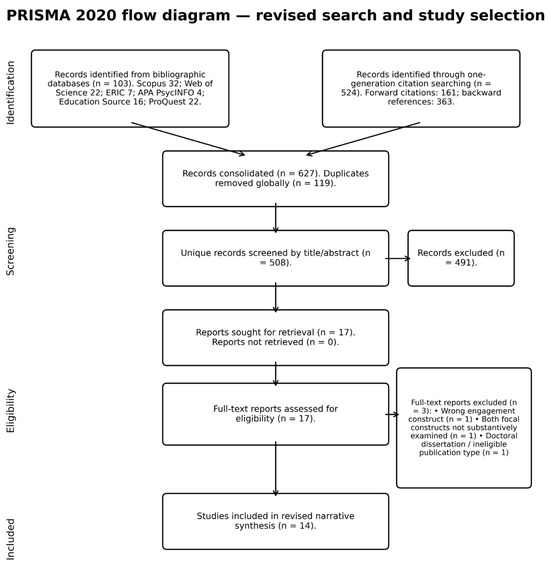
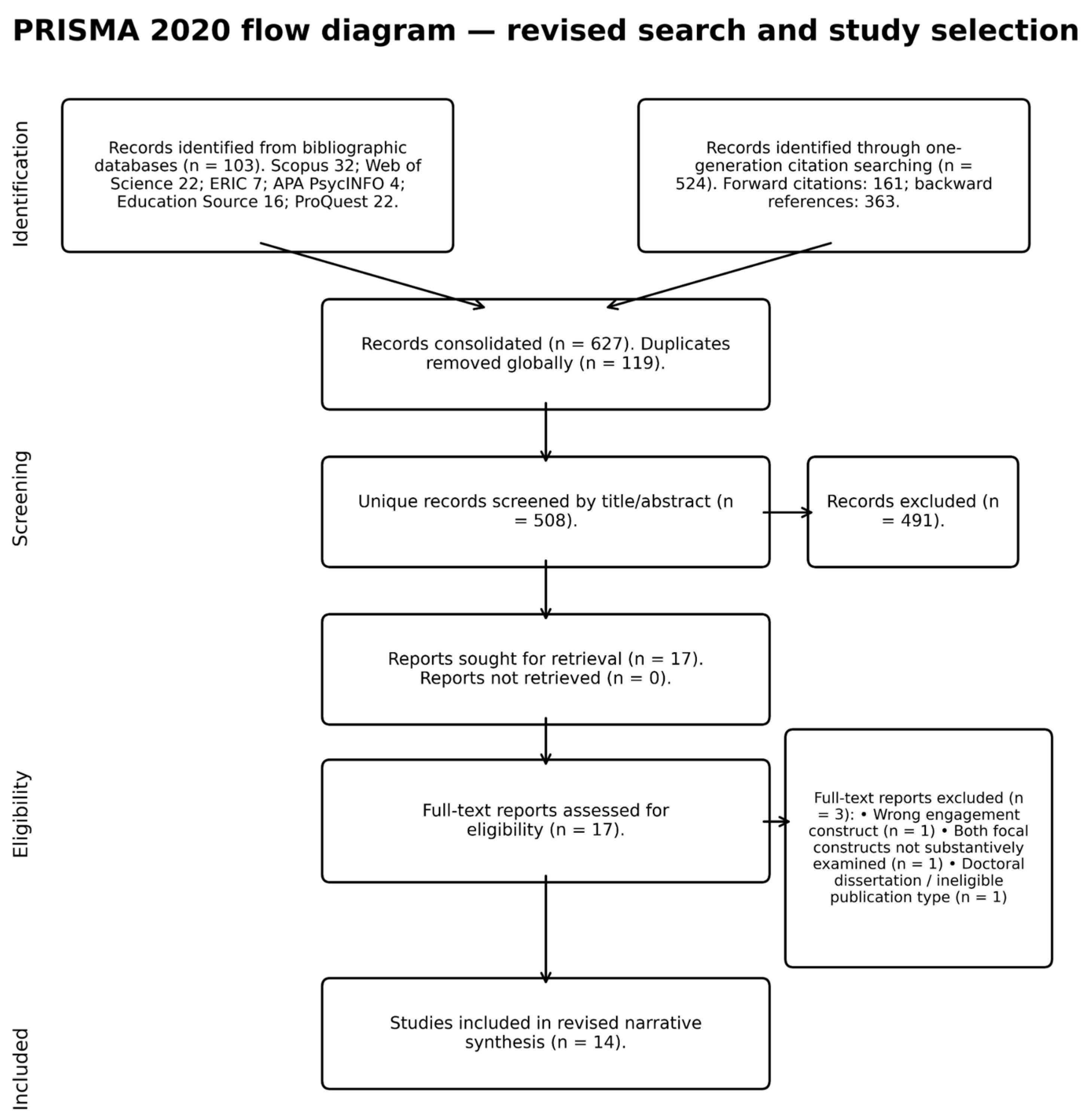
The original 54 Scopus and Web of Science records were initially managed in Covidence. The revision-stage database and citation-search exports were subsequently consolidated with the original corpus in a structured audit workbook. Deduplication across the complete corpus was performed using exact normalized DOI matching followed by normalized-title matching when DOI information was absent or insufficient. Of 627 raw records, 119 duplicates were removed, leaving 508 unique records for title and abstract screening. A single reviewer (O.B.R.-M.) applied the predefined PECOS criteria to all records. In total, 491 records were excluded at title/abstract screening and 17 reports were assessed in full text. Three reports were excluded at full text: Bobrytska et al. [82] because the engagement construct did not correspond to the academic-engagement definition adopted here; Clanchy et al. [83] because both focal constructs were not substantively examined; and Pipes [84] because the report was a doctoral dissertation rather than an eligible journal article. Fourteen studies were included in the final narrative synthesis. The updated study-selection process is presented in Figure 1, and the revision-stage screening audit is retained in the structured audit workbook available for editorial inspection.
Figure 1.
PRISMA 2020 flow diagram of the study-selection process.
2.5. Data Extraction
Data were extracted by O.B.R.-M. using a customized structured template. Extracted information included study identification and context; design and participant characteristics; engagement and employability terminology, definitions, dimensions, instruments, item counts, and psychometric information; theoretical frameworks; modeled roles of the focal constructs; mediators and moderators; direction, magnitude, and precision of the focal relationship where reported; principal findings; limitations; future research recommendations; and research gaps. Reported statistics were retained in the metric used by each primary study, and missing information was recorded as not reported rather than imputed. The complete extraction matrix for all 14 included studies is provided in Supplementary Table S2. Because extraction was not independently duplicated, this is explicitly acknowledged as a review limitation.
2.6. Risk-of-Bias Appraisal
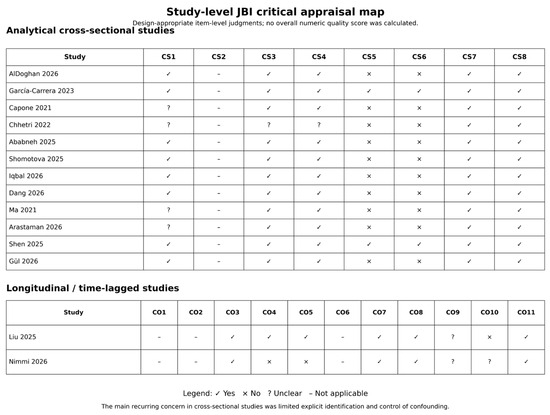
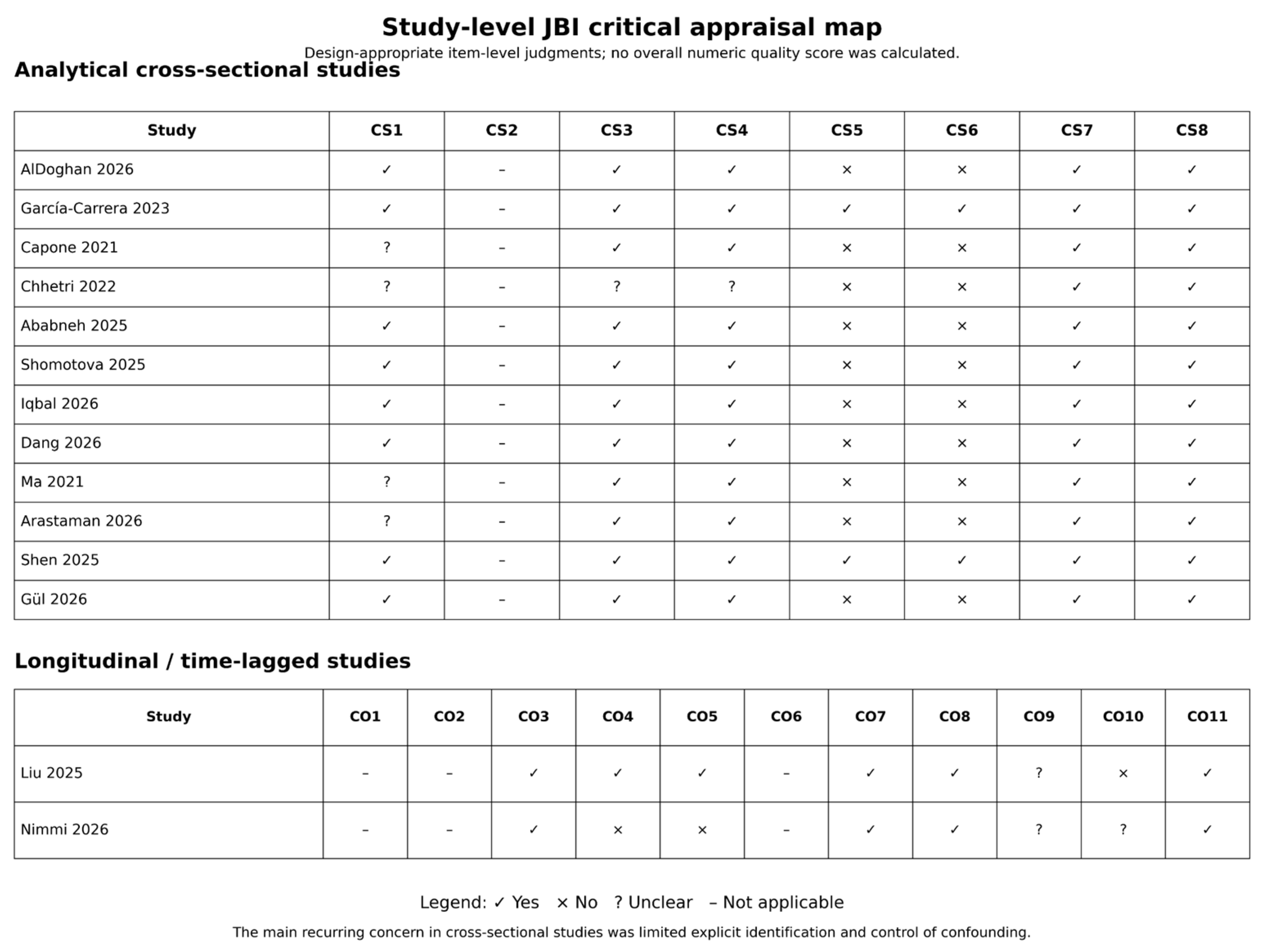
Risk of bias and methodological quality were appraised by O.B.R.-M. using the revised Joanna Briggs Institute (JBI) tools appropriate to study design. Twelve analytical cross-sectional studies were assessed using the revised JBI analytical cross-sectional tool (CS1–CS8) [85], and the two longitudinal or time-lagged studies were assessed using the revised JBI cohort tool (CO1–CO11) [86]. Judgments were recorded as Yes, No, Unclear, or Not Applicable with criterion-specific supporting text. No numerical quality score or arbitrary overall quality category was imposed. Item-level judgments are reported in Supplementary Table S3 and visualized in Figure 2. The appraisal was not independently duplicated.
Figure 2.
Study-level JBI critical appraisal map for the 14 included studies [21,22,23,24,25,26,27,28,29,30,87,88,89,90], based on the revised JBI analytical cross-sectional and cohort appraisal tools [85,86]. Symbols indicate Yes, No, Unclear, or Not Applicable judgments using design-appropriate revised JBI criteria; no overall numeric quality score was calculated.
2.7. Data Synthesis
Given heterogeneity in design, theoretical framing, engagement terminology and dimensions, employability measures, modeled direction, mechanisms, and statistical metrics, the evidence was synthesized narratively rather than through meta-analysis. The synthesis was structured around the review questions and informed by SWiM principles for transparent reporting of synthesis without meta-analysis [91,92,93]. Standardized coefficients, correlations, p values, and confidence intervals were retained as reported; no common effect measure was calculated, no missing statistics were imputed, and no effect-size transformations were performed. Cross-study interpretation emphasized direction, magnitude, precision, design, construct operationalization, and methodological limitations rather than using statistical-significance counts as a substitute for effect comparability. Causal language was avoided for cross-sectional evidence. No subgroup analysis, meta-regression, formal publication-bias analysis, sensitivity analysis, or body-level certainty rating was conducted because the evidence base was small and heterogeneous.
2.8. Registration and Protocol
This systematic review was not prospectively registered. Following an editorial recommendation during initial assessment after manuscript submission, the completed review was retrospectively registered on the Open Science Framework (OSF) using the Generalized Systematic Review Registration template on 14 September 2026 (registration DOI: 10.17605/OSF.IO/RYD7W; URL: https://osf.io/ryd7w/ (accessed on 21 September 2026)). The retrospective registration documents the protocol and procedures actually used and should not be interpreted as a prospective preregistration. No separate publicly accessible review protocol was prepared before study selection. Eligibility criteria, database search strategies, data-extraction fields, and design-appropriate appraisal procedures were predefined and systematically applied throughout the review process.
2.9. Use of Generative AI in Manuscript Preparation
During manuscript preparation and editorial revision, the authors used OpenAI ChatGPT (GPT-5.6 Thinking and GPT-5.6 Sol; accessed July–August 2026) to support language refinement, manuscript organization, consistency checking, and drafting of synthesis text based on author-extracted and author-verified data. Generative AI was not used to autonomously determine study eligibility, extract primary-study data, or make final JBI appraisal judgments. All AI-assisted outputs, interpretations, citations, and numerical statements were reviewed and verified by the authors, who take full responsibility for the content of the manuscript.
3. Results
3.1. Study Selection
The expanded identification process yielded 627 raw records: 103 from bibliographic databases and 524 from one-generation backward and forward citation searching. Global deduplication removed 119 records, leaving 508 unique records for title/abstract screening. Of these, 491 were excluded and 17 reports proceeded to full-text assessment. Three reports were excluded at full text for prespecified reasons [82,83,84], leaving 14 studies in the revised narrative synthesis. Figure 1 presents the complete PRISMA 2020 flow.
3.2. Characteristics of the Included Studies
The 14 included studies were published between 2021 and 2026 and represented nine national contexts: China, India, Italy, Nepal, Pakistan, Spain, Türkiye, the United Arab Emirates, and Vietnam. Twelve studies used cross-sectional quantitative designs and two used longitudinal or time-lagged designs. Final analytical samples ranged from 148 to 5434 participants and comprised 11,958 higher education students overall. Contexts included business and management education, education and psychology, entrepreneurship education, nursing and teacher education, and multidisciplinary university populations. Structural equation modeling and related regression/mediation approaches were common. Table 3 summarizes the included studies.
Table 3.
Characteristics of the included studies.
3.3. Conceptualization and Measurement of the Focal Constructs
3.3.1. Academic Engagement
Substantial conceptual and measurement heterogeneity was observed in engagement. Across the 14 studies, seven labels appeared: academic engagement (n = 4), study engagement (n = 4), student engagement (n = 2), higher education student engagement (n = 1), school engagement (n = 1), learning engagement (n = 1), and work engagement operationalized in a student academic context (n = 1). The Utrecht Work Engagement Scale family was the most recurrent measurement tradition, appearing in seven studies through different versions or adaptations. Other studies used multidimensional academic-engagement measures reflecting behavioral, emotional, cognitive, agentic, social, affective, co-curricular, or school-engagement dimensions. This diversity supports dimension-sensitive rather than purely global interpretation.
3.3.2. Perceived Employability
Perceived employability was more terminologically coherent but remained heterogeneous in operationalization. Eight studies used the label perceived employability, two used self-perceived employability, two used student-perceived employability, one used perceived future employability, and one used employability operationalized through a student self-assessment scale. Across studies, the construct represented students’ subjective beliefs about employment prospects, labor-market potential, or future employability rather than objective employment outcomes. Measures ranged from short unidimensional scales to multidimensional structures. Supplementary Table S2 provides study-level definitions, instruments, dimensions, item counts, and psychometric information.
3.4. Relationship Between Academic Engagement and Perceived Employability
3.4.1. Direction and Consistency of the Relationship
Across the 14-study evidence base, the focal relationship was predominantly consistent with a positive association, but the studies were not statistically comparable enough for a pooled or vote-count interpretation. Ten studies primarily modeled engagement before perceived employability, three modeled perceived employability before engagement, and one examined the constructs correlationally. Positive engagement-to-employability paths were reported in several studies [21,22,23,24,25,26,27,30,89,90], including longitudinal evidence from Liu et al. [25]. In the reverse direction, Ma and Bennett [29] reported a strong perceived-employability-to-engagement path, Arastaman et al. [88] reported a substantial direct employability-to-school-engagement relationship, and Al Doghan et al. [28] classified its hypothesized reverse pathway as unsupported despite internally inconsistent statistics. Dimension-specific results also varied, with some behavioral, emotional, academic, or affective components showing associations that were not reproduced for cognitive or social dimensions [27,30]. These patterns indicate a robustly recurring relationship but not a settled temporal ordering or uniform effect across operationalizations.
3.4.2. Mediating and Moderating Mechanisms
Engagement also frequently appeared as a mechanism within broader models. García-Carrera et al. [23], Ababneh et al. [21], Liu et al. [25], Iqbal et al. [24], Dang et al. [22], and Nimmi et al. [26] identified indirect pathways involving academic, study, student, or career engagement. Shen et al. [89] extended this pattern in a large multi-university sample by showing that learning engagement independently and serially mediated the relationship between psychological capital and employability alongside career values. Gül et al. [90] found a significant direct relationship between work engagement and perceived future employability but did not support the proposed mediation of professional competency through engagement. Arastaman et al. [88] modeled stress, rather than engagement, as a partial mediator between perceived employability and school engagement. Table 4 presents the study-level focal relationships and mechanisms.
Table 4.
Relationship between academic engagement and perceived employability, including mediating and moderating mechanisms.
3.5. Theoretical Foundations and Explanatory Models
The theoretical foundations were heterogeneous. Nine of the 14 studies articulated an explicit overarching framework, while five relied primarily on empirical or construct-level rationale. Resource perspectives were recurrent: Job/Study Demands–Resources models appeared in several studies [21,25], Conservation of Resources theory informed Capone et al. [87] and Arastaman et al. [88], and Shen et al. [89] used Resource-Based Theory to explain how psychological capital and learning engagement contribute to employability. Other studies drew on Student Involvement Theory, Human Capital Theory, Career Construction Theory, Career Ecosystem Theory, self-efficacy/social-cognitive perspectives, and graduate-employability models. No single framework simultaneously explained how engagement is generated, how it connects to employability perceptions, and how those perceptions develop over time. Table 5 summarizes the major theoretical families without proposing a new causal model. These theoretical strands are also represented by foundational perspectives on protean career processes [94], job/study demands and resources [95], conservation of resources [96], self-determination [97], human capital [98], career construction and adaptability [99,100], and self-efficacy [101].
Table 5.
Theoretical foundations identified in the included studies.
3.6. Risk of Bias and Methodological Quality of the Included Studies
The JBI appraisal identified a recurrent methodological pattern. Among the 12 cross-sectional studies, eight clearly reported inclusion criteria and four were unclear; 11 adequately measured both focal constructs and one showed uncertainty for measurement; all 12 used analyses appropriate to their stated objectives and adequately described participants and settings. The most persistent weakness was confounding: only two cross-sectional studies explicitly identified and addressed relevant confounders, whereas ten did not. The two longitudinal/time-lagged studies showed generally adequate measurement and temporal structure, but follow-up completeness or reasons for attrition were incompletely reported. Overall, the evidence base was stronger in measurement and statistical modeling than in explicit confounding control and temporal inference. Figure 2 visualizes the item-level pattern, and Supplementary Table S3 provides the supporting judgments.
3.7. Evidence Gaps and Study-Reported Future Research Priorities
Recurring gaps concerned temporal ordering, construct precision, cross-context generalizability, objective or multi-source employability evidence, and theory-driven testing of mechanisms and boundary conditions. The revised corpus remains dominated by cross-sectional designs, and both engagement-to-employability and employability-to-engagement models are represented. Future work should therefore prioritize multi-wave and reciprocal designs, distinguish engagement dimensions and employability variants, replicate across underrepresented regions and disciplines, and connect subjective employability with objective employment quality and longer-term career indicators.
4. Discussion
4.1. Principal Findings
This systematic review synthesizes 14 empirical studies examining academic-context engagement and perceived employability in higher education. The revised evidence base is broader than the original search and remains predominantly consistent with a positive relationship, but the studies vary in effect magnitude, engagement dimension, analytic role, and modeled temporal direction. The two longitudinal/time-lagged studies provide stronger temporal information than the cross-sectional literature, yet the overall evidence remains insufficient to establish a single causal ordering.
The relationship is also sensitive to construct definition and measurement. Academic, study, student, school, learning, and student-context work engagement were all represented, and dimension-specific findings were not uniform. Perceived employability was comparatively coherent as a subjective career appraisal but was measured through several global and multidimensional instruments. These differences limit direct effect-size comparability and reinforce the need for construct-specific interpretation rather than treating all engagement or employability measures as interchangeable.
A further finding is that engagement often operates within broader resource-development pathways. Several studies positioned engagement as a mediator linking educational, relational, psychological, or career-related resources with employability perceptions [21,22,23,24,25,26,89], while other studies modeled perceived employability as an antecedent of engagement [28,29,88]. The revised corpus therefore supports a mechanism-oriented but reciprocal interpretation: engagement and employability perceptions may be connected through resource accumulation and feedback processes, but those processes require longitudinal testing.
4.2. Theoretical Implications
Theoretical explanations remain plural rather than integrated. Resource-based frameworks are useful for explaining how educational, relational, and psychological resources may foster engagement and employability beliefs, while career-oriented frameworks help explain how students interpret and mobilize those resources. The review does not support selecting one framework as universally superior; instead, future studies should state the temporal role assigned to each construct and test mechanism-specific hypotheses within an explicit theoretical model.
A second implication concerns reciprocity. Reverse-direction findings [28,29,88] caution against assuming that engagement always precedes perceived employability. Perceived employability may itself function as a motivational or psychological resource that reinforces subsequent academic involvement. Multi-wave reciprocal models are therefore needed to distinguish directional, bidirectional, and common-cause explanations.
A third implication concerns the boundary with sustainable career research. Perceived employability is a proximal subjective appraisal and should not be treated as equivalent to career sustainability. Sustainable career development involves trajectories of health, happiness, productivity, adaptability, meaningfulness, and continuity over time [64,65,66,67,68,69,70,71,72,73,74]. The present evidence can motivate future links between engagement, employability perceptions, and those outcomes, but it does not establish that sequence. Adjacent evidence also emphasizes psychological capital, employability capital, career adaptability, and psychosocial resources as developmental resources relevant to sustainable careers [102,103,104,105,106,107].
4.3. Practical Implications for Higher Education
For higher education practice, the findings suggest that engagement and employability development may be addressed as connected student-development processes rather than entirely separate agendas. Curriculum design, faculty support, experiential learning, career-development learning, and university–industry interaction are plausible contexts through which students can develop both academic involvement and employability-related resources. However, the review does not establish that any specific intervention causes improved employment outcomes. Related work has examined barriers to employability engagement [108], work-integrated and experiential learning [109,110,111,112,113,114,115,116], career services and career-development curricula [117,118,119,120,121,122], and university–industry collaboration [123,124,125,126].
Institutions may therefore evaluate engagement- and employability-oriented initiatives together, using explicit theories of change and multiple outcomes. For example, work-integrated learning or employer-facing projects can be assessed not only for participation but also for learning, career self-management, perceived employability, and where feasible objective transition outcomes. Such evaluations should distinguish students’ subjective employability from actual employment status or job quality.
Equity should also be incorporated into evaluation. Access to internships, employer networks, co-curricular activities, career services, and other employability-building opportunities is uneven across student groups and institutions [52,127,128,129,130]. Future institutional studies should therefore test for differential participation and benefit rather than assuming that the same opportunities operate similarly for all students. Equity and access concerns are also reflected in research on international students, disciplinary differences, internships, informal learning, and labor-market inequalities [131,132,133,134].
4.4. Research Agenda for Employability and Sustainable Career Development
The revised evidence supports four priorities for future research.
First, temporal ordering and reciprocity require direct longitudinal testing. Multi-wave cross-lagged, latent-growth, or other temporally ordered designs should assess academic engagement and perceived employability repeatedly across higher education and the transition to work, control baseline levels of the focal constructs, and model theoretically justified confounders.
Second, construct and measurement precision should improve. Behavioral, emotional, cognitive, academic, affective, social, school, learning, and student-context work engagement should not automatically be aggregated, and current perceived employability, future employability, employability capital, objective employment outcomes, and sustainable-career indicators should be treated as related but non-equivalent constructs.
Third, mechanism-specific models should test how educational, relational, psychological, and career resources are translated into employability perceptions through engagement, and under what conditions. Fourth, cross-national and multi-institutional research should examine contextual and equity-related boundary conditions and extend outcomes beyond perceived employability to employment quality, adaptability, well-being, and career continuity. Sustainable-career measures should be included directly when career sustainability is the stated outcome.
4.5. Limitations of the Review
This review has several limitations. First, screening, extraction, and JBI appraisal were conducted by one reviewer rather than by independent duplicate reviewers. The use of predefined criteria, structured audit files, and item-level supporting text improves transparency but does not eliminate the possibility of reviewer-level selection or extraction error. Future updates should incorporate independent duplicate assessment or a clearly prespecified verification strategy.
Second, the focal constructs were labeled and operationalized heterogeneously. Engagement appeared under several academic-context labels and dimensions, while perceived employability included multiple subjective variants. Eligibility was based on substantive construct fit rather than terminology alone, but differences in construct boundaries and measurement traditions reduce direct comparability.
Third, heterogeneity in design, measures, modeled direction, mediators, moderators, and statistical metrics did not support a defensible common-effect meta-analysis. The review therefore relies on structured narrative synthesis and does not provide a pooled estimate. Formal reporting-bias analysis and body-level certainty grading were also not undertaken.
Fourth, only two studies used longitudinal or time-lagged designs, and the evidence remained geographically uneven despite the expanded search. These characteristics limit causal inference and generalizability across higher education systems, disciplines, cultural contexts, and labor markets.
Fifth, sustainable career development is a review-level interpretive extension rather than an outcome directly assessed across the included studies. Perceived employability should not be interpreted as a proxy for objective career trajectories, employment quality, or long-term career sustainability.
Finally, the review was not prospectively registered and no publicly accessible protocol was prepared before study selection. A retrospective OSF registration was subsequently created after manuscript submission in response to the Editorial Office’s recommendation. Although this strengthens transparency by providing a time-stamped public record of the procedures actually used, it does not replace prospective registration and cannot independently verify that all methodological decisions preceded knowledge of the review results.
5. Conclusions
This systematic review synthesized 14 empirical studies examining academic-context engagement and perceived employability across nine national contexts. The direct empirical intersection remains recent and is dominated by cross-sectional evidence. Across heterogeneous measures and models, the relationship was predominantly positive, but its magnitude, dimensional pattern, and temporal direction were not uniform.
The synthesis also shows that engagement frequently functions within broader explanatory pathways linking educational, relational, psychological, and career resources with employability perceptions. At the same time, reverse-direction models indicate that perceived employability may also reinforce engagement. These findings support reciprocal and mechanism-specific research rather than a single assumed causal chain.
Higher education institutions may use these findings to design and evaluate connected engagement and employability initiatives, but the current evidence does not demonstrate that increasing engagement necessarily produces objective employment success or sustainable careers. Future research should use longitudinal, dimension-sensitive, multi-source, and cross-context designs and directly measure employment quality and sustainable-career outcomes where those are the intended endpoints.
Supplementary Materials
The following supporting information can be downloaded at: https://www.mdpi.com/article/10.3390/su18199779/s1, The following supporting materials are provided as an Excel workbook: Table S1, complete search strategies for Scopus, Web of Science, ERIC, APA PsycINFO, Education Source, ProQuest, and the citation-search procedure; Table S2, structured data-extraction matrix for the 14 included studies; Table S3, item-level JBI appraisal with supporting text; Table S4, full-text exclusions and reasons. File S1, PRISMA 2020 checklist. A separate audit workbook preserves source-level counts, global deduplication, the 475 revision-stage title/abstract decisions, and full-text outcomes.
Author Contributions
Conceptualization, O.B.R.-M. and J.T.M.-C.; methodology, O.B.R.-M., J.T.M.-C., O.J.R.-T. and C.A.A.-D.; formal analysis, O.B.R.-M. and O.J.R.-T.; data curation, C.A.A.-D. and D.V.A.-G.; writing—original draft preparation, O.B.R.-M. and J.T.M.-C.; writing—review and editing, O.J.R.-T. and D.V.A.-G.; supervision, O.B.R.-M. and J.T.M.-C. All authors have read and agreed to the published version of the manuscript.
Funding
This research received no external funding.
Institutional Review Board Statement
Not applicable.
Informed Consent Statement
Not applicable.
Data Availability Statement
All data supporting the findings of this systematic review are included in the article and Supplementary Materials. The revision-stage search and screening audit is also available as a structured workbook for editorial inspection. The retrospective OSF registration is publicly available at https://osf.io/ryd7w/ (accessed on 21 September 2026) (DOI: 10.17605/OSF.IO/RYD7W).
Acknowledgments
During preparation and editorial revision of this manuscript, the authors used OpenAI ChatGPT for language refinement. The authors take full responsibility for the content of the publication.
Conflicts of Interest
The authors declare no conflicts of interest.
References
- Clarke, M. Rethinking graduate employability: The role of capital, individual attributes and context. Stud. High. Educ. 2018, 43, 1923–1937. [Google Scholar] [CrossRef] [Scilit]
- Fugate, M.; Kinicki, A.J.; Ashforth, B.E. Employability: A psycho-social construct, its dimensions, and applications. J. Vocat. Behav. 2004, 65, 14–38. [Google Scholar] [CrossRef] [Scilit]
- Rothwell, A.; Herbert, I.; Rothwell, F. Self-perceived employability: Construction and initial validation of a scale for university students. J. Vocat. Behav. 2008, 73, 1–12. [Google Scholar] [CrossRef] [Scilit]
- Tomlinson, M. Graduate employability: A review of conceptual and empirical themes. High. Educ. Policy 2012, 25, 407–431. [Google Scholar] [CrossRef] [Scilit]
- Tomlinson, M. Forms of graduate capital and their relationship to graduate employability. Educ. Train. 2017, 59, 338–352. [Google Scholar] [CrossRef] [Scilit]
- Vanhercke, D.; De Cuyper, N.; Peeters, E.; De Witte, H. Defining perceived employability: A psychological approach. Pers. Rev. 2014, 43, 592–605. [Google Scholar] [CrossRef] [Scilit]
- Li, X.; Xiang, T.; Ma, S. Exploring the influences of four components of university experience on students’ employability: A meta-analysis. Int. J. Educ. Vocat. Guid. 2025, 1–12. [Google Scholar] [CrossRef] [Scilit]
- Maya Ortiz, E.J. An Integrated Competency-Based Framework for Employability and the Sustainability of Higher Education. Sustainability 2025, 17, 10340. [Google Scholar] [CrossRef] [Scilit]
- Vlachopoulos, D.; Pachni Tsitiridou, O. Preparing University Graduates for the Labour Market Through Employability Skills Development and University–Industry Collaboration: A Systematic Review. Educ. Sci. 2026, 16, 426. [Google Scholar] [CrossRef] [Scilit]
- Grosemans, I.; De Cuyper, N.; Forrier, A.; Vansteenkiste, S. Graduation is not the end, it is just the beginning: Change in perceived employability in the transition associated with graduation. J. Vocat. Behav. 2023, 145, 103915. [Google Scholar] [CrossRef] [Scilit]
- Ho, R.M.-h.; Chan, K.-Y.; Uy, M.A.; Kennedy, J.C. Perceived employability as a dual resource: Modeling career success during the university-to-work transition. Front. Psychol. 2026, 17, 1747952. [Google Scholar] [CrossRef] [Scilit]
- Fredricks, J.A.; Blumenfeld, P.C.; Paris, A.H. School engagement: Potential of the concept, state of the evidence. Rev. Educ. Res. 2004, 74, 59–109. [Google Scholar] [CrossRef] [Scilit]
- Kahu, E.R. Framing student engagement in higher education. Stud. High. Educ. 2013, 38, 758–773. [Google Scholar] [CrossRef] [Scilit]
- Kahu, E.R.; Nelson, K. Student engagement in the educational interface: Understanding the mechanisms of student success. High. Educ. Res. Dev. 2018, 37, 58–71. [Google Scholar] [CrossRef] [Scilit]
- Maroco, J.; Maroco, A.L.; Campos, J.A.D.B.; Fredricks, J.A. University student’s engagement: Development of the University Student Engagement Inventory (USEI). Psicol. Reflex. Crit. 2016, 29, 21. [Google Scholar] [CrossRef] [Scilit]
- Reeve, J.; Tseng, C.-M. Agency as a fourth aspect of students’ engagement during learning activities. Contemp. Educ. Psychol. 2011, 36, 257–267. [Google Scholar] [CrossRef] [Scilit]
- Schaufeli, W.B.; Salanova, M.; González-Romá, V.; Bakker, A.B. The measurement of engagement and burnout: A two sample confirmatory factor analytic approach. J. Happiness Stud. 2002, 3, 71–92. [Google Scholar] [CrossRef] [Scilit]
- Astin, A.W. Student involvement: A developmental theory for higher education. J. Coll. Stud. Pers. 1984, 25, 297–308. [Google Scholar]
- Kuh, G.D. What student affairs professionals need to know about student engagement. J. Coll. Stud. Dev. 2009, 50, 683–706. [Google Scholar] [CrossRef] [Scilit]
- Trowler, V. Student Engagement Literature Review; The Higher Education Academy: York, UK, 2010. [Google Scholar]
- Ababneh, K.I.; Ahmed, K.; Ababneh, R.; Al-Waqfi, M.A. Key antecedents and consequences of study engagement among university business students in the UAE. Int. J. Manag. Educ. 2025, 23, 101263. [Google Scholar] [CrossRef] [Scilit]
- Dang, Q.T.; Luu, N.T.M.; Pham, H.T.; Ho, S.N.; McClelland, R. University-industry knowledge collaborations’ intangible outcomes for students and their perceived employability: The mediating role of student engagement. High. Educ. Res. Dev. 2026, 1–19. [Google Scholar] [CrossRef] [Scilit]
- García-Carrera, P.; García-Segura, S.; Falla, D. El papel de la autoeficacia y el engagement académico en la percepción de empleabilidad del alumnado universitario de educación y psicología. Rev. Complut. Educ. 2023, 34, 357–365. [Google Scholar] [CrossRef] [Scilit]
- Iqbal, S.; Taib, C.A.B.; Salleh, M.N.B. Driving graduate employability: The pathway from quality education through student engagement and learning outcomes. TQM J. 2026, 1–18. [Google Scholar] [CrossRef] [Scilit]
- Liu, M.; Tong, X.; Zhao, L.; Cai, W. More resources or less demands? A three-wave longitudinal study on student well-being and perceived employability in entrepreneurship courses. Int. J. Manag. Educ. 2025, 23, 101120. [Google Scholar] [CrossRef] [Scilit]
- Nimmi, P.M.; van der Heijden, B.I.J.M.; Kutty, A.S.; Thomas, A.; Petruzziello, G. Academic and career engagement for employability: Towards a moderated mediation model. Aust. J. Career Dev. 2026, 35, 12–23. [Google Scholar] [CrossRef] [Scilit]
- Shomotova, A.; Ibrahim, A. Higher education student engagement, leadership potential and self-perceived employability in the United Arab Emirates. Stud. High. Educ. 2025, 50, 1206–1232. [Google Scholar] [CrossRef] [Scilit]
- Al Doghan, M.A.; Soomro, F.A.; Bano, S.; Abdelwahed, N.A.A. Nurturing young graduates with career opportunities: Polishing employability skills and work-integrated learning effectiveness. J. Appl. Res. High. Educ. 2026, 18, 1293–1308. [Google Scholar] [CrossRef] [Scilit]
- Ma, Y.; Bennett, D. The relationship between higher education students’ perceived employability, academic engagement and stress among students in China. Educ. Train. 2021, 63, 744–762. [Google Scholar] [CrossRef] [Scilit]
- Chhetri, S.B.; Baniya, R. Influence of student-faculty interaction on graduate outcomes of undergraduate management students: The mediating role of behavioral, emotional and cognitive engagement. Int. J. Manag. Educ. 2022, 20, 100640. [Google Scholar] [CrossRef] [Scilit]
- Ho, T.T.H.; Le, V.H.; Nguyen, D.T.; Nguyen, C.T.P.; Nguyen, H.T.T. Effects of career development learning on students’ perceived employability: A longitudinal study. High. Educ. 2023, 86, 297–315. [Google Scholar] [CrossRef] [Scilit]
- Petruzziello, G.; Mariani, M.G.; Guglielmi, D.; van der Heijden, B.I.J.M.; de Jong, J.P.; Chiesa, R. The role of teaching staff in fostering perceived employability of university students. Stud. High. Educ. 2023, 48, 20–36. [Google Scholar] [CrossRef] [Scilit]
- Niu, Y.; Xu, X.; Lewis, S.; Xie, L.; Reed, M. Examining the Role of Mentoring on Perceived Employability Among University Students in China. J. Career Assess. 2025, 33, 239–263. [Google Scholar] [CrossRef] [Scilit]
- Wen, Z.; Ye, Y. Work values, perceived employability and rural employment intention among Chinese college students: The mediating effect of protean career orientation. Asia Pac. J. Educ. 2026, 46, 536–552. [Google Scholar] [CrossRef] [Scilit]
- Yao, X.; Tuntinakhongul, A.; Sumettikoon, P. Enhancing Undergraduate Employability and Career Adaptability through Career Planning Education: The Mediating Role of Career Decision-Making Self-Efficacy. Eurasian J. Educ. Res. 2024, 113, 251–263. [Google Scholar] [CrossRef]
- Xu, S.; Mansor, A.N.; Amat, S. Empowering Gen Z International Students: The Serial Mediating Role of Psychological Resources in Linking University Support to Perceived Employability. J. Int. Stud. 2026, 16, 141–164. [Google Scholar] [CrossRef] [Scilit]
- Salisu, I.; Alshammari, M.M.; Al-Samhi, N.M. Psychological pathways to perceived employability: A dual-theoretical lens on the mediating roles of self-efficacy and resilience in career development programs. Front. Educ. 2026, 10, 1723538. [Google Scholar] [CrossRef] [Scilit]
- Bennett, D.; Knight, E.; Li, I. The impact of pre-entry work experience on university students’ perceived employability. J. Furth. High. Educ. 2023, 47, 1140–1154. [Google Scholar] [CrossRef] [Scilit]
- de Oliveira, L.B.; de Lima da Silva, B.C. Antecedents of perceived employability among higher education students. Rev. Adm. Mackenzie 2024, 25, eRAMG240155. [Google Scholar] [CrossRef] [Scilit]
- Azalea, A.; Lim, P.K.; Lin, M.-H.; Lee, M.C.C. Effects of career adaptability on university fresh graduates’ perceived future employability and career motivation: Employed versus unemployed. Int. J. Educ. Vocat. Guid. 2026, 26, 231–258. [Google Scholar] [CrossRef] [Scilit]
- Jannesari, M.; Sullivan, S.E.; Baruch, Y. The effect of parents’ support, protean career orientation and self-perceived employability on the school-to-work transition. Career Dev. Int. 2024, 29, 494–509. [Google Scholar] [CrossRef] [Scilit]
- Gerçek, M. Serial multiple mediation of career adaptability and self-perceived employability in the relationship between career competencies and job search self-efficacy. High. Educ. Skills Work-Based Learn. 2024, 14, 461–478. [Google Scholar] [CrossRef] [Scilit]
- Ma, Y.; Nimmi, P.M.; Mouratidou, M.; Donald, W.E. Exploring the impact of serious leisure on well-being and self-perceived employability: The mediating role of career adaptability amongst Chinese undergraduates. High. Educ. Skills Work-Based Learn. 2024, 14, 1252–1266. [Google Scholar] [CrossRef] [Scilit]
- Li, H.; Ngo, H.-Y.; Chui, H. The impact of future work self on perceived employability and career distress. Aust. J. Career Dev. 2023, 32, 5–13. [Google Scholar] [CrossRef] [Scilit]
- Moghaddas, S.; Nilforooshan, P.; Sadeghi, A. Investigating the Relationship between Core Self-evaluation and Proactive Personality with Employability: The Mediating Role of Adaptability, Career Exploration, and Career Planning. J. Appl. Psychol. Res. 2025, 16, 247–265. [Google Scholar] [CrossRef]
- Alhaderi, S.M. From Digital Competencies to Job Market Readiness: The Mediating Role of Employability Competencies and the Moderating Role of Labor Market Dynamism. Sustainability 2026, 18, 7689. [Google Scholar] [CrossRef] [Scilit]
- Shomotova, A.; Ibrahim, A. Validation of measurement scales for undergraduate students’ self-perceived employability and university commitment in the United Arab Emirates. Educ. Train. 2023, 65, 972–992. [Google Scholar] [CrossRef] [Scilit]
- Wójcik, P.; Litwinek, J. Validation of the Polish Version of the Perceived Future Employability Scale (PFES). Sustainability 2026, 18, 1049. [Google Scholar] [CrossRef] [Scilit]
- Nghia, T.L.H.; Anh, P.L.; Duyen, N.T.M. Measuring students’ self-perceived employability capital attainment: The development and validation of a scale. High. Educ. 2026, 1–20. [Google Scholar] [CrossRef] [Scilit]
- López, P.; Simó, P.; Marco, J. Job perception and expectations scale: A new scale for assessing self-perceived employability, job quality, and gender equity. Humanit. Soc. Sci. Commun. 2025, 12, 829. [Google Scholar] [CrossRef] [Scilit]
- Noori, M.I.; Azmi, F.T. Measuring Perceived Employability among Higher Education Students: A Scale Development Study in Afghanistan. Manag. Labour Stud. 2024, 49, 317–336. [Google Scholar] [CrossRef] [Scilit]
- Gill, C.; Todd, J.; Bennett, D.; Gepp, A. Exploring the Interplay Between Equity Groups, Mental Health and Perceived Employability Amongst Students at a Public Australian University. Res. High. Educ. 2024, 65, 1316–1339. [Google Scholar] [CrossRef] [Scilit]
- Ma, Y.; Chen, S.-C. Understanding the determinants and consequences of perceived employability in graduate labor market in China. Int. J. Educ. Vocat. Guid. 2024, 24, 435–454. [Google Scholar] [CrossRef] [Scilit]
- Maska, L. Academic motivation, perceived employability, academic outcomes, and well-being in Greek higher education. Discov. Psychol. 2026, 6, 85. [Google Scholar] [CrossRef] [Scilit]
- Sabri, Z.; Remaida, A.; Abdellaoui, B.; Madi, A.A.; Qostal, A.; Chadli, F.E.; Fakhri, Y.; Moumen, A. Factors affecting engineering students’ self-perceived employability in Morocco. Int. J. Eval. Res. Educ. 2025, 14, 2132–2143. [Google Scholar] [CrossRef] [Scilit]
- Shomotova, A. Bridging the gap: Exploring factors influencing University students’ self-perceived employability in the United Arab Emirates. Ind. High. Educ. 2026, 09504222261450325. [Google Scholar] [CrossRef] [Scilit]
- Alsadig, M.; Zakariya, A. The Influence of Emotional Competencies on University Students’ Perceived Employability: The Moderating Role of University Commitment. Eurasian J. Educ. Res. 2023, 105, 52–69. [Google Scholar] [CrossRef]
- Neneh, B.N.; Dzomonda, O. Bridging the gap: The influence of employability skills on self-perceived employability and academic satisfaction. S. Afr. J. Econ. Manag. Sci. 2026, 29, a6360. [Google Scholar] [CrossRef] [Scilit]
- George, R.I.; Paul, B. Unravelling the interplay between competencies, career preparedness, and perceived employability among postgraduate students: A structural model analysis. Asia Pac. Educ. Rev. 2024, 25, 439–457. [Google Scholar] [CrossRef] [Scilit]
- Noori, M.I.; Azmi, F.T. Students Perceived Employability: A Systematic Literature Search and Bibliometric Analysis. Eurasian J. Bus. Econ. 2021, 14, 37–56. [Google Scholar] [CrossRef] [Scilit]
- Duggal, H.K.; Lim, W.M.; Khatri, P.; Thomas, A.; Shiva, A. The state of the art on self-perceived employability. Glob. Bus. Organ. Excell. 2024, 43, 88–110. [Google Scholar] [CrossRef] [Scilit]
- Jain, A.; Singla, A. Bibliometric Analysis of Perceived Employability: Review and Research Agenda. Abhigyan 2025, 43, 85–114. [Google Scholar] [CrossRef] [Scilit]
- Sulistiawan, J. Mapping employability: A decade of trends and insights from higher education through bibliometric analysis (2014–2024). Glob. Knowl. Mem. Commun. 2026, 75, 4107–4131. [Google Scholar] [CrossRef] [Scilit]
- Karaca-Atik, A.; Meeuwisse, M.; Gorgievski, M.; Smeets, G. Uncovering important 21st-century skills for sustainable career development of social sciences graduates: A systematic review. Educ. Res. Rev. 2023, 39, 100528. [Google Scholar] [CrossRef] [Scilit]
- De Vos, A.; Van der Heijden, B.I.J.M.; Akkermans, J. Sustainable careers: Towards a conceptual model. J. Vocat. Behav. 2020, 117, 103196. [Google Scholar] [CrossRef] [Scilit]
- Russo, A.; Valls-Figuera, R.G.; Zammitti, A.; Magnano, P. Redefining ‘Careers’ and ‘Sustainable Careers’: A Qualitative Study with University Students. Sustainability 2023, 15, 16723. [Google Scholar] [CrossRef] [Scilit]
- Schweitzer, L.; Lyons, S.; Smith, C.J. Career Sustainability: Framing the Past to Adapt in the Present for a Sustainable Future. Sustainability 2023, 15, 11800. [Google Scholar] [CrossRef] [Scilit]
- Van der Heijden, B.I.J.M.; De Vos, A.; Akkermans, J.; Spurk, D.; Semeijn, J.; Van der Velde, M.; Fugate, M. Sustainable careers across the lifespan: Moving the field forward. J. Vocat. Behav. 2020, 117, 103344. [Google Scholar] [CrossRef] [Scilit]
- van der Klink, J.J.L.; Bültmann, U.; Burdorf, A.; Schaufeli, W.B.; Zijlstra, F.R.H.; Abma, F.I.; Brouwer, S.; van der Wilt, G.J. Sustainable employability—Definition, conceptualization, and implications: A perspective based on the capability approach. Scand. J. Work Environ. Health 2016, 42, 71–79. [Google Scholar] [CrossRef] [Scilit]
- Wang, X.-H.; Wang, H.-P.; Lai, W.-Y. Sustainable Career Development for College Students: An Inquiry into SCCT-Based Career Decision-Making. Sustainability 2023, 15, 426. [Google Scholar] [CrossRef] [Scilit]
- Wu, J.; Zhao, T. Encouraging China’s College Students to Achieve Sustainable Careers: Evidence from Structural Equation Modeling. Sustainability 2022, 14, 9837. [Google Scholar] [CrossRef] [Scilit]
- Zammitti, A.; Russo, A.; Baeli, V.; Hichy, Z. ‘Guiding University Students towards Sustainability’: A Training to Enhance Sustainable Careers, Foster a Sense of Community, and Promote Sustainable Behaviors. Sustainability 2024, 16, 8060. [Google Scholar] [CrossRef] [Scilit]
- Russo, A.; Zammitti, A.; Parola, A.; Marcionetti, J. Assessing sustainable career development: The Future-Sustainable Career Scale (F-SCS) for young adults. Educ. Train. 2026, 68, 1194–1214. [Google Scholar] [CrossRef] [Scilit]
- Söner, O.; Duru, H. Developing and validating career sustainability scale: Sample of Turkish university students. BMC Psychol. 2025, 13, 954. [Google Scholar] [CrossRef] [Scilit]
- Alam, M.J.; Noman, S.; Mujib, M.N.I.; Khan, W.S. An assessment of graduates skills gap for sustainable employability during the 4IR in Bangladesh. Soc. Sci. Humanit. Open 2025, 12, 101780. [Google Scholar] [CrossRef] [Scilit]
- Mohan, M.; Sharma, P.; Dana, L.P. Cultivating socially sustainable employability in Industry 5.0: Exploring the impact of specific skills on the employability of management graduates. Educ. Train. 2025, 67, 701–720. [Google Scholar] [CrossRef] [Scilit]
- Álvarez-González, P.; López-Miguens, M.J.; Caballero, G. The role of individual factors in perceived sustainable employability: An application in higher education. Educ. Train. 2024, 66, 873–889. [Google Scholar] [CrossRef] [Scilit]
- Ingusci, E.; De Carlo, E.; Catalano, A.A.; Semeraro, C.G.; Signore, F. Are University Students Ready to Work? The Role of Soft Skills and Psychological Capital in Building Sustainable Employability. Educ. Sci. 2026, 16, 181. [Google Scholar] [CrossRef] [Scilit]
- Qu, Y. Teaching Sustainable Employability: Examining the Factor Structure of the Perception of Career Development Inventory for Chinese College Students. Sustainability 2023, 15, 9049. [Google Scholar] [CrossRef] [Scilit]
- Gao, F.; Yang, L.; Wong, L.P.W.; Zhang, Q.; Sin, K.F.; Romano, A. Promoting Sustainable Career Development in Inclusive Education: A Psychometric Study of Career Maturity Among Students with Special Educational Needs. Sustainability 2025, 17, 6641. [Google Scholar] [CrossRef] [Scilit]
- Page, M.J.; McKenzie, J.E.; Bossuyt, P.M.; Boutron, I.; Hoffmann, T.C.; Mulrow, C.D.; Shamseer, L.; Tetzlaff, J.M.; Akl, E.A.; Brennan, S.E.; et al. The PRISMA 2020 statement: An updated guideline for reporting systematic reviews. BMJ 2021, 372, n71. [Google Scholar] [CrossRef] [Scilit]
- Bobrytska, V.; Reva, T.; Krasylnykova, H.; Protska, S.; Krasylnykov, S.; But, I. Enhancing higher education: Integrating micro-credentials and digital badges into university curricula in Ukraine. Ric. Pedagog. Didatt. J. Theor. Res. Educ. 2025, 20, 63–79. [Google Scholar] [CrossRef]
- Clanchy, K.; Sabapathy, S.; Reddan, G.; Reeves, N.; Bialocerkowski, A. Integrating a career development learning framework into work-integrated learning practicum debrief sessions. In Augmenting Health and Social Care Students’ Clinical Learning Experiences: Outcomes and Processes; Billett, S., Newton, J.M., Rogers, G.D., Noble, C., Eds.; Springer: Cham, Switzerland, 2019; pp. 307–330. [Google Scholar] [CrossRef] [Scilit]
- Pipes, M. Research and Relationship-Based Curriculum—Exploration of How Research and Relationship Experiences in Undergraduate Education Impact Students’ Employability, Graduate Education Intention, and Entrepreneurial Acumen. Doctoral Dissertation, University of Missouri—St. Louis, St. Louis, MO, USA, 2022. [Google Scholar]
- Barker, T.H.; Hasanoff, S.; Aromataris, E.; Stone, J.C.; Leonardi-Bee, J.; Sears, K.; Klugar, M.; Tufanaru, C.; Moola, S.; Liu, X.-L.; et al. The revised JBI critical appraisal tool for the assessment of risk of bias for analytical cross-sectional studies. JBI Evid. Synth. 2026, 24, 401–408. [Google Scholar] [CrossRef] [Scilit]
- Barker, T.H.; Hasanoff, S.; Aromataris, E.; Stone, J.C.; Leonardi-Bee, J.; Sears, K.; Habibi, N.; Klugar, M.; Tufanaru, C.; Moola, S.; et al. The revised JBI critical appraisal tool for the assessment of risk of bias for cohort studies. JBI Evid. Synth. 2025, 23, 441–453. [Google Scholar] [CrossRef] [Scilit]
- Capone, V.; Marino, L.; Park, M.S.-A. Perceived employability, academic commitment, and competency of university students during the COVID-19 pandemic: An exploratory study of student well-being. Front. Psychol. 2021, 12, 788387. [Google Scholar] [CrossRef] [Scilit]
- Arastaman, G.; Eriçok, B.; Yüner, B.; Fidan, T.; Demirkasimoglu, N. Stress under the spotlight: Linking preservice teachers’ employability perceptions to school engagement. Educ. Train. 2026, 68, 626–642. [Google Scholar] [CrossRef] [Scilit]
- Shen, Y.; Wu, J.; Yu, X. Psychological capital effects on employability among tertiary students are mediated by career values and learning engagement. J. Psychol. Afr. 2025, 35, 565–573. [Google Scholar] [CrossRef] [Scilit]
- Gül, D.; Sönmez, B.; Kumral Özçelik, S. The Relationship Between Professional Competency, Work Engagement, and Perceived Future Employability in Nursing Students: A Cross-sectional and Correlational Study. Mediterr. Nurs. Midwifery 2026, 6, 231–241. [Google Scholar] [CrossRef] [Scilit]
- Popay, J.; Roberts, H.; Sowden, A.; Petticrew, M.; Arai, L.; Rodgers, M.; Britten, N.; Roen, K.; Duffy, S. Guidance on the Conduct of Narrative Synthesis in Systematic Reviews: A Product from the ESRC Methods Programme; Lancaster University: Lancaster, UK, 2006. [Google Scholar]
- Snyder, H. Literature review as a research methodology: An overview and guidelines. J. Bus. Res. 2019, 104, 333–339. [Google Scholar] [CrossRef] [Scilit]
- Tranfield, D.; Denyer, D.; Smart, P. Towards a methodology for developing evidence-informed management knowledge by means of systematic review. Br. J. Manag. 2003, 14, 207–222. [Google Scholar] [CrossRef] [Scilit]
- Kim, S.; Creed, P.A.; Hood, M.; Bath, D. Protean career processes in young adults: Relationships with perceived future employability, educational performance, and commitment. Int. J. Educ. Vocat. Guid. 2024, 24, 1–24. [Google Scholar] [CrossRef] [Scilit]
- Bakker, A.B.; Demerouti, E. The job demands–resources model: State of the art. J. Manag. Psychol. 2007, 22, 309–328. [Google Scholar] [CrossRef] [Scilit]
- Hobfoll, S.E. Conservation of resources: A new attempt at conceptualizing stress. Am. Psychol. 1989, 44, 513–524. [Google Scholar] [CrossRef]
- Ryan, R.M.; Deci, E.L. Self-determination theory and the facilitation of intrinsic motivation, social development, and well-being. Am. Psychol. 2000, 55, 68–78. [Google Scholar] [CrossRef]
- Becker, G.S. Human Capital: A Theoretical and Empirical Analysis, with Special Reference to Education; National Bureau of Economic Research: New York, NY, USA, 1964. [Google Scholar]
- Savickas, M.L. Career adaptability: An integrative construct for life-span, life-space theory. Career Dev. Q. 1997, 45, 247–259. [Google Scholar] [CrossRef] [Scilit]
- Savickas, M.L.; Porfeli, E.J. Career Adapt-Abilities Scale: Construction, reliability, and measurement equivalence across 13 countries. J. Vocat. Behav. 2012, 80, 661–673. [Google Scholar] [CrossRef] [Scilit]
- Bandura, A. Self-Efficacy: The Exercise of Control; W.H. Freeman: New York, NY, USA, 1997. [Google Scholar]
- Khalid, J.; Chuanmin, M.; Haroon Rasheed, M.; Umair Ashraf, M. The employability edge: Unleashing graduate potential through quality university experiences and psychological capital. J. Furth. High. Educ. 2025, 49, 874–898. [Google Scholar] [CrossRef] [Scilit]
- Ferolino, A.J.P.; Villamero, D.M.B.; Espinosa, M.A.S. An evaluation of an experiential-based psychological capital intervention to enhance perceived future employability among final-year university students. Ind. High. Educ. 2026, 09504222261417789. [Google Scholar] [CrossRef] [Scilit]
- Pham, T.; Soltani, B.; Singh, J.K.N. Employability capitals as essential resources for employment obtainment and career sustainability of international graduates. J. Furth. High. Educ. 2024, 48, 436–448. [Google Scholar] [CrossRef] [Scilit]
- Parola, A.; La Rosa, V.L.; Marcionetti, J.; Felaco, C. Career Adaptability as a Developmental Resource for Sustainable Careers: A Latent Profile Analysis in Emerging Adults. J. Community Appl. Soc. Psychol. 2026, 36, e70263. [Google Scholar] [CrossRef] [Scilit]
- Zarbo, R.; Perrella, L.; Lodi, E.; Magnano, P. Psychosocial Resource Development for Sustainable Career in University Students: A Multidimensional Training Approach. J. Community Appl. Soc. Psychol. 2026, 36, e70269. [Google Scholar] [CrossRef] [Scilit]
- Pribadi, H.; Atmoko, A.; Hitipeuw, I.; Indreswari, H.; Laras, P.B.; Prayogi, F. Systematic literature review of career sustainability informing social cognitive career theory for SDG related skills in higher education. Discov. Sustain. 2026, 7, 269. [Google Scholar] [CrossRef] [Scilit]
- Fish, N.; Bertone, S.; van Gramberg, B. Improving student engagement in employability development: Recognising and reducing affective and behavioural barriers. Stud. High. Educ. 2026, 51, 181–196. [Google Scholar] [CrossRef] [Scilit]
- Jackson, D.; Dean, B.A. The contribution of different types of work-integrated learning to graduate employability. High. Educ. Res. Dev. 2023, 42, 93–110. [Google Scholar] [CrossRef] [Scilit]
- Jackson, D.; Rowe, A. Impact of work-integrated learning and co-curricular activities on graduate labour force outcomes. Stud. High. Educ. 2023, 48, 490–506. [Google Scholar] [CrossRef] [Scilit]
- Rowe, A.D.; Jackson, D.; Fleming, J. Exploring university student engagement and sense of belonging during work-integrated learning. J. Vocat. Educ. Train. 2023, 75, 564–585. [Google Scholar] [CrossRef] [Scilit]
- Li, F.; Hardy, I. The impact of internship on employability of Chinese professional master degree students: The role of authenticity, reflective learning, and social relationships. High. Educ. 2026, 92, 495–517. [Google Scholar] [CrossRef] [Scilit]
- Black, K.; Warhurst, R. Enhancing Employability Through an Authentic Experiential Learning Exercise. J. Manag. Educ. 2026, 50, 230–258. [Google Scholar] [CrossRef] [Scilit]
- Martínez-Argüelles, M.-J.; Plana-Erta, D.; Fitó-Bertran, À. Impact of using authentic online learning environments on students’ perceived employability. Educ. Technol. Res. Dev. 2023, 71, 605–627. [Google Scholar] [CrossRef] [Scilit]
- Padgett, R.C.; Donald, W.E. Enhancing self-perceived employability via a curriculum intervention: A case of “The global marketing professional” module. High. Educ. Skills Work-Based Learn. 2023, 13, 22–35. [Google Scholar] [CrossRef] [Scilit]
- Mishra, A.; Mishra, P. The Experiential Route to Graduate Employability: The Role of Internships and Self-Evaluation. J. Exp. Educ. 2026, 10538259261465669. [Google Scholar] [CrossRef] [Scilit]
- Khurumova, V.; Pinto, J.C. Career services at HEI’s: What are they offering? Front. Educ. 2024, 9, 1410628. [Google Scholar] [CrossRef] [Scilit]
- Wardle, K.M.; Geronikos, K. Integrating employability learning and career development learning: Insights into a business school approach. J. Teach. Learn. Grad. Employab. 2024, 15, 57–62. [Google Scholar] [CrossRef] [Scilit]
- Whalen, G.C.; Zimmerman, K.S. Bridging academic and career services: A practice-informed integration model for graduate employability. Ind. High. Educ. 2026, 09504222261423293. [Google Scholar] [CrossRef] [Scilit]
- Hsu, T.-C.J. Redesigning a Career Development Course in Post-Pandemic Higher Education: Integrating Blended and Cooperative Pedagogies for Enhanced Student Engagement and Employability. Educ. Sci. 2025, 15, 895. [Google Scholar] [CrossRef] [Scilit]
- Schettino, G.; Trocino, M.F.; Poderico, I.; Capone, V. Student Employability in the Transition from University to the Labor Market: The Role of Faculty Support and Self-Compassion. Int. J. Environ. Res. Public Health 2026, 23, 557. [Google Scholar] [CrossRef] [Scilit]
- Martini, M.; Tomasuolo, M.; Marafioti, E. Enhancing students’ perceived employability through employer engagement events in higher education: Evidence from a quasi-experimental study. Educ. Train. 2026, 1–18. [Google Scholar] [CrossRef] [Scilit]
- Ezeuduji, I.O.; Nzama, A.T.; Nkosi, G.S.; Kheswa, T.P.; Shokane, A.L. Stakeholder perceptions of university-industry collaboration on tourism and business students’ employability in two continents. J. Teach. Travel Tour. 2023, 23, 330–353. [Google Scholar] [CrossRef] [Scilit]
- Moolenaar, R.W.; Nunan, D. Beyond employability: Repositioning industry placements as strategic University–Industry relationships. Ind. High. Educ. 2026, 40, 635–645. [Google Scholar] [CrossRef] [Scilit]
- Khan, I.M.; Edwards, E.; Ianicelli, B.M.; Ahmed, W.; Hardey, M.; Eremionkhale, G. University-industry collaboration for academic success and employability: A connectivist perspective. Stud. High. Educ. 2025, 51, 1843–1863. [Google Scholar] [CrossRef] [Scilit]
- Li, H.; Khattak, S.I.; Shamim, M.A. Quality culture, university-industry collaboration, and perceived employability among vocational students in China: A Yanpei Huang perspective. Front. Psychol. 2024, 15, 1439097. [Google Scholar] [CrossRef] [Scilit]
- Jackson, D.; Lambert, C.; Sibson, R.; Bridgstock, R.; Tofa, M. Student employability-building activities: Participation and contribution to graduate outcomes. High. Educ. Res. Dev. 2024, 43, 1308–1324. [Google Scholar] [CrossRef] [Scilit]
- Drishti, E.; Kopliku, B.; Lesha, J.; Hasmujaj, E. Graduate employability in the Western Balkans: A career ecosystem perspective on labour market inequalities. Educ. Train. 2026, 68, 587–609. [Google Scholar] [CrossRef] [Scilit]
- Xie, A.; Liu, Q. Classed pathways to employability: Rural undergraduates’ career Orientations in China’s elite universities. High. Educ. 2026, 1–18. [Google Scholar] [CrossRef] [Scilit]
- Kumbul Guler, B.; Turgut, D.; Demir, O. Bridging the gap: The role of paid work in enhancing employability and career adaptability among university students. Int. J. Educ. Vocat. Guid. 2026, 1–30. [Google Scholar] [CrossRef] [Scilit]
- Nachatar Singh, J.K.; Holmes, H.-L.; Gupta, S. South Asian Postgraduate International Students’ Employability Barriers: A Qualitative Study from Australia and the United Kingdom. Br. J. Educ. Stud. 2023, 71, 373–391. [Google Scholar] [CrossRef] [Scilit]
- Jackson, D.; Cook, E.J. Work-integrated learning in the humanities, arts and social sciences: Where to from here? Stud. High. Educ. 2025, 50, 2048–2067. [Google Scholar] [CrossRef] [Scilit]
- Vines, S.; Gobel, M.S. Levelling the playing field? How social class and internships influence perceived employability amongst UK university students. Stud. High. Educ. 2025, 1–15. [Google Scholar] [CrossRef] [Scilit]
- Gemmano, C.G.; Manuti, A. Developing to sustain: How informal learning shapes university students’ future careers. Educ. Train. 2026, 68, 39–57. [Google Scholar] [CrossRef] [Scilit]

Disclaimer/Publisher’s Note: The statements, opinions and data contained in all publications are solely those of the individual author(s) and contributor(s) and not of MDPI and/or the editor(s). MDPI and/or the editor(s) disclaim responsibility for any injury to people or property resulting from any ideas, methods, instructions or products referred to in the content. |
© 2026 by the authors. Licensee MDPI, Basel, Switzerland. This article is an open access article distributed under the terms and conditions of the Creative Commons Attribution (CC BY) license.