


Abstract
The internal organisational mechanisms through which green service innovation (GSI) translates into SDG-aligned hotel sustainable performance remain insufficiently understood. Drawing on stakeholder theory and the natural-resource-based view, this study tests a moderated mediation model positioning environmental management accounting (EMA) and eco-innovation (ECI) as parallel mediators of the GSI–hotel sustainable performance (HSP) relationship, with stakeholder pressure as a moderating boundary condition. Hotel sustainable performance is conceptualised as a reflective higher-order construct encompassing environmental performance (SDG 13), economic performance (SDG 8, SDG 12), and social performance (SDG 11, SDG 3). Survey data were collected from 356 managers across 192 four- and five-star hotels in Istanbul and Antalya, Türkiye, and analysed using PLS-SEM in SmartPLS 4. GSI is positively associated with HSP, EMA, and ECI; both mediators are independently and positively associated with HSP; and bias-corrected bootstrapping confirms significant partial mediation via both pathways. Formal moderated mediation tests confirm that stakeholder pressure strengthens the GSI–EMA and GSI–ECI relationships and amplifies the full capability-mediated pathway to SDG-aligned performance, with significant indices of moderated mediation whose confidence intervals exclude zero. The model achieves substantial explanatory power (R2 = 0.703), and PLSpredict confirms out-of-sample predictive relevance, with PLS-SEM RMSE below the linear model benchmark for all HSP indicators. The findings advance SDG-oriented sustainability theory and provide evidence-based guidance for hotel managers, industry associations, and policymakers on green capability investment for SDG-aligned competitive advantage.
1. Introduction
The United Nations 2030 Agenda for Sustainable Development, anchored by seventeen Sustainable Development Goals (SDGs), has fundamentally reshaped the strategic imperatives facing the global hospitality industry [1]. Hotels, as among the most resource-intensive service establishments, are directly implicated in the achievement of multiple SDGs: SDG 13 (Climate Action) demands measurable reductions in greenhouse gas emissions and ecological degradation; SDG 12 (Responsible Consumption and Production) requires the adoption of sustainable operational processes and waste-minimising service designs; SDG 8 (Decent Work and Economic Growth) calls for economically viable, inclusive, and productive business models; and SDG 11 (Sustainable Cities and Communities) underscores the role of hotels in supporting the environmental and social health of their host destinations [2,3]. Translating these global sustainability commitments into measurable hotel-level performance outcomes has therefore emerged as one of the most pressing challenges in hospitality management research and practice.
Green service innovation (GSI) has been widely identified as a primary strategic lever through which hotels can simultaneously advance multiple SDG-aligned sustainability dimensions [4,5]. By systematically redesigning and extending service offerings around environmental principles, encompassing new eco-friendly customer practices, reformed after-sales services, and greener internal operations, hotels can reduce their ecological footprint (SDG 13), improve resource efficiency (SDG 12), and strengthen their economic and social performance (SDG 8, SDG 11) [6,7]. Yet the empirical evidence consistently suggests that green service innovation does not automatically translate into SDG-aligned sustainable performance; rather, its effect is contingent on the internal organisational capabilities that mediate and amplify its effects [8,9,10].
Two such capabilities occupy a critical intermediary position in this translational process. Environmental management accounting (EMA), understood as the systematic identification, classification, and allocation of environment-related costs and performance indicators, provides the informational infrastructure through which the economic and environmental consequences of green service investments are rendered visible and actionable, directly supporting SDG 12’s call for sustainable consumption and production metrics [9,11]. EMA achieves this through two distinct functions: at the strategic level, it provides monetary and physical environmental information that guides proactive long-term decision-making; at the operational level, it monitors environmental costs, tracks resource efficiency, and signals deviations from sustainability targets, enabling managers to translate green commitments into measurable performance gains [11,12]. Eco-innovation (ECI), defined as the development and adoption of cleaner processes, energy-saving technologies, waste-reduction systems, and green materials, embeds SDG 13 and SDG 12 imperatives directly into the hotel’s operational core, converting strategic green intent into measurable ecological and economic outcomes [10,13,14]. Process eco-innovation, in particular, has been shown to be the most consistent correlate of environmental performance improvements in service-intensive industries, as it targets the operational systems where the greatest shares of resource consumption and emissions originate [13,14]. Together, EMA and ECI constitute the capability-level mechanisms through which GSI is translated into the full spectrum of SDG-aligned sustainable performance outcomes that stakeholders, regulators, and communities increasingly demand.
Although EMA and ECI are jointly positioned as mediating capabilities, they are conceptually and functionally distinct. EMA is an informational and accounting capability: it generates the cost, resource, and performance data that managers need to evaluate and communicate the environmental consequences of green service investments [15,16]. ECI, by contrast, is a technical and process capability: it embeds cleaner technologies, materials, and systems directly into hotel operations, producing tangible reductions in resource use and emissions [10,17]. This distinction is theoretically important because GSI may activate EMA and ECI through different mechanisms. Drawing on the NRBV, GSI represents a product stewardship capability that simultaneously creates demand for environmental cost information, a function that EMA fulfils, and generates the knowledge base and organisational readiness from which technically demanding eco-innovations subsequently emerge [8,13]. The two capabilities thus represent complementary rather than redundant translational pathways, a claim that the parallel mediation architecture of the present model is designed to test.
Despite the intuitive complementarity of GSI, EMA, and ECI, prior research has largely examined these constructs in isolation or in bilateral relationships, yielding fragmented insights that are insufficient to guide managerial practice. A small but growing body of literature has begun to explore their interconnections [9,10,18,19], yet no published study has simultaneously modelled GSI as an antecedent to both EMA and ECI, nor tested whether these two mechanisms mediate the GSI-to-sustainable performance relationship within an explicit SDG-aligned framework. This gap is consequential: hotel managers who invest in green service innovation without the informational infrastructure of EMA, or without embedding eco-innovative processes, may fail to realise the full SDG-aligned performance dividend of their environmental commitments. Bibliometric evidence confirms that this integration remains an underexplored frontier, with green innovation research concentrated in either manufacturing contexts or single-mediator frameworks, leaving the simultaneous capability-building role of EMA and ECI in hotel sustainability largely uncharted [20,21].
This study accordingly poses three interrelated research questions. First, does green service innovation directly correlate with hotel sustainable performance, and through which capability-level mechanisms, specifically EMA and ECI, does this relationship operate? Second, do EMA and ECI independently and simultaneously mediate the GSI-to-performance pathway, confirming them as parallel rather than competing translational mechanisms? Third, does stakeholder pressure moderate the strength of the GSI-to-EMA and GSI-to-ECI relationships, such that higher external scrutiny is associated with stronger capability-building responses to green service investment?
A further dimension of this translational process concerns the role of stakeholder pressure. Stakeholder theory [22] and the natural-resource-based view [8] together predict that the intensity of external demands from customers, employees, regulators, local communities, and business associations will shape the magnitude of the capability-building responses, specifically EMA adoption and eco-innovation activity, that follow green service investment [23]. Empirical evidence from hotel contexts confirms that stakeholder pressure is the most consistent correlate of managerial attitudes toward environmental programmes and that it is associated with investment in eco-control systems and green capabilities that subsequently relate to performance improvement [24,25,26]. Hotels subject to heightened stakeholder scrutiny are expected to pursue more ambitious and technically sophisticated green capabilities, amplifying the GSI-to-EMA and GSI-to-ECI relationships and ultimately generating stronger SDG-aligned performance outcomes. Despite the intuitive logic of this contingency, moderated mediation models that simultaneously test EMA and ECI as parallel mediators under stakeholder pressure within a single SDG-oriented framework remain absent from the hospitality sustainability literature.
The present study addresses this gap by developing and empirically testing a moderated mediation model grounded in stakeholder theory and the natural-resource-based view. Using survey data from 356 managers in four- and five-star hotels in Istanbul and Antalya, Turkiye, the study pursues three interrelated objectives. First, it examines the direct association of green service innovation with hotel sustainable performance, environmental management accounting, and eco-innovation. Second, it tests whether EMA and ECI each independently mediate the GSI-to-sustainable performance relationship. Third, it investigates whether stakeholder pressure moderates the GSI-to-EMA and GSI-to-ECI linkages, such that higher stakeholder pressure strengthens both relationships. Hotel sustainable performance is conceptualised as a multidimensional higher-order construct encompassing environmental outcomes aligned with SDG 13, economic outcomes aligned with SDG 8 and SDG 12, and social outcomes aligned with SDG 11 and SDG 3.
The study makes three distinct contributions to the extant literature. First, theoretically, it integrates stakeholder theory and the natural-resource-based view to construct an SDG-aligned nomological network that links external stakeholder pressure to internal green innovation capabilities and multidimensional sustainable performance outcomes, extending this dual-theoretical framework to the Turkish hotel sector as a representative emerging-market hospitality economy where green capability-building under institutional pressure remains underexplored [27,28]. Within this framework, stakeholder theory explains why hotels respond to external environmental demands by investing in GSI, EMA, and ECI, while the natural-resource-based view explains how those capability-level investments translate into competitive and sustainable performance advantages. Second, methodologically, it employs partial least squares structural equation modelling (PLS-SEM) with moderated mediation to disentangle direct, mediated, and moderated-mediation effects within a unified analytical framework. Third, practically, it provides hotel managers and policymakers with evidence-based guidance on the organisational investments most likely to advance SDG-aligned sustainable performance under varying degrees of stakeholder scrutiny, with particular relevance for the Turkish hospitality sector and comparable emerging-market hotel economies.
The remainder of this article is structured as follows. Section 2 reviews the relevant theoretical and empirical literature and develops the research hypotheses. Section 3 describes the research design, measurement instruments, and analytical strategy. Section 4 presents the results of the structural equation model and hypothesis tests. Section 5 discusses the findings in relation to theory and practice, and Section 6 presents the conclusions.
2. Literature Review and Hypothesis Development
2.1. Underpinning Theoretical Lens: Stakeholder Theory and the Natural-Resource-Based View
The theoretical architecture of this study rests on two complementary perspectives: stakeholder theory [22] and the natural-resource-based view of the firm [8]. Together, these frameworks explain the conditions under which hotels invest in green capabilities, how those capabilities translate into SDG-relevant sustainable performance, and why external pressures intensify or moderate these processes.
Freeman’s [22] foundational articulation of stakeholder theory holds that a firm’s long-run survival depends on its ability to identify, understand, and respond to the legitimate interests of all parties who can affect or are affected by its activities [29]. Applied to the hospitality context, hotels are embedded in a web of relationships involving guests, employees, local communities, regulatory bodies, and industry associations, each of which can exert pressure through patronage decisions, regulatory enforcement, reputational feedback, or normative expectations on the hotel’s environmental behaviour [24,25,26,30]. In the present model, stakeholder theory is used to explain not why hotels invest in GSI, but rather why the intensity of external demands amplifies the capability-building consequences of existing GSI commitment: hotels operating under heightened stakeholder scrutiny are expected to convert their green service orientation into stronger EMA and eco-innovation capabilities, and to achieve greater SDG-relevant performance returns as a result. In the context of the SDG agenda, stakeholder groups increasingly align their expectations with global sustainability norms, meaning that SDG 13, SDG 12, SDG 8, and SDG 11 translate into concrete operational pressures on hotel decision-makers [1,2].
While stakeholder theory explains the boundary condition logic of stakeholder-driven capability amplification, it is less informative about the specific internal capabilities through which stakeholder responsiveness is converted into performance outcomes. The natural-resource-based view (NRBV) fills this gap. Hart [8] argued that three interconnected strategic capabilities, namely pollution prevention, product stewardship, and sustainable development, generate competitive advantage in environmentally sensitive markets [31]. Pollution prevention, which corresponds most closely to EMA and process-level eco-innovation in the present study, reduces costs and risks by minimising environmental liabilities at source. Product stewardship, which aligns with GSI, extends ecological responsibility across the service value chain, integrating environmental criteria into service design, delivery, and after-sales support [32]. Sustainable development, the most forward-looking capability, positions the firm to create markets and competitive positions premised on long-run ecological and social sustainability, which the present study operationalises as SDG-relevant hotel sustainable performance. Within this dual-theoretical framework, the NRBV explains the endogenous capability dynamics through which GSI activates EMA and eco-innovation as internal translational mechanisms, while stakeholder theory explains the exogenous boundary condition through which external accountability demands moderate the strength of these capability-building associations. Institutional theory [33] provides a supplementary contextual layer, accounting for the normative and coercive pressures that compel hotels to adopt environmentally legitimate practices even in the absence of purely economic incentives [34], but is not positioned as a core theoretical pillar of the present framework.
Recent scholarship has extended both frameworks to the service economy and the SDG context. Integrating the resource-based view [35] with stakeholder theory, researchers have argued that environmentally oriented dynamic capabilities, understood as the capacity to sense environmental opportunities, seize them through innovation, and reconfigure internal processes accordingly, are the proximate correlates of sustainable performance [13,36,37]. EMA is positioned in this literature as a sensing and reconfiguring capability that makes environmental costs and benefits transparent, enabling hotels to identify cost-inefficient green practices, reallocate resources, and signal environmental credibility to stakeholders, while eco-innovation represents the seizing capability that translates environmental insights into operational improvements [10,11,38]. Green service innovation, as the broadest strategic intent, initiates the cycle by establishing the hotel’s environmental commitment and directing resources toward green service development. The integration of stakeholder theory and the NRBV thus generates a layered model in which GSI activates EMA and eco-innovation capabilities, these capabilities individually and jointly relate to SDG-relevant sustainable performance, and stakeholder pressure moderates the strength of the GSI-to-EMA and GSI-to-ECI capability-building associations.
2.2. SDG Alignment and Sustainability in the Hotel Industry
The United Nations 2030 Agenda for Sustainable Development establishes seventeen SDGs as a universal framework for guiding national, organisational, and community action toward a more equitable, prosperous, and ecologically sustainable world [1,39]. For the hospitality industry, which accounts for approximately eight percent of global greenhouse gas emissions, generates substantial volumes of solid waste, and consumes disproportionate shares of urban water and energy resources, the SDG framework is not merely aspirational but operationally urgent [2,40,41]. Four SDGs are of particular relevance to the hotel sector. SDG 13 (Climate Action) requires hotels to measure, report, and reduce their greenhouse gas emissions and ecological footprint. SDG 12 (Responsible Consumption and Production) calls for the adoption of sustainable operational processes, waste-minimising service designs, and environmentally informed procurement practices. SDG 8 (Decent Work and Economic Growth) demands economically viable, inclusive, and productive business models that support employment and community prosperity. SDG 11 (Sustainable Cities and Communities) underscores the responsibility of hotels to contribute positively to the environmental and social health of their host destinations [3,7].
At the firm level, the SDG framework is operationalised through the concept of the triple bottom line, which requires organisations to account simultaneously for environmental, economic, and social performance outcomes [41,42,43]. In the hotel industry, environmental performance captures outcomes aligned with SDG 13, including the mitigation of climate change, reduction in greenhouse gas emissions, and prevention of ecological degradation. Economic performance captures outcomes aligned with SDG 8 and SDG 12, including improvements in sales, profit margins, market share, and reductions in energy and water consumption costs. Social performance captures outcomes aligned with SDG 11 and SDG 3, including enhanced customer satisfaction, strengthened community relationships, and increased employment [3,7,44]. This multidimensional conceptualisation of hotel sustainable performance, which the present study adopts as a reflective higher-order construct, provides the theoretical bridge between the global SDG agenda and the hotel-level empirical outcomes examined in this research.
Despite the widespread adoption of SDG language in hospitality sustainability discourse, a critical gap persists between normative SDG commitments and the empirical identification of the organisational mechanisms through which hotels convert green strategic investments into measurable SDG-aligned outcomes [2,40]. Existing research has documented the sustainability practices of hotels through descriptive and qualitative methods, but relatively few quantitative studies have tested the capability-level pathways through which green innovation strategies translate into the environmental, economic, and social performance dimensions that constitute SDG alignment at the firm level [3,11]. Environmental disclosure studies in the hospitality sector further confirm that hotels with stronger sustainability reporting mechanisms achieve superior stakeholder legitimacy and environmental outcomes, reinforcing the need to examine the organisational capabilities that underpin credible SDG-aligned performance [45]. This study addresses that gap directly by positioning green service innovation, environmental management accounting, and eco-innovation as the capability mechanisms that translate stakeholder-driven sustainability commitments into SDG-aligned hotel performance outcomes.
A further dimension of SDG alignment in the hotel industry concerns the role of external accountability. The SDG framework explicitly recognises that achieving sustainability goals requires multi-stakeholder partnerships and that private sector actors must be held accountable by customers, governments, civil society, and communities [1]. In the hotel context, this accountability logic translates directly into stakeholder pressure: as awareness of the SDG agenda grows among consumers, regulators, and community groups, the intensity of external demands on hotels to demonstrate measurable sustainability progress increases [24,46]. Hotels that respond to this pressure by investing in green service innovation, and that support this investment with robust EMA and eco-innovation capabilities, are therefore better positioned to achieve and communicate meaningful SDG-aligned performance outcomes. This logic motivates the moderated mediation framework developed in the following subsections.
2.3. Green Service Innovation and Hotel Sustainable Performance
Green service innovation refers to the deliberate extension, creation, and redesign of hospitality services in ways that embed environmental concern into their core logic [4]. In the hotel industry, GSI is highly dependent on the active participation and behavioural expression of frontline employees in daily service processes, as service innovation is characterised by personalisation and process uncertainty that require employees to translate strategic environmental commitments into experiential customer outcomes [4,47]. This encompasses new customer-facing practices, reformed internal administration, and revised after-sales offerings that collectively reduce the hotel’s ecological footprint while maintaining or enhancing service quality [5,6,48]. The hotel sustainable performance construct captures outcomes across three SDG-aligned dimensions: environmental outcomes including reduced greenhouse gas emissions and mitigated ecological degradation (SDG 13), economic outcomes including increased sales, reduced energy and water costs, and expanded market share (SDG 8, SDG 12), and social outcomes including improved community relations, enhanced customer satisfaction, and greater employment (SDG 11, SDG 3) [3,7,44].
The theoretical logic connecting GSI to SDG-aligned sustainable performance is well-established in both stakeholder theory and the NRBV. By reconfiguring services around ecological principles, hotels reduce the resource intensity of their operations, lowering input costs and limiting environmental liabilities [8]. Simultaneously, green service offerings signal responsiveness to stakeholder expectations and SDG commitments, strengthening the hotel’s reputational capital, customer satisfaction, and community relationships [22,40]. Empirically, Chang [18] demonstrated that firms with higher levels of GSI reported superior environmental and financial performance, establishing the theoretical and empirical foundation for the GSI-to-performance relationship subsequently extended to the hospitality sector. Dang-Van et al. [6] demonstrated in a Chinese luxury hotel study that perceived green service innovation mediated the relationship between green hotel practices and consumer brand identification, confirming that GSI positively shapes guest-facing outcomes and the competitive positioning of environmentally committed hotels, while Hu et al. [5] confirmed a positive GSI-to-sustainable performance association in a large-sample Chinese hotel study. Elizabeth et al. [49] demonstrated in a Bali tourism SME study that GSI significantly predicted business performance and served as a strategic resource that strengthened performance outcomes even when traditional marketing strategies showed no direct effect, reinforcing GSI’s role as a primary performance driver in service contexts. Elizabeth et al. [50] further confirmed that green dynamic capabilities related to superior business performance through a GSI mediation pathway, positioning GSI as the key conduit through which internal sustainability-oriented capabilities convert into competitive advantage. Kusa et al. [51] further demonstrated in a cross-national hotel sample that greening strategies directly related to hotel performance across environmental, economic, and social dimensions, reinforcing the multidimensional performance dividend of green service investment. Mensah et al. [34] provided additional hotel-context evidence from Ghana showing that green innovation strategy positively and significantly predicted sustainable performance across all three TBL dimensions. Cross-industry evidence from Martínez-Falcó et al. [52], using a PLS-SEM higher-order construct design methodologically parallel to the present study, confirmed that green innovation significantly related to sustainable performance, further validating the generalisability of this pathway. On the basis of this theoretical logic and empirical evidence, the following hypothesis is proposed:
H1.
Green Service Innovation (GSI) is positively and significantly associated with hotel Sustainable Performance (HSP).
2.4. Green Service Innovation and Environmental Management Accounting
Environmental management accounting is the practice of generating and analysing monetary and physical information about material and energy flows, environmental costs, and the environmental consequences of business decisions [9,12,15]. In the hotel context, EMA encompasses the identification and classification of environment-related costs, their allocation to specific services and operational processes, the development of environmental key performance indicators, and the conduct of service life-cycle and impact analyses [11,53]. EMA thus provides the informational infrastructure through which environmental management intentions are operationalised, monitored, and reported, directly supporting SDG 12’s emphasis on sustainable production metrics and transparency in resource consumption. A systematic review of EMA adoption across industries identified environmental strategy as the single most consistent antecedent of EMA sophistication, with hotels and service firms exhibiting stronger EMA uptake when their strategic orientation is proactively green rather than merely compliant [12]. Recent Turkish hotel evidence further confirms that EMA functions as a critical enabling internal infrastructure, strengthening the translation of green capability investment into eco-innovation activity and ultimately into environmental performance [54].
The association between GSI and EMA is grounded in the NRBV’s proposition that complementary capabilities reinforce each other [8,35]. When a hotel commits to green service innovation, it simultaneously generates a demand for precise environmental cost data, necessary to evaluate the economic feasibility of green initiatives, to identify waste and inefficiency in green processes, and to communicate SDG-aligned environmental performance credibly to stakeholders [9,15]. Hotels with strong GSI orientations are therefore expected to invest more actively in EMA systems as a means of managing the informational complexity that accompanies green service development. Empirical support for this association is provided by Ferreira et al. [9], who demonstrated in a study of large Australian businesses that EMA use was positively associated with process innovation, providing early empirical support for the role of EMA as an operational capability that translates environmental commitment into measurable improvement outcomes; by Rosa et al. [19], who demonstrated in a green innovation ecosystem study that environmental innovation orientation was a primary correlate of EMA adoption among firms embedded in sustainability-oriented networks; and by Gunarathne et al. [11], who demonstrated in a Sri Lankan multi-industry study that environmental management strategy was positively associated with EMA adoption, and that the institutional environment was a direct positive antecedent of both EMS and EMA simultaneously. Schaltegger and Burritt [16] further argued that environmental innovation and environmental accounting co-evolve, as innovations create cost uncertainties that accounting systems are designed to resolve. Abdel-Maksoud et al. [25] provided hotel-specific evidence that eco-control systems, a form of EMA, were systematically adopted by UAE hotel managers in response to multi-stakeholder environmental demands, directly linking green strategic orientation to EMA investment in a hospitality context. These considerations motivate the following hypothesis:
H2.
Green Service Innovation (GSI) is positively and significantly associated with Environmental Management Accounting (EMA).
2.5. Green Service Innovation and Eco-Innovation
Eco-innovation refers to the development and adoption of innovations in products, processes, services, or organisational practices that reduce environmental impact relative to relevant alternatives [10,17]. In the hotel industry, eco-innovation manifests across a range of activities, including the introduction of energy-efficient technologies, the redesign of service delivery to minimise waste, the adoption of cleaner operational processes, and the systematic reduction in water consumption [27,54]. These activities directly advance SDG 13 by reducing emissions and ecological impact, and SDG 12 by embedding responsible consumption and production principles into the hotel’s operational core. Unlike EMA, which operates primarily at the measurement and reporting layer, eco-innovation operates at the technical and process layer, embedding environmental improvement into the hotel’s productive activities.
It is important to distinguish GSI from ECI conceptually, as their apparent overlap has been noted in the literature. GSI represents the deliberate strategic redesign of service offerings around environmental principles, a firm-level orientation that shapes what environmental commitments the hotel makes and how it communicates them to customers and stakeholders. ECI, by contrast, refers to the operational and technical innovations that implement environmental improvements at the process, product, and system level within the hotel’s productive core. GSI is thus the strategic antecedent; ECI is the technical consequence. A hotel that commits to green service innovation creates the knowledge base, organisational routines, and resource allocation priorities from which more technically demanding eco-innovations subsequently emerge, but the two constructs are conceptually and operationally distinct: one is a strategic orientation, the other a portfolio of technical implementations [10,13,27].
The NRBV provides the theoretical foundation for expecting a positive association between GSI and eco-innovation. Hart [8] argued that product stewardship capabilities, which encompass the strategic commitment to incorporating environmental criteria throughout the value chain, create the learning and resource base from which more radical eco-innovations subsequently emerge. Green service innovation is precisely such a product stewardship capability: by systematically redesigning services with environmental criteria, hotels accumulate the knowledge, organisational routines, and technical expertise needed to implement deeper eco-innovations in their operations [5,13]. Empirically, Aboelmaged [10] found that proactive environmental strategy was a significant predictor of eco-innovation activity in a sample of UAE hotel firms. Acar et al. [54] provided direct Turkish hotel evidence that green dynamic capabilities, which encompass the strategic orientation embedded in GSI, were positively associated with eco-innovation activity, and that EMA strengthened this relationship by providing the informational infrastructure through which capability-to-innovation translation is enabled. Akdemir et al. [27] demonstrated in a Turkish hotel context directly comparable to the present study that environmental strategic orientation significantly predicted eco-innovation activity across process, product, and organisational dimensions. Chen [55] demonstrated that green core competence positively predicted firms’ capability to implement eco-innovations, while He et al. [13] further confirmed that innovation capabilities, including green service orientation, were the most consistent antecedent of process eco-innovation. These findings support the following hypothesis:
H3.
Green Service Innovation (GSI) is positively and significantly associated with Eco-Innovation (ECI).
2.6. Environmental Management Accounting and Hotel Sustainable Performance
Once adopted, EMA systems generate a continuous stream of environmental cost and performance data that management can use to optimise resource allocation, reduce environmental liabilities, and demonstrate SDG-aligned accountability to stakeholders [9,11]. The performance consequences of EMA are expected to span all three dimensions of SDG-aligned sustainable performance. From an environmental performance perspective aligned with SDG 13, EMA enables hotels to identify the largest sources of environmental cost and risk, directing managerial attention toward the most impactful remediation efforts and facilitating continuous improvement through environmental KPIs and service impact analyses. From an economic performance perspective aligned with SDG 8 and SDG 12, environmental cost management has been shown to yield significant cost savings, particularly in energy and water use, which represent major expense categories for hotels [15,40]. From a social performance perspective aligned with SDG 11 and SDG 3, the transparency and accountability that EMA enables strengthens the hotel’s social licence to operate and its standing with community stakeholders [16].
Empirical evidence linking EMA to sustainable performance in the hospitality sector is growing. Gunarathne et al. [11] demonstrated that EMA adoption positively predicted both environmental and economic performance across Sri Lankan business organisations, while Ferreira et al. [9] showed, in large Australian firms, that EMA use was positively associated with process innovation, with implied economic performance benefits from the operational improvements that EMA enables. Acar et al. [54] provided direct Turkish hotel evidence that EMA strengthened the association between green dynamic capabilities and eco-innovation activity, functioning as an enabling infrastructure that amplifies the translation of internal capability into measurable environmental outcomes, a role consistent with EMA’s theorised position as a performance-enabling mediator in the present model. Saputra et al. [56] provided direct hotel-context evidence from Indonesia that EMA mediated the association between green competitive advantage and sustainability performance, with EMA systems enabling hotels to translate environmental strategic intent into measurable environmental, economic, and social outcomes. Utama et al. [57] similarly demonstrated in a Bali hotel sample that EMA adoption positively predicted sustainable performance across TBL dimensions. Swalih et al. [12] further confirmed through systematic review evidence that EMA simultaneously relates to environmental, economic, and social performance outcomes, with the breadth of performance gains increasing with the strategic sophistication of the EMA system. These considerations support the following hypothesis:
H4.
Environmental Management Accounting (EMA) is positively and significantly associated with hotel Sustainable Performance (HSP).
2.7. Eco-Innovation and Hotel Sustainable Performance
The association between eco-innovation and SDG-aligned sustainable performance is theoretically grounded in both the NRBV and stakeholder theory. From the NRBV perspective, eco-innovations generate direct environmental performance improvements by reducing waste, energy use, and water consumption at source, advancing SDG 13 and SDG 12; economic performance improvements by lowering operational costs and creating new revenue streams from green service offerings, advancing SDG 8 and SDG 12; and social performance improvements by meeting and exceeding the environmental expectations of customers, employees, and communities, advancing SDG 11 and SDG 3 [8,17].
The empirical literature on eco-innovation and performance in hospitality and related sectors is substantial. Aboelmaged [10] demonstrated that eco-innovation positively and significantly predicted environmental and financial performance in a sample of UAE hotel firms. Acar et al. [54] found in a Turkish hotel sample that eco-innovation significantly mediated the association between green dynamic capabilities and environmental performance, confirming that ECI functions as an operational pathway through which internal sustainability capabilities translate into measurable hotel-level environmental outcomes. This Turkish hotel evidence is particularly relevant to the present study given the shared national context: in the Istanbul and Antalya hotel market where the present data were collected, eco-innovation in energy management, water conservation, and waste reduction constitutes a primary mechanism through which green capabilities convert into performance gains comparable to those documented by Acar et al. [54]. Teng and Wu [28] demonstrated in a large-sample Taiwanese hotel study that green innovation was a significant positive predictor of sustainable performance across environmental, economic, and social dimensions. Wu and Setyawan [58] confirmed in an Indonesian hospitality context that green innovation directly and positively related to sustainable performance, with process-level eco-innovations generating the strongest and most consistent performance effects. Bindeeba et al. [14], in a systematic review of eco-innovation evidence, confirmed that eco-process and eco-product innovations consistently relate to environmental performance improvements, with economic gains following as operational costs decline. Martínez-Falcó et al. [52] provided additional cross-industry PLS-SEM evidence that eco-innovation positively predicted sustainable performance as a higher-order construct. In the hotel industry specifically, eco-innovations in energy management, water conservation, and waste reduction have been documented to yield both environmental and economic performance improvements while simultaneously strengthening relationships with regulators and local communities [2,40]. On the basis of these theoretical and empirical considerations, the following hypothesis is advanced:
H5.
Eco-Innovation (ECI) is positively and significantly associated with hotel Sustainable Performance (HSP).
2.8. The Mediating Role of Environmental Management Accounting
The foregoing analysis has established independent theoretical and empirical support for each of the component relationships in the proposed mediation pathway: GSI to EMA (H2), EMA to HSP (H4), and GSI to HSP (H1). The mediating role of EMA in the GSI-to-HSP relationship rests on the argument that green service innovation does not automatically translate into measurable SDG-aligned sustainable performance; rather, it must be supported by the informational infrastructure of EMA if its environmental and economic potential is to be fully realized [9,15]. The theoretical mechanism unfolds as follows. When a hotel invests in GSI, it initiates a range of new service designs, operational changes, and customer-facing practices, each of which has associated environmental costs and potential savings. Without EMA, these costs and savings remain opaque, making it impossible for managers to identify which GSI initiatives are genuinely cost-effective, and which are merely symbolically aligned with SDG commitments. EMA makes this information visible, enabling the hotel to concentrate GSI investment on the initiatives with the greatest environmental and economic SDG impact, to track progress against environmental KPIs, and to report credibly to stakeholders [11]. In this way, EMA acts as a translational mechanism that converts the strategic intent of GSI into realised SDG-aligned sustainable performance.
Schaltegger and Burritt [16] described this role of environmental accounting as closing the loop between environmental strategy and environmental performance, arguing that without accounting infrastructure, even the most ambitious green strategies remain aspirational rather than operational. Ferreira et al. [9] provided early cross-sectional evidence that EMA use activates process innovation in large firms, consistent with the mediating role theorised here whereby EMA converts green strategic intent into operational performance improvements. Gunarathne et al. [11] provided direct evidence across Sri Lankan business organisations that EMA mediated the association between environmental management strategy and organisational performance. Saputra et al. [56] provided the most direct hotel-context mediation evidence, demonstrating that EMA fully mediated the association between green competitive advantage and sustainability performance in Indonesian hotels, with EMA converting strategic environmental positioning into measurable TBL outcomes. On the basis of this theoretical logic and empirical precedent, the following hypothesis is proposed:
H6.
Environmental Management Accounting (EMA) mediates the association between Green Service Innovation (GSI) and hotel Sustainable Performance (HSP).
2.9. The Mediating Role of Eco-Innovation
Analogously to EMA, eco-innovation is theorised to mediate the GSI-to-HSP relationship, serving as the operational mechanism through which the strategic orientation of GSI is converted into concrete improvements in SDG-aligned hotel environmental, economic, and social performance. The theoretical basis for this mediation rests on the NRBV proposition that product stewardship capabilities, which encompass GSI, create the knowledge base and organisational readiness from which eco-innovations subsequently emerge, and that it is these eco-innovations rather than the strategic orientation per se that directly reduce resource consumption and environmental impact [8,10,59]. The mechanism unfolds as follows. GSI establishes the hotel’s environmental ambition and signals internal commitment to SDG-aligned green development; it also builds the stock of environmental knowledge and routines that are prerequisites for technically demanding eco-innovations [5]. These eco-innovations, encompassing cleaner processes, energy-efficient technologies, water-saving systems, and waste-reducing redesigns, then directly relate to reductions in the hotel’s resource consumption and ecological footprint, advancing SDG 13 and SDG 12. Simultaneously, the cost savings associated with eco-innovations relate to economic performance aligned with SDG 8 and SDG 12, and the visible commitment to environmental improvement strengthens customer satisfaction and community relations aligned with SDG 11 [7,54].
Aboelmaged [10] provided empirical support for an analogous mediation pathway in a UAE hotel study, showing that eco-innovation mediated the association between environmental strategy and firm performance. Chen [55] similarly demonstrated that eco-innovation capabilities partially mediated the association between green core competencies and competitive advantage. Elizabeth et al. [50] demonstrated in a Bali tourism study that GSI partially mediated the association between green dynamic capabilities and business performance, confirming that eco-innovative service transformation is the active mechanism through which sustainability-oriented capabilities convert into tangible performance outcomes, consistent with the mediating logic theorised here for ECI. He et al. [13] provided evidence that innovation capabilities mediated the association between environmental strategic orientation and sustainable performance, with process eco-innovation constituting the strongest mediating pathway. Mensah et al. [34] confirmed in a Ghana hotel study that green innovation strategy operated through an eco-innovation mediation pathway to generate sustainable performance outcomes. Truong et al. [38] demonstrated full mediation of a comparable green orientation-to-performance pathway through innovation capabilities. In the hotel industry, Acar et al. [54] provided evidence that eco-innovation translated green dynamic capabilities into environmental performance outcomes, consistent with a mediating role. These theoretical and empirical considerations motivate the following hypothesis:
H7.
Eco-Innovation (ECI) mediates the association between Green Service Innovation (GSI) and hotel Sustainable Performance (HSP).
2.10. The Moderating Role of Stakeholder Pressure
Stakeholder theory predicts that the intensity of stakeholder pressure will shape the direction and magnitude of organisational responses to environmental imperatives [22,46]. In the SDG context, stakeholder pressure is increasingly shaped by awareness of and alignment with the global sustainability agenda: customers demand SDG-aligned service practices; employees expect their organisations to operate responsibly; regulators enforce environmental compliance standards that reflect SDG 13 and SDG 12 commitments; and communities and business associations hold hotels accountable for their social and environmental footprint [1,24,25,60]. Stakeholder pressure is therefore theorised to amplify the effect of GSI on both EMA adoption and eco-innovation activity, on the logic that the informational and operational value of these capabilities becomes more salient and more actively pursued when the hotel is subject to heightened external scrutiny.
With respect to the GSI-to-EMA association (H8), high stakeholder pressure intensifies the demand for environmental transparency and accountability. Regulatory agencies require documented evidence of environmental compliance aligned with SDG 13 and SDG 12; customers increasingly scrutinise hotels’ environmental claims; and community and employee groups demand visible evidence of environmental commitment [24,25]. Under conditions of high stakeholder pressure, hotels that have invested in GSI face a heightened imperative to make their green efforts measurable and reportable, which is precisely what EMA enables. Conversely, under low stakeholder pressure, the absence of external accountability demands may reduce the perceived urgency of EMA investment, even when GSI is present. Gunarathne et al. [11] found that the institutional environment was a positive direct antecedent of both environmental management strategy and EMA adoption across Sri Lankan business organisations, consistent with the logic that external institutional demands simultaneously activate green strategic orientation and environmental accounting systems. Abdel-Maksoud et al. [25] further demonstrated in a UAE hotel study that multi-stakeholder pressure was the primary correlate of eco-control system adoption, with hotels under higher stakeholder scrutiny developing more sophisticated EMA infrastructures to manage and communicate their environmental performance.
With respect to the GSI-to-ECI association (H9), high stakeholder pressure creates a competitive and institutional environment in which incremental green service improvements are insufficient: stakeholders with high power and urgency demand demonstrable eco-innovations that go beyond symbolic gesture and deliver measurable SDG-aligned outcomes [17,46]. Hotels facing high stakeholder pressure therefore convert their GSI orientation into more ambitious and technically sophisticated eco-innovations than hotels operating under lower scrutiny. Park and Kim [24] showed that regulatory and customer pressure significantly strengthened the environmental strategy-to-performance association in hotel firms, while Abdel-Maksoud et al. [25] demonstrated that multi-stakeholder pressure amplified the association between environmental management practices and performance outcomes in hotel firms. Osei et al. [26] provided the most recent hotel-context evidence, demonstrating in a Ghana hotel sample that stakeholder pressure significantly moderated the green innovation-to-sustainable performance association, with higher pressure amplifying the eco-innovation response to green strategic investment. Mensah et al. [34] similarly confirmed that institutional pressures shaped the conditions under which green innovation strategies translate into sustainable performance, with higher institutional pressure strengthening the green innovation-to-performance pathway in hotel contexts comparable to the present study. The following hypotheses are therefore proposed:
H8.
Stakeholder pressure positively moderates the association between Green Service Innovation (GSI) and Environmental Management Accounting (EMA), such that the association is stronger when stakeholder pressure is high.
H9.
Stakeholder pressure positively moderates the association between Green Service Innovation (GSI) and Eco-Innovation (ECI), such that the association is stronger when stakeholder pressure is high.
2.11. Research Model and Literature Positioning
The conceptual model integrating all nine hypotheses is presented in Figure 1. The model positions Green Service Innovation (GSI) as the primary independent variable and Hotel Sustainable Performance (HSP) as the dependent variable, conceptualised as a multidimensional higher-order construct encompassing environmental performance (SDG 13), economic performance (SDG 8, SDG 12), and social performance (SDG 11, SDG 3). Environmental Management Accounting (EMA) and Eco-Innovation (ECI) are theorised as parallel mediators of the GSI-to-HSP relationship. Stakeholder Pressure (SP) is positioned as a moderator of both the GSI-to-EMA and GSI-to-ECI paths, generating the moderated mediation structure tested in H8 and H9. The direct effect of GSI on HSP (H1) reflects the proportion of the total GSI-to-HSP effect that remains after accounting for the two mediated pathways.
Figure 1.
Research Model.
The model is grounded in the theoretical synthesis of stakeholder theory [22] and the natural-resource-based view [8], anchored within the SDG framework [1]. Stakeholder theory explains the exogenous motivational dynamics through which SDG-aligned external demands are associated with green service innovation. The NRBV explains the endogenous capability dynamics through which GSI activates EMA and eco-innovation as internal translational mechanisms. The SDG framework provides the normative performance benchmark against which hotel sustainable performance is conceptualised and measured. Together, these three pillars generate an integrated, SDG-oriented theoretical framework that advances sustainability science while providing actionable managerial guidance for the hotel industry. Table 1 summarises the positioning of the present study relative to the most closely related prior work, illustrating the specific theoretical and empirical gaps that this research addresses.
Table 1.
Positioning of the Present Study Relative to the Prior Literature.
3. Methods
3.1. Sample and Data Collection
This study employed a cross-sectional quantitative survey design to examine how green service innovation is associated with SDG-aligned hotel sustainable performance through environmental management accounting and eco-innovation, under the moderating influence of stakeholder pressure, in the Turkish hospitality industry. The research context is the hotel sector in Istanbul and Antalya, two of Türkiye’s most commercially significant tourism destinations and cities in which the SDG agenda is increasingly reflected in regulatory frameworks, consumer expectations, and industry standards [2,61]. The study focuses on four- and five-star properties, which are subject to heightened environmental scrutiny and are more likely to have the managerial infrastructure needed to implement the green capabilities under investigation [3,40].
The unit of analysis was the individual manager, and data were collected at the managerial perception level. Eligible respondents were general managers, operations managers, sustainability and environmental managers, accounting and finance managers, and department heads and supervisors. These categories were selected because they collectively possess direct knowledge of green service innovation strategies, environmental accounting practices, eco-innovation activities, and SDG-aligned sustainable performance outcomes, making them appropriate key informants for the focal constructs [62,63]. The use of managerial key informants is well-established in hospitality sustainability research as a means of accessing reliable and strategically grounded perceptions of hotel-level sustainability practices [3,24].
A non-probability sampling strategy combining convenience and purposive elements was adopted. Initial contact was established with the human resource or general managers of 500 randomly selected four- and five-star properties in Istanbul and Antalya, of which 192 hotels officially agreed to participate. To capture diverse organisational perspectives across managerial levels, surveys were distributed to both specialist managers (general, operations, finance, and sustainability managers) and department heads or supervisors within each participating hotel, with each hotel assigned a unique identification code to track responses [64]. The questionnaire was distributed through two complementary channels: in-person visits to hotel administrations to obtain permission, followed by online survey distribution through hotel administration networks, professional hospitality associations, and direct managerial contacts. Each questionnaire was accompanied by a cover letter clearly stating the academic purpose of the study, the assurance of anonymity and confidentiality, the voluntary nature of participation, and the absence of right or wrong answers [65]. Data collection was conducted between February and April 2026.
A total of 1000 questionnaires were distributed across the 192 participating hotels. Of these, 377 surveys were returned, representing a response rate of 37.7%. Where two completed surveys were received from the same hotel, both were retained as valid independent responses reflecting different managerial perspectives within the same property; in most cases two surveys were received per participating hotel [66]. Following data screening, 21 questionnaires were removed due to incompleteness and missing data, leaving a final usable sample of 356 hotel managers and supervisors. To verify that non-response did not introduce systematic bias, an extrapolation test was conducted by comparing early and late respondents on all focal constructs following Armstrong and Overton’s [67] procedure; no statistically significant differences were detected (p > 0.05 for all constructs), providing reasonable assurance against non-response bias. This sample comfortably exceeds the minimum requirements for PLS-SEM with models of equivalent complexity. Specifically, following the inverse square root method recommended by Kock and Hadaya [68], the minimum sample size required for the most complex paths in the model (GSI → EMA, GSI → ECI, and the SP × GSI interaction terms) was calculated as 138 observations, a threshold the present sample of 356 exceeds by a factor of 2.6, supporting mediation analysis, moderation testing, higher-order construct estimation, and bias-corrected bootstrapping with 5000 subsamples [69,70]. Data were screened for completeness, outliers, and logical consistency prior to analysis, and coding and data entry accuracy were verified. The final cleaned sample of 356 was retained for all subsequent analyses.
3.2. Demographic Profile of Respondents
Table 2 presents the demographic profile of the 356 respondents. The sample exhibits diversity across gender, age, educational attainment, managerial position, professional experience, hotel category, and functional department. Male respondents constituted the majority (64.0%), consistent with the gender composition of senior management in the Turkish hospitality sector. The largest age cohort was 30–39 years (36.8%), followed by 40–49 years (30.6%), indicating a predominantly mid-career sample well-positioned to assess strategic green capabilities and SDG-aligned performance outcomes. Bachelor’s degree holders represented the most common educational level (61.5%), with postgraduate qualifications held by approximately one quarter of respondents. Departmental heads and supervisors formed the largest positional group (50.3%), supplemented by substantial representation from operations managers (18.0%) and finance and accounting managers (14.3%). The majority of respondents were employed in five-star hotels (58.1%), with the remainder from four-star properties (41.9%). Collectively, these characteristics confirm the suitability of the sample for addressing the SDG-oriented research objectives.
Table 2.
Demographic Profile of Respondents (N = 356).
3.3. Measures
All constructs were operationalised using previously validated scales adapted to the Turkish four- and five-star hotel context while preserving the original semantic meaning of each item. The questionnaire was prepared in English and subjected to forward and back translation by two bilingual academics to ensure linguistic equivalence for Turkish-speaking respondents [71]. All scale items were rated on five-point Likert response formats; GSI, EMA, ECI, and HSP items were anchored from 1 (strongly disagree) to 5 (strongly agree), while stakeholder pressure items were anchored from 1 (not at all) to 5 (to a great extent). The scales were reviewed by a panel of three hospitality academics and two hotel practitioners prior to pilot testing with 30 hotel managers, whose feedback informed minor wording refinements. The complete set of measurement items is presented in Appendix A (Table A1).
Green Service Innovation (GSI) was measured using six items adapted from Chang [18], Dang-Van et al. [6], and Hu et al. [5], capturing the hotel’s environmentally oriented service extension, new green service practices, green service development, and environmentally driven internal operations [4]. Environmental Management Accounting (EMA) was operationalised through twelve items adapted from Ferreira et al. [9] and Gunarathne et al. [11], covering environmental cost identification, classification, and allocation, development of environmental KPIs, and service life-cycle and impact analyses that support SDG 12 transparency and accountability. Eco-Innovation (ECI) was assessed using eight items adapted from Aboelmaged [10] and Acar et al. [54], capturing cleaner operational processes, waste reduction, energy and water conservation innovations, and ecological redesign of services and processes aligned with SDG 13 and SDG 12. Stakeholder Pressure (SP) was measured with five items adapted from Park and Kim [24] and Abdel-Maksoud et al. [25], each assessing the perceived intensity of SDG-aligned environmental pressure from local community, employees, customers, government regulatory agencies, and business or trade associations. The reflective specification of SP is justified on the grounds that the five stakeholder sources are conceptualised as interchangeable manifestations of a common latent pressure construct rather than as distinct formative causes; hotels experiencing high stakeholder pressure tend to perceive elevated demands simultaneously across all five sources, making the reflective model the appropriate specification [69,72].
Hotel Sustainable Performance (HSP) was operationalised as a reflective–reflective higher-order construct comprising three first-order dimensions that directly reflect the SDG performance framework: Environmental Performance (ENP; four items, SDG 13), Economic Performance (ECP; three items, SDG 8 and SDG 12), and Social Performance (SOP; three items, SDG 11 and SDG 3), adapted from Abdou et al. [3], Rehman et al. [7], and Abdou and Shehata [44]. The reflective–reflective HOC specification is justified on both theoretical and empirical grounds. Theoretically, the three first-order dimensions are conceptualised as co-varying manifestations of an underlying hotel-level sustainability orientation rather than as distinct formative causes; a hotel that performs well on one TBL dimension tends to perform well on others because all three are driven by the same strategic green capability base [44,52]. Empirically, the reflective–reflective specification is consistent with prior PLS-SEM studies that have operationalised sustainable performance as a HOC in hotel and hospitality contexts using analogous TBL dimensionality [7,44,73]. This multidimensional specification reflects the triple-bottom-line and SDG-aligned conceptualisation of sustainability in the hotel context [1,43]. Control variables, including gender, age, education, position, experience, and department, were included to account for demographic sources of variance in sustainable performance outcomes [74].
3.4. Common Method Variance
Given the self-reported, single-source nature of the survey data, several procedural and statistical remedies were employed to address potential common method bias [62]. Procedurally, respondents were informed of the anonymity and confidentiality of their responses; no identifying personal information was required; the academic, non-evaluative purpose of the study was clearly communicated; questionnaire wording was kept simple and unambiguous; all items were adapted from validated scales; and predictor and criterion constructs were separated across distinct questionnaire sections to reduce evaluation apprehension [63]. Participation was entirely voluntary. Statistically, Harman’s common-factor single test was conducted by entering all items into an exploratory factor analysis; the largest single factor accounted for 36.57% of the total variance, well below the 50% threshold commonly cited as indicative of serious common method bias [62,75]. Full collinearity variance inflation factor (VIF) values were computed for all latent constructs, ranging from 1.527 to 2.959, comfortably below Kock’s [76] recommended threshold of 3.3, providing further reassurance against common method bias [77]. It is acknowledged that cross-sectional designs inherently preclude causal inference; the relationships reported in this study should be interpreted as associational rather than causal.
3.5. Data Analysis Procedure
Data were analysed using SmartPLS 4 [78] with partial least squares structural equation modelling (PLS-SEM). PLS-SEM was selected for four principal reasons. First, it is the recommended approach for prediction-oriented research in which explaining variance in the endogenous constructs is a primary objective alongside hypothesis testing [77]. Second, it accommodates complex models incorporating multiple mediating and moderating paths, higher-order reflective constructs encompassing SDG-aligned performance dimensions, and a large number of indicators without imposing stringent distributional assumptions [70]. Third, it is particularly well-suited to the assessment of mediation and moderation in sustainability management research [69,79]. Fourth, it performs robustly with non-normal data and yields consistent estimates under distributional conditions typical of survey data in hospitality research [80].
The analytical procedure followed the two-stage approach recommended by Sarstedt et al. [81] and Hair et al. [69] for reflective higher-order constructs. In Stage 1, all lower-order constructs (ENP, ECP, and SOP as LOCs of HSP) were estimated using their manifest indicators alongside all other first-order constructs (GSI, EMA, ECI, and SP) in a saturated model. The latent variable scores generated in Stage 1 were then used as manifest indicators of HSP in Stage 2, in which the full structural model, including all hypothesised direct, mediated, and moderated paths, was estimated. This two-stage procedure ensures that the HOC specification does not absorb variance from the structural paths, and that the LOC indicators are correctly attributed to their respective lower-order dimensions rather than loading directly onto the HOC in a repeated-indicators approach [81]. Figure 2 presents the Stage 1 measurement model and Figure 3 presents the Stage 2 structural model. Measurement model assessment preceded structural model assessment, with bias-corrected bootstrapping using 5000 subsamples employed for all significance tests [82].
Figure 2.
Stage 1 Measurement Model (First-Order Constructs). Note. Values shown are outer loadings. R2 values for ENP, ECP, and SOP reflect the first-order estimation stage. Dashed arrows represent the SP × GSI moderation paths on EMA and ECI.
Figure 3.
Stage 2 PLS-SEM Structural Model with Standardised Path Coefficients and p-values. Note. Values on paths are standardised coefficients with p-values in parentheses. R2 values displayed inside endogenous construct circles. Dashed arrows represent moderation paths. HSP dimensions: ENP = Environmental Performance (SDG 13); ECP = Economic Performance (SDG 8, SDG 12); SOP = Social Performance (SDG 11, SDG 3).
4. Results
4.1. Measurement Model Assessment
The measurement model was evaluated by examining indicator reliability, internal consistency, convergent validity, and discriminant validity following the criteria established by Hair et al. [69]. Table 3 presents the results. All individual indicator outer loadings exceeded the recommended threshold of 0.70, ranging from 0.713 to 0.952, confirming item-level reliability [77,83]. Cronbach’s alpha coefficients ranged from 0.833 (SP) to 0.957 (GSI), and composite reliability (CR) values ranged from 0.882 (SP) to 0.966 (GSI), all substantially above the widely accepted threshold of 0.70 [77,84], indicating strong internal consistency across all constructs. Average variance extracted (AVE) values ranged from 0.600 (SP) to 0.895 (SOP), all exceeding the 0.50 threshold required for convergent validity [85]. Hotel Sustainable Performance was specified as a reflective–reflective higher-order construct with three SDG-aligned first-order dimensions: Environmental Performance (ENP; SDG 13; AVE = 0.758), Economic Performance (ECP; SDG 8 and SDG 12; AVE = 0.768), and Social Performance (SOP; SDG 11 and SDG 3; AVE = 0.895), confirming the adequacy of the SDG-aligned hierarchical measurement structure. The two-stage estimation procedure was implemented: Stage 1 latent variable scores for ENP, ECP, and SOP were generated from the saturated first-order model (Figure 2) and used as manifest indicators of HSP in the Stage 2 structural model (Figure 3).
Table 3.
Measurement Model Results.
Discriminant validity was assessed using the heterotrait–monotrait (HTMT) ratio of correlations, recommended over the traditional Fornell–Larcker criterion as a more sensitive test of construct distinctiveness [77,86]. As shown in Table 4, all HTMT values were below the conservative threshold of 0.90 [87], with the highest value observed between SOP and ECP (HTMT = 0.761), confirming that each construct is empirically distinct from all others. These findings collectively establish the measurement model as psychometrically sound and appropriate for structural model evaluation.
Table 4.
Heterotrait–Monotrait (HTMT) Ratio Matrix.
4.2. Structural Model Assessment
Prior to testing the hypothesised relationships, collinearity among the predictor constructs was assessed. All inner VIF values were below 3.3 (range: 1.343 to 1.936), confirming the absence of problematic multicollinearity [76,77]. Table 5 reports the standardised path coefficients, standard errors, t-values, 95% bias-corrected bootstrapped confidence intervals, effect sizes (f2), and p-values for all direct effects and control variable paths, estimated using bias-corrected bootstrapping with 5000 subsamples. The structural model for Hotel Sustainable Performance achieved an R2 of 0.703, indicating that the predictor set explained 70.3% of the variance in SDG-aligned HSP, classified as substantial by Cohen [88] and Hair et al. [69]. R2 values for EMA (0.574) and ECI (0.415) indicate moderate to substantial explanatory power, confirming the relevance of GSI and stakeholder pressure as antecedents of these SDG-enabling capability mediators.
Table 5.
Structural Model: Direct Effects and Control Variables.
H1 predicted that GSI would be positively associated with HSP. The results supported this hypothesis (β = 0.186, t = 5.070, p < 0.001, 95% CI [0.113, 0.257], f2 = 0.077), confirming a significant direct association between green service innovation and SDG-aligned sustainable performance. H2 predicted that GSI would be positively associated with EMA, supported strongly (β = 0.343, t = 8.156, p < 0.001, 95% CI [0.263, 0.427], f2 = 0.193), reflecting a medium effect size and confirming that green service innovation activates environmental cost information systems aligned with SDG 12. H3, predicting a positive association between GSI and ECI, was also supported (β = 0.270, t = 5.956, p < 0.001, 95% CI [0.182, 0.360], f2 = 0.097). H4, concerning the association between EMA and HSP, was supported with a medium-to-large effect (β = 0.409, t = 9.975, p < 0.001, 95% CI [0.328, 0.487], f2 = 0.292), and H5, concerning the association between ECI and HSP, was equally well-supported (β = 0.377, t = 8.951, p < 0.001, 95% CI [0.293, 0.458], f2 = 0.291). The f2 values for H4 and H5 (0.292 and 0.291 respectively) fall between the medium (0.15) and large (0.35) benchmarks established by Cohen [88], indicating medium-to-large effect sizes for the EMA-to-HSP and ECI-to-HSP paths, underscoring the centrality of these two capability mediators in the SDG-aligned performance model. No control variable exerted a statistically significant effect on HSP (all p > 0.05); gender showed a borderline negative association (β = −0.124, p = 0.051, 95% CI [−0.253, −0.003]) in which the p-value marginally exceeds the conventional 0.05 threshold while the bootstrapped confidence interval narrowly excludes zero, reflecting a borderline result that should be interpreted with caution rather than as a definitive non-significant or significant effect. The Stage 2 PLS path model with standardised coefficients and p-values is presented in Figure 3.
4.3. Mediation Analysis
The mediating roles of EMA (H6) and ECI (H7) in the GSI-to-HSP relationship were tested using bias-corrected bootstrapped confidence intervals with 5000 subsamples [69,89]. An indirect effect is considered statistically significant when its 95% confidence interval excludes zero. Table 6 presents the results. H6 predicted that EMA would mediate the GSI-to-HSP relationship. The indirect effect of GSI on HSP via EMA was positive and significant (β = 0.141, t = 6.711, p < 0.001, 95% CI [0.102, 0.183]); the bootstrapped confidence interval excluding zero constitutes the primary evidence for mediation, with the variance accounted for (VAF = 43.1%) reported as supplementary descriptive information. Since the confidence interval excludes zero and the direct effect of GSI on HSP remained significant (β = 0.186, p < 0.001), the mediation is classified as partial [89], and H6 is supported. This finding confirms that EMA serves as a translational mechanism converting GSI into SDG 12-aligned informational performance outcomes that subsequently drive broader SDG-relevant sustainable performance. H7 predicted that ECI would mediate the GSI-to-HSP relationship. The indirect effect was also positive and significant (β = 0.102, t = 5.008, p < 0.001, 95% CI [0.064, 0.144]); the non-zero bootstrapped confidence interval confirms mediation, with VAF = 35.4% reported as a supplementary descriptor. Partial mediation is confirmed, supporting H7. Together, the two mediated pathways account for a combined indirect effect of 0.243, supplementing the direct GSI-to-HSP association and confirming that EMA and ECI function as distinct, complementary translational mechanisms linking green service innovation to SDG-relevant hotel sustainable performance.
Table 6.
Mediation Analysis Results.
4.4. Moderation and Moderated Mediation Analysis
The moderating role of stakeholder pressure in the GSI-to-EMA (H8) and GSI-to-ECI (H9) relationships was tested using mean-centred interaction terms and bootstrapping with 5000 subsamples [90,91]. Table 7 reports the full moderation and moderated mediation results. H8 predicted that stakeholder pressure would strengthen the GSI-to-EMA relationship. The interaction term SP × GSI was positively and significantly associated with EMA (β = 0.153, t = 5.964, p < 0.001, 95% CI [0.098, 0.200], f2 = 0.099), confirming a moderate moderating effect and supporting H8. H9 predicted that stakeholder pressure would positively moderate the GSI-to-ECI relationship. The interaction term SP × GSI was also positively and significantly associated with ECI (β = 0.077, t = 2.558, p = 0.011, 95% CI [0.011, 0.131], f2 = 0.038), supporting H9, though with a small effect size. It is noted that the main effect of SP on both EMA and ECI was negative and significant (SP→EMA: β = −0.410, 95% CI [−0.493, −0.326]; SP→ECI: β = −0.411, 95% CI [−0.509, −0.305]). In a mean-centred interaction model, this main effect represents the conditional association of SP with EMA and ECI when GSI is at its mean value, not when GSI is absent. The negative conditional association at mean GSI suggests that stakeholder pressure alone, without a sufficiently strong green service innovation orientation, is not associated with greater EMA or ECI activity and may instead reflect compliance and resource demands that compete with discretionary capability investment. However, when stakeholder pressure combines with green service innovation, the interaction significantly amplifies capability-building, confirming that GSI is the necessary antecedent through which stakeholder pressure is productively channelled into EMA adoption and eco-innovation activity [92]. Interaction plots for H8 and H9 (Figure 4 and Figure 5) illustrate the steeper positive slopes between GSI and EMA/ECI under high stakeholder pressure conditions.
Table 7.
Moderation and Moderated Mediation Results.
Figure 4.
Interaction plot for H8: SP × GSI -> EMA. Note. Slopes shown for High Stakeholder Pressure (+1 SD) and Low Stakeholder Pressure (−1 SD). The steeper slope under high SP confirms the positive moderating effect of stakeholder pressure on the GSI-to-EMA relationship (β = 0.153, p < 0.001, 95% CI [0.098, 0.200]).
Figure 5.
Interaction plot for H9: SP × GSI -> ECI. Note. Slopes shown for High Stakeholder Pressure (+1 SD) and Low Stakeholder Pressure (−1 SD). The steeper slope under high SP confirms the positive moderating effect of stakeholder pressure on the GSI-to-ECI relationship (β = 0.077, p = 0.011, 95% CI [0.011, 0.131]).
To test moderated mediation formally, conditional indirect effects were computed at three levels of stakeholder pressure (−1 SD, Mean, +1 SD) for both mediation pathways, and the index of moderated mediation was estimated with bootstrapped 95% confidence intervals [92,93]. For the GSI→EMA→HSP pathway, the conditional indirect effect increased monotonically from β = 0.078 (95% CI [0.040, 0.120]) at low SP to β = 0.141 (95% CI [0.102, 0.183]) at mean SP and β = 0.203 (95% CI [0.150, 0.261]) at high SP, all significant (p ≤ 0.001). The index of moderated mediation was β = 0.063 (95% CI [0.036, 0.088]), confirming that the EMA-mediated indirect effect of GSI on HSP strengthens significantly as stakeholder pressure increases. For the GSI→ECI→HSP pathway, the conditional indirect effect increased from β = 0.073 (95% CI [0.030, 0.123]) at low SP to β = 0.102 (95% CI [0.064, 0.144]) at mean SP and β = 0.131 (95% CI [0.088, 0.178]) at high SP, all significant (p ≤ 0.002). The index of moderated mediation was β = 0.029 (95% CI [0.004, 0.050]), confirming that the ECI-mediated indirect effect also strengthens significantly under higher stakeholder pressure. All confidence intervals for the moderated mediation indices exclude zero, formally confirming the moderated mediation structure for both pathways.
4.5. Model Predictive Relevance
The predictive relevance of the structural model was evaluated using PLSpredict following Hair et al. [77] and Shmueli et al. [94]. Table 8 summarises the R2 and Q2_predict values for all endogenous constructs alongside the PLSpredict RMSE and MAE statistics at the indicator level for all HSP sub-dimensions. The R2 values of 0.703 (HSP), 0.574 (EMA), and 0.415 (ECI) indicate substantial to moderate in-sample explanatory power. Q2_predict values of 0.418 (HSP), 0.352 (EMA), and 0.258 (ECI) are all well above zero, confirming meaningful out-of-sample predictive relevance for all three endogenous constructs; values in the range 0.25 to 0.50 indicate medium predictive relevance, and the HSP Q2 of 0.418 approaches the large benchmark [69]. At the indicator level, PLS-SEM RMSE values were lower than the corresponding linear model (LM) RMSE values for all ten HSP indicators (ENP1–ENP4, ECP1–ECP3, SOP1–SOP3), confirming that the PLS-SEM model outperforms the naïve linear benchmark in out-of-sample prediction across all SDG-aligned performance dimensions [94]. The largest predictive gains over the LM benchmark were observed for the ENP indicators (SDG 13) and SOP indicators (SDG 11 and SDG 3), consistent with the model’s theoretical emphasis on eco-innovation and stakeholder-responsive green capabilities as drivers of environmental and social performance outcomes. These findings collectively confirm the practical utility of the proposed framework for guiding green capability investments in the Turkish hotel industry.
Table 8.
Coefficient of Determination (R2) and Predictive Relevance (Q2_predict with PLSpredict RMSE and MAE).
4.6. Robustness Analysis: Multi-Group Analysis by Respondent Role
To address the potential non-independence of responses from managers and supervisors within the same hotel, a bootstrap multi-group analysis (MGA) was conducted comparing the manager subsample (n ≈ 177) with the supervisor and department head subsample (n ≈ 179). The MGA formally tests whether path coefficients differ significantly between the two groups, providing a direct robustness check for the main findings.
Results confirm that the five core structural hypotheses are statistically equivalent across both groups for H1 (GSI → HSP; MGA two-tailed p = 0.215), H3 (GSI → ECI; p = 0.440), and H5 (ECI → HSP; p = 0.970), demonstrating that these central findings are robust to the dyadic sampling design. H2 (GSI → EMA) showed a borderline group difference (MGA p = 0.053), with the association stronger for managers (β = 0.464) than supervisors (β = 0.290), though both remain significant. H4 (EMA → HSP) differed significantly between groups (MGA p = 0.004), with the association substantially stronger for managers (β = 0.534) than supervisors (β = 0.261), consistent with EMA being a strategic accounting capability most directly relevant to managerial decision-making and resource allocation authority.
The moderation effects (H8 and H9) were significant in the manager subsample (SP × GSI → EMA: β = 0.107, p = 0.013; SP × GSI → ECI: β = 0.201, p = 0.001) but not in the supervisor subsample (SP × GSI → EMA: β = −0.104, p = 0.141; SP × GSI → ECI: β = −0.022, p = 0.762). The MGA confirms these group differences are statistically significant (MGA p = 0.011 and p = 0.024 respectively), indicating that stakeholder pressure amplifies the GSI-to-EMA and GSI-to-ECI capability-building associations primarily at the strategic management level, where authority over capability investment decisions resides, rather than at the supervisory implementation level. This represents a theoretically meaningful role-level boundary condition of the moderation effects that future research may examine further.
5. Discussion and Implications
5.1. Discussion of Findings
This study set out to examine how green service innovation is associated with SDG-relevant hotel sustainable performance, and whether environmental management accounting and eco-innovation serve as mediating mechanisms that transmit this association, contingent on the intensity of stakeholder pressure. The structural model results provide strong and consistent support for all nine hypotheses, and the findings advance theoretical understanding of the capability-level pathways through which hotels contribute to SDG-relevant sustainability outcomes.
The direct positive association of GSI with HSP (β = 0.186, p < 0.001, 95% CI [0.113, 0.257]) confirms that hotels which systematically redesign and extend their service offerings around environmental principles achieve superior SDG-relevant sustainability outcomes across environmental, economic, and social dimensions. The why behind this finding lies in the dual signalling function of green service innovation. Externally, eco-designed service offerings communicate environmental credibility to guests, communities, and regulators, strengthening reputational capital and customer loyalty in ways that translate directly into economic and social performance gains aligned with SDG 8 and SDG 11 [22,51]. Internally, GSI reorients resource allocation toward lower-input, lower-waste service designs, reducing operational costs and ecological footprint in ways consistent with SDG 13 and SDG 12 [8]. The Turkish hotel context is particularly instructive here: Istanbul and Antalya operate in one of the world’s most competitive international tourism markets, where environmental differentiation increasingly constitutes a competitive imperative rather than a discretionary add-on, making the GSI-to-performance pathway not merely statistically but commercially and strategically significant [28,34]. This finding is consistent with Lam et al. [4], Dang-Van et al. [6], and Hu et al. [5], and extends this evidence base to the Turkish hotel industry within an explicit SDG framework.
The positive associations of GSI with EMA (β = 0.343, p < 0.001, 95% CI [0.263, 0.427]) and with ECI (β = 0.270, p < 0.001, 95% CI [0.182, 0.360]) are theoretically coherent with the NRBV proposition that product stewardship capabilities generate the knowledge base and organisational readiness from which more specialised environmental capabilities subsequently emerge [8]. The why for the GSI-to-EMA association reflects an informational logic: when a hotel commits to green service innovation, it creates a proliferation of new environmental cost centres, material flows, and performance trade-offs that existing conventional accounting systems cannot capture. Managers pursuing GSI face a growing imperative to make environment-related costs visible, controllable, and reportable, and it is precisely this imperative that activates investment in EMA infrastructure [9,16]. In SDG terms, GSI creates the strategic commitment to SDG 12-aligned transparency that only EMA can operationally fulfil. The why for the GSI-to-ECI association reflects a technical learning logic: as hotels accumulate experience with green service designs, they develop the environmental knowledge, organisational routines, and supplier relationships that are prerequisites for more technically demanding eco-innovations in energy systems, water management, and waste reduction [10,54]. GSI is thus the strategic gateway through which hotels enter the eco-innovation trajectory, consistent with Elizabeth et al.’s [50] finding that green dynamic capabilities activate GSI as the conduit through which sustainability-oriented knowledge converts into technical innovation.
The medium-to-large positive associations of EMA with HSP (β = 0.409, p < 0.001, 95% CI [0.328, 0.487], f2 = 0.292) and ECI with HSP (β = 0.377, p < 0.001, 95% CI [0.293, 0.458], f2 = 0.291) are among the most substantively important findings of this study. The why for the EMA-to-HSP association is that EMA converts strategic environmental intent into operational performance intelligence. Without EMA, green investments remain strategically aspirational: managers cannot determine which green service initiatives reduce costs, which generate regulatory compliance value, and which merely signal environmental commitment without delivering measurable outcomes. EMA closes this loop by making environmental performance measurable, allocatable, and reportable across all three SDG-relevant performance dimensions simultaneously [16,56]. Hotels that adopt EMA are therefore associated with systematically greater SDG-relevant performance outcomes from their green investments than hotels relying on conventional accounting alone [57]. The why for the ECI-to-HSP association is operational and material: eco-innovations in energy management, water conservation, and waste reduction directly reduce input consumption and emissions, generating environmental performance improvements aligned with SDG 13 and simultaneous cost savings aligned with SDG 8 and SDG 12 [54]. The social performance gains associated with ECI reflect the reputational and relational dividends of visible operational greening: communities, employees, and customers reward hotels that demonstrably embed sustainability into their productive systems with enhanced loyalty, social licence, and commercial support aligned with SDG 11 and SDG 3 [28,58]. These findings confirm and extend Gunarathne et al. [11] and Acar et al. [54] to a broader SDG-relevant multidimensional performance framework.
The partial mediation findings for EMA (β = 0.141, 95% CI [0.102, 0.183]) and ECI (β = 0.102, 95% CI [0.064, 0.144]) are theoretically significant; the non-zero bootstrapped confidence intervals constitute the primary evidence for mediation, with VAF values of 43.1% and 35.4% reported as supplementary descriptors of effect decomposition. The partial nature of mediation indicates that GSI operates through two distinct channels to advance SDG-relevant sustainable performance. The direct channel reflects the market and reputational benefits of visible green service offerings: guests choose environmentally committed hotels, communities support them, and regulators favour them, generating performance returns that do not depend on the activation of internal accounting or eco-innovation systems [22,34]. The indirect channels via EMA and ECI represent deeper, capability-mediated performance pathways in which GSI generates the internal informational and operational infrastructure that converts green strategic intent into measurable and durable SDG-relevant outcomes. The bootstrapped indirect effects confirm that both capability-mediated pathways are statistically and practically significant, and the combined indirect effect of 0.243 exceeds the direct effect of 0.186, suggesting that the capability-mediated routes collectively account for the larger portion of the total GSI-to-HSP association. This has direct managerial relevance: hotels that invest only in visible green service offerings without building EMA and ECI capabilities may realise a smaller portion of the SDG-relevant performance gains suggested by the present evidence. The combined indirect effect of 0.243 via both pathways exceeds the direct effect of 0.186, reinforcing this conclusion.
The moderation results confirm the role of stakeholder pressure as a boundary condition that amplifies the SDG-relevant capability-building responses to green service innovation. The significant moderating effect of stakeholder pressure on GSI-to-EMA (β = 0.153, p < 0.001, 95% CI [0.098, 0.200]) and on GSI-to-ECI (β = 0.077, p = 0.011, 95% CI [0.011, 0.131]) are both theoretically coherent. The why for the stronger moderation on the GSI-to-EMA path reflects the informational and accountability logic of stakeholder pressure: regulatory agencies demand documented environmental performance evidence, customers scrutinise SDG claims, and industry associations reward certified sustainability reporting. These external demands make EMA not a managerial preference but a strategic necessity for hotels operating under high stakeholder pressure, substantially amplifying the activation of EMA in response to GSI investment [24,25]. The smaller but significant moderation on the GSI-to-ECI path reflects the technical constraint on eco-innovation: while stakeholder pressure encourages hotels to escalate from symbolic green service redesigns to substantive operational eco-innovations, the translation requires capital investment, technical expertise, and supplier relationships that cannot be immediately mobilised in response to external pressure alone, making this pathway more sluggish and less responsive to stakeholder signals than the information-oriented EMA pathway [17,26]. Critically, the formal moderated mediation tests reveal that stakeholder pressure not only amplifies these two capability-building associations but strengthens the complete translational pathway from GSI through each mediator to SDG-relevant hotel sustainable performance. The conditional indirect effect via EMA increases from β = 0.078 (95% CI [0.040, 0.120]) at low stakeholder pressure to β = 0.203 (95% CI [0.150, 0.261]) at high stakeholder pressure, while the conditional indirect effect via ECI increases from β = 0.073 (95% CI [0.030, 0.123]) to β = 0.131 (95% CI [0.088, 0.178]). Both indices of moderated mediation exclude zero (EMA path: 95% CI [0.036, 0.088]; ECI path: 95% CI [0.004, 0.050]), confirming that the full GSI-to-capability-to-performance translational process is meaningfully stronger in hotel environments characterised by high SDG accountability demands. The MGA robustness analysis (Section 4.6) further reveals that these moderation effects are concentrated at the strategic management level, where authority over capability investment resides, providing an additional role-level boundary condition that enriches the interpretation of H8 and H9. This finding constitutes the most theoretically novel contribution of the study: stakeholder pressure shapes the depth and SDG-relevant performance outcomes of the entire green capability development trajectory.
5.2. Theoretical Implications
This study advances theory in several interconnected ways. First, it integrates stakeholder theory [22], the natural-resource-based view [8], and the SDG framework [1] into a unified nomological network that links external SDG-aligned stakeholder pressures to internal green innovation capabilities and multidimensional sustainable performance outcomes. This three-pillar theoretical integration provides a replicable framework for future SDG-oriented hospitality sustainability research. Within this integration, stakeholder theory explains the exogenous boundary condition through which external environmental accountability demands amplify the capability-building consequences of GSI; the NRBV explains how GSI activates EMA and ECI as the capability-level mechanisms through which green strategic intent is translated into SDG-relevant performance returns. Institutional theory [33], while not a core theoretical pillar of the present framework, provides supplementary explanatory power for the normative and coercive forces that compel hotels to adopt environmentally legitimate practices under multi-stakeholder scrutiny, and is acknowledged here as a contextual complement rather than a primary theoretical lens.
Second, the study is among the first to simultaneously model EMA and eco-innovation as parallel mediators of the GSI-to-sustainable performance relationship in a hotel context, anchored within the SDG performance framework. The finding that both mediators independently and partially transmit the GSI-to-HSP association enriches the NRBV by specifying the capability-level mechanisms through which product stewardship orientations generate SDG-relevant performance returns. It also extends Ferreira et al.’s [9] work on environmental accounting and innovation by demonstrating that the co-evolutionary relationship between these constructs has direct SDG-relevant performance implications in the hospitality service sector. The conceptual distinction between EMA as an informational-accounting capability and ECI as a technical–operational capability is theoretically important: the two mediators represent distinct translational mechanisms that serve different SDG functions, with EMA advancing SDG 12 transparency and ECI advancing SDG 13 emissions reduction and SDG 12 resource efficiency at the operational core [95,96].
Third, the moderated mediation structure, wherein stakeholder pressure amplifies the associations of GSI with both EMA and ECI and strengthens the complete GSI-to-capability-to-performance translational pathway, constitutes a novel theoretical contribution that enriches stakeholder salience theory [46] by showing that stakeholder pressure is not merely a background institutional condition but an active moderator that shapes the magnitude of specific SDG-relevant capability-building pathways within hotels. This finding extends the moderated mediation literature in hospitality sustainability research by providing the first formal test, to the authors’ knowledge, of conditional indirect effects in a dual-mediator GSI model under stakeholder pressure in an emerging-market hotel context, filling a specific methodological and empirical gap identified in the prior literature [24,25].
Fourth, the operationalisation of Hotel Sustainable Performance as a reflective–reflective higher-order construct with dimensions explicitly mapped to SDG 13, SDG 8, SDG 12, and SDG 11 addresses a significant measurement gap in the hospitality sustainability literature. This SDG-relevant measurement template provides a replicable and theoretically grounded instrument for future hospitality sustainability research examining performance outcomes aligned with the SDGs. The successful recovery of three psychometrically sound SDG-aligned LOC dimensions using the two-stage PLS-SEM estimation procedure [81] validates the reflective–reflective HOC specification and confirms that hotel-level SDG-relevant performance can be rigorously measured within a single hierarchical construct framework consistent with the triple-bottom-line conceptualisation [41,43].
5.3. Practical Implications
Tier 1: Hotel Internal Management. The central message for hotel managers is that green service innovation is associated with superior SDG-relevant performance, but that the evidence suggests its associated performance gains are substantially amplified when supported by environmental management accounting systems and eco-innovation activities. Managers who invest in developing new green service offerings without simultaneously building EMA infrastructure and operationalising eco-innovations may realise a smaller portion of the SDG-relevant performance gains suggested by this evidence, as the indirect EMA and ECI pathways together account for a larger share of the total GSI-to-HSP association than the direct pathway alone. Investment decisions should therefore treat GSI, EMA, and ECI as a complementary capability bundle advancing SDG commitments rather than as alternative or sequential strategies.
The medium-to-large association of EMA with HSP (f2 = 0.292) signals that hotels should prioritise the development of environmental cost identification and allocation systems, environmental KPIs, and service life-cycle assessment procedures aligned with SDG 12 transparency requirements. These tools make the economic and environmental consequences of green investments visible, enabling evidence-based resource allocation toward the most impactful green service and operational improvements. Hotels lacking dedicated EMA functions should consider establishing them, beginning with the identification and systematic tracking of the largest environmental cost categories, typically energy, water, and waste, and progressively expanding to full service life-cycle impact analyses as EMA maturity grows. Hotel general managers and finance directors should treat EMA not as a compliance burden but as a strategic performance management tool that makes the SDG-relevant performance associations of green investment legible, defensible, and communicable to stakeholders [16,56]. Accounting and finance managers, sustainability managers, and departmental heads all have distinct roles in EMA implementation, and their engagement should be coordinated through an integrated sustainability reporting function aligned with SDG 12 performance benchmarks.
The comparably medium-to-large association of eco-innovation with HSP (f2 = 0.291) suggests that hotels should actively pursue energy-saving technologies, water conservation systems, waste-reduction processes, and green material adoption as complementary investments to their green service portfolios. In the Turkish hotel context specifically, where energy and water costs represent among the highest operating expense categories and where regulatory environmental standards for four- and five-star properties are tightening in alignment with Türkiye’s national SDG commitments, the financial and regulatory case for process eco-innovation is particularly strong [27,54]. Managers seeking stronger SDG-relevant performance associations on GSI investments should treat eco-innovation as a strategically important operational complement, systematically identifying the highest-impact eco-innovation opportunities through EMA-generated environmental cost data and prioritising capital expenditure accordingly.
Tier 2: Industry Associations and Certification Bodies. The moderation findings carry important implications for industry associations and sustainability certification bodies operating in the Turkish hospitality sector. The significant amplifying effect of stakeholder pressure on the GSI-to-EMA and GSI-to-ECI associations confirms that organised, credible, and consistent external accountability signals substantially strengthen the green capability-building responses of hotels to their own green service investments. Industry associations such as the Turkish Hoteliers Federation (TÜROB) and international certification bodies including Green Globe, EarthCheck, and ISO 14001 [97,98] auditors can therefore exercise strategic leverage on the sector’s SDG capability trajectory by incorporating EMA adoption indicators and eco-innovation activity benchmarks into their membership requirements, certification criteria, and annual sustainability reporting frameworks. Association-led training programmes on EMA system design and eco-innovation implementation would directly address the capability gap identified in this study, enabling member hotels to extract greater SDG performance returns from their green service investments. Awards and recognition schemes that specifically acknowledge EMA sophistication and verified eco-innovation outcomes would reinforce the accountability signals that the present model identifies as the primary moderating mechanism through which stakeholder pressure amplifies capability-building [25,26].
Tier 3: Government and Regulatory Agencies. For policymakers in the Turkish Ministry of Tourism and Culture, the Ministry of Environment, Urbanisation and Climate Change, and comparable government bodies in emerging-market hospitality economies, the findings underscore the strategic leverage of regulatory frameworks as a driver of SDG-aligned green capability development. The moderated mediation results confirm that hotels subject to higher multi-stakeholder pressure, including regulatory enforcement, develop substantially stronger EMA and ECI capabilities and achieve significantly greater SDG-aligned performance returns from their green service investments. This finding provides empirical justification for policy instruments that combine environmental performance standards reflecting SDG 13 targets, mandatory sustainability reporting requirements reflecting SDG 12 transparency, green procurement criteria in public tourism contracts, and fiscal incentives for verified eco-innovation investment in hotel infrastructure. A tiered regulatory framework that progressively raises EMA reporting and eco-innovation performance expectations for four- and five-star hotel properties, calibrated to Turkey’s national SDG implementation timeline, would directly activate the stakeholder pressure moderation pathway identified in this study, creating the accountability environment in which hotels are most likely to convert green service commitments into measurable and auditable SDG performance outcomes [1,2,24].
5.4. Limitations and Future Research
Several limitations of this study should be acknowledged alongside directions for future research. First, the cross-sectional design precludes causal inference; while the hypothesised relationships are theoretically grounded and empirically supported, longitudinal or experimental designs would be required to establish temporal ordering and causality among GSI, EMA, ECI, and SDG-aligned sustainable performance. Furthermore, the dyadic sampling design, in which up to two respondents were obtained per hotel, introduces potential non-independence; while the bootstrap MGA reported in Section 4.6 confirms robustness of the main findings, future research employing fully hierarchical multilevel designs would provide a more definitive treatment of this nesting structure. Second, data were collected from a single country, Türkiye, focusing on four- and five-star hotels in Istanbul and Antalya; the generalisability of the findings to other national, cultural, and hospitality contexts remains to be established, and future research could replicate the model in other emerging and developed market settings, including contexts where the SDG regulatory environment and stakeholder accountability infrastructure differ substantially from the Turkish case. Third, self-reported, single-source perceptual data were used for all constructs; future research could benefit from triangulating managerial perceptions with objective SDG performance indicators such as actual energy consumption data, environmental audit scores, and verified financial performance metrics, and from separating predictor and criterion data collection across distinct informants to address residual common method concerns. Fourth, the study examined stakeholder pressure as the sole boundary condition; future research might explore technology orientation, green human resource management, organisational learning, or national SDG regulatory intensity as additional moderators of the GSI-to-EMA and GSI-to-ECI relationships, as well as the potential role of top management green values and organisational culture in shaping the GSI-to-HSP pathway, consistent with emerging evidence from comparable hospitality contexts [34,47]. Fifth, while the reflective–reflective higher-order specification of HSP with SDG-aligned dimensions performed well psychometrically, future research might explore alternative dimensional structures or formative specifications that capture context-specific manifestations of SDG-aligned hotel sustainability in different hospitality settings.
6. Conclusions
This study developed and tested an integrated moderated mediation model examining how green service innovation is associated with SDG-relevant hotel sustainable performance through the parallel mediating roles of environmental management accounting and eco-innovation, contingent on stakeholder pressure, in four- and five-star hotels in Istanbul and Antalya, Türkiye. Drawing on stakeholder theory, the natural-resource-based view, and the SDG framework, the study responded to a documented gap in the hospitality sustainability literature: the absence of a unified empirical framework that simultaneously models dual capability mediators under stakeholder pressure within an explicit SDG-relevant performance architecture.
All nine hypotheses were supported. Green service innovation was positively associated with hotel sustainable performance both directly and indirectly through EMA and ECI. Both mediators independently and partially transmitted the GSI-to-HSP association, confirming their roles as distinct translational mechanisms operating through informational-accounting and technical–operational channels respectively. Stakeholder pressure amplified both capability-building pathways and, critically, strengthened the complete GSI-to-capability-to-performance translational chain, as confirmed by significant indices of moderated mediation for both pathways with bootstrapped confidence intervals that excluded zero. The structural model achieved substantial explanatory power (R2 = 0.703 for HSP) and the PLSpredict assessment confirmed meaningful out-of-sample predictive relevance across all SDG-relevant performance dimensions.
The study makes three contributions. Theoretically, it constructs the first SDG-relevant dual-mediator moderated mediation framework linking GSI, EMA, ECI, and hotel sustainable performance under stakeholder pressure, advancing the NRBV, stakeholder theory, and SDG scholarship in hospitality contexts. Methodologically, it demonstrates the value of the two-stage PLS-SEM higher-order construct approach for modelling SDG-relevant performance as a reflective–reflective HOC, and provides the first formal conditional indirect effects analysis in a dual-mediator GSI model under stakeholder pressure in an emerging-market hotel context. Practically, it provides hotel managers, industry associations, and government bodies with evidence-based guidance on the capability investments and accountability mechanisms most likely to advance SDG-relevant sustainable performance in the hotel industry.
The findings affirm that SDG-relevant hotel performance outcomes are associated with a deliberate and coordinated strategy of green service innovation, supported by environmental management accounting systems and eco-innovation activities, and sustained by the accountability demands of a broad and engaged stakeholder community. As the 2030 SDG deadline approaches, this evidence-based capability framework offers both a theoretical foundation and a practical roadmap for the hotel industry’s contribution to global sustainability.
Author Contributions
Conceptualization, M.A.H.; supervision, S.M.; project administration, S.M.; Validation, M.A.H. and S.M.; Writing—original draft, M.A.H.; Writing—review and editing, M.A.H. All authors have read and agreed to the published version of the manuscript.
Funding
This research received no external funding.
Institutional Review Board Statement
The study was conducted in accordance with the Declaration of Helsinki, and approved by the Institutional Review Board of Cyprus Health and Social Sciences University (Approval Code: KSTU/2025/072; Approval Date: 4 February 2026).
Informed Consent Statement
Informed consent was obtained from all subjects involved in the study.
Data Availability Statement
The original contributions presented in this study are included in the article. Further inquiries can be directed to the corresponding author.
Conflicts of Interest
The authors declare no conflicts of interest.
Appendix A
Table A1.
Measurement Scales and Items.
References
- United Nations. Transforming Our World: The 2030 Agenda for Sustainable Development. Available online: https://sdgs.un.org/2030agenda (accessed on 7 April 2026).
- UNWTO. Tourism and the Sustainable Development Goals; World Tourism Organization (UNWTO): Madrid, Spain, 2015; ISBN 978-92-844-1725-4.
- Abdou, A.H.; Hassan, T.H.; El Dief, M.M. A Description of Green Hotel Practices and Their Role in Achieving Sustainable Development. Sustainability 2020, 12, 9624. [Google Scholar] [CrossRef] [Scilit]
- Lam, R.; Cheung, C.; Tavitiyaman, P. Green Service Innovative Behavior in Hospitality: How Employee Adaptability, Technology Readiness and Green Innovation Culture Matter. J. China Tour. Res. 2026, 1–32. [Google Scholar] [CrossRef] [Scilit]
- Hu, X.; Dang-Van, T.; Wang, J. Exploring the Effects of Green Service Innovation on Psychological and Behavioral Customer Outcomes in the Luxury Hotel Segment. J. Hosp. Mark. Manag. 2025, 34, 416–442. [Google Scholar] [CrossRef] [Scilit]
- Dang-Van, T.; Vo-Thanh, T.; Wang, J.; Nguyen, N. Luxury Hotels’ Green Practices and Consumer Brand Identification: The Roles of Perceived Green Service Innovation and Perceived Values. Bus. Strategy Environ. 2023, 32, 4568–4583. [Google Scholar] [CrossRef] [Scilit]
- Rehman, S.U.; Elrehail, H.; Alshwayat, D.; Ibrahim, B.; Alami, R. Linking Hotel Environmental Management Initiatives and Sustainable Hotel Performance through Employees’ Eco-Friendly Behaviour and Environmental Strategies: A Moderated-Mediated Model. Eur. Bus. Rev. 2023, 35, 184–201. [Google Scholar] [CrossRef] [Scilit]
- Hart, S.L. A Natural-Resource-Based View of the Firm. Acad. Manag. Rev. 1995, 20, 986–1014. [Google Scholar] [CrossRef] [Scilit]
- Ferreira, A.; Moulang, C.; Hendro, B. Environmental Management Accounting and Innovation: An Exploratory Analysis. Account. Audit. Account. J. 2010, 23, 920–948. [Google Scholar] [CrossRef] [Scilit]
- Aboelmaged, M. Direct and Indirect Effects of Eco-Innovation, Environmental Orientation and Supplier Collaboration on Hotel Performance: An Empirical Study. J. Clean. Prod. 2018, 184, 537–549. [Google Scholar] [CrossRef] [Scilit]
- Gunarathne, A.D.N.; Lee, K.-H.; Hitigala Kaluarachchilage, P.K. Institutional Pressures, Environmental Management Strategy, and Organizational Performance: The Role of Environmental Management Accounting. Bus. Strategy Environ. 2021, 30, 825–839. [Google Scholar] [CrossRef] [Scilit]
- Swalih, M.M.; Ram, R.; Tew, E. Environmental Management Accounting for Strategic Decision-Making: A Systematic Literature Review. Bus. Strategy Environ. 2024, 33, 6335–6367. [Google Scholar] [CrossRef] [Scilit]
- He, M.; Pham, V.K.; Pham, T.T.D.; Giao, L.L.P. Innovation Capabilities and Sustainable Performance: Evidence From Vietnam’s Manufacturing and Service Sectors. Corp. Soc. Responsib. Environ. Manag. 2026, 1–20. [Google Scholar] [CrossRef] [Scilit]
- Bindeeba, D.S.; Kurobuza Tukamushaba, E.; Bakashaba, R. Eco-Innovation and Sustainable Business Performance in Africa: A Systematic Review of Emerging Evidence. J. Afr. Bus. 2026, 1–31. [Google Scholar] [CrossRef] [Scilit]
- Burritt, R.L.; Hahn, T.; Schaltegger, S. Towards a Comprehensive Framework for Environmental Management Accounting—Links Between Business Actors and Environmental Management Accounting Tools. Aust. Account. Rev. 2002, 12, 39–50. [Google Scholar] [CrossRef] [Scilit]
- Schaltegger, S.; Burritt, R. Contemporary Environmental Accounting: Issues, Concepts and Practice; Routledge: London, UK, 2017; ISBN 978-1-351-28252-9. [Google Scholar]
- Kemp, R.; Pearson, P. Final Report MEI Project about Measuring Eco-Innovation. UM Merit Maastricht 2007, 10, 1–120. [Google Scholar]
- Chang, C.-H. How to Enhance Green Service and Green Product Innovation Performance? The Roles of Inward and Outward Capabilities. Corp. Soc. Responsib. Environ. Manag. 2018, 25, 411–425. [Google Scholar] [CrossRef] [Scilit]
- Rosa, F.S.; Lunkes, R.J.; Codesso, M.; Mendes, A.C.A.; Costa, G.D. Effects of Green Innovation Ecosystem Coopetition, Environmental Management Practices and Digital Innovation on Carbon Footprint Reduction. Int. J. Contemp. Hosp. Manag. 2024, 37, 722–739. [Google Scholar] [CrossRef] [Scilit]
- Widanti, N.P.K.; Aristana, I.N.; Landra, N.; Puspitawati, N.M.D. Green Innovation Strategies for Enhancing Sustainable Performance: A Bibliometric Analysis and Research Avenues. Econ. Ecol. Socium 2026, 10, 117–138. [Google Scholar] [CrossRef] [Scilit]
- Lodhi, R.N.; Asif, M.; Mutaliyeva, L.; Mussina, K. Trends and Evolution in Sustainable Practices in the Hospitality Industry: A Bibliometric Analysis of Green Innovations and Environmental Impact. Glob. Knowl. Mem. Commun. 2025, 1–19. [Google Scholar] [CrossRef] [Scilit]
- Freeman, R.E. Strategic Management: A Stakeholder Approach; Cambridge University Press: Cambridge, UK, 2010; ISBN 978-0-521-15174-0. [Google Scholar]
- Enbaia, E.; Alzubi, A.; Iyiola, K.; Aljuhmani, H.Y. The Interplay Between Environmental Ethics and Sustainable Performance: Does Organizational Green Culture and Green Innovation Really Matter? Sustainability 2024, 16, 10230. [Google Scholar] [CrossRef] [Scilit]
- Park, J.; Kim, H.J. Environmental Proactivity of Hotel Operations: Antecedents and the Moderating Effect of Ownership Type. Int. J. Hosp. Manag. 2014, 37, 1–10. [Google Scholar] [CrossRef] [Scilit]
- Abdel-Maksoud, A.; Kamel, H.; Elbanna, S. Investigating Relationships between Stakeholders’ Pressure, Eco-Control Systems and Hotel Performance. Int. J. Hosp. Manag. 2016, 59, 95–104. [Google Scholar] [CrossRef] [Scilit]
- Osei, F. Green Innovations, Stakeholder Pressures and Environmental Performance in the Hotel Industry. Tour. Hosp. Manag. 2025, 32, 153–166. [Google Scholar] [CrossRef] [Scilit]
- Akdemir, P.Y.; Çeken, H.; Uysal, T.U. Eco-Innovation and Business Performance in the Context of the Circular Economy: Empirical Evidence from Tourism Accommodation SMEs in Muğla. JEBUPOR 2026, 29, 563–590. [Google Scholar] [CrossRef] [Scilit]
- Teng, Y.-M.; Wu, K.-S. Integrating Green Transformational Leadership, Green HRM, and Green Innovation to Enhance Sustainable Performance in Hotels: Insights from PLS-SEM, NCA, and cIPMA. Oeconomia Copernic. 2025, 16, 1565–1614. [Google Scholar] [CrossRef] [Scilit]
- Emeagwali, O.L.; Aljuhamni, H.Y. Introductory Chapter: Strategic Management—A Dynamic Approach. In Strategic Management—A Dynamic View; IntechOpen: London, UK, 2019; ISBN 978-1-83962-505-3. [Google Scholar]
- Nasr, E.; Emeagwali, O.L.; Aljuhmani, H.Y.; Al-Geitany, S. Destination Social Responsibility and Residents’ Environmentally Responsible Behavior: Assessing the Mediating Role of Community Attachment and Involvement. Sustainability 2022, 14, 14153. [Google Scholar] [CrossRef] [Scilit]
- Alsafadi, Y.; Aljuhmani, H.Y. The Influence of Entrepreneurial Innovations in Building Competitive Advantage: The Mediating Role of Entrepreneurial Thinking. Kybernetes 2023, 53, 4051–4073. [Google Scholar] [CrossRef] [Scilit]
- Hamad, O.; Alzubi, A.B.; Aljuhmani, H.Y. Entrepreneurial Competencies and Social Value Creation for Sustainable Economic Development: The Facilitating Roles of Comprehensive Social Competence and Technological Opportunism. Sustainability 2026, 18, 2530. [Google Scholar] [CrossRef] [Scilit]
- Dimaggio, P.; Powell, W. The Iron Cage Revisited: Institutional Isomorphism and Collective Rationality in Organizational Fields. Am. Sociol. Rev. 1983, 48, 147–160. [Google Scholar] [CrossRef] [Scilit]
- Mensah, P.O.; Mensah, H.K.; Osei, B.A.; Iddris, F. Antecedents of Sustainable Performance in Hotels: The Mediating Role of Green Innovation Strategy. Int. J. Hosp. Tour. Adm. 2026, 27, 568–592. [Google Scholar] [CrossRef] [Scilit]
- Barney, J. Firm Resources and Sustained Competitive Advantage. J. Manag. 1991, 17, 99–120. [Google Scholar] [CrossRef] [Scilit]
- Teece, D.J. Explicating Dynamic Capabilities: The Nature and Microfoundations of (Sustainable) Enterprise Performance. Strateg. Manag. J. 2007, 28, 1319–1350. [Google Scholar] [CrossRef] [Scilit]
- Neiroukh, S.; Emeagwali, O.L.; Aljuhmani, H.Y. Artificial Intelligence Capability and Organizational Performance: Unraveling the Mediating Mechanisms of Decision-Making Processes. Manag. Decis. 2025, 63, 3501–3532. [Google Scholar] [CrossRef] [Scilit]
- Truong, B.T.T.; Van Nguyen, P.; Vrontis, D.; Ahmed, Z.U. Digital Transformation and Sustainable Performance: The Capability–Innovation Pathway. Bus. Strategy Environ. 2026, 1–18. [Google Scholar] [CrossRef] [Scilit]
- Rihal, J.; Alzubi, A.; Aljuhmani, H.Y.; Berberoğlu, A. From Ethics to Ecology: How Ethical Leadership Drives Environmental Performance through Green Organizational Identity and Culture. PLoS ONE 2025, 20, e0336608. [Google Scholar] [CrossRef] [Scilit] [PubMed]
- Mensah, I. Different Shades of Green: Environmental Management in Hotels in Accra. Int. J. Tour. Res. 2014, 16, 450–461. [Google Scholar] [CrossRef] [Scilit]
- Wahyudi, T.; Prasetiyo, A.A.S.P.; Wulandari, S.S.; Artanti, Y. Aligning MSMEs with the Triple Bottom Line: A Systematic Literature Review on Sustainable Business Implementation in Indonesia. JPEKA J. Pendidik. Ekon. Manaj. Dan Keuang. 2025, 9, 57–86. [Google Scholar] [CrossRef]
- Mamash, A.; Iyiola, K.; Aljuhmani, H.Y. The Role of Circular Economy Entrepreneurship, Cleaner Production, and Green Government Subsidy for Achieving Sustainability Goals in Business Performance. Sustainability 2025, 17, 3990. [Google Scholar] [CrossRef] [Scilit]
- Elkington, J. Cannibals with Forks: The Triple Bottom Line of 21st Century Business; New Society Publishers: Gabriola Island, BC, Canada; Stony Creek, CT, USA, 1998; ISBN 978-0-86571-392-5. [Google Scholar]
- Abdou, A.H.; Shehata, H.S. Digital Synergy for Hospitality Sustainability: A Moderated Mediation Model of IoT, Data-Driven Decision-Making, AI, and Hotel Sustainable Performance. Front. Sustain. 2026, 6, 1727952. [Google Scholar] [CrossRef] [Scilit]
- Franklin, B. Sustainability Reporting in the Hospitality Industry: Findings from a Structural Equation Modeling Approach to Environmental Disclosure. Financ. Mark. Inst. Risks 2026, 10, 142–175. [Google Scholar] [CrossRef] [Scilit]
- Mitchell, R.K.; Agle, B.R.; Wood, D.J. Toward a Theory of Stakeholder Identification and Salience: Defining the Principle of Who and What Really Counts. Acad. Manag. Rev. 1997, 22, 853–886. [Google Scholar] [CrossRef] [Scilit]
- Li, Y.; Li, T.; Ling, Y.; Feng, X.; Wang, H.; Liao, C. A Multi-Method Analysis of Employee-Driven Green Service Innovation in Hotels Based on the Ability-Motivation-Opportunity Framework. Sci. Rep. 2026, 16, 4643. [Google Scholar] [CrossRef] [Scilit] [PubMed]
- Rajhi, M.; Aljuhmani, H.Y. Fostering Sustainable Innovation Through Communication Quality: The Sequential Role of Trust in Leadership and Organizational Commitment in Team-Based Enterprises. Sustainability 2026, 18, 554. [Google Scholar] [CrossRef] [Scilit]
- Elizabeth, E.; Prabowo, H.; Setiowati, R.; Bandur, A. Sustainable Tourism Strategies: Examining Green Service Innovation as a Mediator Between the Marketing Mix and Business Performance in Bali’s Tour and Travel SMEs. Tour. Hosp. 2025, 6, 129. [Google Scholar] [CrossRef] [Scilit]
- Elizabeth, E.; Prabowo, H.; Bandur, A.; Setiowati, R. Harnessing Green Dynamic Capabilities for Sustainable Tourism Performance: The Mediating Role of Green Service Innovation in Bali’s Tour and Travel SMEs. Tour. Hosp. 2025, 6, 156. [Google Scholar] [CrossRef] [Scilit]
- Kusa, R.; Suder, M.; Duda, J. Impact of Greening on Performance in the Hospitality Industry: Moderating Effect of Flexibility and Inter-Organizational Cooperation. Technol. Forecast. Soc. Change 2023, 190, 122423. [Google Scholar] [CrossRef] [Scilit]
- Martínez-Falcó, J.; Sánchez-García, E.; Marco-Lajara, B.; Georgantzis, N. Green Human Resource Management and Sustainable Performance in the Wine Industry: The Mediating Role of Green Innovation. Benchmarking Int. J. 2024, 32, 2942–2964. [Google Scholar] [CrossRef] [Scilit]
- Evrikleia, C.; Glykeria-Maria, P.; Eleftherios, T.; Georgia, B. Environmental Management Accounting for Sustainable Development in Greece. Corp. Soc. Responsib. Environ. Manag. 2025, 32, 7987–8010. [Google Scholar] [CrossRef] [Scilit]
- Acar, A.Z.; Acar, P.; Aslan, M.; Yaylalı, İ.; Yılmaz, O.K. The Role of Eco-Innovation and Environmental Management Accounting in Fostering Performance Effect by Green Dynamic Capabilities in the Hotel Industry. Sustainability 2025, 17, 9487. [Google Scholar] [CrossRef] [Scilit]
- Chen, Y.-S. The Driver of Green Innovation and Green Image–Green Core Competence. J. Bus. Ethics 2008, 81, 531–543. [Google Scholar] [CrossRef] [Scilit]
- Saputra, K.A.K.; Subroto, B.; Rahman, A.F.; Saraswati, E. Mediation Role of Environmental Management Accounting on the Effect of Green Competitive Advantage on Sustainable Performance. J. Sustain. Sci. Manag. 2023, 18, 103–115. [Google Scholar] [CrossRef] [Scilit]
- Utama, I.M.K.; Suryanawa, I.K.; Antari, N.W.M.; Widiantara, I.K. Stakeholder Pressure, Environmental Strategies, and Hotel Performance: The Role of Environmental Management Accounting. J. Ilm. Akunt. Dan Humanika 2024, 14, 496–505. [Google Scholar] [CrossRef] [Scilit]
- Wu, E.; Setyawan, A. Enhancing Sustainable Performance via GHRM: Roles of Green Innovation and Organisational Culture in the Batam Hospitality Sector. J. Public Represent. Soc. Provis. 2026, 6, 305–320. [Google Scholar] [CrossRef] [Scilit]
- Younes, S.; Adedokun, M.W.; Alzubi, A.B.; Aljuhmani, H.Y. Impact of Supply Chain Management on Energy Transition and Environmental Sustainability: The Role of Knowledge Management and Green Innovations. Sustainability 2025, 17, 9249. [Google Scholar] [CrossRef] [Scilit]
- Mostepaniuk, A.; Nasr, E.; Awwad, R.I.; Hamdan, S.; Aljuhmani, H.Y. Managing a Relationship between Corporate Social Responsibility and Sustainability: A Systematic Review. Sustainability 2022, 14, 11203. [Google Scholar] [CrossRef] [Scilit]
- Ghoumah, F.; Khadem, A.; Aljuhmani, H.Y.; Alzubi, A.B. Sustaining Workplace Mindfulness in the Hospitality Industry: The Roles of Job Crafting, Meaningful Work, and Growth Mindset. Sustainability 2026, 18, 5282. [Google Scholar] [CrossRef] [Scilit]
- Podsakoff, P.M.; MacKenzie, S.B.; Lee, J.-Y.; Podsakoff, N.P. Common Method Biases in Behavioral Research: A Critical Review of the Literature and Recommended Remedies. J. Appl. Psychol. 2003, 88, 879–903. [Google Scholar] [CrossRef] [Scilit] [PubMed]
- Chang, S.-J.; van Witteloostuijn, A.; Eden, L. From the Editors: Common Method Variance in International Business Research. J. Int. Bus. Stud. 2010, 41, 178–184. [Google Scholar] [CrossRef] [Scilit]
- Daganni, A.; Alzubi, A.B.; Aljuhmani, H.Y. Leading with Algorithms: How AI-Enabled Leadership Fuels Employee Innovation through Creative Self-Efficacy and Process Engagement in the ICT Sector. Leadersh. Organ. Dev. J. 2026, 47, 417–434. [Google Scholar] [CrossRef] [Scilit]
- Aljuhmani, H.Y.; Emeagwali, O.L.; Ababneh, B. The Relationships between CEOs’ Psychological Attributes, Top Management Team Behavioral Integration and Firm Performance. Int. J. Organ. Theory Behav. 2021, 24, 126–145. [Google Scholar] [CrossRef] [Scilit]
- Elkhweildi, M.; Vetbuje, B.; Alzubi, A.B.; Aljuhmani, H.Y. Leading with Green Ethics: How Environmentally Specific Ethical Leadership Enhances Employee Job Performance Through Communication and Engagement. Sustainability 2025, 17, 7923. [Google Scholar] [CrossRef] [Scilit]
- Armstrong, J.S.; Overton, T.S. Estimating Nonresponse Bias in Mail Surveys. J. Mark. Res. 1977, 14, 396–402. [Google Scholar] [CrossRef] [Scilit]
- Kock, N.; Hadaya, P. Minimum Sample Size Estimation in PLS-SEM: The Inverse Square Root and Gamma-Exponential Methods. Inf. Syst. J. 2018, 28, 227–261. [Google Scholar] [CrossRef] [Scilit]
- Hair, J.; Hult, G.T.M.; Ringle, C.M.; Sarstedt, M. A Primer on Partial Least Squares Structural Equation Modeling, 3rd ed.; SAGE Publications, Inc: Los Angeles, CA, USA, 2021; ISBN 978-1-5443-9640-8. [Google Scholar]
- Ringle, C.M.; Sarstedt, M.; Mitchell, R.; Gudergan, S.P. Partial Least Squares Structural Equation Modeling in HRM Research. Int. J. Hum. Resour. Manag. 2020, 31, 1617–1643. [Google Scholar] [CrossRef] [Scilit]
- Brislin, R.W. Translation and Content Analysis of Oral and Written Materials. In Handbook of Cross-Cultural Psychology: Methodology; Allyn and Bacon: Boston, MA, USA, 1980; pp. 389–444. [Google Scholar]
- Jarvis, C.B.; MacKenzie, S.B.; Podsakoff, P.M. A Critical Review of Construct Indicators and Measurement Model Misspecification in Marketing and Consumer Research. J. Consum. Res. 2003, 30, 199–218. [Google Scholar] [CrossRef] [Scilit] [PubMed]
- Murtaza, S.H.; Hussain, K.; Salman, A.; Mustafa, S.M.; Han, H. Exploring the Nexus between Green Initiatives and Hotel Sustainable Performance via Circular Economy Practices. Eur. J. Manag. Bus. Econ. 2025, 1–20. [Google Scholar] [CrossRef] [Scilit]
- Ageli, R.; Alzubi, A.B.; Aljuhmani, H.Y.; Iyiola, K. How and When Entrepreneurial Leadership Drives Sustainable Bank Performance: Unpacking the Roles of Employee Creativity and Innovation-Oriented Climate. Sustainability 2025, 17, 9259. [Google Scholar] [CrossRef] [Scilit]
- Alashiq, S.; Aljuhmani, H.Y. From Sustainable Tourism to Social Engagement: A Value-Belief-Norm Approach to the Roles of Environmental Knowledge, Eco-Destination Image, and Biospheric Value. Sustainability 2025, 17, 4353. [Google Scholar] [CrossRef] [Scilit]
- Kock, N. Common Method Bias in PLS-SEM: A Full Collinearity Assessment Approach. Int. J. E-Collab. 2015, 11, 1–10. [Google Scholar] [CrossRef] [Scilit]
- Hair, J.F.; Risher, J.J.; Sarstedt, M.; Ringle, C.M. When to Use and How to Report the Results of PLS-SEM. Eur. Bus. Rev. 2019, 31, 2–24. [Google Scholar] [CrossRef] [Scilit]
- Ringle, C.M.; Wende, S.; Becker, J.-M. SmartPLS, version 4; SmartPLS: Oststeinbek, Germany, 2022.
- Ashergawi, M.; Aljuhmani, H.Y.; Alzubi, A.B. Empowering Green Innovation Through Artificial Intelligence: The Strategic Role of Organizational Agility and Technological Readiness in the Turkish Construction Sector. Eng. Manag. J. 2026, 1–21. [Google Scholar] [CrossRef] [Scilit]
- Ali, F.; Rasoolimanesh, S.M.; Sarstedt, M.; Ringle, C.M.; Ryu, K. An Assessment of the Use of Partial Least Squares Structural Equation Modeling (PLS-SEM) in Hospitality Research. Int. J. Contemp. Hosp. Manag. 2018, 30, 514–538. [Google Scholar] [CrossRef] [Scilit]
- Sarstedt, M.; Hair, J.F.; Cheah, J.-H.; Becker, J.-M.; Ringle, C.M. How to Specify, Estimate, and Validate Higher-Order Constructs in PLS-SEM. Australas. Mark. J. 2019, 27, 197–211. [Google Scholar] [CrossRef] [Scilit]
- Streukens, S.; Leroi-Werelds, S. Bootstrapping and PLS-SEM: A Step-by-Step Guide to Get More out of Your Bootstrap Results. Eur. Manag. J. 2016, 34, 618–632. [Google Scholar] [CrossRef] [Scilit]
- Awwad, R.I.; Aljuhmani, H.Y.; Hamdan, S. Examining the Relationships Between Frontline Bank Employees’ Job Demands and Job Satisfaction: A Mediated Moderation Model. Sage Open 2022, 12, 21582440221079880. [Google Scholar] [CrossRef] [Scilit]
- Sarstedt, M.; Hair, J.F., Jr.; Ringle, C.M. “PLS-SEM: Indeed a Silver Bullet”–Retrospective Observations and Recent Advances. J. Mark. Theory Pract. 2023, 31, 261–275. [Google Scholar] [CrossRef] [Scilit]
- Fornell, C.; Larcker, D.F. Evaluating Structural Equation Models with Unobservable Variables and Measurement Error. J. Mark. Res. 1981, 18, 39–50. [Google Scholar] [CrossRef] [Scilit]
- Franke, G.; Sarstedt, M. Heuristics versus Statistics in Discriminant Validity Testing: A Comparison of Four Procedures. Internet Res. 2019, 29, 430–447. [Google Scholar] [CrossRef] [Scilit]
- Henseler, J.; Ringle, C.M.; Sarstedt, M. A New Criterion for Assessing Discriminant Validity in Variance-Based Structural Equation Modeling. J. Acad. Mark. Sci. 2015, 43, 115–135. [Google Scholar] [CrossRef] [Scilit]
- Cohen, J. Statistical Power Analysis for the Behavioral Sciences, 2nd ed.; Routledge: Hillsdale, NJ, USA, 1988; ISBN 978-0-8058-0283-2. [Google Scholar]
- Preacher, K.J.; Hayes, A.F. Asymptotic and Resampling Strategies for Assessing and Comparing Indirect Effects in Multiple Mediator Models. Behav. Res. Methods 2008, 40, 879–891. [Google Scholar] [CrossRef] [Scilit] [PubMed]
- Henseler, J.; Fassott, G. Testing Moderating Effects in PLS Path Models: An Illustration of Available Procedures. In Handbook of Partial Least Squares: Concepts, Methods and Applications; Esposito Vinzi, V., Chin, W.W., Henseler, J., Wang, H., Eds.; Springer: Berlin/Heidelberg, Germany, 2010; pp. 713–735. ISBN 978-3-540-32827-8. [Google Scholar]
- Al-Geitany, S.; Aljuhmani, H.Y.; Emeagwali, O.L.; Nasr, E. Consumer Behavior in the Post-COVID-19 Era: The Impact of Perceived Interactivity on Behavioral Intention in the Context of Virtual Conferences. Sustainability 2023, 15, 8600. [Google Scholar] [CrossRef] [Scilit]
- Hayes, A.F. Introduction to Mediation, Moderation, and Conditional Process Analysis: A Regression-Based Approach, 3rd ed.; Methodology in the Social Sciences; The Guilford Press: New York, NY, USA; London, UK, 2022; ISBN 978-1-4625-4903-0. [Google Scholar]
- Alkish, I.; Iyiola, K.; Alzubi, A.B.; Aljuhmani, H.Y. Does Digitization Lead to Sustainable Economic Behavior? Investigating the Roles of Employee Well-Being and Learning Orientation. Sustainability 2025, 17, 4365. [Google Scholar] [CrossRef] [Scilit]
- Shmueli, G.; Sarstedt, M.; Hair, J.F.; Cheah, J.-H.; Ting, H.; Vaithilingam, S.; Ringle, C.M. Predictive Model Assessment in PLS-SEM: Guidelines for Using PLSpredict. Eur. J. Mark. 2019, 53, 2322–2347. [Google Scholar] [CrossRef] [Scilit]
- Munir, A. Implementation of Environmental Management Accounting (EMA) in Supporting Sustainable Business Strategy. Dhana 2026, 3, 52–60. [Google Scholar] [CrossRef] [Scilit]
- Nguyen, V.T.L.; Huynh, T.X.T. Enhancing Business Sustainability Through Environmental Management Accounting (EMA): Insights and Strategic Applications. J. Econ. Bus. Commer. 2025, 2, 118–124. [Google Scholar] [CrossRef] [Scilit]
- Albannai, N.; Alzubi, A.B.; Aljuhmani, H.Y. How Environmental Management Systems Enable Sustainability Transition: The Roles of Green Transition and Policy Support in Driving Circular Product Innovation. Sustainability 2026, 18, 2060. [Google Scholar] [CrossRef] [Scilit]
- ISO 14001; Environmental Management Systems-Requirements with Guidance for Use. ISO: Geneva, Switzerland, 2015.
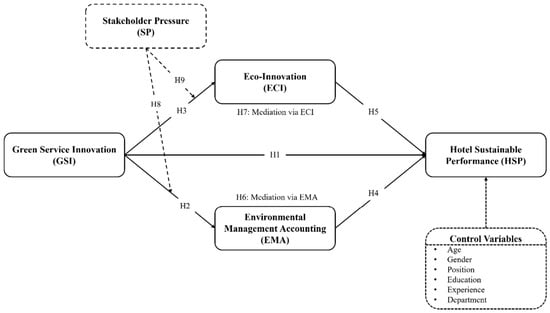
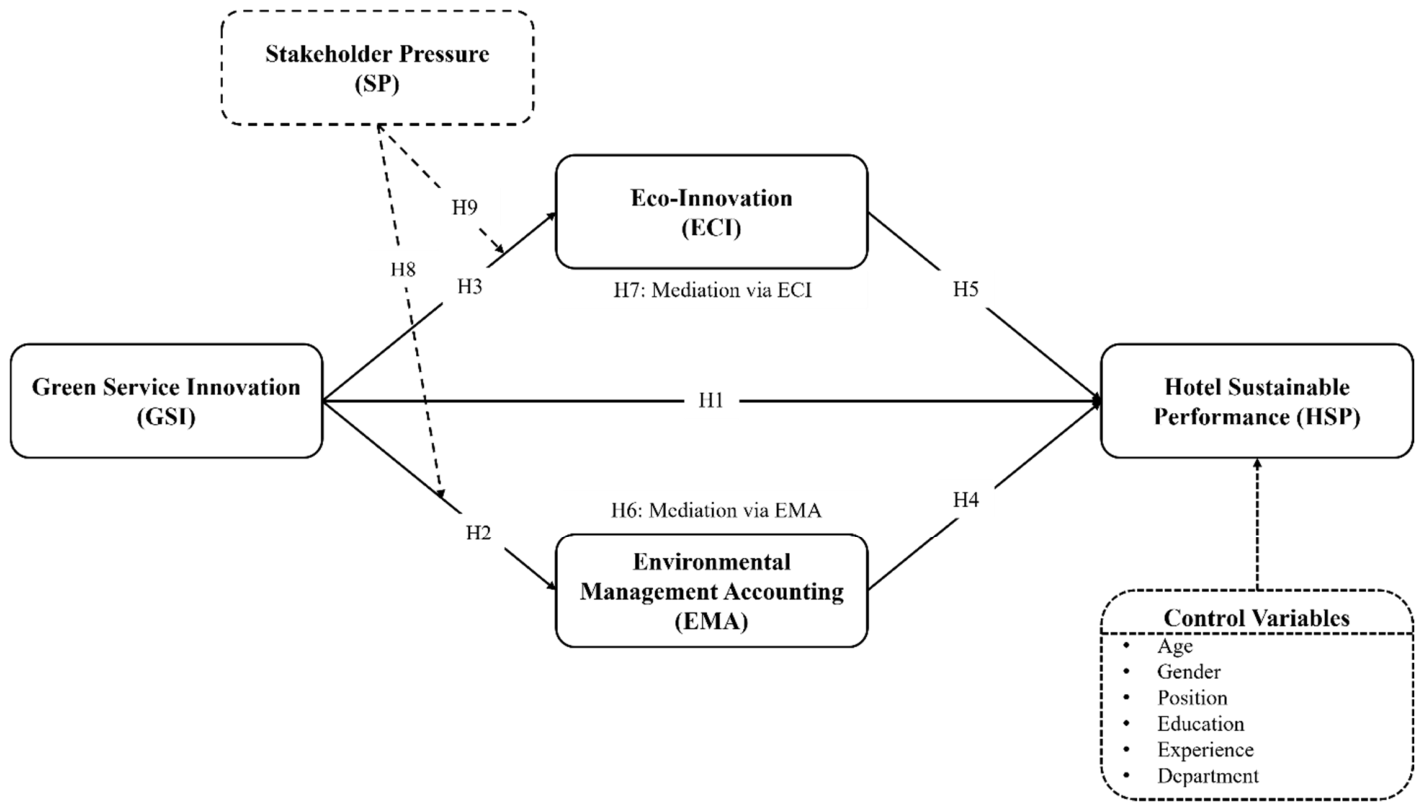
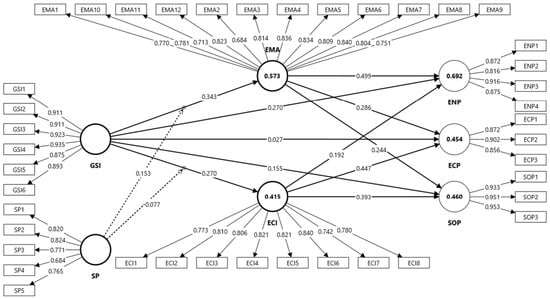
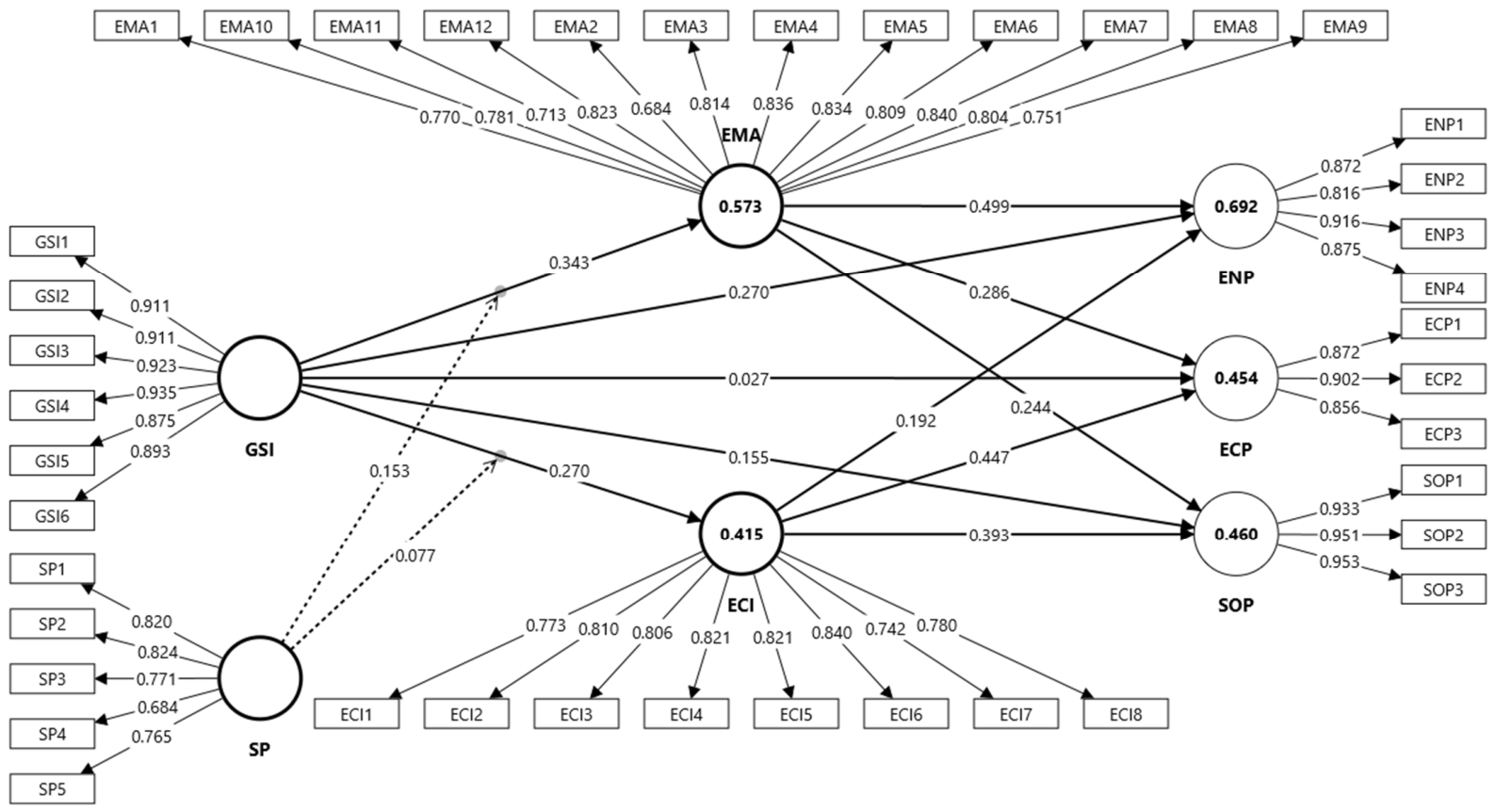
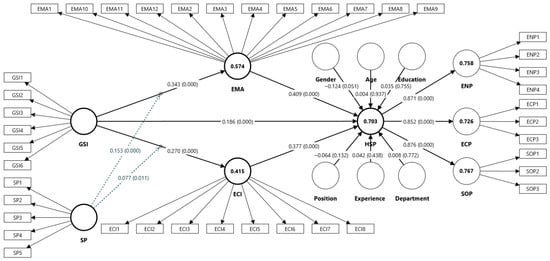
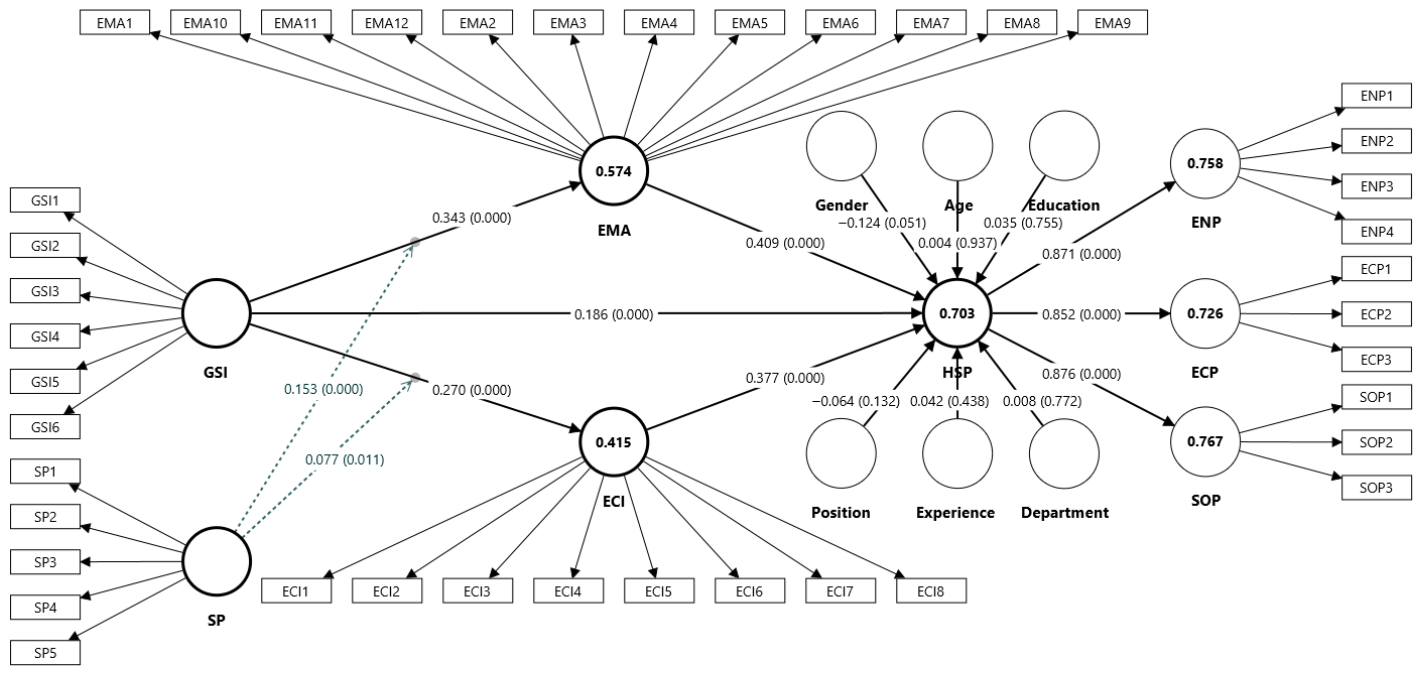
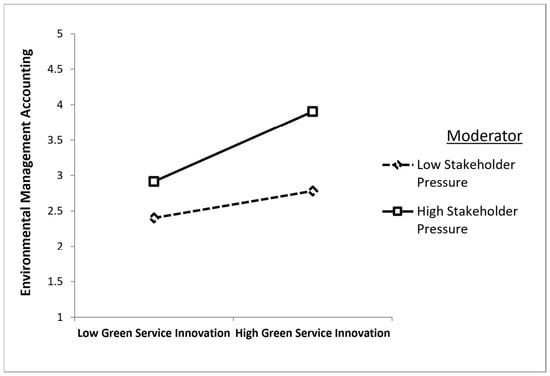
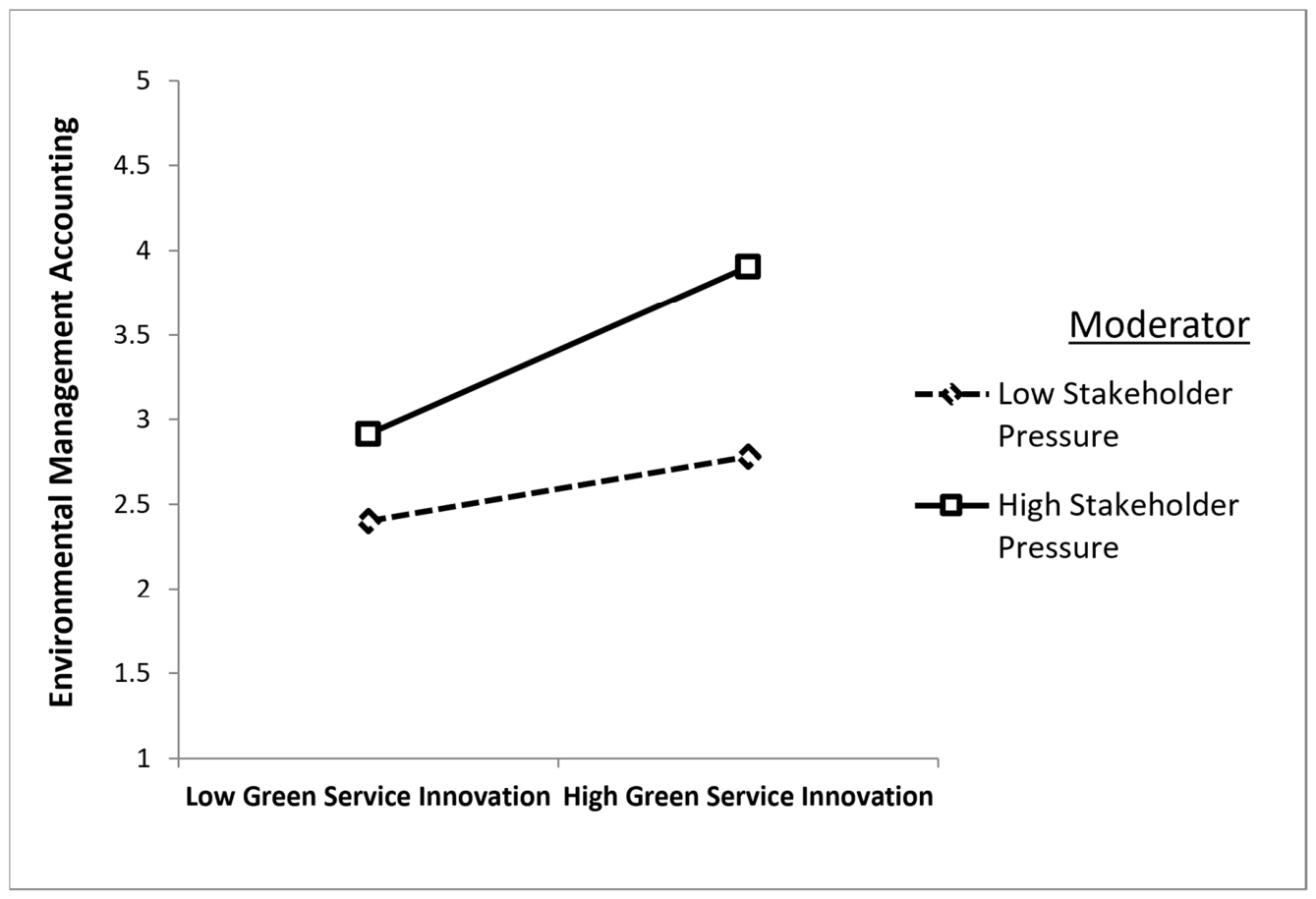
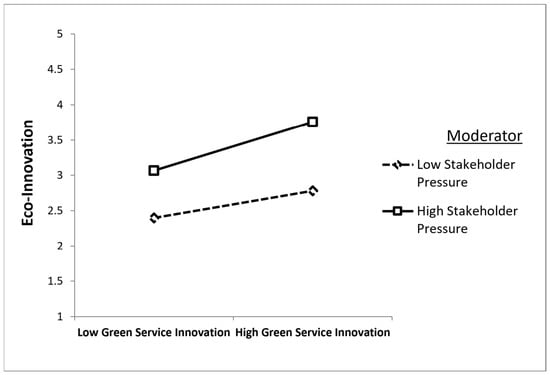
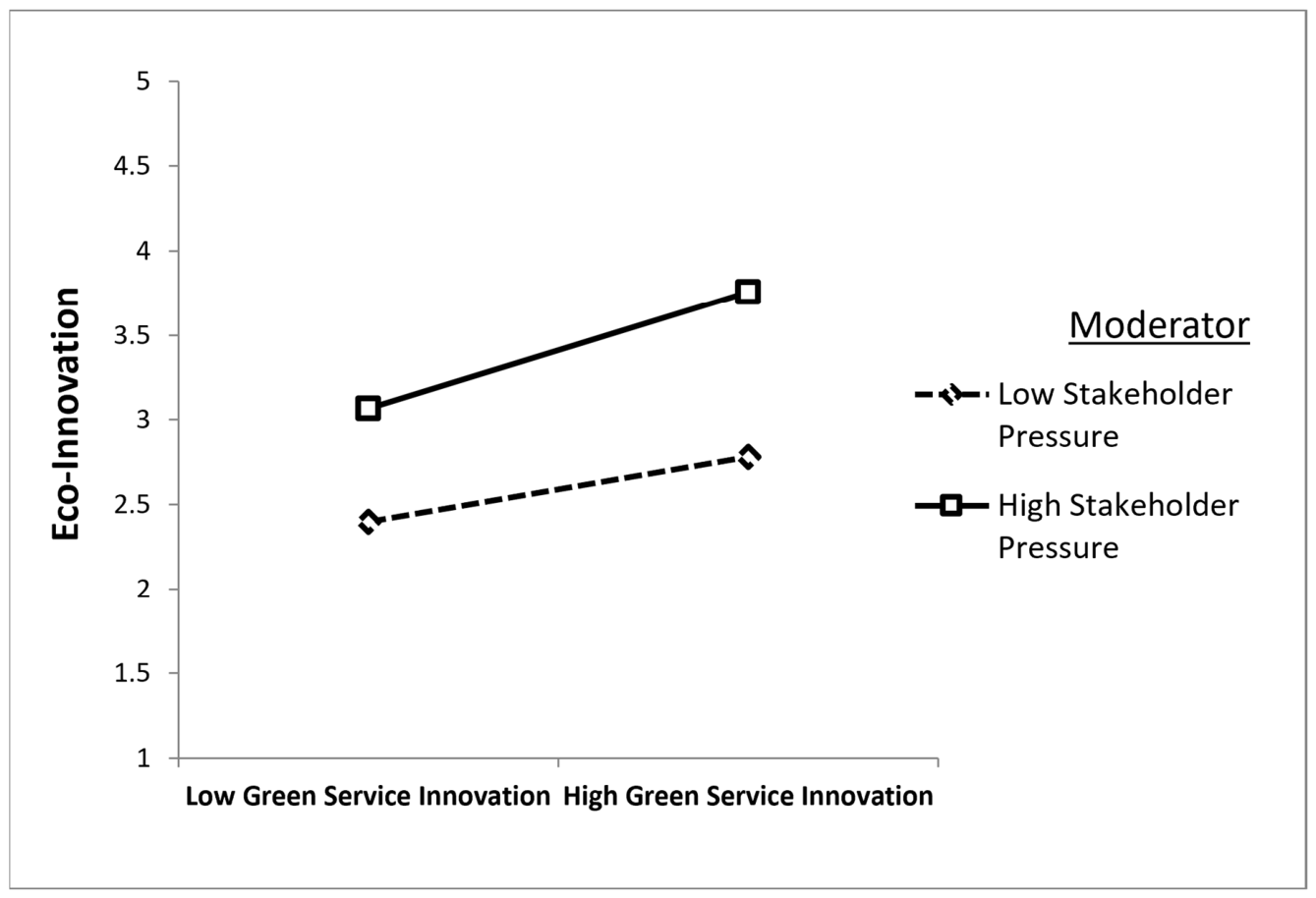

Disclaimer/Publisher’s Note: The statements, opinions and data contained in all publications are solely those of the individual author(s) and contributor(s) and not of MDPI and/or the editor(s). MDPI and/or the editor(s) disclaim responsibility for any injury to people or property resulting from any ideas, methods, instructions or products referred to in the content. |
© 2026 by the authors. Licensee MDPI, Basel, Switzerland. This article is an open access article distributed under the terms and conditions of the Creative Commons Attribution (CC BY) license.