


Abstract
Digital technologies are increasingly used in museums to communicate intangible cultural heritage (ICH), yet how digital curation transforms heritage knowledge and relates to cultural sustainability remains unclear. This study examines museum-based digital ICH curation through a qualitative multiple-case analysis of six Chinese museum projects. The findings identify four mechanisms of knowledge translation: procedural and symbolic visualization, embodied and sensory simulation, contextual and narrative reorganization, and generative and participatory translation. Based on these findings, the study proposes the Somatic-Affective-Narrative (SAN) Co-Curation Framework, which provides an analytical perspective on how digital curation mediates embodied engagement, affective significance, and narrative organization. The study highlights the possibilities and risks of digital curation in sustaining living heritage.
1. Introduction
Museums around the world are undergoing rapid digital transformation, as immersive technologies reshape how heritage is documented and interpreted [1,2]. International policies have situated this transformation within the broader objectives of heritage safeguarding and sustainable development. UNESCO’s 2003 Convention for the Safeguarding of the Intangible Cultural Heritage defines safeguarding as measures that sustain the viability of intangible cultural heritage through documentation, protection, transmission, and revitalization [3]. Under Sustainable Development Goal (SDG) 11, Target 11.4 calls for efforts to protect and safeguard the world’s cultural and natural heritage, while SDG 17 highlights partnerships and knowledge sharing [4,5]. In this context, museums increasingly function as interpretive interfaces through which heritage meanings are communicated and negotiated [6].
In China, national cultural digitization policies have accelerated the development of digital heritage infrastructures and museum-based digital projects [7]. Initiatives undertaken by institutions such as the Palace Museum and the Dunhuang Research Academy illustrate how extended reality, panoramic access, and open digital resources can broaden public access to cultural heritage [8,9].
However, the digital curation of intangible cultural heritage (ICH), such as oral traditions, performing arts, and traditional craftsmanship, presents epistemological and practical challenges [10]. Unlike material artifacts, ICH is transmitted through embodied practice, sensory experience, and situated social relations, which cannot be reproduced through visual representation alone [11,12,13]. Digital curation therefore involves the selective mediation and reorganization of heritage knowledge through technological and curatorial arrangements [14].
Previous studies have defined “knowledge transfer” as the adaptation of existing knowledge to new contexts rather than its complete replication [15], while “knowledge conversion” refers to the dynamic interaction between tacit and explicit knowledge that expands both forms and facilitates their transfer [16]. Building on these perspectives, this study defines “knowledge translation” as the selective mediation and reconfiguration of ICH knowledge across media, actors, and contexts. In museum-based digital curation, it concerns how heritage knowledge is made perceptible, contextualized, and open to public interpretation or participation.
Current studies have examined digital exhibitions, community-based safeguarding, and design models for living heritage [10,14,17,18], but have largely focused on technological implementation, policy, and usability [19,20]. Less attention has been paid to how museum-based digital curation transforms ICH knowledge, whose dimensions resist translation, and how this process reshapes relationships among museums, heritage bearers, technological actors, and audiences. This gap is particularly relevant in China, where expanding digital infrastructures and institutional priorities influence how ICH is selected and represented [21].
To address these gaps, this study examines six museum-based digital ICH projects in China through a qualitative multiple-case comparison. It addresses two research questions: (1) How do digital curation mechanisms translate tacit, embodied, and situated ICH knowledge into public-facing exhibition forms? (2) What conditions, possibilities, and risks for cultural sustainability are suggested by these mechanisms? By identifying recurring patterns across the cases, the study develops an empirically informed framework for interpreting the relationship between digital curation and cultural sustainability.
2. Literature Review
2.1. The Tacit, Embodied, and Situated Nature of Intangible Cultural Heritage
Intangible cultural heritage (ICH) includes the living practices, representations, expressions, knowledge, and skills of communities [10]. Because these practices are continually recreated within community life, their safeguarding depends on the continuity of practice and transmission rather than the preservation of fixed cultural objects [22,23]. Examining digital curation therefore requires attention not only to what heritage content is recorded, but also to how the knowledge underlying these practices is sustained and communicated.
A typical feature of ICH knowledge is its tacitness. Traditional craftsmanship and performing arts rely on knowledge acquired through oral instruction, observation, apprenticeship, and repeated practice [24]. Studies of weaving, dyeing, and related crafts show that transmission involves prolonged bodily adjustment and practitioner guidance rather than the simple communication of codified instructions [25,26,27,28]. Although digital media can document visible procedures and provide access to selected aspects of craft knowledge, sensory judgment, bodily coordination, and practitioner experience remain difficult to formalize.
ICH knowledge is also embodied because it is enacted through movement, perception, and material engagement. The body consequently serves as an important medium of cultural memory and transmission [29]. Conventional museum displays provide limited access to these dimensions, while interactive and performative technologies can create opportunities for visitors to engage with gestures, sounds, materials, and spatial relations [30,31]. Such interaction should not, however, be equated with the acquisition of embodied knowledge. Digital interfaces can approximate selected movements or sensory cues, but they rarely reproduce the duration, correction, material resistance, and practitioner feedback involved in sustained learning [32].
ICH is further situated within particular communities, places, and social relations that give practices their cultural meaning [33]. Digital mediation can broaden access while detaching heritage from the contexts in which it is practiced and transmitted [25]. Accordingly, authenticity in digital curation cannot be assessed solely through representational fidelity. It also depends on whether local knowledge, community agency, and the continued negotiation of cultural meanings remain present in curatorial processes [34]. Community participation should therefore be evaluated through actors’ involvement in selection, interpretation, and decision-making, rather than inferred from their symbolic visibility alone [35].
Tacitness, embodiment, and situatedness are thus interconnected dimensions of ICH knowledge. Together, they provide a conceptual basis for examining what aspects of heritage are translated through digital curation, how that translation is mediated, and which forms of knowledge or agency remain weakly represented.
2.2. Digital Curation of Intangible Cultural Heritage
Digital curation initially developed around the lifecycle management of digital assets. The Digital Curation Center (DCC) Lifecycle Model, for example, emphasizes data preservation, access, and reuse [36,37]. While such models provide a technical basis for managing digital heritage, they offer limited explanation of how living knowledge is interpreted or how communities participate in curation. Participatory approaches have therefore reframed digital curation as a social process involving museums, heritage communities, and audiences [38,39].
When applied to ICH, digital curation also involves the transformation of knowledge. Nonaka and Takeuchi’s SECI model describes knowledge creation through interactions between tacit and explicit knowledge [16], while the K-AEDR model adapts this process to craft–design collaboration through knowledge accumulation, expression, diffusion, and reflection [24]. However, digital curation often privileges the externalization of visible procedures and narratives, while sensory judgment and practice-based experience remain difficult to formalize.
Sociocultural frameworks broaden this perspective by examining the relationships through which heritage knowledge is produced and sustained. The 5As framework conceptualizes ICH through interactions among actors, affordances, artifacts, audiences, and apprentices [40], while the Technology–Community Synergy Framework (TCSF) connects digital methods with levels of participation ranging from information provision to co-governance [10]. The dual-path model further distinguishes informational engagement from affective experience, suggesting that emotional pathways may support continued participation [35]. In documentary analysis, however, these pathways can only be treated as affective affordances rather than demonstrated visitor outcomes.
These frameworks offer complementary insights into knowledge translation, actor relationships, community participation, and affective engagement. They nevertheless remain analytically fragmented. Technical lifecycle models give limited attention to living knowledge; knowledge-conversion models do not fully address institutional authority; and participation or visitor-engagement models rarely distinguish how different dimensions of ICH knowledge are digitally mediated. A more integrated perspective is therefore needed to examine how museum-based digital curation translates heritage knowledge and what conditions or risks this process creates for cultural sustainability.
2.3. Cultural Sustainability and Value Co-Creation in Museum ICH Curation
Cultural sustainability in museum-based ICH curation concerns not only the preservation of heritage resources, but also the continued transmission and negotiation of cultural meanings and practices within communities [41,42]. This perspective shifts attention from whether digital content is preserved to whether digital curation creates conditions for living heritage to remain interpretable and transmissible. Consistent with service-dominant logic, cultural value is understood as emerging through interactions among museums, heritage bearers, technologies, and audiences [43].
Participatory approaches such as social curation and community co-curation seek to involve heritage communities in the selection, interpretation, and circulation of digital resources [18,44,45]. However, the inclusion of communities or interactive functions does not necessarily constitute value co-creation, particularly when interpretive and decision-making authority remains institutionally controlled. Digital platforms may also create affective and practical connections between online encounters and continued heritage engagement [35], but these should be treated as possibilities rather than demonstrated outcomes. Similarly, generative AI can expand opportunities for adaptive storytelling and user participation while introducing risks of cultural bias, semantic distortion, and reduced community control [28,46].
Current studies therefore identify participation, affective engagement, and technological innovation as important to cultural sustainability, but often examine them separately or assume a positive relationship between digital interaction and sustainable outcomes. Less attention has been paid to how specific curatorial mechanisms translate ICH knowledge and create both enabling conditions and risks for cultural continuity. This unresolved relationship among knowledge translation, value co-creation, and cultural sustainability provides the basis for this study.
3. Methods
3.1. Research Design
This study adopts a qualitative multiple-case study design with embedded units of analysis to examine the museum-based digital curation of ICH. A feature-based comparative framework supports cross-case comparison, while directed qualitative content analysis guides the coding and interpretation of documentary materials. The comparative procedure is adapted from Korro Bañuelos et al., who derived analytical characteristics from cultural heritage conservation standards and applied them consistently across information management systems [19]. This study adopts their procedural logic of deriving transparent analytical attributes and applying them comparatively, rather than transferring their substantive conservation criteria to ICH curation. Drawing on Yin’s distinction between cases and embedded units of analysis [47], each case is defined as a bounded museum-based digital curation project or exhibition program involving one or more identifiable ICH elements. The embedded unit is the exhibition mechanism through which technologies, curatorial narratives, heritage knowledge, and participation are organized.
The research proceeded through five stages, as shown in Figure 1. Policy documents and relevant scholarship were first reviewed to derive and operationalize the analytical attributes. Candidate projects were then identified and screened according to predefined criteria. Documentary materials were subsequently collected and coded to construct within-case profiles. Finally, the profiles were compared to identify recurring configurations of knowledge translation and their implications for cultural sustainability.
Figure 1.
Research roadmap of this study.
Eight analytical attributes were derived deductively from the reviewed policy documents and theoretical literature: (1) type of ICH knowledge represented; (2) embodied and sensory mediation; (3) contextual and narrative organization; (4) bearer and community participation; (5) actor connectivity and value co-creation; (6) audience role and engagement affordance; (7) transmission interface; and (8) implementation complexity and cultural risk. The attributes were retained when they were relevant to the research questions, observable in the documentary materials, and applicable across the cases. Their definitions, indicators, and coding rules are provided in Appendix A. They guided within-case coding and cross-case comparison, through which broader patterns of knowledge translation were identified.
3.2. Case Selection
Cases were selected through criterion-based purposive sampling to identify information-rich projects in which the relationship among ICH knowledge, digital technologies, curatorial arrangements, and public-facing exhibition mechanisms could be reconstructed. Candidate projects were identified between March and July 2025 from museum websites, official ICH platforms, news releases, and academic studies. The search terms, candidate list, and screening decisions are provided in Appendix B.
Projects were considered eligible when they met three criteria: (1) intangible cultural heritage constituted the primary interpretive object rather than a general cultural or historical theme; (2) the project was situated within a clearly bounded museum or exhibition context, allowing the curatorial environment and interpretive practices to be examined; and (3) sufficient information was available to reconstruct how digital technologies shaped processes of representation, narration, interaction, or interpretation. Projects centered primarily on tangible heritage, general digital collections or archival platforms, promotional campaigns, or cases lacking sufficient evidence for mechanism reconstruction were excluded.
The initial corpus consisted of 36 museum-based digital ICH interpretation projects identified through a broad search of domestic heritage digitization practices. These projects underwent three rounds of screening. In the first round, projects were excluded when ICH was not the primary interpretive object. In the second round, projects lacking a clearly bounded museum or exhibition context were removed. In the third round, cases were excluded when available materials were insufficient to reconstruct their digital interpretation mechanisms. Following this process, six cases were retained for cross-case analysis, as shown in Table 1.
Table 1.
Case overview.
The resulting cases provide variation in heritage type, institutional setting, and mode of digital mediation, including optical and tactile interaction, AI-supported visual generation, movement- and sound-based engagement, multimedia-supported live presentation, AR-based process interpretation, and AI-mediated narration. This variation supports analytical comparison, although the availability criterion may privilege larger or more extensively documented institutions.
3.3. Data Sources and Corpus Construction
The documentary corpus comprises 117 institutional materials and 306 academic, technical, and media sources. Institutional materials included museum webpages, exhibition descriptions, official reports, press releases, educational materials, photographs, and audiovisual records. Secondary materials included academic studies, technical descriptions, professional reports, and media coverage.
Institutional sources were used to establish project design and curatorial intentions, while academic and technical sources clarified heritage practices and system functions. Media reports provided supplementary descriptions of implementation, and visitor comments were used to contextualize immediate reception. For each source, metadata were recorded, including source type, publisher, date, relevant case, exhibition mechanism, and analytical attribute. Chinese-language materials were analyzed in Chinese, and quoted excerpts were translated into English by the authors. Descriptions of technologies, interactions, and participation arrangements were corroborated across source types where possible. Because the corpus primarily documents curatorial arrangements and engagement affordances, claims concerning visitor experience and long-term cultural outcomes are treated as analytical possibilities rather than directly verified effects.
3.4. Coding and Comparative Analysis
The materials were analyzed using directed qualitative content analysis. The coding unit was a textual or audiovisual segment describing a specific exhibition mechanism. The initial codebook was derived from the eight analytical attributes and included conceptual definitions, observable indicators, and inclusion and exclusion rules, as detailed in Appendix A. Each entry was also classified by evidentiary status, such as an institutional claim, directly documented feature, third-party description, or visitor report. Missing information was recorded as “not documented”.
Coding was conducted by the second and third authors. Both coders first independently applied the preliminary codebook to materials from two contrasting cases. Differences in interpretation were discussed, and the category definitions and decision rules were revised before formal coding. The corpus was then coded and cross-checked using the revised manual. Disagreements were resolved through discussion with reference to the original materials and operational definitions.
The analysis proceeded in three stages. First, coded evidence was consolidated into a profile for each case. Second, the profiles were compared across the eight analytical attributes to identify similarities, differences, and gaps in documentation. Third, recurring relationships among the attributes were examined through abductive pattern comparison. This process generated four mechanisms of knowledge translation. A framework was subsequently developed by relating these cross-case patterns to theories of embodied knowledge, affective engagement, and participatory interpretation.
4. Results: Comparative Assessment of Digital ICH Curation
4.1. Overview of Selected Cases
The six selected cases cover different museum-based approaches to the digital curation of ICH. These cases show how museums and museum-affiliated cultural institutions use different digital configurations to translate craft knowledge, performance skills, musical experience, folk narratives, and interpretive content into public-facing exhibition mechanisms. Together, they provide a comparative basis for examining how ICH knowledge is made visible, interactive, and participatory in museum settings.
The first case, Shadow Puppetry and Technology: ICH Science and Culture Exhibition, was presented at the China Science and Technology Museum. Focusing on Chinese shadow puppetry, the exhibition interpreted both the cultural practice and its underlying scientific principles. It covered approximately 210 square meters and consisted of four sections and eleven exhibits, combining interactive devices, multimedia displays, shadow puppets, images, explanatory texts, and educational activities [48]. Its central mechanism was a light–puppet–screen installation through which visitors could adjust the distance among the light source, puppet, and screen to observe changes in shadow size, clarity, and formation. Material-touch modules also enabled visitors to compare the flexibility and translucency of different puppet materials. The case therefore provides an example of how optical principles and material properties are incorporated into interactive heritage interpretation.
Zhangduan: Relief on Silk, was developed by the Suzhou Silk Museum in collaboration with Baidu’s ERNIE model. More than 3000 Zhangduan textile patterns from the museum collection were reportedly used as materials for model development [49]. The project also included the interactive program Cyber Weaving Zhangduan, which allowed visitors to generate new visual compositions based on traditional textile motifs. Through this mechanism, museum collections and historical patterns were reorganized into a generative interface. The project foregrounds the visual and compositional dimensions of Zhangduan while also raising questions about how far pattern generation can represent the knowledge embedded in weaving practice.
The third case, Flower City in Bloom: Guangzhou Intangible Cultural Heritage Exhibition, was presented at the Guangzhou Cultural Center. The exhibition covered a broad range of local ICH, including Guangdong music, food culture, seasonal festivals, Lingnan medicine, Nanquan, traditional craftsmanship, and local narratives [C3 official exhibition source]. In the “Yueyun Liufang” section, a Guangdong music installation presented the five-piece ensemble through silhouettes, physical instruments, sound, and human–machine interaction. The “Follow Me to Learn Nanquan” device invited visitors, particularly younger audiences, to imitate selected martial arts movements in front of a wooden dummy [50]. These mechanisms combine sound, movement, physical objects, and interactive operation, making the case relevant to the analysis of performing and movement-based heritage.
The fourth case, Vast and Varied: Thematic Exhibition on China’s ICH Safeguarding Practice, was organized by the Chinese Traditional Culture Museum. The exhibition presented more than 100 representative ICH projects through objects, reconstructed settings, multimedia installations, interactive areas, and live demonstrations by heritage bearers [51]. The present study focuses on several specific mechanisms, including an ancient theater combining gauze projection with live performance and process-oriented displays of traditional craftsmanship and tea-making. By bringing digital presentation and live demonstration into the same exhibition setting, this case provides a basis for comparing technologically mediated interpretation with the visible presence of heritage practitioners.
The fifth case comprises selected digital interpretation projects at the Zhejiang Intangible Cultural Heritage Museum, including the ICH AI Future Space, intelligent DIY terminals, immersive particle animations, AR-based craft interpretation, and an AR guide system. Official project materials describe DIY terminals for activities such as calligraphy, bamboo rolling-lantern making, and traditional dougong assembly [52]. Other mechanisms include particle animations based on The Legend of the White Snake and The Butterfly Lovers, AR glasses presenting ceramic-making processes, and marker-triggered video and audio interpretation. Together, these projects illustrate how regional narratives and selected craft procedures are reorganized through guided interaction, spatial media, and augmented interpretation.
The sixth case comprises AI-based and interactive interpretation practices at the Guangdong Intangible Cultural Heritage Museum. These include the “AI Storyteller”, holographic music and theater displays, somatic interaction, and interactive games. The “AI Storyteller” reportedly combines natural-language dialogue with AI digital–human synthesis to provide conversational heritage interpretation [53]. Other installations use holographic projection and interactive interfaces to present Lingnan music, theater, and local cultural narratives. This case offers an example of how AI-mediated narration and interactive display are used to reorganize heritage information into accessible conversational and spatial forms.
4.2. Comparative Matrix of Analytical Characteristics
Following the feature-based comparative logic, the selected cases were compared according to the eight analytical characteristics developed, as shown in Table 2.
Table 2.
Comparative matrix of analytical characteristics across selected cases.
The comparative matrix shows that the six cases translate different dimensions of ICH knowledge through distinct representational strategies. Digital curation tends to foreground aspects that can be stabilized as patterns, procedures, sounds, movements, or interactive operations. C2 externalizes Zhangduan motifs through AI-supported generation, whereas C1 and C3 emphasize optical principles, material properties, sound, and bodily movement. C4 adopts a broader scope by combining multiple heritage categories with multimedia and live demonstration, while C5 and C6 integrate AR, guided interaction, AI narration, and game-based interfaces. These differences suggest a recurring tension between curatorial breadth and representational depth: broad exhibitions provide wider contextual access, whereas focused installations may offer closer engagement with selected dimensions of a practice.
The cases also differ in embodied and sensory mediation. C1 allows visitors to manipulate light, puppets, and screens and compare material properties through touch. C3 incorporates sound and movement imitation, C4 combines projected media with live performance, and C5 uses AR and guided DIY activities to present selected craft procedures. In contrast, C2 relies mainly on screen-based pattern generation. This makes the visual vocabulary of Zhangduan accessible, but the documented interface does not reproduce loom rhythm, manual tension, material resistance, haptic judgment, or prolonged bodily coordination. Sensory and interactive technologies can therefore mediate selected aspects of embodied knowledge, but the depth of translation depends on whether material and practitioner feedback are incorporated.
Contextual organization also varies. C1 frames shadow puppetry through science education; C2 links traditional motifs with museum collections and digital design; C3 situates music, martial arts, festivals, and craftsmanship within Guangzhou and Lingnan culture; C4 organizes diverse traditions through a national safeguarding narrative; C5 emphasizes Zhejiang regional narratives and craft processes; and C6 presents Lingnan heritage through AI-supported conversational and spatial interpretation. These cases show that digital curation does not simply reproduce original contexts but selectively reconstructs heritage through scientific, regional, institutional, or technological frames.
Bearer and community participation is unevenly documented. C4 provides the clearest evidence of practitioner presence through live demonstration. C1 mediates practitioner knowledge through exhibition devices, while C5 reports forms of demonstration and guidance. In C2, C3, and C6, public materials describe visitor interaction more clearly than practitioner or community involvement in selecting, interpreting, or governing content. The cases should therefore be understood as contrasting configurations of institutional control, practitioner visibility, technological partnership, and audience participation rather than equivalent examples of co-curation.
Audience roles also differ. Visitors act as experimenters in C1, pattern generators in C2, listeners and imitators in C3, viewers and witnesses in C4, AR or DIY participants in C5, and dialogue partners or game users in C6. These roles extend participation beyond passive viewing, but operating a device, generating a pattern, imitating a movement, and encountering a practitioner provide different levels of access. None of these activities alone demonstrates embodied learning or shared curatorial authority.
The final attribute concerns implementation complexity and potential cultural risk. These risks are inferred from technological and institutional configurations rather than treated as observed outcomes. C1 may reduce an integrated performance practice to optical principles; C2 may privilege digitizable motifs over embodied craft knowledge; C3 may fragment interconnected practices into discrete interactions; C4 may organize diverse traditions through standardized institutional categories; C5 depends on continued technical maintenance and may simplify lengthy craft processes; and C6 raises questions about how dialectal, vernacular, and locally situated narrative variations are handled by AI systems.
Overall, museum-based digital ICH curation operates as a selective process of knowledge translation. Different configurations privilege different combinations of accessibility, embodiment, contextualization, participation, and risk. These cross-case relationships provide the empirical basis for the four mechanisms developed in the following section.
4.3. Mechanisms of Knowledge Translation for ICH Digital Curation
Cross-case comparison identified four recurring mechanisms through which museum-based digital curation mediates ICH knowledge. These mechanisms were derived from recurring relationships among the eight analytical attributes rather than imposed as initial coding categories. Table 3 summarizes their principal attributes and supporting cases.
Table 3.
Knowledge-translation mechanisms across the cases.
4.3.1. Procedural and Symbolic Visualization
Procedural and symbolic visualization converts motifs, materials, tools, and production stages into visible or manipulable forms. In C2, Zhangduan textile patterns are reorganized through an AI-supported generative system, allowing visitors to explore their motifs and compositional features. C5 emphasizes procedural representation through AR interpretation and intelligent DIY terminals, which divide selected craft processes into guided sequences. C4 similarly uses process-oriented displays to present stages of craftsmanship and tea-making.
This mechanism expands access to aspects of ICH that can be stabilized as images, models, or operational steps. However, visualization necessarily privileges knowledge that can be observed and segmented. In C2, the interface presents textile motifs and visual recombination but does not reproduce loom rhythm, manual tension, material resistance, haptic judgment, or the prolonged bodily coordination involved in weaving. Procedural visibility should therefore not be equated with the complete translation of craft knowledge.
4.3.2. Embodied and Sensory Simulation
Embodied and sensory simulation incorporates touch, movement, sound, operation, and spatial perception into exhibition interaction. In C1, visitors manipulate the relationship among light, puppets, and screens and compare the properties of different puppet materials through touch. C3 presents Guangdong music through sound and spatial display while inviting visitors to imitate selected Nanquan movements. C4 combines projected media with live performance and practitioner demonstration, whereas C5 uses AR and guided activities to mediate selected craft procedures.
Despite their technological differences, these cases share a curatorial logic of reorganizing sensory or performative properties into actions that audiences can perceive or undertake. Shadow formation becomes experimentally manipulable, musical rhythm becomes spatially accessible, and bodily movement becomes imitable. These mechanisms provide affordances for embodied engagement, but they do not reproduce the duration, correction, material feedback, and interpersonal guidance associated with apprenticeship. They simulate selected dimensions of practice rather than establish the acquisition of embodied skills.
4.3.3. Contextual and Narrative Reorganization
Contextual and narrative reorganization embeds heritage knowledge within regional, historical, spatial, or institutional frames. C3 situates music, martial arts, festivals, and craftsmanship within the cultural setting of Guangzhou and Lingnan. C4 connects multiple heritage categories through a national narrative of ICH safeguarding and combines multimedia interpretation with live demonstration. C5 translates regional folk narratives, including The Legend of the White Snake and The Butterfly Lovers, into immersive and spatial experiences. C6 further reorganizes heritage information through conversational AI and digital–human interpretation.
This mechanism operates through spatial staging, immersive storytelling, and interactive narration. It can connect otherwise fragmented information with broader cultural settings, but the resulting context is shaped by institutional and technological selection. In C6, for example, public documentation confirms the use of AI-supported conversational interpretation but does not establish whether dialectal expressions, local oral variants, or contested narratives are retained within the system. Narrative accessibility may therefore coexist with uncertainty regarding the representation of local difference.
4.3.4. Generative and Participatory Translation
Generative and participatory translation enables visitors to generate, select, assemble, imitate, or respond to heritage content through structured digital interfaces. In C2, visitors produce visual variations based on Zhangduan motifs. In C5, AR and DIY systems support guided engagement with craft processes. In C6, users interact with conversational narration and game-based installations.
These mechanisms reposition audiences from viewers to active users, but participation varies in depth. Pattern generation enables creative recombination, guided making supports procedural interaction, and conversational systems allow users to select interpretive pathways. Nevertheless, these activities remain structured by predefined datasets, interfaces, and curatorial rules. The available evidence does not show that visitors or heritage communities govern datasets, revise interpretive frameworks, or share decision-making authority. Generative interaction should therefore be distinguished from substantive co-curation.
4.4. Conditions, Frictions, and Risks for Cultural Sustainability
Under SDG Target 11.4, cultural sustainability in museum-based ICH curation concerns not only the preservation of digital resources, but also the continued accessibility, interpretation, and transmission of living cultural knowledge [5]. The cases suggest that digital curation may contribute to this process by broadening access, reconstructing cultural contexts, diversifying audience participation, and connecting museums with heritage bearers, technology providers, and other institutional actors.
These enabling conditions take different forms across the cases. C1 and C2 provide focused access to selected optical, material, and visual dimensions of practice. C3 and C5 connect interactive interpretation with regional cultural settings, while C4 combines multimedia presentation with live bearer demonstration. C6 expands interpretive access through conversational AI and other interactive systems. Together, the cases show that cultural sustainability is shaped not by technological sophistication alone, but by how digital mechanisms connect representational access with contextual knowledge, practitioner presence, and opportunities for participation.
At the same time, the comparison reveals recurring translation friction between what digital systems can externalize and what remains embedded in material practice, bodily experience, practitioner guidance, or local context. In C2, textile motifs and visual compositions can be digitized and recombined, whereas loom rhythm, manual tension, material resistance, haptic judgment, and long-term bodily coordination remain weakly represented. In C5, AR and guided DIY activities make selected craft procedures accessible, but they provide only limited access to the correction, repetition, and practitioner feedback through which skills are ordinarily acquired. In C6, conversational AI reorganizes heritage information into accessible narrative forms, while the available materials provide little indication of how dialectal expressions, local oral variants, and community-defined interpretations are incorporated. Similar friction is visible in C1 and C3, where optical experimentation or movement imitation presents selected properties of performance without reproducing the integrated practice through which they are learned.
These frictions also point to several potential risks. Selective visualization may privilege knowledge that can be readily codified, segmented, or modeled. Interactive systems may transform lengthy and integrated practices into brief operational encounters. Institutionally organized narratives may reduce the visibility of local variation, while AI-mediated interpretation may introduce standardization through training data, model design, and predefined conversational structures. Digital installations also depend on continuing maintenance, hardware renewal, software compatibility, and content updating, making technical continuity an important condition of long-term accessibility.
Participation presents a further distinction. Device operation, pattern generation, movement imitation, conversational interaction, and attendance at live demonstrations all extend audience involvement beyond passive viewing, but they do not represent the same degree of engagement. Nor does visitor interaction necessarily involve heritage communities in selecting, interpreting, or governing digital content. Among the six cases, C4 provides the clearest evidence of visible bearer participation, while the roles of practitioners and communities in curatorial decision-making are less apparent in the documentation of the other cases.
Overall, the cases suggest that the cultural sustainability of digital ICH curation depends on the relationship among accessibility, embodied depth, contextual integrity, participation, and technical continuity. Digital mechanisms may extend the reach and interpretability of heritage knowledge, but their contribution remains conditioned by what forms of knowledge they privilege, which actors retain interpretive authority, and how digital representation remains connected to living practice.
5. Discussion
The digital curation of ICH in museums emerges at the intersection of technological capabilities, community interests, and institutional mandates. The findings indicate that digital curation does not transfer ICH knowledge into digital form as a complete and stable object. Instead, it selectively mediates particular dimensions of heritage through visual, sensory, narrative, and participatory configurations.
5.1. Selective Knowledge Translation in Museum-Based Digital Curation
The findings suggest that museum-based digital curation is better understood as a process of selective knowledge translation than as the direct transfer of heritage into digital form. The four mechanisms constitute a digital translation spectrum through which different dimensions of ICH knowledge become visible, perceptible, contextualized, or open to interaction. This spectrum highlights the different epistemic effects produced when living heritage is reorganized through particular media and exhibition arrangements.
This interpretation extends digital curation research beyond its common emphasis on technical infrastructure, interface design, usability, immersion, and visitor satisfaction [30,54]. These perspectives help evaluate whether digital systems operate effectively, but provide only a partial account of what happens to heritage knowledge during mediation. The present study instead asks which dimensions of ICH are selected, restructured, and made publicly intelligible. Digital curation is therefore not simply a technical layer added to existing cultural content; it actively shapes the forms through which that content can be interpreted.
The findings also refine existing models of knowledge conversion. Polanyi’s account of tacit knowledge emphasizes the experiential and practical dimensions of knowing [55]. The SECI model explains interactions between tacit and explicit knowledge, while K-AEDR adapts this logic to knowledge accumulation, expression, diffusion, and reflection [16,24]. The cases support the relevance of these models but show that externalization in digital ICH curation is necessarily selective. Knowledge becomes explicit only insofar as it can be reorganized through images, procedures, interfaces, narratives, and interactive tasks.
The contribution of the digital translation spectrum therefore lies in distinguishing accessibility from equivalence. Digital visualization can make a craft sequence easier to observe without reproducing the knowledge required to perform it. Interactive devices can introduce movement, sound, or touch without recreating the extended correction and social learning associated with apprenticeship. Conversational systems may improve access to contextual information while reorganizing local knowledge through institutional and computational structures. Greater perceptibility is an important curatorial achievement, but it should not be treated as the digital reproduction of living practice.
This distinction also contributes to debates concerning the “liveness” of ICH [10]. Digital preservation research emphasizes continuity, accessibility, and reuse [56,57], whereas participatory approaches stress connections with practitioners and communities [18,45]. The findings bring these concerns together by showing that the sustainability value of digital resources depends partly on whether representation remains connected to the practices, contexts, and actors from which heritage knowledge originates. Translation friction is therefore not merely a technical deficiency; it reflects the selectivity inherent in mediation.
Knowledge translation is also institutionally situated. Museums determine what enters exhibitions and how it is categorized, while technology providers influence how cultural content is stored, generated, and accessed. Policy priorities and available resources further shape project design. In China, national cultural digitization and ICH safeguarding agendas provide an important institutional background for these decisions [7].
The digital translation spectrum thus connects knowledge management with cultural sustainability. Visibility may support access and interpretation, but sustainability also depends on contextual continuity, practitioner involvement, and further opportunities for transmission. The central question is not whether digital curation can fully reproduce living heritage, but how mediated representations remain connected to the bodily, social, and cultural relations through which ICH is continually recreated.
5.2. Toward Cultural Sustainability: Somatic-Affective-Narrative Co-Curation Framework
The cross-case findings reveal three recurring questions that are not fully addressed by any single existing model. First, how can digital curation engage the bodily and sensory dimensions of ICH? Second, how might publicly accessible heritage information acquire subjective and affective significance? Third, how are cultural meanings and interpretive authority organized among museums, practitioners, technology providers, and audiences?
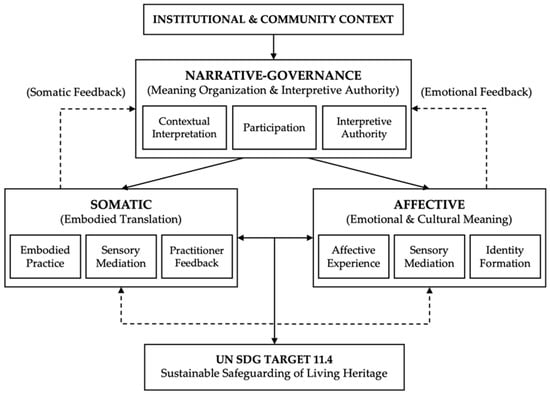
To address this, we propose the Somatic-Affective-Narrative (SAN) Co-Curation Framework (Figure 2). The framework combines empirical findings with theoretical synthesis and situates museum-based digital ICH curation within broader institutional and community contexts. It conceptualizes the sustainable safeguarding of living heritage as requiring coordination among embodied translation, emotional and cultural meaning-making, and narrative-governance processes.
Figure 2.
The Somatic-Affective-Narrative Framework for museum-based digital ICH curation.
The somatic dimension is most directly grounded in the cases. C1, C3, C4, and C5 demonstrate different ways of incorporating touch, movement, sound, spatial perception, and live demonstration into exhibition mechanisms. These examples show that digital and multimedia interfaces can provide bodily and sensory points of access to ICH. In the SAN Framework, the somatic dimension examines how digital curation enables embodied translation by extending beyond visual representation and connecting audience interaction with material properties, embodied practice, sensory mediation, practitioner feedback, and the embodied structures of heritage practice. This dimension draws on the actor–apprentice relationship in the 5As framework, knowledge accumulation in K-AEDR, and the capture component of TCSF [10,24,40]. SAN differs from these models by applying their insights specifically to museum exhibition mechanisms and by distinguishing between affordances for bodily engagement and the acquisition of embodied knowledge. Tangible interfaces, movement imitation, and process simulation may introduce selected principles of practice, but further research is required to determine whether they support subsequent learning or apprenticeship.
The affective dimension represents a further theoretical extension concerning emotional and cultural meaning. Several cases employ immersive environments, aesthetic presentation, anthropomorphic narration, and interactive storytelling that may create conditions for affective experience, while sensory mediation may contribute to audiences’ emotional interpretation of heritage. Several cases employ immersive environments, aesthetic presentation, anthropomorphic narration, and interactive storytelling that may create conditions for emotional engagement. However, the documentary materials do not directly demonstrate emotional attachment, identity recognition, or sustained participation. The affective dimension is therefore theoretically informed by the dual-path model, which distinguishes informational engagement from affective experience [35]. Within SAN, the affective dimension does not assume that immersion automatically produces cultural identification. Instead, it examines how curatorial design connects heritage information with personal relevance, sensory atmosphere, memory, and emotional interpretation, and how these processes may contribute to identity formation. Its inclusion is necessary because knowledge accessibility alone does not explain why audiences may continue to value or engage with heritage. At the same time, this dimension remains a proposition requiring validation through visitor interviews, observation, experimental studies, or longitudinal research.
The third dimension is conceptualized as the Narrative-Governance dimension. The cases show that digital curation organizes heritage through regional, national, scientific, institutional, and computational narratives while simultaneously structuring relationships among museums, practitioners, technology providers, and audiences. Differences in practitioner visibility, technological partnership, and audience interaction reveal that narrative organization is closely connected to authority over datasets, interpretations, and curatorial decisions. The Narrative-Governance dimension therefore examines meaning organization and the distribution of interpretive authority through processes of contextual interpretation, participation, and institutional negotiation. It connects the relational ecology of the 5As framework, the knowledge expression and diffusion dimensions of K-AEDR, and the participation continuum of TCSF [10,24,40]. Within this dimension, co-design and co-governance represent possible forms of participation through which interpretive authority may be distributed among different actors. Its central concern is who selects heritage knowledge, defines legitimate interpretations, and controls its subsequent modification and circulation.
The three dimensions were retained because they represent distinct but interdependent requirements of the sustainable safeguarding of living heritage: embodied practice, affective significance, and the contextual and political organization of meaning. Technical continuity, data management, accessibility, and implementation complexity also play critical roles, but they influence all three dimensions and are therefore treated as cross-cutting infrastructural conditions. SAN therefore differs from the models it synthesizes in both scale and analytical purpose. DCC focuses on the lifecycle of digital resources; SECI and K-AEDR explain knowledge conversion; 5As conceptualizes a relational heritage ecology; TCSF aligns technical processes with levels of community participation. SAN brings these perspectives together at the level of museum-based curatorial mechanisms and connects them to the specific problem of translating living heritage knowledge.
However, the applicability of SAN is conditioned by power relations among museums, heritage bearers, technology providers, and audiences. Interactive or generative functions do not necessarily imply shared curatorial authority, because datasets, interpretive boundaries, and interface options are often institutionally or technically predefined. Museums and technology partners may therefore retain substantial influence over which knowledge is selected, how it is represented, and whose interpretations remain visible. The framework should consequently be used as a diagnostic tool for examining whether somatic engagement is connected to practitioner knowledge, affective design remains contextually grounded, and narrative participation includes meaningful interpretive agency. Its present formulation is also limited by the documentary basis and Chinese museum context of this study and requires further examination through visitor research, practitioner interviews, and applications in different institutional and cultural settings.
6. Conclusions
This study examined how museum-based digital curation translates ICH knowledge and what conditions, possibilities, and risks this process suggests for cultural sustainability. Through a qualitative multiple-case analysis of six Chinese museum projects, the study identified four recurring mechanisms of knowledge translation: procedural and symbolic visualization, embodied and sensory simulation, contextual and narrative reorganization, and generative and participatory translation.
The findings show that digital curation operates as a selective process of mediation. Different curatorial configurations foreground different dimensions of ICH knowledge: AI-supported systems make motifs and narrative information generative or searchable; optical, tactile, and movement-based installations provide access to selected sensory and performative properties; AR and guided interfaces reorganize craft procedures into interactive sequences; and live demonstration retains a more visible connection with practitioner presence. These mechanisms broaden the accessibility and interpretability of ICH, but accessibility does not constitute equivalence. The translation frictions identified across the cases indicate that bodily coordination, material judgment, practitioner correction, local narrative variation, and situated social relationships may remain only partially represented.
The comparison also identifies several conditions relevant to cultural sustainability. Digital curation may support wider access when representation remains connected to cultural context, practitioner knowledge, and meaningful forms of participation. Its contribution is also conditioned by technical continuity, institutional framing, and the distribution of interpretive authority. Interactive functions can diversify audience roles, but visitor operation, generation, imitation, or dialogue does not automatically constitute embodied learning or community co-curation. Similarly, institutionally and computationally organized narratives may improve accessibility while creating risks of procedural simplification, cultural standardization, or reduced visibility of local variation.
Building on these findings and the theoretical frameworks reviewed in the study, the Somato-Affective-Narrative (SAN) Framework conceptualizes digital ICH curation through three interrelated dimensions. The somatic dimension concerns the mediation of bodily, sensory, and practice-based knowledge. The affective dimension addresses the conditions through which heritage information may acquire personal and emotional significance. The Narrative-Governance dimension examines how cultural meanings and interpretive authority are organized among museums, heritage bearers, technology providers, and audiences. Technical continuity, data management, accessibility, and implementation complexity operate as cross-cutting conditions across the three dimensions. SAN is therefore presented as an empirically informed and theoretically synthesized propositional framework for analyzing and designing museum-based digital ICH curation.
For museum practice, the findings suggest that digital projects should begin with the characteristics of the heritage knowledge being mediated. Visual generation, embodied interaction, contextual narration, and participatory interfaces address different curatorial purposes and should not be treated as interchangeable applications of technology. Museums should also clarify the roles of heritage bearers and communities in documentation, interpretation, dataset construction, and decision-making. AI-supported projects require particular attention to data provenance, cultural variation, interpretive accountability, and the continuing authority of source communities. Digital interaction can further be connected with practitioner-led education, community activities, and other forms of continued engagement beyond the immediate exhibition encounter.
Several limitations define the scope of these conclusions. The six cases were purposively selected and differed in scale, heritage category, institutional mandate, and documentary coverage. The study relied primarily on publicly available materials, some of which reflect institutional self-presentation, and does not include direct observation, interviews, or longitudinal evidence. It therefore cannot establish actual visitor learning, emotional attachment, community continuity, or intergenerational transmission. Future research should examine the SAN Framework through visitor studies, heritage-bearer interviews, ethnographic observation, and longitudinal evaluation. Comparative research across different institutional, national, and community-governance contexts could further assess how the three dimensions operate under varying technological and power relations.
Author Contributions
Conceptualization, L.L., K.C. and Y.Y.; formal analysis, L.L. and K.C.; investigation, L.L. and K.C.; resources, Y.Y.; data curation, Y.Y.; writing—original draft preparation, L.L. and K.C.; writing—review and editing, Y.Y.; supervision, Y.Y.; project administration, Y.Y.; funding acquisition, Y.Y. All authors have read and agreed to the published version of the manuscript.
Funding
This research was funded by the “Research on Implementation Strategies for the Normalized Development of Intangible Cultural Heritage Education”, Ministry of Culture and Tourism of the People’s Republic of China, grant number 111602175.
Institutional Review Board Statement
Not applicable.
Informed Consent Statement
Not applicable.
Data Availability Statement
The documentary materials analyzed in this study are publicly available from museum websites, official platforms, and related public sources. The analytical framework, coding manual, case selection process, and screening information are provided in Appendix A and Appendix B.
Conflicts of Interest
The authors declare no conflicts of interest.
Appendix A. Analytical Attribute Derivation and Coding Manual
The analytical attributes were derived through a deductive process combining international policy frameworks, ICH scholarship, digital curation studies, and cultural sustainability literature. The selection followed three principles: (1) relevance to the research questions; (2) observability in publicly available documentary materials; and (3) applicability across different museum-based digital ICH cases. No expert consultation or Delphi method was conducted.
Table A1.
Derivation of analytical attributes.
Each case was coded according to the above attributes based on the documented curatorial mechanisms. The coding focused on the presence and characteristics of exhibition arrangements.
Table A2.
Coding manual.
Appendix B. Candidate Project Pool and Case Screening Log
| Museum/Institution | Exhibition/Project | Final Status |
| Chinese Traditional Culture Museum | Vast and Varied: Thematic Exhibition on China’s ICH Safeguarding Practice | Retained (Final Case C4) |
| Chinese Traditional Culture Museum | Additional Digital ICH Interpretation Display | Excluded in Round 2 |
| China National Silk Museum | AI Interactive Silk Weaving Experience (Shuttle Throwing and Jacquard Weaving) | Excluded in Round 3 |
| China Science and Technology Museum | Shadow Puppetry and Technology: ICH Science and Culture Exhibition | Retained (Final Case C1) |
| Dunhuang Academy | Digital Dunhuang Resource Database and Cloud Exhibition | Excluded in Round 1 |
| Dunhuang Academy | Exploring Dunhuang: Digital Dunhuang Immersive Exhibition | Excluded in Round 2 |
| Dunhuang Academy × Tencent | Digital Library Cave | Excluded in Round 1 |
| Guangdong Folk Arts Museum | Digital Experience Hall | Excluded in Round 2 |
| Guangdong Intangible Cultural Heritage Museum | AI-Based and Interactive Interpretation Practices | Retained (Final Case C6) |
| Guangdong Museum | 3D Virtual Exhibitions and Cloud Tour of Guangdong Museum | Excluded in Round 3 |
| Guangdong Museum | Together with Lacquer: Digital Exhibition of Qing Dynasty Canton Export Lacquerware | Excluded in Round 2 |
| Guangzhou Cultural & Arts Centre | Flower City in Bloom: Guangzhou ICH Digital Exhibition | Retained (Final Case C3) |
| Guangzhou ICH Street | Guangfu ICH Metaverse Street | Excluded in Round 1 |
| Henan Museum | Tang Palace Banquet XR Immersive Exhibition | Excluded in Round 3 |
| Hubei Provincial Museum | Journey through the Bronze Age: VR Digital Heritage Experience | Excluded in Round 1 |
| Hubei Provincial Museum | Echoes of Chu: ICH Digital Performance for Lantern Festival Night | Excluded in Round 2 |
| Hunan Museum | Life Art: Immersive Digital Exhibition of Han Dynasty Mawangdui Culture | Excluded in Round 1 |
| Nanjing Museum | Digital Museum and VR Online Exhibition Hall | Excluded in Round 2 |
| Nanjing Museum | ICH Gallery: Living Experience of Yunjin Weaving | Excluded in Round 3 |
| National Museum of China | Cloud Exhibition of Chinese Civilization (Digital Exhibition of Ancient China) | Excluded in Round 1 |
| National Museum of China | Digital Interpretation of the Rhinoceros Zun Smart Gallery | Excluded in Round 1 |
| National Museum of China | Purple Jade Bowl Heart: Exhibition of Chinese Jian Kiln and Jian Ware Culture | Excluded in Round 2 |
| Palace Museum | Patterns as Carriers of Meaning: The Palace Museum Immersive Digital Experience Exhibition | Excluded in Round 1 |
| Palace Museum | Digital Treasures Pavilion and Digital Collections Database | Excluded in Round 2 |
| Palace Museum | High-Fidelity VR Mixed-Reality Tour of Yangxin Hall | Excluded in Round 3 |
| Palace Museum | Digital Cultural Festival: Celebrating Chinese New Year in the Forbidden City | Excluded in Round 1 |
| Shaanxi History Museum | Beyond the Murals: Tang Dynasty VR Immersive Experience | Excluded in Round 2 |
| Shaanxi History Museum | Virtual Simulation Education Series (Tang Tri-color Ceramics, Murals, and Papermaking) | Excluded in Round 3 |
| Suzhou Museum | Suzhou Weaving Special Exhibition and Treasure No. 1 VR Experience | Excluded in Round 2 |
| Suzhou Museum | Ask Tang Bohu: AI Short Video Series | Excluded in Round 3 |
| Suzhou Silk Museum | Zhangduan: Relief on Silk | Retained (Final Case C2) |
| Suzhou Silk Museum | Suzhou Zhangduan AI Creative Model and Online Exhibition | Excluded in Round 3 |
| Xi’an Beilin Museum | Digital Rubbing and Interactive Stele-Carving Experience | Excluded in Round 2 |
| Zhejiang Intangible Cultural Heritage Museum | ICH AI Future Space and AR-based Interactive Interpretation Projects | Retained (Final Case C5) |
| Zhejiang Provincial Museum | Liangzhu Culture 3D Digital Collection Series | Excluded in Round 2 |
| Zhuzhou Museum | Threads of Light: The Craft and Art of Shadow Puppetry Digital Exhibition | Excluded in Round 3 |
References
- Lian, Y.; Xie, J. The Evolution of Digital Cultural Heritage Research: Identifying Key Trends, Hotspots, and Challenges through Bibliometric Analysis. Sustainability 2024, 16, 7125. [Google Scholar] [CrossRef] [Scilit]
- Cui, H.; Wu, J. Virtual Exhibitions of Cultural Heritage: Research Landscape and Future Directions. Appl. Sci. 2025, 15, 12287. [Google Scholar] [CrossRef] [Scilit]
- UNESCO. Convention for the Safeguarding of the Intangible Cultural Heritage; United Nations Educational, Scientific and Cultural Organization: Paris, France, 2003; Available online: https://ich.unesco.org/en/convention (accessed on 29 July 2026).
- Goal 11|Department of Economic and Social Affairs. Available online: https://sdgs.un.org/goals/goal11#targets_and_indicators (accessed on 29 July 2026).
- Goal 17|Department of Economic and Social Affairs. Available online: https://sdgs.un.org/goals/goal17 (accessed on 29 July 2026).
- Arantes, P. Museums in Dispute: Artificial Intelligence, Digital Culture, and Critical Curation. Arts 2025, 14, 65. [Google Scholar] [CrossRef] [Scilit]
- General Office of the Central Committee of the Communist Party of China. The State Council General Office Opinions on Promoting the Implementation of the National Cultural Digitization Strategy. Available online: https://www.gov.cn/zhengce/2022-05/22/content_5691759.htm (accessed on 29 July 2026).
- Liu, X.; Dong, F.; Shui, W.; Geng, G. Blockchain in Digital Cultural Heritage Resources: Technological Integration, Consensus Mechanisms, and Future Directions. Herit. Sci. 2025, 13, 235. [Google Scholar] [CrossRef] [Scilit]
- Chunlan, Y.; Tengku Wook, T.S.M.; Rosdi, F. Advancing Cultural Heritage: A Decadal Review of Digital Transformation in Chinese Museums. Herit. Sci. 2025, 13, 189. [Google Scholar] [CrossRef] [Scilit]
- Tan, Y.-C.; Yang, L.-H.; Wang, B. Community-Engaged Digital Safeguarding of Intangible Cultural Heritage: A Review of Methods and Challenges. Herit. Sci. 2026, 14, 184. [Google Scholar] [CrossRef] [Scilit]
- Fu, Q.; Zhou, Y.; Ding, X. Pose-Based Embodied Interaction for Digital Dunhuang Dance Heritage. Herit. Sci. 2026, 14, 223. [Google Scholar] [CrossRef] [Scilit]
- Skublewska-Paszkowska, M.; Milosz, M.; Powroznik, P.; Lukasik, E. 3D Technologies for Intangible Cultural Heritage Preservation—Literature Review for Selected Databases. Herit. Sci. 2022, 10, 3. [Google Scholar] [CrossRef] [Scilit] [PubMed]
- Xu, Z.; Liu, F.; Xia, G.; Wang, S.; Duan, Y.; Yu, L.; Zhao, S.; Li, M. Immersive HCI for Intangible Cultural Heritage in Tourism Contexts: A Narrative Review of Design and Evaluation. Sustainability 2025, 18, 153. [Google Scholar] [CrossRef] [Scilit]
- Rodil, K. A Perspective on Systems Design in the Digitisation of Intangible Cultural Heritage. Int. J. Intang. Herit. 2017, 12, 191–198. [Google Scholar]
- Nonaka, I. A Dynamic Theory of Organizational Knowledge Creation. Organ. Sci. 1994, 5, 14–37. [Google Scholar] [CrossRef] [Scilit]
- Nonaka, I.; Toyama, R.; Konno, N. SECI, Ba and Leadership: A Unified Model of Dynamic Knowledge Creation. Long Range Plan. 2000, 33, 5–34. [Google Scholar] [CrossRef] [Scilit]
- Higgins, S. Digital Curation: The Emergence of a New Discipline. Int. J. Digit. Curation 2011, 6, 78–88. [Google Scholar] [CrossRef] [Scilit]
- Mutibwa, D.H.; Hess, A.; Jackson, T. Strokes of Serendipity: Community Co-Curation and Engagement with Digital Heritage. Converg.-Int. J. Res. New Media Technol. 2020, 26, 157–177. [Google Scholar] [CrossRef] [Scilit]
- Bañuelos, J.K.; Miranda, Á.R.; Valle-Melón, J.M.; Zornoza-Indart, A.; Castellano-Román, M.; Angulo-Fornos, R.; Pinto-Puerto, F.; Ibáñez, P.A.; Ferreira-Lopes, P. The Role of Information Management for the Sustainable Conservation of Cultural Heritage. Sustainability 2021, 13, 4325. [Google Scholar] [CrossRef] [Scilit]
- Ren, X.; Hao, X.; Xu, J.; Xu, J. Digital Rebirth: How Task-Technology Fit Drive Immersion and User Engagement in Intangible Cultural Heritage VR. Herit. Sci. 2026, 14, 157. [Google Scholar] [CrossRef] [Scilit]
- Hu, X.; Wang, Y. A Comparative Study on State-Owned and Private Food Heritage Museums (FHM) in China: Exhibition, Experience, and Authenticity. J. Herit. Tour. 2025, 20, 705–724. [Google Scholar] [CrossRef] [Scilit]
- Monova-Zheleva, M.; Zhelev, Y.; Nikolova, E. Intangible Cultural Heritage Presentation and Preservation—Challenges and Opportunities for Museum Specialists. Digit. Present. Preserv. Cult. Sci. Herit. 2020, 10, 233–240. [Google Scholar] [CrossRef] [Scilit]
- Han, Q. Exploring the Evolution of Global Trends and Knowledge Structure in Intangible Cultural Heritage: Insights from Topic Modeling. Herit. Sci. 2026, 14, 149. [Google Scholar] [CrossRef] [Scilit]
- Guo, J.; Ahn, B. Tacit Knowledge Sharing for Enhancing the Sustainability of Intangible Cultural Heritage (ICH) Crafts: A Perspective from Artisans and Academics under Craft–Design Collaboration. Sustainability 2023, 15, 14955. [Google Scholar] [CrossRef] [Scilit]
- Rossau, I.G.; Skovfoged, M.M.; Czapla, J.J.; Sokolov, M.K.; Rodil, K. Dovetailing: Safeguarding Traditional Craftsmanship Using Virtual Reality. Int. J. Intang. Herit. 2019, 14, 103–120. [Google Scholar]
- Yan, Z.; Lim, C.K.; Halim, S.A.; Ahmed, M.F.; Tan, K.L.; Li, L. Digital Sustainability of Heritage: Exploring Indicators Affecting the Effectiveness of Digital Dissemination of Intangible Cultural Heritage through Qualitative Interviews. Sustainability 2025, 17, 1593. [Google Scholar] [CrossRef] [Scilit]
- Yu, L. Digital Sustainability of Intangible Cultural Heritage: The Example of the “Wu Leno” Weaving Technique in Suzhou, China. Sustainability 2023, 15, 9803. [Google Scholar] [CrossRef] [Scilit]
- Wang, Y.; Zhou, Y. Artificial Intelligence-Driven Interactive Experience for Intangible Cultural Heritage: Sustainable Innovation of Blue Clamp-Resist Dyeing. Sustainability 2025, 17, 898. [Google Scholar] [CrossRef] [Scilit]
- Hou, Y.; Kenderdine, S.; Picca, D.; Egloff, M.; Adamou, A. Digitizing Intangible Cultural Heritage Embodied: State of the Art. J. Comput. Cult. Herit. JOCCH 2022, 15, 55. [Google Scholar] [CrossRef] [Scilit]
- Liu, J.; Chen, C.; Zou, H.; Zheng, J.; Gao, D. Preserving China’s Intangible Cultural Heritage through AR/VR Storytelling, Social Media, and AI Narratives. Herit. Sci. 2025, 13, 685. [Google Scholar] [CrossRef] [Scilit]
- Duranti, D.; Spallazzo, D.; Petrelli, D. Smart Objects and Replicas: A Survey of Tangible and Embodied Interactions in Museums and Cultural Heritage Sites. ACM J. Comput. Cult. Herit. 2024, 17, 7. [Google Scholar] [CrossRef] [Scilit]
- Stejskal, J. Art-Historical Empiricism and Digital Visualization of Cultural Heritage. Synthese 2025, 205, 132. [Google Scholar] [CrossRef] [Scilit]
- Cominelli, F.; Greffe, X. Intangible Cultural Heritage: Safeguarding for Creativity. City Cult. Soc. 2012, 3, 245–250. [Google Scholar] [CrossRef] [Scilit]
- Su, J. Conceptualising the Subjective Authenticity of Intangible Cultural Heritage. Int. J. Herit. Stud. 2018, 24, 919–937. [Google Scholar] [CrossRef] [Scilit]
- Shang, C.; Zheng, G.; Liu, W.; Xue, Y. Beyond Information: A Dual-Path Strategy for Sustainable Digital-Cultural-Heritage Management Driven by Affective Experience. Sustainability 2026, 18, 699. [Google Scholar] [CrossRef] [Scilit]
- Ray, J. Digital Curation in Museums. Libr. Hi Tech 2017, 35, 32–39. [Google Scholar] [CrossRef] [Scilit]
- Higgins, S. Draft DCC Curation Lifecycle Model. Int. J. Digit. Curation 2007, 2, 82–87. [Google Scholar] [CrossRef] [Scilit]
- Dhaenens, L.; Truyen, F. Art in Circulation: Creating Content and Context for Digital Reproduction of Artworks. Curator-Mus. J. 2024, 67, 603–616. [Google Scholar] [CrossRef] [Scilit]
- Nappi, M.L.; Buono, M.; Chivăran, C.; Giusto, R.M. Models and Tools for the Digital Organisation of Knowledge: Accessible and Adaptive Narratives for Cultural Heritage. Herit. Sci. 2024, 12, 112. [Google Scholar] [CrossRef] [Scilit]
- Tan, S.-K.; Lim, H.-H.; Tan, S.-H.; Kok, Y.-S. A Cultural Creativity Framework for the Sustainability of Intangible Cultural Heritage. J. Hosp. Tour. Res. 2020, 44, 439–471. [Google Scholar] [CrossRef] [Scilit]
- Kim, S.; Im, D.; Lee, J.; Choi, H. Utility of Digital Technologies for the Sustainability of Intangible Cultural Heritage (ICH) in Korea. Sustainability 2019, 11, 6117. [Google Scholar] [CrossRef] [Scilit]
- Giudici, E.; Melis, C.; Dessì, S.; Francine Pollnow Galvao Ramos, B. Is Intangible Cultural Heritage Able to Promote Sustainability in Tourism? Int. J. Qual. Serv. Sci. 2013, 5, 101–114. [Google Scholar] [CrossRef] [Scilit]
- Roque, M.I.; Campos, A.C.; Almeida, S.; Pasandideh, S. Transforming Museum Management through ICT Adoption: An Analysis of the Portuguese Context during the COVID-19 Pandemic. J. Herit. Tour. 2024, 19, 731–747. [Google Scholar] [CrossRef] [Scilit]
- Tan, S.-K.; Tan, S.-H.; Kok, Y.-S.; Choon, S.-W. Sense of Place and Sustainability of Intangible Cultural Heritage—The Case of George Town and Melaka. Tour. Manag. 2018, 67, 376–387. [Google Scholar] [CrossRef] [Scilit]
- Vicentini Jorente, M.J.; Batista, L.D.S.; Padua, M.C. Social Curation: Collective Participation in the Curation of Digital-Virtual Museum Environments. Encontros Bibli-Rev. Eletronica Bibl. E Cienc. Inf. 2022, 27, 1–23. [Google Scholar] [CrossRef] [Scilit]
- Lai, S.; Tian, Y.; Zhang, Q. The Impact of AI-Generated Technologies-Driven Digital Cultural Heritage Platforms on Users’ Offline Cultural Participation Intentions. Herit. Sci. 2025, 13, 574. [Google Scholar] [CrossRef] [Scilit]
- Yin, R.K. Case Study Research and Applications: Design and Methods; SAGE Publications: Thousand Oaks, CA, USA, 2017. [Google Scholar]
- China Digital Science and Technology Museum. “Shadow Puppetry Is Also Technology—Intangible Cultural Heritage Science and Technology Culture Exhibition” Opens. Available online: https://www.cdstm.cn/frontier/xw/art/2023/art_0c96c6ccc6aa4179a20b36501df763d0.html (accessed on 29 July 2026). (In Chinese)
- Suzhou News Center. Baidu AI × Suzhou Silk: Creating a New Paradigm for Digital Intangible Cultural Heritage. Available online: https://news.2500sz.com/doc/2024/04/17/1076846.shtml (accessed on 29 July 2026). (In Chinese)
- D-ARTS Network. “Flowers Blooming Across the City: Guangzhou Intangible Cultural Heritage Exhibition” at the Central Pavilion of the New Guangzhou Cultural Center. Available online: https://www.d-arts.cn/article/article_info/key/MTIwNzkwNzg5MjaEqYlkr4bOcw.html (accessed on 29 July 2026). (In Chinese)
- Guangdong Intangible Cultural Heritage Museum. Vast and Varied: Thematic Exhibition on China’s Intangible Cultural Heritage Safeguarding Practice. Available online: https://www.gmfyg.org.cn/display/qixiangwanqian/index.html (accessed on 29 July 2026). (In Chinese)
- Hangzhou News. “Making It Alive and Popular”: AI and Craftsmanship Revitalize Ancient Intangible Cultural Heritage. Available online: https://hznews.hangzhou.com.cn/wenti/content/2026-03/27/content_9197475.htm (accessed on 29 July 2026). (In Chinese)
- China News, Guangdong. Interactive Digital Human System Launched at Guangdong Intangible Cultural Heritage Museum. Available online: https://www.gd.chinanews.com.cn/2024/2024-06-08/435195.shtml (accessed on 29 July 2026). (In Chinese)
- Mo, J.; Chen, H.; Ye, C.; Wang, Z.; Chen, C. Exploring the Drivers of Users’ Adoption of Museum Digital Humans. Herit. Sci. 2026, 14, 43. [Google Scholar] [CrossRef] [Scilit]
- Polanyi, M.; Sen, A. The Tacit Dimension; University of Chicago Press: Chicago, IL, USA, 2009. [Google Scholar]
- Lee, P.-C. User Engagement in Digital Curation: A Systematic Review and Synthesis. J. Librariansh. Inf. Sci. 2026, 58, 5–22. [Google Scholar] [CrossRef] [Scilit]
- Lee, P.-C. Evaluating User Experience in Digital Curation within Libraries, Archives, and Museums. J. Web Librariansh. 2025, 19, 1–44. [Google Scholar] [CrossRef] [Scilit]
- Rodil, K.; Rehm, M. A Decade Later: Looking at the Past While Sketching the Future of ICH through the Tripartite Digitisation Model. Int. J. Intang. Herit. 2015, 10, 48–60. [Google Scholar]
- Savova, N.D. Heritage Kinaesthetics: Local Constructivism and UNESCO’s Intangible-Tangible Politics at a “Favela” Museum. Anthropol. Q. 2009, 82, 547–585. [Google Scholar] [CrossRef] [Scilit]
- Hanna, S.P.; Carter, P.L.; Potter, A.E.; Bright, C.F.; Alderman, D.A.; Modlin, E.A.; Butler, D.L. Following the Story: Narrative Mapping as a Mobile Method for Tracking and Interrogating Spatial Narratives. J. Herit. Tour. 2019, 14, 49–66. [Google Scholar] [CrossRef] [Scilit]
- Prahalad, C.K.; Ramaswamy, V. Co-Creation Experiences: The next Practice in Value Creation. J. Interact. Mark. 2004, 18, 5–14. [Google Scholar] [CrossRef] [Scilit]
- Derda, I. Museum Exhibition Co-Creation in the Age of Data: Emerging Design Strategy for Enhanced Visitor Engagement. Convergence 2024, 30, 1596–1609. [Google Scholar] [CrossRef] [Scilit]
- Baioni, M.; Ceschel, F.; Demartini, P.; Marchegiani, L.; Marchiori, M.; Marucci, F. Spread the Voice! Digital Social Platforms as Conveyors of Innovation of Cultural Heritage in Europe. Sustainability 2021, 13, 12455. [Google Scholar] [CrossRef] [Scilit]
- Scovazzi, T. Sustainable Development and Intangible Cultural Heritage. In Cultural Heritage, Sustainable Development and Human Rights; Routledge: Oxfordshire, UK, 2023; pp. 213–232. [Google Scholar]
- Scholtz, M.; De Ridder, K.; Steylaerts, V. Journey towards Unlocking Intangible Heritage’s Tourism Potential: Supply-Side Perceptions, Involvement and Dynamics. J. Herit. Tour. 2025, 20, 21–39. [Google Scholar] [CrossRef] [Scilit]



Disclaimer/Publisher’s Note: The statements, opinions and data contained in all publications are solely those of the individual author(s) and contributor(s) and not of MDPI and/or the editor(s). MDPI and/or the editor(s) disclaim responsibility for any injury to people or property resulting from any ideas, methods, instructions or products referred to in the content. |
© 2026 by the authors. Licensee MDPI, Basel, Switzerland. This article is an open access article distributed under the terms and conditions of the Creative Commons Attribution (CC BY) license.