


Abstract
Although natural resources and geographical factors limit herders’ employment options, the development of digital rural helps herding households compete on an equal footing by expanding employment opportunities. Using survey data collected from 2790 herder households in 26 counties across Gansu, Qinghai, Sichuan and Tibet from 2023 to 2025, this study examines the relationship between county-level digital rural development and non-farm employment. We find that digital rural development is positively associated with the likelihood that household heads engage primarily in non-farm employment. This finding remains stable across a series of robustness and endogeneity checks. Moreover, the positive association is weaker in areas with a larger primary-industry base and among households engaged in forage cultivation, suggesting that local production structures and household labor commitments constrain the conversion of digital opportunities into employment diversification. Further analysis indicates that digital finance and digital consumption are two potential channels through which digital rural development supports non-farm employment. These findings highlight that the employment benefits of digital development depend not only on digital access but also on the flexibility of household labor allocation and the availability of non-farm opportunities in pastoral areas.
1. Introduction
Artificial intelligence, Big Data, and mobile internet are examples of digital technology that are spreading to all parts of the economy and society, changing how production is organized and people work [1]. Given the above, China released the Digital Rural Development Plan in 2018 to promote the construction of a digital rural society and rural revitalization. As 5G networks expand into rural and pastoral areas, the all-weather demonstration project for e-commerce in rural areas continues to advance, and the coverage of digital inclusive finance is gradually expanding. At the same time, digital infrastructure and services are being rolled out in the grassland region at an ever-increasing rate [2]. However, because of their remote areas, fragile ecosystems and unique cultures, these large pastoral areas have been lacking in development resources for a long time. Traditional livestock farming is limited by the productivity of natural grasslands, ecological red lines and fluctuations in market prices, and a single grazing-based livelihood model cannot provide stable income growth for herder households [3]. Therefore, expanding non-farm employment opportunities and promoting the transfer of the pastoral workforce to the secondary and tertiary sectors are urgently needed to consolidate the results of poverty alleviation and prevent a relapse into poverty, as well as to achieve all-round rejuvenation of pastoral areas.
Non-farm employment provides herder households with an alternative to relying entirely on traditional livestock production. This resulting income mix can reduce exposure to livestock losses and strengthen resilience to market, climatic and health shocks [4]. Especially against the backdrop of increasing resource and environmental constraints in pastoral areas and shrinking growth prospects for traditional livestock farming, promoting the rational flow of labor into non-farm sectors is not only a practical necessity for herding households to enhance the resilience of their livelihoods, but also a key direction for industrial restructuring and socioeconomic transformation in pastoral areas. However, the formation of non-farm employment is not simply a matter of individual choice, as herders’ decision-making is influenced by a range of factors, including their ability to access information, job search costs, financial constraints, and the extent of market access [5,6]. The reason why the development of digital rural may have an impact on herders’ non-farm employment is that it can, to some extent, alleviate these constraints.
Existing research has provided a wealth of discussion on the relationship between the digital economy, information and communication technologies, and rural labor migration, as well as the growth of farm household income [7,8,9,10]. A large body of the literature indicates that digital development can improve the information environment, expand market access, alleviate financial exclusion, and, to some extent, facilitate the shift in rural labor toward the non-farm sector [11,12,13]. Some studies have also indicated that the development of internet usage, digital finance, and e-commerce has a positive impact on farmers’ non-farm employment, entrepreneurial activities, and income growth [14,15,16,17]. More broadly, infrastructure development and technological progress can promote economic diversification and strengthen livelihood resilience in peripheral and resource-dependent regions [18]. In terms of research subjects, most of the existing studies have focused on farmers and have paid relatively little attention to herders, another group in pastoral areas. Herders’ employment decisions are influenced by the general labor market, but they are also restricted by other factors, such as grassland management systems, livestock production cycles, household livestock assets and grazing practices; therefore, their non-farm employment behavior is relatively context-specific and constrained [19,20]. Most studies have focused on the general inclusive benefits of digital technology for research, but there is a lack of specific research on how digital rural initiatives operate in the particular spatial conditions of pastoral areas and whether their effects differ among different groups and regions.
This paper takes as its focus the non-farm employment of herders and studies the effect of digital rural development on the transformation of herders’ employment, as well as the mechanisms through which this change occurs. Based on this, this paper seeks to answer the following questions: can digital rural development promote non-farm employment among herders?; through what mechanisms does it primarily achieve this?; and does this impact vary depending on individual characteristics, spatial conditions, and the level of development in each county? This study makes three contributions. First, it conceptualizes digital rural development in pastoral areas as a mechanism for translating digital access into non-farm employment opportunities, emphasizing the role of household labor constraints in livestock-based livelihoods. In doing so, it extends the literature on digital rural development and labor transition by showing that improved digital access does not automatically lead to labor reallocation, because pastoral production commitments may constrain herders’ ability to respond to new employment opportunities. Second, it integrates survey data from 2790 herding households across Gansu, Qinghai, Sichuan, and Tibet, with a county-level Digital Rural Development Index, providing evidence from underrepresented pastoral production systems. Third, it examines how structural and household-level conditions shape the relationship between digital rural development and non-farm employment, highlighting the importance of contextual heterogeneity in pastoral regions. By linking digital development with livelihood diversification, the study also contributes to the rural sustainability literature by showing that the employment benefits of digitalization depend on household labor flexibility and local economic conditions.
2. Theoretical Framework
2.1. Direct Effects of Digital Rural Development on Herders’ Non-Farm Employment
Compared to typical rural areas, pastoral regions face long-standing constraints such as geographical dispersion, poor transportation, limited access to information and insufficient market access. As a result, employment options for herding households are often confined to traditional livestock farming. Access to non-farm employment depends largely on personal network or occasional face-to-face contact [21]. In light of the above, the construction of an information infrastructure, the extension of platform coverage and the broad application of digital tools in the development of digital rural have created new employment opportunities for herders outside of traditional sectors.
According to the theory of information asymmetry, if market participants cannot obtain the required information in time and to their full satisfaction, they will bear a higher search cost, be less efficient in matching, and thus lose opportunities in their decision-making [22,23]. The development of digital rural is changing how herders get jobs and market information. New technologies are now available to help herders stay informed about new employment prospects outside farming, wage levels, working locations and required skills [24]. In this way, information barriers between herders and the outside labor market have been reduced. Thus, employment information is no longer scarce and fragmented, but rather open and accessible. As a result, herders’ awareness of non-farm employment and their opportunities for employment have significantly increased [25].
As is well-known, non-farm employment not only involves the movement of labor across sectors, but also entails costs associated with information search, transportation, payment settlements and job matching. Transaction cost theory suggests that improvements in market efficiency depend largely on reductions in transaction costs [26,27]. The development of digital rural has reduced the time costs, communication costs, and institutional friction faced by herders when seeking non-farm employment through information dissemination, digital payments and platform integration. Looking further, improvements in the information environment and reductions in transaction costs do not stop at the level of access to employment opportunities. Rather, they continue to influence labor allocation within herding households. In this context, non-farm employment reflects the reallocation of household labor from livestock production to non-farm sector [28,29]. Consequently, household labor may gradually shift away from traditional livestock production toward a wider range of market-based non-farm activities. In light of the above, this paper proposes the following hypothesis:
H1.
Digital rural development is positively associated with household non-farm employment.
2.2. Boundary Conditions of the Employment Effects of Digital Rural Development
Digital rural development can improve information access, reduce job-search costs, and strengthen links to external markets. Nevertheless, these improvements do not automatically generate non-farm employment. Whether herders convert digital opportunities into employment also depends on local industrial structure and household production systems. We therefore examine the moderating roles of primary-industry development and forage cultivation.
Structural transformation involves the reallocation of labor from primary production toward secondary and tertiary activities [30]. Primary-industry value added at the county level measures the absolute scale of agricultural and livestock output, rather than the sector’s share of the local economy or its relative return. A higher value may nevertheless indicate a larger agricultural and livestock production base. In such counties, digital tools may be used more extensively for production management, input procurement and product marketing within the primary sector [31]. Digitalization may lower search, matching, and market-access costs while also improving production within the primary sector. Where digital services are used mainly for production management and product marketing, these benefits may be absorbed within agricultural and pastoral activities rather than translated into labor reallocation [32]. The positive association between digital rural development and herders’ participation in non-farm employment may therefore be weaker in counties with a larger primary industry base. We propose:
H2a.
Higher primary industry value added in a county weakens the positive association between digital rural development and household non-farm employment.
Forage cultivation is closely integrated with livestock production and requires labor for planting, management, harvesting, transport and storage [33]. These tasks increase household labor demands, particularly during busy seasons. With limited household labor, forage cultivation may reduce the time available for non-farm employment [34]. It also binds cropland, forage, livestock and family labor into a more integrated production system. Households may therefore have less flexibility to act on digital employment information and market opportunities.
H2b.
Forage cultivation weakens the positive association between digital rural development and household non-farm employment.
2.3. Transmission Mechanisms of Digital Rural Development
In most cases, funding is a key factor limiting herders’ ability to engage in any activities. Continuing livestock production, starting a business, and seeking employment elsewhere may all require financial resources, while reliable payment services can facilitate related transactions [35,36]. However, due to factors such as remote locations, a lack of financial service outlets and exclusion from the traditional financial system, herders have long faced challenges in accessing financial services [37]. The development of digital rural has driven the shift in financial services toward online, convenient and grassroots-level delivery, providing herders with more accessible channels for payments, credit and financial services. The expansion of financial services to grassroots levels represents not only an increase in the scale of financial operations but also an extension of service coverage and an improvement in the efficiency of resource allocation. Digital rural development can facilitate the expansion of digital finance. Greater access to digital financial services may ease the credit and liquidity constraints faced by herding households. This, in turn, can lower the financial barriers to participation in non-farm employment and entrepreneurial activities [38]. At the same time, development of digital finance has reduced the transaction costs for labor transfer and provided a relatively easy way for herders to access external labor markets [39]. Therefore, the development of digital rural areas should not only increase the supply of financial products but also improve the financial situation for herders’ non-market activities at a deeper level and enhance their ability to engage in non-farm employment. Based on the above analysis, this study puts forward the following hypothesis:
H3.
Digital rural development promotes herders’ non-farm employment by expanding digital finance.
With the spread of online shopping, digital payments, and platform services, herding households have become more closely connected to digital markets. These developments have changed how households purchase goods, make payments, and access consumer services [40].
The shift in consumption patterns is not merely a change in lifestyle. It also influences household employment choices through adjustments in income needs and labor allocation. Traditional herding households often rely on self-produced goods and local supplies. Digital rural development has expanded their access to external markets. Their consumption may therefore become more dependent on purchased goods and services. While households now have a wider range of choices regarding goods and services, they also have a greater need for a stable cash flow to support these choices [41]. The increase in digital consumption suggests that more money will be needed by households. As a result, there has been a change in demand for labor, and many people have begun to leave traditional pastoralism for non-agricultural work in search of a more stable income. As households have gained access to a large number of consumer goods, services and lifestyles through digital platforms, their income expectations and consumption patterns have changed, and as a result, the distribution of labor in the household has also been altered [42]. Because non-farm employment offers a higher degree of income monetization and more direct cash returns, it is better positioned to meet the growing demand for digital consumption [43]. Consequently, digital consumption is not only a result of the development of digital rural areas but also a key driver for further promoting non-farm employment among herders. We propose:
H4.
Digital rural development promotes herders’ non-farm employment by expanding digital consumption.
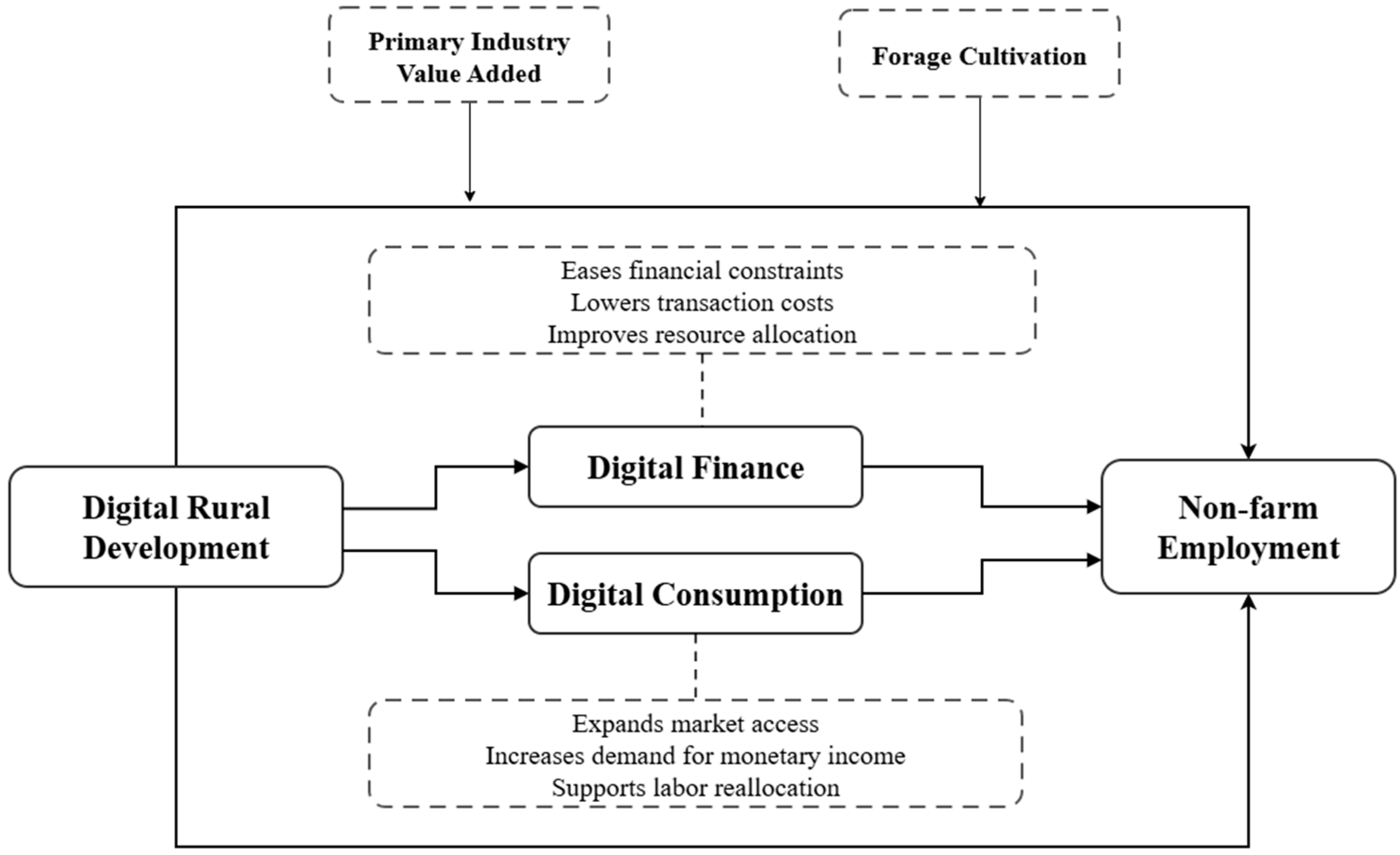
Based on the preceding theoretical analysis and hypotheses, Figure 1 summarizes the proposed research framework, including the direct relationship, boundary conditions, and potential transmission channels.
Figure 1.
Research framework diagram.
3. Research Design
3.1. Data Source
The College of Pastoral Agriculture Science and Technology at Lanzhou University surveyed herder households from 2023 to 2025. Enumerators received common training on the questionnaire and field procedures. Sampling proceeded in four stages. We selected Gansu, Qinghai, Tibet and Sichuan for their extensive natural grasslands. Within each province, counties were stratified by per capita income before random selection. Townships were then grouped by per capita grassland area, with one drawn from each high, middle and low group. Finally, about 14 households were randomly selected in each sampled village. The fieldwork covered 26 counties, 78 townships, 250 villages and 3453 households. Removing 582 records without the outcome and 81 with other incomplete responses produced 2790 observations, an 80.79% retention rate. The Ethics Committee of Lanzhou University approved the study, and every participant provided written informed consent.
3.2. Variable Selection and Descriptive Statistics
Dependent variable. Respondents engaged in non-farm work are assigned a value of one. All other respondents are assigned zero. In the surveyed pastoral communities, most respondents are male household heads. They usually take the lead in major livelihood decisions. Their main occupation often reflects whether the household relies mainly on livestock production or non-farm work. For this reason, the respondent’s main occupation is used as a proxy for the household’s overall employment orientation.
Explanatory variable. The County Digital Rural Development Index is the main explanatory variable. The Institute of New Rural Development at Peking University and the Alibaba Research Institute jointly developed the measure [44,45]. Rather than recording one person’s internet or mobile-phone use, it describes county infrastructure, digital services, and their integration into rural development. This geographical scope matches the place-based design of the study.
Control variables. We include controls at the household-head, household, village, and county levels. Household-head controls comprise gender, age, ethnicity, cadre status, and Mandarin proficiency. Household controls include household size, labor force, mean education, mean health status, intergenerational succession, childcare burden, and eldercare burden. Village-level controls comprise pastoral specialization, village rules, forage-storage facilities, terrain, and the distance from the seasonal settlement to the county government. County-level controls include GDP per capita, the ratio of public-budget expenditure to GDP, the employment share of the secondary and tertiary sectors, total road length, and the number of hospital beds. Unless otherwise stated, all county-level controls are measured in 2020.
Instrumental variable. Reverse causality, omitted variables, and measurement error may bias the estimated relationship between digital rural development and non-farm employment. We therefore use county landline penetration in 2000 as an instrument for the 2020 County Digital Rural Development Index. The instrument is the ratio of fixed-telephone subscribers to the county population. Historical landline networks may predict later digital development because communication infrastructure, construction capacity, and service experience persist over time. Landline penetration in 2000 predates the employment outcomes observed from 2023 to 2025, making a direct effect on current household employment less likely. Nevertheless, historical telecommunications may also proxy for persistent county development, human capital, transport access, or market connectivity. We therefore treat the instrumental-variable estimates as supportive sensitivity evidence rather than definitive causal proof.
Moderating variables. We examine primary-industry value added and forage cultivation as boundary conditions. Primary-industry value added measures the absolute scale of county-level output generated by agriculture and animal husbandry. It does not measure the primary sector’s share of the county economy or the county’s dependence on that sector. A larger absolute value may nevertheless reflect a greater scale of agricultural and livestock activity, which could influence household labor allocation [46]. Forage cultivation indicates whether a household grows forage crops on cropland. Planting, managing, harvesting, transporting, and storing forage require household labor and strengthen links among cropland, livestock, and family labor. Households that cultivate forage may therefore have less flexibility to act on digital employment opportunities.
Mechanism variables. We examine digital finance and digital consumption as potential transmission channels. Digital finance captures the expansion of online payments, credit, and other accessible financial services [47,48]. These services may ease liquidity constraints, reduce transaction costs, and support entry into non-farm employment. Digital consumption captures households’ growing use of online shopping, digital payments, and platform services. Greater reliance on market-based goods and services may increase demand for cash income and encourage labor reallocation toward non-farm activities [49]. Digital finance is measured using the county-level Digital Finance Index in 2020. It captures the development of the local digital financial environment rather than the actual financial behavior of individual households. Digital consumption is measured using the county-level Digital Consumption Index in 2020 and reflects the broader county environment for online consumption and platform-based services. It does not directly measure each household’s use of digital consumption services. The explanations and descriptions of the variables are shown in Table 1.
Table 1.
Descriptive statistics.
3.3. Model Setup
The dependent variable indicates whether the household head reports non-farm employment as the main occupation. The baseline Probit model estimates the association between county-level digital rural development and the probability of a non-farm employment orientation. We specify the model as follows:
where indicates whether household in region participates in non-farm employment in year ; denotes the level of digital rural development; and is a vector of control variables, including household-head characteristics, household characteristics, village characteristics, and county-level economic characteristics. and denote province and time-fixed effects, respectively. A positive indicates a positive conditional association between county-level digital rural development and household non-farm employment orientation.
Although the measure of digital rural development predates the observed employment outcomes, unobserved county characteristics and measurement error may still produce endogeneity bias. This study therefore uses county-level landline penetration in 2000 as an instrumental variable. The two-stage least squares model is specified as follows:
We next test whether county industrial structure and household production constraints moderate the employment association. The model includes primary-industry value added, forage cultivation, and their interactions with digital rural development:
We next examine whether primary-industry value added and forage cultivation condition the association between digital rural development and non-farm employment. Their interaction terms are included in the following Probit specification:
where denotes the added value of the primary industry, and denotes forage cultivation. and represent the interaction terms between digital rural development and the added value of the primary industry, and between digital rural development and forage cultivation, respectively. If < 0, the coefficient is consistent with a weaker latent-index association between digital rural development and household non-farm employment orientation in counties with larger primary-industry value added. If < 0, this suggests that forage cultivation weakens the positive relationship between digital rural development and herders’ non-farm employment.
We evaluate digital finance and digital consumption as parallel channels connecting digital rural development with non-farm employment. The first mechanism equation estimates how digital rural development relates to each channel:
In Equation (6), the mechanism variable is either digital finance or digital consumption. A positive and significant coefficient shows that digital rural development is associated with a stronger county environment for that channel. It does not, by itself, establish household-level mediation.
4. Regression Results
4.1. Basic Model Results
Table 2 presents the baseline results. The Probit estimates are reported as both coefficients and average marginal effects. The OLS estimates are included as a supplementary linear probability model to check whether the direction and statistical significance of the results remain consistent. All models control for province and survey-year fixed effects, and the standard errors are clustered at the village level.
Table 2.
Baseline regression analysis.
Digital rural development is positively correlated with non-agricultural employment. The above relationship is still statistically significant at the 1% level after adding controls for household head, household, village and county. The mean marginal effect of the fully adjusted model is 0.010. On average of the sample, a one-point increase in the Digital Rural Development Index is associated with about a 1 per cent rise in the predicted probability of non-farm employment. The OLS results have the same direction and are still statistically significant. Its size should not be directly compared with the Probit coefficient.
Previous research suggests that improved digital access can expand employment opportunities in rural areas. Mobile networks and digital financial services can connect households to wage employment and other non-farm opportunities. This can reduce information and transaction costs. The results indicate that a similar relationship exists in pastoral China. Employment opportunities may also be shaped by the county’s broader digital environment. Some control variables are also related to non-farm employment. Cadre status and Mandarin proficiency are positively associated with non-farm employment. Ethnic minority status and household labor force size are negatively associated with it. These patterns may be related to social connections, communication skills, and labor requirements in livestock production.
Considering potential endogeneity between digital rural development and herders’ non-farm employment, this study applies an instrumental variable approach. Table 3 reports the instrumental variable results. Landline penetration in 2000 is positively associated with the 2020 County Digital Rural Development Index. The Kleibergen Paap LM test rejects the null hypothesis of underidentification. The first stage F statistic and the Kleibergen Paap Wald F statistic are also above the Stock Yogo critical value, which reduces concerns about a weak instrument. In the second stage, digital rural development remains positively associated with non-farm employment and is significant at the 1% level. The Anderson–Rubin test leads to the same conclusion when inference is made under possible instrument weakness. Unlike conventional inference that relies on sufficiently strong first-stage identification, the Anderson–Rubin test remains informative when instruments may be weak because it does not rely on the usual strong-instrument approximation. The significant Anderson–Rubin statistic therefore provides additional evidence that the estimated relationship is not driven solely by weak first-stage identification.
Table 3.
Instrumental-variable estimates and identification tests.
These tests support instrument relevance but cannot directly verify the exclusion restriction. The use of historical fixed-line infrastructure follows an established identification strategy in the broadband and digital-development literature, where pre-existing telecommunications networks are used to predict subsequent digital infrastructure [50]. In the present setting, the long temporal separation and the inclusion of county economic, fiscal, labor-market, transportation, and public-service controls reduce several plausible alternative channels linking historical landline penetration to current employment. Nevertheless, persistent unobserved county characteristics cannot be completely excluded. We therefore interpret the IV estimates as supportive evidence rather than definitive causal identification.
4.2. Robustness Checks
Table 4 examines whether the instrumental variable results depend on the choice of estimator. Historical landline penetration remains positively and significantly associated with digital rural development in the first stage of both the two step IV-GMM and IV-Probit models. This shows that the relevance of the instrument is stable across the two estimation methods.
Table 4.
Robustness tests for instrumental variables.
Digital rural development also has a positive and statistically significant coefficient in both second stage models. The two step IV-GMM model allows for heteroskedasticity, while the IV-Probit model considers the binary nature of non-farm employment. Their coefficients should not be compared directly because the models use different estimation scales. Still, the consistent direction and significance suggest that the main result is not limited to a linear specification. These estimates provide further support for the positive association between digital rural development and non-farm employment, although they rely on the same exclusion restriction as the baseline instrumental variable model.
To further test the robustness of the baseline regression findings, this study employs a multinomial logit model, substituting the dependent variable with “type of work”—a variable derived from the questionnaire item “What is your type of work?”—which offers the following four options: (1) herding, (2) farming, (3) both farming and herding, and (4) non-farm employment. We then conducted a further analysis of different employment types. In the M-logit model, livestock farming was designated as the reference group, yielding regression results for agriculture, mixed farming, and non-farm employment. As shown in Table 5 digital rural development has a significant positive impact on agricultural employment, a non-significant impact on mixed farming, and a significant positive impact on non-farm employment, with the latter exhibiting the largest coefficient. This indicates that digital rural development does not affect all employment types equally; rather, it more significantly drives herders toward more market-oriented and non-farm forms of employment, such as non-farm employment. It also demonstrates that the research conclusions remain robust even when different models and variables are used.
Table 5.
Employment-type reclassification test.
Table 6 shows some more robustness tests. Column (1) replaces the Digital Rural Development Index with the volume of postal and telecommunications services and thus reflects local communication development in a different way. The coefficient of the additional index is positive and statistically significant. Therefore, the primary reason for this change is not solely due to the original combined index. Column (2) is a stricter definition of the dependent variable, and migrant work is included in non-farm employment. Digital rural development is still positively correlated with the revised outcome; therefore, the baseline result is not due to a specific coding rule.
Table 6.
Further robustness tests of the baseline results.
Columns (3) and (4) apply winsorization at the 1% and 5% levels, respectively, and Column (5) is trimmed by 5%. The estimated coefficients are all positive and significant in the three cases. Therefore, the result is unlikely to be caused by a small number of extreme observations. Column (6) replaces the Probit model with a complementary log-log model. The coefficient is still positive and statistically significant in this alternative specification. In short, all of the above tests show that the baseline association is consistent with other measures, outcome definitions, treatments of extreme values, and binary choice models. However, these checks support the robustness of the association but do not offer separate causal identification.
4.3. Heterogeneity Analysis
The effect of digital rural development may vary across herders because their labor mobility, household responsibilities, communication ability, and access to employment opportunities differ. To explore these possible differences, this study conducts subgroup analyses by gender, ethnicity, Mandarin proficiency, terrain, and county economic conditions. Because no formal between-group coefficient-difference tests are conducted, the subgroup estimates in this section are interpreted as descriptive patterns only.
Table 7 reports subgroup estimates by household-head gender and ethnicity. The coefficient is positive in both gender subsamples but is estimated more precisely among male-headed households. Because the female-headed subsample is substantially smaller, the difference in precision may partly reflect sample size. Without a formal between-group comparison, the estimates should not be interpreted as evidence of a statistically significant gender difference. Across the three ethnic categories, the coefficient is positive and statistically significant. However, separate subgroup estimates do not establish statistically different associations across ethnic groups. The results therefore indicate that the positive association is observed across the reported ethnic categories, rather than demonstrating ethnic heterogeneity.
Table 7.
Effects of digital rural development on herders’ non-farm employment by gender and ethnicity.
Table 8 reports the subgroup estimates by Mandarin proficiency. Coefficients are positive in every Mandarin-proficiency group and become more precise from the basic-communication category onward. They do not rise monotonically, however, and subgroup significance cannot establish either a threshold or a between-group difference. The estimates therefore provide descriptive, rather than confirmatory, evidence of variation by language proficiency.
Table 8.
Heterogeneity analysis by Mandarin proficiency.
Digital vacancies and services are useful only when a job seeker can interpret information and communicate with employers. Mandarin proficiency could therefore complement connectivity in online searches and workplace interactions. However, the non-monotonic coefficients and absence of formal cross-group tests prevent a threshold interpretation. At most, the pattern is compatible with complementarity between language skills and digital access.
Table 9 reports estimates by terrain and county income. Columns (1) to (3) show positive coefficients in mountainous, hilly, and plain areas. The association is significant in mountainous and plain areas, while the estimate for hilly areas is less precise. However, the coefficients are similar across the three groups, so the insignificant result for hilly areas should not be interpreted as evidence of a weaker effect. The findings point to a broadly positive relationship across different terrain conditions rather than clear terrain-based heterogeneity. In mountainous areas, digital services may help herders overcome dispersed settlements, poor transport conditions, and limited access to employment information. The positive estimate for plain areas also suggests that the role of digital rural development is not limited to places facing severe geographic barriers.
Table 9.
Effects of digital rural development on herders’ non-farm employment by terrain conditions and county-level economic development.
The county-development results are more complex. The association is positive in low- and high-income counties but negative and statistically significant in middle-income counties. Low-income counties may gain substantially from improved digital access. High-income counties may have labor markets that convert digital resources into employment more effectively. In middle-income counties, digital tools may instead support agricultural or pastoral production during a transitional stage [51].
4.4. Further Analysis
The baseline results show a positive association between digital rural development and non-farm employment, but local industrial structure and household production constraints may condition this relationship. Pastoral labor is often embedded in agricultural and livestock production. We therefore examine primary-industry value added and forage cultivation as moderating variables. Table 10 reports the results.
Table 10.
Moderating effects of digital rural development on non-farm employment.
The interaction between digital rural development and primary-industry value added is negative and statistically significant. The negative interaction coefficient is consistent with a weaker association in the Probit latent-index equation in counties with larger primary-industry value added. One possible explanation is that counties with larger primary-industry output provide more scope for digital services to support production, input procurement, and product marketing within agriculture and animal husbandry [52]. This interpretation remains tentative because primary-industry value added does not directly measure labor absorption or sectoral returns.
The interaction between digital rural development and forage cultivation is also negative and significant. Forage cultivation links cropland, livestock, and household labor more closely. It requires time for planting, field management, harvesting, transport, and storage. Households engaged in these activities may have less flexibility to respond to employment information provided by digital platforms. Digital development may also be used to improve forage and livestock production rather than support labor movement outside agriculture. Nevertheless, forage cultivation may be endogenous to household employment decisions. Herders who are already more committed to agricultural and pastoral production, or less willing to seek outside work, may also be more likely to cultivate forage.
Overall, the negative interaction coefficients are consistent with H2a and H2b in the latent-index specification, although they are not direct estimates of differences in predicted probabilities.
Digital rural development may influence non-farm employment through improved financial conditions and changing consumption patterns. We therefore examine digital finance and digital consumption as two potential mechanisms. Table 11 reports the results.
Table 11.
Digital rural development and employment mechanisms.
Digital rural development is positively associated with digital finance at the 1% level. Pastoral areas are geographically dispersed and often lack conventional financial outlets. Online and inclusive financial services may reduce the costs of credit, payments, and fund management. They may also ease liquidity constraints during employment transitions and non-farm business activities [53]. These results support digital finance as a potential channel linking digital rural development to non-farm employment.
The digital-consumption results indicate a second potential channel. Digital rural development expands access to goods, services, and platform-based consumption. Greater reliance on market purchases can increase households’ need for regular cash income. Herders may consequently have stronger incentives to pursue migrant work, services, or other non-farm activities [54].
Digital finance may operate through supply-side conditions by easing financial constraints and lowering transaction costs. Digital consumption may operate through demand-side incentives by increasing market participation and the need for cash income. The results are therefore consistent with H3 and H4, although the cross-sectional design does not establish a complete causal sequence.
The estimated proportion mediated is 16.3% for digital finance and 37.7% for digital consumption. These proportions indicate the relative size of the estimated indirect associations within the current model rather than the share of a definitively established causal effect. Because digital rural development, digital finance, and digital consumption are all measured at the county level, the decomposition may partly reflect common county-level digital conditions. The estimated proportions should therefore be interpreted as suggestive evidence of potential transmission channels rather than precise measures of household-level mediation.
5. Discussion
The positive association in this study accords with evidence from Nigeria, Ghana, India, Bangladesh, Tanzania and other countries. That literature links broadband, mobile phones, and digital finance to improved access to employment and markets [8,55,56,57]. Lower information and transaction costs are a common explanation. Our contribution differs in scale; we measure the county digital environment, not household use of one device or service.
Pastoral production does not guarantee better employment for those with better digital access. Connectivity can help people in remote areas access job opportunities and services in the city. It cannot release workers for livestock care, seasonal grazing or other household production. Digital access is thus an information constraint relaxation without a time constraint relaxation. Diversity analysis has also shown that place, language capability and the level of development in a particular county all affect how households use available information.
Existing evidence suggests that limited digital skills and geographical isolation can weaken the benefits of digital infrastructure. These constraints may prevent households from turning digital access into economic opportunities [58,59]. Language proficiency is another important factor. Greater proficiency in the dominant language of the labor market is associated with better job matching and higher labor market returns [60,61]. Taken together, this evidence offers a plausible interpretation of the observed heterogeneity. Digital rural development may reduce information asymmetry, but better access to information does not necessarily translate into non-farm employment. Its potential employment benefits remain conditional on household labor constraints, human capital, and local economic conditions.
Non-linear patterns in county income groups may indicate different stages of economic development. Basic digital access will show a relatively large improvement in poorer counties due to the initial information gap. Rich counties have more jobs and institutions that can better connect information with employment opportunities. Counties in the middle have improved connectivity but are still lacking in sufficient enterprises, services and non-farm employment opportunities [62,63]. Digital information may not be translated into actual employment. That said, this interpretation is not final. County income is a general index that also includes infrastructure, industrial structure, human capital and fiscal capacity. Therefore, the results of these subgroups should be regarded as descriptive patterns and not as causal evidence that the level of income itself alters the effect of digital rural development.
Moderation results show two production-side restrictions. Areas with higher output of the primary sector are more likely to be the beneficiaries of new digital services rather than sites for labor relocation [64]. Fodder cultivation also needs family labor in the field and at home [65,66]. Both conditions will restrict the freedom required for off-duty time. Primary-industry value added also indicates county resources, fiscal strength, market scale and development stage. Forage cultivation may also be the result of employment preferences that occurred earlier.
The channel estimates are consistent with research on digital financial inclusion. Mobile money can lower transaction costs and support market participation where conventional financial outlets are sparse [67]. For pastoral households, digital finance may simplify payments and provide liquidity during a move into non-farm employment [68]. Digital consumption implies a different incentive. Access to a broader set of purchased goods and services can increase demand for regular cash income. Thus, finance may ease entry constraints, whereas consumption may increase the incentive to earn cash. County-level, cross-sectional data cannot establish either sequence as household-level mediation.
Network coverage is therefore only one component of digital inclusion. Herders must also have the language skills, available labor, financial access, and local vacancies needed to act on digital information. The pastoral evidence shows that digital development remains embedded in household production and county economic structure.
6. Conclusions and Policy Implications
This study combines survey data from 2790 herder households in pastoral areas of Gansu, Qinghai, Sichuan, and Tibet, collected during 2023–2025, with the 2020 County Digital Rural Development Index and county-level statistical data. It examines the relationship between digital rural development and herders’ non-farm employment. The baseline estimates show a positive and statistically significant association. This result remains after controlling for household-head, household, village and county characteristics, together with province and survey-year fixed effects. Instrumental-variable estimates and several robustness checks also retain the positive direction. The heterogeneity results generally show a positive trend, but there are no formal differences in gender, ethnicity, Mandarin proficiency or terrain among them. The results for all county-development groups are non-monotonic. That is, they are positive for low- and high-development counties and negative for the middle-development group. The interaction terms for primary-industry value added and forage cultivation are also negative in the Probit latent-index equation. Based on the above results, digital access alone is insufficient. Commitments to household labor and local industrial conditions may prevent better digital access from being used for non-farm employment. Channel analysis suggests that digital finance and digital consumption are the two likely paths. Digital finance will reduce liquidity pressure and transaction costs, and digital consumption may expand market participation and demand for regular cash income. Both indicators are only available at the county level. Digital rural development can provide more employment opportunities in practice, but for herders to benefit, they still need available jobs and suitable skills in their areas.
Based on the above analysis, the following policy recommendations are proposed. First, the digital rural development should meet the actual needs of herders for employment transformation, livestock product sales, financial services and public services. Strengthen efforts to improve the stability of the network, enhance the accessibility and adaptability of the platform and digital services, build an efficient digital infrastructure for herders to access information and market connections conveniently, and expand employment opportunities. Second, targeted training will be organized for middle-aged and older herders, female herders, and those with weaker Mandarin skills. The content of training should cover digital literacy, job information collection, platform application and Mandarin language. This will reduce the threshold for using digital tools and expand the scope of digital dividends. Third, improve access to digital financial services in pastoral areas. Policies should focus on increasing the accessibility and convenience of digital financial services, reducing transaction costs, and easing liquidity constraints for herding households. This can help herders participate more effectively in non-farm employment and make better use of employment opportunities beyond traditional livestock production. Fourthly, account for the local circumstances in the policy. In areas with a large proportion of the primary industry, digital rural services need to help promote the modernization of agriculture and animal husbandry. Areas with stronger foundations in the secondary and tertiary industries need to connect digital platforms more effectively with the labor market, service sector, and county-level industrial system.
This study has several limitations. First, the study combines independent household surveys conducted between 2023 and 2025. It therefore cannot track changes within the same households over time. As a result, the analysis cannot reflect later changes in local digital conditions. Fixed effects for province and survey year account for broad regional differences and common shocks. However, unobserved county characteristics may still influence the estimates. Historical landline penetration provides an additional check on the main result. It may also reflect persistent differences in county development. The instrumental variable results are therefore interpreted together with the baseline and robustness estimates. Second, the respondent’s main occupation, usually that of the household head, represents the household’s overall employment orientation. This measure does not cover secondary work, seasonal work, or employment undertaken by other household members. It may therefore provide only a partial picture of household labor allocation. Third, the indicators of digital rural development, digital finance, and digital consumption are measured at the county level. They describe the local digital environment rather than the actual digital behavior of individual households. The channel analysis therefore identifies possible pathways, but it cannot show how these processes unfold within households. Other relevant channels, including digital skills, social networks, and platform employment, are not examined. Future research could use panel data, updated digital indicators, detailed employment histories, and direct measures of household digital service use.
Author Contributions
Methodology, formal analysis, data curation, and writing—original draft preparation, Z.W.; writing—review and editing, T.S.O.; supervision and project administration, Y.F. All authors have read and agreed to the published version of the manuscript.
Funding
This research received no external funding.
Institutional Review Board Statement
Ethical review and approval were waived for this study due to the use of anonymized socio-economic survey data for econometric analysis. The study did not involve biomedical or clinical intervention, human biological samples, animal experiments, identifiable personal information, sensitive personal information, or commercial interests. The exemption was based on Article 32, Item (2) of the Measures for Ethical Review of Life Science and Medical Research Involving Humans (Guo Wei Ke Jiao Fa [2023] No. 4), which provides that research using anonymized information data may be exempt from ethical review when it does not cause harm to humans and does not involve sensitive personal information or commercial interests.
Informed Consent Statement
Informed consent was obtained from all subjects involved in the study.
Data Availability Statement
The original contributions presented in this study are included in the article. Further inquiries can be directed to the corresponding author.
Conflicts of Interest
The authors declare no conflicts of interest.
References
- Almeida, R.K.; Corseuil, C.H.L.; Poole, J.P. The Impact of Digital Technology on Worker Tasks: Do Labor Policies Matter? J. Dev. Econ. 2025, 175, 103475. [Google Scholar] [CrossRef] [Scilit]
- Zhao, Z.; Liu, R.; Wang, Q. Place-Based Polices and e-Commerce Development in Rural China. China Econ. Rev. 2024, 83, 102085. [Google Scholar] [CrossRef] [Scilit]
- Qian, Q.; Wang, J.; Zhang, X.; Wang, S.; Li, Y.; Wang, Q.; Watson, A.E.; Zhao, X. Improving Herders’ Income through Alpine Grassland Husbandry on Qinghai-Tibetan Plateau. Land Use Policy 2022, 113, 105896. [Google Scholar] [CrossRef] [Scilit]
- Qiu, W.; Yang, S. Impact of Nonagricultural Employment on Rural Households’ Financial Resilience: Evidence from Rural China. Financ. Res. Lett. 2026, 95, 109703. [Google Scholar] [CrossRef] [Scilit]
- Chen, F.; Shi, S.; Chen, W. Internet Usage and Non-Farm Employment of Rural Labor: Micro-Survey Data from Rural China. Soc. Indic. Res. 2025, 178, 1081–1102. [Google Scholar] [CrossRef] [Scilit]
- Liu, W.; Hu, Z. Effect of Internet Usage on Nonfarm Employment Participation and Quality: Evidence from China. J. Rural Stud. 2025, 120, 103882. [Google Scholar] [CrossRef] [Scilit]
- Leng, X. Digital Revolution and Rural Family Income: Evidence from China. J. Rural Stud. 2022, 94, 336–343. [Google Scholar] [CrossRef] [Scilit]
- Bahia, K.; Castells, P.; Cruz, G.; Masaki, T.; Pedrós, X.; Pfutze, T.; Rodríguez-Castelán, C.; Winkler, H. The Welfare Effects of Mobile Broadband Internet: Evidence from Nigeria. J. Dev. Econ. 2024, 170, 103314. [Google Scholar] [CrossRef] [Scilit]
- Do, M.H.; Nguyen, T.T.; Halkos, G.; Grote, U. Non-Farm Employment, Natural Resource Extraction, and Poverty: Evidence from Household Data for Rural Vietnam. Environ. Dev. Sustain. 2022, 27, 28631–28668. [Google Scholar] [CrossRef] [Scilit] [PubMed]
- Li, F.; He, K. Internet Use as a Catalyst for High-quality Nonfarm Employment among Rural Laborers in China. Rev. Dev. Econ. 2025, 29, 2258–2275. [Google Scholar] [CrossRef] [Scilit]
- Niu, G.; Jin, X.; Wang, Q.; Zhou, Y. Broadband Infrastructure and Digital Financial Inclusion in Rural China. China Econ. Rev. 2022, 76, 101853. [Google Scholar] [CrossRef] [Scilit]
- Yao, B.H.; Shanoyan, A.; Schwab, B.; Amanor-Boadu, V. Mobile Money, Transaction Costs, and Market Participation: Evidence from Côte d’ivoire and Tanzania. Food Policy 2022, 112, 102370. [Google Scholar] [CrossRef] [Scilit]
- Ankrah, D.A.; Asante, B.O.; Prah, S.; Boateng, F.K. Impact of Digital Financial Inclusion on the Participation in Farmer-based Organisations, Structured Market and Off-farm Work in Ghana. J. Int. Dev. 2024, 36, 1254–1273. [Google Scholar] [CrossRef] [Scilit]
- Rajkhowa, P.; Qaim, M. Mobile Phones, Off-farm Employment and Household Income in Rural India. J. Agric. Econ. 2022, 73, 789–805. [Google Scholar] [CrossRef] [Scilit]
- Zheng, H.; Zhou, Y.; Rahut, D.B. Smartphone Use, Off-farm Employment, and Women’s Decision-making Power: Evidence from Rural China. Rev. Dev. Econ. 2023, 27, 1327–1353. [Google Scholar] [CrossRef] [Scilit]
- Matsuura-Kannari, M.; Islam, A.H.M.S.; Tauseef, S. Mobile Phones, Income Diversification, and Poverty Reduction in Rural Bangladesh. Rev. Dev. Econ. 2024, 28, 1475–1493. [Google Scholar] [CrossRef] [Scilit]
- Zhang, H.; Millan, E.; Money, K.; Guo, P. E-Commerce Development, Poverty Reduction and Income Growth in Rural China. J. Strategy Manag. 2025, 18, 148–176. [Google Scholar] [CrossRef] [Scilit]
- Sebestyén, T.T.; Benedek, J. Evaluating Agro-Biomass Feedstock for Energy Transition and Rural Sustainability. Next Energy 2026, 11, 100502. [Google Scholar] [CrossRef] [Scilit]
- Hemingway, C.; Cochet, H.; Mialhe, F.; Gunnell, Y. Why Pastoralists Grow Tomatoes: Maasai Livelihood Dynamics in Amboseli, Southern Kenya. J. Rural Stud. 2022, 92, 253–268. [Google Scholar] [CrossRef] [Scilit]
- Senda, T.S.; Robinson, L.W.; Gachene, C.K.K.; Kironchi, G. Formalization of Communal Land Tenure and Expectations for Pastoralist Livelihoods. Land Use Policy 2022, 114, 105961. [Google Scholar] [CrossRef] [Scilit]
- Kirui, L.K.; Jensen, N.D.; Obare, G.A.; Kariuki, I.M.; Chelanga, P.K.; Ikegami, M. Pastoral Livelihood Pathways Transitions in Northern Kenya: The Process and Impact of Drought. Pastoralism 2022, 12, 23. [Google Scholar] [CrossRef] [Scilit]
- Carranza, E.; Garlick, R.; Orkin, K.; Rankin, N. Job Search and Hiring with Limited Information about Workseekers’ Skills. Am. Econ. Rev. 2022, 112, 3547–3583. [Google Scholar] [CrossRef] [Scilit]
- Banerjee, A.V.; Chiplunkar, G. How Important Are Matching Frictions in the Labor Market? Experimental & Non-Experimental Evidence from a Large Indian Firm. J. Dev. Econ. 2024, 171, 103330. [Google Scholar] [CrossRef] [Scilit]
- Jin, X.; Ma, B.; Zhang, H. Impact of Fast Internet Access on Employment: Evidence from a Broadband Expansion in China. China Econ. Rev. 2023, 81, 102038. [Google Scholar] [CrossRef] [Scilit]
- Kelley, E.M.; Ksoll, C.; Magruder, J. How Do Digital Platforms Affect Employment and Job Search? Evidence from India. J. Dev. Econ. 2024, 166, 103176. [Google Scholar] [CrossRef] [Scilit]
- Denzer, M.; Schank, T.; Upward, R. Does the Internet Increase the Job Finding Rate? Evidence from a Period of Expansion in Internet Use. Inf. Econ. Policy 2021, 55, 100900. [Google Scholar] [CrossRef] [Scilit]
- Zhang, M. Does Migrant Workers Benefit from Digital Finance? Evidence from China. J. Labour Mark. Res. 2025, 59, 22. [Google Scholar] [CrossRef] [Scilit]
- Falconnier, G.N.; Descheemaeker, K.; Traore, B.; Bayoko, A.; Giller, K.E. Agricultural Intensification and Policy Interventions: Exploring Plausible Futures for Smallholder Farmers in Southern Mali. Land Use Policy 2018, 70, 623–634. [Google Scholar] [CrossRef] [Scilit]
- Pieper, T.; Nguyen, T.-T.; Qaim, M. Access to Electricity and Gendered Labor Allocation: Insights from Ethiopia. Energy Policy 2025, 207, 114814. [Google Scholar] [CrossRef] [Scilit]
- Gollin, D. Agricultural Productivity and Structural Transformation: Evidence and Questions for African Development. Oxf. Dev. Stud. 2023, 51, 375–396. [Google Scholar] [CrossRef] [Scilit]
- Chen, W.; Wang, Q.; Zhou, H. Digital Rural Construction and Farmers’ Income Growth: Theoretical Mechanism and Micro Experience Based on Data from China. Sustainability 2022, 14, 11679. [Google Scholar] [CrossRef] [Scilit]
- Nguyen, T.-T.; Nguyen, T.T.; Grote, U. Internet Use and Agricultural Productivity in Rural Vietnam. Rev. Dev. Econ. 2023, 27, 1309–1326. [Google Scholar] [CrossRef] [Scilit]
- Fanchone, A.; Alexandre, G.; Hostiou, N. Work Organization as a Barrier to Crop–Livestock Integration Practices: A Case Study in Guadeloupe. Agron. Sustain. Dev. 2022, 42, 54. [Google Scholar] [CrossRef] [Scilit]
- De Janvry, A.; Fafchamps, M.; Sadoulet, E. Peasant Household Behaviour with Missing Markets: Some Paradoxes Explained. Econ. J. 1991, 101, 1400. [Google Scholar] [CrossRef] [Scilit]
- Naito, H.; Ismailov, A.; Kimaro, A.B. The Effect of Mobile Money on Borrowing and Saving: Evidence from Tanzania. World Dev. Perspect. 2021, 23, 100342. [Google Scholar] [CrossRef] [Scilit]
- Apeti, A.E. Household Welfare in the Digital Age: Assessing the Effect of Mobile Money on Household Consumption Volatility in Developing Countries. World Dev. 2023, 161, 106110. [Google Scholar] [CrossRef] [Scilit]
- Avom, D.; Bangaké, C.; Ndoya, H. Do Financial Innovations Improve Financial Inclusion? Evidence from Mobile Money Adoption in Africa. Technol. Forecast. Soc. Change 2023, 190, 122451. [Google Scholar] [CrossRef] [Scilit]
- Han, L.; Lv, Q.; Zhang, Q. Digital Financial Inclusion, Credit Access and Non-Farm Employment. Financ. Res. Lett. 2025, 72, 106510. [Google Scholar] [CrossRef] [Scilit]
- Atta-Ankomah, R. Mobile Money and Intra-Household Employment Diversification: Empirical Evidence from Ghana. Afr. J. Sci. Technol. Innov. Dev. 2024, 16, 382–398. [Google Scholar] [CrossRef] [Scilit]
- Brown, M.; Hentschel, N.; Mettler, H.; Stix, H. The Convenience of Electronic Payments and Consumer Cash Demand. J. Monet. Econ. 2022, 130, 86–102. [Google Scholar] [CrossRef] [Scilit]
- Hou, L.; Hsueh, S.-C.; Zhang, S. Digital Payments and Households’ Consumption: A Mental Accounting Interpretation. Emerg. Mark. Financ. Trade 2021, 57, 2079–2093. [Google Scholar] [CrossRef] [Scilit]
- Hu, D.; Zhai, C.; Zhao, S. Does Digital Finance Promote Household Consumption Upgrading? An Analysis Based on Data from the China Family Panel Studies. Econ. Model. 2023, 125, 106377. [Google Scholar] [CrossRef] [Scilit]
- Berg, T.; Burg, V.; Keil, J.; Puri, M. The Economics of “Buy Now, Pay Later”: A Merchant’s Perspective. J. Financ. Econ. 2025, 171, 104093. [Google Scholar] [CrossRef] [Scilit]
- Hu, Y.; Liu, J.; Zhang, S.; Liu, Y.; Xu, H.; Liu, P. New Mechanisms for Increasing Agricultural Total Factor Productivity: Analysis of the Regional Effects of the Digital Economy. Econ. Anal. Policy 2024, 83, 766–785. [Google Scholar] [CrossRef] [Scilit]
- Sun, Y.; Chen, C. Digital Rural Construction, Financial Development and Regional Economic Resilience: Mechanism Analysis and Empirical Test. Int. Rev. Econ. Financ. 2025, 101, 104146. [Google Scholar] [CrossRef] [Scilit]
- Hazell, P.; Haggblade, S.; Reardon, T. Transformation of the Rural Nonfarm Economy during Rapid Urbanization and Structural Transformation in Developing Regions. Annu. Rev. Resour. Econ. 2024, 16, 277–299. [Google Scholar] [CrossRef] [Scilit]
- Chen, W.; Li, J. Digital Finance, Consumer Convenience, and Rural Residents’ Consumption. Financ. Res. Lett. 2025, 82, 107649. [Google Scholar] [CrossRef] [Scilit]
- Couture, V.; Faber, B.; Gu, Y.; Liu, L. Connecting the Countryside via E-Commerce: Evidence from China. Am. Econ. Rev. Insights 2021, 3, 35–50. [Google Scholar] [CrossRef] [Scilit]
- Mumtaz, M.Z. Financial Inclusion, Digital Finance and Agricultural Participation. Agric. Financ. Rev. 2024, 84, 93–113. [Google Scholar] [CrossRef] [Scilit]
- Czernich, N.; Falck, O.; Kretschmer, T.; Woessmann, L. Broadband Infrastructure and Economic Growth. Econ. J. 2011, 121, 505–532. [Google Scholar] [CrossRef] [Scilit]
- Ma, W.; Zhou, X.; Boansi, D.; Horlu, G.S.A.; Owusu, V. Adoption and Intensity of Agricultural Mechanization and Their Impact on Non-Farm Employment of Rural Women. World Dev. 2024, 173, 106434. [Google Scholar] [CrossRef] [Scilit]
- Zhang, Y.; Ji, M.-X. From Pixels to Production: The Impact of Digital Finance on the Industrial Fabric of Rural China. China Agric. Econ. Rev. 2024, 16, 527–544. [Google Scholar] [CrossRef] [Scilit]
- Yu, C.; Jia, N.; Li, W.; Wu, R. Digital Inclusive Finance and Rural Consumption Structure—Evidence from Peking University Digital Inclusive Financial Index and China Household Finance Survey. China Agric. Econ. Rev. 2021, 14, 165–183. [Google Scholar] [CrossRef] [Scilit]
- Vatsa, P.; Li, J.; Luu, P.Q.; Botero-R, J.C. Internet Use and Consumption Diversity: Evidence from Rural China. Rev. Dev. Econ. 2023, 27, 1287–1308. [Google Scholar] [CrossRef] [Scilit]
- Rupasingha, A.; Pender, J.; Williams, R. Broadband and Rural Development: Impacts of the U.S. Department of Agriculture Broadband Initiatives Program on Saving and Creating Jobs. Econ. Inq. 2024, 62, 698–721. [Google Scholar] [CrossRef] [Scilit]
- Tran, N.T.M.; Tran, V.T.; Grote, U.; Nguyen, T.T. Internet Use, Farm Investment, and Non-farm Employment: Evidence from Thailand and Vietnam. Rev. Dev. Econ. 2026, early view. [Google Scholar] [CrossRef] [Scilit]
- Xue, P.; Jia, W. How Does Internet Use Promote Off-Farm Employment of Rural Laborers in China. J. Asian Econ. 2026, 103, 102139. [Google Scholar] [CrossRef] [Scilit]
- Marshall, A. A New Rural Digital Divide? Taking Stock of Geographical Digital Inclusion in Australia. Media Int. Aust. 2024, 190, 68–84. [Google Scholar] [CrossRef] [Scilit]
- Ma, W.; McKay, A.; Rahut, D.B.; Sonobe, T. An Introduction to Rural and Agricultural Development in the Digital Age. Rev. Dev. Econ. 2023, 27, 1273–1286. [Google Scholar] [CrossRef] [Scilit]
- Bloemen, H.G. Language Proficiency of Migrants: The Relation with Job Satisfaction and Skill Matching. Empir. Econ. 2023, 65, 2899–2952. [Google Scholar] [CrossRef] [Scilit]
- Xu, C.; Liu, X. The Economic Value of Language in China: How Important Is Mandarin Proficiency in the Chinese Labor Market? A Bounding Approach. Labour Econ. 2023, 84, 102393. [Google Scholar] [CrossRef] [Scilit]
- Huang, T.; Quan, Y. Narrowing the Digital Divide: The Growth and Distributional Effect of Internet Use on Income in Rural China. China Econ. Rev. 2025, 91, 102387. [Google Scholar] [CrossRef] [Scilit]
- Han, Z.; Liang, Q. Digital Economy and Inclusive Development of New Agricultural Operating Entities. Aust. J. Agric. Resour. Econ. 2025, 69, 687–700. [Google Scholar] [CrossRef] [Scilit]
- Fluhrer, S.; Kraehnert, K. Mobile Phone Network Expansion and Agricultural Income: A Panel Study. Agric. Econ. 2024, 55, 54–85. [Google Scholar] [CrossRef] [Scilit]
- Tabe-Ojong, M.P., Jr.; Molua, E.L.; Nanfouet, M.A.; Mkong, C.J.; Kiven, V.; Ntegang, V.A. Oil Palm Production, Income Gains, and off-Farm Employment among Independent Producers in Cameroon. Ecol. Econ. 2023, 208, 107817. [Google Scholar] [CrossRef] [Scilit]
- Paudel, G.P.; Nguyen, T.T.; Grote, U. Trade-offs between Labour Migration and Agricultural Productivity: Evidence from Smallholder Wheat Systems in Nepal. J. Int. Dev. 2025, 37, 202–229. [Google Scholar] [CrossRef] [Scilit]
- Yu, C.; Hui, E.C.; Dong, Z. Digital Inclusive Finance and Entrepreneurship in Rural Areas: Evidence from China. China Agric. Econ. Rev. 2024, 16, 712–730. [Google Scholar] [CrossRef] [Scilit]
- Xu, F.; Zhang, L. The Impact of Digital Payments on the Financial Vulnerability of Rural Households: Empirical Evidence from China. Front. Sustain. Food Syst. 2025, 9, 1553237. [Google Scholar] [CrossRef] [Scilit]

Disclaimer/Publisher’s Note: The statements, opinions and data contained in all publications are solely those of the individual author(s) and contributor(s) and not of MDPI and/or the editor(s). MDPI and/or the editor(s) disclaim responsibility for any injury to people or property resulting from any ideas, methods, instructions or products referred to in the content. |
© 2026 by the authors. Licensee MDPI, Basel, Switzerland. This article is an open access article distributed under the terms and conditions of the Creative Commons Attribution (CC BY) license.