


Abstract
Agricultural soils in arid regions require assessment approaches that separate local element enrichment from actual ecological and human health relevance. Here, a site-prioritization framework is applied to potentially toxic elements (PTEs) in agricultural soils from Onaizah, central Saudi Arabia. The approach combines contamination indices, ecological-risk screening, deterministic health-risk estimates, Monte Carlo resampling, and relative ranking of management priorities. A total of 33 surface-soil samples collected from cultivated farms were examined for As, Co, Cr, Cu, Mn, Ni, Pb, V, and Zn. The measured concentration ranges (mg/kg) were 1–5 (As), 1–12 (Co), 10–53 (Cr), 4–38 (Cu), 107–541 (Mn), 6–54 (Ni), 2–23 (Pb), 8–47 (V), and 11–168 (Zn). Based on their mean concentrations, the investigated elements decreased in the following sequence: Mn > Zn > Cr > Ni > V > Cu > Pb > Co > As. The PN values ranged from 0.127 to 1.339, indicating 27 safe sites, 2 warning-line sites, and 4 slightly polluted sites, mainly controlled by localized Zn enrichment and, in one case, Pb. In contrast, mCd values of 0.099–0.676 indicated nil to very low contamination, while RI values of 2.743–15.701 confirmed low ecological risk across all samples. Non-carcinogenic risk was generally below the threshold of concern, with HI values of 0.204–1.018 for children and 0.024–0.119 for adults. Only one site showed a marginal child HI exceedance, emphasizing localized rather than widespread health concern. Children showed approximately 8.6-fold higher non-carcinogenic risk than adults, with Mn, Cr, As, and V as the main contributors. The total LCR values for As, Cr, and Pb ranged from 7.79 × 10⁻⁶ to 4.07 × 10⁻⁵ for children and from 3.48 × 10⁻⁶ to 1.82 × 10⁻⁵ for adults, within the commonly tolerable range of 1 × 10⁻⁶ to 1 × 10⁻⁴. Chromium was the dominant contributor to LCR. Monte Carlo resampling supported the deterministic risk classification, with only a 3.1% probability of child HI exceeding 1 and no simulated exceedance of the LCR threshold for either children or adults. From the standpoint of sustainable soil management, site 7 should undergo further health-risk assessment, while sites 30 and 33 require source verification and periodic monitoring before any remediation action is considered.
1. Introduction
Agricultural soils represent a contact zone between geological materials, farming practices, crop production, and human exposure. In arid cultivated systems, the distribution of potentially toxic elements (PTEs) may be affected by parent material, irrigation practices, dust deposition, fertilizer and manure inputs, pesticide residues, and repeated soil disturbance. Because many PTEs are persistent and non-biodegradable, their gradual accumulation in topsoil may create exposure pathways through incidental ingestion, dermal contact, inhalation of resuspended dust, or transfer into crops [1,2,3,4,5].
The significance of PTEs in agricultural soils depends on more than their measured concentrations. Mobility, toxicity, receptor sensitivity, land use, and exposure route all influence whether an element becomes environmentally or toxicologically important. Some elements, including Ni, Zn, V, Cu, and Mn, are required in small amounts for biological or plant functions but may become harmful at elevated levels or under exposure-enhancing conditions. In contrast, Pb, Cr, and As require particular attention because of their recognized toxicological relevance. Children are generally more vulnerable than adults because of their lower body weight, greater soil ingestion relative to body mass, and frequent hand-to-mouth activity [6,7].
A useful assessment of agricultural-soil contamination should distinguish among three related but different outcomes: the degree of elemental enrichment, the potential ecological implication, and the relevance of exposure to human receptors. Pollution indices such as PN and mCd help identify localized enrichment and cumulative multi-element contamination, but they do not directly represent toxicological risk. RI adds toxic-response weighting and therefore provides a separate ecological-risk perspective [8,9]. Human health risk assessment, based on CDI, HQ, HI, CR, and LCR, further translates soil concentrations into receptor- and pathway-specific screening estimates [10,11,12].
Saudi Arabia serves as a crucial context for this kind of evaluation, as numerous agricultural regions exist in arid and semi-arid climates, where reliance on irrigation, high rates of evaporation, dust contributions, the presence of carbonate-rich soils, and intensive farming practices might affect the accumulation and spatial distribution of PTEs [9,13]. Studies from Saudi Arabia and other arid agricultural regions show that PTE concentrations and related risks vary among cultivated areas because of differences in geology, irrigation conditions, cropping systems, and farm-management practices. Therefore, results from one agricultural setting should not be directly transferred to another without local assessment [14,15,16]. Existing studies provide useful regional context, but they do not establish an Onaizah-specific decision pathway that links contamination screening, ecological-risk classification, receptor-specific health risk, uncertainty analysis, and management-priority ranking.
Onaizah is an important agricultural area in the Al-Qassim Region of central Saudi Arabia, where date-palm cultivation is accompanied by alfalfa, barley, and lemon farming. Nevertheless, the current evidence is inadequate to establish whether the presence of PTEs in these soils reflects widespread contamination, isolated accumulation, ecological risk, or human health effects limited to particular exposure groups. Clarifying this issue is essential because slight to moderate enrichment in arid agricultural soils may not justify remediation across the entire area, although targeted monitoring, source identification, and precautionary management may still be necessary at specific locations [17,18,19]. For this reason, the present assessment links measured PTE concentrations with contamination classes, ecological-risk levels, health-risk criteria, uncertainty outputs, and practical site-priority categories.
Accordingly, this study aims to develop a risk-based decision framework for PTEs in Onaizah agricultural soils. The specific objectives are to: (i) characterize the concentrations and spatial variability of As, Co, Cr, Cu, Mn, Ni, Pb, V, and Zn; (ii) distinguish localized contamination from cumulative ecological concern using PN, mCd, and RI; (iii) estimate deterministic non-carcinogenic and carcinogenic risks for children and adults through ingestion, dermal contact, and inhalation pathways; (iv) evaluate uncertainty in total HI and LCR using Monte Carlo resampling; and (v) translate the combined contamination, ecological-risk, health-risk, and uncertainty outputs into site-priority classes for sustainable monitoring and remediation planning.
2. Materials and Methods
2.1. Study Area, Sampling, and Analytical Methods
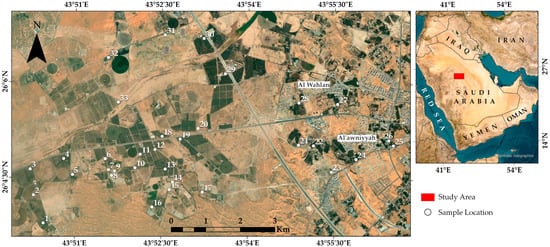
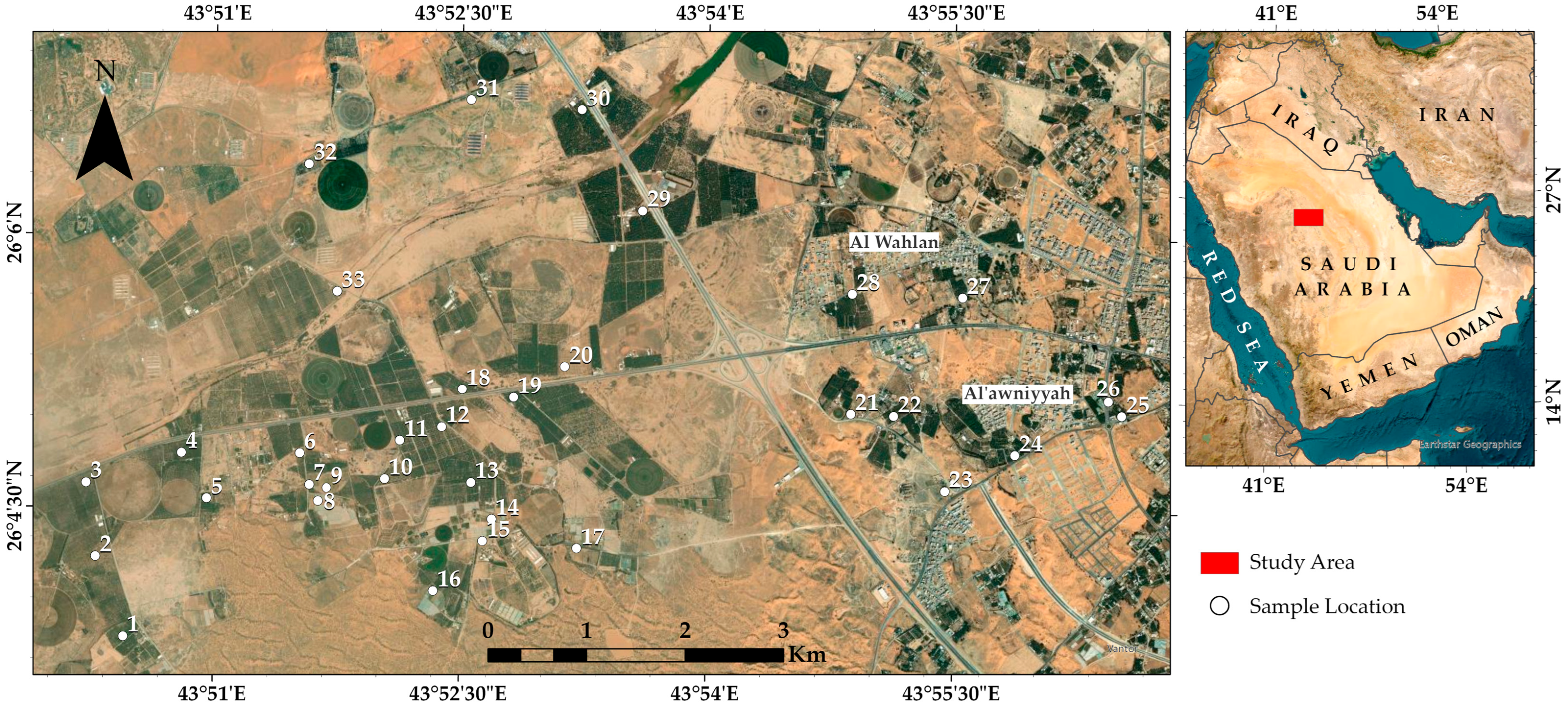
The study was conducted on agricultural farms around Onaizah, Al-Qassim Region, central Saudi Arabia (Figure 1). The sampling area included cultivated fields in the western sector and around Al Wahlan and Al’awniyyah, between latitudes 26.063191–26.112514° N and longitudes 43.837027–43.942072° E. A total of 33 surface-soil samples were collected from the upper 0–15 cm layer, representing the soil horizon most affected by agricultural activities, atmospheric dust deposition, and direct human contact. At each location, loose plant residues and surface debris were removed before sampling. At each site, soil was sampled from multiple closely spaced points within the cultivated plot using a clean stainless-steel hand shovel. The collected subsamples were thoroughly mixed to produce a single representative composite sample. Approximately 0.5–1.0 kg of the homogenized soil was transferred into a clean, labeled polyethylene bag, and the sampling location was recorded with a handheld GPS device.
Figure 1.
Location of the study area and sampling sites: agricultural sampling sites around Onaizah; regional location of the study area in Saudi Arabia.
The soil samples were submitted to ALS Geochemistry Laboratory, Jeddah, Saudi Arabia, for sample preparation and analysis. During preparation, a maximum of 250 g from each sample was pulverized until 85% of the material passed through a <75 µm sieve. Elemental determination was carried out using method ME-ICP41, which involves aqua regia digestion followed by inductively coupled plasma atomic-emission spectrometry (ICP-AES). Because the analyses were performed by an accredited commercial laboratory, the instrument model and manufacturer were not specified in the analytical certificate available to the authors [20,21,22]. This study considered As, Co, Cr, Cu, Mn, Ni, Pb, V, and Zn because of their significance for evaluating agricultural-soil contamination and the associated ecological and human health risks. Analytical detection thresholds differed among the target elements: 1 mg/kg (Co, Cr, Cu, Ni, and V), 2 mg/kg (As, Pb, and Zn), and 5 mg/kg (Mn). Before conducting the statistical analyses and risk assessments, each result falling below its respective detection limit was assigned a surrogate value equal to 50% of that limit. The analytical certificate expressed the concentrations of the target elements as whole numbers in mg/kg. Accordingly, the descriptive statistics and site-level results are reported at the same level of precision, whereas decimal or scientific notation is used for derived indices and risk estimates when necessary.
Analytical quality assurance and quality control (QA/QC) were assessed using the accompanying ALS QC certificate. The laboratory QC program included certified/reference standards, procedural blanks, and duplicate samples. The reported standards, including EMOG-17 and OREAS-45h, fell within their certified target ranges, while blank results were below or within acceptable limits. Duplicate analyses, including duplicate checks for samples A10 and A15, were also within the laboratory target ranges. These QA/QC results indicate acceptable analytical accuracy, low contamination during analysis, and satisfactory reproducibility of the reported elemental concentrations. Because aqua regia digestion does not completely dissolve all refractory silicate minerals, the reported concentrations are best interpreted as acid-extractable rather than absolute total concentrations.
2.2. Integrated Contamination and Ecological-Risk Indicators
The Nemerow integrated pollution index (PN), the modified degree of contamination (mCd), and the potential ecological risk index (RI) were employed to characterize contamination and ecological risk. PN is sensitive to the highest single-element contamination factor and is useful for detecting localized enrichment. mCd reflects the average multi-element contamination burden. RI incorporates toxic-response weighting and therefore links contamination to potential ecological significance. Published mean shale concentrations were used as external reference values for calculating contamination factors because local geochemical background data for Onaizah agricultural soils are currently unavailable. These generalized references are useful for screening-level comparison, but they should not be interpreted as definitive local baseline concentrations [23,24,25]. In this study, the contamination factor (CF) was used as an intermediate parameter for calculating PN, mCd, and RI rather than as a separate reported index. The CF was calculated as
where CFi denotes the contamination factor for element i, Ci represents the measured concentration in the soil sample, and Bi refers to the corresponding published background or reference concentration.
CFi = Ci/Bi
The PN was calculated as
where CFave represents the mean contamination factor of the selected elements at a given sampling site, while CFmax indicates the highest contamination factor recorded at the same site. The resulting PN values were classified according to the Nemerow pollution-index scheme [26].
PN = √[(CFave2 + CFmax2)/2]
The mCd was calculated as
where n denotes the total number of elements considered in the calculation. The mCd results were classified according to the scheme of [27].
mCd = (Σ CFi)/n
The RI was calculated as
Eri = Tri × CFi
The integrated potential ecological risk index was calculated as
where Eri represents the ecological risk factor for element i, Tri denotes the toxic-response factor, and RI refers to the total sum of the ecological risk factors. RI was calculated only for elements with commonly applied toxic-response factors [28].
RI = Σ Eri
2.3. Deterministic and Probabilistic Human Health Risk Assessment
Human health risk was evaluated separately for children and adults using a deterministic screening approach. Direct soil exposure was represented by three pathways: incidental ingestion, dermal contact, and inhalation of resuspended soil particles. Following U.S. EPA soil-risk assessment procedures, CDI, HQ, HI, CR, and LCR were calculated for the relevant receptor groups and exposure routes [29,30,31,32]. Non-carcinogenic risk was assessed for all target PTEs, whereas carcinogenic risk was calculated for As, Cr, and Pb only. The ingestion CDI was calculated as
CDIing = (C × IngR × EF × ED × CF)/(BW × AT)
The CDI through inhalation of resuspended soil particles was calculated as
CDIinh = (C × InhR × EF × ED)/(PEF × BW × AT)
The CDI through dermal contact was calculated as
where C denotes the concentration of the element in soil (mg/kg). The exposure parameters adopted for children and adults are presented in Table 1.
CDIderm = (C × SA × AF × ABS × EF × ED × CF)/(BW × AT)
Table 1.
Exposure parameters used for estimating chronic daily intake and health risk of PTEs.
The pathway-specific HQ was calculated as
where RfD refers to the pathway-specific reference dose. The cumulative hazard index for each soil sample was determined as
HQ = CDI/RfD
HI = Σ HQelement
For carcinogenic elements, the pathway-specific CR was calculated as
where CSF is the cancer slope factor. The LCR for each sample was calculated as
CR = CDI × CSF
LCR = Σ CRelement
LCR values below 1 × 10⁻⁶ were classified as negligible, while values ranging from 1 × 10⁻⁶ to 1 × 10⁻⁴ were considered acceptable or tolerable. Values exceeding 1 × 10⁻⁴ were interpreted as indicating a possible carcinogenic health concern [14,15,33]. The toxicity parameters applied in the non-carcinogenic and carcinogenic risk assessments are presented in Table 2.
Table 2.
Toxicity parameters used for non-carcinogenic and carcinogenic risk assessment of PTEs.
Monte Carlo resampling was applied as a screening-level uncertainty analysis of the final site-specific health-risk estimates. Using Microsoft Excel, 10,000 iterations were performed by resampling, with replacement, the total HI and total LCR values calculated for children and adults across the 33 sampling sites. Accordingly, the analysis reflects spatial variability among the calculated risk indicators rather than uncertainty in exposure assumptions, toxicity parameters, bioaccessibility, or contaminant speciation. For each endpoint, the resampled distributions were summarized using the 5th, 50th, and 95th percentiles, together with exceedance probabilities for HI > 1 and LCR > 1 × 10⁻⁴ [6,33].
2.4. Statistical, Spatial, and Priority-Ranking Analysis
Element concentrations and derived indices were summarized using minimum, maximum, arithmetic mean, median, standard deviation, and coefficient of variation. Site-level contamination, ecological-risk, and health-risk calculations were performed using Microsoft Excel for Microsoft 365 (Microsoft Corporation, Redmond, WA, USA). Spatial visualization and inverse distance weighting interpolation were performed using ArcGIS Desktop 10.8 (Esri, Redlands, CA, USA). The IDW maps were generated to visualize local spatial patterns among the unevenly distributed sampling points, following the Shepard-type distance-weighting approach [34]. Because the dataset included only 33 surface-soil samples and no independent validation subset, the maps were interpreted together with the original sampling points and used as visual aids rather than predictive regional surfaces. Finally, the contamination, ecological risk, deterministic health risk, and uncertainty outputs were combined to prioritize sites for monitoring, source verification, and focused remediation planning.
3. Results and Discussion
3.1. Concentration Levels and Spatial Distribution of PTEs
The 33 agricultural topsoil samples showed clear element-specific differences in concentration levels (Table 3). Concentrations ranged from 1 to 5 mg/kg for As, 1–12 mg/kg for Co, 10–53 mg/kg for Cr, 4–38 mg/kg for Cu, 107–541 mg/kg for Mn, 6–54 mg/kg for Ni, 2–23 mg/kg for Pb, 8–47 mg/kg for V, and 11–168 mg/kg for Zn. Mean concentrations decreased in the order Mn > Zn > Cr > Ni > V > Cu > Pb > Co > As. Zn and Pb had the highest coefficients of variation, indicating stronger site-to-site variability, whereas Mn and Cr were more evenly distributed across the sampled farms. Because supporting data on soil properties, irrigation-water chemistry, fertilizers, manure inputs, and crop uptake were not available, these concentration differences are interpreted as spatial patterns rather than confirmed source signals. Relative to agricultural soils reported from Saudi Arabia and other arid or semi-arid regions, the Onaizah concentrations are generally low to moderate. However, such comparisons should be treated cautiously because sampling depth, digestion method, background reference, crop type, and local geology differ among studies [9,13,14,15,16].
Table 3.
Descriptive statistics of PTE concentrations (mg/kg) in 33 Onaizah agricultural topsoil samples.
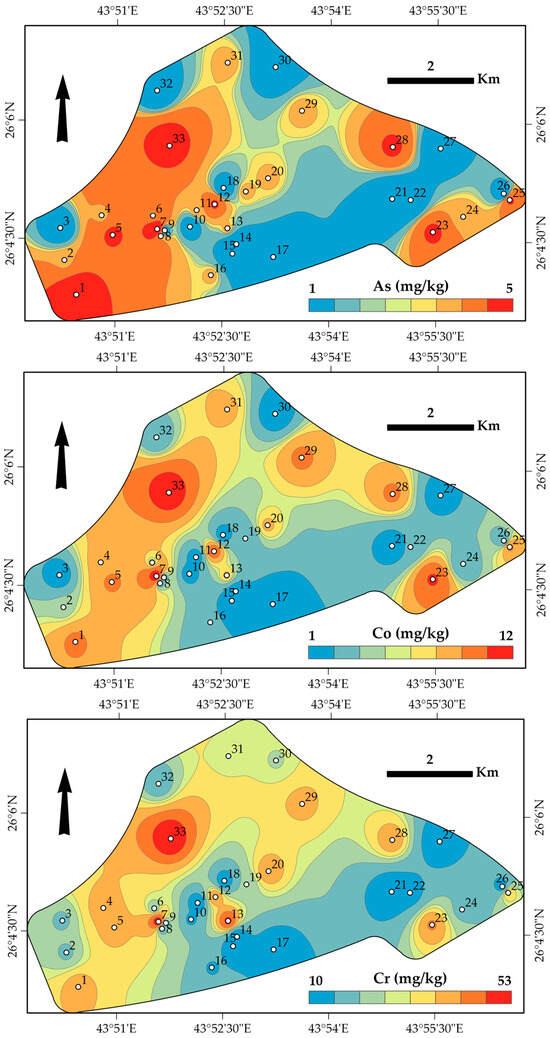
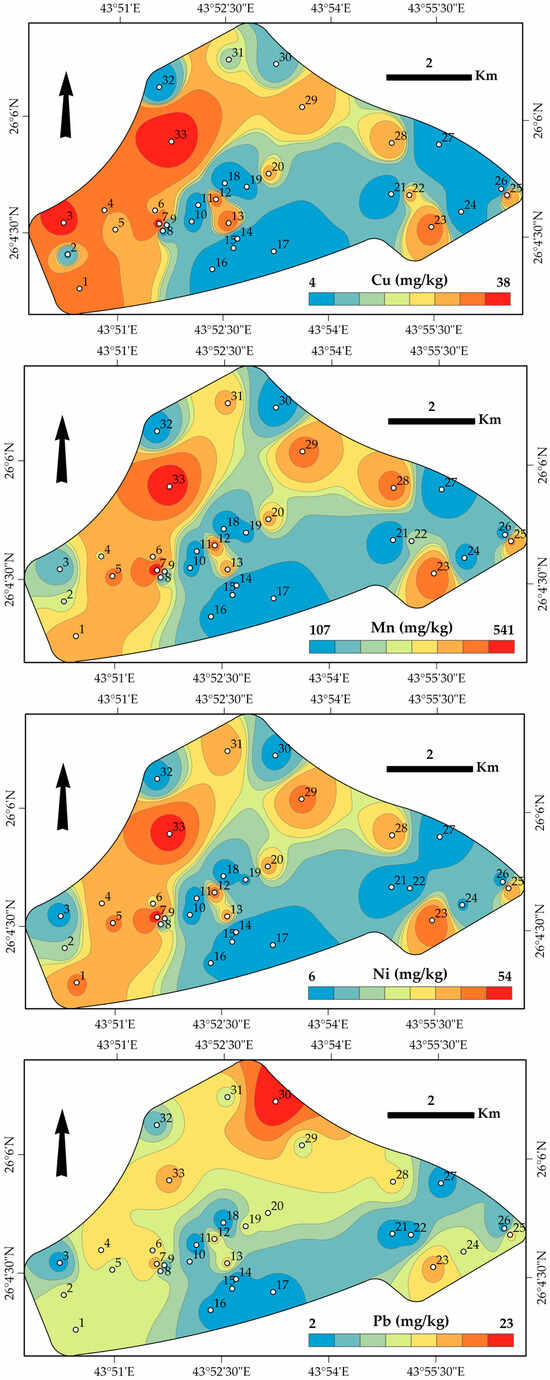
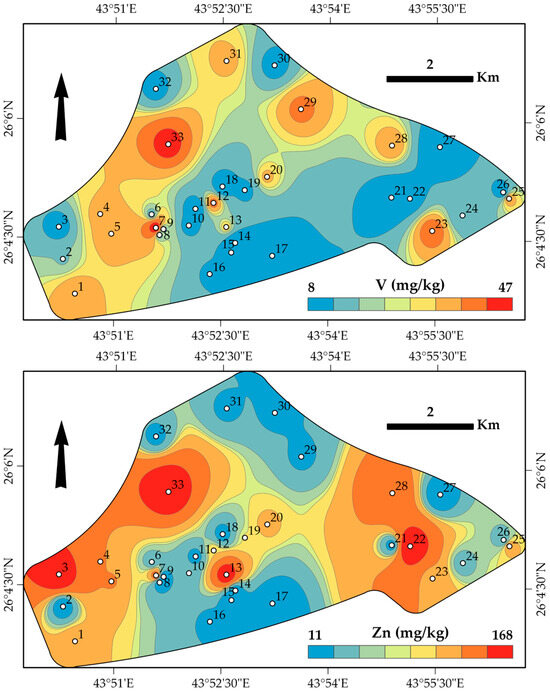
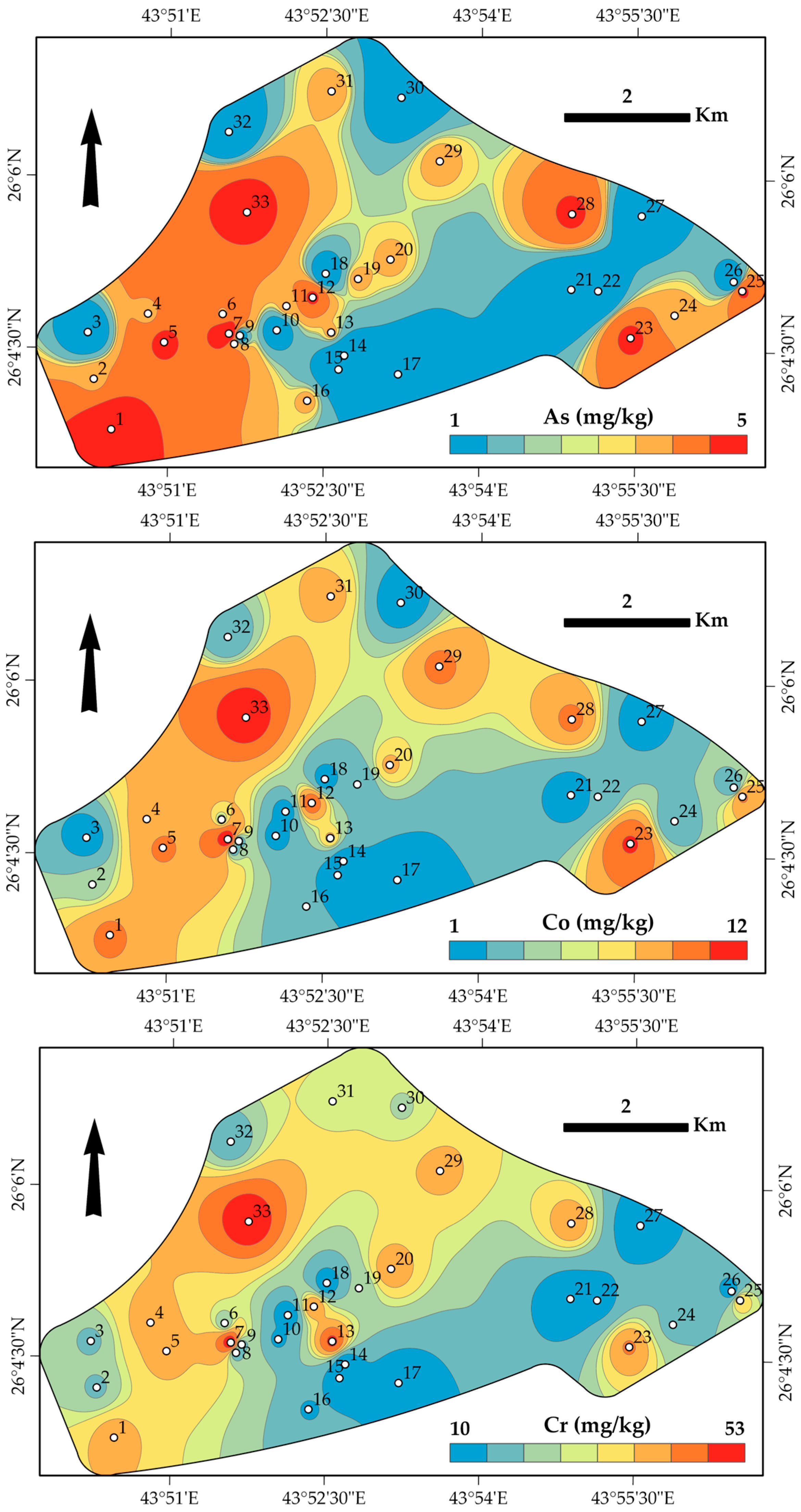
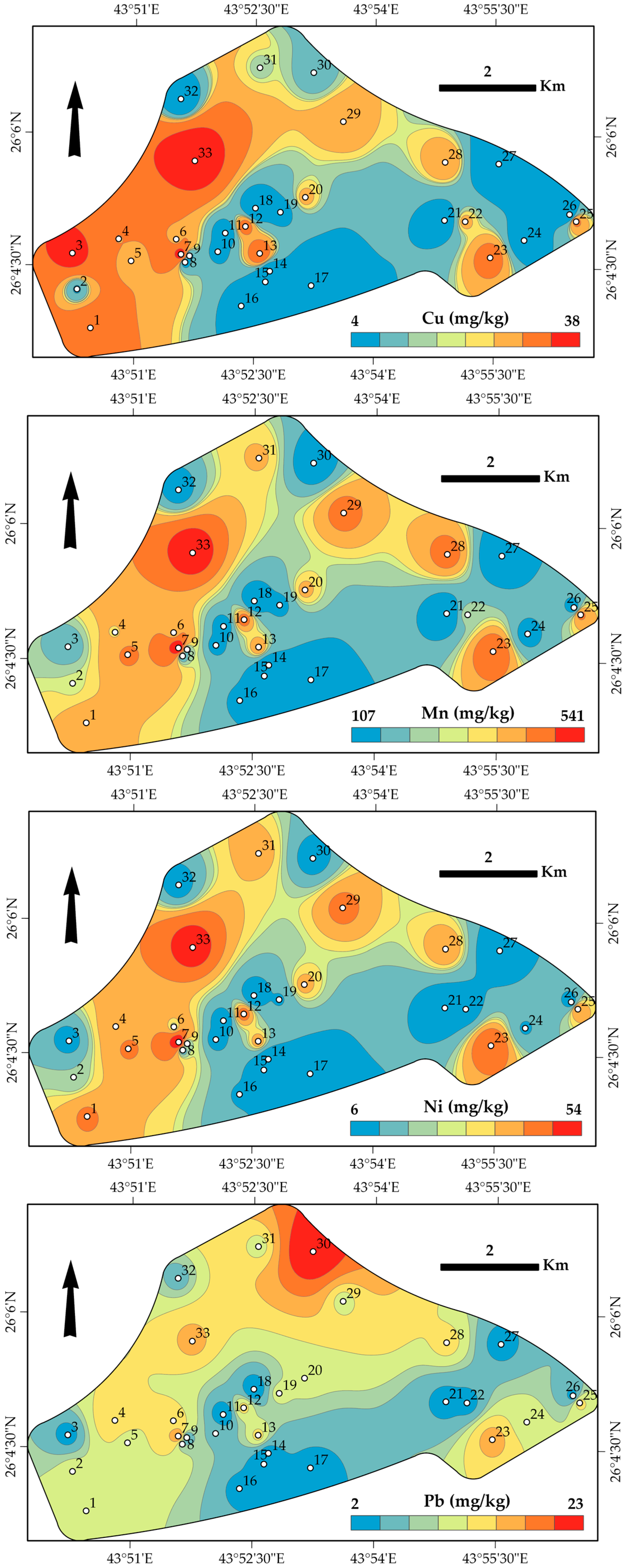
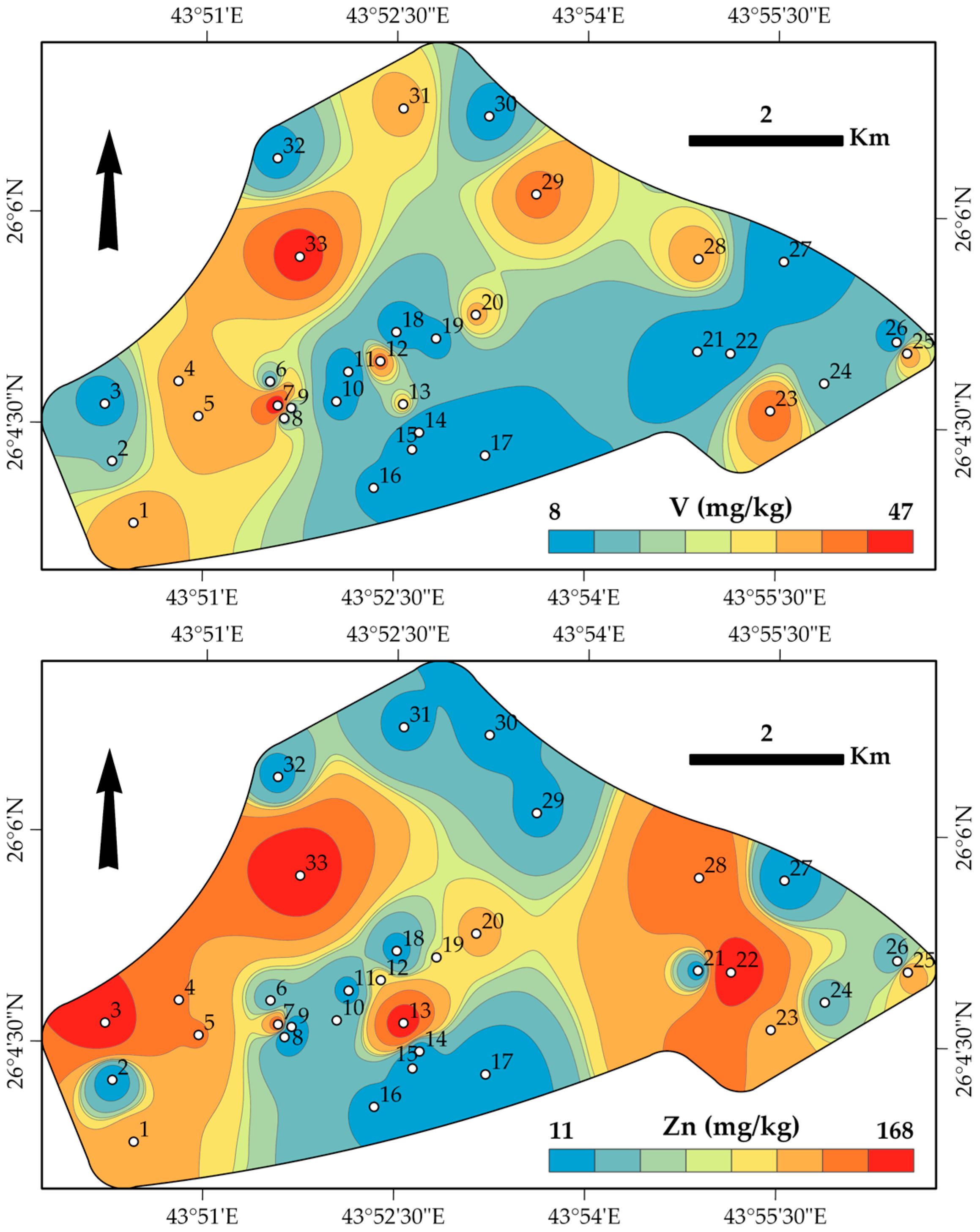
The spatial maps in Figure 2 indicate that Co, Cr, Mn, Ni, and V were relatively elevated, mainly in the western, northwestern, and west-central parts of the sampled farms, especially around sites 7 and 33. Site 7 contained the highest values of As, Co, Mn, Ni, and V, whereas site 33 showed elevated Cr, Cu, Mn, Ni, V, and Zn. In contrast, lower concentrations of several elements were mostly observed in the central and eastern sectors, particularly near sites 14–18 and 21–27. These interpolated patterns indicate local variability among the sampled farms, but they should not be interpreted as confirmed source zones because the interpolation was based on a limited sampling network and lacked independent source-tracing validation.
Figure 2.
Spatial distribution maps of As, Co, Cr, Cu, Mn, Ni, Pb, V, and Zn in Onaizah soils. Interpolated surfaces are used as visual aids and should be interpreted together with the original sampling points. Arrows indicate north direction on the maps, and numbers 1–33 represent the sampling-site numbers.
Cu and Zn displayed more localized enrichment than the Co-Cr-Mn-Ni-V group. Their highest concentrations occurred at site 33, where Cu reached 38 mg/kg and Zn reached 168 mg/kg. Additional Zn elevations were observed near sites 3, 13, 22, and 28. This restricted distribution agrees with the high CV of Zn and helps explain why Zn became a major contributor to PN at several sites. Because farm-input chemistry, irrigation-water composition, soil properties, and crop-transfer data were not measured, possible links with fertilizers, manure, pesticide residues, irrigation-related accumulation, or fine-particle retention should be treated as hypotheses requiring follow-up verification [9,35].
Pb showed a separate localized pattern. Although its mean concentration was low, Pb had the second-highest CV among the analyzed elements, indicating marked site-to-site variability. The maximum Pb concentration occurred at site 30, forming a northern anomaly that was spatially distinct from the Cu-Zn enrichment at site 33. This separation suggests that Pb variability was not controlled by the same local pattern as Cu and Zn. However, without independent source-tracing evidence, possible associations with traffic-related particles, dust accumulation, irrigation or farm-management inputs, or small-scale sediment heterogeneity remain hypotheses for future verification [36,37]. Arsenic had the lowest mean concentration among the studied elements, ranging from 1 to 5 mg/kg with a mean of 1.97 mg/kg (Table 3, Figure 2). Despite its low abundance, As was retained in the health-risk assessment because of its toxicological relevance. Relatively higher As values occurred mainly in the western and northwestern parts of the sampled area, with smaller elevated zones toward the eastern sector.
3.2. Contamination Screening and Ecological-Risk Differentiation
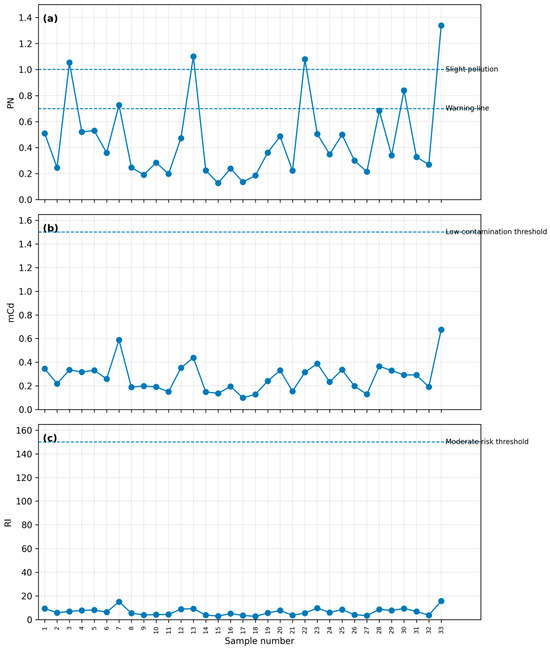
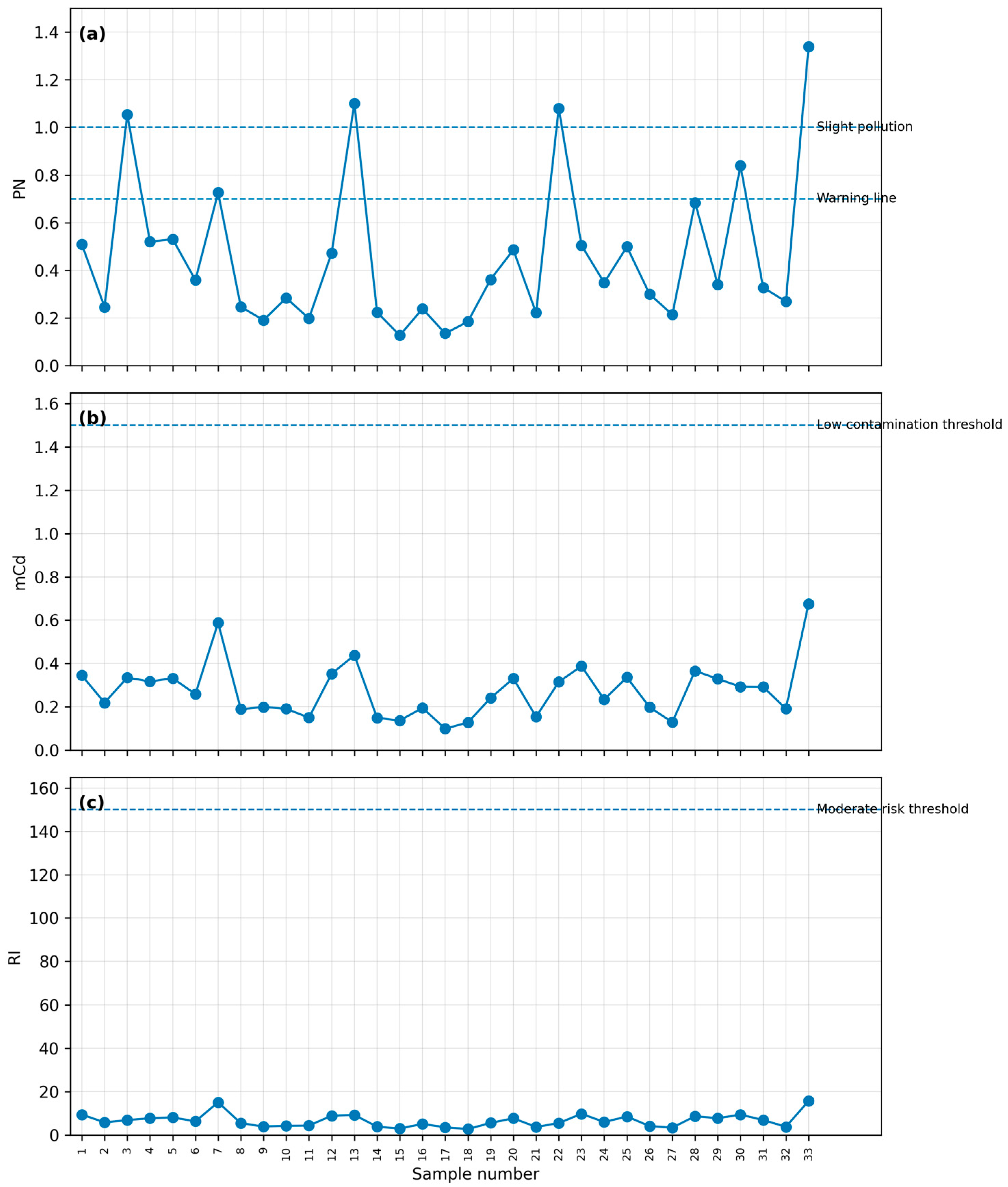
The three screening metrics provided related but not identical information for the Onaizah dataset. PN was the most responsive to localized enrichment by individual elements, with values ranging from 0.127 to 1.339 and a mean of 0.466 (Table 4, Figure 3a). According to the PN classification, 27 sites were safe, two sites, 7 and 30, were at the warning line, and four sites, 3, 13, 22, and 33, were slightly polluted (Table 4 and Table S2). None of the samples reached the moderate or heavy pollution category. The highest PN value was recorded at site 33, consistent with the localized Zn-Cu enrichment shown in Figure 2, whereas site 30 reflected a separate Pb-related warning signal (Figure 3a, Table S2). Therefore, PN mainly highlighted site-specific enrichment rather than area-wide multi-element pollution.
Table 4.
Summary statistics and dominant classification of PN, mCd, and RI for 33 Onaizah agricultural topsoil samples.
Figure 3.
Site-specific screening indicators for Onaizah agricultural topsoils: (a) PN, (b) mCd, and (c) RI. Dashed lines indicate the corresponding classification thresholds.
The mCd results gave a broader cumulative-contamination view. Values ranged from 0.099 to 0.676, with a mean of 0.267 (Table 4, Figure 3b). All 33 samples were assigned to the nil-to-very-low contamination class (Table 4 and Table S2), indicating that the average multi-element contamination burden remained limited across the sampled farms. This contrast between PN and mCd is useful for management interpretation. Similar differences between hotspot-sensitive and cumulative contamination indices have been reported in previous soil studies [38,39].
RI provided a further distinction between contamination status and ecological relevance. RI values ranged from 2.743 to 15.701, with a mean of 6.555 (Table 4, Figure 3c). All sites were classified as low ecological risk, and even the maximum RI value was far below the moderate-risk threshold of 150 (Table 4 and Table S2). The highest RI occurred at site 33, followed by site 7, but both remained within the low-risk class (Figure 3c, Table S2). These results indicate that localized enrichment identified by PN did not translate into substantial ecological risk under the RI framework. This interpretation is consistent with previous applications of risk indices showing that contamination categories and ecological-risk outcomes may differ when toxic-response factors are included [28,40].
3.3. Non-Carcinogenic Human Health Risk
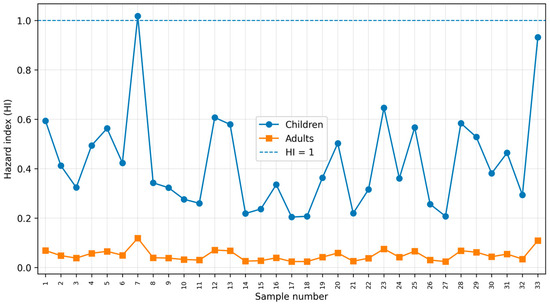
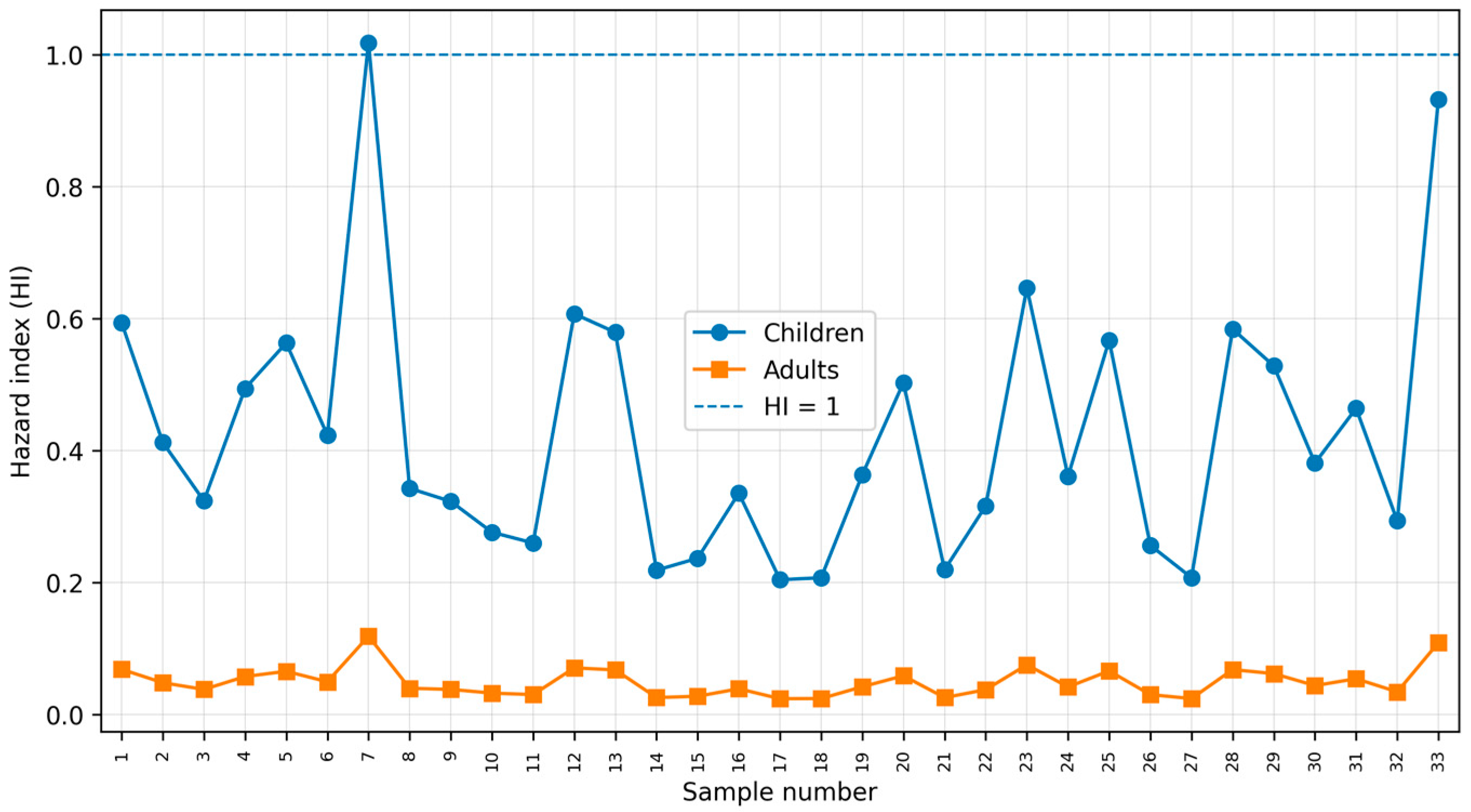
The non-carcinogenic results showed a receptor-dependent but generally low screening-level risk pattern (Table 5 and Table S3, Figure 4). Adult total HI values ranged from 0.024 to 0.119, with a mean of 0.050, and therefore remained well below the threshold of HI = 1 at all sites. For children, total HI values ranged from 0.204 to 1.018, with a mean of 0.426. Only site 7 slightly exceeded the non-carcinogenic screening threshold, with a child HI of 1.018 (Table S3, Figure 4). This result indicates a localized child-related screening concern rather than widespread non-carcinogenic risk across the Onaizah farms. The higher child HI estimates are mainly related to lower body weight and greater soil-ingestion exposure relative to body mass in the adopted exposure scenario [41,42,43]. The average child/adult HI ratio was approximately 8.6, confirming that children are the more sensitive receptor group for direct soil-contact exposure (Table 5 and Table S3).
Table 5.
Average CDI, HQ, and HI values for non-carcinogenic risk of selected PTEs.
Figure 4.
Site-specific non-carcinogenic HI values for children and adults in Onaizah soils.
The element-specific HI pattern shows that non-carcinogenic risk was not governed simply by elemental abundance (Table 5). For adults, the mean element-specific HI values decreased in the order Mn (0.0173) > Cr (0.0131) > As (0.00908) > V (0.00578) > Pb (0.0021) > Ni (0.0013) > Cu (0.00039) > Co (0.00029) > Zn (0.00025). The same general sequence was observed for children: Mn (0.134) > Cr (0.115) > As (0.085) > V (0.052) > Pb (0.020) > Ni (0.012) > Cu (0.004) > Co (0.0027) > Zn (0.0023). Although Zn contributed strongly to PN at several sites, its contribution to HI was minor under the adopted exposure and toxicity assumptions. In contrast, As and Cr made larger HI contributions despite their lower concentrations, highlighting the influence of toxicity-weighted reference doses in health-risk estimation [44,45,46]. Mn, Cr, As, and V dominated the calculated non-carcinogenic risk, accounting for about 90.5% of total mean HI in children and 91.2% in adults (Table 5). This contrast between Zn-controlled PN and Mn-Cr-As-V-controlled HI supports separate interpretation of contamination screening and health-risk outputs.
Pathway-specific results indicate that ingestion was the dominant route for non-carcinogenic risk in both receptor groups (Table 5). In children, ingestion accounted for approximately 91.8% of total mean HI, compared with 6.8% for dermal contact and 1.4% for inhalation. In adults, ingestion contributed approximately 84.4%, followed by dermal contact at 8.9% and inhalation at 6.7%. Although the inhalation fraction was relatively higher in adults because of the exposure parameters used in the model, ingestion remained the principal pathway for both receptors. This pattern is consistent with screening-level soil HHRA studies in which incidental soil ingestion commonly dominates direct-contact exposure [43,46]. The site-specific HI distribution identified site 7 as the main location requiring non-carcinogenic follow-up (Table S3, Figure 4). At this site, the marginal child HI exceedance was mainly driven by Mn, Cr, As, and V, which contributed approximately 31.6%, 25.4%, 21.1%, and 13.0% of total HI, respectively. This agrees with the spatial maps, where site 7 showed elevated concentrations of several transition metals and As (Figure 2). Site 33 had the second-highest child HI value, 0.932, but remained below the screening threshold (Table S3, Figure 4). Other sites with relatively higher child HI values included sites 23, 12, 1, 28, 13, 25, 5, and 29; however, all were below 1. Therefore, the HI results support focused follow-up at site 7 rather than broad non-carcinogenic-risk concern across the studied farms [44,46].
3.4. Carcinogenic Human Health Risk
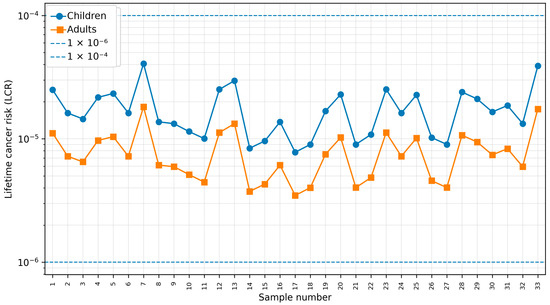
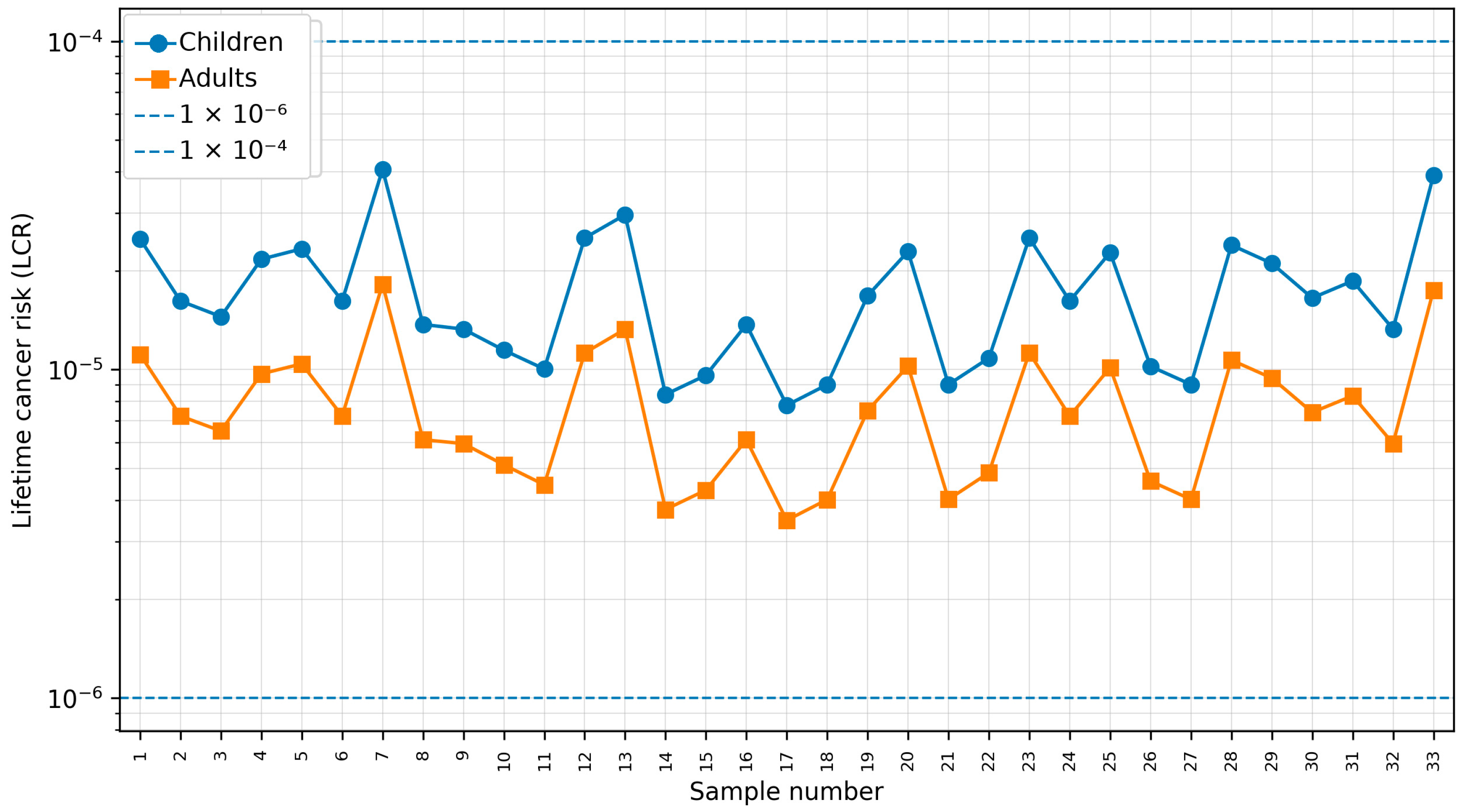
The screening-level carcinogenic risk estimates for As, Cr, and Pb were within the commonly accepted tolerable range, and no sampling site exceeded the upper concern limit of 1 × 10⁻⁴ (Table 6 and Table S4, Figure 5). Total LCR values ranged from 7.79 × 10⁻⁶ to 4.07 × 10⁻⁵ for children, with a mean of 1.77 × 10⁻⁵, and from 3.48 × 10⁻⁶ to 1.82 × 10⁻⁵ for adults, with a mean of 7.92 × 10⁻⁶. These results indicate that carcinogenic risk is not negligible in a screening context but remains below the upper threshold commonly used to define priority concern. Children had higher LCR values than adults at all sites (Table S4, Figure 5), with an average child/adult LCR ratio of approximately 2.24. This receptor difference reflects children’s lower body weight and greater relative soil-ingestion exposure during early-life contact, although lifetime averaging reduces the contrast compared with non-carcinogenic HI [47,48].
Table 6.
Average CDI, CR, and LCR values for carcinogenic risk of selected PTEs for children and adults.
Figure 5.
Site-specific LCR values for children and adults in Onaizah soils.
Chromium was the main contributor to total LCR in both receptor groups (Table 6). On average, Cr accounted for approximately 81.3% of child LCR and 82.0% of adult LCR, while As contributed about 18.4% and 17.7%, respectively. Pb contributed less than 0.3% to total LCR, indicating that the screening-level carcinogenic estimate was controlled mainly by Cr and As rather than Pb [49,50]. Because Cr was measured as total Cr and not specifically as Cr(VI), the Cr-related cancer-risk values should be regarded as comparative screening indicators rather than species-specific Cr(VI) risk estimates [50,51]. Route-specific results showed that ingestion was the dominant carcinogenic exposure pathway, followed by dermal contact, whereas inhalation had a minor contribution [49,52]. This pathway pattern is consistent with the non-carcinogenic assessment and further indicates that direct soil ingestion is the principal exposure route for both children and adults in the studied farms.
At the site level, LCR values identified sites 7 and 33 as the main locations for carcinogenic-risk follow-up (Table S4, Figure 5). Site 7 had the highest total LCR values for both children (4.07 × 10⁻⁵) and adults (1.82 × 10⁻⁵), reflecting the combined effect of comparatively elevated Cr and As. Site 33 also showed relatively high LCR values, mainly associated with Cr. Although both sites remained below the 1 × 10⁻⁴ threshold, their repeated occurrence among the higher-risk locations supports periodic monitoring rather than immediate remediation. This interpretation is consistent with the screening-level nature of the LCR assessment, especially because chromium speciation, bioaccessibility, and soil-to-crop transfer were not evaluated [51,52,53].
3.5. Probabilistic Uncertainty Analysis of Health Risk
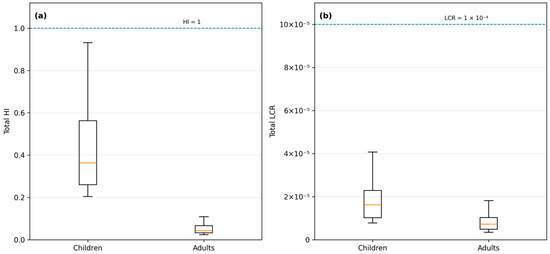
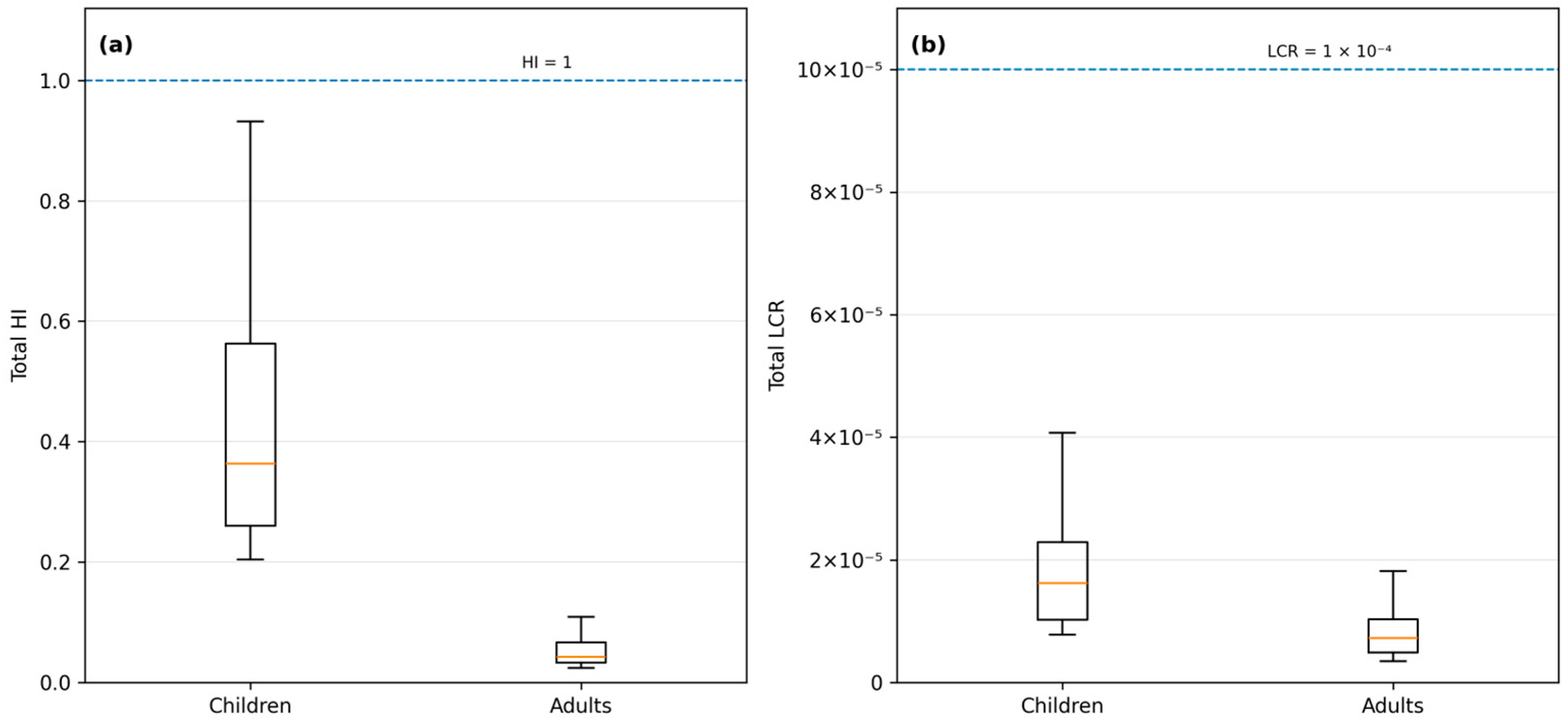
Monte Carlo resampling was applied to examine whether spatial variability among the final site-level risk estimates altered the deterministic HI and LCR interpretations [54,55]. The analysis was performed separately for total HI and total LCR in children and adults. It should be interpreted as a variability-based uncertainty screen of the calculated outputs, rather than as a full probabilistic exposure model [55,56]. For non-carcinogenic risk, adult HI remained below the screening threshold throughout the resampling, with P5, P50, and P95 values of 0.024, 0.042, and 0.109, respectively, and 0% probability of exceeding HI = 1 (Table 7, Figure 6). The child HI distribution had P5, P50, and P95 values of 0.207, 0.363, and 0.932, respectively, with a 3.1% exceedance probability. This indicates that possible non-carcinogenic concern is limited to the upper tail of the child-risk distribution rather than representing the sampled farms as a whole [57,58]. Therefore, the Monte Carlo results support the deterministic conclusion of generally low non-carcinogenic risk, with focused follow-up only for the child scenario at priority locations.
Table 7.
Monte Carlo resampling summary for total HI and LCR in children and adults based on final site-specific risk outputs.
Figure 6.
Monte Carlo resampling distributions of total HI (a) and LCR (b) for children and adults. Dashed lines indicate the adopted screening thresholds.
For carcinogenic risk, all simulated LCR distributions remained below the upper screening threshold of 1 × 10⁻⁴ (Table 7, Figure 6). In children, the P5, P50, and P95 values were 8.40 × 10⁻⁶, 1.62 × 10⁻⁵, and 3.91 × 10⁻⁵, respectively. The corresponding adult values were 3.75 × 10⁻⁶, 7.22 × 10⁻⁶, and 1.75 × 10⁻⁵. No simulated exceedance of the LCR threshold occurred for either receptor group. Thus, the probabilistic screen confirms that carcinogenic risk remained below the upper concern level under the adopted screening assumptions [54,57]. Together with the HI results, these outputs support targeted monitoring of priority sites rather than broad intervention across the cultivated area.
3.6. Risk-Based Soil-Management and Remediation Prioritization
The combined contamination, ecological risk, deterministic health risk, and Monte Carlo outputs indicate that management should be targeted rather than based on immediate area-wide remediation. Most sites were classified as safe by PN, nil-to-very-low by mCd, and low-risk by RI; adult HI values were below 1, and LCR values for both receptor groups remained below 1 × 10⁻⁴ (Table 4, Table 5, Table 6, Table 7 and Tables S2–S4, Figure 2, Figure 3, Figure 4, Figure 5 and Figure 6). Under this screening framework, broad remediation across the cultivated area is not justified. Instead, management should focus on the limited number of sites where contamination indicators, health-risk estimates, or uncertainty outputs showed localized elevation. This approach is consistent with risk-based remediation principles, in which intervention intensity is guided by contaminant severity, exposure potential, site context, and uncertainty rather than concentration values alone [59,60].
Based on the integrated indicators, site 7 represents the highest-priority follow-up location. It recorded the only marginal child HI exceedance, the highest LCR values for both receptor groups, and elevated concentrations of several elements relevant to health-risk evaluation (Tables S3 and S4, Figure 2, Figure 4 and Figure 5). Site 33 represents a secondary priority because it had the highest PN value and the strongest Zn-Cu enrichment, although its HI and LCR values remained below the adopted thresholds (Table 4 and Table S2, Figure 2, Figure 3, Figure 4 and Figure 5). Site 30 is also a secondary priority because it showed a localized Pb-related warning signal in PN despite low ecological and health-risk classifications (Table S2, Figure 2 and Figure 3a). These three sites should be prioritized for repeat soil monitoring, source verification, and review of fertilizer, manure, irrigation water, dust, and traffic-related inputs [59,61].
Because the identified concerns are mostly low and localized, prevention and exposure reduction should precede any intensive remediation action [60,62]. Practical measures may include minimizing dust resuspension from bare soil, optimizing fertilizer and manure application, maintaining vegetative cover where feasible, and repeating soil sampling at the priority sites to confirm whether enrichment persists. Immobilization-based amendments should be considered only if repeated monitoring confirms persistent enrichment and if soil-property, crop-transfer, and bioaccessibility data indicate that such treatment is suitable [60,63]. These amendments may reduce PTE mobility and bioavailability while preserving soil function, but their field use should be evaluated under the specific soil and crop conditions of the affected sites.
4. Limitations
This study should be interpreted as a screening-level site-prioritization assessment rather than a regulatory risk assessment or field remediation trial. Aqua regia digestion provides an operationally defined acid-extractable fraction and may not fully recover elements bound within resistant mineral phases. Additional limitations relate to spatial prediction, uncertainty analysis, and management validation. The spatial maps were generated from 33 surface-soil samples without an independent validation dataset, so they illustrate local spatial variation rather than definitive regional contamination patterns. Monte Carlo resampling was based on final site-level HI and LCR values and did not propagate uncertainty in exposure assumptions, toxicity parameters, contaminant speciation, bioaccessibility, or soil-to-crop transfer. Accordingly, the proposed priority sites and management measures should be verified through repeated sampling, soil-property analysis, bioaccessibility testing, crop-transfer assessment, and field evaluation of any remediation or exposure-reduction practice.
5. Conclusions
This study applied a risk-based decision framework to evaluate PTEs in agricultural topsoils from Onaizah, central Saudi Arabia. The framework links contamination screening, ecological-risk assessment, deterministic health-risk estimation, Monte Carlo resampling, and site-level management prioritization. Overall, PTE concentrations were low to moderate, and mean values decreased in the order Mn > Zn > Cr > Ni > V > Cu > Pb > Co > As. The spatial results indicated localized enrichment rather than broad contamination across the sampled farms. Site 33 showed elevated Zn and Cu, site 30 showed a localized Pb anomaly, and site 7 contained higher levels of several elements relevant to health-risk evaluation.
The PN, mCd, and RI outputs demonstrated that contamination screening and ecological-risk classification can provide different management messages. PN identified a limited number of localized enrichment sites, including warning-line and slightly polluted locations. In contrast, mCd classified all samples as nil-to-very-low contamination, and RI placed all sites within the low ecological-risk class. This confirms that localized enrichment did not develop into broad cumulative contamination or substantial ecological concern under the applied screening framework.
Human-health assessment also indicated mostly low screening-level risk. Adult HI values remained below 1 at all sites, whereas child HI slightly exceeded 1 only at site 7. Mn, Cr, As, and V were the main contributors to non-carcinogenic risk, and ingestion was the dominant exposure pathway for both receptor groups. LCR values for As, Cr, and Pb remained within the commonly tolerable screening range, with no site exceeding 1 × 10⁻⁴.
Monte Carlo resampling was consistent with the deterministic assessment. Adult HI remained below the threshold, child HI showed exceedance only in the upper tail of the resampled distribution, and LCR remained below 1 × 10⁻⁴ for both children and adults. Therefore, the main uncertainty relates to localized child non-carcinogenic risk rather than widespread carcinogenic risk. The practical implication is targeted monitoring and source verification, especially at site 7 for health-risk follow-up and at sites 30 and 33 for localized Pb and Zn–Cu enrichment.
Supplementary Materials
The following supporting information can be downloaded at: https://www.mdpi.com/article/10.3390/su18168429/s1, Table S1: Coordination of the sampled farms and PTE concentrations in agricultural topsoils of Onaizah, central Saudi Arabia; Table S2: Site-specific PN, mCd, and RI values for the 33 Onaizah agricultural topsoil samples; Table S3: HI of PTEs for non-carcinogenic risk in adults and children in Onaizah agricultural topsoils; Table S4. Site-specific carcinogenic risk values of As, Cr, and Pb for children and adults.
Author Contributions
Conceptualization, A.S.E.-S. and K.A.-K.; methodology, N.R.; software, N.R.; validation, A.S.E.-S. and K.A.-K.; writing—original draft preparation, A.S.E.-S., T.A. and K.A.-K.; writing—review and editing, A.S.E.-S., T.A., and K.A.-K.; project administration, K.A.-K.; funding acquisition, K.A.-K. All authors have read and agreed to the published version of the manuscript.
Funding
This research was funded by Ongoing Research Funding program (ORF-RICSP- 2026-5), King Saud University, Riyadh, Saudi Arabia.
Institutional Review Board Statement
Not applicable.
Informed Consent Statement
Not applicable.
Data Availability Statement
All data generated or analyzed during this study are included in this published article and its Supplementary Materials.
Acknowledgments
The authors extend their appreciation to the Ongoing Research Funding program (ORF-RICSP- 2026-5), King Saud University, Riyadh, Saudi Arabia. Moreover, the authors thank the anonymous reviewers for their valuable suggestions and constructive comments.
Conflicts of Interest
The authors declare no conflicts of interest.
References
- Wuana, R.A.; Okieimen, F.E. Heavy metals in contaminated soils: A review of sources, chemistry, risks and best available strategies for remediation. ISRN Ecol. 2011, 2011, 402647. [Google Scholar] [CrossRef] [Scilit]
- Tóth, G.; Hermann, T.; Da Silva, M.R.; Montanarella, L. Heavy metals in agricultural soils of the European Union with implications for food safety. Environ. Int. 2016, 88, 299–309. [Google Scholar] [CrossRef] [Scilit] [PubMed]
- Ngwenya, S.; Mashau, N.S.; Mhlongo, S.E.; Traoré, A.N. A systematic review of the risk management frameworks for potentially toxic chemical elements. Toxicol. Ind. Health 2023, 39, 679–686. [Google Scholar] [CrossRef] [Scilit] [PubMed]
- Petruzzelli, G.; Pezzarossa, B.; Pedron, F. The fate of chemical contaminants in soil with a view to potential risk to human health: A review. Environments 2025, 12, 183. [Google Scholar] [CrossRef] [Scilit]
- Taghavi, M.; Bakhshi, K.; Zarei, A.; Hoseinzadeh, E.; Gholizadeh, A. Soil pollution indices and health risk assessment of metal(loid)s in the agricultural soil of pistachio orchards. Sci. Rep. 2024, 14, 8971. [Google Scholar] [CrossRef] [Scilit] [PubMed]
- Wu, Y.; Xia, Y.; Mu, L.; Liu, W.; Wang, Q.; Su, T.; Yang, Q.; Milinga, A.; Zhang, Y. Health risk assessment of heavy metals in agricultural soils based on multi-receptor modeling combined with Monte Carlo simulation. Toxics 2024, 12, 643. [Google Scholar] [CrossRef] [Scilit] [PubMed]
- Gong, C.; Wang, S.; Wang, D.; Lu, H.; Dong, H.; Liu, J.; Yan, B.; Wang, L. Ecological and human health risk assessment of heavy metal(loid)s in agricultural soil in hotbed chives hometown of Tangchang, Southwest China. Sci. Rep. 2022, 12, 8563. [Google Scholar] [CrossRef] [Scilit] [PubMed]
- Li, Y.; Abuduwaili, J.; Ma, L.; Liu, W.; Zeng, T. Source apportionment and source-specific risk evaluation of potential toxic elements in oasis agricultural soils of Tarim River Basin. Sci. Rep. 2023, 13, 2980. [Google Scholar] [CrossRef] [Scilit] [PubMed]
- El-Sorogy, A.S.; Al Shaiban, A. Geochemical distribution, integrated contamination, and human health risks of potentially toxic elements in Najran agricultural soils, Saudi Arabia. Minerals 2026, 16, 693. [Google Scholar] [CrossRef] [Scilit]
- Sanad, H.; Moussadek, R.; Mouhir, L.; Oueld Lhaj, M.; Zahidi, K.; Dakak, H.; Manhou, K.; Zouahri, A. Ecological and human health hazards evaluation of toxic metal contamination in agricultural lands using multi-index and geostatistical techniques across the Mnasra area of Morocco’s Gharb Plain Region. J. Hazard. Mater. Adv. 2025, 18, 100724. [Google Scholar] [CrossRef] [Scilit]
- Agyeman, P.C.; John, K.; Kebonye, N.M.; Borůvka, L.; Vašát, R.; Drábek, O.; Němeček, K. Human health risk exposure and ecological risk assessment of potentially toxic element pollution in agricultural soils in the district of Frydek Mistek, Czech Republic: A sample location approach. Environ. Sci. Eur. 2021, 33, 137. [Google Scholar] [CrossRef] [Scilit]
- Wu, J.; Xiong, Y.; Ge, Y.; Yuan, W. A sustainability assessment-based methodology for the prioritization of contaminated site risk management options. Environ. Sci. Pollut. Res. 2022, 29, 7503–7513. [Google Scholar] [CrossRef] [Scilit] [PubMed]
- Alharbi, T.; El-Sorogy, A.S. Spatial distribution and risk assessment of heavy metals pollution in soils of marine origin in central Saudi Arabia. Mar. Pollut. Bull. 2021, 170, 112605. [Google Scholar] [CrossRef] [Scilit] [PubMed]
- Alharbi, T.; El-Sorogy, A.S.; Al-Kahtany, K. Contamination and health risk assessment of potentially toxic elements in agricultural soil of the Al-Ahsa Oasis, Saudi Arabia using health indices and GIS. Arab. J. Chem. 2024, 17, 105592. [Google Scholar] [CrossRef] [Scilit]
- Alarifi, S.S.; El-Sorogy, A.S.; Al-Kahtany, K.; Hazaea, S.A. Contamination and health risk assessment of potentially toxic elements in Al-Ammariah agricultural soil, Saudi Arabia. J. King Saud Univ. Sci. 2023, 35, 102826. [Google Scholar] [CrossRef] [Scilit]
- El-Sorogy, A.S.; Al Khathlan, M.H. Assessment of potentially toxic elements and health risks of agricultural soil in Southwest Riyadh, Saudi Arabia. Open Chem. 2024, 22, 20240017. [Google Scholar] [CrossRef] [Scilit]
- Tian, S.; Wang, S.; Bai, X.; Zhou, D.; Luo, G.; Yang, Y.; Hu, Z.; Li, C.; Deng, Y.; Lu, Q. Ecological security and health risk assessment of soil heavy metals on a village-level scale, based on different land use types. Environ. Geochem. Health 2020, 42, 3393–3413. [Google Scholar] [CrossRef] [Scilit] [PubMed]
- Panagos, P.; Ballabio, C.; Lugato, E.; Jones, A.; Borrelli, P.; Scarpa, S.; Orgiazzi, A.; Montanarella, L. Potential sources of anthropogenic copper inputs to European agricultural soils. Sustainability 2018, 10, 2380. [Google Scholar] [CrossRef] [Scilit]
- Kuppusamy, S.; Venkateswarlu, K.; Megharaj, M.; Mayilswami, S.; Lee, Y.B. Risk-based remediation of polluted sites: A critical perspective. Chemosphere 2017, 186, 607–615. [Google Scholar] [CrossRef] [Scilit] [PubMed]
- ISO 11466:1995; Soil Quality—Extraction of Trace Elements Soluble in Aqua Regia. International Organization for Standardization (ISO): Geneva, Switzerland, 1995.
- U.S. EPA. Method 3050B: Acid Digestion of Sediments, Sludges, and Soils; United States Environmental Protection Agency: Washington, DC, USA, 1996.
- Chen, M.; Ma, L.Q. Comparison of three aqua regia digestion methods for twenty Florida soils. Soil Sci. Soc. Am. J. 2001, 65, 491–499. [Google Scholar] [CrossRef] [Scilit]
- Turekian, K.K.; Wedepohl, K.H. Distribution of the elements in some major units of the Earth’s crust. Geol. Soc. Am. Bull. 1961, 72, 175–192. [Google Scholar] [CrossRef] [Scilit]
- Matschullat, J.; Ottenstein, R.; Reimann, C. Geochemical background—Can we calculate it? Environ. Geol. 2000, 39, 990–1000. [Google Scholar] [CrossRef] [Scilit]
- Reimann, C.; Garrett, R.G. Geochemical background—Concept and reality. Sci. Total Environ. 2005, 350, 12–27. [Google Scholar] [CrossRef] [Scilit] [PubMed]
- Nemerow, N.L. Stream, Lake, Estuary, and Ocean Pollution, 2nd ed.; Van Nostrand Reinhold: New York, NY, USA, 1991. [Google Scholar]
- Abrahim, G.M.S.; Parker, R.J. Assessment of heavy metal enrichment factors and the degree of contamination in marine sediments from Tamaki Estuary, Auckland, New Zealand. Environ. Monit. Assess. 2008, 136, 227–238. [Google Scholar] [CrossRef] [Scilit] [PubMed]
- Håkanson, L. An ecological risk index for aquatic pollution control: A sedimentological approach. Water Res. 1980, 14, 975–1001. [Google Scholar] [CrossRef] [Scilit]
- EPA/540/1-89/002; Risk Assessment Guidance for Superfund, Volume I: Human Health Evaluation Manual, Part A. Office of Emergency and Remedial Response, United States Environmental Protection Agency (U.S. EPA): Washington, DC, USA, 1989.
- OSWER 9355.4-24; Supplemental Guidance for Developing Soil Screening Levels for Superfund Sites. Office of Emergency and Remedial Response, United States Environmental Protection Agency (U.S. EPA): Washington, DC, USA, 2002.
- EPA/540/R/99/005; Risk Assessment Guidance for Superfund, Volume I: Human Health Evaluation Manual, Part E, Supplemental Guidance for Dermal Risk Assessment. Office of Superfund Remediation and Technology Innovation, United States Environmental Protection Agency (U.S. EPA): Washington, DC, USA, 2004.
- EPA/540/R/070/002; Risk Assessment Guidance for Superfund, Volume I: Human Health Evaluation Manual, Part F, Supplemental Guidance for Inhalation Risk Assessment. Office of Superfund Remediation and Technology Innovation, United States Environmental Protection Agency (U.S. EPA): Washington, DC, USA, 2009.
- Miletić, A.; Lučić, M.; Onjia, A. Exposure factors in health risk assessment of heavy metal(loid)s in soil and sediment. Metals 2023, 13, 1266. [Google Scholar] [CrossRef] [Scilit]
- Shepard, D. A two-dimensional interpolation function for irregularly-spaced data. In Proceedings of the 1968 ACM National Conference, New York, NY, USA, 27–29 August 1968; Association for Computing Machinery: New York, NY, USA, 1968; pp. 517–524. [Google Scholar] [CrossRef] [Scilit]
- Nicholson, F.A.; Smith, S.R.; Alloway, B.J.; Carlton-Smith, C.; Chambers, B.J. An inventory of heavy metals inputs to agricultural soils in England and Wales. Sci. Total Environ. 2003, 311, 205–219. [Google Scholar] [CrossRef] [Scilit] [PubMed]
- Chen, T.; Liu, X.; Zhu, M.; Zhao, K.; Wu, J.; Xu, J.; Huang, P. Identification of trace element sources and associated risk assessment in vegetable soils of the urban–rural transitional area of Hangzhou, China. Environ. Pollut. 2008, 151, 67–78. [Google Scholar] [CrossRef] [Scilit] [PubMed]
- Komárek, M.; Ettler, V.; Chrastný, V.; Mihaljevič, M. Lead isotopes in environmental sciences: A review. Environ. Int. 2008, 34, 562–577. [Google Scholar] [CrossRef] [Scilit] [PubMed]
- Kowalska, J.B.; Mazurek, R.; Gąsiorek, M.; Zaleski, T. Pollution indices as useful tools for the comprehensive evaluation of the degree of soil contamination—A review. Environ. Geochem. Health 2018, 40, 2395–2420. [Google Scholar] [CrossRef] [Scilit] [PubMed]
- Belay, B.B.; Taye, A.E. Potential toxic metal concentration and risk assessment in agricultural soil and lentil crop (Lens culinaris Medik) in Dawunt Woreda, Northwest Wollo, Ethiopia. J. Toxicol. 2024, 2024, 8985402. [Google Scholar] [CrossRef] [Scilit] [PubMed]
- Xiao, Q.; Zong, Y.; Lu, S. Assessment of heavy metal pollution and human health risk in urban soils of steel industrial city (Anshan), Liaoning, Northeast China. Ecotoxicol. Environ. Saf. 2015, 120, 377–385. [Google Scholar] [CrossRef] [Scilit] [PubMed]
- Guo, G.; Chen, S.; Lei, M.; Wang, L.; Yang, J.; Qiao, P. Spatiotemporal distribution characteristics of potentially toxic elements in agricultural soils across China and associated health risks and driving mechanism. Sci. Total Environ. 2023, 887, 163897. [Google Scholar] [CrossRef] [Scilit] [PubMed]
- Wan, F.; Jiang, N.; Yu, L.; Zang, K.; Liu, S.; He, W.; Hu, Z.; Fan, H.; Li, H.; Wang, H.; et al. Heavy metal ecological-health risk assessment under wheat–maize rotation system in a high geological background area in eastern China. Sci. Rep. 2022, 12, 17912. [Google Scholar] [CrossRef] [Scilit] [PubMed]
- Deliboran, A.; Varol, M.; Aytop, H. Evaluation of ecological and health risks of trace elements in soils of olive orchards and apportionment of their sources using the APCS-MLR receptor model. Environ. Geochem. Health 2024, 46, 320. [Google Scholar] [CrossRef] [Scilit] [PubMed]
- Guo, G.; Wang, Y.; Zhang, D.; Li, K.; Lei, M. Human health risk apportionment from potential sources of heavy metals in agricultural soils and associated uncertainty analysis. Environ. Geochem. Health 2023, 45, 881–897. [Google Scholar] [CrossRef] [Scilit] [PubMed]
- Alzahrani, H.; El-Sorogy, A.S.; Alghamdi, A.G.; Alasmary, Z.; Albugami, T.M.R. A multivariate and geographic-information-system approach to assess environmental and health hazards of Fe, Cr, Zn, Cu, and Pb in agricultural soils of Western Saudi Arabia. Sustainability 2025, 17, 1610. [Google Scholar] [CrossRef] [Scilit]
- Wang, C.C.; Zhang, Q.C.; Kang, S.G.; Li, M.Y.; Zhang, M.Y.; Xu, W.M.; Xiang, P.; Ma, L.Q. Heavy metal(loid)s in agricultural soil from main grain production regions of China: Bioaccessibility and health risks to humans. Sci. Total Environ. 2023, 858, 159819. [Google Scholar] [CrossRef] [Scilit] [PubMed]
- Moriarity, R.J.; Wilton, M.J.; Tsuji, L.J.S.; Sarkar, A.; Liberda, E.N. Evaluating human health risks from exposure to agricultural soil contaminants using one- and two-dimensional Monte Carlo simulations. Environ. Res. 2025, 264, 120391. [Google Scholar] [CrossRef] [Scilit] [PubMed]
- El-Sorogy, A.S.; Al-Kahtany, K.; Alharbi, T.; Alarifi, S.S. Distribution patterns, health hazards, and multivariate assessment of contamination sources of As, Pb, Ni, Zn, and Fe in agricultural soils. J. King Saud. Univ. Sci. 2024, 36, 103489. [Google Scholar] [CrossRef] [Scilit]
- Huang, C.; Gou, Z.; Ma, X.; Liao, G.; Deng, O.; Yang, Y. Quantification of sources and potential risks of cadmium, chromium, lead, mercury and arsenic in agricultural soils in a rapidly urbanizing region of southwest China: The case of Chengdu. Front. Public Health 2024, 12, 1400921. [Google Scholar] [CrossRef] [Scilit] [PubMed]
- IARC. Arsenic, Metals, Fibres, and Dusts. In IARC Monographs on the Evaluation of Carcinogenic Risks to Humans; International Agency for Research on Cancer: Lyon, France, 2012; Volume 100. [Google Scholar]
- Unceta, N.; Séby, F.; Malherbe, J.; Donard, O.F.X. Chromium speciation in solid matrices and regulation: A review. Anal. Bioanal. Chem. 2010, 397, 1097–1111. [Google Scholar] [CrossRef] [Scilit] [PubMed]
- Meng, Q.; Li, Y.; Liu, X.; Wang, Y.; Zhang, J.; Liu, J.; Zhao, Y.; Wang, M.; Li, H.; Chen, L. Human health risks of heavy metal(loid)s mediated through crop ingestion in a coal mining area in Eastern China. Ecotoxicol. Environ. Saf. 2024, 276, 116305. [Google Scholar] [CrossRef] [Scilit] [PubMed]
- Tong, L.; Yang, A.; Fan, M.; Zheng, D.; Li, J.; Liu, H.; Li, C.; Tang, Y.; Cheng, L. Assessment of heavy metal sources and health risks in soil-crop systems of fragmented farmland. Front. Public Health 2025, 13, 1637595. [Google Scholar] [CrossRef] [Scilit] [PubMed]
- Panqing, Y.; Abliz, A.; Xiaoli, S.; Aisaiduli, H. Human health-risk assessment of heavy metal-contaminated soil based on Monte Carlo simulation. Sci. Rep. 2023, 13, 7033. [Google Scholar] [CrossRef] [Scilit] [PubMed]
- Liu, Y.; Xu, F.; Wang, H.; Huang, X.; Wang, D.; Fan, Z. Optimizing health risk assessment for soil trace metals under low-precision sampling conditions: A case study of agricultural soil. Sci. Total Environ. 2024, 944, 173797. [Google Scholar] [CrossRef] [Scilit] [PubMed]
- Wang, X.; Xu, F.; Gui, Y.; Liu, Y. Enhancing health risk assessment for soil heavy metal(loid)s using a copula-based Monte Carlo simulation method. Ecotoxicol. Environ. Saf. 2025, 300, 118419. [Google Scholar] [CrossRef] [Scilit] [PubMed]
- Xiao, M.; Qian, L.; Yang, B.; Zeng, G.; Ren, S. Risk assessment of heavy metals in agricultural soil based on the coupling model of Monte Carlo simulation-triangular fuzzy number. Environ. Geochem. Health 2024, 46, 62. [Google Scholar] [CrossRef] [Scilit] [PubMed]
- Fei, X.; Lou, Z.; Sheng, M.; Lv, X.; Ren, Z.; Xiao, R. Source-oriented stochastic health risk assessment of toxic metals in soil via a hybrid model and Monte Carlo simulation. Ecotoxicol. Environ. Saf. 2024, 286, 117209. [Google Scholar] [CrossRef] [Scilit] [PubMed]
- Huysegoms, L.; Cappuyns, V. Critical review of decision support tools for sustainability assessment of site remediation options. J. Environ. Manag. 2017, 196, 278–296. [Google Scholar] [CrossRef] [Scilit] [PubMed]
- Hou, D.; Al-Tabbaa, A.; O’Connor, D.; Hu, Q.; Zhu, Y.G.; Wang, L.; Kirkwood, N.; Ok, Y.S.; Tsang, D.C.W.; Bolan, N.S.; et al. Sustainable remediation and redevelopment of brownfield sites. Nat. Rev. Earth Environ. 2023, 4, 271–286. [Google Scholar] [CrossRef] [Scilit]
- Hou, D.; O’Connor, D.; Nathanail, P.; Tian, L.; Ma, Y. Integrated GIS and multivariate statistical analysis for regional scale assessment of heavy metal soil contamination: A critical review. Environ. Pollut. 2017, 231, 1188–1200. [Google Scholar] [CrossRef] [Scilit] [PubMed]
- Bardos, R.P.; Jones, S.; Stephenson, I.; Menger, P.; Beumer, V.; Neonato, F.; Maring, L.; Ferber, U.; Track, T.; Wendler, K. Optimising value from the soft re-use of brownfield sites. Sci. Total Environ. 2016, 563–564, 769–782. [Google Scholar] [CrossRef] [Scilit] [PubMed]
- Palansooriya, K.N.; Shaheen, S.M.; Chen, S.S.; Tsang, D.C.W.; Hashimoto, Y.; Hou, D.; Bolan, N.S.; Rinklebe, J.; Ok, Y.S. Soil amendments for immobilization of potentially toxic elements in contaminated soils: A critical review. Environ. Int. 2020, 134, 105046. [Google Scholar] [CrossRef] [Scilit] [PubMed]

Disclaimer/Publisher’s Note: The statements, opinions and data contained in all publications are solely those of the individual author(s) and contributor(s) and not of MDPI and/or the editor(s). MDPI and/or the editor(s) disclaim responsibility for any injury to people or property resulting from any ideas, methods, instructions or products referred to in the content. |
© 2026 by the authors. Licensee MDPI, Basel, Switzerland. This article is an open access article distributed under the terms and conditions of the Creative Commons Attribution (CC BY) license.