


Abstract
This study explores the role of arts-based educational interventions in fostering social mending and urban regeneration in disadvantaged urban contexts. The intervention consisted of participatory mosaic workshops designed to foster cooperation, inclusion, and civic engagement, culminating in the co-creation of public artworks installed in a degraded urban underpass and included 193 children aged 5–15 living in Tor Bella Monaca, a highly marginalized suburb of Rome (Italy). The analysis of the intervention used a mixed-methods approach, based on systematic observation, questionnaires, interviews, and document analysis. The findings indicate that the artistic process acted as a catalyst for both individual and collective transformation: at the individual level, participation enhanced relational skills, emotional expression, and sense of agency; at the community level, the intervention contributed to the reactivation of public space, increased social cohesion, and improved care for the urban environment. We interpret these outcomes through the capability approach, identifying art as a “conversion factor” linking individual capabilities to collective regeneration. The intervention aligns with SDGs 4, 10, 11, and 17 of the 2030 Agenda and supports the relevance of scalable, community-based models for inclusive and sustainable urban policies in deprived areas.
1. Introduction
This study analyses an experimental educational intervention targeted at minors in the neighbourhood of Tor Bella Monaca, Rome. The initiative involved the organization of artistic workshops through which a mosaic was created collaboratively by a team of artists, educators, and psychologists and subsequently installed in a metro underpass in the suburban area.
The idea behind the educational activities was to view the social fractures and individual difficulties faced by minors in the neighbourhood and their families not only as shortcomings to be addressed through social or political interventions but also as an educational opportunity for engagement and expression from a participatory perspective.
The uniqueness of the educational intervention lay in the use of mosaic art as a tool for potential social and urban regeneration. As research shows, in a territory where urban peripheries are closely intertwined with educational poverty [1], which generate individual and social fractures, especially in children [2], an educational approach combined with a strong artistic and communicative dimension could foster regeneration practices with benefits on multiple levels.
This research study, planned from the outset of the educational activities, employed a mixed-methods approach combining qualitative and quantitative methodologies. Based on observations, semi-structured interviews, focus groups, evaluation questionnaires, and the analysis of an association’s database, we investigated various dimensions of urban regeneration, as well as the socio-relational benefits experienced by the participating minors.
This contribution is situated within interdisciplinary research on urban peripheries and their regeneration, with a socio-pedagogical orientation centred on urban regeneration and the Sustainable Development Goals; a complementary analysis of the pedagogical dispositifs [3,4] of the same project has been published elsewhere [5].
Arts-based and community-based practices are widely documented drivers of inclusion and regeneration in marginalized urban areas [6,7,8,9], and research on large-scale social housing estates has shown how peripheral neighbourhoods can become laboratories of regeneration “from below” [10,11]. Three gaps remain unaddressed: the mechanisms connecting individual outcomes and spatial regeneration are rarely theorized; young children are seldom positioned as co-creators of public space; and evidence from severely deprived public-housing estates is limited. This study addresses these gaps: children aged 5–15 act as co-authors of permanent public artworks, and the capability approach makes the pathway from individual capabilities to preliminary effects of urban regeneration explicit (Section 1.2).
In this educational experience, social sustainability is framed as a multidimensional process involving inclusion, equity, and participatory engagement through which educational practices can enhance individual capabilities while contributing to community cohesion and urban regeneration in disadvantaged settings [12,13,14,15]. Furthermore, the intervention aligns with the 2030 Agenda by contributing to SDG 4.7 (education for sustainable development), SDG 4.5 (inclusive education), SDG 10.2 (social inclusion), SDG 11.7 (inclusive public spaces), and SDG 17.17 (multi-stakeholder partnerships), highlighting the role of education in fostering socially sustainable urban regeneration. Recent international frameworks further support this approach, emphasizing culture and arts education to foster inclusion, well-being, cultural diversity, and social transformation [16].
1.1. Background of the Study Area
Tor Bella Monaca is one of the most disadvantaged suburbs in Italy, described as “the last great public suburb” [17]. No other Italian neighbourhood hosts a comparable concentration of public housing; average incomes are the lowest recorded in Rome, and 41% of residents live in absolute poverty. This complex social context contributes not only to individual hardship but also to urban fragmentation, making regeneration both necessary and urgent.
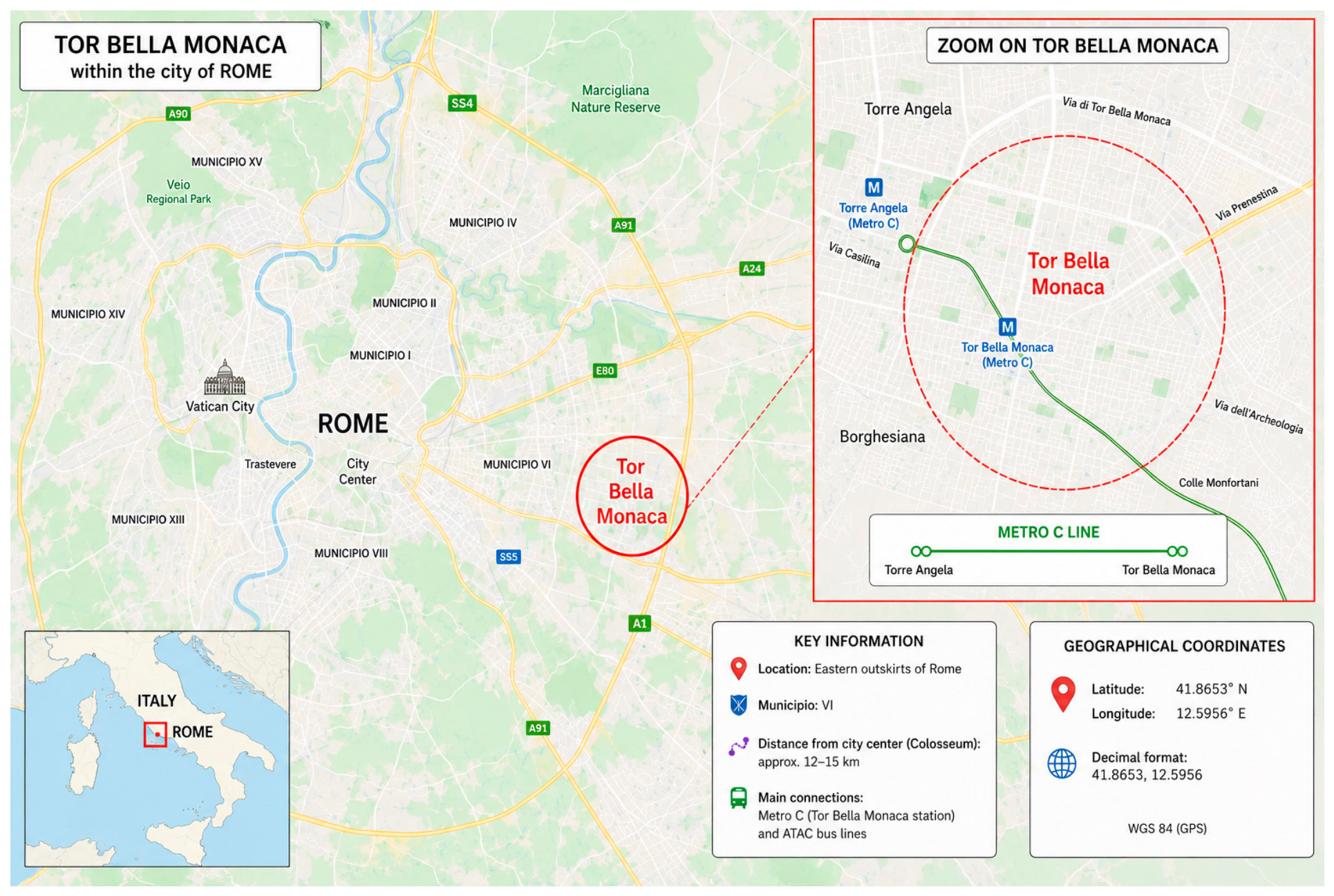
The neighbourhood has been widely studied from an urban planning perspective. The literature reveals that public space in Tor Bella Monaca is often perceived as “inconceivable” [18], meaning that it is either privatized or considered ownerless. Although it is the first neighbourhood encountered when entering Rome from Via Casilina, east of Rome’s suburbs (Figure 1), its appearance is strikingly bleak—hardly befitting a gateway to the “Eternal City” [19].
Figure 1.
Tor Bella Monaca’s map. The figure displays the map of Rome and highlights the Tor Bella Monaca area. Also, key information and geographical coordinates are displayed.
While it is true that in contemporary Rome, the boundary between centre and periphery has become increasingly blurred—both geographically and socially—such that the dichotomy between the two is no longer entirely valid [20], Tor Bella Monaca continues to embody a condition of profound marginalization, both urban and social.
This condition is rooted in the planning history of the neighbourhood. Tor Bella Monaca was built in the early 1980s within the PEEP (Piano di Edilizia Economica e Popolare), Rome’s large public-housing programme, in the late season of Italian modernist planning: high-density prefabricated towers and blocks, rapid and inexpensive but of poor architectural quality [21,22]. Much of the equipment envisaged by the plan—schools, green areas, and public facilities—was never realized: a case of “unfinished modernism”, contradicted from the beginning by the absence of the services it presupposed [17,23,24]. This legacy bears directly on the present: concentrated public housing without services has produced a mono-functional estate, whose socio-economic profile mirrors the allocation of vulnerable households to a space never equipped to support them [25,26].
Over the following decades, the neighbourhood experienced a progressive deterioration of its urban and social conditions. Although media and political attention to the neighbourhood has often been high, over time, the situation has only worsened. This is due to the presence of a large number of public-housing units and the absence of essential social and educational services and facilities. The prospects for integration, involvement, and political representation of residents gradually diminish, public participation fades, and institutions become increasingly distant. As a result, residents’ trust in institutions has progressively eroded, while criminal organizations have consolidated their economic and social grip on the area [24,26,27].
The non-profit organizations Solidarity Medicine Institute (https://medicinasolidale.org/about-us/?lang=en (accessed on 10 July 2026)) and Fonte di Ismaele Centre (https://www.fontedismaele.org), active since 2003 and 2015, respectively, offer free, low-threshold medical services, as well as psychological, primary socio-educational care, in the most socially disadvantaged areas in the suburbs of Rome. They intercept the needs of nuclear families, in particular children and mothers from Italy as well as of other ethnicities, providing health care (therapeutic and prophylactic), life-related support and educational interventions [28,29,30,31]. Both the organizations have been actively working in Tor Bella Monaca suburbs.
Over the years, the system in Tor Bella Monaca appears to have lost an ‘antagonist’ capable of effectively counteracting its destructive and entropic effects. In this process, which seems inevitable and bound to intensify, even urban spaces—becoming ‘no man’s land’—undergo inevitable degradation and deterioration.
1.2. Purpose
This educational study set out to explore whether the perspective of the neighbourhood’s youngest residents—children, whose voice rarely reaches the public sphere—could reveal an educational vocation for this degraded area: an entry point to the city that might acquire the meaning of a ‘civic gate’. This would represent both a physical and symbolic passage, demonstrating how even in the most marginalized and complex periphery of Rome, the desire for urban, social, cultural, and civic regeneration is both alive and shared. This experience resulted from the Memorandum of Understanding of Fonte di Ismaele Centre with the Department for Juvenile and Community Justice (Italian Ministry of Justice) aiming to promote initiatives supporting young people in situations of hardship, at risk of social marginalization, and subject to criminal justice measures.
One hundred and ninety-three children and adolescents, representing various nationalities living in the neighbourhood that often struggle to coexist, participated in this educational experience.
The educational activities were also timed in view of the Jubilee of 2025, during which tens of thousands of pilgrims were expected to pass through the study underpass on their way to the events planned with the Pope, as well as the city centre. Art, as a universal communication tool, would have strongly underscored this desire for change.
Finally, we aimed to develop a methodology for urban regeneration and the inclusion of minors living in poverty and marginalization through art. To achieve this, an integrated network model was developed and solidified through a triple alliance: higher education institutes, local authorities, and the third sector. In synthesis, this study pursued three objectives: (RQ1) describing the individual educational outcomes of the workshops (relational, emotional, and expressive capabilities); (RQ2) documenting the effects on public space and local community, as preliminary indicators of urban regeneration; (RQ3) deriving a transferable methodology for the inclusion of minors through art. The capability approach [32] was adopted from the design stage as the connecting framework.
2. Materials and Methods
2.1. Research Methodology
This educational experience was conducted in accordance with the child protection policy of the Ethical Committee of Fonte di Ismaele Centre (6 November 2021) and the Memorandum of Understanding between Fonte di Ismaele Centre and the Department for Juvenile and Community Justice (Italian Ministry of Justice) signed in June 2023. The agreement aims to support minors experiencing hardship, social marginalization, or involvement in the juvenile justice system while fostering collaboration between institutions and professionals, the educational experience herein described was planned within this agreement.
Informed consent was obtained in accordance with the Declaration of Helsinki and national regulations on privacy and child protection. Written consent was provided by parents or legal guardians, while minors gave verbal assent. Participation was voluntary, and alternative activities were offered when needed.
This study was planned from the outset of the educational activities and developed in three phases: design of the educational project, data collection (observations and interviews), and analysis.
The evaluation of the educational intervention, planned from the outset of the activities, followed a convergent parallel mixed-methods design [33]: quantitative data (questionnaires and the association’s database) and qualitative data (observations, interviews, focus group, and documents) were collected in parallel, analysed separately, and integrated at the interpretation stage. The first of the three questions guiding the evaluation (RQ1, Section 1.2) relied primarily on systematic observation, the psychological team’s reports, and the final evaluation questionnaire; RQ2 drew on post-installation observation of the urban space and on the interviews; and RQ3 drew on the focus group with facilitators and on document analysis. Consistent with the educational and exploratory nature of the intervention, qualitative materials carried the main interpretive weight.
The methodological tools included (1) descriptive and systematic observation using structured grids to monitor both individual behaviours and changes in the urban space; (2) an entrance questionnaire investigating demographic, socio-economic, and environmental perceptions [31]; (3) a final evaluation questionnaire (Supplementary Material S1); (4) data collection from the association’s database; (5) a focus group with workshop facilitators; (6) semi-structured interviews with parents, institutional representatives, and stakeholders; and (7) document analysis related to the design of the educational activities. Given the non-invasive and educational nature of the intervention, this study was conducted under the internal ethical guidelines of Fonte di Ismaele Centre and within the framework of the formal agreement with the Department for Juvenile and Community Justice. For transparency, we disclose that the map in Figure 1 was generated using ChatGPT 5 (OpenAI); the authors reviewed, verified, and edited the output and take full responsibility for its content.
2.2. Participants
A total of 193 minors aged 5–15 years participated in the educational experience; their characteristics are reported in Section 3.1. Participants came from highly disadvantaged socio-economic backgrounds. Notably, 45 minors were referred by social services and included within the framework of juvenile justice support programs.
2.3. Timing and Team
The workshops were held biweekly (Saturday, 9 a.m.–3 p.m.) over a period of 7 months (December 2023–June 2024). Participants were supported by a multidisciplinary team including psychologists, a paediatrician, educators, and artists. Activities took place at the Fonte di Ismaele Centre in Rome, where children were also provided with food and continuous support.
2.4. Laboratory Setting and Activities
The workshop space was organized to support both individual and group work. After a brief introduction to materials and techniques, children engaged in hands-on mosaic activities, prioritizing an experiential learning approach. Participants created individual artworks and contributed to collective mosaics, balancing personal expression with cooperation. The process required interaction with facilitators and peers, fostering relational skills, problem solving, and shared responsibility. Special attention was given to encouraging creativity while maintaining a collaborative environment. The activities also included moments of collective care, such as cleaning tools and managing shared materials.
2.5. Data Analysis
Quantitative data from the questionnaires were examined with descriptive statistics (frequencies and percentages) to characterize the study population.
Observations were recorded through structured grids compiled at each session by the educators and psychologists present, covering participation, peer interaction, emotional expression, care of materials, and after the installation of the mosaics, the condition and uses of the urban space. Semi-structured interviews [n = 15: parents, institutional representatives, and stakeholders] and one focus group with the facilitators [n = 5] were conducted in the final phase, with detailed written notes. Qualitative materials were analysed through thematic analysis [34], with inductive coding being performed by two researchers and themes being refined within the multidisciplinary team. Triangulation across sources and researchers of different disciplinary backgrounds was performed to strengthen the validity of the findings. In operational terms, the analysis followed the six phases described by Braun and Clarke [34]. The initial inductive coding of observation grids, interview and focus group notes, and project documents generated approximately twenty first-level codes (e.g., sustained engagement, requests to continue the activity, pride in the artwork, emotional expression, peer cooperation, involvement of mothers, care of materials, perception of being taken seriously, condition and uses of the underpass, organizational difficulties). No formal inter-coder reliability index was computed, consistent with a consensus-based approach to qualitative rigour. First-level codes were then grouped into candidate themes, and candidate themes supported by fewer than two data sources were not retained. This process led to the final thematic structure presented in Table 1, which maps each theme and its sub-themes onto the supporting data sources and an illustrative quotation.
Table 1.
Final thematic structure: themes, sub-themes, supporting data sources, and illustrative quotations.
Given the exploratory nature of this study, no inferential statistical analysis was performed.
3. Results
3.1. Quantitative Insights and Population Characteristics
A total of 193 minors aged 5–15 years with a balanced gender distribution (51.3% female; 48.7% male) participated in the educational activities (Table 2).
Table 2.
Participants’ characteristics.
The age distribution showed a predominance of children aged 6–10 years (48.2%), followed by 11–15 years (31.1%), while 20.7% were 5 years old, highlighting the inclusion of very young participants from a context of early vulnerability.
The population was highly diverse in terms of ethnic background, with children of African origin representing the largest group (52.85%), followed by Eastern European origin (28.5%), while Italian participants accounted for 13.99%. Participants from Asian and South American backgrounds were less represented (2.59% and 2.07%, respectively).
All families were characterized by severe socio-economic disadvantage, with ISEE values below €5800 (mean ≈ €2900). Despite this, 146 families had at least one employed parent, predominantly the fathers.
Housing conditions were mostly stable (171 families in rented apartments), although approximately 10% experienced precarious living conditions, including nomad camps, campers, and occupied housing.
Participation increased over time, from approximately 10 children per session to up to 40, indicating growing engagement. Family involvement also increased, with parents progressively attending and interacting within the workshop setting. The psychological team’s final report describes this evolution explicitly: initially, “the family members who accompanied them would remain in the waiting room until the activity ended, whereas after a few sessions the parents themselves began to take an active part”—evidence that family relationships “can be supported and facilitated if significant spaces, times, proposals and dedicated resources are invested in, with a far from negligible impact on the reconstruction of a more cohesive social fabric, especially in the peripheries”. The same report notes that working alongside peers of different nationalities “also improved some expressive and learning difficulties linked to bilingualism and to deprived family contexts”.
At the end of the intervention, the final evaluation questionnaire (Supplementary Material S1) was administered to parents and to participants aged 14–18 as part of the ordinary evaluation of the activities. Out of 15 questionnaires returned, 93% of respondents were “very satisfied” or “satisfied”, 100% judged the activities “very” or “fairly” useful and formative, 80% reported improvements in the child involved, and 93% would recommend the project to other families. Although satisfaction-oriented, these results converge with the observational data.
3.2. Artistic Activities and Mosaic Construction
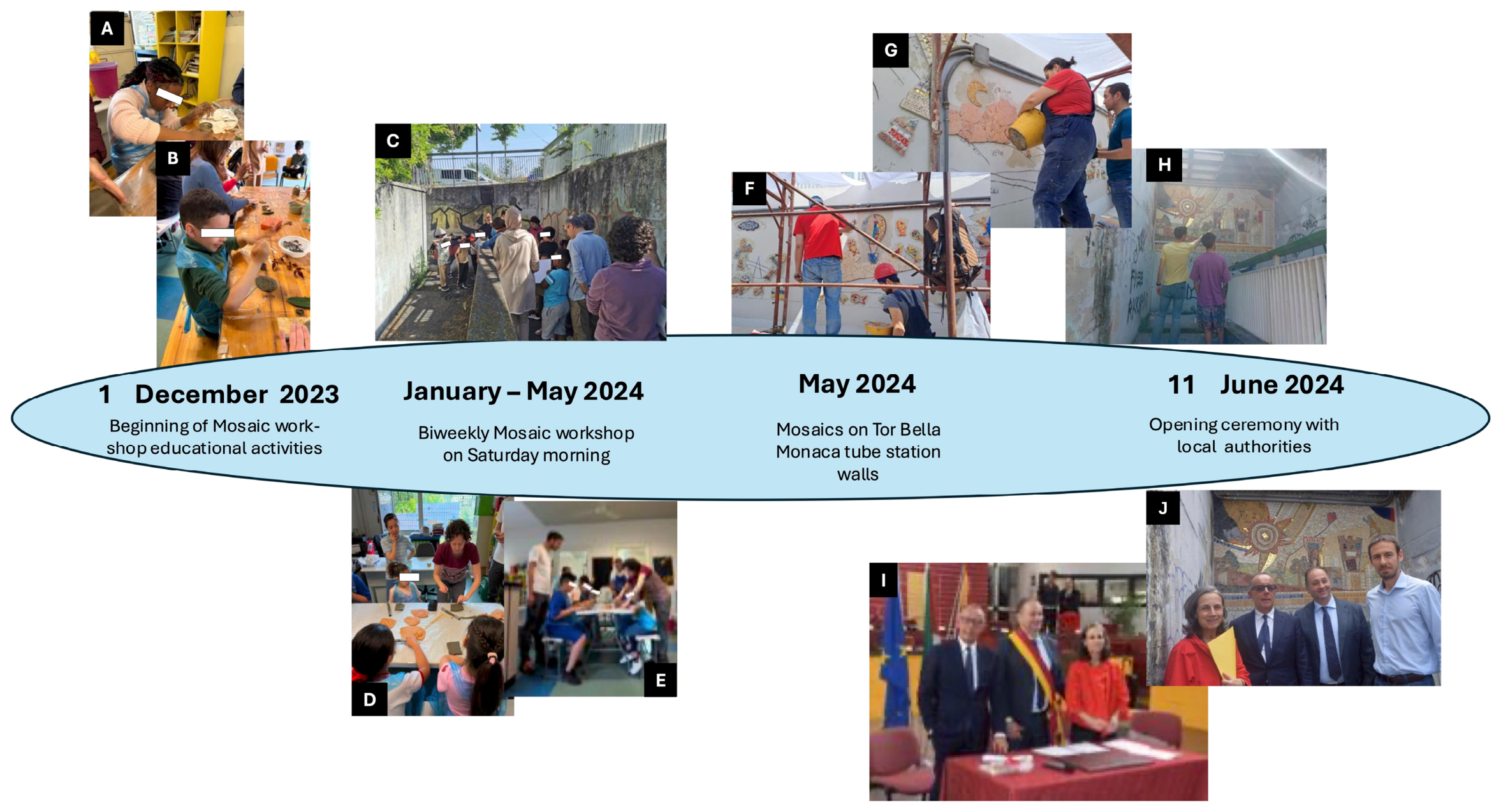
The educational activities were implemented between 1 December 2023, and 26 June 2024, through a series of 12 biweekly workshops held on Saturday mornings. The multidisciplinary team included a physician, two psychologists, a pedagogist, a psychologist–artist, an educator–artist, and five professional mosaic artists, joined by two volunteers of the association during the workshop sessions (Figure 2).
Figure 2.
Flow chart of the Mosaic workshop. This diagram displays the different phases of the mosaic-workshops and the educational activities until the opening ceremony with the local and Justice Department authorities. The pictures document representative moments of the activities. (A,B,D,E)—Children explore the mosaic-making techniques during the mosaic workshops held biweekly on Saturday mornings; (C)—This picture displays the visit of the children of Tor Bella Monaca to the tube station to evaluate the space where the mosaics would be set; (F–H)—Installation of the mosaic panels and final result; (I,J)—Opening ceremony with representatives of Fonte di Ismaele Centre, Local Mayor Authority, Department for Juvenile and Community Justice and Rossoroblu Atelier.
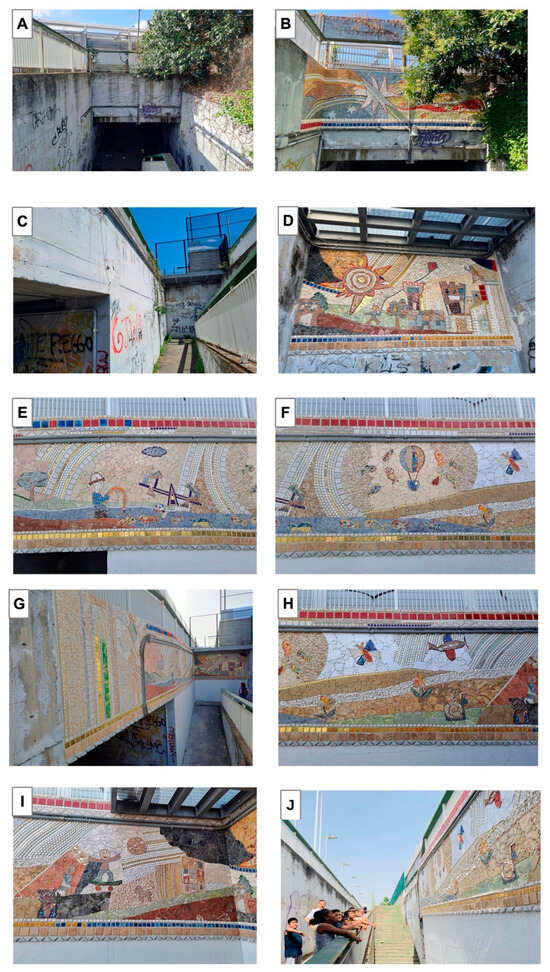
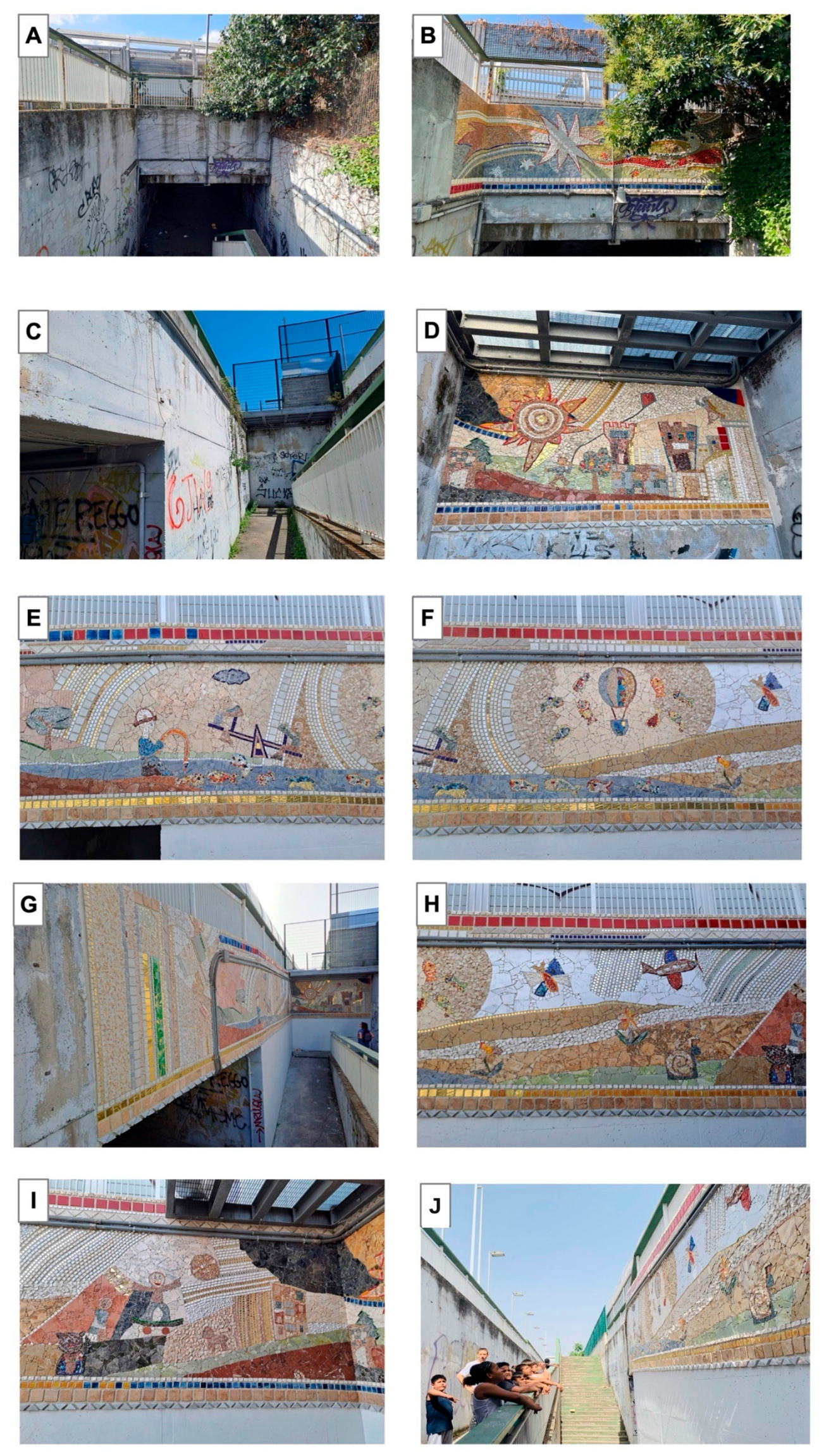
The workshop activities were structured in two main phases. During the first phase, participants explored mosaic-making techniques through individual creative expression, producing drawings and sketches that were subsequently transformed into small mosaic artworks. This hands-on approach enabled children to develop artistic skills while fostering personal engagement with the creative process. In the second phase, participants transitioned from individual production to collaborative creation, jointly designing and constructing two community mosaics: a medium-sized artwork (approximately 3 m2) and a large-scale mosaic (approximately 15 m2), both installed on the wall above the underpass connecting Via Casilina and Via Aspertini (Torre Gaia Metro C station, Rome) (Figure 3).
Figure 3.
Mosaics at Torre Gaia Metro Station, Rome. Building of the mosaics. The mosaics were built between December 2023 and June 2024. (A,C) Entrance of the metro station Tor Bella Monaca, as it appeared in December 2023, before the mosaics’ work. (B,D–J) Entrance of the metro station decorated with the two mosaics made by the children during the activities. Panel (B) depicts the mosaic “Comet, moon stars in the night” (2 m × 1.50 m, approximately 3 m2), and Panels (D–J) depict the mosaic “Our more beautiful city” (10 m × 1.50 m, approximately 15 m2).
The two collective artworks depicted a comet, surrounded by stars and fish, and an ‘ideal city’. These themes were selected through a participatory process and carried strong symbolic value for the participants. In the children’s work, the comet condensed meanings of orientation and hope, while the ideal city translated into images the aspiration to a more welcoming and inclusive urban future. Through the co-design and co-production of these mosaics, the workshop fostered cooperation, collective responsibility, and a stronger sense of belonging to the local community.
The activities were conducted in collaboration with mosaic artists and creative practitioners from diverse international backgrounds. Working alongside educators and psychologists, these professionals provided technical guidance while promoting an inclusive and supportive learning environment. This interdisciplinary approach ensured high artistic quality while simultaneously encouraging social interaction, active participation, and sustained engagement among the children.
To further strengthen the educational dimension of the educational activities, participants also took part in a field visit to central Rome, where they explored historical monuments and ancient mosaic basilicas. This experience connected local artistic practice with the broader cultural heritage of the city, enhancing participants’ awareness of the social and cultural value of public art.
Institutional engagement played a significant role throughout the educational activities. Local authorities participated in key phases, including the presentation of the educational activities, the monitoring of activities, and the final dissemination event. The installation and public inauguration of the second mosaic, the ‘ideal city’, represented the culmination of the participatory process, highlighting the potential of collaborative art practices to promote social inclusion, community cohesion, and place-based urban regeneration.
3.3. Individual Outcomes
The intervention generated several relevant individual-level effects, particularly in terms of engagement, relational skills, and identity development.
Observational data and the final report by the psychological team indicated that children showed high levels of commitment and participation, supported by a perception of being ‘taken seriously’ within the activity. The workshops promoted emotional expression, relational abilities, and cooperative behaviours, confirming the educational potential of arts-based practices.
Among the 167 participants already known to the association, 65 presented neuropsychiatric diagnoses. Within this subgroup, a qualitative improvement in expressive and relational capacities was observed in several cases.
The process also contributed to identity reconfiguration, as children began to perceive themselves as capable of producing meaningful and valuable outcomes for their community. As reported by one of the interviewed mothers,
“Every time we pass through the underpass, he stops to show everyone the pieces he made and tells his friends that now the wall is beautiful because the children made it.”
This indicates a shift from passive marginalization to active self-recognition and agency. Interviews with parents confirmed that this shift extended into the home environment. As one mother put it: “He never talks about school, but he does talk about the mosaic: at home he speaks of it as something of his own. He took all of us to see the wall”.
The thematic analysis identified four recurrent themes: from initial distrust to engagement, documenting the shift from hesitant attendance to stable, self-motivated participation. Firstly, the final report identifies the carefully prepared setting as “a factor of considerable importance […] which helped in particular those who initially showed hyper-vigilance, withdrawal or avoidance of contact (including eye contact), progressively fostering involvement and active participation”. The same reports did not omit critical aspects: “With so many children, on some Saturdays there was too much chaos in the main room: we had to continuously readjust the setting”, one of the team’s psychologists acknowledged. Secondly, we identified the theme ‘being taken seriously’, i.e., the perception—expressed by children and confirmed by parents—of being treated as capable authors rather than recipients of assistance; as documented in the psychological team’s final report, children recognized the importance of the work entrusted to them and responded with remarkable dedication. Thirdly, another theme was identified as pride and self-recognition, i.e., the effect of seeing one’s own work permanently installed in public space, as exemplified above. A fourth theme, beyond the neighbourhood, emerged from the visit to the city centre; most participants had never left Tor Bella Monaca, and in the words of an educator in the focus group, “for many of them it was the first time outside the neighbourhood: they came back full of questions and could not wait to get back to the tiles”. Each theme required convergence of at least two data sources.
Overall, the intervention fostered (i) increased self-esteem and sense of competence, (ii) improved peer interaction and cooperation, and (iii) enhanced emotional and expressive capacities.
3.4. Community Outcomes and Urban Regeneration Effects
At the community level, the intervention was accompanied by encouraging effects related to social cohesion, participation, and the care of public space.
The installation of the mosaics in a previously degraded underpass contributed to the symbolic and material reactivation of the space. In the four months following installation the area remained cleaner than before, no vandalism was reported, and the space attracted positive attention from residents and passers-by. Observations recorded frequent interactions, with individuals stopping to inquire about the artwork, indicating increased social recognition and collective ownership of the space. Family and institutional engagement also emerged as a key outcome. Parents reported high satisfaction and actively participated in later sessions, while local authorities expressed strong support for the initiative. The representative of the local municipal authority highlighted the importance of such interventions in deprived areas, emphasizing their potential for long-term change. Additionally, the educational activities contributed to institutional reactivation, as local services (e.g., street cleaning) were resumed in the area, indicating a broader impact on urban governance. Institutional recognition also emerged at the local level: visiting the workshops with the local council between the third and fourth workshop cycle, the President of Municipio VI described the project as “a concrete gesture for a neighbourhood like this one, which is always described through what is wrong with it”, noting that the municipality had already increased the number of workers cleaning the area “to safeguard this wonderful work”. This outcome was also acknowledged at the highest institutional level: the Head of the Department for Juvenile and Community Justice referred to the project as “a unique and precious opportunity to involve minors through art to regenerate a very complex neighbourhood. The added value was using art to not only engage the minors and give them a new perspective but also to breathe new life into spaces previously used for illegal activities”.
These observations cover the four months after the installation and are to be read as preliminary indicators. Monitoring continues through the ordinary presence of the two associations in the neighbourhood, and a further structured observation round is planned at twelve months; systematic monitoring over time is indeed decisive for assessing whether such interventions consolidate their effects [35].
3.5. Process Outcomes: Participation and Educational Engagement
The structure of the workshops played a central role in mediating both individual and community outcomes. The intervention combined the following:
- Individual artistic production (personal mosaics);
- Collective creation (large public artworks).
This dual dimension fostered a balance between self-expression and cooperation.
The multidisciplinary team (artists, educators, and psychologists) supported a highly engaging and inclusive environment, while the visit to central Rome further reinforced exposure to cultural heritage and aesthetic experience.
Institutional involvement throughout the process strengthened the civic dimension of the educational activities, positioning children as active contributors to their neighbourhood.
4. Discussion
4.1. Art as a Driver of Social Sustainability
The findings indicate that the mosaic-based intervention functioned as a driver of social sustainability, promoting inclusion, participation, and social cohesion among children living in highly disadvantaged conditions.
The participatory structure of the workshops enabled children to engage in shared creative processes, strengthening relational skills, emotional expression, and a sense of belonging. The combination of individual artistic production and collective work supported both personal agency and group integration, particularly in a multicultural setting.
These results are consistent with previous studies showing that arts-based practices can enhance social cohesion and foster inclusive environments in marginalized contexts [9,36]. Similar findings have been reported in studies on non-formal arts education, which show its potential to reduce socio-economic and cultural barriers while promoting youth empowerment in vulnerable communities [8].
Furthermore, exposure to cultural heritage beyond the neighbourhood contributed to expanding children’s aspirations and capabilities, reinforcing the role of education in human development [12,13].
4.2. Urban Regeneration and Public Space
The intervention produced encouraging effects on the public space which, given the short observation window, are best interpreted as preliminary indicators of urban regeneration rather than as evidence of a consolidated transformation.
The installation of the mosaics transformed a degraded underpass into a recognized and symbolically meaningful place for the community. Post-intervention observations showed increased attention from residents, absence of vandalism, and improved maintenance of the area, suggesting a shift in the collective perception and use of space.
In line with urban studies, even small-scale, community-based interventions can activate processes of spatial re-appropriation and social meaning making [7,37]. This dynamic can also be interpreted through the lens of everyday practices, where citizens actively redefine and reclaim urban spaces [38], as well as in relation to the broader concept of the “right to the city” [39].
In this study, the mosaic acted not only as a physical artefact but also as a symbolic and relational device, fostering interaction among residents, institutions, and local organizations.
These dynamics connect with two strands of the international urban debate. The first is the Italian discussion on the ‘mending’ (in Italian rammendo) of the peripheries [40]. The mosaic—an art that binds discarded fragments together until a new image emerges—offers an almost literal material metaphor of this approach, which the ‘social mending’ of our title deliberately echoes. The second is tactical urbanism, which, in Italy, has moved from grassroots practice to an institutional tool of public-space policy [41,42] and to which the association’s gardening and horticulture workshops in the same area also belong. Research on street experiments converges with our findings: citizens value the public-life dimension of such transformations even more than their functional benefits [43]—as the new life of the underpass suggests—and small interventions act as catalysts of ongoing processes rather than autonomous triggers [44], consistently with our reading of the results as preliminary indicators. Within Tor Bella Monaca, our findings converge with the studies that locate the resources for regeneration in the reuse and care of existing spaces (“building on the built” [23,24]) and in the everyday practices of inhabitants and associations [18,26,45].
4.3. Art as a Conversion Factor
The results can be further interpreted through the capability approach, where art operates as a ‘conversion factor’ enabling individuals to transform available resources into meaningful opportunities [12,32].
The artistic process supported the development of individual capabilities—such as self-expression, cooperation, and reflexivity—while also contributing to collective outcomes, including social cohesion and community engagement.
The practice of mosaic making is particularly significant in this regard: assembling fragmented elements into a coherent whole mirror the process of reconstructing identities and social relations in contexts marked by marginalization and fragmentation.
Consistent with existing research, arts-based interventions can enhance resilience, well-being, and empowerment among vulnerable youth [46,47]. This is also consistent with systematic evidence showing that arts-based interventions can support children’s and young people’s well-being when embedded in meaningful social and environmental contexts [48].
In this sense, art becomes not only an expressive medium but also a mechanism through which individuals expand their capabilities and actively participate in social life.
On this basis, the mechanism connecting artistic participation and collective regeneration can be summarized in five steps: (i) workshops develop individual capabilities, letting art itself teach [49]; (ii) these are exercised within shared symbolic production, generating relational goods and common authorship; (iii) the artwork visibly transforms a degraded space; (iv) the transformed space attracts recognition from residents and institutions, reactivating services; (v) this recognition feeds back on the children’s agency. Art thus operates as a personal, social and environmental conversion factor [32]: a micro–meso-circuit on which broader regeneration processes can be built [6,10]. This generative role of art was clearly perceived by the practitioners themselves: one of the mosaic artists observed that the children had understood they “would become artists themselves, building a mosaic that would remain on the city’s walls for many years”.
4.4. Symbolic Dimensions, Power Dynamics, and Intangible Heritage
A first aspect concerns the symbolic content of the artworks. The themes chosen through the participatory process—a comet, the moon, and stars, and an ‘ideal city’—are recognizable across the linguistic, ethnic and religious traditions of the participants: celestial bodies carry meanings of guidance and hope across Christian, Islamic, and other traditions. Systematic data on individual interpretations were not collected, but these universally accessible symbols allowed children who did not share a language, an origin, or a faith to work on the same figure. The co-design of the ‘ideal city’, in turn, worked as an exercise in civic imagination: children of a territorially stigmatized neighbourhood [50] co-envisioned the city that they would wish to inhabit—a pedagogical act of reading and rewriting their world [51]—mobilizing the capacity to aspire [52] and turning a private act of imagination into a public statement at one of the gateways of the neighbourhood.
An honest interpretation also requires addressing the power dynamics of externally facilitated community arts projects. The initiative was designed by adult professionals, several of whom do not live in the neighbourhood, and carried out by organizations endowed with cultural and institutional capital that participants largely lack—asymmetries exposing projects to decorative participation, extraction, and dependency, and—at a more structural level—to the co-optation of tactical interventions within market-oriented urban agendas [53]. The long-standing local presence of the promoting organizations, the participatory choice of themes, the involvement of families, and the permanence of the artworks as a common good mitigated but did not eliminate this structural asymmetry; future editions should transfer larger portions of the design process to participants and residents.
Finally, the mosaics constitute newly created intangible heritage—a shared cultural reference point co-produced by the community’s children—which, as living practice [54], will be sustained less by physical conservation than by the periodic reactivation of the practice itself, involving new cohorts of children.
4.5. Implications for Policy and Practice
This study provides several implications for policy and practice in the fields of sustainable education and urban regeneration.
First, the intervention highlights the replicability of arts-based, community-oriented models in disadvantaged urban settings. The integration of educational, artistic, and relational dimensions appears effective in addressing both educational poverty and social fragmentation.
Second, the findings emphasize the key role of the third sector in facilitating access, building trust, and ensuring the continuity of interventions in marginalized contexts.
Third, the educational activities demonstrate the importance of multi-stakeholder collaboration, involving local authorities, social services, educational institutions, and community organizations. This integrated approach strengthens both the effectiveness and sustainability of interventions, in line with SDG 17. From a sustainability perspective, the model is relevant because it connects personal development, community learning, and broader civic transformation, as supported by recent approaches to multi-level education for sustainability [55].
Finally, the results indicate that arts-based practices should be more explicitly integrated into policy frameworks addressing inclusive education and urban regeneration. By engaging emotional, relational, and symbolic dimensions, these approaches complement traditional interventions and contribute to long-term social sustainability.
4.6. Limitations and Future Research
This study has several limitations. Outcomes were assessed through observation and a satisfaction-oriented questionnaire, so constructs such as empowerment and social cohesion were inferred from qualitative triangulation rather than measured directly. No comparison group was available, preventing counterfactual claims. The post-installation observation period (four months) is short, and the recorded effects may partly reflect the novelty of the artworks; the planned longer-term monitoring will help distinguish lasting change from short-term response. Finally, the model rested on deeply rooted organizations and a dedicated institutional agreement, conditions not automatically reproducible elsewhere; future research should adopt pre–post designs, comparison contexts, and longer observation periods.
5. Conclusions
This study shows that arts-based educational interventions can promote social sustainability in disadvantaged urban contexts by linking individual development with community regeneration. Through a participatory mosaic-based approach, the intervention supported children’s relational, emotional, and expressive capabilities while contributing to the symbolic and material reactivation of neglected public spaces.
Interpreted through the capability approach, art emerges as a conversion factor that transforms limited resources into meaningful opportunities, fostering inclusion, social cohesion, and collective identity. From a policy perspective, the findings highlight the value of community-driven, arts-based models for addressing educational poverty, urban marginalization, and social fragmentation through multi-stakeholder partnerships.
This study also contributes to the implementation of the 2030 Agenda for Sustainable Development, particularly by advancing inclusive and equitable quality education (SDG 4), promoting social inclusion (SDG 10), supporting the regeneration of inclusive public spaces (SDG 11), and fostering collaborative governance (SDG 17).
Although limited by the absence of baseline measures, validated instruments, and a comparison group and by the short follow-up period, this study provides convergent qualitative and observational evidence of the transformative potential of arts-based interventions, whose community-level effects should be read as preliminary indicators of urban regeneration. Future research should assess their scalability and long-term impact through longitudinal and mixed-methods designs.
Supplementary Materials
The following supporting information can be downloaded at https://www.mdpi.com/article/10.3390/su18168350/s1: Supplementary Material S1: Final evaluation questionnaire; Supplementary Material S2: Policy for minors, Fonte di Ismaele Centre; Supplementary Material S3: Formal agreement and ethical indications of the Department for Juvenile and Community Justice, Italian Ministry of Justice; Supplementary Material S4: Informed consent form.
Author Contributions
L.E.: Conceptualization and methodology, writing—review and editing, activity administration, and investigation; S.C.: data curation, methodology, conceptualization, writing—original draft, and writing—review and editing; A.R.: data curation, writing—original draft, and writing—review and editing; L.R.: data curation and review; F.M.: data curation and review; C.P.: data curation, and review and editing; A.C.: investigation, data collection, artwork methodology, and writing—review and editing. All authors have read and agreed to the published version of the manuscript.
Funding
This research study was partially supported by Fondazione Migrantes, Conferenza Episcopale Italiana (CEI); project: ‘I raccoglitori nella segale’, 2024–2025.
Institutional Review Board Statement
Ethical review and approval were waived for this study due to its exclusively educational, non-clinical, and non-invasive nature. All procedures were carried out in accordance with the ethical principles of the Declaration of Helsinki and with national regulations on child protection and data privacy. The educational intervention was conducted under the internal ethical guidelines of Fonte di Ismaele Centre (approved on 6 November 2021; Supplementary Material S2). The socio-educational activities were carried out as indicated by the formal agreement with and ethical indication of the Department for Juvenile and Community Justice (Italian Ministry of Justice) that follows the Italian Government (Supplementary Material S3). Particular attention was paid to safeguarding minors’ well-being, ensuring voluntary participation, and minimizing any potential risk.
Informed Consent Statement
Informed consent was obtained from all subjects involved in the study. Informed consent was prepared in accordance with the ethical principles for medical research involving human subjects following the Declarations of Helsinki and in accordance with the Italian national guidelines for privacy protection in health care and childhood. For the minors, written signed informed consent was provided by the parents or the person exercising parental authority (Supplementary Material S4). Data and information were recorded and sorted following the indication of privacy protection as defined by Italian Law 675/96 art. 13. Participation was voluntary, and minors could withdraw at any time without consequences. All data were anonymized prior to analysis.
Data Availability Statement
The data presented in this study are available on request from the corresponding author due to privacy and ethical restrictions.
Acknowledgments
We are most grateful for the generous support of Fondazione Migrantes, Conferenza Episcopale Italiana (CEI). We thank Grazia De Lucia of The Infinity Foundation, for helpful discussion and revision of the educational activities. We are most deeply grateful to the mosaic Artwork team of Rossoroblu Artistic Atelier for sharing their artwork expertise with the minors involved in this educational project and their contribution to the creation of the mosaics. Lastly, we gratefully acknowledge J. Sheperd for his support and aid throughout these educational activities. During the preparation of this study, the authors used ChatGPT 5 (OpenAI) to generate the map in Figure 1. The authors have reviewed and edited the output and take full responsibility for the content of this publication.
Conflicts of Interest
The authors declare no conflicts of interest. The funders had no role in the design of the study; in the collection, analyses, or interpretation of data; in the writing of the manuscript; or in the decision to publish the results.
References
- Silva-Laya, M.; D’Angelo, N.; García, E.; Zúñiga, L.; Fernández, T. Urban poverty and education: A systematic literature review. Educ. Res. Rev. 2020, 29, 100280. [Google Scholar] [CrossRef] [Scilit]
- Engle, P.L.; Black, M.M. The effect of poverty on child development and educational outcomes. Ann. N. Y. Acad. Sci. 2008, 1136, 243–256. [Google Scholar] [CrossRef] [Scilit] [PubMed]
- Foucault, M. Dits et Écrits 1954–1988; Gallimard: Paris, France, 1994. [Google Scholar]
- Massa, R. Cambiare la Scuola. Educare o Istruire? Laterza: Bari, Italy, 2007. [Google Scholar]
- Orsenigo, J.; Casartelli, S. L’arcipelago pedagogico nel mare delle disuguaglianze contemporanee: Pratiche d’inclusione. Quad. Intercult. 2025, 17, 73–86. [Google Scholar] [CrossRef]
- Sharp, J.; Pollock, V.; Paddison, R. Just art for a just city: Public art and social inclusion in urban regeneration. Urban. Stud. 2005, 42, 1001–1023. [Google Scholar] [CrossRef] [Scilit]
- MacCallum, D.; Moulaert, F.; Hillier, J.; Vicari Haddock, S. (Eds.) Social Innovation and Territorial Development; Ashgate: Farnham, UK, 2009. [Google Scholar]
- Ferrer-Fons, M.; Rovira-Martínez, M.; Soler-i-Martí, R. Youth empowerment through arts education: A case study of a non-formal education arts centre in Barcelona. Soc. Incl. 2022, 10, 85–94. [Google Scholar] [CrossRef] [Scilit]
- Michel, B. Arts and culture in the city: Peripheral centrality, cultural vitality, and urban change in inner suburbs. Cities 2024, 150, 104983. [Google Scholar] [CrossRef] [Scilit]
- Aernouts, N.; Cognetti, F.; Maranghi, E. Urban Living Lab for Local Regeneration: Beyond Participation in Large-Scale Social Housing Estates; Springer: Cham, Switzerland, 2023. [Google Scholar]
- Cellamare, C. Futuri Urbani Possibili; Manifestolibri: Roma, Italy, 2025. [Google Scholar]
- Sen, A. Development as Freedom; Oxford University Press: Oxford, UK, 1999. [Google Scholar]
- Nussbaum, M.C. Creating Capabilities; Harvard University Press: Cambridge, MA, USA, 2011. [Google Scholar]
- Dempsey, N.; Bramley, G.; Power, S.; Brown, C. The social dimension of sustainable development: Defining urban social sustainability. Sustain. Dev. 2011, 19, 289–300. [Google Scholar] [CrossRef] [Scilit]
- Colantonio, A. Social sustainability: A review and critique of traditional versus emerging themes and assessment methods. In Proceedings of the SUE-MoT Conference 2009: Second International Conference on Whole Life Urban Sustainability and Its Assessment; Horner, M., Price, A., Bebbington, J., Emmanuel, R., Eds.; Loughborough University: Loughborough, UK, 2009; pp. 865–885. [Google Scholar]
- UNESCO. Framework for Culture and Arts Education; UNESCO: Paris, France, 2024; Available online: https://www.unesco.org/sites/default/files/medias/fichiers/2024/02/WCCAE_UNESCO%20Framework_EN_0.pdf (accessed on 7 July 2026).
- Montillo, F. Mutazione del Concetto di Periferia: Tor Bella Monaca, L’ultima Grande Periferia Pubblica. Ph.D. Thesis, Sapienza Università di Roma, Roma, Italy, 2016. [Google Scholar]
- Vereni, P.; Giorgi, G.; Cerulli, S. Il Centro e la Rete: L’inconcepibile spazio comune a Tor Bella Monaca. In Periferia: Abitare Tor Bella Monaca; Cellamare, C., Montillo, F., Eds.; Donzelli: Roma, Italy, 2020; pp. 191–208. [Google Scholar]
- Stefàno, D. Il caso di Tor Bella Monaca a Roma. In Obiettivo Periferico. Visioni e Previsioni Sul Futuro Della Periferia Urbana; IUVAS: Firenze, Italy, 2019; pp. 154–160. [Google Scholar]
- Fusco, G.G. Ai Margini di Roma Capitale; Edizioni Nuova Cultura: Roma, Italy, 2013. [Google Scholar]
- Bovati, M. Strategie di rigenerazione architettonica e urbana sostenibile: Il caso di Tor Bella Monaca. Territorio 2012, 63, 85–90. [Google Scholar] [CrossRef] [Scilit]
- Diana, L.; Gissara, M.; Currà, E.; Cecere, C. Tor Bella Monaca e la grande dimensione: Scenari di manutenzione e rigenerazione ERP. Territorio 2016, 78, 53–62. [Google Scholar] [CrossRef] [Scilit]
- Fontanella, E. Costruire sul costruito a Tor Bella Monaca: Strategie di rigenerazione dello spazio edificato. Territorio 2012, 63, 104–106. [Google Scholar] [CrossRef] [Scilit]
- Cangelli, E.; Conteduca, M.; Behnam Kia, E.; Zaiter, H.; Fonti, V. Public housing stock between recovery and sustainability: The case of Tor Bella Monaca in Rome. Sustainability 2024, 16, 2510. [Google Scholar] [CrossRef] [Scilit]
- Maranghi, E. Geografie abitative a Tor Bella Monaca: Uno spaccato sulla domanda di abitare e il significato della casa pubblica oggi. Territorio 2016, 78, 63–68. [Google Scholar] [CrossRef] [Scilit]
- Cellamare, C.; Montillo, F. Periferia. Abitare Tor Bella Monaca; Donzelli: Roma, Italy, 2020. [Google Scholar]
- Lelo, K.; Monni, S.; Tomassi, F. Le Sette Rome; Donzelli: Roma, Italy, 2021. [Google Scholar]
- Manganelli, L.; Berrilli, F.; Di Cave, D.; Ercoli, L.; Capelli, G.; Otranto, D.; Giangaspero, A. Intestinal parasite infections in immigrant children in the city of Rome, related risk factors and possible impact on nutritional status. Parasites Vectors 2012, 5, 265. [Google Scholar] [CrossRef] [Scilit] [PubMed]
- Ralli, M.; Urbano, S.; Gobbi, E.; Shkodina, N.; Mariani, S.; Morrone, A.; Arcangeli, A.; Ercoli, L. Health and social inequalities in women living in disadvantaged conditions. Health Equity 2021, 5, 408–413. [Google Scholar] [CrossRef] [Scilit] [PubMed]
- Urbano, S.; Gobbi, E.; Florio, V.; Rughetti, A.; Ercoli, L. Protection of gender health and fight against gender violence during the COVID-19 pandemic: The experience of our street clinic in a disadvantaged suburb of Rome Metropolitan City. BMC Women’s Health 2023, 23, 434. [Google Scholar] [CrossRef] [Scilit] [PubMed]
- Rughetti, A.; Buonomini, A.R.; Russo, L.; Mazzoli, F.; Urbano, S.; Iordanoglou, F.; Palagiano, C.; Barletta, M.; Casartelli, S.; Morrone, A.; et al. Assuring primary healthcare services to vulnerable children in a disadvantaged suburb of Rome Metropolitan City during the pandemic: Responses to the crisis. Children 2025, 12, 443. [Google Scholar] [CrossRef] [Scilit] [PubMed]
- Robeyns, I. The capability approach: A theoretical survey. J. Hum. Dev. 2005, 6, 93–117. [Google Scholar] [CrossRef] [Scilit]
- Creswell, J.W.; Plano Clark, V.L. Designing and Conducting Mixed Methods Research, 3rd ed.; SAGE: Thousand Oaks, CA, USA, 2018. [Google Scholar]
- Braun, V.; Clarke, V. Using thematic analysis in psychology. Qual. Res. Psychol. 2006, 3, 77–101. [Google Scholar] [CrossRef] [Scilit]
- Ceccarelli, G.; Messa, F.; Gorrini, A.; Presicce, D.; Choubassi, R. Deep learning video analytics for the assessment of street experiments: The case of Bologna. J. Urban. Mobil. 2023, 4, 100067. [Google Scholar] [CrossRef] [Scilit]
- Pulla, V.; Riggs, A. Arts and community work for promoting resilience. Int. J. Soc. Work. Hum. Serv. Pract. 2015, 3, 137–146. [Google Scholar] [CrossRef] [Scilit]
- Porter, L.; Shaw, K. Whose Urban Renaissance? Routledge: London, UK, 2008. [Google Scholar]
- de Certeau, M. L’invenzione Del Quotidiano; Edizioni Lavoro: Roma, Italy, 2009. [Google Scholar]
- Lefebvre, H. Le Droit à la Ville; Anthropos: Paris, France, 1972. [Google Scholar]
- Piano, R. Il Rammendo Delle Periferie. Il Sole 24 Ore, 26 January 2014. Available online: https://st.ilsole24ore.com/art/cultura/2014-06-18/il-rammendo-periferie-094517.shtml?uuid=ABBYPHSB&refresh_ce=1 (accessed on 14 June 2026).
- Lydon, M.; Garcia, A. Tactical Urbanism: Short-Term Action for Long-Term Change; Island Press: Washington, DC, USA, 2015. [Google Scholar]
- Cariello, A.; Ferorelli, R.; Rotondo, F. Tactical urbanism in Italy: From grassroots to institutional tool—Assessing the value of public space experiments. Sustainability 2021, 13, 11482. [Google Scholar] [CrossRef] [Scilit]
- Smeds, E.; Papa, E. The value of street experiments for mobility and public life: Citizens’ perspectives from three European cities. J. Urban Mobil. 2023, 4, 100055. [Google Scholar] [CrossRef] [Scilit]
- Rossitti, M.; Oppio, A.; Torrieri, F.; Dell’Ovo, M. Tactical urbanism interventions for the urban environment: Which economic impacts? Land 2023, 12, 1457. [Google Scholar] [CrossRef] [Scilit]
- Montillo, F. Memorie in Movimento a Tor Bella Monaca: Un Approccio per Ricercare il Senso dei Luoghi; EDIFIR: Firenze, Italy, 2023. [Google Scholar]
- Gaiha, S.M.; Salisbury, T.T.; Usmani, S.; Koschorke, M.; Raman, U.; Petticrew, M. Effectiveness of arts interventions to reduce mental-health-related stigma among youth: A systematic review and meta-analysis. BMC Psychiatry 2021, 21, 364. [Google Scholar] [CrossRef] [Scilit] [PubMed]
- Tache-Codreanu, D.L.; Tache-Codreanu, A. Acting and dancing during the COVID-19 pandemic as art therapy for the rehabilitation of children with behavioural disorders living in socially disadvantaged environments. Children 2024, 11, 461. [Google Scholar] [CrossRef] [Scilit] [PubMed]
- Moula, Z.; Walshe, N.; Lee, E. A systematic review of arts-based interventions delivered to children and young people in nature or outdoor spaces: The impact on connection to nature, health and wellbeing. Front. Psychol. 2022, 13, 858781. [Google Scholar] [CrossRef] [Scilit] [PubMed]
- Biesta, G. Letting Art Teach: Art Education ‘After’ Joseph Beuys; ArtEZ Press: Arnhem, The Netherlands, 2017. [Google Scholar]
- Wacquant, L. Urban Outcasts: A Comparative Sociology of Advanced Marginality; Polity: Cambridge, UK, 2008. [Google Scholar]
- Freire, P. Pedagogy of the Oppressed, 30th Anniversary ed.; Continuum: New York, NY, USA, 2000. [Google Scholar]
- Appadurai, A. The Future as Cultural Fact: Essays on the Global Condition; Verso: London, UK, 2013. [Google Scholar]
- Brenner, N. Is “tactical urbanism” an alternative to neoliberal urbanism? In Critique of Urbanization: Selected Essays; Birkhäuser: Basel, Switzerland, 2016; pp. 128–146. [Google Scholar]
- UNESCO. Convention for the Safeguarding of the Intangible Cultural Heritage; UNESCO: Paris, France, 2003; Available online: https://ich.unesco.org/en/convention (accessed on 7 July 2026).
- Simon, S.; Vieira, I.; Jecu, M. Multi-level education for sustainability through global citizenship, territorial education and art forms. Front. Educ. 2023, 8, 1129824. [Google Scholar] [CrossRef] [Scilit]

Disclaimer/Publisher’s Note: The statements, opinions and data contained in all publications are solely those of the individual author(s) and contributor(s) and not of MDPI and/or the editor(s). MDPI and/or the editor(s) disclaim responsibility for any injury to people or property resulting from any ideas, methods, instructions or products referred to in the content. |
© 2026 by the authors. Licensee MDPI, Basel, Switzerland. This article is an open access article distributed under the terms and conditions of the Creative Commons Attribution (CC BY) license.