


Abstract
Smallholder and family farms in the Western Balkans face intertwined production, market, institutional, human resources and financial risks. This systematic review maps agricultural-risk evidence across seven Western Balkan countries and five enterprise types: crops, livestock, poultry, beekeeping and mixed systems. Following PRISMA 2020, SciSpace was used as a discovery interface for Scopus-indexed literature and was complemented by regional literature compilation, citation tracking and manual verification. From 189 records identified before deduplication, 68 studies published between 2000 and 2025 met the eligibility criteria. Studies were coded by country, enterprise type, risk category and method, and synthesised through a 5 × 5 evidence-gap matrix and complementary risk-overlap analysis. Evidence is concentrated in production risk for crops and livestock, market risk in beekeeping and institutional risk in mixed systems. The main gaps concern human resources risk in crops and poultry and financial risk in poultry. Although 22 studies address multiple risks, only six cover all five major farm risks, mostly descriptively rather than through interaction modelling. The review is limited by uneven regional source visibility and judgement-based evidence coding. The findings support portfolio-based risk management for sustainable rural development rather than isolated hazard responses. The review was not prospectively registered.
1. Introduction
Risk is intrinsic to agricultural production because farm outcomes are shaped by biological processes, weather variability, market fluctuations, policy change, household labour conditions and financial exposure. For smallholder and family farms, unmanaged risk has implications that extend beyond individual farm losses, affecting rural poverty, food security, investment behaviour and the long-term resilience of rural territories [1,2,3].
Agricultural-risk research commonly distinguishes five broad categories: production risk, market risk, institutional risk, human resources risk and financial risk. Production risk captures uncertainty in yields and animal performance caused by weather, pests, diseases and other biophysical drivers. Market risk concerns price volatility, input–output price imbalances, unstable market access and weak bargaining power. Institutional risk refers to exposure created by policy, legal and regulatory change. Human resources risk corresponds to the personal-risk category used in much of the foundational literature and includes illness, injury, ageing, succession failure and labour loss. Financial risk reflects credit obligations, cash-flow variability, interest-rate exposure, insurance gaps and limited access to finance [1,2,4].
The global evidence base remains strongly unbalanced. A major review of 3283 studies showed that agricultural-risk research is dominated by production risk [4]. It also showed that only a minority of studies examine more than one risk type, and that analyses covering all five risk categories remain rare and mainly perception-based rather than quantitatively integrative [4]. This imbalance matters because farm households do not experience risk categories in isolation. A single drought can reduce crop yields, raise feed costs for livestock and poultry, reduce liquidity and intensify repayment difficulties for farms using seasonal credit. Similarly, weak regulatory capacity can amplify disease exposure, restrict market access and limit eligibility for support programmes.
The Western Balkans provide a particularly relevant setting for examining these interlinked risks. Albania, Bosnia and Herzegovina, Croatia, Kosovo, Montenegro, North Macedonia and Serbia—referred to in this review as the seven-country Western Balkan framework (WB7)—share a post-socialist trajectory marked by land fragmentation, incomplete market institutions, limited extension capacity and uneven progress toward European Union agricultural standards [5,6,7,8]. Smallholder and family farms dominate the regional agricultural structure, and many households combine crops, livestock, poultry, beekeeping and mixed farming activities within the same livelihood portfolio [9,10].
To address definitional comparability, this review uses “smallholder/family farm” as an operational regional category rather than as a strict EU/FADN economic-size class. Available regional evidence shows very small average holding sizes and high shares of small holdings: average holding size ranges from about 1.16 ha in Albania and 1.85 ha in North Macedonia to around 5.4 ha in Serbia, while holdings below 2 ha account for 63.2% in Kosovo, 73.4% in Montenegro and 48.8% in Serbia; in North Macedonia, 58.2% of holdings are below 1 ha [8]. For Croatia, Eurostat reports that 70.6% of farms were below 5 ha in 2020 [11]. The EU/FADN approach, by contrast, classifies farms by economic size using standard output, not only by physical area or family operation [12]. Accordingly, the term is used here to denote the region’s prevailing small-scale, family-operated and often diversified farm structure, while acknowledging that national statistical definitions are not fully harmonised across all WB7 countries.
In this review, WB7 is used as a geographical framing of the wider Western Balkan region rather than as a political or enlargement category. The analytical focus follows the five-risk typology used in agricultural risk-management literature and examines whether farm risks are studied across production, market, institutional, human resources and financial dimensions. Croatia is included because it belongs to the broader Western Balkan geographical space and shares comparable post-socialist agrarian legacies with neighbouring countries, including land fragmentation, smallholder structures and the transition toward market-oriented family farming [5,6,7,8,10]. The WB7 framing therefore serves to map how the five major farm-risk categories are represented across the wider regional evidence base, without implying political or institutional equivalence among the countries included.
At the same time, Croatia’s EU membership is explicitly recognised as an institutional difference from the other WB7 countries. Its inclusion is therefore justified on regional and structural agrarian grounds, without treating Croatia as institutionally equivalent to the non-EU Western Balkan countries.
Despite this operational diversity, the regional literature has tended to remain fragmented by country, enterprise and risk type. Available studies often focus on one exposure in one sector, such as climate pressure on crop yields, dairy-market disruptions, avian-influenza outbreaks, weak legal compliance in poultry, or market competition in beekeeping and vegetables [13,14,15,16,17,18]. What remains missing is a systematic regional mapping of how the five core risk categories are distributed across the farm enterprise types that structure smallholder agriculture in the Western Balkans.
This review addresses that gap by constructing a 5 × 5 evidence-gap matrix that intersects five risk categories with five enterprise types: crops, livestock, poultry, beekeeping and mixed systems. The aim is not to estimate the prevalence of risk in the farming population, but to diagnose where scholarly attention is concentrated and where it remains thin or absent. The matrix is complemented by a Venn diagram that visualises the extent to which the literature remains fragmented even when studies move beyond a single risk category.
Compared with broad agricultural-risk reviews that classify risk categories at a general level [4], this review adds a regional and enterprise-specific evidence-mapping layer. The 5 × 5 matrix crosses the five major farm-risk categories with five enterprise types, allowing evidence gaps to be identified at the level of specific risk–enterprise intersections rather than only by risk category. It therefore serves as a diagnostic tool for research prioritisation and policy design in the Western Balkan smallholder context.
Three research questions guide the analysis: RQ1: How is the published evidence on agricultural risk in WB7 smallholder farming distributed across the five risk categories and five enterprise types? RQ2: To what extent does the WB7 risk literature adopt an integrated approach that addresses multiple risk categories, including all five categories simultaneously? RQ3: Which risk–enterprise intersections represent the most consequential evidence gaps, and what methodological and policy priorities do they imply for future research and sustainable rural-development policy?
2. Literature Review
This thematic synthesis is organised around the five major risk categories used in the study: production, market, institutional, human resources and financial risk. This organisation follows the conceptual logic of the review and prepares the basis for the later 5 × 5 evidence-gap matrix. The sources discussed in this section are drawn from the eligible WB7 literature identified through the search and verification process and are used to show how each risk category has been treated across crops, livestock, poultry, beekeeping and mixed farming systems.
2.1. Production Risk
Production risk is the most visible category in the WB7 evidence base. In crops, the literature concentrates on climate variability, projected yield decline, floods, landslides, drought, soil and food-safety hazards, and management constraints in cereal, vegetable and fruit systems [13,19,20,21,22,23]. These studies provide strong evidence of exposure to weather and biological shocks, but they rarely connect production losses to downstream market, financial or institutional consequences.
Livestock production risk is linked mainly to disease, reproductive inefficiency, feed scarcity, water shortages and low productivity in small herds. Evidence from cattle, dairy and small-ruminant systems shows that weak biosecurity, limited disease-control capacity and seasonal resource constraints can undermine farm performance [24,25,26,27,28]. These constraints are not purely technical; they also reflect limited capital, advisory support and insurance coverage.
Poultry production risk is concentrated around avian influenza, Salmonella, biosecurity weaknesses and quality constraints. The evidence covers backyard poultry, intensive laying-hen farms and sector-level constraints, but the financial and market consequences of disease exposure remain insufficiently modelled [15,29,30,31,32,33].
Beekeeping production risk is also well documented. Colony losses, Varroa and Nosema infections, pesticide exposure, deforestation, climate change, shifting flowering periods and contamination risks appear repeatedly across Albanian, Kosovar, Bosnian, Serbian, Croatian and North Macedonian evidence [18,34,35,36,37,38,39]. The wider implication is that production risk often carries simultaneous product-safety, income and market-access consequences.
2.2. Market Risk
Market risk in crop production is reflected in input–output price imbalances, international price exposure, weak competitiveness and unstable value-chain conditions. Evidence from cereals, vegetables and raspberries shows that smallholders face compressed margins, weak bargaining power and sensitivity to external market shocks [17,40,41,42,43].
In livestock, market exposure is shaped by food-safety crises, weak bargaining power, low meat prices and structural limitations in value chains. These constraints are particularly relevant for small-ruminant and dairy systems, where production costs and market prices are often misaligned [14,26,44,45].
Beekeeping forms the clearest concentration of market-risk evidence. Across the region, small producers face competition from cheap imported honey, dependence on informal direct sales, limited branding, weak cooperative structures and vulnerability to supply-chain disruptions [18,46,47,48,49,50,51,52,53,54].
Poultry market risk remains thinner than production-risk evidence. Existing studies point to trade barriers, quality issues, consumer confidence losses and incomplete sectoral analysis, but they do not provide a systematic treatment of price volatility, contract conditions or market power for smallholder poultry producers [31,33,55,56].
2.3. Institutional Risk
Institutional risk is particularly important in mixed systems and in sectors exposed to European Union alignment requirements. Regional evidence highlights policy mismatch, weak implementation capacity, land fragmentation, outdated cadastres, corruption in land processes, incomplete factor markets and limited farmer organisation [5,6,7,57,58,59,60,61].
The institutional dimension is not limited to formal regulation. In poultry, weak consultation with professionals, high farm density and limited surveillance can turn legal and biosecurity gaps into production losses [16,30]. In beekeeping, weak pesticide regulation and incomplete food-safety transposition create exposure for producers attempting to access formal or export-oriented markets [37,62,63,64].
Institutional risk is therefore a cross-cutting constraint. When extension services are weak, producers are less able to comply with standards, obtain subsidies, manage disease risk or access insurance products. This creates a pathway through which institutional weakness intensifies production, market and financial vulnerability.
2.4. Human Resources Risk
Human resources risk is the least developed category in the WB7 evidence base. Available studies concentrate on demographic decline, ageing, out-migration, rural poverty, succession failure and labour scarcity rather than on systematic measures of illness, injury, household labour loss or occupational risk [3,65,66,67].
The livestock and beekeeping evidence illustrates the practical consequences of labour and succession constraints. Small-ruminant systems face shepherd shortages; dairy systems exhibit knowledge gaps related to animal welfare; family beekeeping enterprises face succession challenges; and older beekeepers may struggle with digital registration platforms [45,67,68,69,70]. Gendered differences in disaster-risk exposure further indicate that household labour and resilience are unevenly distributed [71].
For crop and poultry enterprises, the evidence is especially limited. A small number of studies include farmer perceptions, workforce health or household-level constraints, but the region still lacks robust evidence on productivity losses associated with ageing, illness, injury, labour disruption or succession failure [32,72].
2.5. Financial Risk
Financial risk is shaped by credit constraints, weak insurance markets, debt exposure, low profitability and rising input costs. Crop studies provide the strongest evidence, documenting low insurance uptake, demand-side barriers, willingness-to-insure determinants, whole-farm revenue-protection options, debt-risk perceptions and emerging premium-assessment models [73,74,75,76,77,78,79,80].
Livestock financial risk is linked to disease-control costs, low milk profitability, limited credit access and low insurance penetration. These constraints reduce the capacity of farms to invest in productivity, animal-health protection and climate resilience [24,81,82,83].
Beekeeping studies identify subsidy gaps, winter-colony-loss costs and input-cost pressures, while poultry financial risk remains one of the thinnest areas in the literature [35,84,85]. The absence of systematic evidence on credit availability, interest exposure and insurance uptake in smallholder poultry is particularly problematic because poultry production risk is well documented but its financial consequences remain poorly understood.
Overall, the thematic literature shows that the WB7 evidence base contains valuable but unevenly distributed knowledge. Production, market and institutional dimensions are more visible in the literature, whereas human resources risk and poultry-sector financial risk remain less developed. This fragmentation justifies the systematic evidence-mapping approach used in the following Section 3, where the reviewed evidence is operationalised through the 5 × 5 risk–enterprise matrix.
3. Materials and Methods
3.1. Conceptual Framework
The review adopts the five-category risk typology established in agricultural risk-management literature and applies it to the enterprise structure of WB7 smallholder agriculture [1,2,4]. The five risk categories are production, market, institutional, human resources and financial risk. Institutional risk is treated as equivalent in scope to legal or regulatory risk. Human resources risk is treated as equivalent to the personal-risk category used in much of the foundational literature.
The analytical contribution is the cross-tabulation of these five risk categories against five enterprise types: crops, livestock, poultry, beekeeping and mixed farming systems. This design produces a 5 × 5 evidence-gap matrix that identifies where research is concentrated and where critical gaps remain. Albania is discussed as an illustrative case because it concentrates several features of the regional smallholder model: very small average farm size, diversified household portfolios, weak insurance penetration and ongoing alignment pressures with European standards [8,9].
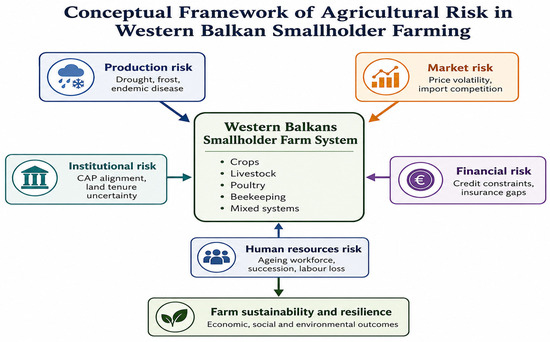
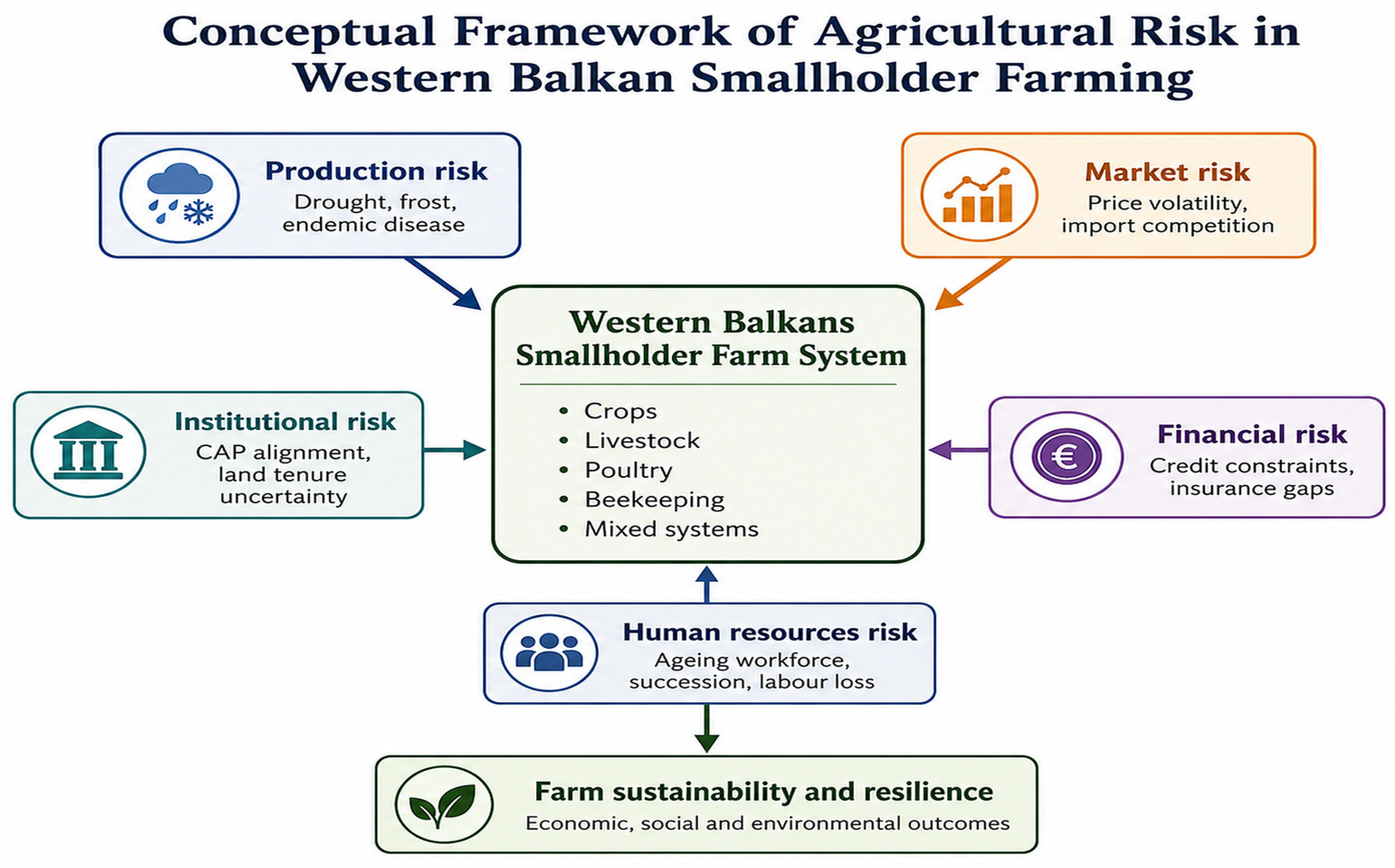
This evidence-mapping design was chosen because the regional literature is heterogeneous in methods, sectors and source types. Statistical pooling would therefore be inappropriate, whereas systematic classification can transparently show where evidence is concentrated, thin or missing. Figure 1 summarises this conceptual framework.
Figure 1.
Conceptual framework of smallholder agricultural risk in the Western Balkans.
3.2. Search Strategy
The literature search followed PRISMA 2020 guidance and was conducted between January and March 2026 [86]. The main identification stream was conducted through SciSpace, used as a discovery interface for Scopus-indexed literature. This approach was embedded in a multi-source verification protocol rather than treated as a stand-alone retrieval procedure. All records retained from the SciSpace stream were manually checked for bibliographic completeness, thematic relevance, source type and compliance with the eligibility criteria. In addition, each retained record was cross-referenced against Google Scholar, Semantic Scholar and OpenAlex, while records identified through these supplementary platforms were checked against the SciSpace/Scopus-indexed stream and the reference lists of included studies. This bidirectional cross-referencing reduced the risk of platform-specific omission and ensured that no eligible study identified through any search stream or citation chain was lost before final screening and coding.
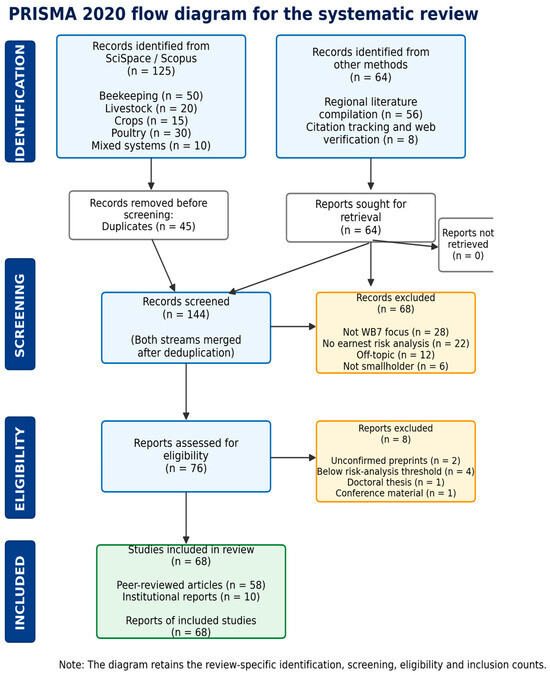
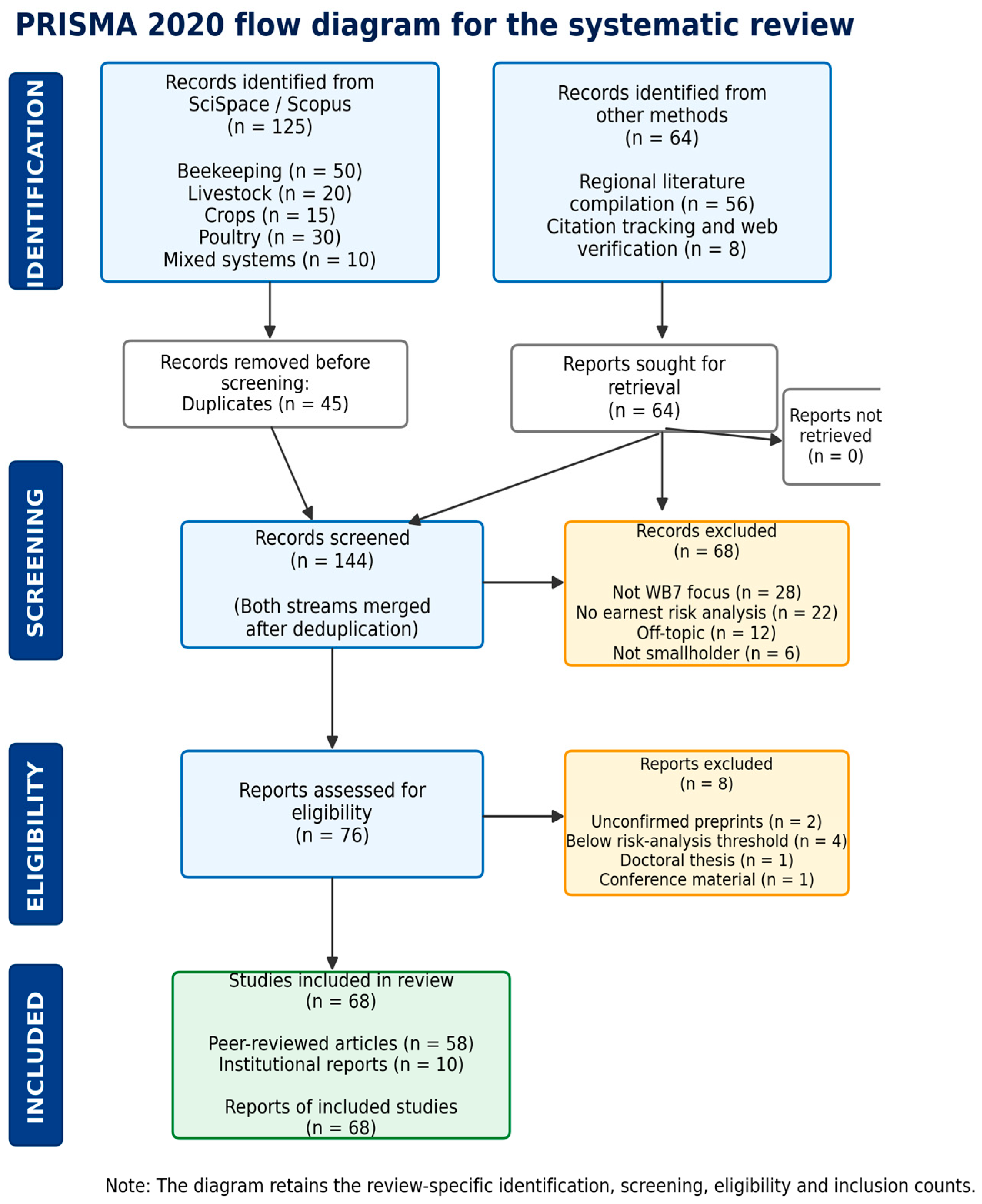
This systematic literature review was conducted and reported in accordance with the PRISMA 2020 statement [86]. The PRISMA 2020 flow diagram is presented in Figure 2, and a larger version is also provided as Supplementary Figure S1 for readability. The completed PRISMA 2020 checklist is provided as Supplementary File S1. The review was not prospectively registered, and no separate review protocol was publicly deposited.
Figure 2.
PRISMA 2020 flow diagram for the systematic review of agricultural risk in WB7 smallholder agriculture.
Five enterprise-specific search rounds were conducted for crops, livestock, poultry, beekeeping and mixed systems. Each search combined three concept blocks: geographic terms covering the seven WB7 countries; risk-related terms covering production, market, institutional, human resources and financial risk; and enterprise-specific vocabulary. Searches were limited to publications from 1995 to 2025.
The final manual verification and screening reconciliation were completed in March 2026. The full enterprise-specific search-string structure, including the geographical, risk-related and enterprise-specific term blocks, is provided in Supplementary Table S1. No formal language restriction was imposed at the screening stage; however, because the main discovery stream relied on Scopus-indexed metadata and international search platforms, possible language and coverage limitations are acknowledged in Section 5.5.
To reduce coverage bias and improve the representation of regional literature, the main search stream was complemented by two supplementary source streams. The first consisted of a pre-existing regional literature compilation assembled through Semantic Scholar, OpenAlex and Google Scholar. The second consisted of targeted citation tracking and manual verification for under-represented enterprise types and risk categories.
3.3. Eligibility Criteria
Studies were retained when they met five criteria. First, they had to focus geographically on one or more WB7 countries. Second, they had to address smallholder, family or small-to-medium farm operations. Third, they had to provide substantive empirical, quantitative or conceptual treatment of at least one of the five risk types. Fourth, they had to focus on crops, livestock, poultry, beekeeping or mixed farming systems. Fifth, they had to be published as peer-reviewed journal articles or as institutional reports from recognised organisations. Studies that mentioned risk only in the introduction or motivation, without analysing it substantively, were excluded, following the earnest-risk-analysis logic used in previous review work [4].
3.4. Screening and Classification
The search identified 189 records before deduplication: 125 from the SciSpace/Scopus-indexed stream and 64 from supplementary methods. After removing 45 duplicates, 144 unique records were screened by title and abstract. Sixty-eight were excluded for lacking a WB7 focus, lacking substantive risk analysis, being off topic, or not addressing smallholder or family farm operations. Seventy-six reports were assessed at full-text level. Eight were excluded, leaving 68 eligible studies: 58 peer-reviewed articles and 10 institutional reports.
Screening and coding were carried out using a structured extraction sheet. Title and abstract screening was conducted by one author, while a randomly selected 20% sample of records was independently checked by a second author to verify consistency. Any discrepancies, where present, were resolved through discussion among the authors. Full-text eligibility assessment and evidence coding were conducted using the structured extraction sheet. Multi-risk and multi-enterprise assignments, particularly in ambiguous cases, were cross-checked to ensure consistent application of the substantive-analysis threshold. For each report, the coding fields included country or regional focus, enterprise type, risk category, method, source type, publication year and justification for inclusion. Ambiguous cases were resolved by returning to the full text and assigning a study to multiple categories only when the relevant risk or enterprise type was substantively analysed rather than merely mentioned. This procedure underpins the complete study-to-matrix mapping reported in Appendix A.
The classification procedure was therefore guided by the predefined five-risk typology and enterprise categories introduced in Section 3.1, while allowing multiple coding only when a study substantively analysed more than one risk or enterprise dimension.
For each eligible study, coding recorded the country or regional focus, enterprise type, risk type, method and justification for inclusion. A study could be assigned to more than one risk category and, where substantively justified, to more than one enterprise type. The matrix should therefore be read as an evidence map rather than as a set of mutually exclusive observations. Cell values represent matrix entries, not independent statistical observations. No chi-square test or correspondence analysis was applied because the classification structure does not satisfy the independence assumptions required for inferential treatment.
4. Results
The results are presented in three steps. Section 4.1 describes the final evidence base by time period and geography; Section 4.2 reports the 5 × 5 evidence-gap matrix; and Section 4.3 adds a complementary risk-overlap analysis to show the extent of multi-risk coverage across the included studies.
4.1. Descriptive Overview
The final database consists of 68 studies published between 2000 and 2025. The evidence base is recent: 51 studies appeared between 2015 and 2025, and 31 appeared between 2020 and 2025. Serbia accounts for the largest share of study locations, followed by Albania, Kosovo, Bosnia and Herzegovina, Croatia, North Macedonia and Montenegro. Twelve studies address the Western Balkans as a regional unit.
The temporal distribution indicates that agricultural-risk research in the WB7 has accelerated during the last decade, but this growth has not produced balanced coverage across countries, risks and enterprise types. The concentration of studies in more recent years also reflects increasing attention to climate, market and institutional pressures affecting smallholder agriculture.
Geographically, the database combines country-specific studies with regional analyses. This mix is important because the evidence-gap matrix is designed to identify not only national concentrations of research, but also regional blind spots that cut across the Western Balkans. The descriptive overview therefore provides the basis for interpreting the matrix as a map of research attention rather than as a measure of risk prevalence in the farming population.
4.2. The 5 × 5 Evidence-Gap Matrix
Table 1 cross-tabulates the 68 eligible studies by enterprise type and risk type. Because studies may address several risks or enterprise types, the totals should not be interpreted as mutually exclusive study counts. The matrix is a descriptive map of scholarly attention across risk–enterprise intersections.
Table 1.
Cross-tabulation of eligible studies by enterprise type and risk type. Red cells (n ≤ 2) indicate severe evidence gaps; yellow cells (n = 3–4) indicate thin coverage. Cell values are descriptive matrix entries, not mutually exclusive study counts.
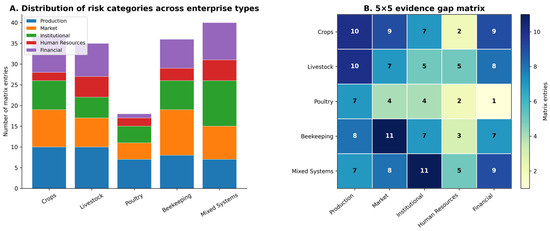
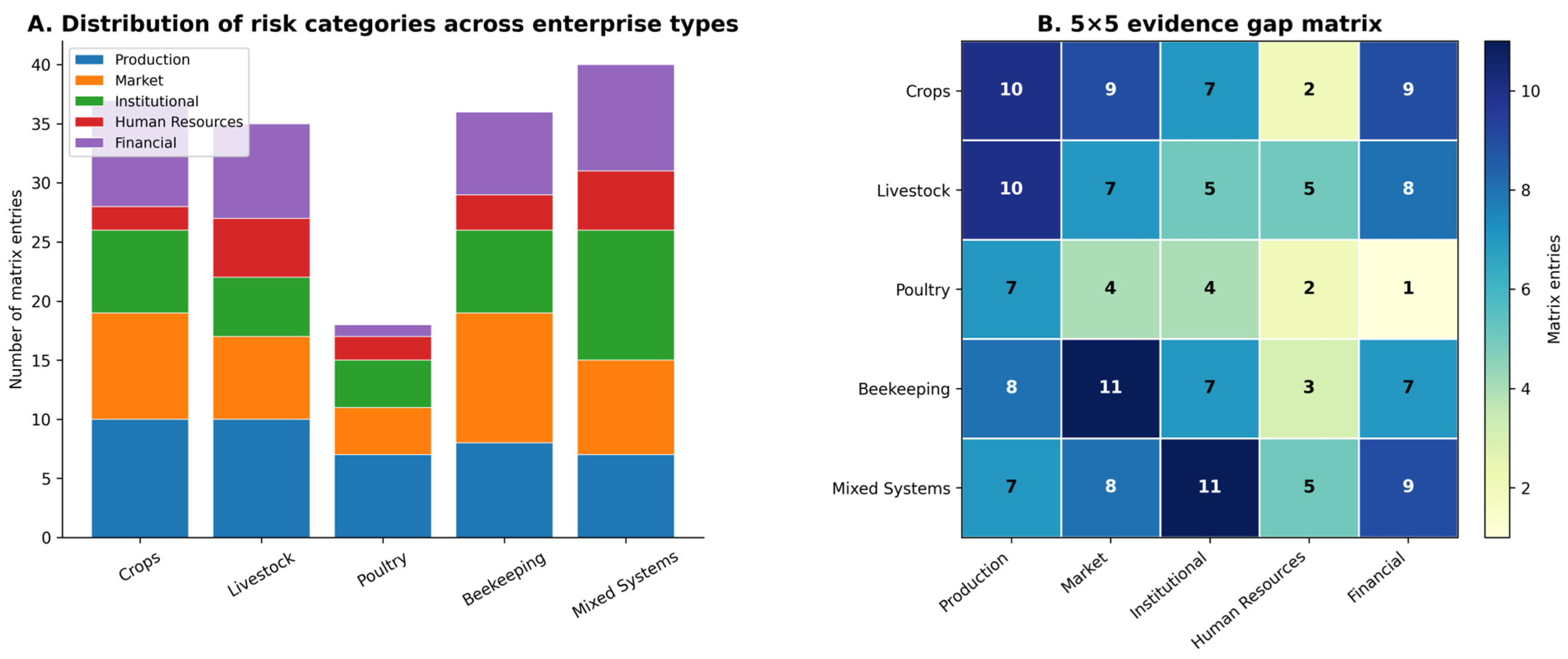
Figure 3 provides two complementary visual readings of the 5 × 5 evidence-gap matrix. Figure 3A shows the overall distribution of risk categories across enterprise types, indicating that crops, livestock, beekeeping and mixed systems have broader evidence coverage than poultry, while human resources risk remains comparatively weak across all enterprises. Figure 3B provides the cell-level interpretation of the matrix. The darker cells show where the WB7 evidence base is concentrated, particularly production risk in crops and livestock, market risk in beekeeping, and institutional risk in mixed systems. In contrast, the lighter cells reveal the weakest intersections, especially human resources risk in crops and poultry and financial risk in poultry.
Figure 3.
Descriptive visualisation of the 5 × 5 evidence-gap matrix: (A) stacked risk-category distribution by enterprise type; (B) heatmap of the risk–enterprise matrix.
Together, the stacked distribution and the heatmap show not only the dominance of production and market risk, but also the uneven enterprise-specific structure of the regional evidence base. This visual evidence is especially important because poultry production risk is well documented, yet the literature does not adequately examine how disease, biosecurity or market disruptions translate into credit exposure, insurance needs or investment constraints.
4.3. Complementary Risk-Overlap Analysis
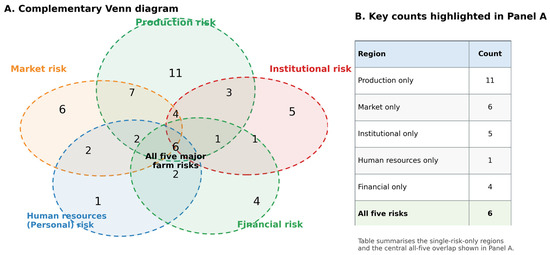
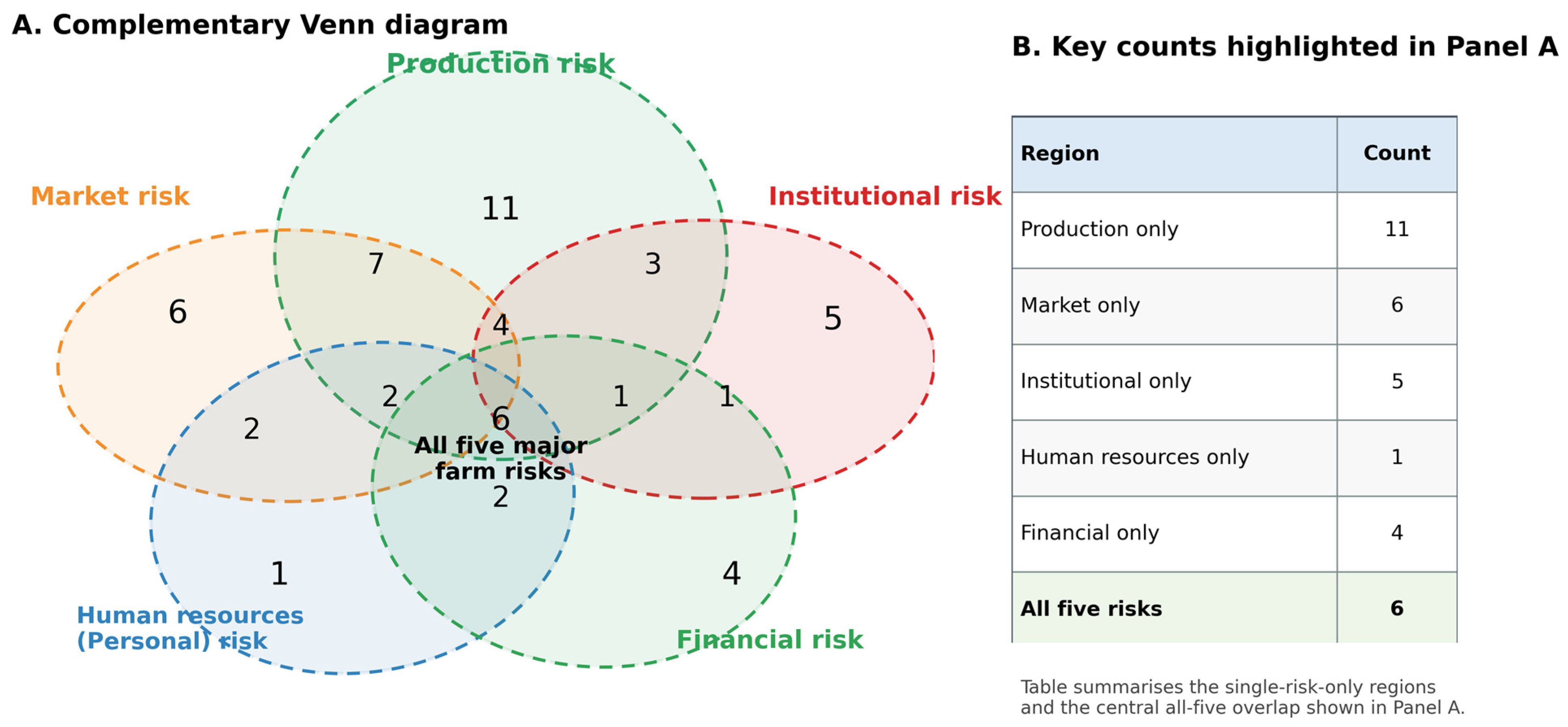
Figure 4 provides a complementary diagnostic tool. It does not replace the 5 × 5 evidence-gap matrix, which remains the main analytical instrument because it includes the enterprise dimension. Instead, the Venn diagram visualises the degree to which the literature remains fragmented across the five risk categories.
Figure 4.
Complementary overlap analysis of the five major farm-risk categories among the 68 eligible WB7 studies: (A) refined Venn diagram showing the overlap of the five major farm-risk categories; (B) summary table of the key counts highlighted in the diagram. The central intersection indicates studies addressing all five major farm risks simultaneously.
Twenty-two of the 68 studies address two or more risk types. This suggests that part of the WB7 literature has moved beyond single-risk analysis. However, the overlap remains partial: many studies cover only two, three or four risks, while only six studies address all five major farm risks simultaneously. These all-risk studies are still primarily perception-based, descriptive or sectoral, rather than based on quantitative simulation, econometric impact modelling or whole-farm welfare analysis.
For transparency, the detailed study allocation across the risk-overlap combinations represented in the Venn diagram is reported in Supplementary Table S2.
This result is central to the paper’s argument. Partial multi-risk coverage is a step forward, but it is not sufficient for a genuinely integrated understanding of smallholder exposure. Farm households experience production, market, institutional, human resources and financial risks as interacting components of the same livelihood portfolio, while the literature still tends to count them separately or analyse only subsets of the risk system.
Accordingly, this review distinguishes multi-risk coverage from genuine risk-interaction modelling. Multi-risk coverage refers to studies that mention, classify or score more than one risk category. Risk-interaction modelling would require an explicit analytical link among risks, for example showing how a production shock generates liquidity pressure, how institutional uncertainty affects market access and investment, or how labour disruption interacts with credit and production constraints. Most all-risk studies in the WB7 evidence base fall into the first category rather than the second.
Taken together, the results show a highly uneven evidence structure. The strongest concentrations occur where production, market or institutional risk has been studied in established enterprise contexts, while the weakest intersections concern human resources risk in crops and poultry and financial risk in poultry. The overlap analysis confirms that multi-risk coverage has increased, but genuine modelling of risk interactions remains rare.
5. Discussion
5.1. Asymmetric Evidence and Fragmented Multi-Risk Coverage
The WB7 evidence base reproduces the global asymmetry found in agricultural-risk research: production and market risks receive much greater attention than human resources and financial risks [4]. The regional matrix adds a second layer to this diagnosis by showing that the imbalance also varies by enterprise type. Crops, livestock and beekeeping receive comparatively stronger coverage, while poultry and human resources risk remain underdeveloped.
This pattern aligns with global agricultural-risk scholarship, but the WB7 setting gives it a specific structural meaning. In a region characterised by fragmented holdings, mixed livelihood portfolios and uneven institutional capacity, the dominance of production-oriented research may underestimate how market access, compliance requirements, household labour and finance jointly shape farm resilience.
To the best of our knowledge, directly comparable systematic evidence for the Western Balkans remains limited. Existing regional studies usually examine single countries, sectors or hazards, rather than mapping the five major farm-risk categories across enterprise types. This gap is practically important because agricultural entrepreneurs and farm managers make decisions within diversified portfolios, where production shocks, market access, institutional compliance, household labour capacity and finance interact. Analysing these risks jointly can therefore support more integrated decisions by farmers, advisory services and rural-development policymakers. The finding that only six eligible studies address all five risks simultaneously is consistent with Komarek et al. [4], confirming that fragmented and production-dominated risk analysis is not only a regional limitation but also a wider global pattern in agricultural risk-management research.
The Venn diagram sharpens this interpretation. The issue is not only that many studies focus on a single risk. Even within the multi-risk subset, most studies remain incomplete because they do not cover the full portfolio of farm risk exposure. A study that captures production and market risk, for example, may still miss the institutional conditions that shape compliance, the human resources constraints that determine labour capacity, and the financial limits that shape investment or insurance decisions.
The most populated cells of the matrix should therefore be interpreted as clusters of risk mechanisms, not simply as bibliometric counts. Production risk in crops and livestock reflects the combined pressure of climatic variability, disease exposure, feed and water constraints, weak biosecurity and limited farm-level risk planning. These factors convert biophysical shocks into income instability and investment hesitation. The concentration of market-risk evidence in beekeeping points to a different mechanism. Small producers are exposed to cheap imported honey, informal sales channels, limited collective marketing, weak branding and variable product-quality requirements. Market access and product credibility therefore become central sources of vulnerability. Institutional risk in mixed systems reflects the way land fragmentation, incomplete cadastral and advisory systems, uneven subsidy access and EU-alignment requirements interact across several activities within the same household portfolio. Conversely, the weakest cells are analytically important because they reveal what the literature still does not measure. Ageing, illness, succession and labour scarcity are rarely modelled as productive-risk variables. Poultry-sector financial risk also remains under-analysed, although disease outbreaks, biosecurity costs and market disruptions can create liquidity pressure, insurance needs and constrained reinvestment.
Two gaps appear especially persistent. Poultry financial risk remains under-researched because poultry studies in the region are concentrated on disease, biosecurity and sector-level production constraints, whereas the financial transmission channels of these shocks—liquidity, credit exposure, insurance demand and reinvestment capacity—are rarely measured. Human resources risk remains thin because ageing, labour scarcity, illness and succession are more often treated as rural background conditions than as farm-level risk variables affecting production continuity, investment capacity and resilience.
5.2. The Methodological Ceiling in Regional Risk Analysis
The review identifies a methodological ceiling. Studies covering all five risks are important, but they mostly rely on Likert-scale perception surveys, comparative indices or descriptive sector reviews. They help identify what farmers perceive as important, but they do not estimate the joint welfare effects of simultaneous shocks. The region still lacks panel datasets, whole-farm simulations, portfolio-based insurance modelling and econometric designs capable of capturing interactions among yield shocks, price changes, policy uncertainty, labour disruption and debt exposure.
This limitation has practical consequences. Without integrated risk modelling, policy instruments are likely to remain partial. Insurance products may be calibrated to isolated hazards; extension services may focus on technical production advice while ignoring credit constraints; and subsidy schemes may target single commodities rather than diversified household portfolios. The matrix and Venn diagram together show why risk management in the WB7 should move from hazard-specific responses toward integrated portfolio-based design.
5.3. Policy Implications for Sustainable Rural Development
Three policy implications follow. First, agricultural insurance should be redesigned around the diversified structure of smallholder portfolios. Evidence of low insurance uptake and weak animal-insurance penetration suggests that existing instruments are poorly aligned with the needs of small family farms [73,77,79,82]. Whole-farm revenue protection, bundled multi-peril products and size-sensitive premium subsidies are promising directions, but they require stronger data on joint risk exposure.
Second, institutional risk created by EU alignment requires stronger extension and advisory services. Compliance with food-safety, traceability and production standards can generate modernisation incentives, but it can also create regulatory pressure for farms lacking capital and information. Better advisory systems could reduce this burden by translating regulatory requirements into practical farm-level decisions [5,7,57].
Third, human resources risk should be treated as a core element of rural resilience policy. Demographic decline, labour scarcity, succession failure and ageing are not merely social background conditions; they directly affect production continuity, innovation capacity and the ability of households to respond to shocks [3,45,65,66].
More operationally, these findings suggest that policy packages should combine risk instruments rather than address each risk separately. Insurance subsidies should be accompanied by advisory support, farm-record systems and credit products that recognise diversified household portfolios. Extension programmes should include financial planning, succession planning and compliance support, not only technical production advice. For poultry and other under-studied enterprises, targeted data collection on costs, credit exposure and insurance demand would allow policymakers to design interventions on the basis of measured vulnerability rather than disease or production indicators alone.
5.4. Albania as an Illustrative Case
Albania illustrates why an integrated approach is needed. The country has one of the most fragmented farm structures in the region, with an average farm size close to 1.2 hectares, and smallholder households commonly combine crops, livestock, poultry and beekeeping activities [8,9]. Albanian evidence covers vegetable production risk, market competition, financial risk, legal risk in poultry, beekeeping threats and five-risk perception in apple farms [16,17,23,37,72,76,87]. At the same time, the wider regional matrix also incorporates evidence on policy-related financial exposure, livestock and dairy-sector risk, family poultry, honey production, small-farm resilience, agricultural insurance, short value chains and pandemic-related agri-food uncertainty [88,89,90,91,92,93,94,95,96,97]. Related recent Albanian evidence further examines demographic patterns in apple farmers’ risk perception [98].
These studies provide valuable enterprise-specific evidence, but they also show the limits of fragmented analysis. Albania needs data and methods that connect production shocks, market access, institutional compliance, household labour capacity and financial vulnerability within the same analytical design. Such integration would support better insurance design, more targeted extension services and more realistic rural-development policy.
5.5. Limitations
Several limitations should be noted. First, the search strategy combined SciSpace as a discovery interface for Scopus-indexed literature with regional literature compilation, OpenAlex, Semantic Scholar, Google Scholar, citation tracking and manual bibliographic verification. Even so, the review may still be affected by the general coverage limitations that characterise systematic reviews of regionally fragmented literature. Some studies published in local journals, institutional repositories or national languages may not have been fully visible through the selected search streams. This risk was reduced by combining database discovery with supplementary source tracking, cross-referencing and manual verification. However, it cannot be eliminated entirely in a region where part of the evidence base is dispersed across national outlets and institutional repositories.
The resulting evidence map should therefore be interpreted as a transparent synthesis of the visible and verifiable literature rather than as an exhaustive census of all agricultural-risk evidence produced in the region.
Second, the 5 × 5 classification necessarily simplifies overlapping risk sources. A single weather event may generate production, market and financial consequences at the same time. Assignment of a study to one or more cells therefore reflects analytical judgement rather than a bright-line rule. Third, matrix entries are not independent observations, because the same study may appear in multiple cells. Finally, the share of multi-risk studies should not be overinterpreted as evidence of analytical depth, because many such studies enumerate risk categories without modelling their interaction.
To limit this subjectivity, coding decisions were linked to substantive analytical treatment in the source text and reported through the study-to-matrix mapping in Appendix A.
6. Conclusions
This review provides an enterprise-level evidence-gap map of agricultural-risk research in the Western Balkans. By intersecting five major farm-risk categories with five enterprise types, it shows where the regional literature is concentrated and where important gaps remain. Production risk is the dominant object of study, market risk in beekeeping forms a clear concentration, and institutional risk in mixed systems reflects the regulatory pressures associated with post-socialist restructuring and European alignment. Human resources risk and poultry-sector financial risk remain particularly underdeveloped.
The main finding is that the regional evidence base is not only uneven by risk category, but also uneven across enterprise types. This means that research and policy priorities cannot be inferred from general agricultural-risk categories alone; they must also consider the specific enterprise settings in which smallholder households combine crops, livestock, poultry, beekeeping and mixed farming activities.
The complementary Venn diagram reinforces the central conclusion: the problem is not only the dominance of single-risk studies, but also the incompleteness of many multi-risk studies. Only six of the 68 eligible studies address all five major farm risks simultaneously, and these remain largely descriptive or perception-based. Future research should move from enumerating risks toward modelling their joint occurrence and welfare effects. For policy, the implication is clear: sustainable rural development in the WB7 requires risk-management instruments designed around diversified farm portfolios rather than isolated hazards.
More specifically, future work should prioritise financial-risk modelling in smallholder poultry systems, labour and succession risk in family farms, determinants of agricultural-insurance uptake, panel datasets that follow farms across seasons, and integrated whole-farm models linking production, market, institutional, human resources and financial shocks.
Supplementary Materials
The following supporting information can be downloaded at: https://www.mdpi.com/article/10.3390/su18168266/s1, The completed PRISMA 2020 checklist is provided as Supplementary File S1, a larger version of the PRISMA 2020 flow diagram is provided as Supplementary Figure S1 for readability, and the enterprise-specific search-string structure is provided as Supplementary Table S1. The complete study-to-matrix coding file is integrated in Appendix A and can also be made available by the corresponding author upon reasonable request.
Author Contributions
Conceptualisation, A.M.; methodology, A.M.; literature search strategy and article listing, E.S.; data curation, A.M. and E.S.; formal analysis, A.M. and A.K.; visualisation and Figure 3, A.K.; writing—original draft preparation, A.M.; writing—review and editing, G.Ç.; critical review, G.Ç.; supervision, A.M.; project administration, A.M. All authors have read and agreed to the published version of the manuscript.
Funding
This research was funded by the National Agency for Scientific Research and Innovation of Albania (NASRI), under the project “Risk Management in Agriculture: The Need to Foster Entrepreneurial Skills among Albanian Farmers”.
Institutional Review Board Statement
Not applicable.
Informed Consent Statement
Not applicable.
Data Availability Statement
The study-level coding data supporting the findings of this review are included in Appendix A and are available from the corresponding author upon reasonable request.
Acknowledgments
During the preparation of this manuscript, the authors used generative AI tools to support reference formatting and verification, language editing, and consolidation of earlier drafts. All outputs were reviewed and edited by the authors, who take full responsibility for the content of this publication.
Conflicts of Interest
The authors declare no conflicts of interest.
Appendix A. Complete Study-to-Matrix Mapping
This appendix lists all eligible studies included in the systematic review and maps them to the assigned cells in the 5 × 5 risk–enterprise matrix. Country codes: ALB = Albania, BIH = Bosnia and Herzegovina, HRV = Croatia, KOS = Kosovo, MNE = Montenegro, NMK = North Macedonia, SRB = Serbia, WB = Western Balkans. Risk codes: PR = Production, MR = Market, IR = Institutional, PeR = Personal/Human resources, FR = Financial. Enterprise codes: C = Crops, L = Livestock, Po = Poultry, B = Beekeeping, M = Mixed systems.
Table A1.
Coding of included studies by country, enterprise type, risk category and method.
References
- Hardaker, J.B.; Huirne, R.B.M.; Anderson, J.R.; Lien, G. Coping with Risk in Agriculture, 2nd ed.; CABI Publishing: Wallingford, UK, 2004. [Google Scholar]
- Harwood, J.; Heifner, R.; Coble, K.; Perry, J.; Somwaru, A. Managing Risk in Farming: Concepts, Research, and Analysis (Agricultural Economic Report No. 774); U.S. Department of Agriculture, Economic Research Service: Washington, DC, USA, 1999.
- Lampietti, J.; Lugg, D.G.; der Celen, P.V.; Branczik, A. The Changing Face of Rural Space: Agriculture and Rural Development in the Western Balkans; World Bank Publications: Washington, DC, USA, 2009. [Google Scholar]
- Komarek, A.M.; De Pinto, A.; Smith, V.H. A review of types of risks in agriculture: What we know and what we need to know. Agric. Syst. 2020, 178, 102738. [Google Scholar] [CrossRef] [Scilit]
- Volk, T.; Rednak, M.; Erjavec, E. Western Balkans agriculture and European integration: Unused potential and policy failures? Post-Communist Econ. 2012, 24, 111–123. [Google Scholar] [CrossRef] [Scilit]
- Mizik, T. Land, as a bottleneck of the Western Balkans’ agriculture. In Proceedings of the 142nd European Association of Agricultural Economists Seminar, Budapest, Hungary, 29–30 May 2014. [Google Scholar] [CrossRef]
- Bajramović, S.; Bogdanov, N.; Butković, J.; Dimitrovski, D.; Erjavec, E.; Gjeci, G.; Gjokaj, E.; Hoxha, B.; Stomenkovska, I.J.; Konjevic, D.; et al. Analysis of the Agricultural and Rural Development Policies of the Western Balkan Countries; Publications Office of the European Union: Luxembourg, 2016. [Google Scholar]
- Edmeades, S.; Tebaldi, E. Exploring the Potential of Agriculture in the Western Balkans: A Regional Report; World Bank Publications: Washington, DC, USA, 2018. [Google Scholar]
- Food and Agriculture Organization. Smallholders and Family Farms in Albania–Country Study Report 2019; FAO: Budapest, Hungary, 2020. [Google Scholar] [CrossRef] [Scilit]
- Zhang, F.; Zorya, S.; Zivkov, G. Greening Agriculture in the Western Balkans; World Bank Publications: Washington, DC, USA, 2024. [Google Scholar]
- Eurostat. Farms and Farmland in the European Union–statistics. Eurostat Statistics Explained. Available online: https://ec.europa.eu/eurostat/statistics-explained/index.php?title=Farms_and_farmland_in_the_European_Union_-_statistics (accessed on 13 July 2026).
- Eurostat. Glossary: Standard output (SO). Eurostat Statistics Explained. Available online: https://ec.europa.eu/eurostat/statistics-explained/index.php?title=Glossary:Standard_output_(SO) (accessed on 13 July 2026).
- Novaković, T.; Milić, D.; Novaković, D.; Tomaš Simin, M.; Zekić, V. Eco-efficiency of crop production in the European Union and Serbia. Agriculture 2025, 15, 2158. [Google Scholar] [CrossRef] [Scilit]
- Popovic, R.; Radovanov, B.; Dunn, J.W. Food scare crisis: The effect on Serbian dairy market. Int. Food Agribus. Manag. Rev. 2017, 20, 113–118. [Google Scholar] [CrossRef] [Scilit]
- Djurdjevic, B.; Polacek, V.; Pajić, M.; Petrović, T.; Vučićević, I.; Vidanović, D.; Aleksić-Kovačević, S. Highly pathogenic avian influenza H5N8 outbreak in backyard chickens in Serbia. Animals 2023, 13, 700. [Google Scholar] [CrossRef] [Scilit] [PubMed]
- Ndregjoni, A.; Murrja, A.; Prendi, L. Analysis of legal risk in farms of intensive chicken production: The case of Kosovo. WSEAS Trans. Environ. Dev. 2023, 19, 655–667. [Google Scholar] [CrossRef] [Scilit]
- Ćerpja, T.; Murrja, A. Market risk analysis: Microeconomic aspect of vegetable farms in Guri i Zi administrative unit, Shkodër in Albania. WSEAS Trans. Bus. Econ. 2024, 21, 885–895. [Google Scholar] [CrossRef] [Scilit]
- Filipović, Z.; Dumendžić, H. Honey market in the Republic of Croatia: Challenges and perspectives of small producers–Case study. Int. Interdiscip. J. 2024, 5, 63–73. [Google Scholar]
- Müller, D.; Hofmann, M. Impacts of Climate Change on Agriculture and Recommendations for Adaptation Measures in the Western Balkans; Leibniz Institute of Agricultural Development in Transition Economies (IAMO): Halle, Germany, 2022. [Google Scholar]
- van ’t Wout, T.; Sessa, R.; Pijunovic, V. Good Practices for Disaster Risk Reduction in Agriculture in the Western Balkans. In Climate Change Adaptation in Eastern Europe; Leal Filho, W., Trbic, G., Filipovic, D., Eds.; Springer: Cham, Switzerland, 2019. [Google Scholar]
- Topi, D.; Babič, J.; Pavšič-Vrtač, K.; Tavčar-Kalcher, G.; Jakovac-Strajn, B. Incidence of Fusarium mycotoxins in wheat and maize from Albania. Molecules 2021, 26, 172. [Google Scholar] [CrossRef] [Scilit] [PubMed]
- Miškić, M.; Njegomir, V.; Stojić, D. Agricultural entrepreneurship and production risk management in Serbian farms. Custos Agroneg. Line 2018, 14, 254–268. [Google Scholar]
- Murrja, A.; Kurtaj, D.; Ndregjoni, A.; Prendi, L. Vegetable farmers’ perception of production risk sources and environmental aspects. WSEAS Trans. Environ. Dev. 2023, 19, 826–835. [Google Scholar] [CrossRef] [Scilit]
- Koleci, X.; van Roon, A.; van Schaik, G.; Hodnik, J.J.; Strain, S.; Guelbenzu-Gonzalo, M.; Karalliu, E. An overview of current approaches and challenges to the control of endemic infectious cattle diseases in Albania. Front. Vet. Sci. 2021, 8, 671873. [Google Scholar] [CrossRef] [Scilit] [PubMed]
- Softić, A.; Martin, A.D.; Skjerve, E.; Fejzić, N.; Goletić, T.; Kustura, A.; Granquist, E.G. Reproductive performance in a selected sample of dairy farms in Una-Sana Canton, Bosnia and Herzegovina. Vet. Med. Int. 2020, 2020, 2190494. [Google Scholar] [CrossRef] [Scilit] [PubMed]
- Food and Agriculture Organization. Small Ruminant Value Chain Analysis for Montenegro. Available online: https://openknowledge.fao.org/bitstreams/7354995c-7a55–4835–8e65–615466843543/download (accessed on 13 July 2026).
- Sredojević, Z.; Popović, N. Sheep farming, pastures, sustainability: An economic model of sheep farm for rural areas in Serbia. In Proceedings of the Sustainable Agriculture and Rural Development in Terms of the Republic of Serbia Strategic Goals Realization Within the Danube Region, Belgrade, Serbia, 5–6 June 2014. [Google Scholar]
- Vico, G.; Pandurević, T.; Kostić, S.; Rajić, Z. Properties of dairy production in the Sarajevo-Romanija region. Acta Agric. Serbica 2011, 16, 135–143. [Google Scholar]
- Djurdjević, B.; Samojlović, M.; Lupulović, D.; Petrović, T.; Polaček, V.; Knežević, S.; Pajić, M. Temporal dynamics and surveillance of highly pathogenic H5 avian influenza in wild birds in northern Serbia (2016–2025). Vet. Sci. 2025, 12, 894. [Google Scholar] [CrossRef] [Scilit] [PubMed]
- Shtylla Kika, T.; Çoçoli, S.; Mersini, K.; Shoshi, N. Biosecurity evaluation on intensive laying hens’ farms in Albania: Assessing practices and recommendations for disease prevention. J. Agron. Technol. Eng. Manag. 2024, 7, 1252–1259. [Google Scholar] [CrossRef] [Scilit]
- Koro, A.; Elezaj, I.; Hadžiabdić, S.; Alić, A.; Rešidbegović, E. Occurrence of Salmonella spp. in backyard poultry in Bosnia and Herzegovina. Iran. J. Vet. Res. 2022, 23, 1–6. [Google Scholar] [PubMed]
- Murrja, A.; Ndreca, P.; Maloku, S.; Meço, M. Analysis of production risk in intensive chicken farms: The case of Kosovo. Folia Acon. Stetin. 2023, 23, 294–310. [Google Scholar] [CrossRef] [Scilit]
- Qorri, D. Poultry sector analysis in Albania. Appl. Stud. Agribus. Commer.–APSTRACT 2022, 16, 1–16. [Google Scholar] [CrossRef] [Scilit] [PubMed]
- Korro, K.; Malutaj, V.; Moka, G.; Elezi, M.; Elezi, B. Risk analysis of Apis mellifera colony losses and health assessment in Albania from 2021 to 2023. Sci. Horiz. 2024, 27, 90–99. [Google Scholar] [CrossRef] [Scilit]
- Stojanov, D.P.; Dimitrov, L.; Danihlík, J.; Uzunov, A.; Golubovski, M.; Andonov, S.; Brodschneider, R. Direct economic impact assessment of winter honeybee colony losses in three European countries. Agriculture 2021, 11, 398. [Google Scholar] [CrossRef] [Scilit]
- Šarić, B.; Paraušić, V.; Subić, J. Deforestation and pesticide use in the Balkans: Beekeepers’ recommendations. J. Environ. Prot. Ecol. 2023, 24, 433–445. [Google Scholar]
- Kuliçi, M.; Kokthi, E.; Hasani, A.; Zoto, O.; Marcelino, J.A.P.; Giordano, R. Threats and drivers of change in populations of managed honey bees (Apis mellifera) in the Balkan countries of Albania and Kosovo. Bull. Insectology 2023, 76, 247–257. [Google Scholar]
- Kuliçi, M. Trend of honey bee colonies in Albania and threatening factors. Optime 2024, 2, 38–45. [Google Scholar] [CrossRef] [Scilit]
- Sopaj, F.; Kastrati, G.; Stafilov, T.; Šajn, R.; Tašev, K.; Paçarizi, M. Honey and bee pollen as bioindicators of mercury and thallium exposure in Kosovo. Toxicol. Environ. Chem. 2025, 107, 952–970. [Google Scholar] [CrossRef] [Scilit]
- Makaš, M.; Nikolić, A.; Uzunović, M.; Krilić, A.; Bećirović, E.; Falan, V. Input/output price parity of maize and wheat in Bosnia and Herzegovina. Works Fac. Agric. Food Sci. Univ. Sarajevo 2017, 61, 439–445. [Google Scholar]
- Brankov, T.; Matkovski, B. Is a food shortage coming to the Western Balkans? Foods 2022, 11, 3672. [Google Scholar] [CrossRef] [Scilit] [PubMed]
- Stojanović, Ž.; Dragutinovic-Mitrovic, R.; Jankovic, I.; Ristic, B. Food chain structure, price and risk management strategies: Insights from the Serbian raspberry case study. In Proceedings of the 13th European International Farming Systems Association (IFSA) Symposium, Farming systems: Facing Uncertainties and Enhancing Opportunities, Chania, Greece, 1–5 July 2018. [Google Scholar]
- Kovljenić, M.; Matkovski, B.; Djokić, D. Competitiveness and cereal self-sufficiency in Western Balkan countries. Agriculture 2024, 14, 1480. [Google Scholar] [CrossRef] [Scilit]
- Biçoku, Y.; Zeqiri, M. The dynamics of Albania’s meat sector: Trends and implications. Int. J. Agric. Environ. Res. 2024, 10, 565–598. [Google Scholar] [CrossRef] [Scilit]
- Xhoxhi, O.; Szucs, T. Small Ruminant Value Chains in Western Balkan Countries; FAO: Budapest, Hungary, 2024. [Google Scholar] [CrossRef] [Scilit]
- Dedej, S.; Delaplane, K.S.; Gocaj, E. A technical and economic evaluation of beekeeping in Albania. Bee World 2000, 81, 87–97. [Google Scholar] [CrossRef] [Scilit]
- Frick, M.; Grgić, Z.; Franić, R.; Štefanić, I.; Kezić, N. Cooperative business potential for beekeepers in Croatia. J. Apic. Res. 2006, 45, 223–229. [Google Scholar] [CrossRef] [Scilit]
- Barlović, N.; Kezić, J.; Osmanagić Bedenik, N.; Grgić, Z. Economic efficiency of beekeeping in Croatia. Agric. Conspec. Sci. 2009, 74, 51–54. [Google Scholar]
- Cvitković, D.; Grgić, Z.; Matašin, Ž.; Pavlak, M.; Filipi, J.; Tlak Gajger, I. Economic aspects of beekeeping production in Croatia. Vet. Arh. 2009, 79, 397–408. [Google Scholar]
- Nedić, M.N.; Nikolić, M.M.; Hopić, E.S. Economic justification of honey production in Serbia. J. Agric. Sci. Belgrade 2019, 64, 85–99. [Google Scholar] [CrossRef] [Scilit]
- Ćavlin, M.; Prdic, N.; Ignjatijević, S.; Vapa Tankosić, J.; Lekic, N.; Kostić, S. Research on the determination of the factors affecting business performance in beekeeping production. Agriculture 2023, 13, 686. [Google Scholar] [CrossRef] [Scilit]
- Paraušić, V.; Muça, E.; Subic, J.; Pomianek, I.; Bekić Šarić, B. Response of short food supply chains in Western Balkan countries to the COVID crisis: A case study in the honey sector. Eur. Countrys. 2024, 16, 86–109. [Google Scholar] [CrossRef] [Scilit]
- Dimitrieska, S.; Efremova, T. Problems in the promotion of honey and bee products. Entrepreneurship 2022, 10, 19–27. [Google Scholar] [CrossRef] [Scilit]
- Kluwede Aguiar, L.; Sejdaras, A. Recent developments in the apiculture sector in Albania: The insertion of beekeepers into the EU honey supply chain. Acta Hortic. 2008, 794, 41–46. [Google Scholar] [CrossRef] [Scilit]
- Silovska Nikolova, A.; Gjorgjiev, M. Production of chicken meat in the Republic of North Macedonia compared with the other former Yugoslav countries. Knowl.-Int. J. 2025, 69, 565–570. [Google Scholar]
- Maloku, D.; Kovács, K.; Shkodra, R. An economic assessment of poultry egg sector in Kosovo. Netw. Intell. Stud. 2020, 8, 71–79. [Google Scholar]
- Jurjević, Ž.; Zekić, S.; Matkovski, B.; Djokić, D. Sustainability of small farms in Serbia: A comparative analysis with the European Union. Agronomy 2022, 12, 2726. [Google Scholar] [CrossRef] [Scilit]
- Obradović, Ž.; Bačić, Ž. Land tenure and land consolidation issues in Bosnia and Herzegovina and Croatia. J. Geod. Geomat. Eng. 2016, 2, 8–17. [Google Scholar]
- Latruffe, L.; Davidova, S.; Desjeux, Y. Perpetuation of subsistence farming in Western Balkans: The role of factor market imperfections. In Proceedings of the 82nd Annual Conference, Royal Agricultural College, Cirencester, UK, 31 March–2 April 2008. [Google Scholar]
- Sauer, J.; Davidova, S.; Latruffe, L. Determinants of smallholders’ decisions to leave land fallow: The case of Kosovo. J. Agric. Econ. 2012, 63, 119–141. [Google Scholar] [CrossRef] [Scilit]
- Zivkov, G. Association of Farmers in the Western Balkan Countries; FAO: Budapest, Hungary, 2013. [Google Scholar]
- Šarić, B.; Muça, E.; Subić, J.; Bekić, B. Environmental threats to beekeeping in the Western Balkan countries: Beekeepers’ perceptions. Environ. Res. Commun. 2023, 5, 065003. [Google Scholar] [CrossRef] [Scilit]
- Đugum, I.; Ličina Sinanović, A.; Jašić, M. Legal approximation for beekeeping sector: Scope of transposition, institutional adjustment and status review in Bosnia and Herzegovina. In Proceedings of the 2nd Congress on Beekeeping and Bee Products, Gradačac, Bosnia and Herzegovina, 24 August 2017. [Google Scholar]
- Vapa-Tankosić, J.; Miler-Jerković, V.; Jeremić, D.; Stanojević, S.; Radović, G. Investment in research and development and new technological adoption for the sustainable beekeeping sector. Sustainability 2020, 12, 5825. [Google Scholar] [CrossRef] [Scilit]
- Bogdanov, N.; Cvejic, S. Poverty and social exclusion in rural Serbia–Position of family farms. Econ. Agric. 2011, 58, 3–15. [Google Scholar]
- Paraušić, V. Adaptability of quality of life in rural Serbia to the needs of young people: Perceptions of agricultural extension officers. West. Balk. J. Agric. Econ. Rural Dev. 2023, 5, 57–72. [Google Scholar] [CrossRef] [Scilit]
- Zhitia, E.; Leeb, C.; Muji, S.; Winckler, C. Welfare of dairy cows in Kosovo and intervention thresholds. Anim. Welf. 2022, 31, 483–493. [Google Scholar] [CrossRef] [Scilit]
- Bislimi, K. Determinants of family entrepreneurship in the beekeeping sector. J. Fam. Bus. Manag. 2020, 11, 342–357. [Google Scholar] [CrossRef] [Scilit]
- Ramadani, V.; Hisrich, R.D.; Dana, L.P.; Palalić, R.; Panthi, L. Beekeeping as a family artisan entrepreneurship business. Int. J. Entrep. Behav. Res. 2017, 25, 717–730. [Google Scholar] [CrossRef] [Scilit]
- Bekić-Šarić, B.; Paraušić, V.T.; Nastić, L.M. E-Agrar platform: Assessment of benefits and usage challenges from the perspective of beekeepers in Serbia. J. Agric. Sci. Belgrade 2025, 70, 205–217. [Google Scholar] [CrossRef] [Scilit]
- van ’t Wout, T.; Augustyn, A.; Terzić, D. Building capacities for agricultural disaster risk reduction in the western Balkan countries: The case of female farmers in Serbia. In Food Security and Land Use Change Under Conditions of Climatic Variability; Squires, V., Gaur, M., Eds.; Springer: Cham, Switzerland, 2020. [Google Scholar]
- Murrja, A.; Çera, G. Exploring the role of five key risks for apple farmers: An explanatory and inferential analysis. South East Eur. J. Econ. Bus. 2025, 20, 53–67. [Google Scholar] [CrossRef] [Scilit]
- Vasiljević, Z.; Zarić, V.; Šević, D. Insurance in agriculture of Serbia as precondition of risk minimization. In Proceedings of the 50th Anniversary Seminar, Agriculture and Rural Development: Challenges of Transition and Integration Processes, Belgrade, Serbia, 27 September 2013; pp. 306–316. [Google Scholar] [CrossRef]
- Stojanović, Ž.; Rakonjac-Antić, T.; Koprivica, M. Farmers’ willingness to purchase crop insurance: Evidence from wheat and raspberry sectors in Serbia. Ekon. Poljopr. 2019, 66, 1077–1093. [Google Scholar] [CrossRef] [Scilit]
- Kokot, Ž.; Marković, T.; Ivanović, S.; Radulović, M.; Bukvić, R. Whole-farm revenue protection as a factor of economic stability in crop production. Sustainability 2020, 12, 6349. [Google Scholar] [CrossRef] [Scilit]
- Kurtaj, D.; Çerpja, T.; Murrja, A. Financial risk analysis: Case study Guri I Zi in the municipality of Shkodër in Albania. WSEAS Trans. Environ. Dev. 2024, 20, 66–75. [Google Scholar] [CrossRef] [Scilit]
- Myslimi, G.; Nikolli, E.; Shima, J. Challenges of agricultural insurance development in Albania. Economicus 2022, 22, 51–62. [Google Scholar]
- Mirč, D.; Ignjatović, M.; Milić, D.; Crnojević, V.; Tica, N. Timely repayment of agricultural loans: Evidence from Serbian farmers. NEW MEDIT Mediterr. J. Econ. Agric. Environ. 2024, 4, 67–84. [Google Scholar] [CrossRef] [Scilit]
- Reka, A.; Gjoni, L.; Kosova, R.; Tabaku, E.; Kosova, A.M. Risk analysis and premium assessment in Albanian agricultural insurance. Int. J. Adv. Nat. Sci. Eng. Res. 2025, 9, 268–275. [Google Scholar] [CrossRef]
- Herzfeld, T.; Möllers, J.; Bajrami, E.; Davidova, S.; Gjonbalaj, M.; Miftari, I.; Krasniqi, N.; Xhabali, V. Commercialization of Smallholder Farms in Kosovo; FAO: Budapest, Hungary, 2022. [Google Scholar] [CrossRef] [Scilit]
- Jalić, N.; Rozman, Č.; Vaško, Ž.; Pažek, K. Determining the extent of economical sustainability of a case study milk farm in Bosnia and Herzegovina based on the real options model. Sustainability 2022, 14, 11993. [Google Scholar] [CrossRef] [Scilit]
- Food and Agriculture Organization. Analysis of the Agricultural Insurance System in Serbia and Recommendations for Better Effectiveness; FAO. 2021. Available online: https://openknowledge.fao.org/items/c472287d-9aae-49fc-8872-f9c9146a96b (accessed on 13 July 2026).
- Ljumović, I.; Vuković, V.; Viduka, B. Access to finance for organic producers in Serbia: Demand side. Ekon. Poljopr. 2015, 62, 989–1002. [Google Scholar] [CrossRef] [Scilit]
- Ćejvanović, F.; Grgić, Z.; Maksimović, A. Assumptions of economic model for sustainable productions of beekeeping in the Bosnia and Herzegovina. Am.-Eurasian J. Agric. Environ. Sci. 2011, 5, 481–485. [Google Scholar]
- Rodić, V.; Perić, L.; Pavlovski, Z.; Milosević, N. Improving the poultry sector in Serbia: Major economic constraints and opportunities. World’s Poult. Sci. J. 2010, 66, 241–250. [Google Scholar] [CrossRef] [Scilit]
- Page, M.J.; McKenzie, J.E.; Bossuyt, P.M.; Boutron, I.; Hoffmann, T.C.; Mulrow, C.D.; Shamseer, L.; Tetzlaff, J.M.; Akl, E.A.; Brennan, S.E.; et al. The PRISMA 2020 statement: An updated guideline for reporting systematic reviews. BMJ 2021, 372, n71. [Google Scholar] [CrossRef] [Scilit] [PubMed]
- Ndregjoni, A.; Doda, E. Factorial analysis of risk perceptions in agricultural farms: Evidence from Korçë county. Prizren Soc. Sci. J. 2025, 9, 36–45. [Google Scholar] [CrossRef] [Scilit]
- Ćejvanović, F.; Franić, R.; Rozman, Č. Transition in agriculture: Review on subsidy and custom rates effects in apple production in Bosnia and Herzegovina. J. Cent. Eur. Agric. 2006, 6, 357–364. [Google Scholar]
- Deže, J.; Ranogajec, L.; Kristić, J.; Faćko, M. Risk identification and management strategies in milk production. Agroecon. Croat. 2021, 11, 19–30. Available online: https://hrcak.srce.hr/269938 (accessed on 13 July 2026).
- Milićević, D.; Samolovac, L.; Lukić, M.; Milićević, D. Livestock sector in Serbia: Challenges, structural gaps, and strategic pathways towards sustainability. Sustainability 2025, 17, 7751. [Google Scholar] [CrossRef] [Scilit]
- Sulejmani, E.I.; Iseni, M.A. Sustainability and perspectives of the North Macedonian dairy industry. J. Agric. Sci. Belgrade 2023, 68, 19–41. [Google Scholar] [CrossRef] [Scilit]
- Alders, R.; Chagelishvili, G.; Hadžiali, N. Family Poultry Farming in Bosnia and Herzegovina, and Georgia: Preliminary Investigation Report; Food and Agriculture Organization of the United Nations. 2025. Available online: https://openknowledge.fao.org/handle/20.500.14283/cd3974en (accessed on 13 July 2026).
- Nikolić, M.; Nedić, N.; Djordjević-Milošević, S. Cost-effectiveness analysis of organic honey production in Serbia. Ekon. Poljopr. 2022, 69, 533–547. [Google Scholar] [CrossRef] [Scilit]
- Borychowski, M.; Stepień, S.; Polcyn, J.; Tošović-Stevanović, A.; Ćalović, D.; Lalić, G.; Žuža, M. Socio-economic determinants of small family farms’ resilience in selected Central and Eastern European countries. Sustainability 2020, 12, 10362. [Google Scholar] [CrossRef] [Scilit]
- Bielza Díaz-Caneja, M.; Conte, C.; Dittmann, C.; Gallego Pinilla, F.; Stroblmair, J. Agricultural Insurance Schemes. Joint Research Centre, European Commission, EUR 23392 EN 2008. Available online: https://publications.jrc.ec.europa.eu/repository/handle/JRC45927 (accessed on 13 July 2026).
- Djordjević Milošević, S.; Möllers, J.; Di Marcantonio, F.; Ciaian, P. The Best Practices and Potential of Smallholders’ Participation in Short Value Chains in the Western Balkans and Turkey; Publications Office of the European Union: Luxembourg, 2021. [Google Scholar] [CrossRef]
- Popovic, J.; Kvrgić, G.; Ćorić, G.; Avakumović, J.; Milošević, D. Uncertainty in SMEs’ assessment of coronavirus pandemic risk impact on agri-food sector in Western Balkans. Ekon. Poljopr. 2020, 67, 445–460. [Google Scholar] [CrossRef] [Scilit]
- Murrja, A.; Vejsiu, I.; Shumeli, A.; Çera, G. Who sees what risk? Demographic patterns in risk perception among apple farmers. J. Agribus. Dev. Emerg. Econ. 2026, 1–19. [Google Scholar] [CrossRef] [Scilit]

Disclaimer/Publisher’s Note: The statements, opinions and data contained in all publications are solely those of the individual author(s) and contributor(s) and not of MDPI and/or the editor(s). MDPI and/or the editor(s) disclaim responsibility for any injury to people or property resulting from any ideas, methods, instructions or products referred to in the content. |
© 2026 by the authors. Licensee MDPI, Basel, Switzerland. This article is an open access article distributed under the terms and conditions of the Creative Commons Attribution (CC BY) license.