


Abstract
Agricultural waste valorization offers a sustainable route for developing advanced materials for renewable energy applications. In this study, cellulose nanocrystals (CNCs) were extracted from melon agricultural residues through hydrochloric, sulfuric, and phosphoric acid hydrolysis and incorporated into a poly(vinyl alcohol) (PVA) matrix to fabricate proton exchange membranes for potential applications in glucose biofuel cells. The influence of CNC surface chemistry on membrane morphology, crystallinity, thermal stability, mechanical properties, proton conductivity, and glucose permeability was systematically investigated. CNC incorporation improved membrane compactness, crystallinity, and physicochemical stability compared with neat PVA. Among the developed membranes, PVA/CNC-S exhibited the best overall performance, showing the highest proton conductivity (1.032 × 10⁻² mS·cm−1 at 50 °C) and the lowest glucose permeability (3.25 × 10⁻⁹ cm2·s−1). Furthermore, the composite membranes exhibited enhanced thermal and oxidative stability due to strong intermolecular interactions between PVA and functionalized CNCs. The results reveal that CNC surface chemistry plays a crucial role in regulating membrane transport properties and structural organization. In particular, sulfate-functionalized CNCs improved proton transport while minimizing glucose crossover. These findings highlight the potential of agricultural waste-derived PVA/CNC membranes as sustainable, low-cost, and efficient proton exchange membranes for potential applications in glucose biofuel cells and related bioelectrochemical energy systems.
1. Introduction
In recent decades, the transition toward sustainable and environmentally friendly energy sources has become a major priority due to the depletion of fossil resources and increasing environmental challenges. In this context, biofuel cells have attracted considerable attention because of their ability to convert chemical energy from organic compounds into electrical energy with low environmental impact [1]. Among these technologies, biofuel cells have emerged as a promising alternative, particularly those using glucose as an energy source due to their renewable, biocompatible, and eco-friendly nature [2,3].
Glucose, an abundant molecule in biological systems, represents an ideal energy substrate for biofuel cells. Its electrochemical conversion into carbon dioxide and water generates the electrons and protons required for electricity production. Glucose biofuel cells have therefore been extensively investigated for biomedical applications, particularly in implantable devices, where they provide a sustainable alternative to conventional batteries. Furthermore, these systems show strong potential for low-power autonomous devices such as biosensors and miniaturized medical systems [4,5,6].
In these systems, the proton exchange membrane (PEM) plays a crucial role by ensuring the selective transport of protons from the anode to the cathode while limiting the passage of fuel molecules. The performance of biofuel cells strongly depends on membrane properties, particularly proton conductivity, chemical stability, mechanical resistance, thermal stability, and selectivity [7]. Commercial perfluorosulfonic acid-based membranes such as Nafion® 117 (Chemours, Wilmington, DE, USA) exhibit excellent performance; however, their high cost, environmental impact, and sensitivity to hydration conditions limit their large-scale utilization [8,9]. In addition, their permeability toward organic molecules may induce fuel crossover, thereby reducing the overall efficiency and operational stability of the system [9].
To overcome these limitations, the development of alternative membranes based on biodegradable and low-cost polymers has attracted growing interest. Poly(vinyl alcohol) (PVA) is one of the most extensively studied polymers because of its easy processability, film-forming ability, biocompatibility, and hydrophilic properties [10,11,12,13]. However, its low proton conductivity and high swelling sensitivity limit its direct use in electrochemical applications.
To improve PVA properties, numerous additives have been explored in the literature. The incorporation of strong acids such as sulfuric acid or phosphoric acid increases the density of mobile protons and improves proton conductivity [14,15,16,17]. However, these systems suffer from acid leaching, poor chemical stability, and long-term degradation of mechanical properties [18,19]. Similarly, the addition of inorganic salts can promotes ionic conduction but often leads to dimensional instability and increased moisture sensitivity [8,20]. The use of plasticizers such as glycerol improves flexibility and can promotes proton transport by increasing the amorphous phase, but it also causes excessive swelling and reduced mechanical strength [21,22].
In this context, cellulose nanocrystals (CNCs) appear as a particularly promising alternative. Derived from renewable, biodegradable, and abundant resources, CNCs possess a high specific surface area, excellent mechanical rigidity, and tunable surface chemistry [23,24]. Their functionalization through acid hydrolysis introduces active groups such as sulfate and phosphate groups, which may facilitate proton dissociation and enhance proton transport across the membrane [24,25]. In addition, CNCs contribute to reinforcing mechanical properties, improving thermal stability, and reducing swelling, thereby offering a better compromise between conductivity, stability, and durability [26,27]. Owing to their nanoscale structure and high density of hydroxyl groups, CNCs also promote the formation of efficient hydrogen-bonding networks that facilitate proton transport.
Moreover, the valorization of agricultural waste as a cellulose source represents a sustainable and economically attractive strategy within the framework of the circular economy. Melon agricultural residues constitute an abundant and underexploited lignocellulosic biomass that can be transformed into high-value materials. The utilization of these wastes not only reduces the environmental impact associated with their accumulation but also enables the development of bio-based materials for advanced energy applications [24].
In the present work, cellulose nanocrystals were extracted from melon plant agricultural residues through acid hydrolysis using three different acids: hydrochloric acid (CNC-H), sulfuric acid (CNC-S), and phosphoric acid (CNC-P) [24]. These nanocrystals were subsequently incorporated into a PVA matrix to develop composite membranes intended for glucose biofuel cell applications.
The main objective of this work is to develop eco-friendly, high-performance, and low-cost proton exchange membranes for glucose biofuel cell applications using cellulose nanocrystals (CNCs) extracted from melon agricultural residues. The originality of this study lies in the systematic comparison of CNCs produced through three different acid hydrolysis routes (hydrochloric, sulfuric, and phosphoric acids) in order to evaluate the influence of their surface chemistry on the functional properties of PVA-based composite membranes. This work aims to establish correlations between the surface functional groups introduced onto the CNCs and the resulting membrane performance, including proton conductivity, glucose permeability, dimensional stability, mechanical properties, and thermal resistance. By combining the valorization of underutilized agricultural waste with the engineering of bio-based membranes, this study seeks to provide a sustainable alternative to conventional commercial proton exchange membranes while generating new insights into the role of functionalized cellulose nanocrystals in energy conversion applications.
2. Materials and Methods
2.1. Materials
Poly(vinyl alcohol) (PVA, 99%) with degree of polymerization in the range of 1700–1800 and degree of hydrolysis ≥ 98% was purchased from LobaChemie Pvt. Ltd. (Mumbai, India). Agricultural residues from melon plant were used as the raw material for cellulose extraction. Sulfuric acid (H2SO4, 95–98%), hydrochloric acid (HCl, 37%), and phosphoric acid (H3PO4, 85%), sodium chloride (NaCl), D-(+)-glucose monohydrate (C6H12O6·H2O), hydrogen peroxide (H2O2) and ferrous sulfate heptahydrate (FeSO4·7H2O) were purchased from Sigma-Aldrich (St. Louis, MO, USA) and Phenolphthalein indicator dye (C20H14O4) was provided by the Solvachim (Casablanca, Morocco). All chemicals were analytical grade and used as received.
2.2. Cellulose Extraction and CNC Preparation
Cellulose was extracted from post-harvest of melon plant residues following a previously reported procedure [24]. Briefly, the biomass was subjected to successive alkaline and bleaching treatments to remove non-cellulosic components, yielding purified cellulose.
Cellulose nanocrystals (CNCs) were then obtained by acid hydrolysis using hydrochloric acid, sulfuric acid, and phosphoric acid, as described in our previous work [24]. The resulting suspensions were designated CNC-H, CNC-S, and CNC-P, respectively.
After hydrolysis, the suspensions were purified by repeated centrifugation, dialysis until neutral pH, and ultrasonic treatment to ensure stable dispersion.
2.3. Preparation of PVA/CNC Composite Membranes
A 10 wt% aqueous PVA solution was prepared by dissolving PVA powder in deionized water at 90 °C under continuous stirring for 2 h. To specifically investigate the influence of the surface chemistry of cellulose nanocrystals obtained through different acid hydrolysis routes while maintaining a constant nanocellulose content, the CNC loading was fixed at 10 wt% relative to the dry mass of PVA for all membrane formulations. Accordingly, the amount of CNC added was calculated based on the dry CNC mass according to Equation (1):
where is the dry mass of PVA. The required volume of each CNC suspension was then calculated from its dry CNC concentration and added to the PVA solution. The mixtures were stirred for 1 h at room temperature to obtain homogeneous casting solutions.
The resulting solutions were cast into Petri dishes and dried at 40 °C for 48 h. The obtained membranes were designated PVA/CNC-H, PVA/CNC-S, and PVA/CNC-P according to the type of cellulose nanocrystals incorporated.
2.4. Characterization of Membranes
2.4.1. X-Ray Diffraction (XRD)
The crystalline structure of the membranes was analyzed using an X-ray diffractometer equipped with Cu Kα radiation (λ = 1.5406 Å). The measurements were carried out over a 2θ range from 5° to 60°.
The membranes were cut into flat pieces and mounted on the sample holder. The obtained diffractograms were used to identify the characteristic peaks of PVA and CNCs and to evaluate the effect of CNC incorporation on the structural organization of the polymer matrix.
The crystallinity index was estimated using the Segal method according to the following Equation (2):
where
- is the crystallinity index (%);
- is the maximum intensity of the crystalline peak corresponding to the (200) plane, generally located at ;
- is the intensity of the amorphous phase, generally measured at .
2.4.2. Fourier Transform Infrared (FTIR) Analysis
FTIR analysis was performed to identify the functional groups and investigate the intermolecular interactions between PVA and cellulose nanocrystals in the prepared membranes. The spectra were recorded in the range of 4000–600 cm−1 using an FTIR spectrometer equipped with an ATR accessory, with a resolution of 4 cm−1 and 32 scans per sample.
2.4.3. Surface Morphology (SEM)
The surface morphology of the membranes was analyzed using a scanning electron microscope (QUATTRO S-FEG, Thermo Fisher Scientific, Brno, Czech Republic). operated at an accelerating voltage of 15 kV. Before observation, the samples were sputter-coated with a thin conductive carbon layer using an ion sputtering system to enhance conductivity and imaging quality. SEM images were collected at different magnifications to investigate the membrane surface structure and filler dispersion.
2.4.4. Thermogravimetric Analysis (TGA)
The thermal stability of the membranes was investigated using thermogravimetric analysis under a nitrogen atmosphere to prevent oxidative degradation. Approximately 5–10 mg of dried membrane sample was placed in an alumina pan.
The analysis was performed from room temperature to 700 °C at a heating rate of 10 °C·min−1.
2.4.5. Oxidative Stability (Fenton Test)
Oxidative stability was evaluated by immersing membrane samples in Fenton reagent containing hydrogen peroxide and ferrous ions for 24 h. After treatment, membranes were washed, dried, and weighed. Residual weight (%) was calculated as Equation (3):
where and are membrane weights before and after treatment, respectively.
2.4.6. Tensile Testing
Mechanical properties were measured using a universal tensile testing machine equipped with a suitable load cell. The membranes were cut into rectangular strips of standard dimensions (50 mm × 20 mm).
2.4.7. Contact Angle Measurement
The surface hydrophilicity of the membranes was evaluated by contact angle measurement using an optical goniometer at room temperature.
A distilled water droplet (approximately 5 µL) was gently deposited on the horizontal membrane surface. The droplet image was immediately recorded, and the contact angle was determined using the associated software.
2.4.8. Water Uptake
The water uptake (WU(%)) of the membranes was determined using the gravimetric method. The membranes were first dried in an oven at 60 °C for 24 h and weighed to obtain the initial dry mass (). They were then immersed in distilled water at room temperature for 24 h. After immersion, the membranes were removed, gently wiped with filter paper to eliminate surface water, and immediately weighed to obtain the wet mass () [11].
The water uptake was calculated according to Equation (4):
2.4.9. Ion-Exchange Capacity (IEC)
The ion-exchange capacity of the membranes was determined by acid–base titration.
The membranes were first immersed in 1 M HCl solution for 24 h to convert all exchangeable sites into protonated form. They were then thoroughly rinsed with distilled water to remove excess acid.
The protonated samples were immersed in 50 mL of 1 M NaCl solution for 24 h to exchange protons with sodium ions.
The resulting solution was titrated with standardized NaOH solution (0.01 M) using phenolphthalein indicator or a pH meter.
IEC was calculated according to Equation (5) [11]:
where
- is the NaOH concentration (mol·L−1);
- is the consumed volume (L);
- is the dry membrane mass (g).The results were expressed in meq·g−1.
2.4.10. Proton Conductivity Measurement
Proton conductivity was determined by electrochemical impedance spectroscopy (EIS) at different temperatures (25 and 50 °C). Membranes were placed between two electrodes, and the bulk resistance was obtained from Nyquist plots. Conductivity was calculated using Equation (6):
where is conductivity (S·cm−1), is membrane thickness (cm), is resistance (Ω), and is electrode contact area (cm2).
2.4.11. Glucose Permeability Test
The glucose permeability of the prepared membranes was evaluated using a two-compartment diffusion cell [28] in order to assess their barrier properties for prospective glucose biofuel cell applications.
The diffusion apparatus consisted of two glass chambers (donor and receptor compartments) with equal volumes, separated by the tested membrane. The effective membrane area exposed to diffusion was accurately measured (A = 25 cm2), and the membrane thickness (L) was determined using a digital micrometer.
Before testing, the membranes were immersed in distilled water for 24 h to ensure complete hydration. After equilibration, the hydrated membrane was fixed between the two compartments to prevent leakage.
The donor compartment was filled with a glucose aqueous solution of known concentration 0.1 mol·L−1, while the receptor compartment contained an equal volume of distilled water.
The experiment was conducted at room temperature (25 ± 2 °C) under continuous magnetic stirring to minimize concentration polarization.
At predetermined time intervals (30, 60, 90, 120, 180, and 24 h), aliquots were withdrawn from the receptor compartment and analyzed for glucose concentration using UV–visible spectrophotometry.
The cumulative glucose transport through the membrane was determined as a function of time.
The glucose permeability coefficient (P) was calculated using Equation (7) according to:
where
- = glucose permeability coefficient (cm2·s−1);
- = slope of glucose concentration increase in receptor side versus time;
- = receptor compartment volume (cm3);
- = membrane thickness (cm);
- = effective membrane area (cm2);
- = initial glucose concentration in donor compartment (mol·cm−3).
2.4.12. Membrane Selectivity Calculation
The membrane selectivity was evaluated by combining the proton conductivity and glucose permeability measurements. The selectivity coefficient (S) (S·s·cm−3) was calculated as the ratio of proton conductivity (σ) to glucose permeability (P), according to Equation (8):
where σ is the proton conductivity (S·cm−1) determined by electrochemical impedance spectroscopy (EIS), and P is the glucose permeability (cm2·s−1) obtained from the diffusion dialysis experiments.
2.4.13. Statistical Analysis
All measurements were performed in triplicate (n = 3), where n corresponds to three technical measurements performed on the same membrane sample. Results are reported as mean ± standard deviation.
3. Results and Discussion
3.1. X-Ray Diffraction Analysis of PVA/CNC Composite Membranes
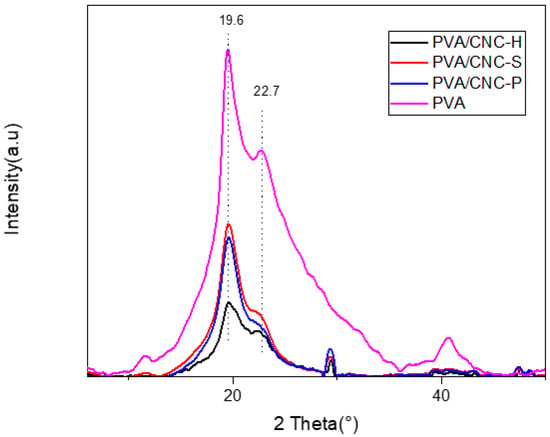
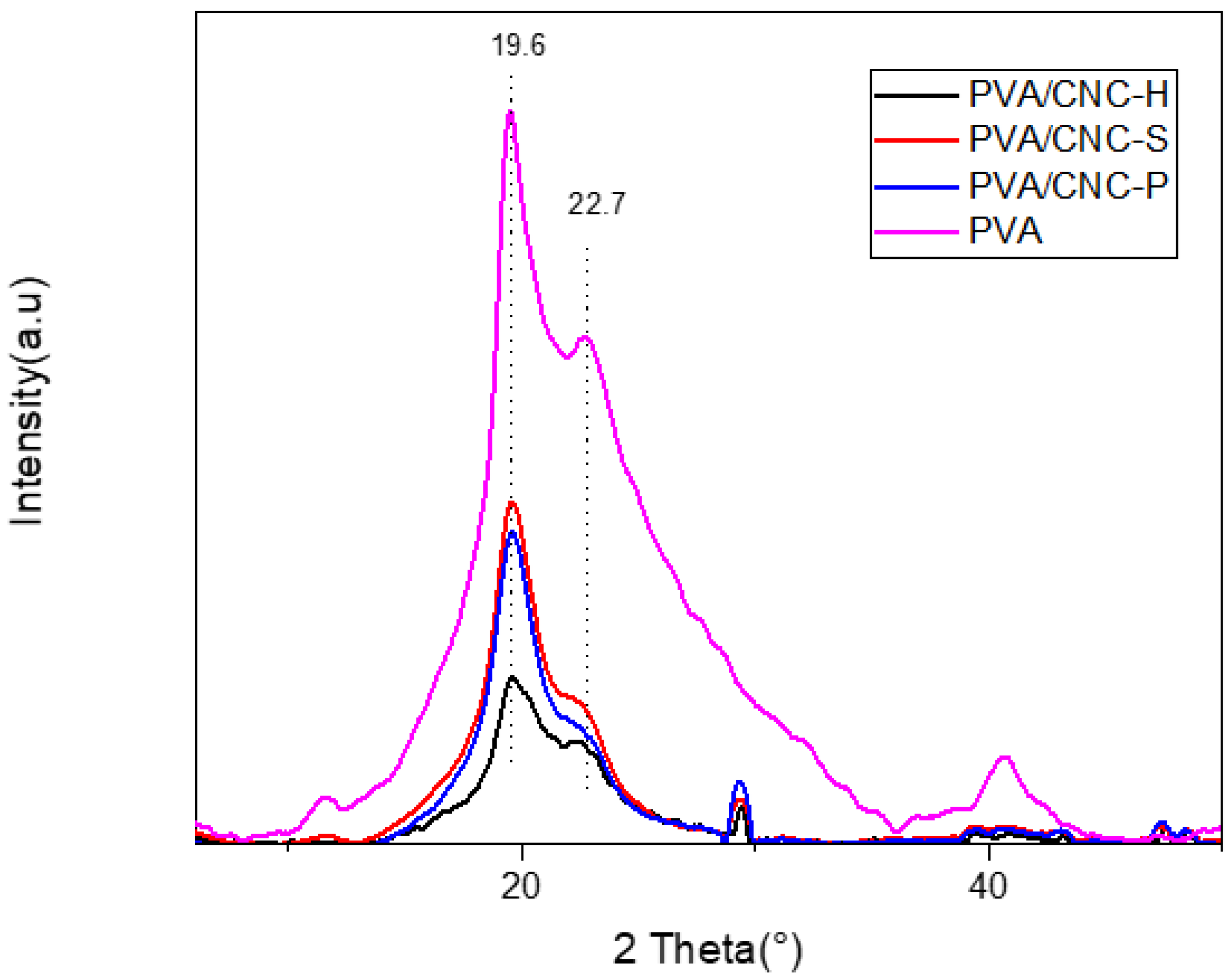
The XRD patterns (Figure 1) highlight the semi-crystalline nature of PVA, characterized by a main peak located at 2θ ≈ 19.6° and a shoulder/contribution around 2θ ≈ 22.7°, which are generally associated with the ordered domains of the polymer [29]. In addition, cellulose I typically exhibits a prominent reflection near 2θ ≈ 22.6°, along with other peaks around 14.8° and 16.5° [24]. In PVA/CNC membranes, these signals may nevertheless appear weakened or partially masked, particularly when the CNC content is moderate and/or when the scattering contribution of PVA is dominant [30].
Figure 1.
XRD Patterns of PVA/CNC-H, PVA/CNC-S and PVA/CNC-P Membranes.
The crystallinity index (Table 1) increases after CNC addition, rising from 41% for neat PVA to 61% (PVA/CNC-H), 67% (PVA/CNC-S), and 64% (PVA/CNC-P). This increase is consistent with the contribution of an intrinsically more crystalline phase (cellulose I) and a nucleating effect of CNCs, which can act as heterogeneous nucleation sites and promote local ordering of PVA chains when dispersion is adequate. Similar trends, namely an increase in PVA crystallinity at low CNC contents attributed to nucleation, have been reported in previous studies on PVA/CNC systems [31,32].
Table 1.
Crystallinity index (CrI, %) of PVA, CNCs, and PVA/CNC composite membranes.
The higher crystallinity observed for the composite membranes (CrI %: PVA/CNC-S > PVA/CNC-P > PVA/CNC-H) indicates that the hydrolysis route influences the structural organization of the PVA/CNC system. This behavior is likely related to differences in the physicochemical characteristics of the cellulose nanocrystals, including their surface charge, colloidal stability, particle dimensions, and dispersion state within the polymer matrix. Previous studies have reported that sulfuric acid hydrolysis generally produces cellulose nanocrystals bearing sulfate half-ester groups, which improve colloidal stability through electrostatic repulsion and favor a more homogeneous dispersion in polymer matrices. In contrast, hydrochloric acid hydrolysis does not introduce charged surface groups, resulting in a greater tendency for particle aggregation. Phosphoric acid hydrolysis has also been reported to modify the CNC surface chemistry, although the nature and extent of surface functionalization strongly depend on the hydrolysis conditions. Consequently, the superior crystallinity observed for the PVA/CNC-S membrane may reasonably be attributed to a more effective nucleating effect resulting from better nanocrystal dispersion within the PVA matrix rather than to the sole presence of specific functional groups. This interpretation is consistent with previous reports describing the influence of CNC dispersion and surface characteristics on the crystallization behavior of PVA-based nanocomposites [24,31,32].
3.2. FTIR Analysis
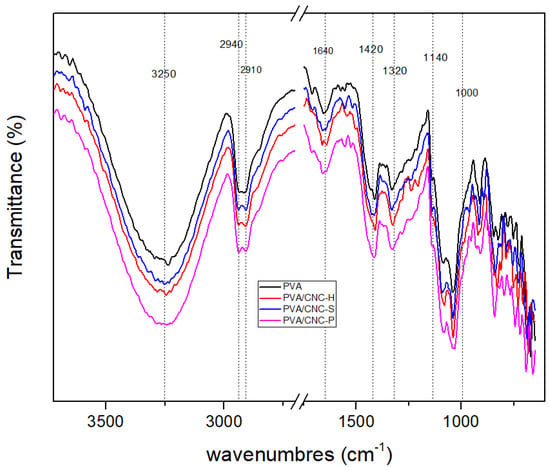
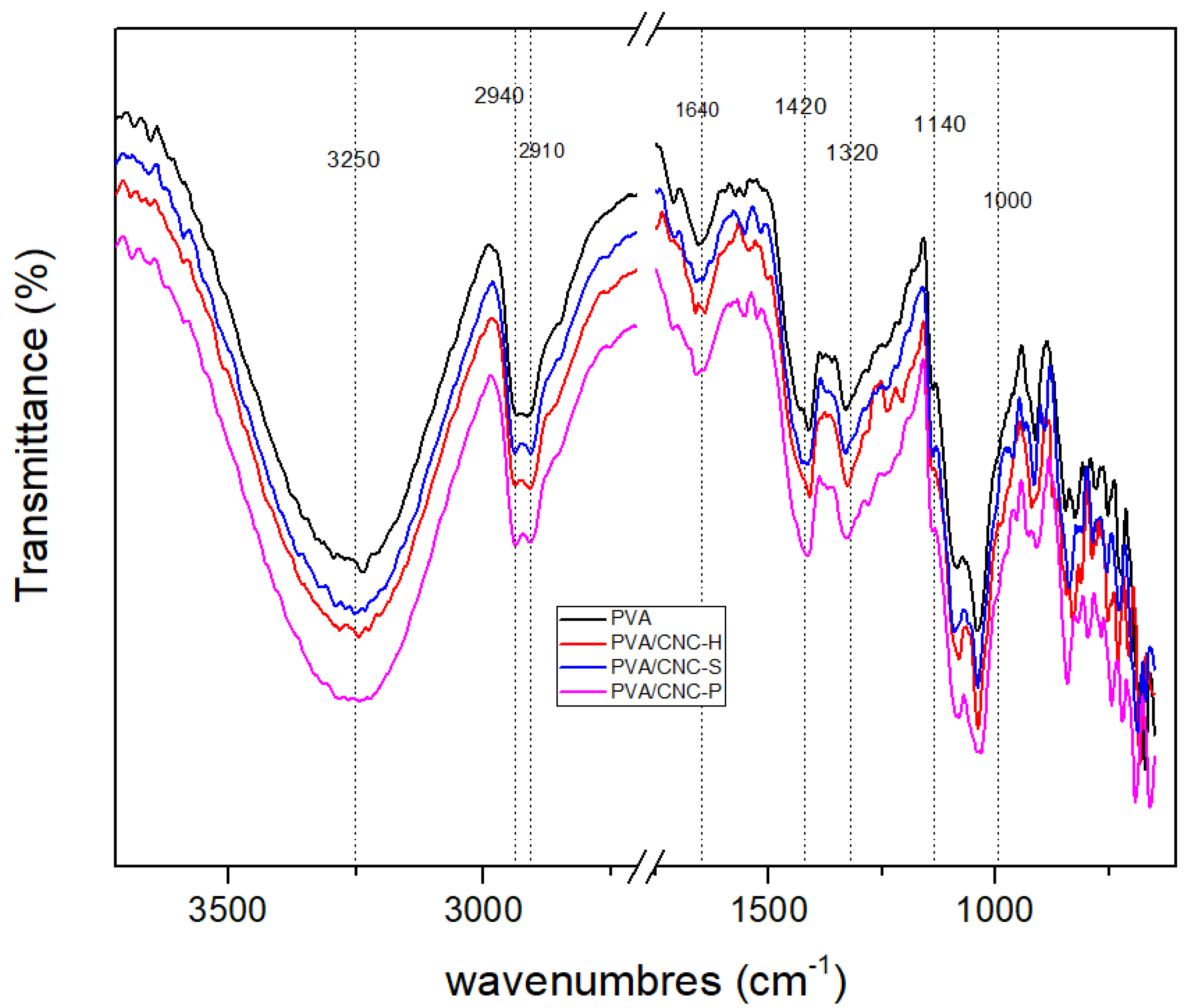
The FTIR spectra of pure PVA and PVA/CNC composite membranes (Figure 2) exhibit the characteristic absorption bands of poly(vinyl alcohol) together with those associated with cellulose nanocrystals, indicating that the membrane fabrication process preserved the chemical structures of both components. The broad absorption band observed around 3250 cm−1 is attributed to the stretching vibrations of hydroxyl groups (–OH) present in both PVA and CNCs [33]. No shift or broadening of this band was observed after CNC incorporation, indicating that the overall hydroxyl environment remained essentially unchanged. Therefore, FTIR analysis alone does not provide direct evidence of enhanced hydrogen bonding between PVA and cellulose nanocrystals.
Figure 2.
FTIR spectra of pure PVA and PVA/CNC composite membranes (CNC-H, CNC-S and CNC-P).
The bands located around 2940–2910 cm−1 correspond to the stretching vibrations of C–H bonds from the alkyl groups of PVA [34]. The absence of noticeable changes in this region indicates that the incorporation of CNCs did not alter the chemical structure of the PVA backbone. The absorption band observed near 1640 cm−1 is generally assigned to the bending vibration of adsorbed water molecules, reflecting the hydrophilic nature of both PVA and cellulose nanocrystals [35].
The bands appearing at approximately 1420 and 1320 cm−1 are attributed to CH2 bending and C–H deformation vibrations characteristic of PVA and cellulose structures, respectively [34,36]. The absorption bands observed at approximately 1140 and 1000 cm−1 are mainly assigned to the asymmetric stretching vibrations of C–O–C glycosidic linkages and C–O stretching vibrations characteristic of cellulose and PVA [37]. The preservation of these characteristic absorption bands indicates that the membrane preparation process did not modify the chemical structures of either PVA or cellulose nanocrystals.
Previous studies have reported that sulfuric acid hydrolysis may introduce sulfate half-ester groups onto the surface of cellulose nanocrystals, whereas phosphoric acid hydrolysis can modify their surface chemistry depending on the hydrolysis conditions [24,38,39]. However, the FTIR spectra obtained in the present study do not provide direct evidence for these surface functionalities, since the corresponding absorption bands may overlap with the characteristic bands of PVA and cellulose. Therefore, the differences observed among the membranes are interpreted based on their overall physicochemical characteristics and supported by previous literature rather than being considered as direct experimental evidence of surface functionalization [24,38,39].
Overall, the FTIR analysis confirms the successful preparation of the PVA/CNC composite membranes and the preservation of the characteristic chemical structures of both PVA and cellulose nanocrystals. The improvements observed in the structural, mechanical, thermal, and electrochemical properties of the composite membranes are interpreted in conjunction with the complementary characterization techniques (XRD, SEM, TGA, tensile testing, oxidative stability, and electrochemical impedance spectroscopy), rather than being attributed solely to the FTIR results.
3.3. Morphological and Structural Properties of PVA/CNC Composite Membranes
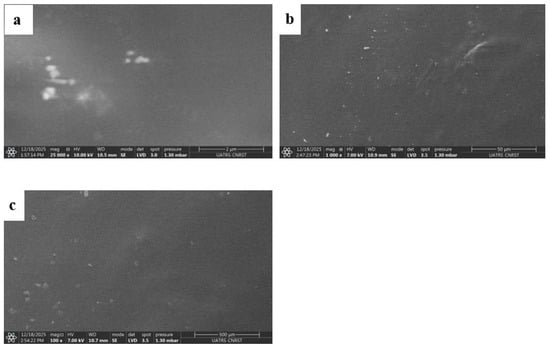
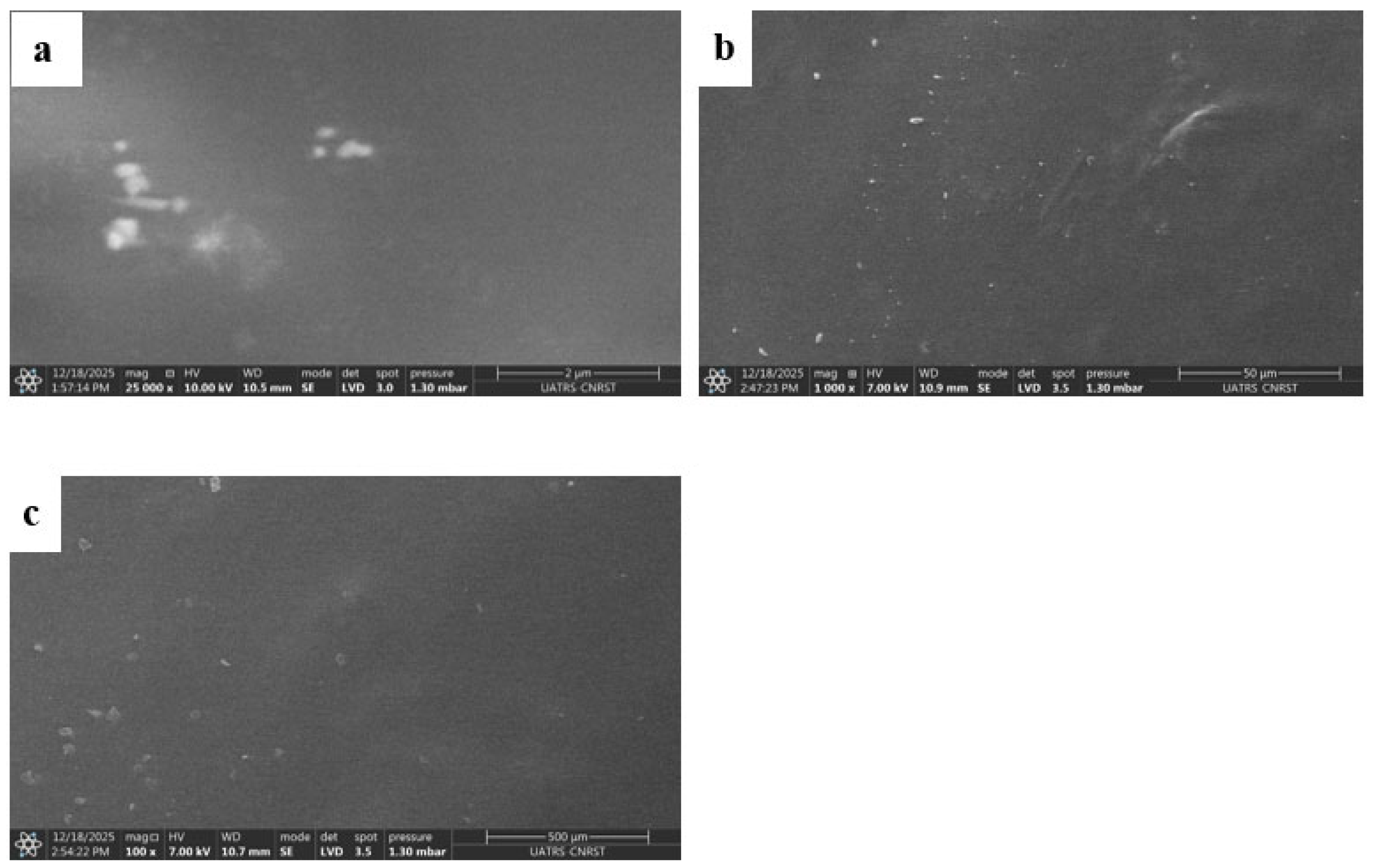
SEM images of the PVA/CNC membranes (Figure 3) reveal noticeable morphological differences depending on the type of acid hydrolysis used for CNC extraction. The PVA/CNC-H membrane exhibits a heterogeneous surface characterized by the presence of aggregates and irregular features, suggesting a less uniform membrane morphology. In contrast, the PVA/CNC-S and PVA/CNC-P membranes display smoother, more compact, and more continuous surfaces with fewer visible aggregates, consistent with a more homogeneous membrane morphology. These morphological differences may be associated with variations in the physicochemical characteristics of the cellulose nanocrystals produced by the different hydrolysis methods. However, SEM observations alone do not provide direct evidence of the distribution of CNCs within the polymer matrix or the nature of the interactions occurring at the polymer–CNC interface.
Figure 3.
SEM images of PVA/CNC membranes: (a) PVA/CNC-H, (b) PVA/CNC-S, and (c) PVA/CNC-P.
The more compact and continuous morphologies observed for the PVA/CNC-S and PVA/CNC-P membranes are consistent with a more compact membrane morphology exhibiting fewer visible surface defects. Such morphological organization may contribute to reducing glucose diffusion while maintaining proton transport, although SEM observations alone cannot directly demonstrate these transport mechanisms. In addition, a more homogeneous morphology is generally considered beneficial for membrane integrity and is consistent with the improved mechanical properties and stability observed in this study. Nevertheless, these interpretations should be considered together with the complementary characterization techniques, which provide a more comprehensive evaluation of the structural, mechanical, thermal, and membrane transport properties of the membranes.
3.4. Thermal Stability
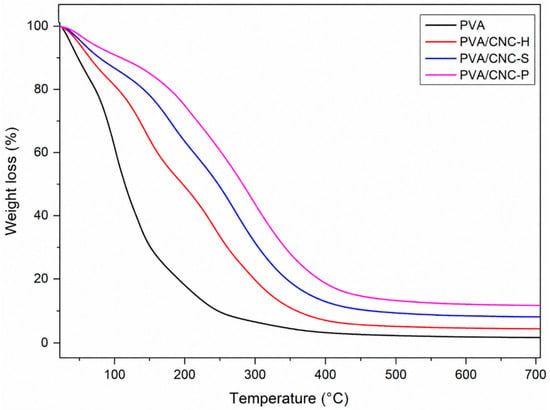
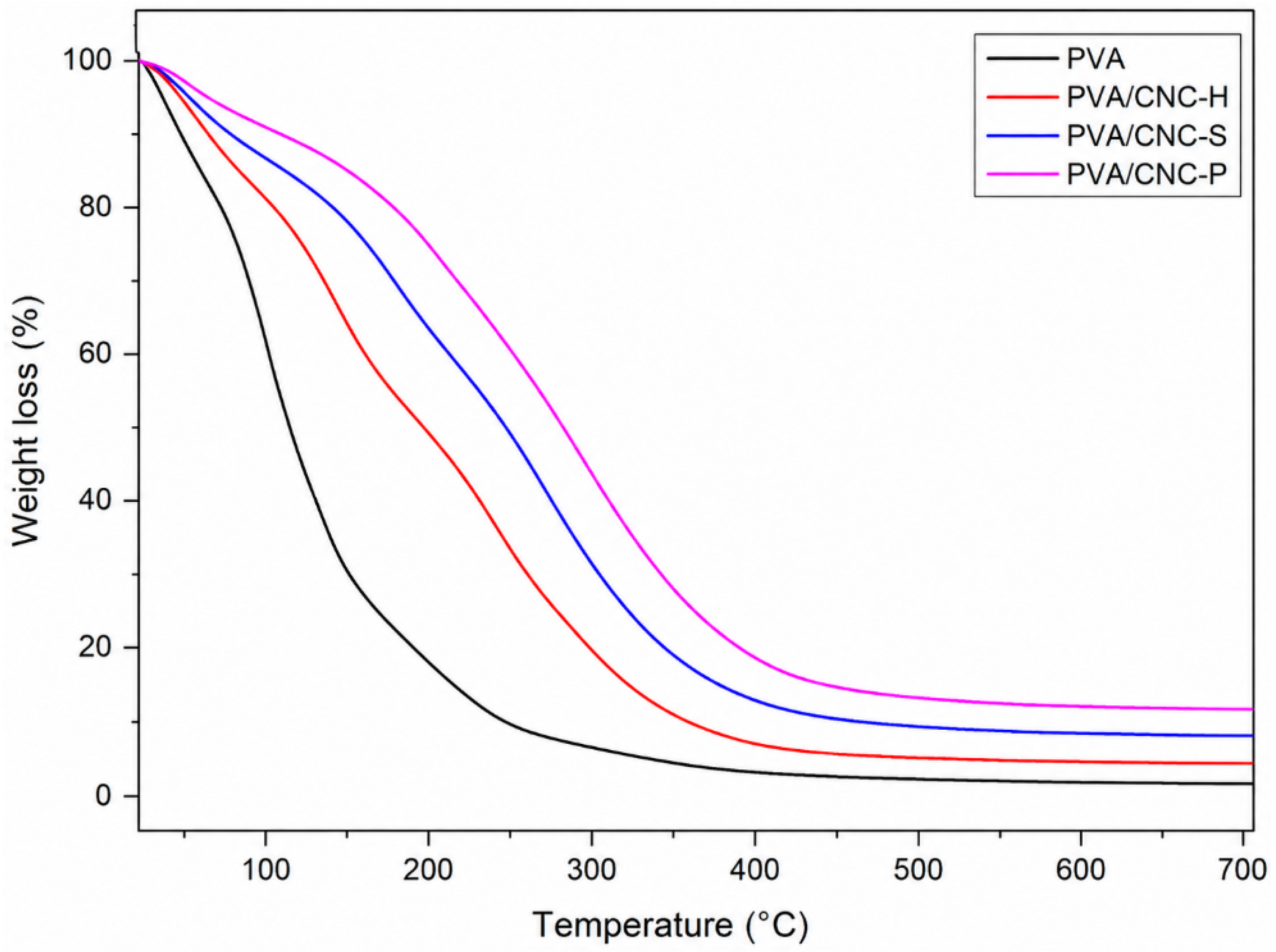
The thermogravimetric curves (TGA) of pure PVA and PVA/CNC composite membranes are presented in Figure 4. All membranes exhibit a multistep thermal degradation behavior characteristic of PVA-based materials.
Figure 4.
Thermogravimetric analysis (TGA) curves of PVA and PVA/CNC composite membranes.
The first degradation step, observed below approximately 120 °C, is associated with the evaporation of free and bound water retained within the polymer matrix. This mass loss is slightly higher for the composite membranes, which may be related to the hydrophilic nature of cellulose nanocrystals and the presence of hydroxyl groups capable of interacting with water molecules.
The pure PVA membrane exhibits the lowest thermal stability among the investigated samples. At 150 °C, the remaining mass of PVA is approximately 30–35%, and it decreases to nearly 10% at around 250 °C, indicating rapid degradation of the polymer matrix. This behavior may be related to dehydration reactions, disruption of intermolecular interactions, and progressive degradation of the PVA backbone.
The incorporation of cellulose nanocrystals was associated with improved thermal stability of the membranes, as indicated by the shift in the degradation curves toward higher temperatures. This improvement may be associated with stronger interactions between the hydroxyl groups of PVA and CNCs and with the formation of a denser hydrogen-bonding network. Such interactions may reduce polymer-chain mobility and increase the energy required for thermal degradation. In addition, owing to their rigid crystalline structure, CNCs may act as reinforcing agents and physical barriers that limit the diffusion of volatile degradation products [40].
Among the composite membranes, PVA/CNC-P exhibits the highest thermal stability over the studied temperature range. It retains approximately 70–75% of its mass at 200 °C, around 45–50% at 300 °C, and leaves a final residue of about 11–12% at 700 °C. This behavior may be associated with the expected influence of phosphate-containing surface species on the formation of a more compact and thermally resistant structure. Phosphate groups have also been reported to favor the formation of a protective char layer during thermal degradation, thereby slowing material decomposition.
The PVA/CNC-S membrane also exhibits improved thermal stability, although it remains slightly less stable than PVA/CNC-P, with a final residue of approximately 7–8% at 700 °C. This behavior may be associated with the expected influence of sulfate-containing surface species and with the more homogeneous morphology observed by SEM. However, SEM observations alone do not directly demonstrate CNC dispersion within the polymer matrix. The PVA/CNC-H membrane also shows improved thermal stability compared with neat PVA but remains less stable than PVA/CNC-S and PVA/CNC-P, with a final residue of approximately 4–5%.
Overall, these results suggest that CNC incorporation may contribute to improved thermal resistance of PVA-based membranes. Adequate thermal stability is a desirable membrane-level property for potential glucose biofuel cell applications. However, the present TGA results should be considered as preliminary thermal stability data and do not demonstrate long-term operational durability.
3.5. Oxidative Stability
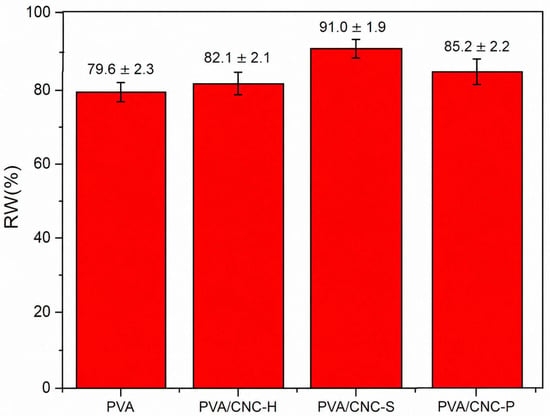
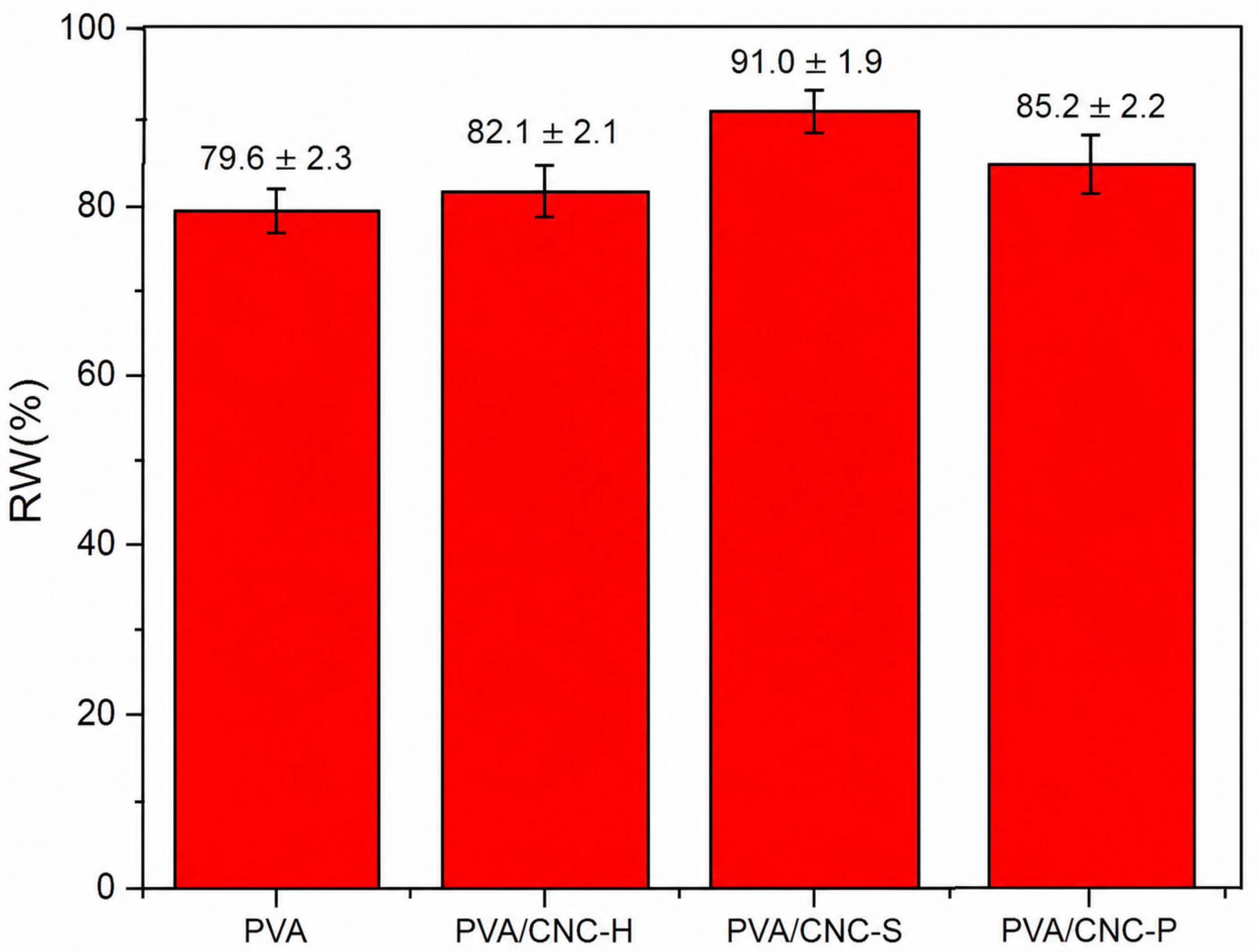
The oxidative stability of the membranes was evaluated using the Fenton test, and the results are expressed as residual weight (RW) in Figure 5. The membranes exhibited residual weight values ranging from approximately 80% to 91% after exposure to the oxidative medium.
Figure 5.
Oxidative stability of PVA and PVA/CNCs membranes.
The neat PVA membrane showed a residual weight of approximately 79.6 ± 2.3%, indicating a comparatively higher sensitivity to hydroxyl radicals generated in the Fenton reagent.
The incorporation of cellulose nanocrystals was associated with higher residual weight values. The PVA/CNC-H membrane exhibited a residual weight of approximately 82.1 ± 2.1%. This result may be associated with the reinforcing effect of CNC incorporation within the polymer matrix, although the Fenton test alone does not directly establish the underlying mechanism.
Among the investigated membranes, PVA/CNC-S exhibited the highest residual weight, reaching approximately 91.0 ± 1.9%. This behavior may be associated with the expected influence of sulfate-containing surface species and with the more homogeneous membrane morphology observed in this study. Such morphological characteristics may contribute to limiting the penetration of oxidative species and reducing polymer degradation; however, these mechanisms were not directly demonstrated.
The PVA/CNC-P membrane exhibited a residual weight of approximately 85.2 ± 2.2%, which was higher than that of neat PVA. This behavior may be associated with the expected influence of phosphate-containing surface species and with the formation of a more structured membrane network, although direct surface characterization would be required to confirm this interpretation.
These findings indicate that PVA/CNC-S and PVA/CNC-P exhibit improved resistance to oxidative degradation compared with neat PVA. This property is relevant to potential glucose biofuel cell membrane applications. Nevertheless, the Fenton test provides only preliminary information on oxidative stability and is not sufficient to demonstrate long-term durability under operating conditions. Additional studies involving prolonged chemical aging, wet–dry cycling, conductivity retention after aging, and continuous operation remain necessary.
3.6. Mechanical Properties
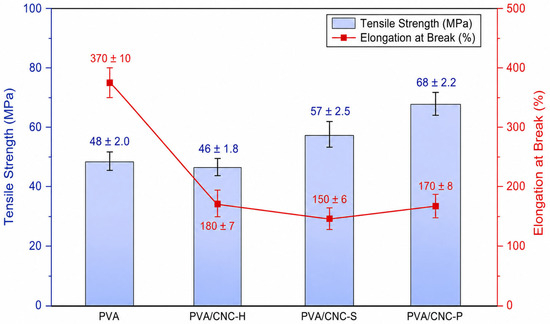
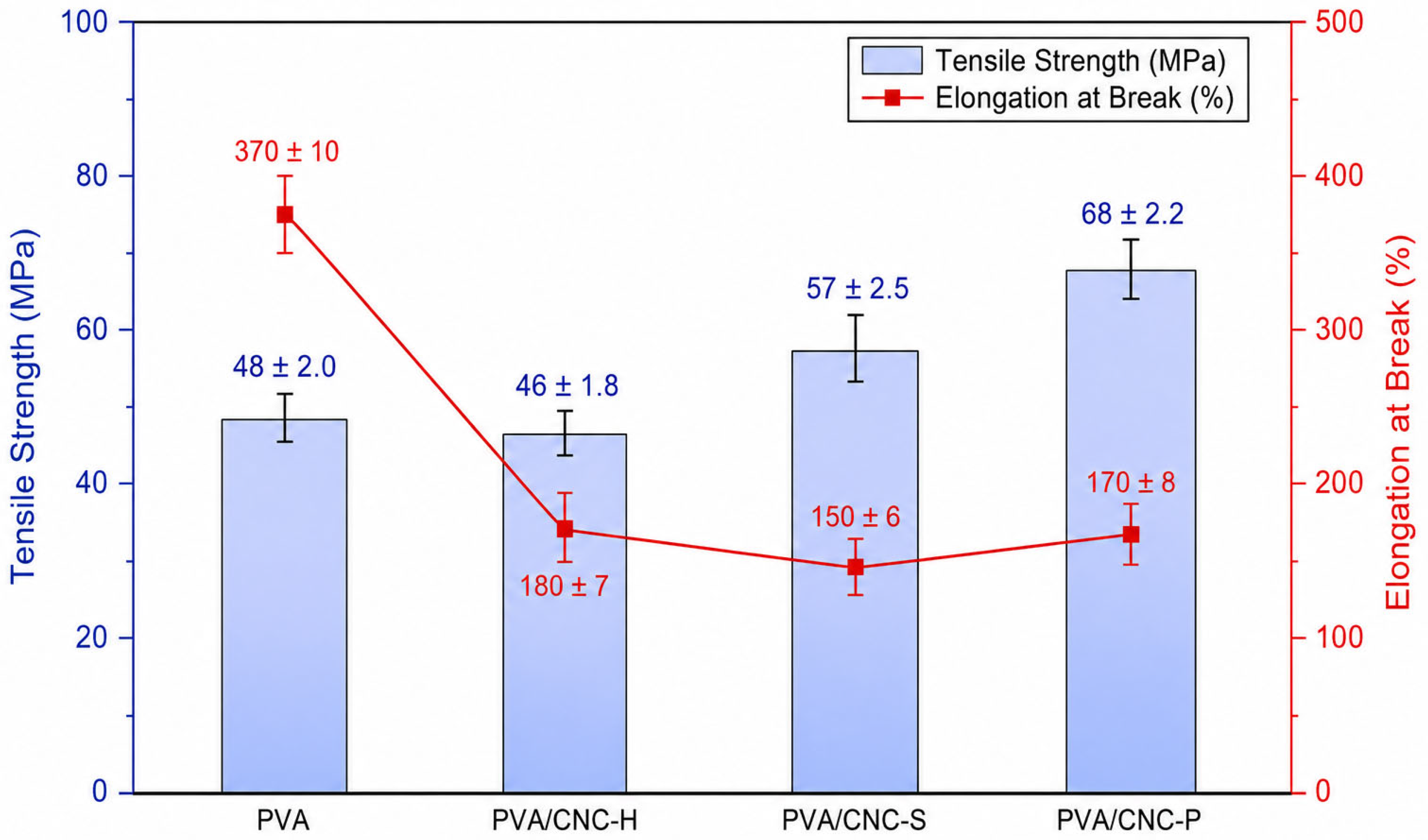
The mechanical properties of PVA and PVA/CNCs membranes were evaluated in terms of tensile strength and elongation at break, highlighting the effect of the incorporation and functionalization of cellulose nanocrystals (CNCs) (Figure 6). Pristine PVA exhibits a tensile strength of approximately 48 ± 2 MPa and a high elongation close to 370 ± 10%, reflecting the typical ductile behavior of hydrophilic polymers with high chain mobility.
Figure 6.
Tensile strength and elongation at break of PVA and PVA/CNCs composite membranes.
The incorporation of CNCs leads to changes in these properties. The PVA/CNC-H membrane shows a tensile strength similar to that of PVA (~46 ± 1.8 MPa), but with a noticeable decrease in elongation (~180 ± 7%), indicating reduced flexibility due to the reinforcing effect of CNCs, which restrict polymer-chain mobility.
The PVA/CNC-S membrane exhibits an increase in tensile strength to approximately 57 ± 2.5 MPa, accompanied by a decrease in elongation (~150 ± 6%). This mechanical enhancement may be associated with the presence of sulfate groups, which strengthen interfacial interactions between PVA and CNCs, resulting in better dispersion and more efficient stress transfer. However, this increased structural organization slightly stiffens the material, reducing its deformation capacity.
The PVA/CNC-P membrane displays the best mechanical performance, with a tensile strength reaching approximately 68 ± 2.2 MPa, while maintaining a relatively high elongation (~170 ± 8%). This combination indicates a good balance between stiffness and flexibility, suggesting strong compatibility between phosphorylated CNCs and the PVA matrix, promoting the formation of a homogeneous and well-structured network.
These results suggest that the addition of CNCs enhances the stiffness and mechanical strength of the membranes at the expense of a slight reduction in ductility. This behavior is typical of polymer nanocomposites, where rigid fillers act as anchoring points that restrict chain mobility [41]. Nevertheless, the PVA/CNC-S and PVA/CNC-P membranes exhibit an optimal balance between mechanical strength and flexibility, which is essential for proton exchange membrane applications, where good mechanical stability is required under hydrated operating conditions.
3.7. Wettability, Water Uptake, and Ion-Exchange Capacity of PVA/CNC Membranes
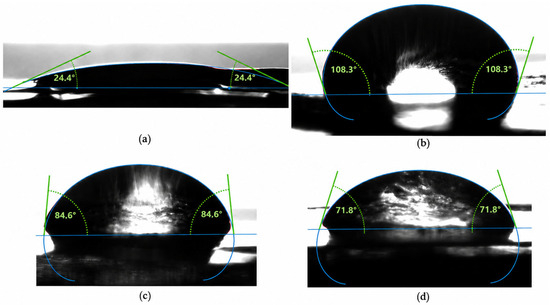
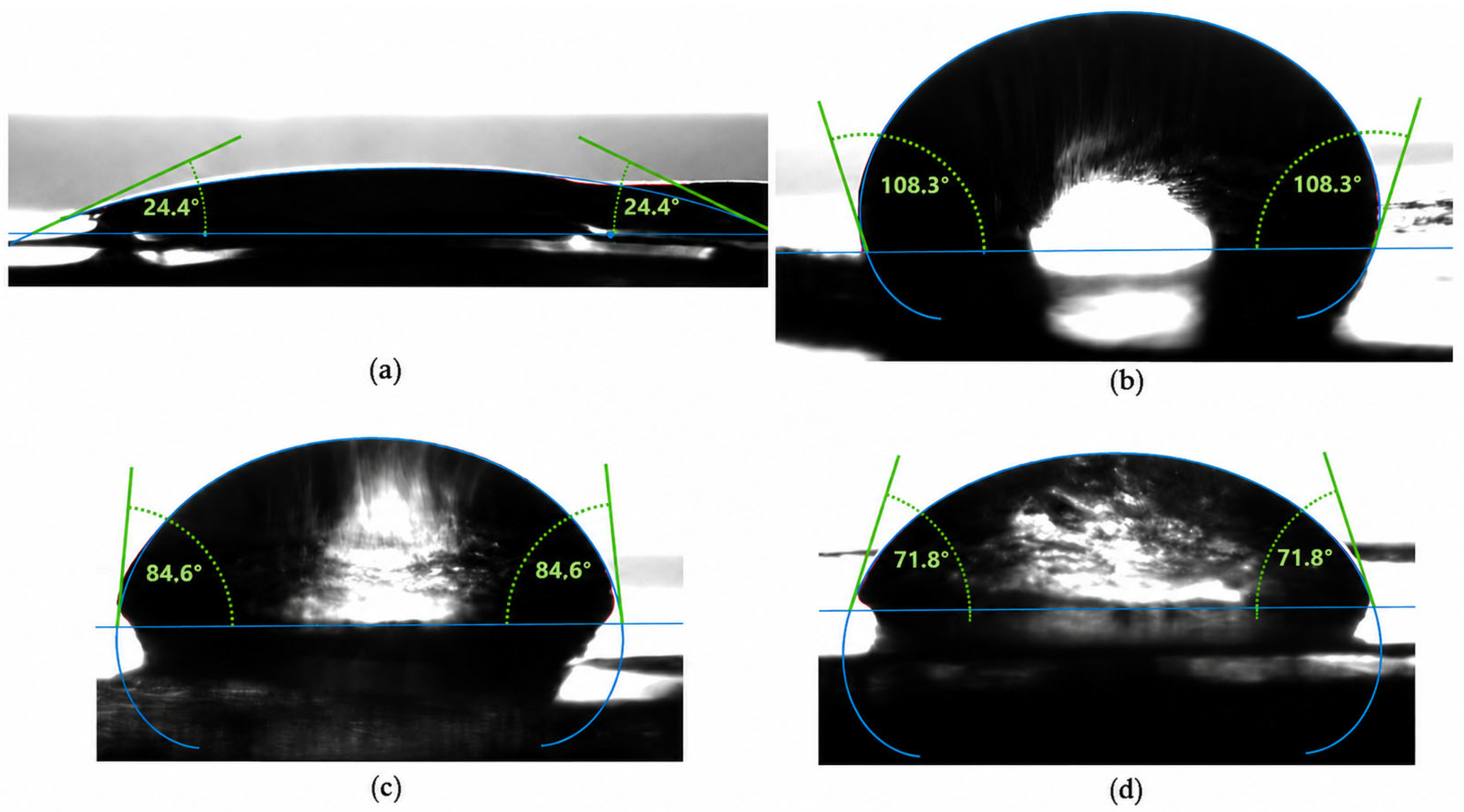
The wettability, water uptake, and ion-exchange capacity (IEC) of PVA and PVA/CNC membranes (Table 2 and Figure 7) were investigated to evaluate their suitability for proton exchange applications in biofuel cells. The contact angle measurements indicate that pristine PVA exhibits strong hydrophilic behavior, with a low contact angle value of 24.4°, resulting in excessive water absorption (131%). Although high hydrophilicity enhances proton mobility, excessive swelling may negatively affect the dimensional and mechanical stability of the membrane.
Table 2.
Water uptake, contact angle, and ion-exchange capacity (IEC) of PVA and PVA/CNC membranes.
Figure 7.
Surface wettability (water contact angle) of PVA and PVA/CNC membranes: (a) PVA, (b) PVA/CNC-H, (c) PVA/CNC-S, and (d) PVA/CNC-P.
The incorporation of cellulose nanocrystals modifies the surface properties of the membranes. The PVA/CNC-H membrane exhibits the highest contact angle (108.3°) and a reduced water uptake of approximately 32%, indicating lower water affinity than neat PVA while maintaining sufficient hydration for membrane stability. Despite a moderate IEC value of 0.52 meq·g−1, the insufficient hydration restricts its proton transport properties.
In contrast, PVA/CNC-S and PVA/CNC-P membranes exhibit moderate hydrophilicity, with contact angle values of 84.6° and 71.8°, respectively. These membranes display balanced water uptake values of 61.76% for PVA/CNC-S and 44.12% for PVA/CNC-P, providing an optimal compromise between hydration and structural stability.
Furthermore, the high IEC values measured for PVA/CNC-S (1.49 meq·g−1) and PVA/CNC-P (1.38 meq·g−1) indicate an increased density of ion-exchange sites compared with neat PVA. Since the CNC loading in the membranes was 10 wt% (relative to the dry weight of PVA), the observed increase in IEC is likely the result of the combined effects of the ionizable surface species introduced during acid hydrolysis, the incorporation of cellulose nanocrystals, and the modified membrane microstructure. Although sulfate- and phosphate-containing surface groups may contribute to the increase in IEC, additional surface characterization techniques such as XPS or elemental sulfur analysis would be required to quantify their contribution. In comparison show enhanced membrane properties; Poly(vinyl alcohol)/Poly(vinylpyrrolidone)-graft-Poly(styrene sulfonic acid) (PVA/PVP-g-PSSA) membranes exhibited water uptake with other membranes reported in the literature, the wettability, water uptake, and ion-exchange capacity (IEC) values obtained for the PVA/CNC-S and PVA/CNC-P are within the range reported for similar PVA-based proton exchange membranes. For example, blended PVA/sulfonated poly(ether sulfone membranes reported in previous work exhibited water uptake values up to 77.21% and IEC values close to 1.02 meq·g−1, demonstrating the positive influence of sulfonic acid groups on water absorption and proton conduction sites in PVA-based matrices [42]. Other studies on PVA-based composites incorporating various fillers also values ranging from approximately 63% to 87% and IEC values between 1.12 and 1.90 meq·g−1, depending on the functionalization level [43]. Similarly, PVA–sulfosuccinic acid/silicotungstic acid composite membranes have reported IEC values up to 1.75 meq·g−1 with water uptake between 31% and 88% for fuel cell applications [44]. Compared to these systems, the PVA/CNC-S (water uptake ≈ 61.8%, IEC ≈ 1.49 meq·g−1) and PVA/CNC-P (water uptake ≈ 44.12% and high ion-exchange capacity IEC ≈ 1.38 meq·g−1, which is beneficial for proton transport and dimensional stability. Overall, these comparisons indicate that the functionalization strategy applied to CNC in the present work yields proton exchange membranes with performance metrics that are comparable to those reported for several PVA-based composite membranes, reinforcing the potential of PVA/CNC-S and PVA/CNC-P for biofuel cell applications.
The proton conductivity of the prepared membranes is governed by the combined effects of water uptake and ion-exchange capacity rather than by either parameter alone. Among the investigated membranes, PVA/CNC-S exhibits the best balance between water uptake (61.76%) and ion-exchange capacity (1.49 meq·g−1), resulting in the highest proton conductivity. In contrast, although PVA/CNC-H exhibits a measurable ion-exchange capacity, its lower water uptake limits the formation of continuous hydrated pathways required for efficient proton transport. Similarly, PVA/CNC-P exhibits intermediate water uptake and IEC values, leading to intermediate proton conductivity. These results suggest that achieving an appropriate balance between membrane hydration and the availability of ion-exchange sites is essential for improving proton transport in PVA/CNC composite membranes.
The combined improvement in wettability, controlled water uptake, and relatively high ion-exchange capacity may facilitate proton transport through hydrated pathways involving both vehicular and Grotthuss mechanisms [45]. Although the proton conductivity remains lower than that of commercial Nafion membranes, the developed PVA/CNC-S and PVA/CNC-P membranes exhibit balanced physicochemical properties that make them promising sustainable proton exchange membrane candidates for potential glucose biofuel cell applications. Further optimization of membrane composition and membrane performance will be addressed in future work.
3.8. Proton Conductivity
Electrochemical impedance spectroscopy (EIS) measurements (Table 3) show that the incorporation of cellulose nanocrystals (CNCs) improves the proton conductivity of PVA membranes, with a systematic increase observed between 25 and 50 °C. Pristine PVA exhibits a low conductivity of 3.75 × 10⁻⁴ mS·cm−1 at 25 °C, which slightly increases to 9.49 × 10⁻⁴ mS·cm−1 at 50 °C, reflecting the limited proton transport resulting from the absence of active ionic functional groups.
Table 3.
Proton Conductivity of PVA-Based Membranes as a Function of Temperature.
The addition of CNCs leads to a noticeable enhancement in proton conductivity, the extent of which depends on the surface chemistry of nanocrystals. Among the investigated membranes, PVA/CNC-S exhibits the highest proton conductivity, reaching 8.0 × 10⁻³ mS·cm−1 at 25 °C and 1.032 × 10⁻² mS·cm−1 at 50 °C. This improvement may be associated with the presence of sulfate groups (–OSO3−), which are expected to provide additional acidic sites facilitating proton dissociation and proton transport through hydrogen-bonded pathways, as reported in previous studies [46]. These surface functional groups may also contribute to increasing the density of proton exchange sites, thereby enhancing proton transport.
The PVA/CNC-H membrane exhibits intermediate conductivity values, increasing from 7.01 × 10⁻³ mS·cm−1 at 25 °C to 8.76 × 10⁻³ mS·cm−1 at 50 °C. This enhancement is likely associated with the structural effect of CNC incorporation, which may promote the formation of hydrated pathways facilitating proton transport. However, the absence of strongly acidic surface groups limits the number of available proton-conducting sites, resulting in lower conductivity than that observed for PVA/CNC-S.
The PVA/CNC-P membrane exhibits conductivity values of 4.72 × 10⁻³ mS·cm−1 at 25 °C and 5.87 × 10⁻³ mS·cm−1 at 50 °C. Although phosphate groups may contribute to proton transport by increasing membrane hydrophilicity and hydrogen-bond formation, their lower acidity compared with sulfate groups is consistent with the lower proton conductivity observed for this membrane [46].
For all membranes, proton conductivity increases with temperature, which may be attributed to enhanced polymer-chain mobility, improved proton dissociation, and facilitated proton transport through both vehicular and Grotthuss mechanisms [45].
Compared with undoped or lightly modified PVA-based polymer electrolytes reported in the literature, the incorporation of cellulose nanocrystals noticeably improves the proton conductivity of the PVA matrix. This enhancement is consistent with the structural organization of the polymer matrix and the formation of hydrated pathways that facilitate proton transport without requiring large amounts of mobile salts or acidic dopants. For example, PVA/NaI membranes generally exhibit conductivities on the order of 10−4 mS·cm−1, whereas hybrid PVA-based electrolytes containing ammonium salts or starch typically exhibit conductivities ranging from 10−3 to 10−2 mS·cm−1 [47,48,49,50]. The conductivity values obtained in the present study therefore fall within the range reported for comparable PVA-based composite electrolytes.
To better position the performance of the developed membranes with respect to the current state of the art, a comparison was carried out with representative proton exchange membranes reported in the literature, including commercial Nafion®, SPEEK, sulfonated PEEK, chitosan-based, cellulose-based, and recent PVA-based membranes. The comparison considers proton conductivity, water uptake, ion-exchange capacity, tensile strength, and glucose permeability, as summarized in Table 4. Whenever available, the experimental conditions reported in the literature, including measurement temperature, hydration state, and characterization methods, were considered to ensure a meaningful comparison. For the membranes developed in this work, the conductivity values measured at 25 °C were selected because glucose permeability was determined under comparable temperature conditions.
Table 4.
Comparison of proton conductivity, water uptake, ion-exchange capacity, tensile strength, and glucose permeability of the developed PVA/CNC membranes with representative proton exchange membranes reported in the literature under comparable experimental conditions.
As shown in Table 4, the developed PVA/CNC membranes exhibit proton conductivities lower than those of commercial Nafion® and other highly conductive proton exchange membranes. Nevertheless, they display competitive ion-exchange capacities, satisfactory mechanical properties, controlled water uptake, and particularly low glucose permeability. These combined characteristics are favorable for reducing glucose crossover while maintaining membrane integrity and are therefore relevant for potential glucose biofuel cell applications.
It should be emphasized that the proton conductivity of the developed PVA/CNC membranes remains lower than that of commercial proton exchange membranes such as Nafion®. Consequently, their use in practical fuel cells would be expected to result in higher internal ohmic resistance, thereby reducing proton transport efficiency and limiting the maximum power output. Nevertheless, the primary objective of this work was not to outperform Nafion®, but rather to develop sustainable proton exchange membranes derived from renewable agricultural waste using an environmentally friendly and cost-effective approach. Compared with conventional membranes, the developed PVA/CNC composites offer several advantages, including the use of renewable bio-based fillers, reduced environmental impact, good thermal stability, preliminary oxidative stability, satisfactory mechanical properties, and low glucose permeability.
It should also be noted that the membrane selectivity values reported in this study were calculated using proton conductivity and glucose permeability measured under comparable ambient temperature conditions (25 °C). Since both parameters are temperature dependent, future investigations should evaluate conductivity and permeability under identical operating conditions representative of practical glucose biofuel cell operation to provide a more rigorous assessment of membrane selectivity.
Overall, the results suggest that cellulose nanocrystal incorporation is a promising strategy for improving the physicochemical properties and membrane-level proton transport behavior of PVA membranes. Although additional improvements in proton conductivity are still required for practical fuel cell applications, the developed membranes represent sustainable and environmentally friendly alternatives for future proton exchange membrane development.
Future work will focus on optimizing the CNC loading, improving proton conductivity through membrane modification and crosslinking strategies, and performing complete electrochemical validation in glucose biofuel cells. This will include polarization curves, power density measurements, open-circuit voltage, long-term stability under continuous operation, hydration/dehydration cycling, conductivity retention after aging, and extended chemical durability tests.
3.9. Glucose Permeability
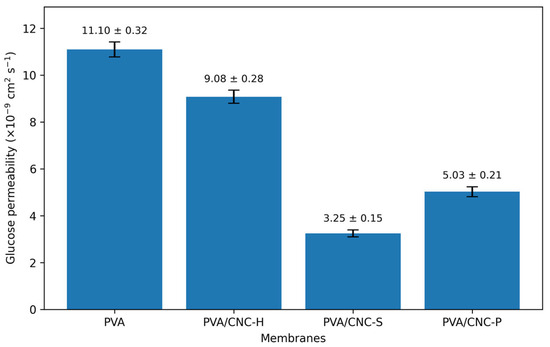
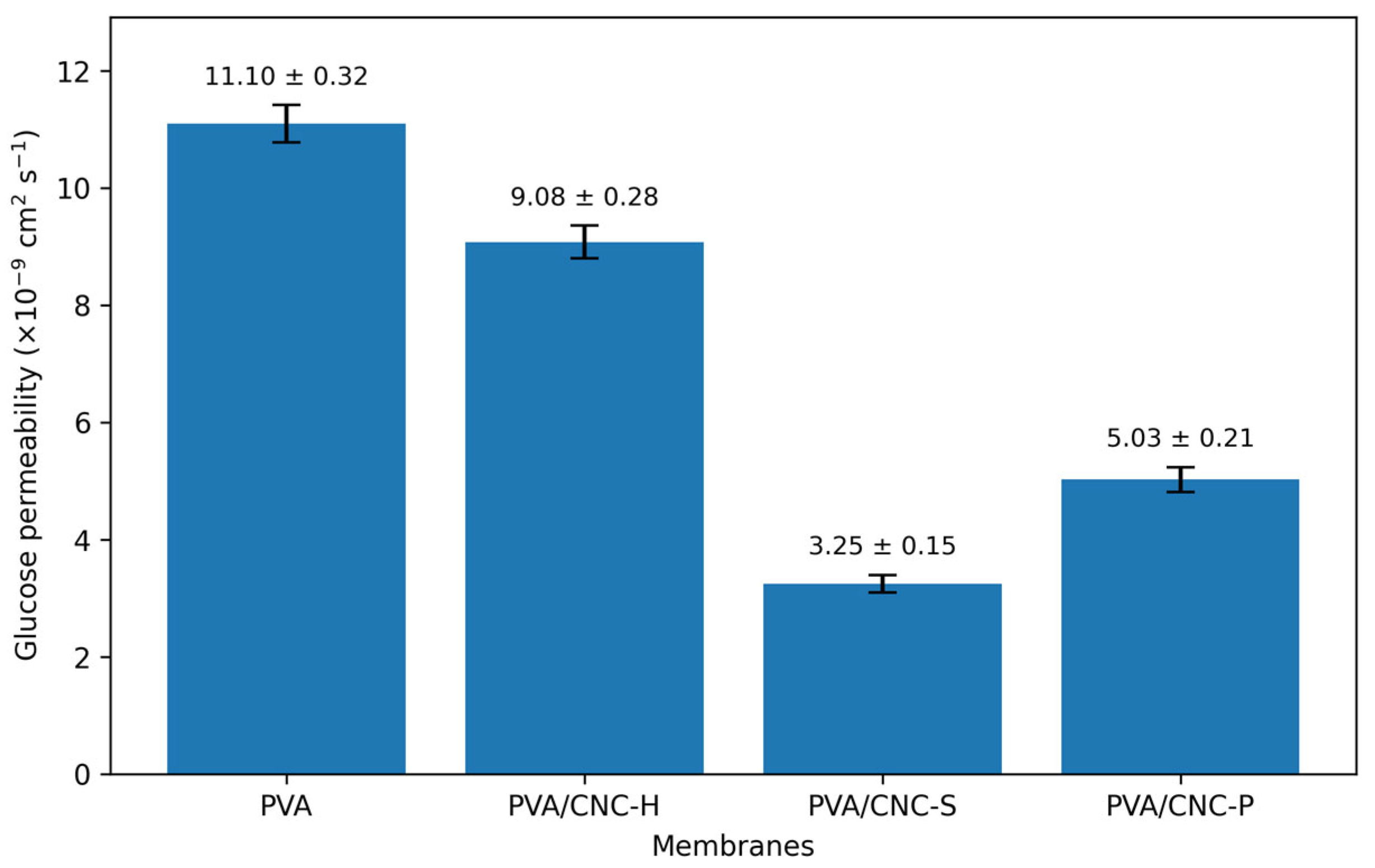
The obtained glucose permeability results (Figure 8) indicate a beneficial effect of incorporating cellulose nanocrystals into the PVA matrix on the barrier properties of the prepared membranes. The pristine PVA membrane exhibited the highest glucose permeability value, reaching , indicating glucose diffusion through the membrane. This behavior can be attributed to the highly hydrophilic nature of PVA, which may promote membrane swelling in aqueous media and leads to the formation of hydrated channels facilitating glucose transport. Similar behaviors have been reported in several studies on PVA-based membranes, where permeability values in the range of to were observed for unreinforced membranes [57,58,59].
Figure 8.
Glucose Permeation Properties of PVA and PVA/CNC Composite Membranes.
After the incorporation of cellulose nanocrystals, a decrease in permeability was observed for all composite membranes. The obtained values decreased to cm2/s for PVA/CNC-H, cm2/s for PVA/CNC-P, and cm2/s for PVA/CNC-S. This remarkable reduction in glucose diffusion suggests that the incorporation of CNCs may contribute to improved barrier properties and transport control within the membrane structure. The decrease in permeability can be explained by the formation of a denser polymeric network resulting from strong hydrogen-bonding interactions between the hydroxyl groups of PVA and those of cellulose nanocrystals. These interactions increase the tortuosity of diffusion pathways and reduce the mobility of glucose molecules across the membrane.
Among the investigated membranes, the PVA/CNC-S membrane exhibited the lowest permeability value cm2/s), indicating an excellent ability to reduce glucose crossover. This behavior may be associated with the presence of sulfate groups introduced during sulfuric acid hydrolysis, which improve the interfacial interactions between CNCs and the PVA matrix, leading to a more compact and organized structure. This improvement is consistent with the findings reported by [60,61,62], who indicated that the incorporation of cellulose nanocrystals enhances the crystallinity and barrier properties of PVA membranes.
These findings suggest that the incorporation of functionalized cellulose nanocrystals is an effective strategy for improving the barrier properties of PVA-based membranes. The PVA/CNC-S membrane appears to be the most efficient due to its very low glucose permeability, making it particularly suitable for enzymatic glucose biofuel cells and proton exchange membrane applications requiring reduced fuel crossover in order to improve electrochemical efficiency and operational stability.
3.10. Membrane Selectivity
To better evaluate the membrane-level transport performance for potential glucose biofuel cell applications, membrane selectivity, defined as the ratio of proton conductivity to glucose permeability (σ/P), was calculated using values measured under comparable temperature conditions (25 °C) (Table 5). Although the proton conductivity of the developed membranes remains lower than that of commercial Nafion membranes, the incorporation of cellulose nanocrystals was associated with higher selectivity values due to the combined increase in proton conductivity and reduction in glucose permeability. Among all membranes, PVA/CNC-S exhibited the highest selectivity (2461.5 S·s·cm−3), owing to its combination of the highest proton conductivity at 25 °C and the lowest glucose permeability. This result suggests that the PVA/CNC-S formulation provides the most favorable balance between proton transport and glucose barrier properties among the membranes investigated in this study, supporting its potential for future glucose biofuel cell applications.
Table 5.
Proton conductivity, glucose permeability and membrane selectivity.
4. Limitations and Future Perspectives
Although the present study reports the successful development of sustainable PVA/CNC composite membranes derived from melon agricultural residues and provides a comprehensive physicochemical characterization, several limitations should be acknowledged.
First, the present study was limited to membrane-level characterization, including proton conductivity, glucose permeability, ion-exchange capacity, water uptake, thermal stability, oxidative stability, and mechanical properties, which are relevant to potential glucose biofuel cell applications. The performance of the developed membranes was not validated in a complete glucose biofuel cell system. Therefore, future studies will focus on membrane electrode assembly (MEA) fabrication and the evaluation of complete glucose biofuel cells under practical operating conditions, including open-circuit voltage, polarization curves, power density, coulombic efficiency, energy efficiency, and long-term operational stability.
Second, a fixed cellulose nanocrystal loading of 10 wt% relative to the dry mass of PVA was employed in this study to specifically investigate the influence of CNC surface chemistry resulting from different acid hydrolysis routes while maintaining a constant nanocellulose content. Therefore, the objective of the present study was not to optimize the CNC loading but rather to isolate the effect of the hydrolysis method and the resulting surface chemistry on the physicochemical and membrane transport properties of the developed membranes. Consequently, no claim is made that the selected CNC loading represents the optimal membrane composition. Future studies will investigate different CNC loadings to identify the membrane composition that provides the best balance between proton conductivity, glucose barrier properties, mechanical stability, and other membrane-level properties relevant to potential glucose biofuel cell applications.
In addition, the proposed proton transport mechanism was inferred from the observed relationships among ion-exchange capacity, water uptake, and proton conductivity, together with trends reported in the literature. The present characterization techniques do not provide direct and conclusive evidence of the surface chemistry of the CNCs or of the specific proton transport pathways within the membranes. Advanced characterization techniques, including X-ray photoelectron spectroscopy (XPS), Raman spectroscopy, in situ FTIR spectroscopy, small-angle X-ray scattering (SAXS), and molecular simulations, will therefore be considered in future work to further elucidate the relationship between CNC surface chemistry and proton transport behavior.
Furthermore, although the thermal and oxidative stability tests provided encouraging preliminary information regarding membrane resistance to degradation, these results are not sufficient to demonstrate long-term durability under operating conditions. Stability under hydration/dehydration cycles, prolonged chemical aging, proton conductivity retention after aging, and continuous operation in glucose biofuel cells has not yet been evaluated. Additional long-term studies therefore remain necessary before practical implementation.
Finally, all measurements were performed in triplicate (n = 3), corresponding to three technical measurements carried out on the same membrane specimen rather than on independently prepared membranes. The results are therefore presented as mean ± standard deviation for descriptive purposes only, without implying statistical significance. Future studies based on independently prepared membrane replicates will enable the application of inferential statistical analyses. Quantitative microstructural characterization, including CNC dispersion, aggregate size distribution, and phase connectivity, will also be considered to further investigate the structure–property relationships governing membrane-level transport performance.
Overall, the present work provides a promising foundation for the development of sustainable bio-based proton exchange membranes from agricultural waste. Future research will focus on improving membrane-level transport performance through optimization of membrane composition and on validating the developed membranes under realistic glucose biofuel cell operating conditions using complete membrane electrode assemblies.
5. Conclusions
In this study, sustainable PVA/CNC composite membranes were successfully developed using cellulose nanocrystals extracted from melon agricultural residues. The incorporation of CNCs improved the structural, mechanical, thermal, and transport properties of the membranes compared with neat PVA. The composite membranes exhibited better compactness, higher crystallinity, improved oxidative stability, and a reduction in glucose permeability.
Among the prepared membranes, PVA/CNC-S showed the best membrane transport performance, with the highest proton conductivity of 1.032 × 10⁻² mS·cm−1 at 50 °C and the lowest glucose permeability of 3.25 × 10⁻⁹ cm2/s. These results indicate that sulfate groups may promote proton transport while limiting glucose crossover.
Thermal results also showed an improvement in the stability of the composite membranes. The observed order of thermal stability and fire resistance was: PVA/CNC-P > PVA/CNC-S > PVA/CNC-H > PVA. Therefore, the PVA/CNC-P membrane exhibited the best thermal behavior and the highest fire resistance among the studied membranes.
This work presents an effective approach for valorizing low-cost agricultural waste into high-value functional nanomaterials and highlights the strong potential of PVA/CNC membranes as sustainable proton exchange membranes for potential applications in glucose biofuel cells, as well as for other advanced bioelectrochemical systems for energy conversion and storage.
Although the developed PVA/CNC membranes exhibited encouraging physicochemical, thermal, mechanical, and transport properties, the present study remains limited to membrane development and characterization. Therefore, further investigations involving complete glucose biofuel cell testing, including polarization curves, power density measurements, open-circuit voltage (OCV), long-term operational stability, and membrane performance under realistic operating conditions, are required to fully validate the practical applicability of these membranes. These investigations will constitute the next stage of our research.
Author Contributions
A.R.: Conceptualization, Methodology, Investigation, Data curation, Formal analysis, Visualization, Writing—original draft. I.F.: Investigation, Methodology, Data curation, Formal analysis. D.B.: Investigation, Methodology, Data curation. A.T.: Validation, Formal analysis, Writing—review & editing. O.T.: Methodology, Investigation, Validation. A.B.: Resources, Validation, Writing—review & editing. L.E.: Investigation, Data curation, Formal analysis. L.B.: Validation, Formal analysis, Writing—review & editing. O.C.: Supervision, Resources, Project administration, Writing—review & editing. S.Z.: Supervision, Validation, Writing—review & editing. S.M.: Conceptualization, Supervision, Project administration, Resources, Writing—review & editing. All authors have read and agreed to the published version of the manuscript.
Funding
This research received no external funding.
Institutional Review Board Statement
Not applicable.
Informed Consent Statement
Not applicable.
Data Availability Statement
The data supporting the findings of this study are available from the corresponding author upon reasonable request.
Acknowledgments
The authors would like to thank of Materials, Process, and Environmental Engineering, Faculty of Sciences Aïn Chock and Hassan II University of Casablanca, Morocco, for providing the facilities and technical support necessary to conduct this research.
Conflicts of Interest
The authors declare no conflicts of interest.
Abbreviations
| CNCs | Cellulose Nanocrystals |
| CNC-H | Cellulose Nanocrystals Obtained by Hydrochloric Acid Hydrolysis |
| CNC-S | Cellulose Nanocrystals Obtained by Sulfuric Acid Hydrolysis |
| CNC-P | Cellulose Nanocrystals Obtained by Phosphoric Acid Hydrolysis |
| PVA | Poly(Vinyl Alcohol) |
| PVA/CNC-H | PVA Composite Membrane Containing CNC-H |
| PVA/CNC-S | PVA Composite Membrane Containing CNC-S |
| PVA/CNC-P | PVA Composite Membrane Containing CNC-P |
| PEM | Proton Exchange Membrane |
| GBFC | Glucose Biofuel Cell |
| SEM | Scanning Electron Microscopy |
| XRD | X-ray Diffraction |
| FTIR | Fourier Transform Infrared Spectroscopy |
| TGA | Thermogravimetric Analysis |
| IEC | Ion-exchange capacity |
| CrI | Crystallinity Index |
| RW | Residual Weight |
| WU | Water Uptake |
References
- Scott, K.; Yu, E.H.; Ghangrekar, M.M.; Erable, B.; Duteanu, N.M. Biological and Microbial Fuel Cells. In Comprehensive Renewable Energy; Elsevier: Amsterdam, The Netherlands, 2012; pp. 277–300. [Google Scholar]
- Calabrese Barton, S.; Gallaway, J.; Atanassov, P. Enzymatic Biofuel Cells for Implantable and Microscale Devices. Chem. Rev. 2004, 104, 4867–4886. [Google Scholar] [CrossRef] [Scilit] [PubMed]
- Cinquin, P.; Gondran, C.; Giroud, F.; Mazabrard, S.; Pellissier, A.; Boucher, F.; Alcaraz, J.-P.; Gorgy, K.; Lenouvel, F.; Mathé, S.; et al. A Glucose BioFuel Cell Implanted in Rats. PLoS ONE 2010, 5, e10476. [Google Scholar] [CrossRef] [Scilit] [PubMed]
- Zebda, A.; Cosnier, S.; Alcaraz, J.-P.; Holzinger, M.; Le Goff, A.; Gondran, C.; Boucher, F.; Giroud, F.; Gorgy, K.; Lamraoui, H.; et al. Single Glucose Biofuel Cells Implanted in Rats Power Electronic Devices. Sci. Rep. 2013, 3, 1516. [Google Scholar] [CrossRef] [Scilit] [PubMed]
- Bouftou, A.; Belfadil, D.; Aghmih, K.; Rezzouq, A.; Fettah, I.; Lakhdar, F.; Lamine, M.; Majid, S. Synergistic Effects of Anthocyanins and Essential Oils in Biopolymer Based Active and Intelligent Food Packaging for Sustainable Applications. Discov. Mater. 2026, 6, 195. [Google Scholar] [CrossRef] [Scilit]
- Bouftou, A.; Joual, A.; Belfadil, D.; Aghmih, K.; Rezzouq, A.; Fettah, I.; El Meskine, A.; Lakhdar, F.; Lamine, M.; Majid, S. Active Sprayable Coatings Based on Cellulose Acetate/Chitosan with Cypress Essential Oil and Anthocyanins: A Novel Combination for Sardine Fillet Preservation. Int. J. Biol. Macromol. 2026, 361, 152052. [Google Scholar] [CrossRef] [Scilit] [PubMed]
- Kreuer, K.-D. Proton Conductivity: Materials and Applications. Chem. Mater. 1996, 8, 610–641. [Google Scholar] [CrossRef] [Scilit]
- Mauritz, K.A.; Moore, R.B. State of Understanding of Nafion. Chem. Rev. 2004, 104, 4535–4586. [Google Scholar] [CrossRef] [Scilit] [PubMed]
- Baroutaji, A.; Carton, J.G.; Sajjia, M.; Olabi, A.G. Materials in PEM Fuel Cells. In Reference Module in Materials Science and Materials Engineering; Elsevier: Amsterdam, The Netherlands, 2016; p. B9780128035818040066. [Google Scholar]
- Wu, G.M.; Lin, S.J.; Yang, C.C. Preparation and Characterization of PVA/PAA Membranes for Solid Polymer Electrolytes. J. Membr. Sci. 2006, 275, 127–133. [Google Scholar] [CrossRef] [Scilit]
- Fettah, I.; Aghmih, K.; Belfadil, D.; Ouachouo, L.; Rezzouq, A.; Elmahbouby, A.; Bouftou, A.; Bih, L.; Majid, S. Development and Characterization of a Nanocomposite Proton Exchange Membrane Based on Poly(Vinyl Alcohol) with Layered Double Hydroxides for Proton Exchange Membrane Fuel Cells (PEMFC). J. Electroanal. Chem. 2025, 999, 119555. [Google Scholar] [CrossRef] [Scilit]
- Fettah, I.; Belfadil, D.; Aghmih, K.; Rezzouq, A.; Ouchabi, M.; Agzenai Ben Salem, Y.; Majid, S. Comparative Study of the Performance of Chemically Modified PVA Electrolyte Membranes for Fuel Cell Systems. J. Thermoplast. Compos. Mater. 2026, 08927057261453870. [Google Scholar] [CrossRef] [Scilit]
- Doha, B.; Asiya, R.; Ichrak, F.; Abderrahim, B.; Omar, A.; Nabila, M.; Souad, Z.; Sanaa, M. Efficient Recovery of High-Solubility Chitosan from Shrimp Shells: A Step Forward in Marine Waste Utilization. J. Mol. Sci. 2025, 41, 25030505. [Google Scholar] [CrossRef] [Scilit]
- Tang, Q.; Huang, K.; Qian, G.; Benicewicz, B.C. Phosphoric Acid-Imbibed Three-Dimensional Polyacrylamide/Poly(Vinyl Alcohol) Hydrogel as a New Class of High-Temperature Proton Exchange Membrane. J. Power Sources 2013, 229, 36–41. [Google Scholar] [CrossRef] [Scilit]
- Xing, P.; Robertson, G.P.; Guiver, M.D.; Mikhailenko, S.D.; Wang, K.; Kaliaguine, S. Synthesis and Characterization of Sulfonated Poly(Ether Ether Ketone) for Proton Exchange Membranes. J. Membr. Sci. 2004, 229, 95–106. [Google Scholar] [CrossRef] [Scilit]
- Sheha, E. Preparation and Physical Properties of (PVA)0.75(NH4Br)0.25(H2SO4)xM Solid Acid Membrane. J. Non-Cryst. Solids 2010, 356, 2282–2285. [Google Scholar] [CrossRef] [Scilit]
- Wang, X.; Cheng, T.; Hu, W.; Hu, L.; Liu, Q.; Yang, B.; Jian, W. Design and Performance Analysis of a Novel Gradient Flow Field Structure for Proton Exchange Membrane Fuel Cells. Fuel Cells 2026, 26, e70069. [Google Scholar] [CrossRef] [Scilit]
- Kreuer, K.D. On the Development of Proton Conducting Polymer Membranes for Hydrogen and Methanol Fuel Cells. J. Membr. Sci. 2001, 185, 29–39. [Google Scholar] [CrossRef] [Scilit]
- Li, Q.; He, R.; Jensen, J.O.; Bjerrum, N.J. Approaches and Recent Development of Polymer Electrolyte Membranes for Fuel Cells Operating above 100 °C. Chem. Mater. 2003, 15, 4896–4915. [Google Scholar] [CrossRef] [Scilit]
- Dennis, J.O.; Shukur, M.F.; Aldaghri, O.A.; Ibnaouf, K.H.; Adam, A.A.; Usman, F.; Hassan, Y.M.; Alsadig, A.; Danbature, W.L.; Abdulkadir, B.A. A Review of Current Trends on Polyvinyl Alcohol (PVA)-Based Solid Polymer Electrolytes. Molecules 2023, 28, 1781. [Google Scholar] [CrossRef] [Scilit] [PubMed]
- Brza, M.A.; Aziz, S.B.; Anuar, H.; Dannoun, E.M.A.; Ali, F.; Abdulwahid, R.T.; Al-Zangana, S.; Kadir, M.F.Z. The Study of EDLC Device with High Electrochemical Performance Fabricated from Proton Ion Conducting PVA-Based Polymer Composite Electrolytes Plasticized with Glycerol. Polymers 2020, 12, 1896. [Google Scholar] [CrossRef] [Scilit] [PubMed]
- Sheha, E.; Nasr, M.M.; El-Mansy, M.K. Structural, Thermal and Electrical Properties of Plasticised PVA Based Polymer Electrolyte. Mater. Sci. Technol. 2015, 31, 1113–1121. [Google Scholar] [CrossRef] [Scilit]
- Moon, R.J.; Martini, A.; Nairn, J.; Simonsen, J.; Youngblood, J. Cellulose Nanomaterials Review: Structure, Properties and Nanocomposites. Chem. Soc. Rev. 2011, 40, 3941. [Google Scholar] [CrossRef] [Scilit] [PubMed]
- Rezzouq, A.; Belfadil, D.; Bouftou, A.; Fettah, I.; Bouchti, M.E.; Cherkaoui, O.; Zyade, S.; Majid, S. Extraction and Characterization of Cellulose Nanocrystals from Post-Harvest of Melon Plant Residues: A New Sustainable Source of Cellulose. Sci. Afr. 2026, 31, e03242. [Google Scholar] [CrossRef] [Scilit]
- Aburabie, J.; Lalia, B.; Hashaikeh, R. Proton Conductive, Low Methanol Crossover Cellulose-Based Membranes. Membranes 2021, 11, 539. [Google Scholar] [CrossRef] [Scilit] [PubMed]
- Phan-Huynh, T.N.; Pham, H.T.; Nguyen, P.T.; Tap, T.D.; Nguyen, T.H.; Phung, Q.; Tran, T.T.V.; Chang, Y.-J.; Lai, Y.-T.; Hoang, D. Cellulose-Based Proton Exchange Membrane Derived from an Agricultural Byproduct. ACS Appl. Polym. Mater. 2025, 7, 2347–2358. [Google Scholar] [CrossRef] [Scilit]
- Herzallh, N.S.; Cohen, Y.; Cohen, R.; Chmelnik, O.; Shoham, Y.; Yehezkeli, O. Cellulose to Electricity Conversion by an Enzymatic Biofuel Cell. Sustain. Energy Fuels 2021, 5, 4580–4586. [Google Scholar] [CrossRef] [Scilit]
- Hickner, M.A.; Fujimoto, C.H.; Cornelius, C.J. Transport in Sulfonated Poly(Phenylene)s: Proton Conductivity, Permeability, and the State of Water. Polymer 2006, 47, 4238–4244. [Google Scholar] [CrossRef] [Scilit]
- Jeong, J.; Yoon, I.; Kim, K.; Jung, S. Structural and Physiochemical Properties of Polyvinyl Alcohol–Succinoglycan Biodegradable Films. Polymers 2024, 16, 1783. [Google Scholar] [CrossRef] [Scilit] [PubMed]
- Sarı, B.; Kaynak, C. Obtaining Cellulose Nanocrystals by Acid Hydrolysis Procedure; and Their Use as Reinforcement in Polylactide Biocomposites. J. Thermoplast. Compos. Mater. 2025, 38, 1040–1062. [Google Scholar] [CrossRef] [Scilit]
- Papapetros, K.; Mathioudakis, G.N.; Vroulias, D.; Koutroumanis, N.; Voyiatzis, G.A.; Andrikopoulos, K.S. Structure-Properties Correlations of PVA-Cellulose Based Nanocomposite Films for Food Packaging Applications. Polymers 2025, 17, 1911. [Google Scholar] [CrossRef] [Scilit] [PubMed]
- Leong, S.L.; Tiong, S.I.X.; Siva, S.P.; Ahamed, F.; Chan, C.-H.; Lee, C.L.; Chew, I.M.L.; Ho, Y.K. Morphological Control of Cellulose Nanocrystals via Sulfuric Acid Hydrolysis Based on Sustainability Considerations: An Overview of the Governing Factors and Potential Challenges. J. Environ. Chem. Eng. 2022, 10, 108145. [Google Scholar] [CrossRef] [Scilit]
- Fortunati, E.; Puglia, D.; Luzi, F.; Santulli, C.; Kenny, J.M.; Torre, L. Binary PVA Bio-Nanocomposites Containing Cellulose Nanocrystals Extracted from Different Natural Sources: Part I. Carbohydr. Polym. 2013, 97, 825–836. [Google Scholar] [CrossRef] [Scilit] [PubMed]
- Mansur, H.S.; Sadahira, C.M.; Souza, A.N.; Mansur, A.A.P. FTIR Spectroscopy Characterization of Poly(Vinyl Alcohol) Hydrogel with Different Hydrolysis Degree and Chemically Crosslinked with Glutaraldehyde. Mater. Sci. Eng. C 2008, 28, 539–548. [Google Scholar] [CrossRef] [Scilit]
- Alemdar, A.; Sain, M. Isolation and Characterization of Nanofibers from Agricultural Residues—Wheat Straw and Soy Hulls. Bioresour. Technol. 2008, 99, 1664–1671. [Google Scholar] [CrossRef] [Scilit] [PubMed]
- Oh, S.Y.; Yoo, D.I.; Shin, Y.; Kim, H.C.; Kim, H.Y.; Chung, Y.S.; Park, W.H.; Youk, J.H. Crystalline Structure Analysis of Cellulose Treated with Sodium Hydroxide and Carbon Dioxide by Means of X-Ray Diffraction and FTIR Spectroscopy. Carbohydr. Res. 2005, 340, 2376–2391. [Google Scholar] [CrossRef] [Scilit] [PubMed]
- Fortunati, E.; Puglia, D.; Monti, M.; Santulli, C.; Maniruzzaman, M.; Kenny, J.M. Cellulose Nanocrystals Extracted from Okra Fibers in PVA Nanocomposites. J. Appl. Polym. Sci. 2013, 128, 3220–3230. [Google Scholar] [CrossRef] [Scilit]
- Kassab, Z.; Kassem, I.; Hannache, H.; Bouhfid, R.; Qaiss, A.E.K.; El Achaby, M. Tomato Plant Residue as New Renewable Source for Cellulose Production: Extraction of Cellulose Nanocrystals with Different Surface Functionalities. Cellulose 2020, 27, 4287–4303. [Google Scholar] [CrossRef] [Scilit]
- Jiang, F.; Hsieh, Y.L. Cellulose Nanocrystal Isolation from Tomato Peels and Assembled Nanofibrs. Carbohydr. Polym. 2015, 122, 60–68. [Google Scholar] [CrossRef] [Scilit] [PubMed]
- El Miri, N.; Abdelouahdi, K.; Zahouily, M.; Fihri, A.; Barakat, A.; Solhy, A.; El Achaby, M. Bio-nanocomposite Films Based on Cellulose Nanocrystals Filled Polyvinyl Alcohol/Chitosan Polymer Blend. J. Appl. Polym. Sci. 2015, 132, app.42004. [Google Scholar] [CrossRef] [Scilit]
- Chou, C.-T.; Shi, S.-C.; Chen, T.-H.; Chen, C.-K. Nanocellulose-Reinforced, Multilayered Poly(Vinyl Alcohol)-Based Hydrophobic Composites as an Alternative Sealing Film. Sci. Prog. 2023, 106, 00368504231157142. [Google Scholar] [CrossRef] [Scilit] [PubMed]
- Kulasekaran, P.; Maria Mahimai, B.; Deivanayagam, P. Novel Cross-Linked Poly(Vinyl Alcohol)-Based Electrolyte Membranes for Fuel Cell Applications. RSC Adv. 2020, 10, 26521–26527. [Google Scholar] [CrossRef] [Scilit] [PubMed]
- Abdel-Hamed, M.O.; Draz, A.A.; Khalaf, M.; El-Hossary, F.M.; Mohamed, H.F.M.; Abdel-Hady, E.E. Effect of Plasma Pretreatment and Graphene Oxide Ratios on the Transport Properties of PVA/PVP Membranes for Fuel Cells. Sci. Rep. 2024, 14, 1092. [Google Scholar] [CrossRef] [Scilit] [PubMed]
- Maarouf, S.; Alouane, Z.; Tazi, B.; Guenoun, F.; Fouad, K. Fabrication and Properties of Hybrid Membranes Based on Poly(Vinyl Alcohol), Sulfosuccinic Acid and Salts of Heteropolyacid with or without Silica for Fuel Cells Applications. Adv. Sci. Technol. Eng. Syst. J. 2020, 5, 1013–1019. [Google Scholar] [CrossRef] [Scilit]
- Muhmed, S.A.; Jaafar, J.; Ahmad, S.N.A.; Purwanto, M.; Daud, N.A.B.; Ismail, A.F.; Othman, M.H.D.; Rahman, M.A.; Atmaja, L.; Santoso, M.; et al. Biopolymeric Electrolyte-Based Membrane on Nanocrystalline Cellulose/Polyvinyl Alcohol for a Conceivable Usage in Proton Exchange Membrane Fuel Cell. Chem. Eng. Res. Des. 2024, 208, 881–898. [Google Scholar] [CrossRef] [Scilit]
- Ogungbemi, E.; Ijaodola, O.; Khatib, F.N.; Wilberforce, T.; El Hassan, Z.; Thompson, J.; Ramadan, M.; Olabi, A.G. Fuel Cell Membranes—Pros and Cons. Energy 2019, 172, 155–172. [Google Scholar] [CrossRef] [Scilit]
- Ahmed, M.B.; Nofal, M.M.; Aziz, S.B.; Al-Saeedi, S.I.; Brza, M.A.; Dannoun, E.M.A.; Murad, A.R. The Study of Ion Transport Parameters Associated with Dissociated Cation Using EIS Model in Solid Polymer Electrolytes (SPEs) Based on PVA Host Polymer: XRD, FTIR, and Dielectric Properties. Arab. J. Chem. 2022, 15, 104196. [Google Scholar] [CrossRef] [Scilit]
- Saxena, A.; Venkatesan Jayakumar, S. PVA-Starch-Based Biodegradable Polymer Electrolytes for Electrochemical Devices. Mater. Today Proc. 2024, 104, 28–31. [Google Scholar] [CrossRef] [Scilit]
- Aziz, S.B.; Abdullah, O.G.; Hussein, S.A.; Ahmed, H.M. Effect of PVA Blending on Structural and Ion Transport Properties of CS:AgNt-Based Polymer Electrolyte Membrane. Polymers 2017, 9, 622. [Google Scholar] [CrossRef] [Scilit] [PubMed]
- Brza, M.; Aziz, S.; Anuar, H.; Alshehri, S.; Ali, F.; Ahamad, T.; Hadi, J. Characteristics of a Plasticized PVA-Based Polymer Electrolyte Membrane and H+ Conductor for an Electrical Double-Layer Capacitor: Structural, Morphological, and Ion Transport Properties. Membranes 2021, 11, 296. [Google Scholar] [CrossRef] [Scilit] [PubMed]
- Madhuranthakam, C.M.R.; Abudaqqa, W.S.K.; Fowler, M. Advances in Polyvinyl Alcohol-Based Membranes for Fuel Cells: A Comprehensive Review on Types, Synthesis, Modifications, and Performance Optimization. Polymers 2024, 16, 1775. [Google Scholar] [CrossRef] [Scilit] [PubMed]
- Asghar, M.R.; Zhang, W.; Su, H.; Zhang, J.; Liu, H.; Xing, L.; Yan, X.; Xu, Q. A Review of Proton Exchange Membranes Modified with Inorganic Nanomaterials for Fuel Cells. Energy Adv. 2025, 4, 185–223. [Google Scholar] [CrossRef] [Scilit]
- Doobi, F.A.; Mir, F.Q. Exploring the Development of Natural Biopolymer (Chitosan)-Based Proton Exchange Membranes for Fuel Cells: A Review. Results Surf. Interfaces 2024, 15, 100218. [Google Scholar] [CrossRef] [Scilit]
- Abouricha, S.; Aziam, H.; Noukrati, H.; Sel, O.; Saadoune, I.; Lahcini, M.; Youcef, H.B. Biopolymers-Based Proton Exchange Membranes For Fuel Cell Applications: A Comprehensive Review. ChemElectroChem 2024, 11, e202300648. [Google Scholar] [CrossRef] [Scilit]
- Chibac-Scutaru, A.L.; Coseri, S. Advances in the Use of Cellulose-Based Proton Exchange Membranes in Fuel Cell Technology: A Review. Int. J. Biol. Macromol. 2023, 247, 125810. [Google Scholar] [CrossRef] [Scilit] [PubMed]
- Sharma, A.; Đelević, L.; Herkendell, K. Next-Generation Proton-Exchange Membranes in Microbial Fuel Cells: Overcoming Nafion’s Limitations. Energy Technol. 2024, 12, 2301346. [Google Scholar] [CrossRef] [Scilit]
- Quispe-Siccha, R.M.; Medina-Sandoval, O.I.; Estrada-Tinoco, A.; Pedroza-Pérez, J.A.; Martínez-Tovar, A.; Olarte-Carrillo, I.; Cerón-Maldonado, R.; Reding-Bernal, A.; López-Alvarenga, J.C. Development of Polyvinyl Alcohol Hydrogels for Controlled Glucose Release in Biomedical Applications. Gels 2024, 10, 668. [Google Scholar] [CrossRef] [Scilit] [PubMed]
- Kushwaha, V.B. Permeation of Molecules through Different Polymeric Membranes. J. Appl. Polym. Sci. 1999, 74, 3469–3472. [Google Scholar] [CrossRef] [Scilit]
- Young, T.-H.; Yao, N.-K.; Chang, R.-F.; Chen, L.-W. Evaluation of Asymmetric Poly(Vinyl Alcohol) Membranes for Use in Artificial Islets. Biomaterials 1996, 17, 2139–2145. [Google Scholar] [CrossRef] [Scilit] [PubMed]
- Adewuyi, Y.G.; Deshmane, V.G. Intensification of Enzymatic Hydrolysis of Cellulose Using High-Frequency Ultrasound: An Investigation of the Effects of Process Parameters on Glucose Yield. Energy Fuels 2015, 29, 4998–5006. [Google Scholar] [CrossRef] [Scilit]
- Paralikar, S.A.; Simonsen, J.; Lombardi, J. Poly(Vinyl Alcohol)/Cellulose Nanocrystal Barrier Membranes. J. Membr. Sci. 2008, 320, 248–258. [Google Scholar] [CrossRef] [Scilit]
- Jahan, Z.; Niazi, M.B.K.; Gregersen, Ø.W. Mechanical, Thermal and Swelling Properties of Cellulose Nanocrystals/PVA Nanocomposites Membranes. J. Ind. Eng. Chem. 2018, 57, 113–124. [Google Scholar] [CrossRef] [Scilit]

Disclaimer/Publisher’s Note: The statements, opinions and data contained in all publications are solely those of the individual author(s) and contributor(s) and not of MDPI and/or the editor(s). MDPI and/or the editor(s) disclaim responsibility for any injury to people or property resulting from any ideas, methods, instructions or products referred to in the content. |
© 2026 by the authors. Licensee MDPI, Basel, Switzerland. This article is an open access article distributed under the terms and conditions of the Creative Commons Attribution (CC BY) license.