


Abstract
Against the backdrop of the digital economy driving high-quality economic development, the convergence of data factor agglomeration and enterprise new quality productivity has emerged as a critical pathway for transforming growth models and shifting development drivers. Taking the National Big Data Comprehensive Pilot Zone (NBDCPZ) as a quasi-natural experiment and using a panel dataset of Chinese A-share listed companies from 2010 to 2023, this paper employs a difference-in-differences (DID) framework combined with a mediation effect model to empirically examine the impact, transmission mechanisms, and heterogeneity of data factor agglomeration on enterprise new quality productivity. Robustness tests are also conducted to verify the reliability of the findings. The results indicate that data factor agglomeration significantly enhances enterprise new quality productivity, and this finding passes robustness tests across multiple specifications. Digital transformation, R&D innovation, and talent agglomeration are identified as the three core transmission pathways through which data factor agglomeration affects new quality productivity. Heterogeneity analysis further reveals that the positive effect is more pronounced in non-state-owned enterprises, firms aged over 20 years, and enterprises located in eastern China. These findings contribute to the theoretical foundations of data factors and new quality productivity, and provide empirical evidence for the design of NBDCPZ policy and the advancement of enterprise new quality productivity.
1. Introduction
Against the backdrop of the digital economy driving high-quality economic development, data factors have emerged as core production factors that promote industrial transformation and enhance production efficiency. Simultaneously, cultivating new quality productive forces represents a key pathway for enterprises to break through growth bottlenecks and achieve transformation and upgrading. New quality productive forces take innovation as the core driving force, characterized by high technology, high efficiency, and high quality [1]. Since the release of the “Outline for Promoting Big Data Development” in 2015, China has continuously advanced the market-oriented allocation reform of data factors, and the establishment of the National Big Data Comprehensive Pilot Zone (NBDCPZ) has provided a key policy vehicle for data factor agglomeration. The 2024 Central Economic Work Conference further proposed promoting the agglomeration of advanced production factors toward new quality productive forces, providing a clearer direction for research on the nexus between data factors and enterprise development.
At present, enterprises still face practical challenges in cultivating new quality productive forces, including insufficient recognition of the data value, low levels of factor integration, and shortages in digital talent supply. Data factor agglomeration can generate significant knowledge spillovers, bring about optimal resource allocation, and create industrial chain synergy effects, thereby effectively alleviating these development bottlenecks and injecting sustained momentum into the cultivation of new quality productive forces [2]. Unlike traditional factor spatial agglomeration, data factor agglomeration places greater emphasis on the coordinated integration of data resources, digital technologies, and professional talent, exhibiting the typical characteristics of non-rivalry and strong positive externalities [3]. In the era of the digital economy, the agglomeration patterns and value release pathways of data factors have become important topics in regional economics and enterprise development research [4].
With the rapid development of the digital economy, data plays an increasingly important role in sustainable development. The data factor agglomeration has gradually emerged as a research hotspot in academia. The establishment of NBDCPZ provides an ideal quasi-natural experimental setting for empirically testing the economic effects of data factor agglomeration [5]. Data factor agglomeration has a positive impact on innovation quality and significantly improves inclusive green development [6]. Meanwhile, Data factor agglomeration plays an essential role in shaping innovation-driven green development and new quality productive forces [7].
Research on enterprise-level new quality productive forces is gradually shifting from macro-level theoretical interpretation to micro-level empirical testing. At the enterprise level, new quality productive forces represent a new production model that is centered on technological innovation, integrates digital and green characteristics, and aims to enhance total factor productivity [8]. Digital transformation is an important driving force for the development of enterprise new quality productive forces, as the deep application of digital technologies significantly promotes the optimization of employment structures [9]. Existing research has found that both digital transformation and supply chain digital-intelligent upgrading are important drivers of the development of enterprise new quality productive forces [10]. Meanwhile, Environmental, Social, and Governance (ESG) ratings can significantly enhance enterprise new quality productive forces [11]. The widespread application of digital technologies and the deepening of digital transformation can significantly improve enterprise operational efficiency and innovation capabilities, laying a solid technological foundation for the development of new quality productive forces.
Regarding the relationship between data factor agglomeration and enterprise new quality productive forces, scholars generally acknowledge the positive enabling role of data factors. Quasi-natural experimental research confirms that data factor agglomeration has a significant positive effect on enterprise new quality productive forces [12]. Mechanism analysis reveals that data factor marketization boosts new quality productive forces by encouraging disruptive technological innovation and fostering deep integration of the digital economy and real economy [13]. These effects are most pronounced among non-state-owned enterprises, technology-intensive sectors, and firms situated in China’s eastern and central regions [14]. The enhancement of data factor-driven ambidextrous innovation capability is likewise an important pathway to new quality productive forces development [15]. Data factor supply and policy support can effectively incentivize enterprise innovation investment, providing external momentum for the development of new quality productive forces [16]. Greater public data openness can enhance the enterprise innovation environment and directly promote the enhancement of new quality productive forces [17]. Meanwhile, the synergistic agglomeration of data and finance can enhance firms’ economic adaptability, indirectly supporting the cultivation of new quality productive forces [18]. Under the green development orientation, data factors can improve the quality of enterprise green innovation, thereby enhancing the sustainability of new quality productive forces [19]. The positive effect of data factor utilization on enterprise green innovation is equally significant, providing green momentum for new quality productive forces [20]. From an external governance perspective, big data tax collection and management enhance resource allocation efficiency, standardize enterprise operational behavior, and promote the enhancement of new quality productive forces [21]. Furthermore, data factor agglomeration has a direct enabling effect on digital new quality productive forces, accelerating the integration and transformation of advanced production factors [22].
Synthesizing the existing literature, we identify three main limitations. First, research predominantly focuses on the macro-regional level, with insufficient systematic empirical analysis and heterogeneity analysis at the micro-enterprise level. Second, the exploration of transmission mechanisms is not sufficiently in-depth, failing to fully reveal the mediating pathways of digital transformation, R&D innovation, and talent agglomeration. Third, there is still room for improvement in causal identification and robustness testing. To address these gaps, this paper takes the establishment of the NBDCPZ as a quasi-natural experiment. Using data from Chinese A-share listed companies spanning 2010 to 2023, we employ a difference-in-differences (DID) model and a mediation model to systematically examine the impact, transmission mechanisms, and heterogeneity of data factor agglomeration on enterprise new quality productive forces. Our objective is to fill the existing research gap and provide empirical evidence on how data factors empower high-quality enterprise development and cultivate new quality productive forces.
Relative to the prior literature, this paper makes three marginal contributions. First, the research perspective is shifted from the macro-regional level to the micro-firm level, focusing on the causal impact of data factor agglomeration on enterprise new quality productive forces. Second, a comprehensive causal identification framework is constructed that includes annual Propensity Score Matching and DID (PSM-DID) methods, parallel trend tests, and placebo tests to alleviate endogenous selection bias and strengthen the credibility of our empirical conclusions. Third, we systematically identify the mediating channels of digital transformation, R&D innovation, and talent agglomeration, and conduct heterogeneity tests, thereby enriching the mechanism research in this field.
2. Theoretical Analysis and Research Hypotheses
This study constructs a coherent multi-layered theoretical analytical framework supported by four interrelated theories, rather than adopting isolated theoretical explanations. Marxist productivity theory serves as the overarching foundational paradigm, defining the essential logic of how factor restructuring lifts productivity and providing the core theoretical basis for the total effect of data factor agglomeration on new quality productive forces. On this fundamental premise, digital economy empowerment theory explains the initial transmission logic: pilot zone policy realizes data factor agglomeration and drives enterprise digital transformation, which constitutes the first mediating channel. Further, innovation-driven growth theory elaborates how digital transformation reshapes enterprise R&D incentives and technological progress, forming the second transmission pathway. Finally, talent agglomeration theory supplements the human capital dimension: digital upgrading and innovation expansion expand enterprise demand for high-skilled talents, and the concentration of high-quality labor optimizes factor composition to ultimately boost new quality productive forces. The four theories form a stepwise, closed-loop logical chain: policy-induced data factor agglomeration → digital transformation → R&D innovation → high-end talent agglomeration → improvement of enterprise new quality productive forces. The following sections unpack each theoretical layer and derive corresponding research hypotheses sequentially.
2.1. Marxist Productivity Theory
According to Marxist productivity theory, the enhancement of productivity is essentially a process of optimizing the combination of production factors and upgrading their qualitative state. Data, as a key production factor in the digital era, can be deeply integrated with laborers, means of labor, and objects of labor, driving systemic transformations in production modalities, organizational structures, and managerial processes [23]. NBDCPZ, through policy guidance and resource concentration, promotes the efficient agglomeration and circulation of data factors within regions, achieving the coordinated allocation of data with capital, technology, talent, and other factors [2]. The scale and knowledge spillover effects generated by data factor agglomeration can reduce enterprise information acquisition costs and improve resource allocation efficiency [3]. Under the combined effects of factor optimization, recombination, and model upgrading, enterprise efficiency in production, R&D, and operations is comprehensively enhanced, ultimately manifesting as a significant enhancement of new quality productive forces. The industrial chain synergy effects brought about by data factor agglomeration further strengthen the division of labor and collaboration among enterprises, enhancing overall production efficiency.
Based on the above analysis, this paper proposes the following hypothesis:
Hypothesis 1.
Data factor agglomeration can significantly enhance enterprises’ new quality productive forces.
2.2. Digital Economy Empowerment Theory
Digital economy empowerment theory indicates that data factor agglomeration can lower the costs and barriers to enterprise digital transformation by promoting digital transformation and easing financing constraints [24]. In regions where data resources are concentrated, enterprises demonstrate stronger willingness and greater investment in digital transformation, and achieve faster results. The comprehensive digital infrastructure and technology service systems within pilot zones can effectively reduce the upfront investment and trial-and-error costs of enterprise digital transformation [25]. Higher digitalization levels can improve enterprise resource allocation efficiency, enhance decision-making precision, and increase operational flexibility, laying a solid foundation for new quality productive forces [10]. Deeper enterprise digital transformation can enable intelligent production processes and refined management models, thereby enhancing total factor productivity. It is thus argued that digital transformation is an important channel through which data factors exert their effects.
Based on the above analysis, this paper proposes the following hypothesis:
Hypothesis 2.
Data factor agglomeration promotes the development of new, high-quality productive forces by enhancing enterprise digitalization levels.
2.3. Innovation-Driven Growth Theory
Based on innovation-driven growth theory, technological innovation is the core driving force for achieving leaps in productivity. Data factor agglomeration brings abundant information resources and knowledge spillovers, helping enterprises more accurately grasp technological trends and market demands [14]. The flow and sharing of data factors can break down information barriers between enterprises, improving the efficiency and success rate of R&D activities [15]. In an environment with more adequate information, enterprise R&D investment becomes more efficient, and innovation output is more rapidly transformed into actual productivity [16]. The continuous enhancement of R&D innovation capability directly drives enterprise technological breakthroughs and efficiency improvements, becoming a key engine for the growth of new quality productive forces [12]. Improved enterprise innovation can accelerate the transformation of technological achievements and facilitate the innovative allocation of production factors. Based on this, research Hypothesis 3 is proposed.
Based on the above analysis, this paper proposes the following hypothesis:
Hypothesis 3.
Data-factor agglomeration enhances enterprises’ new quality productive forces by stimulating R&D investment.
2.4. Talent Agglomeration Theory
Talent agglomeration theory holds that high-quality human capital is an important pillar for the formation of advanced productive forces. Data factor agglomeration is often accompanied by the expansion of digital industries and rising talent demand. The policy advantages and industrial ecosystem of pilot zones attract highly educated and skilled talent to the region [13]. The rapid development of the digital economy has expanded the demand for digitally skilled talent, and data factor agglomeration regions create a talent siphon effect [26]. The upgrading of talent structure can directly enhance enterprise capabilities in technology application, innovation and R&D, and management and operations, providing stable and reliable human capital support for new quality productive forces.
The entry of high-quality talent drives simultaneous improvements in organizational and innovation efficiency, thereby continuously promoting the enhancement of new quality productive forces [27]. The knowledge sharing and technical exchange brought about by talent agglomeration further strengthen enterprise innovation capabilities and production efficiency.
Based on the above analysis, this paper proposes the following hypothesis:
Hypothesis 4.
Data-factor agglomeration promotes the development of enterprises’ new quality productive forces by attracting a concentration of highly educated talent.
3. Research Design
3.1. Model Specification
To examine the impact of data factor agglomeration on enterprise new quality productive forces, this paper constructs the following DID model:
where represents the dependent variable, indicating the new quality productive forces level of enterprise in year ; represents the policy dummy variable for the establishment of NBDCPZ; represents control variables that may affect enterprise new quality productive forces; is the constant term; denotes enterprise fixed effects; denotes year fixed effects; is the random disturbance term; and and are estimated coefficients.
3.2. Data Sources
This paper selects Chinese A-share listed companies from 2010 to 2023 as the research sample, with relevant data sourced from the CSMAR database. To avoid the influence of extreme values, all continuous financial characteristic data are winsorized at the 1% level. To ensure data quality and estimation consistency, observations with severe missing data, suspended trading, asset-liability ratios exceeding 1, ST/ST* status, and those belonging to the financial industry are excluded. The exclusion of financially distressed or abnormally operating firms (ST/ST*) and highly leveraged entities eliminates noise driven by survival bias or extreme financial constraints, ensuring that the sample comprises viable, operating enterprises. This standard screening procedure enhances the reliability of the empirical findings and mitigates potential sample selection bias arising from abnormal corporate states. The exclusion criteria follow standard practices in empirical corporate finance research. The final sample of 40,930 observations represents approximately 98.7% of the initial raw data, indicating that the exclusions are minimal and do not compromise the representativeness of the sample for Chinese listed firms generally.
3.3. Variable Description
3.3.1. Dependent Variable
The dependent variable is enterprises’ new quality productivity (Npro). Following reference [28,29], we build a four-dimensional composite index rooted in Marxist productivity theory and synthesize the composite score via the entropy weight approach. Theoretically, living labor represents the innovative core subject of new quality productive forces. New subjects of labor include intangible assets like data factors and tangible assets such as buildings and machine equipment. As fixed assets, they constitute the material basis of production and act as a buffer against risks, ultimately underpinning the growth of new quality productive forces. Hard technology captures enterprise R&D and digital technical accumulation, while soft technology reflects internal factor allocation and operational efficiency. The detailed indicator system is shown in Table 1.
Table 1.
Enterprise new quality productive forces indicator system.
The detailed indicator system is shown in Table 1. To aggregate these multi-dimensional indicators into a single composite index, we employ the entropy weight method. Unlike subjective weighting approaches, this technique determines weights objectively based on the information entropy of each indicator, thereby minimizing arbitrary human judgment. By assigning higher weights to indicators with greater data dispersion, it effectively captures more discriminative information. This approach is particularly suitable for multi-dimensional indices with varying units and scales, ensuring that the constructed index accurately reflects the underlying data structure and enhances the reproducibility of the measurement. Specifically, all sub-indicators are standardized via min-max processing to eliminate dimensional differences, and are then weighted and summed according to objective entropy weights to obtain the final comprehensive index using Equation (2). The index weight is calculated using the information entropy redundancy , which is achieved from the information entropy based on the proportion of the -th indicator in year , as shown in Equations (3)–(6). represents the sample size.
3.3.2. Core Explanatory Variable
This study selects the NBDCPZ as a quasi-natural experimental setting and defines data factor agglomeration as the core explanatory variable. To accurately assess the net effect of the pilot policy, enterprises located within the pilot areas are classified as the treatment group, while enterprises in non-pilot areas serve as the control group. The list of NBDCPZ pilot areas in this study is derived from official approval information published on the Chinese government website from 2015 to 2016. After systematic review, eight major pilot zones are identified: the first batch in 2015 included only Guizhou Province; the second batch in 2016 included Beijing-Tianjin-Hebei, the Pearl River Delta, Shanghai, Henan Province, Chongqing, Shenyang, and Inner Mongolia Autonomous Region. Based on this context, this paper sets 2016 as the time node for formal policy implementation. If the enterprise’s location was within a NBDCPZ in a given year, the variable takes the value of 1; otherwise, it takes 0.
Although the designation of NBDCPZ reflects regional digital infrastructure and economic fundamentals, the policy intervention remains plausibly exogenous to individual firms’ unobserved productivity trends. First, the pilot zone selection is a top-down macro-policy decision driven by national strategic planning rather than firm-level performance, rendering it orthogonal to micro-enterprises’ idiosyncratic productivity shocks. Second, the application of PSM prior to DID estimation effectively mitigates potential selection bias by balancing observable pre-treatment characteristics, thereby satisfying the conditional exogeneity assumption required for causal inference.
3.3.3. Control Variables
According to references [12,28], this paper selects a series of key indicators as control variables, aiming to comprehensively assess their impact on enterprise new quality productive forces, thereby significantly enhancing the precision and reliability of the regression analysis. (1) Enterprise Size (size), expressed as the natural logarithm of total assets; (2) Return on Equity (roe), expressed as the ratio of net profit to total net assets; (3) Firm Age (firmage), measured as the natural logarithm of the difference between the sample observation year and the enterprise establishment year plus 1; (4) Asset-Liability Ratio (lev), measured as the ratio of total liabilities to total assets; (5) Major Shareholder Fund Occupation (occupy), specifically represented by the ratio of other receivables to total assets. The baseline specification incorporates firm and year fixed effects to control for unobserved heterogeneity. Firm fixed effects absorb all time-invariant characteristics at the enterprise level, including industry attributes, regional economic fundamentals, and local digital infrastructure endowments, while year fixed effects capture common macroeconomic shocks. Consequently, the two-way fixed effects framework substantially mitigates omitted variable bias. The selected firm-level control variables represent fundamental, time-varying financial characteristics that simultaneously influence data factor utilization and new quality productive forces, ensuring model parsimony without sacrificing estimation precision. All standard errors are clustered at the firm level to account for within-firm serial correlation.
3.4. Descriptive Statistics
Table 2 presents the descriptive statistics of the main variables. The descriptive statistics show that the mean value of enterprise new quality productive forces is 2.030, the minimum is 0.020, and the maximum is 33.130. This series of data clearly reflects that the level of enterprise new quality productive forces is generally low, and the wide range between the minimum and maximum values further confirms the high degree of dispersion in the distribution of this indicator. The gap between the mean and the maximum is particularly prominent, indicating not only the wide variation in new quality productive forces levels among enterprises but also the enormous potential for improving overall effectiveness. The new quality productive forces levels exhibited by different enterprises display significant diversity and heterogeneity. To effectively promote policy optimization and upgrading, thereby significantly enhancing enterprise innovation capability and production efficiency, it is imperative to strengthen and refine policy support.
Table 2.
Descriptive statistics of main variables.
4. Empirical Analysis
4.1. Baseline Regression
Table 3 presents the baseline regression results of the impact of data factor agglomeration on enterprise new quality productive forces. Column (1) controls only for firm and year fixed effects. The regression coefficient of the core explanatory variable is 0.186 and is statistically significant at the 5% level. This indicates that data factor agglomeration has a significant positive effect on enterprise new quality productive forces. Column (2) further includes relevant control variables to enhance the robustness of the regression results. The regression results show that the coefficient becomes 0.125; although it has decreased compared to before, it is significantly positive at the 1% level. It can thus be concluded that the establishment of the NBDCPZ has effectively promoted the agglomeration and optimal allocation of data factors within the region, thereby enhancing the new quality productive forces level of enterprises, verifying research Hypothesis 1 proposed in this paper, namely, that data factor agglomeration can exert a significant positive effect on the development of enterprise new quality productive forces.
Table 3.
Baseline regression results.
4.2. Robustness Tests
4.2.1. Parallel Trend Test
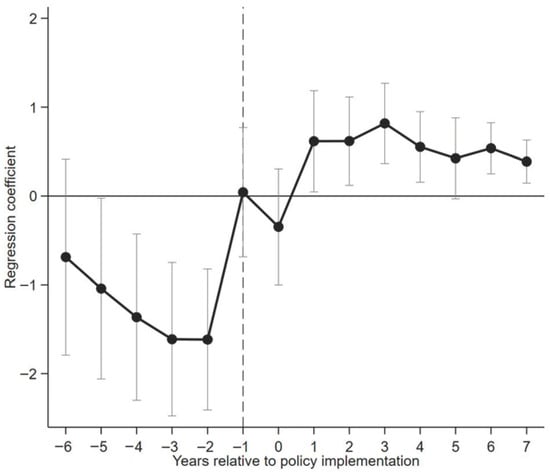
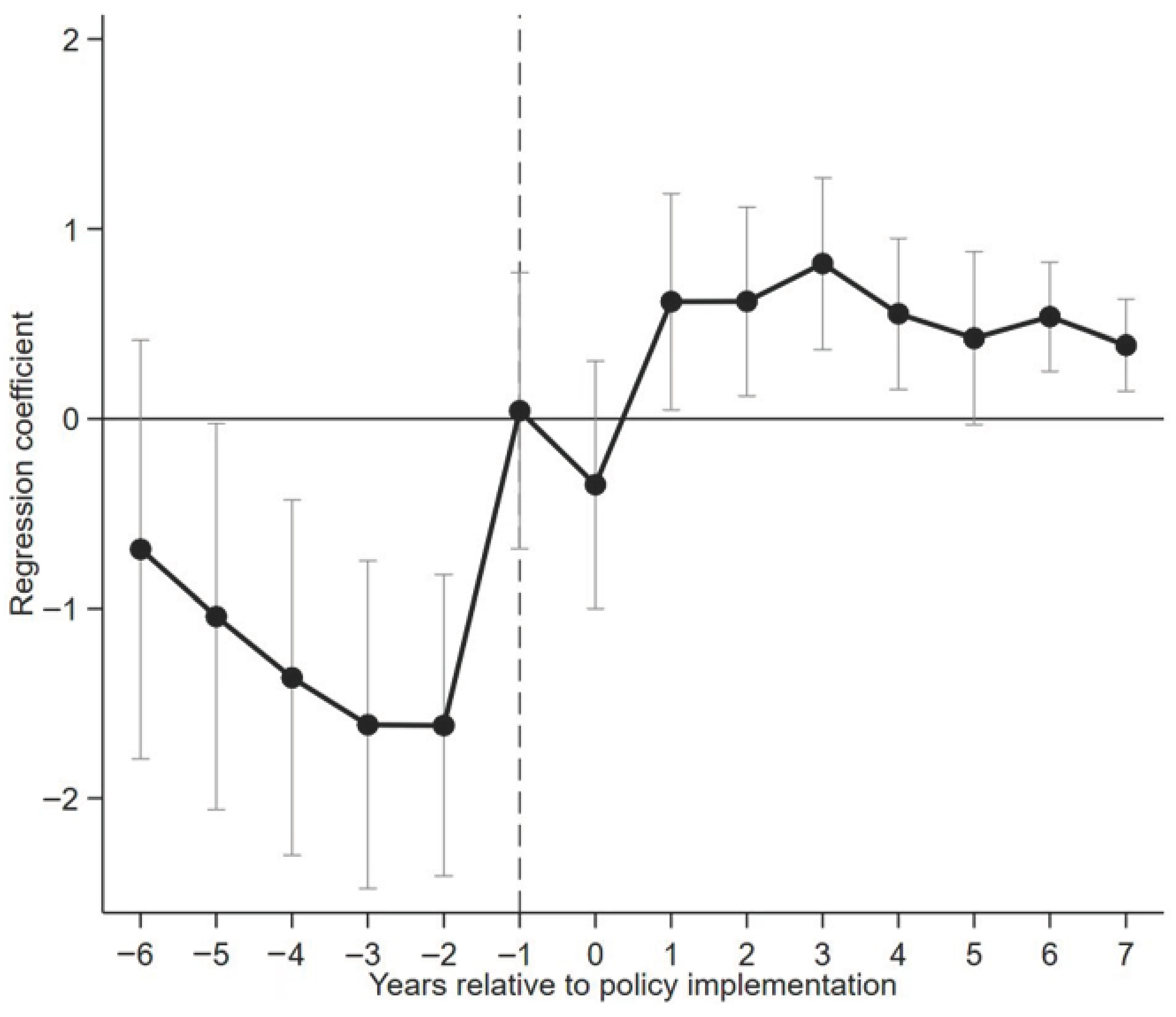
The core premise of the DID model is that the treatment and control groups must satisfy the parallel trend assumption before policy intervention; that is, before the establishment of the NBDCPZ, the temporal evolution paths of enterprise new quality productive forces in the two groups should not exhibit significant differences. Based on this, drawing on the research framework of reference [12], this paper employs the event study method to test the parallel trend hypothesis, with the model specified as follows:
where is a dummy variable, and the remaining variable settings are consistent with the baseline regression model. Figure 1 presents the results of the parallel trend test. The test results show that the estimated coefficients for each period prior to the policy implementation are not statistically significant at the 10% level. This indicates that there was no significant difference in the development trends of new quality productive forces between the treatment and control groups before the policy was implemented, and the parallel trend assumption holds. After policy implementation, the estimated coefficients of the core variable gradually become significantly positive, further demonstrating that the National Big Data Pilot Zones policy has a significant positive effect on enterprise new quality productive forces, and the baseline regression conclusions are robust. However, the policy effect weakens in the 3rd to 5th years after implementation, possibly due to the normalization of enterprise data factor utilization and the stabilization of investment, resulting in declining marginal effects of the policy.
Figure 1.
Parallel trend test.
4.2.2. Placebo Test
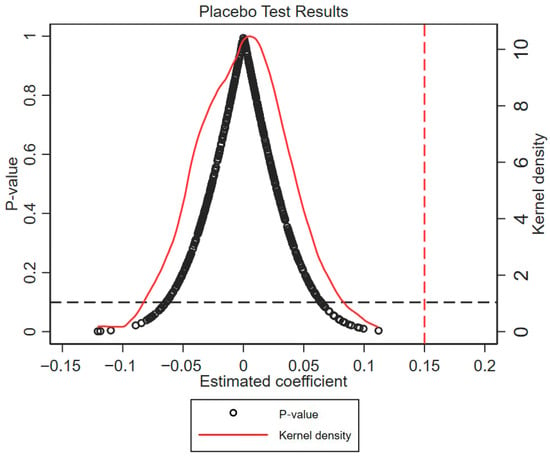
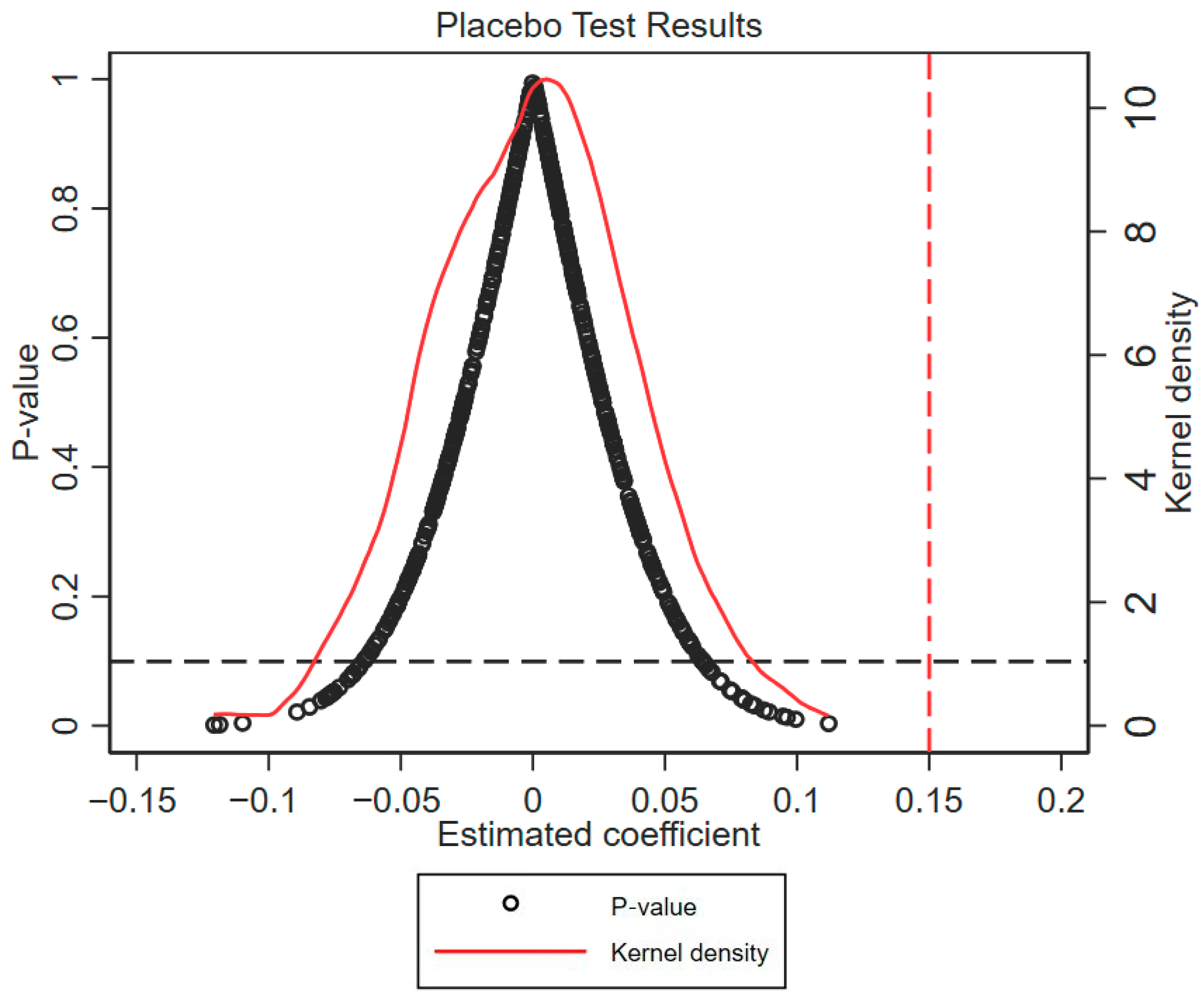
To exclude the interference of unobservable random factors and omitted variables on the baseline regression results and verify the causal identification validity of the policy effect, this paper conducts a placebo test. Specifically, we randomly assign treatment status and policy timing to sample enterprises, construct policy coefficients, and repeat the regression simulation 500 times. The policy coefficient and its corresponding p-value are recorded for each simulation. The results of the placebo test are shown in Figure 2. The simulated estimated coefficients are concentrated around zero, the kernel density curve exhibits a typical unimodal symmetric shape, and the p-values of the vast majority of coefficients are above the 0.10 significance level critical line. The actual policy estimated coefficient in the baseline regression of this paper is 0.125, which is significantly different from the test results of the placebo test. This result confirms that the positive policy effect identified in the baseline regression is not caused by random interference but is indeed driven by the implementation of the NBDCPZ policy, further verifying the robustness of the core conclusions.
Figure 2.
Placebo test.
4.2.3. PSM-DID Test
To alleviate the self-selection bias arising from the non-random selection of pilot cities for NBDCPZ, this paper adopts the annual PSM-DID estimation. We use predetermined firm-level covariates including size, roe, firmage, lev and occupy to match treatment firms and control firms year by year, with a strict caliper bandwidth of 0.05 for 1:1 nearest neighbor matching. Observations outside the common support domain are excluded to ensure the comparability between the treatment and control groups. After passing the balance test, the PSM-DID model is estimated. Table 4 shows that the coefficient of the core interaction term remains significantly positive, and does not differ significantly from the baseline regression outcomes, which further verifies the robustness of the baseline empirical findings.
Table 4.
PSM-DID Analysis.
4.2.4. Replacing the Explanatory Variable
Referring to the research [14], the frequency of big data-related terms in the annual reports of listed companies is used to measure the level of enterprise data factor agglomeration and is included as an explanatory variable in the baseline regression model. As shown in Table 5, the regression coefficient of the enterprise data factor level (entdataelements) exhibits a significant positive effect at the 1% confidence level, confirming that the concentration of internal data factors within enterprises can significantly promote the growth of their new quality productive forces. This finding further corroborates that data factor agglomeration has a stable positive impact on enterprise new quality productive forces.
Table 5.
Replacing the explanatory variable.
5. Mechanism Test and Heterogeneity Analysis
5.1. Mechanism Test
Based on the theoretical analysis presented earlier, data factors empower the development of enterprise new quality productive forces through three interconnected pathways: the digital empowerment effect, the R&D innovation effect, and the talent agglomeration effect. Importantly, these mechanisms operate in a complementary and potentially sequential manner. Digital transformation serves as the foundational layer, enhancing R&D efficiency and attracting high-quality talent, while innovation and talent accumulation, in turn, reinforce digital capabilities, creating a virtuous cycle. To empirically test these transmission channels, we draw on the approach of [12] and formulate the following mediation model:
where represents the mechanism variable, and other variables are the same as in Model (1).
5.1.1. Digital Empowerment Effect
Data factor agglomeration may promote the development of enterprise new quality productive forces by enhancing enterprise digitalization levels. This paper uses the proportion of intangible assets involving digital technology to total assets (Dti) to measure enterprise digitalization levels [29], as a mediating variable for the digital empowerment effect, and conducts the regression analysis. The results are shown in Table 6. The result in Column (1) indicates that data factor agglomeration can significantly enhance enterprise digitalization levels. In Column (2), both digitalization levels and the core DID coefficient remain significantly positive, but the magnitude of the DID coefficient declines compared to the baseline total effect. This suggests that enterprise digitalization plays a partial mediating role. That is, the pilot policy not only has a direct promotion effect on new quality productive forces, but also exerts an indirect positive impact through improving enterprise digitalization. The possible reasons are twofold. On the one hand, the policy dividends and resource effects of the pilot zones lower the cost barriers for enterprises to introduce digital technologies and build digital systems. On the other hand, the circulation and sharing of data factors enable enterprises to better recognize the value of digital transformation, proactively increasing investment in digital intangible assets to adapt to data-driven operational models, thereby enhancing the level of new quality productive forces. Hypothesis 2 is thus verified.
Table 6.
Mechanism test results: enterprise digitalization levels.
5.1.2. R&D Innovation Effect
R&D innovation is the core engine for achieving technological breakthroughs and efficiency and quality improvements in new, high-quality productive forces. This paper constructs an indicator using the ratio of enterprise R&D investment to operating revenue (Re). Table 7 presents the results of the R&D innovation mechanism test. The result in Column (1) indicates that the establishment of National Big Data Pilot Zones significantly enhances enterprise R&D innovation investment, while Column (2) indicates that increased R&D innovation investment can significantly promote the development of enterprise new quality productive forces. The possible reason is that data factor agglomeration, by increasing R&D investment, strengthens enterprise technological innovation capabilities, promotes the innovative allocation of production factors, and provides core technological support for the development of new quality productive forces. Hypothesis 3 is thus verified.
Table 7.
Mechanism test results: R&D innovation effect.
5.1.3. Talent Agglomeration Effect
Talent agglomeration is the core supporting factor for new, high-quality productive forces development [30,31,32]. This paper uses the ratio of employees with a bachelor’s degree or above to the total number of employees (Hepr) to measure the talent agglomeration level of enterprises. Table 8 presents the results of the talent agglomeration mechanism test. The result in Column (1) indicates that the establishment of National Big Data Pilot Zones significantly enhances enterprise talent agglomeration levels, while Column (2) shows that the enhancement of talent agglomeration levels can significantly promote the development of new quality productive forces. The possible reasons are: on the one hand, the industrial agglomeration effect and supporting talent policies of the National Big Data Pilot Zones attract a large number of highly educated talent; on the other hand, data factor agglomeration drives enterprises toward digital transformation, increasing enterprise demand for highly educated technical talent, and enterprises proactively optimize their talent strategies. The technological innovation and management upgrades brought by these talents ultimately promote the development of new quality productive forces. Hypothesis 4 is thus verified.
Table 8.
Mechanism test results: talent agglomeration effect.
5.2. Heterogeneity Analysis
5.2.1. Ownership Heterogeneity
The effect of data factor agglomeration on enterprise new quality productive forces may differ significantly across enterprise ownership types. Based on ownership nature, this paper divides the sample enterprises into state-owned enterprises and non-state-owned enterprises to explore the potential impact of data factor agglomeration on enterprise new quality productive forces under different ownership types. Table 8 presents the results of ownership heterogeneity analysis. The first column shows the non-state-owned enterprise sample, where the did coefficient is 0.472, significantly positive at the 1% level, indicating a pronounced policy empowerment effect. The second column shows the state-owned enterprise sample, where the did coefficient is only 0.177 and is not statistically significant. This difference may be related to the attributes of the two types of enterprises. Non-state-owned enterprises have more flexible decision-making mechanisms, respond more quickly to market opportunities, and possess stronger adaptability in terms of data factor acquisition channels, application scenario development, and technological iteration and upgrading. These characteristics enable them to rapidly transform policy dividends into tangible productivity improvements. In contrast, although state-owned enterprises are resource-rich, they are constrained by multiple administrative layers and lengthy decision-making processes. Their digital transformation often faces the dual challenges of path dependency and insufficient incentives, which hinders the full release of the potential value of data factors and thus weakens the policy effect. To formally test whether the coefficient difference between ownership groups is statistically significant, we conducted interaction term regressions. Column (3) shows that the interaction term (did × soe) is significantly negative at the 1% level, confirming that the policy effect for SOEs is significantly weaker than that for non-SOEs. This formal statistical test provides stronger evidence for the ownership-based heterogeneity reported above (see Table 9).
Table 9.
Ownership heterogeneity.
5.2.2. Regional Heterogeneity
The impact of data factor agglomeration on enterprise new quality productive forces exhibits significant regional heterogeneity. This paper divides the sample enterprises into three groups based on their regions: eastern, central, and western. Table 10 presents the regression results. In Column (1), the did coefficient for the eastern region is significant at the 1% level; in Column (2), the did coefficient for the central region is significant at the 5% level; in Column (3), the did coefficient for the western region is 0.093 and does not pass the significance test. The possible reasons are as follows. The eastern region, with its comprehensive digital infrastructure, mature industrial ecosystem, and abundant talent reserves, can rapidly transform data factors into innovation momentum and promote the development of new quality productive forces. The central region, relying on its industrial foundation and locational advantages, achieves steady improvement in new quality productive forces under the empowerment of data factors. In contrast, the western region, constrained by weak digital infrastructure, insufficient talent supply, and lagging innovation ecosystems, has low efficiency in transforming data factor value and finds it difficult to effectively drive the enhancement of new quality productive forces. To formally test whether the coefficient differences across regions are statistically significant, we conducted interaction term regressions with eastern regions as the baseline group. Column (4) shows that the interaction term (did × west) is significantly negative at the 1% level, confirming that the policy effect in western regions is significantly weaker than that in eastern regions. However, the difference between central and eastern regions is not statistically significant. This formal statistical test provides stronger evidence for the regional heterogeneity reported above.
Table 10.
Regional heterogeneity.
5.2.3. Firm Age Heterogeneity
Enterprise life cycle theory reveals the developmental stage characteristics of enterprises from inception to maturity. Enterprises of different ages exhibit significant differences in resource reserves, risk-bearing capacity, and strategic decision-making flexibility. The implementation of the National Big Data Pilot Zones policy leads to differentiated responses to data factor integration and policy effects across firms at different growth stages. To further explore policy effect heterogeneity across firm age groups, this paper divides the sample enterprises into three categories: those established for less than 10 years, 10–20 years, and more than 20 years. The regression results are shown in Columns (1)–(3) of Table 11. The policy effect of the Big Data Pilot Zone policy on enterprises established for more than 20 years is significant at the 5% level, with a coefficient of 0.508; the coefficient for enterprises established for less than 10 years is 0.509 but is not statistically significant; the coefficient for enterprises established for 10–20 years is only 0.105 and is likewise not significant. The possible reason for this result is that established enterprises with more than 20 years, although they possess organizational inertia, can more steadily align with the resource support of the Big Data Pilot Zone policy by leveraging their long-accumulated resource reserves and market influence, gradually realizing the transformation of policy dividends; start-up enterprises with less than 10 years, despite having operational flexibility, find it difficult to transform policy opportunities into substantive development effects due to insufficient resource reserves and weak risk resistance; while enterprises of 10–20 years are in a balanced phase of business expansion and structural stabilization, where the priority of policy adaptation is lower than business development goals, resulting in the policy effect not achieving statistical significance. The magnitude differences between subgroup regressions and interaction term (Column (4)) regressions are due to the constraint of homogeneous control variable coefficients in the full-sample interaction model. However, the significant interaction terms provide formal statistical evidence for the reported heterogeneity effects.
Table 11.
Firm age heterogeneity.
6. Conclusions and Recommendations
6.1. Research Conclusions
This paper takes Chinese A-share listed companies from 2010 to 2023 as quasi-natural experimental subjects and employs DID and mediating effect models to examine the mechanisms, transmission channels, and heterogeneity of data factor agglomeration on enterprise new quality productive forces. The results indicate that data factor agglomeration can promote the development of enterprise new quality productive forces. The construction of NBDCPZ has driven the agglomeration of data factors within the regions, exerting a steady positive effect on enterprise production transformation, efficiency enhancement, and technological innovation. The regression coefficient of the core explanatory variable is significantly positive at the 1% level and remains robust across a series of tests, including parallel trend and placebo tests. This indicates that national-level data factor agglomeration policy has produced tangible effects on micro-enterprises, which is conducive to data empowerment of the real economy and the cultivation of new quality productive forces.
In terms of the mechanisms of action, data factor agglomeration provides support for enterprise new quality productive forces development through multiple channels. Data factor agglomeration can enhance enterprise digitalization levels, increase the proportion of digital intangible assets, drive the deep integration of digital technologies into R&D, production, and operational processes, and effectively improve enterprise resource allocation efficiency. Furthermore, it can encourage enterprises to increase R&D investment, enhance their technological innovation levels, and provide technological support for the development of new quality productive forces. Finally, it can effectively attract high-quality talent, optimize human capital structure, and inject core momentum into high-quality enterprise development. The above three pathways coordinate and reinforce each other, constituting a complete transmission logic for data factor agglomeration empowering enterprise new quality productive forces.
The results of the heterogeneity analysis indicate that the effects of data factor agglomeration differ significantly across enterprises of different ownership types, regions, and firm ages. From the perspective of enterprise nature, non-state-owned enterprises, with flexible governance mechanisms, rapid market responsiveness, and strong innovation willingness, can more efficiently realize the value transformation of data factors, with a prominent policy empowerment effect. State-owned enterprises, constrained by organizational models and decision-making processes, have weaker innovation and transformation momentum, and the policy effect is not significant. From a regional perspective, the eastern region, with its comprehensive digital infrastructure, mature industrial ecosystem, and most abundant talent reserves, has the highest efficiency in transforming data factor value. The central region, based on its solid industrial foundation and locational advantages, can effectively absorb the empowering effects of data factors. The western region, with weak digital infrastructure and insufficient talent attractiveness, has not yet experienced the driving effect of data factor agglomeration on new quality productive forces. From the perspective of firm age, enterprises established for more than 20 years, relying on their long-accumulated resources and market influence, can steadily transform policy dividends. Start-up enterprises established for less than 10 years, despite operational flexibility, find it difficult to realize policy effects due to insufficient resources and risk resistance. Enterprises of 10–20 years, due to the balancing needs of business expansion and structural stabilization, have not seen prominent policy adaptation effects.
6.2. Policy Recommendations
To translate data factor agglomeration into sustainable productivity gains, policymakers should prioritize institutional refinement and infrastructure investment. Governments must accelerate the replication of successful NBDCPZ models while advancing market-oriented mechanisms for data allocation, including data property rights establishment and secure trading systems. Particular attention should be paid to bridging regional divides by subsidizing digital infrastructure in the western region and implementing differentiated incentives—such as performance-based evaluations for state-owned enterprises and targeted R&D subsidies for non-state-owned enterprises—to ensure policy precision and reduce inter-regional data circulation costs.
Enterprises and regional planners must foster complementary capabilities to absorb these policy dividends. Firms should deepen the integration of data analytics into R&D and operational workflows while establishing robust data governance frameworks to mitigate security risks. Concurrently, regional authorities should facilitate cross-regional talent mobility and technology transfer, encouraging the eastern region to spearhead high-end innovation clusters, the central region to advance intelligent manufacturing, and the western region to leverage digital agriculture and cultural tourism. This multi-scalar approach ensures that data factor agglomeration translates into measurable enhancements in new quality productive forces across diverse economic landscapes.
6.3. Limitations and Future Prospects
While this study provides robust causal evidence regarding the impact of data factor agglomeration on enterprise new quality productive forces, several limitations warrant attention and offer avenues for future research. First, our measurement of new quality productive forces relies heavily on financial statement indicators; although comprehensive, this approach may not fully capture the nuanced dimensions of intangible digital assets and green innovation outcomes. Second, the DID framework, while controlling for time-invariant unobservables, cannot entirely rule out the influence of dynamic, unobserved confounders or anticipate the long-term effects beyond our sample period (2010–2023). Furthermore, the baseline empirical model primarily assumes a linear positive relationship between data factor agglomeration and new quality productive forces. Theoretically, excessive data concentration could potentially lead to diminishing marginal returns, uneven access to digital resources, or market concentration, resulting in non-linear or threshold effects. Third, data availability constraints limited our ability to track the micro-level flow of data transactions within firms.
Future studies could address these gaps by employing granular, firm-level data on data asset registrations or by utilizing alternative identification strategies such as instrumental variables or machine learning techniques to more accurately quantify data factor prices. Extending this analysis to private enterprises or cross-country comparisons would further elucidate the institutional contingencies surrounding data-driven productivity growth. Additionally, threshold regression models and longer panel data could be used to examine these potential non-linear dynamics and long-term consequences.
Author Contributions
Conceptualization, X.C.; methodology, J.Q. and X.C.; formal analysis, J.Q.; investigation, X.C.; data curation, J.Q.; writing—original draft preparation, J.Q.; writing—review and editing, J.Q. and X.C.; supervision, X.C. All authors have read and agreed to the published version of the manuscript.
Funding
This research was funded by the Shanghai Lixin University of Accounting and Finance young backbone teacher innovative team program of “high-level construction of local university”, grant number CXTD2024011; the Shanghai Municipal Key Courses in Higher Education Institutions.
Institutional Review Board Statement
Not applicable.
Informed Consent Statement
Not applicable.
Data Availability Statement
Dataset available on request from the authors.
Conflicts of Interest
The authors declare no conflicts of interest.
References
- Wei, Y.; Wu, M. How new quality productive forces affect income disparities within enterprises: A work tasks perspective. Int. Rev. Econ. Financ. 2026, 106, 104847. [Google Scholar] [CrossRef] [Scilit]
- Sun, L.; Huang, C.; Yang, L. Can data factor aggregation enhance enterprise resilience?—A quasi-natural experiment employing national big data comprehensive pilot zone. Int. Rev. Econ. Financ. 2026, 106, 105007. [Google Scholar] [CrossRef] [Scilit]
- Goldfarb, A.; Tucker, C. Digital economics. J. Econ. Perspect. 2019, 57, 3–43. [Google Scholar] [CrossRef] [Scilit]
- Lou, F.; Li, T.; Bu, Y. Can regional data factor aggregation expand the corporate green innovation boundaries? An AMO framework and field theory perspective. Glob. Econ. Res. 2026, 2, 100034. [Google Scholar] [CrossRef] [Scilit]
- Wang, H.; Hao, Y.; Fu, Q. Data factor agglomeration and urban green finance: A quasi-natural experiment based on the National Big Data Comprehensive Pilot Zone. Int. Rev. Financ. Anal. 2024, 96, 103732. [Google Scholar] [CrossRef] [Scilit]
- Liu, J.T.; Shi, Z.H. The Impact of Data Element Agglomeration on Inclusive Green Development: Evidence from Threshold and Spatial Spillover Effects. Sustainability 2026, 18, 2973. [Google Scholar] [CrossRef] [Scilit]
- Yuan, Y.; Zhu, Y.Y.; Zhang, J.L.; Kang, M. Data Element Agglomeration, Regional Innovation Ecosystem and Innovation Quality. Sage Open 2026, 16, 21582440251397451. [Google Scholar] [CrossRef] [Scilit]
- Zhao, G.; Li, J. Does Enterprise Digital Transformation Enable New Quality Productive Forces Development of Enterprises?: Based on micro evidence from Chinese listed firms. Rev. Ind. Econ. 2024, 4, 23–34. [Google Scholar]
- Liu, R.; Zhang, R.; Lv, M. Digital transformation, technological innovation, and employment structure change: A panel analysis of chinese cities from the perspective of new quality productive forces. Financ. Res. Lett. 2026, 88, 109097. [Google Scholar] [CrossRef] [Scilit]
- Xie, J.; Zheng, Y.; Dong, Q. The Digital and Intelligent Construction of Supply Chains Enables the New Quality Productive Forces of Manufacturing Enterprises: A Quasi-natural Experiment Based on the Construction of Supply-chain Innovation and Application Pilot Cities. J. Shanghai Univ. Financ. Econ. 2024, 26, 15–29. [Google Scholar]
- Guo, Y.; Hu, J.; Dou, Y.; Lin, S. Can ESG rating help shape enterprises’ new-quality productivity? Evidence from China. Int. Rev. Econ. Financ. 2025, 104, 104654. [Google Scholar] [CrossRef] [Scilit]
- He, J.; Lian, X.; Tian, J. How Does Data Aggregation Empower New Quality Productivity?—A Quasi-Natural Experiment Based on China’s National Big Data Pilot Zones. Shanghai J. Econ. 2025, 12, 58–72. (In Chinese) [Google Scholar] [CrossRef]
- Luo, M.; Zhou, H.; Mao, D. Marketization of data elements and new-quality productivity: A quasi-natural experiment based on data trading platforms. Appl. Econ. 2025, 8, 1–19. [Google Scholar] [CrossRef] [Scilit]
- Zuo, X.; Zeng, X.; Sun, P. Unleashing new-quality productive forces: Reconsidering the impact of data-factor marketization. Int. Reniew Econ. Financ. 2026, 107, 105095. [Google Scholar] [CrossRef] [Scilit]
- Zhao, C.; Li, W.; Chen, H.; Xiang, X.; Wang, Y. How does factor agglomeration affect new quality productive forces through dualinnovation? Stud. Sci. Sci. 2026, 44, 1178–1191. (In Chinese) [Google Scholar] [CrossRef]
- Yu, Y.; Ren, X.; Zhang, Z. How Data Factors Drive to the New Quality Productive Forces in China: The Role of Big Data Pilot Zones. Appl. Econ. 2025. Epub ahead of printing. [Google Scholar] [CrossRef] [Scilit]
- Hua, D.; Hong, X. The Effect of Public Data Openness on the Enhancement of Firms’ New Quality Productivity Levels: Based on a Quasi-Natural Experiment of Government Data Platform Access. Political Econ. Q. 2025, 4, 61–89. [Google Scholar] [CrossRef] [Scilit]
- Xu, J.; Xu, W. Exploring the Transmission Pathway of ‘Data-Finance’ Synergistic Clustering on Corporate Economic Adaptability: Evidence from Quasi-Experimental Analysis in National Big Data Pilot Zones. Int. Rev. Econ. Financ. 2025, 101, 104233. [Google Scholar] [CrossRef] [Scilit]
- Yang, C.; Hu, Z. Data Element Resource Supply and Enterprise Green Innovation Quality. Int. Rev. Financ. Anal. 2026, 109, 104839. [Google Scholar] [CrossRef] [Scilit]
- Bai, F.; Zhang, N. Research on the impact of data elements on corporate green innovation. Sci. Res. Manag. 2026, 47, 35–45. (In Chinese) [Google Scholar] [CrossRef]
- Sun, Z.; Rao, M.; Yao, B.; Ci, H.; Li, Z.; Feng, C. Driving Enterprise New Quality Productivity: The Role of Big Data Tax Collection. Int. Rev. Financ. Anal. 2025, 103, 104184. [Google Scholar] [CrossRef] [Scilit]
- Yao, B.; Deng, Y. Research on the Impact of Data Elements Agglomeration on the New Quality Productive Forces of Enterprises. J. Stat. Inf. 2025, 40, 36–49. [Google Scholar] [CrossRef]
- Zhou, W.; Xu, L. On New Quality Productivity: Connotative Characteristics and Important Focus. Reform 2023, 10, 1–13. [Google Scholar]
- Zhang, Z.; Cao, J.; Ma, R.; Feng, Y. Digital economy policies and corporate technology spillovers: A data-driven perspective. Int. Rev. Econ. Financ. 2025, 103, 104516. [Google Scholar] [CrossRef] [Scilit]
- Dong, J. Enterprise Digital Transformation: The Engine of New Quality Productivity Growth. Front. Bus. Econ. Manag. 2024, 25, 339–344. [Google Scholar] [CrossRef] [Scilit]
- Liang, W.; Na, L. Research on the Agglomeration of Data Elements Empowering Digital New Quality Productive Forces. J. Stat. Inf. 2024, 39, 12–23. (In Chinese) [Google Scholar] [CrossRef]
- Wu, J.; Zhan, W. The Impact of New Quality Productive Forces on Advanced Manufacturing Clusters: Empirical Evidence from China. Sustainability 2026, 18, 529. [Google Scholar] [CrossRef] [Scilit]
- Song, J.; Zhang, J.; Pan, Y. Research on the Impact of ESG Development on New Quality Productive Forces of Enterprises- Empirical Evidence from Chinese A-share Listed Companies. Contemp. Econ. Manag. 2024, 46, 1–11. (In Chinese) [Google Scholar] [CrossRef]
- Xie, D.; Wang, R.; He, C. The Market-Oriented Allocation of Data Elements Empowers the Development of New Quality Productive Forces in Enterprises. Econ. Perspect. 2025, 5, 19–37. (In Chinese) [Google Scholar]
- Tian, X.; Ma, Y. Digital asset intensity and strategic disclosure effects on firm performance: Evidence from China. Int. Rev. Econ. Financ. 2026, 105, 104855. [Google Scholar] [CrossRef] [Scilit]
- Jian, X.; Du, D.; Liang, D. Scale or effectiveness? The nonlinear impact of talent agglomeration on high-quality economic development in China. Heliyon 2024, 10, e30121. [Google Scholar] [CrossRef] [Scilit] [PubMed]
- Tan, Y. The Impact of Human Capital Accumulation and Technological Innovation on the Improvement of Regional New Quality Productivity. Int. J. Asian Soc. Sci. Res. 2025, 4, 281227368. [Google Scholar] [CrossRef] [Scilit]

Disclaimer/Publisher’s Note: The statements, opinions and data contained in all publications are solely those of the individual author(s) and contributor(s) and not of MDPI and/or the editor(s). MDPI and/or the editor(s) disclaim responsibility for any injury to people or property resulting from any ideas, methods, instructions or products referred to in the content. |
© 2026 by the authors. Licensee MDPI, Basel, Switzerland. This article is an open access article distributed under the terms and conditions of the Creative Commons Attribution (CC BY) license.