


Abstract
Given the increasingly prominent environmental issues that adversely affect global sustainable development, this study, grounded in situated cognition theory and social cognition theory, constructs a moderated serial mediation model to investigate the mechanisms and boundary conditions through which environmental education influences higher education students’ ecological behavior. Based on a survey and analysis of 3961 higher education students, the findings reveal that (1) theoretical education and practical education exert significantly different pathways to ecological behavior, with practical education demonstrating a significant positive direct behavioral driving force, whereas the direct effect of theoretical education is not significant and operates mainly through indirect psychological transmission; (2) ecological values and ecological cognition serve as serial mediators between environmental education and ecological behavior; (3) the degree of theory-practice transformation positively moderates the relationship between practical education and ecological cognition, while ecological action competence positively moderates the relationship between ecological cognition and ecological behavior. The results indicate that while strengthening students’ environmental education, universities should also focus on cultivating their ecological action competence—the key competence that transforms ecological cognition into actual behavior—and strive to enhance the teaching effectiveness of transforming theoretical education into practical experience.
1. Introduction
As environmental issues become increasingly severe, higher education plays a crucial role in enhancing higher education students’ ecological literacy and guiding their ecological behavior [1,2,3]. However, in reality, some students, despite possessing ecological awareness and cognition, lack the actual initiative to participate in environmental protection, exhibiting a cognitive-behavioral disconnection [4,5]. This suggests that mere educational input does not directly trigger behavioral change [6]. Other studies have also confirmed that the promoting effect of environmental education on behavior is far weaker than its effect on cognition [7,8]. Nevertheless, existing research tends to treat environmental education as a whole, with few studies distinguishing the differentiated pathways of theoretical education and practical education [9]. In terms of mechanism analysis, most studies are confined to a single mediating variable [10,11,12], lacking in-depth exploration of the deeper mechanisms, such as how ecological values facilitate changes in cognitive levels [13,14,15]. Relevant research further points out that the linear “knowledge–attitude–behavior” model hypothesis has not received sufficient empirical support, and the relationships of other psychological constructs (e.g., intention, locus of control, etc.) with behavior are even stronger than that of attitude, suggesting that the process through which education influences behavior involves more complex psychological transmission mechanisms [4,16]. Moreover, whether individual internal characteristics (e.g., ecological action competence, etc.) exert moderating effects on the transformation from cognition to behavior has not yet been effectively validated [17,18].
How environmental education can be effectively transformed into the influencing factors and psychological realization pathways of students’ ecological behavior is an important practical issue facing universities [3,19]. In summary, this study establishes a moderated serial mediation model to address the following three questions: (1) Do theoretical education and practical education differ in their effects on ecological behavior? (2) Do ecological values and ecological cognition serve as serial mediators between environmental education and behavior? (3) How do ecological action competence and the degree of theory-practice transformation moderate this transmission process? Accordingly, departing from previous approaches that treat mediating variables as multiple isolated pathways, this study attempts to construct a serial transmission framework from environmental education to ecological values, then to ecological cognition, and finally to ecological behavior. By analyzing this progressively evolving psychological process, we aim to more accurately explain the underlying mechanisms of the effectiveness transformation of environmental education.
2. Literature Review
2.1. The Influence of Environmental Education on Ecological Behavior
The key to the effectiveness of environmental education lies in the improvement of students’ ecological behavior [3], yet the transformation from cognition to behavior still faces numerous obstacles [4,20]. Without the support of corresponding mediating factors, knowledge accumulation alone can hardly be solidified into persistent behavior [21]. Moreover, empirical studies have confirmed that practical experience is more effective than traditional classroom instruction in promoting pro-environmental behavior [22,23]. Some scholars have pointed out that cognitive skills are the weakest link in environmental literacy [24]. The relationship between environmental knowledge and behavior is not linear; information transmission alone is insufficient to facilitate behavioral change, as behavioral choices are also subject to the interactive effects of internal and external factors [3,4].
2.2. The Chain Mediation of Values and Cognition
The impact of education on behavior is not direct; it often operates through intervening processes of value identification and cognitive deepening [11,12,25]. Social cognitive theory posits that educational information needs to undergo individual cognitive processing before it can be transformed into behavior [26,27]. According to the cognitive hierarchy model, values indirectly influence behavior through cognition [25], and cognition fully mediates the relationship between values and ecological behavior [28]. Meanwhile, the promoting effect of environmental education on low-carbon behavior also needs to be realized through the serial transmission of environmental attitudes and green perceived value [3,29]. In summary, values serve as the antecedent foundation for the formation of cognition, and cognitive appraisal serves as the key channel through which values are transformed into action.
2.3. The Dual Moderating Effects of Ecological Action Competence and Theory-Practice Transformation Degree
Between “knowing” and “doing”, both ecological action competence and the degree of theory-practice transformation play important moderating roles [11,30]. Whether an individual possesses the corresponding environmental knowledge and skills often determines whether environmental attitudes can be translated into concrete actions [31,32]. Kolb’s experiential learning theory suggests that the degree of theory-practice transformation affects whether individuals can effectively internalize practical experience into cognition [33,34]. Individuals with a higher degree of transformation are better at transforming concrete experience into internal cognition through reflective observation [35]. Together, the two factors act on different stages of the transformation from cognition to behavior, constituting the key mechanisms that influence the implementation of environmental education.
3. Research Hypotheses
3.1. The Relationship Between Environmental Education and Ecological Behavior
Environmental education is a process in which higher education students acquire environment-related knowledge and cultivate ecological values through classroom instruction and practical experiential activities on campus. Ecological behavior refers to the voluntary implementation of environment-related actions by individuals, driven by a sense of environmental responsibility and ecological cognition. Theoretical education enables students to internalize environment-friendly awareness as part of their values [4,36], reduces psychological barriers during the implementation process [37], and transforms it from external constraints into internalized habitual self-discipline [38]. Relevant studies have pointed out that school education has a significant positive impact on students’ ecological awareness [36,39], and sound environmental education helps students form ecological values and a cognitive foundation, thereby laying the prerequisites for the subsequent enhancement of their ecological action competence [20,39]. Accordingly, theoretical education establishes the value basis for behavior, whereas practical education offers tangible avenues for behavioral enactment. Neither can be omitted, as both are essential to enabling higher education students to deliberately carry out a range of ecological behaviors in their everyday lives. Accordingly, this study proposes the following hypotheses:
Hypothesis 1a (H1a).
Theoretical education is significantly positively correlated with university students’ ecological behavior.
Hypothesis 1b (H1b).
Practical education is significantly positively correlated with university students’ ecological behavior.
3.2. The Chain Mediation Hypothesis of Ecological Values and Ecological Cognition
Ecological cognition refers to an individual’s cognitive judgment and mastery of ecological knowledge, environmental policies, and the consequences of their own actions. Ecological values refer to an individual’s identification with the intrinsic value of the natural environment and the psychological tendency to regard ecological protection as a moral obligation. The Value-Belief-Norm (VBN) theory emphasizes that values, as a deep psychological foundation, need to be transmitted through the hierarchical pathway of cognition and beliefs before they can be transformed into pro-environmental actions [11,40,41]. However, some early empirical studies have tended to favor a more direct pathway, suggesting that ecological values can directly predict pro-environmental behavior [42,43]. Although these studies provide evidence for the direct effect, most of them stop at reporting total effects or correlations, without testing values as an independent mediating variable within the VBN theoretical framework, nor have they fully demonstrated the internal mechanism by which values bypass the cognitive stage and exert an independent transmission effect [41,44]. To examine whether this direct pathway can receive empirical support within the boundaries of VBN theory, the following hypothesis is proposed:
Hypothesis 2 (H2).
Ecological values mediate the relationship between environmental education and ecological behavior.
The direct function of education is to enhance an individual’s understanding of objective environmental knowledge and policies, and the individual’s level of understanding of ecological knowledge and policies serves as a key cognitive bridge between educational intervention and behavior [32,45]. Related studies have confirmed that knowledge of environmental issues and knowledge of action strategies are two core variables in predicting responsible environmental behavior [31]. An individual’s degree of cognition regarding environmental problems and their understanding of effective action pathways directly determine whether they can translate environmental attitudes into actual behavior [11,31]. This indicates that ecological cognition is an indispensable mediating link in the process through which education influences behavior. Accordingly, the following hypothesis is proposed:
Hypothesis 3 (H3).
Ecological cognition mediates the relationship between environmental education and ecological behavior.
Based on the VBN theory, the function of environmental education is first to help individuals establish solid ecological values [40,46], and then to guide them to proactively adopt a knowledge system that aligns with those values [11,12]. Recent studies have shown that individuals’ ecological values and environmental knowledge do not function in isolation, but rather interact with and mutually reinforce each other, jointly driving conscious ecological behavior [47,48]. Accordingly, the following hypothesis is proposed:
Hypothesis 4 (H4).
Ecological values and ecological cognition play a chain mediating role between environmental education and ecological behavior.
3.3. The Moderating Role of Ecological Action Competence
Ecological action competence refers to an individual’s ability to translate environmental cognition and related knowledge into specific action plans and to execute them effectively. In the transmission process of psychological variables, ecological action competence often serves as a boundary condition, moderating the strength of the impact of ecological cognition on ecological behavior. Specifically, individuals with higher ecological action competence can more quickly translate cognition into actual behavior, thereby bridging the gap between awareness and action; whereas individuals with lower ecological action competence, even if they possess a certain level of ecological cognition, are still unable to put cognition into practice due to a lack of executive ability. This moderating process explains why individuals with similar levels of cognition exhibit significant differences in actual behavioral performance. Based on this, this study proposes the following hypothesis:
Hypothesis 5 (H5).
Ecological action competence positively moderates the relationship between ecological cognition and ecological behavior.
3.4. The Moderating Role of Theory-Practice Transformation Degree
The theory-practice transformation degree refers to an individual’s ability to integrate environmental knowledge learned in the classroom with their own practical experience, and to apply or transfer it to new contexts through reflective thinking [33]. Based on Kolb’s research, the effectiveness of knowledge generation largely depends on whether individuals can effectively combine “reflective observation” with “active experimentation”. In this study, the degree of theory-practice transformation, as a variable measuring the consistency between cognition and action, moderates the pathway from environmental education to ecological cognition: individuals with a higher degree of theory-practice transformation are more likely to internalize practical experiences into deeper-level cognition, and are also able to transform theoretical knowledge into concrete experience through practice. In contrast, individuals with a lower degree of transformation, even if they have received the same environmental education and acquired the corresponding ecological knowledge, may still experience a disconnection between theory and practice. This moderating process helps explain why the same educational input may yield differentiated cognitive outcomes across different individuals. Accordingly, the following hypotheses are proposed:
Hypothesis 6 (H6).
The theory-practice transformation degree positively moderates the relationship between practical education and ecological cognition.
Hypothesis 7 (H7).
The theory-practice transformation degree positively moderates the relationship between theoretical education and ecological cognition.
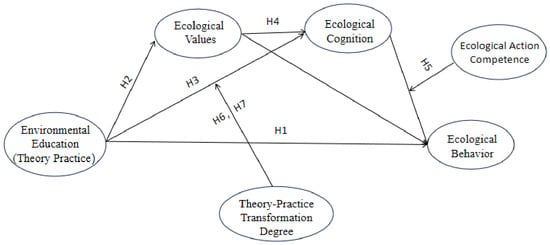
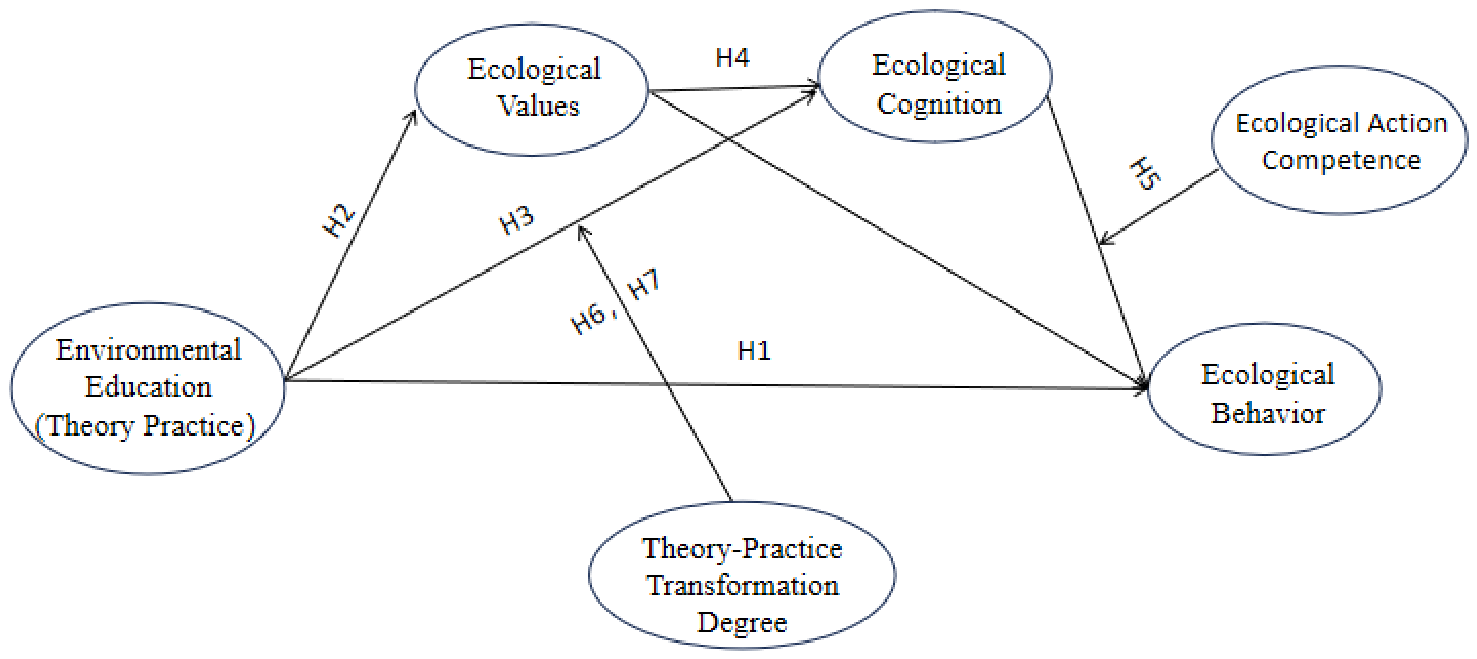
In summary, this study constructs a moderated serial mediation model to investigate the mechanisms through which environmental education (theoretical education and practical education) influences higher education students’ ecological behavior, with a particular focus on the serial mediating roles of ecological values and ecological cognition, as well as the moderating effects of ecological action competence and the degree of theory-practice transformation on this transmission process. Furthermore, this study employs Mplus 8.3 and the Bootstrap method (with 5000 resampling iterations) for parameter estimation and hypothesis testing. The hypothesized model is shown in Figure 1.
Figure 1.
Hypothesized model of the influence of environmental education on higher education students’ ecological behavior.
4. Research Methods
4.1. Research Participants
This study focuses on environmental education and ecological action competence among higher education students. A sample of 15 universities from various provinces across China was selected, encompassing a wide range of academic disciplines, including economics, law, science, engineering, and education, as well as diverse educational levels, from junior college students to undergraduates and above. An online questionnaire survey was employed, with a total of 4300 questionnaires distributed. After excluding invalid responses, 3961 valid questionnaires were finally obtained, yielding an effective response rate of 92.1%.
The characteristics and distribution of the questionnaire sample are as follows: 1628 male students (41.1%) and 2333 female students (58.9%); 1940 students with associate degrees (49.0%) and 2021 students with bachelor’s degrees or above (51.0%); 1928 students enrolled in vocational colleges (48.6%) and 2022 students enrolled in regular bachelor’s degree-granting institutions or above (51.0%).
4.2. Methods
4.2.1. Questionnaire Design
The questionnaire consists of two parts: demographic information and measurement items. The first part collects respondents’ basic background information, including gender, place of origin, type of institution, academic major, educational level, and whether they have served as student leaders. The second part consists of the core measurement items, covering the assessment of multiple dimensions. Specifically, the implementation of environmental education in universities is measured through two dimensions: theoretical education (sample item: “I have enrolled in and diligently studied many courses related to environmental education at university”) and practical education (sample item: “I often actively participate in practical experiential activities related to ecological and environmental protection organized by my university”). In addition, the questionnaire includes measures of ecological values (sample item: “I believe that actively participating in ecological and environmental protection public welfare activities is a social responsibility that every citizen should fulfill”), ecological cognition (sample item: “I can accurately explain and understand the scientific connotation and practical significance of ‘carbon peaking’ and ‘carbon neutrality’”), and ecological behavior (sample item: “In daily travel, I prioritize low-carbon modes such as walking, cycling, or public transportation”). All items in the above dimensions were measured using the Likert 5-point scale (1 = strongly disagree, 5 = strongly agree), with higher scores indicating that the content described in the items more closely matches the actual situation of the respondents.
In addition, for certain specific variables, this questionnaire adopted differentiated approaches to objective scoring and variable transformation. The ecological action competence dimension was measured through respondents’ actual objective experiences, comprising two categorical and ordinal choice items, such as “I am willing to proactively adjust my daily lifestyle for the sake of ecological and environmental protection.” The degree of theory-practice transformation was derived from information extracted from respondents’ answers to a multiple-choice question regarding “the main problems existing in ecological civilization education in universities,” from which information was extracted and transformed into a binary variable for subsequent analyses.
Before the formal administration, this study conducted a small-scale pilot survey to verify the measurement properties and evaluate the data quality of the second part of the questionnaire, which included 17 Likert 5-point scale items and 3 non-scale items. The pilot test employed a combination of convenience sampling and stratified sampling, yielding 280 valid questionnaires, with the sample covering different genders, majors, and educational levels. Item analysis, exploratory and confirmatory factor analysis, as well as reliability and validity tests, were conducted on the 17 scale items, all of which reached satisfactory levels. For the 3 non-scale categorical variables, differential tests were used to examine their logical relationships and coding distributions. Based on the pilot test results, the formal questionnaire was finalized, and the mixed data structure was confirmed to meet the requirements for formal administration.
4.2.2. Reliability and Validity Testing
Reliability testing was conducted using SPSS 28.0 software, and a reliability analysis was performed on the 17 indicators involved. The Cronbach’s α coefficient was 0.922. The Cronbach’s α coefficients for the dimensions of theoretical education, practical education, ecological values, ecological cognition, and ecological behavior were 0.905, 0.860, 0.943, 0.926, and 0.809, respectively, all exceeding 0.7 (the minimum acceptable level). This also indicates that the questionnaire design of the “Environmental Education and Ecological Action Competence among Higher Education Students” survey is scientifically sound, and the collected data demonstrate high reliability and stability. In addition, given that the items in the ecological action competence dimension are non-continuous objective categorical measures, and the degree of theory-practice transformation is a single dummy variable (0–1 variable) transformed from multiple-choice responses, both of which do not satisfy the statistical prerequisites for calculating internal consistency reliability in terms of measurement properties, they are not included in the reporting scope of reliability coefficients.
To further test the theoretical structure and measurement validity of the questionnaire, a validity analysis was conducted on these indicators. A goodness-of-fit test for the questionnaire yielded a Kaiser-Meyer-Olkin (KMO) value of 0.941, and the chi-square coefficient of Bartlett’s test of sphericity reached a significant level. This indicates a significant difference between the correlation coefficient matrix and the identity matrix, demonstrating that the data have high construct validity.
4.3. Ethical Statement
This study has been reviewed by the Science and Technology Ethics Committee of the affiliated university (No. SMYX-2026-004) and strictly followed the procedures and requirements of the Declaration of Helsinki. A questionnaire survey and data analysis were conducted among higher education students. Written informed consent was obtained prior to participation. During the data collection process, a consent form was provided along with a survey questionnaire, detailing the research objectives and content, and ensuring that participants were aware of their right to withdraw from the study at any time. The questionnaire survey was completely anonymous and voluntary, and no personal information (such as name) was required.
5. Result Analysis
5.1. Common Method Bias Test
Since all data were obtained from participants’ self-reports, it was necessary to test for common method bias (CMB) [49]. Following the recommendations of pertinent scholars, the present study employs a dual-analytic strategy integrating both exploratory and confirmatory procedures to achieve cross-validation [50]. First, Harman’s single-factor exploratory test showed that the variance explained by the first unrotated common factor was 25.76%, below the critical threshold of 40%. Furthermore, all subjective evaluation items (17 items in total) were forced to load onto a single common latent factor for confirmatory factor analysis (CFA), which yielded a poor model fit (), far below acceptable standards [49]. The results from both tests consistently indicated that the variance in the data was not dominated by a single method factor. Although post hoc diagnostic methods have inherent limitations in statistical power, the combined evidence suggests that common method bias does not pose a substantive threat at the single-factor level to the core variable relationships in this study [49].
5.2. Descriptive Statistics and Related Analysis
As shown in Table 1, the results of descriptive statistical analysis indicate that there is a notable gap between respondents’ cognitive levels and their actual behaviors with respect to environmental education-related dimensions. Ecological values scored the highest (), and evaluations of both theoretical education () and practical education () were also at relatively high levels. However, the mean score of ecological behavior dropped markedly (), indicating that there remains a considerable gap between “correct cognition” and “effective execution”. Meanwhile, the score for ecological action competence was relatively low (), and the degree of theory-practice transformation was also not high (), further reflecting that there is still room for improvement in current environmental education in enhancing individuals’ comprehensive competence and promoting the integration of knowledge and action. In addition, the standard deviation of ecological behavior () was the largest among all variables, suggesting that different individuals exhibited considerable variation in the process of translating awareness into action.
Table 1.
Descriptive statistics and correlation analysis results of each variable.
The correlation analysis results show that, with the exception of the relationship between ecological action competence and the degree of theory-practice transformation, which was not significantly correlated (), all other pairs of variables exhibited significant positive correlations (). Among these, the correlation between theoretical education and practical education was extremely strong (), and both were moderately to highly positively correlated with ecological values (,) and ecological cognition ( ), indicating that the current environmental education demonstrates good consistency in both transmitting values and shaping cognition. Furthermore, the correlation coefficients between theoretical education and ecological behavior, and between theoretical education and ecological action competence, are 0.401 and 0.300, respectively; while those between practical education and the two variables are 0.413 and 0.291, respectively. These relatively low correlations indicate that the direct linear associations between environmental education content and actual behavior, as well as ecological action competence, are weak.
5.3. Multicollinearity Test and Sensitivity Analysis
To rule out potential interference from collinearity among key exogenous predictor variables on parameter estimation, this study conducted variance inflation factor (VIF) diagnostics for each core path equation [51,52]. Given that “theoretical education” and “practical education” exhibited a certain degree of positive correlation, this study focused on examining three sets of multicollinearity conditions in which these two variables, respectively, took ecological values, ecological cognition, and ecological behavior as dependent variables. As shown in Table 2, across the three sets of equations, the VIF values for “theoretical education” and “practical education” ranged from 3.75 to 4.40, all strictly below the critical threshold of 5.0 recommended by Hair et al. [51]. These results indicate that, despite the relatively strong association between the two educational modes, including them simultaneously in the model did not give rise to serious multicollinearity issues, and the stability of the coefficient estimates was not significantly compromised.
Table 2.
Multicollinearity Diagnostic Results of Core Predictor Variables (VIF).
As shown in Table 3, to further verify the validity of simultaneously incorporating the highly correlated “theoretical education” and “practical education” into the structural equation model and to rule out potential parameter estimation distortion caused by collinearity, this study constructed a single “theoretical education” model and a single “practical education” model separately, and compared their unstandardized path coefficients with those of the combined model. The results showed that both theoretical education and practical education exerted highly significant positive effects on ecological values and ecological cognition in the single models (), with the direction of effects entirely consistent with that of the combined model, and the magnitudes of the path coefficients varied only slightly (), without any sign reversal or abnormal inflation of coefficients due to collinearity. The direct effect of theoretical education on ecological behavior in the combined model was not significant (), while the direct effect of practical education was significant but relatively small in magnitude (); this pattern was also replicated in the single models (theoretical education: ; practical education: ). In summary, incorporating the two educational modes simultaneously into the model did not cause substantial parameter estimation bias, which not only rules out substantive interference from multicollinearity but also demonstrates the robustness of the full model.
Table 3.
Comparison of Core Path Coefficients between Single-Predictor Models and the Joint Model (Unstandardized Coefficients).
5.4. Model Testing
The model fit results showed that CFI and TLI both exceeded 0.90, and SRMR was below 0.08; RMSEA was slightly above 0.08. Given that the model incorporates serial mediation paths and interaction terms and is therefore relatively complex in structure, the slightly elevated RMSEA may be a misestimation under complex model conditions [53]. Overall, the CFI, TLI, and SRMR indices all fell within acceptable ranges. Thus, the model fit results are at a marginally acceptable level. Consequently, the interpretation of path coefficients and hypothesis testing results will be approached with caution and will be evaluated in conjunction with practical significance for a comprehensive judgment.
5.4.1. Serial Mediation Effects and Differences Across Educational Dimensions
As shown in Table 4, the direct effects of theoretical education and practical education on ecological behavior exhibited a clear divergence: practical education had a significant positive predictive effect (), while the direct effect of theoretical education was negative and did not reach statistical significance (). The direction and magnitude of the effects of the two educational modes formed a striking contrast (). Accordingly, H1b—“practical education is significantly positively correlated with higher education students’ ecological behavior”—was supported, whereas H1a—“theoretical education is significantly positively correlated with higher education students’ ecological behavior”—was not supported. This suggests that the driving effect of theoretical education on behavior does not operate directly at the behavioral level but rather requires indirect transmission through internal psychological variables.
Table 4.
Mediation Effects and Effect Sizes.
In terms of single mediation tests, when ecological values served as the sole mediator, the indirect effects of both theoretical education () and practical education () were not significant, and H2 was not supported. This superficially suggests that macro-level value identification alone is insufficient to independently drive behavior. However, when ecological cognition served as the mediator, the indirect effects of both theoretical education () and practical education () were highly significant, with effect sizes substantially stronger than those of ecological values. H3 was thus supported, indicating that ecological cognition plays a significant mediating role between environmental education and behavior. Notably, although the direct effect of theoretical education on behavior was not significant, its indirect effect through ecological cognition was significant, constituting a full mediation pathway.
Further serial mediation analyses revealed that both the chain pathway from theoretical education to ecological behavior via ecological values and ecological cognition (), and the chain pathway from practical education to ecological behavior via ecological values and ecological cognition (), were significant. Notably, although ecological values alone did not function as a significant mediator, the chain pathway became robustly significant once ecological cognition was introduced as a subsequent mediator—indicating that ecological values must be transformed through ecological cognition to exert their influence on ecological behavior. This finding is consistent with the value-belief-norm (VBN) logic emphasized by the VBN theory, thereby supporting H4.
A comprehensive comparison reveals that the pathways through which theoretical education and practical education drive ecological behavior exhibit structural differences. The core distinction between the two does not lie in the magnitude of effects, but rather in the nature of their transmission mechanisms. Specifically, the direct effect of theoretical education was not significant (), and its total effect () was almost entirely mediated by internal psychological variables (total indirect effect ), exhibiting a “full mediation” driving pattern. In contrast, practical education featured both direct and indirect pathways, with a significant direct effect () and a significant indirect effect (total indirect effect ), yielding a total effect of ).
This finding echoes Rickinson’s classic assertion that classroom knowledge, instruction and outdoor hands-on experience differ fundamentally in their modes of effecting behavioral change [33,54]. Rickinson pointed out that if theoretical learning fails to connect with individuals’ existing experiences, its impact often remains at the cognitive level; by contrast, direct experience, characterized by contextual embeddedness and emotional arousal, is more likely to bridge the gap between cognition and action [4,54]. The empirical results of this study are highly consistent with this view: theoretical education influences behavior indirectly through the serial transmission of values and cognition, whereas practical education possesses dual pathways, encompassing both psychological mediation and direct engagement. Other studies have further revealed the underlying mechanism of this difference—the reason why practical education can directly facilitate behavior while bypassing certain psychological mediation links lies in the “embedded cognition” effect unique to hands-on experience [55]: knowledge and skills acquired in authentic contexts are naturally and tightly linked to behavioral trigger cues, making them more readily activated when action is required, without requiring the process of translating abstract cognition into specific situations.
5.4.2. Moderated Mediation Effect Analysis
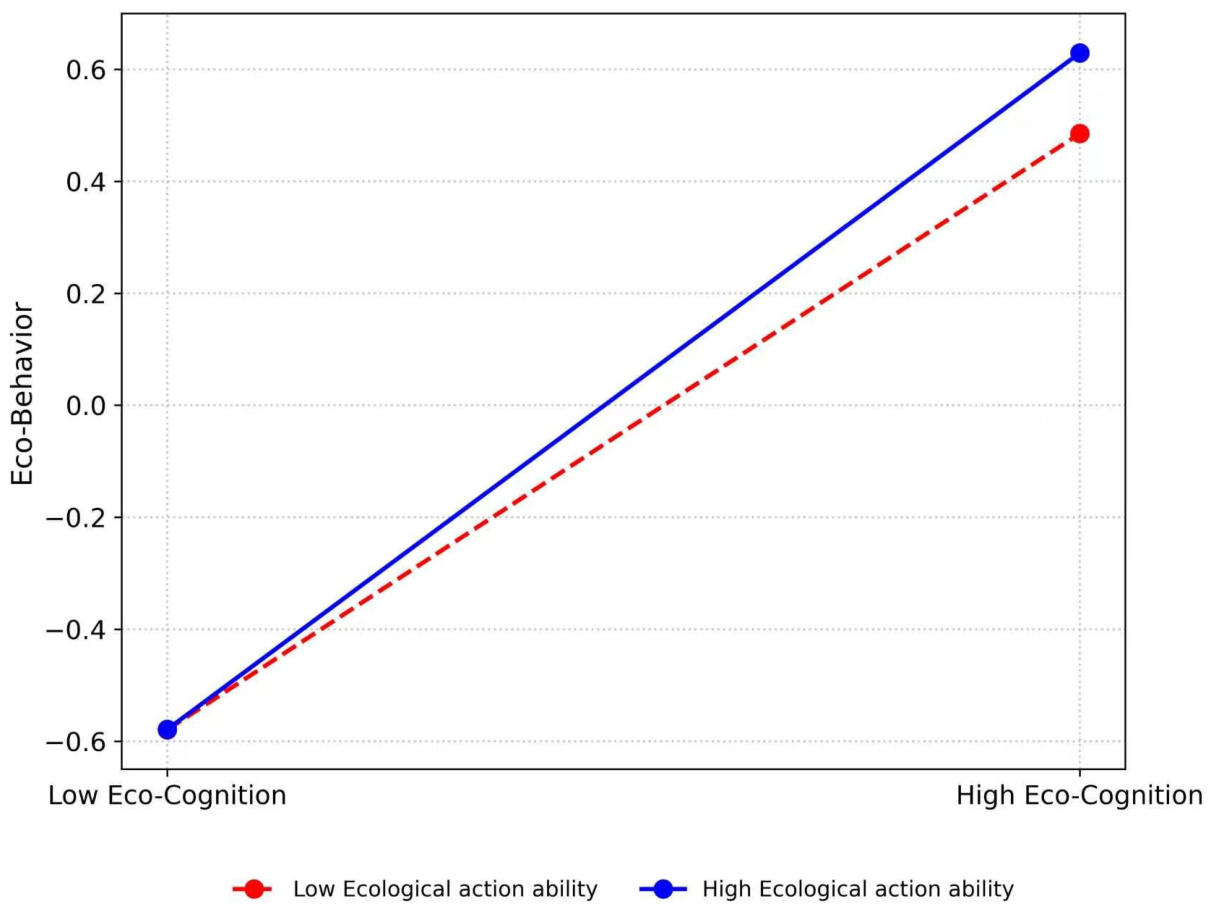
Table 5 shows that the interaction between ecological cognition and ecological action competence had a strong positive effect on ecological behavior (), indicating that ecological action competence plays an important and positive role in the pathway from ecological awareness to ecological behavior. Based on the above results, research H5 was well supported.
Table 5.
Testing of Moderated Mediation Effects.
The stepwise variation in the coefficients of determination (R2) for the three core endogenous variables in the model reflects the combined effect of the scale of independent variables and the inherent predictability of the dependent variables themselves, with the equations at each stage reaching highly significant levels ().
In the ecological values equation (R2), theoretical and practical education alone jointly explained 45.9% of the variance in values.
In the ecological cognition equation (R2), the explanatory power of the independent variables reached its highest level, at 59.5%.
In the ecological behavior equation (R2), the explanatory power dropped back to 32.6%. This may be attributable to unobserved contextual resistance or attenuation losses (manifested as increased residuals) encountered during the translation from cognition to behavior. In line with conventions in behavioral science, this explanatory rate still retains sufficient statistical significance and empirical value.
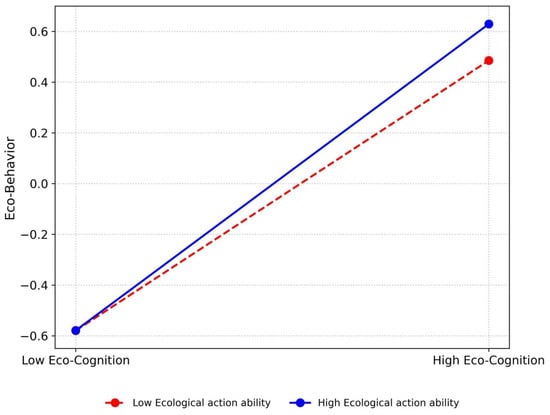
To further clarify the specific manifestation of the moderating effect, this study conducted a simple slopes analysis. The simple slopes test showed (Table 6, Figure 2) that when ecological action competence was low (M – 1 SD), the serial indirect effect of theoretical education on higher education students’ ecological behavior through ecological values and ecological cognition was 0.092, and reached a significant level (). When ecological action competence was high (M + 1 SD), this serial indirect effect increased to 0.104 ().
Table 6.
Conditional Indirect Effects Based on Simple Slope Analysis.
Figure 2.
Diagram of the moderating effect of ecological literacy.
At the low ecological action competence level (M − 1 SD), the serial indirect effect of practical education on higher education students’ ecological behavior was 0.047 (); at the high ecological action competence level (M + 1 SD), the serial indirect effect of practical education was 0.053 ().
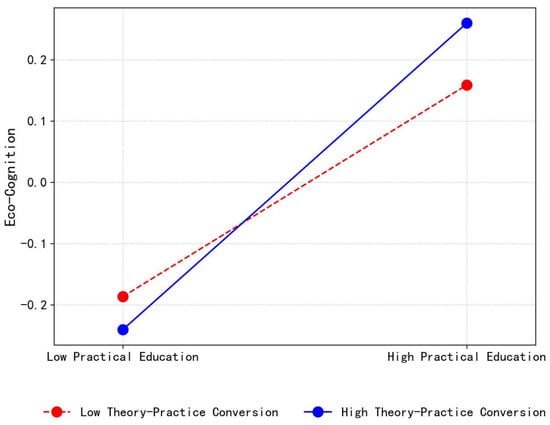
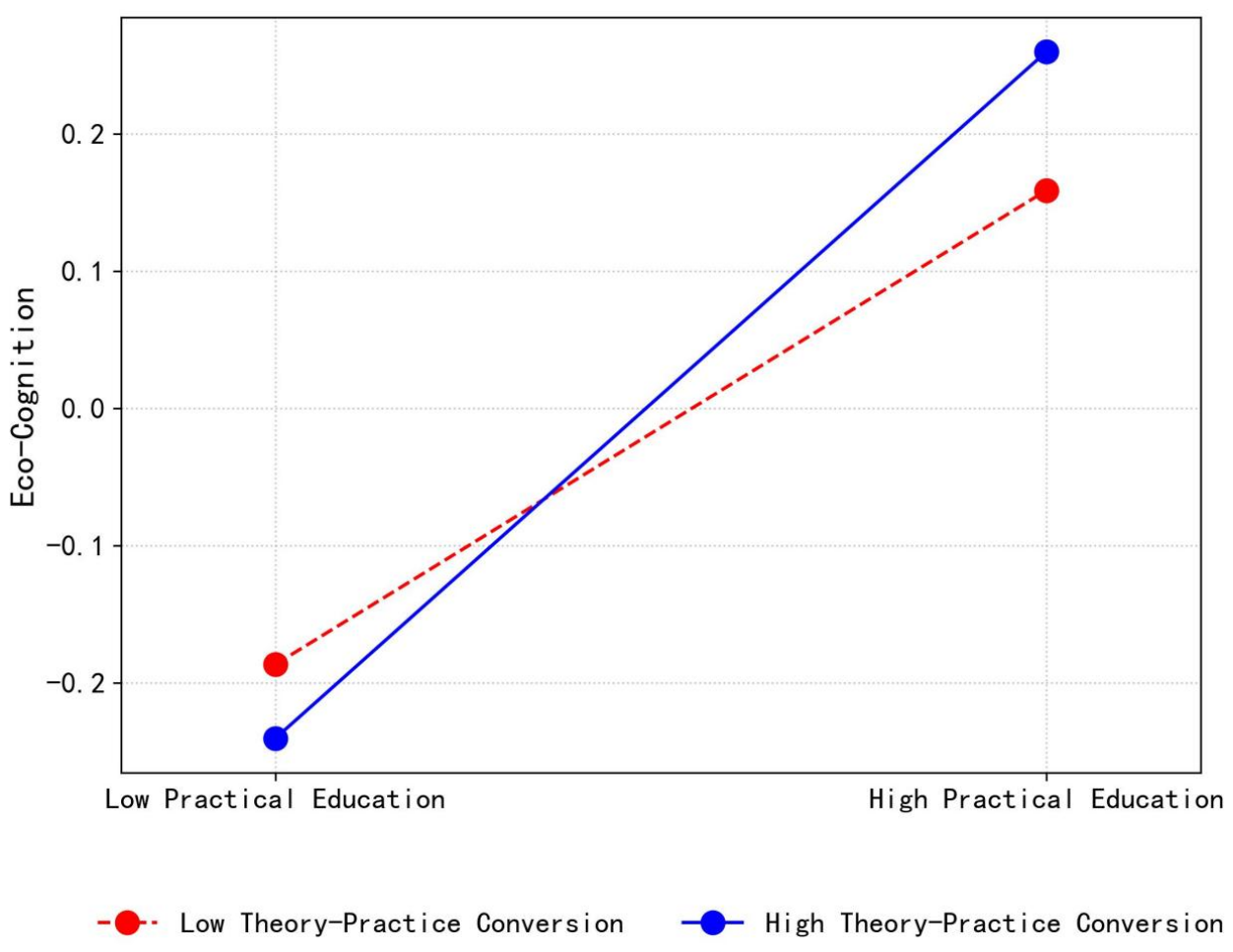
Regarding the moderating role of the degree of theory-practice transformation, in the interaction term tests, the interaction term “practical education × degree of theory-practice transformation” showed a significant positive predictive effect (), while the interaction term “theoretical education × degree of theory-practice transformation” was not significant (). Therefore, H6 was supported, whereas H7 was not confirmed.
The results of the simple slopes test showed (Figure 3) that for practical education: under low ecological action competence conditions, when the degree of theory-practice transformation was low (M − 1 SD), the indirect effect of ecological cognition on higher education students’ ecological behavior was 0.162 (); when the degree of theory-practice transformation was high (M + 1 SD), this indirect effect increased substantially to 0.234 (). Meanwhile, under high ecological action competence conditions, the same pattern occurred—that is, as the degree of theory-practice transformation increased, its indirect effect also rose accordingly, from 0.184 () to 0.266 ().
Figure 3.
Moderating effect of the degree of theory-practice transformation.
6. Discussion
6.1. Differentiated Pathways of Environmental Education Driving Ecological Behavior
This study found that the influence pathways of different educational modes on ecological behavior are significantly differentiated. Theoretical education can only indirectly guide ecological behavior through the chain-like transmission of ecological values and ecological cognition, which indirectly reveals the underlying causes of the inconsistency between cognition and action. By contrast, practical education can directly trigger pro-environmental behavior through sensory engagement. The differences between these two pathways are manifested, in terms of effect structure, as a functional differentiation in which “theoretical education relies on full mediation, whereas practical education possesses both direct and indirect pathways,” and, in terms of mechanistic nature, as an essential distinction between “cognition-driven” and “experience-driven” processes. Notably, the lack of support for H2 further indicates that abstract ecological values are not a direct outlet for ecological behavior—although individuals may establish macro-level value identification, they must combine such values with specific ecological knowledge and transform them into ecological cognition in order to obtain clear behavioral guidance and skill support. This finding echoes the serial transmission logic of this study, in which ecological values influence behavior through the cognitive pathway: the value construction achieved by theoretical education must rely on the cognitive bridge to materialize, whereas practical education can achieve efficient behavioral transformation through the direct experiential pathway. Although the psychological mechanisms of the two pathways differ, they can complement each other: theoretical education lays the value foundation and provides sustained motivation for ecological behavior, while practical education reinforces value identification through hands-on participation and strengthens behavioral inertia. The synergy of the two holds promise for providing a viable path to bridging the “attitude–behavior” gap in environmental education.
6.2. The Chain Mediating Role of Ecological Values and Ecological Cognition
Environmental educational interventions shape ecological values, gradually internalizing social norms into individual self-identification [56]. However, value identification alone often struggles to directly induce behavioral change, and the gap between theory and practice persists [4,57]. In this chain, ecological cognition plays a crucial bridging role, transforming relatively abstract values into concrete, actionable knowledge content [14,58]. This enables individuals, on the basis of identification, to possess the capacity for action, translating psychological endorsement into actual ecological behavior. Ecological values provide the intrinsic driving force for behavior, while ecological cognition endows this drive with clear direction and feasible pathways. Together, they constitute a complete psychological mechanism for the transition from intention to action.
6.3. The Moderating Roles of Ecological Action Competence and Theory-Practice Translation Degree
Ecological action competence and theory-practice translation degree occupy distinct positions along the educational efficacy pathway, and the data unequivocally reveal this differentiation.
Ecological action competence primarily exerts its moderating effect at the juncture where ecological cognition translates into ecological behavior. Individuals with stronger ecological action competence are more adept at converting their cognitive understanding into concrete action plans and executing them effectively, thereby enhancing the predictive power of cognition over behavior. In contrast, individuals with weaker ecological action competence, even when they possess a high level of ecological cognition, are still unable to translate it into practice due to a lack of execution skills, and are thus prone to falling into the dilemma of “easy to know, hard to do”. This indicates that the translation from cognition to behavior is contingent upon the possession of action skills.
The moderating effect of theory-practice translation degree is more prominent in the stage from environmental education to ecological cognition, and exhibits path-selectivity—it is significant only in the practical education pathway, while failing to receive support in the theoretical education pathway. The unsupported result of H7 reflects, to some extent, a fundamental difference in the cognitive formation mechanisms of the two educational modes. Theoretical education relies on systematic logical deduction and conceptual knowledge transmission, and its cognitive formation process possesses a relatively high degree of pathway stability, imposing lower demands on individuals’ capacity for reflective integration of practical experience. Consequently, regardless of students’ varying levels of translation ability, theoretical education can promote ecological cognition in a relatively stable manner. In contrast, according to Kolb’s experiential learning theory, embodied experiences in practical education do not automatically translate into cognitive schemas; only through the processing of reflective observation and active experimentation can they be abstracted into transferable knowledge structures [33]. Therefore, the effectiveness of practical education is highly contingent upon the boundary condition of the theory-practice translation degree. When translation capacity is insufficient, practical experiences tend to remain at the sensory level, failing to facilitate deep cognitive change.
In sum, the non-confirmation of H7 is not a model shortcoming, but rather reflects the intrinsic divergence between theoretical education and practical education in cognitive structuring. Theoretical education operates through passive knowledge absorption, with its effectiveness unaffected by individual transformation ability; however, it hinges on the translation of cognition into capability, requiring reflective integration as a prerequisite. This distinction suggests that future research should carefully delineate the moderating boundaries within which translation ability is applicable, and avoid overgeneralizing its moderating effects across different types of educational pathways.
6.4. Discriminant Validity Between Theoretical Education and Practical Education
The discriminant validity test between theoretical education and practical education in this study revealed a relatively high degree of overlap at the measurement level. Specifically, the standardized correlation coefficient between the two latent variables was 0.974, which exceeded the square roots of the average variance extracted (AVEs) for the two constructs (0.714 and 0.728, respectively), indicating that the Fornell-Larcker criterion did not meet the desired threshold. In higher education students’ subjective perceptions, “systematic classroom-based theoretical learning” and “hands-on participation in environmental practices” tend to intertwine and permeate each other; respondents may not necessarily be able to clearly distinguish between the two when completing the survey. Consequently, the two dimensions exhibit a certain degree of conceptual overlap at the measurement level, which constitutes an important limitation of this study in terms of construct distinctiveness.
However, the failure to meet the discriminant validity threshold does not necessarily imply that the two constructs should be merged [59,60]. Nested model comparisons revealed that when the correlation between the two latent variables was forcibly fixed to 1, the model yielded a non-positive definite covariance matrix and exhibited a significant deterioration in fit, indicating that forced merging would lead to unstable model estimation. More importantly, despite their high correlation, the two constructs demonstrate clearly distinguishable pathways in the structural model: practical education retains a significant direct behavioral driving force, whereas the direct effect of theoretical education is non-significant and operates almost entirely through psychological mediation. This functional-level differentiation itself suggests that the two constructs are not entirely redundant, and aligns with the proposition advocated by Rickinson—that knowledge types should be distinguished based on mechanisms of influence rather than measurement independence. Meanwhile, multicollinearity diagnostics showed VIF values ranging from 3.75 to 4.40 (<5.0), and the path coefficient directions in the single-predictor and joint-predictor models were consistent [51]. Multiple tests for common method bias also indicated that the observed relationships among variables were not artificially inflated by a single method factor, suggesting that the high correlation has not severely distorted parameter estimation.
In summary, this study retains both dimensions in subsequent analyses, but it must be clearly acknowledged that their distinctiveness is suboptimal within the measurement instrument employed. The observed differences in their respective pathways should be treated as exploratory findings rather than definitive conclusions. Future research should validate these results through more discriminative item designs, objective behavioral records, or multi-source data.
7. Limitations and Future Directions
Although this study has yielded some valuable findings based on a relatively large sample and rigorous statistical testing, the following limitations should be acknowledged.
First, the reliance on a single data source raises the potential risk of common method bias. All data in this study were collected through self-report measures. To control for this bias as much as possible, we supplemented Harman’s single-factor exploratory test with a confirmatory factor analysis (CFA) single-factor model test; the results of both tests consistently indicated that the data were not severely dominated by a single method factor (see Section 5.1). However, these tests are ex post statistical remedies with inherent limitations in statistical power, and Harman’s single-factor test itself has been criticized in the literature for being insufficient to fully rule out common method bias [49]. Self-report data remain susceptible to the interference of social desirability effects and respondents’ response tendencies, which may affect the absolute accuracy of the estimated results to some extent [61,62]. Future research could adopt multi-wave longitudinal tracking or multi-source data collection approaches to improve upon this, such as incorporating objective behavioral records or third-party observational evaluations, to reduce the bias risks associated with a single measurement method.
Second, this study analyzed the effects of environmental education, ecological cognition, and ecological values on university students’ ecological behaviors, but did not take into account the influence of factors such as government ecological and environmental protection institutions’ policies and ecological culture. These aspects warrant further in-depth analysis in future research. Meanwhile, this study primarily targets students at Chinese universities as its research subjects, without considering factors such as different national contexts and educational systems. Whether the findings can be generalized and applied to other countries or regions requires further expansion and refinement in subsequent studies.
Third, the environmental behavior variables are all based on respondents’ self-reports (e.g., frequency of low-carbon travel, resource recycling habits, etc.) rather than objective observational records of actual behaviors. Existing studies have shown that there may be discrepancies between self-reported behaviors and actual behaviors [63], implying that the relationships revealed in this study primarily reflect the “self-reported behavioral level” rather than the actual behavioral level in a strict sense [63,64]. Therefore, caution should be exercised when generalizing the conclusions to real-world behavioral contexts. Future research could incorporate objective behavioral observation data (e.g., travel mode records, resource consumption quantities, etc.) or adopt behavioral experiment designs to enhance the external validity of the study.
In addition, this study did not conduct measurement invariance analysis. We attempted to perform multi-group CFA tests across subgroups such as grade level and academic major, but due to insufficient sample sizes in certain subgroups (e.g., the low participation rate among senior students), the models failed to converge stably under the multi-group conditions, and thus we were unable to formally report the results of this analysis. Future research could employ stratified sampling designs to ensure that each subgroup meets the minimum sample size requirements for multi-group analysis, thereby enabling more robust testing of measurement invariance.
8. Conclusions
This study investigated the mechanisms underlying the impact of environmental education on university students’ ecological behavior. Findings reveal that environmental education does not exert a straightforward direct effect on ecological behavior; rather, its influence is achieved in a stepwise manner via value endorsement, cognitive comprehension, and action capacity. The central themes of this research encompass the divergence of educational approaches, serial mediation processes, and the moderating roles of two key variables.
First, theoretical education and practical education differ in their pathways of influence on ecological behavior. Practical education exerts a direct positive effect on students’ ecological behavior, suggesting that active engagement in environmental conservation activities is more likely to facilitate actual behavioral performance. By contrast, theoretical education shows no significant direct effect; instead, it operates indirectly via the sequential mediation of ecological values and ecological cognition.
Second, ecological values and ecological cognition play a serial mediating role between environmental education and ecological behavior. Environmental education can enhance students’ identification with ecological values and further promote their understanding of ecological knowledge, environmental policies, and behavioral consequences, ultimately facilitating the formation of ecological behavior. Among these, ecological cognition serves as an important bridge through which values are translated into actual behavior.
Third, ecological action competence moderates and strengthens the effect of ecological cognition on ecological behavior. Students are required not only to possess environmental knowledge and ecological awareness, but also to develop the capacity to transform cognitive understanding into practical action. The higher the level of ecological action competence, the more effectively ecological cognition can be materialized into specific ecological behaviors.
Fourth, the degree of theory-practice transformation primarily moderates the effect of practical education on ecological cognition. Students with a higher degree of theory-practice transformation are better able to synthesize experiences from practical activities and form cognitive understanding, thereby making the outcomes of practical education more pronounced. However, the moderating effect of this variable on the relationship between theoretical education and ecological cognition is not significant.
Overall, environmental education in universities should emphasize the integration of theoretical and practical education. Curricular instruction can help students establish ecological values and ecological cognition, while practical activities facilitate the translation of cognition into action. At the same time, institutions should also strengthen the cultivation of ecological action competence to more effectively promote the formation of ecological behavior. By constructing a moderated serial mediation model, this study not only clarifies the differentiated psychological transmission mechanisms of theoretical and practical education but also provides detailed theoretical elaboration and empirical support for addressing the real-world dilemma of the cognition-behavior inconsistency among university students in the domain of ecological and environmental protection.
Author Contributions
Conceptualization, J.N. and H.Z.; Methodology, J.N., Z.Q. and H.Z.; Software, L.C.; Validation, Z.Q. and H.Z.; Formal analysis, J.N. and L.C.; Investigation, J.N., L.C. and Z.Q.; Data curation, J.N. and L.C.; Writing—original draft, J.N.; Writing—review and editing, J.N. and H.Z.; Visualization, L.C. and Z.Q.; Supervision, Z.Q. and H.Z.; Project administration, J.N. and H.Z.; Funding acquisition, Z.Q. and H.Z. All authors have read and agreed to the published version of the manuscript.
Funding
This research was funded by the National Social Science Fund of China (No. 20BKS129), and the APC was funded by Jianjun Ni personally.
Institutional Review Board Statement
The study was approved by the Ethics Committee of Life Sciences and Medical Ethics Review Zhejiang A&F University (SMYX-2026-004) on 31 January 2026.
Informed Consent Statement
Informed consent was obtained from all subjects involved in the study.
Data Availability Statement
The data generated or used during the research are available from the corresponding author upon reasonable request. The dataset generated and/or analyzed during this survey study has been deposited in the Dataverse repository and is accessible at https://doi.org/10.7910/DVN/TL35S0 (Harvard Dataverse) (accessed on 30 April 2026).
Conflicts of Interest
The authors declare no conflict of interest.
References
- UNESCO. Educating for a Sustainable Future: A Transdisciplinary Vision for Concerted Action; EPD-97/CONF.401/CLD.1; UNESCO: Paris, France, 1997. [Google Scholar]
- Sterling, S. Sustainable Education: Re-Visioning Learning and Change; Green Books: Cambridge, UK, 2001. [Google Scholar]
- Yang, M.; Ren, G.; Guo, L. The impact of environmental education on college students’ low-carbon behaviour: A chain mediation model moderated by prosocial behaviour. Aust. J. Environ. Educ. 2025. Advanced online publication. [Google Scholar] [CrossRef] [Scilit]
- Kollmuss, A.; Agyeman, J. Mind the gap: Why do people act environmentally and what are the barriers to pro-environmental behavior? Environ. Educ. Res. 2002, 8, 239–260. [Google Scholar] [CrossRef] [Scilit]
- Grossmann, A.; Kriehn, T.; Arikök, M. The technical knowledge paradox: How environmental understanding creates action barriers among German university students. Eur. J. Sustain. Dev. 2026, 15, 75. [Google Scholar] [CrossRef] [Scilit]
- Heeren, A.J.; Singh, A.S.; Zwickle, A.; Koontz, T.M.; Slagle, K.M.; McCreery, A.C. Is sustainability knowledge half the battle? An examination of sustainability knowledge, attitudes, norms, and efficacy to understand sustainable behaviours. Int. J. Sustain. High. Educ. 2016, 17, 613–632. [Google Scholar] [CrossRef] [Scilit]
- Hu, B.; Wang, C.; Xia, Z.; Lu, C.; Ju, X. Environmental education in low-income and middle-income countries: A systematic review and meta-analysis. J. Environ. Psychol. 2025, 104, 102613. [Google Scholar] [CrossRef] [Scilit]
- Hu, C.; Pan, W.; Wen, L.; Pan, W. Can climate literacy decrease the gap between pro-environmental intention and behaviour? J. Environ. Manag. 2025, 373, 123929. [Google Scholar] [CrossRef] [Scilit] [PubMed]
- Palozzi, J.E.; Harper, N.J.; Shackelford, N. From plants to pedagogies: Reviewing environmental education pedagogies with a systems thinking approach to aid curricula development. Environ. Educ. Res. 2025, 31, 1509–1531. [Google Scholar] [CrossRef] [Scilit]
- Zhang, Y.; Hu, H.-L. An investigation into the mechanisms of media use influencing pro-environmental contextual forces and sustainable behaviors in rural tourism. Curr. Psychol. 2025, 44, 9632–9647. [Google Scholar] [CrossRef] [Scilit]
- Stern, P.C. New environmental theories: Toward a coherent theory of environmentally significant behavior. J. Soc. Issues 2000, 56, 407–424. [Google Scholar] [CrossRef] [Scilit]
- Steg, L.; Bolderdijk, J.W.; Keizer, K.; Perlaviciute, G. An integrated framework for encouraging pro-environmental behaviour: The role of values, situational factors and goals. J. Environ. Psychol. 2014, 38, 104–115. [Google Scholar] [CrossRef] [Scilit]
- Henry, A.D.; Dietz, T. Understanding environmental cognition. Organ. Environ. 2012, 25, 238–258. [Google Scholar] [CrossRef] [Scilit]
- Meng, L.; Si, W. Pro-environmental behavior: Examining the role of ecological value cognition, environmental attitude, and place attachment among rural farmers in China. Int. J. Environ. Res. Public Health 2022, 19, 17011. [Google Scholar] [CrossRef] [Scilit] [PubMed]
- Khan, F.; Abbass, K.; Qun, W. Ecological values, green attitudes, and norms: VBN pathways to farmers’ adoption of sustainable practices (SDGs 12, 13, 15). Sustain. Dev. 2026. Advanced online publication. [Google Scholar] [CrossRef] [Scilit]
- Marcinkowski, T.; Reid, A. Reviews of research on the attitude–behavior relationship and their implications for future environmental education research. Environ. Educ. Res. 2019, 25, 459–471. [Google Scholar] [CrossRef] [Scilit]
- Lima, P.A.B.; Luiz, O.R.; Falguera, F.P.S.; Furlan, M.; Mariano, E.B.; de Groot, J.I.M. More than moral motivations: The moderating role of human capabilities on the relationship between personal norms and pro-environmental behavior. J. Clean. Prod. 2023, 425, 139034. [Google Scholar] [CrossRef] [Scilit]
- Feraco, T.; Carbone, E.; Cramarossa, G.; Meneghetti, C. The role of social, emotional, and behavioral skills for nature connectedness, action competence, and proenvironmental behaviors in adolescence. Environ. Educ. Res. 2025, 31, 1224–1239. [Google Scholar] [CrossRef] [Scilit]
- Zhang, J.; Cao, A. The psychological mechanisms of education for sustainable development: Environmental attitudes, self-efficacy, and social norms as mediators of pro-environmental behavior among university students. Sustainability 2025, 17, 933. [Google Scholar] [CrossRef] [Scilit]
- Ardoin, N.M.; Bowers, A.W.; Gaillard, E. Environmental education outcomes for conservation: A systematic review. Biol. Conserv. 2020, 241, 108224. [Google Scholar] [CrossRef] [Scilit]
- Recio-Román, A.; Recio-Menéndez, M.; Román-González, M.V. Examining the attitude–behavior gap in EU ecolabel adoption: A mediation path analysis. Sustainability 2024, 16, 7214. [Google Scholar] [CrossRef] [Scilit]
- Zhao, Y.; Liu, X.; Han, X. Enhancing pro-environmental behavior through nature-contact environmental education: An empirical analysis based on randomized controlled experiment design. Front. Environ. Sci. 2024, 12, 1491780. [Google Scholar] [CrossRef] [Scilit]
- Otto, S.; Pensini, P. Nature-based environmental education of children: Environmental knowledge and connectedness to nature, together, are related to ecological behaviour. Glob. Environ. Change 2017, 47, 88–94. [Google Scholar] [CrossRef] [Scilit]
- McBeth, W.; Hungerford, H.; Marcinkowski, T.; Volk, T.; Cifranick, K. National Environmental Literacy Assessment, Phase Two: Measuring the Effectiveness of North American Environmental Education Programs with Respect to the Parameters of Environmental Literacy (Final Research Report); CISDE: Seville, Spain, 2011. [Google Scholar]
- Homer, P.M.; Kahle, L.R. A structural equation test of the value-attitude-behavior hierarchy. J. Personal. Soc. Psychol. 1988, 54, 638–646. [Google Scholar] [CrossRef]
- Bandura, A. Social Foundations of Thought and Action: A Social Cognitive Theory; Prentice-Hall: Hoboken, NJ, USA, 1986. [Google Scholar]
- Bandura, A. Social cognitive theory: An agentic perspective. Annu. Rev. Psychol. 2001, 52, 1–26. [Google Scholar] [CrossRef] [Scilit] [PubMed]
- Milfont, T.L.; Duckitt, J.; Wagner, C. A cross-cultural test of the value–attitude–behavior hierarchy. J. Appl. Soc. Psychol. 2010, 40, 2791–2813. [Google Scholar] [CrossRef] [Scilit]
- Liu, P.; Teng, M.; Han, C. How does environmental knowledge translate into pro-environmental behaviors? The mediating role of environmental attitudes and behavioral intentions. Sci. Total Environ. 2020, 728, 138126. [Google Scholar] [CrossRef] [Scilit] [PubMed]
- Cooke, S.J.; Jeanson, A.L.; Bishop, I.; Bryan, B.A.; Chen, C.; Cvitanovic, C.; Fen, Y.; Forester, J.; Fürst, C.; Hu, J.; et al. On the theory-practice gap in the environmental realm: Perspectives from and for diverse environmental professionals. Socio-Ecol. Pract. Res. 2021, 3, 243–255. [Google Scholar] [CrossRef] [Scilit]
- Hines, J.M.; Hungerford, H.R.; Tomera, A.N. Analysis and synthesis of research on responsible environmental behavior: A meta-analysis. J. Environ. Educ. 1987, 18, 1–8. [Google Scholar] [CrossRef] [Scilit]
- Bamberg, S.; Möser, G. Twenty years after Hines, Hungerford, and Tomera: A new meta-analysis of psycho-social determinants of pro-environmental behaviour. J. Environ. Psychol. 2007, 27, 14–25. [Google Scholar] [CrossRef] [Scilit]
- Kolb, D.A. Experiential Learning: Experience as the Source of Learning and Development; Prentice-Hall: Hoboken, NJ, USA, 1984. [Google Scholar]
- Kolb, D.A. Experiential Learning: Experience as the Source of Learning and Development, 2nd ed.; Pearson Education: Frankfurt, Germany, 2015. [Google Scholar]
- Mezirow, J. Transformative Dimensions of Adult Learning; Jossey-Bass: San Francisco, CA, USA, 1991. [Google Scholar]
- Wang, K.; Zhang, L. The impact of ecological civilization theory on university students’ pro-environmental behavior: An application of knowledge-attitude-practice theoretical model. Front. Psychol. 2021, 12, 681409. [Google Scholar] [CrossRef] [Scilit] [PubMed]
- Gifford, R. The dragons of inaction: Psychological barriers that limit climate change mitigation and adaptation. Am. Psychol. 2011, 66, 290–302. [Google Scholar] [CrossRef] [Scilit] [PubMed]
- Molkenthin, M.; Christoforakos, L.; Hassenzahl, M.; Laschke, M. Going green from within: Correlational insights into the spread of pro-environmental behavior through the lens of organismic integration theory. Front. Psychol. 2025, 16, 1692227. [Google Scholar] [CrossRef] [Scilit] [PubMed]
- Zhou, X.; Zhang, F.; Shan, L.; Lin, C. Research on the current situation and problems of ecological civilization education for contemporary college students—An empirical analysis based on structural equation modeling. Sustainability 2023, 15, 16051. [Google Scholar] [CrossRef] [Scilit]
- Stern, P.C.; Dietz, T.; Abel, T.; Guagnano, G.A.; Kalof, L. A value-belief-norm theory of support for social movements: The case of environmentalism. Hum. Ecol. Rev. 1999, 6, 81–97. [Google Scholar]
- Steg, L.; Dreijerink, L.; Abrahamse, W. Factors influencing the acceptability of energy policies: A test of VBN theory. J. Environ. Psychol. 2005, 25, 415–425. [Google Scholar] [CrossRef] [Scilit]
- Karp, D.G. Values and their effect on pro-environmental behavior. Environ. Behav. 1996, 28, 111–133. [Google Scholar] [CrossRef] [Scilit]
- Schultz, P.W.; Zelezny, L.C. Values and proenvironmental behavior: A five-country survey. J. Cross-Cult. Psychol. 1998, 29, 540–558. [Google Scholar] [CrossRef] [Scilit]
- Oreg, S.; Katz-Gerro, T. Predicting proenvironmental behavior cross-nationally: Values, the theory of planned behavior, and value-belief-norm theory. Environ. Behav. 2006, 38, 462–483. [Google Scholar] [CrossRef] [Scilit]
- Mago, M.; Yadav, M.; Sharma, S.; Kaur, H. Environmental knowledge influencing pro-environmental behavior among university students: A serial mediation and MGA approach. Int. J. Sustain. High. Educ. 2025, 26, 1072–1095. [Google Scholar] [CrossRef] [Scilit]
- Schwartz, S.H. Universals in the content and structure of values: Theoretical advances and empirical tests in 20 countries. In Advances in Experimental Social Psychology; Zanna, M.P., Ed.; Academic Press: Cambridge, MA, USA, 1992; Volume 25, pp. 1–65. [Google Scholar] [CrossRef] [Scilit]
- Cebrián-Piqueras, M.A.; van Riper, C.J.; Andrade, R.; Raymond, C.M.; Goodson, D.J.; Keller, R.; Plieninger, T. Weaving values, knowledge and context to care for human–nature relationships in protected areas. People Nat. 2025, 7, 1952–1971. [Google Scholar] [CrossRef] [Scilit]
- Sharma, S.; Golebie, E.J.; Stewart, W.; Chu, M.; van Riper, C.J. Diffusion of innovation influences the value basis of pro-environmental behavior in rural communities. Environ. Behav. 2026, 58, 999–1028. [Google Scholar] [CrossRef] [Scilit]
- Podsakoff, P.M.; MacKenzie, S.B.; Lee, J.-Y.; Podsakoff, N.P. Common method biases in behavioral research: A critical review of the literature and recommended remedies. J. Appl. Psychol. 2003, 88, 879–903. [Google Scholar] [CrossRef] [Scilit] [PubMed]
- Gerbing, D.W.; Hamilton, J.G. Viability of exploratory factor analysis as a precursor to confirmatory factor analysis. Struct. Equ. Model. A Multidiscip. J. 1996, 3, 62–72. [Google Scholar] [CrossRef] [Scilit]
- Hair, J.F.; Black, W.C.; Babin, B.J.; Anderson, R.E. Multivariate Data Analysis, 7th ed.; Pearson: Frankfurt, Germany, 2010. [Google Scholar]
- O’Brien, R.M. A caution regarding rules of thumb for variance inflation factors. Qual. Quant. 2007, 41, 673–690. [Google Scholar] [CrossRef] [Scilit]
- Kenny, D.A.; Kaniskan, B.; McCoach, D.B. The performance of RMSEA in models with small degrees of freedom. Sociol. Methods Res. 2015, 44, 486–507. [Google Scholar] [CrossRef] [Scilit]
- Rickinson, M. Learners and learning in environmental education: A critical review of the evidence. Environ. Educ. Res. 2001, 7, 207–320. [Google Scholar] [CrossRef] [Scilit]
- Dutta, D.; Chandrasekharan, S. “We never even touched plants this way”: School gardens as an embodied context for motivating environmental actions. Environ. Educ. Res. 2025, 31, 284–303. [Google Scholar] [CrossRef] [Scilit]
- Gao, Y.; Li, Q.; Han, Y.; Xu, J. From online engagement to offline action: How social media environmental engagement shapes university students’ pro-environmental citizenship through intrinsic motivation and personal norms. Front. Psychol. 2026, 17, 1868354. [Google Scholar] [CrossRef] [Scilit] [PubMed]
- Blake, J. Overcoming the ‘value-action gap’ in environmental policy: Tensions between national policy and local experience. Local Environ. 1999, 4, 257–278. [Google Scholar] [CrossRef] [Scilit]
- Wei, H.; Yao, J.; Wang, F. The effect of government publicity and guidance on farmers’ ecological environment governance participation behavior—The mediating effect of environmental literacy and perceived value. PLoS ONE 2025, 20, e0328274. [Google Scholar] [CrossRef] [Scilit] [PubMed]
- Henseler, J.; Ringle, C.M.; Sarstedt, M. A new criterion for assessing discriminant validity in variance-based structural equation modeling. J. Acad. Mark. Sci. 2015, 43, 115–135. [Google Scholar] [CrossRef] [Scilit]
- Pieters, C.; Baumgartner, H.; Pieters, R. Improving the discriminant validation of multi-item scales. J. Mark. Res. 2026, 63, 502–517. [Google Scholar] [CrossRef] [Scilit]
- Paulhus, D.L. Two-component models of socially desirable responding. J. Personal. Soc. Psychol. 1984, 46, 598–609. [Google Scholar] [CrossRef]
- Crowne, D.P.; Marlowe, D. A new scale of social desirability independent of psychopathology. J. Consult. Psychol. 1960, 24, 349–354. [Google Scholar] [CrossRef] [Scilit] [PubMed]
- Kormos, C.; Gifford, R. The validity of self-report measures of proenvironmental behavior: A meta-analytic review. J. Environ. Psychol. 2014, 40, 359–371. [Google Scholar] [CrossRef] [Scilit]
- Lange, F.; Dewitte, S. Test-retest reliability and construct validity of the Pro-Environmental Behavior Task. J. Environ. Psychol. 2021, 73, 101550. [Google Scholar] [CrossRef] [Scilit]

Disclaimer/Publisher’s Note: The statements, opinions and data contained in all publications are solely those of the individual author(s) and contributor(s) and not of MDPI and/or the editor(s). MDPI and/or the editor(s) disclaim responsibility for any injury to people or property resulting from any ideas, methods, instructions or products referred to in the content. |
© 2026 by the authors. Licensee MDPI, Basel, Switzerland. This article is an open access article distributed under the terms and conditions of the Creative Commons Attribution (CC BY) license.