


Abstract
Forest fires pose a serious threat to forest ecosystems, biodiversity, carbon sequestration, and sustainable socioeconomic development. Timely and accurate detection is essential for effective early warning and emergency response. However, existing deep learning-based methods often face challenges in balancing detection accuracy and computational efficiency under UAV-assisted forestry monitoring scenarios. This study proposes YOLO-MR, a compact and efficient forest fire detection framework based on YOLOv8n for UAV-assisted intelligent forestry monitoring. The proposed method incorporates a multi-scale deep dilated spatial pyramid fast pooling module, GhostConv, an improved ReC2f module, and an additional P2 detection layer, as well as PIoUv2 loss, enabling more effective multi-scale feature representation and improved target localization. Evaluation using the public M4SFWD dataset together with the self-constructed UFFD dataset verifies the effectiveness and generalization capability of YOLO-MR. Compared against YOLOv8n, the proposed YOLO-MR delivers increases of 1.3%, 2.1%, 1.3%, and 2.1% for Precision, Recall, mAP50, and mAP50-90, respectively, on the M4SFWD dataset, with corresponding gains of 0.9%, 1.8%, 1.8%, and 2.5% on the UFFD dataset. Meanwhile, the proposed model requires only 2.85 M parameters, which is 5.3% fewer than the baseline, demonstrating improved parameter efficiency. The experimental results demonstrate that YOLO-MR provides an effective trade-off between detection performance and computational efficiency, offering a promising solution for Unmanned Aerial Vehicle (UAV)-assisted forest fire monitoring and early warning. By enabling timely wildfire detection with a compact and efficient architecture, the proposed framework supports sustainable intelligent forestry monitoring, contributes to ecosystem protection and disaster prevention, and promotes sustainable forest management.
1. Introduction
Forests are referred to as the “green heart” and “ecological barrier” of the planet since they are an essential part of its ecology. They are essential for controlling the world’s climate, conserving water, preserving biodiversity, and sequestering carbon [1]. With their vast coverage area and complex ecological structure, forests have a fundamental position in maintaining global ecological balance and promoting sustainable development. However, due to a number of variables, including increased anthropogenic activities and climate change, forest fires are becoming increasingly frequent and severe, making them among the world’s most devastating natural catastrophes [2,3]. Forest fires not only directly destroy forest resources, damage ecosystem structure and functionality, and lead to a decline in biodiversity, but also emit a large amount of greenhouse gas emissions, further exacerbating climate change [4,5]. Meanwhile, the spread of fires often poses a significant risk to regional socioeconomic development and the safety of lives and property [6], bringing huge challenges to ecological restoration and resource management.
Forest fires have become increasingly frequent, larger in scale, and more severe across the world in recent years. Representative wildfire events in Australia, China, Europe, and North America have caused extensive ecological damage, biodiversity loss, and substantial economic losses. These recurring wildfire disasters highlight the urgent need for efficient, accurate, and intelligent forest fire monitoring and early warning technologies to support timely intervention and sustainable forest management.
To reduce potential safety hazards resulting from forest fires, researchers have been investigating efficient fire detection technologies. Traditional methods mainly include manual patrols [7] and remote sensing monitoring [8]. Although manual patrols can intuitively judge the fire situation, they are inefficient, have limited coverage, and are risky. Remote sensing technology has improved detection efficiency and response capabilities. Among them, thermal infrared sensors [9] can monitor high-temperature areas on the ground, and satellite platforms such as Sunflower-9 [10] and MODIS [11] can achieve large-scale continuous monitoring. Although satellite remote sensing technology has enabled wide-area and remote monitoring of fires, greatly improving monitoring efficiency and coverage, it still has limitations in coverage, data latency, early warning accuracy, and cost owing to constraints in spatial and temporal resolution, meteorological conditions, and transmission costs, which affect timely detection and prompt response to wildfire events.
In addition, UAV remote sensing [12] has become an effective tool for fire monitoring because it offers high imaging accuracy together with flexible deployment. For example, Diyana [13] used the UAV platform to continuously patrol areas that may be threatened by fire. UAVs also leverage artificial intelligence and are equipped with onboard data processing capabilities. Sudhaka [14] studied the preparation method of UAV aerial image information and realized continuous and remote monitoring of forest and mountain flames. By obtaining high-altitude perspective information through UAV flight, the number of forest flames and the burned area can be monitored. To solve the issue of shadow interference from low shrubs in arid regions, Lu [15] suggested the L2AVI vegetation index based on the Lab color space. Compared with the traditional RGB vegetation index, it significantly reduced the shadow influence and achieved a high extraction accuracy of about 99% in multiple study areas. Jiao [16] proposed adopting the YOLO neural network model and applying it to data captured from a depth camera installed on the UAV, which provides real-time images that may be related to the presence of forest fires. Compared with traditional manual patrols or helicopter inspections, drones provide cheap cost, high flexibility and little risk. When a fire occurs, they can respond quickly, providing real-time monitoring and data support. However, data interpretation is still a manual task, which limits real-time performance and automation level. Therefore, the application of computer vision technology to intelligent forest fire detection has gained widespread attention from researchers.
Furthermore, with the rapid development of intelligent forestry technologies, UAV-assisted patrol systems, wireless sensor networks, edge-computing devices, and remote monitoring platforms are being increasingly deployed for forest resource management and wildfire prevention. These intelligent monitoring systems require detection models that can simultaneously achieve high detection accuracy, low computational complexity, and real-time processing capability. Therefore, developing lightweight and efficient forest fire detection models has become an important research direction for intelligent forestry applications.
The continuous progress within artificial intelligence has accelerated the application of machine learning and deep-learning algorithms for forest fire detection in recent years. For forest fire identification, conventional machine learning approaches mostly depend on human feature engineering, which involves manually designing and extracting fire-related characteristics and then feeding these features into an appropriate model for training and prediction. For example, The mismatch issue between the forest fire feature dataset was successfully resolved by Yang [17] improved support vector machine model, PreVM, when paired with an improved L1 regularization technique. Maeda [18] used environmental variables and features such as solar zenith angle as inputs and employed A classifier using random forests for fire detection, which significantly improved detection accuracy. For assessing forest fire susceptibility, Mohajane [19] suggested five hybrid models based on frequency ratio and machine learning. The findings showed that the hybrid models greatly improved prediction accuracy, with the FR-RF model achieving the best performance, with an AUC of 0.989. However, these methods rely heavily on human experience, the feature selection process is complex and time-consuming, and it is difficult to guarantee the extraction of the optimal discriminative feature set. In contrast, deep learning frameworks can derive robust feature representations from original image data, thereby overcoming many limitations of traditional machine learning approaches and achieving superior performance in forest fire detection tasks.
Deep learning is based on a large-scale data-driven training mechanism that can use actual photos to autonomously learn multi-scale and hierarchical feature representations, improving feature representation ability and robustness under complex environments, eliminating the dependence on manually designed features required by traditional machine learning methods. Currently, deep learning has led to the development of various object detection models, including the two-stage R-CNN family [20], single-stage YOLO-based detectors [21], and recent object detection approaches built upon the Transformer architecture [22].These methods have all shown excellent performance in forest fire detection tasks. Two-stage detectors improve detection accuracy through region proposal generation and classification and regression, but exhibit high computational complexity. In contrast, single-stage detectors have faster inference speed while preserving high accuracy, making them suitable for real-time monitoring scenarios. Transformer models model global context information through a self-attention mechanism, and show good performance in complicated and multi-scale backdrops. For example, Muhammad [23] proposed a lightweight CNN-based fire detection method inspired by the SqueezeNet architecture. Experiments show that the method has high accuracy and applicability. Mohan [24] proposed a convolutional neural network-based method for precise forest fire classification using UAV photos. Features extracted from a selected pre-trained lightweight CNN architecture were utilized in the classification process. The average classification accuracy exceeded 98% with 80% training and test segmentation. Han [25] proposed a lightweight YOLO model by combining an attention mechanism and multi-level feature fusion technology. This model is primarily used for drone remote sensing forest fire detection tasks and achieves efficient real-time detection. Zhang [26] proposed a YOLOv5-based forest fire detection method through modifications to the backbone architecture to address missed detection issues resulting from small forest fire targets in long-range monitoring scenarios. The findings demonstrate that the technique increases the precision of identifying small-sized target fires. A transformer-based multi-scale feature fusion detection model was put forth by Liu [27]. On the D-Fire forest fire dataset, it achieved an accuracy of 81.6%, a recall of 74.8%, and a mAP of 81.2%. These metrics were further improved to 86.6%, 83.3%, and 89.2% on the M4SFWD dataset, respectively. This clearly shows that the Transformer-based detection model significantly improves performance in multi-scale fire target recognition tasks. Deep learning has shown considerable promise for use in forest fire detection tasks and is expected to substantially improve forest fire detection performance.
In addition, the human visual system serves as the model for the attention mechanism [28], has been widely applied in deep learning models. When processing a lot of data, it can assist neural networks in selecting focusing on pertinent portions. This mechanism is often combined with deep learning architectures to further improve overall accuracy and efficiency in fire detection. For example, the YOLOv5s-CCAB model based on YOLOv5 was proposed by Chen [29]. By altering the loss function and adding the context transformer CoT and the CA attention mechanism, this model increases the detection accuracy of multi-scale forest fires. The model’s FPS is 36.6 and its mAP@0.5 is 87.7%. The LMDFS model based on YOLOv7 was proposed by Chen [30]. Smoke feature extraction is successfully enhanced by the use of content-aware recombinant feature upsampling technology and the coordinate attention method. Compared to the baseline YOLOv7, the accuracy is 5.9% higher. Saydirasulov [31] used the WIoU loss function, GSConv, and the BiFormer attention mechanism to improve localization performance and overall detection accuracy. Their model achieved an mAP of 79.4%, and achieved 71.3% and 2.6% in small sample average precision (APS) and large sample average precision (APL), respectively.
Even with the advancements in fire image detection technologies, significant challenges remain under complex real-world conditions. On the one hand, complex mountainous terrain, vegetation obstruction, and interference factors such as clouds, fog, and smoke can easily lead to confusion between fire targets and the background. On the other hand, the small scale and irregular shape of early-stage flame and smoke regions can easily cause information loss during feature downsampling, leading to missed detections of small targets. In addition, multi-scale target distributions and blurred boundary features impose higher requirements on the feature representation capability of detection models. Therefore, it is of great practical significance to develop a model with high detection accuracy, efficient architecture, and real-time processing ability for intelligent forestry monitoring systems operating in complex environments. Such models can serve as effective technical support for UAV-assisted wildfire surveillance, remote monitoring platforms, and edge-computing-based early warning applications.
To address these challenges, this study aims to develop a lightweight and efficient forest fire detection framework built upon YOLOv8n, termed YOLO-MR, for UAV-assisted intelligent forestry monitoring. The objective of this study is to enhance the detection capability of small-scale fire and smoke targets, strengthen multi-scale feature representation under complex forest backgrounds, and achieve a favorable trade-off between detection accuracy and computational efficiency. Unlike the direct integration of existing YOLO-based components, YOLO-MR is developed through a problem-oriented architectural optimization strategy tailored to the characteristics of UAV-based forest fire detection scenarios. The proposed framework performs coordinated optimization of feature extraction and multi-scale feature representation, along with bounding-box regression to address the challenges associated with small target detection, complex background interference, and significant target scale variations. Accordingly, YOLO-MR contributes through the systematic design of task-specific feature enhancement strategies and their synergistic integration within a unified detection framework, rather than the straightforward aggregation of existing optimization techniques. The main contributions of this paper are summarized as follows:
- (1)
- An efficient forest fire detection framework, YOLO-MR, is developed based on YOLOv8n. The proposed framework adopts a task-oriented optimization strategy to enhance feature representation and detection capability for UAV-based forest fire monitoring scenarios.
- (2)
- A novel Multi-Scale Dilated Spatial Pyramid Fast Pooling (MDSPPF) module is proposed to enhance multi-scale feature representation and contextual information perception in complex forest environments. By incorporating shared-weight dilated convolutions with multiple dilation rates, MDSPPF expands the receptive field and improves feature representation capability for fire as well as smoke objects with diverse spatial scales.
- (3)
- To improve feature extraction efficiency while reducing redundant computation, GhostConv is adopted to replace conventional downsampling operations. Furthermore, a re-designed ReC2f module based on the integration of C2f and reparameterized convolution (ReConv) is developed to enhance feature representation capability while maintaining an compact network structure.
- (4)
- To enhance the detection capability for small-scale forest fire targets, a P2 detection layer is incorporated to preserve high-resolution spatial information during feature fusion, thereby improving the recognition capability of small fire and smoke regions.
- (5)
- The PIoUv2 loss mechanism function is utilized to enhance bounding-box regression quality and localization accuracy by providing more effective optimization for targets characterized by scale variations and irregular object geometries.
2. Materials and Methods
2.1. Dataset
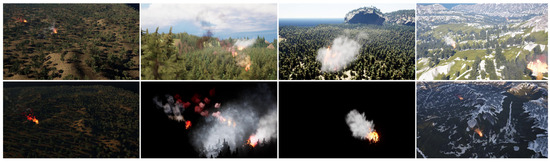
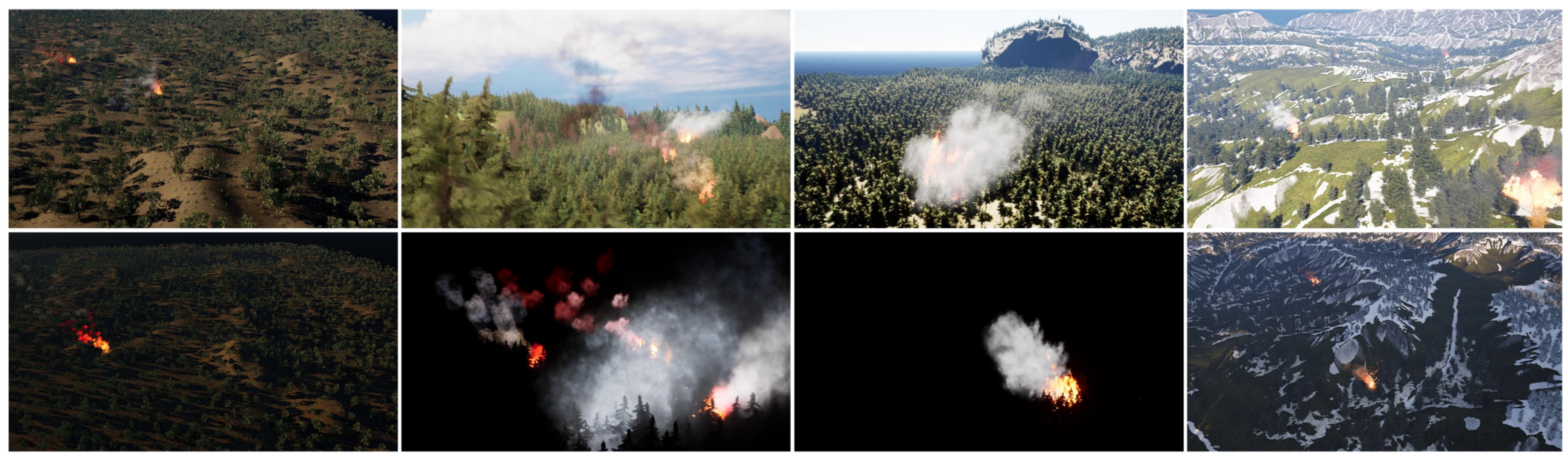
To thoroughly assess the performance and generalization ability of the proposed framework for forest fire detection tasks, this paper conducts experiments using the publicly available forest fire dataset M4SFWD [32] together with a self-constructed UAV Forest Fire Dataset (UFFD). Representative samples from the datasets are presented in Figure 1.
Figure 1.
Example of a fire image.
M4SFWD is a large-scale UAV remote sensing dataset for forest fires, collected from an aerial perspective by UAVs, covering complex scenarios with varying terrain, weather conditions, lighting environments, and fire development stages. This dataset contains 3974 images, effectively reflecting target characteristics and scene changes in forest fire monitoring tasks.
Furthermore, this paper constructs a UAV Forest Fire Dataset (UFFD). The original images for this dataset are primarily sourced from publicly available internet resources and UAV imagery from existing public forest fire datasets, covering different fire scales, smoke densities, weather conditions, and background environments. After manual screening to remove duplicate images, highly similar samples, blurred images, and irrelevant samples, a final UFFD dataset containing 6599 images was constructed.
Both the M4SFWD and UFFD datasets were organized into training, validation, and test subsets according to a 7:2:1 split. This ratio was selected considering the characteristics of forest fire detection tasks. A larger training subset provides sufficient samples for learning complex fire and smoke features, while the validation and test subsets ensure reliable model adjustment and independent performance evaluation. Therefore, this partition strategy provides a reasonable balance between model optimization and unbiased evaluation. During dataset splitting, images from the same source sequence or highly similar scenes were carefully checked and assigned to the same subset to prevent potential train-test leakage. This strategy avoids visually similar samples appearing in both training and testing sets and improves the reliability of the evaluation results. Based on this setting, the M4SFWD dataset is divided into 2782 training images, 795 validation images, and 397 test images, while the UFFD dataset contains 4620 training images, 1320 validation images, and 659 test images. These datasets are adopted to validate the detection accuracy together with generalization ability achieved by the proposed framework across public benchmark and complex real-world scenarios, respectively.
The class distributions across the two datasets are summarized in the following Table 1, where both collections contain two categories, namely fire and smoke. Although the number of fire instances is slightly higher than that of smoke instances, both datasets maintain relatively balanced category distributions without severe bias. This distribution provides a relatively balanced basis for validating the proposed detection effectiveness across multiple forest fire scenarios.
Table 1.
Category distribution in M4SFWD and UFFD data.
2.2. Method
2.2.1. Overview of the YOLOv8 Algorithm
YOLO is the name of the conventional real-time object detection algorithm. The YOLO algorithm has been developed into several versions between 2015 and 2026, and it has demonstrated exceptional performance in object detection and security early warning systems. Among them, YOLOv8 [33] is an optimization and upgrade of YOLOv5 by Ultralytics. It integrates the tasks of object localization and classification within an end-to-end learning architecture and adopts a single-stage detection methodology. YOLOv8 is faster and more effective than two-stage detection technologies such as R-CNN. The YOLOv8 family includes multiple frameworks, including n, s, m, l, and x. YOLOv8n has the fastest inference speed and the smallest parameter scale among the YOLOv8 variants, making it suitable for deployment on resource-constrained platforms. It is better suited for situations with low processing power while maintaining precision. Based on the comparison results of four versions of YOLOv8, YOLOv9, YOLOv10, and YOLOv11 in [34] and the need for lightweight and real-time performance in forest fire monitoring, this research chooses to use YOLOv8n as the baseline model and enhance it.
YOLOv8n is mainly divided into three parts, Backbone, Neck and Head. The main function of the backbone is to extract features from pictures. It consists of a spatial pyramid pooling module (SPPF), a C2f module (C2f), and typical convolutional layers (Conv). The Conv module extracts and modifies the features through the convolution procedures, batch normalization and the SiLU activation function. The C2f module improves the fluidity of feature information and strengthens the feature representation capabilities by optimizing the gradient propagation paths with cross-layer connections. The SPPF block increases its receptive field by three consecutive max-pooling layers relative to the spatial pyramid pooling module (SPP) and reduces the computational complexity. This improves the detection performance and multi-scale feature representation capabilities.
The neck serves as the feature fusion component for different scales and consists of an upsampling module, a C2f module, a convolution module and a feature concatenation module. It is built upon the Path Aggregation Network (PAN) and Feature Pyramid Network (FPN) architectures, thereby effectively fusing features from different levels, improving multi-scale feature representation of the model, and enhancing detection performance in multi-scale object detection tasks.
The Head part borrows the decoupled structure design from YOLOX [35], making the classification head and regression head independent of each other, allowing each module to focus more on feature learning for category discrimination and target localization, thereby enhancing the overall model performance. This structure is based on the multi-scale feature map output by the Neck layer, further extracting information and achieving accurate prediction of target location, category, and confidence. In addition, YOLOv8 adopts an Anchor-Free mechanism, directly representing targets by combining center points or key points with bounding box information, without relying on preset anchor boxes. When facing complex scenes with dense targets and significant scale changes, such as smoke and fire, it has stronger detection adaptability and robustness.
YOLOv8 has good detection performance in many general object detection tasks, but in complex forest fire scenarios, it still faces great challenges. Smoke, vegetation occlusion, strong illumination and terrain variation may interfere with fire recognition and increase the difficulty of feature extraction. In addition, early-stage fire and smoke targets are often small, irregularly shaped, and distributed across multiple scales, which places higher demands on the model’s ability to represent multi-scale features. Furthermore, low-light conditions, haze, and image blur may further reduce detection accuracy. More importantly, practical intelligent forestry monitoring systems are commonly deployed on UAV platforms, edge-computing devices, and remote monitoring terminals with limited computational resources. Therefore, models for forest fire detection should not only provide high detection performance but also maintain a compact structure with real-time inference performance to satisfy practical requirements of wildfire surveillance, early warning, and rapid emergency response.
2.2.2. YOLO-MR Network Structure
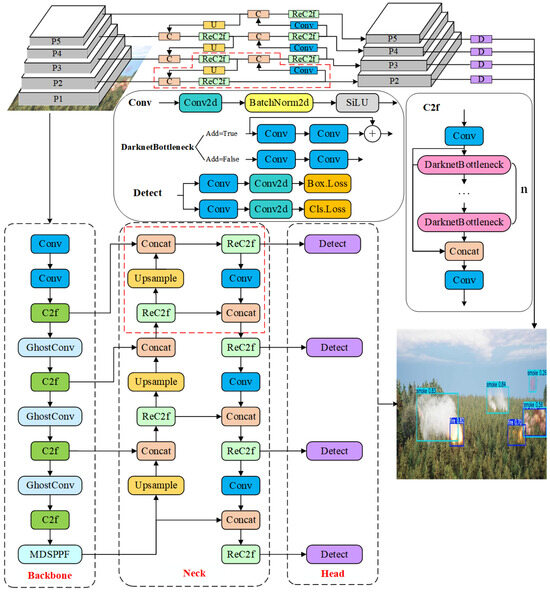
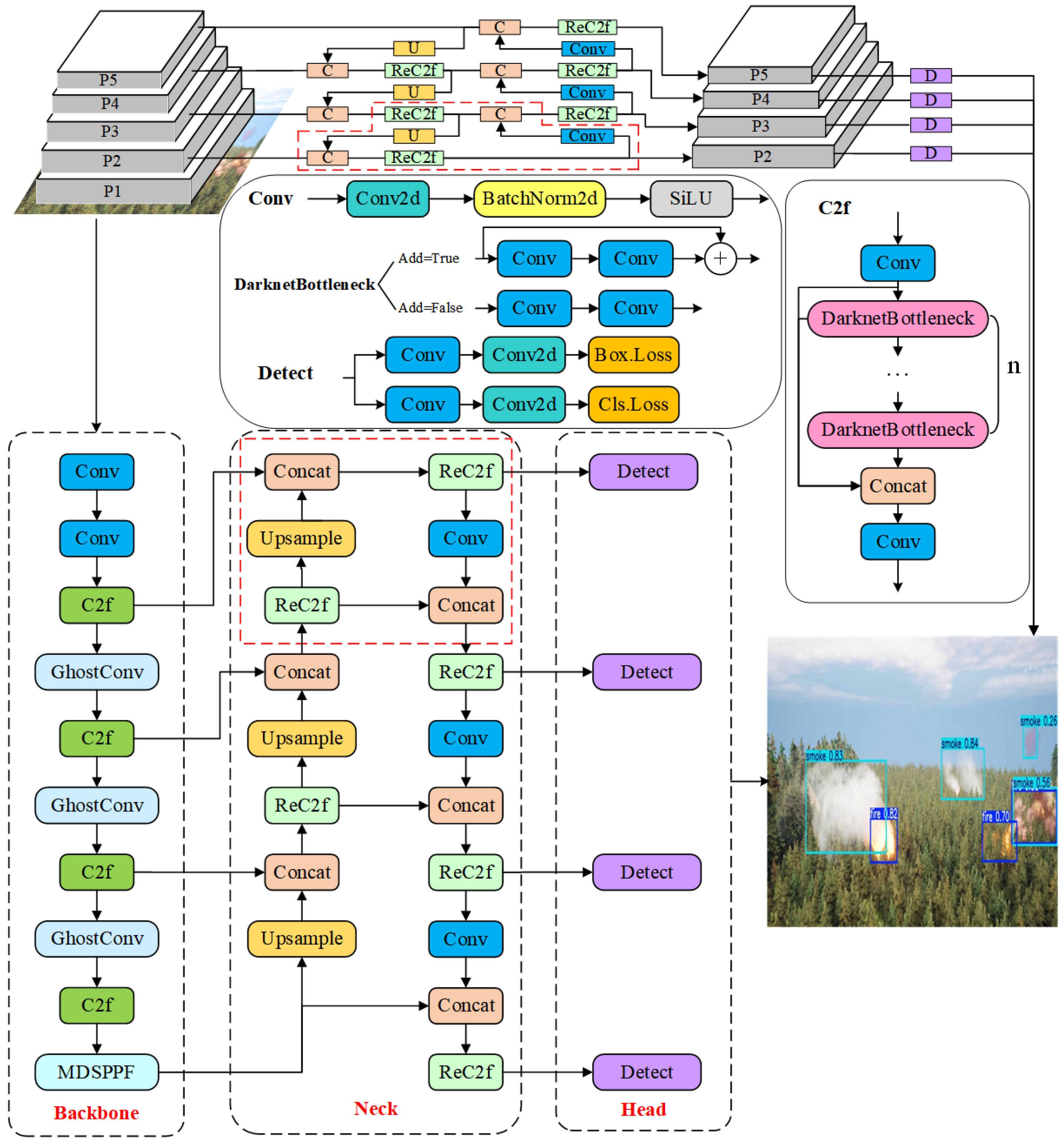
Based on the YOLOv8n baseline model, this study introduces YOLO-MR, a compact and efficient forest fire detection framework. The design of YOLO-MR aims to achieve a balance among detection accuracy, computational efficiency, and real-time inference capability for intelligent forestry monitoring systems. Figure 2 shows the YOLO-MR network structure. Firstly, the model introduces GhostConv to substitute the conventional convolution operation within the backbone, improving detection capability while decreasing parameter quantity. Second, by replacing SPPF of the backbone with the MDSPPF module, the model’s feature representation capability is improved without significantly increasing the model complexity, thereby enhancing detection performance. The ReC2f module is then added to the neck network, and the model’s capacity to identify small targets is enhanced by introducing the P2 layer output. This module improves feature representation while maintaining computational efficiency, enabling the model to learn richer feature representations during training and improving generalization performance. Lastly, the CIoU loss function is replaced by the PIoUv2 loss function, which uses an adaptive anchor box penalty mechanism to enhance the model’s capacity for locating multi-scale targets. The resulting model demonstrates efficient inference performance and provides potential support for UAV-based forest fire monitoring applications.
Figure 2.
YOLO-MR model structure.
2.2.3. GhostConv
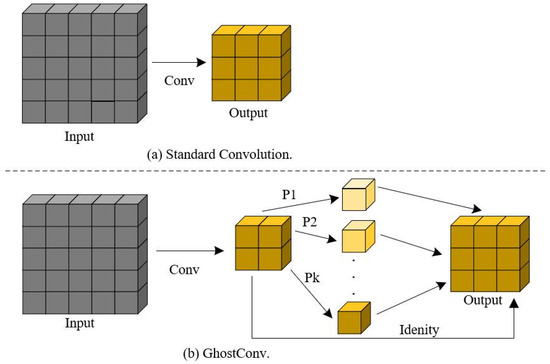
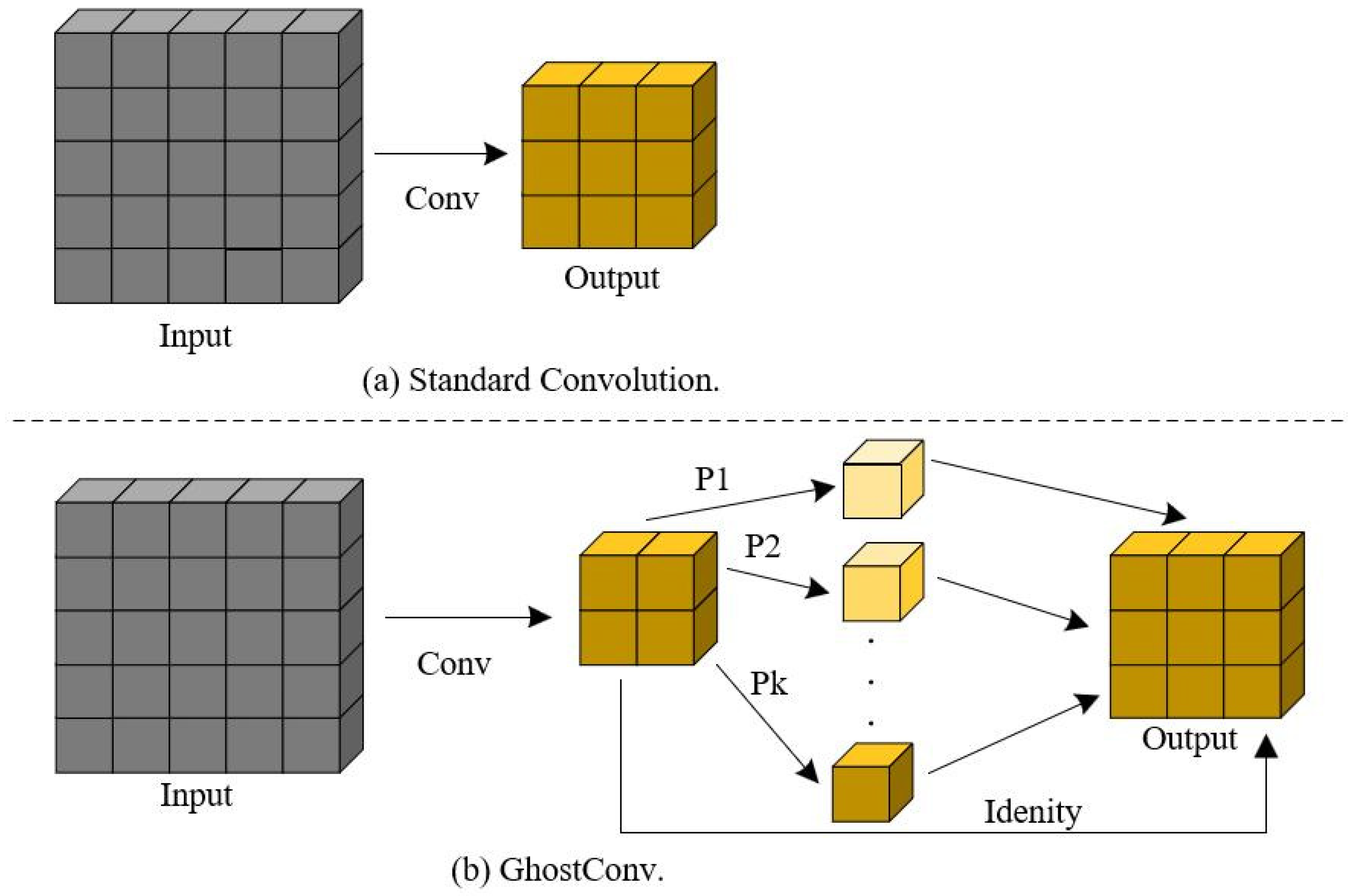
Standard convolution has a large computational cost when generating a large number of feature maps, and there may be redundant representations between different feature maps, which reduces computational efficiency. In forest fire detection, flames and smoke exhibit significant differences in visual appearance and spatial distribution. Generally, the flame has a unique high brightness and contrast, and relatively clear morphological features. However, the smoke has low contrast, fine texture, and fuzzy boundaries, and the spatial morphological variations are complex. This complexity increases the difficulty of feature modeling, so it is important to reduce redundant computation while ensuring expressive power. Lightweight networks such as MobileNet and ShuffleNet effectively reduce computational cost through techniques such as depthwise separable convolution and channel reorganization. However, in actual network structures, 1 × 1 convolution still accounts for a large proportion of computation and memory access overhead.
To address the above problems, Han Kai [36] proposed the Ghost module in GhostNet, It uses inexpensive computation to create more detailed feature maps from the basic feature map, thereby alleviating the convolution redundancy problem. In addition, GhostConv uses effective techniques like depthwise separable convolution, which substantially decreases computational complexity and parameter count while maintaining feature representation ability. Figure 3 illustrates its detailed structure.
Figure 3.
Standard convolution and GhostConv module structure.
Using 1 × 1 convolution, GhostConv first creates an initial feature map with useful feature information. After that, it creates several feature maps by using several inexpensive linear techniques to the original feature map. The final product is obtained by merging these feature maps together with the initial feature map. GhostConv can provide superior detection results by drastically lowering feature redundancy, parameter count, and computational overhead relative to normal convolution. In order to improve the model’s feature extraction performance while lowering parameter count and computational cost, GhostConv is employed in this study to reduce computational cost and memory consumption, thereby making the proposed framework better suited to resource-constrained scenarios such as UAV onboard systems and edge devices.
2.2.4. MDSPPF Module Structure
SPPF is an effective multi-scale feature extraction module since it may increase computing performance while preserving high detection accuracy when compared to regular SPP. However, this module has a fixed pooling kernel size, lacking adaptability to different target scales, resulting in limited flexibility in receptive field. Additionally, some spatial information is lost during the pooling process, impacting the extraction of intricate details and tiny targets. Therefore, this study designs the MDSPPF module by combining deep convolution and dilated convolution to replace SPPF. Unlike SPPF, which relies on a fixed pooling kernel, MDSPPF processes input features in parallel through multiple sets of To capture feature information under various receptive fields, use convolutions with varying dilation rates. Furthermore, it can control the size of the receptive field by flexibly adjusting the dilation rate parameter, thereby extracting features of different scales. Figure 4 illustrates its detailed structure.
Figure 4.
MDSPPF Module Structure.
MDSPPF first performs preliminary feature transformation and adjusts the channel dimension of the input features through 1 × 1 convolution. Subsequently, it employs multiple sets of 3 × 3 depthwise separable dilated convolutions for parallel processing, with the dilation rate of each set of convolutions being flexibly adjustable, thus achieving receptive fields of different scales. These convolutions share convolution kernel weights and extract rich contextual information through a multi-scale design, while reducing computational complexity. In order to provide richer and more reliable input for later network layers, A second 1 × 1 convolutional layer is utilized to fuse the processed multi-scale features after they have been concatenated with the original input. This method optimizes channel dimensions and refines feature representations. This design achieves multi-scale receptive fields through adjustable dilation rates, enhancing the ability to capture small targets and features at different scales, while improving model flexibility while maintaining spatial information and computational efficiency. This design allows the model to more effectively perceive fire as well as smoke targets at different scales in UAV-acquired forest images while maintaining computational efficiency.
2.2.5. ReC2f Module
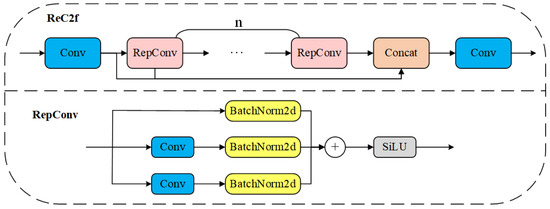
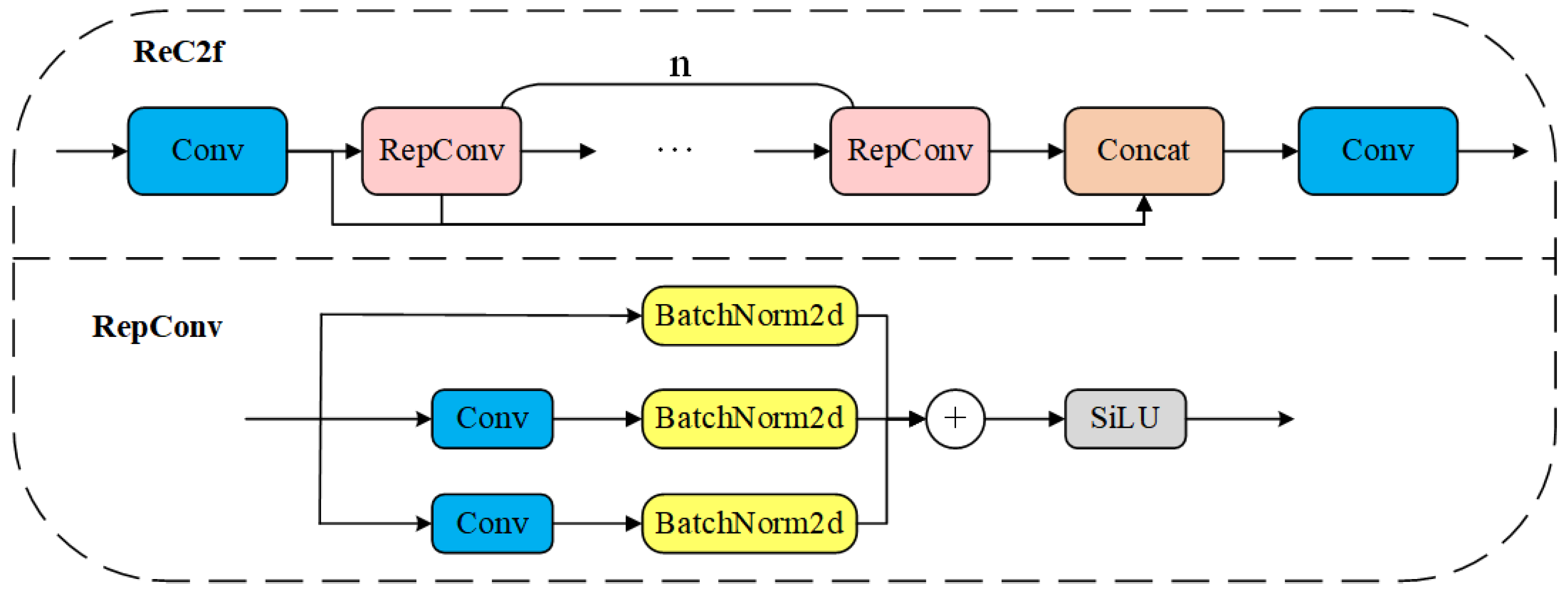
The C2f module performs multi-scale feature fusion while enabling interaction of channel information. However, the C2f module’s lack of cross-channel feature enhancement and significant computational redundancy during the inference stage make it challenging to collect fine-grained features in complicated backgrounds or small target scenes, which limits the increase in detection performance. This study designs the ReC2f module to swap out the C2f module in the area around the neck of YOLOv8n in order to solve the aforementioned issues. In order to improve the feature expression capability in the training stage and preserve computational efficiency in the inference stage, this module keeps the cross-stage partial connection structure of the original C2f module while substituting the RepConv convolution module with structural reparameterization characteristics for the Bottleneck unit inside the C2f module [37]. Figure 5 depicts the ReC2f module’s structure.
Figure 5.
ReC2f module structure.
The ReC2f module first adjusts the channel dimension of the input features using a 1 × 1 convolution. Next, along the channel dimension, the features are divided into two branches. One branch remains unchanged, while the other branch is sequentially processed by multiple serially connected RepConv modules for feature extraction. Next, all features from each branch are concatenated per channel and fused using a 1 × 1 convolution to obtain the final result.
RepConv builds a multi-branch convolutional structure with 3 × 3, 1 × 1, and an optional identity mapping branch during the training phase. The outputs of each branch are linearly superimposed and then processed by a non-linear activation function to obtain the feature representation. In the inference phase, the reparameterization technique equivalently fuses all branches into a single 3 × 3 convolution kernel, achieving structural decoupling between the training and inference phases and enhancing feature representation capabilities without increasing inference computational overhead. This architecture improves feature representation capability while maintaining computing efficiency, making the proposed framework more suitable for UAV-based real-time forest fire monitoring applications deployed on UAV platforms and edge devices with limited resources. This is how it is expressed mathematically:
The weights and biases of the 3 × 3 and 1 × 1 convolutions are represented by , and , , respectively. The normalization operation is represented by BN(.). The activation function is represented by . The convolution operation is represented by . And the input and output are represented by X and Y, respectively.
2.2.6. PIOUv2 Function
The CIoU loss function is the bounding box regression optimization goal of the YOLOv8n method. Compared to the traditional IoU loss, CIoU can still provide effective gradients when two bounding boxes do not overlap, solving the problem of IoU optimization difficulty in such cases. CIoU loss improves localization accuracy in terms of spatial location and shape matching by taking into account both the overlapping area of the bounding boxes and the center-point distance between the predicted and ground truth boxes, as well as the consistency between their aspect ratios. Its specific calculation formula is as follows:
where IoU stands for the ground truth box’s intersection-union ratio with the anticipated box. The squared Euclidean distance separating the center points of the ground truth box and the anticipated box is represented by . The minimal bounding region that encloses the two boxes has a diagonal length of c. The aspect ratio difference between the ground truth box and the predicted box is quantified by ν. The anticipated box’s width and height are denoted by the letters w and h. and stand for the ground truth box’s width and height. The weight parameter used to balance the aspect ratio loss term is denoted by α.
The CIoU loss function still has a number of shortcomings in bounding box regression, despite modest speed improvements. When there is a large difference in the aspect ratio of the predicted bounding box and the ground truth box, it may introduce excessively strong penalties, thereby affecting the learning efficiency and the detection accuracy of the model. In addition, in complex and varied forest fire scenarios, the generalization ability of CIoU may be insufficient, making it difficult to effectively adapt to targets with irregular heights or significant scale changes.
This study substitutes the PIoUv2 (Powerful-IoUv2) loss function for the traditional bounding-box regression loss in enhancing performance for forest fire detection tasks [38]. PIoUv2 drives anchor boxes toward regression down a more simpler route by using a quality-aware penalty factor and target-box size as the normalization denominator, an adaptive anchor-box quality-aware penalty mechanism, and the non-monotonic attention function regulated by a single hyperparameter. By avoiding the potential problem of excessive anchor box enlargement, concentrating on anchors with medium and high quality, and more effectively adjusting to target boxes of different sizes, this enhances the object detector’s performance. PIoU loss exhibits faster convergence and can significantly improve object detection performance when compared with other IoU-based loss functions. The following is how PIoUv2 is formulated:
where represents the intersection between unions corresponding to the predicted bounding box and the ground-truth bounding boxes. f(x) denotes the penalty function. denotes a penalty factor according to the target scale. The absolute distances between corresponding matching boundaries of the target bounding box as well as the predicted bounding box are represented by , , and . The width and height of the target bounding box are denoted by the corresponding variables and . Anchor-box quality is measured by q. The attention function is represented by μ(.) and its behavior is controlled by the hyperparameter λ. Specifically, f(x) indirectly determines the final loss by affecting the penalty factor , which further determines the quality-aware score q. The score q is then introduced into the non-monotonic attention function μ(λq) to dynamically re-weight , resulting in the final .
For Equations (1)–(10), the parameter determination strategy is clarified as follows. In Equation (1), the convolutional weights and bias terms in the RepConv module are learnable parameters optimized automatically through backpropagation during the training process, following the standard structural re-parameterization mechanism. For Equations (2)–(10), the parameters involved in CIoU and PIoUv2 are adopted according to their original formulations and recommended settings. Specifically, the hyperparameter λ in PIoUv2 is inherited from the original PIoUv2 method rather than manually adjusted for the proposed datasets. No additional parameter tuning is performed during testing, ensuring a fair comparison with other detection models.
3. Experiments and Results
3.1. Experimental Configuration and Performance Metrics
Throughout this study, all experiments were performed using one single computing platform in order to minimize the impact of different testing conditions on the results and guarantee experimental dependability. Detailed information on the experimental setup and hyperparameters are provided in Table 2 and Table 3.
Table 2.
Experimental training environment configuration.
Table 3.
Hyperparameter configuration settings.
Every compared model was trained in an identical experimental configuration and evaluation protocol to ensure a fair and consistent comparison. Specifically, the input image size, batch size, and training epochs remained identical for all methods. The optimizer and other model-specific training parameters followed the default configurations of their original implementations. No additional hyperparameter optimization was performed for any model. The source codes of the compared YOLO-based models were obtained from their official open-source repositories. Specifically, most YOLO models were implemented based on the Ultralytics framework (https://github.com/ultralytics/ultralytics/tree/main, accessed on 11 July 2026), while YOLOv13 was obtained from its official repository (https://github.com/iMoonLab/yolov13, accessed on 11 July 2026). Therefore, the performance differences can be mainly attributed to the model architectures and proposed improvements rather than different training strategies or implementation sources.
To provide a comprehensive and objective assessment of the improved model, this paper selects six evaluation metrics, including Precision, Recall, mAP50, mAP50-90, model parameters, and GFLOPs. The proportion of genuine positive instances among all detections identified by the model as positive is known as precision (P). The proportion of actual positive samples successfully detected by the model is called recall (R). The balance between accuracy and recall is fully reflected by the average precision metric (AP), which measures the detection capability for an individual class at various confidence thresholds. Mean average precision (mAP), which is computed by averaging individual AP scores across different classes, is applied to evaluate the model’s aggregate detection ability for multi-class firing targets. mAP50 mainly represents the model’s fundamental detection capabilities and is computed using an IoU threshold of 0.5. In order to more thoroughly assess the model’s overall detection ability and bounding box localization accuracy, mAP50-90 is averaged across several IoU levels from 0.5 to 0.95. Table 4 displays the evaluation indicators’ calculation algorithms.
Table 4.
Assessment Metrics.
3.2. Comparison of YOLO-MR with YOLOv8n and Other YOLO Models
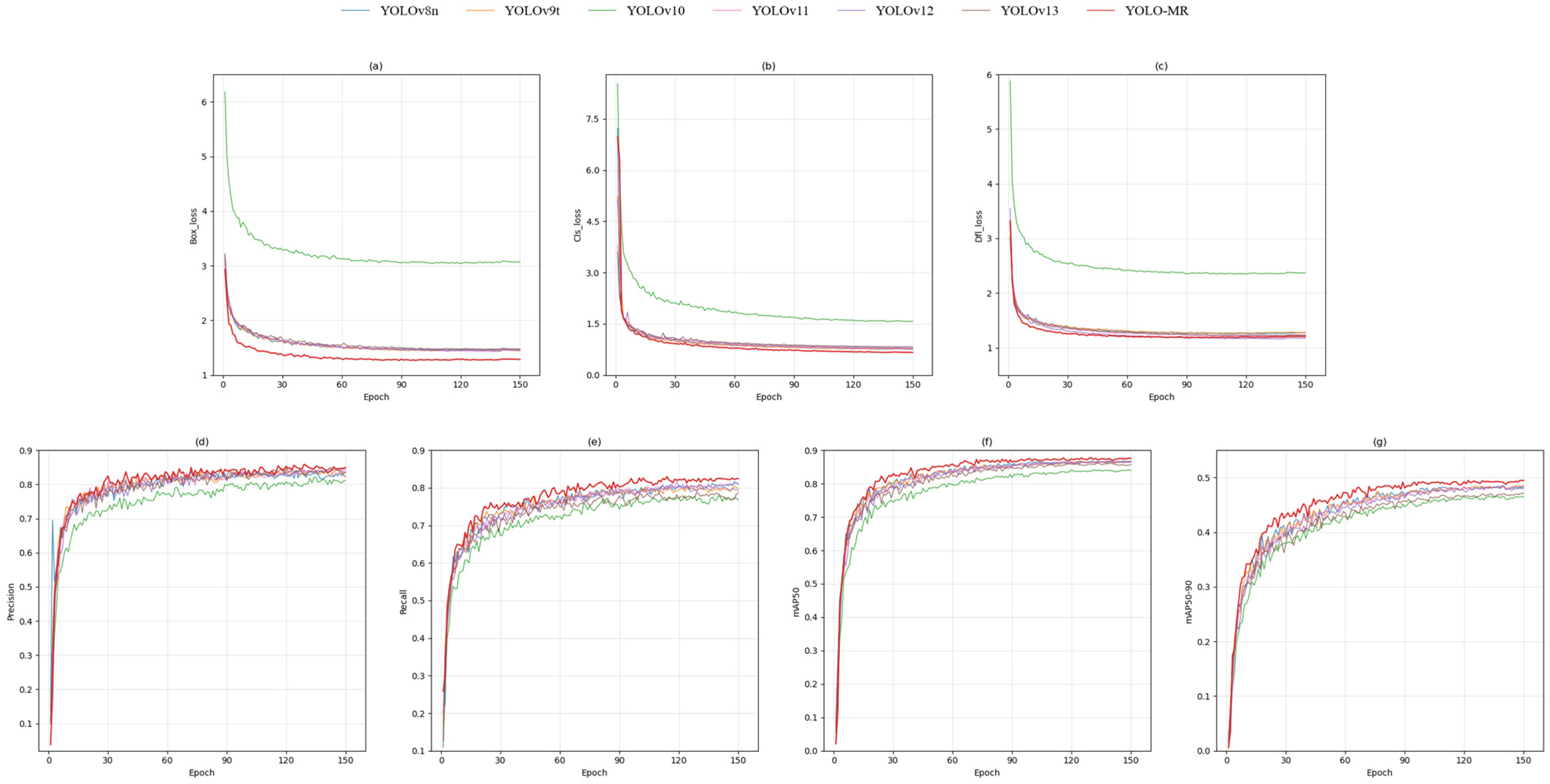
This study compares the proposed YOLO-MR model with six other models—ranging from YOLOv8n to YOLOv13—to evaluate its performance in forest fire detection, the findings are displayed in Figure 6. The figure displays the distribution focus loss, bounding box loss, and classification loss curves as (a–c), respectively. The model’s training effect is better the closer the curve is to zero. The curves of the four indicators’ changes throughout training are presented in (d–g).
Figure 6.
Training results for YOLO-MR, YOLOv8n, and other YOLO series models. (a) box loss; (b) classification loss; (c) distribution focal loss; (d) precision; (e) recall; (f) mAP50; (g) mAP50-90.
As shown in the plots of Figure 6a–c, throughout the early training stage, the loss values of YOLO-MR decrease more rapidly than those of YOLOv8n and other models in the YOLO series, and it converges to a lower value upon stabilization. Notably, in the later stages of training, fluctuations in bounding box loss, classification loss, and Distribution Focal Loss (DFL) are minimal, indicating superior optimization stability and enhanced feature learning capabilities. Figure 6d–g illustrate the trends in Precision, Recall, mAP50, and mAP50-90 during training. Throughout most of the training process, YOLO-MR outperforms YOLOv8n and other YOLO series models across these evaluation metrics and achieves stable convergence earlier. The results indicate that the proposed improvements significantly improve feature extraction as well as object localization performance, thereby enabling more accurate detection of forest fires and smoke.
3.3. Ablation Experiment
To further evaluate model performance, this paper designed an ablation experiment, using the aforementioned evaluation metrics to examine the contributions of various improvement strategies to the overall performance of YOLO-MR using the M4SFWD dataset. The corresponding outcomes are summarized in the following Table 5 In the ablation experiments, A, B, and C denote GhostConv, MDSPPF, and ReC2f, respectively, while P2 and PIoUv2 represent the P2 detection layer and PIoUv2 loss function, respectively.
Table 5.
Ablation Experiment Results.
The effectiveness of each proposed module was assessed through comparative experiments conducted on the M4SFWD dataset. As reported in Table 5, the number of parameters is reduced from 3.01 M to 2.82 M, and the FLOPs decrease from 8.1 G to 7.8 G by using the GhostConv module, which verifies its effectiveness in reducing redundant computation and maintaining a compact network structure. Although mAP50 has a slight decrease, Precision and Recall increase to 0.836 and 0.809, respectively, indicating that GhostConv can effectively reduce computational redundancy while keeping the detection performance competitive. The mAP50 is slightly improved from 0.866 to 0.867 without increasing the number of parameters and computational complexity by the MDSPPF module. The improvement indicates that the module can improve multi-scale feature extraction and expand the receptive field, so that the detector can better capture the flame and smoke features at different scales. The individual performance improvement of the ReC2f module is the most obvious. The recall increases from 0.805 to 0.816, and the mAP50 and mAP50-90 increase to 0.873 and 0.495, respectively. The results show that ReC2f enhances feature reuse and gradient propagation, thus improving the model’s ability to identify complex fire and smoke targets.
Furthermore, the individual contributions of the P2 detection layer and PIoUv2 loss function were evaluated separately. As shown in Table 5, introducing the P2 detection layer improves Precision, Recall, and mAP50 from 0.831, 0.805, and 0.866 to 0.840, 0.813, and 0.875, respectively. This improvement demonstrates that preserving high-resolution spatial information through the P2 detection layer is beneficial for detecting small-scale fire and smoke targets. In contrast, the independent introduction of PIoUv2 does not lead to significant improvement under the baseline setting, with comparable mAP50 and mAP50-90 performance. However, PIoUv2 provides an optimized bounding-box regression objective and contributes to the final performance when combined with other proposed components, particularly for targets with scale variations and irregular shapes.
Interestingly, the combinations among different modules achieve superior Precision values than the baseline YOLOv8n model. This observation does not contradict the individual module analysis, as the effects of different components are not solely reflected in a single evaluation metric. The integration of multiple modules enables complementary feature enhancement, where redundant information is suppressed, multi-scale representations are strengthened, and target-discriminative features are further improved. Consequently, the combined models can reduce false positive detections and achieve higher Precision. These results demonstrate that the proposed components exhibit synergistic effects when jointly incorporated into the detection framework.
When all proposed components are integrated, the proposed YOLO-MR delivers the strongest overall performance, obtaining Precision, Recall, mAP50, and mAP50-90 values of 0.842, 0.822, 0.877, and 0.495, respectively. Compared with the baseline YOLOv8n model, YOLO-MR achieves a relative improvement of 1.3%, 2.1%, 1.3%, and 2.1% for Precision, Recall, mAP50, and mAP50-90, respectively, while reducing the number of parameters by 5.3%. The results demonstrate that the proposed components are complementary to each other and jointly contribute to improved detection performance while preserving a compact architecture.
The above findings suggest that the improvements simultaneously enhance forest fire detection performance while maintaining a compact architecture, which provides potential advantages for UAV-assisted forest monitoring applications. However, further validation on practical UAV and edge platforms is still required to evaluate real-world deployment performance.
3.4. Comparative Evaluation of Different Models
To verify the performance and generalization ability of YOLO-MR, comparative evaluations were carried out on the M4SFWD dataset and the self-constructed UAV Forest Fire Dataset (UFFD). The proposed method was compared with representative object detection models, including the YOLO series models [39,40,41,42,43,44], YOLO-World [45], and RTDETR [46].The experimental results on the M4SFWD and UFFD datasets can be found in Table 6 and Table 7, respectively.
Table 6.
Performance Comparison on the M4SFWD dataset.
Table 7.
Performance Comparison on the UFFD Dataset.
As presented in Table 6, YOLO-MR demonstrates competitive performance compared with state-of-the-art detectors, with corresponding Precision, Recall, mAP50, and mAP50-90 values of 0.842, 0.822, 0.877, and 0.495, respectively. Although YOLO-World achieves slightly higher Precision, its lower Recall increases the risk of missed detections, which is critical in forest fire monitoring tasks. Compared with YOLOv8n, YOLO-MR consistently improves all evaluation metrics, particularly Recall and mAP50-90, indicating better detection and localization performance. Even though the performance differences among advanced models are relatively small, such improvements are still meaningful in UAV-based wildfire monitoring scenarios, where missed detections may delay emergency response. In addition, YOLO-MR shows lower model complexity compared with transformer-based methods. In comparison with RT-DETR, it significantly lowers the parameter count from 31.99 M to approximately 2.85 M while achieving better detection performance, making it a more competitive solution for UAV-based fire detection scenarios.
To further evaluate generalization ability, experiments were conducted on the UFFD dataset. YOLO-MR obtains Precision, Recall, mAP50, and mAP50-90 values of 0.782, 0.728, 0.795, and 0.443, respectively. Compared with other lightweight detectors, YOLO-MR maintains consistent improvements across all metrics, particularly in Recall and mAP50-90, demonstrating robustness in complex wildfire scenarios. It also outperforms RT-DETR with a more compact model size, further confirming its suitability for UAV-based fire detection scenarios.
YOLOv8n is adopted as the baseline model since it represents a widely used compact YOLO architecture with an effective trade-off between detection performance and computational complexity. More importantly, YOLOv8n provides an appropriate foundation for evaluating whether the proposed task-oriented improvements can enhance forest fire detection performance. Although YOLOv12 achieves competitive detection performance, this study does not aim to obtain the highest accuracy by directly adopting the latest high-capacity detector. Instead, the objective is to optimize a compact detector for UAV-based forest fire monitoring scenarios, where accuracy and model complexity should be considered simultaneously. Therefore, YOLOv12 and RT-DETR are included as advanced reference models to further evaluate the competitiveness of YOLO-MR.
The consistent improvements achieved on both M4SFWD and UFFD datasets demonstrate that YOLO-MR not only performs well on public benchmark datasets but also exhibits strong generalization ability in real-world forest fire detection scenarios.
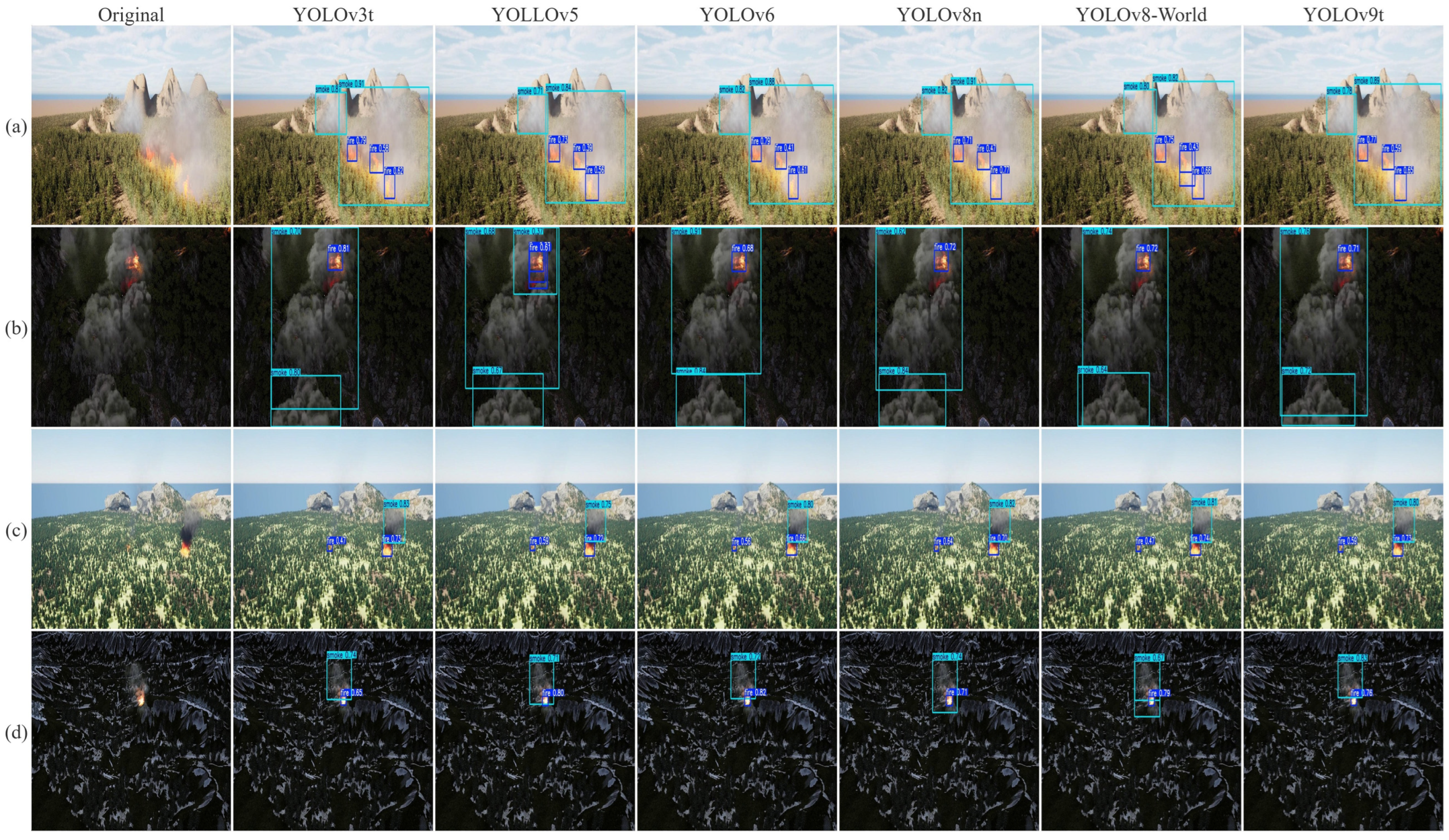
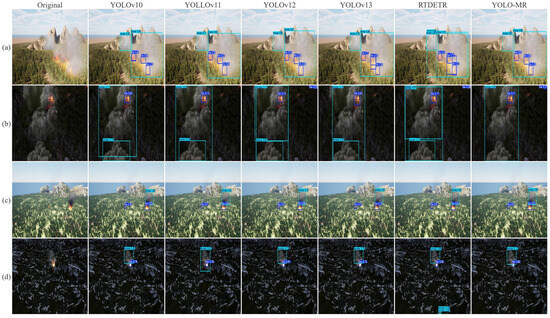
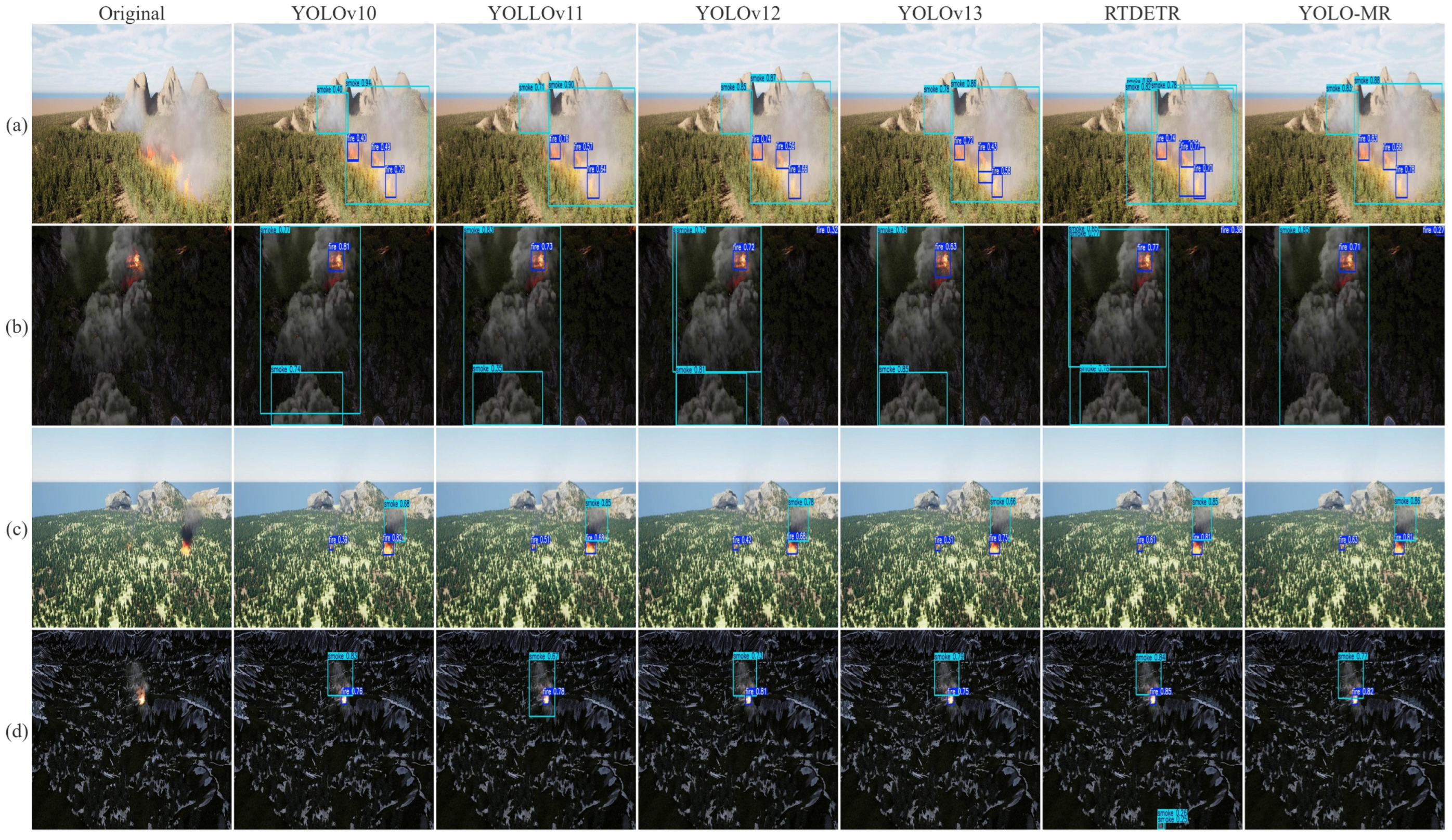
In order to better demonstrate the overall performance of the model, four representative scenarios are selected for visualization analysis in this paper. Figure 7 and Figure 8 display the visualization results, where (a–d) represent multi-target fire and smoke scenes, fire targets partially occluded by dense smoke, distant small-scale fire and smoke targets, and single-target scenes under challenging illumination conditions, respectively. All visualization results are based on RGB visible-light images rather than multi-spectral or infrared images. Bounding boxes are used to visualize and identify the detected targets. The detection results include the classification and localization of flame and smoke targets with corresponding confidence scores.
Figure 7.
Visualization of detection results using YOLOv3t, YOLOv5, YOLOv6, YOLOv8n, YOLOv8-World, and YOLOv9t under different forest dire scenarios: (a) multi-target fire and smoke scenes, (b) fire targets partially occluded by dense smoke, (c) distant small-scale fire and smoke targets, and (d) single-target scenes under low-light conditions. All images are RGB visible-light images.
Figure 8.
Visualization of detection results using YOLOv10, YOLOv11, YOLOv12, YOLOv13, RT-DETR, and YOLO-MR under different forest fire scenarios: (a) multi-target fire and smoke scenes, (b) fire targets partially occluded by dense smoke, (c) distant small-scale fire and smoke targets, and (d) single-target scenes under low-light conditions. All images are RGB visible-light images.
In multi-target scenarios, the detection results of all models are able to detect the targets of flame and smoke, but the boundary regression of YOLOv13 and RT-DETR is relatively coarse, and some flame regions have overlapping detection boxes. Compared with them, YOLO-MR has more accurate bounding boxes that are better aligned with the target regions, and has a better localization ability in complex scenarios. In smoke-occluded scenarios, only YOLOv12, RT-DETR and YOLO-MR can successfully detect all the flame and smoke targets, and the other models have missed detection in different degrees. Additionally, YOLO-MR generates less redundant detection boxes, demonstrating its stronger robustness to occlusion interference and better feature discrimination ability. In distant small-target scenarios, although all the models are able to identify fire and smoke targets, YOLO-MR achieves more accurate localization and more reliable detection results, demonstrating its improved multi-scale feature extraction and feature fusion capabilities. RT-DETR can generate high confidence predictions in low-illumination single-target situations, but also cause obvious false positives. On the contrary, YOLO-MR can effectively suppress the interference of the background while maintaining the accuracy of target recognition and localization. In summary, YOLO-MR always achieves superior performance in detection performance in various forest fire scenarios, such as multi-target scenarios, smoke occlusion, far small targets and low light conditions, which proves the robustness and generalization ability of it for practical forest fire monitoring applications.
3.5. Evaluation of Computational Efficiency
To assess the computational characteristics and potential applicability of the proposed method for UAV-based forest fire monitoring scenarios, computational efficiency experiments are conducted on multiple detection models. The parameters, GFLOPs, GPU memory consumption, and average inference speed (FPS) are selected as evaluation metrics to comprehensively assess model complexity, computational cost, and inference efficiency. The FPS values reported in Table 8 are the average results of five independent runs. The corresponding results are summarized in Table 8.
Table 8.
Comparison of computational efficiency among different models.
Table 8 presents the comparison of computational efficiency among different models. YOLO-MR maintains a parameter-efficient architecture with 2.85M parameters, representing a 5.3% reduction compared with YOLOv8n. Although the FLOPs increase from 8.2 G to 12.2 G due to the introduction of enhanced feature extraction and feature fusion modules, this increase is compensated by improved detection accuracy. Meanwhile, the GPU memory consumption remains relatively stable (149.49 MiB to 154.20 MiB), indicating controlled computational overhead. In terms of inference speed, YOLO-MR achieves 101.59 FPS, which is slightly lower than YOLOv8n (105.32 FPS) but still demonstrates sufficient inference efficiency for real-time detection scenarios on GPU platforms. Compared with RT-DETR, YOLO-MR achieves significantly higher inference speed and lower memory consumption, demonstrating a more compact computational profile. It should be noted that all experiments are conducted on a high-performance GPU rather than edge devices or actual UAV platforms. Therefore, the reported results mainly reflect the relative computational characteristics of different models rather than actual embedded deployment performance. Nevertheless, YOLO-MR is designed as a parameter-efficient detector and demonstrates potential for UAV-assisted forest fire monitoring scenarios.
Overall, YOLO-MR achieves an effective compromise between detection accuracy and computational complexity. Despite not being the most efficient model in terms of FLOPs, the additional computational cost is introduced to strengthen feature extraction and achieve higher detection accuracy.
3.6. Statistical Analysis and Stability Assessment
To further assess the reliability and training stability of YOLO-MR, each model was trained independently five times using the same experimental settings. The mean value, standard deviation (Std), and 95% confidence interval (95% CI) of Precision, Recall, mAP50, and mAP50-90 were calculated to quantify the performance variations caused by stochastic factors during model optimization. The statistical results on both datasets are summarized in Table 9.
Table 9.
Statistical analysis and stability assessment of YOLOv8n and YOLO-MR on different datasets.
As shown in Table 9, YOLO-MR achieves higher mean values than YOLOv8n across all evaluation metrics on the M4SFWD dataset. Specifically, YOLO-MR improves Precision, Recall, mAP50, and mAP50-90 from 0.8360, 0.7984, 0.8618, and 0.4818 to 0.8378, 0.8130, 0.8730, and 0.4948, respectively. Moreover, YOLO-MR exhibits smaller standard deviations for all metrics compared with YOLOv8n, indicating reduced performance fluctuations and improved training stability under repeated experiments. The narrower confidence intervals further demonstrate the consistency of the proposed method.
For the UFFD dataset, YOLO-MR also achieves consistent improvements in the main detection metrics. Compared with YOLOv8n, the mean Recall, mAP50, and mAP50-90 values are increased from 0.7106, 0.7790, and 0.4296 to 0.7270, 0.7932, and 0.4410, respectively. Although slightly larger standard deviations are observed for Precision and Recall, the variations remain within a narrow range. Notably, YOLO-MR achieves a lower standard deviation for mAP50-90 (0.0012 vs. 0.0017), indicating more stable localization performance. Since missed detections are particularly critical in forest fire monitoring, the improvement in Recall provides practical significance for early wildfire detection.
Overall, the statistical analysis demonstrates that YOLO-MR provides more reliable detection performance than YOLOv8n across different datasets. The improvements in average accuracy, together with the acceptable variation among repeated training runs, verify the effectiveness and stability of the proposed model for UAV-based forest fire detection.
4. Discussion and Research Limitations
The experimental results demonstrate that the proposed YOLO-MR model achieves a good balance between detection accuracy and model complexity for forest fire monitoring tasks. The ablation experiments further validate the contribution of each proposed component, while the comparative experiments show that YOLO-MR outperforms the baseline YOLOv8n and several mainstream detection approaches with respect to Recall, mAP50, and mAP50-90. In particular, YOLO-MR achieves higher performance on the M4SFWD dataset, where the scenes are relatively structured and annotation quality is more consistent, indicating stronger feature learning capability under controlled UAV imaging conditions. On the more challenging UFFD dataset, YOLO-MR still maintains robust detection performance despite increased variability in fire scale, smoke density, and background complexity, demonstrating its generalization ability across different real-world forest fire scenarios.
The improved performance of YOLO-MR is mainly attributed to several key components. The MDSPPF module enhances multi-scale feature extraction by expanding the receptive field, enabling better representation of fire regions at different scales. The P2 detection layer improves sensitivity to small and early-stage fire targets by reducing information loss in deep networks. GhostConv reduces redundant computations while maintaining representative features, contributing to a more compact network design. In addition, the PIoUv2 loss improves bounding-box regression accuracy, leading to more stable localization in complex scenarios. Overall, these components jointly improve detection accuracy while maintaining a reasonable computational cost, achieving a good balance between performance and efficiency.
Compared with existing forest fire detection approaches, YOLO-MR focuses not only on improving detection accuracy but also on achieving an appropriate balance between detection performance and model complexity for UAV-based monitoring scenarios. Conventional YOLO-based methods mainly improve detection capability through architectural modifications, while transformer-based detectors, such as RT-DETR, provide strong global feature modeling capability but generally introduce larger model sizes and higher computational requirements. In contrast, YOLO-MR achieves competitive detection performance with a more compact model structure, indicating its potential advantage for UAV-assisted forest fire monitoring applications where computational resources should also be considered.
To alleviate the limitations of existing real-time forest fire detection methods, YOLO-MR addresses several key challenges. The MDSPPF module and P2 detection layer improve the detection of small and early-stage fire regions, while GhostConv reduces computational complexity with limited loss of representational capability. In addition, PIoUv2 enhances localization accuracy under complex conditions such as smoke occlusion. Overall, YOLO-MR improves detection performance while maintaining efficiency, although a trade-off between accuracy and computational cost still exists, leaving room for further optimization on resource-constrained devices.
However, despite these improvements, some limitations still remain. In highly complex environments, such as dense smoke, strong illumination variation, and highly cluttered backgrounds, detection errors may still occur. In addition, the model is currently limited to visible-light imagery, which restricts robustness under adverse weather conditions and extreme environmental variations. Moreover, although two datasets (M4SFWD and UFFD) are used for evaluation, potential domain gaps between datasets and real-world deployment scenarios may still affect generalization performance.
Future research will aim to overcome these limitations by expanding the dataset to include a wider range of real-world wildfire scenarios across diverse environmental settings. Furthermore, the integration of multimodal information, including infrared and thermal imagery together with UAV sensor data, will be investigated to further enhance the robustness of the proposed framework. Finally, further optimization and deployment on real-world UAV and edge platforms will be conducted to validate practical performance in intelligent forestry systems.
5. Conclusions
We propose YOLO-MR, a compact forest fire detection model based on YOLOv8n for intelligent forestry monitoring applications. The proposed framework adopts a task-oriented optimization strategy by integrating enhanced multi-scale feature representation, strengthened detection of small-scale targets, and parameter-efficient feature extraction, thereby improving detection performance while maintaining computational efficiency. Experimental results on two forest fire datasets demonstrate that YOLO-MR achieves competitive and robust performance, confirming its effectiveness and generalization capability in UAV-based fire monitoring scenarios. Despite these improvements, the model still faces limitations in extremely complex environments and visible-light-only conditions. Future research will investigate multimodal data fusion, evaluate the proposed framework under more diverse environmental conditions, and enhance its deployment capability in resource-constrained environments. From the perspective of sustainable development, the proposed framework provides effective technical support for sustainable intelligent forestry monitoring by enabling more reliable and timely forest fire detection. Its ability to facilitate early wildfire warning has the potential to reduce ecological damage, protect forest ecosystems and biodiversity, and contribute to sustainable forest management.
Author Contributions
Conceptualization, W.Z. and Z.L.; methodology, W.Z.; software, W.Z.; validation, W.Z.; formal analysis, W.Z.; investigation, W.Z.; resources, W.Z. and Z.L.; data curation, W.Z.; writing—original draft preparation, W.Z.; writing—review and editing, W.Z. and Z.L.; visualization, W.Z.; supervision, Z.L., X.W., W.F. and N.-F.L.; project administration, Z.L. All authors have read and agreed to the published version of the manuscript.
Funding
This research received no external funding.
Institutional Review Board Statement
Not applicable.
Informed Consent Statement
Not applicable.
Data Availability Statement
Data related to this study can be obtained from the corresponding author upon request. The data, code, and models used in this study are also available online: https://github.com/zerozwy-sp/project_YOLO-MR (accessed on 11 July 2026).
Conflicts of Interest
Author Nanfeng Li was employed by the company Jilin Heyuan Fire Engineering Co., Ltd. Author Xiaogeng Wei was employed by the China City Development Academy. The remaining authors declare that the research was conducted in the absence of any commercial or financial relationships that could be construed as a potential conflict of interest.
References
- Upadhyay, P.; Singh, T.S. The Importance of Conserving Existing Forest Areas and Protecting Biodiversity in Addressing Climate Change Issues. In Forests and Climate Change: Biological Perspectives on Impact, Adaptation, and Mitigation Strategies; Springer: Berlin/Heidelberg, Germany, 2024; pp. 605–623. [Google Scholar]
- Flannigan, M.D.; Stocks, B.J.; Wotton, B.M. Climate change and forest fires. Sci. Total Environ. 2000, 262, 221–229. [Google Scholar] [CrossRef] [Scilit] [PubMed]
- Flannigan, M.D.; Amiro, B.D.; Logan, K.A.; Stocks, B.J.; Wotton, B.M. Forest fires and climate change in the 21st century. Mitig. Adapt. Strateg. Glob. Change 2006, 11, 847–859. [Google Scholar] [CrossRef] [Scilit]
- Grünig, M.; Seidl, R.; Senf, C. Increasing aridity causes larger and more severe forest fires across Europe. Glob. Change Biol. 2023, 29, 1648–1659. [Google Scholar]
- Hillayová, M.K.; Holécy, J.; Korísteková, K.; Bakšová, M.; Ostrihoň, M.; Škvarenina, J. Ongoing climatic change increases the risk of wildfires. Case study: Carpathian spruce forests. J. Environ. Manag. 2023, 337, 117620. [Google Scholar] [CrossRef] [Scilit]
- Kalogiannidis, S.; Chatzitheodoridis, F.; Kalfas, D.; Patitsa, C.; Papagrigoriou, A. Socio-psychological, economic and environmental effects of forest fires. Fire 2023, 6, 280. [Google Scholar] [CrossRef] [Scilit]
- Chen, Y.-J.; Lai, Y.-S.; Lin, Y.-H. BIM-based augmented reality inspection and maintenance of fire safety equipment. Autom. Constr. 2020, 110, 103041. [Google Scholar] [CrossRef] [Scilit]
- Wooster, M.J.; Roberts, G.J.; Giglio, L.; Roy, D.P.; Freeborn, P.H.; Boschetti, L.; Justice, C.; Ichoku, C.; Schroeder, W.; Davies, D. Satellite remote sensing of active fires: History and current status, applications and future requirements. Remote Sens. Environ. 2021, 267, 112694. [Google Scholar] [CrossRef] [Scilit]
- Hua, L.; Shao, G. The progress of operational forest fire monitoring with infrared remote sensing. J. For. Res. 2017, 28, 215–229. [Google Scholar]
- Bessho, K.; Date, K.; Hayashi, M.; Ikeda, A.; Imai, T.; Inoue, H.; Kumagai, Y.; Miyakawa, T.; Murata, H.; Ohno, T. An introduction to Himawari-8/9—Japan’s new-generation geostationary meteorological satellites. J. Meteorol. Soc. Jpn. Ser. II 2016, 94, 151–183. [Google Scholar] [CrossRef] [Scilit]
- Justice, C.; Giglio, L.; Korontzi, S.; Owens, J.; Morisette, J.; Roy, D.; Descloitres, J.; Alleaume, S.; Petitcolin, F.; Kaufman, Y. The MODIS fire products. Remote Sens. Environ. 2002, 83, 244–262. [Google Scholar] [CrossRef] [Scilit]
- Osco, L.P.; Junior, J.M.; Ramos, A.P.M.; de Castro Jorge, L.A.; Fatholahi, S.N.; de Andrade Silva, J.; Matsubara, E.T.; Pistori, H.; Gonçalves, W.N.; Li, J. A review on deep learning in UAV remote sensing. Int. J. Appl. Earth Obs. Geoinf. 2021, 102, 102456. [Google Scholar] [CrossRef] [Scilit]
- Kinaneva, D.; Hristov, G.; Raychev, J.; Zahariev, P. Early forest fire detection using drones and artificial intelligence. In 2019 42nd International Convention on Information and Communication Technology, Electronics and Microelectronics (MIPRO); IEEE: New York, NY, USA, 2019; pp. 1060–1065. [Google Scholar]
- Sudhakar, S.; Vijayakumar, V.; Kumar, C.S.; Priya, V.; Ravi, L.; Subramaniyaswamy, V. Unmanned Aerial Vehicle (UAV) based Forest Fire Detection and monitoring for reducing false alarms in forest-fires. Comput. Commun. 2020, 149, 1–16. [Google Scholar] [CrossRef] [Scilit]
- Lu, Y.; Song, Z.; Li, Y.; An, Z.; Zhao, L.; Zan, G.; Lu, M. A novel desert vegetation extraction and shadow separation method based on visible light images from unmanned aerial vehicles. Sustainability 2023, 15, 2954. [Google Scholar] [CrossRef] [Scilit]
- Jiao, Z.; Zhang, Y.; Mu, L.; Xin, J.; Jiao, S.; Liu, H.; Liu, D. A yolov3-based learning strategy for real-time uav-based forest fire detection. In 2020 Chinese Control and Decision Conference (CCDC); IEEE: New York, NY, USA, 2020; pp. 4963–4967. [Google Scholar]
- Yang, X.; Hua, Z.; Zhang, L.; Fan, X.; Zhang, F.; Ye, Q.; Fu, L. Preferred vector machine for forest fire detection. Pattern Recognit. 2023, 143, 109722. [Google Scholar] [CrossRef] [Scilit]
- Maeda, N.; Tonooka, H. Early stage forest fire detection from Himawari-8 AHI images using a modified MOD14 algorithm combined with machine learning. Sensors 2022, 23, 210. [Google Scholar] [CrossRef] [Scilit] [PubMed]
- Mohajane, M.; Costache, R.; Karimi, F.; Pham, Q.B.; Essahlaoui, A.; Nguyen, H.; Laneve, G.; Oudija, F. Application of remote sensing and machine learning algorithms for forest fire mapping in a Mediterranean area. Ecol. Indic. 2021, 129, 107869. [Google Scholar] [CrossRef] [Scilit]
- Girshick, R.; Donahue, J.; Darrell, T.; Malik, J. Rich feature hierarchies for accurate object detection and semantic segmentation. In Proceedings of the IEEE Conference on Computer Vision and Pattern Recognition; IEEE: New York, NY, USA, 2014; pp. 580–587. [Google Scholar]
- Redmon, J.; Divvala, S.; Girshick, R.; Farhadi, A. You only look once: Unified, real-time object detection. In Proceedings of the IEEE Conference on Computer Vision and Pattern Recognition; IEEE: New York, NY, USA, 2016; pp. 779–788. [Google Scholar]
- Vaswani, A.; Shazeer, N.; Parmar, N.; Uszkoreit, J.; Jones, L.; Gomez, A.N.; Kaiser, Ł.; Polosukhin, I. Attention is all you need. In Advances in Neural Information Processing Systems; Curran Associates, Inc.: Red Hook, NY, USA, 2017; Volume 30. [Google Scholar]
- Muhammad, K.; Ahmad, J.; Lv, Z.; Bellavista, P.; Yang, P.; Baik, S.W. Efficient deep CNN-based fire detection and localization in video surveillance applications. IEEE Trans. Syst. Man Cybern. Syst. 2018, 49, 1419–1434. [Google Scholar] [CrossRef] [Scilit]
- Mohan, B.C. Forest Fire Detection from UAV Images Using Fusion of Pre-trained Mobile CNN Features. In International Conference on Unmanned Aerial System in Geomatics; Springer: Berlin/Heidelberg, Germany, 2021; pp. 39–50. [Google Scholar]
- Han, Y.; Duan, B.; Guan, R.; Yang, G.; Zhen, Z. LUFFD-YOLO: A lightweight model for UAV remote sensing forest fire detection based on attention mechanism and multi-level feature fusion. Remote Sens. 2024, 16, 2177. [Google Scholar] [CrossRef] [Scilit]
- Zhang, L.; Li, J.; Zhang, F. An efficient forest fire target detection model based on improved YOLOv5. Fire 2023, 6, 291. [Google Scholar] [CrossRef] [Scilit]
- Liu, H.; Zhang, F.; Xu, Y.; Wang, J.; Lu, H.; Wei, W.; Zhu, J. Tfnet: Transformer-based multi-scale feature fusion forest fire image detection network. Fire 2025, 8, 59. [Google Scholar] [CrossRef] [Scilit]
- Niu, Z.; Zhong, G.; Yu, H. A review on the attention mechanism of deep learning. Neurocomputing 2021, 452, 48–62. [Google Scholar] [CrossRef] [Scilit]
- Chen, G.; Zhou, H.; Li, Z.; Gao, Y.; Bai, D.; Xu, R.; Lin, H. Multi-scale forest fire recognition model based on improved YOLOv5s. Forests 2023, 14, 315. [Google Scholar] [CrossRef] [Scilit]
- Chen, G.; Cheng, R.; Lin, X.; Jiao, W.; Bai, D.; Lin, H. LMDFS: A lightweight model for detecting forest fire smoke in UAV images based on YOLOv7. Remote Sens. 2023, 15, 3790. [Google Scholar] [CrossRef] [Scilit]
- Saydirasulovich, S.N.; Mukhiddinov, M.; Djuraev, O.; Abdusalomov, A.; Cho, Y.-I. An improved wildfire smoke detection based on YOLOv8 and UAV images. Sensors 2023, 23, 8374. [Google Scholar] [CrossRef] [Scilit] [PubMed]
- Wang, G.; Li, H.; Li, P.; Lang, X.; Feng, Y.; Ding, Z.; Xie, S. M4SFWD: A Multi-Faceted synthetic dataset for remote sensing forest wildfires detection. Expert Syst. Appl. 2024, 248, 123489. [Google Scholar] [CrossRef] [Scilit]
- Wang, Z.; Hua, Z.; Wen, Y.; Zhang, S.; Xu, X.; Song, H. E-YOLO: Recognition of estrus cow based on improved YOLOv8n model. Expert Syst. Appl. 2024, 238, 122212. [Google Scholar] [CrossRef] [Scilit]
- Ramos, L.T.; Casas, E.; Romero, C.; Rivas-Echeverría, F.; Bendek, E. A study of YOLO architectures for wildfire and smoke detection in ground and aerial imagery. Results Eng. 2025, 26, 104869. [Google Scholar] [CrossRef] [Scilit]
- Ge, Z.; Liu, S.; Wang, F.; Li, Z.; Sun, J. Yolox: Exceeding yolo series in 2021. arXiv 2021, arXiv:2107.08430. [Google Scholar]
- Han, K.; Wang, Y.; Tian, Q.; Guo, J.; Xu, C.; Xu, C. Ghostnet: More features from cheap operations. In Proceedings of the IEEE/CVF Conference on Computer Vision and Pattern Recognition, Seattle, WA, USA, 14–19 June 2020; pp. 1580–1589. [Google Scholar]
- Ding, X.; Zhang, X.; Ma, N.; Han, J.; Ding, G.; Sun, J. Repvgg: Making vgg-style convnets great again. In Proceedings of the IEEE/CVF Conference on Computer Vision and Pattern Recognition, Virtual, 19–25 June 2021; pp. 13733–13742. [Google Scholar]
- Liu, C.; Wang, K.; Li, Q.; Zhao, F.; Zhao, K.; Ma, H. Powerful-IoU: More straightforward and faster bounding box regression loss with a nonmonotonic focusing mechanism. Neural Netw. 2024, 170, 276–284. [Google Scholar] [CrossRef] [Scilit] [PubMed]
- Redmon, J.; Farhadi, A. Yolov3: An incremental improvement. arXiv 2018, arXiv:1804.02767. [Google Scholar]
- Wang, C.-Y.; Yeh, I.-H.; Mark Liao, H.-Y. Yolov9: Learning what you want to learn using programmable gradient information. In European Conference on Computer Vision; Springer: Berlin/Heidelberg, Germany, 2024; pp. 1–21. [Google Scholar]
- Wang, A.; Chen, H.; Liu, L.; Chen, K.; Lin, Z.; Han, J.; Ding, G. Yolov10: Real-time end-to-end object detection. Adv. Neural Inf. Process. Syst. 2024, 37, 107984–108011. [Google Scholar] [CrossRef] [Scilit]
- Khanam, R.; Hussain, M. Yolov11: An overview of the key architectural enhancements. arXiv 2024, arXiv:2410.17725. [Google Scholar]
- Lei, M.; Li, S.; Wu, Y.; Hu, H.; Zhou, Y.; Zheng, X.; Ding, G.; Du, S.; Wu, Z.; Gao, Y. Yolov13: Real-time object detection with hypergraph-enhanced adaptive visual perception. arXiv 2025, arXiv:2506.17733. [Google Scholar]
- Tian, Y.; Ye, Q.; Doermann, D. Yolov12: Attention-centric real-time object detectors. Adv. Neural Inf. Process. Syst. 2026, 38, 78433–78457. [Google Scholar]
- Cheng, T.; Song, L.; Ge, Y.; Liu, W.; Wang, X.; Shan, Y. Yolo-world: Real-time open-vocabulary object detection. In Proceedings of the IEEE/CVF Conference on Computer Vision and Pattern Recognition, Seattle, WA, USA, 17–21 June 2024; pp. 16901–16911. [Google Scholar]
- Zhao, Y.; Lv, W.; Xu, S.; Wei, J.; Wang, G.; Dang, Q.; Liu, Y.; Chen, J. Detrs beat yolos on real-time object detection. In Proceedings of the IEEE/CVF Conference on Computer Vision and Pattern Recognition, Seattle, WA, USA, 17–21 June 2024; pp. 16965–16974. [Google Scholar]



Disclaimer/Publisher’s Note: The statements, opinions and data contained in all publications are solely those of the individual author(s) and contributor(s) and not of MDPI and/or the editor(s). MDPI and/or the editor(s) disclaim responsibility for any injury to people or property resulting from any ideas, methods, instructions or products referred to in the content. |
© 2026 by the authors. Licensee MDPI, Basel, Switzerland. This article is an open access article distributed under the terms and conditions of the Creative Commons Attribution (CC BY) license.