


Abstract
Selecting suppliers for circular supply chains is an important requirement, demanding evaluation frameworks that capture reuse, reverse flows, and waste minimization beyond traditional metrics. This paper introduces a structured model designed to assess suppliers against specific circularity-oriented criteria. The Best-Worst Method (BWM) derives criteria weights, the Analytic Hierarchy Process (AHP) ratings evaluate alternatives, and a risk assessment stage consolidates the final ranking. The primary insights of this research include: (i) the development of a structured supplier evaluation model that encompasses dimensions like closed-loop integration, end-of-life management, material efficiency, and waste management into a multi-criteria perspective; (ii) applying BWM to derive consistent criteria weights, clarifying how circular performance attributes shape supplier prioritization; (iii) applying AHP ratings and risk assessment to consolidate the evaluation into a final ranking of alternatives; and (iv) demonstrating the operational feasibility and applicability of the framework through a real-world case analysis, providing empirical evidence for assessing circular supplier performance in industrial environments.
1. Introduction
The circular economy (CE) is rapidly expanding due to growing corporate adoption, especially as policymakers acknowledge that traditional “take-make-waste” linear models are obsolete. Factors such as the energy transition, stakeholder pressure, and strict regulations heavily foster closed-loop systems, emphasizing waste minimization and material reintroduction into production cycles [1]. Moreover, implementing reuse strategies, such as reducing packaging emissions and lowering operational costs, significantly enhances corporate sustainability and efficiency [2]. Driven by these advancements, circular business models are projected to increasingly dictate supply chain profitability [3].
During this paradigm shift, circular supplier selection (CSS) emerges as a core enabler of important advancements. Effective evaluation extends well beyond traditional supply chain metrics like cost and product quality. Instead, it must capture a candidate’s ability to enable circular practices, including reverse logistics, reuse strategies, and waste minimization [4]. Standard purchasing approaches fail to isolate these specific circularity requirements. Consequently, the term “circular supplier selection” has gained significant traction, with numerous authors emphasizing its relevance within the CE domain [5,6,7,8]. Parallel streams investigate this research area using related concepts, such as sustainable supplier selection [9,10,11,12,13,14,15,16,17,18].
Further contributions evaluate suppliers through similar sustainability lenses. These studies employ alternative terminologies such as “supplier evaluation in CE” [19], “data-driven supplier selection in CE” [20], and “green supplier selection” [21]. More recent literature introduces variants like the “viable supplier selection problem” [22] and “reliable circular supplier selection” [23]. This conceptual diversity highlights a wide array of methodological perspectives.
Collectively, these pioneering works demonstrate that despite varying terminology, whether circular, sustainable, green, data-driven, viable, or reliable, all approaches share a central concern: developing structured evaluation frameworks aligned with CE principles. This shared focus underscores the importance of implementing adaptive circular supply chain (CSC) frameworks that simultaneously support environmental sustainability and corporate profitability.
To address these assessment challenges, Multi-Criteria Decision-Making (MCDM) is increasingly adopted [24]. This structured approach assists decision-makers through two core phases: preference modeling and criteria weighting. MCDM protocols allow for the systematic and transparent evaluation of multiple, often conflicting, criteria. Among these methods, the Best-Worst Method (BWM) distinguishes itself through efficient weight assessment. Notably, BWM requires significantly fewer pairwise comparisons than traditional matrix-based approaches. Empirical applications of BWM in supply chain management and digital innovation validate its capacity to handle highly complex decision settings [25].
Advancing from this understanding, this study introduces a novel methodological structure based on BWM. By integrating dimensions specific to circularity, such as closed-loop integration, end-of-life management, material efficiency, and waste management, the proposed framework delivers an actionable pathway for evaluating suppliers within CSC domains. While prior literature addresses supplier selection in sustainable contexts, few studies propose structured evaluation frameworks explicitly aligned with logistics operations.
Beyond BWM, the literature reveals a variety of MCDM applications within CSS. Fuzzy-based techniques are widely adopted to capture data uncertainty and enhance evaluation robustness [26,27,28]. Broader integrated frameworks have also been proposed for sustainable contexts [29,30]. A study highlights applications in resilient and sustainable supply chain network configuration and sourcing strategies within circular business frameworks [31]. Within this stream, hybrid approaches combining BWM have further advanced partner evaluation [32,33]. This study advances this research stream by incorporating Analytic Hierarchy Process (AHP) ratings for alternative evaluation. Furthermore, we complement the framework with a risk assessment stage, ensuring that final prioritization reflects both circular performance and exposure to potential operational vulnerabilities.
In industrial systems aligned with CE principles, selecting circular suppliers directly affects resource recovery, waste management, and process efficiency. These decisions are critical for enabling cleaner production, reducing material losses, and supporting economically viable recovery practices. This practical applicability is illustrated by an actual industrial application. The results highlight the framework’s relevance for environmental quality management by supporting decision-makers in improving waste reduction and resource utilization.
Consequently, the primary insights of this research include: (i) the development of a structured, circularity-oriented supplier evaluation framework that integrates closed-loop integration, end-of-life management, material efficiency, and waste management into a multi-criteria perspective; (ii) applying BWM to derive consistent criteria weights, offering a clearer understanding of how circular performance attributes shape supplier prioritization; (iii) applying AHP ratings and risk assessment to consolidate the evaluation into a final ranking of alternatives; and (iv) demonstrating operational feasibility and applicability through a case study conducted in a chemical manufacturer based in the Latin American region, providing empirical evidence for assessing circular performance in industrial environments.
Regarding the text organization, the background literature is reviewed first, followed by the formulation of the methodological design. Subsequently, the empirical implementation outcomes are disclosed, leading to a comprehensive analysis of the results. Finally, the paper presents concluding remarks and potential paths for ongoing studies.
2. Theoretical Foundations of Circular Supply Chains
2.1. Foundations of CSC
Circular supply chain (CSC) strategies are gaining significant traction in sustainable value creation by integrating green principles directly into corporate objectives. Within this scenario, multiple industrial sectors are redefining their traditional logistics frameworks to align with CE concepts [34]. In the textile industry, for instance, norm-based drivers such as institutional collaboration and research subsidies are instrumental for suppliers to overcome implementation barriers [35].
However, a significant operational contradiction emerges when contrasting strategic environmental intent with practical industry limitations. While macro-level frameworks promote immediate closed-loop adoption, recent studies in the battery sector reveal severe structural bottlenecks in processing used recycling materials, especially during rapid e-mobility expansion [36]. This friction demonstrates that CSC implementation cannot rely on homogeneous assumptions. Instead, circular frameworks are deeply constrained by sector-specific technological, regulatory, and operational realities. This baseline mismatch highlights why evaluating and selecting suppliers based on precise, localized technical capabilities is critical.
To operationalize these challenges, ref. [37] identified critical success factors for adopting sustainability initiatives, providing practical guidance to enhance governance. These contributions prove that CSC effectiveness depends on structural governance mechanisms and decision-support frameworks capable of managing uncertainty. From an operational perspective, the viability of these circular configurations requires integrating stakeholders with well-designed reverse logistics networks. Ref. [38] investigated the concrete limitations of reverse flow strategies, proposing targeted optimization approaches to improve material recovery.
This operational focus matches recent developments by [39], who explored foundational attributes for circular integration in manufacturing. Their work emphasizes that managerial engagement and workforce capacity building bridge the gap between economic growth and sustainable innovation. Consequently, coordinated reverse networks and strong organizational commitment jointly determine actual recovery performance. They translate corporate environmental goals into predictable daily supply operations.
Shifting to systemic industrial dynamics, cyber-physical production environments introduce both critical facilitators and complex constraints to organizational evolution [40]. To evaluate these advanced environments, ref. [41] proposed a comprehensive framework focusing on analytics-based capabilities and key circularity indicators. Their research underscores how eco-innovation and personnel analytics collectively shape supply chain decisions.
Synthesizing these distinct literary streams reveals that the modern evolution of CSC practices depends heavily on the synergy between cyber-physical capabilities, data analytics, and eco-innovation. These interconnected technological elements enable firms to refine their circularity metrics. However, industrial planners still lack unified multi-criteria instruments to evaluate if external suppliers possess the specialized infrastructure required to support these cyber-physical transitions. This conceptual gap justifies the integration of robust weighting and rating methodologies within supplier selection protocols.
2.2. Supplier Evaluation and Selection Criteria in Circular Supply Networks
Selecting appropriate suppliers within CSC is essential for operationalizing sustainability-oriented strategies that target low-impact and resource-efficient objectives. To support these practices, ref. [42] developed an evaluation framework that integrates the core sustainability pillars: environmental, social, and economic dimensions. Similarly, ref. [43] established a selection framework grounded in the triple bottom line by embedding circularity alongside traditional multidimensional criteria. These early foundational frameworks centered primarily on broad macro-environmental indicators. However, they lacked the granular focus required to measure circular-specific performance, such as actual material recirculation rates or product disassembly efficiency.
To address these limitations, recent research leverages innovative digital capabilities and analytical mechanisms to enhance supplier assessment in dynamic, unpredictable environments. Ref. [44] presented a hybrid machine learning-driven framework to assess real-time supplier performance. Concurrently, ref. [45] expanded on fuzzy-based approaches to incorporate uncertainty and complex multicriteria interactions. Extending these methodologies, ref. [46] introduced an empirical approach integrating resilience, circular attributes, and customer-oriented criteria, while [47] proposed advanced weighting mechanisms to balance conflicting decision elements.
An operational contradiction arises, however, when evaluating these computational developments. While advanced machine learning algorithms promise optimal automated selection, their industrial execution frequently fails due to data scarcity, fragmented lifecycle records, and high systemic noise within emerging circular networks. This technological friction highlights a major operational mismatch. It demonstrates that purely automated information-driven frameworks cannot function effectively without robust, expert-driven qualitative grounding. Consequently, industrial planners require hybrid approaches that combine structured expert judgment with rigid multi-criteria priority weights to bridge this data gap.
Integrating specific CE concepts directly into supplier performance frameworks resolves these consistency issues. To address evaluation under high ambiguity, ref. [17] successfully integrated BWM and COPRAS within the household appliances industry. Moreover, ref. [21] enhanced the reliability of subjective expert feedback by deploying structured aggregation strategies and rigorous benchmarking. These studies reveal an increasing effort to embed circularity metrics directly into active decision frameworks. They reinforce the academic requirement for structured methods that synthesize industrial symbiosis, CE indicators, and human expertise under uncertainty.
Ultimately, achieving a comprehensive, mathematically stable assessment requires balancing subjective preferences and objective criteria, effectively combining analytical reasoning with intuitive strategic judgment [48]. This balanced architectural perspective justifies the hybrid integration of weight derivation and alternative rating scales. Table 1 outlines the main evaluation criteria synthesized from the literature to operationalize this CSS framework.
To establish a rigorous operational framework, the identification and structural design of the evaluation criteria (Table 1) followed foundational multi-criteria modeling protocols to ensure the parameters are mutually exclusive, conceptually comprehensive, and hierarchically coherent [49,50]. The integration process began by capturing a broad spectrum of performance criteria from recent CSC literature and clustering them based on thematic alignment. Overlapping operational definitions and redundant parameters were systematically scrutinized through semantic analysis and merged into unified constructs.
The refinement of these candidate elements was governed by three strict filtration thresholds: first, a verified recurrence across contemporary CE and supplier selection studies; second, distinct conceptual boundaries to eliminate the risk of mathematical double-counting during the subsequent weighting phases; and third, a clear operational connection to material recovery, waste minimization, or supply chain resilience. Through this systematic consolidation, the final architecture was streamlined into nine core criteria, providing a direct link between strategic circular objectives and industrial supply chain practices. Before initiating the computational deployment, this unified set was subjected to qualitative validation by academic experts to confirm its systemic completeness and contextual suitability.
Table 1.
Main evaluation criteria for supplier selection.
2.3. Main Gaps That the Research Covers
This section presents a summary of the critical research opportunities observed within the published body of work, emphasizing cross-cutting and interconnected themes. Based on these limitations, it proposes directions for future research with high potential for academic impact and practical application.
Strategic progress in the circular transition requires an integrated understanding of institutional interplay and collaborative governance. Upcoming research should consider the moderating role of corporate capabilities and macroeconomic conditions within digital-circular transition processes [54]. Grounded in institutional theory perspectives, the systematic influence of governance networks deeply shapes CE dynamics, particularly under volatile regulatory conditions in developing nations [35]. Furthermore, aligning entrepreneurial approaches with innovative human resource practices offers strategic levers for manufacturing sustainability during intense technological disruptions. Broader policy analyses also reveal enabling conditions for integrating regulatory levers into circular supply frameworks to prioritize emission reduction and collaborative network integration [55].
However, a clear contradiction emerges between theoretical policy ideals and operational reality. While broad political analyses assume that regulatory and fiscal mechanisms seamlessly drive industry behavior, practical manufacturing systems face extreme friction when aligning day-to-day supply chain with evolving compliance mandates. This mismatch proves that high-level green intent fails without localized, robust decision-support mechanisms at the supplier tier.
To address these execution challenges, emerging research seeks to enhance analytical approaches that increase applicability in CSC models. The deployment of advanced decision-making tools, such as the Group Gray-Best-Worst Method, benefits significantly from experimental validation using structured expert inputs [38]. These developments highlight that circular transitions depend not only on technology but also on institutional alignment, governance structures, and human capabilities. Significantly, these interconnected dimensions remain underexplored in integrated frameworks. This specific mathematical and practical limitation directly justifies the development of our proposed CSS framework, which couples the weight-assessment efficiency of BWM with specialized risk diagnostics.
Further opportunities lie in advancing sustainability-based supplier evaluation by embedding circular principles into context-specific frameworks. Future research could explicitly examine the non-compensatory nature between circular and linear criteria [47]. This introduces another major conceptual conflict: traditional selection frameworks allow high economic performance to compensate for poor environmental compliance. Conversely, true circular networks require threshold-based enforcement where waste minimization and material recovery cannot be compromised by supply chain costs.
Developing integrated systems capable of reconciling regulatory policies and fiscal mechanisms, such as carbon taxation, remains vital for enabling realistic decision-making within complex industrial environments [56]. Ultimately, contemporary research indicates a pressing need for evaluation frameworks that explicitly integrate CE principles, directly address the operational trade-offs with linear criteria, and align supplier prioritization with evolving global fiscal mechanisms. To bridge these persistent limitations, this study develops a comprehensive hybrid methodology that uniquely couples BWM, AHP ratings, and an independent risk assessment stage. By assessing alternatives through targeted, threshold-based circular dimensions while safeguarding the evaluation against high-risk operational profile compensations, the proposed CSS framework delivers a mathematically stable and practically viable instrument tailored for the current realities of complex circular supply operations.
3. Methodological Design and CSS Framework
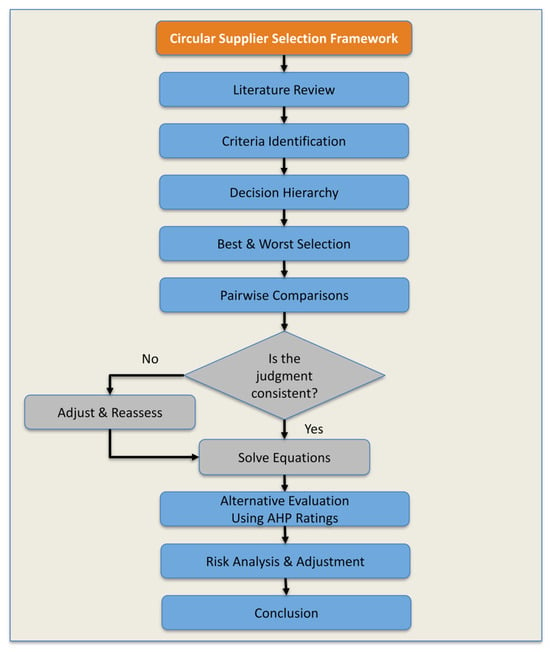
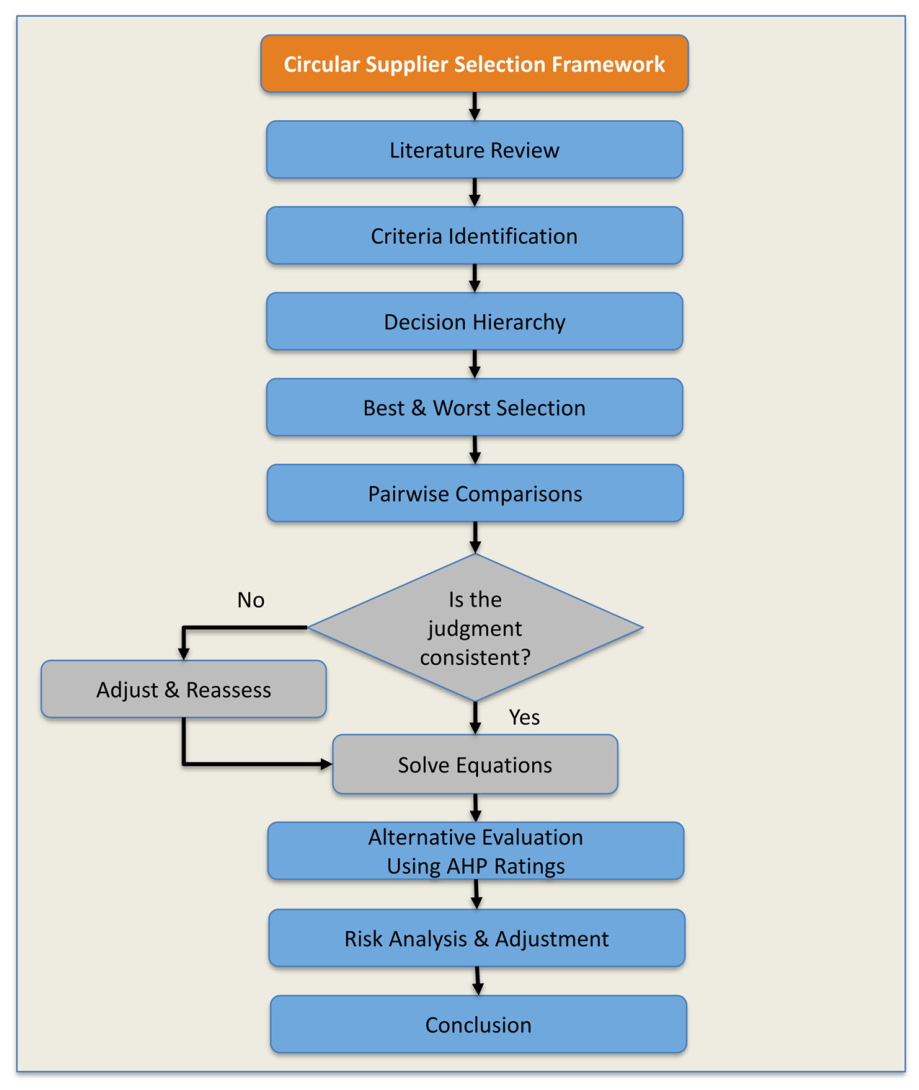
The core methodological architecture sustaining our proposed CSS framework is detailed here. To support CSS under conditions of multiple, interrelated, and potentially conflicting evaluation criteria, an MCDM approach is adopted. The proposed CSS framework combines the BWM, the AHP ratings, and a risk assessment phase within a sequential and complementary structure (Figure 1). Importantly, while this multi-tiered architecture introduces distinct parameters, its sequential layout is specifically engineered to control and minimize human cognitive bias. By converting qualitative expert insights into standardized, mathematically checked matrices, the framework replaces arbitrary corporate selection processes with an auditable and objective decision-making protocol.
Figure 1.
Proposed CSS framework. Flowchart of the CSS framework, starting in orange, progressing through blue stages, and featuring a gray decision point.
Figure 1 illustrates how the relevant criteria for CSS were retrieved from the literature review in Section 2.2. Through this systematic identification, nine specific operational criteria were established: closed-loop supply chain integration (CL), compliance and quality assurance (QA), cost and economic efficiency (EC), digitalization and clean technology for circularity (DT), employee rights and fair labor practices (FL), end-of-life product management (EL), logistics performance for circular operations (LP), material efficiency and circular use (ME), and waste management and process efficiency (WM).
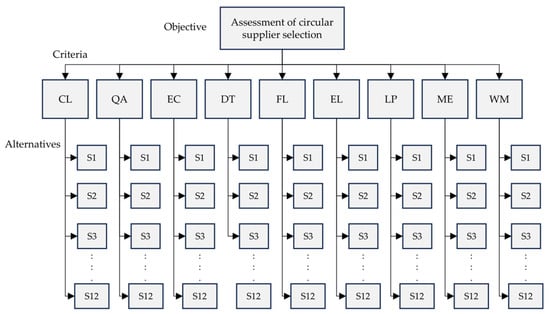
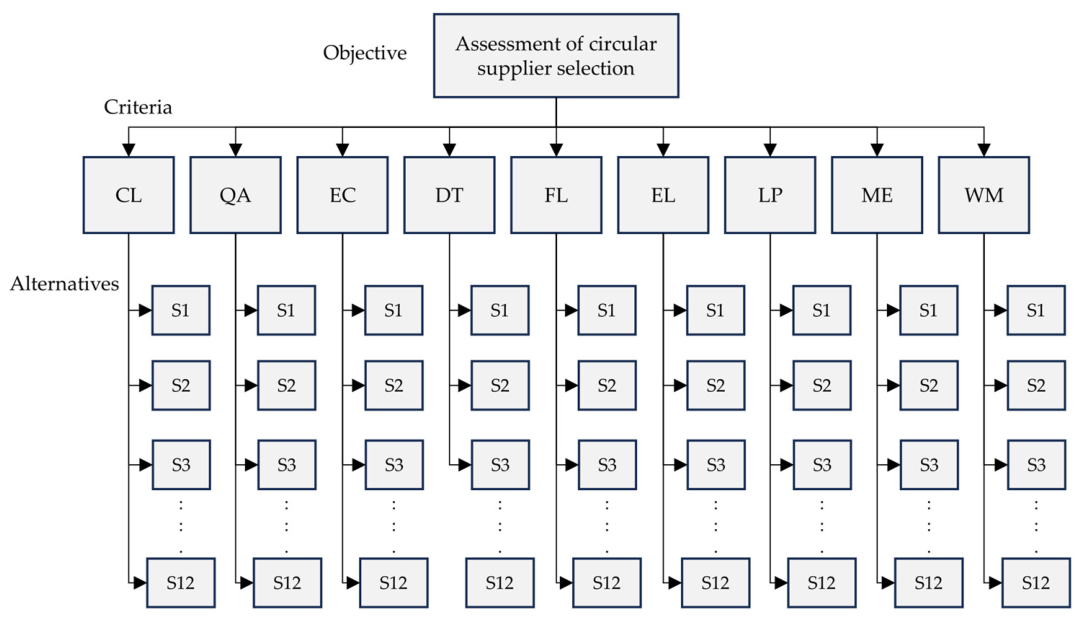
Accordingly, this set of parameters establishes the foundational pillar for structuring the hierarchical decision problem. The suppliers are evaluated as key alternatives within the decision framework (Figure 2), where twelve specific candidates (S1 to S12) were identified. The selection of this supplier base is justified by the company’s supply chain strategy, which emphasizes a balanced allocation of suppliers per product to enhance management efficiency, ensure reliable quality assurance, and foster resilient partnerships. Nevertheless, the proposed methodology can be applied to a broader supplier base without any structural limitation regarding the number of alternatives.
Figure 2.
Decision structure for assessing CSS. Showing the objective at the top, criteria in the middle, and supplier alternatives below.
Figure 2 illustrates the hierarchical decision structure for assessing CSS. The purpose of this hierarchy is to decompose the overall objective of CSC into relevant criteria and, subsequently, into supplier alternatives. Such hierarchical arrangements are necessary because they provide a systematic view of the problem, organize the evaluation into comparable levels, and enable the prioritization process through BWM and AHP. As Saaty [49] highlights, hierarchies are designed to capture the relationships among objectives, criteria, and alternatives, allowing decision makers to synthesize priorities consistently across levels. In this study, the hierarchy clarifies how CE dimensions are conceptually integrated into the supplier evaluation framework.
Addressed through the BWM, the best-to-worst identification and pairwise comparisons are conducted at the criteria level. A primary justification for choosing the BWM lies in its proven mathematical capability in managing CSS procedures while reducing cognitive bias. While approaches such as TOPSIS and ELECTRE function well for sequencing or sorting candidates, they face operational bottlenecks related to accurate digital values or comprehensive scaling techniques. Considering the complexity of innovative CSS, which encompasses assessing operational capability alongside collaborative willingness, BWM mitigates cognitive workload by securing logical consistency while streamlining the required pairwise comparisons. BWM is implemented according to the sequential process established by [57,58]:
- A.
- Identify the criteria as the decision set .
- B.
- Select the top-performing parameter (Best) alongside the lowest-priority option (Worst) within the designated set.
- C.
- Establish preference scores for each criterion combination via a 1–9 scale. The resulting Best-to-Other matrix profile is formulated as the vector , in which each element reflects the comparative priority of the most critical criterion over the remaining elements j.
- D.
- The Others-to-Worst relationships are formulated via the vector , where the superscript T signifies the vector transposition.
- E.
- Calculate the target vector of optimal weights .
- F.
- Verify the results through a consistency assessment. The consistency ratio (CR) evaluates the reliability of the derived BWM weights and is calculated using Equation (1). This metric depends on the optimal consistency indicator which reflects the maximum comparison deviation, alongside the specific consistency index (CI).
Based on the foundational BWM literature [57,59], the reference CI values for the 1–9 scale span from 0 up to 5.53. Adhering to these benchmarks confirms the logical soundness and reliability of the resulting weight vector before proceeding to the AHP stage. In practice, the participating experts identified the Best and Worst criteria, and consistency was checked using the CR index.
The major architectural contribution of this CSS framework lies in integrating performance ratings, derived from the theory of the AHP, into the BWM-based framework. This integration distinguishes the proposed framework from traditional applications of BWM, where structured performance scaling for alternatives is not explicitly incorporated. Each alternative is assessed against the BWM-derived criteria weights using the operational performance calculation presented in Equation (2):
where
where represents the normalized weight assigned to each criterion , subject to the constraint that . quantifies the efficiency rating of each individual supplier across criterion . These values, adapted from [60], range from poor to excellent and represent a standardized operationalization of the AHP Absolute Measurement (Ratings approach) established by Saaty [49]. Rather than arbitrarily assigning weights to this performance scale, these values were rigorously computed in [60] using an AHP pairwise comparison matrix, where judgments were mathematically validated for consistency (Consistency Ratio, ). To better reflect practical supply chain operations where an active supplier rarely exhibits absolute zero efficiency, the lower bound was adjusted from the original 0.00 to an operational floor of 0.10. Since all weights and performance levels are bound within [0, 1], the resulting performance score also lies in the range . Therefore, the resulting vector represents a mathematically grounded scale, allowing alternatives in this current framework to be graded directly without requiring new consistency checks.
Building upon the CSS framework, a comprehensive risk assessment was conducted through expert evaluations of probability and operational impact [61]. To capture the core vulnerabilities of sustainable supply chain, three distinct categories of risk were integrated: environmental [62,63], financial [64,65], and operational [66,67,68].
The underlying numerical anchor values were determined collectively, ensuring transparency and balance in the assessment of risk severity. Following the established matrix framework in [61], both probability and operational impact are operationalized through a 5-point scale, ranging from very low (1), low (2), average (3), high (4), to very high (5). Consequently, Equation (3) demonstrates how the initial raw risk score is derived for each alternative across every category by calculating the product of the assigned probability and impact values:
Following this calculation, Equation (4) illustrates the normalization process, where each raw risk score is scaled against the maximum observed score within the sample to guarantee complete data commensurability:
Finally, Equation (5) integrates the overall performance indices (previously derived from the integrated BWM weights and AHP ratings) with the normalized risk scores, applying a mathematical adjustment to derive the unified prioritization ranking:
where:
- Overall score: reflects outcome.
- Normalized risk score: represents the risk value rescaled within the strict interval bounds of 0 and 1, thereby avoiding mathematical bias during integration.
- α: denotes the corrective sensitivity term applied to regulate the intensity of the risk exposure effect, commonly defined within industrial settings as 0.05 or 0.10. In this study’s numerical application, a value of α = 0.10 was explicitly chosen and applied to reflect the desired empirical sensitivity to risk variance.
This multi-tiered framework ensures a systematic appraisal of alternatives aligned with targeted circularity objectives. By deploying the BWM, decision-makers can systematically quantify criteria importance levels, establishing a rigorous baseline for the comprehensive analysis of CSC practices. The empirical findings derived from this integrated methodology are presented and critically examined in the subsequent sections.
Empirical case studies underscore that multi-criteria frameworks are indispensable for tackling interlocking operational and environmental challenges within CSC. The empirical focus of this research centers on a leading multinational enterprise within the chemical manufacturing sector, which holds a dominant market share as a solution provider across Latin America.
To construct the MCDM framework, a targeted selection strategy was utilized to engage fifteen experts in supply chain operations and industrial sustainability. These experts each bring more than a decade and a half of industrial expertise within the chemical manufacturing sector and allied industries across the Americas. These experts hold varied academic degrees spanning production engineering, business administration, environmental management, and related scientific fields. The qualification process prioritized senior corporate roles, advanced academic expertise, and territorial dispersion, thereby enriching the analytical viewpoint and ensuring a comprehensive representation.
The data collection followed a process to preserve decision integrity. This process was operationalized through an interactive session with the experts, utilizing a standardized digital spreadsheet that bounded the comparison scales (1–9 for BWM and 1–5 for risk parameters). To maintain a systematic procedure during the discussion rounds, the interaction was focused exclusively on aligning the conceptual definitions of the criteria, followed by a group decision process where the final judgments were reached through consensus to eliminate conformity bias. This consistent population of experts from the same industrial sector, operating under this systematic procedure, ensured stability and reliability across both the weighting and ranking stages of the CSS framework.
Furthermore, the rationale for the designated sample size is rooted in the principles of multi-criteria decision analysis. Rather than relying on extensive, statistically generalized populations, these methodologies prioritize the depth of domain knowledge, qualified judgments, and the specialized experience of the chosen group of experts [69,70,71]. This interactive elicitation process successfully ensured consistency and coherence among judgments while maintaining complete transparency and strict methodological rigor [72].
4. CSS Framework Deployment Results
Based on the group decision process established in the methodology, the framework was operationalized to evaluate the circular sustainability criteria. Based on the criteria indicated in Table 1, the expert group formulated the specific pairwise judgments detailed in Table 2. To address any minor cognitive divergences or conflicting viewpoints during the evaluation, the consensus-driven process allowed for debate until a mutual convergence was achieved, ensuring that the final data reflected a unified agreement.
Through this collaborative process, the experts selected material efficiency and circular material (ME) as the best criterion, recognizing it as the fundamental cornerstone of the CSC approach. Prioritizing material efficiency actively drives waste reduction, sustainable resource management, and cleaner production integration. Furthermore, this core metric indicates how effectively an organization minimizes the use of primary resources, enhances recyclability performance, and fosters product innovation aligned with circular principles. As a result, establishing ME as the primary benchmark is essential to simultaneously advance environmental sustainability and operational productivity in the context of CSC. Define to denote the relative weights calculated for each respective criterion detailed in Table 2:
Table 2.
Criterion Evaluation.
The justification for choosing compliance and quality assurance (QA), considering that QA was designated as the worst criterion by the experts, as the least relevant in this context, is, in general, a basic prerequisite instead of contributing to a strategic advantage. All approved alternatives are expected to adhere to legal and quality standards, which reduces the relevance of QA in the context of circular initiatives. This best–worst comparison illustrates the symmetric structure of the BWM, where the relative weights of the remaining criteria are systematically determined through comparisons with the two anchor extremes.
This application uses detailed in Equations (6)–(10). In Equations (6)–(10), the optimization decision variables are the weights and the tolerance parameter . Equation (6) explicitly includes both under the minimization operator, ensuring clarity in the optimization formulation.
From the analysis of paired evaluations (ME to others):
From the analysis of paired evaluations (others to QA):
Normalization and non-negativity:
Upon executing the linear optimization model via a solver, the final criteria weights were generated. The resulting Consistency Ratio (CR) achieved a value of 0.167, remaining significantly below the admissible limit of 0.269 for a nine-criterion framework. This confirms that a high level of consistency was achieved across the individual evaluations provided by the experts (Table 3).
Table 3.
BWM criteria weights.
An analytical inspection of Table 3 reveals that material efficiency and circular use (ME) emerged as the primary core metric, capturing the highest prioritization weight of 0.221. This positioning underscores the strategic pressure within contemporary chemical networks to advance CSS contributions toward optimizing raw material consumption without compromising performance, validating the choice of ME as a fundamental driver to reduce primary resource reliance. Concurrently, closed-loop supply chain integration (CL) secured a second-place ranking, with an established weight of 0.164. This programmatic gap suggests that the long-term viability of material savings depends heavily on structured strategies aimed at keeping resources active via industrial remanufacturing, refurbishment, and cascading cycles within defined restorative supply networks.
Crucially, a numerical equilibrium occurred across three operational vectors, where an identical weight of 0.113 was equally distributed across cost and economic efficiency (EC), end-of-life product management (EL), and waste management and process efficiency (WM). From a management perspective, this identical distribution indicates that total acquisition expenses, including sustainability-driven adaptations (EC), are treated as equally critical to downstream take-back and remanufacturing initiatives (EL) and factory-floor lean manufacturing principles (WM). It signals that within the chemical sector, cost efficiency cannot be uncoupled from systemic product lifecycle extension and immediate process optimization aimed at minimizing inefficiencies.
Furthermore, the integration of social and technological dimensions uncovered distinct hierarchical tiers. Employee rights and fair labor practices (FL) commanded a weight of 0.102, outranking digitalization and clean technology for circularity (DT) at 0.076. This distribution validates that a commitment to upholding fundamental human rights and safe working conditions (FL) takes precedence over technological modernization via AI, IoT, or blockchain deployment (DT), establishing ethical labor as a non-negotiable layer for digital resource tracking. In parallel, logistics performance for circular operations (LP) at 0.057 and compliance and quality assurance (QA) at 0.040 were assigned the lowest priorities. As established during the qualitative baseline discussions, this position indicates that while mandatory quality management standards (QA) and dual forward-reverse infrastructure (LP) are operationally essential to ensure supply flows, they act merely as rigid prerequisites that offer negligible differentiation value for strategic circular positioning.
In summary, the synergy between material efficiency and circular use (ME) and closed-loop supply chain integration (CL) aligns with foundational principles of CE. This operational configuration directly supports Sustainable Development Goal (SDG) Target 12.5; the framework emphasizes the minimization of waste via proactive prevention, continuous reduction, systematic recycling, and open or closed-loop reuse. These findings strongly complement the research of [73] and reinforce how institutional targets translate directly into tactical purchasing decisions within the sustainable management literature.
Moving from criteria weights to alternative evaluation, the qualitative performance assessment was conducted during a dedicated expert session. The participants evaluated each alternative (S1 to S12) according to the predefined performance levels, ensuring comprehensive cross-criteria standardization. Table 4 and Table 5 display the consolidated expert assessments.
Table 4.
Qualitative performance.
Table 5.
Quantitative performance.
By integrating the criteria weights from Table 3 with the quantitative data detailed in Table 5, the final synthesis was achieved. Table 6 provides a summary of these resulting outcomes.
Table 6.
Weighted criteria matrix for the selected suppliers.
An analysis of the CSS highlights consistent contrasts across the nine circular sustainability criteria. Suppliers S1, S2, and S3 maintain distinct operational profiles that position them as the leading candidates within the CSS framework. Specifically, S1 demonstrates a well-balanced performance with pronounced strengths in material efficiency and circular use (ME) and employee rights and fair labor practices (FL). In contrast, S2 shows a performance advantage in closed-loop supply chain integration (CL) alongside stable values in compliance and quality assurance (QA) and cost and economic efficiency (EC). Crucially, S3 continues to stand out by delivering superior outcomes in both material efficiency and circular use (ME), end-of-life product management (EL), and waste management and process efficiency (WM), reinforcing its strategic orientation toward comprehensive product lifecycle optimization.
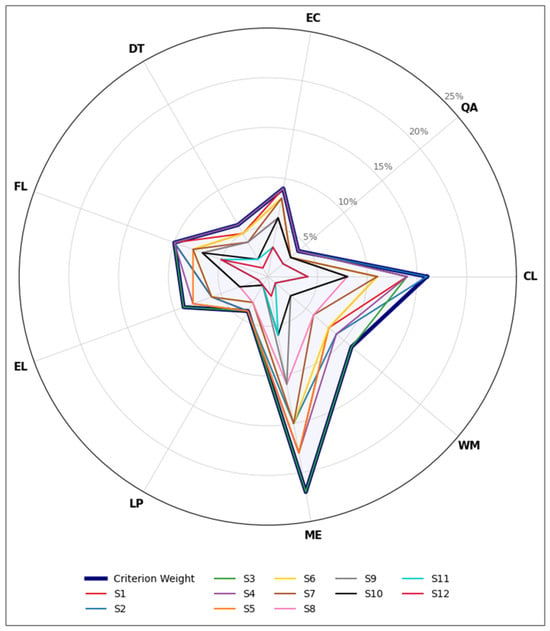
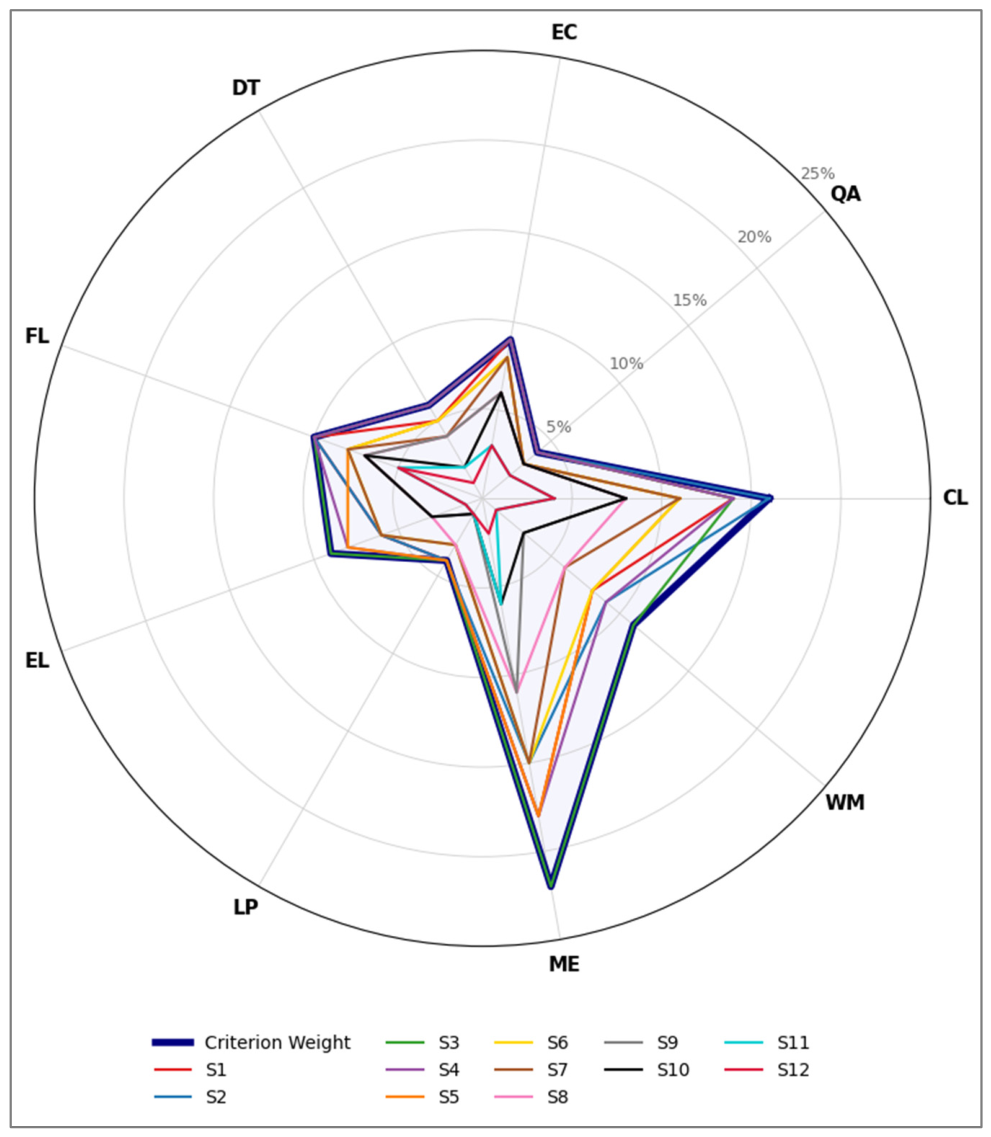
Beyond this top-tier cluster, alternatives S4 to S12 reveal a gradual decline in their operational performance profiles, particularly under the heavily weighted criteria of material efficiency and circular use (ME) and closed-loop supply chain integration (CL). While mid-range options such as S4 and S5 retain moderate, stable values across most dimensions, the subsequent alternatives (S9–S12) exhibit consistently lower performance, especially in logistics performance for circular operations (LP) and digitalization and clean technology for circularity (DT). This distribution suggests that the highest circular sustainability potential is tightly concentrated in the first triad of alternatives. Conversely, the trailing options demonstrate a lower level of technological readiness and infrastructure, resulting in limited alignment with the targeted CE priorities of the purchasing firm. The interrelated comparisons of criteria and alternatives are illustrated and visually mapped in Figure 3.
Figure 3.
Criteria and suppliers comparison. Radar chart showing multiple suppliers compared across criteria.
From a geometric perspective, the radar chart in Figure 3 visually operationalizes the strategic hierarchy derived from the BWM-AHP framework. The outer perimeter represents the maximum priority envelope established by the criterion weights, characterized by an asymmetric, elongated polygon with sharp outward vertices at ME and CL, and a pronounced inward contraction at QA. Geometrically, the performance profiles of the top-tier cluster (S1, S2, and S3) form expanded multidirectional webs that encompass a larger internal area by tracking the outer baseline closely. In particular, the green polygon of S3 projects clearly toward the ME–EL–WM axis, confirming its effective lifecycle optimization path. Conversely, a pronounced geometric compression is visible as the alternatives transition from mid-range candidates to the trailing group (S9–S12). The performance vectors of these latter alternatives collapse toward the central origin of the axis, forming a constricted, low-area polygon. This central convergence visually documents their lower capability to meet the high-weighted circular demands of material efficiency and closed-loop integration.
Building upon the spatial configurations mapped within the multidirectional webs of the radar chart, the qualitative judgments were mathematically synthesized to aggregate the final prioritization vector. The performance scores, calculated according to Equation (2) and based on the operational weights, show that alternative S3 achieved the highest result (0.90), demonstrating a more consistent set of outcomes in advanced sustainability implementation. It is followed by S4 (0.83), which exhibits steady performance, and S2 (0.80), which also reveals solid results across key dimensions (Table 7).
Table 7.
Final ranking and performance synthesis of the evaluated suppliers.
A deeper critical reflection on the numerical distributions in Table 7 reveals that the top-performing candidate, S3 (0.90), establishes a benchmark for circular maturity within the industry, driven by its systematic maximization of the highly weighted material efficiency (ME) and end-of-life parameters. Interestingly, the close positioning between S4 (0.83) and S2 (0.80) highlights two distinct paths to high performance: while S2 capitalizes on mature closed-loop supply chain integration (CL), S4 compensates through balanced, steady operational behaviors across economic and compliance vectors.
Slightly below this vanguard group, alternatives S1 (0.78) and S5 (0.73) form a second performance cluster, indicating acceptable but less integrated circular practices, particularly in criteria related to end-of-life management and digitalization. This intermediate tier indicates that while baseline operational capacity is present, these alternatives lack the systemic capabilities required to synchronize physical reverse flows with advanced circular objectives. Mid-ranked alternatives (S6 and S7) show moderate results, reflecting partial adoption of CSC practices and uneven performance across operational and environmental dimensions.
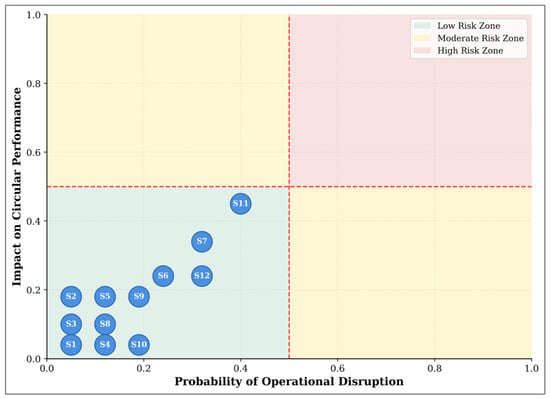
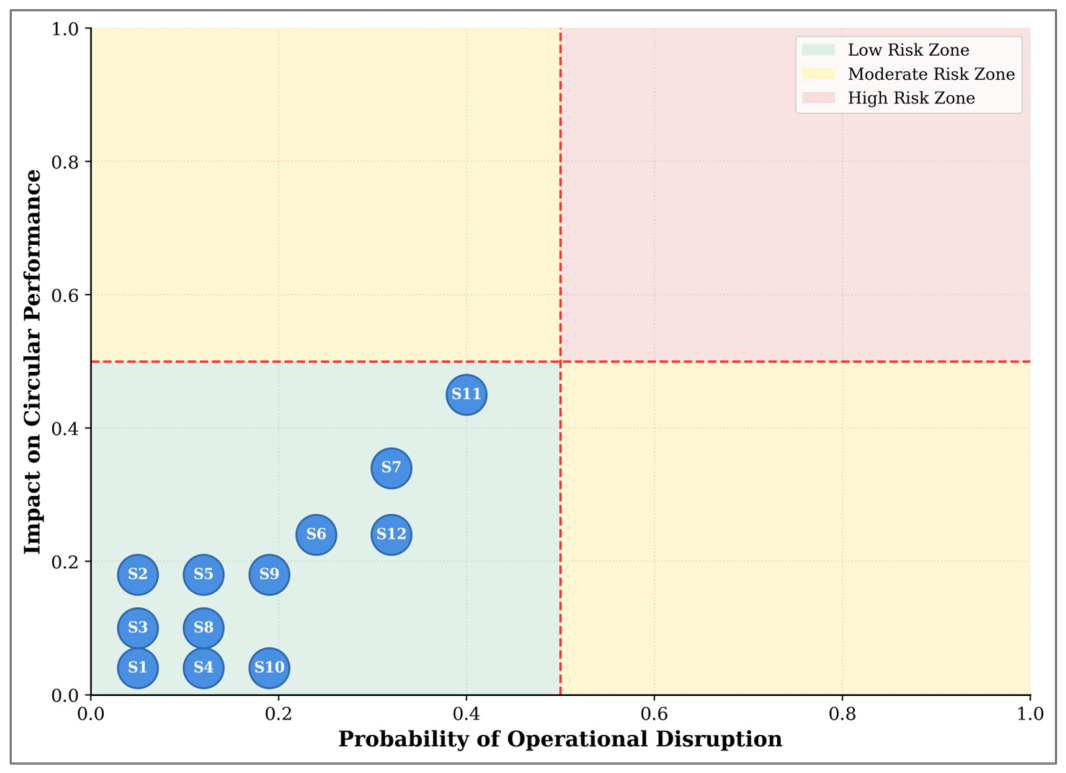
In contrast, the lower-ranked alternatives (S8 to S12) present limited circular maturity, with weaker scores in criteria associated with closed-loop integration, waste management, and clean technology adoption. The extreme drop-off visible in S11 (0.25) and S12 (0.20) isolates a critical structural threshold; these options represent severe operational risks if selected for long-term strategic circular partnerships due to their low performance in resource recovery. These results highlight the existence of significant performance gaps among the evaluated alternatives and reinforce the discriminatory capability of the proposed evaluation framework. Consequently, to ensure a resilient decision-making structure, this efficiency-based prioritization must be balanced against systemic vulnerabilities; hence, an independent risk assessment was conducted to evaluate the probability and operational impact associated with each alternative, with the final risk profiles visually mapped in Figure 4.
Figure 4.
Suppliers’ risk assessment matrix. Scatter plot showing supplier alternatives positioned according to probability of operational disruption and impact on circular performance, with green for low risk, yellow for moderate risk, and red for high risk zones.
Figure 4 presents the results of the risk assessment carried out for alternatives S1–S12, with values normalized on a continuous scale from 0 to 1. This visualization highlights the relative intensity of each alternative, where baseline options S1, S4, and S10 show the lowest risk parameters (0.03–0.08), while S11 stands out as the most critical case (0.40). The remaining alternatives are distributed across intermediate levels (0.12–0.32), allowing a clear view of different degrees of risk exposure within the CSS framework. Crucially, the concentration of the entire portfolio within the lower spectrum of the matrix provides valuable empirical insights into the organization’s supply chain strategy. This single-cluster distribution implies that the evaluated alternatives belong to a highly qualified, pre-selected corporate database that has already undergone rigorous baseline vetting. Furthermore, this low-vulnerability pattern directly confirms the firm’s strategic objective of achieving minimal risk exposure when configuring its circular supply network, ensuring that operational security is prioritized alongside sustainability goals. Table 8 presents the final ranking and risk-adjusted scores derived from integrating risk with the overall performance indices.
Table 8.
Ranking of suppliers.
Table 8 consolidates the evaluation framework by integrating the overall performance scores with the risk-adjusted values, resulting in the final ranking of alternatives. The outcomes confirm S3 (Adjusted Score = 0.89) as the top-performing option, followed by S4 (0.82) and A2 (0.79), which maintain strong positions even after risk adjustment. Alternatives S1 and S5 remain competitive in intermediate ranks (4 and 5), while S6 to S122 progressively decline, with S11 (0.24) and S12 (0.19) occupying the lowest positions. Critically, a comparative reflection between the raw performance and the adjusted scores reveals a structural consistency in the hierarchical prioritization. Because the pre-selected supply base inherently carries a compressed risk profile, the resulting mathematical penalties are marginal and successfully buffered by the strong operational and sustainability margins of the leading alternatives. This consolidated ranking demonstrates the robustness of the proposed CSS framework, ensuring that both performance and risk exposure.
While the risk-adjusted penalties are marginal in this specific application, this outcome validates the stability of the purchasing firm’s pre-qualified supplier base. Importantly, the mathematical architecture of the risk module (Equations (3)–(5)) is purposefully built to serve supply chain environments characterized by high volatility, disruption, and supplier variety. In markets with lesser vendor maturity or severe environmental and financial turbulence, the sensitivity term (α) is capable of introducing pronounced penalties. In such disruptive contexts, the framework is mathematically equipped to trigger significant shifts in the final rankings, preventing the selection of high-performing but highly vulnerable alternatives. As a result, the model provides both a safety check for stable baselines and a robust filtering mechanism for volatile sourcing networks.
5. Discussion
To advance CSS, this research introduces a structured multicriteria framework that leverages the BWM. By embedding CE principles directly into the selection protocol, this research bridges a critical gap in the literature, since conventional, cost-centric supply chain assessments frequently overlook these specific dimensions.
The novelty of the proposed framework lies in conceptually integrating closed-loop integration, end-of-life management, material efficiency, and waste management as interdependent pillars of CSC. Rather than treating them as isolated criteria, the framework embeds them into a unified multi-criteria structure where closed-loop strategies enable end-of-life recovery, material efficiency drives resource minimization, and waste management ensures systemic reuse. This conceptual integration ensures that supplier evaluation reflects circularity as a holistic system, advancing beyond traditional cost-centric or compliance-based assessments.
Methodologically, applying the BWM improves the elicitation phase by fundamentally changing the mechanics of data collection. Instead of forcing experts to complete a full, exhausting pairwise comparison matrix, the method structures the evaluation strictly around reference vectors derived from the most and least preferred criteria. Mathematically, this targeted procedure minimizes the volume of pairwise judgments, thereby mitigating decision fatigue and systematic bias. By simplifying the structural layout presented to the experts, the framework inherently minimizes random judgment variances and yields reliable consistency ratios, supporting the operational integrity of the collective industrial weights.
Regarding the key findings, the application of BWM highlighted the prominence of material efficiency and circular use (ME) and closed-loop supply chain integration (CL) as the key determinants in CSS. This outcome underscores a strategic paradigm shift within industrial networks; contemporary CSCs transcend raw cost-efficiency metrics and demand deep structural capabilities in resource recovery. The mathematical alignment of the weights demonstrates the viability of an evaluative architecture that embeds supplier evaluation firmly within the reduce–reuse–recycle–synergy framework of CE.
In terms of theoretical contributions, this paper enriches both the CSC domain and decision-making literature. It provides a replicable analytical framework based on BWM and performance levels capable of harmonizing disparate circularity-oriented theoretical approaches into a unified CSS framework.
From a managerial perspective, the developed CSS framework provides a practical tool for orchestrating sustainable supply networks. Instead of treating risk and performance as isolated metrics, this framework normalizes vulnerability parameters and blends them into a single, actionable priority index. To operationalize these findings within real-world purchasing operations, managers can deploy distinct, tailored action plans based on the three performance clusters identified in the CSS framework:
- Leading alternatives (S1–S5): These alternatives represent the strategic core of the circular network, exhibiting advanced lifecycle maturity and minimal risk exposure. Managers should secure long-term, high-volume contract commitments with this cluster. Actionable steps include establishing collaborative research and development (R&D) partnerships to co-design raw materials with higher circular yields and integrating digital resource-tracking systems (such as IoT or blockchain) directly with their closed-loop infrastructure to maximize real-time transparency.
- Mid-Ranked alternatives (S6–S7): This group exhibits acceptable baseline operations but suffers from uneven performance across environmental and digital dimensions. Managers should treat these alternatives as development candidates. Rather than diverting volume, the firm should implement structured supplier development programs. Practical actions include conducting joint industrial audits to identify waste bottlenecks and introducing technical training focused on lean manufacturing principles to gradually upscale their process efficiency.
- Lower-Ranked alternatives (S8–S12): These alternatives represent severe operational risks and significant circular deficiencies, positioning close toward the center of the risk matrix due to their lack of resource-recovery capabilities. Managers must enforce strict, non-negotiable corrective action plans (CAPs). The focal organization should freeze any volume expansions for these suppliers and set mandatory six-month deadlines for them to achieve foundational integrated management certifications in environmental management and quality assurance. Failure to meet these circular baselines should trigger systematic phase-out strategies.
The operational feasibility of these recommended actions lies in their direct alignment with established corporate workflows. Rather than requiring the firm to invent new governance mechanisms, the framework leverages existing, industry-standard supplier relationship management (SRM) tools, such as long-term contracts, joint R&D, Supplier Development Programs (SDPs), and Corrective Action Plans (CAPs). By allocating these standard tools based on the objective mathematical boundaries derived from the BWM-matrix approach, the CSS framework reduces subjective corporate bias. This strategic allocation ensures that capital and managerial effort are optimized, targeting intensive technological integration where performance is proven (S1–S5) and restricting enforcement to clear risk-containment thresholds (S8–S12). Consequently, these steps represent an immediately deployable roadmap for industrial practitioners looking to transition from traditional operations to high-performance CSC management.
6. Conclusions
This study successfully illustrates the application of a comprehensive multicriteria framework for CSS, bridging a critical operational gap by embedding multidirectional CE dimensions directly into supply chain management. The core utility of this CSS framework lies in its capacity to simultaneously assess operational capacities and systemic risk exposure, providing organizations with an empirically grounded and mathematically structured tool to navigate the complexities of sustainable sourcing.
This research presents specific limitations. While the underlying conceptual framework is broadly applicable across diverse industrial sectors, the empirical outcomes and priority rankings are restricted by the geographical boundaries of the empirical study and the unique insights of the participating decision-makers. Consequently, the results reflect localized industry characteristics, and applications in different regional or socio-economic environments will naturally yield distinct configurations.
Future research should expand this analytical lens by integrating alternative methodology tracks. First, comparative studies could be conducted to benchmark the proposed BWM–AHP–risk framework against standalone BWM applications and other established MCDM approaches, thereby highlighting its relative performance and added value. Second, deploying the Analytic Network Process (ANP) within the decision structure could more effectively capture the latent interdependencies and feedback loops among circular criteria, which traditional hierarchical frameworks treat as independent. Third, future studies could couple this static multicriteria assessment with dynamic quantitative simulation frameworks, integrating methodologies like System Dynamics or applying Agent-Based Modeling, to evaluate how supplier performance and risk profiles evolve over multi-year horizons. Overall, this study advances the operationalization of CSC, consolidating a replicable methodology within management science and engineering.
Author Contributions
Conceptualization, C.L.T., A.P. and V.A.P.S.; methodology, C.L.T., A.P. and V.A.P.S.; software, C.L.T.; validation, C.L.T., A.P. and V.A.P.S.; formal analysis, C.L.T., A.P. and V.A.P.S.; investigation, C.L.T., A.P. and V.A.P.S.; resources, C.L.T., A.P. and V.A.P.S.; data curation, C.L.T., A.P. and V.A.P.S.; writing—original draft preparation, C.L.T., A.P. and V.A.P.S.; writing—review and editing, C.L.T., A.P. and V.A.P.S.; visualization, C.L.T., A.P. and V.A.P.S.; supervision, C.L.T.; project administration, C.L.T.; funding acquisition, A.P. All authors have read and agreed to the published version of the manuscript.
Funding
This work was funded by the Conselho Nacional de Desenvolvimento Científico e Tecnológico (CNPq) grant number 303248/2025-4.
Institutional Review Board Statement
Ethical review and approval were waived for this study by Institution Committee due to Legal Regulations (In accordance with Resolution No. 510/2016 of the Brazilian National Health Council, Article 1, items I and V, this study is exempt from ethical review, as it involved anonymized and aggregated judgments from specialists without identifiable personal data. Available online: https://www.gov.br/conselho-nacional-de-saude/pt-br/atos-normativos/resolucoes/2016/resolucao-no-510.pdf/view (accessed on 22 June 2026).
Informed Consent Statement
Informed consent for participation was obtained from all subjects involved in the study.
Data Availability Statement
The original contributions presented in this study are included in the article. Further inquiries can be directed to the corresponding author.
Acknowledgments
The authors acknowledge the institutional support provided by the Pró-Reitoria de Pesquisa e Inovação (PRPI) of the Universidade de São Paulo, which contributed to this research.
Conflicts of Interest
The authors declare no conflicts of interest.
References
- Ahmad, W.N.K.W.; Rezaei, J.; Sadaghiani, S.; Tavasszy, L.A. Evaluation of the external forces affecting the sustainability of oil and gas supply chain using Best Worst Method. J. Clean. Prod. 2017, 153, 242–252. [Google Scholar] [CrossRef] [Scilit]
- Larkin, A. To End the Plastic Crisis, We Need New Business Models Based on Reuse. Reuters. 2025. Available online: https://www.reuters.com/sustainability/society-equity/end-plastic-crisis-we-need-new-business-models-based-reuse-2025-05-01/ (accessed on 1 June 2026).
- SCMR Staff. High Hopes for the Circular Economy to Add to Corporate Profits. Supply Chain Management Review. 2022. Available online: https://www.scmr.com/article/high_hopes_for_the_circular_economy_to_add_to_corporate_profits (accessed on 1 June 2026).
- Ellen MacArthur Foundation. Building a Circular Supply Chain; Ellen MacArthur Foundation: Cowes, UK, 2023; Available online: https://www.ellenmacarthurfoundation.org/circular-supply-chains (accessed on 1 June 2026).
- Kaya, S.K. A novel two-phase group decision-making model for circular supplier selection under picture fuzzy environment. Environ. Sci. Pollut. Res. 2023, 30, 34135–34157. [Google Scholar] [CrossRef] [Scilit] [PubMed]
- Mina, H.; Kannan, D.; Gholami-Zanjani, S.M.; Biuki, M. Transition towards circular supplier selection in petrochemical industry: A hybrid approach to achieve sustainable development goals. J. Clean. Prod. 2021, 286, 125273. [Google Scholar] [CrossRef] [Scilit]
- Nasr, A.K.; Tavana, M.; Alavi, B.; Mina, H. A novel fuzzy multi-objective circular supplier selection and order allocation model for sustainable closed-loop supply chains. J. Clean. Prod. 2021, 287, 124994. [Google Scholar] [CrossRef] [Scilit]
- Perçin, S. Circular supplier selection using interval-valued intuitionistic fuzzy sets. Environ. Dev. Sustain. 2022, 24, 5551–5581. [Google Scholar] [CrossRef] [Scilit]
- Alavi, B.; Tavana, M.; Mina, H. A dynamic decision support system for sustainable supplier selection in circular economy. Sustain. Prod. Consum. 2021, 27, 905–920. [Google Scholar] [CrossRef] [Scilit]
- Ali, H.; Zhang, J.; Shoaib, M. A hybrid approach for sustainable-circular supplier selection based on industry 4.0 framework to make the supply chain smart and eco-friendly. Environ. Dev. Sustain. 2024, 26, 22587–22624. [Google Scholar] [CrossRef] [Scilit]
- Dorfeshan, Y.; Jolai, F.; Mousavi, S.M. Sustainable circular supplier evaluation in project-driven supply chains with a fuzzy stochastic decision model under uncertainty. Appl. Soft Comput. 2025, 179, 113370. [Google Scholar] [CrossRef] [Scilit]
- Echefaj, K.; Charkaoui, A.; Cherrafi, A.; Garza-Reyes, J.A.; Khan, S.A.R.; Chaouni Benabdellah, A. Sustainable and resilient supplier selection in the context of circular economy: An ontology-based model. Manag. Environ. Qual. 2023, 34, 1461–1489. [Google Scholar] [CrossRef] [Scilit]
- Gupta, A.K.; Shaikh, I. Sustainable supplier selection criteria for HVAC manufacturing firms: A multi-dimensional perspective using the Delphi–fuzzy AHP method. Logistics 2024, 8, 103. [Google Scholar] [CrossRef] [Scilit]
- Kannan, D.; Mina, H.; Nosrati-Abarghooee, S.; Khosrojerdi, G. Sustainable circular supplier selection: A novel hybrid approach. Sci. Total Environ. 2020, 722, 137936. [Google Scholar] [CrossRef] [Scilit] [PubMed]
- Kusi-Sarpong, S.; Gupta, H.; Khan, S.A.; Chiappetta Jabbour, C.J.; Rehman, S.T.; Kusi-Sarpong, H. Sustainable supplier selection based on industry 4.0 initiatives within the context of circular economy implementation in supply chain operations. Prod. Plan. Control 2023, 34, 999–1019. [Google Scholar] [CrossRef] [Scilit]
- Liu, C.; Rani, P.; Pachori, K. Sustainable circular supplier selection and evaluation in the manufacturing sector using Pythagorean fuzzy EDAS approach. J. Enterp. Inf. Manag. 2022, 35, 1040–1066. [Google Scholar] [CrossRef] [Scilit]
- Nayeri, S.; Sazvar, Z. Sustainable evaluation of the raw material providers based on Industry 5.0 and circular economy aspects: A new stochastic method. OPSEARCH 2025, 63, 134–163. [Google Scholar] [CrossRef] [Scilit]
- Wang, H. Sustainable circular supplier selection in the power battery industry using a linguistic T-spherical fuzzy MAGDM model based on the improved ARAS method. Sustainability 2022, 14, 7816. [Google Scholar] [CrossRef] [Scilit]
- Haleem, A.; Khan, S.; Luthra, S.; Varshney, H.; Alam, M.; Khan, M.I. Supplier evaluation in the context of circular economy: A forward step for resilient business and environment concern. Bus. Strat. Environ. 2021, 30, 2119–2146. [Google Scholar] [CrossRef] [Scilit]
- Wang, C.H.; Ali, M.H.; Chen, K.S.; Negash, Y.T.; Tseng, M.L.; Tan, R.R. Data driven supplier selection as a circular economy enabler: A Taguchi capability index for manufactured products with asymmetric tolerances. Adv. Eng. Inform. 2021, 47, 101249. [Google Scholar] [CrossRef] [Scilit]
- Rukhsar, M.; Hussain, A.; Ullah, K.; Moslem, S.; Senapati, T. Intelligent decision analysis for green supplier selection with multiple attributes using circular intuitionistic fuzzy information aggregation and frank triangular norms. Energy Rep. 2025, 13, 5773–5791. [Google Scholar] [CrossRef] [Scilit]
- Nayeri, S.; Sazvar, Z.; Babaee Tirkolaee, E. Viable supplier selection problem based on Industry 5.0 and circular economy aspects: A hybrid decision-making approach. Int. J. Syst. Sci. Oper. Logist. 2025, 12, 2469117. [Google Scholar] [CrossRef] [Scilit]
- Sajadiyan, S.M.; Hosnavi, R.; Karbasian, M.; Abbasi, M. An approach for reliable circular supplier selection and circular closed-loop supply chain network design focusing on the collaborative costs, shortage, and circular criteria. Environ. Dev. Sustain. 2025, 27, 23415–23438. [Google Scholar] [CrossRef] [Scilit]
- Tramarico, C.L.; Da Silva, A.F.; Branco, J.E.H. Mapping decision-making structures in supply chain contexts: A fuzzy DEMATEL approach. Logistics 2025, 9, 76. [Google Scholar] [CrossRef] [Scilit]
- Streimikiene, D.; Bathaei, A.; Streimikis, J. Enhancing sustainable global supply chain performance: A multi-criteria decision-making-based approach to Industry 4.0 and AI integration. Sustainability 2025, 17, 4453. [Google Scholar] [CrossRef] [Scilit]
- Bai, C.; Zhu, Q.; Sarkis, J. Circular economy and circularity supplier selection: A fuzzy group decision approach. Int. J. Prod. Res. 2024, 62, 2307–2330. [Google Scholar] [CrossRef] [Scilit]
- Çakır, E.; Taş, M.A. Circular intuitionistic fuzzy decision making and its application. Expert Syst. Appl. 2023, 225, 120076. [Google Scholar] [CrossRef] [Scilit]
- Ecer, F.; Torkayesh, A.E. A stratified fuzzy decision-making approach for sustainable circular supplier selection. IEEE Trans. Eng. Manag. 2022, 71, 1130–1144. [Google Scholar] [CrossRef] [Scilit]
- Xie, Z.; Tian, G.; Tao, Y. A multi-criteria decision-making framework for sustainable supplier selection in the circular economy and Industry 4.0 era. Sustainability 2022, 14, 16809. [Google Scholar] [CrossRef] [Scilit]
- Zhang, X.; Li, Z.; Wang, Y. A review of the criteria and methods of reverse logistics supplier selection. Processes 2020, 8, 705. [Google Scholar] [CrossRef] [Scilit]
- Tsao, Y.C.; Balo, H.T.; Lee, C.K.H. Resilient and sustainable semiconductor supply chain network design under trade credit and uncertainty of supply and demand. Int. J. Prod. Econ. 2024, 274, 109318. [Google Scholar] [CrossRef] [Scilit]
- Ishizaka, A.; Khan, S.A.; Kheybari, S.; Zaman, S.I. Supplier selection in closed loop pharma supply chain: A novel BWM–GAIA framework. Ann. Oper. Res. 2023, 324, 13–36. [Google Scholar] [CrossRef] [Scilit]
- Tavana, M.; Sorooshian, S.; Mina, H. An integrated group fuzzy inference and best–worst method for supplier selection in intelligent circular supply chains. Ann. Oper. Res. 2024, 342, 803–844. [Google Scholar] [CrossRef] [Scilit]
- Tramarico, C.L.; Palominos, P.; Salomon, V.A.P. Enhancing circular supply chain implementation: Multi-criteria analysis with the analytic hierarchy process. In AI, Analytics and Strategic Decision Making; Ujwary-Gil, A., Florek-Paszkowska, A., Eds.; Routledge: Abingdon, UK, 2025. [Google Scholar] [CrossRef] [Scilit]
- Nath, S.D.; Mustayin, S.S.; Eweje, G. Circular economy in a developing country’s textile and apparel industry: Managerial perspectives on challenges and motivators. Bus. Strat. Environ. 2025, 34, 3600–3617. [Google Scholar] [CrossRef] [Scilit]
- Feng, J.; Liu, W.; Chen, F. Moving towards a circular economy: A systematic review of barriers to electric vehicle battery recycling. Sustain. Prod. Consum. 2025, 54, 241–260. [Google Scholar] [CrossRef] [Scilit]
- Luthra, S.; Mangla, S.K.; Shankar, R.; Garg, C.P.; Jakhar, S. Modelling critical success factors for sustainability initiatives in supply chains in Indian context using Grey-DEMATEL. Prod. Plan. Control 2018, 29, 705–728. [Google Scholar] [CrossRef] [Scilit]
- Petrudi, S.H.H.; Arabi, H.S. Barriers to product return in a circular supply chain: A case from a retailing industry. Ann. Oper. Res. 2025, 355, 1751–1785. [Google Scholar] [CrossRef] [Scilit]
- Akash, M.H.; Al Aziz, R.; Karmaker, C.L.; Bari, A.M.; Kabir, K.A.; Islam, A.R.M.T. Investigating the attributes for implementing circular economy in the textile manufacturing supply chain: Implications for the triple bottom line of sustainability. Sustain. Horiz. 2025, 14, 100129. [Google Scholar] [CrossRef] [Scilit]
- Kumar, P.; Bhamu, J.; Bhadu, J.; Saraswat, P. Exploring Industry 4.0 technologies for sustainable development goals: A systematic literature review. Int. J. Prod. Manag. Eng. 2025, 13, 27–44. [Google Scholar] [CrossRef] [Scilit]
- Primadasa, R.; Azzat, N.N.; Kusrini, E.; Mansur, A.; Masudin, I. Enhancing circular supply chain management (CSCM) in manufacturing SMEs: An integrated CODAS-ISM-MICMAC approach to big data analytics capability. Process Integr. Optim. Sustain. 2025, 9, 695–715. [Google Scholar] [CrossRef] [Scilit]
- Ghosh, S.; Raut, R.D.; Cheikhrouhou, N.; Bhowmik, C.; Ray, A. Paving the pathway: An entropy-based combined compromise solution approach to facilitate the Indian plastic industry’s transition toward a circular economy. Bus. Strat. Environ. 2025, 34, 5514–5543. [Google Scholar] [CrossRef] [Scilit]
- Sithi, S.S.; Ara, M.; Dhrubo, A.T.; Rony, A.H.; Shabur, M.A. Sustainable supplier selection in the textile industry using triple bottom line and SWARA-TOPSIS approaches. Discov. Sustain. 2025, 6, 344. [Google Scholar] [CrossRef] [Scilit]
- Tajally, A.; Vamarzani, M.Z.; Ghanavati-Nejad, M.; Zeynali, F.R.; Abbasian, M.; Bahengam, A. A hybrid machine learning-based decision-making model for viable supplier selection problem considering circular economy dimensions. Environ. Dev. Sustain. 2025, 1–33. [Google Scholar] [CrossRef] [Scilit]
- Mishra, A.R.; Rani, P.; Pamucar, D.; Saha, A. An integrated Pythagorean fuzzy fairly operator-based MARCOS method for solving the sustainable circular supplier selection problem. Ann. Oper. Res. 2024, 342, 523–564. [Google Scholar] [CrossRef] [Scilit]
- Rezaie, B.; Javadian, N.; Kazemi, M. The customer-based supplier selection and order allocation problem based on the waste management and resilience dimensions: A data-driven approach. Eng. Appl. Artif. Intell. 2025, 153, 110692. [Google Scholar] [CrossRef] [Scilit]
- Wang, J.; Jiang, W.; Huang, T.; Pedrycz, W. A large-scale supplier evaluation approach for circular economy in the presence of circular criteria interactions and weight consistency. Expert Syst. Appl. 2025, 261, 125500. [Google Scholar] [CrossRef] [Scilit]
- Hammond, J.S.; Keeney, R.L.; Raiffa, H. Smart Choices: A Practical Guide to Making Better Decisions; Harvard Business Review Press: Boston, MA, USA, 2015. [Google Scholar]
- Saaty, T.L. Fundamentals of Decision Making and Priority Theory with the Analytic Hierarchy Process; RWS Publications: Pittsburgh, PA, USA, 1994. [Google Scholar]
- Saaty, T.L. Theory and Applications of the Analytic Network Process: Decision Making with Benefits, Opportunities, Costs, and Risks; RWS Publications: Pittsburgh, PA, USA, 2005. [Google Scholar]
- Provensi, T.; Sehnem, S.; de Sousa Jabbour, A.B.L. Towards circularity in supply chains: The case of agtechs. Comput. Ind. Eng. 2025, 201, 110684. [Google Scholar] [CrossRef] [Scilit]
- Dayal, U.; Gupta, M.; Ghosh, D.; Wadhawan, D.; Morrow, A.; Horiguchi, S.; Kumar, A. Enabling product circularity through big data analytics and digitalization. In Proceedings of the IEEE 65th International Midwest Symposium on Circuits and Systems, Fukuoka, Japan, 7–10 August 2022; pp. 1–6. [Google Scholar] [CrossRef] [Scilit]
- Cicconi, P. Eco-design and eco-materials: An interactive and collaborative approach. Sustain. Mater. Technol. 2020, 23, e00135. [Google Scholar] [CrossRef] [Scilit]
- Castro-Lopez, A.; Entrialgo, M.; Liao, C.T.; Santos-Vijande, M.L. Towards circular economy through innovation: The role of entrepreneurial orientation and human resource management. Int. Entrep. Manag. J. 2025, 21, 36. [Google Scholar] [CrossRef] [Scilit]
- Singh, K.; Chaudhuri, R.; Chatterjee, S. Assessing the impact of digital transformation on green supply chain for achieving carbon neutrality and accelerating circular economy initiatives. Comput. Ind. Eng. 2025, 201, 110943. [Google Scholar] [CrossRef] [Scilit]
- Hasan, A.; Kausar, A.; Jaggi, C.K. Investigating the effect of circularity index on a closed loop supply chain with multi-shipment policy. J. Clean. Prod. 2024, 470, 143368. [Google Scholar] [CrossRef] [Scilit]
- Rezaei, J. Best-worst multi-criteria decision-making method. Omega 2015, 53, 49–57. [Google Scholar] [CrossRef] [Scilit]
- Kumar, P.; Singh, R.K.; Paul, J.; Sinha, O. Analyzing challenges for sustainable supply chain of electric vehicle batteries using a hybrid approach of Delphi and Best Worst Method. Resour. Conserv. Recycl. 2021, 175, 105879. [Google Scholar] [CrossRef] [Scilit]
- Yadav, G.; Mangla, S.K.; Luthra, S.; Jakhar, S. Hybrid BWM-ELECTRE-based decision framework for effective offshore outsourcing adoption: A case study. Int. J. Prod. Res. 2018, 56, 6259–6278. [Google Scholar] [CrossRef] [Scilit]
- Tramarico, C.L.; Karpak, B.; Salomon, V.A.P.; Silveira, C.A.M.D.; Marins, F.A.S. Multi-criteria analysis of professional education on supply chain management. Production 2019, 29, e20180087. [Google Scholar] [CrossRef] [Scilit]
- Tramarico, C.; Petrillo, A.; Andrade, H.; Salomon, V. Advancing circular supplier selection: Multi-criteria perspectives on risk and sustainability. Sustainability 2025, 17, 6814. [Google Scholar] [CrossRef] [Scilit]
- Afroozi, M.A.; Gramifar, M.; Hazratifar, B.; Jowkar, S.; Razavian, S.B.; Keshvari, M.M.; Bojnourdi, E.Z. Risk assessment in lithium-ion battery circular economy in sustainable supply chain in automotive industry using gray degree of possibility in game theory and MCDM. Front. Appl. Math. Stat. 2024, 10, 1362200. [Google Scholar] [CrossRef] [Scilit]
- Senna, P.; Marujo, L.G.; Santos, A.C.D.S.G.D.; Ferreira, A.C.; da Silva, L.A.A. E-waste supply chain risk management: A framework considering omnichannel and circular economy. Benchmarking Int. J. 2024, 31, 3429–3458. [Google Scholar] [CrossRef] [Scilit]
- Choudhary, D.; Kumar, A.; Gong, Y.; Papadopoulos, T. Examination of risks in circular supply chains using transition management lens: Towards a circular economy in emerging markets. J. Oper. Res. Soc. 2026, 77, 127–145. [Google Scholar] [CrossRef] [Scilit]
- Lahane, S.; Kant, R. Evaluation and ranking of solutions to mitigate circular supply chain risks. Sustain. Prod. Consum. 2021, 27, 753–773. [Google Scholar] [CrossRef] [Scilit]
- Park, Y.W.; Blackhurst, J.; Paul, C.; Scheibe, K.P. An analysis of the ripple effect for disruptions occurring in circular flows of a supply chain network. Int. J. Prod. Res. 2022, 60, 4693–4711. [Google Scholar] [CrossRef] [Scilit]
- Pellegrino, R.; Gaudenzi, B.; Fraccascia, L.; Genovese, A.; Basile, L.J. Can the adoption of circular economy practices foster supply chain resilience and performance improvements? Bus. Strat. Environ. 2025, 35, 438–457. [Google Scholar] [CrossRef] [Scilit]
- Simonetto, M.; Sgarbossa, F.; Battini, D.; Govindan, K. Closed loop supply chains 4.0: From risks to benefits through advanced technologies. A literature review and research agenda. Int. J. Prod. Econ. 2022, 253, 108582. [Google Scholar] [CrossRef] [Scilit]
- Gabus, A.; Fontela, E. Perceptions of the World Problematique: Communication Procedure, Communicating with Those Bearing Collective Responsibility; DEMATEL Report No. 1; Battelle Geneva Research Centre: Geneva, Switzerland, 1973. [Google Scholar]
- Si, S.L.; You, X.Y.; Liu, H.C.; Zhang, P. DEMATEL technique: A systematic review of the state-of-the-art literature on methodologies and applications. Math. Probl. Eng. 2018, 2018, 3696457. [Google Scholar] [CrossRef] [Scilit]
- Okoli, C.; Pawlowski, S.D. The Delphi method as a research tool: An example, design considerations and applications. Inf. Manag. 2004, 42, 15–29. [Google Scholar] [CrossRef] [Scilit]
- Falatoonitoosi, E.; Ahmed, S.; Sorooshian, S. Expanded DEMATEL for determining cause and effect group in bidirectional relations. Sci. World J. 2014, 2014, 103846. [Google Scholar] [CrossRef] [Scilit] [PubMed]
- Beccarello, M.; Di Foggia, G. Sustainable development goals data-driven local policy: Focus on SDG 11 and SDG 12. Adm. Sci. 2022, 12, 167. [Google Scholar] [CrossRef] [Scilit]

Disclaimer/Publisher’s Note: The statements, opinions and data contained in all publications are solely those of the individual author(s) and contributor(s) and not of MDPI and/or the editor(s). MDPI and/or the editor(s) disclaim responsibility for any injury to people or property resulting from any ideas, methods, instructions or products referred to in the content. |
© 2026 by the authors. Licensee MDPI, Basel, Switzerland. This article is an open access article distributed under the terms and conditions of the Creative Commons Attribution (CC BY) license.